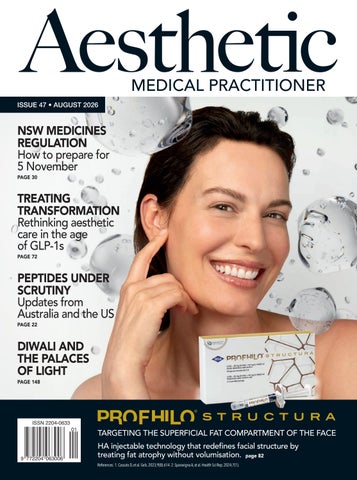
ISSUE 47 xx • JUNE AUGUST 2026 2026
NSW MEDICINES REGULATION How to prepare for 5 November PAGE 30
TREATING TRANSFORMATION Rethinking aesthetic care in the age of GLP-1s PAGE 72
PEPTIDES UNDER SCRUTINY Updates from Australia and the US PAGE 22
DIWALI AND THE PALACES OF LIGHT PAGE 148
ISSN 2204-0633
9 772204 063006
01
TARGETING THE SUPERFICIAL FAT COMPARTMENT OF THE FACE HA injectable technology that redefines facial structure by treating fat atrophy without volumisation. page 82 References: 1. Cassuto D, et al. Gels. 2023;9(8):614. 2. Sparavigna A, et al. Health Sci Rep. 2024;7(1).
PAGE XX
DESIGNED DIFFERENTLY FROM THE START
1-12
Since 1996, Restylane has been the pioneer in HA injectables, offering a premium product uniquely formulated with Galderma’s pure, high molecular weight HA.13–15 Restylane products integrate seamlessly, replenishing what is lost and supporting skin from within.1,5–12,16–27 References and Footnotes 1. Öhrlund Å et al. J Drugs Dermatol. 2024;23(1):1332–6. 2. Belmontesi M et al. J Drugs Dermatol. 2018;17(1):83–8. 3. Edsman K, et al. Dermatol Surg. 2012;38:1170– 79. 4. Micheels P, et al. J Drugs Dermatol. 2016;15(5):600–6. 5. Restylane® LYFT™. IFU. August 2023. 6. Restylane®. IFU. August 2023. 7. Restylane® KYSSE™. IFU. August 2020. 8. Restylane® SKINBOOSTERS™ Vital Lidocaine™. IFU. October 2022. 9. Restylane® SKINBOOSTERS™ Vital Light Lidocaine™. IFU. August 2021. 10. Restylane® REFYNE™. IFU. August 2020. 11. Restylane® DEFYNE™. IFU. August 2020. 12. Restylane® VOLYME™. IFU. August 2020. 13. Faivre J, et al. Exp Rev Med Devices. 2021;18(12):1175–1187. 14. Galderma. Data on file. MA-57232 [Updated]. 77 Million treated. 15. Verpaele A, Strand A. Aesthetic Surg J. 2006;26(Suppl.):S10–17. 16. Gregorio C, et al. Clin Cosmet Investig Dermatol. 2022;15:681–90. 17. Salih ARC, et al. Futur J Pharm Sci. 2024;10:63. 18. Weiner S, et al. Aesthetic Surg J. 2024; Manuscript in progress. 19. Hsieh DM, et al. Aesthet Surg J. 2023;43(5):595-608. 20. Avantaggiato A, et al. Aesthetic Plast Surg. 2015;39(4):459-64. 21. Allen J, et al. Cosmetics. 2024;11:54. 22. Landau M, Fagien S. Plast Reconstr Surg. 2015;136(Suppl 5):188S-195S. 23. Distante F, et al. Dermatol Surg. 2009;35(Suppl 1):389-394. 24. Peng JH, Peng PHL. Indian J Plast Surg. 2020;53(2):198–206. 25. Dovedytis M, et al. Eng Regen. 2020;1:102–13. 26. Arora G, et al. J Cosmet Dermatol. 2021;(8):2458–2462. 27. Laconsis GN, et al. Int J Mol Sci. 2023;24(12):10296. 28. Galderma. Data on file. MA-39680. 29. Galderma. Data on file. MA-55607. 30. Bertucci V, et al. J Drugs Dermatol. 2021;20(4):402–8. 31. Bertucci V, et al. J Cosmet Dermatol. 2021;20(5):1499– 504. 32. Nikolis A, et al. Dermatol Surg. 2021;47(5):e168–73. 33. Ref-20195. In Crowd Lip Filler Survey. US, Brazil, Germany and Thailand. 2024. 34. Huang SH, et al. J Drugs Dermatol. 2020;19:836–42. 35. Fagien S, et al. Plast Reconstr Surg. 2019;143(4):707e–720e. 36. Jones DH, et al. Dermatol Surg. 2020;46(4):465–72. 37. Wang X, et al. Plast Reconstr Surg. 2022;150(6):12251235. 38. Weiss R, et al. Dermatol Surg. 2016;42(6):699-709. 39. Nikolis A, et al. J Cosmet Dermatol. 2024;23(11):3525–31. 40. Molina B, et al. Dermatol Surg. 2015;41 Suppl 1:S325-S332. 41. Prendergast, Peter. Facial Proportions. 2012:15-22. 42. Wu Y, et al. J Cosmet Dermatol. 2020;19(7):1627–35. 43. Williams S, et al. J Cosmet Dermatol. 2009;8(3):216–25. 44. Gubanova EI, et al. J Drugs Dermatol. 2015;14(3):288–95. 45. Dierickx C, et al. Dermatol Surg. 2018;44 (Suppl 1):S10–8. 46. Kablik J, et al. Dermatol Surg. 2009;35(Suppl 1):302-312. 47. Galderma. Data on file (MA-67214). 48. Galderma. Data on file (MA-67212). 49. InCrowd Global Restylane and Hero SKU HCP perception Survey. 2024. 50. Solish N, et al. J Cosmet Dermatol. 2019;18(3):738–746. 51. Philipp-Dormston WG, et al. Dermatol Surg. 2018;44(6):826–832. 52. Andriopoulos B, et al. Poster presented at: AMWC, Monaco. 2019.
PROVEN. TRUSTED. STUDIED.
28,29
NATURAL-LOOKING EXPRESSION RESTYLANE KYSSE™
®
1
No. INJECTORS’
For natural-looking, kissable lips
LIFT & SUPPORT
THE L
1
BEST
No.
RESTYLANE LYFT™
I
P
F
R
7,30–32
S
CHOICE
O
UR
LI
IN
O
O
SELLER
®
HA PORTF
O
For natural-looking lift and facial harmony1,5,16,34–41
HEALTHY GLOW
1
No. INJECTORS’ H
SK
IN
Q UA LIT Y ENH
EN M
R
®
E
FO
RESTYLANE SKINBOOSTERS™
T
CHOICE
A
AN
C
For healthy, glowing skin8,9,23,42–48
100%
95%
99%
found the overall appearance of their face looked natural.50
had maintained or enhanced naturalness of their facial expressions after treatment.51
of those who received treatment would recommend it to a friend.52
UNMATCHED SAFETY AND TRUST Restylane’s safety and efficacy is backed by decades of data and real patient experiences.
CONTACT YOUR GALDERMA BDM TO FIND OUT MORE *Based on a survey with 471 healthcare professionals across US, Brazil, Thailand and Germany. Injectors were asked to select their preferred choice when treating the lips from a selection of HA injectables including Restylane® KYSSE™, Juvéderm® Ultra, Juvéderm® Ultra Plus, Juvéderm® Volbella®, RHA® 3, and Belotero® Lips. 33 t Based on FY 2024 global unit sales, Restylane Lyft is the most sold product within the Restylane portfolio. ‡ Based on a global survey with 367 HCPs across China, Brazil, Germany and Thailand49 Restylane, Class III medical device, is a gel containing hyaluronic acid 20 mg/mL and lidocaine 0.3% for injection into or below the skin to smooth facial wrinkles and enhance lips by restoring volume and fullness. Do not inject into blood vessels as this may lead to a lack of blood supply to the skin and ulceration and scarring. Do not use in patients with severe allergies manifested by a history of anaphylaxis or multiple severe allergies, or known hypersensitivity to lidocaine, amide-type local anaesthetics or streptococcal proteins. Restylane should not be used in or near sites where there are active skin disease, inflammation or infection, or where a permanent implant has been placed. Do not use in patients with bleeding disorders or in those who are taking thrombolytics or anticoagulants and caution when using in patients taking other medicines which prolong bleeding times. Use with caution in patients on immunosuppressive therapy or when treating facial areas with limited soft tissue support or cover such as the periorbital area. Treatment benefits are instant, do not affect facial expression and results usually last 6-12 months. Ongoing treatments are needed to maintain best results. After a Restylane treatment patients may experience some degree of redness, swelling, pain or tenderness, itching and/or bruising which may only last a few days. Post inflammatory pigmentation changes may occur after dermal filler injections in people with dark skin. Inflammatory reactions may occur up to two to four weeks after treatment in rare cases. Other rare adverse effects may include allergy, infection, granuloma formation, persistent discoloration at the injection site, and ulceration of the skin. Exposure to excessive sunlight or extreme cold should be avoided until redness or swelling has resolved. Use with caution before or after laser treatment or chemical peel. Restylane has not been tested in pregnant or breast feeding women. Before using Restylane, please review the full product information on dosage, contraindications, precautions, interactions and adverse effects, available at www.galderma.com/au/all-products. Unfunded in NZ. Product and treatment costs apply. AUS: Galderma Australia Pty Ltd, Level 18, 1 Denison St, North Sydney, NSW 2060, Australia. ABN 12 003 976 930. NZ: Galderma Australia Pty Ltd, 58 Richard Pearse Drive, Airport Oaks, Mangere 2022. NZBN 9429051812249. Distributed in NZ by Healthcare Logistics, 58 Richard Pearse Drive, Airport Oaks, Mangere 2022. Phone: 1800 144 944 (AUS), 0800 174 104 (NZ). Restylane, NASHA, and Galderma are registered trademarks of Galderma Holding S.A. AU-RES-2600016. July 2026.
WITH The first and only liquid neuromodulator designed with PEARL™ Technology1,3,6,7 Now available in New Zealand
BEFORE AND AFTER TREATMENT Real examples of patients treated with Relfydess for frown lines and crow’s feet.
FAST ACTING
SMILING
There’s no need to wait for natural-looking results. Up to 39% of patients saw effects from Day 1.*2,3,8
LONG-LASTING Sustained results for GLs and LCLs. Up to 75% of patients did not return to baseline at 6 months.†3,8
Baseline
Day 1
Month 1
Month 6
Relfydess: Lateral Canthal Lines; 3 x 0.1 mL (30U) (per side) Treated by Dr Steven Liew, Specialist Plastic Surgeon, Sydney
FROWNING
HIGHLY PURE, LIQUID FORMULATION Ready-to-use liquid optimised for simple volumetric dosing.3–5 Consistency and convenience; every vial, every time. Complexing protein-free, with no human- or animal-derived components.3–5
See page 134 for Product Information and references.
Baseline
Day 1
Month 1
Relfydess: Glabellar Lines; 5 x 0.1 mL (50U) Treated by Prof Greg Goodman, Dermatologist, Melbourne
Individual results may vary.
Month 6
PODCAST PERSPECTIVES
From skeptic to believer: Real practitioner experiences with
In this podcast episode, Dr John Delaney talks with Dr Edwina Morgan and Nurse Kate Vengetas about their real-world experiences with Relfydess. Edwina shares clinical insights from the experimental program and Australian launch, while Kate reveals how she went from skeptic to committed adopter. A dynamic, authentic, insider look at Relfydess in everyday practice.
“The quick onset of action, action, the natural feel, feel, the lack of that frozen heavy feeling…the feeling…the feedback was good.” *2,3,8
“I can hand on heart say that with time now, it has been an excellent integration into my clinic.” clinic.”
“It has everything included: quick onset of action, action, superior longevity, longevity, and it feels really natural.” natural.” *2,3,8
t 1, 2
“A liquid neuromodulator is fab from a consumables point of view as well, well, not just time.” ,1–5
“I do think it does have superior longevity ...I had done the background check with regards to clinic revenue and it is not affected. affected. I’ve had it for a year and it is just not an issue.”
“It does definitely take out a margin of error…it error…it removes that risk of medication error in clinic.”
“Conduct your own clinical trial… schedule one vial per patient and follow them up at 24 hours, three days, seven days and two weeks. weeks. Get their honest appraisal and see how they go.”
I feel like Relfydess has been a welcome addition to my clinic. Understand the product because you will love it. it. You just need to give it a chance.
t 1,2
DR EDWINA MORGAN
K AT E V E N G E TA S
Cosmetic Physician, Brisbane
Cosmetic Registered Nurse, Sydney
Listen to the full
podcast here
Please review the XEOMIN® Product Information before prescribing, available by scanning the QR code or by calling 1800 268 820.
This product is not listed on the PBS for upper facial lines. Please review Data Sheet before prescribing, available from the Medsafe website (https://medsafe.govt.nz) XEOMIN® (incobotulinumtoxinA). 50, 100 Units is a Prescription Medicine. Minimum Product Information: Indications: In adults, for the treatment of upper facial lines: glabellar frown lines, lateral periorbital lines (crow’s feet), horizontal forehead lines. See DS for full indications. Contraindications: Hypersensitivity to ingredients; generalised disorders of muscle activity (e.g. myasthenia gravis, Lambert-Eaton Syndrome); Infection or inflammation at the proposed injection sites. Precautions: bleeding disorders; local and distant spread of toxin effect; pre-existing neuromuscular disorders; hypersensitivity reactions; antibody formation; lack of interchangeability between botulinum toxin products; mild to severe dysphagia, aspiration and dyspnea; muscle weakness (neck); swallowing, speech or respiratory disorders; avoid injection near levator palpebrae superioris, inferior oblique and medial injections into the lower lid, pen marks, into blood vessels; ptosis; diplopia; reduced blinking; seizures; contains albumin (human); pregnancy (Cat B3); lactation; children (not recommended); driving/using machines; others, see full DS. Interactions with other medicines: Aminoglycoside antibiotics; anticoagulants or those with similar effect; other agents interfering with neuromuscular transmission, e.g., tubocurarine-type muscle relaxants. Adverse effects: Glabellar frown lines: headache, Mephisto sign; Lateral periorbital lines: injection site haematoma, eyelid oedema, dry eye; Upper facial lines: injection site haematoma, pain and erythema, heavy feeling of frontal area, eyelid ptosis, dry eye, headache, hypoaesthesia, brow ptosis, facial asymmetry, Mephisto sign, nausea; Others, see full DS for all indications. Dosage and Administration: For intramuscular injection, single use in one patient only. Unit doses recommended for Xeomin are not interchangeable with those for other preparations of botulinum toxin. Reconstitute with sodium chloride 9 mg/mL (0.9%) solution for injection (see full DS for dilutions). The optimum dose and number of injection sites in the treated muscle(s) should be individualised for each patient and determined by the treating doctor. Treatment intervals should be determined based on the actual clinical need of the individual patient. Glabellar frown lines: max 30 U/treatment session; generally no more frequent than every 3 months. Lateral periorbital lines: max 24 U/treatment session. Horizontal forehead lines: max 20 U/treatment session; see full DS for all indications. Last date of revision of the text: 16 Dec 2025 Xeomin is an unfunded medicine, a prescription charge will apply. Sponsor: Pharmacy Retailing NZ Limited t/a Healthcare Logistics (HCL). 58 Richard Pearse Drive, Mangere, Auckland 2022. References: 1. Frevert J. Drugs R D. 2010;10:67-73. 2. Kane MA, et al. Dermatol Surg. 2015 Nov;41(11):1310-9. 3. Prager W et al. Dermatol Surg 2010;36 Suppl 4:2155–2160 4. Dressler D et al. J Neural Transm (Vienna) 2018;125:1351–1354. 5. Rappl T, et al. Clin Cosmet Investig Dermatol. 2013;6:211-219. 6. Kerscher M et al. J Drugs Dermatol 2019; 18(1):52–57. 7. Kerscher M et al. Arch Dermatol Res. 2012;304(2):155-161. doi:10.1007/s00403-011-1179-z. 8. de Sanctis Pecora C. Clin Cosmet Investig Dermatol. 2020;13:127-136. 9. XEOMIN Product Information / Data Sheet. 10. Data on file. Merz Australia Pty Ltd. All rights reserved. (ACN: 151 073 559) Sydney, Australia. XEOMIN and the MERZ AESTHETICS logo are registered trademarks of Merz Pharma GmbH & Co. KGaA. Copyright ©2026. ANZ_XEO_AMP_6P_V2:APR26. Date of preparation: April 2026. TAPS: MR12618 For information about how Merz handles personal data, please see Merz General Data Protection Information Notice at www.merz.com/fin Australia: Merz Australia Pty Ltd (ACN 151 073 559), Suite 8.01A,189 O’Riordan St, Mascot NSW 2020. For more information please phone 1800 268 820. New Zealand: Pharmacy Retailing NZ Limited t/a Healthcare Logistics (HCL). 58 Richard Pearse Drive, Mangere, Auckland 2022. For more information please phone 0800 822 310.
S d
PURE* FOR A REASON THE PIONEER OF PURE TOXINS The first pure*150 kDa toxin and Leader of the pure* toxin movement1 *XEOMIN is free from complexing proteins1
2-5
PERFORMANCE 1,6
PURITY
7
PRECISION
8
PERSONALISATION 2,9
PRACTICALITY
l 10
PLANET
D M
Interested in learning more about XEOMIN®? Register now for MAX - Merz Aesthetics Exchange - an expert-led professional education platform.
SAY HI to NUCEIVA® is indicated for the temporary improvement in the appearance of moderate to severe glabellar lines in adult patients.1
DESIGNED FOR
PRECISION
2
This medicinal product is subject to additional monitoring in Australia. This will allow quick identification of new safety information. Healthcare professionals are asked to report any suspected adverse events at www.tga.gov.au/reporting-problems Please review the full Product Information before prescribing. Product Information is available by scanning the QR Code or by calling 1800 749 137. PBS Information: This product is not listed on the PBS. Evolus Australia Pty Ltd, North Sydney, NSW
IT’S ALL IN YOUR PRECISE TECHNIQUE
1
NUCEIVA® IS A PRECISE PRODUCT2
That requires precise intramuscular injection technique to target the correct glabellar muscles in order to achieve optimal clinical results.1
HIGH SATISFACTION IN 94.5% OF PATIENTS3 Percentage of patients with a positive response (improved/much improved) on the Global Aesthetic Improvement Scale (GAIS) by patient assessment (PA) by visit (Per Protocol population) on day 30. The percentages of responders on day 30 in each of the Nuceiva, Botox® and placebo groups were 94.5%, 93.4%, and 8.3%, respectively (p values not available). Most randomised patients (527/540, 97.6%) qualified for inclusion in the PP population.
EXPERTS AGREE4
Nuceiva® has a tight, precise field of effect. Botox is a registered trademark of Allergan Aesthetics, an AbbVie company
REFERENCES 1. NUCEIVA® Product Information 2. Daewoong Method for production of botulinum toxin. Accessed May 2024. https://patents.google.com/patent/US9512418B2/en 3. Rzany BJ, et al. Aesthet Surg J. 2020;40(4):413-429 4. Kaminer MS, et al. J Drugs Dermatol. 2020;19(4):s5-15
June 2025 | AU-P-2500050
Real Patien
BY
eal Patients, Real Results 1 Month Post 1 Treatment
Aesthetics
We’re the newest division of ParagonCare. As an industry leader, we’ve been anticipating what Australian and New Zealand healthcare needs next since 1918; young enough to see exactly where beauty is heading, established enough to get it right. And our innovative products are just the start: our partnerships provide what you need to make it work – from business support to training. Aesthetics & everything that builds your business. Model is for illustrative purposes only
Ready to build something bigger? Talk to us about what a ParagonCare Aesthetics partnership can do for you. aesthetics@paragoncare.com.au
Partnership Clinical Results Neck Tightening (VELOCE + Mesotherapy) (Courtesy of Dr. Yelda Kapicioglu)
Baseline
After 1 session
Sun-Damaged Scars & Freckles (Courtesy of Dr. Erol Koç)
Baseline
After 1 session
Nevus Flammeus (Courtesy of Dr. Yelda Kapicioğlu)
Baseline
After 1 session
Rosacea & Telangiectasias (Courtesy of Dr. Erol Koç)
Baseline
After 1 session
control you can feel. results you can see. elevating safety, quality & professional trust in microneedling.
CONFI DE N C E I N E V E RY TRE ATM E N T. GROW TH I N E V E RY A P P OI NTM E N T.
Built for precision and control, it features adjustable depth settings, six speed levels, and an upgraded digital interface for enhanced visibility during treatments.
The PRO Pen Microneedling System combines safety, efficacy, and 40 years of professional skin health expertise to deliver elevated results for both your clients and your clinic.
Expanded Display Interface
Larger, high-visibility screen for improved readability.
6 Speeds
From 6,300 to 7,700 RPM for customised treatments.
Optimised Power Management
Battery or cable operated to adjust to every environment, with 4-hour battery charge.
Enhanced Structural Integrity
Durable housing engineered for professional use.
Bring the Dermalogica Pro Pen Microneedling system into your business today and start bridging the gap between clinical results and patient trust.
Grip for Precision Contoured grip to help support accurate handing throughout treatment session.
Adjustable Depth Control Ring
Fine-tune needle penetration depth for customised treatment results.
This communication is intended for professional audiences only. Practitioners should refer to the device instructions for use, intended purpose information, and applicable regulatory guidance prior to use.Dermalogica Pty Ltd – PRO Pen Microneedling System – Electronic cosmetic micro-needling handpiece (ARTG 526922) + Dermalogica Pty Ltd – PRO Pen Microneedling System – Cosmetic micro-needle cartridge (ARTG 524693)
AD_HTM
New Aura 3D Imaging System The World’s First High-Intelligence 3D Imaging Platform Meet your digital twin Swiss-made and powered by Hexagon precision technology, Aura is a revolutionary 3D facial imaging system that captures a clinically accurate, photo-realistic digital twin of a patient’s face and neck in just 0.2 seconds. Within 30 seconds, Aura analyses facial structures, skin condition and volumetric changes to generate an immersive 3D model, transforming the consultation process.
Six Powerful Diagnostic Tools in a Single Capture. • Skin Analysis • Before & After Comparison • Facial Measurements • Volume Comparison & Vectors • Drawing & Dynamic Lighting • Advanced Treatment Simulation
13 integrated cameras. 0.1mm clinical accuracy. Swiss precision engineering.
“This imaging system has been the biggest breakthrough in aesthetic medicine over the past few years, more so than any other device for clinicians. The Aura is not an evolution but a revolution in clinical photography”.
Dr Davin Lim, Cutis Clinic
For more information, call 1300 309 233 or email info@hightechmedical.com.au www.hightechmedical.com.au
AD_HTM_AURA_AMP_FP.indd 1
Distributed by
HIGH TECH MEDICAL
15/7/2026 2:01 pm
NEWS 22 23 23 24 24 26 26
MEDICAL BOARD PREPARES PEPTIDE PRESCRIBING GUIDANCE FDA ADVISERS BACK SIX PEPTIDES DESPITE AGENCY OPPOSITION GLP-1 USE LINKED TO INCREASED HAIR LOSS RISK OBESITY DRUGS COMPARED ON WEIGHT LOSS AND WIDER HEALTH OUTCOMES REVISED CRIMINAL HISTORY STANDARD NOW IN EFFECT TWO HOURS OF STRENGTH TRAINING MAY BE LONGEVITY SWEET SPOT COFFEE MAY HELP SLOW AGEING: NEW STUDY
FEATURES 30
p30
NSW SETS NEW RULES FOR COSMETIC MEDICINES From 5 November 2026, NSW cosmetic clinics will operate under a more detailed regulatory framework for cosmetic use substances, with new requirements across prescribing, patient assessment, record keeping and clinical governance.
34
SYSTEMIC SYMPTOMS ASSOCIATED WITH BREAST IMPLANTS: WHERE THE EVIDENCE NOW STANDS Prof Anand Deva discusses the evidence around explant surgery, current research findings and the clinical duty to investigate, counsel and support patients over the long term.
40
THE EMERGING ‘COMPLEX PATIENT’ IN AESTHETIC MEDICINE From GLP-1 receptor agonists and unlicensed peptides to self-directed hormone therapy, Kate Monteith-Ross NP examines why the aesthetic consultation now needs to account for biological readiness.
72
p72
GLP-1S AND THE CHANGING AESTHETIC PATIENT GLP-1 medications have transformed medical weight loss, but the effects do not stop at the scales. Leading aesthetic practitioners from across the country weigh in.
148 DIWALI AND THE PALACES OF LIGHT With candlelit courtyards, flower-filled temples and lavish festive feasts, Diwali offers travellers an opportunity to experience India through one of its most important cultural celebrations.
p58 1 6
BEST PRACTICE 54
RECONSTITUTING BOTULINUM TOXIN: WHAT TO USE & WHY IT MATTERS Dr Giulia D’Anna explains why this routine step deserves closer clinical consideration.
58
WHY PATIENT RETENTION STARTS IN THE CONSULTATION ROOM
p148
A large Australian real-world analysis identifies structured consultation as a key driver of patient trust and retention.
58
WHY CLINICAL SKILL IS NOT ENOUGH An in-depth look at how Juv’ae’s clinical governance framework helps support consistent and accountable practice at every level.
64
ASPS RELEASES GUIDANCE FOR COSMETIC SURGERY MARKETING The Australian Society of Plastic Surgeons has issued a practical advertising guide for members, practice teams and agencies.
COLUMNS 50
ANATOMY FROM THE EXPERT A regular column from Prof Sebastian Cotofana, who shares his expertise on anatomical considerations for aesthetic procedures.
p34
EVENTS 68 136 138 140 142 144 146
GET TO KNOW THE COSMEDICON 2027 TEAM AESTHETICS 2026 SHINES IN SYDNEY NSS 2026 TAKES CENTRE STAGE JUV’AE COSMETIC COLLECTIVE 2026 TEOXANE RESTORE & REWIND ROADSHOW REDEFINING SKIN QUALITY WITH PARAGONCARE AESTHETICS REJURAN SUMMIT NZ 2026
PRODUCTS AND SERVICES 82
Read about the latest technologies, products and services available to make the modern aesthetic practice more successful.
p40 AE STH E TIC
M E D I CAL
P R ACTI TI ON E R
1 7
Great injectors aren’t enough. Great clinical governance is non-negotiable.
Behind every Juv’ae nurse is a multidisciplinary Clinical Governance Committee — reviewing evidence before new treatments are introduced, monitoring outcomes after they launch, and sharing every lesson learned across a network of 450+ cosmetic nurses. It’s why Juv’ae has spent 17 years setting the standard the rest of the industry is now required to meet.
17 YEARS
SUPPORTING AUSTRALIAN COSMETIC NURSES (EST. 2009).
450+ NURSE PARTNERS. A STANDING, MULTIDISCIPLINARY CLINICAL GOVERNANCE COMMITTEE NOT AN AFTER THE FACT POLICY.
You’re not just joining a network. You’re gaining a team that’s invested in your success. SCAN QR CODE TO BOOK A DISCOVERY CALL
AUSTRALIA’S MOST TRUSTED ECOSYSTEM FOR AESTHETIC PRACTITIONERS
JUVAE.COM.AU | 1300 255 913
3
LETTER FROM THE EDITOR
W
Natalie Phan
Karyssa Arendt
Debbie Pilarinos
elcome to the August issue of Aesthetic Medical Practitioner! If there is one thing that remains constant in this industry, it’s that it is in constant motion. New regulations, emerging science and a more biologically complex patient are placing greater demands on clinical judgement. In NSW, the incoming medicines regulation adds another layer of legal detail to expectations that already extend across prescribing, patient assessment, product handling, record keeping and clinical governance. The compliance landscape is becoming more interconnected, with every stage of the patient journey under closer scrutiny. Read our practical overview of what clinics and practitioners need to do before the regulation commences on 5 November (page 30). Peptides are another area attracting growing regulatory attention. We report on the Medical Board of Australia’s forthcoming guidance for doctors prescribing off-label, unapproved and compounded medicines amid concern about the rapid rise in their use, and look at the very different debate unfolding in the US (page 22). GLP-1 medicines, meanwhile, are changing the aesthetic patient in ways that extend well beyond rapid weight loss. Our feature brings together insights from doctors across Australia to examine changes in skin quality and soft tissue support, along with emerging research into adipose tissue biology. It also considers what these findings may mean for assessment and treatment planning as patients present with changes that do not always follow familiar patterns of ageing (page 72). The consultation itself is also being asked to do more. Kate MonteithRoss NP explores the rise of the ‘biologically complex patient’ (page 40), while Dr Andreas Fox’s recent research reinforces that the consultation remains one of the most important clinical tools (page 58). Prof Anand Deva also provides an important update on systemic symptoms associated with breast implants (page 34). While these symptoms remain difficult to define, they are no longer easy to dismiss. We examine current research, the evidence around explant surgery and the duty to investigate and counsel patients over the long term. Alongside our features, this issue brings you the latest technologies, products and clinical approaches influencing aesthetic practice, with expert insights from leading national and international practitioners. Finally, preparations for Cosmedicon 2027 are gathering pace. We are inviting clinicians, researchers and industry experts to submit abstracts for consideration in the scientific program. Join us as we celebrate the event’s milestone 10th anniversary! Head to cosmedicon.com.au/ getinvolved for more information. We hope you enjoy the issue. I’d love to hear your thoughts on the magazine and the issues affecting your practice, so please reach out to me at aimee.rodrigues@primecreative.com.au. Aimée Rodrigues
SUBSCRIBE TO THE AESTHETIC MEDICAL PRACTITIONER eNEWSLETTER
a e s t h e t i c m e d i c a l p r a c t i t i o n e r. c o m . a u 2 0
A E ST H E T I C
Published by:
379 Docklands Drive, Docklands VIC 3008 T: 03 9690 8766 www.primecreative.com.au Chairman John Murphy Chief Executive Officer Christine Clancy christine.clancy@primecreative.com.au Publisher Sarah Baker sarah.baker@primecreative.com.au Managing Editor Myles Hume myles.hume@primecreative.com.au Editor Aimée Rodrigues aimee.rodrigues@primecreative.com.au Business Development Manager Natalie Phan natalie.phan@primecreative.com.au Client Success Manager Karyssa Arendt karyssa.arendt@primecreative.com.au Head of Design Clayton Hawley Art Director Deborah Pilarinos Subscriptions T: 03 9690 8766 subscriptions@primecreative.com.au
The Publisher reserves the right to alter or omit any article or advertisement submitted and requires indemnity from the advertisers and contributors against damages or liabilities that arise from material published. © Copyright – No part of this publication can be reproduced, stored in a retrieval system or transmitted in any means electronic, mechanical, photocopying, recording or otherwise without the permission of the publisher.
All 'before and after' photographs in Aesthetic Medical Practitioner articles are of genuine patients. It is important to understand that they represent one person's experience and there is no guarantee that any other patient will experience similar results.
M E D I CA L
PR ACT IT IO NER
COTOFANA ACADEMY Start learning online today. Anytime, anywhere. Our anatomy courses are the result of years of dedicated anatomical and clinical research, enriched by Professor Sabastian Cotofana’s extensive experience in cadaveric dissection.
ONLINE COURSES
For more information visit cotofanaanatomy.com
NEWS
Image: Poungsaed-Studio/Shutterstock.com
MEDICAL BOARD PREPARES PEPTIDE PRESCRIBING GUIDANCE
The Medical Board of Australia is preparing new guidance for doctors prescribing off-label, unapproved and compounded medicines amid growing regulatory concern over the use of peptides. Announced in the Board’s July newsletter, the guidance will provide ‘clear focus, not new rules’ by reinforcing the professional obligations that already apply when prescribing medicines outside approved or established pathways. The Board pointed to a ‘massive uptick’ in the use of unapproved peptide products and raised concerns that strong consumer demand and commercial pressures may be influencing prescribing practices in parts of the wellness sector. ‘We’re concerned that high consumer demand for peptides is leading some practitioners 2 2
to side-step their professional responsibilities,’ the Board said. ‘Professional responsibilities don’t vanish in the face of patient demand and off-label prescribing should only follow a thorough clinical assessment.’ The forthcoming guidance will address the prescribing of off-label, unapproved and compounded therapeutic goods. Doctors will be reminded of their responsibilities to determine whether a medicine and the individual patient are suitable, obtain informed consent and properly document the consultation. The announcement follows increased compliance activity from the Therapeutic Goods Administration (TGA), which added unapproved peptide products to its priority compliance areas in June following greater detection of unlawful importation, advertising and supply. A E ST H E T I C
Regulatory concern is focused on unapproved products promoted for purposes including weight loss, anti-ageing, muscle growth, recovery and performance enhancement. These products may not have been assessed by the TGA for safety, quality or effectiveness. The TGA has warned of risks including contamination, incorrect labelling, uncertain dosing and substituted or unknown ingredients. Businesses, practitioners and suppliers involved in unlawful peptide activity may face warning letters, infringement notices, product seizures, civil penalties or criminal prosecution. A publication date for the Medical Board guidance has not yet been announced. Source: Medical Board of Australia M E D I CA L
PR ACT IT IO NER
NEWS
Image: everything possible/Shutterstock.com
GLP-1 USE LINKED TO INCREASED HAIR LOSS RISK
FDA advisers back six peptides despite agency opposition A US Food and Drug Administration (FDA) advisory committee has recommended six popular peptides for possible use in patientspecific pharmacy compounding, despite FDA scientists advising against the inclusion of all seven substances considered. The Pharmacy Compounding Advisory Committee voted to support BPC-157, KPV, TB-500, MOTS-c, Epitalon and Semax for inclusion on the Section 503A Bulk Drug Substances List during a twoday meeting in July. A seventh peptide, emideltide, also known as delta sleep-inducing peptide or DSIP, was rejected. The committee’s position differed from that of FDA staff, whose reviews identified limited human evidence, uncertain safety profiles and questions about the identity, quality and characterisation of some substances. Among its findings, the FDA reported no identified human exposure data for drug products containing KPV or MOTS-c, or for products containing the TB-500 fragment under review. For BPC157, Epitalon and Semax, it found the available safety information insufficient to determine whether compounded products could cause harm. AE STH E TIC
M E D I CAL
The committee’s recommendations are advisory and do not automatically add the six peptides to the 503A list. The FDA must consider the votes and undertake formal regulatory action before their status can change. The decision also does not constitute FDA approval or establish that the peptides are safe or effective. Compounded medicines do not undergo the same pre-market approval process as commercially manufactured drugs. The uses considered by the committee were narrower than many claims attached to peptides online. BPC-157, KPV and TB-500 were reviewed for inflammatory conditions or wound healing, while MOTS-c was considered for obesity and osteoporosis. Epitalon was assessed for insomnia and Semax for several neurological conditions. With consumer demand continuing to outpace the evidence base, regulators across the world are under growing pressure to determine where access, compounding and clinical innovation end, and the requirement for established safety, quality and efficacy begins. Source: US Food and Drug Administration
P R ACTI TI ON E R
GLP-1 receptor agonist use has been associated with a higher risk of hair loss in adults with type 2 diabetes, according to a large observational study published in The BMJ. Researchers analysed electronic health records to compare alopecia among patients beginning treatment with GLP-1 RAs, SGLT2 inhibitors or DPP-4 inhibitors between January 2019 and September 2024. GLP-1 RA users had a 37 percent higher relative risk of alopecia than those taking SGLT-2 inhibitors and a 68 percent higher risk than DPP-4 inhibitor users. However, the absolute differences were modest, equating to approximately two to three additional recorded cases for every 1,000 person-years of treatment. The association was strongest for non-scarring alopecia, in which the hair follicles remain intact. The researchers could not determine the severity or duration of hair loss, whether it was temporary or whether it resolved after treatment ceased. The study was not designed to establish why the association occurred. Rapid weight loss is a recognised trigger for increased hair shedding, while reduced food intake, nutritional deficiencies and hormonal or metabolic changes may also contribute. As an observational analysis, the study cannot establish that GLP-1 RAs directly cause hair loss. Its findings were also limited to patients with type 2 diabetes and may not apply to people using these medicines solely for weight management. The results nevertheless add more systematic evidence to a potential adverse effect previously identified through clinical trials, postmarketing reports and anecdotal observations. Source: The BMJ
2 3
NEWS
A major comparison of established and emerging obesity medicines has identified substantial differences in weight loss, adverse effects and broader health outcomes. Published in The BMJ, the systematic review and network meta-analysis compared 19 medicines across 262 randomised trials involving 99,791 adults with overweight or obesity. At one year, tirzepatide and the investigational cagrilintidesemaglutide combination CagriSema produced the greatest average reductions in body weight, at 14.9 percent and 14.8 percent respectively. Several emerging agents achieved similar results, although much of the evidence supporting newer medicines was considered low or very low certainty. The analysis also highlighted the importance of looking beyond total weight loss. Tirzepatide produced the greatest reduction in fat mass, at 25.7 percent, but was also associated with the largest reduction in lean mass, at 8.3 percent. The drugs producing the greatest weight loss did not necessarily have the strongest evidence for wider health benefits. Subcutaneous semaglutide was the only medicine associated with statistically significant reductions in all-cause mortality and myocardial infarction, while both semaglutide and tirzepatide reduced the risk of heart failure. Greater efficacy was generally accompanied by more adverse effects and treatment discontinuation, with gastrointestinal symptoms common across several medicines. Most agents also showed little or no clinically meaningful improvement in quality of life. Source: The BMJ
2 4
Image: Avocado_studio/Shutterstock.com
OBESITY DRUGS COMPARED ON WEIGHT LOSS AND WIDER HEALTH OUTCOMES
REVISED CRIMINAL HISTORY STANDARD NOW IN EFFECT A revised criminal history registration standard applying to registered health practitioners across Australia came into effect on 15 July 2026, providing clearer guidance on how National Boards assess criminal conduct. The standard applies across all regulated health professions, including medical practitioners and nurses working in aesthetic medicine. It is used to determine whether an applicant or practitioner’s criminal history is compatible with holding registration and practising safely. Disclosure obligations remain unchanged. Applicants must declare their full criminal history in Australia and overseas, including convictions, guilty pleas, findings of guilt without a recorded conviction and pending charges. This extends to spent or aged convictions that may not appear on an ordinary criminal record check. Registered practitioners must declare changes during annual renewal and notify Ahpra within seven days of becoming aware of certain events. These include charges for offences punishable by at least 12 months’ imprisonment and convictions or findings of guilt for offences punishable by imprisonment. Under the revised framework, the nature of an offence will be considered separately from its gravity. A E ST H E T I C
This allows Boards to look beyond the penalty imposed and assess what the conduct may indicate about a practitioner’s judgement, honesty, respect for regulation and potential risk to patients. Boards must consider 12 factors, including the relevance of the conduct to health practice, the time elapsed, the practitioner’s age at the time, rehabilitation, insight and the likelihood of future harm. The standard also expressly recognises the effects of racism and inequity on Aboriginal and Torres Strait Islander people’s contact with the criminal justice system. Criminal history does not automatically prevent registration. Depending on the circumstances, a Board may take no action, impose conditions, require education or supervision, or refuse an application or renewal. For practitioners making a declaration, the revised standard reinforces the importance of complete disclosure and supporting context. Court documents, professional references, evidence of rehabilitation and a clear account of the circumstances may all influence how a Board assesses any continuing risk. Source: Ahpra M E D I CA L
PR ACT IT IO NER
I A B
M t A
W p p P s a
T U is a o
T P A f v
Re Ve D J Te
Th as an TH be be
Co Lo
Fo
Au Fo
N Fo
F
INTRODUCING ANNA ROBARDS AS THE NEW ULTHERAPY PRIME® BRAND AMBASSADOR Merz Aesthetics is proud to announce that Anna Robards is the new Brand Ambassador for Ultherapy PRIME®.
To learn more about Ultherapy PRIME®, or to contact a Merz Aesthetics team member for an in-clinic demo, visit ultherapy.com.au
BEFORE
Through her partnership with Ultherapy PRIME®, Anna Robards is helping spark a conversation around confidence and ageing on your own terms.
AFTER 90 DAYS
With over 4 million treatments performed worldwide1 and a 95% patient satisfaction rate,2 Ultherapy PRIME® is recognised as the gold standard in non-invasive skin lifting and tightening.3-5
Representative example. Individual results may vary.
References: 1. Data on File. 2. Werschler WP, Werschler PS. Long-term Efficacy of Micro-focused Ultrasound with Visualization for Lifting and Tightening Lax Facial and Neck Skin Using a Customized Vectoring Treatment Method. J Clin Aesthet Dermatol. 2016 Feb;9(2):27-33. 3. Pavicic et al. Microfocused ultrasound with visualization: Consensus on safety and review of energy-based devices. J Cosmet Dermatol. 2022;21:636–647. 4. Fabi et al. Optimizing patient outcomes by customizing treatment with microfocused ultrasound with visualization: gold standard consensus guidelines from an expert panel. J Drugs Dermatol. 2019;18(5):426-432. 5. Park et al. Customized Treatment Using Microfocused Ultrasound with Visualization for Optimized Patient Outcomes: A Review of Skin-tightening Energy Technologies and a Pan-Asian Adaptation of the Expert Panel’s Gold Standard Consensus. J Clin Aesthet Dermatol 2021;14(5):E70-e79. The ULTHERA® System is intended to apply focused ultrasound energy to the body to achieve temporary changes in the physical appearance of the skin. The ULTHERA® System is indicated for use as a non-invasive dermatological aesthetic treatment to: lift the eyebrow; lift lax submental (beneath the chin) and neck tissue, which can also affect the appearance of lax tissue in the submental and neck regions; and improve lines and wrinkles of the décolleté. ULTHERAPY® should not be used by persons with open wounds, lesions, severe or cystic acne, or implants in the treated area. THIS PRODUCT IS NOT AVAILABLE FOR PURCHASE BY THE GENERAL PUBLIC. Always read the label and consult your Healthcare Professional for more information. This medical device must be administered by a Healthcare Professional or trained personnel under the supervision of a physician. If you are a Healthcare Professional, please review the ULTHERAPY® Instructions for Use before administering treatment, available by calling 1800 268 820. Copyright © 2026. Merz Australia Pty Ltd. All rights reserved. ULTHERA®, ULTHERAPY® and ULTHERAPY PRIME® are registered trademarks of Ulthera, Inc. MERZ AESTHETICS® and The MERZ AESTHETICS® Logo are registered trademarks of Merz Pharma GmbH & Co. KGaA. AU_ULT_ANNA_ROBARDS_AMP_V1_AUG2026. Date of preparation: August 2026. 13644MER. TAPS: MR13712 For information about how Merz handles personal data, please see Merz General Data Protection Information Notice at www.merz.com/fin. Australia: ULTHERAPY® is registered in the ARTG (AUST R 225194). Merz Australia Pty Ltd (ACN: 151 073 559). Suite 8.01A, 189 O’Riordan St, Mascot NSW 2020. For more information, please phone 1800 268 820. New Zealand: Pharmacy Retailing NZ Limited t/a Healthcare Logistics (HCL). 58 Richard Pearse Drive, Mangere, Auckland 2022. For more information, please phone 0800 822 310.
Find out more at ultherapy.com.au
NEWS
Just 90 to 120 minutes of strength training each week, particularly when combined with regular aerobic exercise, may offer the greatest reduction in longterm mortality risk, according to a large 30-year study published in the British Journal of Sports Medicine. Researchers analysed data from more than 147,000 adults in the US, tracking resistance training and aerobic activity over three decades. During the follow-up period, more than 35,000 deaths were recorded, allowing the researchers to examine associations between different exercise patterns and overall and cause-specific mortality. Compared with people who performed no strength training, those completing 90 to 120 minutes per week had a 13 percent lower risk of death from any cause, a 19 percent lower risk of cardiovascular mortality and a 27 percent lower risk of death from neurological disease.
Additional strength training beyond two hours per week did not appear to provide further mortality benefit. This suggests that consistency and a sustainable training volume may matter more than continually increasing time spent on resistance exercise. The strongest outcomes were in participants who combined strength training with aerobic exercise. Individuals who completed the recommended amount of aerobic activity (150 minutes of moderate or 75 minutes of vigorous activity per week) alongside 90 to 120 minutes of resistance training experienced the greatest reduction in mortality risk, reinforcing the complementary benefits of cardiovascular fitness and muscle strength. Cancer mortality followed a slightly different pattern, with the strongest association observed among participants completing 30 to 59 minutes of strength training each week.
Image: xcarrot_007/Shutterstock.com
Two hours of strength training may be the longevity sweet spot
The findings support current physical activity guidelines, which recommend adults undertake musclestrengthening activities at least twice a week in addition to regular moderate or vigorous aerobic exercise. As an observational study, the research cannot prove that exercise directly caused the reduction in mortality risk. Activity levels were also self-reported. However, the findings add to evidence that moderate, sustained resistance training, particularly when paired with aerobic activity, may support healthy ageing and longevity without requiring excessive time in the gym. Source: British Journal of Sports Medicine
COFFEE MAY HELP SLOW AGEING: NEW STUDY New research has identified a biological pathway through which coffee may influence ageing, suggesting moderate coffee consumption in midlife is associated with a greater likelihood of ageing in good health. The findings, presented at the American Society for Nutrition’s NUTRITION 2025 meeting, analysed data from more than 47,000 women followed for approximately 30 years. Researchers examined whether consumption of coffee, tea, decaffeinated coffee and soft drinks during midlife was associated with ‘healthy ageing’, defined as living to at least age 70 free from major chronic disease while maintaining cognitive, physical and mental health. Women who regularly consumed caffeinated coffee were more likely
2 6
to meet the criteria for healthy ageing than those who drank little or none. Each additional cup of coffee consumed, up to around 2.5 cups per day, was associated with a modest increase in the likelihood of healthy ageing. In contrast, tea and decaffeinated coffee showed no significant association, while higher cola consumption was linked to poorer healthy ageing outcomes. Researchers believe coffee’s complex mix of bioactive compounds, including polyphenols and antioxidants, may contribute to these effects by reducing inflammation and oxidative stress, both of which are implicated in the ageing process. However, they emphasised that coffee is unlikely to offset the effects of an otherwise unhealthy lifestyle.
The authors noted that the findings demonstrate an association rather than cause and effect, and that individual responses to caffeine vary depending on genetics, sleep patterns and underlying health conditions. They also cautioned that the benefits were observed with plain caffeinated coffee, not sugarsweetened coffee beverages. While further research is needed, the study adds to a growing body of evidence suggesting moderate coffee consumption may play a small but meaningful role in supporting long-term health and longevity when combined with other healthy lifestyle behaviours. Source: American Society for Nutrition (NUTRITION 2025) and MedicalNewsToday.com
A E ST H E T I C
M E D I CA L
PR ACT IT IO NER
A winning combination: Effective hair regrowth that patients love
Medical-grade, pure exosomes
Needle-free transdermal delivery
Our pilot study of this treatment combination found: 85% of patients demonstrated visible improvement in hair density. ~50% demonstrated moderate to marked improvement. Patient satisfaction and comfort ratings were high across the cohort. Ongoing improvement observed up to 6 months following treatment cessation (observation continues). —Courtesy of Dr Tom Parmakellis and Enesi. Clinical Trial Work in progress. Sydney, Australia. Resiliélle Age Zero exosomes currently only $800+GST for 10-treatment multi-dose vials. Purchase Juvasonic device and adjustable cartridges.
Learn more about our exosomes at www.resilielle.com.au Learn more about Juvasonic at www.juvasonic.com.au
Distributed exclusively in Australia by Enesi | www.enesi.com.au
E
A new category in skin rejuvenation.
The only device designed to improve wrinkles by removing micro-columns of skin, without surgery or thermal energy. Internal diameter of needles is less than the 0.5mm measurement threshold.
Adjustable treatment depth depending on dermal thickness and multiple skin removal percentage settings available to customise the procedure. Integrated vaccum system stabilises the skin while removing the tissue.
Micro-cores close rapidly along the relaxed skin tension lines.
Exclusively distributed by
Be one of the first to offer ellacor in ANZ
FEATURE
Image: Shutterstock AI Generator
NSW sets new rules for cosmetic medicines FROM 5 NOVEMBER 2026, NSW COSMETIC CLINICS WILL OPERATE UNDER A MORE DETAILED REGULATORY FRAMEWORK FOR COSMETIC USE SUBSTANCES, INCLUDING HOW PRODUCTS ARE SOURCED, PRESCRIBED, STORED, ADMINISTERED AND RECORDED. WORDS BY AIMÉE RODRIGUES.
T
he NSW Government has published the Medicines, Poisons and Therapeutic Goods Regulation 2026, confirming a new medicines framework for the state from 5 November 2026. From that date, the Regulation will sit alongside the Medicines, Poisons and Therapeutic Goods Act 2022, replacing the longstanding Poisons and Therapeutic Goods framework that has governed medicines and scheduled substances in NSW for decades. 3 0
A E ST H E T I C
For aesthetic medicine, the most relevant provisions sit in Part 9 of the Regulation, which deals specifically with cosmetic use substances. NSW Health describes these as Schedule 4 prescriptiononly medicines used for cosmetic procedures, including botulinum toxins, deoxycholic acid, dermal fillers and related products such as calcium hydroxylapatite, collagen, hyaluronic acid and its polymers, polyacrylamide, polycaprolactone and polylactic acid. M E D I CA L
PR ACT IT IO NER
FEATURE
CHANGES FOR COSMETIC MEDICINE
Although the Regulation applies well beyond aesthetics, its cosmetic provisions are significant because they spell out, in far greater detail, how cosmetic use substances must be prescribed, stored, administered and recorded. The source of the product, the nature of the prescriber review, the content of the written direction, the role of the administering nurse, storage, record keeping and the responsibilities of the business are now tied more closely together. In practice, this is likely to impact the ordinary mechanics of a cosmetic clinic: who obtains the product, who reviews the patient, who signs the direction, where the product is stored, who administers it and whether the record can show the full pathway.
PRODUCT PROVENANCE COMES FIRST
A central message in the NSW framework is that clinics need to be able to show that a cosmetic use substance has entered the practice through a lawful supply pathway. Under NSW Health guidance, a medical practitioner or nurse practitioner may only prescribe, or direct the administration of, a cosmetic use substance if it is included on the Australian Register of Therapeutic Goods, approved for supply under section 19 or 19A of the Therapeutic Goods Act AE STH E TIC
M E D I CAL
NSW CLINICS: WHAT TO CHECK BEFORE 5 NOVEMBER 1. Review product access and traceability Confirm that each cosmetic use substance has been lawfully supplied and stored in accordance with the Regulation. Clinics should also ensure batch numbers are recorded at administration, so the product can be linked back to the patient record. 2. Review prescriber processes Before prescribing or issuing a direction, the medical practitioner or nurse practitioner must personally review the patient, either in person or by video consultation. Written directions must be signed, patientspecific and valid for no more than six months. 3. Update written direction templates Directions need to include the patient’s details, prescriber details, administration address, responsible provider, date of patient review, validity period and frequency of administration. For each substance, the direction must also specify the product name and form, treatment area, route where required and quantity. 4. Audit nurse administration records Nurses must make a written record for each administration, including the nurse’s name, date
P R ACTI TI ON E R
of administration, batch number, patient details, treatment details, prescriber information, premises address, responsible provider and the relevant direction details. Copies must be provided to the prescriber and responsible provider. 5. Review storage arrangements Cosmetic use substances must be stored in a non-public area, separate from food, protected from contamination if a container breaks or leaks, and in accordance with the product’s label instructions. Clinics should also consider who has lawful access to the medicine. 6. Check emergency readiness Emergency equipment should be available, appropriate for the treatments performed and known to staff. Nurses administering cosmetic substances must be trained to respond to medical emergencies. 7. Confirm business record retention Businesses providing cosmetic procedures must ensure prescriber directions and records of administration are made and kept for two years. Responsible providers, including business owners and operators, must keep copies of written or verbal directions from medical practitioners or nurse practitioners, as well as records of administration made by nurses.
3 1
FEATURE
1989, or supplied by a manufacturer that holds a manufacturer’s licence under that Act.
PRESCRIBER REVIEW MUST BE PATIENT-SPECIFIC The Regulation also gives more definition to the role of the prescriber. Before prescribing or issuing a written direction for the use of a cosmetic use substance, the medical practitioner or nurse practitioner must personally review the patient. NSW Health states this review may occur in person or by video consultation. A verbal direction is permitted only where the prescriber is physically present at the time of administration. Written directions are valid for six months and must be signed. They must include patient and prescriber details, the address where the substance will be administered, the responsible provider, the date of patient review, the period covered by the direction and how often the substance may be administered. For each substance, the direction must also include the name and form of the product, the treatment area, the route of administration where it is not obvious and the quantity to be administered.
NURSES CARRY DEFINED OBLIGATIONS Nurses may administer cosmetic use substances where they are
acting in the course of nursing practice and are directed by a medical practitioner or nurse practitioner, or where the substance has been lawfully prescribed and dispensed for that patient. No other person is permitted to administer cosmetic use substances. The nurse’s obligations extend beyond performing the treatment. A nurse administering a cosmetic use substance must ensure emergency equipment is available, confirm that the product is approved or lawfully supplied, and make a written record for each administration. That record must include the nurse’s name, date of administration, batch number, patient details, treatment details, prescriber information, premises address, responsible provider, date of prescriber review, the validity period and frequency of the direction, and product-specific details including name, form, quantity, route and treatment area. Copies must be provided to both the prescriber and the responsible provider.
PROPER STORAGE
Cosmetic use substances must be stored in a non-public area, separate from food, and in a way that prevents contamination if a container breaks or leaks. They must also be stored in accordance with the storage instructions on the product label.
The Regulation places these requirements on both the person who obtains the substance for administration and the responsible provider of the business where cosmetic procedures are carried out. For clinics, this brings storage back to the practical questions of where medicines are kept, whether access is controlled and whether the business can show that substances have been handled in accordance with the Regulation.
BUSINESS ACCOUNTABILITY
One of the most important parts of the NSW regulations is that it places the cosmetic business, not only the treating practitioner, within the greater compliance picture. Businesses providing cosmetic procedures must ensure procedures comply with the legislation, appropriate risk management policies and procedures are in place, emergency equipment is available at all times, nurses administering cosmetic substances are trained to respond to medical emergencies, and prescriber directions and administration records are made and kept for two years. For clinics using contractor nurses, visiting prescribers, shared premises, franchise models or separate business and clinical ownership structures, this is likely to be one of the most important changes. The business cannot
Image: Bjoern Wylezich/Shutterstock.com
3 2
A E ST H E T I C
M E D I CA L
PR ACT IT IO NER
Image: nadtwstock/Shutterstock.com
FEATURE
ONE OF THE MOST IMPORTANT PARTS OF THE REGULATIONS IS THAT IT PLACES THE COSMETIC BUSINESS, NOT ONLY THE TREATING PRACTITIONER, WITHIN THE GREATER COMPLIANCE PICTURE. sit outside the treatment pathway while all clinical risk is left with the individual practitioner.
ANOTHER BRICK IN THE WALL
The NSW Regulation arrives after several years of regulatory tightening and heightened enforcement activity across cosmetic medicine,
AE STH E TIC
M E D I CAL
unofficially starting with the sizeable cosmetic surgery reforms back in 2023. What has emerged is a much larger compliance map than the industry was dealing with even a few years ago. Prescribing, advertising, product sourcing, patient assessment, scope of practice, clinical records, device traceability, emergency readiness and business governance now sit much closer
P R ACTI TI ON E R
together, with regulators looking across the full pathway from promotion to treatment delivery. Safe practice has always relied on lawful prescribing, careful assessment, appropriate product handling, good records, emergency planning and clear lines of responsibility. What is changing is the level of legal detail around those expectations. AMP
3 3
FEATURE
Image: Satyrenko/ Shutterstock.com
SYSTEMIC SYMPTOMS ASSOCIATED WITH BREAST IMPLANTS WHERE THE EVIDENCE NOW STANDS
3 4
A E ST H E T I C
M E D I CA L
PR ACT IT IO NER
FEATURE
SYSTEMIC SYMPTOMS ASSOCIATED WITH BREAST IMPLANTS REMAIN DIFFICULT TO DEFINE, BUT NO LONGER EASY TO DISMISS. PROFESSOR ANAND DEVA DISCUSSES THE EVIDENCE AROUND EXPLANT SURGERY, CURRENT RESEARCH FINDINGS AND THE CLINICAL DUTY TO INVESTIGATE, COUNSEL AND SUPPORT PATIENTS OVER THE LONG TERM. WORDS BY AIMÉE RODRIGUES.
F
or many years, breast implant illness has occupied uncomfortable territory in aesthetic and reconstructive surgery. Patients have described fatigue, brain fog, joint pain, rashes, sleep disturbance, cognitive changes, anxiety, gastrointestinal symptoms and a range of other systemic complaints, often beginning years after implant insertion. Many have searched for answers through multiple doctors, tests, online forums and, eventually, explant surgeons. Some have felt heard, but many have not. The problem is hard to define. Are the symptoms caused by breast implants? Are they associated with them? Are they part of another undiagnosed inflammatory, endocrine, autoimmune, nutritional, psychological or chronic health condition? Or is the answer different for different patients? The preferred nomenclature has moved towards systemic symptoms associated with breast implants, or SSBI, rather than breast implant illness (BII). BII remains the term many patients know and use, but SSBI is the more accurate descriptor while researchers continue to investigate the underlying drivers of the presentation. Prof Anand Deva, Professor of Plastic and Reconstructive Surgery at Macquarie University and one
AE STH E TIC
M E D I CAL
of Australia’s leading researchers in breast implant safety, has been closely involved in international research, including work on biofilm, capsular contracture, breast implant-associated anaplastic large cell lymphoma (BIA-ALCL) and systemic symptoms. ‘Through science and evidence, we have significantly reduced the risk of adverse events related to breast implants,’ he says. ‘Capsular contracture, for example, has dropped from around 30 percent at 10 years to now around one percent.’ For SSBI, the clinical picture is still incomplete. The underlying cause, or likely causes, remain unknown. And while implant removal appears to help many patients, it should not be sold as a guaranteed cure. ‘There are now a number of large studies published in the US and Europe looking at women presenting with SSBI and their outcomes following implant removal and capsulectomy,’ he says. His own group is preparing a large prospective Australian series of 185 women with systemic symptoms associated with breast implants for publication. Prof Deva has presented the data at local and international meetings and says it is the largest study of its kind to date. ‘The number and severity of symptoms in these women reduced significantly at three to
P R ACTI TI ON E R
six months and at 12 months follow-up post implant removal,’ he says. ‘Importantly, the improvement was independent of whether we performed a total versus partial capsulectomy.’
A STRONGER EVIDENCE BASE, BUT NOT A COMPLETE ANSWER
Since Cronin-Gerow’s first silicone gel implant in 1962, breast implants have not been without controversy. Earlier debate in the 1990s centred on silicone and autoimmune disease, culminating in the US FDA issuing a 14-year moratorium on silicone-filled implants. More recently, in 2019, the recognition of BIA-ALCL brought textured devices and biofilm into sharper clinical focus, with several types of textured implants withdrawn from the international market. SSBI presents a different kind of challenge. Whereas BIAALCL has defined pathology and capsular contracture has clinical and operative findings, systemic symptoms are harder to isolate because they are not confined to the breast, capsule or implant pocket. Part of the difficulty is the breadth of symptoms being reported. Fatigue, cognitive changes, arthralgia, myalgia, sleep disturbance, rashes, dry eyes, gastrointestinal symptoms, anxiety and depression are not 3 5
FEATURE
Prof Deva says certain psychological conditions also appeared more common in women presenting with SSBI, but the direction of that relationship is not clear. ‘Anxiety and depression seem to be much higher in SSBI women compared to controls, but it is difficult to know if this is cause or effect,’ he says.
Prof Anand Deva, Professor of Plastic and Reconstructive Surgery, Macquarie University
specific to implants. They overlap with common medical conditions, perimenopause, thyroid disease, iron deficiency, autoimmune disease, chronic fatigue syndromes, vitamin deficiencies, mental health disorders and other complex presentations. This overlap does not make the symptoms less important, but it does make causation difficult to prove. Prof Deva says the current research has started to exclude some proposed explanations. ‘We have ruled out a number of big factors, for example bacteria,’ he says. ‘Other inflammatory drivers such as particles, foreign body reaction and so on are still under investigation.’ In the Australian cohort, Prof Deva says his team did not identify significant differences in blood inflammatory markers between women presenting with SSBI and matched controls undergoing implant removal for other reasons, without systemic symptoms. They 3 6
Image: Prof Anand Deva
EXPLANT SURGERY IS NOT A GUARANTEE
also did not find higher bacterial levels in capsules from women with SSBI compared with controls. These findings sit alongside international data that has so far failed to identify a consistent infectious or inflammatory profile that separates symptomatic women from controls. Biofilm, heavy metals, silicone particles, autoimmune pathways, foreign body reaction, allergies and psychological drivers have all been investigated to varying degrees. None has yet given the field a complete explanation. ‘Other studies from the US mirror our findings, in that there do not seem to be detectable signs of inflammation in blood work-up or examination of capsules in women with SSBI versus controls,’ he says. ‘We did see higher rates of foreign body reaction and synovial metaplasia in the capsules of SSBI women versus controls, but we are not sure of the significance of this yet.’ A E ST H E T I C
The strongest practical finding in recent SSBI research is that many women experience a reduction in symptom number and severity after implant removal. ‘In short, we are yet to determine what is driving these women to present for surgery,’ Prof Deva says. ‘It is good, however, that implant removal and capsulectomy now offers proven benefit.’ It is important to note that explant surgery is not a guaranteed cure – some women improve dramatically, while some continue to experience symptoms. Some may also need psychological support, particularly if their symptoms have affected work, relationships, body image, identity and trust in healthcare. A comprehensive work-up can help mitigate missed diagnoses and allows explant surgery to be discussed in a more informed way. ‘Whilst the benefit of implant removal and capsulectomy for symptom improvement is now backed by research, it is not a guarantee,’ Prof Deva says. ‘A thorough work-up to exclude other diseases must be performed.’ A good consultation should not pressure the patient toward surgery, nor should it delay care through endless reassurance. It should allow the patient to understand what is known, what remains uncertain and M E D I CA L
PR ACT IT IO NER
FEATURE
what the realistic surgical options are, he says.
WHY ‘EN BLOC’ IS NOT A BLANKET ANSWER
One of the more contentious issues around SSBI is capsulectomy language. Many patients have encountered online claims that en bloc removal is the only safe approach, or that symptoms cannot improve unless the implant and capsule are removed intact. Prof Deva and colleagues have warned against presenting en bloc capsulectomy as the required treatment for SSBI. The term ‘en bloc’ has a defined oncological meaning. In breast implant surgery, it is appropriate when a malignancy involving the capsule is confirmed or strongly suspected, such as BIA-ALCL, where removal of the implant and capsule as an intact unit may be required. In SSBI, current evidence does not show that en bloc capsulectomy is necessary for symptom improvement. Total capsulectomy, partial capsulectomy or implant removal without capsulectomy may all be appropriate in different circumstances. Prof Deva says the decision should be based on implant integrity, rupture, capsular contracture, implant surface, capsule appearance, cancer risk, surgical anatomy, patient preference and operative risk. If a patient has a ruptured gel implant, significant capsular contracture or abnormal capsule findings, a more complete capsulectomy may be clinically reasonable. If the capsule is thin, adherent to the chest wall and difficult to remove safely, aggressive removal may create AE STH E TIC
M E D I CAL
unnecessary risk. The evidence to date suggests symptom improvement is not dependent on total capsulectomy. For patients who already feel dismissed, surgeons need to be especially careful with language. Telling a patient that en bloc removal is not indicated for SSBI should not sound like minimising their concerns, but part of a proper riskbenefit discussion.
A DIAGNOSIS OF EXCLUSION STILL REQUIRES ACTIVE CARE
SSBI is often described as a diagnosis of exclusion. In practice, that can be a useful clinical principle or a frustrating dead end. For the patient, ‘we need to exclude other causes’ should not feel like ‘we do not believe you’. It should feel like a thorough, structured attempt to understand the whole clinical picture. A good work-up may include full blood count, inflammatory markers, thyroid function, renal and liver function, glucose, iron studies, ferritin, vitamin D, B12 and folate, immunoglobulins and autoimmune markers where clinically indicated. It should also take into account age, menstrual and menopausal status, medications, past medical history, family history, mental health, breast symptoms, implant history, rupture risk and time since insertion. The consultation also needs to leave room for the patient’s story. Many women with SSBI describe a long period of trying to make sense of symptoms that did not fit neatly into a diagnosis. A 2026 qualitative study of Australian women presenting with SSBI gives useful insight into this experience (Jones et al). The researchers identified a repeated
P R ACTI TI ON E R
PRACTICAL POINTS FOR CLINICIANS
• Evidence now supports the benefit of implant removal in reducing symptom number and severity for many women with SSBI, with or without total capsulectomy. • SSBI remains a diagnosis of exclusion. Work-up should consider nutritional deficiency, thyroid disease, renal disease, hormone imbalance, inflammatory disease, autoimmune disease and other relevant causes. • Implant removal can reduce symptom number and severity in many women, but improvement is not guaranteed. • Current evidence does not support ‘en bloc’ capsulectomy as the required treatment for SSBI. • Consent should include longterm risks, likely revision surgery, surveillance, financial implications and alternatives to implants. • Patients should be clearly informed that breast implants do not prevent mammography, and that appropriate breast screening should continue. • Breast implant surgery should include long-term surveillance, registry documentation and ongoing duty of care.
3 7
FEATURE
pattern: constrained choices around the original implant surgery; feeling subjected to clinical authority; bearing symptoms alone; searching for information and support; seeing explant surgery as an imperfect solution; regaining agency through social connection; and, for some, becoming advocates for change. Women described not being believed, not being listened to or having symptoms attributed to stress, ageing, perimenopause or anxiety. Many turned to social media because they could not find validation or useful information through the health system. For some, online communities helped them connect symptoms to implants and regain a sense of control. For others, the same spaces could intensify fear or exhaustion. ‘Women need to be taken seriously and not dismissed,’ says Prof Deva, who was a co-author of the study. ‘They need to be heard and, if necessary, offered implant removal and capsulectomy. This benefit is now proven.’
LESSONS FROM THE MACQUARIE BREAST IMPLANT CLINIC
The Macquarie University Hospital Breast Implant Clinic has become an important source of Australian data on women presenting with breast implant-related concerns and complications. Prof Deva says a follow-up paper on 2,109 women presenting to the clinic is due to be released, with several findings already clear. One of the most concerning is how little many women know about their implants. ‘Many women are not informed of the medium- and long-term risk of breast implants at time of insertion,’ he says. ‘More than half of women 3 8
have no idea what implant type or size has been placed in them. This has now improved hopefully with the ABDR.’ The Australian Breast Device Registry has strengthened device traceability, but it does not replace proper documentation, patient education or long-term follow-up by the treating surgeon. ‘We need to ensure that all women with implants are offered ongoing annual surveillance,’ Prof Deva says. ‘That should include imaging, whether ultrasound, mammogram or MRI, when the risk of implant complications starts to rise, from five years onwards, or from age 40 for breast cancer screening.’ He is also concerned that some women have been wrongly told they cannot undergo mammography because they have implants. ‘Women with breast implants can have mammograms, and it is important that this starts from age 40 onwards,’ he says. The Macquarie clinic has also seen a higher rate of complications among women whose implant surgery was performed by practitioners who are not surgically certified.
INFORMED CONSENT IS NOT ENOUGH
‘In my opinion, informed consent is not enough,’ says Prof Deva. ‘We should ensure that women fully understand the mediumand long-term risks of these devices and the certain likelihood that they will need more surgery and will be up for more costs, hence the need for informed educated consent.’ He points to the informed educated consent checklist A E ST H E T I C
developed with NSW Health as a model that should be adopted more broadly. ‘I believe this should become a national standard,’ he says. ‘Women should be given this checklist to read and then given a chance to return and ask questions at a second consultation before deciding to proceed with surgery.’ For cosmetic augmentation, this means a consent process that goes well beyond implant type, shape and placement and early aesthetic outcome. Patients should understand that breast implants are not lifetime devices and should be told about rupture, capsular contracture, implant malposition, pain, altered sensation, infection, scarring, M E D I CA L
PR ACT IT IO NER
FEATURE
Image: Satyrenko/Shutterstock.com
WHERE WE ARE IN 2026
BIA-ALCL risk where relevant, possible systemic symptoms, future revision surgery, the impact of pregnancy and weight change, breast screening, surveillance and likely future costs. Alternatives should also be discussed, he adds, including no surgery.
WHAT COMES NEXT
Prof Deva’s current research is also looking further ahead, including the potential of alternatives to conventional silicone implants. ‘We are working on some interesting new regenerative alternatives to silicone breast implants,’ he says. ‘Early days, but I would love to be able to offer women a silicone-free AE STH E TIC
M E D I CAL
alternative for restorative breast surgery in the near future.’ That possibility is still developing, but it points to a wider question about the future of breast surgery. If patients could one day be offered restorative options with less reliance on permanent foreign material, the risk-benefit discussion may look very different. For now, Prof Deva’s vision of breast implant safety is not limited to device design. He says all women should be fully informed, educated and accepting of the risks before surgery, and that all patients should be offered lifelong implant and breast surveillance, ideally by the surgeon who performed the procedure.
P R ACTI TI ON E R
While SSBI remains an area of uncertainty, clinicians now have better evidence than they did a decade ago. Prospective studies show that many women experience a reduction in symptom number and severity after implant removal, and that improvement does not appear to depend on en bloc capsulectomy. According to Prof Deva, patients need a proper work-up, clear counselling, realistic expectations and ongoing surveillance. They should also be told before implant surgery that breast implants are not lifetime devices and may carry future clinical, emotional and financial implications. Perhaps the most important takeaway, though, is that women presenting with SSBI deserve to be heard, investigated and supported through an evidencebased discussion. AMP
References: McGuire P, Glicksman C, Magnusson MR, Deva AK. Systemic Symptoms Associated With Breast Implants (SSBI): Current Evidence Shows Benefit of Implant Removal With or Without Capsulectomy. Aesthet Surg J. 2023 Aug 17;43(9):1057-1060. Jones, G L, Price, M, Smith, R, Kent, C A, Staniford, L, Taylor-Phillips, F, Deva, A (2026). ‘It takes you to the limit’: a qualitative study of women presenting with systemic symptoms associated with breast implants (SSBI). Psychology & Health, 2026;1–22. McGuire P, Ferenz S, Glicksman CA. ThirtyYear Overview of the Literature Pertaining to Systemic Symptoms Associated With Breast Implants. Aesthet Surg J. 2026 Mar 2;46(3):229-234. 3 9
FEATURE
Image: marevgenna/Shutterstock.com
The emerging complex patient demographic in aesthetic medicine
FROM GLP-1 RECEPTOR AGONISTS AND UNLICENSED PEPTIDES TO SELF-DIRECTED HORMONE THERAPY, A NEW PATIENT PROFILE IS PRESENTING IN AESTHETIC MEDICINE. KATE MONTEITH-ROSS EXAMINES WHY CONSULTATION NOW NEEDS TO ACCOUNT FOR BIOLOGICAL READINESS.
A
esthetic medicine is witnessing the emergence of an increasingly complex patient demographic. Alongside traditional medical histories, practitioners are now encountering patients using licensed and unlicensed weight-loss therapies, injectable peptides, self-directed hormone replacement therapies and other forms of ‘health optimisation’ interventions aimed
4 0
A E ST H E T I C
to ‘biohack’ wellness. Many of these therapies are undertaken outside conventional medical oversight, often sourced via online pharmacies, overseas suppliers, social media networks, gym communities or informal peer groups. Whilst many individuals pursue these interventions with the intention of improving health, longevity and body composition, their use presents significant challenges M E D I CA L
PR ACT IT IO NER
FEATURE
for aesthetic practitioners. Rapid pharmacologically induced weight loss, prolonged caloric restriction, self-prescribed peptide use and endocrine manipulation may profoundly influence tissue quality (Cedirian S et al, 2025), wound healing (Žaliukaitė G et al, 2026), inflammatory responses treatment predictability and overall aesthetic outcomes (Pierpont YN et al, 2013). This article explores the rise of the biologically modified aesthetic patient, the implications for consultation and treatment planning, and the importance of enhanced risk assessment frameworks in modern aesthetic practice. AE STH E TIC
M E D I CAL
THE BIOLOGICALLY MODIFIED AESTHETIC PATIENT
Historically, patient assessment focused largely on medical history, medication use, allergies and treatment expectations. Whilst these factors remain fundamental, contemporary practice increasingly requires clinicians to assess a patient’s underlying biological readiness for treatment. Recent data from both the United Kingdom (MHRA. 2024) and Australia (Seeto, 2024) highlights growing utilisation of glucagonlike peptide-1 (GLP-1) receptor agonists and other pharmacological
P R ACTI TI ON E R
weight management interventions. Concurrently, clinicians are reporting increasing patient use of unlicensed injectable peptides, self-directed hormone therapies, testosterone replacement therapies (TRT), and so-called ‘biohacking’ interventions aimed at enhancing health, performance and longevity. These therapies may include compounds such as BPC-157, TB-500, CJC-1295, Ipamorelin, Tesamorelin and MOTS-c, many of which remain unlicensed for routine clinical use and continue to undergo investigation regarding their longterm safety profiles (JAAOS Global Research & Reviews, 2026). 4 1
Image: marevgenna/Shutterstock.com
FEATURE
The challenge for aesthetic practitioners is that many patients do not perceive these products as medicines. Instead, they are frequently viewed as supplements, wellness aids or optimisation tools. Consequently, patients may fail to disclose their use unless specifically asked – even then they may hide it as they feel ashamed to share for fear of judgement.
SELF-DIRECTED HEALTH OPTIMISATION
A significant proportion of patients are now actively engaging in self-directed health optimisation. Social media platforms, online communities and peer support groups provide extensive discussion surrounding peptide stacking, hormone manipulation, weightloss protocols and personalised dosing regimens. Importantly, many patients selfdetermine dose escalation, alter treatment schedules independently or source medications from overseas suppliers without ongoing clinical review. In clinical practice, patients may conceal this information due to embarrassment, perceived stigma or concerns regarding judgement. 4 2
Others simply do not recognise the relevance of these therapies to aesthetic treatment. Failure to disclose such information may significantly compromise treatment safety and outcome predictability.
ENHANCED RISK PROFILE
Aesthetic outcomes rely upon predictable tissue healing, collagen synthesis, inflammatory regulation, vascular integrity and extracellular matrix remodelling. Increasingly, practitioners are observing patients presenting with biologically altered tissue environments that may adversely affect these processes (Žaliukaitė G et al, 2026). Rapid weight loss induced by GLP-1 and GLP-1/GIP agonists may be accompanied by reductions in lean muscle mass, connective tissue support, hydration status and nutritional reserve. Emerging evidence suggests that prolonged caloric restriction and significant weight reduction may impair collagen synthesis, alter extracellular matrix turnover and reduce physiological reserve (Žaliukaitė G et al, 2026). Clinically, practitioners may encounter: • Accelerated facial ageing and volume loss A E ST H E T I C
• Altered tissue quality and skin laxity • Nutritional compromise • Delayed wound healing • Exaggerated inflammatory responses • Reduced treatment longevity • Increased bruising and prolonged recovery • Unpredictable regenerative responses. Nutritional deficiencies involving protein, iron, vitamin B12, vitamin D, folate, zinc and other micronutrients may further compromise healing capacity and collagen production (Pierpont et al, 2014). Additionally, many peptide therapies remain unlicensed and lack robust long-term human safety data. Whilst some compounds demonstrate promising early findings, numerous agents remain in pre-clinical or early clinical phases, limiting our understanding of their systemic effects and potential interactions when used concurrently or in combination with other therapies. The cumulative physiological impact of multiple concurrently administered therapies remains largely unknown. M E D I CA L
PR ACT IT IO NER
FEATURE
THE CHALLENGE FOR AESTHETIC PRACTITIONERS IS THAT MANY PATIENTS DO NOT PERCEIVE THESE PRODUCTS AS MEDICINES. INSTEAD, THEY ARE FREQUENTLY VIEWED AS SUPPLEMENTS, WELLNESS AIDS OR OPTIMISATION TOOLS.
Traditional consultation models may no longer be sufficient for this emerging demographic. Practitioners should consider incorporating enhanced consultation frameworks that specifically explore: • Current and previous use of GLP-1 therapies • Injectable peptide use • Hormone replacement therapies and TRT • Source of medications • Prescribing oversight and ongoing monitoring • Self-adjustment of dosing regimens • Weight history and future weight-loss intentions • Nutritional status and protein intake • Healing history and previous complications • Symptoms suggestive of nutritional compromise or physiological stress.
Image: NSS
THE CONSULTATION BEYOND TRADITIONAL MEDICAL HISTORY
Enhanced consultation tools may facilitate more open, non-judgemental discussions and improve disclosure rates. Importantly, these conversations should occur within a psychologically safe environment that encourages honesty rather than stigma. AE STH E TIC
M E D I CAL
P R ACTI TI ON E R
Kate Monteith-Ross, MSc, ANP Kate Monteith-Ross is a nurse practitioner and wound care specialist currently undertaking a Doctorate in Education focused on leadership within aesthetic medicine. She owns an award-winning CQC-registered clinic in the South of England and is an internationally recognised key opinion leader, having presented in 27 countries, including at the recent NSS in Sydney. She is also Director of The Clinic, Urban Training Academy and The Patient Recovery Network, and Co-founder and Director of The Nurses Network and The Aesthetic Pages.
4 3
FEATURE
Image: Edugrafo/Shutterstock.com
TREATMENT PLANNING IN THE BIOLOGICALLY MODIFIED PATIENT
THE FUNDAMENTAL QUESTION FOR PRACTITIONERS IS NOT NECESSARILY WHICH TREATMENT MAY IMPROVE THE PATIENT’S APPEARANCE, BUT RATHER WHICH TREATMENT CAN BE SAFELY UNDERTAKEN GIVEN THE PATIENT’S BIOLOGICAL STARTING POINT.
4 4
A E ST H E T I C
The fundamental question for practitioners is not necessarily which treatment may improve the patient’s appearance, but rather which treatment can be safely undertaken given the patient’s biological starting point. Risk stratification should form part of routine assessment, allowing clinicians to categorise patients as low, moderate or high risk prior to intervention. Treatment decisions may include proceeding as planned, modifying treatment protocols, delaying intervention pending optimisation or declining treatment entirely. Caution may be warranted when considering highly inflammatory or regenerative procedures in patients demonstrating ongoing rapid weight loss, nutritional compromise, systemic inflammation or significant physiological instability. Emerging reports have described delayed inflammatory reactions and nodule formation in patients receiving injectable implants whilst undergoing GLP-1 therapy (Luke et al, 2026). Although current evidence remains limited and larger prospective studies are required, these observations raise important questions regarding postinflammatory responses, tissue stability and implant integration within biologically altered patients. The available evidence should be interpreted cautiously given the limitations of existing case reports and small sample sizes; however, under-reporting is likely. Practitioners should therefore exercise clinical vigilance. Similarly, whilst collagenstimulating agents such as poly-Llactic acid, polycaprolactone and calcium hydroxylapatite remain M E D I CA L
PR ACT IT IO NER
FEATURE
AS CLINICIANS, WE CAN NO LONGER ASSUME THAT AN APPARENTLY HEALTHY PATIENT POSSESSES THE BIOLOGICAL STABILITY NECESSARY TO ACHIEVE SAFE, PREDICTABLE AESTHETIC OUTCOMES. valuable treatment modalities, careful patient selection is essential. In patients with unknown biological reserve, significant nutritional compromise or ongoing metabolic instability, treatment responses may become less predictable (De Melo F, 2020). Energy-based device selection also warrants consideration. Fully ablative procedures, including CO2 laser resurfacing, rely heavily on predictable healing responses and tissue regeneration. In selected high-risk patients, alternative modalities that preserve epidermal integrity whilst stimulating dermal remodelling may represent a safer approach. Technologies such as NeoGen nitrogen plasma skin regeneration offer one potential strategy by delivering controlled thermal energy whilst maintaining epidermal architecture, potentially reducing healing burden in appropriately selected patients.
THE WAY FORWARD
The emergence of the biologically modified patient represents one of the most significant changes currently facing aesthetic medicine. As clinicians, we can no longer assume that an apparently healthy patient possesses the biological stability necessary to achieve safe, predictable aesthetic outcomes. The increasing use of weight-loss therapies, peptides, hormone manipulation and self-directed strategies necessitates a more AE STH E TIC
M E D I CAL
medically integrated approach to consultation and treatment planning. Ultimately, understanding a patient’s biological starting point may prove just as important as understanding their aesthetic goals. The future of safe aesthetic practice may depend not simply upon selecting the right treatment but upon identifying when the patient is biologically ready to receive it. AMP References: Bhojani-Lynch T. Late-onset inflammatory response to hyaluronic acid dermal fillers. Plast Reconstr Surg Glob Open. 2017;5:e1532. Cedirian S, et al. Benefit-risk assessment of GLP-1 receptor agonists: implications for aesthetic medicine. Dermatol Ther (Heidelb). 2025. de Melo F, Nicolau P, Piovano L, et al. Recommendations for volume augmentation and rejuvenation using calcium hydroxylapatite. Dermatol Surg. 2020;46(Suppl 1):S3–S14. Guo S, DiPietro LA. Factors affecting wound healing. J Dent Res. 2010;89(3):219–229. Househ M. The use of social media in healthcare: organizational, clinical, and patient perspectives. Stud Health Technol Inform. 2013;183:244–248. Humphrey S, Jones DH, Carruthers JD, et al. Consensus recommendations for the use of injectable poly-L-lactic acid in aesthetic medicine. Aesthetic Surg J. 2014;34(Suppl 1):S32–S44. Loeb S, Bayne CE, Frey C, et al. Fake news: spread of medical misinformation through social media regarding urological conditions. Eur Urol Focus. 2020;6(3):437–439. Luke M, Hurley K, Moore A. Facial nodules following filler injections after initiating compounded tirzepatide use. JAAD Case Rep. 2026;72:1–3. Mayfield CK, Strickland SM, Forsythe B. Injectable peptide therapy: a primer for orthopaedic and sports medicine clinicians. Arthrosc Sports Med Rehabil. 2026;8(2):100995. Medicines and Healthcare products Regulatory Agency. GLP-1 receptor agonists: reminder of
P R ACTI TI ON E R
the potential side effects and to be aware of the potential for misuse. Drug Safety Update. 24 October 2024. Available from: https://www.gov.uk/drug-safety-update/glp1-receptor-agonists-reminder-of-the-potentialside-effects-and-to-be-aware-of-the-potentialfor-misuse Medicines and Healthcare products Regulatory Agency. Guidance on unlicensed medicines and the illegal sale of medicinal products. Available from: https://www.gov.uk/ O’Neill C, et al. Delayed inflammatory reaction to hyaluronic acid dermal filler following semaglutide therapy. J Cosmet Dermatol. 2024. Pierpont YN, Dinh TP, Salas RE, et al. Obesity, nutrition and wound healing. Plast Reconstr Surg. 2014;134(4 Suppl 2):71S–81S. Rahman OF, et al. Therapeutic peptides in orthopaedics: applications, mechanisms and evidence. JAAOS Glob Res Rev. 2026. Seeto RA, et al. Trends in semaglutide prescribing in New South Wales, Australia, 2020–2023. Med J Aust. 2024. Ventola CL. Social media and health care professionals: benefits, risks, and best practices. Pharmacy and Therapeutics. 2014;39(7):491–520. World Anti-Doping Agency. The 2025 Prohibited List. Montreal: World Anti-Doping Agency; 2025. Žaliukaitė G, et al. Effects of glucagonlike peptide-1 receptor agonists on skin homeostasis, wound healing, regeneration, and aging. J Clin Med. 2026;15:2944.
4 5
COMPANY PROFILE
Images: Pro Beauty Solutions
INTRODUCING PRO AESTHETIC SOLUTIONS BUILT FOR MEDICAL AESTHETICS
AFTER 20 YEARS SUPPORTING AUSTRALIAN BEAUTY SALONS, PROFESSIONAL BEAUTY SOLUTIONS HAS LAUNCHED PRO AESTHETIC SOLUTIONS, A DEDICATED MEDICAL AESTHETICS DIVISION BRINGING SELECT ENERGY-BASED TECHNOLOGY TOGETHER WITH LONG-TERM CLINICAL AND BUSINESS SUPPORT.
F
or two decades, Professional Beauty Solutions (PBS) has built its business around more than the products and technologies in its portfolio. Education, business development and continued support after installation have also been central to its model, an approach founders Matt and Lisa Williams are now bringing to a dedicated medical aesthetics audience. Launched in 2026, Pro Aesthetic Solutions has been established as a separate arm of the business for doctors, nurses and medicalled clinics. Led by Director of Aesthetic Technology Mathew Green, the division draws on the infrastructure and industry
4 6
A E ST H E T I C
experience of PBS while adding medical-specific technology and commercial support. AuraLux by Acclaro is the division’s hero technology, with the company saying it offers CO2 laser-like results with minimal social downtime. Built on the proven success of the UltraClear, Acclaro’s flagship cold fibre laser, AuraLux’s mission is to make advanced laser treatments accessible to all aesthetic practices. Boasting comparable outcomes with lower thermal effects, AuraLux offers precise, low-thermal ablation with reduced downtime, reduced treatment time and enhanced patient comfort. M E D I CA L
PR ACT IT IO NER
COMPANY PROFILE
XX
Q&A with
Matt and Lisa Williams Founders, Pro Beauty Solutions
How did the business begin, and how has it developed over two decades? PBS didn’t start with a blank page. It started with my parents, who held the Australian distribution for Youngblood Mineral Cosmetics and ran the business themselves, selling it out of their own home. Lisa and I took that over, and we built it fast: inside five years we’d grown it past 1,000 salon clients. What drove that wasn’t advertising, it was word of mouth. Our clients kept telling other salon owners about the level of service they were receiving from us, and that did more for the business during those first five years than any campaign could have. From there, we started bringing on more brands. Over the following 15-odd years, the business has grown into a portfolio of more than 15 world-class brands, including HydroPeptide, IMAGE Skincare, Pure Fiji, Dermalux LED and AE STH E TIC
M E D I CAL
Pollogen. Today, we work with around 2,500 clinic and salon accounts, employ a team of 56 and have recorded year-on-year growth throughout that period. Launching Pro Aesthetic Solutions (PAS) follows the same pattern: find something you genuinely believe in and build hard around it. This time, the focus is on medical aesthetic technology instead of one skincare brand operating out of a spare room. What prompted you to establish PAS as a dedicated arm for medical aesthetics? Two things collided. First, our own partner base had changed. More of PBS’s technology customers were doctors, nurses and medicalled clinics, not just beauty and skin therapists. That’s a genuinely different buyer with different clinical rigour, compliance requirements, credentialling and commercial decision-making. If you try to serve
P R ACTI TI ON E R
both markets under one team and one brand, you end up serving neither properly. Second, the medical aesthetics category itself has matured, and we had a flagship technology in AuraLux that demanded a dedicated medical go-to-market rather than being squeezed into the existing PBS structure. PAS isn’t a replacement for PBS, nor is it a separation from our core philosophy. It carries the same commitment to innovation, education and partnership, with its own identity and structure to properly support the medical aesthetics market. What experience and industry knowledge from PBS will you bring to practitioners through PAS? The honest answer is: some of it transfers directly, and some of it we had to build fresh. What transfers directly is the discipline 4 7
COMPANY PROFILE
THE AURALUX DIFFERENCE Developed by Acclaro Medical, the compact cold fibre laser is designed for ablative resurfacing with less discomfort and social downtime. Its signature 3DMIRACL treatment can be completed in around 15 minutes, while REFRESH, RENEW and GLIDE extend the platform across different treatment depths and concerns. AuraLux operates at 2910nm; a mid-infrared wavelength that allows for efficient tissue vaporisation at peak water absorption with minimal collateral heat spread. Customisable, the proprietary CoolPulse technology blends cold ablation with adjustable coagulation in the same microchannel for minimal patient discomfort and downtime. Specifically, 95 percent of AuraLux’s energy is absorbed by water chromophores (the ablation), leaving only five percent for heating in the skin (the coagulation).
• Suitable for Fitzpatrick skin types I to VI: Expands access to patients who may not be suitable for traditional resurfacing lasers. • 15-minute treatments: Suits time-poor patients and supports efficient clinic workflow.
4 8
• Improved patient experience: No topical anaesthetic is required for 3DMIRACL, with minimal discomfort and social downtime. • Four treatment modes: 3DMIRACL, REFRESH, RENEW and GLIDE address concerns ranging from uneven tone and fine lines to acne scarring. • Fully customisable and user-friendly: Practitioners can adjust energy, pulse delivery, coagulation levels and modes, or use guided preset settings. • CoolPulse technology: Delivers 5,000 pulses per second, with more points of impact and more even energy distribution than standard Erbium:YAG systems. • Built for the operator: Equipped with a flexible arm, intuitive interface and compact tabletop design. • Designed for practice growth: Offers strong return on investment, with low monthly maintenance costs. • 5-year warranty: Offers peace of mind well beyond year one.
behind our portfolio. Across 20 years and roughly 2,500 accounts, we’ve built a rigorous filter for what earns a place in our portfolio. We look for real clinical evidence, a credible return-on-investment case, strong education and a genuine role within the patient journey. If a technology doesn’t meet these requirements, it doesn’t matter how exciting it appears, we pass. That filter, and the trust it’s built with practitioners, is exactly what we’ve carried into PAS. What’s new is the medical-specific depth behind it. PAS has its own dedicated leadership in aesthetic technology, clinical trainers and business development partners who understand capital equipment decisions and the compliance environment in which doctors and nurses operate. We didn’t assume our skincare experience automatically made us device experts. We built the expertise the medical segment requires on top of the trust and support systems established through PBS. What do practitioners now expect from a technology partner beyond the device itself? A device is a six-figure decision for most clinics, and practitioners have learned (sometimes the hard way) that the sale is the easy part. What matters afterwards is training that helps the team use the technology confidently and consistently from the beginning, not a manual and a wave goodbye. Practices also need a partner willing to have an honest conversation about utilisation and return on investment, not only financing. They need to know the company they signed with will still answer the phone in three years, not just until the next sales cycle. PAS has been built around postpurchase support. This includes dedicated clinical trainers, business development partners who remain involved beyond installation, as well as ongoing assistance with education, treatment integration, marketing and
A E ST H E T I C
M E D I CA L
PR ACT IT IO NER
COMPANY PROFILE
What do you want PAS to become known for in the ANZ medical aesthetics industry? We want to be the partner clinics measure others against, not because we have the biggest catalogue, but because we have built the most trusted one. We want the PAS name on a device to mean that it has cleared a meaningful bar for clinical evidence AE STH E TIC
M E D I CAL
One month AFTER one treatment
BEFORE
One month AFTER one treatment
BEFORE
10 months AFTER two treatments
Images: Eric Bernstein, MD
BEFORE
Images: Aimee Vyas, MBBS, BSc
AuraLux is PAS’s hero technology. What sets it apart, and where’s the greatest value for practitioners and patients? AuraLux is a 2910nm cold fibre ablative laser, and what immediately stood out to us was its ability to address one of resurfacing’s oldest trade-offs: the better the result, the more downtime. AuraLux delivers genuine ablative-grade resurfacing while meaningfully shortening the recovery window, which is where the ‘lunchbreak laser’ idea comes from. The value for practitioners is that it’s a genuine anchor technology – you correct with AuraLux, then maintain the patient’s results with modalities such as LED and an appropriate homecare program. That creates a considered treatment pathway rather than a one-off visit. For clinics that already run other energy-based devices, we’ve positioned AuraLux to complement what they have instead of forcing a rip-and-replace decision; it earns its place alongside an existing fleet where the clinical case supports it. For patients, the value is access to a form of resurfacing that has historically involved greater discomfort and downtime. We brought AuraLux to Australia and New Zealand because we believe it’s genuinely differentiated, not just new.
Images: Lavi Londonson, BSN RN
profitability. We see our role as making the device profitable for the clinic, not just making sure it works.
and commercial sense before we put it in front of practitioners. Our independence is important here – because we do not manufacture our own equipment or rely on a single factory’s product roadmap, we can search for technology developed to address a specific clinical or operational need. Longer term, we want PAS known for still being there. We want practitioners to be able to build a five- and 10-year plan around us,
P R ACTI TI ON E R
the same way they’ve been able to with PBS for two decades. If we’ve done our job, PAS becomes every clinic’s genuine competitive advantage – not just our tagline for it. AMP
For more information, call 1800 625 387 or visit www.probeautysolutions.com.au 4 9
ANATOMY FROM THE EXPERT
PROF SEBASTIAN COTOFANA
Sebastian Cotofana, MD, PhD, PhD, is a globally renowned anatomist specialising in facial aesthetics. With a distinguished career in anatomical research and dissections, he has become a leading international expert, lecturing in over 35 countries. Professor Cotofana earned his medical degree in Munich, Germany, followed by residency in Trauma Surgery. He holds two PhD degrees: one in Medical Sciences from Ludwig-Maximilians-University and another in Anatomy from Paracelsus Medical University. His career spans several prestigious institutions, including Ross University School of Medicine, Albany Medical College and Mayo Clinic, where he became a Full Professor of Clinical Anatomy in 2023. He is also the CEO of Cotofana Anatomy Corp, a global academy focused on teaching anatomy to healthcare professionals. Additionally, Prof Cotofana holds adjoint and honorary professorships at Vanderbilt University, Queen Mary University, Pirogov University and several others worldwide. Prof Cotofana’s contributions to scientific literature include over 250 peer-reviewed articles, book chapters and online communications.
Facial filler spread: new insights from ultrasound anatomy A REGULAR COLUMN PRESENTED BY PROF SEBASTIAN COTOFANA MD, PHD, PHD.
T
he anatomy of the face has been widely explored and is well understood, largely due to advances in anatomic and surgical dissection techniques, as well as modern research endeavours. However, with the emergence of facial ultrasound, facial anatomy can now be visualised in real time, during animation and in living individuals rather than non-living human body donors. The latter is a major advantage of ultrasound-based studies over cadaveric research projects as the tissue is not altered by post-mortem changes and allows for real-time and in-depth visualisation of what lies beneath the skin. It is therefore plausible that many recent anatomic studies have been conducted using high-resolution ultrasound, helping to advance both the medical aesthetic and facial anatomy research fields. A E ST H E T I C
To this end, a recently published article in the May edition of Dermatologic Surgery* presented results from 440 clinical observations, which are in line with previous anatomic, but unpublished, observations.
INVESTIGATING SOFT TISSUE FILLER SPREAD
The study prospectively investigated the spread of soft tissue fillers and biostimulators following injection into various facial regions with both needle- and cannula-based approaches. High-definition ultrasound examinations were performed after treatment, and the spread of the injectate was quantified. A total of 440 consecutive observations were made, followed by 22 additional cases to confirm the primary hypothesis. M E D I CA L
PR ACT IT IO NER
COLUMN
Figure 1: Image reproduced from Dermatologic Surgery* showcasing the facial regions investigated with ultrasound.
NEW ASPECTS OF FACIAL ANATOMY REVEALED
The results revealed interesting aspects of facial anatomy. First, the subdermal structures are not randomly organised but instead follow a clearly defined pattern. This pattern is determined by connective tissue fibers that connect the skin to the superficial fascia of the face (in the midface this fascia is the SMAS) and the superficial fascia to the underlying bone. The subdermal connective tissue fibers are referred AE STH E TIC
M E D I CAL
to as superficial retinacula, whereas the supraperiosteal fibers are referred to as deep retinacula. These retinacula can have a different orientation depending on the facial region. In the lateral face, lateral to the Line of Ligaments, the retinacula are arranged parallel to the skin surface, forming sheets of thin interconnected fasciae. Medial to the Line of Ligaments, the retinacula are arranged in oblique directions, resembling stabilising pillars between skin and bone.
P R ACTI TI ON E R
5 1
COLUMN
Figure 2: Image reproduced from Dermatologic Surgery* showcasing the various orientations of the retinacula located between bone and skin.
Second, in every facial region investigated, the spread of the injected product followed the pathway created by these regionspecific retinacula orientations. Injections along the zygomatic arch, in the lateral face, spread into the temple and midface, demonstrating horizontal product spread. Injections into the medial midface allowed for product distribution between the superficial and deeper fascial layers, demonstrating vertical product spread. The orientation of the retinacula therefore allowed for a predictive model of product spread, irrespective of whether soft tissue fillers or biostimulators were injected.
CLINICAL CONCLUSION
The presence of the retinacula cutis has long been known to the aesthetic medical field, but it was previously assumed that they had little clinical significance, especially for minimally invasive 5 2
A E ST H E T I C
treatments. The above-described study reveals novel insights into these small connective tissue fibres and offers a useful explanatory model for where and why fillers and biostimulators migrate. Understanding these facial regionspecific differences allows injectors to better predict where these materials may migrate and use this knowledge to their advantage. Knowing that fillers migrate horizontally into the temple after zygomatic arch injections might motivate an injector to use a cannula instead, or to inject less product during a needle-based bolus injection. Similarly, knowing that fillers can move from deeper into more superficial fatty layers in the medial midface – especially into the highly mobile superficial fat compartments – may result in less product administration or the use of a cannula when targeting the deep planes. These clinical findings are based on novel anatomic knowledge from non-invasive ultrasoundbased investigations that expand our knowledge of facial anatomy. Anatomy is not a dead topic – instead it is constantly growing and helping to improve and guide clinical practice. The future is bright, and we can all be excited of what will be discovered in the near future. AMP
*Schelke L, Harris S, Cerón Bohórquez JM, Lowrey N, Cartier H, Wortsman X, Cotofana S, Velthuis P. Analysis of Filler Spread: Facial Retinacula Play a Prominent Role. Dermatol Surg. 2026 May 1;52(5):e8-e17.
Prof Sebastian Cotofana is the CEO of Cotofana Anatomy, a company specialising in anatomic education. For more information on his online anatomy courses, visit www.cotofanaanatomy.com. M E D I CA L
PR ACT IT IO NER
Syndeo
The Foundation of Every Skin Health Journey! One Device,
Endless Possibilities for your Business.
Skin Health treatments that go beyond the Face.
Backed by over 26 Years of Research & Innovation Endorsed by Global Industry Leaders. Book a Demo Today!
High Tech Medical is the authorised distributor for Hydrafacial in Australia and New Zealand Call: 1300 309 233 (AU) - 0800 888 135 (NZ) or Email: info@hightechmedical.com.au hydrafacial.com.au | @hydrafacial_anz | #hydrafacialanz Syndeo Treatment AMP_July2026.indd 1
1/7/2026 2:42 pm
BEST PRACTICE
RECONSTITUTING BOTULINUM TOXIN: WHAT TO USE & WHY IT MATTERS
THE CHOICE OF DILUENT AND DILUTION CAN HAVE A DIRECT BEARING ON PATIENT EXPERIENCE AND TREATMENT OUTCOMES. DR GIULIA D’ANNA EXPLAINS WHY THIS ROUTINE STEP DESERVES CLOSER CLINICAL CONSIDERATION.
R
econstitution of botulinum toxin is often treated as a rudimentary step in clinical practice. However, what you reconstitute with – and how you choose your dilution – has direct implications for patient comfort, product longevity and clinical outcomes. While the process may appear simple, it is informed by a variety of considerations, including regulatory guidance, scientific evidence and evolving industry standards. For practitioners, understanding these factors, and applying them consistently in everyday practice, is essential to delivering botulinum toxin treatment safely, predictably and with confidence.
5 4
A E ST H E T I C
WHY DO MANUFACTURERS RECOMMEND NONPRESERVED SALINE? Many botulinum toxin products approved by the TGA and FDA, such as Botox, Xeomin, Letybo and Nuceiva, recommend reconstitution with non-preserved (plain) 0.9 percent saline. This is clearly stated in the product information and package inserts. However, products such as Dysport and Daxxify have entirely different reconstitution recommendations, so practitioners should not assume that one protocol applies to all toxins. In some cases, clinicians may unintentionally work outside approved product information if they are not familiar with brandspecific instructions. This has M E D I CA L
PR ACT IT IO NER
Image: New Africa/Shutterstock.com
BEST PRACTICE
implications not only for clinical practice, but also for patient consent and documentation. The reason manufacturers recommend non-preserved saline is not necessarily because it is clinically superior, but because this is what was used in the original clinical trials submitted for regulatory approval. Pharmaceutical companies are legally bound to provide guidance that reflects the conditions under which their products were studied. They are not permitted to recommend alternative methods that fall outside their approved data, even if subsequent research supports those methods. This means that while clinicians often ask why manufacturers do not recommend bacteriostatic saline, the answer lies largely in regulatory requirements rather than clinical inferiority. Once a product enters the market, the scientific community begins to build upon the initial data. This AE STH E TIC
M E D I CAL
includes large-scale, peer-reviewed, randomised controlled trials that explore variations in technique, dosing and reconstitution. Over time, when consistent findings emerge and are supported by robust evidence, these practices become part of the community standard. This is precisely what has occurred with the use of 0.9 percent bacteriostatic saline for toxin reconstitution.
WHY MOST PRACTITIONERS USE BACTERIOSTATIC SALINE
In contemporary practice, many clinicians preferentially use sterile 0.9 percent bacteriostatic saline rather than non-preserved saline. This is supported by both evidence and practical considerations. One of the most immediate and clinically relevant benefits is reduced injection pain. Bacteriostatic
P R ACTI TI ON E R
Dr Giulia D’Anna is the director of Dermal Distinction Academy, a CPD-approved training provider offering comprehensive, awardwinning courses in cosmetic medicine for doctors, dentists and nurses in Australia. For more information, visit www.dermaldistinction.com
5 5
BEST PRACTICE
saline contains a small amount of benzyl alcohol, which acts as a local anaesthetic. Studies have demonstrated that patients consistently report less discomfort when toxin is reconstituted with bacteriostatic saline compared with non-preserved saline. In fact, early consensus work and comparative studies showed that up to 100 percent of patients preferred injections with preserved saline, with the majority reporting a noticeable reduction in pain. From a patient experience perspective, this is a meaningful advantage.
LONGEVITY AND PRACTICAL USE IN CLINIC
Another key consideration is product stability after reconstitution. When non-preserved saline is used, the general recommendation is that the toxin should be used within 24 hours, with any remaining product discarded thereafter. This recommendation is largely driven by concerns around sterility rather than loss of efficacy. In contrast, when bacteriostatic saline is used, evidence suggests that the toxin remains viable for up to 28 days when stored appropriately. Importantly, studies indicate that the toxin does not lose clinical efficacy over this period. The limiting factor is not degradation of the neurotoxin, but rather the risk of bacterial contamination over time. For many practices, particularly those with lower patient volumes, this extended usability is highly practical. It reduces wastage, improves cost efficiency and allows for more flexible treatment scheduling. It is, however, critical to emphasise that this extended timeframe is contingent on maintaining strict aseptic technique and appropriate storage conditions. 5 6
Several variables can also make this timeframe less reliable, including fridge temperature, product handling and saline viability.
CHOOSING THE DILUENT: WHAT NOT TO USE
While discussion often centres on preserved versus non-preserved saline, it is equally important to understand what should not be used. Botulinum toxin must be reconstituted with 0.9 percent isotonic saline. This is physiological and compatible with human tissue. Hypertonic saline solutions, such as three percent or five percent saline, must never be used. These solutions are designed for specific medical conditions, such as hyponatraemia or intracranial pressure management. Their osmotic properties can cause cellular dehydration, vascular irritation and tissue damage, including the potential for necrosis. These effects are entirely inappropriate in aesthetic practice. Similarly, bacteriostatic water should not be used. It is hypotonic and can lead to cellular swelling and rupture, resulting in tissue damage and increased discomfort. The principle is straightforward: only isotonic 0.9 percent saline – preserved or non-preserved – should be used for reconstitution.
WHY VOLUME MATTERS
Beyond the choice of diluent, the volume of reconstitution plays a critical role in how botulinum toxin behaves in tissue. Most botulinum toxin products have a labelled reconstitution of 2.5mL per vial, which provides a standardised concentration used in clinical trials and reflected in dosing guidelines. A E ST H E T I C
However, in practice, clinicians often adjust dilution depending on treatment goals. Increasing the dilution, by using more saline, results in a lower concentration per unit volume, which can: • Increase diffusion • Soften the effect • Be useful in larger or more superficial areas. Conversely, using a more concentrated dilution, with less saline, can result in: • Greater precision • Reduced spread • More targeted effect in small or delicate areas. This concept is often described in terms of the ‘action halo’, or the area over which the toxin exerts its effect. By altering dilution, the practitioner can influence the size and intensity of this halo. This is not about changing the total dose administered, but rather about how that dose is distributed within the tissue.
WHY CHANGING DILUTION CAN BE CLINICALLY USEFUL Adjusting dilution is not simply a matter of preference – it is a tool for refining outcomes. In areas such as the forehead, where muscle fibres are broad and superficial, a slightly more diluted solution may provide a softer, more even result. In contrast, in areas such as the perioral region or around the chin, where precision is critical and functional muscles are involved, a more concentrated solution may reduce the risk of unwanted spread and functional compromise. This ability to tailor diffusion characteristics allows for a more nuanced approach to treatment, M E D I CA L
PR ACT IT IO NER
Image: Olena Yakobchuk/Shutterstock.com
BEST PRACTICE
aligning technique with anatomy and patient goals. However, it is essential that practitioners understand the implications of altering dilution. Changing concentration without adjusting injection technique or dosing strategy can lead to inconsistent or unpredictable outcomes.
SAFETY, CONSISTENCY AND CLINICAL JUDGEMENT Ultimately, the choice of diluent and dilution should be guided by a combination of: • Evidence • Clinical experience • Patient comfort • Practice logistics.
While bacteriostatic saline is widely accepted within community standard, practitioners must recognise that its use is technically off-label, as it falls outside manufacturer guidance. This AE STH E TIC
M E D I CAL
does not preclude its use, but it does require an understanding of the evidence supporting it, appropriate patient consent and clear documentation within clinical practice. Consistency is also important. Using a standard dilution within your clinic allows for reproducibility of results and clearer interpretation of outcomes over time.
FINAL THOUGHTS
Reconstituting botulinum toxin is not a trivial step; it is a critical part of treatment planning that influences patient experience, product handling and clinical outcomes. While manufacturers recommend non-preserved saline due to regulatory constraints, the broader scientific community supports the use of bacteriostatic saline as a safe and effective alternative that offers clear advantages in patient comfort and product longevity. At the same
P R ACTI TI ON E R
time, understanding dilution allows practitioners to move beyond a one-size-fits-all approach, using concentration strategically to control diffusion and refine results. In modern aesthetic practice, these decisions should not be made by habit, but by informed clinical reasoning. By understanding the science, respecting regulatory frameworks and applying thoughtful technique, practitioners can ensure that even the most routine steps – such as reconstitution – contribute meaningfully to safe, predictable and high-quality patient care. AMP
For information on training in cosmetic injectable treatments, visit www.dermaldistinction.com. 5 7
Image: YAKOBCHUK VIACHESLAV/Shutterstock.com
BEST PRACTICE
Why patient retention starts in the consultation room A LARGE AUSTRALIAN REAL-WORLD ANALYSIS HAS QUANTIFIED SOMETHING CLINICIANS HAVE LONG SUSPECTED: STRUCTURED CONSULTATION IS NOT JUST GOOD PRACTICE, BUT MAY BE ONE OF THE STRONGEST DRIVERS OF PATIENT TRUST AND RETENTION.
A Dr Andreas Fox Medical Director, Artisan Aesthetics Group
5 8
esthetic medicine has long been meticulous in its attention to products, techniques and treatment outcomes. Clinicians and researchers debate rheology, dosing, device parameters, injection planes, complication pathways and the nuances of multimodal treatment planning with increasing sophistication. Yet one of the most influential parts of the patient journey has remained harder to define: the consultation. It is where suitability is assessed, expectations are A E ST H E T I C
set, concerns are uncovered and treatment decisions are made. It is also where the patient begins to decide whether they trust the practitioner enough to continue care. ‘For a long time, consultation has been recognised as important, but it’s also been one of the least measured parts of care,’ says Dr Andreas Fox, medical director at Artisan Aesthetics Group. ‘As aesthetic medicine matures, we’re seeing greater emphasis on patientcentred care, informed decisionmaking and long-term outcomes.’ M E D I CA L
PR ACT IT IO NER
BEST PRACTICE
OUR RESEARCH SHOWS THAT CONSULTATION ISN’T JUST A SOFT SKILL. IT’S A MEASURABLE DRIVER OF PATIENT ENGAGEMENT, TRUST AND CONTINUITY OF CARE. Dr Fox’s recent paper, published in the Journal of Cosmetic Dermatology*, sought to quantify exactly that. The study examined whether the introduction of a formal facial assessment and treatment planning process could influence patient retention across a large network of aesthetic clinics. The retrospective, noninterventional cohort analysis drew on de-identified records from 14,916 patients across 17 clinics in New South Wales and Queensland, all operating within the Artisan Aesthetics Group network. Patients were aged 18 years or older, had received at least two cosmetic injectable treatments between April 2019 and January 2025 and had consented to the use of their data. The structured assessment plan was introduced across the group in March 2022. It included clinician observation, patient questioning to identify priority concerns and a stepwise treatment schedule designed to address those concerns over time. After adjusting for age, sex and assessment frequency, the study found patients in the post-plan period were more than twice as likely to remain engaged in care at six months. The effect was seen across neuromodulators, dermal fillers and biostimulators. ‘What our research shows is that consultation isn’t just a soft skill,’ says Dr Fox. ‘It’s a measurable driver of patient engagement, trust and continuity of care.’ AE STH E TIC
M E D I CAL
BEYOND INTUITION
The importance of consultation is hardly new to experienced clinicians. Most practitioners understand that a rushed, transactional appointment rarely supports the best outcome, particularly in a field where treatment is often staged and deeply personal. What has been missing, Dr Fox says, is evidence at scale. ‘Consultation has always been recognised as important in aesthetic medicine, but when we looked at the evidence, there was surprisingly little research examining its impact in a measurable way,’ he says. Most retention studies, he notes, have focused on products, modalities or treatment outcomes. Far less attention has been paid to whether the structure of the consultation itself influences whether a patient remains engaged in care. ‘We wanted to explore something many practitioners intuitively understand, but that hadn’t yet been quantified at scale,’ he says. ‘One of the strengths of this research is that it reflects what actually happens in clinic, over almost six years, not just what happens in a controlled study environment.’ The study population was predominantly female, with women representing 93.85 percent of participants. Mean age at first visit was 42.47 years, with a range from 18.52 to 89.07 years. Mean retention time across the cohort was 2.11 years. Neuromodulator treatment was almost universal, with more than
P R ACTI TI ON E R
90 percent of patients receiving this modality. Approximately half had received dermal filler, while fewer than 10 percent had received a biostimulator, either alone or in combination. Patients who received neuromodulator treatment alone were retained for an average of 2.14 years. Those treated with biostimulators were retained for 2.88 years, while patients who received all three injectable modalities had the longest average retention at 3.11 years. ‘That doesn’t necessarily mean more treatments are the answer,’ he says. ‘What it suggests is that patients who understand the bigger picture and become engaged in a broader, sequenced care plan are more likely to continue their care over time.’
THE TREATMENT PLAN AS A ROADMAP
Patients may arrive with a single concern, but the consultation often reveals a more complex picture. A patient focused on one line, hollow or perceived asymmetry may not understand how ageing, skin quality, volume, facial dynamics and structural support intersect. This is where a formal treatment plan can change the tone of care,’ says Dr Fox. ‘A high-quality consultation goes beyond assessing anatomy or discussing treatment options,’ he adds. ‘It’s about understanding 5 9
BEST PRACTICE
PATIENTS WHO UNDERSTAND THE BIGGER PICTURE AND BECOME ENGAGED IN A BROADER, SEQUENCED CARE PLAN ARE MORE LIKELY TO CONTINUE THEIR CARE OVER TIME. the person sitting in front of you, what they’re hoping to achieve, why they’re seeking treatment and whether those goals are realistic.’ In practice, he says, the treatment plan helps move the conversation away from isolated treatment requests and towards a longer-term clinical pathway. ‘A lot of dissatisfaction in aesthetic medicine doesn’t come from poor treatment. It comes from uncertainty,’ he says. ‘Patients don’t always know what’s realistic, how long things will take or what the bigger picture looks like.’ A structured plan gives patients a clearer sense of where they are starting, what the priorities are and how individual appointments fit together. It also allows the practitioner to explain why certain concerns may be addressed first, why others may require staging and why some expectations may need to be recalibrated. ‘Rather than each appointment existing in isolation, patients can see how individual decisions fit into a broader plan,’ says Dr Fox. This is particularly relevant in an era where patients are exposed to a constant stream of beforeand-after imagery and social media commentary. Patients may arrive with strong ideas about what they want, but not necessarily a realistic understanding of what is clinically appropriate. ‘One of the biggest causes of dissatisfaction in aesthetic medicine isn’t poor treatment. It’s a mismatch between what the patient hoped would happen and what was realistically achievable,’ says Dr Fox. 6 0
‘A formal plan gives clinicians the opportunity to bring those expectations into the open early. It allows practitioners to discuss priorities, explain what can and can’t be achieved and be transparent about the likely timeline and sequencing of care. In many cases, it’s also about helping patients understand that the thing they’re focused on today may not actually be the best place to start.’
THE EVIDENCE FOR STRUCTURED PLANNING
In the time-dependent Cox model, post-plan initiation was associated with a 2.53 hazard ratio for sixmonth retention, equating to a 153 percent higher likelihood of retention among patients who received a formal assessment and plan. Each additional structured assessment increased the chance of retention by about 25 percent. The benefit remained consistent across treatment categories. Patients were more than twice as likely to be retained beyond six months in the post-plan period for neuromodulators and dermal fillers, and nearly three times as likely for biostimulators. ‘The consistency of the effect surprised me,’ says Dr Fox. ‘We expected consultation to matter, but what was striking was that the benefit was seen across every treatment category we analysed. That suggests this isn’t a productspecific effect but a system-level one. How care is planned and delivered appears to have a strong influence regardless of the treatment itself.’ A E ST H E T I C
The study also found male patients were less likely to be retained than female patients. Dr Fox says this should not be overinterpreted, but it does raise an important area for further research. ‘Men may have different motivations, expectations or engagement patterns when it comes to aesthetic care,’ he says. ‘The key takeaway for clinicians is that engagement drivers may not be identical across all patient groups, and tailoring communication and follow-up strategies will help strengthen that engagement over time.’
RAISING THE STANDARD OF CARE
In Australia, the findings come at a time of heightened scrutiny across cosmetic procedures advertising, consent, patient suitability and clinical governance. For Dr Fox, this makes the consultation even more significant. It is not only the beginning of the patient relationship, but also the place where many of the profession’s broader responsibilities come together. ‘When you look at the direction of regulation, clinical governance and patient expectations, they’re all pointing towards the same thing: a greater emphasis on assessment, suitability, informed decision-making and documentation,’ he says. ‘Consultation sits at the centre of all of that.’ The industry, he says, has become increasingly sophisticated in its discussion of treatment standards. ‘Consultation standards M E D I CA L
PR ACT IT IO NER
BEST PRACTICE
Image: YAKOBCHUK VIACHESLAV/Shutterstock.com
have not always received the same attention, yet the consultation is where decisions are made, expectations are set and trust is established,’ says Dr Fox. The paper supports structured planning as a low-cost, scalable intervention that can be embedded across practice. It also reinforces the idea that quality care is not only about what is done, but how care is assessed, communicated and followed through. This has both clinical and commercial relevance. Retention is not merely a business metric. In aesthetic medicine, it can also reflect continuity, confidence and the patient’s willingness to remain in a planned care pathway. A patient who returns is often one who understands the rationale for treatment, feels heard and trusts the practitioner’s judgement. Dr Fox notes that a structured consultation does not mean reading from a script. It means ensuring that every patient receives a consistent level of assessment, education, planning and review, regardless of practitioner style. ‘Ultimately, that’s how we raise standards,’ he says. ‘Not by telling clinicians what AE STH E TIC
M E D I CAL
to say, but by creating a stronger foundation for consistent, highquality patient care.’
FROM APPOINTMENT TO ONGOING TREATMENT
One of the clearest messages from the study is that consultation should not be viewed as a single appointment before treatment – it is the architecture of the ongoing patient journey. The first consultation may establish priorities, but subsequent structured assessments reinforce the plan and provide opportunities to revisit goals as the patient’s needs change. This becomes increasingly important as aesthetic care becomes more longitudinal. Patients may move between neuromodulators, fillers, biostimulators, energy-based devices and skincare over several years. Without a shared plan, care can become fragmented or reactive. With one, the patient can understand how each stage contributes to the broader outcome. ‘I’ve found that patients are generally very comfortable with
P R ACTI TI ON E R
a staged approach when they understand the reasoning behind it,’ says Dr Fox. ‘Problems tend to arise when expectations are left unspoken.’ In this sense, he says, the treatment plan is not simply a document but acts as communication tool, a consent tool, a retention tool and a clinical governance tool. It also gives the profession a clearer way to teach consultation as a skill. ‘For me, the most important takeaway isn’t just that consultation matters,’ says Dr Fox.’It’s that we now have a starting point for defining, teaching and improving it.’ As demand for aesthetic procedures continues to grow, that starting point looks set to become even more important. The modern aesthetic patient is not only seeking treatment. They are seeking clarity, honesty and a clinician who can guide them safely through decisions over time. For Dr Fox, the opportunity is for the profession to treat consultation with the same seriousness it applies to products and technique. ‘For years, the focus in aesthetics has been on optimising products, techniques and treatment modalities,’ he says. ‘Our findings suggest there is also a significant opportunity to improve outcomes by focusing on how care is planned, communicated and delivered. ‘If consultation can be measured, then it can be improved, taught and embedded more consistently across clinical practice.’ AMP
* Fox, Andreas & Guest, Louise & Telfer, Tara. (2026). Enhanced Patient Retention With Formal, Structured Facial Assessment and Treatment Planning: A Multi-Clinic Real-World Analysis. Journal of Cosmetic Dermatology. 25.10.1111/jocd.70728.
6 1
BEST PRACTICE
Image: Juv’ae
WHY CLINICAL SKILL IS NOT ENOUGH From left: Melissa Isaia, Co-founder and Managing Director; Nicole Schmid-Sanele, Co-founder and Director; Jacinta King, Director of Nursing
JUV’AE EXAMINES WHY THE FUTURE OF AESTHETIC MEDICINE DEPENDS NOT ONLY ON EXCEPTIONAL INJECTORS, BUT ON STRONG CLINICAL GOVERNANCE AT EVERY LEVEL OF PRACTICE.
M
ost patients judge a clinic by what they experience – the consultation, the treatment room itself, the demeanour and knowledge of the clinician. If their experience is positive, they often attribute that outcome to the skill of the person holding the syringe. ‘Clinical skill is, of course, fundamental,’ says Melissa Isaia, Juv’ae Co-founder and Managing Director. ‘Years of education, experience and technical refinement underpin every good decision made in the treatment room. Yet anyone who has worked in healthcare long enough understands that excellent clinicians alone do not guarantee excellent care. ‘Behind every well-run healthcare service is a network of systems 6 2
designed to support good clinical decision-making. These systems determine how practitioners are trained, how new treatments are introduced, how complications are managed, how incidents are investigated and how lessons learned from one patient improve the care provided to the next. Most patients never see these processes, but they shape every aspect of the care they receive.’ This is clinical governance. The term is often misunderstood, and can sound like something reserved for hospitals, accreditation surveys or boardrooms. In reality, clinical governance is simply the framework that allows healthcare organisations to consistently deliver safe, highquality care while continuing to A E ST H E T I C
improve. At its best, it is not a layer of administration sitting above clinical practice but is woven into clinical practice itself. ‘Consider two clinics faced with exactly the same complication,’ says Nicole Schmid-Sanele, Juv’ae Cofounder and Director. ‘In both, the patient receives prompt treatment and recovers well. Clinically, the outcome is identical. Organisationally, the response is very different. ‘One clinic documents the event, completes the required paperwork and moves on. The other stops and asks a series of uncomfortable questions. Could the complication have been recognised earlier? Does the protocol need updating? Was the emergency kit complete? Does the incident reveal a gap in M E D I CA L
PR ACT IT IO NER
BEST PRACTICE
training, communication or patient selection? Does this event change our understanding of the treatment or product being used? Should additional safeguards be introduced before it is offered again? Should every clinician be reminded of the lessons learned?’ Schmid-Sanele says those questions cannot change the outcome for the patient involved. They may, however, change the outcome for the next 100 patients. This is clinical governance in action, the mechanism through which healthcare organisations learn from experience and reduce the likelihood of the same event occurring again. When looking across the Australian aesthetics industry, there are few organisations that have invested in formal clinical governance in a meaningful way, and fewer still with a standing multidisciplinary Clinical Governance Committee dedicated to continuous oversight rather than simply responding to incidents.
CLINICAL GOVERNANCE FOR EVERYDAY PRACTICE
Juv’ae stands out as one of the strongest examples. Founded in 2009 by Melissa Isaia and Nicole Schmid-Sanele, Juv’ae has spent more than 17 years supporting Australian cosmetic nurses, from sole practitioners through to established clinic owners. Today, the organisation supports more than 450 cosmetic nurses across over 500 clinics nationally. Its founders also established the Cosmetic Nurses Association in 2020, reflecting a longstanding commitment to advancing standards across the profession. Long before clinical governance became a regular topic of discussion AE STH E TIC
M E D I CAL
within aesthetic medicine, Juv’ae established a dedicated Clinical Governance Committee and a broader governance framework designed to embed patient safety into every aspect of clinical practice. Now in its fourth year, Juv’ae’s Clinical Governance Committee provides oversight of adverse events, emerging evidence, clinical protocols, risk management and continuous quality improvement. Its role extends well beyond reviewing incidents. Before new treatments, technologies or products are introduced into the network, the committee evaluates the available evidence, considers potential risks, determines appropriate training requirements and assesses whether they align with best practice. Following implementation, outcomes continue to be monitored to support the delivery of safe, effective treatments and consistent results in real-world practice. If emerging evidence or clinical experience suggests a treatment is not meeting those expectations, Juv’ae’s clinical governance framework provides the mechanism to modify protocols, strengthen training or, where necessary, reconsider its place in practice.
SHARED LEARNING, STRONGER PRACTICE
‘Importantly, the lessons learned from a single event do not remain within one clinic,’ says Jacinta King, Juv’ae Director of Nursing. ‘They are shared across the wider Juv’ae network, allowing one clinician’s experience to strengthen practice across hundreds of clinics. Governance becomes cumulative, with every insight contributing to
P R ACTI TI ON E R
X
safer care, stronger clinical decisionmaking and better outcomes for future patients.’ Strong clinical governance shapes the entire patient journey, from critically assessing the evidence behind new treatments before they are introduced, to ensuring clinicians are appropriately trained, monitoring patient outcomes and continually refining clinical protocols as new evidence emerges. It also supports appropriate patient selection, informed consent, emergency preparedness and ongoing professional development. These are often the unseen factors that distinguish good clinics from exceptional ones. Patients may never ask whether a clinic has a Clinical Governance Committee. What they do experience is the outcome of those systems: consistent care, thoughtful clinical decision-making and confidence that safety sits at the centre of every consultation. ‘As our profession continues to mature, technical excellence will always remain essential,’ says King. ‘The clinics that earn lasting trust, however, will be those that pair exceptional clinicians with exceptional systems. Clinical governance exists not only to improve patient outcomes, but also to support practitioners – to strengthen clinical confidence, protect professional registration and create an environment where nurses can continue to practise safely throughout their careers. That is the true purpose of clinical governance.’ AMP For more details or to receive an information pack, call 1300 255 913 or visit juvae.com.au. 6 3
BEST PRACTICE
ASPS RELEASES GUIDANCE FOR COSMETIC SURGERY MARKETING
THE AUSTRALIAN SOCIETY OF PLASTIC SURGEONS HAS RELEASED A PRACTICAL ADVERTISING GUIDE FOR MEMBERS, PRACTICE TEAMS AND AGENCIES, SETTING OUT KEY COMPLIANCE ISSUES IN COSMETIC SURGERY MARKETING.
T
he ‘ASPS guidance for marketers and agencies advertising cosmetic surgery in Australia’ was published in May 2026 and is intended as a practical, plainlanguage resource for those involved in the development, approval and publication of cosmetic surgery marketing. This includes websites, social media, paid advertising, print, email and SMS campaigns, landing pages, practitioner profiles, metadata and third-party content.
6 4
A E ST H E T I C
The guide is based on Ahpra and National Law advertising requirements, as well as the Medical Board of Australia’s cosmetic surgery advertising guidelines. The document is aimed not only at ASPS members and specialist plastic surgeons, but also at clinic staff, digital and creative agencies, social media managers, copywriters, designers and content partners who work with cosmetic surgery practices. M E D I CA L
PR ACT IT IO NER
Image: /Shutterstock.com
BEST PRACTICE
According to ASPS, the purpose of the guide is to summarise the key requirements that apply to advertising regulated health services in Australia and to highlight the additional rules that apply specifically to cosmetic surgery advertising. The guide states: ‘Small wording or creative choices can inadvertently breach’ the relevant requirements, which is why it has been developed to help members and agencies ‘understand the rules upfront and get compliant, effective campaigns approved faster’. While ASPS acknowledges that the interpretation and enforcement AE STH E TIC
M E D I CAL
of cosmetic surgery advertising rules have become increasingly contentious, particularly for specialist plastic surgeons working within established ethical and professional frameworks, the guide emphasises the need for practitioners and agencies to remain aligned with the current requirements. ‘Regardless of these debates, the guidelines remain in force, compliance is essential and failure to adhere to the requirements can result in regulatory action, including conditions relating to advertising, education or mentoring, as well as significant financial penalties,’ ASPS states.
P R ACTI TI ON E R
WHAT COUNTS AS ADVERTISING
One of the central points of the ASPS guide is that advertising is broad. It includes any verbal, printed or electronic communication that promotes or seeks to attract a person to a regulated health service. For cosmetic surgery, this may include websites, social media posts, stories, reels, paid advertisements, directory listings, billboards, brochures, emails, SMS campaigns and content published in public or private social media profiles or groups where it relates to the service. The guide also notes that metadata and search6 5
Image: Andrey_Popov/Shutterstock.com
BEST PRACTICE
engine presentation fields should be considered advertising channels. The guidance states that responsibility generally rests with the person in ultimate control of the advertising, which in most cosmetic surgery advertising will be the registered medical practitioner. However, it also warns agencies and third parties that if they create, publish, boost or manage content, they can expose the practitioner and business to regulatory action. As a practical step, the guide recommends that agencies should not publish any cosmetic surgery advertising without written approval from the practitioner or practice owner.
KEY COMPLIANCE RISKS
The guide identifies several highrisk areas in cosmetic surgery advertising, including testimonials, inducements, unrealistic imagery, use of before-and-after images, targeting of minors or vulnerable groups, influencer content, and 6 6
language that trivialises surgery or exploits body image concerns. On testimonials, ASPS states that cosmetic surgery advertising must not use patient stories, experiences or clinical endorsements, whether in print, on websites or on social media. It also cautions against social media behaviours that may effectively republish or endorse testimonialstyle content, such as re-sharing patient posts, posting screenshots of reviews or direct messages, pinning positive patient comments, linking to third-party review pages or using influencer content that describes results, satisfaction or practitioner expertise. Influencer, ambassador and creator content is also covered. The guide states that where influencers or content creators are engaged, the practitioner or advertiser remains responsible for the content delivered by those individuals, and that influencer content must comply with the same prohibitions, including the ban on testimonials. A E ST H E T I C
IMAGES, OUTCOMES AND RISK
The ASPS guide devotes considerable attention to imagery, including before-andafter photography. It states that cosmetic surgery advertising must use images responsibly and avoid imagery that may imply unrealistic or guaranteed outcomes. According to the guide, beforeand-after images must be genuine, of actual patients treated by the practitioner, and presented in a way that does not make the ‘after’ image the hero image. Images should be as similar as possible in angle, lighting, background, framing, exposure, posture, clothing and makeup. The guide also states that images must not be edited or enhanced through filters, retouching, greyscaling or similar techniques. Where images are intended to show outcomes, the guide says they should include a prominent warning that results are individual and may vary. M E D I CA L
PR ACT IT IO NER
BEST PRACTICE
WHERE INFLUENCERS OR CONTENT CREATORS ARE ENGAGED, THE PRACTITIONER REMAINS RESPONSIBLE FOR THE CONTENT DELIVERED.
Image: Chatchawal Phumkaew/Shutterstock.com
The document also reiterates that risk and recovery information must be accurate, detailed, realistic and easy to find. It advises against language that may downplay the seriousness of surgery, including terms such as ‘simple’, ‘gentle’, ‘quick’, ‘easy’ or ‘safe’ when used in a way that minimises risk or recovery.
BODY IMAGE AND TARGETING
ASPS also highlights requirements relating to body image, vulnerability and patient targeting. The guide states that cosmetic surgery advertising must not exploit vulnerabilities or insecurities, suggest that normal variation is abnormal or needs fixing, or imply that wellbeing will suffer without surgery. The document also warns against claims or implications of psychological benefit, such as improved self-confidence or feeling better about oneself, unless those claims are supported by published, peer-reviewed academic evidence for the specific procedure. Advertising must not be targeted or directed at people under 18. On social media, the guide reiterates that cosmetic surgery advertising should be identified as adult content to limit access by minors. It also advises against the use of metadata, hashtags or algorithmic targeting intended to reach vulnerable or atrisk groups. AE STH E TIC
M E D I CAL
RECONSTRUCTIVE AND COSMETIC CROSSOVER
The guide also addresses the overlap between cosmetic and reconstructive content. ASPS states that where cosmetic and reconstructive content appear together and are difficult for the public to distinguish, the more restrictive cosmetic surgery advertising rules should be applied. This may include mixed Instagram grids, shared social media pages, mixed before-and-after galleries and temporary content such as stories or reels appearing in the same feed. Where services are clearly separated, such as on distinct website pages or clearly separate service pathways, cosmetic surgeryspecific rules may be less likely to
P R ACTI TI ON E R
apply to reconstructive content, although general health service advertising rules continue to apply. The guide concludes with practical do and don’t guidance for agencies, as well as a prepublication campaign checklist covering claims, testimonials, incentives, practitioner titles, imagery, risk and recovery information, targeting, metadata and written practitioner approval. AMP
Download the guide at plasticsurgery.org.au/aspsadvertising-guide-marketersagencies/ 6 7
EVENTS
cosmedicon. GET TO KNOW THE COSMEDICON TEAM!
AS COSMEDICON PREPARES TO CELEBRATE ITS 10TH ANNIVERSARY IN 2027, MEET THE PRIME CREATIVE MEDIA TEAM WORKING BEHIND THE SCENES TO DELIVER ITS NEXT EDITION.
CALL FOR ABSTRACTS NOW OPEN! Submit your research, clinical insights or case studies for consideration in the 2027 scientific program at cosmedicon.com.au/ getinvolved/
6 8
champions of industries that don’t always get mainstream press, but are incredibly important to Australia.
Christine Clancy CEO Favourite part of your job? Seeing the role we can play in growing and supporting our clients and industries. When I meet with our clients, read about them in our magazines and connect with them at our events, I’m so proud that we are able to tell their stories and be
Career highlight or memorable event so far? I was so impressed by the strong community Michelle Kearney, the previous owner of Cosmedicon, had built. Seeing doctors and clients come together to give her such a fond farewell and hearing them speak about how important the event is to the industry made me proud that she entrusted Cosmedicon to Prime Creative Media.
A E ST H E T I C
M E D I CA L
PR ACT IT IO NER
Image: Shutterstock AI
2027
EVENTS
What are you most excited about for Cosmedicon 2027? We are excited to carry on the legacy that Michelle and her team have created while also using our own team and resources to grow the event. We want to spread the word far and wide and attract more delegates, who we are sure will love the Cosmedicon experience. Something people might be surprised to learn about you? I spent seven years in the Canadian Army Reserves as a Radio Operator. What does Cosmedicon’s 10th anniversary mean to you? It’s a chance for us to really invest in the event and have a great party! What have your conversations with partners and delegates taught you? I have learned that this industry values strong connections, an elevated experience and a quality program that helps practitioners and clinic owners grow their practices and businesses. What can attendees and industry partners expect from Cosmedicon 2027? Everything you have come to love about Cosmedicon and more, including a new venue that will further enrich the experience. What does Prime Creative Media bring to Cosmedicon’s next chapter? We want to build on this already great event and serve our purpose of growing individuals, organisations and industries. AE STH E TIC
M E D I CAL
Courtney Burton
Lauren Chartres
Sales Manager
Head of Operations, Events
Favourite part of your job? Watching the growth of my team and our clients.
Favourite part of your job? Problem-solving with exhibitors and suppliers to deliver great outcomes for our clients and continually improve our events. It’s so satisfying when we have helped create a seamless experience for our clients and attendees.
What are you most excited about for Cosmedicon 2027? The additional space at our new venue, which will give more clients the opportunity to exhibit and showcase their products and services. Something people might be surprised to learn about you? Although I’m now based in Melbourne, I have moved around the world multiple times and have lived in the United States, Dubai and Hayman Island. What have your conversations with partners and delegates taught you? Over the past six months, I have been fortunate enough to speak with many partners across the sector. It’s clear that they value trust, integrity, strong relationships and a genuine approach to partnership. What can attendees and industry partners expect from Cosmedicon 2027? A high-quality event that delivers value at every level, from the conference program and workshops to a larger exhibition, an engaged audience of decision-makers and unmissable social events, including an epic gala dinner!
P R ACTI TI ON E R
Career highlight or memorable event so far? Watching the events we run grow. When I joined Prime Creative Media in 2016, the Melbourne International Coffee Expo attracted around 7,000 attendees and around 80 exhibitors. This year, it welcomed close to 20,000 attendees and more than 120 exhibitors. Our events are focused on supporting the industries they represent, so it is especially rewarding to see their reach and impact expand year after year. What have your conversations with partners and delegates taught you? It’s clear that the aesthetics industry values trust and transparency, which aligns closely with Prime Creative Media’s own value of accountability. It has been invaluable to hear directly from the community about what can be improved and what we should continue building upon. 6 9
EVENTS
What can attendees and partners expect in 2027? They can expect to see that we have listened to their feedback: a larger expo space, more attendees and a strong conference program, but still very much the Cosmedicon that the industry knows and loves. What does Prime Creative Media bring to Cosmedicon? A team of experienced event and marketing professionals who understand how to create exceptional experiences and attract highly targeted audiences. We are combining that expertise with the knowledge and feedback of the cosmetic medicine community to support Cosmedicon’s continued growth.
Caitlyn Douglas Head of Awards and Conferences Favourite part of your job? Definitely getting to see all the behind-the-scenes work come to life and watching attendees enjoy and learn from the day or night you have created. Career highlight or memorable event so far? Seeing the Women in Industry Awards achieve its biggest year yet at Prime Creative Media, with record participation and engagement, has been particularly rewarding. What are you most excited about for Cosmedicon 2027? Seeing Cosmedicon continue to grow, expand its offering and deliver even greater value for attendees across the three days. 7 0
Molly Hancock Head of Marketing, Events Favourite part of your job? The people. I love bringing industries together and creating opportunities for meaningful connections. Seeing months of planning come to life on the show floor, whether through new partnerships, business leads or delegates leaving inspired, makes the hard work worthwhile. What are you most excited about for Cosmedicon 2027? This year marks an exciting milestone as we celebrate the event’s 10th anniversary. I’m looking forward to building on its strong foundations while introducing fresh experiences, innovative education and new networking opportunities that reflect how rapidly the cosmetic medicine industry continues to evolve. Something people might be surprised to learn about you? I began my career at Prime Creative Media in editorial rather than events. Before moving into my current role, I spent five and a half years as a journalist, editor and managing editor. That background gave me a strong appreciation for storytelling, understanding what industries care about and building lasting relationships. I still draw on those skills every day because journalism and events are both ultimately about bringing people together and creating worthwhile conversations. What have your conversations with partners and delegates taught you? The consistent message is that people value quality over A E ST H E T I C
quantity. They want practical education, genuine networking opportunities, exposure to the latest products and services and access to trusted experts. They also appreciate an event that fosters collaboration, great conversations and opportunities to celebrate as an industry. What does Prime Creative Media bring to Cosmedicon’s next chapter? Prime Creative Media brings decades of experience in building successful business events and industry communities. Our strength lies in connecting industries through trusted media brands, strategic marketing and high-quality event experiences. For Cosmedicon, that means continued investment in audience growth, stronger industry partnerships, enhanced delegate experiences and a long-term vision that will help the event continue to grow and help define the cosmetic medicine sector for years to come.
Zhane Katene Marketing Coordinator, Events Favourite part of your job? The best part of my job is seeing an event come to life after months of planning, preparation and collaboration with stakeholders. It is incredibly rewarding to watch all those individual elements come together and create an experience that people genuinely enjoy and remember. Career highlight or memorable event so far? Working on the 2026 Women in Industry Awards – it was exciting to M E D I CA L
PR ACT IT IO NER
EVENTS
put my own spin on the content and drive further engagement across its social platforms.
come from shared experiences, whether that’s through sport, travel or music.
publication and Cosmedicon grow from an idea into a highly respected annual event.
What are you most excited about for Cosmedicon 2027? Seeing how the new look and branding come together to elevate the event to the next level for sponsors, exhibitors and delegates.
What can attendees and industry partners expect from Cosmedicon 2027? Well, you could say Cosmedicon has had a bit of a facelift! Attendees can expect fresh energy, new ideas, innovative education and even more opportunities to connect with the people shaping our industry. While there are some exciting new additions, what won’t change is Cosmedicon’s commitment to delivering highquality education and supporting industry connections.
Something people might be surprised to learn about you? On secondment, I helped develop and implement a new content model for the Australian Taxation Office as part of the Reinventing the ATO program, rewriting and reviewing hundreds of technical pages and training content teams around Australia.
Natalie Phan Business Development Manager, Aesthetic Medical Practitioner and Cosmedicon Favourite part of your job? The conversations. Every week, I meet founders, educators and industry experts who bring different perspectives on the future of aesthetics. I love learning what drives people, the challenges they are solving and the ideas they are passionate about. What are you most excited about for Cosmedicon 2027? Returning a year later and reconnecting with the people I have met along the way, as well as meeting new faces. At my first Cosmedicon, I knew little about the industry, but this time, I will be returning to a community that already feels familiar. Being part of the 10th anniversary makes that even more special. Something people might be surprised to learn about you? I’m a collector of experiences. Outside work, you’ll usually find me planning my next trip, following Formula 1 as a loyal Ferrari fan or searching for a great house music event. I think the best memories AE STH E TIC
M E D I CAL
Aimée Rodrigues Editor, Aesthetic Medical Practitioner Favourite part of your job? I love reporting on what’s happening across the industry and taking a deeper look at the clinical, regulatory and business topics that matter to practitioners. My aim is always to keep Aesthetic Medical Practitioner close to the pulse of this dynamic industry. I’m continually grateful for the generosity of the practitioners and industry partners who share their time, knowledge and experience with us. Being trusted to share those insights with the wider community is a real privilege. Career highlight or memorable event so far? Being involved in the genesis of both AMP and Cosmedicon. I have had the opportunity to watch AMP develop into an important industry
P R ACTI TI ON E R
What does Cosmedicon’s 10th anniversary mean to you? It’s very personal to me. I worked with Michelle Kearney at Bella Media over the course of 20 years and saw first-hand the care, ambition and persistence that went into creating Cosmedicon. There is a responsibility to respect that legacy while preparing the conference for its next chapter. The priority is not to change what people love about Cosmedicon, but to give it the platform and support to grow while remaining closely connected to the community it serves. After eight years living in upstate New York, I will also be back in Sydney for the 10th anniversary, so it will feel like both a milestone and a homecoming! AMP
Cosmedicon 2027 will be held from 26-28 February 2027 at Hyatt Regency Sydney. To register or for more information, visit www.cosmedicon.com.au or email natalie.phan@primecreative.com.au. 7 1
GLP-1 SPECIAL
FEATURE
GLP-1s
Image: Edugrafo and borkiss/Shutterstock.com
& the changing aesthetic patient
7 2
A E ST H E T I C
M E D I CA L
PR ACT IT IO NER
GLP-1 SPECIAL GLP-1 MEDICATIONS HAVE TRANSFORMED MEDICAL WEIGHT LOSS, BUT THE EFFECTS DO NOT STOP AT THE SCALES. AS PATIENTS PRESENT WITH RAPID CHANGES IN FACIAL FAT, SKIN QUALITY, SOFT-TISSUE SUPPORT AND BODY CONTOUR, AESTHETIC PRACTITIONERS ARE RETHINKING HOW – AND WHEN – THEY INTERVENE. WORDS BY AIMÉE RODRIGUES.
R
apid medical weight loss is producing a new aesthetic presentation: patients who have lost substantial weight over a matter of months, but with skin and soft tissues that have not adapted at the same pace. Sydney plastic surgeon and Past-President of the Australasian Society of Aesthetic Plastic Surgeons Dr Naveen Somia says the defining issue is not the weight loss itself. ‘It’s the rapidity of the weight loss that causes visible changes in the face and body,’ he says. ‘Loss of subcutaneous fat in the face produces more visible skin laxity, while in the body the arms, abdomen and thighs are common areas of concern.’ This rapid weight loss is altering the face – and clinical presentation of patients – in ways practitioners are only beginning to fully understand. ‘One of the biggest changes I’ve noticed is that we’re no longer simply treating ageing; we’re treating transformation,’ says Melbourne cosmetic physician Dr Amanda Ong. ‘Patients are healthier, lighter and often feeling more confident, yet many are surprised that their face doesn’t reflect how good they feel.
AE STH E TIC
M E D I CAL
P R ACTI TI ON E R
‘GLP-1-associated weight loss doesn’t change the ageing process; it simply accelerates and magnifies it. Changes that may have occurred gradually over many years can become apparent within months.’ Speaking at the Australasian Society of Cosmetic and Procedural Dermatologists (ASCPD) Symposium earlier this year, Brazilian dermatologist Dr Walter Loureiro cautioned against interpreting these changes as accelerated biological ageing. ‘Even though they may look older, these patients are not ageing faster. They are just changing faster. The skin was not designed for abrupt metabolic shifts.’
A DIFFERENT PATTERN OF CHANGE
As the use of GLP-1 receptor agonists has expanded, so too has the number of patients seeking aesthetic advice during or after rapid weight loss. Yet what practitioners are observing extends well beyond simple deflation. According to Dr Somia, patients taking GLP-1 medications often present with loss in the superficial fat compartments of the face, in contrast to the deeper compartment 7 3
GLP-1 SPECIAL
changes more commonly associated with ageing. As the soft tissue contracts, the skin envelope may no longer correspond neatly with the framework beneath it. Hollowing is only one part of the picture. Ligamentous support, dermal thickness, tissue descent, muscularity, baseline bone structure and the skin’s capacity to remodel will all influence the eventual appearance. Existing laxity previously concealed by facial fullness can suddenly become apparent. ‘The loss of superficial fat and associated skin laxity and visible changes to skin quality is what concerns patients,’ he says. ‘Most of the changes are in the midface and lower face, with increased visibility of the jowl and nasolabial fold areas.’ The body can change just as markedly. Dr Somia frequently sees 7 4
patients concerned by loose skin through the arms, abdomen and thighs, while plastic surgery practices internationally are reporting growing demand for abdominoplasty, breast lifting, brachioplasty and other postweight-loss procedures. Melbourne cosmetic physician Dr Sean Arendse says his clinic began noticing facial effects associated with GLP-1 use around four years ago. Their frequency and severity have since increased considerably. ‘The increased use of GLP-1 medications has led to a noticeable surge in patients experiencing rapid and substantial weight loss,’ he says. ‘This trend has brought about marked facial fat depletion, resulting in accelerated signs of premature ageing, particularly in the face. ‘When this fat layer diminishes, the skin loses its underlying support, making it more susceptible to A E ST H E T I C
sagging and contraction. One of the clearest signs is the development of hollow or sunken cheeks as the fat pads recede, while the area beneath the eyes may also become noticeably more hollow, intensifying the appearance of dark circles.’ Hair shedding has also emerged in a smaller group, he adds, often alongside broader concerns about inadequate nutrition, lean-mass loss and the physiological strain of losing weight rapidly. Sydney plastic surgeon Dr Steven Liew says he is seeing two distinct groups of patients: those who present specifically because they have noticed a gaunter face or changes to the body, and existing aesthetic patients in whom the changes are first identified during routine treatment. ‘In patients who have lost only a small amount of weight, or who are M E D I CA L
PR ACT IT IO NER
GLP-1 SPECIAL
Image: IM Imagery/Shutterstock.com
ADIPOSE TISSUE IS FAR MORE THAN SIMPLY STORED FAT. IT IS A BIOLOGICALLY ACTIVE TISSUE THAT CONTRIBUTES TO STRUCTURAL SUPPORT AND THE REGENERATIVE ENVIRONMENT OF THE FACE. – Dr Amanda Ong, Cosmetic Physician
microdosing, one of the first things we may notice is a change in skin quality,’ he says. ‘Skin becomes drier and duller, with early expression lines, particularly around the cheeks and mouth, and some early crepiness through the face and neck.’ Not every patient will develop the same concerns and not every change can be attributed directly to the medication. Age, menopausal status, cumulative sun exposure, smoking, nutrition, genetics, previous weight cycling and the magnitude of the loss all matter. Nevertheless, the scale of GLP-1 prescribing has made these presentations far more visible within aesthetic practice, prompting closer scrutiny of what is occurring beneath the skin. Melbourne cosmetic physician Dr Gordon Ku has seen these presentations become increasingly common over the past two years as GLP-1 medications have become more widely used. ‘It quickly became apparent that rapid weight loss can produce changes in facial volume, skin quality and body composition that require a more holistic approach,’ he says. ‘Rather than treating one concern in isolation, the focus needs to be on timing, tissue quality, nutrition and realistic expectations.’ AE STH E TIC
M E D I CAL
P R ACTI TI ON E R
CHANGES WITHIN THE ADIPOSE COMPARTMENT
Aesthetic medicine has largely viewed facial fat through the lens of contour. When volume is lost, the face changes shape; restoring volume restores support. Emerging research suggests the biology is considerably more complex. Adipose tissue contains not only mature fat cells, but also blood vessels, immune cells, fibroblasts and adipose-derived stem cells (ADSCs), a population of multipotent cells involved in tissue repair, extracellular matrix (ECM) remodelling and cellular signalling. ‘Adipose tissue is far more than simply stored fat,’ says Dr Ong. ‘It’s a biologically active tissue that contributes to structural support and the regenerative environment of the face.’ President of the Cosmetic Physicians College of Australasia Dr David Kosenko says dermal white adipose tissue (DWAT) is particularly relevant when considering the relationship between facial fat and the overlying skin. A specialised component of subcutaneous white adipose tissue, it is anatomically continuous with the deeper fat but adheres directly to the dermis and performs distinct physiological functions. ‘It is increasingly 7 5
GLP-1 SPECIAL
ADIPOSE-DERIVED STEM CELLS HELP MAINTAIN THE FUNCTION OF THE SKIN THROUGH SIGNALLING TO THE OVERLYING SKIN, ECM, FIBROBLASTS AND KERATINOCYTES. WITH A REDUCTION IN THESE CELLS, SKIN FUNCTION CAN BE AFFECTED. – Dr Steven Liew, Specialist Plastic Surgeon
recognised as a highly dynamic tissue with remarkable plasticity, enabling it to adapt its function in response to changing physiological conditions,’ he says. Beyond its structural role, DWAT contributes to wound healing, inflammatory and immune regulation and maintenance of the ECM, supporting the structure and function of the skin. It also contributes to local oestrogen production, a regulator of ECM homeostasis and skin physiology. ‘Consequently, changes within the DWAT may influence not only facial volume but also skin quality and the structural integrity of the overlying soft tissues,’ says Dr Kosenko. With ageing, ADSCs progressively lose some of their proliferative and differentiation potential. Dr Kosenko says this contributes to adipocyte atrophy and the accumulation of senescent cells, which can promote a chronic pro-inflammatory environment and further accelerate adipocyte dysfunction and tissue ageing. Until recently, discussion around the effects of GLP-1 medications on adipose tissue had been largely theoretical, based on anatomical changes seen in practice rather than direct evidence of what was occurring at a cellular level. That changed earlier this year with the publication of the first human study to quantify differences in adipose-derived stem-cell populations in patients using GLP-1 7 6
receptor agonists.1 Researchers led by Dr Maya Firsowicz and Dr Sabrina Fabi analysed abdominal fat biopsies from women receiving GLP-1 therapy and compared them with samples from untreated controls. The findings were striking. Mean ADSC counts in the GLP-1 group were approximately four times lower than in controls, falling from 44.8 cells per square millimetre to 11 cells per square millimetre. The reduction did not appear to affect all cell populations equally. Fibroblast numbers were relatively preserved, suggesting that the stemcell compartment may be particularly vulnerable to the metabolic changes associated with rapid weight loss. Dr Arendse says the findings may help explain why some patients experience changes extending beyond simple deflation. ‘When these regenerative cell populations are diminished, the consequences may extend beyond visible volume loss alone, affecting skin quality, elasticity and the tissue’s capacity for repair and renewal,’ he says. For Dr Liew, the findings offer a possible biological explanation for some of the changes he is seeing clinically. ‘ADSCs help maintain the function of the skin through signalling to the overlying skin, ECM, fibroblasts and keratinocytes. This in turn supports the production of collagen, elastin and hyaluronic acid. With a reduction in these cells, A E ST H E T I C
skin function can be affected. The skin becomes drier, the barrier is disrupted and fibroblast function impaired, with less collagen and elastin being laid down. This is an important finding and helps guide how we treat this group of patients.’ The difference between quantity and quality is increasingly important. When subcutaneous fat diminishes, the patient loses visible cushioning and support. Should the cellular composition and signalling activity of the remaining adipose tissue also change, the consequences could involve dermal resilience, vascularity, collagen behaviour and tissue repair. ‘Whether GLP-1 medications directly alter these cells remains under investigation,’ says Dr Ong. ‘However, rapid loss of adipose tissue appears to influence not only facial structure but also the biological environment responsible for maintaining healthy tissues. These patients aren’t simply losing fat – they’re experiencing changes in the regenerative environment of the face.’
MOVING BEYOND THE REFLEX TO REFILL
When a patient describes hollow cheeks or a gaunt appearance, restoring volume can seem like the most direct answer. Yet attempting to replace every millilitre lost may conflict with the patient’s goals and overlook the other tissues involved. M E D I CA L
PR ACT IT IO NER
GLP-1 SPECIAL Image: Marina Demeshko/Shutterstock.com
‘These patients don’t want to look fuller again,’ says Dr Ong. ‘They want to maintain the healthy, slimmer appearance they’ve achieved while restoring natural support and harmony.’ Dr Kosenko similarly cautions against viewing the presentation purely as adipose tissue loss. ‘In addition to volume depletion, patients often experience changes in skin hydration, firmness and elasticity, reflecting the broader physiological effects of weight loss and alterations in adipose tissue biology,’ he says. ‘Consequently, treatment strategies should not focus solely on replacing volume but also on restoring tissue health.’ Dr Arendse agrees that volume restoration alone rarely addresses the full presentation. ‘Patients are often dealing simultaneously with fat depletion, skin laxity and changes in skin quality,’ he says. ‘No single treatment can address every aspect of medication-related weight loss. The challenge is understanding AE STH E TIC
M E D I CAL
P R ACTI TI ON E R
which tissue changes are driving the patient’s concerns and tailoring treatment accordingly.’ Dr Ku cautions that focusing too narrowly on facial volume risks overlooking the broader clinical picture. ‘The pace of weight loss, skin quality, muscle mass, lifestyle and the patient’s emotional adjustment all play a part,’ he says. ‘Achieving a good result requires careful expectationsetting and a plan that evolves with the patient, rather than a one-sizefits-all approach.’
THE RISE OF REGENERATIVE THINKING
The emerging science around adipose tissue has intensified interest in regenerative approaches, although the term itself encompasses a wide range of treatments with very different mechanisms and evidence bases. Many clinicians are moving towards treatment plans that combine structural correction with 7 7
Image: les images/Shutterstock.com
GLP-1 SPECIAL
efforts to support the biology of the tissues themselves. Dr Liew says the findings have reinforced the need to look beyond volume replacement alone. ‘With this new information, we should now think of a three-pronged approach,’ he says. ‘Apart from replacing volume, which we have been doing, we can use biostimulators to promote collagen production, thicken the soft tissue, provide support to the skin and improve laxity and crepiness. Over time, biostimulators can increase epidermal and dermal thickness through signalling or increased production of adiposederived stem cells. The third prong is actively using regenerative injectables to further remodel the skin, helping to retain water within the dermis and reduce water loss.’ Dr Ong uses collagen biostimulators across different tissue planes and treatment objectives, followed where appropriate by polynucleotide-based injectables, injectable bioremodelling treatments, topical care and energy-based procedures. ‘Each treatment has a role, but only when used for 7 8
the correct indication and tissue plane,’ she says. ‘Structural support and skin quality should never be considered separately. Healthy, youthful tissues require both. ‘These patients don’t necessarily need more volume. They need preservation of support, better tissue quality and treatments that respect the changes already occurring within the face.’ Dr Kosenko says the aim of a regenerative approach should extend beyond correcting the visible effects of fat loss: ‘An ideal regenerative approach is one that supports the ECM and enhances the vitality and function of both fibroblasts and adipocytes.’ At the ASCPD Symposium, Prof Greg Goodman also discussed a number of emerging strategies aimed at supporting fat quality and skin health, including topical rapamycin, retinoids, ceramides, peptides, antioxidants and agents that may influence PPAR-γ signalling. His conclusion, however, was notably pragmatic: ‘GLP-1 therapy is here to stay. Our task is not to fight the weight loss, but to support the skin.’ A E ST H E T I C
M E D I CA L
PR ACT IT IO NER
GLP-1 SPECIAL
RAPID WEIGHT LOSS CAN ALTER SOFT-TISSUE SUPPORT AND SKIN BEHAVIOUR, SO THE TREATMENT PLAN NEEDS TO ACCOUNT FOR CHANGING ANATOMY. – Dr Gordon Ku, Melbourne Cosmetic Physician
TREATING A FACE IN TRANSITION
better undertaken once the patient’s weight and anatomy have stabilised.
One of the most difficult questions is timing. Historically, aesthetic practitioners have often encouraged patients to complete their weight loss before pursuing treatment. But a growing number of clinicians believe that waiting for a stable endpoint may not always be the best strategy. Dr Loureiro was unequivocal. ‘Don’t wait until the weight loss stabilises to start,’ he told delegates at the ASCPD Symposium. ‘Treat along the weight-loss journey as the medication changes the metabolism. Our role is to guide this structural adaptation.’ Early intervention, however, does not necessarily mean aggressive intervention. A face that is still changing presents unique challenges. Additional weight loss may alter the effect of fillers, reveal further laxity or shift the balance between different facial compartments. Dr Ku says this makes a detailed understanding of the patient’s broader weight-loss journey essential. His initial consultation covers the patient’s weight-loss trajectory, medication use, nutrition, medical history and aesthetic goals, alongside an assessment of facial volume, skin quality and laxity in the context of their overall weight change. The aim is not to correct everything at once, but to distinguish between treatments that can support the tissues during active weight loss and more definitive correction that may be AE STH E TIC
M E D I CAL
ROLE OF SEQUENCING
The growing complexity of the GLP-1 patient means that treatment selection alone is just one part of the equation. Sequencing has become equally important, particularly when the patient is still losing weight and the relative contributions of deflation, laxity, declining skin quality and tissue descent continue to change. For Dr Ku, the appropriate plan depends on the degree of volume loss, skin laxity, individual anatomy and whether the patient is continuing to lose weight. ‘Treatment may include biostimulatory approaches, carefully placed dermal filler, energy-based devices, skin-focused procedures and home skincare,’ he says. ‘My usual preference is to begin with careful volumisation, then address skin quality with appropriate procedures and energy-based treatments where indicated. Treatments are staged and reassessed over time, particularly if weight loss is ongoing, to avoid overcorrecting too early. Rapid weight loss can alter soft-tissue support and skin behaviour, so the treatment plan needs to account for changing anatomy.’ Dr Ong describes her approach as working from the inside out. ‘If we restore the foundation, the overlying tissues are naturally better supported,’ she says. ‘Rather than waiting for tissue collapse and then attempting to rebuild the face, I prefer
P R ACTI TI ON E R
to preserve support, maintain skin quality and intervene progressively throughout the weight-loss journey.’ Dr Arendse likewise begins with a detailed assessment of the tissues rather than a predetermined treatment formula. ‘Effectively managing the facial changes that accompany weight-loss treatments demands a nuanced, multilayered strategy,’ he says. ‘We begin with a meticulous facial assessment, carefully considering each individual’s features and concerns. This forms the basis of a personalised treatment plan designed to restore lost volume, rebalance facial contours and achieve a result that appears natural and harmonious.’ Where hollowing is the dominant concern, he may use hyaluronic acid selectively through areas such as the cheeks, temples or infraorbital region. Biostimulators and bioremodelling treatments may then be introduced to strengthen the tissues and improve skin and softtissue quality over time. ‘Energy-based modalities – such as radiofrequency microneedling, high-intensity focused ultrasound and fractional laser resurfacing – are also important, supporting firmer, more resilient skin and reducing the crepey texture often seen after rapid weight loss,’ he says. ‘I also add medical-grade skincare products enriched with peptides, ceramides and hyaluronic acid to help reinforce the skin’s moisture barrier.’ This layered approach also recognises its limits. When patients present with significant tissue descent, surgical procedures 7 9
GLP-1 SPECIAL
WHILE WE SEE SKIN LAXITY AND VOLUME LOSS CAUSING AESTHETIC CONCERNS, NUTRITIONAL DEFICIENCIES AND MUSCLE LOSS ARE PRESENT WITHOUT PATIENTS BEING AWARE OF IT. – Dr Naveen Somia, Specialist Plastic Surgeon may provide the more durable and anatomically appropriate correction. From a surgical perspective, Dr Somia says that fat transfer can address both contour and the biological quality of the soft tissue. He commonly combines fat transfer with a deep-plane midface lift or face and neck lift in patients whose laxity and structural change require more definitive correction. ‘Facial fat transfer is now common alongside any facial aesthetic procedure,’ he says. ‘This supports the plastic surgical principle of replacing like with like. If you lose fat, replace it with fat. This approach also aligns with the current science that has confirmed a four-fold decrease in ADSCs in subcutaneous tissue.’ ‘Treatments should be customised for each patient,’ Dr Somia stresses. ‘The rate of weight loss, the amount still to be lost and the patient’s longterm goals all influence the sequence and timing of intervention.’
ASSESSING THE WHOLE PATIENT
The consultation has become increasingly multidisciplinary, potentially requiring collaboration with prescribing doctors, dietitians and other healthcare professionals. Aesthetic medicine cannot treat the face in isolation from the body that is changing around it. Rapid appetite suppression can affect protein intake, muscle mass and micronutrient status, all of which influence skin quality, recovery and surgical outcomes. For Dr Arendse, each consultation begins with a detailed medical history 8 0
that extends well beyond aesthetic concerns. He says the growing popularity of these medications has made it increasingly important for practitioners to understand a patient’s weight-loss trajectory, nutritional status and overall health. ‘Complications frequently arise not only from excessive use but also from improper administration of GLP-1 medications,’ he says. ‘These drugs are potent medical therapies – far from being quick fixes – and must be handled with care and responsibility.’ Nutritional assessment, protein intake, exercise habits and muscle preservation have likewise become increasingly important conversations. Dr Somia believes these issues are often underappreciated. ‘While we see skin laxity and volume loss causing aesthetic concerns, nutritional deficiencies and muscle loss are present without patients being aware of it,’ he says. ‘Nutritional recommendations to maintain muscle health and skin health are essential interventions.’ Dr Arendse notes that severe appetite suppression can lead patients to consume insufficient calories or protein, prompting the body to break down muscle for energy. Reduced food intake may also contribute to deficiencies in key nutrients, while rapid weight loss itself can trigger hair shedding and other physiological changes. Maintaining an active lifestyle, prioritising adequate protein intake and incorporating strength and weight-bearing exercise therefore form an increasingly important part of the broader treatment plan.
‘By incorporating these practices into patient care, clinicians can more effectively support individuals as they navigate the physical and aesthetic impacts of GLP-1 medications, ultimately fostering better health and appearance,’ he says. Dr Ku similarly urges practitioners to consider the patient’s broader health: ‘Take the time to understand the patient’s weight-loss journey. Assess skin quality and facial structure carefully, set realistic expectations and collaborate with the patient’s broader healthcare team where appropriate. The best outcomes come from treating the individual, not simply responding to a single aesthetic concern.’ GLP-1 medications have not rewritten the fundamentals of facial rejuvenation. Volume, support and skin quality remain as important as ever. The challenge is understanding what is changing beneath the surface and how best to support patients through that transition. ‘We’ve become very good at treating “Ozempic face”,’ says Dr Ong. ‘But I actually think the bigger opportunity is preventing it. If we can preserve structural support, maintain tissue quality and intervene before significant tissue collapse occurs, we’ll achieve far more natural and longer-lasting outcomes than trying to rebuild the face afterwards.’ AMP
1. Firsowicz M, Kamrani P, Zubair R, Boen M, Dayan SH, Fabi SG. Cutaneous Variations in Stem-Cell Population in Those on GLP1-Receptor Agonists: A Comparative Controlled Study. Dermatologic Surgery. 2026;52(6S):S39-S44.
A E ST H E T I C
M E D I CA L
PR ACT IT IO NER
GLP-1 SPECIAL
A different pathway to facial regeneration
PROFHILO STRUCTURA OCCUPIES A UNIQUE PLACE IN MODERN AESTHETICS, SUPPORTING THE FAT COMPARTMENT, EXTRACELLULAR MATRIX AND MULTIPLE CELL TYPES WITHOUT RELYING ON VOLUMISATION OR AN INFLAMMATORY RESPONSE.
F
or much of the past two decades, aesthetic medicine has approached facial ageing from two directions. One has focused on replacing what has been lost, restoring volume, rebuilding contours and compensating for changes in bone and soft tissue. The other has centred on stimulating repair, using controlled inflammation to promote new collagen production and improve skin quality. Profhilo Structura occupies a different position. Designed for
8 2
A E ST H E T I C
placement within the superficial fat compartment, it is neither a dermal filler nor a traditional biostimulator. Its role is better understood through the concept of bioremodelling: supporting the extracellular matrix (ECM) and the cells within it so that tissue can function more effectively across several layers of the face. Melbourne cosmetic physician Dr Sean Arendse describes the product as an important addition to a multilayered approach to rejuvenation. ‘There truly isn’t another product in M E D I CA L
PR ACT IT IO NER
GLP-1 SPECIAL Images: IBSA
THE ROLE OF HYBRID COOPERATIVE COMPLEXES
our clinic that focuses so precisely on rejuvenating facial fat,’ he says. ‘Previously, our treatments involved improving skin quality with energy and non-energy-based treatments, enhancing facial muscle bulk and compensating for age-related bone loss using high G-prime fillers. Now, with Structura, we have a solution that directly addresses facial fat loss.’ A deeper understanding of the ageing face has helped propel regenerative aesthetics from an emerging concept to a central theme in modern practice. This change in thinking has arrived at a time when clinicians are seeing a different kind of patient. Patients AE STH E TIC
M E D I CAL
presenting after rapid weight loss on GLP-1 receptor agonists, women navigating menopause and those seeking more naturallooking outcomes are challenging the idea that rejuvenation is simply a matter of replacing lost volume and smoothing wrinkles. ‘Ageing is a multilayer process, affecting skin, subcutaneous tissue, muscle and bone,’ says Dr David Kosenko, President of the Cosmetic Physicians College of Australasia and Head of Medical and Clinical Training at Dermocosmètica. ‘The ideal regenerative treatment addresses age-related changes at multiple levels. Structura has shown beneficial effects from the skin to the muscle.’
P R ACTI TI ON E R
Profhilo Structura contains highly concentrated hybrid cooperative complexes of high- and lowmolecular-weight hyaluronic acid (HA), produced using IBSA’s patented NAHYCO technology. The two forms of HA are thermally stabilised rather than chemically cross-linked, creating a formulation with its own rheological and biological characteristics. ‘Profhilo Structura is unique in the regenerative aesthetic space because it is composed of hybrid cooperative complexes,’ says Dr Kosenko. ‘This allows the HA to retain its physiological effect whilst being protected from breakdown by hyaluronidase. The result is a more intense and prolonged physiological stimulation of collagen and elastin when compared with linear HA. This translates into improved ECM function and improved cellular vitality of keratinocytes, fibroblasts and adipocytes.’ For Melbourne cosmetic physician Dr Stefania Roberts, these biological effects are central to Profhilo Structura’s appeal. ‘Structura works by leveraging the physiological effects of HA to produce five types of collagen, elastin and an improvement in the ECM, which in turn promotes skin 8 3
X
GLP-1 SPECIAL
that is more hydrated, thicker and more elastic,’ she says. ‘Structura supports areas where facial volume loss has occurred as a consequence of the ageing process, without volumisation.’ For clinicians already familiar with the original Profhilo formulation, Dr Kosenko says the difference lies in the concentration, rheology and tissue target. ‘Profhilo flows through the dermis to improve elasticity, hydration and skin thickness,’ he explains. ‘Profhilo Structura provides structural support to adipose tissue to address changes in facial fat due to ageing. It also works to improve hydration, elasticity and function of the adipose tissue.’ Instead of sitting in one location to create projection, Profhilo Structura is intended to integrate within the superficial fat compartment. Its purpose is not to reproduce the immediate volumising effect of a filler, but to improve the condition and support of the tissue itself. ‘We are no longer in an era where patients simply want their lines erased and volume replaced,’ says Melbourne cosmetic physician Dr Niki Talic. ‘They want better skin quality, they want laxity addressed and they want to still look like themselves.’ 8 4
RETHINKING ADIPOSE REGENERATION
The scientific rationale behind Profhilo Structura rests heavily on the growing understanding of adipose biology. For many years, facial fat was largely viewed in structural terms – a series of compartments that provided contour, support and youthful proportions. Ageing was understood as a gradual loss and redistribution of that volume. Research over the past decade has shown that adipose tissue is not simply passive padding beneath the skin, but a biologically active tissue that communicates with surrounding cells and contributes to the health of the face in ways that extend beyond shape alone. Vassallo et al¹ found that highly concentrated hybrid HA complexes support adipose-derived stromal cell viability and adipogenic differentiation, while increasing the expression of adipogenic markers including PPAR-γ, adiponectin and leptin. The formulation also demonstrated compatibility with adipose tissue and greater resistance to enzymatic degradation than linear HA. Similarly, the Humzah et al review² describes hybrid complexes as capable of enhancing adipogenic differentiation and proliferation, suggesting that they A E ST H E T I C
may support renewal within the fat compartment itself. Dr Kosenko points to emerging in vivo data that appear to reinforce those findings. ‘Histological analysis revealed an increase in the number of mature adipocytes, without an increase in the total number of adipocytes, and an increase in the area of dermal white adipose tissue,’ he says. ‘This was associated with an elevation in PPAR-γ and perilipin, indicating improved ECM homeostasis and adipose tissue restoration.’ ‘What excites me most about Profhilo Structura is that it does something genuinely new,’ says Dr Talic. ‘Structura is the first injectable specifically designed to work within the fat compartment, supporting and regenerating adipose tissue rather than simply filling a space. For me, that represents the direction regenerative aesthetics is heading, with treatments that work with our skin’s biology.’
IMPORTANCE OF THE EXTRACELLULAR MATRIX
A critical component of the facial fat compartment is the ECM, the network of proteins, signalling molecules and structural components that surrounds and supports cells. M E D I CA L
PR ACT IT IO NER
MULTI-LAYER REGENERATION WITHOUT INFLAMMATION
One of the more interesting debates within regenerative aesthetics concerns the role of inflammation. Many established biostimulators rely on a controlled inflammatory response to trigger collagen production, introducing a foreign material that initiates wound-healing pathways and, ultimately, tissue remodelling. Conversely, Profhilo Structura seeks to support regeneration through the physiological effects of HA and its interactions with the ECM, rather than inducing an inflammatory cascade. This characteristic is particularly relevant in the context of ageing itself. Increasingly, researchers describe ageing as a state of chronic, low-grade inflammation, or‘inflammaging’, which contributes AE STH E TIC
M E D I CAL
to the gradual breakdown of collagen, elastin and the ECM. This concept is explored in the Humzah paper, which distinguishes bioremodelling from traditional biostimulation. According to the authors, hybrid cooperative complexes support ECM homeostasis and cellular vitality through physiological pathways rather than immunemediated mechanisms. ‘In the past, our approach relied heavily on inflammatory bioregenerators that stimulate collagen production,’ Dr Arendse explains. ‘While these products are effective, they tend to provoke an inflammatory response that can create fibrotic adhesions within the facial tissue planes. Fortunately, Profhilo Structura does not cause this issue. Instead, it enhances the quality of the tissue planes and supports healthier fat compartments.’ Dr Talic believes this mechanism reflects a broader change in how clinicians think about rejuvenation and long-term tissue health. ‘Profhilo’s hybrid cooperative complex technology integrates into the tissue and signals to cells across multiple layers, rather than provoking the kind of foreign-body or inflammatory reaction that some biostimulators depend on to get their effect,’ she says. ‘With Structura, you get genuine regeneration and a natural-looking outcome.’
GLP-1 SPECIAL
‘Put simply, the ECM is the soup that nourishes keratinocytes, fibroblasts and adipocytes. If the ECM is not healthy, the cells won’t be either,’ says Dr Kosenko. According to Humzah et al, hybrid cooperative complexes facilitate ECM homeostasis and support the vitality of multiple cell types, including fibroblasts, keratinocytes and adipocytes. Laboratory studies cited in the review have demonstrated that exposure to hybrid complexes increases collagen and elastin expression while reducing inflammatory biomarkers such as TNF-a, IL-6 and IL-8. Studies have also shown increased production of type I and III collagen in fibroblasts and keratinocytes, alongside stimulation of type IV and VII collagen within the epidermis.³
STRUCTURA IS THE FIRST INJECTABLE SPECIFICALLY DESIGNED TO WORK WITHIN THE FAT COMPARTMENT, SUPPORTING ADIPOSE TISSUE RATHER THAN SIMPLY FILLING A SPACE.
MENOPAUSE AND THE MODERN PATIENT
The biological changes associated with menopause, together with greater awareness of their effects, make peri- and post-menopausal women an increasingly important group in regenerative aesthetics.
P R ACTI TI ON E R
8 5
Images: IBSA
GLP-1 SPECIAL 8 6
BEFORE
Three months AFTER second treatment
BEFORE
Three months AFTER second treatment
BEFORE
Three months AFTER second treatment
BEFORE
Three months AFTER second treatment
FOR PATIENTS ON GLP-1S, WE ARE SEEING A CHANGE IN TISSUE AND SKIN QUALITY TIED TO DEPLETION OF THE FAT LAYER. STRUCTURA IS UNIQUELY PLACED BECAUSE IT IS DESIGNED TO WORK IN EXACTLY THAT COMPARTMENT.
A E ST H E T I C
M E D I CA L
PR ACT IT IO NER
N IN
E
RK
GLP-1 RAS AND FACIAL AGEING
The rapid uptake of GLP-1 RAs has brought similar issues. While aesthetic practitioners have long treated age-related volume loss, the pace and pattern of change seen in patients experiencing significant medical weight loss can be markedly different. ‘Rapid weight loss triggered by GLP-1 medications can dramatically alter facial appearance,’ says Dr Arendse. ‘As this fat layer diminishes, the skin loses its structural support, making it more susceptible to sagging and shrinkage.’ For many clinicians, these patients have highlighted the limitations of relying on volumisation alone. Fat loss may be accompanied by changes in skin quality, tissue support and the ECM, creating a AE STH E TIC
M E D I CAL
more complex presentation than simple hollowing. ‘GLP-1 RAs do not only affect adipose tissue,’ says Dr Kosenko. ‘They affect muscle and skin as well,’ he says, pointing to oxidative stress, impaired adipose-derived stem cells and reduced oestrogen production within dermal white adipose tissue. Dr Roberts sees this as one reason regenerative approaches are attracting increasing interest in this patient cohort. ‘GLP-1 RAs lead to increased reactive oxygen species, oxidative damage to fibroblasts and reduced glucose uptake by adiposederived stem cells, resulting in decreased collagen production and increased degradation of collagen and elastin,’ she explains. Dr Talic says the effects of rapid weight loss extend beyond visible volume loss. ‘For patients on GLP-1s, we are seeing a genuine change in tissue and skin quality tied to depletion of the fat layer. Structura is uniquely placed because it is designed to work in exactly that compartment.’
DESIGNED FOR THE LONG TERM
One of Profhilo Structura’s attractions lies in its ease of use and practicality. Dr Roberts describes it as ‘cost-effective, quick to administer and offering a great return on investment’, noting that its straightforward administration protocol and relatively small number of injection points improve the patient experience. Dr Arendse agrees, noting that each session typically takes 15 minutes, ‘making it highly efficient from both a clinical and operational standpoint’. Just as importantly, practitioners see Structura as part of a maintenance strategy rather than
P R ACTI TI ON E R
GLP-1 SPECIAL
As oestrogen declines, changes occur not only in the skin but also in connective tissue and fat compartments. ‘The menopause is a challenging time during which a 30 percent reduction of collagen in the skin is observed within five years,’ says Dr Roberts. ‘Profhilo and Profhilo Structura are designed to increase collagen, elastin and HA through a physiological process that helps to slow down the decline.’ Dr Talic says the effects of menopause are often underestimated. ‘As oestrogen declines, the skin thins and the fat compartments begin to lose their support and reposition, all of which drives laxity.’ ‘Structura addresses the problem where it actually originates: it supports the fat compartment and the wider tissue environment regeneratively, rather than masking the changes with volume.’
a one-off intervention. ‘It’s very much a treatment I build into a long-term plan rather than a oneoff,’ says Dr Talic. ‘For my ageing patients, my typical approach is Profhilo Classic and Structura together on roughly a six- to 12-month cycle. In my experience, that kind of repeatable, regenerative maintenance is what keeps results looking natural and progressive.’ As aesthetic medicine moves beyond correction and towards regeneration, Profhilo Structura is drawing attention for its ability to support adipose tissue, the ECM and skin health without relying on an inflammatory response. In an era shaped by the rapid uptake of GLP1 therapies and growing awareness of the effects of menopause, clinicians are increasingly looking for treatments that work with the biology of ageing rather than simply replacing what has been lost. AMP
1. Vassallo V, Di Meo C, Alessio N, La Gatta A, Ferraro GA, Nicoletti GF, Schiraldi C. Highly Concentrated Stabilized Hybrid Complexes of Hyaluronic Acid: Rheological and Biological Assessment of Compatibility with Adipose Tissue and Derived Stromal Cells towards Regenerative Medicine. International Journal of Molecular Sciences. 2024; 25(4):2019. 2. Humzah D, Molina B, Salti G, Cigni C, Bellia G, Grimolizzi F. Intradermal Injection of Hybrid Complexes of High- and LowMolecular-Weight Hyaluronan: Where Do We Stand and Where Are We Headed in Regenerative Medicine? Int J Mol Sci. 2024 Mar 12;25(6):3216. 3. Stellavato A, La Noce M, Corsuto L, Pirozzi AVA, De Rosa M, Papaccio G, Schiraldi C, Tirino V. Hybrid Complexes of High and Low Molecular Weight Hyaluronans Highly Enhance HASCs Differentiation: Implication for Facial Bioremodelling. Cell Physiol Biochem. 2017;44(3):1078-1092.
Profhilo Structura is distributed in Australia and New Zealand by Dermocosmètica. For more details, contact +61 3 9354 0898, info@dermocosmetica.com, www.dermocosmetica.com.au 8 7
GLP-1 SPECIAL Image: Teoxane
THE CHANGING FACE OF WEIGHT LOSS & WHY A MULTI-LAYER APPROACH IS NEEDED TEOXANE PRESENTS MLT 3.1, AN ANATOMY-LED FRAMEWORK DEVELOPED TO ADDRESS THE STRUCTURAL, VOLUMETRIC AND DERMAL CHANGES ASSOCIATED WITH RAPID WEIGHT LOSS AND HORMONAL TRANSITION.
Building on scientific discussions presented at AMWC 2026, Teoxane welcomed UK-based international key opinion leader Dr Kam Lally to Australia for its Weight Loss Roadshow, to share clinical insights into managing the facial impact of GLP-1 therapies and perimenopause through a holistic, multi-layer treatment approach.
8 8
A E ST H E T I C
A
s we enter the metabolic era, bodies are transforming faster than ever before. The rise of incretin-based therapies has transformed the weightloss conversation, with GLP-1 receptor agonists proving highly effective in obesity management and supporting long-term health outcomes.1,3 However, rapid medication-driven weight loss is also creating a new patient type, presenting with facial changes that differ from those associated with chronological ageing alone.1–5 M E D I CA L
PR ACT IT IO NER
Dr Kam Lally
AE STH E TIC
M E D I CAL
SKIN QUALITY
DYNAMIC SUPPORT
STRUCTURE Images: Teoxane
Patients embarking on a weightloss journey often look forward to improvements in their wellbeing and body shape, but many are unprepared for the facial changes that can accompany it. Rapid, significant weight loss can induce measurable anatomical changes across multiple facial layers and increased skin laxity.2 The result can be an ‘ageing paradox’, where volume loss in areas such as the tear troughs, temples and midface increases shadowing and contributes to a tired or aged appearance, while declining skin quality leads to dullness, reduced elasticity and visible laxity.2,3 Similar concerns are increasingly seen among perimenopausal women. Driven by growing interest in longevity and medicalised weightmanagement approaches, they account for a rising proportion of facial aesthetic consultations, with combined concerns around facial volume and skin quality.6 Across both patient groups, facial tissues undergo profound structural and dermal changes that extend beyond volume loss alone,2,3 highlighting the need for a new aesthetic strategy grounded in anatomical precision and tissue physiology.
INTRODUCING THE MULTI-LAYERING TECHNIQUE (MLT) 3.1
In response to the facial changes associated with rapid weight loss and hormonal transition, MLT 3.1 was developed as an anatomy-led treatment framework that addresses structure, volume and skin quality within a single protocol.7 Originally introduced as a duallayer technique, MLT combined
P R ACTI TI ON E R
deep structural support through supraperiosteal placement with a second, more superficial layer designed to preserve dynamic expression and skin mobility.7 The protocol later evolved into MLT 3.1, introducing a third treatment dimension focused on skin quality through Teoxane BabyGLOW, recognising dermal enhancement as a core component of facial rejuvenation rather than an adjunct.8 8 9
GLP-1 SPECIAL
RAPID MEDICATION-DRIVEN WEIGHT LOSS IS CREATING A NEW PATIENT TYPE, PRESENTING WITH FACIAL CHANGES THAT DIFFER FROM THOSE ASSOCIATED WITH CHRONOLOGICAL AGEING ALONE.
X
Image: Teoxane
GLP-1 SPECIAL
BEFORE SELECTING A DERMAL FILLER, IT IS IMPORTANT TO CONSIDER HOW THE PRODUCT WILL BEHAVE UNDER THE MECHANICAL FORCES EXPERIENCED.
9 0
The company says this evolution reflects its technique-led, educationdriven philosophy, moving from isolated correction towards comprehensive facial optimisation.
MATCHING RHEOLOGY TO BIOLOGY
Central to the MLT 3.1 framework is selecting products with rheological characteristics appropriate for specific tissue planes and treatment objectives. Before selecting a dermal filler, it is important to consider how the product will behave under the mechanical forces experienced. Two key rheological characteristics are strength and stretch.9 Strength refers to a gel’s ability to resist compressive forces while recovering its shape following repeated A E ST H E T I C
deformation, helping to provide structural support where projection is required.9 Stretch describes a gel’s capacity to deform and move with the surrounding tissues without compromising its structural integrity, supporting natural facial movement in dynamic treatment areas.9 Teoxane’s RHA filler portfolio leverages Preserved Network Technology to create gels with distinct rheological profiles, providing varying levels of support, projection and flexibility across facial layers.10–13 By aligning product selection with anatomy and tissue behaviour, clinicians can address structural support, volume restoration and facial dynamics within a coordinated treatment plan, helping to maintain natural movement while supporting a harmonious aesthetic appearance.14,15 M E D I CA L
PR ACT IT IO NER
GLP-1 SPECIAL
BY ALIGNING PRODUCT SELECTION WITH ANATOMY AND TISSUE BEHAVIOUR, CLINICIANS CAN ADDRESS STRUCTURAL SUPPORT, VOLUME RESTORATION AND FACIAL DYNAMICS WITHIN A COORDINATED TREATMENT PLAN.
RESTORING MORE THAN VOLUME – PRELIMINARY RESULTS
Data presented at AMWC demonstrated promising outcomes in patients* experiencing facial lipoatrophy associated with medication-driven weight loss. Using a combination of hyaluronic acid-based injectables delivered through multi-layer treatment approaches, including MLT and MLT 3.1, clinicians reported responder rates of up to 100 percent across treated facial zones, with improvements observed in midface volume, infraorbital hollows, temples, nasolabial folds and skin elasticity.14 Patient satisfaction was equally encouraging, with all participants reporting that treatment outcomes met or exceeded expectations and 93 percent describing themselves as satisfied or very satisfied with their results. Patients most commonly reported looking more ‘plumped’, ‘rejuvenated’, ‘healthier’ and ‘refreshed’ following treatment.14 Notably, the multi-layering technique was the preferred treatment approach in almost 80 percent of cases, reflecting the growing recognition that medicationrelated facial changes extend AE STH E TIC
M E D I CAL
beyond volume loss alone. No immediate adverse events were reported, supporting the safety and tolerability of a coordinated, multilayer treatment strategy.14
ADAPTING TO A CHANGING FACE
As rapid weight loss and hormonal transition continue to reshape patient presentations, practitioners are increasingly challenged to address changes that affect multiple facial layers simultaneously.1–3 By combining deep structural support, targeted volumetric restoration and dermal optimisation within a single coordinated framework, MLT 3.1 offers a clinically relevant, holistic response to medically and metabolically driven facial change, supporting natural, harmonious outcomes while preserving facial identity.14,15 AMP
4. Swift A, et al. Aesthet Surg J 2021;41(10):1107-1119. 5. Sharma RK, et al. Otolaryngol Head Neck Surg 2025;173(2):360–6. 6. Fabi SG, et al. J Cos Dermatol 2025;25:e70626. 7. Trévidic P, et al. Aesthet Surg J 2022;42(8):920–9. 8. Majewska L. Dermatol Ther 2022;35(11):e15885 9. Faivre J, et al. Dermatol Surg 2021;47(5):e159–67 10. TEOSYAL PURESENSE REDENSITY 1 – Instructions For Use. 11. TEOSYAL RHA 3 – Instructions for Use. 12. TEOSYAL RHA 4 – Instructions for Use. 13. TEOSYAL PURESENSE ULTRA DEEP – Instructions For Use. 14. Alizadeh N, et al. Poster presented at Aesthetic & Anti-Aging Medicine World Congress 2026; Monaco. 15. Negulescu V, et al. Poster presented at: Aesthetic & Anti-Aging Medicine World Congress 2026; Monaco.
* N=9 (8 female, 1 male); mean age 46 years (range 29–66); total mean weight reduction of 23.4kg (-26,7%) versus before initiation of GLP-1 therapy.14
References: 1. Moiz A et al. Clinical Medicine 2025; 86:103363. 2. Jafar AB et al. Aesthet Surg J Open Forum 2024;6:ojae069. 3. Haykal D, et al. J Cosmet Dermatol 2025;24(2):e16716.
P R ACTI TI ON E R
For more information, visit www.teoxane.com.au. 9 1
ADVERTORIAL
Treating skin laxity in patients experiencing rapid weight loss with
Images: Merz
Ultherapy PRIME
AS RAPID WEIGHT LOSS BRINGS SKIN LAXITY AND REDUCED TISSUE SUPPORT INTO SHARPER FOCUS, ULTHERAPY PRIME COMBINES MICROFOCUSED ULTRASOUND WITH REAL-TIME VISUALISATION TO SUPPORT A PRECISE, PERSONALISED APPROACH ACROSS MULTIPLE TISSUE LAYERS.
W
ith more than 120 clinical papers, 56 clinical studies and over four million treatments performed worldwide, Ultherapy PRIME builds on nearly two decades of clinical experience in non-invasive skin lifting and tightening. As demand grows for treatments that support collagen production while delivering natural-looking outcomes with minimal downtime, Ultherapy’s DeepSEE technology continues to play an important role in helping practitioners address one of aesthetic medicine’s fastest9 2
growing patient presentations: skin laxity and reduced tissue support following rapid weight loss. For these patients, the concern is rarely volume loss alone. Weight loss may exacerbate underlying laxity, alter tissue thickness and reduce support across several facial layers. These changes can vary considerably between patients, influenced by factors including age, baseline skin quality, ethnicity and the pace of weight reduction. This variability reinforces the importance of personalised treatment planning. A treatment A E ST H E T I C
plan that suits one patient may not suit another, particularly when the depth and thickness of the target tissues have changed. Ultherapy PRIME combines microfocused ultrasound with real-time DeepSEE visualisation, enabling practitioners to see tissue layers before and during treatment and guide energy delivery according to each patient’s anatomy. This may be particularly valuable following substantial weight loss, when tissue thickness and the depth of target structures can differ considerably between patients. M E D I CA L
PR ACT IT IO NER
ADVERTORIAL
Q&A with
Dr Frank Lin Specialist Plastic Surgeon, Box Hill, Vic
How long have you been using Ultherapy PRIME? I’ve been using Ultherapy PRIME since late 2024 as part of the Australian Ultherapy PRIME Early Experience Program, but I’ve actually been working with Ultherapy for well over a decade. It’s been an amazing journey to see this technology evolve over that time. Today, Ultherapy PRIME is a foundational aspect of all my patients’ treatment journeys and one of the key devices we rely on in the clinic. Over its nearly two-decade history, Ultherapy has become a global gold standard for noninvasive lifting because we understand so much about the science and how to customise treatments for different patient types. Ultherapy PRIME is the next step in that evolution. With improved real-time ultrasound imaging and a faster processor, the treatment feels more intuitive and offers clinicians
greater confidence in recommending and performing the treatment. How does Ultherapy PRIME fit into your treatment planning or protocols? For me, it starts with setting the foundation. I often compare facial rejuvenation to building a house: the foundation is where the process begins. While traditional injectable treatments are also important, I want to make sure the supporting structures are doing their job. That’s why Ultherapy PRIME features early in my treatment planning. It helps strengthen the SMAS and connective tissue framework, creating an improved scaffold before I introduce injectable treatments. I’m also a strong believer in treating multiple tissue depths. Different layers age differently, so combining deeper treatment at 4.5mm with more superficial depths gives us a more comprehensive regenerative response.
ULTHERAPY PRIME IS A FOUNDATIONAL ASPECT OF ALL MY PATIENTS’ TREATMENT JOURNEYS AND ONE OF THE KEY DEVICES WE RELY ON IN THE CLINIC. AE STH E TIC
M E D I CAL
P R ACTI TI ON E R
9 3
ADVERTORIAL
Are you seeing more patients presenting after rapid weight loss, and has this changed the kinds of facial concerns and treatment indications you are seeing in clinic? Absolutely. One of the biggest changes we’re seeing in aesthetic practice is the number of patients who’ve experienced significant or rapid weight loss, often aided by advances in medical weight management. What’s changed is that these patients aren’t simply presenting with single-dimensional problems like volume loss. They’re presenting with a spectrum of changes across multiple tissue layers. The facial fat compartments have reduced in volume, the skin envelope may no longer match the underlying framework, and any pre-existing laxity often becomes much more apparent once this supporting framework is disrupted. This means our treatment planning has to evolve. Rather than waiting reactively for these tissue changes to become established, we’re increasingly thinking proactively about regenerative treatments earlier in the journey to help support collagen production and maintain structural integrity while these changes are occurring. Why is a personalised approach so important when treating patients after this type of weight loss? Every patient responds differently to weight loss, so there really isn’t a one-size-fits-all approach. Age, gender, baseline skin quality, ethnic differences, the amount of weight lost and how quickly it occurs all influence what we see clinically in each individual patient. Rapid weight 9 4
loss can leave the skin with less opportunity to adapt and remodel, resulting in more noticeable laxity than we might see with more gradual weight reduction. It’s also important to think beyond simply replacing lost volume. If there’s underlying laxity of the retaining ligaments, the SMAS or the connective tissue framework, adding volume alone can often create an unnatural, overfilled appearance rather than restoring natural facial proportions. For this reason, it’s critically important to assess each anatomical layer individually and tailor treatment to the patient’s unique anatomy and the changes they are experiencing with their weight loss journey. How does real-time ultrasound visualisation help you tailor treatment at different depths? Real-time visualisation is what makes Ultherapy PRIME unique. It is incredibly valuable because anatomy can vary enormously between individuals. After significant weight loss, tissue layers become thinner and the depth to the SMAS and other target structures change. That is where I believe Ultherapy’s DeepSEE technology makes such a difference. Instead of treating blindly, based on assumptions, we are actually seeing the anatomy in real time. It allows us to adjust treatment in real time, ensuring that every line of energy is precisely delivered to the intended tissue plane while avoiding non-target layers such as fat and neurovascular structures. For me, real-time visualisation completely changes how we deliver skin tightening treatments and is one of the key features that sets Ultherapy PRIME apart from the rest of the field. A E ST H E T I C
In your experience, what makes Ultherapy PRIME a valuable option for patients? The strength of Ultherapy PRIME is that it stimulates the body’s own regenerative response by encouraging new collagen and elastin production within precisely targeted layers, from the dermis through to the fascial level. For patients experiencing the natural ageing process, Ultherapy PRIME is a valuable tool that allows clinicians to improve structural support non-invasively. For those who have experienced significant weight loss, its role can become even more important. In many cases, disproportionate loss of facial volume unmasks the underlying skin laxity. By treating the skin and connective tissue framework first, we can restore support before considering volume replacement. By setting the foundational framework, it enables clinicians to be more strategic in how and where we utilise other treatments, such as volume replenishment, helping deliver a more natural-looking and harmonious result. Anything else you’d like to add? We are entering a really exciting era of aesthetic medicine. Patients are no longer looking for a quick fix or simply asking for more volume. They’re increasingly interested in restoring the functional integrity of their tissues and maintaining healthy ageing over time. This change in how we view ageing has also influenced the way we think about treatment planning. Rather than relying on a single modality, we’re looking for effective combinations that leverage different treatment synergies For me, it is about considering each anatomical layer and using M E D I CA L
PR ACT IT IO NER
the right treatment in the right place at the right time. Ultherapy PRIME allows me to precisely visualise and target many of the foundational changes occurring within the skin and facial layers, and ultimately deliver more personalised outcomes for my patients. AMP
Copyright® 2026. Merz Australia Pty Ltd. All rights reserved. ULTHERA®, ULTHERAPY® and ULTHERAPY PRIME® are registered trademarks of Ulthera, Inc. MERZ AESTHETICS® and the MERZ AESTHETICS® logos are registered trademarks of Merz Pharma GmbH & Co. KGaA. ANZ_ULT_AMP_ADVERTORIALV1:JUL26. Date of preparation: July 2026. TAPS: MR13776. For information about how Merz handles personal data, please see Merz General Data Protection Information Notice at www.merz.com/fin. Australia ULTHERAPY® is registered in the ARTG (AUST R 225194). Merz Australia Pty Ltd (ACN: 151 073 559). Suite 8.01A, 189
AE STH E TIC
M E D I CAL
BEFORE
90 days AFTER treatment
BEFORE
120 days AFTER treatment
Images: Merz
The ULTHERA® System is intended to apply focused ultrasound energy to the body to achieve temporary changes in the physical appearance of the skin. The ULTHERA® System is indicated for use as a non-invasive dermatological aesthetic treatment to: lift the eyebrow; lift lax submental (beneath the chin) and neck tissue, which can also affect the appearance of lax tissue in the submental and neck regions; and improve lines and wrinkles of the décolleté. ULTHERAPY® should not be used by persons with open wounds, lesions, severe or cystic acne, or implants in the treated area. THIS PRODUCT IS NOT AVAILABLE FOR PURCHASE BY THE GENERAL PUBLIC. Always read the label and consult your Healthcare Professional for more information. This medical device must be administered by a Healthcare Professional or trained personnel under the supervision of a physician or registered nurse. If you are a Healthcare Professional, please review the ULTHERAPY® Instructions for Use before administering treatment, available on 1800 268 820.
Representative examples. Individual results may vary
O’Riordan St, Mascot NSW 2020. For more information, please phone 1800 268 820. New Zealand Pharmacy Retailing NZ Limited t/a Healthcare Logistics (HCL). 58 Richard Pearse Drive, Mangere, Auckland 2022. For more information, please phone 0800 822 310.
Contact Merz Aesthetics to learn more or book an Ultherapy PRIME demonstration.
P R ACTI TI ON E R
9 5
ADVERTORIAL
IT’S CRITICALLY IMPORTANT TO ASSESS EACH ANATOMICAL LAYER INDIVIDUALLY AND TAILOR TREATMENT TO THE PATIENT’S UNIQUE ANATOMY.
GLP-1 SPECIAL
Building better skin health in the GLP-1 era AS MORE PATIENTS PRESENT DURING OR AFTER MEDICALLY ASSISTED WEIGHT LOSS, AESTHETIC TREATMENT PLANNING IS BECOMING LESS ABOUT ISOLATED CORRECTION AND MORE ABOUT THE CONDITION OF THE SKIN ITSELF.
W
CHANGES TO FACIAL CONTOURS, SUBCUTANEOUS FAT AND HYDRATION LEVELS CAN CONTRIBUTE TO SKIN THAT APPEARS THINNER AND MORE VULNERABLE TO ENVIRONMENTAL STRESSORS.
9 6
ith GLP-1 medications becoming more ubiquitous, aesthetic practitioners are encountering a new patient profile with different treatment needs. While facial volume loss and tissue laxity often dominate the discussion, increasing attention is being placed on the importance of skin quality and tissue health as essential components of long-term aesthetic outcomes. Significant, rapid weight loss can place considerable demands on the skin. Changes to facial contours, subcutaneous fat and hydration levels can contribute to skin that appears thinner and more vulnerable to environmental stressors. Skin may appear dull, dehydrated or congested, and patients may describe changes in texture, comfort or brightness. These presentations are not unique to GLP-1 patients, but the growing number of patients undergoing medically assisted A E ST H E T I C
weight loss has brought renewed attention to the importance of skin health as part of comprehensive aesthetic care. Skin quality is not a superficial consideration; surface texture, clarity and luminosity all influence the way patients perceive their results. In patients who have experienced significant weight change, these factors may become more apparent and should be assessed alongside their broader treatment goals.
IMPORTANCE OF SKIN PREPARATION
The emergence of GLP-1-associated aesthetic concerns highlights the importance of long-term treatment planning. Rather than viewing treatments in isolation, practitioners have an opportunity to build integrated, multi-modality plans that support skin health throughout every stage of the patient journey. M E D I CA L
PR ACT IT IO NER
GLP-1 SPECIAL
Dermal remodeling with Hydrafacial – clinically proven results
102%
58%
increase increase in in 1 fibroblast density fibroblast density 1
increase increase in in 1 epidermal thickness epidermal thickness 1
51%
increase increase in in skin skin 1 antioxidant antioxidant levels levels 1 Baseline Baseline
After After Six Six Treatments Treatments
Images: HTM
41%
increase increase in in papillary papillary 1 dermal thickness dermal thickness 1
1. 1. Freedman Freedman BM. BM. Hydradermabrasion: Hydradermabrasion: an an innovative innovative modality modality for for nonablative nonablative facial facial rejuvenation. rejuvenation. JJ Cosmet Cosmet Dermatol. Dermatol. 2008;7(4):275-280 2008;7(4):275-280
As treatment plans become more layered, the condition of the skin at the beginning of care can influence both clinical decisionmaking and patient satisfaction. By addressing hydration, exfoliation, congestion, barrier support and overall skin condition, practitioners can help prepare the skin for subsequent treatments while also supporting ongoing maintenance between appointments. This is where Hydrafacial can play a valuable role within comprehensive treatment planning.
HYDRAFACIAL AS PART OF A COMPREHENSIVE SKIN STRATEGY
Hydrafacial is one of the most recognisable skin health treatments worldwide, with a reputation built on consistency, customisation and immediately visible results. It offers clinicians a practical foundation for skin preparation and long-term optimisation. For many clinics, Hydrafacial functions as an entry point: a preparatory treatment before more advanced procedures AE STH E TIC
M E D I CAL
and a maintenance tool within long-term aesthetic care. This versatility has been central to its popularity and longevity. Hydrafacial can sit comfortably in a cosmetic dermatology clinic, a plastic surgery practice, a medical aesthetic clinic or a skin-focused business because it supports a broad range of patient goals, without discomfort or downtime. This is particularly important in multimodality treatment planning. Injectables, biostimulatory treatments, energy-based devices, regenerative approaches and topical skincare programs all rely, to varying degrees, on the quality and resilience of the skin. By supporting hydration, circulation and skin barrier function, Hydrafacial treatments can help create an optimal environment for subsequent interventions. Hydrafacial’s patented vortex technology combines cleansing, exfoliation, extraction and hydration in a single treatment, while delivering targeted Booster serums selected according to the patient’s skin concerns. The treatment can be used across a
P R ACTI TI ON E R
broad range of skin types and may be incorporated at different stages of the patient skin health journey, from preparation through to post-treatment maintenance and longer-term skin health support. For GLP-1 patients, whose skin concerns may alter as their weight and overall health profile change, repeatable skin health treatments such as Hydrafacial provides continuity. The ability to reassess and adjust treatment over time is particularly useful in patients whose needs are influenced by age, baseline skin quality, lifestyle factors, nutritional status, rate of weight change and previous aesthetic treatments. For clinicians managing GLP-1 patients, Hydrafacial provides a noninvasive, treatment option that can help support healthier-looking skin as part of a long-term aesthetic plan. AMP
Hydrafacial is exclusively distributed by High Tech Medical. For more information, visit www.hightechmedical.com.au or call 1300 309 233. 9 7
PRODUCTS & SERVICES
See your digital twin with Aura 3D Imaging NEWLY AVAILABLE IN AUSTRALIA AND NEW ZEALAND, THE AURA 3D IMAGING SYSTEM BRINGS THE ‘DIGITAL TWIN’ INTO THE AESTHETIC CONSULTATION. DR DAVIN LIM EXPLAINS WHY THE SYSTEM IS CHANGING THE WAY HE PLANS, MEASURES AND COMMUNICATES WITH PATIENTS.
A
ura 3D Imaging captures a patient’s face and neck in 3D in 0.2 seconds. During these milliseconds, the system gathers a high-resolution facial dataset, with an intelligent ‘digital twin’ ready to view on the Aura app in around 30 seconds. Recently launched through High Tech Medical, Aura
9 8
A E ST H E T I C
brings a fresh kind of first impression to the aesthetics market. Made in Switzerland and powered by Hexagon, one of the world’s leading measurement technology companies, the system has been designed to bring precision, speed and a more engaging visual language into the consultation room. M E D I CA L
PR ACT IT IO NER
PRODUCTS & SERVICES
Q&A with
Dr Davin Lim Specialist Dermatologist, Cutis Clinic, Brisbane Aura offers analysis across skin type, wrinkles, texture, red areas, brown spots and pores, as well as before-and-after visualisation, facial dimensions, volumetric and lifting changes and treatment simulation. Rather than relying on isolated concerns or subjective patient recall, practitioners can use the system to support a more structured, whole-face conversation. This has particular relevance as aesthetic medicine moves further toward combination treatment protocols and long-term maintenance. Dr Davin Lim believes Aura is a major advancement in the way clinicians document, assess and communicate aesthetic change. In the following Q&A, he explains how the technology is being integrated into clinical practice, where it sits within whole-face planning and why objective imaging may become an increasingly important part of the modern aesthetic consultation. AE STH E TIC
M E D I CAL
What first drew you to Aura 3D Imaging, and what made you feel it had a place in your practice? I believe this imaging system has been the biggest breakthrough in aesthetic medicine over the past few years, more so than any other device for clinicians. The Aura is not an evolution but a revolution in clinical photography. When you look at most imaging systems in aesthetic medicine, they’re essentially refined cameras with overlay software. That’s fine for documentation, but it doesn’t take you very far when you’re trying to plan complex work. Current imaging systems are technically impressive but practically painful – they slow the consultation down, they need a dedicated room and patients lose patience. Aura captures in 0.2 seconds across 13 cameras and the digital twin is on the screen before the patient has even sat back down.
P R ACTI TI ON E R
What aspect of the technology are you most excited about? Two things really stand out for me. The first is the measurement precision – 0.1mm accuracy is genuine metrology, not estimation. For longitudinal tracking, that changes the conversation completely. We can objectively show a patient that they have regained a specific volume in the midface, or that we’ve maintained jawline projection at 12 months. That removes a lot of subjectivity from outcomes. The second is the simulation piece. Being able to model multiple treatment approaches on the patient’s own face – up to three side by side – gives both of us a much more honest starting point. We’re no longer asking the patient to imagine what something might look like. They can see it. That alone elevates the consultation. 9 9
PRODUCTS & SERVICES
time. The treatment plan becomes architectural, not cosmetic. And patients respond very well to that; they feel like they’re being assessed as a whole person, not picked apart feature by feature.
Images: HTM
How has Aura changed the way you assess patients during consultation? Patients almost always come in pointing at one thing: marionette lines, jowls, lips. And historically, the consultation gets pulled toward these singular concerns. Aura changes that dynamic because the moment you rotate the digital twin and overlay vectors, lifting patterns and volumetric data, the patient starts seeing their face as a system rather than a series of complaints. What I find most powerful is that it forces a structural conversation. Often what the patient calls a ‘deep nasolabial fold’ is really midface deflation, or what they’re calling ‘marionette lines’ is actually loss of jawline support and a posterior cheek descent. With Aura, I can show them that, in 3D, in real 1 0 0
A E ST H E T I C
How do you use the system for treatment planning? I work through it in three layers. The first is the skin layer: wrinkles, pores, red areas, brown spots, texture, scoring. That informs my topical, laser and resurfacing decisions. The second is the structural layer: proportions, angles, vectors, volume. That informs filler, biostimulator and energy device planning. And the third is the simulation layer. I’ll typically run two or three different approaches so the patient can see a comparison. The other thing I use it for is sequencing. In aesthetic medicine, what you do first matters as much as what you do. Aura helps me visually map out a six- or 12-month plan – what we treat now, what we hold for later, what we re-image and reassess. It becomes a roadmap rather than a one-off treatment decision, and that’s how the best long-term outcomes are built. What does Aura allow you to see and measure compared with other skin imaging systems you’ve used? The honest answer is that most prior systems are 2D photography with algorithmic overlays. They’re lighting-dependent, positiondependent and the analysis is essentially an interpretation of pixels. Aura is genuinely 3D – 13 cameras, 18 LED light units, around 575 megapixels of facial data captured in a fifth of a second. M E D I CA L
PR ACT IT IO NER
PRODUCTS & SERVICES
AURA HELPS ME VISUALLY MAP OUT A SIX- OR 12-MONTH PLAN – WHAT WE TREAT NOW, WHAT WE HOLD FOR LATER, WHAT WE RE-IMAGE AND REASSESS. IT BECOMES A ROADMAP RATHER THAN A ONE-OFF TREATMENT DECISION.
What that lets me do clinically is different. I can rotate the face freely, measure asymmetry to a tenth of a millimetre, quantify volume change in cubic millimetres and overlay vector fields that show direction of lift or descent. I can also include the neck; most systems stop at the jawline. For someone planning skin tightening, biostimulators or a comprehensive lift-and-restore approach, having the neck and lower face in one dataset is a meaningful upgrade. How do patients respond to seeing their skin and facial structure represented in 3D? The reaction is consistent, with a moment of recognition I never quite saw with 2D systems. Patients lean in and start rotating the image themselves, pointing at things they’ve never been able to articulate before. For expectation-setting, the simulation feature is the real game-changer. Aesthetic medicine has historically lived on the patient imagining a result and the practitioner hoping their imagination matches reality. Aura puts a realistic 3D simulation between us. It is much harder to over-promise when a credible visual is sitting on the screen, and much easier to align on what is achievable versus AE STH E TIC
M E D I CAL
what is fantasy. Patients leave the consultation with a clearer picture of where they’re starting and where they’re heading. What has your experience been like working with the High Tech Medical? High Tech Medical has a proven clinical record for innovation and bringing market-leading devices to market. Bringing a Swiss-made, Hexagon-engineered device into Australian dermatology and aesthetic medicine is not a plugand-play exercise; it requires people who understand both sides of that equation. High Tech Medical has been excellent on both fronts. Onboarding was quick, the training was thorough, and the support has been excellent That’s not always the case with new device launches – too often you receive the hardware and you’re left to figure the rest out. The experience here has been different, and I think it’s a real asset for Australian clinicians considering Aura. If you had to sum it up, what does Aura add to the consultation/treatment planning that you did not have before? Two things: objectivity and a shared visual language. Free-standing photographic systems introduce
P R ACTI TI ON E R
variables such as patient positioning, expression and the photographer’s skill in consistently capturing the correct angles. With the Aura system, it takes all these variables out of the picture. Compared to current systems that rely on a chin rest for patient positioning, this system can capture imaging reliably on the lower face as well as the inferior aspect of facial positioning, which is important for dermatologists, plastic surgeons and cosmetic physicians alike. The Aura shows the patient exactly what has changed at six or 12 months, in millimetres, volume and skin metrics. That has historically been the missing piece in aesthetic medicine. For me, Aura is the class leader for photographic systems by a long shot. AMP
Aura 3D Imaging is distributed by High Tech Medical. For more details, call 1300 309 233 or visit www.hightechmedical.com.au. 1 0 1
PRODUCTS & SERVICES
Image: Xytide
Bio-regeneration from the matrix up DR MARCO MANCE EXPLAINS HOW SUNEKOS IS DESIGNED TO SUPPORT SKIN QUALITY FROM WITHIN THE DERMIS, USING HA SIGNALLING, AMINO ACID BUILDING BLOCKS AND A LAYERED APPROACH TO EXTRACELLULAR MATRIX REGENERATION.
H
yaluronic acid (HA) has an established role in aesthetic medicine, but Dr Marco Mance, a plastic surgeon based in Zagreb, Croatia, argues that it should not be reduced to a single hydrating function when discussing regenerative skin quality. ‘The real question isn’t how much HA you injected,’ he says. ‘It’s whether the skin actually made collagen and elastin, and how much it was able to use.’ For Dr Mance, this question is pertinent to defining true bio-
1 0 2
A E ST H E T I C
regeneration. It is not enough to place HA into the skin and expect a meaningful biological response, he says. The fibroblast must be signalled appropriately, but it must also have the raw materials required to act on that signal. Sunekos is built around this principle. Its patented HY6AA formula combines HA with six specific amino acids: glycine, proline, lysine, leucine, valine and alanine. Together, they are designed to support extracellular matrix (ECM) bioregeneration by providing both stimulus and substrate. M E D I CA L
PR ACT IT IO NER
PRODUCTS & SERVICES
THE FORMULATION IS BUILT AROUND THE COMBINED ROLE OF HA AND AMINO ACIDS IN SUPPORTING FIBROBLAST ACTIVITY AND THE PRODUCTION OF KEY MATRIX COMPONENTS INVOLVED IN SKIN QUALITY.
THE FIBROBLAST NEEDS MORE THAN A SIGNAL
According to Dr Mance, the point of difference with Sunekos is that it is not a traditional volumising injectable, nor is it intended to be understood as a conventional skin booster. Its formulation is built around the combined role of HA and amino acids in supporting fibroblast activity and the production of key matrix components involved in skin quality. ‘It’s not just about hydration,’ he explains. ‘It’s about giving the fibroblast both the signal and the substrates it needs to support the ECM.’ This is where Sunekos differs from many skin quality treatments that rely predominantly on the hydrating or signalling effect of HA alone. By incorporating a specific amino acid formulation, it helps provide the building blocks the fibroblast requires for collagen, elastin and other matrix components. Dr Mance describes this as the difference between stimulating a cell and supporting a productive biological response. ‘A fibroblast can receive a signal to start building, but if it does not have the materials it needs, the process is limited,’ he says. ‘In ageing skin, we often have decreased nutrients, decreased AE STH E TIC
M E D I CAL
oxygen and decreased amino acid availability. The fibroblast may receive a signal, but the substrate pool is not always there. This is why the amino acid component of Sunekos is so important. Amino acids are signalling molecules, but they are also the building blocks of what you are trying to produce.’ Within the HY6AA formula, each amino acid has a specific role in supporting ECM activity. Glycine and proline are important to collagen structure, lysine is involved in collagen and elastin cross-linking, leucine acts as an anabolic activator, and valine and alanine contribute to elastin and fibronectin synthesis. Dr Mance stresses that the presence of amino acids is only part of the story. The ratio also matters, because the fibroblast is not being asked to produce one isolated component, but to contribute to a balanced ECM response involving collagen, elastin, fibronectin and other structural proteins. Without lysine, he explains, the skin may have the components required to begin building but not the support needed for proper assembly. Without leucine, the anabolic drive is reduced, and without valine and alanine, elastin and fibronectin support may be affected.
P R ACTI TI ON E R
Image: Xytide
Dr Marco Mance Plastic Surgeon, Zagreb, Croatia
1 0 3
PRODUCTS & SERVICES
Image: Xytide
TREATING THE ECM, NOT JUST THE SURFACE
The ECM is a dynamic network of collagen, elastin, fibronectin, HA and other structural and signalling components that contribute to firmness, elasticity, hydration and tissue resilience. With age, photodamage, oxidative stress, inflammation and lifestyle factors, this network becomes less organised. Fibroblast activity declines, collagen and elastin production slow and the dermis 1 0 4
A E ST H E T I C
loses some of its capacity to maintain structure and bounce. Clinically, this can be seen in fine lines, crepiness, thinning, loss of elasticity and poorer overall skin texture. For Dr Mance, supporting the ECM means considering both the message being sent to the fibroblast and the materials available to it. The fibroblast can be encouraged to produce new matrix components, but its ability to do so depends on the biological environment. In ageing skin, amino acid availability, oxygenation, nutrient status and chronic inflammation can all affect the quality of the response. This is why he places Sunekos within a broader regenerative framework, rather than treating it as a conventional HA injectable. Fillers can address the shape of ageing, including contour, volume loss and structural support, he says, while Sunekos is directed towards the biology of ageing within the dermis itself. In practice, this makes Sunekos relevant across several clinical scenarios. It may be used as a standalone skin quality treatment in patients beginning to invest in dermal health before more visible signs of ageing become established, as a preparatory protocol before more structural injectable work, or as part of a maintenance strategy after procedure-based rejuvenation.
THE ROLE OF MOLECULAR WEIGHT
Dr Mance also places considerable importance on the molecular weight of HA, because HA does not behave as a single uniform ingredient once introduced into the skin. Different molecular weights can interact with fibroblast receptors M E D I CA L
PR ACT IT IO NER
PRODUCTS & SERVICES
SUNEKOS IS NOT DESIGNED TO ADD VOLUME WHERE VOLUME IS NOT NEEDED, BUT TO SUPPORT THE BIOLOGICAL SCAFFOLDING THAT GIVES SKIN ITS QUALITY IN THE FIRST PLACE.
in different ways. High molecular weight HA is associated with homeostasis, ECM stability and a calming effect within the dermal environment, while lower molecular weight HA has a different biological role, supporting fibroblast activity, recruitment and proliferation. Sunekos reflects this through two products used at different depths. Sunekos 1200 contains high molecular weight HA and is placed in the deeper dermis, while Sunekos Performa contains lower molecular weight HA and is placed more superficially. ‘It’s important to mention what you’re getting by separating the high molecular weight and low molecular weight HA, because it’s two products that do two different things but complement each other,’ Dr Mance says. ‘When you’re stimulating the receptor without interference, the fibroblast is receiving the clean signal at each depth.’
TIMING THE RESPONSE
Sunekos is a protocol-based treatment, with Dr Mance explaining that the commonly used 10- to 14-day interval is linked to the fibroblast regeneration cycle and the period in which the cell remains receptive to further substrate support. Although treatment can still be performed outside this AE STH E TIC
M E D I CAL
window, he describes this timeframe as the optimal point at which substrate support is replenished while the fibroblast remains active. This timing reinforces the importance of presenting Sunekos as a course of treatment, rather than a single injectable appointment. The objective is not immediate volumisation, but cumulative support for dermal quality through a staged biological process.
INTEGRATING SUNEKOS INTO CLINICAL PLANNING
As aesthetic treatment plans become increasingly multimodal, practitioners are often combining injectables, energy-based devices and skin-focused interventions. Sunekos can be used alongside other treatments, but Dr Mance stresses it is important to understand what each treatment is doing and how it fits into the broader plan. ‘Neuromodulators, structural fillers, lasers, microneedling all have distinct roles in aesthetic practice,’ he says. ‘The aim of Sunekos is not to replace other modalities, but to help improve the quality and behaviour of the skin.’ ‘Sunekos is focused on bioregeneration of the ECM,’ he adds. ‘If you combine it with other treatments, the sequencing should make sense. For some patients, that may
P R ACTI TI ON E R
mean preparing the skin before other treatments. For others, it may mean using Sunekos after an inflammatory or energy-based procedure, once the tissue is ready for regenerative support.’
DEFINING TRUE REGENERATION
Sunekos gives practitioners a way to frame regeneration through the matrix itself using a targeted combination of HA signalling, amino acid substrate support and layered dermal delivery. ‘True bio-regeneration is about giving the skin the signals and materials needed to support its own repair and renewal processes,’ says Dr Mance. ‘Sunekos is not designed to add volume where volume is not needed, but to support the biological scaffolding that gives skin its quality in the first place.’ AMP
Sunekos is distributed by Xytide. For more information, contact info@xytide.com.au. 1 0 5
ADVERTORIAL
SWITCHING PERSPECTIVE Dr Kam Lally on clinical experience with prabotulinumtoxinA (Nuceiva) Images: Evolus
EXPLORING REAL-WORLD DECISION-MAKING, AND THE EVOLVING ROLE OF TOXIN CHOICE IN AESTHETIC PRACTICE WITH DR KAM LALLY.
Internationally recognised UK educator Dr Kam Lally recently led an intimate masterclass in Sydney, sharing his expertise in anatomy, treatment planning and injection techniques using Nuceiva.
1 0 6
A E ST H E T I C
What initially prompted you to evaluate Nuceiva in your clinical practice? I was interested in Evolus’ approach to innovation and education, as well as the strong science and clinical data supporting its launch. The people behind the product were also important to me, with a special mention to Dr Rui Avelar, Evolus’ CMO, who has been a great friend and mentor. M E D I CA L
PR ACT IT IO NER
ADVERTORIAL
Image: Evolus
NEW TOXIN PRODUCTS CONTINUE TO EXPAND OUR TREATMENT OPTIONS, SO I DISCUSS THE AVAILABLE CLINICAL EVIDENCE, PRODUCT CHARACTERISTICS AND MY OWN EXPERIENCE TO HELP PATIENTS MAKE AN INFORMED DECISION.
Dr Kam Lally What factors matter most to you when assessing a botulinum toxin product? As a doctor, safety comes first for me, followed by efficacy and the scientific evidence supporting both. Patient feedback and satisfaction are also important considerations. How do you manage patient expectations when transitioning to a different toxin product? I explain the reason for introducing a different toxin in the first place. New toxin products continue to expand our treatment options, so I discuss the available clinical evidence, product characteristics and my own experience to help patients make an informed decision. AE STH E TIC
M E D I CAL
P R ACTI TI ON E R
What advice would you give to clinicians considering a change in toxin products? Trial it first. Make sure you are comfortable with the individual characteristics of the toxin and understand how to use it to achieve optimal outcomes. You are then in a better position to make an informed decision about incorporating it into your practice. How do you see the role of products like Nuceiva evolving in aesthetic practice? From my perspective, continued innovation provides clinicians with additional treatment options and contributes to the ongoing evolution of aesthetic medicine. This can support both practitioner choice and patient-centred care. 1 0 7
ADVERTORIAL
EVOLUS, A PERFORMANCE BEAUTY COMPANY Evolus has built its position in aesthetic medicine around what it describes as ‘Performance Beauty’, an approach that brings together the clinical foundations of medical aesthetics with some of the consumer experience traditionally associated with the beauty sector. Rather than treating these as opposing worlds, the company’s model reflects the increasingly close relationship between medicine, aesthetics and beauty. Patients may encounter aesthetic treatments as part of a broader approach to appearance and selfcare, but the treatments themselves remain medical procedures requiring appropriate patient selection, consultation, clinical judgement and follow-up.
Evolus has adopted many of the characteristics more commonly associated with contemporary beauty brands, including a strong visual identity, digital engagement and an emphasis on customer experience, while maintaining the clinical evidence, regulatory requirements and practitioner education expected of a pharmaceutical company. That focus has also influenced the company’s approach to education. Since establishing a direct Australian operation, Evolus has developed local training and professional education for healthcare practitioners, including its Evolus Academy program and clinical events examining neurotoxins, treatment techniques and patient outcomes. The broader Evolus model brings clinical focus together with a markedly different brand identity. The language and visual presentation may draw heavily from beauty, but the foundation remains a prescription medicine operating within a regulated clinical environment.
NUCEIVA: DESIGNED FOR PRECISION1
With its combination of precision and purity,1,2 Nuceiva (prabotulinumtoxinA) is a neuromodulator designed to deliver targeted action and support precise injection techniques.4,5 Its product characteristics are intended to support consistent clinical use and patient outcomes.3 1 0 8
A E ST H E T I C
M E D I CA L
PR ACT IT IO NER
Images: Evolus
ADVERTORIAL
Precise by design Nuceiva is engineered using proprietary Hi-Pure technology, a proprietary manufacturing process that delivers a product with ≥95 percent purity.1,2* Hi-Pure technology utilises a series of anion exchange chromatography columns that adsorb and reduce process-related and product-related impurities while allowing the drug substance to flow through for collection.1,2 The manufacturing process combines Hi-Pure technology with vacuum drying to optimise final product quality and produce a precise product.1,2 Where technique meets results Neuromodulators require precise intramuscular injection techniques to target the correct glabellar muscles and deliver the desired clinical results.4 This is where the art of injecting meets the science of performance. In a study, more than 94 percent of Nuceiva patients AE STH E TIC
M E D I CAL
expressed a positive response, rated as ‘improved’ or ‘much improved’, at 30 days after treatment.3 When administered according to the approved product information, Nuceiva has a low risk of complications such as eyebrow ptosis.4 Results can also be fast acting. In a Phase III trial, 55 percent of patients had visible results starting as early as day two.3 In the same trial, results lasted for up to four months.3 Nuceiva combines precision, product purity and clinical performance within a neuromodulator developed specifically for aesthetic practice. AMP
For more information, visit www.evolus.com/au Evolus Australia Pty Ltd North Sydney, NSW
P R ACTI TI ON E R
The views expressed are those of the interviewee and reflect individual clinical experience. This article is sponsored by Evolus. References 1. Daewoong Method for production of botulinum toxin. Accessed May 2024. https:// patents.google.com/patent/US9512418B2/ en; 2. Hi-Pure Technology 2013 Trademark of Daewoong Co., Ltd.; 3. Rzany BJ, et al. Aesthet Surg J. 2020;40(4):413-429; 4. NUCEIVA® Product Information; 5. Kaminer MS, et al. J Drugs Dermatol. 2020;19(4):s5-15. *Purity specification of prabotulinumtoxinA NUCEIVA® (prabotulinumtoxinA) PBS Information: This product is not listed on the PBS. This medicinal product is subject to additional monitoring in Australia. This will allow quick identification of new safety information. Healthcare professionals are asked to report any suspected adverse events at www.tga.gov.au/reporting-problems Please review the full Product Information before prescribing. Product Information is available from https://www.ebs. tga.gov.au/ebs/picmi/picmirepository. nsf/pdf?OpenAgent=&id=CP-2023PI-01255-1&d=20240521172310101 &d=20240524172310101 or by calling 1800 749 137. August 2026 | AU-P-2600075 Evolus Australia Pty Ltd, North Sydney, NSW 2060.
1 0 9
PRODUCTS & SERVICES
Images: Rejuran
in clinical practice
THREE LEADING AUSTRALIAN DOCTORS SHARE HOW THEY ARE INCORPORATING REJURAN INTO LAYERED TREATMENT PLANS TO IMPROVE SKIN QUALITY AND SUPPORT MORE COMPREHENSIVE FACIAL REJUVENATION.
A
s aesthetic medicine places greater emphasis on skin quality and regeneration, practitioners are looking beyond volume replacement alone to improving the function and integrity of the skin itself. Within this approach, regenerative injectables are becoming firmly entrenched in broader treatment plans, used to address skin texture, resilience and overall tissue health.
1 1 0
A E ST H E T I C
Rejuran, an innovative injectable formulated with polynucleotides, entered the Australian healthcare market in 2023 and has since become a valuable addition to multimodal facial rejuvenation, complementing structural, injectable and energy-based treatments. Its versatility allows clinicians to use it alongside lasers, radiofrequency microneedling and other injectables, tailored to individual patient concerns and treatment goals. M E D I CA L
PR ACT IT IO NER
PRODUCTS & SERVICES
CHANGES ARE SUBTLE AND CUMULATIVE, MAKING THE TREATMENT WELL SUITED TO PATIENTS SEEKING A REGENERATIVE APPROACH WITHOUT ADDED VOLUME. IMPROVING THE CANVAS
Dr Davin Lim, Specialist dermatologist, Sydney My approach to facial rejuvenation is layered. Injectables address movement, volume, contour and support, while lasers and energybased devices target pigment, redness, collagen remodelling, laxity and surface change. Rejuran sits within the regenerative skinquality layer. I use it to improve the ‘canvas’, particularly in patients whose skin appears thin, tired, dehydrated or less responsive. I see Rejuran as a skin-quality treatment rather than a volumising or structural treatment. Its role is to improve the biological behaviour of the skin, including hydration, texture and overall resilience. For patients with early ageing, crepey skin, periocular concerns or a broader decline in skin quality, it offers another way to improve the dermal environment rather than simply altering shape or relaxing muscle. Completing the result Rejuran has become a regular part of my protocols when skin quality is limiting the final result, whether after, between or alongside other AE STH E TIC
M E D I CAL
modalities. It is particularly useful in patients whose facial structure has been addressed but whose skin still appears thin, dull, crepey or dehydrated. In these cases, improving skin quality can help complete the outcome. The most common benefits I see are improvements in texture, hydration, elasticity and overall skin quality. Patients often describe their skin as looking healthier or less tired rather than dramatically ‘done’. The changes are subtle and cumulative, making the treatment particularly well suited to patients seeking a regenerative approach without added volume. Rejuran does not replace traditional injectables or devices, but it complements them. In many patients, the best outcome is from combining structural correction with biological skin improvement. Sequencing matters When combining Rejuran with lasers, radiofrequency microneedling or other energy-based treatments, sequencing is important. I try to avoid overloading the skin with too many inflammatory treatments at once, particularly in reactive or pigment-prone patients.
P R ACTI TI ON E R
Instead, I consider skin type, inflammatory risk, device settings and the patient’s tolerance for downtime. In many cases, I prefer a staged approach, separating treatments or using Rejuran during a recovery or skin-conditioning window. Better outcomes often come from careful sequencing rather than doing everything in a single session. Setting expectations From a clinic perspective, Rejuran has been relatively easy to incorporate because it fits naturally into skin-quality consultations. The key is patient selection and expectation setting. Patients need to understand that it is not a filler, toxin or laser, but a regenerative injectable designed to improve skin quality over time. Used appropriately, it bridges the gap between surface treatments and structural injectables. Lasers and energy-based devices can remodel tissue, tighten skin and address pigment and vessels, while fillers and toxins reshape and rebalance. Rejuran contributes something different: it improves the quality of the tissue itself, helping the overall result appear healthier and more natural. 1 1 1
PRODUCTS & SERVICES
REJURAN HAS BECOME A REGULAR PART OF SEVERAL COMBINATION APPROACHES IN MY PRACTICE.
TREATING CHALLENGING AREAS
Dr Cath Porter, Cosmetic physician, Sydney Rejuran plays a key role in the skin element of my treatment planning. I often combine it with energy-based devices and other injectables, such as Profhilo. I use Rejuran in the periorbital area and forehead, combined with other injectables indicated for skin quality. It offers a nonvolumising approach in these delicate areas, particularly beneath the eyes, where careful patient selection and treatment planning are important. Improvements can be seen in skin quality and fine lines; the tear trough area also often improves in colour, with better light reflectance. Combination treatments Rejuran has become a regular part of several combination approaches in my practice. Pairing Rejuran with Profhilo, for example, allows treatment of the entire face from a skinquality perspective, while combining Rejuran with fractional laser treatments has proved particularly valuable in patients with acne scarring. When addressing visible signs of sun damage, including 1 1 2
A E ST H E T I C
pigmentation, vascular changes and uneven skin tone, energy-based devices such as IPL, vascular lasers and resurfacing modalities remain the priority. However, Rejuran can complement these treatments by addressing skin quality as part of the overall treatment plan. When combining Rejuran with laser treatments, I like to perform them on the same day. This minimises downtime and reduces the number of clinic visits for the patient. I perform the laser treatment first and inject Rejuran afterwards, which, in my experience, may help support the outcomes seen with laser treatment. Incorporating Rejuran into practice Rejuran has been easy to incorporate into the clinic for several reasons. There was already considerable interest when it launched, riding the wave of K-beauty, and successful publicity across social media meant patients were asking for it by name and keen to try it. Our clinic is also accustomed to treatments that require topical anaesthetic, including CO2 laser, fractional laser and skin needling. As a result, the procedure has been straightforward for reception staff to incorporate into appointment scheduling and existing clinic workflows. M E D I CA L
PR ACT IT IO NER
PRODUCTS & SERVICES
PUTTING SKIN HEALTH FIRST
Dr Gavin Chan, Cosmetic doctor, Melbourne Rejuran has become an important part of our treatment planning for patients seeking improvements in skin quality rather than simply volume replacement. Increasingly, we view facial rejuvenation as restoring skin health first, then addressing laxity, with volume replacement used more selectively. Rejuran aligns well with this philosophy because it focuses on skin quality and supporting healthier-looking skin. Rather than relying on a single intervention, we aim to combine complementary treatments that address different aspects of the ageing process. A multimodal approach We commonly use Rejuran alongside radiofrequency microneedling, ultrasound, laser resurfacing and vascular lasers. Neuromodulators reduce dynamic muscle movement, while Rejuran
focuses on improving the quality of the skin itself. It is frequently incorporated into treatment plans following collagenstimulating procedures, where the goal is to support recovery and optimise skin quality over time. In this setting, Rejuran becomes part of a broader strategy rather than a standalone treatment. Healthier, stronger skin The improvements we most commonly observe are better texture, hydration, luminosity and an overall healthier appearance. Patients often describe their skin as feeling stronger and more resilient, with changes that develop gradually and look natural rather than obvious. In my experience, Rejuran addresses an aspect of ageing that cannot be fully corrected with volumising treatments alone. It improves the quality of the skin itself, allowing patients to achieve natural-looking rejuvenation without relying on increasing amounts of filler.
Building a long-term plan We find it most effective to integrate Rejuran into a structured treatment plan, allowing appropriate time between treatments for recovery while progressively improving skin quality. Patients increasingly understand the importance of skin quality, making it a logical addition to comprehensive treatment plans and an easy complement to existing injectable and energybased treatments. AMP
Always read the label and follow the directions for use. For further information, contact K Bridge Medical at info@kbridge.com.au.
THE IMPROVEMENTS WE MOST COMMONLY OBSERVE ARE BETTER TEXTURE, HYDRATION, LUMINOSITY AND AN OVERALL HEALTHIER APPEARANCE.
AE STH E TIC
M E D I CAL
P R ACTI TI ON E R
1 1 3
PRODUCTS & SERVICES
Facial longevity & the biology of ageing
Image: BTL
ADELAIDE COSMETIC PHYSICIAN DR DARREN NG EXPLORES THE EMERGING CONCEPT OF FACIAL LONGEVITY AND HOW TECHNOLOGIES SUCH AS EMFACE AND EMFUSION SUPPORT A REGENERATIVE APPROACH TO AGEING.
1 1 4
A E ST H E T I C
The concept of longevity is influencing many areas of medicine. How is it changing aesthetic treatments? I think the biggest change has been the patient. People today don’t simply want fewer wrinkles – they want to look healthy, rested and like the best version of themselves. They’re increasingly interested in ageing well rather than looking artificially younger. We’re also seeing the influence of the broader longevity movement. People are investing in exercise, nutrition and lifestyle because they understand the value of supporting their biology. Aesthetics is following the same path. Rather than simply correcting visible signs of ageing, patients are M E D I CA L
PR ACT IT IO NER
&
EVERY LAYER OF THE FACE AGES AT A DIFFERENT RATE, BUT NONE OF THOSE LAYERS AGE INDEPENDENTLY.
Designed for Facial Longevity
Correction & Prevention
Treat Multiple Facial Layers
looking for treatments that stimulate regenerative processes and help preserve healthy tissue over time. Regenerative aesthetics is becoming less about correction and more about preservation. Many patients focus on wrinkles and skin laxity, but what are some of the deeper biological changes that occur as the face ages? Wrinkles are simply the end result. The face ages as an integrated functional system. The skin changes, connective tissues weaken and facial muscles gradually lose strength, tone and quality. Every layer ages at a different rate, but none of those layers age independently. If muscle support declines, the tissues above lose structural support. If skin function deteriorates, the face appears older regardless of what’s happening underneath. Historically, we’ve focused on individual layers, and we’ve become very good at stimulating collagen and elastin within the dermis. But healthy skin is much more than collagen. The epidermis has its own biology. The calcium gradient plays AE STH E TIC
M E D I CAL
P R ACTI TI ON E R
btlaesthetics.com.au PRODUCT IS NOT INTENDED FOR PURCHASE BY GENERAL PUBLIC. Patient results and patient experience may vary. Always follow the directions for use. BTL and device®, EMFACE®, EMSCULPT®, EMSCULPT NEO®, EXIONTM, EMSELLA®, EMBODY®, EMTONE®, HIFEM®, SYNCHRODE®, EXILIS and device®, VANQUISH and device® and UNISON® are registered trademarks in Australia. Trademarks EMSCULPT, EMSCULPT NEO, EMSELLA, EMBODY, EMTONE and HIFEM are parts of EMTM Family of products. Products, the methods of manufacture or the use may be subject to one or more Australian Patent Registrations or pending applications and one or more Australian Design Registrations. Any unauthorized use is expressly prohibited. The products, the methods of manufacture, or the use may be subject to one or more U.S. or foreign patents or pending applications, see www.btlnet.com/patents. © BTL Group of Companies. All rights reserved.
1 1 5
PRODUCTS & SERVICES
AS WE AGE, THE FACIAL ELEVATOR MUSCLES GRADUALLY LOSE STRENGTH AND TONE, CONTRIBUTING TO CHANGES IN FACIAL CONTOUR. EMFACE ADDRESSES THIS BY SELECTIVELY TARGETING THE MUSCLES RESPONSIBLE FOR LIFTING THE FACE. a fundamental role in skin barrier function, epidermal differentiation and continuous skin renewal. If that biology isn’t functioning well, skin quality declines regardless of what’s happening deeper in the dermis. At the same time, facial muscle health has often been overlooked, despite being the foundation that supports the overlying tissues. When we talk about facial longevity, we therefore need to think beyond wrinkles and understand how every tissue layer contributes to healthy ageing. How has this understanding changed the way you assess and treat patients? It’s completely changed my treatment philosophy. Rather than asking which wrinkle I need to treat, I ask which biological structures need support. Is muscle function declining? Has skin barrier function become compromised? Does the patient need dermal remodelling, epidermal restoration, muscular support or a combination of all three? I think regenerative medicine is redirecting us from replacing tissue and towards restoring tissue function. When every layer of the face functions better, the overall result is naturally healthier and often more durable because you’re supporting the biology rather than simply masking the symptoms. 1 1 6
How do EMFACE and EMFUSION fit into your approach to facial longevity and regenerative medicine? I see them as complementary because they address two fundamental goals of facial longevity: achieving lift and restoring skin health. For me, true lift starts with muscle. As we age, the facial elevator muscles gradually lose strength and tone, contributing to changes in facial contour. EMFACE addresses this by selectively targeting the muscles responsible for lifting the face. By strengthening these muscles, it helps restore the structural supportthat underpins the face. At the same time, synchronised radiofrequency stimulates collagen and elastin within the dermis to help improve skin firmness and elasticity. But lift alone isn’t enough. The first thing people notice is the skin; healthy skin reflects vitality and how well we age. EMFUSION complements this by supporting the calcium gradient, an important regulator of skin barrier function, cellular differentiation and healthy skin renewal. Healthy skin isn’t simply about producing more collagen – it’s about restoring skin that functions as it should. A E ST H E T I C
Together, EMFACE supports lift by restoring the muscles that support the face, while EMFUSION promotes healthier, more resilient skin. By supporting muscle, dermis and epidermis together, we’re treating facial ageing as an integrated biological system. What excites you most about the future of regenerative aesthetics? I think we’re moving into a completely different era of aesthetics. The future isn’t about chasing every wrinkle – it’s about understanding facial biology and preserving tissue health over time. I believe regenerative aesthetics will increasingly become a longevity strategy. As our understanding of ageing evolves, treatments will become more personalised and focused on supporting healthy function across multiple tissue layers. Patients don’t age in layers; they function and age as one integrated biological system, and our treatments should reflect that. AMP
For more information, contact BTL Aesthetics on 0422 608 123, email info@btlmed.com.au or visit btlaesthetics.com.au. M E D I CA L
PR ACT IT IO NER
26–28 February 2027 I Hyatt Regency, Sydney
cosmedicon. Submit your Abstracts for the 2027 Scientific Program
2027
SUBMIT HERE
PRODUCTS & SERVICES
Low downtime, high discipline: rethinking the laser peel
AS DEMAND GROWS FOR LIGHTER RESURFACING, TREATMENTS SUCH AS PIXELPEEL REQUIRE CLINICAL INTENT, NOT COSMETIC LANGUAGE, SAYS PETER SHARPE, RN.
T
he rise of low-downtime resurfacing reflects a broader movement in aesthetic practice. Patients are increasingly seeking better skin quality rather than a single dramatic correction: clearer tone, smoother texture, improved luminosity and healthierlooking skin, without the recovery associated with more intensive ablative procedures. For clinics, this has created strong appetite for ‘laser facial’ style treatments. But according to Peter Sharpe, Operations Director and RN at Kingsway Dermatology and Aesthetics, the category needs the same rigour as any devicebased procedure. ‘Low downtime should not mean low science,’ he says. ‘The treatment still needs a defined target, a predictable 1 1 8
tissue interaction and appropriate patient selection.’ In clinical terms, a laser peel is not simply an elevated facial, nor is it equivalent to a chemical peel. It is a controlled superficial laser-tissue interaction, designed to affect a very shallow layer of the epidermis, often with a limited thermal component. Where a facial may rely on cleansing, exfoliation, hydration or transient oedema, and a chemical peel depends on concentration, pH, exposure time and skin buffering, a laser peel is governed by device parameters and reproducible tissue interaction. PixelPeel, performed with Alma Hybrid, applies this controlled laser-tissue interaction at a superficial epidermal level. A 20-25 micron peel targets the A E ST H E T I C
superficial epidermal compartment, influencing the stratum corneum and superficial viable epidermis. While it is not intended to remodel the deep dermis in the way a deeper fractional treatment would, its value lies in addressing the surface-level concerns patients often notice most – roughness, dullness, uneven reflectance, dyschromia and early photodamage. For Sharpe, the key is not depth alone, but the relationship between depth and heat. ‘Depth tells us how far the laser has ablated or penetrated anatomically,’ he explains. ‘Heat tells us about thermal diffusion, coagulation and collateral effect around that zone.’ A nominally superficial treatment can still create an inflammatory burden if pulse duration, density, M E D I CA L
PR ACT IT IO NER
PRODUCTS & SERVICES
stacking or repeated passes are not carefully managed, particularly in darker phototypes, melasma-prone skin or compromised barriers. The commercial value of light resurfacing therefore depends on discipline, not oversimplification, says Sharpe. In appropriate patients, repeated controlled treatments may support progressive improvements in skin quality when safely delivered, appropriately spaced and matched to the patient’s skin condition. The goal is not maximal injury, but consistent, clinically defensible surface renewal. A key point of difference for Alma Hybrid is its integration of fractional resurfacing with IMPACT ultrasound technology for sonophoresis. Sharpe describes the concept as ‘pathway and payload’: the laser creates controlled microchannels, while ultrasound-assisted delivery may support movement of a carefully selected topical through the temporarily more permeable barrier. The clinical strength, he says, is not in applying any serum post-laser,
but in building a protocol around sterility, timing, product rationale, patient suitability and aftercare. For clinics, this integrated platform approach supports a more standardised and scalable treatment model, helping practitioners plan the resurfacing endpoint, downtime target and topical delivery step within one reproducible protocol. PixelPeel may sit as entrylevel resurfacing, skin-quality maintenance, pigment and texture support, as well as a bridge toward more intensive resurfacing where indicated. As Sharpe sums up, its credibility depends on honest positioning – define the target layer first, select parameters accordingly, and build commercial viability through consistency and trust rather than overpromising transformation. AMP
Continue the conversation with Peter Sharpe. Scan the QR code on the back cover or visit lpg.alma-lasers. com.au/pr-amp-issue47-article
X ALMA HYBRID KEY FEATURES Three core technologies Combines a 10,600nm ablative CO2 laser, a 1570nm non-ablative laser and IMPACT ultrasound technology within one platform. IMPACT increases the skin’s permeability to topicals applied following ablative treatment. HyGrid technology Enables customisation of the ablative CO2 and non-ablative 1570nm ratio within a precise matrix of pixels, allowing clinicians to balance tissue effect, treatment intensity and downtime. ProScan applicator Delivers CO2 and 1570nm energy separately, side by side or sequentially. Its large, adjustable scanning area, cooled tip and multiple scanning shapes and modes support efficient, controlled treatment delivery. Customisable tissue interaction Allows practitioners to tailor ablative, coagulative and non-ablative thermal effects according to the treatment objective and intended recovery profile. PixelPeel A premium CO2 laser peel protocol using advanced proprietary MotionSync technology, designed for patients seeking visible improvements in skin tone and texture with minimal downtime.
Images: Alma
Best-practice presets Integrated presets support structured parameter selection according to the indication, treatment area and individual patient requirements.
AE STH E TIC
M E D I CAL
P R ACTI TI ON E R
1 1 9
PRODUCTS & SERVICES
MICRO-CORING AND THE NEW ERA OF TISSUE SUBTRACTION FROM PATIENT SELECTION AND TREATMENT PLANNING TO COMBINATION PROTOCOLS AND THE FUTURE OF REGENERATIVE AESTHETICS, DR ARASH MORADZADEH DISCUSSES HOW ELLACOR MICRO-CORING OFFERS A FUNDAMENTALLY DIFFERENT APPROACH TO SKIN LAXITY: THE REMOVAL OF EXCESS TISSUE WITHOUT SURGERY.
A
s aesthetic medicine looks beyond stimulation and volume replacement, tissue subtraction is emerging as a new approach to treating skin laxity. Beverly Hills-based surgeon Dr Arash Moradzadeh, internationally recognised for his work in facial plastic surgery and minimally invasive facial rejuvenation, was among the earliest adopters of Ellacor Micro-Coring and has been instrumental in establishing tissue subtraction as a new approach to improving skin laxity. In this exclusive interview, Dr Moradzadeh shares his experience with the technology, patient
1 2 0
A E ST H E T I C
selection, clinical outcomes and where he believes tissue removal is taking facial rejuvenation next. For clinicians unfamiliar with Ellacor, how would you describe the technology and why has it generated so much interest? Ellacor is a first-in-class, nonthermal technology designed to remove microscopic portions of excess skin without surgery. It has generated interest because it addresses an unmet need: patients with meaningful laxity who need more than traditional energy-based treatments can offer but are not ready for surgery. M E D I CA L
PR ACT IT IO NER
PRODUCTS & SERVICES
In addition to treating skin laxity, Ellacor also improves skin quality and texture.
Dr Arash Moradzadeh Facial Plastic Surgeon, Beverly Hills, USA
We often hear Ellacor described as ‘micro-coring’. What does that mean from a clinical perspective? Micro-coring uses proprietary hollow needles to physically remove thousands of microscopic columns of skin. Clinically, we are not simply creating an injury to stimulate a response. We are removing small amounts of epidermal and dermal tissue, then allowing the skin to close and remodel around those treatment sites. Because each core is less than 0.5mm in diameter, the treatment sites can close rapidly without visible linear scarring. Many technologies tighten skin through thermal stimulation, whereas Ellacor actually removes skin. Why is this difference significant? Most energy-based procedures create a thermal injury and rely on contraction and collagen stimulation. Ellacor also stimulates remodelling, but it addresses the fundamental problem of excess skin by physically removing it. This gives us a mechanism that was previously unavailable without surgery. Ellacor is the only non-surgical technology that removes skin via mechanical action. This is the creation of a new treatment category rather than another variation of skin tightening. The defining feature is controlled skin removal without surgery. Tightening and rejuvenation follow, but mechanical tissue removal is what makes the category fundamentally different.
AE STH E TIC
M E D I CAL
P R ACTI TI ON E R
Which patients benefit most from Ellacor, and how has it changed your treatment planning? The ideal patient has visible wrinkles or laxity but is not ready for, interested in or well suited to surgery. This may include patients with early jowling, post-weight-loss laxity, or excess skin that cannot be adequately addressed by adding volume or using energy alone. It is not a substitute for a facelift in someone with advanced laxity, but it may delay surgery or provide an appropriate alternative for patients who are not willing or able to undergo an operation. Ellacor has changed my planning because I now ask whether the patient needs stimulation, volume restoration, tissue removal or some combination of the three. What anatomical areas have surprised you most in terms of clinical outcomes? The lower face has been particularly impressive, especially the cheeks, jawline, marionette region and perioral area. The perioral response can be striking because deepset wrinkles around the mouth are difficult to improve without aggressive resurfacing. What is compelling is that we can create visible, incremental change with minimal downtime and without adding volume or making the patient look overtreated. How does Ellacor compare with traditional energy-based skin tightening technologies? They have different mechanisms and different roles. Energy-based technologies create controlled 1 2 1
PRODUCTS & SERVICES
ELLACOR AND ULTRACLEAR: TWO TECHNOLOGIES, ONE COMPLETE APPROACH TO TISSUE RENEWAL
Ellacor and UltraClear offer two distinct but complementary approaches to rejuvenation – mechanical tissue subtraction and precision laser remodelling – allowing clinicians to think beyond a single modality and build more comprehensive, individualised rejuvenation strategies. Ellacor Micro-Coring technology uses precision hollow needles to mechanically remove microscopic cores of skin without thermal energy. Its true tissue subtraction approach offers clinicians a fundamentally different option for addressing skin laxity and structural ageing, with particular relevance to the mid and lower face, as well as emerging body applications. UltraClear uses a 2910nm cold fibre laser to deliver treatments ranging from superficial resurfacing through to deeper structural remodelling and Laser-Coring. This allows clinicians to address multiple components of ageing and skin quality, including texture, pigmentation, fine lines, wrinkles and scars, while Laser-Coring introduces precision laser-based tissue removal for structural renewal. Together, the technologies create a compelling combination strategy: Ellacor for mechanical tissue subtraction and laxity-focused treatment planning; and UltraClear for resurfacing, skin quality and laser-based structural remodelling.
1 2 2
thermal injury to stimulate contraction, collagen production or resurfacing. Ellacor mechanically removes skin without transmitting thermal energy. Energy devices remain valuable for addressing texture, pigmentation, fine lines and dermal stimulation. Ellacor becomes especially relevant when excess or sagging skin is a major component of the patient’s concern. In many patients, the technologies are complementary. When combining Ellacor with laser resurfacing, we are seeing enhanced outcomes, allowing us to address laxity, texture and pigmentation simultaneously. What have you learnt about patient consultation and setting realistic expectations? Patient selection is everything. For the right candidate, the expectation should be a natural-looking, progressive improvement in wrinkles and laxity. Patients should also understand that the result continues to develop as the treated skin contracts, heals and remodels. A E ST H E T I C
Have there been any treatment pearls or protocol refinements you’ve adopted since first using Ellacor? Soon after adopting Ellacor in my practice, we began exploring different anaesthesia techniques, post-procedure products and targeted therapies offered at the one-week follow-up. We found that adding TXA to our anaesthetic solution significantly reduced bleeding and postprocedure erythema. We also found that applying PDGF immediately after the procedure significantly reduced downtime, with most patients appearing presentable four days after treatment. Some of the other home-care products we recommend include exosomes, topical peptides and Alastin’s Skin Nectar. We commonly see our patients one week after the procedure for a follow-up, when we may offer vascular laser treatment to those with post-procedure erythema. With our change in anaesthetic and post-procedure products, we have M E D I CA L
PR ACT IT IO NER
PRODUCTS & SERVICES
What role does collagen stimulation play, and how much of the improvement do you believe comes from tissue subtraction? Ellacor removes up to eight percent of tissue in each treatment area. Tissue subtraction creates an immediate structural change by reducing the amount of skin within the treated area. The healing response then contributes to contraction, collagen production, elastin remodelling and improved dermal organisation. Ellacor not only removes sagging skin but also renews the skin that remains. Histologic studies support both physical skin removal and subsequent collagen remodelling. How has Ellacor changed the way you think about facial ageing? It has reinforced that facial ageing is multifactorial. Patients may lose fat and structural support, but they may also be left with skin that is excessive, elongated or no longer positioned appropriately. For years, aesthetics focused heavily on adding volume or stimulating ageing tissue. Ellacor introduces another option: selectively removing the tissue that is no longer serving the patient. Facial ageing is not a onesize-fits-all problem, and no single technology can treat every component. The future lies in identifying whether the patient needs tissue subtraction, volume restoration, resurfacing, structural surgery or regenerative stimulation, then selecting each procedure for a defined purpose. AE STH E TIC
M E D I CAL
Are there patients you would specifically avoid treating? I would avoid patients with unrealistic expectations, active infection or inflammation or impaired healing. I would also avoid using Ellacor as a compromise in someone who clearly needs surgery. If the degree of descent or tissue excess requires a facelift, the patient should be counselled accordingly rather than promised a surgical outcome from a nonsurgical procedure.
If there was one message you would like Australian clinicians to understand about Ellacor, what would it be? Ellacor is not simply another skin tightening device. It is a first-in-class approach that removes skin without surgery or thermal energy. The opportunity is not to promise a nonsurgical facelift, but to select the right patient, use the technology for the concern it is designed to treat and provide natural-looking improvement in areas where clinicians previously had very limited options, such as the jowls, perioral region, arms, inner thighs, knees and abdomen. Ellacor does not compete with other energy-based devices. It complements them, particularly when treating photodamaged skin and concerns involving both skin quality and laxity. AMP
Where do you see tissue removal fitting alongside surgery? I see tissue removal as a bridge between traditional minimally invasive procedures and surgery. It may delay surgery for some patients, provide meaningful improvement for those who do not want surgery, and complement surgery in patients Ellacor Micro-Coring and UltraClear with residual wrinkles or skin are exclusively distributed by Device quality concerns. It is not about Consulting. For information, email replacing surgery – it is about giving sales@deviceconsulting.com.au, clinicians and patients another call 03 9998 2020 or visit evidence-based option along the 1 month after and 11month session after 1 session www.deviceconsulting.com.au. treatment continuum. Baseline and Baseline
Baseline after weight los 1 week after 1 month after
BEFORE
One month AFTER one session
Baseline after weight loss 1 week after BEFORE
P R ACTI TI ON E R
1 month after
One month AFTER
Images: Device Consulting
found that vascular laser treatment is required in only 10 percent of our Ellacor patients.
1 2 3
PRODUCTS & SERVICES
VELOCE
and the expanded possibilities of pulsed light THE LATEST ADDITION TO PARAGONCARE AESTHETICS’ CLASSYS PORTFOLIO, VELOCE BRINGS 10 PRECISION FILTERS, HIGH-SPEED DUAL-LAMP DELIVERY, NEAR-INFRARED SKIN TIGHTENING AND RAPID SAPPHIRE COOLING TOGETHER IN ONE VERSATILE PLATFORM.
F
or clinics investing in lightbased technology, versatility is only useful when it is matched by control. A platform may offer a long list of indications, but practitioners also need stable energy delivery, efficient set-up, patient comfort and the flexibility to move between different targets and treatment areas. Veloce by Classys has been designed around those clinical
1 2 4
A E ST H E T I C
and operational demands. From a single platform, clinics can address pigmentation and sun damage, rosacea and diffuse redness, vascular lesions, acne, photoageing, skin rejuvenation, skin tightening and hair reduction. This range allows Veloce to play a broader role within the clinic, particularly when patients present with overlapping concerns. M E D I CA L
PR ACT IT IO NER
PRODUCTS & SERVICES
VELOCE’S INTERCHANGEABLE FILTERS ALLOW PRACTITIONERS TO ADAPT TREATMENT ACCORDING TO THE TARGET CHROMOPHORE, DEPTH AND TREATMENT OBJECTIVE.
PRECISION ACROSS TEN FILTERS
Veloce’s interchangeable filters allow practitioners to adapt treatment according to the target chromophore, depth and treatment objective. Shorter wavelengths can be used for more superficial concerns, while longer wavelengths support deeper treatment and hair reduction. The platform’s automatic filter recognition technology identifies the selected filter and adjusts the system accordingly. This simplifies the transition between applications, supports a more efficient workflow and gives practitioners greater confidence that the correct treatment framework is in place before energy is delivered. Six spot-size options add another layer of flexibility. Practitioners can work precisely across smaller or delicate facial areas, then move efficiently across larger treatment zones without asking one treatment window to perform every task. AE STH E TIC
M E D I CAL
NEAR-INFRARED REJUVENATION WITH NT800
The NT800 near-infrared filter is one of Veloce’s most notable additions. Developed for deep thermal rejuvenation and collagen stimulation, it extends the system beyond the applications most commonly associated with IPL. Operating within the near-infrared spectrum, NT800 delivers controlled thermal energy to deeper dermal structures, stimulating fibroblasts and encouraging collagen regeneration. It operates at 20Hz and produces a uniform output of up to 235 joules within milliseconds, allowing energy to be delivered rapidly across the treatment area. This gives clinics another option for patients seeking improvement in skin firmness and quality, while retaining access to the platform’s pigment, vascular, acne and hairreduction applications. The ability to move between these treatment priorities within one system can support more individualised planning, including staged or combination approaches for patients with several concerns. P R ACTI TI ON E R
STABLE ENERGY AT SPEED
Veloce’s TRUE Multi-Pulse and dual-lamp technology deliver up to 320 smooth pulses over a treatment duration of up to 16 seconds. The dual lamps support a consistent energy profile throughout the pulse sequence, helping to reduce the hot spots and uneven distribution that can occur when output fluctuates. Uniform delivery is central to both performance and safety. It allows practitioners to work efficiently across the treatment area while maintaining greater consistency from the beginning of the pulse sequence to the end. The combination of highspeed output, multiple spot sizes and automatic filter recognition also reduces friction within the workflow. For clinics building a varied light-based treatment menu, this can make it easier to integrate the device across different appointment types rather than reserving it for a narrow set of indications. 1 2 5
PRODUCTS & SERVICES
BUILT-IN COOLING
Patient comfort has become an important part of technology selection, particularly as patients become more informed about devices, downtime and the treatment experience. Veloce incorporates an advanced sapphire cooling system that can reduce the contact temperature to 0°C in three minutes. The rapid cooling protects the epidermis and helps maintain comfort while energy is delivered to the intended target. This is particularly relevant when treating larger areas or delivering higher-performance protocols. Effective cooling can support practitioner confidence, make treatment more tolerable and help patients feel more comfortable returning for a planned course or maintenance.
ABOUT PARAGONCARE AESTHETICS
ParagonCare Aesthetics was introduced to the Australian and New Zealand markets as a dedicated business unit within ParagonCare’s Medical Technology division, bringing the group’s established healthcare infrastructure into aesthetic medicine. In addition to Classys, its portfolio includes Neauvia and Wellcomet and is supported by product expertise, handson training, ongoing clinical and business support and a national technical service network. The model is built around helping clinics evaluate, introduce and maintain technology over the long term.
‘A GENUINELY VALUABLE PARTNER TO WORK WITH’
Q&A with
Neck Tightening (VELOCE + Mesotherapy)
Dr Jimmy Wang Cosmetic Physician, Qld BEFORE
AFTER one session
What has your experience been like working with the ParagonCare Aesthetics team? Communication is timely, follow-up is consistent and I feel supported as a customer. There is a genuine sense that the team is focused on building long-term partnerships with clinicians rather than simply supplying products. I’ve also been impressed by the growing depth of knowledge within the business development
Images Dr Yelda Kapicioglu
Nevus Flammeus (VELOCE)
1 2 6
BEFORE
AFTER one session
A E ST H E T I C
M E D I CA L
PR ACT IT IO NER
PRODUCTS & SERVICES
THERE IS A GENUINE SENSE THAT THE TEAM IS FOCUSED ON BUILDING LONG-TERM PARTNERSHIPS WITH CLINICIANS RATHER THAN SIMPLY SUPPLYING PRODUCTS. team. Their understanding of both the product portfolio and the technologies they represent has continued to strengthen, allowing them to provide practical, clinically relevant advice and tailored support. As a clinician, having access to that level of expertise makes it much easier to evaluate and integrate new technologies into practice with confidence. Overall, it’s clear there is a strong commitment to continually improving both the customer experience and the capability of the team, and that has made ParagonCare a genuinely valuable partner to work with. What do you value most about the support, education or service the team provides? Education is what stands out most to me. I recently had the opportunity to partner with ParagonCare on the launch of the Volformer Protocol across the east coast of Australia, showcasing how Ultraformer MPT and Volnewmer can be combined for comprehensive skin tightening and rejuvenation. I was also privileged to be invited to speak at their annual educational event alongside many respected experts in the aesthetics industry. Through these experiences, I’ve seen first-hand the level of education and support that ParagonCare provides to its customers. Their commitment extends well beyond simply introducing products or
AE STH E TIC
M E D I CAL
devices – they invest heavily in clinician education, practical training and ongoing support to help practitioners achieve the best possible outcomes. In my experience, this level of commitment is exceptional and sets a benchmark that is above and beyond what I’ve seen from many other companies within the aesthetics industry. How has the partnership supported practice growth and day-to-day operations? ParagonCare’s investment in building the reputation and awareness of their technologies has been valuable not only for healthcare professionals but also for consumers. As awareness grows, patients become more informed about the treatments available and are increasingly seeking out clinics that offer these technologies, which ultimately helps drive patient demand. Equally important is their ongoing commitment to clinician education. The regular workshops, training sessions and educational events they organise provide valuable opportunities for healthcare professionals to continually develop their skills, stay up to date with the latest techniques and gain confidence in incorporating new technologies into everyday clinical practice. That combination of market awareness and continuous
P R ACTI TI ON E R
education has been a real asset in supporting the growth of my practice. What qualities do you look for in an industry partner, and how does ParagonCare meet those expectations? For me, the best industry partnerships are built on trust, collaboration and a willingness to listen. I value companies that genuinely seek feedback and take suggestions on board, rather than having a one-size-fits-all approach. That’s something I’ve really appreciated about ParagonCare – they’re receptive to feedback and are willing to adapt and evolve. I also value having a partner who is there when support is needed, whether that’s clinical, educational or operational. Beyond that, they have a good understanding of how the aesthetics industry operates and are prepared to invest in the right areas to support long-term growth, including clinician education, product awareness and meaningful engagement with healthcare professionals. That forward-thinking approach makes them a valuable partner to work with. AMP
For more information or to book a demonstration, contact ParagonCare Aesthetics on 1300 633 603 or aesthetics@ paragoncare.com.au.
1 2 7
PRODUCTS & SERVICES
Image: Enesi
Juvasonic and AGE ZERO exosomes: a clinical case series DR TOM PARMEKELLIS REPORTS ON HIS EARLY CLINICAL EXPERIENCE WITH JUVASONIC AND RESILIELLE AGE ZERO EXOSOMES FOR HAIR RESTORATION, ROSACEA AND DERMAL FILLER OPTIMISATION.
I
believe the search for safe, effective, needle-free methods of enhancing transdermal delivery has become one of the most exciting areas of regenerative and aesthetic medicine. While microneedling remains a widely accepted technique for improving penetration of topical serums, it is typically accompanied by discomfort, bleeding, skin puncture and downtime that some patients would prefer to avoid. Juvasonic is a novel transdermal delivery platform designed to enhance the penetration of active serums through temporary disruption of the stratum corneum using its proprietary Nano Tip technology. Initially introduced as a delivery system for regenerative serums, my clinical experience has demonstrated that the platform has evolved well beyond this original purpose.
1 2 8
Over the past 12 months, my team and I have evaluated Juvasonic in conjunction with Age Zero exosomes by Resilielle (USA) across several clinical applications, including hair restoration, inflammatory rosacea and, more recently, optimisation of hyaluronic acid (HA) dermal filler treatments using the Smooth Tip handpiece. Although these observations represent an early pilot study and clinical case series rather than a randomised controlled trial, the results have been sufficiently encouraging to justify larger prospective studies.
CASE ONE: HAIR RESTORATION PILOT STUDY The first area of evaluation was androgenetic alopecia in both male and female patients. Thirty-two patients with varying degrees of
A E ST H E T I C
hair loss underwent treatment using one of three protocols: • Juvasonic with Age Zero exosomes • Microneedling with Age Zero exosomes • Combined Juvasonic and microneedling with Age Zero exosomes. Treatments were performed monthly for three consecutive months. Patients returned three months after completing treatment, providing a total follow-up period of around six months from baseline. Importantly, the objective of this pilot study was not to determine whether Juvasonic was superior to microneedling, but to determine whether a needle-free transdermal delivery system could effectively deliver active serums through the epidermal barrier and produce comparable clinical outcomes. M E D I CA L
PR ACT IT IO NER
Follow-up observation One of the most interesting observations from this pilot study was that hair growth frequently continued after treatment had ceased. Serial photography demonstrated that numerous patients showed further improvement during the three months following completion of their three-treatment course despite receiving no additional therapy. Progressive increases in hair density and reduced scalp visibility were observed between the three-month and six-month reviews. Although the biological mechanisms responsible for this continued improvement remain uncertain, these observations suggest that the regenerative response initiated during treatment may continue well beyond the active treatment phase. This phenomenon warrants further investigation in larger, controlled studies. AE STH E TIC
M E D I CAL
BEFORE (hair loss)
AFTER three monthly treatments with Juvasonic infusion of 10 billion Age Zero exosomes
BEFORE (hair loss)
AFTER three monthly treatments with Juvasonic infusion of 10 billion Age Zero exosomes
BEFORE (hair loss)
AFTER three monthly treatments with Juvasonic infusion of 10 billion Age Zero exosomes
Images: Enesi
Approximately 85 percent of patients demonstrated visible improvement in hair density, while approximately 50 percent demonstrated moderate to marked photographic improvement. Patient satisfaction was high across all treatment groups. No clinically meaningful differences were identified between patients treated with Juvasonic, microneedling or the combination protocol. From a practical clinical perspective, this suggests that Juvasonic is capable of delivering active serums sufficiently to produce outcomes comparable with conventional microneedling, while avoiding needles, bleeding and the associated downtime.
CASE ONE
PRODUCTS & SERVICES
P R ACTI TI ON E R
1 2 9
PRODUCTS & SERVICES
CASE TWO
CASE TWO: INFLAMMATORY ROSACEA
BEFORE (rosacea outbreak)
24 hours AFTER Juvasonic infusion of 2.5 billion Age Zero exosomes
Images: Enesi
CASE THREE
CASE THREE: POST-FILLER CONTOUR OPTIMISATION
BEFORE (cheek accordion line area treated with HA filler causing superficial lumps)
1 3 0
Following our encouraging results in hair restoration, we expanded the use of Juvasonic with Age Zero exosomes into inflammatory skin disease. Three patients presenting with active inflammatory rosacea underwent a single treatment using the Juvasonic Nano Tip with approximately 2.5 billion Age Zero exosomes applied topically. Remarkably, all three patients demonstrated noticeable clinical improvement within 24 hours. Clinical photography demonstrated marked reductions in facial erythema, inflammatory papules and overall skin inflammation. In some patients, the inflammatory component appeared almost completely resolved after a single treatment. These observations represent individual clinical case reports rather than controlled evidence. Nevertheless, the consistency of improvement across all three patients suggests a possible role for further investigation of this approach in inflammatory skin presentations.
Two days AFTER using Juvasonic Smooth Tip cartridge to flatten filler lumps
One of the most unexpected discoveries during our clinical evaluation has been the use of the Juvasonic Smooth Tip following HA dermal filler treatments. Unlike the Nano Tip, the Smooth Tip does not abrade the skin and is not used for serum infusion. Instead, it provides controlled oscillation that can be applied immediately after filler placement to gently contour recently injected HA. Our early use has focused on superficial blanching techniques for accordion lines. Following filler placement, the Smooth Tip is used to massage and redistribute the filler, improving contour while reducing palpable irregularities. Patients reviewed two days following treatment demonstrated noticeable flattening of filler lumpiness, with smoother contour and improved aesthetic outcomes. This remains an early clinical observation, but it highlights a practical use of the platform beyond serum delivery and suggests potential utility in post-procedure refinement following selected HA filler treatments. A E ST H E T I C
M E D I CA L
PR ACT IT IO NER
PRODUCTS & SERVICES
IN SOME PATIENTS, THE INFLAMMATORY COMPONENT APPEARED ALMOST COMPLETELY RESOLVED AFTER A SINGLE TREATMENT.
CLINICAL DISCUSSION
Across these early applications, the most notable feature of the Juvasonic platform has been its versatility. Initially introduced as a needle-free delivery system for active serums, it has progressively demonstrated utility across multiple areas of aesthetic medicine. Current clinical applications now include: • Needle-free transdermal delivery of active serums • Hair restoration protocols • Delivery of regenerative serums following skin rejuvenation procedures • Adjunctive treatment of inflammatory rosacea • Post-procedure optimisation and contouring of HA dermal fillers. In my experience, few aesthetic devices demonstrate this degree of versatility while maintaining minimal discomfort and virtually no downtime. From both clinician and patient perspectives, this has become one of the most attractive features of the platform. Although these findings represent early clinical experience from a single aesthetic practice, they provide encouraging evidence that non-invasive transdermal delivery technology may become an increasingly important component of modern aesthetic medicine. AE STH E TIC
M E D I CAL
The pilot hair restoration study demonstrated clinical outcomes comparable with microneedling, while early case reports suggest potential applications in inflammatory skin disease and dermal filler optimisation. Larger controlled studies will be required to confirm these observations, optimise treatment protocols and better understand the biological mechanisms underlying the clinical improvements observed. Our early experience suggests that Juvasonic should be viewed not simply as a transdermal delivery device, but as a versatile aesthetic platform capable of supporting multiple clinical applications while offering patient comfort, minimal downtime and high levels of patient satisfaction. As regenerative medicine continues to expand, technologies capable of safely delivering active serums without needles are likely to become an increasingly valuable addition to everyday aesthetic practice. AMP
AGE ZERO EXOSOMES BY RESILIELLE
The regenerative serum used throughout this evaluation was Age Zero exosomes, manufactured by Resilielle. These exosomes are derived from human umbilical cord Wharton’s Jelly and are supplied cryopreserved rather than lyophilised. By remaining frozen until use, the extracellular vesicles are intended to retain their native structural integrity. The preparation contains naturally occurring extracellular vesicles, together with proteins, growth factors, cytokines, lipids and microRNA designed to contribute to tissue repair and cellular communication. Whether cryopreserved exosomes offer measurable advantages over lyophilised preparations remains to be established through comparative clinical trials. However, the clinical outcomes observed during this evaluation have been encouraging.
Dr Tom Parmakellis is Medical Director of Lookfresh Cosmetic Medicine and Director of ENESI Pty Ltd, the exclusive Australian and New Zealand distributor of Juvasonic and Age Zero exosomes by Resilielle. For more information, visit www.enesi.com.au.
P R ACTI TI ON E R
1 3 1
PRODUCTS & SERVICES
dermalogica PRO Image: Dermalogica
brings 360º exosome support to professional microneedling
COMBINING INNOVATION AND PRECISION, THE NEW PRO PEN MICRONEEDLING AND EXOSOME REGENERATION SYSTEM OFFER PRACTITIONERS A PRACTICAL FRAMEWORK FOR ELEVATING AN ESTABLISHED SKIN TREATMENT.
M
icroneedling remains one of the most sought-after treatments for improving skin texture and tone. Valued for its versatility and ability to support the skin’s natural renewal processes, it has become a foundational treatment in professional skin therapy clinics worldwide. Advancements in device technology are helping practitioners deliver even greater precision, consistency and confidence in treatment outcomes. At the same time, innovations in regenerative skincare are creating new opportunities to enhance treatment experiences and support skin recovery. With the launch of the enhanced PRO Pen Microneedling System and Exosome Regeneration System, Dermalogica PRO is placing renewed focus on the full
1 3 2
microneedling pathway – from precision treatment delivery to post-procedure skin support. The PRO Pen Microneedling System has been designed to elevate the microneedling experience for both practitioners and clients through enhanced engineering, intuitive controls and advanced cartridge technology. When paired with Dermalogica’s Exosome Regeneration System, it forms part of a modern, comprehensive approach to skin rejuvenation, post-treatment support and homecare continuity.
WHY MICRONEEDLING REMAINS A CLINIC STAPLE
Microneedling works by creating controlled micro-channels within the skin using fine sterile needles. This A E ST H E T I C
process stimulates the skin’s natural repair response and supports the skin renewal process, helping to improve the appearance of fine lines, wrinkles, uneven texture, enlarged pores, acne scarring and overall skin quality. One of the reasons for the enduring popularity of microneedling is its versatility. Treatments can be customised to address a broad range of skin concerns and tailored according to individual skin condition and treatment goals. It is suitable for a variety of skin types and tones, making it an accessible treatment option for a diverse client base. Clients are increasingly seeking treatments that deliver visible results with minimal downtime, and microneedling continues to meet this demand. Its ability to be M E D I CA L
PR ACT IT IO NER
PRODUCTS & SERVICES
incorporated into comprehensive skin treatment programs has further strengthened its position within the skin health industry.
DESIGNED FOR PRECISION AND PERFORMANCE
The new Dermalogica PRO Pen has been engineered with practitioner usability, treatment flexibility and client comfort in mind. According to Dermalogica, every aspect of the device has been carefully considered to support greater precision and control throughout the treatment process. A larger digital display improves visibility during treatments, allowing practitioners to easily monitor settings and make adjustments as required. An ergonomic grip enhances comfort during use, while the adjustable depth control ring offers precise customisation across different facial and body treatment areas. The PRO Pen also features six speed settings, providing practitioners with the flexibility to tailor treatments according to individual skin needs and treatment objectives. Whether performing a superficial rejuvenation treatment or addressing specific skin concerns, the device offers practitioners greater control over treatment delivery. The PRO Pen is built around Dermalogica’s advanced 14-pin cartridge design. Engineered to AE STH E TIC
M E D I CAL
create evenly distributed microchannels, the cartridge supports consistent treatment delivery while helping practitioners maintain precision and control throughout the procedure. Designed to fit seamlessly into clinics, the device can operate via battery or power cable, offering flexibility for a variety of setups.
THE ROLE OF EXOSOMEENHANCED REJUVENATION While microneedling is well established as a collagen-induction treatment, emerging regenerative technologies are creating new ways to further support skin renewal and recovery. Among the most talked-about innovations in professional skincare are exosomes, naturally occurring extracellular vesicles. Often described as cellular messengers, exosomes play an important role in supporting the skin’s natural regenerative processes by helping cells exchange information and coordinate repair responses. Dermalogica has developed an advanced Exosome Regeneration System that combines the precision of microneedling with targeted skincare technology. Central to the system is Exo Booster, a professional-use formula featuring vegan Lactobacillusderived exosomes. These exosomes work in synergy with Dermalogica’s proprietary
P R ACTI TI ON E R
Pro-Resolution Technology to help optimise intercellular communication and support the skin’s natural recovery processes. When paired with microneedling, Exo Booster is designed to complement the skin’s natural renewal response and help support visible skin rejuvenation. The benefits of the treatment can then be extended beyond the treatment room with Phyto Nature e², Dermalogica’s regenerative exosome leave-on formula. Designed to support ongoing skin renewal, Phyto Nature e² helps visibly firm, smooth and revitalise the appearance of the skin while supporting long-term skin health. For clinics seeking to differentiate their treatment offerings, the combination of microneedling and exosome technology represents an exciting opportunity to incorporate emerging regenerative science into established skin rejuvenation protocols. AMP
Dermalogica Pty Ltd – PRO Pen Microneedling System – Electronic cosmetic micro-needling handpiece (ARTG 526922) Dermalogica Pty Ltd – PRO Pen Microneedling System – Cosmetic micro-needle cartridge (ARTG 524693)
For more information and a limited-time offer on the Exosome Regeneration System, visit pro.dermalogica.com.au/exosomeregeneration-system. 1 3 3
This product is not listed on the PBS in Australia and is unfunded in NZ. Please review the Australian Product Information before prescribing, available at www.galderma.com/au/ all-products or via the QR Code. This medicinal product is subject to additional monitoring in Australia. This will allow quick identification of new tolerability information. Healthcare professionals are asked to report any suspected adverse events at www.tga.gov.au/reporting-problems. NZ: Before prescribing please refer to full Data Sheet which is available from https://www.medsafe.govt.nz/profs/Datasheet/r/Relfydessinj.pdf *
39% of patients treated for GLs (n=223) and 34% of patients treated for LCLs (n=230) saw an onset of effect by Day 1, as estimated from a Kaplan-Meier analysis of patient diary card response. Median time to onset was 2–3 days.2,3,8
†
75% of patients treated for GLs (n=212) and 64% of patients treated for LCLs (n=189) did not return to baseline within 6 months, as estimated from a Kaplan-Meier analysis of time to return to baseline severity for all ITT patients treated with RELFYDESS in the READY-1 and -2 studies who achieved a grade 0 or 1 on both the ILA and SLA at maximum frown (GLs) or maximum smile (LCLs) (exploratory endpoints).3,8
GL, glabellar line; ILA, Investigator Live Assessment 4-Point Scale; ITT, intention-to-treat; LCL, lateral canthal line; SLA, Subjective Live Assessment 4-Point Scale; U, unit(s). References: 1. Shridharani SM, et al. Aesthet Surg J. 2024:44(12):1330–40. 2. Ablon G, et al. Dermatol Surg. 2025;51(3):277–83. 3. Relfydess Product Information. 4. Sundberg ÅL, Ståhl U. Poster presented at: TOXINS 2021 Virtual Conference; January 16–17, 2021. 5. Do M, et al. Poster presented at: TOXINS 2022 Conference, New Orleans, US; July 27–30, 2022. 6. Relfydess New Zealand Data Sheet. 7. Ablon G, et al. Dermatol Surg. 2025;51(3):277-283. 8. Shridharani SM, et al. Aesthet Surg J. 2024 Nov 15;44(12):1330-1340. RELFYDESS: Purified Botulinum Toxin Type A, Free from complex proteins. Classification: Prescription Medicine. Indications: Relfydess is indicated in adult patients for the temporary improvement in the appearance of moderate to severe glabellar lines at maximum frown and moderate to severe lateral canthal lines seen at maximum smile. Contraindications: Hypersensitivity to any component; presence of infection at injection sites; pregnancy; Pre-existing neuromuscular disorders such as myasthenia gravis, Eaton Lambert Syndrome or Amyotrophic lateral Sclerosis. Precautions: The units of Relfydess are not interchangeable with other preparations of botulinum A Toxin. Care should be taken to not inject Relfydess into a blood vessel; Adverse effects from toxin distribution to sites remote from site of administration (excessive muscle weakness, dysphagia, aspiration pneumonia); Patients with any of the following: subclinical or clinical evidence of marked defective neuromuscular transmission, existing problems in swallowing or breathing or a chronic respiratory disorder, increased risk of falls (e.g. elderly), prolonged bleeding times or infection/ inflammation at proposed injection site; Antibody formation to botulinum toxin; Risk of transmission of viral infection; Elderly; Children with significant neurologic debility, dysphagia, or recent history of aspiration pneumonia or lung disease; Pregnancy; Lactation; Drugs interfering with neuromuscular function; Ophthalmic Adverse reactions such as dry eye, reduced tear production and corneal disorders may occur. If symptoms persist refer to ophthalmologist. Refer to product information for full list of precautions. Adverse Effects: common to very common depending on indication: Headache, eyelid ptosis, injection site bruising. Less common adverse events: Brow Ptosis, Muscular weakness and Injection Site Pain. Dose: The units of Relfydess are not interchangeable with other preparations of botulinum type A toxin. Glabellar Lines: 50 units. Lateral Canthal Lines: 30 units/side. Administration: Intramuscular use. Each vial is for single use only on a single patient with residual product after treatment to be discarded. Storage: 2°C – 8°C. (Refrigerate. Do not freeze.) The product does not contain an anti-microbial agent. Unopened vial may be brought to room temperature for 24 hours only. AUS: Galderma Australia Pty Ltd, Level 18, 1 Denison St, North Sydney, NSW 2060, Australia. ABN 12 003 976 930. Phone: 1800 144 944. Relfydess® Sponsor: Ipsen Pty Ltd, Level 5, 627 Chapel Street, South Yarra, VIC 3141, Australia. Distributed by Galderma Australia Pty Ltd. NZ: Galderma Australia Pty Ltd, 58 Richard Pearse Drive, Airport Oaks, Mangere 2022. NZBN 9429051812249. Distributed in NZ by Healthcare Logistics, 58 Richard Pearse Drive, Airport Oaks, Mangere 2022, NZ. Phone: 0800 174 104. Relfydess and Galderma are registered trademarks of Galderma Holding S.A. ANZ-REL-2600020. TAPS Approval: NP25117. July 2026.
POWER YOUR BRAND
with end-to-end media solutions
From strategy to execution, Prime Creative Media delivers expert graphic design, video, podcasts, content, and print and digital advertising to connect you with the audiences that matter.
COSBEAUTY LIFESTYLE
H E A LT H
&
BEAUTY
cos medi con.
Prime Creative Media is the proud custodian of Aesthetic Medical Practitioner, CosBeauty and Cosmedicon.
For more information on the full suite of services, contact Natalie Phan natalie.phan@primecreative.com.au • 0451 046 117
EVENTS
A26 shines in Sydney BRINGING TOGETHER LEADING LOCAL AND INTERNATIONAL EXPERTS, THIS YEAR’S PROGRAM EXAMINED FACIAL AGEING AS A DYNAMIC INTERACTION BETWEEN THE EPIDERMIS, DERMIS, FAT, MUSCLE AND BONE.
F
ounded and led by Dr Steven Liew, Aesthetics 2026 was held at the Hilton Sydney from 23 to 26 July 2026. The four-day program featured Australian clinicians alongside international speakers including Dr Rungsima Wanitphakdeedecha, Dr Nark-Kyoung Rho, Dr Hosung Choi, Dr Priyanka Chadha, Dr Konstantin Frank, Dr Kam Lally and Dr Steven Harris. This year’s program moved beyond individual products and procedures to examine facial ageing as a dynamic interaction between the epidermis, dermis, fat, muscle and bone. Opening sessions encouraged delegates to consider each tissue layer independently before viewing the face as an integrated whole, setting the tone for a program centred on tissue preservation rather than isolated correction. Skin longevity emerged as one of the meeting’s strongest themes. Keynote presentations explored the biology of ageing and biological age, while subsequent sessions and workshops examined skin barrier dysfunction and regenerative approaches to maintaining tissue health. Discussions repeatedly returned to the importance of supporting skin quality before treating visible signs of ageing, with sessions dedicated to polynucleotides, regenerative injectables, biostimulators, bio-regenerators and exosomes. Anatomy was another defining theme. Dedicated masterclasses on temple anatomy, lip anatomy and facial tissue layers reinforced the importance of understanding anatomical planes, product selection and injection technique to improve both outcomes and safety. Longevity science extended well beyond injectables. Additional keynote sessions examined medications influencing biological ageing, peptides, skin longevity biology and future approaches to healthy ageing, reflecting the increasing overlap between aesthetic medicine and longevity medicine. The final day continued the regenerative theme with sessions examining collagenesis, fibrosis, biostimulators and hybrid protocols, before concluding with discussions on vascular events, delayed nodules and other real-world complications. Across the meeting, the message was clear that contemporary aesthetic practice is moving beyond treating isolated wrinkles or replacing lost volume towards preserving tissue health, supporting skin function, understanding anatomy and combining modalities to optimise long-term patient outcomes. AMP
1 3 6
Images: Aesthetics 2026
EVENTS
AE STH E TIC
M E D I CAL
P R ACTI TI ON E R
1 3 7
EVENTS
NSS 2026
takes centre stage in Sydney THE NON-SURGICAL SYMPOSIUM RETURNED TO SYDNEY FROM 5 TO 7 JUNE 2026, BRINGING TOGETHER LOCAL AND INTERNATIONAL LEADERS IN NON-SURGICAL AESTHETICS FOR THREE DAYS OF DYNAMIC LEARNING AND CONNECTION AT THE INTERNATIONAL CONVENTION CENTRE SYDNEY.
H
eld in Darling Harbour, this year’s NSS had a strong sense of momentum from the first sessions through to the exhibition floor. Delegates moved easily between clinical forums, industry workshops and exhibitor stands, creating a lively and connected atmosphere across the full program. The 2026 program reflected the breadth of modern non-surgical aesthetic practice, with sessions spanning injectables, complications management, skin health, regenerative aesthetics, lasers and energybased devices, pigmentation, acne, rosacea, vascular conditions, treatment recovery, practice leadership and patient safety. A clear theme throughout the meeting was the increasing complexity of treatment planning. Speakers explored combination therapies and modalities, multidisciplinary care and clinical decision-making, with a focus on individualised pathways, preparation, recovery and long-term patient outcomes. The impact of GLP-1 therapies and medication-driven weight loss was also part of the conversation, with sessions looking at facial ageing, skin quality and structural change in this emerging patient group. Regenerative aesthetics was another major focus, with presentations covering biostimulators, polynucleotides, exosomes, skin quality treatments and emerging treatment innovations. Across the Medical Aesthetics, Skin Science and Aesthetic Leadership forums, delegates had access to dedicated streams spanning clinical practice and business management. Industry-led workshops ran alongside the main forums, offering practical education on treatment planning, product science, protocols, technology integration and clinic implementation. The international faculty included speakers from Saudi Arabia, Italy, South Korea, the United Kingdom, the United Arab Emirates, the United States, Malaysia, New Zealand and Singapore. Keynote sessions were delivered by leadership expert Janine Garner and AI and technology presenter Adam Spencer, with Andrew Klein returning as Master of Ceremonies. The exhibition floor was also a major drawcard, featuring 45 exhibitors and strong support from across the aesthetics sector. The next edition of the NSS will be held on the Gold Coast from 4 to 6 June 2027. AMP
1 3 8
A E ST H E T I C
M E D I CA L
PR ACT IT IO NER
Images: organicphoto.com.au
EVENTS
AE STH E TIC
M E D I CAL
P R ACTI TI ON E R
1 3 9
EVENTS
JUV’AE
COSMETIC COLLECTIVE 2026 JUV’AE NURSES BROUGHT PLENTY OF GOLD COAST ENERGY TO THE COSMETIC COLLECTIVE CONFERENCE 2026, HELD AT THE LANGHAM FROM 21 TO 23 JUNE.
C
arrying the theme ‘Transforming faces together through connection’, CC26 combined clinical education, practical learning and peer-to-peer conversation across a three-day program designed specifically for the Juv’ae nursing community. The conference opened with a welcome from Juv’ae directors Jacinta King, Nicole Schmid-Sanele and Melissa Isaia, followed by a keynote from Darren Shand on mindset and peak performance. From there, delegates moved into a broad clinical program covering facial architecture, tissue change, rapid weight-loss patients, consultation, anatomy-led treatment planning, skincare journeys and micro-volume restoration. Speakers across the opening day included Dr Kam Lally, Dr Van Park, Dr Ania Smialkowski, Dr Cara McDonald, Dr Lucas de Siqueira and Suzie Hoitink. The day concluded with a Juv’ae panel discussion featuring Alicia Lowther, Brooke Perrett, Charlotte Wolfenden, Maddy-Jane Hoffman, Rachel McDowall and Stephanie McKinnon, followed by a directors’ Q&A and Welcome Drinks. Day two widened the focus to the business and communication demands of modern practice, with Wendy ElKhoury leading sessions on social media, customer acquisition and building bookings. Dr Stephen Lowe, Dr Woo Tan, Rana Kennelly, Dr Abs Settipalli and Dr Dennis McCurdy also shared insights across treatment planning, skin quality, lower face techniques, patient conversations and clinical outcomes. The day also included the Juv’ae 10 Years Service Awards, recognising nurses who have helped shape and sustain the Juv’ae community over the past decade. The final day moved into workshop mode, with delegates rotating through practical sessions on assessment, skin health, energy-based devices, clinical photography, consultation, clinic performance and patient trust. Across the program, CC26 reflected the increasing complexity of cosmetic nursing today, where technical skill must be supported by sound assessment, communication, business awareness and long-term patient planning. AMP
1 4 0
A E ST H E T I C
M E D I CA L
PR ACT IT IO NER
Photographs: Juv’ae
EVENTS
AE STH E TIC
M E D I CAL
P R ACTI TI ON E R
1 4 1
EVENTS
TEOXANE’S
Restore & Rewind Roadshow
TEOXANE RECENTLY BROUGHT ITS RESTORE & REWIND ROADSHOW TO ADELAIDE, MELBOURNE, SYDNEY AND BRISBANE, WITH AN ENGAGING EDUCATIONAL PROGRAM FOCUSED ON THE FACIAL IMPACT OF GLP-1 THERAPIES AND PERIMENOPAUSE.
B
uilding on scientific discussions presented at AMWC 2026, the roadshow featured internationally renowned UK-based Key Opinion Leader Dr Kam Lally, who shared his clinical expertise on the anatomical and physiological changes associated with significant weight loss and hormonal ageing. With the increasing use of GLP-1 and other incretinbased therapies, the roadshow explored clinical approaches to assessing patients who may present with facial changes and altered skin quality following rapid and significant weight loss. Throughout the series, Dr Lally explored the importance of understanding the underlying drivers of facial ageing in these patient groups and highlighted the value of adopting a holistic, multi-layer treatment approach. Through insightful presentations, clinical case studies and practical treatment planning discussions, attendees gained valuable guidance on assessing patients and addressing concerns across facial structure, volume and skin quality to achieve natural-looking outcomes. The Restore & Rewind Roadshow sparked strong engagement and meaningful clinical discussion across all four cities, providing attendees with actionable insights to enhance patient care. The program reinforced Teoxane’s commitment to advancing aesthetic education and supporting practitioners with evidencebased approaches to meet the evolving needs of their patients. AMP
1 4 2
A E ST H E T I C
M E D I CA L
PR ACT IT IO NER
Photographs: Teoxane
EVENTS
AE STH E TIC
M E D I CAL
P R ACTI TI ON E R
1 4 3
EVENTS
Redefining skin quality with ParagonCare
Aesthetics
HOSTED BY PARAGONCARE AESTHETICS IN PARTNERSHIP WITH CLASSYS, THE FULL-DAY EVENT BROUGHT PRACTITIONERS TOGETHER TO EXPLORE ENERGY-BASED TECHNOLOGIES FOR INCREASINGLY COMPLEX AESTHETIC PRESENTATIONS.
H
eld at The Brighton Hotel overlooking Sydney’s Botany Bay on 13 July, Redefining Skin Quality combined clinical presentations, panel discussion, live demonstrations and a technology showcase, with MC Andrew Klein guiding the one-day program. Classys Chief Sales Officer Jin Park opened proceedings, while ParagonCare Aesthetics’ Rachel Irwin explored how innovation, education and market insight can support clinics. Across the program, speakers considered how energy-based devices can be used more selectively, with treatment planning informed by tissue depth, fat distribution, skin quality and the patient’s broader clinical profile. One of the day’s most timely sessions came from dermatologist Dr Davin Lim, who examined how GLP-1 related weight loss is changing the aesthetic patient profile. His presentation challenged practitioners to look beyond the traditional divide between tightening and fat reduction, particularly when treating patients who may already be volume depleted. The respective roles of laser, IPL, ultrasound and radiofrequency were also explored. International guest Dr Bartosz Pawlikowski highlighted the continued relevance of IPL, emphasising careful filter selection, conservative fluence, square pulse delivery and effective cooling. Combination treatment was another strong focus, with discussion extending to the integration of energy-based devices with injectables, biostimulators and mesotherapy. The wider program included Dr Scott Allison on Ultraformer MPT and integrated clinic protocols, alongside Melissa Shields on the role of dermal clinicians in treatment delivery. Dr Jimmy Wang explored Volformer with trainer Tegan Alexander, while Mariel Tan examined the future of skin quality with Quadessy. Live demonstrations and networking rounded out the day, giving attendees the opportunity to continue the clinical discussion, connect with peers and experience the Classys technologies in practice. The emphasis throughout remained on selecting and combining technologies around the individual patient rather than the device alone. AMP
1 4 4
A E ST H E T I C
M E D I CA L
PR ACT IT IO NER
Photographs: www.organicphoto.com.au
EVENTS
AE STH E TIC
M E D I CAL
P R ACTI TI ON E R
1 4 5
EVENTS
REJURAN Summit NZ 2026 THE REJURAN SUMMIT NZ 2026 BROUGHT PRACTITIONERS TOGETHER IN AUCKLAND, MARKING A FURTHER STEP IN THE BRAND’S PROFESSIONAL EDUCATION PROGRAM ACROSS AUSTRALIA AND NEW ZEALAND.
H
eld at Park Hyatt Auckland on Sunday 17 May 2026, the healthcare professional education event focused on Rejuran DOT PN Technology, clinical education, injection protocols, professional technique and expert-led discussion. The program featured international and local faculty, including Dr KyuHo Yi, Rejuran Global KOL, anatomist and cosmetic physician from South Korea; Dr Eric Song, Rejuran Australia KOL, pathologist and clinician; and Dr Paul Nola, Rejuran New Zealand KOL, cosmetic physician and CoPresident and Education Officer of the New Zealand Society of Cosmetic Medicine. The summit was moderated by Dr Sarah Hart, cosmetic physician, founder of Hart Skin Clinic and Co-President of the New Zealand Society of Cosmetic Medicine. The day opened with remarks from Kaitlyn Shin, CEO of K Bridge Medical, followed by an opening address from PharmaResearch leadership. Scientific and clinical sessions covered the science of Rejuran DOT PN Technology, the role of Rejuran in regenerative and reparative medicine and a clinical case study on its use in skin quality and rejuvenation. The program also included live demonstrations on Rejuran injection protocols and techniques, Rejumate-assisted injection technique, a panel discussion moderated by Dr Hart and the Rejuran Recognition Awards Ceremony. Shin said the Auckland summit reflected Rejuran’s continued focus on healthcare professional education in the region. ‘New Zealand is an important and highly engaged market for Rejuran, and this summit provided an opportunity to bring together experienced practitioners for meaningful scientific exchange, education and discussion,’ she said. ‘As the category continues to evolve, our focus remains on supporting healthcare professionals with structured education, access to expert faculty and a clear understanding of Rejuran’s technology and clinical use within professional practice.’ The event concluded with a pre-registered Rejuran Masterclass, giving attendees further opportunity to engage with practical education and facultyled discussion. Rejuran Summit NZ 2026 forms part of the brand’s broader educationled program across Australia and New Zealand, supporting healthcare professionals through training, clinical programs and access to regional and international expertise. AMP
1 4 6
A E ST H E T I C
M E D I CA L
PR ACT IT IO NER
Images: Rejuran
EVENTS
AE STH E TIC
M E D I CAL
P R ACTI TI ON E R
1 4 7
FEATURE
DIWALI
AND THE PALACES OF LIGHT
1 4 8
A E ST H E T I C
M E D I CA L
PR ACT IT IO NER
FEATURE
FROM CANDLELIT COURTYARDS AND FLOWER-FILLED TEMPLES TO LAVISH FESTIVE FEASTS AND PALACE STAYS, DIWALI OFFERS TRAVELLERS AN OPPORTUNITY TO EXPERIENCE INDIA THROUGH ONE OF ITS MOST IMPORTANT CULTURAL CELEBRATIONS.
Image: Infinite-Horizon/shutterstock.com
T
AE STH E TIC
M E D I CAL
he approach of Diwali announces itself long before the first lamps are lit. In the markets of Jaipur, traders begin stacking boxes of sweets in impossible towers while jewellers polish bangles and gemstones beneath strings of marigolds. Across northern India, homes are scrubbed and repainted, their thresholds swept clean in readiness for guests, prayers and the arrival of Lakshmi, the goddess of prosperity. Tailors race to finish festive orders and children count down the days until the festival begins. Rows of clay lamps line balconies and courtyard walls, electric lights trace the outlines of havelis and palaces, and flower sellers do a brisk trade in garlands destined for temples, shrines and front doors. In Udaipur, the glow from palace windows ripples across Lake Pichola; in Delhi, markets remain busy deep into the evening as families make lastminute purchases. To describe Diwali simply as the festival of lights, as it so often is, captures only a fraction of its significance. For millions of people, it is a period of reunion and renewal, shaped by faith and rituals that have evolved over centuries. For those arriving from overseas, Diwali offers an unusually rich
P R ACTI TI ON E R
DIWALI SNAPSHOT When: 8 November Where: Across India, with Jaipur and Udaipur among its most celebrated destinations What it celebrates: Renewal, prosperity and the triumph of light over darkness When to arrive: Three to four days before Diwali
introduction to the country. The celebrations spill into public squares and palace courtyards, yet much of their meaning remains rooted in private homes and family gatherings. Luxury hotels may provide access to temple ceremonies, festive dinners and evening performances, but the festival itself belongs to the communities who observe it.
STORIES CARRIED ACROSS CENTURIES
There is no single Diwali story – ask a family in Jaipur what they are celebrating and the answer may differ from that given in Chennai, Amritsar or Kolkata. In much of northern India, the festival is associated with the Ramayana and the return of Lord Rama to Ayodhya after 14 years in 1 4 9
FEATURE
Image: Hseena/shutterstock.com
THE SIGNIFICANCE OF THE MARIGOLD
Although now inseparable from Indian festivals, the marigold is not native to India. Species of Tagetes originated in Mexico and Central America and reached Asia through early global trade, where the flower quickly found a place in local gardens and ceremonies. Its dense blooms, long flowering season and ability to remain fresh in garlands made it especially useful for large religious and social occasions. The flower’s practical qualities also align with centuries of religious and cultural symbolism. Their vibrant orange and yellow petals echo colours long associated with the sun, fire and the sacred saffron robes worn by Hindu ascetics, giving them strong links to ideas of purity, devotion and prosperity. In Hindu worship, flowers are offered to deities as part of puja, and marigolds became particularly popular because they are abundant, inexpensive and durable enough to be woven into elaborate garlands and decorations. During Diwali, they are used to frame entrances, adorn temples and accompany diyas and rangoli, helping to transform homes into welcoming spaces for family, guests and the goddess Lakshmi. Their importance extends beyond Diwali. Marigolds feature prominently in weddings, harvest festivals and religious ceremonies across India, where they are often seen as symbols of good fortune and celebration. In Rajasthan, markets in the lead-up to Diwali are filled with vast bundles of flowers destined for homes, shrines and palace courtyards, continuing traditions that have been passed down through generations of growers and florists. 1 5 0
FIVE DAYS, COUNTLESS RITUALS
Although the main Diwali evening attracts the greatest attention, the festival unfolds over five days. The celebrations begin with Dhanteras, when households purchase gold, silver, jewellery and practical items for the home; even modest purchases are thought to bring good fortune. In Jaipur’s Johari Bazaar, one of India’s oldest jewellery
districts, shopkeepers extend their hours and the narrow lanes fill with shoppers carrying packages wrapped in bright paper. The following day, known in many regions as Chhoti Diwali, continues the preparations. Homes are decorated, sweet treats are exchanged and lamps begin appearing in doorways and courtyards. The third day brings the festival to its peak. As evening falls, families gather for Lakshmi Puja, offering prayers and lighting diyas throughout the home. Rangoli designs bloom across thresholds in intricate patterns of coloured powder, flower petals and rice flour. New clothes are worn, gifts exchanged and dining tables crowded with dishes. The celebrations continue with Govardhan Puja, associated with Lord Krishna and, in some regions, elaborate offerings of food known as annakut or ‘mountains of food’. The final day, Bhai Dooj, celebrates the bond between brothers and sisters, closing the festival on a note of family and affection.
THE SERIOUS BUSINESS OF SWEETS
If Diwali has an unofficial currency, it is sugar. Weeks before the festival, confectioners begin preparing vast quantities of mithai, the Traditional Bengali wedding
Image: Abhishek Sah Photography/shutterstock.com
Hanging marigold flower garland
exile. According to tradition, the city welcomed him home by lighting rows of lamps, illuminating the streets after his victory over Ravana. Elsewhere, Diwali marks Krishna’s triumph over the demon Narakasura or the worship of Lakshmi, whose blessings are sought for the year ahead. Jain communities commemorate the attainment of nirvana by Mahavira, while Sikhs observe Bandi Chhor Divas, celebrating the release of Guru Hargobind from imprisonment. At the Golden Temple in Amritsar, thousands of lights shimmer across the sacred pool, creating one of the festival’s most striking spectacles. The name itself comes from the Sanskrit dipavali, meaning ‘a row of lamps’, an image that has remained remarkably constant despite the extraordinary diversity of customs surrounding it.
A E ST H E T I C
M E D I CA L
PR ACT IT IO NER
FEATURE
sweets that pass between families, friends, neighbours and colleagues throughout the celebrations. Shop windows fill with silver-leafed barfi, saffron laddoos and pistachio-green rolls, each confection stacked with architectural precision. In cities such as Jaipur and Delhi, buying sweets becomes a ritual in itself. Customers queue outside longestablished shops, ordering elaborate gift boxes destined for relatives and business associates. Some of the best-known sweet makers release special Diwali collections each year, their packaging as carefully considered as the contents. The classics remain unchanged. Kaju katli, made from ground cashews, sits alongside gulab jamun steeped in syrup, coils of jalebi still warm from the fryer and milk-based barfi scented with cardamom or rosewater. Savoury snacks, including spiced namkeen and flaky mathri, offer relief from the sugar and are kept close at hand for the steady stream of visitors arriving throughout the festival. Rajasthan contributes its own flavours to the Diwali table. Dishes such as dal baati churma, gatte ki sabzi and ker sangri reflect the ingredients and traditions of the desert state, while palace kitchens reinterpret historic recipes once prepared for royal households. Food moves through Diwali in much the same way as the festival AE STH E TIC
M E D I CAL
Image: explorewithinfo/shutterstock.com
Image: Kshitiz Awasthi /shutterstock.com
The Lord Rama
Traditional indian mithai
itself: carried from house to house and shared among friends and guests. A box of sweets may serve as a greeting, a thank you, a family obligation or simply an excuse to call on an old friend.
JAIPUR IN FESTIVAL DRESS
There are grander cities in India and larger ones too, but few embrace Diwali with quite the same enthusiasm as Jaipur. Founded in 1727 by Maharaja Sawai Jai Singh II and laid out according to principles of astronomy and urban planning, the city was designed around wide boulevards and orderly bazaars that, nearly three centuries later, still form the commercial and social heart of Rajasthan. For much of the year, Jaipur’s old city is unmistakably pink, its sandstone façades washed in shades of terracotta that date back to 1876, when the city was painted to welcome the Prince of Wales. During Diwali, however, another layer is added. The great market streets of Johari Bazaar, Tripolia Bazaar and Bapu Bazaar are draped in lights and decorations as shopkeepers compete for annual awards recognising the most elaborate displays. To wander through the Pink City in the days before Diwali is to witness a city preparing for its biggest celebration. Jaipur’s history
P R ACTI TI ON E R
has always been closely tied to trade and craftsmanship, and Diwali represents one of the busiest periods of the year for goldsmiths, block printers, miniature painters and textile makers, many of whom work in family businesses that stretch back decades.
BEYOND THE PALACES
For first-time visitors, Jaipur’s royal architecture inevitably dominates the itinerary. The City Palace, still partly occupied by the former royal family, offers a glimpse into the ceremonial life of Rajasthan’s rulers, while the honeycomb windows of the Hawa Mahal and the vast ramparts of Amber Fort remain among India’s most recognisable landmarks. Yet modern Jaipur has become just as interesting for its creative energy. Over the past decade, a younger generation of artists, designers and entrepreneurs has reshaped parts of the city, blending traditional craftsmanship with contemporary Indian design. Nila House, the former home of textile patron Madhu Ruia, has emerged as one of the city’s most thoughtful cultural spaces, combining exhibitions, workshops and artisan-led experiences that explore Rajasthan’s craft traditions. Nearby, Jaipur Rugs has transformed carpet weaving into a global design business while 1 5 1
FEATURE
Image: Kravtzov/shutterstock.com
Hawa Mahal or Palace of Winds, Jaipur
maintaining close relationships with rural weaving communities. The city’s textile heritage is still a drawcard. In workshops on the outskirts of Jaipur, block printers still stamp intricate patterns onto cotton using carved wooden blocks, while dyers work with indigo, saffron and madder in techniques passed from one generation to the next. For travellers arriving during Diwali, many studios offer demonstrations and small-group visits that reveal the labour behind the fabrics filling the bazaars. Food, too, tells part of Jaipur’s story. Courtyard restaurants serve rich Rajasthani dishes designed for a desert climate: slow-cooked meats, preserved berries and yoghurtbased curries. At Diwali, those meals expand to include desserts, festive snacks and family recipes.
UDAIPUR AFTER DARK
Built around a series of artificial lakes and framed by the Aravalli Hills, the city of Udaipur has long attracted artists, writers and 1 5 2
travellers drawn to its palaces and water-bound landscape. The old city rises from the eastern shore of Lake Pichola in a maze of havelis, temples and narrow streets that seem designed for exploration on foot. Above it all sits the City Palace, an immense complex of balconies, cupolas and courtyards built over almost four centuries by successive rulers of the Mewar kingdom. During Diwali, the city acquires an altogether different atmosphere. As dusk falls, lamps appear along the ghats and palace walls, their reflections rippling across the lake. Temple bells echo between the buildings and boats drift across the water beneath strings of light. For many travellers, Udaipur offers a gentler introduction to the festival than Jaipur with smaller crowds. Mornings begin with temple visits and walks through markets selling flowers and sweets; evenings are given over to family gatherings, music and prayer. The city has long occupied a special place in the imagination A E ST H E T I C
of travellers. Nineteenth-century writers described it as the most romantic city in Rajasthan, while filmmakers have repeatedly used its palaces and lakes as cinematic backdrops. The famous Lake Palace, which appears to float at the centre of Lake Pichola, gained international recognition after featuring in the James Bond film Octopussy. Udaipur’s appeal extends beyond its scenery. The city remains an important centre for miniature painting, silverwork and textile production, and many artisans continue to work in small familyrun studios tucked behind the main thoroughfares. Whether experienced in the bazaars of Jaipur, the temples of Delhi or the palace courtyards of Rajasthan, the festival offers a window into customs that continue to influence everyday life across India. For visitors, Diwali offers a chance to experience not only the city’s palaces and lakes, but also the traditions that continue to shape daily life. AMP M E D I CA L
PR ACT IT IO NER
FEATURE Rambagh Palace Hotel, Jaipur, Rajasthan
WHERE TO STAY IN JAIPUR
Image: Altrendo Images /shutterstock.com
Rambagh Palace Once the residence of the Maharaja of Jaipur, Rambagh Palace is among India’s most iconic heritage hotels. Set within 47 acres of gardens, the property combines Indo-Saracenic architecture with grand suites, formal dining rooms and expansive grounds that take on a particularly festive atmosphere during Diwali. The Oberoi Rajvilas Spread across 32 acres on the outskirts of the city, The Oberoi Rajvilas offers a quieter counterpoint to Jaipur’s bustling bazaars. Traditional pavilions, landscaped gardens and a restored 18thcentury Shiva temple create a strong sense of place, while the hotel’s Diwali celebrations often centre on candlelit courtyards and Rajasthani cuisine.
108 Shiva temple in Bardhaman, West Bengal
Image: r-d-p/shutterstock.com
WHERE TO STAY IN UDAIPUR
Lake Pichola and Taj Lake Palace, Udaipur, Rajasthan, India
Taj Lake Palace Set on its own island in Lake Pichola, the Taj Lake Palace is one of India’s most recognisable hotels. Arriving by boat, guests step into a world of marble courtyards, fountains and lake views that feels especially magical during Diwali.
Image: RuslanKphoto/shutterstock.com
The Oberoi Udaivilas Regularly ranked among the world’s finest hotels, The Oberoi Udaivilas occupies 30 acres on the shores of Lake Pichola. Inspired by the palaces of Mewar, its domes, pavilions and reflecting pools provide a spectacular setting from which to experience the festival.
AE STH E TIC
M E D I CAL
P R ACTI TI ON E R
1 5 3
COSBEAUTY LIFESTYLE
HEALTH
&
BEAUT Y
Obsessed with beauty? Sign up for CosBeauty eNews and keep on the cutting edge of cosmetics, skincare and cosmetic enhancement.
SCAN TO SUBSCRIBE
cosbeauty.com.au
SUBSCRIBE TO THE AESTHETIC MEDICAL PRACTITIONER eNEWSLETTER
The industry moves fast. Stay across the shifts defining aesthetic practice. • Regulatory updates • Industry news and events • Emerging technology • Best practice developments Delivered directly to your inbox Exclusively for aesthetic medical practitioners
SCAN TO SUBSCRIBE
aestheticmedicalpractitioner.com.au
POINT PRECISION Introducing PixelPeel™ Powered by MotionSync™, PixelPeel™ delivers precisely controlled CO₂ energy through a randomised pixel pattern, optimising coverage while minimising localised heat accumulation.
For patients who want minimum downtime and maximum results.
Courtesy of Dr Jeffrey Hsu
MotionSync™ Technology Optimised energy
μs Pulse Duration Minimal collateral damage
Available on
delivery
Minimal Downtime Typically 1-3 days*
and
PixelPeel™ is a trademark of Alma® Lasers and is available on selected Alma® devices. Images show patients treated by independent practitioners and are for illustrative purposes only. Results, downtime and time to outcome may vary based on individual factors, treatment parameters and the use of adjunctive therapies. Results shown were achieved over 1–12 months and are not guaranteed. All procedures carry risks and require assessment by a qualified healthcare professional.