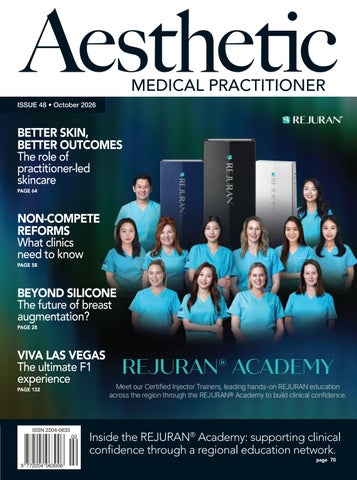
ISSUE 48 • October 2026
BETTER SKIN, BETTER OUTCOMES The role of practitioner-led skincare PAGE 64
NON-COMPETE REFORMS What clinics need to know PAGE 58
BEYOND SILICONE The future of breast augmentation? PAGE 28
VIVA LAS VEGAS The ultimate F1 experience PAGE 132
ISSN 2204-0633
9 772204 063006
02
Inside the REJURAN® Academy: supporting clinical confidence through a regional education network. page 70
In 1996 our story began. In a tiny lab in Uppsala, Sweden, we had the idea to take a molecule the body already trusts, hyaluronic acid, and find a way to make it last. Since then, the Restylane story has been about pioneering HA injectables, with premium products uniquely formulated using Galderma’s pure, high molecular weight HA. Together, we’ve provided over 77 million treatments worldwide* with the world’s most diverse range of HA fillers, and a devotion to quality, writing new stories, building on that original trust. After 30 years of stories, the best chapters are still to come.
*Galderma. Data on file. MA-57232. Global 77 million Restylane® treatments, updated 2025. Restylane, Class III medical device, is a gel containing hyaluronic acid 20 mg/mL and lidocaine 0.3% for injection into or below the skin to smooth facial wrinkles and enhance lips by restoring volume and fullness. Do not inject into blood vessels as this may lead to a lack of blood supply to the skin and ulceration and scarring. Do not use in patients with severe allergies manifested by a history of anaphylaxis or multiple severe allergies, or known hypersensitivity to lidocaine, amide-type local anaesthetics or streptococcal proteins. Restylane should not be used in or near sites where there are active skin disease, inflammation or infection, or where a permanent implant has been placed. Do not use in patients with bleeding disorders or in those who are taking thrombolytics or anticoagulants and caution when using in patients taking other medicines which prolong bleeding times. Use with caution in patients on immunosuppressive therapy or when treating facial areas with limited soft tissue support or cover such as the periorbital area. Treatment benefits are instant, do not affect facial expression and results usually last 6-12 months. Ongoing treatments are needed to maintain best results. After a Restylane treatment patients may experience some degree of redness, swelling, pain or tenderness, itching and/or bruising which may only last a few days. Post inflammatory pigmentation changes may occur after dermal filler injections in people with dark skin. Inflammatory reactions may occur up to two to four weeks after treatment in rare cases. Other rare adverse effects may include allergy, infection, granuloma formation, persistent discoloration at the injection site, and ulceration of the skin. Exposure to excessive sunlight or extreme cold should be avoided until redness or swelling has resolved. Use with caution before or after laser treatment or chemical peel. Restylane has not been tested in pregnant or breast feeding women. Before using Restylane, please review the full product information on dosage, contraindications, precautions, interactions and adverse effects, available at www.galderma.com/au/all-products. Unfunded in NZ. Product and treatment costs apply. AUS: Galderma Australia Pty Ltd, Level 18, 1 Denison St, North Sydney, NSW 2060, Australia. ABN 12 003 976 930. NZ: Galderma Australia Pty Ltd, 58 Richard Pearse Drive, Airport Oaks, Mangere 2022. NZBN 9429051812249. Distributed in NZ by Healthcare Logistics, 58 Richard Pearse Drive, Airport Oaks, Mangere 2022. Phone: 1800 144 944 (AUS), 0800 174 104 (NZ). Restylane, NASHA, and Galderma are registered trademarks of Galderma Holding S.A. AU-RES-2600021. September 2026.
see the effect feel the difference
a regenerative approach to firmer skin and sculpted body
1-4
SCULPTRA (PLLA-SCA®) DELIVERS A REGENERATIVE EFFECT ACROSS THE 3 SKIN LAYERS5–11
+66.5%
INCREASE IN HISTOLOGICALLY ASSESSED COLLAGEN AFTER 3 MONTHS12
DÉCOLLETAGE
UP TO
+34%
INCREASE IN THE QUALITY OF HISTOLOGICALLY ASSESSED ELASTIN AT MONTH 3 AND 68
+26.1%
UPPER ARMS
INCREASE IN DERMAL THICKNESS AT MONTH 98 IN A 15-SUBJECT SPLIT-BODY HIP-DELL STUDY GLUTEAL AREA
THE FIRST PROVEN REGENERATIVE BIOSTIMULATOR FOR FACE & BODY 5–8, 13–16
POSTERIOR THIGHS
SCAN THE QR CODE TO REGISTER YOUR INTEREST IN SCULPTRA BODY OR SPEAK TO YOUR GALDERMA BUSINESS DEVELOPMENT MANAGER
References: 1. Beleznay K, et al. Safety and Effectiveness of Poly-L-lactic acid (PLLA-SCA) for the Improvement in Appearance of Cellulite - A Pilot Study. Poster presented at the International Master Course on Aging Science (IMCAS) World Congress. 01-03 February 2024. Paris, France. 2. Da Cunha MG, et al. Surg Cosmet Dermatol. 2016;8(4):322–327. 3. Haddad A, et al. J Drugs Dermatol. 2019 Sep 1;18(9):929-935. 4. Mazzuco R, et al. Dermatol Surg. 2020;46(Suppl 1):S86-S88. 5. Sculptra IFU 2026. 6. Weibel J, Widgerow A, et al. Poster presented at IMCAS World Congress. 01–03 February 2024. Paris, France. 7. Huth S, et al. J Drugs Dermatol. 2024;23(4):285-288. 8. Zubair et al. A Single Center, Double-Blinded, Split-Body, Randomized Clinical Trial of Injectable Poly-L-Lactic Acid for Volumisation and Adipogenesis of the Hip Dell. 2024. 9. Asius J, et al. Inventors. US patent US 7,731,758 B2. 2010. 10. Morgan P, et al. Product Manufacturing Process for Poly-L-lactic acid (PLLA-SCA). Poster presented at IMCAS World Congress, 26–28 January 2023, Paris, France. 11. Oh S, et al. Antioxidants (Basel). 2023;12(6):1204. 12. Goldberg D, et al. Dermatol Surg. 2013;39(6):915-922. 13. Zhang Y, et al. Regen Biomater 2021;8(5):rbab042. 14. Zhang S, Duan E. Cell Transplantation 2018;27(5):729-38. 15. Shin J-W, et al. Int J Mol Sci. 2019;20:2126. 16. Li M, et al. Cell Death & Disease 2024;15(6):1–11. Sculptra®, Class III medical device, is a 150 mg Poly-L-lactic acid injectable implant reconstituted from dry powder with sterile water for injection and optionally supplemented with lidocaine. Sculptra® is for aesthetic use to increase the volume of depressed areas of the face and body, particularly to correct skin creases, wrinkles, folds, cellulites and for skin quality improvements. Sculptra® is also suitable for large volume corrections of the signs of facial fat loss (lipoatrophy). Indications: For use in the nasolabial folds, cheeks, marionette lines, temples, chin crease, décolletage, gluteal area, posterior thighs and upper arms. Contraindications: Hypersensitivity to any constituents to Sculptra®, patients with a history of anaphylaxis/severe multiple allergies, hypersensitivity to amide-type anesthetics (if supplementing Sculptra® treatment with lidocaine), where there is an underlying known active systemic disease or active disease (infection, inflammation or tumors). Warnings: Improper injection techniques or incorrect preparation procedure may lead to appearance of papules or nodules at the injection site. Massage the treated area to minimize papules and nodules. Do not inject intramuscularly, in tendons or intravascularly. Caution in patients with bleeding disorders or using substances that affect platelet function, thrombolytics or anticoagulants. Do not over-correct as the depression should improve within weeks. Do not inject into the red area of the lip or periorbital area. Precautions: Only be used by healthcare professionals who have adequate knowledge about the anatomy at and around injection site, patients with autoimmune disease or on immunosuppressive therapy, patients with risk factors for developing skin irritations, pre-existing tendency toward edema formation, susceptibility to keloid formation and hypertrophic scarring, latent or subclinical herpes viral infections. Avoid large bolus injections or injecting too superficially. Caution when injecting in areas with limited soft tissue support or cover or thin skin. Avoid excessive sun, UV lamp exposure and extreme temperatures until any initial swelling and redness has resolved. Avoid other cosmetic procedures in the treated area until the skin has healed completely. Sculptra® has not been tested in pregnant or breastfeeding women or those aged under 18 years. Adverse effects: Transient Injectionrelated: bruising/bleeding, pain/tenderness, swelling, erythema and pruritus. Other: nodules/papules, induration, mass and granuloma, eye disorders including visual impairment, infection/abscess, hypersensitivity/angioedema, skin reactions, neurological symptoms, and ischaemia/necrosis including vascular occlusion. Before using Sculptra®, please review the full instructions for use on dosage, contraindications, precautions, interactions and adverse effects, available at www.galderma.com/au/all-products. Product and treatment costs apply. Galderma Australia Pty Ltd, Level 18, 1 Denison St, North Sydney, NSW 2060, Australia. ABN 12 003 976 930. Phone: 1800 144 944 (AUS). Sculptra, PLLA-SCA and Galderma are registered trademarks of Galderma Holding S.A. AU-SCU-2600051. September 2026.
HIGH TECH MEDICAL
WORLD - CLASS TECHNOLOGY LOCAL EXPERTISE A PORTFOLIO BUILT FOR GROWTH
Deka Tetra PRO with CoolPeel Award-winning, nextgeneration CO2 laser that delivers unparalleled precision, versatility and performance. Featuring proprietary Pulse Shape Design® (PSD) technology, Tetra PRO allows practitioners to precisely adjust energy, depth and pulse parameters for customisable treatments from CoolPeel™ treatments to more intensive resurfacing.
Deka TORO
EndyMed PRO Max
A next-generation laser system that includes both picosecond and nanosecond pulses and 3 wavelengths, 785nm, 1064nm and 532nm, to deliver advanced solutions for a broad range of indications.
The next generation of radiofrequency technology, featuring advanced 3DEEP® CORE RF platform, 100W of high-performance energy, faster RF microneedling and intelligent thermal imaging. With a comprehensive range of face and body treatment protocols EndyMed PRO Max is an all-in-one solution for skin tightening, fractional resurfacing, RF microneedling and body contouring.
Designed with efficiency in mind, the different wavelength and emission modalities make TORO one of the most versatile laser systems available.
For more information, call 1300 309 233 or email info@hightechmedical.com.au
The aesthetic industry is evolving and High Tech Medical is evolving with it. For more than 25 years, we have partnered with leading global manufacturers to bring world-class aesthetic technologies to Australia and New Zealand. Today, our portfolio continues to expand across aesthetic medicine, skin health, regenerative aesthetics and advanced treatment technologies. With an expanding portfolio and a dedicated team across Australia and New Zealand, High Tech Medical continues to invest in the future of aesthetic medicine, bringing innovative technologies to market and supporting the clinics behind them. High Tech Medical. Distribution Done Differently.
Hydrafacial
Aura 3D Imaging
Glacial® Skin
A globally recognised leader in advanced skin health treatments, Hydrafacial combines innovative technology, personalised treatments and clinically focused protocols. Powered by patented Vortex-Fusion® technology, the intelligent Syndeo® treatment platform delivers seven essential protocols supported by a continually evolving ecosystem of boosters and treatment solutions.
A revolutionary Swiss-made 3D facial imaging system, powered by Hexagon precision technology, Aura captures a clinically accurate, photo-realistic digital twin of a patient’s face and neck in just 0.2 seconds. Within 30 seconds, Aura analyses facial structures, skin condition and volumetric changes to generate an immersive 3D model delivering six advanced diagnostic tools all from a single scan.
A CryoAesthetics® system, powered by patented Cryomodulation™ technology, to reduce the signs of skin ageing associated with inflammation. Ideal as a standalone treatment or adjunct to laser, microneedling, RF and more, Glacial® Skin provides immediate soothing relief, assisting with post-procedure management for optimal treatment outcomes.
@hightechmedical @hightechmedical www.hightechmedical.com.au
Book a Business Meeting
SAY HI to NUCEIVA® is indicated for the temporary improvement in the appearance of moderate to severe glabellar lines in adult patients.1
DESIGNED FOR
PRECISION
2
This medicinal product is subject to additional monitoring in Australia. This will allow quick identification of new safety information. Healthcare professionals are asked to report any suspected adverse events at www.tga.gov.au/reporting-problems Please review the full Product Information before prescribing. Product Information is available by scanning the QR Code or by calling 1800 749 137. PBS Information: This product is not listed on the PBS. Evolus Australia Pty Ltd, North Sydney, NSW
IT’S ALL IN YOUR PRECISE TECHNIQUE
1
NUCEIVA® IS A PRECISE PRODUCT2
That requires precise intramuscular injection technique to target the correct glabellar muscles in order to achieve optimal clinical results.1
HIGH SATISFACTION IN 94.5% OF PATIENTS3 Percentage of patients with a positive response (improved/much improved) on the Global Aesthetic Improvement Scale (GAIS) by patient assessment (PA) by visit (Per Protocol population) on day 30. The percentages of responders on day 30 in each of the Nuceiva, Botox® and placebo groups were 94.5%, 93.4%, and 8.3%, respectively (p values not available). Most randomised patients (527/540, 97.6%) qualified for inclusion in the PP population.
EXPERTS AGREE4
Nuceiva® has a tight, precise field of effect. Botox is a registered trademark of Allergan Aesthetics, an AbbVie company
REFERENCES 1. NUCEIVA® Product Information 2. Daewoong Method for production of botulinum toxin. Accessed May 2024. https://patents.google.com/patent/US9512418B2/en 3. Rzany BJ, et al. Aesthet Surg J. 2020;40(4):413-429 4. Kaminer MS, et al. J Drugs Dermatol. 2020;19(4):s5-15
June 2025 | AU-P-2500050
Aesthetics
Effective Skin Tightening
Volnewmer by Classys represents a refined approach to skin tightening and rejuvenation. Built around monopolar radiofrequency technology, Volnewmer delivers controlled thermal energy to the skin, supporting improvements in the appearance of firmness, elasticity and skin quality. Designed with treatment efficiency, comfort and versatility in mind, Volnewmer will complement a sophisticated aesthetic portfolio and respond to growing demand for natural-looking rejuvenation.
6.78MHz Monopolar RF Technology Continuous Water Cooling Enhancing patient comfort.
Customisable Treatment Various tip sizes to treat different areas of the face & body.
Gold-Plated Tips Enhancing conductivity, providing even heating and cooling.
Discover Volnewmer Today
D
F ONE PROFESSIONAL PAIRING. MULTIPLE TREATMENT PATHWAYS.
P D
RESILIÉLLE AGE ZERO EXOSOMES WITH JUVASONIC DELIVERY JUVASONIC
RESILIÉLLE AGE ZERO
Advanced Topical Delivery
Pure signal. Preserved.
A professional pairing designed to support clinician-led facial and hair-restoration pathways, with practical training, clinical resources and ongoing product support.
A human-derived extracellular-vesicle formulation produced from Wharton’s jelly umbilical-cord mesenchymal stem-cell material.
Three speed settings | Adjustable cartridges | Red and blue LED | Flatten filler nodules | No proprietary serum lock-in
50 billion exosomes | 5 mL multi-dose vial | Frozen, controlled cold-chain | Low passage
FACE & SCALP Together, Juvasonic and Age Zero can be incorporated into documented professional protocols for facial rejuvenation and hair restoration
S
BRING BOTH INTO YOUR CLINIC Scan for product specifications, clinical material, handling guidance, training and commercial information.
Before and after 3 Age Zero exosome treatments delivered via Juvasonic
Juvasonic brochure
Age Zero brochure
Distributed exclusively in Australia by Enesi | www.enesi.com.au
L F S
G. S.
nic
Discover the
Fotona Difference Premium treatments. Proven te no ogy. Designed to set your ini apart.
Signature Protocols
LipLase VectorLift SmoothEye Fotona4D Fotona4GLOW HoneyComb Lift Micro Laser Coring S in esurfacing Vascular Lesions
Explore the full aesthetic portfolio
Powered by Innovative Medical Technologies | 1800 888 983 | info@innovative.com.au | innovative.com.au
NEWS 18 20 20 22 22
NSW MEDICINES RULES: THE FINAL CHECKLIST RARE BIA-ALCL CASE REPORTED FOLLOWING SMOOTH IMPLANT EXPOSURE SPECIALIST FEE REFORMS PUT PLASTIC SURGEONS & DERMATOLOGISTS IN FOCUS LONGEVITY INTERVENTIONS SHOW DIFFERING EFFECTS ON AGEING BIOMARKERS PREHABILITATION COULD IMPROVE AESTHETIC SURGERY OUTCOMES
p28
FEATURES 24
AHPRA’S NEW PRESCRIBING GUIDANCE FOR PEPTIDES New guidance from Ahpra puts prescribing decisions, informed consent, commercial influence and telehealth models under the microscope.
28
p64
FROM REVISION TO PRIMARY AUGMENTATION: 3D BREAST SCAFFOLDS ADVANCE Prof Anand Deva and Prof Owen Ung take AMP inside the clinical program, from the first 19 patients through to the next phase of regenerative breast surgery.
36
MISSION IN MELGHAT Recently recognised with a Medal of the Order of Australia, plastic surgeon Dr Dilip Gahankari has dedicated more than 20 years to a humanitarian mission in one of India’s most remote regions.
64
BEYOND THE PROCEDURE: SKINCARE’S EXPANDING ROLE IN THE MODERN AESTHETIC PRACTICE Skincare is taking on a more considered role in aesthetic medicine. Leading Australian practitioners discuss how they incorporate topical treatments into multimodal care and why the approach matters.
132 FORMULA 1 LIGHTS UP LAS VEGAS Fast cars, five-star hospitality and Las Vegas after dark. The Formula 1 Grand Prix brings a whole new level of extravagance to the Strip this November.
1 4
p54
p36
COLUMNS 50
ANATOMY FROM THE EXPERT A regular column from Prof Sebastian Cotofana, who shares his expertise on anatomical considerations for aesthetic procedures.
BEST PRACTICE 54
A SIMPLE FRAMEWORK FOR REDUCING BOTULINUM TOXIN COMPLICATIONS
p132
Dr Giulia D’Anna shares six practical principles that every injector should remember before picking up the syringe.
58
THE END OF THE NON-COMPETE? Could Australia’s proposed non-compete reforms change the way aesthetic clinics protect their businesses? We explore the implications for employment contracts, practitioner mobility and clinic owners.
62
INDEPENDENT CONTRACTOR OR EMPLOYEE? Jade Spehr explains why contractor arrangements in aesthetic clinics may not be as straightforward as they appear, and the legal and financial risks for clinic owners who get worker classification wrong.
PRODUCTS AND SERVICES 70
Read about the latest technologies, products and services available to make the modern aesthetic practice more successful.
p24
EVENTS 120 122 124 126 128 130
ALASTIN SKINCARE TAKES CENTRE STAGE TEOXANE SYMPOSIUM SYDNEY 2026 THE SUNEKOS SCIENTIFIC FORUM DERMALOGICA CELEBRATES 30 YEARS IN AUSTRALIA CRYOMED AESTHETICS’ WAVE SYDNEY 2026 INAUGURAL FRESH SUMMIT
AE STH E TIC
M E D I CAL
P R ACTI TI ON E R
1 5
LETTER FROM THE EDITOR
S
Natalie Phan
Karyssa Arendt
Debbie Pilarinos
kincare has always had a place in aesthetic medicine, but its clinical value has not always received the attention it deserves. In our feature on page 64, we speak with leading Australian practitioners about the role of clinic-only skincare in contemporary aesthetic medicine, examining how topical formulations can be integrated into treatment planning, support recovery and help manage skin health over the longer term. Peptides are another area attracting considerable attention, although for very different reasons. NSW Health has issued a public warning about unapproved peptide products following an increase in emergency department presentations. Our report on page 24 examines the guidance, which raises important questions about the growing availability of these products through online suppliers and the responsibilities of practitioners when patients seek treatments that may be well ahead of the supporting evidence. We’re also following the progress of a fascinating Australian research program exploring whether absorbable 3D-printed scaffolds could provide an alternative to conventional breast implants. On page 28, Professors Anand Deva and Owen Ung discuss the latest clinical trials, the experience of patients treated to date and the challenges ahead. Another highlight is the inspiring story of Queensland plastic and reconstructive surgeon Dr Dilip Gahankari, who was recently awarded the Medal of the Order of Australia in recognition of his humanitarian work. His dedication to providing surgical care to underserved communities in rural India is extraordinary, and it’s an honour to share his story on page 36. There’s plenty of practical reading, too. Our best practice section examines proposed changes to Australia’s non-compete laws and what they could mean for aesthetic clinics (page 58), while Prof Sebastian Cotofana and Dr Giulia D’Anna offer valuable insights into anatomy and its importance in safe aesthetic practice (from page 50). We also showcase the latest aesthetic technologies, products and treatments (from page 70), along with news and highlights from the conferences and events bringing our industry together (page 118). A huge thank you to the practitioners and experts featured in this issue for so generously sharing their time and experience with us, and to our broader industry partners for their continued support. Happy reading!
Published by:
379 Docklands Drive, Docklands VIC 3008 T: 03 9690 8766 www.primecreative.com.au Chairman John Murphy Chief Executive Officer Christine Clancy christine.clancy@primecreative.com.au Publisher Sarah Baker sarah.baker@primecreative.com.au Managing Editor Myles Hume myles.hume@primecreative.com.au Editor Aimée Rodrigues aimee.rodrigues@primecreative.com.au Business Development Manager Natalie Phan natalie.phan@primecreative.com.au Client Success Manager Karyssa Arendt karyssa.arendt@primecreative.com.au Head of Design Clayton Hawley Art Director Deborah Pilarinos Subscriptions T: 03 9690 8766 subscriptions@primecreative.com.au
Aimée Rodrigues The Publisher reserves the right to alter or omit any article or advertisement submitted and requires indemnity from the advertisers and contributors against damages or liabilities that arise from material published. © Copyright – No part of this publication can be reproduced, stored in a retrieval system or transmitted in any means electronic, mechanical, photocopying, recording or otherwise without the permission of the publisher.
SUBSCRIBE TO THE AESTHETIC MEDICAL PRACTITIONER eNEWSLETTER
a e s t h e t i c m e d i c a l p r a c t i t i o n e r. c o m . a u 1 6
A E ST H E T I C
All 'before and after' photographs in Aesthetic Medical Practitioner articles are of genuine patients. It is important to understand that they represent one person's experience and there is no guarantee that any other patient will experience similar results.
M E D I CA L
PR ACT IT IO NER
COTOFANA ACADEMY Start learning online today. Anytime, anywhere. Our anatomy courses are the result of years of dedicated anatomical and clinical research, enriched by Professor Sebastian Cotofana’s extensive experience in cadaveric dissection.
ONLINE COURSES – NOW OFFERING 40 CME CREDITS
For more information visit cotofanaanatomy.com
NEWS NSW MEDICINES RULES: THE FINAL CHECKLIST
Image: Aleksandr Rybalko/Shutterstock.com
FROM 5 NOVEMBER, NSW COSMETIC CLINICS WILL OPERATE UNDER NEW MEDICINES LEGISLATION WITH MORE DETAILED REQUIREMENTS AROUND PRESCRIBING, ADMINISTRATION, PRODUCT SOURCING, RECORDS AND BUSINESS RESPONSIBILITY. HERE IS WHAT PRACTICES NEED TO HAVE IN PLACE.
O
n 5 November 2026, the Medicines, Poisons and Therapeutic Goods Act 2022 and Medicines, Poisons and Therapeutic Goods Regulation 2026 come into force, replacing the legislation that has governed medicines and scheduled substances in NSW for decades. For aesthetic medicine, the Regulation introduces specific requirements for cosmetic use substances, including botulinum toxins, deoxycholic acid and products containing substances such as hyaluronic acid, calcium hydroxylapatite, polycaprolactone and polylactic acid. The rules cover the full treatment pathway, from where the product comes from and who reviews
1 8
the patient to who can direct its administration, how it is stored and what records must be kept. Ahead of the commencement, NSW Health released guidance for nurse practitioners and endorsed nurses on 24 August and updated guidance for medical practitioners on 8 September, alongside new FAQs on the legislation. The guidance also clarifies an important limitation on the new designated registered nurse prescribing model. Who can prescribe and direct treatment? Under the cosmetic use provisions, a medical practitioner or nurse practitioner may prescribe a cosmetic use substance or issue a direction for its administration. A E ST H E T I C
Before doing so, the prescriber must personally review the patient. This can take place face-to-face or by video consultation. Written directions must be signed, patient-specific and valid for no more than six months. They must identify the patient and prescriber and include the address where treatment will take place, the responsible provider, date of patient review, period covered by the direction and frequency of administration. For each cosmetic use substance, the direction must also specify the product and form, treatment area, quantity and route of administration where this is not otherwise obvious. A verbal direction is only permitted when the medical practitioner or nurse practitioner is physically present when the substance is administered. New RN prescribing limits From 5 November, appropriately endorsed registered nurses will have authority to prescribe, supply, administer or issue directions for certain registered scheduled medicines within the terms of their endorsement and prescribing partnership agreement. M E D I CA L
PR ACT IT IO NER
NEWS
Cosmetic use medicines are an exception. NSW Health’s 24 August fact sheet states that a designated RN prescriber cannot issue a direction to supply or administer a cosmetic use medicine. They also cannot administer a cosmetic use medicine without a direction from a medical practitioner or nurse practitioner. They may administer a cosmetic use medicine that has been lawfully prescribed by a medical practitioner or nurse practitioner and dispensed for that patient. To clarify, for aesthetic clinics, the introduction of designated RN prescribing does not create a pathway for an endorsed RN to independently authorise cosmetic injectable treatment. Nurses have defined responsibilities A nurse administering a cosmetic use substance must be acting within nursing practice and under an appropriate direction from a medical practitioner or nurse practitioner, or administering a medicine that has been lawfully prescribed and dispensed for that patient. The nurse must make a written record of each administration. This includes the nurse’s name, date of administration, product batch number, patient and treatment details, prescriber information, premises address and information contained in the relevant direction. Copies of the administration record must be provided to both the prescriber and the responsible provider. Nurses must also ensure appropriate emergency equipment is available and that the cosmetic use substance has been lawfully supplied. Product source and storage The new framework places particular emphasis on lawful product supply. A cosmetic use substance must be registered on the Australian Register of Therapeutic Goods or otherwise AE STH E TIC
M E D I CAL
supplied through a pathway permitted under Commonwealth therapeutic goods legislation. A clinic must be able to establish where the product came from, rather than simply having it available for treatment. NSW Health says the cosmetic medicine changes are intended in part to reduce the use of illegally imported and otherwise unlawful products. Storage is also specifically addressed. Cosmetic use substances must be kept in a non-public area, separate from food, protected against contamination if a container leaks or breaks and stored according to the instructions on the product label. The business is accountable too Clinic owners and operators fall within the new framework. NSW Health specifically lists cosmetic clinics, including owners and practitioners who obtain, prescribe, supply or administer cosmetic use substances, among those required to comply with the legislation. Businesses providing cosmetic procedures must ensure appropriate risk-management policies and procedures are in place, emergency equipment is available and nurses administering cosmetic use substances are trained to respond to medical emergencies. The responsible provider must also receive and retain the relevant prescriber directions and administration records for two years. This is particularly important in clinics using contractor nurses, visiting prescribers or external prescribing arrangements. Individual practitioners keeping separate records does not remove the business’s own recordkeeping obligations. The new legislation also introduces a tiered penalty framework for unauthorised activities, with maximum penalties ranging from 20 to 400 penalty units for individuals and 100 to 2,000 penalty units for corporations, depending on the offence.
P R ACTI TI ON E R
CLINIC COMPLIANCE CHECKLIST
Confirm who can authorise cosmetic treatment Medical practitioners and nurse practitioners can prescribe and direct administration. Designated RN prescribers cannot issue directions for cosmetic use medicines. Check patient review and direction templates Ensure reviews occur in person or by video and written directions contain all required patient, prescriber, practice, product and treatment information. Audit administration records Make sure nursing records capture the required information, including batch numbers, and copies are provided to both the prescriber and responsible provider. Trace your product supply Confirm cosmetic use substances have been lawfully supplied and that the clinic can establish their provenance. Review storage Check products are kept in a nonpublic area, separate from food and according to label requirements. Check emergency readiness Ensure appropriate equipment is available and nurses administering cosmetic use substances are trained to respond to medical emergencies. Set up and retain business records Make sure the responsible provider receives prescriber directions and administration records and retains them for two years.
1 9
NEWS
A recent published case report has described breast implant-associated anaplastic large cell lymphoma (BIAALCL) in a patient whose implant history was reported as exclusively involving smooth implants. The case is notable because BIA-ALCL has been associated with textured breast implant exposure, but with no confirmed cases involving a documented history of smooth implants alone. The report described a 56-year-old transgender woman who had undergone multiple bilateral breast implant procedures involving smooth silicone implants between 2006 and 2023. She later presented with progressive unilateral breast swelling and tenderness, with imaging identifying an enlarged left axillary lymph node. The case does not establish that smooth implants cause BIA-ALCL or provide evidence from which the risk associated with smooth devices can be calculated. Previous reports of BIA-ALCL in patients with smooth implants in place at diagnosis have generally involved earlier textured implant exposure or incomplete information about previous devices. In Australia, the Therapeutic Goods Administration continues to state that there have been no confirmed Australian cases in patients who have only had smooth implants. Australian cases have involved polyurethane or textured devices. This case nevertheless adds to ongoing investigation of implant surface characteristics and BIA-ALCL and highlights the importance of obtaining a complete implant history when assessing patients. Practitioners are advised to remain alert to symptoms including delayed swelling or seroma, breast asymmetry, pain, a mass or lymphadenopathy. Source: Cureus Journal of Medical Science
2 0
Image: armagan emre/Shutterstock.com
RARE BIA-ALCL CASE REPORTED FOLLOWING SMOOTH IMPLANT EXPOSURE
SPECIALIST FEE REFORMS PUT PLASTIC SURGEONS & DERMATOLOGISTS IN FOCUS Plastic and reconstructive surgeons are among the specialists set to face greater public scrutiny of their fees under new Federal Government measures, while dermatologists have been highlighted in a separate review of high specialist charges. Legislation passed in September will allow the government to publish fees charged by individual specialists for common medical services, along with associated out-of-pocket costs, on the Medical Costs Finder. Rather than relying on specialists to voluntarily provide information, the system will be able to draw on existing Medicare, hospital and private health insurer billing data. Plastic and reconstructive surgery is one of 11 specialist areas currently included in the Medical Costs Finder. The government said only 106 of approximately 6,300 eligible specialists were voluntarily displaying fee information when the legislation passed. The changes come as the Department of Health, Disability and Ageing separately considers options for addressing what it A E ST H E T I C
describes as ‘excessive’ specialist fees. The consultation is examining how unusually high fees could be identified and what interventions might be appropriate. Options include publishing thresholds for excessive fees, giving practitioners information comparing their charges with peers, peer assessment and potentially introducing caps for individual Medicare Benefits Schedule items. Departmental analysis has identified dermatology among specialties with comparatively higher out-of-hospital fees relative to MBS schedule fees, while surgical specialties feature prominently among higher in-hospital charges. The proposals have not been adopted and the consultation remains open until 19 October 2026. The measures relate to Medicare and private specialist services and do not regulate fees for purely cosmetic procedures that do not attract an MBS benefit. Source: Australian Government Department of Health, Disability and Ageing M E D I CA L
PR ACT IT IO NER
NEWS
Image: Opat Suvi/Shutterstock.com
Longevity interventions show differing effects on ageing biomarkers Lifestyle changes and some medicines may influence biological markers associated with ageing, while commonly used supplements show less consistent effects, according to a large analysis published in Nature Medicine. Researchers created a harmonised database of 51 longitudinal intervention studies and assessed the response of 16 epigenetic clocks and 94 other DNA methylation biomarkers
to interventions including diet, exercise, medicines, supplements and medical procedures. Pharmacological interventions produced the strongest overall responses in DNA methylation biomarkers, while lifestyle interventions including diet and exercise also produced significant changes. Supplements showed weaker and less consistent effects. Medicines examined across the included studies included
metformin, semaglutide, rapamycin and anti-TNF therapies. The researchers were examining whether epigenetic biomarkers respond to interventions, rather than whether those interventions extend lifespan or prevent agerelated disease. The study also found that newer epigenetic clocks designed to estimate mortality risk or pace of ageing appeared more responsive to interventions than clocks primarily designed to predict chronological age. The authors said the findings could help researchers select more appropriate biomarkers for future longevity trials, potentially allowing biological responses to interventions to be detected over shorter periods. Whether changes in these biomarkers translate into longer life, reduced disease or improved healthspan, however, remains to be established. Source: Nature Medicine
PREHABILITATION COULD IMPROVE AESTHETIC SURGERY OUTCOMES Patients preparing for aesthetic surgery may benefit from earlier management of modifiable health and lifestyle factors, according to a new review examining the role of prehabilitation in cosmetic procedures. Published in Plastic and Reconstructive Surgery – Global Open, the review brought together evidence covering medical management, nutrition and diet, smoking and other substance use, weight management and psychological factors before aesthetic surgery. The authors found established links between factors including malnutrition, diabetes and tobacco use and poorer surgical outcomes,
2 2
although aesthetic surgery-specific recommendations remain limited. They argue that these risks should be identified and addressed earlier in surgical planning rather than being considered only in the immediate preoperative period. Procedure-specific considerations were also identified. Hypertension should be assessed and managed in patients undergoing rhytidectomy, while obstructive sleep apnoea warrants particular attention in rhinoplasty patients. Psychological concerns should also be considered from the initial consultation. The review additionally highlighted the increasing relevance of GLP1 receptor agonists, with their growing use for diabetes and
weight management introducing additional considerations when preparing patients for elective aesthetic surgery. However, the authors stressed that there is currently no standardised prehabilitation guide specifically for aesthetic procedures and that recommendations should be tailored to the individual patient. They concluded that addressing known risk factors earlier may provide an opportunity to reduce perioperative complications and support recovery, while further research is needed to establish aesthetic surgery-specific protocols. Source: Plastic and Reconstructive Surgery – Global Open
A E ST H E T I C
M E D I CA L
PR ACT IT IO NER
SUBSCRIBE TO THE AESTHETIC MEDICAL PRACTITIONER eNEWSLETTER
The industry moves fast. Stay across the shifts defining aesthetic practice. • Regulatory updates • Industry news and events • Emerging technology • Best practice developments Delivered directly to your inbox Exclusively for aesthetic medical practitioners
SCAN TO SUBSCRIBE
aestheticmedicalpractitioner.com.au
FEATURE
Image: Pixel-Shot/Shutterstock.com
Ahpra’s new prescribing guidance for peptides NEW GUIDANCE FROM AHPRA PUTS PRESCRIBING DECISIONS, INFORMED CONSENT, COMMERCIAL INFLUENCE AND TELEHEALTH MODELS UNDER CLOSER EXAMINATION AS REGULATORS INCREASE THEIR FOCUS ON PEPTIDES, GLP-1 MEDICINES AND OTHER HIGH-DEMAND TREATMENTS.
T
he Australian Health Practitioner Regulation Agency (Ahpra) has sharpened its focus on prescribing practices involving peptides, GLP-1 medicines and other high-demand treatments, warning practitioners that unsafe prescribing can put both patients and professional registration at risk. New guidance released on 16 September covers the prescribing of medicines off-label, unapproved medicines and medicines intended to be compounded. Ahpra has also confirmed that regulatory action has already been taken against practitioners over unsafe prescribing, with high-volume 2 4
A E ST H E T I C
and single-treatment business models among the areas attracting attention. The announcement follows months of growing scrutiny around the Australian peptide market. The TGA has issued repeated safety and compliance warnings, added unapproved peptides to its compliance priorities and taken enforcement action over unlawful importation, advertising and supply. Ahpra’s update puts the focus on why a medicine was prescribed, what evidence supported the decision, what the patient was told, how conflicts of interest were managed and what follow-up was arranged. M E D I CA L
PR ACT IT IO NER
FEATURE
THE NEW AHPRA GUIDANCE APPLIES TO OFF-LABEL PRESCRIBING, UNAPPROVED THERAPEUTIC GOODS AND COMPOUNDED MEDICINES. PATIENT INTEREST CANNOT DETERMINE THE PRESCRIPTION
One of Ahpra’s new case studies gives a particularly relevant example. A doctor prescribed a range of unapproved peptides after patients requested products promoted for ‘anti-ageing’ and ‘faster muscle repair’. According to Ahpra, the doctor had not adequately assessed the evidence for their safety, quality or effectiveness for the individual patients. The unapproved status of the products and the associated risks and unknowns were not properly explained. Some of the prescriptions followed brief consultations with limited clinical assessment and minimal documentation. Two patients experienced adverse reactions and stopped using the peptides. Ahpra uses the case to spell out what it expects before an unapproved medicine is prescribed. There should be an established clinical reason for the treatment, evidence appropriate to the prescribing decision, a documented discussion of consent and a patient who understands the medicine’s unapproved status, possible risks, uncertainties and available alternatives. That goes directly to a concern regulators have been raising as peptide treatments have gained visibility online and across wellness, AE STH E TIC
M E D I CAL
longevity and weight-management services. Medical Board of Australia Chair Dr Susan O’Dwyer said patient interest cannot determine the prescription. ‘Peptides are like other drugs: A patient may want peptides, but that doesn’t mean they need peptides,’ she said. ‘It doesn’t mean that peptides are clinically justified. Practitioners need to use their judgement, skills and experience to do what is best for their patient.’
DEMAND VERSUS CLINICAL NEED
Ahpra’s concern extends beyond the individual medicine to the way some services are structured. In an earlier joint statement on prescribing and dispensing, Ahpra and the Medical, Nursing and Midwifery and Pharmacy Boards raised concerns about healthcare businesses designed around access to a predetermined medicine. Examples included services focused on obesity, chronic pain and sleep disorders, particularly those using high-volume telehealth consultations, computer or algorithm-based prescribing or direct supply of unapproved medicines. The professional expectations are familiar – good prescribing involves a real-time interaction, an adequate history, appropriate examination or investigations where required and a management plan based on an
P R ACTI TI ON E R
identified therapeutic need. The practitioner remains responsible for the care provided within the business model in which they work. That has particular relevance to peptides because patients may arrive with a product already in mind. Social media promotion has pushed compounds such as BPC-157, GHK-Cu, TB-500, retatrutide and CJC-1295 into a much wider public conversation, often accompanied by claims around weight loss, muscle growth, anti-ageing, cognitive performance and athletic performance. The TGA identifies these among examples of unapproved peptide products that have not been evaluated for safety, quality or effectiveness.
OFF-LABEL, UNAPPROVED, COMPOUNDED
The new Ahpra guidance applies to off-label prescribing, unapproved therapeutic goods and compounded medicines. Off-label use involves an ARTG-listed medicine being prescribed outside its registered indication, while unapproved and compounded medicines have not undergone the TGA evaluation that applies to medicines approved for supply in Australia. Ahpra’s guidance is intended to bring the focus back to the clinical reasoning behind the prescription. When prescribing an unapproved or compounded medicine, or 2 5
FEATURE
an approved medicine off-label, practitioners should be able to show there is an established reason for its use in that particular patient, that the decision is supported by appropriate evidence and that the risks, uncertainties and available alternatives have been discussed and documented. Appropriate monitoring and review arrangements should also be in place. These expectations are already reflected in the National Prescribing Competencies Framework, which says unapproved therapeutic goods, compounded products and medicines used off-label should only be considered where a registered medicine is unavailable or inappropriate, adequate supporting information is available and the potential benefits and risks have been identified, evaluated and documented.
CONSENT NEEDS DETAIL
Informed consent receives considerable attention throughout the Ahpra material. A patient who has researched a peptide before attending a clinic may know its name, claimed effects and how it is commonly used. However, Ahpra’s case study makes clear that this familiarity cannot stand in for a proper consent discussion. With an unapproved medicine, the patient needs to understand its regulatory status and the uncertainties that come with it. Known risks, expected benefits, available alternatives and gaps in evidence all become part of that conversation. The issue has become more pressing as regulators uncover problems with products circulating outside established supply channels. 2 6
On 14 September, two days before Ahpra released its new guidance, the TGA reported a serious adverse event involving a product sold as retatrutide. The patient experienced uncontrollable vomiting that resulted in a torn oesophagus and hospital treatment. Laboratory testing found no retatrutide in the vial. It contained undeclared semaglutide at approximately eight times the level found in semaglutide products assessed by the TGA and included on the ARTG. Retatrutide remains in human clinical trials and has not been approved by the TGA or a comparable international regulator. The TGA warned that products sold as retatrutide outside clinical trials may be counterfeit.
TELEHEALTH STAYS IN FOCUS
Telehealth appears repeatedly in Ahpra’s commentary. The agency says prescribing through telehealth and the provision of certain medicines require greater rigour to prevent patient harm. It is also preparing information for patients on what they should expect from telehealth services. Ahpra’s existing prescribing statement calls for a real-time patient assessment that considers the person’s history and views, along with an appropriate physical examination and investigations where necessary. It also identifies continuity of care as part of good prescribing practice. These expectations become important in businesses built for scale. A short online consultation may leave little opportunity to explore medical history, concurrent medicines, contraindications, previous treatment or the A E ST H E T I C
evidence supporting a requested therapy. Automated questionnaires can collect useful information, but responsibility for the prescribing decision remains with the practitioner. Commercial arrangements are also moving further into view. Ahpra says growing consumer demand coupled with ‘undue commercial influence’ has contributed to departures from professional standards in some cases. New conflict of interest guidance is due to be released shortly. Its earlier guidance specifically highlighted ‘closed loop prescribing’, where the prescriber and supplier are not independent, and said practitioners must ensure that commercial arrangements do not compromise the patient’s interests or freedom to choose where a prescription is dispensed. M E D I CA L
PR ACT IT IO NER
Image: Krakenimages.com/Shutterstock.com
FEATURE
NEW CONFLICT OF INTEREST GUIDANCE IS DUE TO BE RELEASED SHORTLY.
AE STH E TIC
M E D I CAL
ENFORCEMENT BECOMES MORE PROACTIVE
Another significant part of Ahpra’s September announcement concerns how prescribing concerns are being identified. Ahpra CEO Justin Untersteiner said the regulator can act without waiting for a formal notification. ‘If we see red flags, such as unusual prescribing patterns or inappropriate advertising, we can take it up with the practitioner directly or notify other agencies where businesses are involved,’ he said. Ahpra says its intelligencegathering and investigative methods are expanding as new data sources become available. Information is also being shared with other regulators and government agencies. Ahpra and the TGA say they are working together where concerns about prescribing overlap with possible unlawful advertising, importation or supply. P R ACTI TI ON E R
WHAT PRACTITIONERS NEED TO SHOW
For aesthetic practices moving into weight management, longevity medicine or other services involving peptide prescribing, the practical implications reach well beyond access to the medicine. Ahpra is looking at the clinical reasoning recorded before treatment, the evidence considered, the quality of the patient assessment, how consent was obtained and whether monitoring and follow-up were appropriate. The patient’s other treating practitioners and continuity of care may also need to be considered. Clinic systems deserve the same attention. High patient volumes, consultations designed around a particular medicine, financial relationships with pharmacies or suppliers and advertising that generates demand for a specific treatment are relevant when regulators examine how prescribing decisions are being made. Professor Anthony Lawler, Deputy Secretary of the Department of Health, Disability and Ageing and head of the TGA, said practitioners considering unapproved medicines need to understand both the relevant pathways under the Therapeutic Goods Act 1989 and their professional responsibilities to patients. Ahpra’s latest guidance gives practitioners a much clearer view of the areas likely to be examined when concerns arise. The prescription itself is only one part of that picture – the consultation, clinical reasoning, consent process, records, commercial arrangements and follow-up all form part of the prescribing decision that a practitioner may ultimately be asked to explain. AMP 2 7
FEATURE
FROM REVISION TO PRIMARY AUGMENTATION: 3D BREAST SCAFFOLDS ADVANCE A TWO-YEAR FOLLOW-UP FROM AUSTRALIA’S FIRST-INHUMAN BREAST SCAFFOLD STUDY IS NOW INFORMING A LARGER PIVOTAL TRIAL. PROF ANAND DEVA AND PROF OWEN UNG TAKE AMP INSIDE THE CLINICAL PROGRAM, FROM THE FIRST 19 PATIENTS THROUGH TO THE NEXT PHASE OF REGENERATIVE BREAST SURGERY. WORDS BY AIMÉE RODRIGUES.
2 8
A E ST H E T I C
M E D I CA L
PR ACT IT IO NER
FEATURE
X
F
ifteen years ago, Prof Anand Deva, Head of Plastic and Reconstructive Surgery at Macquarie University, received an email from Dr Mohit Chhaya, then a PhD student, with an idea for a new approach to breast reconstruction. Today, that idea is being tested in an Australian pivotal trial involving close to 50 patients, with an absorbable 3D-printed scaffold now being used not only to restore breast volume after implant removal but also in primary augmentation. Between those points lies more than a decade of laboratory work, a carefully staged firstin-human study in 19 women, thousands of MRI images and a question that becomes more interesting as the clinical data accumulate: what happens when the structure used to create a breast is designed to disappear? When Aesthetic Medical Practitioner reported on regenerative 3D-printed breast scaffolds earlier this year, the Australian firstin-human study had produced encouraging early findings, but the clinical experience remained small and the scaffold had been used in a tightly controlled group of patients undergoing explant surgery. The program has since entered a much more demanding phase. The original 19 patients have
AE STH E TIC
M E D I CAL
P R ACTI TI ON E R
now reached more than two years of follow-up, while the pivotal BRV-005 trial expanded the technology into larger scaffolds, more complex breast procedures and primary augmentation. ‘We are well into the pivotal trial, which aims to generate the safety and performance data needed to achieve regulatory approval for the scaffold in restorative breast surgery, both in Australia and internationally,’ says Prof Deva. ‘Close to 50 patients have now completed surgery in BRV-005, which puts us roughly halfway through the trial. I have been surprised by the level of interest in our work and am grateful to the women who have volunteered to help us complete the study. ‘As with all medical technology, there is a long path from conception to safe clinical use. It takes years of laboratory evaluation, completion of a first-in-human safety trial and, now, the pivotal trial.’ Dr Chhaya’s research began in Queensland in 2011, where his PhD work explored 3D printing and computer-aided design as a means of engineering tissue for breast reconstruction. That early research laid the foundations for regenerative medical technology company BellaSeno, established in Queensland in 2015 before 2 9
FEATURE
expanding to Leipzig, Germany, while retaining its Australian research and clinical operations.
HOW THE SCAFFOLD WORKS
Prof Anand Deva Head of Plastic and Reconstructive Surgery at Macquarie University
Prof Owen Ung Professor of Surgery at the University of Queensland’s Faculty of Medicine and President of the Royal Australasian College of Surgeons
3 0
Developed by BellaSeno, the breast scaffold is manufactured from medical-grade polycaprolactone, or PCL, and combined with autologous fat harvested from the patient. Its porous architecture is designed to provide initial form while creating and protecting space for the transplanted fat, allowing vascularisation and tissue integration to occur through the structure. Over time, the scaffold progressively loses its mechanical role and is absorbed, with the intention that the volume and form it initially supported are maintained by the patient’s own tissue. BellaSeno describes this process as Protected Autologous Regeneration, or PAR. In the first human study, routine fat harvesting was used without special processing and the scaffolds were filled with autologous fat to an average of 52 percent of scaffold volume, ranging from 32 to 73 percent. Data presented by Prof Deva show the scaffold providing mechanical integrity during the first two months, beginning to soften between two and six months and having lost its mechanical integrity by around one year, as the regenerated tissue increasingly determines the physical characteristics of the breast. The longer-term objective is for very little evidence of that original structure to remain. ‘Clinicians looking at MRI scans a few years after these patients received the scaffolds would simply see normal breast tissue,’ says Prof Deva. A E ST H E T I C
THE FIRST 19 PATIENTS
BRV-004 was a prospective, singlecentre first-in-human study involving 19 women undergoing restorative breast surgery after implant removal. Sixteen received their scaffolds immediately following explantation, while three underwent delayed placement at least six months later. Eighteen were treated bilaterally and one unilaterally, giving investigators 37 scaffolds to follow. The women had a mean age of 49, ranging from 31 to 67, and had lived with implants for an average of 18 years, with exposure ranging from three to 45 years. Eighteen had originally undergone cosmetic augmentation and one patient had Poland sequence. Prof Owen Ung, Professor of Surgery at the University of Queensland’s Faculty of Medicine and President of the Royal Australasian College of Surgeons, led the first-in-human investigation at Metro North Health and says the study was fundamentally about establishing whether the technology could be used safely in humans. ‘This was a safety trial, and this has been well established, with no serious adverse events (SAEs),’ he says. ‘Secondary endpoints of utility, cosmesis and patientreported outcomes have also been highly satisfactory. ‘Every adverse event, however minor, was recorded. There was a mandatory two-month pause after the first patient before proceeding with patients two to five, followed by a further two-month pause before patient six and completion of trial accrual. Any SAE would have triggered cessation of the trial.’ Only three scaffold sizes were used, 150cc, 170cc and 200cc, and no concomitant aesthetic procedures such as mastopexy were performed. For women accustomed to implants of 300cc M E D I CA L
PR ACT IT IO NER
FEATURE
CLINICIANS LOOKING AT MRI SCANS A FEW YEARS AFTER THESE PATIENTS RECEIVED THE SCAFFOLDS WOULD SIMPLY SEE NORMAL BREAST TISSUE. or more, participation meant accepting that the reconstructed breast would probably be smaller. ‘It was important in this trial to select patients who were focused on silicone removal and alleviation of symptoms, rather than cosmetic concerns, because we could not initially predict what the aesthetic outcomes would be,’ says Prof Ung. ‘Patients also needed to be accepting of a smaller overall breast size, as the first trial was limited to scaffolds no larger than 200cc and most had previously had silicone implants of 300cc or more. ‘We wanted to avoid additional corrective procedures during the trial period where possible, although we kept that option open, because we did not yet know how the breast might change as the scaffold integrated. The draping of the breast around the scaffolds was remarkably good, and we did not feel that any of the patients required anything beyond explant (complete capsular excision) and replacement with the scaffold.’
TWO-YEAR RESULTS FROM BRV-004
The completed two-year results were presented by Prof Deva at The Aesthetic MEET 2026 in Boston. ‘In the 19-patient study, the absorbable scaffold combined with autologous fat grafting was shown to be safe and maintained stable breast volume at two years, by which time the scaffold was no longer detectable on either clinical or radiological assessment,’ says Prof Deva. AE STH E TIC
M E D I CAL
MRI was used to follow breast volume over time, with the first postoperative scan performed at two months. At 24 months, mean breast volume across all 37 treated breasts was 83 percent of the volume recorded at that two-month assessment, with individual results ranging from 61 to 108 percent. Most of the volume change occurred during the earlier postoperative months, followed by greater stability between six, 12 and 24 months. Imaging presented in Boston included MRI angiography showing extensive vascular networks at two years through the region previously occupied by the scaffold. Prof Ung says MRI has proved particularly useful in assessing what is happening within the breast over time. ‘MRI is preferred over ultrasound and provides a better assessment of volume retention, integration and vascularisation,’ he says. ‘The imaging suggests good fat retention and volume and, in some cases, fat generation.’ Patient-reported outcomes were also followed. Breast-Q assessments showed high satisfaction with softness as the scaffold progressively lost its mechanical integrity and the regenerated tissue assumed a greater role. The investigators, however, are careful not to read too much into the findings from a 19-patient safety study. ‘These results of the first-inhuman trial (BRV-004) should not be over-interpreted until we have accumulated more data from the
P R ACTI TI ON E R
current pivotal study,’ says Prof Deva. ‘The scaffolds used in BRV004 were small, with a maximum volume of 200cc, and there were no concurrent breast procedures such as mastopexy. ‘These findings did, however, give us the confidence to commence BRV-005 and satisfied regulators that there was adequate evidence to support proceeding with a larger study. I am grateful to Prof Ung and his team for completing the study, with more than two years of followup now available.’
SAFETY FINDINGS
Across the study, investigators reported no observed fat necrosis, oil cysts, calcifications, palpable indurations, infection, capsular contracture, scaffold displacement or scaffold removal. There was no skin necrosis and all scaffolds remained in situ. Two patients developed haematomas requiring return to theatre and drainage. Three developed seromas, which were managed with percutaneous drainage. Episodes of inflammation were also recorded and resolved with oral antibiotics without surgical intervention. The seromas were associated with another practical issue particular to the first study: a large pocket left behind after removal of an existing implant, with a substantially smaller scaffold placed into that space. Prof Ung says some of the findings were unexpected. ‘Our first experience has been one of a high degree of safety. Patients required 3 1
FEATURE
FOR DECADES, BREAST AUGMENTATION HAS RELIED ON THE SAME APPROACH TO ADD VOLUME. WE ARE OPTIMISTIC ABOUT THE ADDITIONAL CHOICES THIS NEW TECHNOLOGY CAN OFFER. a couple of patients this may have been reactive, as no infections were demonstrated. The apparent resistance to infective complications was a surprise to me. ‘A few patients developed seromas, which were aspirated on a couple of occasions. The seromas were sterile, but we are concerned that large seromas may affect overall integration, vascularisation and bioresorption, so this is something we are keen to avoid in the pivotal trial.’
BRV-005 BROADENS THE TEST
Image: BellaSeno
no drains and only a single dose of prophylactic antibiotics at induction. Three patients returned to theatre – two for haematoma, which required washout without loss of the scaffold, and one out of caution, with no subsequent serious findings. ‘Patients received 24 hours of IV antibiotics as a precaution but did not require ongoing treatment. We had a low threshold for prescribing antibiotics for any superficial redness or erythema, although in 3 2
The pivotal trial removes several of the restrictions that defined BRV-004. Scaffold volume now extends to 390cc, compared with a maximum of 200cc in the first study. Round and anatomical designs are being used and additional breast procedures can be performed where indicated. ‘The pivotal trial will use the technology as it is intended to be used clinically, across both primary and restorative breast surgery, with round and anatomical scaffolds in volumes of up to 390cc,’ says Prof Deva. ‘We are also performing concurrent procedures such as mastopexy or reduction where needed to address breast size, shape and position.’ In July, BellaSeno reported that 11 patients had undergone surgery in the pivotal trial, broadening the number treated across both studies. ‘There are now 30 women walking around the world who have had A E ST H E T I C
breast scaffold surgery across both trials. By the end of August, we expect that number will more than double as we have many more patients scheduled for surgery,’ Prof Deva said at the time. ‘By the time we conclude this trial, we will have generated a robust scientific evidence base focused on efficacy, safety and longer-term patient outcomes. It is without a doubt the most significant advancement we have seen in the field of breast surgery for decades. We have now entered the era of medical regeneration.’ Prof Deva’s latest figure of close to 50 patients completing surgery in BRV-005 puts the pivotal study at roughly its halfway point.
PRIMARY AUGMENTATION ENTERS BRV-005
On August 10, Prof Deva performed the first primary augmentation in the BellaSeno program at Macquarie University Hospital. The patient had never had breast implants and became the first participant in a planned 53-patient primary augmentation component of BRV-005. Until then, the Australian scaffold program had focused on women whose breasts had already undergone augmentation. Their surgery involved removing an implant and capsule, managing scar tissue and restoring volume in an anatomy altered by earlier surgery. ‘It is exciting to now use the scaffold in women who have not previously had silicone implants and M E D I CA L
PR ACT IT IO NER
FEATURE
X
Image: BellaSeno
to offer another option for primary breast surgery,’ says Prof Deva. ‘Technically, it is actually easier because we are not also removing implants and capsules or dealing with scarring from previous surgery. ‘Ultimately, the goal is to move towards using the scaffold for breast reconstruction following surgery for breast cancer or cancer prevention. We plan to begin establishing the protocol for that study in about 12 months, once we have accrued enough data from BRV-005.’ Speaking following the first procedure, Prof Deva said: ‘What is exciting about this trial… is that it could provide women with future options. For decades, breast augmentation has relied on the same approach – a permanent implant to add volume. We are optimistic about the additional choices this new technology can offer.’ Surgically, Prof Deva says operating on a breast without previous implant surgery can be simpler. Aesthetically, however, primary augmentation brings a different set of expectations. Size, shape, projection and symmetry therefore assume AE STH E TIC
M E D I CAL
greater importance as the investigators assess whether the breast they create initially remains predictable once the scaffold begins to disappear.
TRACKING THE RESORPTION PROCESS
Prof Deva says surgical assessment and planning with the scaffold method have much in common with conventional breast augmentation. The major difference lies in preparing patients for what occurs over the following one to two years. ‘The process of patient assessment and surgical planning is similar to that used with silicone breast implants,’ he explains. ‘The key difference with scaffolds is educating patients about how the technology works, what to expect after surgery and what will happen over the following one to two years as the scaffold is absorbed and the patient’s breast tissue and grafted fat gradually regenerate in its place. ‘I have been very vocal about empowering patients and the importance of informed and educated consent before any elective aesthetic surgery. I like that
P R ACTI TI ON E R
the regenerative process is gradual and that we are with these patients for around two years as the scaffold is absorbed. It is wonderful to see them return at three and six months, hear about their experiences and reflections. We learn so much from our patients.’ A conventional implant provides a defined volume from the moment it is placed. With the scaffold, fat graft survival, vascularisation, tissue integration and resorption continue over the following months. BRV-005 therefore needs to establish whether breast volume and shape remain stable as the scaffold is absorbed and the patient’s own tissue increasingly takes over. ‘The BRV-005 study protocol combines clinical assessment, 3D imaging, radiological evaluation and quality-of-life measures at regular intervals until the scaffold has resorbed and we reach a stable endpoint in the regenerative process,’ says Prof Deva. ‘I am truly grateful to the women who have placed their trust in the technology and the research team. They will, hopefully, provide the data we need to offer this choice to future generations of women.’ 3 3
Images: BellaSeno
FEATURE
Prof Ung says the move into primary augmentation builds directly on the cautious progression of the first study. ‘The initial clinical investigation gave us important early evidence about the scaffold’s safety profile and patient outcomes, paving the way for the next phase and the possibility of helping more patients,’ he says. ‘This stage is about continuing to build that evidence responsibly, with rigorous clinical oversight, longer-term follow-up and a clear focus on patient safety. Australia has played a central role in this research from the beginning, and this move into primary augmentation is an important step in understanding how the technology may provide future options for people considering breast surgery.’
FROM TRIAL TO PRACTICE Generating the pivotal data is only part of what would be required to take the technology into broader surgical practice. 3 4
Patient selection, scaffold choice, fat harvesting and placement, pocket preparation and postoperative management all need to be considered alongside the device itself. With mastopexy and reduction now entering the protocol, the team is also gathering information on how scaffold surgery interacts with procedures used to adjust breast position and shape. Prof Deva identifies four areas that need to be addressed before the technology can move towards wider clinical use: 1. Completion of BRV-005. This includes 12- and 24-month followup to demonstrate safety and efficacy in achieving stable breast volume, shape and size through regenerated breast tissue and fat. These data will then be submitted to regulators in Australia and internationally for consideration. 2. Evaluation of the patient experience. Quality of life following use of the scaffold for restorative breast surgery will A E ST H E T I C
need to be formally assessed, with these data submitted alongside the clinical performance information for regulatory review. 3. Standardising clinical assessment and surgical technique. The team is documenting each case to establish consistent approaches to patient assessment, surgical planning, operative technique and the technical skills required for scaffold implantation and fat grafting. Prof Deva anticipates that formal training and certification will be important to ensure the technology is used safely and predictably. 4. Developing a patient-centred care framework. The team is establishing a structured approach to patient engagement, education, empowerment and follow-up care for those considering or undergoing restorative and regenerative breast surgery using the scaffold. M E D I CA L
PR ACT IT IO NER
FEATURE
REGENERATIVE SURGERY IS NO LONGER A FUTURISTIC IDEA. DOZENS OF PATIENTS HAVE HAD THESE PROCEDURES, AND MANY MORE ARE PART OF HUMAN CLINICAL STUDIES. BREAST RECONSTRUCTION COMES NEXT
The ambitions already extend beyond revision and augmentation. Prof Deva says the team intends to begin establishing a protocol for scaffold-assisted reconstruction following breast cancer surgery or cancer prevention once sufficient data have been accumulated in BRV-005, potentially in around 12 months. Moving into breast reconstruction would introduce a very different group of patients, with reconstructive requirements that may include substantial tissue deficits, previous surgery and potentially the effects of cancer treatment. It would also take the research back towards its origins. Dr Chhaya’s initial interest in the field was influenced by his grandmother’s experience with breast cancer and lumpectomy in the 1990s, when reconstructive options were limited. His subsequent PhD research focused on using 3D printing and computer-aided design to engineer tissue for breast reconstruction. ‘When BellaSeno was founded, the ambition was not simply to develop a product, but to help advance a new regenerative approach to soft tissue restoration,’ says Dr Chhaya. ‘The progress achieved to date reflects years of collaboration between scientists, engineers, surgeons and patients who share a common belief that future healthcare AE STH E TIC
M E D I CAL
will increasingly involve technologies designed to unlock the body’s own regenerative capacity. ‘However, we are now considering the pathway from clinical investigation toward future commercialisation and broader clinical access. Regenerative soft tissue surgery is no longer a futuristic idea. Dozens of patients have had these procedures, and many more are going to as part of human clinical studies, which are happening inside operating theatres now.’
MENTOR TAKES GLOBAL LICENCE
The clinical expansion has been accompanied by a significant commercial development. BellaSeno has entered an exclusive global licensing agreement with Mentor Worldwide, a Johnson & Johnson MedTech company. The agreement is intended to support the further development and potential commercialisation of the breast scaffold technology. Mentor’s involvement is particularly interesting given its long-established position as a manufacturer of silicone breast implants. However, as Prof Deva explains, the aim is not necessarily to replace conventional implants, but to expand the options available to patients. The scaffold remains investigational, with its wider clinical use dependent on the
P R ACTI TI ON E R
outcomes of ongoing trials and regulatory approval.
THE BIGGER TEST BEGINS
Prof Ung’s assessment of the first study captures both what has been learned and what remains to be tested. ‘We can be confident in the safety and in a reasonable degree of utility,’ he says. ‘Cosmetic outcomes will always be influenced by individual expectations, but the scaffolds are likely to offer a reasonable degree of predictability and, over time, greater personalisation. ‘Patient satisfaction with breast softening was extremely high and, given that integration occurs, it is likely that additional volume adjustments could be made with minimal additional risk or morbidity.’ The next set of data will need to show whether the volume stability seen in BRV-004 can be maintained across a larger and more varied group of patients, whether breast shape remains predictable as scaffold volumes increase and whether the technique can ultimately be standardised beyond the surgeons who have led its clinical development. With close to 50 patients now through surgery in the pivotal study and the first primary augmentation patients entering follow-up, those answers are beginning to move from the laboratory and early feasibility work into a much larger body of clinical experience. AMP 3 5
FEATURE
MISSION IN
3 6
A E ST H E T I C
M E D I CA L
PR ACT IT IO NER
FEATURE
MELGHAT
X
FOR MORE THAN TWO DECADES, GOLD COAST SPECIALIST PLASTIC SURGEON DR DILIP GAHANKARI OAM HAS RETURNED TO MELGHAT IN RURAL INDIA, WHERE ACCESS TO RECONSTRUCTIVE SURGERY CAN MEAN THE DIFFERENCE BETWEEN LIFELONG DISABILITY AND A CHANCE TO RETURN TO SCHOOL, WORK AND DAILY LIFE. WORDS BY AIMÉE RODRIGUES.
E
ach year, in the week before Christmas, a surgical team from Australia travels to a remote, hilly forest region in central India. They arrive at Mahatma Gandhi Tribal Hospital in Melghat, Maharashtra, where the first day of the camp is often the most chaotic. Patients and families travel from surrounding villages, many arriving with conditions that have been left untreated for months or years. Over the next 48 hours, hundreds of people may be assessed and triaged, with the surgical list shaped by urgency, likely outcome and the limited number of theatre hours available. Melghat, in Maharashtra, is a remote, forested tribal region spread across approximately 4,000 square kilometres of mountain range. It is home to around 300,000 people, many living in small villages with limited access to specialist healthcare. AE STH E TIC
M E D I CAL
P R ACTI TI ON E R
The nearest government service is around six to eight hours away, but distance is only part of the problem, with many villagers financially and socially reluctant to travel to cities. The annual camps are intense and practical. They bring together surgeons, anaesthetists, nurses, occupational therapists and local healthcare workers to provide surgery for patients who may otherwise have little or no access to specialist care. Every year for more than two decades, Gold Coast specialist plastic surgeon Dr Dilipkumar Gahankari has returned to rural India to provide reconstructive surgery to some of its most underserved communities. The annual Melghat surgical camp is far more than an extension of his professional practice – it is a commitment he describes as giving the rest of his year a deeper sense of meaning and purpose. 3 7
FEATURE
I FELT STRONGLY THAT I NEEDED TO BECOME BETTER TRAINED, BETTER EQUIPPED AND BETTER SKILLED SO THAT I COULD COME BACK TO THIS AREA TO HELP THESE PEOPLE. Through the Melghat Tribal Healthcare Initiative, working in association with MAHAN Trust and Mahatma Gandhi Tribal Hospital, Dr Gahankari and the team have helped deliver reconstructive surgical care to approximately 2,200 patients from the region. Many present with conditions that would usually be seen far earlier in a better-resourced health system. For the patients and families who gather outside the hospital, the surgery is rarely about appearance alone. It can mean a child being able to open her mouth, close her eye, use her hand, return to school or move through the world with greater function and independence. 3 8
A E ST H E T I C
PAYING IT FORWARD
Dr Gahankari’s connection to Melghat began long before his Australian surgical career. ‘As medical students, my three friends, Ravi Kolhe, Avinash Saoji and Prem Pandit, shared the same vision of working together in a remote part of India once we became doctors,’ he recalls. ‘None of us knew Melghat then.’ In 1984, Dr Kolhe took the first step, beginning his medical practice in Bairagad, a small village in Melghat. Dr Gahankari joined him soon after, working there for several months in conditions that remain vivid decades later. ‘There was no electricity, radio or phones. We slept on the floor M E D I CA L
PR ACT IT IO NER
FEATURE
in a shack. The village used to be cut off from the rest of the world for four months a year during the rainy season,’ he says. Without assistance, the young doctors treated patients with severe injuries, difficult labour, malnutrition and communicable diseases. The lack of infrastructure was confronting, but it was the vulnerability of the patients that left the strongest impression. ‘The experience of those few months of isolation and remoteness, the plight of the people, their poverty and their helplessness left a lasting impression on me,’ Dr Gahankari recalls. ‘I felt strongly that I needed to become better trained, better equipped and better skilled so that I could come back to this area to help these people.’ He returned to Nagpur to complete his general surgery training, then pursued plastic surgery training in Mumbai. His career later took him to Malaysia and the UK, before he arrived in Brisbane for further training in hand surgery. Australia became home for Dr Gahankari and his wife, but Melghat remained present. ‘My wife and I decided to embrace Australia as our home, and we became citizens,’ he says. ‘Despite this, I never lost sight of Melghat, especially since my friend Ravi has continued to work in that area.’ The first camp for Melghat patients was organised in 2006 in the city of Shegaon by Dr Gahankari and three friends. From 2007, the annual camp in Melghat began to take shape in partnership with MAHAN Trust. Founded by Dr Ashish Satav and Dr Kavita Satav, MAHAN Trust established Mahatma Gandhi Tribal Hospital to provide healthcare for tribal and local patients in Melghat. What began as a small AE STH E TIC
M E D I CAL
hospital with basic facilities has become the base for a wider program of critical care, community health, nutrition, research and visiting specialist camps. ‘What keeps me returning is simple,’ says Dr Gahankari. ‘Tribal people in Melghat have practically no direct access to specialised plastic and reconstructive surgery care.’
RECONSTRUCTIVE SURGERY WHERE IT IS NEEDED MOST
The patients who present to the Melghat camps bring a wide range of reconstructive needs, but postburn injury contractures remain among the most significant. ‘We come across a wide range of reconstructive cases in our camp,’ Dr Gahankari says. ‘Sadly, we see a lot of post-burn injury contractures or other deformities. Every year, we treat a number of congenital deformities such as cleft lip and palate, deformities of the hands and feet, lumps in various areas of the body, and also a number of cancer patients, especially of the face, mouth, breast and other areas.’ Burn injuries are common for reasons closely tied to the living conditions in the region. ‘Burn contractures are prevalent as people sleep beside open fires known as ‘chulhas’ in the bitter cold,’ he explains. ‘Accidents are very common, especially amongst children who often run into the fires. Because of the remoteness, these burns are never properly treated, and the skin heals by contraction, producing deformities.’ In Australia, practitioners may rarely see the severity of untreated burn contractures encountered in Melghat. Without early treatment, wound care,
P R ACTI TI ON E R
BEHIND THE LENS WITH WOODROW WILSON
For filmmaker and clinical photographer Woodrow Wilson, Melghat was the place where a much larger documentary journey began. Wilson first travelled with Dr Gahankari in 2015, documenting the surgical camp at Mahatma Gandhi Tribal Hospital. The experience became the starting point for his wider work documenting surgical aid and access disparities across lower-middle-income countries. He has described Melghat as the place where he first witnessed what he calls ‘curable suffering’. That idea sits at the centre of Syndemic, Wilson’s documentary project exploring surgical access across the Asia-Pacific and Africa. The project follows surgeons, local health systems, patients and communities, showing how access to safe surgery can determine whether treatable conditions become lifelong disability. He also sits on the board of ANDO surgical aid. For more information, visit syndemic.au.
[BRE ADD WOODR Head
3 9
FEATURE
splinting, rehabilitation and surgery when required, contracted scar tissue can restrict the movement of hands, arms, legs, feet and the neck. In children, the impact can become more complex as growth places further tension on scarred tissue. ‘Patients with severe contractures or deformities are often unable to feed themselves or dress themselves,’ Dr Gahankari says. ‘Reconstructive surgery can help people return to their lives. It offers them the use of their hands and bodies, enabling them to regain their place in the world.’ A released contracture can mean a child can use a hand, hold a pencil, attend school or simply just play. For an adult, it may mean the ability to return to work, self-care or community life. For a family, it can change the daily reality of caregiving and dependence. ‘For us, it’s just another operation,’ Dr Gahankari says. ‘For them, it is a chance at a new life.’
4 0
THE CHILD WHO CAME BACK SMILING
Across more than two decades of work, there have been many patients Dr Gahankari has never forgotten. One was an 18-month-old baby with severe burn contractures affecting her entire right arm and fingers and severe malnutrition. ‘With the help of our expert anaesthetic colleagues, we corrected all of her contractures of her right arm and fingers,’ he recalls. ‘We had to redo the surgery the next year as she started to grow, and she needed her contractures released again.’ Years later, he saw her once more, with a big smile on her face and with a functioning hand. ‘Her smile was priceless,’ he says. ‘She now goes to school and is a happy, thriving child.’ It is a story that captures the wider purpose of the camps. Surgery is the clinical intervention, but the outcome may be seen years later, in a child who can use her hand,
A E ST H E T I C
go to school and participate in life in a way that may not have been possible without treatment. ‘These are the moments that continue to draw me back. I have never lost the desire to serve the community of Melghat,’ says Dr Gahankari.
A SURGICAL PROGRAM IN A RURAL SETTING
Running a surgical camp in Melghat requires a level of organisation that extends well beyond the operating theatre. Patients need to be identified, assessed and prepared. Visiting teams need to coordinate with local staff, bring equipment and consumables, manage theatre lists, provide anaesthesia, carry out procedures and support recovery. Rehabilitation is particularly important for burn contractures and hand cases, where splinting and therapy can influence long-term function.
M E D I CA L
PR ACT IT IO NER
FEATURE
The infrastructure around the camps has improved over time, but the early years were basic. ‘When we started our work, there was no electrical grid,’ Dr Gahankari says. ‘Over the years, the grid came, but the electricity was still unpredictable, forcing us to use kerosene lamps and torches for our surgery.’ Generators helped but were not always reliable. Now, he says, mobile telephones are available, and the electricity, although not completely reliable, is more predictable. MAHAN has also invested in infrastructure with the use of more dependable generators. Hospital capacity has grown. ‘We started with 16 beds, and now the hospital is expandable to 64 beds at our peak activity,’ he says. The growth of the program reflects years of repeated effort from Australian and Indian clinicians, volunteers, donors and the MAHAN team on the ground. The visiting model is possible because there is a local healthcare base to work with, and because the same needs keep returning year after year. The barriers for patients are not only medical. Dr Gahankari says financial, social and educational limitations all influence whether a person will seek care in a city. ‘This is where we can help,’ he says. ‘We take these services to them and make them accessible to them in their own environment.’ Over the years, Dr Gahankari has been joined by Brisbane and Darwin hand and plastic surgery specialists, as well as Australian nurses and occupational therapists who bring their expertise to the camps. ‘Australian doctors and nurses are well known for their volunteering initiatives and their selfless work around the world,’ he says. ‘There are so many great examples, including Fred Hollows.’ AE STH E TIC
M E D I CAL
P R ACTI TI ON E R
4 1
FEATURE
‘I am always overwhelmed by the offer of help from many of my colleagues, nurses and therapists, and this just proves that some people just need the opportunity.’
PROFESSION AND PURPOSE
Dr Gahankari has described his Gold Coast practice as his profession and the Melghat camps as his purpose. It is a framing that says much about the place the work holds in his life. ‘I come from a very modest upbringing, and I feel that the Melghat project has kept me wellgrounded,’ he says. ‘The life I live on the Gold Coast and the comfort that I enjoy living in a first-world country are very different from my short stint every year doing our camp.’ His Gold Coast practice includes cosmetic surgery and reconstructive surgery, alongside teaching younger surgeons at Gold Coast University Hospital, research and surgical instrument innovation. ‘This, however, would feel grossly inadequate if Melghat were removed from my yearly calendar,’ he says. ‘Every year, I look forward to our week of work in Melghat. It is a week that gives the rest of the year a deeper sense of meaning and purpose.’
OAM RECOGNITION
Dr Gahankari was awarded the Medal of the Order of Australia in the 2026 King’s Birthday Honours for service to plastic and reconstructive surgery. The official honours notes recognise his work as Lead Surgeon with the Melghat Tribal Healthcare Initiative in Maharashtra, India, in association with Mahatma Gandhi Tribal Hospital and MAHAN, since 2005. 4 2
A E ST H E T I C
M E D I CA L
PR ACT IT IO NER
Images: Woodrow Wilson, Clinical Imaging
FEATURE
THE OAM AWARD BELONGS TO EVERY PERSON ON OUR TEAM, WHO HAS GIVEN UP THEIR CHRISTMASES TO WORK IN A VILLAGE MOST PEOPLE WILL NEVER FIND ON A MAP. His OAM citation also recognises volunteer work across international surgical aid and emergency response, including cleft and reconstructive surgery missions to East Timor in 2001 and 2002, participation in the emergency surgical response to the 2002 Bali Bombings, and emergency medical relief following Australian post-earthquake and post-flood operations in 2011 and 2022. In 2025, he was also recognised as a Champion of Rural Surgery by the Association of Rural Surgeons of India. ‘This OAM award belongs to every person on our team, who has given AE STH E TIC
M E D I CAL
up their Christmases to work in a village most people will never find on a map,’ he says. ‘When you work in a remote corner of the world, you don’t expect to be noticed. I am honoured by this gesture from the Australian Government. ‘I hope that we are able to continue providing our specialised plastic surgery services to the tribal people of Melghat for many years to come.’ AMP
For more information about the MAHAN Trust, visit mahantrust.org.
P R ACTI TI ON E R
Dr Dilip Gahankari OAM at his investiture ceremony with Queensland Governor Dr Jeannette Young AC PSM
4 3
PRODUCTS & SERVICES
High Tech Medical builds for its next phase of growth WITH A NEW EAGLE FARM HEADQUARTERS THREE TIMES THE SIZE OF ITS CURRENT BASE, AN EXPANDED TEAM AND A WAVE OF NEW TECHNOLOGIES JOINING ITS PORTFOLIO, HIGH TECH MEDICAL IS UNDERGOING ITS BIGGEST EXPANSION YET.
A Matt Moncrieff Founder and Managing Director
4 4
fter almost two decades at the same Eagle Farm headquarters, High Tech Medical has outgrown its home. The company is preparing to move into a new Brisbane base three times the size of its current premises, following a year that has seen its team grow to around 40 employees, Hydrafacial return to the broader High Tech Medical business and several new technologies added to an already substantial portfolio. Founder and Managing Director Matt Moncrieff acknowledges it is a major milestone for a company he established more than 25 years ago. ‘It’s an incredibly exciting time for High Tech Medical, and it is also a period of adaptation and adjustment as we work out what this growth looks like now and into the future,’ he says. Part of that growth has come from strong demand across High Tech
Medical’s existing DEKA portfolio, including Tetra PRO, Helix, Onda PRO, RedTouch PRO and Toro. At the same time, 2026 has brought a rapid succession of additions, including Aura 3D Facial Imaging, Glacial Skin CryoAesthetics, EndyMed PRO MAX and the new Helix by DEKA.
NEW HEADQUARTERS BUILT FOR GROWTH
The move will keep High Tech Medical in Eagle Farm but give the business considerably more space to support its next phase of growth. A substantially larger training room and showroom will allow High Tech Medical to increase hands-on education and product demonstrations, while expanded temperature-controlled storage responds in part to the growth of the company’s iS Clinical business. The new premises also
A E ST H E T I C
M E D I CA L
PR ACT IT IO NER
PRODUCTS & SERVICES
THE NEW PREMISES GIVES US THE INFRASTRUCTURE TO SUPPORT OUR NEXT STAGE OF GROWTH, WHILE CREATING A BETTER EXPERIENCE FOR OUR TEAM AND PARTNERS. offer a more modern, open-plan environment, larger communal areas and improved amenities for the growing team. Training capacity is particularly important as the portfolio expands. Bringing a new platform into the Australian and New Zealand markets involves considerably more than delivering equipment to a clinic, and Moncrieff has long regarded clinical education, technical service, marketing support and ongoing business assistance as an important part of the relationship. ‘Ultimately, the new premises gives us the infrastructure and environment to support the next stage of High Tech Medical’s growth, while creating a better experience for our team and partners,’ he says.
BIGGER BUSINESS, SAME VALUES
The scale of High Tech Medical has changed considerably since Moncrieff established the company, but his approach to choosing technology has remained remarkably consistent. He says much of the company’s growth has come from being selective about what earns a place in the portfolio rather than continually adding devices with overlapping indications. ‘Over the past 25 years, I have always been on the lookout for the next big thing, and a large part of High Tech Medical’s success comes AE STH E TIC
M E D I CAL
down to choosing the right products to add to the portfolio,’ he says. ‘I’ve always looked for innovations that genuinely change how practitioners can treat their patients, with the focus on less invasive treatments and better results. ‘It’s not simply about finding new technology; it’s about identifying products from world-leading manufacturers that complement one another and collectively provide a comprehensive offering to practitioners. We take a very considered approach about what we bring into the portfolio. The goal is to offer the right technologies without too much crossover and that principle has guided every one of our 2026 launches.’ Clinical evidence is another part of that assessment. Moncrieff says High Tech Medical looks for technologies backed by validated data, produced by established manufacturers and supported by strong technical, clinical and marketing infrastructure. The result is a 2026 intake that stretches from sophisticated facial imaging to precision cooling, radiofrequency and dual-wavelength laser technology.
HYDRAFACIAL RETURNS TO THE FOLD The expansion has also brought a familiar name back into the business. High Tech Medical
P R ACTI TI ON E R
originally launched Hydrafacial in the local market before the brand moved to a direct operating model. When Hydrafacial subsequently decided to return to a distributor model in Australia and New Zealand, High Tech Medical again took on the distributorship, with the existing Hydrafacial team joining the broader company. ‘High Tech Medical launched Hydrafacial into the market originally, so its coming back into the fold is a little like returning home,’ Moncrieff says. The change is much more than an additional brand logo. It has increased the size of the team and brought Hydrafacial clinics within the company’s wider training, service, marketing and technical support structure. Moncrieff says the intention is to preserve the support those clinics already know while looking for opportunities to build on it. ‘The fact that the Hydrafacial team has joined us means we can provide our Hydrafacial partners with the same comprehensive support they are used to, and we plan to continue with this,’ he says. ‘In fact, we are working hard to identify how we can improve our support network even further.’
WHAT STAYS THE SAME
The scale may be different from the company Moncrieff started more 4 5
PRODUCTS & SERVICES
than 25 years ago, but the underlying expectations have not changed. If anything, he says growth has allowed the company to invest more heavily in it. ‘There’s no question that as the company has grown, it has allowed us to provide our customers with a greater level of support,’ he says. ‘This is across all areas of the business, from marketing and technical support to clinical training and business partnership. We aim to deliver the full support programme to help our clients achieve long-term business success utilising our products.’ For Moncrieff, maintaining that level of involvement comes down to something simple: ‘You have to mean it! If we want our customers to love our products and love working with us, we must provide them with the comprehensive support we would want if we were in their position. That is exactly what we aim to do,’ he says. The new headquarters gives High Tech Medical more resources with which to deliver on that philosophy – more people, more training capacity, more room for demonstrations and a broader range of technologies available through one business. Moncrieff says the expansion will give customers access to greater support while retaining the personal relationships that have underpinned the company for more than two decades. ‘Whether a clinic has been with us for 20 years or has just purchased their first device, they will still get personalised service, dealing with people who understand their business, and a partnership that has the same dedication and commitment to their long-term success.’ 4 6
New to the High Tech Medical portfolio
AURA 3D FACIAL IMAGING CAPTURES A PHOTO-REALISTIC DIGITAL TWIN OF THE PATIENT’S FACE AND NECK IN 0.2 SECONDS.
A E ST H E T I C
Aura 3D Facial Imaging Aura moves High Tech Medical into a different part of the treatment journey, giving practitioners a sophisticated imaging and measurement platform to support consultation, planning and review. Swiss-made and powered by Hexagon precision technology, Aura uses 13 integrated cameras to capture a ‘digital twin’ of the face and neck in 0.2 seconds. It then analyses facial structure, skin condition and volumetric change to produce an interactive 3D model. The platform brings six functions into one capture, including skin analysis, standardised before-andafter imaging, facial measurements, volume comparison and vectors, drawing and dynamic lighting tools and treatment simulation. Practitioners can simulate different approaches across areas including the temples, cheeks, jawline, chin, under-eye and submental region. Moncrieff says the platform reflects a greater emphasis on consultation as patients move towards longer treatment plans involving multiple procedures. ‘Aura 3D Facial Imaging captures a photo-realistic digital twin of the patient’s face and neck, making it a valuable visual tool when deciding on a treatment plan and when assessing the results.’ M E D I CA L
PR ACT IT IO NER
Glacial Skin Glacial Skin brings precision cooling into the portfolio through R2 Technologies’ Cryomodulation technology. The compact platform delivers controlled cooling and is designed for use both as a standalone skin treatment and alongside procedures such as laser, RF and microneedling. Its Glacial Gloss protocol combines cooling with exfoliation and topical products, while Glacial Glide offers a 10-minute precision cooling treatment that can be used on the face or body or incorporated after other aesthetic procedures to assist with heat extraction, soothing and patient comfort. For clinics already working with energy-based devices, Moncrieff sees the ability to layer the platform into existing protocols as an important part of its appeal.
EndyMed PRO MAX EndyMed PRO MAX is the latest generation of EndyMed’s radiofrequency (RF) platform, combining four RF technologies within a modular system for face and body treatments. Powered by 3DEEP CORE RF technology, the platform delivers up to 100W of RF output and uses six RF generators operating simultaneously with phase control. It incorporates fractional and non-fractional handpieces, vacuum-assisted technology and an integrated thermal camera for real-time heat monitoring. Its Intensif MAX RF microneedling handpiece operates at twice the treatment speed of the previous generation, while modular ENDYEYES, ENDYFACE and ENDYBODY handpieces extend treatment options across the face, body and periorbital area.
Helix by DEKA Helix extends the established DEKA laser offering with a dual-wavelength platform combining a 10,600 nm ablative CO2 laser and 1570 nm non-ablative wavelength. The two wavelengths can be used independently or in sequential and alternating combinations, allowing practitioners to adjust the balance between ablation, thermal effect and downtime according to treatment goals. Helix delivers peak CO2 power and incorporates DEKA’s proprietary Pulse Shape Design technology, SmartStack, SmartTrack and Scattered Modality, as well as integrated contact skin cooling and a scanning area of up to 20 × 20mm. ‘Helix was an easy decision to add to the portfolio,’ Moncrieff says. ‘The DEKA CO2 laser range, particularly Tetra Pro, has been a huge success for us. Helix builds on that with more power, contact skin cooling and a second wavelength added. It gives practitioners greater flexibility across a broader range of treatments and we’re already seeing strong interest and uptake.’ AMP
Images: HTM
PRODUCTS & SERVICES
For more details, call 1300 309 233 or visit www.hightechmedical.com.au. AE STH E TIC
M E D I CAL
P R ACTI TI ON E R
4 7
EVENTS
cosmedicon. 2027
Dr Timothy Piatkowski as keynote speaker
From peptides and the biologically modified patient to longevity science and the regulatory pressures facing aesthetic medicine, the first speakers announced for Cosmedicon 2027 reflect some of the questions increasingly presenting themselves in clinical practice. Leading the first announcement is University of Queensland researcher Dr Timothy Piatkowski, whose keynote will examine the rapidly growing use of peptides and what happens when access moves beyond established medical pathways.
4 8
P
eptides have moved rapidly into the public consciousness. Once largely encountered within specific areas of medicine and research, an expanding range of compounds is now being discussed, sourced and used by consumers seeking everything from weight loss and muscle growth to recovery, performance, longevity and changes to their appearance. Much of that activity is occurring outside established medical pathways. It is an area University of Queensland Senior Research Fellow Dr Timothy Piatkowski has been examining closely, including the growing influence of social media and online communities on the way people access and use these substances. Dr Piatkowski’s research examines emerging drug use and associated
health risks, with particular attention to substances used for performance and image enhancement. At Cosmedicon 2027, he will bring that research directly to an aesthetic medicine audience as one of the meeting’s keynote speakers. His session will examine the rapidly expanding peptide market, how these substances are being sourced, the role social media is playing in normalising their use and the risks associated with products obtained outside legitimate medical and pharmaceutical channels. For aesthetic practitioners, the subject extends well beyond peptides themselves. Patients may increasingly arrive in clinic already using GLP-1 receptor agonists and other peptides and substances obtained through multiple channels, sometimes without
A E ST H E T I C
M E D I CA L
PR ACT IT IO NER
Image: Shutterstock AI
Announcing
EVENTS
considering them relevant to disclose during an aesthetic consultation. Understanding what patients are taking, why they are taking it and where it has come from is therefore becoming an increasingly important part of establishing an accurate clinical picture. Where products have been sourced outside conventional medical and pharmaceutical channels, questions around provenance, composition and dosing may add another layer of complexity.
WHERE AESTHETIC MEDICINE CONNECTS
Dr Piatkowski is among the first speakers announced for Cosmedicon 2027, which returns to Sydney on 26-28 February at the Hyatt Regency Sydney. Hosted by Aesthetic Medical Practitioner under the theme ‘Where aesthetic medicine connects’, the three-day meeting will bring together practitioners, researchers and industry to examine the clinical, scientific and regulatory issues affecting contemporary aesthetic practice. Peptides will continue into the opening panel, ‘Hot Topics and Emerging Challenges in Aesthetic Medicine’, where the discussion will broaden to include GLP-1s and the biologically modified patient, Ahpra regulation and other emerging challenges for Australian practitioners. The scientific program will be accompanied by hands-on industry workshops, live injecting demonstrations and a two-day trade exhibition, with further Australian and international speakers to be announced soon.
Cosmedicon 2027 will be held from 26-28 February 2027 at Hyatt Regency Sydney. To register or for more information, visit www.cosmedicon.com.au or email natalie.phan@primecreative.com.au. AE STH E TIC
M E D I CAL
P R ACTI TI ON E R
SPEAKER ANNOUNCEMENT Dr Tom Parmakellis With more than 30 years’ experience in cosmetic medicine, Dr Tom Parmakellis, Founder and Medical Director of Lookfresh Cosmetic Medicine in Sydney and Founder of ENESI, will moderate the Cosmedicon 2027 opening panel, ‘Hot Topics and Emerging Challenges in Aesthetic Medicine’. The panel will tackle some of the issues currently generating the greatest discussion within Australian aesthetic practice, from peptides and GLP-1s to the biologically modified patient, Ahpra regulation and the future direction of cosmetic medicine.
Dr Sean Arendse Dr Sean Arendse, founder of Flawless Rejuvenation Skin Clinics, will join Dr Parmakellis on the opening panel, bringing his perspective as an experienced cosmetic physician and clinic owner to the clinical and regulatory issues confronting practitioners. The discussion will consider what the increasing use of peptides, GLP-1 receptor agonists and other interventions means for patients presenting to aesthetic clinics, alongside the regulatory requirements affecting how cosmetic medicine is practised in Australia.
Dr Gabrielle Caswell Cosmetic physician and founder of independent research hub SpacePort Australia, Dr Gabrielle Caswell will explore the relationship between the microbiome, mitochondria and longevity, presenting research and considering its relevance to aesthetic medicine and ageing.
4 9
ANATOMY FROM THE EXPERT
PROF SEBASTIAN COTOFANA
Sebastian Cotofana, MD, PhD, PhD, is a globally renowned anatomist specialising in facial aesthetics. With a distinguished career in anatomical research and dissections, he has become a leading international expert, lecturing in over 35 countries. Professor Cotofana earned his medical degree in Munich, Germany, followed by residency in Trauma Surgery. He holds two PhD degrees: one in Medical Sciences from Ludwig-Maximilians-University and another in Anatomy from Paracelsus Medical University. His career spans several prestigious institutions, including Ross University School of Medicine, Albany Medical College and Mayo Clinic, where he became a Full Professor of Clinical Anatomy in 2023. He is also the CEO of Cotofana Anatomy Corp, a global academy focused on teaching anatomy to healthcare professionals. Additionally, Prof Cotofana holds adjoint and honorary professorships at Vanderbilt University, Queen Mary University, Pirogov University and several others worldwide. Prof Cotofana’s contributions to scientific literature include over 250 peer-reviewed articles, book chapters and online communications.
Temple anatomy and safe filler injection planes A REGULAR COLUMN PRESENTED BY PROF SEBASTIAN COTOFANA MD, PHD, PHD.
T
raditionally, facial soft tissue filler injections targeted areas of the face where volume was needed, hence the name ‘fillers’. The most frequently injected facial regions were the cheeks, lips or nasolabial folds. During the past decade, however, anatomic insights have increased our understanding of facial anatomy and have expanded the classic view of 2D towards 3D anatomy. In this context, 3D anatomy means that certain facial regions are evaluated not only based on the structures identified within that specific region but also on the layer and depth at which those structures are positioned. For example, in the jawline, the classic 2D understanding was that the facial artery could be identified anterior to the masseter muscle, between the facial vein A E ST H E T I C
posteriorly and the mandibular ligament anteriorly. The new 3D understanding would describe the facial artery as being located in Layer 5, deep to the superficial fatty layer (Layer 2) and deep to the platysma (Layer 3). This example highlights a more profound understanding of facial anatomy in which depth is added to the classic 2D anatomy in order to guide practitioners to find safer and less safe fascial planes when performing facial treatments. In addition, this new understanding of facial anatomy has driven the development of treatment strategies beyond facial volume replenishment. These include facial lifting and facial soft tissue repositioning. To better exemplify these newer concepts, the facial area with the most novel developments should be discussed: the temples. M E D I CA L
PR ACT IT IO NER
COLUMN
ACCORDING TO THE MOST RECENT PUBLICATION ON THE ANATOMY OF THE TEMPLE, A TOTAL OF 13 DIFFERENT FASCIAL AND ANATOMIC LAYERS CAN BE FOUND IN THE TEMPLE.
LAYERS OF THE TEMPLE
According to the most recent publication on the anatomy of the temple,1 a total of 13 different fascial and anatomic layers can be found in the temple. This seems quite extensive, but given that histologic investigations were performed to identify all of these different layers, it is still correct to classify the temple to have only 10 layers. These 10 layers can be individually identified during unmagnified standard anatomic dissections and, from superficial to deep, are as follows: Layer 1: skin; Layer 2: superficial fatty layer; Layer 3: superficial temporal fascia; Layer 4: deep fat of the temple; Layer 5: superficial lamina of the deep temporal fascia; Layer 6: superficial temporal fat pad; Layer 7: deep lamina of the deep temporal fascia; Layer 8: deep temporal fat pad; Layer 9: temporalis muscle; Layer 10: periosteum. From this multitude of fascial layers, only Layers 2, 4 and 9 can be targeted with soft tissue fillers. Layers 3, 6 and 10, AE STH E TIC
M E D I CAL
however, are danger zones or danger layers which need to be understood and avoided.
Layer 2: anatomy
The superficial fatty layer is nothing other than the subdermal fat of the temple. It can be of variable thickness, but especially with advancing age it can become so thin that an almost direct attachment between Layer 3 and Layer 1 is present. This poses a substantial difficulty when trying to reach this plane with a 22G or a 25G cannula during minimally invasive procedures. Therefore, the cannula is often advanced into deeper layers, crossing the superficial temporal artery, which is found in Layer 3.
Layer 2: clinical
In the anterior part of the temple, this layer can be used to smooth small volume deficiencies or to treat deep lateral canthal furrows. The latter treatment
P R ACTI TI ON E R
can require the simultaneous deposition of soft tissue fillers and neuromodulators in one treatment approach. In the posterior part of the temple, Layer 2 can be used to perform the temporal lifting technique. This is a 22G cannulabased bolus technique that results in jawline repositioning (yes, the jawline), but does not affect visibly sunken temples as the product is injected behind the hairline.
Layer 4: anatomy
This layer is termed the interfascial layer, as it is located between the superficial and deep temporal fascia. It is home to the deep fat of the temple, which protects the motor branches of the facial nerve that provide innervation to the frontalis, orbicularis, procerus and corrugator supercilii muscles. No major arteries can be found in this plane, but a small vein is present as it traverses from deeper to more superficial layers; this vein is termed the sentinel vein. 5 1
COLUMN
EARN CME CREDITS WITH COTOFANA ACADEMY Layer 4: clinical
This layer can be used to conduct the interfascial injection technique which increases the temporal volume and has been shown to reposition the periorbital and upper midfacial regions. The interfascial injection technique is conducted with a 22G cannula, and the most frequent approach is from the forehead. Sometimes, an inferior approach from the zygomatic arch is used, but due to the lack of reliable feedback, only the forehead approach is recommended.
Layer 9: anatomy
Layer 9 of the temple is the plane of the temporalis muscle. Like any other muscle, the temporalis muscle receives an extensive arterial blood supply originating from the superficial temporal and maxillary arteries. In detail, the anterior third of the temporalis muscle is supplied by the anterior deep temporal artery, the middle third is supplied by the posterior deep temporal artery, whereas the posterior third of the temporalis muscle is supplied by the periosteal branch of the middle temporal artery; the latter is a small branch of the superficial temporal artery. 5 2
Cotofana Academy now offers CME credits across its online education modules, with 40 CME credits available across the program. Practitioners can complete the modules online and earn CME credits as they progress through the Academy. Find out more at cotofanaanatomy.com.
All of the above arteries have intramuscular and periosteal branches and connect with each other. Of great relevance, however, is the connection between the anterior deep temporal and the lacrimal artery, as via this connecting pathway, represented by the zygomatico-temporal artery, filler material deposited into the temple can reach the eye and can cause devastating adverse events.
Layer 9: clinical
The so-called ‘gun shot’ technique deposits filler material via a 27G needle into the anterior aspect of the temple, with the intention of locally increasing temporal volume. Despite that bone contact is established (Layer 10), the product migrates retrograde and can be found in Layer 9, intramuscularly. This explains why patients experience discomfort while chewing after such treatments and why this injection should be called an intramuscular injection rather than a supraperiosteal injection.
CONCLUSION
Of the above-mentioned layers, Layer 9 is targeted less and less A E ST H E T I C
due to the risk of causing severe adverse events, while Layer 4 is (fortunately) being targeted more frequently due its low adverse events profile. However, when severe temporal hollowing is present, all of the above layers need to be targeted in a multi-layer approach, similar to building a house: first the foundation (Layer 9), then the actual floors (Layer 4) and finally the roof (Layer 2). Whichever techniques are preferred, it must not be forgotten that the most important person in the treatment room is the patient, and that safety is always the highest maxim. AMP 1. Ingallina F, Alfertshofer MG, Schelke L, Velthuis PJ, Frank K, Mardini S, Millesi E, Ehrl D, Green JB, Cotofana S. The Fascias of the Forehead and Temple Aligned-An Anatomic Narrative Review. Facial Plast Surg Clin North Am. 2022 May;30(2):215-224.
Prof Sebastian Cotofana is the CEO of Cotofana Anatomy, a company specialising in anatomic education. For more information on his online anatomy courses, visit www.cotofanaanatomy.com. M E D I CA L
PR ACT IT IO NER
26–28 February 2027 I Hyatt Regency, Sydney
cosmedicon. 2027
Early bird registrations are live now!
REGISTER HERE
Image: Mike_shotsShutterstock.com
BEST PRACTICE
S.A.L.A.D.S.
A simple framework for reducing botulinum toxin complications SIX PRACTICAL PRINCIPLES THAT EVERY INJECTOR SHOULD REMEMBER BEFORE PICKING UP THE SYRINGE. WORDS BY DR GIULIA D’ANNA.
I
recently had the opportunity to present a lecture on reducing botulinum toxin complications at the ASAPS Non-Surgical Symposium in Sydney. The same principles were reinforced during a cadaver workshop where I was co-faculty, reminding me that regardless of experience, preventing complications always begins with understanding anatomy and refining technique. Botulinum toxin is one of the most predictable treatments in aesthetic 5 4
A E ST H E T I C
medicine, yet complications still occur. Fortunately, most are not the result of the product itself, but of treatment planning, anatomical variation or injection technique. Eyebrow heaviness, eyelid ptosis, asymmetry and unwanted weakness often develop because the toxin reaches a muscle that was never intended to be treated. While no single approach can eliminate complications entirely, adopting a systematic M E D I CA L
PR ACT IT IO NER
BEST PRACTICE
injection technique can significantly reduce risk. Over the years, I have found the acronym SALADS provides a simple way to remember six key factors that should be considered before every injection. Like any good clinical checklist, it encourages practitioners to pause, assess and inject with intention rather than habit.
S – SPEED OF INJECTION
The rate at which botulinum toxin is injected is often overlooked. Rapid injection creates greater tissue pressure, increasing the likelihood of the solution tracking along tissue planes. A slow, controlled injection allows the product to be deposited more precisely within the target muscle while reducing discomfort for the patient. Although botulinum toxin diffusion is influenced by multiple factors, gentle injection technique remains one of the simplest ways to improve accuracy. Slowing down also gives the clinician time to appreciate tissue resistance and needle position before completing the injection. Sometimes the best way to inject is simply to inject more slowly.
A – ANATOMY
Every face is different. Muscle size, orientation, strength and recruitment vary considerably between patients. Even muscles that appear anatomically similar in textbooks demonstrate substantial variation in clinical practice. Before every treatment, practitioners should ask themselves: AE STH E TIC
M E D I CAL
• Which muscle am I trying to affect? • What neighbouring muscles must I avoid? • Is this patient’s anatomy typical or are there variations? Understanding the relationship between agonist and antagonist muscles is equally important. Weakening the frontalis without considering the depressor complex, for example, may produce brow heaviness. Similarly, treating the depressor anguli oris without appreciating the position of the depressor labii inferioris may increase the risk of lower lip asymmetry. Knowledge of anatomy remains the single most effective strategy for reducing complications.
Dr Giulia D’Anna is the director of Dermal Distinction Academy, a CPD-approved training provider offering comprehensive, awardwinning courses in cosmetic medicine for doctors, dentists and nurses in Australia. For more information, visit www.dermaldistinction.com.
L – LAYER (DEPTH)
Injection depth matters as well. Facial muscles vary considerably in their thickness and anatomical position beneath the skin. Some lie immediately within the superficial musculoaponeurotic system (SMAS), while others are deeper or overlap adjacent muscles. Depositing toxin too superficially may reduce efficacy or increase spread into neighbouring muscles. Conversely, injecting too deeply may place the product beneath the target muscle, reducing the desired clinical effect. The needle tip should reach the target muscle, not merely the target location. Successful treatment requires an appreciation of three-dimensional anatomy rather than simply identifying surface landmarks.
P R ACTI TI ON E R
RAPID INJECTION CREATES GREATER TISSUE PRESSURE, INCREASING THE LIKELIHOOD OF THE SOLUTION TRACKING ALONG TISSUE PLANES.
5 5
Images: Dr Giulia D’Anna
BEST PRACTICE
5 6
A E ST H E T I C
M E D I CA L
PR ACT IT IO NER
BEST PRACTICE
A – ANGLE OF INJECTION
The angle at which the needle enters the skin influences both accuracy and safety. Perpendicular injections are appropriate in many areas where muscles are relatively superficial and broad. However, other regions require a more oblique approach to improve control or accommodate local anatomy. Needle angle also affects the final position of the needle tip and therefore the location of toxin deposition. Small changes in angle can alter which muscle fibres receive the product. Every injection should be deliberate, with the angle chosen according to the anatomy being treated rather than habit alone.
D – DOSE, DRUG AND DILUTION
A common misconception is that more units automatically produce better or longer-lasting results. In reality, successful treatment depends on selecting the appropriate dose for the individual patient’s muscle strength, facial proportions and treatment goals. It is equally important to remember that botulinum toxin units are not interchangeable. Each formulation is manufactured using its own proprietary biological assay, meaning the labelled units are specific to that product. For this reason, clinicians routinely administer a higher numerical dose of abobotulinumtoxinA (Dysport) than they would with incobotulinumtoxinA (Xeomin) or prabotulinumtoxinA (Nuceiva), despite achieving comparable clinical outcomes. Understanding these differences is essential when changing products or interpreting published literature. Dilution also deserves consideration. Although dilution AE STH E TIC
M E D I CAL
does not alter the total biological activity administered, it changes the volume delivered and may influence injection precision, tissue spread and ease of administration. The clinician should think beyond units and instead consider the relationship between drug, dose, dilution and anatomy.
S – SUPPORT
Your non-injecting hand is just as important as the one holding the syringe. Providing gentle support to the tissues during injection improves both accuracy and patient comfort. Stabilising the skin reduces movement, allowing the needle to be placed more precisely within the intended muscle while helping to minimise discomfort during treatment. Support can also influence where the botulinum toxin travels. By applying gentle traction or compression to the surrounding tissues, clinicians can help guide the product towards the target muscle and reduce its spread into adjacent muscles. In anatomically sensitive regions, thoughtful tissue support may also assist in directing the toxin away from underlying foramina and important neurovascular structures. Support should therefore be viewed as more than simply stretching the skin. It is an active part of injection technique that improves control, enhances precision and contributes to safer, more predictable outcomes.
A SYSTEMATIC APPROACH REDUCES RISK
No injection technique can completely eliminate complications. Individual anatomy varies, products differ and biological responses remain unpredictable.
P R ACTI TI ON E R
However, complications become far less frequent when clinicians adopt a consistent approach to treatment planning. Before every injection, pause and ask yourself: • S – Am I injecting slowly? • A – Do I understand this patient’s anatomy? • L – Am I in the correct tissue layer? • A – Is my needle angle appropriate? • D – Have I selected the right drug, dose and dilution? • S – How can my non-injecting hand improve support, precision and control?
CONCLUSION
Botulinum toxin complications are rarely caused by a single mistake. More often, they result from a series of small decisions that collectively influence where the product is deposited and how it affects facial movement. The SALADS framework provides a practical mental checklist that encourages clinicians to think beyond injection points and dosing charts. By considering injection speed, anatomy, depth, angle, drug selection and functional support before every treatment, practitioners can reduce complications and achieve more predictable, natural outcomes. After all, successful cosmetic injecting is not about how quickly the treatment is completed – it is about how thoughtfully it is performed. AMP
The SALADS botulinum toxin complications lecture is available as part of the Foundation course at www.dermaldistinction.com. 5 7
Image: MilanMarkovic78/Shutterstock.com
BEST PRACTICE
The end of the NON-COMPETE? NON-COMPETE CLAUSES HAVE LONG BEEN USED BY AESTHETIC PRACTICES TO PROTECT PATIENT RELATIONSHIPS, STAFF AND COMMERCIAL KNOW-HOW WHEN AN EMPLOYEE LEAVES. PROPOSED FEDERAL REFORMS COULD SIGNIFICANTLY NARROW THEIR USE.
F
ew clinic owners relish the prospect of a valued practitioner leaving and setting up around the corner. There may be years of investment behind that practitioner, including marketing to build their patient base, training and education, administrative support, access to equipment and technology and the goodwill of the practice itself. Add to that the potential for patients or other employees to
5 8
A E ST H E T I C
follow them out the door and it is not difficult to understand why restraint clauses have become a familiar feature of employment contracts. For many businesses, the answer has traditionally been some combination of non-compete, non-solicitation and confidentiality provisions. An employee might be prevented from working for a competing clinic within a certain radius for six months, approaching M E D I CA L
PR ACT IT IO NER
BEST PRACTICE
THE FEDERAL GOVERNMENT HAS RELEASED DRAFT LEGISLATION THAT WOULD BAN NON-COMPETE CLAUSES FOR EMPLOYEES EARNING AT OR BELOW THE FAIR WORK ACT HIGH-INCOME THRESHOLD.
former patients or encouraging colleagues to join them elsewhere. That framework may soon look very different. The Federal Government has released draft legislation that would ban noncompete clauses for employees earning at or below the Fair Work Act high-income threshold, currently $190,100, while introducing broader restrictions on other postemployment restraints. For clinics, the implications go beyond whether a former employee can work for another clinic nearby. The reforms would place greater weight on how practices protect legitimate business interests, including patient relationships and confidential information, without relying on broad restrictions on where a practitioner can work. ‘For organisations that have traditionally relied on non-compete clauses beyond senior executive roles, early consideration of alternative protections will be critical to ensuring business continuity and reducing legal and operational exposure under the new regime,’ says Michael Starkey, Partner at Baker McKenzie.
COMPETITION VERSUS PROTECTION
A non-compete is the broadest form of restraint because it limits AE STH E TIC
M E D I CAL
where or for whom somebody can work after their employment ends. The Government’s position is that these clauses can unnecessarily restrict worker mobility and suppress competition. Assistant Minister for Productivity, Competition, Charities and Treasury Andrew Leigh put the argument plainly when he said, ‘Workers shouldn’t need their old boss’s permission to take a better job.’ Under the exposure draft, employees at or below the highincome threshold would no longer be subject to an enforceable noncompete. Casual employees and pieceworkers would also be covered regardless of their earnings. The threshold is high enough to capture many employees working within aesthetic practices, making the proposed ban directly relevant to clinic employment contracts. Importantly, determining whether an employee sits above or below the threshold may not be as simple as looking at their total remuneration for the year. Under the proposed model, payments that cannot be determined in advance, including most commissions and incentives, would not be included in the calculation. This is acutely relevant in aesthetic medicine, where remuneration may include a base salary supplemented
P R ACTI TI ON E R
by treatment-based commissions or other performance payments. ‘The ban will apply to employees whose base earnings is less than the high-income threshold,’ says Starkey. ‘This creates a real area of risk when it comes to employees who earn a comparatively low base salary and high rates of commission. Commission will not be taken into account in determining whether the ban applies to a particular employee.’
PATIENT RELATIONSHIPS STILL PROTECTED
The proposed reforms would not remove a clinic’s ability to protect established patient relationships. Client non-solicitation clauses would remain available, meaning a practitioner could be free to work at another clinic nearby while still being restricted from actively approaching certain patients of their former practice. The predominant word is ‘certain’. The restraint must be reasonable and necessary to protect a legitimate business interest, not simply extend to every patient who has ever attended the clinic. The proposed reforms would place greater emphasis on identifying the legitimate business interest being protected rather 5 9
BEST PRACTICE
WHAT CLINICS SHOULD REVIEW
Who is covered? Identify employees whose earnings may fall below the high-income threshold, particularly where remuneration includes variable commissions or incentives. Patient non-solicitation clauses Check that restrictions are directed towards genuine patient relationships developed through the practice and are no broader than necessary. Confidential information Define what is actually confidential, including patient data, commercial arrangements, pricing, supplier information, marketing strategies and internal systems. Staff retention Consider the operational risk of several team members leaving together. Contractual protection may become more limited, increasing the importance of culture, remuneration and professional development. Cascading restraints Review contracts containing multiple alternative restraint periods or geographical areas. These may not survive under the proposed framework. Contract variations Take advice before updating existing employment arrangements once the legislation commences, as a variation may affect the treatment of an existing restraint.
6 0
than indiscriminately preventing somebody from competing. A restraint also needs to be no longer than reasonably necessary to protect that patient connection. The appropriate period will depend on the circumstances, including the nature of the role and the relationship the employee had with patients. Under the proposed reforms, clinics would also lose the familiar practice of inserting several alternative time periods and geographical areas into a cascading restraint and allowing a court to determine which one is enforceable. Confidential information remains separately protectable. Patient data and treatment histories are already subject to privacy and confidentiality obligations, while clinics may also hold commercially sensitive information such as pricing, supplier arrangements, marketing plans, protocols and internal business systems. Contracts should clearly identify those interests rather than relying on a broad restraint clause to do all the work. Clinics will need to be clear about the particular patient relationships or confidential information they are seeking to protect.
RECRUITING FORMER COLLEAGUES
One of the less-publicised elements of the proposed reforms could have significant consequences for smaller aesthetic businesses. The exposure draft would prohibit clauses preventing former employees from soliciting their A E ST H E T I C
previous colleagues, regardless of the employee’s income. In practical terms, a clinic may be able to protect its patient relationships but not contractually prevent a departing practitioner from asking another employee to join them. For a large organisation, losing a handful of staff may be disruptive. For a small clinic, losing a doctor, nurse and practice manager within a short period can alter the business almost overnight. This makes staff retention an operational issue as much as a contractual one. A restraint clause may have provided some comfort in the past, but businesses will increasingly need to consider why employees would choose to stay. Remuneration, working conditions, professional development, clinic culture and opportunities for progression will all play a greater role in staff retention. The Government is also proposing to ban no-poach arrangements, where businesses agree not to hire each other’s employees, as well as wage-fixing agreements between employers. These would sit within Australia’s competition law framework and could carry significant penalties.
GOODBYE TO THE CONTRACTUAL WATERFALL? Another familiar feature of Australian restraint clauses is also under scrutiny. Many contracts use a ‘cascading’ or ‘waterfall’ restraint, offering multiple combinations of time and geography. An employee might, for example, be restrained for 12 months, six months or three months and within 20km, 10km or 5km. M E D I CA L
PR ACT IT IO NER
BEST PRACTICE
The idea behind the waterfall clause is to give a court a series of alternatives, allowing it to enforce a narrower restraint if the broader version is unreasonable. Under the proposed legislation, cascading post-employment restraints would no longer be permitted. For clinics, this would make specificity much more important. Instead of inserting a range of possible restraints into every employment agreement, businesses would need to determine what is genuinely proportionate for that employee and role. A senior doctor with access to business strategy and longstanding patient relationships may present a very different risk profile from a junior employee with limited access to confidential information. One restraint clause is unlikely to suit both.
OTHER TOOLS REMAIN AVAILABLE
Reasonable notice periods would continue to be permitted, as would paid garden leave, where an employee remains employed and continues receiving their salary but does not undertake their normal duties during the notice period. It comes at a cost, of course, but for senior employees with access to particularly sensitive commercial information, garden leave can create useful distance between their access to current business information and their commencement elsewhere. Confidentiality, intellectual property protections and appropriately constructed patient non-solicitation clauses are also likely to assume greater AE STH E TIC
M E D I CAL
importance. The practical direction is away from broad restrictions and towards more precise protection of identifiable business assets and relationships.
WHAT HAPPENS TO EXISTING CONTRACTS?
The proposed ban would not automatically wipe out existing non-compete clauses. Under the exposure draft, the new rules would apply to employment arrangements entered into, or amended, after the reforms commence. This means an employee earning below the $190,100 threshold could still be subject to a non-compete contained in an existing, unchanged employment arrangement, although its enforceability would continue to depend on the law that applies to restraints today. The position could change if that employment arrangement is later amended. Starkey from Baker McKenzie notes that even changes such as a salary increase or change in position could bring an existing arrangement within the new regime, despite ‘any intent to amend its post-employment restrictions’.
KNOW THE DIFFERENCE
Non-compete Prevents a former employee from working for a competitor or competing business for a defined period or within a defined area. Patient / client non-solicitation Restricts a former employee from actively approaching certain patients or clients of the business. Employee non-solicitation Attempts to prevent a former employee from encouraging previous colleagues to leave. This is one of the restraints the proposed reforms would prohibit. Confidentiality Protects information belonging to the business, including patient information and commercially sensitive material, rather than restricting where a former employee can work. Garden leave Keeps an employee on salary during some or all of their notice period while relieving them of their usual duties.
WHAT NEXT?
Public consultation on the exposure draft closed on 2 October 2026, with the Government proposing commencement in 2027, subject to the legislation passing Parliament. Practices should have their employment agreements reviewed before making new hires or varying existing contracts, particularly where current arrangements rely heavily on broad non-compete or cascading restraint clauses. AMP
P R ACTI TI ON E R
6 1
BEST PRACTICE
Image: Branislav Nenin/Shutterstock.com
Independent contractor or employee? The legal risk many aesthetic clinics are ignoring JADE SPEHR EXPLAINS WHY CONTRACTOR ARRANGEMENTS IN AESTHETIC CLINICS MAY NOT BE AS STRAIGHTFORWARD AS THEY APPEAR, AND THE LEGAL AND FINANCIAL RISKS FOR CLINIC OWNERS WHO GET WORKER CLASSIFICATION WRONG.
I Jade Spehr is founder and co-owner of JadeStart, an international award-winning coaching, consulting and marketing firm founded in 2015. Jade is a qualified lawyer, undergraduate accountant and has worked for PwC and Deloitte consulting multi-million and billion-dollar companies.
6 2
want to start with a conversation I have more often than I’d like. A clinic owner sits across from me, proud of the team she has built. Three injectors, two dermal therapists, a receptionist. Then I ask how they’re engaged, and the answer comes back a little too quickly: ‘Oh, they’re all contractors. They invoice me. It’s cleaner that way.’ It is cleaner, right up until it isn’t. In my years working inside aesthetic and skin clinics, first with a legal and accounting lens and now across every part of the business, I have come to see worker classification as the most common and least understood legal exposure in our industry. It is rarely deliberate and usually inherited – the previous owner did it, the injector asked for A E ST H E T I C
it, the accountant never flagged it. But the law does not care how you got there.
THE RULES CHANGED, AND MOST CLINICS DIDN’T NOTICE
For a brief window after the High Court’s 2022 decisions in Personnel Contracting and Jamsek, the written contract was king. If your agreement said ‘contractor’, that carried enormous weight. Many clinics built their staffing models on that comfort. This window closed on 26 August 2024. The Fair Work Act now requires the question to be answered by looking at ‘the real substance, practical reality and true nature of the working relationship’, M E D I CA L
PR ACT IT IO NER
BEST PRACTICE
IF YOUR INJECTOR WORKS YOUR ROSTERED HOURS, USES YOUR PRODUCT, WEARS YOUR UNIFORM, BOOKS THROUGH YOUR SOFTWARE AND TREATS YOUR CLIENTS UNDER YOUR BRAND, THE COURTS WILL VERY LIKELY SEE AN EMPLOYEE. the whole-of-relationship test, not the label on page one. In plain terms, if your injector works your rostered hours, uses your product, wears your uniform, books through your software, treats your clients under your brand and cannot send someone else in their place, the courts will very likely see an employee, regardless of the ABN and the invoice. Treating them otherwise is considered a sham contract. The defence to sham contracting changed too. It used to be enough that you weren’t reckless. Since February 2024, you must show you reasonably believed the worker was a contractor when you engaged them. ‘My last accountant said it was fine’ is not going to meet that bar.
WHAT IT COULD COST YOU
Under the Fair Work Act, a sham contracting contravention now attracts penalties of up to $99,000 for a business with fewer than 15 employees, and for larger businesses the greater of $495,000 or three times the underpayment. Individuals, which means you as a director, face up to $19,800 per contravention. Earlier this year, a Sydney health and wellness business was hit with close to $200,000 in penalties for terminating three workers and re-engaging them as contractors doing essentially the same job. Then the ATO arrives. Where a worker is paid wholly or principally AE STH E TIC
M E D I CAL
for their labour, they are treated as an employee for superannuation purposes even if they are a genuine contractor for other purposes. The super guarantee is now 12 percent. Miss it, and the Superannuation Guarantee Charge applies: the full shortfall, interest, an administration fee and a Part 7 penalty of up to 200 percent of the charge. Add PAYG withholding penalties and, in most states, payroll tax that was never declared. And the regulators are talking to each other. In March this year the Fair Work Ombudsman and the ATO announced a joint focus on sham contracting, noting the ATO receives around 1,000 community tip-offs every week and has visibility of over 185,000 businesses paying 1.4 million contractors. A disgruntled former injector is a tip-off waiting to happen. Our sector is not under the radar either. In 2025 the Ombudsman took a Port Melbourne cosmetic clinic and its director to court over underpayments of a nurse and clinic manager under the Nurses Award, with combined maximum penalties exceeding $129,000. It was a small clinic with two staff – that’s all it took.
WHY CLINICS KEEP DOING IT
Contracting looks like flexibility, lower on-costs and less administration, and injectors often prefer it because they believe it means more take-home pay. But
P R ACTI TI ON E R
X
when I model it properly for owners, the ‘saving’ is almost always smaller than they think, and it sits on top of a liability that grows every pay cycle. Back-pay claims for leave, super and award rates can reach back six years. One misclassified senior injector can be a six-figure exposure on paper.
WHAT CLINIC OWNERS SHOULD DO NOW
Pull every contractor arrangement in the clinic and ask one question: if I stripped the paperwork away, how does this person actually work day-to-day? Where the answer looks like employment, move them. Doing it voluntarily, with an awardcompliant contract and back-pay if needed, is far cheaper than having the Ombudsman do it for you. For the roles that genuinely suit contracting, such as a visiting doctor with their own practice, a locum or a specialist who brings their own clients and equipment, make sure the reality matches the document. They need their own insurance, own pricing, the right to delegate, and no roster control. Then get advice from someone who understands both the Fair Work framework and the ATO’s separate super test. Your team is your greatest asset. Make sure the way you’ve engaged them isn’t also your greatest liability. AMP For more information on business structuring and practice growth, visit www.jadestart.com. 6 3
FEATURE
Skincare’s expanding role in the modern aesthetic practice AS AESTHETIC TREATMENT PLANS BECOME LONGER AND MORE MULTIMODAL, SKINCARE IS BEING MANAGED LESS AS A FIXED HOMECARE PRESCRIPTION AND MORE AS PART OF THE TREATMENT SEQUENCE ITSELF. WORDS BY AIMÉE RODRIGUES.
S
kincare is increasingly being considered within the wider treatment plan, particularly when patients are moving between aesthetic treatments and procedures over many months. The regimen may change several times during that period, with greater emphasis on preparation before a procedure. In practice, the condition of the skin can influence how aggressively a treatment is performed, whether it should be delayed and when the patient is ready to move on to the next stage. 6 4
A E ST H E T I C
‘Skin health is an important part of procedural planning,’ says Melbourne dermatologist Dr Cara McDonald. ‘I look at the integrity of the skin barrier, hydration, inflammation, sensitivity, pigmentation tendency, active acne photodamage, reßßßßß∑dness and rosacea and how well the skin has tolerated previous treatments. ‘If the skin is inflamed, irritated or the barrier is impaired, I may delay treatment or choose a less aggressive approach because compromised skin is generally M E D I CA L
PR ACT IT IO NER
Image: Dmytro Buianskyi/Shutterstock.com
BEYOND the PROCEDURE
FEATURE
Dr Sean Arendse Cosmetic physician
Vita Catanzariti Dermal therapist
Dr Geoffrey Heber Cosmetic physician
Dr Naomi McCullum Cosmetic physician
Dr Cara McDonald Specialist dermatologist
Dr Philip Tong Specialist dermatologist
less predictable in the way it heals. Pigmentary risk is also particularly important when considering lasers, peels and other energy-based treatments, especially in patients with melasma or a tendency to develop postinflammatory hyperpigmentation.’ ‘It is important to carefully assess the patient in front of you rather than standardise treatments,’ she continues. ‘Two patients may be having the same procedure, but their preparation, treatment intensity and recovery plan may be quite different. Many people ask ‘what laser/procedure should I have?’ but don’t consider all the individual variables and all co-existing factors.’ Preconditioning becomes especially relevant before treatments that deliberately create inflammation or controlled injury, but Dr McDonald AE STH E TIC
M E D I CAL
also uses it in patients whose skin is already reactive, pigmented or barrier-impaired. The aim is not necessarily to add products before treatment and, in some patients, preparation means doing less. ‘That may mean improving barrier function and hydration, controlling active inflammation or acne, addressing pigment activity and removing potentially irritating products in the lead-up to a procedure,’ she says. ‘The right skincare routine in advance of a procedure can reduce complications or improve outcomes. Ideally, we want skin that is calm, resilient and functioning well, because that gives us a more predictable recovery.’ Melbourne cosmetic physician Dr Sean Arendse says professional skincare has become the foundation of aesthetic treatment. ‘Now that clinic plans combine multiple
P R ACTI TI ON E R
aesthetic treatments, home care is more important than ever,’ he says. ‘We use iS Clinical skincare to help promote healthy and strong skin before a treatment so the skin can heal more predictably and help achieve more effective long-term results.’ Australian cosmetic physician Dr Geoffrey Heber says his experience in clinic was the impetus for developing Ultraceuticals, particularly as he saw how much patients’ homecare could influence the longevity of treatment results. ‘I could see what treatments like peels, lasers and injectables were capable of, but I could also see their limits,’ he says. ‘A patient would leave with a visible improvement, yet by their next appointment much of that progress had faded, often because what they were using at home wasn’t supporting their skin, 6 5
FEATURE
and in some cases was working against it. ‘Treatments happened a few times a year. Skincare happened twice a day, every day. It became clear to me that the daily routine had as much influence on the outcome as anything I did in the treatment room.’ Dr Heber says this relationship has become more important as aesthetic treatment plans have expanded across multiple modalities and longer periods of care. ‘As aesthetic medicine has evolved, skincare has moved from being viewed simply as an adjunct or aftercare recommendation to becoming an integral part of the treatment plan,’ he says. ‘It needs to help build skin resilience before treatment, support the barrier and recovery afterwards, and provide targeted ingredients that address concerns such as pigmentation, ageing, hydration and overall skin quality over the longer term. ‘The focus is therefore no longer simply on treating a concern at a single point in time. It is about creating a continuous skin health strategy where professional procedures and homecare work together. This allows practitioners to take a more holistic approach to the patient journey and support progressive, sustainable improvements in skin quality.’
LOOKING BEYOND THE ACTIVE
The question of what makes a product appropriate becomes more complex once formulation science is considered. Cosmetic physician and cosmetic chemist Dr Naomi McCullum came to that from an unusual direction. After decades in aesthetic medicine, starting her 6 6
own skincare range prompted her to undertake formal study in personal care science. ‘When we started developing Dr Naomi Skin, I was working closely with cosmetic chemists,’ she says. ‘I became fascinated by what they were doing, but I also became frustrated by how dependent I was on someone else’s technical knowledge to turn an idea into a formulation. Looking back at my medical experience, I could see that I had been focused almost entirely on active ingredients. I realised there was an enormous part of the product development process that I simply didn’t understand. ‘For me, studying personal care science was partly about efficiency, but it was also about innovation. I wanted to understand what was technically possible, what wasn’t and where there might be an opportunity to do something differently. It completely changed the way I think about skincare. Medicine taught me to look at the active; formulating taught me to look at the product as a whole.’ This broader view becomes even more relevant as patients arrive in clinic already familiar with retinoids, exfoliating acids and other actives, often comparing products by percentage alone. The same concentration can behave very differently depending on the form of the ingredient, pH, stability and the delivery system, while the rest of the formulation can affect both performance and tolerability. ‘A hero ingredient and its percentage only tell you part of the story,’ says Dr McCullum. ‘The specific form of the active ingredient matters, as do stability, pH, how it’s delivered within the formulation and how the ingredients work together. A E ST H E T I C
‘I also look at the form the finished product takes, its viscosity and its scent, how it applies, feels and fits into a routine. A product can look great on paper, but that doesn’t mean people will want to keep using it. Skincare is repetitive by nature, so people have to enjoy the process enough to want to do it again.’ Dr McCullum also places skincare and procedures on different timescales. ‘Skincare is what you do every day; procedures are occasional. There are things procedures can do that skincare can’t, but there are also things skincare can do that procedures can’t. When you’re thinking about someone’s skin over years rather than months, both matter. Skincare has consistency on its side; what you do to your skin every day adds up over time. For me, it’s an essential part of maintaining skin quality and skin health long term.’
MANAGING THE CUMULATIVE LOAD
As treatment combinations become more common, Dr McDonald pays particular attention to the cumulative inflammatory burden. ‘One of the biggest changes in aesthetic medicine is that we are increasingly combining treatments rather than relying on one procedure to achieve everything,’ she says. ‘Skincare should support the treatment plan rather than become another source of stress to the skin. Around procedures I tend to simplify routines and prioritise barrier support, hydration and photoprotection. Other active ingredients can then be introduced or reintroduced once the skin has recovered sufficiently. ‘A patient may individually tolerate retinoids, acids, lasers and energyM E D I CA L
PR ACT IT IO NER
Image: imagehub/Shutterstock.com
FEATURE
IT BECAME CLEAR TO ME THAT THE DAILY SKINCARE ROUTINE HAD AS MUCH INFLUENCE ON THE OUTCOME AS ANYTHING I DID IN THE TREATMENT ROOM.
based procedures very well, but layering all of those interventions too closely together can result in irritation, persistent erythema or barrier disruption.’ Dr Arendse says the same principle guides how he sequences iS Clinical actives around multiple procedures. ‘Our focus is on timing and selecting the right ingredients, as overloading the skin with strong products can easily trigger inflammation,’ he explains. ‘We manage this balance by swapping harsh actives for gentler, highperformance alternatives and pausing all exfoliating products while the skin is actively healing. ‘Clinical treatments can temporarily compromise the skin barrier, so we strictly avoid harsh additives or unstable formulas. The products we use are designed to penetrate deeply and effectively without causing any surface irritation.’ The recovery period also helps determine when the skin is ready to be treated again, rather than relying on a fixed interval between procedures. ‘The timing of the next treatment will vary depending on the individual person, their skin condition and how well they recover,’ says Dr McDonald. ‘I want erythema and inflammation to have settled, barrier function to have recovered and any peeling, sensitivity or irritation to have resolved.’ AE STH E TIC
M E D I CAL
WHERE THE MICROBIOME FITS
Research into the microbiome is adding another layer to what is understood about barrier function and inflammation. Sydney dermatologist Dr Philip Tong, who co-authored a 2022 review on skin and the gut microbiome1, says the relationship between the gut and skin is well supported biologically, although considerably more complex than the idea that poor gut health simply manifests on the skin. ‘We know the gut and skin are connected through the immune system, inflammation and the substances produced by gut bacteria, but it is not as simple as saying that an ‘unhealthy gut’ directly causes a skin problem,’ he says. ‘The relationship is complex, and in many cases we still do not know whether changes in the gut are a cause, a consequence or both. One example is the production of short-chain fatty acids by gut bacteria, which can help maintain the gut barrier and influence inflammatory pathways and immune cells that also play a role in skin health.’ Dr Tong says the clearest links are seen in inflammatory skin conditions such as acne, eczema and psoriasis, where differences in the gut microbiome have been identified.
P R ACTI TI ON E R
‘These conditions are still driven by many factors, so it is important not to overstate the role of the gut or suggest that correcting gut health alone will fix the skin,’ he explains. ‘For example, studies in psoriasis have found reduced gut microbial diversity and lower levels of bacteria that produce anti-inflammatory short-chain fatty acids, with some of these changes correlating with disease severity.’ There is also early clinical interest in modifying the gut microbiome through diet, probiotics and prebiotics, although findings remain inconsistent and the research has not produced a single intervention that can be applied broadly across patients. ‘Small studies in acne have reported reductions in inflammatory lesions with probiotic supplementation, while a randomised study in psoriasis found greater improvement in psoriasis severity scores when a probiotic mixture was added to standard topical treatment,’ says Dr Tong. ‘In aesthetic practice, our growing understanding of the microbiome may eventually help us better prepare the skin and support recovery after procedures, but right now the most practical approach is still to optimise the skin barrier, control inflammation and avoid unnecessary disruption 6 7
XX
FEATURE
of the skin before and after treatment. The evidence base is still emerging, but newer research tools are allowing us to study skin microbes, barrier function and inflammation together, which may eventually help identify patients who are more prone to irritation, prolonged inflammation or delayed healing after procedures.’
FROM PREPARATION TO MAINTENANCE
Central Coast dermal therapist Vita Catanzariti has worked with skincare and procedural preparation throughout her career, including working alongside plastic surgeons, and says homecare is planned from the outset rather than added after a treatment has been selected. ‘Having the right skincare regime in place and properly prepping and priming the skin before surgery or cosmetic treatments has always been paramount to achieving the best possible result for healing and longevity,’ she says. ‘We are not just booking treatments such as CO2 laser resurfacing, skin needling or peels. We are asking what the skin needs to be ready for these treatments and what it needs afterwards to achieve the best result and improve barrier function and tissue quality. ‘Home care is what sets things apart. It is the daily maintenance that does the work. No single in-clinic session can replace barrier support, pigment control or collagen stimulation between appointments. If home care and in-clinic treatment are not designed together, you can end up with 6 8
a client who gets a great result in clinic but then loses ground at home, or who is not properly prepared and ends up with an average result. We build it as one continuous programme from the very first consultation. You simply can’t have one without the other.’ The regimen changes as the patient moves through preparation, treatment and recovery. In preparation, Catanzariti says it is important to strengthen the barrier and prime the skin, so it responds optimally and is less likely to overreact or run into delayed healing or complications. ‘During recovery, we simplify the regime, strip back actives, focus on hydration and calming and allow the skin to heal without interference,’ she says. ‘Actives are then reintroduced gradually. ‘Maintenance is where we build towards a solid, long-term routine designed to protect the result and support skin longevity. Every skin is different, so we work with what the skin is telling us and adjust accordingly.’ Keeping that routine manageable becomes particularly important once the treatment plan stretches across many months. Catanzariti says patients are more likely to stay consistent when they understand why each product has been prescribed and the routine is not overloaded with unnecessary steps. ‘Adherence is everything,’ she stresses. ‘It’s the difference between a good result and a great one over time. Keeping the client diligent with their active skincare long term also helps maintain their in-clinic treatment programme. The two reinforce each other. ‘Education is also key, and so is keeping it simple. Explaining A E ST H E T I C
the ‘why’ behind every step is crucial so the patient understands the plan and knows exactly what they are putting on their skin, rather than simply being handed a list of products. We avoid overloading clients with elaborate routines. Regular check-ins also help keep clients engaged, give them the opportunity to ask questions and allow us to adjust the plan when needed.’ Regular review also gives the practitioner a clearer picture of how the patient responds outside the treatment room, including how quickly irritation develops, whether pigmentation returns, how long sensitivity persists and whether the prescribed routine is actually being followed. Catanzariti says that continuity can extend over years. ‘Clients aren’t just coming in for one treatment and disappearing,’ she says. ‘Their journey can span surgical preparation, active in-clinic treatment and years of maintenance afterwards. That changes the relationship into one built on trust and continuity, and it means our advice is considered in the context of the patient’s lifestyle and skin history, not just the treatment in front of us that day.’
SKINCARE AS THE LONG GAME
The growing emphasis on skin quality has also brought skincare closer to the regenerative side of aesthetic medicine. ‘Regenerative procedures have become incredibly popular, and I think that reflects a bigger shift in aesthetic medicine,’ says Dr McCullum. ‘People are thinking more about skin quality and what M E D I CA L
PR ACT IT IO NER
Image: atikinka/Shutterstock.com
FEATURE
their skin will be like in five or 10 years, rather than only trying to correct something now. ‘I tend to look at everything we do, from skincare through to procedures, through a lens of effectiveness, downtime, risk, cost and efficiency. Skincare does really well on all of those measures. It can provide daily sun protection and work on pigmentation, hydration, barrier function and signs of ageing in ways that procedures can’t.’ Dr McDonald also sees skincare as part of a longerterm strategy for maintaining skin quality. ‘I think that is one of the more important changes happening in aesthetic medicine,’ she says. ‘Historically, skincare was sometimes treated as AE STH E TIC
M E D I CAL
something separate from procedures or something patients used afterwards to help the skin recover. ‘Procedures can stimulate remodelling or target a particular structural concern, but the skin continues to be influenced every day by UV exposure, oxidative stress, inflammation, barrier function and ageing. This means good skincare can play a role before, between and after procedures. Daily photoprotection, antioxidants, retinoids where appropriate, pigmentation management and maintaining a healthy skin barrier can all contribute to preserving skin quality over time. ‘We can use skincare to create a healthier biological environment for the skin, help
P R ACTI TI ON E R
protect the gains achieved through procedures and form an important part of a longer-term strategy rather than simply being viewed as aftercare.’ As Dr Arendse sums up: ‘While clinical treatments target deep, structural skin concerns, daily home care maintains overall skin health. Professional products shield the skin from daily sun and pollution damage, keeping it functioning optimally. Ultimately, without a dedicated home routine, your in-clinic results won’t last as long.’ AMP
1. Kang M, Tong PL, West NP. Skin and gut microbiome: Good skin takes guts. Opin Prog Cosmet Dermatol. 2022;2(2):45–50.
6 9
PRODUCTS & SERVICES
INSIDE THE REJURAN ACADEMY
Building clinical confidence through a growing regional education network
7 0
Dr Maysa Abu Laban WA Rejuran Certified Injector Trainer I have been using Rejuran for three years, and I find it delivers effective, predictable and consistent results. It has a good safety profile and it is technically easy to administer. Rejuran has filled gaps in aesthetic medicine, and for this reason it has become my first choice for multiple indications.
Kelly Beasy NP, QLD Rejuran Certified Injector Trainer Patients usually want to know how Rejuran differs from traditional fillers, so I explain that it’s not about adding volume, but about improving skin quality from within. They ask about downtime, how many sessions they’ll need, and when they’ll see results. Most are drawn to the concept of genuinely rebuilding their skin, not just masking ageing.
Josh Fu RN, VIC Rejuran Certified Injector Trainer Rejuran has allowed me to help clients meet multiple concerns rather than relying on single treatments. Providing a strong foundation first allows me to layer treatments synergistically so that clients look and feel more natural. Working on regenerated, healthier skin means each subsequent treatment performs better.
Dr Built Amporndanai QLD Rejuran Certified Injector Trainer Patient selection and setting realistic expectations is important. Rejuran is about gradually improving skin quality rather than creating an immediate dramatic change, so understanding the right indications and treatment journey is key.
Karen Clarke RN, VIC Rejuran Certified Injector Trainer A good candidate for Rejuran in my clinic is someone who is experiencing hormonal skin changes associated with perimenopause/ menopause or skin barrier compromise. It’s also a good treatment option for refreshing the skin under the eyes.
Sunny Kim RN, NSW Rejuran Certified Injector Trainer What I find most useful about Rejuran in clinical practice is the confidence its safety profile gives me when treating delicate areas. It offers me flexibility to address fine lines and skin quality concerns in areas that could be more challenging to treat with other modalities.
A E ST H E T I C
M E D I CA L
PR ACT IT IO NER
PRODUCTS & SERVICES
Shana Jeong RN, VIC Rejuran Certified Injector Trainer I believe Rejuran delivers optimal results when used across the full face. It helps to enhance overall skin quality, support collagen regeneration and create a healthier looking, more balanced complexion. My goal is to achieve harmonious, natural-looking rejuvenation.
Emma Kelly RN, NSW Rejuran Certified Injector Trainer Rejuran is in my top five treatments for patients, and it is one of my favourite options for improving under-eye skin quality. My biggest tip is: right patient, right indication and right expectations. Assess each patient individually, explain the gradual results, expected downtime and the importance of completing the recommended treatment course.
Shona Kim RN, VIC Rejuran Certified Injector Trainer Rejuran isn’t about dramatically changing the face – it’s a different AE STH E TIC
M E D I CAL
approach. I think of it as focusing on skin quality rather than reshaping facial features. That’s why careful assessment, an individualised treatment plan and realistic expectations about gradual change matter so much.
Sophie Kim RN, NSW Rejuran Certified Injector Trainer Rejuran Classic is my most frequently used product because it offers a versatile foundation for regenerative skin treatments. I particularly value its ability to support progressive improvements in skin quality, texture and elasticity. It allows me to tailor treatments to individual needs while focusing on natural-looking, long-term results.
Sara Lavis RN, WA Rejuran Certified Injector Trainer I incorporate Rejuran and PDRN products as part of a broader, individualised treatment plan rather than viewing them as standalone treatments. Depending on the patient’s concerns, I combine them with energy-based devices, targeted skin therapies and prescription skincare to address multiple aspects of skin health, supporting regeneration, skin quality and considered long-term outcomes.
Claire Waterworth RN, NZ Rejuran Certified Injector Trainer For me, the biggest factor in achieving consistent outcomes with Rejuran is technique. Keeping depth and dosing consistent is important. Then it’s about getting patient selection right, being upfront about expectations, and sticking to the treatment schedule.
Julie Hu RN, VIC Rejuran Certified Injector Trainer To use Rejuran well, practitioners need to understand that Rejuran is about building skin resilience. Its true value lies in supporting the skin’s ability to regenerate, recover and respond better over time. It’s about building healthier, more resilient skin as it ages.
P R ACTI TI ON E R
7 1
PRODUCTS & SERVICES
Q&A with
Rejuran Master Trainers Dr Steven Liew Specialist Plastic Surgeon, NSW Where do you see Rejuran fitting within aesthetic practice as understanding of skin quality continues to develop? Globally, as our experience and understanding of Rejuran improves, we are using it across a whole range of skin concerns in aesthetic practice. First and foremost is crepey skin associated with ageing and sun damage, particularly around the periorbital and lower eyelid area, helping to reduce crepiness and improve suppleness and hydration. We also use it in inflammatory skin conditions, and in sensitive skin and skin barrier dysfunction. We see this in a lot of young adults, as well as in perimenopausal women who may previously have had resilient skin and suddenly develop sensitivity because of hormonal changes and barrier dysfunction. Another beneficial use is to help support healing after laser treatments, including ablative and 7 2
non-ablative lasers, as well as skin treatments such as microneedling and radiofrequency microneedling. We also use it for general skin health maintenance, improvement and remodelling of skin quality. This is something we are seeing particularly in the younger generation, who may not be interested in dermal fillers or skin boosters but want something that feels more natural in terms of longterm skin health and longevity. Additionally, I use it to support healing after aesthetic facial surgery and for scar management. Increasingly, I am looking at what I call ‘skin priming’ before surgery, such as facelift surgery, to minimise scar formation. I have also used Rejuran to support scar management, including hypertrophic scarring, helping to reduce redness and make the scar softer. What do you think practitioners need to understand beyond the injection technique itself in order to achieve consistent outcomes? Rejuran is a treatment designed for long-term use and long-term skin health. Over time, we see the skin become smoother, suppler and softer, with less redness and improved elastic recoil. Rather than simply improving laxity, I have found the skin becomes A E ST H E T I C
firmer and has more bounce, which is what you would expect from a regenerative treatment that stimulates elastic fibres. If you understand Rejuran as a longer term strategy, you understand that it is not really a one-off treatment. It is about consistent treatment and monitoring over time. We are starting to see that after consistent treatment over the three years we have been using Rejuran in clinic that the skin certainly looks improved. It is a gradual process, which is why I see Rejuran as part of a long-term approach to skin health and longevity.
Dr Emma Kim Cosmetic Doctor, NSW How do you incorporate Rejuran into broader treatment planning, particularly when combining it with other injectable or energybased treatments? I incorporate Rejuran into treatment plans both as a standalone M E D I CA L
PR ACT IT IO NER
PRODUCTS & SERVICES
treatment and as a complementary modality alongside other injectable and energy-based treatments. I find it particularly valuable when combined with lasers and energybased devices, as the two approaches can work synergistically to support skin regeneration. Lasers and energy-based treatments create a controlled stimulus or thermal injury that activates the skin’s natural regenerative and reparative processes. Rejuran can complement this by supporting repair and regeneration, essentially providing an additional biological stimulus during the recovery and remodelling phase. I see the combination as a way of working with the skin’s natural regenerative pathways from different angles, rather than simply adding multiple treatments together. Rejuran is also a versatile tool in clinical practice. It can be used AE STH E TIC
M E D I CAL
alongside commonly performed injectable treatments such as neuromodulators and hyaluronic acid-based skin boosters, allowing us to address different aspects of skin ageing and quality within the same overall treatment strategy. Ultimately, I see Rejuran as a treatment that can stand on its own but also integrates well in a multimodal approach. The key is understanding the mechanism and role of each treatment and using them in a way that is complementary rather than duplicative, with the overall aim of improving skin quality and achieving a natural- and healthy-looking result. How do patient selection, treatment goals and expectations influence the way you plan a Rejuran treatment course? Patient selection is fundamental. I first establish whether the patient
P R ACTI TI ON E R
is actually looking for an improvement in skin quality, texture and resilience, or whether they are primarily seeking lifting, contouring or volume replacement. Rejuran can be a good option for the former, but it is important not to position it as a substitute for treatments designed to address structural volume loss or significant laxity. I also consider which areas of the face the patient most wants to focus on, as well as what other treatments I have planned. As the clinical response is influenced by the amount of product delivered to an area, if there is a limitation on the total volume available, I sometimes prefer to concentrate treatment more densely in the patient’s priority area rather than spreading a small amount across a larger surface area. I particularly like to incorporate Rejuran alongside energy7 3
PRODUCTS & SERVICES
based devices or lasers where appropriate, as this can allow us to consolidate downtime while addressing skin quality through complementary mechanisms. It is also important to set realistic expectations. Rejuran is generally about progressive improvement rather than an immediate dramatic change, and I find that multiple treatments, often incorporated into a broader treatment plan, can produce a more meaningful cumulative result. The treatment course is therefore individualised according to the patient’s starting point, goals, other planned treatments and tolerance for downtime.
Dr Woo Tan Cosmetic Doctor, VIC What do patients typically want to know about Rejuran when they first discuss it with you, and does this change as awareness of the treatment grows? Initially, patients usually want to know how Rejuran works, whether it is suitable for them and what it can realistically do for their skin. They also ask practical questions about discomfort, downtime, potential side effects, how many treatments they may need and when they might start seeing results. As awareness of the treatment has grown, I have noticed a change in the kinds of questions I am asked. Some patients now come in already familiar with 7 4
Rejuran, while others have had the treatment before and are returning because they were happy with their results. Once they have decided to commit to a treatment plan, their questions become even more specific, such as how often they should have treatment or how we can make the treatment more comfortable for them. Patients are no longer just asking me to explain the treatment; they’re asking me how to make it work for them over the long run. As your experience with Rejuran has grown, are there particular techniques or treatment areas that you approach differently from when you first started? When I first started using Rejuran, I mainly used it as a standalone treatment with a fairly standard protocol. With more experience, I have found it to be very versatile, and my approach has become much more customised, both in technique and in how it fits alongside other treatments. In terms of technique, I have become more considered about indication-specific application. For combination approaches, I now think about Rejuran as one part of a broader treatment plan rather than solely as a standalone treatment. For example, if a patient has oily skin and enlarged pores, I may combine Rejuran with a small amount of botulinum toxin where appropriate. I also use energy-based treatments, such as radiofrequency microneedling, sometimes before Rejuran injections, depending on what I am trying to achieve. A E ST H E T I C
I find there can be a synergistic effect when different treatments are used thoughtfully together. I often say that one plus one can be more than two. It is not simply about adding more treatments but understanding what each treatment can contribute and how they can complement each other. My approach therefore has evolved from asking, ‘How can I treat this patient with Rejuran?’ to asking, ‘Where does Rejuran fit within this patient’s overall treatment plan?’. Together with better patient selection and expectation-setting upfront, that is one of the biggest changes that comes with experience.
Dr Jing Wang Cosmetic Doctor, NSW From a training perspective, what are the most important practical or technical points you emphasise when teaching practitioners to use Rejuran? The most critical technical point I emphasise is precision in depth and spacing during the microinjection technique. Practitioners need to understand that Rejuran is not a dermal filler. It is an injectable gel designed for skin quality improvement and tissue reconstruction within the mid-to-deep dermis. I train injectors to deliver very small, superficial microM E D I CA L
PR ACT IT IO NER
PRODUCTS & SERVICES
IT IS VITAL FOR PRACTITIONERS TO UNDERSTAND THAT REJURAN WORKS AT A CELLULAR LEVEL AS A REGENERATIVE THERAPY, RATHER THAN ACTING AS A VOLUMISER OR WRINKLE RELAXER. droplets spaced evenly across the treatment area, which naturally creates uniform, temporary papules or small bumps on the skin. It is also important to emphasise the amount of product needed to achieve an improvement. Typically, cheeks will require 2-4mLs, the forehead and temples 1-2mLs and the perioral area 1-2mLs. Underdosing can contribute to suboptimal results. Patient expectations around the immediate post-treatment appearance also need to be managed. I explain that the small bumps from the microinjections are expected and typically settle within 24 to 48 hours. Adding a Rejuran mask post injection, which acts like a wet dressing, can also help by creating an optimal environment for skin to settle and recover. What do you think is most important for practitioners to understand about the way Rejuran works in the skin? It is vital for practitioners to understand that Rejuran works at a cellular level as a regenerative therapy, rather than acting as a volumiser or wrinkle relaxer. Its core active mechanism relies on biocompatible polynucleotides – purified DNA fragments derived AE STH E TIC
M E D I CAL
from salmon – that serve two main biological functions. First, they act as a physical scaffold in the extracellular matrix, helping to optimise the microenvironment for cell migration. Second, they actively stimulate fibroblast proliferation, downregulate inflammation and support the synthesis of endogenous collagen. Practitioners must understand this biological pathway to properly select and educate patients. Rejuran is particularly useful for patients seeking improvement in skin quality, including fine lines, crepey texture and acne scarring. Practitioners are encouraged to effectively communicate that results develop progressively over a standard course of three treatments spaced three to four weeks apart. It can also help and support topical and laser treatments for melasma and may help reduce post-inflammatory hyperpigmentation and postinflammatory erythema following laser procedures, as well as support recovery after CO2 and fractional laser resurfacing. In my practice, I consider Rejuran as one of the most effective modalities of treatments to improve skin quality and skin health. It can be used alone or in combination with other treatment modalities.
P R ACTI TI ON E R
7 5
PRODUCTS & SERVICES
The REJURAN Professional Line FROM THE IN-CLINIC REJURAN FACIAL TO ONGOING SKINCARE, THE REJURAN PROFESSIONAL LINE EXTENDS THE BRAND’S FOCUS ON SKIN QUALITY INTO A STRUCTURED PROFESSIONAL SKINCARE PROGRAM DESIGNED TO SIT ALONGSIDE THE WIDER AESTHETIC TREATMENT PLAN.
C
reated for professional aesthetic clinics, the Rejuran Professional Line is a cliniconly cosmetic topical range built around PDRN technology. Distinct from Rejuran’s injectable products, the range is used within the Rejuran Professional Care Program, a inclinic facial protocol that can be tailored according to the patient’s skin and treatment objectives.
Alex Pike
Registered Nurse, VIC Why did you choose to incorporate the Rejuran Professional Line into your clinic? After more than 20 years in aesthetics, my focus has increasingly shifted towards skin quality and long-term skin health. At the same time, we are seeing enormous consumer interest in Korean skincare and K-beauty, and patients are coming into clinic already very aware of Korean approaches to skin. What appeals to me about the Rejuran Professional Line is that it brings some of that approach into a professional clinic environment. Rather than focusing purely on correcting individual signs 7 6
of ageing, it fits with the way I like to treat skin, looking at quality, texture, hydration and overall skin health as part of a longer-term plan. How do you use the Rejuran Professional Line and facial alongside other in-clinic aesthetic treatments? I use the Professional Line as part of a broader skin-quality strategy. In my clinics, we use a number of modalities, including energybased devices, microneedling and professional skin treatments, so I am always looking at how treatments can work together rather than relying on one modality to do everything. Depending on the patient’s skin, goals and treatment history, the Rejuran facial can be incorporated into a wider treatment plan. I think that multimodality approach is where modern aesthetics is heading: assessing the skin properly and selecting treatments that complement each other. What does the Rejuran facial experience look like for the patient? It is an enjoyable patient experience because it feels like a facial and yet it sits within a professional clinical setting. We start with a consultation and skin assessment, then perform the Professional Line protocol according to the individual patient and their skin needs. It can also provide a less intimidating introduction to A E ST H E T I C
the Rejuran approach for patients who may already know the name through social media or K-beauty but are not necessarily ready for more involved procedures. Patients increasingly want the best of both worlds. They want treatments grounded in science, but they also want the experience itself to feel enjoyable. How does the Professional Line complement the wider Rejuran offering? I see the Professional Line as another layer within the broader Rejuran approach to skin quality. It extends that approach into the professional skincare component of the clinic and gives us another way to build a comprehensive skin plan. After two decades in aesthetics, one thing I know is that great skin is rarely the result of one treatment. It comes from consistency and the combination of appropriate in-clinic treatments, technology, professional skincare and quality home care over time. How does growing interest in K-beauty translate into an Australian medical aesthetics setting? The Australian consumer is fascinated by K-beauty. They are incredibly educated about skincare, following Korean beauty trends online and actively asking us about ingredients, treatments and philosophies that originated in Korea. M E D I CA L
PR ACT IT IO NER
PRODUCTS & SERVICES
Experience REJURAN c-PDRN Facial Program Images: Rejuran
A Professinal ProfessionalIn-Clinic In-ClinicTreatment Treatment A
What K-beauty has done particularly well is move the conversation away from simply ‘fixing’ ageing and towards maintaining healthy-looking skin. There is an emphasis on skin quality, hydration, consistency and prevention that resonates with Australian patients. Rejuran fits into that conversation, but in an Australian medical aesthetics setting we still need to bring everything back to appropriate clinical assessment, evidence and individualised treatment planning. We can take the consumer enthusiasm around K-beauty and translate it into a considered clinical approach to skin health, rather than simply following a trend.
Dr Tass Tasiopoulos Cosmetic Doctor, VIC
How do you use the Rejuran Professional Line alongside the injectable range? It has always been my practice to be very selective about what earns a place in my clinic. Rejuran is a company that has invested genuinely in its clinical foundation and that global standing has been earned through research, not positioning. The AE STH E TIC
M E D I CAL
Professional Line is not a separate category for me; it is a continuum of care that works alongside the injectable range. ‘The injectables work at a dermal level, while the Professional Line allows us to support the skin at the surface. Together, they offer us different ways to support skin health within the same overall treatment plan.’ What factors influence when and how you introduce the Professional Line? My approach is to customise treatment according to what the individual patient needs. After a thorough assessment, the Rejuran Professional Line gives me a number of options to address the various concerns we see in clinic. In Australia, we treat a diverse range of skin types, and genetics, age and environmental factors all affect the skin differently. The Professional Line allows us to adapt the approach accordingly, from pre-treatment preparation through to targeted ampoule selection and post-care support. Are there particular patients or treatment goals where you find it especially useful? The Rejuran Professional Line independently has genuine benefits in managing a range of skin concerns. Beyond that, it complements more invasive treatments, including laser and other devices.
P R ACTI TI ON E R
There are also patients interested in aesthetic medicine who do not want injectables, laser or devicebased treatment. The Professional Line gives us another way to work with those patients and address skin quality within the clinic. How does professional skincare contribute to treatment planning in a medical aesthetics practice? In a medical setting, the aim should always be to create an optimal result. That can only be achieved by having access to multiple modalities; only then can you provide a truly holistic approach. In my practice, the Rejuran Professional Range must be included in that repertoire. Skin health is rarely achieved through a single treatment or product; it is the sum of what we bring to the patient, including our inclinic expertise, the technology we select and the retail prescription we send them home with. Ageing and environmental factors do not stop once the patient leaves the clinic. The Rejuran Professional Range supports the skin against those ongoing factors between visits, supporting skin quality alongside what we achieve in clinic. Without it, we are only doing part of the job. AMP
Always read the label and follow the directions for use. For further information, contact K Bridge Medical at info@kbridge.com.au. 7 7
PRODUCTS & SERVICES
Ultra MD relaunch puts skincare around the treatment journey
Image: Ultraceuticals
THE RELAUNCH OF ULTRA MD PLACES PRACTITIONER-LED SKINCARE AROUND THE FULL AESTHETIC TREATMENT JOURNEY, WITH A FOUR-STAGE PROTOCOL DESIGNED TO CONNECT SKIN PREPARATION, PROFESSIONAL TREATMENT, RECOVERY AND LONGER-TERM MAINTENANCE.
U
ltraceuticals has relaunched Ultra MD with a renewed focus on the role of practitioner-led skincare before, during and after aesthetic procedures, positioning the range as part of a connected treatment plan rather than a separate homecare recommendation. Developed by Australian cosmetic physician Dr Geoffrey Heber, Ultraceuticals has its roots in clinical practice. Ultra MD extends that foundation into a clinic-exclusive system designed specifically to sit
7 8
alongside professional treatments, with the relaunch placing greater emphasis on structured protocols, recovery support and longer-term skin management. Dr Heber says Ultra MD was developed in response to the growing sophistication of aesthetic medicine and the need for skincare to be considered with the same level of clinical intent as the procedures it supports. ‘Years ago, as aesthetic treatments were gaining pace, it was pretty clear that skincare was not keeping up,’ he says. ‘Practitioners were offering sophisticated, medically-led care in the treatment room, but the products aesthetic doctors and dermatologists were relying on to accompany these procedures were not optimal. I wanted to close that gap. Ultra MD was created specifically for medically-led aesthetics settings, with unique, clinically tested formulations to help minimise downtime and maximise results. ‘Our recent evolution of the range takes this one stage further and now offers a science-backed treatment journey for pre- and post-procedure. Our aim is that it can be part of the holistic treatment plan of a patient, so every stage of the patient’s journey is connected.’ A E ST H E T I C
FOUR STAGES OF CARE
The relaunched Ultra MD is structured around four stages designed to support the patient journey from end to end: Ultimate Resilience, which focuses on conditioning and strengthening the skin before treatment; Ultimate Treatment, encompassing professional in-clinic formulations; Ultimate Recovery, developed for the post-procedure period; and Ultimate Regenerate, which supports ongoing maintenance between appointments. The protocols can be tailored to common presentations including pigmentation, ageing, barrier compromise, dehydration and sensitivity, with Ultra MD designed for use alongside modalities ranging from peels, microneedling and LED to IPL, laser, radiofrequency (RF) skin needling, HIFU and injectable treatments. The preparation and recovery stages are intended to account for the changing needs of skin as patients move through treatment. ‘What a patient does between appointments can have a significant impact on both their treatment experience and their overall results,’ says Dr Heber. ‘Preparing the skin prior to a skin procedure helps optimise M E D I CA L
PR ACT IT IO NER
PRODUCTS & SERVICES
skin condition and resilience, and can reduce the risk of unwanted side effects, such as postinflammatory hyperpigmentation. ‘Barrier health is equally important. A healthy, resilient skin barrier can better tolerate aesthetic procedures and support recovery, helping to minimise irritation and prolonged downtime. Products containing ingredients, such as the ceramides, sterol and free fatty acids that comprise the lipid barrier, with niacinamide (vitamin B3) and panthenol (provitamin B5) that are both necessary for the synthesis of these lipids, can help support and strengthen the skin barrier before and after treatment. ‘Ultimately, aesthetic outcomes are not determined by the
AE STH E TIC
M E D I CAL
procedure alone. Consistent homecare helps create the ideal foundation for treatment, supports the skin throughout recovery, and helps maintain results between appointments.’
PRACTITIONER-LED BY DESIGN
Professional guidance remains key to the Ultra MD model, with products and protocols selected according to where the patient is in the treatment cycle. By organising skincare around preparation, treatment, recovery and maintenance, the Ultra MD relaunch provides a framework for preparing the skin, supporting professional treatment, managing recovery and
P R ACTI TI ON E R
maintaining and improving results over time. ‘The practitioner is central to this approach,’ says Dr Heber. ‘They can assess the patient’s skin, treatment modality, potential risks, individual goals and then prescribe the appropriate products and protocols at each stage. For the clinic, it provides a clear framework for managing the entire skin journey; for the patient, it offers a simple solution and confidence that their homecare has been selected specifically to support their treatment plan and their longer-term skin goals.’ AMP
X
For more information, visit www.ultraceuticals.com.au/ pages/ultra-md
7 9
PRODUCTS & SERVICES
Images: www.organicphoto.com.au
SKIN QUALITY, REDEFINED
FROM TISSUE DEPTH TO PATIENT SELECTION, DR DAVIN LIM AND MARIEL TAN EXAMINE HOW ENERGY-BASED MODALITIES CAN BE TAILORED THROUGH INCREASINGLY PERSONALISED APPROACHES TO SKIN QUALITY.
S
kin quality may be a familiar treatment goal, but the patients presenting for it are not necessarily straightforward. Changes in facial volume, fat distribution, tissue laxity, pigmentation, scarring and surface texture can coexist, while patient expectations are favouring subtle improvement without an obviously treated appearance. 8 0
A E ST H E T I C
This complexity was a recurring theme at ParagonCare Aesthetics’ recent Redefining Skin Quality event, held in partnership with Classys. AMP follows up with two of the event’s speakers, specialist dermatologist Dr Davin Lim and Mariel Tan RN, to explore anatomy, tissue depth, patient selection and personalised treatment planning. M E D I CA L
PR ACT IT IO NER
PRODUCTS & SERVICES
MATCHING TREATMENT TO ANATOMY WITH DR DAVIN LIM
Dr Davin Lim Dermatologist
What are you seeing patients prioritise when they come in for non-surgical skin tightening and rejuvenation, and has that changed in recent years? Patients are much more sophisticated now. Most aren’t asking simply to ‘look younger’; they want to look fresher, tighter and better defined without looking treated. Downtime, comfort and preservation of their natural facial identity have become increasingly important. There is also much more interest in skin quality – texture, firmness and luminosity – rather than simply chasing lines or lifting everything indiscriminately. The other change is that I’m seeing more patients who understand that ageing occurs at several levels. Skin, fat, connective tissue and underlying facial structure all contribute. The goal is therefore not maximum tightening but appropriate tightening in the right tissue, in the right patient, while preserving facial balance. Where do energy-based treatments sit within a broader rejuvenation plan for you? Energy-based treatments are one component of a rejuvenation plan, not the entire plan. I tend to think anatomically – what is happening at the skin surface, within the dermis, within the fat compartments and at the deeper supporting layers? Once you identify where the problem actually lies, the choice of technology becomes much easier.
AE STH E TIC
M E D I CAL
P R ACTI TI ON E R
That is where a portfolio such as Paragon’s is useful. Volnewmer gives me a monopolar radiofrequency option for broader dermal heating and tightening, while Ultraformer MPT allows focused ultrasound treatment at selected depths. Lasers, injectables and other modalities can then be added when the patient has additional issues such as photodamage, texture change, volume loss or dynamic ageing. What goes into selecting the right modality for an individual patient? I don’t select a device first and then find an indication for it. I look at the patient and assess whether the primary concern is dermal laxity, deeper tissue descent, excess fat, volume deficiency, photodamage or a combination of these. I also consider age, facial shape, bone structure, skin thickness and, importantly, the patient’s capacity for collagen remodelling. Fat distribution is especially important. A patient with a heavy lower face may benefit from treatment very differently to someone with a thin, volumedepleted face. The same amount of energy delivered to those two patients can produce very different aesthetic outcomes. Good energy-based treatment is therefore less about following a standard number of shots and more about understanding anatomy and knowing what tissue you are trying to change — and what tissue you need to preserve. 8 1
PRODUCTS & SERVICES
THE MAJOR ADVANTAGE OF THE ULTRAFORMER PLATFORM HAS ALWAYS BEEN THE ABILITY TO THINK IN LAYERS. What role does Volnewmer play in your approach to skin laxity and tissue tightening, and where have you found it particularly useful in practice? I regard Volnewmer primarily as a dermal remodelling and tightening device. It uses monopolar radiofrequency to create controlled heating through the dermis, so conceptually I use it when I want broader collagen contraction and remodelling rather than focal tissue reduction. Its continuous watercooling and real-time impedance technology also allow energy
delivery to be approached with patient comfort and controlled heating in mind. I particularly like it in patients who have early-to-moderate laxity but who don’t necessarily need volume reduction. In a relatively lean face, my priority may actually be to maintain volume while improving the quality and support of the overlying skin. This is where radiofrequency and focused ultrasound can have quite different roles, and sometimes they are complementary rather than competing technologies.
With Ultraformer III, how does the ability to target different tissue depths influence the way you plan and perform a treatment? The major advantage of the Ultraformer platform has always been the ability to think in layers. With Ultraformer III, different cartridges allow treatment at different depths, so rather than treating the entire face uniformly, I can decide where I want primarily dermal tightening and where deeper treatment or contouring is appropriate. Ultraformer MPT takes
Image: ParagonCare Aesthetics
8 2
A E ST H E T I C
M E D I CA L
PR ACT IT IO NER
PRODUCTS & SERVICES
that concept further with additional treatment modes and a broad range of cartridges for face and body. That changes the treatment from a generic high-intensity focused ultrasound (HIFU) procedure into an anatomical procedure. I may treat one region quite differently from another because the fat thickness, retaining structures and skin quality are different. In my view, the sophistication is not simply having multiple depths available, but knowing when not to use a particular depth. Preserving volume in the wrong patient can be just as important as achieving tightening in another. How are the aesthetic needs of patients changing following significant weight loss, and how does that influence the way you use energy-based treatments? Significant weight loss has changed the patient population we are seeing. These patients can present with a combination of skin laxity, deflation of facial fat compartments and changes in facial proportion. That is very different from the traditional patient with a heavier lower face where controlled reduction of selected fat compartments may contribute to a better contour. At ParagonCare’s Redefining Skin Quality event, my point was that we need to move beyond thinking simply in terms of ‘tightening’ or ‘fat reduction’, particularly in someone who is already volume depleted. In a post-weight-loss patient I am consequently much more conservative about where I use deeper focused ultrasound and where I deliberately preserve fat. Treatments such as Volnewmer can become useful when the objective AE STH E TIC
M E D I CAL
is dermal contraction and skin quality without deliberately targeting volume. Ultraformer MPT can still be extremely useful, but treatment has to be mapped according to the individual anatomy rather than applying a standard full-face protocol. The patient who has lost 20kg should not necessarily be treated in the same way as the patient who has gained 20 kg. How do you decide when an energy-based treatment is enough on its own and when a patient may benefit from combining it with other modalities or treatments? If the patient’s problem is predominantly one-dimensional, for example, relatively mild laxity in otherwise good-quality skin, a single energy-based modality may be all that is required. Once ageing becomes multi-dimensional, however, expecting one device to correct everything becomes unrealistic. Skin laxity, pigment, vascular change, surface texture, fat distribution and structural volume loss are biologically different problems. My approach is therefore to combine treatments only when each modality has a clear job. Ultraformer MPT may be used for focused treatment and contouring at selected tissue depths, Volnewmer for broader dermal tightening, a laser for photodamage or texture, and injectables where genuine structural or volume correction is required. The objective isn’t to use more technology – it is to use the minimum number of appropriate technologies to treat the correct anatomical layers. That is ultimately what gives patients results that look natural rather than treated.
P R ACTI TI ON E R
Dr Davin Lim
8 3
PRODUCTS & SERVICES
WHAT I PARTICULARLY LIKE IS THAT WE CAN BUILD DIFFERENT TREATMENT PLANS USING THE ONE PLATFORM. PRECISION OVER INTENSITY WITH MARIEL TAN RN
Mariel Tan Registered Nurse
8 4
What led you to introduce Quadessy RF microneedling into your practice, and what were you looking for it to add to your existing treatment options? We introduced Quadessy into our practice because of its versatility and the fact that it offers multiple treatment modalities within one platform. At Body Contour Studio, we have a range of different devices, so when we introduce a new technology, it needs to genuinely add value. Patient safety, treatment versatility, efficiency and patient comfort are extremely important. Quadessy has real-time impedance and temperature monitoring, which offers us greater control throughout the treatment and allows us to treat patients in a more personalised way. What I particularly like is that we can build different treatment plans using the one platform. Quadessy offers three different modalities and handpieces, including the RF microneedling handpiece, RF skin-tightening handpieces for the face, body and eye area, and the SmartCure pinpoint handpiece. This allows us to tailor treatments depending on the patient’s concerns and what we are trying to achieve, whether that’s improving skin quality, addressing laxity, refining texture or targeting specific areas. One of the biggest differences we have noticed clinically is patient comfort. Compared with other RF microneedling devices we have A E ST H E T I C
used, our patients find Quadessy significantly more comfortable. Our patients are therefore more willing to return for their next session and, importantly, complete their recommended treatment plans. The efficiency is also a major advantage. Depending on the treatment protocol, we can treat a full face in under 15 minutes. What are the main factors that guide the way you customise a Quadessy treatment? It starts with a detailed consultation and assessment. I look at the patient’s skin type and condition, skin thickness, laxity, pigmentation, scarring, pore size, hydration and overall skin quality. But just as importantly, I want to understand what the patient is trying to achieve. That determines how I approach the treatment, including the depth, energy, areas I target and the topical agents I use alongside Quadessy. I can tailor those elements depending on whether my focus is skin tightening, texture, scarring, pores or overall skin quality. What I like about Quadessy is that it gives me that flexibility. I can use the different handpieces and modalities to be very specific about what I’m treating and where I’m treating it, rather than trying to make one treatment do everything. How do concerns such as skin laxity, texture, scarring or pigmentation influence the approach you choose? With laxity, my objective is primarily collagen stimulation and improving firmness. The treatment approach M E D I CA L
PR ACT IT IO NER
therefore needs to be appropriate to the patient’s tissue characteristics and the degree of laxity we’re trying to address. With acne scarring, texture and enlarged pores, I’m thinking more about precision and controlled collagen remodelling. Scarring is often heterogeneous, so I don’t necessarily want to treat every millimetre of the face identically. I can be more targeted where the pathology exists. Skin type is where patient selection and clinical judgement become particularly important. I consider the Fitzpatrick skin type, and the patient’s history before deciding how aggressively I want to approach the treatment. In higher Fitzpatrick skin types, I’m particularly mindful of unnecessary thermal injury and the potential for post-inflammatory hyper or hypo pigmentation. I also don’t view depth and energy as independent variables. They’re part of a bigger treatment decision that includes the indication, tissue characteristics, treatment area, coverage and patient tolerance. Importantly, I don’t believe every patient needs the most aggressive treatment we can deliver. In many cases, I would rather create a progressive treatment plan and build the result over a series of treatments than compromise the skin barrier or patient experience by trying to achieve everything in one session. Quadessy gives me the ability to individualise that approach, including the different handpieces and the topical agents I use alongside the treatment. Our clinic approach is precision over intensity. The best result isn’t necessarily the deepest treatment or the highest energy; it’s selecting the appropriate parameters for the patient’s indication and skin and knowing exactly when to push the treatment and when to hold back. AE STH E TIC
M E D I CAL
Images: ParagonCare
PRODUCTS & SERVICES
Where does Quadessy sit within a broader skin rejuvenation plan for you? In my experience, Quadessy is a very versatile treatment and can be used both as a standalone treatment or as part of a combination approach, depending on what the patient presents with. If the main concerns are skin texture, acne scarring, enlarged pores, skin quality or mild to moderate laxity, Quadessy can work very well as a standalone treatment. I can select the appropriate handpiece and customise the treatment according to what I am trying to achieve. Where I find it particularly valuable is when a patient presents with multiple concerns that need to be addressed at different levels. For example, if a patient has more
P R ACTI TI ON E R
significant submental fullness or laxity, I may first use another technology to address the deeper tissue and focus on contouring or tightening. I can then introduce Quadessy to address the skin itself and further improve firmness, texture and overall skin quality. Different concerns require different depths, different technologies and sometimes a combination of treatments to achieve the best result. AMP
For more information or to book a demonstration, contact ParagonCare Aesthetics on 1300 633 603 or aesthetics@ paragoncare.com.au. 8 5
PRODUCTS & SERVICES
Expanding treatment options with
Fotona Dynamis
WHAT DOES A LASER PLATFORM ADD TO A PLASTIC SURGERY PRACTICE? FOR DR MARION CHAN, THE ANSWER LIES IN VERSATILITY. WITH DUAL ER:YAG AND ND:YAG WAVELENGTHS AND A BROAD RANGE OF APPLICATIONS, FOTONA DYNAMIS HAS GIVEN HER MORE WAYS TO TREAT PATIENTS ALONGSIDE SURGERY.
L
Dr Marion Chan Specialist Plastic Surgeon
8 6
aser therapy has become an important complement to surgery in Melbourne specialist plastic surgeon Dr Marion Chan’s practice, broadening the range of options available across the patient journey, particularly for those who may not require, or be ready for, a surgical procedure. Working across cosmetic and reconstructive surgery, body contouring, skin surgery and breast reconstruction, Dr Chan sees patients with a A E ST H E T I C
wide range of treatment needs. Some may be seeking treatment following significant weight loss, others may want to address skin quality or surgical scars, while others may benefit from a non-surgical approach before considering surgery. It was within this context that she began exploring laser technology, ultimately introducing Fotona Dynamis into her practice. The appeal, she says, was its versatility and the ability to work with both M E D I CA L
PR ACT IT IO NER
PRODUCTS & SERVICES
THE LASER’S TWO WAVELENGTHS OPEN THE DOOR TO A WIDE RANGE OF TREATMENT POSSIBILITIES AND ALLOW ME TO CREATE LAYERED, HIGHLY INDIVIDUALISED TREATMENT PLANS FOR EACH PATIENT.
Er:YAG and Nd:YAG wavelengths across a broad range of ablative and non-ablative applications. Here, she discusses what drew her to the platform, how her patients are responding to laser treatment and how she is using the technology alongside surgical care. What attracted you to Fotona when you were selecting a laser device? Initially, I was quite apprehensive about choosing a device because I was worried about making the wrong decision. I wanted to ensure that whichever system I selected would allow me and my clinical team to treat a diverse range of patients. At the time, the non-surgical side of our clinic was still relatively new, so we were not entirely sure what types of patients or concerns we would be treating. I also wanted a system that could be used to support the treatment of surgical scars. I was drawn to Fotona because it offered a broad range of treatment options within a single system, with the added advantage of both Er:YAG and Nd:YAG wavelengths. How do your patients respond to the idea of laser treatment? Many patients are initially apprehensive about lasers. There is still limited information and AE STH E TIC
M E D I CAL
education available to the wider community about what modern laser treatments can involve. When patients hear the word ‘laser’, they may immediately think of burning, stinging, significant downtime or poor outcomes. They may also have heard unsettling stories from friends or family members who have had negative experiences elsewhere. A large part of our role is helping patients understand that this is not how we use lasers in our clinic. We use laser treatments to support their healing and recovery journey and to address specific areas of concern. Once patients understand what the Fotona system can do, they often become very interested. Many simply did not realise that laser technology could offer this range of treatment possibilities, and they find it fascinating. How can Fotona treatments support patients following significant weight loss? I see many body-contouring patients who have lost a significant amount of weight. As a result, they may experience facial volume loss and changes in skin texture that can make them appear older than they are. Many of these patients have already undergone procedures addressing areas such as the arms,
P R ACTI TI ON E R
FOTONA DYNAMIS: A HIGHLY INNOVATIVE WORKSTATION Dynamis is a full-featured system offering the power of ultra-high performance Er:YAG and Nd:YAG lasers. Key treatments include: • Fotona4D • TightSculpting • SmoothEye • NightLase • Active acne • Benign lesions removal • Coagulation of mucosal tissue • Full beam and fractional treatments • Gynaecology • Hair removal • Onychomycosis • Pigmented lesions • Scars • Skin resurfacing • Surgical applications: laser lipolysis, endovenous laser ablation • Treatment of wrinkles • Vascular lesions • Veins • Warts
8 7
PRODUCTS & SERVICES
PROPRIETARY TECHNOLOGY FOR A BROAD RANGE OF TREATMENT MODES Both Er:YAG and Nd:YAG sources use Fotona’s proprietary Variable Square Pulse technology, allowing pulse durations to be adjusted from very short microsecond pulses through to much longer pulses for different tissue effects. Er:YAG 2940nm • SMOOTH: non-ablative thermal Er:YAG mode designed to deliver controlled heating while preserving the epidermis. • TURBO: sequences pulses within the same treatment spot to increase ablation depth and create more sharply defined microchannels, with applications including fractional resurfacing and scar treatment. • SupErficial: one of the four modes incorporated into the Fotona4D protocol for more superficial treatment. Nd:YAG 1064nm • FRAC3: a non-ablative threedimensional fractional modality designed to selectively target skin imperfections within the epidermis and dermis. • PIANO: a super-long pulse mode designed for homogeneous bulk heating of the dermis. • QCW: an Nd:YAG mode used for surgical applications including laser lipolysis and endovenous laser treatment.
8 8
thighs or other parts of the body, and they feel much better about themselves. However, their face may not yet have been treated. By this stage, they are often ready to move forward with their lives and may not want to undergo further surgery. For these patients, being able to offer a comprehensive, non-surgical facial treatment using the Fotona system is incredibly valuable. What do you value most about the Fotona system? I love its versatility. The Fotona system can do so much, and I particularly value the fact that it allows me to offer ablative treatments. As a surgeon, I appreciate being able to see a more immediate response. When patients are told they may need to wait three to six months to see a result – and may also require four to six treatments – they can understandably become frustrated with the process. Being able to combine nonablative and ablative treatments is a game changer. It can help patients feel that they are seeing a more accelerated improvement in their treatment journey. Most of all, I value having two wavelengths to work with. This opens the door to a wide range of treatment possibilities and allow me to create layered, highly individualised treatment plans for each patient who comes through the door. Would you recommend Fotona to other practitioners? Absolutely. I believe this is where the future of the field is heading. It is important for practitioners to consider how non-surgical technologies can be integrated A E ST H E T I C
into a surgical practice. These treatments can support surgical outcomes, complement other procedures and, in some cases, provide an intermediate option for patients who are not yet ready for surgery. Some patients are clear candidates for surgical intervention, but others fall into a grey area. They may be suitable for surgery, but we may not want to introduce scarring unnecessarily, or they may not yet feel ready to commit to an irreversible procedure. Having a non-surgical system available allows us to offer these patients another option and potentially address their concerns before they decide whether surgery is right for them.
ABOUT FOTONA DYNAMIS LASER
Fotona’s laser system is powered by two complementary laser wavelengths: 1064nm Nd:YAG, which delivers homogeneous penetration for deeper thermal treatments, and 2940nm Er:YAG, which is highly absorbed by water for superficial ablative and non-ablative treatments. Both wavelengths are supported by Fotona’s proprietary VSP technology, allowing a broad range of treatment modes and tissue effects, from extremely short microsecond pulses for intense targeting of selected areas to very long, sub-second-to-second pulses for gentler bulk tissue treatments. With Er:YAG, the high absorption of laser energy in water allows precise tissue ablation with limited thermal conduction into surrounding tissue. Within the Dynamis system, VSP technology also allows the M E D I CA L
PR ACT IT IO NER
∆T (a.u.)
pulse
PIANO skin tightening* courtesy of M. Taylor
PRODUCTS & SERVICES
PIANO
d
epidermis dermis
0
ModePIANO
PIANO skin tightening* courtesy of M. Taylor
1
2
3
4
PIANO skin tightening* Er:YAG output to be adjusted types. Fotona’s Nd:YAG source across a spectrum of ablative and incorporates treatment modes courtesy of M. Taylor non-ablative thermal settings,®® including FRAC3, PIANO, VERSA offering practitioners greater control and QCW, extending the platform over the balance between ablation across non-ablative aesthetic and and coagulation. surgical applications. AMP Nd:YAG complements this Key Benefits: more superficial Er:YAG action by penetrating more deeply into Fotona laser systems are distributed the skin and producing thermal in Australia and New Zealand by ® PIANO skin tightening* effects without ablating the surface. Innovativeof Medical Technologies. Intended for homogeneous photothermal treatments the dermis Its relatively low absorption in For more information or to book a courtesy of M. Taylor melanin also supports its use demo, call 1800 888 983 or visit Designed to bypass high ® ® absorption within the epidermis ue modality across a broad range of skin https://innovative.com.au.
FRAC3 FRAC3
mis
Selective Selective targetingofofskin skinimperfections imperfections 3 4targeting OTH Mode 2
FRAC3 FRAC3
he tissue. SmoothLiftin™
AFTER SMOOTH treatment
BEFORE
Laser lipolysis
urtesy of D. Maletic
Last pulse
SmoothEye™
2 Significantly reduced recovery times 2 Antiaging treatments from the inside–to–out:
2 Fast and efficient procedures
Laser lipolysis
2 Significantly reduced recovery times
Endovascular treatments
AFTER PIANO treatment
courtesy of D. Maletic courtesy of T. Phillips
2 Fast and efficient procedures
2 For body sculpting Interstitial jawline tightening*
EVLA
urtesy of A. Sikovec
2 Antiaging treatments from the inside–to–out: 21
Fibroma removal
* Treatment of wrinkles
Laser lipolysis
Endovascular treatments Skin resurfacing AFTER FRAC3 treatment BEFORE Skin Skin surface surface temperature temperature thermal thermal image image following following a long a lon ® ® Images courtesy of Fotona FRAC3 FRAC3 Treatment Treatment ofof wrinkles wrinkles Fibroma removal
Interstitial jawline tightening*
courtesy courtesy of R.ofGansel R. Gansel
courtesy of D. Maletic AE STH E TIC
M E D I CAL
21 Skin resurfacing
P R ACTI TI ON E R of Jong-Gu Kim urtesy of A. Gaspar
any tissues
2 Skin 2 Skin rejuvenation rejuvenation with with selective selective targeting targeting ofo Key Benefits: skin skin imperfections imperfections (Treatment (Treatment ofof wrinkles) wrinkles)
courtesy of A. Gaspar
BEFORE
® ®
courtesy of T. Phillips courtesy of A. Gaspar
io e n io a l t re a t m e n al m t re a t
nt nt
FR FR
SmoothLiftin™
Key KeyTreatments: Treatments:
2 For body sculpting
FRAC3 FRAC3Three-Dimensional Three-Dimensional Key Benefits: fractional fractional skin skin treatment treatment
AC AC t t 3 33D3fD r a cf r a c
o pulses
thEye™
courtesy of A. Gaspar
A novel A novel non-ablative, non-ablative, three-dimensional three-dimensional fractional fractional modality modality ® ® forfor skin skin treatments. treatments. FRAC3 FRAC3utilizes utilizes thethe short short pulse pulse duration duration ™ ™ generated generated and and high high peak peak power power density density ofof Fotona Fotona VSP VSP non-ablative Nd:YAG Nd:YAG laser laser pulses pulses toto produce produce a three-dimensional a three-dimensional fractional fractional trolled pattern pattern in in thethe epidermis epidermis and and dermis, dermis, with with damage damage islands islands elivered in photothermal treatments of the dermis that that areare predominantly predominantly located located at at thethe sites sites ofof targeted targeted skin skin h prevents orption withinimperfections. the epidermis s homogeneous imperfections.
Images: Fotona
tments.
® ® and and FRAC3 FRAC3 Nd:YAG Nd:YAG laser laser pulse. pulse. Temperature Temperature fractionalit fractiona ® ® bebe observed observed following following illumination illumination with with a FRAC3 a FRAC3 pulse. pulse 8 9
* Treatment of wrinkles
A multilayer approach to photodamage CUMULATIVE UV EXPOSURE RARELY PRESENTS AS A SINGLE CONCERN. PLASTIC SURGEON DR MANSOOR MIRKAZEMI AND COSMETIC PHYSICIAN DR MARJAN YAZDIAN DISCUSS HOW THEY APPROACH PHOTODAMAGE, AND WHERE LASER TECHNOLOGIES CAN FIT WITHIN A BROADER TREATMENT STRATEGY.
F Dr Marjan Yazdian Cosmetic Physician 9 0
Dr Mansoor Mirkazemi Plastic Surgeon A E ST H E T I C
or Australian aesthetic practitioners, photodamage is an everyday clinical reality. Decades of UV exposure can leave patients presenting with pigmentation, vascular change, inflammation, fine lines, textural irregularity, scarring and declining skin quality. ‘One of the things we see frequently in Australia is that facial ageing and photodamage rarely exist as a single-layer problem,’ M E D I CA L
PR ACT IT IO NER
Image: Yuliya LoginovaShutterstock.com
PRODUCTS & SERVICES
PRODUCTS & SERVICES
says Melbourne cosmetic physician Dr Marjan Yazdian. ‘A patient may have manifestations of cumulative sun damage occurring alongside deeper dermal ageing and structural change.’ This layered view also informs Melbourne plastic surgeon Dr Mansoor Mirkazemi’s approach, particularly when structural ageing is part of the presentation. ‘An ageing face is a multilayer phenomenon involving bone resorption, muscle tone and volume reduction, fat atrophy and displacement and skin changes,’ he says. ‘The important principle is to identify what is actually contributing to a patient’s aged appearance and treat those components appropriately. For some patients,
that may mean surgery; for others, it may be predominantly skin rejuvenation. For many patients, particularly those with cumulative photodamage, the best outcome comes from combining structural correction with treatments that improve skin quality.’
DIFFERENT TARGETS, DIFFERENT DEPTHS
Dr Yazdian’s clinical assessment takes into account Fitzpatrick skin type, pigmentation depth, degree of photodamage, vascularity, texture, scarring, inflammatory skin conditions, barrier health, healing history and the risk of post-inflammatory pigmentary change.
‘I also don’t assume that every concern I see should be treated with the same laser,’ she says. ‘A patient presenting with sundamaged skin may have several processes occurring simultaneously. Some components may be more appropriately treated with non-ablative 1064 nm Nd:YAG, while epidermal irregularity and textural change may benefit from Er:YAG resurfacing. ‘Pigmentation also needs to be characterised carefully. Epidermal photodamage can respond very differently from deeper or inflammation-driven dyschromia, so treatment needs to reflect the underlying process.’ Within her non-surgical practice, Dr Yazdian uses non-
NOW IN AUSTRALIA
One pulse. Two depths. Complete resurfacing. Introducing hybrid fractional therapy on the Aerolase Era Elite: microchannels into the dermis and full-field ablation across the surface between them, all in the same pulse. BEFORE
AFTER 1 TREATMENT*
Fractional resurfacing reaches depth while preserving surrounding tissue. Full-field resurfacing treats the entire surface, but can mean considerably more downtime. Aerolase hybrid fractional therapy is designed to address that trade-off. Era Elite's 300-microsecond, 2940 nm Er:YAG pulse creates microchannels at adjustable depths of 150 to 300 microns into the dermis while ablating the surface between them. Recovery is typically 3–5 days, depending on treatment intensity. 300-microsecond pulse: minimal residual thermal damage. One platform, four modes: Afterglow sub-ablative, laser peel, gentle resurfacing, hybrid fractional. For skin resurfacing. (Photos courtesy Aerolase of Clinical Research)
SEE IT ON YOUR OWN PATIENTS. Book an Era Elite demonstration with Beauty Technology, Aerolase's Australian partner. +61 490 257 449 | info@beautytechnology.com.au | @Aerolase.au *Individual results may vary. Results shown are from one patient following one treatment and may not be representative of results achieved by all patients. For healthcare professionals only.
AE STH E TIC
M E D I CAL
P R ACTI TI ON E R
9 1
PRODUCTS & SERVICES
I DON’T BELIEVE IN TREATING ACCORDING TO A FIXED DEVICE PROTOCOL. THE CLINICAL INDICATION SHOULD DETERMINE THE TECHNOLOGY, NOT THE TECHNOLOGY DETERMINE THE TREATMENT. – Dr Marjan Yazdian ablative 1064 nm Nd:YAG and 2940 nm Er:YAG in different but complementary roles, selecting treatment according to the clinical target and required depth. ‘The aim is not simply to ‘resurface’ the face,’ she explains. ‘It is to choose the appropriate technology and treatment depth for that individual patient.’ Dr Yazdian assesses each region individually, looking at skin thickness, photodamage, dyschromia, texture, scarring and the risk of post-inflammatory pigmentation. Depth and endpoint are then matched to the clinical indication. ‘I don’t believe in treating according to a fixed device protocol. The clinical indication should determine the technology, not the technology determine the treatment,’ she adds.
RESURFACING IN SURGICAL PRACTICE
In Dr Mirkazemi’s surgical practice, Er:YAG resurfacing becomes particularly valuable when skin quality cannot be addressed by structural correction alone. ‘Er:YAG resurfacing has become an important part of my approach to managing cumulative photodamage and facial ageing,’ he says. ‘It is particularly useful because it allows me to address the quality of the skin itself, something that surgical procedures alone cannot achieve. ‘A facelift can make a patient look younger by improving facial shape 9 2
and tissue position, but it does not necessarily make sun-damaged skin look younger. Combining appropriate resurfacing with surgery allows us to address both dimensions of facial ageing.’ In suitable patients, Dr Mirkazemi says resurfacing may also be incorporated into a broader surgical treatment plan, while areas outside the scope of surgery, such as perioral lines or forehead texture, can be addressed separately. ‘Surgery repositions and tightens tissue, but it does not change the quality of the skin itself,’ he says. ‘A facelift or blepharoplasty will not resolve pigmentation, crepiness, fine rhytides or textural damage from decades of UV exposure. That’s where Er:YAG resurfacing comes in.’
BALANCING ENDPOINT AND RECOVERY
Treatment depth needs to be matched not only to the indication but also to the recovery that is appropriate for each patient. ‘A light treatment designed for superficial renewal has a very different recovery profile from deeper ablative resurfacing performed for more established textural change or scarring,’ says Dr Yazdian. The option to use different technologies for different targets may also reduce the need to pursue more aggressive ablation simply to address multiple components of photodamage. A E ST H E T I C
‘My philosophy is that more aggressive treatment is not automatically better treatment,’ says Dr Yazdian. ‘The objective is the appropriate biological response with more predictable healing, rather than simply the most aggressive endpoint we can achieve.’ When resurfacing is used around surgery, Dr Mirkazemi says recovery needs to be considered in the context of the procedure as a whole. ‘The timing of treatment, treatment depth and the surgical procedure itself all influence the overall recovery experience,’ he says. Of course, managing existing photodamage is only one part of the long-term strategy. ‘In Australia, sun management should not be an afterthought but part of the treatment itself,’ says Dr Yazdian. ‘There is little value in correcting accumulated photodamage without addressing the ongoing UV exposure that contributed to it.’ AMP Dr Mirkazemi and Dr Yazdian will present together on Aerolase at ASAPS Gold Coast in November, continuing the discussion around multimodal approaches to photodamage and facial ageing.
Aerolase is distributed by Beauty Technology. For details, contact info@beautytechnology.com.au, or visit beautytechnology.com.au. M E D I CA L
PR ACT IT IO NER
POWER YOUR BRAND
with end-to-end media solutions
From strategy to execution, Prime Creative Media delivers expert graphic design, video, podcasts, content, and print and digital advertising to connect you with the audiences that matter.
COSBEAUTY LIFESTYLE
H E A LT H
&
BEAUTY
cos medi con.
Prime Creative Media is the proud custodian of Aesthetic Medical Practitioner, CosBeauty and Cosmedicon.
For more information on the full suite of services, contact Natalie Phan natalie.phan@primecreative.com.au • 0451 046 117
PRODUCTS & SERVICES
Exosomes & needle-free transdermal delivery
AS EXOSOMES BECOME MORE WIDELY USED IN AESTHETIC PRACTICE, QUESTIONS AROUND SOURCE, PRESERVATION AND HANDLING ARE BEING MATCHED BY A PRACTICAL ONE: HOW BEST TO DELIVER THEM.
A
s exosomes move further into aesthetic practice, it is no longer simply a question of what is in the vial, but where those extracellular vesicles come from, how they have been characterised and preserved, and how a topical formulation is ultimately integrated into treatment. For cosmetic physician Dr Tom Parmakellis, those questions led him to look more closely at both sides of the equation: the exosome formulation itself and the method
9 4
A E ST H E T I C
used to deliver it. His search brought together Resiliélle Age Zero, a cryopreserved humanderived exosome formulation, and Juvasonic, a needle-free platform designed to enhance transdermal delivery of topical actives. As Dr Parmakellis and his team began using the products in practice, the real-world results they were observing prompted a broader interest in making the technologies available to other Australian clinics. That experience M E D I CA L
PR ACT IT IO NER
PRODUCTS & SERVICES
RESILIÉLLE PLACES PARTICULAR EMPHASIS ON AGE ZERO’S PROVENANCE AND CHARACTERISATION, INCLUDING THE CELLULAR SOURCE OF THE EXTRACELLULAR VESICLES, BATCH-LEVEL DOCUMENTATION, VESICLE IDENTITY AND PARTICLE COUNT.
ultimately led to the establishment of Enesi, the Australian distributor of Age Zero and Juvasonic, with a model centred on products and technologies that have first been evaluated in Dr Parmakellis’ own clinical setting.
LOOKING BEYOND THE EXOSOME COUNT
A challenge for practitioners entering the exosome category is that the headline numbers can appear deceptively simple. Age Zero is produced from human umbilical-cord mesenchymal stemcell material sourced from Wharton’s jelly and is manufactured in the US. The formulation currently supplied in Australia contains 50 billion exosomes in 5mL and is intended for professional topical use. But Dr Parmakellis argues that particle count needs to be viewed within a much broader product profile. Source is one part of that assessment, he says. So too is how the extracellular vesicles have been identified and characterised, the analytical method used to arrive at the stated particle count and the documentation available for each batch. Resiliélle places particular emphasis on Age Zero’s provenance and characterisation, including the cellular source of the AE STH E TIC
M E D I CAL
extracellular vesicles, batch-level documentation and the methods used to assess vesicle identity and particle count. Supplier-provided testing includes transmission electron microscopy and CD63 labelling, while lot documentation records manufacturing and expiry information as well as safety, sterility, pathogen screening and MSC identity testing.
CRYOPRESERVED EXOSOMES
What happens between manufacture and treatment is another consideration. Age Zero is supplied cryopreserved rather than lyophilised, with frozen, temperature-controlled transport used through the supply chain. The clinic’s receiving process includes checking package condition, vial integrity, lot number and expiry before transferring the product to the specified storage conditions. Age Zero also places preservation alongside source and characterisation as a key consideration in formulation and manufacturing. The rationale is that extracellular vesicles need to be considered not only in terms of what was present at manufacture, but in the state in which the formulation reaches the clinic.
P R ACTI TI ON E R
FROM FORMULATION TO DELIVERY
Selecting the topical is only part of the equation. The next challenge is getting it across a barrier specifically designed to keep substances out. Microneedling is already widely used in aesthetic practice both for controlled tissue stimulation and to create channels through which topical products can penetrate. It remains an important modality, but its mechanism necessarily involves skin puncture and can involve discomfort, pinpoint bleeding and downtime.
9 5
PRODUCTS & SERVICES
CLINICAL SNAPSHOT
Hair restoration An internal Australian evaluation enrolled 32 patients with varying degrees of androgenetic alopecia, with 31 completing the initial three-treatment series. Patients received either Juvasonic with Age Zero exosomes, microneedling with Age Zero or a combination of both, with treatments performed monthly for three months and followup extending to around six months from baseline. Approximately 85 percent showed visible improvement in hair density, while around 50 percent demonstrated moderate to marked photographic improvement. No clinically meaningful differences between the three treatment groups were observed, and some patients continued to show improvement after treatment had ceased. Reactive skin Three patients presenting with active facial redness and inflammatory change underwent a single Juvasonic
9 6
Nano Tip treatment with 2.5 billion Age Zero exosomes applied topically. All three showed noticeable clinical improvement when reviewed at around 24 hours, including reductions in erythema, inflammatory papules and overall skin reactivity. Post-filler refinement Juvasonic has been trialled as a mechanical adjunct following selected superficial hyaluronic acid filler placement. In three documented cases, the non-abrasive treatment head was used to help flatten or redistribute superficial filler irregularities. Two cases showed visible change after a single in-clinic session of around five minutes, while another involved five minutes of daily use over three days. Applications included a superficial cheek lump, forehead indentation and upper lip lines. While these findings come from a small clinical case series, the results are encouraging and support Juvasonic’s potential role in clinical practice.
A E ST H E T I C
Juvasonic approaches delivery differently. The cordless handpiece combines sonic vibration with gentle microdermabrasion, designed to temporarily disrupt the stratum corneum and support penetration of topical formulations without needles or heat. The device operates between 5,800 and 8,800 RPM, with three speed settings allowing the clinician to adjust treatment according to the area and protocol. The aim is not to reproduce the biological effects of microneedling. Juvasonic is simply offered as a different delivery option, particularly when the clinical objective is topical penetration without needles. Indeed, the two modalities can sit within the same treatment pathway. Where microneedling creates controlled channels and a woundhealing response at greater depth, Juvasonic is primarily being used as a non-invasive topical delivery step.
MATCHING TIP TO TREATMENT
A key part of Juvasonic’s flexibility lies in its treatment cartridges. The Nano Tip is designed for controlled topical delivery, combining the sonic action with gentle surface microdermabrasion. An adjustable 0.0 to 1.0mm product-flow range allows clinicians to regulate how quickly a formulation is dispensed, which can be useful when working with different serum viscosities or treatment areas. At the closed setting, the handpiece can also be used to prepare the skin or scalp before product delivery. The Smooth Tip removes the abrasive component from the equation. That makes it suited to applications where sonic oscillation is required without surface abrasion, including sensitive or M E D I CA L
PR ACT IT IO NER
PRODUCTS & SERVICES
post-procedure skin. In selected circumstances, the non-abrasive head has been used mechanically following superficial hyaluronic acid filler placement to assist with contouring and the redistribution of small irregularities.
FITS INTO EXISTING PROTOCOLS
Juvasonic is not tied to a proprietary serum, allowing clinicians to use it with compatible topical formulations selected for their own treatment protocols. It also incorporates 625nm red and 470nm blue LED,
providing another element that can be incorporated according to the treatment pathway. Dr Parmakellis says the appeal has been less about adding another standalone device to his treatment menu and more about where it can fit into procedures already being performed. With Age Zero, that has included facial and scalp protocols. Juvasonic can also be sequenced with microneedling or other skin treatments where enhanced topical delivery forms part of the plan, while the Smooth Tip has opened a different avenue for postprocedure use.
This expanding clinical role reflects the thinking behind ENESI itself: evaluating technologies in practice first, then determining where they may genuinely add something to an existing treatment protocol. AMP
Dr Tom Parmakellis is Medical Director of Lookfresh Cosmetic Medicine and Director of ENESI Pty Ltd, the exclusive Australian and New Zealand distributor of Juvasonic and Age Zero exosomes by Resilielle. For more information, visit www.enesi.com.au.
24 hours AFTER Juvasonic infusion of 2.5 billion Age Zero exosomes
BEFORE (hair loss)
AFTER three monthly treatments with Juvasonic infusion of 10 billion Age Zero exosomes
BEFORE (cheek accordion line area treated with HA filler causing superficial lumps)
Two days AFTER using Juvasonic Smooth Tip cartridge to flatten filler lumps
BEFORE (hair loss)
AFTER three monthly treatments with Juvasonic infusion of 10 billion Age Zero exosomes
AE STH E TIC
P R ACTI TI ON E R
Images: Enesi
BEFORE (rosacea outbreak)
M E D I CAL
9 7
PRODUCTS & SERVICES
Image: Taega Clinics
LIQUID PCL IN PRACTICE DR JONATHAN LOO EXPLAINS HOW THE FULLY LIQUID PCL BIOSTIMULATOR GOURI HAS BECOME PART OF HIS REGENERATIVE APPROACH AT TAEGA CLINICS.
G
ouri is a fully liquid, particlefree polycaprolactone (PCL) collagen biostimulator designed to stimulate collagen production rather than provide the immediate volumising effect associated with traditional fillers. Its formulation is one of the features that sets it apart within the growing biostimulator category. Conventional PCL fillers have historically incorporated PCL microspheres suspended within a carrier gel. Gouri instead uses Dexlevo’s CESABP technology to solubilise PCL in water, creating a particle-free formulation with high spreadability through the tissue. The fully liquid form is designed to disperse through the tissue, allowing
9 8
A E ST H E T I C
broader collagen stimulation from relatively few injection points. There is also evidence behind the collagen response. In a preclinical in vivo study1, particlefree PCL was associated with increased dermal thickness and more densely packed collagen, with maximal dermal thickness observed at six weeks. Skin elasticity also increased during the study period. Melbourne cosmetic physician Dr Jonathan Loo has been using Gouri for around three years. Its appeal, he says, lies in how those properties translate into day-to-day practice – from cannula techniques to mesotherapy protocols and combination treatment planning. M E D I CA L
PR ACT IT IO NER
PRODUCTS & SERVICES
Q&A with
Dr Jonathan Loo Cosmetic Physician, Melbourne
What is clinically different about working with a fully liquid, particle-free PCL formulation? Working with this formulation specifically offers a lot of versatility for multiple treatment indications and a reassuring safety profile. I am able to use the product neat and undiluted, or dilute the product accordingly to suit the treatment indication. It gives me flexibility to tailor the depth and delivery technique, dependent on the patient and the tissue I am treating.
AE STH E TIC
M E D I CAL
P R ACTI TI ON E R
How does Gouri’s spreadability influence your technique and treatment planning? Spreadability is one of the key characteristics of Gouri, and it has a significant influence on both my injection technique and treatment planning. For me, the advantage is predictability. Understanding how the product distributes through the tissue allows me to plan treatment with confidence and achieve a more even result. I generally use two different approaches, depending on the indication. The first is a deeper cannula technique. Because of Gouri’s spreadability, I can use a single entry point on each side of the face and distribute the product across the intended treatment area with a cannula, minimising the number of entry points required. The second is a mesotherapy technique. Its spreadability is particularly valuable here because I can be confident that the product will distribute into the surrounding tissue rather than treating each injection point as an isolated deposit. I see spreadability as more than simply a physical property of the product. It gives me greater flexibility in how I deliver 9 9
PRODUCTS & SERVICES
the treatment while maintaining consistency and predictability across the treatment area. Which patients do you find are best suited to Gouri? Due to its versatility in application, there is a wide range of treatment indications for Gouri. I recommend this product for patients who are looking for improvement in skin laxity, deep and fine lines, skin tightening and lifting, as well as concerns such as inflammation, acne and acne scarring, and for those looking to improve hydration. Depending on severity, treatments can be repeated once every three to six months. What changes do you typically see as treatment progresses? I have seen significant changes with Gouri after one day of treatment
when the treatment indication is inflammation. However, the best results are often seen between three and four weeks post-treatment due to stimulation of collagen and elastin from the PCL. The two different injection techniques, cannula and mesotherapy, present two different kinds of results. With the cannula technique, I often see subtle skin lifting and tightening with overall skin quality improvement. With the mesotherapy technique, not only do I see improvements in skin texture and quality, with dermal remodelling presenting as subtle volume improvement, but I also notice a glow in the overall complexion. When this is administered in patients with boxcar, atrophic and rolling scars, there can be significant improvement in appearance
after one treatment, with further results after a repeat treatment at three months. Where does Gouri fit within a broader treatment plan? In my opinion, Gouri is a great product to use with other energybased treatments, however it is important to remember that it should be administered after completing energy-based treatments. While the goal of energy-based devices such as RF microneedling is to create connective tissue contraction, subnecrotic bulk heating for neocollagenesis and dermal remodelling, combination therapy with Gouri mesotherapy not only complements the overall collagen stimulation and skin quality improvement but also helps reduce downtime and maximise results from RF microneedling.
BEFORE
1 0 0
AFTER one treatment
BEFORE
AFTER one treatment
A E ST H E T I C
M E D I CA L
PR ACT IT IO NER
Images courtesy of GOURI
(L to R): Mesotherapy protocol and cannula protocol
PRODUCTS & SERVICES
What feedback do you hear most often from patients? I describe the appeal of Gouri as ‘quiet luxury’. The results are typically subtle and progressive. Patients often say that their skin looks healthier, fresher and more refined, sometimes without an obvious change. What I find most telling is that once patients experience those benefits, they often come back asking for Gouri again. Clients who have had Gouri mesotherapy and seen noticeable improvement in acne scarring are often particularly happy with the outcome, as they may not be the appropriate skin type for a full ablative CO2 laser. What Gouri protocol do you use most frequently? Our team performs our Gouri mesotherapy protocol regularly
because many of our patients are looking for broader skinquality improvement. Using our specific dilution protocol, the product is placed superficially at approximately 2mm depth across a structured 60-point injection pattern. It is a 1:1:1 dilution: 2mL of Gouri, 2mL of normal saline and 2mL of lidocaine with adrenaline, performed once every three to six months depending on the skin requirement. What should practitioners understand before using Gouri? I think the practitioners best suited to introducing Gouri into their practice are those fully committed to offering biostimulators. They should also be adept in cannulation, as it is a very important skill to have with these treatments.
I offer eight different kinds of biostimulators in clinic alongside basic dermal filler treatments, and many of my patients who were used to dermal fillers have converted to biostimulators over the past three years. AMP 1. Hong JY, Kim JH, Kwon TR, Hong JK, Li K, Kim BJ. In vivo evaluation of novel particle-free polycaprolactone fillers for safety, degradation, and neocollagenesis in a rat model. Dermatol Ther. 2021;34(2):e14770.
GOURI is distributed by Raan Medical. For more information contact info@raanmedi.com.au or visit www.raanmedi.com.au.
PRODUCTS & SERVICES
PRX PLUS: a topical approach to biostimulation PRX PLUS BRINGS BIOSTIMULATION INTO A TOPICAL TREATMENT, DESIGNED TO SUPPORT SKIN QUALITY WITHOUT NEEDLES, VISIBLE PEELING OR LENGTHY DOWNTIME.
P
Images: Hyperion
RX Plus is a professional topical biostimulator developed by Italian company WiQo and recently introduced to Australian aesthetic clinics by Hyperion Aesthetics. Applied in clinic by a trained practitioner, it is formulated to help improve the visible appearance of skin texture, radiance, firmness, fine lines and uneven pigmentation, with little to no visible peeling and minimal downtime. Its patented formulation combines 33 percent ammonium trichloroacetate
(ATCA), homocysteic acid, citric acid and phytic acid. Professional acid treatments and peeling have traditionally gone hand in hand, but PRX Plus is intended to work differently, with a topical formulation designed to support the visible appearance of skin quality while limiting surface exfoliation. The topical delivery offers practitioners another way to approach biostimulation for patients who may not want a needle-based treatment or significant recovery period.
What practitioners are saying about PRX Plus
Dr Sean Arendse Melbourne cosmetic physician We introduced PRX Plus because many patients are seeking options that support skin renewal with minimal visible peeling and downtime. It gives our clinicians another noninvasive option to consider within an individualised treatment plan. PRX Plus can be offered as a standalone course or considered alongside other treatments available at the clinic, depending on the patient’s 1 0 2
needs and suitability. We see it as a flexible option for supporting overall skin quality. It tends to appeal to time-poor patients looking for a non-invasive, needle-free treatment with limited downtime. Patients may ask about it for concerns including the appearance of fine lines, uneven texture and sun damage, although suitability is assessed individually. In our clinical experience, patients may notice a brighter-looking complexion following treatment. Across a course, we may also see improvements in the appearance of skin texture, tone and firmness. Results vary from person to person. There is a broader shift towards treatment plans focused on long-term
skin quality rather than quick fixes. Interest in topical biostimulation reflects demand for non-invasive options that can fit more easily into busy schedules, with treatment choice guided by individual consultation.
Dr Saras Sundrum Sydney cosmetic physician Many patients want subtle, naturallooking changes rather than a dramatic
A E ST H E T I C
M E D I CA L
PR ACT IT IO NER
AD FO
PR des app une
info
PRODUCTS & SERVICES
alteration to their appearance, and they value treatment options designed with limited downtime. PRX Plus gives us a topical, needle-free option that can be considered for a broad range of patients, subject to individual consultation and suitability. PRX Plus can suit both patients who are new to cosmetic treatments and those who already include other treatments in their routine. For first-time patients, its topical, needle-free approach and limited downtime can make it an approachable introduction to professional skin treatments. For existing patients, it can be considered as part of a broader, individualised treatment plan. It particularly appeals to busy patients who want to support the appearance and quality of their skin but cannot accommodate
extended downtime. Suitability and expected recovery are assessed individually. Patients typically notice a brighter-looking complexion following treatment, with improvements in the appearance of uneven pigmentation, skin firmness, texture, fine lines and visible pores. Results vary between patients.
Dr Cosima Karlburger
downtime, within a personalised treatment plan. We see the strongest interest from patients concerned about dullness, uneven tone or early changes in skin texture who want a treatment that fits around work, family and social commitments. For patients already following a treatment plan, PRX Plus can be considered between appointments for treatments such as Ultraformer MPT, Aerolase or BBL (broadband light), depending on individual suitability. It may also be an option for patients who have previously focused on more intensive aesthetic treatments and now want to give skin quality greater attention. AMP
Sydney cosmetic physician PRX Plus gives us another topical option to support the quality and appearance of the skin with limited
For more information, contact info@hyperionaesthetics.com or visit hyperionaesthetics.com.
The future of skin rejuvenation is needle-free. Meet PRX•PLUS® ADVANCED TOPICAL BIOSTIMULATION FOR VISIBLE, NATURAL RESULTS PRX-PLUS is an advanced topical biostimulator and brightening treatment designed to support the skin’s appearance. It may help improve the appearance of fine lines, uneven texture, enlarged pores, dullness and uneven pigmentation. Individual results and treatment experience vary.
NO NEEDLES
LIMITED DOWNTIME
IMMEDIATE GLOW
BRIGHTER, SMOOTHER, HEALTHIER-LOOKING SKIN
info@hyperionaesthetics.com GREATER A E S T H E T I C M E D I HEALTHIER C A L P SKIN. R AC T I T I CONFIDENCE O N E R • EXCLUSIVELY DISTRIBUTED IN AUSTRALIA BY HYPERION AESTHETICS
1 0 3
Images: Galderma
PRODUCTS & SERVICES
FROM PIONEERING THE FIRST NON-ANIMAL STABILISED HYALURONIC ACID FILLER TO BUILDING A BROAD PORTFOLIO AROUND DIFFERENT GEL PROPERTIES, RESTYLANE’S 30-YEAR STORY IS GROUNDED IN SCIENCE, MANUFACTURING AND CLINICAL EXPERIENCE. DR CEYLAN YILMAZ REFLECTS ON WHAT THAT LEGACY MEANS IN PRACTICE.
W
hen Restylane entered the European market in 1996, aesthetic medicine was operating in a very different market. Existing injectable materials included animal-derived collagen, while native hyaluronic acid (HA), although inherently suited to biological tissue, was rapidly broken down in its unmodified form. 1 0 4
A E ST H E T I C
Developed by Swedish biotechnology company Q-Med (now Galderma), Restylane introduced NASHA, or non-animal stabilised hyaluronic acid, technology. The aim was to stabilise HA through crosslinking while modifying the molecule as little as necessary, creating a gel that could remain in tissue for substantially longer than native HA. M E D I CA L
PR ACT IT IO NER
PRODUCTS & SERVICES
THE WAY A GEL IS STRUCTURED AND CROSS-LINKED, TOGETHER WITH PROPERTIES SUCH AS ELASTICITY, VISCOSITY AND COHESIVITY, INFLUENCES HOW IT BEHAVES ONCE IT IS PLACED INTO TISSUE. Restylane became the first non-animal stabilised HA to reach the European market. It was a development that helped establish an entirely new category of injectable treatment. Over the next three decades, the Restylane portfolio continued to expand. Restylane Skinboosters introduced a new application for stabilised HA in 2004, followed in 2014 by the development of gels using Optimal Balance Technology, or OBT. Designed to complement the existing NASHA gels, OBT added softer, more flexible gels differentiated by their rheological properties, broadening the range of material behaviours available to practitioners. ‘Thirty years is significant, particularly in aesthetics, because this is such a rapidly evolving area of medicine,’ says Melbourne cosmetic doctor and medicinal chemist Dr Ceylan Yilmaz. ‘There is always something new – products, technologies, techniques – and I think innovation is incredibly important but, as a doctor, I also place a lot of value on evidence and accumulated clinical experience.’
FROM MOLECULE TO MATERIAL
Before medicine, Dr Yilmaz studied Medicinal Chemistry with a focus on drug design, discovery and synthesis, a background that continues to inform the way she assesses injectable materials. AE STH E TIC
M E D I CAL
‘I’ve always been interested in what is happening at a molecular level and, importantly, how that translates into a biological or clinical effect,’ she says. ‘When I assess an HA filler, I don’t just look at the headline claims. I’m interested in how the material has been engineered – the crosslinking, gel structure, rheological behaviour and cohesivity and then how those properties are likely to influence its behaviour within tissue.’ Dr Yilmaz says understanding those differences is fundamental; HAs are not interchangeable simply because they share the same base molecule. ‘We sometimes talk about HAs as though they are all essentially the same because they’re based on hyaluronic acid, but their physical properties can be quite different. The way a gel is structured and crosslinked, together with properties such as elasticity, viscosity and cohesivity, influences how it behaves once it’s placed into tissue.’ The evolution of the Restylane portfolio reflects that principle. NASHA products are differentiated in part through particle size and are characterised by firmer gel properties, while OBT introduced gels with different degrees of cross-linking and rheological behaviour, creating softer, more flexible options designed to move with tissue. Together, the two technologies offer practitioners a broader spectrum of material properties to work with.
P R ACTI TI ON E R
Dr Ceylan Yilmaz Cosmetic Doctor and Medicinal Chemist, Melbourne
A PORTFOLIO BUILT OVER TIME
Restylane’s history has also tracked a broader change in how aesthetic practitioners use HA. As its portfolio has expanded, treatment has moved beyond simply filling individual lines towards sophisticated assessment of facial structure, movement and tissue quality. Dr Yilmaz says that breadth changes the treatment-planning conversation. ‘I think it allows you to treat the patient rather than simply treat an area,’ she explains. ‘Two patients can come in asking for exactly the same treatment, for example cheek or lip treatment, but when you assess them, their anatomy, tissue quality, facial 1 0 5
PRODUCTS & SERVICES
WE SHOULDN’T BE ASKING WHICH HA IS BEST; WE SHOULD BE ASKING WHICH HA IS BEST FOR THIS PATIENT, IN THIS TISSUE, FOR THIS PARTICULAR OBJECTIVE.
PROVEN. TRUSTED. STUDIED. THE IMPORTANCE OF movement and underlying structural needs can be completely different. CONSISTENCY An HA’s lift, projection, flexibility Even within the same patient, what and tissue integration can be I want from an HA in one area can assessed clinically, but less be very different from what I want visible is the manufacturing behind somewhere else. those characteristics. ‘Sometimes I need structure ® ‘As practitioners, we see the and projection; other times I want ™ syringe, but there is an final softness, flexibility and movement. enormous amount of science and Having a diverse portfolio means I 7,30–32 manufacturingkissable in producing that can be much more selectiveFor about natural-looking, lips material,’ Dr Yilmaz says. the material I’m placing and tailor ‘Things like the quality of the the treatment to the individual rather starting material, purification, than trying to make one product cross-linking and consistency of the perform every role.’ manufacturing process ultimately ‘We shouldn’t be asking which influence the®characteristics of the HA is best; we should be asking gel we are injecting. which HA is best for this patient, ™ ‘For me, consistency is particularly in this tissue, for this particular important. If I’ve developed objective,’ she adds. experience with This accumulated familiarity is also For natural-looking lifta product and 1,5,16,34–41 understand how it behaves, I want one reason Restylane has remained and facial harmony confidence that I’m going to see that a mainstay of her practice. same behaviour consistently.’ ‘I’ve been using Restylane ‘As a clinician, the most interesting for many years, and over that part is connecting that science back time I’ve developed a very good to what I see every day: how does understanding of how different the product integrate into tissue? products within the portfolio behave ® How does it provide support? How in my hands and in different tissue does it move with the patient? And types,’ she says. ‘What has kept it ™ does it behave in a way that is relevant for me is the versatility of consistent with what I intended when the portfolio. I’m not looking for one 8,9,23,42–48 glowing skin I selected it?’ she adds. HA that does everything.’ For healthy,
30 YEARS, AND STILL CHANGING
28,29
The way practitioners use HAs has changed considerably since Restylane first entered the market. Understanding of facial anatomy has advanced, treatment has moved beyond individual foldsNo. andINJECTORS’ lines CHOICE and greater attention is now paid O to movement, tissue dynamics and I R THE L individualised outcomes. ‘Our approach to HA today is very different from where it was even 10 years ago,’ says Dr Yilmaz. ‘We understand facial anatomy better, we’re thinking much more about No. BEST movement and tissue dynamics, and SELLER patients increasingly want results that O UR O H A P O RTF look natural and individualised rather than obviously treated.’ She is equally clear that product selection cannot be separated from clinical judgement: ‘Understanding those differences helps me match the product to the tissue plane, anatomy and treatment objective, No. which contributes to more INJECTORS’ CHOICE predictable outcomes.’ ‘When we talk about safety, though, I think it’s important to emphasise that the product is only one part of that equation,’ she continues. ‘Anatomy, patient H
found the overall appearance of their face looked natural.1
R
100 %
1
SK
IN
Q UA
LITY E
P
O
LI
T
FO
RESTYLANE SKINBOOSTERS
A
1
EN
HEALTHY GLOW
IN
RESTYLANE LYFT
1
EM
LIFT & SUPPORT
F
RESTYLANE KYSSE
S
NATURAL-LOOKING EXPRESSION
NH
AN
C
95 %
99 %
had maintained or enhanced naturalness of their facial expressions after treatment.2
of those who received treatment would recommend it to a friend.3
UNMATCHED SAFETY AND TRUST Restylane’s safety and e
cacy is backed by decades of data and real patient experiences.
CONTACT YOUR GALDERMA BDM TO FIND OUT MORE 1 0 6
A E ST H E T I C
M E D I CA L
PR ACT IT IO NER
*Based on a survey with 471 healthcare professionals across US, Brazil, Thailand and Germany. Injectors were asked to select their preferred choice when treating the lips from a selection of HA injectables including Restylane® KYSSE™, Juvéderm® Ultra, Juvéderm® Ultra Plus, Juvéderm® Volbella®, RHA® 3, and Belotero® Lips. 33 Based on FY 2024 global unit sales, Restylane Lyft is the most sold product within the Restylane portfolio. ‡ Based on a global survey with 367 HCPs across China, Brazil, Germany and Thailand 49 Restylane, Class III medical device, is a gel containing hyaluronic acid 20 mg/mL and lidocaine 0.3% for injection into or below the skin to smooth facial wrinkles and enhance lips by restoring volume and fullness. Do not inject into blood vessels as this may lead to a lack of blood supply to the skin and ulceration and scarring. Do not use in patients with severe allergies manifested by a history of anaphylaxis or multiple severe allergies, or known hypersensitivity to lidocaine, amide-type local anaesthetics or streptococcal proteins. Restylane should not be used in or near sites where there are active skin disease, inflammation or
PRODUCTS & SERVICES
NATURAL-LOOKING EXPRESSION RESTYLANE KYSSE
LIFT & SUPPORT RESTYLANE LYFT
selection, injection technique, product placement and the practitioner’s ability to recognise and manage complications are all critically important.’ For a product whose history now spans three decades of changing techniques, indications and expectations, perhaps the more compelling legacy is not simply that Restylane has endured, but that the science has continued to evolve as aesthetic medicine itself has matured. ‘I personally don’t see longevity and innovation as opposites,’ Dr Yilmaz says. ‘Ideally, you want the confidence that comes from an established clinical history while continuing to refine how you assess patients and how you use these materials.’ AMP
HEALTHY GLOW RESTYLANE SKINBOOSTERS AU-RES-2600029 References: 1. Solish N, et al. J Cosmet Dermatol. 2019;18(3):738–746. 2. PhilippDormston WG, et al. Dermatol Surg. 2018;44(6):826–832. 3. Andriopoulos B, et al. Poster presented at: AMWC, Monaco. 2019.
For more information, contact Galderma’s Customer Engagement Team on 1800 144 944 or contact your Galderma Business Development Manager.
AE STH E TIC
M E D I CAL
P R ACTI TI ON E R
1 0 7
CELEBRATING 30 YEARS 1996
2004
2007
Restylane®, the world’s first non-animal hyaluronic acid filler (NASHA), is launched in Europe. Within three years it is available in a range of diverse markets.1
Continued innovation leads to the global launch of Restylane® SKINBOOSTERS™, a completely new category of treatment that boosts skin quality and moisture levels.
Restylane Lipp Gel and Restylane Touch Gel are introduced to the New Zealand market. Restylane SKINBOOSTERS Vital is first introduced to the Australian market.
1999
2006
2011
Restylane 0.4 mL and 0.7 mL syringes make their Australian debut.
Restylane 1 mL and Restylane Perlane are launched on the Australian market.
New Restylane gels employing Optimal Balance Technology™ (OBT) are developed to complement existing NASHA® gels, creating the world’s most diverse 2 range of fillers.
References: 1. Supplied in NZ from 1997, under Section 29 of the Medicines Act 1981. 2. Based on G’ values, technology options and number of products within the Restylane range. 3. Galderma. Data on file. MA-57232. Global 77 million Restylane® treatments, updated 2025. 4. Galderma. Data on file. MA-55607. 2023. Restylane® 27 years data publications analysis. Restylane, Class III medical device, is a gel containing hyaluronic acid 20 mg/mL and lidocaine 0.3% for injection into or below the skin to smooth facial wrinkles and enhance lips by restoring volume and fullness. Do not inject into blood vessels as this may lead to a lack of blood supply to the skin and ulceration and scarring. Do not use in patients with severe allergies manifested by a history of anaphylaxis or multiple severe allergies, or known hypersensitivity to lidocaine, amide-type local anaesthetics or streptococcal proteins. Restylane should not be used in or near sites where there are active skin disease, inflammation or infection, or where a permanent implant has been placed. Do not use in patients with bleeding disorders or in those who are taking thrombolytics or anticoagulants and caution when using in patients taking other medicines which prolong bleeding times. Use with caution in patients on immunosuppressive therapy or when treating facial areas with limited soft tissue support or cover such as the periorbital area. Treatment benefits are instant, do not affect facial expression and results usually last 6-12 months. Ongoing treatments are needed to maintain best results. After a Restylane treatment patients may experience some degree of redness, swelling, pain or tenderness, itching and/or bruising which
m O re in
A D 18
e
ct wn nt th ts ch
2014
2017
2024
Restylane Lidocaine, Restylane SKINBOOSTERS and Restylane Perlane are introduced to New Zealand.
The new Restylane branding makes its debut on the Australian and New Zealand markets, launching: Restylane® LYFT™ Lidocaine, Restylane® KYSSE, Restylane® DEFYNE™, Restylane® REFYNE™ and Restylane® VOLYME™.
Restylane SKINBOOSTERS Vital Light is approved for use in the Australian market.
The Emervel® range is introduced, further expanding Galderma’s hyaluronic acid (HA) filler portfolio.
2015
2021
2026
The Australian Restylane portfolio expands with the Emervel line of HA fillers now available for use in market.
Restylane celebrates 25 years of use and the delivery of 50 million treatments worldwide.
Restylane celebrates 30 years of use and more than 77 million treatments worldwide.3 Our extensive scientific heritage includes more than 80 clinical trials and safety data published on over 407,000 patients.4
may only last a few days. Post inflammatory pigmentation changes may occur after dermal filler injections in people with dark skin. Inflammatory reactions may occur up to two to four weeks after treatment in rare cases. Other rare adverse effects may include allergy, infection, granuloma formation, persistent discoloration at the injection site, and ulceration of the skin. Exposure to excessive sunlight or extreme cold should be avoided until redness or swelling has resolved. Use with caution before or after laser treatment or chemical peel. Restylane has not been tested in pregnant or breast feeding women. Before using Restylane, please review the full product information on dosage, contraindications, precautions, interactions and adverse effects, available at www.galderma.com/au/all-products. Unfunded in NZ. Product and treatment costs apply. AUS: Galderma Australia Pty Ltd, Level 18, 1 Denison St, North Sydney, NSW 2060, Australia. ABN 12 003 976 930. NZ: Galderma Australia Pty Ltd, 58 Richard Pearse Drive, Airport Oaks, Mangere 2022. NZBN 9429051812249. Distributed in NZ by Healthcare Logistics, 58 Richard Pearse Drive, Airport Oaks, Mangere 2022. Phone: 1800 144 944 (AUS), 0800 174 104 (NZ). Restylane, NASHA, and Galderma are registered trademarks of Galderma Holding S.A. AU-RES-2600021. September 2026.
PRODUCTS & SERVICES
THE FACE IN MOTION Anatomy, innovation and the future of aesthetic practice
ON 15 SEPTEMBER 2026, TEOXANE AESTHETIC PRACTITIONERS, CUSTOMERS AND ADVOCATES FROM ACROSS AUSTRALIA AND NEW ZEALAND GATHERED IN SYDNEY FOR A FULL DAY OF EXPLORING THE SCIENCE, ANATOMY AND ARTISTRY BEHIND MODERN AESTHETIC PRACTICE.
T
he inaugural Teoxane Symposium Sydney 2026 brought together international and local experts for an immersive programme spanning integrated cadaveric anatomy, advanced toxin and filler strategies, live injection demonstrations, clinical approaches to safety and patient consultation, and the exclusive launch of the new RHA KISS Volume. Headlining the programme was Prof Lee Walker BDS MFDS, a globally recognised expert in aesthetic medicine with more than 30 years’ experience and an international teaching career spanning more than 50 countries. A leading educator, Prof Walker is particularly recognised 1 1 0
A E ST H E T I C
for his work in facial anatomy, patient safety and injectable complication management. Across three sessions spanning the upper, mid and lower face, the symposium underscored a central principle: precision begins long before the needle. The speakers highlighted a holistic approach to aesthetic treatment, considering the interplay of movement, structure, skin quality, facial proportions and individual patient goals, alongside a deeper understanding of facial anatomy, tissue behaviour, risk and product science. Together, these considerations inform not only where to inject, but why, how and when. M E D I CA L
PR ACT IT IO NER
PRODUCTS & SERVICES
Images: Teoxane
X
THE UPPER FACE IN MOTION
Reading the dynamic face The day opened with the upper face session, ‘Movement, Emotion and Longevity’, where Prof Walker and Dr Lucas De Siqueira explored dynamic anatomy through integrated cadaveric dissection and anatomical mapping. The session examined the relationship between facial musculature, movement patterns and emotional expression, while highlighting the vascular and structural considerations relevant to safe and effective injectable practice. Rather than viewing the upper face simply in terms of lines to be treated, the session demonstrated how its underlying musculature contributes to movement and expression, and how the interaction between muscles and surrounding structures influence the overall appearance of the face. Understanding these relationships provides the foundation for treatment planning that considers not only the
reduction of unwanted movement, but also the preservation of desirable facial dynamics.1–3 Putting product into practice Beverly Hills plastic surgeon Dr Daniel Barrett brought an international perspective to the clinical use of daxibotulinumtoxinA (DAXXIFY), drawing on his experience integrating the product into a predominantly surgical practice. Initially, he questioned whether longer duration compared to other botulinum toxin products4 might mean fewer appointments. His experience was different; he reported increased patient uptake, repeat visits and greater engagement with his medical aesthetics offering. He highlighted the importance of integrating the product into the wider patient journey, from patient selection and expectation-setting to treatment and follow-up. Dr Barrett described explaining DAXXIFY’s onset curve to patients so they
understand that early softening is not the final result and that the full effect develops progressively.5 Clinical trial data presented during the symposium showed onset as early as day one,4 with 74 percent of patients achieving at least a two-grade improvement in glabellar line severity at week four; more than half maintained none-to-mild lines through approximately six months.6 Dr Barrett also reported that patients frequently described smoother, more radiant-looking skin following treatment – an observation he referred to as the ‘DAXXIFY’ glow’*. He noted that this patientreported experience had become a recurring feature of reviews, referrals and repeat bookings in his practice. The takeaway was that duration is only part of the proposition – consistent outcomes also depend on appropriate patient selection, calibrated technique and clear communication around the treatment experience.
*DAXXIFY is not indicated as treatment for skin quality.7 DAXXIFY (daxibotulinumtoxinA) is indicated for the temporary improvement in the appearance of moderate to severe glabellar lines associated with corrugator and/or procerus muscle activity in adult patients, and for the treatment of cervical dystonia in adult patients.7
AE STH E TIC
M E D I CAL
P R ACTI TI ON E R
1 1 1
Images: Teoxane
PRODUCTS & SERVICES
THE MIDFACE IN BALANCE
Understanding midface ageing requires looking beyond volume loss to the interconnected anatomical structures that contribute to facial support, proportion and harmony.8 Retaining ligaments, fat compartments and the relationship between tissue planes all influence how the face changes over time.8 These principles were explored by Prof Walker and Dr De Siqueira through an anatomy-led examination of the midface, with live crosses to Sydney Eye Hospital linking the anatomical dissection to the clinical discussion. This structural perspective provides a framework for more considered treatment planning, helping practitioners identify where support may be required and how interventions across different tissue planes can influence overall facial balance.
THE LOWER FACE IN CONTEXT
The final session focused on the lower face, exploring the considerations that inform effective treatment – beginning with the patient, their individual needs and the consultation process before 1 1 2
moving into anatomy of the lips and the RHA KISS Volume launch.
PATIENT BEFORE THE PLAN
In ‘The Patient Journey: Consult, Commit, Retain’, the consultation was positioned as the starting point for meaningful aesthetic treatment, built around four simple principles: listen, look, speak and plan. Led by a panel of local KOL experts, Dr Tarek Shalabi, Dr Jane Lucas and RN Emily Woods, practitioners were encouraged to begin with a straightforward question: ‘What brings you in?’ Rather than immediately filling the silence, the recommendation was to allow the patient time to articulate their concerns before responding. At the mirror, the question changes: ‘What do you like about your face?’ It is a deceptively simple question, but one that reframes the consultation around identity rather than correction. A face is recognised by what is different about it and that difference is part of the individual’s identity. For the practitioner, the challenge is to understand what matters to the patient while bringing clinical expertise to the conversation, including anatomy, risk, realistic expectations and what is genuinely achievable. A E ST H E T I C
The treatment plan is therefore built around the patient rather than imposed upon them.
BUILDING TRUST BEYOND THE TREATMENT ROOM
The consultation discussion also explored the importance of the broader patient experience. Familiarity can create a sense of safety, while authentic communication, appropriate body language and clear, honest advice help establish trust. Setting realistic expectations and recommending what is genuinely in the patient’s best interest can be more important to long-term relationships than focusing on the immediate treatment. From the first interaction with a practice through to consultation, treatment and follow-up, every touchpoint contributes to the patient’s experience. For aesthetic practitioners, this places communication alongside clinical skill as a core component of patient care. Understanding what matters to the patient is the starting point; translating that understanding into treatment requires a detailed appreciation of the anatomy underlying their concerns. M E D I CA L
PR ACT IT IO NER
PRODUCTS & SERVICES
INNOVATION FOR THE DYNAMIC LIP
The lower face and lips form a complex network of anatomical relationships, with treatment requiring an understanding of the connections between the lips, perioral tissues, chin and jawline. Lips are dynamic structures, and their appearance changes significantly with age.9–11 Loss of volume and anterior projection, inversion, lengthening of the cutaneous upper lip and the development of perioral rhytids all contribute to an ageing lip,9–11 while the relationship between the lips and chin also influences overall facial balance.12,13 Assessment therefore needs to consider both static and dynamic features – not simply how the lips look at rest, but how they move, stretch and interact with the surrounding tissues. This places particular demands on an injectable: it needs to integrate with movement while providing the strength and structural integrity required to support shape, contour and projection. RHA KISS Volume – designed for movement These considerations underpin the launch of RHA KISS Volume, the latest addition to Teoxane’s RHA portfolio, designed specifically for the dynamic demands of the lips and perioral
For more information, visit www.teoxane.com.au. References 1. Sooriyaarachchi J, Jiang Di. Facial Expressions as a Nexus for Health Assessment. Bioengineering 2026; 13, 208. https://doi.org/10.3390/ bioengineering13020208. 2. Bress KS, Cascio CJ. Sensorimotor regulation of facial expression – An untouched frontier. Neurosci Biobehav Rev. 2024; 162. https://doi. org/10.1016/j.neubiorev.2024.105684. 3. Sykes JM, et al. Upper Face: Clinical Anatomy and Regional Approaches with Injectable Fillers. Plast Reconstr Surg. 2015;136(5 Suppl):204S– 218S. 4. Mariwalla K, et al. Clinical benefits of daxibotulinumtoxinA for injection: beyond glabellar line effacement? Dermatol Surg. 2024;50(S):S18–S23. 5. Fabi SG, et al. DaxibotulinumtoxinA for Injection for the Treatment of Glabellar Lines: Efficacy Results From SAKURA 3, a Large, Open-Label, Phase 3
AE STH E TIC
M E D I CAL
region.14 Engineered with Preserved Network Technology (PNT),15,16 RHA KISS Volume combines stretch, strength and structural integrity to support natural movement while enhancing volume.17,18 The product is indicated for the perioral region, including the lips, philtrum, marionette lines and oral commissures.16 Its heatless crosslinking process produces a less-modified HA gel,15,18 while its rheological properties are designed to balance malleability with volumising capacity.15,16 The formulation is intended to adapt to facial dynamism, while maintaining a natural look and feel over time.16,17 Clinical data presented at the symposium showed natural-looking outcomes over time, with 99 percent of patients reporting a natural feel† and 93 percent reporting a natural appearance of the lips at one year.19‡ Patient satisfaction at 12 months was reported at 83 percent, compared with 70 percent for the active comparator.19§ The product has also been designed with the practicalities of treatment in mind, with a smooth, consistent gel delivered through a 30G x 12mm Extra Thin Wall needle designed to support precise injection and a gentler experience.20
RHA KISS Volume in practice The live presentation brought this approach into clinical practice, demonstrating how RHA KISS Volume can be used to enhance lip contour, projection and fullness without imposing a standardised lip shape. Its application in a mature patient showcased an approach extending beyond the lips to the perioral region and chin complex, highlighting the importance of considering lip enhancement within the context of the wider lower face. Rather than defining the outcome by volume alone, the treatment focused on creating balance and proportion while maintaining the natural movement and expression of the lips. The approach highlighted how treatment strategy can be tailored to individual anatomy and aesthetic objectives, with product placement and volume considered in relation to the surrounding structures. AMP
Safety Study. Dermatol Surg. 2021;47(S):48–54. 6. Carruthers JD, Fagien S, Joseph JH, et al. DaxibotulinumtoxinA for injection for the treatment of glabellar lines: Results from each of two multicenter, randomized, double-blind, placebocontrolled, phase 3 studies (SAKURA 1 and SAKURA 2). Plast Reconstr Surg. 2020;145(1): 45–58. 7. DAXXIFY® Approved Australian Product Information. 8. Swift A, et al. The Facial Aging Process From the “Inside Out”. Aesthetic Surgery Journal 2021;41(10):1107–1119. 9. Noël X. Expert2Expert. Anatomy & lip enhancement. Master collection Vol 4. Chapter 3. 2013. 10. Sito G, Consolini L, Trévidic P. Proposed Guide to Lip Treatment in Caucasian Women Using Objective and Measurable Parameters. Aesthet Surg J. 2019;39(12):NP474-NP483. 11. Michaud T, Gassia V, Belhaouari L. Facial dynamics and emotional expressions in facial aging treatments. J Cosmet Dermatol. 2015;14(1):9–21. 12. Lipko-Godlewska S, et al. Whole-Face Approach with Hyaluronic Acid Fillers. Clin Cosmet Investig Dermatol. 2021 Feb 17;14:169–178.
13. Gui Z, et al. Lower lip inclination and chin prominence: interactive effects on facial aesthetics and implications for orthognathic treatment planning. Maxillofac Plast Reconstr Surg. 2026;48:8. https://doi.org/10.1186/s40902-02600501-3 14. RHA Kiss Volume – instructions for use. 15. Vantou C, et al. Unravelling the key characteristics of the Preserved Network Technology (PNT): Manufacturing the dynamic RHA fillers Poster. 2024. 16. Faivre J. et al. Advanced Concepts in Rheology for the Evaluation of Hyaluronic Acid–Based Soft Tissue Fillers. Dermatol Surg. 2021;47(5): e159–e167. 17. RDRE 2207, 2134, 2016. Mechanical properties of products. Internal data, R&D measurements. 18. Data on file. Manufacturing process of RHA gels, TSA-INS-0146_012. 19. Weinkle S, et al. Aesthetic Surgery Journal. 2025;45(11) 1175–1186. 20. Pavicic T. et al. Influence of needle size and injection angle on the distribution pattern of facial soft tissue fillers. J Cos Dermatol. 2019;18:1230–1236.
P R ACTI TI ON E R
†Patients rating a grade ≥ 7/10 on the natural scale, from 3 to 12 months.19 ‡Naturalness of treatment. Natural look of smile over time, as assessed by subjects.19 §Patients’ satisfaction was measured over time until 12 months, for the TEOXANE Lip Fullness Scale (TLFS) grades 1 to 3.19
1 1 3
Images: Evolus
PRODUCTS & SERVICES
How Angel Aesthetics is growing a multi-site practice AS ANGEL AESTHETICS PREPARES TO OPEN ITS NEW BRISBANE FLAGSHIP, FOUNDER SYLVIA CROUCH, COO APRIL JONES AND NURSE ELISE WILSON REFLECT ON THE QUESTIONS SHAPING ITS NEXT PHASE OF GROWTH.
F This article is sponsored by Evolus. The content reflects the independent clinical opinion of the author and is intended for healthcare professionals only. The views expressed are those of the interview participants.
1 1 4
or Angel Aesthetics, growth has never simply been about adding another location. As the business has expanded from one clinic into a multi-site practice, it has prompted a closer look at the systems, support and education required A E ST H E T I C
to maintain high standards across a growing team. Ahead of the Brisbane flagship opening, founder Sylvia Crouch, COO April Jones and nurse Elise Wilson share their perspectives on change and the importance of making considered decisions. M E D I CA L
PR ACT IT IO NER
PRODUCTS & SERVICES
AS THE PRACTICE GREW, SO DID THE NEED FOR A PRODUCT PARTNER THAT COULD SUPPORT A LARGER, MULTI-SITE TEAM – NOT ONLY THROUGH PRODUCT SUPPLY BUT ALSO EDUCATION AND ONGOING SUPPORT. CHANGE STARTS WITH A QUESTION
Change in clinical practice is rarely something undertaken lightly. For the Angel Aesthetics team, the decision to explore a new prescription medicine came from the evolution of the business itself. As the practice grew, so did the need for a product partner that could support a larger, multisite team – not only through product supply but also through education, training and ongoing clinical support. ‘Any change in clinical practice requires careful evaluation and consideration,’ says Crouch. ‘The starting point, therefore, was not simply looking for something different. It was asking what the practice needed for its next stage of growth. We wanted an industry partner who could grow with us.’ After evaluating a range of operational, educational and clinical considerations, Angel Aesthetics made a considered decision to support the evolving needs of its growing practice. ‘Growth requires more than expansion,’ says Jones. ‘It requires the right structures, communication and support to ensure that the team can continue working towards a consistent standard across every location. The educational and clinical support resources available through AE STH E TIC
M E D I CAL
Evolus form one component of that broader framework. ‘The decision also involved considering how a change would fit within the wider business and support the team operationally, not just in the treatment room. A growing practice needs systems that are practical, clear and sustainable. Education and clinical support – both before implementation and as an ongoing component – form part of that foundation, helping practitioners feel informed while allowing the business to maintain a consistent approach.’
EDUCATION BEFORE IMPLEMENTATION
Introducing a new prescription medicine can be an opportunity to revisit knowledge, protocols and clinical decision-making. During implementation, Evolus provided Angel Aesthetics both online and face-to-face learning, supported by access to clinical education as the team continued to develop. ‘For nurses joining the practice, education is not viewed as a one-off event,’ says Wilson. ‘It is part of maintaining clinical knowledge and supporting consistent standards across a growing team. The emphasis is on understanding the relevant product information, appropriate use, administration,
P R ACTI TI ON E R
clinical considerations and the importance of continuing education.’ Education is also an important part of building a strong internal culture, says Jones. As the business grows, professional development helps ensure that practitioners remain connected to the values, expectations and standards of the practice.
A NURSE’S PERSPECTIVE
‘Good aesthetic practice is about being well informed across the variety of treatment options available to patients, and understanding not just what we can offer, but why we are recommending it,’ says Wilson. ‘Evidence-led practice starts with knowledge. That means staying current with evidence, product information, techniques and professional education while
1 1 5
PRODUCTS & SERVICES
product information, understanding clinical considerations, continuing to develop technique and being prepared to ask questions when something requires further consideration. ‘It also means being able to explain clinical recommendations clearly and honestly to patients. In a field that continues to evolve, ongoing learning is therefore more than professional development. It is part of maintaining clinical standards.’ Jones sees that same commitment to learning as important at an organisational level. Supporting practitioners means creating an environment where questions are welcomed, education is ongoing and the team has access to the information required to make informed decisions.
Angel Aesthetics Gold Coast Team
INSIDE THE NEW BRISBANE FLAGSHIP
maintaining a clear understanding of the individual sitting in front of the practitioner.’ Individualised treatment planning remains central. Anatomy, facial movement, skin, lifestyle and the patient’s goals all contribute to clinical decision-making. A change in prescription medicine can therefore be an opportunity to revisit protocols and ask thoughtful questions rather than simply transferring an existing approach unchanged. 1 1 6
The objective is not change for the sake of change, says Wilson. It is to ensure that clinical decisions remain informed, considered and appropriate to the individual patient.
KNOWLEDGE BUILDS CONFIDENCE
‘Confidence does not come from product alone but from knowledge, training and experience,’ says Wilson. ‘Knowing the relevant A E ST H E T I C
While the Angel Aesthetics team has been considering what comes next clinically, Crouch and Jones have been thinking about what comes next for the physical practice. The new Brisbane flagship represents another chapter for a business that began with a single clinic. Set across three levels of a heritage building, the new space brings together aesthetics, skin, education and what Crouch describes as the broader ‘Angel Experience’. The design retains the character of the building while creating an environment designed around both patient and practitioner flow. From the layout to the lighting, workspaces and patient areas, every element has been designed with purpose. Jones says the flagship is also an expression of the business’s future direction – a space that brings together the clinical, operational and experiential M E D I CA L
PR ACT IT IO NER
PRODUCTS & SERVICES
elements of Angel Aesthetics under one roof. ‘The intention is to create somewhere that feels professional without feeling clinical in the traditional sense,’ she says.
AN ELEVATED EXPERIENCE
Environment was carefully planned to be part of the overall experience. Complimentary café stations, concierge support, LED spaces and dedicated work areas are designed to make the experience easier and more seamless and comfortable for both patients and practitioners. ‘Luxury to me isn’t about making something look expensive,’ says Crouch. ‘It’s anticipating people’s needs, being generous with the experience and making their life a little easier.’ The same philosophy extends to the practitioner environment. As Angel Aesthetics continues to grow, Crouch wants practitioners to feel proud of where they work and supported in the standards they are striving to maintain.
For Jones, that support is both cultural and practical. A considered workplace is one where the team has the tools, systems and environment needed to do their work well. Education, clinical support and the environment in which practitioners work all form part of that vision.
KEEP QUESTIONING
The team says the next chapter is not about standing still, but about further learning, continuing to question and staying responsive to how aesthetic practice evolves. ‘We hope that the relationships we build with our patients are long term,’ says Wilson. ‘This means keeping evidence and individual patient needs at the centre of clinical decision-making.’ Crouch says the new Brisbane flagship is both a reflection of how far Angel Aesthetics has come and a starting point for what comes next. ‘I started Angel at 20 years old,’ she shares. ‘We’ve never believed in change for change’s
sake. Every decision has to be considered, and it has to make sense for the business, our team and our patients.’ AMP
This article is sponsored by Evolus. The content reflects the independent clinical opinion of the author and is intended for healthcare professionals only. The views expressed are those of the interview participants. Treatment and prescribing decisions should be based on approved Product Information, clinical judgement and individual patient circumstances. NUCEIVA® (prabotulinumtoxinA) PBS Information: This product is not listed on the PBS. This medicinal product is subject to additional monitoring in Australia. This will allow quick identification of new safety information. Healthcare professionals are asked to report any suspected adverse events at www.tga.gov.au/reporting-problems Please review the full Product Information before prescribing. Product Information is available from https://www.ebs.tga. gov.au/ebs/picmi/picmirepository. nsf/pdf?OpenAgent=&id=CP-2023PI-01255-1&d=20240521172310101 &d=20240524172310101 or by calling 1800 749 137. September 2026. AU-P2600091. Evolus Australia Pty Ltd, North Sydney, NSW 2060.
Image: Evolus
AE STH E TIC
M E D I CAL
P R ACTI TI ON E R
1 1 7
PRODUCTS & SERVICES
Beyond collagen: rethinking what it means to regenerate skin AT THE SUNEKOS SCIENTIFIC FORUM ACROSS AUSTRALIA AND NEW ZEALAND, CROATIAN PLASTIC SURGEON DR MARKO MANCE CHALLENGED PRACTITIONERS TO LOOK BEYOND COLLAGEN STIMULATION AND CONSIDER A BIGGER QUESTION: WHAT DOES IT ACTUALLY MEAN TO REGENERATE THE EXTRACELLULAR MATRIX?
F Dr Marko Mance Plastic Surgeon, Zagreb, Croatia
1 1 8
or years, conversations around injectable skin regeneration have centred heavily on collagen. More specifically, collagen types I and III. But according to plastic and reconstructive surgeon Dr Marko Mance, focusing on these two proteins alone risks oversimplifying one of the most complex biological structures in the body. During the Sunekos Scientific Forum roadshow across the Gold Coast, Cairns, Melbourne, Adelaide, Sydney and Queenstown, Dr Mance encouraged practitioners to think beyond simply asking whether a treatment ‘stimulates collagen’. Instead, he posed a different question: What are we actually asking the fibroblast to produce? Healthy skin is not built from collagen I and III alone. The extracellular matrix (ECM) is an interconnected architecture comprising multiple collagen types, elastin, fibronectin, hyaluronic acid (HA) and other components, each performing a different structural or biological role. Skin ageing is therefore not simply the loss of one type of collagen, said Dr Mance. It represents a progressive change in the balance and organisation of the wider matrix. A E ST H E T I C
This interconnectedness is critical as producing more collagen I and III does not necessarily mean the entire ECM has been restored. As Dr Mance explained, collagen V helps regulate the architecture of collagen fibres, while collagen VII helps stabilise their relationship with the basement membrane. Without the surrounding matrix, quantity alone does not necessarily equate to quality. It moves the conversation from ‘How much collagen can we stimulate?’ to ‘How comprehensively are we supporting the architecture of the skin?’.
NOT ALL REGENERATION FOLLOWS THE SAME PATH
The second distinction explored by Dr Mance was how the fibroblast receives its instructions. His presentation contrasted two biological routes – an inflammatory repair response and a physiological regenerative pathway. Inflammation is an essential biological process. When tissue is injured, inflammatory signalling tells the body that rapid repair is required. Cytokines signal fibroblasts to respond to the damage, with collagen I and III playing a central role in restoring structural integrity. M E D I CA L
PR ACT IT IO NER
Images: Xytide
PRODUCTS & SERVICES
As Dr Mance put it, an emergency response prioritises speed over complexity. Physiological signalling is different. Rather than responding to tissue damage, hyaluronic acid can act as a signalling molecule through receptors including CD44 and RHAMM. In this environment, the fibroblast remains in its physiological state and can support production across a broader range of ECM components. For practitioners, this introduces the important consideration that collagen stimulation and ECM regeneration are not necessarily synonymous. Understanding how a treatment communicates with the fibroblast is essential.
SIGNAL THE CELL, THEN PROVIDE THE SUBSTRATE
Signalling the fibroblast is only half of the equation. Once instructed to produce new matrix, the cell requires raw materials. This is the rationale behind the six amino acids contained within Sunekos: glycine, L-proline, L-lysine, L-leucine, L-valine and L-alanine. Dr Mance describes this concept simply as ‘signal plus substrate’. The HA provides the biological signal; the amino acids provide substrates used in the synthesis and organisation of ECM proteins. He says this is important to note because collagen and elastin have specific aminoacid requirements. Glycine and proline are particularly important AE STH E TIC
M E D I CAL
components of collagen, while alanine, valine and glycine feature in elastin. Lysine also has a role in collagen assembly through lysyl oxidase.
FROM THEORY TO ECM EXPRESSION
This broader ECM concept is now supported by recently published laboratory research. A 2026 study by Canciani and Nisoli1 investigated ECM gene expression in cultured human dermal fibroblasts following exposure to a hyaluronic acid and six-amino-acid mixture used in Sunekos Performa. Compared with untreated controls, the study reported increases across multiple ECMrelated genes, including a 242 percent increase in elastin expression, 233 percent increase in collagen IV and 105 percent increase in fibronectin, alongside increases in collagen types I, V, VII and XVII. The research presented at the Scientific Forum reinforced a broader change in perspective – skin regeneration is not simply about producing more collagen but supporting the complex architecture of the ECM. Dr Mance describes this as an evolution from collagen stimulation towards ECM regeneration. As understanding of skin biology continues to develop, ‘more collagen’ may no longer be enough to define regeneration. AMP
P R ACTI TI ON E R
1. Canciani L, Nisoli E. Comparative effects of hyaluronic acid-amino acid and polynucleotide mixtures on extracellular matrix gene expression in human dermal fibroblasts. J Wound Care. 2026;35(6):465-469.
Sunekos is distributed by Xytide. For more information, contact info@xytide.com.au. 1 1 9
EVENTS
SKIN HEALTH takes CENTRE STAGE at ALASTIN EVENT ALASTIN SKINCARE HOSTED AN EXCLUSIVE EVENT IN SYDNEY WITH LONDON-BASED PLASTIC SURGEON DR PRIYANKA CHADHA, EXPLORING THE SCIENCE BEHIND REGENERATIVE SKINCARE AND THE ROLE OF EVIDENCEBASED SKIN HEALTH IN AESTHETIC MEDICINE.
A
deeper look at skin health set the agenda for Alastin’s recent Sydney event, where UK plastic surgeon Dr Priyanka Chadha explored the science behind the brand’s newly released C-RADICAL Defense Antioxidant Serum and Restorative Skin Complex. Drawing on clinical data and her own experience in practice, Dr Chadha explored the difference between skin health and skin quality, and the role of topical skincare alongside aesthetic treatments. Her presentation examined factors that can contribute to skin damage and accelerated ageing – from Australia’s high levels of UV exposure to perimenopause and menopause, rapid weight loss, smoking, stress and poor sleep. While glow, radiance and fine lines may be what initially bring patients into clinic, Dr Chadha encouraged practitioners to consider the underlying condition of the skin, including barrier function, cellular health and its capacity to respond to treatment. She emphasised the importance of getting the fundamentals right, recommending a simple skincare foundation built around cleanser, antioxidant, moisturiser and SPF. Dr Chadha also introduced the concept of ‘remove, rebuild and replenish’ as a framework for integrating skincare around aesthetic procedures. 1 2 0
This led into a closer look at Alastin’s patented TriHex technology, a proprietary blend of peptides designed to support the appearance of collagen- and elastin-depleted skin. The formulation combines TriHex technology with octapeptide-45 to support the dermal-epidermal junction, while magnolol is included to support healthy adipocytes and skin plumpness. Dr Chadha also shared data from 12-week, multi-site studies, highlighting reported increases in collagen and elastin fibres, improvements in hydration and reductions in dermal collapse. She discussed patient-reported outcomes from her own practice, including improvements in radiance, glow and comfort with minimal irritation. Of particular interest was her experience using Alastin skincare alongside energy-based treatments, where she highlighted the important role of topical skincare in preparing the skin before treatment and supporting recovery afterwards. Rather than looking to a single ‘magic’ product, Dr Chadha encouraged practitioners to think in terms of cumulative improvements across the treatment journey, combining evidence-backed skincare with in-clinic procedures to address both visible concerns and the underlying health and quality of the skin. AMP A E ST H E T I C
M E D I CA L
PR ACT IT IO NER
Images: Synergy Effect
EVENTS
AE STH E TIC
M E D I CAL
P R ACTI TI ON E R
1 2 1
EVENTS
TEOXANE Symposium Sydney 2026 MORE THAN 250 HEALTHCARE PROFESSIONALS FROM ACROSS AUSTRALIA AND NEW ZEALAND GATHERED IN SYDNEY FOR TWO DAYS OF EDUCATION, CLINICAL EXCHANGE AND DISCUSSION AT THE TEOXANE SYMPOSIUM 2026.
T
he program opened on 14 September at Sydney’s iconic Machine Hall with ‘Gloves Off’, an interactive session led by Prof Lee Walker BDS MFDS, a globally recognised key opinion leader in aesthetic medicine with more than 30 years of experience and an international teaching career spanning over 50 countries. Framed around a series of ‘controversial conversations’ in aesthetic medicine, the session invited delegates to challenge conventional thinking, contribute their perspectives and reflect on the rationale behind everyday clinical decisions. The highly interactive format sparked lively discussion and set the stage for the scientific program to follow. The energy and enthusiasm generated during the evening event carried through to the following day at the Art Gallery of New South Wales, where delegates gathered for a full-day symposium focused on advancing clinical excellence and patient outcomes. Prof Walker headlined the scientific program with a series of presentations exploring facial anatomy, patient safety and injectable complication management, reinforcing the importance of precision, planning and clinical judgement in modern aesthetic practice. Across sessions dedicated to the upper, mid and lower face, one of the central themes was that precision begins long before the needle. Speakers highlighted the value of a holistic treatment 1 2 2
approach that takes into account facial movement, structural foundations, skin quality, proportions and individual patient goals. Discussions extended beyond injection techniques to include a deeper understanding of anatomy, tissue behaviour, risk management and product science, all of which inform not only where to inject, but why, how and when. An exceptional faculty of local and international experts contributed to the program, including Beverly Hills-based board-certified plastic surgeon Dr Daniel Barrett, alongside an Australian faculty including Dr Lucas de Siqueira, Dr Fane Hu, Dr Steve Crimston, Dr Scott Horsburgh, Dr Jane Lucas, Dr Tarek Thalabi and RN Emily Woods. There was a palpable sense of curiosity and excitement in the room, with clinicians eager to challenge perspectives, exchange ideas and deepen their understanding of aesthetic practice. The audience’s enthusiasm reflected a shared commitment to raising standards within the profession and embracing continual learning in an increasingly sophisticated field. As the symposium concluded, delegates left with more than just clinical knowledge. They departed inspired to challenge assumptions, refine their approach to patient care and continue pursuing excellence through evidencebased practice. AMP A E ST H E T I C
M E D I CA L
PR ACT IT IO NER
Images: Teoxane
EVENTS
AE STH E TIC
M E D I CAL
P R ACTI TI ON E R
1 2 3
EVENTS
Sunekos
Scientific Forum hits the road THE SUNEKOS SCIENTIFIC FORUM TRAVELLED THROUGH THE GOLD COAST, CAIRNS, MELBOURNE, ADELAIDE, SYDNEY AND QUEENSTOWN IN SEPTEMBER, WITH VISITING CROATIAN PLASTIC SURGEON DR MARKO MANCE LEADING THE SCIENTIFIC PROGRAM.
A
cross six stops in Australia and New Zealand, Dr Marko Mance presented the latest science and clinical applications of Sunekos, sharing his experience with practitioners through a focused education program spanning product science, treatment planning and clinical technique. A specialist in plastic, reconstructive and aesthetic surgery with expertise in regenerative and longevity medicine, Dr Mance presented on architectural skin rejuvenation, with a detailed look at the extracellular matrix (ECM) and the biological pathways involved in skin regeneration. Rather than concentrating only on collagen types I and III, the program explored the wider architecture of the ECM, including collagen types IV, V, VII and XVII, elastin and fibronectin, and the different roles these components play in skin structure and function. Dr Mance also took practitioners through the Sunekos formulation, including the role of hyaluronic acid (HA) molecular weight and the combination of six amino acids used to support ECM synthesis. The scientific program explored the role of HA in cellular signalling, alongside the rationale for combining HA with a defined amino-acid substrate. Recent laboratory research was also presented, including published data examining ECM gene expression in human dermal fibroblasts following exposure to the HA and six-amino-acid combination used in Sunekos Performa. The Forum gave practitioners around Australia and New Zealand the opportunity to hear Dr Mance’s perspective on regenerative injectables and the expanding science around ECM regeneration. AMP
1 2 4
A E ST H E T I C
M E D I CA L
PR ACT IT IO NER
EVENTS
Images: Xytide
X
AE STH E TIC
M E D I CAL
P R ACTI TI ON E R
1 2 5
EVENTS
Dermalogica celebrates 30 years in Australia THREE DECADES OF PROFESSIONAL SKINCARE, EDUCATION AND INDUSTRY RELATIONSHIPS WERE CELEBRATED AGAINST THE BACKDROP OF SYDNEY HARBOUR AS DERMALOGICA MARKED A MAJOR MILESTONE.
A
round 250 professional skin therapists, stockists, industry partners and media gathered at Sydney’s Museum of Contemporary Art on 14 August as Dermalogica celebrated its 30th anniversary in Australia. The event capped off a milestone day for the professional skincare brand, following its Longevity Summit earlier in the day, where leading Dermalogica accounts gathered to explore the future of skin health, education, technology, wellness and business. Joining the celebrations from the US was Dermalogica Vice President of Global Education Heather Hickman, who has more than 30 years’ experience in the professional skincare industry and oversees the brand’s global education teams from its Los Angeles headquarters. The evening also brought together figures from Dermalogica Australia’s beginnings in 1996, with members of the original executive team among the guests. Former General Manager Suzette Cassie, Finance Manager Rhona Du Toit, Sales Manager Pam Mitchell and New Business Consultant Jane York joined current General Manager Kristie Millgate to cut the anniversary cake. The occasion also recognised the people who have contributed to the brand’s growth over the past three decades. A special staff gathering opened the evening, with Millgate acknowledging long-serving team members, including several who have been with Dermalogica for more than 20 years. Since arriving in Australia in 1996, Dermalogica has built its local presence around the professional skin therapist and a strong emphasis on postgraduate education, alongside its professional treatments and homecare range. The anniversary celebration reflected that history, bringing together many of the stockists and skin professionals who have worked with the brand over the years while recognising the team behind its Australian operations. AMP
1 2 6
A E ST H E T I C
M E D I CA L
PR ACT IT IO NER
EVENTS
Images: keiraxnicole photography
X
AE STH E TIC
M E D I CAL
P R ACTI TI ON E R
1 2 7
EVENTS
Wave Sydney 2026 puts energy-based innovation in focus CRYOMED AESTHETICS BROUGHT LEADING LOCAL AND INTERNATIONAL CLINICIANS TOGETHER FOR WAVE SYDNEY 2026, WITH A DAY OF CLINICAL EDUCATION EXPLORING ADVANCES IN LASER, RADIOFREQUENCY AND COMBINATION APPROACHES ACROSS SKIN REJUVENATION.
H
eld at W Sydney on 8 August, the event placed Wontech’s growing aesthetics portfolio in focus, combining clinical presentations with insights into the company’s technology development and expanding presence in Australia. Wontech CTO Yang Tio Xiao opened the program with an overview of the company’s evolution since 1999, tracing its development across medical lasers, radiofrequency (RF) and ultrasound technologies. Global/Overseas Sales Director Taehyung (Te Moongi) reflected on Wontech’s long-standing relationship with Cryomed, including their 13-year partnership and the expansion of its portfolio of TGA-approved treatment options available to Australian clinicians. Christine James, CEO of EBOS MedTech, spoke about the role of partnership in supporting the aesthetics sector, with an emphasis on shared values, long-term commitment and both clinical and commercial outcomes. Clinical sessions explored how different energy-based modalities can be used to address multiple layers and signs of skin ageing. Wontech global KOL Dr Almond Wibowo presented an anatomy-led approach to periorbital rejuvenation, examining the use of thulium laser and monopolar RF to target different tissue layers. Dr Miranda Mogle, Clinical Director of Wontech USA, discussed combining RF and pico laser to address laxity, pigmentation and texture, including approaches using Elegio X and PicoCare Majesty. The program also featured local speakers Dr Frank Barbagallo and Goran Gacovski, who examined the evolution of Wontech’s Pastel platform and the clinical applications of Pastel Pro. The day concluded with an opportunity for practitioners and industry representatives from Australia, New Zealand, Indonesia and across Asia to exchange clinical experiences and perspectives on how energy-based technologies are being used across the region. AMP
1 2 8
A E ST H E T I C
M E D I CA L
PR ACT IT IO NER
Images: Cryomed
EVENTS
AE STH E TIC
M E D I CAL
P R ACTI TI ON E R
1 2 9
EVENTS
Inaugural Fresh Summit takes clinical education on the road FRESH CLINICS BROUGHT ITS NEW TRAINING-LED SUMMIT FORMAT TO FOUR LOCATIONS ACROSS AUSTRALIA, COMBINING HANDS-ON CLINICAL EDUCATION WITH PRACTICAL SESSIONS ADDRESSING THE BUSINESS OF CONTEMPORARY AESTHETIC PRACTICE.
F
resh Clinics took its flagship education program on the road in August and September, with the inaugural Fresh Summit travelling to Sydney, Melbourne, Perth and Cabarita Beach on the Tweed Coast. Each one-day Summit was designed around smaller delegate groups and a strong emphasis on practical education, with around 80 percent of the program dedicated to training. Sydney opened the series at InterContinental Coogee on 24 August, followed by Melbourne, Perth and the final event at Halcyon House on 3 September. Under the theme ‘The climb to clinical excellence’, the program moved between the clinical and commercial realities of running an aesthetic practice. Morning sessions addressed consultation, marketing and sustainable clinic growth, before the focus moved to live demonstrations and extended training intensives covering anatomy, assessment, treatment planning and technique. The afternoon program included four training rotations. Evolus presented ‘Precision in Practice’, combining new data, anatomy and consultation with case discussion, while Galderma explored assessment and treatment planning
1 3 0
for facial changes associated with rapid weight loss. Hugel’s session followed an anatomy-led approach from consultation through to treatment technique. Locationspecific sessions included Rejuran and Toskani training in Sydney and Perth, with Allergan Aesthetics and Sunekos sessions offered in Melbourne and Northern NSW. Clinical education extended beyond facial treatment, with demonstrations addressing areas including the hands, neck and abdomen, while optional cadaver training offered practitioners further opportunity to explore anatomy in selected cities. Business education remained a significant part of the program, addressing patient consultation, rebooking, financial management and marketing within the current regulatory environment. The Summit also marked the launch of the Fresh Business Program, developed to provide more focused support across consultation, clinic finances and marketing. Welcome dinners, networking and post-event gatherings rounded out each stop, retaining the community focus of Fresh Clinics’ previous events while taking its education into a more intimate, training-led format. AMP A E ST H E T I C
M E D I CA L
PR ACT IT IO NER
Images: Tim Kindler
EVENTS
AE STH E TIC
M E D I CAL
P R ACTI TI ON E R
1 3 1
FEATURE
Image: Shahjehan / Shutterstock.com
1 A L U M R FO UP S S T A H G IL LAS VEG
1 3 2
A E ST H E T I C
M E D I CA L
PR ACT IT IO NER
Image: New Africa/Shutterstock.com
FEATURE
FROM 19 TO 21 NOVEMBER, FORMULA 1 RETURNS TO THE STRIP FOR THREE NIGHTS OF RACING, PARTIES, VERY EXPENSIVE HOSPITALITY AND THE LOGISTICAL FEAT OF TURNING ONE OF THE BUSIEST STRETCHES OF ROAD IN AMERICA INTO A 6.2KM STREET CIRCUIT. WORDS BY AIMÉE RODRIGUES.
T
here are few places where the sight of a Formula 1 car tearing past a faux Roman palace at more than 300km per hour could seem entirely reasonable. Las Vegas is one of them. Formula 1 first came to Las Vegas in 1981 and raced around a car park. Forty-five years later, it has the Strip. This city was always going to prefer the upgrade. From 19 to 21 November, Formula 1 returns to the Strip for three nights of racing, parties and the logistical feat of turning one of the busiest stretches of road in America into a 6.2km street circuit. By Saturday night, 20 cars will be racing past Caesars Palace, Bellagio and The Venetian, with the city’s neon lights and towering casinos providing the glittering backdrop. The Las Vegas Strip Circuit has 17 corners and a 50-lap race distance of just under 310km, but its defining feature is speed. A long, almost 2km blast along Las Vegas Boulevard allows the cars to stretch their legs properly, with speeds exceeding 340km per hour recorded here. Formula 1 has compared its average speeds with Monza, Italy’s famous Temple of Speed, which is AE STH E TIC
M E D I CAL
P R ACTI TI ON E R
not something generally said about a road lined with casinos, wedding chapels and restaurants selling $1,000 steaks. The race is held late at night in November, and the Nevada desert gets cold remarkably quickly once the sun goes down. Drivers who spend much of the season worrying about overheating tyres can find themselves trying to coax warmth into them instead. The smooth public roads and long straights cool the rubber further, making grip, braking and tyre preparation particularly important during qualifying. Naturally, Las Vegas doesn’t leave the entertainment to Formula 1. Restaurants devise race-week menus and the Strip’s luxury hotels turn restaurants and event spaces into some of the most elaborate viewing platforms in world sport. The possibilities become increasingly extravagant as the budget rises. At the top end of the official 2026 hospitality offering, the Gordon Ramsay at F1 Garage package starts at almost US$29,000 for three days, placing guests between the paddock and pit lane with food curated by Ramsay and 1 3 3
Image: cristiano barni / Shutterstock.com
FEATURE
access to areas most spectators only see on television. Wynn’s Grid Club starts at around US$26,000, while the Bellagio Fountain Club combines race viewing with hospitality beside perhaps the most famous fountains in America. For those who prefer their motorsport from an actual seat, grandstands offer views of the braking zones and overtaking points where much of the racing happens. Either way, choosing where to watch in Vegas involves considerations that simply do not arise at most circuits.
VEGAS AND FORMULA 1: THE EARLY YEARS
The first Las Vegas Grand Prix was actually held in a casino car park. In 1981, Formula 1 arrived at Caesars Palace, looked at the vast expanse of asphalt behind the hotel and built a racetrack on it. Las Vegas was already one of the most famous entertainment destinations in America. Frank Sinatra had played the Sands, Elvis Presley had completed hundreds of performances at the 1 3 4
International and Caesars Palace had hosted everyone from Diana Ross to Muhammad Ali. Formula 1’s contribution was to put concrete barriers around the parking lot. The Caesars Palace Grand Prix circuit measured a little over 3.6km and consisted of a series of tight, repetitive corners drawn across the flat Nevada asphalt. Drivers disliked it almost immediately. It ran anti-clockwise, placing unusual strain on their necks, while the desert heat, constant changes of direction and featureless surroundings made it physically punishing and, by most accounts, not particularly enjoyable. The 1981 race was the final round of the season and three drivers arrived in Las Vegas with a mathematical chance of becoming world champion. Argentina’s Carlos Reutemann led the standings and started from pole, while Nelson Piquet lined up behind him needing to overturn the points deficit. Australia’s Alan Stanley Jones had other ideas. The reigning world champion dominated the race for Williams, winning by more than 20 seconds. Piquet needed A E ST H E T I C
only fifth place to collect enough points to overtake Reutemann in the season standings. He did just that, reportedly so exhausted by the desert heat that he needed assistance from the car – and became the 1981 World Champion by a single point. It should perhaps have been difficult to top, but Las Vegas managed it the following year by hosting another season finale and deciding another world championship. Michele Alboreto won for Tyrrell, while Keke Rosberg finished fifth to claim the 1982 title. In two years, a circuit almost universally disliked by the drivers had settled two Formula 1 world championships. The parking lot experiment ended after 1982 and Formula 1 stayed away from Las Vegas for more than four decades. The city, meanwhile, was busy reinventing itself. The Vegas of the early 1980s still belonged partly to an older generation of casinos, showrooms and entertainers. The Sands, Dunes, Stardust and Desert Inn were fixtures of the Strip. Over the following decades many of them would be demolished, sometimes in spectacular televised implosions, to make room for a new breed of mega-resort. The Mirage arrived in 1989 with an erupting volcano. Excalibur followed with a castle, while Luxor built a pyramid. Bellagio brought an eight-acre lake and dancing fountains and the Venetian recreated canals complete with gondolas. Subtlety was never really the brief. When the sport came back to the city in 2023, the new circuit went straight down Las Vegas Boulevard. Formula 1 invested heavily in a permanent paddock complex and became the promoter of the race itself, effectively embedding the sport into the city rather than hiring a circuit for the weekend. The inaugural modern race was appropriately eventful. There were celebrities, fireworks, an M E D I CA L
PR ACT IT IO NER
FEATURE
DRIVERS TO WATCH
George Russell, Mercedes (Great Britain) The other half of Mercedes’ formidable pairing is George Russell, currently second in the championship. He opened 2026 with victory in Australia and added another win in Austria, while a run of podiums has kept him Antonelli’s closest challenger in the standings. Russell also knows how to win in Las Vegas. He took victory from pole in 2024 and returned to the podium with second place in 2025, giving him one of the strongest recent records on the Strip. His experience on the demanding street circuit could make him a formidable contender.
Image: sbonsi / Shutterstock.com
Image: Motorsport Photography F1 / Shutterstock.com
Kimi Antonelli, Mercedes (Italy) At just 20, Kimi Antonelli arrives at the latter end of the 2026 season leading the Formula 1 World Championship. The Italian has won eight of the opening 14 Grands Prix, including five of the first six races, and heads Mercedes teammate George Russell by 81 points. Most recently, he won at Monza after starting 19th and followed it with victory in Madrid. Las Vegas also comes with good memories. Antonelli finished third here as a rookie in 2025, behind Max Verstappen and Russell.
Max Verstappen, Red Bull Racing (Netherlands) If recent Las Vegas history counts for anything, Max Verstappen warrants attention. He won the inaugural Strip race in 2023 and did it again in 2025, when he finished more than 23 seconds ahead of Russell. The four-time world champion sits sixth in the 2026 standings after a less dominant start to the season, although recent podiums at Monza and Madrid suggest Red Bull remains capable of challenging at the front. With two Vegas victories already to his name, Verstappen will be looking to add a third when the championship returns to the Strip in November.
Image: Orange Pictures / Shutterstock.com
Image: Mau Mau ltd / Shutterstock.com
Lewis Hamilton, Ferrari (Great Britain) At 41, Lewis Hamilton remains Formula 1’s most decorated active driver, with seven world championships and more than 100 Grand Prix victories. His second season at Ferrari has put him third in the 2026 championship after 14 rounds, including victory in Barcelona-Catalunya and podium finishes in Australia, China, Canada and Silverstone. His move to the legendary Italian team remains one of the sport’s most closely watched partnerships, as he continues his pursuit of a record-breaking eighth world title.
Image : Mau Mau ltd / Shutterstock.com
Oscar Piastri, McLaren (Australia) Australian eyes will inevitably be on Oscar Piastri. After fighting for the 2025 world championship, his 2026 campaign has been more difficult, beginning with two races in which he failed to start and including a retirement in Hungary. He currently sits seventh in the standings, although podiums in Japan and Miami have shown flashes of the pace that made him one of Formula 1’s leading drivers last season. Las Vegas has so far been a less rewarding circuit for the Australian. He finished seventh in 2025, but the long straights, heavy braking zones and overtaking opportunities make it a race where fortunes can change quickly – and one where Piastri will be looking for a considerably better return in 2026.
AE STH E TIC
M E D I CAL
P R ACTI TI ON E R
1 3 5
Image: Kobby Dagan / Shutterstock.com
FEATURE
Image: Elnur / Shutterstock.com
The Wynn Hotel
Bellagio Hotel
opening ceremony featuring Kylie Minogue and Journey, and enough pre-race promotion to make even Las Vegas look slightly overexcited. There were also early operational problems, including a loose drain cover that damaged Carlos Sainz’s Ferrari during practice and led to spectators being sent home while repairs were completed. By race night, however, the circuit delivered. Max Verstappen, Charles Leclerc and Sergio Pérez fought for the lead, with Verstappen eventually winning and Leclerc finishing just over two seconds behind. Leclerc then passed Pérez for second place on the final lap, giving the returning event the sort of finish its organisers could hardly have scripted better. 1 3 6
THE MODERN VEGAS GRAND PRIX
Formula 1 can appear bafflingly complicated to the uninitiated, but the basic structure of a Grand Prix weekend is fairly straightforward. In Las Vegas, Thursday brings two practice sessions, Friday has a final practice followed by qualifying and Saturday is race night. In 2026, qualifying and the Grand Prix both begin at 8pm local time. Practice gives teams time to learn how the car is behaving and test different setups. Qualifying is considerably less forgiving. Drivers compete to set the fastest lap, with the slowest eliminated over three progressively shorter sessions until the final 10 fight for pole position. Where a driver starts A E ST H E T I C
matters everywhere, although Vegas offers more opportunities to overtake than some tighter street circuits. Vegas adds a few problems of its own. The circuit is unusually fast for a street track, but the long straights are followed by heavy braking zones. Much of the road is opened to normal traffic outside the event, so the surface changes as rubber builds up over the weekend. Then there is the cold. November evenings in Las Vegas bear little resemblance to the scorching desert days most visitors imagine, and low track temperatures can make it harder for drivers to get heat into their tyres. The circuit begins at the purposebuilt pit and paddock complex before heading towards Koval Lane and eventually Las Vegas Boulevard. Its most famous section is the long straight down the Strip, where the cars run past some of the city’s biggest resorts before turning back towards the start-finish line. Race distance is 50 laps, or 309.958km. Max Verstappen currently holds the race lap record at 1:33.365, set in 2025.
EXPLORING THE CITY
For a dose of old Vegas, head downtown. The Neon Museum has collected the enormous signs that once advertised vanished casinos and motels, including pieces from the Stardust, Sahara and Moulin Rouge. The Mob Museum takes on another chapter of the city’s past, tracing the organised crime figures, casino operators and lawenforcement battles that helped shape Las Vegas through much of the 20th century. Continue to Fremont Street, the centre of Las Vegas nightlife long before the Strip took over. The Golden Nugget and several of the city’s oldest surviving casinos M E D I CA L
PR ACT IT IO NER
FEATURE
AE STH E TIC
M E D I CAL
WHERE TO STAY
Wynn Las Vegas Wynn is perhaps the most complete luxury base for the weekend, particularly for anyone who wants Formula 1 to follow them back to the hotel. Race week brings dedicated events and activations, and its official Grand Fan Package combines a three-night stay at Wynn or Encore with grandstand tickets. The resort is also behind the Wynn Grid Club, one of the event’s most exclusive hospitality offerings. Bellagio If your mental image of Las Vegas still involves fountains, a grand casino and a prime position at the centre of the Strip, Bellagio remains difficult to beat. During the Grand Prix it also happens to sit beside one of the circuit’s signature sections. The location puts guests within walking distance of a large portion of the Strip and close to the Las Vegas Boulevard straight. Book carefully, however: a room overlooking the fountains is not automatically a race-view room, and track views vary considerably by tower and floor. The Venetian The Venetian has the advantage of sitting directly on the circuit and offers official 2026 packages combining a three-night stay with threeday grandstand tickets in the T-Mobile Zone at Sphere. Its all-suite accommodation also works well for a longer race weekend, when a little more room becomes welcome after several nights out. The Venetian stands on the former site of the Sands, where Sinatra, Martin and Davis turned nights at the Copa Room into some of the most storied performances of 1960s Las Vegas. Image: Javen / Shutterstock.com
still operate here beneath a vast LED canopy that stretches over several blocks. Street performers, live music, old-school casinos and an overhead zip line make it a very different proposition from the polished resorts farther south – chaotic, unapologetically kitsch and still unmistakably Vegas. Grand Prix Plaza would normally be an obvious stop for an F1 weekend. Its attractions include F1 Drive, which lets visitors race karts on part of the actual Strip circuit, and F1 X, an interactive exhibition featuring cars, artefacts, pit-stop challenges and simulators. There is one catch for November visitors: the public attraction closes after 4 October so the site can be converted for the Grand Prix itself. Instead, race week spreads across the Strip. Fan zones feature driver appearances, entertainment and team activations, while hotels stage their own events, dinners and parties. For 2026, the West Harmon, East Harmon and Koval zones are being connected, giving ticket holders greater freedom to move between those areas. Then there is Sphere, the US$2.3 billion venue that has become a Las Vegas landmark almost overnight. Standing 112 metres high and wrapped in the world’s largest LED screen, its exterior has appeared as everything from a giant blinking eyeball to the moon, an emoji and, during Grand Prix week, an enormous F1 helmet. On race night this year it also has an appropriately nostalgic booking. The Backstreet Boys will perform the official F1 Afterparty at Sphere after the Grand Prix on Saturday 21 November. For anyone who manages a Formula 1 race followed by the Backstreet Boys in a giant glowing sphere without once questioning the evening’s trajectory, Las Vegas has probably done its job. AMP
The Venetian Hotel
P R ACTI TI ON E R
1 3 7
NEWS
THE LAST WORD Dr Google will see you now AS PATIENTS INCREASINGLY TURN TO SEARCH, SOCIAL MEDIA AND AI FOR HEALTH INFORMATION BEFORE ENTERING THE CONSULTATION ROOM, DR CAROLINE PHEGAN CONSIDERS THE GROWING ROLE OF PRACTITIONERS IN HELPING PATIENTS SEPARATE CREDIBLE INFORMATION FROM MISINFORMATION.
Dr Caroline Phegan, Chief Medical Officer, Ashley & Martin
S
eeking out health information before seeing a doctor is nothing new. What has changed is the scale, speed and sophistication of the information now available. Google and online forums have been joined by social media, influencers and AI tools that can provide seemingly authoritative answers to health questions in seconds. As a result, patients are arriving at consultations having already formed views about their symptoms and what treatment they need. The rapid uptake of AI is only accelerating this. A nationally representative Australian study published in the Medical Journal of Australia found almost one in 10 adults had used ChatGPT to obtain health information in the first half of 2024. OpenAI now says more than 300 million people globally ask ChatGPT health-related 1 3 8
questions each week, while the introduction of its dedicated Health experience in the US points to health becoming a significant use case for AI. These tools can have real value and can help people learn more about their health and prepare questions for a consultation. But greater access to information does not necessarily make it easier to know what can be trusted, nor does it make that information a substitute for personalised medical advice. This is particularly relevant in aesthetic healthcare, where online content can be highly persuasive. Overseas social media accounts with before-and-after images, testimonials and trending treatments can influence expectations about what results are possible, well before they have spoken to a practitioner. The challenge is that inaccurate or misleading health information is not always easy to identify. It can be professionally presented and mixed with enough legitimate medical information to appear credible. Online, education and advertising is increasingly difficult to differentiate. Patients are consuming information from creators, online communities and AI tools that do not necessarily operate within the same clinical, A E ST H E T I C
ethical or regulatory frameworks that govern registered health practitioners here in Australia. In more than 20 years of clinical practice, I have seen this change the conversations we have with patients. A consultation may now involve unpacking something a patient has read or seen online, correcting a misconception about a treatment or explaining why information that is broadly accurate may not apply to them. This doesn’t mean healthcare professionals should discourage patients from researching their health. Instead, our role is to be health facilitators, providing the context and nuance that may be missing online. We must also increase health literacy by guiding patients to identify credible sources and trusted medical information, while reinforcing the difference between general health information and advice tailored to the individual. Medical misinformation will not be solved simply by putting more information into the world. As online health information becomes more sophisticated, helping patients understand and navigate it will become an increasingly important part of healthcare. AMP M E D I CA L
PR ACT IT IO NER
COSBEAUTY LIFESTYLE
HEALTH
&
BEAUT Y
Obsessed with beauty? Sign up for CosBeauty eNews and keep on the cutting edge of cosmetics, skincare and cosmetic enhancement.
SCAN TO SUBSCRIBE
cosbeauty.com.au
AESTHETIC MEDICAL PRACTITIONER
ISSUE 48 • October 2026
BETTER SKIN, BETTER OUTCOMES The role of practitioner-led skincare PAGE 64
NON-COMPETE REFORMS What clinics need to know PAGE 58
BEYOND SILICONE The future of breast augmentation? PAGE 28
ISSUE 48 • OCTOBER 2026
VIVA LAS VEGAS The ultimate F1 experience PAGE 132
ISSN 2204-0633
9 772204 063006
04
REJURAN® ACADEMY Meet our Certified Injector Trainers, leading hands-on REJURAN education across the region through the REJURAN® Academy to build clinical confidence.
Inside the REJURAN® Academy: supporting clinical confidence through a regional education network. page 70
COSBEAUTY LIFESTYLE
HEALTH
&
BEAUT Y
Obsessed with beauty? Sign up for CosBeauty eNews and keep on the cutting edge of cosmetics, skincare and cosmetic enhancement.
SCAN TO SUBSCRIBE
cosbeauty.com.au