SEPTEMBER/OCTOBER 2026 | Vol.20 ISSUE No.5 | www.AggBusiness.com
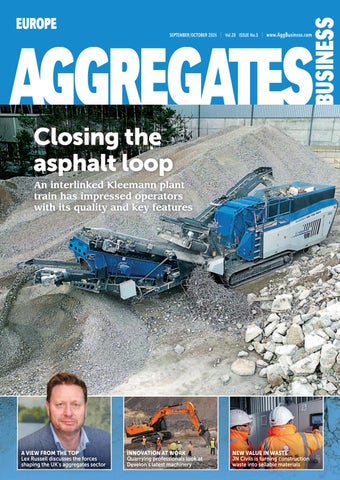
Closing the asphalt loop An interlinked Kleemann plant train has impressed operators with its quality and key features
A VIEW FROM THE TOP Lex Russell discusses the forces shaping the UK’s aggregates sector
ABE0926 COVER.indd 1
INNOVATION AT WORK Quarrying professionals look at Develon’s latest machinery
NEW VALUE IN WASTE JN Civils is turning construction waste into sellable materials
8/9/2026 11:26 am
Lokotrack® LT400RS™ mobile impact crusher
Built for recycling. Easy to move. The LT400RS is built to turn concrete waste, demolition waste and reclaimed asphalt into clean, sellable end products. A large two-deck screen, windsifter and electromagnet enable efficient separation, while wide conveyors support high capacity and smooth material flow.
Maximized material flow and power for recycling
Diesel-electric efficiency
Easy relocation with one-piece or separate screen transport
Easy access for service and cleaning
metso.com
2-3 Comment.indd 2
8/9/2026 11:2 am
COMMENT
Image: Vadim/stock.adobe.com
HEAD OFFICE Prime Global Publishing Capitol Square 4–6 Church Street Epsom, KT 17 4NR EDITOR
Guy Woodford +44 (0) 7486 877 883 guy.woodford@primeglobalpublishing.com
GUY WOODFORD
ASSISTANT EDITOR
Adam Daunt adam.daunt@primeglobalpublishing.com HEAD OF CONSTRUCTION SALES
Graeme McQueen +44 7833 445 592 graeme.m@primeglobalpublishing.com
EDITOR
CHAIRMAN
John Murphy CHIEF EXECUTIVE OFFICER
Christine Clancy PUBLISHER
Entering a growth phase
Paul Hayes CLIENT SUCCESS MANAGER
Janine Clements +61 432 574 669 janine.clements@primeglobalpublishing.com ART DIRECTOR
Michelle Weston COVER IMAGE CREDITS
Kleeman Cemex UK CDE Group Develon SUBSCRIPTIONS
subscriptions@primeglobalpublishing.com
No part of this publication may be reproduced in any form whatsoever without the express written permission of the publisher. Contributors are encouraged to express their personal and professional opinions in this publication, and accordingly views expressed herein are not necessarily the views of Prime Global Publishing. From time to time statements and claims are made by the manufacturers and their representatives in respect of their products and services. Whilst reasonable steps are taken to check their accuracy at the time of going to press, the publisher cannot be held liable for their validity and accuracy.
PUBLISHED BY
Prime Global Publishing AGGREGATES BUSINESS USPS:
is published six times a year. PRINT: ISSN 2051-5766 ONLINE: ISSN 2057-3405
PRINTED BY: Warners (Midlands) PLC
www.AggBusiness.com
2-3 Comment.indd 3
A
fter a relatively flat period, global demand for crushing and screening equipment is starting to pick up. That is one of the key messages in the interview featured in this issue with Metso aggregates business president Markku Simula. He tells Aggregates Business that, even with regional challenges presented by Ukraine and Iran, the industry and its customers are “starting to already feel a little bit more business as usual.” It’s a positive and encouraging market outlook from Metso, which is a leader among crushing and screening equipment manufacturers in North America, South America, Africa, China, the Middle East, and India, and the one of the largest players across Asia Pacific. Metso has spent considerably on research and development over the last decade to advance its crushing and screening equipment for the quarrying sector. Simula said the Finnish manufacturer is focused on bringing innovative products to its customers to help them operate more efficiently. The company has also been expanding its infrastructure, with a significant extension of its India factory in Alwar, Rajasthan, completed in late 2024. The Alwar site is Metso’s largest global manufacturing facility and produces mobile crushing and screening equipment (such as Metso Lokotrack, McCloskey and Tesab) as well as pumps and wear parts. The company has also been constructing new factories in China, where it sees major opportunities from the country’s many “super quarries” that can produce well over ten million tonnes per year. Research backs up Metso’s optimism about the global equipment market, with a recent report from ResearchAndMarkets predicting
“robust growth” in the crushing sector. The report says the global market for crushing equipment was estimated at $US6.2 billion in 2025 and is projected to reach $US11.1 billion by 2032, increasing at a compound annual growth rate of 8.5 per cent from 2025 to 2032. Another major interview in this issue focuses on the UK building materials sector and how it is transforming through artificial intelligence, digital innovation and decarbonisation. Cemex UK Materials managing director Lex Russell describes how he has been leading the business through a period of major change in a dynamic market. This phase has been marked by a continued strategic evolution of Cemex’s operations. In early 2025, the company launched the Project Cutting Edge initiative, which focuses on enhancing competitiveness and strengthening shareholder value through operational efficiencies and a sharper focus on core businesses. Shortly afterwards, Jaime Muguiro assumed the role of Cemex chief executive officer on 1 April 2025, reinforcing this strategic direction. The initiative delivered around $US200 million in savings by the end of 2025 and is expected to reach $US400 million by 2027. “We are now much more focused on ensuring our initiatives deliver clear business value while maintaining a strong alignment of resources and priorities,” Russell told Aggregates Business. “For example, we prioritise digital projects that can generate tangible impact in the short term. Within the circular building materials economy, investments must deliver solid returns and create synergies across the business.” GW
guy.woodford@primeglobalpublishing.com
© AGGREGATES BUSINESS EUROPE September/October 2026
3
8/9/2026 11:2 am
CONTENTS
BUILDING MATERIALS
“If you want mineral products in the future for construction of your hospitals, schools and roads, local authorities have got to support us with planning permissions” – Cemex UK materials managing director Lex Russell p10 Vol.20 ISSUE No.5 September/October 2026
Regulars 03 COMMENT Why global demand for crushing and screening equipment is starting to pick up.
06 ASSOCIATION NEWS The latest news and updates from Aggregates Europe for its members.
50 EVENTS All the key events in the quarrying and aggregates world.
Features 08 COVER STORY An interlinked Kleemann plant train has impressed operators with its quality and key features.
10 BUILDING MATERIALS Cemex UK is evolving its operations to meet the challenge and improve customer value, efficiency and sustainability.
14 SHOWCASE The Develon Demo Days 2026 event showcased new machines, including Series 9 and electric excavators.
16 WASH PLANTS A new CDE-engineered wash plant is helping JN Civils transform construction waste into valuable, recycled materials.
20 QUARRY REPORT France-based Eqiom has expanded its Hitachi excavator fleet, boosting quarry productivity and supporting safer, more sustainable limestone extraction.
04
© AGGREGATES BUSINESS EUROPE September/October 2026
4-5 Contents.indd 4
SEPTEMBER/OCTOBER 2026 | Vol.20 ISSUE No.5 | www.AggBusiness.com
Closing the asphalt loop An interlinked Kleemann plant train has impressed operators with its quality and key features
22 ENGINES Volvo Penta focuses on a multitechnology power approach for its growth plans.
24 EQUIPMENT Propel Industries is drawing on its manufacturing scale in India, its international engineering capabilities, and its diesel-electric equipment range to grow internationally.
A VIEW FROM THE TOP Lex Russell discusses the forces shaping the UK’s aggregates sector
INNOVATION AT WORK Quarrying professionals look at Develon’s latest machinery
NEW VALUE IN WASTE JN Civils is turning construction waste into sellable materials
26 CONVEYORS Smiley Monroe’s Midlands hub is bringing that supply closer to operators across mainland Britain.
28 TYRES Triangle Tyre placed performance and local support at the centre of its steinexpo 2026 appearance as it continues to expand in Europe.
30 PUMPS Tsurumi is widening its UK offering through a partnership with Dragflow.
32 SCREENING Martin Engineering’s Susie O. Bartoli examines how selecting the correct vibration supports efficient and reliable screening.
36 INTERVIEW Metso aggregates president Markku Simula discusses the global demand for crushing and screening equipment.
38 ACQUISITIONS Holcim’s acquisition of Fermacell will extend its European buildingsolutions portfolio.
COVER STORY: An interlinked Kleemann plant train has impressed operators with its quality and key features. Image: Kleemann
40 REGULATION The UK cement industry is being urged to come together and advocate for a brighter future.
42 CRUSHING AND SCREENING Crushing and screening operators are seeking equipment suited to specific production constraints and materials.
44 HAULING New hauling machines show how technology is being better matched to site conditions and existing fleets.
46 LOADING The key trends influencing loading equipment decisions.
48 PEOPLE ON THE MOVE New appointments show how the policy and operational expertise is in demand.
www.AggBusiness.com
8/9/2026 11:22 am
CALL IT OL’FAITHFUL CALL IT ZW310-7 CALL IT THE RELIABLE ORANGE And from April 2027, call Hitachi Construction Machinery LANDCROS 4-5 Contents.indd 5
8/9/2026 11:22 am
ASSOCIATION NEWS
Experts gather for industry task forces
Image: Pavel Jiranek/stock.adobe.com
The biodiversity taskforce took place in Billund, Denmark, on September 10–11.
This autumn will bring a flurry of activity for Aggregates Europe members, as this period will offer the association’s members the opportunity to participate in three different taskforces across the continent, each with its own site visit.
A
ggregates Europe holds its biodiversity, recycling, and communications task forces biannually. Previous iterations have seen industry experts from across the continent gather to exchange information and coordinate action on these three important fronts in different locations, such as Amsterdam, Porto, or Ibiza. This time around, the biodiversity taskforce was held in Billund, Denmark, on the September 10–11. This will be followed by the public relations (PR) and communications taskforce in Paris, France, on September 28–29. Finally, on October 1–2, members will gather in Oslo, Norway, for the recycling task force. Each meeting will include
06
© AGGREGATES BUSINESS EUROPE September/October 2026
6-7 News.indd 6
its own site visit so members may witness first-hand the latest developments in each field. The biodiversity taskforce members shall visit a site in Mjøls. PR and communications taskforce members will visit a Cemex France recycling and recovery platform at Port of Bonneuilsur-Marne. Finally, recycling taskforce members will be able to visit FRANO, a newly opened full-scale soil-washing facility that recovers excavated materials from the construction industry. The topics addressed by these task forces have always been important to the sector, but ongoing developments in Europe make them particularly relevant and timely. Nature restoration has always been an important part of the sector’s work. But
recently, the European Union’s current competitiveness agenda has dominated all conversations, and the Environmental Omnibus has put the nexus between the extractive sectors and biodiversity centre stage. This, in combination with the upcoming Birds and Habitats Directives, underscores the importance of making the conversations to be held in Billund highly relevant and timely. Precisely at a time when competitiveness, reindustrialisation, and raw materials dominate the conversation in Brussels, it is more important than ever to communicate clearly and make the sector’s needs, ambitions, and particularities clear to policymakers. The conversations
to be had in Paris will be fundamental to ensuring the sector’s priorities do not get lost in the noise and that its messaging is clear. Finally, the ongoing development of the Circular Economy Act and the End of Waste Criteria for Construction and Demolition Waste will be of paramount importance for recycled aggregates, making it a priority for members to stay up to date with the ongoing conversations in Norway. By bringing together technical expertise, practical experience and perspectives from across Europe, these task forces will play an important role in supporting a resilient, sustainable and forward-looking aggregates sector. AB
www.AggBusiness.com
8/9/2026 11:21 am
OFFIC
IAL JO
URN
AL O
F TH
E INST
ITUTE
OF Q
UAR
RYIN
G AU
STRAL
IA
MAY
2026
JUNE 2026 INSTITUTE OF
QUARRYING
AUSTRALIA
CTIV
JULY 2026
ITY FROM QUA PIT LAN RRY E FLOO TO R
46
ODU
26
D PR
THE INSTITUTE OF QUARR YING AUSTRALIA
LEAD
ING TH
E WAY
PORTS QUARRY SUP OEING BRISBANE CAN orting a Boral is supp council’s and ensl Que a new vision to build Olympics. venue for the
As the only national quarrying publication and the official journal of the Institute of Quarrying Australia, you’ll always be up to date with the latest developments in industry news, technology and events with Quarry Magazine.
CONSISTENCY IS THE KEY CJD Equipment showca ses what makes the Volvo K Series wheel loaders such a good fit for quarry operato rs.
MIXING IT UP IN SA Liam Berneville-Claye is having a crack at develop ing his business from the ground up in South Australia.
28
PARK FROM PIT TO explains Rob Corkery vital quarry how a once formed has been trans multipurpose into a major facility. recreational
SOLI
18
TION NEXT GENERA SCREENING CRUSHING AND trotech’ of ‘elec A new wave g how nisin lutio is revo generated, electricity is umed. stored and cons
ROCK
34
18
14
16
OFFICIAL JOURNAL OF
36
OFFI
L OF THE CIAL JOURNA
THE AUSTRALIAN EDGE Multotec has invested in local manufacturing to improve support for the Australi an quarrying sector.
It’s quick and easy to subscribe to our monthly print issues, our annual Suppliers Directory and our weekly eNewsletter. Don’t miss out!
SUBSCRIBE NOW www.quarrymagazine.com or email: subscriptions@primecreative.com.au
6-7 News.indd 7
8/9/2026 11:21 am
COVER STORY
Kutter is using an interlinked Kleemann plant train to protect the quality of reclaimed asphalt while producing controlled fractions for reuse in new mixes.
R
eclaimed asphalt is valuable because it already contains aggregate and bitumen. It is difficult for the same reason: processing it too aggressively can produce excessive fines and disrupt the grading required for a new asphalt mix. Construction contractor Kutter is addressing that balance with a mobile Kleemann plant train in Germany’s Allgäu region near Memmingen. The train comprises a MOBISCREEN MSS 502 EVO scalping screen, a MOBIREX MR 100 NEO impact crusher and MOBIBELT MBT 20 and MBT 24 stackers. Together, the machines process feed ranging from 0–120mm, including occasional slabs formed during stockpiling with edge lengths of up to 500mm. The system separates reclaimed asphalt pavement (RAP) before selectively crushing the oversize material, enabling different fractions to retain value within the asphalt production cycle. Control begins before the RAP reaches the crushing train. Wirtgen milling machines remove surface layers, binder courses and base layers separately, helping preserve more consistent material characteristics. The reclaimed material is then screened and crushed before moving to Kutter’s asphalt mixing plant for incorporation into a new mix. At the first processing stage, the MSS 502 EVO divides the feed into three streams. One fraction is discharged as a directly usable product with a high bitumen content, avoiding unnecessary crushing. The middle fraction bypasses the impact crusher and travels through the MBT 20
08
© AGGREGATES BUSINESS EUROPE September/October 2026
8-9 Kleeman.indd 8
stacker, where it is combined with material discharged by the MR 100 NEO. Only the oversize fraction is directed into the crusher for further reduction. The MBT 24 provides additional stockpiling capacity. This arrangement prevents every tonne from passing through the crusher simply because a portion of the feed is oversized. It also allows Kutter to produce homogeneous fractions suited to the grading requirements of its asphalt plant while limiting avoidable generation of fines. Kutter asphalt mixing plant manager Simone Eichiner said the resulting material better matched the company’s production requirements. “The crusher and the screens deliver a material that contains a lower proportion of fines and better fulfils the requirements of the desired grading curve,” Eichiner said. “That’s important when it comes to the production of asphalt mixes in line with the relevant standards. On top of this, the low fuel consumption and simultaneously increased hourly output reduce the operating costs.” The complete train processes up to 240 tonnes per hour (tph). Following impact crushing and separation, its specified products include 0–11mm material for surface and binder courses and a 0–22mm fraction for base and binder applications. Both can be transferred to the mixing plant for use in new asphalt. Mobility is also relevant to Kutter because the contractor works across multiple locations. The individual machines can be relocated and configured around the
Images: Kleemann
Reclaiming quality from asphalt available site footprint, feed characteristics and required products rather than remaining tied to one processing position. Performance is only one part of the operating equation. RAP can arrive in irregular slabs and may require the crusher chamber to be checked or cleared, making safe access and the duration of maintenance interruptions important to daily production. Kutter crusher operator Thomas Guggenmoser highlighted the handling of the machine and the Lock & Turn quick access function. The system supports the controlled opening of the crusher for inspection and maintenance. “The system enables quick and safe opening of the crusher for maintenance and checking and has proved to be very useful in our daily operations,” Guggenmoser said. “It reduces idle times to a minimum and saves us a lot of time and stress. All told, the access to the central service and maintenance points is really very good.” SPECTIVE CONNECT adds a digital view of the train. The application provides information on fuel consumption, production, utilisation and faults, allowing Guggenmoser to check plant status without relying solely on observations made beside the equipment. Fault localisation can help narrow the source of an interruption before further action is taken. For an operator overseeing an interlinked train, this visibility can also show whether a problem originates with an individual machine or elsewhere in the process. “That makes everything more efficient and avoids unnecessary service callouts and interruptions,” Guggenmoser said. The processing train sits within a wider production sequence that extends from selective milling to mixing, paving, and compaction.
www.AggBusiness.com
8/9/2026 11:20 am
COVER STORY
The Kleemann plant train here consists of a MOBISCREEN MSS 502 EVO scalper, a MOBIREX MR 100 NEO impact crusher and two MOBIBELT stackers.
The Wirtgen Group and its product brands – Wirtgen, Vögele, Hamm, Kleemann and Benninghoven – offer the complete portfolio of machines and plants from a single source for operators working in construction materials applications.
www.AggBusiness.com
8-9 Kleeman.indd 9
Kutter has above all come to appreciate the application consulting services provided by the individual brands. Eichiner said the application advice provided across the brands’ team of specialists had helped Kutter examine the complete process rather than evaluate each machine in isolation. “This interaction optimises the overall process,” he said. “The consultants also look outside the box. The focus is on the applications, not on the individual products. That has proved to be an enormous advantage. “The technical support, the fast delivery of spare parts and the training courses for digital tools – everything meshes so well.” AB
Crusher operator Thomas Guggenmoser particularly likes the handling of the Kleemann machine and the Lock & Turn quick access function.
Facts and figures
• Feed material: Reclaimed asphalt pavement 0–120 mm (occasional slabs of milled material with edge lengths of up to 500mm) • Output: 0–11 mm final grain, 0–22 mm final grain, from base layer 0–32 mm • Plant train throughput: 240tph
© AGGREGATES BUSINESS EUROPE September/October 2026
09
8/9/2026 11:20 am
BUILDING MATERIALS
Images: Cemex UK
Cemex UK’s sand and gravel quarry in Shepperton, North Surrey.
Leadership for a changing sector The building materials sector is transforming through artificial intelligence, digital innovation and decarbonisation. Cemex UK is evolving its operations to meet the challenge and improve customer value, efficiency and sustainability.
O
ver the past 12 to 18 months, Cemex UK Materials managing director Lex Russell has been leading the business through a meaningful transformation amid a dynamic market backdrop. This phase has been marked by a continued strategic evolution of the business. In early 2025, the company launched Project Cutting Edge, a key initiative focused on enhancing competitiveness and strengthening shareholder value through operational efficiencies and a sharper focus on core businesses. Shortly afterwards, Jaime Muguiro assumed the role of Cemex chief executive officer (CEO) on 1 April 2025, reinforcing this strategic direction. The initiative delivered approximately $US 200 million in savings by the end of 2025 and is expected to reach $US400 million by 2027. As part of this transformation, Cemex UK, within the broader Europe, the Middle East, and Africa region, has implemented a more streamlined organisational structure, empowering local teams with greater decision-making autonomy, and a stronger focus on core activities and performance. “We are now much more focused on ensuring our initiatives deliver clear business value while maintaining a strong alignment of resources and priorities,” Russell said. “For example, we prioritise digital projects that can generate tangible impact in the short term.
10
© AGGREGATES BUSINESS EUROPE September/October 2026
10-13 Cemex.indd 10
“Within the circular building materials economy, investments must deliver solid returns and create synergies across the business. Today, we have greater autonomy to act, allowing us to make decisions locally that directly support our financial key performance indicators and strengthen overall performance.” Russell said that since Muguiro’s appointment as CEO in April 2025, Cemex’s share value has trebled. “It has made a massive difference, and trading results have improved,” Russell said. “A lot of that reflects the confidence investors and shareholders have in Jaime’s leadership and in the company’s ability to execute. “There is a strong sense in the market that Cemex is delivering on its strategy, with clear priorities and consistent performance, which is helping to build further momentum.” A Scottish national from Penicuik near Edinburgh, Russell has had a long career in the UK and international building materials industry, starting with hands-on experience in various roles before moving into management. He said his success came from continuous learning, building relationships, and a supportive company culture at Cemex. “I’ve seen changes in my job. As the materials managing director for the UK, I looked after aggregates and ready-mix, but I am now also responsible for asphalt, building products and dry silo mortar,” he said.
Russell has worked in the building materials industry for over 40 years, initially starting in 1984 with Scottish quarrying and concrete business Alexander Russell, holding a variety of operational and technical roles. In 1989, he joined RMC’s technical department and later progressed through the company as a quarry manager, operations manager, business manager and director. In 2005, RMC was acquired by Cemex, and two years later, Russell moved to Australia to lead a team in the post-merger integration of Rinker, which Cemex acquired in 2007. He returned to the UK as vice president before becoming managing director of the Cemex UK Materials business in 2018. Russell said his leadership style is characterised by accessibility, clear, simple communication, a focus on purpose, empowerment, accountability, and high personal and professional standards. He said significant improvements in its health and safety culture, successful navigation of the COVID-19 pandemic, continuous improvement, and a positive company culture were his major achievements in the role. Major challenges over the past eight years have included market downturns, global financial crises, business restructurings, and the difficult process of reducing headcount. Russell said the subdued British building materials market is due to a downturn in house building and commercial construction, which is putting pressure on volumes.
www.AggBusiness.com
8/9/2026 11:19 am
BUILDING MATERIALS
To address these challenges, he said Cemex UK’s focus is on price discipline, cost reduction, operational efficiency, and customer relationships. A broader mix of macroeconomic factors, including evolving global conditions, higher interest rates, and energy costs, has also influenced construction activity in the UK, tempering confidence and demand, according to Russell. At the same time, the pace of infrastructure and housing delivery has been more gradual than anticipated, contributing to a more measured market environment. Within this context, Cemex UK continues to take a disciplined approach to investment, progressing with targeted projects such as the Dove Holes Building Products facility near Buxton, Derbyshire, and a new dry silo mortar plant in Swindon, Wiltshire. These developments are designed to enhance operational efficiency and reliability, while strengthening the company’s product offering and supporting its ongoing focus on sustainability and customer service. Cemex’s UK operations can be traced back to 1826, when a small family business owned by Thomas Walker and his son, George Walker, began producing lime mortar in Rugby, a market town in eastern Warwickshire, in England’s West Midlands. This business was eventually acquired by RMC in the year 2000. RMC's own history dates back to the 1930s when Kjeld Ammentorp is credited with founding the
www.AggBusiness.com
10-13 Cemex.indd 11
Cemex UK materials managing director Lex Russell.
“If you want mineral products in the future for construction of your hospitals, schools and roads, local authorities have got to support us with planning permissions” – Cemex UK materials managing director Lex Russell
organisation and establishing the UK's first readymix concrete plant. RMC were in turn acquired by Cemex in 2005. Alongside his role at Cemex UK, Russell chairs the London-based Mineral Products Association (MPA), the UK trade association for the aggregates, asphalt, cement, concrete, dimension stone, lime, mortar, and industrial sand industries, which is advocating for more efficient planning and permitting for the British building materials sector. “There has been a lot going on at the association. It’s not been the easiest couple of years for the national building materials industry, but I’ve been working with a lot of good people at the MPA,” Russell said. “They are an amazing team, experts in their field. Chris Leese [MPA executive chair] was vice president of Cemex UK Readymix when I was vice president of aggregates, and I’ve been enjoying being back working with him. He’s been a great help to me over the years and has been really driving the messages the MPA has been putting out. “This industry has given my family and me a good life, and I want to make sure it remains as strong as possible for future generations. I love everything about what we do. It’s not a chore to get up out of bed in the morning.” Going forward, Russell and the broader MPA team will continue to advocate so the British building materials sector can have a brighter future.
© AGGREGATES BUSINESS EUROPE September/October 2026
11
8/9/2026 11:19 am
BUILDING MATERIALS
“We’re knocking on the government’s door harder than we’ve ever done, and why shouldn’t we? We are an industry that employs 90,000 people,” Russell said. “There has been significant emphasis on supporting the steel-making industry, and we are a significantly bigger employer. It’s about making sure the government is listening to us.” Russell said he and the MPA board are keen for the UK Government, local authorities and wider UK society to recognise the building materials industry as ‘critical’ rather than its current ‘essential’ status to secure future supply chains. “If you want mineral products in the future for construction of your hospitals, schools and roads, local authorities have got to support us with planning permissions. The current process is slow and cumbersome. It’s got worse since COVID. It’s a lack of resources and expertise, not just in local authorities but also in environmental permitting,” he said. “The process is far slower than in other countries. I think they treat materials accessibility as a bigger priority. It’s also important to consider the local economy and jobs tied to obtaining these planning permissions and permits. “It also costs a lot of money to put in our applications. I’ve sent countless letters to the heads of local authorities, highlighting how slow a permitting application has been. “It sometimes helps. At small sand and gravel pits with very small, approved reserves, it’s a big concern. The reserves you are approved to access are also available for
12
© AGGREGATES BUSINESS EUROPE September/October 2026
10-13 Cemex.indd 12
shorter periods. When you’ve got to invest to do this, it gets increasingly difficult.” Despite ongoing market and operating challenges, Russell is optimistic about the sector's future, anticipating growth in housing, renewable energy infrastructure, and more automated, decarbonised operations. He said there was a need for greater certainty regarding planning permissions and government support. Looking at its workforce, Cemex UK is working to attract and retain talent by offering apprenticeships, promoting diversity, and recognising the need to expand the talent pool to meet future industry demands. “What’s in my head is having specific competence and knowledge in the business to cover key topics. It’s knowing who the person I’ll turn to when we’re opening a new sand and gravel or hard rock quarry is,” Russell said. “Who will know what equipment I need to work a quarry face to achieve the best aggregate mix for the crushers and screens? Who understands the quarry's geology so we can build the right haul roads to maximise production? If I’m buying a new cone crusher, which model is preferred? Who will advise me on the best loading shovel for a certain application? “Locally, nationally and globally, we need to understand the needs of our aggregate and other material businesses, and I want good people coming through to drive them forward. “Our employee retention is very good, and some who have left us have come back very quickly.”
Concrete blocks at Cemex’s Dove Holes facility in Derbyshire. Russell said that Cemex UK has a firm focus on employee wellbeing. This includes initiatives on mental health, neurodiversity, and early prostate cancer detection through prostate-specific antigen (PSA) blood testing for male employees aged 40 and over. “I believe our PSA testing will save lives. One of the things about prostate cancer is that it doesn’t necessarily have any symptoms. Early detection is key,” Russell said. “Many of our people participated in our support sessions, and we encouraged employees to bring their partners.” Russell said Cemex UK actively promotes quarry restoration, aiming for ‘biodiversity net gain’ and a ‘nature positive’ approach, leaving restored sites in a better ecological condition than before, which is seen as integral to their operations and beneficial for local communities. “Quarry restoration is one of the things that I love about what we do. We dig up a field where sheep and cows once were grazing, extract the minerals for roads, houses, and hospitals, and when we’ve finished, we restore the site to a much better condition than it was previously, with ponds, wetlands, flora and fauna, encouraging animals and insects to inhabit,” he said. “This is what we do; it’s in our DNA. There are 46 rare birds in the UK, but they’re all on our active and restored sites. “It’s lovely to see on our active sites when we have teams there that have built
www.AggBusiness.com
8/9/2026 11:19 am
BUILDING MATERIALS
relationships with sand martins and other birds or visiting wildlife and look forward to seeing them.” Digitalisation and artificial intelligence (AI) are being integrated across Cemex UK to enhance operational efficiency through predictive maintenance and streamlined safety procedures (the Take 5 app), and to improve commercial insights by analysing sales data and customer behaviour. Cemex Go, a customer-facing app, facilitates ordering and delivery management. This work aligns well with Cemex’s global Digital Forward programme, leveraging cutting-edge technologies such as AI and data cloud platforms to enhance efficiency, productivity, and sustainability across operations. “AI is massively helping us on the operations side with predictive maintenance. It will help them grow a lot stronger. On the digitalisation side, we now use iPads and mobile phones, which can, among other things, give you access to the Take 5 app, which encourages you to run through a digital safety checklist before you do a task,” Russell said. “On the commercial side, we will increasingly use AI to better understand what our customers want. I see this technology as helping our people do their jobs while giving them more time to think about new ways of doing things better and continuously improving.” AB
Reopening of Dove Holes Building facility, marked by a ribbon-cutting ceremony held by Cemex UK Materials managing director Lex Russell and Cemex UK national sales manager for concrete products Sam Culshaw (both pictured at the front here).
ENGINEERED FOR
UNLOCKING VALUE FROM CONTAMINATED WASTE Discover how challenging waste streams from major construction and infrastructure projects, including PFAS, hydrocarbon and heavy metal contaminated soils, are being successfully treated, recovered and diverted from landfill - creating new revenue streams while actively contributing to the circular economy.
For more details, visit cdegroup.com
www.AggBusiness.com
10-13 Cemex.indd 13
© AGGREGATES BUSINESS EUROPE September/October 2026
13
8/9/2026 11:19 am
SHOWCASE
The Real-X system, developed by Develon in partnership with Gravis Robotics, brings next-gen autonomous excavators into realworld operation.
Images: Develon
Advancing towards autonomous operations The Develon Demo Days 2026 event showcased new machines, including Series 9 and electric excavators, and highlighted its advances in autonomous quarrying equipment.
D
evelon welcomed nearly 900 customers, dealers and industry professionals to its equipment showcase, Develon Demo Days, from 13–16 April 2026. Held at the Háje quarry near Prague in the Czech Republic, the four-day showcase gave attendees the opportunity to experience the latest Develon machines, including the new Series 9 smart crawler excavators, in a real working environment. With more than 25 machines on display, the event provided a hands-on platform for customers to explore Develon’s latest innovations designed to enhance productivity, safety, and efficiency across quarrying applications. The event coincided with the launch of Develon’s new DX360LC-9 (37-tonne) and DX400HD-9 (42-tonne) models. These machines build on a next-generation excavator platform featuring full electrohydraulic (FEH) technology and integrated artificial intelligence, designed to deliver enhanced precision, control and efficiency. These new models joined the previously introduced DX230LC-9 and DX260LC-9 models, with all four Series 9 machines available for attendees to operate on-site, providing a valuable opportunity to experience the benefits of the new platform under real working conditions.
14
© AGGREGATES BUSINESS EUROPE September/October 2026
14-15 Develon.indd 14
A key highlight of the event was a live demonstration of the Real-X system, developed in partnership with Gravis Robotics. Combining both companies’ expertise in artificial intelligence (AI)-powered excavation and advanced construction equipment, the system represents a significant step forward in the development of autonomous excavation solutions. The smooth and precise Real-X trenching demonstration illustrated how automation can enhance consistency, safety, and productivity on-site. The collaboration has already resulted in the delivery of the first system of its kind to a customer in Europe, marking an important milestone in bringing next-generation autonomous excavators into real-world operation. Other key partners, including Leica, Engcon, Trimble, Steelwrist and Strickland, exhibited at the event, with representatives on hand to explain the nature of their cuttingedge collaborations with Develon. Other live demonstrations at the event covered several new safety and productivity features from Develon, including the groundbreaking E-Stop system, the first technology of its kind developed specifically for the excavator market. E-Stop is just one of several new advanced intelligent safety features that Series 9 machines can be
equipped with to significantly reduce job-site accidents and protect workers in highrisk environments. “E-Stop technology is comparable to emergency braking systems used in the automotive industry, and has already attracted strong attention from operators seeking practical solutions to improve site safety standards,” Develon product manager for excavators in Europe Stephane Dieu said. The latest version of Develon’s Transparent Bucket 2.0 (TB2.0), an advanced visibility system for wheel loaders, was on display. By effectively eliminating front blind spots, the TB2.0 allows operators to work with greater confidence, improving both safety and overall efficiency. Develon is expanding its portfolio of electric-powered excavators, in response to growing demand from customers looking to transition from diesel to zeroemission solutions. Built on the company’s ‘-7 Series’ platform, the electric machines cover the key compact and mid-size segments, and offer the performance and reliability quarry operators expect alongside reduced environmental impact. The ‘-7 Series’ models on display included the DX20ZE-7 and DX23E-7 electric mini excavators, the DX230LCE-7 electric crawler excavator, and the DX160WE-7K electric wheeled excavator.
www.AggBusiness.com
8/9/2026 11:18 am
SHOWCASE
Special application machines for demolition and material handling were also highlighted at the event, including the new DX140RDM-7 compact demolition excavator, along with the DX160WMH-7 and DX350WMH-7 material handlers. At 14 tonnes, the DX140RDM-7 combines maximum power with exceptional agility, making it ideal for working in confined spaces. The DX140RDM-7 forms part of Develon’s wider demolition range, which also includes the DX245DM-7, DX380DM-7 and DX530DM-7 models, covering a broad spectrum of project requirements. The DX160WMH-7 and DX350WMH-7 material handlers support demanding applications such as recycling, waste management and general industry, delivering the durability, efficiency and performance required for high-intensity operations. Develon said it continues to strengthen its position in the European dozer market with the introduction of the new DD100-7, following the successful launch of the DD130-7. Positioned among the leaders for its class for operating weight and horsepower, the DD100-7 is designed for residential, light commercial and road construction applications. Its precision-focused performance makes it particularly well suited to fine grading work, where accuracy and control are essential. AB
The new 37-tonne DX360LC-9 excavator was on show at Develon Demo Days 2026.
A LONG WAY
TOGETHER
EARTHMAX A SR 41 AX No matter how challenging your needs, EARTHMAX SR 41 is your best ally when it comes to operations that require extraordinary traction. Thanks to its All Steel radial structure and the special block pattern, EARTHMAX SR 41 provides excellent resistance against punctures and an extended service life. In addition to long working hours without downtime, the tire ensures extraordinary comfort. EARTHMAX SR 41 is BKT’s response to withstand the toughest operating conditions in haulage, loading and dozing applications.
Discov ver the BKT K Range KT
For info: europe@bkt-tires.com
www.AggBusiness.com
14-15 Develon.indd 15
© AGGREGATES BUSINESS EUROPE September/October 2026
15
8/9/2026 11:18 am
WASH PLANTS
The JN Civils team pictured with its CDE ProPress.
Partnership turns waste into value A new CDE-engineered wash plant is helping JN Civils transform construction waste into valuable recycled materials.
J
N Civils, based in Blackpool in northwest England, has strengthened its commitment to sustainable construction and resource recovery with the commissioning of a new construction, demolition and excavation (CD&E) wasterecycling wash plant designed and engineered by wet-processing experts CDE. With a processing capacity of up to 150 tonnes per hour (tph), the CDE solution, commissioned at the JN Civils’ Olympic Way facility, represents a significant step forward for the civil engineering and utilities contractor. “Bringing wet processing capabilities in-house gives JN Civils greater control over material quality, availability and, importantly, cost,” CDE business development manager Nathan Loboda-Smith said. “It also creates a platform for sustainable growth through the sale of recycled products to construction and groundworks customers.” Established in 2010 by founder and managing director Joel Cossins, JN Civils
16
© AGGREGATES BUSINESS EUROPE September/October 2026
16-19 CDE JN Civils.indd 16
has grown from a start-up into a trusted provider of civil engineering, utilities, and infrastructure services throughout the UK. Before investing in its own plant, JN Civils was transporting waste material at great cost from its operations to a third-party wash plant for processing; coincidentally, also a CDE-engineered solution. Ultimately, this set-up allowed JN Civils to see CDE’s solutions in action, while building a longterm working relationship. “It was a workable solution to recover as much material as possible, but haulage costs, processing fees, and delays in being able to return those materials back to use meant we needed a more sustainable option over the long term,” JN Civils operations manager David Scott said. “It showed us just how impactful the CDE wash plant was and set us on a path to explore commissioning our own plant.” The investment allowed JN Civils to produce its own materials on-site, creating a new revenue stream and major cost savings.
“We were fans of using recycled aggregates anyway. With the local third-party wash plant, we were spending anywhere between £150,000 and £200,000 a month with them to dispose of waste, and then we were buying the recycled sand and stone back off them,” Scott said. “We were spending half a million a year on concrete, and now we make our own concrete as well, so it was a good decision by our managing director to invest in the CDE product.” CDE Group head of solutions William Melanophy said the plant effectively transforms waste material that previously incurred disposal costs and required the purchase of virgin material into usable products. This has closed the loop for JN Civils and enhanced businesswide efficiencies. The plant has been up and running since late July 2025, and Melanophy said the installation, including mechanical set-up, took around 12 to 14 weeks. “It was about making sure we were getting the right solution on all fronts,” Melanophy said. “We did a lot of work in a short space of time to map out what was the right solution for JN Civils and get a clear picture of the tonnages that were required.” “You're looking at typically a 20-yearplus lifespan for the plant. It's critical that the access and maintenance around that plant is considered right from the start. It can't be an afterthought and has to be
www.AggBusiness.com
8/9/2026 11:18 am
WASH PLANTS
Images: CDE
CDE Group head of solutions William Melanophy.
“It was about making sure we were getting the right solution on all fronts” – CDE Group head of solutions William Melanophy
intrinsically designed into the layers and into the process.” The plant surpassed 300,000 tonnes of material processed by early June this year, which Melanophy said is a testament to the work done up front to ensure the initial tonnage promise was met and exceeded. “There was alignment in terms of the output quality and the understanding that the primary 0–4mm sand produced was to be consumed back into concrete through the batching plant that is on-site here at JN Civils,” Melanophy said. Melanophy said the planning to maximise the effectiveness of the wash plant needed to consider that the site is relatively compact, with other activities taking place, including crushing and the concrete batching plant. JN Civils solidified its decision to partner with CDE on this project after experiencing how CDE technology operates when the contractor was transporting waste to another site which used a CDE solution, coupled with a site visit to another CDE customers, IMS in Dublin, to see the plant in a live environment. “This is understandably a major investment for us, so we did our due diligence,” Scott said. “We looked at what was available in the market, not just in terms of the technology itself, but also the expertise and support available to us once the plant is commissioned. CDE was outperforming on all fronts.
Achieve the Next New Generation Series 9
Smarter Machines
Find out more: eu.develon-ce.com
www.AggBusiness.com
16-19 CDE JN Civils.indd 17
Safer Sites
Better Results
The new Develon Series 9 is the first excavator range to combine AI-powered human detection with an intelligent automatic E-Stop system — helping prevent accidents before they happen. Together with full electronic hydraulic precision, it creates a safer, sharper and more efficient way to work.
© AGGREGATES BUSINESS EUROPE September/October 2026
17
8/9/2026 11:18 am
WASH PLANTS
The ProPress plant surpassed 300,000 tonnes of material processed by June this year. “The other options wouldn’t have delivered the capacity or quality we needed. When it came to aftercare and keeping us up and running, CDE’s availability and proactivity were unmatched.” The complete solution for JN Civils includes an R4500 belt feeder with an integrated feed hopper, an AggMax scrubbing and classification system, an EvoWash sand washing system with patented Infinity dewatering screening technology, an AquaCycle thickener for primarystage water management, and the X3 ProPress filter press.
Stuck for a solution?
Don’t get bogged down on site. Tsurumi’s pumps can transport almost anything to keep your project moving.
+49 211 417 9373 | SALES@TSURUMI.EU | WWW.TSURUMI.EU
18
© AGGREGATES BUSINESS EUROPE September/October 2026
16-19 CDE JN Civils.indd 18
The system is engineered to process CD&E waste in a compact, small-footprint urban environment, producing a range of washed and graded materials, including fine sand, coarse sand, and aggregates in sizes 10–4mm, 20–40mm, and 80–40mm. “The vision for this project was clear from the outset; to help JN Civils take greater control of its waste streams, improve operational efficiency, and recover high-quality materials that can support sustainable construction,” CDE Group project manager David Gordon said. “We’re proud that the plant and our partnership with JN Civils is delivering strongly on all of these aims.” As an Environment Agency-certified organisation, JN Civils aims to recycle 90 per cent of its waste to recover high-quality sand and aggregates for reuse in its own projects and for sale to the wider construction market. “This facility will allow us to reach that ambitious goal, initially helping us to recycle up to 80 per cent of our excavation waste, extracting sand and stone materials to meet product specifications,” Scott said. “It’s a significant step forward in our commitment to sustainability, supporting the circular economy, and providing enhanced value for our customers. By integrating this technology, we aim to reduce our environmental footprint and enhance our operational efficiency.” Since commissioning, the plant has created new commercial opportunities for JN Civils and helped maximise profitability. Recovered products are being used within the company’s own civil engineering operations, and with additional processing capacity, surplus materials are now being sold externally. The processed materials are sold to local builders’ merchants and utilities companies, with 50 per cent of the product reused internally by JN Civils for utility work, creating a full circulareconomy loop and enhancing sustainability credentials to win contracts. Scott said that JN Civils is “delighted” with the performance of the CDE wash plant. “The compactness of it makes for a great design which is testament to the CDE guys,” he said. “The other factor is how clean it keeps itself. It didn’t take much effort to get it to that standard because it’s wellengineered. “It has opened up new areas of business as we didn’t have aggregates sales or anything like that; we were just an end user. Now we’re selling it as well as reusing it ourselves, so that’s creating another revenue stream within the business.” AB
www.AggBusiness.com
8/9/2026 11:18 am
A s v a O in la a
C + gr
Aggregates Business is a go-to source for up-to-date news and views on the American aggregates and building materials sectors. Our wide-ranging features line-up includes in-depth articles on the latest loading, hauling, and crushing and screening machines. Contact: Graeme McQueen +44 7833 445 592 graeme.m@primeglobalpublishing.com
16-19 CDE JN Civils.indd 19
www.aggbusiness.com 8/9/2026 11:18 am
QUARRY REPORT
Operators are impressed by the speed and comfort of the EX1200 excavators.
Images: HCME
Powering limestone extraction France-based Eqiom has expanded its Hitachi excavator fleet, boosting quarry productivity and supporting safer, more sustainable limestone extraction.
T
wo Hitachi EX1200 ultra-large excavators are reshaping operations at the Eqiom cement quarry in Héming, France. To meet performance and sustainability goals, Eqiom has strengthened its long-running partnership with Hitachi Construction Machinery Europe (HCME) by adding a second EX1200 to its fleet, marking a major evolution in how the historic site extracts limestone. The companies’ collaboration reflects a shared commitment to modernising quarry extraction, reducing environmental impact, and ensuring long-term operational safety. Founded in 1892, the Héming quarry extracts 1.1 million tonnes of limestone each year across its 300 hectares, supplying 800,000 tonnes of cement. After decades of working with 250-tonne excavators, Eqiom decided to transform its approach by introducing blasting and switching to faster, smaller and more economical equipment. “We had to completely rethink our operating method to improve efficiency and safety,” Eqiom quarry manager Raphaël Amet said. Following extensive research led by HCME field product support specialist Didier Geneste, the team identified the Hitachi EX1200 as the ideal fit. The first EX1200-6 arrived in March 2019, followed by the nextgeneration EX1200-7 in February 2025. The EX1200 models, equipped with HCME-customised buckets, deliver
20
© AGGREGATES BUSINESS September/October 2026
20-21 Hitachi.indd 20
production rates of up to 1000 tonnes per hour, matching the company’s previous 250-tonne excavators with greater efficiently. “We are achieving the same volumes as with our old excavators, but with much lower fuel consumption,” Amet said. “This is a major economic and environmental benefit.” In six years, the EX1200-6 has reached 7000 operating hours while maintaining a high level of availability, reinforcing the machine’s reliability. For Eqiom’s teams, the upgrade has been a transformative one. “Hitachi machines are fast, smooth, and there is much less vibration,” Eqiom team
leader Laurent Guardo said. “They were easy and pleasant to learn to use.” Thanks to personalised HCME training, all 12 operators adapted quickly and expanded their versatility across excavators, dumpers and loaders, resulting in improved productivity across the board. Amet said not only has the machine’s performance been impressive, but so has the service provided by HCME. “The support provided to the teams and the reliability of the machines have been impeccable,” he said. “This is what is prompting us to already consider a third excavator in the coming years.” AB
The site extracts 1.1 million tonnes of limestone annually.
www.AggBusiness.com
8/9/2026 2:10 m
20-21 Hitachi.indd 21
8/9/2026 2:10 m
ENGINES
Growth shifts into a higher gear Energy resilience and a data centre boom drive a spike as Volvo Penta focuses on a multi-technology power approach.
22
© AGGREGATES BUSINESS September/October 2026
22-23 Volvo Penta.indd 22
This approach is reflected in its engine and power offerings. “We are now demonstrating more and more that this is coming into the market,” Müller said. “Of course, this differs across segments, customers and regions, but we are making the technologies available. “In addition to the G17 natural gas engine, we have the production-ready D8 dieselhydrogen engine. Both are primarily for the genset side. Then we have batteries, energy storage systems that we are now selling, drivelines, electric drivelines and modern diesel technology – Tier 4 Final for North America and Stage V-certified for Europe engines for quarrying and mining, where they appreciate the low emissions, power density and reliability of our engines.” Volvo Penta’s engines and power systems are mainly utilised by original equipment manufacturers (OEMs) to power heavy-duty mobile and stationary machinery.
Volvo Penta president Anna Müller. In quarrying and materials handling, its diesel and electric systems are predominantly found in stone crushers, screeners, rock drills, large forklifts and reach stackers. With connectivity increasingly important in powering quarry equipment, the VolvoConnect digital platform and fleet maintenance system help operators secure maintenance and monitor engine performance remotely. In 2024, Volvo Penta launched the Volvo Penta Co-Pilot advanced software and hardware platform, which is designed to optimise engine performance in the off-highway segment. The solution, which leverages Volvo Group technologies, provides a comprehensive platform for
Images: Volvo Penta
O
ff-road engines and power systems manufacturer Volvo Penta has experienced significant growth in North America, with industrial engine sales doubling between 2023 and 2026. Volvo Penta president Anna Müller said the US market accounts for around 25 per cent of Volvo Penta’s overall sales. The company’s multi-technology approach to powering off-road equipment remains central, encompassing combustion engines, electric drivetrains, and integrated battery storage, with new products such as its G17 natural gas engine and a diesel-hydrogen engine being introduced. The G17 engine can run on natural gas and renewable biogas and is designed for stationary power generation. It is primarily used as a back-up power supply and emergency generator for high-demand, mission-critical infrastructure like data centres and utilities. It can also be used for stationary and mobile power generation in quarrying and materials handling, with applications including powering stationary and mobile crushers, screeners, and conveyors that require clean, reliable, high-torque power. In pumping and ventilation applications, the G17 can drive heavy-duty pumps for dewatering pits and ventilation systems in deep quarries or underground mining operations. The quarrying sector is considered highly strategic for Volvo Penta, with significant effort invested in developing service offers, connectivity, and engines tailored for this market, though direct sales of battery energy storage systems to quarry operators have not yet occurred. Volvo Penta entered the quarrying and mining sectors 15 years ago, and in today’s open and competitive market for underground mining engines, it has gained a 30 per cent global market share, excluding captive in-house use. Müller said this success has been driven by the company’s service network, the uptime it provides to its customers, and engine performance. Müller believes future trends in power for quarrying equipment are likely to include advanced diesel engines (often with hydrotreated vegetable oil compatibility), hybrid technology, and alternative fuels, with no immediate regulatory cutoff for diesel engines anticipated. Volvo Penta has a multi-technology approach to powering off-road equipment, featuring three core pillars: combustion engines, purpose-built electric drivelines, and integrated battery storage subsystems.
Volvo Penta’s new products include the G17 natural gas engine.
www.AggBusiness.com
8/9/2026 2:10 m
ENGINES
accessing information and tools to unlock new possibilities. It enables flexible, up-todate, and cohesive features and interfaces to coexist and scale seamlessly. The system has been designed to help fleet owners and operators better manage projects and requirements. Features include a fully integrated human–machine interface, machine controls, a perception camera for enhanced safety, tyre pressure monitoring, service information, and more. It can also help operator coaching, with smart features such as high-precision positioning, load assist on-board weighing, and stability control. “Co-Pilot is a tool to support OEMs and operators in operating the machine more efficiently, with its combination of advanced analytics and real-time data,” Müller said. “We have a very advanced system that can provide 3D data combined with positioning data and really guide how you operate.”
HVO power Müller identified HVO as an interesting option in current engine trends in the quarrying sector. “It’s available today and you can get a very good reduction of your CO2 emissions,” she said. “Since 2016, all our engines have been compatible with HVO. “We also see growing interest on the hybrid side, which is very interesting for mining and quarrying, where you get a very good combination when you use battery and diesel technology in combination.”
Volvo Penta showcased its total power solutions at ConExpo earlier this year. That flexibility also extends to Volvo Penta’s approach to research The company collaborates with the Volvo Group on the development of core technology, while maintaining its own research and development (R&D) organisation to adapt power solutions. “We share a lot in R&D, but Volvo Penta has its own R&D organisation that is working only to adapt our equipment for various OEMs and specific applications,” Müller said. A major factor in Volvo Penta’s business in North America is the expansion of data centres and the increasing need for energy resilience. With global data centre construction projected to increase six-fold by 2027, demand
is rising for robust construction-site power and dependable back-up power once facilities are operational. “It’s been a combination of drivers, of course, but certainly the expansion of data centres and the need for more energy resilience in general when it comes to not only data centres, but also large energy consumers. That’s a big part of it,” Müller said. “When it comes to growth, then of course we have still a very good business in mining and material handling, but for sure gensets have been a big driver. We have really made big inroads on the genset side.” AB
NEW BUILT FOR GIANT CHALLENGES STEEL CORD CONVEYOR BELTS EXTREME DURABILITY IN HARSH ENVIRONMENTS BUILT TO GO THE DISTANCE HIGH STRENGTH WITH LOW ELONGATION SPECIALISED TOP COVERS AVAILABLE
COLD RESISTANT
HEAT RESISTANT
FLAME RESISTANT
OIL RESISTANT
SMILEYMONROE.COM
www.AggBusiness.com
22-23 Volvo Penta.indd 23
© AGGREGATES BUSINESS September/October 2026
23 8/9/2026 2:10 m
EQUIPMENT
Propel Industries has a reputation for highquality crushing and screening equipment.
Image: Propel Industries
Building beyond the home market Propel Industries is drawing on its manufacturing scale in India, international engineering capabilities and diesel-electric equipment range to pursue growth across the world’s established aggregates markets.
B
orn from an Indian engineering business established five decades ago, Propel Industries is preparing for its most ambitious chapter yet as it brings its equipment and manufacturing expertise to established global markets in Europe and North America. Propel’s route to the quarries of Europe and North America began in India in 1976, when its parent company, Oriental Plants & Equipment (OPEL), established its precision-engineering business. Propel Industries followed in 2009, developing crushing, screening, washing and material-handling equipment for one of the world’s most demanding aggregates markets. That domestic foundation has since grown into more than 3100 installations across more than 50 countries and a portfolio of more than 150 models. Its equipment is available in skidmounted, wheel-mounted and track-mounted configurations. Propel estimated that it now holds around one-third of the Indian aggregates-processing equipment market. Its earlier international expansion focused on markets across South Asia, Africa, the Middle East and South-East Asia. Five decades after its engineering lineage began, the direction of travel is changing. Instead of an established European or North American manufacturer entering India, Propel is bringing Indian-developed equipment to mature markets that have historically supplied much of the world’s crushing and screening technology. Propel Industries told Aggregates Business that the company’s recent development had been supported by a vertically integrated manufacturing model and the use of globally recognised engines, motors, alternators and other components. Currently, around 90 per cent of Propel’s revenue comes from India, with the remaining 10 per cent from international business. Its target is to increase the international
24
© AGGREGATES BUSINESS September/October 2026
24-25 Propel.indd 24
contribution to 30 per cent within two years. Europe and North America represent an important part of that ambition, but entering these established markets has required Propel to take a considered approach to developing crushing chambers and screening units for them. Propel Industries head of business development for North America, Europe, Australia, and South Africa Seamus Doyle told Aggregates Business that diesel-electric equipment can present additional market-entry challenges because electrical standards and regulations vary between regions. He said it had ensured its equipment complied with the relevant requirements before accelerating its expansion. Propel’s European tracked range is built to Stage V emissions compliance and CE-certified safety architecture. “We have invested considerable time, effort and resources, both locally and internationally, to understand the regional transport dimensions and technical compliance requirements for mobile diesel-electric machines,” Doyle said. That preparation supported the company’s appearance at ConExpo/Con-Agg 2026 in Las Vegas earlier this year. In Europe, the company showed its tracked range at Hillhead 2026 in the UK. Propel is now developing a dealer and aftersales network in North America, supported by a regional spareparts hub and localised technical assistance. The objective is to provide efficient response times, extensive parts availability and highlevel technical support for quarrying and aggregates operators in the North American region. A similar approach is being developed in Europe through Propel Omega, following Propel’s acquisition of a major stake in Omega Crushing & Screening of Omagh, Northern Ireland, in 2024.
Its facility in Omagh provides a base for parts supply and service while giving Propel access to the region’s long history of crushing and screening equipment development. “The Propel Omega factory in Omagh and its continued growth are vital parts of Propel’s global expansion,” Doyle said. “It enables the local assembly of more Propel models for the European market and draws on the many decades of industry experience available in the area. “It also demonstrates Propel’s commitment to maintaining a regional presence and investment.” The range being taken into these markets is the tracked series, and it covers the full circuit rather than a single stage. Primary crushing is led by the TMJ 811, built around the AVJ 811 (S) jaw with a 1064mm x 750mm feed opening and a 110kW drive, rated at 150–400 tonnes per hour (tph) and powered in Europe by a Caterpillar C7.1 Stage V unit. Secondary and tertiary duties fall to the TMC cone range — the Q250 at 135–380tph and the SQM 230 at 125–250tph, and the Q350 to 540tph — and to the Endurer Qm250S at 150–380tph to the TMV vertical shaft impactors, from the 220 at 150 – 290tph to the 375 at 264–485tph. Scalping and screening are handled by the PSS 1550 two-deck scalper and the TMS 1561 and TMS 1861 4 deck screens, rated to between 500–600tph, while the Endurer QM250 S closes the circuit within a single machine by pairing the QM 250 cone with an on-board two-deck screen. Alongside the tracked series, Propel offers a semi-mobile ProFast range and a skid-mounted static range, and configures complete plants from around 100tph to 1000tph. The wheel-mounted ProFast range spans sixteen models, from primary jaws rated to 500tph through secondary cones and vertical shaft impactors. The skid-
www.AggBusiness.com
8/9/2026 2:09 m
EQUIPMENT
mounted range is the broadest part of the portfolio, spanning from the 75tph AVJ 508 jaw to the 800tph AVJ 1214, with cones, impactors, screens, washing systems, air classifiers, and thickeners. Omagh is also connecting Propel’s European engineering capabilities with its established research and development operations in Coimbatore, India. This relationship is intended to combine the Indian operation’s manufacturing and application experience with an understanding of the features, standards and operating expectations common in European and North American markets. Propel sees its dieselelectric technology as an important point of differentiation, having launched its first mobile diesel-electric jaw crusher in 2017. Its mobile equipment incorporates onboard generators and can operate using the machine’s engine, mains electricity or a central external generator. This gives operators the flexibility to select a power source based on the site, available infrastructure and production requirements. When external electricity is available, connecting the plant to that source can reduce diesel consumption and engine hours. It can also limit exposure of onboard engines to dust while extending service intervals. Propel has estimated its motorised pulleys could reduce energy consumption by 30–40 per cent compared with conventional arrangements while requiring less routine maintenance. The achievable saving would depend on the application, plant configuration and operating conditions. Propel said these features were designed to strengthen the return on investment by increasing saleable production and reducing costs across the equipment lifecycle. “Propel’s products combine rugged, heavyduty construction with simple operation, high productivity and reduced lifecycle costs,” Doyle said. “The ability to operate from an onboard engine, mains electricity or a central generator gives customers greater flexibility to manage energy expenditure, engine hours and maintenance requirements.” The company’s crushing chambers were initially developed for the hard rock and demanding operating environments encountered in India. According to Propel, their heavy-duty construction and comparatively simple operation allow them to maintain production without extensive technical intervention. Its secondary and tertiary crushers use enlarged chambers designed to increase stone-on-stone crushing. Propel said this could improve product shape and output while extending wear-part life, although results would vary depending on the feed material and operating settings. The manufacturer has also used international projects to adapt its wider plant capabilities to regional requirements. In 2025, it designed and commissioned a turnkey four-stage crushing, washing and water-treatment plant for a quarry operator in South Africa.
www.AggBusiness.com
24-25 Propel.indd 25
Propel Industries has delivered installations in more than 50 countries for quarrying and aggregates operations.
MACHINE
TYPE
KEY SPECIFICATION
THROUGHPUT
TMJ 811
Tracked jaw
AVJ 811 (S) jaw, 1064mm x 750mm feed opening, 75mm– 200mm CSS, 110kW drive
150–400tph
TMJ 710
Tracked jaw
Omega 1065 single toggle jaw, 3600mm X 940mm feed opening, 50mm–130mm CSS
up to 200tph
TMC Q250
Tracked cone
QM 250 cone, 220mm coarse / 155mm medium feed opening, 20mm–45mm CSS
135–380tph
TMC SQM 230
Tracked cone
SQM 230 cone, 85mm feed opening, 15mm–30mm CSS
125–250tph
TMC Q350
Tracked cone
QM 350 cone, 260mm coarse / 180mm medium feed opening
200–540tph
TMC SQM 320
Tracked cone
SQM 320 cone, 100mm feed opening, 15–35mm CSS
180–375tph
Endurer QM250S
Tracked closed circuit
QM 250 cone with on-board 1800mm x 3700mm twodeck screen
150–380tph
TMV 220
Tracked VSI
AVVI-220 rotor, 58mm maximum feed, 45–70m/sec tip speed
150–290tph
TMV 375
Tracked VSI
AVVI-375 rotor, 66mm maximum feed, 45m–75m/sec tip speed
264–485tph
PSS 1550
Tracked scalper
Two-deck, 4800mm x 1540mm top / 4700mm x 1540mm bottom, 150mm feed
up to 600tph
TMS 1561
Tracked screen, three-deck
6120mm x 1550mm top and middle, 5280mm x 1550mm bottom
up to 500tph
TMS 1861
Tracked screen, four-deck
6000mm x 1800mm top and second, 5400mm x 1800mm bottom
up to 600tph
The project required design modifications to comply with the country’s statutory mine health and safety regulations. Propel said the installation helped its teams apply regional compliance requirements across the entire processing circuit rather than on an individual machine. This type of project reflects the breadth of the company’s international proposition. Its expansion is not limited to individual mobile crushers or screens; it also includes static and modular plants that incorporate crushing, screening, washing, conveying and water treatment. The strategy reverses a more familiar industry pattern in which European and North American manufacturers expand into developing aggregates markets. Propel is instead using the scale established in India as a foundation for
entering mature equipment markets. Doyle said confidence in the company’s engineering, products and workforce had enabled it to pursue that direction. However, its progress will ultimately depend on whether international customers see the combination of equipment price, operating cost and regional support as a credible alternative to established suppliers. “The North American and European markets will continue to be important to the crushing, screening and materialprocessing industry as operators adapt to limited resources and new operating challenges,” he said. “With our power solutions, competitive investment proposition and growing regional presence, we believe Propel is well positioned to offer those customers another choice.” AB © AGGREGATES BUSINESS September/October 2026
25 8/9/2026 2:09 m
CONVEYORS
Smiley Monroe’s Midlands hub is bringing that supply closer to operators across mainland Britain.
A
replacement conveyor belt once took two or three days to travel from Smiley Monroe’s Northern Ireland headquarters to customers across mainland Britain. From its Midlands hub, that wait can now be reduced to a matter of hours. Located in Ilkeston, Derbyshire, the facility has completed its first year of operation after opening in 2025. Smiley Monroe established the hub to position belt stock closer to UK quarry operators, vulcanising service companies and other materialsprocessing customers. The location has since supplied over 33,000m of conveyor belt while meeting the sales targets set for its first year. More significantly for customers facing an unexpected failure, almost 20 per cent of its orders have involved same-day collection. This option allows maintenance teams to source a belt locally and begin repairs without waiting for interregional freight. Next-day delivery is also available across mainland Britain. Smiley Monroe business development manager Jeremy Cross said the response demonstrated the operational value of holding stock closer to the point of use. “The feedback we have received from our customers has been incredibly positive,” Cross said. “Having a hub strategically located in the Midlands has made sourcing conveyor belts locally much more accessible and straightforward.”
Conveyors connect the different stages of aggregate production, carrying material between feeding, crushing, screening and stockpiling equipment. A belt failure can therefore stop not only an individual conveyor but also potentially interrupt material flow across the wider plant.
“With company roots in on-site service, we understand the impact of belt failure, and having stock closer to customers means we can get them back up and running faster.” Smiley Monroe business development manager Jeremy Cross “With company roots in on-site service, we understand the impact of belt failure, and having stock closer to customers means we can get them back up and running faster,” Cross said. The Ilkeston operation holds flat and chevron conveyor belts in full rolls and cut lengths. Smiley Monroe said the combined stock available through its British and Northern Irish operations is among the larger conveyor-belt holdings in the UK and Ireland.
Images: Smiley Monroe
Bringing belting closer to customers Smiley Monroe’s conveyor belt solutions are popular with quarry operations and original equipment manufacturers. Its Midlands range expanded in April 2026 to include components and maintenance products used alongside the belts. These include skirting rubber, impact bars, vulcanising materials and coldbonding products. Bringing these products together at one location gives service companies and operators access to more of the materials required to complete a belt replacement or repair. It also reflects the facility’s progression from a belt distribution point towards a broader conveyor supply hub. Smiley Monroe highlighted the facility during Hillhead 2026 in Buxton, where the manufacturer returned to meet quarrying and materials-processing customers. Alongside promoting stock availability at Ilkeston, it introduced its TitanCore steel-cord conveyor belt. The product adds another option to a range supplied into static and mobile processing applications. Smiley Monroe manufactures endless conveyor belts and cut rubber and plastic components from operations in Northern Ireland, the US and India, exporting to more than 60 countries. While that manufacturing footprint is international, the Ilkeston hub addresses a local and immediate requirement. Its firstyear results indicate that, for customers responding to belt failures and scheduled maintenance, proximity can be as important as the product itself. AB
Smiley Monroe’s Midlands hub supplied close to 50,000m of conveyor belt during its first year in operation.
26
© AGGREGATES BUSINESS September/October 2026
26-27 Smiley.indd 26
www.AggBusiness.com
8/9/2026 2:09 m
ISSUE 44 -
THE FIRST
PRIO RITY
FOR AUST
RALI A’S
MINI NG
JUL–AUG 2026
INDU STRY
Through the
2026 | JUL-AU
RIGHT LENS
G | ISSUE
ety Bringing saf into focus technology
T PRIO RITY
FOR AUS
TRA LIA’
S MIN ING
INDU STRY
44
ISSUE 43
- MAY–JUN
2026
REDUCIN
SAFETY LGOthe AD hand
A material
2026 | MAY-J
ling break through
43
K.COM .AU
UN | ISSUE
SAFET OWOR
A PARTNERS
OFFICIAL MEDI
itor spotlight
guide – Exhib
QMIHSC show
nology
Safety tech
ts
Industry even
SAFET OWOR K.COM .AU
Safe to Work is a high-quality, multiplatform publication for the Australian mining sector with safety being the key priority. It is a communication channel within the Australian mining industry that exclusively focuses on safety products and services.
THE FIRS
OFFICIAL
MEDIA PART
NERS
Insight
Health
Events
SUBSCRIBE TODAY
Visit www.safetowork.com.au, select Magazines > Subscribe and use our easy online form to subscribe today!
OFFICIAL MEDIA PARTNERS
www.safetowork.com.au
26-27 Smiley.indd 27
8/9/2026 2:09 m
TYRES
Built for demanding terrain Triangle Tyre placed quarry performance and local support at the centre of its steinexpo 2026 appearance as it continues to expand in Europe.
T
yres operate at the point where a quarry machine’s power, payload and operating environment meet. Selecting the right tyre can therefore influence traction, machine availability and a fleet’s ability to maintain production across demanding load-and-haul cycles. Triangle Tyre highlighted this connection at steinexpo 2026 in Germany, where it presented a selection of its radial off-the-road (OTR) tyres alongside long-standing German distribution partner Heuver. The company’s 164m² stand featured tyre solutions developed for wheel loaders, articulated dump trucks and rigid dump trucks. The display covered L3/E3, L4/E4 and L5 applications, giving quarry operators an opportunity to consider tyres designed for different machines, operating surfaces and duty requirements. A 49-inch tyre from Triangle’s Giant OTR range was also positioned at the entrance to the exhibition grounds. Its prominent display reflected the company’s investment in larger tyre sizes for high-capacity quarrying and mining equipment. For operators, however, tyre size is only one part of the selection process. Machine type, haul distance, ground conditions and load cycles can all affect tyre performance
and service life. The availability of technical advice and local product support is consequently important when matching a tyre to its intended task. Triangle sought to address that requirement through its relationship with Heuver, which combined the manufacturer’s growing OTR portfolio with an established European distribution and support network. Germany remains an important market within this strategy. Its substantial construction and quarrying sectors provides Triangle with a base from which to develop customer relationships and increase the visibility of its OTR products across Europe. Triangle Tyre European OTR director Luca Mai said the company’s steinexpo participation demonstrated its longer-term plans for the region. “Our participation at steinexpo reflects Triangle’s long-term commitment to the European OTR market,” Mai said. “Germany is a strategic country for our business and, thanks to the partnership with Heuver, we can combine an increasingly comprehensive product portfolio with local technical support and customer proximity.” Triangle had expanded its OTR range in recent years by introducing additional products and larger sizes. This development
was intended to help the company address the varied equipment and operating requirements found across quarrying, mining and construction. The L3/E3, L4/E4 and L5 products displayed at steinexpo represent different operating priorities. Depending on their classification and intended use, OTR tyres may be selected to balance factors such as traction, wear resistance, and protection in severe underfoot conditions. Those considerations are especially relevant in quarry operations, where tyres must contend with abrasive surfaces, changing haul roads and repeated loading cycles. An unsuitable choice can affect more than just the tyre itself, with interruptions potentially impacting machine utilisation and broader fleet productivity. This makes access to application knowledge important throughout tyre selection and use. Combining product development with regional distribution enables technical discussions to be based more closely on the machine, site and work cycle involved. “Steinexpo offered the ideal opportunity to present the latest developments in our range and reinforce our position in the quarry and mining sectors,” Mai said. AB
Image: Triangle Tyres
Triangle Tyre showcased its OTR range at steinexpo 2026.
28
© AGGREGATES BUSINESS September/October 2026
28-29 Triangle Tyres.indd 28
www.AggBusiness.com
8/9/2026 1:
m
Built for the world's toughest quarry applications Complete Mobile Crushing & Screening.
Trusted across 50+ countries.
Conformité Européenne Certified for the Crushing Industry
Higher Throughput
TRACK MOUNTED JAW
TRACK MOUNTED CONE
TRACK MOUNTED VSI
TMJ 811
TMC QM Series
TMV Series
Capacity: 150 TPH - 400 TPH
Capacity: 125 TPH - 540 TPH
Capacity: 150 TPH - 485 TPH
Fuel economy
TRACK MOUNTED SCREEN TMS 4 DECK
Capacity: Up to 600 TPH
Hard Rock crushing Hybrid Technology
TRACK MOUNTED SCREEN TMS 3 DECK
Capacity: Up to 500 TPH
Easy Mobility Low Maintenance
TRACK MOUNTED SCALPER
TRACK MOUNTED HS
PSS 1550
TMHS 1961
Scan here
28-29 Triangle Tyres.indd 29
Capacity: Up to 600 TPH
Corporate Office:
SF NO : 38/1B, Trichy Main Road, Kangayampalayam, Sulur, Coimbatore - 641 401. India. +91 99940 60001 / 99940 60002
European Headquarters: 36 Deverney Road, Arvalee, Omagh,County Tyrone, BT790ND,N. Ireland. Sales: +44 7938189594 After Sales: +44 7526668712
Capacity: Up to 500 TPH
Contact Us
+91 93 456 00 455 marketing@propelind.com
www.propelind.com
8/9/2026 1:
m
PUMPS
Combining strengths below the waterline Tsurumi is widening its UK offering through a partnership with Dragflow, bringing together complementary technologies for dewatering, slurry pumping and sediment management.
30
© AGGREGATES BUSINESS September/October 2026
30-31 Tsurumi.indd 30
Tsurumi showcased its technology at IFAT in Munich. The partnership enables the two businesses to consider these stages as part of a broader pumping solution. Depending on the application, this could include dewatering an area, handling abrasive slurry and removing sediment that would otherwise continue to accumulate. Tsurumi has supported the expanded portfolio with a wider exhibition program during 2026. Alongside Hillhead, the manufacturer presented its pumping and monitoring technologies at IFAT in Munich and the American Rental Association (ARA) show in Orlando. Tsurumi Connect was a central part of its IFAT display. The open-network system is designed to monitor and control pumps and other electrical equipment through a cloud connection. Unlike a closed platform limited to a single manufacturer’s machinery, the system has been designed to integrate compatible third-party products. It can provide condition monitoring, alarms, data analysis and remote control while connecting sensors, peripheral equipment and sitespecific control processes.
Image: Tsurumi
W
ater rarely enters a quarry sump alone. It carries fines, mud, sand and stone fragments that can make dewatering more abrasive, increase wear and complicate the removal of accumulated sediment. Tsurumi is addressing this challenge by expanding its UK portfolio through a partnership with Italian pumping specialist Dragflow. The companies are combining conventional dewatering equipment with systems designed to move slurries with high solids concentrations. The expanded offering is intended for quarrying, mining, construction and municipal infrastructure applications. Tsurumi Pumps UK introduced the Dragflow range to the British quarrying industry at Hillhead 2026 near Buxton in Derbyshire. Tsurumi’s equipment is designed for heavy-duty submersible dewatering and slurry pumping. Its pumps are used to handle abrasive water containing sand, mud and stone debris across quarrying, mining and tunnelling operations. Dragflow adds specialist capabilities for highly abrasive slurries and accumulated sediment. Its range includes dredging systems, as well as floating and remotely controlled equipment for sediment removal. These technologies are used in applications ranging from mines and specialist civil engineering projects to ports, rivers and reservoirs. Their addition gives Tsurumi’s UK operation access to equipment for tasks where lowering the water level is not sufficient and the solids settled beneath it must also be moved. The companies said their respective capabilities are particularly complementary in applications involving a high proportion of solids. Tsurumi provides established submersible pump technology for drainage and water removal, while Dragflow supplies systems developed for more concentrated slurry and dredging duties. This distinction can be important in quarry environments. An operator may initially need to clear water from an excavation, but the material suspended in it or deposited on the floor may require a different pump selection and operating approach.
This capability extends Tsurumi’s approach beyond the pump itself. Monitoring operating conditions can help users identify emerging problems, respond to alarms and manage dispersed equipment without relying solely on physical inspections. The ARA event saw Tsurumi display submersible and engine-driven pumps suited to rental fleets. These included its HS and LSC models, KTV and KTZ submersible pumps and the LH high-head series. Rental remains an important route dewatering equipment because pumping requirements can change between projects and emergency water ingress may create short-notice demand. Tsurumi been associated with the North American rental sector for more than three decades. As part of its ARA presence, Tsurumi offered a tiered promotional raffle package. Raffle items included submersible pump packages featuring the HS and LB series, engine pump packages with TE and EPT units, low-level LSC and LSR pumps, and a TPG generator. AB
www.AggBusiness.com
8/9/2026 1:
m
NOW AVAILABLE
AGGREGATES BUSINESS AMERICA
Six issues a year to over 8000 identified quarrying professionals 12-month partners get priority on the best branding opportunities.
Advertising opportunities: Graeme McQueen +44 7833 445 592 graeme.m@primeglobalpublishing.com
30-31 Tsurumi.indd 31
8/9/2026 1:
m
SCREENING
Screen vibrators are wear parts, making ergonomic access important for workplace safety.
Images: Martin Engineering
Finding the screening sweet spot Martin Engineering’s Susie O. Bartoli examines how selecting the correct vibration supports efficient and reliable screening.
Q
uarrying operations rely on screen vibration, and no matter the environment or application, they often encounter similar problems. If the screening rack is properly engineered to accommodate the weight, volume and type of motion, then the support structure will rarely require maintenance. However, vibration is commonly caused by a vibratory motor with moving parts that continually combat resistance forces, as well as by the harsh industrial environment of bulk handling, which inevitably reduces equipment life. The need for vibratory screening requires operators to ensure the periodic replacement of vibrators is factored into the cost of operation. Increased speeds, high G-forces of acceleration, and power-intensive applications can cause extreme heat and wear on internal components, primarily the windings and bearings. Punishing processing conditions, such as high ambient temperatures, dusty environments, excessive material and severe weather, can also damage the equipment. Even with a sturdy vibrator motor design, the constant motion and high heat can gradually wear down the bearings and winding insulation over time. The period between potential breakdowns depends on several factors. Some of the most important include the operating environment, centrifugal force requirements, the condition of incoming power, lubrication type and intervals, and the vibrator’s design and build
32
© AGGREGATES BUSINESS September/October 2026
32-35 Martin Engineering.indd 32
quality. This article will explore vibratory screening applications, their effects on material separation, and how a well-designed vibrator can improve efficiency and reduce operating costs. The demand for mineral resources has steadily grown since the early 20th century, forcing bulk handlers to continually increase production volumes.[1] Screening can affect the quality and accuracy of the separation process. Simply increasing the volume or throughput speed might require the material to undergo several passes to achieve proper separation.
Factors operators need to consider in vibratory screening applications: • Efficiency – the volume of the material stream determines the amount on the screen, which can influence how well it is separated. • Material – the speed, volume, and desired output of screening are dependent on the properties and angle of repose of the application.
The steady increase in demand requires managers of older screen systems to increase production beyond the original specs.[1]
www.AggBusiness.com
8/9/2026 2:1
m
SCREENING
•
•
•
•
•
Angle of repose – how the material spreads naturally across the surface. The loading method and type of vibratory motion assist in even distribution across the screen. Screen design – the screen must be able to withstand the additional weight, while the grid pattern, permeability and type of vibratory motion need to be suited to the application, whether dewatering or separation. Effective slope – the angle of applied vibration determines the speed at which the material moves down the screen. Gravity, amplitude and frequency are factors in the screen’s effectiveness. Vibratory amplitude and frequency – increasing either the amplitude or the frequency will increase the volume of material moving through the system. Vibratory motion – the general vibratory motions are linear (back-and-forth or up-and-down) and elliptical (rotational).
Failure mechanisms in screen vibration Although vibration is the main topic, it is not the only failure mechanism in the screening process. According to a comprehensive literature review, Causes Of Failures In Vibrating Screens: A Literature Review, “The definition of failure mechanisms encompasses all factors that can cause or influence structural or component failures. In essence, it refers to any non-conformity that infiltrates the vibrating screen assembly, leading to future issues”.[2] When a screening rack goes out of service, it can significantly impact production. Simply adjusting the volume of material fed
www.AggBusiness.com
32-35 Martin Engineering.indd 33
to the remaining units decreases efficiency, reduces separation quality, and accelerates wear and tear, increasing the likelihood of additional breakdowns. This increases labour costs, creates greater exposure to safety risks, and elevates operational costs. The study classified failure mechanisms into five distinct categories: • Design deficiency – inadequate engineered design either in the screen structure or the vibrator. • Manufacturing and assembly process deficiency – post-installation structural adjustments are common and can change the centre of gravity or increase the machine’s weight, reducing efficiency. • Operational deficiency – increasing volumes that exceed the recommended limits or the miscalibration of vibrators that put an undue strain on units are common operational deficiencies. • Inadequate maintenance – neglecting to monitor pads and springs on screening structures, not following lubrication procedures, and not addressing rust promptly are common and costly failure mechanisms. • Wear and deterioration – these factors are unavoidable, but proper installation and maintenance of quality equipment can extend the system’s lifespan.
Vibratory amplitude and frequency Amplitude refers to the magnitude or intensity of the vibration, indicating how far an object moves from its resting position.
Frequency indicates how many cycles of vibration occur per unit of time (measured in Hertz). Higher frequency can increase volume but may also increase screen wear and stress on the frame if force outputs are not considered. The vibrator’s force can be adjusted and must at least match the combined weight of the isolated rack and the load volume. When the machine is new, the vibrators are typically set to the force output that delivers optimal performance. Balance throughput volume with reliability. It’s important to consider wear and maintenance when changing the vibrators’ force output. In most horizontal screening applications, two vibrators on a rack operate in tandem, counter-rotating to produce linear motion. This motion generates a line of force that intersects with the machine’s centre of gravity. The placement and angle of the vibrators influence how the motion occurs. With the correct slope and amplitude calculated, gravity will assist the material down the screen. Linear side-to-side motion is effective for sectors such as mining and quarrying, as it allows material to spread across the screen. Mounting vibrators on the sides of the rack causes larger materials to shift and roll to each side, enabling the heavier ends to face downward. In bulk handling, rolling and colliding loosen the aggregate and assist particles in passing through the grate.
A well-designed screening system is extensively tested in many applications to find deficiencies.
© AGGREGATES BUSINESS September/October 2026
33 8/9/2026 2:1
m
SCREENING
Hydraulic vibrators set on a sand dewatering screening system delivering linear motion. Linear up-and-down motion is highly effective for sand biofiltration and particulate dewatering. With vibrators mounted on rails above the material flow, the internal weights lift and drop a specialised screen made of durable fine mesh. This motion causes particulates to separate from the screen. With each cycle, air is introduced between the particulates, and water is forced out, allowing only moisture and particles smaller than a micron to pass through. Elliptical rotational motion is prominent in agriculture for threshing, as well as in recycling and bulk processing. Set in front of or behind the screen, the action causes the material to move forward, then back, using the screen as a tool not only to separate but also, in the case of grains, to remove the husk from the seed. This “cheese grater” effect also helps to remove loose dirt from quarried rock and fines from mined raw material. The weight and volume of the bulk handling environment require a powerful vibrator to do the job effectively. While electric screen vibrators are common, hydraulic vibrators are better suited to portable screen applications where electricity is unavailable. The movement of a hydraulic screen vibrator is driven by a hydraulic pump that delivers pressurised fluid to the motor. The motor then converts the fluid power into rotational motion, which is transferred to eccentric weights. An eccentric weight is a rotating mass that is offset from the centre of rotation, creating an unbalanced force. Industrial electric vibrators for material screening should use inverter-dutyrated and Class H insulated windings to prevent overheating in continuousduty environments.
34
© AGGREGATES BUSINESS September/October 2026
32-35 Martin Engineering.indd 34
Martin Engineering’s screen vibrators produce up to 16,500lbs (7483kg) of centrifugal force. The adjustable eccentric weights tailor performance to three- or fourpanel screens and feature low-maintenance, greaseable, long-lasting cylindrical roller bearings. The high-strength cast aluminium cases are IP66-rated for dust and water protection, with explosion-proof models available that bear the cETL, ATEX, and IECEx marks for use in hazardous locations. An example of a hydraulic screen vibrator is the Martin Hydraulic Screen Vibrator, which provides up to 8300lbs (3855kg) of centrifugal force for efficient material separation. The IP66 enclosure ensures a dry and grit-free internal environment and uses the same mounting bolt patterns as electric vibrators. Both units are effective in punishing industrial constant-duty environments. Low-maintenance components help to ensure long-lasting performance and peace of mind, backed by an industry-leading threeyear warranty.
Example of correct method for adjusting vibratory eccentric weights.
Proper vibration is essential but it is also a wear part, so durable high-quality equipment is key in preventing excessive downtime. Along with a guarantee, the manufacturer or representative should be responsive and provide a replacement quickly. A well-constructed system, along with proper calibration and placement of vibrators, is vital for efficient and optimised screen separation. To extend the equipment’s life, these systems should be easy to maintain and accessible, ensuring workplace safety and lower operational costs. AB
References [1] B. Ramatsetse, K. Mpofu, O. Makinde, et al; Design And Structure Optimization of a Reconfigurable Vibrating Screen For the Mining and Mineral Processing Industries. Tshwane University of Technology. New technology and innovation in the Minerals Industry Colloquium, Southern African Institute of Mining and Metallurgy, Emperors Palace, June 2016. [2] T. Linhares , A da Silva Scari , C. Vimieiro; Causes Of Failures In Vibrating Screens: A Literature Review. Minerals Engineering, Volume 218, November 2024.
www.AggBusiness.com
8/9/2026 2:1
m
THE LEADING INFORMATION RESOURCE FOR
DESIGN • CONSTRUCTION • MANAGEMENT AND MAINTENANCE OF THE WORLD’S ROAD NETWORKS
GLOBALHIGHWAYS.COM
GLOBAL HIGHWAYS SUBSCRIPTION Gives you exclusive access to the world’s best business information service for the road design, construction and maintenance industry.
JOIN FREE TODAY
2025 VOL. 4
2025 VOL. 3
www.globalhighways.com
ROAD
www.worldhighways.com
Q4 2024 ISSUE 10
DIGITALISATION IN CONSTRUCTION A N A LY S I N G
T H E
L AT E S T
T E C H N O L O G Y,
P R O D U C T S
&
globalhighways.com
globalhighways.com
DESIGN, CONSTRUCTION, MAINTENANCE & MANAGEMENT OF THE WORLD’S ROAD NETWORKS
DESIGN, CONSTRUCTION, MAINTENANCE & MANAGEMENT OF THE WORLD’S ROAD NETWORKS
T H E
L AT E S T
T E C H N O L O G Y,
P R O D U C T S
&
CONSTRUCTION EQUIPMENT AND TECHNOLOGY 2025
S E R V I C E S
Bitumen technology
EMBEDDED IoT ROAD SENSORS FROM VAISALA p32
Advanced new solutions p46
Transformative power of standardisation p12
Evolution Road: EV charging and surface disturbance
SPECIAL REPORT 2025
The colourful way to mitigate the urban heat-island effect
Data for generating connected sites: Jennifer Thomson, CPO, MachineMax
IT’S ALL ABOUT PROFIT, PEOPLE AND THE PLANET
PURCHASING TRENDS: THE IMPACT OF MILLENNIALS
TECHNOLOGY at bauma
Italian companies once again showed their excellence at bauma, the world’s leading exhibition for the global construction equipment market. Companies including CASE, CAMS, Rehlko and MB Crusher are in the forefront of innovation when it comes to performance, environmental credentials and the economies of cost and time
The Maybach mining heap: onsite with Komatsu in Germany
Bridging India’s missing link
ITALIAN
AUTOMATING OFF-HIGHWAY MACHINERY PREDICTIVE MAINTENANCE BECOMES MAINSTREAM FACTORS OLD AND NEW DRIVE NORTH AMERICAN RENTAL MARKET CONSTRUCTION EQUIPMENT MANUFACTURING ADOPTING AI AT PACE THE DRIVE TO ELECTRIC CONSTRUCTION MACHINES EMBRACING A MULTI-TECHNOLOGY STRATEGY
Pushing the boundaries at bauma
p29
Digitalisation and modelling for the Lower Thames Crossing
UNIQUE CONTENT AND INSIGHT FOCUSED ON KEY TRENDS IN THE GLOBAL CONSTRUCTION EQUIPMENT AND TECHNOLOGY MARKET FROM THE INDUSTRY’S BEST-INFORMED AND MOST INFLUENTIAL SOURCES
Key Project Report p24
Published by
© Filmfoto | Dreamstime.com
Using BASF’s reactive isocyanate-based modifier B2Last to improve life-cycle performance
p25
SUSTAINABLE ROAD FEBRUARY 2025 NETWORKS
S E R V I C E S
TECHNOLOGY A N A LY S I N G
www.aggbusiness.com
ITALIAN TECHNOLOGY AT bauma
CONSTRUCTION TECHNOLOGY p10
Special report 2025 p21-33
Published by
Published by
GLOBAL PUBLISHING
32-35 Martin Engineering.indd 35
8/9/2026 2:1
m
INTERVIEW
Images: Metso
MARKKU SIMULA A defining era for aggregates
Metso aggregates president Markku Simula spoke to Aggregates Business about the global demand for crushing and screening equipment, and about the future of manufacturing and digital technologies.
T
he global aggregates crushing and screening equipment market is beginning to pick up after a few relatively quieter years. Metso aggregates business president Markku Simula said the company has an optimistic outlook. He believes that, even with uncertainties in some regions, the industry and customers are “starting to already feel a little bit more business as usual”. “Even last year, the market was going down a little bit. At the same time, our sales increased, so we were clearly gaining market share last year,” he told Aggregates Business.
36
© AGGREGATES BUSINESS September/October 2026
36-37 Metso.indd 36
“What we are seeing right now for the next few months and in the coming years is the business is starting to pick up nicely.” Aggregates equipment accounts for around a quarter of Metso’s overall business. Its total sales across its aggregates, mineral processing and mining equipment operations in 2025 were €5.240 million (up four per cent from €5.026 million in 2024). Simula said Metso is number one among crushing and screening equipment providers in North America, South America, Africa, China, the Middle East, and India, and the secondlargest player across Asia-Pacific.
In terms of other current crushing and screening industry trends, he has seen a greater tendency towards renting rather than purchasing equipment, particularly in the US market, influenced by factors such as tariffs. “This is a way for our customers to reduce the risk element in their business,” he said. “And in the US, we have to remember that there is maybe more uncertainty right now than in many other markets as the tariff situation has been fluctuating and it’s not so clear what the future of this is.” Simula said the landscape is similar for all equipment manufacturers in the US, with some
www.AggBusiness.com
8/9/2026 1: 2 m
INTERVIEW
customers hesitant to purchase machines due to not knowing what the level of tariffs will be two or three months down the road, making rental a more attractive prospect. In Europe, Simula has found the market to be very different from the flat levels of demand seen two years ago, with Eastern European countries in particular very positive. “Clearly in Europe there was a big impact when the Ukraine war started, and the business went down significantly. Looking forward, I truly hope for the people of Ukraine that the war will end soon,” he said. “When that happens, there will be two dynamics in Europe that will bring potential business for our competitors, and us as well. “First of all, rebuilding Ukraine will be a huge exercise, which we are naturally interested in helping them do. “But then another part is that when that uncertainty disappears, it will also increase the general activity level in Europe, and I would actually expect that will lead to maybe even a boom in many industries in Europe, including ours.” Simula said the Chinese market has presented interesting opportunities for Metso, with the company recently very successful in the ’super quarries’ that produce at least 10 million tonnes per year, often much more. “These are bigger than anything I have seen anywhere else in the world, with an unbelievable amount of crushers that are going into them,” he said. “They are using several very large primary gyratory crushers. For secondary, they are using the Metso Norberg HP900, which is the biggest secondary crusher that we make. “In one quarry, they were using 16 of these primary crushers and another 16 of the secondary ones; it’s quite mind-blowing.” Metso acquired the Jonsson business, which manufactures large mobile crushing and screening plants, in 2018. Simula said sales of Jonsson equipment have been expanding beyond the Nordic market it originally served, with well over half of those orders coming from new markets, including Central Europe, the US and Australia. “It’s a question of what’s available, and if the marriage is possible with the terms and price, all kinds of things, but we are surely interested in expanding our portfolio,” Simula said. Around half of Metso’s aggregates equipment sales come from its non-Metso-
www.AggBusiness.com
36-37 Metso.indd 37
branded products, including Tesab, McCloskey, Lippmann, and Jonsson. Metso also took 100 per cent ownership of Shaorui Heavy Industries in 2019, a Chinese crushing and screening manufacturer targeting emerging markets. Over the last decade, Metso has increased its research and development (R&D) expenditure every year. “Today we are spending something like five to six times more money on R&D than 10 years ago,” Simula said. “And even throughout COVID times, we actually increased our R&D spending all the time. We are really focused on bringing new value, new products to our customers to help them be more efficient in their operations.” In addition to its investment in innovation, Metso has also been expanding its infrastructure, with a significant extension of its India factory in Alwar, Rajasthan, completed in late 2024. The Alwar site is Metso’s largest global manufacturing facility and produces mobile crushing and screening equipment, such as Metso Lokotrack, McCloskey and Tesab, as well as pumps and wear parts. Simula said the company has also been constructing new factories in China. “If you look at our competitors, many of them are actually pulling out of China. We are investing more and believe that there is more to do in China,” he said. Metso is also making a significant ongoing three-stage investment in its European factories, with the first stage valued at more than €150 million. The company has decided to advance with the second phase of its Lokomotion technology centre located in Lahdesjärvi, Tampere, Finland. This phase involves building a new crusher factory as part of the broader technology centre. The estimated investment for this phase is around €60 million. Groundwork was scheduled to begin in June, with crusher production at the new site expected to start in Autumn 2028. Construction will run concurrently with the first phase, allowing for a phased commissioning approach.
The 68-tonne LT400J is one of the first models in Metso’s Lokotrack EC range of diesel-electric mobile crushers.
“The big message here is that we’ve been investing in R&D, new products and digital solutions to create more value for our customers,” Simula said. “But not only that; we have also been investing really significantly in footprint in order to be able to supply customers the products that they need.” A major part of Metso’s innovation has been its Lokotrack EC range of diesel-electric mobile crushers for the aggregates and recycling sectors, which launched in May 2024. The first models in the Lokotrack EC range were the 68-tonne LT400J mobile jaw crusher and 50-tonne LT350C cone crusher, including the new HPe technology to improve crushing performance. “It is much simpler to operate, [with] less oil and less maintenance because of the electric motors, but it still maintains the productivity and efficiency that you expect from Metso units,” Metso vice president of track solutions in the aggregates business area Jarmo Vuorenpää said. The modularity of the Lokotrack EC range, according to Vuorenpää, has enabled performance upgrades for customers. “This year we have released a version of the LT400J with a pan feeder and scalper for efficient handling of sticky materials. It’s a really nice feature, especially for recycling applications,” he said. “Construction and demolition waste is something that we are addressing more and more. In September, we will release a new impactor crusher built on the same modular platform but designed specifically for recycling applications.” Metso made its new portfolio of digital solutions available for order to aggregates customers in March, bringing them into a single integrated offering. The new portfolio is designed to improve equipment uptime, enhance production performance, and simplify everyday work for customers and distributors. Speaking at ConExpo, Metso vice president for technology and digital business for aggregates Jaakko Huhtapelto provided details of the new offering for quarrying and aggregates producers. “This portfolio integrates the generations of our understanding of the crushing and screening business into modern technologies,” Huhtapelto said. “This is where truly dust meets data, starting from production performance technology, predictive maintenance, as well as the digital experience that expands all the way through the equipment lifecycle. “Production performance is a digital service that combines remote IC wireless control with adaptive feed control, bringing smarter, safer and more productive crushing to the excavator cabin. With remote IC, the operator can see and control the entire Lokotrack process on a mobile device. “Feeder and crusher settings, machine status, and alarms are available wirelessly without stepping out of the excavator. This improves safety and gives better control in changing conditions.” AB © AGGREGATES BUSINESS September/October 2026
37 8/9/2026 1: 2 m
ACQUISITIONS
Image: OleksKao/stock.adobe.com
Holcim will acquire Fermacell as part of its deal.
Building out a European portfolio Holcim’s acquisition of Fermacell will extend its European building-solutions portfolio and accelerate James Hardie’s withdrawal from the region.
H
olcim recently agreed to acquire Fermacell from James Hardie Industries for €840 million, adding a European walling and flooring business to its growing constructionsolutions portfolio. Headquartered in Düsseldorf, Germany, Fermacell produces high-performance fibre gypsum and cement-bonded boards. The business employs more than 1000 people and operates six production facilities, with products sold across 13 European markets. Fermacell is projected to generate net sales of approximately €430 million in 2026. Its Fermacell and Aestuver brands provide walling and flooring systems, including products used for fire protection. The proposed acquisition follows Holcim’s purchase of Xella, a European walling business with projected 2026 net sales of €1 billion. Headquartered in Duisburg, Germany, Xella employs more than 4000 people and operates across 22 European markets. That transaction added the Ytong and Hebel autoclaved aerated concrete modular systems to Holcim’s portfolio, alongside Silka calcium silicate elements and Multipor mineral insulation. Xella also brought the blue.sprint digital service, which connects threedimensional building models with digitally managed factory production using artificial intelligence (AI) and Building Information Modelling. The system is designed to support prefabrication and just-in-time delivery to construction sites. Fermacell will extend this offering into fibre gypsum and cement-bonded boards. Its products would give Holcim additional options
38
© AGGREGATES BUSINESS September/October 2026
38-39 Holcim.indd 38
across walling, flooring and fire protection, complementing the modular construction and energy-efficient refurbishment capabilities acquired through Xella. Holcim chief executive officer (CEO) Miljan Gutovic said Fermacell will broaden the company’s integrated building systems as part of its NextGen Growth 2030 strategy. “Fermacell and Aestuver will complement Holcim’s existing premium brands Ytong, Silka, Hebel and Multipor, broadening our integrated building systems and modular construction offerings,” he said. The company also expects the acquisition to increase earnings per share in its first year following completion. The transaction brings together companies moving in different strategic directions. Holcim is expanding beyond traditional heavy building materials, while James Hardie is preparing to divest its European operations and concentrate investment in its core growth markets. James Hardie also intends to close its European fibre cement business, subject to the required legal processes and consultation with employees and works councils. James Hardie CEO Aaron Erter said the divestiture would allow the company to concentrate on its highest-growth and return opportunities. “We believe this divestiture will strengthen our balance sheet, deliver compelling value for our shareholders and position the Fermacell business for long-term success under Holcim’s ownership,” he said. James Hardie plans to use approximately $US600 million from the transaction to repay debt, accelerating progress towards its target
of reducing net leverage below 2.0 by 30 September 2027. Its board has also authorised a $US250 million share repurchase program. The company expects the transaction to improve its margin profile and return on invested capital after completion. The intended closure of James Hardie’s separate European fibre cement operation extends the strategic change beyond the Fermacell sale. Together, the measures will remove its European operations from a portfolio that will remain focused on North America, Australia and New Zealand. Fermacell, meanwhile, will retain continuity in its management. The business will continue to be led by Fermacell CEO and James Hardie Europe president Christian Claus following the completion of the acquisition. The proposed ownership change gives Fermacell access to Holcim’s European reach and a group of complementary walling products. For Holcim, the business adds another part of the building envelope to a portfolio increasingly structured around integrated construction systems. The acquisition remains subject to customary closing conditions, regulatory approvals, and applicable employee consultation processes. Completion is expected during the first half of 2027. Claus said maintaining service during the ownership transition will remain a priority. “With Holcim’s global reach and complementary capabilities, we will be well positioned to support a smooth transition, build on our strong foundation and accelerate our growth,” he said. AB
www.AggBusiness.com
8/9/2026 1: 1 m
M VOLU
Join Australia’s premier mining resource. LING HAND RIAL MATE CE BULK EREN CONF ER 2025 INING /10 | NOVEMB WA M VOLUME 117 Y G NOLO TECH MINE
INDUSTRY INSIGHT PROSPECT AWARDS
VOLUME 117/11 | DECEMBER
2025
t, Waste nmoore mine
Fifrtsystrong yea IN ELPH
CRITICAL MINERALS
P 25 ROUND-U AIMEX 20 OTLIGHT COPPER SP
25 BER 20 OCTO 7/9 | ME 11 VOLU
LEG INING ING M NDUR E’S E STON
INSIGHT INDUSTRY
HOW SFORMING GIES TRAN TECHNOLO Y MANAGES WASTE? TR THE INDUS
ACY
ING POWctrER ic future
A
DI IAL ME OFFIC RS NE PART
SER
VING
THE
MIN
ING
INDU
STR
Y SI
NCE
190
MEDIA OFFICIAL PARTNERS
SERVING
THE MIN
PRINT POST APPROVED PP100008185
PRINT POST
8185 0000 VED PP1 APPRO POST PRINT
185 PP100008 APPROVED
an ele
ING IND
US
CE 190 TRY SIN
ENT LEADS AUSTRALIAN POWER EQUIPM IFICATION THE CHARGE IN MINING ELECTR
OFFICIAL MEDIA PARTNERS
8 SERVING THE MINING I
NDUSTRY SINCE 1908
8
• Access unparalleled industry insights, news and trends. • Explore exclusive interviews, business profiles, newsworthy innovation, and the latest on regulation. • Australian Mining provides all information in one reputable source.
AustralianMining
38-39 Holcim.indd 39
OzMining
SUBSCRIBE
Australian-Mining
8/9/2026 1: 1 m
REGULATIONS
Creating a fairer playing field Creating the right conditions for investment and competition will help the UK cement industry strengthen its position and support future construction growth. Trading Scheme allowance price. Carbon costs already incurred in the country of manufacture may be deducted from the amount payable, subject to eligibility requirements. Importers will be responsible for registering with HM Revenue and Customs, obtaining emissions information and paying the levy. They will be able to use independently verified emissions data or a default emissions value established by the Government. The system is expected to require an annual report covering 2027 imports, then move to quarterly reporting starting in 2028. A £50,000 annual import-value threshold will apply to each category of covered goods. However, the UK Carbon Border Adjustment Mechanism (CBAM) framework is still being finalised and its methodology and compliance requirements may change before implementation. Importers and other affected businesses will need to monitor the latest UK Government guidance as the January 2027 commencement date approaches. Breedon wants the final methodology published as early as possible and imported cement to face carbon costs comparable with those applied to domestic production. It has also called for closer alignment between the UK and the European Union’s carbon pricing. Since the EU’s CBAM became fully operational at the beginning of 2026, non-EU cement imports into the UK reached a 10-year high in March. The Mineral Products Association (MPA) said this suggested cement was being redirected towards the UK to avoid additional European carbon charges. Competitive pressures have been compounded by weak UK construction activity. MPA data showed ready-mixed concrete sales fell 9.3 per cent in the first half of 2026 compared with the same period in 2025. Sand and gravel sales declined 8.3 per cent, while mortar volumes were down 5.1 per cent.
Infrastructure activity provided some support, with asphalt sales rising 3.2 per cent and crushed rock sales remaining broadly stable, but this was insufficient to offset weakness in housing and commercial construction. At the same time, the MPA estimated that climate and energy policies cost the UK cement sector £82 million, compared with £45 million in 2015. This occurred despite the cement and concrete industry reducing its emissions by 63 per cent since 1990. Breedon GB chief executive Mike Pearce said the combination of electricity prices and uneven carbon frameworks could deepen the UK’s reliance on imports. “Without urgent action to address industrial electricity cost disparities and uneven carbon frameworks, the dependence on imported cement – often from jurisdictions with weaker carbon regimes – will accelerate,” Pearce said. Breedon and the MPA have also called for government procurement to give greater recognition to domestically produced cement and concrete. They said public investment in housing and infrastructure could support local manufacturing, employment and security of supply. Continued backing for carbon capture and storage is another priority. The MPA estimated the technology could reduce the sector’s emissions by 75 per cent by 2035 and lower annual construction emissions by up to 3.8 million tonnes of CO2. MPA senior director for cement and lime Martin Casey said long-term policy certainty is needed to support that investment. “We can have a successful, decarbonised British cement industry that underpins construction targets, but we have to act now, creating the fair, stable conditions needed for long-term investment,” Casey said. AB
Breedon’s Hope Cement Works near Castleton is a key part of its operational network.
40
© AGGREGATES BUSINESS September/October 2026
40-41 Breedon MPA.indd 40
ia Industr Fluid. Engine
This is
ds
Tailore
th A name a s– brand ner for ge
From mi to energ c produ n motio
Image: Alexey Fedorenko/stock.adobe.com
T
he UK cement industry is looking to strengthen its role in supporting the country’s construction and infrastructure needs, with policy, investment and competitiveness set to influence its next era of development. As the market evolves, producers and industry bodies are calling for conditions that can support domestic manufacturing while enabling the sector to continue investing in lower-carbon production. Industry representatives have said that without action on energy costs, carbon regulation, and public procurement, the UK risks losing production capacity and becoming more dependent on overseasmanufactured cement. Breedon has brought these concerns together through its Back British Cement campaign, launched in January to advocate for measures supporting domestic cement production. Breedon chief executive Rob Wood said fair competition remains central to the campaign. “Our Back British Cement campaign advocates for a level playing field for the domestic cement industry, including effective carbon border measures, to support UK construction, economic growth and national resilience,” Wood said. “We believe domestic cement producers should be allowed to compete fairly with overseas manufacturers who do not face the same high energy prices and carbon taxes.” The UK Carbon Border Adjustment Mechanism (CBAM) is intended to address part of this when it takes effect on 1 January 2027. It will apply an import levy to carbonintensive products across five sectors, including cement. The levy will be calculated using the embodied emissions of imported goods and a rate linked to the UK Emissions
www.AggBusiness.com
8/9/2026 1: 1 m
SUBSCRIBE TODAY WA’ minins flagship g eve nt
ASSOCIATION PARTNER
Join us where at Perth’ s la indus try le rgest min aders, in innova g conferen tors an ce d visi and exhib onarie iti s com on, e tog ether.
www.
ial. Industr . Fluid ering. Engine This is
SHOWCASE YOUR INNOVATION AT AUSTRALIA’S ONLY BULK HANDLING EVENT
VOLUME 31, ISSUE 1 | JANUARY/FEBRUARY 2026
5 .com MBER 202 ngreview R/DECE lkhandli VEMBE www.bu30, ISSUE 6 | NO E VOLUM
Melbourne Convention and Exhibition Centre
16-17 September 2026
otion. lia in M
Austra
trial d indus ustry st truste nation’s ind tio a’s mo d solu Australi pporting the ether Tailore su rt ngs tog that’s been transpo that bri ess culture, A name and a busin ua s aq trie – to s indus ulture s. brand , agric n for keeping neration turing tio for ge manufac ilt a reputa to g bu nin s g. movin From mi y – Motion ha always to energ ve, safe, and cti produ .au n.com motio
ing ns keep
www.bulkhandlingreview.com
TO SCAN MORE LEARN
bu
lk ME 30 handlingr , ISSUE ev 4 | JU iew.com LY/AU GUST 2025
VOLU
In this issue: onents Conveyor Compotection Company’s pr
ShiploadIn this issue: er st for the rategy future
EXHIBIT 8-9 O IN 2026. ctoBE BE SEEN. b HEARD. Pert h Con er 2025 BE CHOSEN. ven
tion & Exhib ition Centr e
2024 sold ouevent your t, secure spot today
wam ining expo .com .au
A cross-sector showcase of bulk handling innovation
IN CONJUNCTION WITH
2026
Scan now to download the 2026 Prospectus!
In this issue: Flexco’s engineering first slashes downtime at major iron ore port
MHD
MEDIA PARTNERS
Supply Chain Solutions
Australia’s only publication 100%-focused on bulk solids handling. Australian Bulk Handling Review covers conveyors, silos, engineering, dust control, powder handling, weighing, pneumatics and much more, in industries such as mining and metals, ports and terminals, grain, fertiliser, sugar, salt, foods, milling, resins, cement and woodchips.
1 year
$99.00 (inc GST)
2 years
$179.00 (inc GST)
6 issues of Australian Bulk Handling Review and
12 issues of Australian Bulk Handling Review
1 copy of the Equipment and Services Guide
and 2 copies of the Equipment and Services Guide
Subscribe today: www.bulkhandlingreview.com/subscribe
40-41 Breedon MPA.indd 41
8/9/2026 1: 1 m
CRUSHING
Technology meets regional support Crushing and screening suppliers are strengthening their coverage as operators seek equipment suited to specific materials and production constraints.
L–R: Pilot Crushtec director of sales and marketing Francois Marais, OnTrax Equipment managing director Jonny McNaugher, Pilot Crushtec CEO Sandro Scherf.
42
© AGGREGATES BUSINESS September/October 2026
42-43 Crushing.indd 42
The resulting Stage V-compliant TwisterTrac range has enabled Pilot Crushtec to resume supplying equipment into Europe and other emissions-regulated markets. Pilot Crushtec sales and marketing director Francois Marais said the company needed distributors with established relationships and complementary equipment portfolios. “Trust, reputation and shared values were critical, and these two companies understand their markets and share our service culture and commitment to customer support,” he said. Pilot Crushtec is not attempting to compete across every crushing category. Its TwisterTrac machines target specialised processing duties such as manufactured sand production and recycled asphalt. Applications also include limestone reduction and aggregate shaping.
Image: Pilot Crushtec
P
ilot Crushtec is returning to the UK and Irish markets with Stage V-compliant crushing equipment and two newly appointed distributors. The South African manufacturer has selected OnTrax Equipment for mainland UK and South West Crushers for the Republic of Ireland. The appointments give Pilot Crushtec local representation in territories where more than 35 of its machines have previously operated. Pilot Crushtec has manufactured tracked vertical shaft impact (VSI) crushers for more than 30 years, exporting equipment into several international markets. Its European business declined after the 2008 financial downturn, with the company subsequently redeveloping its range to meet changing emissions standards.
In Ireland, the range offers another production option as restrictions on the availability of natural sand affect the construction materials sector. South West Crushers managing director Larry Collins said VSI technology can help contractors produce manufactured sand and specialised aggregate fractions that conventional crushing equipment may struggle to achieve. “There’s a real shortage of natural sand in Ireland, for instance, and contractors are always looking for ways to differentiate themselves,” he said. “Pilot Crushtec’s VSI offerings give customers access to applications that very few other machines can achieve.” South West Crushers is developing its spare parts capability and will support customers through technicians stationed across Ireland. OnTrax Equipment will add the dual-power TwisterTrac machines to a portfolio that already includes diesel-electric crushing and screening equipment. Initial demonstrations have examined the machines’ performance in reducing recycled asphalt and limestone. Pilot Crushtec said the first sale was initiated shortly after the distributor relationships began. The appointments return the manufacturer to markets where it retains an established machine population. Screencore is also expanding its European distribution network, appointing RME Solutions to represent its equipment in France. RME will supply Screencore’s mobile crushers and screens, along with its trommels and conveying equipment. The French distributor will also be responsible for parts and aftermarket service. Screencore designs and manufactures its equipment in Northern Ireland and has supplied machines into France since the company was established. Its agreement with RME provides a dedicated structure for developing that market rather than servicing French customers directly from its home base. RME has begun demonstrating Screencore equipment across France, with several sales announced since the relationship commenced. The distributor operates across the quarrying, recycling, construction, demolition, and waste management sectors. This gives Screencore access to applications that may require several stages of material processing rather than one standalone machine.
www.AggBusiness.com
8/9/2026 1: 8 m
Image: Screencore
CRUSHING
www.AggBusiness.com
42-43 Crushing.indd 43
RME is showcasing a range of Screencore products across France. According to Metso, this provides the equivalent of a 20 per cent larger effective screening area without increasing the physical footprint. Actual throughput will depend on the feed composition and moisture content, as well as the product specifications required by the quarry. The screens have been developed to complement Metso’s Nordberg HP Series cone crushers. Aligning the capacity of the crushing and screening stages is intended to prevent the screen from restricting overall plant output. If a screen cannot process the crusher’s discharge efficiently, material may accumulate or be returned unnecessarily through the circuit. Increasing screen capacity is therefore intended to improve the overall performance of the process rather than that of a single machine in isolation. The initial ELL Series range comprises the ELL402, ELL403, ELL702 and ELL703. Two- and three-deck configurations are available, with further models scheduled from 2027.
Metso has introduced its ELL Series inclined screens for secondary and tertiary aggregates.
Image: Metso
A mobile crusher, for example, may need to operate with a screen and conveyor selected around the same feed material. Local application knowledge can help determine whether those machines will work as a balanced spread before they reach the site. Screencore’s Ciarán Ryan said RME’s knowledge of the French market and its customer support capabilities were important to the appointment. “It was very easy to choose RME because they have the industry knowledge, focus and expertise to take the Screencore offering to the next level in France,” Ryan said. The arrangement highlights the role distributors play after equipment has been delivered. Mobile plant may be designed for straightforward deployment, but its performance still depends on proper configuration and timely maintenance support. RME’s responsibilities cover the complete Screencore processing and materials-handling range. While these appointments extend the routes by which European operators can access equipment, Metso is addressing another constraint in the processing circuit: increasing screening capacity where there is limited room for expansion. The company has introduced its ELL Series inclined screens for secondary and tertiary aggregates applications. Metso said the range can deliver up to 20 per cent more throughput than a conventional circular-motion screen using the same deck dimensions. This could be relevant to established quarries where installing a larger screen would require changes to structural steelwork or the surrounding conveyors. Modifying access platforms and other plant infrastructure can add further cost and disruption. Instead of increasing the deck size, the ELL Series uses variable elliptical motion to control the movement of material across the screen. Higher-speed movement at the feed end is designed to accept and distribute incoming material. The motion slows towards the discharge end, increasing retention time to support more accurate separation.
An adjustable installation angle of 18–22° allows the screens to be configured around different materials and separation duties. Metso has also increased the spacing between decks to provide more room during inspections and media replacement. The EN 1009-compliant design incorporates Metso’s modular MV vibrating mechanism. The manufacturer said using common modular components can reduce the time required to replace the mechanism and return the screen to operation. Quarries can select Trellex rubber or polyurethane modular media, with tensioned media also available. The ScreenCheck diagnostic tool can be used to monitor the screen’s condition and inform maintenance planning. The ELL Series will be manufactured at Metso’s screening centre in Oradea, Romania. The facility will also supply spare and wear parts, including rubber screening media, to the European market. Regional production should reduce the distance between the equipment manufacturer and its installed base. Its value to operators will ultimately depend on whether it supports reliable access to replacement components and technical assistance when required. Metso presented the ELL Series through authorised dealer Duo at Hillhead 2026, held at Hillhead Quarry in Buxton, UK, in June. The product launch expands Metso’s inclined-screen offering for the European aggregates sector. Metso screening business Central Region vice president Adrian Wood said the new range was developed in response to the difficulty of increasing production within established plant boundaries. “Increasing capacity within the existing footprint is a key challenge for quarry operators across Europe,” he said. “With the ELL Series, we provide a solution that delivers higher output and more precise fractions without requiring plant expansion.” AB
© AGGREGATES BUSINESS September/October 2026
43 8/9/2026 1: 8 m
HAULING
SHF Steinbruchbetriebe has deployed the R70 at its Bettenfeld limestone quarry in Germany
New rigid, articulated and electric machines, alongside an open approach to automation, show how hauling technology is being better matched to site conditions and existing fleets.
A
quarry may choose the truck, but the hauling environment is a deciding factor. Ground conditions, gradients and cycle length can determine whether additional payload becomes productive tonnes or simply adds operating cost. A truck’s capacity matters only when it can be used consistently across the route it has been selected to travel. Rigid haulers generally make their case on broad, well-maintained roads where higher speeds can be sustained over longer cycles. Articulated machines give up some payload capacity but retain traction and mobility as routes become steeper, softer or less predictable. That distinction remains important, but the decision is becoming more involved. Electric models are entering production, site data can be used to test fleet choices, and automation developers are seeking ways to work across machines from different manufacturers. The first new-generation Volvo R70 to operate in Europe provides a useful starting point. The 65-tonne rigid hauler has entered service with SHF Steinbruchbetriebe at its Bettenfeld limestone quarry in Germany. Built at Volvo Construction Equipment’s (Volvo CE) Motherwell facility in Scotland, the Stage V machine has a 42.4m³ body and
44
© AGGREGATES BUSINESS September/October 2026
44-45 Hauling.indd 44
567kW of gross power. Its arrival follows SHF’s long use of rigid haulers, including Terex machines that pre-date Volvo CE’s acquisition of the Terex rigid truck business in 2014. That history matters because SHF expects its haulers to remain in service for 25,000– 35,000 operating hours. The investment, therefore, had to be considered against long-term fuel use, durability, and operator acceptance rather than against performance during an initial demonstration. SHF managing director Klaus Schneider said the quarry examined the machine’s economic performance alongside its operators’ requirements. “Fuel consumption is important to us and so is the overall economic performance of the machine,” Schneider said. The R70 uses a V-shaped body designed to retain material during travel and release it cleanly when tipping. Rapid lifting and lowering of the body are intended to reduce the stationary portion of each haul cycle. Its MacPherson steering geometry uses compact struts attached at the upper body and lower wishbone. According to Volvo CE, the arrangement improves manoeuvrability and ride quality across uneven haul roads. The cab can be accessed from either side, while the seating position and controls can be adjusted for individual operators.
Image: Volvo CE
Haulage takes a different route On a machine expected to accumulate tens of thousands of hours, these details can influence fatigue and operating consistency across a shift. “The steering wheel and seat can be adjusted to suit the operator and the cab itself makes a very positive impression,” Schneider said. “It is quiet, clear and designed with practical quarry operations in mind.” SHF co-managing director Sven Kersten said the company is prepared to introduce new technology where it supports the quarry’s operating and commercial requirements. “We want to embrace and test new technologies,” Kersten said. “But ultimately it comes down to cost-effectiveness, value for money and keeping our operators satisfied.” Volvo CE dealer Robert Aebi and service partner SSM are providing local support for the machine. Its deployment gives the manufacturer its first European operating reference for the latest R70. The model also formed part of the wider hauling range displayed by Volvo CE at steinexpo 2026, held in Germany from 2–5 September. The smaller R60 made its exhibition debut in Germany. Its 55-tonne payload and 36m³ body place it below the R70 for sites where conditions or production requirements do not justify the larger machine on every cycle. Dynamic Shift Control adjusts gear selection to operating conditions, while Eco Shift Mode is intended to reduce fuel consumption. The R60 also uses a V-shaped
www.AggBusiness.com
8/9/2026 1: 7 m
HAULING
www.AggBusiness.com
44-45 Hauling.indd 45
downwards as the body is raised, reducing the risk of interference with larger rock during discharge. A standard weighing system records payload data in real-time and makes it available through Liebherr’s LiDAT platform. An optional external loading light allows the loading-machine operator to monitor the truck’s load status. This can help reduce underloading without repeatedly exceeding rated capacity. It also gives quarry managers a production record based on the material moved rather than machine hours alone. Speed control supports descents by using the engine brake and retarder to maintain a selected limit. Hill-start assistance manages torque to prevent rollback as the truck moves away on an incline. Liebherr has also treated visibility as part of the hauling system. A short, sloping bonnet and cab glazing open the operator’s view towards the travel path and articulation area, while a rear camera covers the space behind the machine. The sound-insulated cab and suspension are intended to limit the effects of noise and vibration over repeated off-road cycles. Machine choice remains central to quarry haulage, but Hitachi Construction Machinery and autonomous technology company Pronto are examining whether existing fleets could be operated differently. The companies have signed a memorandum of understanding to explore a potential mine-automation partnership. No commercial system has been announced under the agreement at the time of writing, making it an intended direction rather than a proven equipment offering. Its proposed approach is nevertheless relevant to quarry operators. Pronto’s autonomous haulage system is designed to be retrofitted to trucks from
different manufacturers, including equipment already working within a fleet. This contrasts with a closed system that requires an operator to standardise on one machinery supplier or technology platform. For a quarry operating trucks of different brands, ages and capacities, an equipmentagnostic system could provide a more gradual route towards automation. Pronto said its technology has been commercially deployed in mixed fleets across three continents and can scale from regional quarries to large mining operations. Hitachi Construction Machinery brings miningequipment knowledge and access to an international customer base. The proposed partnership responds to demand for automation that can be adapted to individual operating conditions. It is also intended to address workforce availability and reduce human exposure to haulage risks. Hitachi Construction Machinery president and executive officer Masafumi Senzaki said combining equipment knowledge with Pronto’s automation technology can give customers more choice in how they introduce autonomous haulage. Whether the collaboration produces a practical quarry-scale system will depend on machine integration, communications infrastructure, site controls and the cost of converting existing trucks. Pronto chief executive officer Anthony Levandowski said compatibility with existing machinery will be central to the proposed approach. “Mine operators have been clear: they want automation that works with the fleets they already own, not another closed, singlevendor ecosystem,” Levandowski said. AB
Liebherr’s TA 230 tackles off-road haulage.
Image: Liebherr
body to retain material during travel and support clean discharge. Volvo CE used steinexpo’s working quarry environment to demonstrate that the truck is only one part of the haul cycle. Its A50 articulated hauler was paired with an L350H wheel loader, showing how loading passes, bucket capacity and truck payload can be considered together. Selecting these machines independently can leave a quarry with an inefficient match. Too many loading passes extend cycle time, while an oversized loader may create excessive impact or leave the truck waiting on other parts of the circuit. The display also included Volvo CE’s A40 Electric. Serial production of the batteryelectric articulated hauler began earlier in 2026, with the manufacturer stating that it retained the off-road capability of its diesel counterpart. The machine has a 39-tonne payload and can operate for up to six hours on one charge, depending on the application. That qualification is important because haul distance, gradient, road resistance, payload and waiting time will all influence whether its battery can cover the required operating period. Charging must also be integrated with production. An electric hauler may suit a contained route with predictable cycles and access to suitable infrastructure, but its commercial case will vary significantly between sites. Volvo CE’s Site Operations and Site Simulation services add another level to this assessment. Consolidated machine data can be used to examine production across mixed fleets, while simulations can test alternative machine combinations before equipment is deployed. Volvo CE Germany commercial manager Frank Schmitt said daily machine readiness remains the company’s benchmark from equipment development through to on-site support. Liebherr used the same exhibition to demonstrate a machine intended for less predictable ground conditions. The manufacturer put its TA 230 Litronic articulated dump truck to work in steinexpo’s live demonstration area. The 30-tonne-class machine can carry up to 28 tonnes in its 18.1m³ body. Its 265kW engine is connected to a permanent 6x6 driveline, with an automatic differential lock and heavy-duty axle suspension that support operation on inclines and in difficult terrain. These characteristics position the TA 230 differently from Volvo CE’s rigid haulers. Its application is not based on maintaining higher speeds along a developed road. The articulated chassis is intended for routes where traction and manoeuvrability take priority. Liebherr offers optional rock tyres and body wear protection for abrasive quarry materials. A quarry-specific tailgate retains material during travel before opening
© AGGREGATES BUSINESS September/October 2026
45 8/9/2026 1: 7 m
LOADING
Proving the value of loading Investments by Whitelocks Plant, Kok Lexmond and Walters Group show how application fit, operating cost and equipment support are influencing loading-equipment decisions.
A
Image: Hyundai Construction Equipment - EU
t a sandstone quarry north of Leeds, the effect of changing wheel loaders can be measured at the fuel bowser. Whitelocks Plant said its Hyundai HL975A is consuming about 8.6 litres of fuel per hour while stockpiling material, loading trucks and completing load-and-carry work. The loader it replaced used approximately 26 litres per hour. The difference shows why the selection of loading equipment cannot be reduced to machine size or peak output alone. Fuel consumption must be considered alongside bucket capacity, truck matching, and the time required to complete each loading cycle. Whitelocks selected the 26.5-tonne HL975A after testing several machines at the quarry. Its 5.2m³ general-purpose bucket can fill an eight-wheel tipper in two passes or an articulated tipping trailer in three passes. Whitelocks site manager Luke Jones said those cycle requirements had been maintained while fuel use had fallen. “We went with the Hyundai for its fuel savings and ease of maintenance,” he said. “It’s been saving us up to 18 litres an hour.” The continuously variable transmission (CVT) is central to the machine’s performance. It adjusts the balance between hydraulic and mechanical power based on the load and travel speed, allowing the engine to operate at lower engine speeds while maintaining acceleration.
46
Operators can select traction, dynamic or creep modes to alter the driveline response for the work being completed. A hydraulic differential lock is intended to maintain traction and limit wheel slip when the loader enters a stockpile or quarry face. For Whitelocks, reduced tyre wear has accompanied the lower fuel consumption. That matters because excessive wheel spin converts engine power into tyre wear without moving additional material. The loader is covered by a 5000-hour extended warranty and connected to Hyundai’s Hi-MATE telematics system. Machine information can be viewed by the customer and dealer, enabling remote identification of service requirements and fault codes. “With the service package, we’re hoping to get at least 20,000 hours of operation from the machine,” Jones said. The experience demonstrates how the loading decision extends beyond the machine itself. Fuel use, tyre life, service response and the number of passes required to fill a truck all contribute to the cost of moving each tonne. That same need to match equipment with its application led Dutch civil engineering and recycling company Kok Lexmond to order three Develon DX360LC-9 crawler excavators. The first DX360LC-9 has entered the company’s fleet, with two more scheduled for delivery. Kok Lexmond
operates 150–200 machines, including 17 Develon and Doosan units. The 37-tonne excavator was selected partly for its performance with crusher attachments. This is important to Kok Lexmond’s recycling work, where the excavator may have to position, break or process material before loading the next stage. According to Develon, Kok Lexmond operates 10 mobile crushing sets each day, with every set processing an average of 2000 tonnes. The company turns mixed aggregate into certified reusable construction materials for projects across the Netherlands and Belgium. The DX360LC-9 uses a fully electronic hydraulic system that manages engine and hydraulic output through electronic controls. Develon has also incorporated operatorassistance functions and artificial intelligence into its Series 9 platform. The order was not based on machine technology alone. Dealer ELM Bouwmachines demonstrated the new platform and will provide aftermarket support under a five-year or 7500-hour factory warranty. Kok Lexmond’s order shows how an operator can standardise around equipment suited to a particular application. Walters Group is applying similar thinking at a considerably larger fleet scale. The UK civil engineering, earthmoving and quarrying contractor has received 28 Cat
Whitelocks Plant has seen significant fuel savings from a Hyundai HL975A wheel loader. © AGGREGATES BUSINESS September/October 2026
46-47 Loading.indd 46
www.AggBusiness.com
8/9/2026 1: 6 m
machines from Finning. The delivery includes excavators, dozers and soil compactors for infrastructure and quarrying projects across England and Wales. The 28 machines are covered by four-year or 8000-hour warranties and customer value agreements. These arrangements are intended to support planned maintenance, machine availability and performance throughout the ownership period. It takes the number of Cat machines supplied by Finning to Walters during the past five years to 400. Walters Group chairman Dai Walters said the company has used Cat equipment for 45 years, with its fleet changing as the scope and location of its work developed. It has operated machinery ranging from rigid dump trucks and large wheel loaders to dozers and mini excavators. The latest delivery includes a Centennial Edition Cat D6 XE dozer produced to mark Cat’s centenary. Walters Group managing director Huw Richards said owning and maintaining a large fleet gives the contractor greater control over project delivery. “We provide certainty of delivery through owning, operating and maintaining one of the largest heavy plant fleets in the UK,” he said. “Our reputation for delivery is based on a right-first-time approach, an engaged workforce and a commitment to utilising modern equipment and working methods.” While these investments show how operators are selecting from the machinery available today, equipment manufacturers are considering how to broaden future product ranges. Yanmar Holdings and Hitachi Construction Machinery have signed a letter of intent to explore collaboration in compact equipment. While no product-sharing or manufacturing agreement has been finalised, the companies will investigate where Yanmar Compact Equipment’s specialist capabilities could be combined with Hitachi Construction Machinery’s international sales and business infrastructure. Both businesses intend to retain their brands and independent dealer networks. This is a significant condition because established parts supply, service coverage and customer relationships can be as important as the products included in any eventual collaboration.
www.AggBusiness.com
46-47 Loading.indd 47
The 37-tonne DX360LC-9 smart crawler excavator is part of the new Series 9 range from Develon. Compact machinery generally sits outside the primary production-loading role performed by large quarry wheel loaders and excavators. Its relevance can instead be found in recycling yards, confined sites, maintenance work and smaller operations where manoeuvrability takes precedence over maximum bucket capacity.
Yanmar Holdings executive vice president Tetsuya Yamamoto said the discussions will consider product-line optimisation, sales networks and aftermarket support. Yanmar will bring its compact equipment specialisation, while Hitachi Construction Machinery will provide experience across the broader construction and mining machinery markets. The letter of intent reflects Hitachi Construction Machinery’s wider use of external partnerships to extend the equipment and services available through its network. Its significance for aggregates producers will depend on what products or support arrangements emerge from the discussions. Hitachi Construction Machinery president and executive officer Masafumi Senzaki said partnerships are part of the company’s strategy to expand customer choice. “Focusing on hydraulic excavators, dump trucks and wheel loaders as our core products, we are implementing a strategy to offer a wider range of choices to our dealers and customers by partnering with external companies,” he said. AB
Hitachi Construction Machinery and Yanmar recently signed a letter of intent to explore collaboration in compact equipment.
Image: Hitachi Construction machinery
Image: Develon
LOADING
© AGGREGATES BUSINESS September/October 2026
47 8/9/2026 1: 6 m
PEOPLE ON THE MOVE
Appointments shape industry priorities Recent appointments throughout the UK and North America illustrate how the quarrying and aggregates sector is leveraging policy and operational expertise.
A
series of appointments across the international quarrying and aggregates sector has placed experienced professionals in advocacy, corporate governance, customer support, and plant operations into new leadership roles. The changes span different levels of the industry. The Mineral Products Association (MPA) has appointed a new chief executive officer (CEO) to represent UK producers, Breedon has added international buildingmaterials experience to its board, and MAJOR has reorganised sales leadership across North America and its wider markets. The MPA has appointed Paul Adeleke as CEO at a time when UK mineral producers are contending with lower demand, energy costs, taxation, supply-chain concerns and pressure to decarbonise production. Adeleke joins from the Global Cement and Concrete Association, where he was
executive director for strategy, policy and communications. His work included advancing the cement and concrete sector’s sustainability agenda and engaging governments and the construction supply chain on the transition towards net-zero carbon. With more than two decades of senior leadership experience, Adeleke has worked in public affairs, strategic communications, sustainability, and industry advocacy. His past roles include positions at the Royal Institution of Chartered Surveyors, the UK Government, and the political intelligence firm Dods Group. Adeleke succeeds MPA executive chair Chris Leese, who is stepping back from frontline duties after leading the association’s executive management team for two years. “Mineral products are fundamental for the economy, society and the transition to a sustainable future,” Adeleke said.
Image: MPA
New MPA chief executive officer Paul Adeleke.
48
© AGGREGATES BUSINESS September/October 2026
48-49 People on the Move.indd 48
“It’s a critical time for the industry and there’s work to be done to secure the recognition and supportive policy landscape the sector needs to play its vital role and remain viable.” Corporate governance is also being strengthened at Breedon, which has appointed Louis Eperjesi as a non-executive director from early 2027. Eperjesi will join the construction materials group’s Audit and Risk, Remuneration, Nomination and Sustainability committees. His appointment gives the Breedon board further experience in international buildingmaterials markets, commercial strategy and organisational change. Eperjesi was most recently CEO of Tyman, an international supplier of engineered components and access solutions to the construction industry. Earlier executive roles included positions with Kingspan, Baxi Group, Lafarge and Caradon. Eperjesi is also a non-executive director of Howden Joinery Group, Trifast and Accsys Technologies. He plans to step down from the board of brick manufacturer Ibstock before joining Breedon. Breedon chairman Amit Bhatia said Eperjesi’s experience across international building-materials markets, strategy development and change management will support the board. Elsewhere, screen media manufacturer MAJOR has promoted three employees to regional sales leadership positions. Tom Costello has become regional director of sales for the central and southeastern US, while Serge Raymond has been appointed regional director of sales for Canada and the northeastern US. Ryan Pintar has added responsibility for the western US and international markets to his role as senior director of customer service. The structure gives each executive responsibility for defined markets while retaining technical and customer-support experience within the company. Costello has worked in the aggregates industry for more than 25 years, including more than a decade with MAJOR. His role centres on dealer relationships, customer support and the company’s presence across the central and southeastern US. Raymond’s promotion follows 26 years with the manufacturer. He began as a plant worker and will now oversee three territory managers across Canada and the northeastern US.
www.AggBusiness.com
8/9/2026 2:1
m
Images: MAJOR
PEOPLE ON THE MOVE
“My goal is to equip our sales team with the technical expertise and resources they need to help producers make informed screen media decisions and get the most out of their screening operations,” he said. Pintar assumed his expanded responsibilities at the beginning of 2026. His remit includes improving access to MAJOR’s screen media and providing more consistent support across western US and international markets. The value of retaining operational knowledge is also evident at Hillhouse Group, where Zander Calderwood has been appointed asphalt production manager for the company’s new Edinburgh Asphalt operation. Calderwood will oversee asphalt production across five plants while leading the operational delivery, commissioning and opening of the facility at Soutra Mains Quarry in Midlothian. The appointment extends a 13-year career with Hillhouse that began when Calderwood joined as an asphalt plant supervisor at Cambuslang, before the plant was constructed. He helped establish that facility and later led the development of the company’s Alloa plant. Calderwood’s experience spans concrete production, crushing, screening, laboratory testing and plant maintenance. That grounding will now be applied to Edinburgh Asphalt as Hillhouse expands its production coverage across eastern Scotland. “I was lucky to learn from some of the best people in the industry,” Calderwood said. “Understanding every stage of the process gave me a really solid foundation and it’s something I’ve carried with me throughout my career.”
www.AggBusiness.com
48-49 People on the Move.indd 49
Calderwood said the facility will add production capacity while extending the company’s coverage across Edinburgh, the Lothians and towards the Scottish Borders. “It complements our existing operations, giving customers even greater flexibility and improving how we serve the east of Scotland,” he said. Hillhouse Quarry managing director Mark Munro said Calderwood has played an important role in the development of the group’s asphalt operations.
“As we prepare to open Edinburgh Asphalt, it is important that we have experienced leadership in place from day one,” Munro said. “Zander has already played a key role in delivering successful new facilities for Hillhouse and his experience will be invaluable as we continue to grow our presence across Scotland.” AB
Zander Calderwood will oversee asphalt production across Hillhouse Group’s five plants while leading the operational delivery of the new facility.
Image: Hillhouse Group
L–R: MAJOR has promoted Ryan Pintar, Serge Raymond and Tom Costello into new roles.
© AGGREGATES BUSINESS September/October 2026
49 8/9/2026 2:1
m
EVENTS | FOR A FULL LIST OF EVENTS VISIT WWW.AGGBUSINESS.COM/DIARY
Engage deeply in the industry The quarrying and aggregates industry is set to host some of its largest trade shows. OCTOBER 2026
MARCH 2027
APRIL 2028
October 6–8, 2026 IQA National Conference Organiser: Institute of Quarrying Australia Tel: +61 (02) 9484 0577
March 15–17, 2027 Agg-1 2027 Organiser: National Stone Sand & Gravel Association Tel: +1 (414) 272-0943
April 3–9, 2028 Bauma 2028 Organiser: Messe München GmbH Tel: +49 89 949-11348
NOVEMBER 2026 November 24–27, 2026 Bauma China Organiser: Messe München GmbH Tel: +49 89 949-11348
March 15–17, 2027 World of Asphalt 2027 Organiser: National Asphalt Association, Association of Equipment Manufacturers, National Stone Sand & Gravel Association Tel: +1 (414) 272-0943
MARCH 2029 March 13–17, 2029 ConExpo/Con-Agg 2029 Organiser: Association of Equipment Manufacturers Show Owners: NRMCA and NSSGA Tel: Call: +1 (414) 272-0943
MAY 2027
Image: IR-Creative/stock.adobe.com
May 8–11, 2027 bauma Saudi Arabia Organiser: Messe München GmbH Tel: +49 89 949-11348
50
© AGGREGATES BUSINESS September/October 2026
50 Diary.indd 50
www.AggBusiness.com
8/9/2026 1:
m
Don’t miss an issue – subscribe today
Combining the resources of our respected editorial team with the knowledge and insights of some of the best and brightest minds in the sector, Mining keeps you up-to-date with the latest news, discussions, innovation and projects in the Australian mining sector.
@MiningMagAus
Mining-Magazine
@mining-mag
SCAN TO SUBSCRIBE
www.miningmagazine.com.au
51-52 BC.indd 51
8/9/2026 11:17 am
Welcome to your one-stop aggregates business world. Aggregates Business is a go-to source for up-to-date news and views on the European, Asian, African, Middle Eastern and American aggregates and building materials sectors. Our wide-ranging features line-up includes in-depth articles on the latest crushing and screening, loading and hauling machines.
MARCH/APRIL 2026 |
Vol.14 ISSUE No.2 |
www.AggBusiness.com MARCH/APRIL 2026 |
Vol.20 ISSUE No.2 |
www.AggBusiness.com
AMERICA
MARCH/APRIL 2026 | Vol.2 ISSUE No.2 |
www.AggBusiness.com
Duo strengthens portfolio
olution ElectricAfriev ca has taken SANY Southern g ards establishin a major step tow trucking p16 zero-emission
Duo Group ink s deal with Keestrack p08
On the risers and Looking at the key numbe trends in the US construction materials sector. p08
RIDE A ROLLERCOASTER at the An in-depth look market p10 Chinese aggregates
SHIFT SUSTAINABILITY ives Sustainability initiat pines p14 expand in the Philip
POTENTIAL IN PERU Holcim bets big p07 on Peru market
INTERVIEW SaMoTer’s Matteo 2026 is its biggest Pasinato says show ever p18
UKRAINE REPORT Positive moves in tough circumstances p12
RECYCLED MATE RIALS How producers can a changing landsc navigate ape p36
CELEBRATING THE INDUSTRY NSSGA honours the careers of high achievers in Las Vegas. p06
BUILDING UP Remanufacturing is on the rise in the US. p10
LEADERSHIP TRANSITION The latest personnel appointments in the US market. p14
Subscribe today: subscriptions@primeglobalpublishing.com
51-52 BC.indd 52
8/9/2026 11:17 am