NOVEMBER/DECEMBER 2026 | Vol.20 ISSUE No.6 | www.AggBusiness.com
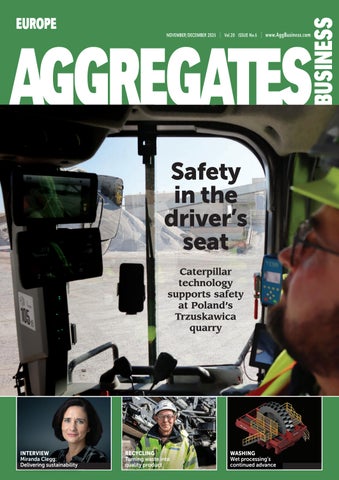
Safety in the driver’s seat Caterpillar technology supports safety at Poland’s Trzuskawica quarry
INTERVIEW Miranda Clegg: Delivering sustainability
ABE1126 COVER.indd 1
RECYCLING Turning waste into quality product
WASHING Wet processing’s continued advance
9/11/2026 7: 1 am
Recycled aggregates
Ready to crush something different? Recycled material is not quarry rock. Feed can be uneven, abrasive or contain unwanted material. But crushed and screened right, demolition waste, concrete, asphalt and slag become new products you can sell. With decades of crushing experience, we help you choose the right equipment, process and wear parts, backed by service and support.
Crushing and screening equipment
Wear and spare parts
Process expertise
Service and support
metso.com
2-3 Comment.indd 2
9/11/2026 7: 2 am
Image: Metso
COMMENT
HEAD OFFICE Prime Global Publishing Capitol Square 4–6 Church Street Epsom, KT 17 4NR
GUY WOODFORD
EDITOR
Guy Woodford +44 (0) 7486 877 883 guy.woodford@primeglobalpublishing.com HEAD OF CONSTRUCTION SALES
Graeme McQueen +44 7833 445 592 graeme.m@primeglobalpublishing.com
EDITOR
SALES DIRECTOR
Richard Powell +44 7551 637054 richard.powell@primeglobalpublishing.com CHAIRMAN
John Murphy CHIEF EXECUTIVE OFFICER
Christine Clancy PUBLISHER
Paul Hayes CLIENT SUCCESS MANAGER
Janine Clements +61 432 574 669 janine.clements@primeglobalpublishing.com ART DIRECTOR
Michelle Weston COVER IMAGE CREDITS
Caterpillar Cemex UK Metso McLanahan SUBSCRIPTIONS
subscriptions@primeglobalpublishing.com
No part of this publication may be reproduced in any form whatsoever without the express written permission of the publisher. Contributors are encouraged to express their personal and professional opinions in this publication, and accordingly views expressed herein are not necessarily the views of Prime Global Publishing. From time to time statements and claims are made by the manufacturers and their representatives in respect of their products and services. Whilst reasonable steps are taken to check their accuracy at the time of going to press, the publisher cannot be held liable for their validity and accuracy.
PUBLISHED BY
Prime Global Publishing AGGREGATES BUSINESS USPS:
is published six times a year. PRINT: ISSN 2051-5766 ONLINE: ISSN 2057-3405
PRINTED BY: Warners (Midlands) PLC
www.AggBusiness.com
2-3 Comment.indd 3
The big industry trends
B
efore returning as editor of Aggregates Business in August, I was on editorial and media projects in the off-highway equipment sector. I was asked about the key trends and issues within the quarrying/ aggregates processing machinery sector, and I based my responses on many, many conversations I’d had over the past year with machinery buyers and representatives from major and small-to-medium equipment manufacturers and their dealers. Global sales of quarrying and wider off-highway equipment have been relatively flat in recent years, partly due to a tough global economic climate, with complex geopolitics and various regional conflicts leading to rising energy costs and market uncertainty, delaying planned new plant investment. Fleet owners are often choosing to extend the working life of their units via remanufacturing. More and more original equipment manufacturers (OEMs) are offering attractive packages and dedicating more engineering and support staff resources to this area of their business. Another key trend is significant investment in technology-enhanced engineering innovation by major OEMs to stand out in a homogeneous and increasingly competitive marketplace. Speaking to me at the 2026 edition of Hillhead, Astec vice president of channel management Malachy Gribben stressed that innovation creates clear differentiation in a market where much of the equipment has remained largely unchanged for years. “I walk around shows like this and I see screening technology that’s 15 to 20 years old,” he said. “Where’s the innovation?” Gribben pointed to the fact Astec showcased its multi-frequency screening technology at the event as an example of the engineering innovation he believes sets the company apart. There has also been a notable increase in OEMs’ focus on technology that enhances the health and safety of their machines. An example can be seen in this issue’s quarry profile feature, which examines how building materials giant
CRH is using Caterpillar’s collision-mitigation system for medium wheel loaders at a major quarry in Poland. The feature looks at the technology in practice, alongside Caterpillar and its local dealer Bergerat Monnoyeur Polska. Another eye-catching development has been many OEMs’ investment in artificial intelligence (AI)-enhanced digital tools to help quarrying and aggregates customers lower the cost per tonne of produced material by optimising machine fleets and worksites’ productivity and efficiency. In an age of shrinking aggregate product and wider building material margins, the extensive use of AI-enhanced digital tools can boost a business’ long-term economic viability, while simultaneously creating environmental wins via reduced emissions and better resource efficiency, including improved water management. The environmental wins also tie into the global industry’s shift to greater circularity, which is seeing more operators producing greater volumes of high-quality recycled aggregate due to customer demand. I gained great insights into how AI-enhanced digital tools coupled with aggregate processing site automation can boost an operation’s bottom line during my time as an independent international advisory board member for DigiEcoQuarry, an EU-funded Horizon project that, between 2021 and 2025, developed an innovative quarrying system (IQS) comprising sensors, processes, tools and methods of data capture, processing and sharing to digitise, automate, and optimise aggregate quarrying operations in real time. The successful project transformed five participating extractive sites across Europe into smart, sustainable Industry 4.0 operations by tapping into the more than 99 per cent of operational data that typically goes unused in quarries. You will see these trends and other seismic industry shifts being covered extensively in Aggregates Business during 2027, when the industry hopes to see the return of more positive trading conditions. GW
guy.woodford@primeglobalpublishing.com
© AGGREGATES BUSINESS EUROPE November/December 2026
03
9/11/2026 7: 2 am
CONTENTS
MARKET REPORT
Aggregates producers across Eastern European aggregate are benefiting from healthy demand for building materials and growth in construction and infrastructure. p16 Vol.20 ISSUE No.6 November/December 2026
Regulars 03 COMMENT How equipment innovation, remanufacturing, AI and automation are shaping the future of quarrying.
06 ASSOCIATION NEWS The latest news and updates from Aggregates Europe and its members.
Features 08 COVER STORY Caterpillar technologies are further enhancing Trzuskawica’s focus on health and safety at its quarry in Poland.
12 INTERVIEW Aggregates Business spoke to Cemex UK’s Miranda Clegg about the company’s emissions reductions.
16 MARKET REPORT Producers in Eastern European are benefiting from demand for materials.
20 INTERVIEW Afrimat CEO Andries van Heerden reflects on 20 years of growth, diversification and strategic investment.
24 GLOBAL AGGREGATES GAIN president Jim O’Brien on the scale and significance of the global aggregates sector.
04
© AGGREGATES BUSINESS EUROPE November/December 2026
4-5 Contents.indd 4
26 ELECTRIC EQUIPMENT Customer trials in Norway are helping Volvo CE refine its EC500 Electric ahead of its planned 2027 introduction.
28 RECYCLING – 2 Companies are finding new ways to turn waste into valuable resources.
32 WASHING TECHNOLOGY CFlo is bolstering its international reach through new partnerships.
34 CONSTRUCTION EQUIPMENT steinexpo visitors got a close-up look at the latest machinery and smart safety features from Develon.
36 MOBILE CRUSHING Metso is expanding its mobile crushing portfolio with two new models.
38 EQUIPMENT AND TECHNOLOGY The winner of the inaugural LANDCROS European Operator Challenge.
40 MOBILE CRUSHERS Kleemann has introduced a new successor in its popular mobile impact crusher range.
42 WASHING – 2 CDE, McLanahan and Terex Washing Systems showcase wet processing and washing technology.
COVER STORY: Caterpillar technologies support safety at a Polish quarry Image: Caterpillar
44 LOADING Liebherr and Develon are both expanding their excavator line-ups with new models.
46 CRUSHING AND SCREENING Pilot Crushtec, McLanahan and EvoQuip showcase screening and plant developments.
48 HAULING – 2 Volvo CE and Caterpillar showcase developments in haulage and autonomous trucking.
50 TYRES – 2 BKT used its first direct presence at steinexpo to showcase tyres designed for heavy-duty operations.
www.AggBusiness.com
9/11/2026 7: 2 am
COA0
FURTHER FROM RISK.
STILL IN CONTROL.
To support a safer jobsite, Cat® Command remote control technologies remove operators from potentially hazardous applications. Keep your people productive while keeping them further from risk. Speak to your local Cat dealer today or visit cat.com/commandtechnology
© 2026 Caterpillar. All Rights Reserved. CAT, CATERPILLAR, LET’S DO THE WORK, their respective logos, “Caterpillar Corporate Yellow”, the “Power Edge” and Cat “Modern Hex” trade dress as well as corporate and product identity used herein, are trademarks of Caterpillar and may not be used without permission.
4-5 Contents.indd 5 COA0607 Cat Command A4 Press_Theo_01.indd 1
9/11/2026 7: 2 am 1/10/2026 2:11 m
ASSOCIATION NEWS
Image: Mehmet/stock.adobe.com
The Birds and Habitats Directives have implications across the European aggregates sector.
Making nature directives work for biodiversity and aggregates The European aggregates sector is calling for clearer permitting and biodiversity rules that recognise its role in supplying essential materials and supporting conservation.
T
he Birds and Habitats Directives are central to Europe’s efforts to protect biodiversity. For the aggregates sector, their implementation also shapes access to the materials needed for housing, infrastructure and climate adaptation. The European Commission’s ongoing stress-test offers an opportunity to strengthen the delivery of nature protection while providing greater certainty for a responsible sector. The exercise examines how to reduce unnecessary administrative burdens while maintaining high standards of nature protection. Aggregates Europe’s continued contribution at EU level brings practical experience from quarry operators to the discussions. A central policy question is whether the stress-test should lead to better implementation of the existing directives or a revision of the legislation itself.
06
© AGGREGATES BUSINESS EUROPE November/December 2026
6-7 News.indd 6
The commission has left that possibility open depending on the findings, intended to be published by the end of the year. For Aggregates Europe, the priority is to address the practical barriers identified by members while preserving the directives’ environmental ambition. The case for legislative changes should thus be assessed against what clearer guidance, consistent interpretation and effective permitting can achieve within the existing framework. Another key priority is the clearer recognition of the public-interest role of aggregates extraction and its strategic planning. Reliable access to local materials underpins essential infrastructure, and contributes to ecosystemic services, practical solutions for flood defences and other sectors for Europe’s wider resilience. Mineral deposits are location-bound, making early coordination between mineral planning and biodiversity
objectives on-site particularly important. Aggregates Europe therefore calls for these contributions to be included in the policy conversations when assessing the “imperative reasons for overriding public interest”. Recognising aggregates within this framework would require a robust assessment of each proposal’s public-interest contribution and ecological implications. However, experience demonstrates that extraction and conservation can coexist inside and around protected areas. But members continue to report lengthy permitting, repeated information requests and inconsistent interpretations between authorities. Legal and policy uncertainty over protected species colonising temporary habitats can also discourage operators from voluntarily creating valuable habitats. These challenges risk undermining
current and future investment and conservation opportunities. That’s why Aggregates Europe advocates for updated sector-specific guidance, better coordinated assessments, clearer procedural deadlines and adequately resourced authorities. Planning should bring together resources, conservation priorities and restoration opportunities, while a clearer framework for temporary habitats should encourage proactive biodiversity management. Through members’ practical expertise and partnerships with scientists, authorities and conservation organisations, Aggregates Europe is committed to helping turn the stress-test into workable improvements without lowering environmental and biodiversity standards. A successful outcome would support access to essential materials alongside measurable gains for European nature. AB
www.AggBusiness.com
9/11/2026 7:
am
CALL IT OL’FAITHFUL CALL IT ZW310-7 CALL IT THE RELIABLE ORANGE And from April 2027, call Hitachi Construction Machinery LANDCROS 6-7 News.indd 7
9/11/2026 7:
am
QUARRY PROFILE
The Trzuskawica site is near Kielce in southcentral Poland.
SAFETY, SCALE AND THE QUARRY OF THE FUTURE
Caterpillar safety technologies are helping CRH-owned Trzuskawica strengthen its focus on health and safety at one of south-central Poland’s largest limestone quarries.
A
t Trzuskawica’s vast limestone quarry near Kielce, health and safety is more than a compliance exercise; it shapes investment decisions, equipment selection, operator training and long-term site development. The company’s philosophy is evident in the quarry’s adoption of advanced Cat safety technologies, including a 360° camera system on its Cat 374 excavator and Collision Mitigation technology on its Cat 972 XE wheel loaders. It is also reflected in the wider safety culture promoted by parent group CRH, whose global standards and best-practicesharing programmes influence daily operations at the Polish quarry. During an October visit to the site by Aggregates Business, Trzuskawica (Aggregates) technical director and board member Krystian Milewski, alongside quarry manager Adam Drozdowski, plant manager Bartosz Postro ny, and quarry and production director Paweł Podsiadlo, outlined how safety, productivity, and future growth are
08
© AGGREGATES BUSINESS EUROPE November/December 2026
8-11 Quarry profile - Poland.indd 8
closely intertwined at one of Poland’s most significant limestone-producing operations.
Caterpillar fleet drives efficiency Trzuskawica’s relationship with Caterpillar at the site stretches back to 2008, when the first machine, a Cat 385 front-shovel excavator, arrived at the operation. Subsequent purchases included dozers, excavators and wheel loaders. A major milestone came in 2022–23 when the quarry replaced its fleet of Belarusian-built BelAZ rigid dump trucks with Cat equipment. The quarry now operates nine Cat 772 haul trucks, supported by a Cat 374 excavator, a Cat 988 XE wheel loader, two Cat 972 XE wheel loaders and two Cat 980 XE wheel loaders. The transition to Cat equipment reflected changing economics and strategic considerations. For management, the move has delivered measurable benefits. According to Drozdowski and Milewski, fuel consumption from the Cat haul trucks equates to a significant saving, while maintaining comparable payload capacities. The improvements are particularly important
given the quarry’s haul distances. Depending on loading location, trucks travel between 1.5–3km from the quarry face to the processing plant. Across millions of tonnes annually, even modest gains in fuel efficiency translate into substantial operational savings. Operators have also noticed improvements in comfort and reliability. “The move to the Cat 772 is like moving to the next century,” Milewski said when comparing modern machine cabs with older trucks. The quarry’s production schedule reflects the scale of the operation, with three shifts running from Monday–Saturday. Material is extracted through regular drilling and blasting operations, with blasts typically taking place between 1.00–2.00pm Monday– Friday. A single blast releases approximately 20,000 tonnes of limestone, and two blasts may occasionally be conducted in a day. Only around eight per cent of blasted rock requires secondary breaking for oversized material, indicating effective blast design and fragmentation performance.
www.AggBusiness.com
9/11/2026 7:
am
Image: Trzuskawica
QUARRY PROFILE
The Cat 374 excavator and Cat 988 XE wheel loader serve as the primary loading units. Together, they load fleets of Cat 772 haul trucks that transport material to the crushing and processing plants. The quarry’s primary crusher, supplied by Polish manufacturer Makrum, processes around 650 tonnes per hour. Supporting crushing circuits provide additional flexibility during maintenance periods and production peaks.
Technology improving visibility and awareness For all the productivity gains of modern mobile equipment, safety remains the overriding consideration. One notable safety enhancement is a Surround Vision (360°) camera system installed on the Cat 374 excavator. Introduced in 2024, the system uses four cameras positioned around the machine to provide operators with a 360° view of their surroundings. The technology helps to reduce blind spots and significantly improves visibility during loading operations. Management said visibility around loading areas represents a critical risk area in quarrying. Excavator operators, truck drivers, maintenance personnel and visiting contractors can all occupy the same operational environment, making situational awareness essential. The camera system gives operators a much clearer view of what is happening around the machine and can help reduce the risk of incidents caused by poor visibility or communication failures. Even more significant is the site’s adoption of Caterpillar’s Collision Mitigation System for Medium Wheel Loaders. Currently fitted to two Cat 972 XE wheel loaders, the system uses sensors and automated intervention technology designed
www.AggBusiness.com
8-11 Quarry profile - Poland.indd 9
Images: Prime Global Publishing
1
2
to prevent collisions involving pedestrians, vehicles or obstacles. Unlike traditional warning systems that rely solely on operator reaction, the Caterpillar system will slow or stop the machine if an obstacle is detected and the operator doesn’t take action. Operators described the intervention as smooth and progressive rather than abrupt. Instead of harsh emergency braking, the machine slows and stops gently, reducing risk while maintaining operator comfort. The technology arrived only a few months before the Aggregates Business visit, making Trzuskawica one of the early adopters within CRH’s European operations. The same system will also be installed on two additional Cat 980 XE wheel loaders, bringing the total number of wheel loaders equipped with technology designed to help prevent collisions with pedestrians to four. For Trzuskawica’s management team, the reasoning is straightforward: if technology can eliminate risk, it should be deployed. For the operators using the technology every day, its benefits are particularly tangible. Robert Redzia operates one of the Caterpillar Collision Mitigation-fitted Cat 972 XE wheel loaders at Trzuskawica. Knowing the technology continuously monitors the area behind the loader reassures
1. The Cat 374 at work at Kowala pit. 2. A Cat 980 XE and Cat 972 XE at Trzuskawica. Redzia that it will quickly identify potential hazards. If a truck or other object enters the machine’s path, he knows the system will alert him and help prevent an incident. Redzia is particularly impressed by the system’s fast response speed. In a busy quarry where conditions can change rapidly, he believes the technology reacts quickly enough to provide meaningful assistance when it is needed most. However, he values the automatic intervention capability most. Redzia stressed that the most important benefit is knowing the machine will stop if a pedestrian comes too close to the loader. This capability gives him high confidence that people working around the machine have an added layer of protection. “The system is especially valuable during the first shift of the day, when quarry traffic is at its highest,” Redzia said. “With numerous vehicles moving around the site, the technology helps manage risks that arise from congestion and constant activity. © AGGREGATES BUSINESS EUROPE November/December 2026
09
9/11/2026 7:
am
Trzuskawica’s fleet of Cat rigid drump trucks. A century of quarrying heritage The history of extraction at Trzuskawica stretches back more than a century. According to Milewski, quarrying activities on parts of the site date to around 1910. Over the decades, what were once separate operations gradually evolved into a large integrated limestone production complex. Today, the quarry operates two principal production areas: Trzuskawica, established in 1976, and Kowala, which dates to around 1960. Each originated as a separate plant before becoming part of the integrated operation. The site produces a broad range of limestone products. The finer end includes materials from 0–22mm, while larger products include the quarry’s key 40–80mm and 80–150mm grades. These coarser fractions serve key industries, including lime production and steelmaking. The site’s ownership structure changed significantly after CRH’s 2023–24 divestment of its European lime business. Limestone material formerly used internally is now supplied to Nordkalk, part of SigmaRoc, which operates the adjacent lime production facilities. Despite these changes, Trzuskawica remains a major aggregates producer, supplying CRH businesses and external customers across Poland. The company also produces limestone aggregates at its Sitkówa mine near Kielce, basalt aggregates from Targowica mine in Lower Silesia, and dolomite aggregates from another Silesia site. Along with its firm focus on health and safety, Trzuskawica prioritises care for the environment and local communities. Demand for aggregates continues to support growth. Trzuskawica quarry currently produces around 4.7 million tonnes of limestone annually, up from approximately 4.5 million tonnes in 2023. According to the management team, infrastructure investment remains a key driver. Road construction projects, bridge developments and broader industry growth have contributed to increasing demand for high-quality limestone aggregates. The site serves internal and external industries, with the latter including many road companies. CRH companies such as Masfalt, which produces asphalt, and Bosta Beton, which manufactures concrete, are major customers. Trzuskawica also supplies Polbruk, another CRH business involved in paving and construction products, as well as a diverse external customer base. Distribution is split between rail and road transport. Between 44–46 per cent of
10
© AGGREGATES BUSINESS EUROPE November/December 2026
8-11 Quarry profile - Poland.indd 10
Image: Trzuskawica
QUARRY PROFILE
production is shipped by rail, reflecting the site’s extensive rail-loading infrastructure. Management views rail as strategically important and plans to further increase its role as part of future expansion projects. At the heart of Trzuskawica’s long-term strategy is an ambitious modernisation programme known internally as the ‘Quarry of the Future’. The multi-stage initiative is designed to increase production capacity from current levels toward more than five million tonnes annually while enhancing operational efficiency and sustainability. The significant project includes upgrades to crushing circuits, replacement of key processing equipment, increased rail-loading capabilities and broader modernisation across the operation. Key elements include replacing jaw crushers and secondary impact crushers, increasing production from the Kowala and Trzuskawica lines and expanding the site’s ability to handle greater volumes through rail logistics. For a quarry already producing almost five million tonnes each year, the scale of that investment demonstrates CRH’s confidence in the Polish aggregates industry. Underlying all of these initiatives is CRH’s global health and safety framework. Managers repeatedly reference the company’s ‘Red Book’, which captures lessons
Collision Mitigation technology on a screen inside Cat 972 XE wheel loader. learned, best practices and safety requirements from operations worldwide. The system is reinforced through monthly reporting and information-sharing. Incidents, near misses and high-potential learning events are communicated throughout the organisation, ensuring lessons learned in one country can prevent accidents in another. “This kind of document collects all best practices from around the world,” Milewski said. The approach extends beyond equipment procurement. Safety performance is monitored through key performance indicators, reporting systems and structured reviews. New technologies are assessed not only for cost or productivity benefits but for their ability to reduce risk. Milewski highlighted how annual training programmes delivered jointly by Bergerat Monnoyeur Poland and Cat Job Site Solutions are among the Trzuskawica site’s most important initiatives to increase operator experience and strengthen health and safety standards. The training is conducted annually, typically at the beginning of the year, and combines classroom-based theory with practical in-machine instruction. Operators receive direct coaching while working on the equipment, enabling trainers to demonstrate best practices in real operating conditions. Operators learn to work safely, reduce unnecessary idling, and adopt techniques that lower fuel consumption while maintaining performance.
Operator Robert Redzia using Cat’s Collision Mitigation technology.
www.AggBusiness.com
9/11/2026 7: 5 am
Images: Prime Global Publishing
QUARRY PROFILE
L–R: Trzuskawica management team – Adam Drozdowski, Krystian Milewski, Bartosz Postrożny and Paweł Podsiadlo. A key strength of the training programme is its use of real operating data. During the Aggregates Business visit, Jarosław Wojtanowski, quarry and aggregate industry manager for Cat dealer Bergerat Monnoyeur Poland (BM Poland), said telematics information from Caterpillar’s VisionLink system helps identify operator errors and undesirable operating habits. BM Poland works closely with site supervisors to analyse these findings and incorporate them into future training. This creates a continuous improvement cycle in
which training is tailored to actual operational challenges rather than generic scenarios. The process is further strengthened by data from the quarry’s TMS telematics platform, which aggregates performance information from mobile equipment and fixed plant assets. Milewski said the combination of TMS and VisionLink provides a far deeper understanding of machine performance, operating efficiency and operator behaviour. By comparing data from systems, the quarry can pinpoint inefficiencies, identify risky habits and adjust training accordingly. The result is a data-driven approach that improves safety, optimises machine performance, enhances fuel efficiency, and supports more productive quarry operations.
Safety first, always Amid the discussion of production volumes, fuel savings, rail logistics and future expansion, one message stood above everything else during the visit. Safety remains Trzuskawica’s highest priority. The quarry’s adoption of 360° camera technology on its Cat 374 excavator, Collision Mitigation systems on its Cat 972 XE wheel loaders, operator training programmes and comprehensive telematics monitoring all stem from the same belief: every employee and contractor should return home safely at the end of the day. That philosophy mirrors CRH’s approach across Europe and globally, where lessons from incidents are shared, safety standards continually evolve, and investment decisions increasingly place worker protection ahead of simple cost considerations. As Trzuskawica progresses with its €50 million ‘Quarry of the Future’ programme and targets production growth beyond five million tonnes annually, management is clear that efficiency gains and output increases must never come at the expense of people. In the modern quarry, productivity matters. Technology matters. Growth matters. But at Trzuskawica, safety comes first. And, increasingly, advanced Cat technology is helping ensure it stays that way. AB
Achieve the Next New Generation Series 9
Smarter Machines
Find out more: eu.develon-ce.com
www.AggBusiness.com
8-11 Quarry profile - Poland.indd 11
Safer Sites
Better Results
The new Develon Series 9 is the first excavator range to combine AI-powered human detection with an intelligent automatic E-Stop system — helping prevent accidents before they happen. Together with full electronic hydraulic precision, it creates a safer, sharper and more efficient way to work.
© AGGREGATES BUSINESS EUROPE November/December 2026
11
9/11/2026 7: 5 am
SUSTAINABILITY
Ahead of the net-zero game Cemex UK is working to cut emissions through its parent company’s Future in Action programme. Aggregates Business spoke to sustainability manager Miranda Clegg to get the inside track.
C
emex UK’s pioneering, governmentfunded shore-to-ship power system at Shoreham Port in West Sussex is designed to eliminate the use of on-board diesel engines for aggregate vessels while in port. Featuring battery storage and renewable energy, the project is a key step towards reducing emissions for the Cemex Go Innovation vessel and aligns with Shoreham Port’s sustainability goals. It is also an eye-catching example of Cemex UK’s contribution to its Mexican parent group’s Future in Action programme, launched globally in 2020. The UK Department for Transport has provided nearly £1.7 million in funding for the power system, with the project involving Cemex UK, iconsys, and the University of Warwick. The system includes a smart shore power microgrid with iconsys iConvert technology, battery energy storage, and solar photovoltaic (PV) generation. The demonstrator delivers a constant 250kW power supply to ships while they are berthed, simulating high demand while reducing reliance on fossil fuels.
12
© AGGREGATES BUSINESS EUROPE November/December 2026
12-15 Interview - Miranda Clegg.indd 12
In addition to significantly reducing CO2 emissions during aggregate discharge, the project will help improve local air quality at Shoreham Port. The project’s installation and demonstration phase began in April 2024 and lasted 12 months. Cemex UK is currently working with its partners to fully validate the technology, following last year’s planning approval to operate the electrification system permanently at Shoreham Port, with the potential to expand its use at other British ports. “The change in the company’s focus on sustainability is massive. It is now a headline act. It is up there on agendas,” Cemex UK sustainability manager Miranda Clegg said. According to Clegg, sustainability at Cemex is a broad concept encompassing operational efficiency, future-proofing, emissions reduction, social engagement, community involvement, staff engagement, and maintaining industry competitiveness. She summarises it as essentially being about how the company operates and prepares for the future.
Clegg emphasised that Cemex UK is “ahead of the game” in advancing towards its net-zero goal by 2050 and interim 2030 targets, with specific goals to reduce CO2 emissions per tonne of cement. The UK is currently achieving approximately a 44 per cent reduction in emissions compared to 1990 levels, exceeding some global and European benchmarks. Other key initiatives driving Cemex UK’s progress include scaling up proven technologies and innovation, such as increasing alternative fuel use (currently around 72 per cent) through methods like hydrogen injection into cement kilns. The company is deploying HiiROC’s thermal plasma electrolysis (TPE) technology at its Rugby cement plant to produce low-carbon hydrogen for industrial-scale use. Clegg said Cemex UK also offers a biodiversity net gain service to help developers, as well as circular economy initiatives focused on repurposing and restoring materials. “It’s also about chipping away at all the different things we know will make us more sustainable and demonstrating that these
www.AggBusiness.com
9/11/2026 7: 2 am
SUSTAINABILITY
The Cemex Go Innovation vessel.
Images: Cemex UK
Cemex UK’s Rugby cement plant.
small changes are scalable and will give our investors more confidence that they are investing in the right business,” she said. “It’s just being a bit better at what we do. “Instead of our six previous Future in Action pillars, we’ve now refocused them into two: smart decarbonisation and responsible nature. We’re focusing on what our investors want to see, rather than setting targets that rely on unproven technologies that could take years to implement and require significantly more investment.” Clegg believes quarry restoration projects are a great example of the responsible nature pillar within Future in Action. “Tying in with the circular economy, we do a lot of work repurposing [quarry] restoration materials,” she said. “We’ve taken around 100,000 vehicles off the road simply by transporting materials by rail from a large infrastructure project to two quarry sites, one just outside London and the other in Rugby. That’s brought in around one million tonnes of spoil to restore our sites.”
Crucial collaboration Collaboration is vital for Cemex UK, Clegg said, particularly with the Mineral Products Association (MPA), where the business works with competitors on policy, advocacy and regulatory support to address the complex
www.AggBusiness.com
12-15 Interview - Miranda Clegg.indd 13
Cemex UK sustainability manager Miranda Clegg.
“We’re focusing on what our investors want to see, rather than setting targets that rely on unproven technologies that could take years to implement and require significantly more investment.” challenges of decarbonising a heavy industry. “We’ve been working, via the MPA, with our competitors on decarbonisation for several years, as we all need to achieve our 2050 goals,” Clegg said. “It’s about pushing for our industry to be heard and securing the regulatory changes we need. “Having Lex Russell [Cemex UK Materials managing director] as MPA chair is great for us, as he understands our needs and the challenges we face and can bring together all the key industry players. “When you look at the legislation and red tape involved in permitting a cement works, for example, it can take years to obtain
all the necessary approvals. If we weren’t working as a group, it would be a much slower process.” Cemex UK benefits from the resources of a global group while maintaining a distinct position in the market through its sustainability work. Clegg sees this combination as an important advantage. “We can draw on global-scale support, but we also have a very strong brand with Vertua [a portfolio of more sustainable products that leverage technology and innovation to help clients meet their construction needs sustainably] and our Future in Action programme,” she said. “Vertua was one of the industry’s first lower-carbon product ranges, and I think Future in Action differs from some competitors’ initiatives in that it covers the whole sustainability picture, including restoration, community involvement and biodiversity. It’s not just about cutting carbon. “We also have our environmental product declarations [EPDs] and our CO2 calculator, which allows us to provide customers with the carbon emissions of their individual concrete mixes. If they need a mix below a certain carbon level, the calculator enables us to adjust the design accordingly while still meeting the required technical performance.” How does Clegg judge Cemex UK’s efforts to engage with local communities surrounding the company’s 200 sites with work and events linked to Future in Action and wider sustainability initiatives? “I think we’re doing really well in this area,” Clegg said. “Over the last couple of years, we’ve switched from a centralised to a localised approach to working with our neighbouring communities, and that’s had a positive impact. © AGGREGATES BUSINESS EUROPE November/December 2026
13
9/11/2026 7: 2 am
SUSTAINABILITY
“We know that the people at our sites have the best local understanding of Future in Action and of what doing the right thing for the environment means in practice. They also want to be good neighbours and support their local communities. They work with their community liaisons while still having access to support from our central team. “If community members want data or have questions about sustainability, we can provide our site managers and teams with answers and evidence so they can respond confidently. Our sites also do a lot of work with local schools.”
Rail wagons loaded with quarried material at a Cemex UK site.
Embracing technology Technology is key to Cemex UK’s sustainability efforts, including implementing automated meter readers for water and electricity, digitising data management, and using Power BI, an interactive data visualisation software product, for reporting. These technologies drive efficiency, improve accountability and help identify issues such as excessive water use and leaks at a cement plant, quarry or concrete plant. “We started rolling out the automated
A truck setting off from Cemex UK’s Rugby cement plant.
14
© AGGREGATES BUSINESS EUROPE November/December 2026
12-15 Interview - Miranda Clegg.indd 14
www.AggBusiness.com
9/11/2026 7: 2 am
SUSTAINABILITY
water meter readers last year, and they have been a great success,” Clegg said. “In effect, we’ve added these small transmitters to many of our sites’ mains water meters, which feed into a portal from which we can automatically download site-level water-use data. This allows us to monitor consumption more accurately and focus on water reduction targets. We found that some sites had been reporting figures hundreds of times higher than the actual water usage. “It sounds simple, but installing these automated readers across our sites has been a significant task, and the rollout is ongoing. We use this data, alongside electricity and fuel usage, in our environmental footprint reports, which are shared with all sites on a monthly basis.” Cemex UK is also actively exploring new technologies, including artificial intelligence (AI) pilot trials, while looking at how to further enhance its Cemex GO digital platform. “Between now and 2030, we’ll be ramping up our advocacy work and promotion of our Vertua products, while ensuring our customers are using our CO2 calculator and have what they need to deliver projects sustainably,” Clegg said. “We’ll also be continuing our work around hydrogen injection.” Clegg said Cemex UK is confident it can meet its 2030 and 2050 targets, which it views as essential to the continued
www.AggBusiness.com
12-15 Interview - Miranda Clegg.indd 15
operation of the construction industry and for avoiding higher costs associated with carbon-intensive imports. She believes the company’s success is also tied to changing external perceptions, highlighting its significant efforts in quarry rehabilitation and biodiversity, which often contrast with public perceptions of the industry.
Regulatory landscape Clegg has been in her current sustainability manager role for six years and with Cemex for almost two decades, with previous experience in waste management at WRG (now FCC) and the Environment Agency, providing a broad perspective on regulation and industry challenges. “Many of our challenges stem from a lack of regulatory resources,” she said. “Having the support of the MPA means we can discuss these challenges directly with the Environment Agency and relevant government ministers. “We are a captive audience with nowhere else to go, and if the Environment Agency is going to take five years to issue a permit – and we’ve seen this at some sites – we can’t operate. They have put extra resources into issuing permits linked to major infrastructure projects, but the rest of us are often kept waiting. Most permits are now issued in two to three years, which, again, isn’t sustainable.” Clegg is putting her views into advocacy
for more realistic regulation and a shift towards self-regulation for trusted companies, allowing the Environment Agency to focus on other issues. Asked how she will be judged a success as Cemex UK’s sustainability manager, Clegg believes it should be measured by how deeply sustainability is embedded within the company’s culture, ensuring new employees understand its importance, and by seeing positive changes internally and externally, including increased customer enquiries about sustainability. “I love seeing the changes we’ve made and how our employees and the people I work with are really taking sustainability on board,” she said. “For example, we might be promoting better waste recycling on our sites and then hear from our teams that they’re concerned they don’t have the correct bins, or that our contractor is collecting recycling together with general waste. “While that’s something we need to address, the fact those concerns are being raised shows the message is landing and that people care about getting it right. We wouldn’t have seen that a few years ago. “You can walk into Binley [near Coventry, home to Cemex UK’s HQ] and talk to people from different teams who can confidently talk about Future in Action and what our net-zero ambition means in practice. For me, that’s a sign of success.” AB
© AGGREGATES BUSINESS EUROPE November/December 2026
15
9/11/2026 7: 2 am
MARKET REPORT
A 1000-tonne-per-hour Quarry Manufacturing and Supplies aggregate plant for Mirfo in Romania.
Image: QMS
Encouraging signs in the east Aggregates producers across Eastern European aggregate are benefiting from healthy demand for building materials and growth in construction and infrastructure.
16
© AGGREGATES BUSINESS EUROPE November/December 2026
16-19 Market report.indd 16
Russia is by far Eastern Europe’s biggest aggregate-producing nation, generating an estimated 760 million tonnes in the most recent Aggregates Europe reporting year. It is unclear, however, what impact the ongoing Russia–Ukraine war has had on aggregate production volumes. Poland is Eastern Europe’s secondbiggest aggregate producer, with 275 million tonnes estimated to have been generated in 2024. Other notable national markets in the region are Romania (167 million tonnes), the Czech Republic (62 million tonnes), Ukraine (40 million tonnes), and Bulgaria (37 million tonnes). Romania continues to receive substantial EU infrastructure funding and has large road, rail and energy project pipelines. Aggregate demand is closely tied to these projects, so production is likely to edge upward unless public investment slows. The country’s current aggregate output is already significantly below Poland’s despite a sizable infrastructure backlog, suggesting room for further growth.
Polish transition Łukasz Machniak, a senior figure in AGH University of Kraków’s Faculty of Civil Engineering and Resource Management, described the Polish aggregates market as being in a transition period, with current weaker construction activity contrasting an anticipated increase in demand due to forthcoming major infrastructure projects.
“According to preliminary Statistics Poland data, construction and assembly output in January–August 2026 was 2.1 per cent lower in real terms than in the same period of 2025,” he said. “These figures provide a broader picture of the construction market. “The year-to-date trend is consistent with output figures for key construction materials: cement production fell by around seven per cent, ready-mixed concrete by five per cent, asphalt by 10 per cent and lime by eight per cent in January–August 2026 compared with
Łukasz Machniak of AGH University of Kraków’s Faculty of Civil Engineering and Resource Management.
Image: Łukasz Machniak
E
astern Europe’s aggregates markets reflect a mix of construction activity, infrastructure investment and differing national growth prospects. Hungary is an Eastern European nation primed for positive construction and wider infrastructure development. The election of Péter Magyar and the Tisza Party in April, replacing Viktor Orbán’s Fidesz government, was a major event in European politics. Under Orbán’s administration, billions of euros in European Union (EU) funding were frozen because of concerns about democratic standards, corruption controls, judicial independence, and public procurement practices. Reports indicated up to €17 billion had been frozen, with a significant portion at risk of being permanently lost if conditions were not met. If a significant amount – or all – of those EU funds are released, coffers are likely to be notably swelled by fresh foreign investment, with many growth-market-hungry investors seeing Hungary as a more attractive commercial bet. Production figures provide a useful starting point for understanding the scale and relative importance of Eastern Europe’s aggregates markets. The latest annual aggregate production volume estimates for the year 2024 from Aggregates Europe (the European Aggregates Association) show that Hungary produced an estimated 67 million tonnes that year, a number that could rise following this year’s election.
www.AggBusiness.com
9/11/2026 7: 2 am
MARKET REPORT
strong domestic producers, and numerous regional businesses. Looking ahead, the outlook for 2027 will depend on how construction activity and major infrastructure programmes translate into actual demand. “I would approach 2027 with cautious optimism,” Machniak said. “My base case would be a gradual improvement in demand, with an uneven regional pattern and different growth rates across aggregates applications. “The scale of growth will depend on actual construction schedules, rather than the headline value of announced programmes.”
A Czech first Holcim has launched a new calcined clay production line at its Čížkovice plant, said to be the first of its kind in the Czech Republic. The facility will enable the supply of 580,000 tonnes of ECOPlanet low-carbon cement to customers every year. With an annual capacity of more than 115,000 tonnes of calcined clay, sourced from Holcim’s local quarry, the line uses patented technology to partially replace clinker in the kiln with calcined clay, reducing the cement’s carbon footprint by around 30 per cent, with no compromise in performance. The Čížkovice line is Holcim Czech Republic’s largest ever investment at approximately CZK one billion (CHF 40 million), with CZK 330 million (CHF 13
million) funded by the nation’s Modernization Fund of the Ministry of the Environment. “This project is proof that Czech industry can be modern, competitive and environmentally responsible at the same time,” Czech Prime Minister Andrej Babiš said. “This is exactly the kind of investment our country needs. It combines technological innovation, the use of domestic resources and investments in the future.” The investment also supports Holcim’s wider strategy to expand its lower-carbon cement offering across the region. “The commissioning of this new calcined clay line is an important step for Holcim to scale up next-generation ECOPlanet low-carbon cement as an innovative solution to meet our customers’ most ambitious goals as the leading partner for sustainable construction,” Holcim region head Central and East Europe Xavier Guesnu said. Holcim is scaling calcined clay worldwide, as it expands its sustainable offering as part of its NextGen Growth 2030 strategy. The new Čížkovice line follows the 2023 opening of the company’s Saint-Pierre-la-Cour plant in France, as Europe’s first dedicated calcined clay line, and the commissioning of a major new line in Guayaquil, Ecuador, in 2025.
Holcim has a new calcined clay production line in the Czech Republic.
Images: Holcim
a year earlier. Changes in the output of these four products serve as reference indicators for conditions in the aggregates market. The longer-term picture, however, shows relatively stable extraction volumes across the two main groups of minerals used to produce aggregates, particularly crushed and dimension stone.” These national trends, however, sit alongside significant regional differences in the distribution of aggregates production across Poland. “Lower Silesia and the Świętokrzyskie region dominate crushed and dimension stone extraction, accounting for 44.1 per cent and 32.7 per cent of national output, respectively, in 2025, or almost 77 per cent combined,” Machniak said. “This is an established feature of the industry’s geographical structure: their combined share ranged from 74.1 per cent to 76.8 per cent between 2018 and 2025. Despite annual fluctuations in extraction, the importance of both regions has remained very stable. “This concentration makes efficient transport, particularly rail over longer distances, strategically important for supplying projects elsewhere in Poland.” Polish sand and gravel extraction is more widely distributed. “Podlaskie and Pomerania are among the leading regions,” Machniak said. “This segment also illustrates regional differences in market conditions: in 2025, extraction increased by 9.7 per cent in Silesia and 5.3 per cent in Lower Silesia, while falling by 15.5 per cent in the Lublin region, 14.9 per cent in West Pomerania and 13.3 per cent in Mazovia. “I would view these changes primarily in the context of local investment cycles, although extraction figures alone cannot establish the causes. The start or completion of a major road contract can materially alter demand within a quarry’s economic delivery radius.” Machniak said there are nearly 2000 aggregate producers in the Polish market, including international groups,
Holcim’s Kujawy Quarry in Poland.
www.AggBusiness.com
16-19 Market report.indd 17
© AGGREGATES BUSINESS EUROPE November/December 2026
17
9/11/2026 7: 2 am
MARKET REPORT
18
© AGGREGATES BUSINESS EUROPE November/December 2026
16-19 Market report.indd 18
Liebherr XPower wheel loaders and mining trucks help to ensure operations run smoothly.
The Liebherr L 576 XPower wheel loader feeding material into a crushing plant. consistent and precise loading process. This is designed to eliminate the need for timeconsuming checks or reweighing, allowing the work process to proceed without interruptions, making drivers’ work easier, reducing downtime and contributing to efficient operation that minimises wear and tear on the machinery. The two TA 230 Litronic mining trucks also demonstrate their strengths on the sand and gravel quarry site. With their powerefficient drivetrain, permanent 6x6 all-wheel drive, reliable traction control and robust axle suspensions, they prove to be particularly stable machines. The machines handle uneven, loamy ground conditions with ease. Their powerful engine also delivers high tractive forces, enabling gradients and terraced extraction areas to be tackled safely and efficiently, allowing for short cycle times and a continuous flow of material. Another advantage in day-to-day operation is the well-designed body geometry: the conical inner surfaces facilitate unloading, particularly with damp or sticky materials, and reduce material build-up. This shortens unloading times and reduces cleaning requirements. Furthermore, the robust construction of the mining trucks helps to ensure consistently high performance, even with
Images: Liebherr
Premium sand, gravel and aggregates The České Štěrkopísky sand and gravel plant specialises in the extraction of highquality gravel sand and aggregates for Czech Republic construction and infrastructure projects. Operating conditions on the site are challenging, with varying terrain, uneven access roads and consistently high loads. Four Liebherr machines are put to the test in daily operation among extraction areas, conveyor systems and material stockpiles. XPower wheel loaders and mining trucks work together to ensure that extraction, transport and loading mesh seamlessly. Two L 576 XPower wheel loaders feed various types of rock into crushing plants, stockpile the material sorted by grain size and load it onto lorries. These high-performance machines are also used for working with overburden and for maintenance work on the site; for example, clearing snow in winter. The Liebherr loader duo is complemented by two TA 230 Litronic mining trucks, which handle material transport within the quarry and reliably move large quantities of sand and gravel between the extraction site and the processing plant. At the heart of the XPower wheel loaders lies the power-split drive system, which automatically and continuously combines the advantages of hydrostatic and mechanical drive systems within a single machine, helping to ensure maximum performance and efficiency across all operating conditions. The hydrostatic drive is the most efficient type for short loading cycles, while the mechanical drive is the most powerful and economical over long distances and when driving uphill. This enables the two L 576 XPower machines to handle the varying demands at České Štěrkopísky – short loading cycles during loading operations on the one hand, and longer travel distances within the gravel plant on the other – with the utmost efficiency. Quartz-bearing sands and crushed rock place high demands on the machines. The materials’ abrasive effect takes its toll on the steel structure and components, particularly on the bucket and its attachments, such as the bolt-on cutting edge. Liebherr addresses these challenges with a robust machine design and low-wear components, which help to significantly reduce wear and tear and ensure high availability in demanding operating environments. “For us, it is crucial that the machines deliver consistent performance even under difficult conditions,” mine manager Thomas Nguyen said. “The Liebherr wheel loaders impress with their robustness in day-to-day use.” To further enhance efficiency in the loading process, České Štěrkopísky relies on the optional weighing system with Truck Payload Assist for its XPower wheel loaders. The system helps operators in loading lorries and mining trucks by calculating the optimum bucket fill and the required number of loading cycles for a
frequently changing routes and heavy loads. The machines are designed to withstand the heaviest loads and ensure high process stability, as well as reliable operational planning. It is not just the wheel loaders and mining trucks that form a well-coordinated team; Liebherr and České Štěrkopísky work closely together in a spirit of trust. The sand, soil and gravel supplier has relied on Liebherr earthmoving machines since the 1990s, particularly due to the combination of high machine quality, innovative technologies and customer-focused service. “For us, alongside performance, fuel consumption and the long-term quality of the machines are the key factors,” Nguyen said. “With Liebherr, we have a partner we can rely on in our day-to-day operations.” While individual projects highlight investment in equipment and lower-carbon materials, the wider outlook for Eastern Europe’s aggregates sector will depend on construction demand and infrastructure development across the region. The region’s market is stable, with several countries, such as Poland, Romania and Hungary, offering notable growth opportunities for domestic and multinational producers and processing equipment suppliers in 2027 and beyond. AB
www.AggBusiness.com
9/11/2026 7: 2 am
AGGR
Aggregates Business is a go-to source for up-to-date news and views on the American aggregates and building materials sectors. Our wide-ranging features line-up includes in-depth articles on the latest loading, hauling, and crushing and screening machines. Contact: Graeme McQueen +44 7833 445 592 graeme.m@primeglobalpublishing.com
16-19 Market report.indd 19 1 AGGREGATES FP 0926.indd
www.aggbusiness.com
9/11/2026 /9/2026 7::2 2 am
INTERVIEW
Andries van Heerden has overseen Afrimat’s growth over the past 20 years.
Images: Afrimat
Afrimat: 20 years of growth and diversification Afrimat CEO Andries van Heerden reflects on two decades of growth, diversification and strategic investment.
A
frimat was established in 2006 through the merger of two South African construction materials businesses, Prima Klipbrekers and Lancaster Quarries. And on 7 November of that year, the newly formed company listed on the Johannesburg Stock Exchange (JSE) Main Board in the Construction and Materials sector. Over the next 20 years, Afrimat grew from a construction materials business into a diversified mid-tier mining group, driven by strategic acquisitions, disciplined capital allocation and diversification. The numbers tell much of the story. Afrimat generated revenue of ZAR349 million (US$21.7 million) in the year of its listing. Two decades later, annual revenue has grown to more than ZAR10 billion – more than 28 times its 2006 level. For Afrimat chief executive officer (CEO) Andries van Heerden, however, the significance of this growth extends beyond the economics. It reflects the success of a strategy designed to build a stronger, more
20
© AGGREGATES BUSINESS November/December 2026
20-23 Interview Afrimat.indd 20
diversified business capable of weathering changing market conditions. That growth has been underpinned by a series of strategic acquisitions that progressively expanded Afrimat’s geographic reach and broadened its product portfolio. Afrimat’s early years as a listed company were largely focused on establishing scale in its traditional construction materials markets. Its first acquisitions came in 2007, when the company snapped up Malans Group and Denver Quarries, transactions that expanded Afrimat’s presence into the Western and Eastern Cape and strengthened its aggregates and sand operations. The company then began deliberately broadening its exposure beyond traditional construction materials, acquiring Glen Douglas Dolomite Quarry from Exxaro in 2011. This marked Afrimat’s entry into industrial minerals while reducing its dependence on the construction materials market. The 2012 acquisition of SA Block Group provided a foothold in the clinker market
and further expanded Afrimat’s position in cement-related materials. The company continued this growth path in 2013 with the acquisition of a 50.7 per cent stake in Infrasors Holdings, adding silica, limestone and other industrial mineral products to Afrimat’s portfolio while significantly increasing its national footprint. Afrimat subsequently acquired the remaining minority interests in the business. The acquisition of Cape Lime in 2016 further strengthened the industrial minerals portfolio and established Afrimat as a leading lime producer. Taken together, these transactions were more than a collection of individual acquisitions; they formed part of a broader strategy to create a business with exposure to different markets and commodities. “Afrimat’s growth over the past 20 years has been driven by a disciplined acquisition strategy, with each transaction either expanding our geographic footprint, broadening our product offering or diversifying into new mining commodities,” van Heerden said.
www.AggBusiness.com
9/11/2026 7: 7 am
INTERVIEW
A decisive move into mining The year 2016 represented a major turning point in Afrimat’s evolution. The acquisition of the Northern Capebased Demaneng Iron Ore Mine marked the group’s entry into bulk commodities and iron ore production, a transformational transaction that opened an entirely new chapter in the company’s development. The diversification continued in 2021 when Afrimat acquired Nkomati Anthracite Mine out of business rescue, adding anthracite to its bulk commodities portfolio. At the same time, the company was building its capabilities further down the mining value chain. The acquisitions of JEF Drill & Blast (now Afrimat Mining Services) and Coza Mining during 2021 and 2022, respectively, expanded the group’s mining services capabilities and supported its vertical integration strategy. Afrimat also continued building its position in future-facing minerals. The acquisition of the Glenover assets and subsequently Glenover Phosphate increased the group’s exposure to phosphate, fertilisers and rare earth elements. These investments ultimately led to the creation of the Future Materials and Metals division, adding another dimension to Afrimat’s diversified portfolio. While these acquisitions extended Afrimat into new commodities and mining services, the company also retained the flexibility to strengthen its original construction materials business. Somewhat ironically, one of Afrimat’s most significant moves came when it returned to the sector from which it had originally emerged. In 2024, the group completed its acquisition of Lafarge South Africa – the largest acquisition in Afrimat’s history. The transaction significantly expanded Afrimat’s national footprint and product offering while strengthening its ability to participate in large-scale infrastructure and construction projects. For van Heerden, the deal also carried considerable symbolic significance. “At the time of our listing, Afrimat operated 18 quarries. Following the Lafarge transaction, we have become the largest aggregates producer in South Africa, with a formidable footprint of 43 quarries across the country,” he said. “For me, that represents a significant achievement and one of the most important milestones in our history.” The Lafarge South Africa acquisition also demonstrated that diversification does not necessarily mean permanently moving away from an original core market. Instead, it can provide the flexibility to strengthen the core business when the right opportunity arises. The successful integration of Lafarge South Africa has been just as important as the transaction itself. Afrimat acquired a business facing significant challenges and subsequently focused on stabilising operations, improving performance and unlocking value. van Heerden views this turnaround as another important achievement in the group’s history.
www.AggBusiness.com
20-23 Interview Afrimat.indd 21
The benefits of the diversified approach become clearer when viewed against the changing conditions in South Africa’s construction market. The rationale behind Afrimat’s strategy became particularly evident after the 2010 FIFA World Cup, when South Africa experienced a significant decline in infrastructure spending. The company recognised that relying exclusively on construction materials would leave it increasingly exposed to fluctuations in infrastructure activity and broader economic cycles. Diversification into industrial minerals, followed by bulk commodities and phosphate, created additional revenue streams and helped balance the group’s exposure to individual markets. At one point, bulk commodities became Afrimat’s largest and most profitable operating segment. The group’s experience in 2026 demonstrates the value of maintaining that diversified model. With the acquisition of Lafarge and a recovery in construction activity, construction materials have again emerged as Afrimat’s largest operating segment. Aggregates are now the company’s biggest contributor, demonstrating how different parts of the portfolio can take the lead as market conditions change. For Afrimat, diversification is therefore not simply about adding businesses but about creating a portfolio capable of adapting as economic and commodity cycles evolve.
Discipline behind the deals A common thread running through Afrimat’s acquisition history is a disciplined approach to capital allocation. The company does not pursue growth simply for the sake of becoming larger. It looks for assets that can generate sustainable returns and create long-term value. This approach requires detailed due diligence, deliberate pricing and a clear plan for improving operations once an acquisition has been completed. In many cases, Afrimat has targeted businesses with quality underlying assets but operational difficulties.
The Glen Douglas quarry acquisition in 2011 marked Afrimat’s entry into industrial minerals. Such situations can provide an opportunity to acquire assets at attractive valuations and subsequently unlock value through investment, operational improvements and turnaround initiatives. “In principle, the most important consideration for us is ensuring that an asset can deliver an appropriate return on capital over time,” van Heerden said. “We are not solely focused on the numbers in a spreadsheet; instead, we apply a broader assessment that considers a range of metrics.” The company considers not only the acquisition price but also the underlying growth potential of an asset and its ability to generate sustainable long-term value. That approach has allowed Afrimat to combine acquisition-led expansion with operational improvement rather than relying solely on market growth to drive returns. Alongside disciplined investment and operational improvements, technology has become an increasingly important tool for managing Afrimat’s expanding portfolio. The group has invested in technology to improve operational efficiency, strengthen decisionmaking and generate greater value from its equipment and processing facilities. The focus was initially on collecting data from earthmoving equipment. The approach has since expanded to fixed plants, with Afrimat using platforms such as AVA for its mobile equipment and internally developed platforms for its crushing operations. The resulting information feeds into a central data pool, where data scientists analyse the information and help translate it into practical operational insights. “We have made significant investments in technology to ensure that we capture the right data from all our assets,” van Heerden said. “All of this information feeds into a central data pool, supported by a team of data scientists © AGGREGATES BUSINESS November/December 2026
21
9/11/2026 7: 7 am
INTERVIEW
who help us interpret the data accurately and use these insights to make informed decisions that improve our operations.” For a business that has been built through geographic and commodity diversification, access to accurate, comparable data across its operations provides an important tool for maintaining consistency and improving performance.
Investing in the next generation Technology and acquisitions may have driven much of Afrimat’s physical expansion, but van Heerden regards people and skills as equally important to sustaining that growth. The company began proactively attracting young graduates through its internship programme around 17 years ago. The two-year programme provides practical experience while creating an internal pipeline of talent. Its success can be seen in the number of employees who have progressed into senior operational and specialist roles.
“It is encouraging to see that many of our quarry managers, as well as some specialists, have progressed through this programme,” van Heerden said. Afrimat’s broader development efforts extend from technical training to management and leadership programmes. Employees are also supported in postgraduate studies, including MBA programmes, while selected individuals receive opportunities for international exposure. But developing talent is only part of the equation for van Heerden. Retaining skilled employees is equally important, and while remuneration and recognition remain key considerations, he believes company culture plays a major role in long-term employee engagement. Creating an environment where employees feel respected, supported and connected to the company’s broader journey is essential to maintaining the skills and experience required for continued growth.
L–R: Andries van Heerden and board member Matie von Wielligh celebrating Afrimat's JSE listing in 2006.
The combination of a diversified portfolio, operational expertise and investment in people has helped shape the business Afrimat is today, providing a foundation for its next phase of growth. After two decades of expansion, the company is entering its next phase from a significantly stronger position than the business that first listed in 2006. The immediate priority is to strengthen the balance sheet and work to ensure the group is positioned to take advantage of future opportunities. At the same time, Afrimat continues to assess any potential acquisitions and opportunities that will broaden its commodity exposure. The company is currently exploring an opportunity to add another commodity to its portfolio and is also considering opportunities to expand into neighbouring countries. For van Heerden, the ambition for the next 20 years is clear. “I envisage Afrimat becoming a multinational company with a diversified portfolio, a strong operational focus and a team of people who are committed to execution while continuing to live the values of the company,” he said. Afrimat’s first 20 years as a listed company have been defined by calculated diversification rather than growth for growth’s sake, along with disciplined investment and a focus on long-term value creation. Building on these foundations, the group aims to extend its reach beyond South Africa while maintaining the operational focus and people-centred approach that have shaped its growth to date. AB
Afrimat has become the largest aggregates producer in South Africa, with footprint of 43 quarries across the country.
22
© AGGREGATES BUSINESS November/December 2026
20-23 Interview Afrimat.indd 22
www.AggBusiness.com
9/11/2026 7: 7 am
OFFIC
IAL JO
URN
AL O
F TH
E INST
ITUTE
OF Q
UAR
RYIN
G AU
STRAL
IA
MAY
2026
JUNE 2026 INSTITUTE OF
QUARRYING
AUSTRALIA
CTIV
JULY 2026
ITY FROM QUA PIT LAN RRY E FLOO TO R
46
ODU
26
D PR
THE INSTITUTE OF QUARR YING AUSTRALIA
LEAD
ING TH
E WAY
PORTS QUARRY SUP OEING BRISBANE CAN orting a Boral is supp council’s and ensl Que a new vision to build Olympics. venue for the
As the only national quarrying publication and the official journal of the Institute of Quarrying Australia, you’ll always be up to date with the latest developments in industry news, technology and events with Quarry Magazine.
CONSISTENCY IS THE KEY CJD Equipment showca ses what makes the Volvo K Series wheel loaders such a good fit for quarry operato rs.
MIXING IT UP IN SA Liam Berneville-Claye is having a crack at develop ing his business from the ground up in South Australia.
28
PARK FROM PIT TO explains Rob Corkery vital quarry how a once formed has been trans multipurpose into a major facility. recreational
SOLI
18
TION NEXT GENERA SCREENING CRUSHING AND trotech’ of ‘elec A new wave g how nisin lutio is revo generated, electricity is umed. stored and cons
ROCK
34
18
14
16
OFFICIAL JOURNAL OF
36
OFFI
L OF THE CIAL JOURNA
THE AUSTRALIAN EDGE Multotec has invested in local manufacturing to improve support for the Australi an quarrying sector.
It’s quick and easy to subscribe to our monthly print issues, our annual Suppliers Directory and our weekly eNewsletter. Don’t miss out!
SUBSCRIBE NOW www.quarrymagazine.com or email: subscriptions@primecreative.com.au
20-23 Interview Afrimat.indd 23
9/11/2026 7: 7 am
GLOBAL AGGREGATES
Image: Jenson/shutterstock.com
China remains the world’s largest aggregates market, with large-scale production facilities supporting its construction and infrastructure needs.
GAIN a global perspective Aggregates are the most-used raw material on the planet, yet the scale and dynamics of the sector are seldom fully appreciated, GAIN president Jim O’Brien writes.
T
he Global Aggregates Information Network (GAIN) now represents 75 per cent of the world’s production, providing much-improved visibility on industry trends and production data. GAIN’s latest figures point to a global aggregates industry adjusting to changing market conditions, with production declining in recent years but the longer-term outlook towards 2030 remaining positive. Its experience also points to a highly resilient industry, more responsibly and sustainably supplying a product essential to economic development and societal wellbeing. Bringing these global trends into focus requires a shared understanding of markets across regions, supported by the cooperation and data-sharing of industry organisations worldwide. GAIN is a unique voluntary non-commercial network of regional and national aggregates associations from around the world with the express purpose of openly sharing best practices to promote a more sustainable industry globally. Founded in 2010 with just five members, GAIN now has 21 members across six continents. Its members represent threequarters of global aggregates production of 37.7 billion tonnes extracted from more than 200,000 quarries globally, employing over three million people.
24
© AGGREGATES BUSINESS November/December 2026
24-25 GAIN.indd 24
GAIN is successful in its highly interactive global membership thanks to the positive cooperation among its members, who hold quarterly virtual meetings, each focused on a specific topic, complemented by an annual in-person meeting. The 2026 in-person GAIN meeting was held in Huzhou, China, in October, and all existing and aspiring members were welcomed. Updating global tonnages One key ambition of GAIN is to compile the best available estimates of aggregates production from data provided by its members. In addition, estimates for non-GAIN countries (based on national populations multiplied by their estimated tonnes per capita) are then included to give the global total. The global total of 44 billion tonnes in 2019, despite the small post-COVID uptick in 2021, has declined to an estimated 37.7 billion tonnes in 2026, a dip of 14.3 per cent. In a nutshell, the global 2019–26 decline is principally due to the quite remarkable, but well managed, reduction of 34.6 per cent in China, the world’s largest aggregates market. This has been offset to some extent by an 11.4 per cent growth in India, the world’s second largest and highest growth market. Europe has declined by 4.6 per cent over that period, while the US has grown by 2.6 per cent. The rest of the world exhibits a mixed picture with some positive trends, but these are as yet insufficient to overcome the decline in China. The global breakdown is still dominated by China at 34 per cent, with India coming second at 18 per cent, followed by Europe at eight per cent and the US at six per cent. These top four comprise 66 per cent of the global demand.
The total for all GAIN members for 2026 comes to 28.4 billion tonnes. Largest among the remaining non-GAIN 25 per cent, or 9.3 billion tonnes, would be highly populated rapidly developing countries including Indonesia, Pakistan, Nigeria, Vietnam and the Philippines, which would be particularly welcomed as new GAIN members. Of significant interest is how the production in tonnes per capita varies according to region. Among GAIN members, these vary from just over 9.5 tonnes per capita in Canada, followed by China, New Zealand, Australia and Saudi Arabia, all at just on nine tonnes per capita, to less than two tonnes per capita in Argentina and South Africa. The global average is 4.5 tonnes per capita. The average for GAIN members is 6.2 tonnes per capita (for a 4.6-billion population), while the non-GAIN average is 2.5 tonnes per capita (for a 3.7-billion population). Industry experience shows that the national aggregates demand in tonnes per capita can be empirically related to gross domestic product (GDP) per capita or, more precisely, the rate of change in GDP per capita plus upward adjustments for national terrain ruggedness and winter climate severity. Aggregates demand in tonnes per capita is driven by economic growth and vice-versa. While global production figures reveal the broad direction of the aggregates industry, conditions vary considerably between regions, reflecting differences in construction activity, infrastructure investment and economic growth. China As construction in China continues to decline, relative market weakness in the first half of
www.AggBusiness.com
9/11/2026 7:
am
GLOBAL AGGREGATES
2026 reflected a double contraction, with property declines and moderating infrastructure growth. There is a new infrastructure focus on the so-called ‘six networks’ – water, underground pipelines, power grid, computing, communication and logistics – and these are destined to become the new growth engine. Notably, manufactured sand now accounts for some 80 per cent of China’s total sand consumption. The aggregates industry development focus is on high-output quarries of typically 10 million tonnes per annum (Mtpa), even up to 70Mtpa, optimised by artificial intelligence (AI) in all operating aspects. India Infrastructural investment in airports, ports, roads, railways and energy infrastructure continues apace, driven by buoyant government spending. Urban housing will also maintain growth momentum. Consequently, a growing aggregates market is anticipated out to 2030. India has also seen a concerted move away from natural sand towards manufactured sand, which now supplies 55 per cent of total sand demand. South-East Asia In South Korea, economic, geopolitical and fuel price turbulence have negatively affected aggregates markets, prompting some government intervention to maintain a viable industry. Japan has experienced similar concerns. Reports from Vietnam indicate an aggregates supply deficit due to the demands of major government-funded infrastructural spend exceeding supply availability, partly due to curtailment of river sand over-extraction. Construction in Malaysia has been buoyed by high-speed rail infrastructure projects and data centre growth. Singapore has continued to see buoyancy in imported aggregates. Overall, South-East Asia is likely to see continued growth in aggregates demand out to 2030, driven by steady economic and population growth and infrastructural needs.
and defense-related expenditure. However, the recovery remains uneven between countries and construction segments. Infrastructure is generally more resilient, while residential and private non-residential construction remain weak in a number of markets. United States Growth is being driven by industrial policy, as well as infrastructure investment, domestic manufacturing, energy development and long-term transportation needs. Rising fuel costs are adding to inflationary pressures and keeping interest rates elevated, slowing project starts and reducing demand for aggregates, so production will only slightly exceed that of 2025. The industry’s greatest challenges remain permitting, workforce availability and ensuring access to future reserves. Canada and Mexico Canada’s construction market is seeing a shift toward infrastructure growth, with a slight contraction in residential building, indicating a slight drop in demand in 2026. The market is highly seasonal, with 40–50 per cent of the annual production typically running over the four summer months. Growth in Mexico construction is being positively driven by near-shoring of manufacturing from abroad, the development of major transport and road projects, and new social housing initiatives. For both Canada and Mexico any changes in tariff regimes could cause further market uncertainty. Central and South America The Brazilian economy has remained resilient throughout 2026, particularly in terms of infrastructural development, but uncertainty
Europe The European outlook has improved since the first quarter of 2026. Construction activity appears to be moving from contraction towards cautious stabilisation, supported particularly by infrastructure, public investment, housing needs, climate adaptation, energy networks
www.AggBusiness.com
24-25 GAIN.indd 25
The technology for producing manufactured sand continues to evolve.
Image: GAIN
Middle East and Africa While the current geopolitical environment in Saudi Arabia has moderated the pace of investment and short-term demand, the fundamentals of the aggregates market remain resilient, supported by ongoing infrastructure development, including new logistics routes. In South Africa, the positive economic prospects at the beginning of 2026 were dampened by onset of the Middle Eastern conflict. In the medium term, there is significant growth potential for the continent of Africa, as modest economic development takes hold. The positive trend in cement-related investment underlines that optimism.
increased amid presidential elections. For Colombia, the outcome of its recent presidential election is seen as positive, the key driver being major transportation projects in and between the larger cities. While Argentina’s macroeconomic situation has slowly improved, there remains no public investment in roads or infrastructure. However, presidential elections in 2027 might stimulate some growth. For Chile, expectations have improved due to increased mining, infrastructure and energy investments. The Costa Rican economy shows steady growth, with the construction sector experiencing a notable rebound compared to 2025. The outlook towards 2027 in Panama also looks positive, with major investment in the Panama Canal, as well as a new freight railway line connecting the Caribbean to the Pacific. Oceania The Australian construction market is being led by government-backed infrastructure and activity in the energy and resources sectors, with roads, rail and utilities forming the strongest part of the pipeline. Residential indicators have also improved. New Zealand has seen increased housing activity, while infrastructure activity is also strong due to decades of under-spending on repairs and renewals, particularly in relation to water infrastructure. Looking to 2030 and beyond Confidence in the global economy has taken a hit in the last year, with the commencement of the conflict in the Middle East and continuation of war in Ukraine. Further challenges have come from economic tariffs, extreme weather events and earthquakes. On the other hand, the increasing world population is creating enormous demand for new and better infrastructure for greater mobility (roads, railways, ports and airports), higher energy demands (transmission lines), higher digitalisation (data centres), water supply and discharge, all of which is positive for the aggregates industry. Demand for new housing grows correspondingly. The global outlook for aggregates towards 2030 therefore remains positive. The decline in China will reach a plateau and India will continue to grow. Given optimism on geopolitics and possible peace dividends, earthquake reconstructions and climate adaptation, the aspiration could be that global aggregates production could reach 40 billion tonnes by 2030. More than ever, aggregates are essential raw materials for the resilience and sustainability of society, for the developed and developing worlds alike. In parallel, GAIN will continue to promote an ever-more sustainable global aggregates industry. Towards that goal, it is seeking to attract new members in South-East Asia, the Middle East, the Central Asian republics, and particularly in Africa. Its ambition has no limits and its potential for further success is boundless. AB © AGGREGATES BUSINESS November/December 2026
25
9/11/2026 7:
am
ELECTRIC EQUIPMENT
Volvo CE puts electric excavator to the test Customer trials in Norway are helping Volvo Construction Equipment refine its EC500 Electric ahead of its planned 2027 introduction. Images: Volvo CE
V
olvo Construction Equipment (Volvo CE) is taking another important step in the development of electric construction solutions as it begins customer testing of the first EC500 Electric pre-build machine in Norway. Equipped with battery and gridconnected capability, including a 35m cable reel, the 50-tonne-class machine is being tested in demanding real-world applications, as Volvo CE works in collaboration with its customers to help refine the final product development. The EC500 Electric is designed to deliver the same performance as the conventional EC500 while offering flexible electric operation through onboard battery power and grid connection. This is an important milestone in the development of Volvo CE’s electric excavator offering. By testing the EC500 Electric pre-build machine together with customers in real applications, the Swedish manufacturer is building the product around the realities of the jobsite – helping it to strengthen machine reliability and provide even more quality assurance.
The machine’s onboard battery provides 2–3 hours of operation, depending on the application and operating conditions. Its electric system is designed to operate on a 400V base and accommodate varying grid conditions, while intelligent grid energy management can help manage power demand. The onboard battery also allows the EC500 Electric to move, load and unload, relocate for blasting or continue working without a grid connection. Combined with intelligent grid energy management, the system can support peak shaving and reduce the need for high-capacity grid infrastructure, helping to lower investment costs and increase the feasibility of electric power. Volvo CE said the feedback from Norway will be invaluable as it continues to develop a high-performance electric solution. By testing the machine in live working environments, Volvo CE can gather detailed feedback
Transporting the Volvo EC500 Electric pre-build machine. on machine behaviour and performance, charging and grid connection, operator experience and practical site integration. This approach helps to ensure the machine is developed around the day-today requirements of customers working in demanding applications. The EC500 Electric is being tested across a range of applications, including quarrying, road building and tunnel projects. Feedback from the testing programme in Norway will inform the final stages of product development, helping Volvo CE refine the machine in line with real jobsite requirements. The EC500 Electric is expected to be for sale from spring 2027, with serial deliveries beginning at the end of 2027. AB
Volvo CE EC500 Electric combines onboard battery power with gridconnected operation.
26
© AGGREGATES BUSINESS November/December 2026
26-27 Volve CE.indd 26
www.AggBusiness.com
9/11/2026 7:
am
THE LEADING INFORMATION RESOURCE FOR
DESIGN • CONSTRUCTION • MANAGEMENT AND MAINTENANCE OF THE WORLD’S ROAD NETWORKS
GLOBALHIGHWAYS.COM
GLOBAL HIGHWAYS SUBSCRIPTION Gives you exclusive access to the world’s best business information service for the road design, construction and maintenance industry.
JOIN FREE TODAY
2025 VOL. 4
2025 VOL. 3
www.globalhighways.com
ROAD
www.worldhighways.com
Q4 2024 ISSUE 10
DIGITALISATION IN CONSTRUCTION A N A LY S I N G
T H E
L AT E S T
T E C H N O L O G Y,
P R O D U C T S
&
globalhighways.com
globalhighways.com
DESIGN, CONSTRUCTION, MAINTENANCE & MANAGEMENT OF THE WORLD’S ROAD NETWORKS
DESIGN, CONSTRUCTION, MAINTENANCE & MANAGEMENT OF THE WORLD’S ROAD NETWORKS
T H E
L AT E S T
T E C H N O L O G Y,
P R O D U C T S
&
CONSTRUCTION EQUIPMENT AND TECHNOLOGY 2025
S E R V I C E S
Bitumen technology
EMBEDDED IoT ROAD SENSORS FROM VAISALA p32
Advanced new solutions p46
Transformative power of standardisation p12
Evolution Road: EV charging and surface disturbance
SPECIAL REPORT 2025
The colourful way to mitigate the urban heat-island effect
Data for generating connected sites: Jennifer Thomson, CPO, MachineMax
IT’S ALL ABOUT PROFIT, PEOPLE AND THE PLANET
PURCHASING TRENDS: THE IMPACT OF MILLENNIALS
TECHNOLOGY at bauma
Italian companies once again showed their excellence at bauma, the world’s leading exhibition for the global construction equipment market. Companies including CASE, CAMS, Rehlko and MB Crusher are in the forefront of innovation when it comes to performance, environmental credentials and the economies of cost and time
The Maybach mining heap: onsite with Komatsu in Germany
Bridging India’s missing link
ITALIAN
AUTOMATING OFF-HIGHWAY MACHINERY PREDICTIVE MAINTENANCE BECOMES MAINSTREAM FACTORS OLD AND NEW DRIVE NORTH AMERICAN RENTAL MARKET CONSTRUCTION EQUIPMENT MANUFACTURING ADOPTING AI AT PACE THE DRIVE TO ELECTRIC CONSTRUCTION MACHINES EMBRACING A MULTI-TECHNOLOGY STRATEGY
Pushing the boundaries at bauma
p29
Digitalisation and modelling for the Lower Thames Crossing
UNIQUE CONTENT AND INSIGHT FOCUSED ON KEY TRENDS IN THE GLOBAL CONSTRUCTION EQUIPMENT AND TECHNOLOGY MARKET FROM THE INDUSTRY’S BEST-INFORMED AND MOST INFLUENTIAL SOURCES
Key Project Report p24
Published by
© Filmfoto | Dreamstime.com
Using BASF’s reactive isocyanate-based modifier B2Last to improve life-cycle performance
p25
SUSTAINABLE ROAD FEBRUARY 2025 NETWORKS
S E R V I C E S
TECHNOLOGY A N A LY S I N G
www.aggbusiness.com
ITALIAN TECHNOLOGY AT bauma
CONSTRUCTION TECHNOLOGY p10
Special report 2025 p21-33
Published by
Published by
GLOBAL PUBLISHING
26-27 Volve CE.indd 27
9/11/2026 7:
am
RECYCLING – 2
Image: Kleeman
On-site at Kleemann’s recycling event.
Turning waste into valuable resources From recycling expertise and crushing technology to advanced processing plants and concrete recovery, companies are finding new ways to turn waste into valuable resources.
R
ecycling is an increasingly important part of making better use of construction and demolition materials, from improving how waste is processed to recovering valuable products for reuse. Equipment manufacturers, recycling specialists and construction materials producers are developing the knowledge, technology and processes needed to make that happen. Kleemann, part of the Wirtgen Group, has been expanding the expertise of its international sales and service colleagues to help customers meet the challenges of modern recycled materials processing. Processing recycled materials presents a range of challenges, from varying material properties and levels of contamination to the need for consistent quality and efficiency. Addressing these demands requires not only high-performance machinery but also in-depth application knowledge. These topics were the focus of four recycling workshops hosted by Kleemann, where colleagues from around the world spent two and a half days gaining practical insights and sharing their experiences. The workshops, which focused on various recycling applications, proved particularly popular. From soil processing with
28
© AGGREGATES BUSINESS November/December 2026
28-31 Recycling.indd 28
scalping screens and concrete processing using various crushing plants through to demolition material and asphalt, participants were able to experience various material flows, process stages and plant designs at close quarters. It soon became clear that every application presents its own set of challenges. The material characteristics, the degree of contamination, foreign materials and the requirements for the final product all influence the processes and require in-depth expertise. By working directly on the plants, workshop participants were able to gain a better understanding of the interrelationships and gain valuable insights for their work. In addition to the practical sessions, the event offered numerous insights and presentations that helped to broaden participants’ understanding of the entire process chain, including the impact of various recycled materials on component wear, as well as the removal of foreign materials from the flow and the correct commissioning of machines. “You immediately notice just how much passion has gone into the topic of recycling and the whole event,” Kleemann sales manager at Wirtgen Germany Henning Lüdtke said.
“The content was practical, relevant and directly applicable to our day-to-day work. It was really enriching for my team and me. “This will help us to provide our customers with even more targeted support.” One of the major benefits of the training was the international exchange. Participants from various markets shared their experiences with a wide range of materials, applications and customer requirements, which led to a dialogue from which everyone involved was able to benefit. This combination of practical work, technical background knowledge and the sharing of personal experiences made the training particularly valuable for many participants. With a deeper understanding of applications, processes and customer requirements, participants returned to their markets well-equipped to support customers on their journey towards greater efficiency and successful recycling.
Metso maximises the value of recycled materials Recycling operations need to make the most of incoming material, with the flexibility to produce different end products to meet market demand.
www.AggBusiness.com
9/11/2026 7:
am
RECYCLING – 2
producing accurately sized products without a separate screening unit on site. Second-deck oversize can also be taken out with an optional onboard foldable side conveyor. Even the return conveyor can turn 90° to produce three products in open circuit. “Using the screen integrated into the machine, you can produce a range of end products,” Uusitalo said. “So you can run multiple processes on a single machine.” The LT400RS is part of Metso’s dieselelectric Lokotrack EC range. All process functions are electric, and the machine runs on its onboard diesel genset. An external power connection is available, so the machine can use site electricity when it is available. This helps keep fuel use, emissions and noise down, which matters at recycling
sites close to housing and on jobs with strict permit limits. “This is an electric and extremely efficient machine. It is great to get familiar with new technology,” Uusitalo said. The aim is to turn demolition waste into useful resources. Crushed concrete and asphalt can be reused in excavation and earthworks, giving these materials a second life rather than sending them to waste. For Mevaset, the LT400RS brings crushing, screening and separation together in one machine, with the flexibility to produce multiple end products efficiently on site.
Mevaset project manager Seppo Uusitalo was pleased with the performance of Metso’s Lokotrack LT400RS.
Images: Metso
Mevaset is a demolition company in Tampere, Finland, that also recycles concrete and asphalt waste at its own site. Metso’s diesel-electric Lokotrack LT400RS mobile impact crusher is giving the team the flexibility to produce several saleable end products in one run with its onboard two-deck product screen. Crushed concrete is a very different material from natural rock, as the demolition waste contains steel and light insulation materials that need to be separated from the crushed material. The raw material base is also limited because it is mainly produced during demolition, with smaller amounts coming from side streams in the concrete products industry. So when the material does arrive, it pays to process it well. “Crushed concrete is a funny material because we have a limited raw material base for it, since it can only be produced during demolition,” Mevaset project manager Seppo Uusitalo said. The Lokotrack LT400RS is equipped for concrete waste crushing with a wide feeder and new Nordberg NP1213MR crusher that can be ordered with one or two breaker plates. Wide conveyors and a large open area under the crusher are designed to ensure efficient material flow. A wind sifter separates lightweight material such as plastic, wood and insulation, while an adjustable on/off electromagnet lifts out rebar and other steel. Together, they help produce clean, saleable material that meets customer specifications. At Mevaset, the machine produces three crushed concrete end products – 45mm, 60mm and 90mm – at a capacity of 350 tonnes per hour (tph). It also produces 16mm crushed asphalt at 250tph. The oversize from both screen decks can be returned to the crusher to maximise screening area, which allows the top deck to work as a ‘relief deck’, ensuring the bottom deck screening load doesn’t get too high and
The Lokotrack LT400RS mobile impact crusher can produce three crushed concrete end products.
www.AggBusiness.com
28-31 Recycling.indd 29
© AGGREGATES BUSINESS November/December 2026
29
9/11/2026 7:
am
RECYCLING – 2
Recovered material moves through CDE’s processing plant for reuse.
30
© AGGREGATES BUSINESS November/December 2026
28-31 Recycling.indd 30
Images: CDE
Washed aggregates emerge ready for a range of applications.
Enva wins waste recycling race with CDE Walshestown Restoration in County Kildare, Ireland, is one of the most visible examples of circularity in practice. Owned and operated by Enva, the 100-acre facility uses CDE wet processing technology to recycle construction, demolition and excavation (CD&E) waste, with recovered materials used to maintain the grounds of neighbouring Punchestown Racecourse. The site is a practical example of Enva’s commitment to returning waste materials to productive use, an ambition that gained significant momentum when the recycling and resource recovery company acquired Walshestown Restoration in 2024. Located near Naas, the facility is licensed to accept up to 330,000 tonnes of CD&E waste each year, predominantly waste soil and stone. Its recycling plant processes material at a rate of 180tph. While the site already had wet processing capability prior to the acquisition, Enva sought a more robust and reliable solution that could match its ambitious plans for the facility. An upgrade of the existing plant was initially considered but, following a series of site visits across the UK and Ireland to see CDE’s waste recycling solutions in operation, the Enva team made the decision to invest in a full turnkey solution. “We needed to modernise the equipment on site if we were to meet our ambitious targets now and into the future,” Enva managing director Richard Kennedy said. “An upgrade was the obvious starting point both from an operational and commercial standpoint, but it became clear that investing in a new plant would yield stronger, faster return on investment and give us the headroom to scale. “From the earliest concept design discussions, however, our primary objective was not simply throughput or recovery rates. We challenged the project team to design what we believe is the safest wash plant in the world to operate. “Every major design decision was measured against its impact on operational safety, operator access, maintenance requirements and the elimination of avoidable risk. The resulting plant reflects a safety-first philosophy embedded throughout the entire design process.” The brief to the CDE team was clear: Enva needed a plant capable of handling inert waste material, producing quality sand and aggregates for reuse, and removing bottlenecks in its day-to-day operations. Safety was a central part of the brief, with the design focused on minimising operator exposure to hazards, reducing maintenance requirements and creating a safer working environment. Meeting these requirements called for a close partnership between Enva and CDE, combining the companies’ technical expertise with practical experience of soil washing. “This was very much a collaborative design process,” CDE business development manager Garry Stewart said.
www.AggBusiness.com
9/11/2026 7:
am
RECYCLING – 2
Image: Heidelberg Materials UK
“Our team brought the technical knowhow and expertise in design, flow, process and build, but Enva had real experience in soil washing at its Portlaoise site and brought practical operational insights that helped shape the final design. “A particular focus throughout the project was safety by design. Together, we reviewed how operators would interact with the plant throughout its lifecycle, including operation, inspection, cleaning and maintenance activities. This allowed us to incorporate features that reduce risk, improve access and support safer operation of the facility on a day-to-day basis.” The CDE-engineered plant features the R-Series primary feeding and scalping screen for transfer point efficiency and maximum yield without compromising equipment life. An AggMax scrubbing and classification system, integrated with CDE’s RotoMax logwasher, combines pre-screening, scrubbing, organic material removal, sizing, stockpiling, fines recovery and filtrate removal on a compact chassis. An EvoWash sand washing system and counter flow classification unit (CFCU) further process the sand, separating it into saleable grades based on particle size and density, with precise control over the separation point. Water management is also built into the system through CDE’s AquaCycle high-rate thickener, which the company said can recycle up to 90 per cent of process water for immediate reuse, and a ProPress filter press. Working together, the two systems help recover up to 95 per cent of process water while producing a filter cake by-product with a range of commercial applications. The plant is currently recovering a range of recycled sand and aggregate products, including 0–2mm, 0–4mm, 4–6mm, 6–10mm, 10–20mm, 20–40mm, 40–80mm rinsed oversize, +80mm, and a filter cake. This extensive product suite is supporting high-value construction and
www.AggBusiness.com
28-31 Recycling.indd 31
critical infrastructure projects across the eastern region, as well as specialist applications such as sporting venues, including Punchestown Racecourse. Beyond its processing performance, the Walshestown plant has been designed around a safety-first operating philosophy. Careful consideration was given to equipment layout, access arrangements, maintenance activities and overall plant operability during the concept and detailed design stages. The result is a facility that not only delivers leading recycling performance but establishes a new benchmark for operational safety. Commissioning of the new plant reflects the culmination of an eight-year relationship between Enva and CDE. “We did our homework when it came to exploring the technology on the market,” Kennedy said. “There’s no doubt about the capabilities of the plant; it’s performing exceptionally well. “Just as importantly, the plant reflects the safety standards we set out to achieve at the beginning of the project. Our ambition was to create the safest wash plant in the world to operate and maintain, and the collaboration between Enva and CDE has enabled us to build a facility that sets a new benchmark for the industry.”
Closing the loop on returned concrete Heidelberg Materials UK has proven the process to produce zero concrete waste at its Greenwich plant in London, a milestone that reinforces the site’s credentials as a circular construction materials supply hub and aligns with the company’s commitment to minimise its carbon impact. A new concrete waste recycling system has been installed at the site, based at Victoria Deep Water on the River Thames. The system is designed to ensure aggregates and cementitious fines are recovered from returned concrete and recycled back into new
material production. The system also allows all the water expended to clean the trucks to be reused. Heidelberg Materials’ Greenwich concrete plant provides customers with its lowest carbon concrete range, which includes evoZero carbon captured near-zero cement, evoBuild GGBS, limestone fines, natural pozzolans and calcined clay. It can also supply high-quality recycled crushed concrete aggregate (CCA), which can be used to replace primary aggregate in the production of ready-mixed concrete. The plant is also enabled with CarbonCure technology, which can reduce the CO2 associated with concrete by around 7–11kg/m3. The process involves injecting pure, manufactured CO2 into fresh concrete, which undergoes a chemical reaction to become permanently mineralised making hydration more efficient. This delivers stronger concrete and permanently locks in CO2, even at end of life, and allows the cement content within the concrete to be reduced by an average of five per cent. The site is also home to a concrete lab and Heidelberg Materials’ evoHub concrete training centre, which offers contractors, consultants and engineers the opportunity to experience lower carbon concrete solutions in practice. “Our Greenwich concrete plant is a great example of our commitment to investing in innovation and decarbonising our business so that we can provide our customers with lower carbon construction materials that support the circular economy,” Heidelberg Materials UK concrete technical director Daniel Clayton said. “The location of our concrete lab and evoHub training centre on site makes it an ideal place for customers to visit to learn about the lower carbon concrete solutions we offer and discuss opportunities for collaborating to develop more in the future.” AB
Heidelberg Materials’ new concrete waste recycling system in Greenwich. © AGGREGATES BUSINESS November/December 2026
31
9/11/2026 7:
am
WASHING TECHNOLOGY
CFlo strengthens global partner network CFlo is bolstering its international reach through partnerships that bring its modular wet processing technology and local support closer to customers across the UK, Canada and Oceania.
UK: Duo Group appointed exclusive distributor In the UK, CFlo signed an exclusive distributor agreement with Coventry-based Duo Group in October. The agreement followed CFlo’s UK launch at Hillhead 2026 and the opening of CFlo Europe, its Northern Ireland hub for design, project management, sales and service. Under the partnership, Duo Group will support UK customers throughout the plant lifecycle, from site assessment and design to installation, commissioning, spare parts and aftersales service. Its experience designing and installing processing plants for quarries, recyclers and contractors will support the introduction of CFlo’s modular wet processing solutions for manufactured sand production, aggregate washing and construction and demolition waste recycling.
32
© AGGREGATES BUSINESS November/December 2026
32-33 CFlo.indd 32
Images: CFlo
C
Flo World Limited, a global specialist in modular wet processing technology, is expanding its international certified partner network through partnerships with Duo Group in the UK, Frontline in Canada and Equip2 in New Zealand and NorthOne in Australia. The expansion supports CFlo’s Vision 2030 ambitions of establishing a presence in 100 countries and becoming the world’s most trusted brand in modular wet processing. The partnerships bring CFlo’s process engineering capabilities closer to customers, providing local access to installation, commissioning, operator training, spare parts and ongoing technical support. With more than 500 installations across 20 countries, CFlo designs and manufactures modular wet processing plants for sand and aggregates, minerals and construction and demolition waste. “Our plants are designed around the customer’s material, and that work starts in our process lab,” CFlo Europe Limited co-founder and regional chief executive officer (CEO) Enda Ivanoff said. “Our partners bring the local delivery and project management experience with teams on the ground who know their markets and will support the plant for its whole working life.”
“The modular design means sites can be up and producing quickly, and the water recycling matters more every year for planning and running costs,” Duo Group sales director Padraig McDermott said. “Being CFlo’s exclusive partner means customers have one team responsible for their plant from start to finish.” The first UK installation is expected to be available for customer visits in early 2027.
Canada: Frontline expands wet processing technology offering In Canada, CFlo is working with Frontline Washing Systems, an established provider of engineered washing and material processing solutions. With operations in British Columbia, Alberta, Manitoba and Ontario, Frontline brings experience in plant applications, project delivery, commissioning, technical service and spare parts support. The partnership expands the range of modular wet processing technologies available to Canadian customers. A CFlo Reurban installation is currently undergoing final commissioning, processing dirty quarry scalpings, with customer visits anticipated in early 2027. “Frontline has built its washing systems business around providing customers with the right equipment and processing solutions for specific applications,” Frontline managing director of washing systems Martin Anderton said. “CFlo adds further capabilities to our offering, and we look forward to developing opportunities together as we continue to grow our washing systems business.” Oceania: Expanding CFlo’s presence in Australia and New Zealand In Oceania, CFlo has partnered with Equip2 in New Zealand and NorthOne in Australia. Drawing on their quarrying and material processing experience, the companies will
The Combo X70 modular wet processing plant. provide regional customers with access to tailored wet processing solutions, operator training, spare parts and ongoing technical support. A number of projects have already been finalised for the region. A Combo X70 is currently under dispatch to a customer in New Zealand for washing aggregates and construction sand, while a multi-milliondollar custom-made project is nearing final assembly and testing, destined for a frac sand project in Australia. “Across Australia and New Zealand, feed materials and product requirements can vary considerably from one operation to another,” Bert Hart of Equip2 said. “CFlo’s decision to test the customer’s material before specifying a plant gives operators a stronger basis for their investment. We’re pleased to bring that process-led approach to the region through our partnership.” A key element of CFlo’s technology offering is its laboratory-led approach to plant design. Material samples are assessed for grading, clay and silt content, and washing behaviour before equipment selection and process configuration are finalised. CFlo’s portfolio includes the Combo, Micrograder, Oremax, Reurban and Aerograder platforms. Its patented Combo system integrates feeding, washing, dewatering, water recovery and stockpiling on a single modular chassis. CFlo also supports its certified partners through a digital portal providing technical drawings, manuals, spare parts information, quotations and manufacturing updates. Its AutoPair application supports assembly, commissioning, preventive maintenance and remote technical assistance. AB
www.AggBusiness.com
9/11/2026 7:
am
AGG
NOW AVAILABLE
AGGREGATES BUSINESS AMERICA
Six issues a year to over 8000 identified quarrying professionals 12-month partners get priority on the best branding opportunities.
Advertising opportunities: Graeme McQueen +44 7833 445 592 graeme.m@primeglobalpublishing.com
32-33 CFlo.indd AGG US out now 33 0926.indd 1
9/11/2026 /9/2026 7::2 am
CONSTRUCTION EQUIPMENT
The DL550-7 wheel loader and the DA30-7 articulated dumper demonstrating their capabilities.
Image: Develon
Develon cements reputation for innovation steinexpo visitors got a close-up look at the latest machinery and smart safety features from South Korean construction machinery manufacturer.
D
evelon drew a very positive reaction from visitors at steinexpo 2026, which took place in early September at Germany’s largest basalt quarry in Nieder-Ofleiden. During its second appearance at the event, Develon impressed visitors at its stand and in the demonstration area with the range of new smart and safety features on its machines. “Right from the start of the trade fair, our stand was bustling with activity – and that didn’t change until the final whistle on Saturday,” Develon field product manager GSA Jens Dullinger said. Product managers and sales specialists took plenty of time to explain the benefits and unique selling points of the tracked and mobile excavators, dumpers and wheel loaders, giving visitors a glimpse inside the machines and inviting them to try out the cabs. The highlight was the DX360LC-9 crawler excavator from the new Series 9. With an operating weight of 37.2 tonnes and the DX08 engine developed in-house, this unit delivers the power required for the most demanding tasks. It also features innovative safety solutions such as Smart AVM, which provides the operator with a complete all-round view of the machine’s surroundings, and e-stop, a novel, artificial intelligence (AI)-powered system that detects people and objects from 10m, issues visual and audible warnings when they are 6m away and halts all movement when they are just 4m away.
34
© AGGREGATES BUSINESS November/December 2026
34-35 Develon.indd 34
The Saturday of the trade fair, when many machine operators typically visit, is especially important. These industry professionals spend the whole day in excavators and wheel loaders and have a significant say in the purchase of new machinery, placing the cabs firmly centre stage. Fortunately, this is an area where Develon scores highly. “We’ve designed this spacious cab for maximum visibility,” Jens Dullinger said of the Series 9 machines. “A huge 12.8-inch split-screen monitor keeps key machine information at your fingertips and helps you stay informed throughout the day.” When working in the dark, the intelligent ambient lighting adapts to the operating mode to prevent glare and eye strain. The DX160WE–7K mobile excavator proved to be another crowd-puller. With an operating weight of 16.8 tonnes, the machine delivers electric power for demanding applications for up to 10 hours. “The demand for the DX160WE–7K was so overwhelming that we are now taking the machine on a demonstration tour, particularly in southern Germany,” Dullinger said. “The schedule is already well filled.” The DX160WE–7K was not the only machine attracting attention in the demonstration area. A defining feature of steinexpo is the opportunity to see heavy machinery operating under realistic conditions. From the viewing stand, visitors were able to see three Develon machines working together: the DX400HD-9 crawler excavator, the
DL550-7 wheel loader and the DA30-7 articulated dumper. The demonstrations were expertly hosted by radio presenter and event moderator Raoul Helmer, who interviewed Dullinger about special features and performance characteristics. One topic was the e-stop. The DL550-7 wheel loader, equipped with the unique Transparent Bucket 2.0 system, demonstrated to the audience how this solution helps to protect lives on the worksite. The DA30-7 6x6 articulated dumper showcased the robustness, strength and durability of this class of construction machinery. Its cab, unveiled in early 2026, features logically arranged controls and improved ergonomics for fatigue-free operation. The high-resolution 12-inch touchscreen monitor provides intuitive access to machine information, settings and camera views. Excellent visibility minimises risks to people in the vicinity of the machine. The machines on display also reflected Develon’s broader focus on innovation, as the company continues to establish its identity in the construction equipment market. Doosan Construction Equipment became Develon in 2023, and most customers have now come to recognise the name, which represent for ‘develop onwards’. “Particularly during discussions with major customers at our exhibition stand, we found that Develon has further cemented its reputation as a particularly innovative construction machinery manufacturer,” Dullinger said. AB
www.AggBusiness.com
9/11/2026 7:
am
DON’T MISS AN ISSUE, SUBSCRIBE TODAY. www.roadsonline.com.au/subscribe
Roads & Infrastructure Australia is a leading news resource for the Australian roads, civil engineering, and infrastructure sectors. Catering to Australia’s civil and road construction industry, Roads & Infrastructure Australia is a key source for industry decision-makers, contractors, civil engineers and individuals in local and state government sectors and the private sector looking to keep up to date with important issues, developments, projects and innovations shaping the industry today.
www.roadsonline.com.au
AUSTRALIA’S ONLY SPECIALIST ROAD MANAGEMENT, CONSTRUCTION AND CIVIL WORKS MAGAZINE 34-35 Develon.indd 35
9/11/2026 7:
am
MOBILE CRUSHING
Metso’s Lokotrack LT200HPX mobile cone crusher with integrated screening.
Images: Metso
New Lokotrack duo Metso is expanding its Lokotrack mobile crushing portfolio with two new models designed for different customer applications.
T
he new Lokotrack LT400RS mobile impact crusher, part of the Lokotrack EC Range, is designed for demanding aggregate recycling and demolition applications, while the Lokotrack LT200HPX mobile cone crusher delivers efficient aggregate production with integrated screening in a compact mobile package. As urban development and infrastructure renewal increase, construction and demolition waste is becoming a growing material stream. Materials such as concrete, asphalt and mixed demolition waste are more difficult to process than quarry rock, as they often contain rebar, wood and other contaminants and vary greatly in quality. The LT400RS is engineered to meet these challenges. As part of Metso’s diesel-electric Lokotrack EC Range, this machine helps recycling contractors process demanding waste materials more efficiently while reducing fuel consumption and CO2 emissions. “The launch of the LT400RS and LT200HPX further strengthens our Lokotrack offering by bringing customers purpose-built solutions for two important applications: recycling and
The Metso Lokotrack LT400RS mobile impact crusher.
36
© AGGREGATES BUSINESS November/December 2026
36-37 Metso.indd 36
aggregate production,” Metso vice president of track solutions Jarmo Vuorenpää said. “The new models help customers improve productivity, lower their cost per tonne and maintain high uptime. “Backed by Metso’s strong aftermarket offering and global support network, they help customers get the most out of their investment throughout the equipment lifetime.” The Lokotrack LT400RS, a new 70-tonne diesel-electric mobile impact crusher, combines high crushing and screening performance with the mobility to relocate quickly from site to site. It helps recycling contractors increase productivity, improve material separation and reduce operating costs, while enabling lower emissions. “The LT400RS is designed to meet the core needs of recycling customers: reliable high capacity, efficient material separation and easy relocation between sites,” Vuorenpää said. “With its diesel-electric drive and electric grid connection, it delivers strong performance while helping customers achieve the lowest possible operating costs.” Part of the Metso Plus offering, the Lokotrack LT400RS supports more sustainable and efficient aggregates operations by helping customers improve
productivity and reduce fuel consumption and emissions. The LT400RS features a 250kW Nordberg NP1213MR impact crusher, with an optional two-breaker-plate configuration, and a 6.4m² two-deck product screen. A wind sifter and adjustable electromagnet support material separation, while wide conveyors and generous clearances help maintain material flow. Foldable side conveyors simplify relocation, and the screen unit can be transported separately when required. The fact that its drive can connect to an external power grid helps reduce fuel consumption, emissions and noise. The machine also features an ICX automation system with production recipes and troubleshooting functions, while a mechanical safety system prevents access to the crusher until the rotor has stopped, supporting safer wear-part changes. The LT200HPX is powered by a Nordberg HP200e cone crusher designed for hard-rock applications, with a choice of cavity configurations to suit different production requirements. Its screening set-up can include a two-deck pre-screen, a 5.6m² two-deck product screen, or both, giving producers flexibility to match the machine to their application. A direct crusher drive supports fuel efficiency, while wide conveyors help to maintain material flow. Folding and lowering functions simplify transport, and extensive service platforms provide access for maintenance. Both of these new products are compatible with Metso digital services, including production performance and artificial intelligence (AI)-powered predictive maintenance, helping customers optimise production, plan maintenance more proactively and maximise uptime. AB
ia Industr Fluid. Engine
This is
ds
Tailore
th A name a s– brand ner for ge
From mi to energ c produ n motio
www.AggBusiness.com
9/11/2026 7:
am
SUBSCRIBE TODAY WA’ minins flagship g eve nt
ASSOCIATION PARTNER
Join us where at Perth’ s la indus try le rgest min aders, in innova g conferen tors an ce d visi and exhib onarie iti s com on, e tog ether.
www.
ial. Industr . Fluid ering. Engine This is
SHOWCASE YOUR INNOVATION AT AUSTRALIA’S ONLY BULK HANDLING EVENT
VOLUME 31, ISSUE 1 | JANUARY/FEBRUARY 2026
5 .com MBER 202 ngreview R/DECE lkhandli VEMBE www.bu30, ISSUE 6 | NO E VOLUM
Melbourne Convention and Exhibition Centre
16-17 September 2026
otion. lia in M
Austra
trial d indus ustry st truste nation’s ind tio a’s mo d solu Australi pporting the ether Tailore su rt ngs tog that’s been transpo that bri ess culture, A name and a busin ua s aq trie – to s indus ulture s. brand , agric n for keeping neration turing tio for ge manufac ilt a reputa to g bu nin s g. movin From mi y – Motion ha always to energ ve, safe, and cti produ .au n.com motio
ing ns keep
www.bulkhandlingreview.com
TO SCAN MORE LEARN
bu
lk ME 30 handlingr , ISSUE ev 4 | JU iew.com LY/AU GUST 2025
VOLU
In this issue: onents Conveyor Compotection Company’s pr
ShiploadIn this issue: er st for the rategy future
EXHIBIT 8-9 O IN 2026. ctoBE BE SEEN. b HEARD. Pert h Con er 2025 BE CHOSEN. ven
tion & Exhib ition Centr e
2024 sold ouevent your t, secure spot today
wam ining expo .com .au
A cross-sector showcase of bulk handling innovation
2026
IN CONJUNCTION WITH
Scan now to download the 2026 Prospectus!
In this issue: Flexco’s engineering first slashes downtime at major iron ore port
MHD
MEDIA PARTNERS
Supply Chain Solutions
Australia’s only publication 100%-focused on bulk solids handling. Australian Bulk Handling Review covers conveyors, silos, engineering, dust control, powder handling, weighing, pneumatics and much more, in industries such as mining and metals, ports and terminals, grain, fertiliser, sugar, salt, foods, milling, resins, cement and woodchips.
1 year
$99.00 (inc GST)
2 years
$179.00 (inc GST)
6 issues of Australian Bulk Handling Review and
12 issues of Australian Bulk Handling Review
1 copy of the Equipment and Services Guide
and 2 copies of the Equipment and Services Guide
Subscribe today: www.bulkhandlingreview.com/subscribe
36-37 Metso.indd 37
9/11/2026 7:
am
EQUIPMENT AND TECHNOLOGY
Belgian operator crowned Europe’s finest Guy Jacobs has won the inaugural LANDCROS European Operator Challenge, beating eight national champions in a series of skill-based challenges in Amsterdam.
Images: HCME-LANDCROS
T
he final of the recent LANDCROS European Operator Challenge identified the most talented operator in Europe: Guy Jacobs from Belgium. Jacobs competed against eight other contestants from France, Italy, Lithuania, the Netherlands, Portugal, Spain, Switzerland and the UK to win the competition, which was held at Hitachi Construction Machinery (Europe) NV (HCME) in Amsterdam. The inaugural event on 11 September followed nine qualifying rounds hosted locally by leading European dealers across May and June. The national champions then met in Amsterdam to compete in eight fun and engaging skill-based tasks, using orange Hitachi machines to demonstrate their capabilities. Jacobs emerged as the winner after coming out on top in four of the tasks. While he achieved the same score as secondplaced Dutch competitor Tjerk Segers, Jacobs completed the challenges in a faster time. “I doubted myself all day, wondering if I was good enough, particularly after the flying bottle challenge didn’t go so well,” Jacobs said. “I’m usually focused on precision and balance, but it was speed that made the difference today.” In recognition of his achievement, Jacobs received an exclusive trip for two to Japan. “I’ve never been before so I’m very curious about the country and I definitely want to see the Hitachi Construction Machinery factory,” he said. The competition also provided an opportunity to celebrate the skills and
enthusiasm of Europe’s construction equipment operators. “Congratulations to everyone who competed in the LANDCROS European Operator Challenge 2026,” HCME director of marketing and brand communication Laura Hendriks said. “Thank you for your enthusiasm, passion and camaraderie throughout the event. “This has been a fantastic opportunity to celebrate the expertise of our talented operator community, highlight the support of our dealers,
Guy Jacobs after winning the LANDCROS European Operator Challenge. and showcase the performance of some of our most popular, reliable orange machines.” The competition precedes Hitachi Construction Machinery’s transition to LANDCROS in April 2027. “Under the new name, our customers will continue to enjoy the same reliable performance, comfort and safety they have trusted for decades,” Hendriks said. AB
The ball game challenge was a highlight.
The grammar time challenge tested operators’ skill.
38
www.AggBusiness.com
© AGGREGATES BUSINESS November/December 2026
38-39 Hitachi.indd 38
9/11/2026 7: 9 am
ISSUE 44 -
THE FIRST
PRIO RITY
FOR AUST
RALI A’S
MINI NG
JUL–AUG 2026
INDU STRY
Through the
2026 | JUL-AU
RIGHT LENS
G | ISSUE
ety Bringing saf into focus technology
T PRIO RITY
FOR AUS
TRA LIA’
S MIN ING
INDU STRY
44
ISSUE 43
- MAY–JUN
2026
REDUCIN
SAFETY LGOthe AD hand
A material
2026 | MAY-J
ling break through
43
K.COM .AU
UN | ISSUE
SAFET OWOR
A PARTNERS
OFFICIAL MEDI
itor spotlight
guide – Exhib
QMIHSC show
nology
Safety tech
ts
Industry even
SAFET OWOR K.COM .AU
Safe to Work is a high-quality, multiplatform publication for the Australian mining sector with safety being the key priority. It is a communication channel within the Australian mining industry that exclusively focuses on safety products and services.
THE FIRS
OFFICIAL
MEDIA PART
NERS
Insight
Health
Events
SUBSCRIBE TODAY
Visit www.safetowork.com.au, select Magazines > Subscribe and use our easy online form to subscribe today!
OFFICIAL MEDIA PARTNERS
www.safetowork.com.au
38-39 Hitachi.indd 39
9/11/2026 7: 9 am
MOBILE CRUSHERS
Images: Kleemann
The MOBIREX MR 130 EVO mobile impact crusher is powerful, flexible and easy to operate.
Next-generation crusher Kleemann has introduced a new successor in its popular mobile impact crusher range in the form of the MOBIREX MR 130 EVO.
The optional double-deck post-screening unit means the machine can produce up to two classes of final product.
T
he latest Kleemann plant offers low fuel consumption, high performance and greater flexibility. The new MOBIREX MR 130 EVO impact crusher with D-DRIVE concept will initially be available in Europe from early 2027, with other markets to follow in turn. The new machine is a versatile solution and delivers high continuous throughput. Applications range from various recycling tasks, such as the processing of concrete, mixed material and asphalt, through to operations with soft to medium-hard natural rock. The optional double-deck post-screening unit means up to two classes of final product can be produced, with the target grain split into separate material flows. Wind sifters can remove lightweight material such as wood and plastic from oversize and medium grain, and the swivelling middle grain conveyor enables subsequent merging with fine grain for even better final product quality. The machine’s design also focuses on efficient operation, with an updated drive system intended to reduce fuel consumption and noise. The D-DRIVE diesel direct drive concept with the latest-generation engine gives the MOBIREX MR 130 EVO notable fuel efficiency. As part of this system,
40
© AGGREGATES BUSINESS November/December 2026
40-41 Kleeman.indd 40
all secondary drives, such as vibrating chutes and conveyor belts, are driven electrically. A load-dependent fan reduces noise emissions. The continuous feed system monitors the utilisation of the crusher and the engine to help ensure continuous material conveyance. This optimises crusher utilisation, reduces wear, and delivers strong material quality. Alongside its mechanical performance, the crusher features digital tools designed to simplify machine operation and day-today management. With the intuitive holistic SPECTIVE operating concept from Kleemann, machine operators have a variety of tools to take the hard work out of their working day. SPECTIVE CONNECT is designed to simplify the digitalisation of the plant on the construction site, with the all-important data transferred to the smartphone or tablet to make reporting easier. Detailed
troubleshooting guides in SPECTIVE CONNECT provide support, meaning less downtime and higher productivity. Ease of use extends to crusher adjustment and maintenance, with features designed to reduce manual intervention and minimise downtime. The MOBIREX MR 130 EVO features fully automatic crusher gap adjustment and zero-point determination. Adjusting the gap setting is simply a matter of pressing a button, making the laborious task of manual measurement on the machine a thing of the past. The zero-point determination feature compensates for wear during crusher start-up and ensures a homogeneous crushing product. Another added convenience is found in the tool-free opening of the crusher. Users can have a full view into the crushing chamber in just 30 seconds, which allows for fast visual inspection and makes replacing the blow bars a simpler process. AB
www.AggBusiness.com
9/11/2026 7: 9 am
Don’t miss an issue – subscribe today
Combining the resources of our respected editorial team with the knowledge and insights of some of the best and brightest minds in the sector, Mining keeps you up-to-date with the latest news, discussions, innovation and projects in the Australian mining sector.
@MiningMagAus
Mining-Magazine
@mining-mag
SCAN TO SUBSCRIBE
www.miningmagazine.com.au
40-41 Kleeman.indd 41
9/11/2026 7: 9 am
WASHING – 2
Advancing the art of washing Images: CDE
CDE is helping Bechtel Group invest in the future of wet processing, while McLanahan and Terex Washing Systems highlight developments in washing technology and expertise.
L–R: CDE business development manager Andrew Wilson, Bechtel Group managing director Michael Bechtel, and CDE director of business development Eunan Kelly.
W
et processing plays an important role in producing quality aggregates, recovering valuable materials and managing water use. Investment in technology, equipment and expertise is helping producers across the sector improve efficiency and adapt to changing operational requirements. In the year of its 100th anniversary, the Bechtel Group is taking the next step in its long-term development by investing in wet processing technology. Together with global wet processing specialist CDE, the family-owned company is developing a state-of-the-art wash plant at its Wallbach site in Bad Säckingen, Germany, demonstrating a long-term commitment to the site while expanding its capabilities in the processing of mineral resources. Since its foundation in 1926, the Bechtel Group has been dedicated to the extraction, processing and supply of mineral construction materials throughout the Hochrhein region in south-western Germany. The family-owned business has continuously evolved over four generations, investing in modern processing technology to meet the changing needs of the construction industry, a tradition it continues in its centenary year. The latest investment reflects this longterm approach while responding to changing sector priorities. The construction materials industry continues to evolve. Resource efficiency, product quality and efficient processing
42
© AGGREGATES BUSINESS November/December 2026
42-43 Washing – 2.indd 42
technologies are becoming increasingly important. It is against this backdrop that the Bechtel Group is investing in a modern wet processing solution that will not only strengthen the company’s existing capabilities and support the long-term competitiveness of its Wallbach operation but also support its contribution to the circular economy. “This investment is far more than the purchase of a new processing plant,” Bechtel Group managing director Michael Bechtel said. “It is a clear commitment to our site, our company and our long-term development. “Our objective is to continue strengthening the Bechtel Group and position
the business for long-term success for future generations.” The new wet processing plant will complement existing processing infrastructure with advanced washing, classification and dewatering technology. The solution has been specifically designed to meet the requirements of the Wallbach site, providing the foundation for efficient, high-quality processing of a range of mineral material streams. The Bechtel Group has commissioned CDE, a company that is internationally recognised for its expertise in wet processing solutions, as its technology partner to deliver the project.
Rendering of the new CDE wash plant for the Bechtel Group.
www.AggBusiness.com
9/11/2026 7: 9 am
WASHING – 2
www.AggBusiness.com
42-43 Washing – 2.indd 43
The McLanahan Bucket Wheel is suitable for applications with high water volumes, especially from a dredge, and can be used as a free-settling classifier where the buckets are used to remove solids. It can also be paired with other equipment from McLanahan’s line of washing equipment to create an entire wet processing system designed to fit each site’s needs. With more than 190 years of experience delivering innovative processing solutions, McLanahan remains committed to helping producers operate more efficiently, safely and sustainably.
Strengthening sales leadership across global markets Terex Washing Systems has announced the appointment of Mark Doherty as global sales
Mark Doherty has been appointed global sales director at Terex Washing Systems.
Image: Terex Washing Systems
Recovering water in high-volume washing The McLanahan Bucket Wheel is the latest addition to the company’s washing line, providing continuous, high-throughput washing, classification and dewatering of sand and gravel. McLanahan’s extensive range of equipment for handling water volume in a slurry feed means it can tailor its washing solutions to each site’s specific requirements, helping to achieve performance, efficiency and reliability across a wide range of applications. As the wheel rotates through the slurry tank, each bucket cuts into the settled solids layer and lifts material out of the water. The buckets are designed to let process water drain while retaining the solids. Siphon tubes return the captured water back into the tank, improving water recovery. McLanahan Bucket Wheels rotate at a slow speed to allow as much water as possible to drain from the material before discharge, making them ideal for high-volume slurries. Product leaving the Bucket Wheel can contain up to 25 per cent moisture, resulting in conveyable or stackable product. When a drier product is required, the material can be further processed with a dewatering screen to achieve a drip-free final product. An auxiliary discharge outlet allows the recovery of nearsized solids before they settle in the tank or overflow the discharge weirs to create a second product. Available in single- and double-unit configurations, McLanahan Bucket Wheels range from 28–36 inches (71–91cm) in width, with capacities of 350–1060 short tonnes per hour (STPH). They also operate at low horsepower and are driven by one motor and gearbox, allowing them to have a smaller footprint.
Image: McLanahan
“We were looking for a partner who understood our requirements and could work with us to develop a solution that would support our business for the long term,” Bechtel said. “CDE impressed us with its experience, technical expertise and collaborative approach throughout the project.” The project also highlights CDE’s commitment to designing and engineering modern wet processing technologies, as well as the importance of these technologies in a productive, efficient and future-focused construction materials industry. “We’re really looking forward to seeing the development and installation of this project,” CDE business development manager Andrew Wilson said. “The Bechtel Group has recognised the changing needs of the market, and how sustainable processing is the best way forward to maximise not just the lifetime but also the quality of the material. We’re delighted to be playing a role in helping the Bechtel Group close the loop whilst also supporting the local construction industry.”
The McLanahan Bucket Wheel is ideal for high-volume slurries. director, a role that will include overseeing the brand’s commercial activities and working with customers and distributors across international markets. Doherty brings extensive experience in engineering, project sales and international commercial leadership. Holding a master’s degree in chemical engineering, he has built a strong track record across several leading organisations. “I am delighted to take on the role of global sales director at Terex Washing Systems,” Doherty said. “The washing and recycling sectors continue to present significant opportunities, and I look forward to working with our customers and distributors around the world to help them maximise the performance and value of their operations.” Terex Washing Systems business line director Paul Carolan said Doherty’s experience will be valuable to the business. “Mark brings a wealth of industry knowledge, commercial expertise and leadership experience to the role,” Carolan said. “Having worked closely with customers, distributors and project partners throughout his career, he understands what it takes to deliver successful outcomes in our industry. “I am delighted to welcome Mark to this important leadership position and look forward to working with him as we build on the experience, knowledge and relationships that have been developed across the Terex Washing Systems business over many years.” AB © AGGREGATES BUSINESS November/December 2026
43
9/11/2026 7: 9 am
LOADING
Liebherr and Develon are expanding their excavator line-ups with new models featuring advanced hydraulics, intelligent assistance systems and operator-focused technology.
N
ew excavator launches are bringing together performance, efficiency and smarter machine controls to meet the demands of modern construction, earthmoving and mining operations. Liebherr unveiled its new R 948 G8, R 952 G8 and R 958 G8 crawler excavators at steinexpo 2026, further expanding its range in the 50-tonne crawler excavator segment, offering a solution for a variety of applications. The R 952 G8 is the centrepiece of the series, with Liebherr highlighting its versatility. A choice of chassis configurations and equipment options allows the machines to be tailored to different operating requirements, while features across the new range are designed to support productivity, reliability and ease of maintenance. The R 948 G8, which is conceived for earthmoving works, features an LC chassis, specialist equipment and optimised motorisation designed to deliver low fuel consumption without compromising on power. The R 958 G8, meanwhile, was developed for challenging mining applications. The machine features a robust S-HD chassis, mass excavation equipment and numerous specialist options for optimising performance.
44
© AGGREGATES BUSINESS November/December 2026
44-45 Loading.indd 44
Designed with the most challenging conditions in mind, the new models feature reinforced structures made from highstrength steels and steel castings. The machines are designed specifically to maximise operational readiness and minimise downtime. They are also designed to keep maintenance ultrasimple, with an easy-to-reach platform for accessing the engine, secure access points, and an automatic central lubrication system integrated into the human–machine interface. The lubrication concepts are automatically adapted for maximum protection and durability of the components. Liebherr offers a variety of equipment options and chassis configurations that enable every machine to adapt to the precise requirements and the specific operation in question. The hydraulic systems are based on Liebherr Technology Positive Control and are designed to guarantee fast, sensitive and harmonised movements. New assistance systems support the machine operators in their daily operations. Liebherr Power Efficiency (LPE) helps to reduce fuel consumption by up to 10 per cent, without compromising on performance.
Image: Liebherr
Excavators put productivity in focus The R 952 G8 is the centrepiece of Liebherr’s 50-tonne segment. The Bucket Fill Assist (BFA) system automates the process of filling the bucket to maintain productivity levels in operation over the long term. In parallel, the Modetronic function adjusts the machine parameters to the requirements of every application to deliver optimum performance, whatever the operating conditions. When it comes to machine operation, the models are fitted with an integrated passive 2D control system as standard, which was developed in collaboration with Leica Geosystems. This is complemented by a built-in, dynamic weighing system that provides 500 machine hours as standard to facilitate precise and controlled loading. A 3D control solution, available as an optional extra, can be expanded with semi-automated functions to increase precision and productivity further still. The new models are fitted with the latest generation of emCAB operator cabins, providing a cutting-edge and comfortable working environment, optimally designed for the requirements of modern-day construction sites. In combination with the INTUSI human–machine interface, this is designed to ensure operation is intuitive and customisable thanks to carefully designed ergonomics and simplified access to the most important machine functions.
www.AggBusiness.com
9/11/2026 7: 9 am
LOADING
The layout of the control elements has been enhanced, which, together with the overall design, means operators can clearly see the controls and reach them quickly, helping to reduce fatigue throughout the working day. Ultra-precise electric joysticks mean work movements are controlled with smoothness and precision, even in the most challenging fields of application. With its camera assistance systems as standard, the new product line improves the operator’s view of the working area for increased safety on site. Skyview 360°, available as an optional extra, provides a complete all-round bird’s eye view, while safer access platforms, clear views of key operating fluid levels and low-lying refuelling and filling solutions further optimise safety and efficiency.
10 groundbreaking technologies and will redefine and set new industry levels of productivity, safety, operator convenience and sustainability.” The DX300LC-9 surrounds operators and their colleagues with an active safety shield of artificial intelligence (AI) cameras, radar and automated controls that work together to catch hazards and stop accidents before they happen. The DX300LC-9 includes a Smart Around View Monitor camera system and a humandetection system. Six cameras, radar sensors and AI-powered human detection provide a 360° view around the machine. With the addition of a new radar system that detects objects up to 6m away, the machine can automatically trigger an intelligent e-stop to halt its swing or travel if a person is detected in the danger zone. The DX300LC-9’s virtual walls are used to set digital boundaries to prevent the excavator boom or bucket from striking overhead power lines or underground obstacles. “Thirty-tonne-class excavators like the DX300LC-9 are typically used for mass earthmoving and site development, utility and underground infrastructure work, civil and transportation projects, demolition, quarrying and material handling,” Dieu said. “They are powerful enough to handle heavy digging and demolition, yet are easier to transport than machines in the 40–50tonne range.” AB
The DX300LC-9 comes with a range of Develon’s technology solutions.
Image: Develon
Smart technology strengthens excavator performance Develon has unveiled the DX300LC-9 32-tonne crawler excavator, the fifth addition to the company’s Series 9 Smart Excavator range. The DX300LC-9 sits alongside the 23-tonne DX230LC-9, 26-tonne DX260LC-9, 37-tonne DX360LC-9 and 42-tonne DX400HD-9 models. Designed with a fully electro-hydraulic control system, replacing traditional mechanical pilot controls, the DX300LC-9 is said to deliver up to eight per cent more fuel efficiency. The machine’s smarter and safer Develon solutions include virtual walls and e-stop. The DX300LC-9 is powered by the Develon DX08 engine, which delivers a net output of 207kW and maximum torque of
1230 kilogram-force metres (12,062Nm) at 1300rpm. The DX300LC-9 has a digging depth of up to 7305mm and a maximum digging reach of 10,530mm. A super-long reach version of the excavator, the DX300SLR-9, provides a reach that is 1m longer than the previous DX300SLR-7 model. In addition to its enhanced cab lighting and safety features, the DX300LC-9 features enhanced soundproofing, providing a noise level of only 67dBA. The DX300LC-9 is also said to offer the highest hydraulic flow in the 30-tonne market. “With the DX300LC-9, we are continuing to build on the success of our Series 9 line-up with another machine that allows our customers to improve their productivity, precision, safety and uptime protection,” Develon Europe Excavators product manager Stephane Dieu said. “The suite of integrated technology, including the standard 360° Smart Around View Monitor camera, optional advanced lift assist system, remote smartphone start, factory 2D grading and real-time oil diagnostics, keeps operators working safely and productively.” As with all Series 9 excavators, the DX300LC-9 is designed to offer increased lifting power and advanced assistance features that streamline demanding tasks while keeping operators comfortable. “With the Series 9 range, Develon is setting a new standard for future products and technologies in construction equipment,” Dieu said. “Like all Series 9 models, the DX300LC-9 achieves this goal by combining
www.AggBusiness.com
44-45 Loading.indd 45
© AGGREGATES BUSINESS November/December 2026
45
9/11/2026 7: 9 am
CRUSHING & SCREENING
Modular plant designs deliver scalable and efficient solutions.
Image: Pilot Crushtec
Built for performance From modular screening equipment and high-capacity finishing screens to improved plant design, Pilot Crushtec, McLanahan and EvoQuip and are helping producers improve performance.
C
rushing and screening operations rely on the right combination of equipment, efficient material separation and careful plant design, with decisions made at each stage influencing productivity, maintenance and overall plant performance. For many mining and quarrying projects, a common temptation is to rush from concept to equipment selection, with frontend engineering design (FEED) treated as a formality. Crushing and screening specialist Pilot Crushtec takes the opposite view. Drawing on decades of experience in Africa, the company has made FEED studies the cornerstone of its project approach, using this wealth of knowledge to identify gaps, challenge assumptions and guide its customers towards proven, optimised solutions. According to Pilot Crushtec director technical support Jorge Abelho, that approach is vital to undertaking the correct FEED study. “If this is not done, the equipment selection, the plant layout and the process won’t work out correctly and you end up having to do changes later,” he said. “This can be very costly and difficult.” Once a plant is built, the room for correction is limited. “If you have got the wrong process layout and you want to try to change it in an operational plant, that is a major disruption,” Abelho. “So it is a lot more costly down the line.”
46
© AGGREGATES BUSINESS November/December 2026
46-47 Crushing and Screening.indd 46
In practice, many FEED studies sent to Pilot Crushtec require further refining. This is where experience plays a critical role in exposing what is missing and, more importantly, what that means for the plant. “Often, to identify potential gaps a sales engineer will go to a site and engage with a customer,” Abelho said. “We ask questions such as, ‘What are your challenges? What is your maximum feed size? What is your grading?’” Once the gaps are understood, Pilot Crushtec leans on the knowledge that has come from decades of installations. That experience allows the team to propose process routes and equipment selections that may differ from a client’s starting point but are grounded in real-world performance. In some cases, Abelho said, this means rethinking the entire flowsheet. “For example, depending on the grading and the blasting, you should choose a screening plant and not necessarily a crushing plant,” he said. “This is a more costeffective option. “That insight, backed by reference cases, can materially reduce both CapEx [capital expenditure] and OpEx [operational expenditure].” Beyond identifying gaps and proposing concepts, Pilot Crushtec actively supports its customers and consulting engineers in turning FEED into buildable, operable plants. Its in-house engineering team
develops modular layouts, checks fit and interfaces and translates process concepts into practical configurations. “Our approach is that we design modular equipment for a plant,” Abelho said. “This means selecting equipment depending on the customer’s specific application.” Pilot Crushtec adheres to a “simple by design” philosophy that helps to avoid unnecessary complexity in its crushing and screening plants, especially for remote African operations. Instead of layering on advanced, electronics-heavy systems, the company focuses on robust modular equipment that is easy to understand, operate and maintain. “This simplicity starts at the design stage, where in-house engineers configure proven building blocks into practical plant layouts,” Abelho said. “The result is a plant that costs less to build, is quicker to commission and can be easily maintained.” Furthermore, the fact these modules are standardised and proven means Pilot Crushtec can quickly provide detailed site drawings and practical operating guidance. This gives consultants and customers a clear basis for decision-making. On the operational side, the company’s support includes manuals, training and ongoing technical assistance. From identifying missing data in FEED studies to challenging assumptions with proven references to guiding equipment
www.AggBusiness.com
9/11/2026 7:50 am
CRUSHING & SCREENING
Image: McLanahan
The UltraSCREEN Horizontal Screen is designed for flexible, efficient material separation.
selection and configuration, Pilot Crushtec uses its decades of crushing, screening and materials handling experience to ensure FEED is not just a document but a robust foundation for long-term performance.
Modular screening designed for flexibility McLanahan has added to its Ultra line of modular equipment with the launch of the UltraSCREEN Horizontal Screen, designed to size and separate up to three classified products and one non-classified product. A pre-engineered, compact solution built on McLanahan’s proven triple shaft Horizontal Screen technology, and designed with an included support structure, the UltraSCREEN has an unrestricted full access platform and a configurable stairway, allowing it to be easily incorporated into new and existing sites. Engineered for rapid delivery and fast installation, the UltraSCREEN Horizontal Screen arrives pre-plumbed and requires minimal wiring, enabling quick set-up and start-up in the field. Made to be tailored to fit a site’s needs, the UltraSCREEN Horizontal Screen is available in 6x20ft (1.83x6.1m), 7x20ft (2.13x6.1m) and
8x20ft (2.44x6.1m) three-deck units and can be configured for wet or dry applications, offering producers a versatile, highperformance screening solution. The new screen also features a standard rollaway discharge chute that simplifies maintenance and improves access to the screen decks. Operators can roll back the chute, lower the working platform, and secure it for safe, efficient service. Integrated flop gates within the chute allow producers to control bypass material, blending it with upper deck material before it reaches the discharge conveyor for improved product consistency. The UltraSCREEN offers a reliable, highefficiency screening solution to fit new or existing sites.
High-capacity screening in a mobile package EvoQuip, a global manufacturer of compact crushing, screening, conveying and shredding equipment, has launched the Falcon 1630 Inclined Screen, a high-capacity finishing screen designed to deliver exceptional performance, rapid set-up and versatility across a range of applications.
Engineered with productivity and operator convenience at its core, the Falcon 1630 combines a large screening area with ease of service and mobility to help customers achieve high throughput with minimal downtime. The Falcon 1630 can handle demanding applications, processing up to 500 tonnes per hour (tph) depending on material type, feed size and screen specification. At the heart of the machine is a robust three-deck screen box with a 16x5ft (4.8x1.53m) top and middle deck and 14x5ft (4.3x1.53m) bottom deck. The machine also incorporates a two-bearing incline screen box with adjustable screen angle to provide operators with the flexibility to optimise performance across varying material types and operating conditions. The new screen has also been developed with maintenance and serviceability in mind. Quick wedge tensioning, bottom deck hydraulic tensioning and dedicated access points help to reduce the time required for mesh changes, supporting maximum uptime and productivity. All four discharge conveyors are hydraulically folding for transport and offer adjustable configurations. The fourth product oversize conveyor features variable tilt and side slew functionality, allowing operators to accurately discharge material for stockpiling or recirculation applications. “The Falcon 1630 has been designed to provide customers with a highly productive, dependable and easy-to-operate screening solution,” EvoQuip product manager Andrew Armstrong said. “We know that operators are looking for machines that not only deliver high throughput but are also quick to set-up, simple to maintain and easy to transport between sites. With its large three-deck screening area, exceptional capacity and a range of features designed to reduce downtime and improve serviceability, the Falcon 1630 delivers exactly that.” AB
Image: EvoQuip
The Falcon 1630 combines high-capacity screening with features designed to simplify maintenance and transport between sites.
www.AggBusiness.com
46-47 Crushing and Screening.indd 47
© AGGREGATES BUSINESS November/December 2026
47
9/11/2026 7:50 am
HAULING – 2
Japan’s first two newgeneration Volvo A45 articulated haulers at the Kano Kousan aggregates production facility.
Hauling technology moves up a gear From next-generation articulated haulers in Japan to autonomous truck fleets in the US, Volvo CE and Caterpillar are exploring new ways to improve productivity, safety and performance.
M
oving material efficiently is fundamental to quarry productivity, but the demands on hauling operations extend beyond payload alone. Equipment must perform reliably across challenging terrain, support safe working conditions and keep material flowing, while advances in automation are creating new ways to improve consistency and operational performance. Developments at operations in Japan and the US illustrate how equipment manufacturers and quarry operators are approaching these challenges. Kano Kousan, an aggregates producer in Japan’s Yamaguchi Prefecture, has received the first two new-generation Volvo A45 articulated haulers in the country. Supplied by local Volvo Construction Equipment (Volvo CE) dealer Daiichi Toy, the machines are helping to improve efficiency, reduce fuel costs and increase operator safety at a demanding quarry site. And Kano Kousan is enjoying the benefits. The heavy-duty units are bringing added efficiency to the crushed stone production, managing the continuous transport of raw stone, overburden, and aggregates across the quarry’s rugged terrain. “Kano Kousan needs to keep its operations running efficiently,” Daiichi
48
© AGGREGATES BUSINESS November/December 2026
48-49 Hauling – 2.indd 48
Toyo chairman Shuji Kinoshita said. “The new-generation haulers give the company the confidence and capacity it needs for tough terrain, and the machines are already proving themselves as key workhorses on site.” Daiichi Toyo will also provide aftermarket service support, using genuine Volvo parts to help maintain machine performance and maximise uptime. The payload on the Volvo A45 articulated haulers has been increased from 41 to 42 tonnes, and Haul Assist with On-board Weighing is included as standard to help optimise loading in real time. “With the new A45 haulers, Kano Kousan saw a substantial increase in productivity. The company was able to move more material in fewer trips, while the On-board Weighing is a valuable tool for preventing underloading or overloading and carry-back,” Kinoshita said. “The customer also reported consuming less fuel, and their operators commented on how easy and comfortable the machines are to operate even on the roughest terrain.” The new-generation A45s feature a completely new transmission system, including a Volvo D16J engine. The drivetrain upgrade is complemented by reinforced axles, making the machines stronger and
more durable for the toughest hauling applications. Meanwhile, improved visibility and an intuitive new operator interface support operator confidence and efficiency on site. These upgrades build on the A45’s capabilities in the demanding conditions commonly encountered in quarry operations, where traction, control and operator visibility are essential to productive hauling. Volvo articulated haulers have earned a reputation for hauling large payloads over harsh, uneven rock and deep mud efficiently and productively. The Volvo A45 is purpose-built for these extreme environments, thanks to its dynamic 6x6 drive system equipped with Automatic Traction Control that instinctively adapts to shifting ground conditions in real time. Highflotation and extra-wide tyres keep the heavy hauler gliding smoothly over soft surfaces without sinking or losing momentum. For descending steep quarry slopes, Volvo’s Downhill Speed Control is included as standard, giving the operator complete control and helping to ensure ultra-safe and steady downhill runs even under heavy loads. The modern cab on the Volvo A45 shields operators from noise and vibration, allowing them to stay fresh and focused throughout long shifts. To further elevate jobsite confidence, an integrated camera system helps avoid critical blind spots, supporting driver awareness of workers or other machinery inside the working area. Even in a high-dust, heavy-mud quarry environment, the crew at Kano Kousan takes tremendous pride in its fleet. Blending decades of hands-on expertise with cuttingedge technology, operators maintain a relentless daily safety routine. Pre- and postshift checks are standard, and safety camera lenses and high-intensity work lights are routinely wiped clear to guarantee flawless vision in all conditions.
www.AggBusiness.com
9/11/2026 7:50 am
“For Kano Kousan, the priority is to keep production moving safely and reliably every day,” Kinoshita said. “With the new-generation Volvo A45 haulers and the support of Daiichi Toyo, the company is well-equipped to keep improving its quarry operations.”
Taking autonomous hauling further Following more than 18 months of autonomous hauling at the Bull Run Quarry in the US state of Virginia, Luck Stone and Caterpillar are expanding the technology to two additional operations: Boscobel and Bealeton. The expansion builds on proven results at Bull Run, where autonomous trucks have hauled more than 3.5 million tonnes since going live in November 2024. The expansion reflects a broader question for quarry operators: how can automation deliver more consistent operations while supporting the people responsible for keeping production moving? Quarry and aggregates producers across the industry face persistent operational challenges of maintaining consistent production across shifts, improving safety, and attracting and developing talent in a competitive environment. For Luck Stone, technology is most valuable when it helps associates become the best versions of themselves while creating safer, more consistent operations. That’s why the company sought a partner whose approach to autonomy puts people at the centre of innovation. Through close collaboration in development and implementation, Luck Stone has seen firsthand how Caterpillar’s approach to combining technology, people and process can improve safety, increase production consistency and create new opportunities for associates to develop new skills and grow into technology-focused roles.
www.AggBusiness.com
48-49 Hauling – 2.indd 49
“At Luck Stone, we’ve always believed innovation should ignite human potential,” Luck Stone vice president of engineering and operations support Travis Chewning said. “Autonomy is creating a safer workplace that improves consistency for our customers and gives our associates opportunities to develop new skills as our industry continues to evolve. Our collaboration with Caterpillar has helped us do exactly that, and we’re excited to continue building on what we’ve learned at Bull Run.” For Caterpillar, the expansion provides an opportunity to refine its autonomous hauling technology and apply lessons from Bull Run to a wider range of quarry operations. “Our mission at Caterpillar is to solve our customers’ toughest challenges, and customers like Luck Stone play an important role in helping us advance solutions for the broader industry,” Caterpillar group president resource industries Denise Johnson said. “By working together, we’ve gained insights that help us refine and scale autonomous hauling solutions that create measurable value for both operations and workforce development. “This expansion demonstrates how strong customer collaborations are helping us accelerate innovation and bring proven solutions to more jobsites around the world.”
Volvo CE dealer Daiichi Toyo provide aftermarket service to support Kano Kousan’s fleet performance and uptime. Delivered by Caterpillar and supported by local Cat dealer Carter Machinery, the expansion will integrate Caterpillar’s autonomous hauling technology across two fleets of Cat 775 trucks at Boscobel and Bealeton, alongside complementary technologies that support loaders and other site equipment. This marks the first time Caterpillar will deploy its autonomous haulage solution on the Cat 775, a key haul truck model in the quarry industry. The Luck Stone expansion is the latest milestone in Caterpillar’s growing momentum in quarry autonomy. The company’s autonomous trucks have collectively hauled more than 13 billion tonnes and safely travelled more than 455 million kilometres with no reported injuries while operating. AB
Autonomous hauling technology will be used across two fleets of Cat 775 trucks at Luck Stone’s Boscobel and Bealeton operations.
Image: Caterpillar
Images: Volve CE
HAULING – 2
© AGGREGATES BUSINESS November/December 2026
49
9/11/2026 7:50 am
TYRES – 2
Built for the toughest terrain BKT used its first direct presence at steinexpo 2026 to showcase off-highway tyres designed for the demands of quarrying, mining and heavy-duty operations.
I
n a working quarry, tyre performance is about more than moving heavy loads; it is about withstanding demanding conditions while keeping equipment productive For Balkrishna Industries Limited (BKT), the India-headquartered international off-highway machine tyre manufacturer, participation in steinexpo 2026 was a significant step forward for the company as it strengthens its presence in the quarry, mining and construction industries. Held in Europe’s largest basalt quarry in Homberg/Nieder-Ofleiden, Germany, from 2–5 September, steinexpo brought together operators, manufacturers, dealers and professionals from the German and broader European quarrying, construction materials, and heavy-duty applications industries. In this highly specialised setting, BKT showcased a selection from its EARTHMAX range, developed to cope with harsh operating environments, heavy loads and intensive operating cycles. BKT’s 250m2 exhibition area highlighted solutions designed for off-the-road (OTR) applications where durability, stability, traction and operational continuity are critical factors for the productivity of the machinery and the jobsite. Among the highlights of the BKT space were the EARTHMAX SR 51 SP and EARTHMAX SR 30 M, two all-steel radial tyres designed for medium-sized wheel loaders but tailored to different application needs. EARTHMAX SR 51 SP was developed for the typical heavy-duty conditions seen in quarries and mines, where loading, dozing,
and load-and-carry operations require a robust structure and high resistance to mechanical stress. EARTHMAX SR 30 M, on the other hand, meets the needs of industrial sites and production facilities, particularly on mainly smooth and paved surfaces. Speaking ahead of the exhibition’s opening, BKT Europe managing director Lucia Salmaso outlined the value of connecting with an audience familiar with the technical demands of off-highway operations. “steinexpo is a strategic event for BKT because we can meet an extremely technical and specialised audience that is well-versed in the operational challenges of the quarrying, mining, and construction sector,” she said. “For this first direct participation, we have chosen to showcase some of the most representative solutions from the EARTHMAX range, tyres designed to support operators in environments where reliability, durability and efficiency directly impact daily performance.” The selection also includes the EARTHMAX SR 45 M in the new 21.00 R 33 size, an all-steel radial tyre designed for rigid haul trucks and ideal for longdistance transport operations, particularly in open-pit mines. For applications involving loaders, articulated dump trucks and dozers, BKT presents the EARTHMAX SR 41, a solution that offers extended performance, durability, and reliability in high-intensity environments. Rounding out the range is the EARTHMAX SR 45 H2, which is designed
for rigid haul trucks that require traction, stability and control even under the most demanding conditions. BKT’s presence at steinexpo 2026 extended beyond its space in area D24. During the trade show, more than 12,000 OTR-themed giveaways were distributed on the shuttles taking visitors to the quarry, while more tyres from the EARTHMAX range were on display in three outdoor areas, mounted on full-scale models of transport and mining vehicles. “The value of an event like steinexpo also lies in the opportunity to closely observe the market, listen to customers and partners, gather technical feedback, and understand how operational needs are evolving,” Salmaso said. “This direct dialogue is essential for the continuous development of solutions that are increasingly aligned with real-world conditions and end users’ priorities.” BKT said its participation in the event reaffirmed its focus on the most demanding segments within the off-highway industry, where the tyre is “not just a component but a decisive factor when it comes to productivity, safety, operational continuity and total cost of ownership”. This vision, BKT said, is supported by the company’s ongoing investment in research, development, and technological innovation. EARTHMAX solutions are designed to meet the challenges of the toughest environments, with the goal of delivering reliable performance and tangible value throughout the entire product lifecycle. AB
Image: BKT
BKT EARTHMAX SR 51 SP radial tyres on a mediumsized wheel loader.
50
© AGGREGATES BUSINESS November/December 2026
50-52 Tyres.indd 50
www.AggBusiness.com
9/11/2026 7:50 am
A WIRTGEN GROUP COMPANY
Strong. On their own or together. THE MOBICAT MC 110 EVO2 AND MOBICONE MCO 90 EVO2
MCO 90 EVO2
MC 110 EVO2
Team players that work together intelligently and strengthen each other. In linked plant combinations, the MOBICAT MC 110 EVO2 jaw crusher and the MOBICONE MCO 90 EVO2 cone crusher really flex their muscles. SPECTIVE makes both plants easy and intuitive to operate. Also, an advanced drive concept ensures greater efficiency with lower consumption. Maximum throughput is achieved thanks to the material flow concept coordinated via line coupling across both crushing stages. Go for the perfect team! www.wirtgen-group.com/evo2-line-kleemann
KLEEMANN GmbH · Manfred-Wörner-Str. 160 · D-73037 Göppingen · T: +49 71 61 / 206 0
50-52 Tyres.indd 51
9/11/2026 7:50 am
Experience value that lasts. Smoother control. Smarter technologies. Fuel efficiency and dependable uptime, for ownership that pays off.
Explore more
50-52 Tyres.indd 52
9/11/2026 7:50 am