Sitwell Infant School Prospectus
Welcome Dear Parent/Carer, This booklet contains information about our outstanding school, which we hope will help you and your child settle quickly and happily into school life. Additional information can be found on our website, www.sitwellinfantschool.co.uk, including links to other useful sites. Being a member of a school community can be exciting and rewarding for both child and adult and we look forward to working with you as part of that community. Close co-operation between parents and teachers and engagement in your child’s learning are very important aspects of our work and we welcome you to talk with us about your child. Please come into school or contact us if you have any questions or matters to raise. If you are considering sending your child to this school you are most welcome to make an appointment to visit us. Yours sincerely, Kirstey Peart, Headteacher
Contents Foreword from the Governors School Values and Ethos School Organisation/School Day Admissions Arrangements The Foundation Stage The Curriculum Special Educational Needs Pastoral Care School Services Extra curricular and out of school activities
2 2 3 3 4 5 9 11 12 14
1
Foreword from the Governors Our Governing Board wishes you a warm welcome to Sitwell Infant School. I hope you will find that this prospectus gives you a feel for the wonderful environment and teaching the school provides for its children. Sitwell Infant School has achieved two consecutive “outstanding” judgements from Ofsted and a key aspect of this success is the way that the school focuses on the all-round development of every child. In fact, in their latest inspection report, Ofsted commented that “The highly successful promotion of pupils' spiritual, moral, social and cultural development is at the heart of the school's work”. The governing board is a group of volunteers who work closely with the Headteacher and staff, and is responsible for setting the strategic direction, monitoring and evaluating performance and ensuring accountability, including prudent budgetary management. It is made up of parents, representatives from the community and the local authority, along with members of the teaching staff. If you are considering Sitwell Infant School for your child, you are more than welcome to visit us. Please contact Mrs Darkin or Mrs Roper on (01709) 531855 or email us through our website. Yours, on behalf of governors, Helen Lovell Chair of Sitwell Infant School Governing Board
2
Sitwell Infant School School Values & Ethos: ‘Be the best that we can be’ Sitwell Infant School believes that every child is entitled to enjoy their learning. This is a place where everyone is valued and cared for as an individual, their views and heritage respected and where the children are at the centre of all we do. We allow the uniqueness in each individual to flourish through a happy, safe and stimulating environment where curiosity is encouraged and everyone can meet their personal goals and fulfil potential: intellectually, physically, socially, emotionally, morally and spiritually. Through a positive community ethos, we listen, engage and promote a can-do attitude in order to prepare all learners for their future lives so they know how to make the right choices. We enable safe, enjoyable learning within the context of a rapidly changing technological world. We nurture our children to enable them to truly become the best that they can be.
Organisation Sitwell Infant School is a day mixed school offering places for children aged between 4 and 7 years old. Children enter our Foundation Stage in the year of their fifth birthday. Children of mixed ability are organised into classes, according to age and with a reasonable balance of boys and girls. Foundation Stage classes are normally set at around 25, with classes in Key Stage 1 set at 30. The school has capacity for 222 children overall.
Admission Arrangements The admissions number for FS2 is 75. The school then has 75 in each year group thereafter.
The School Day School opens 1st morning session begins Playtime 2nd morning session begins Lunchtime Afternoon session begins Assembly Home time
8.45am 9.00am 10.30am 10.45am 12.00pm 1.15pm 2.50pm 3.15pm
Parents are welcomed into school every morning, and are given the opportunity to share in a fun learning activity with their children until 9.00am.
Children are entitled to start school in the September following their fourth birthday and must start school by the beginning of the term after their fifth birthday. An induction programme of visits is arranged, to ease the children into school life. Children who begin full time in September will make several visits in the previous summer term. The school’s current admission policy is operated by Rotherham Local Authority (LA), which is the admissions authority for all community and controlled schools within Rotherham. Application forms need to be returned in January for a place in the following academic year. Full details of the admission arrangements can be found on the RMBC website www.rotherham.gov.uk or by contacting the Admissions team on (01709) 254826.
Junior Transfer At the end of Year 2, children will transfer to a junior school. Most children choose to go to Sitwell Junior School, with whom we share our site and work closely with. A preference form will be sent to all parents of children currently in Year 2 at an infant school in Rotherham in September.
3
Starting School
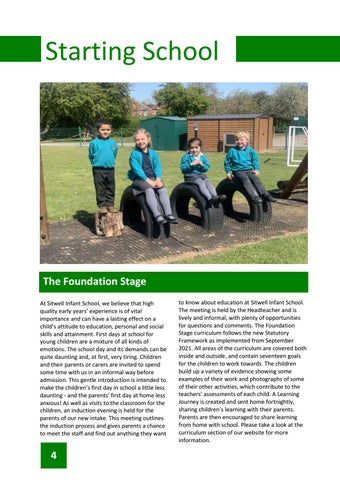
The Foundation Stage At Sitwell Infant School, we believe that high quality early years’ experience is of vital importance and can have a lasting effect on a child’s attitude to education, personal and social skills and attainment. First days at school for young children are a mixture of all kinds of emotions. The school day and its demands can be quite daunting and, at first, very tiring. Children and their parents or carers are invited to spend some time with us in an informal way before admission. This gentle introduction is intended to make the children’s first day in school a little less daunting - and the parents’ first day at home less anxious! As well as visits to the classroom for the children, an induction evening is held for the parents of our new intake. This meeting outlines the induction process and gives parents a chance to meet the staff and find out anything they want
4
to know about education at Sitwell Infant School. The meeting is held by the Headteacher and is lively and informal, with plenty of opportunities for questions and comments. The Foundation Stage curriculum follows the new Statutory Framework as implemented from September 2021. All areas of the curriculum are covered both inside and outside, and contain seventeen goals for the children to work towards. The children build up a variety of evidence showing some examples of their work and photographs of some of their other activities, which contribute to the teachers’ assessments of each child. A Learning Journey is created and sent home fortnightly, sharing children’s learning with their parents. Parents are then encouraged to share learning from home with school. Please take a look at the curriculum section of our website for more information.
4
Curriculum Core Subjects English – Spoken Language; Reading; Writing; Spelling, Punctuation & Grammar Maths – Number; Shape, Space and Measure Science
The National Curriculum is taught at Sitwell Infant School in Year 1 and 2. Our teachers work hard to ensure the curriculum is as stimulating and exciting as possible, so that the children enjoy learning and are inspired to become lifelong learners. We build in many links with the local area and take the children on a variety of educational visits, to excite and interest them in their learning and to create a real life context to learning. Our aim is to deliver our creative curriculum in a cross curricular way. Within each theme of work maximum opportunity will be taken to integrate cross curricular links, with literacy and numeracy at the core. Our creative curriculum has 4 ‘drivers’, which are constantly considered when deciding how and what we teach. Lifelong Learning and Skills (Maths, English, Computing) Community & Environment (Science, Geography, History, Global Dimension) Healthy Lifestyles (PE, PSHE and RE) Creativity (Music, Drama, DT and Art) CURRICULUM MEETINGS FOR PARENTS We hold regular curriculum meetings, during the daytime and evening, for parents to attend to give you the opportunity to find out how we teach different subjects; meet the teachers and gain advice about how to support your children’s learning at home.
English At Sitwell Infant School, English is taught in an exciting, stimulating and enjoyable way. There are 4 main elements to the English curriculum - Spoken Language, Reading, Writing and Spelling, Punctuation & Grammar (SPaG). English at Sitwell Infants is taught mostly through a cross curricular approach but some elements need to be taught separately. Staff in school are highly trained to support children learning English as an Additional Language, using a range of strategies and resources.
Speaking and Listening Development of children’s speaking and listening skills are vital, particularly in their early years. At Sitwell Infant School, children develop a love of listening to stories and poems, saying rhymes, as well as participating in drama and role play – all of which help to develop their listening and speaking skills. They become confident, fluent and articulate, and very able to express themselves. We encourage all children to be interested in other people’s thoughts and feelings, ideas and opinions, and value and respect them.
Writing Much of the writing at Sitwell Infants is cross-curricular in nature covering a range of genres, giving children a real purpose and context in which to write. Writing can be produced individually, as a pair or in groups with a range of inspirations to reflect the wide variety of reasons to write in everyday life. Attention to grammar, punctuation and spelling is thorough within the daily Literacy session but specific aspects are taught separately, where appropriate.
5
Reading
Maths
At Sitwell Infant School we are committed to providing a rich and comprehensive reading programme, offering a range of opportunities to become fluent, enthusiastic readers. A wide range of reading experiences is offered through the Literacy lesson and during continuous provision.
At Sitwell Infant School, we inspire all children to become confident and enthusiastic mathematicians, who are willing to take risks and are not scared of making mistakes. We teach children that an important aspect of their development is to learn from their mistakes. We aim to develop a range of mathematical skills and provide opportunities for their application in meaningful, real-life situations. We strive to provide our children with exciting and challenging investigations, thereby increasing motivation and promoting a positive response to mathematics. For more information regarding our maths curriculum, please visit the Curriculum section of our website, www.sitwellinfantschool.co.uk.
Phonics Phonics forms the daily basis of reading development in EYFS and KS1 and this approach to teaching reading is taught daily in every class. Phonically decodable reading books, as well as simple fiction and non-fiction books, are used to support children’s early reading skills within school. Individual and Guided Reading Individual and guided reading usually takes place twice a week. Children read individually or within a group with others of similar reading ability. The book is specially chosen to match the reading ability of the child or group. During the session, we teach appropriate reading strategies or skills to support children’s decoding and understanding of a text. Guided reading provides opportunities for children to take part in discussion where they can enthuse and learn from each other. Home/School Partnership We really value and appreciate the time parents spend reading with their children at home. This is vital for developing fluency and establishing a good reading habit and a love of books. We hold regular workshops and shared reading sessions throughout the school year to promote reading for pleasure.
6
Science Science is taught every half term, normally through topic work, so that we cover the Science National Curriculum. Each year group has science units of study that will be covered in depth. The development of children’s experimental and investigative skills is of vital importance. Children are encouraged to be independent and collaborative scientific investigators by their involvement in exciting practical investigations. Investigative work takes the form of modelled and independent investigations and the proportion of these skills varies between year groups. The new curriculum also recognises the importance of a developing knowledge of scientific concepts. Our lessons incorporate both knowledge and investigative skills through a lively and creative curriculum.
Curriculum Foundation Subjects Art, Design and Technology, Computing, Music, Geography, History, Physical Education, Religious Education and PSHE
Art Art is a useful means of expression, and is linked with many other areas of the curriculum. All children have experience in using a variety of media including paint, pastel, clay, fabrics and sewing. They produce both 2D and 3D work. During art lessons, children are encouraged to talk about their observations, so developing their use of language. They study work by famous artists and imitate those styles in their own work. We also encourage the children to identify art in the local environment, and value each other’s work. We believe strongly in children working from first hand experience, so make use of many artefacts, visits and natural objects.
Design & Technology Children learn how to think imaginatively, and talk about what they like and dislike when designing and making. They build on the experience gained in the Early Years through investigation and play. They explore how familiar things are designed and how they work. They talk about, draw and model their ideas. The children learn how to use tools safely, to use ICT as part of their designing and making and to consider the health and safety aspects of food technology.
Computing Computing is a new aspect of the Primary National Curriculum, where children develop an understanding of computer science as well as equipping them with the skills to use a range of Information and Communication Technologies to create programs, write texts and store information. Technology is used to enhance the teaching and learning across the curriculum and to motivate and engage the children at every possible opportunity. Each classroom is equipped with computers and a state of the art interactive touch screen which will further develop the children’s computer expertise. We have a large amount of laptops and Google Chromebooks, which are used to teach computer skills and applications to whole class groups or small groups. We also have a large amount of iPads which are used in the classrooms on a daily basis, as well as digital cameras to support the children’s learning.
Music From an early age children experience music in various forms; for example nursery rhymes, background music, songs and games. At Sitwell Infants we aim to nurture and build on these experiences in order to develop an understanding and enjoyment of music. Children are given opportunities to sing, play a variety of simple percussion instruments, explore sounds, compose, perform and listen to music from a range of times and cultures. Children perform in school several times throughout the school year, and also take part in singing for the wider community at various events.
7
Geography & History
Physical Education
At Sitwell Infants we aim to develop a secure understanding and awareness of chronology and the passing of time. We want the children to understand local, national and world events from the past which have had an impact on their lives. We do this by carefully planning topics securing coverage of the new National Curriculum. We want to develop the children’s geographical vocabulary and their vocabulary related to the passing of time to ensure the appropriate use of historical terms. The children will study the lives of significant men and women in the past who have contributed to national and international achievements and discuss changes that have happened over a period of time.
At Sitwell Infants, we believe that all children should be given the opportunity to take part in regular, high quality P.E lessons. To ensure this, all classes receive at least 2 hours of P.E. per week; one of which is outside (weather permitting), with other lessons delivered in the hall. Teachers structure P.E lessons as they would any other lesson with appropriate questioning, challenge and support given to the children.
The children explore why people did things, research causes and make links between events: begin to explore bias and historical interpretation. The children will have opportunities to explore and question a range of primary and secondary historical and geographical sources and develop their skills of organisation, communication and representation. The children also gain historical perspective by placing their growing knowledge into different contexts undertaking studies about the British values of democracy, individual liberty, the rule of law, mutual respect and tolerance of other faiths and beliefs. We ignite the children’s interests in the world around us and deepen their understanding of the past by arranging historical and geographical educational visits and visitors allowing access to high quality first hand experiences which help them with their topic based learning.
8
During indoor P.E sessions, the focus is on movement/dance and gymnastic activities. During outdoor P.E sessions, the children take part in a range of invasion games, striking and fielding games, net/wall games and outdoor adventurous activities. One lesson each week is led by an experienced sports coach; this helps us to ensure that children have the opportunity to experience high quality P.E lessons with good outcomes for all children participating.
Religious Education In our multicultural school, religious education cannot be separated from children’s learning about life in general, their environment and their relationships with others. We encourage our children to care for and respect the work, feelings, faiths and possessions of other people, and we hope that the ordering of our school life will lead to co-operation and friendship with each other. Through assemblies, stories, visits and visiting speakers, children develop a deeper appreciation of the spiritual, moral and natural world around them.
Special Educational Needs The Governors and staff of Sitwell Infant School work hard to ensure that children with Special Educational Needs & Disabilities (SEND) have access to a fully inclusive curriculum and can take part in everyday activities. The school operates within the guidelines contained within the revised Code of Practice that came into effect in September 2014. We will always consult parents if we feel that a child needs further support with learning and parents are encouraged to voice any concerns they may have with their class teacher or the Headteacher. Children will also be encouraged and helped to express their views and all staff work towards supporting these children effectively and boosting their self-esteem. All children entering school will be assessed and this highlights any possible developmental areas which may benefit from very early identification and intervention. The support which children with additional needs receive may be given in class or as an individual or small group member out of the classroom.
Accessibility A clear accessibility plan is in place in school to ensure that we consider the needs of all people with disabilities. We operate a fully inclusive policy in our school, catering for children with very diverse needs. The school has a disabled facility for hoisting and lifting children, with several members of staff trained in its use. The school has access ramps to the entrance and one exit, and except for one room, is all on one level. Parents with disabilities are encouraged to let the school know if there is any way we can make communication between home and school easier for them.
Support for children Children with additional needs will receive specific help from their class teachers, the SEND Co-ordinator and teaching assistants. Where necessary, the school and parents will consult with and receive advice from various outside agencies, such as Learning Support Advisory Teachers, Educational Psychologists or Speech and Language Therapists. At all times, the progress of children with additional needs is assessed and reviewed and individual or group education plans are produced accordingly. A number of bespoke learning packages to support individual children are put into place throughout the year, including support for specific learning needs such as numeracy or literacy, as well as personal, social or emotional needs.
Support for parents Class teachers are normally available at the beginning and end of the school day, should parents wish to talk about their child’s learning and progress or raise any queries they may have in relation to their specific needs. We have an open door policy in school and aim to work as closely as possible with parents to support our most vulnerable children. Our SENDCo is also available to speak to parents, as and when needed. At Sitwell Infants, the SEND Co-ordinator is Miss Astrid Griffiths, who is also the class teacher in Class 5. Full details of our SEND Policy is available on our website, alongside Rotherham’s Local Offer.
9
10
Pastoral Care SMSC & British Values
Behaviour Policy
Within our creative curriculum, fundamental British Values are promoted and discussed so that the children can be prepared for life in modern Britain. This enables children to develop a strong understanding of Democracy, The Rule of Law, Individual Liberty, Mutual Respect and Tolerance of those with different faiths and beliefs.
We have a comprehensive Behaviour Policy and an Anti-Bullying Policy in school which are available from the school office and on the website for any parent to read. A positive approach to behaviour management is promoted in school, which includes a range of rewards for good behaviour and hard work, together with clear sanctions which are understood by all the children. Our Sitwell Superheroes, which are linked to our six Golden Rules, help all children to make the right choices and develop positive behaviours at all times.
Spiritual development encourages the children to reflect on their beliefs, religious or otherwise, and reflect on their experiences, and to try and answer some of life’s fundamental questions. The use of imagination, creativity, and a sense of fascination in learning about themselves and the world around them is developed. Moral development encourages the children to recognise the difference between right and wrong; to have a concern for others and to begin to understand the consequences of their actions. They are helped to think about moral and ethical issues and to think about the views of others in these matters. Social development encourages the children to work and socialise with others and to relate to those from different backgrounds; religious, ethnic and socioeconomic, and they are helped to understand and accept the British Values in order to participate fully and contribute positively to life in modern Britain. Cultural development encourages the children to understand and appreciate the wider range of cultures in their local community and further afield. They are taught to respect different faiths and diversity in local, national and global communities. The children are also encouraged to take part in artistic, sporting and cultural opportunities.
We have a part time Learning Mentor who helps to support any children who may have difficulty managing their behaviour. Support may be put into place within the classroom, through small group work or by giving 1:1 support outside of the classroom.
Nurture Provision To further support children in school to develop their personal, social and emotional skills, a lunchtime nurture club is delivered daily in our specially designed nurture space, the ‘Rainbow Room’. Children take part in a range of activities to develop speaking and listening skills, confidence and key social skills such as turn taking and working as part of a team.
Home Learning We encourage parents to listen to and read to their child as often as possible. Simple games and activities linked to Mathematics, Phonics or Spelling, Punctuation and Grammar are also sent home weekly for parents to complete with their child.
11
School Services Food and Drink The school serves a wide range of high quality dinners, which are planned to provide a balanced and healthy diet with a choice of food every day. All children in school are provided with a cooked meal free of charge through the Government Universal Free School Meals offer. Also as part of this offer, every child is entitled to a free packed lunch when going out of school on an educational visit. In addition to the Universal Free School Meals offer, some families may be eligible for a Pupil Premium Payment to school. You may be eligible if you receive Child Benefit and another benefit such as Income Support or Income based Jobseekers Allowance. If you think your child may be entitled to a Pupil Premium payment to school, please get in touch. Children not wanting a school dinner can bring a packed lunch to school. As we are an accredited Healthy School, we ask parents to ensure the lunch children bring to school is varied and nutritious. Large chocolate bars, cakes and sweets are therefore not permitted in school. Milk is available to all children in school and is free for all children up to their fifth birthday. After this, parents can choose to pay if they wish their child to still have milk on a daily basis. If you would like to order milk for your child please pick up a registration form from the school office. Snacks are not allowed in school except as part of a packed lunch. Drinks for the children should not be in glass containers or cans, for safety reasons. Fresh water is always available for children and the school provides every child with a drinking bottle to be used during the school day. Also, fruit is provided free of charge for every child and is eaten at playtimes within KS1 and during continuous provision in EYFS.
School Health Service
Illness & Absence
The School Health Service offers a service in and through school to help with the health and well-being of your child. The nurse from the School Health Service visits school regularly. A medical examination and assessment is offered to a sample of the children in their first year at school. Prior to this, hearing, sight, weight and height checks are made of all children.
If your child is taken ill at school, we will contact you. Children who are unwell will need to be collected from school by a known adult. If your child is absent from school through illness, please contact the school office by telephoning before 9.30am stating the reason for absence. If your child has to attend a dental or medical appointment during the school day, please give the school evidence of this in advance, especially if your child will arrive late on that day.
Sight and hearing can be checked again at other times at the request of parents, teachers and other professionals. Your child and you can be seen by the nurse at your request or the request of a teacher/other professional. The School Health Service can arrange referral to other clinics or help from other professionals if necessary. The school nurse offers advice on health promotion.
12
Headteachers are unable to grant any leave of absence during term time unless there are exceptional circumstances. If you take your child out of school during term time, without the schools authorisation, the Headteacher will make a request to the Local Authority to issue a Fixed Penalty Notice.
Medicine
Parent Teacher Association
If a child is fit enough to come to school but has to take a course of medicine, a dose of which has to be taken during the school day, a form may be obtained from the school office to give consent for the medication to be administered by a member of staff. The medication will be kept in a secure container in the medicines box in the office or in the refrigerator in the staffroom.
The school has a flourishing PTA. Its aim is not only to raise funds to buy equipment for the school, but to promote understanding between home and school for the ultimate benefit of the children. Meetings are held each half term, to discuss forthcoming events and share ideas. There is no expectation for everyone to attend every meeting, but you are most welcome to come when you are able, and contribute towards this excellent partnership between home and school.
Where a child has asthma, inhalers are kept in the child’s classroom. These should be clearly named, and will be kept in the class teacher’s cupboard for safety reasons. It must be stressed that any child feeling in need of his/her inhaler, should inform the teacher. No other medicine is to be kept in the classroom. Please note that any medical condition should be recorded on the admission form, and discussed with the Headteacher and/or the child’s teacher. An action plan can then be identified in dealing with the condition, if necessary.
Throughout the year the PTA organises highly successful social and fundraising events - the Summer Fair perhaps being the most notable. Each year the PTA raise, on average, £2500 which is used to purchase a wide range of resources to support learning throughout school.
School Uniform Our uniform consists of a round-neck sweatshirt or cardigan in kingfisher blue/green, and a dark blue polo shirt, all with our owl logo. A pair of navy blue, black or grey trousers or skirt is acceptable. During the summer, a green checked dress can be worn. For P.E. children should wear a red T-shirt and black shorts and black pumps, which need to be kept in a drawstring bag on your child’s peg. Please ensure your child’s name is written clearly on all items of clothing. Uniform is available to purchase online and can then be collected from school.
13
Activities Educational Visits We firmly believe that children learn best from their own first hand experiences and to this end we endeavour to take the children on visits that enhance and enrich the chosen topics. Visits range from simple walks around the locality to look at shops, transport, housing and hedgerows etc. or further afield to working farms, zoos or museums. All such outings are carefully planned by the class teacher and are always well supervised by staff and parent volunteers. Full risk assessments are carried out. Contributions towards the cost of school visits are entirely voluntary, but parents will appreciate that without their help, such visits, which play such an important part in the life of the school, would have to be severely curtailed. Parent helpers may be requested to support school staff on visits. We hope you can join us!
School Council As part of the Healthy schools scheme running in school, we have formed a school council. This consists of a small group of children, who are representatives of the school as a whole. The group meets with a member of staff fortnightly to discuss various topical aspects. Children from each year group have an opportunity to be part of the council group. Children can volunteer their services at the beginning of the school year. If more than two children per class show an interest, there has to be a vote by the rest of the class to decide who will represent them. The same children remain on the council for a complete school year. We feel that the school council has become a positive aspect of school life. It has given children a voice and a sense of ownership and responsibility within the school. The council have already had an input into organising fundraising events and making key changes within school. They also made decisions about new playground furniture for the outdoor playground area.
14
CHARGES AND REMISSIONS It is school policy to subsidise visits to ensure that the cost is no higher than £15 per visit. Parent helpers may be required to make a contribution to visits. A full copy of the Charges and Remissions Policy is held in the school and is available to any parent on request. Children in receipt of benefit related Free School Meals are entitled to have part of the cost met by the schools “Pupil Premium” funds.
Before & After School Provision We run after school clubs for Year 1 and 2 children throughout the year. We welcome F2 children to clubs after October half term, giving them time to settle into school life first. The activities vary from term to term but we aim to offer children a wide range of skills based clubs linked to the arts and sports. We also have a breakfast club which has 30 places and runs each day from 7.45am. School staff organise a range of games and activities. Breakfast of cereal, toast and juice is provided. The cost is £3 per day.