Building Bright Futures for Children
Cincinnati Preschool Promise Evaluation Summary: 2025-26 Cincinnati Preschool Promise (CPP) is committed to ensuring children have equitable access to high-quality preschool, preparing them for kindergarten and beyond. CPP provides Tuition Assistance (TA) to eligible 3- and 4- year old children to attend high-quality community-based providers or public preschools within the Cincinnati Public Schools (CPS) district boundary. The findings shown in this 2025-26 evaluation summary demonstrate how CPP’s investments continue to expand access to high-quality preschool and support positive outcomes for children. Results related to preschooler progress and kindergarten readiness include TA recipients enrolled in both community-based and CPS preschools. All other results represent community-based participants. The full report provides additional findings, detailed descriptions of CPP programs, and information about the evaluation methods used to assess CPP’s impact on children, families, Providers, and the broader Cincinnati community. The evaluation was conducted by INNOVATIONS in Community Research and Program Evaluation at Cincinnati Children's Hospital Medical Center, CPP's independent external evaluator. CPP TUITION ASSISTED PRESCHOOLERS ARE LEARNING, GROWING, AND THRIVING Preschool Enrollment
Preschool Attendance Rate
1,131 preschoolers received CPP TA to attend high-quality preschool
89.3% average attendance rate A 5.9 point increase since 2017
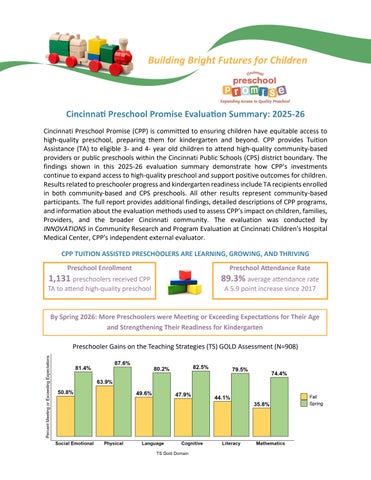
By Spring 2026: More Preschoolers were Meeting or Exceeding Expectations for Their Age and Strengthening Their Readiness for Kindergarten Preschooler Gains on the Teaching Strategies (TS) GOLD Assessment (N=908)
CPP TUITION ASSISTANCE RECIPIENTS SHOW GREATER KINDERGARTEN READINESS The new Kindergarten Readiness Assessment-Revised (KRA-R2) short form was administered this year. Results show that kindergarteners who attended preschool with CPP TA were more likely to enter kindergarten ready to learn than their peers who did not participate, including kindergartners from similar school districts in Ohio. Research studies have shown that students who perform at these levels of readiness are significantly more likely to reach important educational milestones in their future. CPP TA Kindergarten Readiness Rate: Approaching and Demonstrating Levels
CPP TA Participants Consistently Score Higher than Non-Participants
CPP TA Participants On Track for Literacy Increased from Last Year
72.2%
+3.3 - 5.4 points
+17.0 points
Overall KRA-R2 Performance Levels by CPP TA Participation 2025-26
On Track in Language and Literacy by CPP TA Participation 2025-26
KRA-R2 Demonstrating and Approaching Readiness Comparisons by CPP TA Participation and Select Characteristics Population CPP TA Race Black 73.2% Hispanic 46.5% Multiracial 83.3% White 88.0% Gender Female 75.5% Male 68.9% Socioeconomic Status (SES) SES 1 67.8% SES 2 74.6% SES 3 73.6% SES 4 80.6% English Language Learner (ELL) ELL 57.9% Documented Disability Disability 43.7%
Non-CPP 62.5% 37.6% 73.8% 83.8% 70.6% 63.2% 53.2% 61.5% 72.8% 86.2% 34.6% 30.0%
CPP TA participation was a statistically significant predictor of KRA-R2 performance when controlling for race, SES, disability, and ELL status, increasing the odds of Demonstrating readiness by 25.2% and being On Track for Literacy by 58.0%.
Overall KRA-R2 Performance Levels 2025-26: School District Comparison
CPP IS STRENGTHENING CINCINNATI’S PRESCHOOL ECOSYSTEM Expanding Access to High-Quality Preschool •
198 Providers in the CPP Community Provider Network offering more than 3,600 quality and high-quality preschool seats, of which 1,615 seats are in quality gap areas
Continuous Quality Improvement, Teacher, and Provider Support • • •
More Providers achieve high-quality ratings through CPP supports and programs 10 Providers advanced to a high-quality rating this year 147 Provider high-quality rating achievements since Year 1
RECOMMENDATIONS & NEXT STEPS CPP and partners may consider recommendations as they continue efforts to sustain and expand access to high-quality preschool options in Cincinnati, invest in improvements to the local early childhood system, and adapt to emerging challenges within the early childhood landscape. CONTINUE HELPING FAMILIES ACCESS HIGH-QUALITY PRESCHOOL: CPP is achieving its primary goal of increasing access to quality preschool as the number high-quality Providers continue to increase as has participation in CPP. Evaluation results also show that CPP TA participants show positive growth and development during preschool and have higher kindergarten readiness than their same-age peers who do not participate in a high-quality CPP experience. CPP should continue prioritizing TA and Provider supports that support and increase children’s access to highquality preschool, and especially those with greatest social and economic needs. PROMOTE REGULAR PRESCHOOL ATTENDANCE AND EARLY ENGAGEMENT: Attendance rates have steadily increased and remain high among CPP TA participants. Research and local evaluation data document the importance of consistent attendance for children’s developmental progress and long-term success in school. CPP should continue efforts that have been effective in increasing preschool attendance and addressing barriers to regular preschool participation, including attendance supports and incentives, Provider and community partnerships, and parent awareness, communication, and engagement. ENHANCE SUPPORTS FOR PRESCHOOLERS FACING BARRIERS TO SCHOOL SUCCESS: Findings suggest that high-quality preschool benefits children facing barriers to school success. The evaluation was expanded this year and found that disability status, English Language Learner status, race, and socioeconomic conditions are important predictors of kindergarten readiness outcomes. CPP should continue using evaluation data to prevent adverse outcomes for vulnerable groups by offering supports and resources, promoting screening and early identification, implementing inclusive practices, ensuring family engagement, and partnering and advocating in areas most needed. Additionally, for all preschoolers, CPP and partners should focus on strengthening transition supports during kindergarten through third grade to help sustain the progress made during preschool and maximize the long-term benefits of CPP. CONTINUE SUPPORTING QUALITY IMPROVEMENT AND PROVIDER STABILITY: CPP has expanded its community-based TA Provider network from 40 Providers in 2017-18 to 165 Providers in 202526. While CPP has successfully expanded high-quality preschool availablity, it cannot solve the sector’s complex workforce issues alone. Further investment in Provider quality improvement, support from partners, and changes to statewide policies are needed to address ongoing risks to Provider sustainability and workforce stability to preserve the access gains CPP has achieved over the past decade. CPP partnering within a systems approach will be needed to fully address pipeline, teacher quality and retention, and early childhood workforce issues. CONSIDER EXPLORING LONGITUDINAL LEARNING OPPORTUNITIES: The 2025-26 evaluation focuses on outcomes most directly connected to CPP’s investments in high-quality preschool; however, there may be increasing value in complementing current findings with additional measures that help stakeholders understand how early gains are maintained over time. Additional investments and partnerships will be required to expand data collection and evaluation. They will also be important for connecting children and families to supports that can help address barriers that exist outside of preschool while expanding CPP’s reach and long-term impact.