Commun ty Matters Fulton Presbyterian Manor
September 2017
Praise for Promotions!
Congratulations to two Fulton Presbyterian Manor employees who’ve recently earned promotions. We appreciate their dedication, and celebrate their advancements!
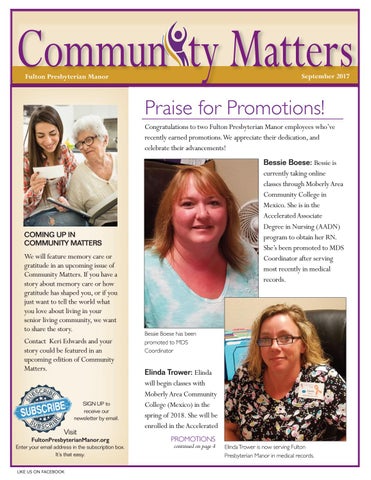
Bessie Boese: Bessie is currently taking online classes through Moberly Area Community College in Mexico. She is in the Accelerated Associate Degree in Nursing (AADN) program to obtain her RN. She’s been promoted to MDS Coordinator after serving most recently in medical records.
COMING UP IN COMMUNITY MATTERS
We will feature memory care or gratitude in an upcoming issue of Community Matters. If you have a story about memory care or how gratitude has shaped you, or if you just want to tell the world what you love about living in your senior living community, we want to share the story. Contact Keri Edwards and your story could be featured in an upcoming edition of Community Matters.
SIGN UP to receive our newsletter by email.
Visit
FultonPresbyterianManor.org Enter your email address in the subscription box. It’s that easy. LIKE US ON FACEBOOK
Bessie Boese has been promoted to MDS Coordinator
Elinda Trower: Elinda will begin classes with Moberly Area Community College (Mexico) in the spring of 2018. She will be enrolled in the Accelerated PROMOTIONS
continued on page 4
Elinda Trower is now serving Fulton Presbyterian Manor in medical records.
What makes a not-for-profit senior living community different? While shopping for a senior living community, it is common to consider the layout of the residence, the taste of the food and the friendliness of the staff as well as the financial requirements and availability of ongoing care.
But what about the operational status of the organization? A community operating with a for-profit business model vs. a not-for-profit business model can make a significant difference in the overall operation and culture of the organization.
®
®
Community Matters is published monthly for residents and friends of Fulton Presbyterian Manor by Presbyterian Manors of 501(c)(3) organization. Learn more at PresbyterianManors.org.
Dawn Smith, executive director Keri Edwards, marketing director To submit or suggest articles for this publication, contact kedwards 2@pmma.org. Telephone: 573-642-6646 Fax: 573-642-2202 Address: 811 Center St., Fulton, MO 65251-1922
Our mission: We provide quality senior services guided by Christian values. FultonPresbyterianManor.org
2 COMMUNITY MATTERS SEPTEMBER 2017
Five major differences are worth exploring to understand the contrast better. 1. Faith-based; Mission-driven
As a not-for-profit organization, there is one governing philosophy to which all operational decisions must alignthe mission! At Presbyterian Manors of Mid-America, our mission is to provide quality senior services guided by Christian values. We carry a culture that makes all decisions by wearing two lenses, one is quality, and the other is Christian values. All things must measure up to those standards.a
2. Continuous ownership
A popular avenue through which forprofit organizations gain revenue in senior living is acquisition and resale. In fact, it is common to see ownership change every five years or so. However, this growth model is simply a grab at revenue which makes it a rarity in the not-for-profit sector.
A volunteer board of trustees is holding the Presbyterian Manors of Mid-America organization and its leadership accountable to the mission and the best interests of the residents.
Enjoying the consistency of continuous ownership can be a huge plus! 3. Oversight is provided by a volunteer board of trustees
Who is at the helm of an organization? The shareholders? The CEO? The Board? In a for-profit business, many decisions are based on what will be pleasing to the shareholders. Compare that to the way a not-for-profit is managed. A volunteer board of trustees is holding the organization and its leadership accountable to the mission and the best interests of the residents. The fact that this group of highly-qualified individuals serves in a volunteer capacity means that there are no alternative motives outside of the mission. This means that residents are always the priority. 4. Net revenue is reinvested back into the community
Just because Presbyterian Manor is a not-for-profit company doesn’t mean
DIFFERENCE continued on page 4
By Suzanne Gerber Pop quiz: When you think about how technology will personally impact your life over the next 10 to 20 years, which of these things do you envision as being part of that evolution?: A.Holographic technology to communicate with your family B. A car that chauffeurs you around C.3-D-printed medicine D.Drones to help with household activities E. All of the above
If the tech-prognosticators are to be believed, the correct answer is E: All of those Jetsons-sounding devices will be available in the coming not-so-many years. Whether that news thrills or terrifies you, it’s ultimately a good thing, because these technological developments can help older adults and those who are housebound with tasks keep them mobile, keep them at home longer and help them stay connected to others, which is one of the most important factors for a long and fulfilling life. “Loneliness is at epidemic levels among elders in the U.S. today,” says Juliet Holt Klinger, senior director of dementia care and programs at Brookdale Senior Living, a leading provider of assisted living and home care. A colleague of hers, Brookdale Chief Medical Officer Dr. Kevin O’Neil, agrees. “Human connection is crucial for people at all ages, but especially so for seniors,” he says. “Loneliness in this age group is associated with shorter life spans, chronic conditions such as high blood pressure, depression and even dementia,” rookdale Chief Medical LIKE US ON FACEBOOK
Officer Dr. Kevin O’Neil agrees. A recent study published in the journal Alzheimer’s & Dementia found that healthy and mildly cognitively impaired people over 70 who engaged in daily face-to-face online conversations for six weeks showed “significant improvements in cognitive skills.” Despite all the exciting developments coming down the pike, however, there’s currently a gap between what’s available now and what’s accessible to the general older adult population. According to a recent survey by techservices provider Bask, eight in 10 older Americans lack the means to utilize the technology — but they would “make greater and more frequent use of information and communications technology (ICT) if they had ready access to support and assistance.” Bask’s research indicates that only onethird of respondents use a personal computer at least once a month, and fewer than one in five text. Close to 50 percent said they don’t go online “because it takes too long to understand and keep up with technological change.” And a full 39 percent said they felt “only somewhat connected or not connected at all to their families.” Recent research from Brookdale further found that 27 percent of people over 80 are “virtual shut-ins.” There’s no easy fix, but for now, it’s up to us — friends and family — to take the initiative and help and mentor our older loved ones with technology. There was a noticeable sea change at this year’s Consumer Electronics Show in Las Vegas: a greater emphasis on needs of people in their 70s, 80s and beyond.
Experts say it will make life happier, healthier and easier for older adults and caregivers
“We’re seeing some new devices that are easier to use, portable and easy to read,” she notes, which to her is an indication that manufacturers are finally “kind of getting the idea of seniors being able to actually use them independently.” A few of the gadgets aimed at older users include a programmable “universal monitoring solution” called Mother that sends a reminder to people to take their meds if the bottle has been stationary past a predetermined amount of time. Another notable debut was a smart TV called Angela, designed for folks who aren’t comfortable using a smartphone or tablet yet want to be able to video chat and share photos and messages. The fact that the number of people 60 and above is expected to more than double by 2050 and that the number of people 80-plus will increase more than sevenfold by 2100 isn’t lost on the R+D folks. “Future tech will increase older people’s independence and help relieve the health services,” says Naomi Climer, the new president of the prestigious Institution of Engineering and Technology. © Twin Cities Public Television - 2017. All rights reserved.
FULTON PRESBYTERIAN MANOR 3
Getty Images
The amazing technology that could change how we age
PROMOTIONS continued from page 1
Associate Degree in Nursing (AADN) program to obtain her RN. She was previously serving as an LPN, and will now be in medical records.
Her favorite thing about working at Fulton Presbyterian Manor is the residents. “I love that they all become family. I enjoy making sure that they get the best possible care: the care that they deserve,” said Elinda. “I’m looking forward to learning new things, and exploring what possibilities are out there for an LPN.” Congratulations to Bessie and Elinda!
®
Fulton Presbyterian Manor 811 Center St. Fulton, MO 65251-1922 ®
LIKE FULTON PRESBYTERIAN MANOR ON
DIFFERENCE continued from page 2
the organization never makes money. The real difference is how that income is managed. Naturally, in a for-profit, revenue goes to serve the shareholders. Conversely, there are no shareholders for a not-for-profit; therefore, all net revenues go back into the community to improve the quality of life for the residents. 4 COMMUNITY MATTERS SEPTEMBER 2017
5. Good Samaritan Programsupported by philanthropy
One of the number one fears of American seniors is running out of money. In more than 68 years of serving seniors, Presbyterian Manors of Mid-America has stood in that financial gap for those who no longer had the resources to pay for their cost of living in the community. The Good Samaritan Program is supported by philanthropic efforts to ensure residents always have a secure future. Choosing a senior living community is a
complex decision with many variables. As you go through the process remember to ask these questions: 1. What is the mission of this organization and how is it implemented each day? 2. Who owns this community and for how long? 3. Who is in charge? (Shareholders? Volunteer board?) 4. What happens to net revenues? 5. What would happen to me if I ran out of money?