The
Review
Special General Assembly of the Presbyterian Church in Ireland
18 December 2025
A repentant Assembly
In response to the failings in safeguarding announced by the Presbyterian Church in Ireland on Wednesday 12 November 2025, a special meeting of the General Assembly was held in Assembly Buildings, Belfast, on Thursday 18 December 2025. The calling of a Special Assembly was the first act of Dr Richard Murray upon returning to the office of Moderator on 1 December 2025. The entire Assembly was both in public and livestreamed, although senior members of a PSNI investigation team and the Department of Health had previously set parameters that meant that while members were not prevented from speaking about safeguarding matters, nothing could be said publicly that would compromise their investigation. In practice, this meant that no details of any specific past failings could be shared, beyond what was already in the public domain. To facilitate debate the General Council brought a report to the Special Assembly which was divided into four sections which addressed
the area of safeguarding along with particular circumstances relating to the Church’s ongoing life and work as it seeks to move forward and respond to the situation it is in. The report adopted a posture of repentance saying: “This is a shameful position for part of the church of Jesus Christ to be in. In light of this, there is no alternative but for the Church to adopt a posture of a broken and contrite heart, i.e., a recognition of the need for repentance, humility and lament.” The full report of the Special General Assembly, and the supplementary report can be accessed on PCI’s website, presbyterianireland.org/specialga25
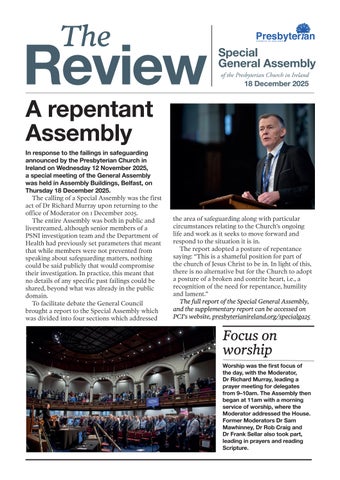
Focus on worship Worship was the first focus of the day, with the Moderator, Dr Richard Murray, leading a prayer meeting for delegates from 9–10am. The Assembly then began at 11am with a morning service of worship, where the Moderator addressed the House. Former Moderators Dr Sam Mawhinney, Dr Rob Craig and Dr Frank Sellar also took part, leading in prayers and reading Scripture.
“Deeply ashamed and sorry” In his opening address to the Assembly, Moderator Dr Richard Murray apologised to those who have been hurt or harmed as a result of the Church’s central failings, saying to those it let down, “We are deeply ashamed and sorry.” As a Moderator preaching at a General Assembly in the most difficult circumstances ever faced by the denomination, Dr Murray brought the words of Psalm 6 to bear upon the current situation. Balancing the realities of God’s discipline and his grace to the truly penitent, he focused attention on the steadfast, never failing, love of the Lord. He encouraged a deeply felt denominational taking of responsibility for what has happened, expressed in grief, lament and sorrow, and a trust in the Lord in the midst of our trouble. He said: “As a Presbyterian family, we have been horrified to learn that people in our care have been hurt and harmed and as yet we do not know the extent of our failings. The vast majority of our ministers, elders, designated persons, and office staff are men and women of integrity and honour, but some have let us all down and for that we are deeply ashamed and sorry… Our denomination now has this cloud hanging over us, all of us have collective responsibility for safeguarding.” Dr Murray made clear that the crisis facing the denomination is significant: “Brothers and sisters, this safeguarding crisis isn’t going to blow over in a week or two, or a month or two, or a year or two and we have to…trust God for the timing going forward because he is the Alpha and Omega, the beginning and the end. For however long it takes, we have to feel this. We have to own this.” Taking as his theme ‘God’s Word for a time of penitence’ from Psalm 6, Dr Murray said: “I want God’s Word to get into us…humbling us, reminding us that apart from God, we are nothing, and…we have nothing.”
2
Special General Assembly Review | December 2025
He continued: “The only reason the Lord should save us is because of his covenant love... we let the Lord down all too frequently, but the Lord never lets us down.” Bringing a focus to those who have suffered, he said: “I believe it’s more than appropriate – it’s necessary – that we gather together in this special General Assembly to grieve and lament for those who have been hurt and harmed (and for their families who have to pick up the pieces), acknowledging that there will be things that these good people have to live with for the rest of their lives…And to them we say, ‘We are sorry that you have been hurt or harmed by our failings.’ We come as this Church family to repent before God.” Concluding his address, Dr Murray referenced Romans 8:28, saying, “May God have mercy upon us. May God comfort those hurt and harmed. May God deliver us from our enemies. May God lead us through this dark tunnel and grant us better days ahead. Because all things (even bad things) work together for good for those who love God.”
Safeguarding measures agreed Measures to elevate the position of safeguarding within PCI were passed at the Assembly. The report before the House acknowledged that safeguarding had been under-resourced and that it is untenable for it to remain within the Council for Social Witness (CSW). In the interim, it recommended: the creation of a Safeguarding Department; new line management arrangements to establish greater independence for those involved in its delivery; and that there be two senior level posts – a Head of Safeguarding and a Safeguarding Lead. Acting Clerk, Dr David Allen, said PCI cannot wait until the police and Charity Commission investigations conclude –
interim steps must take place immediately. “It is clear that in a denomination of more than 500 congregations, safeguarding has been under-resourced. Too few people have been employed, and while our current Safeguarding Lead and CSW Secretary have external support and supervision, this hasn’t always been the case.” He explained that safeguarding was previously funded through the United Appeal for Mission, but it is now clear that this is neither appropriate nor adequate. Instead, it is proposed to fund it through direct congregational assessment. Dr Allen said, “These things cannot be counted in material
terms, and the Church must now invest much more of the money entrusted to it to make sure that these failings never happen again.” A number of amendments were passed concerning the recommendations. One added a focus on the principles of justice that are expressed in the Bible; another called for the circulation of the protocol for the management of safeguarding concerns relating to ministers, elders and senior leaders, to be reviewed by all ministers and kirk sessions asking that this feedback be brought back to the General Assembly for its approval.
Interest The Special General Assembly 2025, attracted a large attendance with over 700 members of the House registering and attending. This was supplemented by over 100 members of the public who attended both the worship and business session. In addition, the livestream was watched by many peaking at over 1600 logins during the business session in the afternoon. Additionally, the Assembly was attended by a larger than normal press and media corps, with all the major outlets being in the building, BBC, UTV, RTE, the Belfast Telegraph and Newsletter. The Belfast Telegraph provided a live commentary of the day’s events that reported on both the worship and the afternoon business sessions. UTV broadcast live from Assembly Buildings for its UTV Live programme at six o’clock, just as the Special Assembly drew to a close. A recording of both sessions is now available on the PCI website and can be watched back here, presbyterianireland.org/specialga25
Special General Assembly Review | December 2025
3
Background given Further detail on the circumstances leading to the safeguarding crisis was given by General Council convener Dr David Bruce. Acknowledging that there is a hunger for detailed information, he said some of the issues were brought in a supplementary booklet to the 2024 General Assembly, and reflected concerns raised by members of the previous Safeguarding committee during 2023 and 2024. This led to the setting up of a Safeguarding Development committee, which brought a set of revised policies to the 2025 General Assembly. Attempts to set up an external review of safeguarding were frustrated by the inability to identify an independent chairperson. “During the early months of 2025, questions surrounding safeguarding became much more acute when an individual was convicted of child sexual abuse offences and was imprisoned. The PCI safeguarding team had become aware of this case in March and once this person was convicted on 12 May, the PSNI gave the Church permission to look into the matter internally since it had become clear by then that this person had a connection to at least one of our congregations,” explained Dr Bruce. The General Assembly Advisory committee (GAAC) appointed a four-person ad hoc group to look into how this had been missed in PCI systems from 2009. It commissioned a report from the safeguarding team, looking into the internal systems in place between 2009 and 2021. “The ad hoc committee considered it and recognised there were deep and concerning failures systemic in nature, extending back through the period under investigation,” said Dr Bruce, explaining that the report was brought
to the GAAC on 10 November, and an abridged version to the General Council on 12 November. “The focus of our concerns about failings centred on the responsiveness of the Church to requests for safeguarding help. Often these responses were slow and, in some cases, completely absent. It was clear that emails had not been opened or that phone calls had not been returned. This was not universal. Many requests for help were dealt with in a timely and professional way and there were staff in the Taking Care office who performed their work in training and support diligently through this period, but the overall picture was of significant failings, including in delivery and in oversight,” said Dr Bruce. Assuring the House of PCI’s positive engagement with the investigations and other bodies, Dr Bruce added, “At the beginning of this journey, members of the ad hoc committee… determined…that we would seek to do the right thing. There would be no cover up. We would follow the evidence in scorn of the consequence to us personally or to the institution of PCI because our first and final and absolute commitment was to those who have been harmed or otherwise affected by our failings as a Church.”
REDRESS SCHEME The Safeguarding Development Committee is to look into the necessity of establishing a Survivor Redress scheme. The resolution passed by the Assembly, proposed that such a scheme would offer a formal apology to survivors of abuse occurring within the Church, together with any necessary compensation and access to support needed. Proposing the resolution, Rev Ivan Steen said: “The survivors are watching and they need to see that we have learned immediate lessons and that we are putting them at the very front of our outcomes and our thinking.”
4
Special General Assembly Review | December 2025
NEW SAFEGUARDING PROCEDURES A new suite of training and resources are on their way, according to PCI’s Safeguarding Lead Jayne Bellingham. Addressing the House, she spoke of the enormous amount of work going on. Currently on the PCI website brief policy statements can be found offering broad statements of intent for the denomination. They are to be supported by
a suite of procedures, which have been completed, had external legal scrutiny and are currently with the Safeguarding Development Committee. She explained, “The procedures that are coming are split between adult and children’s safeguarding, and between Northern Ireland and the Republic of Ireland because we have different legal responsibilities across both of those jurisdictions. “With those procedures is coming a brand-new suite of training and resources,” she said, adding that details for
a roadshow for designated persons is already on the website. Mrs Bellingham acknowledged that it will take time for the denomination to understand and embed the new procedures as they are “massively different from what we have been working with.” She added, “We know they’re not complete… they’re the first draft. They need to be a living document…they need to move with the times.” The House also passed a resolution that the existing safeguarding guidance and Church-wide awareness of safeguarding processes be substantially increased in the immediate short term. Proposing it, Robbie Montgomery, an elder in South Kirk congregation, said it would help congregations but also be “a potential visible deterrent for those who seek to harm.”
Adult safeguarding Through an additional resolution, it was decided that PCI separates its obligations under the protection of adults at risk of harm from those of child protection. Further, the resolution said structures are to be identified to “take forward the commitments of the past, and which should be in a state of preparedness to meet the requirements of the new legislation.” All appropriate measures to support and foster a safer environment for adults at risk of harm are to be adopted. Proposing the resolution, Lesley McDowell, an elder in High Street, Holywood congregation, said: “Sadly, abuse of adults at risk is all too prevalent… We need to…know how to act and to support those with whom we are in contact.” She referred to the Adult Protection Bill, which is in the Committee stage at Stormont, and said, “There will be many opportunities to revisit, to produce appropriate procedures and training in Northern Ireland.” Special General Assembly Review | December 2025
5
Governance, culture and identity The report acknowledged that while some issues reported through PCI and the PSNI helplines and other avenues will be safeguarding and PSNI related, some will not. Proposing this section of the report, Dr David Bruce, convener of the General Council, said that other responses already received “had to do with how we as a Church oversee our work centrally – with some suggesting our processes are closed, remote and lacking transparency. Others have been critical of how we deal with disagreements or disputes. Sadly, some have told us of failures in leadership, including moral failures or conduct which calls into question the integrity of leaders, leaving them open to the charge of hypocrisy, or worse.” Dr Bruce made clear that any disclosures made would be investigated “in the appropriate way”. He also addressed the issue of governance saying: “Questions have been asked about whether our existing governance arrangements of Commissions, Councils and committees are fit for purpose. The Independent External Review Panel will have this question before them from the start, since the Charities Commission quite rightly needs to be satisfied that we can manage the work of the charity competently. But alongside this, is our own understanding of the Presbyterian
6
Special General Assembly Review | December 2025
form of Church government to which we are committed, and in addition, the ongoing work of a Structures and Resources Review which has been meeting for the past 18 months.” A resolution was passed that established a task group to inquire into issues of governance, culture and integrity within PCI. Dr Bruce said, “It is anticipated that this work will crosscut with that of the Structures Review Panel already mentioned.” Two amendments to this resolution were passed – one that ensured input would be given to this group by PCI’s Doctrine committee and another set out the parameters of the membership of the group, with names being presented at a future Assembly, likely to be on 17 February 2026. A further amendment failed to pass. This was proposed by Rev Dr Colin Burcombe and sought to have the issues of culture and integrity examined by an external, independent body. He said, “If we’re serious about reviewing our culture, we need someone from outside to help us see it.” Acting Clerk Dr David Allen urged the House to reject the amendment referencing the volume of work that needed to be done: “It’s not that we’re against external scrutiny…There are things that we have to get done…this just brings in one too many elements of complication.”
The role of Moderator and the format of the General Assembly in June 2026
Recruiting a new Clerk Designate The Assembly addressed the urgent matter of recruiting a Clerk Designate. Dr David Bruce said: “Decisions had already been made in principle about the appointment of a Clerk Designate, but events have overtaken us.” It was agreed that a task group will commence work immediately to revise the appointment process, job description and personnel specification for the post, or posts, of Clerk of Assembly and General Secretary. The group will give consideration to splitting the roles and whether they should be employed roles, or should revert to being paid officeholders. It was agreed that this task group will report to another special meeting of the General Assembly called by the Moderator, likely to be on 17 February 2026.
Resolutions concerning the election of the next Moderator and the format of the General Assembly in June 2026 were considered. It was noted in the report that, in the current circumstances, it would be inappropriate for PCI to engage in some, although not all, of the normal formal and public duties undertaken on its behalf by the Moderator. Having examined the option of suspending the normal election process for Moderator, the General Council also recommended that the election of a Moderator for 2026/27 be held in the normal way, but that the moderatorship be concentrated on pastoring PCI as a denomination. “It’s recognised that every Moderator plays a pastoral role… but the report is saying that in our current circumstances, that aspect of the role will increase and become more significant, and along with that, invitations to some public events should be respectfully declined,” said Acting Clerk Dr David Allen. The resolutions passed have tasked the General Assembly Advisory committee to bring a report on the Moderator’s role to a future meeting of the General Council. Regarding the June 2026 General Assembly, it was recommended that the ceremonial element should be reduced and that reports be more intentionally focused on God and his work, bringing opportunity for encouragement, thanksgiving, learning and prayer for the Church for the future. It should also be ensured that the duration of the June 2026 Assembly should give adequate time for consideration of reports, worship, prayer and informal fellowship and interaction. Invitations to overseas delegates are to be extended in the normal way. Dr Allen said this would encourage “us to be deliberately conversational, rather than confrontational; it’s encouraging us to discuss, rather than debate; it’s encouraging us to be a family, talking and listening prayerfully as together we seek the will of our Heavenly Father; rather than being a parliament, where we take and defend opposing positions, and neglect to listen to others who may differ from us.” The Business committee is to bring a report to the General Council regarding the June 2026 General Assembly. This is to be reported to a Special General Assembly. Special General Assembly Review | December 2025
7
Compromise Agreements The final aspect of the report addressed the Church’s use of Compromise Agreements, or Non-Disclosure Agreements (NDAs). Proposing this section of the report, Dr David Bruce said: “There has been considerable publicity surrounding the occasional use by the Church of Compromise Agreements on the ending of employment.” He continued, “The General Council recognises the need for a careful examination of this question in principle, from a theological, moral and practical perspective, and possibly also a legal perspective should proposed changes to legislation by the UK government be passed and
enacted in Northern Ireland… The question as to whether it is ever the right thing to do to invoke such clauses needs to be carefully examined before we as an Assembly finally determine a policy on the matter. It is this space for thoughtful reflection which is needed.” Debate showed differing perspectives on NDAs. Rev Susan Moore argued: “When we use NDAs to silence people, we are in danger of shutting down information or trends that might help us to see patterns which alert us to problems.” General Assembly solicitor Stephen Gowdy said: “NonDisclosure Agreements are a very common tool nowadays and it would be very foolish for us to exclude ourselves from using them…The critical word is ‘agreement’. They are non-
imposed; they are agreed.” A resolution was passed to establish a task group to consider all aspects of the use of Compromise Agreements and its report will be brought to the General Assembly in June 2026.
To find out more The full report of the Special General Assembly, the supplementary report, and a recording of the business proceedings can be accessed on PCI’s website, presbyterianireland.org/specialga25 or by scanning the QR code. Search for Presbyterian Church in Ireland
Produced by the Communications Department of the Presbyterian Church in Ireland Assembly Buildings, 2-10 Fisherwick Place, Belfast BT1 6DW Tel: +44 (0)28 9032 2284 Email: communications@presbyterianireland.org www.presbyterianireland.org