CNC Milling Parts : Precision Components Powering Modern Manufacturing In today’s competitive manufacturing environment, accuracy, repeatability, and speed are no longer optional—they are essential. CNC milling parts play a critical role in meeting these demands across industries such as automotive, aerospace, electronics, medical devices, and industrial equipment. From early-stage product development to full-scale production, CNC milling ensures components are manufactured with tight tolerances and consistent quality. This blog explores what CNC milling parts are, how they are produced, their applications, and how related processes like CNC lathe services, prototype CNC machining services, and rapid tooling contribute to efficient manufacturing workflows.
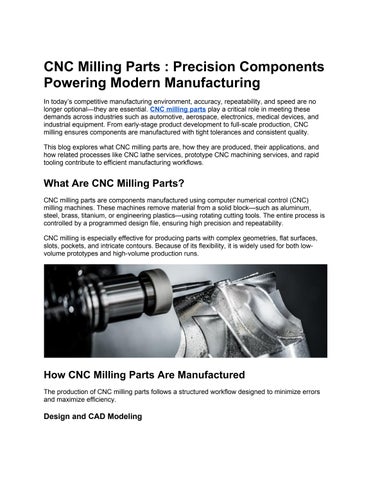
What Are CNC Milling Parts? CNC milling parts are components manufactured using computer numerical control (CNC) milling machines. These machines remove material from a solid block—such as aluminum, steel, brass, titanium, or engineering plastics—using rotating cutting tools. The entire process is controlled by a programmed design file, ensuring high precision and repeatability. CNC milling is especially effective for producing parts with complex geometries, flat surfaces, slots, pockets, and intricate contours. Because of its flexibility, it is widely used for both lowvolume prototypes and high-volume production runs.
How CNC Milling Parts Are Manufactured The production of CNC milling parts follows a structured workflow designed to minimize errors and maximize efficiency.
Design and CAD Modeling
The process begins with a detailed CAD model that defines the part’s dimensions, tolerances, and features. This digital design acts as the blueprint for machining.
CAM Programming and Machine Setup The CAD file is converted into machine-readable instructions using CAM software. Tool paths, cutting speeds, and machining strategies are optimized based on material and part complexity.
Precision Machining and Quality Control Once programmed, the CNC milling machine executes the operations with extreme accuracy. Throughout the process, quality checks ensure the final CNC milling parts meet design and functional requirements.
Advantages of CNC Milling Parts CNC milling offers several advantages that make it a preferred manufacturing method across industries.
High Accuracy and Tight Tolerances CNC milling machines can achieve extremely tight tolerances, making them ideal for components that require precise fits and reliable performance.
Material Versatility CNC milling parts can be produced from a wide range of metals and plastics, allowing manufacturers to select materials based on strength, weight, and environmental requirements.
Scalability from Prototypes to Production Whether producing a single part or thousands of units, CNC milling maintains consistent quality, making it suitable for both prototype and production applications.
CNC Milling vs. CNC Lathe Services While CNC milling focuses on rotating cutting tools, CNC lathe services involve rotating the workpiece itself. CNC lathes are best suited for cylindrical or symmetrical parts such as shafts, bushings, and threaded components. In many manufacturing projects, CNC milling parts and CNC lathe services are used together. For example, a component may be turned on a CNC lathe to create round features and then milled to add slots, holes, or complex surfaces. This combination ensures optimal efficiency and precision.
Role of Prototype CNC Machining Services Before committing to mass production, manufacturers often rely on prototype CNC machining services to validate designs. Prototyping allows engineers to test fit, function, and performance under real-world conditions. Prototype CNC machining services help identify design improvements early, reduce costly revisions, and speed up product development cycles. CNC milling parts produced during prototyping closely match final production components, ensuring accurate testing and smoother transitions to full-scale manufacturing.
Rapid Tooling and Its Impact on CNC Milling Parts Rapid tooling is another important process that complements CNC milling. It involves creating tools, molds, or fixtures quickly using CNC machining techniques. Rapid tooling is especially useful for short production runs, bridge tooling, or pre-production testing. By integrating rapid tooling with CNC milling parts production, manufacturers can reduce lead times, lower tooling costs, and respond quickly to market demands. This approach is particularly valuable in industries where product lifecycles are short and time-to-market is critical.
Applications of CNC Milling Parts Across Industries CNC milling parts are used in a wide range of applications due to their precision and reliability.
Automotive and Aerospace In automotive and aerospace manufacturing, CNC milling parts are used for engine components, brackets, housings, and structural parts that require high strength and tight tolerances.
Medical and Electronics Medical devices and electronic equipment rely on CNC milling parts for precision housings, connectors, and components where accuracy and surface finish are critical.
Industrial Equipment and Machinery From custom fixtures to heavy-duty machine components, CNC milling parts ensure durability and consistent performance in demanding industrial environments.
Conclusion CNC milling parts are at the heart of modern precision manufacturing, offering unmatched accuracy, flexibility, and scalability. When combined with CNC lathe services, prototype CNC machining services, and rapid tooling, CNC milling enables manufacturers to move seamlessly from concept to production. As industries continue to demand higher precision and faster turnaround times, CNC milling remains a reliable solution for producing high-quality parts that meet exact specifications. Whether you are developing a new product or optimizing an existing design, CNC milling parts provide the foundation for efficient and dependable manufacturing.