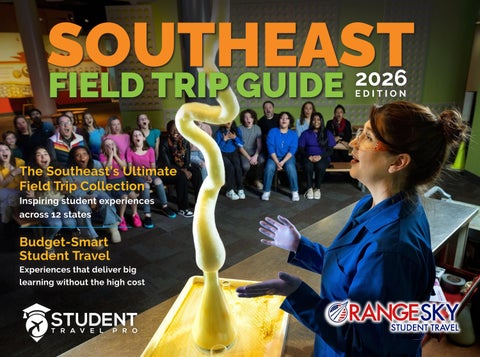
SOUTHEAST FIELD TRIP GUIDE
The Southeast’s Ultimate Field Trip Collection Inspiring student experiences across 12 states
Budget-Smart Student Travel Experiences that deliver big learning without the high cost
2026 EDITION
orangeskytravel.com
SIGNATURE PARTNER
This new Southeast Field Trip Guide is a must for middle through high school teachers and student travel planners. Aside from state-by-state destination ideas and valuable planning tips, explore dozens of impactful field trips and start organizing a new adventure today!
Virginia West Virginia Kentucky North Carolina
Photo courtesy of abstractor/Shutterstock.com
South Carolina Tennessee Georgia Arkansas Alabama Mississippi Florida Louisiana
2026 SOUTHEAST FIELD TRIP GUIDE
3
Changing Perspectives Through Educational Travel
T
hroughout the Southeast, educators will find extraordinary field trip locations that offer enriching student programs, interactive tours, and immersive experiences that encourage curiosity and engagement. Paired with standards-aligned hands-on activities and educational resources, these destinations move beyond traditional field trips and bring students face-to-face with scientific innovation, history and natural environments. This robust edition of the Southeast Field Trip Guide explores 12 states and their diverse offerings, from powerful Civil Rights Movement experiences in Georgia and Alabama to Appalachian history and handson archaeology in West Virginia. Discover more opportunities in places like Everglades National Park in Florida, the Muhammad Ali Center in Kentucky, NASCAR heritage and military history in North Carolina, and many more destinations across the region. We also take a deeper look at several timely topics recently shaping student travel, including budgetsmart field trip strategies, Civil Rights sites that move beyond textbook lessons, weather and climate learning environments, and attractions that connect STEM concepts with sports and society. For more planning assistance from Student Travel Pro, be sure to download your free Student Travel Planning Guide, filled with experiential opportunities for elementary, middle and high school students, plus practical planning tips and expert advice.
Intelligence is not enough. Intelligence plus character, that is the goal of true education. — Dr. Martin Luther King, Jr. That is the power of educational travel. Field trips can change how students see the world, build empathy, evolve perspectives and encourage proactive citizenship, not just provide academic knowledge.
Forge ahead fearlessly and stay inspired! Heather Dale, Managing Editor ON THE COVER: Live science demonstrations bring STEM topics to life at Discovery Place Science in Charlotte, North Carolina. Photo courtesy of Discovery Place Science Facebook
4
2026 SOUTHEAST FIELD TRIP GUIDE
2026 Editorial & Advertising Office 621 Plainfield Road, Suite 406 Willowbrook, IL 60527 P 630.794.0696 F 630.794.0652 info@ptmgroups.com www.ptmgroups.com
Publisher – Jeffrey Gayduk jeff@ptmgroups.com
Chief Editor – Jason Paha jason@ptmgroups.com
Managing Editor – Heather Dale heather@ptmgroups.com
Senior Editor – Randy Mink randy@ptmgroups.com
Contributing Writers – Randy Mink, Chris D. Silbernagel, Abby Shelton Director, Design & Production – Michael Caravette Graphic Designer – Romeo Alcantara Content Development Specialist – Tyler Drag tyler@ptmgroups.com
The publisher accepts unsolicited editorial matter, as well as advertising, but assumes no responsibility for statements made by advertisers or contributors. Every effort is made to ensure the accuracy of the information is published, but the publisher makes no warranty that listings are free of error. The publisher is not responsible for the return of unsolicited photos, slides or manuscripts. Copyright 2026 All rights reserved. Materials may not be reproduced in any form without written permission of the publisher.
14
Credit National Center for Civil and Human Rights Facebook
22
FEATURES
8
South Louisiana Wetlands Discovery Center FB
Southeastern U.S. Sports-STEM Experiences and Why They’re Important Discover what students can learn from stadiums, halls of fame and athletic history By Chris D. Silbernagel
14
From Hurricanes to High Water: Weather and Climate Learning in the Southeast Discover curriculum-aligned destinations where students explore forecasting, flooding, coastal change and community resilience firsthand By Heather Dale
22
Civil Rights Education Beyond the Textbooks
These incredible institutions in the Southeast provide in-depth, immersive and thought-provoking lessons on Civil Rights history By Randy Mink
28
Photo credits - NPS
8
College Football Hall of Fame Facebook
CONTENTS
28
Budget-Smart Field Trips That Still Deliver Big Learning Make every dollar work harder with smart strategies to stretch travel budgets without sacrificing educational value By Abby Shelton
2026 SOUTHEAST FIELD TRIP GUIDE
5
6 2026 SOUTHEAST FIELD TRIP GUIDE
54 66
68
82 Science Museum of Virginia Facebook
78
108
Discovery Place Science Facebook
Audubon Nature Institute Facebook
58 South Carolina Aquarium Facebook
76
West Virginia Botanic Gardens Facebook
64 Historic Arkansas Museum Facebook
FIELD TRIPS
Muhammad Ali Center Facebook
42 Mississippi Museum of Art Facebook
40
National Civil Rights Museum Facebook
44 Rosa Parks Museum at Troy University Facebook
NPS
40 Florida 42 Mississippi 44 Alabama 54 Georgia 58 Louisiana 64 Arkansas 66 Kentucky 68 Tennessee 76 South Carolina 78 North Carolina 82 Virginia 102 West Virginia National Center for Civil and Human Rights Facebook
CONTENTS
CONTENTS
SITE INSPECTIONS
Airboat Adventures in Florida.
62
34 America4Kids by U.S. Tours 60 River Parishes, LA
TOP LISTS 84 Visit Richmond, VA 88 Virginia Beach, VA
72
84
2026 SOUTHEAST FIELD TRIP GUIDE
Science Museum of Virginia in Richmond.
ITINERARIES
Wonders Center & Science Museum in TN.
46 U.S. Space & Rocket Center, AL 50 Alabama Tourism, AL 56 Georgia Aquarium, GA 62 Airboat Adventures, LA 70 Pigeon Forge, TN 72 Wonders Center & Science Museum, TN 74 Casey Jones Village, TN 80 Billy Graham Library, NC 92 Luray Caverns, VA 96 Barter Theatre, VA 98 Visit Williamsburg, VA
7
STEAM programs at Charlotte Motor Speedway in NC.
Southeastern U.S. Sports-STEM Experiences and Why They’re Important Discover what students can learn from stadiums, halls of fame and athletic history By Christopher D. Silbernagel
8
2026 SOUTHEAST FIELD TRIP GUIDE
F
ield trips are more than just fun excursions for students as they help young minds see familiar subjects from a different perspective. Increasingly, some of the Southeastern United States’ most innovative sports venues are doing exactly that. They are transforming stadiums, halls of fame and racing facilities into places where science, engineering, technology, art, history and leadership come to life through dynamic interactive experiences.
experiences and curriculum-aligned activities, venues can demonstrate how sports reinforce classroom learning while inspiring students to explore future academic and career pathways.
ENGINEERING IN ACTION
Sports can give students numerous opportunities to see STEM principles in action, from designing safer race cars to operating sustainable stadiums.
NASCAR HALL OF FAME
Few places do this better than the NASCAR Hall of Fame in Charlotte, North Carolina. This HOF venue’s educational programs for pre-K through 12th grade connect classroom concepts to motorsports through handson activities that explore force and motion, engineering design, problem-solving and career pathways. A project-based workshop for the popular engineering design process provides
Being an athlete is often the only career path in sports that a child might initially consider, but of course there are many others. Sports depend on professionals who design venues, manage operations, develop technology, produce live events, maintain playing surfaces—yes, there is a degree for that—and analyze performance data, and that’s just a small part of the full scope. Experiences within such a multitude of fields can help students better understand that the sports industry depends on a diverse workforce with backgrounds in engineering, architecture, business, communications and skilled trades. But how does taking a group of students to a football stadium or racetrack support what they are learning in the classroom? Sports provides elements that traditional STEM instruction cannot always replicate: an immediate and visible consequence of when the engineering, physics or math works—or doesn’t. The Southeastern U.S. has a large variety of destinations that have embraced this interdisciplinary approach with sports STEM and STEAM field trips. Through dedicated educational programming, behind-the-scenes
NASCAR Hall of Fame Facebook
Charlotte Motor Speedway Facebook
SPORTS AS AN APPLIED STEM LABORATORY
NASCAR Hall of Fame in Charlotte. 2026 SOUTHEAST FIELD TRIP GUIDE
9
tools to build custom race cars that children can take home and race. Grade-specific programming includes: Pre-K – 90-minute, fully-staffed STEM sessions focusing on the wheel, incline planes, levers and axels. Hands-on activities include demonstrating how race cars move on banked tracks and utilizing simple levers and machines. Grades K-2 – 45-minute Engineering Sessions encourage hands-on experimentation and teach about the engineering of a race car, with interactive experiences in design, engineering, construction and testing. Grades 3-5 – 45-minute Science &
Math Sessions blend STEM topics such as demonstrating chemical changes and the chemistry of changing states of matter that power a race car with hands-on chemistry workshops. Grades 6-8 – 45-minute Science & Math Sessions accommodate up to 50 students divided into teams and collaborate on model based subject matter, including combustion, gases, liquids and chemical reactions that connect to car movement and measuring the impact of velocity. Grades 9-12 – 90-minute Chemistry Sessions help high school students understand the heart of the race car: the engine. Groups are encouraged to collaborate in teams and focus on
chemistry components and conduct field tests to understand fundamental principles used in race car performance. With a NASCAR Hall of Fame field trip, students learn that success in racing depends as much on physics, technology and innovation as it does on the driver behind the wheel.
LEARNING CONNECTIONS:
Force and motion, aerodynamics, engineering design, math, communications and motorsports careers
Mercedes-Benz Stadium Facebook
CHARLOTTE MOTOR SPEEDWAY
Mercedes-Benz Stadium in Atlanta, Georgia. 10
2026 SOUTHEAST FIELD TRIP GUIDE
Just outside Charlotte, Charlotte Motor Speedway offers students a STEAM program experience like no other that operates yearround. Able to accommodate a minimum of 30 per group, this 3–3.5-hour program includes hands-on STEAM activities, including robotics and aerodynamics experiments. The program also includes the NASCAR track experience with a ride around the 1.5-mile oval and interactive stations to simulate collision force and bring to life racing design concepts. Charlotte Motor Speedway tours gives groups a behind-the-scenes glimpse into the history of several tracks, with an in-depth look into what the speedway is like when getting ready to host a NASCAR race event. For educators interested in a festival experience focused on STEM learning can check
LEARNING CONNECTIONS:
Speed, acceleration, force and motion, traction, engineering design and teamwork
THE VENUE AS A WORKING ENGINEERING LAB
While sports-related STEM experiences help students gain perspectives on the sports themselves, facility STEM focuses on how different aspects of venues work through all facets of science, technology, engineering and math. Students can investigate questions such as: 1. How do engineers safely remove tens of thousands of people through a venue? 2. How does a retractable roof work? 3. What happens to rainwater? 4. How is a stadium illuminated? 5. How are giant video boards powered and controlled? 6. How is a football field or hockey rink maintained? 7. How does Wi-Fi serve tens of thousands of users simultaneously? 8. How are crowd flow and emergency evacuations calculated? 9. How is sound distributed throughout an arena? 10. How can a facility reduce waste and energy consumption?
MERCEDES-BENZ STADIUM
In Atlanta, Georgia, Mercedes-Benz Stadium Tours provide four distinct STEAM pathways: • Engineering & Architecture • Sustainability • Technology • Art As the first professional sports stadium in the nation to earn LEED Platinum certification for zero waste, ecology and environmental science, Sustainability Stadium Tours cover their zerowaste initiatives, the MBS Urban Garden and solar panel integration. Students can learn about numerous sustainable topics that focus on: • Energy – lighting, solar systems and HVAC • Water – stormwater, irrigation and conservation • Waste – composting, recycling and zerowaste systems • Engineering – efficient building systems •E nvironmental Science – the carbon footprint of large public facilities In addition, engineering, architecture, art and technology naturally play a significant role as students study the stadium’s unique features like the retractable “camera lens” roof, the facility’s architecture and its exterior landscaping.
IMSA Facebook
out the Charlotte Motor Speedway STEAM Expo, which is hosted every October. Students in grades 1 through 12 can explore cool chemistry at Lug Nut’s Laboratory, engage in interactive scavenger hunts involving robotics, meet professional drivers and get a close-up look at authentic race cars.
IMSA STEM experience for high school students.
DAYTONA INTERNATIONAL SPEEDWAY
Abstract science and math concepts are put into focus at Daytona International Speedway in Daytona Beach, Florida. Schools, homeschools and summer camps can book 60-moinute All Access Field Trip/Group Tours that give students a behind-the-scenes look into the “World Center of Racing.” Depending on track schedules, groups can visit the historic start/finish line, explore Victory Lane and ride along pit road for immersive experiences before continuing to the Motorsports Hall of Fame of America (MSHFA). Daytona’s racing history and unique 31-degree banked turns provide natural starting points for open discussions focused on speed, geometry, force and engineering.
DIG DEEPER INTO MOTORSPORTS STEM LEARNING CONNECTIONS:
Technology, sustainability, architecture, structural engineering, art/design and environmental science
Make connections via a separate initiative offered by the International Motor Sports Association (IMSA). Launched in 2025, in partnership with education tech company, EVERFI, IMSA STEM is a free curriculum that introduces high school students to physics, engineering, technology and data science concepts using sports-car racing. In its first year, IMSA STEM reached more than 420 2026 SOUTHEAST FIELD TRIP GUIDE
11
schools, 14,000 students and nearly 500 educators, and continues to expand and grow in 2026. Students can explore distinct topics such as: • Tires, traction and tread • Hybrid technologies used in Grand Touring Prototype cars • Data-driven racing • Safety engineering and material science
These downloadable educational resources help prepare groups for their experience and teach about unique aspects of the industry that students may be unaware exist. Students can also interact with fun exhibits that let them step into industry roles, such as being a sports broadcaster.
LEARNING CONNECTIONS: LEARNING CONNECTIONS:
Force, speed, banking, geometry, motorsports, engineering, history and career exploration
Technology, STEAM, civil/social issues, history, teamwork, leadership and financial literacy
LEARNING DURING THE GAME BEYOND STEM: LEADERSHIP, FINANCE AND CAREER READINESS
Many sports venues also use athletics as a framework for developing leadership, teamwork and the interpersonal skills required for certain career paths within the sports industry.
COLLEGE FOOTBALL HALL OF FAME
The College Football Hall of Fame in Atlanta demonstrates that approach through its Curriculum Playbooks, focusing on four unique educational themes: • STEAM – connecting art and design •T echnology – focusing on football physics and data collection •S ocial Justice – educating on community and social issues •F inancial – delving into early financial planning tools
12
2026 SOUTHEAST FIELD TRIP GUIDE
Educational game-day experiences not only immerse groups in the action of sports, but they provide tangible and visual connections to STEM topics in real time.
SCHOOL GAME DAY AT KIA CENTER
During the Orlando Solar Bears’ annual School Day Game at Kia Center in Orlando, Florida, K–12 students will experience professional hockey through an educational lens. Previous School Day curricula have connected the game with science, math and geography, allowing teachers to explore concepts such as speed, friction, angles and distance while students watch those principles unfold on the ice.
LEARNING CONNECTIONS:
Geometry, measurement, force and motion, friction, statistics and geography
CAREERS BEHIND THE SCOREBOARD
Do you have students who love sports but don’t necessarily plan to become an athlete? That’s okay because they can explore numerous careers throughout the industry that don’t require athleticism. A sports facility can expose students to the following career pathways: • Architects and structural engineers • Mechanical and automatic engineers • Software / IT specialists • Data analysts • Environmental and sustainability professionals • Turfgrass and grounds-management specialists • Sports medicine professionals and athletic trainers • Graphic designers • Camera operators and broadcast engineers • Audiovisual technicians • Electricians / HVAC techs • Commentators / journalists • Hospitality professionals • Event managers • Security and emergency-management personnel • Finance professionals • Marketing and sponsorship teams
MAKE THE FIELD TRIP PART OF THE CURRICULUM
Get students ready for an educational journey by incorporating useful questions and activities before, during and after the field trip.
BEFORE THE TRIP
Ask students to investigate important questions they can get answers to during the experience. For example:
BEYOND THE BIG LEAGUES
1. How is friction beneficial in hockey? 2. Why are racetracks banked? 3. What forces act on a race car? 4. What statistics do coaches and teams track? 5. How does a retractable stadium roof distribute weight? 6. How many various occupations are required to stage one professional sporting event?
STEM learning doesn’t only happen at marquee venues. A venue doesn’t need an NFL logo or NASCAR race to become an effective sports STEM classroom. Local and collegiate facilities can provide similar opportunities to study facility design, turf science, statistics, sports medicine, broadcasting and event operations. • Minor-league baseball stadiums • Collegiate athletic facilities • Recreation complexes • Sports museums • Motorsports facilities • Aquatic centers • Olympic/training centers
DURING THE TRIP
An ideal student assignment during a sports and STEM field trip can be to ask learners to identify three STEM careers they encounter and record the necessary education or skills each requires. This helps them connect STEM topics to different careers in the sports industry.
PLANNING A SPORTS STEM FIELD TRIP
AFTER THE TRIP
Potential post-field trip activities might include: • Create a race car prototype • Design a more sustainable stadium • Analyze sports statistics • Create a sports event budget • Calculate speed or acceleration • Research one sports industry career • Produce a mock TV sports broadcast
College Football Hall of Fame Facebook
College Football Hall of Fame in Atlanta, GA.
There are vital questions educators should inquire about before booking a stadium or venue experience. Asking these questions beforehand will help educators know exactly what to expect, how classroom curricula will be connected to hands-on experiences and what paperwork is required. 1. Which grade levels does the program serve? 2. Is the curriculum aligned with state or national standards? 3. Are experiences guided or self-guided? 4. Does the facility offer teaching materials for pre-trip engagement? 5. How much of the program is hands-on? 6. What, if any, is the minimum / maximum group size? 7. How much time should groups allow for the experience? 8. Can the facility accommodate buses? 9. Is there a lunch space available? 10. What are the chaperone requirements?
11. Are accessibility services or accommodation available? 12. Are waivers required? 13. Do programs change during event days?
PRO TIP:
For teachers, administrators and group leaders planning a sports-STEM educational trip, our Sports Planning Guide offers another great starting point for nationwide sports facilities and group experiences they may offer. Visit www.sportsplanningguide.com
CONNECTING SPORTS AND EDUCATION
As personal interests for students can vary greatly, along with educational goals and classroom curricula, educators are always looking for new and unique ways to bring learning concepts to life on field trips. Sports venues across the Southeast can provide that needed experience that goes far beyond just entertainment and souvenirs, with sports interests and learning objectives that stretch outside professional and collegiate athletes. Students of all ages can explore unparalleled backgrounds where sports, engineering, architecture, design, art, groundskeeping and other fields come together.
2026 SOUTHEAST FIELD TRIP GUIDE
13
The National Hurricane Center tracking Hurricane Helene in the Big Bend of Florida in 2024.
From Hurricanes to High Water: Weather and Climate Learning in the Southeast Discover curriculum-aligned destinations where students explore forecasting, flooding, coastal change and community resilience firsthand By Heather Dale
14
2026 SOUTHEAST FIELD TRIP GUIDE
alongside professionals, allowing the abstraction to disappear and a connection to form.
National Weather Service school visits and NOAA field trips for students introduce middle and high schoolers to the systems behind the concepts firsthand. They aren’t simply studying extreme events. Students are discovering how scientists understand weather, how engineers respond to natural disasters, and how communities adapt and learn to live with weather events.
These experiences can support numerous curriculum areas at once: •A tmospheric Science: Weather systems, hurricanes, tornadoes, severe-weather preparedness, radar and forecasting •E nvironmental Science: Sea-level change, ecosystems, environmental change, erosion, estuaries and wetlands •E ngineering: Stormwater infrastructure, flood control, coastal protection and river modeling •G eography: Coastlines, watersheds, land use and human-environment interaction •C ivics & Social Studies: Evacuation planning, public communication and emergency management •C areer Exploration: Environmental science, hydrology, engineering, meteorology, marine science and emergency management
WHAT STUDENTS CAN LEARN
Florida Oceanographic Society’s Coastal Center.
Along the coast, Earth science concepts are visible in ways that aren’t in the classroom. Sediment transport, estuarine ecology, wetland loss and storm surge can be difficult to visualize from an illustration. Students are stationed along rivers, aboard educational research vessels, and in salt marshes collecting data and working
NOAA’s GOES-16 satellite captured Hurricane Milton approaching the western coast of Florida on Oct. 8, 2024. Instead of simply asking, “What happens during a hurricane?” these types of field trips can prompt a better question: How do scientists and meteorologists understand these hazards, and what do people and communities do with that information?
GO BEHIND THE FORECAST
One of the most authentic weather science field trips available to student groups is not in a museum or science center. Go where the hard work happens and explore behind the scenes during a National Weather Service school visit. Meet those responsible for forecasts and warnings and discover important weather information and systems up close. Educational opportunities vary by office, but numerous locations in the Southeast offer school presentations, tours and virtual learning programs.
NORTH CAROLINA FOS Facebook
Photo credit - NOAA
Rather than reading radar imagery in a classroom, take weather science into the field at forecast stations. Throughout the Southeast, working meteorologists and scientists show students how they forecast the weather and make professional judgments when issuing warnings, using observations, satellite imagery, radar and computer models.
Photo credit - NOAA
T
he Southeast is the epicenter for some of the most intense weather and climate events in the country. Educators in this region don’t have to go searching for real-world examples. They live among them every day. Students see hurricane forecasts on TV, hear tornado warnings on their phones and witness communities preparing for tropical weather events each year. What they don’t see is the science, decision-making and engineering behind those forecasts and warnings.
For example, the National Weather Service in Wilmington, North Carolina, provides inperson and virtual presentations by professional meteorologists on subjects such as hurricane 2026 SOUTHEAST FIELD TRIP GUIDE
15
forecasting, severe thunderstorms and weather safety and preparedness. Unpredictability is part of what makes the experience meaningful for students. They are entering a workplace filled with people whose priority is accurately forecasting weather and protecting the public in real time.
one-hour experiences. This location notes that students can learn about forecasting careers and participate in special experiences, such as witnessing weather-balloon launches.
FLORIDA
Due to unpredictable weather and the fact that these are active forecasting offices, tours normally take place on fair-weather weekdays. Check with the National Weather Service office for your destination and ask about age requirements, group size, tour policies and availability before planning. A great educator resource and starting point
WHAT TO KNOW BEFORE BOOKING A FIELD TRIP
INSIDE HURRICANE FORECASTING
Photo credit - Gulf Coast Research Laboratory Facebook)
Further south, the National Weather Service Jacksonville Office serves Northeast Florida and Southeast Georgia, offering in-person visits and virtual school presentations for middle and high school students. Tours accommodate groups of 20 or less and mix a presentation with an in-depth look inside the office during
is NOAA’s In Your Backyard: Southeast website. It provides teachers in the Carolinas, Georgia and Eastern Florida with a starting point for locating NOAA facilities, educational resources, programs and learning opportunities throughout the Southeast.
Middle schoolers pull a seine net in shallow water along the Mississippi Gulf Coast. 16
2026 SOUTHEAST FIELD TRIP GUIDE
Located in Miami, Florida, the National Hurricane Center (NHC) remains one of the country’s most important resources for hurricane science and education. The facility has offered public and school tours in the past, giving visitors a rare glimpse inside the operation responsible for tracking tropical cyclones, hurricanes and issuing forecasts and warnings. Students can connect classroom lessons on forecasting models, hurricane information, public warning systems and storm tracks with those responsible for producing that information. In-person public tours are paused for 2026; however, teachers planning 2027 NOAA field trips for students should check the NHC Visitor Page for updates. In the meantime, the NHC offers a narrated and captioned video tour of the facility, taking viewers on a unique journey through working offices where weather forecasts and hurricane warnings are produced. The center also participates in NOAA’s annual Hurricane Awareness Tours, where hurricane experts, scientists and Hurricane Hunter crew members visit select communities. Some events offer dedicated student programming and interactive opportunities, including touring the aircraft used to gather atmospheric data.
TAKE LEARNING BEYOND THE CLASSROOM IN LOUISIANA’S RIVER PARISHES CREOLE CULTURE AND THE NATURAL WORLD COME TOGETHER IN AN UNFORGETTABLE LEARNING EXPERIENCE.
Along the Mississippi River, discover the stories of the people and traditions that shaped the communities of Louisiana’s River Parishes. Explore the region’s history, culture, and natural wonders through engaging experiences that bring learning to life.
We’re here to help design the ideal excursion for your students. Let us assist with planning and developing a customized itinerary filled with educational experiences designed to inspire curiosity, discovery, and learning beyond the classroom. Willma Harvey Director of Sales & Business Development 985-359-2783 | willma@lariverparishes.com
YOUR STUDENTS’ EXPERIENCE STARTS HERE LARiverParishes.com/student-groups
Photo credit - NOAA
Hurricane Awareness Tour along the Gulf Coast.
Even without an on-site visit, the National Hurricane Center allows students to learn how scientists turn constantly changing observations, computer models, and probabilities into trustworthy forecasts that communities use for preparedness and decision-making.
HANDS-ON COASTAL SCIENCE Move beyond looking at marine biology through traditional aquarium visits and investigate how wetlands, mangroves, marshlands, estuaries and barrier systems function to better understand how extreme weather influences regions in the Southeast.
18
2026 SOUTHEAST FIELD TRIP GUIDE
FLORIDA
Grade-specific programs span preschool through high school at the Florida Oceanographic Society’s Coastal Center in Stuart. Groups can explore mangrove food webs, fish biology and coastal environments up close. Students in grades 5–12 can get hands-on in the Indian River Lagoon and use seine nets in shallow waters to collect, identify and release marine organisms while studying biodiversity and estuarine ecology. Explore interactive opportunities for kindergarten through high school students at the University of South Florida College of
Marine Science. Here, students become coastal scientists during outdoor field experiences that examine coastal geology, ecology, conservation and watersheds. Locations include Clam Bayou Preserve, Caladesi Island and Fort De Soto, and offer activities that place students directly among seagrass communities, mangroves, oyster habitats and more. Just south of Tallahassee, the Florida State University Coastal and Marine Laboratory provides a different dimension: the opportunity to visit an active university research environment. Teachers can collaborate with the laboratory to craft a unique experience for their group and are encouraged to make arrangements well in advance.
MISSISSIPPI
In Ocean Springs, the University of Southern Mississippi’s Gulf Coast Research Laboratory (GCRL) uses the Mississippi Gulf Coast as an outdoor STEM classroom, comprising the 100-acre Davis Bayou. The facility features laboratories, indoor and outdoor classrooms, floating classrooms and habitat trails. Educators can build field trips ranging from half-day Coastal Explorer programming to multiday marine science trips to examine barrier-island ecology, marine organisms and coastal waterways. In Moss Point, the Grand Bay National Estuarine Research Reserve provides a more research-oriented experience, with programs that connect students with estuary science and environmental data. Groups participating in its BRACKISH program will be introduced to scientific instruments during an estuary boat trip, followed by water-quality case studies.
These programs allow students to understand that coastal habitats aren’t just scenery surrounding weather stories. They are part of the natural system and weather can negatively affect their ability to thrive while protecting coastal communities from storm surge and other hazards.
The Dauphin Island Sea Lab’s Discovery Hall Programs provide students in kindergarten through high school opportunities for field classes from September through May. Aligned with Alabama science standards, these programs can be combined into half-day, fullday, or multi-day experiences in which students investigate coastal and marine environments through hands-on activities, lab sessions and STEM programming.
WETLANDS, RIVERS AND FLOOD SCIENCE
In Louisiana, two facilities help students visualize enormous river and delta systems and ask what environmental change means for people living among these systems. The LSU Center for River Studies in Baton Rouge is a dedicated learning environment for middle and high school students, offering on-site group tours and virtual experiences. Students can glimpse the center’s Lower Mississippi River Physical Model, a 90-by-120-foot moveablebed river model designed to help engineers and researchers study river and coastal environment processes. Mimicking the Mississippi River Delta, the simulator incorporates sediment and controlled water, acoustic sensors, and 20 high-definition projectors that bring river data to the surface.
Photo credit - NOAA.
ALABAMA
High school students can explore weather-related career paths with NOAA. This experience creates an extraordinary bridge between natural science and engineering for students and a chance to ask the right questions. For example: • How does a delta form? • How can scientists model changes before engineers undertake costly restoration and preservation projects? •W hat happens when sediment no longer reaches certain areas? Nearby, the South Louisiana Wetlands Discovery Center in Houma focuses on helping young people understand Louisiana’s ever-changing coast. In collaboration with the UCAR Center for Science Education, the
Wetlands Discovery Center offers a Hurricane Resilience curriculum designed for high school environmental science students. Over approximately 20 days of instruction, students will investigate hurricane and tropical storm risks, sea-level rise, community vulnerability, and how to approach resilience planning. Pair your trip with a visit to its Bayou Terrebonne Waterlife Museum, offering K–8 field trips that incorporate interactive lessons alongside regional environmental and cultural interpretations.
FROM HAZARD TO RESILIENCE
Forecasting a storm is just the beginning. There are many layers to handling natural disasters, 2026 SOUTHEAST FIELD TRIP GUIDE
19
from who decides when to issue warnings and how to communicate risks to the public, where stormwater will go and which infrastructure needs improvement. Understanding these different aspects helps communities prepare for future weather-related events, thus making weather education a natural bridge to public policy, civics and engineering.
in early 2026 and continues to pursue further stormwater and resilience plans throughout the community.
For example, students in Charleston, South Carolina, can observe resilience engineering firsthand, as the city maintains numerous stormwater and flood-reduction projects. One such project is the Low Battery seawall and drainage initiatives, which completed restoration
Encourage students to investigate topics such as: • Where can water go during a major rainstorm? •W hen might a nature-based solution work better than using concrete? •W hat kinds of infrastructure protects buildings and roads?
While these experiences don’t offer traditional programming or structured tours, they provide opportunities to incorporate firsthand environmental observation into an existing Charleston itinerary.
Another recent completed project in Charleston is the Dale Morris Ecological Park, a 19.4-acre flood-mitigation site designed to reduce flooding and improve water quality.
CAREERS BEHIND THE FORECAST
Photo credit - South Louisiana Wetlands Discovery Center Facebook)
High school students interested in career paths in meteorology, climatology, and weather science have ample opportunities to explore careers and meet professionals who oversee forecasting, coastal change, flooding, and other aspects of weather prediction and risk mitigation. Students can explore unique positions in weather-related fields, including: •M arine Scientists / Environmental Educators – study changing ecosystems •R iver Researchers – examine sediment and water movement • Engineers – design vital infrastructure • Emergency Managers – turn forecasts into plans that can protect communities
Coastal Classrooms from the South Louisiana Wetlands Discovery Center introduces students to the importance of wetlands as hurricane protection. 20
2026 SOUTHEAST FIELD TRIP GUIDE
PLAN A WEATHER-FOCUSED FIELD TRIP
Climate and weather field trips for students can accomplish something textbooks cannot: they show learners firsthand that environmental challenges are also fields of study, potential career paths and public responsibility. For educators, these experiences create STEM connections across engineering, ecology, Earth science, civics and geography, while introducing students to careers devoted to understanding weather and protecting local communities.
Explore fun ways to
Learn! Smoky Mountains | Dinner Shows | Dollywood Experiential Shopping | Performance Venues Coasters & Rides | Museums Plan your trip today by visiting PigeonForgeTours.com or calling 1-800-285-7557.
The National Center for Civil and Human Rights offers indepth exhibits that tell Black Americans’ stories.
Civil Rights Education Beyond the Textbooks These incredible institutions in the Southeast provide in-depth, immersive and thought-provoking lessons on Civil Rights history By Randy Mink
22
2026 SOUTHEAST FIELD TRIP GUIDE
The following are a few key sites in the Southeast that can be included in civil rights field trips for students:
Most of the era’s triumphs and tragedies took place in the Southeast, fertile ground for African American history field trips. While some textbooks do a good job of telling the story, nothing can duplicate place-based learning—going to the physical location where history happened. Walking across the Edmund Pettus Bridge in Selma, Alabama, or seeing the Memphis motel balcony where Martin Luther King Jr. was killed puts the past into sharper focus.
Located in Sweet Auburn, the Atlanta neighborhood where King grew up, the Martin Luther King Jr. National Historical Park includes a visitor center with exhibits on King’s personal life and his role in the movement, his birth home and Ebenezer Baptist Church, where he was co-pastor alongside his father. Next to the church, surrounded by a reflecting pool fed by tiers of a cascading stream, resides the tomb of MLK and his wife, Coretta Scott King. Inscribed on the blue-tiled pool are these words: “We will not be satisfied until justice rolls down like water and righteousness like a mighty stream.” Steps away, The King Center and Eternal Flame are reminders of the Kings’ undying commitment to their beloved community.
ATLANTA, GEORGIA MARTIN LUTHER KING JR. NATIONAL HISTORICAL PARK
For teachers interested in organizing a civil rights field trip for students but need help figuring out which cities to prioritize, a valuable resource is the U.S. Civil Rights Trail, a collection of churches, courthouses, schools, museums and other landmarks that recognize brave activists who played pivotal roles in advancing social justice. The Trail’s website has a mapped network of civil rights sites across 15 states with downloadable state-by-state itineraries. Many of the larger sites have education programs that enhance a civil rights field trip, offering teacher-friendly tools and on-site activities that make it more than a sightseeing experience. The best teaching trip involves advanced preparation, guided processing and thoughtful follow-up.
Relive a defining moment in history at the lunch counter sit-in simulation.
National Center for Civil and Human Rights Facebook
National Center for Civil and Human Rights Facebook
DISCOVER CIVIL RIGHTS EXPERIENCES IN THE SOUTHEAST
Wikimedia Commons
T
he modern Civil Rights Movement, a series of organized efforts by Black Americans to end racial discrimination, was one of the most important chapters in 20th-century U.S. history. Hitting its stride in the 1950s and ’60s, the nonviolent campaign resulted in laws to protect every citizen’s constitutional rights.
Sculpture of a policeman siccing his dog on a protester at Kelly Ingram Park in Birmingham, Alabama. Your Life’s Blueprint, a ranger-led education program appropriate for grades 3-9, engages students as they create their life plan using the timeless words of Dr. King. Lasting from 30 minutes to one hour, the program gets students thinking about the steps they need to take to make their dreams a reality. The King Center offers various classroom resources, including a Teacher’s Guide with lesson plans and other curriculum materials for kindergarten through high school.
NATIONAL CENTER FOR CIVIL AND HUMAN RIGHTS
Exhibitions at the privately operated National Center for Civil and Human Rights in downtown Atlanta spotlight not only domestic civil rights history but also lay out a broader view of human rights struggles worldwide. In the popular lunch counter simulation complete with audio of a confrontation, visitors experience what Black college students endured during a non-violent “sit-in” at a whites-only lunch counter in 1960.
2026 SOUTHEAST FIELD TRIP GUIDE
23
visit activities, to enhance classroom learning. The institute’s educational programs are aligned with social studies and history curriculum standards.
The Legacy Sites Facebook
16TH STREET BAPTIST CHURCH
The National Memorial for Peace and Justice, one of the Legacy Sites. For teachers, the online Learning Portal provides lesson plans, Decision Guides and activities that prepare students for a visit. Adjacent to Centennial Olympic Park, the Center is steps from the Georgia Aquarium and World of Coca-Cola.
BIRMINGHAM, ALABAMA BIRMINGHAM CIVIL RIGHTS INSTITUTE
The BCRI anchors downtown’s Birmingham Civil Rights District, which encompasses several landmark destinations within easy walking distance of each other. The Birmingham Civil 24
2026 SOUTHEAST FIELD TRIP GUIDE
Rights Institute provides opportunities for school groups to see black-and-white footage of Martin Luther King’s 1963 “I Have a Dream” speech at the Lincoln Memorial in Washington, D.C., and the jail cell door from behind which he wrote his famous “Letter from the Birmingham Jail” urging religious bystanders to become active in the movement. Museum goers also witness the realities of segregated lunch counters, restrooms, drinking fountains, theaters and bus station waiting rooms. Teachers can access educational materials, including lesson plans, discussion guides and pre-
A turning point in the nation’s Civil Rights Movement was the September 15, 1963, bombing of the Black 16th Street Baptist Church that killed four girls and injured more than 20 others. Perpetrated by Ku Klux Klansmen, the crime shocked the world and generated support and sympathy for the movement, which used the church for mass meetings and rallies. Tours for school groups include exhibits that describe the horrific crime that buried the girls (ages 11 to 14) in rubble.
KELLY INGRAM PARK
Across the street from the Birmingham Civil Rights Institute and 16th Street Baptist Church, Kelly Ingram Park was a staging ground for demonstrations in the 1960s. Among the Freedom Walk’s bronze sculptures are those depicting teens in jail (many marchers were high school students), ferocious police dogs that attacked demonstrators, and the four girls killed in the church bombing. A statue honors Martin Luther King Jr.
MONTGOMERY, ALABAMA EQUAL JUSTICE INITIATIVE (EJI) SITES
EJI operates four sites in Montgomery, a hub of activism during the height of the Civil Rights Movement. The Legacy Museum, deserving of at least two hours, uses holographic recreations and other cutting-edge technology to trace the history of injustice, from enslavement to mass incarceration.
The National Memorial for Peace and Justice, a mostly outdoor space, is dedicated to victims of racial terror lynching. Designed to be an emotionally demanding experience, it features nearly 5,000 names engraved on 800+ steel monuments, one for each county in America where a lynching occurred between 1877 and 1950. The Freedom Monument Sculpture Park displays original artifacts that belonged to enslaved Black individuals. Montgomery Square, the newest EJI site, highlights people and events that shaped the Civil Rights Movement between 1955 and 1965. Art installations, photography and powerful films tell the story.
Because visiting the EJI sites can be intense, these civil rights field trips for students require preparation and follow-through, allowing time for reflection and to digest the material. EJI provides lesson plans, discussion guides and curriculumaligned teacher resources to help students process what they’re learning.
ROSA PARKS MUSEUM AT TROY UNIVERSITY Rosa Parks, a brave seamstress who was arrested in 1955 for refusing to give up her seat on a Montgomery bus, is a civil rights icon. Her action led to the famous Montgomery Bus Boycott. Rosa Parks Museum exhibits, including a 1955 city bus and a 1956 station wagon used in an extensive carpooling system, shed led light on the era’s segregated South.
Rosa Parks Museum at Troy University Facebook
A free shuttle connects the four sites. The sculpture park can be reached by a short boat ride on the Alabama River.
Freedom Monument Sculpture Park in Montgomery. 2026 SOUTHEAST FIELD TRIP GUIDE
25
DEXTER AVENUE KING MEMORIAL BAPTIST CHURCH
A focal point in the Montgomery Bus Boycott, the Dexter Avenue King Memorial Baptist Church, where Martin Luther King Jr. began his journey as a pastor and civil rights leader, offers group tours. A large mural in the church depicts King’s civil rights crusade from Montgomery to Memphis.
SELMA, ALABAMA The iconic Edmund Pettus Bridge, one of the most recognized symbols of the Civil Rights Movement, is free to visit and open at all hours for foot crossings. It was here on March 7, 1965—an infamous date that became known as Bloody Sunday—that 600 nonviolent voting rights marchers were stopped and beaten with billy clubs by Alabama state troopers as they embarked on a trek to the State Capitol in Montgomery. Two weeks later, Martin Luther King Jr. led a five-day march from Selma to Montgomery, this time with protection from state and federal law enforcement. In less than five months after the march, the landmark Voting Rights Act of 1965 was signed by President Lyndon Johnson. Edmund Pettus Bridge anchors one end of the 54-mile Selma to Montgomery National Historic Trail, a unit of the National Park Service. School groups can arrange a ranger-led tour in Selma, meeting at the Selma Welcome Center (while the park’s Selma Interpretive Center is closed for renovations until 2028). Several Selma tour companies offer guided walks led by local historians and by those who participated in the marches as teenagers.
Rosa Parks Museum at Troy University Facebook
EDMUND PETTUS BRIDGE
The iconic Edmund Pettus Bridge. 26
2026 SOUTHEAST FIELD TRIP GUIDE
Selma’s Brown Chapel AME Church, a key gathering place during the Civil Rights Movement, also does group tours.
MEMPHIS, TENNESSEE Interactive exhibits, short films, recorded oral histories and artifacts immerse school groups in the pivotal moments of civil rights history in America, from the first anti-slavery movements to the present day. The National Civil Rights Museum is housed in the former Lorraine Motel, the scene of Martin Luther King Jr.’s assassination on April 4, 1968. Room 306 is preserved as it was on that day, its balcony adorned with a wreath marking where King died from a bullet wound. Exhibits address the assassination and its aftermath, student lunch-counter sit-ins, the Montgomery Bus Boycott, and the Memphis garbage workers’ strike. For teachers, free K-12 education programs, offered virtually or on-site, align with Tennessee and Common Core standards and include interactive experiences on civil rights history, activism and heroes of the movement, music, media and Dr. King’s legacy. Virtual and in-person teacher workshops are available.
MAKING THE MOST OF A CIVIL RIGHTS FIELD TRIP FOR STUDENTS Preparing students for what they will see and putting the visit into context afterward is just as important as the visit itself. For the best experiences, remember that:
The Legacy Sites Facebook
NATIONAL CIVIL RIGHTS MUSEUM
The National Monument to Freedom features more than 100,000 names representing millions of families. • Pre-trip reading and films set the stage and heighten student interest. The BCRI archive, EJI’s educator resources and the National Civil Rights Museum’s teacher materials are all available before the trip. •G uided observation questions during the visit—two or three specific things for
students to notice and think about—will make a difference. • A structured debrief afterward, in the form of discussions or writing assignments, will help ensure the subject matter stays with the student.
2026 SOUTHEAST FIELD TRIP GUIDE
27
The MAX experience in Mississippi.
Budget-Smart Field Trips That Still Deliver Big Learning Make every dollar work harder with smart strategies to stretch travel budgets without sacrificing educational value By Abby Shelton
28
2026 SOUTHEAST FIELD TRIP GUIDE
R
ising transportation and admission costs can make field trips increasingly difficult to justify, particularly when schools are reluctant to place additional financial assistance on families. However, budget-friendly doesn’t have to mean limiting the learning experience. To build a memorable journey without a huge price tag, start with your learning objectives, take advantage of free and low-cost educational resources and research funding before finalizing the trip.
MAKE EVERY BUS MILE COUNT
Also look for walkable clusters where a bus can drop off students near several museums, historic sites or other attractions that can be reached on foot, reducing mileage, parking complications and driver time. Students experience more, teachers gain stronger curriculum connections and schools get greater value from the transportation expense.
START WITH THE BUDGET, NOT THE DESTINATION
When teachers begin planning, it’s tempting to start by asking, “Where do we want to go?” A better question is, “How can we make the most of the budget we have?” Instead of building an expensive trip and trying to find ways to pay for it later, build a great learning experience around resources that are already affordable. State parks, historic sites, university museums and National Park Service locations often offer curriculum-based programming for school groups at little or no cost. These resources are easy to overlook when planners begin with well-known attractions.
One of the easiest ways to reduce costs has nothing to do with choosing a different destination. School trip planners should ask attractions, transportation companies and hotels whether certain weekdays or periods offer lower rates or greater group availability. If your school calendar allows it, simply moving a trip by a few weeks can stretch your budget much further.
Financial assistance isn’t always displayed alongside admission prices. Before assuming the published group rate is the only price Students on a Georgia state park field trip.
Georgia State Parks & Historic Sites – Georgia DNR Facebook
The MAX Facebook
ASK ABOUT OFF-PEAK DATES
ASK ABOUT SCHOOL-SPECIFIC ASSISTANCE
NPS
Transportation is often one of the biggest field trip expenses, so make every mile count. Rather than planning an entire day around a single attraction, look for opportunities to bundle experiences together. A history class, for example, could visit a state historic site in the morning, eat lunch in a nearby historic downtown district, and spend the afternoon exploring a state park that connects to the same unit of study.
The Great Smoky Mountains National Park offers Junior Ranger Programs to middle school students. option, contact the education department and ask about Title I subsidies, transportation assistance, scholarships, fee waivers and educator preview visits. Plenty of museums and cultural attractions welcome teachers for free when they’re planning future student trips. The Country Music Hall of Fame in Nashville is one example, but it’s worth asking any location you’re considering. A preview visit can help educators understand accessibility, logistics, timing and how the experience will connect to classroom objectives before bringing students on site. 2026 SOUTHEAST FIELD TRIP GUIDE
29
FIND FUNDING BEFORE ASKING FAMILIES TO PAY NATIONAL ASSISTANCE
A great place to start is with the Every Kid Outdoors program, which provides fourth graders with a free participation pass to federal lands and waters, making it especially useful for schools planning trips to eligible NPS and other
federal recreation sites. For schools located within driving distance of participating federal lands, the program can eliminate admission costs for eligible fourth-grade groups. Schools interested in outdoor learning should also look at the National Park Trust’s Kids to Parks Day School Grants, an annual opportunity that helps under-resourced schools cover transportation costs for visits to public lands. In
2026, the National Park Trust offered up to $1,000 to Title I pre-K–12 classrooms for educational park experiences.
STATE OPPORTUNITIES
Several state arts agencies have offered transportation grants under the name “Big Yellow School Bus,” helping schools offset the cost of visits to museums, theaters and other cultural institutions. Because these are separate state programs, eligibility, program status and award amounts vary. Trip planners should check with their state arts agency for any current opportunities. Before you start building your budget from scratch, it’s worth spending a little time researching available funding. Student Travel Pro’s Grants & Funding hub brings together state-by-state opportunities in one place, making it easy to find transportation assistance, scholarships and destination-specific offerings.
BUDGET WINS ACROSS THE SOUTHEAST
Throughout the Southeast, free admission, grant-supported programs and discounted school rates can significantly reduce the cost of a field trip. Here are several opportunities worth putting on educators’ radars.
The MAX Facebook
NORTH CAROLINA
The Mississippi Arts and Entertainment Experience. 30
2026 SOUTHEAST FIELD TRIP GUIDE
North Carolina’s state park system gives teachers dozens of opportunities for low-cost outdoor learning. With 40-plus parks offering educational programming, many schools can schedule ranger-led experiences at little or no cost. Programs cover everything from ecosystems and geology to local history and
wildlife, making them easy to connect to classroom standards. For example, admission to Bennett Place State Historic Site in Durham is free, giving history groups a no-cost way to explore the site of the largest troop surrender of the Civil War. The site also hosts an annual event called Civil War School Days, with free adult admission and $1 for children, featuring costumed interpreters, interactive experiences and living history demonstrations.
TENNESSEE
Teachers planning music, arts or cultural studies may also want to explore the Country Music Hall of Fame and Museum. Tennessee educators can often visit for free while scouting future field trips, making it easier to plan with confidence. For science and environmental studies, Great Smoky Mountains National Park offers another admission-free option for science, environmental lessons and Appalachian history. Ranger-led programs help students experience ecology, conservation and Appalachian history in a way no textbook can. While there is no entrance fee, vehicles parking longer than 15 minutes normally require a parking tag. Ask if your group qualifies for parking exemptions under the park’s educational policies.
Florida State Parks Facebook
If your class is studying Tennessee history, government or culture, the Tennessee State Museum in Nashville offers free admission and curriculum-based programs designed specifically for school groups, including guided gallery tours, hands-on programs and costumed interpretive experiences.
Florida’s lush Rainbow Springs State Park. 2026 SOUTHEAST FIELD TRIP GUIDE
31
GEORGIA
Georgia’s annual Super Museum Sunday has offered free admission to participating state historic sites and cultural institutions, making it an event educators can watch for when planning future trips. Georgia state parks offer affordable educational programs focused on natural resources, wildlife and state history, with costs varying by site and program.
KENTUCKY
Kentucky state parks include several historic sites with educational programs covering archaeology, environmental science and Kentucky history. For example, Old Fort Harrod offers a $4 school-group rate for parties of 20 or more, while Waveland lists a $4 school-group rate for prearranged groups of 10 or more.
FLORIDA
Bennett Place Facebook
Florida educators can turn the state’s natural environments into outdoor classrooms without paying the standard state park day-use entry fee. Florida school groups can visit state parks without paying when the field trip is curriculumrelated and for educational purposes. Schools should provide a letter from an appropriate school official confirming the purpose of the visit.
Annual Civil War School Days at Bennett Place State Historic Site in NC. 32
2026 SOUTHEAST FIELD TRIP GUIDE
Florida state parks encompass wetlands, natural springs, coastal habitats, historic sites, forests, and wildlife ecosystems, creating opportunities for field trips focused on environmental science, conservation, Florida history and STEAM learning. Numerous parks also offer facilitated or self-guided educational programming for a structured learning
experience without relying on traditional attraction costs.
MISSISSIPPI
Educators in Mississippi can find substantial savings in Jackson at the Two Mississippi Museums campus, housing the Museum of Mississippi History and the Mississippi Civil Rights Museum. Mississippi K–12 school groups of 10 or more are eligible for transportation assistance and free admission, allowing educators to build a history and civics field trip
without two of the expenses that often create the biggest hurdles to participation. Chaperones and bus drivers also receive free admission.
from outside Lauderdale County.
ALABAMA
Public schools throughout Alabama can find significant savings on STEM field trips with the HudsonAlpha Institute for Biotechnology in Huntsville. State-supported funding can cover eligible HudsonAlpha field trip expenses for groups of 10 to 32 students and up to three chaperones. Additionally, qualifying middle school groups can participate in three-hour programs at no cost, while high school groups can receive funding for programs lasting four or more hours. This funding can help cover materials and lunches; however, transportation and substitute-teacher costs are not included.
Another budget-friendly option is the Mississippi Arts + Entertainment Experience (The MAX) in Meridian, where K-12 field trips cost $5 per student, while teachers and school staff are admitted free with school ID and one chaperone per 10 students is also free. Reimbursement funding for transportation is available for qualifying school groups traveling
Mississippi Civil Rights Museum Facebook
Through hands-on, interactive laboratory experiences, students can explore topics ranging from genetics and biotechnology to genomic science while witnessing how classroom STEM concepts translate to realworld research and careers.
GREAT FIELD TRIPS AREN’T ALWAYS THE MOST EXPENSIVE ONES
A strong and enriching field trip doesn’t have to come with a high admission price—it requires a clear learning purpose and smart planning. Start close to home to minimize transportation costs, ask about school-specific assistance and research funding before assuming a trip is out of reach. As you start planning, explore Student Travel Pro’s Grants & Funding page for transportation assistance, scholarships and other opportunities that can help stretch your field trip budget further.
Mississippi Civil Rights Museum in Jackson. 2026 SOUTHEAST FIELD TRIP GUIDE
33
HUNTSVILLE, ALABAMA’S ROCKET CITY
M
iddle and high school groups can go on an exciting educational journey through immersive lessons in aerospace, history, art and STEM subjects during a fourday field trip to Huntsville, Alabama. Hands-on learning experiences focus on science, with visits to dynamic sites, including the U.S. Space & Rocket Center and the Von Braun Astronomical Society’s Planetarium & Observatory, while connecting to the arts with performance opportunities and an afternoon at the Huntsville Museum of Art. Provided by America4Kids by US Tours, this field trip engages youth groups in unique learning opportunities while providing schools with cost-saving perks, including motorcoach transportation and meals.
Out-of-This-World Student Adventures Await
DAY 1: BASEBALL AND PRE-GAME ONFIELD OPPORTUNITIES
Photo courtesy of US Tours
AFTERNOON Arrive in Huntsville, Alabama, in the afternoon and settle into your hotel for a three-night stay.
34
2026 SOUTHEAST FIELD TRIP GUIDE
EVENING Head to Toyota Field in nearby Madison for a minor league baseball game featuring the home team, Rocket City Trash Pandas, and experience the excitement of the game and learn about the origin of the team’s unique name. Field trip add-ons for pre-game experiences include opportunities for performance groups to entertain the audience or students can form a high-five tunnel to welcome the team onto the Student tours at the US Rocket Center.
ITINERARY field before the game. (This applies to games on select dates from April through September.) Dinner at a local restaurant is included.
boasting thousands of square feet filled with innovative attractions and delicious fare. Students can explore VR experiences, bowling, laser tag, escape rooms and more during a night of fun, food and games.
with hands-on group activities. Admission also includes access to the INTUITIVE Planetarium filled with the wonders of the universe transformed by a state-of-theart digital dome theater. Students can learn about space through stunning celestial shows and interactive astronomy experiences that ignite a passion for space exploration. Boxed lunches are included. AFTERNOON In the afternoon, head downtown and explore the Secret Artemis Trail, a scavenger hunt created to celebrate Huntsville’s longstanding role in America’s space program. Groups can discover 12 one-foot-tall distinct rocket sculptures hidden throughout downtown, turning an afternoon walk into a space-themed discovery mission. EVENING Enjoy a group dinner and interactive games at Stars & Strikes, an entertainment center
DAY 3: HANDS-ON BIOTECHNOLOGY, GENETICS AND ART MORNING After a hearty breakfast, head to the HudsonAlpha Institute for Biotechnology, a nonprofit genome research institute located in Cummings Research Park. The campus is home to some of the world’s leading scientists, educators and entrepreneurs with a passion for exploring the possibilities of genomics to improve human, animal and plant life. Hands-on, lab-based field trips engage students in scientific thinking and help prepare high schoolers for Von Braun Observatory.
Photo courtesy of US Tours
Rocket City Trash Pandas.
New Moon, Mars and Beyond Simulator.
Photo courtesy of US Tours
MORNING Enjoy complimentary breakfast at your hotel before embarking on the ultimate space adventure at the U.S. Space & Rocket Center. An immersive educational experience awaits at the U.S. Space & Rocket Center Museum during a guided tour, featuring interactive presentations and demonstrations about life on the International Space Station. Discover the universe with a Spacedome® IMAX movie along
Photo courtesy of US Tours
DAY 2: CONNECTING AEROSPACE, ASTRONOMY & ART
2026 SOUTHEAST FIELD TRIP GUIDE
35
futures in STEM-related fields as biotechnology and genetics research continue to advance. Lunch is included with your group visit. AFTERNOON Next, explore a permanent collection of more than 3,000 creative pieces showcasing regional artists of the 1800 and 1900s at the Huntsville Museum of Art. Students can discover landmark collections, including Art by American Women, the Sellar’s Collection, and the world’s largest public showcase of Buccellati silver animals
(large animal sculptures crafted of fine silver by the luxury jewelry maker). Then, head to Lowe Mill ARTS & Entertainment, the largest privately owned arts facility in the country. Groups can discover approximately 200 working artists, restaurants, small businesses and live performance venues in a huge historic textile mill transformed into a home for art, music and culture. Students are encouraged to enter maker studios and speak to artists to learn firsthand about their processes, inspirations and how to purchase work. A wide
range of creative activities taught by artists are available for groups, including screen printing, chocolate making and painting. EVENING End the day atop Monte Sano Mountain at the von Braun Astronomical Society’s Wernher von Braun Planetarium & Observatory. Educational astronomy programs introduce students to constellations and captivating wonders of the night sky, with presentations led by VBAS members and professional guest speakers. Clear evenings provide students with firsthand observation opportunities such as telescope viewing, connecting what they learned beneath the planetarium dome to real celestial objects.
DAY 4: DEPART FOR HOME
Hudson Alpha Student Program. 36
2026 SOUTHEAST FIELD TRIP GUIDE
Photo courtesy of US Tours
MORNING Enjoy a complimentary breakfast at your hotel before checking out. Depart for home.
CONTACT America4Kids 304-300–9530 contact@america4kids.com www.america4kids.com
FIELD TRIPS
T
Photo courtesy of Science Museum of Virginia Facebook
urn abstract concepts into tangible knowledge that students can relate to and apply to real-world situations with dynamic educational field trips. Discover experiences that spark curiosity and ignite imagination, turning ordinary lessons into memorable student adventures beyond the classroom.
38
2026 SOUTHEAST FIELD TRIP GUIDE
40 Florida 42 Mississippi 44 Alabama 54 Georgia 58 Louisiana 64 Arkansas 66 Kentucky 68 Tennessee 76 South Carolina 78 North Carolina 82 Virginia 102 West Virginia
Where will their JOURNEY lead?
Invite your students to discover a powerful story of hope at the Billy Graham Library in Charlotte, North Carolina. Together, you can retrace Billy Graham’s journey of faith through multimedia presentations, displays, photos, and memorabilia. Our free, downloadable educational resources and STEAM field trip program are designed to help your students get the most out of their trip and discover what God can do with any life surrendered to Him. To plan your visit or find out more, go to BillyGrahamLibrary.org/students. A MINISTRY OF BILLY GRAHAM EVANGELISTIC ASSOCIATION
©2026 BGEA
FLORIDA
40
2026 SOUTHEAST FIELD TRIP GUIDE
Orlando Science Center Facebook
Where Science Meets the Sunshine State
F
lorida offers school groups far more to investigate than theme parks and beaches. The state’s unique geography, subtropical ecosystems and longstanding relationship with aerospace and innovation provide incredible opportunities for experiential STEM lessons. Rather than passive observation, the state offers educators valuable experiences that emphasize scientific inquiry and interaction. Students can conduct marine research in educational laboratories, stand beneath a Saturn V rocket, examine shipwreck archaeology, study climate, wetlands and water flow, and more. Field trips to Florida encourage students to design, experiment, collect evidence and solve problems through a hands-on approach. Whether the curriculum focuses on engineering, astronomy, marine biology, environmental science or coastal history, the Sunshine State has myriad opportunities for engaging learning.
An extraodinary outdoor science lab awaits in one of America’s most incredible natural wetlands. Captivating science demonstrations at the Orlando Science Center.
Kennedy Space Center Visitor Complex Facebook
investigate marine science using authentic practices rather than viewing aquatic creatures through glass. This two-hour educational experience is also available in Spanish upon request.
ORLANDO SCIENCE CENTER
NASA’s Space Shuttle Program inside Space Shuttle Atlantis at Kennedy Space Center.
A visit to the Orlando Science Center lets students explore STEM in a highly interactive environment through experimentation and discovery. Introduce students to engineering, technology, life science, physical science and astronomy lessons with fascinating exhibits, educator-led activities and live demonstrations. Move beyond presenting scientific facts and into testing ideas and manipulating materials to better understand how scientific principles apply to everyday life. Educators can tailor visits to curricular goals and grade level, making the center ideal for everyone from kindergarten to high school learners.
Immerse students in the full scale of STEM achievement with a field trip to the Kennedy Space Center Visitor Complex on Merritt Island. Witness the massive Space Shuttle Atlantis, examine the Apollo/Saturn V Center, glimpse authentic artifacts from NASA missions and go behind the scenes of an active spaceflight center. Educators can enhance school visits with an engineering challenge (90 to 120 minutes) for grades 5-12, where students work collaboratively to solve age-appropriate design problems. Other experiences involve simulators, hands-on activities and STEM concepts supported by NASA.
Immersive science lessons at Mote Marine Laboratory & Aquarium.
Mote Marine Laboratory & Aquarium Facebook
MOTE SCIENCE EDUCATION AQUARIUM (SARASOTA)
NPS
(ORLANDO)
KENNEDY SPACE CENTER VISITOR COMPLEX (MERRITT ISLAND)
Take a step beyond traditional aquarium visits and into a world of working, state-ofthe-art teaching laboratories at Mote Science Education Aquarium in Sarasota. Mote SEA field trips combine Mote scientist- and educator-led lab experiences with aquarium exploration for an immersive learning adventure. Learn through three unique themed teaching labs, offering age-appropriate lessons where students
FLORIDA
Everglades National Park in Florida.
EVERGLADES NATIONAL PARK (SOUTH FLORIDA)
An extraordinary outdoor science lab awaits in one of America’s most incredible natural wetlands. Everglades National Park in southern Florida offers ranger-led field trips through 2027 from mid-October through mid-April. Programs serve students in grades four through 12 and encourage hands-on participation and collaboration during field excursions. A new middle school program investigates the roles of water and fire through interactive scientific study, while other school programs focus on wildlife, habitat exploration, food webs and the park’s famously complex water system.
2026 SOUTHEAST FIELD TRIP GUIDE
41
MISSISSIPPI
42
2026 SOUTHEAST FIELD TRIP GUIDE
Mississippi Aquarium Facebook
Discover the Stories Shaped by Land, Water and People
F
ield trips throughout the Magnolia State showcase how culture, environment and history are intertwined. Students can explore artistic and agricultural traditions that influenced the state’s development, stand on a battlefield shaped by the Mississippi River, examine Gulf Coast ecosystems firsthand, and convene outside the home of a civil rights leader. These destinations encourage students to think outside the broader textbook narratives through grounding lessons focusing on artifacts, individual experiences and specific landscapes. Robust opportunities for interdisciplinary study include military engineering and geography; art museums that illuminate storytelling and identity; agriculture that introduces environmental science and economics; and discussions of storms and climate resilience that connect to coastal science.
Standing where history happened is a powerful tool to help students understand that social change demanded real people making consequential choices. Animal encounters at the Mississippi Aquarium.
MISSISSIPPI Cairo, a recovered Civil War ironclad, to naval engineering, technology and metalworking.
The Gulf Coast becomes a gateway into aquatic ecosystem studies and environmental stewardship at the Mississippi Aquarium. Explore expansive habitats featuring species from coastal wetlands, the Mississippi River and the Gulf, helping students better understand how marine and freshwater systems connect. Through encounters with fascinating exhibits, learners are encouraged to discuss biodiversity, animal adaptations, conservation and food webs.
Vicksburg National Military Park.
MEDGAR AND MYRLIE EVERS HOME NATIONAL MONUMENT (JACKSON)
Civil rights history becomes profoundly personal at the Medgar and Myrlie Evers Home National Monument. Students can learn about Medgar Evers, a NAACP field secretary whose work challenged segregation and voter suppression during the Civil Rights Movement. Standing where history happened is a powerful tool to help students understand that social change demanded real people making consequential choices. Junior Ranger materials are available and encourage active engagement.
MISSISSIPPI AGRICULTURE & FORESTRY MUSEUM (JACKSON)
Field trips to the Mississippi Agriculture & Forestry Museum introduce students to agriculture through lessons in science, technology, economics and everyday life. Explore how forestry and agriculture shaped Mississippi’s economy while discovering historic buildings, equipment and exhibits showcasing
VICKSBURG NATIONAL MILITARY PARK (VICKSBURG)
Mississippi Agriculture & Forestry Museum.
food production and rural communities. Through the recreated Small-Town Mississippi environment, a social history context shows how communities and rural businesses supported agricultural life.
MISSISSIPPI MUSEUM OF ART Mississippi Museum of Art Facebook
Examine the Civil War through engineering, geography, strategy and history at Vicksburg National Military Park. During the war, Vicksburg’s campaign aimed to seize control of the Mississippi River, making this preserved battlefield an immersive outdoor classroom for discussing topography, transportation networks and the logistical challenges military operations faced. Explore fortifications, battlefield terrain and monuments, and consider the city’s prized location for both Union and Confederate forces. Make STEM connections aboard the USS
The Art Garden at the Mississippi Museum of Art.
Mississippi Agriculture & Forestry Museum Facebook
NPS
MISSISSIPPI AQUARIUM (GULFPORT)
(JACKSON)
Explore the people, places and state of Mississippi through visual interpretations at the Mississippi Museum of Art. Students can practice close observation, visual literacy and interpretation as they explore how art communicates culture, identity, history and perspectives through creative forms. Draw connections between Mississippi and Southern art, race, landscape, history and culture through powerful galleries that become teaching tools. 2026 SOUTHEAST FIELD TRIP GUIDE
43
ALABAMA
44
2026 SOUTHEAST FIELD TRIP GUIDE
Vulcan Park & Museum - Vulcan sculpture.
Where Civil Rights History, Science and Innovation Meet
S
tudents have countless ways to turn classroom lessons into tangible experiences throughout Alabama—from the Gulf Coast waters to the historic streets of Montgomery and the industrial landmarks of Birmingham. Groups can investigate coastal ecosystems, marine technology and climate change on Dauphin Island, while future engineers can discover how the iron industry helped transform Birmingham into an industrial powerhouse. Equally compelling are key sites of the Civil Rights Movement and in-depth lessons on Rosa Parks, the Freedom Riders, and the Montgomery Bus Boycott. Handson programs in science, interactive exhibits, guided tours and affordable field trip options make Alabama an ideal state for crosscurricular educational adventures.
Students can explore massive machinery that helped Birmingham earn its nickname, “The Magic City. Vulcan Park & Museum in Birmingham.
Dauphin Island Sea Lab Faceboo
ALABAMA early mining history or follow the Kiwanis Vulcan Trail before ascending the observation tower for panoramic views of the city they just studied.
ROSA PARKS MUSEUM
Dauphin Island Sea Lab field trip group.
DAUPHIN ISLAND SEA LAB (DAUPHIN ISLAND)
VULCAN PARK & MUSEUM (BIRMINGHAM)
Situated high above Birmingham, Vulcan Park & Museum offers students a larger-than-life introduction to the industry, innovations and natural resources that helped shape Alabama’s largest city. Guided tours are aligned with Alabama standards and can be customized by age. Tours take visitors on a journey to learn about Birmingham’s iron industry, urban growth and the origin of the enormous cast-iron Vulcan statue. Add a visit to Lone Pine Mine to examine
Rosa Parks Museum at Troy University in Alabama. Rosa Parks Museum at Troy University Facebook
A living laboratory awaits student groups at the Dauphin Island Sea Lab. Here, K-12 students are immersed in the field where marine science and hands-on exploration combine. Grades 5-12 can investigate salt marshes using seines and sieves, explore coastal habitats and conduct water-quality tests. Or board the R/V Alabama Discovery and study estuarine species in Mobile Bay. STEM-focused groups can design, build and control remotely operated vehicles as they learn about buoyancy and hydrodynamics. This field lab also focuses on sea-level rise, climate change and the dynamics of barrier islands.
Sloss Furnaces National Historic Landmark Facebook
(MONTGOMERY)
Troy University’s Rosa Parks Museum sheds light on one of the defining moments of the Civil Rights Movement at the very place where it happened. Near the site of Parks’ 1955 arrest, the museum highlights artifacts, interactive storytelling, and immersive exhibits to tell the story of Parks’ courageous action that led to the 382-day Montgomery Bus Boycott. Students will encounter important source materials, including police and court documents, Parks’ fingerprints and arrest record, a 1950s-era Montgomery city bus, and a restored station wagon used to transport boycott participants. The museum offers K-12 programming for educators, and groups of 10 or more can book self-guided tour times in advance.
Iron Pour field trip at Sloss Furnaces National Historic Landmark.
SLOSS FURNACES NATIONAL HISTORIC LANDMARK (BIRMINGHAM) Students can discover hands-on history at Sloss Furnaces National Historic Landmark, with a unique opportunity to explore the massive machinery that helped Birmingham earn its nickname, “The Magic City.” Tours give students an in-depth examination of how iron was produced, the science behind blast furnaces and the experiences of those who worked in the city’s steel and iron industries. Tie arts and STEM together with a unique experience. The Student Tour + Iron Pour lets students create their own designs while learning how iron was historically produced. Then watch metal artists cast students’ pieces in molten iron before they take their finished pieces home. 2026 SOUTHEAST FIELD TRIP GUIDE
45
U.S. SPACE & ROCKET CENTER
R
eady to launch your students on an educational journey that’s truly out of this world? Look no further than the U.S. Space & Rocket Center (USSRC) in Huntsville, Alabama. This world-class institution is a launchpad for imagination, inspiring the next generation of scientists, engineers and explorers. Opened in March 1970, the USSRC offers a journey through the history of space exploration, from the earliest innovations to the future of space travel. It’s the perfect destination to spark curiosity and ignite a passion for discovery.
Blast Off on an Unforgettable Adventure at The U.S. Space & Rocket Center! Photo courtesy of U.S. Space & Rocket Center
LARGER-THAN-LIFE EXHIBITS
46
2026 SOUTHEAST FIELD TRIP GUIDE
Our exhibits inspire the spirit of innovation and discovery. Gaze up at the majestic National Historic Landmark, the full-size Saturn V Rocket that powered the Apollo missions. This centerpiece of the Davidson Center for Space Exploration is a powerful symbol of human ingenuity. Walk beneath a full shuttle stack and get a close-up look at the Apollo 16 capsule, which carried astronauts to the Moon! The “ISS: Science on Orbit” exhibit is a glimpse into the daily life of astronauts aboard the International Space Station, while the “Dare to Explore: Frontiers of Space” exhibit showcases futurefocused technologies like the Blue Origin BE-3U and BE-4 engines, offering a peek at where space exploration is headed.
The Saturn V Rocket captivates visitors with its enormous size and intriguing history, a coveted facility centerpiece and educational experience. Credit – U.S. Space & Rocket Center
SITE INSPECTION Photo courtesy of U.S. Space & Rocket Center
THE ULTIMATE FIELD TRIP: A DAY OF HANDS-ON DISCOVERY
To make the most of your visit, consider the Ultimate Field Trip package. This all-day adventure is a comprehensive experience designed specifically for student groups. It includes general admission, a dedicated tour guide, a show in the INTUITIVE® Planetarium, and a hands-on student lab. This ensures your group sees and does everything without missing a beat! Your tour guide will lead you through key areas like Rocket Park, Military Park, and Shuttle Park, providing expert insights and answering questions along the way. But the real magic happens in the student lab. This one-hour, hands-on session lets students
apply scientific principles in a fun, engaging way. They might build and launch their own mini rockets, explore the physics of spaceflight, or learn about robotics. It’s an opportunity for students to move beyond passive observation and become active participants in the learning process. A thrilling highlight of the day is a ride on the G-Force Accelerator and the Moon Shot simulator. On the G-Force Accelerator, students will experience three times the force of gravity as they spin, just like astronauts do during training. Then, on the Moon Shot, they’ll feel the incredible 4Gs of force during a simulated launch, followed by a few seconds of weightlessness as they rocket 140 feet into the air. These rides offer a powerful, firsthand sense of the physical forces that astronauts endure during a space mission.
A visit to the INTUITIVE® Planetarium is a highlight no one should miss. With its massive 67-foot, 8k digital dome and cutting-edge technology, it offers a truly immersive and educational experience. The planetarium team creates daily live, interactive shows using the latest available data, making each presentation unique and highly engaging. During your visit, take your students on a cosmic odyssey to the furthest reaches of the universe as revealed by the James Webb Telescope in the show “James Webb Telescope: The Story Unfolds.” Alternatively, gain some perspective in “Our Place in Space,” which zooms out to show the Space Camp® has inspired the next generation of explorers for over forty years, providing campers with hands-on NASA astronaut training while focusing on teamwork and leadership skills.
Photo courtesy of U.S. Space & Rocket Center
Photo courtesy of U.S. Space & Rocket Center
Pathfinder Shuttle
Apollo Space Suits Exhibit.
DIVE INTO THE COSMOS AT USA TODAY’S NO. 1 PLANETARIUM IN THE COUNTRY, THE INTUITIVE® PLANETARIUM
2026 SOUTHEAST FIELD TRIP GUIDE
47
INSPIRE THE NEXT GENERATION AT SPACE CAMP®
While the Ultimate Field Trip is a perfect daylong excursion, the U.S. Space & Rocket Center
is also home to the internationally acclaimed Space Camp®. For more than 42 years, this program has inspired more than a million alumni worldwide. Based on NASA astronaut training, the curriculum focuses on developing critical skills like teamwork and leadership. Space Camp® offers a variety of experiences, including space, aviation, cyber, and robotics camps for children ages 9 to 18, as well as programs for adults, families and educators. Additionally, the U.S. Space & Rocket Center is now home to the brand-new Inspiration4 Skills
The INTUITIVE® Planetarium takes audiences on educational journeys across our solar system and beyond! 48
2026 SOUTHEAST FIELD TRIP GUIDE
Training Complex, which offers state-of-theart training, hands-on learning, and immersive experiences to all its camp programs. If you’re looking for a multi-day experience that will have a lasting impact on your students, Space Camp® is the ultimate journey! The U.S. Space & Rocket Center offers an unparalleled educational experience where history, science and the future collide.
Photo courtesy of U.S. Space & Rocket Center
Milky Way and the entire observable universe, or journey to the darkest regions of the galaxy in “Black Holes: Cosmic Abyss.” These shows are a fantastic way to educate, inform, and inspire your students about the universe’s vastness. The INTUITIVE® Planetarium truly “brings the universe down to Earth.”
CONTACT 1-800-637-7223 www.museumgroups@spacecamp.com www.rocketcenter.com
ALABAMA Alabama is full of history, culture and natural beauty
A
labama is one of those destinations that takes you by surprise. It is full of history, culture, and natural beauty, offering travelers an experience that lingers long after the trip is over. Whether you are drawn to the state’s deep musical roots, its pivotal role in civil rights history, or the serene beauty of its Gulf Coast, Alabama has something special for every visitor.
Discover Alabama: A Journey Through Music, History, Food and Natural Beauty 50
2026 SOUTHEAST FIELD TRIP GUIDE
Photo courtesy of Huntsville U.S. Space and Rocket Center
THE HEARTBEAT OF AMERICAN MUSIC: MUSCLE SHOALS SOUND STUDIOS
Nestled in the unassuming town of Muscle Shoals, in the northwest corner of Alabama, lies a hidden gem that has shaped American music in ways you might not expect. Muscle Shoals Sound Studio and FAME Studios have an almost mythical status. They have produced some of the most iconic hits in music history. When you walk through these studios, it is like stepping into a living museum where legends like Aretha Franklin, The Rolling Stones and Etta James once recorded.
SPACE DREAMS REALIZED: U.S. SPACE & ROCKET CENTER If you’ve ever dreamed of reaching for the stars, Huntsville is where those dreams feel within grasp. Known affectionately as “Rocket The U.S. Space & Rocket Center in Huntsville will have your group marveling at its vast exhibits and towering rocket displays.
Muscle Shoals Sound Studio. City,” Huntsville is home to the U.S. Space & Rocket Center, a place that both kids and adults find utterly captivating. There’s something inspiring about standing beneath the Saturn V rocket, realizing just how far we’ve come in the quest to explore the cosmos. Whether you’re marveling at the exhibits or imagining yourself in space during one of their interactive programs, Huntsville makes you feel like a part of humanity’s ongoing adventure into the unknown.
A TASTE OF SOUTHERN TRADITION: BIG BOB GIBSON BBQ RESTAURANT
Now, let’s talk about food—NO trip to Alabama is complete without indulging in its culinary delights. Big Bob Gibson BBQ Restaurant in Decatur is one of those places that stays with you long after you’ve left. Established in 1925, this spot has perfected the art of barbecue, especially its legendary white sauce barbecue chicken. But it’s not just about the food; it’s about the experience of sitting down
in a place that has seen nearly a century of diners, each one savoring the flavors that define Alabama’s rich culinary heritage.
MOTORSPORTS MANIA: BARBER VINTAGE MOTORSPORTS MUSEUM
For anyone with a passion for speed and history, the Barber Vintage Motorsports Museum in Birmingham is nothing short of a treasure trove. Housing the world’s largest collection of vintage and modern motorcycles, this museum offers a fascinating glimpse into the evolution of two-wheeled machines. And it’s not just about bikes—there’s an impressive array of vintage cars and racing memorabilia that’ll get any gearhead’s heart racing.
A LEGACY OF JUSTICE: BIRMINGHAM CIVIL RIGHTS INSTITUTE
Birmingham’s name is forever intertwined with the Civil Rights Movement, and the Birmingham Civil Rights Institute represents a powerful reminder of the city’s role in the Big Bob Gibson BBQ Restaurant.
Photo courtesy of Barber Vintage Motorsports Museum
Photo courtesy Alabama Tourism Dept.
SITE INSPECTION
Barber Vintage Motorsports Museum.
fight for equality. Walking through the exhibits here isn’t just an educational experience; it’s a deeply moving journey through one of the most significant chapters in American history. The bravery and resilience of those who stood up for justice is palpable, and you can’t help but leave feeling inspired.
THE BIRTHPLACE OF A MOVEMENT: HOLT STREET BAPTIST CHURCH MUSEUM In Montgomery, the Holt Street Baptist Church Museum showcases where the Montgomery Bus Boycott was launched in 1955 after Rosa Parks’ arrest. This isn’t just any church—it’s the birthplace of a movement that would ripple through American history, changing it forever. As you walk through the museum, you can almost hear the voices of the civil rights leaders 2026 SOUTHEAST FIELD TRIP GUIDE
51
who once gathered here, including Dr. Martin Luther King Jr. It’s a place of reflection, and as you stand in the same space where history was made, you can’t help but feel a deep connection to the past.
Memorial for Peace and Justice, dedicated to victims of lynching, adds another layer of depth to this experience, making it one of the most profound and important visits you can make.
CONFRONTING INJUSTICE: THE LEGACY MUSEUM
Did you know that Mobile, Alabama, is the birthplace of Mardi Gras in the United States? That’s right, long before New Orleans made this observance famous, Mobile was throwing vibrant, colorful celebrations dating back to 1703. Today, Mobile’s Mardi Gras is a familyfriendly affair packed with parades, dazzling floats and music that makes it impossible to stand still. Even if you’re not visiting during Mardi Gras season, the Mobile Carnival Museum offers a fascinating look into the history and traditions of this lively celebration, making it well worth the trip.
CARNIVAL SPIRIT: MARDI GRAS IN MOBILE
In Montgomery, The Legacy Museum doesn’t shy away from the harsh truths of America’s storied past. Created by the Equal Justice Initiative, this museum offers a sobering, immersive examination of the history of racial injustice, from slavery to mass incarceration. The narratives here are powerful and often difficult but they’re essential for understanding the long and ongoing struggle for equality in the United States. The nearby National
Photo courtesy of Alabama Tourism Department
A STORY OF SURVIVAL: THE CLOTILDA
Holt St. Baptist Church Museum. 52
2026 SOUTHEAST FIELD TRIP GUIDE
time, whether lounging on the soft, white sand or dipping your toes into the turquoise waters. For those who love adventure, there’s plenty to do—fishing, exploring the Bon Secour National Wildlife Refuge, or just strolling along the shore at sunset. And of course, the seafood here is as fresh as it gets. You haven’t truly experienced the Gulf Coast until you’ve savored some local shrimp or oysters while the ocean breeze gently sways the palm trees.
WHY VISIT ALABAMA
Alabama is a state that beckons you to explore, offering a plethora of experiences in music, history and natural beauty just waiting to be discovered. From the soulful rhythms of Muscle Shoals to the inspiring stories of the Civil Rights Movement and from the thrill of space exploration to the serene beaches of the Gulf Coast, Alabama promises an experience like no other.
In Mobile, the discovery of The Clotilda— the last known slave ship to arrive in the United States—has brought new attention to Africatown, a community founded by the ship’s survivors. The remains of The Clotilda, recently found in the Mobile River, tell a story of unimaginable hardship and resilience. Visiting this site and learning about the history of Africatown is both humbling and enlightening, offering a poignant reminder of the enduring impact of slavery in America.
SUN, SAND AND SERENITY: GULF SHORES & ORANGE BEACH
Finally, let’s head down to Alabama’s Gulf Coast, where the beaches are nothing short of paradise. Gulf Shores and Orange Beach are those perfect spots where you can lose track of
CONTACT Shawna Faniel Sr. National Sales Manager (334) 353-1907 Shawna.faniel@tourism.alabama.gov www.alabama.travel
GEORGIA
54
2026 SOUTHEAST FIELD TRIP GUIDE
Museum of Aviation Robins AFB, Warner Robins GA Facebook
Ideas Take Flight in the Peach State
G
eorgia offers an exciting crossroads for student groups, where engineering, environmental science, cultural history and social change intersect. Cuttingedge technology labs and aviation museums encourage future engineers to experiment and solve problems, while Atlanta offers powerful experiences that investigate the Civil Rights Movement and the Olympic Games’ social history. Beyond city learning environments, discover wetlands and nationally significant landscapes that turn history and ecology into outdoor education. Georgia is especially valuable to educators for its quality student programming, with several destinations offering standardsaligned curriculum designed by museum educators for expert lessons. Students can examine primary sources, code robots, study human rights, explore Indigenous and Civil War history and investigate ecosystems up close.
The expanding GEAR Lab brings artificial intelligence, aerospace, robotics, 3d design and automation into focus.
Museum of Aviation in Georgia.
GEORGIA
Chickamauga & Chattanooga National Military Park student programs.
ATLANTA HISTORY CENTER
MUSEUM OF AVIATION
(ATLANTA)
The Atlanta History Center’s 2026-2027 school programming connects directly to civil rights and sports history, with fascinating exhibits and experiences. Students can discover Civil War history through immersive interpretation and learn about Cherokee heritage through storytelling and language. Other programs include explorations of the 1996 Olympic Games and the Civil Rights Movement, giving educators an athletics-focused avenue that incorporates both competition and the
(WARNER ROBINS)
At the Museum of Aviation, just south of Macon, aviation becomes the backdrop for hands-on STEM lessons. Field trips are by grade level and aligned with Georgia science standards, with opportunities for students to complete experiments, engineering challenges, techbased projects and robotics activities. Younger students can explore transportation through guided play, while the expanding GEAR Lab brings artificial intelligence, aerospace, robotics, 3D design and automation into focus, showcasing how emerging technologies connect to real-world careers.
Lunch counter sit-in simulation at the National Center for Civil and Human Rights.
Powerful exhibits at the Atlanta History Center. movement’s impact on the city’s infrastructure, identity and global standing.
CHICKAMAUGA & CHATTANOOGA NATIONAL MILITARY PARK (FORT OGLETHORPE)
National Center for Civil and Human Rights Facebook
NATIONAL CENTER FOR CIVIL AND HUMAN RIGHTS (ATLANTA) Lessons in civil and human rights and civic participation come into focus at an immersive setting that encourages thought and reflection. The National Center for Civil and Human Rights offers K-12 field trips that challenge students to examine how people and communities face injustice and consider their own roles as citizens. Powerful exhibits connect the Civil Rights Movement to the broader human rights struggle worldwide.
Atlanta History Center Facebook
NPS
The center’s famous lunch counter experience helps students feel an emotional connection to peaceful protesters and the resistance they faced. For ages 12 and under, a new children’s gallery opened in 2026 and introduces young learners to civil and human rights history through hands-on challenges promoting civic engagement.
Geography becomes part of the lesson at Chickamauga & Chattanooga National Military Park. Groups can examine terrain, decision-making, and transportation routes that influenced one of the Civil War’s most consequential campaigns. Visit the preserved battlefields while listening to the experiences of soldiers, civilians and communities affected by war. The park offers the chance to study mapping and landscape history, preservation, and connections to social studies with environmental observation and geography. 2026 SOUTHEAST FIELD TRIP GUIDE
55
GEORGIA AQUARIUM
A
t Georgia Aquarium, we provide learning opportunities that are standardsbased and student-centered, with an emphasis on conservation. We aim to build strong connections between students and nature, hoping that students leave with a deeper understanding of and appreciation for our world’s marine environments. Education is a crucial part of our mission at Georgia Aquarium. As a Cognia STEM Certified Attraction, we provide STEAM-based learning programs that are state and national standards-based. Georgia Aquarium has three program options for education groups: General Admission, Instructor-Led, and Virtual programs.
SELF-GUIDED EXPLORATION
56
2026 SOUTHEAST FIELD TRIP GUIDE
Photo courtesy of Georgia Aquarium
Education Beyond the Classroom
Georgia Aquarium’s General Admission program gives classes the opportunity to explore our many diverse habitats and species on their own time. In this self-guided experience, educators can tailor their time in the Aquarium to their individual lesson plans and class goals. All tickets include admission, all available presentations, and all available animal galleries.
INSTRUCTOR-LED PROGRAMS
For a more in-depth experience, Georgia Aquarium provides an Instructor-Led program that delivers engaging, focused learning opportunities where students can ask questions, collaborate, and problem solve with Inspiring curiosity through close encounters with marine life for enriching eductional opportunities.
Photos courtesy of Georgia Aquarium
Connect in-person learning experiences with classroom curricula through interactive, grade-specific Aquarium programs. the guidance of our Georgia Aquarium Educators. Programs are aligned to Georgia Standards of Excellence (GSE) and include a grade-specific, downloadable Teacher Guide with pre- and post-visit activities. Before and after the program, groups will have the remainder of their time to enjoy the various galleries and presentations at the Aquarium.
VIRTUAL AQUARIUM EXPERIENCE
The recent addition of our new kids-centered, interactive gallery, Explorers Cove, and our updated education and conservation-focused dolphin presentation equips students with a wide range of educational experiences and ocean knowledge. However, if your class cannot make it in person, Georgia Aquarium is excited to offer educators a chance to explore the aquarium from inside their classroom or virtually at home. With multiple lesson plans to choose from in each grade level, come dive in with your students for an educational and fun virtual experience!
For more information about planning your next field trip to Georgia Aquarium, contact Madison McClellan at (404) 581-4170 or mmcclellan@georgiaaquarium.org and start creating a memorable experience for the entire class.
To plan your visit today, contact Group Sales at:
404.581.4121
groupsales@georgiaaquarium.org 2026 SOUTHEAST FIELD TRIP GUIDE
57
LOUISIANA
58
2026 SOUTHEAST FIELD TRIP GUIDE
Photo Credit Elsa Hahne
Science, Stories and Culture Come to Life
F
ew other states can offer learners the environmental and cultural complexity of Louisiana. Coastal regions and wetlands provide living examples for lessons in ecology and climate resilience, while New Orleans boasts nationally significant centers exploring music, science and experiences of enslaved people. Students are encouraged to view history through perspectives often difficult to learn from textbooks. Field trip groups can become young scientists and examine Louisiana wetlands and Gulf Coast ecosystems, or explore history through artifacts and stories at a historic plantation. Trace the development of jazz in the state, from local traditions to a world-renowned art form, and discover incredible programming accessible to everyone.
Programs show students how Caribbean, African, American and European traditions came together in the Crescent City and ultimately created a globally influential art form. The Whitney Plantation in Wallace, GA.
LOUISIANA
NPS
Hands-on activities include a shark and ray touch pool, with exhibits highlighting the region’s biodiversity.
JEAN LAFITTE NATIONAL HISTORICAL PARK & PRESERVE
Wetland Trace Walk at Jean Lafitte National Historical Park & Preserve.
The Jean Lafitte National Historical Park & Preserve demonstrates the relationship between Louisiana’s landscapes and people through immersive experiences. The park’s six sites cover a range of subjects, from wetlands, zoology, and Cajun culture to the Battle of New Orleans and the Mississippi River. Ranger-guided programs and science projects are some field trip experiences, where students are encouraged to make observations, collect ecological data and understand climate resilience. Other locations throughout the park interpret music, history and regional culture, all with programming aligned with Louisiana standards and honoring the Every Kid Outdoors initiative.
WHITNEY PLANTATION (WALLACE)
The Whitney Plantation in Wallace takes middle and high school students beyond generalized accounts of slavery and deep into the personal lives and experiences of enslaved people. Educational tours are designed for grades 5-12 and use guided discussion, historical structures, primary sources and experiential learning to help students consider the systems of slavery. During the 75-minute tour, groups can trace inequality and resistance through the experiences, voices and physical spaces of those who shaped the site, and are encouraged to practice observation and interpretation while considering how evidence, including documents and oral histories, helps historians piece together individual lives.
The Audubon Aquarium & Insectarium in New Orleans offers K-12 students opportunities to learn about marine biology and conservation subjects up close through investigative experiences. Groups can explore ocean ecosystems, Louisiana bayous, native Gulf Coast species, insects, endangered animals, and more, while considering food webs and human impacts on wildlife and their habitats.
Audubon Nature Institute Facebook
AUDUBON AQUARIUM & INSECTARIUM (NEW ORLEANS)
Audubon Aquarium & Insectarium.
New Orleans Jazz Museum Facebook
(GREATER NEW ORLEANS)
New Orleans Jazz Museum.
NEW ORLEANS JAZZ MUSEUM (NEW ORLEANS)
Creativity and jazz history come together at the New Orleans Jazz Museum, with specially designed K-12 field trips that incorporate musical history, dazzling exhibits and interactive opportunities. Programs show students how Caribbean, African, American and European traditions came together in the Crescent City to create a globally influential art form. Explore recordings, instruments, artifacts and photographs, and connect them to the history of Congo Square, the evolution of the drum kit, early jazz innovators, music advocacy, migration, technology, civil rights and storytelling. 2026 SOUTHEAST FIELD TRIP GUIDE
59
LOUISIANA’S E RIVER PARISHE PARISHES
xplore Louisiana’s River Parishes on a three-day field trip through St. Charles, St. John the Baptist, and St. James parishes, where history, culture, and the natural world come to life. Discover the region’s culinary heritage and Creole history and explore the complex history of plantations. Venture into the wetlands for immersive ecosystem experiences and connect classroom learning with unforgettable handson adventures. From powerful stories that bring history to life to engaging explorations of its distinctive culture and cuisine, Louisiana’s River Parishes offer enriching opportunities for students with diverse interests.
Three Days of Learning & Adventure
DAY 1 MORNING
Photo courtesy of Louisiana’s River Parishes
8:00 AM: Begin the field trip with breakfast at Coffee & Local Café & Bakery before preparing for the day’s excursion. 10:30 AM: Head to Destrehan Plantation and explore more than 200 years of Louisiana history, including the people, cultures and events that helped shape the region.
60
2026 SOUTHEAST FIELD TRIP GUIDE
AFTERNOON
1:00 PM: Enjoy a casual lunch at Crawfish & Chill Restaurant and listen to the story behind St. Charles Parish’s “Catfish Capital of the Universe” designation. 3:30 PM: Stop by Sneaux House Snowballs for a tasty, chilled treat before continuing to exciting activities. Cajun Pride Swamp Tours.
SITE INSPECTION 4:00 PM: Hop aboard Ragin Cajun Airboat Tours and venture into the Louisiana swamps and waterways. Students will discover and learn about diverse wetland ecosystems, native plants and wildlife, and why they matter to the region.
Groups can soar above the cypress swamp at Zip NOLA or explore the vast wetlands by boat with Cajun Pride Swamp Tours. Both offer a full afternoon of immersive adventures that let educators connect classroom lessons with firsthand experiences.
EVENING
EVENING
DAY 2 MORNING
7:30 AM: Start the day with breakfast at The Donut Hole, a local favorite offering a selection of breakfast items and fresh donuts. 9:00 AM: Embark on an immersive adventure at the Turtle Cove Environmental Research Station to explore Louisiana’s wetlands. Field trips for grades 5-12 give students opportunities to explore aquatic sciences and environmental history through hands-on lessons.
6:30 PM: End the second day with dinner at Pier 51 Seafood Restaurant & Oyster Bar for regional favorites in a casual setting.
5:30 PM: End the field trip on a flavorful note at Spuddy’s Cajun Cooking Experience. Students can roll up their sleeves for a handson cooking demonstration while discovering the culinary traditions that have shaped St. James Parish. Along the way, they’ll also learn about another distinctive part of the parish’s heritage—rare Perique tobacco—and why St. James Parish is known as the Perique Tobacco Capital of the World. Depart for home.
DAY 3 MORNING
8:00 AM: Begin the morning with a light breakfast at PJ’s Coffee in Lutcher to prepare for a final day of learning and exploration. 10:00 AM: Head to St. Michael the Archangel Catholic Church and explore the roles that faith, community and architecture played in St. James Parish’s history.
AFTERNOON
12:00 PM: Tour Oak Alley Plantation, where students can examine history through architecture, agriculture and the stories of those who lived and worked on the property. 1:00 PM: Enjoy lunch in a relaxing
AFTERNOON
1:00 PM: Enjoy lunch at Frenier Landing Restaurant and Oyster Bar and take in the scenic views of Lake Pontchartrain while learning about St. John the Baptist Parish’s designation as the “Andouille Capital of the World.” 4:00 PM: Next, choose between two exciting ways to experience the region’s natural beauty.
EVENING
CONTACT Willma Harvey Director of Sales & Business Development 985-359-2783 Direct | 361-904-8313 Cell Willma@lariverparishes.com www.lariverparishes.com/student-groups/
Photo courtesy of Louisiana’s River Parishes
6:30 PM: Visit the St. Charles Parish Library Planetarium for an out-of-this-world astronomy lesson in an immersive environment. Groups can discover faraway stars, planets, solar systems, constellations and other celestial phenomena. 7:45 PM: End the first day with dinner at the Seafood Pot Restaurant, offering a variety of seafood dishes and po’boys in a casual setting.
atmosphere at Oak Alley Plantation Restaurant before continuing to the next destination. 3:00 PM: Discover Louisiana’s Creole heritage with a visit to Laura Plantation. Here, students can learn about generations of Creole families, both free and enslaved, through stories that help bring the region’s complex history to life.
Destrehan Plantation.
2026 SOUTHEAST FIELD TRIP GUIDE
61
AIRBOAT ADVEN ADVENTURES J
ust 30 minutes from downtown New Orleans, Airboat Adventures offers student groups an unforgettable opportunity to experience one of Louisiana’s most iconic landscapes. Whether students are exploring the bayou for the first time or learning about the state’s rich cultural heritage, every visit blends excitement, education and authentic local experiences into one memorable adventure.
THRILLING EDUCATIONAL EXPERIENCES
62
2026 SOUTHEAST FIELD TRIP GUIDE
UNIQUE VESSELS FOR GROUPS Photos courtesy of Airboat Adventures
An Authentic Louisiana Adventure Students Will Never Forget
Choose a thrilling airboat ride across 20,000 acres of scenic Louisiana wetlands or enjoy a relaxing covered pontoon cruise led by knowledgeable local captains. Along the way, students discover native wildlife, unique wetland ecosystems, Cajun traditions, and the vital role Louisiana’s coastal marshes play in protecting our communities. It’s an engaging outdoor classroom where learning happens naturally through firsthand experiences.
Planning for large groups is simple. We can accommodate up to 200 guests split across multiple airboats, up to 200 guests across three covered pontoon boats, or up to 150 guests aboard the Betsy Ann Paddlewheel. The Betsy Ann seats 100 guests depending on the event layout, making it an ideal setting for student banquets, award ceremonies, performances, educational presentations, or private group events. Students can see upclose the native wildlife and learn about the ecosystem in this outdoor adventure.
Photos courtesy of Airboat Adventures
Bayou Adventures Aw�it!
Discover the thrilling ride through Louisiana’s wetlands on the Betsy Ann Riverboat.
MORE THAN AIRBOAT TOURS
Many student groups choose to extend their visit beyond the tour itself. Our covered waterfront pavilion overlooking the bayou provides the perfect gathering place for boxed lunches, catered meals, orientation sessions, or post-tour activities. With flexible scheduling, customizable itineraries, complimentary motorcoach parking, and optional round-trip transportation from the Greater New Orleans area, our experienced group sales team works with tour operators to create a seamless experience from arrival to departure. Whether you’re planning a school field trip, band or choir tour, youth organization outing, or multi-day student travel itinerary, Airboat Adventures offers an experience that goes beyond sightseeing. Students leave with a deeper appreciation for Louisiana’s wildlife, wetlands, and culture, while creating memories they’ll talk about long after they return home.
For more information about planning your next field trip with Airboat Adventures, contact info@airboatadventures.com or (504) 689-2005 or visit www.airboatadventures.com and start creating a memorable experience for the entire class.
Airbo�t rides. Bayou wildlife. Cajun culture. Unforgett�ble memories. Just 30 minutes from New Orle�ns. info@airboatadventures.com | (504) 689-2005 | www.airboatadventures.com 2026 SOUTHEAST FIELD TRIP GUIDE
63
ARKANSAS
64
2026 SOUTHEAST FIELD TRIP GUIDE
Arkansas Museum of Fine Arts Facebook
Creativity, History and Discovery Take Center Stage
A
rkansas lends educators an impressive range of learning opportunities beyond the classroom. Students can explore African American heritage, visual art and presidential and early Arkansas history in Little Rock. Just outside the capital, archaeology comes to life at one of the state’s most vital Indigenous ceremonial sites. Engaging experiences invite students to investigate artworks, operate historical tools, think critically about how archaeologists and historians reconstruct the past and examine primary sources. Numerous institutions offer free admission, guided educational programming, hands-on activities and teacher resources, making Arkansas an especially appealing state that combines history, civics, culture, STEM and experiential learning in an affordable field trip.
Plum Bayou provides opportunities to observe archeological research as it’s uncovered, showing students how history continues to reveal itself through emerging evidence. STEAM programs at the Arkansas Museum of Fine Arts.
Mosaic Templars Cultural Center Facebook
ARKANSAS
ARKANSAS MUSEUM OF FINE ARTS
Mosaic Templars Cultural Center exhibit highlights African Americans in sports.
(LITTLE ROCK)
Observation, communication and scientific inquiry become tools for students visiting the Arkansas Museum of Fine Arts. Docent-led K-12 tours engage students and encourage them to slow down, observe, ask questions and interpret artwork rather than doing a simple walk-through of the galleries. Current offerings include The Art of Looking, Storytelling in Art and a STEAM tour for grades 3-12, where students approach artwork like scientists using observation, experimentation and investigation. Self-guided tours are also available, supported by mobile resources, and educators can extend the trip with a Children’s Theatre performance.
MOSAIC TEMPLARS CULTURAL CENTER (LITTLE ROCK)
Students can explore Arkansas history through the experiences and achievements of African Americans at Mosaic Templars Cultural Center in Little Rock. Through scheduled guided tours designed for Pre-K through 12th-grade students, groups can learn about Black entrepreneurship, community life, culture, and the organizations that helped African Americans to build economic and social networks throughout Arkansas. Inspiring exhibits encourage visitors to consider how people created opportunity during a time of segregation and social injustice while contributing to the state’s cultural, artistic and political history.
(LITTLE ROCK)
Discover government and civics in a tangible environment at the Clinton Presidential Center. Groups can learn about presidential responsibilities, examine events from the 1990s, and consider how national and international policies are created. Immerse your students in a full-scale replica of the White House Cabinet Room and a recreation of the Oval Office, where they can get visual context for executive branch
Clinton Presidential Center Facebook
CLINTON PRESIDENTIAL CENTER
Exhibits at the Clinton Presidential Center.
Arkansas Archeological Survey - Plum Bayou Research Station Facebook.
studies. The Presidential Library offers free in-person and virtual programs for elementary, middle and high school classes of 10 or more students. Guided tours are available for Pre-K through 12th grade, with free lesson plans and classroom activities available for teachers.
Plum Bayou Mounds Archeological State Park.
PLUM BAYOU MOUNDS ARCHEOLOGICAL STATE PARK (SCOTT)
Visit one of Arkansas’ most significant Indigenous landscapes at Plum Bayou Mounds Archeological State Park, where students can learn how archeologists use physical evidence to understand the people who lived here centuries ago. Plum Bayou provides opportunities to observe archeological research as it’s uncovered, showing students how history continues to reveal itself through emerging evidence. Guided tours highlight active research, mound construction, Indigenous history and ways of life. 2026 SOUTHEAST FIELD TRIP GUIDE
65
KENTUCKY
66
2026 SOUTHEAST FIELD TRIP GUIDE
Louisville Slugger Museum & Factory Facebook
Where Craftsmanship, Competition and Curiosity Connect
K
entucky is a prime state for demonstrating that learning doesn’t always fit neatly into a single subject. Students can engage with sports history that opens the door to conversations about civil rights, manufacturing and math. Horses introduce them to biomechanics and animal science through interactive activities. Head underground to the world’s longest known cave system where geology, water and ecology come together in a natural science lab. Interdisciplinary trips can combine culture, STEM, history and careers, including learning how athletes influence society, exploring landscapes and living organisms, and understanding the manufacturing process in action.
Explore the intersection of sports and manufacturing at the Louisville Slugger Museum & Factory, where students can see one of the country’s most recognizable pieces of sports equipment from raw material to finished bat. Live demos at Louisville Slugger Museum & Factory.
Muhammad Ali Center Facebook
KENTUCKY ground trails offer additional opportunities to study watersheds, forests and biodiversity. Lessons connect to Earth science, chemistry, conservation, ecology, human history, including miners, Indigenous people and early tourists.
Engaging lessons at the Muhammad Ali Center.
Explore the intersection of sports and manufacturing at the Louisville Slugger Museum & Factory, where students can see one of the country’s most recognizable pieces of sports equipment from raw material to finished bat. During a factory tour, witness all aspects of production, from wood selection, measurement, and machinery to production technology and quality control. Students are encouraged to consider why certain players use different baseball bats with various dimensions, and how math, design and material properties affect the finished product. This is a great example of applied STEM, using familiar objects to demonstrate design, engineering and specialized production.
MUHAMMAD ALI CENTER (LOUISVILLE)
At the Muhammad Ali Center in Louisville, boxing is only the starting point for students. Explore exhibits devoted to Ali’s life, global influence and personal values that connect to civil rights, social justice, religious freedom, perseverance and civic responsibilities. Interactive trip components encourage visitors to consider their personal values and goals while connecting historical events to Ali’s life choices. Discover how athletic achievements can open much larger conversations about identity, social change and courage.
Mammoth Cave National Park ranger-led tour.
MAMMOTH CAVE NATIONAL PARK A subterranean adventure awaits at Mammoth Cave National Park, home to the largest known cave system in the world. Walk inside the processes that shape Earth and explore the results of groundwater interacting with limestone over impressive lengths of time. Earth science concepts like erosion, geology, deposition and karst topography become visible on an enormous scale. Cave tours teach students about underground environments and the organisms that live there, while above-
NPS
(MAMMOTH CAVE)
Kentucky Horse Park Facebook
LOUISVILLE SLUGGER MUSEUM & FACTORY (LOUISVILLE)
Interactive activities at the Kentucky Horse Park.
KENTUCKY HORSE PARK (LEXINGTON)
Kentucky is known for its rich horse culture, and Kentucky Horse Park in Lexington offers multidisciplinary learning experiences for school groups. Students can discover agriculture, animal care, equine breeds and anatomy, horse sports science and Kentucky history through immersive activities. Working barns allow students to examine science concepts firsthand that may be difficult to interpret through diagrams, while museum exhibits showcase horses in agriculture, competition, warfare and transportation. School groups can receive personalized trip schedules that incorporate museum exhibits and live shows, helping educators plan around learning objectives. 2026 SOUTHEAST FIELD TRIP GUIDE
67
TENNESSEE
T
Big Ideas Spanning Music, Science and Social Change 68
2026 SOUTHEAST FIELD TRIP GUIDE
Ijams Nature Center Facebook
ennessee field trips offer diverse educational experiences that aim to inspire curiosity and appreciation. In Memphis, groups can access one of the Civil Rights Movement’s most consequential sites, while Oak Ridge reveals nuclearera scientific discoveries and the ethical questions surrounding them. Nashville brings music history and tradition into sharp focus, highlighting how African American music helped shape the nation’s culture. West Tennessee provides cross-curricular experiences in transportation, science, agriculture, and history within one gigantic learning environment.
Engage with sound, rhythm and performance at interactive stations for natural connections to music technology, history and education. Outdoor learning adventures at Ijams Nature Center in Knoxville, Tennessee.
National Civil Rights Museum Facebook
from atomic science, energy and the Manhattan Project to Oak Ridge’s nuclear legacy and continuing research. Educational programs and hands-on activities help students understand how the region and modern life are shaped by research, computing and energy.
DISCOVERY PARK OF AMERICA (UNION CITY)
National Civil Rights Museum at the Lorraine Motel.
The expansive Discovery Park of America offers school programs designed to engage students from kindergarten through high school. Educator-led lessons introduce topics including transportation, science, natural history, technology, art, agriculture and American history through dynamic, hands-on experiences. Field trips can be tailored for different grade levels, with interactive exhibits that foster discovery of STEAM and history.
NATIONAL CIVIL RIGHTS MUSEUM AT THE LORRAINE MOTEL (MEMPHIS)
Built around the infamous Lorraine Motel in Memphis, where Dr. Martin Luther King Jr. was assassinated in 1968, the National Civil Rights Museum traces the tumultuous history of African Americans, from slavery and the fight for freedom through the movement and beyond. Through primary sources, authentic artifacts, photographs and authentic environments, upper elementary through high school groups can encounter history as a series of choices made by people who believed that their actions could change the nation. Educational resources help learners understand aspects of the movement through immersive exhibit-based, digital activities.
A unique field trip experience awaits at the American Museum of Science and Energy, where groups enter one of the country’s most fascinating scientific communities. Museum exhibits and educational programming are tailored to grade level and explore everything
The National Museum of African American Music gives students an interactive way to explore how Black musicians shaped many major genres of American music and culture National Museum of African American Music. Ntnl. Museum of African American Music Facebook
AMERICAN MUSEUM OF SCIENCE AND ENERGY (OAK RIDGE)
NATIONAL MUSEUM OF AFRICAN AMERICAN MUSIC (NASHVILLE)
Discover Park of America Facebook
TENNESSEE
Discovery Park of America. through guided tours and engaging exhibits that trace numerous traditions. Move through galleries to examine everything from gospel, blues, jazz and spirituals to hip-hop, R&B and contemporary music, and learn how innovations to the art form reflect social change, migration, technology and cultural exchange. They can also engage with sound, rhythm and performance at interactive stations for natural connections to music technology, history and education.
IJAMS NATURE CENTER (KNOXVILLE)
Discover hundreds of acres of living ecology through direct observation and investigation at Ijams Nature Center. Students in pre-K-12 can use their senses to investigate the world around them, explore ecosystems and watersheds, become scientists and engage in an authentic field research experiences. 2026 SOUTHEAST FIELD TRIP GUIDE
69
PIGEON FORGE S
urround yourself with the scenic Great Smoky Mountains during your next trip to Pigeon Forge, located just five miles from the entrance to the nation’s most visited national park. Beautiful scenery is the perfect backdrop for any event, and the Smokies provide amazing views for every season.
Where Learning meetsAdventure 70
2026 SOUTHEAST FIELD TRIP GUIDE
Photo courtesy of Pigeon Forge
STUDENT-FRIENDLY ATTRACTIONS
Pigeon Forge is filled with attractions, theaters, restaurants and more, offering a variety of ways to build fun into your itinerary. Dollywood Theme Park features more than 50 rides and attractions, world-class entertainment and many fabulous festivals— plus, it can serve as a great performance venue for school bands or choirs. You can study history, physics, zoology, and geography among other subjects as you explore the park. Just a hop, skip and jump away, The Island in Pigeon Forge is a walkable destination that offers over 80 shops, restaurants, rides and experiences. Pigeon Forge also features a variety of other attractions and activities, including the Titanic Museum Attraction, Pink Jeep Tours, water parks, mountain coasters, theaters and live shows, miniature golf, indoor snow tubing, and more. Riders on Big Bear Mountain at Dollywood.
Photo courtesy of Pigeon Forge
SITE INSPECTION
Titanic Museum Attraction.
Many attractions offer curricula, including topics such as physics, zoology, geography and history, that you can incorporate into a classroom setting before or after your visit. Of course, you can always explore one of America’s largest classrooms – Great Smoky Mountains National Park – aided by lesson plans available at www.nps.gov/teachers. A wide variety of theaters offer performance opportunities for bands, show choirs, dance and choral groups, as well as backstage and educational tours. Take a workshop on singing, comedy, dancing and more at Country Tonite Theatre, or gather in a dedicated meeting space at Dolly Parton’s Stampede. For a unique, up-close look at history, visit the Alcatraz East Crime Museum and Titanic Museum Attraction, or get a hands-on educational experience at WonderWorks.
EVENT SPACES FOR GROUPS
Pigeon Forge also recognizes that options are important. From the LeConte Event Center at Pigeon Forge, with a spacious 200,000 square feet, to more than 20 smaller venues throughout the city, Pigeon Forge has the perfect space for any size event. Plus, you can
choose from a variety of spaces, including traditional and non-traditional options with different sizes, atmospheres and amenities. The best news? Every venue is equipped to meet your needs and help ensure a successful gathering. That is because Pigeon Forge offers unforgettable southern hospitality to every group. Pigeon Forge loves groups, and our businesses know exactly how to take care of them and go above and beyond to ensure a successful experience.
CONTACT Mike Gwinn, Senior Sales Manager 865-429-7329 mike.gwinn@cityofpigeonforgetn.gov www.PigeonForgeTours.com
Photo courtesy of Pigeon Forge
EDUCATIONAL OPPORTUNITIES
The Ring of Fire stunt at Dolly Parton’s Stampede. 2026 SOUTHEAST FIELD TRIP GUIDE
71
THE WONDERS CENTER & SCIENCE MUS MUSEUM M
ake science come alive on your next school field trip to The Wonders Center & Science Museum in Dickson, Tennessee, just a short drive from downtown Nashville. With more than 100,000 square feet of exhibits and hands-on experiences, the museum gives students an exciting opportunity to explore science, history, literature and the natural world beyond the classroom.
Inspiring Curiosity of the World 72
2026 SOUTHEAST FIELD TRIP GUIDE
Photos courtesy of the Wonders Center & Science Museum
IMMERSIVE EDUCATIONAL OPPORTUNITIES
Students can journey through exhibits featuring life-size animatronic dinosaurs, authentic fossils, prehistoric sea creatures, astronomy, biology, history, and STEAM, then experience the excitement of a one-millionvolt Tesla coil lightning demonstration and an immersive top-ten-rated planetarium experience. The newest exhibit, Wonders of the Sea, adds even more for students to discover, bringing marine science to life through colorful displays and interactive learning experiences.
INTERACTIVE STEM EXPERIENCES The center offers plenty of interactive experiences with exhibits that encourage Exploring, discovering and getting hands-on with science at The Wonders Center & Science Museum.
Science Museum
Photos courtesy of Photos courtesy of the Wonders Center &
Visitors look to the stars during an immersive space experience at The Wonders Center & Science Museum. hands-on participation and live science demonstrations for engaging learning. Students can understand physics while downhill racing, use augmented reality to create maps, islands and marine life, and learn about air dynamics and the Bernoulli Principle with levitating orbs in an air station. Elementary, middle, and high school groups can engage in age-appropriate activities aligned with STEM curriculum standards that offer memorable learning experiences.
A DYNAMIC LEARNING ENVIRONMENT
Designed to encourage curiosity and exploration, the Wonders Center offers plenty for students to see, do, and discuss throughout their visit. Discounted rates are available for qualifying groups, making it a great option for school field trips, homeschool groups, and other educational organizations. Lunch options are also available, and the museum’s Java Man Café offers snacks, beverages and light lunch selections. Turn your next field trip into a day of discovery, hands-on learning and memorable experiences. To book a field trip or learn more about trip planning details, email ticketing@wonderscenter.org, call (931) 212-7990, or visit www.wonderscenter.org 2026 SOUTHEAST FIELD TRIP GUIDE
73
CASEY JONES VI VILLAGE
History Comes to Life at Casey Jones Village 74
2026 SOUTHEAST FIELD TRIP GUIDE
Photos courtesy of Brooks Shaw’s Old Country Store and Casey Jones Village
T
here are some stories that stay with us long after we first hear them. The story of Casey Jones’ courage, devotion and final act of sacrifice is one of them. At Brooks Shaw’s Old Country Store and Casey Jones Village in Jackson, Tennessee, student groups can step into that story while enjoying a memorable day of history, food and fun. Located just 60 seconds off Interstate 40 between Memphis and Nashville, Casey Jones Village offers ample bus parking, spacious restrooms and customizable field trip packages.
DISCOVER THE MAN BEHIND THE LEGEND
The Casey Jones Home & Railroad Museum introduces students to one of America’s most celebrated railroad engineers. Its mission is rooted in preserving the life, sacrifice, and legacy of the greatest railroader to have ever lived. Students can tour Casey Jones’ original 1870s home and imagine what life was like for his family during the late 19th century. Inside the museum, high-quality exhibits tell the story of Casey’s railroad career, his heroic final ride and the sacrifice that made his name a lasting part of American history.
Step back in time at Brooks Shaw’s Old Country Store, a beloved landmark filled with Southern charm, history and old-fashioned hospitality.
Photos courtesy of Brooks Shaw’s Old Country Store and Casey Jones Village
A friendly game of checkers at Brooks Shaw’s Old Country Store and Casey Jones Village.
ORY YOU CAN EXPERIEN CE HIST
F I ELD TR I P S Step into the story of Casey Jones and discover r�ilro�d history, h�nds-on fun and w�rm Southern hospit�lity in J�ckson, Tennessee
Groups can view railroad artifacts and Jones family possessions, including the pocket watch Casey carried on the night of his final run. Additional exhibits highlight Jackson’s railroad heritage and the important role railroads played during the Civil War in Tennessee.
GATHER AROUND THE TABLE
Complete the field trip with a meal at Brooks Shaw’s Old Country Store. Serving West Tennessee since 1965, the restaurant is known for its Southern soul food buffet, salad bar, homemade desserts, and was named a Top Ten Buffet by USA Today. Surrounded by thousands of antiques, students can enjoy a taste of Tennessee in the welcoming atmosphere that has made the Old Country Store a beloved destination for generations. Groups can also stop by Miss Anne’s Ice Cream Shoppe for Blue Bell ice cream, nostalgic candy and oldfashioned toys or browse Tennessee gifts and souvenirs at Miss Juanita’s Gift Shop. For more information about planning your next field trip with Brooks Shaw’s Old Country Store and Casey Jones Village, contact salescjv@gmail.com or (731) 668-1223 or visit www.caseyjones.com and start creating a memorable experience for the entire class.
W�th customiz�ble field trip p�ckages, groups can cre�te an experience th�t fits their students, schedule and interests.
CONTACT
salescjv@gm�il.com (731) 668-1223 www.caseyjones.com 2026 SOUTHEAST FIELD TRIP GUIDE
75
SOUTH CAROLINA S
Education from Coastlines to Forests 76
2026 SOUTHEAST FIELD TRIP GUIDE
EdVenture Children’s Museum Facebook
outh Carolina offers student groups countless ways to interact with and experience the incredible natural environments, people and communities through diverse field trip opportunities. In Charleston, younger students can learn about marine ecosystems and be introduced to African American history in the same city, while Columbia offers wildlife conservation studies, hands-on science experiences and engineering opportunities. Numerous destinations support educational topics, including geology, biology, early STEM learning, climate science, history, civics and social studies with in-depth lessons and immersive activities.
Youth groups can become scientists, problem solvers and engineers through highly interactive field trips. Career exploration through immersive exhibits at EdVenture Children’s Museum in Columbia, SC.
African American Museum Facebook
SOUTH CAROLINA educators, STEM activities align with South Carolina curriculum standards, helping them connect classroom science lessons with firsthand animal encounters rather than simply peering through aquarium glass at specimens in their habitats. The coastal location also supports discussions about plastic pollution, ocean health, rising water temperatures and how environmental changes affect animals and habitats throughout food webs.
International African American Museum.
INTERNATIONAL AFRICAN AMERICAN MUSEUM (CHARLESTON)
EDVENTURE CHILDREN’S MUSEUM
Located at Gadsden’s Wharf, students have the incredible opportunity to experience a historically significant location where enslaved Africans arrived. The International African American Museum provides a framework to help groups understand African American history, from the transatlantic slave trade through emancipation, building communities, resistance, social injustice and contemporary culture. Exhibits connect the Lowcountry and Charleston to national and global histories, while multimedia interpretations, artifacts and storytelling connect individual lives to larger historical systems.
Youth groups can become scientists, problem solvers and engineers through highly interactive field trips at EdVenture Children’s Museum. Offered September through May, school programs are organized by grade and adhere to South Carolina standards. Students can learn about hands-on manipulation, experimentation and construction, including stepping inside the enormous three-story human body model for immersive exploration. Pre-K students can build bridges, houses and boats during the Early Engineers program, while laboratory-style South Carolina Aquarium.
(CHARLESTON)
Explore conservation from the coast to the mountains while investigating animals up close at the South Carolina Aquarium. K-12 field trips incorporate lessons on endangered and threatened species and ecosystem health, encouraging students to consider what actions they can take to protect wildlife. For a compelling look at conservation science, the Sea Turtle Lab shows groups how sick and injured turtles are treated, cared for and rehabilitated. For
South Carolina Aquarium Facebook
SOUTH CAROLINA AQUARIUM
NPS
(COLUMBIA)
Congaree National Park. experiences connect to classroom lessons for older children. Other programs focus on investigating magnets, phases of matter, motion, weather and natural resources.
CONGAREE NATIONAL PARK (HOPKINS) Congaree National Park’s expansive floodplain forest dramatically demonstrates how water shapes ecosystems. Students can learn about how seasonal floods move nutrients, organic material and sediments through the landscape, supporting vegetation, towering trees, wetlands and diverse wildlife. Boardwalks and nature trails become educational tools where groups can come face to face with watersheds, soil, decomposition, biodiversity and natural cycles, helping them understand that flooding is more than a devastating weather event. Curriculum resources help students connect firsthand experiences with classroom lessons. 2026 SOUTHEAST FIELD TRIP GUIDE
77
NORTH CAROLINA T
Activism, Engineering and Coastal Discovery 78
2026 SOUTHEAST FIELD TRIP GUIDE
Discovery Place Science Facebook.
hroughout North Carolina, educators have an abundant assortment of exceptional hands-on experiences that help students connect the past to the present. Groups can explore the roots of the sit-in movement, investigate racing technology, climb through nine decks of an authentic World War II battleship and interact with science concepts. The coastal region offers a museum introducing field trip programs in weather, robotics, engineering, regional history and astronomy for the 2026-27 school year. These educational attractions provide valuable resources for educators, with several offering free or reduced admission for NC schools. The state’s familiar subjects, including NASCAR, storms, civil rights and ships, become gateways to deeper lessons about citizenship, environmental change, physics, engineering and how humans can transform society.
Rather than simply hearing the story, groups are immersed in the sit-in movement as they stand beside the counter and reflect on the experiences of four college freshmen who sat peacefully in protest. Up-close animal encounters captivate young minds at Discovery Place Science in Charlotte, NC.
racing are other themes groups can explore through immersive activities and authentic exhibits. North Carolina has strong, deep roots in NASCAR and racing culture, making the Hall of Fame an ideal destination for researching sports as part of a region’s culture and economic development, not just competition. The location also introduces older students to career pathways in automotive technology, making it a field trip that helps sports lovers see a future in the industry beyond the athletic component.
International Civil Rights Center & Museum in Greensboro, NC.
INTERNATIONAL CIVIL RIGHTS CENTER & MUSEUM (GREENSBORO)
NASCAR HALL OF FAME (CHARLOTTE)
The relationship between sports and engineering is fully demonstrated at the NASCAR Hall of Fame, where students can learn about the dynamics of physics in racing, aerodynamics, force, speed and friction. Vehicle design, technology, and the history of stock-car
BATTLESHIP USS NORTH CAROLINA (WILMINGTON)
With two upgraded field trip programs, Battleship USS NORTH CAROLINA is an ideal destination for groups interested in WW II history, ecology and conservation. For grades 3-12, Price of Freedom invites learners to investigate the crew members of North Carolina who served in WWII. The second program, Eagles Island Immersion: Island in the Stream, utilizes the battleship’s surrounding natural NASCAR Hall of Fame.
NASCAR Hall of Fame Facebook.
The International Civil Rights Center & Museum preserves an incredible artifact: the original F.W. Woolworth lunch counter, where the Greensboro Four sat and launched a landmark sit-in on February 1, 1960. Rather than simply hearing the story, groups are immersed in the sit-in movement as they stand beside the counter and reflect on the experiences of four college freshmen who sat peacefully in protest. K-12 groups can go on tours that include a filmed introduction and gallery exploration. Students in grades K-2 experience a shorter tour with storytelling and a scavenger hunt, while older learners can examine exhibits showcasing artifacts, photographs, digital accounts and re-enactments covering the civil rights struggle.
USS NORTH CAROLINA Battleship Facebook
Intl. Civil Rights Center & Museum Faceboo
NORTH CAROLINA
Battleship USS NORTH CAROLINA. environment to teach about conservation, ecology, and the Cape Fear River landscape’s relationship to the people. Both programs encourage inquiry and active learning, where students can explore the ship on their own.
DISCOVERY PLACE SCIENCE (CHARLOTTE)
At Discovery Place Science, students learn through doing. Hands-on exhibits, interactive labs, IMAX presentations, live science experiences and teacher-led activities give K-12 groups incredible opportunities for active learning. Explore physics, engineering, coding, biology and other STEM topics through active investigation, experimentation and problemsolving. Field trips are customizable by grade, group size and curriculum needs. Teachers can tailor a trip to specific labs and classes.
2026 SOUTHEAST FIELD TRIP GUIDE
79
BILLY GRAHAM LIBRARY LI A
80
2026 SOUTHEAST FIELD TRIP GUIDE
GOD’S AMBASSADOR Photo courtesy of Billy Graham Library
Discover Moments in History at the Billy Graham Library
re you searching for a new way to teach your students about history? Look no further than the Billy Graham Library in Charlotte, North Carolina, where history comes alive through interactive displays and exhibits that tell the story of one life that reached millions with the Gospel. Consistently ranked as TripAdvisor’s #1 thing to do in Charlotte, the Billy Graham Library welcomes visitors from all corners of the globe to discover the history of world-renowned evangelist Billy Graham. At the Billy Graham Library, Billy Graham’s evangelistic work lives on. Nestled on a serene, 20-acre property—just minutes from the Charlotte Douglas International Airport—the Billy Graham Library brings his story to life through the self-guided Journey of Faith tour. Every visitor can hear the same message he preached from Charlotte to Los Angeles and Sydney to Johannesburg: “For God so loved the world that He gave His only begotten Son, that whoever believes in Him should not perish but have everlasting life” (John 3:16).
From his humble beginning on a dairy farm to his role as “God’s Ambassador” to the world, Billy Graham’s ministry spanned over eight decades and reached every corner of the globe. Graham preached the Gospel to nearly 215 million people in more than 185 countries and territories through various meetings and engagements. His influential voice and simple The Billy Graham Library is a valuable resource for your students as they grow in their education.
SITE INSPECTION
MINISTRY THROUGH TECHNOLOGY
Graham embraced emerging technology throughout the decades to reach audiences far beyond the pulpit. Since Graham founded the ministry in 1950, the Billy Graham Evangelistic Association’s mission has been to proclaim the Gospel through every effective means available. What began with in-person, evangelistic outreaches eventually evolved as new technology developed. Through The Journey of Faith tour at the Billy Graham Library, you can see how events, books, radio, television, films, and the internet have helped continue what began 75 years ago.
STUDENT RESOURCES AND STEAM
Today, student groups can see how those technologies apply through our free educational resources and STEAM field trip experience. Teachers are encouraged to use the free downloadable lesson plans available on the Library’s website to give an added lens to a field
trip here. Through lesson plans on topics such as “Billy Graham and Racial Equality,” “Pastor to Presidents,” “The Music of the Ministry,” “The Cold War,” and more, students from elementary through high school can discover how ministry can extend beyond the classroom. Each lesson plan includes activities to do before, during, and after a visit to the Library, and each plan is aligned with state and federal standards. The full-day STEAM field trip program invites students to explore Billy Graham’s life and ministry through engaging activities in science, technology, engineering, art and math. The program is suitable for all grade levels and all materials are provided. The only cost for the day is lunch from the on-site Graham Brothers Dairy Bar. One teacher shared that the STEAM program was “the best field trip [they’ve] ever done!”—a sentiment echoed by many educators from across the region.
CONTACT Library Tours (704) 401-3200 LibraryStudents@bgea.org www.billgrahamlibrary.org
Photo courtesy of Billy Graham Library
message provided comfort and hope through times of worldwide crisis, including during the Cold War, apartheid, and following the terrorist attacks of 9/11. Graham’s counsel to U.S. presidents and world leaders mirrored his message to everyday men, women, and children. He preached in remote African villages and in the heart of New York City, and ministered to people from heads of state to the bushmen of Australia and the nomadic tribes of the Middle East. No matter where he went, or who he addressed, he shared the love of Jesus Christ with everybody he encountered.
There are activites for all ages at the Billy Graham Library. 2026 SOUTHEAST FIELD TRIP GUIDE
81
VIRGINIA
V
Enter America’s Living Laboratory 82
2026 SOUTHEAST FIELD TRIP GUIDE
Science Museum of Virginia Facebook
irginia’s concentration of historic sites is famed, but its educational value extends well beyond American history. Students can take on engineering challenges at a major science center, observe and interpret world-class artwork, learn about the Civil War from multiple perspectives, and study marine technology in Norfolk. Several institutions offer field trips, with guided and self-guided options, standards-aligned programs and educational resources available to help educators connect classroom learning with in-person experiences.
VMFA’s expansive permanent fine arts collection lets groups pair art with subjects ranging from global cultures and ancient civilizations to American history and contemporary society. Explore immersive STEM experiences at the Science Museum of Virginia.
lets groups pair art with subjects ranging from global cultures and ancient civilizations to American history and contemporary society. Youth groups can learn through identifying materials, symbols, patterns and visual stories. Middle and high school students are encouraged to consider topics such as cultural exchange, power, identity and the historical context of the artwork. Educational resources and pre-visit materials help groups prepare before arrival and lay the groundwork for close observation and discussion.
Guided group tours captivate students at the American Civil War Museum in Richmond.
SCIENCE MUSEUM OF VIRGINIA (RICHMOND)
VIRGINIA MUSEUM OF FINE ARTS (RICHMOND)
K-12 groups can explore world-class exhibits and learn through observation, interpretation and inquiry at the Virginia Museum of Fine Arts. Docent-led tours encourage students to examine artwork up close, ask questions and use visual evidence to make interpretations. VMFA’s expansive permanent fine arts collection
AMERICAN CIVIL WAR MUSEUM – HISTORIC TREDEGAR (RICHMOND)
Students in grades 4-12 can step into the role of historians at the American Civil War Museum at Historic Tredegar. Through educator-led programs, groups can learn history through authentic artifacts, reproductions and primarysource documents that explore the human experiences of the Civil War. Discover different aspects of history, including soldier enlistment, Field trip art classes at the Virginia Museum of Fine Arts in Richmond. Virginia Museum of Fine Arts Facebook
At the Science Museum of Virginia, gradespecific programs offer educators options to build a bespoke experience tailored around classroom lessons. Programs for grades K-2 include weather elements and science, while grades 3-5 can compare climate and weather using NOAA’s six-foot Science on a Sphere exhibit. Middle and high school groups can explore Earth science and extreme weather as they witness atmospheric systems on a giant animated globe. Discover live science demonstrations, engineering challenge labs, design workshops, hands-on exhibits, makerspaces, Dome programs and astronomy offerings.
Nauticus Facebook
American Civil War Museum Facebook
VIRGINIA
Nauticus. camp life, loading a Civil War rifle, wartime disease and advances in medical care, the Tredegar Iron Works, Civil War prisons, emancipation and other lessons.
NAUTICUS (NORFOLK)
Nauticus offers one of the state’s most comprehensive grade-by-grade maritime STEM programs for K-12. Young learners can explore biology and Earth science up close through interactive activities covering animal habitats and life cycles, plus hands-on water molecule experiments. Middle school students can conduct water quality tests, species surveys, and study lighthouse lenses to learn about light reflection and refraction. Other programs let students test bridge-and-tunnel models, explore environmental science, collaborate on engineering challenges, and learn about Navy weather specialists, the instruments they build, and data collection for weather forecasting. 2026 SOUTHEAST FIELD TRIP GUIDE
83
Top 10 Field Trip Locations in the Richmond Region
S
tand in the very spot where Patrick Henry ignited American independence. Generate your own electricity on a human-powered hamster wheel. Explore a 16thcentury English manor moved piece by piece across the Atlantic. Whether you’re looking to explore Richmond’s rich outdoors or learn about how the area’s architecture has evolved over time, the Richmond region offers options for field trips for students of all ages—many within a short walk or drive of each other, with easy lunch options nearby for a group of any size. Most locations offer tours aligned with Virginia Standards of Learning, turning a single day trip into a curriculum-connected adventure.
Photo courtesy of Visit Richmond Virginia
1) SCIENCE MUSEUM OF VIRGINIA
84
2026 SOUTHEAST FIELD TRIP GUIDE
From animal encounters to liquid nitrogen demos, this museum turns science into spectacle. Students can race an Olympic athlete or feel hurricane-force winds in the Speed exhibit, generate their own energy on a human hamster wheel in Boost, or get hands-on with 3D printers and laser cutters in The Forge makerspace. Student groups also shouldn’t miss a visit to The Dome, the largest screen in the state, where films and astronomy programs transport students from the ocean floor to the outer edges of space.
King’s Dominion.
Younger groups explore plant life cycles and sensory gardens, while older students can dig into wetland ecology and water-quality testing, with field trip programming tailored to every age and curriculum need.
5) AGECROFT HALL & GARDENS
Take students on a journey through 16th-century England without leaving central Virginia. This manor house was transported piece by piece from Lancashire and reassembled in the 1920s. Formal gardens, sweeping lawns, and a backyard turf maze give students plenty to explore beyond the historic interior.
Virginia Museum of Fine Arts.
2) MAYMONT
This sprawling greenspace in the heart of Richmond combines curated international gardens, a Gilded Age mansion, an interactive farm, and a Wildlife Trail home to coyotes and porcupines. The Robins Nature Center invites students to experience the remarkable ecology of the James River and Chesapeake Bay watershed. Customizable tour options, including a self-guided route, make planning easy.
6) AMERICAN CIVIL WAR MUSEUM
Located on the site of the Tredegar Iron Works, where the cannons that fired the first shots of the Civil War were forged, this museum’s core exhibit uses hundreds of original artifacts and immersive technology to tell the story of the Civil War. Museum educators lead programs on the war’s causes and consequences. Lewis Ginter Botanical Gardens.
Home to more than 50,000 works spanning nearly every world culture, from Art Nouveau and Art Deco to South Asian, Himalayan, and African art, VMFA offers specialized student tours such as Fighting Spirit, which examines conflict through art, and Very Virginia, which traces the Commonwealth’s history through its artifacts.
4) LEWIS GINTER BOTANICAL GARDENS
More than a dozen themed gardens and a butterfly conservatory await just outside the city at one of the top gardens in the country.
Photo courtesy of Visit Richmond Virginia
3) VIRGINIA MUSEUM OF FINE ARTS
Photo courtesy of Visit Richmond Virginia
Photo courtesy ofVisit Richmond Virginia
SITE INSPECTION
Maymont Japanese Gardens.
7) TUCKAHOE PLANTATION
Thomas Jefferson’s boyhood home offers a full picture of 18th-century plantation life, including the stories of enslaved people who lived and labored there. Students rotate through the original outbuildings, formal gardens, and main house on this hands-on, interdisciplinary tour built for any grade level.
8) METRO RICHMOND ZOO
Home to more than 2,000 animals, including Bengal tigers, cheetahs, and chimpanzees, this zoo is a strong fit for elementary and middle school groups. Field trips include a guided animal ambassador presentation, giraffe feedings, and scheduled programming like penguin feedings throughout the day. 2026 SOUTHEAST FIELD TRIP GUIDE
85
Beyond its museum walls, The Valentine leads city tours through historic cemeteries, the murals of Jackson Ward, and the streets of Church Hill. Featured field trip programs include Ancients in the Neighborhood, which introduces younger students to neoclassical architecture and design; Era Explorations, which examines how Richmond has changed across different historical periods; and Civil Rights Richmond, which explores the housing crisis through the city’s past in practice, policy, and law.
10) HISTORIC ST. JOHN’S CHURCH
This is the site of Patrick Henry’s “Give me liberty, or give me death!” speech. The Liberty or Death Reenactment brings period-costumed actors to recreate the moment, while Patrick Henry: Meet the Man offers a more intimate, biographical program for smaller groups.
Photo courtesy of Visit Richmond Virginia
9) THE VALENTINE
From colonial history to cutting-edge science, the Richmond region offers student groups a cluster of unforgettable, curriculum-ready experiences—all close enough together to make planning the day easy.
Photo courtesy of Visit Richmond Virginia
Black History Museum and Cultural Center of Virginia.
St. Johns Church 86
2026 SOUTHEAST FIELD TRIP GUIDE
CONTACT Matt Robinette (757) 642-5129 mrobinette@visitrichmondva.com www.VisitRichmondVA.com
HELPING YOU LEAD THE WAY IN RVA Bring your groups to a region where history, culture and new perspectives come to life. From iconic museums and historic sites to arts, food and the James River, we’ll help you lead the way with an itinerary built for discovery, connection and learning. Give your students an experience worth the trip in a region that’s Always Revolutionary.
10 Top Locations in Virginia Beach for Student Groups
V
irginia Beach is a coastal playground brimming with ancient history and exciting attractions, including the iconic Boardwalk and Oceanfront. Students can learn about everything from maritime history and diverse aquatic life to the vibrant artistic expression painted on facades throughout town. Miles of pristine coastline and hiking trails, along with exciting boat tours, provide outdoor experiences for every age and interest.
Photo courtesy of Virginia Beach CVB
1) VISIT THE VIRGINIA AQUARIUM & MARINE SCIENCE CENTER AND ADVENTURE PARK
88
2026 SOUTHEAST FIELD TRIP GUIDE
Embark on an aquatic adventure at the Virginia Aquarium & Marine Science Center and Adventure Park. From engaging educational programs that bring students face-to-face with underwater creatures, to the thrill of the Adventure Park’s outdoor activities, there’s something to pique every student’s interest. The Aquarium’s Adventure Park is a thrilling outdoor experience that challenges students’ agility and fosters team-building and leadership skills in a fun environment.
2) TOUR THE VIBE CREATIVE DISTRICT (ART MURAL TOURS)
Discover impressive art murals on a group tour of the ViBe Creative District, located near the Virginia Beach Oceanfront. ViBe is a place where Cape Henry Lighthouse.
Photo courtesy of Virginia Beach CVB
SITE INSPECTION
5) VISIT A U-PICK FARM
Experience the joy of picking your own fresh produce at Virginia’s U-Pick Farms. From strawberries and blueberries to peaches, apples, grapes, and pumpkins, these farms offer a fun and educational experience for students. Some working farms provide additional educational aspects, special events and fun activities for kids, making the visit both enjoyable and enriching.
The Virginia Beach Surf & Rescue Museum. creativity and artistic expression come together in brilliant works of art adorning all sorts of surfaces. From window murals, painted parking lots and utility boxes to vibrant displays on business and store fronts, Virginia Beach is one of the most colorful and artistic places in the area.
6) VISIT THE VIRGINIA BEACH SURF & RESCUE MUSEUM
3) VISIT THE MILITARY AVIATION MUSEUM
4) EXPLORE CAPE HENRY LIGHTHOUSE
Cape Henry Lighthouse, located on the active Fort Story Military Base, is the first lighthouse authorized by the newly-founded US government and has been standing since 1792. Groups can climb its 191 steps to the
Military Aviation Museum.
U-Pick opportunities in spring at Henley Farms. Virginia Beach community and water-related heritage, hear firsthand stories about Coast Guard heroes, discover surf culture, and participate in fun scavenger hunts. Groups will also learn about the Dictator shipwreck and understand how beach patrols operate under extreme weather conditions.
7) EXPLORE FIRST LANDING STATE PARK Photo courtesy of Virginia Beach CVB
Immerse yourself in the world of aviation at the Military Aviation Museum. With over 70 planes from the first 50 years of aviation history, authentic artifacts, and planes from WWI and WWII, the museum offers a unique learning experience. Tailored educational programs for students, including STEM Exploration Tours, Hangar Tours and Specialty Tours, provide interactive learning opportunities that bring aviation history, aerodynamics and cryptology to life.
Boasting a prominent spot on the Boardwalk, the Virginia Beach Surf & Rescue Museum is a cherished keeper of coastal Virginia history. Built in 1903 (originally the Seatack LifeSaving Station), students will learn about the
Photo courtesy of Virginia Beach CVB
top for a stunning 360-degree view of Virginia Beach and the Chesapeake Bay. Learn the lighthouse’s history, situated near the “First Landing” site, which was the first settlement formed in 1607.
In 1607, three small ships brought the first English settlers to America, deboarding at what is now historic First Landing State Park. Listed in the National Register of Historic Places and considered a National Natural Landmark, the park encompasses 2,888 acres of salt marsh habitats, freshwater ponds, dunes, a cypress swamp, and 19 miles of hiking trails. The on-site Chesapeake 2026 SOUTHEAST FIELD TRIP GUIDE
89
immerse themselves in maritime culture and explore the sparkling waters and shorelines with epic views. Groups can enjoy dolphin- and whale-watching tours, fishing charters, thrilling speedboat voyages, and spins around Cape Henry Lighthouse. Watch out for local wildlife, including wake-surfing bottlenose dolphins.
8) TAKE A BOAT TOUR (DOLPHINAND WHALE-WATCHING; FISHING; SIGHTSEEING)
9) TOUR HISTORIC HOMES & MUSEUMS OF VIRGINIA BEACH
Virginia Beach is positioned geographically near the Atlantic Ocean and Chesapeake Bay, providing a wide range of water recreation, dynamic local wildlife and stunning scenery. Virginia Beach boat tours allow groups to
Virginia Beach’s historic homes and museum tours offer a glimpse into the past and what the first settlers accomplished after landing here. Students can learn about the rich heritage of the region and colonial life at places like the Atlantic Wildfowl Heritage Museum, the Thoroughgood House (1719), the Lynnhaven House (1725), the Francis Land House (1805), and the Ferry Plantation House (1642).
Photo courtesy of Virginia Beach CVB
Bay Center provides educational exhibits, an outdoor courtyard, a pavilion, and an amphitheater where student groups can gather and learn about why the maritime forest is one of the most endangered habitats in the world, along with First Landing history and more.
Take a tour of the historic Thoroughgood House. Virginia is for lovers, but Virginia Beach is for student groups! Start planning your next field trip to this exceptional coastal classroom today.
Photo courtesy of Virginia Beach CVB
10) ENJOY A SHOW AT THE SANDLER CENTER FOR THE PERFORMING ARTS
A thrilling whale-watching boat tour.
90
2026 SOUTHEAST FIELD TRIP GUIDE
From magic shows and MasterChef live entertainment to Motown and Jazz musical performances, the Sandler Center for the Performing Arts is Virginia Beach’s world-class performance space, perfect for students. Groups of 10 or more can receive discounts on select shows that add fun to field trips. Explore the Sandler Center Gallery, boasting local and emerging artists through paintings, drawings, photography, collages, and printmaking masterpieces.
CONTACT Jim Coggin 757-385-6642 jcoggin@VisitVirginiaBeach.com www.VisitVirginiaBeach.com
HAPPINESS IS GATHERING YOUR GROUP FOR A NEW ADVENTURE
easy to get to • accommodations for every budget • fun group activities waterfront dining for groups • close to historic attractions
V I S IT V I RG I N IAB E AC H .CO M/G RO U P -TO U R
LURAY CAVE CAVERNS B
eneath Virginia’s scenic Shenandoah Valley lies a natural wonder four million years in the making — Luray Caverns, the largest and most visited caverns in eastern America. Designated a U.S. Natural Landmark, Luray Caverns is celebrated for its astonishing variety of formations, brilliant natural colors and fascinating history. Since its discovery in 1878 by a tinsmith and local photographer, millions of visitors from around the world have marveled at its grandeur, making it one of the most popular subterranean destinations in the United States.
Discover Luray Caverns – An Unforgettable Learning Adventure 92
2026 SOUTHEAST FIELD TRIP GUIDE
Photo courtesy of Luray Caverns
LURAY CAVERNS
Student groups are invited to explore this living classroom where geology, history, music, and culture converge. The caverns are entirely step-free, with well-lighted, paved walkways leading through cathedral-sized chambers with ceilings towering up to 10 stories high. Along the way, you’ll encounter towering stone columns, shimmering draperies, crystalclear pools, and breathtaking rock formations sculpted by nature over eons. One of the most memorable moments underground is hearing the haunting tones of the Great Stalacpipe Organ — the world’s largest musical instrument. This one-of-akind creation uses specially tuned stalactites covering 3½ acres to produce rich, resonant music of concert quality. Known as the instrument that lets you “hear the rocks sing,” it is an unforgettable blend of science, engineering and art. Dream Lake in Luray Caverns offers nature’s most flawless reflection for unforgettable subterranean adventures.
SITE INSPECTION
SHENANDOAH HERITAGE VILLAGE
This immersive experience brings the history and culture of the Shenandoah Valley to life. At its heart is the Luray Valley Museum, which displays artifacts from the 1750s through the 1920s, telling the story of the region’s early settlers and their European roots. A highlight of the collection is a rare 1536 Swiss Bible, offering a tangible link to the search for religious freedom that shaped the Valley’s heritage. Surrounding the museum is a collection of restored historic buildings relocated from across the region, recreating a small 19thcentury farming community. Students can explore structures such as: •T he Elk Run Dunkard Church (c. 1825) – Once used as barracks by both Union and Confederate troops during the Civil War, the structure still bears signatures and writings from soldiers. •B ellview House (1835) – Former home of the county’s first judge. This village setting offers a hands-on and immersive look at rural life, architecture and culture in the Shenandoah Valley during the 18th and 19th centuries.
CAR & CARRIAGE CARAVAN MUSEUM
Located adjacent to the caverns, this museum showcases more than 140 historic transportation artifacts, from horse-drawn carriages to early automobiles. Students can trace the evolution of travel in America from the 18th century to the early 20th century. Highlights include: • A fully restored 1898 Benz, the oldest car in America still in regular operating condition. • Classic models such as a Stanley Steamer, Pierce-Arrow, Hudson, and Cord. • A 1925 Rolls Royce, a 1911 Hupmobile Roadster, and a 1907 International farm wagon. The exhibit is a vivid illustration of how technology, design and culture intersect to transform transportation over the centuries.
CONTACT Bill Huffman, Director of Marketing and PR (540) 743-6551 x2251 bill.huffman@luraycaverns.com www.LurayCaverns.com
Photo courtesy of Luray Caverns
For more than 147 years, Luray Caverns has inspired awe in its visitors — still as wondrous as the day it first made headlines. Whether for science, history or pure amazement, it is everything you could imagine and more. But the experience doesn’t stop underground. Admission to Luray Caverns includes access to a variety of attractions that make the visit both educational and entertaining for student groups.
The Wishing Well at Luray Caverns produced over $1.2 million donated to worthy causes since 1954. 2026 SOUTHEAST FIELD TRIP GUIDE
93
Your next adventure starts here. Discover the otherworldly beauty of Luray Caverns today.
LurayCaverns.com
BARTER THEATRE Enriching Education Through Captivating Live Performances
W
hether you’re introducing students to live theatre for the first time or building on lessons already happening in the classroom, Barter Theatre’s educational productions bring stories to life in ways that inspire curiosity, creativity and connection. For generations, Barter has partnered with schools to provide engaging theatrical experiences that support learning while creating memories students carry long after the final bow. As the State Theatre of Virginia and one of the nation’s longest-running professional theatres, Barter believes every child deserves the opportunity to experience the transformative power of live performance.
Photo courtesy of Barter Theatre
ENRICHING AND IMMERSIVE EXPERIENCES
96
2026 SOUTHEAST FIELD TRIP GUIDE
Designed with students and educators in mind, Barter’s educational productions are professionally produced, age-appropriate performances that combine exceptional storytelling with meaningful educational value. From beloved literary classics and historical adventures to imaginative new works, each production is carefully selected to complement classroom learning while encouraging students to think critically, ask questions, and explore new perspectives. Every performance is created by the same talented artists, directors, designers, and technicians who produce Barter’s acclaimed resident actor productions, giving students an authentic professional theatre experience. Barter Theatre, the state theatre of Virginia, is the nation’s longest-running professional theatre
A trip to Barter is more than a field trip—it’s an extension of the classroom. Live theatre strengthens literacy by helping students connect with stories in dynamic and memorable ways. It encourages empathy by allowing young audiences to experience different viewpoints and cultures. Students witness collaboration, creativity, and problem-solving in action while developing an appreciation for the performing arts and the people who bring productions to life.
SIMPLIFIED PLANNING
Educators appreciate that every educational production is designed to simplify planning. Flexible performance dates, affordable student pricing, and dedicated group services help schools of every size organize an unforgettable experience. Whether you’re bringing a single classroom, an entire grade level, or a district-wide group, Barter’s experienced team works closely with educators from reservation through arrival to ensure a smooth, enjoyable visit. Convenient motorcoach accommodation, easy bus access, and personalized assistance simplify logistics so teachers can focus on their students.
EDUCATIONAL RESOURCES To extend learning beyond the performance, Barter also offers
IMMERSIVE STORYTELLING
Beyond academic enrichment, attending live theatre offers something increasingly valuable in today’s digital world: a shared, in-person experience. Students laugh together, react together, and experience the excitement of storytelling unfolding in real time. The energy of a live audience creates moments that cannot be replicated on a screen, fostering community, imagination and emotional connection. These shared experiences often become some of the most memorable moments of the school year.
CONTACT Josh Lapping Groups & Partnerships Manager groups@bartertheatre.com 276-619-5406 www.bartertheatre.com/groups
Photos courtesy of Barter Theatre
WHAT STUDENTS CAN DISCOVER
SITE INSPECTION
educational resources that help connect each production to classroom objectives. Study guides, discussion prompts, and curriculum-based activities encourage students to engage more deeply with each production’s themes, characters, and historical context. These resources provide opportunities for meaningful conversations before and after the performance, helping students strengthen reading comprehension, critical thinking, communication, and creative expression.
A Production of Jingle All The Way 2026 SOUTHEAST FIELD TRIP GUIDE
97
VISIT WILLIAMS WILLIAMSBURG T
he past walks beside student groups in Williamsburg and the Historic Triangle, where immersive learning blends with unforgettable experiences. A field trip here offers incredible, engaging living-history lessons in colonial life. Students can interact with costumed interpreters and participate in guided tours, role-playing activities and handson programs to gain a deeper understanding of the area’s significance to America’s story.
Top 7 Educational Stops in Williamsburg & the Historic Triangle 98
2026 SOUTHEAST FIELD TRIP GUIDE
Photo courtesy of Visit Williamsburg
1.) COLONIAL WILLIAMSBURG
Explore the 18th century like nowhere else at Colonial Williamsburg, the world’s largest living history museum. Students can glimpse the Governor’s Palace, the Capitol, and the Courthouse during a guided group tour. Visit the Art Museums of Colonial Williamsburg, where two distinct establishments come together under one roof. The DeWitt Wallace Decorative Arts Museum and the Abby Aldrich Rockefeller Folk Art Museum showcase American decorative and folk art from the 17th to the 18th centuries. For authentic dishes, groups can dine in one of the many Historic Area taverns.
2.) JAMESTOWN SETTLEMENT
Discover America’s beginnings at Jamestown Settlement, a museum alive with 17th-century Virginia history and culture. Experience the Governor’s Palace, courthouse, museums, tavern dining, and living history tours at Colonial Williamsburg.
SITE INSPECTION
3.) HISTORIC JAMESTOWNE
In Historic Jamestowne, students can visit James Fort, first unearthed in 1994. Witness archaeologists from the Jamestown Rediscovery Project unearth relics from the past and glimpse artifacts uncovered during their dig at the Nathalie P. & Alan M. Vorhees Archaearium houses. Tour the 1907 Memorial Church, built to commemorate the 300th anniversary of Jamestown, which resembles a 1619 church used as a meeting place for the legislative assembly.
4.) AMERICAN REVOLUTION MUSEUM AT YORKTOWN
Discover the story of America’s formative years, from the Colonial period to the creation of the Constitution and beyond, at the American Revolution Museum at Yorktown. Students can engage in the Continental Army Encampment to learn about the daily routines of American soldiers through historical interpreters and live demonstrations. At the Revolution-Era Farm, experience hands-on 18th-century chores in the house, kitchen, tobacco barn, gardens, and fields.
5.) YORKTOWN BATTLEFIELD (COLONIAL NATIONAL HISTORICAL PARK)
7.) THE COLLEGE OF WILLIAM & MARY
Visit the Yorktown Battlefield at Colonial National Historical Park, where the last major battle of the Revolutionary War was fought, solidifying America’s independence. Begin the tour at the Visitor Center with an orientation film. Next, explore the exhibits, including General Washington’s field tents used during battle. A ranger-led walking tour offers insight into the last fight and glimpses of the Moore House, Surrender Field, and numerous fortifications and cannons.
The second-oldest college in America (founded in 1693), The College of William & Mary offers an immersive exploration of Thomas Jefferson’s alma mater through engaging group tours—student-led tours, historic campus tours or self-guided experiences. Visit the on-campus Muscarelle Museum of Art and explore one of the oldest university-based art collections in the country, dating from 1732, with over 8,000 objects.
6.) COLIN G. AND NANCY N. CAMPBELL ARCHAEOLOGY CENTER
The brand-new building comprises stateof-the-art laboratories with modern equipment and curated collections. Guest experiences include lessons on what archaeologists do at the site, where excavations began in 1928, and what they have unearthed since. The Center aims to give visitors access to archaeological research most don’t see—the discovery process happening inside the lab. Guests can observe working archaeologists and interact with them to ask questions as they study, clean and analyze historical artifacts in real time.
CONTACT Ally Ramello, Group Sales Manager C: (757) 920-6294 / D: (757) 345-2565 Alejandra.ramello@visitwilliamsburg.com www.visitwilliamsburg.com
Photo courtesy of Visit Williamsburg
Students can discover lesser-known facts about America’s beginnings through exhibits that showcase centuries-old artifacts and interactive activities. Visit the 4D theater and experience the films “1607: A Nation Takes Root” and “Bacon’s Rebellion.” Explore the recreated Powhatan Village and the 161014 fort. Climb aboard the Godspeed or the Discovery replica ships for an immersive history lesson and take a virtual tour of the Susan Constant as it undergoes restoration.
The American Revolution Museum at Yorktown is an immersive experience full of intriguing galleries, fascinating exhibits, inspiring films. 2026 SOUTHEAST FIELD TRIP GUIDE
99
HISTORIC IMMERSION & FUN FOR ALL The Historic Triangle of Williamsburg, Jamestown, and Yorktown is a treasure trove of engaging learning opportunities. Students can journey back in time with iconic heritage sites, living history experiences, and interactive exhibits that illuminate America’s earliest chapters. Beyond history, there’s outdoor adventure, theme park fun, kid-friendly dining, and affordable accommodations for student groups of all ages. The travel experts at Visit Williamsburg can assist you with a full range of services and resources. Start planning an epic, enriching student group trip today!
757-253-2313
|
sales@visitwilliamsburg.com
|
VisitWilliamsburg.com
YOUR NEXT TRIP STARTS HERE.
Looking for your next destination, attraction or itinerary idea?
Student Travel Pro has the resources to help you plan it.
DESTINATIONS
ITINERARIES VISIT STUDENTTRAVEL.PRO
TRAVEL IDEAS
WEST VIRGINIA
102 2026 SOUTHEAST FIELD TRIP GUIDE
Heritage Farm Facebook
Mountain State Science and History Above and Below
L
ocations throughout West Virginia hold stories written in the mountains, plants, sky and human history, encouraging students to look up and back. Field trip groups can investigate the universe using radio telescopes, examine Indigenous cultures through archaeology, and explore historic Appalachian landscapes to understand mountain life. State parks and farms give students opportunities to explore ecology and natural resources, while a historic island turns transportation into part of the trip experience.
Students get a hands-on introduction to archaeology and culture at Grave Creek Mound Archaeological Complex, home to one of the country’s largest Indigenous burial mounds. Immersive programs bring students up close to animal science at Heritage Farm Museum.
who constructed the mound more than 2,000 years ago. Learn about these topics, along with West Virginia archaeology sites, through guided interpretive tours, student programs and hands-on activities that deepen the museum experience. An outdoor interpretive garden offers lessons in Indigenous crop cultivation, and seasonal events, including scavenger hunts, flint-knapping demos and fossil identification.
Students, teachers and aspiring astronomers use the 40-foot telescope at the Green Bank Observatory for hands-on observing projects.
HERITAGE FARM MUSEUM & VILLAGE (HUNTINGTON)
Students can explore Appalachian history and connect it to science, technology and daily life at Heritage Farm Museum & Village through guided tours and independent exploration. Throughout seven themed museums, watch reenactors and artisans demonstrate historical skills, and take part in interactive experiences related to agriculture and sustainability. At the Children’s Activity Museum, young learners can become pioneers and try tasks such as collecting eggs, milking a model cow and pumping water. At the same time, the Restored Schoolhouse Museum offers an immersive experience for students aged 6-13 to learn in a one-room school.
GREEN BANK OBSERVATORY (GREEN BANK)
For K-12 student groups, Green Bank Observatory provides access to authentic engineering and astronomy at an active scientific research facility. Field trips include a one-hour site tour and exploration of the hands-on Catching the Wave exhibit hall. Groups in grades 5 and above can become a Radio Astronomer for a Day, a 24-hour on-site program where students work in teams and use a real 40-foot radio telescope to explore and investigate celestial objects. Younger groups can discover hands-on STEM experiences that teach engineering and astronomy through live demonstrations, interactive activities and exhibits.
(MOUNDSVILLE)
Students get a hands-on introduction to archaeology and culture at Grave Creek Mound Archaeological Complex, home to one of the country’s largest Indigenous burial mounds. Exhibits showcase authentic fossils, Ice Age animals and the culture of the Adena people
Grave Creek Mound Archaeological Complex Facebook
GRAVE CREEK MOUND ARCHAEOLOGICAL COMPLEX
Grave Creek Mound Archaeological Complex.
Blennerhassett Island, Mansion and Museum Facebook
Green Bank Observatory Facebook
WEST VIRGINIA
Blennerhassett Mansion. Other sites offer opportunities to explore coal and salt mining, transportation, glass production and technological changes from 1850 through 1925.
BLENNERHASSETT ISLAND HISTORICAL STATE PARK (PARKERSBURG)
Blennerhassett Island Historical State Park offers field trip experiences for grades 3-6 that combine living history, transportation and early American politics in one immersive adventure. Students begin with a unique sternwheeler voyage across the Ohio River to explore the reconstructed Blennerhassett Mansion and property with historical interpreters. Hands-on youth programming includes a boat ride, a guided mansion tour, museum exploration and educational lessons about early 1800s life and the Blennerhassett family’s connection to Aaron Burr with period demonstrators. 2026 SOUTHEAST FIELD TRIP GUIDE 103
DON’T STOP HERE. THE MAGAZINE IS JUST THE BEGINNING.
Discover more destinations, ideas and resources for your next student trip at StudentTravel.pro.
CLICK HERE TO KEEP EXPLORING