WHITE PAPER
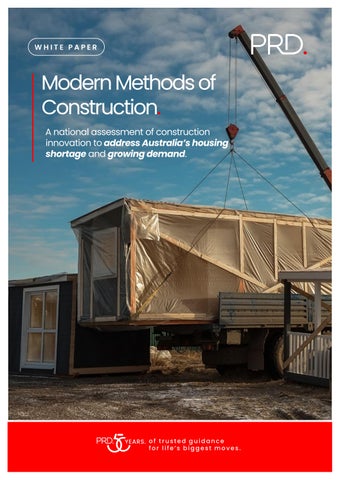
Modern Methods of Construction.
A national assessment of construction innovation to address Australia’s housing shortage and growing demand.
of trusted guidance for life’s biggest moves.
Executive summary. Australia's housing affordability and supply challenges are being driven by persistent housing undersupply, increasing population growth, and changing household needs. This whitepaper brings to light how Modern Methods of Construction (MMC) could offer practical opportunities to accelerate Australia’s housing delivery through faster build times, improved quality control, reduced waste, and greater construction efficiency.
Who this report is for. • • • • •
1
Government and Policymakers: Federal, state and local government decision-makers responsible for housing supply, planning, approvals and infrastructure. Property Developers and Builders: Residential developers, project builders, modular housing providers, and construction firms. Institutional and Private Investors: Build-to-Rent investors, affordable housing investors, land developers, and property funds. Property Industry Professionals: Real estate agents, franchise owners, valuers, consultants, planners, and industry bodies. Home Buyers and Consumers: Particularly first home buyers, younger Australians, downsizers, and people seeking affordable housing alternatives.
Contents. Housing Affordability in Australia
2-3
What are Modern Methods of Construction?
4-5
National Perspective
6-7
Effective Method #1: Modular/Pre-Fabricated Housing
8
Effective Method #2: Micro-Housing/Tiny Homes
9
Global Perspective
10
National & Global Learnings
11
Key Findings
12
Moving Forward
13
About PRD’s Research Division
14
Sources
15
THE ISSUE
Housing Affordability in Australia. Australia’s path to home ownership has continued to deteriorate in 2026. As of August 2026, we have had three cash rate hikes, due to elevated inflationary pressures. The 4.35% cash rate is currently on hold, as the CPI (Consumer Price Index) in June was 3.8%, down from 4.6% in March 20261.
June 2026 data from the Australian Bureau of Statistics show an increase in the number of residential construction approvals, which puts us on the right path. However, this does not guarantee residential project completions and/or delays, and there is still a deep backlog of housing undersupply.
Cash rate hikes and Federal Budget 2027 property tax investment landscape changes (negative gearing, CGT, SMSF) have also added strain to our property market.
Addressing this supply gap requires not only more housing, but faster and more efficient ways of delivering it.
While some markets have recorded a price softening or slower price growth, this is due to reduced borrowing capacity and lower consumer confidence, not because of a meaningful expansion in housing supply.
This report examines the alternative and innovative approaches surrounding MMC to increase housing supply, drawing on international case studies to assess their relevance to the Australian context.
The Real Estate Institute of Australia confirmed that affordability has worsened, underscoring current conditions which are cyclical and unlikely to deliver sustained relief2. When monetary policy eases (i.e. cash rate cut) or economic conditions improve, demand-driven price pressures can reemerge, reinforcing that the underlying structural issue of chronic undersupply remains unresolved.
Australian Residential Construction Approvals. Houses
Other Residential
18,000 16,000 14,000 12,000 10,000 8,000 6,000 4,000 2,000 0
Source: Australian Bureau Statistics. Prepared by PRD Research.
2
Housing approvals declined by 28.6% since a high in April 2021. This is largely due to gaps between policy ambitions and reality according to Master Builders3. Approvals for non-house residential projects fell steadily from late 2017 to mid-2024. Housing approvals are currently seeing a slight recovery. However, supply approvals trended downwards from 2017 until 2024, creating an ingrained bottleneck. This has caused house prices to almost double since 2018.
However, as seen in Table 1 below, Australia did not build enough homes to meet demand. It is not optional that the Housing Accord target of 1.2 million homes by 2030 is met34. Rather, it is essential to restore home affordability in this country. MMC and changing consumer attitudes present an opportunity for the Australian housing market to course correct and allow new homebuyers to enter the market.
In the Federal Budget 2026-2027 a $2 billion investment in housing was announced to aid in lowering the costs of new housing34.
Table 1: Supply Shortfall33. State
Annual Target
Dwellings Approved in the 12 months to June 26
Difference
NSW
74,863
52,487
-22,376
VIC
61,601
55,693
-5,908
QLD
49,291
48,584
-707
SA
16,571
15,243
-1,328
WA
26,164
25,629
-535
TAS
5,077
2,735
-2,342
NT
2,251
847
-1,404
ACT
4,183
4,031
-152
National
240,000
205,249
-37,751
3
What are Modern Methods of Construction? Modern Methods of Construction (MMC) are alternative construction solutions to traditional, labour-intensive building. They are modern construction solutions that lean toward advanced, factory-based and digitally enabled manufacturing9.
The aim of using these alternative building methods is to improve build quality, address labour shortages, and reduce both construction time and cost10.
Table 2: Types of MMC. MMC Type (as referred to currently in the construction industry)
Benefits compared to traditional, labour-intensive building
Description
Volumetric Modular Construction
The process of manufacturing entire rooms of a building off-site in a factory (including finishes, wiring, and plumbing) and assembling them together onsite12. This is usually used in repetitive projects such as apartments, student housing, and hotels as they require similar design concepts with minimal changes12.
Faster delivery, cost reductions and improved quality control10.
Prefabricated Panelised Systems
This method is used to manufacture 2D structural elements such as walls, floors, and ceiling panels in a factory which are then flat-packed and assembled on-site to form the building’s foundational structure12. This is usually used in homes that have been customised or low-rise commercial buildings12.
Faster delivery, reduced on-site labor requirements, improved safety and improved environment performance10.
Precast Flat Panel Systems
These are large concrete, steel, timber or composite panels manufactured off-site and assembled onsite.
Faster structural assembly, high quality and consistency, integrated insulation and openings17.
Additive Manufacturing (3D Printing)
This method uses 3D printing technologies either onsite, if using fragile materials, or off-site to extrude concrete, polymers, or other materials to form complex walls, roofing, or even entire building structures13. This process is widely used, but mostly in hospitals, hotels, and apartments13.
Reduced labor reliance, high precision, and reduced material waster18.
FAQs
4
Why are MMC’s becoming popular?
Are MMC’s being used more overseas?
Although early forms of MMC were driven by post-war housing shortages, today’s adoption is fuelled by affordability pressures and environmental considerations.
Globally, there is increasing usage across multiple residential and general construction projects, with common methods including:
Why are the called MMC’s?
•
Prefabrication
As the construction industry sought safer working conditions and more efficient, cost-effective processes, MMC has became an umbrella term for offsite manufacturing approaches that streamline project delivery11.
•
Modular and volumetric construction
•
Panelised systems
•
Other offsite manufacturing techniques
^ The annual change is reflective of the median price change from (01/04/2024 – 31/03/2025) vs (01/04/2025 – 31/03/2026). Figures displayed in infographics are for the period Q1 2026. Source: REIA, SQM Research, Cordell Connect, Department of Jobs and Small Business. © PRD 2026.
Table 3: Supporters of MMC (not an extensive list). Category
Name
Why are they supporters of MMC?
South Australian Public41
73% of South Australians support expanding the use of prefabricated homes.
Hutchie Group – Hutchie Modular37
Hutchies have publicly stated the benefits of modular and prefabrication construction as quality, waste and onsite movement reductions, and cost savings. Hutchies Modular was established in 2007 with work done valued at approximately $1 billion, 30,000 modules built, and 1,000,000 m2 modular area created. This method has been applied across residential, mining, mixed-use, health, education, civil, and infrastructure.
Australian Industry Group38
“Modern Methods of Construction represent a revolutionary shift in how we conceptualise, design and deliver buildings.” AIG also discusses how MMC is becoming increasingly important to address efficiency and sustainability for housing and are “offering solutions that are faster, more cost-effective and environmentally responsible.”
State Government
Queensland Government39
MMC approaches streamline design and delivery by fast-tracking diligence and approvals, enacting controlled environments, cutting construction times while also co-timing construction with site preparations, reducing waste and downtime that is due to injuries and upskilling labour.
Federal Government
Ministers for the Department of Industry, Science and Resources40
The Albanese Government invested $54 million into supporting State and Territory Governments who are building prefabricated and modular homes. Findings show that these type of homes can be built up to 50% quicker.
Consumers
Builder
Industry Bodies
5
A National Perspective. To date, several projects involving MMC have been proposed and actioned in Australia.
1
3
2
4
6 5
7
6
Table 4: Examples of National Projects Involving MMC. Examples
Product
Result
1
The Woree Development, QLD19
This development is one of Queensland's largest social and affordable housing projects which used volumetric modular and modular pods. While most of the project was MMC, it still required foundations and slabs constructed with traditional methods.
490 Dwellings (245 social, 223 affordable & 22 specialist disability apartments).
2
Champion Lakes Developments, WA20
DevelopmentWA is utilising prefabricated panelised construction to rapidly deliver 81 social homes across 6 locations with 10 new homes already completed within 9 months of commencement. MMC methods are being partially used.
10 social homes.
3
Remote Homes, NT21
A kit-of-parts modular housing solution has been used in the Northern Territory specifically to decrease construction times and to keep up with the increase in demand for regional and remote housing.
n/a – process improvement.
4
Mahon Pool, Maroubra, NSW
The development has been redesigned using both structural and cosmetic precast elements.
n/a – infrastructure project.
5
La Trobe University Student Accom, VIC22
The project was a mass engineered timber construction and included two new buildings that utilised cross laminated timber, which is the largest construction project of its kind in Victoria.
624 Beds.
6
South Australia Prefabricated Homes & Display Village41
South Australia’s Housing Trust is leading the procurement of 120 prefabricated homes. Separately, a six-modular home display village will be constructed for inspection in both metro and regional locations to combat skepticism around quality and livability.
120 Homes & 6 Display Homes
7
Homes Tasmania Social Housing36
Homes Tasmania uses modular construction to deliver standalone dwellings or multi-unit developments, backyard units for household members aged 15 to 25; for household members who are avoiding leaving home due to finances.
>250 homes delivered with 200 in the pipeline
Tiny homes and modular/prefabricate housing have emerged as a significantly effective methods of construction within the Australian context. Its effectiveness is due to being uniquely suited to the current monetary, fiscal, demographic and geographical conditions that are specific to our residential market. Being able to build modular/prefabricated housing up to 50% quicker than traditional methods is crucial in a market constrained by labour issues.
Their controlled manufacturing environments improve quality and reduce waste, aligning with Australia’s net zero objectives. They offer fast, deployable timelines, as well as low impact dwellings suited to regional towns, infill sites and areas facing rental stress. Additionally, tiny homes offer fast, deployable timelines, as well as low impact dwellings suited to regional towns, infill sites and areas facing rental stress.
7
EFFECTIVE METHOD #1
Modular/Pre-Fabricated Housing.
Modular and prefabricated homes are dwellings where major components or whole volumetric modules are manufactured off-site in a controlled factory setting and then transported to be fitted for final assembly27. This form of alternative housing is what is broadly known as Modern Methods of Construction. It involves two possible methods: Prefabrication involves flat pack systems and precast elements Modular construction is more three-dimensional with fully fitted modules that are joined together on site to make a completed building28.
• •
These two approaches have been a global response to labour shortages, rising construction costs, and the need for faster delivery and pressures to meet ambitious housing targets. Put plainly, these alternatives can improve housing supply and affordability through speed and cost efficiency:
•
•
Homes can be constructed up to 50% faster than traditional site-built ones27. This is due to factory production being able to occur whilst site preparation takes place. It also reduces weather delays (where it applies). Can reduce cost of homes by up to 20% due to standardised production, reduced waste and more efficient labour27 ; as reported by the Australian Government Productivity Commission.
The USA and Europe are reaping significant benefits, with modular construction set to claim $130 billion of the market by 2030 whilst delivering an annual cost saving of $22 billion31. An underappreciated, albeit long-term, benefit is that these homes can be designed for relocation or reuse, allowing them to be moved or reconfigured as needs change. Despite this, uptake of MMC remains relatively limited with prefabricated housing accounting for less than 5% of new residential builds in Australia30.
Table 5: Modular/Pre-Fabricated Housing Projects. Criteria
East Village Knutsford Fremantle, Western Australia
To produce prefabricated modular construction that is low-carbon and high-performance homes with an expedited building time.
Was for development to be completed eight months ahead of schedule using modular construction.
Impact
• • •
1,182 student bedrooms.
Investment Costs
Not publicly available.
$500 million.
•
•
Purpose
Government or Regulatory Requirements
• •
8
2032 Olympics Legacy Plans 41 George Street, Brisbane Student Accommodation
62 homes. Housing 200 residents. Project generates 40% of its own power. through integrated solar and battery systems.
Requirements must comply with the National Construction Code (NCC), even though the NCC is primarily structured around traditional on-site construction. States are now fast-tracking prefabricated home approvals and developing national prefab certification systems. Regulatory barriers are inconsistent with state-by-state building code variations.
•
Again, must comply with the NCC even though the NCC is primarily structured around traditional onsite construction. MMC requires additional compliance regarding fire rated joints, sprinkler integration, and smoke detection compatibility.
EFFECTIVE METHOD #2
Micro-Housing/Tiny Homes.
Tiny homes are compact dwellings typically under 50sqm, designed to maximise functionality and minimise cost. They have emerged globally as a response to rising housing prices, land scarcity and a growing interest in minimalist and sustainable living24. Moreover, they provide necessary diversity in Australia's housing options, and a means of quickly expanding affordable housing supply38. Other benefits include: •
• •
Significantly lower construction and purchase costs than traditional dwellings with an Australian-built tiny home costing between $120,000 - $200,000 fully furnished26. This addresses the affordability question and allows for a significantly more accessible entry point into the housing market for first home buyers. Being a compelling investment opportunity: a $160,000 tiny home generating $400-$500 per week is a 11-13% rental yield compared to 3-5% from traditional rental properties26. Smaller footprint that allows a tiny home to be added to existing residential lots as a secondary dwelling, enabling faster, incremental increases in supply without having to rely on largescale developments.
The rise of micro-housing and tiny homes as an alternative housing option has been driven in Australia largely by younger people who have been priced out of traditional homeownership, as well as households seeking lower-cost and lower-impact alternatives amid escalating mortgage stress and cost of living pressures25.
However, significant challenges limit the scalability of tiny homes, such as: •
• •
Regulatory barriers. Some Australian councils remain cautious around secondary dwellings and whilst some councils have a more progressive approach, many councils are still “catching up”26. Lifestyle. Households take time to adjust. However, many prefer the smaller living space once acclimated26. Finance. Banks may treat tiny homes as nonstandard security, which can hinder financing. Obtaining a loan can require non-bank lenders, which would add around 1-2% to interest rates26. Fortunately, this is becoming less of an issue as this alternative housing option is becoming more common.
To overcome these challenges the Australian government must modernise planning schemes and create clear definitions for tiny homes establishing clear pathways for certification under the NNC, allowing councils to approve more tiny-home dwellings. More broadly though, updating local laws is essential. Separating tiny homes on wheels from caravans would remove barriers further, legitimising tiny homes as an option in Australia.
Table 6: Tiny Home Housing Projects. Criteria
The Tiny Homes Foundation Project Gosford, NSW
ModnPods Fixed Tiny Homes Gold Coast, QLD
Purpose
Transitional housing for the homeless. The project focuses particularly on providing crisis accommodation for women and young people.
Suitable for private buyers, secondary dwellings, downsizing or Airbnb.
Impact
4 dwellings, at 14-18m2 per dwelling.
Offers: Studio (14-20m2), One bedroom (22-28m2) and Two bedroom (32-38m2).
Investment Costs
• • •
• Government or Regulatory Requirements
• •
Construction cost was approximately $200K at around $50K per dwelling. Timeline from 2016 to 2018. Land size ≈ 500m2 of Central Coast Council land. Legislation approval under Local Government (Manufactured Home Estates, Caravan Parks, Camping Grounds and Moveable Dwellings) Regulation 2021. Obtained full development approval as a Class 1A dwelling, meaning it met NCC requirements for permanent housing. The first tiny homes project in Australia to be formally approved as permanent social housing.
n/a
• •
Most councils require Material Change of Use (MCU) or secondary dwelling approval. Requires compliance with the NCC.
9
A Global Perspective. MMC have not only been proposed and actioned in Australia but also globally. On an international level, there are different approaches to construction and MMC has been increasingly visible in recent years. Below are some examples to indicate the implementation of MMC internationally.
Table 7: International Examples of MMC. Country
Product
Sweden
Prefabricated modular housing
Japan
Saudi Arabia
Stacked boxed tiny homes
Katerra volumetric housing units
Project Examples BoKlok Housing, Sweden’s MMC flagship, design affordable, energyefficient homes using volumetric modular construction.
The houses are designed to be achievable purchases for low to middle-income families.
Entire rooms or sections are prefabricated using this method.
They are timber-based construction, which means low carbon footprint and energy-efficient insulation.
Unemori Architects produced several 26m2 tiny homes, which created a vertical living space.
By stacking them, tiny homes maximise space in an overcrowded metropolis.
NEOM Modular Housing creates housing units that are manufactured off-site and assembled onsite with robotics. Housing over 3,000 people, the workers completed the project in 10 days.
China
Prefabricated Skycraper
Homes can be installed in less than a week once onsite.
They also help lower construction costs and energy consumption, minimise material use and reduce the project’s carbon footprint.
These housing units reduced construction timelines, minimized onsite labour, reduced carbon footprint and reduced overall material waste. The reductions in turn, greatly improved working conditions.
Broad Group’s Modular Skyscraper project in Changsha started being built in 2015.
The project’s construction was completed in 19 working days with 90% of materials reused or recycled.
Entire building modules were prefabricated in a factory.
The project included safety requirements such as energy-efficient HVAC systems and was certified with earthquake-resistance up to magnitude 9.
The materials were designed to be stacked and connected onsite like ‘LEGO’ blocks.
10
Benefits
The result is a 57-storey mixed-use tower creating office space, residential units, retail and leisure spaces.
The project was also made with fire-resistant materials and had a compartmentalised design which meant a significant reduction in labour and material waste.
Challenges Local zoning laws can slow deployment. Modular homes can sometimes face stigma, despite their high quality. Also, finding suitable plots near urban centres remains difficult.
Building codes and zoning laws are limiting. Tiny homes require a lifestyle change, and the project is hard to replicate in suburbia. The market’s perception labelled the homes as ‘temporary’ making it difficult for people to view tiny homes as a long-term option. MMC uptake across Saudi Arabia remains uneven. Aligning MMC with local building codes and standards remains challenging and there is a great need for more localised manufacturing and skilled labour.
Local building codes had to be adapted for modular high-rise construction. At the time, there was great scepticism about safety and durability of ultra-fast builds. Significantly, coordinating transport and assembly of thousands of modules also proved difficult.
NATIONAL & GLOBAL PERSPECTIVES
What can we learn? International cases can be applied in Australia, but only when adapted to local regulatory, economic and cultural conditions. Sweden’s BoKlok model demonstrates how standardised modular housing can deliver affordable, energy-efficient dwellings at scale. Further, it reinforces timber-based MMC which aligns strongly with Australia's significant timber supply. Japan’s micro-housing innovations show how compact modular units can maximise land efficiency in high-density cities, offering lower material use and reduced energy consumption. This option applies well to Sydney in particular, as the city is running out of space as it is locked by natural and designated barriers (Pacific Ocean, Blue Mountains and National Parks). Saudi Arabia’s NEOM worker accommodation illustrates the potential of industrialised, robotics-enabled volumetric construction. This can be applied to the 2032 Brisbane Olympics, as forecasts suggest Queensland will be short by over half the required workforce.
Moreover, population growth in the past 25 years has been significant. Queensland and Western Australia have seen the most significant growth (61.5% and 62.6% respectively), as they have been emerging capital cities for immigration and emigration, compared to Victoria and New South Wales (due to unaffordability of housing and cost of living). Given this, the national housing market must shift to accommodate the higher populations and evolving consumer needs. This shift has begun with developers redirecting focus to units and apartments in the coming years. In response to these pressures, alternative delivery methods have been used with modular and off-site methods employed. Queensland’s Q-Build is aiding in providing social housing and is partnering with the modular home industry to streamline construction processes4. However, approvals are disjointed, and inconsistent factory certifications have limited the uptake. It's also important to note the sub-tropical climate as a factor.
China’s modular skyscraper projects, such as Broad Group’s 57-storey tower built in 19 days, highlight the feasibility of high-rise modular systems for mixed-use urban development. Australia’s Built-to-Rent and student housing sector is facing an undersupply35. This method can assist with modular high-rises in high density areas near universities or the CBD. Traditionally, residential supply has been dominated by detached housing. Specifically, in Queensland, detached housing comprises 73% of residential stock compared to 32% in similar European markets. This fails to accommodate the increasingly diverse household structure, with single-person households now representing around 25% of all households nationally, projected to reach 28% by 204615.
International examples have largely been in Northern Hemisphere countries where there are fewer extreme weather conditions. As higher rainfall rates and a hotter climate accelerate building degradation and foundation issues, it creates a risk for lightweight formats5. This can be overcome with modular housing designs adapted to align with local standards such as those in the Yarrabilba16. Alternatively, modular builds can minimize the construction delays of harsh weather conditions due to the ability to build off-site6.
Australian Capital Cities Population Overtime. 29000000
Growth
27000000
250,000
Population
200,000
25000000
150,000
23000000
100,000
21000000
50,000
19000000
Dec-2025
Dec-2024
Dec-2023
Dec-2022
Dec-2021
Dec-2020
Dec-2019
Dec-2018
Dec-2017
Dec-2016
Dec-2015
Dec-2014
Dec-2013
Dec-2012
Dec-2011
Dec-2010
Dec-2009
Dec-2008
Dec-2007
Dec-2006
Dec-2005
Dec-2004
Dec-2003
-50,000
Dec-2002
15000000
Dec-2001
0
Dec-2000
17000000
11
Key Findings. Australia’s housing affordability crisis is fundamentally driven by long-term undersupply. The Australian Bureau of Statistics shows housing approvals had three consecutive falls into May 202642, however, there was a 7.2% increase in June 2026. Further, the Reserve Bank of Australia’s August 2026 Statement of Monetary Policy recorded a 3.5% increase in the level of private dwelling investment in the past 12 months, as of March quarter 2026. This applies for detached and higher density residential products, which will benefit all demand types. Even with this improvement, the number of ready-to-sell stock hitting the market is still not enough; mainly due to a combination of: a) Long-term housing undersupply, wherein any slight improvements in the number of houses constructed is still not enough to override the current backlog. b) High construction costs and lengthy construction times; from early sketches (of the proposed housing stock) to the housing product being available to market. Further, Australia’s reliance on detached housing no longer aligns with demographic realities. Single-person households are projected to reach 28% by 2046, requiring more diverse, higher-density, and flexible housing formats15. To address this, higher-density stock investment is on the rise, however, the location of these projects still tend to be limited to inner CBDs and/or metro areas. A shift toward Modern Methods of Construction (MMC) presents a pathway to expanding supply at speed. MMC reduces reliance on on-site labour, construction timelines and costs, and enables factory-controlled quality. International markets demonstrate strong momentum, with modular construction set to reach $130 billion globally by 2030 ($22 billion annual savings). Australian uptake remains below 5% of new residential builds, constrained by regulatory uncertainty, varying council requirements, and perceptions of lower resale value. Tiny homes offer a fast and affordable option that aligns with changing consumer preferences, particularly among younger Australians. Tiny homes diversify housing stock and can be deployed quickly, but scalability challenges persist due to regulatory barriers, lifestyle constraints, and financing limitations. Modern Methods of Construction is not without its challenges. Modular homes can cost developers more, at approx. 20-30% extra margin, due to higher costs on import taxes and fees, transportation, permits and other paperwork, certification requirements, etc. Because of this, many developers shy away from MMC.
12
Moving Forward. Returning sustainability to Australia's housing market is a national effort and without boosting housing supply, this will lead to: • • •
• •
•
Reduced capital flow Into new construction: supply constraints can lead to viability problems for developers.46 Upward pressure on rents: Reports indicate critically low trading stock pushing rents to record highs.46 Continued rapid price growth: “The contradiction between record prices and historic supply failure is not paradoxical – it is the mechanism”.43 Compounding shortages: Every year that supply targets aren’t met; they compound, multiplying the problem every year.46 Increased homelessness: “More people experienced homelessness in areas which had a greater shortage of rental dwellings affordable for low-income households”. These relationships have become stronger over time.44 Exacerbated intergenerational inequality: Reduced access to homeownership means fewer Australians can benefit from the security, wealth accumulation, and tax benefits brought by ownership. As a result, the long-term wealth gains enjoyed by previous generations will be far less accessible to younger people.45
There is approximately $54 billion worth of residential projects set to commence in 2026. With less than 5% utilising MMC, this suggests there is less than $2.7 billion worth of MMC projects. To increase MMC use, Australia's governing bodies need to: • • • • •
Compliance pathways: standardise planning rules across states to reduce complexity. Council requirements: set statutory time limits for council approvals. Deliver infrastructure that supports MMC: increasing investment in enabling infrastructure (road, utilities and school). Increase social and affordable housing: housing must be directly built or funded for low-income households. Increase labour force: without a meaningful increase in labour, construction timelines will halt.
Modern methods of construction now sit at the centre of Australia’s pathway to delivering faster, high-quality and more resilient housing supply. This is evident in both a national and international context. As government bodies, industry insiders, builders, and consumers continue to signal a growing support for the sector, modern methods of construction are poised for a shift, becoming mainstream construction methods.
11 13
ABOUT
PRD’s Research Division. PRD’s property research division provides reliable and unbiased data, insights and consultancy to clients in both metropolitan and regional locations across Australia. Our extensive research capabilities and specialised approach ensure our clients can make the most informed and financially sound decisions about residential and commercial properties.
Knowledge.
Access to accurate and objective research is the foundation of all good property decisions. PRD shares on-the-ground experience and decades of knowledge to deliver innovative and effective solutions to our clients.
We take a holistic approach and focus on understanding new issues impacting the property industry, such as the environment and sustainability, the economy, demographic and psychographic shifts, and commercial and residential design, and forecast future implications around such issues based on historical data and facts.
People.
Our in-house research team is skilled in deriving macro and micro quantitative information from multiple credible sources, so we can ensure we provide strategic advice and financially sound direction regarding property and market performance.
Research Services.
Our research services span over every suburb, local government area, and state within Australia. We have the ability and systems to monitor market movements, demographic changes and property trends. We use our knowledge of market sizes, price structure and buyer profiles to identify opportunities for clients and provide market knowledge that is unbiased, thorough and reliable.
Our services include: • • • • • • •
Advisory & consultancy Market analysis including profiling & trends Primary qualitative & quantitative research Demographic & target market analysis Geographic information mapping Project analysis including product & pricing recommendations Rental & investment return analysis
Get in touch. research@prd.com.au | +61 7 3229 3344
14
PRD does not give any warranty in relation to the accuracy of the information contained in this report. If you intend to rely upon the information contained herein, you must take note that the Information, figures and projections have been provided by various sources and have not been verified by us. We have no belief one way or the other in relation to the accuracy of such information, figures and projections. PRD will not be liable for any loss or damage resulting from any statement, figure, calculation or any other information that you rely upon that is contained in the material. Prepared by PRD Research 2026 © All medians and volumes are calculated by PRD Research. Use with written permission only. All other responsibilities disclaimed.
Sources. 1 Australian Bureau of Statistics. (2026). Consumer price index, Australia. https://www.abs.gov.au/statistics/economy/price-indexes-and-inflation/consumer-
price-index-australia/latest-release
2 Real Estate Institute of Australia (2026). Rising interest rates drive sharp decline in housing affordability. Real Estate Institute of Australia.
https://www.reia.com.au/industry-news/Media-Release-HAR-Mar2026
3 Topalovic, V. (2025). ‘A flashing red light’: Industry bodies sound alarm over falling building approvals. realestate.com.au.
https://www.realestate.com.au/news/a-flashing-red-light-industry-bodies-sound-alarm-over-falling-building-approvals/
4 Queensland Government. (2024). About QBuild. https://www.housing.qld.gov.au/about/department/business-areas/public-works/qbuild/about-qbuild 5 Parliament of Australia. (2018). Current and future impacts of climate change on housing, buildings and infrastructure.
https://www.aph.gov.au/Parliamentary_Business/Committees/Senate/Environment_and_Communications/CCInfrastructure
6 Roberts, D., Park, K., Ankrah, N., & Kim, K. P. (2023, May 26). Weather as the catalyst: Research confirms modular construction mitigates weather-related
challenges. Built Offsite. https://builtoffsite.com.au/news/weather-as-the-catalyst-research-confirms-modular-construction-mitigates-weather-relatedchallenges/
7 Australian Government. (2023). Albanese government delivers immediate $2 billion for accelerated social housing program | prime minister of Australia.
https://www.pm.gov.au/media/albanese-government-delivers-immediate-2-billion-accelerated-social-housing-program 8 Australian Labour Party. (2023, October 31). Start of Housing Australia Future Fund. https://www.alp.org.au/news/start-of-housing-australia-future-fund/ 9 Australian Building Codes Board. (2024). Prefabricated, modular and offsite construction. https://www.abcb.gov.au/initiatives/prefabricated-modular-andoffsite-construction 10 Australian Building Codes Board. (2025). Modern methods of construction. https://www.abcb.gov.au/faq/modern-methods-construction 11 Studio Anyo. (2023). A brief history of modern methods of construction. https://studioanyo.com/a-brief-history-of-modern-methods-of-construction/ 12 Mofid, K., & Valentine-Selsey, R. (2020). Spotlight: Modern Methods of Construction. Savills. https://www.savills.com.au/research_articles/167771/301059-1 13 Hagan, D. (2023). Embracing modern methods of construction to reduce carbon and save time. WSP. https://www.wsp.com/en-au/insights/embracingmodern-methods-of-construction 14 Kāinga Ora- Homes and Communities. (2021). Transforming construction through innovation; our offsite manufacturing plan. https://kaingaora.govt.nz/news/transforming-construction-through-innovation-our-offsite-manufacturing-plan/ 15 Australian Bureau of Statistics. (2024). Household and family projections, Australia. Australian Bureau of Statistics. https://www.abs.gov.au/statistics/people/population/household-and-family-projections-australia/latest-release?utm_source=copilot.com#key-statistics 16 Stockland. (2023). Yarrabilba. https://www.stockland.com.au/residential/qld/yarrabilba/location/masterplan 17 Tawasha, R. (2023, March 10). 11 Modern methods of construction (MMC): Application and benefits. Constructive Solutions, Inc. https://www.solutionsgc.com/11modern-methods-of-construction-mmc-application-and-benefits/ 18 Casado, C., Tassi, R., & Bazzoun, S. (2025). The game-changing impact of modern construction methods. Kearney. https://www.kearney.com/service/operations-performance/article/the-game-changing-impact-of-modern-construction-methods 19 38 South Media. (2024a). Modular construction powers Queensland’s largest social and affordable housing project. Built Offsite. https://builtoffsite.com.au/news/modular-construction-powers-queenslands-largest-social-and-affordable-housing-project 20 Government of Wester Australia. (2025, October 30). New construction methods accelerate social housing at record pace. https://www.wa.gov.au/government/media-statements/Cook%20Labor%20Government/New-construction-methods-accelerate-social-housing-at-recordpace-20251030 21 38 South Media. (2024b, March 9). Indigenous Construction Company’s ‘kit of parts’ set to boost modular housing supply across the Northern Territory. Built Offsite. https://builtoffsite.com.au/news/indigenous-construction-companys-kit-of-parts-set-to-boost-modular-housing-supply-across-the-northernterritory/ 22 La Trobe University. (2024). Project information. https://www.latrobe.edu.au/future-city/about/local-living/student-accommodation-project/projectinformation 23 Hammond, N. (2025,July 8). Queensland facing 54,000 infrastructure workforce shortfall ahead of Olympic Games, data shows. ABC News. https://www.abc.net.au/news/2025-07-08/queensland-facing-infrastructure-shortfall-brisbane-olympics/105506284 24 Chau, H.-W. (2024). Australian councils are opening the door to tiny houses as a quick, affordable and green solution. ArchitectureAU. https://architectureau.com/articles/australian-councils-are-opening-the-door-to-tiny-houses-as-a-quick-affordable-and-green-solution/ 25 Medhora, S. (2025, November 5). Experts share tiny home warning as interest from young people soars. ABC News. https://www.abc.net.au/news/2025-1105/are-tiny-homes-the-solution-to-the-housing-crisis/105971646 26 Tiny House Agency. (2025, October 18). Why Tiny Houses Are Australia’s Answer to the Housing Crisis. https://tinyhouseagency.com.au/guides/Why-TinyHouses-Are-Australia's-Answer-to-the-Housing-Crisis 27 Australian Building Codes Board. (2024). Prefabricated, modular and offsite construction. https://www.abcb.gov.au/initiatives/prefabricated-modular-andoffsite-construction 28 Painter, A. (2024). How Prefabricated and Modular Construction is Shaping Australia’s Housing Future. Constructor. https://www.constructor.net.au/howprefabricated-and-modular-construction-is-shaping-australias-housing-future/ 29 Williamson, D. (2025, July 2). A modular movement: Can prefab homes tackle the housing crisis? Building Connection. https://buildingconnection.com.au/2025/07/02/a-modular-movement-can-prefab-homes-tackle-the-housing-crisis/ 30 Standards Australia. (2025, November 18). Standards Australia invites comment on handbook for prefabricated and modular construction. Standards.Org.Au. https://www.standards.org.au/news/standards-australia-invites-comment-on-handbook-for-prefabricated-and-modular-construction 31 Bertram, N., Fuchs, S., Mischke, J., Palter, R., Strube, G., & Woetzel, J. (2019, June). Modular construction: From projects to products. McKinsey & Company. https://www.mckinsey.org/~/media/mckinsey/business%20functions/operations/our%20insights/modular%20construction%20from%20projects%20to%20produ cts%20new/modular-construction-from-projects-to-products-full-report-new.pdf 32 Mackintosh, L. (2025, August 27). Build-to-rent boom hits $30bn. Property Council Australia. https://www.propertycouncil.com.au/property-australia/build-torent-boom-hits-30bn 33 Australia Bureau of Statistics. (2026). Building Approvals, Australia. https://treasury.gov.au/policy-topics/housing/accord https://www.abs.gov.au/statistics/industry/building-and-construction/building-approvals-australia/latest-release#data-downloads 34 Housing Industry Association. (2026, June 17). Australias housing shortage to worsen as home building falls behind population growth. Housing Industry Association. Hia.Com.Au. https://hia.com.au/our-industry/newsroom/economic-research-and-forecasting/2026/06/australias-housing-shortage-to-worsenas-home-building-falls-behind-population-growth?_cldee=IbQAdT8ppRYJDlGNfD8p9nARjtJUEDVoGYpNdOyQwchhzu9Rj9Phc_ImZg66IDj&recipientid=contact-e4042e3157ede4119c2400155dddfa01ebd172200cac48f78d09b5ade3192af3&esid=24266442-bc6a-f111-a861-000d3ad0cb16 35 Property Council Australia. (2026, June 2). Student housing pipeline grows, but supply still not landing where it’s needed. https://www.propertycouncil.com.au/property-australia/student-housing-pipeline-grows-but-supply-still-not-landing-where-its-needed 36 Homes Tasmania. (n.d.). Modular construction.https://www.homestasmania.com.au/engage/Construction-Projects/modular-construction 37 Hutchies Modular. (n.d.). Hutchies modular. https://modular.hutchies.com.au/about 38 Martin, D. (2025). Modern methods of construction: Revolutionising Australia’s building industry. Australian Industry Group. https://www.australianindustrygroup.com.au/news/blogs/2025/modern-methods-of-construction-revolutionising-australias-building-industry/ 39 Queensland Government. (2026). Modern methods of construction program. Department of Housing and Public Works. https://www.housing.qld.gov.au/about/department/business-areas/public-works/qbuild/modern-methods-construction-program 40 Husic, E., & O’Niel, C. (2025). The Albanese Labor government is building more homes more quickly, and making them easier to buy. Ministers for the Department of Industry, Science and Resources. https://www.minister.industry.gov.au/ministers/husic/media-releases/albanese-labor-government-buildingmore-homes-more-quickly-and-making-them-easier-buy 41 Prefab News. (2026, May 25). South Australia tenders 120 prefab homes and opens a modular display village — as 73% of south australians back prefab housing expansion. Prefab News. https://prefabnews.com.au/south-australia-prefab-housing-pilot-120-homes-2026/ 42 Micallef, C. (2026, July 1). Australia’s housing target slips further away as building approvals slump again. https://www.news.com.au/finance/business/otherindustries/australias-housing-target-slips-further-away-as-building-approvals-slump-again/news-story/b61777f7f7157fa8a9378751c7be151a 43 Dabas, A. (2026, May 22). Australia’s housing crisis and the investment opportunity within: Supply shortfall, rate reversal, and city-by-city alpha in 2026. Intric. https://intricglobal.com/en/insights/articles/australia-property-housing-crisis-2026 44 Australian Housing and Urban Research Institute . (2024, October 10). Growing suburban homelessness rates are driven by shortage of affordable rental housing. https://www.ahuri.edu.au/analysis/news/growing-suburban-homelessness-rates-are-driven-shortage-affordable-rental-housing 45 National Housing Supply and Affordability Council. (2026). State of the housing system 2026. https://nhsac.gov.au/sites/nhsac.gov.au/files/2026-04/ar-statehousing-system-2026.pdf 46 Urban Development Institute if Australia. (2026, March 17). UDIA State of the land reveals why Australia’s housing supply crisis will get worse in 2026. https://udia.com.au/2026/03/udia-state-of-the-land-reveals-why-australias-housing-supply-crisis-will-get-worse-in-2026/
15
Scan the QR Code to connect with your local PRD team. ACT.
Belconnen Canberra CBD
NSW.
Albury Wodonga Beverly Hills Blue Mountains | Springwood Bungendore Dapto Glenmore Park Gundagai Gunnedah Hunter Valley | East Maitland Hurstville Ingleburn Kingsgrove Kogarah Laurieton Liverpool Liverpool Plains | Quirindi Macquarie Park | Ryde Maroubra (Perez) Norwest Nundah Oatley Orange Panania Penrith Port Stephens | Salamander Bay Queanbeyan Ramsgate Beach Tamworth Tumbarumba Tumut Tweed Coast | Kingscliff Upper Hunter | Denman Wagga Wagga Woonona Bulli
QLD.
Ashmore Bayside | Redland Bay Bremer Valley | Rosewood Caboolture Carrara Coolangatta/Tweed Gympie Helensvale Hervey Bay | Torquay Northern Beaches | Rural View Robina Southport Tannum Sands Whitsunday | Airlie Beach
TAS.
Bellerive New Norfolk
VIC.
Ballarat Bendigo Castlemaine Creswick Highton Kyneton Melbourne Apartments Mildura Nagambie Shepparton
WA.
Broome Karratha Project Marketing WA | Claremont
of trusted, local guidance for life’s biggest moves.