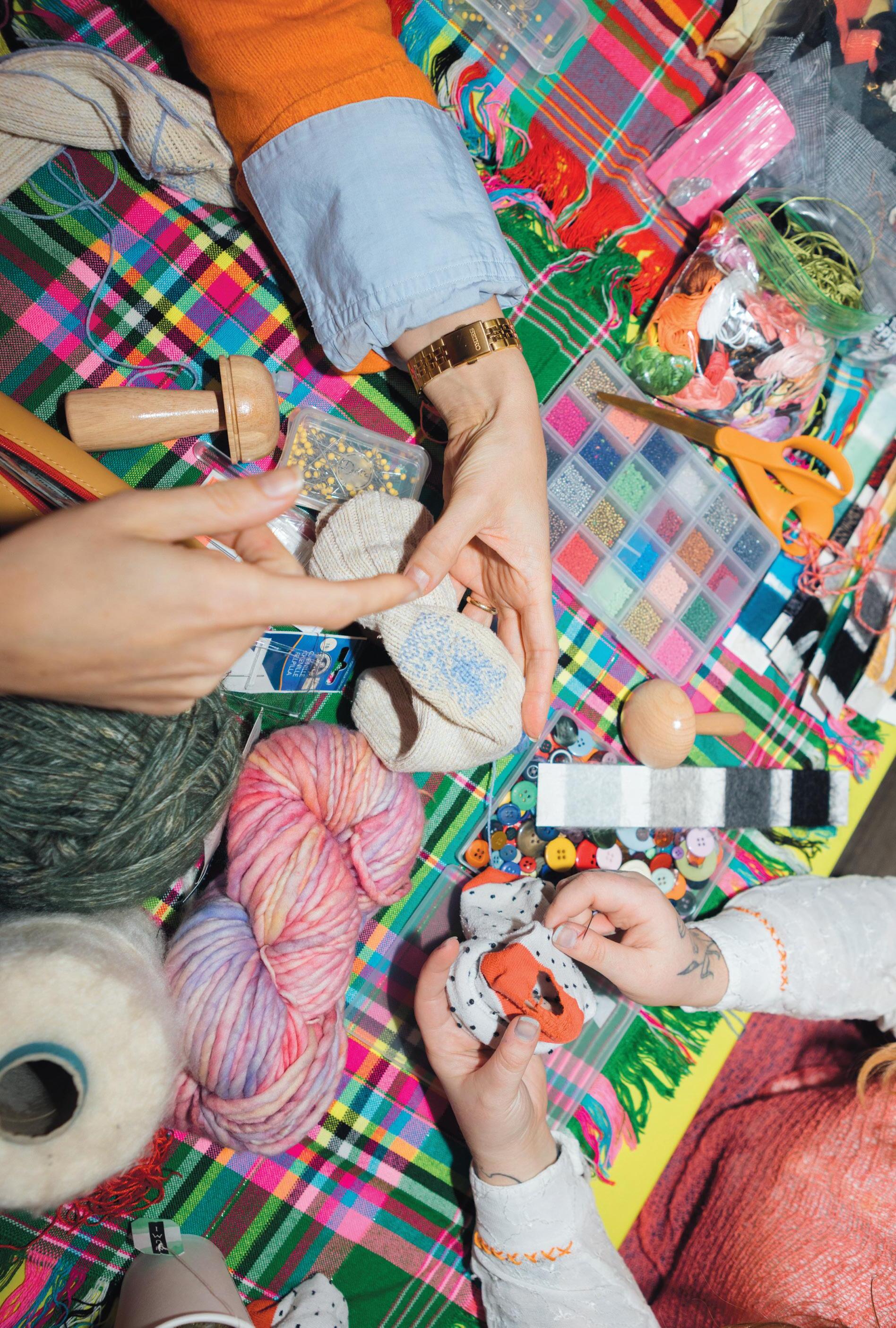
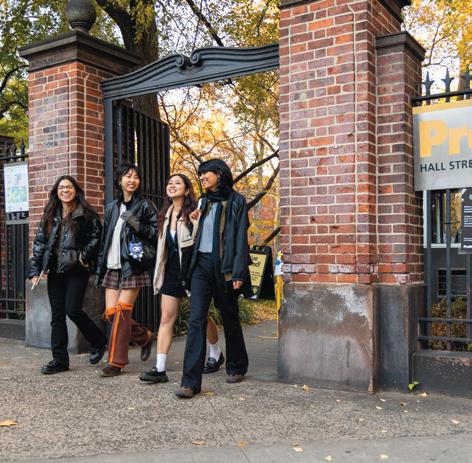
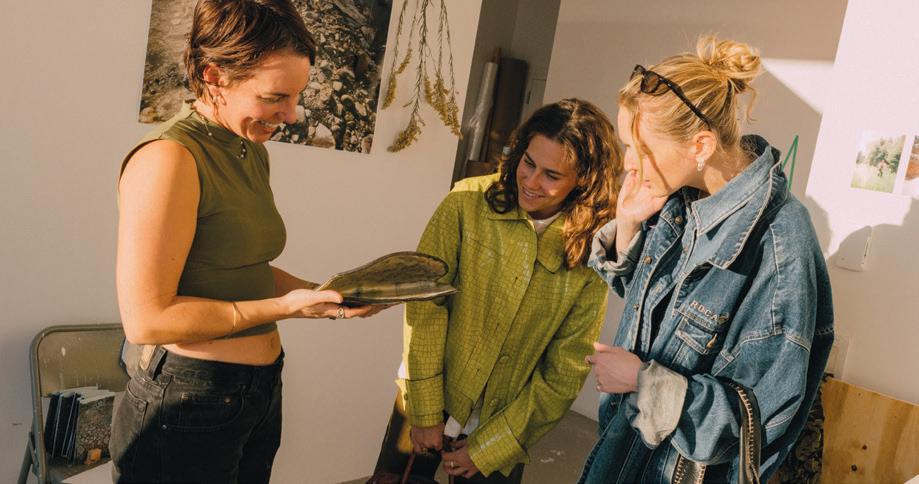
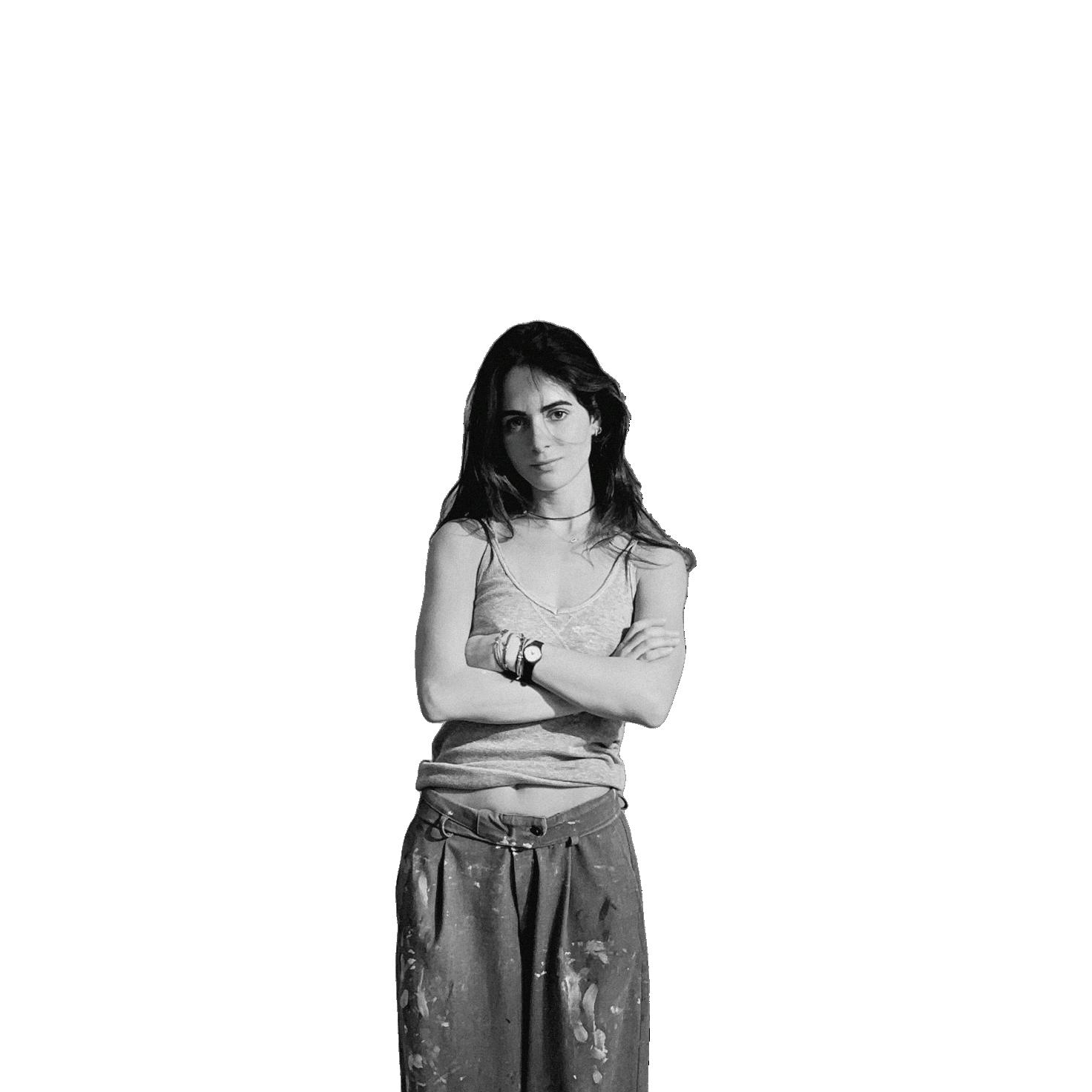
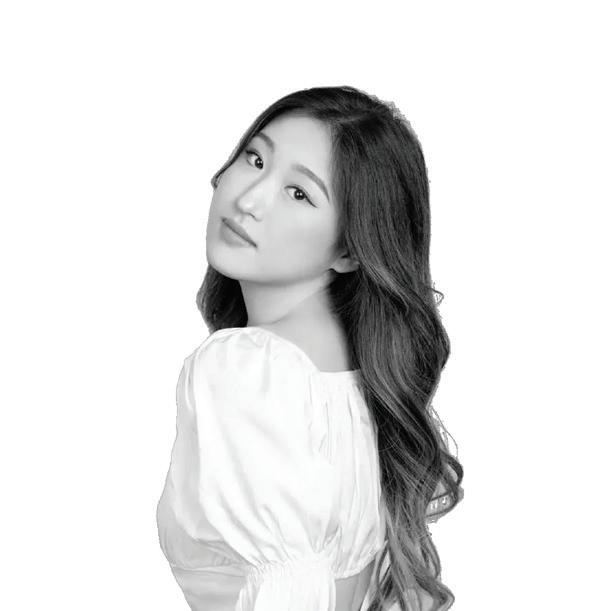
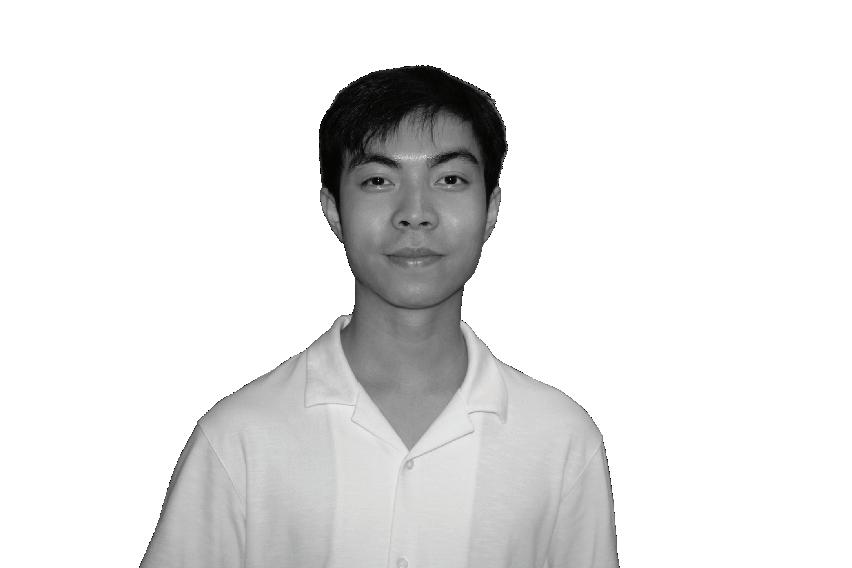
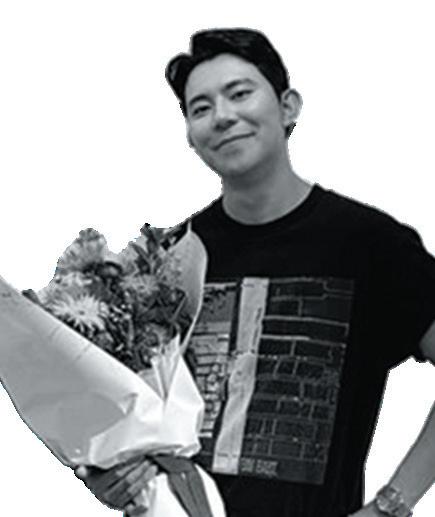
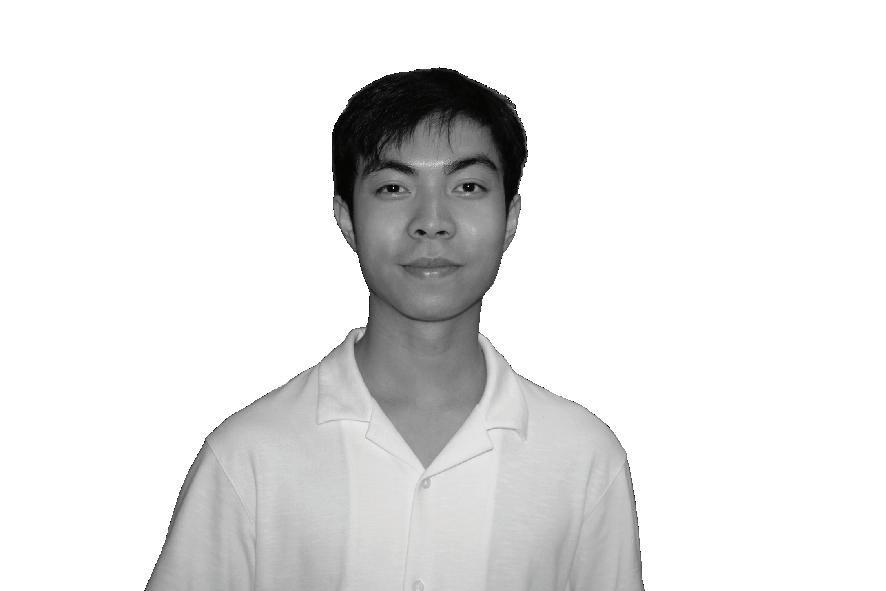
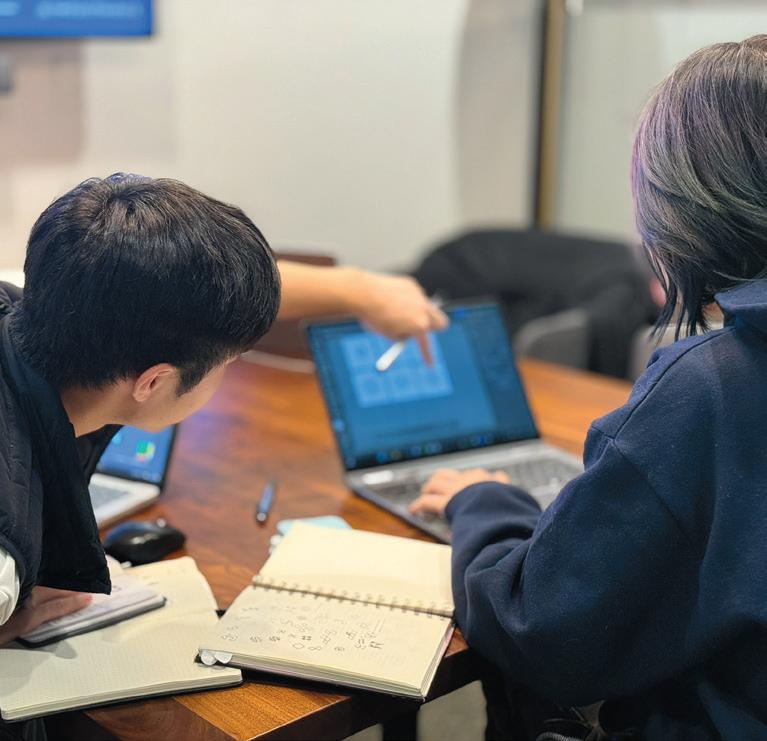
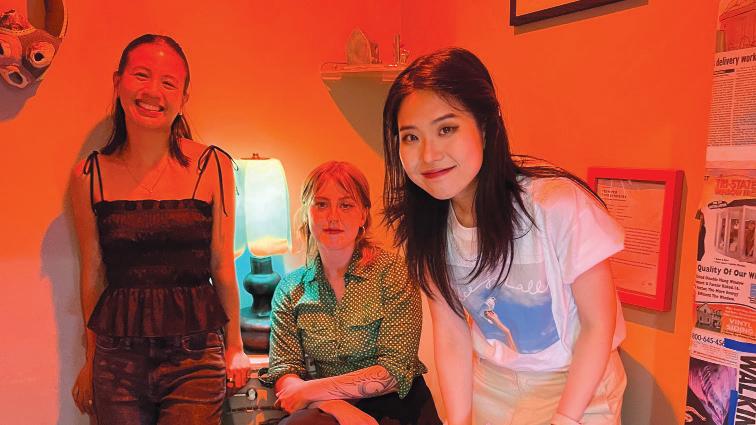
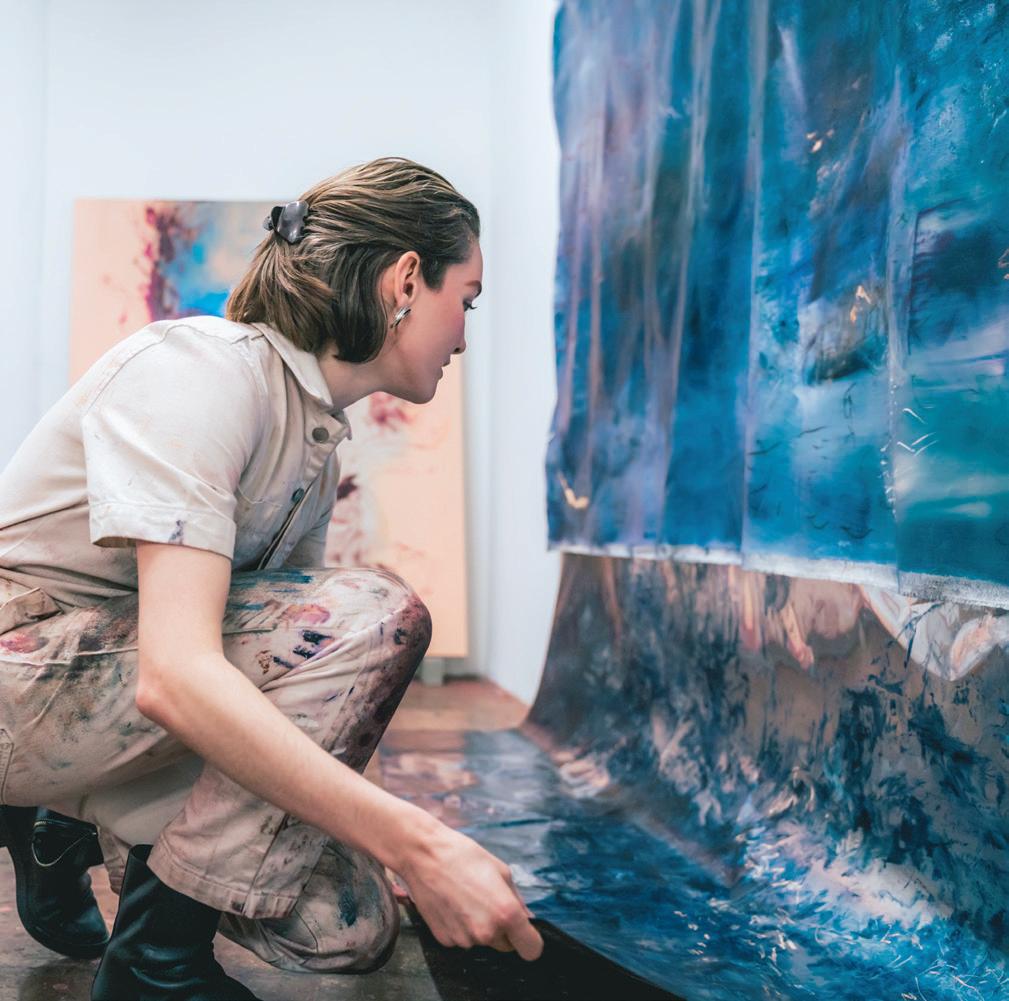
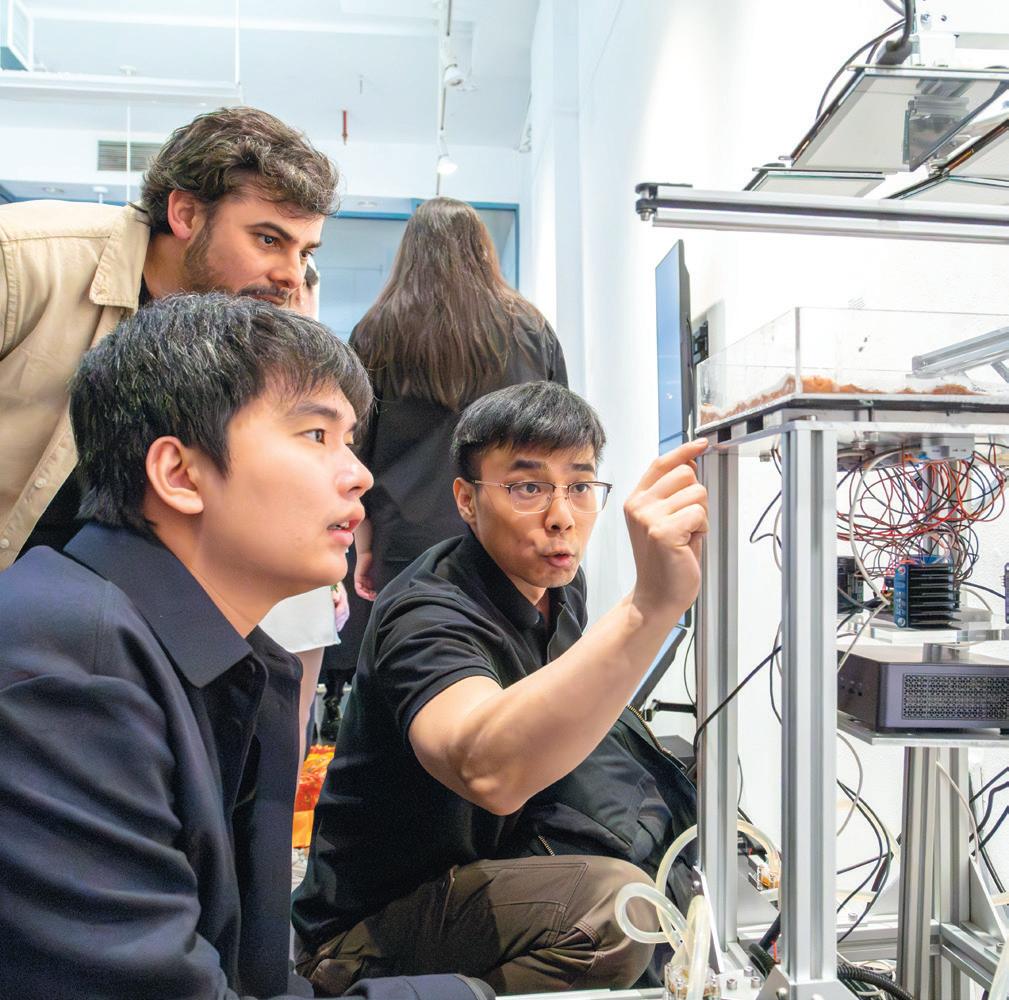
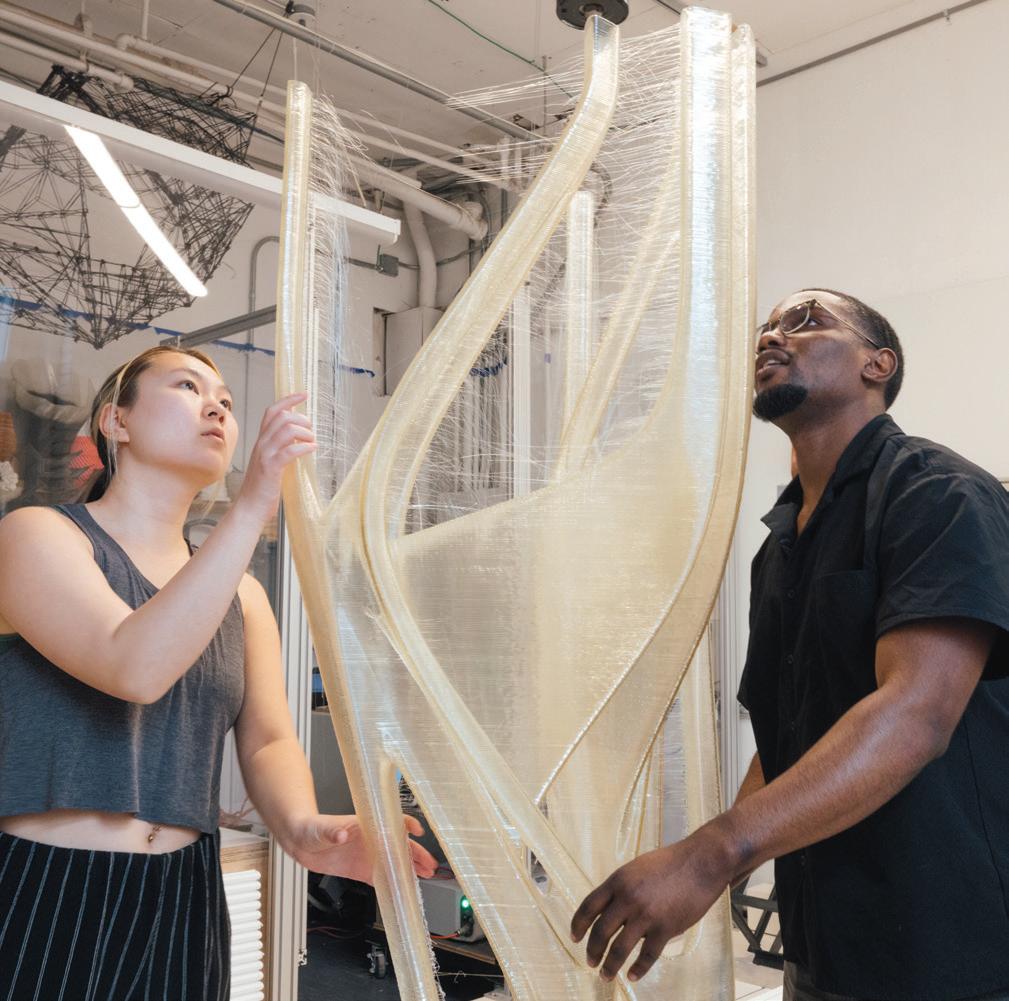
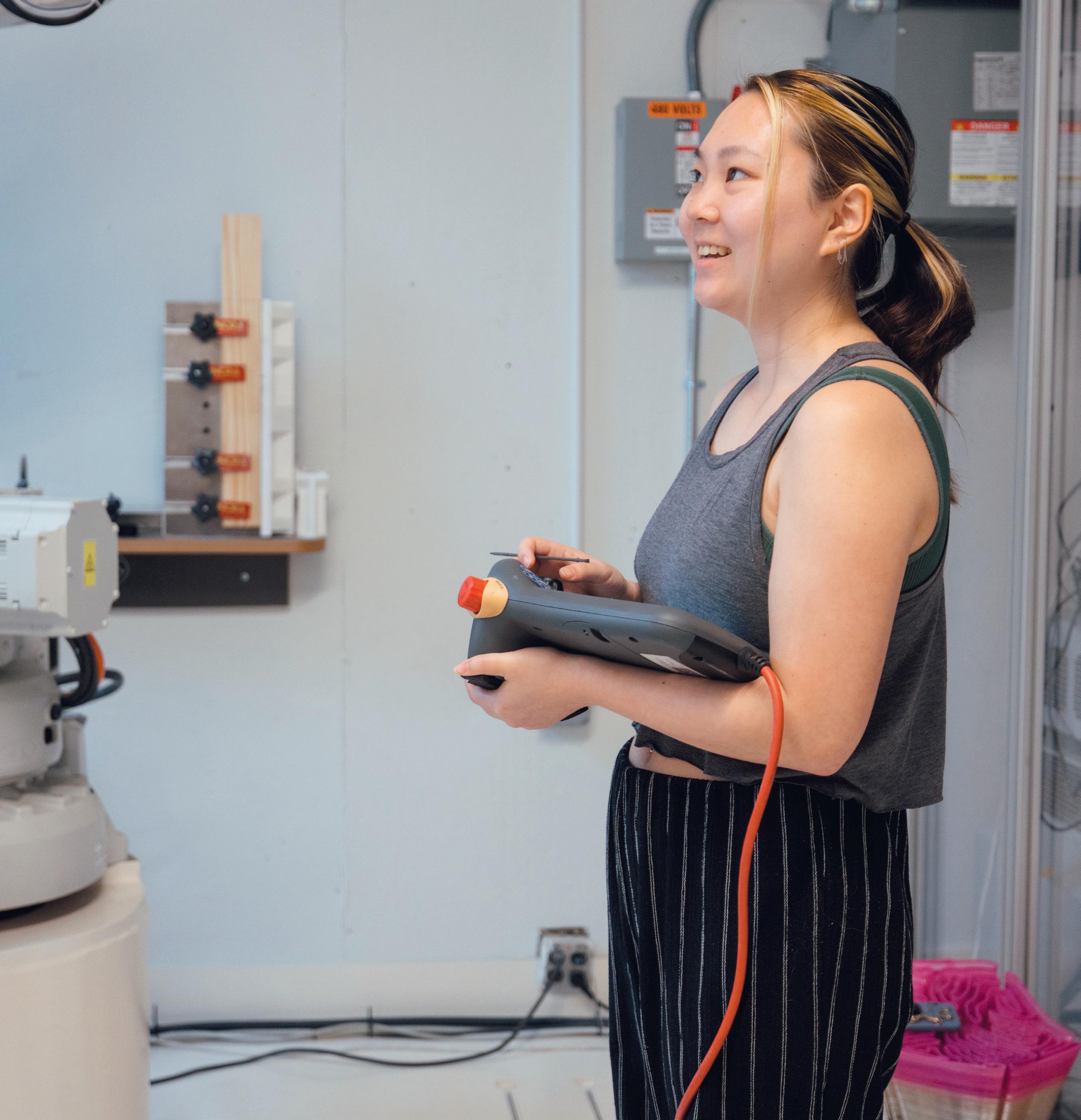
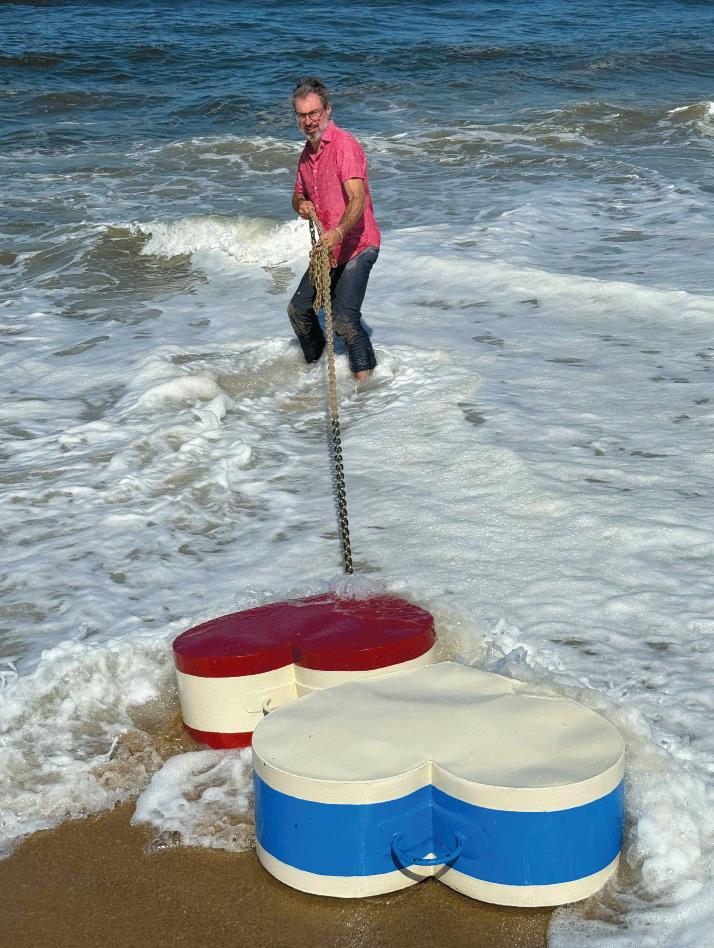
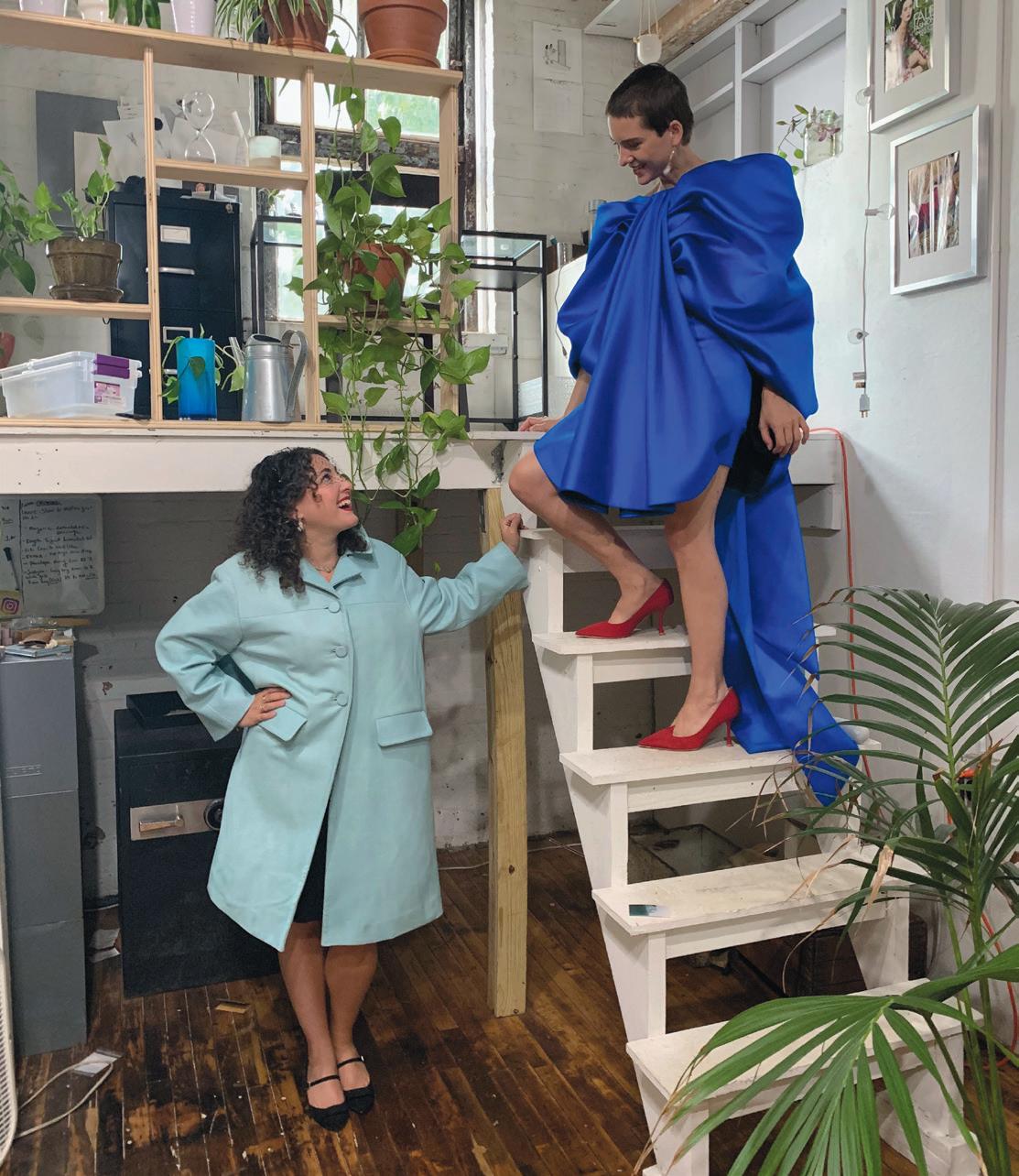
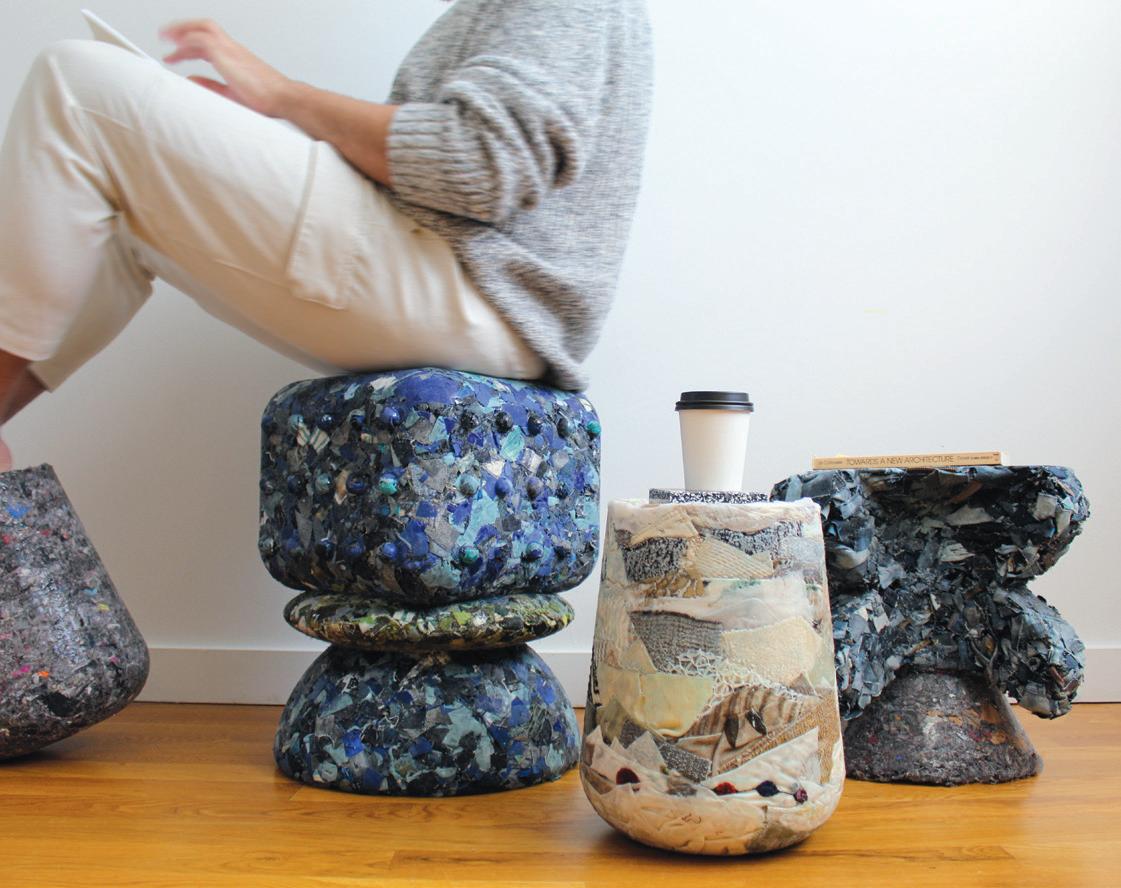
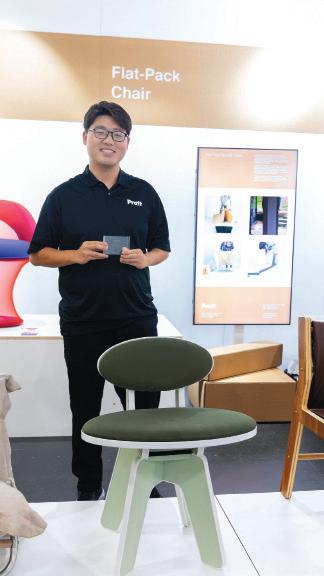
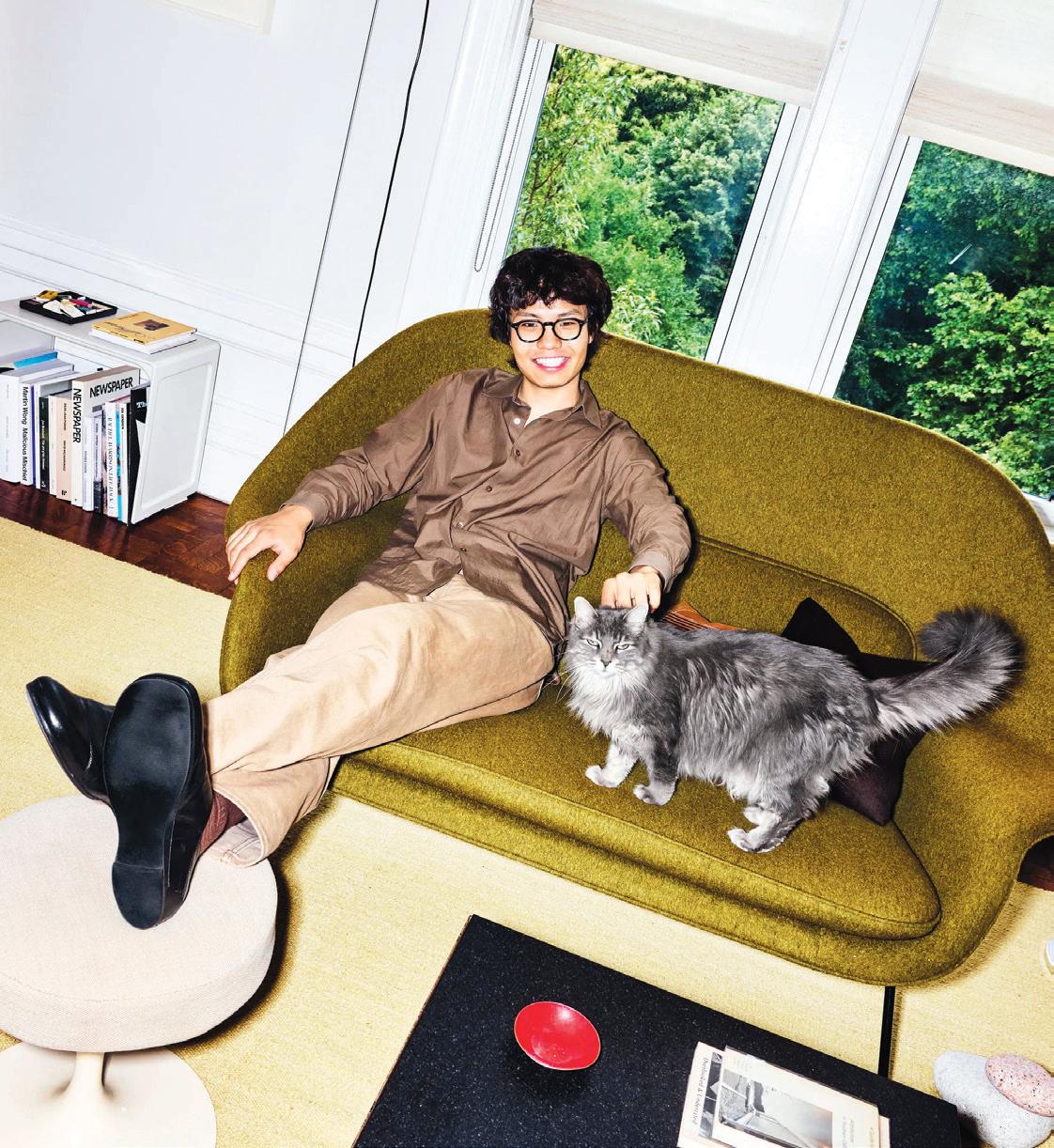
Repair. Rest. Repeat.: Mending Circle, one of Pratt’s newest student clubs, sets aside time for care and community. “It’s in all of our classes about sustainable practices, how to extend the lifespan of things. And that’s exactly what the mending is,” says club president Gianna Breinig, BFA Fashion Design ’27.
What’s happening at Pratt now, from recent events to projects, explorations, and student life.
Updates from Pratt’s News Page
Read more from these stories and keep up with the latest from campus and beyond at pratt.edu/news.
Celebrating Creative Legends
Pratt Institute’s annual Legends gala and scholarship benefit celebrates the power of a creative education to inspire, open doors, and build futures. On October 29, Pratt hosted Legends 2025, which honored creative icons and served as a fundraiser for scholarships. The annual event is essential for the more than 75 percent of Pratt students who rely on financial aid to pursue their educational and creative ambitions.
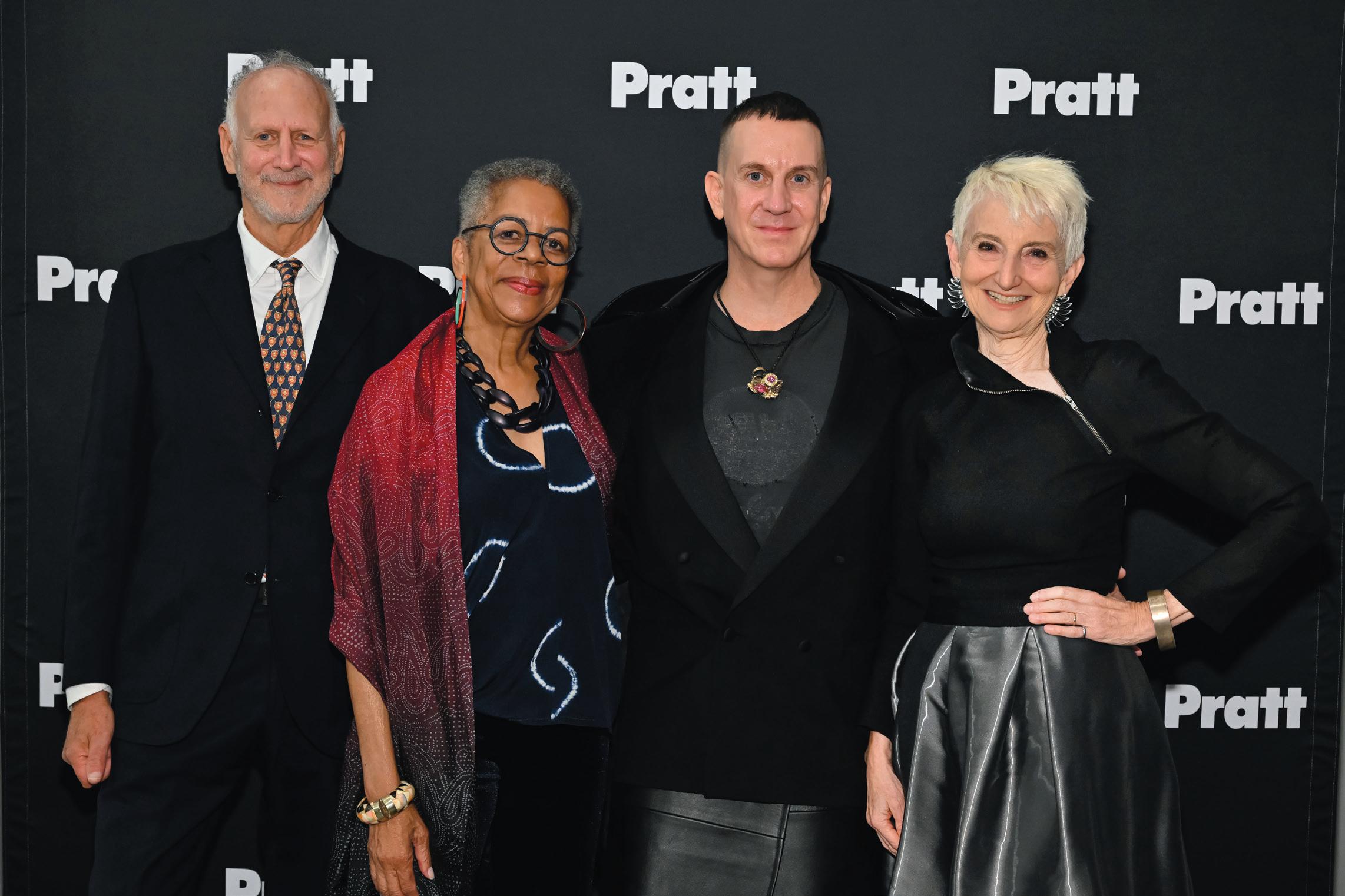
This year’s Legends gala celebrated internationally renowned fashion designer Jeremy Scott, BFA Fashion Design ’95, and award-winning interior designer and
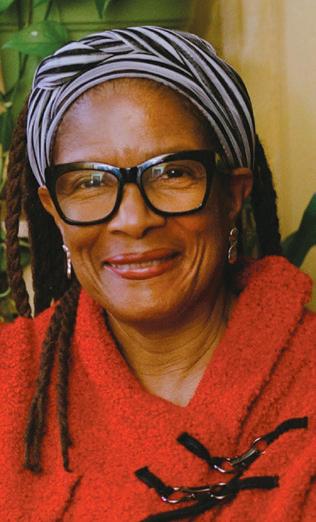
mentor Mavis Wiggins, BFA Environmental Design ’75. The honorees, both alumni of Pratt, were recognized for the trailblazing work and illustrious careers that their Pratt education helped launch. Supermodel, producer, and Emmy-winning television personality Heidi Klum and Editor-in-Chief of Interior Design Magazine Cindy Allen introduced and presented the awards to the Legends 2025 honorees.
For the second year in a row, Pratt hosted Legends at the Manhattan venue Lavan Midtown. Throughout the evening, immersive images and videos gave guests an inside look into Pratt’s state-
of-the-art maker spaces—from ceramic studios and metalshops to 3D print labs and photography darkrooms.
In her welcoming remarks, Pratt President Frances Bronet acknowledged this profound moment in the history of higher education and celebrated the incredible “creative ecosystem” of “thinkers, makers, dreamers called Pratt.”
“Every day, I’m surrounded by people who see the world not just as it is—but as it could be…” said President Bronet.
“The future depends on creative thinkers, problem solvers—and those are exactly the people we propel at Pratt.”
Previous page:
Photo by Dahlia Dandashi. This page, left to right: Gary Hattem, Mavis Wiggins, Jeremy Scott, President Frances Bronet; photo by Andrew Werner
Archival Fashion by Legendary Designer Mary McFadden Arrives at Pratt
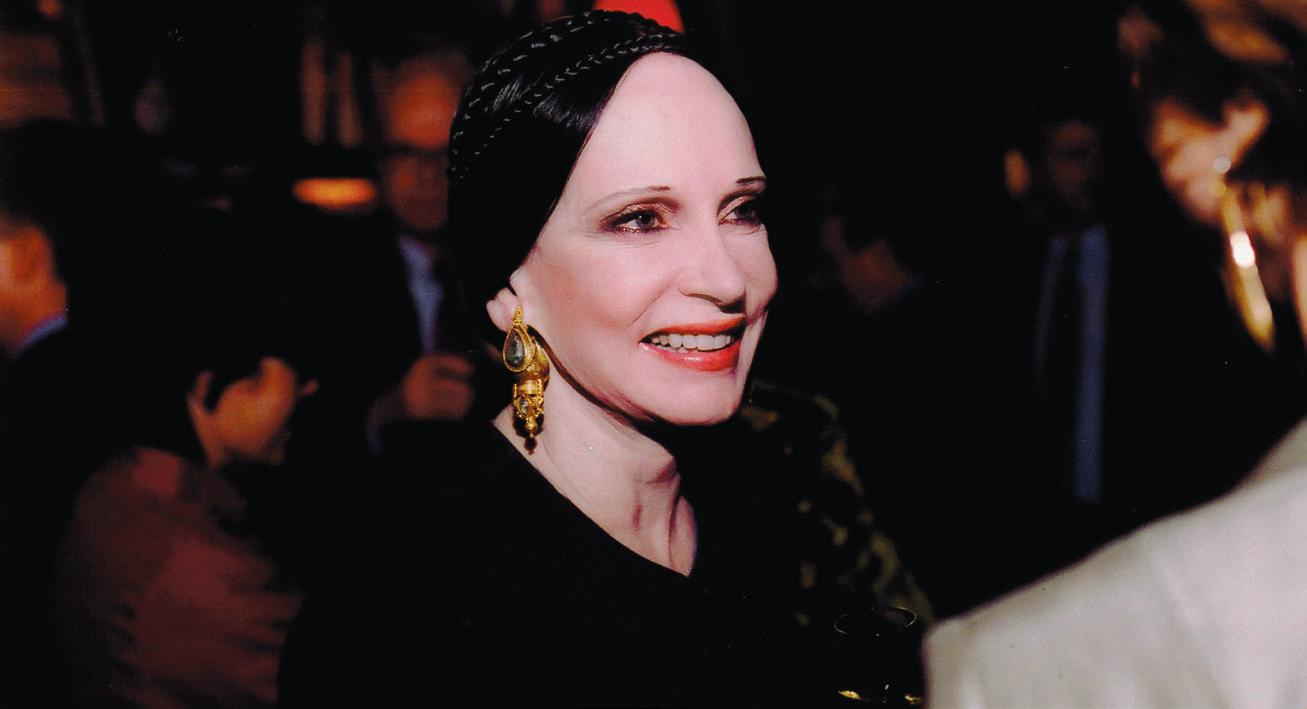
The Mary McFadden fashion archive has relocated to Pratt’s Brooklyn campus in the Juliana Curran Terian Design Center, made possible by a collaboration with Drexel University, the McFadden family, and the Pratt Institute department of Fashion Design. Fashion design pioneer Mary McFadden, renowned for her architectural silhouettes and globally inspired designs, played an integral role in the course of fashion history, with a career spanning the early 1960s through the early 2000s. McFadden was also a writer, editor, and the first female president of the Council for Fashion Designers of America (CFDA). In 2001, she was honored with a Pratt Legend Award.
The relocation and incorporation of these materials into Pratt’s fashion curriculum, housed in the Fashion Design department in the School of Design, is supported by a generous gift from The Family of Mary McFadden. Pratt’s unique integrated approach will see the collection as a generative resource for the Institute’s curriculum across fashion, textiles, and cultural studies. A rotating graduate fellowship program, led by a designated Mary McFadden Collection Scholar, will facilitate research, curriculum development, and curatorial projects associated with the collection.
“Pratt gives you a large toolbox. You can jump right into the workforce.” —Catherine Moreno, BArch ’25, in a story on how graduates of Pratt’s School of Architecture, as one of the top 10 producers of newly licensed architects in the US, are building the world around us.
Pratt Institute is ranked #5 out of 303 US and international art and design universities in the QS World University Rankings by Subject 2026. The listing also ranks Pratt #3 in the United States. Additionally, Pratt was ranked #20 in the History of Art category.
Open Studios, Endless Possibilities
Pratt’s annual Fine Arts MFA Open Studios and Photography MFA Open Studios were complemented by the first-ever Open Fields artist resource fair, making for an electric day of events celebrating artistic practice and the resources that sustain it. Organized by the Fine Arts Department, Open Fields was developed to nurture the city’s arts ecosystem by building community between artists, art lovers, advocacy groups, and the nonprofit organizations that help support and sustain creative practices. For the second year in a row, Open Studios was held at Pratt’s Dock 72 facilities, following last year’s debut of the MFA program’s expansive gallery and studio spaces.
Three Graduates Honored at 2026 Alumni Achievement Awards
Pratt’s Alumni Achievement Awards (AAA) recognizes outstanding alumni who have distinguished themselves in their fields, honoring creatives, artists, and professionals who break boundaries, defy odds, and make statements through their work and lives. This year’s awards ceremony honored three exceptional alumni, nominated and selected by the Pratt community and a panel of past AAA winners, at a luncheon at Manhattan Penthouse on March 13.
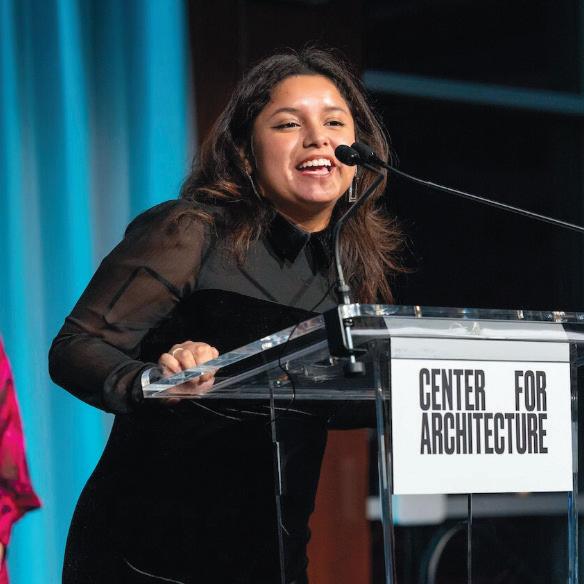
This year, Alumni Achievement Awards were presented to Nanette Carter, MFA Fine Arts ’78; Vann Graves, MS Communications Design ’96; and Lian Farhi, MS City and Regional Planning ’16. The awards ceremony was emceed by 2018 Alumni Achievement Award winner Mahogany L. Browne, MFA Writing ’16. The event also honored the class of 1976, celebrating 50 years since their time at Pratt, their accomplishments, and their vital role in Pratt’s ongoing success.
Imagining Alternative Futures for the Brooklyn Marine Terminal
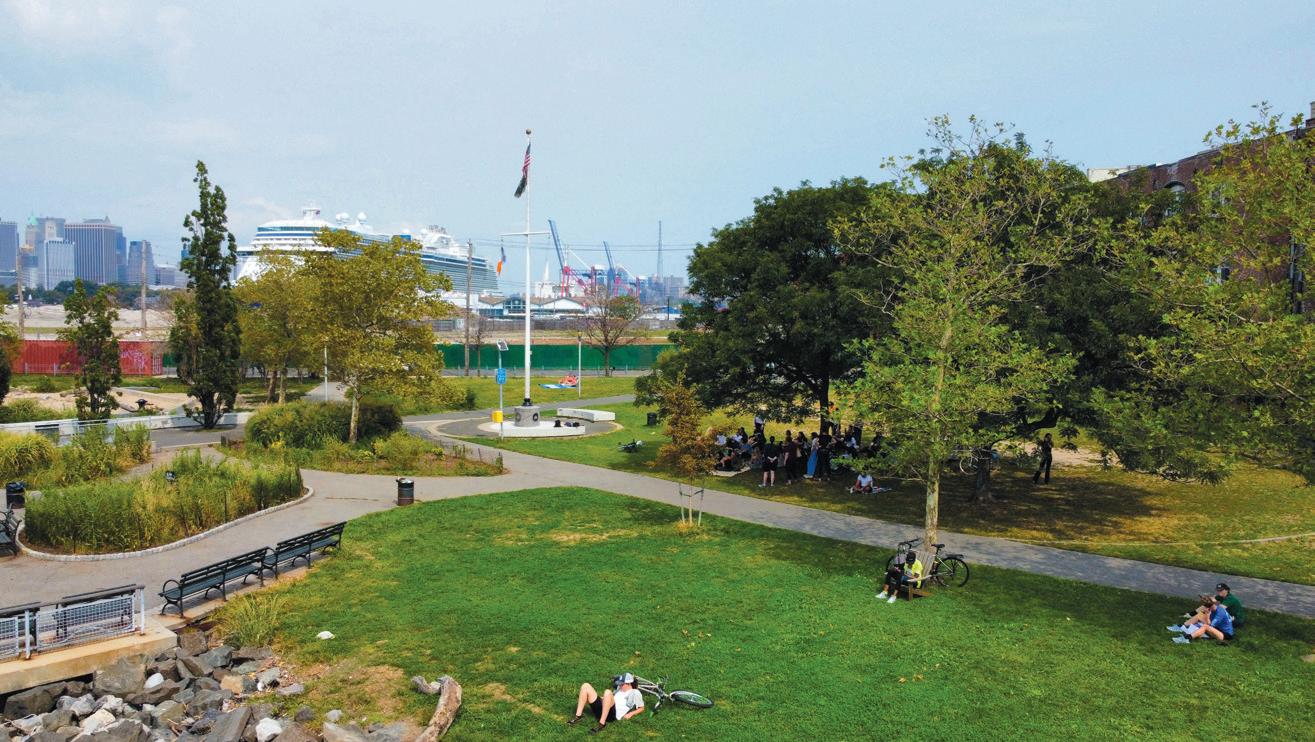
The NYC Economic Development Corporation (EDC) proposes to modernize the Brooklyn Marine Terminal by creating new housing, commercial and public spaces, and economic opportunities in Red Hook. But as the city rushes to fast-track review processes and break ground, advocates have called for greater community input. With this context as a backdrop, four studio courses from the School of Architecture—two graduate and two undergraduate—worked with community members and advocacy groups over the course of the fall semester to explore alternative visions for the Brooklyn Marine Terminal. Their proposals paint a picture of a more resilient Red Hook, with a maritime-focused proposal where housing remains affordable, transit systems are better connected, climate risks are addressed, and local commerce reflects community needs. As the EDC plan continues to evolve, these student-led ideas provide a compelling framework for what community-centered development can look like.
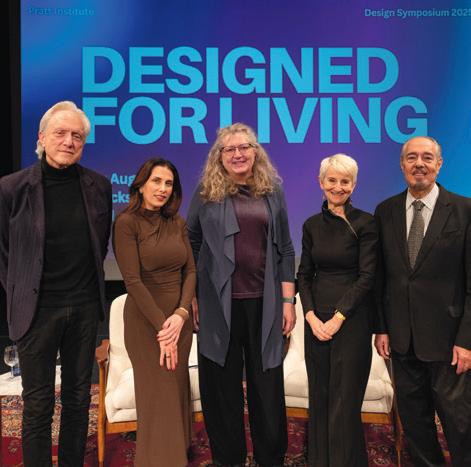
In Case You Missed It: Pratt Institute Design Symposium 2025 Pratt Institute Design Symposium 2025: Designed for Living convened a distinguished panel of designers and industry leaders to discuss the many facets of the home environment and interior spaces. A video of the November 18 discussion, which was held at the Asia Society in Manhattan, is now available to view at talks.pratt.edu.
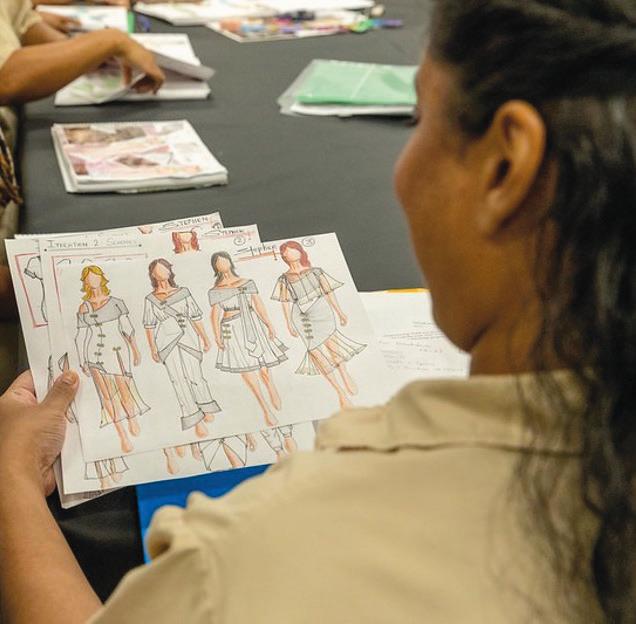
Fashioning New Pathways for Incarcerated Women
A unique fashion design and workforce development program for incarcerated women officially launched at the Edna Mahan Correctional Facility (EMCF) in Clinton, New Jersey. Developed by Pratt Institute and the New Jersey Department of Corrections (NJDOC), the program is one of the first of its kind in the United States and worldwide.
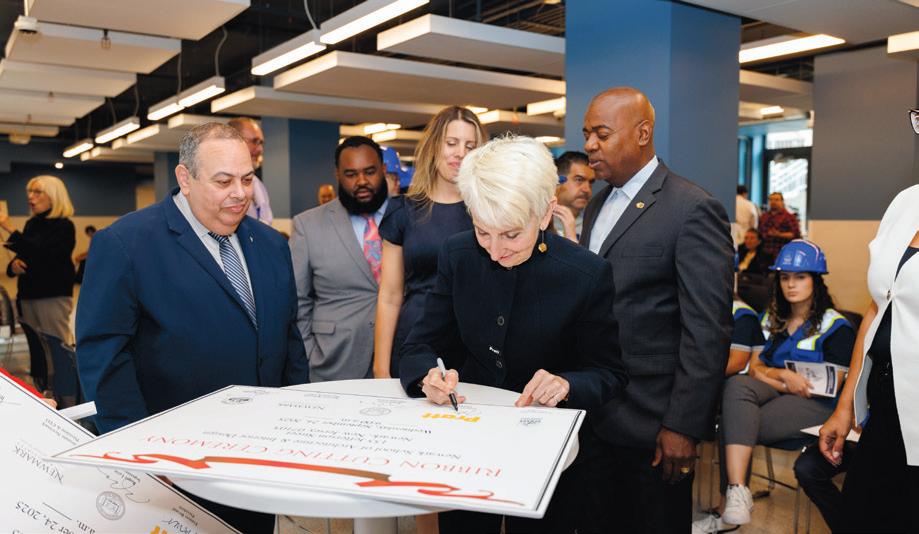
Building “Cradle-ThroughCareer” Pathways in Newark
A new public high school in Newark prepares students for careers in architecture, design, and the building trades, with a curriculum developed in partnership with Pratt Institute. The Newark School of Architecture & Interior Design, the city’s 65th school and the latest addition under the Newark Public Schools’ 10-year strategic plan, is among the first in the state to focus on careers in these disciplines. The school, housed in the former St. James Hospital, welcomed its inaugural class of 212 ninthgrade students in September and will grow by one grade level each year.
Investigating the Relationship Between Information and Human Rights
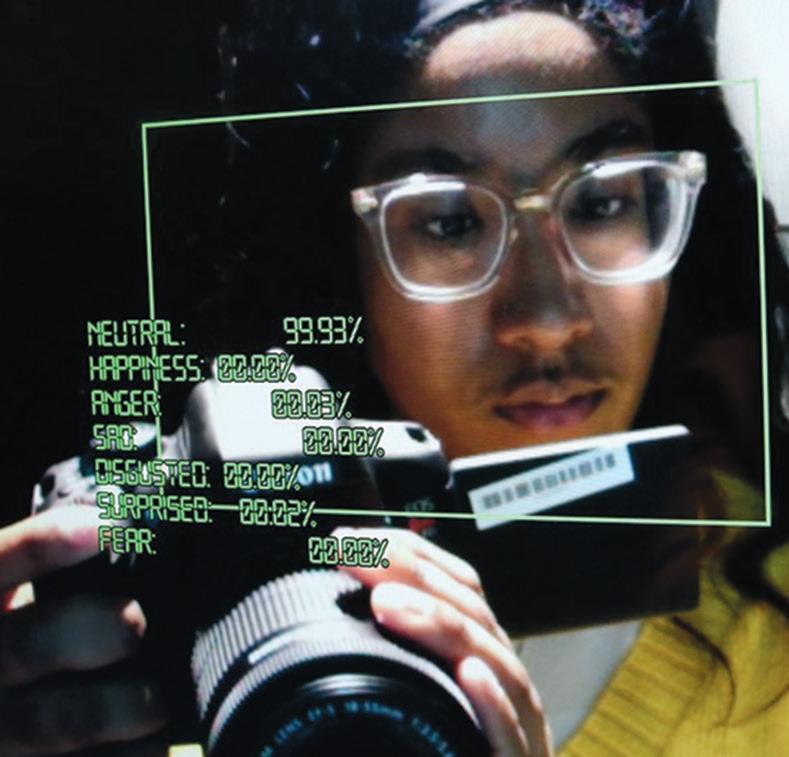
The world is overflowing with data points, statistics, and content. When it comes to pressing issues of human rights, how can we organize this information to be clear, accurate, and accessible? That’s the question asked in INFO 619 Information and Human Rights, a course in the School of Information taught by Visiting Assistant Professor Rebecca Williams. Students completed digital projects—ranging from intentionally frustrating games to informative digital zines—that reflect students’ deep creative and critical engagement with important themes in human rights such as surveillance, children’s rights, misinformation, and systems design.
Above is a graphic from one project, “Keep Your Eyes Peeled: A Spiral Into Surveillance Tech,” a digital zine by Srishti Bhawal, MS Information Experience Design ’26.
Top left: Green space in Red Hook; photo by Gita Nandan.
REMEMBERINGMYF
EBMEMERSDNEIRFYMGNIREBMEMERSDNEIRFYMGNIRE
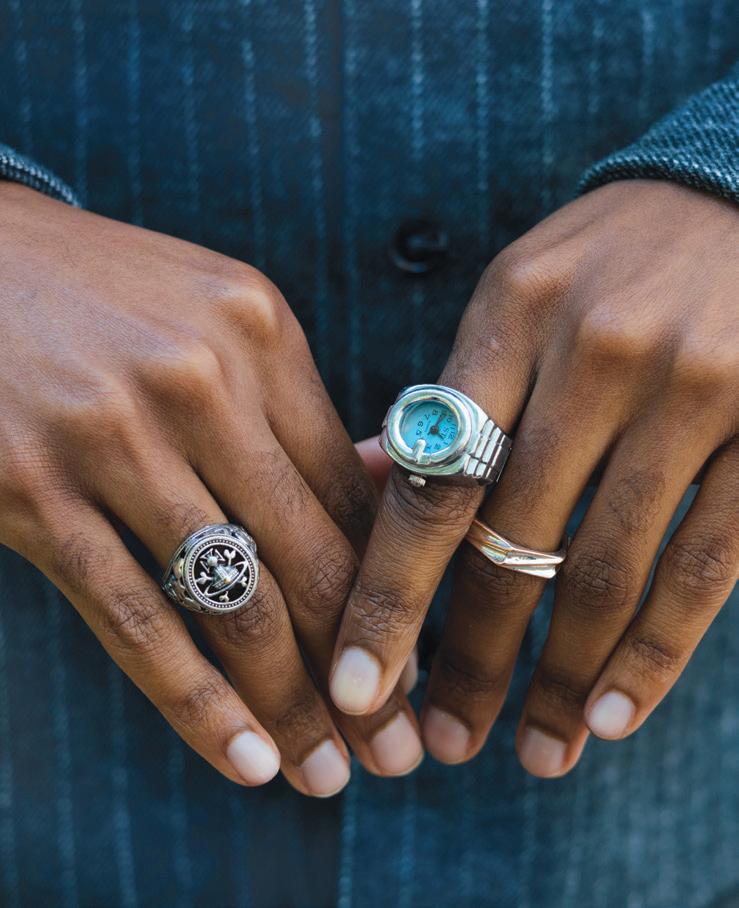
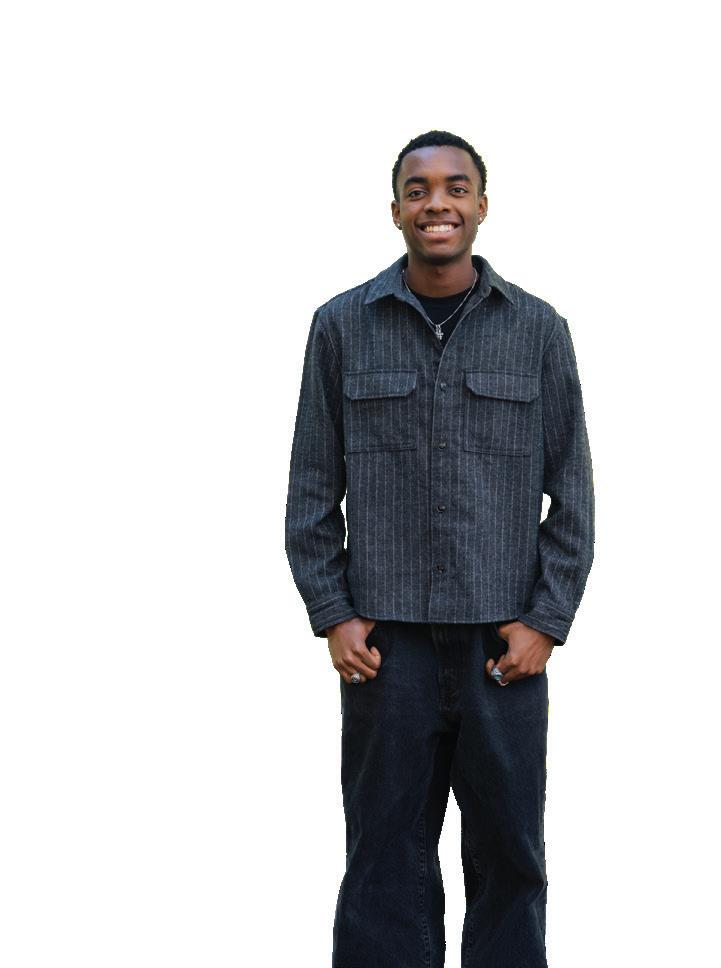
“I wear my rings in memory of my friends or events . . . and with this clock one [an unexpected gift], people are reminded of me in some sense.”
Trey Woodbine Film, class of 2028
“My special object today is this crocheted laptop case. I’m a transfer student, so I’m just new to Pratt. This is a gift from one of my old roommates. She custom sized it for my laptop and it doubles as a really good seat cushion for exploring coffee shops.”
Connor Architecture,Campbellclass of 2029
“I always start off my day by choosing a crystal with the energy that I want to attract. Rose quartz stands for love and abundance.”
Rudy Blake Fine Arts (Painting), class of 2028
Recent Pratt Alumni Share Their Strategy Guides for Launching a Creative Career
Looking back, what was the most valuable part of your Pratt education?
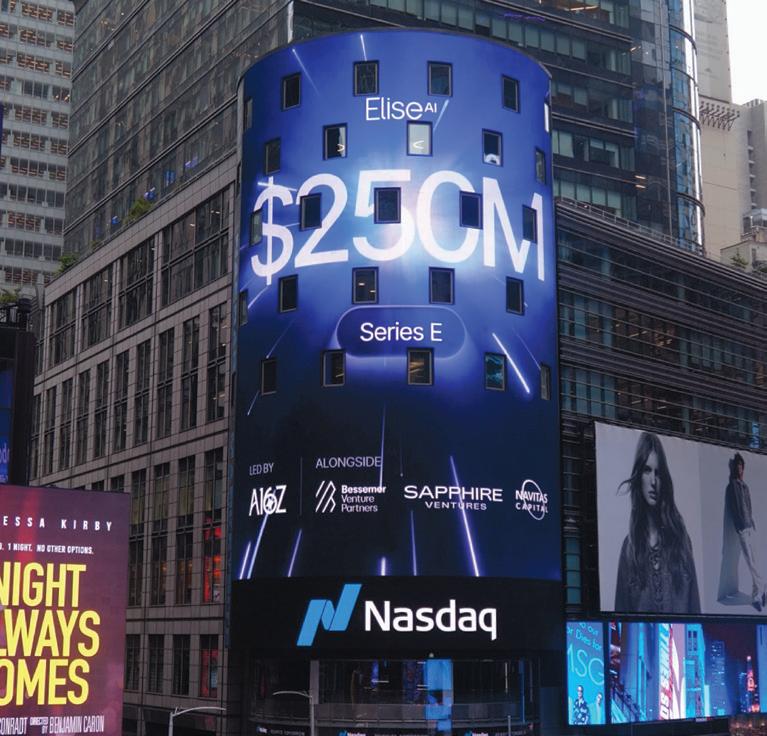
Securing a coveted internship at Apple while still a student at Pratt set Yvette Yoon on a path that combines technology and design. Today, she’s a brand designer at EliseAI, an AI platform for the housing
Can you walk us through your journey from Pratt to your first
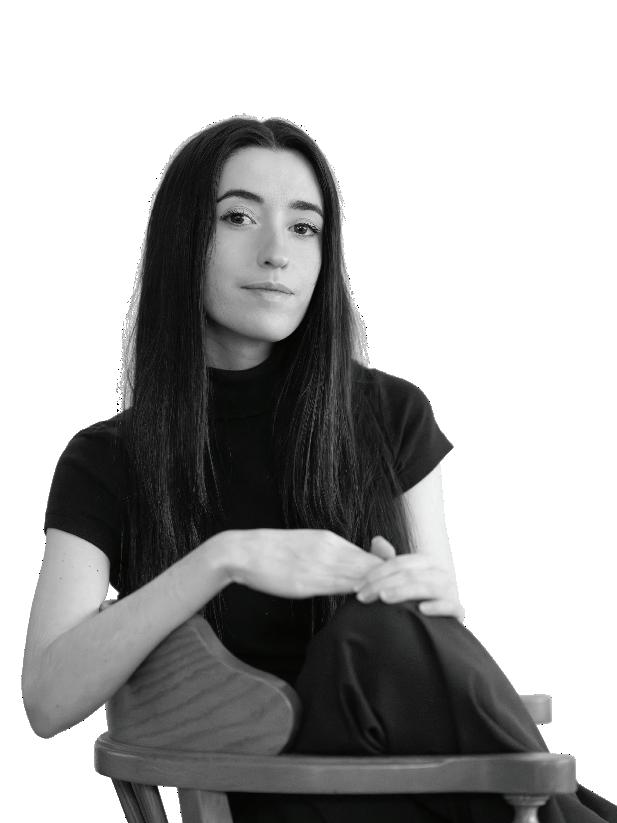
After junior year, I interned at Apple and joined full time as a junior designer after graduation. One of the biggest turning points was support from my professor, Glen Cummings, who took time on a Sunday to help me prepare for the interview. I didn’t have much interview experience at the time, and his guidance gave me the confidence and structure I needed to land the role.
Pratt taught me to look beyond what’s wrong in a design and focus on what it’s trying to communicate. Through my professors and peers, I learned how to widen my perspective—seeing intention, context, and meaning, not just execution. That shift still shapes how I critique my work and build concepts today.
Is there a specific project you consider a turning point in your career?
At Pratt, projects required me to take ideas from start to finish, and because more design today is animated, I often had to expand my work to include motion and even 3D. That experience made it natural for me to consider both static and motion deliverables from the very beginning of the design process. Because of that, I was constantly learning new tools, and those skills became a visible part of my portfolio that opened up new opportunities.
What advice would you give to a student about making a creative career a reality?
I think it’s most important to be proactive about finding resources. That means asking for feedback early and often from professors, peers, and mentors, but also actively building your skill set by learning whatever programs
your projects require. The more you seek critique and keep expanding what you can execute, the more prepared you’ll be when new opportunities open up.
Catherine Chattergoon BArch ’24 Project Team Member, Adjaye Associates
Catherine Chattergoon is a project team member at Adjaye Associates, the architecture and design firm whose recent projects include the Studio Museum in Harlem and Princeton University Art Museum.
What’s a professional skill you developed at Pratt that you rely on today?
I learned and refined a variety of skills at Pratt that I use today, but the skill I appreciate the most is the ability to articulate the importance of the arts in societal change.
Left: Courtesy of Yvette Yoon.
Right:
Courtesy of Catherine Chattergoon
Chattergoon:
I came to Pratt as someone who loved art and design and wanted to spend the rest of my life creating. I left knowing that art and design have a fundamental role in change, consciousness, and building a better world into existence.
I feel grateful to have a steadfast understanding of why we as artists and designers must go to work and contribute to the world through our practices.
Tell us about your journey from graduation to your first full-time creative role after Pratt.
I first became involved in the National Organization of Minority Architects (NOMA) when I joined the student chapter, NOMAS, at Pratt. Through the organization, I met many diverse practitioners who also studied at Pratt, such as the great Pascale Sablan ’06. I leaned on my NOMAS network to help with my transition, and it was through the organization that I found an employment opportunity at Adjaye Associates.
Is there a specific project from your portfolio you consider a turning point in your career?
The most influential project I worked on while at Pratt was Re:Play: Reclaiming the Commons Through Play, which was supported by the Pratt Center Taconic Fellowship and the Center for Architecture.
I was a member of a multidisciplinary team of students, faculty, and diverse practitioners, and together, we worked with gifted young designers living in NYCHA housing in East Harlem to reimagine what joy, play, safety, and belonging look like in their homes and community.
This project illuminated the ambition of my career: embracing architecture as a means of practicing compassion and moving towards social and spatial equity.
What advice would you give to a student about making a creative career a reality?
I recommend viewing your career as a “continuous project altered daily,” a concept from Robert Morris that I encountered at Pratt.
Your work is not just about big ambitions but also the daily journey of creation, experimentation, and exploration. After graduating, I learned that every success story is unique and often filled with unexpected pivots.
The life you want is yours to shape, so never lose sight of how you tend to your dreams each day.
Suhyeon Lee
BFA Fine Arts ’24
Visual Artist and B2B Account Manager, Craver Corporation
Since graduating from Pratt Institute, Suhyeon Lee has built a one-of-a-kind career. From exhibiting his art to forging new global partnerships for the skincare brand SKIN1004, a talent for connection bridges his professional pursuits.
What’s a professional skill you developed at Pratt that you rely on today?
Fine arts and beauty-brand sales seem worlds apart, but my art school background gave me a unique perspective compared to traditional business graduates.
Artists are essentially small-business entrepreneurs: we handle creating, packaging, and shipping our works while also thinking about personal branding, marketing, and building relationships with curators and collectors.
Exploring all these aspects during my studies indirectly prepared me for product development, marketing, sales, and logistics—which helped me adapt quickly to my current role in consumer goods.
Has there been a point in your career where you’ve had to consciously pivot?
I have gained plenty of experience working at art fairs and exhibitions. But a recurring piece of feedback was that I seemed better suited to art sales than being a fine artist.
With my outgoing personality and global background, I decided to lean into that strength and started my career at a Korean beauty brand. I’ve always loved the MoMA Design Store more than the MoMA itself, so adapting to consumergoods brands felt natural.
Can you tell us about a professional challenge you’ve faced?
From a younger age, I only dreamt of becoming a designer or artist, so I focused heavily on visual tools like Adobe Suite or Final Cut Pro. What surprised me in the professional world
Courtesy of Suhyeon Lee
was how much companies rely on Excel. I had to adjust to making decisions based on numbers and spreadsheets first, before getting to the creative or visual outcomes. I wish I’d known this earlier.
What advice would you give to a student about making a creative career a reality?
Of course, the education you get in college is valuable. However, don’t forget you’re spending your early twenties in New York City. Sometimes, going to a gallery opening in Chelsea or a party in Williamsburg can lead to more connections than finishing an assignment. Don’t spend your weekend in Willoughby Hall—get out and meet as many people in the city as you can.
Ananda Ray
BFA Digital Arts ’24 Associate Creative Technologist, Doner
Ananda Ray made her mark as a student at Pratt with works that leveraged cutting-edge technology to preserve and celebrate Black culture, including an augmented reality installation reflecting on Black women’s leadership in activism
and an AI-powered sculpture. Today, she is an associate creative technologist at the Michigan-based advertising agency Doner.
Can you tell us about a professional challenge you’ve faced?
Applying for jobs in my first year post-grad was tough. There was a lot of ghosting, and finding the motivation to stay creative was challenging as well. But having patience and leaning on my support system helped me push through. After moving back to Detroit without easy access to New York City events, I leaned on The Black Alumni of Pratt and a few mentors and colleagues from the Digital Arts Department.
Then, on a whim, I submitted a video to an internship program called BLAC (Building Leaders and Creators). They matched me with Doner after the team saw my work, and I went through an interview process from there. It turned into the best 12 weeks of growth. I learned a ton about advertising and met some amazing people.
Has there been a point in your career where you’ve had to consciously pivot?
I pivoted from art into advertising, and it ended up being a great fit. It was about figuring out how I could apply my art background to a role as a creative technologist in advertising. I had the skills; they just needed to be applied differently.
about Pratt was the community and the people I met. They made me a better artist and made me curious to keep learning.
What advice would you give to a student about making a creative career a reality?
Be patient and stay open. If I could go back, I would let myself breathe and understand that sometimes it’s not you; it’s the market or the timing. Eventually, something will stick and a door will open. You just have to be ready to walk through it when it does. Be ready to pivot, but don’t give up.
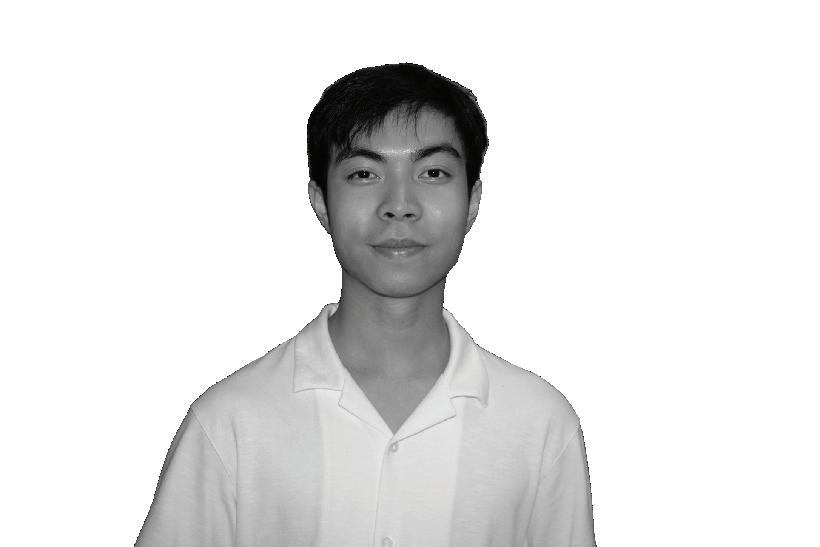
Jonathan Lin BFA Communications Design ’25 Founder, New Studio Partners
What was the most valuable part of your Pratt education?
All my classes opened different avenues for my thinking, both as an artist and as a professional. But I think the best part
For many designers, the “dream job” is the one they create. Jonathan Lin is the founder of the brand transformation studio New Studio.
What inspired you to start your own studio?
I had been doing client work on the side for years, so starting a studio felt like a natural next step rather than a big leap. I have always been more interested in the business of design than the design itself,
Ray:
Left: Courtesy of Ananda Ray.
Right: Courtesy of Jonathan Lin
and I think it is important for designers to understand business because design is ultimately a tool for it. Building a studio gave me the space to learn faster, take ownership, and shape the kind of work I wanted to create.
Looking back, what was the most valuable part of your Pratt education?
At Pratt, the real value came from a handful of people who changed how I think. Justin Fines was one of them. He was my branding professor and later a mentor, and he advised me as I led New Studio’s rebrand of the Utica Public Library. His experience on large-scale rebrands like Burger King and Adobe, along with his feedback inside and outside the classroom, pushed me to think like a creative professional rather than a student.
As a founder, what has been a particularly difficult professional challenge you’ve faced?
In school, you follow a brief so the work can be critiqued and graded. In practice, you often have to redefine the brief and guide clients toward what will actually create value. The shift from “making what is asked” to “identifying what is needed” may seem challenging at first, but it became essential to how we work.
What advice would you give to a current student who dreams of one day starting their own creative business?
Understand that we work in a valuedriven world. Learn how value is created and how to communicate it. Talent
matters, but clarity and curiosity will take you much further.
Júlia Martínez
MS Packaging, Identities, and Systems Design ’25
Graphic Designer and Visualizer, OXMAN
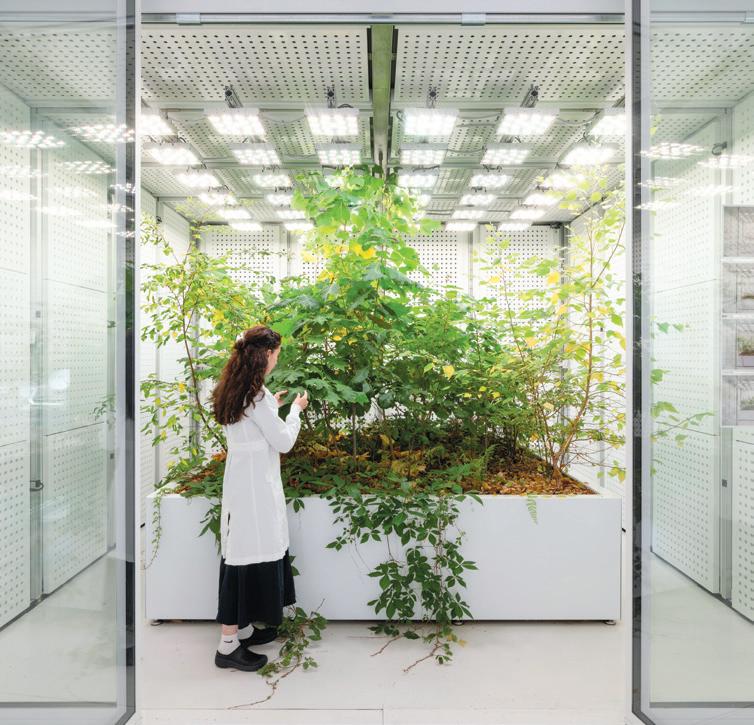
Júlia Martínez, MS Packaging and Systems Design ’25, is a graphic designer and visualizer at the design lab OXMAN, a design company exploring how nature and humans can coproduce, cohabitate, and communicate through biologically informed design and technology.
Can you tell us about a particularly difficult professional challenge you’ve faced?
Design, as an action, exists independently until it is given purpose, use, and consequence. One of the most challenging moments in my professional path was realizing that applying my skills effectively did not always mean applying them meaningfully. Design today plays a central role in shaping products, services, and markets, but within that landscape lies a choice about what kinds of purposes and values one contributes to.
Reflecting on this reshaped how I think about where and how I place my work. Personally, I feel fortunate to have found a place where what I do and why I do it are aligned, allowing me to contribute to causes that matter to me both professionally and personally.
Looking back, what was the most valuable part of your Pratt education?
Design is powerless unless it is grounded in the realities of other disciplines and world contexts. At Pratt, I learned the most by pushing my design practice beyond the boundaries of the design school curriculum, enrolling in courses where I engaged with science, cinema, and architecture.
What’s a professional skill you developed at Pratt that you rely on today?
Pratt trained me to develop a strategic sensitivity: to recognize the places, moments, and conditions where design is truly needed and where it can make a meaningful difference, even when they fall outside traditional design contexts.
What advice would you give to a student about making a creative career a reality?
My mother has always told me I am like an ant: not the fastest or the most conspicuous, but persistent, reliable, and deeply purpose-driven. For most people, a creative career unfolds through uncertainty, rejection, and long stretches without clear signals of progress. Over time, that steadiness is what allows talent to take root and opportunity to surface.
Martínez:
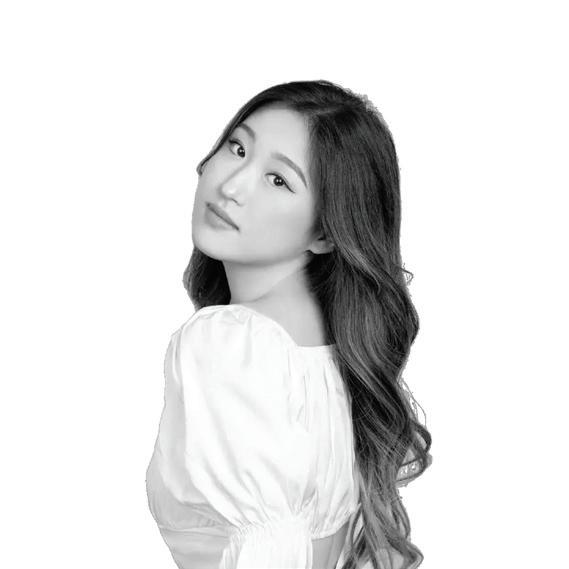
Courtesy of Júlia Martínez
What has been one of the biggest challenges for you in transitioning from a student to a professional
The biggest challenge for me is still the solitude. I miss having people to talk to frequently and getting constant critiques of my work. I am trying to learn more about how that feeling of solitude fits within my painting practice.
Beyond the studio, what’s a practical skill you honed at Pratt that you now rely on as a professional
I learned most of what I know now at Pratt. I learned how to write an artist statement, critique work, and talk about painting. I also learned how important it is to document my art. Most importantly, I met people who shaped me, taught me what I know, and pushed me to create some of my best work.
You had a solo exhibition, The Interstice , just a few months after graduating. Can you walk us through how that opportunity came about?
It all happened through Pratt. During my thesis exhibition, I was selected for a one-on-one visit with Lisette Tucker, the former director of Palo Gallery. Lisette loved the work and shared it with the Palo team. A few days later, the founder, Paul Henkel, came to see my work in person.
I remember him walking in and saying, “These are marvelous!” About 10 minutes into his visit, he offered me a solo show. I held myself together really well, but I was screaming on the inside.
What is the most important piece of advice you would give to a current Pratt student who hopes to build a career as a practicing artist?
The most important advice I can give is to just paint and make things. Be eager to learn and take everything that is given to you. Nothing will come to you if you do not want it. The more you give to your work, the more it gives back. Most of what you hear might not make sense at the time, but if you keep it, it will surprise you later. Keep your work alive!
Tsoutreli:
Courtesy of Palo Gallery
While networking is important, Pratt alumni emphasize building a genuine community of peers, mentors, and collaborators. This community is a vital source of support, inspiration, and opportunity.
Catherine Chattergoon joined a student organization where she met a fellow alum, Pascale Sablan, an accomplished architect, advocate, and leader. Ananda Ray leaned on The Black Alumni of Pratt and departmental mentors during her job search, while Yvette Yoon’s professor gave her the confidence she needed to land a role at Apple. The advice is clear: invest in relationships, because as artist Suhyeon Lee notes, “Many creative projects happen because passionate people meet each other.”
Adopt the perspective of a professional practitioner while you are still a student. This means understanding both the creative and business realities of your field.
Suhyeon Lee points out that artists are “essentially small-business entrepreneurs” who must handle everything from production to marketing. He was also surprised to find that the corporate world relies heavily on data and Excel—a practical skill he wished he had learned sooner. For studio founder Jonathan Lin, the key is to shift your thinking from “making what is asked” to “identifying what is needed,” which is the foundation for creating true value for clients.
Your time at Pratt is an opportunity to experiment and connect ideas across disciplines.
Júlia Martínez advises that “design is powerless unless it is grounded in the realities of other disciplines,” stressing the value of exploring science, cinema, and architecture alongside design. This approach prepares you for complex, real-world challenges. Catherine Chattergoon found her most influential project was a multidisciplinary collaboration with NYCHA residents that clarified her career ambitions. Similarly, Yvette Yoon’s experience turning static designs into motion graphics for class projects became a key part of her portfolio that opened new doors.
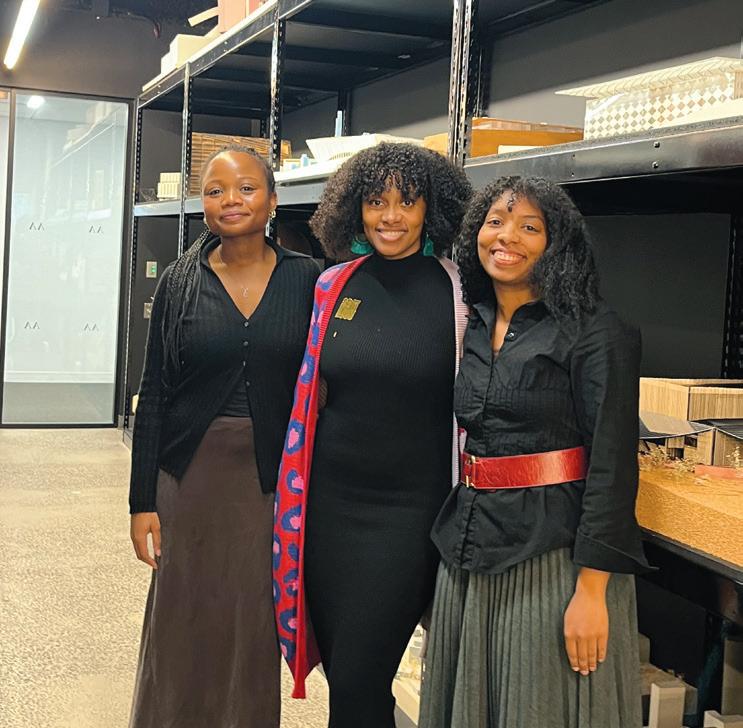
Top: Catherine Chattergoon (right) with fellow Pratt alumni in the New York office of Adjaye Associates: Kazeka Mbekeni (left) and Pascale Sablan. Courtesy of Catherine Chattergoon. Center:
Courtesy of Jonathan Lin.
Bottom: Júlia Martínez in the wet lab at OXMAN, 2025.
Photo by Nigel Young
Having great ideas is not enough; you must be able to communicate their value and intention to others.
Leda Tsoutreli notes that Pratt taught her essential skills like how to write an artist statement and critique work, which are fundamental to a professional practice. Yvette Yoon learned to look beyond a design’s flaws and focus on what it is “trying to communicate,” a shift that still shapes her work today. This skill of telling a compelling story around your work is what Jonathan Lin describes as his primary job: to “create clarity” for clients and his team.
Almost every alum’s story involves an unexpected turn or a conscious pivot.
Ananda Ray successfully transitioned from art into advertising by figuring out how her creative skills could be “applied differently” in the marketing industry. After receiving feedback that he would be effective in art sales, Suhyeon Lee leaned into that strength and launched a new career in a field that felt natural to him. The key is to see your career not as a straight line but as what Catherine Chattergoon calls a “continuous project altered daily,” where you remain open to new directions.
A sustainable creative career is often fueled by a strong sense of purpose.
For Catherine Chattergoon, this means knowing that art and design have a “fundamental role in change.” This ethos guides her work in creating socially conscious architecture. For Júlia Martínez, a major professional challenge was ensuring her skills were applied meaningfully, advising students to find a role where “what I do and why I do it are aligned.” Even for a fine artist like Leda Tsoutreli, this drive is essential; her advice is to “just paint and make things,” because the commitment to the practice itself is what ultimately yields results.
THE HUMAN HAND IN EVERYTHING
In her new book, photographer Cait Oppermann goes behind the scenes of the creative process in an unexpected place— the world of people shaping technology at IBM.
By Daniel Terna
Photographs by Cait Oppermann, BFA Photography ’12
THINK OF THE INDUSTRIAL REVOLUTION IN 19TH-CENTURY AMERICA,
and you might conjure images of soot-filled skies, men and children toiling away in dangerous factories, endless train tracks, clanky machines like the telegraph, and illumination by early lightbulbs. And if you imagined that in black and white, therein lies the role that photography plays in our understanding of history.
When it comes to our narratives around industry and innovation, there’s a long photographic tradition with a range of perspectives on the human relationship with work: from Lewis Hine’s sensitive depictions of laborers dwarfed by machines in often rough conditions and Margaret BourkeWhite’s soaring, heroic photographs of workers intertwined with skyscrapers, to Lynne Cohen’s long exposures in people-less offices and Lewis Baltz’s buttoned-up and orderly company labs.
People at work, and the impressions they make there, are the linchpins of photographer Cait Oppermann’s first solo photobook, IBM Research (published by Actual Source in collaboration with IBM, 2025). The photos are the result of a commission by IBM—which began in the US in 1911 as Computing-Tabulating-Recording Company, and in 1924 became International Business Machines Corporation, reflecting the company’s global ambitions and ultimately its reach in engineering, research, and design. (Side note: Pratt alum Paul Rand designed its iconic “8-bar” logo.)
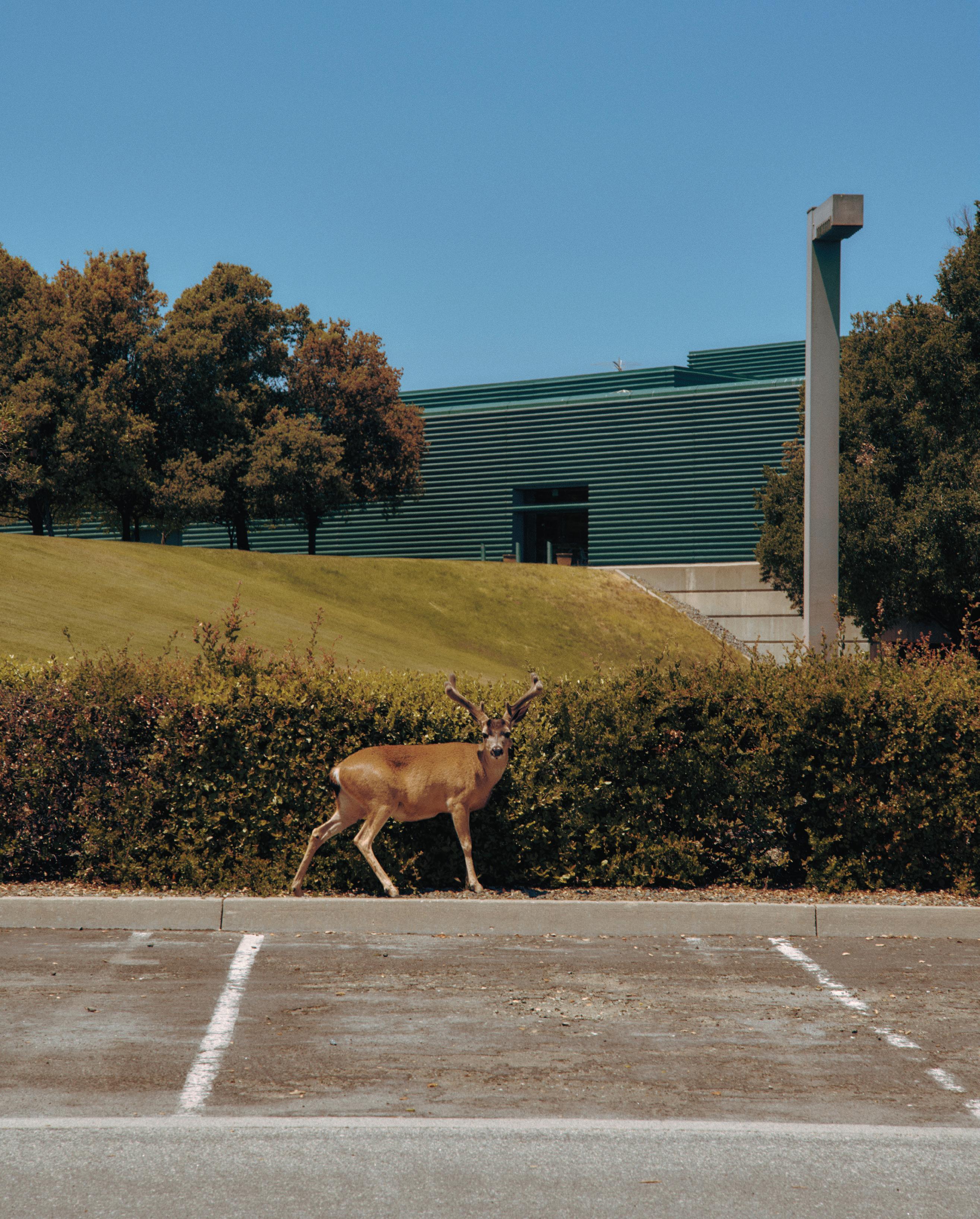
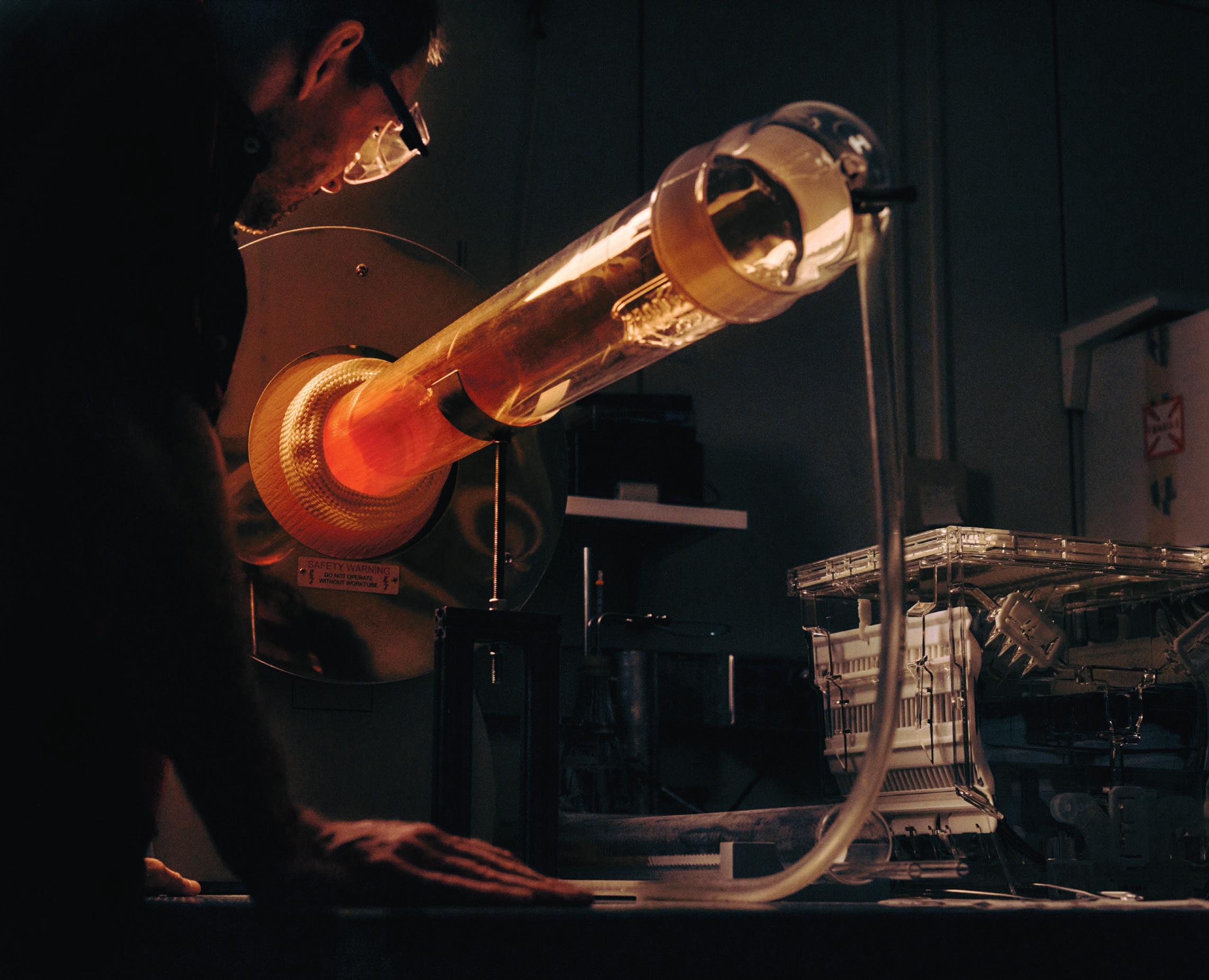
Produced between 2018 and 2024 over the course of four photoshoots at IBM campuses in Almaden, California; Yorktown, New York; and Zurich, Oppermann’s pictures show us how crucial the human hand is in even the most technologically advanced work. Oppermann joins a lineage of IBM-commissioned photographers that includes Ansel Adams and Henri Cartier-Bresson, investigating the interior architecture of active laboratories and offices, and how the workers find their places within the ecosystem. Shedding light on “the unfiltered clues,” as she says in the book’s introduction, to the human stories behind innovation, Oppermann reveals a
company culture that celebrates its layered history, opting not to paint over the hand-drawn height chart on the door frame. In this conversation, Oppermann, who has built a career in commercial and editorial photography and launched her own creative studio, FLOWERS, speaks about the project and shares an inside look at her own creative practice.
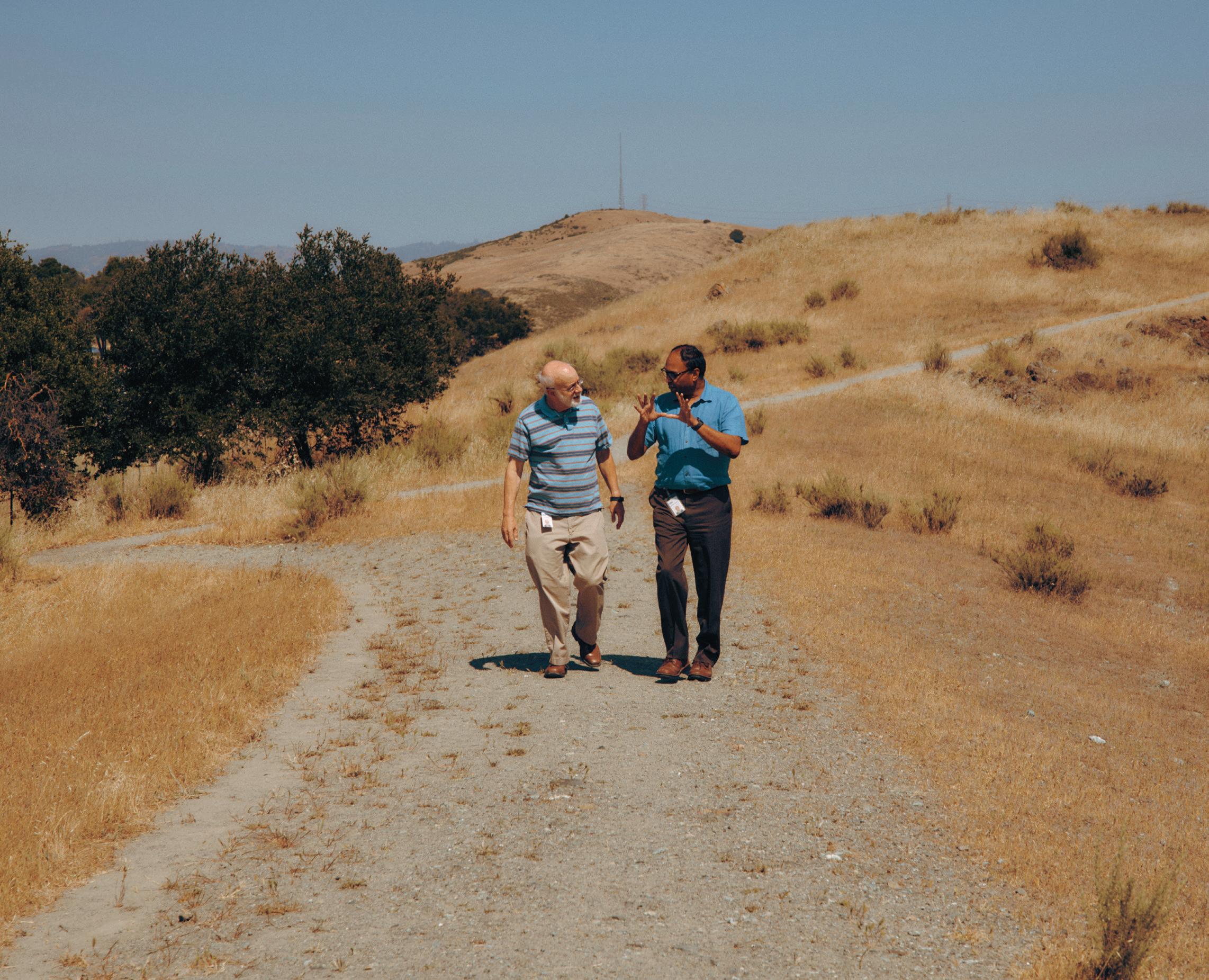
CAIT OPPERMANN IBM commissioned this project starting in 2018. IBM has an internal brand studio that reached out to me about photographing the people behind IBM Research, which is an innovation arm that works on all kinds of different projects, such as quantum computing, battery technology, and AI, among other things. There are scientists, physicists, mathematicians, and researchers.
IBM has a legacy of having artists re-lens the company. Ansel Adams did the same thing [in 1955].
I went into their offices and they showed me this photobook by Andri Pol (Inside CERN, 2014), and I thought, this will be so much fun.
DANIEL TERNA So you’re building an image library.
CO Yes. In Poughkeepsie there’s an IBM archive, which I visited, and that’s where I’ve held the Ansel Adams prints.
The first shoots were in 2018 at Zurich and Almaden. I could pretty much shoot anything I wanted. We had somebody escort us where we’d need security clearance, but no one told us that we had to shoot specific things. It’s the dream.
And everyone was just so in their worlds. My favorite assignments are always the ones where I get to be sucked into somebody else’s world. One of the ways that I defuse tension is by asking lots of questions. I like to pull expertise out of people.
DT There are these colors you use in your work that I like so much—blue and orange. There’s so much blue on these campuses, you really bring it out. Some of these details where things [like computer screens] become abstract
“IF IT’S A PHOTO OF HIGHLY TECHNICAL LAB EQUIPMENT, THERE’S ALSO A VERY HUMAN MESS NEXT TO IT.”
remind me so much of the futurism of ’80s and ’90s advertising photography.
In a way, it doesn’t matter what we’re looking at in your pictures, it’s still fascinating. Most of us won’t know what these technologies are.
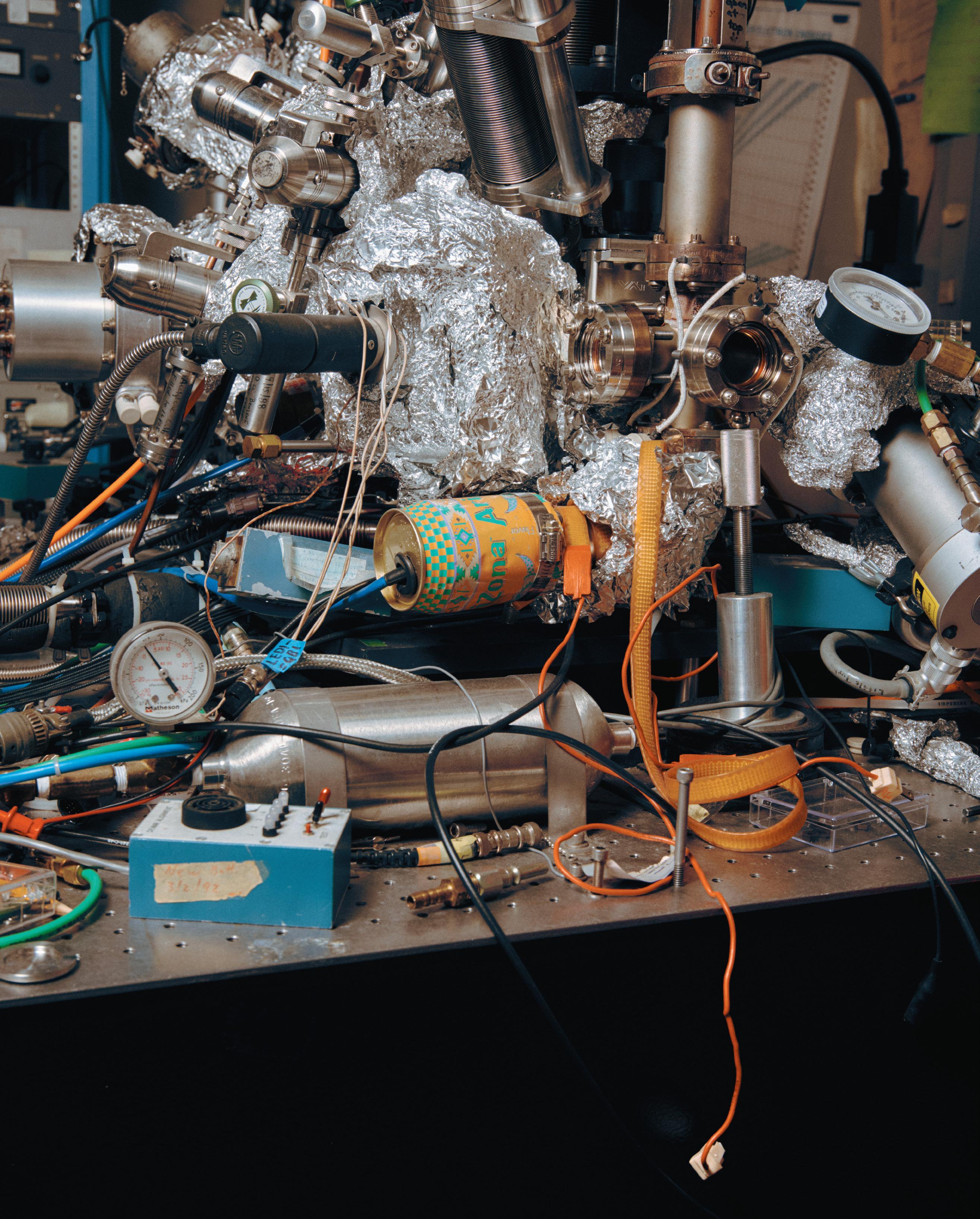
CO That’s why it was so fun to shoot. For instance, in one of these photos there’s a can of Arizona Iced Tea that they’ve modified to be part of the machine, and there’s super high-level, high-tech stuff happening. You can see the human hand in everything. If it’s a photo of highly technical lab equipment, there’s also a very human mess next to it.
One of the benefits of being a legacy brand like IBM is there are going to be labs where you can see somebody’s scribbles on the desk from the 1960s. There’s a patina that’s been left over time.
A lot of these offices have been passed down through generations and people want to get a certain person’s office because it means something to them. It’s super intergenerational.
DT I will say, I love the cafeteria, and the landscapes, the rooftop garden. It’s crazy that you were parachuting into actual meetings. These are not discreet reportage pictures. You literally have a lighting setup going on.
CO I do a lot of shoots commercially where I have to
orchestrate a lot more. But I’m someone who loves to react. I love to be on my toes running around with the subject.
DT Yeah, it seems like a lot of the way you present these scenarios is like a theater stage. You set up your lights; you’re the director, and you say “now go play.” I sense that you’ve created the scene and the composition and then you’re moving around within it.
CO And if you’ve got somebody like me in the mix, I’m telling the subjects to do it again, do it harder. Then you can dial up or down the scene as much as you want. And I like that balance of being swept up in the scene and also being able to orchestrate and engineer aspects of it.
DT How do you feel about having made your first big book?
CO It hasn’t really sunk in yet because it’s such a slow process. It took a year.
Over the years of the project, I’d been casually bringing up the idea of a book to the people who had commissioned me. IBM has a long history of making books and printed material in their archive. In fact, where my parents now live in the Hudson Valley, there used to be more IBM facilities, and you can always find IBM books or shirts in thrift stores there. So I said, we should make a book.
And finally, with IBM’s 100-year anniversary [in 2024], they said OK.
I was so grateful that they were [open to working with
a designer out-of-house]. Actual Source had both the skills and the distribution. They had done the branding for my creative studio, so I asked them if they would be interested in publishing this body of work.
I had to go back and look through all of the shoots, not just what IBM had selected or what I liked, but another comb-through thinking about this as a book. Then I sent all of that to Actual Source.
DT So you trusted them not only as designers, but also as editors.
CO Yes, since I’d been working on this project for so long. I think if it was a shorter-term project, I might’ve been more heavy-handed. But for this I just knew I didn’t want it to be chronological.
We went through many rounds of edits, working through how the images live on the page, the sizing, and how they would breathe. But very few changes were made at all by IBM. There were only a couple of images that they took out, and it was because one of the chips was proprietary technology that hadn’t been released
yet. But they were so open to pretty much everything being included.
DT The cover design reminded me of Christopher Williams’s The Production Line of Happiness (2014), which has a formal structure to it. With your book cover, the IBM letters conjure the logo, which is so indelibly printed in my mind. And the horizontal lines make it feel like a notebook.
CO Totally, I wanted it to feel like a report.
DT But the most obvious parallel in your book is to Larry Sultan and Mike Mandel’s Evidence photobook (1977), the difference being of course that they were working with a preexisting archive of images, whereas here you created the archive.
CO Honestly, what I would love to do one day is go and make a book from the IBM archive.
Have you seen Lars Tunbjörk’s office work? It’s my favorite. He’s a Swedish photographer. He’s in my top five. I have such a soft spot for pictures with all three primaries,
you know? And so much of his work has yellows, blues, and reds. I think I shoot a lot of red because I just love red.
DT I thought of you as more blue, but I see it now.
CO I’m always trying to get primaries.
DT I was also thinking of Darin Mickey’s Human Resources series (2008–2014). These humorous and awkward photos taken in offices.
CO There are all these photographers throughout history who have been documenting places and things like this.
DT I get the sense that you love working.
CO I do. Sometimes it’s a problem. If I’m not working, my hobbies are coming up with a fun, new way to do another type of work thing. I think I have a healthier relationship with work now; it’s evolved over time.
DT At Pratt, why did you want to focus on photography?
CO Photography as a medium feels to me the most innate; it’s the one that I love the most. I also liked the idea of being self-sufficient. I like collaborating later on in the
process, and talking to people about work. But when I’m making things, I prefer to be alone.
When I was making my own work as a student, I’d do the lighting on my own, setting up the light stands. I like the manual labor aspect. I like the process and all the little tools that I’ve packed.
DT You’ve been a working photographer for around 12 years now.
CO Yeah. When I was at Pratt, my goal was to show in galleries and live a life as a working fine artist. It wasn’t until I started getting assignment work that I was like, Oh, I actually love this challenge, the puzzle of having only so many factors you can control.
I also started a production company, FLOWERS, in October 2023.
I enjoy building a business in the same way that I like assignment work. Because it’s like solving a problem or a puzzle. I guess you could say actually that building things is my hobby.
WHAT THIS IT ABOUT GAME? T
IS THIS ABOUT GAME?
Across generations, the Pratt
AT
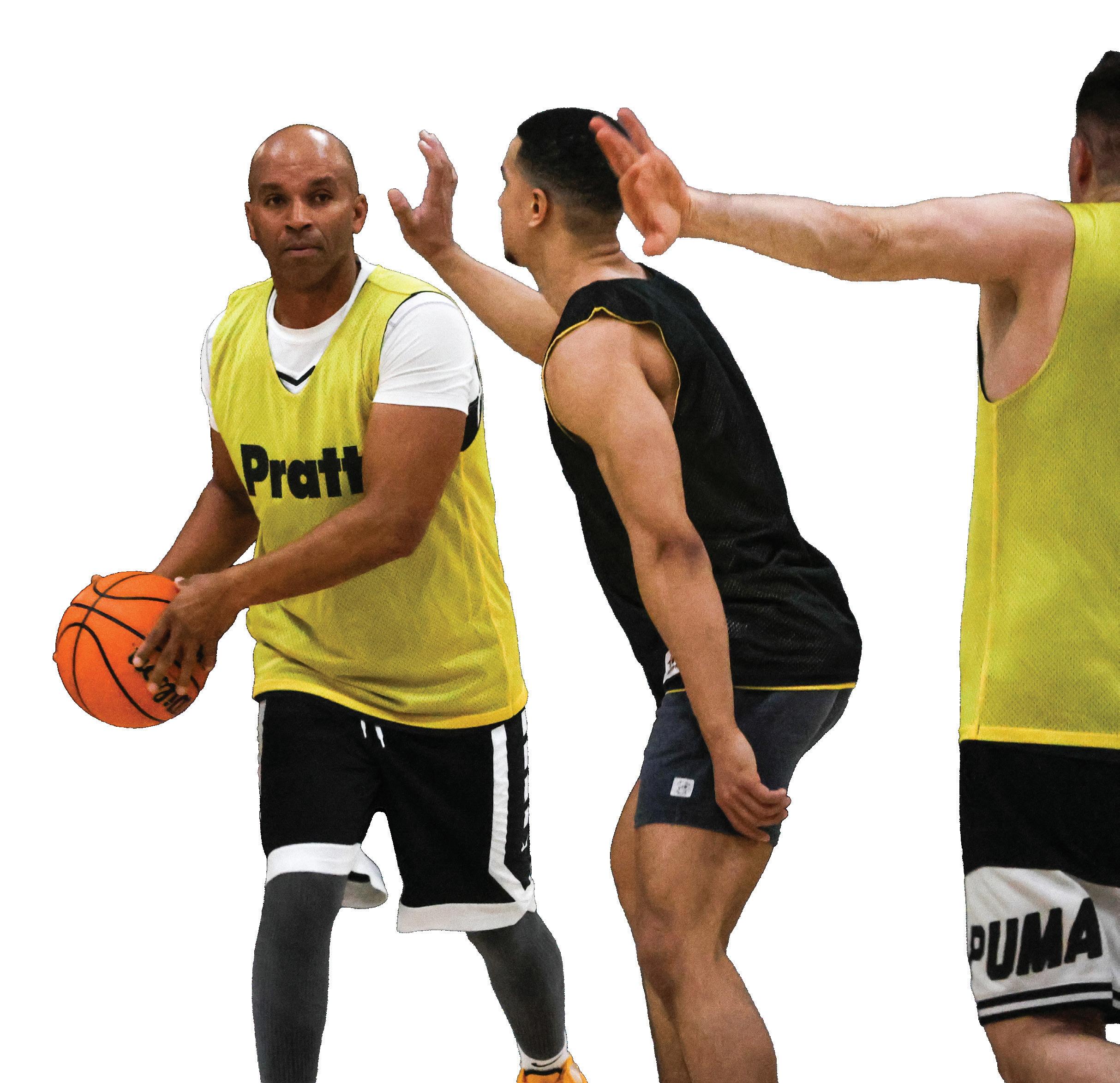
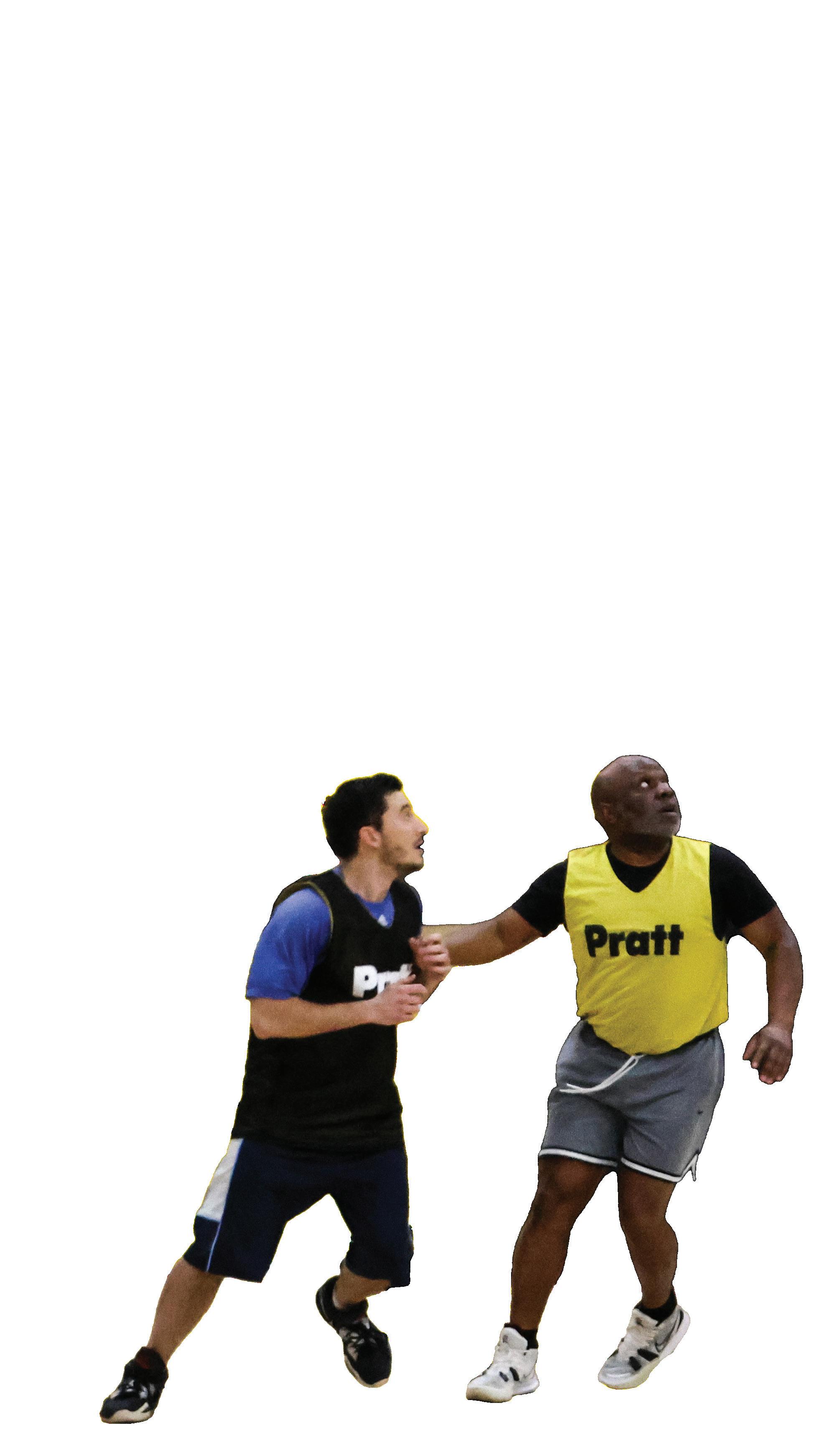
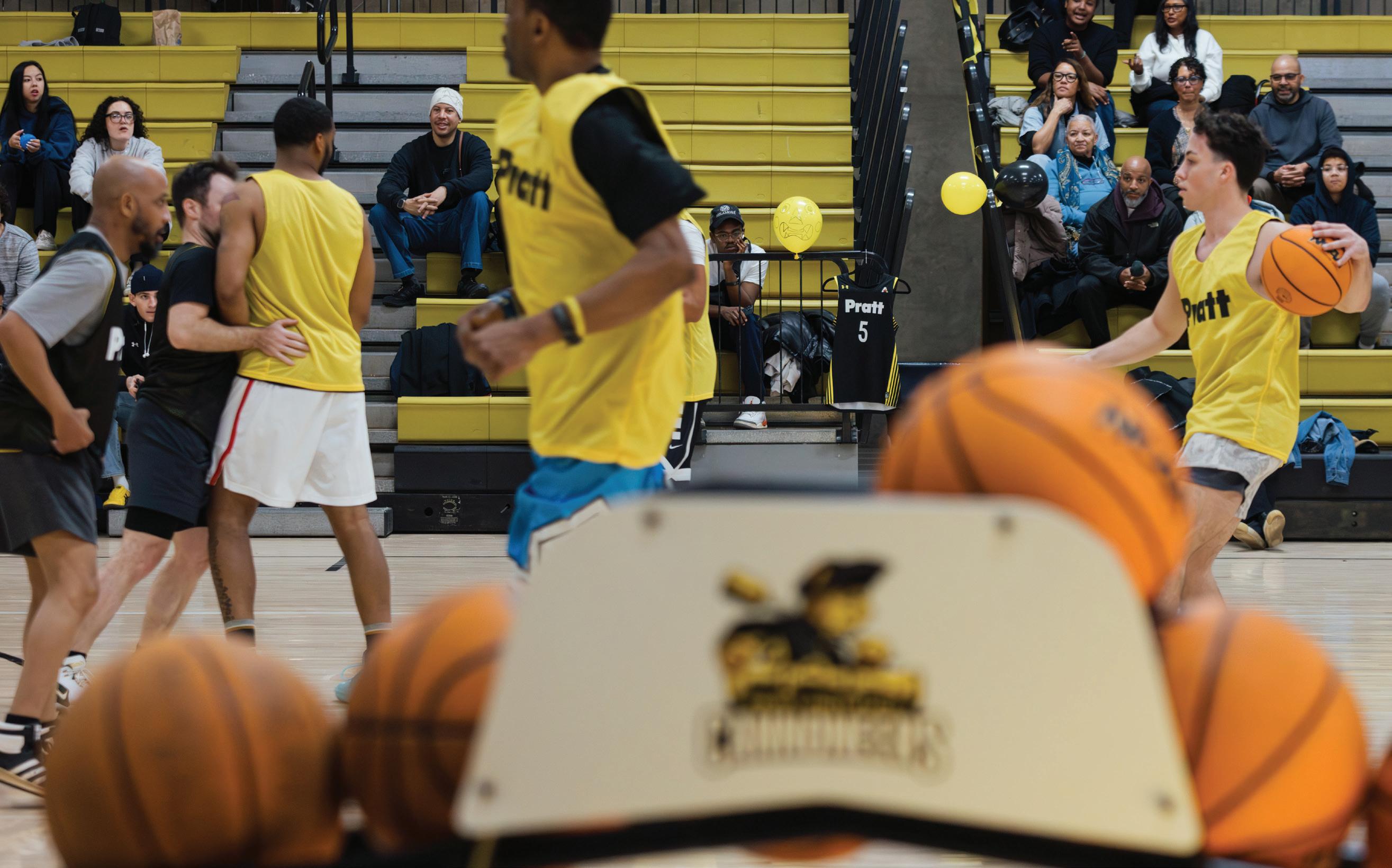
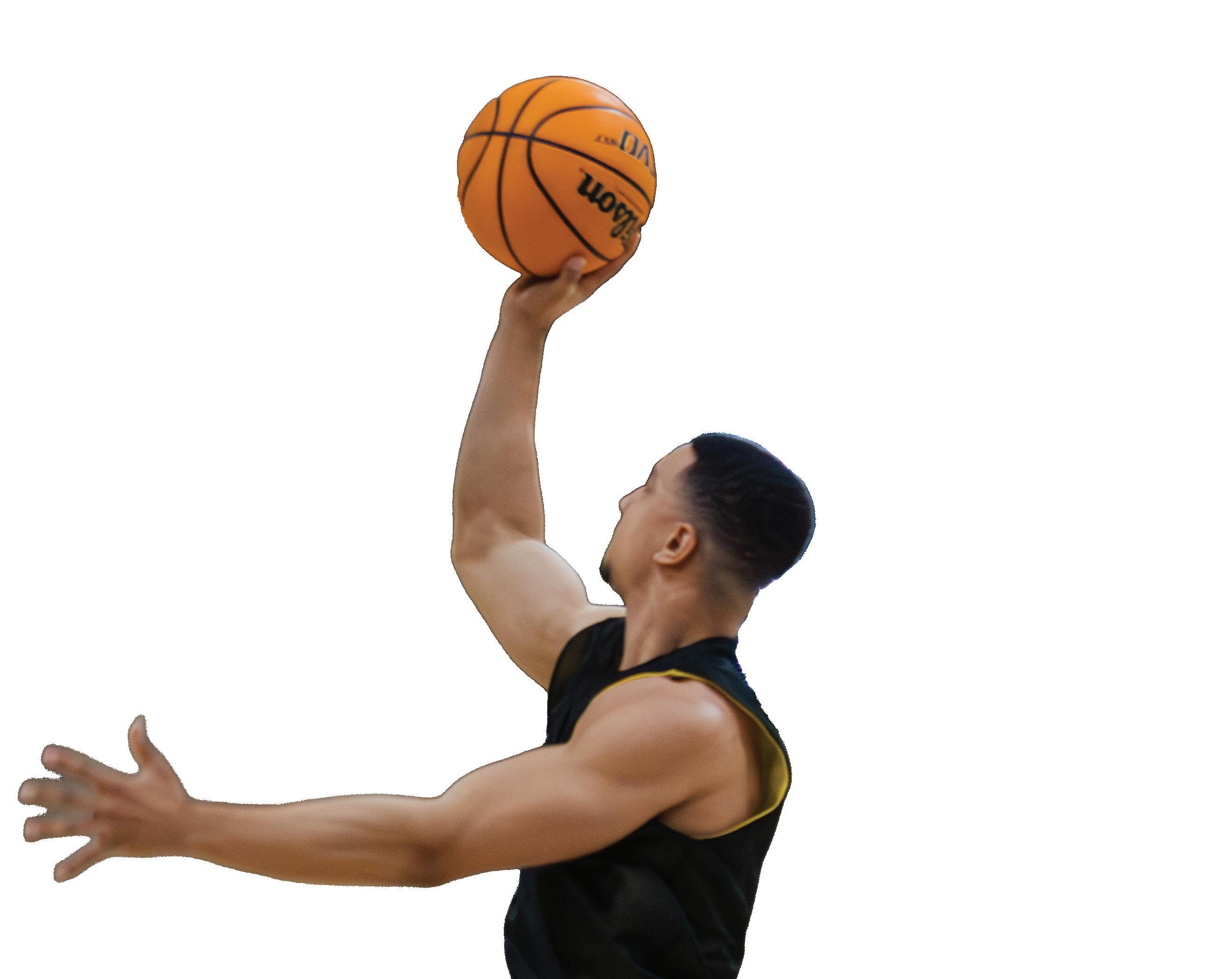
the announcer tells Kadir Nelson, BFA Communications Design ’96, that the crowd wants to see him dunk. Nelson, who is best known for his Caldecottwinning books, New Yorker covers, and album art for artists like Drake and Michael Jackson, laughs at the suggestion. Leaning into the mic, he says, “I haven’t done that in 30 years.”
Photos by Dahlia Dandashi
“MORESOTHANINOTHERSPORTS,THERE’SALOTOF
ROOM I N BASKETBALL
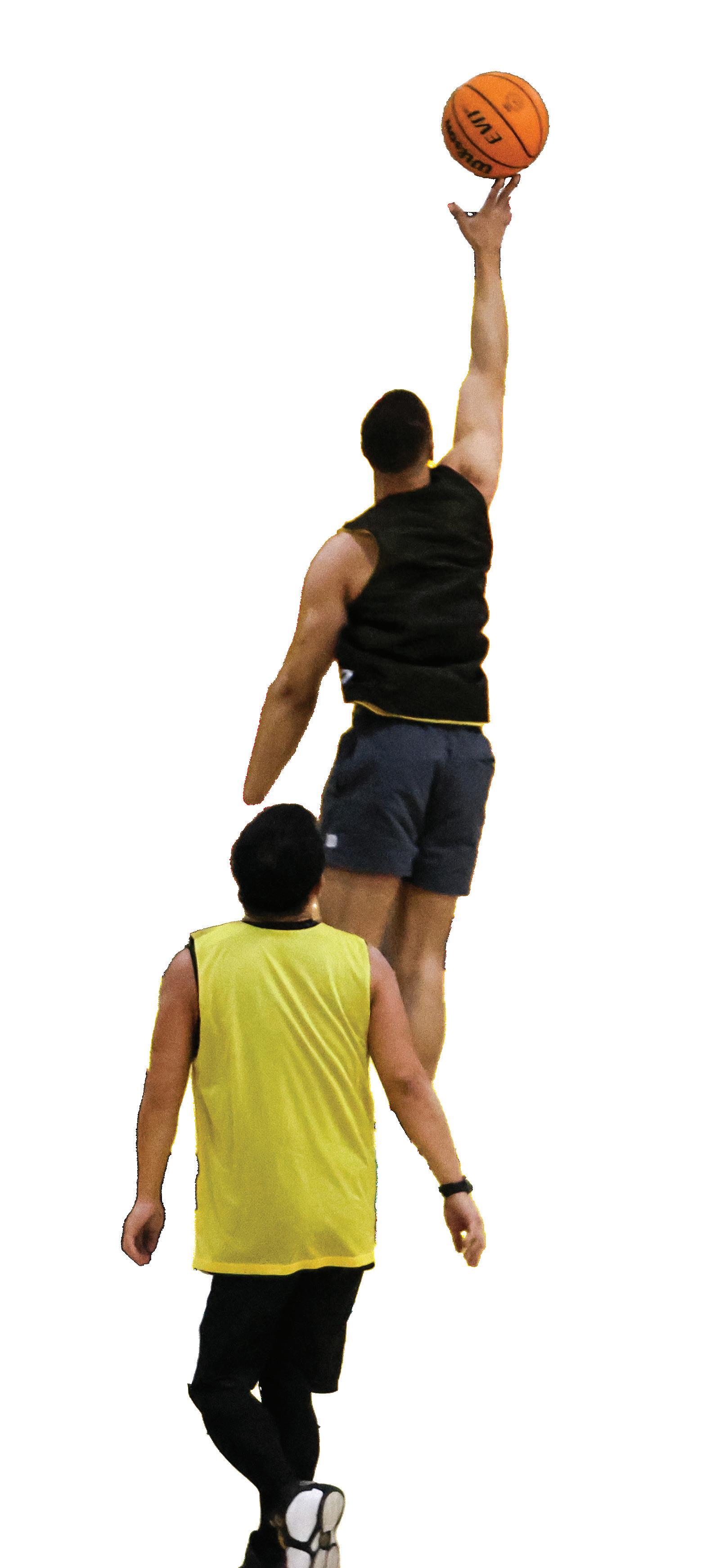
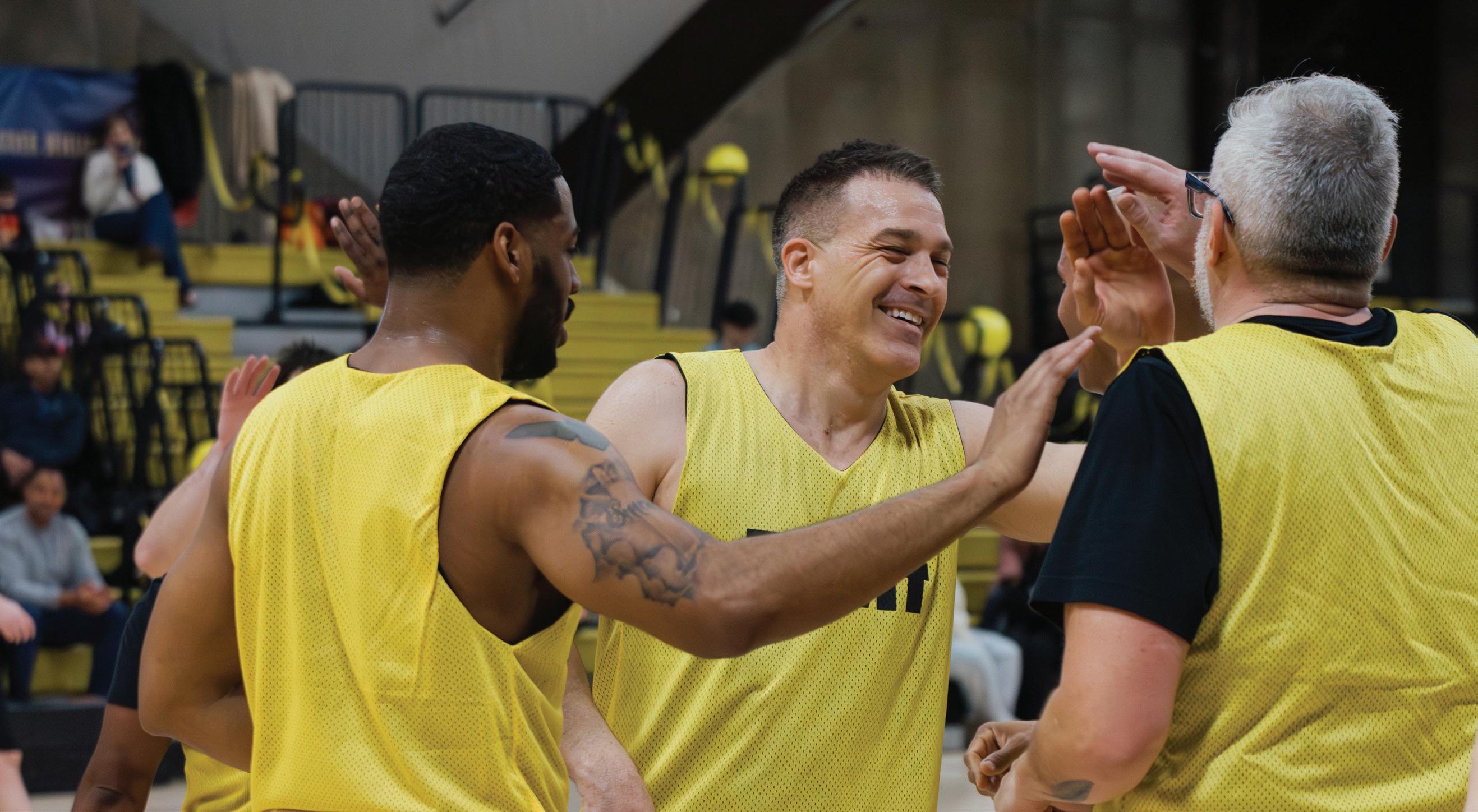
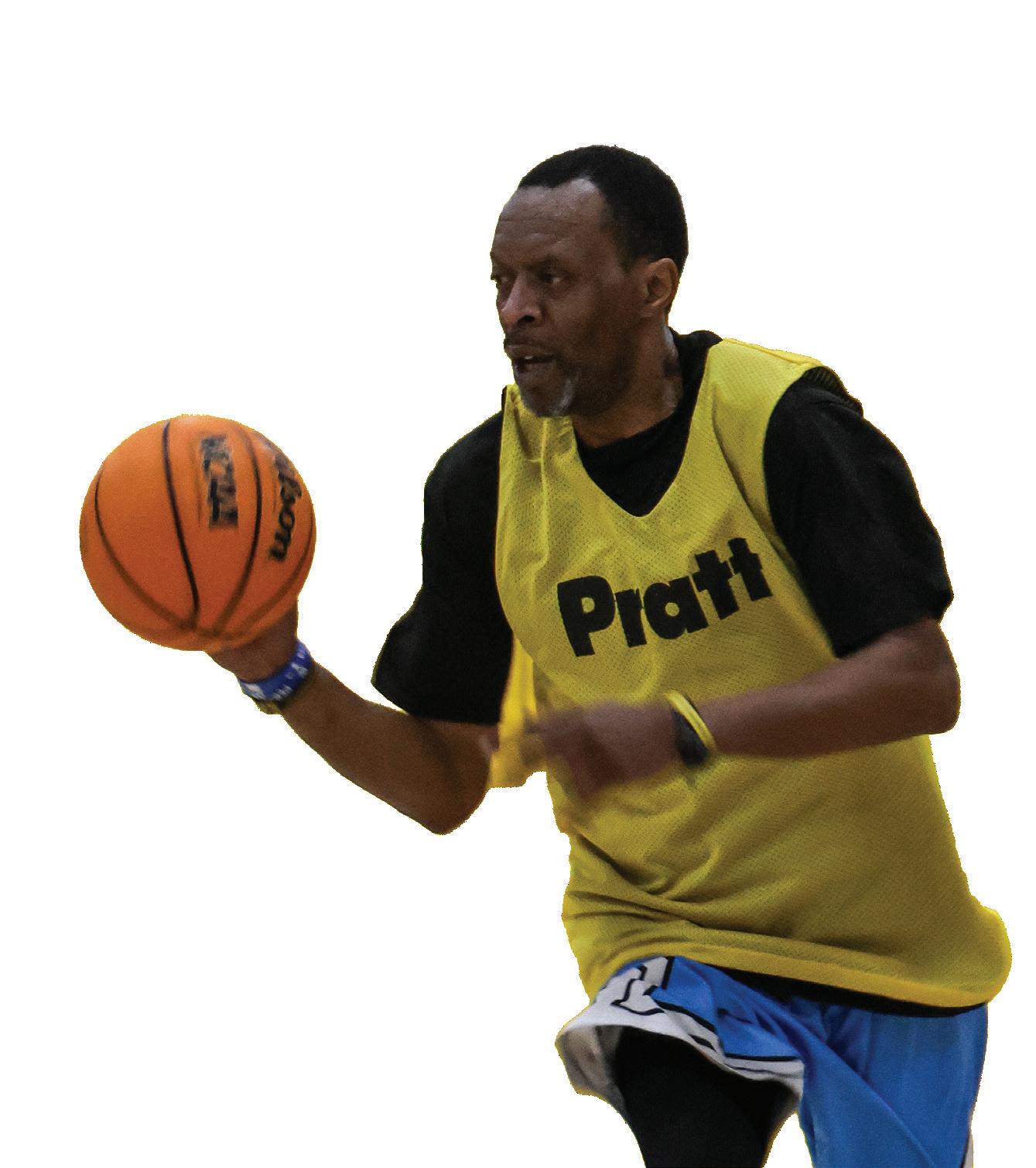
Not quite that long ago, in 2005, Nelson and his former Pratt teammate Bernard Chang, BArch ’95, helped revive the annual alumni game, which records show started in 1974, by organizing an impromptu scrimmage. At the 2026 game—now organized by Athletics and Alumni Engagement, with friends and family filling the freshly renovated ARC’s bleachers—Nelson and Chang are being honored for over 20 years of fostering Pratt’s basketball community, whose history is a testament to a vibrant, if unexpected, connection between creative people and the game of basketball.
“People don’t normally associate artists with sports,” says Rich Lebenson, BFA Graphic Arts ’66. “But there were always people [at Pratt] who were nuts about basketball.”
It’s hard to imagine someone who’s seen more of Pratt’s basketball history than Lebenson, who has coached on and off at Pratt since the ’70s and played as a student in the ’60s. Lebenson was also key in restarting the alumni game tradition following that 2005 scrimmage. When he was a student, the school was gym-less—the team played only away games and practiced at an armory in Bed-Stuy. In the years since, basketball at Pratt has ebbed and flowed—Lebenson’s seen years where Pratt players have led the nation in scoring and rebounds, and others where coaches couldn’t find five players to even try out. Still, Lebenson says, among the students who have come to Pratt for
art, design, engineering, and other creative disciplines, there have always been those who seemed nearly equally dedicated to basketball.
One such student was Ed Mazria, BArch ’63. Today, Mazria is a world-renowned architect, but Mazria saw a different future ahead of him as a senior at Pratt, when he was drafted into the NBA by his hometown team, the New York Knicks. In fact, basketball was at the forefront of Mazria’s mind from the very beginning of his Pratt journey—he was offered a scholarship on the spot after Pratt’s coaches saw him play in an NYC high school showcase. When the coaches asked him to choose a major, he picked architecture on a whim.
“I entered not knowing what I was getting into,” says Mazria of Pratt’s architecture program. Now, Mazria sees a connection between the sport he’s loved since he was a child and the creative practice that became his life’s work.
“Once you get into it, you definitely start to see the connections between basketball and architecture, and a lot of other fields too,” says Mazria. “There’s a lot of strategy involved —when you’re on the court, you’re adapting quickly to different things, so you’re trying to be as creative as possible. You’ve got to be able to see patterns, which is really important in architecture. You essentially design your way into making baskets.”
Two generations later, Kylie Grant, BArch ’26, a star player on the current women’s team, sees the same connections.
“I like doing everything [on the court], and that ties into architecture because an architect does everything!” says Grant with a laugh. “I can’t just draw something up and be like, ‘Oh,
this is cute,’ and pass it to the next person. I have to follow it all the way until the day it’s built. Architecture is about problem solving…and there’s always a problem to solve. I use that same vibe in basketball—when I’m on the court and someone stops me, I’m immediately thinking, ‘OK, how do I counteract how they stopped me?’”
In more ways than one, Grant follows in the footsteps of Cyndi Meserve-Bona, BFA Fashion ’78. There was no women’s team at Pratt during Meserve-Bona’s first year, but due to a then-recent Title IX ruling, it was required that she be allowed to try out for the men’s team. She made the team, and then made history as the first woman to play NCAA basketball.
“While playing basketball, you can be so creative,” says Meserve-Bona, who led her high school team in Maine to four straight state championships, and then came to Pratt to study fashion. Meserve-Bona says she thought coming to art school in New York would mean leaving her basketball days behind. She was happy to be wrong.
For other Pratt alumni, basketball is more than just an analog to their creative work—it’s visible in the work itself.
Sam Peterson, AAS Graphic Design/Illustration ’12; BFA Communications Design ’14, now uses his design skills for Project Backboard, a nonprofit that refurbishes and beautifies outdoor courts across the nation with vibrantly colored art.
Bradley Ward, MFA Fine Arts ’19, made prints during his time at Pratt that collaged photos of basketball icons like LeBron James alongside images of centuries-old European
masterpieces. Ward found it especially meaningful to make this work at Pratt alongside the four other Black students in his MFA cohort—a group Ward says, “felt like a team.”
And then there’s Nelson, whose new book Basket Ball—an illustrated history of the sport from its invention to now—feels like a culmination of a lifetime of making basketball-related art. For Nelson, that work is assisted by a lifetime of playing the game itself. “When I would see, say, a photograph of Michael Jordan or Dominique Wilkins jumping through the air or twisting or making a slam dunk,” Nelson says, “I could translate that into a drawing or painting, because I know what it feels like to do it in real space. Then, I know what it feels like when I look at it on the page. If those two match, then I’ve had success with creating the artwork.”
program. I kind of feel like it’s incumbent upon me to pass along this knowledge.”
To preserve a legacy of people whose creative lives have been touched by basketball, and vice versa, was one of the reasons Nelson and Chang revived the alumni game in 2005. “When I played at Pratt,” says Chang, who has since built an award-winning career in illustration, particularly of comics for publishers like DC and Marvel, “a lot of the older alumni would come by and practice with us and teach us this folklore about the history of the
Near the end of the 2026 game, Nelson and Chang’s team is pulling away. Patrick O’Gorman, BPS Construction Management ’24 (or @pattyoghoops to the nearly 300,000 followers of his basketball-coaching TikTok account), has hit a second three from nearly half court. Lebenson sits courtside like a celebrity, and is approached frequently like one, as friends and fans shake his hand. Meserve-Bona, who made the drive from Maine, where she was inducted into the Maine Basketball Hall of Fame last summer, cheers on from the stands—later, Carlos Acevedo, head coach of Pratt’s women’s team, will tell her what an honor it is to meet her. Grant watches from the sidelines, in preparation for her senior day game later that afternoon.
The clock is winding down, but there’s an air of anticipation here that feels right. “There’s a huge creative element to being a basketball player,” says Mazria. Each moment can feel full of possibility—the court ready to be electrified by a player’s ideas and a team’s collaborative energy. It’s no wonder so many players carry that creativity off the court, too.
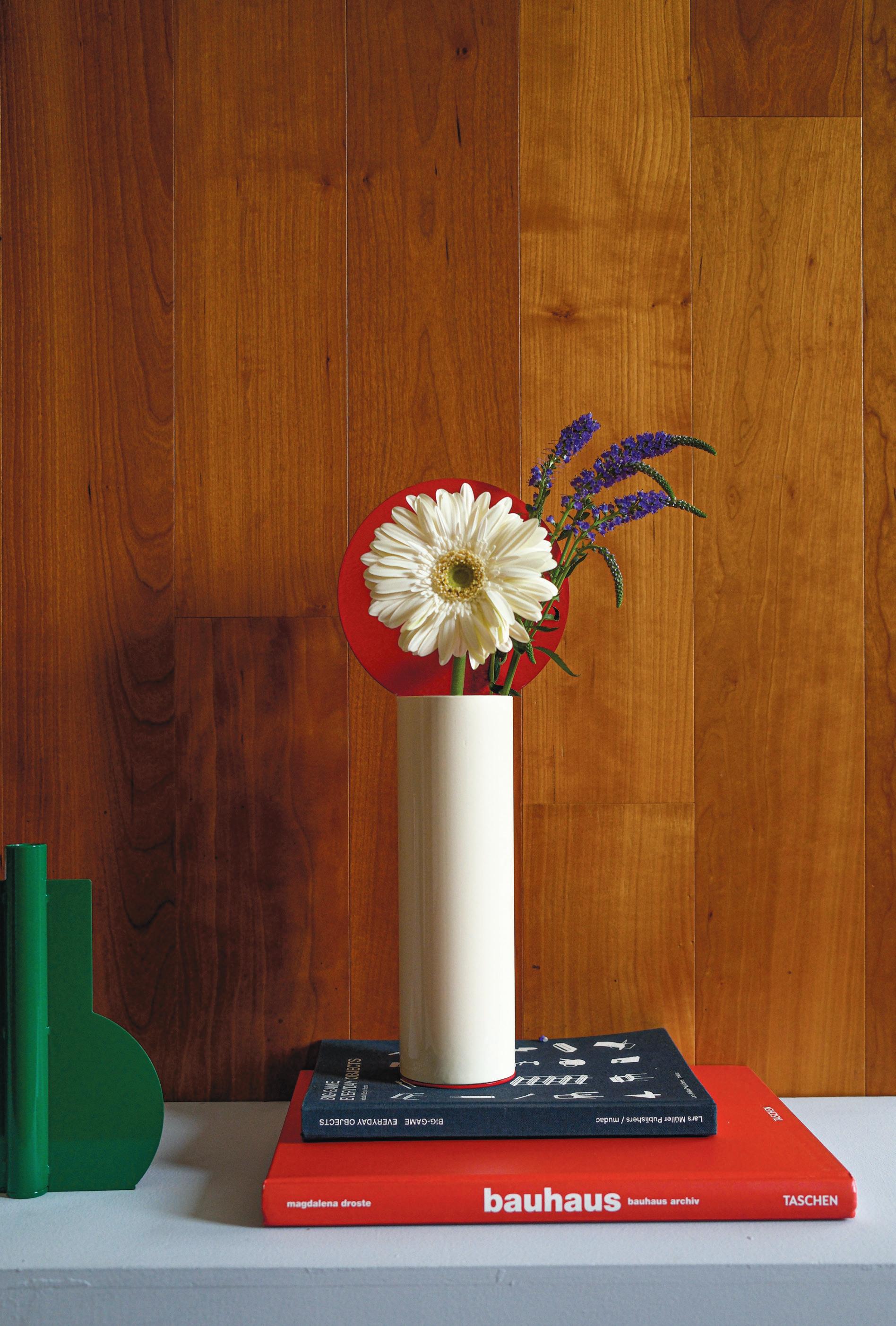
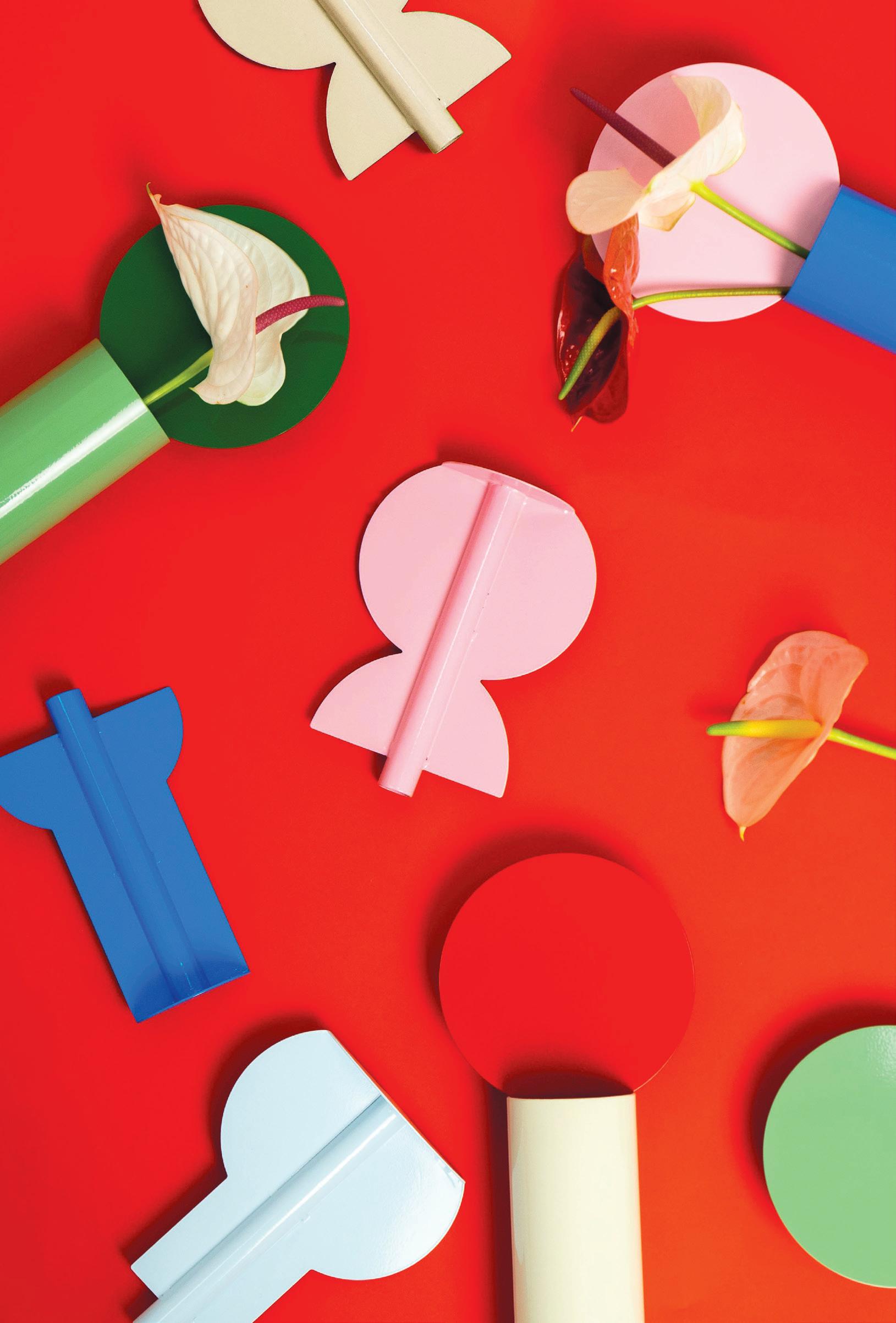
This vessel for floral arrangements designed by Lynn Lin, MID ’17, recalls the mountain sunsets of Medellín, Colombia, “the city of eternal spring.”
Read more on page 40.
Inside looks at work, practice, and collaborations with Pratt alumni.
Where Painting, Sculpture, and Design Blur
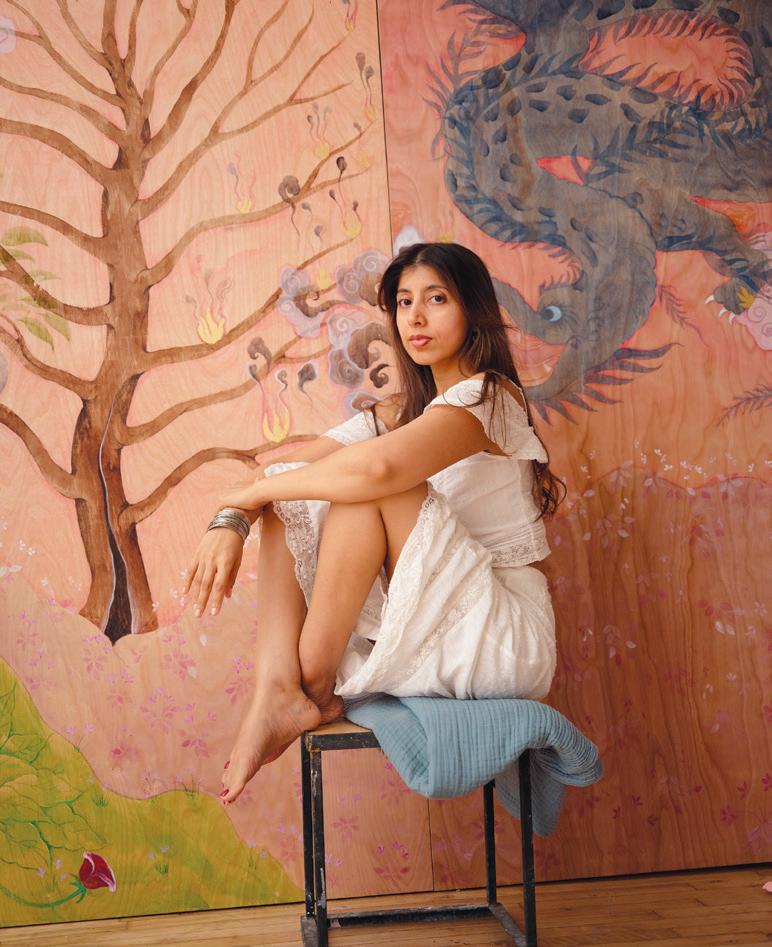
A Paris-born, French-American creator based in Miami, Joyce Billet began experimenting with material and texture as an architecture student at Pratt Institute. Today, she captures organic patterns through photography and hand-painted brushstrokes, then translates them into digital files. These become machine-cut and etched plywood installations that straddle painting, sculpture, and design.
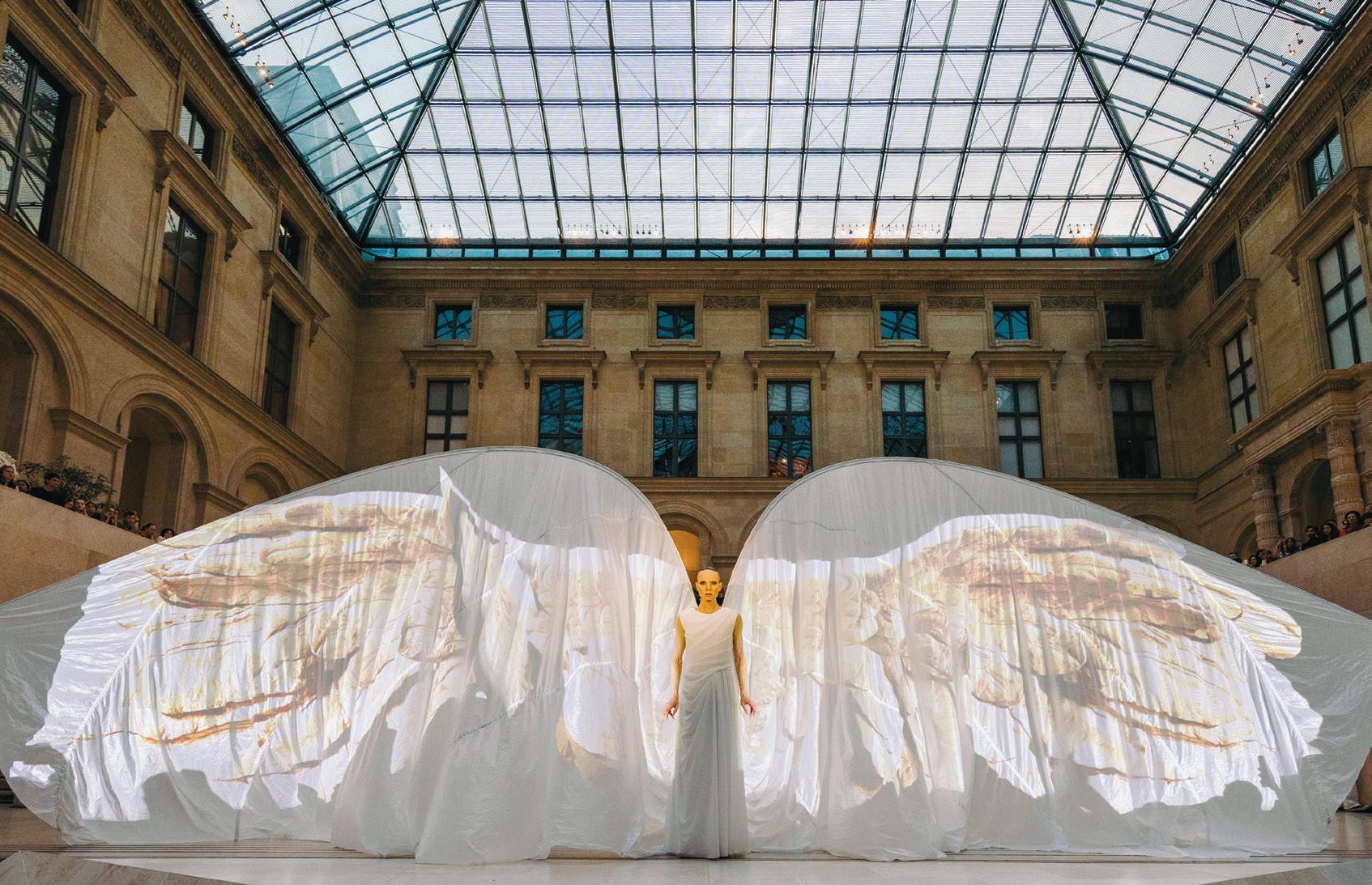
Since 2024, Billet has been in residence at Miami’s Design District, debuting sculptural benches and canopies commissioned by Miami Art in Public Places. She was selected by architect Peter Marino to produce a large-scale permanent installation for Dior’s New York flagship. Her work also appeared as a special project presented by Villa Albertine at Design Miami, and she mentors emerging artists at Florida International University’s Art and Design Incubator.
In this Q&A, she reflects on what fuels her category-defying creative life.
Artist
and designer
Joyce Billet, BArch ’08, explores the tension between nature’s materials and digital processes.
What’s a daily practice that prepares you for your work?
I always begin my day with meditation. It helps me focus and keep my goals in mind throughout the day, because as a creative person, I can get very distracted.
What’s a tool you can’t live without?
A camera. In my work, photography has become a way to transform something that’s physical into something digital. It’s a way for me to translate my hand paintings into something digital that I can manipulate, work on, and play with.
When you hit a roadblock, what’s your tactic for getting unstuck?
Going to friends’ studios. It’s nice to see how other people approach their work, and there’s always something that sparks a new idea or a way to get back into my space.
Where do you creatively recharge?
There are two spaces. One is nature—walking where I can be exposed to natural elements. The other is a busy city like New York. Being in an energetic environment with access to museums and galleries allows me to recharge.
What’s the most inspiring place in New York City for you?
In New York City, I like the MoMA. It’s a classic, but I like that they have the design collection as well as art.
And in Miami?
I love Fairchild Garden, which has all different types of plant life, and the Design District, where I have a studio residency.
Did living and studying in NYC influence your work?
Definitely. New York is one of the best cities to engage with ideas and culture. There’s an international crowd and an energy where people are very ambitious. It drives you in that direction.
How has living and working in Miami changed your work?
My work already had this sort of connection to nature, but it became physically possible to actually integrate nature into my work because of the landscape of Miami.
Who’s the first artist, designer, or architect you saw yourself in or felt a connection with?
An architect I appreciate is Daniel Libeskind, whose studio is where I had my first job. An artist I admire is Rudolf Stingel. I have always been enamored by his carpet paintings because of their dimensionality and texture, and also the fact that he researches different techniques to create that texture.
Who or what is a major influence for you today in your work?
I like technology and new tools. I try to stay up to date with whatever tools are available, but I want to approach them in a way that mixes the hand and the machine—where it’s not used in an obvious way. I’m experimenting with laser cutting, etching, and 3D printing.
Is there a “failure” that turned into a breakthrough?
Moments when materials did not behave as expected often led to breakthroughs. Those experiences taught me to embrace unpredictability as an essential part of the process.
What’s energizing you right now?
I have my first large-scale public art project coming to life. It’s going to be a permanent installation in a new public park in South Miami, hopefully opening in early 2026. I also recently became a mentor at Florida International University’s art and design incubator program.
As a mentor, is there a question you always ask your mentees? If you had no boundaries and you could dream big—not thinking about budget, process, or limitations—what would be your dream company, artwork, or piece?
What’s something you learned at Pratt that you’d want to pass along to a student today?
At Pratt, I felt I could be as creative as I wanted, even in an architecture program. It’s nice to have projects with no boundaries. As a student, that’s the only time in your life you can do that. Listen to your professors who are pushing you in that direction and think outside the box.
— hannah holden
by
Photo
Brooke
D’Avanzo
Curating Connection in Small Spaces
Two Pratt alums team up to reimagine what a gallery can be and how artists can support one another.
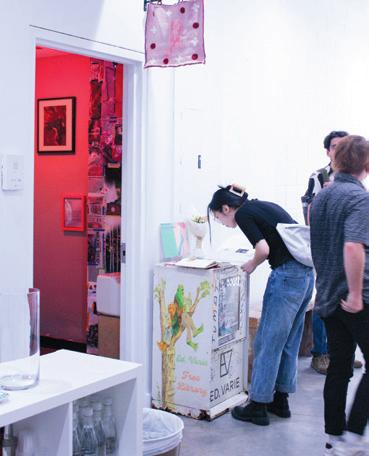
Flush Gallery, an independent, artist-run gallery for emerging artists, takes its name from both the idea of a sudden rush of intense emotion and the fact that its first show was held in a Pratt alumna’s apartment bathroom.
Its founders, Elle Gillette and Xiangni Song, both MFA Fine Arts ’22, met during a time when communities were being formed and reformed in unexpected ways during the COVID-19 pandemic.
Gillette, a multimedia artist studying integrated practices and Song, a painter and illustrator exploring the depths of perception, both worked as monitors in Pratt’s print shop and bonded over their love of illustration and doodling during their free time. It was in the shop where printmaking technician and instructor Caitlin Riordan taught them about an era of Pratt history that would open up new ideas about community-building among artists.
“Caitlin introduced us to the 1980s underground art scene at Pratt,”
Gillette reminisced. Decades ago, Pratt students utilized different spaces outside of the classroom and traditional gallery settings to showcase their work, including the basement of the print shop on campus. Gillette and Song were inspired to tap into the spirit of a grassroots collective for artists in less-expected spaces. Their goal was to “build something that brings artists together to foster community, not competition.”
Gillette and Song were interested in recontextualizing spaces they already had access to, including Gillette’s East Village studio apartment. Subverting the white-walled gallery norm, Flush Gallery was born in Gillette’s apartment bathroom.
Gillette and Song invited Pratt students to participate in Flush through an open call, spread through word of mouth and social media. “I went to MFA thesis shows and reached out to Pratt professors,” Gillette said, and the pair posted dimensions of the space and photos of areas that
Mimicry as Enchantment, 2023
Ten artists’ works explored the themes of mirroring, identity, reflection, and transformation of reality in the red-lit bathroom of Ed. Varie, an East Village gallery.
could accommodate all different kinds of works to generate submissions. About 30 people came to the first show, titled Intimacy, which included small-scale sculpture, photography, prints, painting, and mixed-media works. The grassroots sense of community that Intimacy generated set the stage for future exhibitions. Keeping with the tradition of using bathroom space in different locations, Flush showcased a growing roster of artists from the Pratt community and beyond in two subsequent shows, Mimicry as Enchantment (2023), held at Ed. Varie in the East Village, and Moral Injury (2024), held at Hercules Art Studio in Tribeca.
While Song has stepped back from Flush to focus on her own practice, Gillette continues to work with their shared vision to build community and consider the types of spaces where we view and interact with art. Along with Flush’s show Conditions in January 2026, Gillette is thinking
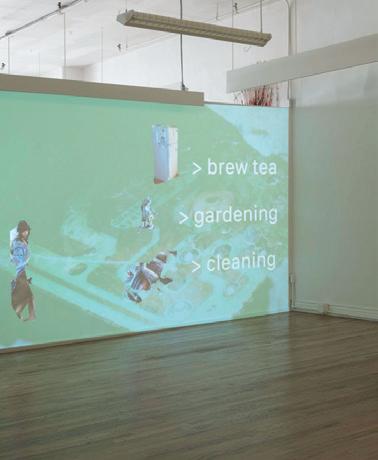
Moral Injury, 2024 Flush Gallery’s third show examined the portrayal of conflict and suffering in our image-saturated era. The exhibition addressed the various internal harms that arise from exposure to actions or events that are in conflict with one’s moral beliefs.
of ways in which the gallery can be more accessible to all digitally.
Gillette also welcomes her fellow artists to help behind the scenes at Flush. “Artists in our shows can be involved as much or as little as they want,” Gillette said. Like it was for her and Song, she believes Flush offers a great opportunity to engage with a creative community that’s invested in one another’s success.
When asked if she had advice for up-and-coming creatives, Gillette emphasized that artists should use their resourcefulness and creativity to their advantage if and when they encounter constraints: “Use whatever tools are available to you right now, be curious and unafraid of failure,” especially when trying something completely new. It’s also important to build and maintain connections as you start out, she says: “Your friendships will take you where you want to go.”
— caroline hibbert
Conditions, 2026
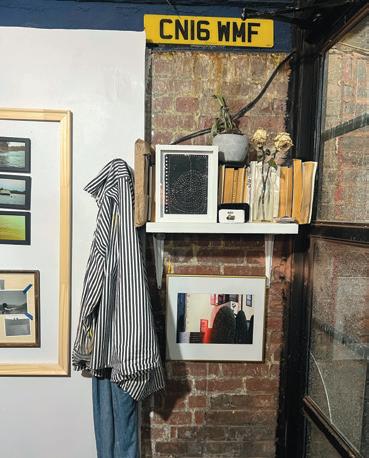
Conditions explored the notion of “compacity,” or as Gillette defines it, the condition of being dense, bound, and contained. The works assembled asked what it means to pack the infinite into the finite, compressing sprawling narratives, sensations, or histories into intense, compact vessels.
Flush Gallery founders Elle Gillette (center) and Xiangni Song (right) with friend Candice Cirilo at Flush’s 2023 show at Ed. Varie.
Home Decor, Accessories, and More from Alumni
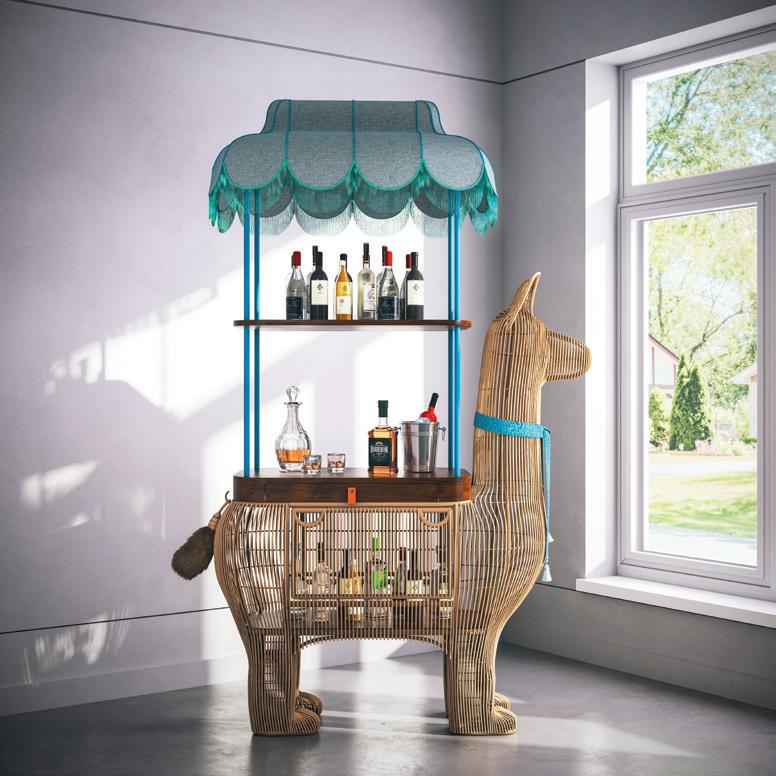
From a pierced baseball cap to a bar cabinet disguised as a llama, new products elevate the everyday with artistry and wit.
1. GUD Florero Cradle
Lynn Lin, MID ’17
Inspired by the radiant sunsets over the mountains of Medellín, Colombia, the Florero Cradle by Lynn Lin provides a colorful “halo” that frames any floral arrangement, from a single stem to a small bouquet. The clean, geometric design encourages a mindful approach to flower arranging, turning a simple task into a daily ritual while adding a focal point to any space. Available at guddddd.com.
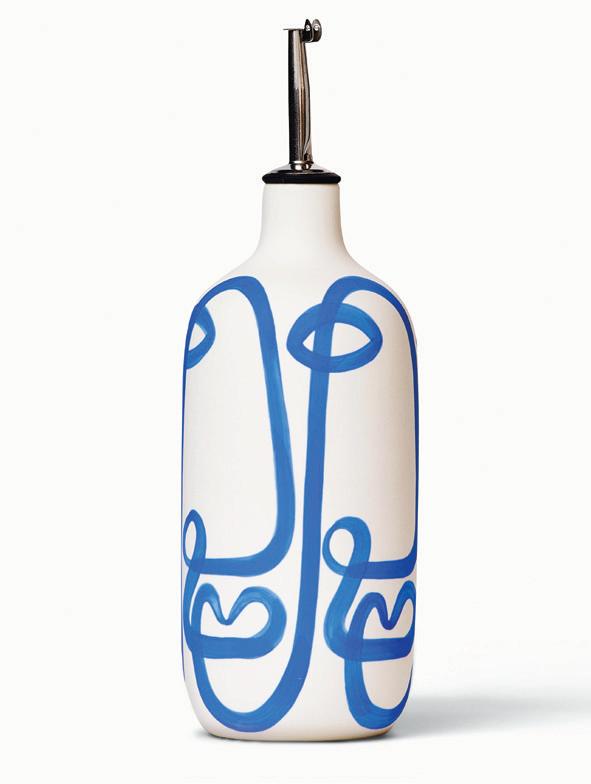
2. Olive Oil Cruet in Cara Cobalt Jazmin de la Guardia, BFA Fine Arts (Printmaking) ’14, and Sierra Yip-Bannicq, BID ’13
This hand-painted porcelain cruet is a collaboration between Jazmin de la Guardia and Sierra Yip-Bannicq, who met at Pratt and together founded the Brooklyn ceramics studio Franca. The nontoxic, dishwasher-safe piece is available in two sizes—short and tall— and in green, terracotta, and black at francanyc.com.
Courtesy of Phaidon.
Courtesy of Kenneth Cobonpue
3. To-Do Tearaway Construction
Notepad
Robert Blair, Rose Wong, Kurt Woerpel, all BFA
Communications Design ’14; Nichole Shinn, BFA Fine Arts ’14; Thomas Colligan, BFA
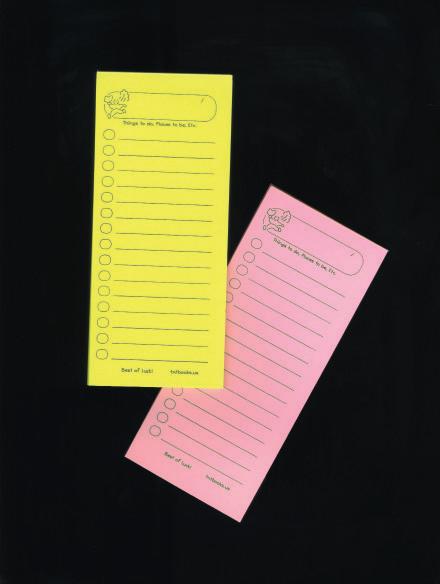
Communications Design ’15 What started as an in-house tool to keep production on track at indie publisher TXTbooks is now available to anyone managing all of life’s “things to do, places to be, etc.” It’s printed on dead-stock construction paper from the publisher’s past projects, which include artist books, zines, and prints. The pad is available in pink and fluorescent yellow at txtbooks.us.
4. Pierced Baseball Hat
Dana Hurwitz, BFA Fashion Design ’12
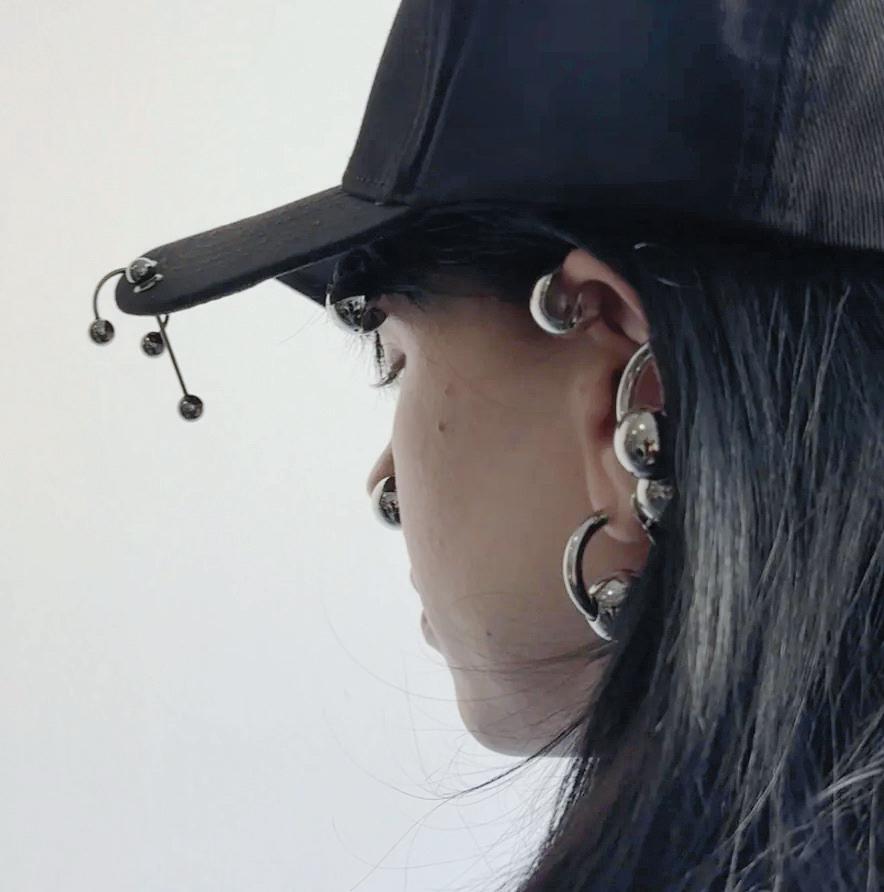
Designer Dana Hurwitz pierces a baseball cap with surgical-grade steel hardware to give the classic accessory an industrial spin. For those wanting a custom touch, the design is offered in two versions: one with hardware installed and another with only the grommets for personalization. Available at bond-hardware.com.
5. Derrick Adams (Monacelli and Gagosian)
Derrick Adams, BFA Art and Design Education ’96
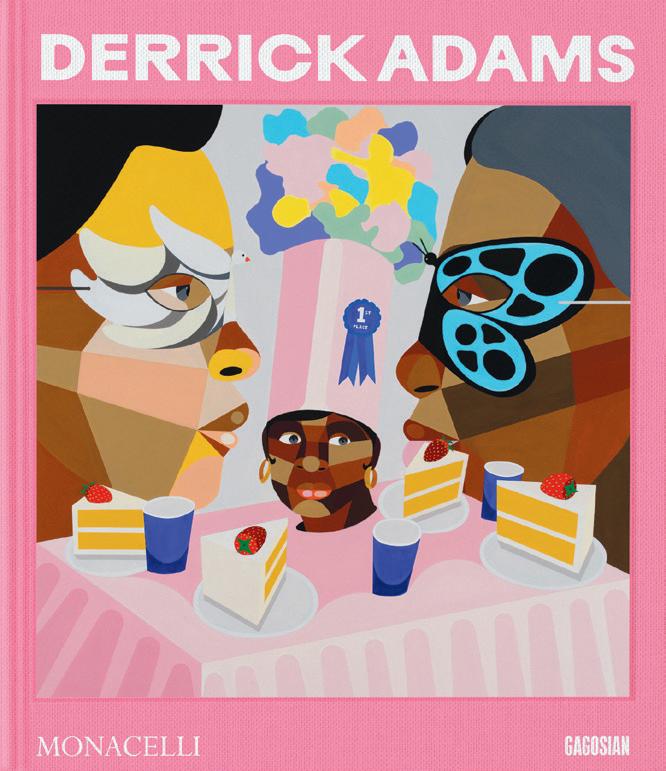
In his multidisciplinary work, artist Derrick Adams creates vibrant, geometric figures to celebrate contemporary Black life and explore narratives of leisure, resilience, and joy. This book is the first monograph to survey his 25-year career. It was published in advance of his major exhibition View Master, on view at the Institute of Contemporary Art/Boston from April 16 to September 7, 2026. Available at phaidon.com.
6. Llama Bar Cabinet
Kenneth Cobonpue, BID ’91
A sturdy pack animal gets a playful spin in this design. The back of this llama features a sanded wooden tabletop and shelf, while its sides—made from hand-woven rattan—open into hidden compartments. The piece comes from industrial designer Kenneth Cobonpue, whom Time magazine called “[rattan’s] first great virtuoso.” Cobonpue was also recognized with a Pratt Legend Award in 2023. Available at kennethcobonpue.com.
7. 18K Eye with Tear Ring
Gabriella Kiss, BFA Fine Arts ’81
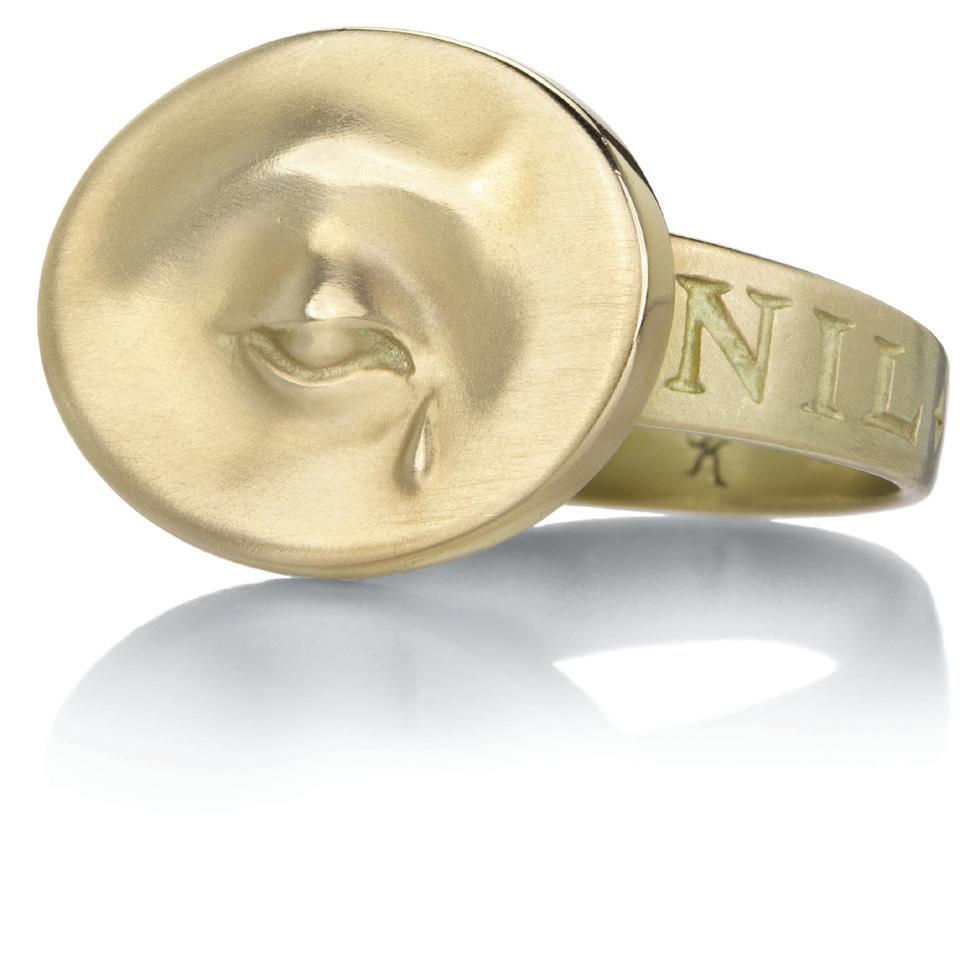
A miniature painting of a paramour’s eye was a fashionable accessory in the 18th and 19th centuries. Reinterpreting this historic form of portraiture, the band of this ring is engraved with the Latin phrase “Nil Nisi Cruce,” meaning “Nothing Without Suffering.” It is part of the “Love Token” series by Gabriella Kiss, who apprenticed under jeweler Ted Muehling, BID ’75, before launching her own studio in the Hudson Valley. Available at quadrumgallery.com.
8. Expansion Sconces
Rob Zinn, BID ’96
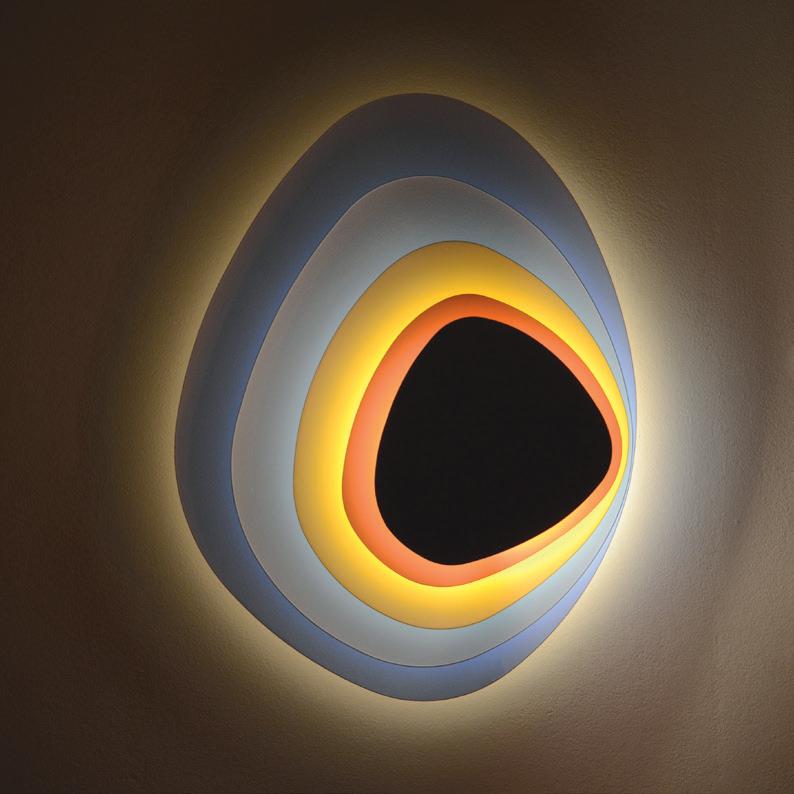
By day, Expansion radiates subtle hues. By night, this layered, lighted sconce transforms as its hidden colors glow brilliantly. Expansion was the original reflective sconce designed by Rob Zinn, cofounder of California-based blankblank. It was recently featured on the acclaimed HBO series Hacks. Available in multiple colorways at blankblank.net.
9. Button Bow Hair Clip in Baroque
Mila Sullivan, BFA Fashion Design ’17
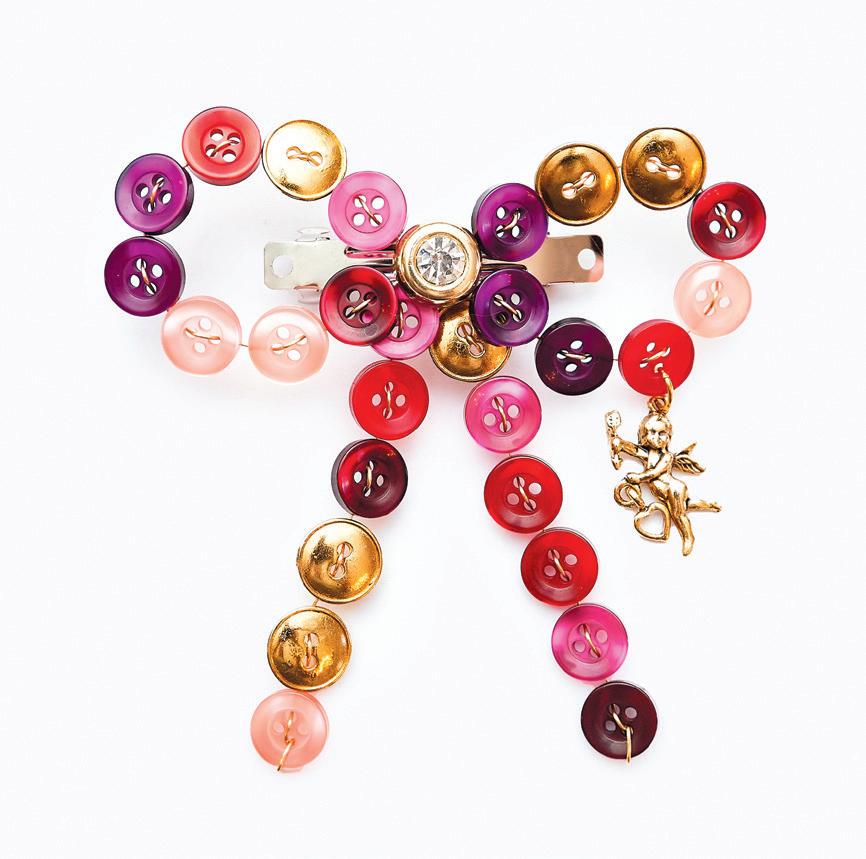
Reinventing buttons and bows, Mila Sullivan crafted this hybrid hair clip that comes with a surprise charm. The accessory is part of the ready-to-wear line that Sullivan produces in Williamsburg, Brooklyn. The collection also includes fanciful slippers, tights, handbags, and more. Available at milasullivan.com.
10. Pigeon Pose Beanie
Sarah Waxman, BID ’10
Inspired by Sarah Waxman’s yoga practice, Pigeon Pose beanies and hats are the ultimate NYC mash-up, bringing together the ubiquitous pigeon and the signature colors of the Mets, Knicks, and Islanders. Waxman’s This Side Up Studio draws inspiration from yoga, mindfulness, and the creative process. Hats, stickers, and more are available at thissideupstudio.com.
7:
Make Pratt your launchpad.
Advance your career, pivot to a new �ield, hone your craft for real-world impact. Whatever your goal, Pratt has a graduate program to meet your ambition.
Build your future in a hands-on, interdisciplinary community at the intersection of practice and theory, with world-renowned faculty and access to New York City’s resources. Explore our 27 graduate programs in architecture, fine arts, design, information studies, and liberal arts and sciences.
Timeless and Innovative
What may no longer serve a personal need can be the very catalyst that helps a student’s career take flight. By converting these assets into a gift for Pratt, you align your personal legacy with values of an institution that never stops creating.
Alumni Notes
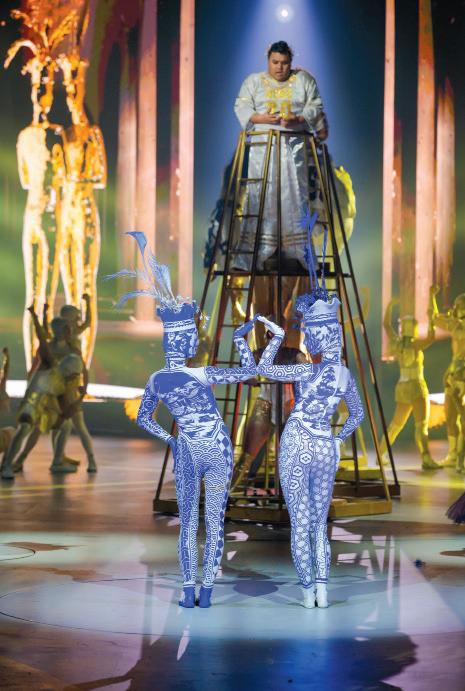
Ben Gould, BID ’08, and Dawn Mostow, MFA Fine Arts ’08, took the World of WearableArt 2025 Supreme WOW Award for their “tribute in latex to Japanese classical ceramics and the mythology of objects.” Read more on page 51.
Alumni Notes is Pratt alumni news highlights compiled from class notes submissions, newsletters, items shared by faculty and staff, and media mentions.
Group Highlights
Terry Winters, BFA Art Education ’71; Carl E. Hazlewood, BFA Fine Arts ’75; Nanette Carter, MFA Fine Arts ’78; and Shahpour Pouyan, MFA Fine Arts ’12, were elected by the National Academy of Design as national academicians in the class of 2025.
Annabelle Selldorf, BArch ’85, and Mickalene Thomas, BFA ’00, were recognized with spots on the annual TIME100 list, which features Time magazine’s picks for the 100 most influential people of the year. Selldorf was recognized for her transformative expansion of The Frick Collection in New York City. Thomas was spotlighted for her internationally touring exhibition Mickalene Thomas: All About Love, which debuted at The Broad in Los Angeles before traveling to London, Toulouse, and Philadelphia. (Time)
Lucy Harris, MS Interior Design ’06, and Michael Warren, MFA Interior Design ’21, of Lucy Harris Studio, designed the interiors for a Brooklyn townhouse featured in global publications such as Brownstoner, AD Italia, and Elle Decoration France. According to the studio, the design infused the homeowners’ love of cooking, design, nature, and travel into the decor. (Lucy Harris Studio newsletter)
Erik Martinez, BArch ’10; Isaac Michan, MArch ’13; and Juan Sala, MArch ’15, earned spots on the inaugural World Architecture Festival and The Architect’s Newspaper “40 Under 40 North America” list. Laura Salazar-Altobelli, assistant professor of undergraduate architecture, was also recognized. (The Architect’s Newspaper)
Jesse Ludington, MS Museums and Digital Culture ’23, and Maddy Heller, MSLIS ’25, presented “Memories of Memorialization: The Presbrey-Leland Memorials Col-
lection at the Woodlawn Cemetery & Conservancy” at the Archivists Round Table of Metropolitan New York Symposium in October 2025. (School of Information newsletter)
Becca Anton and Pranav Dawar, both BFA Film ’25, received recognition from the National Board of Review Student Grant Committee. The program helps young filmmakers complete their projects and exhibit them at film festivals like Sundance and New Directors/New Films. (@prattfilm_video)
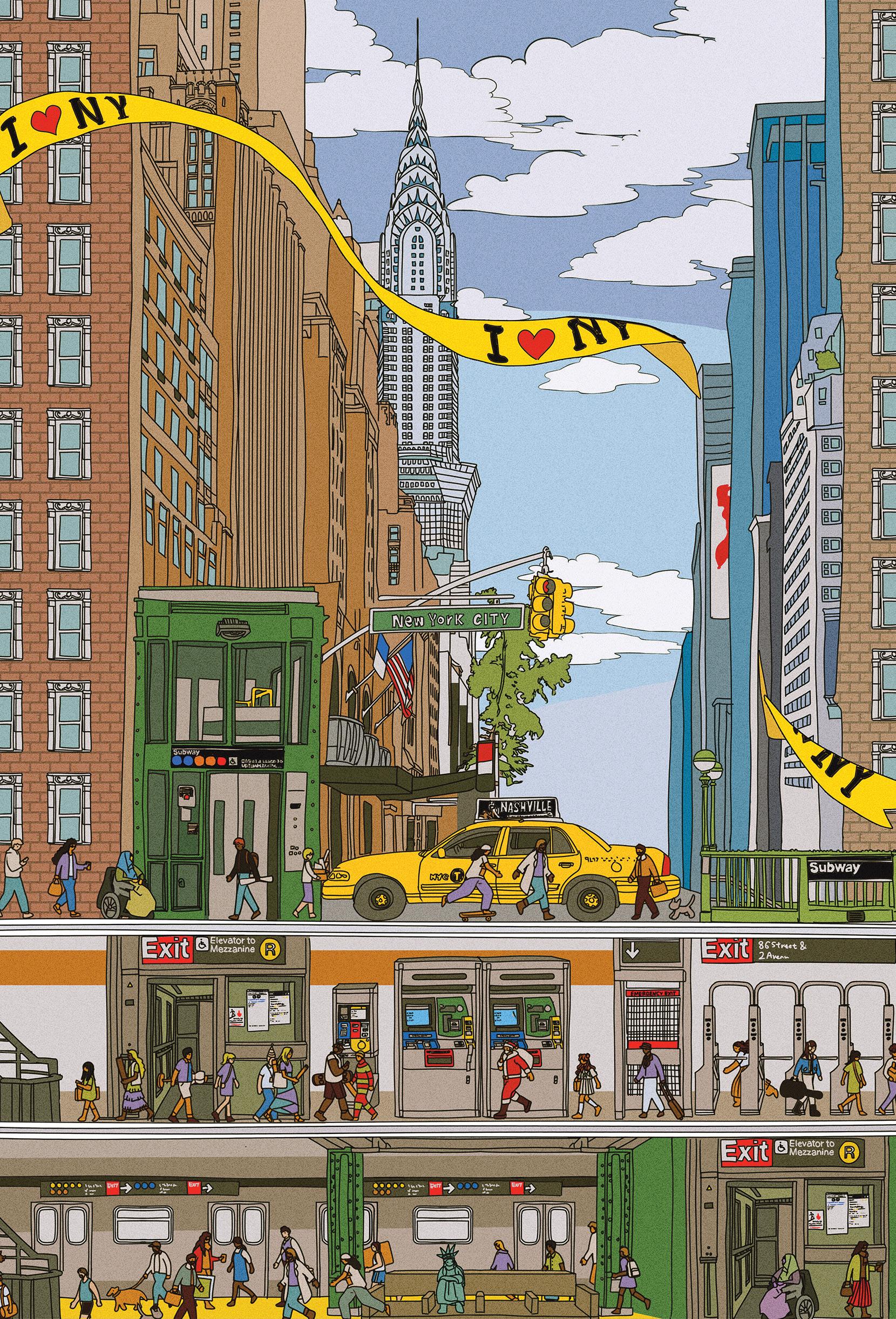
Six Pratt alumni created designs for the 2025 NYCxDesign “Ode to NYC” poster series: Catherine Nina, BFA Communications Design ’24; Sakarit Chankaew, BFA Communications Design ’25; Isabel Chun, MFA Communications Design ’25; Mallory Kurkjian, BFA Communications Design ’25; Yua Maekawa, BFA Communications Design ’25; and Aidan Wesighan, BFA Communications Design ’25. (Poster House)
Ankit Muhury and Emily Sardo, both MArch ’25, won two 2025 SARA NY Design Awards for projects developed in their graduate studios. “Imprints,” from a studio led by Florencia Pita, visiting assistant professor in the Graduate Architecture, Landscape Architecture, and Urban Design (GA/LA/UD) Department, received the Design Award of Excellence, while “The Living Machine,” from a studio with Hart Marlow, MArch ’09, interim assistant chair of GA/LA/UD and adjunct associate professor, earned the Design Award of Honor. (SARA NY)
1950s
Arthur King, BID ’57, exhibited his photographs at Carrie Haddad Gallery in Hudson, New York. Weathered, on view from August 1 to September 21, 2025, included photographs that King took as a student at Pratt and in the following years.
—— Isabel Chun ’25, Underground Hitchhiker, 2025, design for the 2025 NYCxDesign “Ode to NYC” poster series —— Lorna Ritz ’69, Peonies Done, Roses Begun, 2025, oil on canvas, 40 � 50 inches
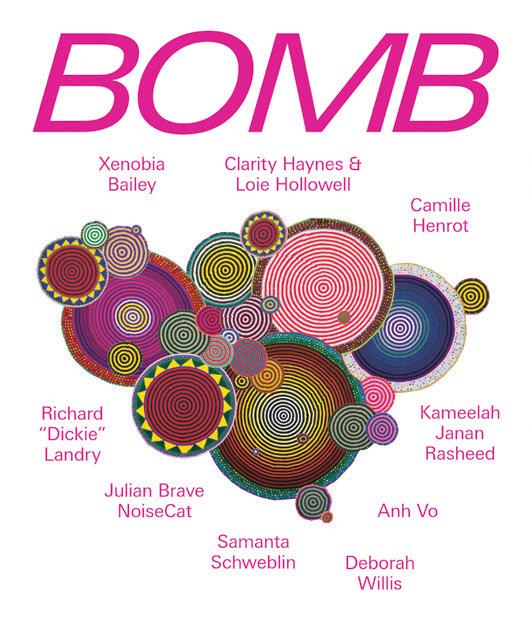
—— Xenobia Bailey ’77, Sun Birthing (1999) featured on the cover of BOMB
1960s
Lorna Ritz, BFA Fine Arts (Painting) ’69, received her first solo exhibition in New York with Lorna Ritz: Paintings, on view at YveYANG Gallery from July 11 to August 16, 2025. Ritz, who trained under James Gahagan (1927–1999) at Pratt Institute, is a MacDowell Fellow whose work is held by museums including the Hood Museum of Art, Dartmouth, and the Anderson Museum of Contemporary Art.
1970s
Michela Griffo, MFA Fine Arts ’70, presented new paintings in a solo exhibition at Moskowitz Bayse in Los Angeles. Who’s Laughing Now? was on view from November 8 to December 20, 2025.
James Vincent Griffin, BFA Fine Arts ’72, has illustrated over 4,000 book covers over the past 50
years. In 2025, he had his vintage romance book cover artwork in an exhibition, Romancing the Novel, at McDaniel College in Westminster, Maryland. In 2022, he opened the Griffin Art Gallery in Jonesborough, Tennessee, where he teaches weekly classes. Last year, he had a solo exhibition, Tapestry of Movement, at the William King Museum in Abington, Virginia, featuring paintings from the past five decades.
Elaine Norman, BFA Fine Arts ’72, created the cover art for the book How Do You Wear The Universe?: Poems & Essays: 2002–2025 by Steve Zeitlin, published by MediacsBooks in January 2025. She also continued her series of personal collage books with the publication of Otherwise Engaged: Weekly Collages from the Year 2020
George Ranalli, BArch ’72, designed the “Valentine #2” Chair, which entered the collection of The Metropolitan Museum of Art in
Previous page and this page:
Courtesy of the artists
1990. A drawing for this chair was on view at the Paul Rudolph Institute for Modern Architecture from July 2 through September 20, 2025, in the exhibition Architecture = Art: The Susan Grant Lewin Collection, curated by Eshaan Mehta, BArch ’26. (Designer’s newsletter)
B. Robert Johnson, BFA Fine Arts ’73, received two awards for his work at SUNY Ulster’s arts and literary magazine, including the Gold Medallion Award for logo design for the National Council for Marketing & Public Relations and the SUNY CUAD for excellence in creativity for magazine design. He serves as the director of printing and graphic services at SUNY Ulster, where his paintings and drawings were recently on view at the Muroff Kotler Visual Arts Gallery in the exhibition time Again
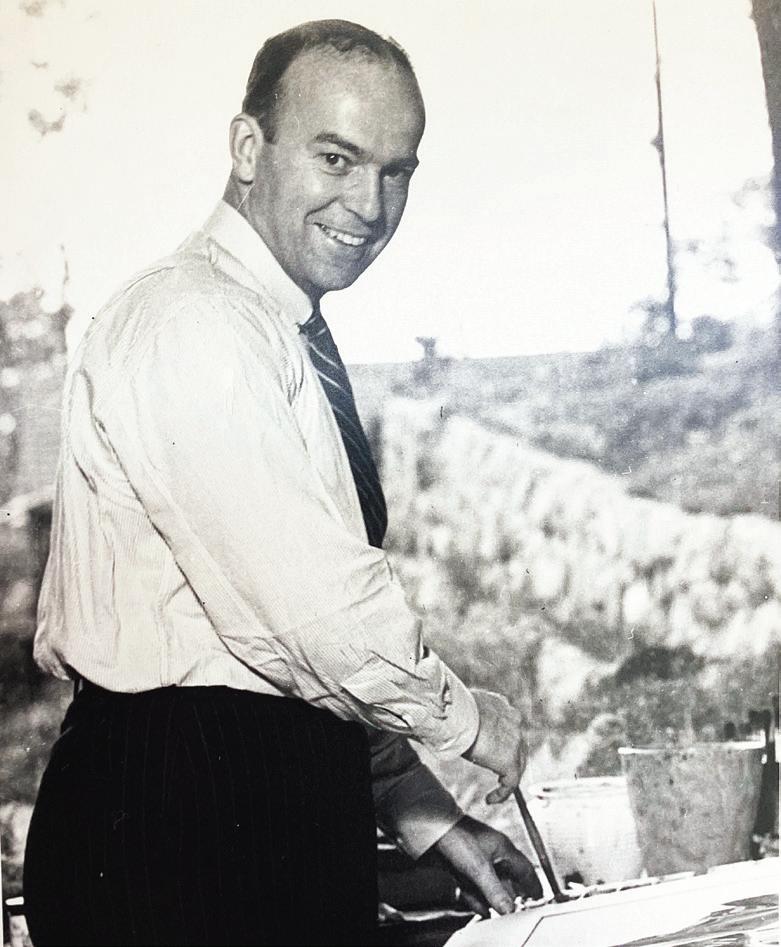
John F. Gould, General Art ’26 (1906–1996), was the subject of a feature article in The Saturday Evening Post, authored by his son, Robert Gould. A prolific illustrator, particularly during the 1940s, Gould created thousands of pieces for the Post and other publications. The article highlights his 70-year career, his collaborations with writers such as Roald Dahl, and his artistic process. Gould also taught art at Pratt Institute for 22 years.
Gould’s first illustration for the Post was for the story “Song for a Handsaw” by Dorothy Thomas in the August 23, 1941, issue, marking the beginning of a major chapter in his professional career. Before his Post tenure, Gould illustrated some 15,000 pen-and-ink drawings for pulp magazines during the Great Depression. The Gould family donated the original framed artwork for “Song for a Handsaw” to the Norman Rockwell Museum in 2014, where it now resides in the permanent collection. (The Saturday Evening Post)
Michael Garland, BFA Communications Design ’74, won the Society of Illustrators 2025 Stevan Dohanos Award for his oil painting Owl Face. He also won the California Reading Association’s 2024 EUREKA! Silver Award for nonfiction children’s books for We’re Not Weird: Structure and Function in the Animal Kingdom, which he wrote and illustrated. Garland has written and illustrated over 30 children’s books over the course of his career.
Ken Aptekar, MFA Fine Arts ’75, had his first European solo exhibition of illuminated manuscripts at Le Clezio Gallery in Paris this spring. Previous exhibitions of the manuscripts were held at the Tibor de Nagy Gallery in New York and Wasserman Projects in Detroit.
C Bangs, MFA Fine Arts ’75, is a featured artist for Cornell’s Alpha CubeSat, a cube-shaped satellite that features the first holograms in space. Alpha’s holograms feature exposures of C Bangs’s clay sculptures, with a moth, fish, man, woman, and cat serving as ambassadors for life on Earth.
Xenobia Bailey, BID ’77, had her hand-crocheted artwork Sun Birthing (1999) featured on the cover of the fall 2025 issue of BOMB. The issue also featured an oral history of the artist in conversation with Terence Washington, as well as a conversation between Deborah Willis, MFA Photography ’79, and Kalia Brooks. (@prattbap)
Phoebe Farris, PhD, MPS Art Therapy ’77, curated the exhibition Bernard/Bernie Boston Retrospective: A Photojournalist, Social Justice Advocate, and Family Man, on view at two sites in McLean, Virginia. Farris also exhibited four photographs and wrote a catalog essay for the group exhibition Decolonial Pilgrimage, on view from October 6, 2025, to January 9, 2026, at Stockton University’s Noyes Galleries at Kramer Hall in Hammonton, New Jersey.
Deborah Willis, PhD, MFA Photography ’79, and Philip Brookman cocurated the exhibition Photography of the Black Arts Movement,
1955–1985. Following its debut at the National Gallery of Art in Washington, DC, it is touring to the J. Paul Getty Museum in Los Angeles and the Mississippi Museum of Art in Jackson in 2026. The exhibition examines how artists used the camera to shape Black identity, document the Civil Rights Movement, and foster community empowerment. (NGA)
1980s
Lisa Corinne Davis, BFA Fine Arts ’80, had her second solo exhibition at Miles McEnery Gallery in
John Gould in his studio in Queens Village, NY, 1946. Courtesy of Robert Gould
New York. Syllogism was on view from September 4 to October 25, 2025. In a review in Hyperallergic, critic John Yau writes, “It is amply clear to me that Davis has made geometric abstraction germane to our swiftly changing, downward spiraling times, and that is no small accomplishment.” (Hyperallergic)
Greer Lankton, BFA Fine Arts ’81 (1958–1996), was posthumously recognized with her first monograph, Could It Be Love, published by Weitzman’s Magic Hour Press in October 2025. The book project, featuring text by Hilton Als, was initiated by artist and activist Nan Goldin, who was Lankton’s friend and roommate in the early ’80s, and the editors Jordan Weitzman and Francis Schichtel. (T Magazine)
Illya Azaroff, MS Construction Management ’97, was inaugurated as the 102nd president of the American Institute of Architects (AIA) in December 2025. An internationally recognized leader with over 30 years of experience in resilient design and disaster response, Azaroff is the founder of +LAB architect, a firm focused on building resilient capacity for underserved communities. He is also a professor at New York City College of Technology and has served AIA in several key roles, including as the 2021 AIA New York State president and as founder of the Design for Risk and Reconstruction committee at AIANY. “Architects are at the forefront of designing buildings and spaces that can withstand nature’s fury. As AIA President, I will work to ensure architects are empowered to create communities that are better prepared to deal with future disruptions,” Azaroff stated in his inaugural address. (AIA.org)
Bruce Southard, BFA Communications Design ’81, published his novel A Final Harvest. He writes, “For all of us who dream about a return to the land and the simple good life we knew, this novel provides unflinching, informative, and sometimes humorous detail on the work that life required. It is a coming-of-age story as well as a story of aging and the end of life in modern-day America.”
Charles Freeman, BFA Communications Design ’82, opened Gallery Charles in the Palm Beach area. The gallery features a selection of his limited-edition photographic works on metal—many captured in and around Paris, including in Versailles—that reimagine classic French architecture, historic
interiors, and other spaces, such as mid-century airport lounges, in refined, large-scale compositions.
Rotimi Fani-Kayode, MFA Fine Arts ’83 (1955–1989), was featured in the “Overlooked No More” section of The New York Times. The article posthumously recognizes the photographer as “a pioneering figure in Black British art whose rebellious, symbol-rich images explored race, queerness, desire and spirituality.”
(The New York Times)
Dustan Knight, MFA Fine Arts ’83, had a solo exhibition, Creative Joy, on view at the York Public Library in Maine from September 4 to October 31, 2025. A MacDowell Fellow and arts educator, Knight states, “I work in several styles that I return to continuously—ambiguous narratives inspired by overheard snippets of life, abstract landscapes that express my experiences in nature, and playful works that explore themes of chaos, humor, and joy.” (York Public Library)
Moses Ros, BArch ’83, a sculptor, painter, and printmaker, served as the artist-in-residence at the Bruce Museum in Greenwich, Connecticut, from February to August 2025. The body of work he created during his residency, HUMAN / NATURE, was on view at the museum from October 8, 2025, to January 4, 2026.
Lew Holzman, MSLIS ’84, most recently showed his digital art made with AI technologies at the
Azit Gallery in Seoul, South Korea. A published poet and recipient of an artist’s grant from the Massachusetts Cultural Council, he moved from photography to digital media before incorporating AI into his practice. “My library degree afforded me the opportunity to work with information and share that, but also gave me the time to be a creative,” Holzman says.
Meryl Lettire, BFA Communications Design ’86, writes that she found success as a commercial illustrator and is now a full-time studio artist focused on “socially engaged textile portraiture.” Her series Heroes of the Holocaust was on view from September 2 to December 8, 2025, at the Human Rights Institute Gallery at Kean University in Union, New Jersey, following a solo exhibition that also included the series The Madonnas at ArtWRKD in Newtown, Pennsylvania.
Keep up with the latest alumni updates and submit yours. Visit the new Alumni News and Events page.
pratt.edu/alumni/news
Courtesy of the artist
Photo by Stacy Moses. Courtesy of AIA
Kate Buehner, MPS Art Therapy and Creativity Development ’87, had a solo exhibition of new paintings, Activation of Shapes, Color and Design, on view from August 28 to September 7, 2025, at River Arts in Damariscotta, Maine. During her career in mental health, Buehner maintained an active art practice. Now retired, the Maine resident creates work from a studio in her home’s attached barn. (Times-Record)
Valery Rizzo, BFA Communications Design ’88, published a book titled Brooklyn 2007–2023 (Kehrer Verlag). The book features Rizzo’s photography made with plastic toy cameras between 2007 and 2023, chronicling a period of major change in the borough through the eyes of a native Brooklynite.
Emilio Sosa, BFA Fashion Design ’89, created the costumes for Jesus
Christ Superstar staged at the Hollywood Bowl from August 1 to 3, 2025, starring Tony Award winner Cynthia Erivo. (Playbill)
1990s
Michelle Frick, BFA Film ’91; MFA Fine Arts (Sculpture) ’23, had two sculptures featured in the group exhibition Trees, we breathe, on view from May 31 to November 30, 2025, at Wave Hill in the Bronx, New York. The presentation reflected on the vital role of trees in ecosystems, and Frick’s sculptures engaged with the legacy of the American chestnut tree, a once-thriving species decimated by blight to functional extinction. (School of Art newsletter)
Gisela Romero, MFA Fine Arts ’92, presented new drawings in
—— Jason Karolak ’97, Kaffrine, 2025, gouache, ink, and acrylic on paper, 15 � 17 inches —— Jay Kaplan ’98, Heart Moorings —— Tina Periquet ’94, lobby of Arya Residences —— Lew Holzman ’84, Slowly Disappearing
the exhibition WE, on view at the Orange County Administration Center in Orlando from September 29, 2025, to January 27, 2026. The works were inspired by the faces of people Romero saw from the window in her studio overlooking one of Orlando’s busiest thoroughfares. (Orlando Weekly)
Tina Periquet, MS Interior Design ’94, was honored with the Ani ng Dangal Award by the Philippine National Commission of Culture and the Arts in 2025. She is principal of Periquet Galicia, a design atelier based in Manila. The firm’s major projects include the Philippine National Museum of Natural History and Arya Residences, the only certified LEED gold residential building in the Philippines.
Jean Shin, BFA Fine Arts (Painting) ’94; MS Art History and Criticism ’96, received a solo exhibition at the Samuel Dorsky Museum of Art at SUNY New Paltz. On view from September 6 to December 7, 2025, Jean Shin: Bodies of Knowledge brought together “key works that consider how lived experience, labor, and shared memory continue to inform how we learn, remember, and communicate,” according to the museum. Shin, an adjunct professor in Pratt’s Fine Arts Department, was also recently awarded a Pollock-Krasner Foundation grant. (Pollock-Krasner Foundation)
Jason Karolak, BFA Fine Arts (Painting) ’97, received a solo exhibition at Robischon Gallery in Denver. Peregrine featured recent oil paintings and water-based paintings on paper inspired by Karolak’s experiences in Senegal. It was on view from October 16 to December 31, 2025.
Jay Kaplan, MFA Sculpture ’98, was awarded a two-week residency as part of the Arts and Science Residency Program through the Peaked Hill Trust at the historic Ray Wells Dune Shack in Truro, Massachusetts. He writes that he spent
time “off the grid” in the dunes while working on his Heart Mooring sculptures and other pieces for his latest body of work, Wrecked.
Jill Loewenthal, MPS Design Management ’98, had an exhibition of paintings, Unstill Life, at the Spring Street Gallery in New Shoreham, Rhode Island, from August 22 to September 4, 2025. The Block Island Times wrote that Loewenthal “invites viewers to pause, reflect, and rediscover beauty in natural and man-made objects—such as ripe fruit or a woven basket—rendered with energy and emotional depth.” (The Block Island Times)
Saba Besier, MFA Fine Arts ’99, presented an installation of ceramic sculptures at the Old Jail Art Center in Albany, Texas. Deep Resilience, on view from June 7 to September 6, 2025, featured coral-like formations to “explore and celebrate the concept of oceanic organisms’ ability to adapt, survive, and build biodiverse habitats on man-made structures, where natural habitats have been eradicated due to pollution, overfishing, coastal development, and climate change,” according to the artist. (Old Jail Art Center)
Debbie Han, MFA Fine Arts (New Forms) ’99, received a solo exhibition at the Youngeun Museum
Courtesy of the alumni
of Contemporary Art in Gwangju, Gyeonggi-do, Korea, as part of an artist residency. Odyssey of Becoming: SHADOW PEOPLE, on view from October 28 to December 28, 2025, featured new works exploring “the complexities of human identity in the digital age,” according to the artist.
2000s
Jen Pawol, BFA Fine Arts (Painting) ’00, became the first woman to umpire a regular-season MLB game during an August 9 doubleheader between the Miami Marlins and the Atlanta Braves at Truist Park in Atlanta. As a Pratt student, she balanced her studies with umping softball games on the weekend. (Referee)
Sarah Krasley, BFA Fine Arts (Sculpture) ’01, was appointed a visiting fellow at Cornell Universi-
ty’s School of Industrial and Labor Relations, where she is researching the intersection of automation and climate adaptation in industrial labor markets. Krasley is also the founder of Shimmy, an ed-tech company that upskills and retrains factory workers for the age of automation. Shimmy recently trained its 12,000th worker.
Eddie Bautista, MS City and Regional Planning ’02, and New York City Councilmember Alexa Avilés coauthored an op-ed in The Brooklyn Daily Eagle examining the proposed Brooklyn Marine Terminal redevelopment plan. Bautista serves as the executive director of the New York City Environmental Justice Alliance. (The Brooklyn Daily Eagle)
Mika Song, BFA Film ’02, wrote and illustrated a new children’s graphic novel. Night Chef: An Epic Tale of Friendship with a Side of Deliciousness! was published
—— Chrissy Angliker ’06 and her studio neighbor, jewelry designer Vanessa Perel-Panar, in The Candy Factory, 2020 —— Mika Song ’02, Night Chef: An Epic Tale of Friendship with a Side of Deliciousness!
—— Radical Acts of Unrelenting Beauty, featuring design direction by Jared Lairmore ’04
—— Laura Terry ’04, Adorable Empire
by Random House Graphic in October 2025. The story centers on a lonely raccoon chef who must leave the confines of the restaurant where she secretly lives to reunite a baby crow with his family. (Publishers Weekly)
Camille Wainer, BFA Communications Design ’02, has artwork and animation featured in Lemurs in Art, a limited-edition art book published by the Lemur Conservation Foundation to raise awareness of issues that threaten the future of wildlife on Madagascar. Wainer’s flash animation MadagaSCARS is held in the Foundation’s permanent collection.
Tom Yeaton, BFA Communications Design ’03, is a senior designer who built a career in strategic creative consulting and design with clients including New Balance, International Justice Mission, Kodiak, and Rios Partners. For 16 years, he worked as a consultant for Timberland, with projects that included numerous logos, catalogs, and a window display at Macy’s Herald Square. At Pratt, Yeaton was a scholarship awardee whose achievements were recognized at an event keynoted by advertising designer Stan Richards.
Tomokazu Matsuyama, MS Communications Design ’04, received a solo exhibition at the SCAD Museum of Art. Liberation Back Home, on view from August 1, 2025, to January 4, 2026, featured paintings and large-scale works that artnet News said “reverberate with West Coast skate energy.” (artnet News)
Laura Terry, BFA Fine Arts (Painting) ’04, published her second fantasy graphic novel, Adorable Empire, with Scholastic in August 2025. Described as “engagingly original” in Kirkus Reviews, the story focuses on a middle schooler named Jinx who is struggling with bullies, her parents’ divorce, and moving to an unfamiliar apartment. When a magic crystal unleashes a band of supernatural forest creatures into her life, Jinx learns to accept the changes in her life and to find happiness once again.
(Kirkus Reviews)
Jared Lairmore, BID ’04, served as the design director for Radical Acts of Unrelenting Beauty, an immersive performance by Jordan Roth that took place at the Louvre Museum in Paris, France, on July 10, 2025.
Samantha Black, BFA Fashion Design ’05, founder and designer of Sammy B, headlined the 16th annual Finale Runway Show during Fashion Week Columbus in September. Black, a contestant on the series Project Runway and Project Runway All Stars, trained at the London atelier of Alexander McQueen before launching her own label. Her designs have been worn by Beyoncé, Rihanna, Gabrielle Union, Nicki Minaj, Keke Palmer, and other celebrities. (Columbus Fashion Council)
Chrissy Angliker, BID ’06, shared warm memories of the artistic community that formed around her Clinton Hill studio space of 14 years, which was recently featured in a short documentary film produced by Jason Schmidt and Cory Jacobs, The Candy Factory, available to stream for free on The New Yorker’s YouTube page. Angliker writes, “We need more counterculture built on love, respect, and creativity.” (Artist’s newsletter)
Mark Grattan, BID ’06, launched his debut collaboration with HBF
Courtesy of the alumni
Textiles. The collection, featuring three patterns inspired by Grattan’s creative journeys in New York City, Mexico City, and Rio de Janeiro, was awarded the Interior Design HiP Award for Best Hospitality Fabric and Textiles in 2025. (Hospitality Design)
Duke Riley, MFA Fine Arts (Sculpture) ’06, received a survey exhibition at Virginia Museum of Contemporary Art. O’er the Wide and Plastic Sea, on view from February 7 to August 31, 2025, was highlighted in Virginia Living (Virginia Living)
Phoebe Robinson, BFA Writing ’06, released a new comedy special, I Don’t Wanna Work Anymore, on YouTube in October. (The Hollywood Reporter)
Liz Hannah, BFA Film ’07, will collaborate with author Liz Moore to adapt Moore’s bestselling novel The God of the Woods for Netflix. Hannah and Moore will serve as co-showrunners, writers, and executive producers. (Variety)
Serban Ionescu, BArch ’07, had a solo exhibition at PLUS-ONE Projects in Antwerp. Vicus, on view from August 30 to October 4, 2025, featured new drawings and paintings. The artist told The Observer (UK), “Everything emerges from an act of drawing. I think there are three organs of thought: the mind, the stomach and the hand—and I rely a lot on the hand.” (The Observer)
Hiba Schahbaz, MFA Fine Arts ’12, received her first solo museum exhibition, The Garden, at the Museum of Contemporary Art North Miami. The presentation, which was on view from November 5, 2025, to March 16, 2026, featured more than 70 works exploring themes of fantasy, heritage, and selfhood. The retrospective was framed conceptually through the idea of the jannat, or “Paradise Garden,” an idyllic space referenced in Islamic tradition and Sufi poetry. The curatorial layout drew inspiration from the Persian and Mughal char-bagh, a quadrilateral garden divided by water channels. Schahbaz’s practice is rooted in the tradition of Indo-Persian miniature painting but has expanded to include large-scale compositions and installations that merge autobiographical and mythological elements. Vogue described the exhibition as “breathtaking” in a feature article, praising the artist’s “intuitive, almost spiritual” process. (Vogue)
Alyona Makeeva, MID ’07, is working as a lead visual merchandising designer at Estée Lauder. For the past two years, she has collaborated with the brands Kilian Paris and Frederic Malle. Her work includes design and production for Macy’s Holiday Windows, pop-ups at Bergdorf Goodman, and a booth at the Sephora Conference in Las Vegas.
Ben Gould, BID ’08, and Dawn Mostow, MFA Fine Arts ’08, won the Supreme WOW Award at World
of WearableArt 2025 for latex garments inspired by Japanese tsukumogami. Mostow and Gould met as students at Pratt Institute and married in 2011. Their garments have been worn by celebrities like Katy Perry and Beyoncé and featured in Vogue
Lizbeth Murphy, BFA Art and Design Education ’08, ran the 2025 New York City Marathon in support of Self Help Africa, an organization with a mission to empower rural
women entrepreneurs across the continent.
Robert Yerachmiel Sniderman, BFA Writing ’09, made the film Night Herons with Joanna Rajkowska for the 2020 edition of the Austrian contemporary art festival Steirischer Herbst. Following its presentation in Joanna Rajkowksa: Night Herons at the gallery Lokal_30 in Warsaw, the film received the 2024 ING Polish Art Foundation Grand Prize, was screened at the
Photo by Charlie Rubin. Courtesy of the Museum of Contemporary Art North Miami
National Museum of Modern and Contemporary Art, Korea, and entered the permanent collection of the Museum of Modern Art in Warsaw.
2010s
Daniel Lopatin, MSLIS ’10, scored the film Marty Supreme, directed by Josh Safdie and released by A24 on December 25, 2025. Lopatin, also known as Oneohtrix Point Never, previously scored the Safdie Brothers’ features Good Time (2017) and Uncut Gems (2019). (School of Information newsletter)
Oleg Lyamin, BArch ’10, was promoted to senior associate at Huntsman Architectural Group in October 2025. Over the course of his career, Lyamin has provided technical leadership on projects for Colliers, Moody’s, Hines, Silverstein Properties, Flagstar, and Citizens Bank.
Nick Pedersen, MFA Digital Arts ’11, was awarded an artist grant by Bloomberg Philanthropies’ Public Art Challenge to represent Salt Lake City (one of eight cities selected nationally to receive $1 million for temporary public art projects addressing urgent civic issues). His project, Here Today, Gone Tomorrow, featured two opposing billboards highlighting the decline of the Great Salt Lake and its potential ecological and economic impacts on the city, state, and region.
Cory Sellers, MFA ’11, was a featured artist in the annual Winter Group Show at Houska Gallery in St. Louis. Sellers’s presentation, titled Immediate Connections, was
on view from December 5, 2025, to March 7, 2026.
Liu Kincheloe, MFA Fine Arts (Painting and Drawing) ’12, received her first solo exhibition. Chirality was on view at the Turley Gallery in Hudson, New York, from September 20 to November 2, 2025. (School of Art newsletter)
Kevin Griendling, AIA NCARB, BArch ’13, launched PrepARE, a comprehensive Architect Registration Exam prep series, in partnership with AIA East Bay. Griendling writes that the program blends on-demand video, community learning, and practice exams “to help demystify the ARE and strengthen career readiness through strategic study design and professional mentorship.”
Noor Ahmed, BFA Fine Arts ’14, was named curator of the fifth edition of the Karachi Biennale (KB27), scheduled to open in January 2027. Organizers say the event “aims to push boundaries, spark dialogue, and reimagine the role of contemporary art in Pakistan’s cultural landscape.” (Karachi Biennale Trust)
Bill Levay, MSLIS ’15, visiting assistant professor in the School of Information, spoke at the Creative Operations Summit in New York. Levay shared how the New York Philharmonic’s archives play a role in the organization’s marketing, storytelling, and audience engagement. (Henry Stewart Conferences)
Judy Yi, BFA Fashion Design ’15, is launching MOONLIT+ silk sleep goggles, a reimagined sleep mask. Yi writes that the patent-pending design “blends blackout comfort with skincare-friendly innovation.”
Izzy Nova, BFA Fine Arts (Drawing) ’16, cocurated the exhibition Artist Narrator: The Art of Storytelling in Contemporary Painting, on view at the nonprofit organization Art House Productions in Jersey City, New Jersey, from September 6 to September 28, 2025. (Artist’s newsletter)
Aarushi Agni, MFA Writing ’17, inaugurated the Writing program’s alum-in-residence program in fall 2025. The initiative is designed to connect cohorts of Pratt writers and help current students understand the career paths that are open to them. A writer, comedian, singer, artist, and educator, Agni performed her show EMOJI: Or how I stopped worrying and learned to send the risky text at Pratt in November.
Rafaella Castagnola, BFA Communications Design ’17, presented Urbe Infinita (Infinite Metropolis), a multimedia solo exhibition that opened in May 2025 in Lima, Peru. The exhibition explored Lima’s evolving landscape of self-built architecture through the Google Maps archive, photography, video, and family stories to reflect on the city’s continuous process of growth and change.
Anika Jade Levy, BFA Writing ’17, published her debut novel Flat Earth (Catapult), which The New York Times described as “funny and sharp.” (The New York Times)
Jive Poetic, MFA Writing ’17, was one of three spoken word poets featured at the Adirondack Center for Writing’s Poetry on Broadway program. Poetic, whose memoir
Skip Tracer was published by W.W. Norton in 2024, is the founder of Insurgent Poets Society and Carnival Slam: Cultural Exchange and the cofounder of the Brooklyn Poetry Slam. (Adirondack Almanack)
Erik Troy, BFA Film ’17, began his career directing commercials in the Boston area. He is currently living and working in the film industry in Southern California, where he is developing his first feature film, Calameda Road.
Chris Rutledge, BFA Digital Arts (3D Animation) ’18, won the animated series competition at the 2025 Ottawa International Animation Festival for Eggland, which he directed with Cole Kush. (OIAF)
Isabelle Brourman, MFA Fine Arts ’19, received the New York Press Club’s Continuing Coverage–National Magazine Award in October 2025 for her illustrations for the “Trump on Trial” series in New York Magazine. (New York Press Club)
Jungwon Phee, BFA Fine Arts ’19, was selected through a competi-
tive open call process to present his work at the SOMA Museum of Art in Seoul, South Korea. 51 Into Drawing: Archival Painting, on view from September 26 to November 2, 2025, featured over 300 paintings and a large-scale installation.
Ava Rikki, BFA Film ’19, made the 2026 Forbes 30 Under 30 list in the Marketing and Advertising category as a director. Rikki writes, “I’m incredibly grateful for the education, mentorship, and community I found at Pratt. So many of the skills
and values I carry into my career today were shaped there, and I’d love to share this milestone with the alumni community.”
2020s
Paolo Balboa, MSLIS ’20, was appointed the chief digital equity officer for the City of New York. In this role, he will implement New York City’s plan to ensure that all New Yorkers have access to broadband internet service and the skills training they need to apply for jobs, fill their prescriptions, apply for child care, and complete other essential tasks. (NYC Office of Technology and Innovation).
Jason Chen, BID ’21, founder of Studio Chen, was recognized among Architectural Digest’s 2025 New American Voices. The highlight noted that Chen began his career working for Billy Cotton, BID ’07, before launching his own studio, where “he has developed his own style while remaining attuned to client needs—whether leaning into the Colonial Revival spirit of a Berkshires house or conjuring a new Manhattan dining concept for the team behind Jupiter and King.” (Architectural Digest)
Avery Toomes, BFA Writing ’22, contributed an essay to Empa-
—— Nick Pedersen ’11, Here Today, Gone Tomorrow —— Noor Ahmed ’14 —— Johnny Xie ’25 with his award-winning chair design, Pivota —— Jason Chen ’21 —— Michael Ortiz Jiménez ’24 and Paula Stoddard Sotomayor ’24 (Estudio PM), Herencia Tótem
thy Impact: The Wild Effects of Kindness in Action, published by Sulit Press Books in December 2025. The volume highlights stories of how acts of empathy created change in individual lives and communities, with proceeds donated to Louder Than Silence, a nonprofit offering free therapy and support services to survivors of sexual violence. (Pratt Writing Alumni Listserv)
Mackie Mallison, BFA Film ’23, was chosen for the inaugural 2025 Sundance Institute Filmmakers Fund, which awards grants to emerging artists.
Joe Turpin, MFA Fine Arts (Painting and Drawing) ’23, is among the artists featured in the exhibition Proverbs, Adages, and Maxims, on view at Heller Museum at Hebrew Union College from August 18, 2025, to June 24, 2026. Turpin’s work, You Can’t Hold a Candle To It! (The Beastie Boys as Shadrack, Meshack and Abednego) recasts a story from the Book of Daniel about three men who were rescued by divine intervention after they were thrown into a furnace. (School of Art newsletter)
Izzy Chavez, BFA Digital Arts (2D Animation) ’24, had their work, Adam and Eve in the Kingdom of Animals, screened at the 2025 Annecy Festival. (MUBI)
Isabela Fraga-Abaza, BFA Digital Arts (2D Animation) ’24, received the Stephen Hillenburg Animation Honor from the Princess Grace Awards following a nomination by Princess Grace Award winner and Pratt assistant professor Caitlin Craggs. (Variety)
Michael Ortiz Jiménez and Paula Stoddard Sotomayor, both MArch ’24, won in the furniture category of Launch Pad at WANTED, a juried competition for emerging designers that took place as part of the International Contemporary Furniture Fair. Collaborating under the name Estudio PM, they created the
collection Herencia Tótem, which transforms reclaimed textiles into side tables and stools. (Dwell)
Ashanti Hampton, MID ’25, plans to open a community pottery studio in Atlanta called East Atlanta Clay. Hampton envisions the studio as a place where artists of all ages can boost their creativity and connect with their neighbors. (The Southerner)
Andrew Riad, MFA Writing ’25, was selected as the winner of the 2025 Megaphone Prize. Riad’s work of poetry, MARTYRED, MOTHER: A FUTURENARRATIVE, will be published by the Brooklyn-based press Radix in 2026. (@radix.coop)
Ciara Sergi, BFA Fine Arts ’25, was featured in the Woodstock Film Festival in October 2025 with her film No Free Brains, which centers around Lamb Chop, a “regular guy” looking to buy a new brain. (Woodstock Film Festival)
Johnny Xie, BID ’25, presented his flat-pack chair design, Pivota, at a trade show at Gensler’s New York City office in October. Xie was previously recognized with the Best of Students Award at the International Contemporary Furniture Fair for this design.
Submission guidelines: Pratt alumni, we want to know what you’re up to, and so do your fellow graduates. Send your updates on work and life to classnotes@pratt.edu. Notes may be up to 75 words in length. Please include your full name, degree or program, and graduation year. Submissions will be edited for length, clarity, and style. Image submissions should be high resolution (300 dpi at 5 × 7 inches).
Pratt Institute Remembers
Those We Have Lost
Alumni
Dolores Tracey
Certificate, Interior Decoration ’39
Benjamin Bucell
Certificate, Food Management ’48
Sylvia Morgenstern
Certificate, Costume Design ’49
Bernard Herbert Springsteel BFA Illustration ’52
Anne Clarke Lackman
BS Home Economics ’53
Wanda Ringel Certificate, Textile Design ’54
Arthur I. Hansen BArch ’55
John Emmet Foley BME ’56
Alison Knowles
BFA Illustration ’56
Jean Marie Schwartz
BFA Interior Design ’56
Dorothy Meyer Fellinger
BS Home Economics ’57
William F. Maler BID ’57
Cynthia Ann Mueller
BFA Graphic Arts and Illustration ’57
Marie Gray
BS Art Teacher Education ’58
Gordon Russell MacDonald
BFA Graphic Arts and Illustration ’58
Jane Blakeley Pokorny BID ’58
Margaret Eichhorn Westin
BFA Home Economics ’58
Janet M. Anderson
BFA Graphic Arts and Illustration ’60
Isaac “Sam” Berger BID ’60
Virginia Gordon Germer
BFA Graphic Arts and Illustration ’61
Gunther Hain
AAS Mechanical Technology ’61
Max Neufeldt
MFA Art Education ’61
Doris Steinman
BFA Home Economics ’61
Donald L. Hayes
AAS Building and Construction ’62
Abby Levine
BFA Fashion Design ’62
Roger T. Panek
BArch ’63
Mary Jane Applegate BFA Fashion ’64
Cynthia Mailman
BS Art Education ’64
Alan D. Speed BArch ’65
Charles T. Wright
BECE ’65
Robert L. Gerbereux MLS ’66
Raymond Rollin Heckman Jr.
BFA Interior Design ’67
Martin B. Dassa
AAS Building and Construction ’64; BS Building Science ’68
Virginia Brooks Manbeck
MLS ’68
Patricia D. Stokes
MFA Fine Arts ’68
Richard Stange
BArch ’69
John Cullen
MS Art Education ’70
Florence Barth Mason
MLS ’70
George Nitefor
BID ’70
Charles R. White
MLS ’70
Martha Allen Murdock
MLS ’71
Linda Ann Rosen
BFA Art Education ’71
Melvin D. Leipzig
MFA Fine Arts ’72
David James Tubridy
BArch ’72
Stephen Borbas
BArch ’73; MS Planning ’76
John E. Rush
BA Social Science ’73
Yuthasart Bhavabhutananda
Na Mahasarakam
Master of Architecture ’74
Kenneth Marcell
BID ’74
Phyllis Meyerson
MS Computer Science ’75
David A. Bersak
MS Planning ’76
Steven Bleicher
BFA Fine Arts ’77; MFA Fine Arts ’79
Oskar A. Pahwul
MFA Fine Arts ’78
Curtis C. Blair
BArch ’80
Margo Nielsen
BArch ’80
Ann Noel Scavone
MFA Fine Arts ’80
Barbara McCormick
MSLIS ’84
David T. Switzer
BFA Communications Design ’84
Elizabeth Peyton Greene
MFA Fine Arts ’85
Steven A. Bonura
BE Civil Engineering ’91
Andrew J. Hennessy
BFA Fine Arts ’92
Stanley H. Olson
MSLIS ’95
Bradly Covington
MFA Fine Arts ’96
Sandy (Sylvia) Long
BArch ’17
Faculty
Philip Perkis
Professor emeritus of Photography
pratt.edu/those-we-have-lost
Views from Pratt
Views from Pratt
Look at your world in a new way with this viewfinder project inspired by artist Corita Kent’s famous exercise. The shape nods to windows of the Brooklyn campus library, which topped the list of favorite places to work at Pratt from our Fall 2025 Prompt.
1. Remove the bottom part of this page and use the guide to cut out your viewfinder.
2. Flip the page and use your viewfinder to frame a moment from your world— on a walk, at work, or in a familiar place you’d like to see differently.
3. Use your new view to start a poem, drawing, or other creative action. Get started with the guides on the reverse.
4. Share your creations with us. Use the QR code or email prattfolio@pratt.edu.
Illustrations by Felix
Summ
200 Willoughby Avenue
Brooklyn, NY 11205
Electronic Service Requested
Enjoying Prattfolio? Tell us what you think. Take the survey at pratt.edu/prattfolio-survey.