Pratt
World Makers
folio The Magazine of Pratt Institute
Contents
6
Special Section: The Work that Shapes Our World Making the City
12
From the built environment to the cultural landscape, Pratt alumni have shaped NYC in countless ways.
Art of the Film
26
26
Pratt alumni from across disciplines reveal the manylayered craft behind the films we love.
Shelf Life
34
They illustrate, write, shepherd manuscripts, and more—Pratt alumni from digital arts to library science bring books into the hands of readers.
From Sketch to Sky in 60 Days
President’s Letter 40
Alumnus Donald A. Hall made aviation history when he engineered the Spirit of St. Louis nearly a century ago. Since then, fellow Pratt alumni have followed him skyward.
In Progress
Highlights
4 6
Updates from Pratt Institute’s news page.
How We Shape the Future
12 46
Introducing World Makers | The Campaign for Pratt Institute.
Alumni Notes
53
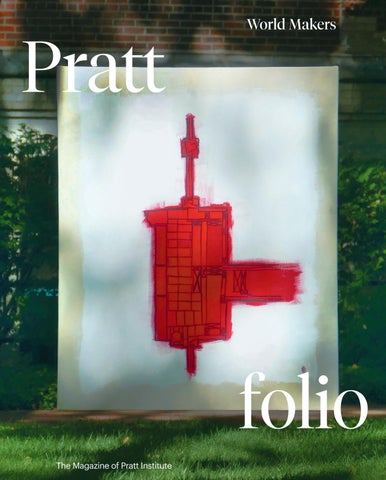
Class notes and alumni highlights from graduates’ submissions, newsletters, and media mentions. About the Cover Forrest Gill-Ehlen, BArch ’26 Untitled 001, 2025, acrylic and pen on canvas, 59 × 48 inches This piece from Forrest Gill-Ehlen’s extracurricular student projects explores architectural ideas in a painterly form, installed above among other works on Pratt’s Brooklyn campus. In Gill-Ehlen’s METROPOLIS Future100–winning portfolio, he describes how his personal projects “operate on a parallel track” to his architecture work, sometimes weaving into his studio projects. Photos by Sofia Narvaez, BArch ’26 Opening (digital arts drawing studio) and closing (BFA photography work at Pratt Shows 2026): Photos by Dahlia Dandashi
In Memoriam
60
Prompt
62
Test your knowledge of alumni work with our crossword puzzle, inspired by one enterprising alumnus’s famous invention.
34
53 About the Typeface For this issue’s special section, Pratt graphic designer Felix Summ looked to Pratt heritage to create a custom typeface. Crafted with the stone-carved lettering of the Chemistry, Engineering, and Machinery buildings as a reference, the project celebrates Pratt’s rich history as the foundation of new ideas and innovation. Read more at pratt.edu/prattfolio. Photo by Dahlia Dandashi
Prattfolio, the magazine of Pratt Institute, is published by Pratt Communications and Marketing. © 2026 Pratt Institute
Staff Photographer Dahlia Dandashi
200 Willoughby Avenue Brooklyn, NY 11205
Project Manager Sahara Henley
prattfolio@pratt.edu pratt.edu/prattfolio
Print and Digital Production Manager Christopher Keating
Facebook, Instagram, LinkedIn: @prattinstitute
40
Video and Photo Production Manager Tim Atakora
Vice President for Communications and Marketing Jim Kempster
Copy Editor Brandhi Williamson Prattfolio is a 2026 CASE Circle of Excellence Awards winner!
Director of Editorial Jean Hartig Staff Writer Hannah Holden, BFA Writing ’14 Graduate Editorial Assistant Caroline Hibbert, MS Historic Preservation ’27 Executive Director of Creative Services David Frisco Assistant Creative Director Jana Flynn Senior Graphic Designer Robert McConnell Graphic Designer Felix Summ Associate Director of Communications Management Erica Dagley Galea
For alumni address changes and obituary notices, please contact Alumni Engagement at alumni@pratt.edu or 718.399.4447. Prattfolio is printed by Lane Press, which has a long history of responsible environmental practices. Learn more at lanepress.com. Please share, recycle, or make something new with this magazine.
President’s Letter
We Are All World Makers
President Frances Bronet
4
PRATTFOLIO | FALL 2026
Photo by Yael Malka, BFA Photography ’12
F
all is a special time at Pratt, electrified with beginnings even as campus and the city transform from green to autumn gold. In this phenomenal creative environment, for our community of explorers, the world is new. Our students and faculty are settling into fresh routines, spaces, and cohorts, with novel inquiries to pursue. They are experimenting across domains, from the tactile to the digital, from materials to structures, in the studio and in the field. They are investigating deep questions within themselves, but also deep questions they have of the world around them. They are imagining new futures. In this moment energized with possibility, we’re excited to announce World Makers | The Campaign for Pratt Institute. This ambitious campaign builds on our foundational strengths and progresses us toward the goals of Setting the Standard, our Strategic Plan, positioning Pratt for greater accessibility, academic innovation, and institutional sustainability as a leader among creative institutions. Here at Pratt, as so many of you have experienced firsthand, you can find the tools to pursue your explorations and make the impact you’ve imagined. World Makers builds the resources that equip our students and faculty to do what they do best: Ask the questions that we didn’t know existed. Engage communities in their inquiry. Think about the effects of their work, on local and global scales. Develop revelatory designs, systems, and creative works that reflect the depth of their investigations. This campaign advances Pratt along the trajectory that makes that work possible: enhancing our learning environment, from buildings to technology and other infrastructure, supporting the success of our faculty, and enabling exceptional individuals anywhere in the world to access a Pratt education—and beyond graduation, to strengthen their connection to Pratt and their professional network as alumni. World Makers is about opening doors, for our students and faculty, and also for you, our Pratt community of alumni, families, colleagues, neighbors, and friends. Together, we have an extraordinary opportunity to invest in Pratt’s future and that of our World Makers—the people who will build our cities, create our landscapes, shape our cultural experiences, and develop design solutions that make a difference in our lives. You can read more about the campaign on page 46, and throughout this issue of Prattfolio, I hope you’ll find inspiration in the stories of so many Pratt World Makers from across creative realms and generations. Join us in shaping the next chapter.
In Progress
A view from opening night of Pratt Shows: Design on May 13, 2026, where visitors encountered an ambitious range of graduating student work, spanning graphic design and illustration, fashion, industrial design, interior design, architecture, and fine arts jewelry.
What’s happening at Pratt now, from recent events to projects, explorations, and student life.
FALL 2026 | PRATTFOLIO
5
Highlights
Read more from these stories and keep up with the latest from campus and beyond at pratt.edu/news.
A Radio City Celebration for Pratt’s Class of 2026 In his Commencement address, journalist and editor of The New Yorker David Remnick said that society “cries out for citizens of imagination and creativity” in order to thrive, and urged the graduating class to not “give up or compromise on what you know and what you love.” The May 19 Commencement honored the class of 2026 with a ceremony in the iconic setting of Radio City Music Hall. The joyful gathering celebrated the achievements of approximately 1,400 6
PRATTFOLIO | FALL 2026
graduating students, who now proudly join the distinguished ranks of Pratt’s global alumni community. Pratt bestowed honorary degrees upon three leaders in their fields whose work embodies the innovation and creativity fostered by the Institute, including Remnick (Doctor of Letters), Director and CEO of the Solomon R. Guggenheim Museum and Foundation and renowned art historian Dr. Mariët Westermann (Doctor of Humane Letters), and esteemed design-
er and printmaker Ted Shaine, BFA Advertising Design ’68 (Doctor of Fine Arts). Speakers included Karen Dunn, adjunct associate professor of graduate communications design, who earned the Distinguished Teacher Award (2026– 2027) and was honored with a medal designed by Jo Barnett, MID ’26. Anish Lahiri, BFA Communications Design ’26, and Aliman Temirbek, MS Urban Placemaking and Management ’26, were the student speakers.
Previous page: Photo by Dahlia Dandashi. This page: Photos by Aditri Bhattacharjee ’27 (top left, bottom right), Dahlia Dandashi (top right, bottom center), Island Photography (bottom left)
Updates from Pratt’s News Page
Top left: Photo by Dahlia Dandashi. Top right: Francine Monaco; photo by Casey Morrissey (left). Tori Purcell; photo by Hazziza Abdullah (right). Bottom left: Courtesy of Christina Lok. Bottom center: The El Puente Mobile Teaching Kitchen. Bottom right: CSU Flagship 2026: Regenerative Communities Summit panelists (l–r) Mark Gardner, Margaret Waldock, Yasemin Kologlu, Karen Ong, and Frances Bronet. Photo by Hillary Caltagirone
New Chairs of Interior Design and Photography
Pratt Launches Storefront Gallery on 14th Street On June 15, hundreds of people gathered along 14th Street between Union Square and the Meatpacking District to peer at a series of storefront windows that were reimagined as a public gallery showcasing the work of more than 30 students across Pratt’s six schools. Located at The Village West, the recently completed mixed-use development at 525 Sixth Avenue from Izaki Group Investments (IGI), Pratt Institute × The Village West: Windows on 14th Street included work encompassing architecture, art, design, fashion, film, information studies, liberal arts and sciences, and creative technologies. Inspired by a shared commitment to creativity, civic engagement, and the power of public space, the project extended student work beyond the classroom and gallery walls, embedding it within the rhythm of city life. Pratt hosted the public window reveal event at The Village West, welcoming students, faculty, neighbors, visitors, and community partners to celebrate the activation of the corridor between Sixth and Seventh Avenues. Attendees included New York State Senator Erik Bottcher, New York City Council Member Carl Wilson, NYC Department of Transportation Commissioner Mike Flynn ’06, Executive Director of Union Square Partnership Julie Stein, Executive Director of the Meatpacking District Management Association Jeffrey LeFrancois, and CEO of IGI USA Eldad Blaustein.
Pratt Students Help Reimagine the Future of 14th Street: “It feels like a snapshot of everything great about New York.” —Christina Lok, MS Urban and Community Planning ’26, says of 14th Street, where she painted the busway mural “Turning Point.”
Students from Irina Schneid’s annual Co-Design Studio won a 2026 NYCxDESIGN Student Product Design Award for the El Puente Mobile Teaching Kitchen. Read about this work and more in “Pratt Shines at NYCxDESIGN 2026” at pratt.edu/news.
Award-winning architect, designer, and educator Francine Monaco has been named chair of the Department of Interior Design within Pratt Institute’s School of Design. Monaco has been a dedicated faculty member of the Pratt community for 25 years. She assumed the role on July 1, 2026, succeeding David Foley, who stepped down after seven years of committed stewardship. Artist and educator Tori Purcell has been named chair of the Department of Photography within Pratt Institute’s School of Art. Purcell has served as assistant chair of the Photography Department at Pratt for the past 16 years. She assumed the role on July 1, 2026, succeeding Shannon Ebner, who stepped down to join Pratt’s faculty.
President Bronet Appears at UN for Regenerative Communities Summit Pratt Institute President Frances Bronet recently joined architects, urban planners, ecologists, and international policymakers at the United Nations for the CSU Flagship 2026: Regenerative Communities Summit. The conversation examined how multidisciplinary teams can advance regenerative design at the scale of neighborhoods, cities, and regions, while drawing on culture, place-based knowledge, and long-standing Indigenous traditions. Bronet also highlighted Pratt’s campus as a living laboratory, where students engage directly with the built and natural environments around them to explore regenerative practices. Read more about how Pratt students, faculty, and alumni are developing design solutions that restore ecosystems, strengthen communities, and address climate change in “Designing Regenerative Futures” on Pratt’s news page. FALL 2026 | PRATTFOLIO
7
Heading into the new semester, Pratt students on the Brooklyn campus can walk into the newly opened Student Wellness Center for all things health and wellness, from counseling and health care to academic and career support. The result of several years of planning, the four-story, 25,000-square-foot hub, with an occupiable cellar, brings together health, counseling, wellness, and success services in one central location across from the Rose Garden. Designed by awardwinning New York firm FXCollaborative, the transformed building creates a welcoming space where students can easily find the care and resources they need. Providing these essential services in an integrated model under one roof means students will spend less time navigating systems and buildings and more time getting holistic support to grow academically, creatively, and personally throughout their time at the Institute. “The opening of the Student Wellness Center marks an important milestone for Pratt and reflects our belief that supporting student wellness and well-being is central to our educational mission,” said Pratt Institute Assistant Vice President of Student Health and Wellness Debbie Scott. “By bringing health, counseling, 8
PRATTFOLIO | FALL 2026
and student support services together in one accessible location, we’re investing in an environment where students can more easily access care and fully engage in their academic and creative work. This center reflects our commitment to ensuring every student has the support they need to thrive during their time at Pratt and as they prepare for their future.” A One-Stop Center for the Whole Student The redesigned building encompasses several existing services, including: Health Services, Counseling Services, the Learning/Access Center, the Center for Career and Professional Development (CCPD), Student Success, Student Support and Care Coordination, the Resilience, Wellness and Well-being Center, and the Pratt Pantry. Wellness at Pratt is about finding flow and restoration—fueling the body, strengthening study habits, and building connections. Together, these and other efforts contribute to a broader culture of belonging and engagement fostered through Student Involvement, Residential Life, and Athletics, ensuring that students feel connected, supported, and able to thrive throughout their time at Pratt.
Construction of the Student Wellness Center was supported by the generosity of parents, staff, trustees, and institutional funders, including a transformative gift from Pratt Trustee Anne Edwards and generous support from the Booth Ferris Foundation. Building for the Future The building that now houses the Student Wellness Center had previously been repurposed for administrative purposes. Rather than replace it, the existing structure was reworked, preserving its architectural legacy while reducing the environmental impact associated with new construction. “Pratt’s campus has a long history of adaptation, and this project gave us an opportunity to build on that legacy in a way that directly supports student life today,” said Michael Syracuse, senior partner at FXCollaborative. “Every decision—from clarifying the entry sequence to calibrating acoustics, lighting, flooring, and materials—was shaped by a holistic understanding of wellness. The result is a center that feels distinctly Pratt: resourceful, tactile, student-centered, and designed to support both individual care and a stronger sense of campus belonging.”
Photo by Dahlia Dandashi
A New Model for Student Care Launches on Pratt’s Brooklyn Campus
Top left: Photos by Dahlia Dandashi. Bottom left: Courtesy of Simran Kaur. Bottom center: Photo by Dahlia Dandashi. Bottom right: Courtesy of Undergraduate Architecture
Board of Trustees: Recently Elected Members and Trustee Emerita
Exploring Design, Collaboration, and Real-World Impact Hundreds of visitors gathered in April at Pratt Institute’s Research Open House 2026 as students, faculty, and visiting researchers shared work that crossed scales and sectors, from material experimentation and public policy to emerging technologies and climate resilience. Pratt’s Research Open House has been organized by the Office of Research and Strategic Partnerships in the Provost’s Office since 2018 to showcase the breadth and variety of research taking place at Pratt, including the work of Pratt’s Provost’s Centers and the IDC Research Accelerator Hub. Having started as a tour of a handful of research demonstrations, the Research Open House has since grown to this year’s assembly of more than 100 exhibitions. “The ambition for this year’s event was to provide Pratt researchers with a platform to feature, advance, and disseminate their work amongst their peers,” said Vice Provost for Research and Strategic Partnerships Eliana Abu-Hamdi. “It also helped researchers seek and secure opportunities for collaboration with university counterparts, industry partners, and community shareholders. Research Open House 2026 exceeded all expectations and demonstrated the strength and agility of Pratt faculty and students to adapt to a shifting landscape. The event was filled with energy and ambition, demonstrating the capacity and values of Pratt Institute.”
Pratt Institute’s Board of Trustees has elected four distinguished new members: architect and professional engineer Evan Akselrad (effective December 11, 2025); artist and Pratt Professor Emerita Iona Fromboluti (effective July 1, 2026); occupational therapist Zara Harris (effective October 23, 2025); and entrepreneur and investor Michael Schafler (effective July 1, 2026). Board of Trustees member Katharine L. McKenna became trustee emerita effective July 1, 2026. Mc Kenna, who graduated from Pratt with a master’s in industrial design in 1984, joined Pratt’s Board of Trustees in 2002, where she served on the student affairs committee, including as the committee chair since March 2025. She has been a longtime philanthropic supporter and deeply engaged member of the Pratt community. McKenna is an accomplished artist, writer, and designer. Her paintings are in permanent collections of The Rockwell Museum, the Museum of Northern Arizona, the Booth Museum, the Woodstock Artists Association & Museum, and the Desert Caballeros Museum in Wickenburg, Arizona.
Housing Innovation Studio Brings Pratt Students to Miami
Information Fellowships at MoMA: Unmatched access “to the collection, to the building, to artist events, and to people across video, graphic design, and digital teams all working in the same creative orbit.” —Simran Kaur, MSIXD ’26, on some of what she experienced in the School of Information’s fellowship program at MoMA.
“I’ve gone to the career fair before, and other career events through clubs, but nothing this focused,” said Teressa Freeman, BArch ’26, one of the students who met with established professionals at CareerConnect, an annual event hosted by The Black Alumni of Pratt with support from the Center for Career and Professional Development.
Pratt Undergraduate Architecture students visited Miami’s Overtown neighborhood last spring as part of an institutional collaboration between Pratt Institute and the University of Miami. With funding from longtime Miami architect and Pratt School of Architecture alum Bernard Zyscovich, BArch ’68, students from both schools will participate in coordinated Housing Innovation studios over four semesters in four academic years from 2026 to 2029, with the focus of each studio alternating between New York and Miami in recognition of the shared urban challenges that both cities face, including affordability, climate impacts, and density. Read more at pratt.edu/news. FALL 2026 | PRATTFOLIO
9
Lou Ambrogio Is Still Paying It Forward
Sebastian Ambrogio ’76
Sebastian “Lou” Ambrogio came to Pratt on a scholarship and graduated with a degree in architecture in 1976. He spent the next three decades building Pfizer’s labs, manufacturing plants, and offices around the world. Lou gave to Pratt year after year while he was working, usually by donating shares of stock. When he retired, he and his wife, Cynthia, started the Ambrogio Family Scholarship Fund so that another student could get the same start he did. Then they went a step further. Lou named Pratt as one of the beneficiaries of his IRA, and that money will go straight into the family’s scholarship fund. It costs nothing to arrange, he can change his mind at any time, and someday it will support a talented Pratt student.
Every World Maker had somebody who opened a door for them. You can be that person for a Pratt student through your will, your trust, or your retirement account. Gifts like Lou’s count toward the World Makers campaign, and they keep working long after the campaign ends.
“Pratt bet on me before I had anything to give in return. Now I get to do that for somebody else.” — Lou Ambrogio, BArch ’76
We’d be glad to talk it through with you.
Rob Danzig, Director of Planned Giving 718.399.4296 | rdanzig@pratt.edu
Celebrating the launch of World Makers | The Campaign for Pratt Institute, we bring together this special spotlight on alumni and their work—building the worlds we know and imagining new ones, in objects, systems, and art, from the city to the sky.
MAKING THE CITY Built environment, cultural heritage, art and artifacts—Pratt alumni have shaped the experience of New York City in countless ways. These six stories behind their innovative and influential work are just the beginning. CONTRIBUTIONS BY JEAN HARTIG, CAROLINE HIBBERT, HANNAH HOLDEN, AND ALLISON C. MEIER
14 PRATTFOLIO | FALL 2026
Page 11: Photo by Dahlia Dandashi. Opening spread: Photo by Sara Cedar Miller. Courtesy of the Central Park Conservancy. This spread: Photo by Tod Seelie
BUILDING A FLOATING DREAM In September 2008, seven handmade boats docked at Deitch Studios on the East River in Long Island City, completing a three-week journey down the Hudson River. These vessels—collectively titled Swimming Cities of Switchback Sea—represented a year of construction, the work of 75 collaborators, and the realization of a decade-long vision of the street artist Swoon (Caledonia Curry, BFA Fine Arts ’02). Built from scrap wood and discarded materials scavenged from New York City construction sites, the rafts embodied a DIY ethos that seemed to anticipate the precarity ahead. The war in Iraq and growing environmental concerns had already prompted many to question their relationship to resources and consumption. Just weeks after they docked, Lehman Brothers collapsed, triggering the worst economic crisis since the Great Depression. This project, Swimming Cities of Switchback Sea, had lived in Swoon’s head since her time at Pratt. “I had been talking about this project for 10 years before it ever happened,” she recalled to Prattfolio. At one point, she intuited that her career had gained enough momentum to realize her vision. “Suddenly I felt this energy where I was like, OK, maybe this is really possible now.” Swoon gained her first experience rallying artists around a shared goal as a student. At the time, Myrtle Avenue was lined with illegally installed billboards. She organized her fellow painters to cover them in art. “That morning where we all did it and everyone’s work came together, it was like this instant change had happened,” she said. She realized that “we together can do something so much bigger than any one person can do by themselves.”
Fast forward. The Swimming Cities crew learned boat-building techniques from the Floating Neutrinos, a group that had previously crossed the Atlantic on handmade rafts. Working in a borrowed abandoned building, Swoon’s volunteers removed nails from lumber while experienced builders guided beginners through construction. Balancing artistic vision with practical demands required compromise, as crew members pushed back against sculptural choices that could result in getting poked with metal while sailing. “Anytime a group of people are trying to do things together, it’s incredibly rewarding and also incredibly time consuming, and usually involves a lot of fighting,” Swoon said. “We were no exception there.” Despite their ramshackle appearances, the boats were fully registered and inspected. Still, the crew faced constant negotiations with Coast Guard authorities. “They kind of hated us, but sometimes we could get them to see us as lovable ragamuffins,” Swoon said. The vessels projected a sense of lawlessness even when operating within regulations, generating both excitement and fear in the river towns where they docked for performances. The rafts became “living symbols of freedom.” Swoon once had a dream of a guardian gathering vessels to safety beneath her skirts as the tides rose. This dream came to life as the boats reached Deitch Studios, where they were tethered to a 25-foot paper sculpture of two embracing women, a work titled Switchback Sisters. In a year that would soon demand resilience from everyone, Swimming Cities of Switchback Sea suggested that, even in collapse, refuge could be found in community and creation. –H.H. FALL 2026 | PRATTFOLIO
15
Pagoda roofs paired with modernist lines. A lightly ornamented memorial arch. Stone façades juxtaposed with decorative metal screens. Poy Gum Lee, Architectural Construction and Architectural Design 1920, undeniably left his mark on the neighborhood he was raised in. Born on Mott Street in Manhattan’s Chinatown in 1900, Lee went on to attend Pratt and became a registered architect, working with firms in New York and Chicago before he was hired as the in-house architect for the YMCA in Shanghai. While living in China, Lee established his own practice there and solidified the “Chinese Deco” style he became renowned for, which combined traditional Chinese architectural features with elements of the Western Art Deco style. However, the chaos of World War II, the Japanese occupation of China, and the ongoing Chinese Civil War led Lee and his family to return to New York in 1945. Lee worked extensively in Chinatown, and his designs can be found throughout the neighborhood. Recognizable structures include the Chinese Consolidated Benevolent Association (CCBA) headquarters, the Kimlau Memorial Arch, the (now-demolished) Pagoda Theater, and the On Leong Tong, or Chinese 16 PRATTFOLIO | FALL 2026
Merchant’s Association, building at 83 Mott Street. The On Leong Tong building—considered to be the most prominent “Chinese modern” structure in the neighborhood— combined a pagoda rooftop with mid-century modern American design. The building is also notable in that it provides an example of how Lee was not always fully credited for his work. Spurred by a request from the Bank of China for more “splendid landmarks” in the neighborhood, various Chinatown associations undertook remodeling efforts on their existing buildings. To this end, Lee was asked to draw up plans in 1948 for the On Leong Tong, situated at the northern gateway to Chinatown. His detailed sketches feature a limestone façade, tiered pagoda roofs, and modern balcony railings. While Lee was instrumental in the building’s concept and overall design, the final built version was attributed to architect Andrew J. Thomas, who had no previous associations with Chinese architecture or Chinatown. Explanations as to why Lee lost the final design commission of the building range from political struggles between CCBA and On Leong leadership to issues with cost. Upon taking on the project, Thomas’s firm reduced Lee’s detail and
Poy Gum Lee’s sketch of the On Leong Tong building in New York’s Chinatown.
PUTTING HIS SIGNATURE ON CHINATOWN
Courtesy of the Lee Family, Museum of Chinese in America (MOCA) Poy Gum Lee Collection
reconfigured proportions, completing the building in 1950. Still, Lee claimed the On Leong Tong on his résumé and circulation of his sketches of the iconic structure’s design solidified his role as the visionary behind its conception. He went on to have a long career, working with business leaders in Chinatown as well as the New York City Housing Authority (NYCHA). While his “Chinese Deco” style shifted to reflect the increasingly minimal, modern designs favored by Chinese business interests in America by the 1950s and ’60s, Lee’s unique mark on Manhattan’s Chinatown was nevertheless recognizable and ubiquitous. Further cementing his legacy, the Museum of Chinese in America (MOCA) launched a retrospective of Lee’s 50-year career in 2015 that displayed drawings and documents unearthed from his family’s archive. Upon returning to Chinatown, Lee remarked in his résumé that he worked in the community to be “of service to my Chinese people.” Amid further changes to Chinatown’s demographics and built environment in the 21st century, his works, including the On Leong Tong, serve as cultural touchstones and a testament to the vision of the architect who grew up on Mott Street. –C.H. FALL 2026 | PRATTFOLIO
17
18 PRATTFOLIO | FALL 2026 Bruce Hannah (right) and Andrew Morrison with their “2308” office chair. Courtesy of Knoll
BUILT TO LAST It was the late 1960s, a few years out from graduation from Pratt, and design partners Bruce Hannah and Andrew Morrison had a vision. From their studio at 27 Howard Street in SoHo, the two called Knoll to invite them to see the work of the “greatest designers in the world.” “We really said this stuff—we were still in our 20s, our brains weren’t fully formed!” Hannah laughed in a conversation earlier this year, recalling how he and Morrison, who died in 2021, began their longstanding relationship with the renowned design company. He spoke to Prattfolio as one of his and Morrison’s groundbreaking designs, originally the “2308” office chair, was being reissued by Knoll some 50 years after its debut. Back then, it wasn’t just youthful confidence they had on their side. The pair were determined, and in this case their objective was specific, according to Hannah: “Our goal, maybe even our philosophy, was to design a chair for Knoll and retire on the royalties. Lucky for us, Knoll took us seriously, and as they say, the rest is history.” The two had connected with Knoll designer Jens Risom through then–industrial design department chair Joe Perry, and they worked with Risom on some of his late collections. He regularly visited them downtown, and seeing a promising project that went beyond his scope—he worked in wood, and the two were at work injection molding alumninum—Risom finally encouraged them to go directly to Knoll. Hannah and Morrison’s invitation was compelling enough that eventually company president Cornell Dechert came down to visit their studio, which the designers had filled with working prototypes. “Everything I do as a designer,
I always make it . . . You eliminate 99 percent of the questions,” Hannah said. Hannah and Morrison were making things all day, every day, in a partnership that would go on for 10 years—and New York City was the perfect proving ground. Surrounded by industrial neighbors, people barely gave a second glance to the two designers carrying 20-foot lengths of extrusion profiles down Broadway. “It was the ’60s and ’70s. New York City was a disaster in so many ways. But it was wonderful in other ways,” Hannah said. “The disaster allowed us to do whatever we wanted.” Their first design with Knoll was an award-winning aluminum-frame collection, a precursor to their task chair. When they designed the chair, ergonomics was having a boom moment, amplified by advancements in computing and changes in the nature of office work. Nevertheless, Hannah said, ergonomic design often considered the user’s status in the office hierarchy more than how their body would interact with the environment. Hannah and Morrison wanted to do ergonomics in “a stealthy way,” Hannah said. “We’re creating an ergonomic shape, but it’s not screaming at you, I’m an ergonomic chair!” “Its subtlety of form caused an uproar,” as Surface puts it. “With its sleek aluminum frame and plush but unobtrusive cushioning, it offered ‘ergonomics without ego,’ almost 50 years before its time.” The dimpled buttons, for example, are positioned to eliminate pressure on the sit bones and offer lumbar support. They also give it a personality. Hannah says this was part of his and Morrison’s philosophy. “One of our intentions was, if someone walks into a room and our objects are there, will they make them
smile? Will they make their day happier? We tried to animate objects, so people would say, Oh, is that smiling at me?” They were also conscious of sustainability. “We were interested in what things weighed, what they were made out of, how you could recycle them, how you could disassemble them,” Hannah said. “All the things we designed, we designed to come apart and be sorted.” The design considerations for the reissue included a new form of fully recyclable foam. Among the other updates are an improved tilt mechanism and gas cylinder and aesthetic details like now–customizable button color. But ultimately, “There is no revelation. If you put one of these chairs next to the ones that are 50 years old, you’d see very little difference,” Hannah said. “What I find interesting is that it still has meaning somehow in society. Our feelings and what we wanted to bring to that chair were important to us and possibly to society.” Hannah went on to design desk accessories for Knoll, like one of the original adjustable keyboard supports and the Hannah Desk System. Morrison’s office system broke new ground for open-plan offices and became a Knoll best-seller. (Hannah also gave a nod to Knoll designs by fellow Pratt alumni Charles Pollock and Ayse Birsel, with whom he has collaborated.) The ideas that began in a SoHo studio proliferated through the city and beyond. “We often talked about designing something that might become an antique, which I think means it’s at least 100 years old,” said Hannah. “Well, the Morrison Hannah chair for Knoll is more than halfway there.” –J.H. FALL 2026 | PRATTFOLIO 19
It’s hard to imagine the New York Public Library (NYPL), or any library for that matter, without a dedicated children’s section. However, this was the reality before Pratt alum Anne Carroll Moore began her groundbreaking work to transform libraries into inclusive space for all ages. In establishing children’s rooms—first at the Pratt Free Library, then at NYPL—Moore reimagined the role of libraries in relation to childhood development and literacy. Originally from Maine, Moore relo20 PRATTFOLIO | FALL 2026
cated to Brooklyn to enroll in the Library School of Pratt Institute, graduating in 1896. At the time, libraries were considered exclusively adult spaces, prohibiting all children under 14 years of age. Perhaps inspired by the paper Moore had presented two years prior proposing the creation of library spaces dedicated to children, Director Mary Wright Plummer asked her to design services for the new children’s room at Pratt Institute’s Free Library. Moore was not only instrumental in establishing this children’s
room—the first of its kind anywhere in the world—but also served as its head for 10 years. Moore’s pioneering work with the children’s room at Pratt caught the attention of Arthur Bostwick, the head of circulation at NYPL, who hired her to set up similar spaces dedicated to young readers at the main library and its branches throughout the city. Upon her hiring in 1906, Moore became the superintendent of children’s work, organizing hundreds of programs, compiling lists of
The children’s room of the Aguilar Free Library, circa 1901. The New York Public Library
OPENING LIBRARY DOORS TO CHILDREN
recommended literature, and developing training for children’s librarians. It was in this position that she also oversaw the Central Children’s Room, which opened in 1911 and was recognized worldwide for its innovative use of child-sized furniture and its accessible, comforting layout. The efficacy of her work was quickly apparent, with children’s books accounting for a third of all borrowed titles from NYPL by 1913. Moore herself had high standards for children’s literature and sought books in
a variety of languages in order to encourage reading among New York’s newly arrived immigrant families. Furthermore, her influence as a reviewer of children’s literature led to a substantial expansion in the children’s publishing field during her lifetime. She also advocated for oral storytelling as a way to draw children to reading, inviting authors to narrate their stories at library branches, likely a precursor to storytimes we see in children’s rooms today. By the time Moore retired from NYPL in 1941, there were children’s rooms in
47 branches throughout the city. Outside of New York, libraries nationwide established dedicated spaces for children based on her model. In choosing to respect children and their learning autonomy rather than look down on their abilities, she expanded the role of libraries in childhood development, helping to foster a love of literature from an early age that was widespread and inclusive, accounting for the lived experiences of children from a variety of backgrounds. –C.H. FALL 2026 | PRATTFOLIO
21
At the 42nd Street station entrance to the 7 train at Grand Central, kaleidoscopic patterns radiate over the curved walls. The palette shifts from cool blues and purples to warm greens and earth tones across the dense geometric forms, where concentric circles, sunbursts of lines, and moonlike slivers overlap and intersect. “Abstract Futures,” a 600-squarefoot glass mosaic mural commissioned by MTA Arts & Design, was unveiled in May 2025 as the first permanent installation by the feminist art collective Hilma’s Ghost, cofounded by Dannielle Tegeder and Sharmistha Ray, MFA Fine Arts, Painting; MS Theory, Criticism, and History of Art, Design, and Architecture ’05. The duo was inspired by the divinatory practices of Tarot cards as they relate to the constant arrivals and departures happening in the station and around New York City. “The major arcana of the Tarot are really archetypal themes of the cycle of life,” Ray said. “We thought that was such a fantastic metaphor for New York and its kind of cyclical loop. The archetypes we drew upon were the Fool, the Wheel of Fortune, and the celestial elements— the moon, the stars, the sun—to tell that almost epic tale of human searching and the journey.” Hilma’s Ghost previously created the Abstract Futures Tarot deck. It was informed by Western and non-Western symbolic usages of shape and color, as well as the legacy of women artists illustrating Tarot, particularly the Pratttrained Pamela Colman Smith, who worked on the popular Rider–Waite–
22 PRATTFOLIO | FALL 2026
Smith deck. Tegeder and Ray began collaborating in 2020 amidst the shutdowns of the COVID-19 pandemic, taking their name and inspiration from Hilma af Klint. The Swedish artist participated in séances and used abstraction to express sacred concepts. Despite af Klint being a modernist pioneer, those esoteric aspects of her practice pushed her to art historical margins along with other women artists whose beliefs did not align with mainstream spirituality. “The feminist sacred spiritual abstraction that we are working with also comes under the umbrella of the occult,” Ray said. “When you look at artists like Hilma af Klint, Ithell Colquhoun, and Agnes Pelton, they were also spiritualists, and they had practices of their own which are still to this day considered taboo. I think what Hilma af Klint did was really open up this portal for us to think about it in much more open ways and as raw material for art making.” Ray (who uses they/them pronouns) was born in Kolkata to Bengali parents and arrived in New York in 2001 as a Pratt graduate student. Their art was mostly figurative until the upheaval in the city following the September 11 terrorist attacks. Ray called it a “cataclysmic moment,” including how they saw identity politics being used and Arab and South Asian people being targeted. They were already interested in the local legacy of the New York School of the 1950s and ’60s and its abstract expressionists who had broken with realist traditions, and saw an opportunity to bring a different approach to abstraction that could
engage with themes of queer identity and immigration. “I use color, shape, pattern, and geometries in really maximalist ways that relate to South Asian textiles and mosque architecture,” Ray said. “I grew up between Kuwait and India, and so those are many of my foundational influences. It certainly started the process for me thinking about sacred abstraction and non-Western abstraction.” Ray is now based in Pittsburgh and is an associate professor of art at Carnegie Mellon University. Their recent work has ranged across media, from a glass art installation that debuted at the Pittsburgh International Airport in 2025 with geometric forms evoking cosmic energy, to murals referencing mandalas painted in 2026 on the grounds of pickleball courts at the city’s downtown Arts Landing. “I think of abstraction as being inclusive,” Ray said. “I also think of abstraction as having certain fugitive qualities, in how symbolism can encode secret messages within the work that can be read, but most of the time fly under the radar.” As the Grand Central mural is now embedded in the daily life of one of the busiest parts of New York City, Ray hopes that its visual symbolism is not just something people will pass by, but will be a point of connection and pause. “We tell people to whisper their female ancestors or artists that they’ve loved who have passed or any role models that they’ve had into the wall to keep activating and charging it.” –A.C.M.
Abstract Futures (2025) © Hilma’s Ghost, NYCT 42 St-Grand Central. Commissioned by MTA Arts & Design. Photos: Etienne Frossard
BRINGING MAGIC UNDERGROUND
FALL 2026 | PRATTFOLIO 23
Over four decades, Sara Cedar Miller, MFA Photography ’83, has changed how New Yorkers see Central Park. As its longtime official photographer and historian, she chronicled how the Manhattan greenspace transformed from a neglected place few wanted to visit to the verdant heart of the city. “It was the great privilege of my life to watch this work of art go from being a national disgrace to the national treasure that it was originally back in the 19th century,” she said. That designed quality of the park, where each vista of rocky outcrops, trees, and water was shaped under the vision of Frederick Law Olmsted and Calvert Vaux, still captivates her even after she has explored nearly every inch of its terrain. When Central Park was fully realized in 1873, it allowed New Yorkers from all walks of life to forget for a moment that they were in a city. It was a democratic ideal expressed through nature that inspired the creation of city parks across the country. “The whole park is entirely manmade; that’s the hard part that people can’t grasp, but it’s my favorite part to share when I give tours,” Miller said. “I talk about the park as a work of art. When we get to the cascade at the top of the park, all of a sudden, people go, ‘Oh, I get it. I feel like I’m looking at a painting.’” She already had a master’s degree in art history from Hunter College before she studied photography at Pratt Institute. After she graduated, she was working by making slides for artists to share their work with galleries when she got a call from a Pratt classmate, Cynthia 24 PRATTFOLIO | FALL 2026
Larson, that changed the course of her career. The job opening was at the still new Central Park Conservancy, which had been founded in 1980 to do what many thought was impossible: rejuvenate the 843-acre landscape, which had radically declined for decades with no management plan for maintaining its nature and infrastructure. Her early photographs captured its deterioration, shocking donors into action. Over the years she visualized the Conservancy’s steady progress in renewing the park. For instance, the sprawling Great Lawn, which had been nicknamed the “Great Dust Bowl” for how it had become more dirt than grass, was restored into a lush lawn. “It was a crazy and wonderful experience in that one minute I’d be climbing a tree or being in the mud, and the next be at a fundraising event or party,” she said. “The clothing was a challenge for the job.” Her photographs helped shift the perception of the park locally and brought wider attention to how advocacy for urban greenspaces mattered. “It’s become a worldwide movement for people to take back their ailing parks, and the Central Park Conservancy was the first and at the heart of that,” she said. Five years into her photographer role, she became the park historian, adding intensive research into the park’s past to her picturing of its present. While she retired in 2017, she remains the park’s historian emerita and has published four books on its history. The most recent is Before Central Park (2022), for which she investigated its geological and social his-
tory, including previously unpublished research about the Black landowners of Seneca Village. She compared how these two aspects of her work balanced each other to the two hemispheres of a brain. “The left side is knowing the ins and outs of the park visually and physically because I
Photo by Sara Cedar Miller. Courtesy of the Central Park Conservancy
THE PHOTOGRAPHER WHO SHAPED HOW WE SEE CENTRAL PARK
walked it almost every day and saw it in every season,” she said. “The right side is the history, and putting those two things together, each one informs the other. I think it made me a better photographer and it definitely made me a better historian.” Now, following years of capturing the artistry in Central Park’s landscapes, she
has returned to her own fine art photography practice, continuing to concentrate on nature but in a more abstract way. She credits her time at Pratt with confirming the importance of making art. “I walked in with a question mark. And I walked out knowing that I was an artist.” –A.C.M.
Across fields and generations, Pratt alumni have made their mark on NYC. Read more highlights of alumni work and add your suggestions at pratt.edu/prattfolio-making-nyc.
FALL 2026 | PRATTFOLIO 25
Pratt alumni from across disciplines reveal the manylayered craft behind the films we love. BY CHRIS RITTER
In film, there’s never just one art form at play. Every shot represents the
Opening spread: Photo by Dahlia Dandashi. This page: Photo by Danielle Perelman
work of artists from across disciplines: cinematography, directing, screenwriting, yes, but also fashion, sound design, visual arts, and more. Among Pratt alumni, there are countless examples of those intersecting paths, and curves in the road too: directors who began as illustrators, sound techs who started as actors, cinematographers who became intimacy coordinators. The result is a world that feels deeply interdisciplinary, where the understanding of one’s own role is deepened by the understanding of others. Here, we talk to seven Pratt grads about how they’ve made their lives in film.
THE SOUND TECHNICIAN Zach Travis, BFA Film ’16
You wouldn’t know it from his recent work—which includes miking Florence Pugh and Andrew Garfield on the web series Celebrity Substitute—but Zach Travis didn’t come to Pratt to be a sound engineer. Travis spent his teens making skate videos, filming and stitching pieces of footage together for him and his friends, though he was never, as he says, “into cameras,” and editing was just “OK.” Travis came to Pratt as a film major, thinking he’d try out acting, screenwriting, and other disciplines until something stuck. What stuck was sound. “I was very blasé about the whole thing,” says Travis, recalling his days as an undergraduate, trying out different roles within films. “But when classmates started asking me to do sound on their school projects, I was like, ‘Oh, this is the thing.’” Travis recalls being drawn to the technical side of sound work, which felt grounded in problem-solving. “I really like to try to figure things out and find solutions, and I think that naturally made me gravitate towards [sound],” says Travis. “It’s really rewarding when I’m presented with a problem, and I have to think, ‘Well, OK, how do I mix this? How do I make this work?’” 28 PRATTFOLIO | FALL 2026
Celebrity Substitute with Andrew Garfield (right), Florence Pugh (center), and host Julian Shapiro-Barnum
In film, those problems can be tricky. “There are things like, we’ve got four people talking in a car, but there’s no room for any of the crew, so how are you gonna get your sound? There’s a lot that goes into that,” says Travis. “Or, we’re only shooting this in a wide shot, from 50 feet away. How are you gonna record the talking on that, or cheat it, or fake it later?” Travis credits Pratt’s classes for giving him a good base for the technical skills needed to make these situations work. But
also, he says, “no matter how technical a class gets, you’re not really going to learn until you try to do it without supervision.” Beyond the classroom, Travis forged a path as a freelancer in New York City’s crowded film scene. After graduating from Pratt in 2016, Travis used what savings he had to buy a TASCAM field recorder and a few mics. With that, he began looking for gigs on Craigslist, Mandy, and Facebook and committed to sound work, quitting his job at a barbe-
cue joint in Gowanus. Today, Travis is entirely self-employed running sound for a roster of repeat clients. Those clients, and the projects Travis works for them, have range. There’s miking A-listers for Celebrity Substitute, talking head-style podcasts in Google’s head office in Manhattan, or capturing night ambience for other Pratt-grad indie filmmakers. For Travis, the variety is gratifying. “I often tell, especially my friends with nine-to-fives, that I could not do a regular job,” says Travis. “I love what I do because I get to work with different people every time, I get to go to different places and work on different concepts. I’m using the same skill set and the same tools for the same objective, but everything else is different every time, and that keeps it exciting.”
Then, Pratt’s Film Department held a seminar with intimacy coordinator Olivia Troy, and a role she had imagined existed became real. “To know that this is a whole profession itself was really cool. She introduced us to this whole world,” says Alade—from the equipment and contracts to the subtle tips and tricks that form the core of an intimacy coordinator’s work. An intimacy coordinator ensures that consent is followed by all parties: by the actors (making sure actors stay within the physical boundaries set by one another) as well as directors and producers (making sure a director doesn’t ask an actor to do something not included in a contract). The work of an intimacy coordinator is “more expansive” than just consent, though, Alade says. It’s also about making an intimate scene feel intimate—by making sparks fly onscreen. “Fostering chemistry between actors is such a wonderful thing,” Alade says, “It’s great to witness.” Establishing chemistry takes different forms for different people. Alade Kemi Star Alade, BFA Film ’26 says that some intimacy coordinators play the role of a “shadow” on set, only The attentive thoughtfulness it takes to stepping in when absolutely necessary. be an intimacy coordinator—the person Alade takes a warmer approach, freon a film or theater set who facilitates quently checking in with actors, offerscenes where intimacy is acted out—is ing them water, and making sure that what Kemi Star Alade says she does best. their confidence stays strong through“It’s so fulfilling to be a safeguard on out a shoot. set,” says Alade, who speaks about her “I like to be quite proactive on set bework with a warm sense of pride. “An cause that helps me feel connected with intimacy coordinator is someone who the performer,” says Alade. Alade was a takes care of performers and the director, stage actor before Pratt, and much of her and ensures the overall—I wouldn’t say work as an intimacy coordinator shows comfortability, because a lot of times, her empathy for the often unglamorous the things that you know are being asked side of acting. “There’s a lot of sets I’ve are never comfortable—but the confibeen on where an actor is just sitting in dence in everyone on set to deal with the a corner until someone calls them,” says topics at hand.” Alade. “It’s nice to be that person to be Alade found her way into intimacy like, ‘how do you feel?’ Sometimes it coordinating almost by accident. Alade feels like you’re the one person for them came to Pratt with her heart set on beon set.” coming a director of photography, but as Alade graduated Pratt this year, and she began working on sets, the technical she enters a professional world where sides of camera work didn’t work for her the work of intimacy coordinators is as much as the more human roles she more visible (and necessary) than ever. found herself filling. For the films that do intimacy right, “To be a good DP, there’s technical Alade is thrilled to understand how. things about a camera that you need to “Any film where you watch,” Alade know to be able to execute, and that’s says, “and you’re just like, ‘wow, this is just not me,” says Alade. “I was always such a beautifully done, intimate, pasfinding myself in that assistant director sionate moment,’ it’s so great to be able or producer role.” to know the inner workings of that.’”
THE INTIMACY COORDINATOR
THE DIRECTORANIMATOR Siwoo Kim, BFA Film ’25
As soon as he could hold a pen, Siwoo Kim was drawing. “Last year’s calendar was my sketchbook,” says Kim, who, in addition to drawing on the backs of used calendars, says he drew on the wallpaper of his room before his parents finally got him a sketchbook. No matter the surface, the years of sketching paid off. Last year, Kim was a Sundance x Adobe Ignite Fellow, a role he earned partly from the strength of his animated film, Inside My Worn Out Drawer, Is An Ocean (2025). The film was Kim’s thesis at Pratt. Now, it’s making rounds at festivals, and has earned Kim a NFFTY New Talent Award. It’s all a bit full circle for Kim—initially, he came to Pratt thinking he’d leave animation behind. “I went into film wanting to be like Bong Joon Ho,” says Kim. “I thought, ‘fine arts is dead for me, I’m gonna go into film.’ But then, as I spent time there doing all these different media, I was like, ‘You know, [animation] is actually cool too. I can bring that back in.’” “Animation is a playground for me,” says Kim. “I’m just in my room, and no one gets to see it until it’s done. I do eventually want to collaborate with better artists one day”—Kim mentions students who majored in animation at Pratt and focused more on the technical side of the work—“but I never really collaborated with animation [at Pratt] because it was such a raw expression of getting my feelings out there.” Post-graduation, Kim is starting to make good on those hopes to collaborate, notably with Myrsini Aristidou, BFA Film ’13. Kim connected with Aristidou through a mentorship initiative with Pratt’s film department. Kim asked to be paired with an international filmmaker—Kim is from South Korea and Aristidou is from Cyprus—and they clicked nearly immediately. “I was asking her for advice, and then she got interested and started mentoring me through my process,” says Kim. “Now she’s my producer on my short film.” Aristidou’s short films are well-decorated at international film festivals of years past, and her first feature film FALL 2026 | PRATTFOLIO 29
THE MULTIHYPHENATE COLLABORATORS William D. Caballero, BFA Digital Arts ’06, and Brad Jones, BID ’10
With such a wide range of skills between them, the ways William D. Caballero and Brad Jones can collaborate are seemingly infinite. Jones calls himself a “digital designer; a jack of all trades and a master of most,” and calls Caballero a “jazz maestro of film,” speaking to his deft leadership as a director, and his willingness to give all members of a filmmaking team the freedom to let their strengths shine. Caballero puts it more simply: “Brad is my creative platonic life partner,” he says. The partnership has been decades in the making. Caballero and Jones met as members of the Kappa Sigma fraternity 30 PRATTFOLIO | FALL 2026
at Pratt, became friends, and supported each other’s work after college, mostly from afar. That was until 2016, when Caballero asked Jones to build a set for Caballero’s web series StoryBored USA. As in previous projects, including his HBO series Gran’pa Knows Best, Caballero used 3D-printed action figure-like miniatures to animate StoryBored USA’s characters, which moved through Jones’s handmade set. But when Jones used his background in 3D animating for Caballero’s next big project, Chilly and Milly, a deeply personal film about Caballero’s parents, they found new freedom. “I told [Caballero] I would be able to match the quality in 3D rendering to still make [the characters] look like action figures,” says Jones. “But it would give us more latitude in posing or reshoots, and we wouldn’t have to waste time waiting for prints to be printed.” That flexibility opened a world of new possibilities. Chilly and Milly went on to earn a selection from the 2022 Sundance Film Festival, while Caballero’s most recent film, TheyDream, won the NEXT Special Jury Award for Creative Expression at the 2026 Sundance Film Festival. On TheyDream, Jones is credited as a writer, producer, animation producer, and cinematographer. For Caballero, bringing on trusted collaborators is a must, in part because of the deeper mission his films on family serve. “I grew up in a trailer in my grandmother’s backyard with two disabled parents, and our stories were pretty much not seen as part of the American narrative,” says Caballero. “It was time to change that. I thought I could be someone that could provide a voice to those who didn’t have any, and so I started doing work about my family.” That wasn’t always encouraged. In Caballero’s post-Pratt education, a professor told him that “no one would ever watch” a film about his family. With the success of Gran’pa Knows Best, Chilly and Milly, and now TheyDream nearly 20 years later, Caballero has made a career in proving that professor wrong. “The more I leaned into my identity as a Latino bisexual filmmaker committed to telling stories about underrepresented peoples and communities,” says Caballero, “the more, not just creative
and financial success I’ve received, but also this feeling of purpose, and really living at my true potential.” He hasn’t done it alone—Caballero is quick to cite the team of creative confidants he’s worked with over the years. It includes Jones, as well as Erica Perez, BFA Animation ’10, an Emmy-winning 2D animator who worked on TheyDream, and Seth Burney, BID ’04, who 3D printed the set and characters for Gran’pa Knows Best. Caballero assembled them and more, all while making intensely personal work that became increasingly highly awarded. For Jones, it comes as no coincidence. “When you’re being true to yourself, and when other creatives see that and join, and then bring their authentic selves, it will only enhance a project,” says Jones. “It’s kind of cliché, but if you tell your truth you’ll find your audience, and not just an audience, necessarily, but your artistic family too.”
Courtesy of William D. Caballero
debuted this year at the Sundance Film Festival, where she and Kim met in person for the first time. Kim’s short film I Would Rather Die Than to Cut My Hair played at the festival within the Ignite block, while Aristidou’s feature played for the festival’s flagship competition, where it won the Audience Award in the World Cinema Dramatic category. “She’s so busy, and she’s taking time out of her life to help me, and that’s really nice,” says Kim. At the time of this writing, they’re in the throes of making Kim’s first proper live-action short, with Aristidou as his main collaborator. Kim pitches ideas, while Aristidou advises and keeps him accountable to timelines. They’re finalizing a script, scouting locations, and hunting for actors. For Kim, it’s all a far cry from animating alone in his room. He says he’s ready for it, with Aristidou’s help. “My senior year, everybody [in Pratt’s film program] made a live-action thesis, and I made animation because I was too afraid of working with people or compromising my vision,” says Kim. “This is my first real live-action film that I actually care about. I don’t think I would ever make it, or it would have taken me longer to get there, if Myrsini wasn’t there saying, ‘Where’s the next script? What are you doing? Like, let’s go.’”
Still from William D. Caballero’s feature film TheyDream
THE CINEMATOGRAPHER Sam Wood, BFA Film ’16
In Sam Wood’s line of work, you’re expected to be perfect. As a freelance camera operator who’s worked on films for Netflix and HBO, music videos for Bruce Springsteen, and the most recent Super Bowl commercial for Meta and Oakley, Wood knows that filming highkey projects often means nailing the shot on the first try, or losing the job. “The first movie I worked on as an A-camera operator, I just kept in the back of my head that I could always get fired, which is probably not a healthy thing,” says Wood. “But I think that helps me not stress so much about it, actually. If that’s the worst thing that can happen [on a job], it’s not the end of the world. In life,
there’s a lot worse things that can happen than getting fired, in terms of your health and your family and friendships . . . I haven’t been fired yet, luckily.” If it sounds like Wood has a healthy relationship with working under pressure, it’s because he’s had nearly his whole creative life to develop it. Growing up on Long Island in Huntington, New York, Wood first honed his filming skills making skateboarding videos with friends, which were planned with long drives into the city, where expectations about nailing the shot were similarly high. “In skateboarding, there’s no worse feeling than your friend trying a trick for hours or days, and then they land it, and you don’t have the shot.” Fortunately, Wood got the shot plenty of times. As teens, Wood and his friends successfully sold some of their skate clips to companies like Adidas and Red Bull, which helped Wood land his first production assistant roles early in college.
Having a few professional clips under his belt at Pratt, Wood says his education in film theory helped bridge the gap between his earlier work and the bigger projects he works on now. “In the beginning of my career, I didn’t think I needed [film theory] at all,” says Wood. “Now, as jobs get bigger, the language that you speak—at least as a camera operator between the cinematographer and the director—is very theory-based. Being able to have a clear and concise understanding of what they’re trying to create is all film theory. I really value that aspect of Pratt now. When you get on to larger jobs, you end up drawing back to that mode of thinking.” Being able to communicate in this way has helped Wood land roles filming for a wide variety of projects—films, music videos, and Super Bowl commercials included. While movies are Wood’s favorite—he’s working on a major motion picture now that he can’t disclose just FALL 2026 | PRATTFOLIO 31
yet—Wood says being able to work on different kinds of projects with different expectations helps him build a full, well-rounded life. “You still have a chaotic schedule, because you never fully know what’s coming next, and your schedule is always shifting around,” says Wood of his career. “But I think that’s the fun balance of making a healthy living, being creatively fulfilled, and being fulfilled with friends and family, personal hobbies, and stuff like that—to me, that’s the sweet spot.”
THE COSTUME PROFESSIONAL Jade VandenBrink, MFA Communications Design ’25
Part of Jade VandenBrink’s path from fashion to film sounds almost too full circle to be true. But it is: before Vanden Brink worked on the set of The Devil Wears Prada 2 for veteran designer Molly Rogers, she was working as an intern in the fashion industry, where, as she tells it, her life “was very ‘Devil Wears Prada’.” “People would tell me, ‘go find this yellow fabric,’” says VandenBrink, “and then I would come back with five yellow fabrics, and they’d be like, ‘None of these are the same yellow.’” 32 PRATTFOLIO | FALL 2026
“Everything was like the cerulean thing,” VandenBrink says, referring to Meryl Streep’s now iconic monologue from the original The Devil Wears Prada. She found her groove helping dress the cast in the movie’s sequel. VandenBrink always had an interest in fashion. She’s long made upcycled clothing to sell at markets, a practice she honed while living in New Zealand for a year after college. Before coming to Pratt to study communications design, she attended a postgrad fashion program at Parsons School of Design, marking a big career switch—VandenBrink had earned a bachelor’s in animal science from the University of Saskatchewan, where she was training to be a veterinarian. Then, her career took another turn when VandenBrink met Rogers at a trade show she attended with a friend. VandenBrink introduced herself and dropped Rogers a business card. Eight months later, she got a text—it was an offer to work on the Sex and the City reboot, And Just Like That. It was her first job in costumes. “She said she was impressed, because usually people come up to her and they’re like, ‘I like shopping, and so I want to be a costume designer!’” VandenBrink says of Rogers. “She said that I came up, I was confident, and I said I really like working hard—I think that was the giveaway.”
On the job, VandenBrink went out into the city with Rogers to scour stores and choose clothes for the characters on And Just Like That—characters whose high-fashion tastes are among the most distinctive parts of their personalities. The skill translated well to The Devil Wears Prada 2, which Rogers asked VandenBrink to come back for two years later. Between those projects, VandenBrink completed Pratt’s MFA Communications Design program, looking to grow her design skills and apply them in the broader professional world. While film work keeps finding her—she’s recently worked in costume design for the cheerleader sitcom Stumble, an Austin Powers–parodying Verizon commercial, and a still-confidential movie—VandenBrink is turning her focus to an upcycled-workwear company she created earlier this year. “Pratt made me realize that I may be better at creative direction and exhibition [design], but film is a good stepping stone for that,” says VandenBrink. “I want to be in more of a role where I’m overseeing projects and giving feedback. . . . Film trained me for that, because I was helping style, collect, and organize clothes, then give feedback on them; I was involved in the whole creative process . . . I gained a lot of confidence for that at Pratt.”
Photo by Macall Polay / © Walt Disney Studios Motion Pictures / Courtesy Everett Collection
The Devil Wears Prada 2
WINNING MOMENTS IN PRATT ALUMNI FILM HISTORY
Fantasia: Mickey Mouse (voiced by Walt Disney), ‘The Sorcerer’s Apprentice,’ 1940. ©Walt Disney / Courtesy Everett Collection; Good Time: US poster, from left: Benny Safdie, Robert Pattinson, 2017. © A24 / Courtesy Everett Collection; Gravity: Sandra Bullock, 2013. ©Warner Bros. Pictures / Courtesy Everett Collection; The Post: US poster, from left: Tom Hanks as Ben Bradlee, Meryl Streep as Kay Graham, 2017. TM & copyright © Twentieth Century Fox Film Corp. All rights reserved. / Courtesy Everett Collection; Wicked: Ariana Grande, 2024. Photo by Giles Keyte / © Universal Pictures / Courtesy Everett Collection; Ghostbusters logo: Allstar Picture Library Ltd / Alamy
From sound engineering to screenwriting and scoring, alumni have made their mark in cinema since the form’s early days. Here are highlights of some of their celebrated contributions.
Short Film (with Original Song) Shawn Christensen, BFA Communications Design ’97, won the Academy Award for Best Live Action Short for his film Curfew in 2013. In addition to writing, directing, and costarring in Curfew, Christensen also released a single, which he composed for a dance scene in the film after licensing rights for a different song fell through.
Stereophonic Sound Engineering alumnus William “Bill” Garity won an Academy Award in 1941 for inventing Fantasound—the stereophonic sound system that made Disney’s Fantasia the first film to be released with multidirectional sound. Garity attended Pratt before serving in World War I with the US Signal Corps and went on to work closely with Walt Disney beginning in the early 1920s.
Editing In 2022, Lillian Benson, BFA Art Education ’70, was honored with the Career Achievement Award for Outstanding Contributions to Film Editing from American Cinema Editors. Among other works, Benson’s editing filmography includes the widely celebrated Eyes On the Prize documentary series, which painted a detailed image of the American Civil Rights Movement.
VR Experience Brett Purmal, BFA Computer Graphics ’02, was recognized for his work on Carne y Arena, a virtual reality experience written and directed by Alejandro Iñárritu, recipient of a 2018 Academy Award for Special Achievement. Using VR technology and animation worked on by Purmal, Carne y Arena aims to immerse viewers in the hardships of migrants attempting to cross the border from Mexico into the United States.
Titles Visual Effects David Shirk, BFA Film ’89, won the Academy Award for Best Visual Effects for Gravity (2013), the sci-fi thriller starring Sandra Bullock and George Clooney. Shirk served as the film’s animation director, overseeing a team of nearly 30 animators to accomplish difficult tasks like simulating zero-gravity space.
Alumnus and former faculty member Robert Brownjohn won a British Design and Art Direction Gold Award in 1964 for his work on the title sequence of Goldfinger (1964). On the sequence, critic Will Hodgkinson of The Guardian wrote in 2017 that Brownjohn “had succeeded in turning a title sequence— generally an afterthought—into high art.”
Directing In 1981, Robert Redford won the Academy Award for Best Director for Ordinary People. Redford attended Pratt to study painting before finding his canvas on screen. In 2016, in an interview with his grandson, Redford said that Ordinary People came at a time in his career when he felt torn between acting and painting. “Then I realized,” said Redford, “why can’t I combine the two?—which led me to be a director. Ordinary People was my first venture.”
Costume Design In 2025, Paul Tazewell won the Academy Award for Best Costume Design for his work in Wicked. Tazewell’s Wicked win marked a long run of praise for his costumes—his first Tony for Best Costume Design was for Hamilton in 2015—as well as making him the first Black man to win the award.
Writing-Directing Score Daniel Lopatin, MSLIS ’10, also known by his artist alias Oneohtrix Point Never, won the Soundtrack Award at the 2017 Cannes Film Festival for his score for the Safdie brothers film Good Time (2017). Lopatin went on to score two more films for the Safdies—Uncut Gems (2019) and Marty Supreme (2025)—as well as produce music for artists like The Weeknd, Moses Sumney, and Soccer Mommy.
In 2009, I Love You Phillip Morris, the first film directed and written together by John Requa and Glenn Ficarra, both BFA Film ’91, was nominated for several awards, including Golden Camera, at the Cannes Film Festival. The film drew what Rotten Tomatoes called one of the best performances of star Jim Carrey’s career.
Logo Design Ghostbusters released in 1984, using the now unmistakable logo designed by illustration alumnus and the film’s associate producer Michael Gross. The Ghostbusters logo was voted the most iconic work by a Pratt alum in a 2012 survey of Pratt alumni for the Institute’s 125th anniversary.
Adaptation (and Acting) Harvey Fierstein, BFA Art Education ’73, adapted his Tony Award–winning three-part play collection Torch Song Trilogy for film in 1988. Today, the plays are considered groundbreaking for their candid storytelling of LGBTQ+ life in the 1970s. Fierstein reprised his lead role in the plays on screen and went on to lend his signature voice to memorable roles in Mrs. Doubtfire (1993) and Disney’s Mulan (1998).
Screenplay Liz Hannah, BFA Film ’07, earned a Golden Globe nomination for Best Screenplay for The Post (2017), the political thriller about The Washington Post’s publishing of The Pentagon Papers, which became one of the most critically acclaimed films of 2017. Upon reading Hannah’s script, Steven Spielberg, who went on to direct the film, said, “my entire outlook on the future brighten[ed].”
Feature Debuts At the 2026 Sundance Film Festival, alumni Myrsini Aristidou, BFA Film ’13, and William D. Caballero, BFA Digital Arts ’06, both won awards for their first feature films—Aristidou for Hold Onto Me and Caballero for TheyDream.
FALL 2026 | PRATTFOLIO 33
SHELF LIFE Whether creating new worlds in words and images, hand-binding DIY zines, or helping library patrons find resources, Pratt alumni across disciplines bring books into the hands of readers. James Kwan ’14, Maeve Norton ’15, Anna Sergeeva ’22, and Adrian Shirk ’11 spoke with Prattfolio about their multifaceted careers as authors, illustrators, designers, and independent publishers. BY HANNAH HOLDEN
DIGITAL ARTS TO CHILDREN’S LIT
Opposite: photo by Dahlia Dandashi. Photos courtesy of the alumni
James Kwan, BFA Digital Arts ’14, is an animator and illustrator who has created work for major clients including The New York Times, LEGO, and Netflix, and contributed to productions such as Netflix’s BoJack Horseman and NBC’s Elf: A Christmas Musical. His critically acclaimed children’s books include Dear Yeti and How It Feels to Be a Boat.
What happens after you have an idea? Once I start on an idea, I’ll create a document where I brain dump all my thoughts. Over time the idea begins to take shape, and I’ll turn it into a dummy (or a rough draft) of the picture book. The dummy gets pitched to publishers, and if someone likes it, we finish it from there. It’s a much longer process than most people think. My most recent book, I Come from Another Galaxy, was an idea I started working on 10 years ago! How did your education at Pratt shape the way you approach writing and illustrating children’s books?
When you begin a new project, how do you first imagine the world of your story? Every project starts a bit differently! My first book, Dear Yeti, started in a children’s book class at Pratt. The professor, Pat Cummings, recommended starting with something you would want to draw over and over again (because you will have to!). For some reason, I wanted to draw hikers looking for monsters in the woods, like a minimalist Where’s Waldo, so I ran with that. Other books have been inspired first by ideas, characters, even music.
I majored in animation at Pratt, where we learned a lot about storyboarding, storytelling, and character development. So when I make children’s books, I approach them like little movies. How does your experience in animation influence your approach to books, and how do these two forms of storytelling diverge? In children’s books, I love that I get to spend much more time on a single “frame,” whereas in animation you have to crank out work extremely efficiently because there is so much that goes into that. On the flip side, I miss that
children’s books don’t have music or audio to help build the mood. What surprised you most about the journey from being a student to becoming a published author with books on shelves? Growing up, English was always my least favorite subject, and I never connected with the books I had to read in high school. I wouldn’t have guessed that I would be making my own books today. What advice would you give to Pratt students or alumni who want to create their own picture books? It can take a long time for these things to actualize, so be patient!
“When I make children’s books, I approach them like little movies.”
FALL 2026 | PRATTFOLIO 35
WRITING AND AGENTING Adrian Shirk, BFA Writing ’11, is a literary agent at Driftless Literary, a boutique literary consultancy that represents experimental literature across genres, with a focus on bringing books to independent and small presses. Shirk, the author of hybrid memoirs Heaven Is a Place On Earth and And Your Daughters Shall Prophecy, is also a member of the performance group The Party Theater and an adjunct associate professor, CCE, in Pratt’s Writing Department.
book’s audience? Some books are meant for 500 people, and we make that book for those 500 people. Some books are meant for much larger audiences, so we figure out a way that that book can reach a larger audience. What do you see as the agent’s role in bringing a book into the world?
How did your time at Pratt shape the way you think about bringing unconventional projects to publication? I came of age in turn-of-the-century Portland, Oregon, and cut my teeth on DIY punk scene media culture and queer literary culture in the region. Pratt massively expanded, and in a lot of ways reinforced, that education. Uniquely among academic creative writing programs, Pratt was staffed by working writers, many of whom were involved in legacy indie and small press poetry publishing communities and projects and presses. Those are the people who helped elucidate an understanding of publishing that extended beyond tiered understandings of “big is better, and small is fine, but less.” It helped me to articulate and understand, Why do we publish books? How do we want to publish books? What are the different choices we have? How big is a 36 PRATTFOLIO | FALL 2026
There are as many ways to agent as there are literary agents that exist. But, in general, you’re acting as the emissary and intermediary for the author. Often an agent’s role is to see many things in the work that the author hasn’t even seen yet—including things like who might want to read that book, and what kinds of publishers are connected to the communities and audiences who might want to read that book. When an offer is on the table from a publisher, you become the negotiator of all of those contracts, which include an enormous range of complicated legal and economic decisions. Generally, in a traditional context, an agent also becomes the permanent bookkeeper of all future earnings that the book makes throughout its life. What does it look like in practice when you’re working with authors? We take on 12 projects a year. How those projects function is that an author pays us a retainer, we do developmental work with them at the beginning, and then we do a submission process which focuses primarily on the indie landscape, but also includes—if we think that there’s a real fit—some literary imprints of the Big Five. And then, if and when there is a sale, we do not act as the agent on contract. We negotiate the contract
on behalf of the author, but the author is enshrined in the contract as the sole recipient of all future earnings of that book. All royalties, all sales of subsidiary rights, which include film, audiobook, TV, dramatic adaptation, and sales to foreign markets—all of that goes to the author in perpetuity. How do you want authors to think about the publishing process? I know so many people with so many amazing books who are struggling to navigate this landscape. Or, they’ve gotten agents, and then that agent, forced to bend the project to some kind of market trend, required that the author change the work quite a bit, then tried to sell it, and it didn’t sell, and then that author is abandoned by their agent. That happens a lot. I’m very interested in demystifying and resourcing authors so that we stop relating to publishing as a kind of mysterious golden egg being handed down from on high to a special baby for reasons we don’t understand. Instead, I want to reverse that power dynamic entirely: I, the author, have the tools and knowledge to try to understand or figure out what kind of place and life and resources my book needs, and to create a strategy or process that moves from there, rather than one that submits oneself to some kind of nameless power. That’s true for all the workshops and one-off consulting we do. The end-all, be-all is not to predict market trends and earn commissions off of books that have been spiritually orphaned, but to have a much richer, much riskier, exciting literary landscape full of empowered authors.
COMD TO COVER DESIGN Maeve Norton, BFA Communications Design ’15, designs covers for popular middle grade and young adult titles, including Goosebumps and The Baby-Sitters Club, while also pursuing her own illustration, lettering, and storytelling.
How did your education at Pratt prepare you for art direction?
Can you describe the art director’s role in bringing a book to life? Art directors are responsible for all visual aspects of the book, from the cover to the page design and even the case under the hardcover jacket. There are a lot of different ways we can go about bringing a book to life, and this really depends on the book! Sometimes that means hiring an illustrator; sometimes it means hiring a photographer for a photoshoot. Sometimes it’s as simple as a knockout type treatment. Each book needs something different, and it’s an art director’s role to know what it needs and how to best situate the book in a crowded market. Aside from the visual aspect, we’re also managing schedules with the artists and printers, handling proofing samples, and working very closely with our editorial, sales, and marketing teams to create something that stands out and simultaneously sits well within the genre.
My time at Pratt uniquely prepared me for my role as an art director, and I think that was largely because the ComD Department has a foundation year before moving into your major. I was lucky enough to take some courses that didn’t necessarily relate to my illustration major, like packaging design, critical visual thinking, and a zine course. At the time, these electives were chosen purely for their fun appeal, but looking back now I can see how they inform my daily practice today. Another way Pratt prepared me to be an art director was through our class critiques. In those sessions, I learned how to talk about art, articulate my notes, and present them to people in a way that is digestible and collaborative. I would say 90 percent of my job today is influenced by that education. When assigned to work on a book, how do you translate the world of a book into a physical object? I always like to read the manuscript and then approach the design in a 360-degree way, and this can mean getting quite granular with how the book resonates with me. Sometimes, a book may feel like a specific color, texture, or stylistic treatment. I’ve made entire playlists or listened to albums on repeat if they speak to the tone of the novel and the design choices I’m pushing forward. An author has already done the heavy lifting of world-building, and it’s my job to pull from that world in a visual way. If the book is about dragons, maybe we see a scale texture throughout. If the setting is tropical, I’ll lean into warm colors. My
job in creating a cover is to signal to a reader in three seconds what this book is about, and I pull a lot of subtle cues from the novel to achieve that. What is the most challenging part of your job? The most challenging part of my job is occasionally working on books that I am not the target reader for. A girly cult YA novel? Right up my alley. But, a war story centering around a boy and his dog? I have to dig a bit deeper for that. What motivates me, and is also the most rewarding part of the job, is remembering that every book is some kid’s favorite book ever. Something that I don’t necessarily connect to may be the book that shaped a child’s life, and that understanding pushes me to create better work every day.
“What motivates me, and is also the most rewarding part of the job, is remembering that every book is some kid’s favorite book ever.”
FALL 2026 | PRATTFOLIO 37
LIBRARY SCIENCE TO BOOKSELLING AND PUBLISHING
space that’s based around storytelling is part of the practice inherently. I saw it as a communal sculpture made in collaboration with the team that worked there, but also every single person that came in. What surprised you most about your journey of starting a business?
How did your time at Pratt shape Dear Friend Books? At Pratt, I developed my knowledge around information organization, then I was able to apply it at Dear Friend Books in a way that was unique but still based on the foundation of what I learned about physical and online organization systems. At Dear Friend Books, books were organized across the seven chakras, with the books categorized more on their energy or essence rather than their specific subject matter. We didn’t have any labels on the shelves, instead basing the space around serendipity and synchronicity.
The difference between the creation phase and the operations phase. As an artist and like a creative worker, the ideation phase and the beginnings—like designing the logos, working on the layout of the actual space, figuring out the vibration of the events—all of that is completely different from your day in, day out. The sinks flooded, the gate didn’t close, this person called in sick. Either you have to have two sides of you or work with partners who can fill in, because that’s a lot to take on as one person. What inspired your decision to expand Dear Friend into a press? On the front wall of Dear Friend Books, we displayed artist zines and small press publications, submitted through our website. I’m constantly trying to support and uplift what other people are doing, which leads to the desire to do that for ourselves. The press’s motto is Sancto Sanito Om nos Critura Sonat, which is “Every creature sounds with a holy sound” in Latin. Voices from the depths of souls are what uplifts.
How did your artistic practice influence your approach to launching the bookshop?
Can you tell me about the first book from Dear Friend Press, Aquabet?
I say that as an artist, I work with language as a medium, so a bookstore or a
Aquabet is a meditation on the alphabet. It’s a hybrid work and very much rooted
38 PRATTFOLIO | FALL 2026
in memoir, poetry, and photography. I deconstruct the alphabet as the original artificial intelligence and hold it responsible for the chaos of the contemporary condition: systemic oppression, climate crisis, human violence, and so forth. As a technology, the alphabet has controlled the structure of our brains and our thinking but has become so internalized that we don’t think of it as a technology; we think of it as our consciousness. After Aquabet, do you have plans to produce your next title? I’m putting one foot in front of the other because everything is kind of a DIY process, from interior layouts, design, editing, printing, working with the printer. Now, I think the next step is more distribution-focused. I want to fulfill the whole life cycle and understand a bit more about the opportunities, the cost, the difficulties before diving into what’s next. But I definitely would want to do an open submission period and share that work.
“I’m constantly trying to support and uplift what other people are doing.”
Photo by Anna Watts
Anna Sergeeva, MSLIS ’22, is the founder of Dear Friend Books, a bookshop and wine bar that operated in Bed-Stuy, Brooklyn, from 2022 to 2026. In 2026, she launched the independent publisher Dear Friend Press with her debut book Aquabet.
PICTURE THIS
Every alum who works in books started as a child who loved stories. These recent titles written and illustrated by Pratt alumni are fostering the next generation of readers.
Twinkle, Twinkle, Little Sheepy: A Sleepy Sheepy Story (Flamingo Books)
Canticos La Vaca Lola: Lola the Cow (Encantos)
Lucy Ruth Cummins, BFA Communications Design (Graphic Design) ’05, author
Black Girl, Bloom Bright (Roaring Brook Press) Mahogany L. Browne, MFA Writing ’16, author
Freedom to Read: The Story of Teacher Mary Peake and One Mighty Oak Tree (Beach Lane/ Wiseman)
Black Girl, Bloom Bright features vibrant illustraLesa Cline-Ransome, BFA tions by Sawyer Cloud and Fashion Merchandising ’87, author, and James Ransome, “Twinkle, twinkle little the poetry of Mahogany BFA Communications Design sheep / now it’s time to get L. Browne ’16. Browne’s (Illustration) ’87, illustrator some sleep.” The energetic previous works for young This picture book biogralamb Sleepy Sheepy once readers include Woke: A phy follows Mary Peake, again battles bedtime only Young Poet’s Call to Justice, who risked punishment to succumb to slumber in a School Library Journal to run a secret school for this rhyming board book Best Book of the Year and Black children in prefrom author-illustrator Kirkus Best Picture Book Civil War Virginia—first duo Lucy Ruth Cummins of the Year. School Library in her home, then under ’05 and Pete Oswald. It Journal calls Black Girl, an oak tree at a Union follows previous series Bloom Bright “an inspircamp. Husband-and-wife installments Sleepy Sheepy, ing call to Black children team Lesa Cline-Ransome Sleepy Sheepy and the everywhere” that “express- ’87 and James Ransome Sheepover, and Creepy es the beauty of what it ’87, a Newbery Honor Sheepy. means to be a Black girl.” author and ALA Children’s Age Range: 0–3 years Age Range: 4–8 years Literature Legacy Award recipient, collaborated on the text and watercolor illustrations.
Susie Jaramillo, BFA Communications Design ’95, author
We Are Free: Our First Amendment Rights (Rise � Penguin Workshop) Edel Rodriguez, BFA Fine Arts
This interactive bilingual ’94, illustrator board book brings the clas- Timed to the 250th ansic nursery rhyme “La Vaca niversary of the United Lola” to life with colorful States, We Are Free illustrations and multime- introduces young readers dia singalong content. The to the freedoms outlined Emmy-nominated Cantiin the First Amendment. cos series, which includes Through vivid illustrations over 50 titles, is produced by Edel Rodriguez ’94 and by Encantos Media, a commentary from attorney public benefit corporation and educator Allison Matifounded by Susie Jaramillo ulli, the book explores what ’95 to bring the songs of her it means to speak, gather, youth to a new generation. and express beliefs in the Age Range: 0–5 years United States. Age Range: 4–6 years
Age Range: 4–8 years
FALL 2026 | PRATTFOLIO 39
When Donald A. Hall 1919 engineered the Spirit of St. Louis nearly a century ago, he made aviation history. Here’s a look back at his feat and at the Pratt alumni who have followed him skyward. BY HANNAH HOLDEN
42 PRATTFOLIO | FALL 2026
year, he found that many members of his class had enlisted rather than complete the two-year program. A memorial in Pratt’s Rose Garden, dedicated in 1926, honors the students, faculty, and staff who died in the war. Hall’s classmates noted in the 1919 edition of Prattonia that those students who remained on campus “went valiantly onward” with their education despite the uncertainty in the world around them. Hall and his fellow engineering students received an education that was both theoretical and practical. They studied steam and gas engines, designed power plants, learned how to operate lathes and milling machines, and mastered advanced mathematics. Hall graduated from Pratt in 1919, the same year in which Raymond Orteig first offered a $25,000 prize to any pilot who could cross the Atlantic nonstop from New York to Paris or vice versa. If Hall had been aware of the prize, it didn’t influence him as he worked his way up in the burgeoning aircraft industry, eventually relocating from New York to Southern California. After several years working as an aircraft engineer, Hall decided to train to become a pilot. He enrolled at a program at Brooks Field in Texas, where he was given a topography manual. It bore the signature of a student from the previous
class. “Hall crossed out the name ‘C.A. Lindbergh’ and signed his own. Little did he know that his path and that of Cadet Charles Lindbergh would soon cross again,” wrote Hall’s grandson, Nova Hall, in the biography Spirit and Creator. Hall did not pass the rigorous exam required to earn his wings. For all his brilliance, Hall “didn’t have the quick, intuitive reactions necessary to become a fighter pilot,” according to Nova Hall. He returned to engineering, and when Lindbergh approached Ryan Airlines about building a plane capable of crossing the Atlantic, Hall became the chief engineer. With several famous, well-resourced pilots also vying for the Orteig Prize, Lindbergh wanted the plane completed in a mere 60 days. Hall and Lindbergh wasted no time. Hall squeezed another desk into his small office to double his workspace. He was living at the YMCA, and Lindbergh took a room there so they could collaborate at all hours. According to Nova Hall, his grandfather “worked tirelessly, week after week, at one point staying on task for 36 hours straight without sleep.” The stakes were high. As Bob van der Linden, Curator of Air Transportation and Special Purpose Aircraft at the Smithsonian’s National Air and Space Museum, explained in an interview,
Opening spread: The Spirit of St. Louis engineered by Donald A. Hall ’19. Courtesy of the Smithsonian’s National Air and Space Museum. This page: Lindbergh (third from right) and Hall (second from right) posing with the Spirit of St. Louis in 1927. Photo by 504 collection / Alamy.
W
hen Charles Lindbergh landed in Paris in 1927, having flown across the Atlantic alone, the world celebrated the daring young pilot whose achievement made the world suddenly feel more connected. But what many didn’t know was that the machine that had crossed the ocean was the work of another young man, a Pratt Institute alumnus. Donald A. Hall, Certificate in Industrial Mechanical Engineering 1919 (1898–1968), was 27 years old when he engineered Lindbergh’s plane, the Ryan NYP, popularly known as the Spirit of St. Louis. Hall grew up in a working-class family in Brooklyn, fascinated by the science and industrial innovations remaking the city around him. High-rise buildings shaped the New York skyline, electricity replaced gaslight, the Williamsburg Bridge connected Brooklyn and the Lower East Side, and the first subway linked City Hall and Harlem. In September 1917, as World War I raged in Europe, Hall enrolled in Pratt Institute’s School of Science and Technology, a precursor to the School of Engineering, with plans to pursue a career in automotive design. The war’s impact on campus was profound. When Hall returned for his final
Left: Courtesy of Pratt Archives. Right: Courtesy of the Smithsonian’s National Air and Space Museum.
Portrait of Donald A. Hall 1919 in Prattonia. “The race is not to the swift,” reads Hall’s yearbook quote.
Almost 1,000 spectators gathered to see Lindbergh take off in the Spirit of St. Louis from Roosevelt Field in Garden City, New York.
“Lindbergh wanted an airplane that would be, more than anything else on the planet, reliable. Because his life depended on it.” This meant that the Spirit of St. Louis was “a pretty conventional design, and that was on purpose,” according to van der Linden. Rather than innovate recklessly, Hall and Lindbergh combined elements of existing Ryan aircraft and modified them for the transatlantic challenge: their plane featured elongated wings to create the extra lift needed to carry the weight of 451 gallons of gasoline. Hall and Lindbergh were practical and shared an understanding of what the mission required. As van der Linden explained, “They worked very well together, in part because they were about the same age, but they also understood one another. Hall understood the task that they were facing and didn’t come in with any preconceived notions.” Lindbergh, meanwhile, had carefully studied the failures of his competitors—some of whom had died or disappeared in the effort to claim the Orteig Prize—and knew exactly what he wanted to avoid. The rushed 60-day timeline meant that they had to take some shortcuts, and this led to at least one disagreement. Hall determined that the fin and rudder design of the Ryan M-2—which served
as the basis for the Spirit—was too small for the modified aircraft, with its significantly longer wings and heavier fuel load. Hall calculated that the Spirit needed a larger tail for proper stability and control. But Lindbergh made the case that he wanted a plane that was less stable so that he would remain constantly engaged in controlling it, preventing him from falling asleep and plummeting into the ocean. Hall relented, a choice that ultimately was revealed as a critical judgment call: the night before he launched from Long Island, New York, Lindbergh was so nervous that he couldn’t fall asleep; he then had to stay awake for 33 more hours to complete his mission. Despite the pressures, Hall remained orderly and rational. He produced the designs for each component in an order that allowed them to be built and assembled while he designed the next. He also accepted suggestions from his colleagues. Since one of the Spirit’s five fuel tanks blocked Lindbergh’s view, a worker named Albert Clyde Randolph proposed adding a periscope for forward visibility. Hall verified that the periscope wouldn’t make the Spirit less aerodynamic, then approved the addition. In fact, during test flights, the plane’s speed peaked at 128 miles per hour, 3.5 miles per hour faster than Hall had calculated.
Lindbergh landed in Paris on May 21, 1927. More than a personal achievement, Lindbergh’s flight shifted how the world saw itself. With proof that an airplane could traverse a vast ocean, interest in commercial flight exploded; the globe felt smaller. Amidst international fanfare, Lindbergh returned to New York City, where he received the Orteig Prize at a gala dinner. During his acceptance speech, he asked Hall to stand so the attendees could recognize the engineer who made the Spirit’s flight possible. After a national tour, the Spirit was donated to the Smithsonian Institution. Today, it remains on view at the National Air and Space Museum in Washington, DC, where visitors witness the enduring legacy of Hall’s engineering brilliance. Lindbergh spent the following decades mired in notoriety, earning the condemnation of President Roosevelt for pro-isolationist political positions that ran counter to his world-expanding accomplishment. Meanwhile, Hall led a quiet life outside the limelight. Hall continued his aviation career in San Diego, California, where he founded the Hall Aeronautical Development Company. When the Great Depression brought financial hardship, he was forced to close the business and joined FALL 2026 | PRATTFOLIO 43
44 PRATTFOLIO | FALL 2026
View of the cockpit of the Spirit of St. Louis. Courtesy of the Smithsonian’s National Air and Space Museum. This page: Images courtesy of Pratt Archives
Above: During World War I, Pratt Institute served as a major training ground for the US Army Signal Corps, seen here rebuilding airplane fuselages in a shop in 1918. Right: Michael Maniatis ’80 and his man-powered airplane in Pratt Campus, September 27, 1978– June 1, 1979.
Consolidated in 1936. In 1949, Hall went to work for the US Navy at Naval Air Station North Island, where he started as an engineer before rising to head of the helicopter branch and, later, head of the structures branch. In 1958, he was part of a three-person team that debunked a long-standing myth about the bullwhip’s crack. The sound, they proved, came not from leather slapping leather but from the whip’s tip breaking the sound barrier. He retired in 1963 and died in 1968. Hall was hardly the only Pratt graduate captivated by flight. The pull was strong enough that, through the 1950s, aerospace firms including Boeing, Northrop, and Hamilton Standard ran recruiting ads in the Prattler, promising students who were about to graduate the opportunity to work on “top-secret programs that probe beyond the frontiers of the known,” as Boeing boasted in one such ad. The fascination with flight not only inspired engineers but also artists. No one captured that better than Michael Maniatis, MFA Fine Arts ’80, who built a human-powered airplane from Styrofoam, balsa, plywood, and aluminum for his thesis. “I’m bridging the gap between sculpture and technology,” he said at the time. “It’s a battle of aesthetics and function.” Pratt’s engineers, meanwhile, kept reshaping the field that Hall helped establish. Thomas J. R. Hughes, BEME ’65; MEME ’67, for one, worked at Grumman and General Dynamics before devel-
oping the computational mechanics algorithms now embedded in the software used to design safer, more efficient planes. V. W. Lee, BME ’63; MEME ’67, was on the forefront of adopting cutting-edge analytical tools in his work as a stress analyst at Fairchild Republic and Grumman. Lee was responsible for ensuring the structural flight safety of the A-10 Thunderbolt, a ground support aircraft known as “The Warthog.” On the cusp of the 100th anniversary of the Spirit of St. Louis’s flight, both
Pratt Institute and the aerospace industry look much different than they did in Hall’s time. Pratt’s engineering school closed in 1993, and increasingly sophisticated designs and stringent safety standards mean that certifying a new aircraft type alone can take up to nine years, according to the FAA. Nonetheless, with his workhorse ethos and spirit of creative pragmatism, Hall is recognizably a model for the generations of Pratt students who followed in his footsteps and continue to soar to great heights. FALL 2026 | PRATTFOLIO 45
How We Shape The Future World Makers The Campaign for Pratt Institute
Pratt Institute announces an ambitious campaign to make Pratt more accessible, resilient, and sustainable than ever.
FALL 2026 | PRATTFOLIO 47
Enter World Makers, the most ambitious fundraising campaign in Pratt’s history. Launched on October 29 with a goal of $100 million, this visionary initiative is laser-focused on strategic priorities that will deliver vital support to our students, elevate our world-class faculty, and take our New York City campuses into the next era: z Elevating the student experience through the
Since 1887, Pratt Institute has provided a transformative education experience for emerging creative professionals whose talents expand our sense of possibility and wonder. Pratt’s world-class reputation reflects our unique capacity to apply creativity in service to the public good across a wide range of disciplines. At a time when humanity is confronting both monumental challenges and exciting opportunities, the world needs Pratt more than ever.
48 PRATTFOLIO | FALL 2026
expansion of financial aid, scholarship, and internship programs z Fueling faculty success through resources
that enable us to celebrate and empower our dedicated teacher-practitioners—from endowed chairs and support for professional development to the strengthening of our research enterprise z Delivering vital improvements to our
infrastructure through enhanced computing platforms and revitalized classrooms, maker spaces, convening spaces, and studios
z Funding capital projects that strengthen our
competitive standing and help attract promising students and top-tier faculty World Makers invites you to stand with the students, faculty, staff, and supporters who are writing the next chapter of this extraordinary institution. Meet five of them in the pages ahead.
Photos by Dahlia Dandashi (46–47, 51) and Yael Malka, BFA Photography ’12 (49–50)
Look Out, World.
Bold Legacy. New Chapter.
Investing in Hope
Kathryn Chenault World Makers Campaign Co-Chair Trustee
World Makers co-chair and trustee Kathryn Chenault has dedicated herself to expanding opportunities for young people. Since 2020, Mrs. Chenault and her husband Kenneth, the former CEO of the American Express Company, have funded the Chenault Scholarships at Pratt to support high-achieving undergraduate students pursuing careers in architecture. “I come from a long line of architects; my father and his sisters were all architects, and my grandfather designed the footprint of Howard University’s campus, including the library, among other HBCUs. It was challenging for them to be architects of color during their time,” she says. “Today, there’s a shortage of Black architects in the field; I take pride in supporting the next generation.” “Every year, these students inspire me through their excitement, their determination, and their desire to learn more,” Mrs. Chenault continues. “Their optimism gives me hope for the future. Pratt is an inspiring place filled with resilient, extraordinary talents like these scholars, and I’m proud to further the Institute’s mission through the World Makers campaign.”
Every year, these students inspire me through their excitement, their determination, and their desire to learn more. Their optimism gives me hope for the future.
Endowing Excellence
Byron Lars
Jane B. Nord Professor of Fashion Design Byron Lars is a renowned fashion designer whose clients have included Michelle Obama, Angela Bassett, and Mattel. His career expanded into teaching when he was named Pratt’s Jane B. Nord Professor of Fashion Design. “Part of Pratt’s reputation comes from an emphasis on having established practitioners serve as faculty members,” he explains. “Even though I hadn’t taught before, the endowed chair created an opportunity to apply my years of professional and business experience in ways that would benefit young designers. I fell in love with being in the classroom almost immediately.” Established through the generosity of alumna Jane Nord, the rotating endowed professorship also gives students the opportunity to meet and learn from role models and potential mentors. “I recently had Elena Velez come speak to my students. She’s a young designer who’s already accomplished amazing things—and she’s still close enough to the students’ age that they can relate to her on a personal level,” Byron notes. “Students really appreciate it when you meet them where they are; it’s also gratifying to see them get so enthusiastic about aspects of the business that I may have taken for granted, like the various steps that go into launching a fashion line.” Byron is deeply grateful for the opportunity to help shape emerging designers while collaborating with and learning from his Pratt colleagues. “It’s amazing to think that Jane, who attended Pratt in the 1940s, has created this amazing resource that will benefit Pratt students and faculty far into the future,” says Byron. “Having additional endowed chairs at Pratt would make a tremendously positive impact.” FALL 2026 | PRATTFOLIO 49
A Commitment to Student Wellness
Anne Edwards Trustee
When trustee Anne Edwards visits Pratt’s campus, she makes time to meet with students and learn about both their needs and their accomplishments. Student wellness is a topic that arises frequently during those conversations. “Because our students are working so hard and juggling multiple responsibilities, it’s critical to provide resources that support their health, well-being, and creativity,” she notes. “That’s why it was an honor to support initiatives like the new Student Wellness Center.” Anne sees her gift to the renewed Center as a manifestation of Pratt’s commitment to students’ long-term success. “Pratt was founded during the Industrial Revolution to help students apply their creativity in service to society,” she explains. “We’re now in the midst of another transformational era, with emerging technologies like AI changing how we communicate and create. Pratt students and faculty are leading the charge in applying these technologies to make a positive impact. My hope is that the revitalized Student Wellness Center will provide a space that makes it easier for them to stay healthy, focused, and ready to thrive as they navigate their educational journey.”
Pratt students and faculty are leading the charge in applying these technologies to make a positive impact.
50 PRATTFOLIO | FALL 2026
Strong Foundations
Iona Fromboluti
Professor emerita, Foundation; Trustee
Doug Wirls
Professor emeritus, Foundation “Pratt students truly are World Makers,” says Doug Wirls. “And to shape new worlds, they need to understand the world around them.” In their yearlong Foundation courses, Doug and his wife Iona Fromboluti, who are both emeritus professors at Pratt, guided multiple generations of first-year Pratt students through the fundamentals of the creative process by incorporating scientific and natural history objects into their curriculum. “The natural world is deeply important to art and design,” Iona explains. “There’s so much for students to learn through physical objects.” After nearly three decades of teaching, Doug and Iona generously gifted their treasure trove of materials to Pratt Institute in 2020—and with the addition of other donations, the collection now consists of more than 1,300 objects that included taxidermy animals, cases of pinned butterflies, and shelves of birds’ nests. Iona and Doug also made a significant financial contribution, and with additional support from the Speyer Family Foundation, Pratt was able to establish the Foundations Lab on the fourth floor of the Institute’s Main Building. This beautiful learning and research space now serves hundreds of first-year students and the wider Pratt community. “When a person’s curiosity is easily satisfied, it provides a fast route to a conclusion, but a lot gets missed along the way,” says Iona. “Investing in creative spaces and learning materials that are tactile and tangible helps ensure that Pratt continues to teach students how to further their practice through patience and discipline, and pursue new problems instead of finding easy answers.” 50
Together, we will further the spirit of creative achievement that inspired our founding.
Join us in shaping tomorrow. pratt.edu/worldmakers FALL 2026 | PRATTFOLIO 51
EXPLORE YOUR FUTURE. Pratt is where your creative journey began—and it doesn’t have to end. Keep growing with the School of Continuing and Professional Studies, right here in Brooklyn, Manhattan, or online.
CERTIFICATES Designed for creatives at any level. Stack courses, mix disciplines, and shape your unique art and design path.
PRECOLLEGE FOR HIGH SCHOOL STUDENTS Teens thrive in Pratt’s renowned PreCollege 2-week Explore program or 4-week summer intensive.
GRADUATE PREPARATORY COURSES Pratt faculty lead preparatory courses to sharpen essential skills before grad school.
INTENSIVES Boost your creative edge with short, focused courses—credit or noncredit.
Explore here: pratt.edu/scps
Join small interdisciplinary cohorts of architects, artists, and designers for a Pratt faculty- and subject matter expert-led experience that combines academic inquiry, cultural exploration, professional networking, and hands‑on creation around the world. Start your journey. Sign up to be notified of new trips. Contact us: scps-noncredit@pratt.edu
Images courtesy of Cheryl Stockton, Stockshot Studio
COMING SOON: EDUCATION ABROAD FOR LIFELONG LEARNERS
Alumni Notes
Sam Peterson, AAS Graphic Design/ Illustration ’12; BFA Communications Design ’14, and Nick Fusaro, BFA Fine Arts ’12, of Project Backboard, a nonprofit that restores and beautifies outdoor basketball courts, completed a court renovation with Jason Stopa, MFA Fine Arts ’10, in Williamsburg, Brooklyn. The court at Rodney Park North (Rodney St. and S. 4th St.) opened on June 23.
Alumni Notes is Pratt alumni news highlights compiled from class notes submissions, newsletters, items shared by faculty and staff, and media mentions.
Barry Saines, BS Food Science and Management ’74, and Lauren Rocco (Danglo), BFA Art and Design Education ’12, wrote to share that they are colleagues at Midwood High School in Brooklyn, where they “bring Pratt’s creative and interdisciplinary spirit into their work as educators, demonstrating the Institute’s enduring impact across generations.” Emilio Sosa and Paul Tazewell, both of whom attended the Fashion Design program, were nominated for the Tony Award for Best Costume Design of a Play. Sosa was nominated for The Balusters— his sixth nod—and Tazewell, who has won two Tonys and received 10 previous nominations, was recognized for his work on Joe Turner’s Come and Gone. (NPR) Emily Pettigrew, BFA Communications Design (Illustration) ’13, had work featured in PAINT YOUR LIFE!, a group exhibition curated by Ryan Steadman, MFA Fine Arts ’99, on view from May 24 to July 26, 2026, at Leo Koenig Inc. in Andes, New York.
1940s Kathleen Ryan Blakemore, Certificate, Advertising Design ’47; BFA Communications Design ’88, celebrated her 100th birthday. Blakemore worked at Harper’s Bazaar in New York City and as an art director at Chicago’s Marshall Field. She raised four children in Old Greenwich, Connecticut, while operating a women’s clothing boutique. “Her first love has always been painting, which she continues to this day,” write friends Janice Henry Coleman and Steve Henry ’72. Now based in Nashville, Blakemore is in demand as a pet portrait artist.
1950s Marilyn Church, BFA Graphic Arts and Illustration ’59, presented her work in the three-person exhibition Forms and Fields, on view at Carter Burden Gallery in Manhattan’s Chelsea neighborhood from March 19 to April 24, 2026. Audrey Meyer, BFA Advertising Design ’59, worked as the art director at the University of Washington Press from 1962 to 2007. Now retired, she lives on Hilton Head Island in South Carolina.
1960s Barbara Nessim, BFA Graphic Arts and Illustration ’60, had a solo show at the DePaul Art Museum in Chicago titled Barbara Nessim: My Compass Is the Line. On view from March to June 2026, the exhibition featured Nessim’s paintings, drawings, computer art prints, and a site-specific installation alongside her sketchbooks or “forever books,” which are integral to her creative process. Cynthia Dantzic, MFA Fine Arts ’63, had a drawing on view in the 34th Annual National Arts Club Roundtable Exhibition, organized around the theme of freedom of expression, on view from June 10 to 26, 2026. Wendy Schoenbach Reasenberg, MID ’65, published a book about her father’s medical work titled The Life Savers of World War II, which highlights the often-overlooked contributions of the Army Epidemiological Board in controlling infectious diseases. Kirkus Reviews called the book “a rousing saga of the anti-microbial front, full of compelling scientific lore and energetic writing.” Don Wynn, BFA Graphic Arts ’67, shared recent exhibitions. In early 2025, The Timeless Adirondacks
Marilyn Church ’59, Secret World, acrylic on canvas, 40 —— × 38 inches —— Saberah Malik ’72, Collapsed Pixels from a Land of Everything, 2026 —— Architectural Fantasies: ArtistBuilt Environments by Jo Farb Hernández featuring principal photography by Fred Scruton ’81 54 PRATTFOLIO | FALL 2026
was on view at D. Wigmore Fine Art, the gallery that represents him. The retrospective Outdoor Life: Paintings by Don Wynn was on view from September to December 2025 at St. Bonaventure University. On view from summer to fall 2026 at the Adirondack Lakes Center for the Arts, Three Perspectives featured work by Wynn and two of his former students, John Keefer and Mark Walp.
1970s Jan Degenshein, Emeritus AIA and FAICP, BArch and MS Planning ’70, was elected to the City Council of Norwalk, Connecticut, in 2025. He also received the Community Beacon Award from the Westchester Hudson Valley Chapter of the AIA, where the chapter recognized his “generosity in sharing knowledge and fostering collaboration.” George Thompson, BFA ’71, began his creative career as an art director for Bloomingdale’s advertising department, then moved to editorial illustration for publications and clients across industries. Thompson then transitioned to fine arts. More recently, he expanded his practice to ceramics and papiermâché under the name George’s Sideshow, creating a collection of sculptures inspired by his love for vintage sideshows and the circus. George’s Sideshow was presented at the Oddities and Curiosities Expo in Philadelphia in August. Saberah Malik, MID ’72, presented her textile work at SPRINGBOARD: Members’ Juried Exhibition at the
Newport Art Museum in Newport, Rhode Island, from January 22 through May 31, 2026. José Rodeiro, MFA Fine Arts ’73, has his painting Momotombo Volcano with a Field and a Jungle featured on the cover of Liberalism’s Environmental Promise, a book authored by his son, Manuel Rodeiro, that was published by SUNY Press in June 2026. His painting Duende Nutia is featured on the cover of Coyote Woman by Silvia Scheibli, published by Dream Tyger Press in April 2026. He launched a new website, rodeiro-art.com. Michael Garland, BFA Communications Design (Illustration) ’74, received the Stevan Dohanos Award at the 2025 Society of Illustrators Members’ Open Exhibition. Garland has authored and illustrated 44 children’s picture books, including Miss Smith’s Incredible Storybook, winner
Previous page: Photo by Cem Salur (@cemjemgem). This page: Courtesy of the alumni
Group Highlights
Courtesy of the artist
Lillian Bassman (American, 1917–2012), A Report to Skeptics, 1952, Gelatin silver print, 83/4 × 121/2 inches, The Metropolitan Museum of Art, New York, Gift of Lizzie and Eric Himmel, 2025. © Estate of Lillian Bassman
of the California and Delaware State Reading Awards, and illustrated more than 50 books by other authors, including James Patterson and Gloria Estefan. Monsignor Farrell High School inducted him into its Vir Fidelis Hall of Fame and honored him with the Thomas Moran Award. Thomas Santelli, BFA Fine Arts ’74, released his first book, Coney Island Ink: Portraits of the Coney Island Tattoo Festival, in June 2026. Published by the Goff Books imprint of ORO Editions, the volume contains more than 230 photographic portraits taken in the mid-’80s and early ’90s, prior to New York City’s legalization of tattooing in 1997. Ken Aptekar, MFA Fine Arts ’75, had a solo exhibition, Holy Moly!, on view from March 5 to April 17, 2026, at Le Clézio Gallery in Paris, France. The exhibition presented works from Aptekar’s ongoing series “Illuminated Manuscripts in the Age of Social Media and Texting,” which combines the traditional art of illumination with the texts, symbols, and interfaces of contemporary digital communication. (Le Clézio Gallery) Cindy Slotnick Beene, BFA Art Education ’76, has developed a system of activities built around the “Human Alphabet Letter” following her retirement from her career as a special education literacy and reading teacher. The packet, which includes cards, a poster, a coloring
Lillian Bassman (1917–2012), who studied fashion illustration at Pratt in the early 1940s, received a monographic exhibition at The Metropolitan Museum of Art. Lillian Bassman: Bazaar and Beyond, on view from March 2 to July 26, 2026, explored how Bassman helped reshape American magazine design by blending avantgarde sensibilities with mainstream publishing, pushing fashion imagery toward abstraction. Drawn from a gift of 70 works from Bassman’s estate to The Met, the exhibition traced Bassman’s influential career at Harper’s Bazaar from the 1940s through the 1960s, highlighting her inventive darkroom techniques, editorial layouts, and experimental photography. It also followed Bassman’s return to her archive in the 1990s, when she reprinted early negatives in an increasingly abstract style, finding a new audience for her pathbreaking work.
book, and an instructional brochure, is designed to help learners improve a variety of skills, including balance, letter recognition, and hand-eye coordination. Lou Storey, BFA Fine Arts ’76; MFA Fine Arts (Painting) ’83, authored his debut novel, The Big Bad Blockbusters, available in December 2026 from Legacy Book Press. Storey describes the novel as a work of autofiction based on his years working as an exhibition designer at the New York Public Library. He shares, “It is a book about creative work: the belief it requires, the toll it takes, and the unexpected families it builds.”
1980s Fred Scruton, MFA Photography ’81, did the principal photography for the book Architectural Fantasies: Artist-Built Environments by Jo Farb Hernández. A comprehensive study of artist-built,
artist-modified, and artist-decorated structures in America, the book additionally includes architectural monuments and sites of spiritual devotion. Over 60 structures spread throughout the United States are illustrated with a combination of vintage and recent photography.
Phoebe Farris, PhD, MPS Art Therapy and Creativity Development ’77, curated Native Americans of New Jersey: Past and Present, on view from May 17 to September 2, 2026, at the Monmouth Museum. Named first on The Guardian’s list of museum exhibitions to visit for the USA’s 250th anniversary, the exhibition aimed “to make the history and presence of people Indigenous to what is now known as New Jersey accessible,” featuring artifacts and narratives shared by tribal communities and on loan from the Art Bridges collection. Mary Ann Michna, MFA Fine Arts ’78, had her painting series My Terre Haute included in the exhibition Terre Haute, Reflected and Reframed, on view from June 5 to September 6, 2026, at the Swope Art Museum in Terre Haute, Indiana. FALL 2026 | PRATTFOLIO 55
Peter Kuper, BFA Fine Arts (Painting and Drawing) ’82, was named a finalist for the Pulitzer Prize in illustrated reporting and commentary. The Pulitzer Prize Board praised his “vibrant and wordless political cartoons on the climate crisis, politics and emerging technology rendered with a fresh perspective and a unique approach to visual storytelling.” (The Pulitzer Prizes) Moses Ros, BArch ’83, won the BRIO Award for installation art. 2026 exhibitions of Ros’s work include Environs: Sculpture, Paint-
ings & Mobiles at the Bendheim Gallery, Greenwich, Connecticut; Landscape As Witness at Longwood Art Gallery, the Bronx; Color Is Not Enough at Riverfront Art Gallery, Yonkers; and the NEXT Biennial of Contemporary Print at Ellio Fine Art, Houston. Ros also had work on view at St. Nicholas Park from May to October as part of Harlem Sculpture Gardens. (Artist’s newsletter) Rosemary Redmond, MFA Fine Arts ’84, rebuilt her studio with a Joan Mitchell Foundation grant after surviving the 2018 Paradise Camp Fire. Her work was chosen to represent the Museum of Northern California Art’s exhibition honoring the fire’s survivors, Beauty From Ashes (2019). She earned a spot in the Center for Contemporary Arts National Juried Competition in Abilene, Texas (2021). In 2024, she received a solo exhibition at the Homer Council on the Arts in Alaska. Bob Eckstein, BFA Communications Design ’85, created the new game Writer’s Block: A Novel Game of Writing, Strategy, and Sabotage. Eckstein is an educator, a cartoonist for The New Yorker,
56 PRATTFOLIO | FALL 2026
and a New York Times-bestselling author whose publications include Inspired by Cats: Writers and Their Mews(es) and Footnotes from the Most Fascinating Museums. Janet Neuhauser, MFA Fine Arts ’85 (1952–2026), completed her final project, LIKENESS: SelfPortraits, shortly before her death from a neurological illness in March 2026. Featuring self-portrait photography spanning 30 years, the title is now available from Minor Matters. Roma Slack Devanbu, MFA Fine Arts ’85, had a solo exhibition of photography on view from July 2 to August 1, 2026, at Axis Gallery in Sacramento, California. Titled Surface Tension, it was dedicated to the memories of two of Devanbu’s Pratt professors: Alan Klotz, who instructed in the history of photography and passed away in 2022, and Philip Perkis (1935–2025), professor emeritus of photography. Jay Sylvester, BFA Communications Design ’85, was accepted to the 2026 Art Omi Artists Residency and assigned the Milton and Sally Avery Art Foundation Fellowship.
Andrew Allen, MFA Fine Arts ’86, had a work titled Planet Behavior accepted for inclusion in the 2026 Piccolo Spoleto Juried Art Exhibition, on view from May 22 to June 7, 2026, at City Gallery in Charleston, South Carolina. Christy Hale, BFA Communications Design ’86, has written and illustrated more than 30 children’s books. Her recent titles include Serious Fun!: Work & Play with Charles & Ray Eames (Neal Porter Books/Holiday House, March 2026); Reaching Across the Sky: A Celebration of Bridges (Christy Ottaviano Books/Little, Brown and
Keep up with the latest alumni updates and submit yours. Visit the new Alumni News and Events page. pratt.edu/alumni/news
Courtesy of the artist
Deborah Willis ’79. Courtesy of Matt Borkowski
Deborah Willis, MFA Photography ’79, received the 2026 AIPAD Award, which recognizes “visionaries who have spent their lives committed to promoting and fostering a deeper understanding of and appreciation for fine art photography.” A MacArthur Fellow and acclaimed scholar, curator, artist, and author, Willis centers the cultural, historical, and aesthetic experiences of Black communities and women. Her prolific scholarship includes the books Reflections in Black: A History of Black Photographers, 1840 to the Present (2000) and The Black Civil War Soldier: A Visual History of Conflict and Citizenship (2021). As a curator, she has organized exhibitions at institutions including the National Gallery of Art. Her honors include a Guggenheim Fellowship, an NAACP Image Award, and induction into the American Academy of Arts and Sciences. According to AIPAD, “Through her teaching, writing, curatorial vision, and advocacy as coeditor of the Vision and Justice publication series, Willis has transformed the study and appreciation of photography and African diasporic visual culture, inspiring generations of artists, scholars, and cultural thinkers.”
Derrick Adams ’96, Heavy is the head that wears the crown. —— Courtesy of Gagosian —— Sallywood, directed by Xaque Gruber ’91 Reaching Across the Sky: A Celebration of Bridges by Christy —— Hale ’86 —— Roma Slack Devanbu ’85, Blue and White Stuttgart Abstraction
having my work situated within this academic and cultural framework is a significant milestone.” She shares her work at sorayamarcano. jimdofree.com.
Top: Courtesy of Gagosian. Other images courtesy of the alumni
Company, May 2026); and Bibi Steps Out! (Candlewick Press, June 2026), a collaboration with writer Roni Schotter. Robert Talarczyk, MS Communications Design ’86, had work selected for the Graphis Best100 Exhibition, on view from June 26 to July 27, 2026, at The Cannery in San Francisco.
1990s Xaque Gruber, BFA Fine Arts ’91, directed and released his first feature-length film, Sallywood, an
autobiographical comedy based on Gruber’s adventures as an assistant to legendary actress Sally Kirkland, who plays herself in the lead role. Sallywood has won 50 film festival awards and was released on Amazon Prime, Fandango, and in cinemas nationwide. Soraya Marcano, MFA Fine Arts ’95, relocated to Europe in 2017 and is currently based in Spain. Her profile was recently added to the Millay Arts alumni database and the digital repository Diasporican Art in Motion, an initiative of the Center for Puerto Rican Studies at Hunter College. Marcano writes, “As a contemporary diasporic artist,
Purvi Shah, MS Communications Design ’95, is the founder of PlayRx .life, “a wellness platform for adult well-being through play, creativity, coaching, and somatic healing.” Shah and her son, Arjun Shah, hosted a sound bath and vinyl set at New York’s Silence Please on August 2, 2026, and a sound healing and breathwork session at Reforesters Laboratory in Brooklyn on August 6, 2026. Derrick Adams, BFA Art and Design Education ’96, installed a monumental public portrait of curator Koyo Kouoh (1967–2025), the first African woman to curate the Venice Biennale, on a façade near the Arsenale. “Rendered in Adams’ bold, geometric style and referencing ideas of joy and Ubuntu, the painting underscores Kouoh’s lasting impact on global contemporary art and community-driven practice,” wrote Surface Magazine. (Surface Magazine) Scott Rummler, MSLIS ’97, wrote to share that he founded a fintech startup called ScalarSight, noting that it “uses quantum principles to predict long-range equity and crypto prices.” Debbie Han, MFA Fine Arts (New Forms) ’99, presented her exhibition Odyssey of Becoming: SHADOW PEOPLE at the Seosomun Shrine History Museum in Seoul, South Korea, following its debut at the Youngeun Museum of Contemporary Art. Han’s work uses the metaphor of the “shadow” to explore the interactions of social self and inner self and confront the disconnection experienced in contemporary society. She also received the Seoul Sculpture Award and had work presented at Seoul’s Ttukseom Hangang Park during the Seoul Sculpture Festival.
2000s Hervé Sabin, MArch ’01, was selected as one of 30 finalists for 2026’s Loewe Foundation Craft Prize for his work titled Sèvi-Tè, a series of sculpted vessels made of charred weathered wood and beeswax that draw on ancient techniques of hollowing wood for communal use. The finalists presented their work at the National Gallery in Singapore from May 13 to June 14, 2026. Ashley Soulier, BFA Fine Arts (Drawing) ’02, is the founder of Ashley Ella Studio Fine Art Restoration, a fine art restoration and preservation studio dedicated to the care of paintings, works on paper, and cultural heritage objects. Since graduating from Pratt, she has built a specialized business serving private collectors, artists, corporations, and institutions. She completed the restoration of a monumental painting for the Museum of National Catholic Art that was exhibited as part of the America250 celebration. David Huchteman, BArch ’03, was appointed CEO of Carrier Johnson + Culture, a national design firm with a practice spanning architecture, FALL 2026 | PRATTFOLIO 57
Mary Shah, BFA Art and Design Education ’07, art history minor, had new paintings and works on paper featured in the two-person exhibition In the Ecstasy of the Sun, on view from May 7 to June 26, 2026, at Rick Wester Fine Art in New York.
interior design, landscape architecture, and planning. (Archinect) Jon Stroop, MSLIS ’04, was appointed dean of libraries at Princeton University. “To me, an agile library keeps adding value as the academic landscape shifts and anticipates where scholarship is heading,” Stroop said in an announcement. “My focus as dean will be on setting that direction and building the capacity to sustain it.” (Press release) Jessie McGuire, Communications Design ’05 and visiting instructor in the School of Design, received a National Design Award for her work at Thought Matter, the firm she leads with founder Tom Jaffe. The studio—specializing in brand identities, campaigns, digital platforms, and installations—has worked with clients including The Met, the New York Historical, the Rubin Museum of Himalayan Art, Misfits Market, and Thinx. (Cooper Hewitt, Smithsonian Design Museum) Mark Grattan, BID ’06, was featured on the cover of Architectural Digest. In the magazine, Grattan explains how he transformed a Bed-Stuy rental apartment near Pratt Institute into a showcase for his handcrafted furniture. Grattan, who won Ellen’s Next Great Designer and returned to Brooklyn from Mexico City to work with Solange Knowles, is originally from Ohio and first came to Pratt
Alanna Jaworski, BArch ’08, was recently named associate principal at Union Studio Architecture & Community Design. She leads the firm in designing affordable and supportive housing. (PBN Connect) Leenda Bonilla, MPS Arts and Cultural Management ’09, had a solo exhibition, The Bata Project: Urban | Island Folklore, on view from May 20 to June 22, 2026, at El Barrio Artspace PS 109. The exhibition is part of a three-year art project that celebrates the bata, or house dress, to honor immigrant communities in New York City.
2010s James H. Ward III, BArch ’10; MSArch ’11, is senior innovation manager at JRM Construction Management and a professor at Columbia University’s Graduate School of Professional Studies. His career spans landmark projects including the World Trade Center, Hudson Yards, and JPMorgan Chase’s new headquarters at 270 Park Avenue. Recently elected to the City Council of Orange, New Jersey, representing the South Ward, Ward bridges architecture, innovation, and public service to make complex systems more human. Ruth Alejandra Mora Izturriaga, MFA Fine Arts ’13, was a featured artist in the group exhibition Friendship Through Culture, on view from March 1 to May 29, 2026, at the Japanese Canadian Cultural Centre in Toronto. Her body of work draws inspiration from Meiji-era kimonos, which concealed vibrant
Leenda Bonilla ’09 wearing her bata, or house dress. Photo by —— Lizzy Alejandro —— Sahara Briscoe, Super String Theory Design. Photo by Jae Grumulaitis ’22 —— Still from Departing, directed by Tomisin Sarumi ’25. Courtesy of New York African Film Festival 58 PRATTFOLIO | FALL 2026
ornamentation within their linings, preserving cultural memory during a period of Westernization. Her studio, SUMO Project, has also created a visual guide to help emerging artists break into public art. Steven Harwick, BFA Photography ’14, had work featured in The Outwin 2025: American Portraiture Today, a group exhibition on view at the Smithsonian’s National Portrait Gallery in Washington, DC, from January 24 through August 20, 2026. The 34 artists in the exhibition were selected through a juried national open-call competition that received more than 3,300 submissions. Maclain Maier, BFA Writing ’14, cowrote the play A Light on the River: The Lighthouse Keepers of the Gilded Age, which was performed at the Hudson River Maritime Museum in Kingston, New York, in June 2026. (Writing alumni listserv) Juan Sebastian Restrepo, BFA Fine Arts ’15, hosted Open Studio: Color & Body Awareness—Drawing from Sensation for Art After Dark at the Norton Museum of Art in West Palm Beach, Florida, on March 20. The workshop invited participants to translate bodily sensations into color relationships through guided mindfulness and abstract drawing. Lea Patrice Fales, MFA Fine Arts ’16, wrote and illustrated her second children’s picture book. Oxette: The Power of Two was released on April 1 from Pasture Pine Press. The book explores the importance of both persistence and asking for help through the eyes of Virginia, a cow tasked with removing stones from a field. Izzy Nova, BFA Fine Arts ’16, curated the exhibition Aromantic at PS122 Gallery in Manhattan, which was on view from March 6 through March 29, 2026.
Eda Sarman, BArch ’16, has been developing an artistic practice “concerned with the vitality of water.” Sarman’s exhibition, Playing with Water, on view at Istanbul Metropolitan Municipality Bebek Cistern from March 13 to August 21, 2026, focused on obsolete cisterns, the unique historical water structures of Istanbul. Han Qin, MFA Digital Arts ’17, presented work at Memor Museum in New York City this spring. States of Becoming was on view from May 4 to 16, 2026, and featured painting, installation, and cyanotype works exploring migration and identity. Additionally, the visual dance performance ROOM, created with choreographer Jingqiu Guan, was presented at Harvard University’s CAM Lab on April 24, 2026. Karolina Kubik, MFA Performance and Performance Studies ’18, explored punk laughter as a performance of refusal during her MFA at Pratt, influenced by growing up in communist Poland. Today, she is a lecturer at the University of the Arts Poznan (UAP), where she cofounded the independent Intermedia Institute and teaches Actions in Public Space. Kubik plans to defend her PhD by late 2026, researching somatic environmentalism as planetary care through folk healing, autonomic neurobiology, and physical metalwork. Visit intermedia.uap.edu.pl. Karalyn Mark, MSLIS ’18, serves as director of interlibrary loan and government services at the Vermont Department of Libraries, where she oversees the statewide interlibrary loan network, administers the interlibrary loan courier system, and provides training in reference services for library staff. At Pratt, Mark earned advanced certificates in Archives and Special Collections and in Conservation and Digital Curation.
Courtesy of the alumni
to attend the Summer PreCollege Intensive. (Architectural Digest)
Melas Martinos. Photo by Lorenzo Zandri. Courtesy of Local Local
Sofia Xanthakou, BArch ’13, earned a spot on Monocle’s list of “16 emerging stars in art, politics, architecture and beyond.” Xanthakou, the founder of the Athens-based architectural practice Local Local, worked for firms in London and New York before returning to her home city to open her own office. Recently, Local Local collaborated with local craftspeople to reimagine the art gallery Melas Martinos, located mere steps from the Acropolis, and renovated a 19-century townhouse in Plaka, one of the oldest neighborhoods in Athens, known for winding streets that date back to ancient Greece. In London, Local Local completed a renovation of a Victorian terrace in Paddington, restoring character to an apartment with few remaining original details through reworked proportions, new doorways, and carefully selected materials. “It’s not that I don’t want to do things as they have been done in the past, but it’s good to spice things up,” Xanthakou told Monocle. (Monocle)
Courtesy of the artist
in the Age of Artificial Supremacy (published in January 2026), which includes a chapter from Redding’s spouse, Redding-Shim Kwet Yung. Redding’s publications have received notice in outlets such as Consciousness Magazine, Buffalo Criterion, St. Louis Argus, North Dallas Gazette, and more.
Jeremy Martin, MPS Art Therapy and Creativity Development ’18, created wearable sculptures featured in Siren Songs, a concert that debuted at Brooklyn’s MITU580 on the opening night of ChamberQUEER’s 2026 festival, Together on the Precipice.
2020s Jae Grumulaitis, BFA Photography ’22, presented work at the Photoville Festival in Brooklyn Bridge Park
Wanqing (Rita) Zhang, MFA Communications Design ’23, recently served as both the graphic designer and UX/UI designer for the mental health app Semicolon. The design project has received a Muse Design Award, a Muse Creative Award, and an NY Product Award, among other recognitions. Zhang shares, “Raising public awareness of depression is my passion. I’ve always been interested in mental health, exploring how design can help patients cope with depression and how it can serve as a tool to solve real-world issues.”
from May 16 to 30, 2026. Her portrait series, Made in NYC: Meet the Makers, documents BIPOC business owners and makers building their dreams in New York City. Grumulaitis has produced the series for five years with the Pratt Center for Community Development’s Made in NYC initiative, an assignment that began as a student internship. (Photoville Festival)
Charleigh Frederick, BFA Writing ’24, rereleased her novel, Rule 25: Don’t Fall for the Target, through publisher Bow’s Bookshelf on March 10, 2026. The young adult spy thriller follows teen Autumn as she is sent out on her first mission for her crime family.
Rob Redding, MFA Fine Arts ’22, celebrated the publication of two books, New Identities (published in January 2025) and Black Power
GeunWoo (Kevin) Kal, BFA Film ’25, is marking the completion of his first year as the founding editor and producer at San Francis-
co-based production company Story Co. Kal shares, “One of the biggest ways Pratt prepared me was exposing me to a wide range of perspectives. Being surrounded by people with different creative ideas, backgrounds, and approaches in mediums taught me how to collaborate effectively and to stay open-minded. That experience became crucial in my work.” Tomisin Sarumi, BFA Digital Arts ’25, screened her short film Departing at the 2026 New York African Film Festival at Lincoln Center. (NYAFF)
Submission guidelines: Pratt alumni, we want to know what you’re up to, and so do your fellow graduates. Send your updates on work and life to classnotes@pratt.edu. Notes may be up to 75 words in length. Please include your full name, degree or program, and graduation year. Submissions will be edited for length, clarity, and style. Image submissions should be high resolution (300 dpi at 5 × 7 inches).
FALL 2026 | PRATTFOLIO 59
In Memoriam
Pratt Institute Remembers Those We Have Recently Lost George Steger Certificate, Industrial Mechanical Engineering ’44 Julia (Blackwell) McKellop Papen Certificate, Interior Design ’46 Eugenia Dukas Certificate, Costume Design ’47 Catherine W. Aker Certificate, Costume Design ’48 Grace Dorothy Mowat Certificate, Costume Design ’49 William Atcheson Jr. Certificate, Advertising Design ’50 Edna A. (Dallacqua) Diamond BS Home Economics ’51 Haig Goshgarian BEE ’51 Edith Bandler Bar Certificate, Advertising Design ’53 Gloria Caranica Certificate, Industrial Design ’53 Barbara Lewis Munro BFA Textile Design ’53 Martha Jane Soltow MLS ’53 Ruth Berg Certificate, Costume Design ’54 Joan R. Schulz BFA Interior Design ’54 Konrad Von Appen BArch ’54 Sister Marie Antoinette Mannuzza BS Home Economics ’55 Dorian Stephen McGowan BS Art Teacher Education ’55 Robert W. Prigge Sr. BArch ’55 Peter White Certificate, Advertising Design ’55 Jay E. Foley BME ’56 Georgia (Rigopoulos) Hadley BS Art Teacher Education ’56; MS Art Education ’63
60 PRATTFOLIO | FALL 2026
Leonard Levitan BID ’56 Marvin Stone BFA Advertising Design ’56 Ivor A. Parry BFA Advertising Design ’57 Alan J. Rodrigues BFA Home Economics ’57 Kenneth R. Schwenk BME ’57 James H. Uehling BFA Advertising Design ’57 Joseph Pokorny BArch ’58 Joan M. Simpson AAS Advertising Art ’58 Charles H. Stewart BID ’58
Stanley L. Ettinger Certificate, Advertising Design ’48; BFA Advertising Design ’61 Kevin P. Jones BME ’61 William Murray BIE ’61 Robert Yurasits BEE ’61 Pierre A. Dillard BME ’62 Gerald Drechsler BME ’62 Donald Galusha BEE ’62 Heidi Jung BFA Advertising Design ’62
Dana Charles Thayer BID ’58
Thomas B. Marshall AAS Mechanical Technology ’62; MS Facilities Management ’00
Leslie Christenson BFA Interior Design ’59
Joseph R. Messina BFA Advertising Design ’62
Ernest C. Daeschler BArch ’59
Stephen H. Pine BArch ’62
Andrew V. Ippolito MLS ’59
Pat Steir BFA Graphic Arts and Illustration ’62; Honorary Doctor of Fine Arts 1991
Ellen Kirwin Illustration (1956–1959) Howard C. Krauth Jr. AAS Building and Construction ’59 Bernard Most BFA Advertising Design ’59 David Barbour BS Engineering Science ’60 Nicholas D’Angelo BArch ’60 Jerome “Jerry” Moriarty BFA Graphic Arts and Illustration ’60 Isaiah Zagar BFA Graphic Arts and Illustration ’60 Richard “Pres” Bruning BID ’61
Robert W. Cimbalo BFA Graphic Arts ’63 Charlotte A. Floyd BS Art Education ’63 Richard L. Layton BS Engineering Science ’63 Anne M. Mott MLS ’63 Mark Safron BS Art Education ’63 Nikolai Buglaj BID ’64; MID ’68 Rita J. Falkener BFA Fashion ’64 Walter Haber MLS ’64
Lt. Cmdr. James F. Parsons USN Ret. BEEE ’64
Ira Bruce Holst BS Physics ’71
Janet Neuhauser MFA Fine Arts ’85
Herbert G. Elman BS Art Education ’65
Coleridge W. Orr MLS ’71
Jon M. Shoulberg MID ’88
William H. Newcomb BFA Interior Design ’65
Denis T. White AAS Building and Construction ’71
Winston Bracken BFA Photography ’91
Eva Park Riley BFA Interior Design ’65
Vickie Almquist BFA Fashion ’72
Maura Lester BArch ’92
Elaine Bertelsen Krause BFA Art & Design Education ’66
Barry Eckstein BID ’72
Marcelo Renzi BArch ’92
Leonard Viggiano MLS ’66
Charles Kohn BID ’72
John R. Loring Honorary Doctor of Fine Arts ’96
Fernande C. Auslander MLS ’67
William A. McKeag BArch ’72; MS Planning ’76
Atieno “Tina” P. Ouma BFA Fashion Design ’98
William Bell BS Mathematics ’67
David Chuk MFA Fine Arts ’73
Eric J. Clarke BFA Communications Design ’99
Thomas Henry Janicz BID ’67
Willis Fugate MFA Fine Arts ’73
Juliana Lam MPS Design Management ’03
Victoria I. Markstein MS Computer Science ’67
Marilyn Wassman MLS ’73
Thomas Yeaton BFA Communications Design ’03
Craig R. Newburgh BID ’67
Michael Arthur Coleman BArch ’74
Caroline Epp MFA Fine Arts ’05
Sr. Thoma Swanson, OP MFA Fine Arts ’68
Ingeborg E. Klier-Hinkley BFA Fashion ’75
Catherine “Cat” L. Frazier BA Critical and Visual Studies ’13
Jon R. Zogg BID ’68
Barry Moldovan BFA Fine Arts ’77
Gretchen Nadasky MSLIS ’13
Peter Dustira BID ’69
Madeline A. Poster MFA Fine Arts ’77
Wasi Ferdus Photography (2017–2019)
Joseph Fritz BFA Art Education ’69
Steven Colandrea BFA Photography ’78
Joseph “Jerry” Hager BS Building Science ’69
James W. Berkise MSLIS ’79
Marie (Avona) Madorma Former longtime staff member of the Office of Public Affairs
Leo J. Lagrotte BS Food Science and Management ’69
Gayle J. Goodman BFA Merchandising and Fashion Management ’79
Susan Michod MFA Fine Arts ’69 Lucian R. Blazej MS Planning ’70 Kenneth C. Herdman MS Art Education ’70 John McManus BFA Advertising Design and Visual Communication ’70 Susan Meshberg BFA Advertising Design and Visual Communication ’70 Thomas Prochaska MFA Fine Arts ’70 William Bardavid BS Construction Management ’71 David L. Barton MS Computer Science ’71
pratt.edu/those-we-have-lost
John M. Buchbinder MFA Fine Arts ’80 Christopher Wilds Johnston BArch ’82 Ellen Kirschner BArch ’82 Ardith Murphy Singh Fine Arts (1978–1982) Peter Bellenchia BFA Fine Arts ’83 Marcel de Winter BArch ’84 Phyllis A. Morgan BS Nutrition and Dietetics ’84 Thomas Miesner BEEE ’85
FALL 2026 | PRATTFOLIO 61
Prompt
Be True to Your Work
For this issue of Prattfolio, which surveys just some of the Pratt alumni work that has shaped our world, we took inspiration from an invention by one irrepressible architecture alum. During the
economic struggles of the Great Depression 49 Across decided to design a diversion for his fellow Americans. In his Jackson Heights apartment, he created Criss-Cross Words, which would become one
of the most popular games in history: Scrabble. Find nods to other works by alumni in our puzzle. Visit pratt.edu/prattfolio -crossword for the answer key and to learn more about alumni work.
by Stella Zawistowski
ACROSS 1 Removed the skin from, as an apple 6 Peanut butter containers 10 Magazine whose red-and-white logo was designed by Pratt alumnus Howard K. Richmond 14 Share and share _____ 15 Word seen in Shepard Fairey’s prints 16 Conceptual core of a campaign 17 Iconic NYC museum whose renovation was overseen by Robert H. Siegel ’62 19 Bitter beers 20 First responders’ field: Abbr. 21 Push _____ (graphic design studio named after a fastener) 22 Mineral known as “fool’s gold” 24 Last month of the year: Abbr. 25 Completely fill 27 Breakfast chain whose iconic pink-and-orange logo was designed by Lucia DeRespinis ’52 32 Carbonated frozen drinks with a polar-bear logo 34 Machine for weaving 35 Three times three 37 Crunchy sandwiches, for short 38 Sharpness-reducing visual effect 39 Stringed instrument in Indian music 40 “The Simpsons” bartender 41 One of music’s Haim sisters 42 Home of Japan’s Umeda Sky Building 43 “Royal” landline design evolved by Donald Genaro ’57 47 Ersatz 48 Charged particle 49 Alfred Mosher _____ (Pratt alum who co-invented Scrabble) 52 Tool for doodling 54 Uber alternative 57 “Alternatively,” in texts: Abbr. 58 Classic 1975 children’s book written and illustrated by Tomie DePaola ’56 62 Not boundary-pushing 63 Back part of a shoe 64 Resting on a bed, perhaps 65 Refuse to deal with 66 Shrill barks 67 Book found in the NYPL’s Map Division
DOWN 1 Part of a book 2 Pratt graduate, for short 3 Camera setups 4 Heart test: Abbr. 5 Gets more intense 6 They Might Be Giants singer Flansburgh ’84 7 President Lincoln’s nickname 8 Outdoor equipment chain
62 PRATTFOLIO | FALL 2026
1
2
3
4
5
6
14
8
9
10
15
17
22
24
25
33
28
29
34
35
39
40
41
42
45
50
36
46
47
49
31
26
38
44
30
13
23
37
43
12
19
21
27
11
16
18
20
32
7
48
51
52
59
53
54
57
58
62
63
64
65
66
67
9 Indication of a medical condition 10 Teller of falsehoods 11 Lentil cake in South Indian cuisine 12 Where shoes go 13 Simplicity 18 Small cut from shaving 23 Japanese currency unit 24 Membership fees 25 Pigs’ noses 26 Absolutely loves 27 Try to prevent 28 “Let me think about it” 29 Harmonious agreement 30 Mythical Greek giant 31 Plumber’s de-clogging tool 32 “Big Blue” company whose logo was designed by Paul Rand ’32 33 Sound heard during Horses on Campus 36 The Renaissance, for example 38 “Loser” singer
60
55
56
61
39 Pratt Manhattan Center’s neighborhood before its move to 14th Street 44 Type of logical statement 45 Singer Lil _____ X 46 Radar sound 49 Office bigwig 50 D-Day beach where some Ghost Army soldiers landed 51 Vegan protein choice 52 Get ready 53 Slithery sea creatures 54 Shape of a Slinky 55 Wintour of fashion 56 Accessories designed by Mónica Santos Gil ’15 58 Socially timid 59 Brewed breakfast beverage 60 In the style of 61 Publication for whose magazine Arem Duplessis ’96 was art director (2004–2014): Abbr.
Pratt students are relentlessly creative, balancing intensive studio hours and academics with jobs, internships, and personal commitments. Their artistic and academic genius cannot thrive without fundamental security and well-being. Giving Tuesday gifts to Pratt support wellness programming, counseling services, and basic-needs resources.
This Giving Tuesday, your support moves us to make space and empower care.
Together, we ensure that no Pratt student has to choose between their education, their mental health, or their basic needs.
Learn more
and make an early gift by visiting giving.pratt.edu/GivingTuesday
FALL 2026 | PRATTFOLIO 63
64 PRATTFOLIO | FALL 2026
FALL 2026 | PRATTFOLIO
iii
Pratt Institute Communications and Marketing 200 Willoughby Avenue Brooklyn, NY 11205 Electronic Service Requested
It’s time to shape tomorrow. Join us in writing the next chapter of Pratt Institute.
NON-PROFIT ORG US Postage Paid Brooklyn, NY 11205 Permit No. 3137