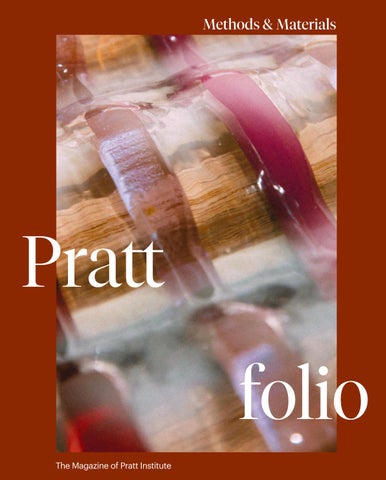
Methods & Materials
Pratt folio The Magazine of Pratt Institute
i
Contents Mill, Melt, Press, Shape
16
What Is Happening Now Is Never Going to Happen Again
26
Creating Across Continents
36
Prattfolio visits five students working across mediums in Pratt’s shops and labs.
AI is offering new visions for architecture, and opportunities for architects to shape its future.
A festival in Portugal becomes a hub for explorations of materials and practices that reinforce a sense of belonging, enhance local resources, and promote their revitalization.
The Message in the Medium
In sculpture and teaching, James Grashow made art an invitation.
6 President’s Letter
4
In Progress Highlights
6
Expertise
12
Diary
14
Network At Work
52
Connections
53
Catching Up
54
New and Noteworthy
56
Alumni Notes
61
In Memoriam
70
Prompt
72
Updates from Pratt Institute’s news page.
Associate Professor Blake Marques Carrington on technology, experimentation, and artmaking.
44
Students share their favorite finals-week snacks at Late Night Breakfast.
A career survey with artist Jaye Moon, MFA Fine Arts ’94.
Meet the interior designers and best friends designing livable, thought-provoking beauty.
Diving into fall with SNL costume maven Sam Bennett, BFA Fashion Design ’07. About the Cover Sofia Arreola Salem, BID ’25, Loom (detail) A weave made of glass that resulted from experimentation and testing with scrap-glass slumping—ultimately forming the surface of a table and working loom—was among the projects exhibited for this year’s Material Lab Prize. The annual prize, now in its sixth year, recognizes student design work that incorporates material exploration. Read about the 2025 Material Lab Prize on page 11, and learn more about submitted and award-winning projects at materiallab.org. Photo by Dahlia Dandashi Opening spread: A live drawing session in East Hall at Orientation 2025. Photo by Dahlia Dandashi
54
Jewelry, books, and more from Pratt alumni.
Class notes and alumni highlights from graduates’ submissions, newsletters, and media mentions.
What was your favorite place to make work while you were at Pratt?
16
26
36
Prattfolio, the magazine of Pratt Institute, is published by Pratt Communications and Marketing. © 2025 Pratt Institute 200 Willoughby Avenue Brooklyn, NY 11205 prattfolio@pratt.edu pratt.edu/prattfolio Facebook, Instagram, LinkedIn: @prattinstitute Vice President for Communications and Marketing Jim Kempster Director of Editorial Jean Hartig Staff Writer Hannah Holden, BFA Writing ’14 Graduate Editorial Assistant Caroline Hibbert, MS Historic Preservation ’27
56
72
Executive Director of Creative Services David Frisco Assistant Creative Director Jana Flynn Senior Graphic Designer Robert McConnell Graphic Designers Marcela Albuquerque Jina Alhenawi Felix Summ Associate Director of Communications Management Erica Dagley Galea Video and Photo Production Manager Tim Atakora
44
Project Manager Sahara Henley Print and Digital Production Manager Christopher Keating Copy Editor Brandhi Williamson For alumni address changes and obituary notices, please contact Alumni Engagement at alumni@pratt.edu or 718.399.4447. Prattfolio is printed by Lane Press, which has a long history of responsible environmental practices. Learn more at lanepress.com. Please share, recycle, or make something new with this magazine.
President’s Letter
The Power of Making
A
t the start of this academic year, I shared with our new faculty and students: learning through making is at the heart of what we do at Pratt. Our creative processes are deeply embodied, critically engaged, and boldly experimental, whether we are deepening our skills in traditional methods, generating new technologies or venturing into new ways of creating with them, or exploring at the intersection of the hand and the digital. This issue of Prattfolio is a reflection on that creative continuum, alive in the work happening today in our shops and labs, studios and classrooms, in the field, and in the innovative and masterful practices of our alumni around the world. This year, Pratt is focusing on the power of a creative education in a rapidly shifting world. Amid the complex conditions that surround our work, of technological change, escalating crises, and divisive pressures, while the value of higher education is being called into question, at Pratt we are making space for perspective-broadening dialogue and creating ways to move forward as a collective. This is happening in part through our Pratt Presents events series, which is looking in particular at creative enterprise as AI infuses our lives and industries. Through panel discussions and other programming, the series considers how artists, designers, and creative professionals are uniquely positioned to engage with new technologies through critical, ethical, and innovative lenses. (Learn more at pratt.edu/about/pratt-presents.) In mid-November, Pratt hosted our fellow Association of Independent Colleges of Art and Design (AICAD) member schools at the 2025 AICAD Symposium “Engaging Values.” With our colleagues in art and design education, we examined how we are preparing the next generation of creative professionals to be contributors and leaders of influence in our dynamic world—whether they are shaping the built environment, devising systems and products that enhance our lives, or giving life to worlds in their art that connect us to our shared human experience. As we move into the implementation of our next strategic plan, Pratt aims to be the standard setter among creative institutions, in imagination, innovation, sustainability, accessibility, and community. Following a yearlong, communityengaged process of development, the strategic plan was approved this fall, looking to the future of innovative education, including enhanced learning pathways, redesigned spaces and systems, and strengthened community partnerships. (Visit pratt.edu/strategic-plan to learn more.) Embedded in all of this is Pratt’s dedication to education that empowers our students to be independent and critical thinkers well equipped to adapt to the changing modes and challenges of the world, teaching them how to think, not what to think. Our students go into the world to do and create meaningful work, among an extraordinary community of alumni who continuously exemplify the transformational power of making. However you are connected with Pratt, I hope you see your vital part in this network, past, present, and future.
President Frances Bronet
4
PRATTFOLIO | FALL 2025
In Progress
What’s happening at Pratt now, from recent events to projects, explorations, and student life.
At the Grand Central–42 St subway station, the new mural Abstract Futures by Hilma’s Ghost (Sharmistha Ray ’05 and Dannielle Tegeder) visualizes the literal and figurative journeys that New Yorkers embark upon in the city. Read more about recent Pratt alumni and faculty transit art on page 9.
5
Updates from Pratt’s News Page
Read more from these stories and keep up with the latest from campus and beyond at pratt.edu/news.
Hats Off to Pratt’s Class of 2025! Pratt’s 136th Commencement honored the class of 2025 with a ceremony held at Radio City Music Hall on May 20. The momentous gathering recognized one of Pratt’s largest ever graduating classes, with more than 1,400 dedicated and accomplished students joining the ranks of Pratt’s vibrant alumni community. 6
PRATTFOLIO | FALL 2025
Honorary degrees were bestowed upon poet and cultural critic Claudia Rankine (Doctor of Letters), renowned architect Annabelle Selldorf, BArch ’85 (Doctor of Fine Arts), and visionary designer and typographer Stefan Sagmeister, MFA Communications Design ’98 (Doctor of Fine Arts). Speakers also included Frank
Franca, adjunct assistant professor of undergraduate communications design, who earned the Distinguished Teacher Award (2025–26) and was honored with a medal designed by Hayden Holmes, BFA Fine Arts (Jewelry) ’26. View more Commencement moments on Pratt’s news page, pratt.edu/news.
Previous page: Hilma’s Ghost (Sharmistha Ray, MFA Fine Arts; MS Theory, Criticism, and History of Art, Design, and Architecture ’05, and Dannielle Tegeder), Abstract Futures (2025) at the Grand Central–42 St subway station; photo by Etienne Frossard. This page: Photos by Jutharat Pinyodoonyachet (top left, bottom right and left) and Dahlia Dandashi (top right, bottom center)
Highlights
Top left: Professors of Undergraduate Architecture Lawrence Blough (left) and Deborah Gans (right), who lead the Housing Futures Lab, an accelerator in the IDC Research Accelerator Hub, with Pratt President Frances Bronet in the Research Yard. Top right, left to right: Peter West, Andrew Holder, Courtney Knapp. Bottom right: Matías Piñeiro; photo by Películas mirando el techo. Bottom center: Quinn Gregory. Bottom right: Photo by Kathryn Gamble
Academic Leadership Appointments
IDC Foundation Awards Second $1 Million Grant to Pratt’s Research Accelerator Hub The IDC Foundation awarded a second $1,000,000 grant to Pratt Institute to foster the next phase of the IDC Research Accelerator Hub in Pratt’s Research Yard, enabling an expansion of the initiative’s research, mentorship, and faculty fellowship programs through 2028. The IDC Research Accelerator Hub was opened in 2023 to support research accelerators and centers, as well as initiatives by Pratt faculty and students. The first round of funding created the overall framework and supported the IDC Research Accelerator Hub, IDC Research Accelerator Mentoring Program, and IDC Accelerator Research Faculty, and allowed for technology and equipment upgrades in the shared space of the Research Yard. The IDC Foundation promotes innovation in the fields of architecture, engineering, and building construction and has been a supporter of Pratt since 2018, with ongoing and past funding including scholarships and travel and research initiatives in the School of Architecture and the IDC Foundation Design Lab Initiative led by architecture faculty with student involvement.
Peter West, a distinguished writer, scholar, and academic leader with decades of experience championing the humanities, was appointed the next dean of Pratt Institute’s School of Liberal Arts and Sciences. He began the role on July 7, 2025. In the School of Architecture, Andrew Holder was named chair of Graduate Architecture, Landscape Architecture, and Urban Design, and Courtney Knapp was named chair of the Graduate Center for Planning and the Environment. Both assumed their roles at Pratt on July 1, 2025.
Pratt Institute Ranked in Top 10 of Art & Design Universities
2025 Guggenheim Fellowship Awarded: Associate Professor of Film/Video Matías Gustavo Piñeiro was selected for the Guggenheim Foundation’s 100th Class of Fellows. The annual grants support up to a year of creative and scholarly work.
“Bridging the gap between street-level realities and high-level design, I will conduct this research and ensure its results resonate on both sides of the Atlantic.” Quinn Gregory, MArch ’25, is studying different urban approaches to bicycle infrastructure in the EU as a 2025– 2026 US Student Fulbright Finalist.
Pratt Institute is ranked #7 out of 263 US and international art and design universities in the QS World University by Subject 2025. The listing also ranks Pratt #4 in the United States. Additionally, Pratt was ranked #10 in the History of Art category. Published annually, the rankings assess the world’s top universities in 55 individual subjects based on academic reputation, employer reputation, and research impact. They are published by Quacquarelli Symonds (QS), one of the world’s leading sources of comparative data about university performance. Pratt has been rated one of the world’s top 10 art and design universities by QS World University Rankings by Subject every year since QS added the category to its rankings in 2015. FALL 2025 | PRATTFOLIO
7
At Research Open House 2025, students, faculty, and staff displayed and discussed nearly 60 innovative projects in research, advocacy, scholarship, and community. The public event, attended by more than 500 members of the Pratt community and beyond, was held on April 24 at the Research Yard, Pratt’s dedicated space for applied creative research in the Brooklyn Navy Yard. Pratt’s Research Open House has been organized by the Office of Research and Strategic Partnerships in the Provost’s Office since 2018 to showcase the breadth and variety of research taking place at Pratt, including the work of Pratt’s Provost’s Centers and IDC Research Accelerators. This year’s event included four major themes, all with an emphasis on the merger of art and applied discovery: Experiential Health and Technology, Urban 8
PRATTFOLIO | FALL 2025
Community Design, Innovation in Industry, and Artificial Intelligence in Creative Practice. Exhibits from community and industry partners such as Design Works High School and DeAndra Craigman Studios and Base Ceramics for Made in NYC, as well as university peers including The New School, Syracuse University, and Lehigh University, demonstrated the growing reach and impact of the Research Yard. Four projects were awarded honors: The Excellence in Community Engagement Award went to Climate Stories by Swati Piparsania, assistant professor of Industrial Design. This “mobile educational platform is designed to foster environmental awareness and responsibility through play-based learning and interactive storytelling for students aged 6 to 10 in NYC public schools.” The Excellence in Innovation and
Design Award went to COSMOS by Peter Sim, AICAD post-graduate teaching fellow in Industrial Design. COSMOS is an elegant, ornate wooden and bejeweled chair that includes more than 400 parts “assembled together, blending different styles from different times, and combining digital and analog craftsmanship.” The Excellence in Industry Impact Award went to Insulative Felted Lint Textiles by Lily Allen, BID ’25, who transformed dryer lint collected from New York City laundromats into a versatile textile that can be used for fashion, outdoor gear, and home goods. The Excellence in Research Award went to the Pratt Center for Community Development for its multifaceted work improving the affordability and sustainability of NYC’s small homes alongside their community partners Cypress Hills LDC and IMPACCT.
Photo by Dahlia Dandashi
Research Open House 2025 Awards Recognize Community Engagement, Sustainability, and Design Projects
Top left: Photo by Jenna Bascom Photography, courtesy of ICFF. Top right: Abstract Futures, 2025. © Hilma’s Ghost, NYCT 42 St–Grand Central. Commissioned by MTA Arts & Design. Photo by Etienne Frossard. Bottom right: Students at the Hall Street Shelter for the StudentAlumni Day of Service. Photo by Prisha Goldy Kapania, BFA Communications Design (Graphic Design) ’26.
New Stops on the Pratt Transit Art Tour
Souvenirs, Chairs, and Group Shows at NYCxDESIGN 2025 Pratt students, faculty, and alumni participated in this year’s NYCxDESIGN events in a variety of ways, from group exhibitions to solo shows. The 2025 NYCxDESIGN Student Showcase, held at the Fashion Institute of Technology on May 19, featured work by Bobby Hay, BFA Interior Design ’25, and Nicole Yuen, MID ’25, that explored the theme of perseverance and considered “how creatives [can] bring people together and build bridges.” Work from 15 Pratt students and graduates was featured in the NYCxDESIGN showcase with Arts Thread, including a ceiling lamp made from discarded materials by Sveva Michahelles, MID ’23; a floating food forest by Amy Chien, MArch ’23; and a surf shoe by Haocheng Lou, MID ’23. At the International Contemporary Furniture Fair (ICFF) at the Javits Center, Zhiwei (Johnny) Xie, BID ’25, received the Best of Students Award for his flat-pack chair design titled Pivota. Five other students from the Interior Design and Industrial Design departments participated in The WANTED Design Schools Workshop, organized by WantedDesign, where they explored ways to redesign food systems in NYC. Professor of Industrial Design Constantin Boym organized the NYCxDESIGNxSOUVENIR showcase, which featured New York Cityinspired souvenirs from 72 designers, including numerous Pratt faculty members and alumni. Visiting Assistant Professor of Undergraduate Architecture Kiki Goti curated the group exhibition Forced Perspective, which featured design objects and furniture. Back on Pratt’s Brooklyn campus, Visiting Instructor of Industrial Design Danielle Begnaud, MID ’20, and Visiting Assistant Professor of Interior Design Margot Kleinman hosted Co-Designing the Classroom in the Design Center Gallery. They displayed and discussed their findings from a year of codesigning a classroom space with elementary school students. Throughout NYCxDESIGN week, these contributions reflected the breadth and depth of design at Pratt, where students, faculty, and alumni are not only shaping the city’s creative dialogue, but also reimagining how design can foster connection, community, and change.
In subway, train, and bus stations, artwork by Pratt alumni and faculty enlivens daily commutes, from colorful glass windows on elevated tracks in the Bronx to intricate mosaics underground in Brooklyn. A map of the artwork—newly updated to include installations by Lisa Corrine Davis, BFA Fine Arts ’80; Hilma’s Ghost (Sharmistha Ray, MFA Fine Arts; MS Theory, Criticism, and History of Art, Design, and Architecture ’05, and Dannielle Tegeder); and Visiting Associate Professor of Fine Arts Shervone Neckles—invites riders on a tour of creative expression from the Pratt community, much of it created through the ongoing MTA Arts & Design program for the subway and commuter rail stations. Visit pratt.edu/transit-art-tour.
Student–Alumni Day of Service Supports Hall Street Shelter More than 20 Pratt alumni and students gathered in Willoughby Hall on Saturday, April 26, to prepare 200 care packages for families at the Hall Street shelter as part of the second annual Student-Alumni Day of Service organized by Student Involvement, Community Board (CBoard), and Alumni Engagement. The care packages, adorned with friendly illustrations, featured notes of encouragement, snacks donated by the campus food provider Chartwells, toiletries donated by the Resilience, Wellness, and Well-Being Center, and resources for nonEnglish speaking residents to use at the local New York Public Library. FALL 2025 | PRATTFOLIO
9
Summer in the City: PreCollege Scholars Experience Life at Pratt In July, Pratt’s annual PreCollege Summer program welcomed a new cohort of talented high school students to its Brooklyn campus for a unique creative experience. For four weeks, accepted students leveled up their knowledge of fine art, animation, design, and more, leaving the program with expanded portfolios of work. Each year, The Black Alumni of Pratt (BAP) provides a number of full-ride scholarships for Black and Latinx students based in New York State to attend Pratt’s PreCollege program. Many scholarship recipients have gone on to attend Pratt or other art and design colleges. This year, BAP Scholarships were awarded to Devon Antwi, Sienna Perez, and Simone Davis Vasquez, who were selected based on the strength of their creative portfolios. “It means a lot to know there’s a community of people who came before me that not only succeeded but are reaching back to help others move forward,” said Vasquez.
At the 78th Annual Tony Awards, esteemed writer and actor Harvey Fierstein, BFA Art Education ’73, was honored with the 2025 Special Tony Award for Lifetime Achievement in the Theatre, and Oscarwinning designer Paul Tazewell won for Best Costume Design in a Musical. Over the course of his career, Fierstein has received four Tonys—for Torch Song Trilogy (Best Play and Best Actor in a Play), La Cage Aux Folles (Best Book of a Musical), and Hairspray (Best Actor in a Musical). His résumé also includes the Tonywinning Kinky Boots, among many others. Tazewell was awarded a Tony for Best Costume Design in a Musical for Death Becomes Her. This marks Tazewell’s second Tony; he previously won Best Costume Design for Hamilton. Earlier this year, he received an Oscar for his costume design on the film Wicked.
Project SEARCH Interns Graduate
“You don’t experience something like that very often in your college life.” —Jay Vargas-Garcia, class of 2026, in the recent New York Times story “A Long Sunrise Walk to Start the School Year,” which highlighted Pratt’s Brooklyn Bridge walk tradition and commitment to cultivating creative citizens. 10 PRATTFOLIO | FALL 2025
Recent alumni show how internships open doors to creative careers: “Be open to many different opportunities and try them all out to see where you might fit in,” says Alex Montané, BA Cultural Studies/Critical Theory and Analysis ’14; MA Art and Design Education ’21, of The Bronx Museum, where she was a fellow.
New York City high school students received career training through Project SEARCH, a national program focused on workforce-readiness for individuals with intellectual and developmental disabilities. The Pratt program, which first began in November 2021, is sponsored locally by AHRC New York City and the NYC Department of Education (DOE). To date, 38 interns have participated at Pratt, with up to 11 more arriving this fall. Pratt recently received the “The Positive Impact Award” from AHRC NYC for its efforts helping students gain confidence, community, and workforce-readiness skills.
Top left: Photo by Casiano Hamer, BFA Film ’18, 2025 PreCollege Coordinator. Top right: Photos by John Angelillo/UPI/Alamy Live News. Bottom left: Photo by Dahlia Dandashi. Bottom center: Alex Montané speaking at The Bronx Museum; Image courtesy of Alex Montané. Bottom right: Photo courtesy of Pratt Human Resources
Alumni Harvey Fierstein and Paul Tazewell Shine at the Tony Awards
Top left: Photo by Sam Hollenshead. Top right: Material Lab Prize awardees and jurors, left to right: Alexandra Bernhard, Lauryn Menard, Nainil Patel and Shruti Pendharkar (on phone screen), Heechan Kim, Kamilla Csegzi, Gabriela Mestriner, and Kim Mupangilaï; photo by Dahlia Dandashi. Bottom left: Edible Invasives by Arzu Oran, BID ’25; image courtesy of the artist. Bottom right: Image courtesy of Caryn Cast
Beyond Pratt: Where Students Go After Graduation Pratt Institute students have strong career trajectories upon graduation. According to the latest first destination survey conducted by Pratt’s Office of Institutional Research and Assessment, 92 percent of survey respondents from the class of 2023 secured employment or pursued further education within 12 months of graduation, highlighting the value of a creative education in today’s job market. Pratt graduates are making their mark at some of the world’s most influential and innovative companies, including Amazon, Apple, Dreamworks, Google, Meta, Nickelodeon, Oscar de la Renta, Penguin Random House, PepsiCo, Sesame Workshop, Sony, The Met, and West Elm.
Sixth Annual Material Lab Prize Celebrates Material-Driven Design Pratt’s School of Design announced the sixth annual Material Lab Prize, awarded annually to a student designer at Pratt whose work incorporates material exploration. The prize celebrates and exhibits interdisciplinary material-driven design, with a focus on innovation and craft. This year’s jury included designers Kamilla Csegzi, Edward Cabral, Kim Mupangilaï, Heechan Kim, and Lauryn Menard. At a reception for the Material Lab Prize exhibition on September 18, the jury awarded this year’s grand prize to Nainil Patel and Shruti Pendharkar, both MID ’25, for their project Biocircuits, a sustainable alternative to conventional circuit boards, made from biochar sourced from pistachio and coconut shells combined with agar-agar. Two honorable mentions were also awarded to Gabriela Mestriner, MID ’26, and Alexandra Bernhard, MID ’26. Mestriner’s project Magnetic Dust transforms steel dust—a byproduct of metal fabrication—into handmade papers with subtle magnetic properties. Bernhard’s project BioBeads reimagines festival beads using biodegradable materials as a sustainable alternative to the single-use plastics common at events like Mardi Gras.
Design to Help You Reconnect with Nature A number of recent projects from students in the School of Design, in disciplines ranging from interior design to illustration and beyond, explore how design can spark sustainable ideas, provoke new questions, and open possibilities for reimagining our relationship with the natural world. The news page highlighted 12 projects, including a culinary approach to invasive plant management (Edible Invasives: Foraging & Tasting Experience by Arzu Oran, BID ’25), a plant-care app (Placho by Ran Tao, MS Packaging, Identities, and Systems Design ’26), and a book about design, nature, and mental health (“Designers as Facilitators of Nature Therapy,” by Yuting (Winnie) Wu, MFA Communications Design ’25).
Art Outdoors from Pratt Alumni Pratt alumni created several recent public artworks, including the largest mural in Westchester County, a black-and-white ode to place in Maine, and more. The news page highlighted five works by Caryn Cast, AOS ’13 (shown working on Bodega Kitty Mural in Williamsburg, Brooklyn, above); Robyn Henry, BFA Fine Arts (Painting) ’21; Na’ye Perez, MFA Fine Arts (Painting and Drawing) ’20; and Finn Evans, AOS Graphic Design ’24; AOS Illustration ’25. FALL 2025 | PRATTFOLIO
11
Expertise
With AI and Artmaking, “You Need to Keep a Sense of Experimentation”
12
PRATTFOLIO | FALL 2025
Blake Marques Carrington, An Infinite Density Over Zero, 2021
machine learning are transforming our understanding of creativity, Prattfolio caught up with Carrington to ask about how he’s engaging with these technologies in his practice and in the classroom. As an artist, how would you characterize your perspective on technology? Blake Marques Carrington: I emphasize to my students that technology and new media don’t just mean an iPhone or computers. In some ways, we could consider a burnt stick of charcoal that early humans used to make drawings on cave walls a form of technology. When oil paint was invented in the early Renaissance, that was a form of technology. So, as artists, it’s good for us to keep deep time in mind when thinking about technology and how humans have a special ability to make tools. A question I like to think about is how tools interact with and shape the human
sensorium: our complete perceptual system, including the five senses of seeing, hearing, taste, touch, and smell, as well as other senses, like our sense of our body in space. How are those senses all shaped with technology? How do we shape technology with our senses? The feedback loop between our sensorium and the external world has always fascinated me. I’m consistently experimenting with and researching new tools, especially related to AI. It’s sometimes hard to carve out time for play that doesn’t need to have a product at the end of it. But when dealing with technology, you need to keep a sense of experimentation. Based on your experience with AI, what opportunities do you see this technology creating for artists? BMC: The main positive that I’ve seen among my students is that, while we’re
Images, this page and opposite, courtesy of Blake Marques Carrington
I
n the work of Blake Marques Carring ton, artist, associate professor in the Digital Arts Department at Pratt, and coordinator of the department’s Art and Technology program, the distinction between the digital and physical worlds dissolves, creating new ways to experience the interplay of human perception and technology. This can look like entering a white cube gallery rumbling with the sounds of distant explosions and discovering bass shakers affixed to the ceiling, producing subtle tremors that reverberate like fireworks. Or, it can mean watching as the Beaux-Arts facade of a museum appears to crumble, then reassemble itself—an illusion created through video projection. Visitors to Brooklyn’s Prospect Park might encounter Carrington’s work in the form of two AIs affixed to a tree, battling in a cycle of creation and critique, pruning pixels until they produce an image of a bonsai. Carrington first dipped his toes into digital media in high school, when a teacher introduced him to Photoshop. With this novel tool, he manipulated images, then painted them. Twenty years later, he’s had four US solo exhibitions, released six music albums under the name Russian Ark Sakura, and collaborated on concert visuals with rock star Patti Smith and the experimental sound art group Soundwalk Collective. The tools he employs today include powerful software like Unreal Engine, widely adopted in the film and gaming industries to create 3D graphics, and TouchDesigner, which allows users to connect blocks of information called “nodes” to generate interactive experiences. Large language learning models, like ChatGPT, serve as brainstorming partners and resources for technical advice. Though Carrington is an adept programmer, it’s often technological limitations–glitches, distortions, and the opaque logic of AI– that yield his most fruitful experiments. As artists reckon with the ways in which emerging technologies like AI and
all interested in these tools, we don’t think AI is some sort of savior. I’ve had students do work focused on exploring the levels of AI—experimenting with processes where it’s human-centered and AI just helps, versus workflows in which AI is making choices and deciding the goal of a given operation. As far as brainstorming goes, AI can loosen ideas that might be too rigid. For instance, recently I was preparing a new syllabus about electronic music and sounds. I spent a few days writing out many possible ways to structure the semester. After I felt like I had hit my head against the wall and I couldn’t think of other directions I wanted to take the class, I checked with AI, asking, “Okay, what are some possible modules?” However, I don’t like to start with AI. I like to fight for myself first, and get to a point where I’m struggling, and then maybe let AI loosen my gears a bit. Are there any challenges of working with AI or ways in which artists should proceed with caution? BMC: In general, I find I’m not interested in generative images, video, or sounds. The reason is that I’m an artist: I love getting deep in the process and discovering new things. I feel like I’m missing out on the most beautiful part of artmaking if I outsource that brainwork. AI is an average output of everything, right? I don’t think you’re going to get truly unique outputs from a mishmash of everything that’s on the internet. An ethical critique would certainly be related to copyright and how AI is based on the unauthorized copying of other people’s work. I don’t trust that the big tech companies have our best interests in mind as artists, creators, or humans. That said, knowing these tools is important. AI is already better than us at certain tasks. It’s going to upend jobs and the economy in general, completely. Eventually, AI is going to do everything better than us, potentially. Right now, having a strong creative voice, being passionate about what you’re doing, and diving into something extremely deeply is very important. And that’s going to be as good of a security against AI as anything else that I can think of. —hannah holden
Exploring Technology in Works by Blake Marques Carrington
A Mess that Encodes, 2019 Amazon founder Jeff Bezos has argued that humanity will inevitably exhaust Earth’s resources and be forced to colonize space. In this video installation, a distorted plastic dinosaur careens through a version of the cosmos cluttered with knick-knacks. The work critiques utopian fantasies of moving to space to escape the consequences of consumerism and overconsumption.
A Model That is Wrong But Useful, 2021 This surreal, apocalyptic wreckage is how a faulty app perceived an ordinary scene of a person resting in a hammock near a trailer. While the app failed at its intended purpose of capturing and modeling the environment, in an artistic context, it is up to the viewer to decide whether the output has any value.
An Infinite Density Over Zero, 2021 (opposite) In Hollywood blockbusters, a camera can tail a high-octane car chase or take flight with a dragon. Often, these physically impossible maneuvers are achieved with a combination of computer-generated imagery and footage captured with aerial drones. In this interactive installation, players use wireless game controllers to adopt the vantage point of a drone as they navigate an environment created from a digital scan of a Grand Canyon hiking trail—with Carrington appearing on screen as a virtual tour guide during a livestreamed performance based on this work.
FALL 2025 | PRATTFOLIO 13
Diary
Chocolate Churros After Dark
It’s 9 PM on a Thursday during finals. Outside, campus is quiet, but in the Student Union it’s another story—Student Involvement’s Late Night Breakfast is just getting started. Prattfolio stopped by last spring’s installment of the twice-yearly tradition and asked about students’ favorite finals-week snacks.
Photos by Dahlia Danashi
“The Hot Cheetos or the White Cheddar Cheez-Its in the dining hall— they’ve got good snacks!” — Minh Bauch, with Amelia Biggs, both BFA Communications Design ’25
“Dark chocola te you, it keeps y —it satisfies ou up for long enough, it fee ls nutritious.”
— Jalen Stokes , Writing, class of
14 PRATTFOLIO | FALL 2025
2026
“Ice cream w ith chips, from th chocolate e machine in th soft-serve e dining hall .” — Amand
a Reyes, class of 2027 Communications Design ,w , Fine Arts, clas ith Natalia Gonzales, s of 2027
nchies e Halal Mu tting th to g in o e g “I’ve been rtle, and I’ve been g y M n o fries.” place n gyro with e k ic h c e th ttarai, ne Bha kos, with Ju ’25 k a S i il s a V y — hotograph both BFA P
FALL 2025 | PRATTFOLIO
15
During the busy weeks at the end of last spring semester, Prattfolio caught up with five students working across mediums in Pratt’s shops and labs. They were creating everything from shoe soles to building facades using a range of tools, machines, and processes. Here is an inside look at how they’ve experimented, created, and guided their peers in making at Pratt.
Prattfolio visited Chanbin Im, BID ’25, one afternoon in her studio, just after she had been working in the School of Design’s CNC Lab milling foam for a chair prototype. Im, who came to Pratt for its industrial design tradition, has used her love of making and tools as a jumping-off point into all kinds of fabrication. She has been a student monitor in the Foundation and School of Design woodshops for much of her time at Pratt and in her own work often combines a number of fabrication techniques in a single project.
Have you found yourself gravitating toward certain ways of making as you’ve gone through Pratt? Yes! Can I show you my capstone project? [A slipper prototype, right.] It incorporates a 3D-knitted textile and a CNC-milled cork sole. I’ve been studying 3D-printed textiles recently because this topic touches both industrial and fashion design. So I was gravitating toward exploring 3D-printed textile techniques, and I found a technique called CNC knitting. I really wanted to apply it to my project, and I did! This part [the upper of the shoe] is 3D knitted. I think this project used the most technology at Pratt: The cork sole was CNC flip-milled—which was a new attempt for the CNC Lab. Christian [Adamik] and Mauricio [Tacoaman] helped me a lot. For the CNC knitting, it was Tracey [Weisman] in the Knit Lab who helped. The upper knit with all these tunnels was also a new attempt for the lab. Let’s look at some of your other work. I wanted to show you this chair experiment I did last semester in my furniture studio. I like it because I learned this technique in the Space, Form, Process class in my Foundation year. This is just bent sheet metal pieces connected with bolts and nuts. However, this simple bending gives a structure and aesthetic, showing potential to be real furniture. I am attached to this prototype. It shows how a raw material can perform differently and inspire thousands of different designs. Do you have a favorite tool or machine? Since I used it most recently, the CNC knitting machine is my favorite. In the woodshop, I love this wood-turning tool, the lathe. I can make something look like a finished piece. And it’s fun and meditative to carve out the wood.
18 PRATTFOLIO | FALL 2025
Opening spread: School of Architecture laser lab (left) and School of Art ceramics shop; photos by Dahlia Dandashi. This spread: Photos by Dahlia Dandashi
How did you get interested in industrial design? I was interested in tools and hardware when I was in high school. I thought they looked pretty as is. My sister Jeongbin was studying industrial design at Pratt at that time, so I was aware of the industrial design field, and I thought my interests aligned with it. Industrial design is very broad, so I knew I could do whatever I wanted. I was also interested in fashion, the hardware part of it. Industrial design allowed me to combine fashion studies with industrial design projects.
For techniques or skills, I’m really into folding origami tessellations. This is closely related to the idea of a pattern that provides functions. Is there an experience you’ve had in the shops that’s taken you in a direction you didn’t expect? I’ve been working as a student monitor in the Foundation woodshop for almost four years, and in the School of Design for three years. Since I’ve learned all the tools and machines in the shop, it has opened my mind to making and designing. What I mean is that students tend to make something that they can make . . . so knowing lots of skills widened my choices. Like the knitting machine—it’s something that I can’t do with my hand. For the CNC [pieces], that’s also the same; you can 3D model it, and then you can let the machine do it for you. However, I still like a hands-on approach, like cutting wood, making plaster molds, etc., because it helps you to understand the fundamental aspects of design. At Pratt, we take many hands-on approaches. We make more physical prototypes than CAD models. I think we’re more into crafting. Do you have any advice for students who are navigating the shops for the first time? I’ve gotten to experience things differently because I’ve been working in the woodshop for a long time. Not knowing how things are built limits your design, but even being in the shop, watching how other students are working, will teach you how to make things. Get to know the technicians, ask a lot of questions. Stack up your experience until senior year, and then use all your knowledge in your thesis projects. The reason I’ve been taking a knitting class, learning more CNC, working in the woodshop, putting my feet in many areas, is to make the best result out of the resources at Pratt. So I think at least a little bit, getting experience with some of these techniques will be really helpful later, not only for your school projects, but also for the future. The only thing I regret is not taking a metal class! I believe school is a preview of the professional world we’ll experience as designers. I hope every student enjoys and learns through the incredible faculty, staff, and inspiring colleagues and peers at Pratt. FALL 2025 | PRATTFOLIO 19
Baker Townsend, BFA Fine Arts (Painting) ’26, studied computer science and graphic design before coming to Pratt, taking a new step into fine arts. Painting has since led to metalwork, and Townsend spoke with Prattfolio in the fine arts metal shop, amid the whirs, clangs, and snaps of work in progress, to talk about that journey.
What have you been working on this semester? This semester, I took a class, sheet metal shaping, with Adam [Apostolos, visiting instructor and technician in the fine arts metal shop]. These are some projects we did, learning different techniques: We shaped a bowl, learning shining, beveling, curving, stretching, and shrinking, with aluminum. This box, we learned how to precisely measure, cut, and make something level, and hinges, being very precise—this one drove me nuts. It was fun. I do like being very precise when I make things. I do enjoy something that works, that has a function. Something else I’m working on is a house for a creature my partner is making. It’ll be this metal structure, epoxy molding, and these long legs, long arms coming out, like a hermit crab in its shell. They draw this thing a lot, and I told them they should make it a sculpture, so we’re working on that. Is there anything you’ve discovered here that’s changed the way you think about your work? Maybe not so much my work, but how I see objects. I understand how much goes into making a hole or making a box work; there are so many specificities that go into it. It’s allowed me to appreciate objects more, being in the metal shop, and I’ve gotten more interested in material. I’ve worked with steel and aluminum, and I find it a lot of fun. The variation I deal with is how thick the metal gets, and that can cause different things to happen, which I think is very interesting. Same if I’m stretching a canvas, thinking about stretching cotton vs. canvas, a large scale vs. a small scale. The material reaction to the environment is interesting too. Like, this wasn’t rusted before it started
20 PRATTFOLIO | FALL 2025
Photos by Megan Proctor, BFA Photography ’25
What brought you to Pratt? It was the campus, and access to a lot of resources to do things with my hands and physical mediums. I knew I wanted to do painting, because I was new to fine arts in general and started them kind of traditionally. Since I’ve been here, I’ve realized that I enjoy a lot more [practices]. I’ve always been fascinated with machine shops, the smell of them, the textures, the noises. I knew I wanted to work here [in the metal shop], so I took a class sophomore year, and then I got a job here this year.
getting humid a couple days ago, and canvas on a hot day will start sagging— which I kind of love. It feels like it’s alive. You’ve talked about how the metal shop is a collegial environment—how have you worked with other students? In here, it’s not a competition; there’s no reason not to help anyone. Adam knows best at the end of the day, but it is great when the room is full of people who have taken classes or worked here and you can ask them for advice. If I know someone works with a certain tool a lot and I’m going to use that tool, I go to them. I work a lot with the drill press and know how it operates well, and people come to me to ask about that. What are some of the fundamental things you’ve learned here? Tool sensibility, machinery sensibility. You don’t need to push too hard to make something work—if you’re pushing hard, it’s not going to work. How important it is to understand what a tool is before you use it, and how to work with it and not against it, and once you understand, you can pick things up a lot faster. That’s helpful outside here too. At Pratt, we’re encouraged to make whatever we can conceive of, and I love that. At the same time, we should be making within the limitations of what we know and learn those limitations first before moving on. I get wanting to learn everything all at once—I felt that same way—but you’ll get farther being comfortable with a small amount of tools first, and everything is going to feel easier after that. Build slow. It’s a whole new space, a new environment. You shouldn’t come in here expecting to know anything. And for someone who’s curious about the shop but maybe hesitant? It’s not a bad thing to be scared when coming in here. Be OK with it; it’s how you should be feeling. It starts to become a fun fear in this intense environment that, once you get used to it, invigorates you.
FALL 2025 | PRATTFOLIO
21
CH: I was always interested in fabrication. Going to undergrad, I did architecture history, instead of full-blown design. I really got into history, the background behind design concepts. I think design was waiting for me the whole time, but I never took the leap until now.
Master of Architecture students Kerry Richardson and Colin House, both finishing their second year in the program, met Prattfolio in the School of Architecture Robotics Lab and studios to talk about their experiments and successes in 3D printing with clay. For an assignment to design building facades, both designed clay brick systems and used the robot to make their models, working together to navigate an unconventional and inventive process.
How did you get to this place, 3D printing with clay? KR: The project was to design a facade, so when we were researching precedents, one of the ones I chose was made of ceramic tile. [A Factory As It Might Be by Assemble Studio.] It wasn’t 3D printed; it was this simple extrusion of clay. Then I found out that we can print clay. I started by making molds. I’d 3D print a mold and put the clay in, and have that as my tile, but it’s easier printing clay with the robot. CH: We all have our own 3D printers [in the master’s program], so we’ve been introduced to that process, but I work at the shops here, and I know that the robot is capable of doing clay 3D printing. So, we were interested in ceramics as a base point, and it was sort of like, OK, if we’re interested in ceramics, and we already know a bit about 3D printing, why don’t we try this. [Kerry and I] weren’t even in the same class—but we thought, let’s just do it together. KR: We just found each other doing the same thing. CH: [As precedent] I was inspired by 212 Stuart Street by Höweler + Yoon, an apartment complex building. They used concrete panels as the facade, not ceramic. But I chose that one because it had this wavy form that drew me to it. I wanted to combine that shape with the materiality of clay and see what happens when you combine the two. What did you discover in the process? KR: There was so much trial and error. With the type of clay you’re using, the speed that you’re printing, how many wall layers you have. How you’re packing
22 PRATTFOLIO | FALL 2025
Photos by Dahlia Dandashi
What brought you to Pratt? KR: I studied biology and chemistry in undergrad. So something completely different from architecture. I wanted to do something more design focused, where I could be more creative.
the clay, how wet the clay is when you’re packing it into the tube, how much clay you need for each piece. CH: We started out with a clay that was super groggy—it had sand and silt and gravel. That wasn’t working at all with the 3D printer. It didn’t hold moisture, and it didn’t go through the extruder properly with the nozzle. KR: We kept going with that clay because we really wanted to make it work. Until we were like, OK, we need to find something smoother. Once we found this [terracotta with no grog], we were printing like five pieces a day. CH: We would come in at like 8 AM, pack the tube, submit the files, and then just stay there all day. We air dried for three to four days, and then, after the pieces dried completely, we brought them to this artist in Bushwick who owns her own studio and has a kiln that she rents out. The bisque fire is the first process— these [Colin’s pieces] are just bisque fired, so they have that natural terra-cotta tone—and Kerry went back for the glaze.
KR: I wanted to include color. The glaze, you never know how it’s going to come out. This is supposed to be a dark blue-green, but it’s really dark— it could’ve been the temperature it was fired at, or the way I painted it. It’s all experimentation. CH: I don’t think either of us have ever worked with clay. Greg [Sheward, School of Architecture production facilities manager and visiting assistant professor] pointed us toward resources, and we took that info dump and then ran with it from there. KR: We were making our own profiles, finding our own clay— CH: We were creating the geometry in Rhino, with no idea how well it would print on the robot. Every project in the robot lab is so different, that there’s not really a textbook “here’s what you have to do.” How has working with other students in the shops shaped your work? CH: With the robot, students come in with files and we work through the files together with Greg, because it has a really big learning curve. In the woodshop, it’s more hands-on. It’s definitely helped that we have a community that we’ve built up—we have people who’ve got our backs and want to see us succeed, and they put in a lot of time and effort to help us through whatever mishaps we run into. What advice would you give to someone figuring out how to navigate these spaces? KR: Talk to people. I was so intimidated by the woodshop, and it took me forever to get in there and use the bandsaw, but I went and asked for help. In the robot lab as well. CH: Everyone who goes to Pratt is excited to make something, so they’re always down to help you. They will get behind your idea no matter how awful it is [laughs]. You don’t get that level of community at every school.
FALL 2025 | PRATTFOLIO 23
Let’s look at some of your work. I made this sculpture, The Worm (opposite, bottom), sculpting from 3D models of human vertebrae, while thinking about the process of translating the three-dimensional into the two-dimensional and then back to the three-dimensional. The steel mounting for this was done in the metal shop. I bent the central steel component with the Hossfeld bender. It’s an old machine [patented in 1925]. It’s a very fiddly tool, but it does everything. I like old machines and tools; nothing better than the basics. This next work, Name of the Shell (opposite, top), was made, in part, with fiberglass. I was inspired by custom fiberglass housing, which is typically used to protect and preserve specimens in museum collections. I filled the inside of [a body form made with duct tape] with spray foam—which is not a good choice, by the way; I did not realize how little spray foam there was in each can! I coated the foam form with plaster so 24 PRATTFOLIO | FALL 2025
Photos by Megan Proctor, BFA Photography ’25
Hui Ying Koh, BFA Fine Arts (Sculpture and Integrated Practices) ’25, was drawn to sculpture by its expansive possibilities. Determined to make the most of the resources at Pratt to explore ways of making, Koh worked in the ceramics and metal shops (alongside an internship in the city at multidisciplinary artist Betty Beaumont’s studio, where she is now an assistant). Koh met with Prattfolio in her studio to talk about the tools, techniques, and process behind her work.
What brought you to Pratt? I’ve always been interested in the arts. I had explored a variety of mediums like drawing and printmaking, but I chose sculpture [as a concentration] because I’d been working in a ceramics studio, and had found that there were a lot of avenues I could take with sculpture, which really drew me in. A majority of the artists I looked up to at the time were also sculptors. I chose Pratt because facilities like shops and studios are very important to me. I’m not someone who can make art in an empty room. I wanted access to good equipment, in a city that has a good art scene. While I worked for a ceramic studio called Pinch in Singapore before college, I only truly began to understand the scope that ceramic studios could reach when I came to the US. Pratt’s ceramics studio stood out to me because of its size and scope. I started working in the ceramics shop maybe my second week at Pratt. There were a lot of fancy machines and equipment I had never seen before. I really learned a lot. Then, while I was thinking about working at a different type of shop to learn more about a different medium, Adam [Apostolos] offered me a job after I took his Metalworking class, and so I started working at the metal shop.
I could sculpt the form a little before using it as a mold for fiberglass sheets. When I tried to pop the hardened shell off the plaster mold, it didn’t come off. I had to chisel out the plaster. After that, I painted a few layers of beeswax on the inside, which I proceeded to texture by hand with a needle tool. For the metal mount, I planned it out with tape and I brought the plan to Adam. We bent rods using a combination of torsion grips and heat. People don’t see how much work goes into an artwork. For me, it’s not relevant if all this labor is seen or not. I think when you’re putting in a lot of effort, or your hand, into something, you imbue it with your soul. And this sense of care will naturally present itself in the finished work. You mentioned artists who inspired you. Who were those artists? One of the biggest reasons I studied sculpture was because I was a huge fan of the artist Olafur Eliasson. It’s funny, my best friend got into architecture because of Olafur Eliasson. We had both seen his work—these huge installations that are awe-inspiring, that capture the best moments of nature—and were like, I want to do this, but we took it in two different directions. He uses a lot of materials that aren’t traditional artist materials, and a lot of new processes that join science, technology, and art. What would you tell a new student about navigating the shops? I would say, make good use of the resources here at Pratt. When you come up with ideas, you don’t always think of how you’re gonna make them, but you should try to see how the shops can support you and your ideas. Don’t limit yourself, but also come up with ideas that make use of the resources you have while you’re at Pratt. For me, I found it important to understand what was available to students so I could mentally prepare myself to explore these resources. I tried out a lot of new mediums and new technology at Pratt, and that really exposed me to multidisciplinary and experimental methods of making. It’s wonderful to be around a community of people who are all trying stuff out on this new technology.
FALL 2025 | PRATTFOLIO 25
Whatever Is Happening Now
26 PRATTFOLIO | FALL 2025
Is Never Going to Happen Again AI Is Offering New Visions for Architecture, and Opportunities for Architects to Shape Its Future BY ALLISON C. MEIER
The display type in this story is set in a font generated by LTTR/AI, a doctoral project of Filip Paldia.
H
ow will our built environment change when designed more and more through the visions of machines? Artificial intelligence (AI) has a history in programming that predates its now ubiquitous presence in culture, yet it’s only in the past few years with widespread access to chatbots and generative image programs that many people have directly interacted with it in their creative work. Although almost every field is grappling with the implications, ethical dilemmas, and possibilities of AI, architecture faces particular challenges and opportunities in adapting its design processes to this technology.
28 PRATTFOLIO | FALL 2025
The imagery in this story, the work of Pratt Institute faculty and their collaborators, was featured in the 2025 Pratt School of Architecture exhibition Transductions. Opening spread: Cathryn Dwyre and Chris Perry of pneumastudio, Portal Opposite: Jason Vigneri-Beane Crypto-flora, 2024 Right: Jason Vigneri-Beane Aerial Infrastructures, 2024
Digital imaging has long been central to communicating ideas in architecture, acting as an intermediary between conceptual forms and the built world. Architects are now considering not solely how to use AI to automate aspects of their work, whether workflows or as a way to efficiently interpret regulations like building codes, but also how it can be a tool of creative collaboration as they experiment with a technology that is still evolving. A study released this year by the American Institute of Architects (AIA) in collaboration with Deltek and Construct Connect found that while just 6 percent of architects surveyed are regularly using AI tools in their work (including chatbots, image generators, and tools for analyzing grammar and text), 53 percent have experimented with AI, suggesting a modest but growing level of adoption as questions about its usage remain. Around three-quarters of the architects reported feeling optimistic about AI’s potential to automate manual tasks, yet a whole 90 percent had concerns about AI’s inaccuracies, security, authenticity compared to purely human-made work, transparency, and how its data and models might be used. Meanwhile, the 2025 AI report from the Royal Institute of British Architects (RIBA) stated that 59 percent of its surveyed architects’ practices are using AI, up from 41 percent in 2024. It is likely these numbers will climb in the coming years as understanding about what AI can do and how architects could use it further develops.
“It’s changing every day because all of the AI models that we’re all using, they’re learning,” said Jason Vigneri-Beane, professor of undergraduate architecture in Pratt Institute’s School of Architecture. “Whatever is happening now is never going to happen again, because it’s not like normal software where you open it, you use it, you close it, you open it the next day, and it’s the same. Neural networks are learning, and so you can generate something, and then an hour later, they learned so much from all the other people using it, that moment is gone.” t was with this interest in capturing the current experimentation with AI and architecture that Vigneri-Beane cocurated Transductions: Artificial Intelligence in Architectural Experimentation with Olivia Vien, MArch ’15, adjunct assistant professor in Graduate Architecture, Landscape Architecture, and Urban Design (GALAUD) at Pratt; Stephen Slaughter, chair of undergraduate architecture; and Hart Marlow, MArch ’09, interim assistant chair of of GALAUD. The exhibition, held in early 2025 at The Rubelle and Norman Schafler Gallery on Pratt’s Brooklyn campus, included over 30 architects and designers working in architecture at Pratt and beyond and showcased what they were at that time exploring with AI in their work. It wasn’t an exhibition merely speculating on the future of AI but instead examining how early adopters have already been pushing the technology to its limits.
“One of the things that prompted the show was following the explosion of experimentation around generative AI and its new visual possibilities,” VigneriBeane said. Themes that emerged when the curators were viewing the work together revealed how lines were blurring between the physical and virtual, with AI encouraging hybridization between the two by bringing in source material not only from architecture but also from areas such as ecology and geology or film and art. While architects can input constraints, design styles, specifications for materials, types of buildings, and other guidelines into text-to-image machine-learning models like Midjourney and Stable Diffusion, what these models generate can often be a surprise as they turn text prompts into visuals based on things like patterns in their datasets. Architects are also inputting their own renderings or sketches into these models and further augmenting them through prompts, opening up new directions that they may not have discovered in more conventional modeling software. Vigneri-Beane, who is also the founding principal of the Brooklyn-based Split Studio, has an ongoing project on “cyborg ecologies” that engages with AI image generation in taking a futuristic perspective on the relationship between ecology and design at an imagined time when both are being created by machines. The images are hauntingly beautiful even with their hints of apocalypse, envisioning FALL 2025 | PRATTFOLIO 29
Duks Koschitz and Robert Bracket III Inflatable Concrete Pavilions (Series), 2024
synthetic flowers growing on intricate structures and otherworldly floating contraptions—or “aerial infrastructures,” borrowing from the title of the work—terraforming new ground. “It’s very easy to get something; it’s very hard to get something interesting, because the more these models learn, the more many of them are tending— because of the way that people are using them—towards realism and commercialism,” Vigneri-Beane said. He added that when he first started using AI image generators, there were a lot of what are known as “hallucinations,” when the AI would glitch away from reality to fill in the gaps or perceive patterns or objects that were not there. “It was really hard to get something reasonably representative, and now it’s flipped. It feels like you have to work harder every week to uphold the creativity, which I think is a good argument for why we’re vital contributors to this process.” ndeed, many of the creators featured in Transductions emphasized that human intervention is still necessary in these digital 30 PRATTFOLIO | FALL 2025
processes. “We have to understand what [AI] is capable of, but we also need to understand how to use it, and then how to break it or how to manipulate it and use it with intent,” said Alex Tahinos, adjunct assistant professor in GALAUD. His work featured in Transductions challenged the way that AI tends to be object-oriented and focused on the foreground of its generated images. He instead aimed to make the architecture itself a landscape of structures seemingly being absorbed into the environment, a concentration on the background of a rendering that is contrary to how AI is usually viewing architecture, as it privileges a building or structure rather than its context. Tahinos is the founder of the multidisciplinary practice fka design and has an ongoing interest in creating hybrid environments through experimenting with technology. His work in Transductions, in bringing building types into unexpected collisions of styles and forms, also expressed how AI creates images that are guided by the relationships between the vast data it is drawing on, which come from diverse visual sources.
“One of the biggest things that needs to be discussed when it comes to AI is the culture of, for lack of a better term, sampling,” Tahinos said. “The music industry went through this same thing, and I think now with the influx of all these images, this tool becomes our way into that idea of sampling, and I think that we’re going to have very similar discussions over the next years based on authorship.” Where the architect fits as an author in the creative process when AI is a part of it was also a recurring theme in Transductions, including in more practical considerations of its role in making real-world objects. “I see it as a powerful extension of existing workflows, a tool to accelerate iteration and bridge the gap between digital design and physical fabrication,” said Robert Lee Brackett III, adjunct associate professor of undergraduate architecture. He noted that his practice already merges hands-on techniques like model-making and sketching with computational methods, such as simulation and 3D printing, with AI adding another connection between those tactile and technical approaches. “The
It’s very easy to get something; it’s very hard to get something interesting.
key is utilizing AI not as an autonomous creator, but as a collaborative partner, reacting to and enhancing human intention, responding to established design parameters, and accelerating the translation of ideas into tangible form.” Brackett’s work in Transductions demonstrated how he has been translating abstract, textured landscapes digitally made with AI into 3D forms that are then milled into foam and cast in concrete. Like Tahinos, he has been confronting the limitations of the dominant perspective of AI as it tends to veer towards photorealism rather than abstraction. Transductions also featured Brackett’s work with Duks Koschitz, professor of undergraduate architecture, with whom he codirects d.r.a. Lab (Center for Design Research in Architecture) at Pratt. They have been investigating the use of AI to generate images of inflatable structures—something they’ve regularly utilized, as pneumatic structures offer quick and cost-effective solutions for large temporary works—with a concrete texture. “This probably took longer than making a 3D model and using standard
rendering tools, but the form was imaginary, and we wanted to push the tool,” Brackett said. While inflatable concrete might seem like an impossible idea, attempting to make a heavy material into something ephemeral and light, Brackett and Koschitz are interested in how AI is allowing them to realize what would be too difficult to test only through hands-on building. “It’s a constant feedback loop—taking things from the physical world, putting them into the digital world, generating plausible scenarios, and then bringing that back out to see if we can make them at the scale of architecture.”
T
his fall, Brackett and Koschitz are teaching an undergraduate advanced design studio exploring generative AI outputs, including image and text generation as well as 3D modeling, in which students will be asked to integrate AI tools into an architectural workflow. With the wide availability of AI, both undergraduate and graduate students are often coming into their courses with some firsthand knowledge of what the tools can do by FALL 2025 | PRATTFOLIO 31
Above: Olivia Vien Imprinting Grounds, 2024 Opposite: Robert Brackett III Terraformed Diffusion Landscapes (Series), 2024
32 PRATTFOLIO | FALL 2025
having interacted with text-to-image models like DALL-E, which was released in 2021, and Stable Diffusion and Midjourney, which were both released in 2022. The dialogue that many educators are hoping to start in introducing AI to their coursework is in asking students not to take the outcome of AI image generation as the final product and instead use it as a starting point or sandbox for their individual creativity. “The point is to try to teach them that no matter what the tool is, your job and your agency as a designer, as an architect, should be to bring your own thoughts and ideas to it and never let the tool just tell you how to use it,” said Caleb White, visiting assistant professor in GALAUD. “And I think we’ve learned that from years before dealing with digital tools in architecture.” He pointed out that modeling programs like AutoCAD have been a standard of 2D and 3D computer-based design for architects since they were introduced in the mid-1980s. While AI can represent a new frontier of design possibilities, it still requires the same level of awareness of how the technology works and how it can be used to
express an idea and still bring a level of craft to its image production, just as an architect wouldn’t take the default tools of another rendering software as their final product. White, who is also a lecturer in Rensselaer Polytechnic Institute’s School of Architecture and cofounder of the architectural design firm MatterLab, based in Troy, New York, and Mixed Signal, an experimental design media group, has been engaging with AI in his work for years before its increased accessibility. He brought that experience into the Mediums 3– Visualization course he cotaught with Ramon Pena Toledo, visiting professor in GALAUD, and Joseph Giampietro, adjunct assistant professor in GALAUD. “There are certainly experts in the industry on AI, but I would actually say that most of us are amateurs and playing with it together,” White said. “So we tried to take that position in Mediums. We wanted to incorporate AI because you can’t ignore it anymore. It’s important for students to be exposed to these tools, but we also didn’t want it to be an AI-focused seminar, because I think everybody is realizing this tool can become a little bit of an echo chamber, and it can actually start to limit the outputs that you can achieve if everyone’s using the same tools in the same ways.”
T
hat concern with the sameness of AI content is not unique to architecture, with everything from the use of ChatGPT for writing to the uncanny perfections achieved by AI photo editing tools threatening to homogenize creative work. Likewise, AI’s environmental impact, its privacy concerns, copyright issues, and ethical questions about the scraped data AI models are trained on and their biases are shared across disciplines engaging with this technology. Job displacement from AI—whether the technology is actually able to replace a human or if doing so seems economically advantageous for the employer—is also shadowing excitement about applying it to practices and firms in architecture, where positions that are between the creative process and production have the most precariousness in being taken over by AI through automation. “AI is fundamentally changing how people work and is likely to replace some jobs,” said Mark Heller, an assistant
professor in the Master of Landscape Architecture (MLA) program. “In the short term, there may be a risk of layoffs and downsizing as firms compete to be the nimblest. In the long term, I am hopeful there will be a flourishing of small landscape architecture studios—individuals, partners, small collaboratives, possibly even guilds, that are able to compete with traditi onal firms because they develop unique and efficient modes of leveraging AI.” Heller’s work includes building software for landscape and urban analysis, modeling, and simulation, and while he said he has used AI minimally, it’s been in a range of applications, from the most basic, as a thesaurus, to more complex usages like identifying best practices and precedents. He compared it not to replacing a person but instead to the need to pull up a dictionary or scroll Reddit threads for information. “Optimistically, the potential of any new tool is to free us from drudgery,” Heller said. “Architecture and its allied disciplines are heavily mediated by software. If automated workflows and more intelligent software and hardware can shift the balance between
computer-based time and time spent in the field with real materials—not proxies—the most important question to entertain is how we want to spend that newly available time.” It also has the potential to create new roles in the industry, notably in construction, which works in partnership and alongside architecture. For example, Vardhan Mehta, BArch ’18, was recently named to the “Forbes 30 Under 30” list for his work as the cofounder and CEO of Acelab, a Brooklyn-based company established in 2020 that is creating AI-powered software that can support construction companies in sourcing sustainable and affordable building materials. As more architects start looking into how to use AI, more opportunities will presumably arise, whether it’s analyzing risk factors in the structure of a building or improving a design’s sustainability by testing different layouts. (Being able to give text-to-image generators a prompt that actually creates something that stands out from the rest of AI-generated imagery, meanwhile, is a new and necessary skill in itself.) “Every generation, across all disciplines and professions, contends with
the possibility of professional extinction. But architecture doesn’t die—it mutates,” said Dr. Harriet Harriss, professor in the Graduate Center for Planning and the Environment (GCPE). “When drawing boards gave way to digital modeling in the 1980s, the discipline didn’t collapse; it recomposed itself. Each technological rupture is less an ending and more an invitation. The question is not will we adapt, but who will script the adaptation. Enter early, and we write the spatial syntax of tomorrow’s cities and spaces; enter late, and we become footnotes in someone else’s dictionary. Architectural pedagogy should not attempt to protect students from this disruption by persisting with a business-as-usual approach, but instead should apprentice them into disruption—teaching them to choreograph the ruptures rather than merely withstand them.” Those consequences are incredibly evident in the many criticisms of AI, such as its tendency to elevate certain perspectives and dismiss others, and how it can amplify any biases that were part of the data it was trained on. Especially since that data has largely been scraped from the internet, it has taken FALL 2025 | PRATTFOLIO 33
The question is not will we adapt, but who will script the adaptation .
34 PRATTFOLIO | FALL 2025
in all of the discrimination, stereotypes, and inequalities in who and what are represented there and how. Studies of text-to-image AI systems have revealed that they can reinforce and perpetuate stereotypes about gender and race and foreground a Western cultural perspec tive. Likewise, architecture by the leading designers of the United States and Europe is more likely to be in the datasets than architecture originating in parts of the world that are underrepresented online. According to the nonprofit Internet Society, over half of online content is in English, although approximately 16 percent of the global population speaks English as a first or additional language, further skewing what content is shaping the output of AI.
Alex Tahinos Rococo, 2024 Cape May, 2024
“AI is no oracle. It is a mirror, smeared with the fingerprints of its makers,” Harriss said, recalling themes explored in Preservation in a Time of Precarity, a Pratt symposium “on the intersection of, and equanimity between, artificial intelligence and Indigenous intelligence” held in fall 2024. “Its training sets are already biased towards Western and Global North assumptions and advantages. If we let those values dominate, AI becomes not a tool of possibility but a repetition engine for old hierarchies, including gender and racial biases that are often dressed up as ‘traditions.’ That is why pedagogy must teach students not just how to use these tools, but how to disobey them—how to imagine
against the predetermination and often prejudice of the prevailing datasets.” “What should give us all hope,” Harriss added, “is the impact that the extraordinary diversity of the next generation of architects is beginning to have on AI. They are not just inheriting it, they are shaping it, embedding new forms of ethics, justice, and ecological responsibility into the datasets and the design cultures that AI learns from and carries forward. That’s the essence of machine learning: it absorbs the identities of those who train it. Consequently, a leading architecture school is less a site of instruction and more a rehearsal space for futures that do not yet exist— a place where students learn to teach the machine as much as it teaches them.”
This is probably simply the beginning of how AI will shape the practice of architecture, as much of what has been most visible are those stunning and strange renderings of fantastical structures that merge data culled from across human culture into new forms. Architects have never taken just one approach to how they represent their work, even in the days of sketches and models, and for many, AI is another avenue for this visualization that at the same time can encourage them to rethink their ideas by doing something unexpected. As architects are exploring its potential for imagery, design, and automation, they are finding new ways to create while making sure that the world AI is envisioning is one that keeps humanity at its core. FALL 2025 | PRATTFOLIO 35
CREATI
CONTIN
ING
ACROSS
The À Deriva festival in Portugal becomes a hub for explorations of materials and practices that reinforce a sense of belonging, enhance local resources, and promote their revitalization. by joe mccarthy
NENTS
The miter joints were eluding Cadyn Chien and Cristian Maldonado, both MArch ’25. It was trial and error at scale as they built their project for their Advanced Design Research studio, a private chapel with unique geometry that required joint cuts at more specific angles than the standard 45 degrees. Adding layers of complexity to the project, the pair was working with unique constraints, as the model would need to break down flat for an international trip. The finished piece would be part of a group of installations and art and design activations Pratt Institute faculty and students were preparing for this summer’s À Deriva Architecture, Design, and Arts Festival in Penacova, Portugal, an event Pratt and the University of Coimbra developed in collaboration with the community of Penacova through seed funding from the Foundation for Luso-American Development in Lisbon. The festival presented students and faculty from across disciplines at Pratt with opportunities for codesigning with a community, learning about regional culture, and exploring new practices and materials.
38 PRATTFOLIO | FALL 2025
Page 36, this page, and opposite: photos by Rachel Guo, MArch ’25
Page 36: Pratt architecture students Cadyn Chien and Cristian Maldonado’s “Chapel of Play” installed in Penacova. Above: Detail of Chien and Maldonado’s chapel structure.
Chien and Maldonado used plywood to create their structure and explored joints that were both formal and expressive for the structure.
ASSEMBLY REQUIRED “Cutting, sanding boards down, trimming From the start, Chien and Maldonado knew they would be working with plywood, them, using the table saw. We did a lot of wood joinery exploration, thinking since the structure had to be taken apart about how the different pieces of wood and reassembled in Portugal. Although can interlock with each other and how the material was flat-packable and ideal they also speak of the narrative, so that for prefabrication, it was prone to cracksome joints are more structural and othing and required a lot of troubleshooting. “We were dealing with really thin wood,” ers are more expressive.” This expressiveness would help Chien said. “Plywood can chip off and “Chapel of Play” achieve a balance of break if you sand too hard. We had to cut playful and sacred elements as part a bunch and think about the material limof the Design 6: Storied Cabinets studio its and possibilities while making it.” taught by Graduate Architecture, Urban The intricacies of making unfolded in Design, and Landscape Architecture Pratt’s School of Architecture woodshop. faculty Joe Vidich and Olivia Vien, which “We went to the woodshop and that, asked students to design and build strucfor me, was the first time that I had to tures, inspired by Penacovan culture and work with every machine,” Chien said.
history, that “blur boundaries between the container and the contained, the functional and the fantastical.” Over the course of the semester, bringing the structure from 2D to a scale model to an accessible piece of furniture presented many challenges, none more so than getting the miter joints right. Figuring out the exact angle required a level of precision and experimentation that exceeded what digital tools like Rhino or laser cutting could offer. Small mistakes during the cutting process could lead to chipping or poor alignment, so they learned to pay close attention to the grain, flexibility, and fragility of the material itself. “There was a lot of back and forth communication between us and the [woodshop] workers,” Chien said, referring to the technicians who supervised the machines, and explaining how even a basic misunderstanding about whether they were referring to the cut-off angle or the remaining angle could derail a cut. There were other elements to consider in this build as well—things like screw type and seal for the paint finish, for which the pair had to factor in climate, durability, and ease of reconstruction. “We had to think about safety, shipping, and how the wood would respond over time, especially since it’s a structure that allows people to enter,” Chien said. The pair’s final composition was in itself a gateway to exploration and a new perspective. For the design, they arrived at a tall vertical structure placed on a horizontal base that invited visitors to enter through a low opening, an action that Chien and Maldonado began to see as a “mini ritual.” “It’s telling the body, ‘you have to change your position and crawl inside.’ You have to slow down and think, ‘is this opening big enough for me to crawl in?’” Chien said. “Then there’s this shift that happens when you’re inside, not just formally, but geometrically as well. The inside space is painted in this vibrant warm orange that’s meant to be stimulating and intimate, inviting both curiosity and a sense of pause as the body feels like it’s wrapped in filtered sunlight.” FALL 2025 | PRATTFOLIO 39
NEW TECH MEETS TRADITIONAL MATERIALS In Portuguese, the word deriva refers to a state of figuring things out as you move through them, maintaining a sense of playful curiosity amid both the familiar and the new. This concept animated the year-long collaboration between Pratt and the University of Coimbra, during which teams researched, designed, and built the projects that would be installed and displayed in Penacova, finding inspiration in local culture and materials and conversations with community members. On a fact-finding and story-collecting trip, Pratt faculty held a community town hall in Penacova and toured local architectural sites, museums, and 40 PRATTFOLIO | FALL 2025
manufacturing spaces, where they were able to hold and feel cork. This experience laid the groundwork for two undergraduate studios tasked with developing installations for the festival. (Read more about the student experience at the center of À Deriva at pratt.edu/news/a-deriva.) Portugal is the largest producer and exporter of cork in the world, and the manufacturer Corticeira Amorim agreed to donate cork for use in the festival projects. Even then, the material’s fragility was apparent to Richard Sarrach, executive director of Production Systems and adjunct associate professor of undergraduate architecture. When he brought the ultra-thin 2mm sheets of cork to
Assembly Loop Lab (ALL), the designfabrication facility under Production Systems in the Technology Division, they cracked and tore easily, resisted traditional fabrication methods, and appeared limited in their ability to occupy space. Through continued experimentation, Sarrach and Scott Sorenson, associate director of Production Systems and visiting assistant professor of undergraduate architecture, discovered that specialized equipment could transform how cork performed and appeared. Using a UV printer, typically employed for printing on rigid surfaces like glass, metal, and plastic, they applied ink directly to cork. Because the UV curing process
Opposite: Working with fragile cork, Pratt architecture faculty members Richard Sarrach and Scott Sorenson explored processes that transformed its material qualities. The result is a “cabinet of curiosities” that was installed in Penacova during the festival.
This page and opposite: photos courtesy of Richard Sarrach
Right: Sarrach and Sorenson’s structure, Confraria dos Confrades Confabulados, contained 3D-printed figures representing Portuguese culinary brotherhoods.
hardens ink with light instead of heat, it allowed for varied surface treatments without damaging the material. The result was visually striking, lending the cork unexpected qualities. It shifted in appearance with the light, at times looking like leather, at others like metal. Pairing this with the precision of the Zünd digital cutter, which sliced cleanly through cork “like butter,” the team was able to move beyond the flatness of the material. By stacking, folding, and rolling it onto itself, they created layered surfaces, going from paper-thin sheets to forms several inches thick. What began as a fragile, easily damaged surface evolved into a sculptural, dynamic skin. For the festival, Sarrach and Sorenson incorporated the transformed cork into a cabinet of curiosities based on Portugal’s gastronomic brotherhoods—around 100 organizations dedicated to preserving culinary practices and traditions in Portugal. They selected nine related to Penacova to represent in their design. The figures were produced at ALL using Fused Deposition Modeling (FDM) 3D printing with custom code that gave the brotherhoods a distinctive fuzziness, adding an ethereal quality to their forms. “As visitors move around the installation, they experience shifting perspectives of these ‘conspiring brothers’,” Sarrach and Sorenson noted. “The cabinet serves as both shrine and stage, elevating these cultural guardians while inviting viewers to discover the rich tapestry of Portuguese culinary traditions they represent.” FALL 2025 | PRATTFOLIO 41
42 PRATTFOLIO | SPRING 2025
Opposite: Artist Analia Segal led a workshop with Penacova residents and Pratt faculty and students that involved bread making, sculpture, language, and dialogue.
Opposite: photo courtesy of Analia Segal. This page: photo by Joseph Vidich
Left: Segal was inspired by the community ovens located along the Mondego River and local baking traditions.
RECIPE FOR CONNECTION During one of the early visits to Penacova, Analia Segal, adjunct professor - CCE of fine arts, was intrigued by the concept of community ovens she kept seeing in small towns along the Mondego River. “These are local brick ovens that people share for cooking and making bread,” she said, noting that they’re common throughout Europe. “The traditional Portuguese ‘biscoito’ endured long voyages, nourishing sailors and explorers as they set forth on their intrepid journeys across the seas.” As she spoke with locals, she learned of bread’s importance as both a source of nourishment and a basis for community and wanted to explore the sculptural pot ential of breadmaking. During a 10-day return trip in March, she apprenticed with João Fernando Costa, a fifth-generation baker who she met at the initial town hall meeting, at his bakery Padaria do Largo. “I learned the ropes of being at a bakery,” she said. “I went there early in the
morning and learned different breadmaking techniques. I got to know the family and develop trust, which is a big part of the process. I felt like the impetus for this was learning and finding new models for transmission of knowledge in different settings. We came up with a recipe that was suited for a sculptural piece as part of a multimedia installation.” Segal’s interest in this ancient practice inspired a workshop “that centered on the belief that we are not estranhos— not strangers—but companheiros: from cum panis—those with whom we share bread, gestures, and stories.” “I felt that it was tapping into the instinct that everyone has to create,” Segal said. “Dough is very similar to clay, there’s no need for technical learning or explanation. It becomes more about giving room for dialogue.” Pratt students and faculty, along with local citizens, joined her for the “mãos
na massa” workshop at the start of the festival that sought to “remind us that making and sharing are ancient acts of connection, and that every loaf broken is an offering of presence.” Gathered around a table on the cobblestone street, the participants were asked to choose a word in their mother tongue that made them feel closer. They then kneaded dough and sculpted words like memory, community, and rio, the Portuguese word for river. “As a contemporary artist, I choose the material that best communicates my ideas, so it’s not necessarily the bread that was important, it was the participatory experience, the collaboration with the community, the traveling, the language and translation,” said Segal, who is also currently a PhD candidate at Universidad Politécnica de Madrid. “There’s a lot about this project that continues my research inside and outside of the classroom. It has planted new seeds to develop.” FALL 2025 | PRATTFOLIO 43
In Sculpture and Teaching, Alumni Artist and Educator James Grashow Made Art an Invitation BY CLINTON KRUTE
EDITOR’S NOTE As we were designing this story, James Grashow, known as Jimmy to his friends and loved ones, passed away at 83. His work and uplifting perspective on art making, at any age, seeing humble materials as charged with life and possibility, was an inspiration to us in creating this issue. We thank his family for the opportunity to share this story with the Pratt community.
rtist James Grashow, BFA Graphic Arts ’63; MFA Art Education ’66, was a master sculptor, capable of quickly, magically hand-carving a subject’s likeness out of a hunk of wood, without even a photo for reference. And yet, for all his skill as a woodworker and draftsman, Grashow was pulled back throughout his career to a medium that is less expected in the realm of fine arts: corrugated cardboard. He had a special knack for working at stacks of it with his knife, cutting and painting and carving into it again until he’d produced a chain of playful monkeys, a sea- or 46 PRATTFOLIO | FALL 2025
cityscape, or even vases out of which bloom delicate architectural structures (or “houseplants,” as he called them). It wasn’t only his facility with the material that drew him to it again and again—it was the ubiquity of cardboard that made it so special. Not only is cardboard accessible to everyone in proximity to a recycling bin, but it’s almost impossible to find someone who hasn’t, at some point in their life, built something out of it. Speaking from his studio in Redding, Connecticut, which he described as a protective space that allows him to shut out the noise of the world, the artist was completely at ease when surrounded by his work. At age 83, Jimmy—as he’s known to his friends, whom he made very easily—exuded a sense of peace, an awareness of his own achievements as an artist, educator, father, and partner to Guzzy, his wife and, as he called her in an interview for this story, his “translator.” An accomplished illustrator who created the iconic cover for Jethro Tull’s
1969 album Stand Up and had a regular gig creating artwork for The New York Times throughout the 1970s and ’80s, Grashow is perhaps best known today for his vividly rendered and exceptionally playful sculptural work. Regardless of the medium and subject, his hand is immediately identifiable. His work has been exhibited all over the world and, as we see in Cindy Meehl’s new documentary about the artist, titled Jimmy & the Demons, which premiered at the Tribeca Film Festival in June, over these past few years, he’d been beginning to consider what all this work that he’d created, and all of this life that he’d lived, added up to. It was at Pratt where he first discovered that art could be both a form of communication and a sanctuary. Growing up in Brooklyn in the 1950s, he sensed that art was his calling. He told me, “The only thing I ever could do really was draw. I have no mathematical skills, and I can’t spell.” It was at Pratt that he was able to bring his unarticulated dreams
Photo by Irish Flare Photography
James Grashow leads a cardboard art workshop at The Granite Church in Redding, Connecticut, where his monumental work The Cathedral was exhibited last year.
Photo by Bryan Haeffele
“Cardboard is grateful for the opportunity to become something, and a person is grateful to be given a chance to make it.” to fruition: “It was the holy grail for me. Finally, I was doing something that I absolutely loved. Pratt was everything.” Specifically, the school and its professors introduced him to the many mediums that he would go on to master over the course of his career. Grashow said, “I think I remember every teacher who influenced me”—Steven Green, Fritz Eichenberg, Jacob Landau, Richard Lindner, and painter George McNeil—and he described the late Richard Bove as an “unbelievable teacher.” Bove later asked Grashow to take over his class, which he did and continued to teach at Pratt for more than 10 years. Before that, after graduating with his MFA in art education in 1965 and spending a year in Florence on a Fulbright scholarship, Grashow became a working artist, supplementing his commercial and gallery work with teaching. He began to teach at Pratt, one day a week, in the late ’60s, where he brought an infectious enthusiasm, wit, and love of materiality to the classroom. As he put it, “My class was
more about creativity and how to conceive, rather than how to draw. My theory was that once you understood space, you could draw anything. How do you put a line to paper? What does it mean to create a form?” Grashow thought of teaching as an extension of his artistic practice. He sought to engage his students in his own fascination with the incredible possibilities of the materials themselves. He vividly recalled some of his favorite moments working with students: “At Pratt, we did anything we wanted to do . . . We made a big Thanksgiving table and had the students draw giant plates and a turkey dinner on it. We made clothespins, and everyone had to do a drawing of their laundry, and we hung the laundry throughout the school, even over the entrance to Pratt. Every week was an adventure. Now, 50 years later, I still get notes and letters about that class.” Then and throughout his career, Grashow’s teaching and his art found the extraordinary in the everyday. Which
James Grashow with The Cathedral at The Granite.
brings us back to the material that has come to define Grashow’s sculptural practice: common, run-of-the-mill cardboard. The industrial packing product has been a constant in his work, from the endlessly inventive and playful installation work from the ’70s and ’80s to his more recent large-scale project, Corrugated Fountain (2012), a detailed rendering of Bernini’s fountain that was left, by design, to crumble and collapse outside the Aldrich Museum of Contemporary Art in Ridgefield, Connecticut. For the artist, the disposability of cardboard was conceptually, even spiritually, significant. As he told me, with a menagerie of cardboard creatures dangling behind him in his wonderland of a studio: “We’re dispensable; we’re disposable; we’re finite, just like cardboard. So cardboard and people become the perfect partners in a claim to eternity. Cardboard is grateful for the opportunity to become something, and a person is grateful to be given a chance to make it.” FALL 2025 | PRATTFOLIO 47
For students of all ages, he saw card board as an invitation to creativity. In a New York Times story this past summer, he said it could be particularly potent for anyone who feels they’ve lost their connection with making: “Cardboard is the gate back!” Clearly, for Grashow, it was the work itself, and his direct engagement with the raw materials of his projects, that made it all worthwhile. It’s not the product, as they say, but the process, approaching each day as another opportunity to physically interact with the world in a creative way. “When I wake up, I love to work,” he said. “Some days you wake up and you’re unbelievably physically jittery; your body wants to do something gigantic. You want to make a big machine. And then there are days when you want to do something that’s seamless, like a mantra, something slow and contemplative.” Meehl’s film follows Grashow over the course of the four years it took him to complete The Cathedral, a hand-carved wood 48 PRATTFOLIO | FALL 2025
piece that the artist saw as a rumination on mortality, and something of a culminating project, weaving together the many formal and thematic concerns that had obsessed him over the years. The piece centers on an effigy of Christ, who, as grotesque demons grasp at his heels, hefts a magnificent church on his shoulders. The sculpture is weighty in its religious and art historical references, while bubbling over with Grashow’s signature wit. “I have come to feel that an artist’s true identity is not found in the images he makes but in the medium he chooses,” Grashow reflected, in a favorite quote shared by Guzzy. Of wood, he said, “I love the contemplative process required by a woodcut; its detail-by-detail evolution toward finish. A smooth and sensual piece of wood and the limitless possibilities it provides seem to touch the heart of what I am.” Though he was raised Jewish, The Cathedral emerged fully formed in his imagination not as an illustration of
religious dogma, but as a remarkably straightforward expression of the struggle we all feel to overcome our demons. In Grashow’s perspective, that happens through the practice of the art, and the miracle of creation. Art, for Grashow, was a refuge, a place in which those demons could be transubstantiated into laughter and joy through process and form. As he described it, there was a profound connection between his approach to art making and his approach to teaching, both of which were honed during his time at Pratt: “It’s being in the moment. All time collapses. You’re 100 percent there. If you’re an artist, that’s where you want to be. Where time and everything disappears, and the only thing you feel is the chalk and charcoal. Your body lives to be there. When you teach, that’s where you want everybody to be. It’s like everybody is an electric terminal, and you can light one up, and then that person lights the next one. The idea is to light up the whole room.”
Photo courtesy of Jennifer Wastrom
James Grashow in his studio, from the documentary Jimmy & the Demons.
EXPLORE YOUR FUTURE. Pratt is where your creative journey began—and it doesn’t have to end. Keep growing with the School of Continuing and Professional Studies, right here in Brooklyn, Manhattan, or online. CERTIFICATES Explore flexible, noncredit certificates designed for creatives—at any level. Stack courses, mix disciplines, and build the skills you seek to shape your unique art and design path—online or in person.
PRECOLLEGE FOR HIGH SCHOOL STUDENTS High school students can thrive in their creative passion, build a standout portfolio for college admission applications, and get a taste of on-campus college life through Pratt’s renowned PreCollege program.
GRADUATE PREPARATORY COURSES Stay strong at Pratt. Targeted preparatory courses sharpen essential skills before grad school, curated and led by Pratt’s expert faculty.
INTENSIVES Boost your creative edge with short, focused courses—credit or noncredit. Grow your skills fast, connect with peers, and make your mark.
LEARN MORE pratt.edu/scps
CONNECT WITH US kdangelo@pratt.edu
FALL 2025 | PRATTFOLIO 49
pratt.edu/graduate-studies
Shape your future at Pratt. Advance your career, pivot to a new field, hone your craft for real-world impact. Whatever your goal, Pratt has a graduate program to meet your ambition. Build your future in a hands-on, interdisciplinary community at the intersection of practice and theory, with world-renowned faculty and access to New York City’s resources. Explore our 27 graduate programs in architecture, fine arts, design, information studies, and liberal arts and sciences.
Network Inside looks at work, practice, and collaborations with Pratt alumni.
Artist Jaye Moon ’94 creates interactive, tactile Lego Braille paintings that invite viewers to a multisensory experience. Read more on page 52.
51
At Work
Artist Jaye Moon ’94 creates sensory experiences to connect people across languages and experiences.
What’s a daily practice that prepares you for your work? Each morning, a simple breakfast clears my mind and prepares me to create. Then, I organize my Lego bricks by color and shape— it gives me a sense of control and focus.
“It is not those differences between us that are separating us. It is rather our refusal to recognize those differences,” read lines of text in one of Jaye Moon’s paintings. The quotation is Audre Lorde’s, and in this work and others by Moon, like Blowin’ in the Wind above, featuring Bob Dylan’s lyrics, the words are set in Braille, rendered in the studs of Lego bricks. Moon studied fine arts at Pratt in the early 1990s, under Robert Zakarian and John Monti, concentrating on sculpture and earning her MFA in 1994. Since that decade, she has been creating artworks with Lego, translating literary passages, song lyrics, and her own writing to Braille within the paintings, inviting those who encounter them to a tactile and visual experience. In March, Moon was inducted into the New York Foundation for the Arts Hall of Fame, where she was celebrated for her unique and inclusive approach to art making. In Prattfolio’s career Q&A, Moon shared a window into her practice working with unconventional materials. 52 PRATTFOLIO | FALL 2025
What’s energizing you right now? I’m energized by creating quiet, meditative abstract works that translate Korean and English literature into Braille with Lego bricks to tell stories that are not only seen but also felt and imagined. I also make daily number paintings based on Braille number codes.
What’s a tool you can’t live without? Lego bricks are essential to my practice. They let me build tactile, Braille-based abstractions that communicate across sight and touch, merging color, language, and accessibility into inclusive visual art.
What is a major influence for you today in your work? Life experiences and current issues influence my work. I believe art should reflect our times. I translate narratives from inspiring films, books, and my personal writings— bridging touch and vision.
When you hit a roadblock, what’s your tactic for getting unstuck? When I hit a roadblock, I pause and step away from the work. I take a walk or shift my attention to something mundane. This helps me gain a fresh perspective and return with renewed clarity.
What’s a chance you’re glad you took? Faced with the difficulty of getting permission in NYC, I installed Lego public art without approval. Those spontaneous acts sparked unexpected community dialogue and opened up new creative possibilities.
How do you creatively recharge? I find creative energy in quiet, everyday moments—readings, slow walks, conversations, and daily rhythms. These simple pauses help me reset, gain unexpected clarity, and reconnect with a deeper sense of balance and awareness in life.
Is there a “failure” that turned into a breakthrough? In the ’90s, being told Lego wasn’t “real” art motivated me to go deeper—transforming that rejection into a breakthrough that shaped my practice around accessibility and interactivity.
What’s the most inspiring place in New York City for you? The most inspiring place in New York City for me is Brooklyn, my home for over 35 years. Its everyday life and cultural diversity constantly spark new ideas and fuel my artmaking.
What’s your favorite part of the work you do today? Creating tactile abstract art that transcends differences—inviting blind individuals, people from diverse cultures and backgrounds, and all age groups to engage with the work through their own personal perspective.
How has living in the city influenced your work? Living in New York City has exposed me to different cultures, identities, and social issues. The city’s complexity deeply shapes my work, inspiring inclusive, tactile art that bridges language, accessibility, and emotion.
What’s one book you’d recommend to a fellow artist? I recommend Sister Outsider by Audre Lorde—a collection of essays and speeches exploring identity, feminism, race, and justice. It offers powerful insights on embracing difference and inspiring social change.
Who’s the first artist you connected with? The first artist I truly connected with was Nam June Paik. His groundbreaking multimedia work inspired me to envision my own path blending technology, culture, and public engagement.
What’s the best advice you’ve received? Stay true to yourself—and to your vision. Don’t be afraid to explore unconventional paths. Art comes from uncertainty and change; it’s about expressing your unique voice through the journey of your life.
Previous page and this page: Jaye Moon, Blowin’ in the Wind, 2023, 8,000 Lego bricks in Braille, Dibond, 40 40 inches. Courtesy of the artist & Jennifer Baahng Gallery
Brick by Brick
Connections
The Best Friends Designing Livable, Thought-Provoking Beauty
Photos courtesy of Jesse Parris-Lamb
Interior design alumni Amanda Jesse ’09 and Whitney Parris-Lamb ’09 of Jesse Parris-Lamb
From a cozy book nook in a Brooklyn brownstone to an inviting living room in a towering industrial beach house in Connecticut, the work of interior design firm Jesse ParrisLamb can appear effortless. But for founders Whitney Parris-Lamb and Amanda Jesse, both MS Interior Design ’09, every design choice results from technical rigor and professional expertise. “Although we want our design to be aspirational and beautiful, and thought-provoking in its beauty, we still have to recognize that it needs to work for a family or an individual,” Jesse said. “The interior design standards—of the height of a coffee table or a proper seat, or the distance between two things and the path of circulation—are so important.” Balancing the art and science of interior design has helped the founders become established entrepreneurs whose projects are regularly featured in publications
like Architectural Digest and Vogue. But they didn’t start their careers as designers. Nearly two decades ago, Parris-Lamb was a dissatisfied arts educator in New York City, and Jesse was a ballerina in Ohio whose company had declined to renew her contract. Seeking to pivot, they applied to Pratt’s graduate Interior Design program, attracted by its national ranking and reputation as a launch pad for second careers. During the program, a professor paired Jesse and Parris-Lamb to design a library for users with visual impairments. The assignment kick-started their friendship and creative partnership. “As soon as we started working together, it gelled, because we’re both intense and focused, and have a take-no-prisoners approach to projects,” Parris-Lamb said. Jesse and Parris-Lamb’s time at Pratt coincided with the Great Recession. As layoffs rocked the interior design industry, they none-
Park Slope Brownstone Cork’s unique cellular structure traps and absorbs sound waves. For a graphic designer’s study that doubles as a late-night nursing room, Jesse Parris-Lamb lined the walls with cozy, sound-dampening cork tiles from the maker Nova.
theless secured internships and junior designer positions at high-end residential firms. Networking while they were students helped them overcome economic headwinds to secure full-time design positions after graduation. As they established their careers, friends and acquaintances reached out for help reenvisioning their spaces. Working on these projects at night and on weekends, they saved to start their own business. Jesse and Parris-Lamb were warned that going into business together could strain their friendship. But they were determined to make Jesse Parris-Lamb a reality, which they did in 2014 after landing their first major residential project. “We didn’t have a major fallback plan,” Jesse said. “So it had to work, but I felt very confident it would.” Today, Jesse Parris-Lamb operates from a storefront studio in Prospect Heights, Brooklyn. The team has grown to eight employ-
Canfield Island Residence Invented to make urban transport cleaner and more comfortable, subway tile quickly found its way into homes. For a Connecticut beach house, Jesse Parris-Lamb chose handmade ceramics from Waterworks, giving a shower room subtle color variation.
ees, including fellow alumni Carol Andrews, MS Interior Design ’17, and Zhuoshan Cai, MFA Interior Design ’22, who were introduced to the founders by Pratt faculty members Tarek Ashkar and Jon Otis. Though many founding partners divide responsibilities, Parris-Lamb and Jesse continue to work in sync. “The beauty and success of our partnership is the creative collaboration,” Parris-Lamb said. Having worked together for 18 years, “Amanda and I can be in a meeting and, without saying any words to each other, know pretty much exactly what the other person is thinking.” The founders return to Pratt every year to participate in the residential design critique focused on townhouses—this time not as students, but as seasoned professionals. “It turns out we have a lot to add to the conversation,” Jesse said, smiling. “This is what we do every day.” — hannah holden
Brooklyn Heights Wood Frame Jesse Parris-Lamb gave the millennia-old tradition of terra-cotta a modern spin, decorating the walls of a kitchen with handmade tile from Walker Zanger. Adorning the floor is a hand-painted geometric pattern that pays homage to the textile art of Anni Albers.
FALL 2025 | PRATTFOLIO 53
Catching Up
Fresh Starts with Costume Maker Sam Bennett ’07 This has been a milestone year for Saturday Night Live costume supervisor Sam Bennett, BFA Fashion Design ’07. SNL celebrated its 50th anniversary, and this fall marks 10 years of Bennett’s work on the show—joining the crew as a tailor and working his way up to his current role managing the costume shop. Prattfolio caught up with Bennett as summer slid into autumn to see what was fueling him creatively. It’s a particularly electric season for him: “Even though I adore summer vacation, I’m always excited to go back to work in the fall,” he said. “SNL season 51 is back in October! I wonder what crazy things I’ll make and who I’ll meet this season.”
2. 3.
HOT GLUE GUN! HOT GLUE GUN! People love to hate on hot glue, but it’s versatile, fast, and buildable. I even keep a travel size glue gun in my suitcase just in case.
54 PRATTFOLIO | FALL 2025
I’m in the middle of the new season of Wednesday. The show is such a visual treat. The costumes and set designs are absolutely incredible and I want all of Morticia’s wardrobe, and her beach umbrella and chairs.
1: Photo by Anna Belousova. 2: The cast of Wednesday. Courtesy of Netflix © 2025. 3: Evan Amos/Wikimedia Commons
1.
My home is an extension of my creativity. Every day I’m arranging flowers, swapping around artwork, or moving furniture, plants, and knickknacks. I rotate what’s hung on the walls so I don’t get bored as easily. And when I do get bored, the first stop is the paint store. Currently, I have clouds on the living room ceiling and a pink disco bathroom.
4.
I think being resilient and able to branch out helps you find your center better. It can help you identify and harness your best assets. I like taking classes and workshops for fun in other mediums. Nothing beats getting filthy at a ceramics class the day after working on a pristine white wedding dress. It’s a good way to scratch all my itches.
5.
I’m only a few months in, but I’m a shrimp dad! That’s right, I have a tank full of beautiful little freshwater shrimp. They come in lots of colors and are so much easier and more fun than fish!
4 & 7: Photos courtesy of Sam Bennett. 5: Stephanie Leuker/Wikimedia Commons. 6. Photo courtesy of Garbage
6.
Garbage, my favorite band from high school, is back on tour! I can’t wait to feel my teen angst when they visit Brooklyn.
7.
The wall of my workspace at SNL is somewhat of a catchall collage of some special projects and memories. The Sam’s Sweet Buttered Buns is a leftover decal from a rejected costume for Samuel L. Jackson. The orange stripe template is a stencil we made from one of Aubrey Plaza’s monologue cue cards (all the departments enjoy reusing them). A picture of Aidy Bryant as the most beautiful chicken in the world looks over me as I work. Aidy has a special place in my heart (I made her wedding dress!) and this chicken costume was one of my favorites to make. She’s my sewing guardian angel.
FALL 2025 | PRATTFOLIO 55
New and Noteworthy
Jewelry, Home Goods, and More from Pratt Alumni
Pratt graduates’ recent products and publications include playful accessories, hybrid furniture, and visual histories.
1. The Rose Book (Phaidon) Kristine Paulus, MSLIS ’03 In everything from fashion to fragrance to art and horticulture, the rose is one of nature’s enduringly captivating flowers. The Rose Book, coauthored by Kristine Paulus, head of acquisitions and technical services at New York Botanical Garden’s LuEsther T. Mertz Library, does a deep dive into its historical and cultural significance. Along with essays and a rose glossary, 220 images trace the rose’s influence—a visual survey with highlights that include botanical illustrations, a couture Dior gown, and a rose-embellished Barbie as well as ancient mosaics and Victorian Valentine’s cards. Available at phaidon.com. 2. 260 Hybrid Table for Arcanium Inc. Zac Feltoon, BID ’08 Made for a seamless transition from dining to gaming, this table from Zac Feltoon for Arcanium Inc. uses a unique folding-leaf system to shift modes. “The table leaves follow a balletic transition sequence, which, as far as we can tell, is a design solution that has never been done before in table design,” says Feltoon. The piece, named a Core77 Design Awards 2024 Notable, was created especially with long-form game players in mind, with a storage compartment at the center, covered by the dining table’s surface, to help pause extended game sessions. The 260 Hybrid Table is made of solid American Ash hardwood in Omro, Wisconsin. Available at arcaniuminc.com.
56 PRATTFOLIO | FALL 2025
1: Phaidon. 2: Zac Feltoon/Arcanium Inc. 3: Marland Backus. 4: Hachette Book Group. 5: Rebecca Mapes. 6: ORO Editions
1
2
3
4 5 6
3. Bouncy Ball Necklace Marland Backus, BID ’15 With her foundations in industrial design, Marland Backus creates jewelry that plays with form, material, and scale—like a giant diamond ring designed as neckwear, toy-car hair clips, and a charm bracelet bursting with shell, crystal, and glass ornaments and other miniature surprises. Backus’s designs have adorned stars and style tastemakers like Chappell Roan, Charli XCX, Addison Rae, Doja Cat, and Olivia Rodrigo. This nostalgic piece is made of bouncy-ball lookalike resin beads, complete with tiny star confetti and glitter inclusions, on a stainless steel chain. Available at marlandbackus.com.
4. Basket Ball: The Story of the All-American Game (Little, Brown Books for Young Readers) Kadir Nelson, BFA Communications Design ’96 Forthcoming in January, Kadir Nelson’s richly illustrated history of basketball celebrates the passion, strategy, and athleticism that’s been at the heart of the game since its origins some 125 years ago. Accompanying the Caldecott Medal–winning artist’s paintings are features on star players including Wilt Chamberlain, Magic Johnson, Michael Jordan, LeBron James, and Stephen Curry along with quotes from significant figures in basketball. For sports lovers, Nelson’s new book could be a companion to his lauded bestseller We Are the Ship: The Story of Negro League Baseball. Available at hachettebookgroup.com.
5. Resting Glass Set Rebecca Mapes, BFA Fine Arts ’11 From the Santa Fe studio of Rebecca Mapes come glass objects that take their forms from nature’s shapes and lines. Pieces from the Resting series, which includes uniquely crafted vases, bowls, and glasses like those shown here, were blown by Mapes using glass produced in Tijuana, Mexico. Available at rebeccamapes.com, along with jewelry that borrows similar inspiration from the natural world.
6. Greatness (ORO Editions) Pascale Sablan, FAIA, NOMAC, LEED AP, BArch ’06 Celebrating the work of 47 contemporary architects and designers from around the world, this anthology from architect and activist Pascale Sablan addresses the question of “greatness” in architecture and sheds light on oftenoverlooked contributions to the field. Through profiles, essays, and project case studies, Greatness highlights how the discipline at large and the built environment—from residential, cultural, institutional, and master plan design—have been and continue to be shaped by designers from a range of backgrounds. Available at oroeditions.com.
FALL 2025 | PRATTFOLIO 57
Syrop
Make an impact and support the next generation of Pratt students.
A gift to Pratt fuels the work of our students. Your generosity can ensure our students receive an experience that promotes their creative and academic success, access to world-class faculty, and an environment that is unique and cross-disciplinary.
Scan the QR code to make your gift online at giving.pratt.edu.
ALUMNI ACHIEVEMENT AWARDS
SAVE THE DATE
Friday, March 13 Manhattan Penthouse | 80 Fifth Avenue New York, New York 10011 Join us for an award ceremony and luncheon to celebrate the alumni community, the Class of 1976, and our incredible awardees.
2026 With special recognition of the Class of 1976
Additional details and how to RSVP will be announced in early 2026. Questions? Email alumni@pratt.edu.
1, ’6
LD H O N ARC R A , B NE AL E N U P TH RO JOA NN SY D P A AN RO URE SY CT LE
& z u r C y d d Te
26 Y AR U R M W EB 15 P LLO iUM F Y, 6: FO TOR A i T SD E A TO UD R d U UR ON L A CE an d. L A e TH CT PTI . uire e L A r c i f P H bl eq is LE CE S ES nt e pu re r E N e i a M R ev th is to ions GG T. JA h i t n T e a H S op serv 1 6 Re
Browse the latest Pratt and Cannoneers gear. Scan the QR code or visit shop.pratt.edu to explore the collection and purchase yours.
Photo provided by Estudio Teddy Cruz + Fonna Forman
an m r o F a n n Fo
BY ED W Z DO EL iON EN E S DAT TH UN FO
Timeless and Innovative David Saylor, MiD ’69
David Saylor, MID ’69, noted interior designer and educator, is a longtime advocate and philanthropist to Pratt Institute. In addition to his David Saylor Scholarship for Design benefitting both Interior Design and Industrial Design students, David has also left a bequest commitment in his estate plan. “My graduate education at Pratt afforded me the opportunity for a successful and fulfilling career in interior design and education. By providing a bequest in my estate plan for Pratt, I hope future generations will also benefit from the intellectual and practical experience I gained at Pratt.”
Please join David in remembering Pratt in your estate plan so that future Pratt students may benefit from the valuable and meaningful Pratt education.
For more information, visit plannedgiving.pratt.edu and please contact Rob Danzig, director of planned giving, at 718.399.4296 or rdanzig@pratt.edu or 200 Willoughby Ave, Myrtle Hall, 6th Floor, Brooklyn, NY 11205.
Alumni Notes
Pratt’s Communications Design departments and the Department of Exhibitions presented the alumni exhibition Process in Practice at Pratt Manhattan Gallery. Read more on page 67.
Alumni Notes is Pratt alumni news highlights compiled from class notes submissions, newsletters, items shared by faculty and staff, and media mentions.
Group Highlights
The IW Gallery in Brooklyn hosted a Pratt alumni exhibition, Lineage and Latitude, from May 24 to June 29, 2025. Yedda Ye, MFA Fine Arts ’25, organized the show, developed with Vida Sabbaghi, BFA Theory, Criticism, and History of Art, Design, and Architecture ’11; MS Art and Design Education ’14, founder of the art and design organization COPE NYC and owner of the gallery. The show developed out of a COPE NYC collaboration with Jean Shin, BFA Fine Arts ’94; MS ’96, Adjunct Professor (CCE) of Fine Arts. Lineage and Latitude brought together “18 artists who trace their development through a common academic lineage at Pratt Institute, while forging paths that diverge in intent, form, and sensibility.” The exhibition featured the artists Susan Luss, BFA Fine Arts ’13; Nazli Efe, MFA Fine Arts ’22; Rodrigo Tafur, MFA Fine Arts ’23; Elizabeth Hackenberg, MFA Fine Arts ’24; and MFA Fine Arts ’25 alumni Zakariya Abdul-Qadir, Monique Kevita Edwards, Eric Geithner, Claire Heidinger, Herok, Yeon Jong Jeong, Yerang Moon, Hyun Sun Ohm, Siha Park, Greta Schneider, Aileen Schretzmayer, Avery Schuster, Yedda Ye, and Wei Yuan. (@iwgallery) Vida Sabbaghi also curated Overlap: Life Tapestries at Gallery 14C in Jersey City, on view from July 12 to September 12, 2025. The exhibition included work by 13 women artists including several with connections to Pratt: alumnae Yerang Moon, MFA Fine Arts ’25, and Jean Shin,
BFA Fine Arts ’94; MS ’96, adjunct professor (CCE) of Fine Arts, and Franklin Furnace founder Martha Wilson. Judith Larson, BFA Fine Arts ’25, assisted with the show’s installation.
1950s John G. Rombola, Certificate, Illustration ’54, has works on paper and paintings in the Brooklyn Museum collection. His works on paper are being shown through 2025, and his paintings were shown in August 2025. Rombola’s work is also in the collections of The Metropolitan Museum of Art, Cooper Hewitt, Joseph H. Hirshhorn Museum, and The New York Historical Society as well as many private collections. His website is johnrombola.com. Suzanne Vanderbilt, BID ’55, was featured in GM Authority for her design work at GM. Inspired by a Pratt Institute instructor to pursue automotive design, she joined GM’s Styling Department in 1955. She contributed to iconic GM designs, initially focusing on Chevy instrument panels and later working on Cadillac vehicles, including making early contributions to the Firebird III concept. (GM Authority)
embroidery floss —— Saberah Malik ’72, Lost Roads, 2024, and small mirrors, 27 � 57 inches —— Robert Hooper ’77, Am Abend, da es Küle War, 2024, 68 � 40 inches (shaped) Julie Joslyn (Brown) ’74, cover of Cobalt Confidential, her —— new album as one half of the musical duo Iconoclast —— José
Rodeiro ’73, Rubén Darío Azul, Version 2, 2014, oil on canvas board, on Adela Najarro’s book Variations in Blue 62 PRATTFOLIO | FALL 2025
1960s Fredric D. Pascal, BCE ’63, (aka Rick Pascal) has published two books of short stories inspired by The Twilight Zone, Stephen King fantasies, and the irony of O. Henry. Detour and Next Stop Unknown are both available online in print and ebook formats. Pascal’s career encompassed chemical-plant design and corporate strategic planning, culminating with Pascal owning his own executive search firm. Robert W. Conn, BCE ’64, has received two prestigious awards: the 2023 Simon Ramo Founders Award from the National Academy of Engineering (NAE) and the 2025 Vannevar Bush Award from the National Science Foundation. Each award has been given to just one person a year for 60 years. Dr. Conn is a member of the NAE and is only the third person to receive both awards, a singular distinction for a Pratt graduate. Claire Jeanine Satin, MFA Fine Arts ’68, had an exhibition, Artyping: Typewriter Books, on view from January 31 to April 17, 2025, at Miami-Dade Public Library’s Main Library. The exhibition showcased “sculptural pieces crafted from typewriter components, such as ribbons, spools, and keys, alongside elements from their modern counterparts—computers.” Glenn Abel, BID ’69, joined the Berlin Airlift Historical Foundation as a flight crew member. This historical and educational organization flies a vintage C-54 Douglas transport to airshows throughout the US. In 2024, they completed 18 missions and flew more than 30 times in
an eight-month period. As senior loadmaster, Abel is responsible for plane safety and multiple flight procedures. He is also in charge of design, production, and installation of display components for the only flying museum in the world. Howard C. Lee, OAA, MRAIC, AIA, BArch ’69, retired from his practice in 2011, as partner emeritus at +VG Architects (The Ventin Group), a 50+ person firm with offices located in Brantford, Toronto, Ottawa, Ontario, Canada. Lee writes, “My classmate William Gallo, AIA, BArch ’69, recalled recently in Prattfolio the impact of key mentors-educators at Pratt—profs like Salzman, Breger, Gwathmey, and Brill . . . they made an indelible mark to our work and career path as architects and inspired drive for architectural excellence. Particularly Professor Mike Brill: teacher, practitioner, and mentor with an exceptional humor and kindness— the short chubby guy with a fat
Previous page: Photo by Jason Mandella Photography. This page: Images courtesy of the alumni
Two Pratt alumni were named 2025 Society of Illustrators Hall of Fame inductees: Rudy Gutierrez, BFA Communications Design ’79, professor of undergraduate communications design, and Kadir Nelson, BFA Communications Design ’96. Tim O’Brien, adjunct professor of undergraduate communications design, was also honored this year.
Images courtesy of the alumni
Tony Griego ’25, Candelabra, 2024, ceramic, 12 � 11 � 11 inches
black crayon in hand . . . by which many ‘labour intensive’ drawings were surgically demolished during critique.”
1970s Hal (Harold) Bromm, BFA Interior Design ’70, founded Hal Bromm Gallery, Tribeca’s first contemporary art gallery, in 1975. Over the last 50 years, he introduced Rosemarie Castoro, Derek Jarman, and David Wojnarowicz, and presented Keith Haring’s first major gallery exhibition in 1981. Bromm led efforts to preserve Tribeca’s historic character, leading to the area’s success as an adaptive reuse model. In 2025, the gallery celebrates its 50th anniversary with exhibitions and a book, When I Met Hal: The Gallery’s Fifty Years in Tribeca.
Olli Toppeta, MSLIS/MA History of Art and Design ’22, and Dylan Kaleikaumaka Hill, MA History of Art and Design ’23, cocurated Exquisite Relations, on view from August 4 to September 27, 2025, in the Rubelle and Norman Schafler Gallery. Spanning painting, sculpture, photography, film, and performance, the exhibition brought together the work of students and recent alumni “who embody the prismatic dimensions and nuanced journeys of LGBTQIA+ individuals and communities,” according to the curatorial text. The alumni highlighted in this presentation were Charlie Chayyim Shaw, BFA Photography ’22; MSLIS ’25; Danninger Feng, BFA Fine Arts (Painting) ’25; Tony Griego, MFA Fine Arts (Painting/Drawing) ’25; Jalin Kolen, BFA Photography ’25; Onur Mavitas, MFA Digital Arts (Interactive Arts) ’25; Robin Theriault, BFA/MA Art and Design Education ’25; and Wei Yuan Chang, MFA Fine Arts (Sculpture) ’25.
Michela Griffo, MFA Fine Arts ’70, had work featured in the exhibition On Education at Amant in Brooklyn. The show ran from March 20 to August 17, 2025. She was also selected as one of three artists to speak in a panel discussion about the exhibition on March 22.
for older adults. Phillips was honored for his contributions to JLHA.
Richard Bettini, BArch ’72; Master of Architecture ’73, has been teaching Revit software since 2023 in Pratt’s School of Continuing and Professional Studies.
José Rodeiro, MFA Fine Arts ’73, had artwork featured on or in a number of publications. His piece Attaché Case, 1986, is on the front cover of poet Paul B. Roth’s book
George Ranalli, BArch ’72, had his firm’s Blumenthal Renovation of a small lake house in Mount Kisco, New York, featured in the Italian journal The Plan.
Before the Aftermath (Access Road Studios, 2025). Rodeiro’s bodegón Rubén Darío Azul, Version 2, 2014 is the cover art for Adela Najarro’s book Variations in Blue (Red Hen Press, 2025). Tropical Storm Eta Skirting Pass-A-Grille Beach, 2020, is in the July/August issue of Tampa Bay Magazine. Mia Wolff, BFA Fine Arts ’73, had a monograph, The Empty Lot, published by Fantagraphics last year. The book features the author’s
Saberah Malik, MID ’72, had work in So It Goes, the summer 2025 exhibition of the Wassaic Project in Wassaic, New York. The works on view comprised six tapestries from Malik’s “Water Water Everywhere” portfolio of aerial images from Pakistan’s 2022 megafloods. Malik’s work is supported in part by a grant from the Rhode Island Council on the Arts, through an appropriation by the Rhode Island General Assembly and a grant from the National Endowment for the Arts. James G. Phillips, AIA, BArch ’72, founder and managing executive of TPG Architecture, was a recipient of the 2025 Mary Lenox Sheafe Award from the James Lenox House Association (JLHA), which comprises James Lenox House and Carnegie East House, New York City’s not-for-profit independent and enriched living communities FALL 2025 | PRATTFOLIO 63
paintings and a fantastical storyline that involves a portal within the author’s favorite empty lot in Brooklyn. The Empty Lot also includes a conversation between Wolff and famed science fiction author, essayist, and memoirist Samuel R. Delany. Julie Joslyn (Brown), MPS Art Therapy and Creativity Development ’74, released her 12th album, Cobalt Confidential (Fang Records), with Iconoclast, the internationally acclaimed duo from NYC, composed of Julie Joslyn (alto saxophone, violin, live electronics, vocals) and Leo Ciesa (drums, keyboards, vocals). A review in Black Syrup (Serbia) says: “Blending quasi-jazz with pop-rock and classic melodies, movie-like music with noisy improvisation and fast hardcore, Iconoclast brought their own elegant freakiness to the stage and their show remained unforgettable.” Amy Ross, BArch ’75, shared a remembrance of her partner, Bob Wilkoff, BArch’75, who passed
away on May 21, 2025: Bob was the second of three generations of Pratt graduates. His father, Bill Wilkoff (Industrial Design) and his daughter Kate (Fashion) are also alums. After graduation, Bob returned to his hometown of Washington, DC, where he started Archaeon Architects. Bob practiced for over 40 years and was still working on projects at the time of his death. His work was primarily residential with an emphasis on accessible living—a cause championed by his father, who was instrumental in the development of ADA laws. In addition to his design talents, Bob was known as an amateur photographer, world traveler, avid motorcyclist and musician. Robert Hooper, BFA Fine Arts ’77, had a painting exhibition, The Prime Numbers, at 65GRAND in Chicago. The show ran from February 28 through April 5, 2025. Nanette Carter, MFA Fine Arts ’78, also a former Pratt faculty mem-
ber, had a retrospective exhibition, Nanette Carter: A Question of Balance, at Montclair Art Museum in New Jersey, from February 8 to July 6, 2025. The first museum survey of Carter’s nearly five-decade career included 46 works, from early prints and paintings to recent large-scale collages. The Wexner Center for the Arts at The Ohio State University is holding a solo exhibition of Carter’s work this fall, through January 11, 2026. (Berry Campbell) Tobi Kahn, MFA Fine Arts ’78, has a painting he made in graduate school at Pratt, from his White Window series, included as one of 22 works in the permanent collection at The Phillips in Washington, DC. Beatrice M. Mady, MFA Fine Arts (Painting) ’78, was featured in the exhibition New York Women Abstract Artists at the Sarah Moody Gallery of Art, University of Alabama, Tuscaloosa. Curated by Vered Lieb, the exhibition ran from February 6
64 PRATTFOLIO | FALL 2025
to March 31, 2025. Simultaneously, an extension of New York Women Abstract Artists was showcased at Scott Miller Projects in Birmingham. Mady maintains her studio in Jersey City, where she continues to explore the ideas of abstraction and color in her oil paintings.
1980s EIan F. Taberner, AIA, BArch ’81, was honored with the Selfless Labor Award from Boston Architectural College (BAC), where he is director of master of architecture thesis. The award is “given to a volunteer in the BAC community who has worked tirelessly for an extended period to advance the College’s mission.” In addition to his work at BAC, Taberner has been a guest juror in Pratt’s School of Architecture attending design reviews since 2004 for Professor Theoharis L. David, FAIA, BArch ’61.
Top to bottom: Pratt Institute Archives. Image courtesy of the artist. Courtesy of Berry Campbell, New York
Cyndi Meserve-Bona ’78 made history on Pratt’s men’s varsity basketball team.
Cyndi Meserve-Bona, BFA Fashion ’78, the first woman to play on a men’s varsity basketball team in the NCAA, as a freshman Cannoneer at Pratt in 1974, was inducted into the Maine Basketball Hall of Fame in August 2025. During her high school years in Maine, she led her school, Livermore Falls, to four straight Mountain Valley Conference titles and scored more than 1,000 points. After leaving the court after her first year at Pratt to focus on her studies and complete her degree, graduating with highest honors, she returned to the game as part of the Maine Senior Women’s Basketball league. “This has been great, to find this again,” she told Portland Press Herald in a 2015 video interview. “It’s a big part of my life. It makes me happy.” (Portland Press Herald)
Mady ’78, Giotto’s Angels, oil on canvas, 48 � —— Beatrice M.David Weisman ’82, Coney Island Boardwalk 66 inches —— —— Carey Jolliffe ’91 —— Lesa Cline-Ransome ’87 —— Nanette
Images courtesy of the alumni
Carter, Shifting Perspectives #5, 2024, oil on Mylar, 56 � 70 1/2 inches. © Nanette Carter
David Weisman, BFA Communications Design ’82, a lifelong DoT (Designer of Things), has recently launched his photography website, urbanspelunking.com, along with the Instagram account @urbanspelunker. His interest in photography spiked during the pandemic. To avoid public transportation, he began biking everywhere and taking photos. Besides working in financial services, Weisman has been a faculty member at the School of Visual Arts, an artist in residence at NISDA, a toy designer in Norway, and a SEGA animator. Moses Ros, BArch ’83, was the 2025 artist in residence at the Bruce Museum in Greenwich, Connecticut, with an exhibition of his artwork in October 2025. Andrea Ciaston, DA, BFA ’84, has published two art textbooks with Kendall Hunt Publishing. Her art appreciation course text ARTSPEAK released its second edition in 2025, applying the qualitative art analysis methodology she developed during her doctoral research in studio art at New York University to trace foundational visual elements
throughout art history for college students. Her second publication, Drawing as Process, similarly approaches drawing as a shared visual language. Goulda Downer, PhD, BS Nutrition and Dietetics ’84, received the Community Engagement Award from Howard University at its inaugural Excellence in Innovation and Academic Achievement Awards Ceremony. The award is conferred upon a member of the university’s faculty who exemplifies high-level scholarship, commitment to service, and visionary leadership that continues to elevate the institution. The ceremony highlighted the university’s recent Research One (R1) Carnegie Classification, widely considered to be the highest research activity classification among colleges and universities in the United States. Jacqueline “Jax” Manhoff, BFA Fine Arts ’84, had an exhibition, Passion/Compassion, and book launch at Station5 gallery in Santa Fe. From Manhoff’s bio: “I have been a painter, abstract expressionist, beat poet, henna artist, cartoonist, drag king, and backup singer. But photography is my truest passion. I always write ‘passion/ compassion’ on the back of my camera. It’s my lucky charm.”
Numbers and The Hawaiian Colors (published by Acme Tiki Co.). These are a followup to his first book, The Hawaiian Alphabet. In a description shared by the author, the books feature “a whimsical retro illustration style, dynamic typography, and vibrant color schemes” to help children learn the Hawaiian language. More information can be found at hawaiialphabet.com. Woong-Sik (Timothy) Chon, MFA Fine Arts (Painting) ’92, with a minor in art history, accepted a new position as director of the Henry Luce III Center for the Arts & Religion at Wesley Theological Seminary in Washington, DC, beginning August 1, 2025. “My vision for the interdisciplinary work between the arts and religion began with my Pratt in Venice Study Fellowship during the summer of 1991.” Jennifer Mariotti, BFA Communications Design ’93, is an award-winning graphic designer and creative director with a successful 30+ year career. She has been a lifelong
writer, including articles for school newspapers and local publications, client brochures and sales materials, and countless short stories. This year, Mariotti published her first book, The In-House Graphic Designer’s Survival Guide. Jean Shin, BFA Fine Arts ’94; MS ’96, Adjunct Professor (CCE) of Fine Arts, has a solo show, Bodies of Knowledge, curated by Sophie Landres, at the Dorsky Museum in New Paltz, New York. The exhibition is on view through December 7, 2025. (artist’s newsletter) Scott Rummler, MSLIS ’95, published an article about his digital artwork in Leonardo (February 2025, MIT Press). “Scalar Wave Paintings: A New Approach to Postdigital Art” explores Rummler’s works that “look white to the naked eye but take on rapidly changing hues when viewed through a digital camera. . . . The works disrupt the ability of the internet to duplicate aesthetic experiences and change the relationship between
Lesa Cline-Ransome, BFA Fashion Merchandising ’87, received both a Coretta Scott King Author Honor and a Newbery Honor for her verse novel One Big Open Sky (Holiday House, 2024).
1990s Carey Jolliffe, BFA Communications Design (Graphic Design) ’91, unveiled the last two volumes in a trilogy of children’s books he wrote and illustrated, titled The Hawaiian FALL 2025 | PRATTFOLIO 65
Erica Shires, BFA Photography ’01, had a solo exhibition at ZiF: Center for Interdisciplinary Research in Bielefeld, Germany. This resulted from a three-month Art/Sci Fellowship in 2023, during which she worked with climate scientists and biologists. Her film Data Ghosts, developed during this fellowship, screened at the Climate Film Festival in New York City, where it won the award for Best Experimental Film. The film was also a finalist for the 2024 Lumen Prize.
image and object that is at the heart of much of aesthetic theory.” Cesar Santalo, BFA Fine Arts ’95, received the key to the city of Boca Raton, Florida. David Griffin, MFA Fine Arts ’99, published the book Drawing Music, Marking Time with Bloomsbury Press. Since graduating from Pratt, he has taught at OCAD University in Toronto, Canada, in the Faculty of Fine Art. Marcelo Minoliti, MPS Design Management ’99, contributed to the book An Endless Journey – Connecting the World: The Story of Corporación América Airports (Oscar Riera Ojeda Publishers). This landmark publication chronicles the evolution of the world’s largest international airport operator, which manages over 50 terminals across Latin America, Asia, and Europe. (Pratt Creative Enterprise Leadership) Mark Smith, BFA Fine Arts ’99, launched the designer jewelry brand HIDDEN by MARKS, based out of Copenhagen, Denmark.
2000s Kelly Hsiao, BFA Photography ’00, was awarded first place in the 24th Julia Margaret Cameron Awards in
the Professional category, for her image Emergence. An exhibition was held at FotoNostrom gallery in Barcelona in July 2025 featuring a comprehensive display of 20 of Hsiao’s underwater photographs captured in Maui, Hawaii. Heather Williams, MPS Art Therapy and Creativity Development ’00, had a solo exhibition of her artwork, Safe Passage in Conversation with Her Flowers, at the Karl and Helen Burger Gallery on the campus of Kean University in Union, New Jersey. The show ran from January 21 to May 9, 2025. Williams is assistant chair for clinical training in Pratt’s Creative Arts Therapy Department. Kathleen Mooney, BFA Film ’01, finished her children’s book About My Brother, with illustrations by fellow alum Todd Oscar Harris, BID ’01. Mooney writes that the nonfiction book is “told from my own 8-yearold perspective as a child with a sibling who has disabilities. I wrote the book to create representation for families like mine and those of some of my students, as a way to build understanding, compassion, and empathy for children like my brother.” Bret Recor, MID ’01, founder of the design agency BoxClever, worked with Skylight, the digital picture frame company, to design the Skylight Calendar Max, a wall-mountable smart calendar, which was
Rummler ’95, Scalar Wave Painting, Second View —— Scott (Frankfurt), 2024, 3D LiDAR —— Erica Shires ’01, Diorama scan, NeRF, video still —— Kelly Hsiao ’00, Emergence 66 PRATTFOLIO | FALL 2025
Reiko Igarashi, BID ’02, was promoted to associate principal at Skylab Architecture. A LEED AP and NCIDQ-certified professional with 20+ years of experience, Igarashi specializes in experience design in branded environments, contributing to projects like the Serena Williams Building at Nike HQ (LEED Platinum) and Snow Peak North American HQ. In addition to her BID from Pratt, she holds a Master of Architecture from Rice University. In her new role, she leads narrative concept development, ensuring creative consistency across projects. Chelsea Minola, BFA Interior Design ’02, of the design practice Grain (founded with James Minola), participated in Casa Cork by David Rockwell during Milan Design Week. “The installation celebrates circular design and showcases global makers who are pushing the boundaries of sustainability in the built environment,” Chelsea and James said in their newsletter. “As longtime admirers of cork’s remarkable properties, we’ve developed a body of work that honors its regenerative nature.” Grain presented furniture from their cork collection at Casa Cork. (Grain newsletter)
Adam Selman, BFA Fashion Design ’04, was tapped to become the executive creative director of Victoria’s Secret. “Dreaming big builds a community and creates a table full of beautiful friends and collaborators. If you’ve ever sat at my table, or invited me to sit at yours—thank you,” Selman shared in an Instagram post about his new role. (@adamselman, Vogue) Alexandra Amon, BFA Communications Design ’06, starred in the self-produced feature film Eternal, now streaming on Amazon Prime Video in the US. “It’s the first time ever for an Ivorian film to be featured on the global streaming platform and a historic step for my country and myself,” she writes. Amon adds that she started her own production company, ZIV Productions, when she returned to the Republic of Côte d’Ivoire, her home country, after graduating from Pratt. William D. Caballero, BFA Computer Graphics ’06, had his animated short Chilly and Milly named People’s Voice Winner for Best Art Direction-Video in the 2024 Webby Awards. (webbyawards.com) Little Wing Lee, MS Interior Design ’06, received the 2025 National Design Award for interior design. Lee is founder of the design practice Studio & Projects, whose projects span cultural institutions, like the National Black Theatre in Harlem; commercial, hospitality, and residential spaces; and products. Lee also founded the not-for-profit organization Black Folks in Design. (Cooper Hewitt) Duke Riley, MFA Fine Arts (Sculpture) ’06, was the Wassaic Project’s 2025 Summer Benefit honoree. “Duke is one of our earliest artists-in-residence, whose work— whether developing intricate
Images courtesy of the alumni
named one of 2024’s best inventions by Time. (@bxclvr)
Top: Photo by Jason Mandella Photography. Bottom: Image courtesy of the artist
The communications design alumni exhibition Process in Practice at Pratt Manhattan Gallery.
scrimshaw pieces out of shoreline trash or piloting a homemade submarine into the path of a cruise ship—has always served as a model for the kind of fearless approach and meticulous craftsmanship we hope to inspire in our artists and our students,” the organization’s codirectors said in the event announcement. (Wassaic Project) Phoebe Robinson, BFA Writing ’06, is starring as a host on the cooking competition show Clash of the Cookbooks streaming on Roku. (NBC New York) Nasreen Alkhateeb, BFA Fine Arts ’07, won second place in Getty Images’ awards for creators advancing disability representation. Also, Alkhateeb was cinematographer for She Runs the World, which was selected as first runner up for Best Documentary in the 2025 Tribeca Film Festival Audience Awards. The film premiered at the festival in June. (Getty Images; @sherunstheworldfilm)
Tomasz Kalata, MSLIS ’07, was named one of Library Journal’s Movers and Shakers 2025—Innovators. “Tomasz Kalata is a library data whiz. That wasn’t his original plan, but his ideas have solved many collection issues for New York Public Library (NYPL) and Brooklyn Public Library (BPL). The Polish-born Kalata is responsible for ‘transforming’ BookOps, NYPL and BPL’s shared technical services division, according to nominator Michael Santangelo, BookOps deputy director of collection management.” (Library Journal) Tiffany Baker, BID ’08, unveiled The Dear Neighbor Project in Brooklyn this April. The public art project promoted public awareness of flooding in Gowanus. (@dearneighborproject) Rebecca Perez, MS Communications Design ’08, recently launched Tendrils, an art and literary journal focused on trauma. The premiere issue, “Trauma and
This past summer, Pratt’s Communications Design departments—led by Undergraduate Chair Meta Newhouse and Graduate Chair Gaia Hwang—and the Department of Exhibitions presented the alumni exhibition Process in Practice at Pratt Manhattan Gallery. The show ran from June 27 through September 6, 2025. Curated by Ginger Gregg Duggan and Judith Hoos Fox of c2-curatorsquared, with exhibition design by Aryn Beitz, MFA Communications Design ’16, Process in Practice showcased designers’ work and processes, “highlighting the multiple paths a design practice can take.” Featured designers included undergraduate communications design alumni Kadir Nelson ’96; Beatriz Gutiérrez Hernandez ’17; Vincent Drayne ’18; and Partner & Partners’ Devika Sen ’18, Lulu Johnson ’19, and Logan Heffernan ’20 and alumni of graduate communications design Stefan Sagmeister ’98, Anuthin Wongsunkakon ’98, Joseph Cuillier III ’14, Amanda Phingbodhipakkiya ’15, Xinyi Li ’16, David Good ’17, and Snigdha Pamula ’19. The show reflected how alumni practices “cross disciplines and geographies—from public art in New York to storytelling through children’s books in Mexico, and from type innovation in Bangkok to sustainability in publishing and user experience.” the Body,” is a curated collection of 60+ artworks and short-form literature from US-based artists and writers. Each work explores how trauma manifests, transforms, and is held inside us. Tendrils is dedicated to fostering healing and sparking conversations around trauma.
Jesi Bender, MSLIS ’11, had a new book, Child of Light, published in August. The novel is experimental historical fiction about the intersection of electricity and spiritualism in 1890s Utica, New York. While set over a hundred years ago, the story, told through the eyes of a 13-year-old girl, reflects issues
2010s Meaghan Barry, BFA Communications Design ’10, celebrated the publication of Designing for Local Communities: A guide to empowering groups in your neighborhood, published by Bloomsbury in May 2025. “Part of the book is inspired by my experiences while at Pratt, taking a Freelancing and Business class in the Communications Design Department with then department chair Kathleen Creighton and faculty member Jon Weiman (they receive a thanks in the acknowledgments of the book).” FALL 2025 | PRATTFOLIO 67
J Yang, BFA Communications Design ’18, illustrated the cover for the YA novel The Queen Bees of Tybee County, published by HarperCollins in April 2025. Aarushi Agni, MFA Writing ’19, was featured in Time Out New York for her solo show EMOJI: The Hieroglyphs of Our Time, or how I learned to stop worrying and send the risky text . The show, which was part of the New York City Fringe 2025 festival in April, is a “sharp and funny mix of music, comedy and multimedia explores risky texts, emoji semiotics, and how we navigate love, longing and global crises through connections both digital and deeply human.” (Time Out)
Adrian Volz, BFA Communications Design (Graphic Design) ’11, shared that the Army Corps of Engineers, Seattle District, selected his mark to commemorate the 50th Anniversary of the Libby Dam in Libby, Montana. Volz writes, “My design honors the decades of hard work that the Army Corps devoted to this monumental project. In addition to recognizing the many impactful contributions of this dam to society (flood control, water storage, and hydroelectric power), the logo incorporates a special homage to the Kootenai People.” Andy Martinez, BFA Film ’13, creator of the bespoke shoe brand &e, had his work and routine as a sneaker designer highlighted in The New York Times: Martinez “studied cartooning and film at Pratt Institute and found himself surrounded by fashionable people. Soon, they saw his shoes and wanted a pair of their own. His business snowballed online, and he has sold his shoes to celebrities, including the music artists SZA, Doechii, Don Toliver, Jessie Murph and Theophilus London, and the Los Angeles Lakers star LeBron James.” (The New York Times) Mark Fingerhut, BFA Digital Arts ’15, was featured in Artnet News in a review of his “4D software poem,” Halcyon.exe: The Ride. The work was on view at Rhizome’s exhibition Rhizome World at WSA in New York City. Art critic Ben Davis 68 PRATTFOLIO | FALL 2025
writes: “It feels like watching a fun new genre of art boot up and come to confident life.” (Artnet News) Alaa Tarabzouni, MArch ’15, is part of the design collective that created the exhibition Good Water for the London Design Biennale 2025, commissioned by Saudi Arabia’s Architecture and Design Commission. (Financial Post) Claire LeDoyen, BFA Writing ’16, had their first book, the word you were looking for, published by Plan B Press. Izzy Nova, BFA Fine Arts (Drawing) ’16, curated the exhibition Indiosyncratic Identities at Tabla Rasa Gallery, which another Pratt alum, Audrey Frank Anastasi, directs in Brooklyn. The exhibition ran from May 8 to May 30, 2025, celebrating the gallery’s 20th anniversary. Vardhan Mehta, BArch ’18, cofounder and CEO of Acelab, an AI-powered platform used to streamline construction product research and workflows, was recently highlighted on the 2025 Forbes 30 Under 30 list for manufacturing and industry. (Forbes) Yiyao Tang, BFA Interior Design ’18, was included in the group exhibition Rich Land, Poor Land at Carriage Trade in New York City. The exhibition examined the politics of landscape and expropriation, referencing Stuart Chase’s depression-era land use study Rich Land, Poor Land. The show features work by artists including Ansel Adams, Dorothea Lange, Nancy Holt and Robert Smithson, and Michael Ashkin.
Momo Huang, MPS Design Management ’19, cofounder of Asian Creative Foundation, hosted Social Impact Hackathon, an event cosponsored by Pratt Creative
Enterprise Leadership at Pratt Manhattan Campus on May 23 and 24, 2025. Asian Creative Foundation aims to build a community to support the next generation of Asian creatives in their journey to achieve and sustain their dreams. Jungwon Phee, BFA Fine Arts ’19, had a solo exhibition, Ma, at Gallery Hayashi in Tokyo, from February 22 to March 22, 2025. It was the first international show for Phee, who is based in Seoul and New York City. Phee also had work in the group show New Indépendant: Crossword from June 20 to July 27 at Yangpyeong Museum in South Korea, part of its emerging-artist development program, New Indépendant. Phee was among seven artists selected for the program.
Images courtesy of the alumni
we face today, including: mental health, sexuality, race, and gender. This is Bender’s fourth book, and she also helms KERNPUNKT Press, a home for experimental writing.
Ahchipaptunhe (David L. Haff), BID ’19, an enrolled member of the Delaware Tribe of Indians, indigenous people of Lenapehoking, has work on view at Gracie Mansion in New York City this year, in advance of the upcoming 400th anniversary, in 2026, of the Dutch settling in Manahatta (present-day Manhattan). Ahchipaptunhe has also recently shown paintings and sculptures at Arizona State University and in Santa Fe and Scottsdale, Arizona, with a two-person show at the Scottsdale Civic Center coming in January 2026.
2020s Rob Redding, MFA Fine Arts ’22, was featured in Upscale Magazine, in the company of fellow February/ March-issue feature subjects including MC Lyte and Simone Biles. The article highlights Redding’s artwork The Racist, which was prominently featured in his thesis show at Pratt in 2022.
Image courtesy of the designer
Kathrine Cays, MPS Art Therapy and Creativity Development ’23, is a Nature-Assisted Expressive Arts Therapist and founder of Teleios Studios, LLC. Now pursuing a PhD in Transdisciplinary Leadership and Creativity for Sustainability at the University of Vermont, her work centers on reconnecting human and more-than-human systems through the arts, imagination, and altruistic love. Cays facilitates therapeutic workshops rooted in creativity, ecological awareness, and care, continually exploring transformative mechanisms to foster healing across clinical, community, and natural settings. Gina Kim, MFA Communications Design ’23, writes: “As a proud alumna of the Communications Design program, I wanted to express my heartfelt gratitude to Pratt Institute for laying the foundation of my creative journey. I’m thrilled to share that I was recently featured in Forbes, highlighting my work as an internationally active art director and AI-driven visual storyteller. This recognition is a meaningful milestone in my career, and it would not have been possible without the education, inspiration, and community I received at Pratt.” Sarena Wu, BFA Interior Design ’23, shared on LinkedIn: “I never thought I’d say this, but . . . I actually built my thesis in real life.” Wu’s thesis, developed with Visiting Associate Professor of Interior Design Brendan Moran, explored how urban environments could be designed to promote a sense of calm. A year later, she brought that vision to life in Taipei, collaborat-
——
ing with a developer to realize her concept—featuring curved walls, circular ceilings, and seamless transitions between indoor and outdoor spaces. Hins Zuo, MFA Communications Design ’23, was art director and experiential designer for Cafeao, the concept cafe project of streetwear-brand founder Edison Chen. Designed to connect coffee, fashion, community, and arts, the cafe opened in Taipei in March. “This project is the extension of my grad-school research. It showcases my learning of graphic design, experiential design, ethnographic research, and more”—including a belief in “no limitations as a cross-disciplinary visual communicator” shared by professors and peers, Zuo writes. Rachel Handlin, MFA Photography ’24, had her first solo exhibition, strangers are friends I haven’t met yet, at White Columns in Manhattan last fall. The show “aligns autobiographical works with her ongoing photographic documentary project in which she travels across the world to meet other individuals with Down syndrome who have also earned a college degree,” according to a press release. The New York Times featured Handlin in a profile on the occasion of the exhibition. (White Columns) Yunyu Huang, Yirong Zhang, Yushu Zhuang, and Ziyan Wu, all BFA Interior Design ’24, won the People’s Choice Award at the Accor Design Awards 2024 for their project Sofitel Shanghai: The Light Beyond. (@accor_design) Ananda Ray, BFA Digital Arts ’24, was a panelist on the Apollo Theater’s AI/AR career panel Beyond the Algorithm in May. (Apollo Theater) Neel Soni, BFA Film ’24, was longlisted for the 2025 BAFTA Student Awards for his film Babli by Night. “The film follows the story of Babban, a Muslim, transgender forest guard battling societal
—— ——
Rebecca Perez ’08, Tendrils journal Adrian Volz ’11, commemorative mark for the Army Corps of Engineers Libby Sarena Wu ’23 Ahchipaptunhe ’19, Dam anniversary Welakanink (Good Land), which describes the southernmost point of Manhattan
——
as well as familial indifference, seeking solace among nature, and grappling with an unexpected HIV diagnosis,” Soni wrote on Instagram. “I wanted to try and create understanding and empowerment in regions where they are greatly needed, revealing the sanctuary that nature provides to those ostracised by society.” Xiangjie Rebecca Wu, MFA Fine Arts ’24, was highlighted by Artsy as an “artist on our radar” in December 2024. Last year, Wu exhibited paintings in a duo show with Mason Hunt at 1969 Gallery in Manhattan and in the group show Dream Archives at Eleventh Hour Art in Brooklyn. (Artsy) Dillon Bencivengo, MArch ’25, began a full-time role as a junior designer at Hill West Architects in June. Kate Evans, MFA Fine Arts (Printmaking) ’25, received the Elizabeth Foundation for the Arts Robert Blackburn Printmaking Award. “Her work explores the self-importance that saturates society—whether through social media, political corruption, or daily chaos. By highlighting these themes, she pokes
fun at our perceptions of ourselves, revealing the gaps between reality and self-image.” (@prattfinearts) Siwoo Kim, BFA Film ’25, was accepted into the 2025 Sundance Institute Ignite X Adobe Fellowship. The fellowship, which is awarded to 10 emerging filmmakers, “identifies and supports new voices and talent from the next generation of filmmakers and fosters fresh audiences for independent storytelling.” (@sundanceorg)
Submission guidelines: Pratt alumni, we want to know what you’re up to, and so do your fellow graduates. Send your updates on work and life to classnotes@pratt.edu. Notes may be up to 75 words in length. Please include your full name, degree or program, and graduation year. Submissions will be edited for length, clarity, and style. Image submissions should be high resolution (300 dpi at 5 × 7 inches).
FALL 2025 | PRATTFOLIO 69
In Memoriam
Pratt Institute Remembers Those We Have Recently Lost Alumni
Frances A. McDonald Johansson Certificate, Advertising Design ’52
Morgan Chu Master of Architecture ’58
Sylvia E. Baclanic Certificate, Dietetics ’42
Jack L. Rothschild Certificate, Advertising Design ’52
Jane DeMelis BFA Graphic Arts and Illustration ’58
Joe Caroff Certificate, Advertising Design ’42
Paul Wollman Certificate, Advertising Design ’52
Jacqueline Freedman BFA Advertising Design ’58
Norma Joy Goldwyn BFA Fine Arts ’46
Ann Marie Adams Certificate, Textile Design ’53
Doris Modell Tipograph BS Home Economics ’46
Joseph Csatari Evening Art School (1953)
Robert Redford Class of 1958; Honorary Doctor of Fine Arts 1979
Angelo Tornabene BME ’46
Del Footer BID ’53
Norma R. (McNitt) Treichler Certificate, Dietetics ’47
Robert Jacobson Chemical Engineering (1949–1953)
Gerald Luss Certificate, Interior Design ’48
Norma Gatje Smith Certificate, Textile Design ’53
Phyllis (Turcott) Palestri BCE ’48
Bernard Campisi BFA Advertising Design ’54
Norman Greenblatt Certificate, Interior Design ’49
Lorraine (Wark) Diamond BS Home Economics ’54
Jackie (Cohen) Heyman Costume Design (1948–1949)
Herbert Migdoll Advertising Design (1952–1954)
William Kissiloff Certificate, Industrial Design ’49
Cynthia Szekeres Prozzo Certificate, Illustration ’54
Kenneth S. Carluccio Certificate, Industrial Design ’50
Arthur I. Hansen BArch ’55
Leander Fornas Certificate, Illustration ’50
Joseph Edward Leitgeb BCE ’55
Richard Hodes Illustration (1948–1950)
Theodore L. Strauss BArch ’55
Morton Künstler Certificate, Illustration ’50
Henry T. Debski BEE ’56
John G. Lawler BFA Advertising Design ’63; MFA Fine Arts ’68
Edith Laken BS Home Economics ’50
Sue Goffredi BS Art Teacher Education ’56
Carl W. Bergquist BID ’64
Doris Faith Klueg BS Home Economics ’51
Pauline (Liszewski) Syslo BFA Home Economics ’56
Donald Kelemen BID ’64
William W. Steidel Certificate, Illustration ’51
Patricia Ann Willen BFA Advertising Design ’56
Robert D. Ascione BArch ’65
George Gagliardi BCE ’52
Elizabeth A. Dolman BFA Graphic Arts and Illustration ’57
Peter John Goldhammer BArch ’65
Kenneth W. Geiser BME ’52
Jean Anne Noe BFA Interior Design ’57
Charles Lewis Hill III Graphic Arts (1962–1965)
70 PRATTFOLIO | FALL 2025
Mary M. Lee MLS ’59 Gordon Bryan Heath BFA Graphic Arts and Illustration ’60 Thomas Lewick Science and Technology (1958–1960) William “Bill” L. Porter MID ’60 Ira P. Kurlander BArch ’62 Rona Lepine Lambing BEE ’62 Thomas Medsger BFA Advertising Design ’62 Charles Schouw BEE ’62 Kai S. Tom BFA Advertising Design ’62 Michael Hampton BFA Advertising Design ’63
Rebecca S. Hollenbaugh MLS ’65
Michael Piazza BID ’74
Keith Mervis BFA Interior Design ’65
Bruce Brooks MFA Fine Arts ’75
Catherine Wagner BID ’65
Jose I. Fortoul MS Computer Science ’75
Stephen Grabow Master of Architecture ’66
Ian Kessen BFA Fine Arts ’75
Antonio Lima BFA Art Education ’66
Stanley Smokler MFA Fine Arts ’75
Gerard Nucera Food Science and Management (1963–1966)
James A. Vaught Jr. BS Computer Science ’75
Robert Wilson BFA Interior Design ’66; Honorary Doctor of Fine Arts 1991
Robert Wilkoff BArch ’75 Alfred Kohler MS Computer Science ’76
James Grashow, BFA Graphic Arts ’63; MFA Art Education ’66 Former faculty member of the School of Art and Design Ronald Marini, BFA Fashion ’70 Former visiting associate professor of Fashion Design Barbara Neski Former faculty member of the School of Architecture Thomas W. Orlando Former faculty member of the School of Art and Design Federico Savini Longtime Fine Arts technician and faculty member of the School of Continuing and Professional Studies and the School of Art
John Thorpe Feidt Jr. MFA Art Education ’67
Sandra “Sandi” Kochiss MFA Fine Arts ’78
John D. McCarty Jr. MFA Art Education ’67
Madelaine Gold MFA Fine Arts ’80
Terry Siegel Former longtime professor of English and Humanities
Philip Catania BFA Graphic Arts ’68
Thomas Keough BFA Communications Design ’80
Terry Smith Campus safety officer 1990–2025
Richard Wayne Forster BFA Graphic Arts ’68
Stephen Boras BEE ’83
Glenn W. Hoffman BFA Advertising Design and Visual Communication ’68
Cynthia Stoddard Ganea MFA Fine Arts ’84
Alisa Zamir, MS Package Design ’71 Professor emerita of Graduate Communications Design
John S. Obarowski BArch ’68 Barry Seidman Advertising Design and Visual Communication (1961–1968) Robert Leslie Webster Architecture (1963–1968) Emma Lee Crawford BFA Fine Arts ’70; MS Package Design ’75 Tracy McGrath Neitze Fine Arts (1969–1971) Alfred Bentley BS Construction Management ’72 Karen W. Moy BFA Fashion ’72 John Stuart Pope BFA Fine Arts ’72 Peter S. Constable BID ’73 Patricia Fonville Wright BFA Fashion ’73 Charles N. Hickok MFA Fine Arts ’74 Deanna Lorenz BFA Communications Design ’74
Gerda E. Ruehl Rajicic MSLIS ’84
pratt.edu/those-we-have-lost
Enid Mastrianni BFA Photography ’86 Mahmood Shaikh MS Package Design ’86 Elizabeth A. Robbins MS Interior Design ’87 Mark Van Note MS Computer and Decision Science ’88 Rita Kay Meyer MSLIS ’90 Christian Juarez Fine Arts (1999–2002) George Smaragdis MFA Digital Arts ’09 Thomas Otto Valente BArch ’12
Faculty and Staff Everett Adelman, Architecture (1964–1966) Former faculty member of Pratt Munson David Edward Byrd Former faculty member of the School of Art and Design
FALL 2025 | PRATTFOLIO
71
Prompt
A Place for Making
Campus shops, labs, lawns, and libraries, and even New York City itself have been sites of making for generations of Pratt students.
Barbara Carr’s architecture class sketching in New York City’s Chinatown, in an undated photo. Photo by Karen Elias, BFA Photography ’84. Courtesy of Pratt Institute Archives
From the studio to the streetscape, woodshop to robotics lab, tell us:
What was your favorite place to make work while you were at Pratt?
Share a photo of your favorite Pratt creative space with Prattfolio, and check out more images of making at Pratt through the years: pratt.edu/prattfolio-prompt.
Need something to kickstart your creative process today? Here are some of the prompts we received from our call in the Spring 2025 issue:
Exercise.
Take a break. ith t out w Talk i ne—find a o some ng board. di soun
72 PRATTFOLIO | FALL 2025
Begin.
RugLife
2.6– 5.23.2026 Curated by Ginger Gregg Duggan and Judith Hoos Fox of c2-curatorsquared Azra Aksamija Nevin Aladağ Ali Cha’aban Sonya Clark Liselot Cobelens Nicholas Galanin Johannah Herr Oksana Levchenya Noelle Mason Wendy Plomp Stéphanie Saadé Slavs & Tatars Ai Weiwei Andrea Zittel
144 West 14th Street New York, NY 10011
Liselot Cobelens, California Drought (from the Dryland series), 2024, wool, 78¾ � 981/2 inches. image courtesy of the artist and Museum of Craft and Design (San Francisco, CA). Photo courtesy of Henrik Kam
RugLife features the work of 14 contemporary artists and designers working across the United States, Europe, the Middle East, and Asia who utilize the rug as a medium to address cultural issues such as religion, technology, social justice, housing, and the environment. This exhibition examines this functional-object-turned-artpiece in its contemporary form, as it is manipulated, reinterpreted, and made new.
Gallery hours: Monday–Saturday, 11 AM–6 PM pratt.edu/exhibitions 212.647.7778 @prattexhibits #RugLife
Pratt Manhattan Gallery
Pratt Institute Communications and Marketing 200 Willoughby Avenue Brooklyn, NY 11205 Electronic Service Requested
Enjoying Prattfolio? Tell us what you think. Take the survey at pratt.edu/prattfolio-survey. 74 PRATTFOLIO | SPRING 2024
NON-PROFIT ORG US Postage Paid Brooklyn, NY 11205 Permit No 3137