Publications mail agreement #43155015
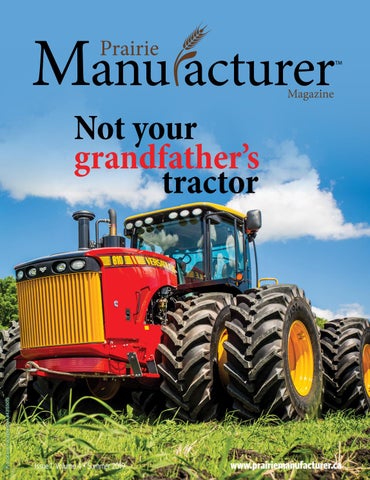
Not your grandfather’s tractor
Issue 1, Volume 4 • Summer 2019
www.prairiemanufacturer.ca
SASM.CA
BUILDING A SAFER WORKPLACE STARTS HERE. COMPLETE HEARING PROTECTION SERVICE Noise level testing Custom molded hearing protection Audiometric testing
POWERFUL ONLINE TRAINING MANAGEMENT SYSTEM (TMS) Low cost helps reduce financial barriers Available to any organization, anywhere
TES OUR T DRIVE TMS FOR
FREE !
EMAI L OR C TODA ALL US Y.
Affordable way to keep workers safe
FIT-FOR-DUTY TESTING NOW AVAILABLE IN CANADA AlertMeter reduces workplace injuries and fatalities linked to alertness, fatigue and impairment
Verifiable and accurate – effective for daily contractor worker management
Accurately measures cognitive function, reaction time and visual acuity
Developed in conjunction with NIOSH Completely non-invasive
No cost, no commitment trials NOW AVAILABLE.
SAFETY ASSOCIATION OF SASKATCHEWAN MANUFACTURERS 1313 Broadway Ave. Regina, S4P 1E5 Phone: (306) 525-7276
34-1736 Quebec Ave. Saskatoon, S7K 1V9 Phone: (306) 384-7276
Protect your workers. Protect yourself.
NAIT’S NEW PRODUCTIVITY AND INNOVATION CENTRE IN EDMONTON, AB, FEATURES STATE-OFTHE-ART TECHNOLOGY AND ADVANCED MANUFACTURING LABS TO SERVE INDUSTRY NEEDS.
THE DESIRE TO IMPROVE I S AT T H E H E A R T O F E V E R Y SUCCESSFUL BUSINESS. To thrive in an age of disruption, Canadian businesses need to continually innovate and adapt. NAIT has worked closely with industry partners for more than 50 years. Through NAIT’s Industry Solutions, we support the creation of globally-competitive and prosperous organizations that continue to lead the way, nationally and internationally. We help partners to: • • • • • •
adopt new technologies imagine, develop and test new products and improve existing ones develop applied research solutions for issues faced by industry assess and improve business practices provide workforce training with a focus on productivity host industry conferences and events.
Learn more at nait.ca/industry
As a part of Industry Solutions, NAIT’s new Productivity and Innovation Centre advances the work we do together. It is the place industry comes for solutions and to succeed.
Publisher Ronda Landygo ronda@prairiemanufacturer.ca 877.880.3392
In this issue View from the C-Suite
6
When an opportunity presented itself as a challenge to her values, Émilie McKinney stepped up and started her own manufacturing company. Now, she’s selling across North America and looking to a bright future in business.
Not Your Grandfather’s Tractor
20
Agricultural equipment today is a far cry from that of our grandfathers’ time. Machinery is larger, more powerful, more efficient, and smarter than ever before, and it’s changing agribusiness in a big way. Learn how Prairie manufacturers are staying at the forefront of this changing industry.
Prairie manufacturers are working to diversify their workforces and expand the economic prosperity of manufacturing jobs by recruiting and retaining Indigenous employees. Plus, some First Nations are getting into manufacturing themselves.
Is your team as welcoming as you think?
38
You might talk a good talk, but does your team walk the walk when it comes to welcoming all people? Carrie Schroeder explores how teams can become more welcoming, and this can help unlock the potential of your entire organization.
Just ask…
5
43
48
Special thank you to our editorial advisory committee. Creative Director Dana Jensen Sales info@prairiemanufacturer.ca Cover photo courtesy Versatile.
Charting a New Path, Together
32
Editor Jeff Baker jeff@prairiemanufacturer.ca
Language is powerful. Words can divide and perpetuate ignorance, but they can also build bridges toward respect, understanding, and inclusivity. Kimberley Puhach continues her Just Ask series with a focus on Indigenous inclusion and reconciliation.
5 Questions about agriculture Agriculture and manufacturing? You bet! Bonnie Bain explains what agriculture today means, how manufacturing is connected to this foundational industry, and what challenges the industry is working to overcome to ensure sustainability and profitability.
Next issue Spotlight: The convergence of traditional and non-traditional industries continues. Prairie manufacturers are engaging with biotechnology to better their market offerings, and biotech companies are working with manufacturers to develop and produce market-leading products, services, and solutions to customers around the world. Regional feature: The breadbasket of the Canadian Prairies, Saskatchewan has always been a leader in food manufacturing. Today, companies across the province are offering new products that are not only healthy and profitable, but sustainable, too. Booking deadline: August 9, 2019 Material due: August 16, 2019
© Copyright 2019 Prairie Manufacturer MagazineTM All rights reserved. The contents of this publication may not be reproduced by any means, in whole or in part, without prior written consent of the publisher. Publications mail agreement #43155015 Return undeliverable Canadian addresses to: Prairie Manufacturer Magazine 207 Hugo St. North, Suite 3 Winnipeg, MB R3M 2N1 To change your address, or to be removed from the mail list, e-mail info@prairiemanufacturer.ca. While every effort has been made to ensure the accuracy of the information contained in and the reliability of the source, the publisher in no way guarantees nor warrants the information and is not responsible for errors, omissions or statements made by advertisers. Opinions and recommendations made by contributors or advertisers are not necessarily those of the publisher, its directors, officers or employees.
Proudly printed by Premier Printing Ltd. Printed in Canada | 5/2019
@prairiemfg
Editor’s Notebook
So, manufacturing... we meet again By Jeff Baker
H
i, I’m Jeff. I’m the new editor of Prairie Manufacturer Magazine. In March, I was asked to join the Prairie Manufacturer team and take over the editorial reins of this groundbreaking magazine. I’m excited to be at the helm of this publication, helping Prairie manufacturers tell their stories to their peers and beyond. I’m definitely not a stranger to the world of manufacturing, especially in Alberta. Over nearly 20 years, I’ve had the opportunity to see inside numerous manufacturing facilities and spend time connecting with the owners, executives, and leaders who are leading the transformation of the industry across the Prairies. Now wearing my Editor’s hat, I get to uncover the hidden stories and help Prairie manufacturers just like you share the innovative, creative, and ground-breaking work that’s going on in the region and changing the face of
manufacturing not only here, but across the globe. But enough about me, Prairie Manufacturer is about you, the manufacturers. When you break it down, manufacturing is about making things… whether that’s making more things, making new things, or simply making things better. Manufacturers know all about making things and making lots of those things better. Now, it’s about making the people who make those things better. This issue is chock-full of contributors who are doing things differently, seeing things differently, and challenging the assumptions and status quo of how we do business in today’s manufacturing world. They’re asking important questions, pushing for real answers, and trying to have a positive impact on the industry, now and into the future.
When you break it down, manufacturing is about making things… whether that’s making more things, making new things, or simply making things better.
4
Prairie Manufacturer Magazine • Summer 2019
It’s a new path that’s being forged by Prairie manufacturers, and it’s a path that includes more people than ever before, reaching into more communities than ever before. On page 6, read about a young Indigenous woman in Manitoba taking the lead in her own manufacturing company thanks to an opportunity presented as a challenge to her values. Manufacturing doesn’t just build things; the industry is also helping to build bridges between communities across the region. Turn to page 33 to learn how in Charting a New Path, Together. The world continues to change, and the change is accelerating. Manufacturing is no different. Companies are facing these changes head-on, but there is still a lot to do, explains Carrie Schroeder in the latest Women in Manufacturing article on page 38. The names we call the equipment we use might be the same, but the
nature of this equipment and ‘how’ it does its job is night-and-day compared to even just a decade ago. In Not Your Grandfather’s Tractor on page 20, read about how these innovations are making a difference not just here on the Prairies, but around the world too, and spreading well beyond the traditional sectors. Manufacturers hold the knowledge, skills, and experience needed to make things of all sorts. It’s the same knowledge, skills, and experience that will keep manufacturers – and their
customers – at the fore of the changing economy and enable them to thrive in the future. After all, if manufacturing is about making something, that something can be a more inclusive, representative, and engaged industry that makes a better world for all of us. In the spirit of making those somethings better, I invite you to contact me. This is your industry, your magazine, and your community. I want to hear from you! Send me your
feedback, story ideas, information on manufacturers making a difference or doing something outstanding, and anything else that matters to you and your organization. Please drop me a line at jeff@prairiemanufacturer.ca. Until the next time we chat, I hope you enjoy the read.
The bank of make it or break it At BDC, we understand the importance of cash flow protection, and the challenges. No matter the obstacle or objective, we can help you find the business solution that fits. As the only bank exclusively devoted to entrepreneurs, rest assured, our financing services are tailored to you.
Call us at 1-888-INFO-BDC or visit bdc.ca
BDCad_Manufacturing_7x4.625_en.indd 1
2017-11-17 12:14 PM
www.prairiemanufacturer.ca
5
View from the C-Suite
Hearing
(and answering)
the call of opportunity By Émilie McKinney
M
y name is Émilie McKinney. I am 18 years old, and a youth from Swan Lake First Nation in Manitoba. I live with my mom and business partner, Natalie Foidart, in nearby Somerset. I’m a Fancy Shawl dancer, a post-secondary student at Maskwacis Cultural College in Alberta, and best of all, I am the founder of Anishinaabe Bimishimo Corporation. I was a high school student at at École Régional Notre-Dame, had just turned 16 and had already travelled a few countries to hoop dance. There was a winter Pow Wow coming up that advertised a jingle dress special. I had grown out of my jingle dress and wanted to make myself a new one. I called our local elder, from whom we used to get our jingle cones, and sadly his cone maker had passed away, and he couldn’t get any more jingle cones made. We headed to a trading post in Winnipeg to purchase jingle cones. I asked the clerk to see the jingles behind the counter. They were so expensive! They were $40 for a bag of 100 cones, and I needed four bags. On top of that, the jingle cones were made in Taiwan. The jingle dress is a sacred dance that represents healing. The jingle cones are meant to hit each other to awaken the creator so
6
Prairie Manufacturer Magazine • Summer 2019
that prayers and healing can be heard. How can an object as sacred as a jingle cone be made in Taiwan? This is supposed to be an Anishinaabe product, and it should be made by Indigenous peoples in North America. It bothered me so much. I wanted to put authentic cones on my dress. I started searching where to purchase North American-made cones, but I came up empty handed. It did not make sense to me at all. How could a sacred item be made in Taiwan?
Be the change On the drive home, my mom said “Listen, if you don’t like this or have a problem with this, then do something about it. Talking about it won’t help. The problem will still be there until someone makes that change, so solve it!” She explained that this change would be big, and I would need a logo that has meaning, a business name, and a business plan. She said until she saw those things, she didn’t want to hear another word about it. Most importantly, she said if I were serious and presented her with those things that she would do everything in her power to support me. She likely thought it would end there. She was wrong! When I got home from school the next day, I showed her my logo, explained to her the meaning, and handed her my business plan. I wanted to pay homage to our elders that had given us this teaching and had moved on, that dance by us in spirit, right over there. Anishinaabe is who I am. I am an Anishinaabe from Swan Lake First Nation. Bimishimo means dancing by, as in dancing over there, by us, beside us. The vision of Anishinaabe Bimishimo, the first manufacturer of jingle cones in Canada, was born that day.
A steep learning curve We had to learn so much - from substrates to machinery, to planning to making projections. Countless hours were spent on trying to find the right substrate we wanted and needed to work with. Things like the sound of the substrate came into play. We stumped a few salespeople when we asked them to describe the sound their substrate made. I’m sure a few of them questioned our sanity. It was hard to be taken seriously in the manufacturing world at times. We often felt brushed off. But I really needed to make this change and was willing to fight for it. Things like our manufacturing line and piecing it all together so it could work flawlessly was challenging. We had to find experts, like the awesome people at Wallace Machinery who actually took us seriously and made the time to explain to us how everything could work, what we should consider and helping us find the pieces required so we could put it all together and build something that fit our needs.
When the going gets tough… Finding funding or to be taken seriously for that was also challenging. Banks and credit unions wouldn’t fund our start up, and I was too young to qualify for any kind of indigenous funding opportunities. We were so grateful to have been guided to Women’s Enterprise Centre of Manitoba and Futurpreneur who gave us the ability to start up. We ran into huge issues during start up; nothing went to plan. A custom piece of machinery built for us by a local engineering firm was delayed by five months, so we hand rolled 250,000 cones. I was even hand rolling cones in class just to meet demand. A lot of raw material was wasted during trials of our custom-made machine. After three prototypes it finally ran true at triple the cost, and we
We stumped a few salespeople when we asked them to describe the sound their substrate made. I’m sure a few of them questioned our sanity.
www.prairiemanufacturer.ca
7
used half of our raw material in that process which ended up in our scrap bin, so we ran into cash flow issues. We ran out of copper and brass three weeks after our complete line ran true in May 2018, and I had to wait until I turned 18 to finally be able to secure additional financing. At long last, I did it! We did it! First People’s Economic Growth Fund, Dakota Ojibway Community Futures, and Swan Lake First Nation helped us to get there. Our brass and copper are set to arrive in less than two weeks; our manufacturing line runs true; and I have over 80 stores throughout North America that carry our jingle cones. Every week, we have more stores that sign up to carry our product. How can an object as sacred as a jingle cone be made in Taiwan? This is supposed to be an Anishinaabe product, and it should be made by Indigenous peoples in North America.
It’s only the beginning
and writing proposals… well, public speaking is awesome! I’ve just started to work on a top-secret Limited Edition Project that I’m hoping to launch on the day of Fall Solstice. I still have numerous goals I want to achieve, and I still have a lot to learn. I am looking into developing another custom in-house manufacturing line in the near future that involves an environmentally friendly aspect. And this has been a small part of my journey. If I had one piece of advice for other young entrepreneurs, it would be: “Whatever you’re doing, do it with passion and do it with love. You can only accomplish so much when you don’t have passion. Fight for what you believe in and never give up.”
I know how to service every aspect of my manufacturing line, and driving the forklift is super cool. Packaging and shipping are tedious, but marketing is super fun. Public speaking is awesome,
Émilie McKinney, is Founder of Anishinaabe Bimishimo Corporation, is an internationally recognized hoop dancer, and is a member of Swan Lake First Nation in Manitoba.
Daria experienced the beauty of Tokyo’s cherry blossom festival earlier this year on her dream trip to Japan!
Become a dream maker It takes just a few seconds to make a dream come true for a child in Manitoba battling a life-threatening illness. The Dream Factory is a Manitoba-based charity that brings dreams to life for kids in our community battling life-threatening illnesses. Whether it’s a trip to far-off destinations, a princess makeover, or a day with a Winnipeg Jet - we make each Dream as special as possible.
Eric was thrilled to meet his hockey hero, Patrik Laine, during the 2018-19 NHL Season.
Each and every Dream come true starts right here in our community with a referral from a friend, family member, or medical professional. But did you know that YOU can refer a child to have a dream come true? As long as they are under 18 and battling a life-threatening illness, they may qualify for a once in a lifetime experience. Our dream is for every child and family going through one of these incredibly difficult situations to experience the joy and comfort that can come from a dream come true - but we need your help. If you know of a child or family that would benefit from the joy, hope, and support of a Dream - please take the time to refer them. It just takes a few seconds to make a dream come true!
Azariah’s dream of becoming a Disney Princess came true this March at the happiest place on earth!
Thank you for being a dream maker! Refer a Dream Kid today at thedreamfactory.ca/refer 8
Prairie Manufacturer Magazine • Summer 2019
GAME CHANGERS
How can more Canadian manufacturing companies succeed?
M
any manufacturing businesses have mastered the art of running "lean and mean": achieving maximum efficiency on the production line is prioritized as key to business growth. But are we giving the same attention and priority to our workforce, the employees who are ultimately responsible for delivering this business growth? We’ve all heard the mantra that employees are a company’s greatest asset, but how do you know this to be true? General statements carry little weight without measurable roadmaps to achieving them. Unlike production efficiency (where reduced costs + increased production = greater revenue) workforce optimization can be hard to measure, but not impossible. What if you could learn from real-business examples of what can result when you put the right person in the right position and empower them to drive change? Or hear more about the employees who gave their companies a competitive edge and the business leaders who enabled them? Enter Game Changers, a new series coming soon to Prairie Manufacturer, brought to you by Pinnacle. Each article in this series will tell the story of a person (or group of people) who sparked positive change within their manufacturing company. We’ll share the perspective of not just the employee, but also the business leader who recognized the employee’s potential and facilitated the change. These stories will provide a jumping off point for broader conversations about reimagining the way you hire: about the
risks of understaffing in the name of efficiency, about the costs of hiring the wrong person, about lost opportunities when you fail to invest in finding your game changers. Look for Game Changers in the next edition of Prairie Manufacturer.
About Pinnacle Great companies are built with great people who make a difference. As Manitoba’s largest specialized recruitment firm, Pinnacle’s passion is finding those game changers who make that difference. Founded in 2002, Pinnacle is Winnipeg’s leading local recruitment firm. Our 25 industry-specialized recruiters focus on one goal: connecting top talent with top Manitoba companies. We deliver on this goal in two areas: Executive & Professional Search, and Staffing & Recruiting across a wide variety of sectors. Learn more at www.pinnacle.jobs
Game Changers starting Fall 2019 brought to you by:
www.prairiemanufacturer.ca
9
Money & Markets
Prairie Innovation: A Keystone of Manufacturing Success The Prairies are a hotbed of innovation, but is our walk nearly as strong as our talk? By Jayson Myers
M
aybe it’s the water… or the fresh air. I think the wide-open spaces make a big difference. So, too, do the long distances between communities and the diversity of people who call Western Canada home. For me, the Prairies have always been a hotbed of innovation. The grandeur of the environment makes a natural impression on the Prairie spirit, as does the need to overcome the challenges of climate and geography. The prominence of Prairie agriculture and Western Canada’s resource-rich economy have helped engender the type of practical problemsolving that is at the heart of innovation. Of course, they have created ready markets for innovative manufacturers as well. From a business point of view, there’s simply the need to create value for customers in a fiercely competitive global market – no one in Western Canada can grow their business without reaching beyond local customers. From the oil sands, agricultural equipment, and aerospace to artificial intelligence, nanotechnology, clean
tech, additive manufacturing, and advanced forming and welding technologies, the Prairies are home to some world-leading innovations. We need to do more to recognize and celebrate those achievements and draw attention to them around the world. Two recent surveys underscore just how innovative the Prairie provinces – and Prairie manufacturers in particular – actually are. The first was published in March of this year by Statistics Canada. It is a survey of how companies in all business sectors across Canada use advanced technologies related to materials handling, production and processing, design and information control, environmental management, security, and business intelligence. It also looks at the use of emerging technologies like sensors, advanced materials, the industrial internet, artificial intelligence, nano- and biotechnologies, blockchain, geomatics, and 3-D printing. The survey found that more than 58 per cent of Prairie manufacturers have invested in advanced and emerging
While 82 per cent of western Canadians say that it is important to take risks in order to come up with new ways of doing things, fewer than half would actually be willing to take those risks themselves.
10
Prairie Manufacturer Magazine • Summer 2019
technologies over the past three years. That’s relatively higher than the 55 per cent of manufacturers that invested in new technologies across Canada as a whole, and it’s a significantly higher adoption rate than the 46 per cent of companies from all business sectors in both Western Canada and across the country that report using innovative technologies. In fact, Prairie manufacturers have the highest level of technology adoption in the country. Quebec checks in second at 55 per cent; Ontario comes next at 54 per cent; and the Atlantic provinces at 43 per cent. What sectors of Prairie manufacturing are leading in technology adoption? The answer may be a little surprising – or maybe not if you know many of the leading companies in the sector. Wood products, paper, furniture, electronics, and medical devices all have above average rates of technology investment. The second survey was published in early May by the Rideau Hall Foundation, the organization established by former Governor General David Johnston to inspire and mobilize ideas, people, and resources across Canada to help realize our shared aspirations, particularly when it comes to innovation. It’s a study of attitudes and engagement around innovation – in finding new and better ways of doing things. First off, it shows that Canadians are very optimistic when it comes to the benefits of innovation. Close to 80 per cent of us believe that diversity and collaboration
are unique strengths that influence our innovation culture. Nearly one in three Canadians would position the country among the top innovating nations in the world, and the business sector is viewed as the most important innovating sector, especially in Western Canada. So far, so good. However, the survey also identifies some important challenges when it comes to acting on even the best of intentions. While 82 per cent of western Canadians say that it is important to take risks in order to come up with new ways of doing things, fewer than half would actually be willing to take those risks themselves. Over 70 per cent say that they are open to using new technologies, but only 48 per cent are willing to pay more for them. While a large majority of people across the country see collaboration as a crucial factor enabling innovation, fewer
than a third say that they are comfortable partnering with others. This is very much in line with another Statistics Canada survey published a couple of years ago that investigated the innovation practices of Canadian business. It found that only 23 per cent of Prairie manufacturers regularly build collaborative relationships to lower the risks involved in innovation. That’s far higher than other business sectors, but slightly lower than the Canadian average. Manufacturers in Western Canada are more likely to collaborate with universities, colleges, or with government agencies than with each other or with other business partners. It’s clear that there is a disconnect when it comes to translating good intentions into real outcomes. Statistics Canada points out that even when manufacturers do invest in advanced technologies, 40 per cent or more do not achieve their business
objectives. There are real challenges when it comes to business strategy, management, and execution. David Johnston emphasizes the importance of ownership when it comes to innovation and decision making. He’s right. The mark of successful innovation is not just the fact that companies are investing in advanced technologies, but that they are deploying them successfully in their business to add customer value, compete, and grow. Jayson Myers is the CEO of Next Generation Manufacturing Canada — the country’s advanced manufacturing supercluster. An award-winning business economist and leading authority on technological change, Myers has counselled Canadian prime ministers and premiers, as well as senior corporate executives and policymakers around the world.
ESSENTIALS OF PHYSICAL ASSET MANAGEMENT AND ISO 5500X Are you charged with managing manufacturing assets? Do you want to improve your asset performance, understand and treat asset risks, make financially-optimized asset management decisions? If so, this training course is for you. Learn the skills you need to implement holistic and sustainable asset management practices in your organization. Training Course Overview
Who should attend? CEOs, COOs, CFOs, General Managers, Asset Managers, Maintenance Managers, Supply Chain Managers, Plant Managers, CIOs, Operations Managers, Capital Program Managers and all aspiring asset managers. Course Length & Cost 21 hours (via webinar) - $1,350. Group rates and private training courses are available for your organization.
Asset management is the way to run the organization to assure stakeholder value!
Contact us today about upcoming course dates and custom course options. info@greemanassetmanagementsolutions.com Greeman Asset Management Solutions Inc. (GAMSINC) is a firm that provides asset management advisory services, consultancy and training to asset-intensive organizations. Our solutions focus on helping firms to align their operations to their asset management policies and strategic plans and to derive value from their assets.
www.prairiemanufacturer.ca
11
Profile
Expanding across Indigenous manufacturing networks By Chris Kauenhofen, CPA, CA
M
anufacturing in Canada and particularly across the Prairies is as diverse as its people. One constant in the manufacturing industry is development in technology. The technological landscape continues to evolve equipment and operations. Moreover, demographics within the central Canadian manufacturing sector are shifting and opening up opportunities for all types of new business development. Indigenous businesses in particular have been increasingly active. The 2019 Federal Budget has allotted funding in support of Indigenous entrepreneurs and their business development. This aims to help communities identify opportunities, build business plans and strategies, and employ efforts to improve various infrastructure. While this is helpful for many Indigenous business owners, there are those who are proud to have started and maintained their ventures without any external financial assistance.
Indigenous manufacturers To gain a better understanding of this shift for Indigenous manufacturers, Alfred Lea, founder of Tomahawk Chips in Manitoba, shared some of his insights and experiences. Prior to starting Tomahawk Chips, Lea consulted manufacturers with existing equipment on how to most effectively leverage their industrial machinery. He helped them develop plans and strategies that made the best of existing resources, bringing products to life that made the most business sense.
12
Prairie Manufacturer Magazine • Summer 2019
For a long time, Lea had big plans for starting his own manufacturing company, “I’ve built so many businesses for others; why not build my own?” Lea hasn’t always taken the easiest route but sticks to his principles. He is proud that Tomahawk Chips is 100% Canadian and Indigenous owned, and even more so that it is operated without any financial assistance. He chose potato chips for his own venture because they were lightweight, easy to handle and transport, didn’t freeze, and could withstand heat. With all operational considerations in line, potato chips were the logical choice. He launched Tomahawk Chips in 2015, and has since expanded across Canada and the U.S., with plans to penetrate markets internationally.
Initial challenges Lea’s biggest business challenge was distribution. The distance to transport the products created a barrier for timing and cost efficiency. Lea’s solution was to team up with a distribution company that helped Tomahawk Chips move goods, rent space for storage and warehousing, and manage inventory. “It’s important to have business partners that are compatible with you, that can grow with you and offer support in areas where you need it,” Lea notes. “Taking advantage of all the strengths your network has to offer is crucial in building
your business.” Further to logistics, this extends into other aspects of growing a business; like tax and financial planning. This is where BDO stepped in. From the beginning, the client partnership with BDO helped fuel Tomahawk Chips’ growth.
Emerging demographics According to Lea, the Indigenous manufacturing industry has been seeing an increasing number of young people, in particular women. “These are the ones that are the most determined,” Lea states. “Most of my business associates are women. They have a huge grassroots mentality where they want to establish a strong business foundation from the beginning of any venture.” Manitoba’s Indigenous business community has a very large female presence that’s been a driving force for positive change. Moreover, the business landscape has gotten younger. Generally speaking, younger demographics have substantial social media presence and rely on those networks for fast and widespread communication. Lea has always been an advocate for supporting youth in business. Being actively involved in local Friendship Centres that introduce Indigenous youth to business opportunities, Lea is keen on helping train the younger generations on how to market their own products and harness their networks with e-commerce platforms. “I encourage them to keep doing this and not lose momentum. Keep sharing successes and reaching out to expand networks as much as possible.”
thing. Your business has to encompass everything that you are, because you’ll be spending all your time doing it. So choose something you’re passionate about,” Lea continues, “Don’t give up when it gets hard, and don’t listen to others when they try to knock you down.”
Growing businesses together Forward movement is the foundation of manufacturing. As Lea states, “Take control of your own passions and keep moving forward.” As someone who had to wait a long time for funding to become available to start his business, Alfred Lea deeply understands the value in having resources at your disposal. Working together with other businesses to take advantage of each other’s talents is the way to bridge strengths across networks to build something great. Not only great products, but great relationships.
Advice to other business owners Determination and perseverance are at the forefront of building a business and seeing your vision through. Lea advises that entrepreneurs adhere to this, whether they’re in manufacturing or not. “Determination is the most important
Chris Kauenhofen is a partner with BDO Canada LLP’s Winnipeg office and leads the Manitoba Manufacturing leadership team, providing coaching and advice to entrepreneurial-minded businesses, including various Indigenous organizations.
www.prairiemanufacturer.ca
13
Lessons in Lean
Lifelong learning: Is your organization curious enough to keep learning? By John Chaput
F
rom the moment we’re born, we begin learning. We master the basics first: breathing, seeing, crying, eating, and so on. Then we start learning because we are curious, and our world expands around us. Much of what we learn when we are young is retained pretty much instantly. As we get older and our learning becomes more sophisticated, we need more effort and repetition to retain the things we have experienced or been taught. I’m sure we can all remember studying for the moment we will be asked in elementary school to recite our multiplication tables or a poem. How much effort does it take to successfully write a university or college exam? What about learning a new business process or technique? These are examples of how learning gets more difficult over time. Lifelong learning means having curiosity to explore new methods, processes, and possibilities while gaining a new perspective and being open to change. It means listening with the intention of understanding; asking genuinely inquisitive questions that lead you to new ideas and experiments. It means having empathy towards the experiences and beliefs of others. These things build a strong dialogue within a group or team in a safe environment where learning is not just a collateral outcome of problem solving but a deliberate part of the process. I feel many people equate ‘learning’ to only what we receive through our formal education system, but it’s so much more. In fact, the learning we get from our institutional education represents only a fraction of what we learn on regular basis. Think about it; what have you learned in the past year, the past month, yesterday, or since your breakfast this morning? Learning is everywhere. To truly embrace learning is to recognize 1) learning is continuous, and 2) we must act on what we learn and apply it.
A never-ending journey Learning is a never-ending journey that leverages past knowledge, experiences, and perspectives, so learning is always personal and is constantly evolving. We cannot get to the next step without first learning the previous step. This process gives us the ability to make better decisions and more importantly ask better questions to get better answers to inform our decisions. Humans cannot stop learning, because we are naturally curious animals. Our curiosity ties directly into the sphere of knowledge, where the more we learn, the more questions we have. As our sphere of knowledge grows, we become aware of more things we did not know before which leads to more questions. We can see greater possibilities and understand the limitless reaches of our imagination. Albert Einstein said: “I am enough of an artist to draw freely upon my imagination. Imagination is more important than knowledge. Knowledge is limited. Imagination encircles the world.” Pause for a second and think about that. Do we learn because it’s prescribed, or do we learn because our desire to understand is driven by our human curiosity? We have an inner drive to continually change and grow, stemming from our imagination. I believe one of our drivers to learn is the need to satisfy and feed our imagination.
Learning is living, and living is learning Author Tom Clancy said: “Life is about learning; when you stop learning, you die.” What does that mean? Why would we die if we stop learning? We can frame it as this: In the absence of learning, there is an absence of creativity which disables our imagination. Without
Learning is a never-ending journey that leverages past knowledge, experiences, and perspectives, so learning is always personal and is constantly evolving.
14
Prairie Manufacturer Magazine • Summer 2019
learning we cannot explore our imagination, therefore creating a void in our human curiosity and rendering us essentially dead to the world around us. We are meant to create, explore, debate, and adjust; all of which are elements of learning and living! Best-in-class organizations and truly innovative companies are good at tapping into the imaginations of their team members through creating learning environments. I’ve always been a believer that the ultimate organization is a problemsolving organization. This is achieved through the belief (not instruction) that we need to learn and grow through everything we do at all levels of the organization. That’s really the fundamental of problem solving. When you think about problem solving it’s about three things: learning, creating, and doing. Learn about our problems (their significance, root cause, and fixability), then create a new way to improve or modify the ‘doing.’ After you set forth and ‘do,’ you have to learn if the solution is working as intended and adjust if it’s not. It’s the basics of Deming’s Plan-Do-Check-Act cycle.
Enable, inspire, and trust We need to continuously find ways to enable and inspire learning. Whether it’s within ourselves or outwardly as a leader. You don’t have to be a formal leader to create a learning environment; you simply need to open the door to feedback, ideas, and discussion. We are all leaders in some way. Just as we teach in Continuous Improvement, and particularly within Lean, trust the process. Since learning is a process, as leaders we want to establish environments where lifelong learning is the expectation. We need to understand then trust the process. This means understanding that learning in your organization is an evolution and you have to start with building a strong foundation. The learning evolution in an organization might start with getting all staff speaking the same language through groupbased lean training, which will lead to a better understanding of business opportunities through identification of business
wastes. Then that could lead to more questions – more why’s being asked by virtue of growing the sphere of knowledge. For some organizations, it could be a matter of understanding how inclusive your team truly is; learning the barriers and behaviours preventing people from moving into effective positions regardless of gender, race, or background. Yet for other organizations, perhaps it’s hitting the reset button on culture. If the desire is to have a culture of innovation and creativity, for example, learn about where you are today. What does the end goal look like, and what’s the first step in setting that foundation? Does it mean leadership training and reflection related to innovative cultures, followed by strategy development and deployment (AKA Hoshin) with the leadership team? You need to learn and evolve together.
One step at a time Just like learning leads to great skills, understanding what needs to be learned, and in what order, is critical. Understand that businesses grow in sophistication one person and one experience at a time. Whether you’re a formal leader or a new entry-level employee, be curious and be inquisitive. Seek tools and direction to put your imagination to good use and support the same for those around you. You have a responsibility – a duty, even – to share and support learning as your sphere of knowledge grows. I encourage you to focus on a simple four-step learning plan: • Ask yourself ‘What did you learn yesterday?’ • Set a goal to learn something simple related to your situation today • Seek and learn • Repeat every day for the rest of your life John Chaput is Director, Business Development for CME Manitoba. With 25-plus years’ experience in manufacturing and business transformation, John has worked globally to support teams in their pursuit of excellence.
we understand business-to-business marketing It’s not about brand or design or image – its about convincing potential clients to purchase from you. Let’s talk and get your marketing going. deschenesregnier.com proudly serving industry for over 30 years
DES 21746 Prairie Manufacturer Ad-FIN.indd 1
2019-05-21 11:38 AM
www.prairiemanufacturer.ca
15
Sponsored Content
The Safetys unites Manitoba's business community under the banner of workplace safety The third annual Safetys gala will be held September 25, 2019, at the RBC Convention Centre in Winnipeg, where it will be getting some national exposure as well. The Safetys is being held in conjunction with the Canadian Society of Safety Engineering's Professional Development Conference, also being held in Winnipeg in September. "We're ready to welcome you, whether you're from Manitoba or visiting our province for the conference," says La Palme, "but don't wait to get your tickets. So far, we've sold out every year!"
SAFETYS
OM
THE
W
hat was only a wish four years ago has developed into a success story that continues to grow. The Safetys: A Celebration of Workplace Safety began as an idea by several members of Manitoba's North American Occupational Safety and Health (NAOSH) Committee: what if we presented the NAOSH Awards in partnership with other organizations at one annual gala event that celebrates Manitoba's safety champions across all industries? SAFE Work Manitoba came on board with its awards program, and six industry-based safety programs — Made Safe - Manufacturing Safety for Manitoba; Manitoba Heavy Construction Association WORKSAFELY; Construction Safety Association of Manitoba; Manitoba Farm Safety Program; RPM Trucking Industry Safety; and S2 Safety: Sales and Service Safety Association — developed their own awards to create a partnership of eight organizations. The Safetys was born. "The Safetys recognizes Manitobans for the important work they do to make their workplaces safer, and unites business leaders under the banner of safety," says Laura La Palme, the gala's committee chair. "Improving workplace safety should be top-of-mind for all of us, no matter our job role or industry."
Tickets go on sale June 17, 2019 at
thesafetys.ca
Alberta OHS inspections are continuously being conducted. Are you prepared? To meet Legislative requirements, a Health and Safety Representative or Health and Safety Committee must be designated for the workplace. Are you in compliance? As a certified provider, MHSA invites you to register for the Joint Work Site Health and Safety Committee and Representative training course at a location near you.
Stay tuned to www.mhsa.ab.ca for the release of our online course offerings.
MANUFACTURERS’ HEALTH & SAFETY ASSOCIATION
A SAFER WORKPLACE STARTS HERE
www.mhsa.ab.ca
Servicing Southern Alberta: 201, 292060 Wagon Wheel Link, Rocky View, AB T4A 0E2 (403) 279-5555 / 1-888-249-2002 Servicing Central Alberta: 54 Queensland Crescent, Red Deer, AB T4P 0V2 (403) 343-0002 / 1-844-343-0002 Servicing Northern Alberta: 225 Parsons Road SW, Edmonton, AB T6X 0W6 (780) 428-1006 / 1-888-249-2001
Keep in touch with what’s happening in industry and at the MHSA by visiting www.mhsa.ab.ca 16
Prairie Manufacturer Magazine • Summer 2019
SAFETY PAYS IN MANITOBA THE PROOF IS IN THE COMPANY WE KEEP Made Safe is manufacturing’s certifying partner for SAFE Work Certified.
Manufacturing Safety for Manitoba
Industry-based certification is working. Manufacturing injuries are down by half in the last ten years. And more than half a million dollars has been returned to manufacturers through certification programs. Certified members are eligible for a 15 per cent rebate on WCB premiums or $3,000 – whichever is greater.
Don’t just take our word for it. Certified companies are leading the way: • • • • • • • •
Morris Industries Farm King Monarch Industries Winpak Loewen Boeing AGI Westeel Black Cat Wear Parts
• • • • • • •
DeFehr Furniture Griffin Wheel All Fab Building Components Conviron Decor Cabinets New Flyer Industries Arne’s Welding
• • • • • •
Norstar Industries AGI Westfield S2 Safety Association Gerdau Behlen Industries Custom Castings
Every day, more and more Manitoba manufacturers are making the choice to get certified. Made Safe is ready to help. Contact us today!
67B Scurfield Blvd. Winnipeg, MB R3Y 2G4 204.949.1454 madesafe.ca
An initiative of
The Principal Resource
It’s time to get strategic about employee benefits Get your employee benefits package working for you; not the other way ‘round By Earl Shindruk
I
t is 2019, and there is no shortage of economic and political factors, both provincially and nationally, that an owner must be responsive to. An expenditure that is perhaps the easiest to control, yet the most demoralizing to reduce, is the workforce. When less production is needed to meet decreasing consumer spending, I’ve seen companies in the last few years reduce as much as 70% of their workforce. As a benefits broker, I’ve worked with companies to develop creative compensation strategies that help to manage labour expenditures, reduce the peak and valley syndrome of a workforce, and strengthen a team by focusing on retaining skilled workers. With so many benefit providers in the market, and so many options for plans, how does a company choose the benefit plan that will provide them the maximum value? You start with your business objectives and audience – and use these to shape your strategy. At the most basic level, the Objectives of every benefits plan include recruitment, retention, productivity, and peace of mind for employees; the extra step is aligning these with your employee management goals. For instance, is your goal to reward and retain senior executives, the individuals at the core of your business?
Or ensure the team members that have invaluable knowledge and expertise remain with the organization? Is your goal to attract the top performers of the millennial generation - those with high ambitions but a unique sense of entitlement? Do you want to ensure that every employee has their basic health needs covered and that they are using their benefits plan as needed to improve attendance, efficiencies, and productivities? With economic shifts, your goals likely change. While cutting out plan features to save costs may be inevitable, restructuring your plan to ensure that you’re rewarding skilled employees for their commitment allows you to strengthen your relationships and overall retention strategy. For many companies, the goal in the last few years has shifted to keeping skilled employees. This means rewarding them with better benefits and sometimes adding additional plan features such as health spending accounts, group retirement programs, and even wellness accounts, which are designed to keep workers productive and healthy. With that said, the value of additional plan features is subjective, and your employee needs must be considered as well. This brings us to Audience, in other words, a Needs Assessment.
A benefits plan is a retention tool only if your employees are aware of the value of the benefits package.
18
Prairie Manufacturer Magazine • Summer 2019
Analyze the existing workforce demographics to determine the needs of different categories of employees. In our experience, employees in the manufacturing industry: l have a lot of muscle and soft tissue problems particularly in their back and shoulders, so practitioner coverage is a must l are on their feet a lot, so footwear plans need to cover orthotics and orthopedic shoes l are on projects requiring close attention to detail, so eye care and vision care are necessities l are experiencing stress and anxiety around layoffs and job loss, so many are on anxiety and antidepressant medication l use short term disability insurance frequently, not only for stress and mental health concerns but also for injuries to hands, arms, and backs. To retain employees, your plan should cover these needs. When looking to attract new talent, anticipating the needs of the ideal employee will help to attract just that type. For instance, younger employees usually value paid time off, whereas older employees may place a higher value on retirement income plans. Employee needs go beyond the fundamental deliverables of a plan and extend to communication and administration as well. Specifically,
reimbursement percentages paid within the plans (such as 80% vs. 100% for medications), and the percentage of premiums covered by their employers, is information often misunderstood. A benefits plan is a retention tool only if your employees are aware of the value of the benefits package. Your Strategy builds off these assessed needs and organizational objectives to determine employee eligibility, coverage levels, plan features, and exclusions. l Eligibility refers to whether you will provide the same benefits to all employees, or provide different benefit levels based on employee classifications. Common classifications affecting this would include job status or full time vs. part-time. l Coverage Levels are typically communicated as a percentage of cost coverage for specific health expenses. However, for Life Insurance, Short Term Disability, and Long-Term Disability, it is determined by the overall maximum, which is the maximum amount of insurance a carrier will provide under the terms of the contract. l Plan Features include Life Insurance, Accidental Death and Dismemberment, Dependent Life Insurance, Short Term Disability, Extended Health Care, Dental Care and Critical Illness. Each of these plan options may be included or excluded and can have varying levels of coverage. It is worth noting that to remain fully non-taxable for the employee; the employee must pay 100% of the life insurance, accidental death, and dismemberment, dependent life, critical illness, and disability (both short and long term) premiums.
Strategically designed benefits plans shortlist the potential combinations of these factors based on organizational and employee needs. An example of this is one of our CNC Machine Shop clients, previously a 32-person team that has reduced to eight people in the past year. They implemented a reward program for employees who have stayed with the company for five years. Once they reach the five-year mark, the employer pays 100% of the Extended Health Care and Dental Care premiums. With a similar approach, a number of our clients contribute a higher percentage of the premiums as employees remain with the company for one, two, or three years. In this case, their goal is to grow a new workforce and target more immediate retention. Another common tactic is to provide a health spending account, which allows employees to determine what areas they need to allocate funds to cover health costs that would otherwise not be provided through regular plan features. This enables employers to ensure they are covering the needs of a diverse workforce and that all of their employees feel valued. Developing creative compensation packages that look at more than just the hourly wage is critical in defining your company’s edge in an increasingly competitive labour market. Looking at the total package from the perspective of current and prospective employees, aligning it with your company’s management plan, and employing specific benefit strategies will help you maintain your core people and ensure you have skilled workers at every stage of the economic cycle. Earl Shindruk is President and founder of Optimax Benefits, an Edmonton-based benefits broker, and has worked in the benefits industry for 24 years.
eyesafe CAN
CUT WORKPLACE SAFETY COSTS
40-60%
Offers tailored prescription eye safety solutions for any size company and their employees. Controls company costs and provides affordable care for employees, with a perfect fit. More than 300 locations throughout Alberta; delivered by professionals. A free program administered by the Alberta Association of Optometrists.
Let us show you how we can help. www.eyesafe.ca sales@eyesafe.ca 780.451.9451
www.prairiemanufacturer.ca
19
Not your grandfather’s tractor Equipment in today’s agricultural operations is a far cry from what it used to be
PHOTO COURTESY VERSATILE.
By Jeff Baker & Laurel Johanson
20
Prairie Manufacturer Magazine • Summer 2019
S
ince the term “tractor� was coined in 1896, tractors and other agricultural equipment have undergone multiple cycles of reinvention that continue to this day. Today you can find machines with 360-degree LED lighting systems for night work, GPS auto-steer, and electro-hydraulic systems all controlled with the push of a button. Prairie manufacturers, like Manitoba’s Versatile, have been contributing to these technological innovations for decades. But have the principles of farming really changed since the days of steam engines and horse carts? The answer is complicated, but one thing is certain: agricultural equipment is a far cry from what it used to be, and machines are larger and smarter than ever before.
www.prairiemanufacturer.ca
21
It’s about the people Danny Mann, Department Head of Biosystems Engineering at the University of Manitoba, says his focus is on the design of agricultural machinery specifically from the perspective of the human operator. “My research has always been: what is the impact on the person who is sitting in the cab?” Mann says investigating lightbar systems for agricultural machinery kickstarted his research on machine use from a human-factors perspective. Lightbar systems track whether or not a machine like a sprayer is on-track in the field and help guide it along the proper path. “On the one hand farmers saw it was a great asset. It told them if they were skipping or doing a double application of their herbicide,” says Mann. “They could see the economic and environmental benefits…but they also found that it was extremely annoying to use. It changed the way they had to interact with the rest of their machines.” According to Mann, the rise of autonomous equipment is one of the main technological advancements agricultural producers and manufacturers must now contend with. But autonomous equipment doesn’t necessarily mean the human operator becomes obsolete. “We’ve been looking to understand what information will be necessary to remotely supervise a sprayer or a tractor on the field and still have confidence that what it’s doing out there is okay,” says Mann. “My personal belief is that there’s still going to be a desire for the farm operator to supervise these machines, whether it’s from a tablet from a pickup truck on the field or from a home office.”
that could change in the next few years as automation is explored further. “You might end up with a fleet of smaller machines working autonomously because you’re not constrained by light hours or the operator getting fatigued. They can work 24 hours around the clock.” Even with his wealth of knowledge on the subject, Mann says it’s hard to say whether any of his predictions will actually come true given the nature of the industry.
Finding the sweet spot In Frontier, Saskatchewan, Honey Bee Manufacturing Ltd. operates a modern 100,000 sq ft facility specializing in harvesting equipment manufacturing – a long way from the company’s founding in 1979 by brothers Glenn and Greg Honey. “Our big innovation in the 70s was a draper header,” says Spencer Groth, Honey Bee’s Marketing Manager. “It lays the crops down more evenly, and feeds crops into the combine more evenly, and it’s also a lot less aggressive on the crops.” Groth says that after the draper header was developed, farmers could maximize their yield and the carrying capacity of their combines. But the innovation at Honey Bee didn’t stop there. “In the early 2000s, flex drapers came along,” says Groth. “It’s basically the functionality of the draper header having a flexible cutter bar. That was huge in the industry, so obviously everyone jumped on board.” Today Honey Bee prides itself on having the lowest cutter bar height in the industry. When it comes to crops that grow particularly low to the ground, having a low cutter bar height is crucial to increasing a farmer’s yield.
Will size matter?
PHOTO COURTESY PAMI.
Although the trend in recent years has been toward larger machines that can cover more ground in the field, Mann says even
22
Prairie Manufacturer Magazine • Summer 2019
Rather than hydraulic fluids or springs, Honey Bee uses air which allows the cutters to get closer to the ground. “We have an onboard air compressor with several airbags that is mounted onto the frame,” explains Groth. “So, when you air that up, you more or less have a rigid header, and you take whatever air pressure that you want, and you’ve got your flex.”
Bigger isn’t always better Groth says that while the focus at Honey Bee used to be on producing bigger machines that can cut more crops at a time, the recent push has been for increased efficiency over size. “I think what it’s shifted to is making sure that you’re not losing that crop that you are cutting, and not just having a big cutter that can cut everything up really fast, but making sure that you’re not leaving anything in the field,” says Groth. “We’re focused on eliminating crop loss at the header, because that’s where most of it occurs.” And as far as automation goes, Groth says there isn’t as much at Honey Bee on the harvesting side, but more at companies focused on the planting side. “In my opinion it’s because precision is so important when you’re planting seeds in the ground,” says Groth. “When you’re harvesting and scooping it up, it’s a bit different. You can’t really install a GPS for that.”
From Manitoba to the world While GPS might not work for every application, producers still have access to yield-maximizing technological innovations that don’t require a massive
Saskatchewan’s Manufacturing Sector Set for Growth Saskatchewan is a driving force in the agricultural equipment manufacturing industry. And all the ingredients are in place to stimulate future growth: •
New Saskatchewan Commercial Innovation Incentive offers a 6% corporate income tax rate on qualifying innovation for 10-15 years
•
Low corporate income tax rate for manufacturing and processing of 10%
•
Strong cluster of agricultural implement manufacturers and local suppliers
•
Manufacturing and processing exporter hiring tax incentives
Saskatchewan Ministry of Trade and Export Development will work with you to help you grow your business or start a new venture in Saskatchewan. Email: invest.sask@gov.sk.ca.
saskatchewan.ca/invest |
2018 Saskatchewan Manufacturing Shipments
17.9 billion
$
Manufacturing Shipments 2008-2018
36%
PHOTO COURTESY BUSHELPLUS.
“I don't think most people are aware of how much high-tech innovation we are working with in agriculture these days and how fast it has developed. My grandpa still plowed with a horse, and I remember these stories while watching our equipment today.”
cash outlay or significantly change the ‘how’ of crop production. Marcel Kringe, founder, owner, and technical agronomist of Brandon, Manitoba-based BushelPlus, is taking on the world with a made-in-Manitoba technology that is helping crop producers realize significantly better yields with an investment that can see payback in only a couple of days. Kringe started his career in agriculture through an intensive apprenticeship program and completed his Bachelor of Science in Agriculture in his native Germany. After working on farms both big and small, he made the move to Canada. Kringe was driving forage harvesters and excavators and working for a variety of agribusiness companies before starting BushelPlus as a hobby. Today, as his full-time job, Kringe is developing and manufacturing BushelPlus products and technology in Manitoba, selling them around the world.
Waste not, want not Kringe’s “eureka” moment came when he realized the savings that were possible at harvest time, but a lot of people weren't aware because there was no easy way to accurately test or prove it. That’s where his company’s drop tray comes in.
24
The BushelPlus drop tray system attaches to the underside of a combine harvester and catches samples of the process waste from the equipment. By catching this waste, producers can analyze how much desirable grain and seed is not making it to the truck, but instead ending up back in the field. Grains and seeds left in the field is essentially money left on the table. “When you work hard as a farmer or agronomist all year to grow this crop and then realize someone could waste five or more per cent of the harvest, it makes you question why you’re spending all that money on the best seed, fertilizer, and spray and then working so hard if we waste it anyways,” says Kringe. An important aspect of the development of BushelPlus, says Kringe, was the safety improvement the system brings to the field. “Nobody wants to get hurt doing it the old way, running beside a driving combine trying to throw a tray underneath to catch a sample. The safety aspect of our remote release is a huge payback in itself. Nothing is worth more than a human’s life,” Kringe says.
customers in Australia and the UK. In addition, the company has also released the BushelPlus App that makes harvest loss calculations easier and allows customers to store machine settings and crop details for future reference. According to Kringe, “Our main goal is to keep the customers happy and the quality of product and customer service high.” When asked for his thoughts on innovation in the industry, Kringe says, “I don't think most people are aware of how much high-tech innovation we are working with in agriculture these days and how fast it has developed. My grandpa still plowed with a horse, and I remember these stories while watching our equipment today.” “I think it would be great to have a network or opportunity for young startups like us to get in touch with larger companies and work on projects or possible joint ventures together, or even have a mentoring role in some way,” Kringe said. “In Germany, there are interesting concepts where large companies in other industries are connecting with startups and helping them to the next level, without just taking them over or stealing their ideas and running with it. It's a development that can help both parties in the long run. It’s sustainable, fair for both parties, and a way that can build a solid foundation for a bright future that will create jobs. That is very important for me.”
It’s a journey, not a destination
Connecting big to smart
The BushelPlus team recently released a new design tailored to certain chaff management machines used by
It’s the collaborative drive for innovation and improvement that is at the heart of research, development, and
Prairie Manufacturer Magazine • Summer 2019
testing agencies across the Prairies. One such organization is the Prairie Agricultural Machinery Institute (PAMI), based in Humboldt, Saskatchewan. PAMI was established in 1975 to provide a unique resource to both Prairie farmers and agricultural equipment manufacturers with a focus on evaluation, development, and research concerning agricultural machines. In the 44 years it’s been operating, the Institute has seen massive changes in both the equipment and the market across the Prairies. “It’s a shift where the big iron is now becoming smart iron,” says Dave Gullacher, PAMI’s President and CEO. “A machine is iron, but it’s now also circuit boards, software, technology, logic controllers; there’s a lot of computer technology at work in the field today.” The technology shift isn’t just changing work in the field in the rural areas, either. “We’re seeing new connections in the industry thanks to the technology being deployed. The urban folks working in software and coding are building products and services for the equipment users in the fields in the rural areas. The technology is connecting people across and between regions in new ways,” says Gullacher.
The more things change… “The ‘big five’ pieces of equipment – tractor, tiller, seeder, sprayer, and harvester – on a typical Prairie farm remain the same,” explains Gullacher, “but the capacity, speed, and technology have changed so much in recent decades. Combines used today have at least four times the capacity of the machines we saw when PAMI was first established.” Looking back even further, Gullacher says, “When my father was the age my son is now, it took nine tonnes of material to be handled by a crew of threshermen to produce just one tonne of material in the bin. Now it’s one person handling a machine that can process many times that and end up with significantly better results in much less time.”
Where does Gullacher and the PAMI team see the agricultural machinery industry going in the future? Autonomous equipment and granularlevel detail for planning and operating. Getting operators out of the machines is going to be massive for the industry, said Gullacher.
“It’s taking the big iron, making it smart iron, but then taking it back to smaller and smarter iron that will use technologies like GPS, variable-rate applications for seeding and spraying, and even smaller harvesters that will be more accurate and more efficient. The innovation is never going to stop.”
Your business is unique Your financing should be too fccfinancing.ca
www.prairiemanufacturer.ca
25
PHOTOS BY DANIEL KRUMP.
A lot has changed over the last 100 years, but one thing remains constant: CME’s dedication to helping manufacturers grow.
Dare to Compete Conference and CME Gala Awards Dinner 2019 Celebrating 100 years of manufacturing excellence with CME Manitoba’s 100th anniversary.
www.prairiemanufacturer.ca
27
Premier of Manitoba Legislative Building Winnipeg, Manitoba CANADA R3C 0V8
A MESSAGE FROM THE PREMIER Manufacturing is a significant contributor to Manitoba’s economy, accounting for approximately ten percent of the province’s gross domestic product and the export of manufactured products offers significant growth potential for Manitoba. The industry offers Manitobans, particularly our youth, highly skilled, satisfying careers with the potential for training and development. Indeed, more than 61,000 Manitobans are currently employed in the manufacturing sector and we expect to grow over the next several years. On behalf of all Manitobans, I am pleased to convey our appreciation to the Manitoba Division of Canadian Manufacturers and Exporters for the outstanding leadership it provides in assisting our province’s manufacturers and exporters to grow and compete on the world stage. I am also pleased to extend my warmest congratulations to •
Brian Klaponski and Gary Anderson on their induction into the Canadian Manufacturers & Exporters’ Hall of Fame;
•
Jan den Oudsten on receiving the Canadian Manufacturers & Exporters’ Pioneer Award;
•
Canadian Kraft Paper Industries Limited on receiving the Canadian Manufacturers & Exporters’ Export award and to
•
JCA Electronics on receiving the Canadian Manufacturers & Exporters’ Emerging Award.
Each of these prestigious awards represent well-deserved recognition of the recipients’ many impressive accomplishments as a business leaders in our province. They have each set an impressive example for others to aspire to emulate. Thank you once again to the Manitoba Division of Canadian Manufacturers and Exporters for the important work you do to ensure a brighter, more prosperous future for our province. You are one of the reasons why the only thing better than to day in Manitoba is tomorrow in Manitoba.
The Honourable Brian Pallister
CME 2019 Gala award recipients
From left to right: Dave Hogg, inducted into CME’s Hall of Fame with the presentation of a special Lifetime Achievement Award at the 2018 Canadian Lean Conference. Gary Anderson, Hall of Fame Award recipient. Jan den Oudsten, Pioneer Award recipient. John Anderson with JCA Electronics, Emerging Award recipient. Brian Klaponski, Hall of Fame Award recipient. Ron Koslowsky, CME Manitoba Vice President. Tony Zandos with Canadian Kraft Paper Industries, Export Award recipient. Dennis Darby, CME President and CEO.
CME has been the voice for manufacturers in Manitoba for 100 years. Over that period, products, processes, and employee relations have changed dramatically, but based on a review of CME board meeting notes from the 50’s and 60’s, the issues of business growth, productivity, new technologies, and having the right people with the right skills have remained constant. The acknowledged strength of our manufacturing sector in Manitoba has been supported by CME, along with a group of manufacturing leaders willing to serve on our board of directors and to open up their doors to share with others. This has helped Manitoba manufacturers overcome the challenges of growing in a smaller market, far-removed from many customers. The power in any association is the desire and willingness of its members to participate in and support its plans and activities, which is surely a driver of CME’s centennial success. The past 15 years have seen CME in Manitoba grow from a staff of three to over 30 people – each and every one dedicated to our mission of helping manufacturers grow and addressing key issues and opportunities. We punch well above our weight and have been recognized nationally as leaders in providing services to manufacturers. We are truly your partner in providing training and services to support your operations and in making connections for solutions. At CME, we typically don’t spend time promoting ourselves and our achievements helping manufacturers with a wide range of issues or opportunities. We regularly receive notes from members thanking us for the help we have provided them and the real impact it has made. On this occasion of our 100th anniversary, I think it’s okay to put humble modesty aside and proudly acknowledge that CME has made a significant difference to the success of the manufacturing sector in Manitoba. Please join me in celebrating these accomplishments as we look forward to the next 100 years!
Ron Koslowsky Divisional Vice President Canadian Manufacturers & Exporters
Proud recipient of the CME Export Award
30
Prairie Manufacturer Magazine • Summer 2019
We sincerely thank all the employees at
CKP & P1P
for the outstanding effort!
Temperatures Are Rising at Red River College. OR COOLING, AS THE CASE MAY BE. Within the walls of the newly renamed Jan den Oudsten Vehicle Research & Technology Centre is a vehicle test facility that can reach temperatures as high as +50° C and low as -40° C. A first for Western Canada, the MotiveLabTM is a 7,000 square-foot vehicle test facility that can house big vehicles, and even bigger ideas. For 15 years, Red River College has been at the cutting edge of applied research in Canada. We’re well-equipped to support and evolve alongside industry – for the next 15 years and beyond. At Red River College, what we’re doing is working. And we want to work with you. Visit our website to get in touch today: rrc.ca/research.
PHOTO COURTESY MANITOBA AEROSPACE
Charting a New
32
Prairie Manufacturer Magazine • Summer 2019
Path,
Together By Martin Cash
F
or many years it’s been understood that for the economies of the Prairie provinces to prosper, there needs to be greater engagement with Indigenous populations. Prairie manufacturers understand the value of increasing Indigenous participation in the industry and momentum is building to try to bridge the gap. That said, there’s plenty of ground to make up. Of the 40 companies who recently participated in a Procurement Opportunities for Indigenous Business event with government procurement officials organized by the Aboriginal Chamber of Commerce in Winnipeg, there were no manufacturers. The federal government’s Indigenous Business Directory has about 1,800 companies registered, and while 145 of them are designated as manufacturing, several of them are marketing companies or service suppliers “linked” to manufacturing. Inroads are being made in the manufacturing sector in terms of labour force involvement and enterprise ownership and the sector is likely no better or worse than others. Darrell Brown, president of the Aboriginal Chamber of Commerce, is not aware of any manufacturing companies within his membership. He said structural impediments for Indigenous people just to get into a position to be able to access capital can be a challenge. “Chances are, Indigenous people just don’t have the resources or the personal wealth or the relationship with lenders,” Brown said.
Foresight and wisdom But the chance of encountering Indigenous-owned manufacturing companies is a lot greater today than 40 years ago when the Whitefish Lake First Nation in northeastern Alberta formed the Goodfish Lake Business Corporation (GFLBC) and began servicing the oil sands industry with a dry cleaning and laundry business. The manufacturing enterprise, which is now the predominant supplier of fire-resistant work wear for the oil sands, began after the dry-cleaning service was up and running. Companies like Syncrude and Suncor requested Goodfish Lake Industrial Dry Cleaning to repair the heavy-duty coveralls they were cleaning. As regulation and necessity demanded more technically specific fire-resistant work wear, GFLBC started its own industrial garment manufacturing operation a couple years later in the early ‘80s. www.prairiemanufacturer.ca
33
“Sure, there is a social obligation but, in this economy, it is important to be as good if not better that your competitors.”
Sandy Sanderson, CEO of GFLBC, credits the Chief and Council back then of having the foresight and wisdom to see the opportunity. “They realized there was all this oil and gas activity two and half hours north of the community and they wanted to bring some of that opportunity and business back to the community and create jobs,” Sanderson said. Not only was the demand geographically remote for many other potential suppliers, but the customers – the big oil companies – were predisposed to doing business with Indigenous communities who were their neighbours. But just because there was a willingness to do business, the enterprise had to figure out how to deliver. “Sure, there is a social obligation but, in this economy, it is important to be as good if not better that your competitors,” Sanderson said. “We certainly get enquiries about how we have developed and I believe the key is that you want to find your niche market,” Sanderson said. “What can you offer that your competitors can’t or won’t offer? A lot of Indigenous businesses in the region and businesses in general in northeastern Alberta have a tendency to look at yellow iron (enterprises that involved the use of heavy equipment like bulldozers and graders). But that is very capital intensive but at the same time very, very competitive.” Since Sanderson came on board six years ago, the $22-million enterprise has become that much more competitive, efficient and productive. Further, the decision was made to create an independent board and stock it with experienced and influential financial and industry expertise.
Building the culture Creating a corporate culture that would ensure quality and competitiveness necessary for long-term sustainability is not easy work. But Sanderson has helped instill just that at Goodfish Lake including implementing lean processes. Seven managers recently completed Lean Six Sigma Green Belt, 60 employees
34
Prairie Manufacturer Magazine • Summer 2019
went through a Dale Carnegie Training program, and about 10 of GFLBC’s financial staff have participated in programs from the Aboriginal Financial Officers Association. “That’s really one of the things that had been missing from the company,” said Sanderson who is a member of the Mikisew Cree First Nation in Fort Chipewyan, Alberta. “In the past we did not have a lot of bench strength or a lot of depth. In the last few years we’ve invested heavily (in human resource development).” There are about 70 employees at the Goodfish Lake Sewing & Garment Factory and another 70 at the Goodfish Lake Dry Cleaners some of whom have been there for more than two decades. Recently the corporation instituted a pension plan, seeding it by back-paying employees $1,000 for every year employed. “We thought it would be very important for us to make sure these people were looked after,” he said. Being a sustainable business in what is invariably a competitive marketplace means there has to be a workforce with plenty of buy-in. “Every little piece of continuous improvement helps show examples, and really allows employees to own it in terms of them finding successes and being able to say, ‘Wow. Look we just shaved this much time off…’,” Sanderson said.
Communities of opportunity Community buy-in is likely vital for band-owned businesses. Opaskwayak Cree Nation (OCN) near The Pas, Manitoba, has already been dialoguing with the community about the potential development of an aerospace parts manufacturing operation. Like Goodfish Lake, the precedent-setting endeavour at OCN has solid commitment from customers even before work has begun on the plant. OCN jumped on board two years ago when Boeing Canada and Manitoba Aerospace, the organization representing more than 30 companies and 5,300 employees in the aerospace sector in Manitoba, put out a call for interest to investigate the viability of an aerospace parts plant in partnership with a First Nation. The project came out of interest, spearheaded by then head of Boeing Canada, Kim Westenskow, for the industry to reach out to the Indigenous community.
PHOTO COURTESY GOODFISH LAKE BUSINESS CORPORATION.
Ginger Martin, CEO of the band’s economic development organization Paskwayak Business Development Corporation, has been working with industry partners and consultants mapping out the project. A business plan is now in its final stages and set to be completed in June. No one will say what the expected capital costs will be other than acknowledging it will be in the millions of dollars. Wendell Wiebe, CEO of Manitoba Aerospace, said, “No one has ever done this kind of thing before. It’s exciting. I do think it has potential. The final decision will be OCN’s but at least we can say we helped give them good information for them to make that decision to move forward.” Ginger Martin admitted that, at times, it seemed impossible. But not anymore. “Today I can confidently say we can do it,” she said. “There’s no reason why we shouldn’t be able to. We’re grateful we have the support of Manitoba Aerospace and Boeing and Magellan. We would not be able to do a project of this magnitude without them. They have been huge supporters of OCN assisting us in every step especially being able to meet with funders and make those connections.”
36
Prairie Manufacturer Magazine • Summer 2019
For a greenfield development like this to work, patience and extraordinary support from the broader community will provide the greatest chance for success. Martin said, “We need to do it the right way and that takes time. We want to make sure we start out on the right foot. It can be win-win for all the surrounding area.” Collaborations are underway with surrounding communities and organizations to develop workforce training programs that will suit the specific needs of this enterprise. Evidence of success from having the right kind of training resources is already out there.
Indigenous workers take flight StandardAero, another Winnipeg aerospace operation, has had a relationship for about 10 years with Neeginan Institute of Applied Technology, an off-shoot of the Centre for Aboriginal Human Resource Development (CAHRD). Both Heather McCormick, CAHRD’s director of education and training, and Stacey McLeish, StandardAero’s vicepresident of human resources, say the depth of collaboration that has occurred has led to StandardAero now relying on Neeginan to train a steady supply of entry-level gas turbine
repair and overhaul technicians… who just happen to be Indigenous. StandardAero, whose local workforce has held steady at 1,400 for many years, has about 50 Neeginan College graduates on staff including some who have advanced to field service technician, StandardAero’s highest-level technical placement. McLeish said that while there is an investment of time in supporting the Indigenous grads from Neeginan, their presence in the workforce is nothing exceptional. “I don’t think we see it that way,” she said. “We’re investing in qualified individuals for our organization. I mean this in the most positive way possible. I think that they (StandardAero’s Indigenous workers) become just another employee.” Neeginan offers various programs and courses depending on industry demand, including welding, CNC machining, and others in addition to the gas turbine repair and overhaul course. CAHRD and Neeginan have been successful in obtaining federal funding and industry support and now have modern facilities and equipment that could handle even more than the 100 students currently enrolled. But McCormick said there is another crucial element required. “Our training facilities are good. We have top of the line equipment,” she said. “What we really struggle more with is just the personal development and growth of the students and
“We’re investing in qualified individuals for our organization. I mean this in the most positive way possible, I think that they become just another employee.”
addressing historic barriers that they face… and working toward helping them move past some of that.” She said, “The larger community probably does not understand the depths of that work. It’s not just bringing someone in for 10 months and teaching them to weld. There is a whole other process going on here.”
Turning talk into action McCormick said there is an increasing willingness and interest from employers to hire Indigenous workers and unlike 10 years ago, Neeginan is regularly fielding calls from potential employers about availability of workers. McLeish agreed that such a sentiment exists. “There is more awareness from employers that maybe they should try to hire more Indigenous workers but many don’t know how to approach it,” she said. Places like Neeginan College are working to help employers learn just how to turn that awareness into action.
#AMECHICAGO
WAYS TO SHARE, LEARN AND GROW AT AME CHICAGO 2019
9
Keynotes
50+
Sessions
35+
Tours
30+
40+
Limitless
Networking
Workshops Exhibits
REGISTER BY JUNE 30 FOR A DISCOUNT AT
AME.ORG/2019CHICAGO www.prairiemanufacturer.ca
37
Women in Manufacturing: Is your team as welcoming as you think?
Opening the door for more helps you unlock hidden potential in your organization By Carrie Schroeder
38
Prairie Manufacturer Magazine • Summer 2019
A
while back as I walked into a large meeting, I was greeted by one of my male colleagues who said, “I think I now know how you feel.” I was confused at first then quickly realized the comment was referring to the gender imbalance in the room. It brought a smile to my face. You see, throughout my career in manufacturing, I have often been the only woman in the meeting room. This time the table was turned, this was our first Women in Manufacturing (WIM) meeting in Manitoba, and the women outnumbered the men. This was an unusual situation for my male colleague to experience! Don’t get me wrong; I wish there would have been more men in the room that day, because we need to engage men as well as women in the WIM initiative to build a strong ecosystem of change. One of the biggest challenges facing women in manufacturing is the male-centric work culture.
Experience and point of view matters In the summary report, Untapped Potential: Attracting and Engaging Women in Canadian Manufacturing, close to half the women surveyed felt they need to work harder than men to prove themselves. Although only a small number of men completed the survey, the vast majority believed that there was no workplace discrimination between the sexes. The fact that men do not see a problem, is part of the problem. Women need their male colleagues to understand their concerns and be part of the solution. I believe there is a strong business case for gender inclusivity and diversity. There have been a multitude of studies that show workplaces with diverse teams achieve higher results and greater innovation. The Peterson Institute for International Economics conducted a global survey of nearly 22,000 companies from 91 countries, and results show organizations with women in at least 30 per cent of leadership positions improved profits by six percentage points over competitors with fewer or no women in leadership. In order to promote women to positions of leadership in manufacturing, we must first get them to enter our doors; we need to create an environment that is welcoming and embraces everyone’s differences. To build an inclusive
When I was told by a customer that I would need big balls to lead our sales department my response to him was ‘I had nothing to lose!’
culture, we must acknowledge the biases that exist, but quite often we are not even aware we have these biases. These unconscious biases exist in all of us.
We’re all biased I am the first to admit I am biased. I have been involved in manufacturing for over 30 years and, through this time, I believe I have adjusted to working in a male-centric environment. Instead of challenging the norms, I have found myself adapting to them. I have seen the irony in being promoted to a position of higher responsibility yet having my male reports being compensated at a higher level. I have been told I did not need a raise because I had a husband who was the bread winner. I have used my sense of humor to cope with times when I have been asked by customers if they could talk to one of the guys because he had a technical question. I took great pleasure in transferring those calls to a male colleague who had very little technical knowledge of the product we manufactured and would have a fit of giggles when he transferred the call back to me. When I was told by a customer that I would need big balls to lead our sales department my response to him was ‘I had nothing to lose!’
Be the change Through this time, I realized the decision was mine: I could continue with a career that provided challenges but also immense opportunities for growth, or I could restart my career in an area other than manufacturing. To continue to do the work I loved I had to adjust the person I was at work, I had to compromise being authentic. Reflecting on my experience I truly want to make a difference for those young women entering careers in manufacturing. As my awareness has grown, I have taken an
Women Makers, Exporters and Innovators Helping you grow your business is our business.
Advice, Training, Networking, Financing, Peer Mentorship
wecm.ca
www.prairiemanufacturer.ca
39
honest look at myself and admit I need to change my antiquated perceptions and attitude in order to be the change I want to be a part of – an authentic change. You know the saying “It takes a village”? Well, this change of the manufacturing ecosystem is going to take all of us in every sector of manufacturing to work together to attract the talent we need to grow manufacturing on the Prairies and throughout all of Canada.
There’s a tool for that To get everyone in the manufacturing sector involved to help make manufacturing more gender inclusive, CME’s national WIM initiative has created a Gender Inclusion and Diversity toolkit. The toolkit is open source and provides a suite of practical tools that will help you and your organization address the inclusivity and diversity challenge in bite-size chunks. And help you do it in a meaningful way. The great part of the toolkit is you can choose the tools that work best for you and your organization and work them in a way that is best for your individual situation. The change can happen; it is happening. Now let’s come together as a strong community – a strong village – to make a difference for the women in manufacturing and for the young women we need to attract to careers in manufacturing. Your organization is only as valuable as the talent it attracts and retains. When we actively create and cultivate a culture of inclusion we will attract, retain, and continue to build the workforce we need to continue to grow our businesses, to continue to grow the manufacturing sector.
Learn more To learn more and to pledge your support for the Women in Manufacturing initiative and to access the toolkit, visit womeninmanufacturing.ca. Carrie Schroeder is the Director of Operations for Canadian Manufacturers & Exporters (CME) in Manitoba, and is one of the driving forces behind CME’s Women in Manufacturing initiative. To learn more, visit www.womeninmanufacturing.ca.
Join the movement. Be a part of the Women in Manufacturing initiative by celebrating the important role women play in advancing the industry, and by championing inclusion and diversity in your own workplace. Prairie Manufacturer Magazine is committed to doing its part. In each of the next two issues, you will find a featured column or article shining a spotlight on that very topic: Fall 2019: Enough talk — let’s get this done Winter 2019: Harnessing the power of influencers To learn more, or to become involved, contact info@prairiemanufacturer.ca.
40
Prairie Manufacturer Magazine • Summer 2019
Your commitment to diversity starts with your job postings and descriptions
P
otential candidates are reading between the lines of job postings and position descriptions to determine if your corporate culture is a fit for them. How is your message being received? Manufacturing and technology have traditionally been male-dominated, while careers in people services, including education and nursing, have tended to be female-dominated. If you’re looking to attract under-represented candidates to your company, you’ll have to be extra diligent in writing your job postings.
First impressions The job posting is often a first impression of your company, and it starts to immediately communicate your organization’s values. Including more ‘neutral’ descriptors like “excellence,” “understanding,” or “premier” are subtle but impactful ways to be more inclusive in your search for employees and helps potential candidates see themselves in the job.
The language you use The words used in your job posting make a difference. “Fast-paced environment,” “driven,” and “disciplined” tend to attract predominantly male candidates; “build lasting relationships,” “passion for learning,” and “fostering” tend to attract more female candidates. The inclusion of those words can even deter the very people you’re trying to attract from applying at all.
Express your commitment Candidates want to know they’ll be welcome in your culture before they make the effort to apply. A statement at the end of your job description that showcases additional benefits such as flex time, parental leave or mentorship programs can go a long way in reinforcing your company’s commitment to diversity. Rhae Redekop Executive Recruitment Consultant, Engineering & Technical Pinnacle
GO B2B MARKETING CHALLENGE
FIRST PLACE Brock Andony & Jordan Sinclair University of Saskatchewan SECOND PLACE Frank Jia University of British Columbia
THIRD PLACE Sam Wong & Kristy DeClark University of British Columbia
Marketing Challenge Leads to Solutions GO Productivity held a marketing case competition earlier this year and the results were outstanding. The challenge stimulated fresh and innovative thinking by university teams from across Western Canada to look at how businesses can be more competitive through productivity improvement. Again, our congratulations to all who participated. One thing is clear – the evidence is in, that productivity and innovation are the keys to business growth and success. So why not take the next step to see what is possible for improving the performance of your business? Discover the ARC Program; Assessment - Roadmap - Coaching.
TAKE THE NEXT STEP email start@goproductivity.ca or call (780) 471 7060 goproductivity.ca/arc-services/
Inninew
First Peoples
Nakisha
Anishinaabeg Aboriginal
Truth
Métis
Indian Act
First Nations
42
Prairie Manufacturer Magazine • Summer 2019
Elder
Nehiyiwak Haudenosaunee
Dene
Treaties Clan Anisinemowin
Inuit
Communities
Reconciliation
Mi’gmaw
Dakota Indigenous
just ask...
Indigenous Indigenous, Aboriginal, Indian or First Nation, have you asked this question? No? Why does it matter? By Kimberley Puhach
L
anguage is powerful. Words can become labels that divide and perpetuate ignorance. They can also build bridges toward respect, understanding, and inclusivity. In Canada, this is fundamental to our ongoing path toward reconciliation and inclusion between Indigenous and nonIndigenous people. There is learning required; there is replacing of old habits or ways of thinking required. But these changes are not unique to non-Indigenous people. I along with most Indigenous people, represent the intergenerational impacts of assimilation policies and cultural genocide. We too are learning who we were in order to reclaim who we are. We are all not in the same place of that reclamation process. It is complex and it is humbling, especially with regard to language. The upside? Some of us are asking as many—and maybe the same—questions non-Indigenous people want answered. Some of us are still learning with respect to language, so there is no better time than the present for non-Indigenous people to join this journey and engage in this conversation remembering it is Indigenous people who lead and self-determine what is appropriate. My icebreaker is simple: If you want to know what is
offensive or what is appropriate terminology when you speak with or refer to Indigenous Peoples . . . just ask.
Quick tip #1: Recognize legal definitions vs. traditional terminology Indian is an expression rooted in Canadian law with a specific legal definition. It has nothing to do with the traditional terminology of our culture nor does it capture our unique identities. Traditional terminology is how Indigenous People self-declare, and it is how we prefer to be acknowledged in the broadest context. For example, if speaking at an event in a professional capacity, I would be fine being introduced as Kimberley Puhach, followed by my job title. However, I would then introduce myself by my traditional (spirit) name, my clan, and my Nation.
Quick Tip #2: Which rules do you follow when rules don’t apply? Indigenous languages are oral-based so the conventions of Western languages simply do not apply. Elders and scholars
www.prairiemanufacturer.ca
43
If you want to know what is offensive or what is appropriate terminology when you speak with or refer to Indigenous Peoples . . . just ask.
have and continue to work tirelessly to create such translations, but in many cases they simply do not exist. This is why you will seldom find consensus on Western spelling of Indigenous terms. The “why”, the “what”, the essence of Indigenous language, is conceptual. It is story-based, spoken, and alive. As I mentioned, I am very much on my own personal journey of identity reclamation, and part of this path requires me to seek the knowledge and perspectives of others from within my own or fellow First Nations.
Why reclaiming our story is important This issue of history and its impact on terminology emerged in my conversation with Traditional Knowledge Keeper and Indigenous activist, Leslie Spillett, Inninew (Cree) who gave a wonderfully comprehensive answer to the question. “This is complex especially for people who haven’t had much contact with First Peoples,” says Spillett “Indeed it can feel like walking through unfamiliar terrain littered with land mines. The original names were altered by colonial contact, but prior to that each nation had its own understanding of identity and nationhood. Nationhood was defined by land or territory, language customs, laws, governance systems, spiritual laws, shared history, world views, etc.” For example, Spillett says Anishinaabe, the people, were referred to as Ojibway, Saulteaux, or Chippewa by Europeans.
Likewise, the Nehiyiwak, were called Cree; and the Lakota, Dakota, and Nakisha became known as the Sioux. Indigenous People still refer to themselves by those names the Europeans used. Changing this is an ongoing process that begins with learning one’s language Nehiyiwak, Anishinaabe, Haudinishoni, Mi’gmaw (not Mic Mac) and with others asking them, respectfully, what they prefer to be called. Once you know this history, you understand why team names like The Fighting Sioux or the Redskins are deemed inappropriate or downright offensive. Substituting them with a conventional name is a necessary step toward re-educating all people about the true history of Indigenous People. Cultural appropriation is an important topic to be understood, and, when it is, there is an opportunity for reconciliation. In the case of the Métis, Spillett adds they are a distinct cultural group with elements of nationhood including land base origins in the Red River Valley. In terms of labels and their power to divide or degrade, Métis were also commonly called “half breeds,” a term Spillett says was adopted and, for some, still used to this day. Inuit, on the other hand, reclaimed their collective identity, shedding their colonial label “Eskimo.” According to Spillett, this process of identity reclamation continues to evolve. In the past decade, the use of the word Indigenous has gained popularity. Used to describe groups of many nations in the Americas, Indigenous emerged through the collective work of First Peoples drafting the United Nations Declaration on the Rights of Indigenous Peoples. As we move along the path of reconciliation, although outdated terms like Ojibway/Ojibwe, Cree, Aboriginal are not offensive, what is important to be mindful of is how and when it is used.
Plan. Print. Promote. Think Smart.
Toll Free: 1.888.663.6644
44
Prairie Manufacturer Magazine • Summer 2019
premierprinting.ca
When it comes to terminology, context and motive matter
This spoke to me about the impact systems and structures have had on him. He grew up under the Indian Act (First Nations are still governed by this), a law designed to assimilate our people into Canada. He experienced decades of blatant cultural genocide in Indian Residential School yet maintained his proud Nehiyiwak (Cree) identity. Those labels and those experiences affect his language to this day. It is best not to use the term Indian when referring to Indigenous peoples, First Nation or Métis. Indian is an outdated legal term with a very specific legal definition that may offend Indigenous people. So how do we sum it up? It is complicated and will continue to evolve as we move forward. My best advice remains the same. When you are in doubt, just ask. Do so with humility and respect out of genuine curiosity and listen with authenticity and a desire to learn more, but keep in mind the aforementioned guidelines. I also suggest that if you are interested in learning more, educate yourself through the many resources available to the public. Miigwech (Thank You Respectfully).
Respecting the context and the motive of language is subjective. I asked a young Anishnaabe woman her views on terminology and how she self-identifies. She offered, “I identify as Indigenous to most people but I will say that I am Anishinaabe to those who I know are familiar with traditional terminology. In that case, I also share where I came from and my community.” I asked what her ideal future would be when it comes to identity and terminology. She explained that her hope is that everyone would understand when she identified herself using her Anishinaabemowin language, specific nation and community, rather than through broad terms like Indigenous or the colonialized versions previously mentioned. A Nehiyiwak (Cree) Elder and Survivor from Saskatchewan, who is now in his 70s, provided yet another perspective: “Canadian Indigenous First Nations peoples identify each other by the role they have in the community,” he says. “. . . a friend is simply ‘Tanisi Neechi’ which translates to ‘Hello my friend.’ His traditional point of view illustrates the kinship within Nations, between First Nations people, and between First Nations and nonIndigenous people. Though deeply connected to his culture and spirituality, the Elder often used the term Indian when referring to himself or Indigenous peoples in a broad and general sense.
Kimberley Puhach is the director of human resources and Indigenous inclusion at the Manitoba Institute of Trades and Technology. She also serves as chair of the Mayor’s Indigenous Advisory Circle in Winnipeg, and was recently appointed to the MAVEN Leadership Council, which aims to address gender equality in the tech sector.
Have a question? Just ask. Conversation is a powerful tool. It has the potential to break down barriers, dispel stereotypes, build understanding, and strengthen relationships. Sometimes, however, the sensitivity around a particular topic can result in those conversations not taking place, regardless of how important they really are. That’s why, in 2019, we here at Prairie Manufacturer Magazine are committing to steps to improve the dialogue. Each of our four issues this year will feature a Just Ask column that explores diversity and inclusion, and the terms we use in our everyday lives. The next editorials will focus on LGBTQ2S (Fall 2019), and workplace diversity (Winter 2019). I hope you will join us and be a part of the conversation.
Ronda Landygo Kimberley Puhach
Publisher, Prairie Manufacturer Magazine
Just Ask Guest Columnist
www.prairiemanufacturer.ca
45
INDUSTRY EVENTS
JUNE 2019
OCTOBER 2019
Global Petroleum Show 2019 June 11-13, 2019 Calgary, AB www.globalpetroleumshow.com
The ABEX Awards October 19, 2019 Saskatoon, SK www.saskchamber.com/pages/abex
CME Manitoba Industry Night @ the Goldeyes June 21, 2019 Winnipeg, MB www.cme-mec.ca
Southern Manitoba Manufacturers’ Summit (SMMS) October 24, 2019 Morden, MB www.cme-mec.ca
JULY 2019 CME Manitoba Golf Tournament July 24, 2019 Winnipeg, MB www.cme-mec.ca
AUGUST 2019 MHSA Annual Charity Golf Tournament August 20, 2019 Red Deer, AB www.mhsa.ab.ca
SEPTEMBER 2019 Made Safe Manufacturers’ Forum September 4, 2019 Winnipeg, MB www.madesafe.ca Manitoba Aerospace Golf Tournament September 12, 2019 St. Andrews, MB www.mbaerospace.ca SAFE Work Awards | The Safetys September 25, 2019 Winnipeg, MB www.thesafetys.ca Canadian Manufacturing Technology Show (CMTS) September 30 – October 3, 2019 Toronto, ON www.cmts.ca
46
2019
Prairie Manufacturer Magazine • Summer 2019
CPHR Manitoba’s HR Conference 2019 October 29-30, 2019 Winnipeg, MB www.cphrmb.ca/2019conference
NOVEMBER 2019 AME International Conference November 4 – 7, 2019 Chicago, IL www.ame.org/chicago Deputy Ministers’ Dinner November 7, 2019 Winnipeg, MB www.cme-mec.ca Trade Summit November 28, 2019 Winnipeg, MB www.cme-mec.ca
DECEMBER 2019 Agricultural Manufacturers of Canada Convention & Trade Show December 4-5, 2019 Saskatoon, SK www.a-m-c.ca/convention
To have your event listed in the next issue, contact info@prairemanufacturer.ca
JUNE 11-13, 2019
C A L G A R Y, C A N A D A NORTH AMERICA’S LEADING ENERGY EVENT
R E G I S T R AT I O N
NOW OPEN! USE CODE “ MEDIA” FOR YOUR
COMPLIMENTARY VISITOR PASS GLOBALPETROLEUMSHOW.COM/REGISTER
GPS IN NUMBERS 1,000+
Exhibiting Companies
600+
Conference Delegates
10
NOCs
60+
30
100+
Expert Speakers
460,000+ Gross sq ft
50,000+
IOCs
GPS TECHNICAL & STRATEGIC CONFERENCE REGISTRATION Three Day Technical $ Conference Pass
795
Three Day Strategic Conference Pass
795
$
Attendees
115+
Technical Sessions
Countries Represented
Now offering GPS SUPER PASS - Take advantage of everything GPS has to offer! 1495
INCLUDES:
$
Three day passes for Technical, Strategic & CGEF Conference, Strategic Opening Plenary, daily access to Global Market Seminar Series and one ticket to GPS Awards Gala & other networking events
GLOBALPETROLEUMSHOW.COM
www.prairiemanufacturer.ca
47
5
QUESTIONS
about agriculture With Bonnie Bain, P.Ag., CPA, CGA, Senior Relationship Manager, Corporate & Senior Accounts with Farm Credit Canada
What is agriculture? A typical definition includes words like ‘farming’, ‘tillage’, ‘husbandry’, but agriculture is so much more! Agriculture today includes manufacturing which supplies the latest technology in crop production, animal production, transportation, food processing, packaging, and more. Agriculture also includes the scientists developing new disease resistant crops, geneticists advancing animal production, and food safety technicians ensuring we have a safe food supply. In Canada alone, 1 in 8 jobs is in agriculture, employing 2.3 million Canadians, and the sector contributes over $100 billion (or 11 per cent) to Canada’s GDP.
How has technology advanced agriculture? New processing equipment and methods have improved food and animal safety. Drones, robots, driverless tractors – information technology has certainly found a great partner in agriculture! GPS enables agricultural producers to employ variable rate technology, ensuring efficient use of inputs, and helps minimize waste, save money, and maximize production. The ability to analyze and mine the data that these systems collect represents opportunity for even further advancements. New crops that are disease- and pest-resistant, have a longer shelf life, and have improved nutritional content are being developed using genetic modification and more recently gene editing technology. Gene transference occurs naturally, and this technology is used to transfer only targeted genes. This is the same technology that has developed insulin and certain vaccines and antibodies. For more information on genetically modified organisms (GMOs), please see www.gmoanswers.com.
How are changing consumer demands impacting agriculture? Consumers are becoming more discriminating about the food they consume, demanding certain quality attributes (organic, high protein, peanut-free, soy-free, gluten-free, etc.) and elevated assurances regarding food safety. Some demands are driven by the increase in food allergies and intolerances or increased health consciousness. Some demands are driven by trends or, sometimes, misinformation. These consumer demands result in stricter regulations, labelling requirements, and certifications. Agriculture must
48
Prairie Manufacturer Magazine • Summer 2019
continue to be innovative, connected to the consumer, and agile to meet demands, all while remaining competitive, environmentally responsible, and sustainable.
What are some of the challenges facing Canadian agriculture? a. Meeting rising food demand. Production is impacted directly by weather and climate change, lack of human resources, crop & animal diseases, and access to capital. We need to continuously improve technology, crop varieties, crop- and animal husbandry practices to keep up with world food demand. b. Consumer perception of modern agriculture. There exist negative perceptions about technological advances, food safety, animal welfare, and environmental impacts. These can be overcome with consumer education, transparency, and increasing engagement with the industry. c. Sustainability. We have only one planet, and the industry continues to focus on increased food production without sacrificing water security or depleting natural resources. The consumer also has a role to play to minimize waste. The United Nations estimates that one-third of the world’s food is wasted, so we can all play a part in ensuring the food we produce is efficient and sustainable. d. Trade barriers and restrictions for imports and exports. Canada relies heavily on exports; over $50 billion annually and roughly half of our production goes to export. When a country imposes trade sanctions, it can have a monumental impact. For example, 90 per cent of Canada’s canola goes to export, contributing $19 billion to the economy. e. Lagging productivity. Compared to other developed countries, Canada processes much less of our raw material. There is huge potential for Canada to increase our processing and export more value-added consumer products. This requires innovation and investment.
Why is agriculture so important? Everyone must eat, and agriculture provides us with the safe food the world needs to survive. The world will need to produce 60 per cent more food by 2050 to feed our growing population. We can all play our part. For more information, check out www. agriculturemorethenever.ca or www.aitc-canada.ca.
Manufacturing business support across the Prairies BDO’s Manufacturing and Distribution practice combines accounting, tax, and business advisory with industry prowess. Whether you’re looking to leverage international operations, grow through acquisition, or optimize inventory management systems, BDO provides proactive support and guidance for your business operations.
In the Prairies, our BDO locations include: X X X
Brandon Calgary Edmonton
X X X
Grande Prairie Lethbridge Pembina Valley
Assurance | Accounting | Tax | Advisory www.bdo.ca/manufacturing
Proud partner of X X X
Portage la Prairie Red Deer Winnipeg
HELPING MANUFACTURERS GROW. CME supports manufacturers through our programs, services, advocacy and events. In Manitoba, benefit from training like Lean, safety and leadership or connect with resources for best practices, one-on-one advice or B2B opportunities. Our holistic approach is focused on your unique set of challenges and customized to help you grow.
SUSTAINABILITY & ENVIRONMENT
SAFETY
ADVOCACY & BUSINESS INTELLIGENCE
WE’RE HERE TO HELP. CONNECT WITH US TODAY! 204.949.1454 | CME-MEC.CA
LEADERSHIP & EXECUTIVE SUPPORT
FUTURE WORKFORCE
9
WAYS TO HELP YOU GROW
TRADE & BUSINESS DEVELOPMENT
LEAN & PRODUCTIVITY
HR & SKILLS DEVELOPMENT
ADVANCED MANUFACTURING & INNOVATION