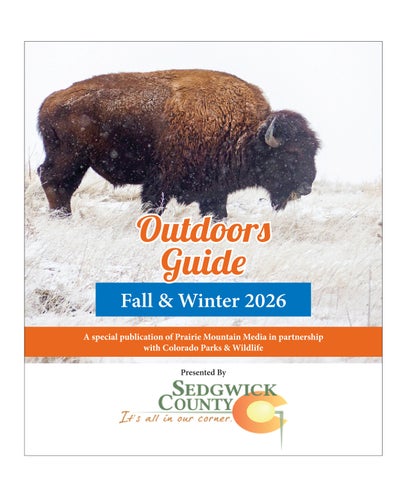
Outdoors Guide Fall & Winter 2026 A special publication of Prairie Mountain Media in partnership with Colorado Parks & Wildlife Presented By
2
| FALL & WINTER OUTDOOR GUIDE | THEMORGAN COUNTY TIMES+FORTMORGANTIMES.COM
THURSDAY, AUGUST 27, 2026
FORTMORGANTIMES.COM
THURSDAY, AUGUST 27, 2026
| FALL & WINTER OUTDOOR GUIDE | 3
PHOTO COURTESY COLORADO PARKS AND WILDLIFE
Waterfowl hunting provides the ultimate way to connect with nature and immerse yourself in the Colorado outdoors.
Inside
Wild bison is now a big-game species ................................................. 4 Hunting in Colorado? Know the rules before you head out ............... 6 Why you should go lead-free ................................................................. 8 Wildfires and drought challenge wildlife across Colorado ............... 10 Wildlife and habitat conservation efforts supported by oil and gas fees ................................................................................. 12 Tips for scenic fall adventures and responsible recreation ............. 13 Camping Gear List................................................................................. 14
The Fort Morgan Times
Content for this section is provided by Colorado Parks and Wildlife. On the cover: A bison walks through a snowy field. Photo by Wayne D. Lewis/CPW.
Journal-Advocate
Project Staff
The 2026 Fall and Winter Outdoor Guide is a product of these newspapers: www.fortmorgantimes.com
www.journal-advcoate.com
Julesburg Advocate
www.julesburgadvocate.com
Akron News Reporter
Sara Waite, Editor/Publisher
Copyright 2026, Prairie Mountain Media
www.akronnewsreporter.com
THE FALL & WINTER OUTDOORS GUIDE
is a special publication in coordination with Colorado Parks & Wildlife. Prairie Mountain Media wishes to thank Colorado Parks & Wildlife for photos, stories and information provided for republication in this section. Please visit
cpw.state.co.us for a full complement of outdoors recreation information.
4
| FALL & WINTER OUTDOOR GUIDE | THEMORGAN COUNTY TIMES+FORTMORGANTIMES.COM
THURSDAY, AUGUST 27, 2026
HUNTING
DENVER POST PHOTO
Bison gather in a field in the Rocky Mountain Arsenal National Wildlife Refuge in Denver on Dec. 12, 2023.
Wild bison is now a big-game species
The CPW Commission approved regulations giving bison a dual classification as both livestock and wildlife, following the direction of the 2025 Protect Wild Bison Act (SB25-053). CPW regulations are designed to implement SB25-053. CPW is not proposing regular bison hunting seasons at this time. Under the new regulations, privately owned bison herds will continue to be managed as livestock. However, free-ranging bison that naturally enter the state from neighboring jurisdictions will now be managed as wildlife, specifically as a big-game species under CPW au-
thority. “This dual classification recognizes both the cultural and ecological importance of bison while providing the tools needed to manage wild bison as big game wildlife,” said CPW Big Game Manager Andy Holland. “Colorado’s last native wild bison were killed in the late 1800s, but as restoration efforts expand across the West, wild bison are moving into Colorado from the Book Cliffs herd in Utah.” Adding bison to the list of animals that CPW manages and protects as a big-game species requires several updates to existing regula-
tions, including the addition of Director-approved management licenses to be used on a case-bycase basis, for example, in the case of game damage, updates to definitions and the adoption of license fees. CPW is developing a registration process for interested hunters to join a management roster, which could be used if needed to manage a free-ranging herd. That process, including a public application form and drawing system, is expected to be available in January 2026 through the CPW website. If management action is necessary, names from the
roster will be used for a random draw to issue licenses. Successful applicants will be notified directly by CPW. “These regulations prepare Colorado for when wild bison once again roam here,” Holland said. “Our goal is to ensure we have the management tools available while we are engaging stakeholders to create a Book Cliffs Bison Herd Management plan, which will establish the bison management area and population objectives.” For more information on bison management in Colorado, visit CPW’s Rules and Regulations page.
THURSDAY, AUGUST 27, 2026
THE MORGAN COUNTY TIMES+FORTMORGANTIMES.COM
| FALL & WINTER OUTDOOR GUIDE | 5
6
| FALL & WINTER OUTDOOR GUIDE | THEMORGAN COUNTY TIMES+FORTMORGANTIMES.COM
THURSDAY, AUGUST 27, 2026
HUNTING
Know the rules before you head out General Hunting Laws 1. Colorado Parks and Wildlife can post firing lines at its properties. 2. It is illegal to kill, capture, injure or harass wildlife from a motor vehicle or an aircraft. It is also illegal to operate aircraft with intent to injure, harass, drive or rally wildlife. It is illegal to discharge a firearm or release an arrow from a motor vehicle or an aircraft. 3. It is illegal to discharge a firearm or release an arrow from, on or across a public road. Hunting with rifles, handguns, shotguns firing a single slug and archery equipment is prohibited within 50 feet on each side of the center line of any public road. On a divided road, the prohibition includes the median, and the 50-foot requirement is measured from the center line of both roads. 4. It is illegal to carry or have a
firearm, except a pistol or revolver, in or on a motor vehicle unless the chamber is unloaded. While using artificial light from a vehicle, it is illegal to have a firearm with cartridges in the chamber or magazine, or possess a strung bow unless the bow is cased. 5. Except for “furbearers” and “other small-game” species, you must take all edible portions of meat (“small-game birds” and “small-game mammals”) from the field and prepare for human consumption. Do not leave wounded wildlife (or wildlife that might be wounded) without attempting to track and kill it. 6. Possession of wildlife is evidence you hunted. 7. Small-game and migratory bird hunters are not required to wear solid, fluorescent orange or pink clothes. However, CPW encourages you to wear fluorescent orange or pink clothes for safety. 8. You must stop at CPW check
stations when told to do so. 9. Violations of Colorado wildlife laws carry point values. You can face suspension of license privileges for up to five years or more if you accumulate 20 or more points in five years. 10. During deer, elk, pronghorn and bear seasons, firearms (except handguns) must be unloaded in the chamber and magazine when carried on an off-highway vehicle (OHV). Firearms (except handguns) and bows carried on an OHV must be fully enclosed in a hard or soft case. Scabbards or cases with open ends or sides are prohibited. This regulation does not apply to landowners or their agents carrying a firearm on an OHV for the purpose of taking depredating wildlife on property owned or leased by them. 11. CALIBER RESTRICTION: It is illegal to hunt game birds, smallgame animals or furbearers with a centerfire rifle larger than .23 caliber in regular rifle deer and elk seasons west of I-25, unless you have an unfilled deer or elk license for the season you are hunting. A small-game license is required.
Legal Hunting Hours
Legal times to hunt small game and/or waterfowl are one-half hour before sunrise to sunset.
Aids in Hunting
Trish Lockhart REALTOR®
970-520-2201 trish@altituderealtyco.com
Commercial, Residential, Farm & Ranch Licensed in Colorado and Nebraska www.trishlockhart.com
1. Dogs are allowed to hunt small game, waterfowl and furbearers, but only to pursue, bring to bay, retrieve, flush or point. It is illegal to use dogs to hunt cottontail rabbits, snowshoe hares and tree squirrels on land where any regular deer, elk, pronghorn or moose season is in progress. 2. Artificial decoys are permitted. 3. European ferrets are permitted for hawking. Ferrets must be neutered, tattooed on left inguinal area and dyed along one-fourth of their body for easy field identification. 4, Mechanical devices designed to call wildlife are allowed. Recorded or electronically amplified calls can be used to hunt furbearers and crows only and light geese during the conservation order season.
5. You can hunt migratory game birds over standing crops or feed used in the course of agricultural planting, harvesting or other normal agricultural practices; baiting is not allowed. It is illegal to use drones to look for, scout or detect wildlife as an aid in hunting.
Legal Hunting Methods For Small-Game Mammals 2. Shotguns no larger than 10 gauge. Shotguns cannot be capable of holding more than 3 shells in magazine and chamber combined. 3. Hand-held bows and crossbows. 4. Air guns and slingshots. 5. Hawking. 6. All live traps (only cage or box traps) placed on public lands must be labeled clearly with the trapper’s Customer Identification number (CID), in a place that can be easily seen without needing to move the trap to see the label. Trappers who don’t have a CID must legibly label the traps with the trapper’s name. Live traps that aren’t labeled properly may be confiscated by any wildlife officer. This law also applies to furbearers (below).
For Small-Game Birds (Except Migratory Birds) 1. Rifles or handguns allowed for dusky grouse and ptarmigan. 2. Shotguns no larger than 10 gauge not firing a single slug. Shotguns cannot be capable of holding more than 3 shells in magazine and chamber combined. 3. Hand-held bows and crossbows. 4. Air guns and slingshots allowed for dusky grouse and ptarmigan. 5. Hawking.
For Migratory Birds
1. Shotguns cannot be larger than 10 gauge. They cannot be capable of holding more than three shells in magazine and chamber combined. They must be fired from the shoulder. To reduce capacity of shotguns that hold more than three shells in the chamber and magazine combined, the magazine must RULES » PAGE 7
FORTMORGANTIMES.COM
THURSDAY, AUGUST 27, 2026
Rules FROM PAGE 6
be cut off, altered or plugged with a one-piece filler that cannot be removed unless the gun is disassembled. Slugs are illegal to hunt waterfowl. 2. Hand-held bows are allowed only if the arrow or bowstring is not held or drawn mechanically. It is illegal to use bows on firing lines designated by the Parks and Wildlife Commission. 3. It is legal to hunt waterfowl in the open, from a blind or other concealed place (except a sink box). When camouflaged with vegetation from agricultural crops, camouflaging cannot result in exposing, depositing, distributing or scattering grain or other feed. 4. Hunting is allowed from vessels (except sink boxes) with motors or sails if motor is off, and/or sails furled and forward movement has stopped. Hunting is allowed from drifting vessels and those propelled
by hand. Motorized vessels are only allowed to pick up dead or injured birds, or to put out and retrieve decoys. 5. It is legal to take migratory birds, including waterfowl, coots and cranes, on or over the following lands not otherwise baited: standing or flooded standing crops; standing flooded or manipulated natural vegetation; flooded harvested crop lands; where seeds or grains were scattered solely from normal agricultural planting, harvesting, post-harvest manipulation or normal soil stabilization practice; flooded, standing agricultural crops where grain is inadvertently scattered solely by a hunter entering or exiting an area, placing decoys or retrieving downed birds. It is also legal to take migratory birds, except waterfowl, coots and cranes, on or over the following lands not otherwise baited: where grain or other feed is distributed or scattered solely from manipulation of agricultural crops or other feed, or solely from normal agricultural operations. “Baiting” means the di-
| FALL & WINTER OUTDOOR GUIDE | 7
rect or indirect placing, exposing, depositing, distributing or scattering of salt, grain or other feed that could serve as a lure or attraction for migratory game birds to, on or over any areas where hunters are attempting to take them. “Baited area” means any area on which salt, grain or other feed has been placed, exposed, deposited, distributed or scattered, if that salt, grain or other feed could serve as a lure or attraction for migratory game birds to, on, or over areas where hunters are attempting to take them. Any such area will remain a baited area for ten days following the complete removal of all such salt, grain or other feed. 6. Hawking or falconry permitted. 7. Dogs, artificial decoys, duck calls or goose calls are legal, except recorded or electronically amplified calls or sounds. Recorded or electronically amplified calls are legal to hunt common crows. 8. You don’t need a permit to have and transport plumage or skins of legally taken migratory
birds for your use. 9. You don’t need a permit to have, dispose and transport feathers from wild ducks and wild geese legally killed, or from birds seized and condemned by wildlife authorities. It is legal to use feathers to make fishing flies, bed pillows, mattresses and similar commercial items, except for millinery or ornamental use. 10. In Light Goose Conservation Order Season: Recorded or electronically amplified calls are allowed. Shotguns that hold more than 3 rounds in the chamber and magazine may be used in this season only. Hunting is allowed onehalf hour before sunrise to one-half hour after sunset. A federal migratory bird stamp is not required, but a Colorado waterfowl stamp is. 11. The most restrictive state or federal laws apply. See fws.gov for a detailed summary of federal regulations on migratory bird hunting. More regulations also may apply to National Wildlife Refuges opened to hunting; go to fws.gov/refuges for details.
WELCOME HUNTERS AND BIRD WATCHERS! Visit the best kept secret in Northeast Colorado.Visit Brush! BRUSH PRAIRIE PONDS
BRUSH STATE WILDLIFE AREA
Nestled 2.5 miles south of Brush on Clayton Street. This wildlife area features plentiful pheasant and ducks. Hunt nine different ponds, two of which are reserved for Brush residents. Visit cpw.state.co.us or call 970-842-6300 for hunting reservation information.
Located 2.5 miles north of Brush on Highway 71. Whether hunting or viewing wildlife, common game includes deer, pheasant, turkey, quail, dove and waterfowl. Access also available to bass, bluegill and trout for anglers on Chartier Pond.
Following your hunt, please visit The Course Cafe at Petteys Park, featuring a full restaurant menu and daily drink and dining specials. Follow lunch by playing the premier 9-hole golf course in all of Northeast Colorado.
8
| FALL & WINTER OUTDOOR GUIDE | THEMORGAN COUNTY TIMES+FORTMORGANTIMES.COM
THURSDAY, AUGUST 27, 2026
BIG GAME
Why you should go lead-free As conservationists, individual hunters have real power to make a difference for wildlife. By switching to lead-free ammunition, hunters can help protect our country’s most beloved birds and wildlife, promote healthy ecosystems and conserve our natural heritage. In 2023, the Colorado state legislature passed House Bill 23-1036, the “Nontoxic Bullet Replacement Hunting Program.” This legislation tasked CPW with working with nongovernmental partners to design a two-year pilot program to encourage hunters to voluntarily switch to lead-free ammunition. CPW and partners have met monthly to develop outreach and educational materials for hunters, coordinate strategies and communications, and provide range demonstrations. In fall 2025, a targeted sample of deer and elk rifle hunters were surveyed on their use and opinions of lead-free ammunition. Results indicated that there were no statistical significant differences in leadfree ammunition use between individuals in an Experimental Group (who received informational materials and resources from CPW prior to their hunting season) and those in a Control Group (who received no informational materials or resources). The results did however indicate statistical significance that hunters’ choice of ammunition was impacted by practical, rather than value-based, concerns, with the most significant barriers to
WAYNE D. LEWIS — COLORADO PARKS AND WILDLIFE
Switching to lead-free ammunication can protect wildlife, promote healthy ecosystems and conserve our natural heritage, Colorado Parks and Wildlife says. adoption being concerns over ammunition quality, performance, and price. Conversely, the single most important factor motivating the switch to lead-free ammunition was the hunter’s concern for the positive impact on non-target wildlife. No new regulations on lead am-
Outdoors recreation opportunities are plentiful in Northeast Colorado
munition have been enacted.
by hunters are made of two materials: a lead core and a copper Comparing Lead with Lead- jacket. Some rounds are made of a Free Ammo single metal, often copper, for big and small game; steel, bismuth An effective, high-performance and tungsten are used for waterround is one of the most import- fowl and upland birds. Colorado Parks and Wildlife ant factors in a clean, ethical harvest. Most traditional rounds used LEAD-FREE » PAGE 9
The Fort Morgan Times and Sterling Journal-Advocate, along with our other media partners, remind you to place safety first when enjoying the outdoors. Please visit
cpw.state.co.us
and peruse outdoors recreation opportunities, information and activities. And don’t forget to get your kids involved in the outdoors.
THURSDAY, AUGUST 27, 2026
FORTMORGANTIMES.COM
| FALL & WINTER OUTDOOR GUIDE | 9
Lead-free FROM PAGE 8
hosted range demonstrations, comparing the performance of lead and copper ammo using ballistics gels. Using ballistics gels representatives from Sporting Lead-Free and the North American Non-lead Partnership have shown the difference. These gels are excellent models for living animals, as they imitate muscles and vital organs very closely.
Fragmentation
PHOTO COURTESY COLORADO PARKS AND WILDLIFE
Crowd at a CPW hosted lead-free demonstration at Cameo Shooting When a lead bullet hits ballis- Range. tics gel, it loses weight as it mushrooms out, leaving small pieces of After being hit in the heart or animal but some can spread much lead along its path. In one demon- lungs with an effective, well-placed, farther. Hunters pride themselves stration, lead bullets lost 30% of humane gunshot, a big-game ani- on leaving the land better than they their weight after impact; cop- mal tends to travel a certain dis- found it. As conservationists comper bullets remained almost en- tance — its “standardized animal mitted to protecting natural hertirely intact, losing only 1% of their flight distance” — before it col- itage, many hunters are choosing weight, but still mushroomed. Lead lapses. Research has shown that lead-free ammunition to benefit is softer than other expandable bul- moose, brown bear, red deer (sim- wildlife and support healthy ecolets: It’s common for one lead bullet ilar to elk) and roe deer all travel systems. to erode over 100 fragments. Cop- their standardized flight distances per bullets, on the other hand, leave whether shot with a lead or copper Lead and Animal Health very few fragments behind bullet: Neither type causes excesLead-based ammo can have negsive suffering. ative effects on nontarget wildlife. Swift, Ethical Kill • Gut piles can be a great source While it’s commonly believed the Cost and Availability of food in the fall and winter amount of weight loss and fragMid- and top-tier rifle ammo, months for raptors like eagles and mentation lead bullets undergo is whether lead or lead free, are com- hawks. Mammals like foxes, fishers necessary to do enough damage to parable in price. Lead-free ammu- and black bears will also partake. down a big-game animal, this is not nition, both as loaded ammunition It’s one of the innumerable benefits true. The bullet paths visible in the and bullets for reloading, is avail- of hunting: Nothing goes to waste. gels show that lead and copper bul- able in all popular calibers through • Even when a big-game animal lets both expand into a mushroom many manufacturers. Lead-free is is shot through the heart or the shape, creating a broad pathway, often available at local stores and lungs, the gut pile left after field and radiate enough energy into the online. Plan in advance to make dressing can contain stray fraganimal for a swift, ethical kill. In sure you have ammunition in time ments of lead. A lead fragment as fact, the weight that copper bullets for your hunt. small as 20 mg, about the size of maintain actually provides supea grain of rice, can be fatal to an rior penetration compared to lead, Beyond the Bullet eagle. ensuring a clean harvest. Because lead bullets fragment on • Lead is well known as a neuimpact, tiny pieces of lead are left rotoxin, a substance that causes Efficiency along the bullet’s path through the brain damage. As it dissolves in
the stomach and is absorbed into the bloodstream, tissues and bones, lead harms the nervous system. Animals can suffer tremors, convulsions, delays in brain development, poor coordination, stomach muscle paralysis and even death. • Because lead stays in the bloodstream temporarily, blood lead level is an accurate indicator of recent lead exposure. Though it exits the bloodstream after a short period, lead never leaves the body, accumulating in the bones over the animal’s lifetime. • Lead-free ammo reduces lead exposure in raptors. In one experiment, scientists distributed leadfree ammo to hunters for two seasons and measured the blood lead levels of bald eagles in the area. They found that when more hunters used lead-free ammo, blood lead levels in the local eagle population decreased. • Many research studies from across the globe have shown that blood lead levels in raptors are higher during big-game hunting seasons, with lead from gut piles as a major source of lead exposure. • Even a perfect shot can leave lead fragments in the gut pile of an elk, deer, moose or other big-game animal. Lead fragments can travel as much as 18 inches away from the main wound channel, making it impossible to remove all lead from the meat or gut pile.
Lead and Human Health
Lead fragments are often so small we don’t notice them as we’re preparing, cooking or even chewing meat. Confirmed lead fragments are found in approximately 20% of ground game meat. Talk to your doctor if you’re concerned about the effects of lead on you or your family’s health.
10
| FALL & WINTER OUTDOOR GUIDE | THEMORGAN COUNTY TIMES+FORTMORGANTIMES.COM
THURSDAY, AUGUST 27, 2026
WILDLIFE CONSERVATION
PHOTO COURTESY COLORADO PARKS AND WILDLIFE
Many wildlife species are facing increased stress to search for food, water and shelter in the wake of wildfires and drought.
Wildfires and drought challenge wildlife Drought and wildfires are creating challenges for wildlife and the habitats they depend on. As landscapes recover from fire and water sources are scarce, Colorado Parks and Wildlife (CPW) is closely monitoring habitat conditions, as many wildlife species face increased stress to search for food, water and shelter. Wildfires can rapidly alter ecosystems by removing vegetation that provides food and cover for wildlife. While ecosystems are
adapted to periodic fire and will recover over time, the initial impact of large wildfires may reduce habitat quality, displace animals and increase competition for limited resources. Species that are unable to relocate quickly or that rely on specialized habitats may be especially vulnerable this summer. Drought compounds these challenges by reducing water availability, limiting plant growth, and affecting the insects, fish and other food sources that wildlife need
to survive. Lower stream flows, shrinking wetlands and dry landscapes can impact a wide range of species from birds to mammals to amphibians and reptiles. Limited moisture also reduces the annual growth of important shrubs used by bears, elk, moose, pronghorn and mule deer. Plant growth directly affects the food available to wild animals, and drought reduces the number of animals the habitat can support.
How You Can Help Wildlife
Community members can help wildlife by respecting habitat and giving animals space, which helps build community support and responsible behavior towards wildlife. • Give wildlife extra space and respect area closures. • Do not feed wildlife; let them find natural food sources. • Properly dispose of trash to deter wildlife from entering residenHABITAT » PAGE 11
FORTMORGANTIMES.COM
THURSDAY, AUGUST 27, 2026
Habitat FROM PAGE 10
tial areas. • Keep dogs on a leash, especially near wetlands and riparian areas. • Report sick or stressed wildlife to a local CPW Office. • If you see a poaching incident, report it to Operation Game Thief by emailing game.thief@state.co.us or calling 1-877-COLO-OGT. • Volunteer for habitat improvement projects at state parks and state wildlife areas. As smaller streams dry up, wildlife may walk along roads or gather around livestock tanks. Keep a safe distance, avoid feeding or approaching wild animals, and report problematic interactions to CPWtrained wildlife officers to help reduce conflicts and protect both wildlife and communities. CPW is seeing a significant increase in bear activity this summer as bears migrate into neighborhoods and cities in search of human trash. As of Aug. 7, CPW received 5,197 reports of bear sightings and incidents, an increase
from 2,853 reports in 2025 over the same time period. Wildlife officers are frequently called to help with bears because people have left trash outside, or bears have entered open garages and unlocked cars. These calls can be prevented with extra diligence by humans to secure trash and strong-smelling items that can attract bears. CPW will issue a press release featuring bear incident data for 2026. For more bear educational resources, visit bearwise.org. “Summer wildfires and drought test every creature. Protecting their habitat today gives wildlife hope for future generations,” said CPW Habitat Conservation Supervisor Casey Cooley. “This summer in particular, we ask people to be mindful that wildlife are having to work harder to find food and water. The best thing we can do to support them is to keep them wild and not feed or disturb them. Feeding wildlife can increase the chances of human-wildlife conflicts or make them sick and dehydrated.”
Wildlife Habitat Improvement Projects
| FALL & WINTER OUTDOOR GUIDE | 11
CPW’s wildlife management decisions are grounded in the best available science and the expertise of agency biologists, researchers, veterinarians and wildlife managers. Staff collect and analyze data through population surveys, GPS-collar studies, genetic sampling, disease surveillance, habitat assessments and long-term monitoring programs. By adjusting hunting and fishing season structures and license quotas in areas affected by wildfire damage, closing boating ramps during extreme drought conditions, and establishing voluntary and mandatory fishing closures, CPW can partner with the public to sustain healthy habitats and wildlife populations. Once wildfires pass through a landscape, CPW is on the ground helping restore land and habitat so wildlife can return to burned areas and thrive for future generations. Below are examples of habitat conservation projects that CPW is actively working on to support wildlife resilience and biodiversity. • Following the 2025—2035 State Wildlife Action Plan (SWAP) to protect and conserve native species
• Managing a Native Seed Warehouse to plant native wildflowers and grasses • Following the Habitat Conservation and Connectivity Plan, which prioritizes projects like invasive weed control, forest/riparian restoration, prescribed fires and the construction of wildlife-friendly fencing and fish passage installations to support wildlife on the move • Providing Colorado Wildlife Habitat Program (CWHP) funding for landowners to protect important wildlife habitat • Funding a Cumulative Impacts Disturbance Index database to track the effects of past and present habitat loss due to human activity across the state • Building pollinator gardens at state parks • Restoring wetland habitat at state wildlife areas Even during difficult drought conditions, habitat improvement efforts, responsible recreation and public lands stewardship can help Colorado’s wildlife remain resilient. For more information about wildlife conservation and living with wildlife, visit https://cpw.
12
| FALL & WINTER OUTDOOR GUIDE | THEMORGAN COUNTY TIMES+FORTMORGANTIMES.COM
THURSDAY, AUGUST 27, 2026
WILDLIFE CONSERVATION
Conservation efforts supported by oil, gas fees Colorado Parks and Wildlife (CPW) is investing in eight new conservation efforts through funds raised by fees authorized by Senate Bill 24-230 to address the impacts of oil and gas production on Colorado wildlife and ecosystems in alignment with CPW’s 2026-2036 Strategic Plan and Colorado’s Outdoors Strategy (COS). “SB24-230 was an innovative, collaborative, and common-sense way to protect our wildlife, outdoor spaces, and important habitats from the effects of oil and gas production. Every Coloradan cherishes Colorado’s iconic natural beauty and these funds help CPW conserve and protect wild spaces that drive our tourism, create outdoor recreation opportunities, and are home to the wildlife Colorado is known for. These funds show the way that industry and conservation can find a path forward to better protect the great outdoors that make our state amazing and unique,” said Governor Polis. These investments are a collective commitment to the goals outlined in Colorado’s Outdoors Strategy, a statewide framework that aligns state, local, and regional partners around shared conservation and recreation priorities. Informed by the latest research, these projects directly support the strategy’s goal of ensuring wildlife biodiversity, maintaining connected habitats, and benefiting communities and economies from healthy ecosystems. This important work simultaneously advances CPW’s 2026-2036 Strategic Plan, which seeks to support healthy wildlife populations and habitats. “These additional projects showcase how fees collected from oil and gas operations will be used to restore and protect habitat for Colorado’s wildlife,” said CPW Director Laura Clellan. “CPW will continue to work with industry partners, conservation organizations and local communities to ensure that funded projects deliver measurable impacts that mitigate the impacts of oil and gas operations.” The eight new wildlife conserva-
tion efforts include:
Greenback Recovery Capacity ($287,149 Annually) Provides a dedicated team to lead native species conservation efforts for Greenback Cutthroat Trout recovery, which can be affected by water use and water quality effects from oil and gas production. These efforts are crucial to preventing the species from being federally listed and securing its future habitat.
Colorado Wildlife Habitat Program Request for Proposal ($4,000,000 Annually) Provides Colorado Wildlife Habitat Program (CWHP) funding opportunities for landowners who want to protect important wildlife habitat, provide public wildlife-related recreational access or sell property to CPW. The additional funding will improve wildlife connectivity and migration corridors and slow biodiversity loss to help address the effects of oil and gas operations.
Habitat Conservation and Connectivity Plan Implementation ($1,000,000 Annually) Implements the Habitat Conservation and Connectivity Plan, which prioritizes wildlife species and addresses barriers to wildlife connectivity and migration corridors across Colorado to help offset impacts in areas affected by oil and gas operations. Additional funds will help implement the Habitat Conservation Team’s restoration and land protection targets. Projects include invasive weed control, forest/riparian restoration, and the construction of wildlife-friendly fencing and fish passage installations to support wildlife on the move.
Native Plant Coordinator and Warehouse ($572,202
Annually)
Provides dedicated funding for the implementation of the 2025— 2035 State Wildlife Action Plan (SWAP), approved by the USFWS in January 2026, to promote native species conservation in Colorado. The SWAP acts as the primary roadmap for conserving Species of Greatest Conservation Need (SGCN) and describes the effects of oil and gas operations on terrestrial and aquatic wildlife in Colorado.
Establishes the first-ever fulltime CPW position to manage the Native Seed Warehouse located in Delta, Colorado, to support largescale habitat reclamation and promote native species conservation. CPW and partners currently lack adequate native plant materials to restore habitats impacted by energy extraction and climate events, such as wildfires. Funding will modernize equipment and Water Acquisition scale operations to meet growing ($2,000,000 One-time) legislative and conservation demands for native seeds. CPW’s abilPurchases a senior water right ity to plant native wildflowers and for Golden Gate Canyon State Park grasses helps grow healthy and ro- and Ralston Creek State Wildlife bust habitats. Area, which is ranked by CPW’s Aquatic Section as the highest priBlack-footed Ferret and ority water right in the state. The Prairie Dog Management funding will help protect and restore important watersheds and ri($1,636,963 Annually) parian habitats in Colorado. Creates a holistic management The first round of wildlife and program with a dedicated wildlife habitat projects funded through biologist and eight temporary staff, Senate Bill 24-230 fees, announced to establish stable Black-footed fer- in April, used $5,477,765 for seven ret (BFF) recovery sites and miti- identified remediation projects that gate plague outbreaks, which are will increase habitat restoration, indirectly influenced by climate im- wildlife monitoring, pollinator garpacts and threaten native ecosys- den planting, species conservation, tem stability. This will support the and strategic land and water proprotection of wildlife and habitats tection efforts across Colorado. for an important native species in One project funded in the first Colorado. round of allocations was $85,000 toward Columbian sharp-tailed Cumulative Impacts grouse translocations, which inDisturbance Index volves strategically capturing and moving birds from one population ($950,000 Year 1) to another. Oil and gas operations are prevDevelops a database to track the effects of past and present habitat alent in the areas where these speloss due to human activity across cies are found in the state. These the state. This will assist in the con- translocations support genetic ditinued research and monitoring of versity and help maintain populathreats to Colorado wildlife and tion health, conserving one of Colecosystems, including from climate orado’s unique native species. CPW continues to use these new change and oil and gas operations, and will provide CPW staff with a fees to mitigate the impacts of oil vital tool during Colorado Energy and gas operations, with the next & Carbon Management Commis- round of conservation projects to sion permitting reviews, enabling a be funded in fiscal year 2026. For more information on Colodata-driven understanding of ecorado Parks and Wildlife conservasystem overlap and impacts. tion work, visit cpw.state.co.us or SWAP Species Management subscribe to CPW’s Conservation ($2,000,000 Annually) eNews to receive monthly updates on ongoing conservation projects
FORTMORGANTIMES.COM
THURSDAY, AUGUST 27, 2026
| FALL & WINTER OUTDOOR GUIDE | 13
OUTDOOR RECREATION
Colorado Parks and Wildlife offers tips for scenic fall adventures and responsible recreation As Colorado’s vibrant fall colors paint the landscapes in a breathtaking spectacle, Colorado Parks and Wildlife (CPW) encourages sportspeople and outdoor enthusiasts to witness this natural wonder and practice simple conservation acts. Colorado is home to more than 220,000 acres of public land, 43 world-class state parks that welcome 19 million visitors annually, 350 state wildlife areas, 6,000 miles of streams and over 1,300 lakes and reservoirs — each offering a unique and diverse experience. Below are tips and resources on how to plan a fall outdoor adventure and ways Coloradans and outof-state visitors can take action to protect Colorado’s land, water and wildlife while also making the most of an outdoor experience.
Know Before You Go
• To help plan a state park visit, use the Colorado State Parks Guide (Guía De Los Parques Naturales) or State Park Finder. Both provide a comprehensive map and reveal what trails and outdoor activities are available at each park. • Discover state fish units, state wildlife areas and state trust lands with the 2025 Colorado State Recreation Lands Brochure. • Explore campsite, cabin and yurt rentals at Colorado state parks. RECREATION » PAGE 15
PHOTO COURTESY COLORADO PARKS AND WILDLIFE
Visitors use binoculars at Muller State Park.
Yuma | (970) 848-5839 Fort Morgan | (970) 867-4966 Sterling | (970) 522-2330 PREMIERACA.com © 2013 Premier Farm Credit, All Rights Reserved. Holyoke | (970) 854-3585
14
| FALL & WINTER OUTDOOR GUIDE | THEMORGAN COUNTY TIMES+FORTMORGANTIMES.COM
THURSDAY, AUGUST 27, 2026
Camping Gear List: Essential + Recommended Items Essential Items: Good Walking shoes/ boots
Recommended Items: Personal Hygiene and Safety
Shorts
Towel
Long pants
Wash cloth
Long sleeve shirt/sweatshirt
Lip balm
Short sleeve shirt/t-shirt
Toothbrush/ toothpaste
3 pairs of socks (per person)
Soap
Raingear
Deodorant
Sleeping bag/ blankets/ bedding
Sunglasses
Backpack/ daypack
Sunscreen (SPF 30 or greater)
Firewood – buy locally!
Insect repellent
Matches/ lighter
Family first-aid kit
Fire starter/ kindling
Flashlight/ headlamp
Dishware (plates, cups, silverware)
Clothing
Cooler with ice/ reusable cold packs
Hat
Water bottle
Sleepwear
Food items (see separate menu list)
Underwear
Tent
Swimsuit
Tarp/ footprint
Water shoes
Lantern
Warm jacket
Sleeping pads
Kitchen Items
Cooking stove
Resealable plastic bags
Cooking stove fuel (propane)
Paper towels
Cooking pots and pans
Trash bags
Cooking utensils
Hand Sanitizer
Washtub with sponge and bio-soap
Dish towel
Large water containers
Can opener Aluminum foil Roasting sticks Extras Camera Extra batteries Camp chairs Notebook and pencil Playing cards Nature guide Binoculars
FORTMORGANTIMES.COM
THURSDAY, AUGUST 27, 2026
Recreation FROM PAGE 13
• Find park events and classes on the CPW Events Calendar. • Read our Leaf Peeping Guide: How to Chase Changing Colors in Colorado state parks. • Download the free COTREX app to find trailheads, maps and closures. • Bring layers — mountain weather changes quickly. • The majority of public lands in Colorado are open to multiple types of recreational use. For safety reasons, big game hunters using a firearm must wear fluorescent orange or pink when in the field. Please note it is illegal to intentionally interfere with hunters, including causing animals to flee, denying access to public areas or injecting yourself into the line of fire.
Keep Wildlife Wild
• Be prepared to cross paths with wildlife. • Do not feed, touch or approach wildlife (this includes Halloween pumpkins). • Bears are in hyperphagia and trying to eat 20,000 calories per day. Be BearWise to prevent human-caused conflicts with bears in neighborhoods or while hiking. • Watch for wildlife on roadways during daylight saving time. • Help wildlife migrate smoothly to wintering areas by removing tangle hazards from yards. • Keeping dogs leashed helps prevent moose and bear attacks on trails. • Elk, moose and deer are in their annual rut (mating season), so give them space. Elk and moose can get territorial and attack when they feel threatened. • If you see wildlife that appears sick or injured, leave it alone. Call your local CPW office and ask a trained wildlife officer for guidance.
Many species call Colorado home, making it the perfect destination for Leave It As You Find It wildlife watching. In the fall, wild• Parking in designated areas is life are more active, looking for food critical — undesignated parking or in rut looking for a mate. can destroy vegetation, ignite wild-
| FALL & WINTER OUTDOOR GUIDE | 15
fires in dry grass or block search and rescue vehicles. Help keep our trees healthy by not carving into them or pulling down branches. • Pack it in, pack it out. Whatever you bring into the outdoors, take it out with you. • Keep dogs leashed and put waste bags in a trash can. Do not hang waste on trees or put waste bags in vault toilets. “Autumn is one of the most magical times to visit state parks — crisp air, golden trees, and the majestic return of migrating bald eagles to their winter home in Colorado. We are celebrating the season with family-friendly events like our annual Halloween-themed candy crawl, guided bird walks, and moonlight hikes,” said Barr Lake State Park Manager Lisa Gill. “While you’re out spending time at your favorite state park, help us keep them beautiful — be a park steward by packing out trash, staying on trails, and respecting wildlife. Together, we can protect these special places for every wild animal and human alike”.
Fishing in Colorado and Water Safety
• Wear a life jacket. • Dress accordingly and protect yourself from the dangers of cold water shock. • Paddleboards and kayaks are considered vessels, and life jacket requirements apply. • Heavy wind can raise water levels quickly and without notice. • Explore Colorado’s new category of fishable waters: Colorado Quality Waters. • Colorado’s beer industry could be impacted by Aquatic Nuisance Species, which can harm aquatic ecosystems and the water quality that supports Colorado’s vibrant beer culture and brewery scene. Keep Colorado’s beer culture from going flat: Clean, drain and dry your water gear. Find a Boat Inspection and Decontamination Site or gear and watercraft cleaning station near you.
Avalanche Safety
Avalanches can happen anywhere there is snow on steep slopes (between 30-50 degrees) yearround. Before you depart, check the weather forecast or avalanche. state.co.us for up-to-date avalanche safety information.
200W. 4th St., Julesburg, CO (970) 474-2000 • mbenson@kci.net Complete Listings at: www.benson-realty.com
Offering farms, ranches, residential & commercial property. Licensed in Colorado & Nebraska.
16
| FALL & WINTER OUTDOOR GUIDE | THEMORGAN COUNTY TIMES+FORTMORGANTIMES.COM
THURSDAY, AUGUST 27, 2026
The Great Outdoors... For more information: call 970-474-3344 or visit: https://sedgwickcounty.colorado.gov/ https://townofjulesburg.com/ https://www.sedgwickcolorado.com/ http://www.rivertrailonline.org/
Fishing
&
Hunting
SponSored by: The Sedgwick counTy commiSSionerS