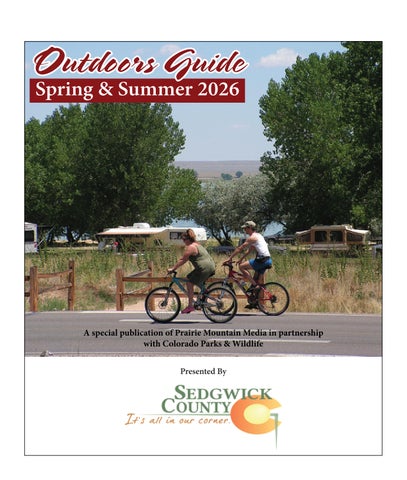
Outdoors Guide Spring & Summer 2026
A special publication of Prairie Mountain Media in partnership with Colorado Parks & Wildlife Presented By
2
| OUTDOORS GUIDE | FORTMORGANTIMES.COM
THURSDAY, APRIL 30, 2026
The Great Outdoors... For more information: call 970-474-3344 or visit: https://sedgwickcounty.colorado.gov/ https://townofjulesburg.com/ https://www.sedgwickcolorado.com/ http://www.rivertrailonline.org/
Fishing
&
Hunting
SponSored by: The Sedgwick counTy commiSSionerS
THURSDAY, APRIL 30, 2026
FORTMORGANTIMES.COM
| OUTDOORS GUIDE | 3 Inside Trek the trails: Get out and explore Colorado scenery on foot, bike or horseback 4 Colorado fishing licenses available for 2026-27 season 5 Spend a night under the stars at Colorado State Parks 6 State Wildlife Areas expand recreation opportunities 8 Stay safe while enjoying an aquatic adventure 9 Keep your distance — and keep your food to yourself 10
COURTESY COLORADO PARKS & WILDLIFE
Colorado offers unrivaled opportunities to fish over 35 species in some of the most scenic bodies of water. Fish anywhere in 6,000 miles of streams and over 1,300 lakes and reservoirs. To find fishing locations, stocking reports and resources, visit cpw.state.co.us/fishing.
The 2026 Spring and Summer Outdoor Guide is a product of these newspapers:
The Fort Morgan Times www.fortmorgantimes.com
Journal-Advocate
www.journal-advcoate.com
Public invited to help track river otters statewide 11 Volunteers have big impact on success of CPW mission 12
Julesburg Advocate
www.julesburgadvocate.com
Project Staff
Akron News Reporter
www.akronnewsreporter.com
Sara Waite, Editor/Publisher Matt Swaney, Production
Content for this section is provided by Colorado Parks and Wildlife.
Copyright 2026, Prairie Mountain Media
Aquatic nuisance species are a pain if they’re not caught 14
Welcome Hunters This coupon entitles bearer to ONE of the following on their next visit:
5” Cinnamon Roll 5” Pecan Roll (Subject to availability)
Truck parking available
Serving locally sourced products. Catering options available. Semi-truck parking.
10646 CO 59, Sedgwick, CO • (970) 463-5509
4
| OUTDOORS GUIDE | FORTMORGANTIMES.COM
THURSDAY, APRIL 30, 2026
OUTDOOR RECREATION
Trek the trails: Get out and explore Colorado scenery By Colorado Parks & Wildlife
With more than 700 miles of trails winding through parks across Colorado, the possibilities for adventure are endless. From easy paved paths to challenging natural terrain, there’s a trail for every explorer — whether you prefer walking, hiking, biking, snowshoeing, cross-country skiing, or even horseback riding.
Colorado Trail Explorer
Discover and explore Colorado’s unique trail experiences with the Colorado Trail Explorer (COTREX). COTREX offers the most comprehensive trail map available for the state. Built using data from over 230 trail managers, COTREX has information about nearly 45,000 miles of trails in one easy-to-find place. Use COTREX on the web or download the app.
Accessible Trails and TrackChair Program For people experiencing disabilities, State Parks offer handicap accessible trails and all terrain wheelchairs, called TrackChairs, so everyone can get out and enjoy Many state lands and parks have trails perfect for bikers of all skill levels. Colorado’s outdoors. user, be courteous and make your and horse to let them know you Safety on Trails approach known. A friendly greet- would like to pass. Whether you are hiking, biking ing or ringing a bell is considerate. • Allow as much room as possior riding a horse, it’s important to ble when passing a horse to avoid follow trail etiquette. This helps ev- Horses being kicked or spooking the aneryone stay safe on the trails. All users should yield for eques- imal. Proceed slowly and steadily trians. If you encounter a horse on while passing, and talk to the horse Hiking a trail: to help it relax. If an equestrian • Walkers and others yield to • Be sure to make yourself visible gives you the right or way, wait equestrians • Keep calm — sudden move- until you receive a signal that it is • Downhill travelers yield to up- ments can startle a horse safe to pass. hill travelers • Allow the animal to be on the • If an equestrian gives you the • Slower travelers yield to faster uphill side of you and the trail, right of way, wait until you receive travelers where it may feel safer. Something a signal that it is safe to pass. unfamiliar from above a horse may Biking Crossing Paths with Wildlife trigger fear of a predator. • Bicyclists yield to equestrians • Be alert from instructions Colorado state parks are home to • Bicyclists yield to walkers from the equestrian and speak to a diversity of wildlife, and you may • Bicyclists yield to skaters the horse in a normal tone, which encounter animals on the trails. • Downhill travelers yield to identifies you as a human. When this happens, be respectful travelers going uphill • When approaching a horse, do of the animal. Observe from a safe • Slower travelers yield to faster so from the front distance, safe for you and safe for travelers • If you intend to pass the horse the animal. Move slowly and casu• Before passing another trail from behind, call out to the rider ally, never directly at an animal,
DUSTIN DOSKOCIL — CPW
and never chase or harass the animal. Avoid animals that behave unexpectedly or aggressively. Please do not feed wild mammals.
State Trails Program
The State Trails Program helps local governments, clubs, nonprofit partners and federal land managers through grants and expertise for non-motorized trails in Colorado. Every year the program awards $2 to $3 million in non-motorized trail grants. Continuing to improve trail recreation opportunities while protecting wildlife, habitat, and cultural resources, as well as other environmental aspects, is at the heart of CPW’s mission. The Colorado Parks and Wildlife Recreational Trails Program has actively encouraged the development of a variety of trails since 1971.
THURSDAY, APRIL 30, 2026
FORTMORGANTIMES.COM
| OUTDOORS GUIDE | 5
ANGLING
Colorado fishing licenses available for 2026-27 season By Colorado Parks & Wildlife
Colorado Parks and Wildlife (CPW) is now selling fishing licenses for the 2026-2027 fishing season. Fishing licenses are valid from March 1, 2026, through March 31, 2027 (13 months). Regulations and pricing for annual, daily and multiday fishing licenses are available in the new 2026 Colorado Fishing Brochure (Pesca en Colorado En Español). Youth aged 15 and under fish for free. Anglers can purchase a license online at cpwshop.com, by phone at 1-800-244-5613, in-person at a CPW office or through a sales agent. CPW also offers specialty licenses and passes for veterans, people with disabilities, seniors, income eligible residents and first responders. “By purchasing a fishing license, anglers play a crucial role in funding Colorado’s fishery management, supporting hatcheries and fish
stocking operations,” said CPW Assistant Director for Aquatic Wildlife Matt Nicholl. “Balancing outdoor recreation with mindful conservation, the anglers in our state make significant contributions to the maintenance of recreational fishing opportunities in Colorado’s rivers, streams and lakes, and protect the needs of native, non-game aquatic species. Anglers who buy a fishing license also pay a $1.25 Colorado Backcountry Search and Rescue (BSAR) fee that funds local search-and-rescue teams and volunteers. While these organizations are county-based and coordinated through county sheriff offices, CPW provides support and funding from the statewide level. Colorado offers unrivaled opportunities to fish over 35 species (both warm and cold-water fish) in some of the most scenic bodies of water. Fish anywhere in 6,000 miles of streams and over 1,300 lakes and reservoirs. To find fishing locations,
stocking reports and resources, visit cpw.state.co.us/fishing Colorado now offers a new category of fishable waters (in addition to Gold Medal Waters): Colorado Quality Waters. CPW fish management biologists have identified and nominated the waters based on fish sampling records, creel surveys and professional biological assessments. CPW fish hatcheries play a crucial role in improving and maintaining Colorado’s fish populations. Currently, CPW operates 19 fish hatcheries, where over 90 million fish are bred, hatched, reared, and stocked each year. Some hatchery fish enhance angling opportunities, an essential part of the state’s economy, contributing $1.9 billion annually. Others are critical to the recovery efforts of native species. “CPW biologists, hatchery staff, and volunteers will soon be spawning fish from wild brood waters to replenish our walleye and saugeye fisheries,” said CPW Deputy Assis-
tant Director Josh Nehring. “Our hatcheries also stock the Front Range waters with trout while water temperatures remain cool for added angling opportunities.” CPW fisheries biologists are now providing the public with online survey summaries by water. The collected data is used to track fish population trends, evaluate the effectiveness of management actions such as stocking and regulations, and establish realistic management goals for a given lake or stream. With zebra mussels discovered in 2024 on the Colorado River and additional detections in 2025, CPW’s Aquatic Nuisance Species (ANS) section continues to ask non-motorized recreation users to be a pain in the ANS and “clean, drain and dry” fishing gear to prevent the spread of aquatic nuisance species in Colorado’s waters. CPW has installed Gear and Watercraft Cleaning Stations at state parks, state wildlife areas and river access points.
6
| OUTDOORS GUIDE | FORTMORGANTIMES.COM
THURSDAY, APRIL 30, 2026
CAMPING
COLORADO PARKS AND WILDLIFE PHOTO
Skygazers at Jackson Lake State Park, which is now a designated International Dark Sky Park.
Spend a night under the stars at Colorado State Parks By Colorado Parks & Wildlife
Lying beneath a starry canopy and drifting off to the sound of nature is just one draw to camping in Colorado. Breathtaking natural beauty, few bugs and the abundance of outdoor activities at your fingertips make the Centennial State one of the nation’s most popular places to camp. Colorado Parks and Wildlife offers a six-month advance campsite reservation window, so it’s time to start booking your summer adventures in Colorado state parks. Choose your preferred overnight accommodations within a park with activities you enjoy, and then book your campsite, cabin or yurt! Use CPW’s online State Park Finder to narrow your search by ac-
tivity, nearby cities, camping and lodging accomodations and other facilities. Interested in hiking? The site recommends parks such as Castlewood Canyon and Cheyenne Mountain. Looking for an accessible cabin or yurt to rent? Find one at Ridgway State Park or Mancos State Park. Staying closer to home? Northeast Colorado offers several park options where you can get away for a day or enjoy a longer stay.
North Sterling State Park
North Sterling State Park is a gateway to outdoor fun and relaxation. One hundred miles due east of the Rocky Mountains, the park is nestled in the gently rolling prairie grasslands on the western edge of the Great Plains. The view goes
on for miles in every direction, broken only by the bluffs and canyons to the north, with blue skies above. The open prairie may look unremarkable at first glance, but visitors who take the time to look a little closer at the wildlife, plants and geology of North Sterling State Park will find a hardy ecosystem just as unique and fascinating as any mountain forest. From May through September, North Sterling Reservoir attracts both locals and tourists, and waterfowl hunters flock to the area during the hunting season. Wide, golden grasslands extend in every direction around the large highplains reservoir, flanked by majestic bluffs to the north and the open landscapes of farms and ranches to the east, all beneath clear blue skies. Feel the warmth of a camp-
fire as you relax, gazing at the brilliant stars overhead. North Sterling Reservoir offers great coves and fingers to explore during the spring and summer months. The reservoir opens to boating in the spring after ice off and will stay open until Oct. 31. Anglers, boaters and water skiers enjoy the water all day. Boaters may recreate anywhere on the water, but the land outside the park boundaries is private property. Please note the state park property boundaries shown on the reservoir map in the park brochure. Three campgrounds with 141 campsites can accommodate tents, trailers, or motorhomes. Electrical hookups are available at all sites in Elks, Chimney View (50-amp) and Inlet Grove (50-amp) campCAMPING » PAGE 7
THURSDAY, APRIL 30, 2026
Camping FROM PAGE 6
grounds, with potable water hydrants located nearby and wastewater dump stations available inside each entrance.
Jackson Lake State Park
With 3,303 acres of land and water to explore, Jackson Lake State Park is a haven for outdoor enthusiasts. The park’s main attraction is the 4,600-surface-acre reservoir. Check with the park for water levels, temperature and more boating conditions. Jackson Lake is ranked one of the Top 15 Park Beaches by Reserve America for its shoreline camping and its large warmwater reservoir with sandy bottom and beaches. Anglers, boaters and naturalists alike will enjoy the variety of water and land-based recreation and facilities found here. Jackson Lake State Park is the first Colorado State Park to be certified by the International DarkSky Association. Visitors to Jackson Lake might
FORTMORGANTIMES.COM
see deer, rabbits, squirrels and coyote, along with an abundance of migratory bird species. Jackson Lake State Park has six campgrounds with 230 individual campsites available for your enjoyment. Most accommodate campers or trailers and tents. Hammock camping is permitted in tent sites #49-52 in Lakeside Campground and #79-82 in Pelican Campground. Three hammock posts are available at each site.
no estimated reopening date. Boyd Lake State Park offers modern, easily accessible campsites that can accommodate tents, pick-up trailers and motorhomes. The park’s 140 paved pull-through sites, equipped for vehicles up to 40 feet, offer 20-, 30- and 50-amp electric hook-ups, along with picnic tables and grills. Three restroom buildings, playgrounds and horseshoe pits are available. Winter camping (November 1 to March 31) features a designated bathroom Boyd Lake State Park building. A dump station is availBoyd Lake State Park is a wa- able. ter-recreation haven in northern Colorado. The lake lies at the west- Barr Lake State Park ernmost edge of the plains, by the Barr Lake State Park provides foot of snow-capped Long’s Peak a sanctuary for both wildlife and and the mountains of the Conti- people. A reservoir that covers nental Divide. The park attracts more than 1,950 acres is the heart visitors who enjoy boating, camp- of this 2,715-acre park. The lake is ing, water skiing, swimming, fish- surrounded by cottonwoods and ing, paddlesports, picnicking, bicy- marshes and is home to aquatic cling, walking, hunting and wild- plants. life viewing. Its southern half has been choPlease note that the Boyd Lake sen as a wildlife refuge to shelter Marina will be closed for the 2026 animals and a greater variety and season due to the end of the operat- number of birds than anywhere ing contract. Due to low water lev- else in Colorado. Just a short drive els forecasted, a new concession- northeast of the Denver area, Barr aire will not be selected. There is Lake State Park has something for
| OUTDOORS GUIDE | 7
every type of outdoors person, from the fishing enthusiast and boater to the naturalist. Barr Lake State Park offers the nature enthusiast a remarkable opportunity to observe all types of wildlife. Barr Lake State Park is a wildlife viewing and recreation destination for the local and regional community, and it is one of the top birding destinations in the state of Colorado. Over 371 species of birds have been seen at the park. Barr Lake State Park offers an expansive boardwalk with beautiful gazebos and benches for unparalleled wildlife viewing. Prominent species there include eagles, pelicans, double-crested cormorants, blue herons and grebes. At the Barr Lake Nature Center, visitors can see displays about the park’s wildlife and have their questions answered by a naturalist. The Nature Center is located near the south parking lot. Center hours vary; call 303-6596005 for hours and information about upcoming programs or to arrange a program for your group. This park does not allow camping.
8
| OUTDOORS GUIDE | FORTMORGANTIMES.COM
THURSDAY, APRIL 30, 2026
OUTDOOR RECREATION
Archive photo of Jumbo Reservoir (courtesy of Mandi Brandt/CPW) Jumbo Reservoir, State Wildlife Area, Colorado Walleye Association Tournament
State Wildlife Areas expand recreation opportunities By Colorado Parks & Wildlife
State wildlife areas (SWAs) are state- or privately owned lands that offer state-managed, wildlife-related recreation to the public. While most activities focus on hunting and fishing, each SWA has different allowed activities based on location and available resources. These parcels of SWA land are paid for by sportspersons, and managed under state law by Colorado Parks and Wildlife employees for the benefit of wildlife. CPW manages about 350 SWA lands around the state. To enter an SWA, visitors are re-
quired to hold either a current SWA pass or a valid hunting or fishing license. This policy also applies to individuals utilizing trails that lead into or through SWAs. Purchasing an SWA pass or a hunting/fishing license is easy and can be done online, by phone at 1-800-244-5613, or at any of our sales locations. It’s important to note that the SWA pass is different from our State Park Pass. The pass valid dates are March 1 of the current year through March 31 of the following year. The pass is tied to an individual account holder, not the vehicle accessing the SWA.
For added convenience, the SWA pass and any noncarcass license is available as a digital pass via the My CPW app. Individuals who visit an SWA without a license or pass may have to pay a fine. The penalty is a $100 fine plus $39.50 surcharges for a total of $139.50 and five (5) license suspension points. If officers have to continually contact the same individuals who are not following the rules, they may choose to issue a citation. Visitors should check current hunting, fishing and land use regulations when planning to visit an SWA.
Northeast Colorado boasts a number of SWAs that allow a variety of activities. Use CPW’s online SWA Finder to filter your search by county, activity or type of facility. For example, SWAs that allow fishing include: • Banner Lakes • Frank • Jackson Lake • Jumbo (Julesburg) Reservoir • Prewitt Reservoir • Red Lion • South Republican • Stalker Lake • Willow Creek
THURSDAY, APRIL 30, 2026
FORTMORGANTIMES.COM
| OUTDOORS GUIDE | 9
WATER RECREATION
Stay safe while enjoying an aquatic adventure trust. • Make sure you and everyone else in your group is wearing a life Whether swimming in a lake, ca- jacket. noeing down a river or setting out on a boating trip, safety needs to Cold Water Shock Is Real: be top of mind when you embark What to Expect if You Fall on an aquatic adventure in Colo- into Cold Water rado. Read on for the essentials of water safety. No Lifeguards on Duty
rate and hyperventilation (excessive breathing). If you experience cold water shock, quickly regain control of your breathing and get into the HELP position (Heat Escape Lessening Posture) by crossing your arms across your chest and pulling your knees up to your chest, as if hugging yourself, to retain body heat.
Colorado Water is Cold Water
2. Muscle Failure
By Colorado Parks & Wildlife
Colorado waters are classified as “cold water” (anything under 70 degrees) for most of the year. Swimming in cold water risks cold water shock, which can lead to drowning even for strong, experienced swimmers. • Dress for the water temperature, not the air temperature. • Bring an extra set of clothes in case you get wet. • File a “float plan” with the details of your trip with someone you
There are no CPW-operated swimming locations with lifeguards on duty at any time. Swimmers are responsible for their own safety. If a swimmer needs to be rescued, help will not be available immediately, increasing the risks
Even experienced swimmers can experience shock within one minute in frigid water and may lose muscle control within 10 minutes. This can make it difficult or impossible to swim.
of cold water shock and drowning.
3. Hypothermia
1. Cold Shock
An unexpected fall into cold water can cause an involuntary gasp reflex (which can cause you to breathe in water). Cold water shock can also cause rapid heart
4. Effects of Cold Water Shock Even if you escape a dangerous situation, cold water can have short- and long-term effects on your health. It’s important to realize that different waters can pose different risks. Large, open bodies of water offer a variety of activities, including boating, swimming and fishing. But even on a calm day when the water is flat, it’s important to understand the risks and keep safety top of mind when recreating on lakes and reservoirs.
Drowning Dangers Hypothermia, when your body’s Drop Offs
core temperature drops to dangerous levels, can set in quickly. If you are with other people, you can reduce heat loss by huddling together. 75% of victims don’t survive to this point.
The bottoms of lakes are inconsistent. “Drop offs” are spots in lakes, reservoirs, streams and rivers with sudden changes in depth. These abrupt changes can be risky WATER » PAGE 13
WELCOME HUNTERS AND BIRD WATCHERS! Visit the best kept secret in Northeast Colorado.Visit Brush! BRUSH PRAIRIE PONDS
BRUSH STATE WILDLIFE AREA
Nestled 2.5 miles south of Brush on Clayton Street. This wildlife area features plentiful pheasant and ducks. Hunt nine different ponds, two of which are reserved for Brush residents. Visit cpw.state.co.us or call 970-842-6300 for hunting reservation information.
Located 2.5 miles north of Brush on Highway 71. Whether hunting or viewing wildlife, common game includes deer, pheasant, turkey, quail, dove and waterfowl. Access also available to bass, bluegill and trout for anglers on Chartier Pond.
Following your hunt, please visit The Course Cafe at Petteys Park, featuring a full restaurant menu and daily drink and dining specials. Follow lunch by playing the premier 9-hole golf course in all of Northeast Colorado.
10
| OUTDOORS GUIDE | FORTMORGANTIMES.COM
THURSDAY, APRIL 30, 2026
WILDLIFE ENCOUNTERS
Keep your distance — and keep your food to yourself By Colorado Parks & Wildlife
In Colorado, you can meet wildlife wherever you go: state parks, cities and your own backyard. Wildlife viewing is an excellent pastime — but encounters with wildlife can be delicate situations, and it’s important to know what to do when you come across wildlife. It’s human nature to want to help or take care of wildlife — but wildlife aren’t people or pets. Handling, feeding or taking in wildlife can be dangerous and cause unintended harm.
Don’t Feed Wildlife
Under Colorado law, intentionally feeding deer, elk, pronghorn, mountain goats, bighorn sheep, mountain lions and bears is illegal. Violators can face fines of $100. Intentional or inadvertent feeding is the major cause of many wildlife problems. Feeding wildlife is more harmful than helpful.
Feeding Wildlife Puts Everyone at Risk • It invites unwanted and potentially dangerous guests For example, feeding deer in your yard can also attract mountain lions; uncleaned birdfeeders may attract bears. • It can end badly for wildlife Bears have an excellent sense of smell and a great memory. Feeding a bear, or allowing one to eat your trash, could be a death sentence
JERRY NEAL — COLORADO PARKS AND WILDLIFE
Wolf kits make an appearance around the entrance to their den. for it. If a bear, mountain lion or other animal is allowed to use human food sources, it can become less wary and more emboldened around people. It’s more likely to attack pets and people, and when that happens, it needs to be killed to protect human health and safety. Be part of the solution — keep food away from wildlife! • It disrupts normal wildlife behavior
Outdoors recreation opportunities are plentiful in Northeast Colorado
The normal feeding behavior allows big-game animals to spread out as they graze or browse. Artificial feeding disrupts that behavior. It prompts deer, for example, to crowd together in small areas where they are more likely to be chased by dogs and hit by cars. • It causes disease in wildlife The crowding caused by artificial feeding can also increase stress and spread disease. Salt and min-
eral blocks, corn, grain and pumpkins all facilitate disease transmission. These diseases take time to incubate; an animal that got sick at an artificial feeding spot may move far away before it starts to show symptoms — this means that those who feed wildlife often don’t see the consequence of their actions. Animals that catch diseases from artificial feeding spots can also go WILDLIFE » PAGE 11
The Fort Morgan Times and Sterling Journal-Advocate, along with our other media partners, remind you to place safety first when enjoying the outdoors. Please visit
cpw.state.co.us
and peruse outdoors recreation opportunities, information and activities. And don’t forget to get your kids involved in the outdoors.
THURSDAY, APRIL 30, 2026
FORTMORGANTIMES.COM
| OUTDOORS GUIDE | 11
WILDLIFE CONSERVATION
Public invited to help track river otters statewide cial media channels and be a part of sharing the story of river otter recovery with communities across Colorado.
By Colorado Parks & Wildlife
Colorado Parks and Wildlife (CPW) is asking the public to help document river otter distribution across the state through a new community science project on the iNaturalist platform, part of the agency’s 2026 Otter Y.E.A.R. (Yearlong Engagement and Assessment of River Otters). The project marks the 50th anniversary of river otter reintroduction in Colorado. Otters once occupied the major rivers of the state, but they were wiped out by the early 1900s due to the absence of any rules governing the take of wildlife or water pollution. Colorado Division of Wildlife reintroduced 120 river otters between 1976 and 1991. “Coloradans who enjoy river otters today have that opportunity because of the vision and dedicated work 50 years ago by Division of Wildlife employees and several graduate students, along with the Pittman-Robertson dollars used to fund the effort,” said River Otter Program Manager Bob Inman. “This year’s survey will help us understand the extent of reintroduction success and any limitations to it.”
Wildlife FROM PAGE 10
on to affect many other animals. • Diseases can spread from wildlife to livestock, pets and people Primary concerns are devastating diseases such as brucellosis and tuberculosis — both of which can infect humans — and Highly Pathogenic Avian Influenza (HPAI), which has led to major damage to wild bird populations and the agricultural industry. HPAI can also infect humans.
Wildlife Aren’t Pets
In Colorado, you cannot remove an animal from the wild and take
How to participate
COURTESY COLORADO PARKS AND WILDLIFE
An undated photo of an early river otter reintroduction conducted by Colorado Division of Wildlife.
iNaturalist is a free online social network and citizen science platform that allows users to record and share observations of biodiversity. By uploading photos or sounds of wild organisms, you can get help identifying species from a global community of naturalists and even an automated identification tool. Using iNaturalist helps you learn about local nature, connect with other enthusiasts, and most importantly, contribute valuable scientific data to biodiversity research and conservation efforts worldwide. Download the free iNaturalist app. Search for the “Otter Y.E.A.R. 2026” project.” Submit photos of river otters or signs such as tracks or scat. Include location details to help improve data quality. By contributing observations, participants will play a direct role in wildlife conservation and help CPW build a clearer picture of river otter distribution across the state.
Through the iNaturalist Otter Y.E.A.R. project, residents and visitors can submit photos and locations of river otters or signs of their presence. In addition to public participation, CPW staff and partner organizations will conduct surveys throughout the year, including scheduled efforts on the Yampa, Green, Colorado, and Gunnison
Rivers. Data collected in 2026 will inform future conservation work, including potential reintroduction efforts into suitable habitats that remain unoccupied. Participants in the iNaturalist project will have the opportunity to see their submissions featured in monthly “Otter Photo of the Month” highlights on CPW’s so-
it home as a pet. CPW regulations do not allow keeping any state-regulated wildlife as pets, even if those animals are allowed in other states. Colorado Parks and Wildlife’s stance on owning wildlife is informed by conservation, with the goal of maintaining Colorado’s unique ecosystem and protecting native animals. Even when you hand-raise a wild animal, it still maintains its natural behaviors. These animals: • Will lose their fear of humans and become a danger to people, especially as they mature. • Are more likely to approach humans in search of food or other resources and become aggressive. • Are more likely to come close
to human structures and facilities other federal, state and local laws where they may cause damage and dealing with importation, disease and other issues. become injured or trapped. • May carry diseases that pose a risk to humans or domestic animals Unregulated vs Regulated and humans. Similarly, humans and species: domestic animals may carry disFor a species to be Unregulated, eases that pose a risk to wildlife. it must be native to the tropics/subAnimals You Can Own in tropics only. If its native range is Colorado outside or extends outside of the tropics/subtropics, it’s Regulated. Some animals sold commercially are considered exotic wildlife. CPW Never Release Live Animals Live animals may never be rehas created two categories of species called Unregulated Wildlife leased into the wild, except as and Domestic Animals. Species on noted under native reptiles and these lists are legal to own, import amphibians. Introducing live anor sell. You do not need a license imals into the Colorado ecosysfrom CPW to have one of these spe- tem can have devastating consecies, but you must comply with all quences.
12
| OUTDOORS GUIDE | FORTMORGANTIMES.COM
THURSDAY, APRIL 30, 2026
GIVING BACK
Volunteers have big impact on success of CPW mission By Colorado Parks & Wildlife
Colorado Parks and Wildlife has nearly 5,000 volunteers who contribute more than 283,000 hours annually — a staggering economic impact of over $10 million and an equivalent capacity of 136 full-time employees. Volunteers are praised as key players in making CPW’s mission possible, as volunteer positions range from staffing state park entry stations to participating in annual walleye spawns, and all of their contributions can be tied to economic impact for the state and support of the programs. CPW volunteers extend the agency’s reach, support the current and future workforce and drive greater collective impact. The experience of volunteering at CPW allows people to give back, get outside and meet people who love the outdoors. Volunteering opportunities are available at state parks, wildlife areas, fish hatcheries, offices and with educational programs. “Volunteers remind us that meaningful change starts with individuals willing to step up,” said Statewide Volunteer Coordinator Becky Mares. “This is an opportunity to celebrate our volunteers at CPW and all the incredible work they do alongside our employees. We hope their dedication and passion inspire other people to volunteer at CPW and experience the fulfillment we feel working to support our state parks and wildlife populations for generations to come.” During National Volunteer Week, April 19-25, 2026, CPW highlighted the impact of volunteers through a variety of efforts, including volunteer stories, educational opportunities, and encouraging new and deepened volunteer engagement. When you volunteer with CPW, you can give back, get outside, meet people, and make friends. Opportunities at state parks, wildlife areas, fish hatcheries, offices, and with educational programs vary by season and by region. “A meaningful story from a longtime volunteer is that they didn’t know what to do after retirement and felt lost,” said Mares. “Volun-
COURTESY COLORADO PARKS & > WILDLIFE
A happy CPW volunteer at Barr Lake State Park. teering at CPW gave them that sense of purpose again. Volunteers commonly find that the interactions they have with people at our state parks and while participating in wildlife conservation are meaningful, new and exciting.” Many upcoming volunteer projects will align with Earth Day activities occurring around the state. CPW will also connect with volunteers through a Director’s letter and an invitation for active volunteers to participate in a virtual meet-and-greet session later this spring.
Those looking for a volunteer project can find opportunities to fit a variety of abilities and interests: Camp hosting Education and outreach Habitat and trail work Wildlife projects Outdoors and community science Maintenance and construction As state park visitation and wildlife management needs grow in Colorado, so does the need for volunteers to bring unique perspectives to CPW’s mission and a community of care. National Vol-
unteer Week serves as a call to action for people of all ages to engage in public service. Whether through a few hours of support, a season or long-term commitment, every act of volunteering helps conserve Colorado’s treasured outdoor lifestyle and legacy. Outdoor enthusiasts gearing up for the summer season can find a variety of CPW volunteering opportunities to help protect Colorado’s public land, water and wildlife. To learn more about volunteering at CPW, visit cpw.state.co.us/ volunteer.
THURSDAY, APRIL 30, 2026
FORTMORGANTIMES.COM
Water
jackets readily accessible for every person on board. Children under 12 must wear a life jacket at all times while on board any vessel. “Vessels” includes boats, Jet Skis and other personal motorized watercraft, paddleboards and kayaks.
FROM PAGE 9
and catch swimmers off guard.
Water Depth
Know Your Limits
Most reservoirs average 40-100 feet deep, making them unsuitable for those with limited swimming abilities.
• Be aware of your limitations and those of your fellow boaters and of your equipment. • Do not boat alone. Two or more boats are safer.
Unmarked Hazards
Lower water levels this summer can expose unmarked hazards that swimmers would usually not expect. Hazards could include trees, rocks, etc.
Be Prepared
Swim Beaches
Swim beaches at state parks are designated areas on the shoreline with specific regulations such as no glass, no pets and no grills. The swimming portion, usually separated with a swim line or other physical barrier, is required to be tested per Colorado Department of Public Health and Environment standards of sanitation. No boats or vessels of any kind are allowed.
| OUTDOORS GUIDE | 13
WAYNE D. LEWIS — CPW
Colorado Parks and Wildlife urges boaters to have proper safety equipment, including life jackets, before entering the water. Remember that there are no CPW-operated swimming locations with lifeguards on duty at any time. Swimmers are responsible for their own safety at all times.
dleboarding and kayaking fatalities occur when people are not wearing a life jacket. By keeping you above water, life jackets can be a last line of defense that prevents a bad situation from getting far worse. ColLife Jackets Save Lives orado law requires that all water The majority of swimming, pad- vessels have appropriately sized life
Night Lodging for Hunters, Traveler, & Families Facilities Available for Events & Parties Located in the Historic Farmer’s State Bank Building 10 Guest Rooms • Common Guest Areas Breakfast Nook Call or e-mail for reservations:
(970) 463-9932 or sedgwickantiqueinn@gmail.com
100 Main Avenue, Sedgwick, Colorado 80749 Check out our website! www.sedgwickantiqueinn.com
• Be familiar with current conditions, including water level and weather. • Familiarize yourself with the particular section of river you plan to boat on. • Ensure to carry the proper equipment, including a first aid kit, trash and human waste containers, extra layers, and rescue equipment like a throw bag. • It’s best if you and everyone in your party know first aid and CPR. • Be prepared to help others should an accident occur. It is up to you and everyone in your boat to be prepared to help each other.
14
| OUTDOORS GUIDE | FORTMORGANTIMES.COM
THURSDAY, APRIL 30, 2026
WATER RECREATION
Aquatic nuisance species are a pain if they’re not caught By Colorado Parks & Wildlife
Colorado Parks and Wildlife’s 2026 public awareness campaign reminds Coloradans who recreate on the state’s waters to “Be a Pain in the ANS” by cleaning, draining and drying their watercraft and gear after each use. The campaign highlights simple steps that help prevent the spread of aquatic nuisance species (ANS), including zebra and quagga mussels, which can damage aquatic ecosystems, recreation infrastructure and water delivery systems. CPW’s Aquatic Nuisance Species team has also expanded gear and watercraft cleaning stations at state parks, wildlife areas and other popular access points to make it easier for recreators to take these steps. The campaign encourages anglers, boaters, paddlers and other water users to help spread the message by sharing campaign content and reminding others to clean, drain and dry their equipment. It also highlights the potential for ANS to have far-reaching impacts into areas like agriculture production, water infrastructure and drinking water. This first phase of the campaign has images and content specifically related to potential impacts to Colorado’s wine industry. “Protecting Colorado’s waters is something everyone who enjoys them can help with,” said Robert Walters, CPW’s Invasive Species Program Manager. “Our inspec-
tion and decontamination programs are an important line of defense, but individual actions like cleaning, draining and drying watercraft and gear are just as critical. This campaign is about reminding people that small steps taken by thousands of recreators can make a big difference.”
2025 inspection and decontamination efforts Colorado’s ANS inspectors remained busy during the 2025 boating season, conducting 438,272 watercraft inspections and 30,039 decontaminations of boats suspected of carrying mussels, other aquatic invasive species or standing water. During the same period, CPW staff intercepted 136 watercraft fouled with invasive mussels before they could launch in Colorado waters. Most contaminated watercraft arriving in Colorado originate from neighboring states with known infestations. In 2025, the majority of these mussel-fouled watercraft originated from Lower Colorado River impoundments, most notably Lake Powell. However, additional watercraft were also intercepted from other parts of the country, including Texas, the Great Lakes states, and even from as far away as New York. In addition to boat ramp inspections, CPW staff also conduct inCOURTESY COLORADO PARKS & WILDLIFE spections and decontaminations A boat propeller covered in invasive mussels was intercepted during an at roadside inspection stations loAquatic Nuisance Species (ANS) inspection before it could contaminate cated at ports of entry across the Colorado waters. state.
THE SPRING & SUMMER OUTDOORS GUIDE is a special publication in coordination with Colorado Parks & Wildlife. Prairie Mountain Media wishes to thank Colorado Parks & Wildlife for photos, stories and information provided for republication in this section. Please visit
cpw.state.co.us
for a full complement of outdoors recreation information.
THURSDAY, APRIL 30, 2026
FORTMORGANTIMES.COM
| OUTDOORS GUIDE | 15
16
| OUTDOORS GUIDE | FORTMORGANTIMES.COM
THURSDAY, APRIL 30, 2026