TLM Kits/Stem kits for Schools in India: A Practical Guide to Teaching Learning Materials Introduction: Making Classroom Learning More Practical
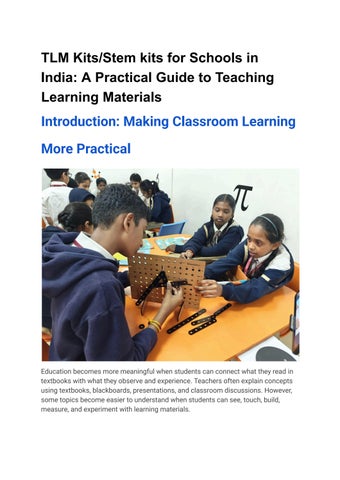
Education becomes more meaningful when students can connect what they read in textbooks with what they observe and experience. Teachers often explain concepts using textbooks, blackboards, presentations, and classroom discussions. However, some topics become easier to understand when students can see, touch, build, measure, and experiment with learning materials.
This is where TLM kits can support effective classroom teaching. TLM stands for Teaching Learning Material, which includes resources that help teachers explain concepts and encourage students to participate actively in the learning process. For schools looking to introduce practical education, TLM kits for schools can make lessons more interactive, particularly in Science, Mathematics, Environmental Studies (EVS), and STEM education. These resources can include models, manipulatives, activity materials, experiment components, worksheets, and guided learning activities. Practiko supports hands-on education through learning activities across Science, Mathematics, Robotics, and Engineering. Its learning solutions combine physical kits with activity instructions, digital resources, and teacher support to help schools introduce more practical learning experiences.
What are TLM Kits/stem kits? TLM kits are collections of teaching and learning resources designed to help educators explain academic concepts through demonstrations and activities. Instead of relying entirely on verbal explanations, teachers can use these materials to make abstract ideas easier to understand. For example, a teacher explaining fractions can use fraction models, while a Science teacher can demonstrate basic concepts through suitable experiment materials. Similarly, students can use geometric shapes to explore mathematical relationships or models to understand how different structures work. Teaching Learning Material Kits can be designed for specific subjects, grade levels, and classroom objectives. Some focus on foundational literacy and numeracy, while others support scientific exploration, problem-solving, and practical skills. Well-planned TLM educational kits should be easy to use, appropriate for students’ age groups, and connected to the learning outcomes teachers want to achieve. The objective is not to replace textbooks or teachers. Instead, these resources provide another way to explain concepts, encourage questions, and help students learn through experience.
Why Do Schools Need TLM Kits/stem kits? Modern classrooms need learning approaches that encourage participation rather than passive listening. Students may remember a definition after reading it, but practical activities can help them understand how the concept works.
Using TLM kits in India can help schools introduce classroom demonstrations, group activities, and hands-on exercises that complement their existing curriculum. Some important benefits include: 1. Better conceptual understanding Students can observe concepts in action instead of depending entirely on theoretical explanations. Visual models and practical demonstrations can make difficult topics more accessible. 2. Increased classroom participation Activities encourage students to ask questions, share observations, and discuss possible solutions. This can make lessons more engaging for different types of learners. 3. Development of problem-solving skills When students complete an activity, they may need to test an idea, identify a mistake, or try another approach. These experiences can develop reasoning and decision-making skills. 4. Opportunities for collaborative learning Teachers can organize students into small groups, allowing them to share materials, divide responsibilities, and discuss their findings. 5. Support for experiential education Schools can use practical learning resources to connect classroom concepts with real-life situations and encourage students to learn by doing.
Types of TLM Kits/stem kits Used in Schools Different subjects require different teaching resources. Schools should select materials according to their curriculum, students’ grade levels, and classroom requirements. 1. Mathematics TLM Kits/stem kits Math TLM kits can help teachers explain numbers, fractions, measurements, shapes, patterns, geometry, and other mathematical concepts.
For example, students can use counters to understand basic arithmetic, geometric models to explore shapes, and measuring tools to practice measurement. These activities can help make mathematics more visual and less intimidating. TLM kits for mathematics teaching are particularly useful when teachers want students to understand the reasoning behind a formula instead of memorizing it alone. 2. Science TLM Kits Science TLM kits can include experiment materials, models, measurement tools, and activity components that help students investigate scientific ideas. Teachers can organize activities related to light, sound, motion, matter, forces, and other age-appropriate topics. Students can observe results, record findings, and discuss what they learn. Suitable TLM kits for science teaching can help connect scientific theory with practical observation while encouraging curiosity and careful experimentation. 3. EVS TLM Kits Environmental Studies materials can help students explore nature, water, plants, waste management, resources, and their surroundings. Teachers may use visual models, sorting activities, maps, and classroom demonstrations to connect lessons with everyday experiences. Such resources can make environmental concepts easier to discuss and understand. 4. STEM and Robotics Learning Materials STEM learning combines Science, Technology, Engineering, and Mathematics. Depending on the design, STEM learning kits and robotics activity kits can introduce students to mechanics, simple circuits, structures, automation, and basic engineering challenges. These activities can encourage students to design, build, test, and improve their ideas. Schools should select age-appropriate materials and ensure that teachers have the instructions and training needed to conduct activities safely. How to Choose the Right TLM Kits/stem kits for Schools Before purchasing teaching materials, school leaders should consider how the resources will be used in actual classrooms.
Check curriculum relevance Choose materials that support the subjects and learning outcomes taught at the school. Resources should complement the curriculum rather than introduce activities without a clear educational purpose. Consider students’ age groups Materials suitable for primary students may differ from those required for middle or secondary school students. Consider complexity, safety, instructions, and the level of independent work expected. Look for clear activity instructions Teachers should be able to understand how to prepare, conduct, and explain each activity. Instruction booklets, worksheets, assessment questions, and demonstrations can make implementation easier. Review quality and reusability Schools should check component quality, durability, storage requirements, and whether materials can be reused across multiple classroom sessions. Consumable items and replacement requirements should also be considered. Evaluate teacher training and support Even useful materials may be underused if teachers do not know how to integrate them into lessons. Look for providers that offer onboarding, training, demonstrations, and assistance with classroom implementation. Compare cost and overall value When evaluating TLM kits suppliers in India, schools should compare the complete offering rather than price alone. Consider the number of activities, quality of materials, curriculum suitability, teacher support, and long-term usability. Practiko focuses on helping schools bring practical learning into everyday classroom teaching through structured learning activities and supporting resources. Its educational solutions cover Science, Mathematics, Robotics, and Engineering, with more than 600 hands-on learning activities described in its learning programme. These activities can support the broader goals of teaching learning materials by giving students opportunities to observe, experiment, build, test, and understand concepts.
Physical kits and activity instructions Practiko’s learning approach combines physical learning materials with activity booklets that provide examples, instructions, and assessment support. This structure can help teachers prepare activities and guide students through the learning process. Digital learning resources Video tutorials and digital content can help teachers understand how activities work before introducing them to students. These resources can also support lesson preparation and make demonstrations easier to follow. Teacher onboarding and implementation support Introducing practical learning requires planning, preparation, and teacher confidence. Practiko provides virtual teacher onboarding and implementation training to help educators become familiar with the learning resources. Its support also addresses questions related to products, applications, digital content, and implementation. Activities across multiple subjects Practiko’s programme includes activities across Science, Mathematics, Robotics, and Engineering. Its engineering and robotics learning areas include topics such as mechanics, mechatronics, hydraulics, renewable energy, and IoT/automation. This multidisciplinary approach can help schools create opportunities for students to apply concepts from different subjects through practical tasks. Schools considering Practiko should discuss their grade levels, curriculum, available classroom space, activity requirements, and teacher-training needs to determine which learning solutions are appropriate for their setting.
TLM Kits for Primary and Elementary Education Young learners often benefit from concrete examples when learning foundational concepts. Teaching materials can help them count, compare, classify, recognize patterns, identify shapes, and explore their surroundings. TLM kits for primary school students should be age-appropriate, easy to handle, and supported by simple instructions. Teachers can use short activities to introduce a topic, reinforce a lesson, or check whether students have understood a concept.
For elementary education, activities can gradually become more challenging as students develop their knowledge and confidence. Ready-to-use resources may also help teachers organize lessons more efficiently, provided that the activities match the intended learning outcomes.
How Teachers Can Use TLM Kits/stem kits in the Classroom The effectiveness of teaching materials depends on how they are integrated into lessons. Schools can follow a simple process. 1. Introduce the concept: Explain the learning objective and connect it with something students already know. 2. Demonstrate the materials: Show students how to use the components and explain any relevant safety instructions. 3. Organize an activity: Ask students to work individually or in groups, depending on the task. 4. Encourage observation: Invite students to record what happens, compare results, and discuss their findings. 5. Connect the activity to the lesson: Explain how the practical experience relates to the textbook concept. 6. Assess understanding: Use questions, worksheets, student explanations, or a short follow-up task to check learning. This approach allows TLM kits for teachers to become part of lesson planning instead of being used only for occasional demonstrations.
Where Can Schools Find TLM Kits/stem kits in India? Schools researching TLM kits in India should compare providers based on curriculum relevance, product quality, activity variety, instructions, teacher training, and after-sales support. Searches for TLM kits manufacturers in India, TLM kits suppliers in India, and TLM kits vendors in India may help schools identify potential providers. However, schools should verify each provider’s actual product range, suitability, delivery arrangements, and implementation services before making a decision. Those planning to buy TLM kits online should also review the kit contents, age recommendations, product photographs, return policies, and availability of replacement components. Schools purchasing in bulk should request a detailed quotation and clarify what is included in the price.
Practiko offers hands-on learning solutions across multiple subjects, supported by activity instructions, digital resources, and teacher onboarding. Schools interested in this approach can visit Practiko’s website to explore its educational offerings and discuss their
Conclusion Effective teaching is about helping students understand ideas, ask questions, and apply their knowledge. TLM kits/stem kits https://practiko.in/can support this process by giving teachers practical resources to complement textbook learning and encourage classroom participation. From mathematics manipulatives and science experiments to STEM and robotics activities, suitable teaching materials can create more opportunities for students to learn by doing. Schools should select resources according to curriculum requirements, student age groups, material quality, and the level of support available to teachers. Practiko’s hands-on learning approach offers schools a way to explore practical activities across Science, Mathematics, Robotics, and Engineering, supported by activity instructions and teacher training. With thoughtful planning and consistent classroom use, teaching learning materials can help create engaging learning experiences and make practical education a meaningful part of school life.