By Prachiti Kamath
THESIS submitted in partial fulfillment of the requirement for the Master of Science in Spatial Experience Design Art Center College of Design Pasadena, California April 2025
Advisor: Thea Petchler
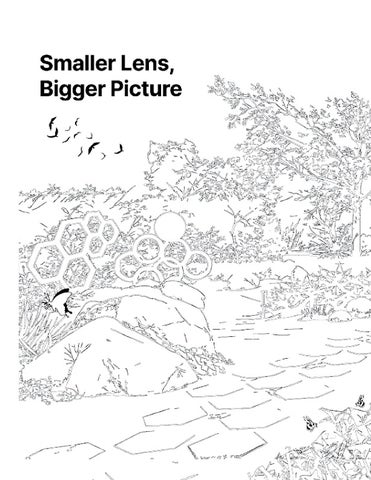
Our attention is naturally drawn to larger animals because they take up space in our environments and narratives, while smaller Reimagining Urban Ecology as Shared Habitats species often go unnoticed, not out of a lack of empathy, but because they exist beyond our immediate awareness. The real challenge lies in capturing our attention. How might we design to direct our attention to urban environments and ecological narratives that magnify the presence of pollinators, creatures essential to our ecosystems, and bring them into focus to foster deeper emotional connections with the often unseen?
s many cities, people are working to restore nature to urban life gh green construction, urban pocket parks, wildlife corridors, and ams that encourage urban ecology and greenspace creation. When it s to ecologically restorative spaces, many ecologists, designers, ects, and urban developers have recognized and incorporated new gies into their plans. Reflecting on historical practices and comparing to today's urbanized environments reveals how much of our ction to nature and biodiversity has been lost. As a result, efforts to grate nature into our surroundings often fall into the trap of mative sustainability. While these projects reflect a growing concern e environment, they frequently remain isolated efforts rather than al parts of a larger, interconnected ecological vision. In many cases, re reactive rather than systemic, failing to address the scope and cy of ecological imbalances. Despite the best intentions, our cities ue to expand in ways that fragment habitats, disrupt species ctions, and push wildlife to the edges. The following critics of these e-level implementations call in turn for a move towards ecological n practices that emphasize genuine participation. Urban initiatives d go beyond merely showcasing greenery or tracking sustainability s; they must actively invite people to engage with their environment s that cultivate deeper connections and foster a more profound standing of the natural world. ay's rapidly urbanizing world, achieving ecological balance is singly urgent. As cities expand, the impact on natural ecosystems e delicate balance of species interactions becomes more unced. Recognizing this challenge, this thesis explores innovative aches for designing built environments that not only accommodate n needs but also foster positive interactions with other species.
architectural design. The goal is to promote coexistence and mutual flourishing between humans and non-human species, recognizing that biodiversity is essential for a healthy and resilient environment. By understanding the complex dynamics of ecosystems and the interdependence of various organisms, this paper argues for the possibility of designing spaces that mitigate the negative impacts of human activity while nurturing a sense of appreciation for the natural world among future generations. The research defines "nature" as not just a collection of plants and animals, but a complex system of relationships and processes. However, many current projects that aim to highlight eco-friendly initiatives without fostering genuine connections between people and their ecosystem. While these initiatives might seem forward-thinking, they usually put aesthetics, branding, or legal compliance ahead of community involvement and long-term ecological integration. This superficial approach risks reducing sustainability to a visual or technological display rather than a lived experience that motivates behaviour change. One common example is the popularity of green roofs and living walls in urban areas. While these features can have ecological benefits, like enhanced air quality and reduced heat island effect, many are constructed purely for aesthetic reasons or to achieve LEED certification standards rather than as fundamental components of a larger ecological system. They are frequently poorly managed, lack biodiversity, or are inaccessible to the general public, restricting their ability to promote meaningful humannature connections. Similarly, many corporate sustainability programs, such as highly controlled urban gardens or tree-planting campaigns, are more about branding than restoring ecological equilibrium. These initiatives usually involve monoculture plantings of non-native species, which are chosen for their clean appearance rather than their ability to support indigenous fauna. For example, many city beautification programs plant rows of decorative trees that, while visually beautiful, provide little to no habitat for birds, pollinators, and other urban wildlife.
Projectslived like Singapore's Bishan-Ang Motheir Kio Park, which turnsguided concrete unities in greater harmony with surroundings, by into that naturalised that sustain local species, are prime examples of iors valuedriverbanks natural cycles and biodiversity. Today, however, urban ver restoration recreationalfrequently areas may coexist. In us a similar vein, cycles, h and modernand infrastructure separate from these ona's Superblocks project incorporates green corridors that support g our awareness and appreciation of the ecosystems we live in. While efforts ersity while giving priority to pedestrian-friendly areas. The Wild West End tegrate wildlife into urban environments are admirable, they frequently fall ve in London collaborates with developers to link disparate urban green of addressing the more fundamental, systemic challenges of environmental by constructing biological corridors, pollinator-friendly habitats, and green ness and management. ps. By preserving open grasslands that sustain native plants and animals, ent years, numerous individuals and organizations have proposed and s Tempelhofer Feld, a former airport that has been transformed into a public ted projects that address these challenges, tackling ecological and erves as an example of how extensive urban restoration may benefit both topics from diverse ideological and practical perspectives. These ervation and biodiversity.
ves reflect a growing recognition of the need to reinterpret urban spaces, ularlyrestoration parks and public areas, foster greater ecological awareness and gical has also beentoadopted by American cities such as San ctivity. However, continue to be railway, poorly designed, sco, Chicago, andmany Newparks York. worldwide Originally an abandoned New prioritizing aesthetics andconverted recreational over ecological ity's High Line has been intofacilities an elevated urban parkfunction. with requently feature manicured lawns, non-native plant species, and excessive plant species that draw birds and pollinators. The Presidio in San caping, theirconsiderable potential as biodiverse habitats andtodiminishing sco has limiting undergone ecological restoration re-establishtheir fostering meaningful human-nature Rethinking how parks are ecosystems, while Millennium Park ininteractions. Chicago combines native ned andwith integrated urban environments is crucial. aping efficientinto water management. These initiatives highlight how ous urban initiatives have been undertaken tant urbanecological areas are restoration for supporting ecological resilience and globally in an o alleviate habitatthese degradation, biodiversity lack of connection to ersity. Although initiatives have hadloss, a lotand of asuccess, many urban gical restoration programs have major obstacles that restrict their longeffects. The tendency to put recreational and aesthetic advantages of extensive ecological restoration is one common criticism- for ple, although the High Line provides a beautiful green area, selfning ecosystems are not completely supported by its highly curated ecture and restricted biodiversity. In a similar vein, the addition of ation in certain green infrastructure projects does not always pond with regional ecological requirements, creating green areas that t always ecologically useful. Furthermore, the problem of maintenance ng-term stewardship is frequently ignored. Despite receiving large nvestments, many ecological restoration initiatives lack long-term al models to ensure continued care. Without committed governmental rt or community involvement, these areas may deteriorate over time ease to serve the intended ecological purpose. In addition to restoring stems, a good ecological restoration project should foster a longg emotional and cultural bond between humans and the natural world.
Berlin. Projectslived like Singapore's Bishan-Ang Motheir Kio Park, which turnsguided concrete communities in greater harmony with surroundings, by canals into that naturalised that sustain local species, are prime examples of behaviors valuedriverbanks natural cycles and biodiversity. Today, however, urban how riverand restoration recreationalfrequently areas may coexist. In us a similar vein, cycles, growth modernand infrastructure separate from these Barcelona's Superblocks project incorporates green corridors that support limiting our awareness and appreciation of the ecosystems we live in. While efforts biodiversity while giving priority to pedestrian-friendly areas. The Wild West End to reintegrate wildlife into urban environments are admirable, they frequently fall initiative in London collaborates with developers to link disparate urban green short of addressing the more fundamental, systemic challenges of environmental spaces by constructing biological corridors, pollinator-friendly habitats, and green awareness and management. rooftops. By preserving open grasslands that sustain native plants and animals, In recent years, numerous individuals and organizations have proposed and Berlin's Tempelhofer Feld, a former airport that has been transformed into a public executed projects that address these challenges, tackling ecological and park, serves as an example of how extensive urban restoration may benefit both conservation topics from diverse ideological and practical perspectives. These people and biodiversity.
initiatives reflect a growing recognition of the need to reinterpret urban spaces, particularlyrestoration parks and public areas, foster greater ecological awareness and Ecological has also beentoadopted by American cities such as San connectivity. However, continue to be railway, poorly designed, Francisco, Chicago, andmany Newparks York. worldwide Originally an abandoned New oftenCity's prioritizing aesthetics andconverted recreational over ecological York High Line has been intofacilities an elevated urban parkfunction. with They frequently feature manicured lawns, non-native plant species, and excessive native plant species that draw birds and pollinators. The Presidio in San hardscaping, theirconsiderable potential as biodiverse habitats andtodiminishing Francisco has limiting undergone ecological restoration re-establishtheir role in ecosystems, fostering meaningful human-nature Rethinking how parks are native while Millennium Park ininteractions. Chicago combines native designed andwith integrated urban environments is crucial. landscaping efficientinto water management. These initiatives highlight how Numerous initiatives have been undertaken important urban urbanecological areas are restoration for supporting ecological resilience and globally in an effort to alleviate habitatthese degradation, biodiversity lack of connection to biodiversity. Although initiatives have hadloss, a lotand of asuccess, many urban nature. ecological restoration programs have major obstacles that restrict their longterm effects. The tendency to put recreational and aesthetic advantages ahead of extensive ecological restoration is one common criticism- for example, although the High Line provides a beautiful green area, selfsustaining ecosystems are not completely supported by its highly curated architecture and restricted biodiversity. In a similar vein, the addition of vegetation in certain green infrastructure projects does not always correspond with regional ecological requirements, creating green areas that are not always ecologically useful. Furthermore, the problem of maintenance and long-term stewardship is frequently ignored. Despite receiving large initial investments, many ecological restoration initiatives lack long-term financial models to ensure continued care. Without committed governmental support or community involvement, these areas may deteriorate over time and cease to serve the intended ecological purpose. In addition to restoring ecosystems, a good ecological restoration project should foster a longlasting emotional and cultural bond between humans and the natural world.
hing to be admired from afar but also something to be understood, cted with, and integrated into human life. Urban surroundings have a ntial impact on mental well-being and community participation.
social connection. Well-designed public spaces promote social connections and a feeling of community, allowing people to meet and interact. Organizations and studios dedicated to fostering ecological restoration and environmental education are adopting diverse approaches, including social design, community-building, and research-driven practices. In the United States, and particularly in the Los Angeles region, foundations such as the Theodore Payne Foundation and the Xerces Society exemplify these efforts by focusing on native plant species and promoting environmental education. The Theodore Payne Foundation advocates for native plant landscapes, offering resources and workshops to help communities incorporate regionally appropriate flora. The Xerces Society plays a key role in pollinator conservation, protecting essential insect populations through habitat restoration and policy advocacy. Through workshops, demonstrations, and accessible resources, these organizations empower individuals to understand and engage with their local ecosystems. In all these efforts, it is critical to evaluate how individuals might turn their newly discovered awareness into meaningful activities that benefit both themselves and the environment.
Organizations may need to provide a strong narrative to impact people in extending their commitment to ecological stewardship beyond the place or programs that are ongoing. Ron Finley’s initiatives are a powerful example of ecological stewardship that resonates deeply within the Los Angeles community. His guerrilla gardening efforts not only address the immediate need for fresh food but also foster a sense of responsibility and connection among residents. By transforming neglected spaces into productive gardens, Finley encourages people to engage with their environment, promoting biodiversity and enhancing local ecosystems. In Los Angeles, several studios and initiatives have concentrated on ecological restoration projects around the LA River, public parks, and other urban landscapes. These efforts include promoting native species, establishing wildlife corridors, and creating sustainable interactions between urban infrastructure and natural habitats. For instance, some projects aim to transform freeways and public buildings into spaces that support biodiversity. Others integrate ecological education into museum exhibits, libraries, and public gardens, thereby broadening access to environmental knowledge. These diverse initiatives underscore the importance of ecological education in reshaping urban environments and public perceptions of nature. MacArthur Park, a vital green space in the heart of Los Angeles, serves as a powerful example of the city's chronic disinvestment in its public spaces. Despite its critical importance to residents, particularly those in densely populated neighborhoods with limited access to parks, it continues to face neglect.
nderserved and in need of long-term investment. Addressing this mic issue requires a shift in priorities, focusing on equitable development ustainable, accessible green infrastructure for all communities. Ultimately, nstrating how innovative strategies and educational programs can bridge p between urban development and ecological restoration, enabling e to reconnect with the natural world in meaningful and lasting ways. gical education is essential for cultivating a society that understands and y engages in environmental stewardship. By providing knowledge about rvation, biodiversity, and sustainable practices, it empowers individuals ke informed decisions about their surroundings, fostering a deeper sense ponsibility toward the environment. Beyond traditional classrooms, tional programs in public spaces can serve as a vital platform for handsrning and community involvement. These spaces offer opportunities for duals to directly engage with the natural world, whether through pating in local habitat restoration projects, learning about native plant s, or becoming involved in community science initiatives. Such ences play a key role in breaking down the barriers that often separate dwellers from the environment. In cities like Los Angeles, where the fasturban lifestyle can overshadow natural spaces, these programs help e the gap between city life and the ecosystems that sustain it. When e have direct access to nature within their communities, they develop a nal connection to it, fostering a deeper understanding of its importance greater desire to protect it. Moreover, ecological education in public s can also serve as a tool for social equity. When parks, community ns, or even tiny pockets of green in the city become places to learn the environment, they allow anyone, regardless of age, income, or round to engage with nature in a way that is approachable and ngful. In locations where access to traditional environmental education is ted, these shared spaces provide a valuable opportunity to learn outside classroom, directly in the heart of the community. They become more ust places to explore or relax; they are places where people reflect, ask ons, and share stories and knowledge. In this way, public spaces can a stronger sense of belonging and empathy, reminding us that knowing aring for our environment should be a shared responsibility.
conservation but also reimagines our relationship with the natural world. While many initiatives focus on ecological education and environmental protection, my investigation distinguishes itself by having a transformative impact on public awareness and empathy for oftenoverlooked species. This project, which focuses on viewing the world through the eyes of smaller species, has the potential to spark significant emotional and intellectual connections. It emphasizes the importance of these creatures in preserving ecological equilibrium, as well as their direct significance to human life. This approach promotes a better understanding of biodiversity by emphasizing the connectivity of all species and the complicated web of relationships that keep ecosystems alive. Participating in immersive and introspective experiences might build a lasting appreciation for small contributions to our ecosystems, which are often overlooked but important. The project's impact stems from its ability to evoke awareness, transform mindsets, and promote active stewardship, ensuring that biodiversity protection becomes a shared obligation founded on genuine care and understanding. This thesis investigates innovative design approaches to foster deeper connections between humans and the natural world, focusing on creating built environments that promote ecological balance and coexistence, particularly with other species. Against the backdrop of urbanization and growing environmental concerns, it seeks to bridge the increasing disconnect between humans and nature through evidencebased, innovative design interventions. Additionally, this thesis emphasizes the importance of cultivating emotional connections between humans and nature, rooted in the belief that fostering awareness and empathy is essential for inspiring behavioral changes that support environmental well-being. This approach is built around a critique of anthropocentrism, which prioritizes human needs at the expense of ecosystems, and instead promotes a balanced perspective that recognizes humanity’s interconnectedness with other species and ecosystems. While advocating coexistence with all species, the thesis places particular focus on pollinators, underscoring their critical roles in ecological balance and human survival.
stems. Shermer’s analysis advocates for shifting perspectives to nize the interdependence of all species. Evidence from ancient cave art, s the Lascaux paintings, illustrates humanity’s historical appreciation for uman life, inspiring the thesis’s call for a renewed focus on coexistence. nizing that most of the global population now resides in urban areas, esis focuses on designing interventions within cities, seeing them as platforms for fostering ecological awareness and encouraging nable behaviours. With a particular emphasis on younger graphics, the research highlights the need to instill environmental nsibility early in life. A deep understanding of these dynamics is crucial ping spaces that support ecological balance while ensuring ethical nsibility toward future generations. The concept of ‘intergenerational e tyranny’, the idea that present actions can unfairly limit the choices, ces, and well-being of future generations, serves as a guiding principle cknowledging that overexploiting resources today risks leaving a shed world for those who come after. Given the long-term, irreversible s of unsustainable urban growth, reliance on fossil fuels, and biodiversity his is particularly critical in light of the climate catastrophe. Urban areas bute significantly to resource consumption and greenhouse gas ons; if present generations do not take responsible action, we run the leaving behind a planet defined by ecological collapse, instability, and y. Therefore, considering future generations when designing is not only y required, but also necessary to maintain the long-term justice and of the planet. This study prioritises immersive and age-appropriate ences to inspire the next generation of ecological stewards, nising that instilling environmental responsibility early in life is critical for oping more conscious, empowered citizens capable of carrying on nable practices and values. The importance of restoring urban green s to enhance biodiversity and human-nature connections forms a critical ation for this thesis. Research by Klaus and Kiehl highlights the role of onnected green networks, from small green roofs to larger habitats, in rting wildlife movement and fostering resilience to environmental es.
authentic ecological engagement. Many urban landscapes a carefully designed to cater specifically to human-centric ideals and appeal at the expense of ecological functions. Despite their apparent greenness, they often feature rigid zoning that separates recreational areas from wilder, biodiverse zones, limiting natural interactions. These environments, while offering controlled access to nature, fail to support authentic ecological processes and instead create a disconnection between urban inhabitants and the natural world. To bridge this gap, the thesis incorporates edutainment as a tool to engage younger audiences, leveraging principles of child psychology to design immersive, curiosity-driven learning experiences. By integrating gamified elements, it simplifies complex environmental topics and enhances engagement, inspired by museums and spatial design projects that promote active participation. The thesis also uses contrasting utopian and dystopian visions of the future to raise awareness about the consequences of ecological neglect versus the benefits of ecological harmony. These scenarios aim to instill urgency and responsibility in participants. This evolving exploration of ecological balance and coexistence synthesizes diverse ideas into a cohesive vision. By combining innovative strategies with immersive experiences, the thesis has the potential to inspire meaningful and lasting ecological awareness, encouraging individuals to protect and coexist with the ecosystems that sustain life on Earth. The project particularly emphasizes engaging younger audiences, recognizing the importance of instilling environmental responsibility early in life. Keith’s research demonstrates that access to urban green spaces fosters connections to nature, especially for children, promoting pro-environmental behaviors and empathy for ecosystems. The thesis leverages edutainment to engage young learners, drawing on Karime et al.’s findings that immersive, curiosity-driven experiences stimulate cognitive and emotional development. By integrating principles of child psychology, the project designs environments that inspire wonder and critical thinking.
ques, engaging learning experiences, and compelling narratives, the t envisions built environments that inspire a sense of wonder, foster hy for other species, and ultimately lead to a more sustainable and gically balanced future.
esis emphasizes on the restoration of urban green spaces as a means to ablish human-nature connections and enhance biodiversity, critiquing controlled environments that prioritize aesthetics over genuine gical engagement, as emphasized by Gottwald and Turner. This project nges such conventional urban design approaches, advocating instead aces that balance human use with ecological integrity, allowing nature to alongside human activity. The thesis promotes a paradigm shift toward nizing the interdependence of all species, reinforcing the idea that cities d function as shared environments where humans, plants, and animals t. Berger’s discussion of shared spaces highlights how communal ences within urban environments can cultivate a sense of connection utual responsibility. By designing spaces that invite human-nature ctions, such as pollinator-friendly gardens, biodiverse urban corridors, ild pockets within cities, this project aims to dissolve the artificial daries that separate people from their surrounding ecosystems. A key
y in fostering this perspective shift is the use of "inverted reality" techniques, challenge human-centric viewpoints by allowing participants to experience the rom the perspective of smaller species, particularly pollinators. Inverted reality our typical interactions with the environment by distorting scale and ctive, promoting exploration and emotional engagement. This strategy has nvestigated using augmented and virtual reality, as well as analogue design ntions such as large sculptures, interactive installations, and participatory roleg environments. These inversions transform the narrative from dominance to ence, from observer to inhabitant, fostering a sense of shared agency with creatures. Gamification further enhances these educational experiences by g complex environmental topics accessible and engaging. Insights from Mantis search highlight how game design elements, such as challenges and point s, encourage active participation and sustained engagement.
proven successful in children's museums and spatial storytelling, and serve as a model for the thesis's goal of making ecological understanding both accessible and emotionally resonant. Environmental education, particularly through the edutainment approach, plays a key role in engaging younger audiences, stimulating both cognitive and emotional development to foster a lifelong respect for the environment (Gottwald & Turner). Complementing this, gamification uses game design elements to make environmental topics more engaging and accessible, inspiring active participation and sustained ecological awareness, as highlighted by Berger's work on immersive, interactive spaces. The power of narrative is also integral to the thesis, utilizing contrasting utopian and dystopian scenarios to highlight the consequences of ecological neglect versus the benefits of sustainable practices. Themed experience design enriches this narrative by combining storytelling, spatial design, and interactivity, crafting immersive environments that deepen emotional connections and inspire a stronger commitment to sustainability. The exploration of empathy, environmental design, and the interaction through different spectrums of gamified and roleplaying experiences addresses some of the most pressing challenges they will face, such as environmental sustainability, social justice, and mental well-being, which is important for the future inhabitants of the city. The younger generation is inheriting a planet dealing with the consequences of climate change. This project's focus on spatial design and empathy toward the environment will ideally help cultivate a sense of responsibility and care, encouraging them to think about how their environments affect both themselves and the ecosystems they depend on. The emphasis on spatial justice and equity is vital in creating environments that are inclusive and fair. As younger people become more vocal about issues like racism, inequality, and accessibility, the designs and spaces they create and inhabit will need to reflect these values. Empathydriven design can influence how spaces shape our emotional and mental states. Children or youth, often dealing with heightened stress, mental health challenges, and a sense of disconnection, can benefit from environments that prioritize well-being and positive engagement. The balance between different out-of-the-box experiences might offer a way to engage with complex societal issues in an approachable and interactive manner. This can empower young people to think critically, creatively, and constructively about potential solutions for the future, allowing them to navigate the complexities of an interconnected world. By developing a deep understanding of how empathy and design intersect, they can be better equipped to shape a world that is more mindful of both human and environmental needs, ensuring a positive legacy for future generations.
edge is not only theoretical but ctionable, leading to lasting nmental responsibility and action. ourages communities to see elves as active participants in gical restoration, fostering a tive effort toward building more nable, resilient urban nments. This connection is ial for creating a future where duals are not only aware of the nmental challenges facing the but are also equipped with the and motivation to address them.
When all the above are considered collectively, it offers a rich and nuanced perspective, drawing from a diverse range of publications across multiple time periods. This expansive approach has enabled me to critically examine the evolution of ideologies, while also exploring how contemporary research builds upon foundational studies, adapting to current societal contexts and shifting mindsets. This thesis, with its distinct focus, embarks on a niche exploration that spans a broader spectrum of topics, from implication to conservation. This methodology has significantly enhanced my understanding of how sociology, psychology, and ecology intersect, unveiling the complex relationships between various subfields of study. This work is based on an interdisciplinary and historically informed paradigm that sees empathy as a key tool for promoting awareness while also holding everyone responsible. By connecting past and present narratives and interpreting them through an emotional and ethical perspective, this research positions design as an effective tool for creating more conscious interactions between people and the non-human environment. Had I confined my research to only the niche aspects of this thesis, I would not have been able to push my inquiry forward in a truly dynamic way. It is this comprehensive approach that has allowed me to create a unique and evolving research path, one that holds the potential to open up new possibilities and contribute a fresh perspective to the field.
gin the transformation of human-nature connections, a shift in oint is required, one that recognises our interconnection with the nonn world. This study emphasises the need to design with empathy, care, cological awareness, setting the framework for a future in which cities te not only as human dwellings but also as vibrant, living ecosystems. otential of this research is creating a future where cities operate as t ecosystems, which has been highlighted in this case study. Designers a vital role to play in incorporating nature into urban areas, promoting ersity, resilience, and fostering a deeper bond between people and iving species. The findings of the study provide important lessons that ners should follow to ensure sustainability, inclusivity, and ecological ce in urban and spatial planning. tely, this research advocates for a paradigm shift in urban design, one anscends aesthetics to embrace ecological restoration, emotional ction, and systemic sustainability. Designers can craft cities that are st livable but regenerative, ensuring a thriving future for all species. urban planning must go beyond sustainability toward regenerative n, where built environments heal ecosystems, restore biodiversity, and e coexistence. By adopting these strategies, designers can redefine not as sites of extraction and depletion, but as spaces of renewal, nce, and collective flourishing. The future of urban and spatial design d ensure that every built space contributes to ecological balance rather isruption. from just designers and urban planners, this research also highlights critical roles of diverse stakeholders- government bodies, ecologists, rofit organizations, local communities, community scientists and tional institutions. Each group is essential in transforming urban s into ecologically integrated environments. While designers and ers develop the frameworks for these spaces, government bodies and are key in implementing policies and securing resources, local unities are central to the stewardship of green spaces, and ecologists ommunity scientists provide the scientific expertise needed for ssful restoration efforts, and educational institutions help foster nmental literacy and engage the public in these efforts.
the positive effects of greener, healthier environments. By rethinking how we design urban spaces, we have the potential to enhance mental well-being, foster environmental stewardship, and create equitable, sustainable communities. Collaboration between these stakeholders is necessary to realise this vision. Urban designers can collaborate with legislators to implement laws that promote green infrastructure, and educators can incorporate environmental literacy into their curricula to encourage the next generation to appreciate and protect urban ecosystems. Environmentalists and community organizations can facilitate grassroots efforts, ensuring that ecological interventions address local needs and biodiversity challenges. This research provides a blueprint for transforming cities into ecosystems that support both human and non-human life, offering solutions that can be scaled and adapted globally. Ultimately, by embedding ecological principles into urban planning, we can create healthier, more resilient cities that serve the needs of both current and future generations.
Rumaan. “Rachel Cusk’s Inverted World.” The New Republic, 14 Aug. 2024, ublic.com/article/184261/rachel-cusk-parade-review-inverted-world. an Society of Landscape Architects. “Bishan-Ang Mo Kio Park | 2016 ASLA Professional .” Asla.org, 2016, www.asla.org/2016awards/169669.html. , Joris. “5 Secret Ingredients for Audience Engagement in Museums.” The Octalysis 19 June 2023, sgroup.com/2020/04/5-secret-ingredients-for-audience-engagement-in-museu ms/. Ross. Storytelling for New Technologies and Platforms. CRC Press, 22 June 2022.
Katrina. “Utopia and Dystopia the Potential of Human Nature.” Bsudlr, 4 Apr.
blogs.bsu.edu/dlr/2019/04/04/utopias-and-dystopias-the-potential-of-human-n ature/. Katrina. “Utopia and Dystopia the Potential of Human Nature.” Bsudlr, 4 Apr. 2019, blogs.bsu.edu/dlr/2019/04/04/utopias-and-dystopias-the-potential-of-human-n ature/. zati, Michele. “Barcelona’s Superblocks: Putting People at the Centre | angers.org.” CityChangers.org – Home Base for Urban Shapers, 28 Mar. 2023, ngers.org/barcelona-superblocks/. o, Silvia, et al. “The role played by age on children’s pro-ecological behaviors:
oratory analysis.” Journal of Environmental Psychology, vol. 44, Dec. 2015, pp. 85–94,
doi.org/10.1016/j.jenvp.2015.09.006.
cofidio + Renfro. “The High Line.” DS+R, 2019, dsrny.com/project/the-high-line. ia as an Inverted Hero’s Journey.” Science Meets Fiction, 23 July 2019,
meetsfiction.com/nonfiction-essays/dystopia-as-an-inverted-heros-journey/
eich, Barbara. “‘Humans Were Not Centre Stage’: How Ancient Cave Art Puts Us in Our The Guardian, Guardian News and Media, 12 Dec. 2019, www.theguardian.com/ design/2019/dec/12/humans-were-not-centre-stage-anci ent-cave-art-painting-lascauxt-altamira. Frei, Hans, and Marc Bohlen. MicroPublicPlaces. 2009. s of Roberto Burle Marx - Garden Design.” GardenDesign.com, 2018, ardendesign.com/brazil/burle-marx-rio.html. an. Life between Buildings: Using Public Space. Island Press, 2011, https:// entral-proquest-com.artcenter.idm.oclc.org/lib/artcenter/detail.action?d 317590. Phaenomenologie Des Geistes. Middlesex, England, The Echo Library, 2006.
r, Paul H. “Urban Park restoration and the ‘museumification’ of nature.” Nature and , vol. 2, no. 2, 15 Sept. 2007, pp. 95–114, https://doi.org/10.3167/nc2007.020201. r, Paul H. “Urban Park restoration and the ‘museumification’ of nature.” Nature and , vol. 2, no. 2, 15 Sept. 2007, pp. 95–114, https://doi.org/10.3167/nc2007.020201.
Constructed Environment, vol. 10, no. 2, 2019, pp. 41–60, https://doi.org/ 10.18848/2154-8587/cgp/v10i02/41-60. Hall, Edward T. The Hidden Dimension. Anchor Books. Doubleday, 1969, Academia.edu, https://www.academia.edu/43785083/The_Hidden_Dimension_Edward_Hall. Howe, Alex. “Dystopia as an Inverted Hero’s Journey.” Science Meets Fiction, 23 July 2019, sciencemeetsfiction.com/nonfiction-essays/dystopia-as-an-inverted-heros-journey/. Huang, Xiaoting, et al. “Incorporating Personal Experience in Free-Choice Environmental Learning: Lessons from a Zoological Theme Park.” Environmental Education Research, vol. 25, no. 8, 5 Mar. 2019, pp. 1250–1266, https://doi.org/ 10.1080/13504622.2019.1569203. Accessed 6 Dec. 2020. In Our Dystopian Future, Farmers Will Use These Artificial Pollination Machines to Replace Bees.” Fastcompany, 19 Feb. 2020, www.fastcompany.com/90463417/in-our-dystopian-future-farmers-will-use-these-artifici alpollination-machines-to-replace-bees. Inverted Humans: A Thought-Provoking Perspective.” Wondergressive, 3 Sept. 2024, wondergressive.com/2023/08/23/inverted-humans-a-thought-provoking-perspective/. Inverted Humans: A Thought-Provoking Perspective.” Wondergressive, 3 Sept. 2024, wondergressive.com/2023/08/23/inverted-humans-a-thought-provoking-perspective/. Jacobs, Jane. The Death and Life of Great American Cities: Orig. Publ. 1961. Vintage Books, 1992. Jorgensen, Anna, and Paul H. Gobster. “Shades of green: Measuring the ecology of urban green space in the context of human health and well-being.” Nature and Culture, vol. 5, no. 3, 1 Dec. 2010, pp. 338–363, https://doi.org/10.3167/nc.2010.050307. Karime, Ali, et al. A Multimedia-Driven Ambient Edutainment System for the Young Children. 31 Oct. 2008, https://doi.org/10.1145/1462014.1462026. Accessed 1 June 2023. Keith, Ryan J., et al. “Urban Children’s connections to nature and environmental behaviors differ with age and gender.” PLOS ONE, vol. 16, no. 7, 29 July 2021, https://doi.org/10.1371/journal.pone. 0255421. Keith, Ryan J., et al. “Urban Children’s connections to nature and environmental behaviors differ with age and gender.” PLOS ONE, vol. 16, no. 7, 29 July 2021, https://doi.org/10.1371/ journal.pone.0255421.
e Education.” NACTA Journal, 1 Jan. 2010, pp. 43–50. Accessed 7 Nov. 2024. Valentin H., and Kathrin Kiehl. “A conceptual framework for urban ecological restoration abilitation.” Basic and Applied Ecology, vol. 52, May 2021, pp. https://doi.org/10.1016/j.baae.2021.02.010.
Valentin H., and Kathrin Kiehl. “A conceptual framework for urban ecological restoration abilitation.” Basic and Applied Ecology, vol. 52, May 2021, pp. https://doi.org/10.1016/j.baae.2021.02.010.
eresa, and Peter Lang Publishing. Animal Edutainment in a Neoliberal Era : Pedagogy, and Practice in the Contemporary Aquarium. New York, Peter Lang
ing, 2021
Planet Editors. “The Lonely Planet Guide to Chicago’s Millennium Park.” Lonely Planet, 14 25, www.lonelyplanet.com/articles/guide-millennium-park. Marco, Christopher. “Are locks the Future of Urban Living?” CNU, 5 Mar. 2024, www.cnu.org/publicsquare/ 3/05/are-superblocks-future-urban-living. nne Andrei. Nature’s Mirror. University of Chicago Press, 20 Nov. 2020. ough, William. “Ecology , Ethics & Making of Things.” A Boat for Thoreau, 14 July 2022, ough.com/writings/a-boat-for-thoreau/. ge, Jessica. “Experiencing dystopia through umwelt: Modelling the nonhuman animal in kingdom.” English Studies, vol. 103, no. 3, 29 Mar. 2022, pp. 6, https://doi.org/10.1080/0013838x.2022.2043003.
ley on the Great Discontent (TGD).” The Great Discontent (TGD), 11 Oct. 2016, atdiscontent.com/interview/ron-finley/. y, Walt. “Inverted World: Karl Marx on Estrangement of Nature and Society.” Capitalism Socialism, vol. 8, no. 4, Dec. 1997, pp. 31–47, https://doi.org/ 0/10455759709358760. Accessed 16 Nov. 2020. er, Michael. “Why Humans Prefer to Be the Center of the Universe.” Scientific American, ic American, 20 Feb. 2024, ientificamerican.com/article/why-humans-prefer-to-be-the-center-of-the-univers e r, Jon. “Coming Home: The evolutionary roots of Utopia.” Utopian Studies, vol.
2, 1 Jan. 2009, pp. 299–320, https://doi.org/10.5325/utopianstudies.20.2.0299.
r, Jon. “Coming Home: The Evolutionary Roots of Utopia.” Utopian Studies, vol.
2, 1 Jan. 2009, pp. 299–320, https://doi.org/10.5325/utopianstudies.20.2.0299. Alissa. “The Best Time to Plant a Tree.” Torched, 20 Apr. 2024, www.torched.la/the-best-
-plant-a-tree/. Accessed 19 Feb. 2025. Alissa. “Urban Oasis.” Torched, 30 Aug. 2024, www.torched.la/urban-oasis/.
ed 19 Feb. 2025.
brands-interact-w ith-their-audiences-dc5d625924f4. XR, Mantis. “Gamification in Spatial Commerce.” Medium, Medium, 22 Sept. 2023, medium.com/@mantisxr/spatial-commerce-is-revolutionizing-the-waybrands-interact-w ith-their-audiences-dc5d625924f4. “Presidio Tunnel Tops.” Swinerton, 29 May 2024, swinerton.com/project/presidiotunnel-tops/. Accessed 29 Mar. 2025. “Tempelhofer Feld: A “Unique Pearl in the Heart of Berlin” - Urban Design Forum.” Urban Design Forum, 9 Oct. 2024, urbandesignforum.org/tempelhoferfeld-a-unique-pearl-in-the-heart-of-berlin/. “Wild West End.” Arup.com, 2024, www.arup.com/projects/wild-west-end/. “Wild West End.” Green Cities, uk.thegreencities.eu/best_practices/wild-westend/.
Thesis 2025 aduate Spatial Experience Design