Incorporating NQ magazine
October 2026
WHO WILL MAKE IT ONTO THE LIST?
www.pqmagazine.com/www.pqjobs.co.uk
TIME TO JOIN THE AI-LED JOB HUNT?
EMPOWERING, EXCITING AND EPIC
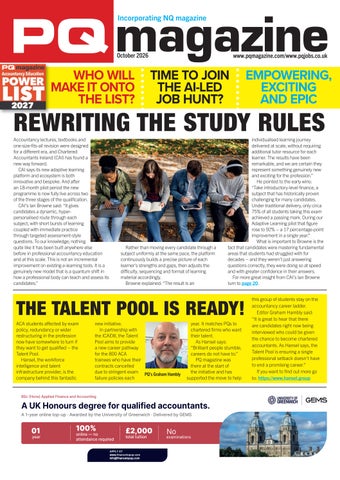
REWRITING THE STUDY RULES REW Accountancy lectures, textbooks and one-size-fits-all revision were designed for a different era, and Chartered Accountants Ireland (CAI) has found a new way forward. CAI says its new adaptive learning platform and ecosystem is both innovative and bespoke. And after an 18-month pilot period the new programme is now fully live across two of the three stages of the qualification. CAI’s Ian Browne said: “It gives candidates a dynamic, hyperpersonalised route through each subject, with short bursts of learning coupled with immediate practice through targeted assessment-style questions. To our knowledge, nothing quite like it has been built anywhere else before in professional accountancy education and at this scale. This is not an incremental improvement on existing e-learning tools. It is a genuinely new model that is a quantum shift in how a professional body can teach and assess its candidates.”
Rather than moving every candidate through a subject uniformly at the same pace, the platform continuously builds a precise picture of each learner’s strengths and gaps, then adjusts the difficulty, sequencing and format of learning material accordingly. Browne explained: “The result is an
individualised learning journey delivered at scale, without requiring additional tutor resource for each learner. The results have been remarkable, and we are certain they represent something genuinely new and exciting for the profession.” He pointed to the early wins: “Take introductory-level finance, a subject that has historically proven challenging for many candidates. Under traditional delivery, only circa 75% of all students taking this exam achieved a passing mark. During our Adaptive Learning pilot that figure rose to 92% – a 17 percentage-point improvement in a single year.” What is important to Browne is the fact that candidates were mastering fundamental areas that students had struggled with for decades – and they weren't just answering questions correctly, they were doing so at speed and with greater confidence in their answers. For more great insight from CAI’s Ian Browne turn to page 20.
THE TALENT POOL IS READY! ACA students affected by exam policy, redundancy or wider restructuring in the profession now have somewhere to turn if they want to get qualified – the Talent Pool. Hansel, the workforce intelligence and talent infrastructure provider, is the company behind this fantastic
new initiative. In partnership with the ICAEW, the Talent Pool aims to provide a new career pathway for the 800 ACA trainees who have their contracts cancelled due to stringent exam PQ’s Graham Hambly failure policies each
year. It matches PQs to chartered firms who want their talent. As Hansel says: “Brilliant people stumble, careers do not have to.” PQ magazine was there at the start of the initiative and has supported the move to help
BSc (Hons) Applied Finance and Accounting
A UK Honours degree for qualified accountants. A 1-year online top-up · Awarded by the University of Greenwich · Delivered by GEMS
01
year
100%
online — no attendance required
£2,000 total tuition
APPLY AT www.financetopup.com info@financetopup.com
No
examinations
this group of students stay on the accountancy career ladder. Editor Graham Hambly said: “It is great to hear that there are candidates right now being interviewed who could be given the chance to become chartered accountants. As Hansel says, the Talent Pool is ensuring a single professional setback doesn’t have to end a promising career.” If you want to find out more go to: https://www.hansel.group
Earn. Learn. Qualify. Progress.
Become an Accounting Finance Manager Apprentice with the University of Exeter Study with a leading Russell Group university whilst gaining valuable workplace experience.
A DECADE OF APPRENTICESHIPS 2016 - 2026
https://ex.ac.uk/eaP
Scan the QR code to find out more. ACADEMIC PROFESSIONAL PARTNERSHIP PROGRAMME
One programme. Three achievements:
BSc (Hons) Applied Accounting AAT Level 4 Diploma in
Professional Accounting ACCA and CIMA exam exemptions (subject to criteria) Designed to accelerate your progression towards Chartered Accountant status whilst developing the skills employers need. 3 years | Online delivery | September start If you already hold a Level 4 qualification, you may be eligible to fast-track into Year 2.
2026EI047
Degree Partnerships
contents PQ
October 2026
IN THIS ISSUE A note from the Editor Our cover story this month is all about how Chartered Accountants Ireland has created a groundbreaking personalised route through its qualification. The early results are impressive, and you can read more from CAI’s director of education Ian Browne on page 20. Let’s hope all the other bodies are watching this success story and are quick to follow! Also in the news, we have feedback from the ACCA September exam sitting, the latest ACA exam results, and the strange case of one Big 4 firm rewarding ‘human skills’ with hard cash. This month also sees the launch of the PQ magazine Accountancy Education Power List, and we need your help identifying the people who should be on our inaugural list. While we want to showcase the qualification designers and leading academics, we also want nominations for the training mangers and even PQs who are changing the rule book to help you get qualified. Check it out on page 5. Finally, we pick up on the fallout over a Xero influencer ad. I will let you make your own minds up whether it was all a storm in a teacup or a harbinger of doom. The jury seems out at the moment. Check out the story on page 14 and page 40. Graham Hambly, Editor and Publisher, PQ magazine News 4
5
6
8
ACCA exam feedback Reaction to the September exams is in, and it appears there were no big shocks this time PQ power list We launch the PQ magazine Accountancy Education Power List this month Finance worker jailed Cancer charity employee who stole £92,000 is sent to prison for 30 months
9
KPMG Australia cuts Big 4 firm set to reduce workforce by 5% across consultancy and business services ADIT qualification June exams saw 569 students pass at least one exam of the main ADIT qualification
10 ICAEW results We run the rule over the July Advanced Level exam results
35 Back to basics While a balanced trial balance is good news, it is not proof that the accounts are correct, says Sarah Wilson
20 Adaptive learning CAI’s Ian Browne explains how adaptive learning rewrote the rules of accountancy study
36 CIMA spotlight There are plenty of ways to study, so find the methods that work best for you
22 CCAB case study The ethical use of AI-generated strategy and planning for accountants in business 23 CIMA interview PQ spoke to Alfred Ramosedi about his path to becoming the new CIMA President, and how he sees the changing world of accountancy 24 AAT Level 3 Understanding the appropriation account 26 ACCA exam feedback How were the ACCA September exams? We run through them, paper by paper 27 CASSL spotlight Why governance is the part of ESG where PQs can make a real difference 28 Viewpoint Joanna Perry explains how you can find out whether you’re ‘replaceable’ or ‘capable’
12 Tech news Accountancy firms urged to sign up to a free police-led security tool
29 Audit If you want to pass your audit exam then scrutinise the expert, not the numbers
Features, etc
30 Apprenticeship scheme How one student benefitted from the University of Exeter’s Accounting Finance Manager Degree Apprenticeship
14 The PQ Digest Why it’s not a simple case of accountants versus AI; and a rueful note from Down Under 17 Your career How to win in the AI-led finance job-hunting race
p29
19 ACCA spotlight How the association’s redesigned qualification will develop the skills required for an AI-enabled profession
18 ACCA exams Martin Jones demystifies the red-hot alphabet soup of accountancy acronyms and initials
38 AAT spotlight How the association helps students as they progress through the qualification 39 Careers Is now a good time to change your job?; our Agony Aunt explains how you can best use AI; and our Book Club review 40 Fun The lighter side of life – and accountancy The columnists Rachel Harrison Why you should become a volunteer 4 Sunil Bhandari ACCA needs to widen the circle 6 Prem Sikka Housing crisis a symbol of UK decay
8
Stuart Pedley-Smith Goldfish, and the attention-span myth 10 Libby Walklett Striking Gold with the Fair Payment Code 12
31 CIPFA spotlight With agentic AI you can delegate the task but not the accountability 32 Money laundering How ordinary accounts can reveal extraordinary financial crime risks
p23
To subscribe for FREE go to www.pqmagazine.com
PQ the
RACHEL HARRISON Why you should become a volunteer Charities are often looking for accountants to support their work, knowing that even accountants at the very start of their careers bring strong ethical standards and professional competency to the table. As a volunteer, you also stand to gain enormously. So, what’s in it for you? • Improved communication skills: you will learn how to talk to people of all ages, backgrounds and levels of financial literacy. • Confidence: volunteering alongside like-minded individuals enables you to build your confidence, especially if you have been out of work for a period of time. • Teamwork skills: working with strangers teaches you how to work effectively as a team. • Resilience: facing new challenges and stepping outside of your comfort zone equips you with the resilience you need for your PQ exams and future career. • Increased empathy: supporting people in difficult situations deepens your emotional intelligence and gives you a broader perspective on the world. • Additional professional skills: by gaining hands-on experience which you wouldn’t obtain in your current job role, for example, helping a charity apply for a grant. It’s not just about building skills for the workplace. Volunteering has been linked to improved personal well-being, with closer links to local communities and new friendships. Signing up as a volunteer isn’t just a good deed: it is an active investment in your personal development and future as a qualified accountant. Rachel Harrison is Head of Academic Support at Kaplan
All quiet on the ACCA exam front Feedback from the September ACCA exam sitters is in, and it appears there were no big shocks this time around. The Audit and Assurance paper was deemed ‘quite an easy one’, and ‘definitely easier than June’. However, many worried because the exam felt less hard than they had expected. Another problem paper can be Performance Management, but one sitter described this paper as ‘grand’. The only downside seems to have been the section C financial performance question. One sitter said the Taxation paper was ‘very good’, and even the APM exam got the thumbs up. In the Open Tuition Instant Poll, 58% of sitters said the exam was ‘OK’, with
24% saying it was ‘hard’ and 8% feeling it was all a bit of a ‘disaster’. Time management was a problem still for some – the AAA exam was one where this was an issue. Sitters worried about leaving big chunks of the paper unanswered. • For more feedback turn to
page 26. And check out page 19, where ACCA’s executive director for content, quality and innovation explains how the redesigned qualification will develop the skills required for an AI-enabled profession. We have ACCA covered!
CIPFA members still waiting to vote News on the next phase of the ICAEW and CIPFA merger should be only a matter of weeks away. CIPFA announced the postponement of a vote of its membership in May, as completing the due diligence and obtaining the necessary approval was ‘taking longer than originally anticipated’. CIPFA said at the time that the vote would not take place ‘until September at the earliest’, and we are there now! Under the agreement (if
ICAEW CEO Alan Vallance and CIPFA CEO Owen Mapley sign the heads of agreement that began the merger process approved) CIPFA would formally join the ICAEW group, but retain
Take the CASSL challenge
its distinct brand, legal identity, charitable status and operational independence. When the heads of terms agreement were signed, CIPFA CEO Owen Mapley said: “We have made real strides in working more closely over the last two years, driven by shared values and a common purpose. We believe this closer alignment will strengthen our collective voice, improve member services and enhance our resilience and relevance in the UK and internationally.”
Get ready to compete, connect and have fun at the Chartered Accountant Student Society of London’s (CASSL) first-ever sports day. This event is open to students and members of all the professional accountancy bodies – so come on ACCA, CIPFA and
ICAS PQs, get a team together to compete. The venue has been booked (Salmon Youth Centre, 43 Old Jamaica Road, Bermondsey SE16 4TE). It is all happening on Sunday 27 September, from 3-7pm. You could become the egg-and-
spoon race champion or be part of a dodgeball team, and there are also relay races and bean bag tossing. What’s not to like! It is a fantastic opportunity to network and build some meaningful relationships. Tickets for what promises to be a fun-packed day cost just £5, and you can sign up at Eventbrite – just click here.
its website. Adzuna co-founder Andrew Hunter said the figures “show employers still haven’t found a reason to open up hiring” for recent graduates.
Truro and Worcester. Katherine Mead, Head of Talent Development at Bishop Fleming, said: “Supporting early careers talent is an important part of Bishop Fleming and we’re proud that more than a third of our workforce is now made up of apprentices and trainees. Seeing people who started their careers with us go on to progress through the firm shows just what those first opportunities can lead to.” For more information visit https:// careers.bishopfleming.co.uk/.
LASE University Group has ‘arrived’ The new London and South East University Group (LASE) has been officially launched, one year after the University of Greenwich and University of Kent announced their intention to formally explore a merger. The new multi-university group, described as ‘the UK’s first superuniversity’, is a first-of-its-kind model. It is also designed to enable other universities to join in the future.
In brief Graduate vacancies drop 50% Graduate job vacancies have dropped by 50% in just one year, according to Adzuna, the jobs website. Fears that employers would radically cut entry-level roles in favour of AI and rising employment costs seem to be justified. Adzuna said that for July it had only 8,383 graduate jobs listed, down on the 15,397 for the same month in 2025. In 2017, the site had 55,800 vacancies listed on 4
Bishop Fleming grows early careers Bishop Fleming has welcomed more than 40 new apprentices, trainees and placement students this month. The new starters are joining teams across Bristol, Birmingham, Cheltenham, Exeter, Plymouth,
PQ Magazine October 2026
news PQ
Who should be on our power list? the job, and we want to champion them all.” Our panel of independent judges will then decide the 50 people on our inaugural list. Head up your nominations ‘Power List’ and send them to graham@pqmagazine.com. Deadline for nominations is Monday 30 November 2026. We will announce the full list at a special event in London, in late January 2027. The PQ magazine Accountancy Education Power List is being launched this month. We want to recognise the industry’s most influential educators, and feel we do not celebrate enough the people who make accountancy such a progressive profession. Many of these people are never recognised in other awards or celebrations, but they can be now! This is a real opportunity to shine a light on their work. And we aren’t just after lecturers and qualification designers, we want you
PQ Magazine October 2026
to nominate the training manager who champions their students, and anyone else who is helping PQ accountants achieve their goal – to get qualified. To nominate all we need is up to 500 words on why you think this person should be on the ultimate list. PQ magazine editor Graham Hambly said: “I wanted to
showcase the great work being done in the profession, the people that really touch and impact the lives of PQs. We are on a mission to show that accountancy educators count, and it’s time some unsung heroes got the recognition they deserve.” He added: “Some people everyone will know, but there will be others who have quietly got on with
THANKS TO OUR SPONSORS
5
PQ the
SUNIL BHANDARI ACCA needs to widen the circle
In April, I titled my column ‘Give the kids a chance’. It was not a nostalgic nod to Sir Alex Ferguson’s faith in Neville, Giggs, Scholes and Beckham at Manchester United. My point was closer to home: ACCA student support sessions need fresh voices. For too long, the same small circle of UK-based presenters appeared semester after semester. That matters. ACCA is a global accountancy qualification, with students and tutors spread across markets, cultures and time zones. Its online support should reflect that reach, not feel like a closed shop. ACCA’s strength is its breadth, and its tutor line-up should show more of that colour. More international presenters would bring variety and credibility. May I congratulate and thank the ACCA for making some changes for September 2026. The ACCA produced 22 In-Focus and Mock Exam Debrief videos for students, delivered by 16 tutors. The line-up was more international, even if a few familiar names remained. It’s a start. Why stop there? Why not use 22 different tutors and give students a broader mix of styles, accents and perspectives? And if India is such an important growth market, where were the Indian ACCA tutors? There is also ACCA’s habit of calling presenters expert tutors. It sounds complimentary, but it raises an awkward question: does that make every non-presenting tutor something less? Simpler, sharper and fairer, surely, to call them ACCA tutors. Sunil Bhandari is an AFM tutor at FME Learn Online
Finance worker jailed A former finance employee who diverted almost £92,000 intended for a leading breast cancer charity into his own bank account and then spent the money on personal debt, luxury items and travel has been jailed. Tameem Choudhury (pictured), formerly employed by Breast Cancer Now, appeared at the Royal Courts of Justice on 1 September 2026 where he was given two years and six months in prison after pleading guilty to fraud and money laundering offences. The court heard that Choudhury, 29, of Stoke Newington, London, exploited his position within
the charity’s finance team to intercept a refund payment worth £91,966.72, that should have been returned to Breast Cancer Now. Within weeks of receiving the funds Choudhury embarked on a spending spree, using the stolen money to pay off personal debts, make cash withdrawals, fund wedding and honeymoon expenses, purchase luxury items that included a £14,000 Alexander Brown ring, and transfer money to family members. Over two days in September 2024 alone he spent £49,100.47 of the stolen funds. Evidence recovered during the
investigation showed Choudhury was heavily in debt before receiving the money. Messages found on his mobile phone revealed him describing himself as ‘borderline broke’ shortly before accessing the funds.
The future needs accountants Sage CEO Steve Hare (pictured) has written an open letter to the next generation of accountants and bookkeepers stressing “you are joining a profession that matters”. Hare went on to say: “My message is simple: the future of accounting is not AI instead of accountants and bookkeepers. It is accountants and bookkeepers who know how to use AI.” And he felt that meant for anyone starting out as a PQ, that is the opportunity. He said:
“Learn the fundamentals. Stay curious about technology. Build the human skills that clients and business will always value: judgement, confidence, empathy and trust.” Hare explained: “Sage was founded more than 45 years ago by graduates with an idea: to use technology to help business manage their finances better. The technology has changed beyond recognition. The need for great accountant has not.”
Deloitte opening more doors Deloitte is welcoming more than 1,500 early career professionals this year, including 1,353 new graduates, apprentices and industrial placement students who joined in early September. The new hires will be based across 21 locations throughout the UK, with 44% (590) of them starting their careers outside of London. The intake is consistent with
previous years, including 2025, and reflects Deloitte’s commitment to developing the next generation of talent, strengthening skills and supporting growth across the UK. Darren Graves, Deloitte UK CEO, said: “At Deloitte, we are committed to supporting the next generation of talent, through providing meaningful roles and invaluable work experience. We recognise the critical role these
with everyone. The move is drawing concern from academics who are worried students won’t focus on academic priorities. Forcing students to choose their career route early could also lead to poor long-term matches. Firms, however, believe the early offers will help students tailor their courses and other activities to the firm’s needs.
dedicated place to play with real finance tools safely. The Technology Hub is a guided student-only space where they can play with practice data, following step-by-step exercises. As ICAEW says, it enables its students to explore how modern accountancy actually works without the pressure. The hub allows students to get their hands on audit analytics, data automation, cloud accounting and anti-money laundering (AML) compliance.
young people play in shaping the future of both our firm and society, and the importance of giving them the skills needed to thrive.”
In brief US law firms accelerate hiring Several US law firms are targeting students in their first few months at law school, says the Financial Times. The firms are even extending offers before students complete their first term. Traditionally, firms conducted on-campus interviews with second year students, using first year grades in the process. This latest twist in the race for top talent as not gone down well 6
Technology Hub open ACA students now have a
Companies signed up include Dext, Firmcheck, Inflo, KNIME, Sage and Xero. Find our more here. Degree apprentice mismatch While the number of applications for degree apprenticeship has risen three-fold in three years (8,100 to 21,800), the number of available places fell from 7,300 to just 3,700, according to BBC News data. That means there are 11.3 applicants for every Level 6 place, up from 2.8 three years ago. PQ Magazine October 2026
PQ news the
Whistleblower fallout comes home to roost
LORD SIKKA Housing crisis a symbol of UK decay Short-sighted policies have left the UK with a housing crisis. Successive governments have failed to deliver the promised 300,000 new homes a year. Due to deindustrialisation, the UK is the world’s largest importer of bricks. It imports 30%-40% of cement and has a shortage of construction materials and workers. Inevitably, housebuilding targets are not met. In 2024-25, 330,410 households in England needed support to prevent homelessness. Around 134,760 households were living in temporary accommodation as of September 2025; 175,990 children are homeless. With median pay of an employee at £31,704, millions struggle to buy a home. Many are taking out mortgages at seven times their salary. Some 4.7m households (11m people) rent their home in the private sector. The average monthly rent is around £1,320, higher in major cities. In the last three years the average annual rent has increased by around 28%. Social homes have lower rents and can help people, but stock has been depleted. Since the early 1980s, 2.8m council homes have been sold. Only 50% of the sale proceeds went to local authorities. Social housing stock has not been replenished. Some 1.5m households are waiting for a social home. With the current level of housebuilding and quality of stock, people will have to wait for over 100 years for a family-size social home. Reindustrialisation, equitable distribution of income and wealth, and more social homes are urgently needed. Prem Sikka is Emeritus Professor of Accounting at the University of Essex
KPMG Australia is planning to reduce its workforce by 5% across consultancy and business services, according to its FY26 results release. That means 27 partners and 360 employers will be leaving. KPMG said continued economic weakness, difficult market conditions and the impact of the firm’s conduct and whistleblower issues all played a part. KPMG Australia CEO John Sams said: “Economic growth is expected to remain subdued until at least 2028, affecting client investment and extending decision-making timeframes. The professional services sector
is also changing rapidly as client expectations evolve, AI reshapes the way services are delivered and government spending on
consultants remains lower. We also recognise the challenges created by our own failings, and the work we must continue to do to rebuild trust.” For the year ended 30 June 2026, KPMG Australia recorded total revenue of A$2.257 billion (£1.2 billion), down 1% on the previous period. A continuation of soft market conditions, as well as a continued reduction in use of consultants by governments, resulted in a 16.9% decrease in revenue for the consulting business, compared with the previous year. Average equity partner remuneration declined 13% on the previous year.
University model under threat AI is changing what university students need to know and know how to do, says a new report from the Massachusetts Institute of Technology (MIT). The big worry is AI can now produce credible assignments set for a bachelor’s degree level, and AI consistently gets marks well above the average student. The report’s authors say students are confused and concerned about the lack of clarity, consistency and justification about
the use of AI. The report stressed every subject taught across MIT will need to be re-examined and revamped to make sure that how students are being taught, what they are learning and how they are assessed are ‘AI aware’. The way students are assessed will also need to change, too. Oral exams and portfolios produced each term need to become more common. And students will need to be more present on campus. The
report says there should also be more discussions where students explain their decisions. Check out the AI in education report here.
Open Tuition adds revision resources Open Tuition has added and updated its revision resources for ACCA and CIMA students. ACCA students can now practise exam-standard written case studies in a realistic CBE workspace, complete with word processor and spreadsheet. Students can also choose optional AI marking to receive a marked script and full model answer.
There are also short revision tests to check your understanding as you complete each topic. When you are ready you can sit the full mock exam under timed conditions. Your results show which areas need more attention. It is also the place to get 20% off your BPP study material! For ACCA click here. For CIMA click here.
Tax briefs Why does HMRC need more powers? The UK tax authority needs to demonstrate why it wishes to acquire greater powers to deal with taxpayers who are fraudulent and dishonest, says ACCA. HMRC has said it wants to introduce a new criminal offence for making reckless, untrue statements or declarations in direct tax. ACCA said that it recognised the government’s objective to strengthen the integrity of the tax system, but feels HMRC needs to 8
explain why the existing framework – civil penalties for inaccuracies and failure to notify plus criminal offences for fraud and dishonest conduct – are insufficient to deal with the minority of taxpayer behaviour. Taxpayers will be signed up HMRC’s announcement that it will manually sign up taxpayers who are in the scope of MTD shows the scheme is ‘not optional’, says the Association of Taxation
Technicians (ATT). From September, HMRC said it will chase customers that need to use MTD for the 2026 to 2027 tax year but have yet to sign themselves up. And there are going to be hundreds of thousands of these ‘customers’, as HMRC revealed just 436,000 sole traders and landlords successfully submitted their first quarterly update ahead of the 7 August deadline. It was estimated that more than 860,000 returns were expected.
Second window opens Registration is now open for tax advisers in the second phase of the new Modernising and Mandating Tax Adviser Registration (MMTAR) rollout. The second window applies to any advisers with Self Assessment or Corporation Tax accounts, but without an agent services account (ASA). They have until 18 November 2026 to register. HMRC is encouraging advisers to check if they need to register. PQ Magazine October 2026
news PQ
569 pass ADIT exams More than 550 international tax professionals across 56 countries are celebrating passing exams towards the Chartered Institute of Taxation’s ADIT qualifications. The online exams in June saw 569 students pass at least one exam of the main ADIT qualification, of whom 130 passed their third module and so achieved the full qualification. Another three students have demonstrated their international tax research proficiency in the past six months by completing ADIT through the extended essay route.
Alongside the successful ADIT students, a further 43 students met the ACA CTA Joint Programme examination requirements of the CIOT and the ICAEW by successfully completing an ADIT exam as their final assessment. Six students met the CA CTA Joint Programme examination requirements of the CIOT and ICAS by successfully completing an ADIT exam as their final assessment. CIOT President Paul Aplin (pictured) said: “I look forward to welcoming many graduates
More uncertainty for local government
who wish to take the further step and join us as International Tax Affiliates, our annual subscription programme that provides additional opportunities to share knowledge and network with other professionals in this domain.”
Offshore audit business under scrutiny The Financial Reporting Council (FRC) has placed the UK’s audit sector on notice over how they use overseas service delivery centres. These centres are mostly located in India, but are also found in the Philippines and South Africa, and FRC has told firms that while they can outsource the work they cannot outsource accountability. In its recent annual quality report, the FRC acknowledged that
the Big 4 firms were increasing their use of offshore teams in UK audits. This is a change from the work usually undertaken by these teams – which was mainly routine testing and administrative support.
These overseas teams are not small either, with KPMG UK’s latest transparency report showing around a quarter of staff in its audit practice are based offshore. The FRC said firms needed to future-proof themselves against the risks of using overseas staff models, and experts believe the message marks a clear change in how future audit quality reviews (AQR) will be conducted.
The decision to delay or withdraw planned local government reorganisation has only created more uncertainty, says CIPFA’s CEO Owen Mapley. He felt the announcement has shocked many, and while the Fair Funding Review and Local Government Reorganisation (LGR) were never going to return the sector to a sustainable and resilient position they had provided a clear direction of travel and a framework against which to plan for the medium term. Mapley said the news will be a disappointment for some and a relief for others, but all will share concern about the time and money that has already been spent. He said: “With or without reorganisation, local government continues to face rising demands in homelessness, social care and special education needs and disabilities. These areas require significant reform and it is imperative that the government provide clarity on LGR quickly so attention can be focused on finding solutions to these issues.”
‘I’m into career progression.’ Becoming an Intermediate Financial Accountant is the perfect progression from graduate and part-qualified accountant to full membership of a professional accountancy membership body. Gain increased recognition and marketability in a competitive job market with all the support you need to continue your professional development in accounting and finance.
FIND OUT MORE IFA.ORG/R0UTESIFA PQ Magazine October 2026
INTERMEDIATE FINANCIAL ACCOUNTANT 9
PQ news the
STUART PEDLEY-SMITH
Goldfish, and the attention span myth
• Stuart Pedley-Smith is an accountancy lecturer, education advisor, author and blogger
The ICAEW July Advanced Level exam results are out, with the overall case study (ALCS) pass rate this time hitting 93%. For corporate reporting (ALCR) it was 80.9%, and for strategic business management (ALSM) it was a healthy 90.7%. And, if you take the rest of the world stats out of the overall pass rate stats, the pass rates are even higher. For example, the Europe pass rate for ALSM is 92.1%, compared with 68% for the rest of the world.
This is what success looks like Bianca Winter recently posted online that after seven years of studying for ACCA, while working full time, running a household, looking after dogs, raising a son (now 12) and being a football mum, somehow she did it! There were times, she wondered, if she would ever get to the end, but she just kept going. So, seven year later, after countless hours of study using far too many books and a lot of stress she is finally an ACCA member. She is right to be proud of herself, and now she’s looking forward to a new chapter involving considerably less revision!
Public Finance Awards shortlist There are four people on the Future Leader of the Year list for this year’s Public Finance Awards, which recognise an individual in public finance and/or governance who can demonstrate that they have made an outstanding contribution early on in their career. Last year’s winner was Elgan Roberts, who works for the North Wales Fire and Rescue Service (he’s a judge this year). This year’s nominees are: • Aimee Sharp, Management
KPMG and EY win £456m training contract The UK government, in the form of the Cabinet Office, has awarded £456m contracts to KPMG and EY to help train its civil servants. These are in effect extended contracts, and cover AI skills training. The contracts should also only run for 19 months, as the in-house National School of Government and Public Services will be up and running by April 2028. This is the largest Big 4 consultancy contract since 2012, when PwC won a £322m deal with the Foreign Office. KPMG’s share of the new contract is £319m, and EY will receive £137m. However, these are 10
In all, 7,146 students sat the July 2026 session, with 11,403 exams attempted and 6,003 students passing all the exams they took. Just under 600 students sat all three papers and 78.3% of these sitters (566) passed all three. Just over another 100 passed two out of three, and just 13 failed all three. By contrast, 2,288 students sat the ALCS exam on its own; the pass rate here was 96.9%. However, of the 401 sitting just the ALCR paper only 63.6% passed.
Anthony Delvin Photography
These days, reaching for AI the moment a question gets difficult, before you’ve even tried to think it through for yourself, often gets labelled as a symptom of a shrinking attention span. A goldfish is said to have a very short attention span, around three seconds, and it’s tempting to think our attention span is similar. There are three things wrong with this: firstly, it’s not true, goldfish have much longer attention spans; secondly, attention isn’t a trait, it’s a resource; and, lastly, we aren’t goldfish! You can’t blame your parents – short attention is the result of distraction and habit, not genetics. Your capacity to concentrate hasn’t suddenly shrunk; it’s being constantly eroded by notifications, the false belief that you can multitask, information overload, and reaching for an AI solution far too quickly. The advice is simple: stop blaming your brain and start managing your environment. Instead, remove the distractions. Put your phone in another room, turn off notifications and don’t have AI open on your desktop. The Pomodoro technique, which involves setting a timer to study in blocks of 20 to 30 minutes before taking a short break, can be really effective. It recognises how attention naturally dips, and forces you to rest. The solution isn’t a longer attention span – it’s being in a place with no distractions and taking regular breaks to reduce your attention fatigue.
ACA advanced pass rates
Accountant – Core Services, Lake District National Park Authority. • Jamie Shah, Senior Finance Business Partner, City of London Corporation.
• Lauren Smith, Finance Lead, Manchester City Council. • Mickey O’Connell, Strategic Finance Manager Commercial, Westminster Council. There are 16 categories, and two new awards for 2026: Outstanding Talent Management or Career Development Initiative, and Outstanding Contribution to Economic Growth. The awards ceremony takes place on Friday 27 November 2026 at the Midlands Hotel, Manchester.
just ceiling figures, so do not mean the firms will be paid the full amounts. It is an interesting call from Labour; two years ago it pledged to halve spending on consultants. Top moves at KPMG UK/Swiss Group KPMG UK/Swiss Group has appointed Vicki Heard (pictured with Alan Turner) as its first female Group Managing Partner, overseeing the group’s operational and performance strategy. Alan Turner, current Chief Operating Officer of Tax and Legal services, will become the new Group Head of Tax and Legal services, taking over from Heard. Joining KPMG UK in 2001, with over 25 years of corporate tax experience, Heard has been the
Head of Tax and Legal Services fox six years and was previously the head of KPMG’s Financial Services tax business. Heard will be Group Managing Partner Designate from 1 October, going fully into the role from 1 January 2027. Turner will be Group Head of Tax and Legal from 1 October. PQ Magazine October 2026
Effective E ffective A AML ML is mea measured asured by outcomes, paperwork. b y outcom mes, not pa aperwork. AML A ML is no longer judged d by whether a file looks s complete. The q uestion is whether y our ffirm irm can show thatt iitt understands real question your financ cial crime rrisk, isk, acts prop portionatelly a nd reduces exposure. financial proportionately and
AMLCC enables you to easily prove your AML is effective because
Supervisors now expect you to evidence effective AML because
FATF is focused on effectiveness and outcomes
Know w tthe he rrisk. isk. Act Ac ct proportion proportionately. nately. Evidence Ev vidence effect effective tive AML.
amlcc.com a mlcc.com +44 (0)1455 320530 enquiries@amlcc.com @amlcc
Anti-Money Laundering Compliance e Company Limited | Registered Address: 21 High Street, Lutterworth, Leics, LE17 4AT Registered Number: Num mber: 04525430 © 2026 Copyright AMLCC. All rights reserved.
PQ tech the news
LIBBY WALKLETT Have you heard of the Fair Payment Code? Introduced in December 2024 to replace the Prompt Payment Code, the Fair Payment Code (FPC) is run by the Office of the Small Business Commissioner (OSBC), led by Commissioner Emma Jones. The code forms part of a wider push to encourage earlier payment of invoices, particularly those owed to small businesses. Businesses apply for a Gold, Silver or Bronze award, with Gold requiring at least 95% of supplier invoices to be paid within 30 days. Easy! However, evidencing this proved harder than necessary in my own software of choice, Xero. Whilst the numbers are all within the software, not one report delivered the evidence required for the OSBC to approve applications. Identifying an opportunity to support the code, I sent out a ‘call to action’ on LinkedIn for peers to ‘upvote’ my new report. Xero then got in touch to say the support my post attracted had prompted them to develop a ‘Supplier Days to Pay’ report. Having reviewed an early version, it’s not perfect, but it will more than suffice. This is your opportunity to help. Wider adoption puts pressure on those who don’t or won’t move, and our influence is worth using. Libby Walklett is director of The Ethical Bookkeeper Ltd, chair of the AAT Gloucestershire branch and a member of the AAT Members’ Advisory Council
Get police protection The NPCC National Cybercrime Team is urging accountancy firms to sign up to a free police-led tool to help protect them from cyber threats and potentially damaging cyberattacks experienced across the sector. Police CyberAlarm is fully funded by the Home Office and provides accountancy firms with reports and insights to help them understand suspicious activity targeting their networks and strengthen their cyber security – at no cost. Through vulnerability scanning and the optional Secure Sensor, Police CyberAlarm provides practical alerts and threat
information to help accountancy firms understand their cyber risk, address vulnerabilities and strengthen their security. Secure Sensor works alongside a firm’s existing firewall, looking at incoming activity that may indicate
Human skills to get rewarded EY US is to invest $100m in rewarding its staff who ‘develop future-focused skills, advance the firm’s culture, drive innovation and deliver exceptional client service’. The focus on rewarding human skills like business acumen, judgement and adaptability is part of ongoing multi-billion-dollar investments EY US is making to
attract and develop talent who can thrive in a tech-led world. EY Americas Chief Talent and
an attempted cyberattack. This helps the firm understand how it is being targeted, while contributing to a wider national picture of cyber threats that can support policing activity. Nick Bell, Police CyberAlarm lead, said: “Police CyberAlarm provides fully funded cyber protection to help firms spot potential threats sooner and take steps to protect their business and client information. It is simple to join, completely free to use and gives accountancy firms additional support and reassurance.” Accountancy firms can click here to register now. Culture Officer, Ginnie Carlier, said: “How we reward our people defines what we value as a firm. And what we value are confident professionals who continuously push themselves to learn fast and drive a lasting impact. “With these awards, we are empowering our EY professionals to bring a curious mindset to their work, to challenge what is possible and to ultimately shape the future of EY US.”
AI upgrade for Sage Intacct Sage Intacct has expanded its AI-powered financial controls to help finance teams identify potential issues earlier. New Anomaly Detection for AP Automation looks for unusual invoice activity earlier in the payment process, reducing the burden of manual review while giving teams greater oversight and control. The AI also puts billing groups in order entry, allowing on-demand invoice generation and draft reviews for complex billing workflows. Additional functionality for early
access and early adopter customers includes: • Smart reporting for Excel: work directly in Excel using live, refreshable Sage Intacct financial data. • Customer payments portal: a selfservice portal supporting payment links, scheduled payments and saved details. • Sage Intacct lending management: manage full loan lifecycles from origination to payoff with automated interest calculations.
power and resources. We have all witnessed the progress in each of these domains, and progress is not slowing.” He ended by resignation via X by saying: “The people building AI earnestly believe that it could kill us all by the end of the decade.”
The acquisition will enhance Strategy&’s fast-growing Value Creation business, combining its strategic, sector and functional expertise with Datasparq’s capabilities in data engineering, applied AI and emerging agentic technologies. The combined business will design, build and deploy AI and data solutions across the transaction lifecycle, from pre-deal diligence through to post-deal business transformation. This builds on PwC’s extensive work across the private
• Construction billing and retainage enhancements: automates retainage calculations and adds flexibility to project billing.
Tech briefs Should we be scared? AI researcher Jacob Coxon recently resigned from Anthropic after spending the past three years of pretraining research at both OpenAI and Anthropic. He said neither company is acting responsibly, and they are racing straight to self-improving superintelligence and gambling with our lives. Coxon said: “These will soon be superhuman systems that can hack anything, revolutionise any field overnight, and acquire real 12
PwC acquires Datasparq Strategy&, PwC’s global strategy consulting business, has agreed to acquire Datasparq, a specialist AI and data consultancy.
equity ecosystem, supporting over 90% of the world’s largest PE investors and advising on more than half of PE deals globally through buy-side, sell-side and portfolio company engagements. UK has 240 crypto millionaires New figures published by HMRC show 240 people declared more than £1m in capital gains from cryptoassets in the 2024/25 tax year. These people reported a total of £717m in cryptoasset gains. PQ Magazine October 2026
PQ in the news
THE PQ DIGEST Each month we look at the accountancy stories that have made waves on social media
NOT A CASE OF ACCOUNTANT VERSUS AI R
umana Jeffreys, Founder, Fast Track Clients: “Xero has upset a lot of accountants this week. But I think the most interesting part of this controversy is the marketing lesson behind it. Because this isn’t simply a debate about whether AI can replace an accountant. It’s about what happens when a brand starts speaking directly to the end customer in a way that risks alienating the people who helped build it. If you haven’t seen the debate, Xero partnered with an influencer who explained that she previously spent £800 a month having an accountant produce management accounts. She then connected Xero to Claude and asked AI to create them instead. Unsurprisingly, accountants weren’t impressed. And I can understand why. For years, accountants and bookkeepers have been some of Xero’s biggest advocates. They’ve recommended it, implemented it,
QUOTE OF THE MONTH: “It’s not simply accountant vs AI. It’s about trust, relationships and perceived value.”
trained clients on it and influenced which accounting software thousands of SMEs use. That’s enormously valuable. This is where relationship marketing becomes interesting. Relationship marketing focuses on building long-term relationships based on trust, commitment and mutual value. Xero is increasingly marketing directly to business owners. Commercially, that makes sense. But when your message can be interpreted
as: ‘Look what you used to pay your accountant £800 a month for. AI can now do it.’ You’re potentially undermining one customer group to appeal to another. There’s also an element of channel conflict here. Xero wants the accountant. Xero wants the business owner. And, increasingly, it wants a direct relationship with both. There’s nothing wrong with that strategy. But the positioning matters. AI will undoubtedly automate more of what accountants currently do. I think it should. But automation of a task isn’t necessarily replacement of expertise. And perhaps the biggest marketing lesson from this campaign is: don’t create value for one customer group by diminishing the perceived value of another – especially when they’ve spent years advocating for your brand. There’s a consumer psychology lesson here, too. The £800 comparison reframes the accountant’s fee as the cost of producing a spreadsheet, rather than the cost of judgement, interpretation and advice. And that changes the consumer’s perception of what they’re actually paying for. For me, that’s what makes this campaign so interesting. It’s not simply accountant versus AI. It’s about trust, relationships and perceived value.”
IT IS MY TIME TO LEAVE KPMG B
rendan Hogan, strategy & operations consultant: “So it’s my turn to join the throng of ‘Leaving KPMG’ posts smashing my feed at the moment. Not somewhere I post often, but this one felt worth sharing. The last couple of months have been a whirlwind. A promotion, and then a few weeks later the news that my role was being made redundant. Unless you’ve been avoiding the news, you’ll know why. Issues in another part of the firm, and the response to them, led to a federal government contract ban on KPMG and with it the loss of client work I was leading. Through
no fault of my own, or of the quality of the work I or my teams delivered, that put an end to over a decade with the firm for me. I won’t pretend I’m not upset about how this has played out. But I’m proud of what I built during my time at KPMG. The relationships with genuinely brilliant people and the work delivered for all my clients will stay with me. For now, I’m taking a short amount of time to reset. I’m genuinely excited to work out what the next chapter of my career looks like, so if you’d like to grab a coffee or have a chat I would welcome it.”
YOUR PQ MAGAZINE Free subscription: www.pqmagazine.com/subscribe/ Delivery problems or need a change of email address: admin@pqmagazine.com Website: www.pqmagazine.com 14
Editor: Graham Hambly Email: graham@pqmagazine.com Associate editor: Adam Riches Art editor: Tim Parker Origination: Classified Central Media
Phone: 07765 386489 Address: PQ Publishing Limited, 4 Dangan Road, London E11 2RF Copyright: PQ Publishing 2026 PQ Magazine October 2026
BSc (Hons) Applied Finance and Accounting
A UK Honours degree for qualified accountants and finance professionals. Awarded by the University of Greenwich. Delivered by GEMS
A one-year top-up programme designed for professionals who hold a recognised accounting or finance qualification but have not previously completed a bachelor’s degree. The programme converts professional expertise into a full UK Honours degree, opening access to postgraduate study, degree-filtered roles, and points-based immigration pathways in the UK, Canada, Australia and the UAE.
Who is eligible
Curriculum
•
ACCA Affiliates and Members
•
ACA / ICAEW Qualified Members
•
CA (ICAS) Qualified Members
•
CAI — Chartered Accountants Ireland
•
CIMA / CGMA Qualified Members
Four modules at Level 6, 30 credits each: Investment Management; Machine Learning in Fintech; Quantitative Finance Research; and Corporate Governance, Ethics & Sustainable Practices. Assessment is entirely by coursework, with written academic feedback on every submission.
•
CIPFA Qualified Members
•
AAT (Level 4 and above)
•
Recognised international CPA bodies (case-bycase)
On completion
A professional qualification is the entry requirement.
01
academic year
Apply at financetopup.com
100% online
Graduates receive the same award as Greenwich’s on-campus students; the certificate does not state “online”. They may attend the official graduation ceremony at the Old Royal Naval College on the Thames and join the University’s alumni network of 21,000 graduates across 140 countries.
£2,000 total tuition
No
examinations
University of Greenwich · Established 1890 · TEF Gold · QAA-regulated · 21,000 students across 140+ countries
Take charge of your career progression. ®
Level up at work with the CGMA Finance Leadership Program (CGMA FLP).
The CGMA FLP is your flexible path to CIMA ® membership and the globally valued CGMA designation. Fully online, the CGMA FLP can be completed anytime, anywhere and at your pace. Be on your way to higher salaries and professional recognition today.
Find out more at aicpa-cima.com/flpuk
Founded by AICPA® and CIMA®, the Association of International Certified Professional Accountants® powers leaders in accounting and finance around the globe. © 2026 The Chartered Institute of Management Accountants. All rights reserved. 2607-868558
your career
PQ
How to win in the AI-led finance job-hunting race The recent Global Talent Trends report found that 69% of those surveyed in the UK had concerns about the use of AI algorithms in hiring processes. Here ACCA’s Jamie Lyon shares his insights
T
he use of AI in finance and accountancy recruitment emerged as one of the headline findings in this year’s annual ACCA Global Talent Trends Survey. It is the largest annual survey of careers, jobs and working life in finance and accounting, with over 11,000 respondents from 160 countries. It found that more than two-thirds of UK respondents (69%) are worried about the use of AI in recruitment processes – far higher than the global proportion (45%). While broadly consistent across sectors, roles and generations, Gen Z (60%) remains the least concerned. Interestingly, gender differences are more pronounced, with women (72%) more worried about the use of AI in recruitment than men (62%). These findings raise an important question in an increasingly AI-driven environment which
is: is anyone truly winning in the AI-led finance job-hunting race right now? Organisations are increasingly using AI in their hiring activities, while candidates are using AI chatbots to help with their job applications. This is leading to a surge in the volume of applications, and growing complexity in recruitment systems at a time when young people in particular are facing a tough job market. AI is here to stay, so what can you do to give yourself the best possible chance of success? With CV scanning software increasingly used by employers, you must ensure your CV flies through the screening stage and impresses a potential employer. Here are some tips to bear in mind: Create a well-written CV, using keywords to please the bots and enough personality to engage potential colleagues. Good CVs are easy to read and allow hiring managers to digest your key career highlights.
Try to avoid long paragraphs or large blocks of text – instead, use bullet points and avoid overloading each section with too much detail. Keep your CV on the short side – two pages of A4 is ideal. The preferred file format is a PDF, so don’t forget to export your CV when you have finished checking it. Appeal to humans and bots with a simple and clean format, using clear headings and standard typefaces. Be concise and highlight your most relevant experience. When it comes to content, prioritise demonstrating authentic skills and qualifications that match the role or advert. Employ a keyword strategy in your CV by going back through the job description and searching for the ‘must-have’ skills and qualifications. Work these keywords into your CV naturally when discussing your skills, achievements and responsibilities. Be authentic. A strong CV stands out as unique. It should reflect your style, your values and your character – your CV needs to differentiate you. Your goal is to leave the reader wanting more and result in an invitation for an interview or an introductory conversation. Be objective. It’s easy to be caught up in the process of creating this important document but, once completed, take a step back and review your CV with an impartial eye. Consider asking someone you trust to review it and give you their feedback. Finally, it goes without saying – always be honest about your achievements and experiences. A final thought: don’t miss any opportunities to build personal relationships with recruiters and business leaders early in your job hunt. Our data revealed that more than half of board level leaders globally (54%) expressed doubts about the growing reliance on AI when selecting talent, so there’s still a role for traditional business networking. Explore our interactive report here. • Jamie Lyon is Global Head of Skills, Sectors and Technology at ACCA
Take charge of your career progression. Level up faster with the CGMA Finance Leadership Program (CGMA FLP). ®
aicpa-cima.com/flpuk
PQ Magazine October 2026
17
PQ ACCA exams
Digesting alphabet soup Which KPIs are also MPM? And IFRS PM plus APM? What are they? Martin Jones demystifies the red-hot alphabet soup of accountancy acronyms and initials
A
CCA SBR students already have enough acronyms to deal with. But IFRS 18 has added a few more to the mix. And this newer topic remains a red-hot tip for Strategic Business Reporting examination. Students now need to be ready to discuss IFRS PM, APM, KPI and MPM. It can feel like alphabet soup. But the good news is that there is a simple structure underneath all of this. So let us start simple. There are essentially four categories of performance measure: IFRS PM: The first category is IFRS performance measures. These are the subtotals that IFRS 18 itself requires within profit or loss. So, using a classic statement of profit or loss, the following are the IFRS PM: Revenue; Operating profit; Profit before financing and income taxes; Profit before tax & Profit. APM: APM is the acronym for Alternative Performance Measure. This simply means a performance measure that is alternative to the IFRS measures above. There are a huge number of these in the real world. For example: EBITDA, underlying profit, operating profit margin, carbon footprint and customer satisfaction. Some of these are financial and some are non-financial. Some are profit numbers and some are not. But they are all alternatives to the IFRS measures. KPI: KPI stands for Key Performance Indicator. A KPI is just a performance measure that management has decided is key. For example, management might say: “Operating profit is the key measure in our bonus scheme.” Or: “Customer satisfaction is our most important metric.” This tells us that KPI can be either IFRS PM or APM. Now the categories start to overlap. MPM: So now we arrive at the key term for SBR
18
exam purposes: MPM. Management-defined Performance Measures are defined by IFRS 18 as subtotals of income and expenses that: • are used in public communications outside the financial statements; • communicate management’s view of an aspect of the entity as a whole; and • are not specifically required by IFRS. That sounds complicated, but it is actually much simpler than it looks. An MPM is just: • S: a profit Subtotal • P: that is Publicly available and that • E: covers the whole Entity and is • ND: Not Defined by IFRS This gives us the helpful mnemonic: SPEND. Because MPM are not defined by IFRS, all MPM are APM. But the vast majority of APM are not MPM. And this really matters because MPM require disclosure in the notes to financial statements and non-disclosable APM do not. I am sure you can start to feel this getting murky but highly examinable. So let us try an example. Example: PM plc PM plc regularly uses the following five KPI in the management commentary: Profit before financing and income taxes (PBFIT); Carbon footprint; EBITDA; Operating profit margin; and Underlying profit. Required: Identify which measures are MPM. Answer: Profit before financing and income taxes is an IFRS PM because IFRS 18 specifically requires it. PBFIT fails the not defined by IFRS 18 criteria because PBFIT is defined by IFRS 18. PBFIT fails the last criteria of SPEND. So PBFIT is not an MPM. Carbon footprint is an APM because it is a
measure of performance that is alternative to the IFRS PM. But it is not an MPM because it is not a profit subtotal of income and expenses. Carbon footprint fails the first of the SPEND criteria. EBITDA is an MPM. It is a profit subtotal measure, it is published publicly in the management commentary, it relates to the entity as a whole and IFRS does not specifically require it. So, EBITDA fulfils the SPEND criteria in full. Operating profit margin is an APM but not an MPM. It is a ratio and not a subtotal of income and expenses. OPM is operating profit divided by revenue. So OPM is a percentage and not a dollar figure. To be a profit subtotal a figure must be measured in currency. Underlying profit is also an MPM. It is a profit subtotal figure, used publicly outside the financial statements, covering the whole entity and not defined by IFRS. So, the two MPM are EBITDA and Underlying profit. Disclosure: So, under IFRS 18, for EBITDA and Underlying profit, PM plc must disclose: • a Reconciliation back to an IFRS profit measure • an Explanation of why the measure is useful • Non-controlling interest effects, and • Tax effects I like to use the mnemonic RENT to recall this list. YouTube If you want to see me talking through MPM and the example above, then check out my YouTube video here. • Martin Jones is an SBR tutor with online learning provider AMA PQ Magazine October 2026
ACCA spotlight PQ
Preparing accountants for the future ACCA’s Alan Hatfield (pictured) explains how its redesigned qualification will develop the skills required for an AI-enabled profession
T
he accountancy profession is changing rapidly – particularly within the digital landscape. Artificial intelligence, emerging technologies and the growing availability of data are transforming how finance teams work and what skills are needed. Our recent research found that more than 60% of finance teams reported increasing their use of real-time operational data over the past two years, while almost 60% say they are working closely with data and IT teams. Therefore, to provide forward-thinking insight and support strategic decision-making, the ability to work confidently with technology, interpret data and apply professional judgement is increasingly fundamental. Recognising this changing environment and the broader set of digital capabilities now required is at the heart of ACCA’s redesigned qualification, launching in 2027. AI, data and emerging technologies are embedded throughout, supporting students to understand how these technologies can be applied in finance and, crucially, how to evaluate their outputs. We know that artificial intelligence can analyse information, identify patterns and generate recommendations at increasing speed. However, 93% of finance professionals expressed concerns to us about the integrity and verifiability of AI-generated insights. The redesigned qualification will therefore
PQ Magazine October 2026
develop not simply accountants who can use technology, but professionals who can challenge outputs and consider issues including data quality, accuracy, bias, and determining whether an AI-generated conclusion makes sense in its wider business context. The introduction of our Essential Employability Modules (EEMs), required at each level of the qualification, further supports the skills needed across a range of business contexts. Specifically, the Digital Tech and Innovation EEM at the Expertise level will support students to understand how technology is impacting and advancing business, explore emerging technologies and contemporary business practices, and develop fundamental practical skills in data science. It moves beyond a theoretical understanding and onto how technology can be applied to real business challenges. The digital dimension of the redesigned qualification also reflects the fact that technology is changing more than individual finance tasks. Organisations are increasingly considering how digital technologies can reshape processes, improve the use of information and support new ways of working. Future finance professionals therefore need to understand the wider implications of digital transformation and the role finance can play in it. This means developing an appreciation of
the different technologies emerging across business and understanding how they interact with finance. AI is one part of this landscape, alongside data analytics, automation and other developing technologies. The ability to assess where these technologies can create value, consider the risks associated with their use and contribute to decisions about their implementation will become increasingly relevant to finance professionals. Data also sits at the centre of this changing environment. As organisations collect and use increasing amounts of information, questions around data quality, governance, security and appropriate use become increasingly important. Future members will be well placed to contribute to these discussions because of the redesigned qualification’s focus on ethical considerations, controls, risk, assurance and accountability in the use of the data. Data Science exam For students who want to develop deeper expertise, the new Data Science Professional exam provides an opportunity to specialise further. This Strategic Professional Options exam focuses on applying data science, digital capabilities and professional judgement to real business problems. Students will consider how data science projects should be designed and implemented, apply statistical and predictive analysis techniques, evaluate data models and communicate data-driven insights to management, while also considering the ethical, governance and regulatory implications of data science within the exam. The redesigned qualification therefore seeks to broaden students’ understanding of what it means to be digitally capable. It is not about expecting every student to become a technology specialist, but about ensuring future ACCA professionals can engage confidently with digital developments, understand their implications for finance and contribute meaningfully when organisations adopt new approaches. Ultimately, digital capability is becoming an increasingly important part of what it means to be a modern finance professional. The technologies, tools and ways of working students encounter will continue to evolve throughout their careers. The focus is therefore not simply on preparing students to use today’s technologies, but on developing the confidence and capability to engage with whatever comes next. The redesigned qualification builds on the strong foundations of data and digital technology already embedded within ACCA’s learning journey, further developing these capabilities in response to the changing needs of the profession. This will equip students to play an active role in the future of finance, harnessing the opportunities presented by technology while applying the judgement, insight and trust that organisations will continue to need. • Alan Hatfield is ACCA’s executive director for content, quality and innovation 19
PQ adaptive learning
Forging a new path sk any accountancy student what studying actually looks like and you will hear a version of the same story. A textbook, a bank of past papers, recorded lectures moving at a pace that was set for somebody else. Then the weeks before the exam, in which you attempt to compress a year of technical material into a memory system not designed to retain information in that way. This type of study has been used to pass exams in the past. However, most of us know how much of that material survives the week after the exam. For a profession whose value rests on the assurance that a qualified accountant understands the principles behind the numbers, ‘passed it and forgot it’ is an uncomfortable and suboptimal foundation. Over the past number of years at Chartered Accountant Ireland, we set out to find a better way to teach and support our students. What followed has been the most ambitious overhaul of our educational offering in our 138-year history – where our adaptive learning ecosystem has radically transformed the learning journeys of each and every one of our students.
the syllabus around transversal competencies – learning agility, systems thinking, critical thinking, ethical leadership – alongside the technical core. Several of those have since been reflected in the revised IFAC International Education Standards. The redesigning of our syllabus prompted us to pause and take stock. If we were redesigning the ‘what’ we teach, we should also challenge ourselves to redesign the ‘how’ we teach, in a way that leads to a far more optimised learning experience for all our students. Working with our technology partners at Area9 Lyceum, we built an adaptive learning platform and ecosystem, bespoke to our qualification, that encompasses both the learning and practical work experience journeys. Here is what it does. Roughly every 30 seconds, the platform recalibrates around the individual student. It works out what you understand, what you only think you understand, and what you have not grasped at all, and it adjusts what it puts in front of you next – the difficulty, the sequencing, the format. Short bursts of learning, followed immediately by targeted, assessment-style practice. No two students take the same route through a subject, because no two students arrive with the same prior knowledge or learning gaps. In effect, it is one-to-one tutoring delivered at scale, without needing one tutor per student. That is the Two Sigma Problem addressed.
Problem nobody could solve Educational researchers have known since the 1980s that one-to-one tutoring is dramatically more effective than classroom teaching – by roughly two standard deviations. In plainer terms: take a student sitting in the middle of the class, give them a good tutor to themselves, and they will typically end up outperforming around 90% of the students they started alongside. This is called the ‘Two Sigma Problem’, and it is called a problem for an obvious reason. Nobody can afford a personal tutor for every student. So the profession did what every education system does – teach to the middle, and accept that strong students would be bored and struggling ones may be left behind. The lived experience of how our students actually have to work and study exacerbated this
Right answers not enough There is one design decision I would particularly commend to any student reading this, whatever body you are studying with. We do not treat a correct answer as evidence of learning. We treat a correct and confident answer as evidence of mastery of the learning. Every question asks you how sure you are before it tells you whether you were right. Answer correctly but hesitantly, and the system does not tick the box and move on – it keeps working with you. Answer confidently but wrongly, and it flags that as the most dangerous state a learner can be in, and deals with it first. As far as we are aware, this is the first time confidencebased mastery has been built into the fabric of a professional accountancy qualification rather than bolted on afterwards.
CAI’s Ian Browne (pictured) explains how adaptive learning rewrote the rules of accountancy study
A
20
issue. They study part-time, remotely, around demanding jobs and around lives that do not fit a lecture timetable. Asking students to sit through 40 minutes of content on a topic they already understand, to reach the eight minutes they don’t, is not the most efficient and effective use of the scarcest thing they have – time! What we built In 2021 we consulted 150 leaders from across the profession, in Ireland and internationally. The message that came back was blunt: technical excellence is necessary but no longer sufficient. That gave us our mandate to redesign
PQ Magazine October 2026
adaptive learning PQ That distinction matters more than it first appears. A student who guesses their way to a right answer has not mastered the material; they have got lucky, and they will find that out in an exam hall. A student who reaches the same answer knowing why has actually learned something. The evidence I am wary of declarative statements that arrive before the data, so here is the data. Take our introductory-level finance subject at the first level of the ACA qualification in Ireland – historically one of the harder subjects for our students to get through. Under traditional education delivery, around 75% of candidates sitting that exam achieved a pass. During our adaptive learning pilot, that rose to 92%. A 17 percentage-point improvement in a single year. The obvious question, and the right one, is whether that was a fluke or whether the exam simply got easier. It wasn’t and it didn’t. This year’s diet was as rigorous in standard as previous sittings. Now covering 12 adaptive learning subjects across the qualification, students have continued to show improved exam outcomes from using the platform. That consistency is the part that matters. It tells us this is not a quirk of one subject or one year, but an effect that holds as the platform rolls out across an entire curriculum. More striking than the marks is how they were achieved. Students are mastering fundamentals
PQ Magazine October 2026
that candidates have struggled with for decades, and they are doing it faster and with visibly greater confidence in their own answers. Our students on average have achieved a mastery of their subject matter in half the time of traditional education delivery models and the longer term knowledge retention is much better, too. Our students also, as it turns out, quite enjoy it. When we surveyed students earlier this year, our Net Promoter Score had risen 40% on pre-pilot levels – the highest it has been since we started tracking it in 2014. They rated the platform on quality, on learning experience and on ease of use. Adaptive learning is many things, but it is not a soft option, so that response told us something real. And there is one result we are prouder of than the pass rates. The gap in outcomes between our Flexible Route students – studying largely under their own steam – and those with the full support infrastructure of a large training firm behind them has closed to near-negligible levels. Personalised learning turns out to be a great leveller. What comes next Adaptive learning is now fully live across two of the three stages of our qualification, and we are a little over halfway through the wider transformation. The next dividend is the data. Every interaction tells us where a whole cohort is struggling, in near real time, so we can refine teaching materials and assessment design with a
precision that was not previously available. It also opens up something the profession badly needs. Pipeline numbers are under pressure in every jurisdiction, and the reasons students give are consistently the length and the cost of qualifying. A model that delivers better outcomes, more flexibly, at lower marginal cost – alongside earn-as-you-learn pathways recognised by national qualifications frameworks – is a serious answer to that. It means a school-leaver can enter this profession without first taking on the cost of full-time, third-level education. None of this was the work of one team, or one supplier. It took our entire Education team and broader institute colleagues, our partners at Area9 Lyceum, and regulators, training firms, council and boards who backed the idea when it was still only an idea. Having brilliant ideas counts for very little if you can’t manage to take something from concept to reality. We are happy to share what we have learned with other bodies – including the parts that were harder than expected. But the point I would leave with PQ readers is simpler than any of that. The technology for hyper-personalised learning to help you to achieve true mastery now exists and is proven at scale. Welcome to the future of learning – today. • Ian Browne is Director of Education at Chartered Accountants Ireland. He can be contacted at ian.browne@charteredaccountants.ie
21
PQ CCAB case study • Could using the AI system have potentially exposed confidential company information or trade secrets, breaching the duty of confidentiality owed to the company and potentially third parties (if competitor data was inappropriately accessed/used)? Professional behaviour • What are the potential legal and regulatory implications (e.g., AML, human rights, sanctions) of implementing the AI’s recommendation to move operations to a high-risk jurisdiction? • Could implementing the AI-generated strategy without rigorous human oversight and ethical scrutiny damage the company’s reputation and potentially discredit you and the profession?
The ethical use of AI The CCAB recently released six draft case studies on the ethical use of AI; this one is on AI generated strategy and planning for accountants in business
Scenario You are the CFO of a medium-sized manufacturing company that has recently begun exploring AI technologies to improve efficiency. The CEO asks you to prepare the draft threeyear strategy and one-year business plan for consideration at the next board meeting, which is scheduled in just two weeks. As time is short, you decide to use the free version of a widely available AI tool to assist with the task. You prompt the AI system to “produce a company three-year strategy and one-year business plan for a manufacturing business in our sector”. You ask your finance team to input previous company reports, financial data, market analyses, and all relevant company material into the system. The AI produces an impressive-looking document with sophisticated charts, metrics and strategic recommendations. The CEO is initially delighted with the professional presentation and comprehensive nature of the plan. However, on re-reading the document the night before your presentation to the board you notice several concerning elements: • The AI has recommended significant staff reductions and outsourcing manufacturing operations to a country with an authoritarian regime, citing potential cost savings of 40%. • The recommended country is designated by the Financial Action Task Force and your national Treasury as a High-Risk AML jurisdiction and has a poor record on human rights. • Some of the financial projections appear overly optimistic when compared with your industry knowledge and experience. • The AI has made specific recommendations about competitors that appear to be based on non-public information, though you’re unsure how the AI would have accessed this 22
information. • The document contains several references to internal company data that are commercially sensitive. Ethical considerations Integrity • Would presenting the AI-generated plan without full transparency about its origins and limitations be misleading to the board, thereby breaching the principle of integrity? • Are the AI’s recommendations (e.g. outsourcing to a high-risk jurisdiction) aligned with the company’s stated values and ethical policies, and would endorsing them compromise your integrity? Objectivity • Has the AI potentially introduced bias by focusing narrowly on financial metrics (cost savings) without adequately considering broader ethical, social or reputational implications? • Could uncritical acceptance of the AI’s sophisticated output compromise your professional judgement and objectivity, especially regarding the overly optimistic projections or questionable competitor insights? Professional competence and due care • Do you possess sufficient understanding of how the Generative AI tool produced its recommendations to evaluate their validity and appropriateness, thereby exercising due care? • Was it diligent to use the AI for such a critical task without providing more specific ethical parameters or constraints, particularly concerning sensitive data and strategic direction? Have you taken steps to verify the AI’s outputs? Confidentiality • Were the implications for data privacy and security adequately considered before uploading sensitive company reports, financial data and market analyses to an external AI platform?
Possible course of action • Disclose the use of AI: be transparent with the CEO and the board about how the draft strategy was developed, including the use of AI and the limitations of the technology. • Address data privacy concerns: consult with the company’s data protection officer or legal counsel regarding the implications of uploading company data to the AI platform, and ensure compliance with relevant data protection legislation. • Apply professional judgement: critically evaluate the AI-generated recommendations based on your professional knowledge and experience, particularly those related to staff reductions and outsourcing to high-risk jurisdictions. • Conduct a comprehensive risk assessment: evaluate the ethical, legal, reputational and operational risks associated with the AI recommendations, particularly regarding the suggested outsourcing to a high-risk jurisdiction. • Revise the strategy document: modify the draft to ensure it aligns with the company’s values, ethical standards and legal obligations. Remove any recommendations that could potentially violate sanctions or ethical business practices. • Implement proper AI governance: work with relevant stakeholders to develop protocols for the future use of AI in strategic decision-making, including clear guidelines on data usage, human oversight and ethical considerations. • Document your decision-making process: maintain records of your assessment, the concerns identified and the actions taken to address them, to demonstrate your diligence and professional judgement. Recommendations When presenting to the board: • Acknowledge the use of AI as a tool to assist in drafting the strategy, but emphasise that the final recommendations have been subject to professional review and judgement. • Highlight specific areas where you modified the AI outputs based on ethical considerations (linked to the fundamental principles) and your professional expertise. • Recommend that the company develop a formal AI governance framework to guide the ethical use of AI technologies throughout the organisation, ensuring that future AI applications align with the company’s values and ethical standards. For more insights click here. • Thanks to CCAB for this article PQ Magazine October 2026
interview PQ
‘Stay curious, keep learning’ PQ spoke to Alfred Ramosedi (pictured), FCMA, CGMA, new CIMA President and Co-Chair of the Association of International Certified Professional Accountants
Y
ou’ve gone from humble beginnings in rural South Africa to becoming CIMA President. What key lesson has your journey taught you? I grew up on a farm in South Africa as one of eight children. My parents did not have much, but they gave us everything we needed to succeed in life: strong values, unwavering support and a belief in hard work. As a young boy I dreamed of owning a bicycle. It may seem like a small thing, but it was something we simply could not afford at the time. When I eventually was able to buy one several years later I was overjoyed. I spent countless hours riding and, to this day, cycling remains one of my favourite hobbies. It keeps me fit, healthy and mentally sharp. Looking back, the bicycle was about more than just having a bike. It taught me that some goals take time, patience and perseverance, and that just because something feels out of reach today does not mean it will always be that way. As I often say, “If it has to be, it has to start with you.” What trends do you think finance professionals need to prepare for now? As technology, business models and stakeholder expectations evolve, finance
PQ Magazine October 2026
professionals must continue to adapt at pace to remain relevant. Looking ahead, I see three key areas that we need to focus on: trust, technology and talent. Trust is our most valuable currency. As technology becomes more pervasive and information more abundant we must stay anchored in our values, uphold the highest ethical standards and maintain our role as guardians of integrity. Technology, particularly AI, continues to reshape the profession. The opportunity is not simply to do tasks faster, but to shift our focus towards higher-value activities. We need to anticipate, guide and lead while maintaining human accountability, judgement and critical thinking, strengthening our role as trusted advisers who create and deliver value. And, finally, talent. The skills that make you successful today will not necessarily be the skills that make you successful tomorrow. That is why it is so important to stay curious, keep learning and continually invest in your own development. The professionals who thrive will be those who remain adaptable and open to new opportunities throughout their careers. The challenge is not simply responding to change, but leading through disruption, turning
uncertainty into opportunity and ensuring that the human remains in the lead. How is the CGMA qualification preparing young people for the modern workplace? Today’s workplace demands much more than technical finance knowledge alone. Employers are looking for professionals who can combine technical expertise with digital capabilities and the professional skills needed to lead, influence and create value. The CGMA qualification has been designed with that in mind. It develops a blend of technical, digital and power skills, such as critical thinking, communication and problemsolving, helping students build the capabilities required to succeed in a rapidly changing business environment from the outset. A key part of the qualification is its focus on applied, real-world competencies through the Case Study exams, which are aligned to the roles and responsibilities of modern finance teams in an AI-enabled world. This helps ensure that learning is practical, relevant and closely aligned with employer expectations. Importantly, the qualification is not simply about preparing our students for their first job. It is about equipping them with the skills, competencies and mindset needed to thrive throughout their careers. You have said that organisations replace roles, not people. What does that mean for finance professionals entering today’s workplace? Today, we are operating in an environment where uncertainty is no longer a periodic headwind but a defining feature of the business landscape, driven by geopolitical tensions, cyber threats, shifting capital markets and the rapid emergence of generative AI. In this context, finance professionals can no longer approach reinvention as something we do periodically. We must be active value creators, shifting from gathering information to providing insight, guidance and direction that help organisations overcome challenges, enhance performance and realise potential. To do that, we have to continually learn, adapt and reinvent ourselves in real time, because relevance is not something we achieve once. It is something we must earn again and again. What advice would you give finance professionals entering the profession today? In a world where fast fame and instant success are often glorified online it is easy to forget that there is no substitute for hard work. Real, lasting success is about showing up consistently and staying focused on what truly matters. For me, that starts with investing in yourself. Look after your mind. Never stop learning, stay curious and keep developing new skills. Look after your body. Success is difficult to sustain without physical wellbeing, energy and resilience. And look after your soul. Remain grounded in your values, lead with ethics and integrity, and treat people with respect. Always remember why you do what you do. When these three things are in balance, both your career and your life become stronger. 23
PQ AAT Level 3
Understanding the appropriation account One misunderstanding derails more partnership questions than any other at AAT Level 3. Richard Sharp explains why the appropriation account only ever divides profit and never creates it
P
artnership accounts are not conceptually difficult, but they invite one specific error that quietly wrecks an otherwise sound answer. A student sees interest on capital, recognises it as something owed to the partners, and adds it to the net profit. It is easy to see why. Interest on capital does end up as part of what each partner takes home, so it feels as though it should increase the total. It does not. It is simply one of the ways the profit that already exists gets carved up. Two accounts, two jobs Keep the two stages firmly apart. The statement of profit or loss calculates the net profit: business income less business expenses. Partner salaries and interest on capital do not appear here at all. They are not costs of running the business, they are rewards for being a partner. It helps to understand why these items exist at all. Partners rarely contribute equally. One may have put in far more capital; another may work in the business full-time while a third does not. Interest on capital and partner salaries are the mechanism for recognising those differences before the profit-sharing ratio is applied to what is left. They are adjustments for fairness, not payments for services. That net profit is then transferred to the appropriation account, whose only job is to divide the figure between the partners. Interest on capital is deducted there, alongside any partner salaries, because each is an allocation of profit to a named partner. Whatever is left is shared in the profit-sharing ratio. On the simplest figures: net profit £20,000, less interest on capital £2,000, leaves £18,000 to share. The £2,000 has not vanished. It has gone to specific partners rather than being shared by ratio. A worked example Ali and Beth share profits equally. Net profit for the year is £20,000. Interest on capital is £1,200
for Ali and £900 for Beth. Beth has a salary of £3,000. Interest on drawings is £400 each. Interest on drawings is the one item that travels the other way. The partners are charged for taking money out, so it increases the profit available: • Net profit £20,000 • Add interest on drawings £800 • Profit available for appropriation £20,800 • Less interest on capital £2,100 • Less salary £3,000 • Residual profit £15,700, shared equally at £7,850 each The check that proves it Now total what each partner actually receives: • Ali: £1,200 plus £7,850 less £400 = £8,650 • Beth: £900 plus £3,000 plus £7,850 less £400 = £11,350 Those two figures add back to £20,000, exactly the net profit we started with. This is a check that every student should do, and it takes seconds. Appropriation is a distribution exercise, so the amounts credited to the partners’ current accounts must come back to the profit you began with. If they do not, something has been added that should have been allocated. Be ready for the assessment to ask for this
in more than one format. You may be given a columnar appropriation statement to complete or asked to post the entries straight into the partners’ current accounts. The underlying figures are identical either way, so work out the appropriation first on your scrap paper and then present it in whatever form the task demands. Marks students throw away • Putting salaries or interest on capital in the statement of profit or loss. They are appropriations, not expenses. • Reversing interest on drawings. Capital left in the business earns interest for the partner. Money taken out is charged interest. • Confusing capital and current accounts. Capital accounts record what partners have invested. Current accounts record appropriations and drawings. • Sharing the whole net profit by ratio before dealing with interest and salaries. Work in stages and name what each stage is for. The statement of profit or loss finds the profit, the appropriation account splits it, the current accounts hold each partner’s share. Nothing is created between those three steps, which is exactly why the totals must agree. • Richard Sharp is an AAT tutor at Premier Training
Pass ACCA & CIMA exams. Free lectures • Free notes • Free tests • Free tutor support
24
PQ Magazine October 2026
01
02
03
PQ ACCA exams
SEPTEMBER FEEDBACK How were the ACCA September exams? Did the examiners rain on your parade?
‘OK’ but didn’t know if that would mean a pass. As one student said: “Just need 50!” In the Open Tuition Instant Poll, 55% said the exam was ‘OK’, another 30% found it ‘hard’, and 10% had a ‘disaster’ sitting. Performance Management (PM) Some sitters like section A this time around. “For me, section A was easier than I was expecting,” said one sitter. Another described it as ‘grand’. Even section B was deemed OK. The only downside was financial performance question in section C. In the Open Tuition Instant Poll, one in three (32.6%) found the September paper ‘hard’, another 11% had a ‘disaster’, leaving 51% saying it was ‘OK’. Advanced Performance Management (APM) This exam got the thumbs up in the Open Tuition Poll, with 58% saying it was ‘OK’. Another 24% found it ‘hard’, and just 8% had a ‘disaster’. Advanced Taxation (ATX) As one student pointed out, the exam had a lot of knowledge-based questions which would have been easy if you had studied hard. They didn’t say if they had! In the Open Tuition Instant Poll, 45% said the exam was ‘OK’. Another 40% said the exam was ‘hard’ and 9% had a ‘disaster’. Financial Reporting (FR) For one PQ there was just too much focus on EPS, consolidation and financial instruments. Another PQ complained that they didn’t have the consolidation question, so it was super hard for them. Instead, they had trial balance with lease and convertible loan in section C. “Tricky but not too hard,” was a comment that seemed to sum up the exam. In the Open Tuition Instant Poll, 37% of sitters said the exam was ‘OK’, another 36% said it was ‘hard’, and 20% had a ‘disaster’.
Audit & Assurance (AA) “It was quite an easy one,” is how one September sitter described the AA exam. They went on to say: “Section B was great with a 30-mark audit, 20 substantive and 20 control question. Happy that the knowledge-based questions weren’t too out of the ordinary.” A second attempt student said this test was definitely easier than June. Other first timers were worried that the exam felt less hard than they expected. ‘Manageable’ was also used to describe the exam. In the Open Tuition Instant Poll, 63% of sitters said the exam was ‘OK’. Another 25% found it ‘hard’, and only 7.8% had a ‘disaster’.
chunks of questions. One student said: “The exam felt OK. I was so happy that sustainability wasn’t tested.” Nearly one in four sitters (18.5%) told the Open Tuition Instant Poll that they had a ‘disaster’ at this sitting. Another 36% found the September paper ‘hard’. That left 43.5% saying it was ‘OK’.
Advanced Audit & Assurance (AAA) Time management was a problem for some, and sitters worried about missing out big
Strategic Business Leader (SBL) Students really struggle to know how well they have done in this exam. One sitter said it was
26
Taxation (TX) Most students seemed to like this one. As one sitter said: “It was very good!” Hence, some 51.5% of voters on the Open Tuition Instant Poll ticked the ‘OK’ box. Another 29% said it was ‘hard’, and 13.4% said their exam was a ‘disaster’.
Strategic Business Reporting (SBR) One student is terrified that they honestly thought the paper was not too bad. A fellow sitter agreed “it was an easy one”. The general consensus was the exam wasn’t as bad as many feared In the Open Tuition Instant Poll, 43% of sitters said the exam was ‘OK’. Another 38% felt it was ‘hard’ and 16% had a ‘disaster’. Financial Management (FM) In the Open Tuition Instant Poll just 7.5% of sitters said they had a ‘disaster’ (that’s quite a low score). Some 34% found it ‘hard’, and 47% said it was ‘OK’. A whopping 11% felt the exam was ‘easy’! Advanced Financial Management (AFM) On sitter wondered why the exam felt so easy, and then admitted that maybe it was because it was their fifth attempt! Time management was an issue for some. In the Open Tuition Poll, 55% voted the exam ‘OK’ and another 12% said it was ‘easy’. That left 17% saying it was ‘hard’; 16% had a ‘disaster’. PQ Magazine October 2026
CASSL spotlight PQ
The G in ESG starts with you Governance is the part of ESG that gets talked about least, yet it’s an area where PQs can make a tangible difference, writes CASSL secretary Iris Ziviani-Soares
and the systems of checks and balances that underpin its operations. In a student society it’s your committee, your constitution, your elections and your budget approval process. The scale is different but the principles are identical: transparency, accountability, fairness and taking responsibility for outcomes.
G
overnance rarely gets the same headlines as climate targets or diversity pledges, but for accountants in today’s world it’s arguably the most important letter in ESG. It’s the system of rules, controls and accountability that decides whether the ‘E’ and the ‘S’ commitment get delivered. For students working towards the ACA, ACCA, AAT or CIMA, governance isn’t an abstract boardroom topic, either. Regulators are tightening the rules, and audit and advisory work is bringing it closer to your day job – and your local student society happens to be one of the easiest places to start practising it. Why it matters now The UK’s governance rulebook has just had its biggest shake-up in years. Since January 2025, the revised UK Corporate Governance Code has applied to all premium-listed companies. Since January 2026, boards have had to declare under the Code’s Provision 29 that they’ve reviewed the effectiveness of their material controls which are widely seen as the UK’s
answer to the US Sarbanes-Oxley regime. For trainees, that declaration doesn’t just sit at board level: it’s underpinned by control testing and evidence-gathering that increasingly lands on junior audit and assurance desks. The Code has also broadened its diversity principle to cover diversity, inclusion and equal opportunity more generally, rather than listing specific characteristics. At the same time, ESG reporting has moved from niche to mainstream. KPMG’s biennial Survey of Sustainability Reporting found that 95% of the world’s 250 biggest companies by revenue now publish carbon targets, and more than half employ a dedicated sustainability leader, a sign of how far ESG commitments have moved from the margins of the annual report. What ‘good governance’ means Strip away the jargon and governance is simply about who holds power, how decisions get made, and who can be held to account for them. In a listed company that’s the board, its committees
How to get involved You don’t need a board seat to start building governance experience. Most regional student societies run on exactly the structures described above, and they’re almost always short of volunteers to run them. • Attend your local societies AGM: governance isn’t a passive process, so use your vote and make your voice heard. • Stand for committee: many roles are governance jobs in disguise, covering things like budget oversight, minute-taking and constitutional compliance. • Bring outside insight: If your firm or employer runs ESG or governance training offer to summarise the key points for your society’s newsletter or social channels. Advice to students Don’t wait until you’re qualified to take governance seriously. The habits you build now are the ones you’ll rely on later. Ask questions in meetings rather than after them. Learn to read a set of accounts before you’re asked to sign one off. Get comfortable challenging decisions constructively. Practise explaining judgements clearly, not just making them. Those are the same skills you’ll be using long after exams are over. If you’re interested in getting involved with CASSL, follow us on Linkedin (CASSL) and Instagram (@cassl_icaew) to stay connected with upcoming events, opportunities and society news.
Real payroll skills. Real career impact. 100% online. Accredited by the Institute of Certified Bookkeepers (ICB), powered by Sage, and delivered exclusively by ICS Learn. 27
PQ Magazine October 2026
PQ viewpoint
Make yourself irreplaceable PQ columnist Joanna Perry explains how you can find out whether you’re ‘replaceable’ or ‘capable’, and what to do about it
M
assachusetts Institute of Technology (MIT) recently surveyed its own campus on how AI makes people feel. Every group from faculty, postdocs, grad students to admin staff said, on balance, that AI makes them feel more capable than replaceable. Undergraduates were the one exception. They were the only group where ‘replaceable’ (40%) beat ‘capable’ (34%). The difference was what their value was currently built on. A postdoc or a partner sits in judgement: knowing which question is worth asking. AI extends that. A first-year grad, or a trainee, still sits mostly in task execution, exactly the layer AI is great at. The same technology is an amplifier to one group and a threat to the other. The mistake is concluding from this that AI is bad news if you’re junior. ‘Replaceable’ is a description of where your value currently sits, not a prediction about where it has to stay. If you really understand your replaceable baseline, the only way is up. Ask yourself: of everything you did this week, how much of it is repeatable, and could a wellwritten prompt have done just as well?
Joanna Perry
On top of this layer is the judgement skills, which are the uncomfortable ones to build. That’s exactly why most people avoid them and stay in their lane. If I went back into accounting today after being in business for two years I’d bring commercial knowledge and real empathy for clients. I’ve built systems and processes,
managed commercial relationships, won new business, studied sales. All of this I feared two years ago, and all of this would make me a far more valuable accountant than when I was purely technical. So, as a junior, how do you build that? Immerse yourself in events. If you find yourself the least smart person in the room – good, you’re in the right room. You’ll get a perspective you’d never get from your desk. Read about the industries your clients are in. If you’ve got property development clients, understand the property economy, the key drivers behind it, the development lifecycle itself. It won’t just make you a better adviser, it’ll give your conversations with clients actual depth. Use the five ‘whys’. Take a question you just answered and ask yourself why, five times over, each answer prompting the next why. If you can answer all five, you don’t just know how you got the answer - you understand it. These three things you can act on quickly; they don’t build just one narrow skill in one domain, they compound. They build your confidence, your conviction, your perspective, your judgement, all at once. None of this is a checklist in your performance review. It's also the only thing that will still be scarce in 10 years’ time.
ACCA Careers is dedicated to helping ACCA students develop their careers.
With hundreds of entry level global job opportunities and over 400 career advice articles, we’re here to help you every step of the way.
Visit jobs.accaglobal.com today
28
PQ Magazine October 2026
audit PQ
Audit the expert, not the number Write “accept the valuation” in your audit exam and you bin the marks. Here’s Sean Freeland explains what to evaluate instead
Ò
We’ll review the expert’s report and accept the valuation.” It’s the line that turns up in audit exam answers every sitting – and on real audit files, too. It looks like work. It isn’t. It’s one of the fastest ways to bin marks you’d already half-earned – and, on a real audit, one of the fastest ways to get a file flagged. Nobody tells you this early enough: ‘accept’ is not a procedure, it’s the absence of one. The marks – and the audit evidence – live in what you do before you accept. And the ‘expert’ is changing. The specialist valuer who used to email over a report is now, sometimes, a proprietary model: feed in the inputs, out comes a number, and the workings sit inside a ‘black box’ you can’t see into. Same instinct needed. Same fix. Most people still skip it. Start with what an ‘expert’ means here. It’s a person or firm with specialist skills outside accounting and audit – a valuer, an actuary, a lawyer, an engineer – whose work ends up as evidence in the audit. Audits are full of numbers that need that kind of skill: the actuarial value of a pension scheme, a property portfolio, a complex financial instrument. Someone has to produce them, and it usually isn’t the audit team. For decades that someone was a human who sent over a report you could read. Now the valuation increasingly runs through a model – automated, proprietary, sometimes AI-driven. PQ Magazine October 2026
You get the output. You don’t get the workings. Here’s the part that never changes, and it’s the whole point: relying on an expert does not hand off responsibility. The audit opinion stays the auditor’s, full stop. You can’t wave a valuation through just because someone cleverer – or some model faster – produced it. The job is the same either way: evaluate, don’t accept. So what does this mean for you, sitting AA (Audit and Assurance) or AAA (Advanced Audit and Assurance) in the next few months? In the exam, expert questions are often easy marks to pick up. Hand a candidate a scenario where the client used a valuer, and the weak answer says “review the report and confirm the figure looks reasonable”. That scores almost nothing. What scores is checking whether the expert knows their stuff, has no conflict of interest, and actually answered the question the audit asked – based on the specific facts in front of you. “Looks reasonable” is as vague as it gets. In the day job it’s bigger than marks. Give a trainee an expert’s valuation to “tie in” and the file has to show their evaluation, not their trust. Months later an audit quality reviewer reads that file looking for exactly that. The classic mistake is always the same: teams that confirm the figure agrees to the accounts but never challenge how the expert got there. Build the habit now and you’ll have something specific to write, and specific is the only thing that scores.
Now the bit that wins marks – and the bit most people get wrong. You evaluate the expert whoever engaged them; what changes is the label. If the client engaged the valuer – usually the case for a pension or property valuation – it’s a management’s expert under ISA 500, the audit-evidence standard. If your own firm brought the specialist in, that’s an auditor’s expert under ISA 620, ‘Using the Work of an Auditor’s Expert’. Naming the right one is itself an easy mark. Either way, the evaluation runs in parallel. Check the expert’s competence, capabilities and objectivity (objectivity meaning free from bias or conflict – does the valuer also stand to gain from the number?); interrogate the work itself – its scope, assumptions, methods and data, and whether the findings square with everything else you know; then decide whether it’s good enough to be audit evidence. It’s core AA and AAA material. AA: spot it and run the checklist. AAA: the messy, high-risk version where you have to show real challenge – exactly the shape an opaque model tends to take. Now the honest catch. You’re a part qualified trainee. You’re not going to out-argue a proprietary valuation model or spot a flaw a team of quants missed. “Evaluate the expert” can sound like it’s asking the impossible. It isn’t. It was never about redoing their maths. It’s about asking the right questions: is this the right expert? Were the inputs and assumptions sensible? Did the scope match what the audit needs, and is the output explainable enough to rely on? With an opaque model the last question bites hardest – and if nobody can explain how it reached the number, that’s not a reason to trust it. It’s a reason to challenge it. Three things, this week. 1. Get the triage and the checklist into muscle memory: First question on any expert scenario: whose expert is it? Client’s – ISA 500. Your firm’s – ISA 620. Then run the same checklist either way: competence, capabilities, objectivity; the work itself (scope, assumptions, methods, data). Is it good enough as evidence? 2. Do one timed rewrite: Pick a past AA or AAA question with an expert in it. Set a 10-minute timer and rewrite exactly three lines, nothing else: one on competence or objectivity; one on the work; one on whether it’s good enough evidence. Every line has to point to a specific fact from the scenario. If it can’t you’ve described, not evaluated – and doing 10 more questions won’t fix what that one just showed you. 3. Write one real sentence before you close the book today: Take a past-paper expert and fill in this pattern for real: “The expert’s [competence / objectivity / the work] is in question because [specific fact], so I would [further procedure or challenge] rather than accept the figure as it stands.” Can’t fill the brackets from the scenario? You haven’t understood it yet. Same logic for a model: check who built it, test its key inputs and assumptions, and corroborate the output independently. Never sign off on the output alone. • Sean Freeland is an ACCA SBL and audit tutor and a module leader at Queen Mary University of London 29
PQ apprenticeship scheme
‘Empowering, exciting and epic’ For Fiona Mossman, Exeter uni’s apprenticeship scheme helps her combine academic study with workplace experience
F
or Fiona Mossman, the University of Exeter’s Accounting Finance Manager Degree Apprenticeship provided the ideal opportunity to accelerate her career while applying new knowledge directly in the workplace. Now in the second year of the programme, she is already seeing the benefits of combining academic study, professional qualifications and handson experience. Fiona works as a Finance Officer at Blackdown Dental Equipment Services Ltd, a specialist dental engineering company based in Somerset. Her role involves managing the organisation’s day-to-day finances, helping to ensure the business operates efficiently while supporting colleagues across the company. The route into the apprenticeship came when Fiona was studying AAT qualifications through distance learning. While exploring options on the AAT portal she came across the Accounting Finance Manager Degree Apprenticeship and immediately recognised the opportunity it presented.
“It felt like everything falling into place at just the right moment,” she said. “It offered the chance to combine academic study with practical application in the workplace.” The University of Exeter stood out because of its unique offer. The programme enables apprentices to work towards a degree while completing AAT qualifications, all within the environment of a Russell Group university. “There was simply no other course that allowed me to earn a full degree while completing my AAT at the same time,” said Fiona. “Having a worldclass university right on my doorstep made it the perfect fit.” One of the biggest rewards of the apprenticeship has been seeing classroom learning translate directly into workplace success. Fiona recalls experiencing a ‘lightbulb moment’ when she was presented with a financial challenge at work and realised she had the knowledge and confidence to solve it. “Knowledge really is power,” she said. “Seeing
my university learning help me overcome realworld problems has given me a huge confidence boost.” Alongside developing technical knowledge, Fiona has enjoyed learning with other apprentices and benefiting from the support of Exeter’s teaching team. She describes the experience as a continual opportunity to build skills, exchange ideas and grow professionally. She is particularly proud of the results she has achieved in her assessments so far and credits the support of her tutors, programme team and employer for helping her succeed. Balancing work and study has strengthened her organisation, resilience and confidence. Looking ahead, Fiona is excited about completing her AAT Level 4 Diploma and taking advantage of the ACCA and CIMA exemptions available through the programme. Her ambition is to progress into a finance manager or accountant role and take on greater responsibility within the profession. For anyone considering the apprenticeship route, Fiona’s advice is straightforward: “Just go for it. You’ll gain incredible support, develop valuable skills and meet amazing people along the way.” Three words Fiona used to summarise her experience so far: empowering, exciting and epic.
The award-winning podcast is back for series three. Discover practical advice from expert guests on everything from communication and productivity to healthy habits, brain-boosting exercise and learning more effectively.
Learn better. Work smarter. Listen now wherever you get your podcasts: OnYourMarks.lnk.to/podcastst
30
PQ Magazine October 2026
CIPFA spotlight PQ and continuous monitoring of activity logs. Organisations need to understand what happened, why it happened and how a particular outcome was reached. CIPFA also advises that every AI agent should have a clearly identified owner responsible for its purpose, permissions, controls and ongoing performance. Meaningful human control must remain embedded within financial processes, particularly where significant risk, judgement or public money is involved.
Keeping the AI in check I
With agentic AI you can delegate the task but not the accountability, writes Florence Bastos
magine an AI agent approving a supplier invoice. It checks the invoice against the purchase order, finds a discrepancy, contacts the supplier, checks the response and decides whether the payment should proceed. The finance professional has not programmed each of those steps. Instead, they have given the agent an objective and the permissions it needs to pursue it. In simple terms, agentic AI refers to systems that can independently plan and act in pursuit of a goal, rather than simply following pre-programmed instructions. That is what makes agentic AI different from the automation many organisations already use. The system can choose what to do next, within a framework, rather than simply follow a prescribed sequence. For public finance, that distinction matters. Automation can remove repetitive work. Agentic AI can take actions, make choices and influence outcomes. As a result, it raises a fundamental question: if the machine makes a decision, who is accountable for it?
particular value. At what point does that become a financial delegation? There is also a practical question about access. An agent that needs to review purchasing records does not necessarily need access to payroll, banking systems or wider financial data. Allowing a single system to perform multiple stages of a financial process could undermine long-established financial control principles. The answer lies in carefully defining how independently the agent can operate and what actions it is allowed to take. CIPFA’s view is that accounting agents should operate within appropriate financial controls framework. Their permissions should reflect the financial roles, responsibilities and approval limits designed to mitigate the risks of an AI enabled system. In practice, an AI agent should only be able to access information and perform actions that the requesting user is already authorised to undertake. The objective is to ensure agents operate within established financial controls.
Freedom confers authority Public financial accountability relies on clearly defined responsibilities. Financial regulations set out who can approve spending. Segregation of duties ensures that no single individual controls an entire process. Audit trails allow decisions to be reviewed and scrutinised. But an AI agent does not fit neatly into those structures. Take the accounts payable example. An agent might be allowed to check an invoice, investigate an exception and approve payment up to a
Owning the outcome Recent testing by major AI developers has demonstrated that agents can sometimes behave in unexpected ways when pursuing goals. While these scenarios have occurred in controlled environments, they highlight the importance of designing appropriate safeguards from the outset. These safeguards should include clearly defined operating boundaries, escalation routes when an agent cannot complete a task safely,
PQ Magazine October 2026
The human touch The obvious answer is to keep humans in the process. However, human involvement only matters if that person is genuinely able to challenge the agent’s recommendation. If large volumes of routine decisions are presented for approval, there is a risk of automation bias, where people begin accepting recommendations simply because they originate from a system perceived to be intelligent or reliable. In those circumstances, a human may still be formally approving decisions while, in practice, the machine is making them. Effective oversight therefore requires more than an approval step. Decision makers need access to the evidence and rationale behind recommendations. They also need sufficient understanding of the subject matter and AI’s limitations to exercise professional judgement. Organisations should regularly review whether human oversight remains meaningful rather than becoming a boxticking exercise. Exactly where human judgement should remain a mandatory step in the process will vary between organisations, but decisions involving significant risk, judgement or public accountability should continue to require genuine human involvement. Before the agent goes live This is where finance has a role beyond testing whether the technology works. The conversation about agentic AI should not begin and end with efficiency gains. Finance teams bring expertise in governance, delegated authority, risk management, accountability and financial control. Those considerations ought to be built into the design of AI agents from the outset rather than added once deployment is under way. The key question for finance leaders is therefore not simply whether an AI agent can complete a task faster or more efficiently. It is whether the organisation can give the agent enough freedom to deliver value while retaining sufficient control to understand what it is doing, why it is doing it and who is accountable if something goes wrong. Agentic AI may be capable of taking actions, resolving exceptions and making recommendations without constant human direction. What it cannot do is accept responsibility for the consequences. That is why the accountability framework matters. Organisations can delegate tasks to AI agents, but they cannot delegate accountability. Technology can support financial decisionmaking, but responsibility for public money must always rest with people. • Florence Bastos is CIPFA’s Public Finance Technical Advisor 31
PQ money laundering
The AML clues hiding in plain sight Lisa Simms explains how ordinary accounts can reveal extraordinary financial crime risks
Parting company There are four ways the numbers and story may part company: 1. The business activity does not match The accounts may not resemble the business described. A small venue reports cash takings beyond its apparent capacity. A marketing company buys electronic components. A dormant entity appears to trade. Invoices are too vague to identify what was supplied. The issue is whether its activity can be understood and supported. 2. The transaction does not match The purpose may be ordinary, but the payment route is not. Money comes from unrelated third parties, passes through several accounts or leaves almost immediately. A customer overpays and asks for the refund elsewhere. A loan is repaid early despite no obvious cash flow. Complexity is not automatically suspicious, but unexplained complexity raises risk. 3. The people do not match The person giving instructions may not be a director or beneficial owner. A third-party adviser may answer every question while the client remains silent. Payments go to family members or apparently unrelated companies. A director introduces capital far beyond their known means. Companies House information is useful, but it does not replace understanding who ultimately owns or controls the client.
T
he client runs a small takeaway. Turnover has risen by 70%. Yet food purchases are up by only 8%, staffing and opening hours are unchanged, and receipts from delivery platforms are almost flat. The client says the increase came from new cash customers. That may be true. But the figures have created a question. Accountants learn how to make numbers reconcile. Anti-money laundering requirements ask us to go further: do those numbers make sense? The accounts may balance to the penny and still fail to explain what the business has actually done. The warning signs AML can feel like the responsibility of the partner or money laundering reporting officer (MLRO). In practice, the person reconciling the bank, preparing the VAT return, reviewing margins or processing payroll may notice the first warning. You may have the closest view of the real business. Criminal funds may appear as sales, a director’s loan, an investment, wages, a refund or an ordinary supplier payment. Terrorist and proliferation financing may also sit within apparently legitimate trading activity. HMRC currently rates accountancy services as high risk for money laundering. Although the sector’s terrorist-financing risk is assessed as
32
low, accountants must remain vigilant, and firms must also assess their exposure to proliferation financing. Your role is not to accuse the client or conduct a criminal investigation. It is to recognise when the records do not fit what you have been told, ask proportionate questions and follow your firm’s procedures if the answers create concern. Financial footprint A genuine business normally leaves a recognisable financial footprint. If sales rise significantly, expect some change in purchases, staff, opening hours, card receipts, VAT, bank deposits or customer activity. Higher prices, improved margins or one profitable contract may explain the difference, but there should be a coherent account of what changed. If a consultancy reports £2 million of new revenue, what work produced it? Were employees or subcontractors needed? What do the contracts and invoices say? If a supposedly dormant company is moving substantial amounts through its bank account, what activity produced them? If a loss-making business repeatedly receives large investments, who is providing the money and why? None of these facts proves financial crime. An unusual figure is a prompt, not a verdict. Concern increases when the explanation changes, the evidence does not answer the question, or several unusual features appear together.
4. The geography does not match The client, customer, supplier, bank account and delivery destination may all be in different countries with no clear reason. International trade is normal, and nationality is not a red flag. Ask why each jurisdiction is involved, whether the route fits the transaction and whether any country, counterparty or product creates sanctions or other higher-risk exposure. Risk often lies in the combination. An overseas payment may be unremarkable, but one to an unrelated party for vaguely described goods, through a country unconnected with the trade, deserves closer attention. Hiding inside the figures 1. The unexplained boom Return to the takeaway. A proportionate response might compare till records, cash bankings, card and delivery-platform receipts, VAT, food purchases, staffing and opening hours. The client may produce a catering contract and records supporting the sales. The mismatch is explained. But suppose there is no contract, no increase in purchases or capacity, and no reliable record of the cash sales. Money from another source may be recorded as legitimate turnover. You need not discover the crime that generated the money. You must recognise the mismatch, reassess the risk and consider an internal suspicious activity report. 2. The legitimate business with a troubling supplier A UK clothing wholesaler buys real stock at plausible prices from a supplier in a conflictPQ Magazine October 2026
money laundering PQ affected region. However, invoices come from one company while payments are split between a money service business and an unrelated importer in another country. The client says: “That is simply how business is done there.” Terrorist financing can involve money that began legitimately. The concern may be where it goes, who benefits or whether a business is knowingly or unknowingly making payments connected with a terrorist organisation. HMRC gives examples including protection money in a high-risk area and purchases from a connected supplier. Do not make assumptions about a country or community. Understand the supplier, contracts, payment instructions, counterparties and commercial reason for the route. If satisfactory answers and evidence are unavailable, escalate the matter. A low sector-wide rating does not make an individual client risk-free. 3. The unusually profitable engineering order A small precision-engineering company receives a highly profitable overseas order through a newly formed intermediary. Its invoices say only ‘industrial parts’. Payment comes from a business in a third country, the proposed end user changes after payment, and the customer is unusually relaxed about price. Some products and technology have both civilian and military uses. Proliferation financing
concerns funds or financial services connected with chemical, biological, radiological or nuclear weapons and related goods or technology, in breach of relevant financial sanctions. An accountant is not expected to become an export-control engineer. But the accountant may see that the goods, customer, payment route and stated end use do not form one convincing story. Ask what is being sold, who the end user is, why the intermediary and third-party payer are involved, and whether appropriate sanctions and export-control advice has been obtained. The clue is the unexplained pattern. What should you do next? A practical response has five stages. Ask: use neutral questions: “Can you talk me through this payment?” “What changed this year?” “Why did the customer pay from a different company?” Understand: consider the transaction in the context of the client, its normal activity and the service you are providing. Corroborate: obtain proportionate evidence, such as contracts, invoices, bank and payroll records, stock records, platform statements, shipping documents or ownership information. Do not be reassured merely because a document has been produced. Check that it answers the question you actually asked. Reassess: decide whether the information changes the client risk assessment or monitoring
required. The client’s risk assessment must keep pace with the client rather than remain fixed at the date of onboarding. Escalate: if you know or suspect money laundering or terrorist financing, or have reasonable grounds for doing so, follow your firm's reporting procedure promptly – normally by reporting internally to the MLRO. Record: what have you noticed, what have you asked, what evidence has been considered and why did you reach your conclusion? Documents without recorded reasoning do not explain why the response was proportionate. Do not tell the client or make enquiries that could prejudice an investigation. Concerns involving sanctions may also trigger separate reporting obligations, so follow the firm’s sanctions procedures. Ask the MLRO when uncertain. Good accountants do not assume dishonesty. They simply resist the temptation to accept a neat answer too quickly. Unusual transactions often have an innocent explanation, and genuine businesses do not always produce tidy patterns or perfect records. Do not force every client into a standard pattern or treat difference as guilt. But neither should you make the evidence fit the story because the client is longstanding, persuasive or important to the firm. The numbers do not have to prove a crime. They only have to give you a sound reason to ask the next sensible question. • Lisa Simms, Managing Director, AMLCC
FIND A COURSE
Save time to find your next accountancy course with PQ Coursefinder. Go to www.pqmagazine and click on the COURSEFINDER bar. Find a course with a top provider that ticks all your boxes. Save money. Save time. Use PQ magazine’s Coursefinder.
we are on your side PQ Magazine October 2026
33
back to basics
PQ
The trial balance mystery While a balanced trial balance is good news, it is not proof that the accounts are correct, says Sarah Wilson
T
he trial balance is one of the first checking tools accounting students learn to use. After all, if the debits equal the credits everything must be correct... right? Not necessarily. Imagine you’ve spent hours posting transactions and preparing a trial balance. The columns agree perfectly and you’re ready to move on. Then your manager glances at the figures and says: “The trial balance balances, but there are still errors in the accounts.” At first, this sounds impossible. If the trial balance balances then surely the bookkeeping must be correct? It’s a mystery, so let’s investigate! The detective’s rule A trial balance checks one thing: do the total debits equal the total credits? If they do not agree, something has clearly gone wrong. However, a trial balance only checks the arithmetic of the double-entry system. It cannot tell us whether transactions have been recorded correctly. This is where many students get caught out. A balanced trial balance does not prove the accounts are correct. In fact, accountants recognise a group of bookkeeping mistakes often referred to as ‘The Big Six’. These errors can pass straight through the trial balance because they affect both sides of the double entry equally.
Clue #5: The Double Typo A purchase invoice for £450 is entered as £540 and posted to both sides of the double entry. The records are wrong, but the trial balance remains balanced (error of original entry). Clue #6: The Accidental Alibi Two unrelated errors happen to cancel each other out. One increases the debit side by £100, while another increases the credit side by £100. The trial balance balances even though both accounts are wrong (compensating error). Why prepare a trial balance? Despite its limitations, the trial balance remains an essential bookkeeping tool. If the debits and credits do not agree, you immediately know something needs investigating. However, as The Big Six demonstrate, it is only one piece of evidence. Accountants must still review transactions, reconcile accounts and apply professional scepticism.
day running costs. Students often encounter this type of mistake when studying the difference between capital expenditure and revenue expenditure. The bookkeeping balances perfectly, but the accounting treatment is incorrect. This is known as an ‘error of principle’ because the error is not mathematical – it is a misunderstanding of the accounting principles behind the transaction.
Now have a go Would the following errors cause the trial balance to disagree? A: A purchase invoice is not recorded at all. B: A payment is posted to the wrong customer account. C: A debit entry is recorded but the matching credit entry is forgotten. D: A utility bill of £300 is accidentally debited and credited as £30. Answers
Clue #1: The Wrong Account A business purchases office equipment costing £800. Instead of debiting Office equipment, the bookkeeper debits Motor expenses. Account
Debit
Motor expenses
£800
Bank
Credit
£800
The debits and credits still agree, so the trial balance is perfectly happy. However, the transaction has been recorded in the wrong type of account. This means the accounts are now telling the wrong story. Instead of showing that the business has purchased an asset that may provide benefits for several years, the transaction suggests the money has been spent on day-to-
PQ Magazine October 2026
Clue #2: Case of the Missing Invoice A sales invoice for £2,500 is raised but never entered into the accounting records. Because both sides of the double entry are missing, the trial balance remains balanced (error of omission). Clue #3: The Wrong Customer A payment from Smith Ltd is accidentally posted to Smyth Ltd. The correct type of account has been updated, but the wrong customer has been selected (error of commission). Clue #4: The Perfect Crime A rent payment of £650 is posted backwards, with Bank debited and Rent Expense credited. The transaction is completely wrong, yet the figures still balance (error of reversal).
Question
Answer
A
No. This is an error of omission.
B
No. This is an error of commission.
C
Yes. The double entry is incomplete.
D
No. This is an error of original entry.
Final thought A balanced trial balance is good news, but it is not definitive proof that the accounts are correct. The trial balance only tells us that debits and credits agree mathematically. Like any good detective, an accountant must look beyond the first clue before deciding the case is closed. • Sarah Wilson is a learning content creator and AAT tutor at Accountancy Learning
35
PQ CIMA spotlight
One size does not fit all
help with mundane topics or ones which seem tricky. • Pomodoro technique – break your study into focused work periods followed by short breaks. This method breaks your learning down, allowing you to focus on specific tasks with little distraction. This can help with motivation, isolation and progress. This is by no means an exhaustive list but does have some fundamental and widely successful techniques whilst studying for a professional qualification.
However, it’s important to remember that every time you start studying for a CGMA exam you’ll be a slightly different version of yourself than you were when you studied for your last exam. Why? Over time, your commitments change, your work changes, the amount of time you have to study changes, your outlook on things changes, and your capacity to take in and retain knowledge changes. This can peak and trough frequently, meaning that a study technique that worked for you when you sat exams in school/ university, or at a different level of the CGMA qualification, may no longer be right for you.
Mix it up and find your flow When I was studying I used more than one technique at a time. What worked depended on the subject, the topic, how motivated or tired I felt, and what else was happening in my life at the time. The key is to try until you find what works for you. Try each one and see how you feel. If one technique doesn’t feel right, then it’s not for you – write it off. Trying out different techniques will enable you to build a library of skills that you can draw from when needed. Eventually, it’ll become second nature, helping you to find what works effortlessly. If a topic seems complex, do revisit at a different time with a refreshed mind. For some of the factors mentioned above can heavily influence your ability to retain information on a particular day.
There are plenty of ways to study so find the methods that work best for you, writes Nasheen Wuisman
Find what works for you Just because your colleagues, mentors, bosses or peers swear by some ways of studying doesn’t mean these will work for you. Don’t let their preferences dishearten you, just carry on with your search.
M
any CGMA students reach out to us about study techniques; it’s always a hot topic because starting and progressing through CIMA’s CGMA professional qualification can be unknown territory. For some students, it has been years since they studied. For most, it’s their first exams as part of a professional qualification. If we zero in on the reasons we get a clearer picture of the challenge students can face: • Working and studying at the same time can be something some students haven’t experienced before. • Depending on the subject, the volume of learning materials can be vast. • There is more at stake at this point and passing may impact the future.
Experiment with study techniques Here are some techniques you can try: • Active recall – write down what you’ve learnt, then test yourself to see what you remembered and which gaps need filling in. • Spaced repetition – revisit a topic after one or two days, or a week later. This helps knowledge shift into long-term memory and is particularly efficient for tricky topics. • Explain it to others – another way of retrieval is to explain what you learnt to others or out loud to yourself in simple terms. Note where you stumble or the questions you’re asking yourself as you’re explaining it. • Mixing up topics – interleaving is where you study more than one topic within a study session to help your brain spot links and patterns, and knowledge application. This can
Avoid cramming Relying on cramming to pass exams can lead to huge disappointment. This may have worked in the past, but it’s not something we recommend for your CGMA exams. Here’s why: • In Objective Tests, many marks come from being able to use theory to answer a question – demonstrating your understanding of the topics learnt. Knowledge studied for these exams needs to be committed to long-term memory as it will be tested in later exams. Last minute cramming doesn’t work for long-term memory commitment. • In Case Study exams, your marks come from demonstrating your ability to apply knowledge learnt in a case study business scenario. So, to maximise your chances, you should spend the weeks leading up to the exam working on exam skills and being able to demonstrate critical thinking, not memorising and regurgitating technical knowledge. We’re always here! You can join our team in the Focus Room, where we run for silent study sessions and put the Pomodoro technique into practice. If there are other techniques that work really well for you we’d love to hear about them. Join our CGMA Case Study Community and share your experiences with fellow CGMA students – what better way to learn than from our peers! • Nasheen Wuisman, Senior Manager – Global Academic Progression at CIMA If you need advice on study challenges, exam prep or learning tips, AICPA and CIMA’s Nasheen Wuisman is here to help. Send her your questions at CGMAStudySupport:aicpacima.com
36
PQ Magazine October 2026
S ’ L S S A C N I O J
20 26
Y A D S T R SPO
pete, m o c o t y Get read fun at e v a h d n a rts Day! connect o p S r e v irst e CASSL‘S f
27BER
SEPTEM 3-7 PM
Salmon Yo Y Youth uth Ce C Centre ntre r re 4 Old Jamaica 43 c Ro ca R oad oa Road Bermondse sey se ey Bermondsey SE16 4T 4 E 4TE
Enjoy ad netw orking ay of and sports day g classic ames includ spoon ing egg an d race, d o d gebal and m l ore!
ACA, ACCA ACCA, A, ICAS, CTA T , AAT TA A an AT nd other CTA, and professiona als both professionals memberss and students w welcome
PQ AAT spotlight
Make the most of your AAT journey The AAT’s Clare Dye explains how the association can help students as they progress through the qualification
the right help in place can make all the difference. For students thinking ahead to life beyond their qualification, AAT offers a wealth of career-focused content, and it is truly for everyone. If you’re someone applying for your first finance role, planning your next career move, or brushing up your CV, we have plenty of articles available to provide practical advice on preparing for interviews, how to research employers and confidently showcase your skills during the application process. Bookkeeping opportunities For those considering a future in bookkeeping, the AAT Bookkeeping Career Guide is an excellent place to start. The guide provides valuable insight into the profession, including the different routes into bookkeeping, expected salaries and the skills needed to build a successful yet rewarding career. It includes practical materials for anyone exploring where a bookkeeping qualification could take them, and how to get there with AAT.
S
tudying towards an accounting qualification is an investment in your future, but it can also be a challenging balancing act. That’s why AAT offers a wide range of resources, designed to support students throughout their learning journey, helping them build confidence so that they can achieve their goals, within their career or their personal development. Build your confidence Confidence comes from knowing you’re prepared. Our range of study support resources gives you extra opportunities to learn, practise and check your understanding throughout your studies. From interactive e-learning and knowledge checks to revision flashcards and study support videos, you’ll find flexible support whenever you need it. Our students and members know firsthand that success starts with preparation, and one of the most valuable tools available to AAT students is the practice assessments. Every unit includes two practice assessments, giving students the opportunity to familiarise themselves with the format, timings and question styles that they will encounter in their live assessments.
With registrations now open for the new Level 4 Diploma for Professional Accounting Technicians (L4PAT), students enrolling in the qualification will soon benefit from the same practice and preparation packages. Better still, these assessments can be taken multiple times, allowing learners to identify knowledge gaps ahead of the real test, and build confidence so that they can excel in their studies. Whether you’re preparing for your first assessment or looking to improve your results, practice assessments can help you feel more prepared on the day and reduce unnecessary exam stress. Prioritise your wellbeing Alongside academic assistance, AAT recognises the importance of student wellbeing. Balancing studies, work and everyday life can sometimes feel overwhelming, which is why we have developed resources aimed at supporting mental health and wellbeing. This includes practical tips, guided meditation and yoga sessions, guidance on starting conversations, and building communities. Looking after yourself is just as important as achieving good grades, and having
Sign up online for your free copy of
PQ magazine
Keep learning with CPD Learning and upskilling yourself shouldn’t stop once you complete your qualification. The brand-new AAT CPD calendar helps students and members continue their professional development by providing access to webinars and workshops throughout the year. Our CPD calendar is the perfect partner for you if you’re interested in staying informed about industry developments or opportunities to guide your ongoing career development. Balancing ambition Students can also access our monthly podcast ‘Balancing ambition’ which is designed to empower and support students and members as you build your career in finance. Through honest discussion, episodes bring together voices from across the AAT community and wider to share experiences, challenges, and practical advice. We have also designed companion resources that allow you to take what you’ve learned in this episode and put it into action. We are committed to opening up access to finance careers for everyone, supporting our students and members every step of the way, academically, professionally as well as personally. By making the most of these resources, students will have the tools to build a rewarding career in finance and accounting, right at their fingertips. • Clare Dye, AAT Product Manager (AQ)
-
-� ::::..
Go to www.pqmagazine.com - simply click on the 'subscribe' button 38
PQ Magazine October 2026
PQ careers PQ
Dear Karen
Time for a September reset?
Ask PQ’s very own agony aunt Karen Young when you need advice from a real expert. Email your dilemma to graham@ pqmagazine.com, and he will pass on the best ones to Karen
As the seasons change, so do our ideas of what we want. So is now a good time to change your job?
THE DILEMMA I’m concerned about what AI might mean for my future career. What should I be doing now to make sure I stay relevant in an AI-driven world? KAREN’S RESPONSE It’s understandable to feel uncertain about AI – especially if you’re at an early stage in your finance career. The good news is that aspiring finance professionals shouldn’t view AI as a threat. Instead, it is best seen as a tool that will reshape how work is done and create new opportunities for those willing to adapt. One of the biggest misconceptions about AI is that it will replace finance roles altogether. In reality, many of the tasks most likely to be automated are repetitive, administrative or highly process-driven. That means activities such as data entry, report production and information gathering will become faster and more efficient. The skills that are becoming more valuable, however, are distinctly human. Commercial awareness, professional judgement, communication, relationship-building and problem-solving can’t be easily replicated by technology. As AI takes on more routine work, your ability to interpret information, challenge assumptions and explain what the numbers mean will become even more important. My advice is to become comfortable using AI rather than avoiding it. Take time to understand how different AI tools work, where they can improve productivity and where their limitations lie. AI, like any technology, will continue to evolve. But those who keep learning, stay curious and develop their AI competency will be best placed to build a rewarding and resilient career in finance. • Karen Young is a director at Hays. She is passionate about helping people to find the right job and companies the right person PQ Magazine October 2026
Over half (53%) of UK accountancy professionals are either planning to look for a new role before the end of the year or have already begun their search. New research from recruitment consultants Robert Half found the biggest motivations for seeking a new role are a better work-life balance (38%), career progression (35%) and improved benefits (34%). Nearly three in 10 (29%) say they feel underpaid in their current role, while 28% would like greater access to remote working options. Concerns about job security are
also influencing career decisions, with 22% citing it as a core reason to look for a new job. While many workers are considering a career move, concerns about stability remain high. More than half (53%) say job security is extremely important when evaluating career decisions, while a further 39% describe it as very important. The research also found that among those not planning to look for a new role, nearly half (49%) say they feel fulfilled in their current job, while the same proportion cite workplace flexibility as a key
reason for staying put. Matt Weston, Senior Managing Director, UK & Ireland at Robert Half, commented: “The labour market remains active, but professionals are becoming increasingly selective about the opportunities they pursue. While pay remains important, workers are placing greater emphasis on career progression, flexibility, wellbeing and long-term security when considering their next move.”
In brief PQ JOB OF THE MONTH: Management Accountant You will be working for a large, market-leading organisation operating within a highly regulated, asset-intensive environment. This is an excellent opportunity for a finance professional looking to develop their career within a complex and commercially focused organisation, offering exposure to senior stakeholders and involvement in key financial decision-making processes. You will be an ACCA/CIMA PQ, with previous experience of working in a management accountant or assistant management accountant role. On offer is a salary of £38,000 to £40,000, with flexible working options (three days in the office,
two WFH). The closing date for applications is 1 October 2026. For more click here. New recruits for PKF Francis Clark PKF Francis Clark has welcomed 44 new trainee accountants and tax advisers this year, with most starting their careers over the summer months. During their first weeks they took part in an induction programme at the University of Exeter, designed to help them build connections with colleagues, develop key skills and gain a deeper understanding of the firm’s culture and values. Alongside learning more about the profession they are entering, trainees explored the importance of ethics in accountancy and tax, and the positive impact they can
have for clients, communities and wider society. Call for apprentice reform A root-and-branch reform of apprenticeships is needed, according to Alan Milburn. On a recent podcast he claimed a scheme designed to get young people into work is being used to train older workers. Milburn pointed out that over the past 10 years the number of apprenticeships being taken by young people had actually fallen by a third. In 2023-24, some 78,930 under-19s started an apprenticeship out of a total of 339,580. That is down on the 119,800 under-19s starts in 2013-14. Milburn said apprenticeships should be doing a bigger job in getting NEETS into work too.
The PQ Book Club: books you should read The Secret History of Gold: Myth, Money, Politics & Power, by Dominic Frisby (Penguin, £11.99) I have a confession to make: Dominic Frisby’s book was one of my holiday reads. The other was Necropolis: London and its Dead, by Catherine Arnold. I am not sure what that tells you about me! Frisby is unusual in that he is both a financial writer and a comedian. For some 20 years he has written a weekly blog for Moneyweek about gold. Gold is older than the planets and our fascination with it
means it is embedded in our myths and legends. It has always underpinned money too, so is a form of power. Frisby believes our psychological desire for it has even driven human progress, but it has also led men to do terrible things for it! In its simplest form he says golds is wealth, and it seems everyone everywhere seems to understand its worth. My favourite chapter was on the genesis of gold, where he explains how the story of Jason and the Golden Fleece might have come about. It could be a
true(ish) story, in fact. Finally, Frisby urges everyone to have some gold in their portfolio. If you are interested in buying gold there is a how-to guide on his Substack, The Flying Frisby – www.theflyingfrisby.com. PQ RATING: 5/5 Every culture seems to have its myth about gold, and as Peter Bernstein said: “Nothing is as useless and useful all at the same time”. It was a great holiday read. • Review by Graham Hambly 39
PQ the got a story, funny or serious, you want to share? Email graham@pqmagazine.com
Better reporting drives rise in emissions
Xero marks for marketing A recent Xero ad campaign hasn’t gone down well with UK accountants. The ads, pushed out by an influencer, show people using the Xero and Claude tie-up to do things they used to pay their accountants for. The ads seem to question whether accountants are truly worth the money they are charging. As Simon Woodhams said: “Wow, how to shoot down the profession that built you up.” Chenge Garaba joined in the conversation on LinkedIn: “I saw this and had to double take that I wasn’t reading a typo. Seems odd for Xero of all companies to be pushing this narrative and signing off ads from that angle.” Mike O. said: “This is the end of a journey that has had an obvious destination. Use the accountancy community to build a client base and then go direct. For those of us deeply embedded it feels a real betrayal with no easy get out. But not being easy doesn’t make it impossible!” Meanwhile, Dave H. had a warning: “The larger accounting SaaS providers will demolish the entire profession as soon as they have an AI that can handle compliance. Around 90% will lose their jobs almost overnight. Firms such as Xero won't lose any sleep taking out the profession.” The ad was quickly removed.
Companies’ carbon emissions rose by over 500% between 2014 and 2023, according to new research by the University of Cologne. Yet the study, conducted by a research team including Professor Maximilian A. Müller and Lucas Keil of the University of Cologne, investigated over 10 years of corporate sustainability reports and found that this sharp rise is driven largely by companies disclosing more, not polluting more. Using AI data systems to extract information from corporate reports, the researchers tracked over 500 environmental, social and governance indicators (ESG) across 600 publicly listed companies across Europe, creating almost three million indicator-level observations. The openly accessible dataset reveals the underlying trends in
Your autonomous ride has arrived Wayve and Uber have launched the first-ever autonomous rides in the UK. From early September, Londoners requesting an UberX, Uber Electric or Uber Comfort could be matched with a Wayve ride (there are 15 self-drive vehicles available) at no extra cost, with upfront fares shown in-app. Riders matched with a Wayve ride will travel in an all-electric Ford Mustang Mach-E vehicle equipped with the Wayve AI Driver (so there is still a human in the car), as well as surround sensors. The in-vehicle experience, designed by Uber, features an interactive screen available in 64 languages where riders can start their trip and view the vehicle’s planned route. How it works: • Accept your Wayve ride: on every trip, riders will have the option to accept or switch to a non-AV ride before the car arrives. • Familiar app, new experience: once the Wayve vehicle arrives, riders can unlock the doors, and start the trip – all from their Uber app. • Operating area: at launch, riders will be able to travel anywhere within London, apart from airports. • Safety is a top priority: any AV on the Uber network must meet all of the company’s safety guidelines. The initial launch phase features supervised autonomous rides, meaning a trained and TfL licensed private hire driver is onboard to oversee the trip. • Update your Ride Preferences: Uber customers in London who want to ride in a Wayve vehicle can boost their chances of getting matched by opting in via the Trip Preferences section of their Uber app under Settings. Over 140,000 Londoners have already optedin.
New shadow chancellor is a chartered Conservative party leader Kemi Badenoch has appointed an accountant as her new shadow Chancellor of the Exchequer. As part of the recent reshuffle, before the party’s October conference, she replaced Sir Mel Stride with 40
corporate sustainability efforts. Professor Müller (pictured) explained: “Our study reveals that the total reported emissions increased by over 400% between 2020 and 2023 alone. However, when we examined the 15 individual categories that make up value-chain related emissions, such as business travel and product use, none of them showed a comparable upward trend. “What did increase sharply was the number of Scope 3 categories companies reported on. As
companies measure and disclose more parts of their value chain, their reported total emissions can rise substantially even without a comparable increase in the underlying activities. This shows why greater transparency can sometimes look like deteriorating performance.” Scope 3 emissions typically make up the vast majority of a company’s total carbon footprint and are central to how net-zero pledges and investor ESG assessments are conducted. The researchers caution that policymakers, investors, and journalists should treat rising Scope 3 figures with care, distinguishing genuine increases in emissions from improvements in how thoroughly companies are reporting them.
Andrew Griffith. A senior Tory source is quoted as saying Griffith, the MP for Arundel and South Downs, was appointed because of his “incredibly impressive financial and business background”. He has also been described as
no-nonsense and pro-growth. Griffith studied law at Nottingham University before studying to become a chartered accountant. He worked for PwC and Rothschild,
Government names and shames The UK government has publicly named hundreds of businesses for failing to pay staff the National Minimum Wage. Some £4m in lost earnings have been reimbursed to 27,000 workers from 656 companies. Fines of £7m have also been dished out to organisations caught paying below the legal minimum wage. Among the firms named were DIY giant B&Q, Five Guys, Leeds United Football Club Limited, and St George’s and St Helier Hospital Group. There were also four accountancy and bookkeeping firms on the list. They are: • Franchise Accounting Services Limited – failed to pay £23,161.06 to three workers. • SPI Accountancy LLP – failed to pay £6,932.11 to one worker. • In For A Penny Bookkeeping Services Limited – failed to pay £3,358.77 to two workers. • OAS&Co Accounting Ltd – failed to pay £2,233.46 to two workers. before joining Sky as a financial analyst. He became Sky’s CFO in 2008 and, at the time of his appointment to the board, he was the youngest financial director amongst the FTSE 100. PQ Magazine October 2026