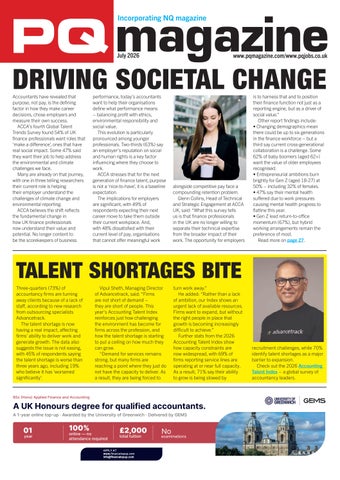
Accountants have revealed that purpose, not pay, is the defining factor in how they make career decisions, chose employers and measure their own success.
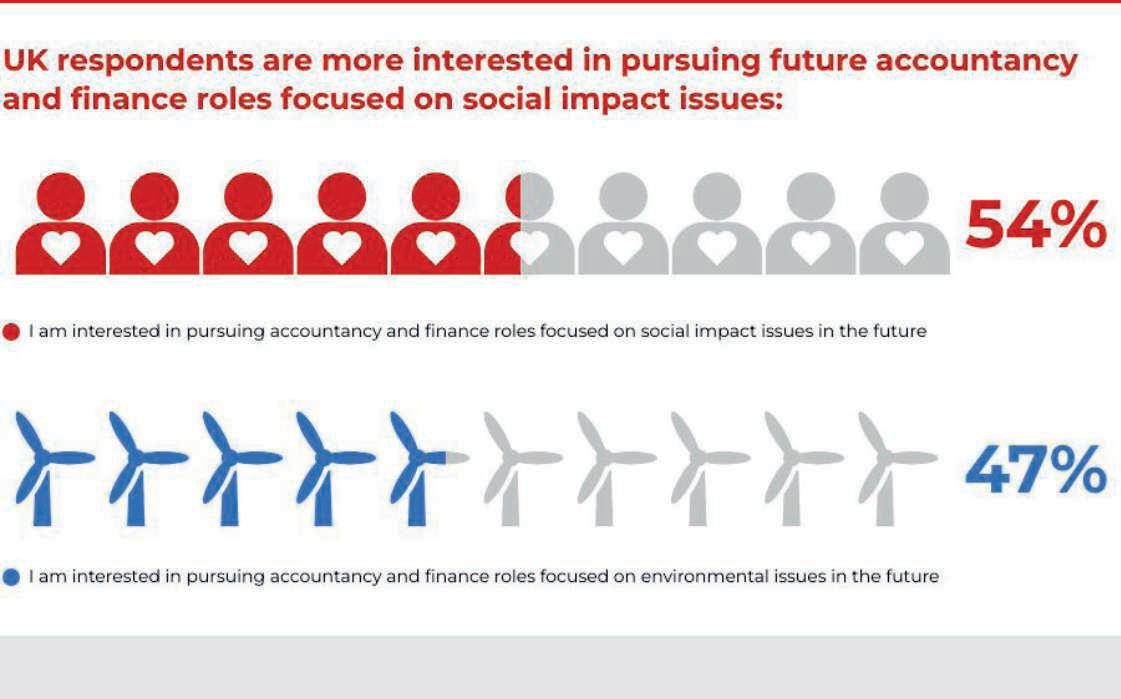
ACCA’s fourth Global Talent Trends Survey found 54% of UK finance professionals want roles that ‘make a difference’, ones that have real social impact. Some 47% said they want their job to help address the environmental and climate challenges we face.
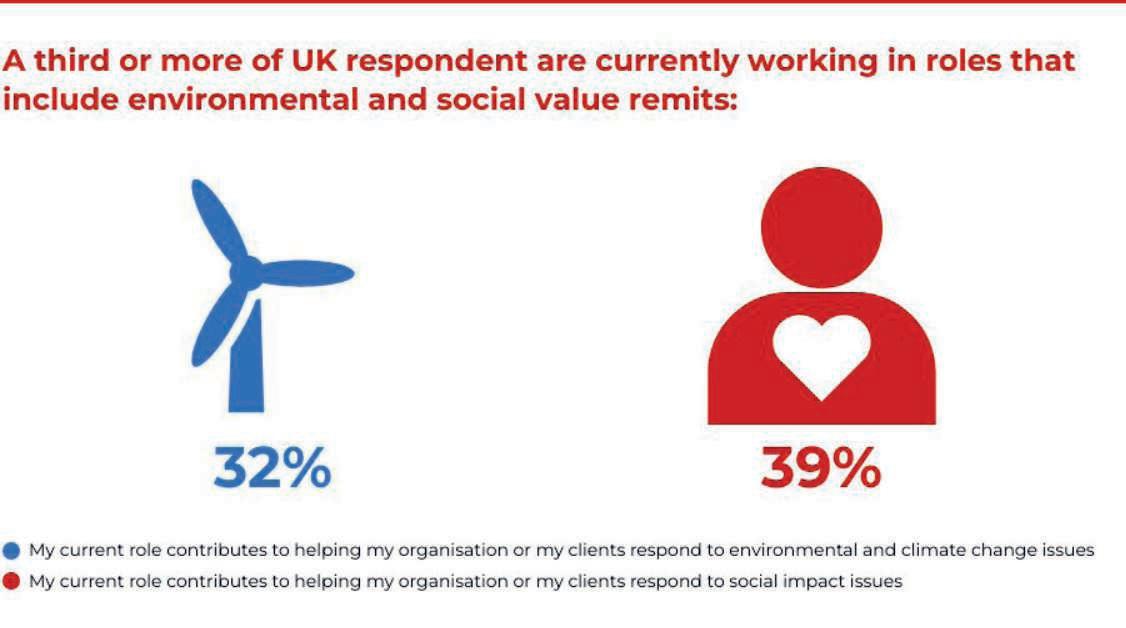
Many are already on that journey, with one in three telling researchers their current role is helping their employer understand the challenges of climate change and environmental reporting.
ACCA believes the shift reflects the fundamental change in how UK finance professionals now understand their value and potential. No longer content to be the scorekeepers of business
performance, today’s accountants want to help their organisations define what performance means – balancing profit with ethics, environmental responsibility and social value.
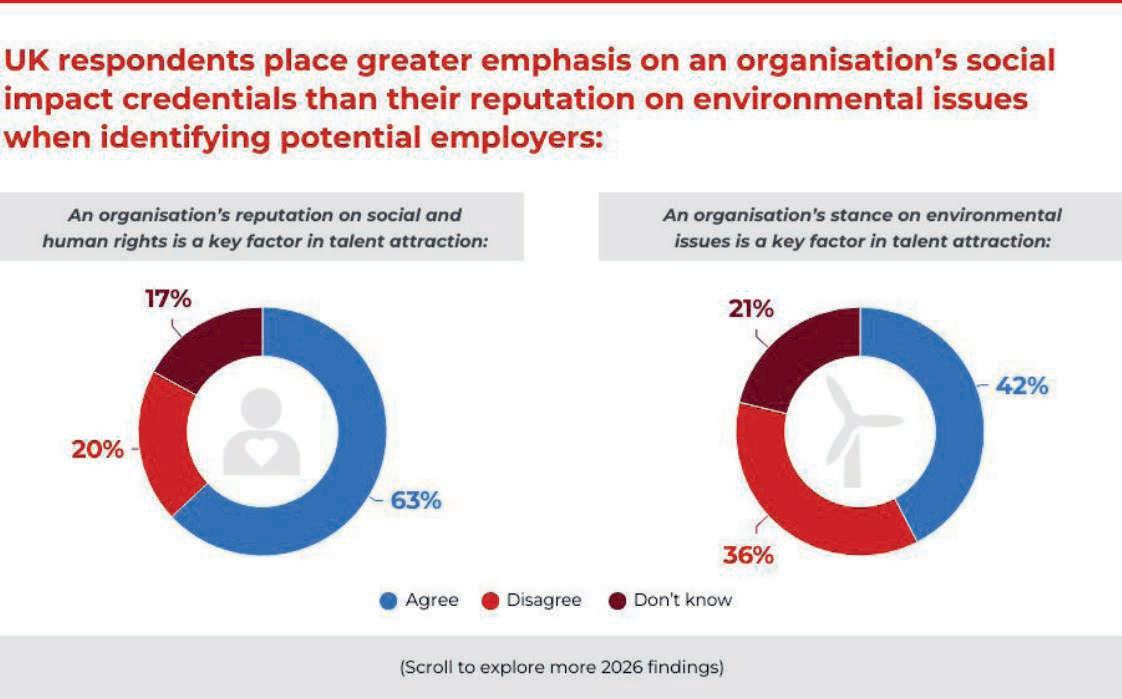
This evolution is particularly pronounced among younger professionals. Two-thirds (63%) say an employer’s reputation on social and human rights is a key factor influencing where they choose to work.
ACCA stresses that for the next generation of finance talent, purpose is not a ‘nice-to-have’, it is a baseline expectation.
The implications for employers are significant, with 49% of respondents expecting their next career move to take them outside their current workplace. And, with 48% dissatisfied with their current level of pay, organisations that cannot offer meaningful work
alongside competitive pay face a compounding retention problem.
Glenn Collins, Head of Technical and Strategic Engagement at ACCA UK, said: “What this survey tells us is that finance professionals in the UK are no longer willing to separate their technical expertise from the broader impact of their work. The opportunity for employers
TALENT SHORTAGES BITE
Three-quarters (73%) of accountancy firms are turning away clients because of a lack of staff, according to new research from outsourcing specialists Advancetrack.
The talent shortage is now having a real impact, affecting firms’ ability to deliver work and generate growth. The data also suggests the issue is not easing, with 45% of respondents saying the talent shortage is worse than three years ago, including 19% who believe it has ‘worsened significantly’.
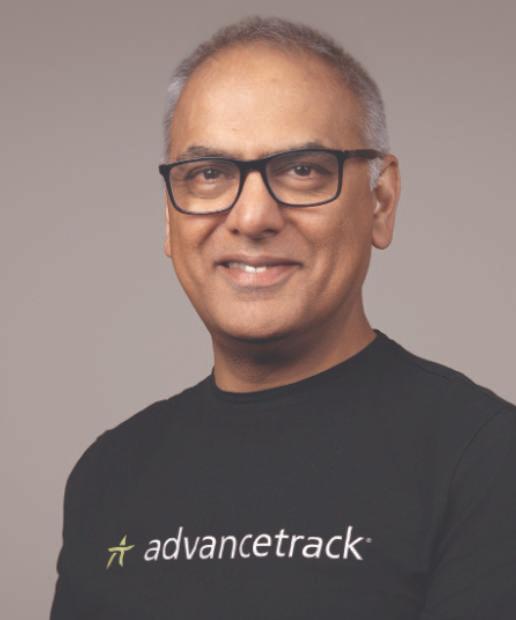
Vipul Sheth, Managing Director of Advancetrack, said: “Firms are not short of demand –they are short of people. This year’s Accounting Talent Index reinforces just how challenging the environment has become for firms across the profession, and how the talent shortage is starting to put a ceiling on how much they can grow.
“Demand for services remains strong, but many firms are reaching a point where they just do not have the capacity to deliver. As a result, they are being forced to
turn work away.”
He added: “Rather than a lack of ambition, our Index shows an urgent lack of available resources. Firms want to expand, but without the right people in place that growth is becoming increasingly difficult to achieve.”
Further stats from the 2026 Accounting Talent Index show how capacity constraints are now widespread, with 69% of firms reporting service lines are operating at or near full capacity. As a result, 71% say their ability to grow is being slowed by
is to harness that and to position their finance function not just as a reporting engine, but as a driver of social value.”
Other report findings include:
• Changing demographics mean there could be up to six generations in the finance workforce – but a third say current cross-generational collaboration is a challenge. Some 62% of baby boomers (aged 62+) want the value of older employees recognised.
• Entrepreneurial ambitions burn brightly for Gen Z (aged 18-27) at 50% – including 32% of females.
• 47% say their mental health suffered due to work pressures causing mental health progress to flatline this year.
• Gen Z lead return-to-office momentum (67%), but hybrid working arrangements remain the preference of most.
Read more on page 27
recruitment challenges, while 70% identify talent shortages as a major barrier to expansion.
Check out the 2026 Accounting Talent Index – a global survey of accountancy leaders.
IN THIS ISSUE
As you may have noticed, the World Cup kicked off on 11 June! Normally, PQ has lots of coverage; how the games clashes with accountancy exams, and how impossible it is to run an event in this football-obsessed month. We even try to find a quirky accountancy story – but for us this has all become impossible!
For me, the Great Game is no more – and I can’t even blame VAR for everything that is wrong. The bureaucrats that run the sport have managed to taint the product beyond recognition and have finally managed to sell the very soul of their ‘product’.
It worries me. Where is the transparency, scepticism, and accountability? And who is following the money?
The game seems be running without any real scrutiny, with vast amounts of money swashing around, going where exactly? The forecast is this World Cup will bring in $13bn in revenue, with the prize money for the teams around $871m. That leaves lots over.
Then there’s sportswashing, and we could have a terminal problem.
I am currently still saving up for the $2m ticket, where Gianni Infantino will serve me a hot dog and coke! Just so you know, he is expected to stand for a third term as Fifa President next year – unopposed!
Onwards to Saudi Arabia! Can’t wait…
Sorry rant over, and we do have a great magazine this month as always.
Graham Hambly, Editor and Publisher, PQ magazine
8 ICB initiative
4 ICAEW study
Accountants in the UK are still in high demand despite the impact of AI, new research finds
5 AAT salary guide
What AATs should be earning –and the gender pay gap
6 Universities challanged
Serious risk of institutional failures in higher education, Parliamentary committee warns
Bookkeepers’ institute unveils a host of measures to improve its offering
9 Student loans
Half of people with a student loan say they regret borrowing to pay for their degree
10 CIPFA results
We run the rule over the latest set of exam pass rates
12 Tech news
Finance firms warned over AI risks around confidential data Features, etc
14 The PQ Digest
In praise of the AAT; why ACCA students narrowly fail the SBR exam; and some advice on how to pass AAT’s Level 4 AMAC unit
17 Wellbeing
Accountants are not immune from financial pressures, so is it time to ask for help?
18 ACCA exam feedback
Which June exams were ‘OK’? And which ones were
a ‘disaster’? We’ve got the answers right here
20 ICAEW Student Council
Meet the new chair and vice chair of the ISC for 2026/27 – Sunny Yang and Sophie Armstrong
21 AAT level 4
Nick Craggs provides an overview of the content of the new AAT L4PAT qualification
23 ACCA SBL exam
Chris Cain explains a technique to collect both technical and professional skills marks in the SBL exam
25 Back to basics
Use decimals when answering a question on VAT and you will never go wrong
26 A question for Tom Tom Clendon explains how to calculate NCI as a proportion of net assets and goodwill
27 ACCA spotlight
New talent survey ‘dismantles the stereotype of the numbersfocused accountant’
28 Carillion scandal
Five Carillion accountants reprimanded and fined for misconduct
29 CIPFA spotlight
All accounting students should study audit diligently – even if they don’t plan on becoming an auditor
30 IFA spotlight
How to tackle the scourge of late payments, a problem that impacts most heavily on the UK’s SMEs
31 CIMA spotlight
How to approach the structure and format of your case study answer
32 AAT exams
Karen Groves explains how to approach mark-up and margin questions
33 Green accounting Why you really need to care about ESG
34 AAT spotlight
An analysis of the findings of the association’s latest ‘Filling the Gap’ report
36 Deloitte survey
Annual report finds young accountants want more than just a fast-paced career
37 Careers
ACCA launches Talent Management Toolkit; our Agony Aunt explains how to balance work and exam revision; and our Book Club review
38 Fun The lighter side of life – and accountancy
The columnists
Rachel Harrison Why PQs need a growth mindset 4 Sunil Bhandari Seek out the specialists – it will pay off 6
Prem Sikka Why rich and poor are poles apart 8
Stuart Pedley-Smith Don’t let AI do your thinking for you 10
Rachel Harris You’ve qualified –so what happens next? 12
RACHEL HARRISON Why PQs need a growth mindset
There’s an old adage that says change is the only constant in life. As a PQ it can sometimes feel like you are on the receiving end of strategic shifts driven by AI and technology.
Change can be daunting, but it is also an opportunity to demonstrate leadership. Use these tips to proactively manage change:
• Be your own ally: what would you say to a friend in the same situation?
• Turn problems into suggestions: bring your manager solutions, not problems. Taking ownership of the situation will demonstrate leadership skills.
• Reflect on your training needs: if your studies or job role now require more specialist IT skills, seek out free resources online to actively improve your skillset.
• Use support networks: talk to peers who have been in similar situations. Build connections and support networks.
• Reframe your thoughts: ask yourself what you fear might happen and reflect objectively on the positives you are currently ignoring. New technology may enable you to focus on valueadded activities, eliminating tedious administrative tasks.
• Remember the bigger picture: ask yourself how you will feel in five years’ time. Does this change give you the opportunity to work with new people and build new connections?
Learn to manage your reaction to change today to develop the skills you need tomorrow, when you are the person leading the changes from the top.
Rachel Harrison is Head of Academic Support at Kaplan
Meet new ICS chair and vice chair
Former PQ of the Year Sunny Yang has been elected as the new ICAEW Student Council chair for 2026-2027. His Vice Chair this year will be Sophie Armstrong. Both have also chaired CASSL, and Yang will be able to attend ICAEW Council meetings, to ensure student voices are heard at every level of the institute. Yang felt students broadly have the same worries: where is my career heading? What if I
Graduate recruitment will be down
Accountants in the UK are still in high demand despite the impact on jobs from AI, according to new research from ICAEW.
However, the survey of mid-tier firms revealed more than twothirds of firms felt AI would reduce demand for some early-career accountants.
ICAEW said that mid-tier firms would hire more school leavers and fewer graduates, while the role of the accountant would pivot from routine compliance and reporting to judgment, interpretation and ethical oversight by 2030.
The fall in graduate hiring could
be dramatic – with a 40% fall in grads likely to be offset by a 49% rise in the employment of school leavers. ICAEW said this move was influenced by the recent increases in employer national insurance
Using AI at uni isn’t cheating!
Students should not be told it is cheating to use AI in their
studies, according to the new CEO of Deloitte’s Asia-Pacific
ACCA exam fee rise
ACCA is increasing its exam fees by 3% from September “to support the ongoing enhancement of the ACCA qualification, alongside the tools and services that support our student base”.
It explained that it is redesigning the new qualification with advanced digital tools and learning support. The association said: “These
get fired? What if I do badly in the exams? He believes the ICS and local student societies are there to relieve some of these pressures.
Check out more on page 20
CIMA launches Rise2040
The future of the profession is not predetermined, and it will be shaped by the choices we make today, said Mark Koziel, CEO of AICPA and CIMA.
Launching ‘Rise2040: Shaping
enhancements bring together cutting-edge technical, business and professional skills for a rapidly changing world, with a strong focus
the Future of Finance and Accounting’, Koziel explained this latest initiative is not about predicting the future, it is about equipping the profession to actively shape it.
The report identifies five interconnected drivers currently shaping the profession’s future: technology and data infrastructure; value model transformation; talent and workforce dynamics; regulatory and trust architecture; and market and societal expectations.
contributions, changes to Level 7 apprenticeship funding, and the impact of employment rights legislation.
The firms aren’t necessarily looking to train more accountants. They want to hire people with expertise in data analytics, technology, and sustainability.
ICAEW CEO Alan Vallance (pictured) said: “Demand for accountants remains high but the nature of early-career accounting roles is expected to change as technology absorbs routine work, creating both opportunity and tension.”
region, Robert Hillard. He told Bloomberg that students should be encouraged to use AI because it prepares them for work, but felt universities are struggling to put AI at the core of how they get students work-ready.
And he is worried that graduates are developing a negative perception about AI. He explained: “Too many students see AI as cheating; they are taught that AI is something that is used for cheating. So they come into the workforce already with a negative perception. We have to change that.”
on employability and career impact. They also include the continued enhancement of tools proven to improve student outcomes, such as the ACCA Study Hub, the Practice Platform, My Exam Performance, and other resources designed to support exam success for our students.”
Students will be paying the increase when they sign up for the September sitting – which opened for entry on 5 May.
KPMG Australia CEO resigns over whistleblower scandal
KPMG Australia has confirmed its treatment of a whistleblower and investigation into their allegations “fell short of the firm’s expectations, those of the whistleblower and the broader community”.
As a direct consequence, both the CEO Andrew Yates and national manging audit partner, Julian McPherson, have now resigned.
Female AATs earn more – sometimes
Female AAT students continue to achieve higher salaries and bonuses than their male counterparts, according to the latest AAT salary guide.
However, this all changes on qualification, and MAATs and FMAATs men working full time at the professional level earn 6% more than women at the same level. They also receive a bonus that is 13% higher.
The big worry is the significant pay gap that persists for AAT licensed accountants. Male licensed accountants working full time are earning 32% more than their female equivalent. That gap has only narrowed one percentage point from the 2023 survey.
Female apprentices also earn 8% less than their male counterparts.
The worry here is that percentage has grown since the last survey in 2023, when the difference was 3%.
AAT average (median) full-time salary: Apprentices £24,100; Level
ACCA June exam feedback
There was a big contrast in how students felt about the SBR and SBL exams at the latest sitting. Just 9% of June exam sitters felt the SBL was a ‘disaster’ for them, according to the Open Tuition Instant Poll.
Some 56% of students voted the SBL exam ‘OK’ this time around.
This compares with a whopping 39.4% who voted the June SBR paper a ‘disaster’, with another 41.1% saying
2 Certificate in Accounting £27,000; Level 3 Diploma in Accounting £27,331; Level 4 Diploma in Professional Accounting £28,750; AATQB £31,000; MAAT £38,188; FMAAT £50,000.
Check out the full survey here
they found the exam ‘hard’. That is a lot of unhappy PQs!
Other problem papers this June were perceived to be Advanced Taxation and Advanced Financial Management. At the other end of the spectrum were AA and FR, which seemed to be much more ‘do-able’.
Check out all the feedback on page 18
Star for the future
Haide Scatamacchia, from Banco BV, recently won the Rising Star Award at the Finance for the Future Awards 2026. Judges said she stood out for her exceptional passion and drive in delivering institutional-scale impact from an analyst role in one of the world’s most challenging and critically important natural capital markets.
Her multi-disciplinary expertise and bold, purposeled leadership are already extending the conversation beyond Brazil, and the judges said they were “excited to see where that ambition takes her”
SUNIL BHANDARI Why specialists are important
I recently started playing golf again, and the first thing I did was find a coach. That is how I came to work with a professional named Simon.
My wife is also getting back into tennis, but I knew better than to ask Simon to coach her. Golf is his speciality, and that is where his expertise lies.
The same principle applied when I suffered acute kidney failure. My consultant, Nadia, is a renal specialist who focuses entirely on kidney care. That is her field, and I will always be grateful that she saved my life.
So what is my point?
In a column I wrote for PQ last year I argued that changes to the ACCA syllabus would push tutors to teach multiple exams. That is exactly what has happened. This move towards diversification is largely driven by revenue, which is understandable to a degree. Even so, it may weaken the level of support students have come to expect from their tutors.
The best tutors are often those who have spent years teaching a single paper. They know it thoroughly and are true specialists.
There may now be fewer ACCA tutors dedicated to one paper, but they still exist. I am proud to be one of them.
And I practise what I preach. Now it’s time for my next golf lesson with Simon.
Universities at breaking point
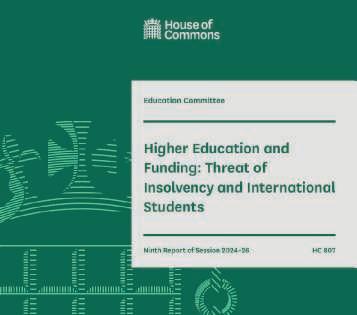
The higher education sector in England is facing a financial crisis that poses a serious risk of institutional insolvency, according to the Parliamentary Education Select Committee.
The committee stressed that without urgent and co-ordinated action there is a clear possibility of a university closing. Given universities’ anchor role in their local communities, the collapse of an institution would be calamitous. It would risk closing off opportunities for students from lower socio-economic backgrounds, lead to the loss of irreplaceable expertise, and
Rising Star
The Institute of Chartered Accountants of Scotland (ICAS) has announced the winners of its annual CA Rising Stars competition, recognising the brightest young talent from global accountancy profession.
At a prestigious awards ceremony at London’s Oxo Tower, Jemima Jacobs (pictured) was named overall winner of CA Rising Stars 2026 from a highly competitive shortlist of 35 outstanding chartered accountants
undermine local research and development. The ripple effects would be felt throughout local economies and internationally.
The report recommends that the government urgently establish a formal early warning and
aged 35 and under.
Jacobs, an audit supervisor at Bank of America, has built a standout career combining financial expertise with a deep understanding of technology risk and cybersecurity. She also serves as audit committee chair and trustee of the Meningitis Research Foundation, inspired by her own recovery from the illness. She will now represent ICAS at the One Young World Summit in Cape Town this November.
The full list of CA Rising Stars 2026 can be found in the latest edition of CA magazine
Money and connections
Young people in the UK aspire to own their own business, but the dream feels financially out of reach, according to new research from Xero.
The study found nearly threequarters (72%) of students surveyed aged 16-21 are attracted to the idea of entrepreneurship, but half of the respondents (51%) are being thwarted by a lack of funding,
Oxford Brookes concession
Oxford Brookes University (OBU) has confirmed that students in the Middle East who had their exams cancelled were still able to submit a Research and Analysis Project (RAP) in May 2026. OBU said it will accept the results of the June exam instead. However, students who fail the June exam will not be eligible for the BSc Applied Accounting and will not receive a result. Students who have paid a submission fee will be refunded.
The good news for all students concerned is the exams went ahead in the Middle East in June.
IASB issues IFRS 20
The International Accounting Standards Board (IASB) has issued IFRS 20 Regulatory Assets and Regulatory Liabilities, a new standard for companies subject to a specific type of rate regulation.
The new standard aims to help investors better understand how that rate regulation affects a company’s financial performance, financial
intervention protocol, triggered when the Office for Students categorises an institution as at risk of insolvency. This protocol should set out clearly when government intervention is warranted and provide a menu of responses, ranging from restructuring to an orderly exit.
The report also explained that, as a result of the fee freeze, universities have been driven to increase income from fees for postgraduate and international students, creating an unhealthy reliance on international recruitment.
Read the full report here
a lack of confidence (49%) and lack of financial skills (37%).
This has led to a sense of career exclusion, with 61% believing running their own business is a path reserved for people with money or connections.
Xero UK MD Kate Hayward (pictured) said: “We have a generation who are ambitious and driven to build something of their own, yet we’re failing to give them the skills and confidence to make it happen.”
position and its prospects for future cash flows.
It will affect companies subject to rate regulations that determine how much a company can charge customers and when it can charge them. Companies that supply vital services, such as electricity, water and gas, are often subject to this type of regulation.
Time to engage – it’s the CIMA awards Nominations are now open for CIMA’s ENGAGE UK & Europe 2026
Awards, but you only have until 22 June to get them in.
The awards shine a spotlight on the impact CIMA members, students and employers are making across the profession.
Among the award categories are the Henry Robinson Student of the Year, and Rising Star of the Year.
The shortlists will be announced on Friday 28 August, and we even know who is going to be compere for the awards night on 13 October – none other Shuan Williamson (aka Barry from EastEnders).
Sunil Bhandari is an AFM tutor at FME Learn Online
BSc (Hons) Applied Finance and Accounting
A UK Honours degree for qualified accountants and finance professionals.
Awarded by the University of Greenwich. Delivered by GEMS
A one-year top-up programme designed for professionals who hold a recognised accounting or finance qualification but have not previously completed a bachelor’s degree. The programme converts professional expertise into a full UK Honours degree, opening access to postgraduate study, degree-filtered roles, and points-based immigration pathways in the UK, Canada, Australia and the UAE.
Who is eligible
•ACCAAffiliates and Members
•ACA /ICAEWQualified Members
• CA(ICAS)Qualified Members
• CAI CharteredAccountantsIreland
• CIMA /CGMA Qualified Members
• CIPFA Qualified Members
•AAT (Level 4andabove)
• Recognised internationalCPA bodies(case-bycase)
A professional qualification is the entry requirement.
Curriculum
Fourmodules at Level6, 30 creditseach:Investment Management;MachineLe
rn
ngin Fintech; QuantitativeFinanceResearch; and Corporate Governance,Ethics&SustainablePractices Assessment is entirely by coursework, with written academic feedback on every submission.
On completion
Graduatesreceive thesame awardasGreenwich’s on-campusstudents; the certificate does not state “online”. They may attend the official graduation ceremony attheOld RoyalNavalCollegeonthe Thames and join the University’s alumni network of 21,000graduates across140 countries
01 academic year
100% online £2,000 No total tuition examinations
LORD SIKKA
Why rich and poor are poles apart
The UK has become a much more polarised society, and that harms social stability and economic growth.
Wealth is concentrated in fewer hands. Just 56 people hold more than the combined wealth of 27 million Britons. The richest 1% owns 456 times more wealth than a person in the poorest 50%. The poorest half holds just 4.6% of the wealth.
Some 13.4 million people live in relative poverty; 25.3 million people, including 14.9 million working age adults, live in households below the minimum income standard. Work is a way out of poverty, but it does not pay enough – 4.4 million people earn less than the real living wage. The real average wage has hardly changed since 2008; 32% of Universal Credit claimants are in work. Millions rely on charity to survive.
The stark reality is that too many people lack good purchasing power to buy goods and services and stimulate the economy. Many town centres have become economic deserts. Businesses have little incentive to invest.
Governments pledge adherence to arbitrary fiscal rules to manage debt and deficits. Such rules are not accompanied by any binding targets for achieving full employment, improving workers’ share of GDP, eradication of poverty, improving life expectancy or meeting any social goals.
Equitable distribution of income and wealth goes a long way towards addressing social problems and ought to be central to policies for economic rejuvenation.
Prem Sikka is Emeritus Professor of Accounting at the University of Essex
Tax briefs
Tax-free overtime doesn’t add-up
The proposals by the Reform Party to treat overtime earnings as tax free for most employees “do not add-up”, says Blick Rothenberg’s Robert Salter. He explained: “Whilst Reform have suggested that the policy would only cost the Government £5bn per annum in lost tax receipts, it is unclear how valid these numbers are.
“This is because there is no definitive data on how much overtime is actually worked in the
ICB plans for the future
The Institute of Certified Bookkeepers (ICB) has announced bold plans for new Level 5 qualifications launching in 2027. And, with university partnerships, the new qualifications will create progression routes to a master’s degree.
At a special event to celebrate the start of ICB’s 30th anniversary year, CEO Ami Copeland (pictured) also unveiled a new Approved Employer scheme, designed to develop bookkeeping talent within modern business.
Finally, ICB has launched an AI Academy for both bookkeepers and
accountants. She stressed that AI will not be replacing professional bookkeepers. She said: “Instead, I believe AI will increase the value of the work bookkeepers do.”
Copeland explained: “The
future of bookkeeping is about much more than processing transactions. It is about connecting finance, technology, operations and business growth. It is about helping clients understand what the numbers mean and using that insight to make better decisions.
“To support this shift, our new qualifications and learning pathways will place greater emphasis on commercial awareness, operational understanding, technology and advisory skills, helping bookkeepers develop the expertise needed for increasingly strategic roles.”
Caroline Smale elected ICAEW President
ICAEW has announced that Caroline Smale (pictured) has become its President for 2026-27. She is just the fifth woman to hold this post.
Smale began her career as a graduate trainee at mid-tier firm Bishop Fleming in 1988, qualifying as a chartered accountant in 1992. She has been with the firm for almost 40 years.
Smale said: “As President I will champion a profession that is inclusive, forward-looking and
encourages talent from every background, because the future strength of the profession depends on the opportunities we create today.”
She continued: “In my time as President, my aims echo the ICAEW strategy in supporting the profession to flourish. I want to ensure accountants remain at the cutting edge of digital transformation, promoting sustainability and changing market needs. I am keen to increase resilience by
Associate programme overhaul
Grant Thornton UK has set out plans to overhaul its Associate programme for the September 2027 intake.
The new programme will span audit, tax and advisory, and build
UK and reports such as the Office for National Statistics’s labour force survey are dependent upon volunteer submissions, which make them somewhat unreliable.”
Government freezes fuel duty rise
The UK government has postponed the planned 5p increase in fuel duty, extending the freeze until at least the end of 2026. As reported in the last issue of PQ magazine, the duty on fuel was due to rise in September,
on the firm’s commitment to be a marketleader on pay, with a digitally focused curriculum and a clear pathway to partnership.
Grant Thornton said the redesign will help build
December and March.
In addition, the fuel duty rate on red diesel (used by farmers) will be cut from 10.18p to 6.48 per litre from 15 June until the end of the year.
A ‘holiday’ for vehicle excise duty has also been unveiled for the next 12 months. That means when hauliers renew the HVG VED they will pay just £1, saving £600.
April’s early filers
Hundreds of thousands of taxpayers got ahead of the game
empowering professionals and firms to navigate economic uncertainty, workforce pressures, and evolving technical standards.”
the partner pipeline of 2040 and beyond ‘from the ground up’. Chief People Officer Abigail Fisher said: “Our ambition to lead the market on starting pay is a very deliberate signal about who we are and where we are going. It tells the very best candidates that we value their potential from day one, it tells our clients that we are investing in the future capability of our firm, and it tells the market that Grant Thornton is serious about being long-term leader in the profession.”
by filing their Self-Assessment return in April, with 86,270 submitting on day one – as Easter Monday emerged as the most popular date.
More than 298,900 people filed in the first week of the tax year. The month of April set a new record, with almost 740,000 submitting their returns for the 2025 to 2026 tax year.
HMRC’s Myrtle Lloyd said: “For thousands of people, filing early and staying on top of their finances has become the norm.”
Student loan system is ‘freezing futures’
Over half of people with a student loan say if they had their time again they would not borrow money for their further education.
An extensive poll conducted for the House of Commons Treasury Select Committee inquiry into student finance found 92% of respondents believe the interest and repayment terms attached to their loans are unreasonable. That goes up to 95% for the Plan 2 cohort.
Some eight in 10 also
said repaying the loan was much worse than they expected, and 70% felt the loan was having a material impact on their financial planning.
When asked if they would take out a loan again, knowing what they know now, some 51% said
Solving the accountancy skills gap
The UK government needs to have a clearer workforce plan for accounting and finance if it wants to fill the skills gap, says AAT.
In its latest report, in conjunction with Public First, there are also recommendations for Lifelong Learning
Entitlement and wider post-16 funding reforms to support flexible progression in accountancy.
While the AAT is doing its bit, it is also calling for a more joined-up approach. The new research shows AAT students and members
contribute an impressive £3.8bn to the UK economy.
Sarah Beale, AAT CEO (pictured), said: “This report clearly shows that AAT’s social and economic impact go hand in hand. But we need an education and skills system built around
no; just 21% said yes!
The committee chair, Meg Hillier (pictured), recognised the scale of frustration and acknowledged the “upset is powerful”.
NUS vice-president Alex Stanley said governments have repeatedly changed the terms in a way that no bank could do legally, effectively making conditions worse. His worry is the loans are now freezing the future for many graduates.
access and flexibility. Get that right, and the social and economic prize is clear.”
The right accountancy course for you
Looking for an AAT, ACCA or CIMA course? Well, look no further – PQ magazine has done the hard work for you!
Check out our Course Finder page – just click on the body you are studying.
We have listed our trusted providers, those we think go that extra mile for you. If you want to pass your next exam you need to take a look at our list.
We have worked closely with all these colleges, some for more than 20 years. And we believe they can get you from PQ to NQ!
A recent addition to the AAT list is KBM Training & Recruitment. We have also added Accaprep.com to the ACCA section, so watch this space as we will be working with them on some ‘special offers’. CIMA studiers should check out CIMA Practice, who join HTFT, Astranti and Viva Financial Tuition on the list.
STUART PEDLEY-SMITH
Don’t let AI think for you
GenAI is brilliant. It’s fast, available 24/7, and never gets tired of answering your questions. But there is danger hiding in plain sight – it’s called cognitive dependency.
What starts as a helpful shortcut can quietly become something more damaging. There’s a crucial difference between using GenAI as a tool to better explain something you don’t understand and using it as a replacement for thinking. One is called cognitive offload, the other cognitive dependency.
Cognitive offload is healthy. Just as a calculator handles arithmetic so your brain can focus on the thinking about what the numbers might mean, AI can clear mental clutter and free you up for deeper thinking. That’s AI working for you.
Cognitive dependency is something else entirely. It’s when AI does all the heavy lifting, drafting your answers, explaining concepts you haven’t wrestled with, summarising material you haven’t read. Research from Wuhan University found that greater AI dependence correlates with lower critical thinking skills. Think of sat nav: follow it everywhere and eventually you lose your ability to navigate at all.
For PQs the stakes are real. Exams test your thinking, not AI’s. The good news? You can use AI smartly. Ask it to quiz you or challenge your answers – not write them.
We built tools to save us time so we could think more. Let’s make sure that’s still what we’re doing.
• Stuart Pedley-Smith is an accountancy lecturer, education advisor, author and blogger
CIPFA pass rates published
CIPFA’s latest exam results saw Strategic level pass rates fall heavily – SCS was 47.62% in March, and SPFM was 45.24%.
The Developing Strategy & Data Analysis pass rates have been on a downward trajectory over the past four sittings, too. In June 2025 this paper had a healthy 77.51% pass rate, but now the pass rate stands at 52.73%.
In stark contrast, the Governance and Risk Management pass rate in March was 95.31%, after rising for the last three sittings. The Examiner Reports said that students are getting better at the MCQs.
CIPFA’s AA sitters saw a nice jump in the pass rate from last
time around – up from 35.97% to 40.91% in March. However, this pass rate is a fall on the March 2025 sitting of 56.68%.
CIPFA MARCH 2026 EXAM RESULTS: AA 40.91%; BPFM
Your profession needs you!
Calling all students and early-career accountants –it’s time to find your voice and join the IFAC Young Leaders Collective.
The Collective was created in 2024 to help the profession learn from the perspective of early-career and aspiring accountants.
The 28 members of the Collective engage directly with IFAC on its most important initiatives, including corporate reporting, AI, accountancy body member
value, and the attractiveness of the profession.
You will need to have less than five years of work experience, be comfortable sharing ideas in group settings, and be open-minded.
The minimum time commitment is 30-40 hours over the year, including attendance and prep for four virtual meetings a year.
IFAC has opened up its 2027 call for applications to identify new members for the Collective who will serve up to two one-year terms, starting 1 January 2027. The application deadline is 8 July 2026.
Keeping students connected
ICAS’s Highlands accountancy talent pipeline initiative, connecting students to each other and the institute, held its first-ever event recently.
Some 20 chartered accountancy (CA) students and graduates from across the Highlands met at Saffery’s Inverness office. This included those on the ICASRGU Graduate Apprenticeship programme.
ICAS is currently supporting 30
students, with plans to expand the networking programme to more locations later this year (including
Aberdeen).
Cat Devaney, Executive Director of Learning at ICAS, said: “With several students spread across Inverness and the region, these sessions give CA students a valuable opportunity to build local networks, connect with peers and gain fresh perspectives. Students further along in their studies can offer practical advice, study tips and real-world insight to those just starting out, helping to build confidence early in their CA journey.”
Promotions all round at Deloitte Deloitte UK has promoted more than 6,000 staff and increased the number of its equity partners to a record high.
The Big 4 firm said the promotions are part of the firm’s commitment to competitively reward skills and experience, with salaries in-grade rising by an average of 4.2% (up from 2.9% in 2025).
Following what it called a very strong financial performance in FY26 the bonus pool will increase by 14% across the business.
Some 48 employees became partners, alongside 68 salaried partners who have
been converted to equity partners. This means there are now 784 equity partners in total – the most in Deloitte UK’s history.
KPMG scraps summer perk
Staff at KPMG UK will no longer be able to clock off at 3pm on Fridays over the summer months, following a new cut at the Big 4 firm. Introduced in 2021, staff could take the perk from June through to the end of August.
Bloomberg was the first to report the change, and a KPMG spokesperson said: “Every year we review our summer ‘jump start’ programme to make sure we are considering market conditions and business needs.”
Big 4 rival PwC has a similar policy, and it
will be running the perk from 20 July to 28 August. It has trimmed the scheme back by six weeks – it previously ran from June to August.
PwC faces WH Smith audit probe
The Financial Reporting Council has begun an investigation in relation to the statutory audit conducted by PwC of the consolidated financial statements of WH Smith plc for the financial year ended 31 August 2024.
The decision was made at a meeting of the FRC’s Conduct Committee in late April, and published on 9 June 2025.
The investigation will be conducted by the FRC’s Enforcement Division under the Audit Enforcement Procedure.
You’ve qualified. Now what?
Passing your exams is the goal. But the accountants who build brilliant careers don’t just pass, they prepare for what comes after. And most people don’t start thinking about that until it’s already happened.
Here’s what I wish someone had told me earlier.
Your letters are the floor, not the ceiling. ACCA, CIMA, ACA: they get you in the room. What keeps you there, and what gets you promoted, is everything else. Communication, commercial awareness, the ability to tell a story with numbers rather than just produce them.
Specialise in something before someone specialises you. Accountants who stand out are known for something specific. Whether that’s a sector, a software, a client type or a technical niche, pick a lane and go deep. Generalists are everywhere. Specialists are sought after. Build your reputation before you need it. That means being visible. Contributing in meetings. Sharing what you know online and in the room. The people who get the interesting opportunities are rarely the best technically. They’re the ones other people think of first.
And, finally, find your people. The colleagues, mentors and peers who cheer you on, open doors and tell you the truth when you need it. A strong network built early compounds over a career in ways that are impossible to overstate. Start now.
You've worked hard to get here. Make sure the profession notices.
Rachel Harris is the founder of striveX and @accountant_she
AI adoption moving fast
Nearly three-quarters of Gen Zs and millennials (74%) report using AI in their day-to-day work, up sharply from last year (57% of Gen Zs and 56% of millennials), according to Deloitte’s 2026 Global Gen Z and Millennial Survey
The worry is some organisations are struggling to keep up with the pace of change, and many respondents to the survey admitted they are facing ‘digital fatigue’ as the influx of new digital tools are
Be careful with AI
Finance teams are being warned to review how they use AI tools at work, amid growing concerns over confidential company data being uploaded into consumer AI platforms without proper safeguards.
Michael Gould (pictured), founder of software company Kaleidoscope.com, said many finance professionals are experimenting with AI to speed up modelling and reporting workflows, but may not fully understand the risks around data retention, governance and trust in AI
generated outputs.
His warning comes alongside the launch of The State of Financial Modelling & Planning 2026
Meet GT Augment
Grant Thornton is rolling-out GT Augment, its AI platform, across the UK this summer. This makes Grant Thornton one of the first major UK accountancy firms to embed generative AI across its entire workforce.
All partners and employees in audit, tax, and advisory will be set up with Anthropic’ s Claude by the end of August as part of a £500m
investment.
Chief digital office David Gartside said too many firms risk mistaking visibility for impact when it comes to AI: “The firms that win won’t be the ones talking the most about AI. They will be the ones using it so well it barely gets mentioned. This isn’t about AI theatre. It’s about changing how work gets done in ways clients can feel, even if they
report from Kaleidoscope.com, which found finance teams are increasingly adopting AI while still relying heavily on underpinning spreadsheet-based workflows. According to the report, 42% of finance teams still rely exclusively on spreadsheets without a dedicated modelling platform, while 45% spend significant time manually updating data and 44% spend major time checking for errors.
The report suggests many organisations are layering AI onto fragmented modelling environments rather than replacing them, creating concerns around transparency, version control and confidence in outputs.
don’t see the mechanics behind it.” Alongside the rollout, Grant Thornton plans to open a Digital Experience Centre in London later this year.
EY/Microsoft strengthen global initiative
EY and Microsoft have announced a ‘significant evolution’ of their alliance, with the promise more than $1bn of investment over the next five years to help clients accelerate their AI transformation.
The new initiative will bring together Microsoft engineers with EY’s business consultants, aligned by industry, to provide specific AI solutions focused on highest value business opportunities.
Janet Truncale, EY Global Chair and CEO, said: “Together with Microsoft, EY is supporting clients
often poorly integrated into legacy systems. The constant alerts, tool switching and use of multiple platforms is just adding to the stress.
Check out more on page 36
Show us your accounts!
Companies House has confirmed it plans for all UK small and microentities to file profit and loss accounts from April 2028.
There is, however, going to be an opt-out of publishing this
to unlock value through rapid deployment of AI at scale. With access to a single, integrated team, clients will have at their disposal both Microsoft’s market-leading engineering depth, alongside EY teams’ deep industry knowledge and change management capabilities.
“By combining people and innovation in this next phase of the alliance, clients will be empowered to realize the transformative power of agentic AI within the enterprise.”
information on the public register, but access to these accounts will still be open to Companies House, law enforcement and HMRC.
All companies will also have to file their annual accounts via commercial software.
The number of times a company can shorten its accounting reference period has been reduced, too.
The government said the changes give companies and software providers 21 months to get ready.
KPMG and Anthropic sign alliance
KPMG and Anthropic have created a new digital gateway powered by Claude, bringing Anthropic’s frontier AI directly into KPMG’s client delivery platform.
The launch is part of a global alliance, with an initial focus on tax clients and private equity firms. By embedding Claude into KPMG Digital Gateway, the firm’s market leading AI-enabled platform, clients can build agentic workflows in real time to help drive better outcomes.
THE PQ DIGEST
AAT IS A COMMUNITY
Sarah Beale, CEO at AAT: “What a difference the AAT community makes! AAT members and students add £3.8bn to the UK each year – that’s a massive boost for the economy, underpinned by the social impact of opening up a career path to the widest pool of talent.
“However, the reality is that too many people are held back because they can’t find a clear route into the jobs market and into meaningful careers. It’s not a lack of talent – they just need access and opportunity to succeed. When those doors are open, talent is ready to pour in, building the careers and businesses that supercharge economies.
“This is made clear in the third and final chapter of our ‘Filling the Gap’ series. Independent modelling undertaken by Public First for AAT shows that 83% of our members and students from lower socioeconomic
backgrounds say AAT helped open career doors for them. Their modelling also goes on to show the economic benefits that stem from this both in individual earnings as well as the resulting economic contribution that makes.
“Accessibility needs to take a more central role in the education and skills system. That's what unlocks opportunity and boosts growth. Get that right, and the social and economic prize is clear.”
Here’s AAT’s overview of key findings: https://tinyurl.com/fpcjbctw
Read the full report from Public First: https:// tinyurl.com/36tk92n3
JUST MOVE ON
Tom Clendon, ACCA SBR expert tutor: “Some students who’ve failed their SBR exam with 45%-49% get quite surprised (and a bit angry) when I explain to them the truth behind why they failed...
“You failed because of perfectionism. Yes. Perfectionism. Not because of a lack of knowledge... or because of bad luck. Failing with a mark that close is because you were getting stuck on complex adjustments trying to
get the answer ‘right’ and ran out of time. You missed out on low-hanging fruits.
“That is why I always say: Just Move On (JMO). Your goal isn’t a 100% perfect answer. It’s a 50% pass. So please don’t fall into the trap of being a perfectionist and trying to replicate the length and quality of the examiners' answer.”
AMAC IS HARD!
AAT tutor Gillian Russell: “Mystery solved… and it all started with a copy of PQ magazine!
“So today, whilst having a read through the brilliant (and completely FREE) magazine, I stumbled across something very interesting…
“On page 23 are the AAT pass rates from Jan-Dec 2025. And guess what? Level 4 AMAC has the LOWEST pass rate of every AAT unit across ALL levels! Suddenly, a mystery that has been bothering me for years was solved…
“Why do I spend so much of my time tutoring AMAC students? Because AMAC is HARD. It’s the unit that makes students question life choices whilst trying to remember variance formulas, investment appraisal methods, budgets, limiting factors, and performance measures.
“But here’s the thing… AMAC is absolutely passable when you understand the logic behind it and stop trying to memorise everything without understanding why. That’s exactly why I spend so much time helping students with it.
“So, if you’re currently battling Level 4 AMAC and feeling like it’s just you – it definitely isn’t!”
Free subscription: www.pqmagazine.com/subscribe/
Delivery problems or need a change of email address: admin@pqmagazine.com
Website: www.pqmagazine.com
Top employers love this learning platform.
CGMA FLP is your flexible path to CIMA® membership and the CGMA designation. Fully online and practical skills-focused, hundreds of top UK firms are choosing to upskill their staff through the CGMA FLP.
Stand out with the CGMA® Finance Leadership Program (CGMA FLP). Find
Offer a range of accountancy-led services to the general public in the UK when you gain an IFA practising certificate through IFA Direct. The flexible, relevant and accessible study units provide structured learning designed to complement busy lifestyles.
Under pressure
Accountants are not immune from financial pressures, so is it time to ask for help?
Rising household bills and other financial pressures are creating a perfect storm of mental health issues for accountants, says the occupational charity for the ICAEW community, caba.
Previous research from the charity found more than one in 10 accountants (13%) had been affected by financial hardship in the past two years, and nearly one in six (16%) had relied on credit to pay for essentials. Of those struggling financially, 72% said rising living costs were the main cause, with 42% having to cut back on basics such as heating, hot water and broadband – pressures that can contribute to heightened stress, anxiety and wider mental health challenges.
In addition, the stigma surrounding debt, particularly among chartered accountants, can make it more difficult for individuals to seek support. This may lead some to withdraw or feel isolated at a time when early help and intervention could make a meaningful difference to their mental wellbeing.
Dr Cristian Holmes, Chief Executive at caba, said: “Accountants are often seen as financially secure; however, the reality is that they face the same cost-of-living pressures as everyone else. They are not immune to rising household bills and inflationary pressures.
“Financial strain and mental health are closely interconnected, with money worries often acting as both a trigger and intensifier of stress, anxiety and burnout. Rising living costs, combined with demanding workloads, can create a perfect storm for mental health challenges, affecting confidence, relationships and overall wellbeing.”
To support accountants with dealing with financial pressures and the mental health challenges that come with this, Tom Barrett, Senior Support Officer at caba, has the following advice:
1. Set a budget – mental health challenges as a result of financial hardship are often made worse by uncertainty, either feeling unsure about where your money is going or how much you’re really spending. While many people don’t stick to a regular budget, having a clear and accurate view of your outgoings can bring a sense of control and reduce anxiety. In many cases, estimated spending differs significantly from reality, so tracking your actual expenses is a powerful first step caba’s tools can help you take back control and ease some of that pressure.
2. Don’t shy away from benefits – worrying about finances can feel overwhelming, and it’s common to feel hesitant about seeking support. Concerns about complexity or stigma often prevent people from exploring benefits they may be entitled to. However, accessing this support can significantly ease financial strain and reduce stress.
3. Take control of energy, fuel and household costs – rising energy and fuel costs are currently
a major source of stress for many people. While you may not be able to control prices, taking small, practical steps can help you stay in control and reduce financial uncertainty. These steps could include reviewing your subscriptions recently and making sure you’re getting the best value for your money when it comes to everyday services like insurance, energy or the internet.
If your credit balances are increasing each month, don’t wait until your options run out. It may be time to explore solutions to manage your debts
4. Finally, don’t keep concerns about financial strain to yourself – as accountants there is definitely still stigma around speaking up about financial hardship. However, you are not immune to the rising cost of living and inflationary pressures. You can speak to caba confidentially about your experiences and get support. You don’t need to go through this alone.
• Call 01788 556366, email enquiries@caba. org.uk or visit www.caba.org.uk to find out more about how caba can support you.
ACCA JUNE FEEDBACK
The June exams have come and gone! But which ones were ‘OK’ and which ones were a ‘disaster’. Here is what students said…
Audit & Assurance (AA)
No big outcry this time around – in fact the vast majority of those voting in the Open Tuition Instant Poll said the exam was ‘OK’. As one sitter said: “Except three or four difficult things, this was a standard exam.”
Advanced Audit & Assurance (AAA)
“It was hard,” is all one PQ wrote after sitting the June exam. In the Open Tuition Instant Poll 30% of sitters agreed, and voted the exam ‘hard’. Another 14.7% said they had a ‘disaster’.
Taxation (TX)
Deemed ‘OK’ this time around, with one student describing section A as ‘decent’. Someone who found the exam hard felt they had to make some very random adjustments in section C. In the Open Tuition Instant Poll 36.5% of sitters clicked the ‘hard’ button, and 9.6% said it was a ‘disaster’ for them.
Strategic Business Leader (SBL)
Some sitters felt the examiner had thrown some curve balls. Where was the question on technology and sustainability, asked one PQ –neither came up!
Others just didn’t see what the pre-seen had added to the scenarios actually provided.
In all, 55.9% of sitters voted the exam ‘OK’ in the Open Tuition Instant Poll. Another 29.7% found it ‘hard’, and 9% had a ‘disaster’.
‘Truly terrible’
How were PM, APM and ATAX? One paper stood out for all the wrong reasons!
Performance Management (PM)
Sitters didn’t like section C. In the Open Tuition Instant Poll 45.7% clicked the ‘hard’ button when they voted, while 16.1% had a ‘disaster’.
Advanced Performance Management (APM)
Deemed ‘OK’ overall, although time management was tricky for some.
The Open Tuition Instant poll saw one in three (34.3%) describe it as ‘hard’; another 21.1% said it was a ‘disaster’.
Advanced Taxation (ATX)
This was a problem paper for many, and it was Q1 they struggled with. One sitter described it as ‘rough’, and they felt the rest of the paper was very niche. It was also described as ‘truly terrible’ and ‘horrible’.
Others just said they left the exam hall deflated. The safe haven of an ethics question wasn’t there– it was about advertising.
Not surprising then that in the Open Tuition Instant Poll 38.4% voted the exam a ‘disaster’, while another 32.8% said it was ‘hard’.
Financial Reporting (FR)
A do-able paper, and slightly easier than the
mocks, said one sitter. Many seemed to be relying on section C to get them through, as section A and B were deemed harder.
In the Open Tuition Instant Poll 54.1% sitters felt this exam was ‘OK’, another 34.4% said it was ‘hard’, and only 4.9% had a ‘disaster’.
Strategic Business Reporting (SBR)
“If I could list out my worse SBR topics and combine them in one exam, this was that exam,” said one sitter. Another said: “This exam was challenging. This was my fourth try, and I am confident there will a fifth as well!” So a tough one for many.
In the Open Tuition Instant Poll a whopping 39.4% said they had a ‘disaster’, and another 41.1% found the exam ‘hard’.
Financial Management (FM)
‘Really good’ and ‘lovely’ is how some students described this June’s section C. The same
could not be said for the other sections on the paper.
As one sitter said: “Section A and B was the hardest questions I’ve done so far.” Other students admitted they found these sections difficult and time consuming. One student just said: “I hated every minute of it.”
In the Open Tuition Instant Poll 44.8% of June sitters said the exam was ‘hard’, while another 17.2% said they had a ‘disaster’.
Advanced Financial Management (AFM)
One in four sitters (24.1%) said this was a ‘disaster’ for them. In the Open Tuition instant poll another 38% said the paper was ‘hard’. That left one in three thinking everything was ‘OK’.
We liked the comments that there was too much talking in all the questions, and too many calculations. Ultimately, time was the enemy for many sitters.
Develop the accounting leaders of tomorrow.
Digitally upskill your team through funded degree apprenticeships
Available in:
•Data Scientist
•Digital and Technology
Solutions Professional
•Project Manager
• Delivered primarily online with flexible, asynchronous learning
• Funded through the Growth and Skills Levy, levy transfer, or government co-investment
2026 October intake now open for applications
D Deadline: 28th August
Giving you a voice
Meet the new chair and vice chair of the ISC for 2026/27 –Sunny Yang (left) and Sophie Armstrong (right)
Sunny Yang is ACA and CTA qualified. He started his accountancy career in banking assurance, working with investment banking and trading clients, before moving into corporate tax advisory, where he now works with privately backed and multinational businesses on areas such as transactions, restructuring, compliance and tax risk.
Alongside his day job, Sunny has been heavily involved in the student and early-careers side of the profession. He has had two terms as Chair of the Chartered Accountant Student Society of London (CASSL) and now chairs the ICAEW Student Council. He also is one of the youngest members on ICAEW council.
Sophie Armstrong, the new Vice-Chair of ICAEW Student Council, currently works at as a senior auditor for large UK businesses. She is the most recent ex-Chair of CASSL, where she was the youngest Chair in the organisation’s 140year history.
Involvement in Council
The ICAEW Student Council is made up of chairs and councillors from ICAEW’s student societies, representing the views of around 40,000 professional trainees currently studying towards the qualification. Sunny and Sophie both began their involvement with CASSL, before going on to represent students more widely through ISC. For Sunny, the ISC is valuable because
it connects students with the wider ICAEW ecosystem. It allows student representatives to share what is working well locally, raise the challenges students are facing, and give students a voice with the people making decisions. He believes that the professional journey of a trainee can be enhanced by local societies in each region, to help develop new skills and networks that may not always be readily available through their day-to-day roles.
Sophie shares a similar view and sees ISC as a platform to help the next generation of students feel more informed, more connected and less alone throughout their ACA journey.
Priorities in office
Their priorities can be summed up in three words: unite, share and grow.
There is a huge amount of good work happening across the network, but societies should not always have to reinvent the wheel. Where events, exam support, careers talks or wellbeing initiatives are useful to all students they want to encourage more collaboration in the network.
Another priority is to champion diversity and equal opportunities for ACA trainees. They hope to target the needs of trainees from smaller firms or more diverse backgrounds who may need more support from the regional student societies.
They are also focused on ensuring ISC continues to engage with the major themes shaping the future of the profession, including AI, data, sustainability, wellbeing and the changing expectations placed on future chartered accountants.
ICAEW’s new qualification
Next Gen ACA has been developed through a substantial consultation process, with chief examiners and other ICAEW stakeholders actively seeking feedback and suggestions from previous ISCs. Sunny recalls being closely involved in focus group-style sessions, where regional chairs shared their views on what matters most as the profession evolves. This includes which skills, topics and technical areas should remain central to the syllabus.
Both Sunny and Sophie agree that the scheme has been rolled out and delivered with a lot of preparation. ICAEW examiners have been attentive to ISC feedback and have shown a willingness to adapt, refine and improve the qualification where appropriate.
ISC influence
ICAEW has carried out many consultations and is always keen to hear students’ views. Previous Chairs of the ISC usually go on to hold office on ICAEW’s main council, which gives a lot of weight to the decisions made by ICAEW.
Senior ICAEW stakeholders attend ISC meetings regularly to present ideas, test thinking, and hear about students’ experiences.
Advice to new starters
Sunny and Sophie would tell their younger selves not to underestimate how much the ACA journey shapes you beyond the exams. When starting ACA it can feel like everything is about passing the next paper. Exams matter, but the qualification is also about building judgement, resilience, networks and professional confidence.
Their advice is to get involved early: join your local student society, attend events, meet people beyond your own firm and build a strong support network. Some of the most valuable opportunities in their careers have come from volunteering, mentoring, contributing to the wider profession and saying yes to opportunities.
Sunny and Sophie have both had invaluable tutelage from ICAEW office holders like Malcolm Bacchus (a past President of ICAEW) throughout their time with CASSL and Sunny has been grateful for mentors such as Deborah Harris (the first black female President of the London Society of Chartered Accountants).
• Thanks to ICAEW for this article
All change
Nick Craggs provides an overview of the content of the new AAT L4PAT qualification
AAT’s new level 4 qualification (called L4PAT) has some of the biggest changes to the AAT qualification in many years. There are no written tasks at level 4 anymore and that means you get your results within 24 hours – well, you will when there have been enough assessments taken. Initially, there will be a delay on the release of results. However, do not mistake the lack of written tasks for the exams being easier. It is still a level 4 qualification. The other big change is that there are no optional units. All students will do the following five mandatory units:
Financial Accounting (FNAC)
This unit focuses on the skills required to prepare the financial statements for a single limited company. Students will be able to prepare a statement profit and loss, statement of financial position, statement of cashflows and statement of changes in equity. Students will also gain an understanding of international
accounting standards.
This unit will give students the tools required to analyse financial statements through ratio analysis. The unit follows on from the level 3 Financial Accounting: Preparing Financial Statements. As such, you need to be comfortable with adjustments such as accruals, prepayments and depreciation, as these are assumed knowledge at level 4.
Management Accounting (MNAC)
In this unit students will understand the creation of budgets and be able to assess business performance against budget. Students will also be able to assess both short-term and long-term decision-making in a variety of methods. It also looks at how a business might manage its cashflow. The unit follows on from Management Accounting Techniques at level 3, so you need to be comfortable with things such as cost behaviour and budgeting. However, spreadsheets are not
assessable at level 4, so you don’t need to use that knowledge from level 3.
Audit and Internal controls (ATIC)
This unit brings together the Audit and Internal Controls unit from Q22. Students will learn about the purpose of control procedures and how to evaluate and test these controls effectively. This unit also covers the entire audit procedure from planning and risk assessment, both tests of controls and substantive testing, to the final production of the audit report. Students will then be able to review and report in the audit findings. This unit doesn’t follow on from any other unit at level 3. While there isn’t a set order to study the units on the L4PAT qualification, I would suggest you study this unit after the Financial Accounting one. This means that you will understand what the accounts that you are auditing look like.
Principles of Taxation (PTAX)
This unit combines the current Personal Tax and Business Tax units from the previous Q22 syllabus. Students will be able to calculate a taxpayer’s income from employment, selfemployment, property and investments. Students will then be able to calculate the tax and national insurance due on this income. This unit also introduces students to calculating capital gains and losses and the capital gains tax due on them. Students will also learn to calculate the taxable profit for a limited company and the corporation tax due on it. You may be thinking this is where I tell you this unit follows on from the Tax Processes for Business unit at level 3. Well, it doesn’t really. That unit mainly focuses on VAT, whereas this unit covers the previously mentioned income tax and corporation tax.
Advanced Business Awareness (AVBA)
This unit prepares students for the real business world and the challenges and opportunities they will face. Students will learn how businesses define their strategies, visions and objectives. They will also learn the difference between ethics and law, and how to deal with ethical and legal issues. They will learn how to manage data and use it to make better decisions.
Students will also get an understanding of the need for sustainability and EDI in the workplace. The unit also covers economic factors facing businesses such as interest rates, inflation, supply and demand and international trade. This will probably come as no surprise, but this follows on from Business Awareness at level 3. You will need to brush up on your knowledge on the Fundamental Principles and money laundering.
There are some subjects that were in the Q22 qualification which are no longer assessable, as AAT have mapped the new qualification to what accounting technicians are doing in the workplace in today’s world. Personally, I am sad to see inheritance tax go, as I am no longer able to bring in my inheritance tax example of Richard Burton and encourage students to watch the classic 1960s war film ‘Where Eagles Dare’. However, I am not so sorry to see transfer pricing and linear regression being no longer assessable.
• Nick Craggs, AAT distance learning director, First Intuition
Better with letters!
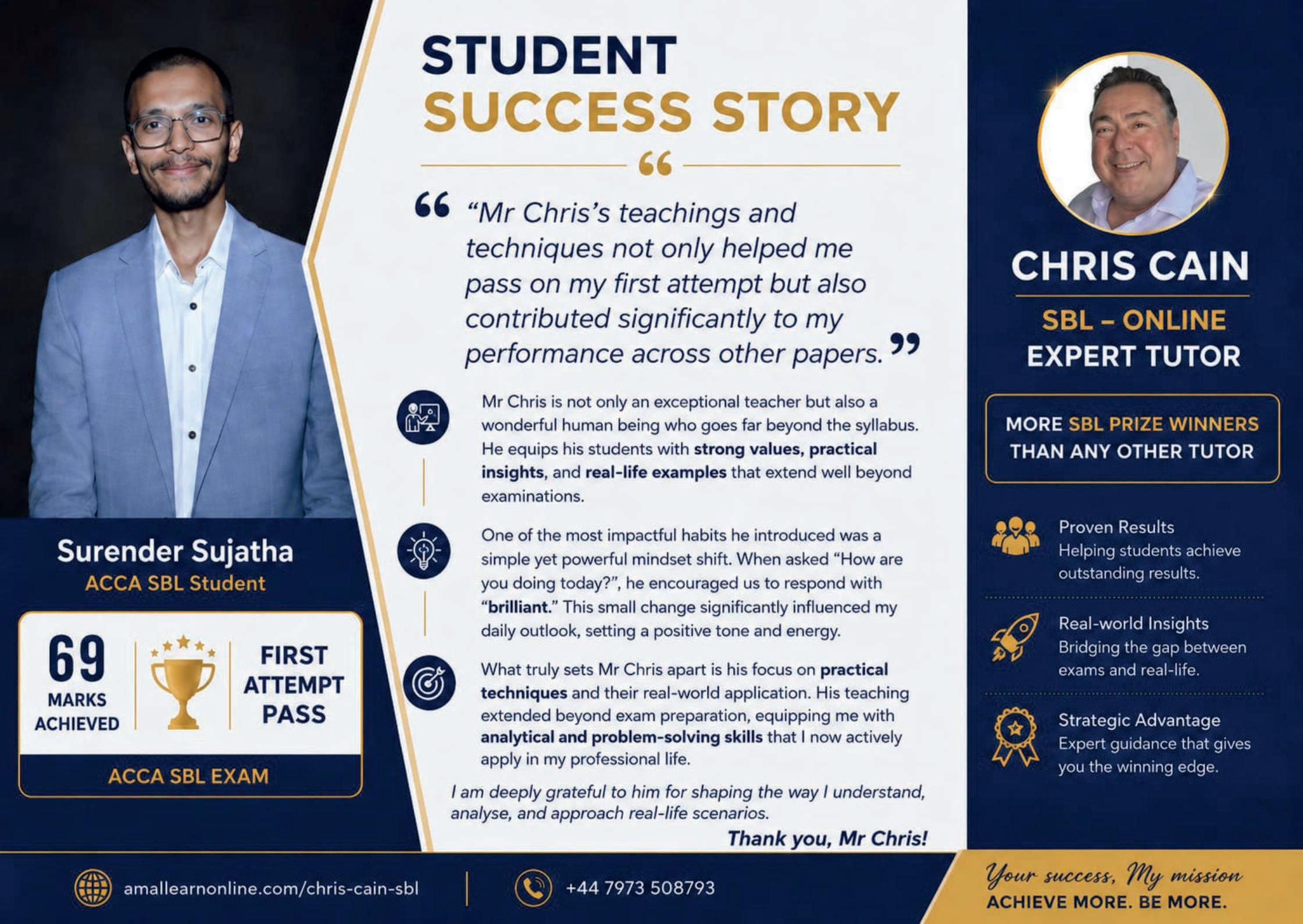
Chris Cain explains how to use ‘SRriIC’ to collect both technical and professional skills marks in the SBL exam
Ilove helping ACCA students pass SBL. I do this partly by creating processes that students learn, practice and then apply in exams. This article introduces one of the most powerful processes I have created, and it is easy to memorise and apply – I call it ‘SRriIC’.
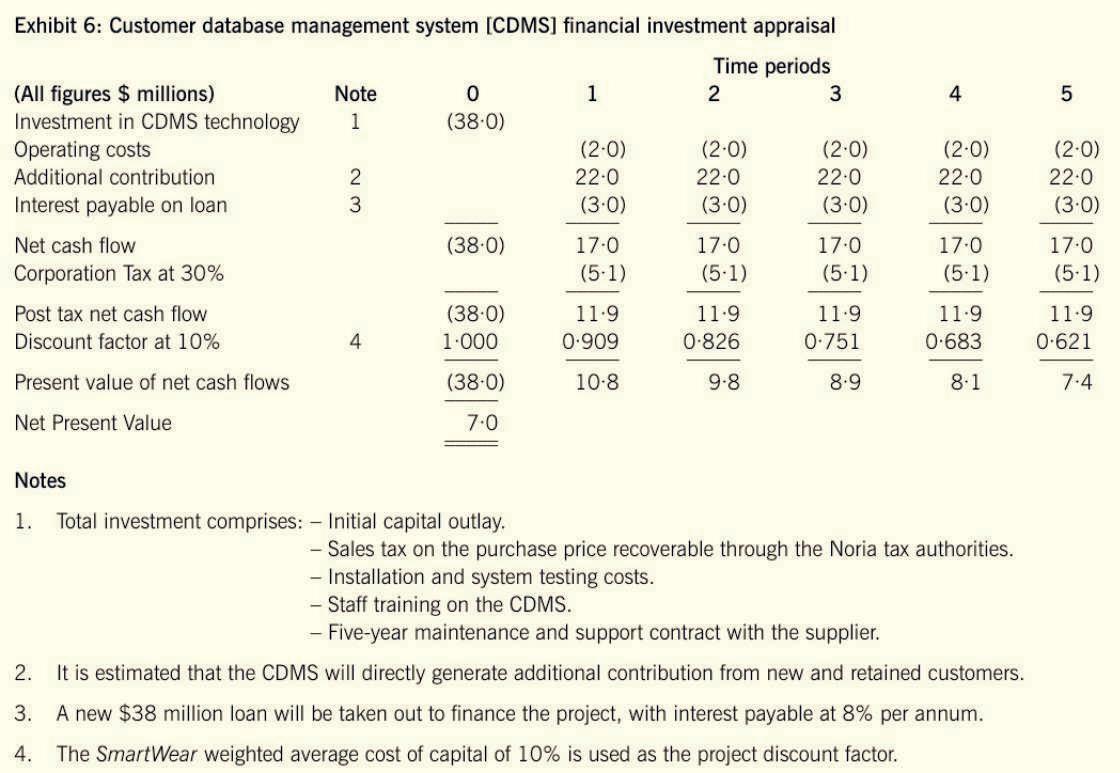
In SBL, students must be prepared to evaluate an NPV analysis which, based on examiners’ comments, appears to be a major weakness for many students. There are a possible number of reasons for this, but I will focus on how ‘SRriIC’ supports the process of answer planning sentences.
In this article I will show how ‘SRriIC’ can be applied to a part of Task 4(b), from the SBL March 2019 SmartWear exam, to collect both technical marks and professional skills marks simultaneously.
The SmartWear question can be found within ACCA’s Strategic Business Leader past exam resources, together with the examiner’s answer.
Task 4(b) required candidates to evaluate the marketing department’s NPV analysis (Exhibit 6) of a proposed investment in a customer database management system (CDMS). Students were also requested to question any underlying assumptions made by the marketing department in producing the NPV analysis. Although this task was only allocated 10 technical marks, it was very challenging for those who did not have a flexible structured approach towards undertaking an analysis and/ or evaluation.
The proposed investment generated a positive NPV of $7 million. At first sight this appears attractive. However, strategic business leaders do not simply accept forecasts – they challenge them.
What is SRriIC?
The letters: S – Statement
R – Reason (justification)
r – result in i – impact on
I – implication(s) for C – consequence(s) of
The SR is where students give an opening statement followed by a reason/justification.
The r and i link with the process of undertaking an analysis (convergent thinking).
The I and C are linked with the process of developing an evaluation (divergent thinking).
Please not: I do not advocate the application of every letter r, i, I and C when producing an answer on a single point (see below).
The Additional Contribution Calculation
The ‘Additional Contribution’ is given as a constant value of $22 million for five years.
The ‘SRriIC’ process could applied to structure planning as follows:
The Statement: “Additional contribution is unlikely to remain unchanged throughout the five years at $22 million.”
The Reason: “Because SmartWear’s forecast sales profile should be assumed by the marketing department to rise each year. This is fundamental to the justification of the CDMS investment”.
Applying the r and i: “This is highly likely to result in inaccurate revenue forecasts and negatively impacting the reliability of the NPV calculation for the CDMS investment proposal.”
Applying the I and C separately: “One implication for the marketing department is to formally involve the finance team as a ‘business partner’ when undertaking an investment project proposal to ensure a commercially sound NPV analysis and the avoidance of errors.
“A possible consequence could be the reduction in shareholders’ value, rather than an increase as suggested by the current positive NPV of $7.0 million because of the wrong underlying assumptions being made by the marketing department.”
NOTE: Both the I letter and C letter do not have to be applied in the same discussion point on ‘additional contribution’ because the examiners will be looking for other elements in the NPV analysis to be discussed for 10 marks, such the omission of working capital in the NPV analysis?
The examiner’s answer identified several other assumptions that candidates should challenge, including constant operating costs despite inflation, the inclusion of interest within project cash flows, omission of potential tax allowances and the treatment of maintenance costs.
Do not assume that ‘SRriIC’ is purely a process for undertaking an analysis and evaluation. It also provides a critical thinking tool and creative thinking tool. This assists with the generation of ideas and, therefore, additional discussion points.
The Statement and Reason parts of the process help identify and explain technical issues. Consequently, students collect technical marks.
The Implications and Consequences parts in the process help demonstrate good communication, commercial acumen as well as evaluation. Consequently, students more easily collect professional skills marks.
This is particularly valuable in SBL because professional skills marks account for 20%. In addition, clearly demonstrating professional skills throughout the exam can result in technical marks being rewarded.
I hope this brief insight into ‘SRriIC’ helps you in your studying of SBL and any forthcoming examination.
• Chris Cain, the creator of ‘SRriIC’, advises students on internship and volunteering experience as part of the ACCA Professional Experience Requirements (PER)
Meet Tom Clendon
‘My passion is to help ACCA students pass their SBR exam, but you may not know that I was an ACCA student once. I know the pressures of juggling work, life and study. When I left school I went straight into the workplace. But, aged 22, I married Jenny and that made me realise I needed a career and a profession, not just a school leaver’s job.
So, with no exemptions and minimal support from my employers, I studied for ACCA. It was not easy, but it was worth it. Becoming an ACCA member changed my life.
It has enabled me to earn a living to provide for my family, live and work abroad, change my career from being in practice to education and, eight years ago, start my own online business.
I am now a wholly independent ACCA SBR online lecturer, offering platinum courses (tuition and revision) and stand-alone revision courses to individuals who choose to study with me. I am passionate about breaking it down, keeping it simple and getting students over the line. Marking is dear to my heart.
I share my knowledge by being active on LinkedIn and being a podcaster and YouTuber. Over the years I have worked closely with ACCA to support the qualification. I have won three PQ awards – one for my podcast, one for Lecturer of the Year, and one as part of the Online College of the Year!’
If you want help passing the ACCA SBR exam, check out my socials or WhatsApp me.
Message Tom on +44 7725 350793
See www.tomclendon.co.uk
And there’s more on Tom’s YouTube channel
Don’t divide by six!
Use decimals when answering a question on VAT and you will never go wrong, says Sarah Wilson
During your studies VAT is something that comes up regularly — and it’s an area where many students rely on shortcuts rather than understanding the process. You may have heard ‘divide by six’. This approach can work, but only in very specific situations.
The challenge is that this shortcut is often learned early on and then carried forward without much thought. In the exam, however, questions are rarely designed to reward memorization alone. Instead, they test whether you understand why a calculation works — and whether you can adapt when something looks slightly unfamiliar.
In this article we go back to basics and look at a more reliable, flexible method: using decimals. This approach will work regardless of the VAT rate and will help you feel more confident in both exams and real-world scenarios.
Shortcuts can catch you out
The commonly used ‘divide by six’ rule works when VAT is 20%, because the gross figure represents 120% of the net. However, this is a coincidence of the rate, not a method you can rely on universally.
A common exam mistake is to jump straight into a familiar shortcut without properly reading the question. If the VAT rate is anything other than 20%, or if the question is structured slightly differently (for example, asking for the net rather than the VAT), this approach can quickly lead to errors.
If the VAT rate changes the shortcut no longer works. This has already happened in the UK, for example during Covid-19, when rates were temporarily reduced to help businesses recover. In an exam, relying on memorized rules can lead to mistakes if the question is presented slightly differently.
The decimal method
The key principle is to convert the VAT rate into a decimal before doing any calculations:
20% = 0.20
10% = 0.10
5% = 0.05
Once you have done this, the process becomes logical and consistent.
Task Method Example
Add VAT (Net → Gross)
Remove VAT (Gross → Net)
Multiply by (1 + VAT rate)
Divide by (1 + VAT rate)
£325 × 1.20 = £390
£390 ÷ 1.20 = £325
The ‘1.’ in the decimal is the net value, then the VAT % is the figure after the decimal point (e.g. 0.2) and altogether it represents the gross amount (e.g. 1.2)
This method is particularly useful in an exam setting because it gives you a clear starting point. Rather than trying to remember which shortcut applies, you can apply the same structured approach every time.
Worked example
A business sells three items with standard rate
VAT (20%):
Item A: £245 (net)
Item B: £380 (net)
Item C: £125 (net)
To calculate the gross amounts we multiply each by 1.20:
Item A: £245 × 1.20 = £294
Item B: £380 × 1.20 = £456
Item C: £125 × 1.20 = £150
This shows how using decimals allows you to apply the same method consistently.
When the rate changes
Imagine the VAT rate reduces to 10%.
A customer receives an invoice for £462 (gross). To find the net amount divide by 1.10:
£462 ÷ 1.10 = £420
VAT = £462 − £420 = £42
If you attempted to use a shortcut such as dividing by 6, you would get an incorrect answer.
Reduced rate example (5%)
In the UK, some goods use a reduced VAT rate of 5%.
If the gross price is £378, we divide by 1.05: £378 ÷ 1.05 = £360
VAT = £18
Again, the same method applies – only the decimal changes.
Now
have a go
A business has issued the following invoices (all gross figures):
A: £558 at 20%
B: £693 at 10%
C: £472.50 at 5%
Calculate the net amount and VAT for each.
Answers
Customer Working
A £558 ÷ 1.20 = £465 Net
VAT = £558 - £465 = £93
B £693 ÷ 1.10 = £630 Net
VAT = £693 - £630 = £63
C £472.50 ÷ 1.05 = £450 Net
VAT = £472.50 - £450 = £22.50
Final thought
Using decimals means you are applying a method you understand, rather than relying on memorized shortcuts. It is flexible, reliable, and will always work — no matter what VAT rate you are given.
More importantly, it allows you to approach exam questions with confidence. Instead of second-guessing which rule to use, you can focus on the logic of the calculation — and that is exactly what examiners are looking for.
• Sarah Wilson is a learning content creator and AAT tutor at Accountancy Learning
A question for Tom
Tom Clendon explains how to calculate NCI as a proportion of net assets and goodwill
The question
Could you clarify why when NCI is measured as a proportion of net assets that the goodwill arising is only attributable to the parent company. I know this is true, but I just don’t quite understand why. Please explain!
Tom’s answer
Let me just reiterate that it is true that when NCI is measured as a proportion of net assets that the goodwill arising is only attributable to the parent company. The significance of this means that the impairment loss on the goodwill will only reduce group retained earnings and none will be charge to the NCI. It also means when we are dealing with group exchange differences on the retranslation of such goodwill there will also be no impact for NCI.
Illustration
Let me illustrate with numbers to prove the point.
Let’s take an 80% investment in a subsidiary that cost $200m and where NCI was measured as
The
However, please consider the alternative explanation of how that $120 goodwill has arisen.
The parent has paid $200m for the controlling interest in the subsidiary. It has paid $200m for an 80% stake in the $100m net assets of the subsidiary. So the parent has paid $200m and in return has only got a share of net assets of $80m (80% x $200).
So when you compare what the parent paid ($200m) with what the parent got ($80) we see that the premium that it has paid is $120m. This goodwill therefore just belongs to the parent (read that again – it should make sense).
Final thought
I give you this explanation to give you absolute certainty that when NCI is measured as a proportion of net assets, the goodwill is attributable to the parent only.
It still remains the case that where NCI is measured at fair value then the goodwill arising will be in full and so any impairment loss or exchange difference will impact the NCI accordingly.
You must always calculate goodwill the proper way to show the introduction of NCI however it is measured.
• Tom Clendon is an online lecturer teaching SBR. He loves WhatsApp and can be messaged on +44 7725 350 793. See www.tomclendon.co.uk
Talent trends 2026: does your role drive change?
The fourth edition of the largest annual talent survey of accountants has just been published – and it dismantles the stereotype of the numbers-focused accountant, writes ACCA’s Jamie Lyon
More than 2,000 UK finance professionals say that purpose, not pay, is a defining factor in how they make career decisions, choose employers and measure their own success. More than 11,000 finance professionals across 160 countries participated in the research, on issues including career ambition, sustainability, intergenerational collaboration and workplace wellbeing.
The findings from ACCA’s annual Global talent trends survey reveal that 54% of UK finance professionals want roles that make a difference to social impact, while 47% want their work to contribute to addressing the environmental and climate challenge.
Crucially, many are already there: one in three say their current role is helping their employer address environmental and climate issues, and 39% say they are actively contributing to social impact work.
The shift reflects a fundamental change in how UK finance professionals understand their value and their potential. Where accountants were once primarily scorekeepers of business performance, they are increasingly being asked to help organisations define what performance means: balancing profitability with ethics, environmental responsibility and social value.
That evolution is particularly pronounced among younger professionals. Two-thirds (63%) say an employer’s reputation on social and human rights is a key factor in where they choose to work. For the next generation of finance talent, purpose is not a nice-to-have. It is a baseline expectation.
The implications for employers are significant. With 49% of respondents expecting their next career move to take them outside their current workplace, and 48% dissatisfied with their current level of pay, organisations that cannot offer meaningful work alongside competitive pay face a compounding retention problem.
Other interesting UK report findings:
• Changing demographics mean there could be up to six generations in the finance workforce – but a third say current cross-generational collaboration is a challenge. Some 62% of baby boomers (aged 62+) want the value of older employees recognised more.
• Entrepreneurial ambitions show a generational divide as these aspirations burn brightest for Gen Z (aged 18-27) at 50%. A gender divide is also evident, with male respondents’ ambitions (43%) outpacing those of females’ (32%).
• Some 48% say they’re dissatisfied with their current compensation as cost-of-living concerns continue to exert wage pressures. Despite easing inflation levels, fewer employees are satisfied with their pay.
• Some 69% have concerns about the use of AI algorithms in hiring processes – with Gen Z being the least concerned (60%). Interestingly, gender differences are more pronounced with women (72%) being more worried about the use of AI in recruitment than men (62%).
• And 47% say their mental health suffers due to work pressures causing mental health progress to flatline this year.
• Gen Z lead the return-to-office momentum (67%), with younger employees seeing office presence as a pathway to progression. But there is no appetite for a return to office full time. Hybrid working arrangements remain the preference of most (65%).
• The talent flight-risk is reduced; 49% expect their next career move to be outside their current organisation, perhaps reflecting a more difficult labour market.
Discover more in the full report on ACCA’s website.
• Jamie Lyon, Global Head of Skills, Sectors & Technology at ACCA
Glenn Collins, Head of Technical and Strategic Engagement at ACCA UK: “What this survey tells us is that finance professionals in the UK are no longer willing to separate their technical expertise from the broader impact of their work. The opportunity for employers is to harness that and to position their finance function not just as a reporting engine, but as a driver of social value.”
FRC sanctions Carillion accountants
Five Carillion accountants have received severe reprimands and fines for their misconduct over the downfall of the multinational firm
The Financial Reporting Council (FRC) has imposed sanctions against two former Group Finance Directors of Carillion plc. Both were found to have acted recklessly and failed to act with integrity in connection with the preparation of accounting information for Carillion’s financial statements prior to the company’s collapse in 2018.
Former Group Finance Director Richard Adam, and his successor in that role (and previously Carillion’s Financial Controller), Zafar Khan, have accepted their misconduct in respect of several areas of Carillion’s business. This includes certain specific transactions, major UK construction contracts and a supply chain finance facility that were each material to the company’s reported financial performance in one or more financial years between 2013 and 2016 inclusive, and the half year to 2017.
The FRC’s Executive Counsel has also imposed sanctions on three other former Carillion senior accountants.
Sanctions in full
The following sanctions were imposed as part of the agreed settlements:
• Richard Adam has been excluded from the
ICAEW for a recommended period of 15 years and issued with a severe reprimand. A financial sanction of £550,000, reduced to £222,019, was also imposed to take into account a fine of £232,830 imposed by the FCA in respect of related events, and a settlement discount.
• Zafar Khan has been excluded from the ICAEW for a recommended period of 10 years, and also issued with a severe reprimand. A financial sanction of £225,000 was reduced to £60,228 to take into account a fine of £138,960 imposed by the FCA in respect of related events, and a settlement discount.
The three unnamed accountants received exclusions from their recognised supervisory bodies of eight, five and two years, along with fines of between £26,000 and £45,500 after
settlement discounts, and severe reprimands. The terms of the settlements agreed by the Executive Counsel were approved by a member of the independent Tribunal Panel.
Background
Prior to going into liquidation in January 2018, Carillion was a leading UK-based multinational construction and facilities management services company. It employed around 43,000 people globally, was listed on the main market of the London Stock Exchange and had multiple contracts with public authorities.
In July 2017, Carillion issued a profit warning and announced an expected provision against its construction contracts of around £845 million. In September 2017, Carillion announced a further provision of approximately £200 million and a first half loss of around £1.15 billion.
In November 2017, Carillion issued another profit warning and indicated that it would breach its banking covenants the following month. On 15 January 2018, Carillion was placed into compulsory liquidation. Its failure amounted to one of the biggest corporate failures in UK history.
Why audit matters
Marc Rosato explains why all accounting students should study audit diligently – even if they don’t plan on becoming an auditor
Have you ever sat down to revise an audit module and thought: “I’m not planning to become an auditor, so why do I need to know this?”
It’s a fair reaction. Most CIPFA students go on to work in finance teams rather than audit teams.
But after a recent CIPFA session on audit readiness, I found myself thinking back to my own time as a student and how differently some of these ideas land once you see them in practice.
When audit becomes real
The session focused on what organisations actually struggle with when preparing for audit, and the issues unearthed were rarely about accounting standards or technical judgements. More often, they came down to working papers and the quality of audit evidence.
Most finance professionals can recognise a good working paper. The challenge is producing them consistently, particularly when time is limited and pressure is coming from other directions. That gap between knowing what good looks like and producing it under real conditions
is often where things start to slip.
Why working papers?
Working papers are often thought of as something produced for audit. In practice, they do a quieter but broader job. They explain how figures have been built up, capture the reasoning behind decisions and allow someone else to follow the logic without needing extra context.
When they are well prepared they make processes easier to follow. When they are not the gaps tend to show up later in the audit process.
Different perspectives
One of the more interesting parts of the session was the range of responses.
Some people felt the material matched what they already do. Others said it brought attention to areas they had not previously thought about in much detail. That difference is not unusual. In some organisations, audit cycles have been delayed or occurred less frequently than in the past, which means fewer opportunities to build familiarity with the rhythm of audit work.
Over time, that can affect confidence in what ‘good’ looks like in practice.
What is manageable?
Another point that came through was the difference between understanding expectations and being able to meet them consistently.
Most people are aware of what good documentation looks like. The difficulty is finding the time and space to do it properly when other pressures are competing for attention.
Better working papers, clearer audit trails and stronger internal review processes are all relatively straightforward in principle. In practice, they rely on capacity that is not always available.
Audit readiness also depends on what happens outside the finance team. Finance can only work with the information it receives. If that information is incomplete, inconsistent or difficult to access, it limits how far good practice can go.
So while finance teams carry a lot of responsibility for audit preparation, they are also dependent on how information flows across the wider organisation.
Why this still matters
For students, audit can feel distant from dayto-day career plans, especially if you do not see yourself working in assurance. But many of the habits it encourages – clear documentation, structured thinking and attention to evidence –carry through into most areas of finance.
Most students will not become auditors. Most will, however, work with them at some point.
A final thought
Understanding what auditors are looking for, and why certain questions come up, tends to make those interactions smoother.
It also has a habit of improving the quality of work long before an audit ever begins. That alone makes it worth taking seriously while you are studying.
• Marc Rosato, Public Finance Standards Advisor, CIPFA
Tackling the scourge of late payments
Late payment is not simply a bad business habit – it’s a systemic issue embedded in supply chains across the economy. Jonathan Barber shares how PQs can help tackle this issue
SMEs have effectively been acting as involuntary lenders to larger businesses. Extended payment terms, some stretching beyond 90 days, have become normalised in certain sectors. The result? A power imbalance from those best able to bear it to those least equipped to manage it. SMEs frequently accept unfavourable terms because they fear losing contracts, while many are reluctant to chase overdue
invoices aggressively, if at all, or apply statutory interest at the risk of damaging commercial relationships. As a result, late payments become expected, tolerated and, ultimately, embedded.
The consequences are significant, as cashflow uncertainty limits SMEs’ ability to invest and grow. Time that should be spent developing the business is overshadowed by chasing payments. In the most severe cases,
profitable businesses can fail simply because they are not paid on time.
At the IFA, it’s our view that previous attempts to address the issue have fallen short because they rely too heavily on voluntary compliance. Initiatives like prompt payment codes and reporting requirements have improved transparency but not shifted behaviour at scale.
The UK government’s 2026 reforms are significant not just for what they introduce, but because they acknowledge late payments as a structural problem requiring structural intervention.
The introduction of a mandatory 60-day cap on payment terms directly challenges the normalisation of extended terms, as does making statutory interest on late payments compulsory. The introduction of strict timelines for disputing invoices, combined with enhanced enforcement powers for the Small Business Commissioner, signals a move away from a culture of encouragement towards one of accountability.
However, SMEs will still need to manage cashflow risk, enforce their rights, and adapt to changing customer behaviours. As such, PQ accountants play a central role in:
• Moving clients from reactive to proactive credit management, establishing clear invoicing disciplines, payment monitoring, and ensuring follow-up processes are consistent.
• Helping SMEs model the impact of delayed payments and build resilience through better working capital management.
• Supporting businesses in updating contracts and terms to ensure they are compliant and fully benefit from new protections.
• Providing commercial insight, advising on customer risk, payment behaviour, and whether some trading relationships are viable under new enforcement conditions.
While these reforms represent a meaningful attempt to reset the imbalance, legislation alone will not change the systemic issue overnight. The combination of stronger rules and stronger financial management is what will tip the scales, and PQs play a key role in delivering both.
• Jonathan Barber, Executive Director – UK at the Institute of Financial Accountants (IFA)
Nasheen Wuisman has some advice on how to approach the structure and format of a case study answer
ÒHow do I approach the structure and format of a case study answer?” This is a common student query our 1-2-1 support team has been hearing recently.
Our students are following guidance from a variety of resources, including tuition providers – all of which makes perfect sense. But when they put pen to paper the reality often ends up looking different.
Answers can feel long-winded, possibly off on a tangent, with candidates writing too much or not enough. Should you write in paragraphs or in bullet points? What about the tone? And then there’s the theory – does the examiner want a ‘brain dump’? How much theory is enough? Let’s start by standing back and looking at what case study examiners are looking for.
CIMA’s CGMA case study exams test students’
ability to apply syllabus material to practical situations, identifying the issues to a business problem and developing a response that meets the requirement, communicated in a plausible manner. This mirrors the expectation placed on a finance professional responding to a manager’s request in the workplace. The response needs to be sufficiently detailed to provide an adequate explanation of what was required.
Demonstrate your skills
Structure is the framework of your explanation; it’s your answer plot. Without it your answer can lose meaning, flow and clarity and you risk contradicting yourself or lacking cohesion. The following will help achieve a sound structure to your answer:
• Identify the issue(s): This is the core to the
task. It could be an event, a choice that needs to be made, or a risk faced. This is the crux of what is being asked and the foundation of your answer.
• Answer the question: Carefully read and interpret the question to ensure you address the requirement. There are often multiple elements. Examiner reports frequently note that some students failed to answer the question set. Make some brief notes whilst reading the requirement, as this will help ensure that you identify each area to cover. This is a skill that improves with practice prior to sitting your exam.
• Plan your answer: Time pressure can tempt you to start writing a detailed answer immediately, but this can lead to a variety of problems. Spending a few minutes planning, before starting to write your answer, can go a long way. Allocating time for each task and sub-tasks, jotting possible headings, noting relevant theory, writing down brief discussion ideas, linking these intentions to the pre-seen, are all part of planning. This is a key step to enable you to prepare to write your answer, so keep planning time to minimal – but always remember how crucial this stage is.
Format is how your answer plot will be presented to the examiner. Your communication must be relevant, applied to the scenario and supported by a sensible argument.
• How much should you write? Very short answers often lack sufficient content and have too few relevant points to score well. Equally, overly long answers that ramble and fail to address the requirements tend to score badly. Some students pick up on a key word and write everything they know, regardless of relevance – this does not earn credit. Referencing the pre-seen and unseen materials appropriately can demonstrate understanding and commercial awareness and will gain marks where relevant. Blindly copying chunks of text from the pre-seen or unseen materials will not earn credit.
• Stick to the point: Pay attention to how you are communicating and use the right language for your stated audience. Avoid including non-markearning material such as long introductory or concluding paragraphs.
• Headings: When planning your answer, you will have identified key words from the requirements that you needed to address. Use these as your headings to improve clarity, help you to keep track of how much of the requirement you have addressed, and give you a better chance of being awarded marks.
• Paragraphs and bullet points: Keep paragraphs short – three to four relevant sentences focused on a single idea is easier to follow and to mark. Don’t use bullet points unless you are listing per the requirement or if you are running out of time.
• Tone: Use the format suggested in the requirement to maintain a professional tone throughout.
• Conclusion: Ending with a short, justified conclusion strengthens your answer and helps demonstrate your decision-making skills –something examiners value.
• Nasheen Wuisman, Senior Manager – Global Academic Progression, CIMA
How to calculate mark-up and margins
Karen Groves explains how to approach mark-up and margin questions and tests your knowledge on the subject
One method that can be used to reconstruct missing figures is to use mark-up and margins. A business will typically set the selling prices by using either:
• A profit margin where a percentage profit is used on the net selling price, so a percentage of the sales figure; or
• A mark-up where a percentage profit is added to the net original cost of the item to reach the sales price.
VAT is ignored in the calculations if you are a VAT registered business. Once you have calculated your mark-up or profit margin selling price, this will then be subject to VAT as appropriate.
Mark-up example
A garden furniture retailer uses a 25% mark-up on cost to set the selling price. The cost of the goods being sold is £200, so we calculate the actual selling price as follows using percentages known as the cost structure:
Sales 125 (cost figure + 25% mark-up)
Cost of goods 100 (this is 100% being the cost figure)
Gross Profit 25
We know that the cost is £200, so:
If the £200 is equivalent to 100%, the sales of 125% will be: £200 x 125 = £250.00
If you are given the sales figure of £250, equal to 125%, the cost can be calculated as follows:
£250 x 100 = £200
Profit margin example
A sportswear retailer operates with a 30% profit margin. Sales this week are £10,000, so we set up the cost structure. However, this time the sales figure is 100%:
Sales 100
Cost of goods70(cost must be 70% if sales are 100%)
Gross Profit 30
We know that the sales figure is £10,000.
As sales are £10,000, the cost is calculated as follows:
£10,000 x 70 = £7,000
of goods
Gross Profit
If you were given the cost of sales figure of £7,000, you can calculate the sales figure as follows:
£7,000 x 100 = £10,000
Both mark-ups and margins can be used in incomplete records assessment questions to help find missing sales or cost of goods figures.
Example
KSA Manufacturing has a gross profit margin of 30%. We have been provided with the following information:
Purchases = £20,000
Opening inventory = £3,000
Closing inventory = £4,000
We now need to calculate the sales for the period: Cost structure
The sales figure can now be calculated:
£19,000 x 100 = £27,143
Once you have your sales figure and know how to put together the cost structure, you can then find the total for cost of goods sold, and other missing figures such as purchases or inventory.
Now have a go
1 The sales for a toy store were £20,000 for the month and the business operates a 25% mark-up on cost policy.
What will the cost of goods sold be?
• £20,000
• £25,000
• £16,000
2 The cost of goods sold for a clothing store was £15,000 for the month, and the business operates a 40% profit margin.
What will the sales for the week be?
• £21,000
• £15,000
• £25,000
Answers
1. £16,000
2. £25,000
• Karen Groves is an AAT tutor and AAT Faculty Director at e-Careers
ESG and the accountant
Rachel Spence explains why you need to
care about
ESG
ESG reporting focuses on three critical business areas: environmental, social and governance. It provides a framework for businesses to communicate their sustainability efforts, ethical standards and long-term strategies to stakeholders. As consumers, particularly Gen Z, become more environmentally conscious, the importance of ESG reporting is rapidly growing in today’s business environment.
Environmentally, businesses can reduce their carbon footprint with simple actions, such as ensuring that computers are switched off at the end of the day to improve energy efficiency. Events like Accountex are adopting sustainability practices, such as planting a tree for every attendee, despite the profession’s continued reliance on paper in many offices. Socially, companies are encouraging employees to take paid time off to volunteer, which benefits the community and enhances employee skills in the long run. Governance is about operating with integrity, transparency, and compliance –principles that drive long-term business success. Together, these ESG factors are crucial to an organisation’s long-term sustainability.
While ESG is vital for business owners, why does it matter for accountants? The role of the traditional accountant is evolving. It’s no longer just about numbers – it’s about guiding businesses towards sustainability, social responsibility and strong governance. Accountants are essential in measuring and reporting ESG-related costs and benefits, aligning them with broader financial goals. We must also ensure businesses comply with stricter ESG regulations, particularly those related to environmental impact and governance. This responsibility is critical, as investors rely on us to provide accurate and reliable reports.
Fulfilling responsibilities
How do accountants fulfil these responsibilities? The first step is to gather reliable data on energy consumption, carbon emissions and community investments. This data must withstand scrutiny from stakeholders, including investors and regulators. But data collection is just the beginning. We must also analyse the data to assess long-term benefits, especially when the initial costs are high. For instance, when calculating the return on investment
for switching to energy-efficient lighting, we balance upfront costs with long-term savings. Additionally, accountants often act as advisors, helping management set, track and achieve ESG goals while ensuring compliance.
However, ESG reporting presents challenges. Accurate and consistent data is essential, but obtaining it can be difficult when different departments use varying systems, leading to fragmented data, especially in social metrics. The complexity of ESG reporting standards adds another challenge. ESG frameworks are less standardised compared with traditional financial reporting and are constantly evolving. Furthermore, businesses face significant costs related to ESG implementation, including staff training, equipment and (sometimes) consultant fees. Ongoing maintenance costs and opportunity costs also factor into the equation.
As ESG practices become more integrated into business operations, the demand for accountants with expertise in ESG reporting continues to rise. Accountants familiar with frameworks like the Global Reporting Initiative (GRI) or the Task Force on Climate-related
Financial Disclosures (TCFD) are in high demand. This shift provides accountants with an opportunity for professional growth and allows them to become leaders in driving businesses toward a more sustainable future.
The future of accounting is evolving. ESG competencies are no longer optional: they are essential. Accountants must be equipped with the skills and knowledge to navigate the complexities of ESG reporting. By embracing these responsibilities we can position ourselves as forward-thinking professionals, ready to lead businesses that are not only financially successful but also environmentally responsible and socially accountable.
In conclusion, ESG reporting is reshaping accounting. As accountants continue to play a central role in shaping sustainable business practices they help build a more ethical, transparent and responsible economy. By understanding ESG principles and reporting, trainee accountants can prepare themselves for success in this evolving field, positioning themselves to tackle the challenges and seize the opportunities ahead.
• Rachel Spence, MAAT
Time for action
AAT’s Filling the Gap report confirms what we already knew – now it’s time to act, writes Angela Renshaw (pictured)
When the AAT published the final part of its ‘Filling the Gap’ research I read it in one sitting. Not because the findings surprised me, but because seeing it all in one place, backed by rigorous economic modelling from Public First, was quietly powerful.
I’ve spent the past two decades in accountancy training, and the report reflects something I see every day: demand outpacing supply, employers struggling to recruit qualified staff, and too many potential learners unaware of the routes available to them.
The
numbers that matter
Some 83% of AAT members from lower socioeconomic backgrounds say AAT helped open doors in their career. Nearly half of the finance workforce comes from those same backgrounds yet they progress 25% more slowly than peers with equivalent performance and experience. That gap isn’t about ability. It’s about access.
The earnings data reinforces this. AAT learners aged 19 to 24 earn 11% more than their peers nationally. Those who progress from GCSE-level through to AAT earn 21% more than the national median for that group. A level 4 qualification carries an earnings uplift
of £1,400 a year compared to Level 3. These are not marginal gains, they represent genuine shifts in life chances.
Flexible delivery
The report calls on the Government to ensure that post-16 funding supports flexible delivery models, including remote learning, to improve accessibility for all types of learners. At Premier Training, we don’t run cohorts or ask learners to wait for a term to start. Our tutors know their students by name, our marking turnaround is 48 hours, and we pick up the phone. Those might sound like operational details, but in practice they are what keeps a learner moving forward when confidence dips or life gets in the way.
Case for apprenticeships
Some 74% of AAT apprentices report a salary increase in the year after completion. Progression rates into accounting roles from AAT apprenticeships stand at 87%, which is the second highest of any apprenticeship pathway in the UK. The return on investment for employers is documented in outcomes that can be tracked, measured, and repeated.
I contribute to the quality of AAT assessment materials and apprenticeship standards as an
Independent Assessor and External Quality Assurer, which gives me a clear view of what ‘good’ looks like at national level. When apprenticeships are designed and delivered properly, they are rigorous, relevant, and transformative. At Premier Training, employers are active partners in shaping outcomes, not passive participants. The strength of the model is not just in the qualification achieved at the end, but in the capability built along the way.
AI: what’s next?
The report addresses AI with refreshing clarity. Modelling suggests productivity gains driven by AI could add £8 billion in GVA to the UK’s accounting and bookkeeping sector but only if the workforce is equipped to adapt. Two in five people say they would consider a career in accountancy if AI removed routine administrative tasks. I don’t see that as a threat to the profession. I see it as a signal of opportunity.
If you’re an employer, the talent you’re struggling to find may already be in your organisation. An apprenticeship is one of the most cost-effective ways to develop it. If you’re considering whether to study the evidence is clear: the earnings returns and career progression is real, and the idea that you needed to have taken a different path at 18 is simply no longer true.
The AAT’s ‘Accounting for Growth’ report is one of the clearest pieces of evidence I have seen that vocational training in accountancy works, not only for individuals but for employers and the wider economy. What it needs now is not more proof but more action. That’s why forward-thinking employers are investing in their finance teams now, because the businesses that emerge strongest from this shift will be the ones whose people are qualified, adaptable and ready.
For more information on Premier Training’s apprenticeship provision and support click here
• Angela Renshaw is Director of Apprenticeships at Premier Training, an AAT External Quality Assurer and author of AAT assessment and teaching materials
How’s it working out?
Deloitte’s annual survey of Gen Z and millennials finds young accountants want more than just a fast-paced career
As Gen Zs and millennials move deeper into adulthood and leadership they are reshaping how progress at work is defined, often prioritising stability, skills and well-being before advancement, according to Deloitte’s 2026 Global Gen Z and Millennial Survey.
Now in its 15th year, the research draws on responses from more than 22,500 Gen Zs and millennials across 44 countries, alongside qualitative insights from business leaders.
Financial pressures
For the fifth consecutive year, cost of living is the top concern for both generations, far outpacing other societal concerns. Financial pressure is driving the ‘maybe later’ trend for these generations; while they are ambitious, their financial reality has altered timelines for major milestones.
More than half of Gen Zs (55%) and millennials (52%) say they have delayed major life decisions, such as starting a family, furthering their education or launching a business, due to their financial situation.
Some 69% of Gen Z and 64% of millennials say that the availability or affordability of housing has a direct impact on their career
decisions and where they can work.
Despite these pressures financial optimism persists, and 53% of Gen Zs and 45% of millennials expect their personal financial situation to improve within the next year.
Sustainable leadership is key
Interest in leadership is widespread but not urgent. Consistent with last year’s findings, only 6% of Gen Zs and millennials say achieving a leadership position is their primary career goal. The hesitation is driven by concerns about the trade-offs being in a leadership role may present.
Most Gen Zs and millennials favour steady progress (44% of Gen Zs and 45% of millennials) over rapid promotions (25%/21%), with some even willing to move laterally or take a step back to find the right role (21%/20%).
The most commonly cited barriers to leadership are stress and burnout (50% of Gen Zs and 49% of millennials), excessive responsibility (50%/48%), and concerns about work/life balance (41%/46%).
Three-quarters of Gen Zs (76%) and twothirds of millennials (67%) say they are interested in pursuing senior leadership roles at some point in their careers.
AI adoption moving fast
Nearly three-quarters of Gen Zs and millennials (74%) report using AI in their day-to-day work, up sharply from last year (57% of Gen Zs and 56% of millennials). While AI is widely viewed as an accelerant, helping improve efficiency, output quality and work/life balance, some believe organisations are struggling to keep pace. And respondents are facing digital fatigue, exacerbated by an influx of digital tools that are often poorly integrated with legacy systems and workflows.
Beyond advancing efficiency and work quality, these generations are using AI to identify learning and development opportunities (79% of both generations), seek career advice (72% of Gen Zs and 69% of millennials), and cope with work-related stress (67%/65%).
And Gen Zs and millennials feel they are adapting faster than their employers, as nearly one-third believe their organisation is not prepared for the changes AI will bring (30% of Gen Zs and 31% of millennials), and another one-third say the AI tools available to them at work are only somewhat or not at all sufficient (33%/32%).
However, more than half of respondents (58% of Gen Zs and 54% of millennials) report experiencing digital fatigue from constant alerts, tool switching, and multiple platforms.
Losing knowledge
As baby boomers retire, organisations face mounting pressure to preserve institutional knowledge, all while preparing for the arrival of Gen Alphas, who are expected to enter the workforce in significant numbers by the end of the decade.
Only 54% of Gen Zs and 60% of millennials say their teams could maintain performance if a key expert left tomorrow, citing limited incentives, time constraints, confidentiality concerns, and high turnover as barriers to effective knowledge sharing.
Nearly a quarter (23%) of respondents say AI is leading their companies to create new entry-level roles, though some remain concerned about AI’s impact on jobs with 20% of Gen Zs and 17% of millennials saying their organisations are scaling back entry-level roles.
When asked how AI usage is affecting entry-level jobs within their organisations, respondents most often said it’s enabling entrylevel employees to gain experience faster (26% of Gen Zs and 28% of millennials), allowing them to focus on higher value work (25% of Gen Zs and millennials), and accelerating career growth potential (25% of Gen Zs and millennials).
Dear Karen
Ask PQ’s very own agony aunt Karen Young when you need advice from a real expert. Email your dilemma to graham@ pqmagazine.com, and he will pass on the best ones to Karen
THE DILEMMA
I’m in the middle of exam season and feeling really torn. I want to do well in my role, but I also know how important it is to pass my exams. It feels like I can’t fully focus on both. Should I prioritise one over the other?
KAREN’S RESPONSE
You are not alone; this is a common challenge. The good news is you don’t need to choose one over the other, but you do need a realistic and healthy balance.
Your exams are important, and during exam season it’s natural for them to take more focus. They are a key step in your long-term career. However, that doesn’t mean your role should fall by the wayside. In fact, your work can support your learning.
The key is managing expectations – including yours. You don’t need to be operating at full capacity in every area. At work, focus on your core responsibilities and communicate clearly with your manager. Most employers understand exam pressures and will support you if you’re open with them. They want you to pass too!
When it comes to studying, aim for consistency rather than cramming. Short, focused revision sessions alongside work are often more effective than trying to do too much at once. Just as importantly, protect your downtime, burnout won’t help either your exams or your performance at work.
Remember, this is a temporary period. Success now is about steady progress, not perfection. By being organised, proactive and kind to yourself you can navigate both successfully.
• Karen Young is a director at Hays. She is passionate about helping people to find the right job and companies the right person
ACCA launches talent toolkit for SMEs
ACCA has developed a Talent Management Toolkit for small and medium-sized practices
ACCA has unveiled its new Talent Management Toolkit, a two-part resource designed to help small and medium-sized accounting practices (SMPs) attract, develop and retain the talent they need to serve the millions of small businesses that rely on them.
The toolkit launch is part of ACCA’s global campaign focused on talent in SMPs.
Competition for finance and accountancy talent is more intense than it has been for a generation. AI and automation are reshaping what accountants do day to day, client expectations are rising, and a new generation of candidates is
In brief
Machine learning engineers wanted
The Big 4 posted more jobs for AI specialists than for auditors last year, according to new research from the Financial Times.
Roles requiring AI skills added up to almost 7% of jobs postings from Deloitte, EY, KPMG, and PwC in English-speaking countries in 2025. That figure was 2% in 2022 when ChatGPT was launched. Audit roles accounted for under 3% of adverts over the same period.
The figures exclude trainee and intern roles, but the FT says the accountancy industry’s pyramid career structure – where a small number of partners oversee vast layers of less-experienced staff –is under threat.
entering the market with different priorities from those who came before.
The toolkit is published in two linked parts:
• SMP Talent Management Toolkit (for practice leaders): A practical guide structured around the talent cycle – attract, develop, retain. At its core are 10 messages for attracting talent to an SMP, grounded in practitioner experience and developed
through direct conversations with the global SMP community. The publication also covers learning culture, AI upskilling, skills frameworks and retention.
• Why choose a career in a small or medium-sized practice? (for candidates): A story-led companion for anyone considering an SMP as a career destination – school leavers, graduates, career changers or experienced professionals. It features the same 10 messages reframed from the candidate’s perspective, 10 career tips and a skills development framework drawn from ACCA’s Career Paths Reimagined 2026 research.
More information on the toolkit can be obtained here
Assistant Financial Accountant
Are you an assistant accountant or semi senior currently in practice and thinking about your first move into industry? Well, here’s a job for you!
You will be joining a privately owned, multi-entry group in a technical finance function, where the focus is firmly on statutory accounting and financial reporting.
You could be ACA or ACCA part qualified, AAT qualified or qualified by experience.
On offer is a salary of £40,000 to £45,000 (DOE), plus study support for professional qualifications.
Closing date for applications
is 25 June 2026. For more click here
PEI growing apace
Private equity investment (PEI) continues to rise in mid-tier ICAEW firms. A new ICAEW study found 46% of mid-tier firms have now secured PEI, nearly doubling from 25% in 2025.
Firms said their motivations for PEI centred on growth through M&A and talent investment, both cited by 82% of firms this year. In contrast, only 20% of firms are likely to accept PEI in the next three years, while just 5% of independent firms said they would consider PEI, down from 15% last year, suggesting that appetite for PEI may be plateauing.
The PQ Book Club: books you should read
How to do more: Futureproof yourself in an AI-driven economy, by Sharon Gai (Wiley & Sons, £22)
Now is the time to protect your precious human hours, says author Sharon Gai. You need to invest them in work that truly needs a human touch. For everything else start finding the tools to hand it off to the machine.
Despite all the doom and gloom surrounding AI, and future filled with robots, unemployment and soulless routines, she believes we are going to be OK.
Education is an area that really interests her. She
wonders why we are pouring so much energy onto transforming finance, healthcare and retail with AI; maybe the first industry we should truly re-imagine is education. After all, that is where it all begins.
Gai spotlights the Khan Academy’s Khanmigo and China’s Squirrel AI, where chatbots and adaptive platforms tailor lessons to individual knowledge gaps. For her, AI can free students from rote memorisation and push them towards creativity (the highest form of learning). She believes education must shift from teaching answers to cultivating the ability to ask
better questions. There is good news for the teachers, too – they will still be needed for their mentoring, providing socio-emotional support, empathy, and fostering collaboration and creativity.
PQ RATING: 5/5 Gai envisages a world where companies will send us items we haven’t ordered. She believes we won’t want to return them because the company that sent us those items knows exactly what we wanted. I’m not sure I am ready for that just yet!
PQ JOB OF THE WEEK:
Returns don’t lie
When was the last time you heard someone receiving nearly £50m from a tax authority? Well, step forward Colombia’s Shakira, who recently won her battle over residency and tax in the Spanish court.
The tax authorities had to prove she had spent 183 days in Spain in 2011 (that’s the minimum required before someone has to pay income tax there). They were not able to do so.
And, as Professor Rita de la Feria from the University of Leeds rightly pointed out, her returns don’t lie, Shakira, Shakira!
However, it’s not over just yet, as the tax agency is planning an appeal to the Supreme Court, so it doesn’t have to repay the money until the final ruling!
Dip pots win VAT battle
The Upper Tribunal has ruled in favour of the taxpayer in a closely watched VAT case on dipping pots supplied as part of KFC takeaway meal deals, finding that the dips should be treated as separate zero-rated items rather than folded into a single standard-rated supply of hot food.
The decision overturns the First Tier Tribunal’s 2024 ruling and will be of interest to food retailers selling takeaway meal deals that combine hot and cold items with different VAT treatments.
MHA VAT partner Sue Rathmell said: “I am pleased that the Upper Tribunal has agreed with the taxpayer that fastfood meal deals are not automatically single standard-rated supplies. While the case may centre on the humble dip pot, the implications are much wider. This decision gives takeaway food retailers a strong reason to look again at how meal deals are structured for VAT purposes, particularly where cold items are sold alongside hot food.
“If a business can show it is making multiple items with different VAT treatments, rather than one bundled supply, there may be scope to apply VAT separately to each element, and potentially an opportunity to make a claim. It is a useful reminder that, in VAT, even the smallest item on the tray can carry real significance.”
Separated at birth?
Who doesn’t love a lookie-likie? Well, we have two for you this month.
Richard Glover had just watched Zombieland and said: “Out of interest has anyone ever seen top tutor Sean
Purcell ACMA CGMA and Woody Harrelson? I was talking to Sean at the PQ magazine awards and didn’t see Woody at all.”
Next up is Richard Moriarty, the CEO of the FRC, and Adrian Edmondson’s character Eddie in the TV series Bottom…
Treat influencers and politicians the same
Social media influencers and politicians should have their gifts treated in the same way by HMRC, say Blick Rothenberg.
Robert Salter, a director at the firm (pictured), said the recent news that Nigel Farage, the leader of the Reform Party, received a gift of £5m in 2024 prior to his election to the House of Commons, again raised the question about whether politicians should be taxed on gifts from political allies and party donors.
He said: “A gift which is held to be related to someone’s vocation – and politics could presumably satisfy this condition – could be regarded as taxable earnings by HMRC, even when there is no contractual basis to the payment, when received by media personalities or social media influencers.
“While genuine personal gifts between friends are presently non-taxable in the UK, decisions as to if something is a personal gift for tax purposes can be very fact-specific, and the frequency and size of some gifts to politicians does raise questions as to whether they might have a job-related element to them.”
Salter added: “Given that gifts from companies, for example, to social media influencers and media personalities are often regarded as taxable income in the hands of the recipients by HMRC, one could argue that it would be fair to treat gifts to politicians in exactly the same way.”
Pope Leo wants AI ‘disarmed’
Pope Leo XIV says artificial intelligence needs to be ‘disarmed’, and technological progress has to be at the service of human dignity, solidarity and the common good.
He understood using the word ‘disarm’ would have shocked some people, but Pope Leo felt the moment requires words that can awaken consciences and indicate paths forward for humanity.
His worry is AI will be turned into an instrument of domination, exclusion and war. He condemned the use of AI in warfare, and felt reducing human control of weaponry would make it impossible to consider any
war using AI ‘just’. He also cited the slave trade, suggesting AI could be used to normalise the exploitation of people again, describing ‘new digital slaveries’.
The Pope said the current technological revolution was an “epochal turning point”, comparable to the upheaval confronted by Pope Leo XIII in 1891 during the Industrial Revolution.