Incorporating NQ magazine
February 2026
www.pqmagazine.com/www.pqjobs.co.uk
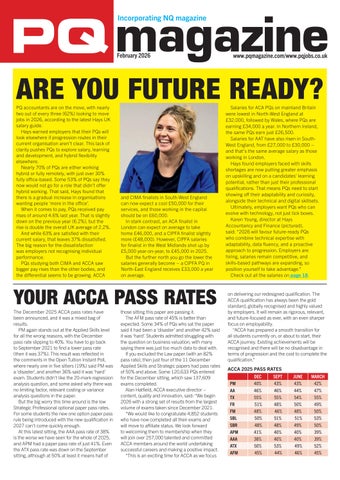
ARE YOU FUTURE READY? PQ accountants are on the move, with nearly two out of every three (62%) looking to move jobs in 2026, according to the latest Hays UK salary guide. Hays warned employers that their PQs will look elsewhere if progression routes in their current organisation aren’t clear. This lack of clarity pushes PQs to explore salary, learning and development, and hybrid flexibility elsewhere. Nearly 70% of PQs are either working hybrid or fully remotely, with just over 30% fully office-based. Some 53% of PQs say they now would not go for a role that didn’t offer hybrid working. That said, Hays found that there is a gradual increase in organisations wanting people ‘more in the office’. When it comes to pay, PQs received pay rises of around 4.6% last year. That is slightly down on the previous year (6.2%), but the rise is double the overall UK average of 2.2%. And while 63% are satisfied with their current salary, that leaves 37% dissatisfied. The big reason for the dissatisfaction was employers not recognising individual performance. PQs studying both CIMA and ACCA saw bigger pay rises than the other bodies, and the differential seems to be growing. ACCA
and CIMA finalists in South-West England can now expect a cool £50,000 for their services, and those working in the capital should be on £60,000. In stark contrast, an ACA finalist in London can expect on average to take home £46,000, and a CIPFA finalist slightly more (£48,000). However, CIPFA salaries for finalist in the West Midlands shot up by £5,000 year-on-year, to £45,000 in 2025. But the further north you go the lower the salaries generally become – a CIPFA PQ in North-East England receives £33,000 a year on average.
YOUR ACCA PASS RATES The December 2025 ACCA pass rates have been announced, and it was a mixed bag of results. PM again stands out at the Applied Skills level for all the wrong reasons, with the December pass rate slipping to 40%. You have to go back to September 2021 to find a lower pass rate (then it was 37%). This result was reflected in the comments in the Open Tuition Instant Poll, where nearly one in five sitters (19%) said PM was a ‘disaster’, and another 36% said it was ‘hard’ exam. Students didn’t like the 20-mark regression analysis question, and some asked why there was no limiting factor, relevant costing or variance analysis questions in the paper. But the big worry this time around is the low Strategic Professional optional paper pass rates. For some students the new one option paper pass rule being introduced with the new qualification in 2027 can’t come quickly enough. At this latest sitting, the AAA pass rate of 38% is the worse we have seen for the whole of 2025, and APM had a paper pass rate of just 41%. Even the ATX pass rate was down on the September sitting, although at 50% at least it means half of
those sitting this paper are passing it. The AFM pass rate of 45% is better than expected. Some 34% of PQs who sat the paper said it had been a ‘disaster’ and another 42% said it was ‘hard’. Students admitted struggling with the question on business valuation, with many saying there was just too much data to deal with. If you excluded the Law paper (with an 82% pass rate), then just four of the 11 December Applied Skills and Strategic papers had pass rates of 50% and above. Some 120,633 PQs entered for the December sitting, which saw 137,609 exams completed. Alan Hatfield, ACCA executive director – content, quality and innovation, said: “We begin 2026 with a strong set of results from the largest volume of exams taken since December 2021. “We would like to congratulate 4,852 students who have now completed all their exams and will move to affiliate status. We look forward to welcoming them to membership when they will join over 257,000 talented and committed ACCA members around the world undertaking successful careers and making a positive impact. “This is an exciting time for ACCA as we focus
Salaries for ACA PQs on mainland Britain were lowest in North-West England at £32,000, followed by Wales, where PQs are earning £34,000 a year. In Northern Ireland, the same PQs earn just £26,500. Salaries for AAT have also risen in SouthWest England, from £27,000 to £30,000 – and that’s the same average salary as those working in London. Hays found employers faced with skills shortages are now putting greater emphasis on upskilling and on a candidates’ learning potential, rather than just their professional qualifications. That means PQs need to start showing off their adaptability and curiosity, alongside their technical and digital skillsets. Ultimately, employers want PQs who can evolve with technology, not just tick boxes. Karen Young, director at Hays Accountancy and Finance (pictured), said: “2026 will favour future-ready PQs who combine technical expertise with adaptability, data fluency, and a proactive approach to progression. Employers are hiring, salaries remain competitive, and skills-based pathways are expanding, so position yourself to take advantage.” Check out all the salaries on page 18.
on delivering our redesigned qualification. The ACCA qualification has always been the gold standard, globally recognised and highly valued by employers. It will remain as rigorous, relevant, and future-focused as ever, with an even sharper focus on employability. “ACCA has prepared a smooth transition for all students currently on, or about to start, their ACCA journey. Existing achievements will be recognised and there will be no disadvantage in terms of progression and the cost to complete the qualification.” ACCA 2025 PASS RATES PM AA TX FR FM SBL SBR APM AAA ATX AFM
DEC 40% 46% 55% 51% 48% 50% 48% 41% 38% 50% 45%
SEPT 43% 46% 55% 48% 46% 51% 48% 40% 40% 53% 44%
JUNE 43% 44% 54% 50% 48% 51% 49% 40% 40% 49% 46%
MARCH 42% 47% 55% 49% 50% 53% 50% 39% 39% 52% 45%
study LIVE ON DEMAND DISTANCE LEARNING
Empow Empower o ow wer we career your care rre eer Virtually - Virt rt rtually
Flexible study packages tailored to you, your schedule and your aspirations
NEW IMPROVED WEBSITE BUY B UY AND AND STUDY STUDY ONLINE ONLINE
Contact Us : info@htftpartnership.co.uk htftpartnership.co.uk
contents PQ
IN THIS ISSUE
February 2026
A note from the Editor Welcome to latest PQ magazine, jammed-packed with all the latest news. This month we provide an update on the ICAEW/ CIPFA merger – did you know that ICAEW members won’t be getting a vote? We have the latest CIMA OT pass rates too, and delve into the ‘upgrades’ to the CGMA syllabus. There’s also news on the AAT student conference, and we take a look at how ACCA’s scrapping of remote exams hit the national headlines. We published a few days later than advertised for this month. We wanted to get the latest ACCA results in, and they had been pushed back a week. ACCA PQs should note that there are some more changes to exam dates and standard entry times coming up. The March 20206 exam results will now be released on Saturday 11 April (00.01 BST), and the June 2026 standard entry deadline will be Thursday 16 April (23.59 BST). Additionally, there is no late entry period for June 2026. ACCA has told us that planned systems upgrades across this time will impact access to the Exam Planner. It means ACCA students have just six days (instead of the usual 14) to enter the June exams following the release of the March results. We will remind you of the changes again, but it all means you really need to plan ahead if you want to sit this June. Graham Hambly, Editor and Publisher, PQ magazine News 4
5
6
8
ICAEW/CIPFA tie-up ICAEW members won’t get vote on proposed merger – to the surprise of some CIMA OT pass rates We run the rule over CIMA’s new objective test pass rates ACCA hits headlines ACCA’s move back to exam halls to stop the cheats makes national news
9
New AAT initiative AAT announces new training partnership with the Nuclear Institute ICAS first for Wales ICAS accredits Wrexham University/Prifysgol Wrecsam for accounting degrees
10 ACCA gets the credit ACCA’s Professional Diploma in Sustainability gets top marks in accreditation process 12 Tech news Survey finds most accountants have no faith in AI Features, etc 14 Have your say Do accountants really need to learn how to pull pints? Well done for focusing on women’s health; and why ACCA needs to come clean on exam cheating. Plus our social media round-up
p17
17 PQ awards 2026 The clock is ticking – so get your entries in for the best awards
around. You could be there on the big night! 18 Salary checker So are you being paid what you should be? Top recruiter Hays has the answer 20 CIMA spotlight CIMA unveils new study resource based on examiner insights 21 AAT exams Depreciation explained – so take note, Level 3 and Level 4 students! 22 Real lives How HTFT tutor James Read is making a difference far beyond the classroom 23 ACCA spotlight How to make the most of your studies in 2026 24 A question for Tom Maximise your exam marks by putting yourself in the shoes of the marker, says Tom Clendon 25 Audit What audit trainees still don’t know about professional judgement 26 The year ahead Accountancy body chiefs gaze into their crystal balls and predict how the next 12 months will pan out
34 PESTLE analysis How to use this invaluable analysis tool that looks at six factors that could impact on a business 36 Cash flow Why cash flow forecasts are the lifeblood of small businesses 37 Careers What are accountancy professionals really looking for in a job in 2026? Our Agony Aunt explains how to make the most of your PQ status; and our Book Club review 38 Fun The lighter side of life – and accountancy. Plus the answers to our Annual Bumper Quiz, and we name the three lucky winners The columnists Rachel Harrison Meet our new columnist from Kaplan 4 Sunil Bhandari What you should be getting from mock exams 6 Prem Sikka Society needs radical action, not slogans 8 Anna Kate Phelan Why exams matter more than ever 10 Rachel Harris How to manage your time better in 2026 12
28 Taxing cryptocurrency HMRC wants to know your crypto income – after all, it is taxable 29 CIPFA spotlight What’s the true cost of improving children’s social care? 30 Exam technique How to make the most of your time and keep your studies on track 32 International standards All you need to know about IAS 20 Accounting for Government Grants
p22
To subscribe for FREE go to www.pqmagazine.com Hands-on learning for real-world business situations Gain practical skills with the CGMA ® Finance Leadership Program (CGMA FLP).
aicpa-cima.com/flpuk
PQ the
RACHEL HARRISON Win the digital learning game The modern route to becoming qualified frequently involves digital learning, through live online sessions or leveraging self-paced digital resources. This digital approach offers incredible flexibility and has significantly improved accessibility for many aspiring accountants. However, it also demands a certain kind of mindset. To truly thrive in a digital learning environment you must embrace active engagement. Maintaining a dedicated, distraction-free study environment and a structured schedule are paramount. Strive to treat live online sessions like a physical classroom: eliminate phone notifications, close down emails and be ready to actively participate. For self-paced online study, block out focused time slots of 60 to 90 minutes and ensure you have a specific area of learning based on a topic in your course. This deliberate scheduling fosters the consistent, focused effort needed for progress. It’s cognitively easier to simply watch a recorded lecture or follow along, but true retention and mastery come from direct and deliberate interaction. Adopt a ‘desirable difficulty’ mindset. For example, when your tutor poses a challenging question engage with it – solve it yourself rather than waiting for the tutor to do it. The digital classroom shouldn’t mean learning in isolation – your professional network forms an essential support system. By treating your digital study with structure, active participation, and collaboration, you will transform screen time into genuine professional mastery. Rachel Harrison is Head of Academic Support at Kaplan
ICAEW members won’t vote on merger The proposed merger between CIPFA and ICAEW will not be voted on by both sets of members, to the surprise of some. The ICAEW has said the proposal does not involve any changes to its constitution, so a members’ vote is not needed. However, changes will be made to CIPFA’s Supplemental Charter and Bye-Laws so CIPFA members will be required to vote for these changes. This vote is expected in late spring or early summer. The vote will be open for 21 days and requires a two-thirds majority to pass. A special general meeting will be held to announce the result. In mid-December, ICAEW Council agreed to progress the merger with CIPFA, subject to several conditions being met. These include further due
Alan Vallance, CEO, ICAEW (left) and Owen Mapley, CEO of CIPFA diligence, the necessary regulatory approvals, and approval by CIPFA members. The institute also stressed the ACA qualification remains entirely separate and unchanged, and there is no equivalence with the CPFA qualification. However, under the proposals
ICAEW becomes a special member of CIPFA, with rights to appoint the majority of CIPFA’s board. ICAEW believes this avoids the risks and complexity of a full acquisition. The institute reiterated that ICAEW and CIPFA will remain separate legal entities, with their own governance frameworks.
ACCA key dates: upcoming changes ACCA has made some changes to its ‘normal’ scheduling of the March exam results and June standard entry deadline dates. ACCA explained that planned systems upgrades will impact access to Exam Planner. It means June exam sitters have six days rather than the usual 14 days to enter the exams, following the release of the March results.
There is no change to the date of the June 2026 exam entry, which opens on Tuesday 3 February 2026.
CIMA spotlights key topics CIMA has launched CGMA Spotlight Topics, focusing on the case study areas students find tricky. Using examiner-led guidance, the topics are ones that frequently appear in the case study exams. The new guidance, produced with the help of Kaplan, should
lead to clearer understanding of how topics connect to real exam scenarios, helping exam sitters approach the case study with more confidence. Every six months CIMA’s Study Support Team analyses examiners’ reports to identify new topics that will feature going forward.
weightings and a need for deeper critical thinking. There will also be more emphasis on sustainability in MCS and SCS. For free access to the guide go to www.procountancy.com
You can find the new centre at the Watson Building, 4 Renshaw Street, Liverpool L1 2SA. Reed Business School was the first-ever winner of PQ magazine’s College of the Year award, some 22 awards ago!
RBS opening in Liverpool Reed Business School has opened a new training centre in Liverpool (in January 2026). On offer will be ACCA’s Foundation in Accountancy and the Applied Knowledge level.
ACCA new syllabus news ACCA students will have to wait until Spring to see the Expertise and Strategic Professional Exam guidance pack for the new syllabus, which is being introduced in September 2027.
The March 2026 exams results will now be released on Saturday 11 April (00.01 BST). The June 2026 standard entry deadline will now be Thursday 16 April (23.59 BST). There will be no late entry period for June 2026, and ACCA has said it cannot accommodate any further exam entries after the standard entry deadline. At Operational level the spotlight topic is variances, for Management it is additions to a group, and for Strategic it is currency-related economic tasks. Each of these topics is split into three, providing an explanation of a real exam question, a debrief from a tutor, and details about what the examiner is looking for. Read more on page 20.
In brief CGMA syllabus update guide Hugh Martin’s Procountancy has launched a handy CGMA Syllabus Update Guide for 2026. As Martin says, the syllabus is evolving and PQs need to stay on top of this. Gen AI is coming into the E1, P1 and E3 OTs (there’s more in this issue on that), and from the May 2026 the case studies will also change. For OCS there will be an increased emphasis on sustainability, changes to core 4
From March, students will be able to see the exam and essential employability module syllabuses, along with specimen exams. However, one new qualification proposal may already be changing student exam habits. The need to pass just one optional paper under the new system means some students who have got one under their belt (under the current system you have to pass two optional papers) are just sitting on that pass until the new qualification is introduced. PQ Magazine February 2026
news the PQ
CIMA’s new OT pass rates are in CIMA’s P2 objective test is still ‘the one to pass’, as the new stats show a pass rate of 46%. This is despite a year-on-year rise in the overall pass rate of two percentage points. It was a similar story for F2, which also saw a two percentage points jump over the previous year – rising from 47% to 49%. However, these are still the only OT papers with pass rates below 50%. CIMA publishes the CGMA objective tests once a year, and the latest stats cover the exams sat between 1 November 2024 to 30 November 2025. And while F2 saw a jump in its pass rate the rates for F1 and F3 both slipped two percentage points, to 76% and 56% respectively. The good news is all the P paper pass rates were up or held steady, when compared to the previous
year’s figures. P1 rose one percentage point to 54% and the P3 pass rate was the same as 2023/24, at 63%. CGMA OT PASS RATES (1/11/24 – 30/11/25) E1 E2 E3 F1 F2 F3 P1 P2 P3
2024/25 82% 81% 76% 76% 49% 56% 54% 46% 63%
2023/24 83% 81% 76% 78% 47% 58% 53% 44% 63%
2022/23 84% 81% 74% 80% 51% 56% 54% 44% 59%
2021/22 84% 83% 74% 80% 51% 55% 52% 43% 58%
Are accountants real professionals? Accountancy could be losing its professional degree status under President Trump’s ‘One Big Beautiful Bill Act’ (OBBBA). The US Department of Education is reclassifying degrees as professional and non-professional, and there will be a narrower definition for professional degrees. Those still deemed to be
professional (and there are 11 categories) include medicine, law and pharmacy. However, accountancy, architecture, nursing and occupational therapy will be among those excluded, with the changes taking effect from 1 July 2026. Those undertaking ‘professional’ degrees qualify for higher loan limits, so the
worry is that losing professional status will create more barriers for low-income, first-generation and mid-career students. It has also been suggested that the changes disproportionately affect women, with many occupations losing their professional status dominated by women.
Nominate for PQ awards now! One New Year’s resolution that should be easy to keep is entering the PQ magazine awards! Now in their 23rd year, the awards uniquely shine a light on everything good in accountancy education. There are 21 shiny PQ magazine trophies up for grabs and we need your entries now! It is easier to get the chance to get your hands on one of these coveted trophies than you think – all we need is 500 wise words on why your nominee should win. The first ever tutor to win our Lecturer of the Year was Paul Moore (in 2004). He was swiftly followed by Francis Braganza, Stuart Pedley-Smith and Tom Clendon. Others top tutors on the list include Gareth John, Brigita Petrova, Sean Purcell, Regwana Uddin and Paul Merison. Check out all the categories and how to enter on page 17.
Serious about Credit and Collections? CICM: Bridging credit and finance with skills that make businesses stronger.
CICM Membership - Connecting credit and finance professionals to a community that strengthens every business. CICM Qualifications - Building the expertise that bridges credit and finance across the full financial cycle. CICM Training - Practical skills that unite credit and finance to drive stronger business performance Your next opportunity starts with CICM – Contact us now for further information. W : c i c m . c o m E : i n f o @ c i c m . c o m T: 0 1 7 8 0 7 2 2 9 0 0
PQ Magazine February 2026
SCAN ME
5
PQ the
SUNIL BHANDARI What is a mock?
As we approach the first ACCA revision season of 2026, the use of mock exams by ACCA candidates will be a key part of their preparation. All students are expected to take at least one exam in a timed exam simulation. But what is a mock? Should it be exam standard? Should it be predictive? Should it be easy? Should it be more challenging? The mock creators can take one of two approaches. One is to write a gentle mock exam. What I would describe as at the lower end on the scale of difficulty. For those who attempt the mock it should be motivational. They can do this if it repeats on the day. But it’s a big if. Alternatively, they could create a mock that is predictive but challenging. At the upper end of the exam scale. To make the student sweat a little. The major benefit of the latter is, whether you pass the mock or not, you know on the big day the actual paper will be easier in comparison. Personally, I think the former approach carries too much risk. It gives a false sense of security. Hence, without doubt, I prefer the latter approach. The bottom line is mock exams should be predictive and at the upper end of the challenge scale – but fair. BTW, I am a mock exam creator! Sunil Bhandari is an AFM tutor at FME Learn Online
ACCA hits the national news ACCA’s move back to exam halls became a Financial Times ‘exclusive’ at the very tail end of 2025, under the headline ‘World’s largest accounting body scraps remote exams to combat cheating’. The FT said the ACCA has concluded that online tests have become too difficult to police, particularly as artificial intelligence has made it easier to cheat. PQ magazine pointed out we had ‘exclusively’ written about the move online on 6 November 2025, some seven weeks earlier. In our story we explained ACCA had sent a ‘Withdrawal of remotely
invigilated exams’ email to all students who have sat remote exams in the past 18 months. From this March, ACCA will only offer remote exam sittings where it
does not have exam centres. ACCA’s Alan Hatfield, executive director- content, quality and innovation, told PQ magazine at the time: “The vast majority of our students already use exam centres, but we understand this will be disappointing news for some of those who prefer to take their exams remotely. “We are making this change because, as technology evolves, we have concerns around the ongoing security of remote exams and we want to protect the hard work ACCA students put into earning their qualification.”
Meet Faraaz, a Faithful accountant Faraaz, a 22-year-old internal auditor from Middlesbrough (pictured), recently starred among the contestants for series 4 of the BBC’s hit show, The Traitors. He is a big fan of the show and said he would “play with my head over my heart”. Faraaz said before joining as a ‘Faithful’ that he is quite approachable and bubbly, and said it was good to meet new people. He has one weakness, a fear of heights. The winner walks away with
CIMA’s E3 and Gen AI Along with the E1 and P1, Gen AI will be examined in CIMA’s E3 OT from this January (so right now!). Kaplan has written a series of helpful articles on the Study Hub for the institute about the upgrades. For E3, Kaplan outlines how GenAI is transforming the profession: • Automation of routine tasks (e.g.
£120,000. If he won the prize money Faraaz said he would love to be able take his family on a Hajj
pilgrimage. And, if there is a bit left over, then a new car will be the order of the day!
financial reporting). • Enhanced data analysis and interpretation (e.g. identifying trends and anomalies). • Improved financial forecasting (e.g. budgeting). • Advanced compliance and risk management (e.g. banking industry). • Personalised financial advice (e.g. tailored advice to each client). • Creation of intelligent financial documents (e.g. dashboards). Kaplan also looks at how Gen AI technology uses advanced machine
learning, such as: • General Adversarial Networks, GANs (e.g. Nvidia’s use of StyleGAN to create human faces). • Variational Autoencoders VAEs (e.g. Spotify and music recommendations). • Large Language Models, LLMs (e.g. Duolingo). The full articles can be found at https://hub.cimaglobal.com/ articles. • You can read how Gen AI is affecting the operation level on page 20.
2026, but don’t worry if you miss that as there is also a September intake. Created with the University of London, the BSc is open the eligible ACCA students, affiliates and members. With flexible study options and the ability to take the programme anywhere in the world, the course allows you to gain a prestigious academic qualification and progress towards ACCA membership at the same time. To find out more click here.
EY staying put in London EY has renewed the lease of its One More London Place HQ until 2040, which it says marks the firm’s continued investment in London as a place to do business. One More London Place (1MLP) is the UK and global headquarters of EY and home to more than 8,000 people. The lease on the building was due to expire in 2028 and has been renewed due to its unique proposition, with a prime location and excellent transport links.
In brief AAT student conference The accelerAATe online conference is running again from 28 to 30 January 2026. This free, three-day virtual conference is designed for students whether they are just starting out or approaching their final assessments. You will learn how to build your professional networks and discover some practical study techniques. One session you will not want to miss is Ideal Schools’ ‘Top Study Skills That Actually Work – with AI 6
and Smart Data Insights’. That takes place on Thursday 29 January at 3.15pm. Another top session on the Thursday (at noon) is ‘Overcoming and manging personal challenges while studying’. Sign up for the event here. Sign up for ACCA’s new BSc The application window for ACCA’s new BSc Professional Accountancy degree is now open. The deadline for the March intake is 9 February
PQ Magazine February 2026
Develop the accounting leaders of tomorrow. Digitally upskill your team through funded degree apprenticeships Available in: • Data Scientist • Digital and Technology Solutions Professional • Project Manager • Delivered primarily online with flexible, asynchronous learning • Funded through the Growth and Skills Levy, levy transfer, or government co-investment
April 2026 intake now open for applications Deadline: 13th March
FIND OUT MORE
PQ news the
AAT goes Nuclear
LORD SIKKA Society needs action, not slogans After considerable public opposition, the government has withdrawn the two-child benefit cap. This will lift 550,000 children out of poverty. Currently, 5.2m children live in poverty, which stunts their physical and cognitive development, and prevents them from realising educational and employment potential. Child poverty can’t be eradicated without tackling parental poverty. Around 4.5m jobs pay less than the real Living Wage. Some 1.17m workers are on zero-hour contracts; 34% of people on Universal Credit are in employment. The Employment Rights Act 2025 does not end zero-hour contracts or ‘fire and rehire’ policies which enable employers to fire workers and rehire them on inferior pay and conditions. There is no government plan to curb profiteering. Water, energy, rail, mail and grocery prices are rising at rates faster than inflation and plunging millions into poverty. There is huge lack of social housing. Liverpool has 12,764 households on its social housing waiting list. It has just five ‘additional social rent dwellings’, as local authorities have been starved of resources. The poorest 20% pay a higher proportion of income in taxes than the richest 20%. The bottom 50% of the population owns less than 5% of wealth, while the top 10% owns a staggering 57%. Slogans and political PR won’t end poverty. A radical reconstruction of society is needed, and that can’t be done without engagement with the power of corporations and the superrich. Prem Sikka is Emeritus Professor of Accounting at the University of Essex
AAT has announced a new partnership with the Nuclear Institute (NI), offering NI members exclusive access to AAT financial courses. This collaboration is a first for AAT, and underscores the vital need for financial literacy beyond what is seen as traditional finance roles. In the nuclear sector strong money management directly supports safety, innovation, project leadership and growth. Two courses are now available to NI members with an exclusive discount: • Business Finance Basics for
Finance Professionals. • Business Finance Basics for NonFinance Professionals. Each course is a three-hour session consisting of six modules, including video tutorials and
interactive learning. Robert Gofton, NI CEO (pictured), said: “As part of our commitment to developing our members we’re proud to launch a new partnership with AAT. Our first collaboration is to offer discounted access to high-quality financial training and qualifications. “In today’s nuclear sector, financial literacy isn’t just for finance teams, it’s a core skill for professionals at every level. Whether you’re early in your career, managing budgets or looking to better interpret financial reports, these courses, especially those tailored for non-finance professionals, will empower our members with essential management capabilities.”
Youth unemployment rising fast The UK’s youth job market has deteriorated sharply, with young people accounting for over half of the total rise in unemployment since mid-2022, says the latest PwC’s Youth Employment Index. Youth inactivity has also climbed to new highs, with three million young people now out of the labour force – that’s more than any other working-age group. It means the youth unemployment rate has hit 15%. It was 11%
three years ago, and now is rising fastest than anywhere else in the G7. PwC’s senior economist, Jake
Finney, says modelling currently shows no statistically significant relationship between AI adoption and youth unemployment. This is, he says, is because young people tend to start their working lives in retail and hospitality, which have lower exposure to AI. However, there are signs that the retail industry is shrinking, and graduate hiring is falling fast, so two traditional routes into the world of work could be closing.
Mastering exam verbs As part of the CGMA qualification upgrade, CIMA has updated the verbs used in both the syllabus and exam blueprints. CIMA says the verbs now used are designed to better reflect how candidates will be assessed and what the examiner expects. Understanding these verbs is essential, as they signal the skill level and guide how you should approach each task. Responding
and recognising them correctly will significantly improve your exam performance, says CIMA’s Matthew Hall in his Mastering Exam Verbs guide. He stressed students need to familiarise themselves with the verbs listed in the exam blueprints and how they are used in the pilot papers. Verbs commonly used in case study tasks include: evaluation,
Schedule 8, Group 1). The chickens were not heated to order, were not kept hot until sold, and were not advertised as hot, all conditions for being zero-rated. The judge was also unhappy that the supermarket failed to disclose key facts about its packaging that helped control the chicken’s temperature. Morrisons will be paying up!
the planned threshold for taxing inherited farmland from £1m to £2.5m. In her last Budget, Rachel Reeves also introduced an exemption allowing farmers to pass on assets to their spouse tax-free, passing on up to £5m in qualifying assets without incurring tax. The latest move follows months of protests. Environment Secretary Emma Reynolds said: “We have listened closely to farmers across the country and we are making
discuss, interpret, recommend, and explain. Hall provides examples of how the examiner will use these verbs in his guide. Check out the new guide here.
Tax briefs Hot stuff: Morrisons’ £17m VAT bill The dilemma of when hot food becomes just lukewarm food has cost Morrisons supermarket chain a cool £17m. The supermarket had appealed against HMRC’s standard 20% VAT charge on its cooked rotisserie chicken. However, the first-tier tribunal stated that for hot food to be zero-VAT rated it must be ‘hot’ when supplied to customers, and meet the conditions set out in Note 3B (Value Added Tax Act 1994, 8
IHT plans for farms ‘softened’ The UK government has increased
changes to protect more ordinary family farms.” Employee tax breaks extended The publication of legislation to extend income tax exemptions for eye tests, glasses and home working equipment to include costs reimbursed by employers, has been welcome by the Chartered Institute of Taxation (CIOT). A new exemption for flu vaccinations has also been extended to employer reimbursements. PQ Magazine February 2026
news PQ
ICAS accredits Welsh degree ICAS has accredited Wrexham University/Prifysgol Wrecsam for two of its BSc accounting and finance degrees, the first time a Welsh higher education provider has been formally recognised. The accreditation covers the University’s BSc (Hons) Accounting and Finance, and BSc (Hons) Accounting and Finance with Foundation Year/International Year. From 2026, students enrolled on these programmes will benefit from a direct and supported pathway towards the CA qualification,
with the first cohort of graduates completing their studies in 2029. ICAS said the partnership with Wrexham University/Prifysgol Wrecsam reflects its commitment to widening access in the profession and supporting diverse routes into
IFAC handbook update The International Federation of Accountants (IFAC) has issued its 2026 edition of the Handbook of International Education Standards. The new edition brings together the full suite of standards – IES 1-8, along with the supporting framework and glossary – and incorporates all recently revised and updated standards. The latest edition includes: • The Framework for International Education Standards, which
outlines the foundational concepts for developing and maintaining professional competence. • A Glossary of Terms, providing essential definitions used across the standards. • IESs 1–6, addressing entry requirements to professional accounting education programmes and the initial professional development of aspiring professional accountants. • IES 7, Continuing Professional Development, establishing
accountancy. The University’s emphasis on inclusivity – including support for Welsh language use across studies and campus life – aligns closely with the institute’s ambition to remove traditional barriers to entry. Gail Boag, ICAS CEO, said: “We’re leading the way in widening access to the accountancy profession, and accrediting our first Welsh university degree is a significant milestone in delivering on that ambition. Wrexham University/Prifysgol Wrecsam stands out for its strong focus on graduate employability and its close links with industry.” requirements for lifelong learning for all professional accountants. • IES 8, Professional Competence for Engagement Partners, which outlines the competence demands for engagement partners responsible for audits of financial statements. • Revisions to IES 2, 3, 4 and 6 aimed at strengthening global consistency in formal assessment and supporting emerging skills needs in areas including ethics and sustainability. For more go to https://www.ifac.org/news.
FCA fines two ex-Carillion FDs Richard Adam and Zafar Khan have been fined £232,800 and £138,900 respectively by the Financial Conduct Authority for their part in misleading statements being issued by Carillion plc. The FCA said both former financial directors were aware of serious financial troubles in the construction business but failed to reflect this in company announcements or alert the Board and audit committee, leading to poor oversight. Both were also deemed to have acted recklessly. Steve Smart, joint executive director of enforcement and market oversight at the FCA, said: “Those in positions of responsibility have a duty to keep the market accurately and adequately informed. With Carillion, we have seen the serious impact it can have when they don’t. The action taken against Mr Adam and Mr Khan demonstrates our commitment to preventing market abuse and upholding the standards we expect.”
Online education programme Offer a range of accountancy-led services to the general public in the UK when you gain an IFA practising certificate through IFA Direct. The flexible, relevant and accessible study units provide structured learning designed to complement busy lifestyles.
Ofqual Regulated
Find out more at ifa.org.uk/ifadirect or call our Education Team now on +44 (0)20 3567 5999
PQ Magazine February 2026
9
PQ news the
ANNA KATE PHELAN Exams matter more than ever In an age of AI tools that can summarise, make calculations and draft essays in a matter of seconds, some may question whether traditional exams still hold value. Especially if they’re a PQ dedicating many precious hours studying for them! We must remember that exams remain an unparalleled benchmark of competence, integrity and capability. They provide a fair, standardised way to assess what candidates actually know. They often strip away external aids and digital shortcuts, ensuring that every student has an equal platform. In a profession built on public trust, this independence matters. Clients, employers and regulators need assurance that qualified accountants truly understand the principles behind the numbers, not just how to generate answers using technology. Exams encourage deep learning that forms the foundation of good judgement. Accounting isn’t just about performing calculations, it’s about interpreting standards, evaluating risks and making sound decisions. They also develop resilience and discipline. Preparing for them teaches time management, critical thinking and the ability to perform under pressure, skills that employers demand. Passing a tough paper shows how you respond to challenge. Exams protect the credibility of the profession. Without rigorous assessment, qualifications lose meaning and public confidence erodes. Exams aren’t outdated – they’re more important than ever. They ensure that every PQ earning their stripes has the competence, consistency and character the profession demands. Anna Kate Phelan is Chief Product Officer at Eintech
ACCA sustainability diploma gets top marks ACCA’s Professional Diploma in Sustainability has been formally credit rated on the Scottish Credit and Qualifications Framework at Level 10, with 20 credits (representing 200 learning hours). SCQF Level 10 – part of an internationally agreed educational benchmark – is deemed the standard of a UK Bachelor’s (Honours) Degree. Abdul Goffar, director – UK at ACCA (pictured), said: “We’re pleased to have had our sustainability diploma credit rated at SCQF Level 10. Sustainability is rapidly becoming one of the most powerful drivers of business
Six PQs for HWB Southampton-based accountancy firm HWB has appointed six new starters as it looks to grow its own talent to counter skills shortages. Accounts and audit trainee Dalbir Bhullar has been welcomed back after graduating. He completed a placement year with the firm’s payroll team. The other trainees are Tom Stanley (tax assistant), Tom Watson (accountant), Sophie Murray-Cousens (payroll administrator) and Charlie Hodgson (accounts AAT). Also among the starters is marketing administrator Olivia Bryant, who will do a marketing qualification. Managing director Tracy Jenkins said the aim is to meet business demand by ‘growing organically’ the business leaders of the future. She explained: “We find that the optimum way of doing this is to attract and
New starters: The latest HWB recruits with managing director Tracy Jenkins, seated right, are from left, Tom Watson, Sophie Murray-Cousens (seated), Olivia Bryant, Tom Stanley, Dalbir Bhullar and Charlie Hodgson recruit the best young people, give them full hands-on training and offer them a clear career progression path.”
CIPFA to lead EFS assurance reviews The Ministry for Housing, Communities and Local Government (MHCLG) has appointed CIPFA, supported by Grant Thornton UK Advisory & Tax LLP and Peopletoo Ltd, to conduct independent assurance reviews of local authorities in financial difficulty – including councils
EY audit of Shell probed The Financial Reporting Council has begun a full-scale investigation into the statutory audit conducted by EY of the consolidated financial statements of Shell plc for the financial year ended 31 December 2024. On 2 July 2025, Shell told the London Stock Exchange that EY had reported noncompliance with audit partner rotation rules, including exceeding the time limitations for partner rotation under the UK’s Revised Ethical Standard. The investigation will include consideration of whether relevant requirements relating to partner rotation have been breached. 10
strategy, regulatory compliance and investment decision-making. As the regulatory environment becomes more complex, businesses require financial professionals who can lead the sustainability agenda. “The SCQF Level 10 recognition underscores the quality of this
programme and our commitment to ensuring the accountancy profession is ready to step up and lead the transition to a sustainable global economy.” The ProDipSust exam is delivered as an integrated case study, testing learners’ ability to apply their knowledge to realistic, complex scenarios; an approach that ensures professionals can respond effectively to the challenges they will face in practice, says ACCA. Learning is supported through its study resources, including four dedicated certificates and exam preparation materials. Find out more here.
reliant on exceptional financial support (EFS). CIPFA’s assurance reviews will support MHCLG’s role in the stewardship of the local government system. Reviews will deliver expert analysis of the finances and governance of selected local authorities. The reviews will help
develop a picture of each council’s financial situation, the context in which it operates and its risks and challenges. Recommendations made by these reviews will help local authorities to take the right steps to maintain or return to financial sustainability and ensure their continuous improve.
The FRC Enforcement Division will conduct the investigation under the Audit Enforcement Procedure.
to scale global adoption and integration of AI”. The Big 4 firm’s global headcount also jumped by 1.8%, to 276,030.
KPMG delivers 5.1% revenue rise KPMG International has unveiled operating revenue of $39.8 billion for the year ended 30 September 2025 (FY25). That is a year-on-year rise of 5.1%. Tax and legal services grew by 7.5%, driven by client demand for AI-enabled managed services, and audit grew by 6% due to the growing demand for assurance services. KPMG are embedding AI into its platforms and offerings, and has launched KPMG Workbench, its “foundational and single AI platform designed
Deloitte Midlands move Deloitte will make One Centenary Way its new home in Birmingham. It plans to move into floors seven and eight, occupying some 46,000 sq ft, and expects to move in this autumn. The new space aligns with Deloitte’s World Climate ambitions. It is one of the city’s most sustainable buildings, with a pure electric heating and hot water supply system and SMART access to services, information and facilities throughout. Currently based at Brindleyplace, Deloitte employs more than 1,000 people in the region. PQ Magazine February 2026
PQ tech the news
RACHEL HARRIS New year, new money habits
January has a reputation in practice. New deadlines, new clients, new targets, and the pressure to ‘start strong’. For trainees and PQs especially, it can feel like the month where everything accelerates at once. The risk isn’t workload alone. It’s mistaking busy for effective. Burnout season usually starts with good intentions: saying yes to everything, responding instantly, trying to prove reliability. Over time, that turns into long days, reactive working and the sense that nothing ever quite gets finished. This year reframe money habits as work habits. The way you manage your time, energy and attention is just as important as how you manage a ledger. A simple weekly cadence can make a disproportionate difference: • Monday planning (20 minutes): decide the three outcomes that would make this week successful. Not tasks, outcomes or feelings. • Daily 15-minute triage: once a day, pause and reset priorities. What’s urgent? What’s noise? What can wait? • Friday reset (15 minutes): close loops, write a short handover to your future self, and leave work mentally finished. Boundaries don’t mean working less. They mean working deliberately. That might look like batching emails or being clearer about when something can be done rather than when it’s requested. Accountancy is a marathon career, not a January sprint. The habits you set now, around pace, focus and recovery, are the ones that protect both your performance and your longevity.
UK plc not ready for AI adoption AI may be the most transformative trend in accounting and finance, but less than one in 10 accountants believe their organisation is well prepared to benefit. A new CIMA survey found just 8% of accountants felt their firm was up to managing the AI trend. The main problem appears to a lack of skills and talent to deal with the challenges. There are also real concerns about the technology’s maturity. CIMA chief executive Andrew Harding (pictured) said: “The advance of AI tools in the last two years is enabling a paradigm shift in how finance teams operate and the work they can do to generate
value for their organisations. While professionals recognise the potential on offer, many today feel underprepared and under skilled.
There’s a clear gap between anticipating disruption and taking action.” Despite the uncertainty, Harding remains optimistic: “The good news is that CIMA is addressing the skills gap. Last year, we overhauled the CGMA Professional Qualification to embed new technologies such as GenAI across the syllabus and offer a number of resources to help members develop digital finance skills. GenAI is fast becoming a powerful co-pilot for finance professionals, helping to guide decision-making, drive performance and enhance the value finance business partners bring to organisations.”
E-invoicing not mandatory until 2029 E-invoicing will now not be made mandatory until 2029, giving a “much needed lead-in time” to prepare for changes, says the Association of Taxation Technicians (ATT). It was also confirmed in the Budget that mandatory e-invoicing will apply only to VAT invoices, meaning many of the smallest businesses (those not registered for VAT) will not be obliged to adopt the technology at
this stage. Jon Stride, chair of the ATT’s Technical Steering Group, said: “We welcome the decision to focus on a decentralised e-invoicing model and not to introduce real-time reporting at this stage. The priority should be getting the right infrastructure in place. With more than 130 countries already implementing or planning to implement e-invoicing standards, the roadmap must set
out clear, realistic timelines and practical support measures to help businesses prepare.”
KPMG attains ISO certification KPMG International has become the first Big 4 international firm
to attain ISO 42001 certification for AI management systems. This achievement builds on the momentum of ISO 42001 certifications already earned by KPMG member firms in Australia, Spain, India and the USA. ISO 42001, developed by the International Organization for Standardization, provides a comprehensive framework for the design, development and use of AI
systems. The standard requires a robust system of controls to ensure accountability and trust while mitigating risk in AI deployment. KPMG’s global head of AI and digital innovation, Steve Chase, said: “You can’t guide clients on an AI journey you aren’t on yourself, and that’s why we are investing in the same AI governance and standards that we advise clients on.”
also ensure they automatically share up-to-date and accurate accounts of all their users’ earnings. The Crypto Reporting Framework (CARF) is being implemented in many other countries, making it easier for tax authorities to share information.
provider to AI-powered tax preparation partner. The new detection tool is integrated directly into IRIS Elements and IRIS Accountancy Suite at no additional cost, identify errors before submission to HMRC. Built on GPT4.1 and fully integrated into Microsoft Foundry, it addresses the challenge of comparing current-year returns against historical data by flagging discrepancies. These include unexpected income fluctuations, missing dividend or interest income and manual entry errors.
AI losing firms money UK businesses that rely on general purpose AI tools such as ChatGPT for financial, bookkeeping and tax advice are losing money, according to new research from Dext. The study found half of accountants and bookkeepers were aware of companies that have suffered direct financial loses – including overpayments, missed allowances, penalties, fines or compliance issues, all because of incorrect or misleading AI-generated advice.
Rachel Harris is the founder of striveX and @accountant_she
Tech briefs Time to report crypto Anyone buying cryptocurrency in the UK after 1 January 2026 will need to share their account details with HMRC. The revenue is seeking to collect what it believes are tens of millions in unpaid tax. HMRC also wants to address what it sees as high levels of non-compliance among crypto investors, and believe this move will mean any gains are much harder to hide. Cryptocurrency exchanges must 12
IRIS launches AI tax tool IRIS has launched the first phase of its AI-powered tax anomaly detection tool, marking a strategic shift from compliance software
PQ Magazine February 2026
WHAT WE OFFER ACCA COURSES All Papers available for all sittings Start Any Time From Anywhere in the World
PLATINUM APPROVED COLLEGE
SINCE 2008
Study your own way: Live Online or On‑Demand The Choice Is Yours
WORLD TOP 5
40+ STUDENTS
Visit our website: AccountancySchool.com +353 (0)1 906 1351
FIRST IN THE WORLD
11 STUDENTS
email graham@pqmagazine.com
How are your soft skills going? Do accountants really need to learn how to pull pints (PQ, page 8, January ’25)? One firm, Azets, is exploring partnerships with major hotel, pub and restaurant chains to offer secondments for trainee accountants. It is an interesting move. As the firm’s CEO Peter Gallanagh says, automation and AI is taking over compliance and data-heavy tasks. It means accountants must evolve into trusted advisers – and it is that shift at scale that requires a new focus on softer skills. What is also interesting is that the firm’s new policy is a reflection of Gallanagh’s own life
experiences. He admits he comes from a deprived background. His dad was a manager of some grocery stores in Glasgow, and he was one of 12 kids and was sent to work at 15. He says his experience taught
him a lot, but it appears too many trainee accountants are coming to the profession with no real-life working experiences. This puts them at a huge disadvantage, and I am not sure we can blame Covid for that, because more and more of the young people I know don’t seem to want or need a part-time job. I like the fact that, for Azets, having a Saturday or holiday job will be as important as being good at maths! It should have always been the case. As Gallanagh said in a recent interview with the Times newspaper: “It’s not easy, it’s very difficult to deal with ‘Joe Public’, but it builds resilience.” Name and email address supplied
Our star letter writer wins a fantastic ‘I love PQ’ mug! An interesting line-up Thanks for a really interesting line-up in the January issue. The focus on women’s health and wellbeing in accountancy feels long overdue, and the article on how tech hubs are helping students and the December technical problems are particularly relevant after this sitting. Thanks for continuing to give PQs a proper voice in the profession. Name and address supplied
Scrapping remote exams How much cheating was actually going on for ACCA to stop remote exams? Is there something ACCA isn’t telling us, because all the other bodies seem to be ploughing ahead with them? Sometimes I think it is the sheer size of the ACCA that is its undoing. And the fact that you can study full time for a professional qualification without actually having a job. If ACCA students were working then they would better understand the need for ethics and integrity. For many passing the exams is everything, and what being a professional means has been forgotten. Are students actually learning the importance of a
professional reputation? Yes, they can answer a question in the exam on it, but do they then understand what it really means? Name and email address supplied
Women’s troubles Wow, a magazine that is prepared to talk about ‘women’s troubles’ is rare indeed. And well done ICAS for the 3M report, the Scottish Institute really
is taking the lead when it comes to shaping the profession. These issues are very real, and ones I have encountered on more than one occasion during my working life. True inclusion can only come if women talk more openly about how menstruation, menopause and miscarriage. I firmly agree the professional bodies all need to do more, too. Name and email address supplied
Our story about the ACCA student who was told he had passed an exam he thought he had failed went viral on social media this month. PQ magazine discovered that an error in a recent exam meant some students who had received a failed notice were informed a year later that they had actually passed. ACCA told us: “Our rigorous checking procedures revealed an error in one of our questions on the December 2024 Performance Management exam. We’ve contacted affected students to correct their marks, provide exam fee refunds where relevant, and offered our sincere apologies. We’re very sorry for this and the frustration it has caused.” On LinkedIn one top tutor wondered what caused the mistake, and why was it only discovered a year later. Another tutor said: “And just think of the time, money and career opportunities wasted.” The results processes and governance around professional exams was also questioned, as one commentator said: “Strong post exam validation and transparent remediation processes are essential to protect candidates and the credibility of the qualification.” Another comment summed up PQ magazine’s view: “I thought the ACCA exams were checked and rechecked. Hope they put something in place to stop this happening in the future.” It wasn’t all negative though, some posted support for the ACCA. One said: “Full credit to ACCA for owning up to this. Full credit to PQ for publicising this.”
PQ Magazine 4 Dangan Road, London E11 2RF | Phone: 07765 386489 | Email: graham@pqmagazine.com Website: www.pqmagazine.com | Editor/publisher: Graham Hambly graham@pqmagazine.com | Associate editor: Adam Riches | Art editor: Tim Parker Contributors: Sunil Bhandari, Prem Sikka, Anna Kate Phelan, Tony Kelly, Phil Gammon, Edward Netherton, Francesca Cullaney | Subscriptions: subscriptions@pqmagazine.com | Origination services by Classified Central Media If you have any problems with delivery, or if you want to change your delivery address, please email admin@pqmagazine.com
Published by PQ Publishing Ltd © PQ Publishing 2026
Developed with accountants in mind. Accurate replications of questions from ACCA, AAT, CIMA, ICAEW & ICB. Discover fully-functioning spreadsheet features for your accountancy training. Discover Rogo.
Visit getrogo.com for your free trial
PQ awards PQ
GETNOMINATING We need your entries for the PQ magazine awards. Who do you want to win one of our coveted trophies?
THE 2026 AWARDS CATEGORIES PQ OF THE YEAR NQ OF THE YEAR DISTANCE LEARNING STUDENT OF THE YEAR ACCOUNTANCY GRADUATE OF THE YEAR ACCOUNTANCY APPRENTICE OF THE YEAR STUDENT BODY OF THE YEAR
N
ow really is the time to get your nominations in for the 23rd PQ magazine annual awards. There are lots of categories up for grabs, so take a look (see the categories opposite) and help us spread the love. This really is a time to nominate a tutor who has made all the difference to you getting qualified, or a fellow PQ who should be rewarded for their kindness. We also encourage you to nominate yourself. Sometimes it is the only way to show the people around you that you count! Last year’s ceremony at Salsa Temple certainly went off with a bang, with our singing accountant and Mariachi band. The star-studded event saw Katy Hickety crowned our Distance Learning Student of the Year, and CIMA qualified Katarina Collins picked up NQ of the Year. After last year’s event First Intuition’s Gareth John said: “PQ always puts on an amazing bash. And great to catch up with so many of the sectors most influential leaders.” Meanwhile, AIA’s Carl Jepson commented: “What an evening, showcasing all that is positive about the accountancy sector.” We have something just as good planned for this April! We have a new category this year – Student
Champion of the Year. This category is open to everyone: students, lecturers, websites, even Facebook groups that are making a positive impact on the profession. Nominations need to be up to 500 words each. If you feel you need to add supporting material then please provide this separately, but your entry will be primarily judged on those 500 words. We do need proper entries though, a tick in the box and simple few words won’t make it onto the short list – our awards are about quality not quantity, so hundreds of entries for one tutor doesn’t mean they win. It’s about what they have done for you and your fellow PQs that counts. To download the application click here. Once you have your entry sorted send it off to us at awards2026@pqmagazine.com. And we are happy with a simple Word document, we don’t need anything fancy. And that is it, that is all we need. Remember, if you or your nominee get on that short list you get to come to the awards night (for free). So, don’t miss out on a unique night in the accountancy education calendar – get nominating! Deadline for entries is Friday 6 March 2026.
STUDENT CHAMPION OF THE YEAR (NEW) ACCOUNTANCY BODY OF THE YEAR ACCOUNTANCY COLLEGE OF THE YEAR – PUBLIC SECTOR ACCOUNTANCY COLLEGE OF THE YEAR – PRIVATE SECTOR ONLINE COLLEGE OF THE YEAR LECTURER OF THE YEAR – PUBLIC SECTOR LECTURER OF THE YEAR – PRIVATE SECTOR STUDY RESOURCE OF THE YEAR ACCOUNTANCY PODCAST OF THE YEAR INNOVATION IN ACCOUNTANCY BEST USE OF SOCIAL MEDIA TRAINING MANAGER/MENTOR OF THE YEAR GRADUATE/APPRENTICESHIP TRAINING PROGRAMME OF THE YEAR ACCOUNTANCY TEAM OF THE YEAR ACCOUNTANCY PERSONALITY OF THE YEAR
OUR SPONSORS
PQ Magazine February 2026
17
PQ Hays salary survey
What does 2026 have in store? Karen Young (pictured), Director at Hays specialising in Accountancy and Finance, delves into the latest Hays salary guide
T
he world of work for PQs continues to shift, shaped by a challenging economy, persistent skills shortages and fast evolving ways of working. Our latest 2026 Hays UK Salary & Recruiting Trends Guide pulls together what employers are prioritising and how PQs themselves are feeling about pay, progression and flexibility, so you can calibrate your next career move with confidence. Employer sentiment Despite cost pressures and uncertainty, hiring appetite is resilient. Some 68% of employers in accountancy and finance plan to hire in the next 12 months, broadly in line with last year, even as 92% say they faced skills shortages, particularly around technical and digital skillsets and data enabled decision making. Employers are responding by putting greater emphasis on upskilling and on candidates’ learning potential (not just formal qualifications).
weighing factors such as commute, team rhythms, and how much flexibility is offered week to week, as hybrid policies can vary significantly between employers. Benefits and EVP Employers understand that salary isn’t the only factor influencing career decisions. Across the market, flexibility, well-being and clear progression opportunities are increasingly important, alongside a positive work environment. Organisations are responding by investing in upskilling and structured development as part of their retention strategies. For PQs, the most common benefits currently offered include an employee pension (61%), additional leave (39%) and flexible working arrangements (39%). When asked what would tempt them to move job, the top reasons were: better salary and/or benefits package (50%), the person they would be managed by (22%), future opportunities (17%) and location (11%). This highlights that while compensation and career development remain critical, flexibility and well-being are also strong priorities.
What about the money? Across the sector, 90% of employers increased salaries last year. Despite this, pay satisfaction hasn’t kept pace. Among PQs, the picture is mixed: 63% feel satisfied or very satisfied, while 37% remain dissatisfied. The main reason? Over half of respondents (52%) say their salary doesn’t reflect individual performance. The overall salary increases for PQ professionals this year as recorded by our guide is 4.6% – and although lower than the increase witnessed last year (6.2%) – the rise is well above the overall UK average of 2.2%.
Career progression Market-wide, job mobility is edging up. In our wider survey, 62% of professionals plan to move jobs within the next year, and employers continue to report hiring difficulties across permanent and interim roles. For PQ professionals – this number is even higher at 64% – indicating that employers need to review their retention strategies if they want to hold onto talent. Overall, for PQs, over half (51%) feel positive about their career prospects this year, 48% say there’s scope for progression in their organisation, and 65% report overall job satisfaction.
Ways of working Hybrid working remains the dominant model across PQ professionals, with 58% currently working in a hybrid setup, compared with 31% fully office-based and 11% fully remote. Flexibility is clearly a priority; 53% say they wouldn’t accept a role without hybrid options, yet office presence is gradually increasing as organisations look to strengthen collaboration and team dynamics. Work-life balance is also a major consideration. In fact, 55% of PQs would accept a lower-paid job if it offered better work-life balance, highlighting how strongly people value personal wellbeing alongside career progression. For professionals, this means
What PQs can do now When negotiating, look beyond salary. Consider benefits that matter, such as flexibility, study support and clear progression pathways. Push for transparency by asking about salary bands, bonus structures and promotion criteria early in the process, as visibility strongly influences decision-making. Bottom line: 2026 will favour future-ready PQs who combine technical expertise with adaptability, data fluency, and a proactive approach to progression. Employers are hiring, salaries remain competitive, and skills-based pathways are expanding, position yourself to take advantage. To see the salary guide in full click here.
18
Scotland AAT studier ACCA Finalist ACCA PQ CIMA Finalist CIMA PQ CIPFA Finalist CIPFA PQ ACA Finalist ACA PQ
North West AAT studier ACCA Finalist ACCA PQ CIMA Finalist CIMA PQ CIPFA Finalist CIPFA PQ ACA Finalist ACA PQ
Typical £28,000 £43,000 £38,000 £43,000 £38,000 £40,000 £35,000 £43,000 £35,000
Typical £28,000 £44,000 £38,000 £45,000 £38,000 £42,000 £34,000 £37,000 £32,000
West Midlands AAT studier ACCA Finalist ACCA PQ CIMA Finalist CIMA PQ CIPFA Finalist CIPFA PQ ACA Finalist ACA PQ
South West AAT studier ACCA Finalist ACCA PQ CIMA Finalist CIMA PQ CIPFA Finalist CIPFA PQ ACA Finalist ACA PQ
Typical £28,000 £47,000 £38,000 £48,000 £40,000 £40,000 £36,000 £43,500 £36,000
Typical £30,000 £50,000 £45,000 £50,000 £45,000 £45,000 £38,000 £42,000 £37,000
PQ Magazine February 2026
Hays salary survey PQ
North East AAT studier ACCA Finalist ACCA PQ CIMA Finalist CIMA PQ CIPFA Finalist CIPFA PQ ACA Finalist ACA PQ
Yorkshire & the Humber AAT studier ACCA Finalist ACCA PQ CIMA Finalist CIMA PQ CIPFA Finalist CIPFA PQ ACA Finalist ACA PQ
Typical £27,000 £42,000 £36,000 £45,000 £38,000 £40,000 £33,000 £41,000 £35,000
Typical £27,000 £43,000 £36,000 £45,000 £38,000 £40,000 £34,000 £41,000 £35,000
East Midlands AAT studier ACCA Finalist ACCA PQ CIMA Finalist CIMA PQ CIPFA Finalist CIPFA PQ ACA Finalist ACA PQ
Typical £26,000 £47,000 £36,000 £47,000 £38,000 £42,000 £34,000 £43,500 £36,000
East of England Wales AAT studier ACCA Finalist ACCA PQ CIMA Finalist CIMA PQ CIPFA Finalist CIPFA PQ ACA Finalist ACA PQ
Typical £27,500 £42,000 £38,000 £45,000 £38,000 £43,000 £34,000 £38,000 £34,000
AAT studier ACCA Finalist ACCA PQ CIMA Finalist CIMA PQ CIPFA Finalist CIPFA PQ ACA Finalist ACA PQ
London AAT studier ACCA Finalist ACCA PQ CIMA Finalist CIMA PQ CIPFA Finalist CIPFA PQ ACA Finalist ACA PQ
South East AAT studier ACCA Finalist ACCA PQ CIMA Finalist CIMA PQ CIPFA Finalist CIPFA PQ ACA Finalist ACA PQ PQ Magazine February 2026
Typical £29,000 £48,000 £40,000 £48,000 £40,000 £42,000 £35,000 £42,000 £36,000
Typical £30,000 £60,000 £48,000 £60,000 £48,000 £48,000 £39,000 £46,000 £39,000
Typical £30,000 £53,000 £45,000 £53,000 £45,000 £42,000 £36,000 £45,000 £35,000 19
PQ CIMA spotlight
Master complex topics with CGMA Spotlight Topics CIMA has unveiled a new study resource based on examiner insights. Nasheen Wuisman explains all
N
ew year, new challenges! As we kick off 2026, many of you are already preparing for your next CGMA Case Study exam. The good news? We have just unveiled a brand-new resource to guide your studies: CGMA Spotlight Topics. These are examiner-led deep dives into complex exam topics to help you tackle the exam with confidence. As you work your way through the CGMA syllabus you may wonder how some of those topics appear in a Case Study exam. What’s the context? What’s the scope? And how do you apply that knowledge in a real-world scenario? CGMA Spotlight Topics answers these questions by breaking down some of the topics that can appear frequently in the Case Study exams and showing you how to address them in the exam, in a given scenario. Using tasks from past papers, feedback
from the examiners’ reports on weaker performance topics, insights from the
Gen AI and CIMA’s operational level CIMA is now examining Gen AI in its Operational Level exams. So where will you find it?
G
en AI has arrived in the form of the upgraded CGMA syllabus, but students will be only be too aware that CIMA is already examining AI and big data. The enhanced content on Gen AI within existing component outcomes and core activities will appear in: E1B (Technology in a Digital World) 1b – The key technologies that define and drive digital world. 2d – Ethics of technology use. P1B (Budgeting and Budgetary Control) 2a – Forecasting. 20
2b – Master budgets. 2c – What-if analysis in budgeting. Operational case study This will feed into core activity B: discuss budget information for the purposes of planning and control. For E1 and P1 OT exams there will be specific questions on Gen AI for the relevant representative task statements. And, in turn, the OCS will see greater use of Gen AI embedded into the case study content. You might also find some specific tasks related to budgeting focusing on the use of Gen AI. Students have already been asked questions
examining team, and support from Kaplan, CGMA Spotlight Topics is a perfect addition to your exam preparation resources. The resource is brand new, and more topics will be added after future exam windows. Check it out now at https://bit.ly/3YsYlqj • Nasheen Wuisman, Senior Manager of Global Academic Progression at AICPA & CIMA, together as the Association of International Certified Professional Accountants
about big data and AI so, as we said, including Gen AI is just an extension of this. But what are the scope of these changes? All the new learning material has been updated with the new content. For E1 and the Financial Function Transformational competency, the key areas are: • Definition of Gen AI. • Different types of Gen AI models and applications. • Common uses of Gen AI. • Linking into ethical consideration and mitigations around the use of Gen AI. New Kaplan guidance The benefits and dangers of AI are highlighted in Kaplan’s new guidance for CIMA students sitting the E1 OT exam. The benefits of AI include improved productivity, motivation, availability efficiency, reduction in operational costs, innovation and finally personalisation. On the danger side are bias, ethical concerns, resource intensity and cost, variable quality, lack of creativity, lack of emotional intelligence, encouraging human laziness, and finally the risk to employment. Students also need to understand that both machine learning and generative AI are subsets of AI. With P1 and Budgeting and Planning Competency, there is new material on the use of Gen AI in budgeting and its links to big data analytics, and the issues to consider when doing so. You can find Kaplan’s articles here, along with the changes to E3. Check out the full Gen AI operational level webinar here. PQ Magazine February 2026
AAT studies PQ
Depreciation explained Karen Groves explains the concept of depreciation, which Level 3 and Level 4 students are required to calculate
D
epreciation is the reduction in value of an asset due mainly to wear and tear and obsolescence, for example caused by changes in technology. If you purchased a new car today it would not be worth the same as what you paid for it in a year’s time; the drop in value is called depreciation. The non-current asset will be shown at cost on the Statement of Financial Position, together with accumulated depreciation and the carrying amount for your Level 3 studies. At Level 4, the carrying amount only is shown with the depreciation calculations shown in the notes to the financial statements. The accumulated depreciation represents the total amount of depreciation charged to date. The carrying amount represents what the asset is worth now (cost minus accumulated depreciation). Depreciation is an estimate, and it is very unlikely an asset would be sold for the same amount as the carrying amount. How to calculate depreciation Before calculating depreciation we need to establish if there is a residual value. The residual value is the amount that the business expects the asset to be sold for at the end of its useful economic life; however, this isn’t assessed in every question. The useful economic life can be in years or in activity output. There are three methods of calculating depreciation as follows, with the most suitable method being chosen by management: • Straight Line: This method assumes that the asset will have the same amount of depreciation charged each year, so a consistent amount charged over the asset’s useful economic life. Example:
Annual depreciation charge
=
Cost – estimated residual value Useful economic life
Or: Cost – estimated residual value x percentage given = annual depreciation charge. If a business purchased an asset with a cost of £500,000 and an expected useful economic life of five years, we would calculate the depreciation as follows: Annual depreciation charge
=
£500,000
= £100,000
5 Years • Reducing Balance (also called Diminishing Balance): This method assumes a higher amount of depreciation to be charged in the early years, which reduces over time. The method uses the carrying amount of the asset to base the depreciation calculation on rather than the cost. Example: Annual depreciation charge = Carrying amount x % If a business purchased an asset with a cost of £200,000 and depreciates this at 15% per annum using the reducing balance basis, we would calculate the depreciation as follows in the first year: Annual depreciation charge = £200,000 x 15% = £30,000 For the second year the calculation would be: Annual depreciation charge = £200,000 - £30,000 x 15% = £25,500 As you can see, the depreciation amount reduces every year. • Units of Production: This method is based on usage of the asset, so more activity equals a higher depreciation charge, lower activity equals a lower depreciation charge. Example: Current years activity Annual depreciation Cost – residual = x charge value Expected activity in useful life If a business purchased machinery with a cost of £120,000 and an expected useful economic life of 60,000 machine hours, we would PQ Magazine February 2026
calculate the depreciation as follows, if the year one machine hours used were 12,000: Annual depreciation charge = £120,000 x
12,000
= £24,000
60,000 A further example of an asset that this method would be suitable for could include a photocopier, which has an average life of a set number of photocopies. Questions 1 If a business purchased an asset with a cost of £700,000 and an expected useful economic life of five years, what would be the annual depreciation charge? 2 If a business purchased an asset with a cost of £400,000, estimated residual value of £50,000 and an expected useful economic life of four years, what would be the annual depreciation charge? 3 If a business purchased plant and machinery with a cost of £880,000 and an expected useful economic life of 200,000 machine hours, what would be the annual depreciation charge if the year one machine hours used were 10,000? Answers 1 Annual depreciation charge
=
£700,000
= £140,000
5 years 2 Annual depreciation charge
=
£400,000 - £50,000
= £87,500
4 years 3 Annual depreciation charge = £880,000 x
10,000
= £44,000
200,000 • Karen Groves is an AAT tutor and AAT Faculty Director at e-Careers 21
PQ real lives
More than debits and credits W
HTFT’s James Read is much more than a brilliant tutor – and here’s why…
hen James Read logs into his live online AAT sessions students see a dedicated tutor with expert knowledge and a genuine interest in them doing well. What they perhaps don't know about are the many miles he’s driven into a war zone! We often think of our tutors as existing solely within the confines of their specialisms, experts in the latest accounting standards, tax rules and exam skills who appear on our screens and vanish afterwards. James reminds us this couldn't be further from the truth. Having worked for HTFT Partnership since 2023, James has built a reputation for going above and beyond. Not only do his students achieve excellent results, he makes sure they feel supported. He’s the tutor who notices when you’re struggling before you’ve even asked for help. But after class James doesn’t always pack away his computer and go home. Instead, you may well find he’s planning his next humanitarian trip to Ukraine, organising
collections of medical supplies, co-ordinating volunteer drivers, and yes, personally delivering evacuation vehicles such as 4x4s and vans to the front line. It all started when the war began in 2022 and people in his village asked if he would set up a collection point at his home. It quickly grew and James became part of a local support group, initially delivering donated aid to women and children refugees evacuated to Poland, living in cold warehouses and disused schools. What they saw and heard there inspired them to do more. James is part of a group that take vehicles from the UK to be used to evacuate injured soldiers from the front line and the elderly from villages under threat. Sadly, these vehicles have a very limited lifespan, but it’s hugely rewarding: the last van they delivered rescued 30 people before being destroyed. The group are all volunteers who finance the trips themselves, though donations from locals helps with fuel and channel crossings. James also gives talks and arranges fundraising events. It takes up far too
much time and after each trip they vow it will be their last, but what they see drives them on to one more. On one trip to Sokal, James and his team were taken to a meeting place and treated to lunch. The people were so delighted they had come, not only to bring aid but to show support. As it turned out, their presence was almost as important as the aid itself. Although conversations flowed using hand gestures and laughter, nobody had much idea as to what was being said. They then loaded a minibus with wheelchairs and medical equipment and headed to a hospital in Lviv for amputee soldiers returning from the frontline. The drive highlighted the devastation in the country, which on reflection never fails to remind us how incredibly lucky we are to live where we do. The accountancy profession has always been about more than debits and credits, and James is a great example of that. So next time you’re in a live session remember your tutor isn’t just someone who teaches accountancy. They have other interests, care about the world we live in, and some are prepared to do something about it. That’s the kind of accountant the profession needs.
maximise. Get a BSc alongside your ACCA. Applications are now open. Expand your options. Now there’s no need to choose between an academic or a professional qualification. Study for a BSc seamlessly alongside your ACCA.
Find out more. 22
PQ Magazine February 2026
ACCA spotlight PQ fits your circumstances. Aspects you should include as part of your plan are: • What exams you’ll enter and when. • How much time you allocate to your studies. • When and where you’ll study. • What activities you’ll carryout during each study session. However, plans may need adjusting as circumstances change. Acknowledging from the outset this may be required and building in some flexibility to your study framework will better prepare you to manage those challenges, and support a healthier approach to your studies.
Making 2026 count: plan your year ahead ACCA’s James Patrick shares some advice on how to make the most of your studies in the coming year
W
ith the decorations stashed away and the mince pies finally depleted, the festive season is most definitely over. We all know January might not be everyone’s favourite month, but it is the perfect time for a fresh start. A chance to reset your mindset, get planning and put structure around your ambitions for the year ahead. Whatever stage you’re at as an ACCA student, a good study plan will help you stay focused, motivated and mentally balanced. But even the best laid plans can hit bumps in the road when unexpected work, family and life events are inevitably thrown into the mix. So here are some top tips to help you plan for exam success in the year ahead and how to navigate those obstacles should they come your way. Take stock and reflect Before looking forward you should reflect
PQ Magazine February 2026
on how your planning and study approach supported you last year. You may wish to ask yourself questions like: • What elements of my approach are worth keeping and what should I change? • Were there any obstacles which affected my exam performance last year? How can I mitigate them? • Are there any changes I need to make to better manage my wellbeing whilst progressing through the qualification at the same time? Reflecting honestly on questions like these will help you identify what’s working and where adjustments might be needed to make this year’s plan more achievable. A flexible framework Your study framework should balance structure with flexibility and at a pace that
Define your goals Using a goal-setting framework, like SMART (Specific, Measurable, Achievable, Relevant, Time-bound) can be helpful to both define what success in 2026 might look like and identify what steps will support you in achieving that success. This will give your study time more focus and structure. Example of SMART goals might be: • “Prepare myself well for the Performance Management exam in June, by studying for 12 hours on average per week from 10 June including completing three timed mock exams.” • “Complete the Ethics and Professional Skills Module ahead of the September exam session, by dedicating two hours each week between June-August to work through the module.” • “Complete and record at least three performance objectives over next 12 months, with monthly check-ins with my supervisor to help keep me on track.” Remember to build in regular reviews of your goals, too. This will allow you to see how you’re progressing towards them and give you the opportunity to identify any areas of your study framework which may need adjusting. Keep wellbeing in sight At times it might seem like your studies are consuming you and you may struggle for motivation. On days like these, reminding yourself why you started your ACCA journey in the first place can help keep you motivated. Whether it be to start your career as a finance professional, enhance your earning potential or to give yourself globally job mobility. To stay connected to your purpose you might even find it useful to note it down on a sticky note and attach it to your laptop or notebook. It’s also important to remember that study success also depends on a healthy studywork-life balance. Breaks are not wasted time, they’re essential. Research shows that study effectiveness improves with regular downtime. So, when you’re structuring a study schedule ensure you factor in enough time to get adequate rest, to stay active, and identify your network of peers, friends, tutors and even mentors who you can lean on for support. In summary: plan carefully, review regularly and, most importantly, be kind to yourself! • James Patrick is Head of Education Solutions and Student Support at ACCA 23
PQ exam marking
A question for Tom To maximise your marks in an exam you need to put yourself in the shoes of the marker, says Tom Clendon
The question What if I make a mistake in a preliminary calculation that means I get the actual answer wrong? Will I still earn any marks? What is the own figure rule? And how does marking written answers work? Tom’s answer Let me reassure you that you will always gain marks for correct workings, even if the actual final answer is wrong. For example, there are three ingredients to the calculation of goodwill – the controlling interest, the noncontrolling interest (NCI) and the net assets. Let us say that each ingredient has be calculated and that the requirement is to calculate the goodwill for three marks. It is perfectly possible that the goodwill number calculated is wrong but that does not necessarily mean that no marks would be awarded. With marking it is not an all-or-nothing approach. Let us say the reason why goodwill was wrong was because no attempt was made to calculate the NCI, but the other two ingredients were correct.
On this basis two out of three marks would be awarded! With clear workings, even the wrong overall answer can produce enough marks to pass. Own Figure Rule (OFR) Exam scripts are marked by professionals who are trained and empowered to award marks using the OFR. In other words, you can earn full marks for doing the right thing to the wrong number. Let us imagine that having calculated goodwill, the next requirement was to conduct an impairment review to determine the impairment loss for a further three marks. Now having incorrectly determined the goodwill in the first place it will prove impossible to numerically determine the correct impairment loss. But fear not. This is where the OFR kicks in. If the impairment review process is correctly followed – albeit using an incorrect goodwill figure – then there is no reason why full marks cannot be given for the answer. It is the method that is being marked. This is why it is so important
to layout your workings clearly so the marker can follow your process. Marking of written answers With answers that require a narrative answer the general rule of thumb is that one mark is awarded per valid point. In some questions there can be more valid points to be made than marks on offer. In these circumstances the number of marks that can be awarded will be maxed out. For example, a requirement may ask for an explanation of the benefits of sustainability reporting but for only three marks. Now there may be up to six separate valid points that could be made. But if a student’s answer makes five of them then the maximum marks the marker can award is three. If a point made is not valid then no marks are deducted – in other words, there is no negative marking. On that basis, instead of writing nothing, it is worth writing a point down even if you are not certain it’s valid. After all, if you write nothing you will certainly get no marks. Conclusion By understanding how exam scripts are marked – by putting yourself in the shoes of the marker – you will be a better student and more confident about how to earn the marks on offer. • Tom Clendon FCCA is the ACCA SBR expert tutor and an online lecturer. He has been an examiner and marker. See www.tomclendon.co.uk
amplify. Make a BSc part of your ACCA journey. Applications are now open. Enhance your global career prospects. Study for a BSc Professional Accountancy from the University of London, designed to work with your ACCA studies.
Find out more. 24
PQ Magazine February 2026
audit PQ
The unexamined sceptic Sean Freeland shares some thoughts on what audit trainees still don’t know about professional judgement
O
ne of the most common questions I hear from audit students isn’t about standards or procedures. It’s much simpler than that: “Is this sceptical enough?” It’s usually asked by bright, diligent trainees who have done everything asked of them. They know the ISAs, they can structure a clean answer, and they’re careful not to miss anything. What they’re really asking, though, is whether they’re allowed to trust their own judgement, or whether they’re supposed to keep looking until the syllabus tells them to stop. I see this across ICAEW Audit & Assurance, ACCA Audit & Assurance and at Advanced level. The students who struggle most with professional judgement are rarely the weakest. More often, they’re the most conscientious. The problem isn’t effort or intelligence. It’s that audit exams and audit work reward very different things. Audit exams, by necessity, are tidy. They are designed to be fair, markable and consistent. The risks are identifiable, the information is bounded, and there is reassurance in knowing
PQ Magazine February 2026
that a ‘good answer’ exists somewhere on the marking scheme. Real audit work is nothing like that. Evidence is incomplete, time pressure is constant, and judgement calls are made amid commercial realities and human dynamics that never appear in exam questions. This is where professional scepticism is often misunderstood. In practice, it isn’t about being confrontational or mechanically challenging management. It’s quieter and more uncomfortable than that. I remember sitting with a senior manager who was ready to sign off a judgement I’d flagged. Technically, the numbers reconciled. The working papers looked fine. But something didn’t sit right, the timing, the shift in explanation, the sense we were being nudged just far enough to stop asking. What held me back wasn’t a lack of technical knowledge; it was uncertainty about whether I had enough grounds to push further. The moment that mattered came afterwards. The manager didn’t tell me I was right or wrong. She asked, simply: “What would you need to feel comfortable here?” That question, and the permission to say “I’m not sure yet”, reframed
scepticism for me as professional responsibility, not personal doubt. Many trainees struggle with this because they’ve never been asked to practise judgement explicitly. Passing AA, or even AAA, demonstrates technical competence and discipline. It does not, on its own, build confidence in judgement. That develops through discussion, reflection and seeing how experienced auditors reason through uncertainty. Too often, trainees expect confidence to arrive automatically with qualification. When it doesn’t, they assume the problem is personal rather than structural. The Next Generation ACA’s shift towards case-based assessment is an important step. Case studies force candidates to wrestle with ambiguity rather than hunt for the “right answer” in a marking scheme. But assessment reform alone doesn’t build professional courage. Case studies can simulate realism on an exam paper; they can’t replicate what actually develops judgement in practice, sitting with someone more experienced, hearing them articulate uncertainty, and learning that “I’m not sure yet” is a professionally credible position. What makes the biggest difference is how judgement is modelled. Trainees benefit from hearing why decisions were made, not just what was done. From seeing experienced auditors explain what made them uneasy, rather than presenting conclusions as obvious after the event. And from being allowed to be wrong in environments where learning is prioritised over blame. The profession doesn’t lack technically capable trainees. What it needs are auditors who are comfortable saying “I’m not sure yet”, and who recognise that this discomfort is not weakness, but judgement forming. If you’re a student, ask your tutors and mentors how they reason when they’re uncertain. If you’re a tutor, model the thinking, not just the conclusions. And if you’re a junior auditor, trust that feeling when something doesn’t quite add up. That’s professional scepticism at work. And that’s where audit quality really comes from. • Sean Freeland is a lecturer and module leader on the PwC Flying Start programme at Queen Mary University of London. He also teaches Strategic Business Leader and Advanced Audit & Assurance
25
PQ the year ahead
What lies ahead in 2026? We asked the accountancy body chiefs for their thoughts on what will happen over the next 12 months. Here’s what they told us…
More focus on ethics and ESG Gail Boag, ICAS: As the profession enters 2026, chartered accountants (CAs) are operating under greater responsibility and sharper public scrutiny than at any point in recent decades. In recent years they have navigated shifting tax and audit regulation, economic volatility driven by inflation and interest rate changes, and growing expectations to provide assurance beyond the financial statements. These pressures have tested professional judgement, adaptability and resilience as automation and artificial intelligence reshape core accounting tasks. At the same time, accountants are increasingly expected to act as ethical stewards, challenging weak governance, addressing sustainability and ESG reporting requirements, and safeguarding public trust. Three areas now stand above all others: political and regulatory uncertainty, accelerating technological change, and rising demands for ethical and sustainable practice. The outlook for 2026 remains unsettled. Geopolitical risks continue to weigh on confidence, while recent UK budget decisions postponed many major policy choices.
With the Scottish Budget approaching, businesses and advisers face an extended period of ambiguity and a lack of long-term clarity on UK and Scottish tax strategy. For the profession, the continued delay to audit reform and corporate governance legislation remains a concern. Proportionate and purposeful regulation will be essential, particularly as private equity investment in accountancy firms intensifies scrutiny of audit quality and independence. If 2025 marked the move from AI experimentation to early integration, 2026 will be a year of consolidation and accountability. As firms embed AI into audit, tax and advisory work, governance, transparency and ethical oversight will become increasingly important. Far from diminishing the role of the CA technology is elevating it, placing greater value on professional judgement and trusted advice. Ethics and sustainability will remain imperative. As sustainability frameworks evolve, CAs will play a critical role in translating complex requirements into meaningful action and credible assurance. Ultimately, the profession’s future lies not only in technical competence, but in trust, leadership and relevance. • Gail Boag, CEO, ICAS
Navigating the expanded scope of finance Andrew Harding, CIMA: Over the past decade, the role of finance professionals has evolved faster than we could have ever anticipated – and that pace won’t slow anytime soon. Today, we sit at the heart of almost every organisation, at the crossroads between finance, business strategy, and management. In 2026 and beyond, our ability to turn information into strategic insight, connect the dots across the organisation, embrace emerging technologies and align performance with purpose will be more vital than ever. Three trends will define this journey: • Artificial intelligence: AI is no longer a futuristic concept – it’s a present-day force reshaping industries, economies and everyday life. For finance professionals its impact goes far beyond automation. When thoughtfully integrated, AI enables smarter decisionmaking, drives operational efficiency, accelerates innovation, and strengthens risk management. To make the most of these benefits, finance professionals must develop the skills, knowledge and confidence to deploy and leverage AI effectively.
• Value creation: With AI and other emerging technologies accelerating change, the ability of finance teams to deliver value through core management accounting competencies will become even more critical. Finance professionals will be expected to leverage their expertise to optimise resource allocation, manage costs, drive efficiency, deliver transformation and support strategic decision-making in what is likely to be a tough economic environment. • Sustainability: While sentiment around the world towards ESG is mixed, few argue against the importance of creating and delivering value through sustainable business models. In 2026, finance professionals will play a vital role in further integrating non-financial and financial information to drive business performance, support long-term growth and build organisational resilience. As I look to the months ahead, I’m energised by the opportunities that lie before us. Together, let’s lean into change, lead with confidence, and turn challenges into opportunities to shape the future of our profession. Here’s to a year of progress, innovation and impact. • Andrew Harding, FCMA, CGMA, Chief Executive at the Chartered Institute of Management Accountants
Your future, our commitment Owen Mapley, CIPFA: 2026 will be another year of rapid change for all who work in public financial management. All governments face mounting pressures from continued economic uncertainty, ageing populations and ever-rising demand for key public services. Across the public sector, finance teams are being asked not only to balance budgets but to support difficult choices about priorities, risk and long-term sustainability. At CIPFA, we see these challenges not as obstacles but as opportunities for you, the next generation of public finance professionals, to lead with purpose. That’s why we’ve recently reimagined our competency framework. The foundations that have always mattered around ethics, integrity and technical accounting excellence remain at the heart of what we do. But the world you’re entering requires more. Our framework now embeds AI literacy, data engineering awareness and the ability 26
to demonstrate self-awareness and an adaptive mindset because leadership today is as much about resilience and intellectual curiosity as it is about numbers. Public finance professionals need to understand complex delivery systems: who controls costs, how risks are shared and where accountability ultimately sits. Finance professionals must operate as integral parts of their organisations, shaping decisions rather than simply recording them. As your career companion, CIPFA is here to support you through this transformation. Our qualifications, learning pathways and mentoring will help you apply these skills in real-world contexts, whether that’s green budgeting, performance reporting or harnessing technology to deliver value for citizens. As you look ahead to 2026, lean into the possibilities. Embrace innovation, uphold the highest ethical standards and never lose sight of the need to assess the outcomes and impacts that your work has on communities. The future of public finance needs your energy, insight and adaptability. • Owen Mapley is CEO of CIPFA PQ Magazine February 2026
the year ahead PQ
Broaden your horizons Helen Brand, ACCA: It’s a great time to study accountancy and it’s a great time to launch a career in accountancy. I can state these big claims with confidence because all over the world I see the evidence to back them up. Wherever I travel the story is the same. Accountancy students are looking forward to a future that is filled with promise, because it is a world that needs their skills and qualities more than ever before. And it’s a career that is constantly broadening, as sustainability, AI and tech skills become even more important, redefining what it means to be an accountant. I’m looking forward to welcoming the first cohort of students to our new BSc (Hons) Professional Accountancy programme with the University of London. It gives
students the opportunity to gain a degree as they study for their accountancy qualification, enabling people to achieve an academic and a professional qualification. As you plan your studies for the year ahead, remember to use the wealth of ACCA resources that are available to you, wherever and whenever you want them, from the Study Hub to topic explainers, mock exams to podcasts. You can also plan your next steps at ACCA Careers, and we have a wide range of careers resources. It’s a reminder of a key priority for us – employability – ensuring that ACCA members and students are always first choice for the most exciting and bestrewarded career opportunities across the world. We want to ensure this continues into the future, which is why we announced our redesigned ACCA qualification in June 2025. The first exam sittings will take place in 2027, and we’re already sensing rising excitement in our community. • Helen Brand, chief executive, ACCA
Heading in the right Direction (2030) Alan Vallance, ICAEW: For ICAEW students 2025 was a key year. It saw the launch of our Next Generation ACA exams, following the biggest changes we have made to our flagship qualification in a generation. The profession faces rapid transformation as we navigate new technologies, global challenges and expectations for ethical leadership, and the changes we have made futureproof the ACA to ensure it remains the qualification of choice for the business leaders of tomorrow. Last year we also launched our new strategy, Direction 2030, to ensure ICAEW remains the most trusted and forward-looking professional body in the world, and this will remain a focus into 2026 and beyond. Across five strategic initiatives we will focus on equipping our
members with skills for the future, upholding public trust and integrity and helping members thrive in a fast-changing world. This means that we will continue to evolve the ACA and enhance the experience of our members across the world. We will draw on member insights to engage policymakers on the issues that matter most to our profession and wider business. And we will uphold the rigorous professional and ethical standards that make the ICAEW designation, our members and our students, trusted worldwide. Looking further ahead, in 2030 ICAEW will celebrate its 150th anniversary. While I am sure there will be challenges, I am excited to see the opportunities these will bring to the profession. Chartered accountants have always adapted, and I know this will continue to be the case. • Alan Vallance, CEO, ICAEW
The turning point
More than numbers
Sarah Beale, AAT: The accounting profession is at a turning point, and how we respond in 2026 will decide whether we close the UK’s skills gap or let it grow wider. Traditional routes are no longer the only way in. Apprenticeships, T Levels and new V Levels are creating more diverse, future-ready pathways. Yet the challenge remains, with one in three businesses struggling to hire finance talent last year. Employers want technical expertise and ‘power skills’ like communication and resilience, qualities that are increasingly hard to find. Some firms are even outsourcing, reducing opportunities at home. Whether you’re starting out or changing careers, accountancy offers stability and purpose. At AAT, we’ve seen how vocational routes transform lives and help businesses thrive. Government steps, such as funding apprenticeships for under-25s, are welcome, but real progress needs a joined-up approach, training at the heart and support for employers to bring in talent of all age, not just NEETs. Technology will keep reshaping the profession. Despite fears about AI replacing jobs, most accountants see it as an enabler, freeing them from routine tasks and allowing greater focus on insight and client support. In 2026, demand will grow for skills like AI literacy, leadership and strategic thinking, which are strengths that remain uniquely human. Finally, small businesses will also feel pressure, particularly with Making Tax Digital for Income Tax. Accountants will play a vital role in guiding SMEs through compliance, managing risk and building resilience. This year will test the profession, but it’s also a moment of real opportunity. With the right skills, smarter technology and stronger support for businesses, accountants will be leading change across important areas of growth in the UK. • Sarah Beale, CEO, AAT
Jonathan Barber IFA: Heading into 2026, one thing’s becoming abundantly clear for trainees and qualified accountants alike – being great with numbers isn’t enough anymore. Strong client communication skills are increasingly essential as more of the technical grind is handled by automation and AI. Clients want trusted advisers who understand them, can explain things simply, and make them feel confident about the decisions they’re making. A recent article in The Times highlighted this shift perfectly, reporting that Azets is sending trainee accountants on secondments in retail and hospitality – pulling pints and serving customers – to help them build better people skills in real-world environments. It’s an unconventional move, but it shows how valuable confidence, empathy and face-to-face communication have become in our profession. At the IFA, we’ve long believed these skills aren’t just ‘nice to have’. They’re part of what makes a modern accountant genuinely effective. The ability to build rapport, ask the right questions, challenge when needed and communicate clearly can transform client relationships and open the door to better advisory work. In 2026, we’re increasing the number of regional events in the UK and strongly recommend PQs attend. They’re a brilliant way to practise your people skills, meet IFA members, share experiences, and learn from those who’ve already mastered the client-facing side of the job. Get involved, get talking and build the communication skills and confidence that will set you up for the future. • Jonathan Barber, Executive Director – UK at the Institute of Financial Accountants
PQ Magazine February 2026
27
PQ crypto & tax
HMRC wants your crypto tax HMRC has prompted more than 100,000 people about making crypto tax disclosures. Ex-HMRC tax consultant Amit Puri explains why
H
MRC have more than doubled the number of people it wrote to about cryptoasset gains last year. Some 65,000 tax payers received ‘nudge letters,’ and anyone who had dabbled with crypto currency real does need to ensure they have paid the right tax if they want to avoid huge penalties! Who is exposed to crypto tax? What seems clear is many investors in cryptoassets have failed to report their cryptotax-related gains. While most have not returned anything to HMRC, others have failed to even recognise that just changing from one type of cryptoasset to another is also a chargeable disposal for tax purposes. The problem is exacerbated as investors often use international crypto trading platforms too, which are not required to share information with HMRC yet, so this area of tax risk is serious from HMRC’s perspective. Beware, despite these activities feeling like mere speculation, as if one were gambling (which is not a taxable activity), the selling and exchanging of cryptoassets is taxable. So what can one do to correct historic errors? After publishing various guidance over the past decade to raise awareness, HMRC launched a new crypto tax disclosure facility at the end of 2023 for those with historic tax errors to correct. Disclosure facilities offer the most favourable treatment and approach from HMRC, especially for those who makes a wholly unprompted or voluntary disclosure. In many cases there should not be any penalties at all. How HMRC finds investors HMRC has been approaching cryptoasset platforms directly for records on UK resident clients, to pursue them (usually in their ‘one-tomany’ letters way). It has uncovered swathes of investment clients’ information, which it used to send the tens of thousands of ‘nudge letters’ to people who they suspected owed UK taxes on
28
One-to-many contacts HMRC has confirmed the number of oneto-many informal letters/emails sent out, designed to prompt recipients in to checking their affairs to ensure they are compliant. Year
their cryptoassets. Also, HMRC has signed up to the Crypto Asset Reporting Framework, which will see comprehensive information regarding investors and their cryptoassets being collected from 1 January 2026 and automatically being shared with HMRC. This includes most investment/ exchange platforms overseas, too. Investors should not be waiting for HMRC to write to them, prompting a disclosure out of fear of knowing that HMRC are now armed with their financial information by then. That is likely to cost more overall, and investors could even find themselves liable to penalties for deliberate actions or dishonesty, which brings with it the possibility of being named and shamed publicly. This streamlined facility is for investors (primarily, but those trading in cryptoassets too) who have not reported their cryptoasset sales and exchanges; namely, those transactions that were reportable on their self-assessment tax returns.
Total number of ‘nudge letters’ issued
2020/21
0
2021/22
8,329
2022/23
0
2023/24
27,713
2024/25
64,982
Tax specialists such as Pure Tax Investigations offer services including: Tax disclosures: Tax investigation specialists help clients navigate the tax disclosure facilities (amnesties) available to facilitate the disclosure of historic income and gains linked to offshore accounts and assets, property rental profits and crypto gains. Tax investigations: HMRC has extensive powers to carry out enquiries (compliance checks) into all tax returns to make sure an entrepreneur or business has paid the right amount of tax at the right time. Also, there are even more intrusive and in-depth investigations that are pursued; resource intensive. If you or a client has been contacted by HMRC about cryptoasset gains then specialist tax advisors can help steer that disclosure process, to keep it on track and focused, to bring about a swift conclusion. They will fully review the buying, exchanging and selling data, so that they can robustly prepare annual tax calculations. This creates that all-important trusted ‘buffer’ between clients and HMRC during their in-depth and intrusive investigations and in all voluntary disclosures, too. • Amit Puri, Managing Director, Pure Tax Investigations. Email info@pure-tax.com
PQ Magazine February 2026
CIPFA spotlight
PQ
The long road to recovery C
CIPFA’s William Burns asks: what’s the true cost of improving children’s social care?
hildren’s social care remains one of the most financially exposed areas of local government. Demand continues to rise, workforce pressures show little sign of easing and the placement market remains unstable. When services are judged ‘Inadequate’, these underlying pressures do not disappear; they are joined by the additional financial and organisational costs of recovery. A recent CIPFA briefing, drawing on the improvement journeys of Wakefield and Medway councils, provides a clear picture of what that recovery can involve. Both councils ultimately improved their Ofsted ratings, but neither did so quickly or cheaply. In each case, improvement required sustained investment and close corporate oversight over several years. An accumulating cost One of the most striking features of both councils’ recovery is that the cost of improvement did not present itself as a single programme or budget decision. Instead, additional spending accumulated over time. Investment in workforce capacity, leadership roles, quality assurance and systems developed alongside day-to-day pressures on placements and demand. What began as service-level interventions
PQ Magazine February 2026
gradually became a wider financial issue, with implications for medium-term planning and risk management. Legacy of funding decisions Medway’s experience illustrates how earlier funding decisions can shape the scale of later recovery. Real-terms reductions in children’s services budgets following earlier inspection concerns weakened leadership capacity and resilience.When performance later deteriorated, the authority faced a prolonged and costly improvement process. The savings achieved earlier were outweighed by the financial and organisational effort required to stabilise the service. Governance and financial information In both councils, governance and financial information played a central role in managing recovery. Improvement boards, external oversight and clearer accountability arrangements gave leaders and members better sight of progress and risk. This was supported by investment in data and reporting systems, which allowed performance and spending to be tracked with greater confidence. Without this infrastructure it would have been difficult to demonstrate improvement or make informed decisions about where further investment was required.
Workforce stability Workforce stability was another recurring theme. High vacancy rates and reliance on agency staff were recognised as both a financial and operational risk. Wakefield and Medway both prioritised permanent recruitment, manageable caseloads and professional development, accepting higher staffing costs in the short term. Over time, this approach supported greater stability and reduced volatility, particularly in high-cost areas such as residential care. Importantly, neither council treated a ‘Good’ Ofsted judgement as the end of the process. Both recognised the risk of regression if investment reduced too quickly, particularly given continued demand growth and market pressures. Maintaining progress required ongoing commitment to leadership capacity, assurance and early help, even as wider financial pressures persisted. Taken together, the case studies underline that improvement in children’s social care is not a discrete service challenge. It is a corporate financial issue that tests governance, planning and risk appetite across the authority.The cost of improvement can be significant, but the experiences of Wakefield and Medway demonstrate that delay or underinvestment carries a higher price. • William Burns is a social care policy Advisor at CIPFA 29
PQ time management
Timing is everything
Nikki Richmond explains how you can make the most of your time and keep your studies on track 1. To-do list At the start of each day identify the top three study tasks you have. Enjoy the feeling when you complete each goal and cross it off the list. If any tasks arise during the day, or there are ‘nice to haves’, add these to a separate list that you can review the following day. 2. Time blocking This builds on the first technique but anchors the tasks to specific times during the day. Add meeting invites to your calendar for the time(s) when you will focus on completing the tasks you have identified. It can act as a motivator – delete it from the calendar once you’re done. For added accountability, add a colleague or friend to the meeting invite.
W
e all have 24 hours in a day, although if you are juggling work alongside studying and other commitments on top it may feel like those 24 hours are not enough. Students often tell me that they do not have enough time to study and they are overwhelmed by everything that needs doing. If this sounds familiar, here is a framework to help you get back on track with your studying and feel as though you are making progress as the exams approach. 1. Pick a priority Given the limited amount of time in a day, it is not possible for us to take every opportunity that presents itself. So how can we decide which opportunities to take and which to pass on? The first thing is to determine what your priority is right now (it may well change over time). If you are taking exams in the next few weeks or months it is likely that these will be top of your priority list. If an opportunity arises, ask if it fits with this priority. If it does then go for it; otherwise, park it for now.
2. Identify tasks Once you have identified studying as your priority, consider what your goal is and what you need to do in order to achieve it. For example, breaking down a topic into bitesize chunks during the tuition phase of your course or spreading revision bank questions and past papers throughout your revision phase can help you find enough time to practice all topics. 3. Tune into your circadian (daily) and monthly rhythms Consider when you feel you are best able to do certain types of activities. For example, do you study best first thing in the morning, during the day or into the night? This can help with scheduling. If you have monthly cycles and know that on the first few days you need more sleep then, as far as you are able, ensure you do not skimp on rest. Once you have decided on your preferred approach then it is time to start putting a plan in place. Here are three of my favourite practical tools that you can use to achieve this. Give one of these tools a go if you have not tried it before.
3. ‘Pomodoro’ technique Our ‘working memory’ can only take in so much information at one time. As a result, if we want to study in the most effective way we should concentrate on one task at a time, without distractions. Enter the Pomodoro method. It takes its name from the Italian word for tomato, as this was the shape of the timer used in devising the original method. Here is how it works. Set a timer (any shape) for a time to focus solely on your task. Once your timer pings you should take a break before restarting the timer for your next session. The original method uses times of 25 minutes for work, five for a rest. Then repeat this cycle three more times, but feel free to flex the times to suit how you work best. I find I get the most out of 45 minutes on a task, followed by a five-minute break, repeated one or two times before taking a longer break. Remember to review your plan on a daily or weekly basis to evaluate what is working well and what could be better. There is little use in continuing to adopt a plan or technique if it is not achieving your objectives. Make sure you also build in some ‘down time’ to prevent burnout. The earlier you can start, the more manageable and fun(!) your journey to the exams will become. • Nikki Richmond, Nikki Richmond Coaching & Training
Develop your finance team with funded degree apprenticeships: Data Scientist, Digital and Technology Solutions Professional, Project Manager BOOK A FREE CONSULTATION CALL
30
PQ Magazine February 2026
Hands-on learning for real-world business situations CGMA® Finance Leadership Program (CGMA FLP) — learning that fits your schedule. CGMA FLP is your flexible path to CIMA® membership and the globally recognised CGMA designation. Fully digital, the CGMA FLP helps you understand new topics in bite-sized chunks that you can apply directly at work.
Find out more at aicpa-cima.com/flpuk
Founded by AICPA® and CIMA, the Association of International Certified Professional Accountants® powers leaders in accounting and finance around the globe. © 2025 The Chartered Institute of Management Accountants. All rights reserved. 2507-247958
PQ international standards
Accounting for grants clarified I
Arish Faisal explains all you need to know about IAS 20 Accounting for Government Grants
AS 20 covers accounting for government grants and assistance. A government grant is not a gift: it’s earned through compliance with stated conditions, such as creating jobs, investing in research or acquiring specific assets. Types of grant 1. Capital-related – linked to the purchase or construction of long-term assets (e.g. factory building, equipment). 2. Revenue-related – linked to operating expenses (e.g. training subsidies). Grants are recognised only when there’s reasonable assurance that the entity will comply with the conditions attached to the grant; the grant will be received; and over the period that the related costs are recognised (matching). Capital grants (CG) Here there’s a choice of two presentation methods: CG Method 1: Deduct the grant from the cost of the asset and depreciate the net. So lower depreciation expense each year and no separate income line for the grant. Simple, but not very informative. • When grant recognised: Dr Asset / Cr Cash (or receivable) CG Method 2: Recognise the grant as a liability (deferred income) when receivable. Reduce this liability by recognising income systematically over the asset’s useful life. Record the asset at full cost, and depreciate that full cost. This gives a clearer picture of how grant income supports profit over time. • When grant recognised: Dr Cash (or Receivable) / Cr Deferred income (liability) • Then each year: Dr Deferred income / Cr Other income (P&L) Aspect
CG Method 1
CG Method 2
Asset shown at:
Net of grant
Full cost
Grant in SoFP
Reduces asset cost
Deferred income liability
Grant in p&l:
Reduces depreciation
Other operating income
Transparency:
Simple but less clear
More transparent presentation
Net profit impact:
Same over total life
Same over total life
Example 1: Capital grant recognition Harbour Tech Ltd purchased equipment on 1 January 20X5 at a cost of $1,000,000. The government provided a conditional capital grant of $200,000. The equipment has a useful life of five years, with no residual value, and uses straight-line depreciation. Required: Show how the grant would be accounted for under IAS 20 using each of the two methods for year 1 (the year ended 31 December 20X5). CG Method 1: Deduct from the cost of the asset • Annual depreciation (without grant): $1m / 5 = $200,000 pa • Asset cost net of grant: $1,000,000 – $200,000 = $800,000 • Annual depreciation (after grant): $800,000 ÷ 5 years = $160,000 pa The asset is shown at a lower cost in the statement of financial position (SoFP). Annual depreciation expense is $160,000 ($40,000 lower than if no grant). No separate income from the grant appears in profit or loss. CG Method 2: Deferred income method Asset cost: $1,000,000 / Deferred income (liability): $200,000 Each year: • Depreciation expense = $1,000,000 ÷ 5 years = $200,000 • Grant income recognised = $200,000 ÷ 5 years = $40,000 The asset is shown at full cost in the SoFP together with a deferred income liability which will reduce over time. Annual depreciation expense is $200,000 (same as if no grant), and grant income of $40,000 per year is recognised. The net impact on the P&L is the same as Method 1. 32
Example 2: Breach of Grant conditions Now let’s assume that a year later Harbour Tech breached one of the grant conditions and has to repay the grant. IAS 20 states that when a grant becomes repayable we correct the understatement in previous years and ensure future results reflect the true cost of the asset and the loss of support. CG Method 1 (grant deducted from asset): Compute the difference between the carrying value of the asset at the end of year 1, compared to if no grant had been received: Without grant $
With grant $
Cost
1,000,000
800,000
Accumulated depreciation
200,000
160,000
Carrying amount
800,000
640,000 PQ Magazine February 2026
international standards PQ The difference of $160,000 represents the future total benefit Harbour Tech has anticipated through reduced depreciation. This must be cancelled when the grant is repaid, together with reversing the previous $40,000 depreciation benefit in year 1. 1 Dr Property, Plant & Equipment $160,000 (to eliminate future benefit) 2 Dr Expense (Profit or Loss) $40,000 (to remove year 1 benefit) 3 Cr Cash / Liability $200,000 (to repay grant) CG Method 2: When the grant was treated as deferred income We must repay the deferred liability AND reverse the previous $40,000 of income recognised. 1 Dr Deferred Income $160 000 (to cancel the liability) 2 Dr Expense (P&L) $40 000 (to reverse year 1 income) 3 Cr Cash / Liability $200 000 (to repay grant) Revenue Grants Revenue grants are recognised over the period of compliance, with any unearned portion shown as deferred income, either as reduction from the related expense or as other operating income. At each yearend, the deferred income liability is split into current and non-current portions based on when it will be released to income. Example 3: Revenue grant Harbour Tech Ltd received a $100,000 government cash grant on 1 January 20X5, on condition that it would create and maintain 30 new jobs for two years (20X5–20X6). In year 1 (20X5) Harbour Tech fulfils the first year’s condition. Half of the obligation is satisfied, so $50,000 is recognised as income. On recognition of grant: Dr Cash $100,000 / Cr Deferred Income $100,000 At the end of year 1: Dr Deferred Income $50,000 / Cr Other
Income (P&L) $50,000 Deferred income remaining = $50,000. Since this balance will be recognised within the next 12 months, it is all shown as a current liability at 31 Dec 20X5. If Harbour Tech had failed to meet the target and the grant wholly repayable, the whole $100,000 would have been repaid out of the deferred income account. Year 2 (20X6) Harbour Tech again meets the grant conditions. The remaining $50,000 is now released to profit or loss. 1 Dr Deferred Income $50,000 2 Cr Other Income (P&L) $50,000 Deferred-income liability remaining = nil. If Harbour Tech had failed to meet the Year 2 target, and the grant partially repayable, the unearned $50,000 would have been repaid out of the deferred income account. Government assistance Government assistance is a broader and less formal term. It covers any government action that provides an economic benefit but does not involve a specific transfer of funds or measurable compliance obligation. Because it cannot be reliably quantified, it is not recognised as income — but must be disclosed in the notes to the accounts. Examples of government assistance 1 Tax exemptions or reductions: such as a lower corporate tax rate for companies in special economic zones. 2 Government-funded advisory or training services: free seminars or consultancy support offered to small businesses. 3 Infrastructure improvements: construction of roads or ports that benefit surrounding industries. 4 Loan guarantees: where the government guarantees repayment to lenders but no direct payment is made to the entity. • Arish Faisal is an ACCA tutor
FIND A COURSE
Save time to find your next accountancy course with PQ Coursefinder. Go to www.pqmagazine and click on the COURSEFINDER bar. Find a course with a top provider that ticks all your boxes. Save money. Save time. Use PQ magazine’s Coursefinder.
we are on your side PQ Magazine February 2026
33
PQ AAT exams
How to use PESTLE analysis PESTLE is an invaluable analysis tool that looks at the factors that could impact a business. Nick Craggs explains all
A
s AI and machine learning change the role of accountants, crunching numbers and manually processing data is becoming less and less important, whereas interpretation and analysis is now the lion’s share of the workload. There are loads of different tools and models that you can use to analyse products, markets and businesses. There are Porter’s 5 Forces to analyse the competitive environment, the Boston Matrix to analyse a product portfolio, or the 7 Ms model to analyse a process. Another model is PESTLE, which is assessed at both Level 3 and Level 4 of AAT. PESTLE analysis looks at the external environment that a business operates in and looks at the factors that could impact on a business. It helps a business to identify any potential issues that they may need to deal with and helps them to focus their responses. It categorises these factors into six different groups: Political, Economic, Social, Technological, Legal and Environmental – from which PESTLE analysis gets its name. In the exam, students could be given a scenario and be asked to identify a threat in some or all these aspects, and then potentially an action to reduce the threat. So, what could come up? Political: This looks at things that the government could potentially do that will affect a business. These can be both positive and negative. A simple example of this is taxation; the government might give tax allowances on
34
environmental equipment, and the business might benefit from this. It could also be negative; a potential cut in government spending might negatively affect a business that picks up government contracts. Therefore, you may want to suggest that the company might want to look for non-government contracts to reduce the risk. Economic: There are several economic factors that can affect a business in a good or bad way. One that is in the news is disposable income. If people’s disposable income falls they may look at where they spend their money, and reassess where their money is going. If you are a business that people can choose to live without, for example luxury fashion, you might be a bit concerned. You may feel that launching a budget brand might be a way to reduce your exposure to a fall in disposable income. Social: These are influences that affect and define lifestyle, and thus people’s behaviours. These include elements such as family, community and socio-economic status. This takes it further than just looking at demographics, but it is not only just the people but their behaviour, and how the business interacts with them. People’s behaviours may change in regard to fashions or trends. People are generally more interested in how their behaviour affects the environment, and a carbon neutral company may be perceived as more attractive than ones of its competitors. Technological: This does vary depending on the industry. If we look at our own industry, accountancy, there have been massive
advancements in technology. Accountants that don’t keep up with advances in technology may be left behind, as they are unable to match their competitors in terms of efficiency or service levels. Technology is one of four themes running through the qualification, so I see this one as key. Legal: You assume that most businesses try to operate within the law (mostly), so any changes to the law may well affect the business and how it operates. This can be as simple as employment law to as big as you are not allowed to operate in a certain country. Environmental: Environmental factors affect all businesses. Some businesses are motivated by simply wanting to save energy to save money, whereas others are more motivated by being a better member of society. Some businesses may be very conscious that their behaviour will influence their customers and prospective customer’s behaviour. However, it isn’t just about how a company can influence the environment, it also considers how the environment can influence the company. This can vary from a tanning salon struggling when there is a heatwave to when a volcano in Iceland shut Europe’s airlines down! I think that this is a great addition to the syllabus, and it is yet another example of AAT transitioning towards producing students with a great level of business acumen and the ability to inform and advise businesses and organisations. • Nick Craggs, AAT distance learning director, First Intuition PQ Magazine February 2026
AAT Distance Learning
AAT: What level should I start at?
Get Started Today
Identify the right AAT qualication for you with Premier Training’s Skills Checks.
Start your studies the same day 24 hour online access with instant access to tutor support.
Your free online Skills Check is automatically sent to a Premier Training tutor who will advise you on which AAT level to study rst. Head to our website at www.premiertraining.co.uk for more details.
Award winning learning resources including printed books, eBooks & e-learning, videos and quizzes.
You can start AAT distance learning courses on any day and t your studies around your job and other commitments.
Assignments
Interest-free instalment plans are available for all courses as well as FREE Xero training and certication.
Learning Resources
Prompt marking turnaround – marked by a tutor (not a computer).
Xero Advisor Certication 01469 515444
info@premiertraining.co.uk
Premier Training has teamed up with Xero and is pleased to offer the Xero Advisor Certication Equivalency Course FREE OF CHARGE to anyone who enrols.
PQ cash flow
Building cash flow forecasts A
Rachel Spence explains why cash flow forecasts are the lifeblood of small businesses
booming business paired with strong sales and an ever-increasing customer base does not always result in great success. Great business success will come with great planning; profit can still result in a business being run into the ground. Why? Profit is not what keeps the lights turned on, it does not pay the bills, its cash that takes that responsibility. Thus, cash flow forecasting is a vital tool if any small business is to stay solvent, make informed decisions and grow sustainably. What is it? A cash flow forecast is a tool used to predict the cash inflows and outflows of a business within a given period. Cash inflows are going to result in a higher cash position so, for example, any loan payments received, customers settling their invoices or any returns on investments. By contrast, cash outflows are going to result in a decrease in the cash position; this could, for example, be payments that are made to suppliers or tax bills. Through mapping this movement of cash, a business gains a clear picture of whether the business will have enough cash to operate smoothly whilst also meeting its obligations. Why cash flow essential To prevent insolvency: Demand and profitability is not the core reason as to why small businesses fold, it is because they become insolvent because they haven’t managed their cash flows. They run out of cash when they need it most because they haven’t prepared for any financial bumps in the road or any unexpected costs. Around 38% of small businesses failures could have been prevented had a cash flow forecast been drawn up, as it would have allowed time to act – chase trade receivables quicker, cut costs or even try to secure some short-term funding. As a planning tool: Small businesses are looking to grow, and the best way to be able to do this is to plan. Growth may look different but could include a new location, an increase in staff or perhaps the launch of a marketing campaign. It is essential though that a business can be confident that they can afford these investments. Thus, through the cash flow forecast, a business can see their future cash position and allow for any funding gaps to be highlighted and dealt with accordingly. To build confidence To secure funding, a small business needs to
36
show that they are financially viable and that any lenders will get a return on their investment. A clear, realistic cash flow forecast demonstrates you have a proactive approach to planning and that you understand your business well making you attractive to potential investors, it suddenly becomes easier to gain their trust. How to build a cash flow forecast The good news is that this doesn’t have to be a complex process, it can be as simple as creating a well-structured spreadsheet clearly showing the inflows and outflows of the business to arrive at the net cash flow position. There is no set guidance on how often a cash flow forecast ought to be produced, so they can be done in line with the company policy. It may be that the business decides to create their forecast monthly, but they may decide to do it more regularly if needed especially during volatile periods. Pitfalls to avoid Forecasting does of course come with its own battles; one of the most frequent is the overestimation of how quickly trade receivables will settle their debts. It’s very easy to assume
that customers will pay on time, but as soon as credit terms are involved, or if clients simply delay payment, businesses find themselves short on cash. Irregular expenses are also sometimes missed when they should be accounted for, such as insurance premiums or unexpected computer repairs, but of course these are also going to affect the cash flow. There is also the possibility that businesses begin to treat their forecast as a static document – they forget to update it, don’t amend anything and therefore it becomes outdated as prices and costs fluctuate. A dynamic, regularly reviewed forecast is far more valuable than one that quickly becomes irrelevant. Conclusion Cash flow forecasts aren’t just financial planning tools – treat them as survival tools. They help businesses anticipate shortfalls, plan strategic moves and navigate uncertainty with confidence. For small businesses especially, cash flow forecasting can be the difference between building a thriving future and closing the doors for the last time. • Rachel Spence, MAAT
PQ Magazine February 2026
careers PQ
Dear Karen Ask PQ’s very own agony aunt Karen Young when you need advice from a real expert. Email your dilemma to graham@ pqmagazine.com, and he will pass on the best ones to Karen THE DILEMMA I’m part qualified and sometimes doubt myself when applying for a new role because I’m not fully qualified. How can I present my status confidently when conducting myself in an interview?
KAREN’S RESPONSE It’s normal to feel some uncertainty when you’re part qualified and still studying – many people experience the same hesitation. But being a PQ is a clear indication that you’re actively developing your knowledge and skills, and investing in your future. Employers recognise this and will value the determination it shows, especially when balancing studies with work and a personal life The key is to shift the focus from what you haven’t finished to what you’ve already achieved. Start by outlining the responsibilities your current qualification level enables you to handle. Whether you’ve been preparing reports, supporting audits, managing reconciliations or utilising AI to help to streamline processes, use examples that demonstrate your impact. Showing how you’ve applied your knowledge in practical situations is the best way to give employers confidence in your capability. Next, frame your ongoing studies as a strength. Make it clear that you’re continuously learning and bringing fresh insight into your work. This signals ambition, adaptability, and a growth mindset – all qualities that employers are looking for. Most importantly, avoid apologising for being part qualified. Speak with clarity and pride about the progress you’ve made and the direction you’re heading. When you present your part-qualified status as part of your professional journey, it becomes a powerful asset in your personal progression. • Karen Young is a director at Hays. She is passionate about helping people to find the right job and companies the right person PQ Magazine February 2026
What matters most What are accountancy professionals really looking and genuine paths for growth in their current positions. The report says: “Accountants want employers who value their efforts and offer flexibility, as well as clear internal paths for advancement.” Some 48% of those surveyed said they would consider moving jobs primarily for higher pay, but the same amount said they were ‘neither satisfied nor dissatisfied’ with their current pay packet. But only 26% of accounting
professionals believe they will reach their salary goals if they remain in their current role. Company culture also plays an important role in how accountants assess their workplaces and future employers. Just over half (51%) rate their current company culture as ‘good’ or ‘very good’. However, one in five describe it as ‘poor’ or ‘very poor’. Interestingly, just 7% of accountancy professionals identified Making Tax Digital as their biggest career concern for 2026. Yet the number of accountancy professional concerned about the rise in technology grew from 10% in 2024 to 20% in 2025. Check out the full report here.
Former PQ makes managing partner Former PQ Katie Hodson has become the managing partner of Azets Ashford offices, some two years after becoming a partner in 2023. Hodson started work with the firm (then Wilkins Kennedy) in the audit and accounts team in 2005, and qualified as an ACCA in 2009. Her expertise is in construction, property and viticulture sectors, and she works on a range of SMEs, owner-managed businesses, sole traders and partnerships. Hodson said: “Kent is a fantastic place to do business. That’s evident from the fact that the county is home to everything from farms and vineyards to manufacturers, digital innovators and everything in between.”
Graduate hiring slump Graduate vacancies have slumped, with roles advertised in November 2025 falling 45% compared with the same month in 2024. Jobs site Adzuna said at the same time advertised entry-level vacancies, that is for those starting their first job, dropped by 25%. Figures show that vacancies for all jobs fell for five months in a row, despite November usually being a good month as businesses take on staff for the festive season. You have to go back to the pandemic lockdowns to find similar figures. Adzuna co-founder Andrew Hunter said: “2025 has been one of the toughest environments for jobseekers across almost every corner of the market, particularly among people entering the market for the first time.”
for in a job in 2026? Accountants seem to like their work, with 94% ‘very likely’ or ‘likely’ to remain in the profession in the next five years, according to new research by accountancy recruitment specialists Spencer Clarke Group. However, the recruiter said it is vital employers take action and ensure their employees are ‘motivated and satisfied,’ as the survey highlighted that many accountants can’t see clear
In brief Leading change carries risk A fifth of change experts (which includes accountants) say senior managers are avoiding leading major change with their company, fearing it will derail their careers. A further 17% say senior managers feel it is safer to leave projects, such as rolling out AI or restructuring, to someone else, rather than risk being tainted by association if anything goes wrong. Such caution is understandable. The study, conducted by Capability for Change, found that over half (53%) of all projects involving major change in professional services, like accountancy, don’t succeed. Almost a fifth (19%) say their company’s most recent project was a failure.
The PQ Book Club: books you should read Unforgettable Presence: Get seen, gain influence, and catapult your career, by Lorraine K. Lee (Wiley, £22) Are you the CEO of your career? Does your LinkedIn presence sparkle? If the answer to these two questions is ‘no’ then it’s time you read Lorraine K. Lee’s book! Lee is someone with presence; she’s an award-winning keynote speaker and founding LinkedIn news editor to boot. And she believes she has spotted something about presence others have missed – it is both about the ‘how’ and ‘where’ you are seen. Post-pandemic, Lee says
you can no longer rely on in-person interactions to create an impression and build a reputation and brand. The way you ‘show up’ online has become key, so even your email signature and profile picture on your video calls helps create your professional presence. Some early advice resonated with PQ: share your accomplishments without bragging! She also says you need to create an ‘EPIC’ career brand – and those crucial elements are Experiences, Personality, Identity and Community. This book is packed with really useful practical stuff. For camera framing, she believes you need
three to five fingers’ width between the top of your head and the top of the frame, with half your torso showing. That allows people to see your hand gestures. No one wants to look at just a head. For photos on LinkedIn a smile is great, but it has to be a genuine smile – remember, we want to be authentic. So, you need to smile with your eyes, which makes the corners of your face wrinkle. PQ rating: 5/5 Lee has created a fantastic blueprint, to ensure an unforgettable presence is possible for everyone. 37
PQ the got a story, funny or serious, you want to share? Email graham@pqmagazine.com
I don’t like January! Three out four accountants said they felt stressed returning to work after the festive period, according to a poll from caba, the chartered accountants’ benevolent association. It doesn’t help that 74% of those surveyed said they feel more stressed in January than in any other month of the year.
The survey of UK accountants found end-ofyear related workload (37%), post-holiday backlog (32%), personal financial strain (29%), and seasonal factors such as reduced daylight hours (34%) and bad weather (33%) are among the biggest stressors at this time of year. In the last December–January period the charity recorded a 14% rise in enquiries, with 27% related to health (mental or physical) and 23% related to financial issues. However, 49% of those surveyed say they would feel reluctant to seek help for physical issues, 63% for mental health and 68% for personal finance, with 39% saying they’d worry it could be perceived as a sign of weakness by peers or colleagues, and 27% fearing it could harm their career prospects. • Support from caba is free to ICAEW students, members and their close families, and given in the strictest confidence. Call 01788 556366, email enquiries@caba.org.uk or visit https://www.caba. org.uk/with-you.html to find out more.
Uber new contracts avoid VAT charges Chancellor Rachel Reeves’ ‘taxi tax’ may not bring in the revenue she was hoping for, as Uber seems to have swerved the VAT charge. Reeves announced in her November Budget that VAT would be payable on minicab fares, which she boldly predicted would raise £700 million a year. However, the ride-hailing app giant has rewritten the contracts of all its drivers outside London. The new Uber contracts make the company an agent rather than supplier of transport service. In turn, this means drivers make a contract with passengers, so they must charge any VAT due on the fare. Uber must pay any VAT on its commission only. With many drivers unlikely to be earning the £90,000 threshold for VAT that revenue will be lost. In London, Uber must work to Transport for London rules (the agent model is not allowed), and passengers there will have to pay the 20% on their fares.
See in the New Year with a tax return Some 6.36 million people headed into 2026 with their Self Assessment tax return filed, but that leaves 5,65 million still to file! With the 31 January deadline looming, 54,053 taxpayers chose to use New Year’s Eve and New Year’s Day to file their return. And HMRC says 342 taxpayers filed their tax return in the final hour of 2025! Oh, and those penalties for late filing are: • An initial £100 fixed penalty, which applies even if there is no tax to pay, or if the tax due is paid on time. • After three months, additional daily penalties of £10 per day, up to a maximum of £900. • After six months, a further penalty of 5% of the tax due or £300, whichever is greater. • After 12 months, another 5% or £300 charge, whichever is greater. There are also additional penalties for late payments of 5% of the tax unpaid at 30 days, six months and 12 months. If tax remains unpaid after the deadline, interest will also be charged on the amount owed, in addition to the penalties above.
Public trust in tax Public trust in tax remains strongest in Asia – particularly South-East Asia – and the Anglophone Pacific (Australia, New Zealand and Canada), driven by digital access and transparency. In contrast Europe and Latin America show less confidence in the fiscal contract between citizens and the state, according to a new survey from ACCA, IFAC, CA ANZ and OECD. Three-quarters of respondents from Asian countries felt that their tax system is equitable, compared with less than a quarter of the countries beyond Asia. Clear communication appears to matter, as respondents who found tax authority messages easy to understand were four times more likely to trust the authority. ACCA CEO Helen Brand said: “Asia’s strong public trust in taxation offers valuable lessons for the world. People here see tax as a contribution to the community, not just a cost, but that trust can’t be taken for granted. Transparency, fairness and visible returns for taxpayers are what sustain confidence in the fiscal contract over the long run.”
Annual Bumper Quiz: the answers Thanks for all your entries to this year’s quiz but, sadly, there can only be three winners! So well done to Matthew Cocking, Rachel Spence and Stephanie Marshall, who win a Fujifilm instant camera. As with all quizzes there was a bit of tension around which is the largest city in the world. Now the United Nations uses three definitions for what constitutes a city – cities proper, metropolitan regions, and urban area. Our answer had Tokyo as the largest by both urban and metropolitan area (37,785,000 and 37,274,000 respectfully). However, the UN 2025 population estimates Jakarta has a city population of 41,913,860, so we accepted both 38
answers in the final reckoning. A big thanks go to our quiz sponsors: AAT, ACCA, AICPA & CIMA, CIPFA, ICAEW and ICAS. The answers 1. Angela Rayner; 2. DOGE (Department of Government Efficiency); 3. Zach Polanski; 4. Nathan Gill; 5. USA; 6. Mark Carney; 7. Liberation Day; 8. Moo Deng; 9. The Bayeux Tapestry; 10. The Louvre in Paris; 11. Niko Omilana; 12. Austria; 13. David Szalay, for his novel Flesh; 14. Joe Wilkinson and Keira Knightley; 15. Sam Fender, for his album People Watching; 16. Iain Stirling; 17. Anora; 18. Kendrick Lamar, for Not Like Us; 19. Queen;
20. West End Girl; 21. Spain; 22. Nick Rockett; 23. Iliman Ndiaye; 24. Ludvig Åberg; 25. 19; 26. India; 27. Arsenal; 28. Beau Greaves; 29. Philadelphia Eagles; 30. Canada; 31. The Battle of Trafalgar; 32. Augustus Caesar (born Gaius Octavius); 33. Mary I, also known as Mary Tudor; 34. The Window Tax; 35. Jamestown (Virginia); 36. 1989; 37. 13 years, from 1920 to 1933; 38. Spencer Perceval; 39. Great Fire of London; 40. King John; 41. Sunny Afternoon by The Kinks; 42. Generative Pre-trained Transformer; 43. George Orwell; 44. Mexico – the tree is Árbol del Tule in Oaxaca; 45. Tokyo/Jakarta; 46. West Bromwich Albion; 47. Confucius; 48. Lehman Brothers; 49. 13; 50. 1694 PQ Magazine February 2026