PPI SyEN EMAIL: PPISyEN@PPI-Int.com
EDITORIAL STAFF Editor John Fitch Editor-in-Chief Robert Halligan Managing Editor Francois Retief PRODUCTION STAFF Marketing Manager Rebeca Verhagen Graphic Designer Matthew Wong Publishing Assistants Trudy King Joshua Nagra PUBLISHER
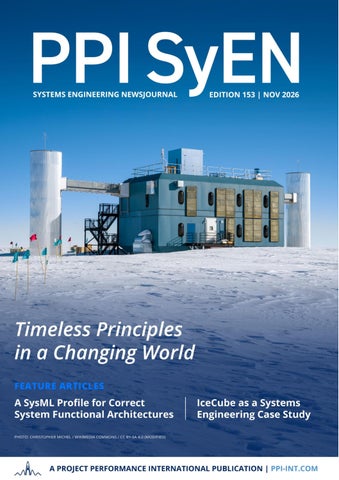
Project Performance International 2 Parkgate Drive Ringwood, Vic 3134 Australia Tel: +61 3 9876 7345 Tel UK: +44 20 3608 6754 Tel USA: +1 888 772 5174 Tel China: +86 188 5117 2867 www.ppi-int.com © 2012–2026 Project Performance (Australia) Pty Ltd, trading as Project Performance International. All rights reserved except where otherwise indicated; third-party licenses apply. COVER PHOTOGRAPH IceCube Neutrino Observatory in 2023 by Christopher Michel / Wikimedia Commons. CC BY-SA 4.0. Cropped and adapted for this cover. Source | License
PPI SyEN (PPI Systems Engineering News journal) is published quarterly. Archived editions and subscriptions to future editions are available for free at: https://www.ppi-int.com/syennewsjournal/ November 2026
WELCOME Dear Readers, Welcome to the November 2026 edition of the PPI Systems Engineering Newsjournal (SyEN), themed Timeless Principles in a Changing World. Few engineering stories illustrate this theme better than the IceCube Neutrino Observatory, whose scientific achievements have been recognized through the 2026 Nobel Prize in Physics, awarded to Professor Francis Halzen. We are particularly pleased to revisit this achievement through Randall (Randy) Iliff, PPI Principal Consultant and former Systems Engineering Manager for IceCube. In IceCube as a Systems Engineering Case Study, originally published in SyEN Edition 37, Randy describes how established systems engineering principles were adapted to an unconventional scientific environment. His account is as much about people, credibility, and risk as it is about technical engineering. At a very different scale, José Luis Fernández and Alfonso García explore the disciplined development of functional architectures in A SysML Profile for Correct System Functional Architectures. Their article demonstrates how foundational functional analysis principles can be applied through modern modeling tools. The technology evolves, but the underlying engineering logic remains consistent. In our Final Thoughts, Syenna explores another enduring principle: trust. The Interface Nobody Specifies reflects on the relationships between people and organizations that make complex engineering endeavors possible, particularly when those relationships are tested. Elsewhere, this edition covers developments in systems engineering research, SysML v2, digital engineering, AI-enabled tools, and activities across the international systems engineering community. Together, these contributions remind us that progress is not simply about adopting new technologies, but about applying sound engineering judgment, strengthening collaboration, and delivering systems that fulfill their intended purpose. We hope you enjoy this edition. Best wishes,
Francois Retief Managing Editor
[Contents]
2
PPI SyEN EDITION 153| NOVEMBER 2026
CONTENTS
SYSTEMS ENGINEERING NEWS ........................................................................................................4 Recent events and updates in the field of systems engineering
CONFERENCES, MEETINGS & WEBINARS ..................................................................................... 19 Events of Relevance to systems engineering
FEATURE ARTICLES........................................................................................................................... 23 A SysML profile for correct system functional architectures ............................................ 23 By Jose L. Fernandez and Alfonso Garcia
IceCube as a Systems Engineering Case Study ...................................................................... 35 By Randall C. lliff
Nobel Prize recognizes the science behind IceCube’s Antarctic neutrino telescope; and the PPI connection .......................................................................................................................... 42 By Randall C. lliff
SYSTEMS ENGINEERING RESOURCES ............................................................................................ 45 Useful artifacts to improve your SE effectiveness
FINAL THOUGHTS FROM SYENNA The Interface Nobody Specifies....................................... 74
Views expressed in externally authored articles are not necessarily the views of PPI nor its professional staff.
PPI Systems Engineering News journal (PPI SyEN) seeks: ➢ To advance the practice and perceived value of systems engineering across a broad range of activities, responsibilities, and job descriptions ➢ To influence the field of systems engineering from an independent perspective ➢ To provide information, tools, techniques, and other value to a broad spectrum of practitioners, from the experienced, to the newcomer, to the curious ➢ To emphasize that systems engineering exists within the context of (and should be contributory toward) larger social/enterprise systems, not just an end in itself ➢ To give back to the Systems Engineering community
November 2026
[Contents]
PPI defines systems engineering as: An approach to the engineering of systems, based on systems thinking, that aims to transform a need for a solution into an actual solution that meets imperatives and maximizes effectiveness on a whole-of-life basis, in accordance with the values of the stakeholders whom the solution is to serve. Systems engineering embraces both the technical and management dimensions of problem definition and problem-solving.
3
SYSTEMS ENGINEERING NEWS Recent events and updates in the field of systems engineering
INCOSE News During the past quarter, INCOSE has published a variety of newsworthy highlights through its Q3 2026 Members Newsletter and press releases. Recent news gleaned from these sources includes: Board of Directors Election Results Results have been announced from the 2026 Board election, with the following leaders joining the Board at the upcoming 2027 International Workshop: • • •
Stueti Gupta - Secretary (2-Year Term) Paul D. Nielsen - Director-at-Large (3-Year Term) Gan Wang - Director-at-Large (3-Year Term)
Barclay R. Brown Foundation On 8 September, INCOSE announced the launch of the Barclay R. Brown Foundation, created to preserve Dr. Brown’s legacy and continue his mission of Connecting Knowledge to What’s Next. Through scholarships, grants, educational initiatives, collaboration, and strategic giving, the Foundation will support students, early-career professionals, educators, researchers, organizations, and programs aligned with Dr. Brown’s work in advancing Systems Engineering, AI Research and Development, Systems Thinking, Quality Management, education, mentorship, innovation, and the development of others. Learn more and contribute here. INCOSE Foundation News The Foundation announced the launch of the Dorothy McKinney Family Scholarship, an annual $15,000 grant for MS in Systems Engineering students. The Foundation also presented its inaugural Excellence in Systems Engineering Award to the University of Michigan Mars Rover team in recognition of the team’s rigorous systems engineering practice. Evolution of the INCOSE Publications Portfolio INSIGHT is currently INCOSE’s practitioner-focused magazine, featuring accessible articles, interviews, case studies, and lessons from real-world systems engineering practice. Beginning in January 2027, INSIGHT will transition from a traditional magazine into a year-round online November 2026
[Contents]
4
SYSTEMS ENGINEERING NEWS publication featuring interviews and conversations with authors, editors, practitioners, and experts from across the systems engineering field. Twice each year, INCOSE will also publish a downloadable PDF edition containing a curated collection of featured INSIGHT interviews and articles. These editions will preserve the magazine-style reading experience while allowing individual pieces to be released throughout the year. Complementing these changes, INCOSE is also launching INCOSE Applications & Case Studies (IACS), a new open-access practitioner journal dedicated to field research, real-world applications, and lessons from systems engineering practice. According to Bill Miller, Editor-in-Chief of INSIGHT, “The IACS‘ focus is to communicate practicable outcomes, thereby demonstrating the value of systems engineering to our members as well as the broader systems community and the even broader socio-technical communities and enterprises.” As part of this transition, INCOSE is asking its members to explore the new IACS publication to learn how to contribute to this resource and to recommend authors, practitioners and subject-matter experts for future INSIGHT interviews. IS2026 Highlights The role of JCOSE, the Japan Chapter of INCOSE, in hosting the 2026 International Symposium (IS) was recounted along with the metrics of this successful event: • • •
963 attendees from 34 countries 513 first-time attendees, 222 non-members 200+ presentations, panels, and tutorials over 6 days.
Keynote speakers and their topics were recalled: • • • •
Dr. Yuko Harayama: What Does Human Touch Mean in the Age of AI? A Society 5.0 Perspective Prof. Giancarlo Guizzardi: Thinking Fast and Slow in Systems Engineering Fumiya Tsutsui: Engineering challenges for the world-first space vehicle - Lunar Camping Van Dr. Rosemary Barnes and Prof. Amro Farid: Energy Transformation – Systems Thinking for Resilience, Equity and Harmony.
The Q3 Members Newsletter also included the contributions of a variety of INCOSE chapters to the symposium. The Call for Papers for IS2027 has been issued with a submission deadline of 11 January 2027.
November 2026
[Contents]
5
SYSTEMS ENGINEERING NEWS Chapter Updates Numerous INCOSE chapters reported their significant activities and accomplishments beyond their participation in IS2026. A sample of these chapter news items includes: •
•
• •
•
• •
•
The India chapter notes impressive growth in membership, reaching 475 with 193 SEPs, echoing increased levels of engagement supported by regional “Circle Meet” events. The North Star chapter held an overview of Project Wildfire, with thoughts on how to apply its lessons to other forms of natural disasters by the establishment of resilience hubs. The Los Angeles chapter earned the Platinum Circle Award in a year marked by frequent chapter events and support for regional STEM service. The Seattle Metro chapter hosted two requirements-focused sessions with speakers Dr. Steven Dam (Application of Generative AI to Enhance Requirements Management) and Dr. Ron Carlson (Validating the Readiness of Potential Requirements). The New England chapter highlighted the collaborations with local universities (Worcester Polytechnic Institute and MIT) on integrating AI into graduate programs and real-world implementations of digital twins. Chapter members are also gaining hands-on MBSE experience through a partnership with MathWorks. The Canada chapter is conducting its second INCOSE Canada Student Competition. IFSE (INCOSE UK) will host its ASEC 2026 event on 24-25 November with the theme of Purposeful Transformation. IFSE also celebrates the publication of Don’t Panic! The Absolute Beginner’s Guide to System Design, Don’t Panic! The Absolute Beginner’s Guide to Modelling Functionality, and IfSE Practical Systems Engineering Journal: Issue 2 – Model-based Systems Engineering The Portugal chapter passed numerous startup milestones and is participating with the Brazil chapter in a translation of the INCOSE Systems Engineering Glossary.
Modelica Association News Modelica is a freely available, equation-based, object-oriented language for convenient and efficient modeling of complex, multidomain cyber-physical systems described by ordinary differential, difference and algebraic equations. The Modelica Association is a non-profit organization that develops coordinated, open access standards and open source software in the area of cyber-physical systems. Highlights from the Association’s August 2026 newsletter are found below. Board Highlights A report from Dirk Zimmer, Modelica Association Chair: •
Welcomed Dr. Clément Coïc to the Association board, noting his special focus on the interaction of Modelica and FMI standards and agentic AI.
November 2026
[Contents]
6
SYSTEMS ENGINEERING NEWS •
Highlighted the record number of submissions for the “fall” regional conferences: Asian Modelica & FMI Conference in Hangzhou, China, and American Modelica & FMI Conference in Atlanta, Georgia.
Conferences and User Meetings Early planning is ongoing for a vendor-led conference, Modelon Innovate 2027, that will take place in Malmö, Sweden on 21-22 April 2027 with the theme, Physics-Driven. Agent-Powered. Functional Mock-up Interface (FMI) News The Functional Mock-up Interface project reports: • • •
•
The in-person FMI Design meeting on 8-10 June in Munich, Germany yielded good progress on a wide range of FMI-related standard extensions and issues. The command-line tool for FMU validation and simulation, fmusim, has been moved to an open-source library and re-implemented in Rust. Pre-Release versions of FMI Layered Standard for Network Communication (FMI-LSBUS v1.3-beta.1) and of FMI Layered Standard References (FMI-LS-REF v1.0.0-beta.1) are available. Working groups are making progress on additional standards: FMI Layered Standard WebAssembly (FMI-LS-WASM) and FMI Layered Standard for DifferentialAlgebraic Equations (FMI-LS-DAE).
Modelica Vendor News •
• • •
•
•
Keysight Technologies has announced the release of SimulationX 2026 with modeling enhancements for Vehicle Dynamics, Advanced Heat Exchanger, Hydraulics, and FEM. Lunco has developed LunCoSim, an open-source, Rust-based simulator for lunar and orbital mission engineering that runs in the Rumoca compiler. M Dempsey LTD has released MLQT 2026.3 that includes a new Modelica MCP server for creating, editing, and checking Modelica models and libraries. Model Based Innovation (MBI) has developed a custom MCP (Model Context Protocol) integration (with skills files) that streamlines Modelica simulation and automated analysis workflows - turning simulation runs and report generation into simple, agent-driven steps. MBI has launched a variety of courses, including Agentic AI for Modelica Modeling and Simulation. Modelon has launched the Data Center Library for Modelon Impact, a new Modelica-based library that helps engineers design, simulate, and optimize data center cooling systems in response to the growing demands of AI-driven infrastructure. Their AI Assistant in Modelon Impact has been enhanced with new agentic simulation capabilities, allowing engineers to interact directly with models using natural language. OpenModelica 1.27.0 includes an experimental MCP server for interaction with AI agents, plus a wide range of feature enhancements.
November 2026
[Contents]
7
SYSTEMS ENGINEERING NEWS •
•
•
•
•
•
The August 2026 release by Orthogonal of ODE+ Component adds support for the DLR PowerTrain library. Their new ODE+ Exploration software solves single- and multi-objective problems over an analytic expression or a Modelica model. Purdue University has extended Rumoca, an open-source Modelica compiler that generates code for scientific-computing environments, with an eFMI workflow for deploying sampled control algorithms on embedded systems and demonstrated these capabilities on the outer-loop controller of a small autonomous fixed-wing aircraft. Renault Group has released version 1.9.3 of the FMU Manipulation Toolbox, an open-source Python package for analyzing, modifying, and combining FMUs without recompiling them. TLK-Thermo has implemented a system model of liquid-cooled CPU racks in TIL Suite 2026.1 in support of modeling and simulation of modern data center cooling systems. Their new TIL Add-On Battery provides support for evaluating battery thermal management system (BTMS) concepts. Wolfram has released a free set of agent skills that teach AI coding assistants Claude Code, Codex, or any agent with command-line access - to work with Wolfram System Modeler. XRG Simulation has joined the EU-funded Horizon project EVEREST with 12 European partners from industry and research. EVEREST stands for: Energy-efficient Vehicle Range Enhancement through Smart Thermal design and user-centric solutions.
View details of these and other announcements in the latest Modelica Association newsletter. System Dynamics Society 2026 Highlights The System Dynamics Society (SDS) conducted its first System Dynamics Conference fifty years ago in Norway with 70 participants in attendance. The 2026 International Systems Dynamics Conference (ISDC 2026) met in Delft, the Netherlands, with 623 participants from 58 countries in support of the theme “Navigating uncertainty, managing instability, and crafting futures together”. View conference highlights. 2026 Award Winners SDS announced a range of awards to organizations and individuals who have contributed to the theory and application of system dynamics and to the advancement of the Society. The winners were recognized in July at ISDC. The Jay Wright Forrester Award, which recognizes the best contribution to the field of System Dynamics during the preceding five years, went to the team of Juliette Rooney-Varga, Florian Kapmeier, Charles Henderson, and David N. Ford for their paper on the diffusion of innovation, Community-based propagation to scale up educational innovations in sustainability, November 2026
[Contents]
8
SYSTEMS ENGINEERING NEWS published in the journal Nature in 2024. In this paper, the authors demonstrate that word-ofmouth alone is often insufficient to spread educational innovations and introduce the concept of converting adopters into ambassadors, creating a new reinforcing feedback loop that enables much greater adoption. The Outstanding Service Award recognizes individuals for their long-term, exceptional volunteer contributions to the Society. The 2026 recipient, Billy Schoenberg, has played a critical role in the Society’s successful transition to virtual and hybrid conferences while expanding access to System Dynamics through open-source tools and AI initiatives. The Dana Meadows Award, recognizing the very best student work in the field, had one winner and three “honorable mentions”: • • •
•
Giovanni Cunico - Why Doesn’t Information Always Impact Decisions? Navigating Goal Ambiguity, Worldviews, and Information in Strategic Decisions Aletta Husmann (Honorable Mention) – Developing A System Dynamics Model for Utilization of Greenfeed Technology on Extensive Rangelands Jefferson K. Rajah (Honorable Mention) – Assessing the impacts of endogenous behavioural change on food demand in a feedback-based global integrated assessment model Sami Nour (Honorable Mention) – Fragmentation and Turnover Hold Back Labor Productivity in the Single-family Residential Construction Industry.
Two individuals were recognized with the Early Career Health Paper Award for outstanding papers dealing with health-related topics, authored by students or recent graduates: • •
Jose Mazariego (Winner) - A System Dynamics Model of HPV Vaccinations Among Adolescent Boys in New York State Ke (Koko) Zhou (Honorable Mention) - Housing Efficiency, Fuel Poverty, and NHS Burden: Modelling health-equitable decarbonization pathways in England.
Additional awards included: • •
Barry Richmond Scholarship Award: Sina Ataee Best Poster Award: Lin-Ya Hong, Lingxi Liu, Shuo Wang, Juan Esteban Martinez Jaramillo, and Erik Pruyt.
See the SDS awards press release for additional details. Learn more about SDS awards, past and present. Reflections from the Executive Director Beyond a record-breaking ISDC, Rebecca Niles, SDS Executive Director, summarized other 2026 Society highlights as:
November 2026
[Contents]
9
SYSTEMS ENGINEERING NEWS • • •
Membership has grown to 1,400+ members representing 75+ countries, hundreds of organizations, and dozens of fields and industries. The SDS Seminar Series reached 7,400 attendees this year, with the new Systems Sparks Practitioner series attracting over 500 participants. Contributions to student scholarships and the Strengthen the Field and Innovation Funds exceeded $60K.
ISDC2027 Preparations are underway for the 2027 International System Dynamics Conference, taking place on 18-22 July in Cleveland, Ohio, USA. Ideas for special events at ISDC2027 may be submitted until 15 December 2026. NIST Transit Cybersecurity Framework Community Profile Released The NIST National Cybersecurity Center of Excellence (NCCoE) has released the final NIST Interagency Report 8576, Transit Cybersecurity Framework Community Profile, to help U.S. transit agencies strengthen their cybersecurity practices while supporting safe and resilient transit services. The Transit CSF Community Profile provides a voluntary, risk-based resource to help transit agencies: • •
Strengthen cybersecurity preparedness and resilience against evolving threats facing the sector. Prioritize cybersecurity activities that align with their mission by mapping them to NIST Cybersecurity Framework (CSF) 2.0 outcomes.
The Transit CSF Community Profile focuses on three strategic priorities: • • •
Securing and managing critical assets to support safe and reliable operations. Strengthening collaboration with stakeholders and suppliers to improve resilience and supply chain security. Continuously improving organizational operations and processes, workforce cybersecurity awareness, and capabilities.
Download the Transit profile. PDMA News and Conference Highlights The Product Development & Management Association (PDMA) conducted the 2026 PDMA (Ignite Innovation) Summit on 8-11 October 2026 in Atlanta, Georgia. The Summit was held jointly with the Journal of Product Innovation Management (JPIM) Research November 2026
[Contents]
10
SYSTEMS ENGINEERING NEWS Forum. In addition to a full slate of keynotes, presentations, and workshops, the Association took the time to recognize outstanding corporate performers and future leaders in the discipline of New Product Development (NPD) and innovation management. PDMA 2026 Outstanding Corporate Innovator Awards For over three decades, the OCI Award has recognized exceptional organizations that have demonstrated outstanding innovation excellence. The OCI Award selection process identifies companies that consistently generate and harness long-term value through exceptional product and service innovation. Winning companies demonstrate well-defined new product development practices and processes that have contributed to their innovation success. Two companies were selected as recipients of this year’s honor. Huntsman Advanced Materials As a global leader in high-performance specialty materials and solutions, Huntsman’s Advanced Materials division takes pride in helping customers find innovative material solutions to complex challenges facing the aerospace, electronics, transportation, construction, adhesives, coatings, and composites industries. Through a commitment to innovation, customer collaboration, and operational excellence, Huntsman develops technologies that help customers improve performance, reliability, safety, and sustainability. At the core of Huntsman's success is a disciplined innovation system that connects strategy to execution through robust governance, portfolio transparency, and a single system of record that enables informed decision-making across the innovation lifecycle. Combined with a culture focused on solving customer challenges, this framework allows Huntsman to consistently transform customer and market insights into differentiated solutions and measurable business outcomes "What distinguishes Huntsman as an innovator is not a single product or breakthrough, but a disciplined process that integrates a culture of innovation with customer focus, proper governance, and intentional portfolio management that is visibly supported by leadership and embraced throughout the organization.” (Angela Cooper, Global Portfolio Management and Market Analytics Senior Manager) Perdue Farms Founded in 1920 in Salisbury, Maryland, Perdue Farms has expanded to deliver a premium portfolio of trusted food. A team of passionate and creative R&D associates evaluate ideas against simple but critical criteria: does it solve a real consumer need? From there, crossfunctional teams work together to determine how it can be brought to market in a way that creates value for consumers and the business. “At Perdue, innovation begins with a simple but powerful commitment: to listen deeply, think boldly and create with purpose. By staying close to consumers, customers, and the changing needs of the marketplace, we turn insight into meaningful solutions that make people’s lives better and reflect the values that have guided Perdue for more than a century.” (Brice Westring, Senior Vice President and Head of Research & Development) November 2026
[Contents]
11
SYSTEMS ENGINEERING NEWS Learn more about the OCI award here. Read the PDMA press release. Global Student Innovation Challenge 2026 PDMA’s 7th Annual Global Student Innovation Challenge (GSIC 2026) finalists presented their ideas at PDMA’s Ignite Innovation Summit to determine 1st, 2nd, and 3rd place awards. The original field of GSIC 2026 participants included 156 students on 44 teams representing 24 universities from 16 countries. Each team submitted a product/service/software idea and detailed the unique value proposition, evidence of demand, and mockup or embodiment of that product. Three finalists competed for top honors: •
• •
1st place: Novadüng: A Cassava-Derived Bio-SAP Hybrid Diaper System for Sustainable and Accessible Infant Hygiene in Indonesia (Institut Teknologi Bandung, Indonesia) 2nd place: PeatGuard- Restoring Degraded Peatlands with Satellite Technologies and Community Mobilisation (Nanyang Technological University, Singapore) 3rd place: GridFlex - EV Charging Load Management Platform (Technical University Berlin, Germany).
Additional Conference resources PDMA has made available a Summit Webinar Series consisting of 30-minute virtual presentations. Access these webcasts using the links below: • • • •
From Contradictions to Breakthroughs From Idea to Scale: The Four Leadership Modes That Drive Product Innovation Making AI Adoption Stick Next Generation New Product Governance Systems
Daily videos recapping the highlights of the Summit may be found here. Systems Engineering Research Center (SERC) Updates The August 2026 update from the Systems Engineering Research Center (SERC) and its partner agency, the Acquisition Innovation Research Center (AIRC), highlights these organizations’ research-driven contributions to systems engineering practices. AI4SE & SE4AI Research and Application Workshop The 7th AI4SE and SE4AI Workshop took place on 22-23 September at the George Washington University with the theme “Speed and Innovation through AI4SE & SE4AI”. The Workshop included more than 70 panels and presentations with a diverse range of leading-edge content November 2026
[Contents]
12
SYSTEMS ENGINEERING NEWS available here. AIRC Insights Explores Mission Engineering and Integration Activity (MEIA) The 21 July 2026 installment of the AIRC Insights series explored Implementing MEIA and DevOps to Bridge the Gap Between Development and Operational Deployment. Key takeaways were that MEIA offers: •
•
• •
Speed and evidence over opinion by replacing informal, opinion-driven platform debates with modeling, simulation, campaign analysis, and mission engineering so decisions rest on a shared, transparent body of evidence. An end-to-end pathway that links problem identification, technology discovery and due diligence, prototyping/experimentation, and acquisition integration/fielding into one continuous pipeline rather than disconnected efforts. A design focused explicitly on transfer and scale-out of the mission thread and modeling/simulation approach to the services and combatant commands. An opportunity to leverage existing knowledge as MEIA teams pull in FFRDC, UARC, and academic studies already underway on a given problem rather than starting analysis from zero.
View the MEIA panel video. Moving Beyond Kill-Chain Thinking in a Kill-Web World One of the military’s most daunting problems involves kill webs. These interconnected networks of systems with diverse capabilities operate in complex and often parallel ways to ensure the US military can execute warfighting effects across domains with flexibility and resilience to failure. However, analytic structures for Mission Engineering (ME) and MEIA (see article above) focus on kill chains, which are not simply composable in a way that effectively captures the network properties and dynamics of a kill web. This AIRC Perspectives paper discusses these challenges and makes recommendations to address critical needs concerning kill webs in MEIA activities and Capability Portfolio Management (CPM) decision-making. Download the Full Report. INCOSE INSIGHT Special Issue SERC leaders were instrumental in creating a special June 2026 issue of the INCOSE INSIGHT practitioners magazine, titled “A Decade of AI and Systems Engineering: Looking Back and Forward”. See the Resources section of PPI SyEN Edition 152 (August 2026) for the abstracts of these articles. SERC Research Review 2026 The annual SERC Research Review took place on 10 November in Washington, D.C., to showcase government-funded SERC research projects and foster vigorous discussions on
November 2026
[Contents]
13
SYSTEMS ENGINEERING NEWS advances in systems engineering to benefit national security. Presentation slides and related resources are available on the SERC event page. SERC Mourns Passing of Dr. Bill Rouse Dr. Bill Rouse, emeritus member of the SERC Research Council and advisor to the launch of the AIRC, passed away on 4 August. Fellow SERC members summarize and laud his many contributions. Access the latest SERC news here. Follow SERC on LinkedIn. AIA EN-NAS 9300-500 LOTAR for MBSE Standard Published The INCOSE Tools Integration & Model Lifecycle Management (TIMLM) Working Group reports the publication of a new standard, EN/NAS 9300-500 Aerospace Series - LOTAR - Long Term Archiving and Retrieval of digital technical product documentation such as requirements, architecture, simulation, and analytical data - Part 500: Fundamentals and Concepts for Long Term Archiving to enable Model-based Systems Engineering. Jointly developed by the TIMLM WG and PDES, Inc., the standard is the first in a series of standards supporting the preservation of MBSE models, simulation, and supporting data. The EN 9300-5xx series specifies the methods for long-term archiving and retrieval of MBSE data represented as digital models. The characterization of models that are considered in scope of this document and the MBSE process use cases include: • • • •
• • • • •
product or system design requirements models functional architecture models logical architecture models (system structure, arrangement, connectivity, software allocations and controls, and part relationships) numerically-based system analysis and simulation models, generally regulated 1D control loop models featuring system components and transport elements (tubing, piping, signaling, software) verification and validation of requirements protocol-dependent signal or communication networks multi-model linking and system parametric models system trade study models the solution architecture models and data that are needed to implement the system and generate system engineering data for downstream designs.
Download the standard here.
November 2026
[Contents]
14
SYSTEMS ENGINEERING NEWS EDM Association News The EDM Association (EDMA) is a leading member-led global trade association focused on advancing data management and analytics best practices, standards, and education. Formerly the EDM Council, the EDMA merged in 2025 with the Object Management Group (OMG), which is now an EDM Association Community. In the EDMA’s Q3 update, John Bottega, President of the EDM Association, reported on the general progress of the Association in the rapidly evolving AI-driven business environment. The EDMA has staked out a clear position on AI: “The path to AI optimization begins with trusted, interoperable data through best practices and standards.” This trusted data foundation is what “enables AI to reason accurately, digital twins to mirror reality with fidelity, and AR systems to deliver contextual intelligence in real time.” Highlights from the EDMA’s four communities demonstrate support for this strategy: OMG Standards Development Organization (OMG SDO) OMG continues to expand the standards and frameworks (API4KP, ODM, OMG Commons, FIBO) that enable scalable, interoperable, and trustworthy enterprise AI solutions. Augmented Reality for Enterprise Alliance (AREA) AREA is helping organizations translate XR technologies into measurable operational and workforce benefits. The Innovation Impact Framework keeps the emphasis on human‑centered design and workforce adoption — the real keys to avoiding stalled pilots and achieving measurable value. Digital Twin Consortium (DTC) DTC is accelerating digital twin innovation through interoperability, physical AI, robotics, and industry-focused collaboration. Specific actions include: •
Forming a new quantum computing working group in the DTC
•
Joining AMD’s Open Robotics Partner Ecosystem
Data & Analytics (D&A) EDMA is expanding practical guidance, standards, and tools that help organizations build trusted, AI-ready data ecosystems. For example, the Data Asset Foundations helps EDMA members turn well‑governed data into measurable business value by giving them a structured way to inventory, assess, and manage data as a true enterprise asset. Key Partnerships Strategic partnerships are broadening the Association’s influence and strengthening alignment across data, engineering, and standards communities, notably with: November 2026
[Contents]
15
SYSTEMS ENGINEERING NEWS • • •
INCOSE: collaborating on the intersection of systems engineering and data/information management OGC (Open Geospatial Consortium): aligning geospatial and location data standards ODI (Open Data Institute): partnering on open data practices, data trust frameworks, and broader data ecosystem thinking
Follow the EDMA news here and on the News pages for each of the EDMA communities. SysML v2 Releases The Object Management Group (OMG) has announced both the 2026-7 release and 2026-8 release of the Systems Modeling Language™ Version 2. The latest (2026-8) release is now publicly available here and includes Beta 2 versions of the KerML 1.1 and SysML 2.1 metamodels and model libraries. The 2026-7 release provides resolution for 16 KerML and SysML issues. View the 2026-07 release notes. In addition to bug fixes, the 2026-8 release includes technical changes to caching of computed values and post-processing implementation changes after model parsing. View the 2026-08 release notes for details. Obeo and CEA-List Deepen AI-MBSE Partnership Obeo, an independent MBSE software provider, and CEA-List, a French technology research institute specializing in intelligent digital systems, have announced a new milestone in a partnership that began several years ago - leading to major developments based on Obeo’s Eclipse Sirius technology for the open-source Papyrus and SysON tools. Obeo and CEA-List are combining their expertise in augmented collaborative engineering, an approach that brings artificial intelligence and systems engineering together to rethink the user experience and enable project teams to collaborate and connect more effectively, particularly in demanding industries such as aerospace, defense, and transportation. Combining Obeo’s product expertise with CEA-List’s research excellence, the two partners are jointly developing artificial intelligence assistants integrated into MBSE tools. Initial developments focus on adaptive onboarding and coaching capabilities designed to make these tools easier to learn and use. Read the Obeo press release.
November 2026
[Contents]
16
SYSTEMS ENGINEERING NEWS Updates to the Systems Engineering Tools Database (SETDB) The Systems Engineering Tools Database (SETDB), developed by PPI in partnership with INCOSE, provides a virtual platform for engineering tool vendors to communicate their latest offerings. Recent SETDB updates, including both new tools and updates to existing tools, include: Vendor: AI Marketplace GmbH • TESSA (Architecture AI Assistant): An AI assistant for model-based systems engineering. It works inside the SysML modelling environment that engineers already use, turning requirements and plain-language instructions into consistent SysML model content. The engineer approves every proposed change before it is applied. • portal0: Engineering Intelligence & Automation: An engineering intelligence and automation platform. It connects engineering data spread across ALM, PLM, and requirements systems, PDFs, Office documents, spreadsheets, and e-mails, then applies AI workflows for requirements, test traceability, quality reviews, and change impact analysis. Vendor: Angry Pixie Electronics LLC • Holarch: Browser-based MBSE tool for SysML v2 and the Lifecycle Modeling Language. Text and diagrams edit one model, with requirements, verification, interfaces, risks, simulation, and generated documents on the same model. Free for students, instructors, and personal use. Vendor: Change Vision, Inc. • Astah Professional: An integrated modeling tool that supports UML diagrams, ER diagrams, flowcharts, and requirements modeling. It helps teams visualize, design, and manage system and software structures. Version 11 adds AI-assisted modeling features to support diagram creation and improvement. • Astah SysML: A lightweight SysML diagramming tool that is perfect for systems engineering. Our user-friendly tool helps create a clear understanding among business analysts, engineers, developers, and quality assurance specialists with Astah SysML. • SysMLv2 Editor for Visual Studio Code: A lightweight extension developed by Change Vision, Inc., designed for engineers working with SysML v2. It enables fast, syntax-aware model editing, with key productivity features such as real-time validation, symbol navigation, and diagram visualization. • Astah UML: A modeling tool focused on creating UML diagrams for system and software design. It provides a simple and intuitive environment for visualizing system structure and behavior. Version 11 introduces AI-assisted modeling features that support UML diagram creation and improvement.
November 2026
[Contents]
17
SYSTEMS ENGINEERING NEWS •
Astah System Safety: A modeling tool for safety-critical systems to support system architecture modeling, system safety assessment, and analysis.
Vendor: NordTrace Solutions • TraceBoard Suite: A lightweight, air-gapped ALM platform for safety-critical engineering. It automates end-to-end requirement traceability, test evidence logging, and NATO/compliance document generation (DO-178C, ISO 26262) for defense and embedded tech. Vendor: Planetary Utilities • Starforge JupyterLab: An engineering platform that creates a natural language interface to your engineering stack. It connects with your digital twin models, simulations, and system data—making them accessible through conversation. • Starforge Kotar: A browser-based IDE for SysML v2 — textual and graphical modeling, model-aware validation, engineering analysis, and automation — all working against one shared semantic model. No plug-ins. No format translation. In addition to software tools, the SETDB also includes links to a variety of industry standards. Recent additions include: Source: INCOSE/OMG • Model Characterization Pattern (MCP): The MCP is structured into configurable feature groups that can be tailored to specific model types and stakeholder needs. Source: AUTOSAR • Automotive Architecture Standards: The AUTOSAR layered architecture offers all the mechanisms needed for software and hardware independence. It distinguishes between three main software layers that run on a Microcontroller (µC): application layer, runtime environment (RTE), and basic software (BSW). PPI SyEN readers are encouraged to check out these new and updated systems engineering tool offerings. Access the SETDB website.
“Planning is bringing the future into the present so that you can do something about it now.” Alan Lakein
November 2026
[Contents]
18
CONFERENCES, MEETINGS & WEBINARS Events of relevance to systems engineering
Capella Days 2026: Program Details The annual free online gathering of the Capella (MBSE tool) and Arcadia (MBSE method) community, Capella Days 2026, is scheduled for 1-3 December. Capella Days brings together the creators of Capella/Arcadia, providers of Capella add-ons and services, and MBSE experts and industrial users. Planned presentations span multiple industries. Avionics: • Non-functional Requirement Creation & Traceability Using Property Values (Joshua Wedgewood, Rolls-Royce) • From Requirements to Engineering Decisions: Building an Aircraft Landing Gear System in Capella (Apurva Pardeshi, Bluekei Solutions; Shefali Arya and Randhir Swarnkar (TimeTooth Technologies). Energy: •
Space: • •
•
MBSE Toolchain Based on Capella to Manage System Integration During the Engineering Phase (David Plancq, Nuward)
Implementing Arcadia and MBSE Techniques for Future Earth Observation Missions (Dario Scimone, Indra Space) Closing the Downstream Gap: From Arcadia Functional Breakdown to Requirements and FMEA (Michael Handrischik-Bowman, Tom Handrischik, and Denis Prell, Foxsolution) e-F4GSA: Extended Framework for Generalized Space Architectures: An ARCADIA & Capella Perspective (Antonio Cassiano Julio Filho, INPE).
Railway: • Modeling the European Railway System with Capella (Gauthier Jourdain, CESAMES) • Validating Dynamic Behavior in Complex Railway Systems Using Arcadia and POOSL (Guatem Shet and Shantanu Patil, Bluekei Solutions). Motors: • From Learning to Modeling: The Hybrid Mining Truck Journey with Arcadia and Capella (Rami Wehbe and Mohammad Chami, SysDICE and David Pietsch, RollsRoyce Power Systems) November 2026
[Contents]
19
CONFERENCES, MEETINGS & WEBINARS View the Capella Days agenda. Register here. NAFEMS ASSESS Simulation Leadership Summit 2027 The NAFEMS Analysis, Simulation & Systems Engineering Software Strategies (ASSESS) Initiative seeks to take on the challenge of leading engineering simulation toward delivering greater value. ASSESS is a think tank that brings together thought leaders and visionaries from industry, government, and academia to address challenges and shape the future of engineering simulation. The Simulation Leadership Summit 2027 is billed as a place “Where Simulation's Future Gets Decided”. The 2027 Summit will take place in Amsterdam, Netherlands, on 8-10 March 2027. Working sessions for the participants (limited to 80 senior leaders) will address topics such as: • • • • • • •
Artificial Intelligence / Machine Learning Business Challenges Achieving Certification by Engineering Simulation Engineering Simulation Confidence & Governance Democratization of Engineering Simulation Integration of Systems and Detailed Sub-System Simulations Engineering Simulation Digital Twin(s).
Learn more and register here. Call for Abstracts: NDIA 2027 Human Systems Conference The U.S. National Defense Industrial Association (NDIA) will host its 2027 Human Systems Conference in Arlington, Virginia, USA on 3-4 March 2027. This in-person conference will take place on the campus of George Mason University. The 2027 NDIA Human Systems Conference will highlight the critical role Human Systems plays in transforming research and technology into operational capability. The theme, "Human Systems in Action to Integrate People, Technology, and Acquisition," focuses on the methods, partnerships, and practices required to transition emerging innovations into deployable, mission-effective solutions. As military organizations rapidly adopt artificial intelligence, digital engineering, advanced training systems, and other emerging technologies, success often depends on how effectively these capabilities are integrated with the people, organizations, and acquisition processes that enable operational use. A Call for Abstracts for this conference has been issued with a submission deadline of 14 November 2026
[Contents]
20
CONFERENCES, MEETINGS & WEBINARS December 2026. Abstracts are sought for two engagement formats (Lightning Talks and Poster Sessions) in three tracks: • • •
Personalized Assessment Education and Training (PAE&T) Protection Sustainment and Warfighter Performance (PS&WP) Systems Interface and Cognitive Processing (SI&CP).
Call for Papers: NASA Formal Methods Symposium 2027 The 19th NASA Formal Methods Symposium (NFM 2027) will be held on 11-13 May 2027 at the University of Houston Clear Lake, Houston, Texas, USA. The NASA Formal Methods Symposium (NFM) is an annual forum to foster collaboration between theoreticians and practitioners from NASA, academia, and industry. NFM's goals are to identify challenges and to provide solutions for achieving assurance for such critical systems. NFM 2027 has issued a Call for Papers that includes topics of interest such as: • • • • • • • • • •
• •
Advances in automated theorem proving including SAT and SMT solving Code generation from formally verified models Correct-by-design controller synthesis Formal approaches to fault tolerance Formal assurance methods to handle adaptive systems Formal methods in systems engineering and model-based development Formal verification, including theorem proving, model checking, and static analysis Run-time verification Safety cases and system safety Techniques and algorithms for scaling formal methods, such as abstraction and symbolic methods, compositional techniques, as well as parallel and/or distributed techniques Theoretical advances and empirical evaluations of formal methods techniques for safety-critical systems, including hybrid and embedded systems Use of formal methods in software and system testing.
NFM 2027 seeks two types of submissions: • •
Regular papers (16 pages, plus references), describing fully developed work and complete results. Short papers (8 pages, plus references) describing novel, publicly available tools or case studies.
Important Dates: • Abstract submission: 4 January 2027 • Full paper submission: 11 January 2027 • Notification: 26 February 2027 November 2026
[Contents]
21
CONFERENCES, MEETINGS & WEBINARS •
Camera-ready papers: 19 March 2027.
Learn more about NFM 2027. Call for Papers: Models for Formal Analysis of Real Systems (MARS 2027) Workshop MARS workshops bring together researchers from different communities who are developing formal models of real systems in areas where complex models occur, such as distributed and decentralized systems, cyber-physical systems, hardware/software co-design, biology, finance, quantum and reversible computing, etc. The 8th Workshop on Models for Formal Analysis of Real Systems (MARS 2027) will take place on 11 April 2027 in Copenhagen, Denmark. MARS 2027 is affiliated with the European Joint Conferences on Theory and Practice of Software (ETAPS 2027). A Call for Papers has been issued for MARS 2027, seeking papers that present formal models of real systems and answer questions such as: • • • • • •
Which formalism was chosen, and why? Which abstractions have been made, and why? How were important characteristics of the system modelled? Were there any complications while modelling the system? Which measures were taken to guarantee the accuracy of the model? How can different modelling approaches be compared on this system?
In addition to the workshop proceedings, the formal models presented at the workshop will be archived in the MARS Repository, a growing, diverse collection of realistic benchmarks. The due date for paper submission is 22 January 2027, with notification by 5 March and final versions due by 24 March. Upcoming PPI Live-Online ™ and In-Person Systems Engineering Five-Day Courses Click here to view the full schedule or register for upcoming courses
November 2026
[Contents]
22
FEATURE ARTICLES A SysML profile for correct system functional architectures
A SysML profile for correct system functional architectures
By Jose L. Fernandez and Alfonso García
Jose L. Fernandez, Independent consultant and former UPM university tenured associate professor
jose.fernandez@incose.net Alfonso García, Independent consultant
alfgarciacasado@gmail.com Copyright © 2026 by Jose L. Fernandez and Alfonso García. All rights reserved. Authored for PPI SyEN
Abstract One of the most important views within a system model, regardless of the type of system, is its functional architecture. Functional architecture is a representation of the system behavior (what the system does) in the form of functions as transformations of inputs into outputs. Traditionally the functional analysis approach for developing functional architectures was applied to the development of many systems since 1950. However, its use in the industry has been declining with the advent of object-oriented development. We believe this object orientation causes a weakness present in several of the most popular MBSE methodologies, where there are no clear guidelines on how to build a correct functional architecture characterized by functional and sequential cohesion among functions. Here we emulate the traditional functional analysis approach using SysML notation, so first we develop a detailed conceptual model of what is a function and the main dependencies between functions that are parent->child dependencies and out->in dependencies. Later, we build a SysML profile and implement it in a popular commercial case tool. This Integrated Systems Engineering and Pipelines of Processes in Object Oriented Architectures, “ISE&PPOOA SysML profile” is offered free to the MBSE community. This paper summarizes these steps and illustrates them with an application example. Keywords: SysML profile, conceptual model, functional architecture, UML, MBSE tools. INTRODUCTION AND STATE OF THE PRACTICE Functional architecture is a representation of the system behavior (what the system does) in the form of functions considered as transformations of inputs into outputs. Given a common technological approach to accomplish a system-level function, a functional architecture may be developed that spans a wide range of physical implementations of the technological approach. November 2026
[Contents]
23
FEATURE ARTICLE Having a functional architecture of the system of interest enables the validation of its functionality and performance with respect to the operational needs, the decomposition and allocation of subfunctions to physical blocks of the physical architecture, and the identification and operation of interfaces [1]. Functional architecture represents the core model for the development of mechatronic systems, which are systems with mechanical, electronic, and software parts. For those mechatronic systems the functional architecture can be considered as the frame that integrates the diverse engineering specialties involved in the development of the system. First, functionalities are identified and modeled as a functional architecture and later a decision is made about how to allocate and implement the functions using diverse technologies [2]. The functional analysis approach for developing functional architectures has been applied to the development of many systems since 1950 [3]. However, its use in the industry has been declining with the advent of object-oriented development. We believe this object orientation causes a weakness present in several of the most popular MBSE methodologies [4], where functions are mainly identified from system use cases and there are no clear guidelines on how to build a correct functional architecture characterized by functional and sequential cohesion among functions [5]. We consider a correct functional architecture is one that follows the basic guidelines of traditional functional analysis, where there are two fundamental types of relationships: the parent-child relationship between a parent function and its child functions, and the out->in dependency relationship between functions that exchange matter, energy, or data. A recent publication proposes using semantic and syntactic equivalence to determine whether a functional substitution is valid [6]. The approach presented here has a different objective: decomposing a function into its child functions, also employing equivalence criteria between the parent and the children—specifically, syntactic equivalence and equivalence based on contextual behavior. To emulate the traditional functional analysis approach using SysML notation and a commercial MBSE tool, we first develop a detailed conceptual model of what a function is and the primary dependencies between functions that are parent->child dependencies and out>in dependencies. Later, we build a SysML profile and implement it in a popular commercial case tool. This SysML profile is offered free to the MBSE community. We created this profile for SysML v1, but we believe it would also be useful for SysML v2, since SysML v2 better supports the difference between action definition and usage, and the SysML v2 definition of item [7], is more consistent with our approach, so we plan to develop it for SysML v2 as well. This paper summarizes the development of the ISE&PPOOA SysML v1 profile and illustrates it with an example of application.
November 2026
[Contents]
24
FEATURE ARTICLE CONCEPTUAL MODEL OF THE FUNCTIONAL ARCHITECTURE As we described above, it is important to consider the function as a transformation of inputs into outputs. Other definitions of function are more generic such as the definition of the NASA Systems Engineering Handbook, where a function is defined as “a specific action, process, or task that a system, subsystem, or component must perform to achieve its mission objectives” [8]. When a systems engineer defines a function as a transformation as we do, he or she has to be aware of the inputs to the function and how these inputs are transformed into outputs. Simultaneously if he or she decomposes a function into its child functions or subfunctions, the systems engineer has to be aware of maintaining the consistency of the inputs and outputs between the parent function and its child functions. These considerations may be modeled conceptually as a UML class as shown in Fig. 1. The conceptual diagram is an extension of the conceptual diagram of the MBSE methodology ISE&PPOOA that is presented in the ISE&PPOOA methodology book [2]. Other ontological approaches to functions can be found in the literature. Particularly interesting is the approach by Kitamura and Mizoguchi applied to production companies [9]. In Fig. 1 conceptual model, a function is a transformation that may play the role of sender or receiver of items. An item may be either a material item, energy item or data item. When a function is a parent function it has one to many children. A function is defined once in the functional hierarchy and it is used in one or more functional flows. A functional flow is an ordered aggregation of functions that have the role of used functions that means they are used by this particular functional flow. So, the parent-child relation is established when the functions are defined. The order of functions is established when the functions are used in a functional flow. Between each pair of functions, we model functional interfaces. Functional interfaces are defined as well between some functions and external entities interacting with our system of interest. Here a correct functional architecture is one that follows the basic methodological approach of traditional functional analysis, where there are two fundamental types of relationships: the parent-child relationship between a parent function and its child functions, and the out->in dependency relationship due to interfaces between functions that exchange matter, energy, or data items. The parent-child relationship must be based on the inputs and outputs of the parent function and how these inputs and outputs are assigned to its child functions. If this is not done consistently, the resulting functional hierarchies and functional flows will be incorrect.
November 2026
[Contents]
25
FEATURE ARTICLE
Fig.1. Conceptual model of Function in the ISE&PPOOA MBSE methodology A SYSML PROFILE FOR A CORRECT FUNCTIONAL ARCHITECTURE SysML supports language extension for domain-specific purposes through the definition of profiles and stereotypes, in accordance with the UML profile mechanism [10]. A profile is a specialized package that extends a reference metamodel by defining stereotypes inside it. These stereotypes extend one or more metaclasses by introducing additional semantics, properties, and constraints, adding this way domain-specific meaning while ensuring that extensions remain strictly additive and do not alter the original metamodel. When a modeling concept is already defined by a stereotype in an existing profile, adding domain-specific meaning will be achieved by creating a new stereotype that specializes the existing one using the generalization relationship. Through the generalization relationship, the new stereotype inherits and extends the properties and constraints of the base stereotype, while preserving compatibility with the original profile. When mapping ISE&PPOOA concepts to SysML v1 (Fig. 2 ), the ISE&PPOOA Function concept corresponds most closely to the SysML Activity concept which inherits from UML. Inputs and outputs of a Function can be represented as specialized elements of the Property concept, which Activity owns because it is a special type Classifier. These inputs and outputs are typed by the Item concept, which is itself a specialized type of Block used to represent entities that flow from/to the Function. Additionally, the Child Function concept can be represented as an additional property of Function, typed by the Function concept itself.
November 2026
[Contents]
26
FEATURE ARTICLE
Fig.2 . Mapping of ISE&PPOOA concepts to SysML concepts In a similar manner, the Functional Flow concept also maps to the Activity in SysML (Fig. 3), since both share the same purpose: describing behavior through the coordinated sequencing of subordinate elements. An Activity can be represented by an Activity Diagram, which visualizes the Nodes and Edges that define its behavior. In the ISE&PPOOA MBSE methodology, functional flows illustrate how functions from the functional hierarchy are executed in sequence to represent system behavior. Consequently, the SysML concept that best corresponds to the Used Function concept is Call Behavior Action, a specialized Action used to invoke another Behavior defined somewhere in the model [11].
Fig.3. Mapping of ISE&PPOOA functional flow to SysML activity diagram The simplified implementation of the ISE&PPOOA Profile is illustrated in the following figures: Fig. 4 and Fig.5.
November 2026
[Contents]
27
FEATURE ARTICLE
Fig. 4. ISE&PPOOA Profile for function and child function
Fig. 5. ISE&PPOOA Profile for input, output and item To enforce the ISE&PPOOA methodology rules that maintain consistency of inputs and outputs between parent and child functions, constraints have been added to the Function, Input, and Output stereotypes. In UML and SysML, a constraint is a condition or restriction that a model element must satisfy. When a constraint is defined on a stereotype, the modeling tool applies it as a validation rule to detect and report violations to users during modeling (Fig. 6). November 2026
[Contents]
28
FEATURE ARTICLE
Fig 6. Constraints applied to the ISE&PPOOA stereotypes EXAMPLE OF APPLICATION OF THE ISE&PPOOA SYSML PROFILE FOR CAMEO As an application example, a simplified model of a Steam Iron is defined using the ISE&PPOOA profile in version 2024 Refresh 3 of Cameo Systems Modeler™, one of the leading tools for MBSE. To elaborate on the functional architecture, the ISE&PPOOA methodology proposes defining the system context by one or more context diagrams. A context diagram (Fig. 7), explicitly identifies the external entities with which the system must interact and the exchanges of matter, energy, or data. Domain knowledge and these inputs and outputs help to identify the system functions that transform the inputs received by the system into the expected outputs it produces.
Fig. 7. Context diagram of the Steam Iron
November 2026
[Contents]
29
FEATURE ARTICLE Based on the context diagram and domain knowledge, the identified top-level functions are shown in Fig. 8 displaying the inputs they receive and the outputs they are responsible for producing. By applying the validation rules of the ISE&PPOOA MBSE profile, the modeling tool alerts the systems engineer about any non-conformances they may have unintentionally introduced, such as functions without inputs, functions without outputs, or inconsistencies between parent and child functions.
Fig. 8. Partial view of the first layer of the Steam Iron Functional Hierarchy Figure 9 shows another example of functional decomposition, this time of the internal function “F6 Generate Ironing Steam”. It clearly illustrates, in compact form, how the function inputs (which are internal system inputs) are transformed through its child functions to produce the required external output “Ironing Steam”.
“The scientist describes what is; the engineer creates what never was.” Theodore von Kármán
November 2026
[Contents]
30
FEATURE ARTICLE
Fig 9. Functional Hierarchy of F6 Generate Ironing Steam Within the ISE&PPOOA methodology interfaces between functions are identified and expressed in N-squared diagrams, such as the one shown in Table I. An N-squared diagram is a matrix-based representation used in systems engineering to depict interfaces and interactions between system elements. The elements (i.e. functions in the table) are listed along the main diagonal, while the off-diagonal cells illustrate the inputs and outputs exchanged between them. The convention here is that inputs to each function are displayed in the column of the function in a cell, and outputs are displayed in the row of the function. This compact format helps identify all interfaces and highlight any missing or inconsistent connections. Once the functional decomposition is performed and the out-in dependencies are identified from the N-squared diagram, it is easier for the systems engineer to build up the functional flows to depict how different functions are used and activated to transform the inputs to the system into the required outputs. SysML control nodes are added judiciously to coordinate the flow of control. An example of functional flow based on the N-squared diagram of Table 1 is displayed in Fig. 10.
November 2026
[Contents]
31
FEATURE ARTICLE These functional interfaces will serve to identify and model the physical interfaces of the physical blocks where the functions are allocated later in the development. New functional requirements based on the outputs of each new function modeled are identified as well. TABLE I. N-SQUARED DIAGRAM SHOWING F6 CHILD FUNCTIONS INTERFACES
Fig. 10. Example of functional flow "Generate and Transfer Steam". CONCLUSIONS Thanks to the implemented profile, the concepts of Function, Input, Output, and Used Function are clearly represented in the system model. Together with the validation rules defined by the ISE&PPOOA MBSE methodology and implemented in the selected MBSE tool, these elements guide systems engineers in creating correct functional architectures. Such correct functional architecture facilitates requirements flow down and traceability, effective interface management, system physical architecture design, and enables a smoother transition to integration and V&V activities. Interested people can get free the ISE&PPOOA Profile & Plugin for Cameo Systems Modeler 2024x by contacting the authors via email at: ise&ppooa@ppooa.com.es with their contact details: name, institution or company, location, and professional email address. November 2026
[Contents]
32
FEATURE ARTICLE References [1] R. S. Carson and B. J. Sheeley, “Functional Architecture as the Core of Model‐Based Systems Engineering,” Proc. INCOSE International Symposium, Vol. 23, 2013, pp. 29–45. [2] J.L. Fernandez and C. Hernandez, “Practical Model-Based Systems Engineering”. Artech House: Norwood, MA, 2019. [3] T. De Marco, “Structured Analysis and System Specification”, Upper Saddle River, NJ: Yourdon Press. 1978. [4] J.A. Estefan and T. Weilkiens, “MBSE Methodologies.” In: Madni, A.M., Augustine, N., Sievers, M. (eds) Handbook of Model-Based Systems Engineering. Springer, Cham. 2023. https://doi.org/10.1007/978-3-030-93582-5_12 [5] R. Stevens et al.,” Systems Engineering. Coping with Complexity”, Hemel, UK: Prentice Hall Europe, 1998. [6] M. Sureshkumar, H. Johnson, S. Kumar, D. Thomas, & H. Kannan, “Formal Reasoning for Equivalence-Based Substitution in Functional Architectures,” INCOSE International Symposium 2026, Tokyo, Japan, June 13-18, 2026. [7] Object Management Group, OMG Systems Modeling Language™(SysML®) Version 2.0 Part 1: Language Specification, March 2026. https://www.omg.org/spec/SysML/2.0/Language/PDF [8] NASA. “Systems Engineering Handbook,” NASA SP-2016-6105 Rev2, National Aeronautics and Space Administration, Washington D.C.: 2016. [9] Y. Kitamura and R. Mizoguchi, “Ontology-Based Modeling of Product Functionality and Use Part 2: Considering Use and Unintended Behavior,” DS 29: Proceedings of EDIProD 2002, Zielona Góra, Poland, 10.-12.10.2002 [10] Object Management Group, Unified Modeling Language (OMG UML), Infrastructure, Version 2.4.1, OMG Document Number formal/2011-08-06, Aug. 2011. https://www.omg.org/spec/UML/2.0/Infrastructure/PDF [11] Object Management Group, OMG Systems Modeling Language (OMG SysML™), Version 1.7, OMG Document Number formal/24-01-07, Jan. 2024. https://www.omg.org/spec/SysML/1.7/ About the Authors José Luis Fernández has over 40 years of professional experience working on projects in roles such as researcher, systems analyst, senior engineer, coordinator, department head, and consultant. His expertise spans air traffic control systems, avionics, data acquisition and industrial control systems (SCADA) for thermal and nuclear power plants, air navigation aids, mobile applications, home and building automation, and medical devices. Until 2018, he was a tenured professor at the ETSI Industriales (UPM) in Madrid. He is the author of the ISE&PPOOA MBSE methodology and the lead author of the book “Practical Model-Based Systems Engineering” (Artech House, 2019) and has authored numerous book chapters, articles, and conference papers. Currently he works as researcher and trainer in MBSE.
November 2026
[Contents]
33
FEATURE ARTICLE Alfonso García is an independent Systems Engineering consultant and MBSE trainer. He holds a master’s degree in industrial engineering (Automation and Electronics) from Universidad Politécnica de Madrid (UPM) and has been an INCOSE Certified Systems Engineer Professional (CSEP) since 2014. He has more than 19 years of professional experience as a systems engineer, architect, and consultant, and has worked on a range of engineering projects—including air traffic management, avionics, automotive, elevators, medical devices, and defense systems—using both traditional and model-based Systems Engineering approaches.
November 2026
[Contents]
34
IceCube as a Systems Engineering Case IceCube as a Systems Engineering Case Study Study By Randall C. Iliff by Randall C. Iliff Project Performance International Copyright © 2011 by Randall C. Iliff. All rights reserved. REPRINTED FROM PPI SYEN EDITION #37
Keywords: Systems Engineering; Process Tailoring; Academic Culture; Fundamentals; Case Study Abstract The South Pole is now home to IceCube, the world’s largest neutrino particle telescope. IceCube is a true “Discovery Class” research instrument, with potential to fundamentally alter our understanding of the physical universe. The author had the privilege of participating in the project as the Systems Engineering Manager, and was responsible for tailoring the SE process to serve the unique needs of this ambitious academically-driven development effort. This paper shares key observations and lessons that are hopefully valuable to others in the SE community. About IceCube The IceCube project website contains a wealth of information about the instrument, collaboration membership, and science objectives. The following description is provided from that website [1]: “IceCube is a particle detector at the South Pole that records the interactions of a nearly mass-less sub-atomic particle called the neutrino. IceCube searches for neutrinos from the most violent astrophysical sources: events like exploding stars, gamma ray bursts, and cataclysmic phenomena involving black holes and neutron stars. The IceCube telescope is a powerful tool to search for dark matter, and could reveal the new physical processes associated with the enigmatic origin of the highest energy particles in nature. IceCube is the world’s largest neutrino detector, encompassing a cubic kilometer of ice. It may seem strange to use the ice, but there are several reasons why it is an excellent location. First, the ice is very clear. IceCube is buried very deep in the ice, about 2000 meters or 1.5 miles. At that depth, pressure has pushed all the bubbles out, which means it is easy for the Digital Optical Modules (DOMs) to record neutrino interactions. Second, it is very dark in the ice. This is important because when a neutrino interacts with an atom of ice, a particle called a muon is produced. The muon radiates blue light that is detected by the DOMs. The direction and intensity of the light allow us to determine where November 2026
[Contents]
35
FEATURE ARTICLE the neutrino was coming from in the Universe. Finally, the last great thing about the ice at the South Pole is that there is a lot of it! The IceCube neutrino detector is enormous. It uses a cubic kilometer of ice and is the largest neutrino detector in the world. The total cost of IceCube is $271 million USD. The National Science Foundation provided around $242 million for construction, and the rest was provided by our funding partners in Germany, Sweden, and Belgium.
Figure 1 – IceCube in Scale [1] Figure 1, IceCube in Scale, provides a sense of the enormity of the deep-ice portion of the instrument. In addition to over five thousand DOMs located in the ice, the project also includes a surface detector array called “IceTop”; an instrument control and data acquisition computing facility at the South Pole; data analysis resources in the Northern Hemisphere; and a variety of special test and transportation equipment. The Systems Engineering Challenge The Systems Engineering technical challenge arose from a combination of factors that included complex operational, design, and support requirements, an extreme deployment environment, and the need to attain extremely high long term reliability. While the technical challenges were daunting, the largest single factor in determining an effective tailoring strategy was finding a way to fit SE into the established academic culture of the collaboration team. The IceCube project arose following a pilot project called the Antarctic Muon and Neutrino November 2026
[Contents]
36
FEATURE ARTICLE Detection Array (AMANDA). AMANDA proved the basic instrument design concept, demonstrated the ability to deploy sensors in deep ice, and provided the participants with high levels of experience and confidence. Thus a group of extremely bright individuals, almost exclusively from the Physics community, formed the core of the IceCube project effort. The transition from a successful pilot project to large scale instrument design and deployment effort was much more fundamental than one of scale alone. The “stakes” went up enormously for all participants. With success would come the possibility of incredible scientific breakthroughs and at some point perhaps even Nobel Prize award honors, but failure would embarrass both individuals and institutions throughout the collaboration. Impact extended well beyond the IceCube project, since building a reputation for successful management of large scale science expenditures is essential to research driven institutions such as the University of Wisconsin and other collaboration members. Conditions of the much larger IceCube project funding therefore introduced formal Project Management and Systems Engineering responsibilities for the first time. On paper this inserted a new responsibility layer between the Principal Investigator and the project resources, but the working relationships established during the AMANDA effort remained dominant. The success of AMANDA is clear evidence that PM and SE competencies were present to some extent regardless of formality or individual position titles, and the individuals involved no doubt felt that outside assistance wasn’t really needed. It is this author’s opinion that the extraordinary team carried forward from AMANDA would most likely have been “successful” on IceCube even without formal PM and SE, but that the achieved quality of that success would have been very different. Systems Engineering, and to a lesser extent PM, thus entered the IceCube project as an externally imposed and largely unwelcome obligation. Position authority was theoretically strong, but virtually impossible to utilize in practice. This left informal authority as the primary means of beneficially influencing the project. Choose Your Battles Wisely It was immediately apparent that SE would need to operate on IceCube very differently than what I had experienced on prior aerospace and commercial projects. In particular, the SE team would need “permission” from the balance of the project to function as Systems Engineers, and that permission would be challenging to earn. By its very nature SE always requires a period of upfront investment, and when successful the return on that investment takes place much later in the project life cycle. That delayed return on investment is often a difficult “sell” even in environments where remarkable benefit has previously been experienced. On IceCube the investment period was widely misinterpreted as at best unhelpful, and at worst a waste of time. Without the funding body mandate and strong support of an experienced PM, true SE would not have been possible. November 2026
[Contents]
37
FEATURE ARTICLE We ended up viewing the overall project responsibility in three overlapping categories, each of which had its own “rules of engagement”. At one end of this range were opportunities to enrich the operating flexibility and future value of the instrument, at the other was the responsibility to identify and mitigate risks that threatened the entire project success. In between was a large area of important, but mostly routine reduction-to-practice engineering effort. Depending on the nature of the effort, we either operated openly and collegially, as a parallel and occasionally integrated resource, or as a challenging and often unwelcome change agent. Opportunity Enrichment Once a degree of personal and professional credibility had been established, the SE team had little difficulty working within the project to contribute new capabilities, improve operational flexibility, or enhance performance. Each of these areas was readily seen as valuable by the balance of the project. Also included in this category of effort were efficiencies in cost and schedule as well as general problem solving and technical support. Core Design Effort As mentioned previously, the AMANDA project resources carried across into the IceCube project. That meant that collaboration partners were able to continue engineering development and refinement with the same very talented and experienced individuals. The SE role in core design was largely one of coordination and interface management, and although significant design contributions took place the vast majority of the “credit” for core engineering goes to the collaboration members. The primary customer requirements consisted of basic physics performance, data integrity, and operational flexibility. Physics. The IceCube collaboration includes many institutions and individual scientists, and thus represents a diverse set of research interests. These interests were consolidated into eight major categories based on similar energy level and particle types. Each of the eight categories was then evaluated to determine key requirements such as sensitivity, resolution, dynamic range, and other properties fundamental to the instrument design. Summing the most demanding aspects resulted in an instrument specification capable of meeting nearly all collaboration research interests. Data Integrity. Extreme care was taken to ensure that all data captured by the instrument would be properly tagged, retained in both raw and compressed forms, and that systems were implemented to allow appropriate “blinding” to eliminate any potential challenge to research objectivity. Also required were provisions to collect and distribute information among collaboration researchers. Operational Flexibility. Because IceCube is a true “Discovery Class” instrument, the likelihood that it will reveal interesting research opportunities outside the original eight categories is very high. Extensive provisions were made in the requirements and resulting design to allow for future upgrades and changes in operational parameters. With such November 2026
[Contents]
38
FEATURE ARTICLE flexibility comes responsibility to retain configuration control and always be able to fall-back to the last trusted version. Identifying and agreeing on these derived requirements was a significant portion of the design effort. Like any project, IceCube had to be broken down into a manageable set of individual hardware and software configuration items. These in turn gave rise to numerous interfaces that also needed to be defined and managed. Requirements drivers were identified and examined to determine the limiting conditions, resulting requirements allocated to configuration item specifications, trade studies were conducted, and the usual validation / verification planning supported. Deploying an instrument of this scale at the South Pole also involved close coordination with a number of external groups, each of which required programmatic and technical interface consideration. Figure 2, IceCube Deployment at the South Pole, shows the resources needed to deploy each one of over 80 strings of sensors in the ice. The two large tanks located in the excavated area are IceTop detectors, and the balance of visible equipment constitute the Enhanced Hot Water Drill used to produce the 2,500 meter deep holes into which the sensor strings are lowered. The short working season at the South Pole meant that deployment would require several years to complete, and the complex seasonal start-up / shut-down overhead factored heavily into technical and programmatic requirements.
Figure 2 – IceCube Deployment at the South Pole [2] Although a unique project application, each of these core design activities followed basic SE practices and were accomplished with surprisingly little difficulty. The level of detail and thoroughness involved in the analysis occasionally generated comments about the SE team being a little “obsessive”, but in general the effort was well tolerated by the balance of the project organization and often acknowledged as quite helpful. November 2026
[Contents]
39
FEATURE ARTICLE Risk Reduction By far the most difficult aspect of the SE effort was fulfilling the responsibility to identify and mitigate risk. It is a fundamentally different mindset to hope for success than to search for risks and plan so thoroughly that failure becomes impossible. All of the personal and political challenges that arose for SE during the project came up as a result of differences of opinion about the severity and probability of risks. One of the earliest SE activities was to perform a high level failure modes and effects analysis (FMEA) for the purpose of determining risk mitigation priority. Figure 3, IceCube System FMEA, clearly communicated the importance of making sure that devices permanently deployed in deep-ice were as close to flawless as possible. Risks in data analysis or other system aspects were undesirable, of course, but the resulting impact would be relatively minor and recoverable without loss of scientific data or confidence. Problems with devices in deep-ice would be fatal, so the overwhelming majority of risk reduction effort was devoted to the Digital Optical Modules and cabling that connects them to the surface facilities. Functional Role Science Data Stream Sensor Subsystem
Key System Elements In-Ice and Ice-Top DOMs, cables, connections
Accessible?
Failure Effect
Criticality
No
Permanent loss of science data due to failed channel(s) for remainder of instrument life. Permanent loss of science data due to induced failure of channel(s) for remainder of instrument life. Permanent loss of science data from channel(s) due to wear-out, performance drift, or end of service life degradation effects. Degraded science data from channel(s) compared with specifications, but still deemed useful for less demanding scientific purposes such as Supernova detection and reporting. Permanent loss of science data from unavailable channel(s) / string(s) during the interval between failure and system restoration following maintenance. Permanent loss of science data from unavailable channel(s) / string(s) during the interval between buffer overflow and system restoration following maintenance. User inconvenience prior to restoration, no loss of science data.
Very High
Science Data Stream - DOM Hub
DOM Hub, DOR Card, DOM Power Supply, Master Clock Distribution System
Yes
Buffer Limited Trigger and Event Processing
Raw Data Storage, Raw Data Buffer, String Processor, Trigger, Event Buffer, Event Data Storage, Communications Buffer
Yes
Off-line Data Processing
All other system elements
Yes
Very High
High
Moderate
Moderate
Moderate
Low
Figure 3 – IceCube System FMEA
November 2026
[Contents]
40
FEATURE ARTICLE The SE team employed rigorous “physics of failure” analysis techniques to search for all inherent or environmental sources of potential failure, then engaged in design trade studies to select recommended solutions. Extensive testing, simulation modeling, and vendor coordination was used to validate assumptions and verify that the recommendations were sound. Potential for human error during construction or handling was evaluated and mitigated through design, packaging and training. All of these risk mitigation efforts were valuable, but none were free in terms of time or project budget. Because risk is by definition uncertain, no “proof” of probability or impact was available to defend the expenditures involved. Building understanding and consensus among decision makers was essential, yet often difficult due to differences in priority or interpretation of available data. In effect, virtually all of the goodwill “earned” in the opportunity and core design areas was “spent” to accomplish necessary but unpopular risk reduction effort. Conclusion The Systems Engineering logic is so powerful that even a largely informal role can be extremely valuable on projects such as IceCube. In this instance, as in all others the author has personally been involved in, the potential of SE has been limited not by process or tool set, but by the opportunity to conduct the SE effort in good faith. SE Managers, and perhaps the SE community at large, would be well served to focus on their ability to communicate and negotiate an effective SE role on projects. This is particularly true outside of the traditional aerospace environment. References [1] Information on http://www.icecube.wisc.edu [2] Photo credit: IceCube Collaboration / NSF About the Author Mr. Iliff has over 45 years’ of PM and SE experience on developmental efforts ranging in size from a few thousand to billions of dollars, and has built a solid record of disruptive innovation in aerospace, medical, commercial, and consumer markets. Randy is a charter member of INCOSE and has been a steady contributor ever since. He works with Project Performance International as a Course Presenter / Principal Consultant and is also the founder of his own consulting company Eclectic Intellect. Prior to that he was Vice President at the award-winning product development firm bb7, served as Systems Engineering Manager for IceCube, an Engineering Manager at Motorola Government Electronics Group, a Program Manager / Senior Systems Engineer at Martin Marietta Denver Aerospace, and a junior member of the “skunkworks” Advanced Development Group at McDonnell-Douglas Astronautics. Mr. Iliff holds a BS in Engineering / Industrial Design from Michigan State University, and an MS in Systems Management, Research and Development from the University of Southern California.
November 2026
[Contents]
41
Nobel Prize recognizes the science behind IceCube’s Antarctic neutrino By Randall C. Iliff telescope; and the PPI connection
Nobel Prize recognizes the science behind IceCube’s Antarctic neutrino telescope; and the PPI connection
IceCube is a compelling Systems Engineering proof case. IceCube – a scientific instrument buried deep beneath the Antarctic ice – has led to the 2026 Nobel Prize in Physics, highlighting an extraordinary combination of scientific vision, engineering and perseverance. Professor Francis Halzen of the University of Wisconsin– Madison, USA, has been awarded the prize “for decisive contributions to the IceCube Neutrino Observatory and the discovery of high-energy neutrinos of astrophysical origin.” The idea behind IceCube dates back to Halzen’s proposal to use the Antarctic ice as a detection medium. Turning that idea into a functioning observatory, however, required an enormous engineering effort. Over seven seasons of construction, teams drilled 86 holes almost 2.5 kilometres into the ice and deployed thousands of optical sensors. The final sensor was installed on 18 December 2010, completing the detector. IceCube began its first fully-instrumented physics run in May 2011. IceCube is a very unusual telescope. Rather than using lenses like a conventional optical instrument, or listening to signals with radio dishes, IceCube converts approximately one cubic kilometre of exceptionally clear Antarctic ice into a particle detector. Buried between about 1,450 and 2,450 metres below the surface are 5,160 digital optical modules arranged along 86 vertical strings. Individual sensors detect tiny flashes of light produced when neutrinos interact with matter in the ice; advanced computational software integrates the individual results into “events” that are then reported for analysis. The completed observatory is not simply a collection of sensors. It is a highly integrated system operating in one of the most remote and challenging environments on Earth. Once the optical modules are frozen into the ice, they cannot be physically accessed. Like spacecraft, inherent reliability and maintainability is essential since any subsequent problems must be diagnosed and corrected remotely. The scale and ambition of the project make the engineering story almost as remarkable as the science. IceCube achieved a very unusual project outcome. The IceCube development and construction effort was completed on time, on budget, and has delivered spectacular technical performance. That was accomplished despite extreme logistical challenges, conduct outside traditional development environments, and despite a goal to operate well beyond technical state of the art.
November 2026
[Contents]
42
FEATURE ARTICLE A significant contributor was Randall (Randy) Iliff, Course Presenter and Principal Consultant with Project Performance International (PPI). Randy served as the Systems Engineering Manager for the IceCube project, and was responsible for tailoring the systems engineering approach to the needs of an academicallydriven scientific program. Randy subsequently documented his experience in IceCube as a Systems Engineering Case Study in the PPI SyEN news journal, edition 37. That paper examines how systems engineering was applied within a scientific environment and the lessons that could be drawn from the development of a “Discovery Class” research instrument. The paper also points out the critical need for SE to be closely integrated with project management efforts. In honor of the project recognition, we are sharing that article once more. Many years have passed, but the logic remains as sound as ever. The paper is also incorporated into PPI’s Systems Engineering Management courseware, where it provides course participants with a real-world example of systems engineering being applied to an unconventional and highly complex development program. Randy has devoted the last twenty years to advancing “non-traditional” applications of SE, and has worked as a PPI consultant with a number of organizations to help their leadership understand the market opportunity that SE represents. Randy has helped those organizations establish effective internal processes, refine workflows, and introduce useful knowledge management systems. Systems Engineering Perspective IceCube illustrates an important point about systems engineering: the discipline is not limited to conventional engineering products or industrial programs. The project’s objective was fundamentally scientific — detecting elusive particles from distant astrophysical events — but achieving that objective required the coordinated development of many interacting elements: sensors, electronics, software, communications, data processing, infrastructure, deployment methods, operations and the people and organizations responsible for them. The operating environment added another layer of complexity. Components had to be installed deep beneath Antarctic ice, at a location where physical access would become impossible after deployment. Decisions made during design and construction therefore had long-term consequences for operation, maintenance and scientific performance. This is where systems engineering provides value. By looking beyond individual technical components and considering the system as a whole, engineers can establish the relationships between requirements, architecture, interfaces, verification, operation and the wider environment in which the system must perform.
November 2026
[Contents]
43
FEATURE ARTICLE IceCube demonstrates what can be achieved when this systems perspective is applied to a problem at the boundary of science and engineering. IceCube also demonstrates that the logic of SE holds enormous power even when the means of implementing SE might be considered “minimalist” by many in the field. It is the function of SE that matters most for outcome, the form of SE matters primarily for efficiency and sustainability reasons. The 2026 Nobel Prize recognizes the scientific achievement of Francis Halzen and the IceCube collaboration. It also provides a timely reminder of the engineering endeavor required to turn an extraordinary scientific idea into a working system. IceCube is an extreme example, but the logic applied on that effort is universal. There are systems everywhere that need direction and management to come into existence and deliver benefit to the world. Some of those systems need the full richness of modern SE methods and technology, some need merely to align with the logic of development more closely. Wherever along that continuum you fall, IceCube is a powerful example of what is possible when tasks and methods are properly aligned. For PPI, the story has an additional significance: the systems engineering experience of Randy Iliff on IceCube continues to be shared with engineers and engineering leaders through our training and consulting work! References Nobel Prize 2026, ‘The Nobel Prize in Physics 2026’, NobelPrize.org, viewed 8 October 2026, https://www.nobelprize.org/prizes/physics/2026/ IceCube 2026, ‘Francis Halzen, IceCube principal investigator, wins 2026 Physics Nobel Prize’, IceCube Neutrino Observatory, viewed 8 October 2026, https://icecube.wisc.edu/news/awards/2026/10/francis-halzen-icecube-principal-investigatorwins-2026-physics-nobel-prize/ National Science Foundation 2026, ‘2026 Nobel Prize in physics awarded for NSF IceCube neutrino discoveries’, NSF, viewed 8 October 2026, https://www.nsf.gov/mps/updates/2026nobel-prize-physics-awarded-nsf-icecube-neutrino Nature 2026, ‘Nobel physics prize awarded for detection of cosmic neutrinos’, Nature, viewed 8 October 2026, https://www.nature.com/articles/d41586-026-03092-1 Iliff, Randall C. 2011, ‘IceCube as a Systems Engineering Case Study’, PPI SyEN, Project Performance International, viewed 8 October 2026, https://www.ppi-int.com/systemsengineering-newsjournal/ppi-syen-37/
November 2026
[Contents]
44
SYSTEMS ENGINEERING RESOURCES Useful artifacts to improve your SE effectiveness
INCOSE INSIGHT Practitioners Magazine – August Edition The August 2026 Edition of INSIGHT, INCOSE’s Practitioners Magazine, has been published by Wiley. Electronic subscriptions to INSIGHT are available as a member benefit to INCOSE members. Hard-copy subscriptions to INSIGHT are available for purchase by INCOSE members for one membership year, and to the public. The 11 members-only articles in the 52-page Volume 29, Issue 4 highlight the theme of Engineering In and For Dynamic, Uncertain Environments. Agility as an Emergent Behavior Authors: Rick Dove and Mike Yokell In common usage, the terms agile and agility refer to the ability to move quickly and easily. In systems engineering agility is not installed or practiced; it is a behavior that emerges when eight strategic aspects engage effectively and efficiently with a dynamic situation. This article explores the nature and nurturing of emergent agility. Agile Systems Engineering in the Age of AI: Architecting for Dynamic and Uncertain Environments Author: Robin Yeman Dynamic operational environments and accelerating technological disruption are reshaping how systems engineering must be practiced. Traditional lifecycle models assume stability in requirements and context; however, modern socio-technical systems, particularly those incorporating artificial intelligence, operate under persistent uncertainty, rapid feedback cycles, and evolving mission demands. This article argues that systems engineering must shift from a control-centric discipline to one grounded in disciplined adaptability. Integrating agile principles, model-based systems engineering (MBSE), modular open systems architecture (MOSA), and AI-enabled capabilities, the paper proposes an adaptive systems engineering operating model for sustained mission relevance. It differentiates the constraints of hardware, software, and AI-driven systems, examines AI as both an engineering tool and a system component, and outlines infrastructure requirements including digital threads, continuous validation architectures, and adaptive governance. A cross-industry aerospace case study demonstrates how modularity, concurrent engineering, and digital twins enable iterative delivery in safety-critical domains. Practical guidance is provided for systems engineering practitioners seeking to anticipate and respond effectively to dynamic and uncertain operating environments. November 2026
[Contents]
45
SYSTEMS ENGINEERING RESOURCES Decomposing Complexity: A Systems Engineering View of Modern Software - Aligning the V-Model with a Slicing-Based Decomposition Strategy Author: Shreya Sridhar Modern software-intensive systems - particularly in regulated domains such as medical devices - have reached a level of complexity that challenges traditional approaches to system decomposition. While the V-model has long served as a foundational systems engineering framework for ensuring traceability and verification rigor, its practical application in largescale software programs often reveals a disconnect between how systems are decomposed and how they are ultimately built, integrated, and verified. A growing need has emerged for a decomposition approach that preserves the intent of the V-model while adapting to the realities of iterative development, cross-functional dependencies, and continuous integration. One such approach is slicing, a systems-oriented decomposition strategy that reframes how complexity is structured, shifting from component-centric thinking to behavior-driven, end-to-end system realization. This article explores the parallel between the V-model and slicing, arguing that slicing does not replace the V-model, but rather operationalizes it in a way that is more aligned with modern software development. Dynamic Decision Custody in Uncertainty Author: Larri Rosser In dynamic, uncertain environments, humans are not the weakest link - they are the last resort: the agents of judgment, improvisation, and ethical choice when automation reaches its limits. As engineered systems evolve, we have reached a point where architecture and concepts of operation must adapt to center human decision-making when it is needed most. This article explores current patterns of work that are becoming brittle, and new patterns that emerge when systems are designed for ambiguity-aware decision custody. From Silos to Services: Systems Engineering for the Digital Enterprise Author: Justin Fanelli Systems engineering earned its place in the Department of War the hard way. In the early Cold War, what had been a working set of wartime practices for managing radar, aircraft, missiles, nuclear forces, and command-and-control systems hardened into a recognized discipline. That discipline runs through each of the three major military offsets: the complexity of nuclear deterrence, the networking of precision strike, and the interoperability now demanded by AI, autonomy, and distributed operations. Through the first two offsets, exquisite systems led the race: custom built, inside a program, and often decades in the making. That model won its era. It will not win this one by itself. The constraints have changed. The Department of the Navy still needs exquisite platforms, November 2026
[Contents]
46
SYSTEMS ENGINEERING RESOURCES but it also needs a delivery system that can absorb new technology, data, and mission needs faster. Speed is now more decisive than ever. Tens of thousands of companies produce capabilities relevant to national security. Autonomy, commercial cloud, cyber, communications, data, AI, sensors, and edge technologies move on cycles measured in months, sometimes weeks. Interfacing with new data and new capabilities can no longer wait for the next technical exchange meeting. This is not only a naval problem. It is a systems engineering problem. Large enterprises in defense, industry, health care, energy, transportation, and government all face the same pattern: many capable parts, many responsible organizations, many local optimizations, and too few common rules for turning those parts into coherent services. The result is predictable: prolonged deployment cycles, vendor lock-in, duplicated engineering, high sustainment costs, and fragile integration at the seams. So the uncomfortable question was simple: how does an institution this large move at the speed of the problem? If You Know OODA, Like Boyd Knew OODA … Authors: Rick Dove and Mike Yokell This article examines the OODA loop as modeled by John Boyd, how it relates to eight strategic aspects of systems engineering agility, and how that perspective reveals points of leverage for amplifying desired capabilities and outcomes. Implementing Functional-Outcomes-Driven Tailoring (FODT): A Strategic Roadmap for MultiOrganizational Product Development Author: Barend Botha As the complexity of engineered systems continues to grow, traditional systems engineering methodologies often struggle to reconcile development agility with lifecycle discipline. Functional-outcomes-driven tailoring (FODT) is proposed as a structured, evidence-based framework that aligns methodology selection with the functional objectives and outcome imperatives of each lifecycle phase. Building on two prior articles that established the rationale and validation for FODT, this paper presents a practical roadmap for large-scale implementation across single and multi-organizational product development environments. The proposed phased strategy addresses the cultural, procedural, infrastructural, and leadership dimensions essential to successful adoption. While designed to complement earlier foundational work, this paper stands alone in its detailed guidance on how to institutionalize FODT at scale - transforming tailoring from an exception to a best-practice pillar. Leveraging Product Line Engineering for Agile Delivery of Cyber- Physical Systems Author: Larri Ann Rosser Agile methods have produced significant gains in productivity and delivery speed for November 2026
[Contents]
47
SYSTEMS ENGINEERING RESOURCES software-intensive systems, yet their application to complex cyber-physical systems has not yielded comparable results. This gap reflects not merely cultural resistance, but fundamental structural constraints associated with hardware development, manufacturing, long-lead components, integration, certification, and system-level testing. Attempts to optimize for software flow alone therefore fail to improve overall value delivery. This article suggests that product line engineering (PLE) provides a structural mechanism for enabling meaningful agility in complex cyber-physical systems by organizing solutions into stable core assets and controlled variability that explicitly respects physical and organizational constraints. By aligning product line scoping decisions with system bottlenecks and delivery objectives, organizations can preserve throughput while enabling rapid adaptation and learning. The article presents key challenges encountered when applying agile practices to cyberphysical systems, outlines PLE principles tailored for such environments, and introduces practical alignment patterns for integrating PLE with agile systems engineering. Illustrative practitioner examples are provided to demonstrate how these patterns support faster, more reliable delivery without sacrificing system integrity. The result is a pragmatic framework for achieving cyber-physical agility grounded in architectural discipline rather than softwarecentric optimization. MBSE Enablers for Agile Systems Engineering - Reuse, Modular Systems & Product Lines Author: Matthew Hause The INCOSE future of systems engineering (FuSE) initiative is a collaborative effort to realize the Systems Engineering Vision 2035, pivoting from traditional, process-driven methods to a more agile approach working with the different engineering and systems engineering disciplines. It focuses on addressing complex societal challenges through holistic, sustainable, and AI-enabled systems engineering, creating actionable roadmaps. The Agile Systems and Systems Engineering working group has identified eight strategic aspects, two of which are the following: •
Shared-knowledge management – facilitated communication, collaboration, and knowledge curation
•
Adaptable modular architectures – composable and reconfigurable designs from evolving variations of reusable assets
Model-based systems engineering (MBSE) has progressed to the point that it is now ubiquitous in systems engineering. It is therefore logical that MBSE be used together with systems engineering agility in order to leverage its benefits. This article will examine how the OMG Reusable Asset Specification (RAS), the Modular Open Systems Approach (MOSA), product line engineering (PLE) used as part of MBSE, and agile can address these strategic aspects to enable systems engineering agility.
November 2026
[Contents]
48
SYSTEMS ENGINEERING RESOURCES Wayfinding Through Change Author: Kenneth Kubo As systems grow larger, more complex, and begin to incorporate expectations of the deployment environment, infrastructure, and multiple subsystems, a disciplined approach is essential to preserving the understanding of the product vision. Once the purview of big industrial development houses, the practices of systems engineering and a systems thinking mindset are enablers of development productivity, ensuring clear elaboration of stories and acceptance criteria, incorporation of overarching requirements such as regulatory compliance, ongoing management of system margins, and understanding and maintaining the right level of testing. Regardless of your choice of scaling framework or tools, you can evolve and tell the story of the system so that all members of all teams can drive to a common valuable result. In particular, this presentation draws on the recent work of the NDIA Systems Engineering Division to update how technical capabilities are acquired, managed, and evaluated to responsively field system functionality at the speed of relevance.
View INSIGHT Volume 29, Issue 4 in the Wiley online library. INCOSE Systems Engineering Journal INCOSE has published, through the Wiley online library, the September 2026 edition of the Systems Engineering Journal. Volume 29, Issue 5 includes open access articles, plus full access papers that require an institutional login, e.g., via INCOSE membership. PPI SyEN has included abstracts to guide our readers to which of these diverse topics best fit their interests. September 2026 Open Access Articles Open Access articles are available to view and download in PDF format without any restrictions. A Systems-Level Approach to Address Risks and Ethics in Artificial Intelligence Systems Authors: Vincent P. Paglioni and Torrey Mortenson Abstract: Artificial intelligence (AI) is rapidly changing the world, from completely controlling routine or mundane tasks like text and image generation, to powering advanced algorithms that control critical systems. The recent advances in generative AI quickly overwhelmed multiple industries, from education to finance, as first adopters rushed (and continue to rush) to take advantage of the technology. The expanding AI ecosystem presents novel risks and ethical challenges that must be handled to ensure that technology is leveraged fairly and ethically. There are intertwined risks and ethical challenges stemming from the stochastic nature of AI (i.e., intrinsic risks), as well as from specific applications (i.e., extrinsic risks). November 2026
[Contents]
49
SYSTEMS ENGINEERING RESOURCES Appropriately regulating AI requires a systems-approach to develop an integrated solution to these dependent challenges. Thus far, however, questions of risk, ethics and regulation appear to occupy separate spaces. This article reviews the risks and ethical implications of AI and proposes a system-level approach to integrating ethics and regulation for the nascent industry. Balancing Accuracy and Cost: Trade-Offs in Large Language Model Quantization for the Systems Engineering Domain Authors: Ryan Bell, Raymond Madachy, and Ryan Longshore Abstract: As Large Language Models (LLMs) are increasingly deployed within the systems engineering domain, optimizing these models to balance performance accuracy and cost for given computational resources becomes essential. One process for finding the right balance is quantization, a process that involves converting model parameters from higher precision formats to lower precision formats. This empirical study investigates the impact of quantization at varying levels, including 4-, 8, and 16-bit floating-point, on LLM performance and cost within systems engineering problem contexts. The benchmark for systems engineering tasks, SysEngBench, is used to evaluate LLM performance. It is tailored to systems engineering domain knowledge and is mapped to the INCOSE Systems Engineering Handbook and IEEE 15288 System Life Cycle Processes, covering concepts across requirements, architecture, model-based systems engineering, technical management processes, and specialty engineering activities. By examining accuracy loss across quantization levels, insights can be gleaned into scenarios where lower bit quantization provides resource efficiency gains with minimal impact on accuracy, as well as scenarios where higher bit quantization levels are paramount for maintaining high fidelity responses. Analysis of quantization levels versus accuracy and model size, together with inferencing computing costs, indicates distinct trade-offs that can guide practitioners. These cost efficiency trade-offs help in selecting appropriate quantization levels to balance desired performance, cost, and resource requirements, which is particularly useful for model deployment in computation-constrained environments. Building Collaboration Theory Across Education Science and Systems Engineering—The FINDUS Process for Collaboration Authors: Johan Cederbladh and Simon Sjölund Abstract: Systems Engineering (SE) relies on industry–academia collaboration for much of its research. Such collaborations are frequently described as valuable in practice. At the same time, there is a need to align between partners to maximize the value of collaboration through acknowledging and working with nuances between parties to share and develop knowledge. At its essence, collaborative efforts might not achieve complete partner alignment to drive value if not emphasized, which could be averted with foresight and planning efforts. In the educational sciences there is a rich history of collaboration, and many models and theories for multi-stakeholder collaboration have emerged over time. In this work, we investigate the potential carry-over from educational sciences to collaboration November 2026
[Contents]
50
SYSTEMS ENGINEERING RESOURCES between industry and academia in systems engineering, and discuss how an existing model of activity theory could be used to increase value in collaborative efforts between different partners. We formulate a model of activity theory applicable for systems engineering and present the Frame, Investigate, Negotiate, Do, Understand, Share (FINDUS) process to help practitioners apply the model pragmatically. The FINDUS process is presented through a set of questions that can be used as a checklist during collaboration. Digital Engineering Transformation as a Sociotechnical Challenge: Categorization of Barriers and Their Mapping to DoD's Policy Goals Authors: Md Doulotuzzaman Xames, and Taylan G. Topcu Abstract: Digital Engineering (DE) transformation represents a paradigm shift in systems engineering (SE), aiming to integrate heterogeneous analytical models and digital artifacts into an authoritative source of truth to improve traceability and lifecycle management. However, despite institutional support, many DE initiatives underperform or fail to realize their purported benefits. This article posits that this is an outcome of an incomplete understanding of sociotechnical barriers, and more specifically, how their interplay influences DE transformation efforts. To that end, we present a structured synthesis of these challenges based on the literature and the sociotechnical systems theory, organized across dimensions of people, technology, processes, culture, infrastructure, and goals. We then map these barriers against the U.S. Department of Defense's DE policy goals. Our findings reveal that technological investments alone are insufficient, and DE failures often stem from social factors such as workforce readiness, leadership support, and cultural alignment. Further, our analysis shows that sociotechnical barriers often cascade across multiple policy goals, thus complicating accountability, prioritization, and long-term sustainment. These findings have direct implications for stakeholders who play a critical role in DE transformation initiatives. For instance, managers could use our mapping as a diagnostic tool to proactively identify risks and prioritize resource allocation; policymakers could complement their strategic mandates with sustained investments and long-term change management support; and finally, engineers could benefit from approaching DE as a more effective mode of collaboration, and not as a threat to their job security. Extending SysML v2 for Safety - Open-Source Library for the System-Theoretic Process Analysis Authors: Alexander Ahlbrecht, Florian Wagner, and Umut Durak Abstract: Safety challenges in automated transport systems create the need for a strong design and safety coupling. In this regard, the second version of the Systems Modeling Language (SysML v2) offers new integration opportunities with extensibility features such as libraries. Due to the novelty of SysML v2, safety libraries have not yet been sufficiently explored. Hence, this article investigates the integration of the System Theoretic Process Analysis (STPA) into SysML v2. STPA was selected because of its system-theoretic foundation and suitability for analyzing complex transport systems. Results reveal opportunities (e.g., library managers), current limitations (e.g., tool maturity), and future work (e.g., standards) for SysML v2 safety extensions. November 2026
[Contents]
51
SYSTEMS ENGINEERING RESOURCES Model-Based Cybersecurity: Automating Common Vulnerabilities Reporting Authors: Ahmad Jbara and Dov Dori Abstract: The Common Vulnerabilities and Exposures (CVE) Program's mission is to identify, define, and catalog publicly disclosed cybersecurity vulnerabilities. A cybersecurity practitioner who suspects a software, hardware, or service vulnerability, can initiate a CVE-ID Requesting process, as defined by MITRE. This process is cumbersome, as it is entirely textual and evolvable, making it prone to incomplete descriptions and misinterpretations. To automate and streamline the process, we developed a model of this process using ObjectProcess Methodology (OPM ISO 19450:2024). The model features computational capabilities, enabling practitioners to feed a textual description of the potential vulnerability they wish to report for CVE-ID Requesting. In response, the system provides all matching CVE Numbering Authority (CNA) instances in a descending relevance order. A survey that evaluates the effectiveness of this model-based approach has shown that it formally explicates the CVE-ID Requesting process and automates it. This greatly alleviates the task of determining what CNA is best suitable for examining the potential CVE for which a number is sought. Beyond streamlining and automating the process, this work demonstrates the benefits of adopting an approach to cybersecurity that standardizes and formulates global cybersecurity processes and systems. The approach facilitates the way professionals navigate their way in the complex, evolving web of hardware and software vulnerabilities. Model-Based Systems Engineering in Space Applications: A Comprehensive Literature Review Authors: Rehobot Bekele Buruso, Sara Himmiche, Taiwo Tejumola, Yeshirun Alemayehu, and Bertrand Rose Abstract: The growing complexity of space engineering is driving the demand to embrace the adoption of Model-Based Systems Engineering (MBSE). Although the MBSE is well-practiced in the space industry, the level of effort and need required to obtain the benefits of MBSE vastly differ across enterprises; this disparity presents a significant challenge to adopting best practices and establishing a uniform standard procedure. This comprehensive review analyzes 126 studies published between 2011 and 2023 to examine current MBSE practices and their enablers (method, tool, and language) to identify the best strategies of application. This study proposes five phases of MBSE common in all applications: requirements management, model development, simulation and analysis, configuration management, and collaboration and communication, which are core systems engineering activities performed throughout the lifecycle of the system of interest. This review conducts a qualitative and quantitative analysis of MBSE enablers employed across each phase, assessing their frequency of utilization, and functional contributions to SE tasks. The findings reveal four archetypes of the MBSE methods as they evolve to meet different levels of mission complexity and organizational needs, four MBSE languages based on modeling and interactions, and seven groups of MBSE tools categorized by their capabilities and functions. The utilization of MBSE enablers across MBSE phases demonstrated a strong alignment with the development of lifecycle stages, providing better guidance for the practical implementation. Finally, the study identifies key opportunities and challenges for future research to advance MBSE practice further. November 2026
[Contents]
52
SYSTEMS ENGINEERING RESOURCES September 2026 Full Access Articles A Conceptual Introduction to Hetero-Functional Graph Theory for Systems-of-Systems Authors: Amro M. Farid, Amirreza Hosseini, and John C. Little Abstract: A defining feature of 21st century engineering challenges is their inherent complexity, demanding the convergence of knowledge across diverse disciplines. Establishing consistent methodological foundations for engineering systems remains a challenge—one that both systems engineering and network science have sought to address. Model-based systems engineering (MBSE) has recently emerged as a practical, interdisciplinary approach for developing complex systems from concept through implementation. In contrast, network science focuses on the quantitative analysis of networks present within engineering systems. This article introduces hetero-functional graph theory (HFGT) as a conceptual bridge between these two fields, serving as an entry point for both communities. For systems engineers, HFGT preserves the heterogeneity of conceptual and ontological constructs in MBSE, including system form, function, and concept. For network scientists, it provides multiple graph-based data structures enabling matrix-based quantitative analysis. The modeling process begins with ontological foundations, where an engineering system is defined as an abstraction and represented with a model. Model fidelity is assessed using four linguistic properties: soundness, completeness, lucidity, and laconicity. A meta-architecture is introduced to manage the convergence challenges between domain-specific reference architectures and case-specific instantiations. Unlike other meta-architectures, HFGT is rooted in linguistic structures, modeling resources as subjects, system processes as predicates, and operands—such as matter, energy, organisms, information, and money—as objects. These elements are integrated within a system meta-architecture expressed in the Systems Modeling Language (SysML). The article concludes by offering guidance for further reading. A Model-Based System Reliability Design Method Combining Dynamic Visualization Analysis Authors: Yuan Wenqiang, Sang Shuhan, Peng Kun, Shi Chungang, Liang Zan, Niu Biao, and Luo Weifeng Abstract: This paper proposes an MBSE-based visual dynamic reliability analysis method for complex equipment systems to address the limited coupling between system modeling and visualization simulation and the inability of static fault trees to reflect real time damage evolution during mission execution. The method builds a real time bidirectional data loop among the system modeling tool, the visualization simulation environment, and dynamic fault tree analysis, enabling dynamic mapping and synchronous updating of fault probabilities from simulation damage data. Using an armed helicopter as a case study, a data interaction platform integrating UE5, Simulink, and the system modeling tool is developed, and 100 independent dynamic simulation runs are conducted together with a comparison against static fault tree analysis. The results indicate that the proposed method effectively captures the dynamic evolution of top-event probability under the present damage scenarios, while providing real time responsiveness and scenario awareness for dynamic reliability assessment. The method provides support for early-stage scheme comparison and November 2026
[Contents]
53
SYSTEMS ENGINEERING RESOURCES preliminary safety evaluation of complex equipment systems. Evaluating Complex System Resilience Through BARD: A Bifurcation Analysis for Resilience Diagnostics Framework Authors: Rogelio Gracia Otalvaro and Bryan C. Watson Abstract: Understanding and managing modern systems is becoming more challenging as they grow in complexity and become more integrated, as emphasized in the INCOSE Systems Engineering Vision for 2035. These new challenges increase the risk of system failure. Resilience Engineering is a subfield within Systems Engineering that studies system performance in the face of disruptions. Due to the term resilience having multiple connotations, many methods measure resilience in systems differently. Moreover, traditional methods to measure resilience, such as linear recovery or probability-based models, can become insufficient as systems grow in size, complexity, and nonlinearity. Bifurcation Analysis (BA) is a mathematical approach to understanding system behavior under changing conditions. BA is commonly used to study nonlinear systems and transition states known as bifurcations. While it has been extensively used in many fields, BA is not widely used in Resilience Engineering. This paper suggests the BARD—Bifurcation Analysis for Resilience Diagnostics—framework to aid Resilience Engineering practitioners in addressing system resilience in complex systems. While drawing from control theory, the framework is used solely as a diagnostic instrument to help system engineers identify risks and performance regimes; the framework does not attempt to design or tune control systems. The BARD framework is applied to two cases to demonstrate its uses and potential. Contributions are an overview of the current state of Resilience Engineering and Bifurcation Analysis, the introduction of BARD as a general-use framework to assess resilience via Bifurcation Analysis, and two applications of the framework. Integration of Well-Formed Semantic Mapping to Extract System Optimization Information Authors: Douglas Eddy, Daniel Dunbar, Mark Blackburn, Ian Grosse, and Thomas Hagedorn Abstract: Systems that are typically modeled within SysML are complex and not easily represented in their full semantic context. Furthermore, model complexity poses challenges to rapid and optimal decision making early in a system development process without significant trial and error. There are some cases where representative data can be obtained to characterize a complex system's overall performance. For such cases, this work introduces a method grounded in the fundamentals of rigorous decision-based design principles by its integration within a semantic Interoperability and Integration Framework (IoIF) that interfaces with SysML for digital engineering of complex system models. Salient features include simplified formulation of SysML model information to conform to fundamental principles. This resulting Best System Selection (BestSys) method utilizes data that represents any system-of-interest along with its requirements information within SysML to identify the best option. The method also constructs a surrogate model from the data to find a potentially better solution in the trade space not located at a data point. The workflow further maps that system's information within IoIF in a way that may enable SPARQL queries and consistently meaningful visualizations. November 2026
[Contents]
54
SYSTEMS ENGINEERING RESOURCES Model-Based Modularization Approach for Reconfigurable System Architecture Design Authors: Zhemei Fang, Zi'an Zhang, Jianbo Wang, and Xiaozhen Qin Abstract: In response to the growing need for reconfigurable systems in dynamic operational environments, this paper presents a model-based modular and reconfigurable architecture design approach that integrates Model-Based Systems Engineering (MBSE) method with modular decomposition. The method centers on a service-driven Function-Mode-Component (FMC) model constructed using the Department of Defense Architecture Framework (DoDAF), explicitly linking functional behaviors, operational modes, and physical components. To address hidden reconfiguration constraints, a design matrix and state-space analysis framework are introduced, identifying conflicts arising from shared components, sequential dependencies, and concurrent operations. Coupled with a multi-criteria modular decomposition strategy that accounts for reconfiguration constraints, the approach generates cohesive, low-coupling modules while quantitatively evaluating alternative decompositions. A missile launch system case study demonstrates the method's capability to guide modular decomposition, uncover infeasible reconfiguration paths, and provide feedback to update DoDAF models, supporting iterative model-based architecture design. Systems Engineering of Adaptive AI Inference Orchestration Across Heterogeneous Accelerators Author: Yahav Biran Abstract: Heterogeneous AI accelerators solve the fundamental problem of limited compute capacity and rigid pricing by enabling access to diverse computational resource pools with varying cost-performance characteristics. This mirrors federated cloud computing paradigms where resource pooling across providers optimizes utilization and cost. We present an SE framework for adaptive orchestration using hierarchical decomposition, standardized interfaces, and model-based engineering. Our approach integrates INCOSE lifecycle processes with evolutionary architecture patterns to manage technical complexity while enabling stakeholder value. Empirical validation achieves 70% cost reduction and 99.95% availability, demonstrating how SE principles enable sustainable heterogeneous AI systems. System Evolution Analytics on Interconnected Entities in a System State Series Author: Animesh Chaturvedi Abstract: This paper presents a System Evolution Analytics (SysEvolytics) model to capture system evolution information. We express evolving systems as a State Series, such that each state is preprocessed to generate temporal networks as an Evolution Representor (ER), which can be used for the analysis of evolving interconnected entities (or features) in the state series. For the System Evolution Mining, we used two types of pattern mining as follows: evolution rule mining and evolution subgraph mining. For the System Evolution Learning, we used interconnected entities in the ER to learn and recommend using System Neural Network. To generate knowledge and recommendation reports about system evolution, we applied SysEvolytics model to software, natural language, retail market, and movie genre. We discussed three SysEvolytics applications on Cloud services, Bitcoin, and Social media. The November 2026
[Contents]
55
SYSTEMS ENGINEERING RESOURCES System “ilities” (changeability, stability, complexity, interpretability, and explainability) are defined to help stakeholders as follows: analyst, developer, tester, and maintainer. INCOSE members in good standing may access all Systems Engineering Journal content through their INCOSE Connect login (using the Wiley Online Proceedings Library link after login). Non-members may subscribe to the journal, use institutional logins from their university or place of employment, or purchase access to individual articles at the URLs associated with the article titles, above. Recommended Product Development and Innovation Resources The Product Development Management Association (PDMA) hosts a Knowledge Hub (kHUB) that offers a wide variety of product development and innovation management resources in the form of blogs, podcasts, videos, conference presentations, feature articles, and whitepapers. Also included are research articles from the Journal of Production Innovation Management (JPIM). Recent recommendations include: •
A strategy for Adopting AI in NPD (article)
•
Building Sustainability into Your Product Innovation Process (article)
•
From Contradictions to Breakthroughs (webcast)
•
From Organizational Goals to Customer Outcomes: An AI Product Playbook (webcast)
•
Governance Is Back: How Gated Portfolios Are Reclaiming Control in the AI Era (article)
•
How to Implement Community-Driven Product Development (CDPD) Without Overhauling Your Process (article)
•
Introduction to Exploratory Product Development (article)
•
Jobs to be Done Pyramid (book review + purchase link)
•
Making AI Adoption Stick (webcast)
•
Material Selection and Requirements in Product Design (article)
•
New Product Governance in a Time-Compressed World (article)
•
Next Generation New Product Governance Systems (webcast)
•
Should we Trust AI? A Governance Model for AI in NPD (article)
•
Stage-Gate®: The “Official” 2026 Version (article)
•
Strategic Disruptions (podcasts and takeaways)
•
Survive the AI revolution of product management – with Bob Cooper, PhD (podcast)
•
Why AI Projects Fail—Even When the AI Works (article)
•
Why Customers Resist Innovation: 3 TED Talks on Designing for Human Readiness (blog + video)
•
Why Independent Inventors Still Matter in the AI Era? (blog)
November 2026
[Contents]
56
SYSTEMS ENGINEERING RESOURCES •
Zero to One: Notes on Startups, or How to Build the Future (book review + purchase link).
Access to kHUB is free and open to the public. Full-text access to JPIM research articles requires a PDMA membership or institutional access to the JPIM through the Wiley Online Library; however, kHUB publishes JPIM article abstracts and key takeaways. Create a guest account or join PDMA here. System Dynamics Society (SDS) Recommendations The System Dynamics Society (SDS) makes available or recommends a wide variety of resources concerning applications of system dynamics techniques to diverse problem domains. Recent recommendations include: • • • • • • • • • • • • • • • • • • •
Agent-Based Modeling and System Dynamics Integrated with AI and Analytical Methods (journal paper) Agentic AI and the Self-Managing Enterprise (open access presentation + membersonly recording) Agentic Modeling in Action: System Dynamics with Socrates and Merlin in Stella® (webinar) AI Interfaces for SD Models (Chapter webinar) An operational theory of firm inspired by Forrester's Industrial Dynamics (recording) Applying Systems Thinking to Public Health and Food Systems (recording) Building Systems Literacy from Childhood to Leadership (article + members-only recording) Connecting the Dots: Addressing Community Challenges Together (article) Deploying Soft Operations Research Techniques in Hybrid Modelling: The Role of Qualitative System Dynamics in Sustainability Analysis (journal paper) Introduction to Modeling Sustainable Development in Business Processes: Theory and Case Studies, 2nd Edition (book) Making System Dynamics More Accessible Through AI-guided Modeling (article + members-only recording) Modelling degrowth policies with system dynamics: Towards policy coherence (journal paper) Rigorous Tools Real Worlds How to Engage Stakeholders and Shift Systems (recording) Signals & Levers: Systems Thinking Tools to Unblock Software Delivery (book) System Mapping Meets AI: Practical Ways AI Can Support Your Mapping Process (article + members-only recording) Systems Thinking and System Dynamics for Space Leadership (webinar) Systems Thinking Essentials (book) Teaching Dynamic Modeling with AI and Athena (webinar) The 2026 International Systems Dynamics Conference (blog)
November 2026
[Contents]
57
SYSTEMS ENGINEERING RESOURCES • • • •
The iSD model from Millennium Institute: a Sustainable Development Simulator (webinar) Using Artificial Intelligence in System Dynamics Education (whitepaper) Vensim and Ventity Video Tutorials - Ventana Systems (recordings) What leads to administrative bloat? A dynamic model of administrative cost and waste (article).
The System Dynamics Review, published quarterly by Wiley, includes a mix of open access and member-only articles in recent issues (Volume 42, Issue 2 and Issue 3): • • • • • • • • • • • •
Analyzing the Economic Impacts of the Expected İstanbul Earthquake: An InputOutput Model Integrated with a System Dynamics Model ChatXmile: An LLM-Assisted Closed-Loop Workflow for the System Dynamics Process Considerations of Climate Mitigation Feedback Phenomena Designing for Impact: Engaging Stakeholders With System Dynamics Models (open access) Exploring Approaches to Conceptualization in System Dynamics Modeling (open access) Mitigating the Impact of Drought on Inland Water Transport: A System Dynamics Approach (open access) Strategies to Improve Project Results Using Relational Capital in Agile and Hybrid Agile Software Development (open access) The Architecture of Catastrophe: A Structural Explanation for Endogenous Pilot Error (open access) The Qualitative Engine: Creating and Evaluating an Iterative AI Modeling Tool Speculative Bubbles and Control Theory - An Endogenous Approach (open access) Teaching the Keynesian Multiplier as a Feedback System: A System Dynamics Flight Simulator for Economics Instruction Using Systems Archetypes in Public Health: A Review Connecting System Dynamics Literature and Public Health Applications (open access).
Join the SDS to gain full access to members-only content. Business Analysis Resources The International Institute of Business Analysis (IIBA) is a nonprofit professional association that helps business analysts develop their skills and further their careers by providing access to relevant content. IIBA publishes a variety of open access and members-only resources that are published in numerous media formats. Analyst Catalyst Blog This open access blog features posts that address different aspects of the business analysis November 2026
[Contents]
58
SYSTEMS ENGINEERING RESOURCES discipline. Recent topics include: • • • • • • • • • • • • • • • • • •
AI-Assisted Prototyping: Turning Requirements Into Interaction Analysis Debt, AI Fluency, and Why the Requirements Phase Is Over Before Any Major Change, Look Back at the Whole Process First Beyond the Numbers: The Decision That Changed the Room Business Analysis in Agile: A Skill and a Role Business Analysts Are Ready. Are Their Leaders? Rebuilding Trust When One Stakeholder Group Gets Left Behind Same Program, Two Tranches: What Changed When I Gave My Analysis a Second Brain Stakeholder-Informed vs. Validated: A Marketplace Case Study Take the Humans Out at Your Own Peril The Golden Halo Effect: When Expertise Is Mistaken for Perspective The Strategy Table Business Analysts Belong At The Tool Doesn't Think for You: AI in Business Analysis Three Perspectives From BA Digest Q3 What a Dog’s Breakfast Taught Me About Business Analysis When Practitioners See Themselves: How a BPMN Diagram Changed the Conversation Why Your AI Strategy Has a Certification Problem Your AI Can't Fix a Process You Haven't Looked At.
Business Analysis Live! Podcasts IIBA’s podcast library is also open to non-members, with over 100 episodes “aired” to date. Recent titles include: • • • • • •
Adversarial Thinking for Business Analysts Fix the Process Before the Technology Instincts are Data Too The 3 A's of Business Analysis Thinking Is Still Your Job Why Good Decisions Go Wrong.
IIBA Webinars The IIBA posts open-access webinars on its YouTube channel. Recent videos include: • • • • •
AI Can't Replace Your Gut Feeling - Human Skills Reign Supreme! Confidence by Design: Building the Mindset for High-Impact Business Analysis The Most Underestimated Role in Your AI Transformation The Real Reason Projects Fail (Even with Agile and Project Management) When AI Does the Work, What Remains for the Business Analyst.
Other Business Analysis Resources: A variety of additional resources are published by the IIBA, including: November 2026
[Contents]
59
SYSTEMS ENGINEERING RESOURCES •
10 Ways to Deliver Value With Business Analysis (Infographic)
Investigate IIBA membership to access additional resources. Journal of Innovation: Supply Chains Reimagined The EDM Association (formerly OMG) has published the August 2026 Edition of the Journal of Innovation. The theme of this edition is “Supply Chains Reimagined: Circular, Smart, and Adaptive”. The seven articles in this edition address the capabilities of AI-enabled digital workflows that span the supply chain, including: Artificial Intelligence in Collaborative Data Sharing for Intra-Company Logistics This contribution examines the role of Artificial Intelligence (AI) in a data sharing framework for intra-company logistics, with a focus on Track and Trace enabled through multi-partner collaboration. Intra-company logistics constitutes a critical operational subset of multipartner supply-chain networks; the present contribution focuses on the former while remaining embedded in the latter. Using the Intra-Company Logistics (ICL) Testbed as a realworld reference case, the paper explores how AI can enhance transparency, interoperability, and resilience across logistics operations while supporting broader digital transformation. Automated Negotiation for Future Supply Chains Supply-chain operations require continual coordination across organizational boundaries: adjusting delivery dates, exchanging data, allocating capacity, attributing carbon. This paper examines automated negotiation as one principled mechanism for such coordination and considers its relationship to the emerging notion of an agent economy in which autonomous software agents transact on behalf of their principals. We do not claim that automated negotiation is the only relevant mechanism — auctions, marketplaces, posted-price exchanges and conventional contracts all retain important roles — but we argue that, in settings where each side's preferences, constraints and policies are private and not legitimately disclosable, structured negotiation protocols are a particularly useful tool. Drawing on a 2024 production deployment of NEC's Negotiation Automation Platform (NAP) at an NEC group company that closed 95% of delivery-date adjustments with a median time of 77 seconds across 1,300 product types, the paper reports measurable improvements in cycle time and closure rate. We then discuss eight categories of business value and five deployment patterns: delivery-date adjustment, data-space contracting (Catena-X, xIPF), integration with Multi-Agent Generative Systems (MAGS) through the NEC–XMPro Digital Twin Consortium testbed, embedding into IFS Cloud through NEC's partnership with IFS, and an early state exploration into the application to global logistics. We also locate this work relative to Gartner's notion of machine customers and offer a five-year projection across adoption, architecture, intelligence, standards, and regulation. The paper closes with practical recommendations and an honest discussion of caveats and open research questions.
November 2026
[Contents]
60
SYSTEMS ENGINEERING RESOURCES Connected Financial Supply Chain Supply chains are often described as networks for moving materials, products and information. They are equally networks for creating, validating and settling financial obligations. A purchase order, shipment event, proof of delivery, invoice, financing request and payment instruction are not separate administrative records; together they form an endto-end data chain connecting commercial intent to physical execution and financial settlement. When data across that chain is incomplete, inconsistent or late, the result is not merely a reporting problem. It creates delivery delays, invoice disputes, excess working capital, fraud exposure, compliance failures and poor supplier relationships. Building on the data-management perspective developed for the payments industry, this article reframes data management as a foundational supply-chain capability. It explains how strategy, architecture, master data, data quality, governance, standards and analytics should be applied across plan-to-pay and order-to-cash processes. It also shows how visibility standards, common identifiers and structured payment messages can connect physical events with financial outcomes. The central argument is simple: resilient, responsive and trusted supply chains require trusted data at every handoff, especially where goods, documents and money intersect. Demystifying Supply Chain Risk Assessment As artificial intelligence systems become increasingly embedded in global supply chains and regulatory frameworks evolve to address emerging risks, organizations face unprecedented challenges in conducting comprehensive due diligence. In this paper, we present the MITRE System of Trust™ (SoT™) framework as a structured methodology for supply chain risk assessment and explain its architecture, practical applications, and alignment with emerging regulatory requirements. This paper provides a comprehensive mapping of SoT risk categories, factors, and measures to the European Union’s Artificial Intelligence Act and Ecodesign for Sustainable Products Regulation (ESPR), demonstrating how this question-based framework serves as a foundation for compliance with modern supply chain governance requirements. We also highlight natural alignments between SoT and standards from the Object Management Group (OMG) and the Digital Twin Consortium (DTC), which together enable organizations to build adaptive, risk resilient supply networks grounded in trustworthy data and end-to-end traceability. Through detailed analysis and concrete examples, we illustrate how SoT’s 700+ risk factors and 2,200+ risk measures provide a systematic approach to identifying, evaluating, and documenting supply chain risks across supplier, supply, and service domains. Digital Product Passports for Circular Supply Chains The European Union’s Ecodesign for Sustainable Products Regulation (Regulation (EU) 2024/1781, “ESPR”) establishes the Digital Product Passport (DPP) as a structured digital record that travels with a product across its lifecycle [1]. While DPP is most often discussed as a sustainability or labelling tool, its real significance is supply-chain–scale: DPP is the first time European law obliges multi-tier actors — meaning every organisation in a product's supply chain, from raw-material miners and processors at Tier 3, through component manufacturers and assemblers at Tier 2 and Tier 1, to the brand owner, logistics operators, and ultimately November 2026
[Contents]
61
SYSTEMS ENGINEERING RESOURCES recyclers — to publish a shared, machine-readable claim about a single physical product. That single shift turns the DPP from a labelling concept into a supply-chain interoperability question. A circular supply chain, the term used throughout this paper, is one designed to keep materials and products in use at their highest possible value for as long as possible — through repair, reuse, remanufacturing, and recycling — rather than disposing of them at end of life. Evolvable Multi-Agent Hierarchical Architecture for Contested Logistics Ecosystems Logistics systems that underpin modern supply chains face growing pressure from disruption, adversarial interference, and fragmented data. This paper introduces an evolvable multi-agent hierarchical architecture supported by an AI-Ready Data Intelligence Platform, designed to enable resilient, interoperable, and adaptive logistics operations in contested environments. The architecture organises autonomous digital agents, human decisionmakers, and distributed data services across strategic, operational, and tactical layers, supporting coordinated reasoning while preserving local autonomy. A shared data foundation provides semantic alignment, automated quality assurance, adversarial validation, and provenance tracking, enabling agents and human operators to reason explicitly about data trustworthiness, not merely provenance. An illustrative use case grounded in a large-scale logistics modernisation programme demonstrates how the architecture supports sustained decision quality, improved operational resilience, and reduced integration burden under disruption and adversarial pressure. The paper draws lessons applicable beyond defence contexts, contributing architectural guidance for supply chains that must become circular, smart, and adaptive in the face of growing uncertainty and intelligent threat actors. Regulatory Digital Product Passports as a Catalyst for U.S. Supply Chain Visibility Persistent limitations in how supply chain data is expressed, shared, and analyzed constrain both public- and private-sector decision-making in the United States. Current practices remain largely single-threaded and tactical, with heavy dependence on third-party datasets that often lack completeness, consistency, and provenance. This paper examines whether emerging European Union (EU) and United Nations (UN) initiatives—particularly the EU Ecodesign for Sustainable Products Regulation (ESPR) and the UN/CEFACT United Nations Transparency Protocol (UNTP)— are likely to drive standardized, structured Digital Product Passport (DPP) data creation at scale, and whether that shift could significantly improve availability of actionable supply chain data in and through the United States. NIST TEVV-Athlon Framework for Evaluating AI Systems In August 2026, the U.S. National Institute of Standards and Technology (NIST) released the Initial Public Draft of NIST AI 2002, The TEVV-Athlon Framework for Evaluating AI Systems. Although the public comment period for this draft has expired, PPI SyEN readers may find the content of this 41-page document valuable as they consider how to assess the quality of systems that contain AI.
November 2026
[Contents]
62
SYSTEMS ENGINEERING RESOURCES ABSTRACT: Test, evaluation, verification, and validation (TEVV) of artificial intelligence (AI) systems is used to provide evidence that systems can effectively meet individual or organizational goals while minimizing negative impacts. Due to the extensive variety of AI use, a flexible approach is needed for organizations to develop and conduct measurement approaches that are customized to their needs. This paper introduces the TEVV-Athlon Framework, a four-stage method for developing customized assessments of AI systems based on organizational TEVV objectives. The framework produces a TEVV-Athlon, an assessment where AI systems are tested via a set of Events and Tools that produce data on Blocks related to measurement concepts of interest. To illustrate the approach, an example TEVV-Athlon is constructed using the framework. Practical guidance for conducting a TEVVAthlon is also provided. The TEVV-Athlon Framework can be applied as needed to produce meaningful information about AI system performance and help organizations measure the impact of their AI systems. The TEVV-Athlon framework consists of four elements: • • • •
Articulate & Organize Define & Construct Apply & Measure Synthesize & Interrogate
To illustrate this framework, NIST AI 200-2 walks through its application to a sample QueryViolation problem, in which a chatbot is expected to respond to a request with relevant information (i.e., the query) and avoid providing a certain type of prohibited information (i.e., violations). NIST AI 200-2 includes general guidance on practical topics such as: • • • • • •
Gathering Appropriate Expertise Checking Basic TEVV-Athlon Requirements, Resources, and Materials Composing a TEVV Toolbox Applying Best Practices for Scientific Measurement Validating Measurement Beware of Goodhart’s Law.
Numerous appendices supply resources for the TEVV Toolbox, e.g., AI benchmarks and methods for red teaming and user or field testing. View the NIST news release here. Webinar Series: Toward the Future of AI-Enabled Data Driven Engineering (DDE) The Lifecycle Modeling Organization (LMO) develops and maintains an open-source modeling language that is structured and behavioral, the November 2026
[Contents]
63
SYSTEMS ENGINEERING RESOURCES Lifecycle Modeling Language (LML). The LMO has launched a 9-part webinar series on the theme of Toward the Future of AI-Enabled Data Driven Engineering (DDE). As system complexity continues to outpace the capabilities of traditional engineering approaches, the systems engineering profession is evolving beyond Model-Based Systems Engineering (MBSE) and Digital Engineering toward an AI-enabled, Data-Driven Engineering (DDE) environment. Part 1 of this series, delivered on 29 September, featured Dr. Warren K. Vaneman, ESEP, former Professor of Practice in the Systems Engineering Department at the Naval Postgraduate School and current Chair of the Lifecycle Modeling Language (LML) Steering Committee. Dr. Vaneman introduced a vision for an engineering environment in which authoritative lifecycle data becomes the primary representation of system knowledge. He explored how models, simulations, analyses, and digital twins can be generated from a trusted Authoritative Source of Truth and how ontologies, Conceptual Data Models, and artificial intelligence can work together to turn lifecycle data into decision-quality information. Key Takeaways from Part 1 include: • • • • •
Why systems engineering is evolving toward AI-enabled Data-Driven Engineering The role of authoritative lifecycle data in creating a trusted representation of system knowledge How ontologies and Conceptual Data Models support semantic consistency, interoperability, and traceability How AI can support semantic integration, traceability, risk identification, decision intelligence, and verification and validation How the Lifecycle Modeling Language (LML) can provide a foundation for an integrated engineering ecosystem
View the Part 1 video. Part 2 of the series, delivered on 27 October, focuses on “Foundational Ontology”. Dr. Steven H. Dam, ESEP, President of SPEC Innovations and VP/Acting President of the Lifecycle Modeling Organization, explores how a foundational ontology can provide this common structure for Data-Driven Engineering. Using the LML and its economy-of-entities philosophy as an example, Dr. Dam discusses how a concise but comprehensive set of entities, relationships, and attributes can reduce ambiguity, improve interoperability, and provide a foundation that organizations can tailor to their specific engineering needs. Key Takeaways from Part 1 include: • • • •
What a foundational ontology is and why it matters to Data-Driven Engineering How a common semantic foundation reduces ambiguity across engineering disciplines The role of entities, relationships, and attributes in organizing lifecycle data How LML's economy-of-entities approach supports a concise and extensible engineering ontology
November 2026
[Contents]
64
SYSTEMS ENGINEERING RESOURCES •
How organizations can tailor a foundational ontology while maintaining semantic consistency and enterprise alignment.
Check back on the LMO YouTube channel for the posting of Part 2 and subsequent webinars in this series. Subscribe there for notification of upcoming installments. Learn more about LML here. Investigate membership in the LMO. Smart Cities Council: Urban Insights Newsletter The Smart Cities Council (SCC) publishes a monthly newsletter, Urban Insights, that provides a forum for experts to communicate their perspectives on the latest Smart City strategy, use cases, technologies, policies, standards, regulations, and legislation. The August edition of Urban Insights featured five articles that may be of interest to PPI SyEN readers, especially those involved in the responsible development of socio-technical systems. Bringing AI-Powered Vendor Intelligence to City Hall For cities, counties and public agencies, choosing the right technology can be a complex and resource-intensive process. The decisions that matter most — those affecting citizen services, public health data or decades of legacy infrastructure — often require extensive research, detailed procurement processes and a defensible audit trail, all while government teams are being asked to do more with limited resources. Taloflow Civic is tackling this challenge by using AI-powered vendor intelligence to help publicsector teams research, compare and evaluate technology solutions faster and with greater transparency. The platform is designed to turn what can traditionally be weeks or months of vendor research and requirements gathering into a structured, scored and documented evaluation process — helping government decision-makers move towards procurement with greater confidence. The Biggest Transportation Problem Isn't Traffic — It's That Cities Were Designed Around Vehicles Instead of People For nearly a century, urban development has been dictated by a single, unwavering metric: vehicular throughput. When traffic builds, the traditional response from planning departments has been uniform — expand highways, widen intersections, and optimize traffic signals to shave seconds off the morning commute. Yet, despite billions of dollars funneled into these massive public works, congestion has only intensified, while urban spaces have grown increasingly fractured, polluted, and detached from human scale. The hard truth that municipal leaders, policymakers, and urban planners must confront is this: congestion is not the disease; it is merely a symptom. The true underlying crisis is November 2026
[Contents]
65
SYSTEMS ENGINEERING RESOURCES structural. Our modern cities were fundamentally designed around the geometric requirements of the automobile rather than the biological and social needs of human beings. The Deal You Can't Unwind: Why the smart-city buildout carries a risk most parties never price Every large infrastructure deal is signed twice. The first signing is legal. Lawyers agree on terms, a council or a board approves, money moves, and the contract becomes enforceable. Everyone in the room treats that as the finish line. The second signing is quieter, comes later, and belongs to the man at the docks and everyone standing behind him. They decide whether they accept it. That verdict appears in no contract and arrives on no schedule anyone controls, and it is the one that decides whether the arrangement actually lasts. Most parties building smart cities today pour their attention into the first signing and almost none into the second. They price the technical, financial, and delivery risk with real care, and treat public acceptance as weather, something that happens to a project rather than something built into it. That blind spot is the quiet fault under the whole buildout. It matters now because of what cities are signing: streets, buildings, transit, and utilities wired into connected systems, with data and artificial intelligence layered on top. The capability is real and much of it is useful. But these are long-horizon commitments made over public assets, and the terms are being set quickly, under competitive pressure. When the horizon runs to decades and the ground underneath is public, the second signing decides whether any of it holds. The First Question a Smart City Should Ask Why the Future of Urban Intelligence Begins With Human Capacity Every smart city eventually arrives at the same reckoning. It can sense traffic before it stalls, balance its own power grid, predict where infrastructure will fail before it does. And still, none of that answers the one question a truly intelligent city has to be able to answer: what is happening to the human beings living inside it? Not simply how long they're living. Rather, how well they are living. Whether they can think clearly, move freely, recover from stress, stay economically productive, feel genuinely connected to the people around them, and wake each day with enough capacity to actually live the life they're building, not just maintain it. What Agentic AI Deployment Actually Looks Like in Regulated Operations A city procurement lead I spoke with on a recent project put it bluntly: she didn't need another vendor telling her what the AI could automate. She needed to know what happens to a resident's case file when the system gets it wrong. That's the question that decides these deployments, and it's rarely the one vendors come prepared to answer. Public sector buyers, and the operations leaders who serve them, aren't evaluating performance. They're evaluating accountability. Can the system recognize what it doesn't know? Is there a complete, reviewable record? Who is responsible when the model is wrong, November 2026
[Contents]
66
SYSTEMS ENGINEERING RESOURCES and how fast does a resident, a patient, or a small business find out? These aren't compliance checkboxes. They're the conditions under which a public institution can use AI without breaking the public's trust in it. Learn more about the Smart Cities Council here. Requirements Engineering Magazine: Recent Articles The Requirements Engineering (RE) Magazine is published by the International Requirements Engineering Board (IREB) multiple times per year. Articles are welcome from Business Analysis and Requirements Engineering professionals, regardless of IREB membership status. Publication is free of charge for the authors. In the September 2026 edition, Ahmed Maghawry, a university lecturer with a PhD in Artificial Intelligence, authored an article titled “When Requirements Can’t Fly! How PDRE Helps Engineers Spot and Fix Penguin Requirements”. Abstract: In today’s VUCA world - volatile, uncertain, complex, and ambiguous - many projects fail for a subtle reason: some requirements look right but quietly break the rules that hold everything together. These are Penguin requirements. They pass reviews, survive refinement, and only reveal their damage later through instability, scope creep, and defects. PDRE (Principle-Driven Requirements Engineering) introduces a powerful way to proactively avoid sub-optimal requirements engineering or even detect such misfit requirements early, before they trigger cascading failures. This article shows how PDRE helps Requirements Engineers preserve assumptions, control change, and keep requirements “flying” together - when one unexpected Penguin can bring the whole system down. Topics addressed include: • • • • • • •
A familiar RE problem, examined through a different lens What PDRE brings to Requirements Engineering Requirements quality as a structural concern Penguin requirements: misfits in disguise A subtle Penguin requirement example (easy to miss) How PDRE helps Requirements Engineers respond Evidence from the PDRE pilot.
The October 2026 edition initiated a 2-part series with “Requirements Engineering as Operative Strategy Work – Part 1”. In this article, authors Daniela Kreiner, Requirements Engineer and Product Manager, and Dennis Woyke, Requirements Engineer and digital design expert, explore why the gap between strategy and execution arises and how Requirements Engineering can help bridge it.
November 2026
[Contents]
67
SYSTEMS ENGINEERING RESOURCES Abstract: Most strategies do not fail in formulation. They fail in translation, somewhere between the boardroom and the next project decision. This first part of our series makes the case for Requirements Engineering as the missing translation mechanism: breaking vague goals down into verifiable requirements, exposing dependencies and goal conflicts, and using traceability as an instrument for strategic decisions. Two roles carry this work: the analyst and the translator. Topics addressed include: • • • • •
The Problem What value does a strategy create? From Static Structure to Controlled Transformation – Requirements Engineering for Bridging the Gap From Strategy to Requirement — Analytical Depth Instead of Interpretation From Concept to Practice – What RE Work Means in a Strategic Context.
View the other 100+ RE Magazine articles. Sign up to be notified about new issues of the Requirements Engineering Magazine. See guidelines for contributing to the RE Magazine as an author. Book: Making Better Decisions Chris Ortiz, an award-winning author, process improvement specialist, and 2013 Shingo Prize winner, has released a new book, Making Better Decisions: How to Avoid Common Traps, Eliminate Distractions, and Drive Impactful Outcomes. The book introduces the “Seven Pillars of the Paint It Red Philosophy,” a practical framework designed to avoid common decision-making traps, eliminate distractions, and drive meaningful outcomes. These Pillars include: • • • • • • •
Overcomplication Rake Theory Control Bias Five Closest People Stoicism Process–People–Product Model Minimalism.
Paperback ISBN 978-1041342038 Published by Routledge, 136 pages.
November 2026
[Contents]
68
SYSTEMS ENGINEERING RESOURCES Business Analysis (BA) Digest Q4 2026 Edition Blackmetric Business Solutions, a UK-based training and consulting firm, publishes a quarterly Business Analysis (BA) Digest. In keeping with its theme as your regular round-up of useful BA content, the 66-page Q4 2026 edition addresses topics such as: • • • • • • • • • • • • • • • •
Blueshift Part 2: How Business Analysis Can Stop a Cyberattack Building Your BA Brain: Why Business Analysts Need a Second Memory Expected Chaos Is Not a Launch Strategy: The Role of Business Architecture in Smoothing the Transition Finding a Voice in a Crowded Delivery: The BA in Modern Agile Teams Finding Impact as a Business Analyst in Small and Mid-sized Businesses Human-in-the-loop (HITL): How AI Is Accelerating the Transformation of a Business Analyst Role I Don’t Want to Be in a Meeting Room with Technical People Lost Requirements: Lessons from a Toaster Oven Prompt Engineering: A Requirements-based Approach to AI Success Prompting Is Not the Same as Thinking: The Rise of Analysis Debt Social Media Loafing: The Feedback We're Missing Speeding Up Decision-making: Transforming Elicitation in Business Analysis The Business Analyst’s Kinder Egg: Mermaid Diagrams! Using Group Construct Analysis to Understand Stakeholder Worldviews in Ambiguous Situations, Part 22: Sailing by the Stars What You Need to Know to Prepare Your Product Discovery Strategy Why Strong BAs Say No More Than They Say Yes.
Typical articles are a quick read at 2-4 pages in length. Subscribe to the BA Digest here. Webinar: From AI Experimentation to Enterprise Value CIMdata, a leading Product Lifecycle Management (PLM) research, education, and consulting organization, has posted the video of an August 2026 webinar titled “From AI Experimentation to Enterprise Value: AI Governance Strategies for Trusted AI at Scale”. Key takeaways from this webinar include: • • • •
Governance Frameworks: Develop governance frameworks that accelerate rather than hinder AI adoption Clear Accountability: Establish clear accountability for AI-assisted decision-making Generative & Agentic AI: Govern Generative AI and Agentic AI initiatives effectively Risk & Agility: Manage risk while enabling innovation and business agility
November 2026
[Contents]
69
SYSTEMS ENGINEERING RESOURCES • • •
Measurement: Measure AI effectiveness, adoption, and business value realization Trust & Transparency: Build trust through transparency, oversight, and responsible AI practices Strategic Alignment: Align AI governance activities with organizational objectives and strategic outcomes.
Download presentation slides. View prior CIMdata PLM webinars. Tom Sawyer Software Blog and Videos Tom Sawyer Software hosts a variety of online resources covering a wide range of topics associated with the systems engineering discipline and particularly the AI-supported visualization of system knowledge. Tom Sawyer Software Blog Recent articles on the blog include: Definition of Digital Engineering: Capabilities and System-Level Applications Digital engineering is an approach to understanding and managing modern engineered systems that reflects how they are built and operated today. As systems become more software-driven, interconnected, and long-lived, organizations increasingly face challenges that traditional engineering methods often struggle to address. Across many industries, engineers must work with systems whose structure and behavior span multiple domains and evolve continuously over time. Under these conditions, maintaining clarity about how systems are organized and how decisions affect outcomes becomes progressively more difficult. This article examines digital engineering as a response to these challenges, outlining what the discipline entails, why it has become necessary, and how organizations apply it to reason more effectively about complex systems. Digital Transformation in Engineering Digital transformation in engineering is the shift from fragmented, tool-centric workflows to connected, system-level environments where data, models, and processes operate within a shared context. Instead of relying on static documents, manually maintained diagrams, and siloed tools, engineering organizations build interoperable systems that make relationships, dependencies, and constraints visible in real time. This system-driven approach enables more accurate decision-making, faster response to change, improved compliance, and scalable engineering operations across the entire lifecycle. Digital Twin Applications Powered by Graph-Based System Execution Digital twin applications create the most value when they do more than simulate or visualize November 2026
[Contents]
70
SYSTEMS ENGINEERING RESOURCES a system. In complex operational environments, they must help maintain the current system state, interpret changes as they happen, and support decisions that account for downstream impact. This shift matters because enterprise systems already generate large volumes of telemetry, events, and historical records. The limiting factor is no longer data availability. It is whether that data can be synchronized, structured, and interpreted in a way that reflects how the system actually behaves under live conditions. That is why execution has become the defining requirement. A digital twin that cannot reason about dependencies, evaluate changes in context, and stay aligned with current operating conditions remains useful for observation but is limited in operational decision support. Execution-grade digital twin applications depend on an explicit system model that can represent relationships, maintain live state, and support impact-aware reasoning as conditions evolve. Ultimate Guide to Dependency Graph Visualization Dependency graph visualization represents the relationships between various components in a system using graphical diagrams. These graphs provide a clear view of how components interact, revealing dependencies that may not be immediately apparent through traditional methods. In this context, a dependency graph is a network of nodes (entities) and edges (relationships), illustrating how components influence one another. Dependency graphs are often used to: • • •
Analyze Complexity: Identify highly dependent components. Plan Modifications: Understand the impact of changes in one part of the system. Improve Clarity: Provide a visual representation that simplifies complex systems.
Webinars and Videos Tom Sawyer Software maintains a YouTube channel with a mix of webinars and instructional videos. Recent SE-related offerings include: AI-Assisted Model-Based Systems Engineering with SysML v2 How can artificial intelligence reshape the future of Model-Based Systems Engineering (MBSE)? In this webinar, Tim Weilkiens, CEO of oose, MBSE consultant and trainer, co-author of SysML v1, and lead developer of SysML v2, shares how AI and SysML v2 are coming together to transform the way complex systems are designed and engineered. You’ll learn how AI assistance can automate model creation, reduce manual effort, and improve accuracy, helping teams keep up with increasing system complexity and tighter development timelines. Tim also demonstrates how SysML v2’s textual notation and API services open new possibilities for AI-driven workflows. November 2026
[Contents]
71
SYSTEMS ENGINEERING RESOURCES This session combines strategic insights with hands-on practice, including a live demonstration of AI-assisted SysML v2 modeling that shows how AI-enhanced tools can streamline model creation, analysis, and collaboration between systems and software engineers. Building Accountable AI Agents with Knowledge Graphs Join us for this exclusive webinar with special guest Dr. Jans Aasman, CEO of Franz Inc., as he explores how Knowledge Graphs are transforming Agentic AI into practical, accountable, and mission-ready systems. Discover how Tom Sawyer Perspectives and AllegroGraph by Franz Inc. work together to enable orchestration, explainability, and real-time visualization of AIdriven systems—delivering transparent, auditable intelligence at scale. Introducing Tom Sawyer Digital Engineering Digital engineering initiatives span complex ecosystems of data, models, tools, processes, and objectives. Connecting these disparate elements across engineering systems provides a cohesive view of dependencies, changes, and downstream impacts. In this webinar, Austris Krastins, Senior Technical Design Director at Tom Sawyer Software, will introduce the Tom Sawyer Digital Engineering product suite and demonstrate Tom Sawyer Planning, a new visual planning environment for managing initiatives, projects, milestones, releases, and their relationships. Join us to discover a more connected, visual approach to managing complex engineering plans and dependencies. Reimagining Space System Design with SysML v2, AI, and Next-Generation Modeling Tools Join us for this insightful webinar with special guest Dr. Johannes Gross, CEO of Planetary Utilities, as he explores how SysML v2 is reshaping the future of space system engineering. Dr. Gross discusses SysML v2 as a platform technology and introduces Starkit, a modular space system architecture designed to accelerate and unify space mission development. He also demonstrates how AI-integrated workflows are transforming interdisciplinary modelbased engineering, enabling teams to conceive, design, and validate complex missions with unprecedented speed and cohesion. The webinar also showcases new capabilities released in Tom Sawyer SysML v2 Viewer 1.3, including extended graphical syntax support, new sequence diagram visualization, ondemand edge-crossing visualization controls, and improved rendering responsiveness. These enhancements enable clearer understanding of complex models and support the forwardlooking engineering approaches highlighted throughout the session. The Role of Graphs in Agentic AI and Operational Intelligence As enterprises and public sector organizations move beyond generative AI toward autonomous, agentic systems, the ability to understand relationships, context, and operational dependencies has become increasingly critical. In this webinar, guest speaker Karthi Subramaniam, Founder of Frizb, explores how graph technologies provide the foundation for operational intelligence and next-generation AI systems. Learn how graphs enable AI agents to reason across connected data, improve decision November 2026
[Contents]
72
SYSTEMS ENGINEERING RESOURCES transparency, and accelerate root cause analysis in complex operational environments. The presentation also explores how graph-powered systems support government and critical infrastructure use cases, including mission planning, security monitoring, asset tracking, and investigation workflows where accountability and traceability are essential. The “System as Code” Paradigm in SysML v2 Most engineering fields have embraced automation, yet Systems Engineering remains largely manual, fragmented, and slow. That’s about to change. The “System as Code” paradigm, powered by SysML v2 and advanced tools like Sensmetry’s SysIDE Pro, brings software-like rigor, automation, and scalability to systems engineering. Join us for this in-depth webinar with Juozas Vaicenavicius, PhD, CEO and Co-Founder of Sensmetry, as we explore how the “System as Code” movement is transforming the way complex cyber-physical systems are designed, validated, and deployed.
PPI RESOURCES PPI offers a multitude of resources available to all our clients, associates and friends! Click on any of the links below to access these resources today. Systems Engineering FAQ: https://www.ppi-int.com/resources/systems-engineering-faq Industry-related questions answered by PPI Founder and Managing Director Robert Halligan. Key downloads: https://www.ppi-int.com/keydownloads/ Free downloadable presentations, short papers, specifications and other helpful downloads related to requirements and the field of Systems Engineering. Conferences: https://www.ppi-int.com/resources/conferences-and-meetings/ Keep track of systems engineering-relevant conferences and meeting dates throughout the year. Systems Engineering Goldmine: https://www.ppi-int.com/se-goldmine/ A free resource with over 4GB of downloadable information relevant to the Engineering of systems and a searchable database of 7,800+ defined terms. You can expect the content of the SE Goldmine to continue to increase over time. Systems Engineering Tools Database (requires SEG account to log in from the Systems Engineering Goldmine): https://www.systemsengineeringtools.com/ A resource jointly developed and operated by Project Performance International (PPI) and the International Council on Systems Engineering (INCOSE). The SETDB helps you find appropriate software tools and cloud services that support your systems engineering-related activities. As a PPI SEG account holder, you have ongoing free access to the SETDB. PPI SyEN News journal (a substantial quarterly SE publication): https://www.ppi-int.com/systemsengineering-newsjournal/ You’re already reading our quarterly news journal! However, click on the link to access the history of 100+ news journals containing excellent articles, news, and other interesting topics summarizing developments in the field of systems engineering.
November 2026
[Contents]
73
FINAL THOUGHTS FROM SYENNA Final Thoughts
The Interface Nobody Specifies
By Syenna
The Interface Nobody Specifies The INCOSE Systems Engineering Handbook, Fifth Edition, contains a delightful observation under the Supply process: Relationship building and trust between the parties is a nonquantifiable quality that, while not a substitute for good processes, makes human interactions agreeable. If this sounds like an unusual thing to find in an engineering handbook, feel free to look it up on page 50. It's really there. Syenna has always appreciated the careful, measured language of engineering handbooks. Particularly the word agreeable. Consider a project that has gone spectacularly wrong. The contractor and supplier are exchanging legal demands, project managers are frantically searching for someone to blame, and senior executives are suddenly taking a keen interest in correspondence they previously had no time to read. Human interactions have most certainly become noticeably less agreeable. Interestingly, everyone may still be following the agreed processes. The contract remains valid, the requirements are documented, and change control procedures are in place. Indeed, the volume of formally controlled correspondence may have increased dramatically. What disappeared somewhere along the way was trust. And, unlike a failed component, nobody seems quite sure how to replace it. Yet Syenna has worked on projects rescued from seemingly impossible situations precisely because the parties had invested in building trust. When difficulties arose, they could draw on that goodwill, accept uncomfortable compromises, and find a workable middle ground. Sometimes the trust between two people was sufficient to unblock a situation that contracts, procedures, and escalating correspondence had failed to resolve. The Trust Reserve In The Speed of Trust, Stephen M. R. Covey builds on his father’s Emotional Bank Account concept, describing trust deposits and withdrawals and their economic consequences through trust taxes and trust dividends. Syenna has found this an extraordinarily useful way to think about engineering projects. We carefully establish financial reserves, technical margins, and schedule contingencies to deal with uncertainty. Yet one of the most valuable reserves may never appear in the project plan: the trust accumulated between people and organizations. It grows through competence, November 2026
[Contents]
74
FINAL THOUGHTS honesty, fairness, keeping commitments, and occasionally doing the right thing when it comes at a personal or commercial cost. And when a project encounters serious difficulties, that reserve can become invaluable. A supplier might agree to an extraordinary effort, a customer might accept a difficult concession, or two organizations might find a compromise that neither would contemplate without the confidence built through their previous dealings. The parties recognize that protecting their shared objective, and perhaps their future relationship, may be worth more than winning the immediate argument. There is, however, a catch. Trust is not an unlimited credit facility, and unlike a bank account, nobody sends you a statement showing your available balance. You cannot know precisely how much goodwill remains, or how much a particular request will cost. Repeated withdrawals without replenishment will eventually exhaust the reserve, and trust should never become an excuse for exploiting another party's goodwill. Worse still, attempting to withdraw more trust than the relationship can bear may do lasting damage. Future requests become harder to accommodate, assurances are met with skepticism, and even genuine efforts to rebuild trust may earn less credit than before. In Covey's terminology, the relationship begins paying a trust tax. The damage is not necessarily permanent, but restoring confidence can take considerably more effort than building it in the first place. The Missing Interface Systems engineers spend considerable effort defining interfaces. We identify what must cross them, in which direction, under what conditions, and with what performance characteristics. José Luis Fernández and Alfonso García illustrate this in their article on functional architectures in this edition. Even something as familiar as a steam iron benefits from disciplined thinking about functions, inputs, outputs, and their relationships. Their SysML profile helps identify inconsistencies that might otherwise remain hidden. But what about the interfaces between people? Consider the interface between an engineer and a project manager, or between a contractor and a supplier. What are its required inputs and outputs? Technical information, certainly. Decisions, approvals, concerns, and commitments. But also honesty, professional respect, credibility, and the willingness to listen. We can document the first group reasonably well. The second is rather harder to capture in an interface control document. There is no obvious SysML stereotype for willingness to admit you were wrong. Perhaps there should be. After all, complex systems are not delivered by specifications, models, or processes alone, but by people working across organizational, disciplinary, cultural, and contractual boundaries. Their ability to cooperate, resolve disagreements, and pursue a shared objective is fundamental to success. November 2026
[Contents]
75
FINAL THOUGHTS This suggests a rather interesting proposition: a systems engineer is, to a considerable extent, also an engineer of trust. Not because trust can be specified, allocated, or verified like a technical requirement, but because the systems engineer must help create and maintain the conditions in which people can cooperate effectively. Sound technical architecture remains indispensable. So does the human architecture that enables it to become reality. Permission to Be a Systems Engineer Randy Iliff's account of the IceCube project provides a compelling example. The scientific team was highly capable and experienced. Systems engineering, introduced as a formal responsibility, was not initially welcomed with enthusiasm. Randy's position gave him formal authority, but that alone was insufficient. The team's confidence had to be earned. Randy describes how the systems engineering team established credibility by solving problems, improving flexibility, and contributing to the project's success. That goodwill became essential when difficult discussions about risk were unavoidable. Indeed, much of the goodwill earned through helpful contributions was subsequently spent on necessary but unpopular risk-reduction activities. Syenna finds that observation particularly insightful. Trust did not eliminate disagreements. It created the conditions under which difficult disagreements could be productive. Sometimes the trust reserve had to be drawn upon to persuade highly capable people to reconsider decisions they were confident were correct. And the stakes were extraordinary. When thousands of sensors are permanently installed deep beneath Antarctic ice, discovering a design problem after deployment is considerably more troublesome than correcting a drawing. The engineering team needed to challenge assumptions and confront risks before the opportunity to correct them disappeared. IceCube's extraordinary scientific achievements, recognized through the 2026 Nobel Prize in Physics, remind us what effective collaboration across disciplines can ultimately achieve. Performance, Character, and Trust This principle extends beyond engineering. Leadership author Simon Sinek recounts discussions with US Navy SEALs about selecting members for elite teams, including SEAL Team Six. He contrasts battlefield performance with trustworthiness away from it: the difference between performing under pressure and being someone others can depend on. Sinek relates the distinction through a rather blunt question attributed to the SEALs: “I may trust you with my life, but do I trust you with my money or my wife?” The wording may be decidedly military, but the point is powerful. In Sinek's account, a highly skilled individual who cannot be trusted may be less desirable than a moderately performing colleague whose character and reliability are beyond question. We devote enormous attention to measuring technical competence and individual performance. Yet an exceptionally capable person who conceals problems, undermines November 2026
[Contents]
76
FINAL THOUGHTS relationships, or pursues personal advantage at the team's expense may ultimately do more harm than good. Complex projects require more than individually excellent people. They require people whose competence and character allow others to depend on them, particularly when circumstances become difficult. The Price of Doing the Right Thing Some of Syenna's most memorable lessons about trust have come from considerably less spectacular circumstances. Years ago, while managing an acquisition process, Syenna reviewed a quotation from the preferred supplier and noticed something troubling. The price was too low. Not because the supplier was unusually efficient, but because important complexity appeared to have been overlooked. Syenna raised the concern with the supplier. Syenna's manager was decidedly unimpressed. We could have had him for that price! Perhaps. But this was a small contractor. When the overlooked complexity eventually emerged, who would absorb the additional cost? How long before the project descended into claims, disputes, and mutual accusations? A contract that looks like a bargain on signing day can become extraordinarily expensive when neither party can deliver what the other expects. The intervention was not particularly well received and came at a considerable cost to Syenna's credibility in that role. Nevertheless, it still seems to have been the right decision. Perhaps it protected a trust reserve that had not yet even been established, while spending some personal credibility in the process. On another occasion, Syenna was discussing a technology platform with a prospective media publisher. After carefully listening to the publisher's requirements, it became clear that the company's platform could address them. However, a competing platform appeared to be an even better fit, and Syenna recommended that the publisher consider that option as well. Not exactly the approach recommended in most sales training courses. The publisher signed up anyway and subsequently contributed a couple of referrals. Whether the recommendation influenced that decision is impossible to know, but the experience illustrated something important: the publisher's interests were being placed ahead of an immediate commercial advantage, even when doing so might have meant losing the business. Both experiences involved putting a longer-term relationship ahead of an immediate advantage. One cost credibility; the other ended in a sale. Syenna believes both decisions were correct. Perhaps that is the difficulty with trust: its value is rarely evident in the
November 2026
[Contents]
77
FINAL THOUGHTS individual transaction, and the return on investment is neither immediate nor guaranteed. Sometimes building trust with one party even requires spending credibility with another. Timeless Principles Engineering continues to evolve, with modeling languages, digital environments, and simulation capabilities unimaginable to earlier generations. Yet the challenge of getting people and organizations to work together toward a common objective remains remarkably familiar. Good processes, clear requirements, sound architectures, contractual discipline, and rigorous risk management matter enormously. But none of them makes trust unnecessary. Nor should trust be mistaken for simply agreeing with everyone. Sometimes protecting a relationship means saying something the other party would rather not hear, or drawing on accumulated goodwill to challenge an assumption or secure a difficult concession. Perhaps the most important human interface is tested at the moment someone says, “I think you may be wrong.” If the response is curiosity, discussion, humility, and a willingness to reconsider, the interface is probably healthy. If the response is defensiveness, escalation, and a search for scapegoats, we may have discovered a rather serious interface defect. Unfortunately, it seldom appears in the verification report. We carefully monitor the depletion of financial reserves, technical margins, and schedule contingencies. Perhaps we should pay equally close attention to the trust reserves that allow people to work together when those other reserves begin to run out. After all, we have learned to detect elusive particles from distant galaxies and listen to radio signals from across the universe. Yet getting two people in the same meeting room to understand and trust each other remains one of engineering's enduring challenges. And by the time everyone agrees that the human interface has failed, the lawyers may already have established their own communication protocol. Human interactions, meanwhile, remain noticeably less agreeable. Where is trust on your organization's balanced scorecard, or in your project's PMP or SEMP—and how much of your project's success is riding on it? Regards,
Syenna References [1] Covey, S. M. R., with Merrill, R. R. (2006). The Speed of Trust: The One Thing That Changes Everything. Free Press. [2] Sinek, S. (2019). The Infinite Game. Portfolio. [3] INCOSE (2023). Systems Engineering Handbook: A Guide for System Life Cycle Processes and Activities. Fifth Edition. Wiley. November 2026
[Contents]
78