VOLUME 67 • ISSUE 2 JULY 2025
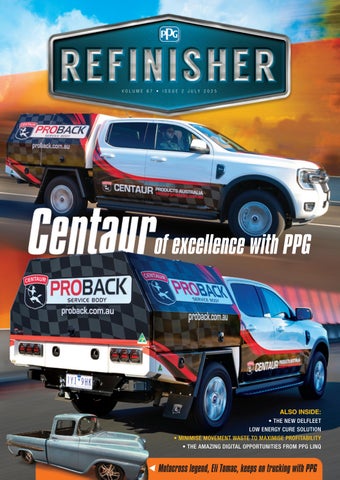
of excellence with PPG
ALSO INSIDE: • THE NEW DELFLEET LOW ENERGY CURE SOLUTION • MINIMISE MOVEMENT WASTE TO MAXIMISE PROFITABILITY • THE AMAZING DIGITAL OPPORTUNITIES FROM PPG LINQ
Motocross legend, Eli Tomac, keeps on trucking with PPG
TM
MATTE EXTREME COATING
Tough doesn’t even begin to describe it Rugged, stylish, easy-to-use 2K coating perfect for truck beds, ute trays, RVs, trailers and MUCH MORE!
Contact your local distributor today for more information www.semproducts.com.au
CONTENTS 2 ISSUE
July 2025 VOLUME 67
MAGAZINE
Editor-In-Chief Andrew Blake
Editor John M Stanley Creative Director Dean Parrott Published for and on behalf of PPG Industries Pty Limited by
Kisschasey Creative Pty Ltd Telephone (03) 9421 3311
Australia Head Office Locked Bag 888, Clayton South, Victoria 3169. McNaughton Road, Clayton, Victoria, Australia, 3168 Telephone: 13 24 24 www.ppgrefinish.com.au New Zealand Head Office 5 Vestey Drive, Mt Wellington, Auckland, New Zealand. Toll Free Telephone: 0800 320 320 Victoria 104-106 Woodlands Drive, Braeside, 3195 Telephone (03) 8586 0000 New South Wales 10 Peter Brock Drive, Eastern Creek, 2766 Telephone (02) 9854 6600 Queensland 18 Breene Place, Morningside, 4170 Telephone (07) 3823 8000 South Australia 97-105 Bedford Street, Gillman, 5013 Telephone (08) 8346 6870 Tasmania 136 Invermay Rd, Invermay, 7248 Telephone 1300 305 699 Western Australia Unit 2/6 Colin Jamieson Drive, Welshpool, 6106 Telephone (08) 9256 3920
PPG Logo, Delfleet, Deltron, Envirobase, Global Refinish System, Harlequin, PaintManager, Prizmatique, Radiance, RapidMatch, Startline and ‑ are registered trademarks and We protect and beautify the world, Crystallance and RapidMatch are trademarks of PPG Industries Ohio, Inc. SATA and SATAjet are registered trademarks of SATA GmbH & Co. KG. Third-party trademarks referenced in this magazine are the property of their respective owners.
SC A N TO R E A D T HE REFINISHER ONLINE
features regulars
Editorial Co-ordinator Chelsea Hilsberg
4 News opportunities 6 Digital How the PPG LINQ ecosystem is transforming the paint shop
is power 10 Knowledge A 50-year-old family business that is leading the way
6
of excellence 16 Centaur Quality local manufacturing is alive and well at places like Centaur Products Australia. Thanks to clever engineering, efficient manufacturing processes and a quality finish, supported by a strong PPG partnership, it’s creating products that exceed customer expectations.
20 The right process for each job
Prep and prime for plastics
16
X – from project to product 28 jet Behind the scenes of SATA’s jet X development
sky’s the limit 32 The Meet the team that loves a challenge
32
28
REFINISHER
REFINISHER NEWS
4
Huge crowds flock to biggest MotorEx ever A
gainst a backdrop of over $70 million dollars’ worth of vehicles on display, epic unveils, cruising, drifting, live music and much, much more, the PPG stand at Meguier’s MotorEx 2025 was kept rocking from start to finish. Showgoers off all sorts found a reason to drop in, whether it was to check out the dazzling ‘Colour Wall’, the MIRKA polishing and sanding demos or to get a close up look at the cool car and motorcycle on display and chat to a PPG specialist about how to go about achieving their own dream finish. SATA’s new premium spray gun, the jet X, was on display and it drew a lot of interest as it gave many painters a firsthand opportunity to check out it features and the different model choices. Industry legend, Howard Astill made appearances on both days as he was kept extremely busy signing autographs and chatting to visitors. Everyone is already planning an even bigger and better event R in 2026!
Smooth transition in key leadership role A
fter 14 years in the key role of PPG General Manager, Automotive Refinish ANZ, Paul Galea has decided to take a step back, making way for the arrival of a familiar face to many regional
customers, with David White stepping in on 1st May 2025. Over more than 20 years with PPG, David has held a number of leadership roles within the New Zealand refinish team and was most recently PPG General Manager of Industrial Coatings and Packaging ANZ. David says he is both extremely humbled and excited to be taking
Paul Galea (left) and David White (right)
the helm of the PPG ANZ Refinish team and business. “Paul leaves this role with a tremendous legacy of commitment to his team, building strong relationships with customers across the region and delivery of outstanding business results. Moving forward, my desire for the ANZ business is to build on this legacy whilst leveraging the abundant talent we have across our refinish team to ensure we operate with more agility, efficiency, tenacity and focus. In all we do we intend to strive to become the first choice of supply partner and leave no stone unturned to develop long standing business practices that continue to grow our people, our business and that of our partners as we look to the future of a vibrant ANZ market.” In the meantime, Paul Galea’s extensive talents and experience will continue to enhance PPG’s excellent reputation in the region as he takes on the role of PPG Global Director, Special Growth Projects – Automotive Refinish. R
REFINISHER NEWS
REFINISHER
5
DRIVE THROUGH “A
strategy of continuous improvement takes serious commitment, no matter what line of business you are in. But a refusal to settle for the status quo can pay off handsomely, whether you are star motorcycle racer, Eli Tomac (pg 22), local engineering and manufacturing dynamo, Centaur Products (pg 16), 50-year-old family business, Geoff Richards Panel Beating (pg 10), or the SATA team developing the new jet X spray gun. Pushing boundaries and creating solutions to support customers is what PPG does very well. In this issue, alone, we have an overview of the remarkable PPG LINQ digital ecosystem (pg 6), the launch of Delfleet F3362 HP Express Topcoat Thinner (pg 14), a Talking Training article on efficiently
WITH ANDREW BLAKE REFINISH MARKETING DIRECTOR ANZ
dealing with plastics (pg 20) and the MVP Business Solutions team looking at ‘motion waste’ (p24). The bottom line is, PPG has your back!” “Finally, I’d like to recognise and thank Refinisher editor, John Stanley, on his upcoming retirement. During 25 years in the role, he has made a significant and impactful contribution to not only this magazine but also to the enormous amount of people John has worked with over the years – both from the PPG team and all the customers who he has interviewed and spoken to about their shops, roles and love of the industry. John has always looked for way to continue to improve Refinisher and it would not be what it is today without his dedication. We all wish John the best for his next chapter in life, travelling, relaxing and spending time with family and friends. John, thank you, from myself, the PPG team and the entire industry.”
Major Kenworth supplier awards for PPG A
fter around 50 years of PPG supplying PACCAR Australia’s Kenworth DAF production facility in Melbourne, the relationship between the pair is as strong as ever. As evidence of the close win / win partnership, PPG recently walked away with two prestigious awards, including Kenworth Overall Supplier of the Year! As well as supplying almost 100 percent of the coatings used at the PACCAR Australia manufacturing facility, a wide variety of PPG staff work closely with the team to ensure that every vehicle that rolls off the line has a premium DELFLEET® Evolution paint finish, according to Chris Edwards (PPG Vic / Tas Business Manager) who accepted the trophies. “This isn’t just about supplying product
L to R - Marcel Hunt, Operations Director PACCAR Australia, Paul Galea, PPG General Manager Refinish ANZ, Chris Edwards, PPG Business Manager VIC TAS, Damian Smethurst, Managing Director PACCAR Australia
– it really highlights the PPG philosophy of supporting customer success at every level. It reinforces the strength of our technology, coupled with local manufacturing and support. Everyone plays a part and everyone should be proud of this award. Our strong ongoing relationship with PACCAR Australia and the honour of receiving these awards is not about any one individual within PPG R – it’s a true team effort!”
REFINISHER
PPG LINQ
6
Digital opportunities Thanks to a versatile set of advanced, easy to use digital tools, the PPG LINQ ecosystem is opening a new frontier in paint shop efficiency, productivity and accuracy.
A
steady stream of digital technologies has been responsible for making miraculous changes in so many areas of our lives. Extraordinary capabilities that were thought of as difficult or even impossible just a short time ago, are now a breeze and quickly become second nature. Pretty much anywhere you looked the possibilities seemed endless and that got PPG’s global technical team thinking – what could be achieved by applying innovative digital technologies to the collision repair sector? Nothing was off the table as PPG created a dedicated ‘Digital Customer Experience’ team who began working behind the scenes to develop and refine a variety of different digital technologies aimed at streamlining the refinish process. Today, it has grown into the overall brand we known as PPG LINQ but the term that is used to describe what the team have created is ‘digital ecosystem’. It’s important to understand that, while PPG LINQ is made up of a number of individual technologies in the digital space, they actually link together in order to create something that is truly ground-breaking. Because it’s an eco-system, PPG LINQ is continuing to
evolve and develop as time goes on. The current lineup consists of: LINQ™ Color – Intuitive, easy to use, cloud-based digital colour selection software to identify the best colour with confidence. DigiMatch™ – Next generation spectrophotometer that records six angles of colour camera images and six angles of reflectance to help make colour matching quicker and more precise. VisualizID – Clever colour visualisation software that lets you utilise an advanced digital process in order to choose the best colour match, thus avoiding slow and wasteful traditional manual methods. ™
MoonWalk® – Revolutionary automated colour dispensing technology that produces ultra precise mixes at the press of a button. MagicBox™ – A clever digital gateway that wirelessly connects the paint shop computer, spectrophotometer and scales.
MagicSensor™ – Provides real-time temperature and humidity data that allows painters to make informed product choices.
Embracing the profitability of digital solutions Paint product are not the only factors that govern how efficiently your refinish paint shop is able to operate. Digital technology is an emerging frontier that offers some of the biggest potential gains across the collision repair space, according to Greg Tunks, PPG MVP Business Solutions Manager ANZ. “Digital technologies aimed at the refinish space have only begun arriving over the past few years but we are already seeing big rewards for those who take the plunge into the PPG digital eco-system.
PPG LINQ
REFINISHER
7
When you think about it, digital technology is not something we should be scared of. For example, computer quoting is a digital technology. When it first emerged, you had people saying they would rather do a paper quote. Nowadays, almost everyone uses digital technology to prepare quotes. We are now seeing the combination of the DigiMatch spectro and the VisualizID software do a similar thing with the colour matching process. Old school thinking is that you need to go through the drawn-out process of choosing what you think is the closest colour formulation and then doing a sprayout card every time. DigiMatch and VisualizID shortcut that by using a simple to use digital solution that makes it very straightforward to choose the best colour
match which you can trust to go ahead and paint the job. If you had forecast this to people ten years ago, they would have said it will never happen. As much as anything, the PPG LINQ digital technologies are about providing the information you need to make smart choices and the confidence to get the job done with speed and efficiency. That return on investment makes them a no brainer.”
Dive into the digital eco-system All PPG customers will be exposed to PPG LINQ digital technologies but one of the beauties of the system is that you are free to choose which components work best for your business. For instance, you could choose to just use LINQ Color. Alternatively, you could fully immerse yourself in the digital eco-system with a full package of digital tools, including a MoonWalk automated
dispensing system – it’s up to you. Already more than 60 MoonWalk units have been delivered locally (over 2500 globally) and more than 250 customers are taking advantage of DigiMatch and VisualizID to perform digital colour matches.
LINQ Color There is no cost for PPG customers to use LINQ Color. Most PPG ColorMobile users have already migrated
REFINISHER
PPG LINQ
Digital opportunities
8
to LINQ Color and PaintManager users are now making the switch, says Bowie Crook, PPG IT Colour Systems Manager. “If you are a PaintManager user, you will find LINQ Color very familiar but it’s a far more sophisticated colour retrieval system. Because it’s cloud-based, it does require an internet connection but most collision centres have that these days and it brings lots of benefits. Just like your other cloud-based systems, such as internet banking, you can access LINQ Color 24/7 wherever you can get an internet connection and you are not limited to a PC in the paint room – some people choose to use a tablet, a laptop or even a smart phone. Since information is held on the cloud, rather than a database on a computer, the colour formulation, etc are always absolutely up to date and it doesn’t suffer from frustrating software glitches and corruptions. You can also tell that the LINQ Color developers have listened to feedback because it’s a slick, streamlined system to
use. One of the newest features is ‘multiuser’ that allows for separate user logins where there are a number of users in the same shop. For managers, there is a variety of handy reports available to help better run the paint shop.” Those looking to switch from PaintManager to LINQ Color can simply visit www.ppglinq.com where you can click on ‘support’ and follow the prompts to set up an account.
DigiMatch and VisualizID – the one-two combination When talking about the positive impact digital technologies are having in collision repair centres, it’s difficult to overstate what the combination of the DigiMatch spectro and the VisualizID 3D colour visualisation software has done. Already, hundreds of
repairers have made the switch to this streamlined, digital solution and it could not be simpler, Bowie explains. “It starts with taking a reading with DigiMatch. It might look like a regular spectro but it’s actually capable of capturing an enormous amount of data on the target colour. Along with its six angles of reflectance readings, it adds a digital camera that takes images from six angles – this is something rarely seen in the market. All that information is fed into the VisualizID 3D colour visualisation software within LINQ Color (or PaintManager). It sounds pretty much like a manual process to this point but this is where digital technology takes over. Using the data from DigiMatch, VisualizID
PPG LINQ
REFINISHER
9
i
is wirelessly transmitted to the paint shop scales or MoonWalk unit, as well as the label printer. It also means that the paint shop computer or tablet, etc, no longer needs to be in the actual paint mixing room. MagicSensor is another piece of digital technology in your arsenal. By mounting it in the spray booth, it wirelessly provides real-time temperature and humidity data to LINQ Color where it can recommend the best products, including hardeners and thinners, to use in the specific conditions you are spraying in.”
creates a digital rendering of the target colour while, at the same time, presenting a list of the closest matching formulations under that manufacturer colour code. For the technician, it’s as simple as choosing the formulations with the closest match ratings and comparing a digital rendering of them against the target colour. To make it easier, there are lots of options to rotate the colour renderings next to each other, change lighting type and direction and check face, flop and flip. Typically, users say they would never go back to the old-fashioned manual method and owners / managers love it because it saves time and improves accuracy.”
MagicBox and MagicSensor – small but powerful Seamless connections and instant access to the latest information are keys to enjoying the advantages of digital paint shop technology and this is where MagicBox and MagicSensor come in, says Bowie. “Essentially, MagicBox is the gateway that links your key paint shop components together. It means that information from DigiMatch is seamlessly passed onto LINQ Color and, once a colour formulation is chosen, that information
s
MoonWalk – mixing with the best This incredible piece of technology not only makes the paint room instantly cool, it also features groundbreaking capabilities that drive efficiency, precision and waste reduction. With its ability to precisely dispense tinters to 0.01grams all day, every day, MoonWalk takes the stress from painters and frees them up to do other productive tasks. In addition, when only a tiny amount of colour is needed, it can accurately dispense volumes a human wouldn’t even consider. This helps to minimise paint wastage, as does the way the tinter bottles are installed in the unit upside down. As a result, every drop of product gets used, rather than the industry average of 4.2% which collision centres traditionally throw away because it’s seen as too difficult to get out. Although a MoonWalk unit is not cheap, when you take into account its dispensing accuracy, productivity and waste and rework minimisation, it’s a new age tool that can actually deliver a quick return on investment.
Time to take advantage of PPG LINQ? The PPG LINQ ecosystem offers collision repairers a variety of innovative options and packages which they can choose from to best suit their individual needs. To get the process in motion, contact your PPG Territory Manager or call the PPG Customer Service Hotline on 13 24 24 (Aust) R or 0800 320 320 (NZ).
REFINISHER
SHOP PROFILE
10
Knowledge is power
A constant drive to upskill staff has helped Geoff Richards Panel Beating grow to become a regional powerhouse that serves the local community with a family focus.
L
ewis Richards just laughs when he hears collision centre owners trot out the old saying ‘what if we train our people and then they leave’. He says it’s a philosophy that is well past its use-by date and the experiences of the family business, Geoff Richards Panel Beating, in Dubbo, NSW, prove it.
“This is a mindset in the industry that we are trying to change and I feel like we are actually making headway. We honestly believe that the generation coming through now are our future and we need to train these people and enable them to become great staff. Here, we invest in upskilling all of our staff and we consider them as family. When someone in our community has an accident, we want them to think, ‘it’s okay, Geoff Richards Panel Beating will look after us’ but we can only offer that service with exceptional staff.” It was Lewis’s grandfather, Geoff, who established the enduring business way back in 1974. His father, Todd, came onboard as a painter in 1985 and slowly took over the reins. As a kid, Lewis says he loved cars but what he really enjoyed was watching Todd paint a car in the booth. It sparked a burning desire to become a skilled
painter himself, join the business and make his father proud – something that came to fruition in 2008. Entering the 2010s, Geoff Richards PB was still a relatively small operation, working out of a tiny 180m² shed but managing to churn out very respectable numbers. However, it was time to go big, explains Lewis. “My mum, Tracey, had made an amazing career in real estate before she joined us in about 2011. Tracey is absolutely exceptional with the business side so she was running the admin / financials, Todd was running the office and talking to customers and I was running the workshop – we were a three-person team. In about 2013, we realised we were definitely outgrowing our facility. We could foresee a long future for the business but we needed a new facility to allow us to grow. We spent about two years in planning, including dad and I using our PPG connections to visit some great shops around the state so we could work out the best strategies for the floorplan. Tracey and Todd put absolutely everything on the line to build the new premises which we moved into in 2016. What that bought was the basics so we actually brought much of our existing equipment from the old shop.
SHOP PROFILE
REFINISHER
11
It wasn’t just about the investment – it was also a massive move in terms of location. Since 1974, people knew Geoff Richards PB was at 5 Mansoor Street, West Dubbo but, to get space for the new facility we had bought a block in the Blue Ridge estate on the other side of town. We were a bit concerned but our customers quickly made the adjustment.” The new premises encompasses 4000m² which is fully concreted and marked out with carpark bays, etc.
The workshop itself is ten times larger than previously, spanning 1800m², and there is also 200m² of office / admin space, a parts department out the back and 200m² of mezzanine space for parts storage. Utilising all that space, along with the very latest in products, processes and equipment has seen the 30-person Geoff Richards PB team significantly boost output, says Lewis. “Back when I joined, we were doing about seven cars per week. We built that up to about 21 cars per week when we outgrew the old shop. Although it varies, on an average week we now
do 40-something cars! And we are not talking about the normal carpark scraps you see in metro areas. A lot of our jobs are animal strikes so often the damage is the whole front end and down the side. That means our average repair job is a lot bigger. Part of our investment in training staff is that it opens their eyes to what is possible on the workshop floor and the different ways to repair vehicles. Over the past eight years, Tracey, Todd and I have worked hard to build this shop into something unbelievable. Everything is state-of-the-art and all of the team are trained to use it.” One constant for almost the entire life of the business is the PPG partnership. Not only has it helped Geoff Richards PB remain at the cutting edge of product technologies, Lewis says they have also been quick to take advantage of the latest PPG digital technologies.
REFINISHER
SHOP PROFILE
Knowledge is power
12
S H O P FA C T S Geoff Richards Panel Beating “We have had a MoonWalk unit for about three years and we also use the DigiMatch spectro and the VisualizID 3D colour visualisation software. I can wholeheartedly say that they are a massive advantage in the paint shop. Bringing these latest PPG technologies in has just obliterated colour errors. We just scan the colour with DigiMatch, use VisualizID to compare the vehicle colour against the closest variants, choose the best formulation and send it to MoonWalk to mix. It’s mind-blowing and the whole team love it.” As part of the PPG partnership, Geoff Richards PB also takes advantage of PPG’s MVP Business Solutions program. According to Greg Tunks, MVP Business Solutions Manager ANZ, the Dubbo business is as good as any collision repairer he has been involved with. “It’s a very, very nice shop! It’s beautifully laid out and organised and they are very progressive, forward thinking and willing to embrace technology.” To save time and keep tabs on quality, Geoff Richards PB has brought many operations in-house. This includes windscreens, refrigerants, PDR work, electric vehicle repairs, aluminium repairs and even ADAS calibrations, says Lewis. “Looking out on the shopfloor right now, we have around ten cars that are going to need ADAS calibration. The complexity of booking them into a dealership and dropping off and picking up creates a massive bottleneck. We bought a Bosch DAS 3000 setup and, along with myself, there are two other staff members who have done ADAS training so we can do everything from
Owners: Todd and Tracy Richards Staff: 30 PPG Product: Envirobase High Performance Territory Manager: John Miller radar and blind-spot monitors through to the reprogramming of headlight modules.” Tracey, Todd and Lewis are very proud of what they have achieved and they like nothing better than showcasing it to the community. Indeed, Geoff Richars PB regularly hosts tours and familiarisation sessions for anything from pre-schoolers through to young people who are in the midst of deciding their career path.
“For around seven years we have been running programs where we bring in 14 to 17-year-old males and females to take them through the whole business operation, including showing them different paint products and techniques. There are already multiple young people coming into the industry after doing one of these introductory sessions. We love spreading the word about how great this business and our industry is.” “To be able celebrate our 50th Anniversary in 2024 and to get to where we are as an independently owned family business is an amazing achievement and a real credit to Tracey, Todd and my grandfather, Geoff. For their part, we would like to say a big thankyou to each and every staff member. Without dedicated staff and family, we would not have been able to do it. At Geoff Richards Panel Beating we are one big happy family and we work together as a family.” R
SATA
Apprentices go premium The new SATAjet X 5500 Apprentice Spray Gun gives apprentices the unprecedented opportunity to get their hands on a premium gun at extremely attractive pricing.
A
pprentice spray painters have never had it so good! As they take their first steps on their career path, the latest SATAjet X 5500 Apprentice Spray Gun gives budding spray painters access to premium spray gun technology at an exceptional price point. Over the years, SATA and its local distributor, PPG, have established a long history of supporting apprentices by offering exceptional equipment at heavily subsidised pricing but this takes it to the next level, says Trevor Duke, PPG National Training Manager. “Stepping up to the SATAjet X 5500 Apprentice gun has so many positives for apprentices. Rather than spending decent money on just an average gun, they can have a top end SATA model in their hand at an excellent price. This gun is leaps and bounds ahead of any other gun out there and that can really help apprentices as they make their way in the trade. Thanks to its X Nozzle technology, outstanding atomisation and a precise, controlled spray fan, it has the ability to give inexperienced painters a real sense of confidence from the very start. This is also a great point for collision centre owners / managers, given that the aim should be to build an apprentice’s skillset and get them productively painting live jobs as early as possible. As they continue to develop their skills, this leading-edge SATA technology will continue to help them as they go on to tackle some of the more tricky colours on the market. The SATAjet X 5500 Apprentice gun also features the digital inlet air pressure gauge built right into the handle. This makes it super easy and precise to adjust and apprentices can also take advantage of the spray gun setup charts created by the local PPG technical team which give setup recommendations for pretty much any product you are spraying.”
SATA’s long running apprentice support initiative offers a range of outstanding products covering virtually all the significant equipment an apprentice is likely to need. Any vehicle painting apprentice at a training organisation, across Australia, can take advantage by simply getting the appropriate form from your TAFE instructor or a PPG or Protec Territory Manager or by calling the PPG Customer Service Hotline on 13 24 24 (Aust). After filling out the form and getting your teacher to sign it, just return it for processing and items will be R freighted to you.
REFINISHER
13
REFINISHER
PPG PRODUCT TECHNOLOGIES
14
Express
yourself
With one simple change, Delfleet F3362 HP Express Topcoat Thinner gives operators a convenient low energy cure solution that delivers versatility, speed and sustainability.
P
roduction speed is important, whether you are manufacturing new Commercial Transport (CT) equipment or repairing, refurbishing or re-liverying existing trucks or trailers. At the same time, many operators are looking to reduce their exposure to constantly rising energy costs. Still others are also seeking ways to reduce their carbon footprint and demonstrate to customers, fleets and work providers that they are working in a more sustainable way. The launch of Delfleet F3362 HP Express Topcoat Thinner lets you tick all three boxes in one go! Designed to work with the market leading Delfleet Evolution 419 Ultra High Solids DG line, it’s
all about giving operators the versatility and flexibility to integrate smoothly into their production processes and deliver instant results. Best of all, it does this without the need for any special changes.
Locally developed and manufactured The catalyst for the creation of Delfleet F3362 HP Express Topcoat Thinner originated from the OEM CT sector where manufacturers were looking to generate faster cycle times in order to achieve greater throughput and, ultimately, more units produced in a given period of time. The skilled team within the R&D laboratory at PPG’s Clayton, Melbourne facility, took
on the task of formulating a local solution. With access to PPG extensive product development network, they were able to choose the best global technology and then adapt and finetune it to best suit the needs of users in this region. In addition, Delfleet F3362 HP Express Topcoat Thinner is now being manufactured at PPG’s Clayton production facility.
Simple switch – super results Using Delfleet F3362 HP Express Topcoat Thinner could not be easier. In place of the regular topcoat thinner, simply substitute Delfleet F3362 HP Express Topcoat Thinner. There is no need to purchase or use different equipment and the application technique remains exactly the same. This means that operators can still take advantage of all the features that have made Delfleet
PPG PRODUCT TECHNOLOGIES
REFINISHER
15
Evolution 419 UHS DG line a favourite across this region. This includes single visit application mode (a light closed coat over the job, immediately followed by a full wet coat) which eliminates flash-off time, gives excellent coverage, outstanding long-term durability and the ability to accelerate it, when required. There is also a 14 day recoat window and sanding or scuffing of the surface isn’t required. Not only does this make multi coloured designs quicker and easier, it also slashes sanding labour time and minimises potentially disruptive dust. Now, Delfleet F3362 HP Express Topcoat Thinner adds the ability to dramatically slash bake times. Its outstanding versatility lets you choose the solution that best suits your production cycle and spray booth. Simply select from the booth temperature and duration of the bake cycle as indicated below.
Cures in 20 minutes @ 40°C
Cures in 15 minutes @ 50°C
Cures in 10 minutes @ 60°C
Note: Because spray booths vary considerably in their performance, it’s important to understand that these figures represent panel temperature, not booth temperature. In many instances, this makes it possible for operators to cut their current bake cycle in half! This benefit is magnified even further when you are dealing with
multiple colours involving more than one masking and application process. In addition, the reduced bake cycle should contribute to reduced energy bills. In doing so, it can also make a contribution to lowering the businesses carbon footprint. Note: Due to the accelerated nature of Delfleet F3362 HP Express Topcoat Thinner, it’s important to factor in a slight reduction in gloss level compared with regular Delfleet Evolution 419 UHS DG line finishes. Having said this, extensive local testing has indicated that the reduction of gloss level is minimal but, even so, it is a factor when choosing which jobs it should be used on. This includes areas such as a chassis, battery box, toolbox, guards, bumpers, etc.
Speak to your Territory Manager If you are interested in taking advantage of what the Delfleet F3362 HP Express Topcoat Thinner technology offers, it’s recommended that you first consult with your PPG Territory Manager. Although it’s anticipated that Delfleet F3362 HP Express Topcoat Thinner will be best suited to CT manufacturing operations (trucks, trailers, buses, etc), it can also have a place in CT repair, refurbish or relivery work where it could help to push through smaller jobs, such as a bumper, a step or a door. Your PPG Territory Manager is best placed to work with you to determine how you can make R the most of its speed and versatility.
REFINISHER
FEATURE STORY
16
of excellence
From its collision repair roots, the D’Alberto family business has continually evolved with intelligent engineering, painting and manufacturing capabilities that deliver innovative solutions to customers.
A
s the Australian car manufacturing industry began to wind down in the late 2010s, the management team at Centaur Products Australia were left in a bit of a quandary. Over the years, the Melbourne based company had carved out a healthy niche as a trusted supplying of high-quality painted components for organisations, including Holden Special Vehicles (HSV), Tickford Performance and Toyota TRD but that workflow was rapidly drying up. Once again it was a trigger for the versatile company to pivot in a new direction as it set about using clever engineering and tried and true manufacturing processes to diversifying its product portfolio, explains Centaur Director, Al D’Alberto. “We had developed a very good skillset within out group. We had good engineering practices, good manufacturing practices and we were efficient. Because we worked as a just-in-time supplier, we were very disciplined in the way we produced parts on time and delivered them to where they needed to be. We realised that we had the capabilities
to actually create our own products from scratch. Initially, that led to Centaur being offered the contract to develop and manufacture the original Prisoner Transport POD for Victoria Police and we have since followed it up with a number of other projects.”
Brothers in arms Now 69 years old, Al was actually still at school when his two eldest brothers, Frank and Ezio, kicked the business off in a small garagestyle facility in the Melbourne suburb of Kilsyth, doing collision repairs, alongside tyres and discount fuel. Another brother, Fernando, joined after a stint as a production engineer at Ford Motor Company and Al followed suit after completing his engineering degree. With the four D’Alberto brothers working in the business, it gave them the opportunity to set in place the diversification mindset that exists to this day. “The need to evolve was forced on us. We were doing a lot of work and not making a lot of money so we went looking for other opportunities. At the time, HSV had just started building the first VL model and we heard they were having some paint and colour matching issues on the body kit components. We asked if we could do some samples for them which went really well. What really cemented the relationship was our ability to value add. Although we started off spray painting parts, we became more of a logistics supplier, as well. For example, even though HSV would purchase moulded parts from a supplier, we would take up the slack in between.
Al D’Alberto (far left) and Tony D’Alberto (left)
FEATURE STORY
REFINISHER
17
Rather than HSV having to do it, we would make sure the supplier had the parts ready on time and that they were of a certain standard before we painted them and delivered them to HSV on time. At the same time, we were aiming our quality higher than what the customer was looking for. As a result, we lifted the standard of what we did which helped us outperform our competitors and we would like to think we lifted the standard of the vehicles, as well.”
Second generation drive If the name D’Alberto sounds familiar it may be because of Al’s son, Tony. His motor racing resume includes a Supercars development series (now Super2) win in 2007, a stint as a fulltime Supercars driver, an Australian GT Championship in 2017, a TCR Championship in 2022 (along with 2nd in 2019 and 2023) and
a long-term stint as a Supercars endurance driver for Dick Johnson Racing, including multiple Bathurst 1000 podium finishes. At 39 years old, Tony has now added his experience and youthful enthusiasm to help run the business, alongside his father. “I worked here running the paint line after I finished school but, when I went car racing, it got a little tricky to manage both. It was always my vision to return and it’s a good time with dad wanting to slow down a bit. I guess I bring youth and energy to the table but there is also what I have learnt from working with some of the best motor racing teams out there. It’s about getting to know all the personalities on the team, what each person’s strengths are and working to get the best out of everyone in that team environment. It’s a good progression in my career, I am familiar with the business and I have dad to lean on while I do a sort of ‘apprenticeship’.”
REFINISHER
FEATURE STORY
18
Fun fact – Centaur Products used to be called Bellmont Nominees. Having bought out the other business partners, Al and Tony saw Centaur (a mythical creature that is half man and half horse) as a far more appropriate name which is designed to symbolize strength and adaptability.
The POD that keeps on giving The design and manufacture of the Prisoner Transport POD for Victoria Police is one of Centaur’s most successful long-term projects. Originally, the POD was designed to fit snuggly onto a Commodore Ute. When that car was discontinued, the POD concept was switched to the Holden Colorado model. When that vehicle also disappeared, Centaur engineered the POD to fit the Ford Ranger and that has continued up to the current series. It has meant working closely with everyone involved in order to create and manufacture an outstanding product, says Al. “In the case of Victoria Police, they want to source components or accessories that are manufacturer approved so it doesn’t affect the vehicle’s warranty. That means we developed the Prisoner Transport POD under a three-way agreement where we worked closely with the vehicle maker, along with Victoria Police. After building a prototype, we got buy in from Victoria Police members. Once that was approved, we made production tooling and began manufacturing. Rather than reinvent the whole POD each time, we were able to use the
prisoner compartment and adapt it to the next vehicle. As well as ensuring the PODs are safe and durable to use, we have continued to add innovations. For example, we identified that when the rear door was being opened, there was the potential for someone inside to lash out and kick the door into the officer’s face. We engineered a solution where, if the door is accelerated outwards, it actually locks in position to prevent it hitting anyone outside.”
At home on the road With its growing expertise in fibreglass construction, Centaur bought the tooling for a lightweight caravan, in the late 2010s. Today, the Karavané and smaller Freedom Plus model are slowly building up a following in the market, says Tony. “We have put a lot of
Centaur Products take concepts from CAD to finished products
FEATURE STORY
REFINISHER
19
PROBACK to the future
work into offering a slick, innovative, high-quality design, while keeping weight down as much as possible. As a result, you don’t need a big tow vehicle and they are very user friendly and simple to set up. Part of my role now is to get the message out to people about the advantages of these caravans so that more people understand what they are all about”
Colourful long-term partnership Although pure painting operations has taken a step back from its heyday, Centaur still operates five spray booths with five painters amongst the overall tally of 40 staff. It also sees the enduring partnership with PPG continue. Indeed, Al says he can remember PPG being used way back in the early days of the business. “It makes sense to have a strong relationship and PPG is the best in Australia, in my opinion. PPG’s biggest strength in the early days was its connection to the OEM automotive industry. Colour matching was strong and it was actually PPG’s OEM division that helped us produce better quality painted parts when we were working with HSV, etc. Whenever a new project came through, we asked PPG to develop a process that gives us the finish and longevity required to match the customer’s needs. Even this morning, we had Manny (Grillo, PPG National Colour Auditor / Consultant) doing a colour match for us – that is the sort of service you get from PPG.”
One key product solution the Centaur team has focused its innovative engineering might on is the PROBACK range. It’s essentially a highly versatile storage and workplace solution that is designed to fit on a ute base and it can even be colour coded to the vehicle. Two options are available and both come beautifully crafted and constructed from quality materials, says Tony. “We will offer a few different ‘off the shelf’ layouts to help tradies keep the cost down while still getting a high-quality solution. On top of that, we offer a fully customised option which is perfect for fleets who want to set up their technicians with a solution that helps them work more quickly and efficiently. For example, we have just done a custom PROBACK for the Royal Australian Corps of Military Police (RACMP) where we designed it from scratch to their exact scope. Because we have excellent in-house engineering, led by dad, we were able to design everything on CAD and, when they were happy, build a prototype which they signed off on before we went to production. When the complete vehicle was delivered through the Ford dealership, the feedback was that the RACMP members were really impressed, particularly with the attention to detail.” “Having the Prisoner Transport POD contract is great but history has taught us not to be too reliant on one sector but to diversify. Manufacturing is still alive in Australia. When it comes to relatively low volume specialty or bespoke builds, I think that is where the Centaur team excel with good design, quality finish, built on time. Getting everyone working together to overcome challenges and getting a product out the door that was designed and put together from scratch is very rewarding. Overall, this is about enjoying the opportunity of working with dad and continuing a legacy the R family has built up over many years.”
REFINISHER
20
TALKING TRAINING
Prep&
All plastics are not the same so tailoring your prep and prime process is the secret to getting it done with productivity, profitability and quality.
prime for plastics
T
he replacement of one or more painted plastic components is an extremely common part of modern repairs. This frequency makes it especially important to choose the best process to deal with each plastic item in the most efficient way. To help repairers, the PPG technical team has conducted extensive testing to determine the best process to cater to
different scenarios, resulting in ‘process charts’ which are available to provide a best practice, step-by-step guide. Below are some of the key points and tips to take into considerations, says Trevor Duke, PPG National Training Manager.
Identification While the label might say ‘plastic’, the fact is that one plastic material is not necessarily the same as another. This is why it’s important to identify which plastic you are dealing with because there can be differences in how particular plastics are processed.
In general, plastic components will be stamped on the rear with a mark that identifies what plastic it’s made of.
A clean start Plastic parts are typically made in a mould and, to ensure they easily come out of their mould, manufacturers generally use a release agent. The problem when it comes to the refinish process is that you won’t know whether a waterborne or solvent borne release agent was used. I see some people not use any cleaners, just a grey Mirlon pad, but this simply doesn't cut it. As a result, it’s better to choose the most thorough products and process. OneChoice SU408 Bodykleen is a great product which I think is underutilised. Simply mix it in the required ratio and go over the part with a grey Mirlon pad.
TALKING TRAINING
REFINISHER
21
Don’t let Bodykleen dry on the plastic where it might bleach or stain it. It’s recommended to do a section at a time before washing off with water. D846 Antistatic Cleaner gives you a double whammy of benefits. Not only is it excellent for removing solvent borne release agent, it also works to eliminate the static electricity from the plastic. Static electricity can be a real issue. If Prepsol was wiped over the part (a definite no no), it could ignite and cause a fire. Static electricity can also cause paint to repel from adhering to the surface and it can affect the alignment of particles in the paint – particularly with metallics.
Primed for performance The type of plastic you are dealing with and the scope of the repair will influence which priming technology to use. PPG offers a variety of priming solutions to choose from.
LVA-650 EnviroLock Plastic Primer Converter If you are dealing with a repair that requires the priming of both metal and plastic components, this would be my go-to choice for the speed of the process. Utilising it is as simple as substituting LVA-650 for the regular thinner in LVP-201/205/207 EnviroLOCK Primer. Rather than having to mix separate primers for the plastic and the metal components, LVA-650 can be applied over both to provide strong adhesion for the following paint layers. EnviroLOCK Primer is available in three spectral grey shades (LVP-201 G1, LVP-205 G5 and LVP-207 G7) to suit the topcoat colour and features fast, easy application, minimal need for sanding and a long recoat window. For example, if you are doing a front-end repair that involves a bonnet, bumper and guards, there is no need to apply a separate plastic primer and wait for it to cure. You can simply choose the most appropriate spectral grey shade from the EnviroLock Primer range, mix it with LVA-650 and apply it over the whole job in one go, including correctly prepared e-coated parts and existing OEM paintwork. As a bonus, EnviroLock Primer also has
good film build, meaning it has the ability to fill the annoying scratches and imperfections you often find on new plastic components.
OneChoice UV8080 UV Cured Primer Surfacer This is PPG’s super-fast and convenient aerosol applied UV cured solution which is ideal for most plastics, as well as metal substrates. No mixing is required – simply shake the can, spray the required area and no flash-off is required. Its key benefit is that it’s capable of curing in just three minutes under an approved UV lamp, after which sanding and topcoating can begin immediately. Because UV8080 cures to a transparent finish, a follow up spectral grey primer layer is required before topcoating. Note: Because it’s a different formulation, the spray gun applied OneChoice SU1280 UV Cured Primer Surfacer should not be used on plastic substrates.
D820 Plastic Adhesion Promoter As an alternative to the two products above, this is a fast, transparent 1 pack primer suitable for use on the vast majority of paintable plastic substrates and avoids the need to identify the plastic prior to spraying. A follow up spectral grey primer layer is required before topcoating.
D816 Plastic Primer This plastic primer will give you adhesion on all PUR and PUR/RIM substrates, something R no other plastic primer will provide.
REFINISHER
PPG MOTORSPORT
22
on and a ti a r a p e r p s Meticulou s own abilitie is h in f e li strong be to c the tools a m o T li E n has give one of the f o ts h ig e h scale the nding most dema arth. sports on e
A
t the tender age of just 17-yearsold, Eli Tomac made a spectacular start to his professional motocross career by winning the 250 AMA (American Motorcyclists Association) season opener at Hangtown, California, in 2010. Although the remainder of the season didn’t go quite as well, it set him on the pathway to becoming one of the winningest riders in motocross / supercross history. “In my mind it was about trying to be one of the best guys out there and just trying to be a winner, period. Somehow, I made that happen in my very first pro race in 2010 but I also got my reality check in the weeks that followed where I struggled with some endurance and not being strong enough. As a kid turning pro at 17-years-old, you still have a lot of growing to do and there are so many variables that go into getting through a season.” Although the 32-year-old now considers himself in the twilight of his career, he is still
well and truly at the pointy end of the field. Not only that, he has amassed an incredible record including a 250 (west) Supercross (SX) title, an AMA 250 motorcross title (2013), four AMA Pro Motocross titles (2017, 2018, 2019, 2022) and two AMA Supercross titles (2020, 2022). On top of this, Eli currently sits 2nd on the all-time 450SX win list with 53 victories. Eli credits his father, John Tomac, a professional mountain bike racer, for his love of dirt bikes. “As well as racing bicycles, my dad rode motorcycles for fun and that is how I started – two wheels are in our DNA. I ended up going to local motocross races and it grew from there. It’s an irreplaceable feeling so I will definitely ride dirt bikes when I have done professional racing.” The American season typically kicks off in January with a gruelling 17-rounds of supercross, closely followed by 11 or 12 round of motocross. It means riders must prepared for both. Although you
PPG MOTORSPORT
REFINISHER
23
could be forgiven for seeing supercross as just motocross held within a stadium environment, the two disciplines are quite different animals. “Motocross is more about endurance. It’s two longer races where you have to be really strong. The biggest difference is that supercross is more technical with jumping where you have to be very technically sound and precise. It’s a higher heartrate when racing than even in motocross but with supercross you are just doing shorter qualifying and one 20-minute main event. Supercross is an all-out sprint so very rarely do you have time to relax and get your heartrate down.”
Eli’s partnership with PPG began back in his amateur racing days and throughout his career he has proudly worn the PPG logo on his race jersey. From time to time this has also seen PPG help out with the painting of team rigs and some special projects for Eli, himself. “It’s a really cool, long-term relationship with PPG. As part of it, I get to do meet and greets with PPG customers at the supercross races. PPG has also helped with painting a couple of pickup trucks for us. The last one was a very cool Chevy Apache. It was my dads and we fixed it up and unveiled it at SEMA.” As impressive as Eli’s stellar career has been, it could have been even more remarkable if injuries had not reared their ugly head. “The risk of getting hurt is something we all accept when you are a racer. In this sport, it’s not a matter of ‘if’ injuries will happen, it’s about ‘when’ they happen. For the most part, I have had a very healthy career but I have had a couple of injuries happen in the past two seasons.
In particular, the 2023 supercross season was worst case scenario for me. I was in the position where I basically just needed to finish to lock up the championship. Unfortunately, I had an absolute freak deal on a very ordinary jump rhythm section where I ruptured my Achilles tendon. There is nothing to compare it to and it’s one I would like to forget happened.” Throughout his long career, Eli says he has learnt that if he puts in the work, he can trust himself to get the job done. “The most important thing for me is to believe in myself and know that I have done the preparation so that, when I’m on the gate, there are no questions in the back of my mind. I consider myself on the tail end of my career and, when it’s over, I’m going to miss the competition of racing a motorcycle. Trying to stay as one of the best guys on a supercross or motocross track is addictive to me and it’s going to be hard to walk away from.” R
REFINISHER
MVP BUSINESS SOLUTIONS
24
Waste While motion is a fundamental part of collision centre operations, unnecessary motion is a recognised ‘waste’ that could well be putting the handbrake on your business profitability.
I
f you were to look into a collision repair workshop and see staff scurrying to and fro, you could be forgiven for thinking that it must have good productivity. However, it’s often not the case, according to Greg Tunks, MVP Business Solutions Manager, ANZ. “A common misconception is that if you walk into a collision centre and see lots of people buzzing about, that shop must be busy. It’s actually the reverse! When you walk in and nothing appears to be happening, generally it’s because everyone is where they should be, beavering away on their respective jobs. When we are talking about lifting production to get more vehicles in and out in a given time, it’s motion waste
that is the number one limiting factor for 90% of businesses. Although you will never completely eliminate motion waste, the goal should be to reduce it to the minimum.”
Tracking motion waste Naturally, motion is a necessary part of daily life in the workshop. However, the waste factor comes in when the motion does not add value to the job. Because every business is different in its layout and processes, it’s crucial to get a clear understanding of the potential motion waste in each individual collision centre. This is where your local MVP Business Solutions Manager comes in. As part of the support package to PPG customers, they can arrange to visit your workshop and track the movement of staff over a set period of time. When they leave the job, the aim is to literally track where they go, why they go there and how long it takes. This quickly builds up a valuable snapshot of where motion waste is negatively impacting the business. What we are looking for is hotspots – places where multiple staff members visit multiple times. By identifying these patterns, it’s easier to come up with solutions to minimise or eliminate the motion waste.
Technicians benefit too Before the tracking process begins it’s important for the workshop team to understand that it’s not about them, it’s about the collision centre operation. We explain to them that we are not looking for fault with them. It’s about understanding what the techs need to go through each working day in order to do their job properly. Quite often, the hurdles that are placed in front of technicians are in fact created by management. When you begin to eliminate motion waste, it actually makes the job easier and less stressful for technicians. One factor that is potentially underestimated is the ability to reduce emotional fatigue for staff. Imagine driving to work wondering what you are in for that day? It’s much better to know that everything is just going to hum along.
The cost of motion waste When you don’t fully understand the impact of motion waste, you could be forgiven for thinking that a few minutes away from the job, here and there, can’t have that much impact. However, the numbers say otherwise. For example, 36 minutes per day of unnecessary movements is a figure
MVP BUSINESS SOLUTIONS
REFINISHER
25
TIMWOOD
we would regularly see during the tracking phase. Given there are around 250 selling days per year, that works out to 150 hours per year. Multiply those 150 hours by an average shop rate of $100 per hour, it equals $15,000 that is coming off your bottom line. And this is just for one technician!
Unprecedented opportunities The good news is that tracking motion waste and understanding the results puts you in a position to reap impressive rewards
with some relatively simple changes or investments. For example, the consumables cupboard is a common destination for technicians, multiple times during the day. Eliminating much of that waste can be as simple as purchasing something like a MIRKA Sanding Station. It’s far more efficient because it lets the technician take all the consumables and tools to the job so there is no need to walk away. Better understanding the waste in your business is the key to getting onto the pathway to greater profitability.
Waste should be public enemy number one in any business. The seven wastes are defined as: 1. Transportation Waste – Moving material or product in a way that does not add value to the product or customer. 2. Inventory – Material takes up space, ties up cash, costs money and may be getting damaged. Too much inventory means other problems become less visible. 3. Motion – Personal movement that does not add value. 4. Waiting (Time) – Waiting for parts, information or for a decision to be made. 5. Over-processing – Processing not essential to the customer’s perception of value. 6. Over-production – Producing more material or information than is needed or before It’s needed. 7. Defects – Defective products or information impede flow and lead to wasteful handling, time and effort.
To access the wide variety of support services on offer, contact the MVP Business R Solutions team at mvp.anz@ppg.com.
PPG PEOPLE 26
Lorna Bower
P P G S TA F F P R O F I L E
Customer Service, Export
L
ook back over Lorna’s career and the complex art of ensuring freight moves smoothly from one country to another is never far from centre stage. After five years at a Japanese freight forwarder in London, she spent nine years with Virgin Atlantic Cargo at London Heathrow airport, in a variety of roles including Customer Service Manager. In 2005, she moved to Melbourne with her husband and young family and for several years worked as a stay-at-home mum. When it was time to dip her toe in the water again, Lorna joined PPG in 2012 as Customer Service Supervisor before transferring to the Customer Service, Export role in 2013.
“Complying with required export regulations can make it a challenging role. To ensure the process happens smoothly, you need to understand Australian customs requirements, to ensure shipments leave without delay. You also need to understand the customs regulations
for the destination country which can vary between countries / regions. Working closely with our logistics partners, my role is to process and monitor export shipments to ensure each step happens smoothly and timely. It’s something I have been doing a long time and I’m comfortable with and enjoy the process. The most challenging part is in managing internal and external customer expectations around timeframes and restraints that are outside of our control. As some shipments can take several months to complete, it’s always very rewarding when a job is finalised and delivered.” In 2018, Lorna’s outstanding efforts were recognised with the ‘PPG Spirit Award’ at the annual sales conference. “It was lovely to be singled out from the whole of the PPG ANZ refinish R team to receive this award.”
MORE ABOUT LORNA • Favourite hobbies/pastimes? Hiking, catching up with friends, walking my dogs, family time, travelling. • Favourite food? Italian. • Favourite drink? Coffee. • Favourite music / band? Varied – from Jack White to Blur and everything in between. • Favourite car / motorcycle? Volkswagen Beetle. • Favourite holiday destination? New Zealand.
PPG’s automated paint mixing system, PPG MoonWalk, replaces manual paint mixing processes to deliver greater efficiency with less wasted product, a cleaner work environment for technicians, and reduced environmental impact. This revolutionary system features a high-accuracy scale and precision mixing to ensure quality and consistency in every paint mix. Automated processes also help to reduce labor time and minimise human error, which means that PPG MoonWalk can significantly boost the productivity and profitability of your body shop.
PPG MoonWalk is part of the PPG LINQ™ digital ecosystem. Visit PPGLINQ.com for more information.
REFINISHER
SATA
28
How did SATA build on the already outstanding SATAjet X 5500 to create the jet X? We take a look at the depth of engineering and passion that went into the multi-year project.
X
jet
from project to product S
pare a thought for Patrick Reinicke. As Head of Innovation and Development Projects at SATA, he is the person responsible for overseeing the research and development team working on the SATA products of the future. Given SATA’s technological leadership, that is a very challenging role. The team is continually pushing the boundaries of spray equipment performance and the new jet X is a perfect
example. With the finished product now in the hands of painters all over the world, Patrick takes us through the backstory of what it took to create ‘the spray gun that works for you’.
we didn’t ‘just’ want to have an upgrade of the SATAjet X 5500. Instead, we wanted to take a very innovative approach. Our development manager said, and I quote, ‘Let’s build the best damn paint spray gun in the world and nothing less’.
Thinking back to the very beginning, how did you approach the project?
What does that mean?
I can only say that standards were very high right from the start. We were very aware that
It means that everything had to be the best. First and foremost, of course, the
SATA
REFINISHER
29
nozzle technology. Then the ergonomics, the design and the digital unit. But it also means that the premium quality had to be reflected in all aspects of the product. That includes the operating instructions and the presentation of the product in the packaging. Everything was scrutinised.
Nozzle technology is at the heart of a spray gun. How did you manage to raise the bar even higher? With the labyrinth airflow system, we found a way to make the air and particle distribution highly homogeneous. The jet X has a particularly even, clearly defined spray pattern. This is technically quite sophisticated. But the decisive factor is what the user gets out of it – an extremely safe application, a very direct painting feel and, as a result, an outstanding result.
How difficult was it to increase product performance by such a significant margin once again, particularly given existing SATA spray guns have already set benchmarks that are so high? We needed all our expertise – and persistence. We worked even more intensively than before with simulations in the two-substance system, during nozzle development. This means that we not only simulated airflows, we also simulated the behaviour of liquid particles in the air – which is considerably harder to do. But, as sophisticated as the simulation is, nothing beats good old-fashioned extensive physical testing with a wide variety of materials and under different conditions. This is the sort of attention to detail that it comes down to.
What kind of numbers are we talking? We have developed, manufactured and tested several hundred nozzles. In total, there were well over 1,000 variants of nozzle systems, consisting of air and paint nozzles.
Couldn’t you have stopped at 500 and said that is enough? Maybe we could have (Patrick says with a laugh). Then the result would
And another great feature: the adam X pro is very easy to install and remove – without a docking station or anything like that. You can do it quite literally in the blink of an eye.
The trigger is another clever feature. certainly have been very good. But not optimal. We simply didn’t stop until it met our requirements.
What is immediately noticeable about the jet X DIGITAL pro is the digital unit. The adam X pro. Of course, it has a range of functions that goes far beyond what we have seen so far. That is one thing. But what is just as important is that we placed great importance on keeping the whole thing practical. For instance, we developed a battery management system that is designed to maximise battery life. We didn’t want the painter to have to change the battery after just six months. We developed an operating concept that is tailored to the conditions in the paint booth. It works intuitively, with simple movements, even when wearing gloves.
It’s removable which makes cleaning much easier. And it has an integrated tool for the paint nozzle. So you have everything you need with you in the spray booth. If you want to tighten the paint nozzle, you can do so right there on the spot. You don’t have to leave the booth to look for tools. Initially, there were those who thought it was a gimmick. But now everyone is saying how great they think this feature is. Especially as it’s simply very well thought out and implemented to a high standard. You will notice it when you remove the trigger – it simply feels good and of high quality. It’s not that easy to explain. It fits, runs well and sounds good, too. You can just R feel that it’s done well.
Hitting Formulating a waterborne coating system to meet stringent ADF requirements took a technological breakthrough, a special collaboration and a lot of hard work.
W
aterborne coatings are nothing new these days so you could be forgiven for thinking ‘what is the big deal’ about a new waterborne coating that is aimed at Australian Defence Force (ADF) projects. The ‘big deal’ is the difficulty in formulating a coating system that is both waterborne and capable of meeting the rigors of ADF specifications. To achieve ADF approval, a coating must perform to a specific level across a wide range of challenging criteria, including chemical agent resistance, the ability to deal with temperature extremes and high UV exposure, corrosion resistance and
near infrared capability. It’s a daunting list of specifications and stepping up to this challenge took an extraordinary collaboration and the behindthe-scenes talents of the team within PPG’s Clayton R&D laboratory.
Drive for sustainability It may surprise you to learn that, as an Australian government entity, the ADF is actually concerned about Environmental Health & Safety, sustainability, etc. As part of this, the Defence Science and Technology Group (DSTG), part of the Australian Department of Defence, had been targeting the development of a waterborne coatings solution for defence and making very good progress. Having created the core technology, DSTG went looking for a partnership that would help develop it further while also formulating it to be made in commercial quantities and manufactured locally.
A waterborne solution for the ADF Thanks to a variety of collaborations over the years, the DSTG and the local PPG technical team have built a high degree of trust and
this led to a landmark alliance, says Scott Mandragona, PPG ANZ Refinish Technical Manager. “DSTG had the nucleus formula for the waterborne topcoat but, with their resources, they were only able to take the concept so far. What we could offer them is an innovative partner who could take the concept through the rest of the development phase, right through to commercialisation and manufacture locally. When you think of waterborne, this is not like Envirobase High Performance which is a single-pack product. This technology is actually a two-pack waterborne which is isocyanate cured. After many years of research, what DSTG has been able to do is select suitable resins to provide the required chemical agent resistance but, the really clever bit is that, although there is some solvent in the hardener, it’s at such a low level the mixed product still comes in under 50 to 80 grams per litre, so it’s very much low-VOC.
Tuning to ADF specifications The number one priority for the PPG technical team was to ensure this new waterborne coating solution met all the ADF specifications. While it sounds straightforward, it’s anything but,
the target according to Scott. “Building in the characteristics we need, such as UV or chemical resistance, typically means introducing different additives. However, every time you introduce a new additive or adjust the volume of an additive, it has the potential to upset something else in the formulation. For example, something as simple as adding a matting agent to control the level of gloss to meet the ADF spec for a matt finish, has the ability to influence other areas of the coating. When we came to preparing the formulation for manufacture in the Clayton factory, we had to consider things like which pigments to use and even how to mill them to the required consistency. Finally, we were able to start with a small batch process here in the laboratory and scale it up to the production floor in the factory.”
A complete waterborne solution “While the topcoat technology came via DSTG, the waterborne primer is actually PPG’s own intellectual property. It’s something we were working on locally so we were able to use it to our advantage to create a complete waterborne solution. That includes PPG’s own near infra-red pigmentation which helps minimise a vehicle’s infra-red signature on the battlefield in order to help avoid infra-red detection.” The landmark program has done exactly what it set out to do, says Scott, by giving defence contractors an effective, easy to use, homegrown solution. “The aim of the DSTG was to develop the technology locally and keep manufacturing here in Australia
and that is exactly what has happened. The DSTG team did really good work and we are proud that they chose to hand it over to us. We are just a small team here at PPG Clayton and it was just a three-person team who did the majority of work and made it happen, despite having an accelerated timeline thrust on them. They did a great job and the ADF appreciate their work, too. It praised the local PPG team for its ‘outstanding support’ for the LAND 907 Phase 2 and LAND 8160 Phase 1 projects, along with its dedication, technical advice, training delivery and breadth and depth of technical expertise.” R
REFINISHER
CUSTOMER PROFILE
32
The sky’s the
From fixed-wing aircraft and helicopters, through to cars, trucks, boats and caravans, Auto & Aero Refinishing is carving its place as a one-stop-shop for professional refinishing.
T
hey say ‘variety is the spice of life’ and that is exactly the way they like it at Auto & Aero Refinishing. Operating out of a spacious facility in Pukekohe, about 50km south of Auckland, the small team of craftspeople love nothing more than having a curveball thrown at them, according to co-owner, Josh Adams. “Doing the same thing day-in, day-out can start to feel like a bit of a chore. I think all of us really enjoy the mix of work that comes through the door and the challenge of doing something different. The most fun is when a customer comes in with a ‘different’ paint scheme and we can work with them, push the boundaries and make it happen.” Just a couple of years ago, Auto & Aero Refinishing was winding down. Owner, Tony Antonovich, had been running the business for 20 years but, now in his late ’60s, he was looking to step back and have more time to
t i m i l
enjoy his classic car collection. However, about two years ago, Tony’s nephew, Josh, stepped in. After a 15-year stint dairy farming, Josh wanted to return to his first love – panel beating and spray painting – so he became a co-owner with his uncle. Auto & Aero Refinishing is operated out of Tony’s properties which has a number of advantages, explains Josh. “There was already a big workshop / hangar onsite which Tony was using for storage so we built him another shed to house his stuff and took over the hangar. The business had never really done trucks before so we
installed a large spray booth that is about 15 metres long so it’s big enough for trucks, helicopters and planes. We have another booth that can hold small aircraft and cars and we have converted a third area into a spray booth to handle planes. Onsite we also have a 600 metre airstrip where planes can land and taxi right to the workshop. After the work is done, they simply fly the plane out again.” While it’s relatively early days for the revamped business, work is flowing in from customers near and far. For example, the nearby Admore airport has a good deal of private aeroplanes and helicopters so it offers good opportunities. While they try to steer away from traditional insurance jobs, Auto & Aero Refinishing is targeting a diverse spread of work, including trucking fleets, car restorations, fixed and rotor wing
CUSTOMER PROFILE
REFINISHER
33
aircraft and even boats, caravans and race cars. Although they have advertised in aircraft magazines and hot rod publications, they are finding that customers arrive at their door via word of mouth from people who have witnessed the attention to detail and high-quality finish. Much of it is quite specialised work that requires a certain level of skill and understanding, says Josh. “Painting something like
a helicopter or aeroplane is a little different to painting a car or truck. There is a bit of specialised knowhow involved just in thinks like knowing what to paint. I have heard horror stories of people painting over areas that are not supposed to be painted on an aeroplane or helicopter. Even when it comes
to stripping them back to bare metal, I have seen people put paint stripper on composite materials, like carbon fibre, which is a big no-no. There are also differences when it comes to paint application. For example, when painting a car, you are generally trying to get it as shiny as possible, whereas on
REFINISHER
CUSTOMER PROFILE
34
The sky’s the
limit
aircraft there are rivets so you have to get the best gloss you can without getting to the point where you get runs off the rivets. There are also the differences in sanding the job. Although you are basically sanding big aluminium panels, like on a truck, you have to be careful not to sand off rivets. When you think about it, a helicopter or aeroplane might be worth a million dollars, whereas a car or truck is not that much.” With so many diverse jobs coming through the door, the choice of paint partner was especially important. For Josh, it was PPG all the way. “When I first came here I wanted to switch to PPG. I have always found that PPG will be there with the solutions you need. We mainly use Deltron Evolution on aircraft and, if we need to do metallic, we use Deltron. Going with one paint brand was not just the best way to deal with aircraft in terms of warranty and backing, it also gave us the tools to produce the best finish. We get great support from our distributor, Autolink, and if we have an aircraft or job that is a bit different, the PPG team will come in and prepare a paint specification for us, including all the recommended products and processes.”
PPG Territory Manager, Michael Lee, rates their work very highly. “The speed and quality Auto & Aero Refinishing achieves is very impressive. The finished product is their best advertisement.” At the moment, Josh says the workflow percentage is running at around 50 / 50 between trucks and aircraft, as well as a car restoration job on the go and other jobs being slotted in around them. Processing them efficiently means careful shuffling of the four-person team, consisting of Tony and Josh, along with Martin Kostiuk, who specialises in airbrushing and custom paint, and his son Taylor who specialises in classic cars. “To repaint a truck cab and chassis takes around 100 to 150 hours and we try to turn them around in around two weeks because we know the customer needs it back on the road earning money for them. Doing a helicopter or aeroplane is up around the 350 to 400 hour mark depending on the size and how detailed the strip down needs to be. We get engineers in to do the strip down and put them
back together and sign it off. When it comes to a restoration job, a clean panel beat and paint is about 300 hours and if there is rust it’s going to take a bit longer. We tend to get busy with touching up and repainting helicopters over winter because they want to fly them over summer. Even though these helicopters can look fancy, many were actually built back in the ‘70s or ‘80s so the paintwork can be quite a few years old. We get quite a few plain coloured jobs so it’s great when a customer comes to us with a special livery design, whether it’s for a helicopter, aeroplane, truck, etc. For example, one of our customers is from Stony Creek, which is a hunting clothing brand, and we were able to paint up his helicopter in camouflage colours.” Despite the exceptional depth of talent and experience amongst the Auto & Aero Refinishing team, one of the key factors in its success is that none of them are ego driven. That allows them to work together smoothly to get the job done, says Josh. “We love the challenge of all the different jobs we do. There are always new things cropping up and that means we are always learning – that is the really cool part. It means we really do live up to our motto ‘We love what we do’.” R
Connect. Automate. Digitise. The end-to-end digital ecosystem bringing advanced, game-changing technologies to your collision centre
Scan the QR code to see how PPG LINQTM can benefit your business! youtu.be/t4isZfVLwzw
Introducing the 3D digital sprayout
Compact, fast, easy-to-use spectrophotometer
This advanced, 3D digital colour visualisation tool smoothly interfaces with the next-generation PPG DigiMatch™ camera-equipped spectrophotometer to totally transform the user experience of selecting the best colour match formulation from PPG’s extensive library.
PPG’s high tech DigiMatch spectrophotometer features a digital colour camera to significantly boost performance. The camera’s six imaging angles combine with six reflective angles to provide additional texture information to help quickly and precisely retrieve the correct formula match.
Explore the PPG LINQ™ Digital Ecosystem. Visit PPGLINQ.com
You You give give your your best best every every day. day. Here Here is is ours. ours.
The new jet X DIGITAL pro. The new jet X DIGITAL pro. It comes with a completely new nozzle concept. The It comes a an completely new nozzle The digital unitwith offers unprecedented rangeconcept. of functions. digital an unprecedented of functions. Packedunit withoffers features that make the range difference. We did Packed with features that make the difference. did all this for one reason alone: To make it easier We for you all this for one reason alone: To make it easier for you to be better. to be better. jet X. Works for you. jet X. Works for you.
Contact your local SATA distributor Contact local SATA distributor for moreyour information. for more information. Follow us online! INFO Follow us Australia online!& New Zealand INFO PPG Refinish www.sata.com/jetx PPG Refinish Australia & New Zealand www.sata.com/jetx