THE VOLU M E
61 •
I S S U E
3
S EP T EM B ER
2019
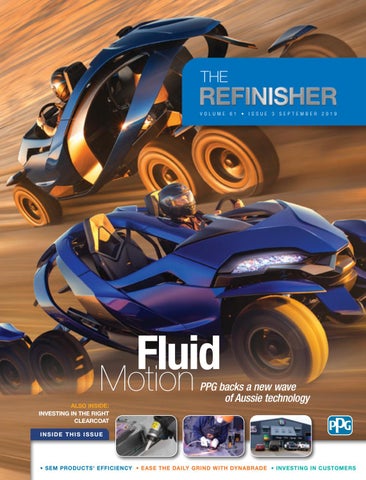
Fluid Motion ALSO INSIDE: INVESTING IN THE RIGHT CLEARCOAT
PPG backs a new wave of Aussie technology
INSIDE THIS ISSUE
• SEM PRODUCTS’ EFFICIENCY • EASE THE DAILY GRIND WITH DYNABRADE • INVESTING IN CUSTOMERS
NOTHING MATCHES TODAY’S COLOURS BETTER
Lexus Structural Blue. Inspired by the iridescent beauty of the Blue Morpho butterfly. Matching any colour is easier when you’re spraying with the best. Learn more at ppgrefinish.com.au
©2019 PPG Industries, Inc. All rights reserved. The PPG Logo and Envirobase are registered trademarks of PPG Industries Ohio, Inc.
contents SEPTEMBER2019
3
SCA N TO RE A D T HE REFINISHER ONLINE
61 VOLUME
THE
REFINISHER
ISSUE 3
Editor-In-Chief Paul Galea
6
Editorial Co-ordinator Kevin Woolerton
4
News
6
SEM-sational solutions
Editor John M Stanley Creative Director Dean Parrott
SEM Products are the perfect fit for panel and paint
Published for and on behalf of PPG Industries Pty Limited by
Kisschasey Creative Pty Ltd Unit 113, 91 Murphy St. Richmond, Victoria, 3121 Telephone (03) 9421 3311
14
16
Dynabrade tools for versatility and long lasting performance
16 Australia Head Office Locked Bag 888, Clayton South, Victoria 3169. McNaughton Road, Clayton, Victoria, Australia, 3168 Telephone: 13 24 24 www.ppgrefinish.com.au New Zealand Head Office 5 Vestey Drive, Mt Wellington, Auckland, New Zealand. Toll Free Telephone: 0800 320 320 Victoria 104-106 Woodlands Drive, Braeside, 3195 Telephone (03) 8586 0000
20
Tasmania PO Box 406, Kings Meadows, 7249 Telephone 0412 254 807 Western Australia Unit 2/6 Colin Jamieson Drive, Welshpool, 6106 Telephone (08) 9256 3920
PPG Logo, Delfleet, Deltron, Envirobase, Global Refinish System, Harlequin, PaintManager, Prizmatique, Radiance, RapidMatch, Startline and ‑ are registered trademarks and We protect and beautify the world, Crystallance and RapidMatch are trademarks of PPG Industries Ohio, Inc. SATA and SATAjet are registered trademarks of SATA GmbH & Co. KG. Third-party trademarks referenced in this magazine are the property of their respective owners.
What is your investment strategy? Doing the sums on clearcoat performance
Queensland 18 Breene Place, Morningside, 4170 Telephone (07) 3823 8000 South Australia 97-105 Bedford Street, Gillman, 5013 Telephone (08) 8346 6870
State of the ‘art’ Perth based start-up, Ferox, created the Azaris specifically to grab attention and, with its high energy PPG finish, it succeeds spectacularly. Packed with trailblazing new drivetrain and suspension technologies, this amazing vehicle is set to take Aussie ingenuity to the world.
20
New South Wales 10 Peter Brock Drive, Eastern Creek, 2766 Telephone (02) 9854 6600
Built to last
32
24
The cost of an unorganised parts department – part 2 The keys to a streamlined parts process
32
Demand and supply Investing in an expansion to meet growing demand
NEWS REFINISHER
4
PPG MOONWALK on the launch pad ™
A
fter debuting in the Europe, Middle East and Africa markets, the groundbreaking new PPG MoonWalk automated paint mixing system is on track to hit the local refinish industry in 2020. When it does, this innovative, self-contained system is set to deliver an all new level of speed, precision, quality and colour consistency to the paint mixing process. Along with tinter storage and a dispensing rack, it features precision scales, a RAPIDMATCH® GO spectrophotometer, a barcode scanner, a label printer and an integrated computer with PPG PAINTMANAGER® XI colour management software. It’s a very cool piece of technology, says Kevin Woolerton, Marketing Director Refinish ANZ.
“We are very excited by the prospect of offering our customers PPG MoonWalk, however it’s not going to be available overnight. It has been hugely popular in Europe and the manufacturer is busy ramping up production to meet demand.
We anticipate it arriving locally in 2020 and we will provide more details once we have a definite launch timeline.” For more information, visit www.moonwalkrefinish.com.
R
Your refinish website is ready
H
ave you checked out www.ppgrefinish. com.au recently? After a significant makeover, PPG’s dedicated refinish website for the ANZ market is now a more attractive and informative place to visit. Although the general website layout remains fixed, the site will be kept fresh by consistently uploading interesting and relevant content. As well as the latest news, PPG training options and a link to online versions of The Refinisher, you will find revised ‘Product’ pages and a new format for conveniently accessing Safety Data Sheets. Regular updates will continue so it’s well worth bookmarking www.ppgrefinish.com.au as a favourite! R
NEWS 5
REFINISHER
DRIVETHROUGH
Small on size,big on performance M
IRKA continues to lead the charge to high efficiency electric tools with the launch of a 77mm DEROS with a 2.5mm oscillation. Compact dimensions make the DEROS 325CV ideal for accurately targeting smaller sanding operations, such as SMART repairs, headlight restoration and hard-toreach areas. Keeping the repair smaller allows the job to be done faster and more profitably. To further boost efficiency, MIRKA has released a 77mm range of its innovative Optimized Surface Preparation (OSP) System. Geared to keeping small repairs compact and fast, this combination of ‘net sanding’ technology and soft abrasive products, delivers benefits that simply
cannot be achieved with a conventional abrasive system. Combining the 77mm DEROS with the 77mm OSP system helps save time on every job which enhances productivity and profitability – it’s the R perfect partnership!
WA Training Centre open for business T
o meet growing demand, PPG WA has invested in a dedicated training centre. Located in Fremantle, it features a host of training equipment, including two spray booths. It’s already providing a solid base for delivering training programs for both customers and internal staff, as well as offering an excellent venue for conducting demonstrations of PPG products, SATA spray equipment and MIRKA tools, abrasives and polishes. For more information contact WA Training Manager, Ruarc O’Connor, on 0417 503 179.
R
with Paul Galea
A
ny talk about automation in body shops is usually met with a shrug of the shoulders and doubts about how it would cope with all the variabilities. Whilst there are challenges, PPG continues to focus on automation as a way of supporting shops that have difficulty attracting and keeping skilled staff, not to mention minimising labour cost. This has led to PPG’s latest innovation in paint dispensing, called Moonwalk™. The benefits are many – simplicity, reduced waste and colour accuracy, just to name a few. Indeed, being so simple to operate makes paint mixing a task that no longer requires specialised skills or the cost of a tradesperson. In fact, it’s questionable if it even needs to be part of the modern-day paint shop at all. After the recent Moonwalk launch in Europe demand has outstripped all expectations. We can expect to see it in action in Australia and New Zealand around early next year. How much thought and effort does the average body shop give to sealants? In fact, this area has become more challenging, with attention to detail needed to meet the ever-increasing expectation of returning vehicles to pre-accident condition, including replicating the OEM look and performance of sealants. However, there is very limited information or support available. PPG’s recent acquisition of SEM Products is about to change that. Late this year a gradual rollout of 1K sealants and specialised nozzles will be followed early next year by more innovative fast cure, 2K products and equipment. SEM Products is about to alter the local R sealant marketplace so stay tuned!
SEM REFINISHER
6
Whether in the panel shop or the paint shop, the innovative range of SEM Products is set to give ANZ users the ability to slash repair steps, time and wastage, while enhancing quality.
SEM sational solutions
W
hen you think about traditional and dynamic names in the collision repair industry, SEM Products is one of those right at the top of the list. Even if you have not heard of SEM Products before, you soon will. PPG’s acquisition of the industry leader in late 2018 has proven to be the catalyst for a significant expansion of SEM Products’ global reach and one of the first regions to benefit will be Australia and New Zealand, says Kurt Way, PPG Category Manager, Associated Products.
Market proven Check out the background of SEM Products and you can see that it’s a very well established and respected brand in the North
SEM 7
American market. While the company did sell in other world markets, it has been heavily focused on its home market, but why should they have all the good technology? In the past, you would often see a limited range of SEM Products being used by many local repairers but the acquisition by PPG gives our region immediate access to a large, high quality, already market proven collision centre consumables range. Local SEM Products’ launches will happen in stages but we are basically talking about a specialised range of adhesives, fillers and sealers designed to help you achieve an OEM style finish on automotive repair and refinish jobs. What it does is offer Australian and New Zealand repairers an industry leading PPG solution across a wide range of the modern repair process.
Perfect fit Look closely and PPG’s acquisition of SEM Products is a logical one because the two companies share many philosophies. For example, over the years, SEM Products has cemented its position in the marketplace by consistently developing innovative solutions specifically to meet the needs of end users. It may be relatively small but it’s a very dynamic company that punches well above its weight. It has done this by
staying very close to its customer base. This allows the Research & Development team at SEM Products to react very quickly to any changes or needs in the market – whether that is developing a totally new technology or making an improvement or refinement to an existing product. When a new trend emerges in repair types or techniques, they have typically used thinking ‘outside the box’ to come up with some very creative and effective solutions for customers. To highlight this, the SEM Products team even introduced the Built Better™ motto which is about always striving to develop high quality products that boost repair speed and the quality of the end finish, while minimising labour time spent on each job. Across all levels of the company, people really care about what they deliver to customers. It’s a very family focused company where they really do operate like one big family and it’s a strategy that has really worked over the long term.
Easy access training Whether you are a regular user or totally new to the range, the strong focus SEM Products has on training solutions makes it easy to understand exactly what you need to do in order to get the best from
each product. Importantly, the company’s training component is very easy to access. The SEM Products YouTube channel is a prime example. It’s packed with instructional videos on how to use a wide selection of the products. They feature easy to follow visuals and clear step-by-step instructions, along with helpful tips and techniques to simplify each task. It’s super convenient to watch on your phone or other mobile device. For example, a panel beater who is about to use a SEM Products seam sealer or adhesive, can take a moment to watch the video on their phone to brush up before they tackle the live job. This is especially handy when deciding on which nozzle to use or to get any tips to help with the task.
REFINISHER
SEM REFINISHER
8
more jobs per day, week, etc. Whether it’s sealing an interior or exterior seam, a joint or a void, this advanced performance range has an option to suit any scenario.
SEM-sational solutions
Dual-Mix™ Seam Sealer (grey or beige) • Fast cure reduces process time • Direct to metal • Sprayable for added versatility • Non sag forulation duplicates OEM sealers • Paintable immediately • Will not shrink, harden or crack
First launch – Seam sealers Leading the first wave of SEM Products to the ANZ market is the company’s market leading range of seam sealer materials, starting with 1K technology, with 2K technology arriving later. Together, they offer an ideal solution for quickly and effectively achieving the correct OEM style appearance and necessary corrosion protection after a repair.
SEM Products 1K seam sealers Comprising a regular version and a sprayable option, these versatile single component sealers provide excellent adhesion direct
to metal and give the applicator an ideal amount of ‘working time’. To assist with processing speed, they are paintable immediately. There is a choice of colours (White, Grey, Beige and Black) to help match the original OEM sealer and they will remain flexible, without shrinking or cracking.
SEM Products Dual-Mix™ seam sealers Featuring the very latest in two component technology not seen before in the Australian and New Zealand markets, this SEM Products range offers industry leading performance aimed at reducing repair process time and allowing you to process
Dual-Mix™ Heavy Bodies Seam Sealer (black, white, beige and grey) • Excellent adhesion direct to metal and multiple surfaces • Holds tooling marks throughout the working time • Non sag • Paintable immediately • Remains flexible without shrinking or cracking Dual-Mix™ Self Levelling Seam Sealer • Ideal for use on drip rails, roof and boot seams • Direct to metal on non-flexing roof skins • Excellent self-levelling properties • Flows nicely into crevices • Paintable in just 15 minutes • Remains permanently flexible and will not shrink, harden or crack Dual-Mix™ High-Build Self Levelling Seam Sealer • A controlled flow epoxy which is perfect for roof seams, drip rails and boot seams • Direct to metal on non-flexing roof skins • Paintable in just 15 minutes • Remains permanently flexible and will not shrink, harden or crack
SEM 9
Dual-Mix™ Panel Vibration Control Material • An epoxy / urethane blend designed for sound dampening, in order to provide an OEM level of noise and vibration reduction on roof skins, quarter panels, intrusion beams and other cavities • Superior flexibility • Excellent sag resistance • Up to 60 minutes of working time • Protects against corrosion
Applicators, tips and accessories No matter which of the SEM Products' range you are applying or which OEM style finish you are trying to mimic, there is a handy solution to suit. As well as manual and
pneumatic applicator dispensing guns, there are options to apply sprayable materials in a replica of the original factory finish. In addition, there is a whole range of tips and accessories designed to help you quickly produce a professional appearance. What they all have in common is superior SEM Products design which delivers increased process speed and efficiency, as well as a SEM-sational end result! R
OVER 70 YEARS IN THE MAKING
T
he rich history of SEM Products makes for interesting reading. When George Sneckner and William ‘Bill’ Elliott gave their names to the company – Sneckner Elliott Manufacturing (SEM) – and opened the doors in California in 1948, they actually made architectural paints. In 1972, the company was purchased by Don and Marilyn Scranton who began the transition to the automotive sector. In the mid ‘80s they also put their vision into action by selling a portion of the company to its employees. They believed that if the company took care of its people, the people would take care of the company. This act transformed the culture at SEM Products. A modern catchcry is to ‘run it like you own it’ which was easy for SEM Products’ people because they did! As more and more innovative solutions were added to the range, SEM Products thrived to the point where, in 1992, the need for extra space led to a relocation across the country to Charlotte, North Carolina. All but one family made the move along with the company and several of those families are still part of the SEM Products team today. A second plant was opened in Rockingham, North Carolina, in 1998, before the entire company was relocated to its current location in nearby Rock Hill, South Carolina, in 2009, in order to bring everything under one roof. In late 2018, SEM Products was acquired by PPG. Today, SEM Products is staffed by around 80 employees who handle everything from product development, to manufacturing and shipping from this site.
REFINISHER
FEATURE PANEL SHOP REFINISHER
10
How the west was
one
With a shared vision, four Perth collision centre owners have combined to develop their own multi-site operation with a focus on long term business efficiency and sustainability.
✚ R
ather than ‘if you can’t beat ‘em, join ‘em’, the bold move to create a new Multi-Site Operation (MSO), called the Vizion Group Pty Ltd, was more about recognising the trend towards MSOs and the advantages it offers. In many ways it was a meeting of minds that brought together the four Perth collision centre owners – Wade Morrison and Scott Bitters from Universal Panel & Paint, along with Nick Farago and Heath Barber from Paull & Warner Accident Repair Centres. In fact, the idea had been bubbling away for some time before it came to fruition in 2017, according to Wade Morrison. “We met Heath and Nick about 15 years ago and they are good guys and good operators. About three years ago we got quite serious about doing something together. As we discussed things, we could see that the only real option for growing the brand was through multiple sites. It gave us
economies of scale, as well as sustainability for the business. Between the four of us, we decided to set up the Vizion Group and look for locations where there were holes in the coverage where we could better support work providers.” Today, Vizion Group comprises Universal Panel & Paint, located in the northern Perth suburb of Neerabup, the two Paull & Warner sites in Perth and Belmont and a jointly purchased fourth site.
FEATURE PANEL SHOP
V I Z I O N G R O U P P T Y LT D
“Because of our strong relationship with work providers, they were able to give us guidance about particular areas where they had a need for services. The O’Connor site is a good example – we were able to purchase it and rebrand it as the first Vizion Group site.” Despite their many years of experience, the four owners didn’t take the MSO step lightly. Indeed, they have specifically sought out expert support, says Wade. “We brought on board ex-MTAWA and Car Craft executive, Noelle Simons, and she brings some real credibility to the business. As well as being our board chairperson, she was also instrumental in helping to structure the business and do some marketing and brand development. The sixth member of our board is Scott’s father, Barry Bitters, a retired insurance industry executive
11
who has strong expertise in business and financial management. Basically, he has been our business coach. He has taught us to look at the figures and percentages and think like businessmen. It’s not about taking all the emotion out, it’s about taking the tradesmen’s hat off and putting the business hat on. We also believe that insurance companies want to work with businessmen, rather than tradesmen.” “Barry is also very much about planning for the worst-case scenario. If we are not hitting targets, even if it’s only by a small amount, he wants to know why. When something does go wrong it’s not about pointing the finger, it’s about fixing it so it doesn’t happen again. One of Barry’s catchcries is that in order to grow the business you have to work on the business, not in it. It can be challenging when you put four business owners together because everyone has a slightly different take on
things. We have actually done a SWAT (Strengths, Weaknesses, Opportunities, Threats) analysis to work out who was best at what roles and then assigned job roles on that basis.” Long term paint supply partner, PPG, has also been supportive throughout the process, says Wade. “PPG has been loyal to us over the years and helped us to grow the business in different ways – it’s no good if we buy a can of paint but then don’t have the work to use it on. We get very good backend support from PPG, including working with Fabian Gaida (PPG Market Development Manager) to support vehicle brands and PPG's MVP Business Solutions team who help us with things like monitoring financials, as well as
REFINISHER
FEATURE PANEL SHOP 12
How the west was one
REFINISHER
V I Z I O N G R O U P P T Y LT D
S H O P FA C T S Vizion Group Pty Ltd Owners: Wade Morrison, Scott Bitters, Nick Farago and Heath Barber Staff: 51 PPG Product: Envirobase High Performance Territory Manager: Rob Dennis thinking a little ‘outside the box’. PPG’s training team is also helping us with I-CAR training. We are very close to getting all the paint shops to I-CAR Gold status, then we will work on the panel and admin sides. We have already made strong progress but the ultimate goal is for all the sites to be I-CAR Gold and MTA Green Stamp accredited.” The four Vizion Group sites give a fairly even coverage of the Perth market, from O’Connor in the south, to Belmont in the east and Neerabup in the north. With 10 minutes’ drive between the closest and 45 minutes between the furthest, they are close enough to support each other, yet far enough apart to not cannibalise work. Across the group there is a total of 51 staff – 18 at Neerabup, 9 at O’Conner, 15 at
Belmont and 9 at Perth. While the ups and downs of the mining sector can have a big impact on the WA labour market, Wade says there has been little problem in finding good staff and being an MSO now offers the opportunity to provide more of a career path. “Typically, a shop will only have a manager and a foreman or leading hand and usually those people are in those roles long term so there is little opportunity to grow within the business. One of our focuses is certainly to offer staff the opportunity to be able to move between sites, whether for promotion or due to workload. For example, work at Neerabup dropped off at one stage and we were looking at possible redundancies. We were devastated – it impacts families and these guys work well together because we carefully select staff for cultural and skill fit. Ultimately, we were able to move several staff to the Belmont and Perth sites. Since then, we have had a panel beater grow his career by moving from Belmont to Perth.”
“The other goal is, that if we do move staff, we want each site to have standardised practices, equipment and materials. All the sites use PPG’s Envirobase waterborne paint and the PPG WA team is helping us to develop standardised practices and processes. It’s not 100 percent documented yet, but we are getting there. We have an induction booklet for staff and I’m developing a staff workshop handbook that will cover paint processes, panel processes, quoting and everything else from A to Z.” In a relatively compact Western Australian market, the challenge is to work closely with insurance companies to secure long term work supply – not easy when two large MSOs capture a large proportion, says Wade. This makes it important to expand, but to do so intelligently. “The pressure to reduce costs is extreme and the only way to survive is to increase volume and reduce margins. The Vizion Group is all about being process driven, no wasted time, keeping everything lean, etc. We are looking at another couple of sites at the moment but we will only add more after carrying out substantial research because it’s a big investment. We have not set a limit on the number of sites – it’s really based on the needs of the work providers. Our ultimate goal is to own all the properties and we are working on that at the moment. I think that sends a clear message that the Vizion Group is R here to stay.”
OEM PARTNERSHIPS 13
Cool
technology Thanks to an ongoing collaboration with PPG, Ferrari is the first to debut a new paint system which is very cool in more ways than one.
F
errari’s 3.9 litre twin-turbo V8 powered Portofino™ Gran Turismo can accelerate from 0 to 100 kilometres per hour in just 3.5 seconds. Although the PPG coatings applied to this gorgeous supercar take a bit longer than that to cure, they can actually do so at significantly lower temperatures and with reduced energy consumption thanks to new Low Temperature Coating (LTC) technology by PPG. Indeed, the introduction of LTC technology was a key to the automotive OEM business earning PPG’s overall Sustainability Award, says Rebecca Liebert, PPG Senior Vice President of Automotive Coatings.
“In addition to providing high-quality coatings and uniform colours, our new technology reduces energy consumption by more than one-third. This is one way PPG continues to create value for our customers. It demonstrates PPG’s commitment to innovation in sustainability while maintaining the high level of quality that customers, such as Ferrari, expect.” The advanced LTC technology, which launched last year on the Portofino Gran Turismo, was developed by PPG’s OEM team in Quattordio, Italy, in partnership with researchers at the company’s Coatings Innovation Center, in Allison Park, Pennsylvania. While Ferrari was the first automaker to use the LTC technology, Rebecca Liebert expects other carmakers to follow suit. The technology relies on a basecoat and a two-component clearcoat which has been specially formulated to bond and cure at low temperatures. And, while paint shop operations typically consume about 70 percent of the energy used within an automotive assembly plant, the LTC
technology can reduce that by nearly 40 percent, according to Selamawit Belli, PPG Global Product Manager, OEM Coatings. “The benefits are immediate and easy to see. Automakers can actually reduce the physical size of their paint shops by using fewer ovens and at lower temperatures.” Not only that, the technology also improves quality by ensuring colour uniformity across different substrates because both carbon-fibre and composite components can be baked with the bodyshell. Multiple colour options are available with different LTC basecoats with gloss, matt and pigmented clearcoats. Overall, LTC technology is part of a Low-Energy Automotive Paint Process (LEAPP) initiative from PPG’s OEM unit, with the aim of creating a transformative effect on the paint shop operations, sustainability and vehicle appearance for vehicle makers, says Rebecca Liebert. “Automotive manufacturers face ongoing pressure to reduce energy consumption. LTC and other LEAPP initiatives help us to deliver solutions that meet those goals without sacrificing quality or appearance.” R
REFINISHER
DYNABRADE TOOLS REFINISHER
14
Built to last Forget today’s throwaway society – Dynabrade tools are designed and made to deliver long lasting performance.
A
top-notch tool doesn’t just get the job done – it typically does it with an ease and capability that makes it very satisfying to use, not to mention more efficient. Where some brands have positioned their tools to fit a particular price bracket, which means average performance and a limited lifespan before simply getting thrown away, Dynabrade has stuck to the no compromise approach that has made it a legendary name in pneumatic tools. Rather than being assembled from imported components, all of Dynabrades pneumatic tools are still made in America, but a special partnership has now seen the automotive range of Dynabrade tools exclusively distributed in Australia and New Zealand by PPG. The range offers a variety of options that fit perfectly into the modern collision repair process.
Where it all began – Dynafile This is the tool which started the revolution back in 1969 and it still remains a top seller for a very good reason, according to Kurt Way, PPG Category Manager, Associated Products. “The beauty of the Dynafile concept is in its versatility, as well as its performance, and this kit is a great starter tool for many users getting into the brand. Basically, you get four quality tools in one handy carry case.
• Belt sander – There is a choice of two different width belts, depending on your needs, and it’s typically used in areas, such as sanding welds where a new panel has been joined. It’s ideal for targeting the welds very closely in order to keep the sanding area as compact as possible. This not only speeds up the job, it also helps give the repair area an OEM-style finish. • Sanding disc – Different sizes and grits are available and there is a quick release thread that makes it easy to attach and remove. • Grinding attachment – Why have a separate grinding machine when you can just fit the attachment to your Dynafile? • Die grinder – Perfect for fabrication work. These are four tools that all good panel shops will have and you get them all in one package. Once you have it you will wonder how you ever did without it!” “When you look at the Dynafile you can see that it comes standard with impressive attention to detail. A safety lockout system on the trigger helps prevent accidents, especially when changing belts and attachments, and there is a swivel arrangement on the air inlet to help keep the hose out of the way while you work. The motor is powerful, torquey and very efficient in terms of compressed air usage, as well as being very compact. All the components are beautifully cast and very robust but that is Dynabrade for you! The reality is, Dynabrade engineers know these tools are going to get a hard life which is why they designed them to cope with whatever is thrown at them while giving back in terms of reliability, ease of use and performance. Any concern with the sticker price disappears when you have an outstanding tool that is going to be a pleasure to use every day!”
DYNABRADE TOOLS 15
Maintenance and repair network Dynabrade arrives locally with a complete backup and support service. This comprises a network of factory approved repair centres that not only have a full understanding of Dynabrade tools, they also have access to an extensive stock of spare parts and special tools to fit them. These factory accredited experts are on hand to ensure your Dynabrade tool is effectively repaired and back in your hands R as quickly as possible.
Dynafile
For product reviews, training and maintenance tips check out Dynabrade’s YouTube Channel at www.youtube.com/user/DynabradeInc/featured
150mm Orbital Sander “The 6-inch or 150mm sander with a 5mm orbit is a Dynabrade favourite and it’s certainly the default name for quality, reliability and performance. When people out in the workshops talk about random orbital sanders, they will commonly refer to them as Dynabrade even when they are not Dynabrade branded because it has become a default name. You find plenty of tradespeople around who have Dynabrade sanders that are 10 or even 15 years old and they are still going strong.” “In terms of pneumatic tools, this Dynabrade sander is quiet, smooth and powerful and very efficient with compressed air usage. It comes with the same attention to detail as other Dynabrade products so it’s beautifully cast and put together and feels like it will last forever and, if you look after it, it just might!”
Cleaning tip: Don’t blow off your sander with compressed air – this can actually force dust into crevices and through seal into the internal workings. Rather than risk this potential damage, it’s better to vacuum off the dust.
150mm Orbital Sander
REFINISHER
FEATURE STORY REFINISHER
16
State
of the ‘art’
L
ike it or not, the days of the Internal Combustion Engine (ICE) are numbered. Although fossil fuel burners will survive for a little while yet, automotive brands across the globe are busy gearing up to release an avalanche of electric and autonomous vehicles that are already sounding its death knell. One of the unexpected consequences is that vehicle designers suddenly get unprecedented freedom. With no need to package an ICE and its associated hardware, vehicle architecture has the potential to look very different to the way it has for the past century. When it comes to spectacular, unconventional styling, it’s hard to go past the Azaris. Indeed, it was created by Perth based start-up, Ferox, specifically to grab attention. Never intended as a production vehicle, Azaris is actually a handmade piece of automotive artwork aimed at introducing the world to a selection of ground-breaking technologies, according to company CEO – Director, Troy Wheeler. “Thanks to the transformation in vehicle architecture, which is being driven by electric vehicles and autonomous technologies,
we saw the opportunity to apply our in-house developed technologies to what we call ‘liberating the wheel’. It’s about removing any restrictions on where or how drive wheels are placed on a future vehicle and the type of suspension system that could be used. One of the core Ferox technologies is a brand new classification of pump and motor that is driven by a solution of 95% water, with 5% additives, and it has been about 40 years in the making. We have known about its opportunities in vehicles for some time, but what we have done is pick our timing. You can have a brilliant idea but if the market is not ready for it at that moment, it can sink. We have waited for there to be enough disruption in the automotive industry where a door opened to new, non-conventional technologies.”
Technology masterclass What Troy is referring to is the revolutionary in-hub fluid drive motors. Where conventional hydraulics are high pressure (3,000psi to 15,000psi), hot, jerky and inefficient, the Ferox fluid motors operate at a much lower pressure (200psi to 1500psi), are incredibly smooth, responsive
Wrapped in wave inspired bodywork, featuring PPG paint, the uber-cool Azaris is a rolling artwork that showcases a revolutionary new drive system and suspension design.
FEATURE STORY 17
Look at the rear of the Azaris and you notice something odd. There are no conventional differentials or drive shafts to any of the rear wheels. Indeed, getting power to the four wheels would be fiendishly difficult to do without Ferox’s other key technology, the ‘DNA arms’ suspension system which also happens to provide a remarkably smooth ride. Troy says it allows the Azaris to track smoothly across the bumps and potholes of the terrain like surfing a wave – an apt description given the fluid motor drivetrain. Cleverly, the fluid lines to drive the motors are actually encased inside each suspension arm which protects them from the elements and external damage.
(L to R) Troy, his brother, Ben, and father, Daryl.
and efficient (as much as 98%) and deliver high start-up torque in a similar way to an electric motor. Packaged neatly into the hub of each of the four rear wheels, the compact fluid motors are happy to move in forward or reverse and can be used to harvest energy when braking. They can also be scaled up to power something as large as the huge tippers seen in the mining sector. For convenience, the fluid pump in the Azaris is driven by a BMW R1200 GS motorcycle engine, but Troy sees electric power as the ideal fit in the long term.
REFINISHER
FEATURE STORY 18
State of the ‘art’
REFINISHER
Look at me! In theory, the Ferox technology could have been retrofitted to an existing car, however it would not have looked that different, says Troy. A key focus of the project was to make a statement with an appearance that people simply could not ignore. “Part of the initial brief was that, even when it was standing still, the Azaris should have a real presence that created a commotion and really enticed people to look. It also had to have a fluidity in its design elements that highlighted the fluid drivetrain. Part of that was creating a lot of negative space that reveals the technology. For example, we purposefully punched a hole through the middle of the vehicle so you could see there were no differentials or driveshafts.” “Some people thought we were a bit crazy to invest the time, energy and money into paint but the first thing you notice about any vehicle is its colour. We discovered Adam and Jason Harvey at Como Panel & Paint, here in Perth, and they have gone above and beyond to assist throughout the project. They put us in touch with PPG who were keen to help. Richard Harvey, a Colour Technologist
at PPG in Melbourne, worked closely with Minh from our team who was overseeing colour and trim.” Richard Harvey was able to use PPG’s full arsenal of tools to provide unique solutions. “For over a decade I developed colours for local vehicle manufacturers so this was quite similar. Working with the Ferox team, we came up with a paint concept that gave the feel of a wave in motion. To do this I formulated a three-layer blue, a hematite colour and contrasting silver, along with finishes that varied from satin to full gloss. I have not seen colours like these in OEM so they are quite unique.” The Ferox team were over the moon with the results, says Troy. “I really appreciate the support from the entire PPG team, the quality of work and the paint – it’s PPG’s ENVIROBASE® High Performance waterborne which is perfectly in tune with the whole fluidic theme of the Azaris. It looked absolutely amazing in Monaco, alongside the other exotic displays.”
Thinking outside the box Interestingly, the project’s biggest challenge was not the task of developing the mind-bogglingly complex technology, according to Troy. “To me, the biggest challenge for any project like this is finding the right people. I am proud to say that the core engineering all the way through to the visuals of this vehicle have been created by
FEATURE STORY 19
a unique team that pushed the boundaries as far as we possibly could with the resources we had. This vehicle was literally built from computer screen to reality in one shot which is a very rare feat.” “Being a start-up, we work primarily with contract-based staff and keep a tight core of stakeholders and a small fulltime team. In terms of skillsets, I guess we see engineering a bit more loosely than in the common workplace. Rather than pigeonhole our team members, we encourage them to cross between the various fields – engineering, industrial design, surfacing, etc – and remove traditional limitations. It’s interesting – you get a very different perspective from nonacademic based engineers that really helps come up with some of these very creative solutions that, maybe, a more traditionally trained engineer might not have thought of. For example, the process of creating the DNA arm structures for the rear suspension. We provided guidance to an industrial designer and he came up with the unique concept of the ‘double helix’ structure.”
The world stage One of the biggest issues facing Ferox is simply that it’s a small company, relatively isolated from the rest of the world. Revealing the Azaris late in 2018 changed that, says Troy. “For the first five years, it was very hard to get meetings with companies potentially interested in the technology because we were not visible. When we unveiled Azaris I called the team at the CarAdvice website and later got a call from the newatlas.com team who cover new technology and science. If it was not for them taking the time to look at and report on our vision we would not be where we are now. Nowadays, we tend to at least get an opportunity to meet with people and show them our technology. Through that there are opportunities to license the technology and apply it to a number of different industries, such as earth moving and defence.”
REFINISHER
IN THE GENES
A
fter spending a very successful 14 years as a licenced financial adviser, Troy Wheeler felt it was time to chase his dreams. Indeed, inventing is literally in his genes. “I am actually the third generation of my family involved in developing various technologies so I am standing on the shoulders of those who came before me. My grandfather and father were both passionate about inventing, including some very cool base technology which we call the ‘Wheeler Technology’ and that includes the fluid drivetrain. I have wanted to do this since I was 13 years-old and five years ago I was able to transition from the wealth management sector and create Ferox. My particular skillset is the ability to bring together the people and vision in a way that showcases the technology.” “We were also surprised by an invitation from Top Marques Monaco, held in June 2019. It was a great opportunity to appear on a global stage and the Azaris was displayed right at the main entrance as one of the show’s flagship vehicles. Although the Azaris was not made for production, with the interest we have had, there could be a limited run of vehicles. When you think about it, the things that carry the most value in the world are actually art pieces and those that hinge on exceptional technology are even more valuable. Custom paint colours would be a key part and we would love to work with PPG to explore future opportunities. In the meantime, Ferox intends to remain at the very pointy end of vehicle architecture and evolution as we move into robotics. We already have more R ideas so watch this space!”
TALKING TRAINING REFINISHER
20
What is your investment strategy? Investing in clearcoat
The sticker price of some clearcoats can make them look very attractive, but there are hidden downsides. Typically, the cheaper the price, the older the technology and that tends to come with significant drawbacks in the production process. Let’s face it, older technology is cheaper for a reason. The latest technology clearcoats may be more expensive to purchase per litre but, in the case of PPG clearcoats, what they bring to the overall production cycle far outweighs the higher initial price.
Rather than simply looking at the initial purchase price, you should be asking yourself – which clearcoat is the best one for my business to invest in? It may sound strange to talk about ‘investing’ in a clearcoat but it’s effectively what you are doing by choosing one of PPG’s modern, high tech formulations. Yes, your investment will cost more at the initial stage, but you will get the return on investment when you factor in the overall costs. In other words, which clearcoat will allow my business to sell
D E NE RGY SA VIN
GS
T
AN IME
WI
AT
Initial purchase cost is not an accurate indicator of a product’s value. Do the sums and a great price tag can actually turn out ODUCED PER S PR D AY to be false T I UN economy that CLEAR NEW CO costs you TH money.
I NG
The true price
DRY
W
ould you buy a new car purely on price? It’s never that simple. People take into account a whole host of factors – practicality, fuel efficiency, service costs, performance, driving enjoyment, etc – because these are important in the overall ownership experience. It’s the same for many products we purchase, such as clearcoat, says John Hristias, PPG Business Support Manager Asia / Pacific.
S AV
MO
E
BEFORE
SELL MORE Which represents additional sales per month
RE
$$$
SAVE MORE Drying time is reduced which represents energy cost savings
TALKING TRAINING 21
more, save more, produce more? The local PPG technical team has put a lot of effort into researching this and the results are clear (pardon the pun!) – the latest technology clearcoats are far more cost effective to use and it’s not even close. For an average collision centre, the simple choice of clearcoat can make a big impact on annual sales. Even if you don’t believe it’s true, it’s worth looking into, right?
Comparing investment strategies For the sake of comparison, we have pitted the long running AUTOTHANE® HS Clearcoat against one of the most up-to-the-minute formulations, LVC-104 EnviroFLOW Clearcoat. However, you can expect a similar result from any of PPG’s high-tech clearcoats, such as LVC-136 EN-V Performance Clearcoat. Rather than just use theory, the PPG technical team actually used real job type scenarios to measure every aspect of the process. Initial cost – At the beginning it looks like no contest. Per litre invoice pricing shows that EnviroFLOW Clearcoat is over 2.5 times the buy price of Autothane HS Clearcoat.
OTH CYCLE TIME GE BO (Min A R s) AVE
88 New Booth Cycle (in mins)
106
18 GAIN
Current Booth Cycle (in mins)
PRODUCE MORE Improve the capacity for production by reducing booth cycle time
RFU – By the time each product is Ready For Use, the gap has narrowed to the point where EnviroFLOW Clearcoat is approximately twice the price per litre of Autothane HS Clearcoat. Consumption – For the purpose of this exercise, a Commodore bonnet was used. Several technical team members applied both clearcoats and the amount of material each of them used was recorded. When it was averaged out, the recommended coverage with EnviroFLOW Clearcoat actually took around 40% less material than Autothane HS Clearcoat. Lower consumption brings the material cost per job down and this is before we factor in the significant labour time saving.
Labour impact – When talking about the overall process, there are a number of aspects that dramatically impact the amount of labour time requires. For example, application time – EnviroFLOW Clearcoat is used in "tack and wack" mode which is one light coat immediately followed by a wet coat, whereas Autothane HS Clearcoat requires two full coats. Flash-off between coats is another big factor – Autothane HS Clearcoat requires a 10 minute flash-off, while EnviroFLOW Clearcoat requires none at all. Add all this up and Autothane HS Clearcoat actually takes an extra 24% labour time! Cycle-time savings – Along with the labour time savings of using a modern, high tech clearcoat, comes substantial reductions in total cycle-time. We are talking reduced application time, as well as reduced bake time, not to mention lower energy costs. Bake time can be slashed even more by switching to LVC-105 EnviroFIVE Clearcoat which has the remarkable ability to cure in as little as five minutes!
Invest in performance When you ignore the initial purchase price but actually map out the entire cycle-time of the process, it becomes clear that PPG’s latest clearcoat formulations are a far more cost effective solution. This is not really surprising given the massive technology leap modern technologies have over older products. Indeed, we are able to show people the detailed calculations which clearly highlight the dollars and cents advantages. We are talking around 20 to 30 minutes trimmed from an average booth cycle-time, day-in, day-out. Taking that extra cycle-time and utilise it to process more jobs per day, week, month, etc. has the potential to boost collision centre turnover by hundreds of thousands of dollars per year. That seems like a pretty effective investment strategy R to me!
For detailed information, contact your PPG Training Manager or MVP Business Solutions Manager.
REFINISHER
PPG PARTNERSHIPS REFINISHER
22
Colour connections To be successful, public transport has to be a super convenient option for users and, whether we realise it or not, colour plays a crucial role.
I
t’s not hard to see why Maree Cotter believes she has the best job in the world. As Customer Campaign & Design Manager for Auckland Transport, she and her multiskilled team, oversee an incredibly complex city-wide network of services to support both locals and visitors. “Auckland is the only city in the world, that I could find, where ‘way finding’ across four travel modes – walking, cycling, the motorist and public transport – are looked
after by one authority. Normally they are overseen by different authorities but here it’s all Auckland Transport and that provides opportunities you just would not get anywhere else.” However, the fun parts of designing the visual aspects of the entire network comes with its own pressures. “Our remit is to encourage people to shift from their cars across to public transport, mainly to help keep the roads clear for users, such as tradies, courier drivers, etc, who can’t do their job any other way. To do this, we look at the psychology of how people find their way through the public transport system. It’s about making it as simple as possible because we know that, if people hesitate, you lose them. For example, one day a car
PPG PARTNERSHIPS 23
user might decide to take the bus – if they can’t easily understand the system or find the help they need, they get frustrated and it can be six months to two years before they try again.” “We have just rolled out a new network plan which includes designing the look and feel of the entire business. This covers everything from timetables, uniforms and signage, right through to the colour scheme for buses, trains and ferries, both internally and externally. It’s not really about making it look good – it’s about making the system as intuitive as possible to use. For example, we previously had 12 different bus operators, plus tourist buses, looking after different sectors of the city and each had its own coloured branding. For anyone new to the system, or for visitors to the city, it made it difficult to know which bus to get onto. In order to make it as seamless as possible for customers, we decided to make all the buses and trains look as similar as possible. It’s not just the paint colours – the internal fabrics, decals, iconography, etc. are also as similar as possible.” Having settled on four colours to represent Auckland Transport (AT Ocean Blue, AT Silver, AT White and AT Yellow), the task was to accurately transfer those colours to Auckland’s public transport fleet, comprising 1367 buses, 193 double-decker buses and 72 train ‘sets’ (three carriages each). Maree went in search of support to get a clear understanding of paint colours and she found it in PPG. “When I started investigating, I went to the bus operators and asked who they dealt with for paint – PPG was the name that
came up most frequently. I was then able to go to Tony Thorpe (NZ Refinish Regional Sales Manager) to get an understanding of how we could spec these Auckland Transport brand colours so there would be no confusion when it came to each operator painting their vehicles. That expertise was exactly what I needed to guide me through that stage. Tony, along with Mark Brearley (PPG NZ Commercial Transport Manager), have been super helpful and without PPG’s support it would have been a lot more painful. Working with them, we were able to get the approved colours matched in PPG products and PPG even created a FleetSpec for Auckland Transport. They were then able to make it available to each
Maree with Mark Brearley and Tony Thorpe from PPG
of the organisations doing the re-livery work to make sure our colours are consistent right across the fleet. It’s probably quite an odd partnership because I don’t invoice PPG and PPG doesn’t invoice Auckland Transport but we work together to get the process done and it has worked incredibly well.” Designing the branding livery was not just about appearance, says Maree, operational factors were also taken into consideration. For example, her team actually analysed the common parts of the bus which were damaged in an accident. By keeping the design simple in those locations, bus operators can have pre-painted panels ready to be fitted, thus ensuring the vehicle is more quickly back on the road and serving customers. After painting the very first bus, Maree admits to being very nervous as she waited to see how the colours would work on the streets of Auckland. As it happens, all the colours have been very well received and the fresh branding is playing its part in helping the new network program to drive an uptake in public transport usage. It’s a credit to the entire team involved, says Maree. “The people I work with are super, super passionate about this city. We live in it so R we want it to be right!”
REFINISHER
MVP REFINISHER
24
The cost of an unorganised
parts department
Store in dedicated parts area
M V P – PA RT S D E PA RT M E N T
PART 2
How to convert your parts department from a place of lost opportunities to a well organised business profit centre.
L
ast issue, Greg Tunks, MVP Business Solutions Manager ANZ, looked at the importance of the parts department as a key profit centre and, hence, the need to have a dedicated person to manage it. He also explained strategies to better organise the parts area and the parts ordering process. Now, having stripped the job using X-Ray Planning, identified all the parts required and ordered them, it’s time to organise for their arrival.
Receiving Does your collision centre have an organised parts receiving process? We have seen many repairers where the parts delivery person simply dumps the parts inside the door, finds the nearest staff member to sign for them and they are gone. Better managing this process can bypass a whole lot of downsides.
• Sign on to efficiency – When you or a staff member signs to indicate the parts have arrived, it’s effectively accepting what has been delivered and that they are all accounted for. Obviously, this is taking a risk. To avoid arguments with the parts supplier, someone should physically check off each part while the delivery person is there. • Use a job number – Consider use the job number as the ‘parts ordering number’. Not only would each part include the job number it’s meant for but it can also list how many parts. For example, if five parts are ordered for a particular job, they will be marked ‘1 of 5’, ‘2 of 5’, etc. so it’s easy to spot if one is missing. • Mirror match – When a part arrives in a box or packaging, the part number may match with what has been ordered but does the part inside actually match?
Every part should be physically removed from its package, checked for any damage and mirror match against the original part which was taken off the vehicle. For example, it may be a bumper which is fitted with sensors, or vice versa, where the job actually requires the opposite. This simple task avoids time-wasting surprises further down the track. • Store in dedicated parts area – Correct parts should be placed against the job, in their appropriate location, in the dedicated parts area.
White board
MVP 25
Delivery Drivers
Documented processes
Credit where credit is due It defies logic to pay good money for a part and then just leave it sitting on a shelf somewhere but this is something that happens in far too many collision centres. The key reason is that there is no organised parts credit process in place. A mezzanine floor or a store room are the typical places where you will find perfectly good but unwanted parts. These are parts which were ordered, delivered and paid for but found to be incorrect for some reason so never charged out to a job. In other words, it’s a drain on profitability. Some people will say they are too busy to organise to return them but, when it adds up to tens of thousands of dollars over time, is this really a good argument?
• Parts credit process – Setting up a parts credit process is very straightforward, particularly after you have organised the parts area. It’s as easy as having a parts credit shelf where spaces are labelled for each of your part suppliers. Any parts which need to be returned are placed in the appropriate place on the shelf. When that supplier makes the next delivery of parts, they can simply check the shelf and take any parts that are applicable to them. • Whiteboard – As an alternative, or if the parts credit shelf is not right where the parts are delivered, you can use a whiteboard. Then, all the delivery person has to do is check the whiteboard to see if there are any returns for them. • Delivery drivers – Make sure to clearly communicate your parts credit (and parts delivery) process to your parts suppliers and their delivery personnel. Keep reminding them!
Given that parts are a key profit centre for repairers, it literally makes dollars and sense to have your parts processes documented. Once done, don’t keep them filed away in a folder somewhere – print out the step-bystep processes and put them in a visible place. Whether you have a dedicated parts manager or not, this is a quick reference and reminder to everyone that this is the way we process parts in this business.
Leadership and culture Have you stopped to consider the sheer dollar value of the parts which flow through your collision centre? For larger operations, it can easily head into the millions per year. Like anything worthwhile, getting it right takes leadership and a consistent reinforcement of the processes from management. With commitment over time, the correct process becomes the default choice and embeds itself in the culture of the business. That is when you know you R are on to a winning strategy!
REFINISHER
PPG PEOPLE REFINISHER
26
PPG Staff Profile
JohnStanley D
espite writing for well over 20 years, John’s earlier career began in an entirely different field. After completing a motor mechanic apprenticeship, he worked in the trade for about 10 years before looking for an alternative pathway to use his skills. Several years in mechanical warranty claims were followed by the role of fleet manager for a 350-car national fleet. A move to the U.K. saw John transition through various jobs before getting the offer to join a London advertising agency where he wrote product compendiums for upcoming GM Opel vehicles. This involved regular trips to Russelsheim, Germany, to gather information from designers, engineers, etc. Having returned to Australia for the new millennium, John took up the role of editor of The Refinisher from issue 1, 2001.
Editor
The Refinisher magazine
Favourite hobbies /pastimes? Tennis, fiddling with our cars, veggie patch Favourite food? Really, really good ice-cream Favourite drink? Muscat Favourite music / band? Hunters & Collectors Favourite car / motorcycle? Ferrari Portofino / KTM 350EXC Favourite holiday destination? Italy
“Basically, my role involves researching and writing all the articles you read in The Refinisher. Although I am listed as editor, it’s a real team effort to put it together four times per year. This includes the publishers, who lay everything out so beautifully, the super-helpful PPG Refinish Marketing team at Clayton and all the PPG experts who provide the technical details for the informative articles.” “Over the years, I have thoroughly enjoyed ‘interviewing’ PPG users for various articles – they tend to be so positive! I believe everyone has a story to tell and it has been a lot of fun transferring them into words. The biggest challenge is getting decent photos to go with the words. Many people think a phone is a reasonable substitute for a camera but, for print quality, it’s not. Like any job, it has its stressful moments but what makes it easier is the people I work with. It’s a such a positive, can-do R environment – what’s not to like!”
SAFETY REFINISHER
28
Friend
&foe
Compressed air is absolutely essential for collision centre operations but, used in the wrong way, it has the potential to injure or even kill.
O
bviously, the air that we breathe is fundamental to our survival. However, take that ordinary air from the surrounding atmosphere, squeeze it and channel it through a system of pipes and hoses and it becomes something quite different. It terms of collision repair, compressed air becomes a very useful power supply for a whole range of tools (drills, sanders, grinders, etc.) in both the panel and paint workshops. Not only that, in the spray booth, compressed air is the sole energy source for operating your spray gun and achieving efficient paint application.
Avoid the dark side These days, there is no doubt a good compressed air supply is an indispensable part of collision repair but people tend to think of it as harmless and forget it also has a dark side. This high pressure, concentrated stream of high speed air has enough energy behind it to easily damage
SAFETY 29
Never clean clothing or hair with compressed air Hands up everyone who has done this or seen it done? Unfortunately, cleaning clothes with compressed air seems to be quite a common practice but it can lead to major issues. What is perhaps not understood is that a stream of compressed air can actually penetrate the skin, even when there is a layer of overalls, etc. over the top. It is particularly dangerous where there is an open wound. Here, the small amounts of oil or dirt which can be found in compressed air can be forced in where they can then cause serious infections. Worse still, compressed air entering the body can lead to an embolism – this is where a bubble of air is forced into a person’s actual bloodstream. If this air bubble travels to the heart it can result in symptoms which are similar to those of a heart attack. If it takes a different route and reaches the brain, it can cause a stroke. Crucially, both scenarios can be fatal! Eyes and ears The two parts of the body, perhaps, most vulnerable to compressed air are the eyes and ears. Firstly, a stream of compressed air has the force to pick up pieces of debris and turn them into high speed missiles that can not only puncture the skin, they can easily damage an eye. Secondly, even at relatively low velocity, a misdirected jet of compressed air can pop an eyeball out of its socket or do other significant damage. The most obvious danger to the ears is from the potentially harmful level of noise produced when a volume of compressed air it vented nearby. This often results in intense sound which is well above safe decibel
Dos and don’ts
COMPRESSED AIR
a human body. When you combine this with the fact that many people in the industry don’t take sufficient care when using it – perhaps, it is a case of familiarity breeds contempt – and it is easy to understand why injuries regularly occur.
3
Always wear proper Personal Protective Equipment (PPE) when using compressed air or equipment which utilises compressed air.
3
In particular, wear safety glasses with side shields or a complete face shield, if required.
3
Wear hearing protection when operating pneumatic equipment or when dumping or venting compressed air lines, filters, etc.
✘
Under no circumstances direct a stream of compressed air at yourself or another person. If you must use compressed air to blow off / clean down a surface, ensure the pressure is suitably reduced – generally, less than 30psi.
levels. However, it is also important to understand that a stream of compressed air directed towards the ear can easily rupture an ear drum resulting in hearing loss or, in extreme circumstances, it can even cause a brain haemorrhage. Don’t horse around Pranks and jokes using compressed air can quickly turn from a little fun into serious, life threatening situations. The human body has little defence against a stream of compressed air which is aimed at the wrong place. Although the mouth is for breathing in air, it takes only a small amount of compressed air being blown into the mouth to result in ruptured lungs or intestines. The navel or belly button is another weak point –
even through clothing, compressed air can enter and rupture intestines. As well as the many issues already mentioned, there has been occasions where compressed air has been directed at a person’s private parts (why would you do that?). In the past, this type of extreme horseplay has resulted in serious problems, such as a rupture of the R bowel or even death.
REFINISHER
PPG COLOUR REFINISHER
30
Find it, Paint It
Don’t have the paint code for a vehicle’s exterior or interior colour, trim, etc? No problem – just Paint It!
H
ow cool would it be to be able to stand in front of a vehicle and, without even knowing its paint code, have the ability to conveniently look up its exterior colour, trim colour, wheel colour, etc, even if you are far away from a refinish paint shop? With PPG Paint It you can! And you can do it on any mobile device that has an internet connection. Rather than being an ‘app’, PPG Paint It is actually an innovative web-based colour tool designed to offer an interactive approach to colour identification and selection. Best of all, there is no need for special software and no subscription required. All you need is a smart phone, tablet, laptop or even desktop computer which can be used to navigate to http://www.ppgpaintit.com/
In basic terms, Paint It provides an easy and convenient search option to find the colours used on imported vehicles starting with model year 2008. Updates are continually added when they become available. To make it easier to get a fast, accurate result, there is an array of search features and functionalities. Searches can be conducted via geographical region (Asia / Pacific, North America, Europe, etc) and further narrowed down by selecting the vehicle manufacturer, the specific model,
the model year and the colour family, as well as whether it’s solid, metallic, etc. It’s also possible to refine the search by ‘Usage’, if you are just looking for a specific roof colour, an under-bonnet colour, trim colour or wheel colour, rather than the main exterior colour. Not only this, Paint It also displays very handy on-screen digital colour representation ‘squares’, in either ‘grid view’ or ‘graph view’. As the search criteria is narrowed, the digital colour squares get larger, once again helping to identify the target colour. It’s also possible to show digital representations of just one colour group. For example, there may be six different reds available on a particular model and these can be isolated and displayed next to each other so that subtle differences between them become more obvious. Clicking on each colour square links to the colour name, the manufacturers code and other useful information. Thanks to PPG Paint It, your smart phone or other mobile device in now a powerful colour tool that links you directly to a vast database of information, no matter where you are! R
PPG PARTNERSHIPS 31
Hero worship When Holden released the V2 Monaro in 2001, it became an instant classic. Now, Holden is giving you the chance to own one, complete with bespoke PPG paint colour.
D
espite the V2 Monaro still being an out-and-out head turner nearly two decades after it was launched, Holden is about to elevate one particular 2004 VZ CV8 Monaro to the next level. As part of a special promotion, dubbed ‘Project Monaro’, the company is putting a well-used original vehicle through a ‘zero to hero’ restoration to create a V2 Monaro like no other. Taking the lead are Holden’s design and engineering teams based at the company’s Port Melbourne headquarters. Members of the design team, including some who were involved in the initial V2 Monaro development, will be responsible for adding some extra pizazz to the interior and exterior. At the same time, Holden’s engineering team, with help from Red Bull Holden Racing and some key build partners, will set about enhancing the way this unique two door performance car goes, stops and turns. Given colour is such a crucial factor, Holden enlisted PPG as its paint partner. Indeed, the process of developing the bespoke colour has many similarities to the long-term Holden / PPG partnership which saw PPG supply the production line where the V2 Monaro was built, as well as playing a key role in creating Holden’s overall colour palette. For Project Monaro, it started with Ben Wood, from Holden’s Colour & Trim department, putting together a ‘storyboard’ of visual cues which he presented to staff at PPG’s Clayton Colour Laboratory. Using this to guide them, PPG chemists got to work formulating a series of colour variations. These were then sprayed out at a variety of different gloss levels – from full matt, to satin and full gloss – by using a combination of off-the-shelf PPG products, D8115 Matt Clearcoat and D8117 Semi-Matt Clearcoat.
The result is a bold and unique colour in a satin finish which has been named, ‘Panorama Blue Suede’ (Note: This colour formulation is not available to the public). It will be applied by B&A Motor Body Repairs, in Clayton, Melbourne, a respected family business which is not only a long-running PPG customer but, in 2018, also became Australia’s first ever Holden Certified Collision Repairer. How do you win this modern-day classic Monaro? Holden has opened the promotion to both trade and retail service customers of the company’s dealers across Australia and New Zealand. You can even watch the restoration process via a series of videos hosted by motorsport icon, Craig Lowndes. For more info, check out www.acdelco.com. R au/offers/project-monaro.
REFINISHER
CT REFINISHER
32
As a growing workload stretched workshop capacity to the limit, Total Fleet Imaging decided to invest in a massive expansion to meet customer demand – it has not looked back!
Demand and supply A
sk brothers, Damien and Adam Bennett, what it is that keeps customers coming back to their business, Total Fleet Imaging (TFI), and they will tell you it’s all about making a commitment, religiously sticking to it and delivering on time. It was the same for their father Barry, when he ran the business that he had started 55 years ago, as a 19-year-old sign-writer. In 2006, TFI moved into a vast new workspace in the Melbourne suburb of Laverton but less than a decade later it was already feeling the pressure of not enough space. However, it was very much positive pressure, says Adam.
“It was all about the growth in our customer base. For example, a customer might have only had one truck 15 years ago but now they 15, 50 or even 100 trucks and they are still our customers. We don’t lose many customers so it really built demand.” Workflow at TFI falls into three basic categories – painting trucks (refurbishments, re-liveries, etc), painting trailers and preparing new curtains for tautliner style trailers. Unfortunately, they were all competing for valuable production time and space, says Damien. “Although we had two 20 metre booths, because a truck could be sitting in a booth for an extended time, it really held up production of curtains which are much faster moving. It made sense to move truck painting elsewhere and we were fortunate enough to be able to purchase the property next door just over three years ago. Beforehand,
CT 33
we sat down with our accountant and bank manager to crunch the numbers on how much better off we could expect to be after the expansion and that forecast has been on or above our target.” As well as increasing total land area to around 12,000m² (about three acres), TFI
has been able to add a third truck sized spray booth, a spacious undercover area and a dedicated truck workshop. In total, TFI now boasts around 5,000 m² under roof. There is also the ability to manoeuvre a b-double combination right around the building. Importantly, it has freed up floor
space in the original workshop to allow curtains and trailers to be processed far more efficiently. As well as space, it comes down to a combination of scheduling correctly and having the right equipment, tools and skilled staff, Adam explains. “Scheduling is a big part of our productivity and profitability. To create a schedule, you need to understand the timeframes and exactly how long jobs take. Then you need to follow that on a day-today basis in order to meet the promised timeframe for customers – we get a lot of pressure to make sure we meet targets! Our General Manager, Mark, looks after the overall scheduling and then we have a Workshop Manager, a Paint Shop Manager and a Paint Shop Leading Hand who take care of their different areas. Mark runs everything on a computerised scheduling system which has monitors on the shopfloor so the guys don’t need to come looking for instructions – they just look at the monitor to get all the information about the next job.” “There is now 43 staff and they work as a close-knit team. We have not had staff turnover for a long time. In fact, we often find new staff from friends of current staff and that has made it easier for us to grow. We work hard to look after staff and they would not suggest their mates should come and work here unless it was a good place to work.”
REFINISHER
CT 34
Demand and supply
REFINISHER
Another factor that helps with fast and consistent production is the partnership with PPG which spans almost 30 years. Although TFI spent two short stints with other brands, they quickly returned to PPG and today’s partnership is stronger than ever, says Adam. “We have seriously never had an issue with PPG. For trucks and trailers we use the Delfleet Evolution paint system and the new F4949 tintable primer (Delfleet CT Productive Chassis Primer Mixed Colour) has been a really good product for us. On the curtains we use PPG 2K – it has a makeup that adheres extremely well to the vinyl of the curtains and then we apply 2K HS Ultra Flexible Clearcoat over the top to give long term protection. PPG’s backup support is second to none, too. There is always training available when we want it and we also get help from Mindy Roberts and Greg Tunks from PPG’s MVP Business Solutions team on the financial side and with ‘lean’ processes, etc. Mindy and Greg even gave us advice on the layout and workflow for the new extension. Colour is another area where PPG supports us. For our customers, colour is about being instantly recognised. With many fleets, you don’t need to see the name, you can tell the brand by the colours. PPG’s FleetSpec makes it easy for our painters to get it right every time, whether it’s a prime mover, a trailer or a curtain. People often ask if we advertise. We don’t but every job that goes out on the road is our advertising. You can’t beat word-of-mouth!” Rather than just apply high quality liveries, TFI has worked to develop another string to its bow via its in-house graphic design department. It’s a great way to attract and hold customers, according to Damien.
“Originally, we had one graphic designer but he got snowed under so we had to put another on and we have since added another to meet demand. It means we can offer a full branding service. It might be an existing client who wants to rebrand or tweak their livery or it might be a new client who comes in off the street and wants branding done from scratch. Whether it’s vans through to prime movers, we work with them to do a design for each type of vehicle. It helps turn them into long-term clients.” The brothers, split basic responsibilities, with Adam looking after the truck painting side while Damien takes care of the trailer
and curtain production. Both of them like to keep a ‘finger on the pulse’ on the production floor, to support and guide the TFI team, as well as ensuring they know exactly what stage each job is at should a client ring. Indeed, customers have typically been very loyal and over the years have actually become friends, according to Adam, and that is hardly surprising when you look at the family nature of the business. At 74 years of age, Barry Bennett still comes into work every day, Damien has been with the company for 31 years and Adam a few years less. Not only has the recent expansion made it clear that Total Fleet Imaging is here for the long haul, there are even future plans in place, says Adam. “When we purchased the property next door it came with an existing business operating at the front. That is our future growth avenue where there is another 3,000 m² of space if needs be. We even have council approval for the stage two expansion. We believe that we are already the oldest surviving signage company in the country and there is a good few years left in us yet!” R
Driving innovation for 70 years.
A 70 Year Heritage. Everyday. Collision, restoration & commercial shops trust SEM’s OEM recommended products to reduce repair time, steps & waste in every application. We relentlessly pursue excellence. We innovate and we improve. Visit semproducts.com/history to learn more.
semproducts.com