THE VOLUME 62 • ISSUE 2 NOVEMBER 2020
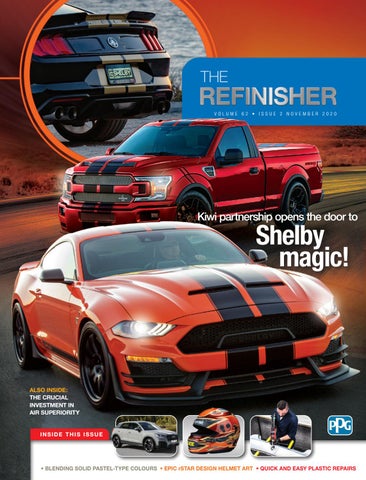
Kiwi partnership opens the door to
Shelby magic!
ALSO INSIDE: THE CRUCIAL INVESTMENT IN AIR SUPERIORITY
INSIDE THIS ISSUE
• BLENDING SOLID PASTEL-TYPE COLOURS • EPIC rSTAR DESIGN HELMET ART • QUICK AND EASY PLASTIC REPAIRS
PLASTIC REPAIR
SEALERS
PLASTIC REPAIR MATERIAL
2K SEAM SEALERS
Utilising SEM’s advanced DUAL-MIX technology, this thoroughly modern plastic repair system is fast, versatile and highly effective yet very easy to train and simple to use.
Featuring next-gen 2K technology, SEM’s product range of DUAL-MIX 2K Seam Sealers will change the way you seam seal. By setting in just minutes, DUAL-MIX 2K Seam Sealers lets you quickly get on with the job.
PPG Industries Australia 14 McNaughton Rd, Clayton, VIC 3168 Australia
13 24 24 www.ppgrefinish.com.au
PPG Industries New Zealand 5 Vesty Drive, Mt Wellington, Auckland, 1060 New Zealand
semproducts.com
contents NOVEMBER2020
3
SCA N TO RE A D T HE REFINISHER ONLINE
62 VOLUME
THE
REFINISHER
ISSUE 2
Editor-In-Chief Paul Galea
6
Editorial Co-ordinator Kevin Woolerton
4
News
6
Plastic repairs with speed and simplicity
Editor John M Stanley Creative Director Dean Parrott
New, market-leading technology from SEM Products
Published for and on behalf of PPG Industries Pty Limited by
Kisschasey Creative Pty Ltd Unit 113, 91 Murphy St. Richmond, Victoria, 3121 Telephone (03) 9421 3311
10
8
Creating epic motorsport helmet artworks
10 Australia Head Office Locked Bag 888, Clayton South, Victoria 3169. McNaughton Road, Clayton, Victoria, Australia, 3168 Telephone: 13 24 24 www.ppgrefinish.com.au New Zealand Head Office 5 Vestey Drive, Mt Wellington, Auckland, New Zealand. Toll Free Telephone: 0800 320 320
16
Queensland 18 Breene Place, Morningside, 4170 Telephone (07) 3823 8000
Western Australia Unit 2/6 Colin Jamieson Drive, Welshpool, 6106 Telephone (08) 9256 3920
PPG Logo, Delfleet, Deltron, Envirobase, Global Refinish System, Harlequin, PaintManager, Prizmatique, Radiance, RapidMatch, Startline and ‑ are registered trademarks and We protect and beautify the world, Crystallance and RapidMatch are trademarks of PPG Industries Ohio, Inc. SATA and SATAjet are registered trademarks of SATA GmbH & Co. KG. Third-party trademarks referenced in this magazine are the property of their respective owners.
The complete package A landmark partnership with Matamata Panelworks now sees Shelby American’s ultra-desirable range available for Kiwis to order. Fabricated and built at Shelby New Zealand, they offer an all new level of performance and exhilaration.
16
New South Wales 10 Peter Brock Drive, Eastern Creek, 2766 Telephone (02) 9854 6600
Tasmania 136 Invermay Rd, Invermay, 7248 Telephone 1300 305 699
Return to spender Making an investment and reaping the rewards
Victoria 104-106 Woodlands Drive, Braeside, 3195 Telephone (03) 8586 0000
South Australia 97-105 Bedford Street, Gillman, 5013 Telephone (08) 8346 6870
Heads up display
24
The visual difference The secret to clear and simple visual communications
32 32
Driven to diversify Sloanebuilt Trailers leading the field with a state-of-the-art new factory
NEWS REFINISHER
4
Highlighting below the S surface ATA’s exterior spray gun design is well-known for its incredibly high degree of craftsmanship and styling but the latest limited-edition model gives a glimpse into the precision engineering below the surface. Dubbed the SATAjet® X 5500 Bionic, it features colourful and highly detailed graphics that appear to peel back the surface to reveal the internal technology that makes a SATA gun so special. Beneath the special graphics, this is a fully functional spray gun with all the features of the current premium model so it can
be used every day or it makes a marvellous addition to a display collection. The SATAjet X 5500 Bionic is available in HVLP or RP technology and in DIGITAL® (with built-in air pressure gauge) or non-digital format. SATA special editions are available in strictly limited numbers and have a history of selling out very quickly so reserve yours now at your SATA distributor R to avoid disappointment.
Colour Matching Comp goes 24/7 on Facebook W
in, lose or draw, the annual PPG Colour Matching Competition is all about participation but, unfortunately, that can’t happen in 2020 due to the coronavirus pandemic. As a result, a special Facebook Group has been created to provide a pathway to the 2021 event. It’s open to previous competitors (regional, state or final level), along with trade instructors and
spray-painting apprentices who wish to participate in future competitions. The Colour Matching Competition Facebook Group is already providing a handy platform to access colour theory and other technical information, as well as a forum to discuss a range of topics and link with PPG colour experts. Request to join by filling out the short questionnaire at www.facebook.com/ groups/PPGcolourmatching/. Register interest for the 2021 PPG Colour Matching Competition at www.ppgrefinish. com.au/Training/colour-matching-comp or contact your PPG Training Manager R or Territory Manager.
NEWS 5
REFINISHER
DRIVETHROUGH
Curtain call for a local favourite A
fter almost three decades in action, the Cobra refinish system is being phased out. Unveiled via a series of spectacular launch events in 1991, Cobra took the market by storm. Initial estimates were that 150 collision repairers would convert in the first year but after three months over 700 had switched to Cobra! Three years of intensive research by the local development team at PPG’s Clayton headquarters really paid off. Not only was
F
Cobra an instant hit thanks to its colour capability, ease of use and quality, its flexibility has seen it go through a number of major upgrades to cope with the extraordinary changes in automotive coatings technology. However, modern, new generation refinish systems which have a more global reach, such as Deltron® GRS and Envirobase High Performance®, have now overtaken Cobra and it’s time to R bid a fond farewell.
Setup to perform
ollowing the strong response to the SATAjet X 5500 Setup Guide poster, PPG training managers and technical staff have been at it again creating a handy setup guide for its little brother, the SATAminijet® 4400. Available now, the SATAminijet 4400 Setup Guide include comprehensive guidelines, suggestions and tips that take the guesswork out of the setup process. Designed to make life easier for paint technicians, the setup guide covers a range of
popular PPG products, detailing the recommended fan, fluid and pressure settings for a variety of application situations. Ultimately, it’s about helping to consistently get the best from SATA’s versatile, compact spray gun. To get your own SATAminijet 4400 Setup Guide poster simply contact your PPG Territory Manager, your PPG Training Manager or calling PPG’s Customer Service Hotline 13 24 24 (Aust) or R 0800 320 320 (NZ).
with Paul Galea
A
s I put pen to paper, Melbourne’s hard lockdown is coming to an end and the sense of relief is obvious. However, whilst the easing of restrictions can be almost instantaneous, the impact on the collision repair sector will take much longer to overcome. I used to believe the industry was isolated from economic factors – after all, nobody chooses to have an accident according to the economy. Who would have thought a virus could impact the collision business like nothing before? It sounds obvious now but how people move around (mobility) has a direct and swift impact on our industry. Indeed, we have seen repair volumes almost directly mimic the movement of vehicles on the roads. On a positive note, we are seeing vehicle movement recover significantly faster than the use of public transport. If I had to single out one article in this issue, it would be our local launch of SEM Products plastic repair solutions (page 6). As a result of this easy-to-use, two-pack, Dual-Mix™ technology we have already seen an uplift in collision centres wanting to target in-house repairs rather than subletting or replacing with a new part. As well as compensating for potentially lower repair volumes, there are many more benefits that may not be obvious at first glance. Admin time to manage the replacement part or subcontracted repair is almost completely eliminated, paint material usage is reduced, in some instances there is the opportunity to blend within the component, assembly time is reduced, as is the storage space required for new parts, waste dispose cost and all-important key-to-key cycle-time. R What’s not to like!
SEM PRODUCTS REFINISHER
6
Plastic repairs with speed and s mplicity
Two new plastic repair solutions from SEM Products bring super quick Dual-Mix™ technology to let you make common plastic repairs with ease, versatility and speed.
T
hese days, it’s no surprise that collision centre owners / managers are focused on the bottom-line cost of each job. Typically, the aim is to minimise labour cost but if you can also include speed, quality and flexibility, along with simplicity, it becomes a winning combination. When it comes to plastic repairs, SEM Products has done exactly that by launching two options with market leading abilities. As the name suggests, Dual-Mix™ Multi-Plastic Repair Material caters to the majority of plastic types, while Dual-Mix™ Problem Plastic Repair Material provides a handy solution for rare types of plastic. Both feature two-pack Dual-Mix technology which delivers excellent adhesion while also curing and being ready to sand in just 15 minutes. Recently, Tom Widmer, SEM Technical Sales Manager, based at the company’s headquarters in, South Carolina, visited Australia to explain the advantages of these time-saving new products.
Keep it simple, keep it fast! All the way through the process, these products have been designed to be very quick and effective but, at the same time, very simple. We have deliberately made it easier to do the process right, than do it wrong. This leaves a lot less room for errors that can cause reworks. It also means there are some big differences between SEM Products plastic repair solutions and the competitors. For a start, the technician doesn’t need to spend time trying to work out what type of plastic it is. When dealing with most plastics – basically, the flexible ones – Dual-Mix Multi-Plastic Repair
SEM PRODUCTS 7
Material and Dual-Mix™ Problem Plastic Repair Material very easy to train, learn and quickly begin getting the most from.
Complementary to plastic welding
Material is the go-to choice. On the odd occasion when you strike a rigid or unusual plastic, there is Dual-Mix Problem Plastic Repair Material. For simplicity, both products can be applied directly over raw plastic without the need to apply an adhesion promotor first. This is a step where the technicians might either incorrectly apply the adhesion promotor or accidently ‘forget’ to do it all together. Our theory is, you can’t forget a step that is not there! Yet another advantage is when feather-edging. We are the only company that says you can go ahead and feather right into the existing paintwork. Other products recommend feather-edging into the raw plastic and then having a second feather-edge into the existing paintwork but this is just extra potential for them to show through after the repair which can result in a rework. It’s also simple when it comes to the actual repair job. The same SEM Products material is used on the inside and outside of the repair and both sides can be done simultaneously – there is no need to wait for one side to cure before continuing. For the final finish, you can choose between applying a thin layer of SEM Products plastic repair material, applying polyester body filler over it or apply a urethane primer – they are all fine so it’s up to you. All these factors make Dual-Mix™ Multi-Plastic Repair
SEM Products plastic repair materials are not designed to replace plastic welding – Dual-Mix MultiPlastic Repair Material and Dual-Mix Problem Plastic Repair Material are for use in addition to plastic welding. For example, they are not recommended for tears that go right to the edge of a panel – this is where plastic welding is a more effective solution. Rather, these SEM Products solutions are ideally suited to certain common repairs, such as a hole or tear in a bumper bar facia.
The process is simple, fast and effective:
Prep both sides, including dishing out the damaged area. Place masking tape over the outside of the repair and then apply SEM Products Plastic Repair Reinforcing Tape on the inside. Apply the plastic repair material on the inside. Place some SEM Products Plastic Repair Contouring Tape over it and use a spreader to smooth out the material. The Plastic Repair Contouring Tape can be removed after curing and reused on further jobs. Turn the bumper over, remove the masking tape, apply plastic repair material over the outside and spread it out. In 15 minutes, it’s cured and sanding can begin.
As well as repairing accident damage, Dual-Mix Multi-Plastic Repair Material and Dual-Mix Problem Plastic Repair Material offer a perfect solution for certain awkward situations. Think about those times when a bumper (new or second hand) arrives with something like sensor holes or an extra indicator hole which doesn’t match the vehicle in your workshop. Simply using the above process to eliminate the unwanted holes means not having to wait for the correct part to arrive and the customer gets their vehicle back quicker. SEM Products is a PPG company. Check out the extensive library of instructional videos on the Youtube channel, SEM Products Inc. A range of SEM Products are available from your PPG, Protec or CPC distributors. R
REFINISHER
PPG CUSTOMERS REFINISHER
8
Head up display While retaining its crucial safety functions, rStar Design can transform your motorsport helmet into a piece of wearable art that is an extension of the driver’s personality.
A
lthough it’s not difficult to find a new motorsport helmet that delivers quality protection, colour choice can leave a lot to be desired. Typically, the boring options are either white, black or bare carbon-fibre. It’s here that rStart Design has carved out a healthy niche creating custom helmet paint jobs for drivers competing in everything from grassroots go-karting, through to elite level motorsport, including Supercars and NASCAR. Located in Sydney, it’s a one-man-band operation run by Frank Stivala, who says it has been an evolution of his skills as an automotive spray painter.
“I was working for myself doing restorations and hot rods and I explored helmet painting as a way to fill the gaps. I grew up around different forms of motorsport so I painted a display helmet and went to local go-kart events to show people and give out business cards. I ended up painting helmets for a few well-known, young go-kart racers which got the ball rolling. Within two years helmet painting had completely taken over.” While many elements go into helmet painting, the basics of refinish painting remain the same, says Frank.
It’s about sticking to tried and true products and processes and insisting on fine attention to detail. “I have been mucking about with an airbrush since before I left school so I was very comfortable with that. Then it was just a matter of combining my painting skills with a basic knowledge of graphic design. The first step is to generate a digital rendering of the helmet artwork based on the customer’s ideas, colour choices, etc. This is one aspect I had to refine and get better at over time. Although it’s a twodimensional (2D) rendering, it’s a very good representation of what the customer is going to get. They approve that before I go ahead and apply any paint. No matter what colour they are, 99% of helmets come finished in a factory clearcoat so the prep work is just like preparing a blend panel on a car.” “Once the design is set, there is a lot of layout and masking work to take it from 2D to the 3D shape of the helmet. This is where the freehand element comes in as you start to mask up and every single job is different. Planning your steps is a big factor, especially when doing logos. Getting the colours on in the right sequence and putting on the minimal amount of paint are just some of the things you have to think about. Some customers do worry about weight so you can’t just keep adding more and more.”
PPG CUSTOMERS 9
One of rStar Design’s most high-profile customers is 2018, 2019 and 2020 Supercars Drivers Champion, Scott McLaughlin, who has been a client since the start of the 2015 season. When it comes to head protection, Scott insists on three non-negotiable criteria – a Bell Racing helmet, with artwork by rStar Design and finished in PPG paint. “Normally, Frank paints two to three helmets per year for me and he is so thorough and creative. I don’t give him much direction, I just want a tribute to my Gran on the top, a Kiwi with the New Zealand flag and my sponsor logos, including PPG, and from that point Frank can do what he wants. Design-wise, he always comes up with fantastic little touches.”
According to Frank, PPG’s combination of refinish and specialty finish products are perfectly suited to helmets such as Scott’s. “Because there are so many layers, you can’t afford to have large paint build ups and this is the beauty of PPG products. For example, I used PPG D794 tinter for the yellow on Scott’s helmet and I have never seen a yellow cover like it! To give it an extra lift I also used PPG’s VIBRANCE COLLECTION®, including VCC580 Custom Clear. Generally, when you want a special
effect finish you have to switch to another brand but you never quite know what result you will get when mixing and matching brands. The Vibrance Collection lets you stay within the PPG brand so it’s a no brainer for what I’m doing.” Although every job is different, Frank estimates that about six hours of computer design work and around 25 to 30 hands-on hours go into the typical helmet. While this level of attention to detail doesn’t come cheap, customers do get what they pay for – incredible, individual art pieces that highlight the wearers personality, as well as all-important sponsors. Frank even designed and commissioned the manufacture of a bespoke rStar Design branded helmet case as an optional extra that many customers choose in order to help keep their helmet in pristine condition. “When you target the high end of the market, you have to be super fussy. It’s not just about painting helmets. It’s the premium products I use, the helmet bags, the on-line store, the social media presence – it’s the R complete rStar Design package!”
REFINISHER
FEATURE PANEL SHOP REFINISHER
10
T H E B O D Y R E PA I R S H O P
Return to
spender Following a major investment in his business, Mick Caruso made the welcome discovery that the return on investment came with far more than just a shiny new workshop.
I
n the year 2000, when Mick Caruso and his wife Sandy established The Body Repair Shop, it was a two-man operation in a tiny 360m² workshop doing mostly fleet work. As time went on and the business began doing insurance work, Mick estimates that it grew at an impressive rate of up to 30 percent per year. However, by around 2017, he felt it had reached its limits in its original workspace.
“We had about 2500m² of space but it was spread across three different buildings. It got to the point where we had done everything we could with the old workshops and I was ‘over it’, so we built an additional brand new building on the same site and did it exactly the way I think it should be done. If we had not made the investment I probably would not still be in the business. The biggest benefit is time for myself. In the past I was working ‘in’ the business during the day and trying to work ‘on’ the business after hours. Now I can do things I enjoy doing on weekends and even take days off, if I want to.” Situated in the Adelaide suburb of Salisbury Plains, the overall 20,000m² property is owned by the Caruso Family Trust and Mick reckons this is a win / win
because the trust gets the best possible tenant – The Body Repair Shop! A large proportion of the increased rental cost has also been offset by installing a huge 100kW solar electric system on the roof. Mick project-managed the construction of the business’ spectacular new premises with a design that incorporated a lot of experience, along with research from a variety of sources. “The most important factor was flow. The old workshop had a type of flow but there were always little roadblocks and hinderances from using existing buildings. I got lots of different input for the new layout. For example, from going to PPG MVP Business Solutions seminars over the years where I listened closely and picked up lots of pointers. Firstly, the flow in the new workshop is exactly what you dream of. Jobs do a full loop, the floor is fully marked out for vehicles, equipment, etc. and each technician has their own space and they are generous spaces. As each vehicle enters it’s filmed from five different angles and there are over 40 cameras throughout the premises. It lets us follow the car from the time it arrives, right through the repair process, to the point where the customer picks it up.” The light filled reception area is both welcoming and efficient at dealing with customers, while four spacious, undercover
FEATURE PANEL SHOP 11
quoting bays make that task quicker and easier. Tall panel-lift doors lead inside, where the paint area features four prep bays and two larger (3m high by 8.5m long) Lowbake spray booths. Although designed to cater to the high roofed vans that come through, Mick says they also benefit regular jobs because it’s possible to paint a vehicle and all its parts at the one time. One booth is also fitted with Lowbake’s RADS – Rapid Air Drying System. “RADS is an extra cost but it works really well. The PPG Envirobase waterborne
system we use dries quickly on its own but RADS takes it to the next level when we are doing a larger job or want to push something through quickly. I am a painter by trade and when PPG first demonstrated Envirobase it made perfect sense. Being affiliated with PPG is not just about products. For example, our Territory Manager, Rob (Allevi), not only helps us with the latest and best processes, he also monitors the guys to make sure they are following the correct steps. It takes the load
REFINISHER
off me and I think any large shop today needs that sort of close affiliation.” As part of his long term partnership with PPG, Mick also works with MVP Business Solutions specialist, Michael Green, who has supported the implementation of 5S and Lean methodologies. Although it was expected, the new workshop’s immediate productivity gains actually caught the team by surprise, according to Mick. “In late 2018, we literally closed for Christmas in the old building and, two
Below: Mick and Sandy Caruso
FEATURE PANEL SHOP REFINISHER
12
Return to spender
T H E B O D Y R E PA I R S H O P
weeks later, started back in the new workshop. To settle in we cut the workload by 10 percent but by early on the first Thursday, the boys had finished everything – it was that much of an improvement! Currently, there are 25 staff and they enjoy the new workshop, too. It’s spacious, airconditioned and well organised so it’s a pleasure to work in.” While the new building spans 2200m², it has been supplemented by one of the existing 1260m² workshops. This combined floorspace of almost 3500m² fits nicely with the triage system of allocating jobs. “When we assess each job that comes in, it’s rated on a scale from a ‘bar scrape’, to a small hit and a medium hit, through to a large, heavy hit, and it’s booked in accordingly. The new building can deal with any type of job but, predominantly, we do anything up to medium jobs. The main building of the old workshop is still running and it’s used for larger hits. It made sense because it’s a ready to go workshop
S H O P FA C T S The Body Repair Shop Owners: Mick and Sandy Caruso Staff: 25 PPG Product: Envirobase High Performance Territory Manager: Rob Allevi
with benches, prep bays and two booths. This system gives us big savings because big jobs and small jobs don’t mix. For example, a bar scrape can be fast tracked without potentially being held up by a large job which moves around the workshop more slowly and holds up the booth for longer.” These days, The Body Repair Shop is a real family affair encompassing, Mick and Sandy, along with their three
grown up children who have their own careers but get involved in their spare time. For example, their son, Raffaele, has helped make adjustments to the management structure, Mick explains. “Raff pointed out that I micro manage to the max. I know I do but it’s a hard lesson to learn. In the past, I found I would be bombarded with questions that I think staff should know the answers to. My aim is to make sure the place can run without me by putting a management structure in place that allows staff to manage themselves. Every person in the workshop also needs to know there is a pathway for their career. I have lads who have worked for me for over 10 years and they have now progressed up into management. They know the way I think and the heartbeat of this place and, over the past couple of years, I have noticed how they have stepped up and made a real difference.” After years of putting in long hours running his business, with little time off, Mick admits he was feeling burned out. However, the opportunities created by the new facility have given the 55-year-old a new outlook on his own career. “At the moment, I am content that the next five years or so are pretty much set in place. After that, we will see. Seeing this place develop and now work smoothly is very rewarding. It makes it a real pleasure whenever I look out of my office window.” R
OEM CONNECTIONS 13
training Star opportunities Mercedes-Benz invited PPG personnel from around the globe to a special training program in order to reinforce their skills as Mercedes-Benz Qualified Paint Specialists.
F
rom the new vehicles that roll off its global production lines, through to a lifetime of use on the roads, Mercedes-Benz is a company absolutely committed to providing and maintaining a premium level of paintwork. In particular, it aims to ensure that its customers have easy access to high quality refinish solutions that will return their Mercedes-Benz to the very best pre-accident condition, should a mishap occur. Given PPG’s close partnership with Mercedes-Benz at the OEM level, where it supplies a range of coatings technologies to Mercedes-Benz manufacturing facilities across the world, it’s no surprise that PPG was also invited to take part in the prestige marque’s latest refinish qualification program. John Hristias (PPG Business Support Manager Asia / Pacific) was one of 15 PPG technical staff who assembled at the state-
of-the-art PPG training facility, at Hilden, Germany, for the week-long course. “Our PPG training team in Germany has worked closely with Mercedes-Benz personnel to put together a complete, global training program that is aimed at ensuring a consistent delivery of the Mercedes-Benz message right across the different world markets. It’s a very comprehensive program which meant we had a ‘full on’ week going through all the finer details. The course was broken down into four overall modules – a basic training module, a topcoat module, a special colour training module and a paint diagnosis training module. As we progressed through them, the modules covered everything from the Mercedes-Benz OE factory process, through to the EH&S criteria to follow. It touched on all the substrates that are used, the Mercedes-Benz standards and procedures,
all the different two and three layer paint systems used on their vehicles, as well as the specialty matt finishes, Alubeam Silver, etc. Even though the PPG trainers are all very experienced, there were lots of handy tips we picked up, such as safety measures to take when dealing with the company’s current and future hybrid electric and full electric vehicles. I think we all really enjoyed the week working closely with the Mercedes-Benz trainer. The key factor is that, now we are Mercedes-Benz Qualified Paint Specialist, we have all returned to our PPG regional markets where we are busy passing this information onto our fellow PPG training staff. Best of all, this puts the entire PPG training network in the perfect position to spread the precision Mercedes-Benz message on to any refinish R repairers who need it.”
REFINISHER
Colour and coverage From ancient man to today, pigments have evolved to become complex and sophisticated pieces of chemistry that give us unprecedented coverage, colour and special effects.
T
he use of pigments follows the history of man. Employing pigment materials dug from the ground or produced from plants or animals, our distant ancestors created cave art which is still visible tens of thousands of years later. As paints got more sophisticated, so did pigments, says Kevin Woolerton (Refinish Marketing Director ANZ) who is a qualified paint chemist.
Pigments versus dyes The simplest way to explain the difference is that, despite being extremely similar in structure, a dye is soluble in the medium it’s used in – like dissolving sugar in water. In contrast, a pigment consists of tiny particles suspended in a matrix, such as a binder. As a result, pigments are much more durable.
Natural to synthetic Until towards the end of the 20th century most pigments were created from naturally occurring materials, often mined from the ground. For example, iron oxides have been used as pigments since ancient times. However, modern versions are man-made (essentially carefully made rust!) and there are
four types: Red, Yellow, Transparent Red and Transparent Yellow. The transparent pigments have extremely small particle size and are used in metallics and other effect colours. The non-transparent reds and yellows have large particle sizes, are opaque, but bring a degree of dirtiness to a colour match. Early pearls were made from a mineral call ‘muscovite’ which was dug from the ground. Thanks to the natural irregularity of the crystal structure, it produced the colour change you would expect from a pearl (or mica – they are the same thing). As modern, synthetic pearl technology has developed, it produces a much deeper and stronger flop, compared to muscovite. Indeed, pigments used in today’s automotive coatings are almost entirely synthetic (man-made). Where natural, organic origins produce a random, inconsistent result, the move to synthetic pigments is all about consistency.
One important exception is titanium dioxide (TiO2) which is a naturally occurring ore that is still mined. Its major use is in solid colours where it imparts whiteness, as well as opacity due to its large particle size.
The synthetic age Virtually all modern automotive pigments are synthetic and, therefore, much more consistent. Chemical engineers start with a range of different substrates which are then treated in various ways to achieve a particular end result. For example, aluminium effect pigments are basically made by spraying pure aluminium to produce a very, very fine powder. In contrast to regular pigments, which produce colour by absorbing some wavelengths of light rather than others, aluminium pigments are full of tiny mirrors that reflect light. As a result, you get a brighter face and a dark flop. It’s interesting to note that aluminium pigments need to be treated differently for solvent-borne and waterborne automotive coatings. Allowing aluminium and water to mix produces oxidisation which creates gases so, for waterborne applications, the tiny particles get a special coating to prevent water getting to the aluminium. Pearls micas are different, again. They create colour through interference – it’s essentially the same effect you see on a fish scale, a pearl or a spill of petrol in a puddle of water. To achieve a strong colour change, these pigments use a smooth, flat substrate and coat it with an incredibly thin layer of highly reflective material.
Durability When it comes to developing synthetic pigments, they are every bit as complex and difficult to make as a pharmaceutical product. We are talking about very complex chemical structures that are fine tuned for different applications. As a result, although there is a vast overall range of pigments
available, the automotive coatings industry only uses a very narrow selection which offer sufficient durability to cope with constant exposure to road and weather conditions, as well as harsh UV. Achieving that durability means passing extensive and extreme testing and that brings complexity and cost. The good news is that modern pigment technology has virtually eradicated the durability issues seen with certain colours, such as reds, yellows and oranges.
Size counts One big difference between solid colours and effect colours is pigment particle size. In basic terms, solid colours use larger sized particles, while effect colours feature tiny particles. The larger particles in solid colours are virtually spherical which effectively absorbs or scatters light to get the best opacity with no angle effect. It’s worth mentioning here that lesser opacity is
sometimes a good thing. With effect colours, it lets us achieve a bright, clean face colour – which larger particles would dull – and a dark flop when viewed on an angle. Some effects particles are so small they are almost nano in size and this produces transparent pigments. Using these highly transparent colours in combination with a strong colour changing effect pigment is responsible for some of the latest exotic colours, such as Mazda’s 46V Soul Red Crystal and 46G Machine Grey and Ford’s R Ruby Red.
FEATURE STORY REFINISHER
16
The complete package Already renowned for its quality smash repairs and epic custom builds, Matamata Panelworks is now giving Kiwis access to authentic right-hand-drive Shelby magic!
W
hichever way you look at it, the credentials of the 6th generation Ford Mustang GT have made it a modern sports coupe favourite. Packing a 5.0 litre Coyote V8 under the bonnet, pumping out 339kW and 556Nm, it’s an impressive blend of looks, sound and performance. However, for some people it’s just not enough. They crave a package that is more unique, with even higher levels of street cred, and this is where Shelby American comes in. Created in 1962 by designer, racing driver and entrepreneur, Carroll Shelby, the iconic organisation has become intrinsically linked to the legendary Mustang nameplate. Today, Shelby offers a sizzling selection of enhanced Mustang models to cater to almost any taste, from the Shelby GT with 480hp to 700-plus horsepower, to the exhilarating Shelby Super Snake and the ballistic flagship, the Shelby Super Snake Wide Body Edition boasting 825 horsepower.
Until recently, these jealously guarded premium services were only available in the United States and only in a left-hand-drive (LHD) car. However, along with the launch of the 6th generation Mustang in 2015, Shelby American decided to expand its footprint outside of the US by partnering with high calibre businesses to establish a very select group of specialist Mod Shops and Carroll Shelby stores around the globe. For Malcolm Sankey, owner of Matamata Panelworks (located a couple of hours drive south of Auckland), it presented a once in a lifetime opportunity to join this exclusive coalition and build these ultra-desirable machines for Kiwi enthusiasts. “Designing, fabricating and building cars has been a passion of mine since the day I was born so, when the latest Mustang was launched in New Zealand in right-hand-drive and I had customers encouraging me to partner with Shelby, the timing seemed perfect. I already had a contact at Shelby American to start the process but I was very busy running our regular restoration, custom and smash repair work so I really needed someone to push it forward. As fate would have it, I managed to get Ross Prevette onboard and that has worked
FEATURE STORY 17
amazingly well. Shelby American are extremely careful about who they partner with but I have been fortunate to have the right people around me, with the right capabilities to prove to Shelby that we have what it takes. Not only did we get the contract to build Shelby Mustangs, it also covers the truck range – the Shelby F150, Shelby F150 Super Snake, Shelby F150 Super Snake Sport and the Shelby Raptor. Then, since meeting everyone over at Shelby American, we also picked up the Shelby Heritage Series – Shelby Cobra, Shelby Daytona Coupe and Shelby GT40. At Shelby American, they have recognised how New Zealanders have been part of the Carrol Shelby story.” According to Malcolm, his company’s complete package of skills, services and support played a key part of securing the contract.
This includes his team’s impressive skillset and craftsmanship, the systems they have in place and his choice of PPG – the brand chosen by Shelby American and used at Ford’s Flat Rock Assembly Plant where the latest Mustang is built. “We have been using PPG in the paint shop since day-one of the business. These days, we use PPG’s Envirobase (High Performance) waterborne system – it’s easy to use and the colour matching is great. Whenever a new product or colour comes along, the PPG team are here to update us and help with any tips, training or demonstrations. From the moment we said we were setting up Shelby New Zealand, PPG has been fully supportive with our PPG Territory Manager, Dave Mills, working hard to help wherever we need it.”
REFINISHER
FEATURE STORY 18
The complete package
REFINISHER
DRESSED TO IMPRESS
B
uild time for the various Shelby models start at about 10 days for a Shelby GT and extends to around a 40-day turnaround to complete the heavily modified Shelby Wide Body Super Snake. Depending on the model and options, each car comes in for a host of upgrades aimed at boosting performance, luxury and the all-important visual impact. Malcolm’s skilled team swings into action making a host of body changes.
With a workshop that already housed a collision repair section, a restoration / custom section and a paint shop, the first task was to perform a major clean and rationalisation in order to provide dedicated space for constant Shelby production. In the longer term, plans are in place to construct a dedicated Shelby workshop and showroom adjacent to the existing Matamata Panelworks facility. Taking on the Shelby partnership also meant increasing staff numbers from the 20 highly skilled staff the business already employed. Interestingly, publicity surrounding Shelby New Zealand has made that task a little easier with people actually approaching the business because they want to be part of it. Along with Shelby’s stamp of approval came the immense responsibility to ensure the coveted machines being built at Shelby New Zealand exactly matched those rolling out the door at Shelby America. This saw Malcolm, Ross Prevette and two other staff members undergo intensive training working alongside the production floor crew at Shelby America to learn the exacting processes and procedures. During that time, Malcolm says he took over 980 photos and videos for future reference. Ultimately, this
“For a Shelby GT we are talking new grille, bonnet, side skirts and rear spoiler and it’s all done in PPG Envirobase. We mix the colours straight off the PPG PaintManager XI system and we have not even needed to blend anything – it has been a perfect match. When it comes to the Shelby Wide Body Super Snake, Shelby America were familiar with the fabrication skills of our team and were comfortable trusting us with the modifications. Part of the transformation process means cutting off the outer skin of the rear quarter panel. We then refabricate the inner guard to meet the wider arch of the new rear quarter. From there we fit the ‘Wide Body’ panels that extend the width by 100mm to cover the wider rear track. Because there are so many modifications, almost the entire car is painted as part of a Shelby Wide Body Super Snake build.”
FEATURE STORY 19
attention to detail is being applied to every car built by Shelby New Zealand. In turn, this gives it the right to fit a unique Carrol Shelby Manufacturing plaque to each vehicle with the number recorded in the official Shelby register which confirms the authenticity and specification of each and every genuine Shelby vehicle. “The sign off processes and documentations are not something Shelby takes lightly – there are strict protocols for absolutely everything! A car has to be completely finished, with everything ticked off, before they will send out the Carrol Shelby Manufacturing number and plaque to be fitted to the car.” Despite all this, he says, some people will argue that these cars are somehow less than those from the US. “You can’t make everybody happy. You get the staunch believers who say a car built here is not a Shelby because it’s not LHD and it’s not built in America. Fortunately, the vast majority of people just love them and say ‘wow, what a car’!” After throwing open the doors to Shelby New Zealand in October 2019, enquires and orders have been off-the-chart. And rather than slowing interest, the country wide lockdown due to the COVID-19 pandemic, N E X T G E N E R AT I O N
C
ars aren’t Malcolm Sankey’s only passion – he is just as passionate about skill development. “Going forward, we are looking at different ways to offer an apprenticeship or some sort of scholarship tuned to this type of work. I have a great bunch of skilled people who love doing what they do but we need to pass on the skills to the next generation. It’s about finding youngsters with the right drive and passion and training them in the correct ways to do things. If not, who is coming through to carry on once we are gone?”
actually accelerated enquires as people had more time to research their dream car. Shelby New Zealand is now setting to work on a backlog of Shelby builds, including no less than six Wide Body Super Snakes. “Customers have two options. They can come straight to Shelby New Zealand and Ross will help them through the specification and build process or they can go to any Ford dealership in the country, ask to look at a Shelby and Ross will be in contact. Depending on what option boxes the customer ticks, prices range from around NZ$132,995 to roughly NZ$235,000 which includes the price of the Mustang GT they are based on. These are rare and exotic cars, ready for New Zealand roads which you can’t get anywhere else in the world. Personally, I have always been old school when it comes to cars but I have turned a corner with these late model Shelby’s. The more I work on them and see how they perform and handle, the more I have to say ‘Wow!’” From the establishment of Matamata Panelwork’s longstanding reputation through to the new partnership with Shelby America, Malcolm has more reasons than ever to be proud of his team and what they have been able to achieve. “Behind me is a family and a group of staff who are incredible. Together, we have managed to open doors that have taken us to some fantastic places. Part of the reason why we have gotten to where we are is our willingness to learn and explore all the avenues. It’s humbling and a big honour to be associated with the legendary Carroll Shelby. It’s something where I wake each morning and have to R pinch myself to believe it!”
REFINISHER
TALKING TRAINING REFINISHER
20
Air
superi rity After investing in a quality booth and spray guns, along with a decent compressor with plenty of capacity, don’t forget the booth air regulator / filter unit, says John Hristias, PPG Business Support Manager Asia / Pacific.
I
t’s a bizarre situation we see all too often. A collision centre will spend significant money to ensure its air compressor is up-to-date, the booth is well maintained and the painters have top-notch spray guns but then become total cheapskates when it comes to installing a booth air regulator / filter unit that can handle the task. While the compressor, the booth and the spray guns are all important factors, I would argue that the booth regulator / filter is at least as critical, if not more so.
Powering your spray gun When you stop to think about it, the compressed air supply is actually the only thing powering your spray gun. You can go to the effort of choosing a quality spray gun, such as the latest SATAjet X 5500, fitting it with the appropriate nozzle set and then adjusting it to the perfect application settings but that can all be undone by one thing – the booth regulator / filtration system. A cheap unit can impact in a number of ways: • Air quality – When a problem arises in the spray booth, the tendency is to always blame the products being used. However, when you consider how much effort paint brands put into testing and manufacture, it’s rarely the products. Just a tiny amount of contamination – oil, water, etc – getting through the filter and into the paint layer and can cause issues. Generally,
contaminants are virtually invisible to the technician but they can lead to issues such as delamination and stone chipping. • Air quantity – When you pull the trigger on your spray gun, you need to know your compressed air system can keep feeding it with the required volume and pressure to perform correctly. Typically, cheaper booth regulator / filter units only deliver 30 cubic feet per minute (cfm). Plug in a HVLP spray gun (approx. 15cfm) and an air hood (approx. 17cfm) and you are already over 30cfm! However, invest in a high quality SATA three-stage regulator / filter system and you get a unit that delivers 90cfm of volume very close to where it’s used. You actually get faster flash-off because the paint material is more finely atomised and clearcoats, in particular, are glossier.
A breath of fresh air A key point that should never be forgotten when choosing a booth regulator / filter system is that it also supplies the breathing air for painters. This is where a little pennypinching can risk health. SATA’s range of regulator / filter units are not only designed to deliver the air volume and quality that modern refinish systems need (waterborne or solvent-borne), they are also capable of delivering technically pure air for painters to breath. SATA actually launched its first air filtration unit shortly after its first ever spray gun, back in 1925. Since then it has been at the cutting edge of filter technology and it’s easy to see by looking at the latest SATA 400 Series. For a start, SATA filter cartridges are significantly larger than conventional ones (up to half as big again) which means they hold a large volume of air in reserve so you get consistent airflow. For the second ‘fine filter’ stage, SATA uses paper which is state-of-the-art. The paper is folded over
TALKING TRAINING 21
processes around 20 jobs per week, the annual scheduled replacement cost of cartridges in a SATA three-stage filter unit is only around $1 to $2 per job! Considering what just one rework costs or all the issues it causes if paint technicians get sick, this really is an insignificant cost. And it’s not just the time, materials and frustration of the rework, itself, it’s also the job you could process while the rework is being done.
Maintaining the standard
and over to create much more filter surface area – more than three times that of a conventional cartridge! A triple stage filtration unit is required for waterborne and that adds an activated charcoal cartridge to remove any traces of oil or solvent vapours.
A clever investment When you do the math, stepping up to a high-quality booth air regulator / filter system, such as the SATA 400 Series, is a cheap overall investment for the business. For instance, if your collision centre
Even high-quality filter cartridges won’t last forever and will need to be replaced. However, as the calculations point out, the overall cost is not expensive in terms of purchase price and especially not if you throw in the cost of the odd rework. As part of the installation, it’s vital to set up a maintenance schedule (and someone responsible for it) to ensure filters are cleaned or replaced at their specified intervals. SATA filters include a handy indicator which clearly shows how long until the cartridge requires replacement – once it turns completely red, the cartridge should be changed. R
REFINISHER
PPG PRODUCTS REFINISHER
22
T4903 High Performance Blender
Pastel blending solution As the rise of modern pastel colours creates a subsequent increase in blending issues, PPG’s T4903 High Performance Blender is here to provide a quick and effective solution.
C
heck out the new car colour catalogue for many of the popular global brands and you will see the appearance of a growing number of solid pastel-type colours. From light blues and shades of beige to creams and greys, vehicle manufacturers are following this current trend to ensure their customers can drive their new vehicle away in the latest, in-fashion colours. Where the OEM factory colours go, the refinish industry must
follow and that means dealing with any consequences it might cause. In the case of these latest pastel colours, the issues have come when attempting to blend them which is why PPG has responded with T4903 High Performance Blender as part of the ENVIROBASE® High Performance range, the region’s most popular waterborne refinish system.
Pastel blending issues Without getting too technical, the simplest way to explain the root of these blending issues is that it can be traced back to the fact that each pigment has a different specific gravity or weight. When these pigments are mixed into a colour formulation and sprayed onto a vehicle, their weight makes them react in different ways. As they hit the panel and start to dry, the heavier pigments tend to sink while the lighter pigments tend to rise to the top. It’s important to note that this is a phenomenon that has always happened, it’s just that it tends to have more of an impact on these current pastel colours where it can create a halo type appearance around the blend edges.
This is actually quite a versatile new addition to the Envirobase High Performance range. Its primary role is to give refinish painters a convenient, easy to use and highly effective solution for dealing with pastel blending issues. When you start to blend a colour and realise that it’s not going to achieve a good enough match, this is the time to switch to a T4903 High Performance Blender process in order to make the halo issue disappear. • Start by separating some colour from the formulation and this will be used for blending. This is done because adding T4903 High Performance Blender will alter the original colour to one which is perfect for blending but not to use over non-blend areas. For example, it’s a good idea to keep some of the original colour formulation in case it’s needed for a touch up on the current vehicle or if another job in the same colour comes in. • Take the separated colour and mix it 1:1 with T4903 High Performance Blender to create an RFU blending solution. This is where using SATA RPS cups makes the job even easier and straight forward. • Application is simple. Using the T4903 High Performance Blender mix, just extend the blend area a little bit out past the current edge and a little bit back into the original colour and that is it! Any haloing should disappear straight away.
PPG PRODUCTS 23
Other uses – three-layer pearls When you think about it, in most instances the groundcoat layer of a threelayer pearl finish tends to be a solid pastel colour. As a result of this, it’s also the type of finish which traditionally suffers from the appearance of halos. It’s also where T4903 High Performance Blender offers a handy solution. Simply use the same method as described above to separate an amount of colour, mix it 1:1 with T4903 High Performance Blender and apply it around the blend edges to help ensure haloing doesn’t grin through the final finish.
Other uses – Monday to Friday cupboard colour extender The versatility of T4903 High Performance Blender means is not limited to the blending process for pastel colours, it can also be used in conjunction with your Monday to Friday cupboard*. Sympathetic colour from the Monday to Friday cupboard is typically used as the initial groundcoat on a job to save on the amount of colour formulation required for the actual job. However, say you need 200ml of sympathetic colour for a particular job but you only have 100ml in the cupboard?
In this instance, T4903 High Performance Blender can easily be added 1:1 to create a colour extender. It’s another way of saving on job cost and mixing time and it doesn’t matter that it changes the colour because, in this case, it’s only being used as an initial groundcoat which will be covered with the actual vehicle colour. For more information on how to integrate T4903 High Performance Blender into your paint shop processes, speak to your PPG Territory Manager or Training Manager. *A Monday to Friday cupboard is a simple and cost-effective way to make use of the small amounts of colour which are left over after each job and are often simply thrown away. For more information about how to set up and use a Monday to Friday cupboard, speak to your PPG Training Manager or MVP Business Solutions Manager. R
REFINISHER
MVP BUSINESS SOLUTIONS REFINISHER
24
MVP
V I S U A L C O M M U N I C AT I O N S
The
visual
difference Human beings are visual animals so it makes perfect sense to build a collision centre communication system based around clear and simple visual cues.
A
lthough you may not realise it, visual communications are all around us, from traffic lights on the roads to the apps that help navigate your smart phone. Whether it’s colours, symbols, images, etc. or a combination of these, visual communication tends to use as few words as possible, yet is capable of getting the message across at a glance, says to Greg Tunks, MVP Business Solutions Manager ANZ. Lots of collision repair centre owners are looking for the ‘next big thing’ but we find many have not yet put the basics in place and visual communications is one. It’s not something unique to our industry – visual communication is everywhere.
A good example is the safety cards in commercial airliners. Even if you have never flown before, it gets the very important messages across in the most simple and effective way. As well as being effective, visual communication strategies tend to be simple and inexpensive to implement so it’s a no-brainer for an efficient collision repairer.
Words can get in the way Although verbal communication still plays a key role, it does have its downsides. For example, the spoken word doesn’t always sink in – particularly if it’s longwinded or rambling – and the message each
person receives is open to interpretation. Another shortcoming is that a supervisor / manager needs to be there to pass the verbal message on. Often there is a double whammy of wasted time when a technician has to go looking for verbal instructions and the supervisor has to stop what they are doing to deliver them.
Visualising the strategy Rather than leaping straight into a visual communication strategy, it’s important to first take a step back and clearly identify the issues you are trying to address in your collision repair centre. Once this is done, it’s easier to pick and choose the best visual communication techniques to suit each situation.
Keep it simple Whatever visual communication strategy you choose, simplicity is paramount. With visual communication (along with written communication), the more concise and simple it is, the better it will be understood. Indeed, good visual communication should leave no doubt in the mind as to what needs to be done.
4
1 1
1
5
6
4
1 2 2
3 3
Everybody in the know Once settled on a form of visual communication, it’s vital to ensure the people who are going to use it, fully understand it. As a result, some form of training needs to be done with all staff members who are going to be affected by the change in communication techniques. If it’s to be effective, they need to clearly understand what the visual signals are and what the shop is trying to achieve by using them. Given that they are the ones who will be using it, it’s even worth getting the team involved in the development phase. For example, the team can agree on abbreviations for any words that are commonly used, such as ‘N’ for new or ‘S/H’ for used or second hand. Using colours is another good way to keep things simple and help eliminate the need for written words. The MVP Business Solutions team recommends the use of a traffic light style system. Green is a clear sign that the task is good to go. Red is a clear, universal signal to stop and yellow or amber indicates caution.
• Job mapping – This is where waterborne marker pens are used to write relevant information directly onto the job. It doesn’t matter whether you prefer to put all of the instructions on the windscreen or, instead, write them directly onto the different areas of the vehicle which are involved, this is all about getting specific information to where it’s needed. For example, if a panel should be repaired or replace, whether it is existing damage, where a blend is required or if a sublet will be needed. • Parts trolly traffic lights – A green card clearly indicates that all parts have arrived so the job can proceed. A red card immediately says ‘stop’, the job should not start because there is a delay on one or more of the key parts. A yellow card indicates that key parts have arrived but some minor parts (badges, etc) are still to come – the job process can begin and minor parts fitted later.
Examples of visual communications When it comes to visual communication strategies in a collision repair situation, the possibilities are virtually limitless, however here are some basic common ideas to get the ball rolling. • Production white board – This is a simple, inexpensive, at-a-glance solution which is very effective. Typically, it’s used to communicate production information to
everyone who can see it, such as what job needs to be done in what order, as well as basic data on what needs to be done for the specific job.
For more information contacting your MVP Business Solutions manager or contact the team at mvp.anz@ppg.com. R
5
6
PPG PEOPLE REFINISHER
26
PPG Staff Profile
John Carter T
hanks to two uncles who owned collision repair centres in Dublin, a good proportion of John’s youth in Ireland was spent getting familiar with the industry. However, his career took a very different tack, including stints in the specialised branches of both the military and police services, along with completing a Master’s Degree in Business. A visit to an aunt in Australia added another life twist. “I ended up buying a Nissan Patrol and hitting the Nullarbor. After nine months travelling the country, I returned to Perth and decided I didn’t want to go back to Ireland but that meant I needed a job.” John picked up a role at Cadbury, overseeing a sales team and found he excelled at it. Over preceding years, he took on more challenging roles to extend his skills, eventually arriving at PPG in 2018 to look after an 11-person team in Western Australia.
Favourite hobbies /pastimes? SCUBA diving (I am a SCUBA diving instructor), skydiving and marksman shooting Favourite food? Asian cuisine Favourite drink? A single malt scotch once in a while Favourite music / band? U2 – not because they are Irish but because they still pull sell-out crowds Favourite car / motorcycle? Ducati Favourite holiday destination? The most memorable would be Norway
WA Business Manager Refinish
“Like any sales role, doing business here in WA is relationship based – people buy from people. One of our biggest advantages is the high level of support we offer customers thanks to so many staff in the field – competitors simply don’t have that depth. My role is not office bound. As well as supporting our sales team with whatever they need, while also managing our processes and strategies, I am mostly on the road visiting customers in order to build stronger relationships. To be honest, there are not many things I don’t enjoy about this job. For me, one of the biggest motivators is to get the best out of our people and create a very successful team environment.”
NOTHING MATCHES TODAY’S COLOURS BETTER
Lexus Structural Blue. Inspired by the iridescent beauty of the Blue Morpho butterfly. Matching any colour is easier when you’re spraying with the best. Learn more at ppgrefinish.com.au
©2019 PPG Industries, Inc. All rights reserved. The PPG Logo and Envirobase are registered trademarks of PPG Industries Ohio, Inc.
MIRKA REFINISHER
28
Fine time
to switch to Iridium
Already the pace setter for productivity and clog-free dust extraction, MIRKA’s Iridium® range adds two finer grits (P800 and P1000) for even greater versatility.
W
hen it was launched locally in 2019, users quickly found that MIRKA’s all new Iridium is no ordinary paper-backed abrasive. In fact, to create its latest premium paperbacked abrasive range, MIRKA’s R&D team went back to the drawing board and started with a totally clean sheet design. The result is a major shift in technology. To make it happen, MIRKA actually developed and built an entirely new manufacturing machine for its production facility in Finland. In contrast to the way conventional paper-backed abrasives
are made, this new manufacturing process ensures the abrasive grains are very precisely placed on the backing material exactly where they are needed. At the same time, Iridium has a lot more grains per disc. In addition, MIRKA formulated a new UV cured resin which not only locks the grains securely onto the paper, it also leaves a non-stick characteristic that means Iridium abrasives actually repel dust. This nonstick surface is combined with a computer designed, laser-cut multi-hole pattern to give Iridium remarkable dust extraction performance and an exceptional lifespan.
Fine grits expand versatility Thanks to its ability to deliver efficiency gains that far outweigh any extra cost per disc, MIRKA’s initial Iridium range was quickly adopted by repairers looking to save on process time, materials and overall job cost. However, there were certain situations where a finer grit abrasive would be handy so the local PPG team put in a request to MIRKA head office. MIRKA’s R&D team were happy to develop two finer options and this has seen P800 and P1000 added to the local range. Now users are able to utilise P800 as a particularly effective solution for everyday tasks, such as the preparation of blend areas. The finer Iridium P1000 can also come into play for preparing blend areas on jobs that involve more difficult or sensitive colours. Apart from this, it also offers a useful option for other tasks, such as the removal of excessive orange-peel or paint defects, etc.
MIRKA 29
MIRKA Shark Blade Multi-talented and cost effective Investing in the right products for the modern collision repair process, is fundamental to reducing cycle-time in order to process more jobs and boost profitability. It’s all about ‘return on investment’, according to Jason Salmon, PPG Product Specialist, Associated Products, and MIRKA’s Iridium range, is a perfect example. “When it arrived in 2019, Iridium came with a unique new abrasive technology which gives it an aggressive cut that is long lasting and has the bonus of repelling dust to prevent clogging. As a new technology, the initial purchase price is a little higher but it promises a strong return on investment for local repairers so we put it to the test. Over two full days we tested the Iridium range against eight other premium abrasives and we used a scientific approach to accurately measure the results. Following a detailed cost analysis, we found that Iridium not only out performs the best, its impressive ability to cut fast, repel dust and stay sharp also made it a more cost-effective option when compared to conventional technologies that sold on price, rather than performance. However, we are not asking repairers to take our word for it. Just give Iridium a go and prove it for yourself – many already have and have become instant converts.” R
After applying a great white, or any other colour, MIRKA’s new Shark Blade tool lets you quickly and conveniently sink your teeth into the removal of any paint imperfections.
I
magine having the ultrasharp slicing power of a razor blade in your hands, except without the safety issues associated with the flexibility of its exceptionally thin blade – this is what the new MIRKA Shark Blade is all about. Compact and beautifully crafted, the Shark Blade is made of super hard and durable carbide steel, similar to the metal used to make the cutting portions of drill bits, router bits, and radial saw blades. This handy little tool is designed for quickly and easily removing dirt nibs, runs, high spots or other defects from painted surfaces in one quick pass. A specially contoured shape allows the Shark Blade to smoothly follow body profiles and get into small areas. To use it, simply tilt the blade onto its chamfered edge and gently push against the dirt nib, paint blobs, runs, sags, etc. The extremely hard carbide steel blade enables the chamfered edges of the Shark Blade to remain remarkably sharp and true, meaning it retains the ability to slice through paint imperfections long into the future. The Shark Blade is supplied in a hard-wearing protective pouch with a belt loop, along with a cord lanyard
to allow it to be hung around the neck if you wish, thus keeping it conveniently at hand and ready for action. PPG is the exclusive distributor of MIRKA products across Australia and New Zealand. R
REFINISHER
PPG CUSTOM 30
Simply marble-ess! Paul Stoll, PPG U.S. Training Instructor and custom paint artist, shares a step-by-step method for creating a unique, free-form, marble-like effect on smaller objects.
T
hese days, there are many different custom paint effects available and, one of the more unusual is to mimic the abstract, natural look of marble. It has the ability to make a very cool addition to a custom build and there are a number of different techniques to achieving a marble-like effect. For smaller parts (think a motorcycle tank, a helmet, a wing mirror casing,
etc.), the following method doesn’t require any special equipment and it’s quite straightforward to do. I would recommend first doing some practice runs before tackling a ‘live’ job but sticking to these step-by-step instructions should give you all the basics that you need for a successful result.
What you will need
REFINISHER
• VIBRANCE COLLECTION® VWM500 Custom Mid-Coat • RADIANCE® II DMX Dye, colour(s) of your choice • Slow solvent reducer • Container / tub for water • Paint cups – SATA RPS Cups are perfect • Touch-up spray gun, such as a SATA Minijet 4400 • Appropriate PPE – gloves, respirator, safety glasses, etc
Step-by-step process In this example, Paul chose two translucent toners from the ENVIROBASE® High Performance mixing cabinet and applied shades of Rose (T438) and Violet (T443) over the marble effect.
Prepare water – Prepare a tub containing warm to hot water (at least 22.5°C). If the water is too cold, the paint will sink to the bottom. Adding a detergent booster, such as Borax, to the water will further help float the paint on top.
1
Mix colour – Prepare your colour mixture in the paint cup. Start with VWM500 custom mid-coat and then add 5% of the Radiance II dye. Note: In this example we are
PPG CUSTOM 31
Ideal for small parts Since creating this effect involves dipping the part in water, it’s best suited to small parts that will easily fit into your tank. Here, we have used a display motorcycle tank that has been pre-painted with a white pearl basecoat, before being clearcoated, sanded and masked off. R
2
Stir – Working quickly, use your gloved finger or a stirring stick to move the dye around until it forms a pattern to your liking.
Remove – Slowly pull the part straight up out of the water and remove any paint dangling from the part before turning it over.
5
7
Dip – Choose an area where the swirls on the water are most appealing and carefully dip the part up to the point where it has been masked. Let the part sit for a few seconds.
That’s how simple it is to create the marble-like effect. Since the black dye is transparent, the white pearl shows through it. Now you can stop here and clearcoat the effect as a finished product. Alternatively, you can do what Paul has done by taking the project one step further and applying coats of translucent colour, before going on to apply clearcoat.
using DMX219 Black. Once this is done, reduce the mixture 100% with a slow reducer. Adjust spray gun – Load your touch-up spray gun and turn the air pressure way down.
3 Spray – Apply the dye onto the water in short spurts to create rings of the dye swirling on top.
6 4
REFINISHER
CT REFINISHER
32
Driven to diversify Y
ou know you must be doing a lot right when customers are so happy with your product portfolio, they begin urging you to fill other product niches because they trust they are going to love them as much as the existing range. For Sloanebuilt Trailers (SBT), this wave of customer lobbying provided the confidence to make the biggest investment in the company’s history, resulting in a brand-new factory and facilities, along with a substantial expansion of skilled staff. Interestingly, this sort of customer driven demand has been a factor at SBT since day-one, back in the mid-1970s, when Ken Sloane offered rare aluminium welding capabilities to Sydney’s tipper operators. After taking over the business in the mid-1980s, Fred and Helen Marano actually used their own experience as tipper operators to build custom designed tippers to suit the needs of customers. From a small factory in Camden, SBT expanded to a 2.5 acre site in Smeaton Grange in 2000, before making the step up to a vast nine
Spurred on by persistent customer requests to expand its range of quality services and products, Sloanebuilt Trailers embarked on a major investment in facilities and people.
acre site (still in Smeaton Grange) in mid2020. The decision to make the massive investment turned out to be a no-brainer, according to Bennett Haberbusch, SBT Business Relationship Manager. “Sloanebuilt Trailers is best known for our long lasting, simple to use, safe and reliable tippers but a lot of our clients are fairly diverse in what they do. For example, they might have tippers but also drop-decks for transporting hay or machinery, or they might also do general freight using tautliners, etc. Over the years, customers kept asking us to be more of a one-stop-shop that covered even more of their needs. Instead of turning people away, the opportunity was there to expand our product range, as well as increase our service / repair offering, spare parts, etc. It was about reinvesting rather than standing still and that made the decision pretty easy.”
CT 33
With an empty, nine-acre site to work with, the SBT team were able to come up with a bespoke design just for them. In order to get smooth production flow, the management team did intensive
research on other manufacturing operations, not just transport related. Over the years, the size of the average truck and trailer combination has become physically larger so plenty of work was also put into optimised traffic flow. The production line process begins with fabrication from raw aluminium or steel before flowing onto the
blasting area and then the paint department. Returning to the main factory, it gets a fit out of electrics, hydraulics and parts, such as mudflaps, prior to rolling out the door. Start to finish takes around two to three weeks, depending on the product. Comprising 40,000m² under cover, the impressive layout of the new facility is fitted out with all the features needed to maximise efficiency, Bennett explains. “Our large engineering, admin and sales hub is now housed within our centralised main building. Out in the factory we installed a 1000 tonne hydraulic press which is one of the largest in the Southern Hemisphere. It now allows us to press hardened steel and other steels in very large sections. We have our own grit blasting booth and then two drive through, heated spray booths. One booth will take a full, 26-metre-long B-double and the other is just over 20 metres long. These two booths mean we can be a hell of a lot more productive. In conjunction with our partnership with PPG, it takes our finish to the next level. PPG actually forms a major part of our selling strategy. The appearance, the durability, the ability to accurately colour match to
REFINISHER
CT
Driven to diversify
REFINISHER
34
the truck manufacturers, the scope to offer our customers special finishes in metallics and pearls – it’s something we really talk up. When a customer is spending big money on a new Kenworth, Mack or Volvo, we point out that the PPG paint we put on is exactly the same as went onto the truck. That level of paintwork quality means the trailer is easy to clean and still looks great in five to ten years when changeover time comes. It’s a great image for the customer and, when people see that it’s a Sloanebuilt Trailer, it reflects well on our reputation.” SBT’s strong relationship with PPG now spans around two decades and, depending on the application, takes advantage of the DELFLEET® Evolution range which is specially formulated for heavy vehicle
applications, as well as products from the DELTRON® and Commercial Performance Coatings portfolios. In addition, SBT is a member of the regionwide PPG FleetPool network. This fits in nicely with the company’s significantly expanded maintenance / repair department built into the new facility. “The old factory only had one dedicated repair bay which meant we had to turn people away. That made repairs and maintenance a major factor in the design of the new facility. Now we have four dedicated drive-through bays and it’s a standalone section with its own manager, its own team and its own specialised equipment. There is even a driver’s room with showers, toilets and refreshments to make use of
while they wait. Another benefit of the new site is the ability to work 24/7 without the time curfew we had at the old site. Eventually, we want to get an afternoon or night shift going to help customers get back on the road quicker. To use our maintenance / repair section they don’t have to be a Sloanebuilt customer or even have a Sloanebuilt Trailer. Whether it’s an accident repair or a refurbishment job, we can leverage that FleetPool / PPG relationship to give customers the highest level of support.” To go with the new facility, SBT has also invested heavily in personnel. It now has over 110 staff and is still actively looking for quality people to fill positions across the business. More than ever, Sloanebuilt Trailers remains a family operation. Fred Marano is still one of the first to arrive and last to leave each day and his four grown children play key management roles. One area that has been beefed up considerably is engineering and this has long given SBT an edge in innovative solutions. For example, since the Performance Based Standard (PBS) framework was introduced by the government in 2012, SBT’s engineering team has been able introduce a number of boundary-pushing concepts that have resulted in significant productivity gains for customers. SBT’s quality is even being recognised overseas. A special program is actually seeing small numbers of US specification tippers and flat top / drop deck style trailers shipped to clients in the United States. More than anything, the investment in a purpose-built facility and skilled staff is set to cement the long-term future for Sloanebuilt Trailers. “We continue to invest in design and the integration of technology in order to create products that make life easier and safer for our customers. Soon SBT’s range will offer pretty much any trailer you like, except stock crates and fuel tankers. Our production facility is now the jewel in the crown. We go to great lengths to get clients to come here, meet our staff and take a good look at the facilities, from fabrication to final assembly and maintenance / repairs. We believe Australian owned and made is a message R well worth telling people!”
With a dazzling palette of colours and an arsenal of mind-blowing special effects, the only limitation is your imagination. These high-energy finishes are easy to use and fully compatible with PPG’s market leading refinish systems, including the ENVIROBASE ® High Performance waterborne system, making eco-friendly custom paintwork a reality! Whether it’s for a hot rod, custom car or motorcycle, for a finish that turns heads, draws crowds and gets award winning recognition, there’s only one choice – PPG Vibrance Collection! 13 24 24
@PPGVibranceAustralia
www.vibrancenetwork.com.au
PPG Australia McNaughton Road Clayton, VIC, 3168, Australia 13 24 24
PPG New Zealand 5 Vestey Drive Mount Wellington, 1060 Auckland, New Zealand 0800 320 320