THE V O L U M E
6 1
•
I S S U E
2
J U N E
2 019
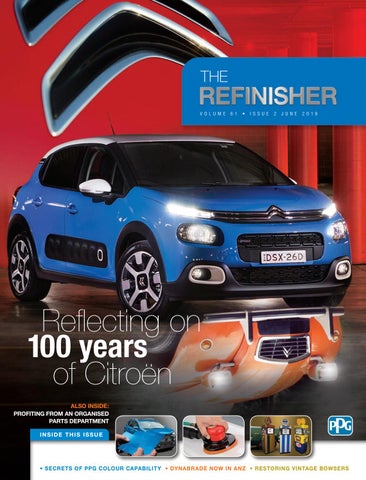
Reflecting on 100 years of Citroën ALSO INSIDE: PROFITING FROM AN ORGANISED PARTS DEPARTMENT INSIDE THIS ISSUE
• SECRETS OF PPG COLOUR CAPABILIT Y • DYNABRADE NOW IN ANZ • RESTORING VINTAGE BOWSERS
. A cut above the rest Introducing MIRKA IridiumŽ - Produced with cutting edge technology. IRIDIUM is engineered to perform in the modern refinish process for both paint removal and surface preparation. Available in coarse to fine grits, Iridium cuts faster, is hard wearing and practically repels dust, thanks to the new precision coating the abrasive stay sharper for longer. Featuring MIRKA’s new laser cut multi-hole pattern, dust extraction is efficient and clog-free, giving Iridium the perfect balance of speed and efficiency, which save you time, materials and money!
Cuts fast, stays sharp, the new IRIDIUM from MIRKA AVAILABLE FROM YOUR LOCAL MIRKA DISTRIBUTOR
www.mirka.com
PPG Australia McNaughton Road Clayton South, VIC, 3168 13 24 24
PPG New Zealand 5 Vestey Drive Mount Wellington, 1060 0800 320 320
t
contents JUNE2019
3
SCA N TO RE A D T HE REFINISHER ONLINE
61 VOLUME
THE
REFINISHER
ISSUE 2
Editor-In-Chief Paul Galea
6
Editorial Co-ordinator Kevin Woolerton
4
News
6
Simply the best
Editor John M Stanley Creative Director Dean Parrott
A special PPG partnership brings Dynabrade to ANZ
Published for and on behalf of PPG Industries Pty Limited by
Kisschasey Creative Pty Ltd Unit 113, 91 Murphy St. Richmond, Victoria, 3121 Telephone (03) 9421 3311
14
14
MIRKA Iridium is here and it’s a cut above the rest
16 Australia Head Office Locked Bag 888, Clayton South, Victoria 3169. McNaughton Road, Clayton, Victoria, Australia, 3168 Telephone: 13 24 24 www.ppgrefinish.com.au New Zealand Head Office 5 Vestey Drive, Mt Wellington, Auckland, New Zealand. Toll Free Telephone: 0800 320 320
20
New South Wales 10 Peter Brock Drive, Eastern Creek, 2766 Telephone (02) 9854 6600
Western Australia Unit 2/6 Colin Jamieson Drive, Welshpool, 6106 Telephone (08) 9256 3920
PPG Logo, Delfleet, Deltron, Envirobase, Global Refinish System, Harlequin, PaintManager, Prizmatique, Radiance, RapidMatch, Startline and ‑ are registered trademarks and We protect and beautify the world, Crystallance and RapidMatch are trademarks of PPG Industries Ohio, Inc. SATA and SATAjet are registered trademarks of SATA GmbH & Co. KG. Third-party trademarks referenced in this magazine are the property of their respective owners.
Everything points to a WOW finish Using a Wet-On-Wet primer should be your first choice
Queensland 18 Breene Place, Morningside, 4170 Telephone (07) 3823 8000
Tasmania PO Box 406, Kings Meadows, 7249 Telephone 0412 254 807
Vive la difference! Like his cars, André Citroën was anything but conventional. For the past century, vehicles carrying his name have epitomised innovation and style and a long-term PPG partnership is helping to use colour to further enhance that individual character.
16
Victoria 104-106 Woodlands Drive, Braeside, 3195 Telephone (03) 8586 0000
South Australia 97-105 Bedford Street, Gillman, 5013 Telephone (08) 8346 6870
Cuts fast, repels dust, stays sharp
32
22
Colour capability & why you don’t want to be without it Why PPG colour capability is second to none
32
People power The Royan Group celebrates its 75th Anniversary
NEWS REFINISHER
4
PPG sustainability practices help Protect and Beautify the World P
PG’s motto, WE PROTECT AND BEAUTIFY THE WORLD™, isn’t just for show. Indeed, the recently published ‘2018 Sustainability Report’ showcases PPG’s ongoing progress against its 2025 sustainability goals. Some of the highlights include: • Preserving and protecting the environment: 32% of sales from sustainably advantaged products and processes. In addition, 29% of manufacturing and R&D locations had zero process waste to landfill.
• Beautifying our communities: The 200th COLORFUL COMMUNITIES® project since the program’s launch in 2015. This has impacted more than 5.2 million people in 30 countries! • Valuing our people: As well as a 10% reduction in the injury and illness rate, 20% of top management positions were held by women, with greater female representation across the workforce.
To learn more, visit sustainability.ppg.com
R
SATAjet X 5500 setup guide poster A
s SATA’s latest premium model takes the market by storm, PPG has taken all the guesswork out of getting the most out of it thanks to a special SATAjet X 5500 setup guide poster. After extensively testing the SATAjet X 5500, and its innovative X-Nozzle System, under a complete range of local conditions, PPG’s regional technical team has compiled a set of easily to follow recommendations. No matter where you are spraying – from Darwin to Dunedin or Auckland to Perth – this SATAjet X 5500 setup guide poster lets you quickly and easily tune your gun for maximum performance. Indeed, PPG personnel have seen as much as a 25% reduction in application time, along with a 25% reduction in material usage! Speak to your PPG representative to get your free SATAjet X 5500 setup guide poster. R
NEWS 5
REFINISHER
DRIVETHROUGH
with Paul Galea
I
Heroes of Chemistry P
PG’s position as a leading innovator was reinforced recently when the 2019 ‘Heroes of Chemistry’ award (issued by the American Chemical Society) was handed to a team of PPG automotive OEM coatings scientists for the discovery and development of the B1:B2™ Compact Paint System. Using this innovative system lets OEMs eliminate entire steps from the vehicle painting
process. Two layers are applied Wet-On-Wet (B1 giving primer, filling, chip resistance and durability protection and B2 adding colour and extra durability) and don’t require baking or heated drying in between. By eliminating the primer layer, the B1:B2 Compact Paint System delivers big savings for OEMs by reducing the paint shop footprint, while slashing energy consumption R and increasing overall process efficiency.
Airvolution is back – more mobile than ever! A
fter being ‘off-air’ for a time, the free online airbrush magazine, Airvolution, has made a welcome return. Created to showcase the work of students of Airbrush Venturi (the successful, region-wide airbrush school), the original version ran for seven
years but was limited by only being suitable to view on computer. For 2019, Airvolution has been totally revamped and built on a platform specifically for smartphones or other mobile devices, although it’s fine to view on a computer. The new format also sees two articles added every week, 50 weeks a year – that is 100 articles a year, all about airbrushing! Check it out at www.airvolution.com.au R
f your paint shop doesn’t have the tools to be on top of colour, the fact is, you will struggle. What I am referring to is the continued evolution of motor manufacturers using colour as a key part of their design and styling strategy. Whilst this is not new, in recent times this trend has accelerated with mainstream OEMs introducing new colours and processes that were not even imaginable on a production vehicle five or ten years ago. PPG’s commitment, investment and, most importantly, the results it achieves in keeping up-to-date with these global developments is what keeps us at the leading edge of colour solutions for local collision centres. We understand that having the correct pigments to reproduce a colour is a must but what is even more critical is ensuring it works in a refinish environment, not just a lab or an OEM production line. PPG’s investment in colour development, user-friendly products and technical training continues to cement our leadership position in colour and it’s being recognised in the market. Currently, more repairers are converting to PPG in order to improve colour capability than for any other single reason. From a customer’s perspective, another key is investing in training. PPG is the leader here, too. Our technical training team across the region supports technicians with all the tools, processes and techniques they need to effectively match any new colour that hits the market. More than ever, repairers really need to ask themselves, ‘am I colour capable?’. R
PRODUCT NEWS REFINISHER
6
When it comes to pneumatic tools, Dynabrade has become the trusted name for rock-solid reliability, longevity and industry-leading performance. precision engineered tools are a perfect fit, according to Kurt Way, PPG Category Manager, Associated Products. “Dynabrade really is the default name for premium quality pneumatic sanders and grinders. Typically, you will hear people say they are going to ‘Dynabrade’ the job, whether they are using a Dynabrade tool or not. Thanks to this new partnership, we are giving them even more reasons for that tool to be an actual Dynabrade so they can enjoy all the advantages that come with it. It’s an incredibly strong name with a very traditional USA-built philosophy and history of innovation. When you look at it, Dynabrade has built its reputation on a very simple mind-set. It’s all about producing very well engineered tools that are made to do a job and do that job very, very well
Simply the best Y
ou know someone has really made it when they are known by just a one-word name – think Adele, Bono, Madonna, Oprah, Shakespeare, etc. It’s the same for brands which become almost universal generic terms in their market segment, with iconic names like Jet Ski (Kawasaki), Band-Aid (Johnson & Johnson), Kleenex (Kimberly-Clark)
and Bobcat (Bobcat Company), coming immediately to mind, just to name a few. And squarely into that category goes Dynabrade. The local PPG team has now established a special partnership with the legendary American brand which will see Dynabrade products become more widely available to Australian consumers. When it comes to quality products and processes, these
PRODUCT NEWS 7
– it’s as simple as that! Not only will local customers be able to choose from a range of Dynabrade models, they will also have the peace-of-mind that come from having full support in terms of training and best practice processes, as well as spare parts and repair services.”
Born in the USA To really understand the revolution Dynabrade created, you have to go right back to the mid-1960s. At that time, company founder, Walter Welsch, was a salesperson selling coated abrasives. As he visited clients, including Curtis Wright (who were making jet engine blades) and Wurlitzer (organs and jukeboxes), he noticed the complex and challenging filing and sanding operations they had to deal with as part of their manufacturing processes. He reasoned that there had to be a better way and this planted the seed for a portable abrasive belt sanding device that could perform these operations much faster and with better accuracy. Walter set to work designing an innovative abrasive belt tracking system but it took incredible perseverance and financial risk, and a fateful switch from electric to pneumatic power, to finally see his ground-breaking tool, the Dynafile, hit the market in 1969. And it has not looked back since! Today, the Dynafile remains the best-selling machine the company makes. The strength of Walter’s design can be seen in the fact that, 50 years down the track,
the casting for today’s tool is still almost identical to the original. As time went by, a wide range of variations were developed with different belt widths and radii to suit different applications across a vast array of industries. There are now no less than 32 different contact arms for the Dynafile and each one is intended for a special job. However, the story does not stop there. Dynabrade quickly earned a reputation as a problem solver. As a result, people would literally come to the company with a problem and the Dynabrade research and development team became experts at coming up with effective solutions. With the motto ‘We listen. We observe. We optimise’, the aim has always been to boost productivity while reducing overall costs.
Made in America to last For almost 30 years, Dynabrades company headquarters and manufacturing facility has been located in Clarence, New York. Growing demand has seen it expand seven times over the years, to the point where it now measures 150,000ft² (approximately 14,000m²). Importantly, the words ‘Made in USA’ are still proudly displayed on every air tool package because each one is still manufactured in America, says Kurt Way. “Where many brands might design a tool in their home country but then get it manufactured in another country, such as China, Dynabrade have not gone offshore for manufacturing. Rather than lose control of quality and have products made to a price, Dynabrade has worked hard to
REFINISHER
A-MASTERNEWS PRODUCT PAGE 8
Simply the best
REFINISHER
ensure that its products are made to a standard. I am not just talking about material quality – which is outstanding – or the manufacturing precision, I am also talking about the extraordinary attention to detail which you can appreciate as soon as you pick up and use a Dynabrade tool.” “Dynabrade products are not cheap but they are definitely not throwaway items, either. With some of the cheaper brands, people will tend to swap them out every 12 months or even less. Buy a Dynabrade product and, if you look after it, it’s going to last you a long, long time. I know that a lot of the PPG guys have Dynabrade tools which are 10 to 15 years old and still performing perfectly. It’s a very strong brand with very strong mechanicals. Compared with other pneumatic tools, you get lower vibration, lower noise level, lightweight, excellent balance and operator comfort. Thanks to the design and quality of the air motors, they generate excellent torque and that gets the job done quicker and easier. When you look at the overall costs, we believe a Dynabrade tool is going to save you money in the long run.”
Backup and support Via the partnership with PPG, Dynabrade products arrive on the local market with the sort of backup and support you would expect from a premium offering. This means an extensive stock of spare parts, along with a network of repair centres strategically located around the region to deal with both warranty and post warranty repairs. In fact, having factory accredited experts repair your Dynabrade product is a perfect way to maximise the long-term value.
More than just panel and paint While the collision repair sector is a major user of Dynabrade products, there are others who are ideally placed to take advantage, says Kurt Way.
“Dynabrade has an excellent reputation and a long history with panel beaters, fabricators and painters but we see its appeal going much further. For example, the light industrial sector and industrial sector are two in particular which have lots of grinding and sanding operations that could benefit from Dynabrade. Indeed, in many cases these manufacturing operations can’t be performed with an electric tool due to the safety issue from possible sparks so a pneumatic Dynabrade tool provides an excellent, high productivity solution. Whichever sector it’s being used in, we believe that Dynabrade tools will be a perfect fit for best practice processes.” R
PPG CUSTOMERS 9
Assistance with no bull Faced with the need to remove and refit more and more heavy and cumbersome bull-bars, Jeff Kunkel came up with a solution that take the load off while increasing productivity.
L
ike many repairers, Jeff Kunkel noticed an increasing number of 4X4 utes coming through the workshop, in line with their growing popularity in Australia and New Zealand. While this was fine for workflow through his business, Dosser Panels in the north eastern Victorian town of Benalla, it did introduce a potentially costly issue. These vehicles are often fitted with aftermarket bull-bars and, due to their size and weight, the removal and refit process required three people. Having worked with Mindy Roberts, PPG’s MVP Business Solutions Manager Victoria / Tasmania, Jeff knew this issue was seriously eating into his workshop productivity, not to mention the OH&S issues it raised. “We don’t get a big labour allowance for R&R of a bull-bar and to do the job we were dragging staff away from work on other jobs. I searched the Internet but could not find a solution so one night, over a couple of beers, I did some drawings and decided to make one. Amazingly, it worked first
time – the bull-bar is nicely balanced on the tool and there are straps to adjust for forward or backward tilt.” “Initially, I just made it for my shop but a visiting rep saw it and asked what it was. He told someone, who told someone else and it just snowballed. I called it Bullbar Assist and I started building them but, after making about 30, I decided it was too much so I looked for someone to manufacture it. After one failed attempt to find a good Chinese manufacturer, I found Shin Fu Corporation. They made a demo version and it was perfect so we switched production over to them.” Mindy Roberts says it’s a great story of ingenuity. “From an MVP Business Solutions perspective, the beauty of Bullbar Assist is that it ticks all the boxes in terms of ‘lean’ production. It’s a tool that allows one person to comfortably handle the job and other staff are not being taken away from what they are doing.”
Apart from the R&R of bull-bars, Bullbar Assist has other features, according to Jeff. “You can also raise it to a comfortable height for fitting accessories, such as driving lights, and we have also added a towbar adaptor because many heavy towbars suffer from the same issue. Bullbar Assist is available via a new business, JS & B Industries, and you can check it out through our Facebook page – www.facebook.com/bullbarassist/.” R
REFINISHER
FEATURE PANEL SHOP
Top REFINISHER
10
M O U N T M A U N G A N U I C O L L I S I O N R E PA I R S
of the mount
T
he seaside city of Tauranga (in the Bay of Plenty region of the North Island) has grown steadily over the past 20 years to the point where it’s now New Zealand’s fifth largest and Mount Maunganui Collision Repairs has grown right along with it. Named after the local Mount Maunganui landmark, the business was established 24 years ago by Tom Johnson who has systematically put all the pieces in place to create one of the region’s premier repairers. “My father had a collision repair business here in town and I did my panel beating apprenticeship with him. Later, I started this business and dad has long since retired. About 10 years ago I decided to build a new shop and went looking for a suitable plot of land which is very difficult to find here and it’s expensive. I did manage to find something, however to make the
Backed by loyal staff, authorised repairer approvals and key suppliers, including PPG, Mount Maunganui Collision Repairs has built an enviable reputation for quality repairs. most of the limited space, it was going to have to be a two-storey building so I wanted to make sure we got the design right from the start. I took a trip to Sydney to look through some repair facilities there and then came back and put all the ideas together to come up with something which has turned out to be very space efficient and flows really well. The panel beating department is upstairs and the paint shop is downstairs, with a ramp to join them. We have decent offices, a nice reception area and even a tiled showroom where we can deliver finished vehicles to owners. It was a huge investment at the time and back then it was pretty trick but, nowadays, I would say that all the features are pretty standard.”
Combining the presentation and efficiency of the new facility with Tom’s attention to detail and commitment to customer service attracted the attention of a variety of vehicle brands. An approach came via local dealers who were already using Mount Maunganui Collision Repairs. They knew the standard of work it produced and the brands needed an approved repairer in the local area. Eventually, this saw Mount Maunganui Collision Repairs appointed as an authorised repairer for BMW and Mercedes-Benz, as well as an approved repairer for Holden, Hyundai, Suzuki and Toyota.
FEATURE PANEL SHOP 11
“In particular, the Mercedes-Benz and BMW authorisations involved a lot of hard work – I reckon it took about 18 months from start to finish. It was not just the building and our quality of work, it was also how you deal with customers.
You have to meet all of their criteria, buy all the specialised tools and do all the specialised training which is often held overseas. For example, three year ago I went to Kuala Lumpur for three weeks training on the new BMW 7-Series. I doubt many are sold in New Zealand but you still need to be prepared. Although the training is specific to the 7-Series, the technology and processes you learn also relate to the rest of the BMW fleet. All the staff have families and commitments so it’s hard to expect them to spend time away so I normally go to the overseas training, bring the information back and pass it on.” Mount Maunganui Collision Repairs employs 13 staff, made up of three painters and a general hand, six panel beaters and three in admin. While Tom acknowledges it’s very difficult to find skilled staff these days, it has not been a big problem for him because most staff are long term. “I try to treat all the staff as fairly as possible and look after them as best I can.
I provide a good work atmosphere and a decent workshop environment which is well organised and I think when you combine all those things it really helps. Because my staff have been around for a while, they know how things work and they pull together to make things happen so it’s a good culture. We do a lot of I-CAR courses and there is PPG training which they generally do in-house which is really good. The main thing is that it gives all the technicians the confidence they are doing the job to manufacturer’s specifications, as well as the satisfaction that, when a vehicle drives out, it’s back to as good a condition as it was beforehand.” It was about six years ago that Tom made the switch from a rival waterborne paint brand to PPG. While he admits it was not an easy decision, he says the resulting partnership has proven to be very positive for the business.
REFINISHER
FEATURE PANEL SHOP REFINISHER
MOUNT MAUNGANUI
12
C O L L I S I O N R E PA I R S
Top of the mount
“I had looked at different paint systems and I really wanted to go with PPG. I realised that Envirobase High Performance was a very good paint system but it was more than just the quality of the paint. It’s also the backup support, service, training and everything else that goes with it from PPG which is really important.” Tom says he focuses considerable time on using the data output from the shop management system to monitor production efficiency across the entire workflow, as well as keeping track of all the numbers which drive shop profitability. To help with this, he plans to take advantage of PPG’s MVP Business Solutions program in the near future. “I have spoken with Helen Aird (NZ MVP Business Solutions Manager) quite a few times and I am looking forward to getting involved with MVP Business Solutions. I can definitely see the value in it, particularly for streamlining workshop process and minimising waste.” After more than 30 years in the trade, Tom says he has seen a lot of changes in
S H O P FA C T S Mount Maunganui Collision Repairs Owner: Tom Johnson Staff: 13 PPG Product: Envirobase High Performance Territory Manager: Peter McLean the industry which is one of the reasons it’s important to keep abreast of the latest trends. “Over the past 20 to 30 years we have seen a big evolution in collision shops. Back then, a lot didn’t have paint shops and they were often smaller in scale. We have gone from small basic shops to big flash shops with a lot more staff. The sorts of repairs we are doing has changed a lot and the way we go about those repairs. Then there is the equipment, health and safety advances, etc. Back then, it was not a very good trade to be in but, nowadays,
I would be happy to recommend it to a friend’s son or daughter as a career. That is what makes it so frustrating that we can’t find good apprentices. I have tried working with the local school, etc. and the issue is finding young people who are committed. If a few decent young people came in looking for a job, it would not be a problem to put them on.” At 52 years of age, Tom has no plans to wind back. In fact, he is looking at once again investing in a bigger facility. “We have been looking to expand for the last little while but we have the same issues as before with finding space to grow. Although we are not fully at capacity, we need more space in order to put new systems in place, such as a rapid repair section. If we can find the land, I believe we can build a shop that will take us to R the next level again.”
PPG MOTORSPORT 13
Back to where it all began Before today’s massive B-Double race team transporters used to carry cars, parts and equipment to race tracks all over the world, there was ‘The Blue Hilton’.
W
hen looking for a present to celebrate Roger Penske’s 80th birthday, the crew at Team Penske discovered a novel gift which had helped change the landscape of motor sport. Back in the early ‘70s, Team Penske’s customised 1972 International Fleetstar truck became one of the first known enclosed transporters ever used for racing purposes.
Designed for efficiency and functionality by Mark Donohue (the organisation’s first champion driver), its royal blue exterior and the sleeper area over the cabin, saw it aptly named ‘The Blue Hilton’. It went on to serve Team Penske in various capacities from 1972 until 1983, at which point is was sold. Everyone assumed it had eventually ended up in a scrapyard until 2015 when a long-time Penske Team member spotted a for-sale listing in an automotive trade publication. Amazingly, the historic truck was still with the owner who had originally purchased it from Team Penske.
After using it while competing in various racing series, he had simply retired it to a spot on his property. “After we confirmed that it was, in fact, The Blue Hilton that was for sale, I called Brian Hard (President of Penske Truck Leasing) and we agreed that we had to find a way to bring her back to life,” said Team Penske President, Tim Cindric. “This transporter was there when the foundation was laid for Team Penske and it is symbolic of the way in which we operate today.” Over 8,000 painstaking man-hours were spent to complete The Blue Hilton restoration process and it was done down to the smallest detail, including authentic PPG paintwork and hand applied lettering. It was a labour of love, says Team Penske Historian, Bernie King. “When you talk with the crew members that drove and worked out of this transporter over those years and you look at the photos from the many cars it carried, you see how The Blue Hilton was an integral part of our history. It’s certainly very much a part of the Team Penske heritage. Everyone at Penske Truck Leasing that was involved did a fantastic job of restoring this truck to how it was when it ran and carried many of the team’s winning cars.” The Blue Hilton will initially be on display at Team Penske headquarters in Mooresville, North Carolina, where fans can view it from the Fan Walk that runs the length of the massive shopfloor. R
REFINISHER
MIRKA REFINISHER
14
These three attributes make the all new MIRKA Iridium® range the cost effective premium abrasive for the modern refinish process.
Cuts fast, repels dust, stays sharp W
hether it’s for paint removal or surface preparation, the abrasive you choose to use plays a key part in the speed and efficiency of the job and the quality of the end result. However, typically that means you need opposing characteristics. It must have a fast cut but also be long lasting and it should have efficient dust extraction while also delivering the required surface finish. Last but not least, it should be cost effective to use. As a global innovator in abrasive technology, MIRKA has now engineered all these features into its all new flagship paper backed abrasive range, called ‘Iridium’.
Manufacturing technology leads the way MIRKA is recognised as an industry innovator so it’s perhaps no surprise that it’s actually the way Iridium is made which contributes heavily to its outstanding performance. Indeed, the new range has been classified under the category dubbed ‘Intelligent Abrasives® by MIRKA’. Iridium’s cutting-edge manufacturing process utilises the latest in low VOC resin systems to ensure the individual ceramic / aluminium oxide abrasive grains are not only in the perfect cutting position, they are also being held in a vice-like grip. As a result, Iridium
delivers an aggressive initial cut which then goes on and on. The added advantage of the advanced resin system is that it leaves an abrasive surface that virtually repels dust. This means that the clogging issues which affect conventional abrasives are not a problem with Iridium.
Engineered for the modern refinish process Available in a selection of coarse through to fine grits, the entire Iridium range shares the innovative, non-stick coating. Comprising various configurations of abrasive discs
MIRKA 15
and strips, Iridium is designed to be a straightforward fit to the backing pads of all sanding machines. Having said that, the range is perfect for use with MIRKA’s hugely popular electric tools, such as the DEOS (Direct Electric Orbital Sander) and the DEROS (Direct Electric Random Orbital Sander). No matter which tool you are using, there is no precise alignment need – simply place the iridium disc or strip onto the backing pad and it’s good to go. It’s here that MIRKA’s new laser cut multi-hole pattern works perfectly with Iridium’s clog free abrasive surface to ensure ultra-efficient dust extraction. When it comes to the task of paint stripping, Iridium’s coarser grits (80 – 240) provide the performance to power through even the hardest of clearcoats. Getting the job done faster means you save valuable labour time which helps reduce job cost. Moving on to paint preparation (320 – 600) and the Iridium abrasive grits have again been specifically optimised for the task. One of the key features is an excellent scratch pattern engineered to work perfectly with primers and fillers. This delivers a fine surface finish so there are no surprises in your final paint finish – even with the most transparent colours.
And, combined with iridium’s clog free abrasive coating, this virtually eliminate costly reworks by preventing the development of dust pills which leave frustrating pigtail swirls in the surface.
Scientifically tested Thanks to its leading-edge technology, Iridium is a thoroughly modern abrasive and in-depth local testing has shown that it’s right on the money, according to Kurt Way, PPG Category Manager, Associated Products. “The aim was to see exactly how Iridium would perform in local workshop conditions so we spent two full days testing the range (from 80 grit to 600 grit) against eight other premium abrasives. To ensure it was accurate, we used a very scientific approach to precisely measure the results. For example, to keep it consistent, we had two team members do all the sanding on set sized panels and they did all the testing blind. Every time an abrasive was changed,
it was fitted to the machine and handed to them so they had no idea which brand it was. From these long days of testing we did a full costing analysis for each abrasive and that threw up some real surprises. We had some of the abrasive brands that looked good on paper, however when they were tested under repeated scientific conditions, they didn’t look quite so good.” “What we found was that Iridium does more than just compete with the top end of the market. This is leading-edge abrasive technology which out performs the best and shows that Iridium is now an excellent option – and it comes at a better price! We ended up putting Iridium through its paces on a wide range of surfaces, from soft through to hard, including wood and bare steel which usually blunts abrasives very quickly. We believe that this testing has shown that Iridium is the best mix of performance and cost on the market. However, don’t take our word for it, give Iridium a go and prove it for yourself.” R
REFINISHER
FEATURE STORY REFINISHER
16
Vive la
difference! From the beginning, Citroën has focused on disrupting the status quo and, 100 years on, it still offers customers an unconventional route to unique automotive style and technology.
A
quick quiz – what was the first mass produced Front-WheelDrive (FWD) car to hit the market? The legendary 1959 BMC Mini springs to mind but, in fact, it arrived more than two decades after the first. Incredibly, it was 1934 when the Citroën Traction Avant (literally, ‘Drive Front’) not only started the FWD revolution, it also pioneered the mass production of a host of other automotive innovations still in use today. At a time when virtually every car was built with a body on a separate ladder chassis, the Traction Avant featured an all steel, unitary body construction, as well as independent suspension all around and four wheel hydraulic brakes. The French are known for bringing a sense of style but Citroën also wrapped it in innovative technology.
Citroën 2CV or deux chevaux (1948 to 1990)
Gearing up As the First World War came to a close, André-Gustave Citroën, was looking for a new direction for his factory. Having been heavily involved in bringing American style production line principles to the manufacture of military munitions during the war, he aimed to apply it to a new venture. With the launch of the Citroën brand in 1919, André’s ambition was to use a mobile assembly line to make cars affordable, everyday objects and it worked. Despite being the first inexpensive French car, the Citroën Type A still came packed with standard equipment and this saw it sell in big numbers. Eager customers snapped up 10,000 in the first year and, during 1924, Citroën made 50,000 vehicles. By 1926, almost one third of vehicles on French roads were made by Citroën!
Citroën DS (1955 to 1975)
FEATURE STORY 17
Marketing with innovation
Deux Chevaux
André Citroën had a flair for marketing, as well as innovative technology. He used a whole range of activities to highlight his vehicles. This included utilising the Eiffel Tower and aerial signwriting, as well as some really off-the-wall stunts. When introducing the first all steel body car in Europe, the Citroën B10 in 1924, he highlighted its strength over conventional timber framed cars by literally rolling it off a cliff! A similar stunt was used to showcase the Traction Avant’s new unitary body construction. After barrel rolling down a steep hill, it was even driven away! Demonstrating Citroën’s incredible ruggedness, a 1923 5CV Type C Torpedo model became the first car to be driven around Australia. It already had 48,000km on the clock when Neville Westwood from Perth, WA, made his round trip between August and December 1925. Now restored, this historic vehicle is part of the collection at the National Museum of Australia.
In 1935, André Citroën died from stomach cancer and, around that time, the company got into financial difficulty which saw French tyre company, Michelin, step in to become a shareholder. Despite this, the innovations continued. In the mid-1930s, transportation in rural France was still very much reliant on horses so Citroën came up with a project for a motorised alternative. Simplicity, rather than comfort, was the order of the day. With lightweight construction and a tiny two-cylinder air-cooled engine driving the front wheels, it should be capable of carrying four people and 50kg of potatoes to a top speed of 60km/h while using just three l/100km of fuel. Due to the poor state of roads at the time, it also had to have very flexible suspension with the ability to cross a ploughed field with a basket of eggs inside without breaking any. Called the Citroën 2CV or deux chevaux, it was set to be launched in 1939 when WWII broke out. To avoid falling into Nazi hands during the French occupation period, prototypes were hidden in various places. After finally making it to market in 1948, the 2CV remained in production, with only minor changes, until 1990, with around 8.8 million variants being built!
Meet the goddess When it was unveiled at the Paris Motor Show in 1955, the radical Citroën DS looked like it had just arrived from another planet. The streamlined, avantgarde styling was matched by a remarkable list of features, including the world’s first hydropneumatic self-levelling suspension system and the first mass produced use of modern disc Citroën C5 Aircross (2019)
REFINISHER
FEATURE STORY REFINISHER
18
brakes. The interior was no less astonishing with the driver sitting behind a single spoke steering wheel. Dubbed ‘Goddess’, the public loved it – 750 deposits were taken in the first 45 minutes of the Paris Motor Show, with the total reaching 12,000 in just one day and nearly 80,000 by the time the show closed. It stayed in production until 1975. Note: In French, DS is pronounced ‘de es’. This sounds the same as ‘déesse’ which means Goddess.
PSA Group to today Despite the reputation for innovation, Citroën’s pathway has not been smooth sailing. After an ill-fated ownership of Italian sport car brand, Maserati, in the late 1960’s, Citroën Automobiles went on to merge with Peugeot Automobiles to create the PSA Group in 1976. With the economics of platform sharing came a dilution of Citroën’s unconventional approach to vehicle design and styling. However, in recent time, Citroën has begun to find it mojo, again. From the launch of the company’s premium sub-brand, ‘DS’, in 2009, through to distinctively styled current models, such as the Cactus, it’s clear that Citroën is once again giving customers a characterful alternative to the increasingly similar looking vehicles on the market.
Colourful partnership Along with this, Citroën has also got more adventurous with colour and it’s doing it with full support from its long-term coatings supply partner, PPG. Indeed, when planning for the local launch of the all new C3 Aircross compact SUV, Citroën went to the unprecedented step of asking Australian customers to help set the colour palette. With contrasting body, roof, decal and roof rail colours available, an online poll was conducted to determine the top five colour combinations, says Citroën Australia’s Product Planning Manager, Justin Narayan. “Citroën, the world over, is delivering a range of vehicles under the ethos of ‘inspired by you’ and what better way to give Australians a say in the planning process than letting them choose the colours that best represent them.” To help Citroën develop an avantgarde colour range which appeals to customers, PPG does a lot of behind the scene work. Each year, PPG experts present Citroën staff with its Global Colour Show which showcases colour trends and directions across a wide range of applications, including consumer goods, automotive colour and residential, commercial and industrial design. PPG colour specialists then work closely with Citroën stylists to develop specific colours, often two years in advance of their release. Once a colour is confirmed, PPG personnel then follow a specialised process to ensure it can be repeated online in a mass production situation. Indeed, PPG is Citroën’s primary coating supplier. Not only does this mean supplying a full range of coatings – ecoat, primers, basecoats and clearcoats – but also the advance application technology of PPG’s B1:B2 Compact Paint System. This innovative PPG developed system lets OEMs, such as Citroën, actually reduce the number of steps needed to paint a vehicle. In basic terms, the B1 layer provides primer, filling, chip resistance and durability protection, while the B2 layer provides colour and additional durability. Both layers are
FEATURE STORY 19
applied Wet-On-Wet and don’t require a baking or heated drying process in between. By removing the need for a dedicated primer booth and all related processing, the B1:B2 Compact Paint System save OEMs in both capital outlay and operating costs by requiring a smaller paint shop footprint, reducing energy consumption and increasing overall process efficiency. PPG also has dedicated technical staff onsite at each Citroën plant to support the efficient running of the paint shop, as well as looking for continuous improvements. And the close partnership continues on a regional basis where local PPG staff provide ongoing warranty support. Should a local Citroën vehicle suffer a paint related issue, PPG staff will examine the vehicle and provide a detailed report on the cause.
Strong personality As it introduces its latest local model range, Citroën is making a welcome return to strong personality and innovation, epitomised by its soon be released mid-sized SUV, according to Citroën Australia’s Managing Director, Ben Farlow. “The all-new C5 Aircross is a return to Citroën’s comfort credentials and, symbolically, arrives in time for the marques 100th Anniversary. The all-new C5 Aircross will underpin Citroën’s line-up in its centenary year, bringing with it standout styling, unrivalled comfort and a new focus on SUVs for Citroën in Australia.”
Along with strong graphic touches, such as Airbump®, dual stacked headlamps and distinctive roof bars, the company’s SUV flagship was developed using the Citroën Advanced Comfort® Programme. This saw Citroën file more than 30 patents for technologies developed. Drawing on the company’s vast expertise in suspension comfort, Citroën has developed Progressive Hydraulic Cushions™ (PHC). While convention suspension systems comprise a shock absorber, a spring and a mechanical stop, PHC adds two hydraulic stops – one at either end. This gives engineers greater freedom in the car’s clearance and delivers what the company describes as a ‘magic carpet ride’. The effect is further amplified by seats which are actually inspired by the world of bedding. As well as providing support, they also contribute to damping out the various vibrations from the vehicle and road surface. André Citroën wasn’t interested in maintaining the status quo and, like the company founder, the revitalised Citroën is keen to be a trailblazer rather than a follower. In 2018, Citroën sold more than 1.1 million light vehicles worldwide, despite not competing in the North American market. It’s clear that there are plenty of customers who want to celebrate the difference Citroën offers. R
REFINISHER
TALKING TRAINING REFINISHER
20
Everything points to a
grey shade, it provides a crucial element for matching the original OEM finish. These days, virtually all vehicle manufacturers use a spectral grey or sympathetic groundcoat as an integral part of achieving full-opacity on colours. OEMs do it for efficiency and speed and these are key reasons why collision centres should follow suit.
Taking advantage of WOW
Combining Wet-On-Wet primer with the correct spectral grey shade and some specific process touches provides all you need for a quick, effective and invisible match.
T
he modern Wet-On-Wet (WOW) primer process has been around for quite some time now but some repairers still don’t take full advantage,
according to John Hristias, PPG Business Support Manager Asia / Pacific. He explains how some very straightforward WOW techniques can bring a big boost in terms of paint shop productivity, minimised material usage and the quality of the end result.
Why WOW A good WOW primer is designed to perform two main roles. On new panels, it gives excellent adhesion for the following paint layers and, by using the correct spectral
PPG makes it easy to mimic the OEM process in the refinish paint shop by offering two high productivity WOW primers – EnviroLOCK™ (part of the next-gen Low-VOC range) and the popular PrimaGUARD 2K primer. Both share a whole host of efficiency boosting characteristics: • No need to sand new e-coat panels which reduces process time and retains e-coat corrosion protection. • No flash-off between coats – simply apply in single visit mode. • Cuts a whole step from the traditional process because the silky-smooth finish means there is no need to sand before topcoating. • Seals off sensitive substrates and can be applied directly over small rub-throughs. • Applied over repairs, gives extra security around the edge of the repair while also dealing with fine scratches and pin holes.
WOW techniques Here are some handy techniques to make the WOW process even more effective. • Prime into the adjacent blend panel – This is an easy way to soften the blend edge, rather than leave a ‘hard’ edge where the panel ends. Simply turn your gun side on (or rotate the air cap 90 degrees) and put a quick, thin, vertical coat of primer (in the correct spectral grey shade) down the edge of the blend panel. Just 30mm to 50mm is enough to soften the edge and ensure it looks right when bolted together.
TALKING TRAINING 21
• Blending thinner – Using aerosol OneChoice® SXA860 Blending Thinner around the primer edge is a simple way to soften it even further. • Touch ups with OneChoice Epoxy Rub-through Primers – Available in three spectral grey shades (SUA340 Light-Grey, SUA440 MidGrey and SUA540 Dark-Grey), this easy to use aerosol option quickly and efficiently deals with frustrating rub-throughs. Fast to flash-off, it lays down so smoothly there is no need for sanding before topcoating.
• Choosing a spectral grey shade – You can find convenient information on the recommended shade of spectral grey to use under each basecoat colour as part of the listing on PPG’s PAINTMANAGER® XI software system for mixing and managing the paint operation. Note: It’s also possible to mix PPG ENVIROBASE® High Performance waterborne basecoat in each of the seven spectral grey shades.
• Sprayout card – It’s important to do your sprayout on a card which is in the recommended spectral grey shade. I have seen technicians try to spray the colour out on a white card – it takes a lot of coats and, typically, they end up trying to tint the colour darker which will not work. • Unusual situations – If you are unsure about which spectral grey shade to use because, say, the vehicle has been repaired a few times, it’s best to try a spread. For example, with a red I would recommend doing a sprayout over G5, G6 and G7. Use them to check which is correct before doing the live job. R To access specific training on WOW priming, contact your PPG Representative or your local PPG Training Manager.
Wet-On-Wet priming delivers significant increases in shop throughput • Door gaps – Some technicians avoid WOW because it goes into door gaps. Rather than missing out on the advantages, just do some double masking so the primer can’t blow into the door gaps. Then remove the first layer of masking and continue with the topcoat.
PPG’s WOW primers are specifically designed to be mixed in one of seven spectral grey shades, from G1 through to G7, specifically to cater to the modern OEM colours. Today’s factory finishes tend to be transparent so you can see through the topcoat layer down to the groundcoat. This means the groundcoat shade (whether it’s spectral grey or a sympathetic colour) actually forms a fundamental part of the overall colour. Given the aim of the refinish process is to replicate the factory finish, it makes perfect sense to use the appropriate spectral grey shade when refinishing virtually any vehicle colour. Particularly when topcoat opacity can be achieved in the minimum number of coats which saves application labour time, reduces material usage and boosts profitability.
TIME SAVED
TIME TAKEN (Minutes)
WOW with spectral grey
Example shown: New panel painted off car
65
Minutes Sandable Primer Topcoat and Bake Preparation for Topcoat Undercoat and Dry Preparation for Undercoat
PPG Wet on Wet Primer
✓
Saves time
✓
Saves energy
✓
Saves Material
REFINISHER
PPG COLOUR REFINISHER
22
Colour capability & why you don’t want to be without it
If there’s any doubt about how vital colour capability is in the refinish sector, it’s worth investigating the extraordinary resources PPG devotes to getting it right.
M
ainstream OEMs are getting far more adventurous with colour and it’s all about attracting customers – colour sells! For example, brands like Ford, Lexus, Nissan, Mazda and others now have exotic colours with a candy-apple type effect. Some people still believe refinish systems are pretty much the same in terms of colour capability but these new colours are exploding that myth. If a new colour arrives in a collision centre and the paint system doesn’t have the capability to match it, that shop is really going to struggle with time, cost and an unhappy customer!
It’s precisely why PPG gets proactive on colour capability and the person overseeing this is PPG Global Colour Platforms Director, Stacie Toothman. The 24-year veteran at PPG says it takes a combination of expert knowledge, detailed processes and close partnerships with OEMs around the world to deliver reliable colour capability. “PPG actually has an entire global team dedicated to addressing customer colour needs for our global platforms. This team consists of members from our global colour, technical and marketing teams, who meet regularly with OEM counterparts to ensure we have the latest information on any new pigment technology being readied for use in a new OEM colour. Typically, there is an opportunity to view new pigmentation during OEM styling events which are held several model-years prior to a new colour launching. The obvious advantage is that we can evaluate whether we have the necessary colour capability within our existing platforms well ahead of a new colour launch.”
“Where OEMs may be using exotic new pigment technologies or specialised application techniques, it’s important we get as much advanced information as possible because we might need to develop our own specialised technique to provide a refinish solution. PG manages this on a global level through another process where we have smaller sub-group of technical, colour and application experts working closely on these extremely unique colours. They collect specific information, such as OEM models volumes, launch regions and timing of launch.” “PPG’s process of maintaining good alignment to OEM technology allows us to be a leader in colour capability by being ready with repair formulations and, if necessary, repair processes for customers before new technologies are seen on the road.” The net result, says Stacie, is that refinish technicians can save significant time and hassle simply by choosing a paint system with market leading colour capabilities, such as PPG’s ENVIROBASE® High Performance waterborne basecoat system. “When a technician is faced with using a platform lacking in colour capability, a lot of time can be spent finding the correct formula, tinting a formula or, in the worst case, repainting a vehicle that was repaired
PPG COLOUR 23
with a non-capable formula. This is why PPG sees it as essential to maintain superior colour capability within our paint platforms. From experience, we know that choosing a refinish system with superior colour capability can provide technicians with a real sense of confidence that they will have the correct formula to get the job done right the first time.” Ensuring PPG’s global refinish platforms contain all the necessary tinters to reproduce an OEM colour, whether it’s a solid, metallic or specialised colour, is the essence of colour capability, says Stacie. This ensures each platform has the capability to provide an excellent match for any OEM colour that exists today. “Generally, colour solutions are provided to our customers in the form of additional tinters for our platforms. Often, if a tinter is used in only a few special colours, it’s launched as a ‘Limited Use Toner’ (LUT). PPG PAINTMANAGER® XI software has the ability to alert the user when a formula includes an LUT, allowing them to order the LUT or special mix from their distributor.
In rare cases, when an OEM has a very limited and specialised colour, we may opt to support a repair through PPG’s Customer Service team. Again, PPG’s PaintManager XI software will notify a customer and provide the appropriate information to access the repair solution easily and confidently.” “The perfect dovetail to PPG’s colour capability is PPG’s training capabilities. Generally, before an exotic new colour is released, the regional PPG training team will have information in-hand and will go through application testing to ensure everything works smoothly. They can then pass those tips and techniques on to local customers. Next time an exotic new colour hits your paint shop and you have all the PPG tools to process it efficiently and stress-free, you can rest assured that there are a whole team of expert PPG people behind the scenes who are there to support you!” R
REFINISHER
MVP REFINISHER
24
The cost of an unorganised
parts department A collision centre parts department should be a key profit centre but for many businesses it’s simply a case of lost opportunities.
D
o you have a dedicated parts area and a staff member responsible for parts? What about written parts department processes? In a modern collision centre, looking to maximise profitability, these are essential basic requirements, says Greg Tunks, MVP Business Solutions Manager ANZ. Over two issues, he takes an overview of the parts process and how you can reap the advantages.
M V P – PA RT S D E PA RT M E N T
PART 1
No margin for error Whenever one of the MVP Business Solutions team is asked to do an audit or financial analysis of a collision centre business, it quickly becomes obvious if it has an efficient and effective parts process in place. There are two fundamental factors here. First is the parts margin which the collision centre receives. This is a very important Key Performance Indicator (KPI) for the business because it makes up a significant proportion of the income. As a result, it’s an area that deserves your attention in order to maximise profitability. The second factor we see from an unorganised parts department is the negative affects in the workshop. Often, technicians will start a job only to find out that a major part is missing or has not arrived. Typically, this will start a time-wasting process where the technician goes looking for the part, finds it’s not there, and then has to move onto another job.
Cranbourne Body Works
organised, have good attention to detail and be committed to following the correct process. Having an individual within the business who is responsible for parts gives far more control as they oversee the entire chain of events and streamline the progress of parts into the business. Organisation equals productivity which equals profitability!
Organised parts area Each collision centre should have a dedicated parts area where all the various parts processes happen. For a start, any unnecessary clutter should be removed before the area is thoroughly cleaned.
Parts manager When you consider the overall dollar value of all the parts which pass through a typical collision centre in a week, month or year, having someone dedicated to control this is an absolute no-brainer. Call them a Parts Manager if you wish but they need to be Cranbourne Body Works
MVP 25
A fresh coat of paint will help, as well as: • Mark out the floor area – This provides a simple visual marker to show where the parts area starts and finishes and where everything should be placed within it. • Specialised shelving allows parts, such as bumpers, to be neatly stored to help avoid them being damaged, yet making TRAFFIC LIGHTS them easy to locate. • Parts trolleys – There should be one for each DO NOT START JOB job and it should contain all the parts which were removed from the vehicle and are being refitted, as well as new parts when they arrive. The parts trolley is stored in the parts area until the job is ready to start and An important part or parts are missing then simply wheeled to the vehicle where everything is available for YOU CAN START THE JOB the technician to work without interruption. • Basket for painted parts – This is kept with the parts trolley and is perfect for keeping smaller painted parts where they are easy to locate. Part or parts are missing but • Labelling should be not crucial to the job progress used on each parts trolley to clearly show which Parts ordering job number it’s currently OK TO START JOB being used for and any After identifying the full other information your list of parts needed for team will need. the job, it’s important to • Traffic lights – A basic get the best buy price set of visual indicators possible (particularly in can be used to make an average repair price it obvious what state situation), while also each trolley is in. ‘Green’ placing your order as means all the parts are efficiently as possible. All parts are present there and the job can Wherever possible, be started. ‘Red’ means this should be done don’t start the job because something is electronically (email it to the parts vendor) missing. ‘Yellow’ means although all the which is far more productive than spending parts are not there, the job can still be lengthy time on the phone to each parts started because it’s just missing a minor supplier. It’s important to get a notification part (badge, moulding, etc). of whether any of the parts will be delayed
and how long that delay will be. It’s asking for trouble to get some of parts sent when the rest are on back order. If they are delivered, you have to store them and there is the risk of them being damaged. Our recommendation is to not get any parts sent until the entire order is ready.
Part 2 Next issue we will look at what happens when parts arrive at the collision centre and what to do if they are not correct. In the meantime, your MVP Business Solutions Manager will be happy to help you set up, refine and maximise performance in your collision centre’s parts department. R
REFINISHER
PPG PEOPLE REFINISHER
26
PPG Staff Profile
ClaireHunter A
fter completing a Batchelor of Applied Science at RMIT and starting out in the dairy industry, Claire quickly found her groove in the local paint industry. As well as plenty of time spent in R&D working on new products, she was also able to widen her experience in others areas of the business. More importantly, Claire got to learn how the production plant worked and realised that a planning role made perfect sense.
Favourite hobbies /pastimes? Gardening and family time Favourite food? Anything homemade that I don’t have to cook myself Favourite drink? Portello Favourite music / band? Taylor Swift Favourite car / motorcycle? HR Holden Panel Van Favourite holiday destination? Anywhere new is good
Planning
Manager “I was lucky enough to be accepted for a Production Planner role at PPG and I started in July 2011. Since then I have been able to take on more responsibility and slowly step up into higher roles. In my current role, I look after the five Production Planners who organise production through PPG’s Clayton manufacturing site. At a higher level, I also look at plant capacities and various other production factors.”
“In basic terms, production planning is about scheduling the manufacture of batches of product in the plant. We juggle a whole bunch of factors, such as the equipment capacity in the plant, whether we have the necessary raw materials onsite in time and the expectations of PPG’s internal Strategic Business Units (SBU) on how much stock we physically make. In fact, managing expectations is probably our biggest challenge, both with the SBUs and the Production Department. Everyone has expectations but sometimes they collide so it’s up to us to try and prioritise which is the most important.” “The most enjoyable part is definitely the people! We have a very good crew but even people outside this area are great. We predominantly interact with the Production Department and Demand Planners. The Demand Planners are fantastic in that they are often in a similar position to us – between a rock and a hard place!” R
PPG CUSTOMERS REFINISHER
28
Pump up the volume After establishing an enviable reputation for restoring vintage fuel bowsers and garagenalia that spans well over 35 years, Paul Crowther finds himself busier than ever.
S
o, you have got your classic car or your ‘man-cave’ or both, but what is next? Like many others, Paul Crowther’s search led to garagenalia (everything from oil cans and signs to fuel bowsers) but, in his case, it became more than just collecting – it became a full-time business. According to Paul, it all started back in 1992 when he cut up a dilapidated Ford Customline to make a lounge suite for his man-cave. “I thought, I wouldn’t mind having a petrol bowser sitting next to it so I found one. After that, I found a few more and I sort of got addicted. I started restoring them and it just turned into a business. Eventually, I moved into my workshop which was 18 years ago.” Today, Babs Bowser Restorations (located in the Adelaide suburb of Para Hills West) handles all
sorts of restorations. Along with bowsers, a wide range of collectables, such as Coca-Cola chests and fridges, model cars, oil tins, signs, etc. flow through the workshop. As bowsers have become more popular, good ones have become more difficult to find, says Paul. “A lot of the really early ones you can find at farms, homesteads and places like that. Others have been taken off the kerbside where they were used and put away in sheds. At one stage, I got onto a petroleum yard where they actually fixed all the bowsers. They wanted to clean up so I did that for them. Half went to scrap and the others I was able to use. I had plenty of bowsers to keep me occupied.” According to Paul, the level of detail he puts into restoring a bowser is not too different to a vehicle restoration. “I used to do car restorations and it’s very similar. Some of these bowsers have a lot of different components and features in them so there is a lot of things you have to make look pretty. Some are just an outside skin with flat panels but others open up so you have to make sure both the inside and outside look just right. A lot of restorers don’t go to the same level of detail that I do but, for a lot of my customers, the bowser is going inside their house so it has to be done right.”
PPG CUSTOMERS 29
before you even touch it! A restoration job on a bowser can take between three and six months and cost anything from $5000 to $20,000 because there can be as much as 350 hours labour, plus materials, in them. However, when you see a ’60s bowser next to a ’60s era car, it looks amazing and they hold their value. I’m currently setting up a part of my workshop like a classic service station as a showroom for my bowsers. At the moment I’m actually book out for a year in advance which is great because I really enjoy getting these jobs perfect for R my customers.”
“I used PPG paint for that first Customline lounge suite back in 1992 and I have used it ever since. I met Joe Esposito (PPG Business Manager Refinish SA), we got talking and it went from there. PPG really look after me. I paint over all sorts of substrates and they give me full, step-bystep processes for each. On these bowsers, there are a lot of small pieces to finish and you have to get them right straight-offthe-gun because you can’t polish them. PPG has different primers for whatever I need to do and then the colours and clearcoat to finish it off – it’s everything from start to finish.” Paul has found that sticking to the original manufacturer’s colours is not necessarily a priority. “Some of the original colours were a bit bland and washed out so I like to use bright colours so that these restored bowsers stand out.
I don’t stray a long way from the original colours – usually just brighter. Having said that, if someone wants the exact original colours, I can do it. I also do replica automotive signs. An original can cost many thousands but I can paint up a replica in PPG paint. I have the different designs on computer so I mask them up, spray four or five different colours, then clearcoat the whole thing and it looks ‘killer’!” “I do spare parts for bowsers, as well. If I can’t source parts, I try to fix what is there or make the part. With things like broken castings, I have a mate who does new castings for me. Lately, I have also been getting some common parts, typically in brass and aluminium, done in bulk overseas.” Due to their popularity, the value of bowsers has gone up, particularly the rarer models, says Paul. “There is one from around 1917 that is now worth about $45,000
REFINISHER
NEXT GENERATION REFINISHER
30
Finders and keepers Convincing a new generation of talent that collision repair is a worthwhile industry in which to spend their career is going to take input from everyone involved.
T
he question is often asked – where will the next generation of collision repair industry staff come from? We are not just talking about tradespeople but also administration staff, parts managers, etc. Right across the region, training organisations, collision centre businesses and other industry players are working hard on finding and keeping young talent. One effective strategy has simply been to provide support and recognition for these younger members of the industry as they navigate their way through the early years. Some people may see this as a mollycoddling approach but, the fact is, times are very different from when most older owners / managers entered the industry. Like it or not, that means taking a different, more nurturing approach, says Duncan McDonnell, National Sales Manager PPG Refinish. “Young people have so many career options these days and it seems as if the collision repair industry has been pushed further and further down the list. A lot of work has been done to improve the perception of the industry with some outstanding shops leading the way in
presentation, equipment and techniques. While that is great, we need to find ways to retain young talent and minimise the current high dropout rate. Feeling like they are part of a team and getting a decent level of support seems to go a long way to offering a solution. When you think about it, young people live in an incredibly connected world. Via social media, they get instant connection and instant recognition. It makes them feel good and who doesn’t want to feel good, particularly if it relates to work?” Now in its third year, a support initiative from PPG’s NSW Refinish team has seen leading apprentice spray painters selected for a specialised pathway that includes both equipment and knowledge. Called the PPG NSW Apprentice Scholarship program, it’s overseen by NSW Training Manager, Trevor Duke, and at any one time has as many as 16 apprentices (both second and third years) involved. While receiving a topof-the-range SATAjet spray gun and SATA Vision 2000 Air-fed Hood is certainly helpful, it’s the additional training that gets them excited about their developing career, says Trevor.
“TAFE does a great job of training but our scholarship groups get more exposure to specialised areas earlier. As they work their way from the basics through to more challenging topics, including dealing with tricky OEM finishes, you really notice their confidence and motivation grow. We even get our MVP Business Solutions team in to help them understand the financial drivers behind running a profitable collision centre business. It’s all about helping them build confidence so they can build a long career in the industry.” Supporting young talent can also come in the form of recognition. It might be as simple as pointing out that their efforts are appreciated or it could go a little further with some sort of reward (maybe a gift voucher to purchase tools). Thanks to Australasian Paint & Panel Magazine and sponsor, PPG, there is another option which lets you nominate a promising youngster (under 21 years of age on 31st May) for the ‘Young Achievers Award’. Although they must work in a collision centre, they don’t have to be a technician. Paint & Panel says it’s looking for young people who are team players, love
NEXT GENERATION 31
Panel Beater
Painter
learning and have the right attitude and work ethic. Nominees will be highlighted online and the winner will be flown to Paint & Panel’s awards presentation dinner in October and profiled in the magazine. For more information, visit www.paintandpanel.com.au and click on ‘Everything you need to know about the 2019 awards’. It’s also a good strategy to support apprentices who are looking to be proactive by seeking their own recognition through organised competitions. This can include high profile competitions, such as WorldSkills and the annual PPG Colour Matching Competition. Your role may be as simple as providing some training at work or some extra time with their training organisation to help sharpen their skills. An advantage of these competitions is that they have a very broad level of participation.
Administration
Parts Manager
For example, although only one apprentice from each Australian state and New Zealand will win through to the PPG Colour Matching Competition final, a large number of apprentices across the region get to participate in the preliminary rounds. As a result, they all get the incentive to sharpen their colour matching skills and then test them against their peers.
Win, lose or draw, past experience has shown that it gets youngsters excited about their trade. It’s worth remembering that, in this constantly changing world, we need to constantly re-evaluate what we do. If that means finding a strategy that helps your younger members of staff to feel like a fully-fledged part of the long-term team, that has to be good for the entire industry. R
REFINISHER
CT REFINISHER
32
Over 75 years, the Royan Group has become the largest CT repair network in Australia but, from the beginning, one particular asset has truly defined this long-haul company.
People power I
n terms of ‘bricks and mortar’, Royan Truck & Trailer Repairs presents a very impressive proposition. With seven sites strategically spread up and down Australia’s eastern seaboard, each featuring state-ofthe-art facilities, it’s easily the biggest heavy vehicle repairer in the country. However, this 75-year-old business would be nothing without one crucial factor, ‘people’, and it’s here where Royans gets truly impressive. There are about 250 individuals who, together, make up the Royan Group team. Many are long term staff and they represent a very valuable asset for the organisation, says Steve O’Reilly, Group General Manager. “Recently, we listed all the staff who had 20 years or more of service with the company. Collectively, this added up to
over 1750 years of experience! It’s quite incredible, particularly when you consider we only listed the staff who had reached 20 years of service – there is also considerable experience in those approaching 20 years of service. The most valuable part is that experienced staff can really save time in the repair process. At every branch there are several staff who have more than 20 years’ service and these people have seen pretty much everything in the repair game. Over the years, they have solved problems, fabricated parts and found solutions to virtually any issue you can think of. Instead of learning everything through trial and error, their experience comes into play and that is priceless.” “These days, it’s quite difficult to find skilled tradespeople so we have been training apprentices for many years.
CT 33
They get the benefit of the more seasoned tradespeople mentoring them and passing down their skills which helps to bring on the next generation and they spread right through the company.” Back when Bede Royan started the company in 1944, Australia was barely out of the horse and cart era. It was during World War II and, after finishing his shift in a Sydney munitions factory, he started repairing cars and trucks in an old wood and coal yard in Parramatta. His first employee, a talented panel beater and spray painter, named Arnold May, actually stayed with Royans for the rest of his working life. Later, Bede’s son, Ron, joined as an apprentice. After Bede’s daughter, Patti, married in 1957, her husband, Don Andrews,
also transitioned into the business. It was Ron and Don who made the momentous decision to change the direction of the company, according to Steve O’Reilly. “Truck repairs had always made up a large proportion of the workflow but they saw an opportunity for two key reasons. Back then, there were no truck repair specialists, as such, and then there was the sheer length of time it took to repair trucks in those days – four, five or even six months was commonplace! In the early 1970s, the modern truck, as we know it today, was only just becoming common and Don and Ron noticed the trend in truck accidents and saw a void that Royans could fill. They started focusing on truck repairs and very quickly the four to six month repair time was slashed to eight to ten weeks which was very well received by the trucking industry and insurers. It’s a completely different industry today. There are jobs that go in and out in a day but a really big job can still take four to six weeks or so.” With the business flourishing, the first regional branch was opened in Wagga in 1980, followed by Dubbo a couple of
years later. Thanks to a partnership with the Church family, Royan Melbourne was established in 1984. After a major reinvestment in a totally new purposebuilt workshop in 2009, Royan Melbourne became the most modern CT repair facility in the country. To provide greater coverage for road transport operators, the group extended its reach to Brisbane in 1997 and to Newcastle in 2002 with the purchase of the O’Neill’s workshop. The most recent addition came when a ‘satellite shop’ was opened in Wodonga on the NSW / Victorian border.
REFINISHER
CT 34
People power
REFINISHER
With seven locations separated by considerable distance, all needing to offer the same standard of Royans service, it’s essential to not only continue to reinvest in facilities but also in personnel, Steve O’Reilly explains. “The company owns all but one of its buildings – it’s currently negotiating to purchase Royans Brisbane – and it has continued to invest in each of the facilities. The equipment for heavy vehicle repairs involves significant investment but it’s worth it. There is always new equipment coming out and most of the time it provides a benefit in terms of more cost-effective repairs so we need to stay current. The other thing we focus on is training. Three years ago, we appointed Garry Woodcock as Group Compliance Manager (he did his apprenticeship at Royans Sydney and has been with us for 40 years). His main role is to develop industry best practices for the group. In the past we often had seven branches doing things their own way but Garry is tasked with developing the best of the best systems, equipment and processes and standardising that across the group.” One thing that consistently helps with best practice processes in the paint shop is the PPG partnership. Indeed, the connection goes right back to the beginning, says Steve O’Reilly. “We have been long term PPG customer based on two main reasons – we believe it’s the best product and the backup service which includes technical support, process training, etc.
PPG wants to add value to our business, not just supply us with paint. For example, for several years we have been involved with PPG’s MVP Business Solutions program. With their help we do a lot of benchmarking between branches and PPG does an annual inspection at each branch and gives us advice in the form of a detailed report. We review that with PPG staff, our directors and branch managers. That is the sort of help we value.” Even though the Royan Group is a large business, it very much retains a family business feel. Indeed, the fourth generation of the Royan, Andrews and Church families have now entered the business but that does not give them a free ride to the top. Each of them starts on the ground floor and works their way up in line with their skills – just like anyone else in the business who shows initiative can do and, in fact, has done in the past! Actually, most of the current senior management started off with
an apprenticeship on the Royans shopfloor. It’s a people-based plan which is aimed at seeing the Royan Group supporting customers in another 75 years or more, says Steve O’Reilly. “There is no doubt that heavy vehicle technology is going to change dramatically in the next 10 years or so. We are expecting a trend to smaller trucks and there will be electric trucks but it’s difficult to see fully autonomous trucks taking over, given the distances freight moves and the road conditions in Australia. Royans will still need to stay abreast of everything because even the best trucks and the best drivers have accidents so we expect to be around for R quite a while!”
CAN YOU MATCH IT WITH THE BEST? CALLING ALL AUTOMOTIVE SPRAY PAINTING APPRENTICES! Do you have what it takes to be a colour matching champion? The PPG Colour Matching Competition is on again and you are invited – regional and state competitions start soon. Test yourself against the best, get bragging rights on your mates and you could win through to represent your state in this year’s national final in Melbourne. Not only that, there are cool prizes to be won, including gift vouchers, SATA spray equipment and MIRKA tools. Will it be you this year? Limited spots are available so find out more by speaking to your training provider.
FOR ENTRY DETAILS, SPEAK TO YOUR TRAINING PROVIDER TODAY!
www.ppgrefinish.com.au www.ppgrefinish.co.nz @PPGANZRefinish
TAS
“The PPG Colour Matching Competition has helped me feel highly confident in myself, my work and matching colours in the workplace. It’s a great feeling to be recognised all over Australia. It was a great experience!”
PPG is proud to announce the partnership with Dynabrade Automotive Tools in Australia. PPG Customer Service
PPG Industries Australia Pty Ltd 14 McNaughton Road Clayton, VIC 3168, Australia 13 24 24