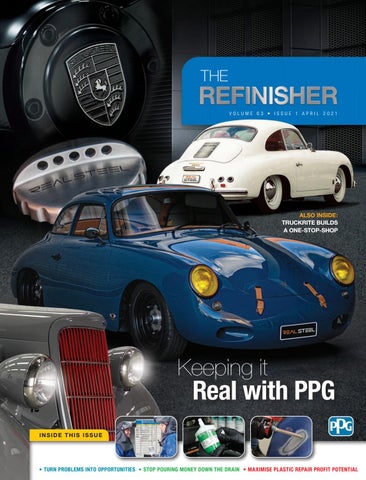
THE VOLUME 63 • ISSUE 1 APRIL 2021
ALSO INSIDE: TRUCKRITE BUILDS A ONE-STOP-SHOP
Keeping it
Real with PPG
INSIDE THIS ISSUE
• TURN PROBLEMS INTO OPPORTUNITIES • STOP POURING MONEY DOWN THE DRAIN • MAXIMISE PLASTIC REPAIR PROFIT POTENTIAL
PLASTIC REPAIR
SEALERS
PLASTIC REPAIR MATERIAL
2K SEAM SEALERS
Utilising SEM’s advanced DUAL-MIX technology, this thoroughly modern plastic repair system is fast, versatile and highly effective yet very easy to train and simple to use.
Featuring next-gen 2K technology, SEM’s product range of DUAL-MIX 2K Seam Sealers will change the way you seam seal. By setting in just minutes, DUAL-MIX 2K Seam Sealers lets you quickly get on with the job.
PPG Industries Australia 14 McNaughton Rd, Clayton, VIC 3168 Australia
13 24 24 www.ppgrefinish.com.au
PPG Industries New Zealand 5 Vesty Drive, Mt Wellington, Auckland, 1060 New Zealand
semproducts.com
contents APRIL2021
3
SCA N TO RE A D T HE REFINISHER ONLINE
63 VOLUME
THE
REFINISHER
ISSUE 1
Editor-In-Chief Paul Galea
6
Editorial Co-ordinator Kevin Woolerton
4
News
6
Primed for performance
Editor John M Stanley Creative Director Dean Parrott
Revamped and ready for anything!
Published for and on behalf of PPG Industries Pty Limited by
Kisschasey Creative Pty Ltd Unit 113, 91 Murphy St. Richmond, Victoria, 3121 Telephone (03) 9421 3311
10
10
Signature moves Inside Toyota Thames
14
Time to bring plastic repairs in-house? The SEM Products way to make it happen
Australia Head Office Locked Bag 888, Clayton South, Victoria 3169. McNaughton Road, Clayton, Victoria, Australia, 3168 Telephone: 13 24 24 www.ppgrefinish.com.au New Zealand Head Office 5 Vestey Drive, Mt Wellington, Auckland, New Zealand. Toll Free Telephone: 0800 320 320
16
Combine old-school coachbuilding with hi-tech equipment and a sophisticated machine shop and what do you get – Real Steel Group! Throw in skilled painters with PPG products and SATA guns and you have a restoration shop with an exceptional reputation.
14
Victoria 104-106 Woodlands Drive, Braeside, 3195 Telephone (03) 8586 0000 New South Wales 10 Peter Brock Drive, Eastern Creek, 2766 Telephone (02) 9854 6600 Queensland 18 Breene Place, Morningside, 4170 Telephone (07) 3823 8000 South Australia 97-105 Bedford Street, Gillman, 5013 Telephone (08) 8346 6870 Tasmania 136 Invermay Rd, Invermay, 7248 Telephone 1300 305 699 Western Australia Unit 2/6 Colin Jamieson Drive, Welshpool, 6106 Telephone (08) 9256 3920
PPG Logo, Delfleet, Deltron, Envirobase, Global Refinish System, Harlequin, PaintManager, Prizmatique, Radiance, RapidMatch, Startline and ‑ are registered trademarks and We protect and beautify the world, Crystallance and RapidMatch are trademarks of PPG Industries Ohio, Inc. SATA and SATAjet are registered trademarks of SATA GmbH & Co. KG. Third-party trademarks referenced in this magazine are the property of their respective owners.
Keeping it real
20
Waste not, want not Everyday tips to remove waste and boost profitability
32 32
Vision to reality New premises help build a true one-stop-shop experience
NEWS REFINISHER
4
Rise of blue conveys trust, dependability, healing and hope S
ales of blue cars are growing and COVID-19 is likely to fuel this worldwide trend, according to PPG’s global colour team. PPG’s latest Automotive Colour Popularity Report shows blue hues climbed to a 9% global colour share (1% up on 2019), although white remains the dominant global choice. As consumers navigate the challenges of the pandemic, blue is seen as an optimistic, comforting colour that conveys trust, dependability, confidence, healing and hope. As the swing to blue continues, it’s expected to emerge in more vivid or
desaturated shades, deep-sea luxury tones and hues with a slight turquoise influence. In turbulent times, white colours reflect consumers’ desire for refined simplicity and versatility and this is credited with helping it
remain the world’s most popular automotive colour. Despite white tones falling 1% from 2019, solid and metallic shades still claimed a 34% share worldwide in 2020. This was led by the Asia-Pacific region with 41% – a rise of 1% over 2019. For full details on PPG’s Automotive Colour Popularity Report, visit news.ppg.com/2020automotivecolor. R
Advanced colour modelling for OEMs P
PG’s close partnerships with vehicle OEMs across the globe has been further enhanced with the launch of an innovative digital styling software program. Recognising an increasing need for digital tools and technologies, it features exceptionally realistic 3D modelling of colours and effects on virtual car designs and surfaces, thus giving automotive designers a clever new tool to help develop the colours of the future. An exclusive, integrated ‘speed shape’ incorporates all the complex shapes, edges, curves and flat
surfaces that go into making up any type of vehicle. Developed by PPG, it’s designed to depict the interaction of colour, geometry and light to create authentic renderings of a vehicle’s surfaces, including wheels and interior components. In addition, the digital styling program offers vehicle OEMs
complete access to PPG’s expansive library of digital colour files. It’s also fully compatible with industry-standard colour-rendering software, enabling OEM design teams to collaborate with PPG directly, remotely and in real time on the colour design process. The program’s launch is seen as the first step in digitising the entire colour styling R process for PPG customers.
Colour fuelled remedy from ‘Chromatic Joy’
N
eed some colour inspiration to create a thoroughly modern and attractive reception area, workshop, office space or even your home? Launched under the TAUBMANS® by PPG architectural brand, the ‘Chromatic Joy’ colour palette is designed to provide the perfect solution in a
new ‘COVID normal’ world. Tuned specifically to suit Australian conditions, it introduces a pastel-toned selection of 23 vibrant, cheerful colours, along with nine carefully crafted whites to allow for simple, practical pairings. No matter what the project, the Chromatic Joy collection can be used to transform any space and create an emotionally nourishing environment that promotes happiness and positivity. To explore the colours of Chromatic Joy, R visit www.chromaticjoy.com.
Father and son project W
hen it came to making the most of COVID-19 induced lockdown, Laurie Allan (Commercial Performance Coatings National Field Demonstrator) and his son Kayne had the perfect project. After stripping a rundown caravan to the chassis, the pair totally rebuilt it before fitting
out the interior with everything needed to prepare delicious coffee and tea. To create the funky, retro orange, brown and cream exterior, Laurie used products from PPG’s Commercial Performance Coatings range, including Performance Polyurethane Topcoat. You can enjoy a brew and see this father and son handywork around Melbourne and Victoria. For locations and updates, follow @messinwithjim on R Instagram.
NEWS 5
REFINISHER
DRIVETHROUGH
with Paul Galea
A
lthough we are very proud of our refinish systems and what they do for our customers, some people may not know that they are actually just one part of the incredibly broad product range on offer from PPG. Having said this, word is definitely spreading and we are seeing more and more customers picking and choosing particular PPG product technologies that suit their specific applications. In fact, there are three examples in this issue. While Real Steel Group (feature article pg 16) use refinish products for their awesome restoration work, they also utilise products from PPG’s Aerospace range and Commercial Performance Coatings portfolio to coat some of the precision machined items they manufacture for clients, such as the defence industry. It’s a similar story at Truckrite (pg 32) who use the DELFLEET® Evolution paint system for their Commercial Transport refinish and re-livery work but also supplement that with Commercial Performance Coatings products to efficiently cater to various specialised applications. Omni Tanker is another interesting company (pg 28). It has developed a very clever solution for transporting aggressive corrosive liquids and chosen a suite of PPG coatings, including from the Commercial Performance Coatings range, to keep its products protected and looking good long into the future. Nowadays, PPG even offers solutions outside the coatings space. On page 14 you can read about the SEM Products solutions for dealing with plastic repairs. It’s all about accessing the best available options, along with the PPG-level of support, to ensure they work in the best possible way for your R business.
COMMERCIAL PERFORMANCE COATINGS REFINISHER
6
Primed
for performance
Unrivalled for offering a solution for any application, PPG’s Commercial Performance Coatings primer range gets a major revamp, including updated formulations, Australian Standard colours and even greater ease-of-use.
J
ust like PPG’s market-leading specialist refinish systems, the company’s Commercial Performance Coatings brand gives users versatile primer options which are perfect for laying down a solid foundation for following paint layers. In fact, no matter what you are looking to coat – from agricultural machinery, mining gear or maritime equipment through to glass, structural steel or even custom cars or vehicle restorations – there is a vast selection to suit virtually any situation. To ensure it maintains its market edge, the local technical team has now taken the opportunity to give the range a top to bottom makeover in order to provide customers with even greater performance, value and simplicity.
Simply the best Despite a well-earnt reputation for providing an effective solution for any application you can think of, the Commercial Performance Coatings primer range has become a little unwieldy over time. For example, a variety of product duplication have crept into the portfolio over the years, mostly from primers that came as part of company acquisitions, such as with Ameron and Protec. Consequently, there were various primer categories where Commercial Performance Coatings offered a number of options, essentially catering to the same application, but with only slight differences between them.
The outcome was a product portfolio that was more complex than it needed to be. As a result, the technical team at PPG’s Clayton, Melbourne headquarters has utilised feedback from local users and drawn on extensive in-house knowledge, in order to sort through the entire range to simplify and refine it. When doing this, one key factor to understand is that wherever there was more than one product in the same category, in every single instance, the best performing primer was chosen to remain in the range. What’s more, while going through this process, the team has taken the opportunity to introduce the latest coatings technologies. As a result, many products will also give users a noticeable improvement in usability and performance. In conjunction with the revamp, Commercial Performance Coatings primer labelling has been given a freshen up with logical naming and appearance making it easier to clearly identify individual products with just a glance.
‘Australian Standard’ colours For many Commercial Performance Coatings users, the most revolutionary feature of the revised primer portfolio is that products can now be purchased in a selection of Australian Standard colours. As the name suggests, it’s all about standardising colour across the board, from an etch primer to an epoxy or an alkyd zinc phosphate. As a result, it’s now possible to look at an Australian Standard colour card and have absolute confidence that the primer you are using will match the colour that was specified. To highlight the change, the
COMMERCIAL PERFORMANCE COATINGS 7
Australian Standard colour code also forms part of the Commercial Performance Coatings product name, such as N61 Black, N64 Dark Grey, N63 Red Oxide, Y45 Manilla, N35 Light Grey, etc. As well as providing greater colour accuracy and consistency, the switch to offering products in Australian Standard colours also makes it easier to select a sympathetic primer colour to suit the topcoat. In particular, this provides considerable advantages in production situations, including the ability to achieve faster topcoat coverage, while at the same time using less topcoat material. As an added bonus, using a sympathetic primer colour also means that any stone chips, scratches or blemishes will tend not to be immediately obvious.
Change for the better Although change can sometimes be unsettling, the update of the primer range is all good news, according to Dave Payne, Commercial Performance Coatings Product Specialist. “I can’t see any downsides for customers
due to this change – only plenty of benefits. The range is much simpler to navigate and I believe the ability to access these products in Australian Standard colours will be a revolution because you can rely on getting the same colour across the board. Not only that, because we have kept the best performing product in each category, people can count on a high level of performance that is at least equal to what they are used to and in many cases it will be better. And there are still plenty of the traditional Commercial Performance Coatings options, in terms of price points, with the ‘good’, ‘better’, ‘best’ rating system.
When it comes to determining which primer you should be using, the new Primer Conversion Chart (available at www.ppgcpc.com.au) makes it very straightforward. If the product you currently use has been deleted, it will tell you exactly what the substitute product is. Another factor to remember is that the entire Commercial Performance Coatings range was developed by the R&D team at PPG’s Clayton laboratories and is constantly being refined. As well as being formulated to excel in Australian conditions, every product is also manufactured locally. What’s not to like! R
REFINISHER
PPG MOTORSPORT REFINISHER
8
As Kiwi star, Scott McLaughlin, transitions from Supercars to INDYCAR, he heads into his rookie season with the backing of two winning organisations – Team Penske and PPG!
Support network I
t’s almost a rite-of-passage for Kiwis to head off on an overseas adventure but Scott McLaughlin has taken it to the next level. After crossing the Tasman to conquer the Supercars championship, the young Kiwi has now accepted the opportunity of a lifetime to relocate to the U.S. and prepare for an assault on the NTT INDYCAR® SERIES. And he will take something very familiar with him – the ongoing support from PPG. “My connection to PPG actually goes right back to karts. Dad was always keen on making my little kart look like a hot rod so we always had it painted in PPG! This carried over to my early days in race cars, especially in New Zealand, where PPG helped paint my V8SuperTourer. Then, most recently, within the Penske organisation, I have been heavily involved with PPG from a brand ambassador perspective. It’s surreal to think my first full season in the INDYCAR Series is almost here. I am truly living out my dreams and to have PPG on board as our primary partner is amazing. I watched the beautiful blue and white PPG cars compete over the last few years and they look
amazing on the track. It’s going to be an honour to represent PPG in the No. 3 Team Penske Dallara / Chevrolet this season.” While it’s set to be a massive transition for Scott, antipodeans do have a history of making their mark in INDYCAR. His Australian team mate, Will Power, snared the 2014 INDYCAR Champion, while fellow Kiwi, Scott Dixon, has an incredible run of six INDYCAR Championships, including last year (2003, 2008, 2013, 2015, 2018, 2020). For reigning and three-times Supercars champion, Scott McLaughlin, the 2021 season will be all about getting his head around the step out of touring cars and into open-wheel racing. “The biggest difference is how much grip the INDYCAR has – it’s fast and a lot lighter so the amount of speed you carry through some corners is phenomenal. I have also had to get used to the steering weight. The INDYCAR doesn’t have power steering like the supercar, so the forces through your arms and shoulders are a lot higher. I have worked hard in the gym this offseason to try to combat this!”
Despite the steep learning curve, Scott has already shown great promise. At the first INDYCAR test of the year, at Sebring International Raceway in January, Scott completed 130 laps and displayed good pace compared with established INDYCAR drivers, including team mates in the four car, Team Penske stable – Josef Newgarden, Simon Pagenaud and Will Power. Importantly, no one is putting undue pressure on the 27-year-old Christchurch native in his rookie season, instead trusting him to keep a level head, methodically learn the ropes and build his speed over the 17 race series. It was Team Penske President, Tim Cindric, who originally approached Scott about fulfilling his lifelong dream and he believes a top 10 finish would be a big accomplishment for the newcomer. As well as a new car and new circuits to learn, you can throw in the challenge of everyday life in a new country. “Everything is so much bigger here. You really can get everything at your fingertips, which is nice, but right now where we are it's really cold and even snowing sometimes.
PPG MOTORSPORT 9
When it snows the place really shuts down and everyone stays home, for the most part – that is something I have never experienced before. When people find out where I am from it normally takes a little to explain what New Zealand is all about. People over here also struggle to understand me sometimes which is a little annoying!” Perhaps surprisingly, Scott has found many U.S. fans love the Supercars series. Although hamstrung by time zones, many U.S. fans take to YouTube to follow the series. Having said that, his profile hasn’t transitioned with him. “I am definitely someone no one really knows about which is quite nice, to be honest. If people do recognise me, they are really nice and genuine, welcoming me to the USA and wishing me well for the year ahead.” The 2021 season kicks off on April 18th and, no matter what happens, the young Kiwi’s 56 race wins and 76 poles over his nine-year Supercars career already ranks him amongst Team Penske’s all-time
leaders in career victories (third) and poles (second). This year also represents the 37th seasons of the Team Penske and PPG partnership, says Bill Shaw, PPG Director, Strategic Accounts, Automotive Refinish. “The relationship with Team Penske has been extremely successful for PPG, both on and off the track. We are excited to add another chapter to our history with Scott McLaughlin and the No. 3 PPG Dallara / Chevrolet team. Scott has proven himself to be one of the most talented race car drivers in the world and we know success in his new opportunity with the team is just around the corner. PPG is excited to be a R part of that.”
Created by Frank @ rStar Design (www.rstardesign.com.au) in Sydney and completed in PPG, Scott's 2021 helmets feature a tribute to his Gran, a Kiwi, merged New Zealand and United State flags and a quote, "If the opportunity arises, I'll take it. If not, I'll just work a little harder".
REFINISHER
FEATURE PANEL SHOP REFINISHER
10
T H A M E S V E H I C L E O P E R AT I O N S
moves By exploiting the unique Thames Vehicle Operations facility,
A Signature move
Toyota’s Signature Class program has helped the carmaker
Rather than simply shut up shop and walk away, the Toyota New Zealand team explored other opportunities for the facility and, in so doing, hatched a new plan that is still paying off handsomely more than 20 years later. Now dubbed Thames Vehicle Operations, the 14-acre site was transformed into a refurbishment facility to process vehicles for Toyota’s Signature Class program. Essentially, one end of the operation is fed with specially selected imported Toyotas and ex-lease Toyotas which were first registered in New Zealand, and out the other end comes pre-owned vehicles that are about as close to new as possible. To begin with, each vehicle is thoroughly cleaned and assessed to determine if it has the potential to meet Signature Class standard – around one vehicle per month is rejected. From there, vehicles go through a complete mechanical, body and trim makeover. If necessary, New Zealand compatible audio systems are fitted, as well as any other accessories. As many as 3400 vehicles pass through the Signature Class program each year – an average of more than 65 per week – and, when complete, they make their way out into the Toyota dealer network where they have become extremely popular amongst pre-owned vehicle buyers looking for value with peace-of-mind. In addition, the Thames Vehicle Operations facility is also given the task of fitting brand new Toyota Hilux models with aftermarket parts, such as tow bars and bull bars.
become one of New Zealand’s most trusted brands.
O
ver the past few decades, Toyota has cemented its place as the market leading vehicle brand in New Zealand and none of this has happened by chance. Indeed, the Japanese auto giant has meticulously mapped out a pathway that began with the seeds for long term success actually being planted way back in the 1960s. This was when a small production plant in the country town of Thames, a little
over 100km southeast of Auckland, began assembling Toyota Corollas from CKD (Completely Knocked Down) kits. As Toyota’s popularity grew, the company later bought the plant from its original owners and a string of other models were also assembled onsite. However, in 1998, when changes to the country's imported vehicle tariffs made local assembly non-viable, Toyota was left at a crossroads.
FEATURE PANEL SHOP 11
s Readymade workforce Back in the late ’90s, as Toyota mulled over what direction to take at Thames Vehicle Operations, what was quickly recognised was that there was a skilled, passionate and ready to go workforce on hand. Throughout the restructure, and over the years since, this enthusiastic team have become the unsung heroes. Importantly, they came fully embedded in and familiar with the ‘Toyota Way’ of doing things, explains Peter Manning, Manager – Thames Vehicle Operations. “Every operation has a standardised process – it’s an important part of the culture we inherited from the assembly plant. Today, we still operate much the same, just on a smaller scale. All the staff are also encouraged to put forward any ideas that may cut costs or make the job easier or safer. For example, when it
came to fitting tow bars to Hilux models, a couple of staff members remembered an old machine which had been used to lift in fuel tanks on the production line. They were able to update it and use it to make tow bar fitting a one-person operation, rather than a laborious, two-person job.”
Constant upgrades As the success of the Signature Class program gained momentum over the years, Thames Vehicle Operations was rewarded with ongoing investment, including the installation of
state-of-the-art new equipment. One of the more recent upgrades include a massive refit of the paint area which has helped lift the facility to up-to-the-minute standards. This includes preparation / sanding bays where all tools, equipment and consumables are close at hand, along with a dedicated
REFINISHER
FEATURE PANEL SHOP REFINISHER
12
T H A M E S V E H I C L E O P E R AT I O N S
the paint team. For example, recently we suggested they look at the new technology available in SATA spray guns. Once they saw the finish the new SATA guns produced and the time saving in application, there was no comparison and they upgraded their SATA technology.”
Green outlook S H O P FA C T S Thames Vehicle Operations Owners: Toyota New Zealand Staff: Approximately 70 PPG Product: Envirobase High Performance Territory Manager: Paul McKerrow
Signaturemoves
priming booth. The two main booths are especially interesting. They are long enough to enable three cars to be worked on in each booth, at one time, allowing the paint team to work more efficiently. A paint mixing room in between gives easy access to both booths. In addition, there is a separate booth to process items such as spoilers, alloy wheels and hubcaps, as well as touch ups.
PPG partnership The strong ties between Toyota New Zealand and PPG evolved out of PPG’s original role as an OEM supplier to the Thames Assembly Plant. Over the years, it has been about far more than just paint supply, according to Duncan Morgan, PPG National MSO Support Specialist.
“We work with the Thames Vehicle Operations team on a daily basis and it’s about constantly looking for the best technologies and processes that not only suit their needs but also support their relentless drive to minimise costs while maximising the quality of the end result. It’s what we do at PPG! We analyse each step of the preparation and paint process and determine how we can shorten processes and reduce labour time, while ensuring it’s a 100% warrantable process from start to finish. Then we share our detailed plans with the Toyota team and, together, we implement it, monitor the results and make further refinements, if necessary. Training is a key part and it has helped us build a strong relationship with
Running an environmentally sustainable facility has always been a high priority for Thames Vehicle Operations and one of the key moves was a step up to using PPG’s ENVIROBASE® High Performance Waterborne Basecoat System, along with LVC-136 EN-V Clearcoat. As well as noting improvements in its environmental impact, the PPG waterborne process has delivered far-reaching positive effects in overall efficiency and energy savings, according to Peter Manning. “We have achieved around a 50% reduction in solvent usage and around 40% in energy savings. There is also greater efficiency and quality – especially the colour matching – of our vehicle refurbishment process which we believe will bring significant energy savings from the shorter bake times.” While the process itself has had a positive impact on achieving greater environmental efficiencies, it has been equally important that Signature Class vehicles are painted to the highest possible standard.
All in the family When you consider the skills, willingness to explore improvement opportunities and overall culture of the 70-odd staff, it’s no surprise that the Thames Vehicle Operations facility has been a long-term success, says Duncan. “Thames is a small country town of less than 8,000 people and Thames Vehicle Operations is a major local employer. From the management team to the staff on the production floor, it’s a very family-oriented workplace. For the PPG team that works with them, such as Territory Manager, Paul McKerrow, it’s far more than just another account. We have been welcomed in as part of the family and that makes it very much a partnership where we are all R invested in the ongoing success.”
PAINTMANAGER XI 13
With the simple installation of an Internet accessible connection, your PAINTMANAGER® XI computer can tap into all the awesome benefits of PPG’s global colour network.
Advantage I
receiver
magine trying to run your collision centre without a reliable internet connection. Nowadays, it’s an absolutely indispensable element that gives you quick and easy access to customers, suppliers and work providers, as well as to important information resources. One of those information sources, which has become more crucial than ever over recent years, is PPG’s vast colour database. However, many collision centres still don’t have an Internet-enabled PaintManager XI computer in the mixing room. It’s important to understand that it’s not about access to the general worldwide web, it’s about automatically having the very latest colour matching information at your fingertips.
Colour matching on a global scale PPG operates a network of colour matching laboratories in strategic locations around the globe and these colour experts are at the coalface of PPG’s close partnerships with vehicle OEMs. As the automotive colour space constantly changes, PPG’s global colour network works hard to continuously feed updated data into the company’s colour network. For paint technicians around the globe, this is vital colour matching information but only if they can get access to it. This is why PPG is recommending that customers take advantage of this up-to-the-second colour
matching data by installing a reliable Internet accessible connection to their PaintManager XI computer.
Support network Although there are some basic requirements to meet, it’s relatively straightforward to install and your local PPG team will be happy to help. As well as providing you with details for the specifications of any hardware components, the PPG team can provide advice and assistance on how your Internet-enabled PaintManager XI computer can be setup to operate safely and efficiently. This includes limiting its access to authorised websites only in order to minimise the risk from malicious external sources.
Remote reporting and help Along with daily automatic updates of colour matching data, there are extra bonuses. When needed, it gives the ability to grant remote access to PPG Helpdesk staff. This helps minimise downtime by allowing them to quickly and efficiently assist in resolving any software / hardware related issues that might crop up. In addition, it lets you run PaintManager XI reports at any time – even from home. It can be easily setup to have reports automatically emailed to you on a daily / weekly basis, as well as run reporting for R multiple site operations.
For more information about installing a reliable Internet accessible connection, contact your PPG Territory Manager or the PPG Customer Service Hotline on 13 24 24 (Aust) or 0800 320 320 (NZ).
REFINISHER
SEM PRODUCTS REFINISHER
14
Time to bring
Dual-Mix Multi-Plastic Repair Material and Dual-Mix Problem Plastic Repair Material have the speed and process simplicity that makes this an ideal time to reassess how your collision centre deals with damaged plastics, according to Greg Tunks, MVP Business Solutions Manager ANZ.
plastic repairs in-house?
Opportunity knocks
The speed and ease-of-use of SEM Products two-pack plastic repair solutions could be the perfect excuse to begin repairing plastics in-house to maximise your profit potential.
G
iven front and / or rear impacts tend to make up the majority of accident repair scenarios, it’s no surprise one of the first things to take a beating are the plastic bumpers. Traditionally, damaged bumpers are delt with in one of two ways – via an exchange program or with a brand new part. However, the recent launch of a pair of plastic repair solutions from SEM Products has changed the playing field. As well as featuring unique epoxy-based, two-pack technology,
Back in the day, plastic parts, including bumpers, tended to be relatively inexpensive which didn’t generally make it worthwhile spending labour time to repair them. However, nowadays bumpers are often significantly more expensive, ranging in price up to $2000. Therefore, if a new mid-priced bumper is worth, say $800, it can be well worthwhile to do a repair and this doesn't matter whether your collision centre is operating on a fixed price or predictive repair cost model with your work provider or quoting for individual jobs. The pendulum has swung back to the point where it’s now beneficial for repairers to try and sell more labour time. This is particularly true after what we have seen in COVID hit 2020 when many repairers ran short of work. Obviously, it makes no sense to send work out via a bumper exchange program for another business to make money on the job when you have staff not being fully utilised. When you have access to high tech materials, such as SEM Products Dual-Mix plastic repair solutions, that allow you to get the repair done very quickly and easily, it puts your business a long way in front. Getting back to the example of damage to a circa $800 bumper – you could do a repair on the bumper, charge it out at around $400 and the labour time that you sell is going onto your bottom line. What’s more, the insurance company should be happy, too. If a new bumper was going to cost them $800 and you are repairing it for $400, it’s going to make them happy and, if you are working on a fixed price or predictive model they won’t mind because they are paying the same amount either way.
15
Dedicated workstation Once you have decided to bring plastic repairs in-house, I would recommend setting up a dedicated workstation. It could be a work bay, if you have the room, or maybe a bench in the corner or it could even be set up in the parts area. Naturally, it would have all the tools and materials on hand to make the job as quick and simple as possible for the person doing the work. I would even recommend having step-by-step processes printed out and mounted on the wall where it’s easy to see them.
Manpower Traditionally, it would be the panel beater’s role to carry out these sorts of repairs but, with a product that is so straightforward to use as Dual-Mix Multi-Plastic Repair Material and Dual-Mix Problem Plastic Repair Material, it doesn’t have to be done by a specialist tradesperson. All you really need is a person with a little common sense and some reasonable hand skills who can be given some training and time to familiarise themselves with the products. It could be a detailer who is not fulltime cleaning cars or
Dedicated work station or work bay
Exchange or new part
Repaired in-house
Mid-priced bumper bar
Charge out labour
$800
even a parts person. As a bonus, they go from a non-productive staff member to one that actually generates income when they
$400
are doing plastic repairs. It might even make life more interesting for them, as well. In a large collision centre that is doing decent volume, it could well be worth employing someone just to do plastics.
Simply to use system Despite being high-tech, the beauty of the SEM Products plastic repair system is its simplicity in dealing with common situations, such as a hole or tear in a bumper facia. In the past, different types of plastics made it very difficult to make a successful repair but SEM Products make it easy – Dual-Mix Multi-Plastic Repair Material works for most plastics and Dual-Mix Problem Plastic Repair Material is for the odd difficult plastic type. Preparation work is very straightforward and both products are applied directly to the raw plastic – an adhesion promotor is not required. Whether you are researching, learning the system or just brushing up, the SEM Products Inc YouTube channel has handy step-by-step process videos you can watch whenever you like. SEM Products is a PPG company. A range of products are available from SEM Products R authorised distributors.
REFINISHER
FEATURE STORY REFINISHER
16
Keeping it At Real Steel Group, combining cutting-edge technology with old-school coachbuilding craftsmanship is proving to be a match made in restoration heaven.
B
ack when Jason Bobruk joined his father’s collision repair business in the late 1980s, restoration work was generally limited to an odd job in the corner, for when regular work was slow. Although the shop was kept busy repairing mostly high-end European vehicles, Jason harboured other
dreams. Despite his father, Ludy, buying him an old 356 Porsche as a bribe to get him to stay at school and go on to be an architect, clearly, that didn’t work, says Jason. “From when I was a kid, I had a passion for restos and I always wanted to learn more. However, back then it wasn’t feasible to make a business from it because the value of cars for restoration was so little. For example, the 356 Porsche dad bought me in 1986 was worth $6000 so to spend $30,000 on a restoration simply wasn’t feasible. Since then, the value of cars has steadily increased and that has helped drive classic car restorations. Nowadays, when cars are worth $300,000 or more, it makes it worth doing a high-level restoration.”
Men of steel Eventually, Jason established Real Steel Restorations to, literally, cater to ‘real steel bumpered’ cars. Initially, restorations were supplemented by a fair bit of custom work but that has since died away after too many projects only got halfway before the owner ran out of funds and commitment. In 2013, things took another major twist when one of Jason’s customers, Steve Mommsen, who has a similar passion for cars, approached him with a business proposition. The idea was to combine the machining of fine tolerance components with the old-school craftsmanship of Jason and his team. Having set up ‘Real Steel Group’ in
FEATURE STORY 17
Queanbeyan, just outside Canberra, everything was going well until the third partner decided to depart, explains Steve. “He was the one with the machining background so Jason and I had to learn very quickly. Fortunately, we had a very clever machinist, Graham Friend, who helped take up the slack. When we kicked all this off, the machine shop had two manual machines and one CNC machine and we started out producing automotive parts. However, once word got around about the quality of work, we began getting enquiries from the defence industry and that side has almost completely taken over to the point where, today, we run 11 different CNC machines. In addition to our coachbuilding team, led by Jason, the machine shop means we have the ability to fabricate pretty much anything that is needed. That sets Real Steel Group apart. When it comes to custom stuff,
we probably have the highest capability of any shop in the country!” For the business’s staple diet of classic car restorations and classic car smash repairs, the in-house machine shop often becomes an absolute god-send, according to Jason. “Many of the parts for these ‘old girls’ you simply can’t get any more so we make them. For example, we did a ’71 Dino Ferrari which was missing tail light bezels. You can’t get the original parts but the machine shop was able to machine some out of brass and they are actually better than the originals. It was the same for the car’s worn-out boot hinges.”
Concours? Of course! Having produced such an outstanding body of work spanning several decades, Jason and his team have earnt the right to be a little choosy with the work they do. Today, the workshop is packed with an eclectic mix of
Above: Jason guides his son, Connor, through a restoration task.
REFINISHER
FEATURE STORY REFINISHER
18
back in the early ‘80s and it was a pretty tired car so every part of the job had its own unique challenges. We knew there was previous accident damage so we stripped and unpicked the entire car – they are fully welded so nothing unbolts – while also undoing the '80s resto. At this point I didn’t think it looked too bad but when it came back from the blasters, I could not believe it was the same car – there were holes everywhere! It ended up consuming a lot of hours and there were a lot of anxious moments for the owner because he never anticipated how big it would be. After initially estimating it would take 18 months, the job ended up taking five years!”
Keeping it
Paint partnership
classic vehicles, from high-end Porsches and Ferraris to enduring Aussie favourites. The Real Steel team will finish the restoration to any level the customer requests, right up to the incredibly high standards of a Concours d ’Elegance. This French term literally means ‘a competition of elegance’ and it’s often used for elite car shows where immaculately presented vehicles are typically judged for being as close as possible to the original condition in which they left the factory. When it comes to award winning Concours d ’Elegance cars, Real Steel Group already has the runs on the board, Jason explains. “For me, the right job comes down to cars that interest me. The white 356 Porsche we recently restored to Concours winning condition is a perfect example. We were lucky to find the type of car the customer was after – he wanted a right-hand-drive model and there were only 400 genuine 356 Porsches delivered in Australia between 1951 and 1965. It had had a low budget restoration done
The owner had originally planned to assemble the Porsche himself. However, when he laid eyes on the incredible paint job, he left it to the Real Steel team, says Jason. “Our painter, David ‘Naz’ Narik, has an excellent eye and he is one of the best painters I have ever seen. When you combine his skills with PPG products, the result is amazing. In fact, it was Naz who did our first job in PPG about 3.5 years ago. It was a vehicle that had originally been finished in PPG so we thought we would refinish right through with PPG products. While doing the job, it was clear Naz loved the change and he said it was so much better working with PPG products. When we made the switch, three of us went to the PPG NSW Training Centre in Sydney which was great and we get ongoing support whenever we need it.” Nowadays, Real Steel Group takes advantage of products from PPG’s Aerospace Coatings and Commercial Performance Coatings ranges for various parts coming through the machine shop, along with PPG refinish coatings for the automotive side of the business, says Naz. “PPG gives us a great range and versatility in the paint shop – from being able to cater to the classic side and restorations, through to the custom side with the Vibrance Collection. PPG has a product to suit every application and part that comes our way. PPG is also great when it comes to formulating colours for the older vehicles we deal with. They have a great list of old formulas, combined with the RapidMatch spectro and colour chips, which really speeds up the colour matching process.”
Critical mass Each of the 15 skilled craftspeople are fully engaged in the process, says Jason, so do you have to be a perfectionist to achieve these sorts of outstanding results?
FEATURE STORY 19
“Without a doubt! All of us are super critical on everything we do. The job doesn’t leave until it’s absolutely right. Sometimes it can be a pain in the arse but it’s the reason we have zero percent rectifications in this shop.” Since the establishment of Real Steel Group, the incredible attention to detail has been complemented by progressively blending in the latest in technology, explains Jason. “Rather than the old-school method for fabricating a new panel for an old vehicle, where you manually create a template, take profiles of contours, check one side against the other, etc, we bought a 3D laser scanning tool. If you have, say, a damaged / rusted out panel on one side of a car, you can 3D scan the good side, model it in ‘Solidworks’, mirror it and waterjet cut a three-dimensional buck. The panel is still handmade but the accuracy of the buck is perfect. With certain jobs, it’s just unreal to have that sort of technology to complement our skills.” This blend of old-school and new-school not only benefits internal operations, it has also worked to enhance the performance of the business, as a whole, according to Steve. “The main strength of our business is our diversity. We have several income streams to balance our income from the different divisions but that also
gives us the ability to provide our customers with different services across the business which is unlike any other shop. Not only that, it’s having the in-house technical expertise to run all these divisions that we believe sets us apart from any other shop in the country.”
Satisfaction Around 12 months ago, the third generation Bobruk joined the business when Jason’s son, Connor, began his apprenticeship. He has become part of a team that is at the top of its game, explains Jason. “There isn’t just one guy taking the glory here – we get these results collectively using a combination of some incredible talent. Painter We need to do that David 'Naz' because for many Narik customers these are ‘forever’ cars. If we live up to our expectations, the job is going to far exceed the customer’s expectations and that is very satisfying. In fact, this is the sort of work I would be doing for free if I didn’t need to make money to live. It’s hard to explain but, for me, this is 100% job satisfaction.” R
REFINISHER
TALKING TRAINING REFINISHER
20
Waste not In business, waste is literally the same as pouring money down the drain. It’s much smarter to employ strategies that not only minimise waste but also maximise profitability.
S
mall amounts of waste in the collision repair process can seem insignificant but, the fact is, they really add up over time. In the modern industry where margins are tighter than ever, can your business really afford this drain on the bottom-line? Kicking off your waste minimisation strategy generally just takes a shift in mindset, according to John Hristias, PPG Business Support Manager Asia / Pacific.
Spend a little to save big Often, we see collision centre owners mistaking a ‘cheap’ option for a ‘cost-effective’ option and typically the outcome is waste (both time and materials) – cheap is generally cheap for a reason. A good example is the paint mixing, spraying and storing process. Owners will choose a cheap plastic container to mix paint in, then transfer it into a bladder type system, via a strainer, which is then fitted into a pot for spraying. While you could argue about how well this setup works for application (I find they restrict paint flow which can affect the end result), what you can’t argue with is how much waste it generates compared to SATA’s clever RPS Cup solution. Available in various sizes, RPS Cups come with everything included so there are no stock issues ensuing you have all the various parts (strainers, bladders, cups, etc). A separate mixing cup is not required because you simply mix the products – primer, basecoat, clearcoat – in the RPS Cup. As well as a material savings, there is also a worthwhile time saving
w
TALKING TRAINING REFINISHER
want not because the product doesn’t need to be transferred to a bladder – the RPS Cup is simply attached directly to the spray gun where it acts just like a conventional spray pot. You can have everything mixed in RPS Cups and ready to go in the booth so switching to the next step of the job is as easy as changing to the next RPS Cup. Small convenience features also make a contribution. It’s easy to choose the best size RPS Cup (300ml, 600ml and 900ml) for the job, they can be topped up if needed and even shared around. For example, if you have more than one painter, it’s easy to get the most from a mix of clearcoat by passing it on to the next painter to use. And, at the end of the day, there is less waste to throw out, the bin fills up more slowly and the contractor doesn’t need to come as often to empty it.
Savings from Monday to Friday Where a bladder type system makes it difficult to store basecoat, an RPS Cup could not be simpler and that makes it perfect for your Monday to Friday cupboard (Note: To learn the full benefits, speak to a PPG representative). By habit, experienced painters will mix a little extra volume for a job to make sure they don’t run out. With ENVIROBASE® High Performance basecoat, you don’t have to throw out any leftover colour. Simply remove the RPS Cup
from the gun, seal it and put it on the shelf in the Monday to Friday cupboard. Because Envirobase High Performance mixed colour keeps for up to three months, it can be used on later jobs of the same colour or used as a sympathetic coloured groundcoat to save topcoat usage.
Sanding stations on point One of the more wasteful factors in a collision centre workshop is with abrasives, including Mirlon discs and pads. Typically, the technician will get to the end of a task with a partially used abrasive leftover. It might have 25%, 50% or 90%
of its abrasive ability left but, because there is often no obvious place to store it, that perfectly good abrasive frequently gets thrown away. Not only are you not getting the most value from the materials, it’s also filling up the bin faster. A great solution is something like the MIRKA 5S Sanding Station. It succeeds because it’s based on the principle of having ‘a place for everything and everything in its place’. Technicians can wheel the sanding station right to the job and know they have everything they need on-hand. By including a slot for used but still good abrasives, it quickly becomes automatic to place them there ready to be used on the next job.
The value of organisation Looking at the waste equation, one factor often underestimated is workplace organisation. When technicians are given efficient products to use and effective processes to follow, it tends to take away stresses and frustrations. It gives them everything they need to generate quality work the first time, along with minimal waste. Having happy technicians, in an organised workplace, tends to eliminate waste, get the job done quicker and with minimal reworks. It’s a concept I have seen so many times, I know it works! R
Art
meets science
When vehicle OEMs demand the coolest colours to help sell their cars, it’s up to paint company Colour Technologists to use colour chemistry to create the solution.
T
he colour palette you see on the showroom floor is incredibly important to vehicle OEMs. While good vehicle styling is essential, colour literally goes hand-in-hand with it. In fact, research shows that the first thing a customer see is the colour and, in as little as 10 seconds, it can determine whether they want to buy that product or not. This strong influence on vehicle sales is why vehicle
brands devote substantial time and effort into getting colour just right. However, it’s not actually the OEM that is responsible for creating these colours. Typically, it’s specialist staff at the OEM’s key paint partners who carefully crafting new colours as part of a complex process that begins two to three years before they reach production. Given PPG’s close partnerships with virtually every major vehicle OEM around the globe, it’s a process the company is very familiar with, says Richard Harvey, Colour Technologist at PPG’s Clayton, Melbourne headquarters and someone who spent around 15 years developing colours for Holden.
Staying on trend Each year PPG’s global colour styling team unveils its automotive colour trends package which is presented to vehicle OEMs in order to help them refine their colour direction. In addition, the designers / stylists from a vehicle OEM will present their regional PPG colour team with an annual colour briefing.
These are artytype people who use a portfolio of material, such as mood boards, to describe the colour space being targeted and how they want a colour to make vehicle buyers feel when they see it. It’s a crucial step because it’s essentially predicting what colours will be popular in around three years’ time, which is the typical timeframe we work in.
Interpret and create Although OEM designers have a mind’s eye view of what they want, they generally don’t have a clue when it comes to a technical understanding of the chemistry that goes into creating an automotive paint colour – that is where Colour Technologists come in. After the briefing, it’s our role to interpret their arty descriptions and bring it to life in a colour that is also practical and functional in
a production line scenario and when it gets out onto the road. Whether the OEM is working with water-based or solvent-based technology, we can utilise different OEM focused, PPG paint technologies that give us a huge amount of flexibility in terms of the ingredients we can pick and choose. While formulating each colour, it’s up to us to ensure we have a balanced formulation with the right amount of pigment versus resin, etc. When it comes to colour development, there are no hard and fast rules – it’s my job to use all the tools at my disposal to create what the OEM is looking for. For example, if they ask for a brown, it’s up to me to find a way to create a brown that looks interesting and has the characteristics they want. Working within their guidelines, I have to get creative and come up with my own ideas to achieve the end result. The designers are always aiming to push the colour
envelope and, personally, I really enjoy doing that. More often than not, you will start off with a request for 10 colours but, because some colour developments can go off on a couple of different tangents, you actually end up giving them 15 or more colour options. One area where we have a freehand is in the choice of pigment technologies, although it comes with limitations. For example, even though a new pigment technology might offer some really interesting effects, from an automotive OEM colour perspective, we simply can’t touch it because it has not been proven in terms of things like durability and suitability for mass production. All the pigments we use have passed many years of extensive testing but it also means they are actually quite old.
Reality check Because OEMs always push the colour envelope, sometimes we have to give them a bit of a reality check. Ultimately, there are restrictions on what we can create for them. For example, if they are targeting an extremely bright yellow, we would explain that in a production situation, the opacity just is not sufficient. Basically, it comes down to cost per unit to paint, feasibility for production and durability over the long term. While feasibility and durability are nonnegotiable, the cost really depends on how badly they want that particular colour to be in their palette. For example, we have seen small amounts of HARLEQUIN® (from PPG’s VIBRANCE COLLECTION® of special effect finishes) used in colours in the past. At the end of the day, vehicle OEMs tend to be open to all sorts of options when it comes to achieving a colour that is just right. R
MVP BUSINESS SOLUTIONS
MVP
D R I V I N G P R O D U C T I V I T Y & P R O F I TA B I L I T Y
REFINISHER
24
Identify and improve No business is immune to issues that eat away at efficiency but there is a simple means of logging and correcting them which goes a long way to driving productivity and profitability.
E
very single business, no matter what it does or how well run it thinks it is, will have glitches in its processes. Whether they are big or small, each of these issues represents an opportunity to improve, says Greg Tunks, MVP Business Solutions Manager ANZ. The trick is to implement a strategy that identifies and logs individual issues and monitors their progress until they are corrected and this can be as simple as utilising two, low tech
whiteboards – the ‘Problem Log Board’ and the ‘Continuous Improvement Board’. Best of all, the region-wide MVP Business Solutions team are happy to supply these ready-to-go whiteboards and in-shop training, as part of the PPG support package.
Logging the path to continuous improvement The first step to correcting a problem is to identify and log it and this is where the
‘Problem Log Board’ comes in. Mounted somewhere easily accessible in the workplace, it provides a convenient means of physically documenting individual issues each time they arise and recording how much time it consumed. Typically, we are looking for repeat issues that have a minimum 15-minute impact on overall labour time, rather than a five-minute glitch that happens once in a blue moon. What you end up with is a Problem Log Board that not only details the issue but also the time it consumes and the frequency at which it happens. What we are aiming to highlight is the common occurrences which present the greatest opportunity to make productivity savings.
All aboard One of the beauties of this problem log and action system is that it involves everyone on the shopfloor. All staff are empowered to make inputs. If a glitch occurs that takes 15 labour minutes or longer to correct, anyone can then go to the Problem Log Board and write up the details. When one of the MVP Business Solutions team introduces the system at a repairer, they will fully explain to shopfloor staff what the boards are designed to do, how to use them and the issues we are looking for. It is typically the delays that frustrate them, steal their time and stop jobs flowing smoothly. We also go to great lengths to point out that it’s not about finger pointing or targeting any individual person. In fact, no names are recorded – just the issue and the job number. It’s about achieving a better outcome for the business, as well as a better environment for everyone who works there.
MVP BUSINESS SOLUTIONS 25
Don’t accept the ‘norm’ Common process glitches could be as simple as one department not signing off on a job before it’s past on, meaning someone has to go back, explain the issue and get it inspected and signed off. Or it could be something like wrong parts, missing parts, colour matching issues, etc. What we find is that, within many repairer businesses, these everyday issues become intrenched over time to the point where people simply accept them as the norm. This is why, when filling out the Problem Log Board, it’s crucial to change mindset and be ruthless in listing all genuine issues. Once you start searching for them, I have no doubt you will find issues that interrupt the process – all of them need to be logged. While monitoring repairers, I have seen nearly seven hours of time lost due to issues in just one day so there is plenty of opportunities.
Continuous improvement mode Once everyday issues have been identified, some of them will be moved onto the Continuous Improvement Board. It provides a simply, long-term method of documenting ongoing issues and, more importantly, detailing the course of action being taken to correct each one, as well as the date on which it’s scheduled to be completed and the person responsible. Because it’s also mounted in an easily seen location in the workshop, the Continuous Improvement Board becomes an in-your-face reminder as you work through the issues and tick them off as fixed. This doesn’t mean it will become redundant. There will always be issues and, even when they are rectified, there may be another underlaying issue to target. That is why it’s called ‘continuous improvement’!
Wait, there’s more! One of the unexpected but welcome benefits of this simple system is the positive impact it tends to have on overall staff morale and buy-in. Because every staff member is empowered to flag an issue when it arises, they feel like the problems they face in the workplace are being taken seriously. It gives them an opportunity to identify frustrations that are often out of their control but which stop them from doing their job in the most efficient way. Most staff want to work hassle free and because the owner / manager is proactively identifying issues, actioning and fixing them, it makes the workplace a better and more productive R place for everyone.
REFINISHER
PPG PEOPLE REFINISHER
26
PPG Staff Profile
Richard Harvey W
ith a father who was a spray painter and a mother who was an artist, Richard reckons paint and colour were always in his blood. Fresh from completing a Diploma of Polymer Engineering, his career began in the plastics industry, developing polypropylene compounds and colour matching for the OEM automotive industry. It’s also the place that sparked his keen interest in colour. A subsequent move to PPG, as a Colour Supervisor, opened a whole new world in terms of colour, says Richard.
Favourite hobbies /pastimes? I’m a bit of an adrenalin junkie – I have a passion for martial arts (multiple disciplines) and I love the coast, travelling, hiking and discovering new places Favourite food? Japanese but I love all kinds of food Favourite drink? A Fat Yak beer or a Shiraz or Cab Sav Favourite music / band? Metallica, the Chilli Peppers, Pink Floyd Favourite car / motorcycle? Nissan GTR ‘Godzilla’ Favourite holiday destination? Give me clean, warm air, sunshine and the coast and I am happy
Refinish Colour Technologist
“Dad and I were diehard Holden enthusiasts and Peter Brock was my hero but I never could have imagined I would be involved in shaping the history of the
Holden Commodore. Working closely with Holden’s design and engineering team, I began pushing the envelope in terms of what was considered possible in OEM colour. As a result, I developed
almost every new Holden colour, from MY2003 to MY2017, including many well-known hero colours – amongst my favourites are ‘Crunch’, ‘Voodoo’, ‘Poison Ivy’ and ‘Wild Fire’. I also developed many show-car colours, such as the 2004 Holden Torana TT36 concept." For the past seven years, Richard has held the role of Colour Technologist and colour remains at the forefront, including following in his uncle’s footsteps by playing a key role in the annual PPG National Colour Matching Competition. “My passion is to create, help others, solve problems and, generally, understand how things work, in all aspects of my life. At PPG I get to do all this on a daily basis and I believe this has been a key driver in my successful 25-year career in colour science.”
ENGINEERED FOR EXCELLENCE
Thanks to an unrivalled combination of exceptional speed, superb colour accuracy, no-fuss ease of use and effortless blending and mottle control, this is simply the best refinish technology on the market. Backed by a range of primers and clearcoats featuring advanced low-VOC technology, it’s the eco-friendly choice which really delivers on outright speed. With everything a 13 24 24
modern, fast-paced collision centre needs to slash cycle-time while
@PPGANZRefinish
www.ppgrefinish.com.au
boosting productivity and profitability, Envirobase® High Performance is engineered for excellence!
CUSTOMER PARTNERSHIP REFINISHER
28
The acid test Thanks to its development of ground-breaking new technology for the transportation of aggressive corrosive liquids, Omni Tanker is revolutionising the world!
O
ur road transport network carries an incredible variety of cargo. Most poses little or no threat to communities and the environment but a small fraction of goods present special challenges. For example, when the truck next to you on the freeway is carrying an aggressive corrosive liquid, you want to be certain it’s in the safest possible container. In the past, this typically meant a steel vessel with a specialised lining material but these are heavy and a breach of the lining can result in a rapid failure of the system. Founded in 2006, Sydney company Omni Tanker set about applying aerospace thinking and materials to the problem, says Chief Executive Officer, Daniel Rodgers. “In 2007, Omni Tanker developed patented new technology which combines a seamless thermoplastic interior for the tank, with a fibre reinforced polymer external structure, to create tanks with exceptional chemical resistance and safety for the transport of these high consequence cargoes. Today, Omni Tanker produces specialised equipment for the bulk transportation of aggressive corrosive liquids, such as hydrochloric acid and sodium hypochlorite, as well as a wide range of other chemicals. Omni Tanker is now the equipment
of choice for the Australian market in segments, such as mining, water treatment and industrial chemicals.” Omni Tanker’s ability to manufacture exceptionally light, yet robust and safe tanks, capable of transporting Class 8 corrosive chemicals, also captured plenty of attention from overseas markets. The fact that the carbon fibre reinforced polymer shell is
twice the strength of steel, yet weighs in at around half the mass, simply sealed the deal, according to Chief Technical Officer, Dr Luke Djukic. “As we expanded, we began to look at offshore markets. We found that they experience the same issues in aggressive corrosive chemical transport that the Australian market does. Since Omni Tanker technology provides an effective solution to a difficult challenge of manufacturing durable and lightweight tanks for these chemicals, the international market was keenly interested to learn more about our technology. Omni Tanker technology is now approved in Germany and the United States, amongst other international regulators. Holding approvals in multiple jurisdictions is helpful in gaining acceptance of competent authorities and customers alike.” Omni Tanker’s homegrown technological advancement has been recognised with international awards from the composite industry in the U.S. and Asia, as well as transportation innovation awards in Europe. Providing a unique solution to local and overseas customers is very satisfying, says Chief Sales Officer, Michael Corfield. “As an Australian company, exporting to and having acceptance of our
CUSTOMER PARTNERSHIP 29
products in Europe and America, validates the objectives of our business.” With its unique blending of aerospace expertise and conventional transport technology, Omni Tanker has developed a specialised workforce which allows it to deliver on the complex development projects and production. As a result, it features a multi-disciplined team, including composite technicians, fabricators, fitters, electricians, engineers and managers. Although it’s what is inside that counts most, the appearance of Omni Tanker’s products is seen as a mark of the quality and this makes the paint department and paint partner, PPG, important parts of the production process, says Michael Corfield. “Omni Tanker values innovation and product performance from our supply chain partners. PPG has a
strong reputation globally for producing quality, high performance paints and finishes. Longevity and visuals of the final painted finish are important to Omni Tanker’s customers. PPG paints deliver this, along with workability in our production line and the ability to supply special colour additives for our customer’s brand identification.” Further building on its ground-breaking performance, Omni Tanker focused the talents of its R&D department on the development of the ‘OmniTAINER’.
As the world’s first carbon fibre composite ISO tank container, it was launched to the global market in 2020, in partnership with tank container leasing powerhouse, Eurotainer. Advanced polymer composite materials from the aerospace industry are now being adopted by the tank container industry and Omni Tanker is leading the charge, says Dr Luke Djukic. “It’s exciting to be at the forefront of this process. We are engaged with international regulatory bodies and are also privileged to be part of the United Nations working group of the Sub-Committee of Experts on the Transport of Dangerous Goods, developing recommendations for fibre-reinforced polymer tanks.” Using its proprietary technology, Omni Tanker is currently developing and commercialising a range of products for the international market for multi-modal chemical transportation, including future large capacity vessels for rail transportation. The company is also working on materials with cryogenic temperature capability suitable for liquid hydrogen. “With our in-house engineering design and analysis capabilities, together with deep expertise in composite materials, Omni Tanker is looking forward to a bright future”, says Daniel Rodgers. “It’s a real tribute to our dedicated team that we are able to export to the world’s leading markets.” R
REFINISHER
MIRKA LEROS REFINISHER
30
Sanding productivity reaches new heights Sometimes a tool comes along that is an absolute no-brainer. With its long reach, huge sanding head and powerful electric motor, the MIRKA LEROS excels on big, flat surfaces.
I
f there is one task long overdue for a technology revolution, it’s the sanding of large, flat surfaces, such as a Pantechstyle trailer, a bus, tram or boat or even curtains for curtain-sider trailers. It’s slow, boring work but the business-critical factor is the amount of time it adds to the repair cycle, along with labour to the job cost. Forget the conventional 150mm orbital sander used for most paint prep sanding tasks, MIRKA’s LEROS (Long Electric Random Orbital Sander) has been
purpose designed to excel at these types of jobs. As a result, it delivers unprecedented productivity and flexibility, along with incredible ease-of-use, all while offering the ability to slash sanding labour time by an incredible 50% or more!
Big head with a long reach It makes perfect sense that a big sanding head is going to be a decisive advantage when it comes to quickly and efficiently sanding a large surface and the LEROS features a head that measures an impressive 225mm. Doing the simple math shows the LEROS’s 225mm head sands well over double the surface area, at any one time, compared with a conventional 150mm orbital sander. Another obvious advantage is that the sanding head is mounted on a long, ergonomically designed shaft that gives the operator far greater reach. They keep their feet firmly on the ground where they are free to move quickly, smoothly and effectively around the job. There is even an optional extension shaft to extend the reach of the LEROS even further. Crucially, it’s a real boost for OH&S. In the majority of cases, there is no need for a scissor-lift / cherry picker, scaffolding or other equipment in order to get the operator to the potentially hazardous elevated portions of the job.
Light, powerful and comfortable from any angle LEROS is fitted with MIRKA’s powerful, low maintenance 350W brushless electric motor, yet weighs in at a featherweight 3.5 kilograms. In addition, the 5mm random orbital motion delivers the exact scratch pattern that is perfect for automotive paint preparation applications. A very pleasant
MIRKA LEROS
large relatively flat surfaces. The best way to fully appreciate the many features is to see it in action, just like these businesses did.
surprise for many first-time operators is just how simple and comfortable LEROS is to use. Its dual vacuum suction point design and ergonomic layout means forces are transferred to the sanding head which dramatically reduces the strain on the operator, compared with conventional sanders. The vacuum suction actually helps keep the head firmly against the surface, making the LEROS very light and manoeuvrable. All the operator has to do is guide the tool across the surface. Combined with the 180° flexibility of the head and its nicely balanced design, operators find they are able to comfortably sand for long periods without fatigue.
Iridium is the perfect partner To further maximise performance for LEROS users, a range of 225mm discs (80 grit to 320 grit) have been launched in MIRKA’s state-of-the-art, paper-backed technology, ‘Iridium’. Not only is it capable of very quickly removing stock over a large area, the dust repelling abrasive surface and computer designed, laser-cut multi-hole pattern, gives Iridium abrasives super-efficient dust extraction, combined with virtually clog-free performance and exceptional lifespan.
Demonstrated advantages While the LEROS is perfectly suited to the CT repair and relivery sector, its advantage can be applied to any sanding job involving
“For what we are doing, sanding buses and coaches, the LEROS is unreal! Instead of people using working platforms, the LEROS’s long handle reaches the higher sides of a coach and we can sand a bus roof without having to lean and possibly strain yourself or compromise safety. Whether you are left or right-handed, it’s very easy to control and I couldn’t believe how much time it saved.” Matt Johnston, Paint Section Supervisor at Custom Bus “The LEROS is super easy to use. With the swivel head design, not much effort is required – it moves smoothly across the surface. The Iridium abrasives are a really good product – you get what you pay for with MIRKA. I can definitely see the LEROS as a great thing for the industry, especially from the safety aspect so it’s not all about saving time and labour dollars.” Alistair Mills, Leading Hand Painter at Nathans Truck and Trailer Smash Repairs “When doing a massive panel with a normal 150mm sander it takes a long time and you are up and down ladders, on scissor lifts, etc. With LEROS, you keep your feet on the floor, it takes all the hard work out and it saves a lot of time.
It always sits flat against the surface and it’s really light and smooth to move around – it felt effortless.” Bailee McGuire, Spray Painter at BT Ryan Smash Repairs Arranging your own in-shop demonstration is as simple as contacting your PPG Territory Manager or the PPG Customer Service Hotline 13 24 24 (Aust) or 0800 320 320 (NZ). The LEROS is available from authorised MIRKA distributors across Australia and New Zealand. R
CT REFINISHER
32
VISION TO reality Capitalising on spacious new premises, the Truckrite team has packed it full of the latest technology and equipment to provide customers with a true one-stop-shop experience.
B
usiness can be tough but every now and then, when the pressure is on, the stars can align. Having been forced into an end of lease move for his thriving business, Truckrite Heavy Vehicle Repair Specialists, owner Steve Melotsis was wondering if he would ever find a new home.
“I searched for about six months but I could not find anything suitable for sale or lease. It might have been divine intervention but suddenly this premises in Dandenong South popped up and, by the next day, I had signed the lease contract! It’s perfect for Commercial Transport
(CT) – it’s in one of Melbourne’s major CT areas, on a main road and with easy access to arterial roads. At that time, I also bought out my previous partner and teamed up with Neil Walling, who was my Clayton South manager. This was a great fit as Neil shares the same vision.” Along with the dream location, Steve always had a vision to expand and become a one-stop-shop where customers can get virtually everything done without needing to go elsewhere. “I think CT is a great industry. Australia is a vast country and pretty much all freight is moved by road. It continues to increase year on year and is being driven by the exponential growth of e-commerce. For example, the growth in sales of 4.5 to 10 tonne trucks is huge. They still have accidents and require maintenance so there is lots of scope.” Reducing bottlenecks and increasing efficiencies was the key design focus for the new facility. As well as his own 35 years of experience, Steve sought advice from long-term paint partner, PPG. “I discussed my plans with the PPG team and they have given me lots of assistance.
CT 33
Left to right: Steve Melotsis & Neil Walling
One of the biggest reasons I changed to PPG many years ago was the technical support. They have a lot of knowledge and experience in layout and design that they are happy to share.” The sheer size of the new facility has helped with the one-stop-shop strategy. Specifically designing dedicated areas and equipment for each repair stage and service Truckrite offers, has eliminated bottlenecks and increased efficiency. The extensive investment includes a new 19 metre sand blasting booth, as well as a double chassis straightening system, complete with Josam gear, which can handle two 16 metre or oversize vehicles at the same time or up to five smaller vehicles simultaneously. Dedicated aluminium welding and fibreglass repair areas are joined by a fabrication department with machine shop which can fabricate pretty much anything from tow truck tilt trays to truck bodies. The mechanical repair side features access pits complete with computerised wheel alignment and brake testing technology. Five existing overhead cranes across two of the four workshops
make light work of heavy or awkward lifting jobs. Upstairs, is a signwriting department, complete with printers, laminators, vinyl cutters and an in-house graphic designer. The paint shop expands to five truck booths, complete with prep bays and a second mixing room dedicated to rapid repairs. PPG products and training have been instrumental in boosting paint shop performance even further, explains Steve. “PPG has great products and a diverse range. We use Delfleet (the DELFLEET Evolution paint system which is made specially for CT applications), as well as products
from the Commercial Performance Coatings range. Laurie Allen (Commercial Performance Coatings National Field Demonstrator) has really helped us refine processes and make the paint shop more efficient. For example, with some of our trailers and chassis, it has reduced the painting time by half!” From day-one, Truckrite has been process driven and, to meet these objectives, it operates under an integrated management system compliant to ISO Quality, Environmental and Health & Safety Standards. In addition, Steve religiously tracks data flow across the business and this has identified an opportunity.
REFINISHER
CT 34
VISION TO reality
REFINISHER
“Looking at Truckrite repair data over the past few years shows the majority of jobs are skewed towards a particular scope of work. It’s the classic light to medium accident on a 4.5 to 10 tonne truck involving a left-hand front hit with damage to the front bumper, corner panel, door, etc. Back in 2014, I began discussions with Mark Williams from Low Bake regarding small to medium CT repairs and developing Gas IR equipment to suit. We began installing the prototype at Clayton South but work commitments stopped it being completed. The project reignited when we move here and led to us setting up one 19 metre booth with an automated Lowbake Gas IR system.” “Given CT substrates and paint products are different to light automotive, we conducted trials with the assistance of PPG and Low Bake to perfect the paint application and curing process to suit our CT rapid repair process. Simultaneously, we trialled and developed specific processes in order to achieve the efficiencies, cost savings and cycle-time reduction required at each stage of the administration, management and repair
process. Called ‘TRUCK LITE Rapid Accident Repairs’, this new division will target ‘in scope’ rapid repairs for trucks, buses, etc. but will also continue to cater to conventional heavy vehicle repairs.” “We are excited by the results and are confident we will reduce cycle-time on in-scope repairs by at least 50%. It’s a win for everyone – owners get their vehicle back sooner, we pass on some cost savings to the work provider / fleet operator and Truckrite
increases repair volume / footprint! Because of the size of this facility, we also have dedicated spaces for heavier hits, cab changeovers, etc.” The expanding business currently employs 28 staff but it’s always on the lookout for skilled staff with the right attitude. “You are only as good as your employees and we have a very good team. We have found that a clean, efficient and smoothly run workplace actually attracts good people. Word-of-mouth is our best asset and, long term, we want to be seen as an employer of choice.” One new role created after the move was appointing a Business Development Manager to further grow the business and take advantage of the larger footprint, technology and equipment. “When approaching fleet operators, our Business Development Manager can offer a tailored package to suit their needs. From a fleet point of view, Truckrite is not only part of the nationwide PPG FleetPool Network, it’s now a one-stop-shop offering everything they need, including servicing / mechanical repairs, accident repairs, refurbs, signage, sand blasting, etc. Our wider business also includes car repair shops so we can even look after a fleet’s light vehicles. From a marketing perspective, it’s about getting customers in the door but you can’t lose sight of the fact you have to deliver on the promise and that is all about customer service, quality work and being on-time when getting vehicles back on the road.” With this new facility, Steve was able to bring several decades of business experience into play. “I had a vision for this new Truckrite. It was a blank canvas and such a big space that I wondered how we would fill it but we quickly ran out of room and have added more from next door. Currently, our footprint covers about three acres, with two acres undercover, and I envisage we will add another 30% of space in the next 12 months. What I love about business is envisaging something, completing all the research and planning and then seeing R it right through to reality.”
www.ppgcpc.com.au
SIMPLICITY. CONSISTENCY. CAPABILITY. Commercial Performance Coatings has the solution! Locally developed, locally manufactured and designed for ease-of-use, Commercial Performance Coatings comprises a diverse product range that delivers exceptional versatility. Starting with PPG’s proven and reliable global coatings technologies, the local development team has formulated an incredibly wide range of technically superior primers and topcoats. With such a vast selection to choose from, you will find a Commercial Performance Coatings product to meet virtually any requirement you might have.
Iridium. up a gear Iridium.Move Move up a gear Move up a gear Iridium. Move up a gear
Introducing Mirka Iridium®. Produced with cutting edge technology. Perfected for speed Introducing Mirka Iridium®. Produced with cutting edge technology. Perfected forand speed and Mirka Iridium®, Produced with cutting edge technology. Perfected for speed and efficiency. Iridium efficiency. IridiumIridium cuts faster fewer rough smooth surfacesurface finish. Thanks to the to the efficiency. cutswith faster withsteps fewerfrom steps fromto rough to smooth finish. Thanks cuts faster with fewer steps from rough to smooth surface finish. Thanks to the new precision new precision coatingcoating the abrasive does not wear easily; practically repels dust, the grains new precision the abrasive does notout wear outiteasily; it practically repelssodust, so the grains coating the abrasive does not wear out easily; it practically repels dust, so the grains stay sharp stay sharp longer. Dust extraction isProduced efficient and convenient with Mirka’s new multihole pattern. stay sharp longer. Dust extraction is efficient and convenient with Mirka’s new multihole pattern. Introducing Mirka Iridium®. cutting edge technology. Perfected forJust speed and longer. Dust extraction is efficient and with convenient with Mirka’s multihole pattern. place and go. Just place and go. Coarse to fine grits, Iridium works well on both soft and hard surfaces. Just place and go. Coarse to fine grits, Iridium works well on both soft and hard surfaces. efficiency. Iridium cuts faster with fewer steps from rough to smooth surface finish. Thanks to the Coarse to fine grits, Iridium works well on both soft and hard surfaces. new precision coating the abrasive does not wear out easily; it practically repels dust, so the grains Get to Get the finish faster move––up a gear. Get to the theline finish line–faster faster move up aa gear. gear. finish line move up stay to sharp longer. Dust extraction is efficient and convenient with Mirka’s new multihole pattern. Just place and go. Coarse to fine grits, Iridium works well on both soft and hard surfaces.
NEW!NEW!
Get to the finish line faster – move up a gear. www.mirka.com www.mirka.com
NEW! Dedicated to thetofinish. Dedicated the finish.