THE
JACKDAW March/April, 2010 No. 90 £7
Independent Views on the Visual Arts
WHAT HAPPENED TO THE SUTHERLAND BEQUEST? HAS CRAFT GONE DAFT? IS ART SCHOOL WORTH IT? A RESTORER HANGS UP HIS SCRAPERS AND GOES FAIRLY QUIETLY ... SO FAR ARE THE FILTHY RICH RUINING THE WAY WE LOOK AT ART? THE COMPLEXITIES OF DRAWING FROM LIFE
ONLINE SAMPLE
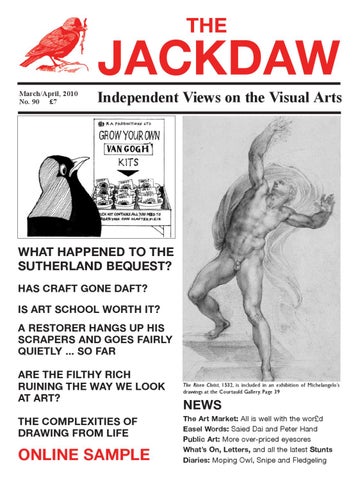
The Risen Christ, 1532, is included in an exhibition of Michelangelo’s drawings at the Courtauld Gallery. Page 39
NEWS The Art Market: All is well with the wor£d Easel Words: Saied Dai and Peter Hand Public Art: More over-priced eyesores What’s On, Letters, and all the latest Stunts Diaries: Moping Owl, Snipe and Fledgeling
A Note to Goldmark Customers: David Lee, editor and writer of the Jackdaw, along with his fellow contributors, dare to say it as they see it. No political correctness here, they bring you intelligent articles, art news and consistently highlight the questionable practices of the art establishment. With his irreverant and humorous take, Lee often reminds me of the best and most important of the 18th and 19th century satirists. The following pages, taken at random, from the current issue of The Jackdaw should give you a feel. If you like it as much as we do there is a special offer for Goldmark customers of ÂŁ25 for the next 6 issues (usually ÂŁ40). Act now to support this wonderful periodical. Mike Goldmark ps. Click on page to zoom in and out, use controls above to modify You can double click on email/web addresses highlighted in red
The Jackdaw INTRODUCTORY SUBSCRIPTION OFFER
6 ISSUES FOR ONLY £25 (full subscription £40)
“Intelligent”, “Bruisingly critical” – Evening Standard “Entertaining”, “Subversive” – Daily Telegraph “Dissident art magazine” – Sunday Times “Lively satirical art magazine” – The Times “Totally unsuitable for Birmingham” – Birmingham Art Gallery
SPECIAL SUBSCRIPTION (6 issues) – £25
To subscribe, email us at info@goldmarkart.com (you can double click the email link) or call us now on 01572 821 424 and we’ll do the rest for you.
Contents and Editorial 5 COMMENT 8
Craft Goes Daft
9
The Palace of Dreamers and Schemers
Laura Gascoigne wonders if craft, which would appear to have discovered artbollocks, has lost its way. Recent graduate Oscar Bower considers if art school is worth the effort and expense.
10 Whatever Happened to the Sutherland Bequest?
Alexander Adams looks into its history and its current status, where an element of secrecy prevails.
12 Retiring Mr Wild
Michael Daley reflects upon the career of Martin Wyld, until recently chief restorer at the National Gallery.
FEATURES 14 Review: The Real Van Gogh
Angus Stewart exhorts the benefits of boning up before paying a visit to the Royal Academy.
15 Easel Words Peter Hand’s other worlds. 16 Life Drawing and the ‘Objective’ Paradox
After years of practice Paul Wilks examines his complicated responses to the Life Class.
17 The Great British Art Debate
David Buckman introduces a series of exhibitions in Sheffield, Newcastle, Norwich and London intended to make us think about the Englishness of English art.
19 20 21 24
Letters Three of them to be precise; plus Deaths Easel Words Saied Dai Art Market Some of the art you can’t afford. Stunts The usual pot pourri of sideshows designed to catch your eye but nothing else.
DIARIES 6
Moping Owl... Keeps a raptor’s look-out from her high vantage, especially upon the scribblings of art critics.
11 First Degree Fledgeling, our art history student, has
discovered the unnecessary impenetrability of contemporary are theory... poor bugger.
13
Private View Snipe is our recent art history graduate making her way in the world of work.
NEWS 26-34 35 Public Art 38 What’s On The Jackdaw is published by Jackdaw Newsletters Ltd., 93 Clissold Crescent, London N16 9AS (0207-254 4027 or mobile: 0777 367 3722) email: dg.lee@virgin.net – internet: www.thejackdaw.co.uk. ISSN: 1474-3914 It is published six times a year, and mailed out second class to subscribers about one week before the beginning of the subject month. Annual subscription costs £40 in Britain, £45 in Europe, $80 in North America and £50 elsewhere, and is payable by cheque to the above address. A subscription form can be found loose inside the issue. The Jackdaw welcomes outside contributions and especially information. Submissions will not be returned and any information received will be treated with complete confidence. Back issues £5. The Jackdaw will take advertisements, but only full pages: telephone for rates. Advertisers will exercise no influence over editorial policy. Contents, unless otherwise stated, are copyright to The Jackdaw and permission must be received in advance before they are used elsewhere.
PERHAPS LENIN HAD A POINT
I
t’s a bit rich on the one hand (see opposite) to be begging for survival and then on the other to criticise the rich for the thoughtless way they use loose change to pollute the precious – but fuck ’em, here goes. A few years ago an eminent critic and dear friend advised me that my admiration for Giacometti was “an aberration of youth”. I was pushing fifty at the time so I was well flattered, but I knew that even should my admiration eventually wane I’d always respect Giacometti for his personal qualities: modesty; indifference to wealth; avoidance of the limelight; and an inspiring commitment to advancing a unique vision. As it has transpired my affection remains undimmed. His sculptures confront the essentials: what is the precise measure of the quiddity and soul of a person, and how do we adequately convey this so complex moving animal in a static object? Simple, obvious things perhaps but, nevertheless, the very basics of figurative sculpture, the foundation and cornerstones of great art. Like his work or not, there is no faulting Giacometti’s dedication and seriousness of purpose: he commands our respect. As you may read in James Lord’s as good as definitive 1997 biography of the sculptor, he surrendered his life totally to what he did. There was nothing much to him other than his work and although American cash rolled in during his final years he gave it away, mostly, and curiously, to a likeable gangster’s moll who bought fast cars, chic clothes and pills in all colours of the rainbow. Despite being Swiss, Giacometti remained the archetypal Gallic bloke: face guttered with wrinkles; sexy, lop-sided frown-cum-grin; that shapeless ouvrier’s raincoat; and a Gitane permanently on the slow burn. I also know he must have something universally appealing as a sculptor because thirty years ago I took my mother to see an exhibition of his work at Whitworth Art Gallery in Manchester fully expecting her to denounce it as typical of modern nonsense and, besides, why had I wasted her time on such a good day for washing. On the contrary, she was as fascinated as I by the intricately worked surfaces and the magic by which the artist translated what he saw of a real figure into a flattened bean pole stood to attention and wearing incongruous platform soles. We had different inklings as to what the artist might have been getting at but, like the most enduring, inexhaustible poetry, it is always best to be kept guessing a smidgeon shy of conclusive understanding. In recent times the very singularity of an artist like Giacometti is a danger to itself. At the top end of the art market live a score or fewer collectors whose main qualification for buying would appear to be a desire only to flaunt their wealth, or to invest in gilt-edged fixed assets whilst the stock market recovers. Of the most expensive works of art sold in the last three years, all of them have been bought either by hedge-funders, those meritless parasites who gamble away our pensions, and nouveaux Russian and Asian mineral nabobs eager to justify their recently acquired seats at the top table with public demonstrations of breathtaking vulgarity. (Who needs four yachts?) These loathsome scumbags are exemplary scions of the consumer age at its most mindlessly acquisitive. They are spirit-free zones obsessed with conspicuous materialism and showing off. Regrettably, art has now become one of their principal targets. By this attention they have not only ruined collecting as a discipline for the usually generous discerning, but they have also ensured that scarcely a museum in the world can now afford to buy anything of consequence by important artists. Sotheby’s and Christie’s have not only conspired in this stomachchurning spectacle but have fuelled it. There are those purists who tut-tut when art is referred to as a ‘brand’, like any other luxury item, a football team or an art magazine say, but this is now precisely what painting and sculpture are to the types who buy at the top end. Art is just as functional a trinket in keeping up appearances as a silly wrist watch with a circumference of knobs – the more knobs the richer you are, and you know the wind speed on Jupiter.Thus, former black marketeer Roman Abramovich likes March/April 2010 THE JACKDAW
10 Comment
WHATEVER HAPPENED TO THE SUTHERLAND BEQUEST? Alexander Adams goes in search of an explanation for its disappearance
G
raham Sutherland (1903-1980) formed a strong attachment to the Pembrokeshire peninsula, starting with his first visit in 1934. The topography and natural forms invigorated his art and separated him from the gentle pastoralism of Samuel Palmer. His art acquired a potent rawness, a nervous boniness. His line became imbued with a tension it had lacked hitherto. Whether or not the transition to Modernism was actually due to this environment, the biomorphic and geological shapes provided Sutherland with the material necessary. In 1942, the painter wrote: “[Pembrokeshire] certainly seemed very foreign to me, though sufficiently accessible for me to feel that I could claim it as my own. [...] It was in this country that I began to learn painting.” (Sutherland is not being purely metaphorical here; he had trained in technical drawing and etching.) Sutherland made regular trips to Pembrokeshire and it became a wellspring for his art. After hostilities ceased in 1945, Europe became accessible again and Sutherland moved to Menton, southern France. He only resumed his connection with Pembrokeshire late in life. The bond strong again, in 1976 the artist decided to donate work to the region in perpetuity. In a letter he expressed his reasons for the donation. “From the first moment I set foot in Wales I was obsessed. I have worked there particularly in Pembrokeshire every year since 1934 – with one long & regrettable gap, brought about by the fact that I thought I had exhausted what the countryside had to offer both as a ‘vocabulary’ & as inspiration. “I was sadly mistaken; & in the last ten years I have made up for it, continuing my visits in order to make my studies & to soak myself in the curiously charged atmosphere – at once both calm & exciting, to meet the people – so kind & optimistic & to benefit on good days from the extraordinary clear & transparent light. “About four years ago, the thought came into my mind that, having gained so much from this country, I should like to give something back. “Over the years, my wife and I have managed to keep a certain body of my work directly inspired by Wales & we both felt that we would like to make a gift of the greater part of it – hopefully for the benefit of Pembrokeshire & the nation. “But how to house it? It was then that the Hon. Hanning Philipps & his wife Lady Marion made the most generous of proposals – to make available for my work a large room, with a flat above for a curator, in an annexe of Picton Castle, where the work could be kept together & open to the public. “I felt that this splendid offer was so generous & acceptable that I decided to add some oil paintings – 15 in number – all done between 1970 &1976 – some done specially for the gallery; also to give a body of graphic work, lithographs, etchings etc. “It remains to say that this is a quite modest collection: but we are happy to give it not only for the reasons I have stated, but because I think it is high time that there should be some move towards decentralization; also because I believe that work done in a certain
The modern Pardoners Simon Jenkins The Guardian
area is seen best in that area. G.S. 17.iii.76” This original bequest (“the Bequest”) was supplemented by later gifts from the artist and his widow. The Bequest now comprises approximately 700 items, including 28 oils, 163 prints, 486 other works on paper and some miscellaneous items. The work is in the process of being thoroughly catalogued, the results of which are due to be made public next year. The Bequest was housed at the Graham Sutherland Gallery at Picton Castle, Pembrokeshire under the auspices of the Graham and Kathleen Sutherland Foundation (“the Foundation”) until 1989. Although the Foundation was then custodian of the Bequest, the Foundation had been preceded by a charitable body of trustees which had been through different incarnations. By 1989 the financial burden of maintaining the gallery and archive became unsupportable for the Foundation. It then unconditionally gave the entire Bequest to the National Museum of Wales (“NMW”), which was accepted as it seemed “there was a real risk that it might otherwise be dispersed”. At that time NMW made clear it would maintain the collection in Picton Castle for at least five years but did not specify the future of the Bequest beyond that point. What the Foundation assumed (or had been told) may be moot: if the gift was unconditional, then NMW commitments were not binding or even relevant. It would be interesting to discover what the Foundation directors had believed about the collection’s future before they donated the work. If NMW was being unconditionally entrusted with the Bequest, why was the five-year-maintenance undertaking made?
T
he cost of running Picton Castle gallery, which was sparsely attended, proved as difficult to support for NMW as it had done for the Foundation before. In 1995, following the expiry of the five-year pledge, NMW closed the gallery at Picton Castle. The Bequest entered a period of limbo which lasts to today. Parts of the Bequest have been shown at venues in Wales and, since 2008, frequently and en bloc at Oriel y Parc, a new gallery in St David’s. When not on display, work is stored in Cardiff. Although NMW has stated “we regard the Sutherland collection as being of fundamental importance to the visual arts in Wales”, the situation of the Bequest is complicated. Firstly, the work is now integrated into the collection of NMW, which held Sutherland works independently before the acquisition of the Bequest. The Bequest had a special character, being firmly linked through provenance and subject matter and NMW initially sought to preserve the integrity of the group. Secondly, although parts of the Bequest are shown in Pembrokeshire, NMW intends to exhibit more in Cardiff. On one hand, this is expedient use of work not on display in St David’s; on the other hand, Cardiff is not Pembrokeshire. Sutherland’s letter is express in nominating Pembrokeshire as the intended home for the Bequest. Legally, neither is an issue for NMW if the 1989 donation was without conditions. All previous stipulations and intentions of artist and Foundation would have been annulled by “unconditional transfer”. Copies of the document deeding the original Bequest (if such an item exists), the will of Kathleen Sutherland, the charter of
Today the beauty of holiness has been replaced by the holiness of beauty. The failure of modern aesthetics to supply accessible appeal in the visual or musical arts has led a stampede into the past. We once derived mental comfort, uplift and local pride from worshipping saintly relics in church. Now we are supposed to find them in a museum. Like churches, museums have pulled off a professional masterstroke. They have made the relic more important than themselves, yet requiring their priestly interpretation. Only thus can humans find intercession with the spirits of the past. As religion must not be tainted by money, museums too must be unsullied – and tithed by the state. The manoeuvre is brilliant. God is dead, long live God.
THE JACKDAW March/April 2010
Diary 13 the Foundation and the transfer agreement of 1989 have not been seen by me. There is no reason to infer that anything underhand has taken place. However, essentially, it is not possible to assess how many of the Sutherlands’ and Foundation’s restrictions and wishes (if any) obtain because the critical document, the transfer agreement of 1989 (and to a lesser extent, correspondence and memos prior to that agreement), has not been made public. In fact, it is not possible, without sight of the papers, to precisely determine what those aims might have been. Deeds of foundation and wills should make clear how much leeway the trustee bodies, and later, the Foundation, had for the disposal of the Bequest.
W
hat of the future for this group? Rachel Flynn, a PhD postgraduate from the University of Bristol, is cataloguing the work in the Bequest (including artist correspondence) and attempting to locate and collate relevant legal documents relating to the history of the collection. NMW states that no special regulations cover stewardship of the Bequest, as it was received unconditionally. For NMW the sole difficulty with the Bequest is logistical rather than legal, as the Bequest no longer exists in a legal sense. Whatever happens, hopefully, the work of Ms Flynn will draw attention to the generosity of one of Britain’s more overlooked post-War painters. NMW was faced by (and is dealing with the consequences of) an issue that will become increasingly common. In an age when artists come to feel that their legacies are best served by bequeathing groups of work to exist together in perpetuity, it is left up to lawyers, legatees, trustees, curators and law makers to arbitrate these matters. What happens when an independently managed body is no longer self-sufficient? Is any subsequent custodian bound by stipulations that rendered the former status quo unworkable? How far do artist stipulations, both in letter and spirit, extend? Who will subsidise the bequests of artists who fall from popularity? How many more artist’s rooms can the Tate, for example, afford to sustain? With the shadow of deacquisition looming, can – and should – artists expect to shape their own legacies through bequests and foundations? The making of all art is, to a degree, grasping for immortality; beyond that, is it reasonable for artists and collectors to define a more express form of legacy; and is it fair for institutions and nations to accept such bequests when the conditions of such donations are unsustainable or punitively onerous? The author wishes to express his grateful thanks to Oliver Fairclough, Keeper of Art, NMW and Rachel Flynn for their generous assistance and the Estate of Graham Sutherland for permission to use the artist’s images and texts. Images and text by Graham Sutherland (c) Estate of Graham Sutherland. Alexander Adams is an artist and writer based in Berlin. His exhibition Alexander Adams: New Paintings, Northumbria University Gallery, Newcastle, runs from April 16th to May 28th
PRIVATE VIEW by
Snipe
Dear Uncle Jackdaw, Apparently, once upon a time, Paul McCartney was cool and John Hoyland was at the forefront of abstract art. Since then they’ve mellowed, certain substances may have rotted away their imaginations and they’re passed it. New artistic ideas no longer come from the sixties generation, which is surprising given the worship proffered them by the kids of the noughties. Still living with my ’rents, I would know. (Aside: Alas! I’m one of those poor arts graduates, subject to the whims of the job market and the caprices of those student loan interest people; subsisting in the same bedroom I’ve had since infancy.) Occasionally I sidle off to Hoxton to meet like-minded Eastendonians, and although they share a nostalgia for the swinging sixties, in particular the hippy counter culture, there is no knowledge of or respect for the artists and no desire to emulate the burst of creative energy that they represented. None of my contemporaries has heard of Richard Hamilton, Joe Tilson and Anthony Caro. And they say these artists are still alive. This year, I joined a figure painting evening class in order to get over Christmas at home. From past experience, I expected a hoard of old hens clucking around a curmudgeonly old art professor (cockerel). The course was to be satisfactory as I would paint better than them, because I could see more, and this would be very good for my self esteem. But, it turned out that talent wasn’t lacking, or so the cute little teacher thought (hatchling). Twenty ravens had made it their new year’s resolution to meet chicks by taking up hobbies that pretty birds are meant to do. The result? A lot of tweeting and some spectacular portraiture. On a flying visit to 10 Downing Street the other day, the Government Art Collection left a similar impression on me as my parent’s collection; it’s safe, conservative and stifling. The one difference being that the GAC works are magnificent. The Lowry is extra gloomy, the Reynolds more regal, the Henry Moore especially naked, the Gainsborough terribly country pageant and the Freud particularly inspired by his grandfather, than any I’ve seen before. And yet it filled me with an Orwellian angst that this ubiquitous collection, which infiltrated every major British Government building in the universe, could have its own agenda permeating people’s minds with Brit Art. Like the benevolent despotism of the CIA in the 40s, 50s and 60s insinuating in cultural life as suggested in Who Paid the Piper, funding the “proper” anti-subversive art; visiting Downing Street left me with an ominous feeling, as well as the desire to quit my job and work for the GAC. Having hatched in an art-stocked home alienates me from my absurd, well-meaning, ignorant colleagues. The bungling Director, the highly strung fundraiser and the obese IT man which make up my operations department are comic examples of humans who wish to collect art but have no desire to show discernment. So they associate themselves to a twentieth century art collection so diverse that it need not express any preference, less partiality, and feel they are in some way doing the country a favour. According to Google Chrome, the RSPB call me a “medium sized, skulking wading bird with short legs”, I think this gives the wrong impression of a Snipe. Likewise living at home has completely distorted my view of the contemporary art world, as the pieces around me are expressions of society decades, if not centuries ago. To distract myself, I am thinking of giving my colleagues help lessons about the nuances of art history or attending a support group on getting one’s act together and movingº out. Love Snipe March/April 2010 THE JACKDAW
18 Comment
The destruction of an ideal
Richard Feigen The Art Newspaper
The biggest heist in history is afoot, some $20bn to $30bn worth. On 13 November, ground was broken in Philadelphia on a fake reconstruction of the Barnes Foundation. The late Dr Albert Barnes, a physician, inventor and one of the greatest art collectors in American history, created the Barnes Foundation in the 1920s to serve as a study collection for art appreciation and stipulated that the collection remain in the building he had designed for it in Merion, Pennsylvania. Barnes’s will has been violated. The former custodian of the foundation, Lincoln University, has been bribed out of its inherited responsibility with state funding. The greatest collection of impressionist, post-impressionist and modern paintings in the world—including 181 Renoirs, 69 Cézannes, 59 Matisses, 46 Picassos, 18 Rousseaus and 11 by Degas, 7 Van Goghs, 6 Seurats, 4 Manets and 4 by Monet—is about to be kidnapped from Merion and abducted to the Philadelphia Mall in the interest of tourism. This heist has been meticulously, even brilliantly orchestrated by Barnes’s enemies—the Philadelphia establishment, led by Governor Rendell and the city’s vested foundations and citizens. Certainly they think what they’re doing is best for their city. They’re wrong. It is wrong to break a will. It is wrong to violate the testament of a man who devoted his life to making what he considered an important statement. But it is also a mistake. The public is the victim.
W
hat defines the Britishness of British art? Like ‘What makes English music immediately recognisable?’, it is a question that has teased what we must call Cultural Historians for years. Now Tate Britain and public galleries in Norwich, Newcastle and Sheffield combine in “The Great British Art Debate”, a four-year programme intended to stimulate discussion of the subject. “Is British art a fantasy?” asks the Press Release, along with “Does the art of the past say anything about the world of today? Should the British public have a say in what goes into museums? A Constable of the Suffolk countryside, a Richard Billingham of the Black Country, a John Martin landscape: how do these and the thousands of works from our national collections impact on the public’s perception of Britishness?” They are all questions worth asking, particularly in a period where the notion of Britishness is becoming harder to pin down. In the end, it is unlikely that firm answers will emerge, however much the talking. Nobody is going to define all factors that make British art obviously not German, Italian or Mexican any more than one can draw boundaries around the characteristics of the English symphony, tone poem or concerto. Even experts are floored when asked to say exactly why the music of George Butterworth, Gerald Finzi, Ivor Gurney or Herbert Howells is so English, but one instinctively knows that it could not have been written – even with the help of an Equal Opportunities Commission – by an Albanian, Chinese or Russian. Nevertheless, the Great British Art Debate will offer the British public a valuable opportunity to see hundreds of pictures and to encounter artists past and present whose work usually lies unseen in vaults or is ignored in favour of so much that is merely moneyspinning or trendily fashionable. Many years compiling the two editions of my dictionary, Artists in Britain since 1945, and more recent employment as one of the two proof reviewers for The Public Catalogue Foundation’s multi-volume survey of the 200,000 oil, tempera and acrylic paintings in public collections across the United THE JACKDAW March/April 2010
Kingdom, 80 per cent of which are not commonly on view, has revealed how many marvellous pictures remain largely unknown. The Great British Art Debate began last year with a series of seminars, lectures, fanzines and displays with “input from local communities in London, Norfolk, Tyne & Wear and Sheffield areas.” It has just moved into the next phase giving the public “unprecedented access to outstanding collections of British art” with the first major exhibition: Watercolour in Britain: Travelling with Colour runs until April 18th at Norwich Castle Museum & Art Gallery, appropriately as East Anglia has such a strong watercolour tradition. After Norwich, it travels to the three other venues, in each being “presented differently”. Accompanying it is a well illustrated book with four essays: “Watercolour in Britain: A National Art?”, “Travelling with Colour”, “Tradition and Beyond” and “Vision and Imagination”. Chronologically the 102 works on display include a good selection of the early topographical masters, such as Francis Towne, Thomas Girtin, John Sell Cotman and J M W Turner, continuing through to moderns including some surprises. A bonus for lovers of Cotman is the gallery’s separate exhibition of this artist’s oils, watercolours and prints with an illuminating selection of his letters. Highlights of the touring show? These must always be personal, but Norwich Castle Museum’s own Cotman On the River Greta, Yorkshire, of 1806-7, impressed as particularly fine, his third and last tour of Yorkshire in 1805, after the first two in 1803, having most profoundly affected him. Notable in this work is the very light but fine drawing under the restricted range of colour. Cotman has magically built up the work with layers of wash in Payne’s grey, umber and blue. A discrete section of 14 Turners, heavily drawing on the artist’s 1856 Bequest to the nation, ranges from the fine and big 1798-9 panoramic gouache, pencil and watercolour Imaginary Landscape ?on the River Teifi with a Cluster of Houses in the Foreground, a Church Spire Beyond, and Windsor Castle on a Cliff above a Distant Plain to the much smaller 1800-5 pencil and watercolour
Kirkstall Abbey, Moonrise: Colour Study, a gem of sombre atmosphere. oving on into the 19th century, two fine examples of John Frederick Lewis come from the Laing Art Gallery. Easter Day at Rome, of 1840, painted when Lewis was in his midthirties, is a huge watercolour and bodycolour panorama that merits lengthy study. Finished in rich colours typical of the artist, this crowded scene has the impact of an oil painting. The second Lewis is Hhareem Life, Constantinople, of 1857, in watercolour, bodycolour and pencil, filled with exquisite detail. Amateurs have not been neglected. The Reverend James Bulwer, working through most of the 19th century, is nicely represented by his watercolour Morston Church, of about 1855, which entered the Norwich collection through the Russell James Colman Bequest just after World War II. There is no need to excuse as amateur Edward Lear, represented by a dozen examples drawn from his journeys in Corsica, Italy, Egypt and Greece. They are all interesting, but none made as great an impact as some seen over the years in London commercial galleries, such as The Fine Art Society. Neither is any of the Lears in the Norwich show as powerfully atmospheric as another Victorian William James Muller’s undated watercolour Stonehenge, from the Tate collection. On into the 20th century, the Tate’s 1908 Miss Eliza Wedgwood and Miss Sargent Sketching shows how impressive John Singer Sargent could be when abandoning canvas for paper. It is a watercolour and gouache of great fluidity, an Edwardian period piece indicative of Sargent’s versatility. Only a decade later he would paint the horrific Gassed, now in the Imperial War Museum. John Piper and Graham Sutherland are represented in Norwich by seven and eight examples respectively. The Sutherlands are an especially strong group. When the Tate assembles its watercolour show next year it intends to spread its net wider, to include works from other public collections, galleries and artists. Among these, the Imperial War Museum’s holding should offer rich examples. Eric Ravilious is an obvious candidate, and what about another, largely forgotten, Sussex
M
Letters 19 Let’s hear it for Beauty, again Roger Scruton Daily Mail
We should not think that these changes in the world of art – which have been paralleled, too, in the worlds of music and literature – are without significance. What we look at, listen to and read affects us in the deepest part of our being. Once we start to celebrate ugliness, then we become ugly, too. Just as art and architecture have uglified themselves, so have our manners, our relationships and our language become crude. Without the guidance offered by beauty and good taste, we find it difficult to relate to each other in a natural or graceful way. Society itself becomes fractured and atomised. From Roy Osborne Misconceptions Is Crivelli’s Annunciation an example of Immaculate Conceptual Art?
From Joe McIntyre Black Watch Memorial In answer to your call for information about the Black Watch Memorial in No. 89. The sculpture is by Scott Sutherland RSA (19101984). Scott was head of sculpture at the Duncan of Jordanstone College of Art in Dundee when I was a student there in the 1960s. He is better known for his world famous Commando Memorial at Spean Bridge, 1952, a commission he received following an open competition (above). It used to be a joke among taxi drivers in Dundee to tell drivers new to the area that there was a ‘kiltie’ at the top of the Powrie Brae going to the Black Watch club in Dundee...
The Tragedy of Rothko William Boyd The Guardian
From Ranko Bon Animal Spirits in the Market It often flashes through my mind that I should roll up my sleeves and apply George Akerlof and Robert Shiller’s theory of animal spirits to the workings of the art market. In this context, I usually mull over the five elements of their theory: confidence, fairness, corruption, money illusion, and storytelling. Confidence is easy, as art objects are customarily compared with other valuable assets among which investors can choose. The belief that the value of these objects will always go up because of their limited supply pops up in every boom, during which it is only reinforced by steadily rising prices. The art market is inherently unfair, as witnessed by the utter randomness with which a few lucky artists are thrust into the limelight by top gallerists, museum curators, collectors, auctioneers, and journalists. Corruption is rife in the market, where all the above agents systematically benefit from insider trading in all its forms. Often enough, mind-boggling court cases bring the muck into the open. As is the case with other valuable assets, money illusion sets in whenever the purchase and sale prices of art objects are compared. Inflation is systematically disregarded when fabulous ‘profits’ are cheerfully paraded for all to see. And storytelling is at the very core of the art market. As most of the art objects are recognized as such only on trust, most market agents offer little more than carefully packaged snake oil. All I would need to do to connect the dots would be to examine as an example the colourful career of an artist in the limelight: say, Tracey Emin. Still, I sincerely hope someone will soon beat me to this feat of economic theory. http://www.residua.org
From Edna Weiss The Bells Tolls For Thee Whenever I see Millet’s The Angelus (No 89) my thoughts go back to the RA Schools in the early 1950s when a very well known lecturer (who shall remain nameless!) [Why? Ed] spoke to us about the picture. As he projected it onto the screen he said that we should also think of it as “Burying the Baby”, which he said would help us concentrate our minds. From Henry Tebbutt Indisposition I was going to write to you complaining about the tiresome predictability that was the Channel 4 series “The School of Saatchi”, but then I realised that I didn’t give a toss.
DEATHS John Lawson, stained glass maker, 77 Michael Kidner, abstract painter and sculptor, 92 Tom Hoving, museum director and curator, 78 Lawrence Halprin, US architect, 93 Ronnie Stennett-Wilson, glassmaker and craft promoter, 94 Craigie Aitchison, painter, 83 Alfred Hrdlicka, Austrian sculptor, 81 Susan Einzig, illustrator and teacher, 87 Anthony John Poole, sculptor, 83 Alastair Flattely, teacher, 87 Kenneth Noland, American abstract painter, 85 Harry Diamond, photographer, 85 Robert Carruthers, sculptor and teacher, 84 David Levine, US caricaturist, 83 Bill Brooks, founder of Christie’s South Kensington, 85 Dennis Stock, photographer, 81 Vivien Knight, museum director, 56 Don Steyn, art dealer, 73
On 29 February 1972 the English artist Keith Vaughan went to see an exhibition of Mark Rothko paintings. Vaughan recorded the occasion in his diary: “To Hayward Gallery in the afternoon to see Rothkos. Feeble stuff. Large décor. Boring to paint and look at. Not surprising he killed himself if that was all there was to do.” This is both ironic and shrewd. Ironic in that Vaughan was also to kill himself five years later (though for reasons unconnected with his art) but shrewd in that, even in this throwaway remark, he gets to the crux of our responses to Rothko and his huge, darkly luminous paintings. ...It doesn’t take a huge thought-experiment to try to imagine the growing hell of being a colour-field abstract painter condemned to lay on those huge swaths of colour on canvas – however beautiful, however lambent – month after month, year after year, decade after decade. I suspect this was why Rothko surrounded his work with a penumbra of intellectual pontification, as if the sheer density of arid academic commentary made the simple act of painting these colour-fields a more worthy endeavour. March/April 2010 THE JACKDAW
22 Art Market
BROKEN RECORDS T
he 1658 portrait by Rembrandt (above) sold for £20 million at the end of last year was bought by casino owner Steve Wynn. It is an addition to other big art names already on show in his Las Vegas casino as entertainment for the high rollers. In the same Old Master sales the Van Dyck self-portrait illustrated in the last issue fetched £8.3 million: his previous was £3 million. The Domenichino from Glyndebourne, also illustrated in the last issue, fetched £9.3 million. All the above were records. Apart from these successes the Old Master sales were nothing to celebrate with 42% unsold. A good picture by the little known Caesar Boetius van Everdingen (above right), depicting a girl holding a basket of plums, sold for 25 times its £50,000 estimate at £1.2 million. Quality pictures sell whereas hardly anything
else is worth the effort of looking. The most astonishing price of all was reserved for the Raphael drawing (right), which raised a staggering £29 million at Christie’s. The previous highest price realised by any work on paper was the £23 million fetched by a Degas drawing in 2008. Thus did a mere preparatory sketch for a Vatican fresco of 1510 become the second most expensive Old Master work sold at auction, the most expensive being the early Rubens, Massacre of the Innocents, at £49.5 million.
Sales at Sotheby’s fell by over 50% in 1009 from $4.86 billion in 2008 to $2.28 billion last year. The share price at the end of 2009 was, however, at $24, three times what it had been a year before. The London Jewish Museum has bought a previously unknown painting by Marc Chagall, Apocalypse in Lilac, from a Paris auction for £26,600. It is thought to be worth many times more than what they paid for it. Museums were apparently unaware of the picture’s significance. ndrew Lloyd Webber tried to sell the early Picasso, The Absinthe Drinker (left), not a particularly good one it has to be said (for example, his left arm looks as though it belongs to a bloke standing some way off behind him), three years ago but it was withdrawn from sale because the heirs of a Jewish art dealer claimed that their ancestor had been forced to sell it by the Nazis. Until that time it had spent several years on loan to the National Gallery. Lloyd Webber, who bought the painting legitimately, has now come to an agreement with the heirs which will enable him to sell it without impediment. It is not known if a payment was made, although two years ago a US court decided that the appellants had not demonstrated that they were the rightful owners of the painting. The painting was bought in 2002 for £18 million and might make £30 million if sold now.
A
THE JACKDAW March/April 2010
T
en photographs of snowflakes by Wilson Bentley (1865-1931) have a price tag of £3,000 at a fair in New York. In 1931 Bentley published Snow Crystals containing 2,500 flakes each with a unique crystalline structure. He perfected the process in 1885 by attaching a bellows camera to a microscope following two years of trial and error. When first published scientists suspected the images of having been faked.
Art Market 23
IS IT 5 O’CLOCK YET?
W
e ought to apologise for using the same picture twice on this spread but dear old Griselda is worth it, isn’t she? What an asset she is to any picture that someone perhaps doesn’t want you to look at too closely. Last month she was going weak at the knees for Raphael. This month it’s that dirty Dutchman Rembrandt. She might look as though she’s pining for a husband but she’s no pushover.To hold up a frame that size she must have biceps like Sly Stallone: which will make her so useful on the farm when the hands are skiving off with swine vesicular disease and there’s a tractor tyre to blow up and a shippen to muck out. Do you get the impression – we do – she’s not really looking at the silly fellow in the picture? He looks awful – those porky fingers – as though he could do with a good wash. There’s a wistful look in those doe eyes, isn’t there, as though she’s far away dreaming of opening a little farm shop selling her own Walled Garden brand of Zelda’s Chutneys. The gloves, by the way, are the softest lamb skin, they’re only there to protect her delicate fingers from snagging on the frame’s rough stucco. Really, how much longer will she have to do this silly day job before her very own something-in-theCity installs her in a Cotswold Grange? Good luck Griselda. See you next month.
T
his life-size self-portrait with a black eye by Lucian Freud, painted in the late 70s following fisticuffs with a taxi driver, was sold by Sotheby’s for £2.8 million (estimate £4 million). The picture had never previously unknown and unfinished portrait, said to be an early previously been seen in public or reproduced. Said the pugnacious work by Rubens and estimated by Sotheby’s at £6-8 million, which Lothario: “I used to have a lot of fights. It wasn’t because I like fighting. recently turned up in London with barely a scrap of provenance, didn’t It was just that people said things to me which I felt the only reply was sell despite having received enormous publicity. to hit them, and quite often I wanted to hit people.”
A
March/April 2010 THE JACKDAW
24 Stunts
KNITTING FOR THE TROOPS
“L
eading British artist” [Leading where exactly? Ed] Andy Holden has based a work upon a misdemeanour of his youth.When 12 his parents took him to Egypt where he pilfered and brought home a piece of stone from the Great Pyramid. Don’t worry Andy, we’ve all done that – there’s a small piece of the Library of Celsus in the Jackdaw offices if you know where to look. His parents were ever so angry with him, he says. In order to assuage his guilt, or something, he has knitted a ten-foot high replica of the fragment and exhibited it at Tate Britain. It is accompanied by a film of the artist returning the fragment to its original position. “It is the largest piece of knitting we’ve ever had here,” wrote one of the gallery’s overawed Snake Oil Salesmen. “You could turn this magnificent achievement into a range of Aran sweaters or even more baby jackets. Of course the real reason why it is exhibited here in an art gallery is because it is expanding the envelope and challenging [fill in whatever it is it’s challenging and then don’t forget to let me know in case someone asks me].” It is to be washed at a low temperature with fabric conditioner in order to avoid shrinkage.
F
LET SLEEPING DOGS DROWN
W
e assure you this is not one of the many invented stories which appear in The Jackdaw. An underwater sculpture park is being constructed off the Mexican coast near the Isla Mujeres. It is the ‘brainchild’ of one Jason de Cairo Taylor who has already created one underwater sculpture exhibition off Grenada in the West Indies. It is no exaggeration to call this work ‘challenging’ as you are required to hold your breath for upwards of two minutes in order to see each work. The piece illustrated is called Archive of Lost Dreams and is to do with sorting bottles, or some nonsense. Cairo Taylor is hoping that there will be 400 works on the seabed by the end of next year making it the largest subsea sculpture park in the world.
atso (now thin) has come up with a moderately agreeable stunt at his eponymous shop in Chelsea. American stunter Emily Prince has done little drawings of each of the 5,158 American victims of the wars in Iraq and Afghanistan since 2004. Here, left, is Stephen Walberg from Paradise, California who died aged 18 in April 2007, drawn in pencil on vellum; and right is Jason Morales La Puente, who was killed aged 20 on April 18th, 2007. The tiny drawings are pinned to a large map of the USA according to their place of origin. “It operates as a study of racial demographics for soldiers sent to fight.” And by this presumably she means – and this applies to the British victims of the same conflicts – a disproportionate number of young whites. But that’s doubtless a very inconvenient truth, so moving on swiftly... As an homage this project is unexceptionable even worthy, but as art – obviously the drawings are feeble – it qualifies only as a stunt and is therefore appropriately exhibited in this palace of stunts. Needless to say, owing to the stranglehold of political correctness over all aspects of modern life, there is not a single word anywhere which considers this project as a strategy deeply and disgustingly exploitative of the casualties for the purpose of advancing an art career. Heaven forbid.
THE JACKDAW March/April 2010
Stunts 25
H
ave a good look at this place. This is a village in the heart of the Rioja wine country of northern Spain. The bent metal is coloured lime green and raspberry. It is a hotel designed by Frank Gehry. Imagine the scale of the conceit you must need to have developed as an architect to want to inflict such an enormity on a pastoral setting. Such an excrescence might look perfectly appropriate in a tacky dump like Dubai, but in the middle of an historic town and landscape? Then ... then imagine the scale of the stupidity, or the backhanders, that the local council would require in order to give this flapper planning permission. And then imagine the imbecility of tourists who wish to travel in northern Spain and stay in a hotel designed by Gehry. What is the word for two steps beyond decadent? [I think the phrase you are struggling to locate is: We’re Fucked! Ed]
EROSIONISM: THE FINAL FRONTIER
L
andscape painter, Kane Cunningham, has bought a house near Scarborough which, in the next few years, will collapse down a cliff into the North Sea. He paid three grand for a house otherwise worth £150,000 with a view to making of it an art installation. Cameras inside will record its demise. Members of the public have been invited to send letters which will be pinned to the wall. The ‘work’ is ‘about’ “lost dreams, financial disaster and threatening sea levels,” announced yer man. In the meantime he is using the bungalow as a studio. There will be some sort of exhibition at Scarborough Art Gallery next autumn. Stunter Rick Hendry, a graduate of St Martin’s, over the years an industrial production line for stunters, specialises in painting (badly) on old floppy discs, CDs and tape cassettes. His latest effort is an interpretation of the Mona Lisa. His work “explores how technological advancement is affecting society”. Altogether now: “Oh no it isn’t!” So this is the sort of self-delusional cobblers they teach them to write nowadays.
M
ilan has pulled off the ultimate stunt in what we must all now call ‘outreach’.The municipal authorities, eager to bring high art to the mob, have projected one of their masterpieces, namely a family portrait by the world famous Carlo Nuvolone, on to the city’s tallest building. All the usual defensive platitudes were uttered to justify this scheme. March/April 2010 THE JACKDAW
26 News
THE ICA ON THE CAKE MINUS ONE HEDGE FUND
H
ow long is it since it was essential to visit the ICA? Ten or fifteen years years? Twenty? Since every state-funded gallery started showing the kind of State Art over which the ICA once enjoyed a monopoly, its primary function has been more or less redundant, or at the least diluted to the point of insipidity. It’s now just another central London outlet for State Art. Despite receiving over £1.5 million per annum in public subsidy – the public subsidy of the avant garde ... now there’s a conceptual problem – it is running a deficit of £800,000. This is partly a result of losing revenue because they stopped charging for entry a couple of years ago. The ICA is now to receive a special wedge of £1.2 million from the Arts Council in order to keep it afloat; that is, buoyant upon its ocean of mediocrity. A third of its 90-strong workforce are to be fired. Another marvellous job, therefore, overseen by Alan Yentob, who is the chairman of the ICA’s trustees. Ekow Eshun, the director of the ICA who has staged any number of exhibitions no one can remember, also sits on the main panel of the Arts Council. But it’s alright, there will have been no conflict of interest because he’ll have sneaked out into the passage while they were making their decision on his grant. When the ICA’s latest financial debacle featured in the papers it was revealed that the ICA only pays £18,500 a year in rent to the Crown Estate for its premises on The Mall because it receives special treatment. This ‘special treatment’ is not, apparently, a concession vouchsafed to Mall Galleries next door. They show the wrong kind of art and therefore are ineligible not only for annual dispensations from the Arts Council but also peppercorn rents from their landlord, who happens to be the same as the ICA’s.
HOW TO MAKE PERFECT GRAVY
W
hen the Arts Council placed art bureaucrats as opposed to artists on the gravy train one couldn’t possibly have predicted the disparity in pay that would come to exist between the penpushers, i.e. those who can’t do anything other than file forms, and those whose careers and incomes they were supposed to be advancing. Four regional heads of the Arts Council each picked up redundancy cheques for £300,000 when they were already earning £80,000 a year, that is, by the Arts Council’s own reckoning, eight times the average artist’s income.
VISUAL ARTS AWASH WITH MONEY
T
he constant demands of the arts lobby for more and more money from the Government to cover ever greater shortfalls or ever more lavish new buildings somehow doesn’t ring true. All other evidence suggests a museum and gallery industry riding a Big Sur of cash. Barely a week goes by without another museum or gallery opening new premises – many of which seemed unnecessary and were only embarked upon because money is available through the lottery and assorted charities and donors – or announcing extravagant schemes for extensions offering more comfortable accommodation for their staff. Herewith, then, the latest batch of expansionism: Kettles Yard in Cambridge, which receives £155,000 a year from the Arts Council, has received a £2.3 million award from the Arts Council lottery. This forms part of a £5 million development plan which involves a new extension and an upgrade of facilities which have already been upgraded in recent memory.The Museum of Modern Art in Oxford which, since its last upgrade, has been called something else, has now announced yet another building programme (at the very least its third since it opened) concerned with improving its entrance and creating “a project space”. They might turn their attention to staging more exhibitions which it is worth the effort of going to see, as was the case in the now distant past. How many British artists whose average incomes are 30% below even the poverty line will benefit from such lavishness? The answer is hardly any. The Arts Council’s policy of usual suspects, State Art and foreigners first, will see to that. THE JACKDAW March/April 2010
A
lmost six months after the annual accounts of the Tate Gallery were published the following inconspicuous sentences found its way into the papers: “During 2008-09 Tate liquidated the hedge fund investments resulting in TriAlpha ceasing to act as an investment manager to Tate.The proceeds of the hedge fund sales are currently held as cash. During the year the investment funds lost 13% of their value.” Knowing the Tate’s partiality for not telling the whole story, this caused one or two who are nifty with balance sheets to examine the numbers. It turns out that the gallery registered a million pound loss on resources invested in high risk hedge funds, or 17% of their investment fund’s full value. £6.3 million of the gallery’s £27 million investment portfolio had been placed in the hands of two hedge fund managers, Coutts and TriAlpha, and was worth £5.2 million when cashed in. They were advised to cash in their hedge funds just in time to miss the 20% increase of the last 12 months. There are those commentators who have observed that hedge funds are so risky that three out of four charities never invest in them and the majority of those who do never exceed 8% of their total investments. The Tate trustee in charge of these risky investments was Trustee chairman Paul Myners, who left the Tate in October 2008 to take up the position of Gordon Brown’s business guru in the House of Lords. You may recall that his first success in that job was awarding the chairman of RBS which was bankrupt and is now owned by the taxpayer an eyewatering pension. Myners said recently a propos of the mess he and his banker colleagues dropped us all in: “Too many of us failed to act as good stewards of our clients’ money.” You can say that again sonny. Your flirtation with the arts cost it a fortune. Other titbits in the annual accounts reveal that the Tate has now over 1,300 employees and that the President-For-Life earned £173,000 including £12,000 as bonus and has an accrued pension of £1.3 million. This means he earns £50,000 a year more than anyone else on the payroll, 21 of whom earn over £60,000 a year. The Tate made £3.3 million on a turnover of £31 million from it cafes, restaurants and bookshops. The figure had been £1.4 million the previous year. 7.4 million visited all the various galleries, it is claimed, of which half were foreigners and an eighth children under 16. £54 million was received in Government grants. Late News: The Tate is advertising for a new Trustee. They’re after someone with retailing skills to help develop the shops and cafés. The advert is helpful: “The appropriate candidate will have to be considerably more competent than that fat prick Myners turned out to be and be willing to pay homage daily to the President-For-Life.”
Michael Landy, who is organising the Rubbish Art stunt courtesy of your money at South London Art Gallery, has recently suffered testicular cancer. Laudably, and unlike some others, he didn’t make a front-page fuss about so grievous a diagnosis. However, not wishing to be in any way flippant concerning this misfortune, we do wonder when he will perform that stunt-of-all-stunts, the only last-word genuinely worthy of the publicity-seeking YBA generation, and exhibit his own pickled nuts in a jar at the Tate. Send suggested titles on a postcard to Tate Britain. Janus and Uranus Anus have not been in the papers for days, so here we go. At last year’s Art Frieze, which is a fair for circus enthusiasts, the Fratelli Cloaca doodled on people’s money for free, the ‘idea’ being that their lines increased the value of said bill. Such was the demand that by the end of the day there was still a queue so the Anus’s dealer, J Fop Esq., took notes from those in the queue who were told that they would receive their money back duly doodled upon. They didn’t. Janus Anus (or was it Uranus?), meanwhile, is in combative mood: “Anyone who handed over their money can come and get it – we don’t feel moved to make people money after they have been so ungenerous.” That’ll learn em.
News 27
NO!
IT’S ALL IN THE LADDERS
H
aving had its first request for planning permission for an extension rejected by Camden Council, the British Museum has made a quick revision to the original ‘Ladders’ so that Richard Rogers’s plans have now, hey presto, met with approval. Something to do with some of the ladders being squeezed and other ladders being dug deeper into the ground. We wouldn’t want you to think the Jackdaw is in any way cynical about such processes but there doesn’t appear to
HELL HATH NO FURY LIKE AN EX-WIFE DOWN TO HER LAST 20 PAIRS OF TRAINERS
H
edge-funder Steve Cohen, who was among the collectors forcing up prices in the recent contemporary art market boom, and who currently owns Dick Flasher’s shark (now itself replaced due to rot), has been accused of fraud, racketeering and insider trading by his exwife, who is after an extra $300 million or so. They were divorced in 1988 and she claims he lied then about how much he was worth in order to minimise her pay-off.The FBI is already investigating allegations of insider-trading against Cohen’s company. Is the penchant for corruption among high-rolling art collectors more developed than the same tendency in others? [I couldn’t possibly speculate. Ed] Doubtless all this signifies that the shark will be swimming expensively into the calmer waters of another collection before you can say Bernie Madoff. The latest on the extension to Tate Modern is very positive, the President for Life has so far raised £76.5 million, the majority of it from public sources. £215 million is needed so there’s only £150 million needed. The President for Life is still convinced and upbeat that the Lord Serota Building will be completed by 2012. Watch out for those filthy rich Russians on the honours lists. The BBC has spent £4 million on an assortment of art stunts relating to its rebuilding programme in Portland Place. This includes £1.6 million on a pavement piece outside the main entrance by American architect-cum-stunter Mark Pimlott. The corporation also paid a documentary photographer £70,000 to record the building work. Wonder how many works they got for their money which will pass the test of stamina exemplified by Eric Gill’s sculptures for the original building... The Greeks are as good as bankrupt. Their state bonds are worth less than back issues of The Jackdaw [They’re well in the shit then. Ed]. As a country they falsified their annual accounts in order to gain entry into what was promised as an economic paradise i.e. the Euro. They now have an annual public spending deficit of 13%. They have met the problem head on and closed 40 museums and archaeological sites, many of which were in a disgraceful state of neglect to start with. Never having heard of the word ‘hypocrisy’ they will be doubtless lecturing us yet again on the poor condition of the Elgin Marbles, those same sculptures they want returned to Athens in order to augment their own Acropolis remnants, which they allowed to be eroded by fumes.
YES!
be much difference, if any, to published mock-ups between the dismissed first try and the lauded second. The museum was obviously more persuasive the second time around and the councillors had obviously been won over by the beauty of His Lordship’s ladders and the cogency of St Neil’s arguments. The BM has already raised £92 million, some of this from its reserves, reserves apparently considered far too precious to waste on opening all the existing galleries at the same time. Amazing, isn’t it, the free ability of impoverished museums to find millions when they shift into world-domination mode. There has been a spate of art thefts in the south of France. The Cantini museum in Marseilles lost a Degas pastel, The Chorus, worth £700,000. It was on loan from the Musée d’Orsay in Paris. Staff have been interviewed because the Clousots suspect it was an inside job. It was simply taken off the wall during opening hours and there was no evidence of either a break-in or any force used to remove the picture. A couple of days later about 30 works worth a million pounds, including pictures by Picasso and Rousseau, were stolen in a New Year burglary from a private collector. An Italian art collection worth many tens of millions has been seized by Italian police from the disgraced owner of the Parmalat milk company which went bust in 2003 owing millions to small investors. The collector said that he had never owned any of these works and didn’t know of their whereabouts. Subsequently, they were found hidden in the attics and cellars of various of his various properties. What’s the Italian for ‘porridge’? [Pappa d’Avena. Ed] Andrew Lloyd Webber’s art foundation has been criticised for allowing him to use a painting he bought for the trust, St Cecilia by J W Waterhouse, to be exhibited in a theatre during the run of one of his musicals. He bought the painting and donated it to the trust thereby reclaiming a million quid in tax. The charity watchdog claimed it was concerned by the frequency of the transactions by which Lloyd-Webber benefited from showing the works. The paintings are on display to the public on average between four and six months a year each. Current enquiries have resulted in the repayment of £1.5 million in taxes. There may have been well-aimed criticisms about the arrangement of the new medieval and renaissance galleries recently unveiled at the Victoria and Albert Museum, but there is no doubting the richness of knowledge and pleasure than can be derived from a wander through the new galleries into the older ones at the back via those astonishing sculpture courts. It is indeed circuitous, not always clear or consecutive but the power of individual pieces for the informed, strolling visitor provides among the most special experiences in London. There is not much that can’t be taught, intimated or understood about West European sculpture from this labyrintine display. It takes some getting used to but it’s worth the effort. The loan perhaps from the British Museum of some well-chosen examples of Imperial Roman sculpture at the beginning of the story would have been helpful, for so much of what comes afterwards has its genesis here. March/April 2010 THE JACKDAW
28 News
HONEST, IT COME OFF IN MY HAND
T
he carefree lack of respect shown by the young for every body and thing is taking its toll on precious museum objects. Recently released material shows there is now an epidemic of casual vandalism in museums. And the damage is not always caused by outsiders. Art handlers employed by the museums cause the worst assaults. There were 22 incidents at the Natural History Museum and 18 at the V&A, one of which involved the decapitation of a marble statue while it was being moved. The damage caused by the public is minimal because it is usually the work of children who can’t keep their hands to themselves. Few regular museum-goers will not have encountered children touching objects and poking paintings.This is a good reason why children under 30 should be banned from museums. They are rarely interested in the exhibits but instead wander about in groups behaving badly and noisily, filling in crass quiz forms designed for morons and visibly desperate to leave. The tendency especially in the National Gallery to have an earnest lady – they usually have hair straight out of Rossetti and bottoms from Botero – squatting on the floor asking children questions about what they can’t be bothered to look at should be scrapped. It makes the looking at work unbearable for everyone else, and most week days they are in every room. There’s no escaping this scourge.The Jackdaw himself, at a moment when he was recently lost in the plug ugliness of a painting by Cézanne, was reared rudely from his thoughts by a dig in the back from some middle-aged lesbian who was hurrying a group of stupefied nippers on to precisely the spot he was occupying. He turned around shocked and angered by the intrusion and decked her with a lightning left uppercut before threatening to slit the parents’ throats of any child who so much as wimpered. Well, something like that. The way to prevent serious damage to the public’s priceless heirlooms is to ban children and place a moratorium on the obsession museums now have with constantly moving stuff around, not only between their own rooms but between museums often thousands of miles apart. LATE NEWS: A visitor to the Metropolitan Museum in New York made a six-inch tear in the corner of Picasso’s The Actor, 1904, left, when she lost balance during a class. The canvas will be repaired in time for the exhibition of 250 works by the artist in the Metropolitan’s collection which opens at the end of April.
A
brick (left) signed by stunter Gavin Turk, said to be worth three grand, has been stolen from an exhibition of bricks in South London – there are apparently different types. Quite an original idea though this one. Think about it. Sign an existing commodity bought from a shop and increase its value simply by signing it and transforming it into a work of art. [Shit! Why didn’t I think of that? Ed] The title of the work is Revolting Brick and the thief, cunningly, replaced it with an unsigned facsimile carrying the written comment “Thank you, have a nice day, next...” The replacement brick was supplied by the gallery itself as it was taken from a pile of unsigned ones which the public could take away as a memento. The police have been alerted and a reward offered. One unpleasant cynic who wished not to be quoted claimed that the brick had been replaced by Turk himself in order to knock up some publicity. Snarky bitch.
It is written, for at least the fourth time, that Muhammed Atta, the leader of the 9/11 attacks on the World Trade Centre and the pilot of the first plane to hit, had tried to sell looted artefacts from Afghanistan in 1999 to a German academic who instantly alerted the Secret Service. He had said that he needed money in order to learn how to fly in the USA. There is no significant corroboration of this story.
journeyman artist to the Earl of Powys were bought at Bonhams and will return to Powys Castle. The third purchase was a portrait of a Northumberland nobleman, Baron Widdrington, who having been sentenced to death in the ’15 Jacobite Rebellion was then reprieved. The picture was bought in a house sale for £3,250 and will return to Nunnington Hall in Yorkshire where the Baron lived the rest of his life.
The National Trust has recently been buying works inexpensively. A 1761 view of Sissinghurst Castle when it was used during the Seven Years War as a camp for French POWs was bought for £12,000 for Sissinghurst Castle. Seven 19th century paintings of cattle by a
The portrait of David Cameron by Jonathon Yeo, illustrated in the last issue, sold for £200,000 at an auction to raise money for the Tories. Cameron himself described it as “work in progress”, i.e. he looks indecisive and uncertain – an exemplarily accurate portrayal then.
ICA NBG Tim Teeman The Times
It’s one of those questions that recurs like a nightmare: just what is the point of the ICA, the one-time centre of cutting edge art on the Mall? However, what was once a chin-scratching interrogation of the wisdom of exhibiting bits of carpet fluff shaped as rabbits and calling it art has now taken on more urgency as the ICA fights for its very life. Reports have suggested the organisation, long the subject of a vexed identity crisis, is on its last legs; that it could close as early as May. Its director Ekow Eshun vigorously denies this, but admits that radical change is planned, with – according to an ICA spokeswoman – “a fair estimate” that a third of its full-time staff of “around 60” will be in line for redundancy.
THE JACKDAW March/April 2010
News 29
T
he war for supremacy in the streets is under way. Battle is joined between The Jackdaw’s occasional columnist, Banksy, and a rival for his position as King of Graffiti, one Robbo. First Robbo painted one of his designs along the Regent’s Canal, then Banksy stencilled a painter and decorator wallpapering over his design. Then Robbo snuck back and cleverly made it seem as though Banksy was endorsing Robbo as the monarch of the gable end daub. This was how it was reported by the newspapers but, after full consultation with Banksy himself, The Jackdaw can reveal that the truth is in fact that Banksy is both Robbo and himself, Robbo having always been his cooler alter ego. “I am a complicated character,” said Banksy when he recently visited our Belgravia office complex. “These conflicting artistic tensions are constantly battling for supremacy in that creative corner of my head.Think Lennon and McCartney inside the same creative ferment. Think Matisse and Picasso, Ant and Dec... It’s easy for them they had two lots of space but one minute I’m Robbo, the next I’m Banksy, then I’m Robbo again. Michelangelo never had these problems ... but then neither did he have two income streams from different, competing sets of collectors. There are no flies on my arse, Sir Jack.” You can say that again mate. Further along the canal the great man has inscribed his studied, profound thoughts concerning climate change, about which he is, naturally, very very concerned indeed. He has written “I don’t believe in global warming” which, ingeniously, is being overtaken by the rising level of the water. It’s tricky to explain such profundity but, rest assured, it is worth thinking about.
The Jackdaw’s close friend, collaborator and occasional columnist, Banksy (see above), has shown his first film at the Sundance Film Festival in Park City, Utah. (And for those of you who know your photography, yes this is the Park City which was the subject of Lewis Baltz’s marvellous book of that ilk.) Sundance is the festival for film bores run by Robert Redford, who was himself once, we are informed, a child actor of note. Banksy’s film is called Exit Through the Gift Shop and concerns whatever its about – we’re not allowed to know, it’s very hush hush. When he came into the Jackdaw office to bum his weekly chicken tikka in the basket washed down by five pints of Randy Wench Winter Warmer, the King of Graffiti told The Jackdaw: “It is the story of how one man attempts to film the unfilmable, and fails. Additionally, I’ve not been in the papers so far this year and this is the reason. I’ve been hard at it producing another pile of opportunistic crap which easily duped media types will find utterly irresistible and write up as though I am the new Visconti. The result will be yet more dinner party invitations from Dame Antonia Fraser and Joan Collins.” It opens in British cinemas on March 5th. Banksy has given us special permission to reveal, in advance of the film opening, that his real identity is Esau Lassie from Lancashire. There have recently been three exhibitions at major West End galleries celebrating the art of celebrated marine painter Montague Dawson (1895-1973). No newspaper critic reviewed any of these shows.
A MATTER OF ENDOWMENT T he Royal Institution of Cornwall has voted to sell some of its works in order to fund an endowment. The income of the Royal Cornwall Museum is liable to be slashed over the next few years necessitating extraordinary measures. The two paintings selected for disposal are Bondage (above) by Ernest Normand (1859-1923) and The Sea Maiden by Herbert Draper (1864-1920). Described with good reason as “racy” pictures there is no attempt in either to conceal their soft-pornographic intent. And amusing pictures they are. Both were donated to the museum in 1909 and were included in the Tate’s Victorian Nude exhibition in 2001. Four other paintings have been earmarked for disposal by neogotiation with other museums. All the works are what are considered to be “non-Cornish items” – and there we were proud in our belief that art is a universal language. It is hoped to raise £3 million by these disposals.
March/April 2010 THE JACKDAW
30 News Corporate sponsorship of the arts fell by 7% last year from £687 million in 2007/8 to £655 million. Museums lost 37% of their income from fund-raising. This year will be worse still with both parties expected to cut arts funding after the General Election. The Madonna of the Yarnwinder, the 1501 painting by Leonardo da Vinci stolen from the Duke of Buccleuch over six years ago, has gone on show in the National Gallery of Scotland for the next two years. This is the perfect shop window in which to see it. In the last issue we mentioned the dispute between HM Customs and the Prince of Lichtenstein which was threatening an exhibition at the Royal Academy in September of old master paintings from his holding. The Prince has now called off the exhibition leaving the RA scratching their heads for a replacement. Many times over the years we have drawn attention to the impertinent questions applicants are expected to answer on their Arts Council grant forms. Especially those concerning the sexual orientation of their boards of trustees. This question was dropped in January. It was replaced with: for males, ‘Which holiday destination do you prefer, Ibiza or Guernsey?’; and for females, ‘How would you describe your hair – flat or spiky?’ Recriminations are flying following the collapse of posh antique seller Partridge. Former arts minister, David Mellor, who was part of a consortium who bought the troubled shop four years ago is alleging malpractice by the previous family owners, including that of selling a Winston Churchill painting which they knew to be fake. Late News: The liquidation has got dirty. Mellor has issued writs against the owners claiming “systematic fraud” and “counterfeiting” – i.e. restorations which became rebuildings. The Partridge family meanwhile claim that Mellor is trying to avoid paying them a debt of £1.3 million. Call for Jarndyce. The case of the stolen pencils, the box lifted from a Dick Flasher installation at the Tate by one Cartrain, is closed. As explained by Mr Cartrain himself who met Hirst at the opening of the latter’s daubs at White Cube: “He asked me if I was Cartrain to which I replied I was. He explained to me he was all right with all the publicity and that he wished to speak further.” The police charges have been dropped. Interesting that Flasher looks at everything in terms of the publicity it generates. This is a form of modern sickness. It requires a name. Those who have accepted gongs in the New Year’s honours list include David Barrie, formerly director of the National Art Collections Fund, smoker Maggi Hambling and Penny Johnson, who minds the Government Art Collection. All got CBEs, the first and last of them simply for doing their jobs. Items from the Vatican’s secret archives have recently been published for the first time. Included is a letter from Michelangelo indulging in his favourite pastime, asking for more money. He should have joined Unison. Sylvester Stallone is a painter exhibiting at international art fairs. He is also, it says here, an actor – a veritable multum in prado. There is a high-tech hunt going on for the bones of Caravaggio. It is thought he was buried in a crypt in the cemetery of Porto d’Ercole on the coast of Tuscany. The DNA in the bones will be compared with that of the family of Caravaggio’s brother whose descendants still live in northern Italy. The problem is nobody really knows where he was killed or where he was buried, so don’t hold your breath. THE JACKDAW March/April 2010
WHEN RED WANTS TO GO GREEN
T
here are ten red self-portraits like the one above. According to the supreme arbiters of Warhol in Philadelphia none is authentic. One was recently offered to the Tate as part of the d’Offay sale [I think you mean ‘gift’. Ed] but the Tate had to reject it on the grounds that the others are not considered genuine and some of them have even been stamped “Denied” on the back. Some of the denied prints are signed, dated and personally inscribed by Warhol himself, yet are still declared duds. And the Warhol Protection Society are eager to ‘examine’ the ones they haven’t seen in order to stamp them on the back and therefore render them unsaleable. Warhol himself accepted them as his even though they were printed outside the Factory and based on a photobooth picture. All of this matters only when Warhol’s favourite subject enters the equation: Dosh. They are worth $2 million each if authenticated by the WPS and Sweet Fanny Adams if they are not, which is tough if you own one and would now like to cash it in.
STUCK IN THE MIDDLE WITH YOU
V
incent’s ear crops up somehow somewhere every year. This time ‘they’ claim to have found the real reason why he cut it off, although when you examine the new evidence for the great discovery it turns to be just as speculative as all the other theories. He did it, according to the Art Newspaper, because he had learned of the imminent marriage of his brother Theo, whom, hitherto, had been his sole financial support. The letter announcing the marriage is featured in a still-life painting by Vincent completed while he was recovering from the psychotic episode caused by his falling out with that sponger-in-chief of the 19th century, Paul Gauguin. Others may tend to believe what most have believed since the event occurred on the night of his falling out when, as Gauguin claimed,Vincent chased him with an open razor. Withdrawal of financial support is serious for anyone, especially for a driven soul as Vincent was, but that particular connection with self-harm is not established.
NOT BAD FOR A FAKE W
News 31
hat most experts agree is a much later version of La Belle Ferronniere, a portrait of a mistress of the Duke of Milan, by Leonardo da Vinci, is to be sold by Sotheby’s (estimate $300,000$500,000) 90 years after the controversy which made it notorious. The owners, the Hahn family, were given the painting in 1920 as a Leonardo and tried to sell it for $250,000, the equivalent now of £1.6 million. They launched a lawsuit against British art dealer Lord Duveen who denounced it as a fake, which was rich coming from someone who himself frequently dealt in dodgy merchandise written up (for a small consideration) by tatty Bernard Berensen. The court couldn’t decide and Duveen forked out $60,000 in an out-of-court settlement. It is now being sold as a work of the early 17th century, which has been confirmed by analysis of the pigment, with the speculation that it might have been stolen from the French royal collection during the Napoleonic period. In the film version of the saga, the sitter will be played by Angelina Jolie. Meryl Streep is cast as Leonardo da Vinci and Brad Pitt as Lord Duveen. The picture will be painted (better than the original) by James Gemmill and the film will take fourpence farthing in its opening weekend.
T
his issue’s other Leonardo yarn concerns that mouldy old canard that the Mona Lisa is in fact a self-portrait by Leonardo. A team from the Italian National Culture Committee has asked to open the tomb in which da Vinci is though to have been buried in 1519 at Amboise Castle. If they can locate his skull they can rebuild his face. We refer readers to many past issues in which forensic sculptors have made total asses of themselves by pretending they can recreate appearances from a skull.The owners of Amboise Castle seem keen on the idea despite the fact that the church in which Leonardo was buried was destroyed during the Revolution and what were presumed to be his remains removed and buried in a different church nearby. They’ll also be able to tell us if Leonardo died of TB or Aids, whatever. They have said they will examine the teeth, providing the old boy had any left, to compare with those owned by descendants of Leonardo who are buried in Bologna.
MUSEUM CLOSURES S
ome museums are beginning to feel the effects of recession. Many, such as the Russell Cotes in Bournemouth are cutting opening hours while others, such as the Lock Museum in Walsall, have shut altogether. The extraordinary Booth Museum of Natural History in Brighton is closing several days a week while the Aston transport museum in Birmingham is under threat of total closure. It is the smaller, lesser known museums which seem the most vulnerable, though their collections are no less important to enthusiasts than those of major national galleries. The amounts of money saved by partial closure are pitifully small. In one example the shutting of the Richmond town museum for one day a week saved £15,000 in an overall budget of £160 million. Here’s another story which has a habit of cropping up every nine months. ‘Researchers’, those individuals infamous for wasting their own time and your money on pointless projects, have analysed paintings for evidence of illness in those who modelled the figures in well-known pictures. This is familiar territory for those who will have read, at least once, Patrick Trevor-Roper’s fascinating examination of artist’s with eye defects, Through Blunted Sight. These new researchers at the University of Palermo have concluded that Michelangelo’s knobbly knees, as revealed in the figure he modelled in Raphael’s The School of Athens, is a sure sign of kidney disease. Mona Lisa had high cholesterol, a Piero Madonna has a goitre and the Infanta in Las Meninas suffered “hormonal problems”. The researchers were less certain about Stanley Spencer, who could have had testicular cancer but, more likely, just had massive bollocks.
An organisation of busybodies called Kids in Museums, who want to see more children in museums, have come to the conclusion that children don’t need buttons to press and have tired of interactive displays. They get that at home on their laptops. What they want is to dress up like Henry VIII and handle bits of bones. What they actually need is banning from museums where their presence ruins the experience for everyone else and if they try to enter a beagle, specially tipped for the purpose, should clout them round the earole and kick them out. The Thyssen family, said to be owners of the largest private art collection in the world after the Queen’s, are disputing with one another over who owns what. It’s turning into a biblical epic about avarice with all the other vices thrown in. The collection passed to the last wife of the Baron whose son, who was told he was left nothing but a few pictures, is now claiming that he wasn’t told he was a cobeneficiary. He wants to sell some of the collection. His mother is accusing him of idleness and too great a love of luxury. Very entertaining for the Spanish population, a mere quarter of whom are unemployed and back to riding about on donkeys. March/April 2010 THE JACKDAW
32 News Amazing, isn’t it, how quickly their sense of humour deserts our supposed trailblazers of the avant garde. The Boat Train, whom we can’t help noticing hasn’t yet fucked off to France as she promised she would do, recently called in the police when someone sent Christmas cards signed as if from her to all her Spitalfields neighbours. The forger used the cards to criticise Emin for not renovating properly, as she promised, a building in the locality she bought last year for £4 million. This spring will see the opening of Zaher Hadid’s museum of contemporary art in Rome. Like most recent art museums it looks heavy on the architecture with not much room allowed for art. The main artist is Hadid. How did we allow ourselves to get stuck at the end of such a Fountainhead cul de sac? The Danish cartoonist who portrayed Muhammad with a bomb in his turban provoking a campaign of hatred against him orchestrated by a handful of trouble-making clerics, has had his home invaded by an Islamic fanatic from Somalia. The cartoonist hid in a specially constructed strong room following which hastily alerted police shot the invader twice. This delicious snippet was divulged in a recent ‘sales’ column. Princess Michael of Kent, obviously flush from flogging off the family snowshakers and bootscrubbers, is putting together a collection of contemporary art for which she is being advised by that interstellar luminary Tracey Emin. What a critical mass of imbecility their conversations must represent. Picasso biographer John Richardson penned a long appraisal of Francis Bacon for the New York Review of Books in which he detailed the seedier aspects of the painter’s love of sado-masochism. Mention was made of an episode with George Dyer, a low life to whom Bacon took a shine, during which the painter was thrown through a window and nearly lost an eye. Richardson claims such eye-openers provided subjects for Bacon’s best work. A Swiss art collector, Gilbert Brownstone, has donated 120 works of art to the National Museum of Cuba in Havana. The nine most recent works donated included Picasso, Warhol, Duchamp and Miro and he has dedicated the latest gift to those imprisoned in the United States who were responsible for shooting down the two aircraft carrying Anti-Castro Cuban exiles in 1996. The new Nottingham Contemporary Art Gallery, apparently known locally as “the fag packet”, doubtless on account of its having become established as a meeting place for homosexuals, has a leaky roof. Mark, this will be the fault of the weather not the architects. Paintings in Hospitals recently celebrated its 50th birthday. Its director said: “Research shows that there is, on average, a oneday reduction in the length of stay when patients are exposed to art simply because it makes them – and their staff – feel better.” Wouldn’t it be marvellous to know the science behind that statement. Who knows, maybe you can have talking through your arse cured on the National Health. Fiona Banner has been selected to make the Duveen commission at Tate Britain, the stunt this year discharged so flatly by Eva Rothschild. Banner’s work used to comprise ‘canvases’ with written descriptions of books and films, of the sort for which she was nominated for the Turner Prize. She has also made large sculptures of punctuation marks. Recents works comprise written descriptions of a Life Class. Of course, she would have been a writer had she exhibited the merest waft of talent for it. THE JACKDAW March/April 2010
OF CABBAGES AND KINGS
E
ndless coverage on television and in newspapers and magazines means we are all intimate with the appearances, postures and foibles of the Royal Family. Unlike the subjects of Henry VIII we don’t need a painted portrait carted about the regions to show us who spends our taxes. There is no hiding place, therefore, for the contemporary painter who is brave enough to take on a royal portrait because everyone can measure the success of a painting against the reality. We can all see immediately if they are any good... ... And this one (above) is a poor picture. The heir to the throne is nominally the focus. He stands stiffly in a doorway his head slightly too small and marginally off the centre of his shoulders. The likeness is not convincing enough for us to interpret it as a character study of one who in life is so obviously intelligent,dutiful, concerned and thoughtful. It is also astonishing that a figure who is so naturally imposing and who towers over most in his company here looks like a five-stone weakling incapable of filling out his uniform. Indeed, his head looks squashed in from the sides, the eyes too close together. In deference to his brother, Harry squats hunched informally and obviously uncomfortably on a narrow dado looking upwards, listening, trying to appear natural, yet failing. His right hand is placed stiffly in an unnatural position at his groin. There appears no fond connection between the brothers, the gap between them being in pictorial terms a rift valley. Despite this yawning canyon, the painting still manages to feel cramped by the frame. In reproduction at least, the picture doesn’t give the impression of being well painted. And what with pictures and rails here there and everywhere the composition is overly fussy. The artist has fallen between the extremes of formality and informality with the resulting image not knowing what it’s supposed to be. It is, as a result, functionless and it will certainly not go down as among the better painted royal portraits, of which there are so few. Indeed, if this picture indicates the drift of royal portraits the future will be better off with photographs. The monarchy is at a critical moment and just when we needed a Velasquez or a Goya, or even a Reynolds, to show us something more than mere decorative appearances, we’ve got someone called Nicky Phillips. God help us, and god help the royal family who have to sit for hours to the apparently endless succession of journeyman artisans eager to climb on their backs. Late News: Prince Harry has complained that his hair is too ginger and that William has been given too much: “It is what it is. It could have been worse,” was his less than complimentary verdict.
A
News 33
portfiolio containing 40 original drawings by James Gilray (1756-1815) has been found in a binliner at the Ministry of Justice when some departments were moving offices. It contains the so-called Suppressed Plates, scurrilous material savagely and pornographically lampooning the Royal Family, among others, and had obviously been seized at some point during criminal investigations. It was considered obscene but has now been handed to the print department of the V&A which has albums of similar material. Due to the illegal nature of the Suppressed Plates they were not publicised or otherwise widely circulated and only a few complete copies survive. The accompanying drawing (left) shows a pissed Barras, an opportunistic French revolutionary politician, watching a Josephine and friends dance naked whilst a midget peeping Tom Napoleon peers through the curtains.
CONSTABLE STOOD ON THIS SPOT
SEEING A WORLD IN A TIMETABLE
T
he Tate has acquired eight small coloured etchings by William Blake (1757-1827) for £441,000, one of which is reproduced here at not far from actual size.They were found in an international train timetable bought from a second-hand bookshop in the 1970s and not recognised until three years ago. They date from the 1790s and are characterised by strong imagery inspired, it is thought, by the French Revolution and the war with France. The works are finished in pen and ink and hand-coloured with tempera on watercolour. The eight etchings were given by Blake’s widow to artist Frederick Tatham and were then lost until they re-appeared courtesy of the Golden Arrow. The V & A has closed its historical musical instruments gallery comprising 260 items, some of which will end up in the Horniman Museum in south London. The room will be allocated instead to yet more clothes which is more likely to bring in gormless punters. Has anyone else noticed how the shop at the V&A gets bigger every time you go? Eventually the V&A will be an ace shop with some old clothes attached. What they should do in order to woo the shoppingaddicted mob is let all the space closest to the Brompton Road entrance to High Street clothes retailers and then encourage the tempted shoppers to view some retro rags. Imagine what some wideboy like Philip Green could do with the cast rooms once he’d squeezed four floors into them and staffed it with students.
T
he precise spot from which John Constable painted, in 1814, The Stour Valley and Dedham Village (above) in the Museum of Fine Arts in Boston, has always confounded scholars. It’s hard to think why. With a distinctive meander in the Stour clearly visible in the middleground, a particular angle on the church and a shallow ridge in the foreground it ought to have taken someone armed with an Ordnance Survey map upwards of two minutes to plot within a hundred yards the location of Constable’s viewpoint. It took a chap from the National Trust using old local maps to identify the field boundaries. And by God he found it. And it looks nothing like it did then, although the farm dog is more or less the same.
A
BBC antiques programme was unable to feature an Old Master painting in which Ariadne is depicted showing a bare breast because producers thought it might offend viewers. Yes, this is the same shower who allow all and sundry to f-andblind with impunity on comedy shows. March/April 2010 THE JACKDAW
38 What’s On Tony Birks-Hay: Hot Landscapes Quest Gallery, Bath until March 20th Norman Cornish at 90 King’s Place Gallery, King’s Place 90 York Way, London N1 March 5th – April 23rd Henry Moore Tate Britain February 24th – August 18th Henry VIII: 500th Anniversary The Drawings Gallery Windsor Castle until April 18th Christian Kobke Danish Master of Light National Gallery March 17th – June 13th The Artist’s Studio Sainsbury Centre for the Visual Arts University of East Anglia, Norwich until May 23rd Beauty and Power: Renaissance and Baroque Bronzes Wallace Collection, W1 April 29th – July 25th Sargent, Sickert, Spencer Fitzwilliam Museum, Cambridge until April 5th Looking Back at the The Life Room The Strang Print Room University College, Gower St, WC1 until June 11th Victoria Crowe Bohun Gallery, Henley-on-Thames until March 6th only
8
0 works are featured in an exhibition devoted to Paul Sandby (1731-1809) at the Royal Academy from March 13th to June 13th. Subjects are landscape, buildings and characters from all over Britain, Sandby being an extensive tourist. Above: The Sock Seller, 1759 Blair Hughes-Stanton 1929-1939 North House Gallery Manningtree, Essex until March 6th Left: The Beginning, 1930 wood engraving from Birds, Beasts and Flowers by D H Lawrence On the Move: Visualising Action is at the Estorick Collection, NI until April 19th. This exhibition illustrates the many ways in which artists have tried to represent movement in still images from Wootton’s rocking-horse fox hunt to Muybridge, Eakins and Marey and the Futurists. It is curated by Jonathan Miller. Opposite: Dynamism of a Cyclist, 1913, ink on paper by Umberto Boccioni (1882-1916)
THE JACKDAW March/April 2010
What’s On 39
M
ichelangelo’s 1533 presentation drawing in black chalk, The Dream of Human Life, is the centrepiece of an exhibition of the artist’s drawings and letters with related prints at the Courtauld Gallery until May 16th. All the works selected relate to Michelangelo’s friendship with Tommaso de’ Cavalieri. Vasari described these works as “drawings the like of which have never been seen”. Above: The Dream of Human Life, 1533, black chalk, 40 x 28 cms Front cover: The Risen Christ, 1532, pen and brown ink, 19 x 39 cms
T
here aren’t many more ridiculous statues than this one by Prussian Emil Wolff (1802-1879) depicting the gangling Prince Albert complete with Scargill plashings. He had himself depicted, modestly, as a combination of victorious Caesar, Apollo and willing hoplite and gave this lifesize sculpture to his new wife Queen Victoria in 1844 as a birthday present. It is not reported what she thought of it but how could she not be driven to an insatiable hunger for instant copulation in the royal coach by such a fetching vision of masculinity. Albert, who rather fancied himself as a dashing Coriolanus, had a second version of it made in which the ‘kilt’ was lengthened, for reasons of decorum, and sandals added. It is included in Victoria and Albert: Art and Love at The Queen’s Gallery, Buckingham Palace from March 19th to October 31st. March/April 2010 THE JACKDAW
The Jackdaw INTRODUCTORY SUBSCRIPTION OFFER
6 ISSUES FOR ONLY £25 (full subscription £40)
“Intelligent”, “Bruisingly critical” – Evening Standard “Entertaining”, “Subversive” – Daily Telegraph “Dissident art magazine” – Sunday Times “Lively satirical art magazine” – The Times “Totally unsuitable for Birmingham” – Birmingham Art Gallery
SPECIAL SUBSCRIPTION (6 issues) – £25
To subscribe, email us at info@goldmarkart.com (you can double click the email link) or call us now on 01572 821 424 and we’ll do the rest for you.