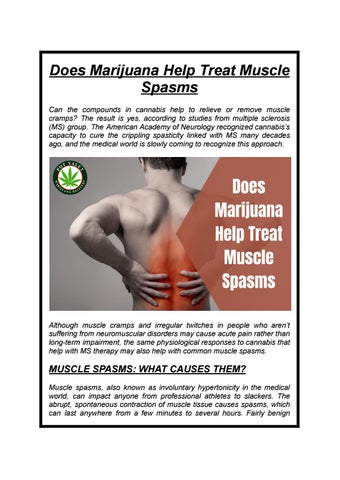
Does Marijuana Help Treat Muscle Spasms Can the compounds in cannabis help to relieve or remove muscle cramps? The result is yes, according to studies from multiple sclerosis (MS) group. The American Academy of Neurology recognized cannabis’s capacity to cure the crippling spasticity linked with MS many decades ago, and the medical world is slowly coming to recognize this approach.
Although muscle cramps and irregular twitches in people who aren’t suffering from neuromuscular disorders may cause acute pain rather than long-term impairment, the same physiological responses to cannabis that help with MS therapy may also help with common muscle spasms.
MUSCLE SPASMS: WHAT CAUSES THEM? Muscle spasms, also known as involuntary hypertonicity in the medical world, can impact anyone from professional athletes to slackers. The abrupt, spontaneous contraction of muscle tissue causes spasms, which can last anywhere from a few minutes to several hours. Fairly benign
contractions are commonly referred to as cramps, and they can be caused by: ● ● ● ● ● ● ● ● ● ●
Stretching insufficiently before physical exercise Muscle exhaustion Exercising in a hot environment Unbalanced hormones or pregnancy Dehydration Potassium, magnesium, and calcium electrolyte imbalances Circulation problems Unwanted weight Side effects of prescription drugs Age
Mild cramping can be relieved by resting and hydration. The more frequent and intense spasms that cause horrible twitches and high levels of discomfort, on the other hand, are more difficult to overcome. These persistent twitches and cramps may be triggered by one or more of the causes mentioned above, or by underlying health issues like spinal cord injuries, degenerative conditions like dystonia or Huntington’s disease, or nervous system diseases like amyotrophic lateral sclerosis (ALS) and multiple sclerosis. These effects can cause spasticity, which causes muscles to stay in a constant state of contraction, resulting in muscle stiffness or constriction and conflicting with normal speech, motion, and demeanor. More serious and sometimes chronic muscle spasms are usually treated with a variety of prescription regimens. Cyclobenzaprine, Tizanidine, and Baclofen are three of the most popular medicines used to treat muscle spasms. Sleepiness, vomiting, migraine, dry mouth, chest pain, dizziness, depression, and rashes are also possible side effects of these medications.
MARIJUANA FOR MUSCLE SPASMS Most of what we learn about cannabis’s ability to alleviate muscle spasms comes from MS science, which has led to its acceptance and uses as a cure for diseases like multiple sclerosis. The capacity of marijuana to minimize some inflammatory responses that cause muscle spasms has been reported. With the surge of marijuana delivery in Los Angeles is the increasing popularity of cannabis beneficial cannabinoids. Cannabinoids like THC
connect to cannabinoid receptors in the human endocannabinoid system, resulting in lower levels of inflammatory proteins, according to a study by the University of South Carolina. Low levels of these proteins cause the spasm response to be suppressed. Many studies have looked into the efficacy of THC/CBD combination therapies for reducing muscle spasticity and suppressing neurotoxicity. According to a new report published in the journal Frontiers in Immunology, “Anti-inflammatory effects of cannabinoids derived from marijuana (Cannabis sativa) and synthetic formulations have been well-studied. Cannabinoids have also been shown to help MS patients with spasticity and neuropathic pain. As a result, a medication containing 9-tetrahydrocannabinol (THC) and cannabidiol (CBD) called Sativex has been approved in many countries, including Europe, Australia, and Canada.” Other research has shown that the synthetic cannabinoid Nabilone greatly decreases spasticity-related pain and that smoking cannabis reduces symptoms and pain in patients with treatment-resistant spasticity. Five hundred people with spasticity were given the synthetic cannabinoid Sativex for four weeks in one of the most rigorous trials of its kind to date. According to follow-up reports, about half of the study participants recorded a 20 percent change in spasticity.
MARIJUANA FOR MUSCLE REHABILITATION There is substantial statistical evidence of marijuana’s ability to relieve or avoid the more common but less crippling muscle pain and spasms physical exercise, injury, or overuse, concerning evidence that proves its efficacy in assisting people with MS and other nervous system diseases. Muscle regeneration is one of the important ways cannabis can aid in the relief of these spasms. Marijuana and weed delivery services are becoming increasingly popular among athletes due to their anti-inflammatory properties in muscle repair. Any workout that increases in muscle size or strength is the product of a process in which muscle tissue is first ripped apart and rebuilt. This process usually causes a level of muscle tissue inflammation, which can trigger pain signals. The function of cannabidiol
(CBD) in reducing the harmful effects of exercise-induced oxidative stress is one of marijuana’s recognized anti-inflammatory properties. And professional sports teams are reconsidering their stance on the use of legal cannabis for pain relief and exercise rehabilitation as professional and elite athletes support CBD compounds for muscular recovery and pain management. CBD was withdrawn from the World Anti-Doping Agency’s list of banned substances in 2018 due to these reforms. Marijuana can help with muscle rehabilitation by decreasing the occurrence and duration of muscle spasms. It can also help with the discomfort of muscle overuse and damage during the recovery period. These pain-relieving properties have been well-documented in scientific journals. They add to the increasing body of evidence supporting medical marijuana usage in muscle rehabilitation after exercise and injury. Marijuana’s function in managing muscle spasms caused by accidents and other problems unrelated to diseases like multiple sclerosis has sparked a growing interest. There hasn’t been some definitive study, but considering the large body of testimony and anecdotal proof, it’s not difficult to believe that the same therapeutic effects that medicinal marijuana may have for MS patients may also be used to manage milder types of muscle spasms. In some states, if you have muscle cramps or chronic pain, you might be eligible for medical marijuana. People with muscle spasms show good outcomes from the hybrid and Sativa-dominant strains, according to community feedback. If you wish to use cannabis to relieve muscle spasms, you can check for the type of cannabis product you want on an online dispensary menu or weed delivery in El Segundo.
Thanks For Reading