Peace and safe return for all who are missing
BY TAYLOR SNOWBERGER
The Big Art Loop, a 34-mile trail encircling San Francisco that links more than 100 artworks, was launched by the Siljbrandij Foundation two years ago. The route includes the eastern shore, from Bayview to the Ferry Building, now populated with whimsical, cringey, and provocative sculptures. There are temporarily installed works funded by the Siljbrandij Foundation, and older public sculptures chosen through traditional civic processes involving neighborhood groups, public works officials, and arts commissioners.
Siljbrandij Foundation-installed sculptures tend to share two traits: monumental scale – more than ten feet wide or tall – and psychedelic sensibility. Many were originally fabricated for Burning Man or Love Burn.
In March, Friends of the Sunset Dunes successfully petitioned the Arts Commission to extend temporary installation of Siljbrandij Foundation-funded works located on the Big Art Loop for a year. A Friends of the Sunset Dunes survey found that while some sculptures drew ire, others, such as Spinning Rock by Zack Coffin, were popular.
Art along the eastern shore is nested in a network
BY JESSE DEE
If you’re driving on Potrero Hill this summer and a kid passes you by like they just got shot out of a cannon, you’re not hallucinating. The world’s fastest skateboarders are pushing the envelope on the Hill’s slopes, trying to break the sound barrier, or at least look like it on YouTube clips.
Skateboarding trends move in cycles, with skaters constantly re-making stunts that were cool decades ago, going higher, further and faster. Downhill skating is presently all the rage after a lengthy hiatus. San Francisco’s world-famous grades, including on Potrero Hill, are being conquered by stunt wood pilots seeking fame and fortune through board sales and shoe endorsement deals.
Fueling the madness is the all-seeing eye of the skateboarding media machine, a.k.a. Thrasher Magazine, the skateboarders “bible.” The publication and its video channels put certain hills into the global spotlight by showcasing the daredevil antics of fast and fearless “bombers” who lay it all on the line attempting to be the first one to slay virgin slope.
The fuse was lit several years ago by an unassuming laid-back lightning bolt named Frank Gerwer, who burned a new chapter into the ever-expanding book of skateboarding pioneers by becoming the first person ever documented to blaze down North Beach’s Kearny
from the
Q: What’s the proudest moment of your life?
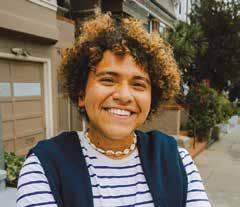
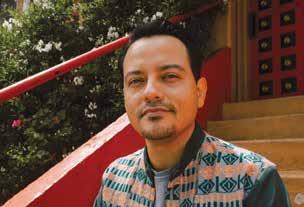
DJ Brookter: The proudest moment of my life was walking across the stage at Utah State University to receive my bachelor’s degree in Communications. As the first person in my immediate family to earn a college degree, that moment represented more than academic achievement. It symbolized perseverance, sacrifice, and the fulfillment of a dream that began when I was a child. Growing up, my highest aspirations were to play Division I college football and to earn my degree. Standing on that stage in Logan, Utah, and seeing my family members who had made the trip to support me was everything I had imagined and more. It was a deeply emotional reminder that success is never achieved alone. It is built on the love, encouragement, and belief of those who stand beside you. That moment continues to drive me. It reminds me of where I come from, the
responsibility I carry, and the importance of creating opportunities so others can experience milestones of their own.
Theo Ellington: Being a father to three boys, Lennox, Hendrix, and Maxwell has been the proudest moment of my life. I would also say becoming the first in my family to graduate from college. My grandfather worked as a laborer on roads and bridges in San Francisco. My mom raised my brother and I working as a concessioner at Candlestick Park for $18,000 a year. All that I am today I owe to the sacrifices they made. I can now pass along the values of hard work and determination to my own children.
J.R. Eppler: As a father, the biggest source of my pride now resides in my son. Like many city kids, he loves transit, and we’ve long enjoyed our “Muni Adventures,” on
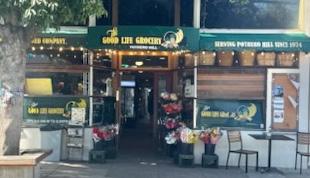
The Potrero View is San Francisco’s longest running neighborhood newspaper. For almost 56 years, every month –except for an occasional December – the View has appeared at Farley’s, The Good Life Grocery, and other distribution points throughout Dogpatch, Mission Bay, and Potrero Hill. For roughly half that time the paper has also been deposited at front doors and stoops.
I acquired the View from Ruth Passen, who, along with a volunteer band of “red diaper babies,” had spent decades handcrafting each issue. Bill and Jodie Dawson, alongside Lenny Anderson, Micky Ostler, and Rose Marie Sicoli, initially typed editions on blue stencil to be printed on a mimeograph machine. Later, under Vas Arnautoff’s watchful scrutiny, followed by Abigail Johnston, articles were cut and assembled onto boards using X-Acto knives and glue sticks. It was a physical process, in which words took physical form, presented as thoughts readers could hold in their hands.
My daughter was in kindergarten when I became the View’s publisher. She’s now in graduate school at the University of York in England. Like those before me, publishing the View hasn’t been my day job. While compiling articles from a rotating set of freelance writers, I consulted
BY STEVEN J. MOSS
for the U.S. Treasury Department in Niger and Senegal, taught politics at San Francisco State University, worked for Native American Tribes, and founded San Francisco Community Power, an energy efficiency nonprofit dedicated to closing the Hunters Point and Potrero power plants. The paper, and the community it serves, was always in the background, giving me an insistent monthly tug to make sure there were enough ads and stories to make each issue a success. A monthly alarm clock.
I’ve received numerous complaints about the paper. For a couple of years, after almost every issue, a caller would leave a long voice mail mocking various headlines, particularly those attached to my columns. He disappeared after the COVID pandemic; I miss him. I’ve also received reader compliments about a particular story or issue. One of my favorites was from Roger Hillyard, founder of
Farley’s, who was impressed that each issue was delivered promptly on the first of the month to his cafe, “like a real newspaper.”
At its best the View is a gift of hyperlocal knowledge, a paper prayer for civic engagement and democracy, a reminder to buy from nearby merchants. The crossword puzzle offers a moment of heady entertainment, the calendar a mix of possible outings, Lester Zeidman’s and Kayren Hudiburgh’s thoughtful display of items on sale at The Good Life Grocery, what’s being celebrated at Farley’s, and the eye-popping prices of the latest real estate offerings. The printed form, slow-cooked cadence, and grab bag of stories about land use, neighborhood personalities, and local history makes the View distinctly different from social media. Nothing pops up, harvests personal data, or pushes specific news or products whilst its being paged through. Though a user’s fingers might get inked-stained.
For much of the roughly 20 years I’ve served as the View’s publisher, the production team has included Helena Chiu, who designs each issue, and Catie Magee, who prepares and manages invoices. Ad salespeople and reporters, ill-compensated and subject to my periodically annoying getthings-done management style, tend to cycle through more quickly. Some, including Jessica Zimmer and Rebekah Moan, have had more staying power.
Advertisers have followed a similar pattern, with Farley’s, Goat Hill Pizza, Good Life Grocery, and St Teresa’s maintaining placements through most of the View’s history. Others – Rickshaw
Bagworks, Hiba Academy, Vanguard Properties, and Claudia Siegal – are of more recent vintage, making important contributions to paying the View’s bills while announcing what they’re offering the community.
I turned 65 last October. Not necessarily retirement age: Social Security pays maximum benefits at age 70. Still, the passage caught my attention. I’ve experienced elders who were slow, even resistant, to letting go of what they could no longer do well, especially when it’s what they cherished most. There comes a moment to say goodbye to everything, hopefully with grace. The clock, and my no longer youthful energy levels, tell me that it’s time to make transitions, for myself and my work.
In one way, the View is a community asset, a kind of information utility. In another it’s a chronically struggling, small business, kept afloat mostly by dedicated, civic-oriented, advertisers. I’ve spent the last year consulting with community members, merchants, and contributors, searching for the best opportunity for the View to survive, hopefully thrive, in our artificial, digital era. The journey ultimately led me to collaborate with the Gazetteer, a recently launched publication dedicated to citywide and neighborhood news conveyed on the printed page. While I’ll continue to publish the View until the end of this year, and contribute columns thereafter, this issue marks the beginning of a change to new ownership.
Ultimately, it’s the advertisers, subscribers, donors, and readers who will determine the View’s future. The paper needs your attention and affection to stay in business, especially as new threats emerge from outlets that’re leveraging philanthropic dollars to undermine longstanding neighborhood newspapers. Publishers like me, we come and go. Communities, in one form or another, are forever. I hope that whether or not my fingers touch a monthly issue, yours will. It’s your View

PUBLISHER Steven J. Moss
ACCOUNTING MANAGER Catie Magee
PRODUCTION MANAGER Helena Chiu
THIS MONTH’S CONTRIBUTORS Jesse Dee, Rebecca Dittrich, Steven J. Moss, Tamala Motta, Mark Steensland, Taylor Snowberger, Jim Van Buskirk, Dena R. Verkuil
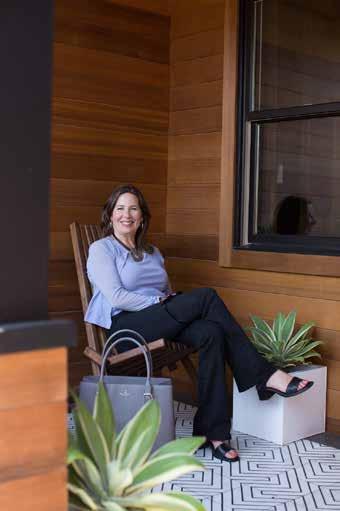
“and I wouldn't hesitate to recommend her ser vices to anyone. I felt like I was her only client even though I know that wasn't the case Claudia was a joy to work with; she is a super nice,
person with a great sense of humor At the same time I obser ved her willingness to push to make sure my needs were met. Final result - I followed Claudia's suggestions and received multiple offers, all
-Kk L Recent Client


Last month, at Fourth and Channel streets – where in February a driver ran a red light, killing a two-year-old and injuring her mother – municipal officials installed plastic posts to protect the bike lane and repainted thick white stripes in the crosswalks. Traffic safety advocates blame the roadway’s design, which features zigzagging turns, wide space for automobiles, and an absence of red-light cameras and traffic signals timed to give pedestrians a head start, for elevating travel hazards. In March, Safe Street Rebel placed flexible stakes along the bike lane, which San Francisco Municipal Transportation Agency staff replaced with new posts, creating a permanent “separated bikeway.” Police previously arrested the driver, Merih Fssha Solomon of Walnut Creek, on suspicion of vehicular manslaughter in connection with the February incidence.
BY TAMALA MOTTA
“Rec and Park Fined for Felling Community Trees,” in the June 2025 View, told the story of San Francisco Recreation and Park Department’s (RPD) illegal removal of apple and fig trees. The plants were on public property, under San Francisco Public Works’s (DPW) jurisdiction. RPD said the trees needed to be chopped down because they posed a risk to passersby. A $20,000 fine - $10,000 per tree - was issued to RPD for acting without a permit, which the department appealed.
At a hearing on the appeal last year, DPW urban forestry inspector, Captain Susan Nawbary, said she wasn’t sure why the fig tree was cut down. RPD Operation Manager for Community Gardens, Will Lyons, replied that Urban Agriculture and Community Gardens Program Director, Mei Ling Hui, had been tending the fig tree for many seasons but after repeated unauthorized excessive pruning by an unknown community member, the tree became a hazard.
Hill residents disagree with RPD’s reasoning, believing that the fig tree was in good condition and other factors might have led to its removal. One inhabitant said she occasionally felt threatened by community garden members when harvesting fruit from the tree, and that figs she’d picked were once stolen from her car. Another Hill resident and San Francisco Urban Forestry Council member stated that the trees weren’t in dire need of attention.
As a result of the hearing, the $20,000

fine was waived provided that RPD plant, water, and establish trees of equal total diameter as the ones removed, with replacement species to be agreed upon by all parties. DPW imposed a lien on the property for the fine amount, to be collected if a permit wasn’t submitted by March 2026, with trees planted by October 2026.
“As you may have heard, RPD is seeking to plant six fruit trees at 760 San Bruno in response to the Public Works hearing order from the fig tree removal last year,” Hui stated in a January email to community volunteers and other stakeholders. “I am writing to this group to request your feedback on tree selection, which will all be fruit trees. We understand that the community wants a fig tree to be replanted and have one on order already. With our climate, a handful of fruit trees produce really well, while some fruits are less likely to provide a good crop; the best producers are lemons, apples, and plums. We suggest a mix of these for the remaining trees.”
“One respondent identified a request to include native trees such as toyon,” stated Hui, in a follow-up email sent in February, indicating that the plan was to plant two lemon trees, two toyon trees, one fig tree, and one apple tree.
Hill residents were frustrated by the outcome, as they’d expected that all trees would be fruit bearing. Hui didn’t reply to the View’s initial queries on the topic.
“We are not ok with this selection at all,” said Hill resident Monica Packi. “In her first email, she clearly states that all six are to be fruit trees. We want six trees
of equal value to what we lost… fruit producing trees.”
“I have been working with Mei Ling on species selection for the project with the goal of addressing the community’s requests while also identifying a practical compromise,” said DPW Urban Forestry Inspector, Bryan Ong. “There are several factors involved beyond simply selecting tree species, including site conditions, planting restrictions, and jurisdictions. Due to safety concerns, no trees can be planted in the original proposed locations. The retaining wall in that area is not structurally sound and will need to be addressed by DPW at a later date… Given these constraints, the planting plan has been adjusted. To accommodate community preferences while maintaining site requirements, Mei Ling and I have proposed the following species selection: upper area, near the entrance, one apple, one lemon and one fig. Lower area, hillside behind the garden, one coast live oak one toyon and one lemon. As this is a community garden, we carefully considered input from all participants, and this plan represents a balanced solution that reflects everyone’s feedback.”
Last month Hui issued an email stating, “To the south of the main garden gate, we will plant one lemon, one fig, and one apple. In the lower park area to the south of the garden, down the steps and towards Caltrain’s fence, we will plant one toyon, one oak, and one lemon.”
The View again contacted Ong to ask her about community concerns related to tree selection. She replied by stating that the trees had already been planted.
BY JIM VAN BUSKIRK
“After four decades in Bay Area film publicity, Karen Larsen steps back; and the work goes on,” stated the press release, which went on to explain that Potrero Hill’s indefatigable publicist and community activist had closed her boutique firm. Her longtime colleague, Tim Buckwalter, would continue the business under a new name, Larsen Associated.
“My work has been important to me,” Larsen said. “But I’m not going to miss the day to day: sending out screeners, filing tear sheets, writing reports…”
Larsen wasn’t a passive publicist, actively engaging in all her projects. Now she’ll have more time for consulting.
“Any way I can be helpful, with whatever I know,” she said. “I need to start charging for that.”
Inducted into the Academy of Motion Picture Arts and Sciences in 2018, Larsen acknowledged the perks included invitations to special screenings and parties. She maintains close friendships with many of the people she’s worked with over the years.
“My dream was to turn the business over to someone. I wouldn’t let it go. My heart was set on it, even if it was unrealistic. Tim had worked with me years ago, then went away, then came back, this time showing more interest. When I asked him, he responded, ‘Let me think about it.’ I don’t know if my higher power stepped in, or what.
Since Buckwalter didn’t want her 360 Ritch Street office she has to clear out the space, the former site of Ritch Street Baths. She’s figuring out what to do with the furniture, including a table she inherited from Lawrence Ferlinghetti’s City Lights Bookstore. There are eighteen cabinets filled with files on people, tributes, festivals, films, including such promotional materials as posters, DVDs, and VHS tapes.
Asked about changes she’s noticed Larsen responded, “the whole scene is different.”
With Netflix’s rise, demise of video stores, closure of theatres like Embarcadero Cinema, it’s harder to get films shown.
Local Publicist continues on page 11
The Potrero Dogpatch Merchants Association potrerodogpatch.com
Our next meeting will be Tuesday, May 12 , from 9:45 to 11:00 a.m. at Goat Hill Pizza. Come along and enjoy a continental breakfast, connect with your fellow business leaders, schmooze, network and chat. Check out the lovely string lights we just installed along the 18th Street corridor.
Dogpatch Art & Business Association (DABA) dabasf.org
Connecting Dogpatch businesses, arts organizations, and community through events, resources, and local collaboration. Follow @destinationdogpatch
Get involved:
• Help develop/maintain our wayfinding map (linktr.ee/exploredogpatch)
• Help build our online business community platform
• Join as a supporting member
Dogpatch Neighborhood Association (DNA) dogpatchna.org
We nurture civic participation & community building while fostering the unique character of Dogpatch. Our meetings are open to all, but membership is the lifeblood of the organization. You do not have to live within the Dogpatch boundaries to be a member or attend meetings, you just need to care about what happens in Dogpatch. Monthly Meetings are held the second Tuesday of every month — 7 p.m. at The Dogpatch Hub.
Save the date: May 12, June Ballot Deep Dive. Kate Degelau-Pierce, Co-President of the SF League of Women Voters, leads a non-partisan exploration of the state proposals and city measures appearing on the June 2nd ballot. Gain unbiased insights into local bonds and charter amendments before you head to the polls.
Community Meet ‘n Clean: Join us May 10 at Progress Park, 12 to 1:30 p.m. Help keep the neighborhood beautiful!
JOIN DNA TODAY!
BY MARK STEENSLAND
Like many other Potrero Hill residents, life began elsewhere for Nader Hanhan and his wife, Summer. She was just five years old when her family emigrated from Palestine in the late-1960s. Nader arrived a decade later, after finishing high school, sights set on securing a higher education.
Their families knew each other back home. Their acquaintance changed to romance on the City College campus. Marriage followed soon after.
Nader worked at a grocery store his brothers owned, then got into the clothing business with Summer. They started with a store on Broadway Street in Oakland, eventually expanding to 10 locations, including an Oxford Street outlet at the now-closed Hilltop Mall in Richmond. He was accepted to the University of California, Berkeley as an engineering major, but management issues at the Richmond store forced him to take time off from school. His return was further delayed by the need to provide for his

Friends of Jackson Park (FoJP) friendsofjacksonpark.org

Join us for Coffee & Kids in Jackson Park on Sunday, May 3rd, 9 to 11 a.m. Brings your friends, family and neighbors to jumpstart your morning with coffee & donuts and to learn more about FoJP and the upcoming park renovation. Hope to see you there!
We’re looking for community support so please use our QR code and donate today. Every dollar helps! More info at: friendsofjacksonpark.org

Green Benefit District GreenBenefit.org
Get involved with the Dogpatch and NW Potrero Hill Green Benefit District!
Join us for our Monthly Board Meeting on Wednesday, May 20, from 6:30 to 8:30 p.m. at the Dogpatch Hub (1278 Minnesota St.), where we will discuss all the great things we’re doing in the neighborhood. Questions? Contact us at info@ greenbenefit.org.
Help make the Green Benefit District greener! Our next GBD volunteer event is at the Vermont Greenway & Eco-Patch on Saturday, May 16, at 10 a.m. Sign up for a GBD volunteer event at greenbenefit.org/volunteer or report an issue at greenbenefit.org/report-a-problem.
The Potrero Boosters Neighborhood Association potreroboosters.org
New to town or just looking to spend some time with neighborhood friends? Join us for our May social at Thee Parkside, 1600 17th Street on Tuesday May 26th at 7 p.m. What does the neighborhood mean to you and what would you like to see for its future? We’d love to hear it! The Potrero Boosters Neighborhood Association informs, empowers, and represents the residents of the Potrero District on issues impacting our community in order to develop and maintain complete, vibrant neighborhoods.
growing family, with three children. He eventually committed to running the business full time.
“I had to do it,” Nader said wistfully. “But I promised myself to educate my kids.” And he did. All three are college graduates, working in their chosen fields.
“One is now a computer engineer, one is a graphic designer, and the other is a physical therapist,” he said.
Nader eventually shifted back to the grocery business, purchasing a shop on Haight Street in 1995, acquiring New Potrero Market in 1996 from fellow Palestinian immigrants Jamil Khuri and Abdallah Shami, who’d been running the place since 1960. In 2010, the Hanhans sold the Haight Street store and committed full time to the corner of 18th and Texas streets.
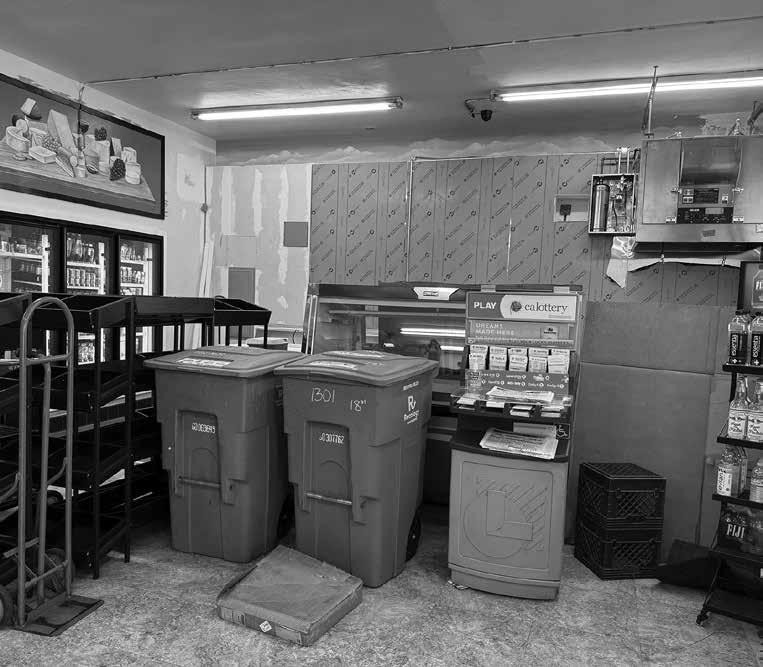
They weathered the challenges of the pandemic. Rising costs created the need for an additional revenue stream. Two years ago, they decided to convert part of
Potrero Hill Community Connectors sfcommunityliving.org
The Potrero Hill Community Connectors, a program of the Community Living Campaign, bring neighbors together each week at the Potrero Hill Neighborhood House for FREE exercise, wellness, learning, and community.
Start your Thursday with the Adult Exercise Class from 10–11 a.m., featuring gentle strength, balance, flexibility, and Chair Yoga with Carolyn. Tea, snacks, and community time are offered before and after class, creating a welcoming space to connect.
This month, we’re highlighting Drop‑In Tech Help at The NABE with Dana Cayce. Prefer not to walk the hill? Dana offers appointments and can meet you at the Potrero Hill Library or over a cup of coffee at Thinkers Café. To schedule, call (415) 821-1003 x109.
On May 7, from 11 a.m. to 12 p.m., join us to create wildflower bud vases for yourself or a neighbor. Happy Mother’s Day on May 10th.
Every Last Thursday, we celebrate Born‑On Birth days at 11:15 a.m. with a light lunch and cake. For details, contact Kuzuri at: kuzuri@sfcommunityliving.org or (415) 955-7239
Starr King Open Space
StarrKingOpenSpace.org
Join our monthly volunteer days on the second Saturday of the month. This month it is Saturday, May 9 from 10 a.m. to 12 p.m. Our annual meeting and election is Monday, May 18 from 7 to 8 p.m. at the Potrero Neighborhood House. Food & drink provided. Donate to help keep Starr King Open Space open, accessible, and well-maintained for our neighborhood.
For a $225 annual fee (up to 150 words) or $300 (151 to 200 words), your organization can be listed in Getting Involved. Contact production@potreroview.net
BY REBECCA DITTRICH
Before my dad, Rich Dittrich, had a massive stroke in 2021 he was an adventurer, deep sea fishing and riding jet skis at 40 miles per hour. He practiced as an obstetrician-gynecologist at Thomas Jefferson University Hospital, located in Philadelphia, a pioneer of hormone replacement therapy. He was seeing patients, teaching medical students, and regularly swimming until his cerebral hemorrhage.
In the wake of his catastrophic stroke, he was given a less than 25 percent chance of surviving. He now relies on a wheelchair for mobility, and his severe aphasia, a language processing disorder that leaves him unable to engage in meaningful
conversations. It’s an incredibly difficult reality for a man whose greatest currency was once charisma and conversation.
Post-stroke, dad moved to an assisted living facility in Brooklyn, New York to receive therapy and be closer to my husband, Bryan, and me. Two years later we relocated to the Bay Area, nearer my sister, Danielle, a Menlo Park resident, along with her spouse, Aaron, and their two children, Dylan and Chloe. After viewing a couple hundred homes to find one that could be altered for ground-floor accessibility, we bought a duplex, renovated it to be wheelchair manageable and relocated to Potrero Hill.
BYOW continues on page 11
Hi Neighbor, Potrero Hill is a hyper-intense micromarket. With only a 0.7-month supply, unprecedented demand is pushing sales frequently past $1,600 per square foot But achieving a peak price isn’t standard—it’s strategic.
I know Potrero block-by-block, matching every street’s unique value with my proven marketing plan. Whether you own a North Slope Victorian or a Dogpatch loft, I customize your strategy with precision staging and targeted data. The goal? Delivering the highest possible sale price per foot
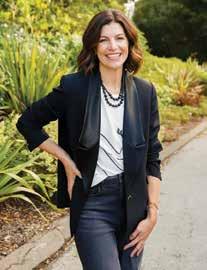
After 34 years in our home, Sally’s communication and marketing strategy made the process seamless. We received multiple offers and set a new record for our street.”
- Annette E.

Let’s Grab Coffee at Farley’s—My Treat.
Let’s talk data and how a tailored strategy can maximize your home’s value.
SALLY THOMPSON-HAWKS
Potrero Resident & Real Estate Advisor
415.812.7032 | sally@sageteam.com | DRE #01382744


5/3 Sunday
Community: Empty Bowls
Empty Bowls will benefit the San Francisco-Marin Food Bank, combining art and activism to fight food insecurity. For $65 choose from an array of handcrafted bowls donated by San Francisco Bay Area artists, fill it with soup and sit down for a simple meal of soup, bread and a cookie. The bowl is yours to keep. Soups provided by Cafe Josephine, with vegan options available. Wine and beer will be on hand for purchase. 1 to 3 p.m. $65. Randall Museum, 199 Museum Way. For more information: www.sfemptybowls.org/
5/6 Wednesday
Art: Yerba Buena Center for the Arts Free Admission Day
Opened to the public in 1993, YBCA was founded as the cultural anchor of San Francisco’s Yerba Buena Gardens neighborhood. Offerings span the realms of contemporary art, performance, film, civic engagement, and public life. 11 a.m. to 5 p.m. Free. Yerba Buena Center for the Arts, 701 Mission Street. For more information: ybca.org/visit/
5/7 Thursday
Design: Museum of Craft and Design Free Admission Day
Founded in 2004, MCD showcases designers, makers and artists through a distinctive series of exhibitions and public programs. As a non-collecting institution, the museum collaborates with artists, designers, museums, and universities, as well as venues and
practitioners to create experiences in the world of craft and design. 12 to 5 p.m. Free. Museum of Craft and Design, 2569 Third Street. For more information: sfmcd.org/visit/
5/8 Friday
Music: Jazz Without Borders
Lua Hadar’s Jazz without Borders blends global styles and languages. She peppers her show with funny stories to connect the dots between her influences and her songs. She and her band, Twist, will perform from samba to swing. 8 p.m. Tickets from $20. Community Music Center, 544 Capp Street. For more information: tinyurl. com/TicketsLua
5/10 Sunday
Mother’s Day: Free Guided Walking Tours of San Francisco
Spend quality time with mom while learning something new about the City you love. San Francisco City Guides offers 14 free guided walking tours on Mother’s Day. 10 a.m. to 4 p.m. Free, except where admission fee is required. For more information: bit. ly/4tPjetp
Music: A Mother’s Day
Celebration with The Golden Gate Park Band
Celebrate Mother’s Day with soaring melodies at a special concert in Golden Gate Park. Featuring special guest soloist Sarah Jaegers on clarinet, the afternoon promises warm nostalgia and uplifting harmonies beneath the open sky. 1 to 2:30 p.m. Free. Spreckles Temple of Music, 50 Hagiwara Tea
Garden Drive. For more information: bit.ly/487fTO2
5/14 Thursday
Calligraphy: Exploring My Curiosity for Language Through Calligraphy
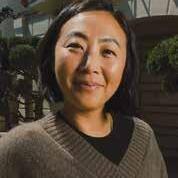
Step into a world where language becomes art, with a glimpse into Takako Takigawa’s creations. This salon offers a rare opportunity to experience Takigawa’s calligraphy and book work up close, accompanied by her reflections on the process: selecting a passage, shaping its form, scale, and layout on each page, deciding which words deserve emphasis. Calligraphers, designers, typographers, and anyone curious about the expressive potential of written language will find fresh perspectives in this exploration of how calligraphy and the book arts meld the visual and the verbal. Born in Japan, Takigawa has been teaching and creating calligraphy works since the 1990s. She’s lived in Brazil and Hong Kong. 6 p.m. $9.85 to $28.52. Letterform Archive, 2325 Third Street. For more information: bit.ly/4sCzBsj
5/15 Friday through 5/31 Sunday Theater: PlayGround’s Festival of New Works Festival of New Works showcases the next generation of playwrights This year’s festival will be highlighted by the premiere presentation of Mycelium by Juliet Kang Huneke. It also features staged readings of three brand-new plays in development under commission as part of PlayGround’s year-long Playwright Residency Program: Good Romans by
Baylee Shlichtman, The Case of the Missing Messenger by Madeleine Butler, and Disloyal by Anne Brady. Four playwrights will be recognized this year as Fest ival Finalists for their outstanding plays. Potrero Stage, 1695 18th Street and simulcast. For more information: playground-sf.org/ festival/
Art: SFMOMA’s Hat Party for Matisse Exhibit Opening
Celebrate the opening of Matisse’s Femme au Chapeau: A Modern Scandal by wearing your favorite hat. The exhibition, on view until September 13, explores the history and impact of Matisse’s iconic 1905 portrait of his wife, Amélie, a work that shocked Paris and became a cornerstone of modern art. Visitors can participate in handson activities, including making hats from recycled materials and crafting flores de papel. Open to all ages; activities included with regular museum admission. 10 a.m. to 5 p.m. $30. SFMOMA, 151 Third Street. For more information: bit.ly/4tfzx2P
Health: Beach Tai Chi
Known for its slow, intentional movements, tai chi has practitioners worldwide and is particularly popular as a form of gentle exercise and moving meditation, with benefits to mental and physical health. All welcome. 10 a.m. Free. Meet at Judah Street and Great Highway. For more information: https://bit.ly/4mEPpcO
Calendar continues on next page






5/21 Thursday
Art: Watercolor Postcards
Enjoy a cozy hangout at ARCH and paint watercolor postcards. After Hours is informal, uninstructed. Supplies available for testing. Bring your
favorite along with a project to work on or follow a prompt and experiment with art material samples. Light snacks and beverages on offer; feel free to bring your own. 6:30 to 8:30 p.m. $10. Each attendee will receive a $10 ARCH gift card; no-shows forfeit it. ARCH Art Supplies, 1490 17th Street. For more information: bit. ly/4csbqH2
5/23 Saturday and 5/24 Sunday
Community: Carnaval Festival Carnaval San Francisco offers five main stages, 50 local performing artists, and 400 vendors, with international food, dancing, and entertainment. Over its 48-year history, the festival has welcomed renowned artists and delivered a vibrant cultural experience, drawing more than 400,000 attendees annually. The Grand Parade
features a 60-contingent lineup with 5,500 artists representing the cultural heritages of Brazil, Mexico, Panama, Bolivia, Cuba, Peru, Puerto Rico, Nicaragua, Colombia, Trinidad and Tobago, Guatemala, El Salvador, and more. Festival hours: 11 a.m. to 6 p.m. Grand Parade begins at the corner of 24th and Bryant streets at 10 a.m. on Sunday. For more information: carnavalsanfrancisco.org


150+ classes a week. 365 days a year.
I N S E CT PA LO O Z


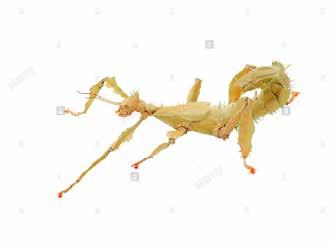
Get up close and personal with live arthropods from the Insect Discovery Lab, including the Australian Walking Stick, Giant African Millipede, and many more! Make insect-inspired art with local artists, bid on an African safari, and taste mealworm chocolate-chip cookies, too! JUNE 7, 2026 12PM-3PM





Our care is one-of-a kind. We don't just treat symptoms. We treat your child from the inside out.
We find the right remedy. We gladly offer safe alternatives to antibiotics when appropriate.
We offer house calls. Life is busy, let us come to you.
We’re always here. Your GetzWell provider is available 24/7. Just call or email. We’ll answer.
We are what we eat.
We believe nutrition and functional medicine are powerful ingredients for growing kids.


different lines around San Francisco. One of the proudest moments of my life was our first ride on the 55 Dogpatch line, a route I advocated for and helped design after the 22 Fillmore route changed. Riding it together was special because my son understood that his dad had helped make it happen, and it helped him see how citizen advocacy can make a real difference in people’s daily lives.
Q: Who is your best friend?
DJ Brookter: My sister is my best friend. Growing up, we shared a room for the first nine years of her life before our parents were able to afford a home where we each had our own bedrooms. That experience created a bond between us that has only grown stronger over time. After our mother passed away, I left for college a year later. Watching my sister grow into the incredible woman she is today has been one of the greatest blessings of my life. She is not only an amazing mother, but she has also earned two degrees, accomplishments that reflect her resilience, determination, and strength. Seeing the woman she has become continues to fill me with pride and gratitude. I truly could not have been blessed with a better sister or a better friend.
Theo Ellington: My best friend is my brother, Edwin Gipson. He’s always been my biggest confidant and the person who has shared every part of growing up in Bayview with me—from the loss of our cousin who was shot and killed in the neighborhood, to telling stories through the documentary film work I did in high school about the 24 bus line and the homelessness crisis we saw every day. Those experiences shaped how we see San Francisco and why this work matters to me. My brother has always kept me grounded and reminded me that this work–whether organizing neighbors to fight for environmental justice at the Hunters Point Shipyard or standing against the discriminatory policing practice of stop and frisk–is ultimately about people, dignity, and community.
J.R. Eppler: My best friend is Will. We met in fifth grade and went through high school together, playing baseball and spending so much time at each other’s homes that our families became each other’s second family. What bonded us was a shared curiosity about the universe; we could spend hours talking about space and the future of exploration or the history of our country. Over the years we’ve stayed close through all of life’s chapters: leaving home, building careers, starting families, and navigating the triumphs and challenges of adulthood. Will now lives in the Oklahoma City area, where he works as an adjunct history professor and an education technology project manager, but distance hasn’t changed the foundation of our friendship. We share the same values and political outlooks, and our decades-long friendship has reinforced for me how important loyalty, community, and showing up for people really are.
Q: What do you like most about Dis trict 10?
DJ Brookter: I love D 10 because it stands out for its sunny weather, vibrant culture, and strong sense of community. Our neighborhoods like Vis Valley, Little Hollywood, Bayview, Potrero Hill and Dogpatch are known for being among the sunniest parts of the city. The district is one of the most culturally diverse areas,
with deep roots in communities centered around Bayview–Hunters Point. With community gardens, historic neighborhoods, and evolving waterfront spaces, District 10 reflects the resilience, diversity, and character that makes San Francisco unique.
Theo Ellington: Our greatest strength is the diversity of our residents. In no other district in San Francisco do you have a historic Black neighborhood, a burgeoning immigrant community, the new AI/ Tech capital of the world, makers and creatives, first generation Americans, and working-class families all living side by side. District 10 is a welcoming neighborhood that has a real opportunity to grow without displacing longtime residents. We’ll soon have the best waterfront in the world, with development sites at Pier 70, the Power Station, the Shipyard, Candlestick, India Basin, and Schlage Lock. We need leadership that will actually fight to get these projects over the finish line and to make sure the people who live in, work in, and love this district share in its future.
J.R. Eppler: What I love most about District 10 is its character and possibility. Nowhere else in San Francisco brings together such a wide range of neighborhoods and people, with families who have been here for generations alongside newcomers building their lives and businesses. This district has always been the city’s working backbone, shaped by shipyards, rail yards, factories, and small businesses that powered San Francisco’s growth. You can still feel that history in the streets and along the waterfront. At the same time, District 10 holds enormous potential for the future. With thoughtful leadership and investment, it can strengthen its spot as the working heart of San Francisco, creating jobs and supporting families in a community where opportunity and prosperity are shared by everyone who calls it home.
District 10 Supervisor Q & A continues in the June issue.
the market into a deli, offering sandwiches to customers who may not have time for a full-service sit-down meal offered by nearby locations such as Plow or Chez Maman. With no one in the area serving the sort of food they grew up with, they added gyros and shawarma alongside kaiser rolls and cold cuts to the menu.
They’ve been steadily pursuing their quest to turn the deli dream into reality, with more than a few bumps in the road along the way. The expanded operation needed more electrical power. Getting Pacific Gas and Electric Company approval to upgrade the store to 200 amps took nearly a year. The original December 2025 installation date was cancelled due to weather; additional scheduling conflicts delayed it a fewer three months.
In the interim, Nader hired Shatara Architecture to design the remodel and set to work, repainting the store’s interior before moving shelves and coolers to make room for the deli. Besides cosmetic changes, they’ve partnered with Toast for point-of-sale systems and equipment, installed a new hot water heater, new sinks, new coolers, a ductless hood over the cooking area, and an ANSUL fire suppression system.
Nader said his total investment in the project so far is more than $200,000.
“It’s a lot,” he admitted, but both he and Summer hope that their unique offerings will enable the corner market to thrive, starting with a soft reopening this month.
BY DENA R. VERKUIL
The Potrero View is accepting crossword puzzle submissions. To be considered for publication puzzles should adhere to standard crossword size (15x15) and specs; fill/clues/theme must have local relevance. Happy to take theme inquiries or unclued grids for feedback before construction. Please e-mail: denarobin@me.com

Carl Anthony February 8, 1939 April 4, 2026.
Carl Anthony was a groundbreaking architect, author, and community strategist who bridged the oft-separate worlds of civil rights and environmentalism. As a founder of Urban Habitat and the Breakthrough Communities Project, Anthony spent more than five decades arguing that a healthy environment is a fundamental human right; one that cannot be separated from the struggle for social and economic equity.
Born in 1939 in Philadelphia’s Kingsessing neighborhood, Anthony’s early life was shaped by the stark contrasts of mid-century urban America. One of the few Black students at Columbia University’s architecture program in the 1960s, he felt the profound tension between his professional training and the civil rights movement burning in the streets outside. Rather than choosing one, he integrated both, traveling across Africa after graduation to study how indigenous cultures adapted their structures to the natural world; a journey that would define his “ecological architecture”.
In San Francisco, as the former president of the Earth Island Institute, Anthony
intersection at the bottom, coming to a stop under the cameraman’s tripod, beaming with a classic “did I do that” smile. The yackity yacking went viral almost immediately when a commentor took notice that the hill was so steep it has a staircase instead of a sidewalk. The web’s blah blah grapevine then dissected every trivial detail of the 15 second missile launch, down to whether Gerwer’s windbreaker had a zipper and, if not, did he have five or six buttons on it or was it Velcro. Bombing hills was back on the front page.
Gerwer’s defeat of Kearny Street was the first shot fired in the current battle to see who can go down the world’s biggest, fastest and scariest looking slopes and live to tell about it. Baxter Street, the second steepest hill in Los Angeles, was the next massive peak to fall, successfully bombed by Don “Nuge” Nguyen. After that came explosive videos from GX 1000 and Deathwish skateboards featuring Sean Greene, Jeff Carlyle and Tristan Funkhouser, who should start charging rent on Taylor and Quintara streets; for all practical purposes they own them, two of the most fearsome mountains in the entire range.
It’d be criminal not to mention Pablo (P-Spleef) Ramirez (R.I.P.), one of the most talented people to ever touch San Francisco streets with a skateboard. In the mid-2010s he pretty much owned any hill west of Twin Peaks and several others while spreading the kind of vibes skating just can’t get enough of.
In the present day a guy who lives
combined the traditions of Martin Luther King Jr. and John Muir. He challenged the mainstream environmental movement to look beyond pristine wilderness into the heart of the “built environment;” the neighborhoods, transit systems, and parks where people of color lived and worked.
Anthony served as president of the Berkeley Planning Commission and led the Ford Foundation’s Sustainable Metropolitan Communities Initiative, where he championed the idea that cities and suburbs are part of a single, interdependent system. In the Bay Area, he was an advisor on the conversion of the Presidio into a national park and supported such neighborhood projects as the Potrero Gateway Park.
Anthony taught at the University of California, Berkeley, Harvard, and Columbia. He authored The Earth, the City, and the Hidden Narrative of Race, which offered a roadmap for a activists seeking to build a “multiracial leadership for sustainable communities”. Anthony envisioned a future where every neighborhood—from Dogpatch to the Delta—offered clean air, green space, and a sense of belonging.
He’s survived by his longtime partner and collaborator, Dr. Paloma Pavel.
up to his name, Deshun Byrd, has people in the know talking about his successful flights down both Elizabeth and Duncan streets in Noe Valley.
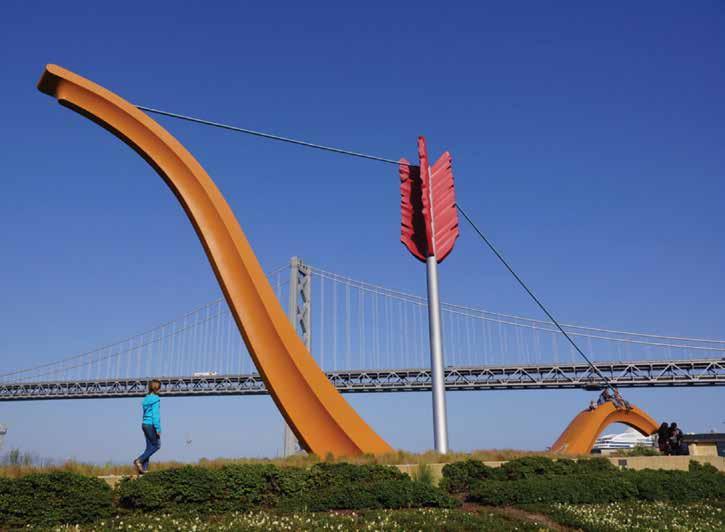
In Potrero Hill in 2024 Frank (Frontside Frank) Gallagher cemented his place in the history of San Francisco hill bombing by going down De Haro Street from the top unscathed. Gallagher’s Instagram post, besides putting people on the edge of their seats, shifted the down hilling focus from Downtown to the Hill. Now, every fast skater in the world looking to make a name for themselves wants to be the first person to drop in on one of the neighborhood’s many terrifying slopes. De Haro, Arkansas, Carolina and 23rd streets, among others, can be like gigantic concrete waves that’re highly photogenic, with Victorian “painted ladies” and the City’s skyline in the background.
San Francisco is known for its 43 different hills, each with its own character. To skaters the City is a 49 square mile public skatepark that’s open 24 hours a day, a virtual Baskin and Robbins of different flavored chutes and ladders that range in difficulty from green square bunny slopes to triple black diamonds that can test even the best riders. To a skater the City’s hills seem like gigantic hundred-foot waves begging to be ridden. Much like a hundred-foot wall of water they can crush you like an aluminum can.
Streets such as Elizabeth, Taylor, Kearny, and De Haro have only been successfully bombed by a handful of skaters and have left more than a few wannabes with painful road rash souvenirs from getting tossed like a salad or put in the spin cycle from going splat to the flat.
Daredevils skating down hills is nothing new in the City; it’s been going on since the most famous pro, the legendary Tommy Guerrero, and the C.B.S. crew started using Muni busses as urban ski lifts to get to the top of Ninth Avenue in the early-1980s. These days the aces have pushed bombing hills to another level by doing difficult maneuvers at the top of the slope and then flying down the hill in a victory ride that can be terrifying to watch for the uninitiated.
The View invites those under 18 to submit any creative work suitable for publication, including drawings, short stories (fewer than 150 words), photographs, comic strips, jokes, before the 20th of the month. Winning entries will receive a $20 prize. Please send submissions to editor@potreroview.net
Looking for the perfect one-of-akind gift? SF Neighbors specializes in custom fine-line, hand-drawn illustrations full of whimsy and warmth that celebrate the love and memories of places that mean the most to you. Learn more: sfnghbrs.com
The View accepts legal notices. Please contact: production@potreroview.net; 415.643.9578.
Modest pay, interesting assignments. Contact: editor@potreroview.net
We're all going to die; why leave the writing of your obit to someone else? Whether you believe the end is imminent or just something you contemplate idly whilst taking a shower, you can control your own destiny, or at least how it's reported. Or, after examining your life story and finding it lacking, add to it! Up to six people in three two-hour sessions, $150. Interested parties should contact editor@potreroview.net
Sixty-something male intermediate tennis player looking for (semi) regular rally or game partner. Email editor@ potreroview.net
Got something to sell? Have a service to provide? Each classified ad is $25 for up to 200 characters. www.potreroview.net/advertise
Jumping urban cornices and taking Satan’s slingshot down the City’s steepest grades isn’t for the faint of heart. With speeds greater than thirty miles an hour, there’s no room for error. It requires the confidence of a base jumper, the balance of a high wire walker and the hunger of a Peregrine falcon on the hunt. One false move can send a person to the hospital.
“Part of the allure is the danger” said veteran downhill skater Bill Harper, who moved to San Francisco from Redding specifically to skate the hills and recently became the first person to shoot 23rd Street from the top all the way down to Potrero Avenue. “The best way to bomb hills is to not even think about falling. You just gotta envision yourself high fiving your friends at the bottom and go all in and commit to it.”
Harper knows what he’s talking about. He’s paid his dues and has road rash scars from a crash on Dolores Street when a combination of faulty equipment and wet pavement caused him to get the dreaded “death wobbles,” which cause a rider to lose your stability and get tossed face first from seemingly out of nowhere.
According to Harper, what makes skaters today different from the pioneers is that the entire death or glory operation is “filmed from at least two angles, and more importantly people have friends blocking the intersections to avoid collisions with cars” which could be fatal.
“In the old days guys would just cross their fingers and roll the dice, but after a couple high profile automobile deaths, especially the tragic Pablo Ramirez incident, you don’t really see that happening anymore,” he said.
He added that while 23rd Street might look borderline suicidal to some people it’s just a matter of being confident. And “the bright side is that General Hospital is at the bottom and open for business 24 hours a day.”
Big Art Loop from front page
of intersections and ports that reflect years of industrial history. Bright ship hulls breach the water behind century-old brick warehouses. Once a manufacturing employment center, tourists are now drawn to Oracle Park, Chase Center, and multiple public spaces.
Publicly funded sculptures on the Big Art Loop in Bayview include Promissory
Notes , at the Southeast Community Center entrance at 1550 Evans Avenue. Made by Mildred Howard, a San Francisco–born artist, it’s a bronze rendition of three anklets standing stiffly on their sides, meant to evoke a ship’s hull. Blair Randall, San Francisco Public Utilities Commission Arts and Education Program Manager, who keeps an online archive, quoted Howard as saying, “the work will stand as an homage to the travels, trials, and perseverance of Bayview residents.”
A 13-foot-tall African mask hung on a pole stands in the middle of the dock at India Basin Waterfront Park. The artwork, “Whispers of Waste,” is by Zulu Heru, 31, an Army veteran turned sculptor with a studio a block away from India Basin. Made of 5,000 pounds of industrial materials, mostly recycled, it’s the 20th installation along the Big Art Loop.
Site-specific sculptures at Islais Creek include self-serious Islais, by Cliff Garten, which occupies a small traffic island and evokes a flowing, waterlike feeling. Its blue and white colors reflect the sky, clouds, nearby waterway, and an adjacent building. More didactic than interactive, Ship Shape Shifting Time at Islais Creek Park, by Nobuho Nagasawa, mimics the dimensions of cargo ships that commonly plied the creek in the 1950s, offering historic information.
Temporary installations in Mission Bay associated with the Siljbrandij Foundation include the overbearing Hulls, by Richard Deutsch, at Glen Haven Park, featuring elongated metal spires that resemble impatiently steepled fingers, their chrome patina suggesting a less-than-human touch. Nearby, at Mission Creek Park, is the inviting Louis, by DeWitt Godfrey, an interactive sculpture with a hive-like structure sporting a rusted patina, allowing observers to experience the artwork from inside.
The bright red Dr. Fisherian’s Runaway Machine, by Chris Wollard and Kevin Conran, seems not to know why it’s there any more than you do, but it clearly defines Crane Cove Park as a place for children, play, and innocence. Local artist Bryan Tedrick produced Steelhead out of reclaimed metal from a Napa winery fire. His talent for creating flow from jagged individual pieces is apparent. The sight
Big Art Loop continues on next page
of fabricated salmon, located at the intersection of China Basin Street and Terry A Francois Boulevard, near the water, is sensible if not thrilling.
Two notable, permanent, municipal acquisitions are Olafur Eliasson’s Seeing Spheres, and Cupid’s Span by Claes Oldenburg and Coosje van Bruggen. Monumental in size and experimental in concept, Seeing Spheres, with its mirrorlike chrome and round forms, encourages play via reflections.
“Seeing Spheres offers a place to pause, where you see yourself from the outside, as a participant in society,” Eliasson stated in a press release.
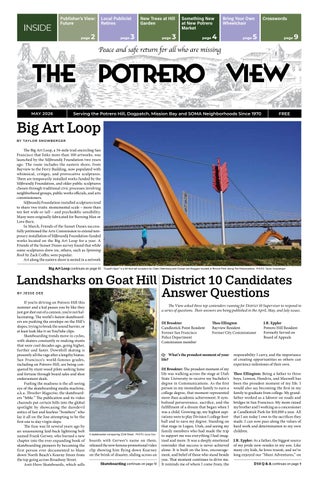
Cupid’s Span, which rests just below the Bay Bridge thoroughfare, consists of a huge bow and arrow painted with red and gold enamel, its arrow piercing Rincon Park’s green grass, suggesting adulation for San Francisco.
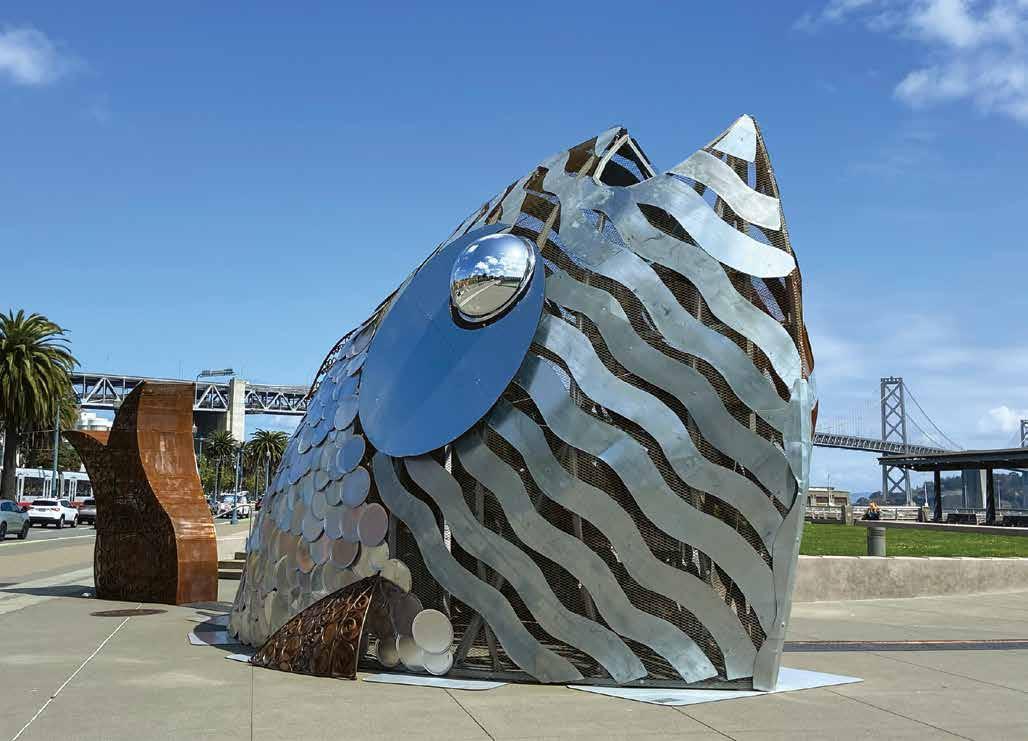
South-of-Market hosts Corpus by Michael Christian, a San Francisco artist, and Atabey’s Treasure by El NiNo, alongside Aurora by Ruth Asawa, a San Francisco–based artist and educator. All are located roughly at The Embarcadero and Market Street, where ocean and water themes naturally concentrate. Asawa’s elegant examination of weaving and paper folding echoes the forms she discovered through her hallmark explorations of everyday materials in sculpture. Slightly goofy, Atabey’s Treasure is a large fish made of recycled pizza pans, which joyfully recalls the children’s book The Rainbow Fish Corpus blends the nautical with the surreal in its domineering metal form.
Creating a narrative along Third Street, these works transform the historic waterfront from an elegy of labor and industry into a meditation on public space, neighborhood spirit, and contemporary art. This experimental curation won’t last forever; go look for yourself.
The Covid pandemic didn’t help.
“Young people got used to watching movies at home. Everybody still needs publicity. Is there a formula? Absolutely not! You have to make it your business to know who likes what. You have to know how to get the word out.”
Larsen has nine grandchildren, two great grandchildren, soon to be four. One due “any minute;” another in June. In addition to family engagements, she’s coordinating a reunion of the “Over Easy” veterans, to take place at the Bay View Boat Club in October. She worked as a researcher on the popular KQED show about healthy aging, which aired twice a day from 1977 to 1982. She’ll continue promoting — pro bono — Potrero Hill History Night, hosted by the Potrero Hill Archives Project, as well as the Potrero Hill Festival. She encourages people to shop locally, citing The Good Life, Farley’s and Thinkers cafes.
“I love the library! I’m not going anywhere. You’re still going to see me!”
BYOW from page 5
We told dad’s private aide in New York, Issabelle, presently 70-years-old, that we’d be moving to San Francisco, and invited her to come with us. She quickly replied, “okay,” with a smile. It was the beginning of a dynamic, multigenerational home, which now includes my ninemonth-old, Brooklyn.
At 78-years-old, dad does his best to socialize, participating in an aphasia conversation group at San Francisco State University and stroke survivors support gathering through Kaiser. He’d like to resume teaching, a formidable challenge given his aphasia. For a man once full of adventure, his wheelchair and lack of body control have made him reluctant to go on outings. More often than not, when someone asks how he feels about the move he
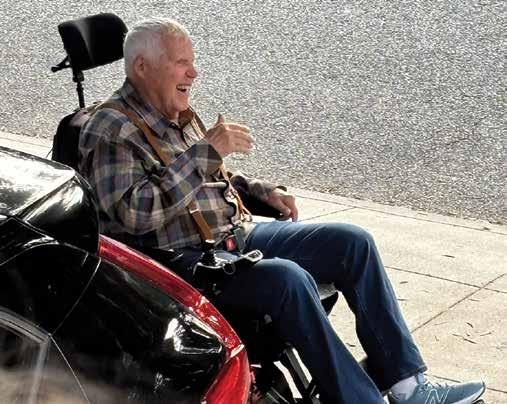
responds “family,” with positive inflection, before replying “hills,” with reluctant disappointment.
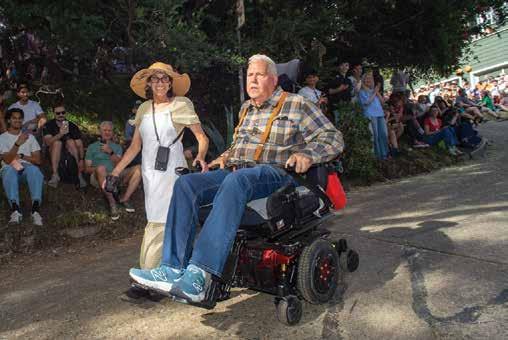
Last year’s Bring Your Own Big Wheel was the first neighborhood activity we participated in after moving to San Francisco in 2024. My family loved it. Danielle plotted this year’s costume theme for months. The race is just a few blocks from our 20th and Rhode Island home. We walked – dad wheeled – there with a big crew: my sister-in-law and brother-in-law, Alyssa and Nick, in from Arizona with their two children, Annie and AJ; my mom, Phyllis; my dad’s second aide, Utulei, who joined his care team a couple of months ago; Danielle, Aaron, Dylan and Chloe; Bryan and our daughter. We sported a collective “Old McDonald Had a Farm” costume theme, planning an Easter egg hunt afterwards.
As we watched the race, Danielle suddenly caught my dad on video halfway down the hill. No one knew he and
Issabelle had entered. In fact, neither he nor Issabelle intended to participate. As they’d prepared to leave, participants warmly encouraged them to traverse San Francisco’s curviest street. Down they went, wheeling the longest and steepest hill they’ve taken in the year and half since we’ve moved to the community.
Issabelle said that before they got on the “race track” she’d asked a spectator if it was long. They said “no.” She was shocked to discover that it has two “S”’s, as she described the route.
My husband met them at the bottom of the hill to help them navigate back home, traveling down Kansas to 23rd, up 23rd, then back to Rhode Island. As they came up the block, the whole family met my dad chanting “Poppa! Poppa!” It’s the most alive I’ve seen him in the almost five years since his stroke.
Issabelle and dad are already plotting their costumes for next year.