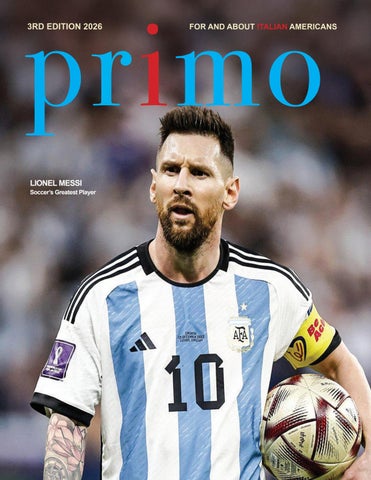
primo 3RD EDITION 2026
FOR AND ABOUT ITALIAN AMERICANS
LIONEL MESSI
Soccer’s Greatest Player
F&L PRIMO / THIRD EDITION 2026 / 1
2 / THIRD EDITION 2026 / F&L PRIMO
contents
3RD EDITION 2026
indice
Cover: Lionel Messi,
soccer’s greatest player
primo magazine PUBLISHER Reem Nourallah
26
LIONEL MESSI
Italian on both sides of his family, many consider him the best ever in soccer.
A Letter from the Editor 5 Stand Up for Caitlin Clark Travel/Hidden Treasures 8 Largo di Torre Argentina Language 10 John Steinbeck in Italian Wine & Spirits 16 Nora—Italy’s Strange Beer Readers’ Corner 18 Food Recipes 56
Crema di Carote e Mele, Sogliola Fritta, Costolette di Maiale ai Peperoni, Rigatoni con Salsicca, Frutti di Bosco con Crema Alla Vaniglia, Torta al Caffè
Reviews 62
46
24 SYMANI ROBOTIC SURGERY Cutting-edge medical technology is developed by this Italian company.
ARNALDO POMODORO
Hollywood’s most imaginative work was anticipated by the sculptor.
52
32 GEOLOGY IN PAINTINGS
Renaissance artworks often depicted rare rocks and unique Italian strata.
FLORENTINE DIAMOND
We convey the story of the rare gemstone, once owned by the Medici.
56
40 DJANGO 60TH ANNIVERSARY We pay tribute to one of Italy’s greatest westerns.
EDITOR Truby Chiaviello PUBLISHERS EMERITUS Herve van Caloen Francis L. DeFabo CIRCULATION MANAGER John Desaro DESIGN & LAYOUT Thomas Jenkins CONTRIBUTING WRITERS
Rami Chiaviello Truby Chiaviello Reem Nourallah Michael J. Ranieri John J. Russo
ADVERTISING SALES Truby Chiaviello 2125 Observatory Place, N.W. Washington, D.C. 20007 202.363.3741 editor@flprimo.com Ask about our advertising packages. The magazine F&L PRIMO, (ISSN 1536-1543), 3RD EDITION 2026, Volume 26, Issue Three, is published by Potomac Media. Six issue subscription is $27.95. Copyright F&L PRIMO 2026. All rights reserved. Mail editorial and letters to: PRIMO, 2125 Observatory Place, N.W., Washington, D.C. 20007, editor@flprimo.com. Subscription inquiries: Call 202-363-3741 help@flprimo.com. Subscribe by logging on to www. primomagazine.com or call 202-363-3741.
AUTUMN AURA
The flavors of Italy are celebrated in the fall season. F&L PRIMO / THIRD EDITION 2026 / 3
4 / THIRD EDITION 2026 / F&L PRIMO
editor’s note
nota dell’editore
A LETTER FROM THE EDITOR, TRUBY CHIAVIELLO
STAND UP FOR CAITLIN CLARK
A Plea to Italian American Leaders: Speak Out for One of Our Own
Difendiamo i nostri campioni!
T
here are moments when a community should recognize one of its own— and moments when recognition is not enough. Caitlin Clark, who donned the cover of PRIMO in the previous edition, is one of the most extraordinary athletes of her generation. She is also an Italian American, descended through her mother’s family from immigrants who carried their heritage from Sicily to the American Midwest. Italian Americans have every reason to celebrate Caitlin’s remarkable ascent. Yet celebration carries with it an important obligation. When one of our own is subjected to treatment that appears excessive, dangerous, or deliberately intimidating, we must stand up for her. In too many games to count, Caitlin Clark has been subjected to a number of assaults.
Such incursions are rarely, if ever, counted as fouls. In her rookie season, five of the WNBA’s 30 flagrant fouls were committed against Clark—a staggering 17 percent! In June, 2024 when Clark’s team—Indiana Fever—played the Chicago Sky, opposing player Chennedy Carter came up from behind Clark to shoulder-check her to the floor before the ball was even inbounded. Officials called the incursion an ordinary awayfrom-the-ball foul. In the playoffs that year, DiJonai Carrington, of the Connecticut Sun, struck Clark in the eye to bruise her during a defensive play. Many on social media accused Carrington of an intentional hit. A year later, it was against the same team—Connecticut Sun, when an opposing player, Jay Sheldon, caught Clark in the face. Shaken by the assault, Clark got back on her feet.
Clark pushed Sheldon away, only for Marina Mabrey, a teammate of Sheldon’s, to forcefully and viciously knock Clark to the floor. This year, on June 24, Phoenix Mercury star Alyssa Thomas made contact with her fist to Clark’s throat area while Clark was on the floor. No foul was called. How many times does this have to happen before Italian American organizations say something? Where are the voices that so readily celebrate Italian American achievement when the photographs are flattering and the occasion festive? Why do Italian American leaders go silent when one of our own, who excels at a sport, suffers such egregious abuse? Caitlin Clark demonstrated repeatedly she can take a hit, get back on her feet, and continue playing. She is the model of professionalism.
F&L PRIMO / THIRD EDITION 2026 / 5
We proudly claim our champions. We should also be willing to stand by them.
Clark’s behavior on and off the court remains exceptional. Her sportsmanlike conduct is a source of pride for all Italian Americans. She has become a role model—and rightly so—for girls and young female adults. This is precisely why the rest of us should pay attention to what happens to Caitlin. Courage on the part of the athlete does not relieve leagues, officials, players—and communities—from recognizing a disturbing pattern—when physical play threatens to become something else. Basketball is a contact sport. The WNBA is populated by exceptionally strong, competitive professional athletes.
6 / THIRD EDITION 2026 / F&L PRIMO
Clark should neither expect nor receive special treatment because of her fame. Yet, neither should her fame make excessive contact against her acceptable. This is not a plea to protect Caitlin Clark from any and all types of competition. Rather, it is a plea to protect competition itself. What Italian American leaders must do is speak up. We must ensure our people are treated fairly in sports and, for that matter, all other endeavors. We don’t yearn for special treatment. We yearn for equity. We demand respect. Italian Americans know something about watching one of our own enter an established
arena to immediately become a target of extraordinary attention. We have seen it in entertainment, politics, business, and sports. Such success is often accompanied by envy, resentment, and, even, violence. This is when our community must stand up and say: Enough. Clark should be defended — yes—for the sole reason that she is Italian American. If we don’t defend her, who will? We must recognize achievement, courage, and fair play when we see them. We proudly claim our champions. We should also be willing to stand by them.
When murder turns par for the course
The Case of The Amorous Caddy Anthony Celano delivers a smart, unsettling, and finely crafted noir that lingers long after the final page. It’s a cautionary tale about delusion and desire—and a reminder that beneath the quiet surface of ordinary life, danger often lurks in the most unexpected places. primo magazine
The Case of the Amorous Caddy By Anthony Celano
Buy it on Amazon.com Today!
GROWING UP IN BROOKLYN
An Ode to a Writer From a Chemist A Celebration of the world’s most famous borough Professor Polacco pays tribute to Salvatore La Puma...no greater tribute to one author than for the other to write an outstanding book with both writers’ names in the title. “Brooklyn Joe and Sal: Two Bensonhurst Boys”...is awesome! PRIMO Magazine, 2023
Brooklyn Joe and Sal Two Bensonhurst Boys By Joseph C. Polacco
Buy This Book Today - At Amazon.com F&L PRIMO / THIRD EDITION 2026 / 7
Outlaws and Marshals...
corsa travel
Hidden Treasures - Reem Nourallah
CATS RULE
Felines Hold Court in Rome’s Largo di Torre Argentina
F
Few places capture the strange layering of Rome quite like Largo di Torre Argentina. Beyond the Colosseum, there exists an enormous opening below street level with ancient columns, stone foundations, and the remains of four Roman temples. They belong to the Area Sacra, or Sacred Area of Largo di Torre Argentina, one of the most important archaeological sites from the Roman Republic. This is where on March 15, 44 B.C.—the Ides of March—Julius Caesar was assassinated. Popular imagination sometimes places Caesar’s murder in the Roman Forum. Yet, his murder occurred in the Curia of Pompey, a Senate meeting hall inside the Theatre of Pompey complex in the Campus Martius. Caesar arrived there for a meeting of the Senate. Waiting for him was a conspiracy of Roman senators who believed his accumulation of power threatened the Republic. Among their leaders were Marcus Junius Brutus and Gaius Cassius Longinus. The conspirators surrounded Caesar and attacked him with daggers. He suffered 23 stab wounds. Their effort to save the Republic failed spectacularly. Caesar’s death instead helped trigger another period of civil war.
Two photographs convey how a number of cats live and roam inside the archaeological site of Largo di Torre Argentina, the location where Julius Caesar was assassinated by Roman senators. 8 / THIRD EDITION 2026 / F&L PRIMO
Travel
Caesar’s nephew Octavian eventually emerged victorious as Augustus, Rome’s first emperor. Today, the remains associated with the Curia of Pompey survive at Largo Argentina, alongside four Republican-era temples constructed over several centuries before Christ. Much of this ancient landscape was buried until demolition exposed the ruins in the 1920s. Almost as soon as archaeologists uncovered ancient Rome, some new residents began moving in—Cats! The excavated ruins provided an ideal refuge for Rome’s homeless felines: a place where they could gather in hidden corners, hunt for prey near stone shelters, and take long naps beneath the Italian sun. For decades, the animals were cared for by Roman women affectionately known as gattare, or “cat ladies.” Among them was actresses Anna Magnani. The unforgettable star of Roberto Rossellini’s Rome, Open City reportedly fed the cats during her breaks while working at a nearby theater.
In 1993, volunteers established what became the Torre Argentina Cat Sanctuary. The organization provides food, veterinary treatment, sterilization, and adoption services for cats, including animals that are elderly, disabled or otherwise difficult to place. Today, visitors contemplating the remains of Republican Rome will inevitably spot the sanctuary’s residents. A cat may be stretched across an ancient stone or disappear behind a column or sit imperiously atop a wall surveying the tourists. Two thousand years ago, powerful men gathered here to decide the fate of Rome. Caesar entered as the most powerful Roman alive and never walked out. Empires rose and fell, buildings disappeared and archaeologists eventually uncovered the forgotten city beneath the modern one. Julius Caesar may have met his end at Largo Argentina. Yet, these days, the cats rule this hidden treasure in Rome.
• Italian Language Courses • Sicilian Language Courses • Saturday Night Dances • Italian & Italian American Studies • Italian American Speaker Series • Italian Cultural Performances • Annual Scholarship Ceremony • Annual Awards Dinner Dance Gala • Neapolitan Language Courses www.italiancharities.org
info@italiancharities.org
718-478-3100
F&L PRIMO / THIRD EDITION 2026 / 9
language
John Steinbeck The Voice of California Had Italy on His Mind
T
The voice of California. That was John Steinbeck. The farms of Salinas Valley, the fishing docks of Monterey and the people who inhabited both made up the settings and characters of his novels and short stories. Steinbeck knew Italians before he knew Italy. Born in Salinas, in 1902, he grew up amid the immigrant communities there. Italians were prominent among the farmers, laborers, and fishermen of Monterey County. In Tortilla Flat, a novel published in 1935, Steinbeck wrote about Italian fishermen inside Monterey’s wharf. They were part of the multicultural mural he observed in California. Italy was important to Steinbeck. He developed an affection for the country’s landscape and people. His first time there was as a war correspondent in 1943 when American forces invaded the peninsula. He returned to Italy in 1953. His visit to Positano that year inspired his celebrated essay about the Amalfi Coast. In later years, he went to Rome, Florence, Naples, and parts of Sicily. Steinbeck had already solidified his reputation as one of America’s best authors before his visits to Italy. Yet the country reinforced something already present in his writing: an attraction to communities where friendship, family, food, and 10 / THIRD EDITION 2026 / F&L PRIMO
What DID THE author Like most about italy? personal loyalty could matter more than wealth or social position. Two Italian characters were significant in Steinbeck’s novels. The first was in East of Eden, published in 1952, set largely in California’s Salinas Valley. Steinbeck featured a minor character named Louis Lippo. With a father from Italy, Lippo represented an Italian American presence in the developing West— one of the many immigrant threads woven into Steinbeck’s California. The second was in The Winter of Our Discontent, his final novel, in 1961. A key character in this story was Alfio Marullo, an immigrant from Sicily. He owns the grocery store where the protagonist, Ethan Allen Hawley, works as a clerk. The contrast is deliberate. Ethan descends from an old, onceprominent New England family but has fallen on economic hard times. Marullo, the immigrant, has become his employer. Ethan discovers Marullo entered the United States illegally. Tempted by the possibility of acquiring the business, he secretly reports Marullo to immigration authorities. Here Steinbeck performs a remarkable moral reversal. The supposedly respectable American betrays the immigrant, while the immigrant proves the more honorable man.
Marullo believes Ethan to be honest and trustworthy. Before departing for Italy, he gives the store to Ethan because of the latter’s loyal years of service. Ethan receives generosity from the very man he has betrayed. Marullo is part of Steinbeck’s larger argument about America. It is a person’s character, not his heritage, money or social position that confers him with virtue. By the time he received the Nobel Prize for Literature in 1962, six years before his death, Steinbeck had penned 11 novels, six novellas, two collections of short stories and several screenplays. He wrote about temptation, sin, guilt, sacrifice, and redemption. These themes originated in his biblical imagination, but Steinbeck’s encounters with Italy placed him inside a culture where such questions had been explored for centuries through Catholicism, art, and everyday life. Steinbeck’s California was already partly Mediterranean. Italians shaped the world around Monterey before Steinbeck crossed the Atlantic. When he finally reached Italy, he discovered an older version of a world he already knew. In the pages to follow is an excerpt from Steinbeck’s novel, The Winter of Our Discontent, in English and translated into Italian.
F&L PRIMO / THIRD EDITION 2026 / 11
English
The Winter of Our Discontent
ur town of New Baytown is a handsome town, an old town, one of the first clear and defined whole towns in America. Its first settlers and my ancestors, I believe, were sons of those restless, O treacherous, quarrelsome, avaricious seafaring men who were a headache to Europe under Elizabeth,
took the West Indies for their own under Cromwell, and came finally to roost on the northern coast, holding charters from the returned Charles Stuart. They successfully combined piracy and puritanism, which aren’t so unalike when you come right down to it. Both had a strong dislike for opposition and both had a roving eye for other people’s property. Where they merged, they produced a hard-bitten, surviving bunch of monkeys. I know about them because my father made me know. He was a kind of high amateur ancestor man and I’ve always noticed that ancestor people usually lack the qualities of the ones they celebrate. My father was a gentle, well-informed, ill-advised, sometimes brilliant fool. Singlehanded he lost the land, money, prestige, and future; in fact he lost nearly everything Allens and Hawleys had accumulated over several hundred years, lost everything but the names—which was all my father was interested in anyway. Father used to give me what he called “heritage lessons.” That’s why I know so much about the old boys. Maybe that’s also why I’m a clerk in a Sicilian grocery on a block Hawleys used to own. I wish I didn’t resent it so much. It wasn’t depression or hard times that wiped us out.
An outstanding documentary that recounts the invasion of Gaul by Julius Caesar and his Roman Legions. ___ Yes, please send me the dvd documentary, "The Gallic Wars," for $19.95. Free shipping and handling.
First & Last Name
Address
City
State
Phone
Payment by
__Check
Zip
__ Money Order __ Credit Card
CC:_________________________________________ Exp Date: _________ Name:_______________________________________ Sec. Code: ________ Please detach and complete the form and mail with check made to PRIMO, money order or credit card information to: PRIMO, 2125 Observatory Place, N.W., Washington, D.C. 20007, or call 202-363-3741; www.onlineprimo.com
12 / THIRD EDITION 2026 / F&L PRIMO
nger splashed up in Ethan before he knew it and he was surprised. A “I’m not a chiseler, Marullo.” “Who’s a
chiseler? That’s good business, and good business is the only kind of business that stays in business. You think Mr. Baker is giving away free samples, kid?” Ethan’s top blew off with a bang. “You listen to me,” he shouted. “Hawleys have been living here since the middle seventeen hundreds. You’re a foreigner. You wouldn’t know about that. We’ve been getting along with our neighbors and being decent all that time. If you think you can barge in from Sicily and change that, you’re wrong. If you want my job, you can have it—right here, right now. And don’t call me kid or I’ll punch you in the nose—” All Marullo’s teeth gleamed now. “Okay, okay. Don’t get mad. I just try to do you a good turn.” “Don’t call me kid. My family’s been here two hundred years.” In his own ears it sounded childish, and his rage petered out. “I don’t talk very good English. You think Marullo is guinea name, wop name, dago name. My genitori, my name, is maybe two, three thousand years old. Marullus is from Rome, Valerius Maximus tells about it. What’s two hundred years?” “You don’t come from here.” “Two hundred years ago you don’t neither.”
John Steinbeck
Italian
a nostra cittadina di New Baytown è una bella cittadina, una città antica, una delle prime città d’America ad Ldi quegli avere una fisionomia chiara, definita e compiuta. I suoi primi coloni — e, credo, i miei antenati — erano figli irrequieti, infidi, litigiosi e avidi uomini di mare che furono il tormento dell’Europa ai tempi di Elisabetta,
che sotto Cromwell si impadronirono delle Indie Occidentali e che infine vennero ad appollaiarsi sulla costa settentrionale, muniti di concessioni del restaurato Carlo Stuart. Riuscirono a combinare con successo pirateria e puritanesimo, che, a ben vedere, non sono poi così diversi. Entrambi nutrivano una forte avversione per chiunque si opponesse loro ed entrambi avevano l’occhio sempre rivolto alla proprietà altrui. Dalla loro fusione nacque una razza di scimmie dure a morire, capaci di sopravvivere a tutto. Li conosco bene perché mio padre volle che li conoscessi. Era una specie di appassionato dilettante di genealogia, e ho sempre notato che quelli ossessionati dagli antenati di solito sono privi proprio delle qualità degli antenati che celebrano. Mio padre era un uomo mite, colto, sconsiderato e, a volte, brillantemente sciocco. Da solo riuscì a perdere le terre, il denaro, il prestigio e il futuro; in pratica, perse quasi tutto ciò che gli Allen e gli Hawley avevano accumulato nel corso di parecchi secoli. Perse tutto tranne i nomi — che, del resto, erano l’unica cosa che interessasse davvero a mio padre. Mio padre era solito impartirmi quelle che chiamava «lezioni sull’eredità di famiglia». È per questo che so tanto di quei vecchi tipi. Forse è anche per questo che oggi faccio il commesso nella drogheria di un siciliano, in un isolato che un tempo apparteneva agli Hawley. Vorrei non provare tanto risentimento per questo. Non furono né la Depressione né i tempi difficili a mandarci in rovina.
a rabbia esplose dentro Ethan prima Lstesso ancora che se ne rendesse conto, e lui ne rimase sorpreso. “Io non sono
un imbroglione, Marullo.” “Chi ha detto imbroglione? Questi sono affari, e buoni affari sono unico tipo di affari che resta negli affari. Tu pensi che signor Baker regala campioni gratis, ragazzo?” Ethan esplose. “Adesso ascoltami,” bene, gridò. “Gli Hawley vivono qui dalla metà del Settecento. Tu sei uno straniero. Non puoi capire. Per tutto questo tempo siamo andati d’accordo con i nostri vicini e ci siamo comportati da persone perbene. Se pensi di poter piombare qui dalla Sicilia e cambiare tutto questo, ti sbagli. Se vuoi il mio posto, prenditelo — qui e ora. E non chiamarmi ragazzo, o ti do un pugno sul naso—“ Ora Marullo mostrava tutti i denti in un largo sorriso. “Va bene, va bene. Non arrabbiarti. Io cerco solo di farti un favore.” “Non chiamarmi ragazzo. La mia famiglia vive qui da duecento anni.” Alle sue stesse orecchie suonò infantile, e la sua rabbia si spense. “Io inglese non parlo molto bene. Tu pensi Marullo è nome da guinea, nome da wop, nome da dago. I miei genitori, il mio nome, forse ha duemila, tremila anni. Marullus viene da Roma. Valerio Massimo ne parla. Cosa sono duecento anni?” “Tu non sei di qui.” “Duecento anni fa, neanche tu.” F&L PRIMO / THIRD EDITION 2026 / 13
From the author of “Mussolini Did Some Good” “...relying on a large amount of research reinterpreted in the light of some brilliant personal insights. In this way the author retraces the short parable of Italian colonialism.”
L’indicie dei libri del mese
“Filippi’s... “I applaud Cusmano book warns us for his luminous against ‘prejudice’ rendering of Filippi’s from incendiary believing truth we know telling.” when we George don’t Elliott know…” Clark, Giovanni Accenti de Luna, Magazine La Stampa
Please buy today
BUT WE BUILT ROADS FOR THEM Available on
Amazon.com 14 / THIRD EDITION 2026 / F&L PRIMO
Distributed by IPG
Francesco Filippi is a historian of mentalities and an educator who has specialized in the relationship between memory and the present. "Mussolini Also Did A Lot of Good" is his first book to appear in English. He lives in Trento, Italy.
“CelebratingAT The Heritage” is FAST TIMES a valiant lesson for us all to revere a specific Italian town, STATEN ISLAND HIGH in addition, to the whole of Italy. Our homeland is more than the
country of our ancestors, but, The book is essential reading rather, the enclave of family and for Italian who friends whoAmericans shared experiences experienced America. unique to1980s their locale. Moreover, young people...who A great book is struggle with the and “Celebrating Thepains Heritage." joys of...high school will find Magazine, 2021 thePRIMO novel most enlightening. Damien is the model survivor of the tempestuous years in adolescence and young adulthood. In 1980s speak, we surmise the novel, accordingly: “Fake is excellent! Concisely written and edited to Italian” offer an additional
Keeping the Spirit of Calitri, Italy Alive in America
primo magazine interpretation of the Italian American experience, “Celebrating The Heritage” offers an excursion An Italian’s The Decade Reagan, through the View UnitedofStates by way ofofthe proud progeny Calitrani MTV, New of Wave andimmigrants. Heavy Metal
it today FAKEBuy ITALIAN
By Marcat DiPaolo Available www.xlibris.com
888-795-4274 Buy it on Amazon.com Today!
“Giovanni: Street Urchin of Naples” is a decades’ long saga for the Italian immigrant experience to coincide with key historical events such as World War I, the 1929 Stock Market Crash, The Great Depression, World War II and the social turmoil of the Cold War years, up to 1969.
Can a man truly escape his modest origins, no matter how far he climbs? An extraordinary saga to give us the soul-stirring answer. “Giovanni: Street Urchin of Naples” is awesome and inspiring. primo magazine
Pseudonyms and Some Tall Tales CELEBRATNG THE HERITAGE An 83% True Autobiography with
What does it take for an Italian to find the American Dream?
“Giovanni: Street Urchin of Naples” Buy it today
Available at Amazon.com
20 / FIRST EDITION 2024 / F&L PRIMO
A
tuscan treasury
Stories from Italy’s Most Captivating Region From WWI to Covid, from Florence to the tiny villages of Tuscany, stories of love, courage and adventure by award-winning author
Paul SalSini A perfect gift! Amazon.com • ATuscanSeries.com F&L PRIMO/ THIRD / FIRSTEDITION EDITION2026 2022/ /15 15 F&L PRIMO
wine and spirits
vini e superalcolici NORA
Italy’s Strange New Beer
I
In the Piedmont village of Piozzo, master brewer Teo Musso created Baladin Nora, a distinctive craft beer whose inspiration reaches from northern Italy to ancient Egypt. Nora is produced by Birrificio Baladin, the pioneering brewery founded by Musso in 1996 with the idea that beer could express the same artistry, that Italians expect from wine. Nora may be his most intriguing creation. The amber-colored beer is brewed with Khorasan wheat—marketed under the KAMUT brand—and flavored with ginger, sweet orange peel and myrrh. Hops play a relatively restrained role. The result is aromatic, spicy and slightly exotic, with citrus and herbal notes that distinguish Nora immediately from an ordinary lager. Despite its rich character, Nora is not high in alcohol. At 6.8 percent by volume, it is stronger than standard Italian and American lagers but considerably below some Belgian ales and imperial beers that can reach 10 percent or more. Nora’s intensity comes primarily from its unusual combination of grain, fruit and spices rather than sheer alcoholic strength. There is also a personal story behind the name. Musso was inspired by a woman named Nora, his former wife, whose family background included North Africa. That connection helped inspire his exploration of Egyptian and African flavors for a beer to bear her name. Musso grew up in a farming family in Piedmont and opened Le Baladin as a pub in Piozzo in 1986. When he began brewing a decade later, the operation was decidedly modest. Equipment included converted milk-processing vessels, while part of the young brewery reportedly occupied space once served as his family’s chicken coop. Today, Baladin emphasizes agriculture and Italian ingredients, embracing Musso’s philosophy that beer begins with the earth. Piozzo, located in the Province of Cuneo amid one of Italy’s great foodand-wine regions, remains Baladin’s home.
16 / THIRD EDITION 2026 / F&L PRIMO
Nora consequently represents something larger than an unusual beer. It demonstrates the inventive spirit of contemporary Italian food and drink: rooted in agriculture and craftsmanship but unafraid to look far beyond Italy for inspiration. In a land famous for wine, Teo Musso proved that an Italian beer could have a story—and a character— entirely its own.
The Wild West Il Selvaggio West
Eugene DiCesaris has developed an enticing series with his second book, “Sharp: Life or Death.” The title character is the noble gunman in the western genre tradition. New characters are continuously introduced as Clayton Sharp confronts violent outlaws, renegade Indians and corrupt lawmen. A great western series! primo magazine Ride the trail with a man haunted by the past and driven by faith to make things right. Courage. Love. Forgiveness. The West has never felt more real—or more human.
CLAYTON SHARP: LIFE OR DEATH
Book Two
By Eugene J. DiCesaris
Buy it on Amazon.com Today!
La Scala Magica / The Magic Ladder by Nino Provenzano Translated into English Verse by Gaetano Cipolla Nino Provenzano presents a collection of poems rooted in the Arbëresh culture of Sicily, exploring family, memory, faith, and the passage of time. Written in a language and tradition preserved for centuries, these verses reveal the beauty of everyday life while celebrating the customs and values of a remarkable people. Presented in both the original language and English verse translation, this volume opens a unique window into a living heritage. This bilingual paperback is now available $16 plus $4.00 for shipping from Legas, P.O. Box 149, Mineola, NY 11501.
Yes, please send me the book, “Italian Horror Cinema,” for $19.95 plus $4.00 for shipping and handling
Full Name: _________________________ Address: ___________________________ City: ______________________________ State:_____ Zip: ____________________ Phone: ____________________________ Email: ____________________________ Credit Card #: _________________________ Exp. Date: __________ Sec Code: ________
Please complete the above form and mail the flyer with check, money order or credit card information to: PRIMO Magazine, 2125 Observatory Place, N.W., Washington, D.C. 20007. F&L PRIMO / THIRD EDITION 2026 / 17
readers’ corner
angolo dei lettori
SAINTS MATTER By Michael J. Ranieri
I
n many Italian American families, saints were not distant religious figures found only in churches or prayer books. They lived with us. They stood quietly on dressers beside family photographs, watched over kitchens and bedrooms, traveled in wallets as worn holy cards, and appeared in whispered prayers during moments of fear, loss, illness, or uncertainty. In our family, as in so many others, the saints mattered. 18 / THIRD EDITION 2026 / F&L PRIMO
The women in particular—my mother, my grandmother, and aunts—carried these devotions most faithfully. Interestingly, as they grew older, they did not attend church regularly. Yet their belief in certain saints never disappeared. Their faith became deeply personal, practical, and woven into everyday life. Saints were protectors and helpers—they were our companions who steadied life when things threatened to go wrong.
No saint appeared more often in our household than Saint Anthony of Padua. To this day, I can still hear my mother’s voice whenever I misplaced something. “Look everywhere,” she would say. “And don’t forget to pray to St. Anthony.” Like many Italian Americans, she spoke of him as if he were a trusted family friend whose special responsibility was helping recover lost things. Keys, wallets, important papers—nothing was too small for St. Anthony’s attention. Somehow, when the missing object eventually turned up, as it often did, the saint quietly received part of the credit. Then there was Saint Jude, the patron saint of desperate situations. Italian American families who endured immigration, poverty, war, and illness often developed a deep attachment to St. Jude.
The saints became part of the emotional architecture of Italian American life.
In our family, the saints mattered because they helped people believe that things would somehow turn out all right.
In our family, we sought his intercession whenever problems seemed beyond easy solutions. His very purpose was to help when hope itself appeared to be fading. The devotion to Padre Pio in the 1950s was something close to a religious movement among Italian American families. Like countless others, my mother was drawn to the stories of miracles, healing, suffering, and holiness that surrounded the humble Capuchin friar from southern Italy. She once hosted a fundraiser in our home for relatives and friends devoted to Padre Pio. The atmosphere surrounding him carried a sense of mystery and hope.
To many Italian Americans, Padre Pio seemed approachable—a holy man who understood suffering, sacrifice, and ordinary people. Years later, I encountered another enduring Italian American tradition involving Saint Joseph. When we were having difficulty selling our home in Plymouth, Massachusetts, several Italian friends immediately offered the same advice: bury a statue of St. Joseph in the yard. So, naturally, I bought a small St. Joseph statue—Amazon conveniently came to the rescue— and buried it as instructed. Like millions of other Italian Americans before us, we participated in a tradition blending faith, hope, family
folklore, and perhaps a touch of superstition. Whether coincidence or divine intervention, the house eventually sold. To outsiders, these customs might seem quaint or even irrational. But to many Italian Americans, the saints represent something much deeper. Immigrant life was often uncertain and difficult. Families faced dangerous work, financial instability, illness, language barriers, and separation from loved ones left behind in Italy. The saints provided reassurance. They offered the comforting belief that someone was watching over the family. And perhaps that is why these devotions endured so powerfully among Italian Americans, especially among the women who held families together through quiet strength and constant worry. Their faith was less theological than practical. You prayed to the saint who could help. You lit a candle. You carried the holy card. You asked for protection. And somehow, life felt a little more manageable afterward. The saints became part of the emotional architecture of Italian American life. They traveled with immigrants across the Atlantic and settled into kitchens and living rooms across America. They accompanied families through hardships and triumphs alike. In our family, the saints mattered because they helped people believe that things would somehow turn out all right. F&L PRIMO / THIRD EDITION 2026 / 19
readers’ corner
angolo dei lettori
Evviva il North End!
By John J. Russo
Some 5,000 Italian immigrants oston’s North End predates came to Boston in 1890. Italian migration. BFamously They settled in the North End to known as the home of Paul Revere, the Irish settled here in the 1840s when they fled the potato famine. The Italians began to come to America 20 years later. It was the aftermath of the unification of Italy that ushered in a long period of unrest in the new kingdom, particularly in the agricultural south. Taxes on produce were especially devastating for the peasant farmers. Then came a series of natural disasters to further depress the region. That was when young Italians left Italy. 20 / THIRD EDITION 2026 / F&L PRIMO
transform the area to subsequently become the city’s “Little Italy.” The North End provided access to the waterfront for illiterate, unskilled labor to find work. Last fall, my family visited Boston to celebrate my mother-in-law’s 100th birthday. We took this opportunity to visit the North End. We were able to take the Boston metro subway, affectionately known as the “T,” to the city’s Little Italy. My daughters booked our party of 10 for a local walking tour of the North End.
We started at the statue of Tony DeMarco, a world welterweight boxing champion in 1955, born to Sicilian parents, who grew up in the North End. Next, we visited Regina Pizzeria. The eatery, opened in 1926, uses brick ovens, from 1883, to make what many consider to be the best pizza in Boston. It was very tasty and delicious; a brickoven pizzeria where the owner greeted us. We also stopped at Modern Underground Restaurant, an Italian owned pastry shop. We visited two more Italian shops, one featuring Sicilian pizza. We ended up having three slices of pizza and cannoli on our walking tour.
The North End is more than food. This is an historic area of Boston that precedes the influx of Italians.
The North End is more than food. This is an historic area of Boston that precedes the influx of Italians. It’s home to Paul Revere’s house and the famous Old North Church which dates to 1723. Paul Revere lit the lanterns to warn that the British were coming. Before he began his famous ride, he said, “One if by land, two if by sea.” Outside the church is an old cemetery with headstones dating back to the 18th century. The North End is where the Boston Molasses Disaster occurred. It was in 1919 when a storage tank containing 2.3 million gallons of molasses burst.
The black fluid rushed onto the streets killing 21 people and injuring many more. It took weeks to clean up the molasses. Residents say the smell lingered for years. The walking tour then brought us across from the Charleston Naval Shipyard, where anchored is the USS Constitution, a wooden hull ship, also known by its nickname “Old Ironside.” Built in 1797, the USS Constitution was the oldest active ship in the US Navy and oldest commissioned ship still afloat in the world. Unfortunately for us, the ship was not in the harbor that day.
You can hardly visit this area without touring the Boston Tea Party Ship Museum. We were able to reenact the Boston Tea Party by tossing containers of tea, from a replica 18th century ship, into the harbor. The North End is still reminiscent of 1900 where you can find houses very close together. Most are well maintained and desirable. This is a perfect place to see American history and enjoy great Italian food. We had a nice afternoon touring the North End. If you are visiting Boston, this can make a nice destination supplementing many of city’s historical sites. F&L PRIMO / THIRD EDITION 2026 / 21
The Story of a Family The Story of a Village in Abruzzo
Bruno’s writing is both evocative and accessible, painting vivid pictures of both the Italian village and the American steel town... Readers will find themselves immersed in the sights, sounds, and emotions of the era, fostering a deep connection to the characters and their experiences.
primo magazine We enjoy the benefit of hindsight... the luxury of looking back with certainty at a journey our ancestors undertook with great uncertainty!
The Love of San Demetrio By Louis G. Bruno, Jr.
Buy it on Amazon.com Today!
22 / THIRD EDITION 2026 / F&L PRIMO
The Tide Brings Secrets
NCIS AGENT JERZY SHORE Vercessi’s novel is a thoughtful and well-crafted mystery anchored by a memorable protagonist and enriched by the author’s firsthand knowledge of the naval world. It’s a smart, grounded entry into military crime fiction—and a promising start to what could be a compelling series. primo magazine
NCIS Agent Jerzy Shore By George Vercessi
Buy it on Amazon.com Today!
The book serves a most valuable service. The rapidly changing times make it increasingly harder for families to stay together. As we travel farther away from home, we lose our roots and risk losing our legacy. Mary Gordon guides us in the journey ahead with a timeless book on how to keep our family identity for posterity. PRIMO Magazine
This is important book ... Gordon provides numerous suggestions on how to conduct family oral histories, preserve and use them, protocols to consider, and recording techniques.
Prof. Clifford E. Trafzer, UC Riverside
Nothing defines the Italian American experience more than the cherished attribute of family.
Buy it today FAMILY ORAL HISTORY ACROSS THE WORLD Discount code 25AFLY1 at checkout. Good to end of June 2025 www.routledge. com/9780367654801
Grand Lodge of Virginia Italian Heritage Lodge of Fairfax #2517 was chartered in 1981. Our monthly events are mostly held at the Knights of Columbus Hall (behind St. Leo the Great Catholic Church) 3702 Blenheim Blvd, Fairfax, VA 22030. New members are always welcomed! Visit our website at https://italianheritagelodge.org President: Dawn Falsinotti falsinotti@yahoo.com (703) 362-1724 Past State President: Joseph Scafetta Jr. joseph.scafetta.jr@gmail.com (703) 533-8064
Nothing defi,nes the ltalin.n American erperzence more than the cherished attribute ef fam t(y.
F&L PRIMO / THIRD EDITION 2026 / 23
24 / THIRD EDITION 2026 / F&L PRIMO
Surgery By An Italian Robot...
By Rami Chiaviello
SYMANI F
or centuries, the surgeon’s hand has been medicine’s most important instrument. Training, experience, and extraordinary dexterity allow a physician to perform impossible feats. Yet even the steadiest human hand has physical limitations. Italian engineers have developed a robot to overcome them. The Symani Surgical System, developed by Medical Microinstruments (MMI), a company founded near Pisa in 2015, is a robotic platform created specifically for microsurgery and supermicrosurgery. The extraordinarily delicate work of repairing and reconnecting tiny blood vessels and nerves can now be done by a robot. Unlike the better-known da Vinci Surgical System, whose Italian name honors Leonardo da Vinci but which was developed by an American company, Symani is technology born in Italy. Symani uses miniature articulated devices known as NanoWrist instruments. The surgeon sits at a console to control the apparatus. The robot translates the physician’s hand movements for precise surgery inside the patient. Advantage comes in the scale of microsurgery. Surgeons must place sutures in blood vessels measuring one or two millimeters. In supermicrosurgery, surgeons operate on structures less than one millimeter in diameter. Any doctor will possess natural tremors. Under a microscope, these tiny movements become significant. Symani is designed to filter that tremor with motion scaling 20-to-1; a movement of 20 millimeters by the surgeon can be translated into a movement of just one millimeter by the robotic instrument.
In 2020, Symani was first used in Florence for reconstructive surgery of a patient with traumatic injuries. Four years later, surgeons at Penn Medicine performed the first American operation with the Italian-developed system. One patient had suffered a severe injury to the forearm. Reconstructive surgery involved taking living bone and skin from the patient’s leg to transplant the tissue to the injured arm. Symani assisted surgeons to reconnect minute blood vessels to keep the transplanted tissue alive. Another patient faced possible leg amputation following complications involving an infected knee prosthesis and substantial loss of tissue. Surgeons transferred muscle and skin from the patient’s back to reconstruct the damaged area, using Symani to assist in reconnecting the transplanted tissue’s blood supply. Symani is set to treat lymphedema, a debilitating accumulation of fluid after lymph nodes are removed during cancer treatment. Other reported applications for the robot include nerve repair, limb reconstruction, central lymphatic surgery and creation of vascular access for kidney dialysis. More than five centuries ago, Leonardo da Vinci studied the human body with an engineer’s eye, filling pages with remarkably detailed drawings of muscles, bones, tendons, and the mechanics of the human hand. Leonardo sought to understand how nature had constructed a machine of extraordinary dexterity. Today, not far from Leonardo’s Tuscan homeland, Italian engineers have approached the same problem from the opposite direction.
F&L PRIMO / THIRD EDITION 2026 / 25
LIONEL MESSI
26 / THIRD EDITION 2026 / F&L PRIMO
The ball remained impossibly close to his feet as defenders lunged and missed. At his most brilliant, the effect could seem less athletic than otherworldly—as though he played the game according to different laws of physics. There is a reason soccer writers, teammates, and opponents have so often reached for the same description...
"He’s From Another Planet!"
By Truby Chiaviello
F&L PRIMO / THIRD EDITION 2026 / 27
He dribbled like a winger, passed like a midfielder, and finished like a striker.
Lionel Messi.
B
orn Lionel Andrés Messi Cuccittini on June 24, 1987, in Rosario, Argentina, both sides of his family are Italian. They came from the same province and region in Italy—Macerata, Le Marche. On his father’s side, the story began in Montefiore di Recanati. Angelo Messi was born there in 1866, the son of Pacifico Messi. In 1893, Angelo and his wife, Maria, departed Italy for South America where they settled in Rosario, Santa Fe, Argentina. The couple then had a son, Aniceto, born there in 1902. The family did not return to Italy. Argentina was home. Aniceto had a son—Eusebio Italo Messi, who later married Rosa Maria Perez in 1952. Six years later, Aniceto had a son—the father of Lionel Messi—Jorge Horacio Messi Perez. Lionel’s Italian heritage did not end with the Messi surname. His mother’s family undertook an equally remarkable—and more circuitous—journey from Italy to Argentina. Lionel’s mother—Celia María Cuccittini—had ancestors who came from San Severino, Le Marche, also in the province of Macerata. Her great-grandfather Raniero Coccettini married Rosa Ricchezza, and the couple had two children, Giulia and Francesco, while still living in Italy.
28 / THIRD EDITION 2026 / F&L PRIMO
In 1899, the family boarded the Washington to cross the Atlantic for Brazil. Their destination was the agricultural interior of São Paulo state. After Raniero found work on a farm, the family remained in Brazil. There, in Ribeirão Preto, another son was born on January 27, 1904. His Italian name was Arderigo Coccettini. During the family’s South American migration, their names were altered. Arderigo became Federico, while Coccettini eventually became Cuccittini—the surname carried today by Messi’s maternal side. In 1905, the Coccettini-Cuccittini family left Brazil for Argentina, settling in the Rosario area. There, subsequent generations included Antonio Cuccittini and his daughter, Celia María. Married to Jorge Messi in 1978, she gave birth to Lionel in 1987.
Two separate migrations from Italy converged in Argentina: the Messi family and the Coccettini family—both from Le Marche. In 2000, Lionel left Argentina for Spain to attend FC Barcelona’s youth development system. His Italian heritage eventually became his legal identity. Through his paternal ancestors from Le Marche, he became an Italian citizen by descent. He registered with the municipality of Recanati as an Italian living abroad. His father, Jorge, had visited the commune in 2010 to pursue the family’s Italian citizenship records. The purpose was to connect Lionel’s status as a European player. Messi was 17 when he began his professional career with FC Barcelona. His first goal came in May 2005. Playing for the Spanish club until 2021, Messi became a soccer superstar. He scored 672 goals in 778 appearances to become the club’s all-time leading scorer. Messi helped Barcelona win 10 La Liga championships and four UEFA Champions League titles. He was part of the extraordinary 2008-09 team that captured the Spanish league, Copa del Rey and Champions League.
Messi’s greatest individual season came in 2011-12, when he scored an astonishing 73 goals in all competitions for Barcelona. During the 2012 calendar year, he kicked 91 goals, one of the most remarkable scoring achievements in the history of the game. Messi’s control, acceleration, and passing through groups of defenders made him one of soccer’s most distinctive players. By the time he left Barcelona in 2021, he had established records unlikely to be broken for generations. Messi won the Ballon d’Or, soccer’s most celebrated individual prize, a record eight times between 2009 and 2023. He won six European Golden Shoes as the leading league scorer among Europe’s top divisions and finished as La Liga’s leading scorer eight times.
F&L PRIMO / THIRD EDITION 2026 / 29
Lionel Messi, pictured with his father, Jorge, while holding the EFE Trophy honoring him as the top Ibero-American player of the 2006–07 Spanish league season.
For Argentina, Messi was key to their winning the FIFA Under-20 World Cup in 2005 and an Olympic gold medal in Beijing in 2008. Messi captained Argentina to the Copa América championship, defeating Brazil in the final at Rio de Janeiro’s Maracanã Stadium. Then came the defining achievement of his international career. At the 2022 World Cup in Qatar, the 35-year-old Messi produced one of the finest tournament performances. He scored seven goals to lead Argentina to the final against France. After an extraordinary 3-3 match, Argentina prevailed on penalty kicks. Messi finally lifted the World Cup for Argentina. It was in 2023 when Messi came to the United States to play for Inter Miami, arguably the biggest event in American soccer since the arrival of David Beckham. Inter Miami had 30 / THIRD EDITION 2026 / F&L PRIMO
been struggling for years. Messi led the club to the Leagues Cup championship—the first trophy in Inter Miami history. He scored 10 goals in seven tournament matches and won both the Golden Boot and best-player award. Messi’s genius began with the ball seemingly attached to his left foot. At barely 5-foot-7, he possessed a low center of gravity to give him extraordinary balance. He could sprint while keeping the ball remarkably close. He could change direction before a defender could react. Taller players might overpower him, but they could never catch him. Messi was unpredictable. His movements were sudden. He could change direction instantly. He never lost control of the ball. As a boy in Argentina, Messi was diagnosed with a hormone deficiency. He received medical
treatment but his stature remained modest. He never became a physically imposing athlete in the traditional sense. Instead, his compact frame, powerful legs, and exceptional balance proved ideally suited to weaving through crowded defenses. Messi might not have been the fastest in the league, but he was the quickest. He accelerated rapidly to seize openings before they became obvious. He could draw several defenders toward him and then, at precisely the right moment, slip a pass through the abandoned space. An opposing team could prevent Messi from shooting only for him to create a goal for a teammate. Defenders might give Messi additional space to prevent the pass only for him to attack the goal himself. He was simultaneously one of soccer’s greatest scorers and one of its greatest creators.
Messi did not always overwhelm goalkeepers with power. He often defeated them with placement, calmly curling the ball beyond their reach. Later in his career, free kicks became another formidable weapon. He could be seen walking rather than running in a match. Mistaken for inactivity, Messi was actually observing the defense to identify spaces. He was anticipating how the game was developing. Then, without warning, he accelerated with the ball into the opening he had discovered. Italian blood is most apparent in Messi’s competitive spirit. His passion for excellence runs both on and off the field.
Messi is famous for his quick temper. After Argentina’s heated 2022 World Cup quarterfinal against the Netherlands, during a post game interview, Messi angrily confronted Dutch player Wout Weghorst with the now-famous Spanish remark, “What are you looking at, fool? Go away.” Criticism of his playing was never tolerated by Messi. Former Liverpool player and television analyst Jamie Carragher had given the soccer star a negative assessment after a match was broadcast. Messi privately messaged Carragher on Instagram and called him a “donkey.”
For Messi, 2026 is a year of change. He officially retired from playing for Argentina, after the team made it to the World Cup final, only to lose to Spain. He is still under contract to continue playing for Inter Miami. Most profoundly, he suffered the loss of Jorge, who died on August 8. Jorge was as close to Messi as any father could be. He was his son’s agent and confidante throughout his career. Married for almost 10 years to Antonella Rocuzzo, Messi and his wife have three children—Thiago, Mateo, and Ciro. The future for Messi is modeled after his playing. He will anticipate, adapt, and achieve his goals.
F&L PRIMO / THIRD EDITION 2026 / 31
32 / THIRD EDITION 2026 / F&L PRIMO
The Greatest Paintings of the Italian Renaissance Showing Italy’s Bounty of Stones, Stratas, and Minerals
By Reem Nourallah
F&L PRIMO / THIRD EDITION 2026 / 33
G
hirlandaio creates a richly observed landscape to reflect the Renaissance fascination with the natural world. The painting’s geological elements subtly reinforce the themes of creation, permanence, and earthly wealth. The viewer's eye is drawn beyond the Holy Family to a broad harbor framed by rolling hills and distant mountains as rendered with soft blue-gray tones. Atmospheric perspective suggests the weathered limestone and sandstone formations common throughout central Italy. The background hills expose bedrock through thin layers of soil to illustrate the effects of erosion. Stone is the foundation of the human world depicted in the painting. The stable itself incorporates masonry, columns, and brickwork, while the distant city is constructed from hard rock. Ghirlandaio reminds the viewer that civilization itself is built from the Earth's geological resources. The gifts of the Magi emphasize nature's mineral wealth—gold vessels, jeweled garments, pearls, and precious gemstones—including rubies, sapphires, and emeralds. Formed over millions of years beneath the Earth's surface, they are presented before Christ as offerings of the highest earthly value.
Painted in 1488, Adoration of the Magi by the Florentine Renaissance master Domenico Ghirlandaio depicts the biblical visit of the three Magi to the Christ Child in Bethlehem.
Ghirlandaio transformed the landscape into a celebration of the Earth's bounty, offered in homage to the newborn King. The artist painted himself as the second male figure to the left of Mother Mary.
34 / THIRD EDITION 2026 / F&L PRIMO
B
ellini carefully depicts horizontal strata, fractured cliff faces, weathered ledges, and deep fissures, suggesting sedimentary rock shaped over millions of years by uplift and erosion. The artist's observation of nature was so meticulous that modern geologists have admired the painting for its convincing portrayal of layered rock formations. The cave beside the saint is depicted as a natural geological formation carved into the mountainside through the slow forces of weathering. The rocky shelves, broken slabs, and scattered boulders reinforce the impression of an ancient landscape continually shaped by nature. Plants emerge from cracks in the stone, vines cling to the cliff face, and trees take root in thin soils atop the bedrock. A small stream winds through the valley, quietly illustrating how flowing water gradually sculpts the landscape. Every element reflects the Renaissance fascination with observing the natural world as faithfully as possible. Unlike many earlier religious paintings in which rocks serve merely as decorative backgrounds, Bellini transforms the landscape into an active participant in the scene. The enduring stone cliffs symbolize permanence, creation, and God's presence in nature.
Painted around 1475–1480, St. Francis in the Desert by Giovanni Bellini portrays St. Francis of Assisi emerging from his rocky hermitage to receive profound spiritual revelation.
Geology becomes an expression of the divine order that St. Francis experiences in the natural world in Bellini’s “Saint Francis in the Desert.”
F&L PRIMO / THIRD EDITION 2026 / 35
eonardo carefully portrays Loutcrops, layered rock strata, fractured weathered surfaces, and deep caverns with an accuracy unprecedented in Renaissance art. The closely observed geological formations suggest limestone sculpted over immense spans of time by water, erosion, and natural weathering. Every ledge, crack, and overhang reflects Leonardo's scientific habit of studying the natural world firsthand.
36 / THIRD EDITION 2026 / F&L PRIMO
Painted between 1483 and 1486, Virgin of the Rocks is one of Leonardo da Vinci's greatest masterpieces.
ater is important to the W painting’s landscape. Pools, streams, and a distant
waterfall illustrate the powerful role of flowing water in shaping caves and valleys. Leonardo understood that water gradually carved the Earth's surface, an insight remarkably advanced for the late 15th century. Ferns, irises, columbines, and other plants emerge from crevices in the stone, demonstrating how life takes root even in harsh environments.
Painted around 1458–1460, Andrea Mantegna's Agony in the Garden depicts one of the most poignant moments in the New Testament. For Mantegna, the permanence of the rocks contrasts with the fleeting events unfolding to symbolize endurance, stability, and the timeless nature of God’s creation.
he painting is dominated by imposing rock T formations to frame nearly every part of the composition. Unlike the soft, rounded hills
common in earlier medieval art, Mantegna's cliffs appear fractured, layered, and sharply angular. The horizontal strata, weathered ledges, and deep vertical fissures closely resemble sedimentary formations to suggest Mantegna studied observable geology rather than rely on artistic convention. The foreground features broad slabs of exposed bedrock worn smooth by erosion. Narrow cracks and broken edges divide the stone into distinct layers, while scattered fragments suggest natural weathering and the gradual breakdown of rock over centuries. The winding pathway leading toward Jerusalem follows the contours of the terrain, illustrating how human settlements adapt to the underlying geology.
F&L PRIMO / THIRD EDITION 2026 / 37
T
he composition is framed by towering rocky cliffs that rise dramatically from the sea. Unlike the idealized hills often found in earlier Renaissance paintings, these formations are irregular, weathered, and deeply eroded. Sheer rock faces, fractured ledges, and steep coastal escarpments create a convincing sense of an ancient shoreline shaped by powerful natural forces. The cliffs appear to have been carved over countless centuries by wind, rain, and the relentless action of waves. The sea itself plays an important geological role. Its swirling waters lap against rocky headlands and isolated outcrops, illustrating the continual process of coastal erosion. Narrow beaches and rocky inlets suggest the gradual deposition of sand and sediment between the cliffs, while offshore rock pinnacles hint at resistant stone left behind as softer material eroded away.
38 / THIRD EDITION 2026 / F&L PRIMO
Painted around 1510–1515, Andromeda Freed by Perseus by the Florentine Renaissance artist Piero di Cosimo illustrates the dramatic Greek myth in which the hero Perseus rescues Princess Andromeda from a fearsome sea monster.
Painted around 1484–1486, Sandro Botticelli’s The Birth of Venus is one of the most celebrated masterpieces of the Italian Renaissance. The painting illustrates the classical myth of Venus, the Roman goddess of love and beauty, emerging from the sea after her birth.
Botticelli grounds his mythological vision in the physical world. The shell, the sea, and the coastal landscape all remind viewers that beauty emerges from nature itself.
A
t the center of the composition is the enormous scallop shell, perhaps the painting’s most recognizable natural object. Although created by a living organism rather than geological processes, seashells are composed primarily of calcium carbonate, the same mineral found in limestone and marble. Over millions of years, countless shells accumulate on the ocean floor to eventually form limestone, one of the Earth’s most abundant sedimentary rocks. Venus symbolically emerges upon a material that connects marine life to the geological history of the planet. The painting highlights the dynamic relationship between land and sea. Gentle waves carry the goddess toward a rocky shoreline where sediment has accumulated into narrow beaches and coastal terraces. These features reflect the continuous processes of erosion, deposition, and shoreline formation that shape coastlines over time. The distant headlands and gently sloping coast suggest a landscape sculpted by the persistent action of wind and water.
F&L PRIMO / THIRD EDITION 2026 / 39
40 / THIRD EDITION 2026 / F&L PRIMO
The 60th Anniversary
4K Restoration Now In Theaters S
ixty years after its original release, Sergio Corbucci’s Django returns to the big screen in a beautifully restored 4K edition. But what made this gritty Italian western such a landmark in cinema history? We explore the fascinating story behind one of the most influential Spaghetti Westerns ever made. Who or what inspired the name of the film? How did Corbucci create a darker, more violent vision of the American West?
F&L PRIMO / THIRD EDITION 2026 / 41
Sergio Corbucci’s
Django.
Credit is given to Quentin Tarantino for elevating Corbucci into the limelight of a new generation. Tarantino went so far as to borrow the title for his 2012 movie – “Django Unchained” - and the theme song, as originally sung by Rocky Roberts. Corbucci was even featured as a minor character in Tarantino’s film—the Oscar nominated “Once Upon a Time in Hollywood.”
O
riginally released in 1966, Django now returns in a magnificent 4K restoration, giving audiences an opportunity to rediscover one of the most influential Spaghetti westerns ever produced. The newly remastered film is set to be shown at movie theaters throughout America to mark the 60th anniversary of its original release. For many years, Django lived in the shadow of Sergio Leone’s westerns A Fistful of Dollars and The Good, the Bad and the Ugly. Over time, however, critics and movie lovers came to appreciate Corbucci, in his own right. He created something altogether different than Sergio Leone. Never mind the renewal of Corbucci’s reputation, however, he still plays second fiddle to Sergio Leone – and, rightly so, since Leone’s films were better. Leone is one of the top five directors from Italy—along with Federico Fellini, Vittorio De Sica and others. Although Corbucci showed greatness in several offerings, he ranks further down the line, perhaps 15 or, maybe, 20, in a list of Italy’s best filmmakers. Corbucci excelled in the western genre, although he preferred comedies. He made a string of enticing films from 1966 to 1972. Corbucci cast Jack Palance in The Mercernary, along with Tony Musante. In Companeros, Corbucci cast Palance again with a supporting role given to Fernando Rey, who played the villain in The French Connection. A hidden gem of Corbucci’s is arguably The Hellbenders, starring Joseph Cotten, the story of a Civil War veteran from the South who makes his way to an unsettled region of the Wild West to begin a new Confederacy. 42 / THIRD EDITION 2026 / F&L PRIMO
Oh Django! After the showers is the sun. Will be shining...
After some years on Gunsmoke, Burt Reynolds was cast as Navajo Joe, a film by Corbucci about a renegade Indian. Most fans consider The Great Silence worthy of special praise. Corbucci’s film starred Alain Delon as a mute gunman who takes on a cruel bounty hunter played by Klaus Kinski in the Rocky Mountains. For Corbucci – Django was his best. Not just director, Corbucci served as producer and cowriter. His younger brother Bruno helped write the script along with several others, most notably, Fernando Di Leo, maker of a string of Eurocrime films from Italy. The production also included Carlo Simi, whose unforgettable production designs not only defined Django but also Sergio Leone’s The Good, the Bad and the Ugly and Once Upon a Time in the West. Django’s executive producer was Frank Rossellini, the younger brother of legendary filmmaker Roberto Rossellini. The most notorious of those working behind the scenes in Django was no doubt the assistant and second-unit director Ruggero Deodato. He was internationally known for directing Cannibal Holocaust. The horror movie by Deodato was the first of its kind—a story premised on found footage detailing the grisly murders of documentary filmmakers in the Amazon. The concept was later borrowed by the makers of The Blair Witch Project.
Pictured: At the article’s introduction is a picture of Franco Nero starring in the title role of “Django.” Nero appears upper left in the film’s finale. Left page shows Corbucci with posters of several Westerns he made after “Django.” This page, from left clockwise, the Italian actress Loredana Nusciak plays Maria, Ángel Álvarez as Major Jackson, leader of the Red Shirts/KKK militia and José Bódalo as General Hugo Rodriguez. F&L PRIMO / THIRD EDITION 2026 / 43
Cannibal Holocaust was despised by the critics as one of the most disgusting films ever made. At its release in 1980, Deodata was arrested in Milan and charged with making a snuff film. Prosecutors were convinced the director had intentionally killed an actress in the film to deliver the practical effects of a scene. Deodata had to show the court the cast member—an Amazon native—was alive and well. The charges were dropped after the director showed how the murder on film was nothing more than a combination of prosthetics, makeup, and camera movement. How did Corbucci conceive the unique title – Django? Corbucci named the film’s hero after Belgian jazz guitarist Django Reinhardt. The musician had suffered severe burns in a fire that left two fingers on his fretting hand largely unusable. Yet despite this devastating injury, he reinvented his playing style to become one of the great jazz musicians of the 20th century. Like Reinhardt, Django is a survivor who refuses to surrender. The starring role in Django went to Franco Nero. The 24-year-old actor, at the time, initially refused the part. A friend, director Elio Petri, convinced Nero that this was the opportunity of a lifetime. Petri went on to win an Oscar for Best Foreign Film in 1971 for Investigation of a Citizen Above Suspicion.
Franco Nero was to become Italy’s answer to Clint Eastwood and Charles Bronson. His quiet, intense performance transformed him into an international star. Django begins with one of the most unforgettable openings in movie history. Across a lonely, muddy landscape, a mysterious stranger slowly drags a coffin behind him. That image alone has become one of cinema’s greatest visual icons. Soon Django arrives in a town controlled by two ruthless factions. One is led by Major Jackson, a brutal former Confederate officer, and his gang of hooded gunmen. The other is commanded by the Mexican revolutionary and bandit, General Hugo Rodriguez. Caught between them is María, a young woman whom Django rescues from almost certain death. At first glance, the film appears to follow the same basic premise as Akira Kurosawa’s Yojimbo, which also inspired Sergio Leone’s A Fistful of Dollars. This was based on Red Harvest by Dashiell Hammet – written in 1929. Leone’s film famously became the subject of legal action by Kurosawa because of its close similarities to the Japanese classic. Corbucci, however, openly acknowledged Kurosawa’s influence by crediting both Akira Kurosawa and writer Ryūzō Kikushima in Django. Ironically, Django is the more original film. Corbucci was a friend of Leone’s who sought his own style in making a western. Leone was famous for his dry landscapes and sun-drenched deserts. In contrast, Corbucci gave us muddy streets and a wet and cloudy atmosphere. He gave us the unforgettable coffin with one of the most surprising weapons ever seen in a western. These elements combined to create a film unlike anything Hollywood produced during the 1960s. The main villains in Django are Major Jackson’s hooded militia. Elements of real post-Civil War organizations are combined for effect. Their red uniforms recall the historical Red Shirts of Reconstruction, while their hooded appearance and racial fanaticism clearly evoke the Ku Klux Klan. Whether this was Corbucci’s precise intention or simply artistic symbolism, the result is one of the most memorable groups of villains in film history. The supporting cast is equally impressive. Loredana Nusciak gives María warmth and dignity amid the brutality surrounding her. Although the actress’s last name sounds Slovak, she was originally from Trieste, Italy. Spanish actor José Bódalo brings charisma and complexity to General Hugo Rodríguez. Ángel Álvarez creates a terrifying Major Jackson whose cruelty still shocks audiences nearly sixty years later. Scenes from the film “Django,” directed by Sergio Corbucci, pictured in this column. Upper right page are members of the staff who helped make the film, first column—Roggero Deodata, second unit director, Fernando Di Leo, screenwriter, and Rocky Roberts, singer of the film’s title track, second column—Frank Rossellini, executive producer, Bruno Corbucci, screenwriter and Django Reinhardt, jazz guitarist who inspired the film’s name.
44 / THIRD EDITION 2026 / F&L PRIMO
Today, thanks to an outstanding 4K restoration created from the original camera negative, audiences can appreciate Django as never before. The restoration was carried out by Fondazione Cineteca di Bologna and Surf Film at the renowned L’Immagine Ritrovata laboratory. Although the restoration work was completed in 2018, it has now been released theatrically to celebrate the film’s 60th anniversary. Moviegoers can note how the 4K frame in the film may have fewer pixels than a photo taken with a modern smartphone. The 4K is resolution 4,096 x 2,160 pixels in comparison to the smartphone’s—8,064 x 6,048. The difference is that you’re seeing over 130,000 of those high-quality frames played back at 24 frames every second. That’s what creates the illusion of motion—and why restoring a classic film like Django is such a monumental undertaking The restoration reveals details in Carlo Simi’s production design that were often lost in older prints. The colors are richer in the newest version. The image is sharper. The locations are better shown: Much of the movie was filmed in Elios Studios – outside Rome – where they built the muddy village. Near the coastline in Italy was the introduction shot – filmed inside the Tor Caldara Nature Preserve. Some scenes were filmed near Madrid at Colmenar Viejo and La Pedriza… then back to Italy for the graveyard ending at Canale Monterano and Tolfa. Luis Bacalov’s unforgettable musical score sounds magnificent. Most importantly, the restoration preserves one of Italy’s most unique films for future generations. Nearly sixty years after its original release, Django remains powerful, influential, and unforgettable.
F&L PRIMO / THIRD EDITION 2026 / 45
F
or millions of moviegoers, some of the most unforgettable images in science fiction and horror have been colossal metallic spheres, mysterious alien machines, ancient artifacts hiding impossible technology, and geometric objects that come alive. They appear in films such as Star Wars, Hellraiser, Event Horizon, and Prometheus. They convey sleek surfaces that split open to reveal intricate inner mechanisms. Long before these images became cinematic icons, an Italian sculptor was exploring remarkably similar ideas.
His name was Arnaldo Pomodoro.
BEFORE GEORGE LUCAS, BEFORE CLIVE BARKER, BEFORE RIDLEY SCOTT, BEFORE PAUL S. ANDERSON...
The Rotanti sphere by Arnaldo Pomodoro, 1968 46 / THIRD EDITION 2026 / F&L PRIMO
ITALIAN INSPIRED The Death Star, “Star Wars,” 1977
F&L PRIMO / THIRD EDITION 2026 / 47
Born in 1926 in Emilia-Romagna, Arnaldo Pomodoro became one of Italy’s most celebrated modern sculptors. His work can be found throughout the world, including the Vatican Museums, the United Nations headquarters in New York, the Hirshorn Art Gallery in Washington, the Trinity College Dublin, and museums and public spaces across Europe, Asia, and the United States. Pomodoro often described his work as an exploration of what lies beneath the surface. His famous Sphere Within Sphere sculptures present what appears to be a flawless bronze globe. Yet great fissures tear through the surface to reveal an elaborate interior of gears, architectural forms, and mechanical structures that might be either ancient or futuristic. The sculptures invite viewers to ask questions: What hidden civilization built these machines? Are they relics from a forgotten past—or artifacts from humanity’s distant future?
48 / THIRD EDITION 2026 / F&L PRIMO
N
Pictured top is the Imperial I-class Star Destroyer in the 1977 film, “Star Wars.” Below, one of Pomodoro’s figures in the Piramide series he began in 1972. This particular sculpture was made in 1986. On the preceding page, top, is “Sphere within a Sphere,” a set of sculptures first conceived by Pomodoro in 1962. In contrast, the Death Star, in construction phase, in “Return of the Jedi,” 1983.
either George Lucas nor other filmmakers have publicly credited him as an influence. Yet the visual similarities are difficult to ignore. Consider also that Pomodoro’s works were completed many years before Star Wars, Hellraiser and other films that resemble his vision. Consider the partially exposed mechanical interior of the Death Star in Star Wars. Compare it with Pomodoro’s fractured bronze spheres. Look at the intricate geometry of the Lament Configuration in Hellraiser, whose elegant exterior conceals a labyrinth of hidden mechanisms and gateways to another dimension. The resemblance may be coincidental, but the artistic conversation feels unmistakable.
F&L PRIMO / THIRD EDITION 2026 / 49
The Architecture Of Mystery
The strongest connection is not to movie monsters but to mysterious objects and environments that populate modern science fiction. Pomodoro’s sculptures evoke alien civilizations millions of years old. His carvings resemble sacred machines and hidden technologies. His works present architectural models that seem to come alive. These same ideas appear repeatedly in cinema. The gravity drive aboard the doomed starship in Event Horizon resembles a monumental sculpture brought to life, exposing nested rings and impossible machinery. In Prometheus, the Engineers’ technology possesses the same paradoxical quality: ancient yet futuristic, organic yet mechanical, sculptural yet functional. The figure shows a thick skeletal that protrudes outward from a thick base, not unlike Pomodoro’s sculpture.
"In my work I see the cracks, the eroded parts, the destructive potential that emerges from our time of disillusionment."
Arnaldo Pomodoro
50 / THIRD EDITION 2026 / F&L PRIMO
A Quiet Legacy
Pomodoro’s work expresses a deeper philosophical idea beyond machinery. Civilizations, people, and even history itself possess polished exteriors that conceal immense complexity beneath the surface. Every crack reveals another story. This tension between order and chaos, perfection and fracture, has become one of the defining visual themes of science fiction. Whether depicting an alien spacecraft, an ancient portal, or a mysterious artifact discovered beneath the sands of another world, filmmakers often rely upon the same visual paradox that Pomodoro explored throughout his career. Modern science fiction draws inspiration from countless sources—architecture, industrial design, surrealism, engineering, and fine art. Hollywood may not ever admit borrowing from Arnaldo Pomodoro. Yet his sculptures deliver an aesthetic that has become instantly recognizable: polished geometric forms hiding intricate inner worlds; machines that seem sacred; technology that feels almost biological; objects that appear to possess secrets waiting to be uncovered. His is a language of mystery. As audiences continue to marvel at the futuristic and otherworldly creations of Hollywood’s cinematic universes, they may not realize that what they are seeing was conceived many years earlier by an Italian sculptor working in bronze.
Pictured: Left page top, the Gravity Drive from the 1997 film “Event Horizon” in comparison to bottom left page, “Grande Disco” (Great Disc), a sculpture, erected in 1972 in Milan, by Arnaldo Pomodoro. On this page, “Cubo I” (Cube I) by Pomodoro, was erected in 1964, in Monte Carlo. The picture above is the Lament Configuration from the 1987 film, “Hellraiser” resembling, in some ways, Pomodoro’s sculpture.
F&L PRIMO / THIRD EDITION 2026 / 51
The
Florentine Diamond
52 / THIRD EDITION 2026 / F&L PRIMO
You won’t find it in a museum.
Is the jewelry cursed? Three Habsburgs: Empress Zita, who belonged to a noble family in Parma, Italy, before she married Charles I, below right, who became the last ruler of the Austro-Hungarian empire. Below left, Karl von Habsburg, grandson of Emperor Charles I and Empress Zita.
U
nlike the Hope Diamond, now proudly displayed inside the Smithsonian’s National Museum of Natural History in Washington, D.C., its Italian counterpart—the Florentine Diamond—is hidden away in a secret vault. Where? In Italy, you might ask? No. In Montreal, Canada. The unlikely location of the Florentine Diamond, today, is one of many unique attributes associated with one of the world’s most precious—and mysterious—gems. For more than a century, the Florentine Diamond shined as one of Europe’s greatest adornments. A magnificent pale-yellow stone of approximately 137 carats, it was once among the most celebrated possessions of the Medici grand dukes of Tuscany. Its story encompasses India, Portugal, Florence, Vienna, and the collapse of the AustroHungarian Empire—and begins with a purchase made by Grand Duke Ferdinando I de’ Medici. The diamond's earliest history is clouded by legend. One romantic account claims that it belonged to Charles the Bold, Duke of Burgundy. The large gemstone was lost when he was killed at the Battle of Nancy in 1477. That such a precious ornament was with him at a time of serious combat underscores the doubt associated with this particular telling of history. We must look south from France for a fuller and more accurate understanding of this special diamond’s chain of possession.
A magnificent pale-yellow stone of approximately 137 carats F&L PRIMO / THIRD EDITION 2026 / 53
A painting of Ferdinando I de’ Medici, his wife and children. Right page: The Hope Diamond and its Italian counterpart—The Florentine Diamond necklace, as originally crafted by orders of the Medici.
The better-documented Medici story begins much later. The enormous rough diamond had apparently reached Europe through Portuguese trading connections with India. The large gemstone eventually came into the possession of the Portuguese Castro-Noronha family before they deposited the object with the Jesuits in Rome. Ferdinando I de’ Medici recognized an extraordinary opportunity. After lengthy negotiations conducted in part through the Florentine scholar and gemstone expert Orazio Rucellai, the Grand Duke purchased the rough diamond in 1601 for approximately 35,000 Portuguese scudi. Remarkably, the documentary evidence survives: the purchase is recorded in a document dated October 12, 1601. The stone acquired by Ferdinando was not yet the Florentine Diamond familiar from later illustrations. His son and successor, Cosimo II de’ Medici, commissioned the Venetian diamond cutter Pompeo Studentoli, then working in Florence, to transform the stone. In 1615, Studentoli completed an extraordinary double-rose cut. The resulting yellow, almond-shaped diamond contained 126 or 127 facets and weighed roughly 137 carats. Cosimo II had the diamond incorporated into an elaborate jeweled setting as a present for his wife, Maria Maddalena of Austria. It subsequently became one of the supreme symbols of Medici magnificence. When the celebrated French traveler and gem merchant Jean-Baptiste Tavernier saw the Florentine in 1657, he proclaimed it the secondlargest great diamond in Europe. The Medici did not lose the Florentine through 54 / THIRD EDITION 2026 / F&L PRIMO
theft, war, or financial ruin. They lost it because their dynasty died out. Gian Gastone de’ Medici, the last Medici Grand Duke of Tuscany, died childless in 1737. His sister, Anna Maria Luisa de’ Medici, was the dynasty's final representative. The succession brought Tuscany under the House of Habsburg-Lorraine, headed by Francis Stephen of Lorraine, husband of Maria Theresa of Austria. The Florentine Diamond consequently passed from the Medici inheritance into Habsburg possession and eventually went to Vienna. There it became part of the imperial treasure. For generations the great yellow diamond remained associated with the Austrian Habsburgs. Empress Zita of Austria, born to a noble family from Parma, was married to Emperor Charles I. She cherished the diamond but never wore it in public. She and Charles had eight children. After the death of Archduke Ferdinand, the empire of Austria-Hungary fell under the domain of Charles I, who had no stomach for the ongoing conflict of World War I. He pushed for an armistice in 1918. Austria-Hungary collapsed at the war’s end and Emperor Charles I lost his throne. The imperial family were forced into exile. The Florentine Diamond went with them to their new home in Switzerland. For decades afterward, its whereabouts became one of the great unsolved mysteries of the jewelry world. In 2025, the Habsburg family revealed that the Florentine Diamond had not been stolen, re-cut or destroyed, as generations of historians had feared. The family had secretly stored the heirloom in a bank vault in Quebec, Canada after they fled Europe at the start of World War II.
Karl von Hapsburg, today, a member of the European Parliament of Austria, is the grandson of Emperor of Charles I. He serves as head of the Hapsburg family. Reporters from the New York Times and Der Spiegel were invited to join him in viewing the Florentine Diamond, the first time for the Hapsburgs in almost 90 years. The Viennese jeweler, A. E. Köchert, was there to authenticate the diamond. In 2026, the Italian Senate formally noted the rediscovery of the Florentine Diamond as being intact after more than a century. The Florentine Diamond is often compared to the more famous Hope Diamond in size and value. At 137 karats, the Italian gemstone is much larger than the Hope Diamond’s 45 karats. Yet, of the two adornments, the Hope Diamond, with its blue aura, is valued at $250 million, while the Florentine Diamond comes in at $750,000. Although large and exquisitely cut, the yellow color makes it less unique. The Hope Diamond is said to be cursed as evidenced by the untimely deaths of those who wore it, among them, Princess Marie Louise of Savoy — better known as the Princesse de Lamballe. She was born in Turin in 1749 of the House of Savoy. The Hope Diamond was owned by her close friend, Marie Antoinette, Queen of France. The necklace, containing the blue gemstone, was loaned to the Italian princess for a gala in Italy. Some years later, after the Hope Diamond was returned to the French queen, Princess de Lamballe was arrested, along with Marie Antoinette during the French Revolution. She was beheaded by the guillotine in Paris in 1792. One wonders if bad omens accompany the yellow gemstone in the destinies of whole nations, rather than individuals. Indeed, consider how it was the Medici, at the height of their power and influence, experienced a steady decline of fortune after they possessed the Florentine Diamond. The same happened to the mighty Habsburgs as the Austria-Hungary empire collapsed when they took possession of the necklace and gemstone. Such is the moral of the story of the Florentine Diamond, after it was displayed and then stored away in 2025. Nations and empires may come and go, but the Florentine Diamond remains forever. F&L PRIMO / THIRD EDITION 2026 / 55
The school doors are open. Backpacks are filled. Grandchildren hurry off to new classrooms. The lunchboxes are packed with care. We gather around the table before and after the busy day ends. We pass the bread. We share the stories. The season reminds us to nourish, encourage, and celebrate. A new school year has arrived.
Come September
56 / THIRD EDITION 2026 / F&L PRIMO
Crema di Carote e Mele Ingredients: 2 tbsp extra-virgin olive oil, 1 medium onion, chopped, 2 cloves garlic, minced, 1½ pounds carrots, peeled and sliced, 2 apples (such as Gala or Honey crisp), peeled, cored, and chopped, 4 cups vegetable broth, ½ tsp fresh thyme leaves, salt and ground black pepper, to taste, ¼ cup heavy cream (optional), fresh parsley or chives, chopped, extra-virgin olive oil, for drizzling. Directions: Heat the olive oil in a large pot over medium heat. Add the onion and cook until softened, about 5 minutes. Stir in the garlic and thyme; cook 1 minute. Add carrots, apples, and vegetable broth. Bring to a boil, then reduce the heat and simmer for 25–30 minutes, until the carrots are tender. Purée the soup with an immersion blender (or carefully in batches in a blender) until smooth. Stir in the cream and season with salt and pepper. Ladle into warm bowls, drizzle with a little extra-virgin olive oil, and garnish with parsley or chives.
Sogliola Fritta Ingredients: 1½–2 pounds white fish fillets (cod, haddock, flounder, or sole), 1 cup all-purpose flour, salt and freshly ground black pepper, vegetable or peanut oil, for frying, lemon wedges, fresh chopped parsley Directions: Pat the fish dry and season lightly with salt and pepper. Dredge each fillet in flour, shaking off any excess. Heat about ½ inch of oil in a large skillet to 350°F (175°C). Fry the fish 3–4 minutes per side until golden brown and crisp. Drain on paper towels. Sprinkle with parsley and serve immediately with fresh lemon wedges.
F&L PRIMO / THIRD EDITION 2026 / 57
Costolette di Maiale ai Peperoni Ingredients: 4 bone-in pork chops (about 1 inch thick), 2 tbsp extra-virgin olive oil, 2 red bell peppers, sliced, 1 yellow bell pepper, sliced, 1 medium sweet onion, thinly sliced, 4 garlic cloves, minced, 1 tsp dried oregano, 1 tsp chopped fresh rosemary, ½ tsp crushed red pepper flakes, ½ cup dry white wine, 2 tbsp red wine vinegar, salt and ground black pepper, fresh parsley, chopped, for garnish Directions: Season the pork chops generously with salt and pepper. Heat the olive oil in a large skillet over medium-high heat. Brown the pork chops for 3–4 minutes per side. Remove and set aside. Add the peppers and onion to the skillet. Cook until softened, about 8 minutes. Stir in the garlic, oregano, rosemary, and red pepper flakes. Cook for 1 minute. Pour in the white wine and scrape up the browned bits from the pan. Let the wine reduce by half. Stir in the vinegar. Return the pork chops to the skillet, cover, and simmer for 10–15 minutes, until the pork reaches an internal temperature of 145°F. Sprinkle with parsley and serve with roasted potatoes, crusty Italian bread, or creamy polenta.
58 / THIRD EDITION 2026 / F&L PRIMO
Rigatoni con Salsiccia Ingredients: 1 lb rigatoni, 1 lb Italian sausage (sweet or hot), sliced, casings removed (optional), 2 tbsp extra-virgin olive oil, 1 small onion, finely chopped, 3 cloves garlic, minced, 1 (28-ounce) can crushed tomatoes, ½ cup dry red wine (optional), 1 tsp dried oregano, ¼ tsp crushed red pepper flakes (optional), salt and freshly ground black pepper, to taste, ¼ cup fresh basil, chopped, 2 tbsp butter, freshly grated Parmigiano-Reggiano cheese. Directions: Cook rigatoni in salted boiling water until al dente. Heat the olive oil in a large skillet. Add the sausage and cook until browned. Add the onion and cook until softened, about 5 minutes. Stir in the garlic and cook for 1 minute. Pour in the red wine and reduce by half. Add crushed tomatoes, oregano, and red pepper flakes. Simmer 20–25 minutes. Toss the cooked rigatoni with the sauce, adding a little reserved pasta water if needed. Add the butter. Stir in the basil and top with grated cheese. F&L PRIMO / THIRD EDITION 2026 / 59
Frutti di Bosco con Crema Alla Vaniglia Ingredients: 2 cups fresh strawberries, sliced, 1 cup fresh blueberries, 1 cup fresh raspberries, 1 cup fresh blackberries, 1 tbsp sugar (optional, depending on the sweetness of the fruit), 1 tsp freshly grated lemon zest. For vanilla cream—1 cup heavy whipping cream, ½ cup mascarpone cheese, softened, 2 tbsp confectioners’ sugar, 1 tsp pure vanilla extract. Directions: Gently combine the berries in a bowl with the sugar (if using) and lemon zest. Refrigerate for 15–20 minutes. In a separate bowl, whip the heavy cream until soft peaks form. In another bowl, whisk together the mascarpone, confectioners’ sugar, and vanilla until smooth. Fold the whipped cream into the mascarpone mixture until light and fluffy. Spoon the berries into individual dessert glasses or bowls. Top generously with the vanilla cream and garnish with mint leaves and a little extra lemon zest.
60 / THIRD EDITION 2026 / F&L PRIMO
Torta al Caffè Ingredients: For the cake—2 cups all-purpose flour, 2 tsp baking powder, ¼ tsp salt, ½ cup unsalted butter, softened, 1 cup granulated sugar, 3 large eggs, 1 tsp vanilla extract, ½ cup espresso, cooled, ¼ cup whole milk. For the espresso mascarpone frosting—8 ounces mascarpone cheese, softened, 1 cup heavy cream, ⅓ cup powdered sugar, 2 tbsp cooled espresso, 1 tsp vanilla extract Directions: Prepare the cake—preheat the oven to 350°F. Grease and flour two 8-inch round cake pans. In a medium bowl, whisk together the flour, baking powder, and salt. In a large bowl, beat the butter and sugar until light and fluffy, about 4 minutes. Beat in the eggs one at a time, then add the vanilla. Combine the espresso and milk. Alternately add the dry ingredients and the espresso mixture to the butter mixture. Mix just until combined. Divide the batter evenly between the prepared pans. Bake for 30 minutes, or until a toothpick inserted in the center comes out clean. Allow the cakes to cool in the pans for 10 minutes before transferring to a wire rack. Prepare the frosting—beat the mascarpone, powdered sugar, espresso, and vanilla until smooth. In a separate bowl, whip the heavy cream to stiff peaks. Gently fold the whipped cream into the mascarpone mixture until fully combined. Spread half of the frosting over one cake layer. Place the second layer on top and frost the cake. Dust lightly with cocoa powder and garnish with chocolate curls.
F&L PRIMO / THIRD EDITION 2026 / 61
reviews
RED SNOW: A Son’s Exploration of His Parents’ Holocaust Experiences By Robert Zweig Available at Amazon.com
A number tattooed on an arm is the starting point for Robert Zweig’s Red Snow, an intensely personal account of his father’s survival during the Holocaust. For much of his childhood, Zweig knew fragments of what had happened to his father, Leo. Yet the complete story remained obscured by silence, scattered recollections, and the dark humor his father sometimes employed to keep the past at a distance. Red Snow is Zweig’s attempt to penetrate that silence. The story begins in Breslau, Germany, in November 1938. Heinrich and Sophie Zweig are prosperous Jewish parents raising four sons: Sigi, 18; Leo, 16; Kurt, 13; and Alfred, 9. Zweig deliberately introduces them as an ordinary family. The boys tease one another, their parents worry about them, and the rhythms of home and work continue much as they always have. Then comes Kristallnacht. The Nazi pogrom of November 9–10, 1938, unleashed violence against Jews and Jewish-owned businesses, homes, and synagogues in Germany and Austria. For the Zweigs, it marks the beginning of a descent that happens with terrifying speed. Rights disappear. The boys are forced from school. Work and movement become increasingly restricted. What makes Zweig’s account particularly effective is the family’s understandable inability to comprehend just how far events will go. Each new outrage seems almost impossible—until something worse replaces it. Eventually Heinrich, Sophie, and their youngest son, Alfred, are deported east, where they are murdered. Their other sons, meanwhile, are scattered. Sigi escapes to Palestine, while Leo and his younger brother Kurt are left behind. For Leo, survival repeatedly depends upon nerve, adaptability, and chance. He and Kurt encounter French prisoners while working. They obtain false papers in an attempt to reach France. The Gestapo catches them. Imprisoned, beaten, and kept apart, the brothers don’t see one another again until they are brought before a judge. Afterward, they are separated once more. Leo’s path leads to Auschwitz while Kurt is killed in prison. Zweig does not romanticize his father’s endurance. In the preface, he remembers how Leo himself rejected any ideas of his own heroism. He thought himself lucky. 62 / THIRD EDITION 2026 / F&L PRIMO
Luck, however, is tested almost beyond comprehension as Germany collapses. With Soviet forces advancing, Leo and other prisoners are driven westward through freezing conditions. It is this terrible march— men struggling through snow while prisoners around them collapse and die—that gives Red Snow its haunting title. Leo somehow survives to Dachau to live long enough to see liberation. Yet liberation is not the end of Zweig’s story. One of the book’s most remarkable episodes occurs in its second half. Leo tries to locate his oldest brother, Sigi, whom he believes is still alive and serving with a Palestine military unit in Italy. Leo travels through Treviso, Rome, and finally Naples to find Sigi. His search proves fleeting until, while sitting in a café, a British officer notices him and remarks upon his resemblance to someone he knows. That someone is Sigi. Arrangements are made, and the following day the brothers—after war, imprisonment, and years of uncertainty—are reunited. It is in Italy that Red Snow undergoes a subtle transformation. Naples offers Leo something that liberation alone could not provide. He finds evidence that ordinary human existence still survives. After years in a world organized around racial hatred, imprisonment, terrible torture and death, he encounters the noisy give-andtake of Neapolitan street life—he sees people talking, bargaining, eating, arguing, and living. The contrast is profound. Humanity has not disappeared after all. In Naples he also meets Gabriella Herrmann. They fall in love, marry, and eventually immigrate to the United States, settling in New York to begin a new life. Zweig acknowledges that Red Snow contains reconstructed conversations, scenes and thoughts based upon family recollections and his research. It is therefore as much a son’s act of reconstruction as a conventional memoir. That may be the book’s greatest strength. The Holocaust reduced millions of human beings to numbers. Leo Zweig was given one—155901—and carried it on his arm for the rest of his life. Red Snow works in the opposite direction. A son begins with that number to painstakingly restore the person behind it: a boy, a brother, a prisoner, a survivor, a husband and, finally, a father.
ITALY, A LOVE STORY Women Write about the Italian Experience Edited By Camille Cusumano Published by Centanni Publications Available at Amazon.com www.camillecusumano.com
Italy has inspired countless travel books, but Italy, A Love Story seeks something far more intimate than any previous rendition. Edited by Camille Cusumano, this collection of essays by 28 women explores a country that is not simply visited but experienced—through family, food, romance, ancestry, art, desire, disappointment, and self-discovery. Cusumano is especially well suited to assemble such a collection. Her own love affair with Italy began not in Rome, Venice, or Florence, but in Peterstown, the Little Italy neighborhood of Elizabeth, New Jersey. The fifth of ten children, she grew up surrounded by the traditions of her four Sicilian grandparents. There were the expected staples of an Italian American household—the pasta, meatballs, tomatoes and pizza—but also customs that set the family apart. St. Joseph’s Day and the feast of Santa Lucia were observed, as was sometimes Pasquetta, the Monday after Easter. Her grandmother even practiced Old World remedies with olive oil and the laying on of hands. Thus, when Cusumano writes about Italy, she approaches the country with the unusual perspective of someone encountering a place that is simultaneously foreign and familiar. She knows well the Italy of the travel brochures. She has walked the Via dell’Amore in Cinque Terre, absorbed the art of Florence, bicycled through Umbria and encountered what she calls “my people” in a Sicilian mountain village. Yet Italy, A Love Story deliberately ventures beyond picturesque landscapes and culinary pleasures. Cusumano wants her contributors to penetrate the stereotypes and reveal something more complicated about the country and themselves. Cusumano’s mission was to go above and beyond the typical narrative of Italy. In the introduction, she writes: “I can promise you that you won’t find the composite portrait of the Italian experience contained within these pages anywhere else. There was a defining moment when I knew this book would be great, that these literary essays would transcend the typical travel article, would rise far above all other books on Italy and contain writing that penetrates beyond the facile stereotypes of Italy.”
The range is suggested by the wonderfully evocative titles. There is Elizabeth Asdorian’s “Falling in Love in Milan,” Deana David’s “The Trouble with Tiramisu,” Serena Richardson’s “An Italian Thanksgiving,” Natalie Galli’s “Black and Pink in Cefalù,” Barbara Grizzuti Harrison’s “Rome, the Art of Living” and Julianne DiNenna’s “Back to Nonna’s Boot.” One essay seems particularly important to Cusumano’s conception of the book. While reading Rachel Dacus’s “Venice and the Passion to Nurture,” about a woman confronting the possibility of infertility in Venice, Cusumano watched her own mother prepare enough pizza to feed four generations of their family. In that juxtaposition, the anthology’s purpose came into focus. Italy becomes more than geography. It becomes a setting in which questions of motherhood, family, identity and belonging acquire new meaning. Dacus captures the totality of Venice when she writes: “Restoration is the business of Venice. Memento mori. Remember that you must die. Everything is passing, peeling, and patched, but the city plods along, preens, and on occasion drops off a bit. Craftspeople work for restoration, commemoration, and magic. A Jewish artist at work in the ghetto says, “I work from the Bible and from my imagination.” From form and image. The imagination, always present in Venice, near the surface, intruding, extruding, suffusing, stretching its tendrils into reality, making us pay attention.” That is ultimately the attraction of Italy, A Love Story. There is no single Italy here. For one woman it is ancestral home; for another, escape. It can be romantic, sensual, frustrating, nourishing or empowering. Cusumano brings these different voices together around one irresistible proposition: Sometimes we travel to discover a country. And sometimes, through that country, we discover ourselves. F&L PRIMO / THIRD EDITION 2026 / 63
GIACOMO DA LENTINI’S SONNETS RETRANSLATED INTO SICILIAN Introduced and Translated into English Verse by Professor Gaetano Cipolla Available at Amazon.com Arbasicula.com
Long before Dante, Petrarch, and Boccaccio established their places among the giants of Italian literature, a remarkable experiment in poetry occurred in Sicily. At the court of Emperor Frederick II, a group of educated courtiers began composing sophisticated verse in Sicilian rather than Latin. Foremost among them was Giacomo da Lentini, the poet generally credited with one of literature’s most consequential inventions: the sonnet. In Giacomo Da Lentini’s Sonnets Retranslated Into Sicilian, scholar Gaetano Cipolla undertakes something more ambitious than translating a medieval poet. He attempts to give da Lentini his Sicilian voice back. Born in Lentini, Sicily, da Lentini served Frederick II as a notary. His name appears in surviving documents as Notaro Jacomo. Cipolla places him at the center of the Scuola Siciliana, the Sicilian School of poets that flourished around Frederick’s imperial court during the first half of the 13th century. Influenced by the troubadour tradition of Provence, the poets of Sicily eliminated any musical or performative character while refining the treatment of romantic love. Their Sicilian became an important literary language. Cipolla cites Dante’s recognition of the school’s significance. He argues that its influence extended forward to the Dolce Stil Novo and ultimately to Petrarch, Boccaccio, and the Renaissance. After Frederick II died in 1250 and his political order declined, original manuscripts of the Sicilian School largely disappeared. The poems survived through copies made by scribes, or amanuensi, in Florence, Pisa, and Venice. Cipolla argues that these scribes did not merely copy the Sicilian. They adapted the poems to their own languages, most consequentially Tuscan. Thus, later generations were not necessarily reading what da Lentini had originally written. Cipolla approaches the problem almost as a literary archaeologist. Working from surviving texts and his extensive knowledge of Sicilian, he performs what might be called reverse translation to reconstruct the language, sounds, and rhythms that da Lentini’s poetry may originally have possessed. What arises is the phenomenon known as “Sicilian rhyme.” Cadences in surviving texts were imperfect. Cipolla maintains that this was not a poetic technique of the Sicilian School but a consequence of translating Sicilian verse into Tuscan. 64 / THIRD EDITION 2026 / F&L PRIMO
Prof. Gaetano Cipolla
Differences in vowel systems and pronunciation turned a perfect Sicilian rhyme into an imperfect Tuscan one. What generations regarded as a characteristic of medieval poetry may therefore have been an artifact of its transmission. Cipolla’s book allows readers to examine the evidence themselves. This trilingual edition presents the poetry in Sicilian, English, and Tuscan with two canzoni and thirty sonnets. The juxtaposition allows readers to see—and, especially with the Sicilian, hear—the linguistic differences Cipolla describes. Cipolla’s English translations are not dry academic renderings. They seek to retain the lyricism of the originals. In “Now How Can so Great a Lady Enter Through,” love becomes almost supernatural. Da Lentini wonders how the image of his beloved can enter through his eyes and reside within him. He compares her to a glowing lantern whose light passes through his eyes and enters his heart. In “Many a Lover Carries His Own Malady,” love becomes a secret illness. The lover suffers inwardly while maintaining an outward appearance of normality, surrendering his heart and soul to his Madonna. Across eight centuries, the emotional predicament remains recognizable. That accessibility is one of the book’s strengths. Cipolla gives the general reader poetry to enjoy while providing the serious student with a provocative argument about language, manuscript transmission, and the origins of Italian literature. This is volume XXIV of the “Pueti d’Arba Sicula” series, devoted to bringing Sicilian poetry to the English-speaking world. At 76 pages, the volume asks readers to reconsider the linguistic foundations upon which Italian literary history was built. Cipolla ends his profile of da Lentini by expressing satisfaction that he may have given Giacomo a Sicilian voice. That is precisely the book’s achievement. Seven centuries after that voice was obscured, Cipolla invites us to listen for it again.
JOIN
ARE YOU A PROUD ITALIAN AMERICAN?
DO YOU WANT TO KEEP YOUR HERITAGE ALIVE? At the National Italian American Foundation (NIAF), we provide cultural resources, networking opportunities and the chance to support the next generation through our scholarship and youth programs. NIAF membership includes exclusive discounts on Italian products and services, including travel to Italy and dual citizenship assistance, as well as subscriptions to our Ambassador magazine and monthly newsletters.
TODAY We hope you will sign up and become a part of the NIAF family:
membership@niaf.org | 202.939.3117 | www.niaf.org F&L PRIMO / THIRD EDITION 2026 / 65
Left your
in I taly?
Bring it home with the best programming from
Subscribe to XFINITY
SPECTRUM
66 / THIRD EDITION 2026 / F&L PRIMO 1-800-934-6489 1-855-243-8892
VERIZON FIOS 1-800-837-4966
today! OPTIMUM
1-866-218-3259
DIRECTV
1-877-912-2702