



This issue’s front cover features lightning and the many dangers it can cause on outdoor construction sites. Although lightning is a relatively rare hazard in the UK compared to other parts of the world, it can cause significant problems for the construction industry and for those working on site.
It is important to be aware of the threat, plan ahead and take decisive action when storms approach. Having a regularly tested and maintained lightning protection system is a vital part of this preparation, directing strikes away from both people and equipment.
page 33.



9 Companies House crackdown won’t stop rogue builders, warns FMB
9 Chartered bodies urge government to champion professional standards
10 Campaign launched to protect against invoice fraud in construction
11 Dean Clough announces year-end occupancy increase and positive outlook
11 Registration opens for Digital Construction Week 2026
12 Cheshire community to benefit from wellbeing village delivered by Wynne Construction
13 Accredited British-made construction products worth £5.5bn to UK economy
15 What’s new for 2026: London Build moves to Excel London for its biggest edition yet
16 Supporting the construction sector through skills, innovation and industry partnership
17 Young brickwork apprentice chosen for regional SkillBuild 2026 qualifier
17 The value of work placements for students at South & City College Birmingham
18 Growing electrical training for today’s tradespeople
19 Skills Minister impressed with quality of training at New City College
20 Construction skills pipeline to support major projects across Cambridgeshire
20 UK construction sector confronts workforce challenges
23 BPCA highlights pest management at major housing reform event
23 Levelled-up PestEx hosts thousands in London
24 NASC warns of major skills gap in scaffolding and access sector
24 Construction firm fined after death of teenage labourer
25 IPAF launches new MEWP spotter training course
25 NASC achieves prescribed organisation status with CITB
HEALTH & SAFETY
27 Nearly half of all fire safety inspections unsatisfactory
27 Balfour Beatty plead not guilty in nuclear site fatality prosecution
28 Construction industry vulnerable to prostate cancer due to proportion of male workers
29 Major builders merchant fined £2.2m after worker killed in conveyor crush
ENVIRONMENTAL ISSUES
30 Nuclear planning reforms raise questions for compliance
30 BPF seminar will update on plastics in construction LEGAL ISSUES
31 Legal issues in construction: understanding common disputes ASBESTOS
32 UKATA announce date of 2026 conference
ACCESS & LIGHTNING PROTECTION
33 Lightning on site: is your site ready to weather the storm?
TRANSPORT & INFRASTRUCTURE
34 Balfour Beatty Vinci prepares to launch second HS2 viaduct over the M6
34 Construction begins at Port of Tilbury in boost for local economy
35 HS2 launches final giant tunnelling machine towards Euston Station
HERITAGE
36 Lifting the curtain: Rochdale Theatre set for dramatic new look
36 Cautious welcome for new repairs fund
37 ‘Does Edinburgh deserve Edinburgh World Heritage?’ ask local residents HOUSING
38 Sefton 2030 promises ‘much needed new homes’ at former Bootle High School
38 BSRIA urges building performance testing to deliver warm homes plan
39 Seddon kicks off home investment programme across Midlands and Yorkshire
39 Cardo Group delivers warmer homes and lower bills for Monmouthshire residents
40 Story Homes delivers on-site lesson for pupils
40 Hanwell site chosen for borough’s first Community Land Trust homes
41 Anwyl completes executive homes in Eccleston
41 Over-reliance on major developers is holding back Wales’ housing supply
42 DHF to showcase expertise, exclusive offers and new training at The Security Event 2026
42 Safer Places Wales guide launched




[THIS ISSUE hits the ground with a reminder on our front cover of one hazard every construction site must respect: lightning. It may be rare in the UK, but lightning poses serious risks to people, equipment and schedules. Planning ahead and having a regularly tested lightning protection system isn’t optional – it’s essential. We see how sites can prepare, protect teams and weather the storm safely.
• Once again, Construction National is proud to be a media partner of London Build. Returning to Excel London in November for its biggest edition yet, London Build 2026 showcases the innovation, expertise and collaboration shaping the UK’s built environment. From smart technology and sustainability solutions to major housing and infrastructure projects, it’s the must-attend event for developers, contractors and professionals driving the sector forward.
• Across the UK, housing projects continue to transform communities. The Sefton 2030 initiative is delivering much-needed affordable homes on the former Bootle High School site, with 400 properties in phase one alone. In Monmouthshire, Cardo Group’s retrofits at Newland Way have upgraded 14 homes to an EPC A rating, lowering bills and improving comfort, while Seddon has begun long-term investment programmes across Yorkshire and the Midlands, bringing energy efficiency and essential maintenance to hundreds of homes.
In London, Ealing Council has selected Marston Court for its first Community Land Trust homes, offering genuinely affordable housing and empowering residents to shape their community.
• Education and skills development remain vital. Story Homes welcomed pupils from Winmarleigh Church of England Primary School to their Stonebrook Meadows site in Preston, giving students hands-on insight into planning, construction and design. Across the sector, apprenticeship programmes, work placements and specialist training in brickwork, electrical and wider trades continue to nurture the workforce needed for today’s complex projects. Skills pipelines are critical as the industry faces both labour challenges and technical demands.
• Health, safety and compliance are front of mind. From the NASC warning about a scaffolding skills gap to MEWP spotter training and fire safety inspections, our coverage reinforces the importance of rigorous standards. Environmental responsibility is also gaining momentum: BSRIA has urged evidence-led building performance testing for retrofits, nuclear planning reforms have sparked compliance discussions, and initiatives targeting plastics and energy efficiency demonstrate the sector’s growing commitment to sustainability.
• Legal, heritage and infrastructure dimensions are also featured. We report on common disputes in construction projects, HS2 milestones, Port of Tilbury expansion and a dramatic new look for Rochdale Theatre – highlighting the range of challenges faced across the sector.
Once again, Construction National demonstrates the breadth and depth of the industry, providing timely insight, practical guidance and inspiration – helping professionals deliver safer, smarter and more sustainable projects across the UK. q
Ian Wild Editor, Construction National



[NEW COMPANIES HOUSE reforms designed to crack down on dodgy companies will not protect homeowners from rogue builders, the Federation of Master Builders (FMB) has warned, as the construction industry calls for licensing to close the consumer protection gap.
The Economic Crime and Corporate Transparency Act 2023 (ECCTA) – the biggest overhaul of UK corporate transparency since 1844 – is being implemented in phases, with critical deadlines approaching this year. From spring 2026, accountants filing on behalf of clients must register as Authorised Corporate Service Providers, while all existing company directors face a November 2026 deadline to complete identity verification or face fines and removal from the register.
The FMB has warned that while the reforms will verify who builders are, they will not verify
what they can do – leaving homeowners vulnerable to incompetent work, abandoned projects and financial devastation. The warning comes as FMB research found homeowners have lost an estimated £14.3bn to rogue builders in the past five years.
Brian Berry, Chief Executive of the FMB, said: “We welcome the Companies House reforms as an important step in tackling economic crime, but they don’t go far enough to protect homeowners from rogue builders.
“These reforms will verify a builder's identity, but they won’t verify their competence, their insurance or their track record. Anyone can still call themselves a builder with zero barriers to entry and zero protections for consumers.
“Homeowners are being left in horrific situations – we’ve seen vulnerable people living without working toilets for over a year,
wheelchair users left homeless on their own property, life savings wiped out. The legal system is failing them. That's why we're calling for mandatory national licensing with minimum competency standards for all builders. ECCTA tells you who they are.
Licensing would tell you if the builder is qualified and competent. Complete consumer protection requires both.
“By contrast, FMB members undergo rigorous vetting before they can join, which includes: insurance verification, financial background review, directors’ background checks, online review assessments and trading history verification. On top of this, FMB inspectors examine prospective members’ work on site before approval and members must agree to the FMB Code of Conduct with regular ongoing monitoring throughout their membership.” q
[THE CHARTERED INSTITUTE OF BUILDING (CIOB) has joined a group of chartered bodies in urging government to champion professional standards to rebuild trust in public services.
The professional bodies representing more than 1.5 million people have written to the Government calling for stronger backing of chartered and professionally registered status across key sectors, arguing it is essential to rebuilding public trust and driving economic growth.
In an open letter to Pat McFadden, the Secretary of State for Work and Pensions, the Chartered Week Alliance, a coalition of over 40 chartered and professional organisations which includes CIOB, asks ministers to take a lead in expecting and promoting professional registration and chartered status, including within the civil service.
The alliance argues that chartered bodies are uniquely placed to support national renewal: raising standards, widening access to professional careers, strengthening ethical practice and underpinning confidence in public and business services.
The call came during the second annual Chartered Week, a campaign highlighting the role of professional standards in public accountability and economic competitiveness.
The letter states that partnering more closely with chartered and professional bodies across disciplines – from science, technology, engineering and maths to environment, law, accountancy, leadership, management and procurement – will help ensure public policy has long-term credibility.
It also highlights that active membership of a professional body represents a clear pledge of public accountability, underpinned by codes of conduct and ethical commitments – a safeguard the alliance says is ‘critical in the AI age’.
Dr Victoria Hills, CIOB CEO, said: “Chartership represents the

pinnacle of professional excellence, demonstrating a practitioner ’s advanced knowledge, experience and commitment to ethical standards within their field. Importantly for the construction sector it also demonstrates a specific level of skill or competence which has become increasingly important with the introduction of the Building Safety Act for example.
“The built environment encompasses a broad range of professions and different sectors, including many roles in the public sector, and to build and maintain the trust of the communities we build for, its important standards are set high and upheld. We see it as our role and that of other professional bodies to set those standards, help our members to meet them and develop pathways for a broader spectrum of people to gain chartered status.” q

[ THE National Crime Agency (NCA) and National Federation of Builders (NFB) have launched a joint campaign aimed at accounts payable professionals and finance personnel in the construction industry that highlights the risks of invoice fraud, a crime that costs businesses millions each year.
Invoice fraud is one of the most common and costly forms of financial crime affecting individuals, families and businesses.
The construction industry is especially vulnerable to invoice fraud because it relies on complex supply chains often involving contractors, sub-contractors, consultants and suppliers, frequent high value payments and reliance on emails to communicate payment instructions which criminals can compromise.
Invoice fraud happens when criminals deceive individuals and businesses into paying fake invoices or diverting a genuine payment into accounts controlled by fraudsters. Fraudsters can impersonate suppliers, intercept emails or send convincing invoices to generate immediate payments into their own accounts. The aim is to manipulate victims into transferring funds to the fraudsters instead of their legitimate destination.
Figures released by Action Fraud reveal that in September 2025 alone, invoice fraud victims lost a total of £3,908,086 from 83 Report Fraud cases, averaging
more than £47,000 per case. Invoice fraud accounted for 85% of all payment diversion fraud losses in September 2025.
In 24/25 Report Fraud analysis indicated that the two largest sectors impacted were construction and manufacturing (25%).
This campaign provides individuals and businesses with practical guidance on identifying and preventing invoice fraud including:
• Check for any changes to invoice details, bank details or if you are being pressed for an urgent payment.
• Verify by calling the genuine supplier on a previously used phone number before you transfer money, as emails can be intercepted or diverted.
• Never transfer money until you are satisfied the details are correct
The NCA and NFB have an info sheet on invoice fraud which can be found at ask-nfb.builders.org.uk , accompanied by a social media campaign on the NCA and NECC LinkedIn accounts. The activity is co-branded with the Home Office’s national Stop! Think Fraud campaign.
Nick Sharp, Deputy Director Fraud at the National Economic Crime Centre (NECC) in the NCA, said: “Invoice fraud is one of the highest harm types of fraud experienced by victims and it has a huge impact on those who become a victim.
“Businesses can be destroyed by a loss of cashflow from a fraudulent payment,
families and livelihoods are at serious risk of collapse if fraudsters are successful. By providing the correct information to those in a position to thwart the fraudsters’ efforts, we can stop the worst examples of invoice fraud in their tracks.
“That is why the NCA is actively targeting and disrupting the criminal networks behind invoice fraud through investigations and intelligence sharing with international partners. However, prevention remains equally as important as disruptions.”
James Butcher, Deputy Chief Executive at the NFB, commented: “The National Federation of Builders is delighted to be supporting this important campaign which plays a crucial role in helping our members protect themselves against invoice fraud.
“By promoting awareness and encouraging stronger safeguards, we can work together to reduce the risks faced by organisations and ensure they are better equipped to prevent financial harm. Collaboration and education are key to stopping fraudsters and we are proud to stand behind an initiative that helps strengthen resilience across the construction industry.
“This campaign is a vital part of our strategy – by raising awareness and strengthening defences within the construction sector, we can significantly reduce opportunities for criminals to succeed.” q
[ DEAN CLOUGH, the 22-acre, award-winning destination located in Halifax, has announced robust occupancy rates and notable growth in footfall for its fiscal year ending 2025/26.
The expansive historic estate, which encompasses over 600,000 sq ft of commercial space, is currently approaching 70% occupancy. With several deals pending, the estate anticipates increasing this figure to approximately 80% within the next twelve months.
Dean Clough closed deals for over 46,000 sq ft last year, with another 60,000 sq ft pending. New tenants include NHS Community Services, Appleyard Lees, EMS and Can Can Productions, plus various retail, leisure and wellbeing providers. Several smaller agreements also followed the opening of a new co-working space at Dean Clough.
The substantial growth in utilisation of Dean Clough’s 1,300 space car park represents a positive development, indicating a robust ‘return to work’ trend among business occupiers. Usage has risen by an impressive 37% in the last 12 months, driven primarily by daily commuters as well as leisure visitors, and its average occupancy on weekdays stands at 70%.
Dean Clough, once the world's largest carpet manufacturer, features 16 Victorian mill buildings spanning half a mile with high quality public realm, amenity space and ample parking, including high speed EV chargers. Over more than forty years, it has been redeveloped into a hub for business, leisure, retail and culture, now hosting over 150 businesses and employing more than 3,500 people. Notable occupiers include Covea Insurance, Calderdale College, Prestige Gifting and Activate Group.
Dean Clough’s workspace offering is heavily supported by on-site amenity and wellbeing facilities. It is also an established cultural destination with extensive events spaces, engaging public realm, its own subterranean theatre and six public art galleries, making it a popular destination for visitors too.

Jeremy Hall, Chairman and Managing Director at Dean Clough Ltd, said: “We are delighted to report increased activity at Dean Clough which has enjoyed a fantastic year of new occupation, footfall and general on-site activity. With more employers supporting workplace returns there has been a notable shift in priorities for sustainability and wellbeing, areas where Dean Clough really stands out.
“The buildings offer sustainable, energy-efficient spaces within a vibrant, creative community and historic setting. Together, these features make Dean Clough a unique and thriving work-leisure destination and we are proud to have an incredible retention track record.”
Through an ongoing investment programme of refurbishment, Dean Clough continues to bring forward new space opportunities for occupiers, from a one-person office up to 50,000 sq ft of Grade A space with up to 12,000 sq ft floorplates.
Dean Clough is located on the edge of Halifax town centre, between Leeds and Manchester, and just 15 minutes from the M62 with direct train links to Leeds, Manchester, York and London. q
[DIGITAL CONSTRUCTION WEEK (DCW) returns to Excel London on 3-4 June, and registration is now open. Free to attend and carefully curated, Digital Construction Week is where new ideas and technology transforming architecture, engineering, construction and operations (AECO) are brought to life.
There will be:
• Over 230 CPD-accredited seminars across ten stages
• Hands-on demo’s from 150 plus exhibitors showcasing the latest technology
• More than 9,000 attendees connecting over shared challenges, for real solutions
“The atmosphere at Digital Construction Week 2025 was palpable,” said David John Varghese, Principal Engineer at AtkinsRéalis.
“Beyond the impressive software and hardware demonstrations, there was a strong undercurrent of conversation focused on implementation, adoption and the cultural shifts necessary to make these technologies truly effective.”
Karolina Orecchini, Event Director of DCW, said: “We’re opening our doors at a time when AECO’s developments are more pivotal than ever. It’s the people that
make this industry exceptional, and bringing them together to explore and celebrate the advancements we’re seeing. That’s going to be a real joy.”
With over 150 brands on display, Digital Construction Week is where breakthrough tech meets real-world application. The exhibitor list is shaping up nicely, with confirmed names including 4PS Construction Solutions, Autodesk, Bentley Systems, Bluebeam, Buildots UK, Elecosoft, Glider Technology, Nemetschek, OpenSpace, Revizto and Sage.
“I was struck by the energy, the expertise and the sheer commitment on display to driving better construction outcomes and greater productivity through technology,” said Cliff Smith, Executive Director of the Get It Right Initiative.
“From digital twins, augmented reality and automation, to information management, AI and robotics, you’ll see how these solutions resolve your challenges, deliver on your goals and accelerate your projects.”
Covering everything from information management and digital transformation to net zero and autonomous vehicles, over 400
expert speakers cut through the noise to bring you what matters.
With keynote speakers, interactive sessions and expert panels, the seminars are designed to open the floor to honest discussions and help tackle real challenges.
The event serves as the annual meeting hub for AECO innovators from around the globe, so you can meet the right people and strike up relationships that last well beyond the show floor.
And thanks to dedicated meet-up sessions and features built for networking, those connections happen naturally – no awkward hovering required.
“DCW has consistently served as more than just a conference: it’s a vital hub for learning, a platform for sharing both successes and setbacks, and an invaluable space for connection,” shared David Philp, Chief Value Officer at Bentley Systems.
Andrea Charlson, Managing Director at Madaster, said: “DCW is really important because it brings together a whole range of different people, all unified by one common idea, but actually from a lot of different backgrounds.” q

[ A WELSH CONSTRUCTION FIRM has played a key role in boosting Ellesmere Port’s medical services with a new multi-millionpound health and wellbeing village now operational.
Wynne Construction has completed the £13.5m Great Sutton Medical Centre development (top) after being appointed by NHS Merseyside and Cheshire. The new 34,000sq ft state-of-the-art facility offers 30 consultation and treatment rooms for visiting medical officers and six letting spaces for businesses to utilise – one of which is already occupied by a pharmacy.
Prioritising the usage of sustainable energy within the build, community members will also have access to five electric vehicle charging points alongside 145 car parking spaces. In addition, the centre has been fitted with a 35kW photovoltaic system as well as five air source heat pumps in a bid to minimise reliance on the national grid.
As part of the design and build contract, works also saw the familyowned business demolish and redevelop the former scout hut and village hall (below) situated on the 12-acre site.
Both buildings feature more natural lighting and a larger floorplan than their predecessors with the new hut benefitting from steadfast

access to heating and electricity – facilities that were absent in the previous structure.
Wynne Construction project manager Mark Wilson said:
“Progressing construction around the existing village hall proved challenging due to the tight working space, however, I’m proud of our team for minimising disruptions by offering users of the old village hall temporary car parking access to ensure they could always access the facility.
“Overall, it’s been fantastic to deliver such a vital project that will undoubtedly serve the local community through the provision of physical and mental support as well as spaces for social interaction.
“It has also had a wide impact on the region, with approximately 800 people having worked on the scheme since its inception, including a range of local subcontractors, and 79 apprentice and 16 work experience weeks taking place on site.”
Alongside the trio of new builds, Wynne Construction has relocated and upgraded the children’s play park to the back of the site, as well as resurfaced the wellbeing village’s two sports fields.
Complete with new changing rooms the 14,500sq m recreation grounds will be utilised by local youth football team, Great Sutton FC.

Wynne Construction is celebrating 100 years of construction excellence. Operating throughout Wales and the North West of England, the company delivers high-quality projects across sectors including education, social housing, healthcare, and sport and leisure.
The company is appointed to a number of key frameworks, including the North Wales Construction Partnership (NWCP), Pagabo, SEWSCAP, South West Wales Regional Contractors Framework (SSWRCF), Welsh Procurement Alliance, Westworks, and RNLI, demonstrating its strong track record of collaborative delivery for both public and third-sector clients. q
•
[
BRITISH-MADE construction products and services are delivering a significant boost to the UK economy, according to new data released by Made in Britain – the not-for-profit organisation that licenses the internationally recognised trademark to verified UK manufacturers.
There are now 471 construction and building product manufacturers certified to use the Made in Britain mark, representing a combined annual turnover of £2.2bn, which is fed directly into the UK economy.
This equates to an estimated total contribution of £5.5bn in value to the wider UK economy, using the Oxford Economics Gross Value Added multiplier – enough to fund 220,000 construction jobs, build more than 70 new hospitals or the entire annual GDP of Bermuda.
From large-scale names such as Marshalls, Polypipe, H+H UK Ltd and Anglian Home Improvements, to hundreds of specialist SMEs across windows, doors, insulation, fixings and modular builds –these manufacturers represent the very best of British manufacturing at home and abroad.
Phil Knight, Head of Private Housebuilding at H+H UK Ltd, said: “The UK construction industry can be a very volatile sector, affected by fast-changing weather conditions and by rapid developments in buyer confidence. For this reason, a locally based and reactive product supply chain plays an essential role in project delivery.
“Global supply chain shocks, on the other hand, create massive logistical problems, while an increased focus on environmental considerations makes local sourcing an ever more attractive option. We believe that UK manufacturing of fundamental materials such as masonry blocks helps to secure the on-time delivery of key building projects.”

The Made in Britain trademark is designed to help British manufacturers increase their visibility and competitiveness. With growing pressure on supply chains and the demand for sustainable, transparent procurement climbing ever higher, the mark enables buyers to identify products with verified British provenance.
John Pearce, CEO of Made in Britain, said: “From the moment we launched the Made in Britain campaign, our mission has been simple: uplift British manufacturers and support their growth to benefit not just their businesses, but the wider national economy also.
“Seeing our construction members, of which there are almost 500 now, provide some £5.5bn to the UK economy is evidence to us that we need British-made products and British-made manufacturing

more than ever, and our members are standing up to that challenge.
“The construction industry is one of this country’s most important sectors, and connecting so many of Britain’s leading construction companies via our Made in Britain trademark has allowed them to not just promote their achievements right here in Britain, but also to celebrate them.
“Being Made in Britain is something to be proud of, and figures like this are further evidence that our members play a crucial role in the national economy and infrastructure, promoting economic growth and national productivity right here in the UK. Our collective trademark is a symbol of high standards of sustainability, reliability and British-made provenance, and we are proud of the contributions our construction members make.”
To meet this growing demand, Made in Britain has recently launched a new ESV qualification to ensure that British manufacturers can easily demonstrate their social value and improve their chances of securing tender bids.
Consumer and trade sentiment around UKmade products continues to strengthen. For example, according to a recent YouGov poll commissioned by Made in Britain, 67% of UK consumers want clearer labelling to identify British-made goods and nearly half of Britons say they want to see more UK products in shops. q
• To learn more about the internationally recognised Made in Britain trademark visit www.madeinbritain.org

[AFTER A DECADE of record growth, London Build – the UK’s leading festival of construction, architecture and design – is entering a new era. The 2026 edition will take place at Excel London, unlocking more space, more content and more opportunities than ever before.
For the first time, the show will co-locate with elementalLONDON, uniting the construction, building services and sustainability sectors under one roof to create the UK’s ultimate built environment event.
The move to Excel enables London Build to deliver its largest exhibition and conference programme to date, bringing together the full construction supply chain in an expanded format designed to inspire, connect and drive business growth.
What’s new for 2026:
• More exhibition space and attendees – 12 halls, over 650 exhibitors and 25,000 plus visitors expected across two days.
• Expanded programme – 17 stages, summits and interactive workshops covering digital construction, sustainability, health & safety and fire safety.

• Networking hubs doubling in size – over 25 industry-led hubs and 40 plus exclusive networking events connecting every corner of the sector.
• Start-up zone – a dedicated platform showcasing disruptive innovators and emerging technologies redefining the construction landscape.
• Careers hub – supporting new talent with mentoring, insights and opportunities to shape the future workforce.
A new collaboration: London Build x elementalLONDON
Launched in 2025, elementalLONDON is the event dedicated to energy, performance and sustainability in the built environment, where innovators, specifiers and solution providers come together to accelerate the journey to net zero.
In 2026, elementalLONDON joins London Build at Excel London, creating the UK’s most comprehensive built environment event – a single destination for construction, design, engineering, energy and sustainability professionals.
For exhibitors and sponsors, the co-located event offers an unrivalled platform to showcase innovation, lead the sustainability conversation and build meaningful connections with the decision makers driving change across the industry.
London Build is the UK’s largest festival of construction, architecture and design, featuring over 25,000 attendees, more than 900 speakers across 17 CPD stages and over 650 exhibitors. Meet the Buyers, Architect’s Hub, celebrity guests, entertainment, DJs, networking parties, live music and much more! q
• Visit London Build on 25-26 November at Excel London. For more information visit www.londonbuildexpo.com or email marketing@londonbuildexpo.com
[ UNIVERSITY CENTRE SOMERSET (UCS) COLLEGE GROUP are proud to be a strategic partner to the construction and civil engineering sector, developing the skills, behaviours and technical excellence required to meet the demands of modern infrastructure and development.
Positioned as the region’s leading provider of technical and professional training, UCS College Group work in close collaboration with local, regional and national employers to identify emerging skills gaps and shape future-ready training pathways. By aligning curriculum design with industry need, they ensure learners gain not only qualifications, but the competence, confidence and professional behaviours demanded by today’s construction environment.
UCS College Group deliver a comprehensive portfolio of apprenticeships and professional qualifications across construction and civil engineering – from entry-level site roles through to advanced training for supervisors, managers and senior professionals.
Partnerships with major employers including Laing O’Rourke, Willmott Dixon and EDF ensure their programmes remain industryrelevant, responsive and future-focused. Training is delivered across four specialist campuses, equipped with industry-standard workshops and realistic external workspaces that replicate live site conditions.
Learners benefit from expert instruction, cutting-edge tools and equipment, and environments designed to mirror the expectations of modern construction projects.
Cannington College is home to The Construction Skills and Innovation Centre (CSIC). Training and up-skilling the construction
workforce and civil engineers, CSIC replicates a real-life construction site, with industry-standard plant, machinery and equipment. Construction site behaviours and standards are embedded into specific learning around technical knowledge and skills.
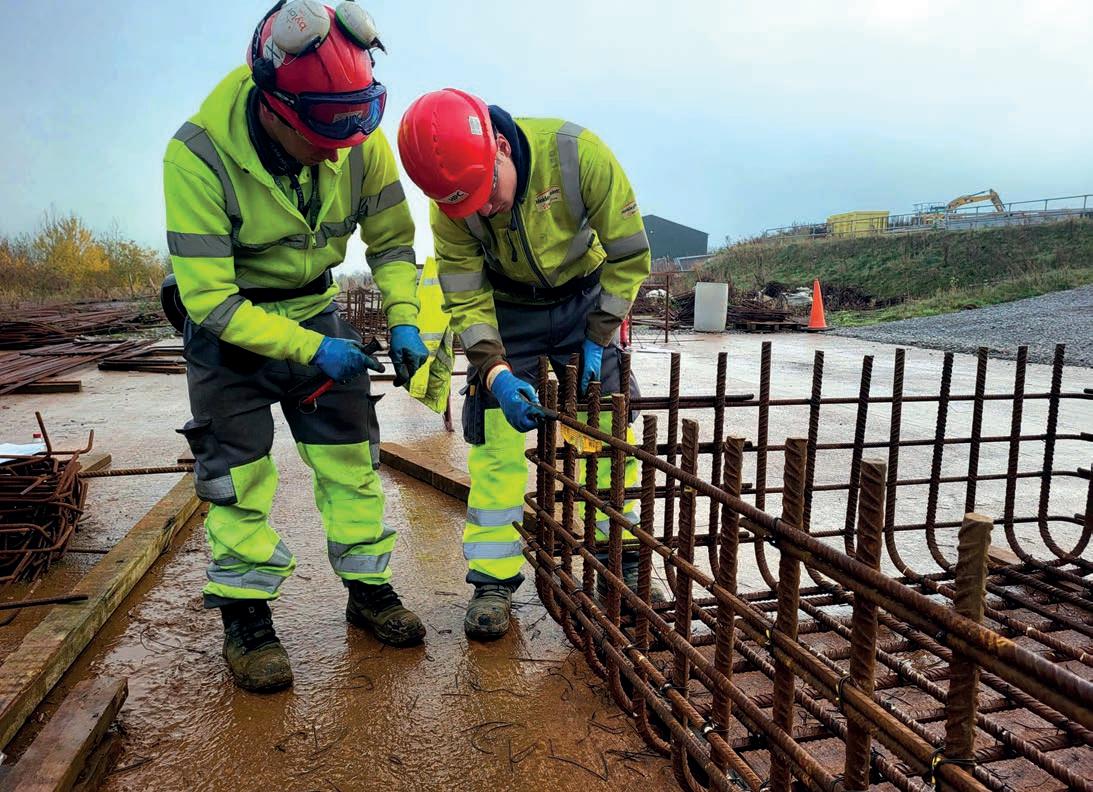
The centre provides critical skills training and apprenticeships for infrastructure construction, specialising in groundworks, steel fixing, formwork, slinging and lifting, water utilities, lifting supervision, appointed persons site supervision and management courses as well as many CPCS plant categories. CSIC is the UK’s leading civil engineering training centre, offering bespoke training products to employers across the UK. It has proven to be life-changing for many candidates who have progressed through the skills-set offered.
CSIC is also home to Construction Live – an exciting and unique experiential programme offering groups of individuals the opportunity to experience what it is like to work on a construction site.
Now recognised as a vital work experience component to those on degree and apprenticeship programmes, Construction Live sees individuals experiencing first-hand how to plan, manage and build a construction project, aligned to any outcomes required for their studies. It reinforces health and safety expectations and high project values and behaviours, preparing candidates for the stringent requirements on real construction projects. q
• For more information about apprenticeship programmes, courses and training at UCS College Group, call 01278 655111 or email business@ucscollegegroup.ac.uk
[
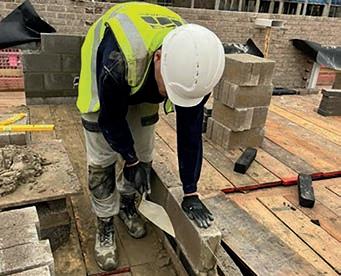
17-YEAR-OLD Bloor Homes bricklaying apprentice, Will Roberts, has been selected by Heart of Worcester (HoW) College to represent the developer and college at the annual SkillBuild 2026 Regional Qualifying competition taking place at Heart of Worcestershire College in May.
Will (pictured) is one of three students selected by tutors at HoW College to compete against bricklaying apprentices across the region. The six-hour bricklaying competition will require each apprentice to use their skills, precision and time management to complete projects designed to test skills and abilities at Level 2 curriculum.

On the day, marks will be awarded for technical proficiency and execution, including dimensional positioning, alignment, details of projected and recessed features, joint finishes, conformity to the drawing, the cleanliness of the facework, and work methods. Marks will also be awarded for working safely and wearing the appropriate personal protective equipment throughout the competition.
Bloor Homes’ bricklaying apprenticeships are sought after, as the developer provides a collective place for apprentices of different levels to work on site and learn together, under the expert guidance of dedicated bricklaying apprentice master, Dave Weldon. This ensures apprentices have the support on site that they need whilst also adhering to the high standards of work and professional health and safety required of a live building site.
Dave Weldon said: “We are so proud of Will – given that he only started his apprenticeship six months ago with no previous building experience, it’s fantastic to see how well he has progressed. He’s also our youngest apprentice, which makes his selection for this important regional competition even more impressive.
“Will has taken on board the high standards and attention to detail we expect from all our apprentices, alongside everything he is being taught at HoW College. His place at the regional qualifier is well-deserved. We wish him the very best of luck in June.”
Will Roberts said: “It was a surprise to be selected for the competition but I’m looking forward to it. I may be relatively new to bricklaying, but I’ve already learned a lot at HoW College and working on site at Bloor Homes. If they think I’m ready, I will definitely give it my best shot!”
The annual SkillBuild competition is run by Go Construct, an organisation funded by the construction industry to provide resources for anyone looking for a career in the construction and built environment sector. It also showcases the many rewarding opportunities available and helps people from all backgrounds to enter an exciting and growing industry which has a huge impact on the UK’s housing, industry and infrastructure.
There are seventeen Regional Qualifying events across the UK and Northern Ireland. Bricklaying is one of ten categories in the competition – apprentices and full-time students in carpentry, dry-lining, furniture and cabinet making, joinery, painting and decorating, plastering, roof slating and tiling, stonemasonry, and wall and floor tiling also compete for a place at the SkillBuild National Final.
When all seventeen qualifiers have closed, only the top eight highest scoring competitors from across the country in each category will go through to the SkillBuild National Final held at the end of the year. q
• For more information about Bloor Homes’ apprenticeship and trainee opportunities visit bloorhomes.com/careers. For more information about the SkillBuild 2026 competition visit goconstruct.org/skillbuild
[ WORK PLACEMENTS play a pivotal role in construction education – and at South & City College Birmingham they are an essential bridge between the workshop and the world of work.
For students across all levels – from introductory vocational courses to advanced technical programmes – these experiences provide a powerful opportunity to apply their learning in real industry settings. In a sector shaped by rapid technological change and ongoing skills shortages, this connection between education and employment has never been more important.
On placement, students gain an authentic understanding of how construction sites operate: the pace, the teamwork, the health and safety expectations and the practical problem solving required to keep projects moving. This exposure builds confidence, competence and the professional behaviours employers value most.
Whether working alongside skilled tradespeople, site supervisors or project managers, learners develop both technical ability and vital soft skills such as communication, reliability and adaptability.
For many students, placements also open their eyes to the breadth of careers available – from bricklaying and electrical installation to surveying, digital construction and sustainability-focused roles. This first-hand insight helps them make informed choices about their
future pathways and strengthens their motivation to progress.
For employers, offering placements through South & City College Birmingham is a strategic way to generate social value while shaping the future workforce. By supporting local learners, businesses contribute to community development, promote social mobility and strengthen their recruitment pipeline.
Employers who collaborate with the college often find they gain early access to motivated, skilled individuals who are better prepared for the realities of site work.
Ultimately, work placements create a win-win partnership between students, employers and the region. They ensure that future construction professionals are equipped with the skills, behaviours and experience required to build safe, innovative and sustainable environments – benefiting both industry and the wider community for years to come. q
• If you’re an employer interested in offering a placement or finding out more about how you can support the college’s construction students, please contact the Employer Engagement Team at South & City College Birmingham. Call 0121 694 5066 or email business.dev@sccb.ac.uk
[ ABINGDON & WITNEY COLLEGE is significantly strengthening its electrical training offer to meet the rising demand from working professionals across the trades. As the need for skilled electricians increases nationwide, the college is strengthening its provision with flexible, industry led trai ning designed to help tradespeople stay compliant and competitive.
The recent release of new electrical regulations on 15 April has accelerated this growth. In response, the college now offers targeted update courses for qualified electricians who already hold the 18th Edition. These focused programmes ensure professionals remain fully aligned with evolving standards without interrupting their working routines.
Electrical Installation and Maintenance apprenticeships are now delivered across both Abingdon and Bicester sites, increasing accessibility for learners and upskilling professionals.
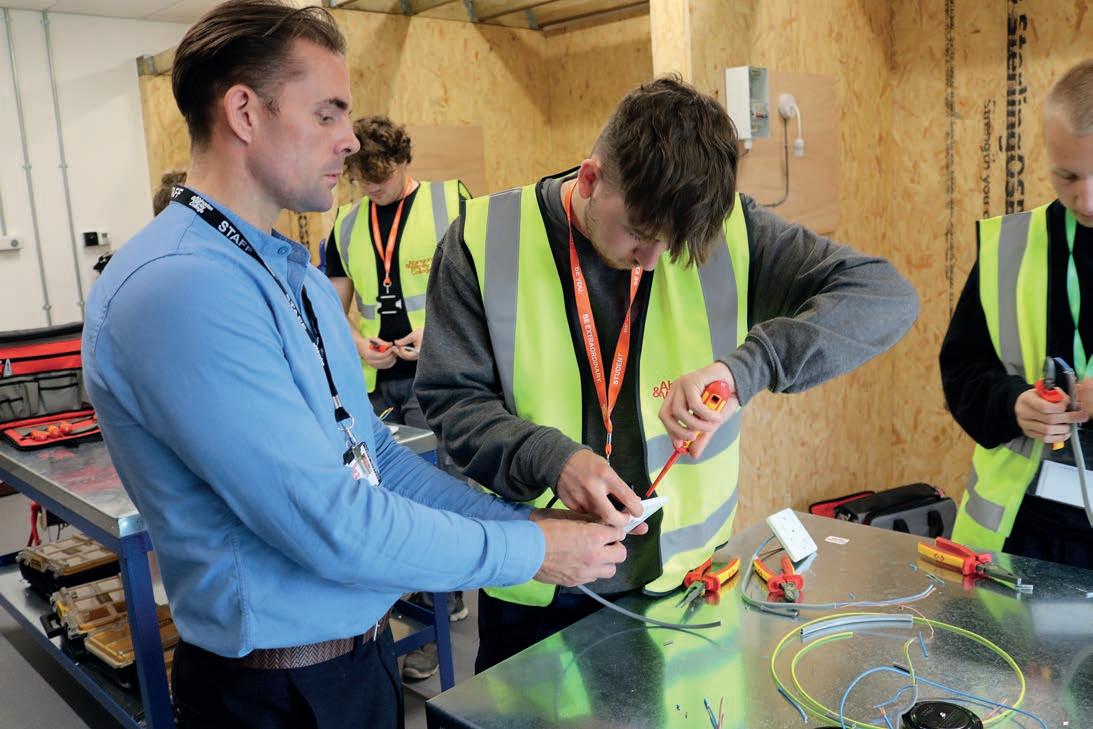
Training takes place in modern workshops equipped with up-to-date industry tools and materials, ensuring every learner experiences practical, workplace ready training that reflects employer expectations.
A major area of growth has come from the introduction of evening electrical courses, created to support tradespeople who need to study around daytime commitments. Demand has been exceptionally strong, quickly reaching capacity and leading the college to add further evening cohorts so more professionals can access training that fits their schedules.
With a focus on hands-on learning, industry experienced tutors and close collaboration with local employers, Abingdon & Witney College is strengthening its role as a leading provider for the region’s electrical workforce. This expanded offer ensures professionals at every stage can stay skilled, up-to-date and ready to meet the demands of a fastmoving sector.
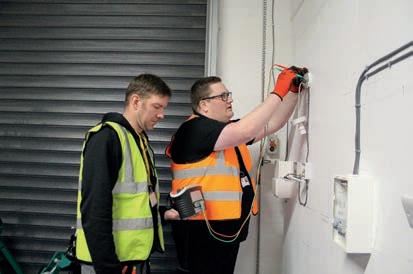
Interested in developing your skills or exploring our electrical training offer?
To enquire about any of our courses, please contact Will Gibbs, Construction Skills Project Lead, who will be happy to support you with course information, entry requirements and upcoming start dates. q
• For further information email Will.Gibbs@ abingdon-witney.ac.uk or visit the website at abingdon-witney.ac.uk
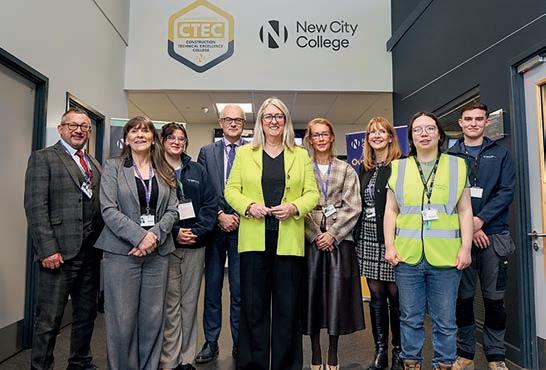
[ NEW CITY COLLEGE’S Construction and Engineering Campus in Rainham was in the spotlight when it welcomed Baroness Jacqui Smith, Minister for Skills, for a visit highlighting the vital role that further education colleges play in developing the UK’s workforce.
The minister toured the college’s fantastic facilities, met with students, staff, apprentices and employers, and used the visit to make a national TV and press announcement that reaffirmed government investment in skills and technical education.
New City College was recently announced as the Construction Technical Excellence College (CTEC) for Greater London so it was the perfect place for Baroness Smith to see for herself the remarkable work being carried out to try to address the UK’s construction skills shortage.
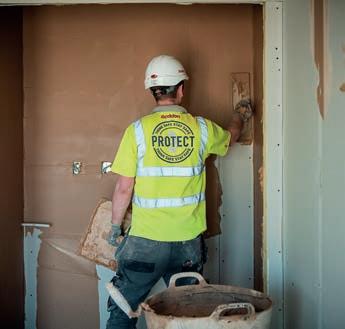
During her visit the minister looked around the plumbing, carpentry, engineering and brickwork workshops, where she met with students and apprentices. She spoke directly with learners and electrical apprentices, asking about their courses and the practical, industryready skills they are developing to support their future careers. She even had a go at bricklaying herself!
Baroness Smith then met with employers to discuss the crucial

role that further education colleges play in meeting skills shortages and supporting local and national economic growth. Following the tour, she re-confirmed the government’s funding and commitment to boosting capacity in colleges, ahead of an expected 67,000 additional 16- and 17-year-olds entering post-16 education by 2028.
She said: “Learning a trade opens doors to a brilliant career and a secure future, and trade workers are crucial to our mission to turbocharge economic growth.”
Colleen Marshall, Principal of New City College, Rainham, said: “It was an honour to host Baroness Jacqui Smith and to show her around our incredible facilities. The minister was very impressed and commented on the dedication and enthusiasm of our staff, as well as the high levels of engagement shown by our students and apprentices.
“We are proud of the work taking place across the college and the role that NCC plays in developing the skilled workforce of the future.” q
• For more information call 020 7613 9416 or email employability@ncclondon.ac.uk



[THE CONSTRUCTION INDUSTRY TRAINING BOARD (CITB) is working in partnership with the National Skills Academy for Construction (NSAfC), Urban&Civic and Constructed Pathways to build a long-term construction skills pipeline that supports major regeneration projects across Cambridgeshire. The partnership connects workforce planning directly to some of the largest development programmes in the region, including Waterbeach, Alconbury Weald and St Neots. Collectively, these sites represent thousands of new homes, major infrastructure investment and decades of construction activity.
At the heart of the collaboration is a commitment to widening access to construction careers. The programme actively reaches people who are economically inactive, helping them re-engage with employment through structured training and supported entry routes into the industry.
For CITB, this work represents a model of place-based partnership aligning investment, employers and training providers around a shared vision. The ambition is not simply to fill vacancies but to transform lives, strengthen communities and ensure Cambridgeshire has a skilled, diverse and resilient construction workforce for the future.
Through the NSAfC framework, employers are engaged from the outset ensuring training reflects real site demand and leads to genuine job opportunities. The framework is a way of working that enables partners to gain the skills they need on site, on time. Developed by CITB and approved by industry, it provides structure and direction to help deliver consistent, high-quality training on a live construction project.
Working in partnership with DWP, Sodexo/HMP Service, the local authority and the Council Youth Impact Team, Constructed Pathways is developing training solutions the skills industry has identified as most valuable. To date, they have delivered bricklaying taster sessions and intensive six-week bricklaying bootcamps as well as plant operative and Class 2 HGV bootcamps.
Urban&Civic’s long-term stewardship of the developments creates the stability needed to think beyond short-term labour supply. The focus is on building a local workforce legacy – creating progression routes, supporting apprenticeships and embedding social value into how construction is delivered across the region.
Nathan Wilkins, CITB Customer Engagement Manager, said: “This is just the beginning. The long-term vision is to create a sustainable pipeline of new entrants ready to start meaningful careers in construction, supported by systems that allow them to continue developing their technical skills in line with regional demand. This is a strong start, and now we build momentum.” q
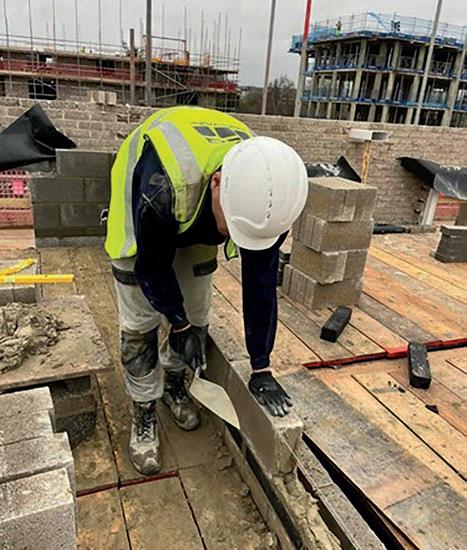
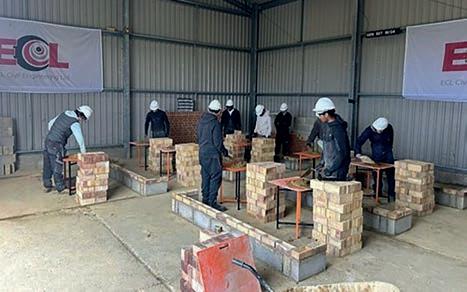
[AS THE GOVERNMENT pushes ahead with its ambition to build 1.5 million homes and deliver critical national infrastructure, the industry needs tens of thousands more skilled workers to meet demand.
In response, the Department for Education has launched the Construction Technical Excellence College (CTEC) initiative – a national programme designed to modernise how construction skills are taught, strengthened and supported across England.
Ten colleges – one in each English region and one with a national remit – have been awarded CTEC status. Each was chosen for its strong track record in technical education and i ts ability to drive forward innovation in construction training.
Backed by major government investment, the network aims to support the training of 40,000 learners by 2029, from traditional trades to professional roles and emerging disciplines such as digital
construction, sustainability and modern building technologies.
In the South West, Exeter College has been appointed as the region’s CTEC, using government funding to expand knowledge sharing, accelerate curriculum innovation and strengthen the construction talent pipeline. The South West CTEC is already working with further education colleges, private training providers, employers of all sizes and local authorities all over the region – from Bournemouth to Bristol to Newquay.
Activities include knowledge-sharing roadshows and indepth collaboration with training providers to shape a more industryresponsive curriculum and support professional development, ensuring teaching keeps pace with sector demands. q
•
Abingdon & Witney College
Tel: 01235 541 111
E: apprenticeships@abingdon-witney.ac.uk
W: www.abingdon-witney.ac.uk
126 Churchill Road, Bicester OX26 4XD
Exeter College
T: 01392 400500
E: info@exe-coll.ac.uk
W: exe-coll.ac.uk


Exeter College, Hele Road, Exeter, Devon EX4 4JS
Fife College
Tel: 0344 248 0132
E: sales@fife.ac.uk
W: www.fife.ac.uk

Dunfermline City Campus, Calaiswood Crescent, Dunfermline KY11 8WH
T: 0330 135 9000
E: info@ncclondon.ac.uk
W: www.ncclondon.ac.uk


Epping Forest | Hackney | Havering | Redbridge | Tower Hamlets
South Hampshire College Group
> Apprenticeships
> Technical & Professional Training
E: info@shcg.ac.uk
W: www.shcg.ac.uk

South & City College Birmingham
T: 0121 694 5066
E: business.dev@sccb.ac.uk
W: www.sccb.ac.uk

Digbeth Campus, High Street Deritend, Digbeth, Birmingham B5 5SU
University Centre Somerset College Group
T: 01278 655004
E: CSIC@btc.ac.uk
W: www.ucscollegegroup.ac.uk
Bath Road, Bridgwater, Somerset TA6 4PZ




[ THE British Pest Control Association (BPCA) took part in RHE Global’s Housing 2026 conference in Birmingham on 25 March, an event focused on raising standards and improving health across the housing sector.
The conference brought together representatives from across social and private rented housing, including local authorities, academics, campaigners and government stakeholders. Discussions centred on how upcoming regulatory changes in England could improve living conditions for tenants.
Key topics included Awaab’s Law, the Renters’ Rights Act, and proposed updates to the Housing Health and Safety Rating System and Decent Homes Standard. Sessions explored how these reforms will affect inspection regimes, enforcement approaches and day-to-day housing management.
Awaab’s Law, in particular, is expected to place tighter legal duties on landlords to investigate and resolve hazards such as damp and mould within set timeframes. Pest issues will soon be covered by the legislation when we enter into phase two of the rollout, anticipated in October 2026.
For pest professionals, this is likely to mean increased demand for rapid response, clearer reporting and closer collaboration with housing providers to identify the underlying causes of infestations.

part of the conversation from the start. We’re seeing a real shift towards prevention, better inspection and closer collaboration with housing providers.
Niall Gallagher, Technical Manager at BPCA, also delivered a presentation on changing techniques, trends and considerations for pest management within housing. His session highlighted how evolving housing standards are shaping pest control approaches, particularly in relation to inspection, proofing and integrated pest management.
Niall said: “As housing standards continue to evolve, pest management needs to be
“With measures like Awaab’s Law coming in, there’s a greater expectation to deal with issues quickly and tackle the root causes, not just the symptoms. Getting this right not only protects properties, but has a direct impact on tenant health and wellbeing.”
The event provided a platform for crosssector collaboration, with a strong focus on practical implementation and preparing organisations for the next phase of housing regulation. q
[ PESTEX played host to around 2,100 people and over 1,600 visitors between 18 and 19 March, for the UK’s biggest pest control event in the calendar year.
Held at London’s Excel Centre, the event brought together delegates from all over the globe to network, discover new products, and attend seminars and debates on pest management and business topics.
More than 125 pest management manufacturers and distributors packed out the exhibition hall with incredible-looking stands, fantastic new products and creative games with giveaways for winners.
Lauren Day, Events Manager at BPCA, said: “PestEx is the pinnacle of our events calendar, and once again we were blown away to see all the effort our exhibitors put into making their stands exciting and engaging. The energy in the hall was electric, and we couldn’t do it without their enthusiasm and support.
“PestEx 2026 has been the biggest show yet; we expanded the floor plan, filled the theatres with more speakers than ever and gave ourselves a huge challenge. And we absolutely smashed it!”
New to the show this time was dedicating the entire Spotlight theatre to debate sessions, with panellists from across the industry, government bodies, other associations or institutes, and even from businesses like Pret a Manger. Subjects ranged from surveying techniques to building amazing pest control teams – and even some pest-related politics!
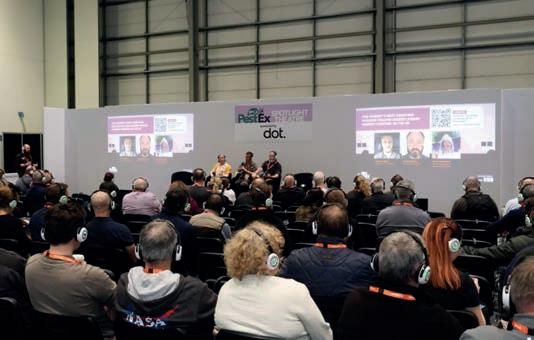
Rosina Robson, BPCA’s Chief Executive, was thrilled with her first PestEx experience, commenting: “There was an incredible atmosphere in the exhibition hall over the two days. PestEx is a truly unique industry event; you really don’t get a better chance to meet this many pest professionals, suppliers, manufacturers, business owners, specifiers, government departments and member benefit providers under one roof in the UK.” q
[
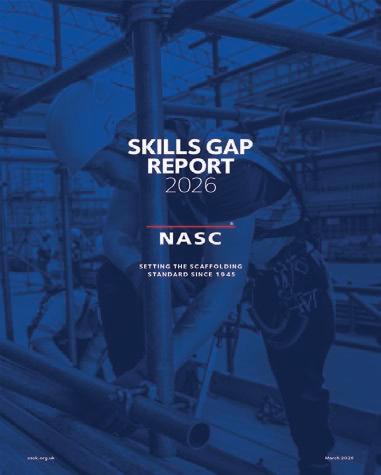
THE UK scaffolding and access sector is facing a shortage of 40,000 skilled workers, according to a new report published by the NASC, the UK's leading trade body for scaffolding and access.
The NASC Skills Gap Report 2026 is based on responses from full NASC member companies and provides the first detailed snapshot of workforce capacity across the sector. It found that 56% of firms currently have at least one vacancy, with an average of 4.4 open roles per organisation. Across NASC members alone, this equates to around 1,760 vacancies.
Demand for workers is expected to grow further in 2026. Around 83% of NASC member organisations say they plan to recruit this year, with scaffolders making up the largest share of expected hires. When projected across the wider scaffolding and access sector, NASC estimates that the industry could face around 40,000 vacancies once retirements and normal staff turnover are taken into account.
Clive Dickin, Group CEO of NASC and CISRS (pictured), said members are already feeling the pressure. “Our members expect almost 6,000 vacancies this year alone and when you factor in retirements and normal staff turnover, then across the whole sector, including non-member firms, that means an equivalent of around 40,000 roles that will

need to be filled,” he said.
Dickin said training and education remain the long-term solution, highlighting continued investment in CISRS training, apprenticeships and professional development to maintain high standards of competence and safety.
However, he warned that training new entrants takes time and said the sector may also require short-term support through migration policy so experienced scaffolders from overseas can help meet demand while the domestic workforce pipeline grows.
The report also points to structural challenges affecting workforce growth. Around 7% of the current workforce is expected to retire within the next four years, potentially removing more than 1,400 experienced workers just from NASC member companies. Firms also reported
difficulties recruiting qualified staff, citing economic uncertainty, pay expectations and a lack of applicants as key barriers.
NASC says the findings highlight the need for coordinated action between industry, training providers and government to ensure the scaffolding workforce is ready to support the UK’s future construction and infrastructure projects.
The full NASC Skills Gap Report 2026 is available to download now at nasc.org.uk q
[ A CONSTRUCTION FIRM has been fined £40,200 after a teenage labourer died falling down a ventilation shaft on a London building site.
Renols Lleshi, 19, was helping to dismantle scaffolding on the 12th floor roof garden of a block of flats being built at the Ark Soane Academy site, Mill Hill Road, London on 5 July 2023. As he stepped onto a ventilation shaft the covering gave way, and he fell six floors to his death.
Renols’ father said: “My family and I are devastated by the loss of Renols. To know that his death was caused by an accident which was entirely avoidable only makes our loss even harder to cope with.
“We are grateful to the Health & Safety Executive for their efforts to investigate the accident and prosecute one of those responsible for Renols’s death. However, nothing anybody can do can bring our loved one back or lessen our grief in any way.”
A Health and Safety Executive (HSE) investigation found that the ventilation shaft had been covered only by a sheet of plasterboard and roofing foam. Routine inspections of the building did not include
the roof garden area, meaning the inadequate covering went undetected and no warning was given to the scaffolding team.
HSE guidance on working at height states that employers should carry out as much work as possible from the ground and ensure workers can safely access and leave areas where work at height is required. Equipment used for working at height must be suitable, stable and strong enough for the task and properly maintained.
Employers and those in control of work at height must ensure activities are properly planned, supervised and carried out by competent people, including the use of appropriate equipment.
Jerram Falkus Construction Limited pleaded guilty to breaching Regulation 4(1) of the Work at Height Regulations 2005. The company was fined £40,200, ordered to pay a £2,000 surcharge and £5,000 in costs at City of London Magistrates’ Court on 18 March 2026.
HSE Inspector Natalie Prince said: “Falls from height are one of the biggest causes of workplace fatalities and major injuries. This was a wholly avoidable incident that led to the death of a young man.” q
[ THE International Powered Access Federation (IPAF) has released a new eLearning MEWP spotter training course, designed for anyone who assists a mobile elevating work platform (MEWP) operator in safely manoeuvring a machine into position.
The new course is concise, theory-only and delivered entirely online. This is for convenience and enables candidates to learn in their own time, at their own pace and on their own devices. Interactive graphics and videos clearly guide candidates through their learning journey and show various worksite environments and real-life scenarios.
The course takes approximately two and a half hours to complete, and upon passing the online theory test, candidates are awarded their qualification, which is valid for five years.
A MEWP spotter is a specific role assigned to one or more people to observe MEWP operations onsite, in real-time and, where necessary, communicate with the MEWP operator to direct them to manoeuvre the MEWP safely away from any obstacles or hazards that may be beyond the MEWP operator’s line of sight.

The requirement for MEWP spotter training was first identified by powered access contractors. Routinely, and as part of their risk assessments, many contractors assign the dedicated role of MEWP spotter on their worksites because it has proven to reduce accidents and incidents.
Paul Roddis, IPAF Training Manager, said: “This new MEWP spotter course demonstrates what is possible when IPAF works in partnership with its contractor members to develop practical solutions for the industry. Together, we have created something exceptional that I firmly believe will save lives.
“If you’re involved in helping a MEWP operator to safely
[ THE NASC has been recognised as a CITB Prescribed Organisation. Clive Dickin, Group CEO of NASC and CISRS, commented: “We are delighted to announce that NASC has been recognised as a CITB Prescribed Organisation, a formal acknowledgement of our standing as the principal trade body for the scaffolding and access sector.
“This status means that NASC now has an official role in the CITB levy consensus process, giving our members a recognised and collective voice on how training funding is directed across the construction industry. It is a responsibility we take seriously and one we will fulfil with the same commitment to raising standards that underpins everything we do.
“For our members, this is further evidence that NASC's influence extends well beyond guidance and auditing. We are at the table where decisions that shape the future of skills and training in this industry are made, and we will continue to ensure that the scaffolding and access sector is properly represented.” q
manoeuvre a MEWP into position, this is the course for you. Likewise, we recommend the course is also taken by operators, supervisors and site managers, to ensure everyone on site understands the spotter’s role, hand signals and where the spotter should be safely positioned.”
Provision of universal training for all MEWP spotters means the role and associated responsibilities are better understood and utilised. q

Welcome to our A to Z guide of the websites of some of the industry’s leading players.
you are one of
directed to that company’s website.
To get your company’s website listed on this page just















[THE LATEST FIGURES from GOV.UK show that fire safety concerns are at an alltime high, with the number of unsatisfactory audits and formal notices served soaring. Of the 51,026 fire safety audits carried out in 2024/25, 42% (21,312) were found to be unsatisfactory, with almost 3,000 premises served formal notices.
Unsatisfactory fire safety audits have increased steadily over the last eight years, while formal notices served to premises owners have also risen alarmingly.
The statistics also raise concerns about the lack of fire safety audits carried out on a yearly basis, with just 2% of the 2.5 million premises that require regular audits having them carried out in each of the last six years. These premises should ideally be audited by a competent person every three years.
Analysis of the statistics from the UK’s leading smoke ventilation manufacturer, Sertus, suggest that while there has been an alarming number of unsatisfactory audits and formal notices served, the industry has been forced to take building fire safety more seriously since the Grenfell disaster.
Richard White, commercial director at Sertus, believes that there has been a change in how audits are being approached, with those in charge benefiting from the new legislation and processes put in place in recent years.
He said: “While the statistics may be alarming on the face of it, I’d argue that the increase is likely happening because of the implementation of the Building Safety

Regulator and new legislation. There is a proper process in place now, and there wasn’t before. More people are beginning to understand what good looks like when it comes to fire safety.”
There’s positivity that the industry is now placing additional emphasis on protecting the life of citizens, which is a direct reflection of the changes driven by Dame Judith Hackitt with the backing of HSE and Ministry of Housing, Communities and Local Government.
The Building Safety Act 2022 was brought in off the back of the Grenfell tragedy to implement stricter regulatory frameworks for
the design, construction and management of higher risk buildings. Alongside this, Fire Safety Act 2021 was also introduced and clarifies that the Responsible Person for a building must manage and reduce the risk of fire.
The two pieces of legislation have driven increasing scrutiny from auditors, as they are now more likely to capture any areas of noncompliance due to the liability and risk if a fire was to break out. The Building Safety Act in particular places particular emphasis on earlystage design, ensuring compliant application of fire safety equipment, such as smoke ventilation, is in place. q
[
BALFOUR BEATTY GROUP LIMITED have pleaded not guilty to health and safety offences following a worker fatality at AWE plc's Aldermaston nuclear site. The infrastructure company appeared at High Wycombe Magistrates Court for a prosecution instigated by the Office for Nuclear Regulation (ONR), the UK’s independent nuclear regulator.
The company is facing two health and safety charges following alleged breaches of the Health and Safety at Work etc. Act 1974 Section 2(1), and 3(1).
They relate to an incident which occurred at the Aldermaston site in West Berkshire on 6 July 2023 when a 58-year-old male construction worker from East London died after sustaining fatal injuries.
The trial date has not yet been scheduled. ONR will announce details of the date and location of the trial when available.
ONR regulates the work at AWE's Aldermaston and Burghfield sites, which covers the entire life cycle of nuclear warheads – from initial concept, assessment and design, through to component manufacture and assembly, in-service support, and finally decommissioning and disposal.
The incident was a conventional health and safety matter and there was no radiological risk to the public. q

[ THE CHARTERED INSTITUTE OF BUILDING (CIOB) has teamed up with leading men’s health charity and the largest public funder of prostate cancer research, Prostate Cancer UK, to encourage more men working in the construction industry to be aware of their prostate cancer risk and what they can do about it.
Prostate cancer is now the most common cancer in the UK and one in eight men will be diagnosed with the disease during their lifetime. The risk of developing it increases with age and is double for Black men.
Currently more than 80% of the UK’s construction workforce is male, with over a third being over the age of 50, meaning the sector is a key audience when it comes to raising awareness of the key risk factors that can affect men, the free and simple testing men at risk can ask for, and where men dealing with a diagnosis can go for support and advice.

CIOB President, Paul Gandy sadly lost his own father, an uncle and an industry colleague to prostate cancer. He strongly believes the construction sector has a responsibility to its workforce to make them aware of how simple it is to get tested.
He said: “With such a high proportion of built environment workers being male, it makes our sector more vulnerable to prostate cancer than most others so it’s important everyone understands the risks, the symptoms and how to get tested. Health must never be a taboo subject, but in our industry it often is, and this is something we want to overcome by working with Prostate Cancer UK to get the message far and wide. Construction is about building strong foundations that last and looking after our health is part of that work too.”
To help men understand their own risk of the disease, Prostate Cancer UK has created a free and confidential online risk checker that takes just thirty seconds to complete and has been used by over four million men to date. It asks a small number of straightforward questions and provides guidance about risk and what to do next. CIOB is encouraging male workers across the construction industry to go online to find out their risk and what to do next if they are at higher risk.
Paul Gandy added: “If you’re a man working in construction, I would strongly encourage you to use the checker. And for everyone, male and female, who manage teams or work alongside others, encourage them to do the same and ensure there’s flexibility around time off to get tested. Starting a conversation about prostate cancer might be the moment that helps a man discover his risk and take action. Taking just thirty seconds now could change the course of a life, perhaps even your own.”
For those deemed to be at higher risk, the first test for signs of prostate cancer is a blood test called the prostate specific antigen, or PSA, blood test. It’s a safe and effective way of working out if more tests are needed and can be requested for free from a GP. There is currently no national screening programme for prostate cancer in the UK, unlike some other cancers, so it’s vital men know if they are at higher risk – as a result of being over 50, or being over 45 if they are Black or have a family history of the disease – and proactively speak to their GP about the option of a PSA blood test.
Nick Ridgman, Head of Support Services at Prostate Cancer UK,
said: “We’re delighted to be partnering with the Chartered Institute of Building to reach their members with vital information about the most common cancer in men. Prostate cancer is curable if found early, but it’s also the most common cancer without a screening programme, so the responsibility to know your risk and speak to a GP rest entirely on men’s shoulders. That’s why Prostate Cancer UK is leading the way with our £42m TRANSFORM trial, which will find the safest and most effective way to screen all men in the future.
“But for the here and now, we need men to know their risk, which increases if they’re over 50 and if they’re Black or have a family history of the disease, and chat to their GP about a simple blood test if they are at higher risk. We’ve developed a simple online tool to help, so men can check their risk in 30 seconds by visiting our website or searching ‘check my risk’ today. Through our partnership with the CIOB, we aim to get more men across the building and construction industries a lifesaving early diagnosis.”
Nick Molyneux, a senior manager at construction company Mace, has first-hand experience of the importance of early diagnosis of prostate cancer. He had no symptoms but a routine PSA blood test detected elevated levels of prostate specific antigen, which led to further checks and a biopsy. He was diagnosed with prostate cancer which, thankfully, was found early and considered to be ‘low grade’.
He said: “It was quite a worrying time. You hear a lot about prostate cancer but you don’t really understand the full nitty gritty of it all. If I didn’t have that blood test, I’d never know, even now. It is really important to get that test, especially if you’re in the higher risk category.”
“It’s so important to put your health first and get yourself checked. It’s a simple blood test and it could save your life.”
Peter Rowe has worked in the construction industry for more than 45 years. He is a Fellow of the Chartered Institute of Building and was diagnosed with prostate cancer in 2025. He said: “I had never really noticed any of the symptoms you will commonly read about, such as problems going to the loo – other than after a night out, for example, which I had simply put down to dehydration.
“However, one weekend my ‘dehydration’ got so bad I had to go to A&E. Over the following weeks, it was confirmed I had an enlarged prostate. After a few weeks of further tests and scans, I was then diagnosed with prostate cancer and given the choice of treatment or surgery.
“Because of the findings of the biopsy, I chose radical surgery, which can require up to a year for full recovery. I now need ongoing PSA blood tests to check no cancerous cells were left behind.
“It is quite clear to me now that had I thought about what was happening to me and found the time to go to my doctor and ask for a PSA test, surgery may have been avoided. So, please take a PSA test for both your sake and the people in your life. It is a simple blood test; it’s not embarrassing and could save your life.” q
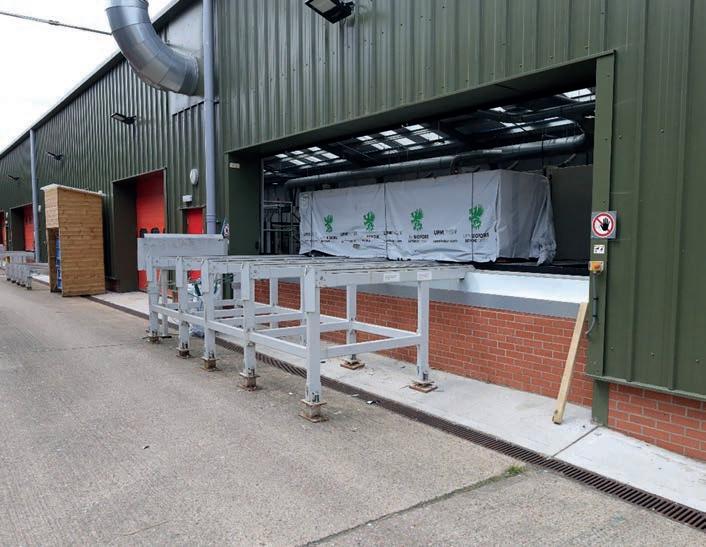
[ ONE OF THE COUNTRY’S largest building merchants has been fined more than £2m after one of its workers was crushed t o death by a pallet of timber that weighed around three tonnes.
Paul Coulson, 56, died after a colleague started a conveyor not realising Mr Coulson had climbed inside it – resulting in the f atal crush.
The incident happened on 22 May 2024 at Herringswell Sawmills, a site in Bury St Edmonds in Suffolk operated by Huws Gray Limited. Mr. Coulson, a labourer, had been tasked with removing plastic packaging from pallets of timber before they could be processed at the mill.
The 56-year had climbed within the framework of the conveyor to access some of the packaging. However, another operative, who could not see Mr Coulson from his location, started the conveyor. This resulted in the pack of timber moving forwards and colliding with him. The operative, who could see that the pack of timber was not moving along the conveyor as it should, reversed it before changing its direction. This resulted in the pack of timber moving forwards again – colliding with Mr Coulson for a second time. The crush injuries sustained were so significant that he died at the scene.
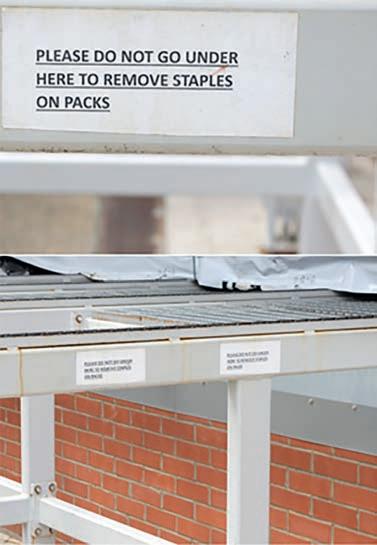
An investigation by the Health and Safety Executive (HSE) found that the company – which provides supplies to the buildin g trade from hundreds of sites across Great Britain - had previou sly identified that employees were accessing the danger zone within the conveyor and placed signage asking employees not to do so. However, CCTV analysis revealed that between 14 April and 23 May 2024, operatives entered within the framework of the convey or on 19 different occasions.
Although the company had placed stickers on the conveyor in a bid to tackle the working practice, no further action was taken to prevent access until after the tragedy.
The measures subsequently introduced to reduce the risk included guarding the conveyor to prevent access, changing the
system of work so that the pallets were unwrapped before being placed on the conveyor, as well as more CCTV being installed to allow all angles to be seen by those operating it.
Although standards of health and safety are much improved over recent years, sawmilling remains a high-risk industry.
Accidents can happen when people enter dangerous parts of the machinery to carry out adjustments, clear blockages or replenish consumables. Companies need to prevent access to the reciprocating carriage and associated machinery during normal operation. This can be achieved by having in place:
• Fixed-distance guarding on the sides of the machinery
• Close guarding designed to meet the necessary reach distances
• A combination of these or other suitable measures
Huws Gray Limited, based in Llangefni, Anglesey, pleaded guilty to breaching the Health and Safety at Work etc Act 1974 Section 2(1). The company was fined £2.2m and ordered to pay full costs of £9,929 at Chelmsford Magistrates Court on the 26 March 2026.
HSE inspector Joanne Williams said: “This was a staggering failure that has cost a man his life and robbed a family of the ir loved one, and the scale of the fine handed down reflects the gravity of this case. All companies, regardless of their size, must follow the hierarchy of control for guarding dangerous parts within work equipment.
“Our investigation revealed that in this case, Huws Gray Ltd chose to control a serious risk through instruction alone – ins tead of putting proper safeguarding measures in place. This meant employees were able to access a danger area, with tragic consequences.
“Had Huws Gray Ltd taken robust action when they became aware of the problem, Paul Coulson would be alive today. Our thoughts will always remain with his family and friends for the loss they have suffered.”
The case was taken by HSE lawyer Edward Parton supported by paralegal Mariea Slater. q
[THE UK GOVERNMENT has accepted a series of recommendations aimed at accelerating nuclear energy development, but the proposed reforms are already prompting debate among environmental groups and planning specialists.
While the expansion of low-carbon energy infrastructure is widely seen as essential to achieving net-zero targets, critics argue that the changes could weaken environmental protections and introduce new risks for wildlife.
The proposals follow the Fingleton Review, an independent assessment of nuclear regulation commissioned by government to identify ways of simplifying and reducing the cost of nuclear development. Led by economist and former regulator John Fingleton, the review called for significant reforms designed to remove perceived regulatory barriers and speed up delivery of nuclear projects.
The Government published its official response to the review on 13 March 2026, confirming that it broadly accepts the principles set out and intends to begin implementing the recommendations over the coming months.
Central to the proposed changes is the introduction of new mechanisms intended to streamline environmental assessments for major nuclear projects. Ministers argue that the current system can involve repeated surveys and regulatory checks that delay infrastructure delivery without necessarily improving environmental outcomes.
Among the measures under consideration are the use of Environmental Delivery Plans (EDPs) for nuclear sites, as well as changes to the way environmental impact assessments are carried out. The Government has also suggested reducing some assessment requirements where risks are considered hypothetical or where conditions at a site have not materially changed.
Another proposal involves replacing existing environmental assessment processes with a new system of Environmental Outcomes Reports, intended to focus regulation on measurable environmental results rather than procedural compliance.
A centralised national dataset of environmental assessment information from nuclear developments is also proposed. In theory, this would allow regulators and developers to access previous survey data more easily and reduce duplication between projects.
Other suggested reforms include easing biodiversity net gain requirements for nationally significant infrastructure projects, introducing alternative assessment routes for defencerelated nuclear developments and reviewing the role of judicial review in major infrastructure planning cases.
Perhaps the most significant policy shift is a proposed planning presumption in favour of low-carbon energy infrastructure. If adopted, this could make it more difficult for planning authorities to refuse applications for nuclear or other low-carbon projects, even where environmental concerns have been raised.
While industry bodies have broadly welcomed the drive to streamline planning, conservation organisations have warned that some proposals could undermine existing safeguards for protected species, including bats.
Under current planning and environmental regulations, developers must often undertake detailed site surveys and prepare tailored mitigation measures where protected species may be affected by construction.
Critics argue that proposals to rely on broader EDPs could remove the requirement for site-specific surveys and bespoke mitigation measures. They say this risks overlooking the particular ecological conditions of individual sites.
Environmental specialists also warn that wildlife populations are often highly localised. If a development destroys a specific habitat or colony, replacement populations may not naturally re-establish in the same area.
Another point of concern is the suggestion that environmental mitigation could
increasingly rely on standardised or ‘offthe-shelf’ measures rather than bespoke ecological strategies tailored to particular species or locations.
Some conservation groups have also questioned the evidence base underpinning the reforms. They argue that the Fingleton Review relied on a relatively small number of case studies, some of which were unrelated to nuclear projects.
Examples cited in the review reportedly included environmental mitigation issues associated with the HS2 rail development, which critics say may not be directly comparable with nuclear infrastructure planning.
The Government has said the reforms will be ‘rooted in evidence’ and designed to deliver both faster infrastructure development and improved environmental outcomes. However, environmental organisations argue that more comprehensive scientific analysis should be undertaken before regulatory changes are introduced.
For contractors, developers and project planners, the proposed reforms could significantly reshape the planning landscape for major energy infrastructure.
If implemented, streamlined environmental processes could reduce planning times and simplify regulatory compliance for largescale projects. However, any weakening of environmental safeguards may also increase the likelihood of legal challenge, particularly during the consultation stages.
The Government has indicated that some reforms could be introduced as early as summer 2026, with further measures expected in the autumn. The full package of changes is expected to be implemented progressively through to 2027.
As consultations begin, construction professionals involved in major infrastructure delivery will be watching closely. The challenge will be balancing the urgent need for new low-carbon energy generation with the legal and environmental safeguards that remain central to UK planning policy. q
[THE BRITISH PLASTICS FEDERATION (BPF) is hosting an inaugural online seminar on 19 May on the latest developments in the plastics in construction sector
Free to attend for BPF members, architects, specifiers and academics, the seminar will cover an update on the UK construction market, including a planned overhaul of UK regulations affecting construction products. It will also provide insight into how circularity (including recycling) is developing in the sector; the latest on life cycle analysis and use in construction carbon modelling; as well as awareness of important research in engineering plastics sustainability affecting construction.
The work of the BPF and the UK plastics industry in construction will also be covered. It is aimed at those across all areas of the construction value chain who are interested in finding out the latest on plastics in construction. q
• More details and how

[ DISPUTES are an almost inevitable feature of construction projects. From early design discussions to the final stages of completion, large numbers of professionals are involved in delivering a project, including developers, contractors, subcontractors, consultants and clients.
Each party brings its own expectations, priorities and contractual obligations. When these do not align, disagreements can arise that can disrupt progress, increase costs and, in some cases, lead to formal legal proceedings.
Across the UK construction sector, disputes frequently arise over issues such as payment, project delays, quality of workmanship and contractual interpretation.
Payment disagreements remain among the most common problems. Contractors may claim they have not been paid on time or that the value of their work has been underestimated, while clients may dispute t he amount being claimed or argue that work has not been completed to the required standard. These disagreements are often triggered by delayed payments, disputes over the valuation of completed work or uncertainty surrounding additional costs arising from changes to the project.

Changes to the scope of work can also generate conflict. Construction projects rarely proceed exactly as originally planned, and it is common for clients to request design changes, additional features or alternative materials. While such changes may improve the final outcome, they can also affect costs and completion dates.
If variations are not properly recorded and agreed through a formal process, disagreements may emerge over whether additional work was authorised and how much it should cost. Clear documentation and transparent communication are essential to managing these changes and reducing the likelihood of disputes.
Health and safety issues can also lead to serious disagreements. The UK construction sector operates under strict safety regulations designed to protect workers, site visitors and the public. When concerns arise about unsafe working practices, inadequate safety measures or breaches of regulatory requirements, work may be halted until the issues are addressed. Disputes can arise over responsibility for safety failings or liability following an accident. Such matters can involve the regulatory authorities.
Where variations are not properly documented or agreed in advance, the potential for disagreement increases significantly. Resolving such disputes typically requires careful review of the contract terms, negotiation between the parties and, if necessary, referral to adjudication or the courts.
Time pressures can also generate conflict. Schedules are often tight and many activities depend on the completion of earlier stages of work. Delays caused by material shortages, adverse weather, design changes or late decision-making can quickly disrupt a programme. In some cases the original project timetab le may simply have been too ambitious. When delays occur, disputes can arise over who is responsible and who should absorb the financial consequences.
Contracts may contain provisions allowing extensions of time or imposing financial penalties for late completion, which can intensify disagreements if responsibility for the delay is unclear.
Quality of work and defect claims represent another source of conflict. When workmanship falls below expectations or materials fail to meet required standards, disputes can arise. Problems may range from poor finishing or incorrect installation to more serious structural concerns. In some cases defects may only become apparent months or years after construction has been completed. Resolving such disputes often involves inspections, technical assessments and, where appropriate, remedial works or claims for compensation.
Many disputes can be traced back to issues within the contract itself. Construction contracts are intended to define responsib ilities and project timelines. However, if clauses are poorly drafted or open to interpretation, different parties may understand their obligations in different ways. Ambiguous wording can easily lead to disagreement, particularly when problems arise on site. Resolvi ng a dispute often requires detailed examination of the contract a nd, in some circumstances, legal interpretation of the parties’ rights and obligations.
Design-related problems are another common source of conflict. Errors or omissions in drawings, miscommunication between designers and contractors, or unexpected site conditions can result in discrepancies between the intended design and what is ultimately built. Determining responsibility for such issues can be complex and often requires independent technical expertise to assess whether the design was adequate or whether construction deviated from the approved plans.
Even before construction begins, disagreements may arise during the tendering process. Contractors invest significant time and resources in preparing bids, and disputes can occur if there are concerns about the fairness of the selection process or if tender documents contain unclear or inaccurate information. If project requirements are poorly defined at this stage, misunderstandings may carry forward into the construction phase and create further problems.
Construction activity can also affect neighbouring properties, sometimes leading to disputes with adjacent landowners. Issues may arise over property boundaries, access arrangements, noise, dust or damage caused by construction works. Effective communication with neighbouring property owners and appropriate protective measures can help minimise these conflicts.
While construction disputes are common, many can be prevented through careful planning and good project management. Clear and comprehensive contracts, consistent communication between project participants and thorough documentation of decisions and changes can significantly reduce the risk of disagreements escalating. When disputes do arise, alternative resolution processes such as negotiation, mediation or adjudication can often resolve matters more quickly and cost-effectively than litigation.
Ultimately, construction projects are complex undertakings involving numerous moving parts. By recognising the common causes of disputes and addressing them proactively, developers, contractors and consultants can reduce conflict, maintain productive working relationships and keep projects moving forward. q
[
FOLLOWING THE RESOUNDING success of UKATACON 2025, UKATA has announced the dates and venue for its next landmark event. The UKATA Asbestos Conference 2026 (UKATACON 2026) will take place on 18 June 2026 at The Crowne Plaza, East Midlands.
The 2025 conference brought together nearly 120 professionals from across the asbestos, health and safety, legal, healthcare, education and construction sectors. What began as an annual gathering has evolved into a catalyst for change. The 2025 event marked a shift from knowledge to measurable progress, addressing one of the most persistent public health issues of our time.
Planning for UKATACON 2026 is underway and anticipation is already building. The event will expand on the successful format introduced in recent years, offering a broader delegate base, a more diverse speaker lineup and an even greater focus on practical knowledge sharing and innovation.
A social evening with networking opportunities will take place on Wednesday 17 and the conference will be held on Thursday 18 June. With asbestos once again a topic of national discussion – from parliamentary committees to investigative journalism – the timing could not be more critical.
UKATA Chief Operating Officer Craig Evans said: “UKATACON brings together professionals, policymakers and innovators who share one clear purpose: to make asbestos risk management smarter, safer and more accountable. 2026 will be our most ambitious conference yet, providing a platform where transparency, innovation and lived experience meet to shape the future.”
The 2025 conference featured leading voices from across the asbestos and
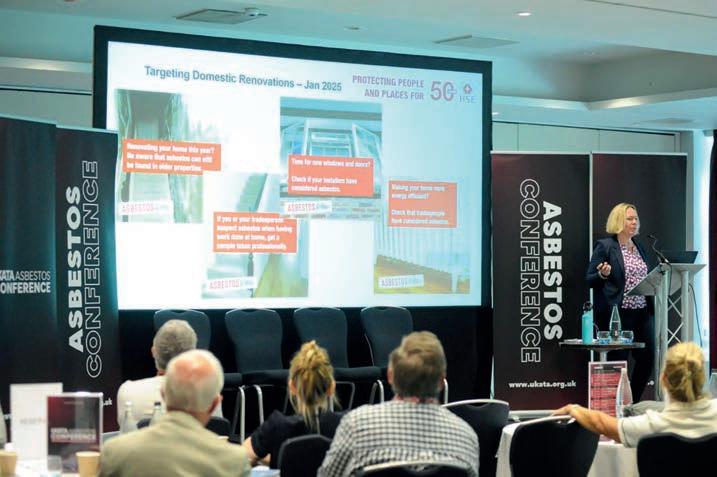
occupational health landscape, including representatives from the Health and Safety Executive, NHS, Irwin Mitchell, Mace and ACS Risk Group. Delegates engaged in sessions that tackled the realities of asbestos management, compliance, health protection, digital transformation and legal accountability. Exhibitors showcased tools and technologies designed to make asbestos safety more effective, connected and data driven.
Delegates provided some exceptional feedback following the 2025 event with Kevin Quinn of Tersus Group (Hydro-X) saying it was ‘one of the most useful and interesting events I’ve been to’.
Wojciech Przytulski, Asbestos Manager at P.P O'Connor Group Limited, added: “Great event well organised, fantastic speakers with great presentations. Fantastic opportunity for networking.”
UKATA have already secured a number of

high-quality speakers for UKATACON 2026 including representatives from the HSE, legal experts and a powerful personal perspective from a mesothelioma victim, with further industry speakers to be announced shortly. The full programme will be released in the coming weeks.
UKATA are also expanding the event to include a broader audience of clients, duty holders and decision-makers, creating even more opportunities for valuable discussion, learning and networking.
Whether you work in asbestos management, construction, education, healthcare or policy, UKATACON 2026 is an opportunity to be part of a shared effort to improve standards in asbestos risk management, drive change and protect future generations.
UKATA is dedicated to enhancing the quality and standards of asbestos training with the aim to shield workers and the public from the hazards of asbestos exposure.
The association collaborates closely with its members to guarantee they have access to the latest information, training resources and industry updates. They provide a suite of support services to assist them in accomplishing their training objectives. Membership encompasses a diverse array of organisations involved in asbestos training, including training providers, asbestos removal contractors, consultants and equipment suppliers.
UKATA is fervent about promoting safe and responsible working practices, committed to working with members and partners to realise a shared vision of protecting workers and the public from the hazards linked with asbestos exposure. q
[
CONSTRUCTION SITES are environments built around control – risks are assessed, procedures are written and workers are trained to manage hazards ranging from heavy machinery to working at height.
Lightning, however, introduces a very different kind of danger. It is sudden, unpredictable and capable of affecting large areas of an exposed site within seconds. Knowing how to respond when lightning strikes – or when a storm is approaching – can make the difference between a near miss and a serious incident.
Outdoor construction sites are particularly vulnerable because they frequently contain tall structures and conductive materials. Tower cranes, steel frameworks, scaffolding and temporary fencing can all act as pathways for electrical energy.
A lightning strike does not necessarily have to hit a worker directly to cause injury; electricity can travel through metal components, equipment or even through the ground in the vicinity of the strike.

The first step when lightning threatens is recognising the warning signs. Darkening skies, strong winds and distant thunder are often the earliest indicators of an approaching storm. Safety guidance widely used in construction applies the so-called ‘30-30 rule’. It proposes that if the flash to bang is 30 seconds in length or less you should seek shelter. Staying inside this shelter is advised until 30 minutes past the last clap of thunder.
Certain activities should be suspended without delay. Crane operations are among the most exposed tasks on a construction site because cranes often represent the highest point on the site and can attract lightning. Work on scaffolding, steel frames or roofs should also cease, as workers in these locations are effectively elevated and surrounded by conductive materials.
Once work is halted, workers should move quickly to safe shelter. The safest options are enclosed buildings with proper electrical grounding or fully enclosed vehicles with metal roofs. These environments help channel electrical energy safely into the ground if a strike occurs nearby. By contrast, open plant machinery, partially constructed buildings, scaffolding platforms and temporary shelters provide little protection.
It is also important to avoid certain instinctive reactions. Standing under trees, sheltering beside metal fencing or remaining close to cranes and other tall structures can increase the risk of injury. Lightning can travel through these structures or jump across short distances in what is known as a side flash.
If lightning strikes the site and someone is injured, immediate first aid becomes critical. Contrary to common belief, a person struck by lightning does not retain an electrical charge and can be safely touched. The primary concern is often cardiac arrest, as the electrical current can
G & S Steeplejacks Ltd
Over






disrupt the heart’s rhythm. Workers trained in first aid should check breathing and responsiveness and begin cardiopulmonary resuscitation if necessary while emergency services are contacted.
A strike can also create secondary hazards across a construction site. Electrical systems may be damaged by power surges, small fires can ignite in materials or equipment, and structural components struck by lightning may require inspection before work can resume. For this reason, supervisors should ensure that the site is carefully assessed before operations restart.
Planning ahead is essential. Many contractors now monitor weather forecasts or use lightning detection systems that provide alerts when storms are approaching. Having a regularly tested and maintained lightning protection system is vital, safeguarding cranes, steel frameworks and workers by safely directing strikes away from people and equipment. Lightning remains a relatively rare hazard in the UK, but construction sites by their nature amplify the risks. With awareness, preparation and decisive action when storms approach, site teams can significantly reduce the danger posed when the sky itself becomes part of the work environment. q

[
BALFOUR BEATTY VINCI, HS2’s construction partner in the West Midlands, is preparing to launch the second viaduct over the M6, marking another major milestone in the delivery of the UK’s highspeed rail network.
Engineers are gearing up to move the west deck of the M6 South viaduct, which is currently being assembled in four sections near Chelmsley Wood. The first 107m section will be slid into position over the M6 junction 4 southbound slip road, using a specialist hydraulic jack to manoeuvre the 1,250 tonne weathering steel structure across 102 metres onto its concrete piers.
Once installed, the west deck will sit parallel to the 320m east deck, which was safely launched over the M6 in three stages in 2025. The final phase of that installation was a UK first, completed while traffic continued to flow beneath the structure thanks to close collaboration between HS2 and National Highways.
Russel Luckhurt, civil engineer at Balfour Beatty VINCI, said: “Building on the success of installing the east deck viaduct last year, we’re gearing up for the first launch of the neighbouring west deck in April.
“We’re using the same sliding technique, where a giant hydraulic jack will push the viaduct across the motorway in multiple stages throughout the year. The previous launches provided the team with invaluable experience, which they’re eager to apply to future works on

this eye-catching structure spanning the M6."
The west deck has required an additional assembly stage compared with the east deck. Space constraints, the staggered positioning of the abutments and the curve of the adjacent loop road have created a shorter launch platform, meaning the structure must be built in four smaller sections before sliding into place.
Commenting on progress, Ian Clarke, HS2’s Project Manager for the M6 works, said: “After safely completing the first viaduct on time, our engineers have wasted no time in forging ahead with the second installation. Thanks to
the world-class engineering techniques we’re adopting on HS2, we’ve once again been able to reduce the number of temporary closures on the motorway while we carry out these essential works.”
Once complete, the twin 320m viaducts will carry HS2 trains over one of the busiest parts of the motorway network, improving capacity and connectivity between Birmingham and London. The launch represents another significant achievement for Balfour Beatty VINCI as it continues to deliver major civil engineering works across the West Midlands section of HS2. q
[A MAJOR INVESTMENT in the future of the River Thames and the local economy has been marked as Uber Boat by Thames Clippers officially broke ground on a new, state-of-the-art, bespoke dry dock facility at Port of Tilbury.
The purpose-built facility, being developed by Southbay Civil Engineering, will transform how the company maintains its 24-vessel fleet, while creating long-term economic opportunities in Tilbury and across Thurrock.
A breaking-ground ceremony was held in March to mark the beginning of construction, with the facility’s first phase set to open by the end of 2026 and be fully operational in early 2027. The event brought together company leadership, local government representatives and community stakeholders to celebrate the start of a project that places Tilbury at the centre of London’s growing river transport network.
This investment aligns with both local and national priorities to strengthen domestic industries, support economic growth and ensure the UK remains a competitive maritime hub.
The creation of the dry dock facility continues Uber Boat by Thames Clippers’ commitment to creating employment pathways and vocational maritime training, including partnerships with local education providers South Essex College and Thames Skills Academy. Apprenticeship positions within Uber Boat by Thames Clippers have been created as a result of the development, helping young people gain access to careers in the maritime and engineering sectors, strengthening the local skills base and supporting the next generation of river transport professionals.
Every vessel in the fleet is required to enter dry dock annually for essential safety and maintenance checks. The new dry dock will have capacity for up to five vessels on land and two in the water simultaneously, significantly increasing operational efficiency and resilience. At the heart of the development is a new dedicated travel hoist, which will allow vessels to be lifted safely and efficiently in all weather conditions.
Currently, lifting vessels from the water relies on cranes, which cannot operate safely in high winds. The introduction of this travel hoist removes this constraint, allowing vessels to be rotated quickly and reliably year-round.
Sean Collins, CEO of Uber Boat by Thames Clippers, said: “It is not just about breaking ground on a new facility, it’s an investment in people, skills and the long-term future of river transport. Tilbury will play a critical role in maintaining and supporting our fleet for decades to come. This project strengthens our ability to operate efficiently and sustainably, while creating meaningful employment and training opportunities for the local community.”
Antony Ballantyne, Operations Director, Southbay Civil Engineering Limited said: “Southbay are delighted to be part of this key infrastructure project, which will help to ensure the River Thames remains an essential part of UK’s transport network. In constructing this dry dock facility, we are committed to investing within the local economy through utilising the regional supply chain, and through the creation of employment opportunities. The project will allow us to display our full capabilities as one of the UK’s leading marine civil engineering contractors.” q
[
HS2 HAS STARTED excavation of the final tunnel bore on the 140mile railway between central London and the West Midlands – marking a significant milestone for the project.
The last of 11 tunnelling machines built for the project has started its drive from Old Oak Common Station in west London towards Euston – the railway’s terminus. The tunnel boring machine (TBM) is named Karen after Karen Harrison, one of the first female train drivers in the UK, who drove out of Old Oak Common depot.
To mark the milestone, two female train drivers from Avanti West Coast were invited onto the machine to drive it alongside the engineers working on the project.
The launch comes hot on the heels of TBM Madeline, the first of two machines being used to excavate the twin-bore tunnel, which was launched in January. TBM Karen will complete the second bore of the 4.5 mile Euston Tunnel which will bring Britain’s fleet of high-speed trains directly in and out of the heart of the capital – improving capacity of the rail network and providing passengers with more reliable and faster journeys.
The government’s commitment to a new HS2 station at Euston is vital for the wider regeneration of the Euston area, acting as a catalyst for investment and creating new homes and employment opportunities.
The launch comes as HS2 continues to undergo a comprehensive reset, putting the programme’s construction in the right sequence and bringing certainty to the railway’s final costs and opening dates. Led by HS2’s Chief Executive Mark Wild, the reset will put HS2 back on track and unlock the project’s transformational benefits – vital new rail capacity and economic growth.
Rail Minister, Lord Hendy, said: “Today’s launch brings HS2’s journey to Euston another step closer to reality, as this Government presses on to deliver this project and with the transformational Euston station redevelopment.
“We’re putting HS2 back on track, and taking the railway into central London is crucial to unlocking its full potential to deliver more jobs, more homes and a long-term boost to the whole British economy.”
Alan Morris, Line of Route Delivery Director at HS2 Ltd, said: “The launch of the final HS2 TBM towards Euston is significant milestone in our extensive tunnelling programme. TBM Karen will complete the second bore of the Euston Tunnel, bringing high speed train services directly in and out of the centre of the capital, enabling future economic growth and regeneration.
“While we have been working hard to reset the project, our expert teams have been focused on safely driving up productivity – and today’s final TBM launch is real evidence of that paying off.”
The TBM was named Karen in keeping with the tradition of naming tunnelling machines after prominent women. In a nod to the remarkable woman behind the name, two current female train drivers, Hayleigh Richardson and Vicky Knight, from Avanti West Coast visited the site to mark the start of tunnelling and were given the opportunity to operate the machine alongside the engineering team.
Avanti West Coast is the current operator of intercity rail services on the West Coast Main Line, connecting London with Birmingham, as well as Manchester, Liverpool, Glasgow and North Wales.
Hayleigh said: “It is a fantastic privilege to be part of this latest milestone for HS2 – it’s not every day you get to swap a train cab for the controls of a tunnelling machine. For it to be named Karen is a wonderful tribute to a pioneering woman who helped pave the way for female drivers today.”
Vicky said: “Karen Harrison’s story is one to admire, and it is great she is getting the recognition she deserves for the influential role she played in shaping our industry. I’m honoured to take part in this event to celebrate her legacy, as well as mark another key moment in building the railway of the future.”
The TBM is the final machine to be launched on HS2 to complete the bored tunnels on the HS2 route between the West Midlands and London.

Four other tunnels have now been completely bored – the Northolt, Chiltern, Long Itchington Wood and Bromford tunnels.
Euston is the second bored tunnel underneath the capital – after the Northolt Tunnel – and is being constructed by HS2’s London tunnels contractor, Skanska Costain STRABAG joint venture.
The giant tunnelling machine was manufactured by the world’s leading TBM supplier, Herrenknecht AG, in Germany, before being shipped to the UK and reassembled in the underground station box at Old Oak Common.
The 198-metre long machine operates as a 24/7 underground factory, excavating the earth and installing concrete segments into rings to create the tunnel. Overall, on both bores of the tunnel, 48,294 concrete segments will be installed and 1.5 million tonnes of spoil will be excavated. Each 6 tonne concrete segment has been manufactured by STRABAG in a newly-established facility in Hartlepool, before being transported down to the capital by rail.
The tunnelling operation for the Euston Tunnel is being facilitated by a separate temporary logistics tunnel which was completed in January 2024. The 853 metre Atlas Road Logistics Tunnel will allow the tunnelling team to access both machines, deliver construction materials and remove the excavated spoil. All the excavated material from the tunnel will be taken via conveyor to the London Logistics Hub at the Willesden Euro Terminal Depot. From there it is taken by rail for reuse in projects in Kent, Cambridgeshire and Warwickshire, taking more than 135,000 trucks off the road.
Jonathan Morris, Managing Director of Skanska Costain STRABAG joint venture, said: “We are proud to launch HS2’s final tunnel boring machine, a major milestone for both SCS JV and the wider project as we excavate the twin-bore tunnel towards Euston. During this work the TBMs will remove over 1.5 million tonnes of excavated material and construct the final section of the tunnels using more than 8,000 pre-cast rings.
“Our teams have already delivered 8.4 miles of tunnels under London and will now continue working around the clock to complete these final drives. Achieving this safely and productively is our top priority, with our TBMs progressing at an average rate of around 16 metres per day while maintaining the highest levels of safety performance.”
The TBM has been launched underground from the Old Oak Common station box, 23m below ground. At its deepest, the Euston Tunnel will be 66 metres below ground. Once the TBM finishes its journey, it will be parked and key elements of the machine will be pulled back through the tunnel. The cutterhead, spanning 8.53 metres will be excavated from the Euston Cavern and removed. The outer part of the front of the machine, known as the shield or ‘can’, will remain underground and will be grouted in behind the concrete tunnel lining.
The journey to central London will see the TBM pass under the final resting place of Isambard Kingdom Brunel in Kensal Green cemetery. Brunel is widely celebrated as one of the world’s most ingenious figures in engineering history, and who also set standards for building a modern railway. q
[
ROCHDALE’S CURTAIN THEATRE will be getting a new look, after plans for improvements to the exterior of the building have been revealed. The historic 180-seat theatre on Milkstone Road, that has just celebrated its centenary, will soon benefit from a re-painted façade inspired by the theatre’s signature red, along with new signage and exterior lighting to improve its appearance and visibility as part of a wider investment in the area by Rochdale Development Agency.
As well as giving the theatre, which was established in 1925, a more prominent and theatrical appearance, the investment aims to encourage new audiences and improve the appearance of Milkstone Road.
Designs showing what the theatre will look like after work is complete have been produced by architects IF_DO, who have worked with the volunteer team at the theatre during a series of engagement workshops to develop designs that celebrate its rich theatrical history, while looking to its future.
The busy area, close to Rochdale town centre, is benefitting from a series of other improvements and activities, delivered by Rochdale Development Agency and Culture Co-op, aimed at celebrating the people, businesses and identity around Milkstone Road. The work is part of the Made in Milkstone programme announced last year, supported by Rochdale Borough Council’s Community Regeneration Partnership funding.
Councillor Sue Smith, cabinet member for communities and co-operation at Rochdale Borough Council, said: “I’m pleased to see this progress, helping improve Milkstone Road and putting culture at the heart of regeneration. The work will be in keeping with the theatre and its history, playing on the idea of lifting the curtain through careful use of the theatre’s signature red.
“The design also incorporates new signage and better opportunities to promote their fantastic shows to new audiences. We want to ensure the benefits of investments to Rochdale Station Square extend to the wider neighbourhood too, so it’s a great time to improve another one of our much-loved cultural venues.”
Danny Groves, business director from the Curtain Theatre welcomed the support. He said: “Having a façade like this on the outside, will send a really strong message to people in the town that this is a special place and we’re very keen to welcome new visitors. There’s great energy inside the theatre too and we’re looking forward to the work commencing.”

Sarah Castle, director of architects IF_DO, added: "We’re delighted to be supporting the transformation of this much-loved community asset. It's been great to learn about the history of the theatre and the people who keep it running, working with the volunteer team to shape an exterior that better reflects the energy they bring to their productions.
“It’s been a joy to collaborate with such committed, creative people and to translate that energy into a bright new façade, bold signage and lighting that will give the theatre a more visible, welcoming presence on the street, helping to keep the theatre at the centre of local cultural life.”
As part of Rochdale’s year as Greater Manchester Town of Culture, the programme is seeing a range of cultural activities being rolled out in the community, alongside major investment at Heywood Civic and Touchstones. q
[CULTURE SECRETARY Lisa Nandy has announced that £1.5bn will be invested over a five-year period to save more than 1,000 cherished arts venues, museums, libraries and heritage buildings across England from closure.
In recognition of the important role religious heritage buildings play in the UK’s national story, a new £92m fund called the Places of Worship Renewal Fund will replace the £23m Listed Places of Worship Grant Scheme and bring these important buildings into line with other heritage assets. It will give them access to the same level of financial support from the government as historic houses, monuments and other heritage sites.
The Places of Worship Renewal Fund has been generally warmly welcomed but concerns have been expressed over the impact of ending the Listed Places of Worship Grant Scheme.
The Church of England’s director for cathedral and church buildings Emily Gee said: “We warmly welcome the government’s Places of Worship Renewal Fund and the certainty of this investment in repairs and improvements for eligible parish and cathedral church buildings.
“We also welcome the government’s recognition of the special role of historic churches in national life – church buildings are national treasures for the common good.
“They have huge spiritual, cultural and historical significance, and are major centres of practical assistance to their communities through services such as food banks, lunch clubs and parent and toddler groups. They serve as a place of sanctuary, refreshment and cultural heritage throughout the UK.
“The vast majority of fundraising for the maintenance and repair of these buildings
is done locally by heroic volunteers and government support is crucial in helping them reach their targets – and we are really grateful for this ongoing support.
“However we are very concerned that the end of the Listed Places of Worship Grant Scheme – after more than 20 years – will mean added pressure on local fundraisers and inevitably a drain on other sources of funding. We will work with the wider sector and the government to see how that burden can be alleviated.
“We look forward to seeing the details and working out what it means in practice for the Church of England’s 12,500 listed church buildings. We will continue to work closely with other church buildings’ charities and funders, Historic England and other denominations and faiths, as well as the government, in this important period of transition.” q
[ LOCAL CAMPAIGNERS have accused one of Edinburgh’s foremost heritage guardians of failing to champion conservation within the UNESCO World Heritage site that they are supposed to protect.
In a double bombshell, Terry Levinthal, the head of Edinburgh World Heritage (EWH), has now denied supporting a controversial proposal for a super hostel, while also preparing to deliver a lecture questioning whether Edinburgh still deserves its World Heritage status.
Terry Levinthal first courted controversy when he gave his backing to proposals for a 544-bed super hostel in Atholl Crescent in Edinburgh’s UNESCO-listed New Town, causing concerns among local people and other heritage and architectural groups.
But after two months of silence on the issue, he has now told campaigners that he did not, in fact, support the proposals. Just hours after receiving the apparent U-turn from Mr Levinthal, campaigners say they were further gobsmacked to learn that he will be the keynote speaker at next month’s World Heritage Day Lecture, entitled: “Does Edinburgh still deserve World Heritage status?”

scheme was clearly made in their planning response and there is no mention of an equivocal position. We do not believe that anyone reading the EWH statement would regard it as anything other tha n supportive of the scheme. This is the very opposite view of the other heritage bodies.”
EWH claims the lecture will ask: “What can we do to ensure the World Heritage status lasts for another 30 years, and what can residents do to help maintain it for the next and future generations?”
Philip Flockhart, a conservation architect who is leading a campaign by residents on Atholl Crescent, described the situation as ‘absurd’. He pointed out that ironically Mr Levinthal will n ow lecture residents on how to protect the cherished environment that they have been begging him for months to help preserve.
Philip said: “Serious questions have been raised about how EWH could give its backing to this proposal and still claim to prot ect our World Heritage status. Now, the organisation charged with safeguarding the UNESCO designation is publicly musing about whether the city is worthy of it or not. It is beyond parody”
When the super hostel plans were submitted to Edinburgh Council late last year, EWH were consulted and provided a response which stated: “EWH finds the proposed use acceptable. We support the heritage-led approach taken, noting the high degree of reversibility of the scheme. Overall, the proposal works with the buildings rather than against them. It is clear that alterations to the heritage elements are sensitively considered and that the heritage assessment has strongly influenced the approach taken.”
This response enraged local people and put EWH at odds with almost 280 objectors, including the Cockburn Association, where Mr Levinthal previously worked, the Architectural Heritage Society of Scotland, West End Community Council, Local MP Dr Scott Arthur and all four Ward councillors, who represent four different political parties.
Under this mounting pressure, Mr Levinthal has now written to the residents’ representative Mr Flockhart claiming: “We did not ‘support’ the application as your PR agents continue to suggest. Finding a use ‘acceptable’ does not confer support.”
Mr Flockhart said he was confused by Mr Levinthal’s claims, which came after months of unsuccessfully trying to get an explanation from the EWH chief. He added: “EWH support for the
Celebrating 30 years of World Heritage in Edinburgh, Mr Levinthal’s lecture will take place in a city centre church on April 22.
The UNESCO status was granted in 1995 for both the Old Town and the New Town and covers 4,500 buildings, 75% of which are listed.
Promotional blurb for the lecture reads: “Is enough being done to keep it safe? Safe from climate damage, irresponsible or insensitive alterations, or market-led development interests wi th little knowledge of conservation of the requirements of a herit age area. Does it have too many visitors? Too many hotels? Too many student flats?”
It goes on: “How do you balance economic growth with civic liveability? Could Edinburgh find itself on UNESCO’s World Heritage at Risk register and follow the fate of Liverpool and lose its World Heritage status?”
Mr Flockhart suggested “If Atholl Crescent is emblematic of the calibre of protection that EWH continues to offer the World Heritage Site, then yes, it is at risk”.
The EWH support for the super hostel proposals, which Atholl Crescent residents regard as a classic case of a market-led development trumping amenity and conservation concerns, is like ly to be raised by those attending the lecture.
Mr Flockhart explained: “From the ‘70s, Edinburgh New Town Conservation Committee and the Old Town Renewal Trust both originally aimed to stem the loss of city-centre residential life and encourage the conservation of historic buildings as places to l ive, later merging to form Edinburgh World Heritage in 1999.
“We hope that EWH will in future consider the effect of its planning advice on the residential life of Edinburgh.”
The hostel planning application was submitted late in 2025 by a development vehicle called Atholl Crescent Propco Ltd. However, when no planning decision was made by Edinburgh Council within the allotted timescale, the company submitted its proposals dir ectly to the Scottish Government’s Planning and Environmental Appeals Division. A decision is still awaited. q
[ THE SOVINI GROUP, in partnership with Sefton Council, has announced the first major development in its ambitious Sefton 2030 initiative.
Transforming the former site of Bootle High School on Browns Lane, Netherton, this scheme is set to breathe new life into a disused brownfield site, delivering sustainable and affordable homes to the local community.
The flagship Browns Lane development marks the first step in the wider Sefton 2030 vision, a collaboration that will deliver over 1,000 new affordable homes across the borough. Affordable housing includes both social housing and low-cost home ownership tenures like Shared Ownership and Rent to Buy. Phase one alone is set to successfully bring 400 high-quality properties to Sefton.

Sefton Council Leader Cllr Marion Atkinson and The Sovini Group CEO Roy Williams
By uniquely utilising brownfield land, Sefton 2030 not only reinvigorates the borough but directly tackles the growing need for affordable housing.
The Browns Lane development will play a vital role in helping reduce reliance on temporary accommodation and transitioning local families into secure, high-quality homes. By focusing on long-term stability, the partnership is dedicated to establishing sustainable tenancies that empower residents to put down roots, feel secure and thrive.
The redevelopment of the former Bootle High School has already drawn high-profile praise from regional leaders who recognise its transformative potential.
Sefton Council leader Cllr Marion Atkinson said: “It’s great to see that Sefton 2030 will provide much needed new homes for local people to rent and buy, getting underway here at Browns Lane. People will see these eye-catching hoardings going up at sites across Sefton as the Council and Sovini forge ahead with the partnership.
“The partnership will also provide jobs and training opportunities for local people and the money we raise from the land sales will also go towards funding services we provide across the Borough, so it provides benefits for everyone.”
The development has also been championed by Cllr Carla Thomas of St Oswald Ward in Sefton. Cllr Thomas shared her support, commenting: “It’s absolutely fantastic to see the Sefton 2030 partnership coming together to deliver something so ambitious in my local area. This is a wonderful opportunity for people who are looking to get a foot on the property ladder in a thriving area.”
Ultimately, Sefton 2030 is set to deliver a stronger, more resilient Sefton, benefiting generations to come. q
[THE Building Services Research and Intelligence Association (BSRIA) has launched its whitepaper Retrofit Testing For Warm Homes, calling for building performance testing to be made a core component of all Government-funded retrofit projects.
At a time of rising energy costs and growing global price volatility, the organisation warns that without proper testing, retrofit programmes risk widespread installation failures and wasted taxpayer investment.
The publication is aimed at civil servants and policymakers involved in retrofit, as well as housing providers, local authorities and other public bodies responsible for funding, commissioning and assuring retrofit programmes. It supports the Government’s ambition to deliver comfortable, thermally efficient homes for all.
The UK needs to upgrade millions of homes to meet legally binding net-zero commitments while reducing energy bills, improving comfort and protecting occupant health.
Yet recent findings from large-scale domestic retrofit schemes have highlighted widespread installation failures, costly remediation and declining public trust. These failures are the consequence of a retrofit process that continues to rely heavily on assumptions, visual inspections and limited oversight, rather than measured evidence of how homes actually perform.
Targeted performance testing protects public investment and ensures retrofit delivers real-world energy savings at a time when households are increasingly exposed to volatile global energy prices. The paper examines the current quality assurance landscape, such as PAS 2035 and BS 40101, and identifies where measurement requirements still fall short.
Testing methodologies before, during and after retrofit work can
help the country avoid the installation failures and costly remediation that have plagued previous schemes.
John Taylor, Publications Manager at BSRIA, said: "With wholesale gas prices rising sharply in recent weeks, the UK’s reliance on poorly performing homes is once again being exposed. This means ensuring homes are energy efficient is increasingly a cost-of-living issue, in addition to the health and carbon issues.
“The UK has some of the least efficient housing stock in Europe and the failure to address this at scale is leaving the country structurally exposed to global energy price volatility.
“While we welcome the Warm Homes Plan, retrofit continues to suffer from a poor reputation, driven by repeated failures caused by inappropriate specifications and poor-quality workmanship. And, at a time when every pound matters, investment must deliver measured, not assumed, performance.
“Right now, we’re effectively conducting retrofit blind. However, by pairing the Warm Homes Plan with proper testing of airtightness, ventilation and insulation, we can make sure that any investment delivers real-world results.
“Retrofit decisions must be based on evidence-led, propertyspecific measurement so that outcomes can be verified, energy demand is genuinely reduced, and reliance on turbulent global markets is lowered. The recommendations in this whitepaper will help to avoid past mistakes and ensure the Warm Homes Plan is a much-needed success at a time when the consequences of getting this wrong are too significant to ignore." q
• For more information and to download the whitepaper, please visit www.bsria.com/uk/
[ CONSTRUCTION and property
services specialist Seddon has started work on three new long-term contracts, which will see hundreds of homes across Yorkshire and the Midlands upgraded over three-year delivery programmes.
The programmes include energy efficiency improvements to more than 300 homes through the government’s Warm Homes Wave 3 retrofit scheme for Warwick District Council and South Yorkshire Housing Association.
It has also been appointed to deliver planned works to fire doors, communal areas and kitchen upgrades in homes for long-term partner, Incommunities.
Seddon supported South Yorkshire in bidding for the funding and developing the programme of works using its retrofit consultancy model, before commencing works.
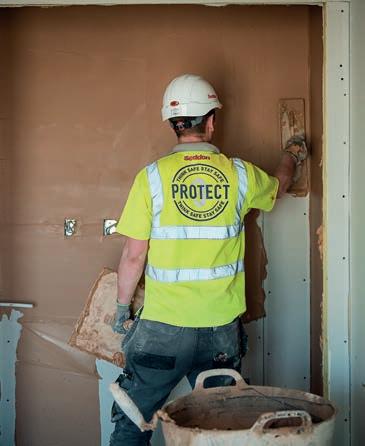
The investment will support landlords with essential improvements to bring homes up to a minimum EPC C rating, while helping residents reduce energy bills and live in warmer, more comfortable properties.
For Warwick District Council, Seddon will deliver improvements to 176 homes in Warwick and Leamington Spa over three years, including solar PV installation, loft insulation top-ups and improvements to ventilation.
The company has also commenced a window and door replacement programme with Your Housing Group, delivering works at 250 homes, further strengthening its portfolio of long-term planned investment partnerships.
In South Yorkshire, Seddon has started work on site in Sheffield,
delivering the first phase of a three-year Warm Homes Wave 3 programme, with further works planned in Rotherham and Maltby in years two and three.
Between 130 and 150 homes are expected to benefit over the life of the programme. Initial works include solar PV insulation and ventilation improvements, alongside wider upgrades.
Seddon has also begun the second year of its ongoing partnership with Incommunities. The new planned maintenance programme builds on kitchen replacement works delivered in 2025 and ongoing damp and mould works.
The project includes kitchen replacements to homes in Keighley, alongside fire safety works across two sheltered accommodation blocks in Bingley and Bradford.
Mark Walker, Managing Director at Seddon Housing Partnerships, said: “This investment will bring huge benefits to hundreds of families, and we are looking forward to working with the communities to ensure works are delivered in the right way.
“It is a strong start to the year for Seddon and reflects the confidence our new and existing clients place in us to deliver essential investment in their homes.
“Across large-scale retrofit programmes, building safety and planned maintenance works, our focus is on improving the quality and sustainability of existing homes while minimising disruption for residents.
“By supporting clients from the earliest stages of programme development through to delivery on site, we’re able to help bring forward schemes that reduce energy costs, improve comfort and ensure homes remain safe, compliant and fit for the future.” q
[CARDO GROUP has completed retrofit works at Newland Way in Wyesham, improving the energy efficiency of 14 homes and helping Monmouthshire Housing Association (MHA) residents save on their energy bills.
Cardo Group carried out a range of works across the two-bedroom apartments, including solar PV installation, ventilation improvements and targeted insulation measures such as external wall and loft insulation.
Solar PV panels were installed across the roofs alongside other roofing upgrades and improved drainage. Steel decking and walkways have also been installed to make shared areas safer for residents in the surrounding areas.
Altogether, the combination of renewable energy and low-carbon upgrades with fabric improvements has increased the energy efficiency of the homes to the top Energy Performance Certificate rating of A, supporting MHA’s commitment to creating warmer, more sustainable homes and moving
towards national low-carbon emission targets.
The £1.2m project, backed by more than £400,000 from the Welsh Government’s Optimised Retrofit Programme, began in 2024 and was completed in partnership with Monmouthshire County Council.
To celebrate the completed project, Cardo hosted an event with Monmouthshire Housing Association in March.
The organisations were joined by Cabinet Secretary for Housing and Local Government Jayne Bryant MS, Deputy Leader of Monmouthshire County Council Paul Griffiths and Wyesham Ward Councillor Emma Bryn, who met with residents to hear about the positive impact the project has had on their homes.
Jayne Bryant said: "It was great to visit Newland Way and see for myself the difference these improvements have made for the people who live there.
“This is exactly the kind of project that the Welsh Government’s Optimised Retrofit Programme was designed to support and it
shows what can be achieved when housing associations, local councils and contractors work together.
“We want every social home in Wales to be warm, safe and fit for the future, and projects like this bring us a step closer to that goal.”
Gwyndaf Tobias, CEO at MHA, said: “We’re incredibly proud of what has been achieved at Newland Way. With support from the Welsh Government’s Optimised Retrofit Programme, and through strong partnership working with our supply chain, we’ve been able to deliver innovative, energy-efficient upgrades that make a real and lasting difference to people’s lives.
“This project reflects MHA’s wider decarbonisation ambitions and our commitment to investing in new approaches that create warmer, more sustainable homes. Newland Way shows what can be achieved when we collaborate closely with our contractors and residents to deliver highquality, low-carbon solutions that are built for the long term.” q
[ PUPILS FROM Winmarleigh Church of England Primary School were given a unique insight into the world of housebuilding during an educational visit to Story Homes’ Stonebrook Meadows development in Garstang, Preston.
The visit supported the school’s Key Stage 2 curriculum, where pupils are currently learning about settlements, land use, natural resources, and how geographical knowledge is applied in real-world careers. With ongoing development in the local area, the trip provided a valuable opportunity for children to see these concepts brought to life.
During their visit to Stonebrook Meadows, pupils heard from Story Homes’ Land and Planning team, who explained how potential development sites are selected and the key factors that must be considered, including environmental impact, infrastructure and community needs.
The children also met with the site project manager, who provided each pupil with personal protective equipment before guiding them safely around the development. The group toured two homes at different stages of construction – one at ‘first fix’ stage and another that had recently been plastered – giving them a clear understanding of the build process. The visit concluded with a tour
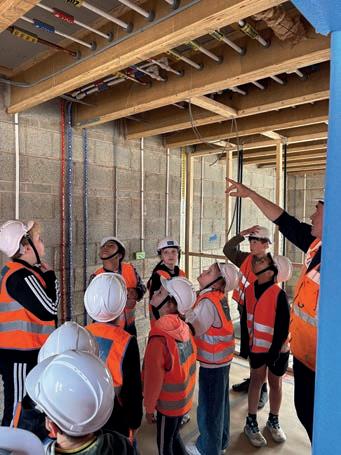
of a completed show home, allowing pupils to experience the full journey from planning through to finished product.
Each pupil received a goody bag to take home, helping to reinforce the day’s learning and providing a memorable end to the visit.
David Rimmer, Production Director for the North West at Story Homes, said: “It was a pleasure to welcome the pupils
from Winmarleigh Church of England Primary School to Stonebrook Meadows. It’s incredibly important for us to engage with young people in our communities and show them how subjects like geography play a vital role in what we do every day. Seeing the different stages of construction first-hand really helps bring their classroom learning to life.”
Sarah Shaw, Key Stage 2 teacher at Winmarleigh Church of England Primary School, commented: “This visit has been a fantastic experience for our pupils. It’s given them a real understanding of how geography is used beyond the classroom, particularly within the construction and housing sector.
“The opportunity to explore a live development and hear from industry professionals has been invaluable, and it’s something they’ll remember for a long time. We’re very grateful to Story Homes for providing such an engaging and informative experience.”
Stonebrook Meadows is a thoughtfully designed development of 133 high-quality homes. Featuring a range of three, four and six-bedroom properties, alongside spacious layouts and a welcoming community setting, it offers an ideal environment for modern family living. q
[EALING COUNCIL has identified Marston Court in Bordars Walk for a community-led housing scheme, with the site expected to include up to 20 new genuinely affordable homes.
The decision meets a promise the council made in 2022 to find a suitable place for a Community Land Trust (CLT) during this council term. CLTs are not-for-profit groups that provide genuinely affordable homes by linking prices to local incomes and keeping them affordable for future generations.
Like the rest of London, the borough has high housing costs. There is a growing need for homes that people can afford, including those who do not qualify for social housing but cannot afford private rents or to buy. The average home in the borough now costs 16 times the average local salary.
CLT homes offer an option for people in this situation. The land is owned by the community, while homes are sold or rented at prices linked to local incomes rather than market levels. CLTs often offer a mix of affordable sale and discounted rent. They can also bring wider benefits, such as new public spaces or local training and work opportunities. Across London, CLTs have shown that community-led housing can create well-designed homes while giving local people more influence over development.
Ealing Citizens, a local alliance of faith, education and charity organisations, has worked closely with the council on this project. It has been campaigning for more than a decade for a CLT and took part in the selection process that led to Marston Court being chosen.
The council will now carry out more checks on the site and begin the early stages of work to help bring a future scheme forward. A report asking for approval to formally market the opportunity and choose a CLT partner is expected to be considered by the council’s cabinet in late 2026. Once a partner is chosen, they will work with residents to design
the homes and agree how they will be managed in the long term.
Councillor Peter Mason, leader of Ealing Council, said: “We promised to find a suitable site for a Community Land Trust during this council term, and agreeing Marston Court as the preferred location means we are keeping that promise.
“This is an important step towards creating genuinely affordable homes that stay affordable for local people. CLT homes give residents more say in how their homes and neighbourhoods are shaped, and this work will help more people put down roots in the borough.”
Jackie Ashmenall, a community leader from Christ the Saviour Church – a member institution of Ealing Citizens – said: “I’m so proud of our housing team, who have never given up hope that one day we would see genuinely, permanently affordable homes built in our borough. These homes will mean security and opportunity for people who are so often squeezed out of the housing market – key workers, young families and young people.”
“We have worked tirelessly for over 10 years on this campaign because we believe the Community Land Trust model offers something different: a fairer system where homes stay affordable not just today, but for future generations. That’s why this moment means so much to our community.”
Henry Wilson, a young resident involved with Ealing Citizens, said: “I work full-time but I can just about afford to rent one room in a shared house, because owning a home in London feels impossible. For many young people like me, the housing market is completely out of reach.
“Through Ealing Citizens I’ve learned how Community Land Trusts can give young working people a real chance to own a home and put down roots. That’s why I’m excited to be part of this campaign and hopeful we’ll see more genuinely affordable homes built across the borough.” q
[ AROUND £500,000 has been invested in a Lancashire village as a result of an exclusive new homes development.
Anwyl Homes recently welcomed the final residents to its Parr Meadows development in Eccleston, marking the completion of the scheme.
The 3.67-acre site, south of Parr Lane, was acquired from Metacre, a subsidiary of Northern Trust Company, in autumn 2022.
After securing reserved matters approval from Chorley Borough Council for the layout of the development, design of the homes, landscaping and access, Anwyl started work on site in spring 2023 and opened show homes in early 2024.

Anwyl has now successfully completed the development of 22 executive family homes and 12 affordable properties, available via a registered social landlord.
Managing director of Anwyl Homes Lancashire, John Grime, said: “We’re immensely proud of Parr Meadows. When we acquired the site, there were very few new homes being built in the Eccleston area. We reviewed the local market, identified gaps in supply and demand and sought to address them by providing a combination of substantial family homes, alongside affordable housing. Eccleston is a sought-after neighbourhood and we started receiving enquiries almost as soon as we announced our plans.
“The success of Parr Meadows demonstrates that we have ability and expertise to adapt our developments to cater for local housing needs, in this case delivering premium quality, highly energy-
efficient executive family homes. While developing the land we retained mature trees and hedgerows and provided a new area of public open space.
“We’ve also invested around £500,000 in the local community, including funding towards the creation and maintenance of natural green spaces and playing pitches, and amenity green space via contributions agreed during the planning process. Our Love From Anwyl initiative saw three schools in the neighbourhood, plus Eccleston Recreational Park, Eccleston Brass Band and Rainbow Hub, share £5,000.”
Headquartered at Buckshaw Village, Anwyl’s Lancashire business operates across the county and in Greater Manchester, the Liverpool City Region and parts of Cheshire.
In Lancashire, its developments include Priory Gardens in Burscough, where Anwyl is building 380 homes across 20 acres of land. Work is also underway at Walkers Glade in Ingol, where 164 new homes are being created on a 27-acre site. The first homes there will be released for sale in spring.
Anwyl is also active in the land market. “We’re keen to acquire new sites across the North West and will consider intimate schemes, like Parr Meadows where we can deliver large and luxurious properties or larger scale developments offering a more varied housing mix,” John Grime added.
“We will work with landowners to navigate through the planning process to deliver the housing people want and need.” q
[AS WALES APPROACHES the Senedd election on 7 May, the Federation of Master Builders (FMB) Cymru is urging all political parties to prioritise meaningful reform of the housing delivery system, warning that without stronger support for small and medium-sized (SME) housebuilders, Wales will continue to fall short of the homes it urgently needs.
Access to housing has become one of the most pressing challenges facing communities across Wales. With wages failing to keep pace with house prices, homeownership is increasingly out of reach for many working households.
Latest Welsh Government estimates show that Wales requires approximately 8,700 new homes every year to meet demand. However, over the past five years, delivery has averaged only around 5,000 homes annually, creating a persistent and growing shortfall.
Around 75% of new homes in Wales are built by the private sector. However, the market has become increasingly dominated by a small number of very large developers operating across England and Wales. These firms understandably prioritise sites that maximise financial returns, meaning less commercially attractive, but locally important sites, are often overlooked.
Meanwhile, SME housebuilders, once responsible for around 40% of new homes in the late 1980s, now deliver just 10%. FMB Cymru
says reversing this decline is essential if Wales is to address its housing crisis.
The collapse in SME delivery has been largely driven by a planning system that has become excessively risky, unpredictable and costly. The complexity and financial exposure involved in securing planning permission means that only firms with substantial reserves can consistently operate in the current market.
Ifan Glyn, FMB Cymru Director, said: “If we continue to rely on a small number of large firms to deliver the vast majority of our homes, we will never build at the scale and pace required to meet Wales’s housing need. SME builders are rooted in their communities, deliver smaller sites that large developers often overlook, and can help create a more diverse and resilient housing market.
“However, the current planning system is stacked against them. Without reform to reduce risk, SME builders simply cannot play the role Wales needs them to play. The next Welsh Government must commit to creating the conditions that allow SMEs to thrive. That is the only way we will significantly increase supply, reduce waiting lists and restore access to homeownership and affordable housing.”
FMB Cymru is calling on all political parties to set out how they will support a more balanced housing market that empowers local builders and deliver the homes Wales urgently needs. q
[THE Door & Hardware Federation (DHF) has announced its presence at The Security Event 2026, taking place on 28-30 April at the NEC Birmingham. Visitors will have the opportunity to meet industry experts, explore new training opportunities and access an exclusive membership offer.
DHF will showcase a preview of its new Building Hardware Training programme at the event. The programme has been designed to support product managers, customer service teams, trade counter operatives and professionals working within the building hardware sector in developing key skills and maintaining compliance with industry standards.
Visitors will be able to learn more about the programme, explore how it can benefit their organisation and register their interest ahead of the launch.
Visitors to Stand 5/A102 will also be able to take advantage of a special £100 discount on their first-year’s subscription fee, when applying at the DHF stand. This offer gives companies and professionals a valuable opportunity to join one of the UK’s leading trade bodies and access ongoing technical support, training and guidance.
DHF’s technical team will be available throughout the event to provide expert guidance and answer technical questions – whether that’s about best practice, compliance requirements or current industry developments. The membership and training team will also be present to discuss the full range of member benefits. Visitors will be able to collect the 2026-2027 training and membership brochures at the stand.
A number of DHF members will be exhibiting at the event, including Allegion UK, ASSA ABLOY, CAME UK, CLD Fencing Systems, Commtel, dormakaba, Easygates, Element Materials Technology, FAAC UK, Frontier Pitts, GEZE, Hikvision, Inova Gates, Latham’s Steel Doors, LORIENT, Metador, Pendle Doors, Rutland UK, SQUIRE SECURITY, Strongdor, The Keysafe Company, UAP Ltd and UL Solutions.
“The Security Event 2026 provides a valuable opportunity to meet our members, speak with industry professionals and share the latest developments in training and technical support,” said DHF’s Deputy CEO, Patricia Sowsbery-Stevens. “We look forward to welcoming visitors and discussing how DHF

can support businesses across the sector.”
Visitors can register for a free ticket to attend by visiting https://bit.ly/41ihQ6k and are encouraged to attend Stand 5/A102 to learn more about DHF and its support for the door and hardware sector. q
[THE WELSH GOVERNMENT, the Designing Out Crime Group Wales and Secured by Design (SBD) have launched Safer Places Wales to support the prevention of crime through placemaking and urban design.
Safer Places Wales sets out how successful planning and street design can discourage criminal activity and reduce the fear of crime. It provides practical advice for planners, developers, local authorities and stakeholders to support them in embedding crime prevention principles into the design and planning process.

It is intended to help both developers and decision makers consider issues of community safety at the beginning of the design process and encourage conversations at the concept stage.
Written by Policing, in partnership with senior planners from the Welsh Government, it is a guide that brings together best practice and provides clear direction as to what is required of design in order to reduce crime. It focuses on the attributes of creating safe and sustainable communities, and looks to resolve many of the planning issues and tensions that appear to conflict with one another causing difficulties, delays and expense for all, often leaving communities vulnerable.
Safer Places Wales provides direction on many topics that have often been lacking this direction, such as describing how communities can be connected to local amenities whilst not undermining security, thus encouraging direct travel by walking, cycling and the use of public transport.
Cabinet Secretary for Economy, Energy and Planning, Rebecca Evans, said: “The Safer Places Wales guidance represents an important step forward in how we think about safety within community spaces. Places that
are well designed, well connected and well used are places that feel safer and function better.
“The new principles will also help us deliver environments that are more welcoming, more accessible and more reflective of the communities they serve.”
Michael Brooke, Head of Government Advocacy & Police Engagement at Police Crime Prevention Initiatives, said: “This document demonstrates what can be achieved when partnerships are formed and the different disciplines of planning and policing work together.
“By the use of subtle yet meaningful design techniques that are incorporated early into future development proposals, communities will be safer in their homes and fear crime less for generations to come. It’s a marvellous achievement and one I am very proud to have been a part of.”
Mike Harvey, Designing Out Crime Officer from South Wales Police, said: “As Chair of the Designing out Crime Group Wales I was delighted to be involved with Police CPI and the Welsh Government in producing this guide and would like to thank everyone who has been involved in the process of producing this document.
“The guidance provides practical advice for planners, developers, local authorities and stakeholders to support them in embedding crime prevention principles into the design and planning process. It is intended to help both developers and decision makers to consider issues of community safety at the beginning of the design process and for them to involve Designing Out Crime officers and have conversations with them at the concept stage. The aim is to work in partnership and to make places that are safer and to promote safe, sustainable and attractive environments.” q