Wednesday with a special anniversary celebration at City Hall, highlighting major accomplishments and investments that are helping make Oakland safer, cleaner, and more responsive to residents while continuing to move the city forward.
Over the past year, the Lee
administration has focused on strengthening public safety, addressing homelessness, illegal dumping, and improving quality of life across neighborhoods, the foundations that will bring businesses to Oakland, create new jobs, and revitalize Oakland’s economy.
“Over the last 365 days, we’ve worked every day to move Oakland forward,” said Lee. “We have reduced crime to historic lows,
supported our youth, cleaned our streets, and made significant investments in our neighborhoods. The momentum is real, and we’re just getting started.”
“Our work is far from over,” Lee added. “But Oakland is moving in the right direction. We are building safer neighborhoods, stronger communities, and a more vibrant future for everyone who calls Oakland home. Oakland is on the move.”
Among her administration’s most significant achievements is the successful issuance of a historic $334 million bond to fund street paving, affordable housing, and major infrastructure improvements throughout Oakland. The issuance of the bond represented a major turning point for Oakland’s financial stability and long-term investment strategy. Public
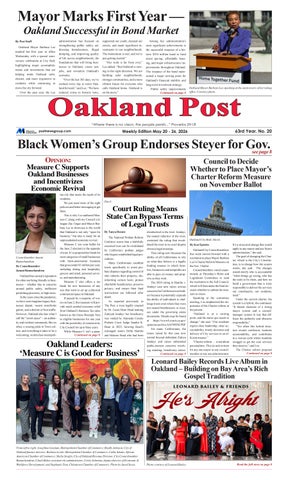
By Councilmember Janani Ramachandran
Oakland has earned a reputation for often not being friendly to businesses – whether due to concerns around public safety, inefficient permitting processes, or high taxes.
In the years since the pandemic, we have seen longtime legacy businesses depart, vacant storefronts galore, and a decline of foot traffic.
However, Oakland also has what I call the “secret sauce” – an authentic and resilient community like no other, a rousing pride in Town culture, and everything it takes to be a welcoming, world-class metropoli-
tan city that meets the needs of its residents.
We just need more of the right policies and better messaging to get there.
This is why I co-authored Measure C along with my Council colleague Zac Unger and Mayor Barbara Lee to showcase to the world that Oakland is not only “open for business,” but also is ready for an unprecedented economic revival.
Measure C (on your ballot for the June 2 election) is the opposite of a tax. It’s a proposed tax break for most categories of small businesses with brick-and-mortar locations that gross under $1 million per year, including dining and hospitality, grocers and retail, personal services, and manufacturing.
Measure C also offers a tax break for new businesses of any size that want to set up a physical commercial space in Oakland.
If passed by a majority of voters on June 2, this measure will provide much needed economic relief from Oakland’s Business Tax (also known as the Gross Receipts Tax) to eligible businesses for one year with the possibility of extension by City Council for up to three years.
While Measure C isn’t a pana-
By Tanya Dennis
The National Probate Reform
Coalition warns that a faithfully executed trust can be invalidated by California’s probate judges who bypass established legal procedures.
Many Californians establish trusts specifically to avoid probate disputes regarding control of who inherits their property; disinheriting certain heirs; protect charitable beneficiaries; preserve privacy; and ensure their final instructions are followed after death.
As reported previously in The Post, a trust legally enacted by Dr. Laura Dean Head making Zakiyah Jendayi her beneficiary was voided by Alameda County Probate Court Judge Sandra K. Bean in 2023, favoring Head’s estranged sisters Della Hamlin and Helaine Head who had been
disinherited in the trust. Jendayi, the named inheritor of the trust, contested the ruling that invalidated the trust to no avail despite obvious legal missteps.
That ruling now threatens the ability of all Californians to rely on what they believe is a legally binding manner in which families, businesses and nonprofits are able to pass on money and property as they wish.
The 2024 ruling in Hamlin v. Jendayi case now raises serious concerns for California trust holders because it potentially expands the ability of individuals to challenge trusts even where they were not named beneficiaries or trustees under the governing estate documents. Details may be found at https://www4.courts.ca.gov/ opinions/archive/A167695M.PDF
For many Californians, the issues raised by this case now extend beyond defendant Zakiya Jendayi and raises substantial public-interest concerns involving standing; beneficiary notice;
By Ken Epstein
Oakland City Councilmembers this week moved forward with a resolution to place Mayor Barbara Lee’s Charter Reform Measure on the Nov. 3 ballot.
Councilmembers voted unanimously at Thursday’s Rules and Legislation Committee to send the resolution to the full Council, which will then make the final decision whether to submit the measure to voters.
Speaking at the committee meeting, Lee emphasized the importance of the Charter reform at the present.
“Oakland is at a turning point, and the status quo needs to change,” she said. “Our residents expect clear leadership, clear accountability, timely decisions and delivery of City services in an efficient manner.”
“Charter reform … is not about personalities. This (is not) written for any one mayor or any councilmember or any one administrator.
It’s a structural change that would apply to any mayor and any future administration,” she said.
The goal of changing the Charter, which is the City’s Constitution, is to change how the system works, she said. The changes would clarify who is accountable “when things go wrong, who has the tools to fix them, and how we build a government that is truly responsible to deliver the services our constituents, our residents, need.”
Under the current charter, the system is a hybrid, she continued. “It blends elements of a strong mayor system and a council/ manager system in way that diffuses the authority and obscures responsibility.”
“Too often this hybrid structure creates confusion, weakens accountability, and contributes to a vicious cycle where residents struggle to get the core services they deserve,” said Lee. The Charter reform proposal
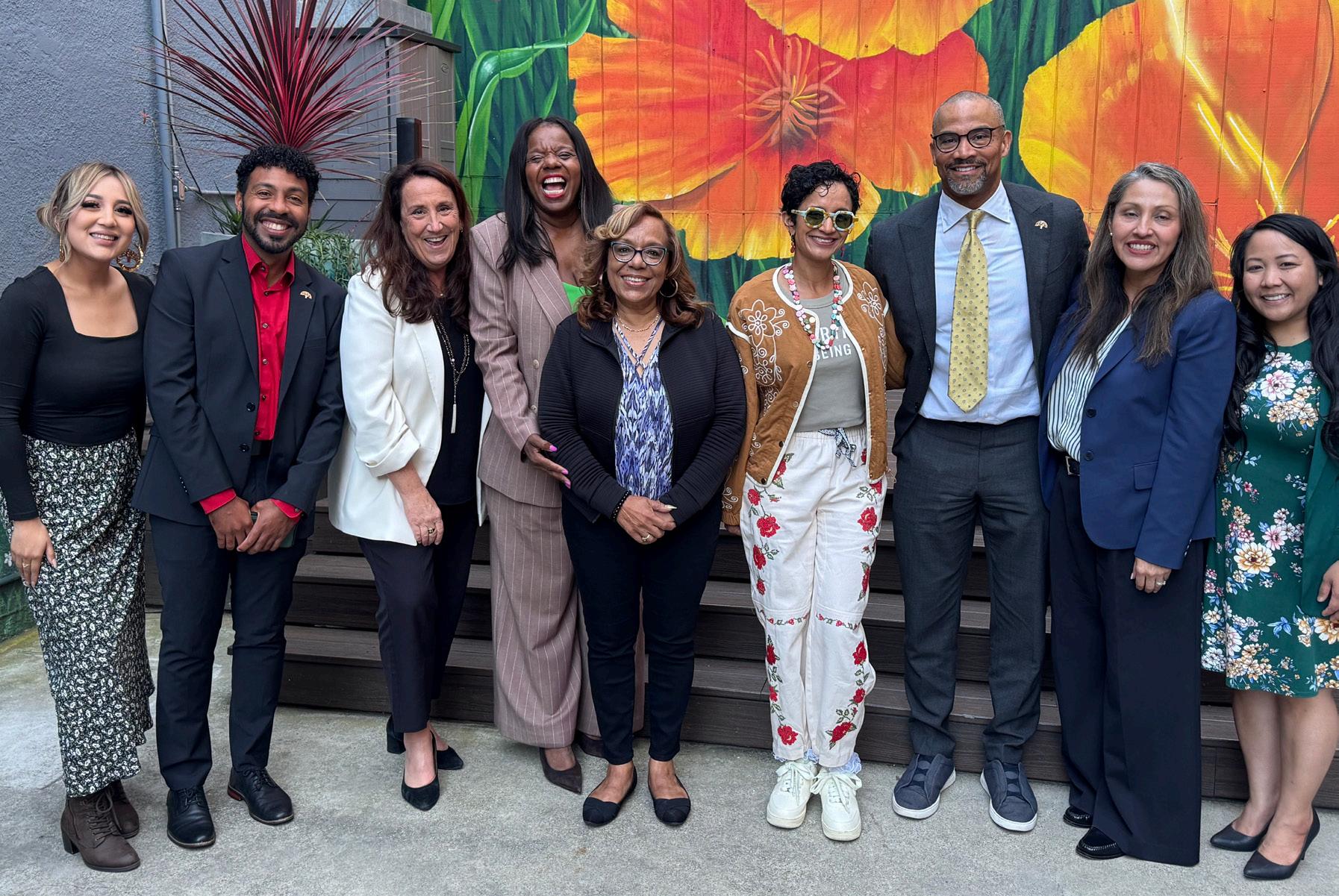
From left to right: Josephine Guzman, Metropolitan Chamber of Commerce; Bradly Johnson, City of Oakland finance director; Barbara Leslie, Metropolitan Chamber of Commerce; Cathy Adams, African
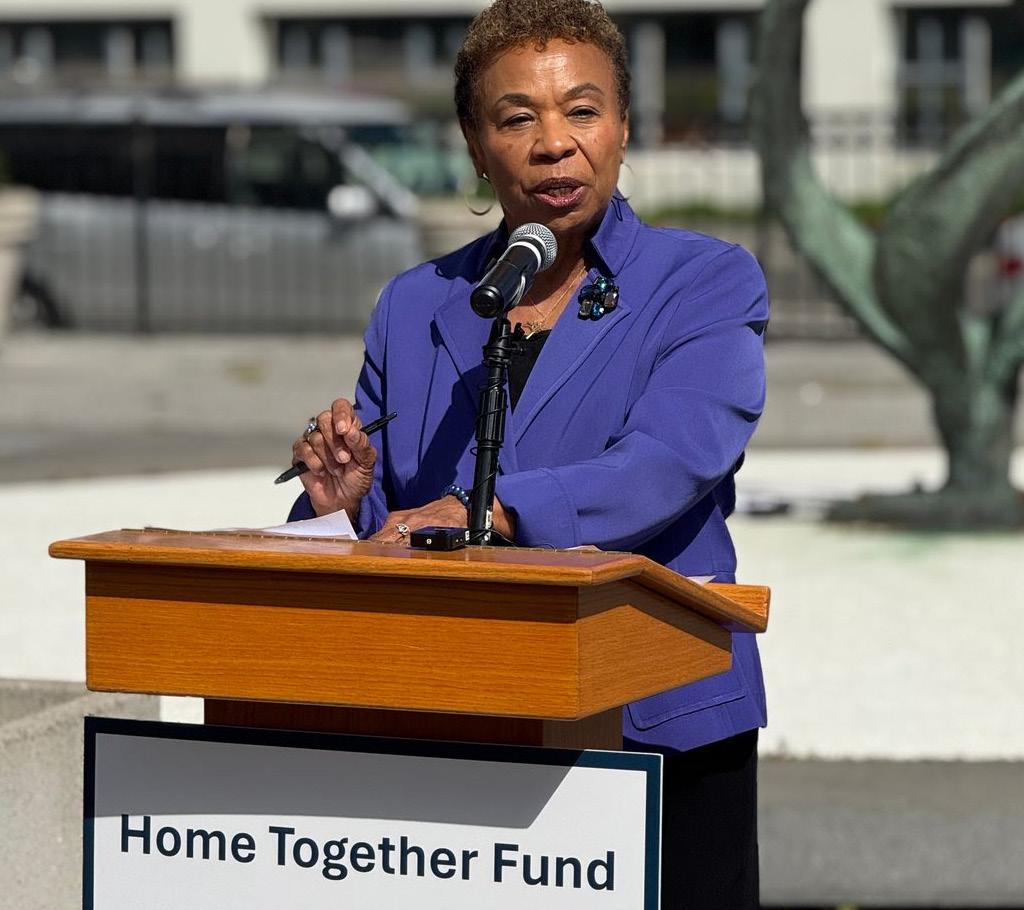
Oakland Mayor Barbara Lee speaking at the anniversary of her taking office. Courtesy photo.
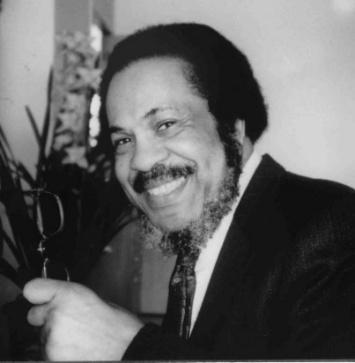
Photo courtesy of Leonard Bailey.
City Hall. iStock.
California State Library Releases Housing Construction Tracker
By Bo Tefu California Black Media
The California State Library has released an updated interactive Housing Construction Tracker designed to give policymakers a clearer picture of where new housing is being built across the state and how development patterns have changed over time.
The tool, developed by the California Research Bureau (CRB), compiles parcel-level data to map residential construction across legislative districts from 2001 through 2024. Officials say the updated version expands the state’s ability to analyze housing trends that have long been difficult to track in a consistent, statewide format.
Housing affordability remains one of California’s most persistent policy challenges, with lawmakers introducing more than 1,000 housing-related bills since 2019, according to the National Conference of State Legislatures’ Housing and Homelessness Legislation Database. Despite repeated legislative efforts, construction has continued to lag behind demand in many parts of the state.
The CRB notes that economic research consistently shows increased housing supply helps reduce costs at a regional level. However, California’s housing production has not kept pace with states such as Texas and Florida, which have continued to add more housing units in recent years.
According to the updated tracker, California saw stronger housing growth in the early 2000s before construction
sharply declined during the Great Recession. While production gradually recovered in the following decade, it has largely flattened since around 2018.
The data also highlights clear geographic disparities in where housing is being built. Inland regions, including parts of the Inland Empire, Central Valley, and Sacramento suburbs, account for a large share of new development.
Coastal areas such as Los Angeles and the Bay Area continue to show comparatively lower levels of construction.
The tracker further shows that even during periods of growth, housing production has been uneven across legislative districts, with some areas consistently building far more units than others.
Researchers say these differences reflect long-standing economic, geographic and regulatory factors that influence development decisions across the state.
The updated database includes nearly 2 million recently built parcels, representing more than 2.3 million housing units and millions of bedrooms statewide.
It also allows users to break down construction trends by district and other geographic categories, offering a more detailed view of how California’s housing landscape has evolved over the past two decades.
State Library officials say the goal of the tool is to support evidence-based policymaking by giving lawmakers and researchers better access to data as they continue working to address California’s housing shortage and affordability crisis.
Newsom Pushes Fiscally Stable, EducationFocused May Revise as Critics Raise Concerns
By Joe W. Bowers Jr. California Black Media
Gov. Gavin Newsom presented the final May Revision of his administration on May 14, outlining a state budget proposal he says balances California’s finances through 2027–28 while preserving major investments in education, health care, behavioral health and housing programs.
During a presentation at the State Capitol, Newsom framed the proposal as a response to economic uncertainty, federal policy changes and long-term pressures on state spending.
“We’re not just the fourth largest economy in the world,” Newsom said, describing California as the “tentpole” of the U.S. economy while pointing to the state’s $4.1 trillion economy and leadership in innovation, manufacturing, agriculture and trade.
Newsom said California’s strong economy continues to drive growth and investment but warned that federal Medicaid reductions and other policy changes are creating new fiscal pressures for California and other states.
The revised budget proposal totals about $349 billion, including roughly $248.3 billion from the General Fund.
The administration says revenues came in about $16.5 billion higher than expected over the multiyear budget window, driven largely by personal income tax collections tied to capital gains earnings.
The budget relies on spending reductions, fund shifts, reserve adjustments and new revenue proposals, including changes to corporate tax credit rules and expansion of sales taxes to some software products and services.
Education is one of the largest
spending areas in the budget.
Under the proposal, Proposition 98 funding for TK–14 education would rise to about $127.1 billion, pushing total per-pupil funding to a record high of about $27,700 when state, local and federal funding are combined.
The budget also includes a 4.31% cost-of-living adjustment (COLA), a $2.4 billion ongoing increase for special education, $1 billion ongoing for community schools, literacy funding for reading coaches and specialists, and $5 billion in flexible funding for teacher training and recruitment.
Medi-Cal spending is one of the state’s largest fiscal pressures. The administration projects a $4.2 billion Medi-Cal (California’s Medicaid program) shortfall in the current year, driven by rising enrollment, health care costs and federal policy changes stemming from H.R. 1, known as the “One Big Beautiful Bill Act.”
The budget proposes several Medi-Cal cost-control measures, including restoring asset tests for some recipients, stronger oversight of care services, and changes affecting some immigrant populations.
The budget continues Newsom’s homelessness strategy, including $500 million for the Homeless Housing, Assistance and Prevention (HHAP) program.
State Controller Malia Cohen said the revised budget reflects stronger-than-expected revenues but cautioned that California remains vulnerable to Wall Street volatility and continued dependence on high-income taxpayers.
Republicans criticized the budget and questioned whether the administration had fully resolved California’s long-term structural budget issues.
Senate Republican Leader Brian Jones (R-San Diego) criticized the budget’s approach to affordability and business costs, warning that it would “increase taxes on employers by $5 billion in a move that will devastate our beleaguered business community.”
Assembly Speaker Robert Rivas (D-Salinas) said lawmakers must “safeguard health care and food assistance, advance housing affordability, and manage every taxpayer dollar with discipline.”
By Bo Tefu California Black Media
California is deploying $760 million in homelessness funding to local governments and regional agencies across the state, with Gov. Gavin Newsom’s administration saying the investment is aimed at expanding shelter, housing, and prevention services in all eligible regions.
The funding is being distributed through the state’s Homeless Housing, Assistance and Prevention (HHAP) program, which supports coordinated regional responses to homelessness. Officials said 11 regions are receiving new allocations under the latest round, which continues a statewide effort to reduce unsheltered homelessness and expand longterm housing solutions.
According to the California Department of Housing and Community Development, the latest awards build on previous HHAP funding rounds that have collectively supported local strategies to move people off the streets and into housing. State officials said every eligible region has now received support under HHAP Round 6.
“We’re pairing historic investments with real accountability and demanding results at every level of government,” Gov. Gavin Newsom said in announcing the funding. “No one in California should be without a place to call home.”
The administration said more than 100,000 Californians have transitioned from homelessness into permanent housing through HHAP-supported programs and related initiatives in recent years. Officials also reported a 9% decline in unsheltered homelessness statewide, which they described as the first notable drop in more than a decade.
HHAP is a multi-year grant program that provides funding to California counties, large cities, and
Continuums of Care. The program supports a range of interventions, including emergency shelters, street outreach, rapid rehousing, rental assistance, and permanent supportive housing.
Officials said most participating regions are dedicating roughly 90% of their HHAP funds to permanent and interim housing solutions, reflecting a state push to prioritize long-term exits from homelessness over short-term interventions.
“The state continues to invest in local regions and partner with local governments to scale proven solutions that prevent and end homelessness,” said Tomiquia Moss. She said the grants are helping expand access to housing and supportive services while strengthening local systems aimed at reducing homelessness.
The latest funding round includes a combined $760 million in HHAP allocations, part of nearly $5 billion in total program investments since its expansion.
State officials said recipients will be required to demonstrate measurable progress in reducing homelessness, with performance tracked through standardized state metrics. Funds must be fully spent by June 2029.
The announcement comes as California prepares for a seventh round of HHAP funding, which is expected to total $500 million and expand accountability requirements tied to housing outcomes and local policy implementation.
Officials said the combined investments reflect a broader statewide strategy focused on increasing housing supply, strengthening behavioral health services, and accelerating efforts to move people out of encampments and into stable housing.
Senate President pro Tempore Monique Limón (D-Santa Barbara) said the Senate remains focused on strengthening reserves while maintaining critical investments.
“We look forward to working with our partners in the Assembly and the Governor’s Office to deliver an on-time budget that strengthens the fiscal foundation of the state,” said Limón.
The Legislature now begins formal negotiations with the Governor’s office to finalize the 2026–27 state budget. Under the California Constitution, lawmakers must pass a balanced budget by
iStock.
iStock.
Gov. Gavin Newsom delivers his final budget May 14, 2026. CBM photo by Antonio Ray Harvey.
Public Notices, Classifieds & Business
Over
“Richard
“Richard
Erika Jones Elementary School Teacher Secretary-Treasurer California Teachers Association
VanCedric Williams High School Teacher Board Member California Teachers
“Richard
Shelly Gupton Elementary School Teacher Board Member California Teachers Association
Mayor Marks First Year ...
have also shown measurable results under Lee’s leadership. Violent crime is down 22%, burglaries are down 24%, and robberies have dropped 23%. Oakland reached a 58-year low in homicides in 2025, earning recognition from California Attorney General Rob Bonta as a national model for community-based violence reduction.
The administration expanded Ceasefire violence prevention strategies, funded new police academies, expanded MACRO non-emergency response teams citywide, partnered with regional agencies on public safety operations, and hosted 20 Public Safety Town Halls that engaged more than 2,000 residents. Two ‘Guns to Gardens’ events also helped remove 147 firearms from Oakland streets.
Lee also has made investing in youth a major priority during her first year. The Mayor’s Summer Youth Employment Program expanded to employ 1,050 young Oaklanders, while the Oakland Fund for Children and Youth and Department of Violence Prevention now support more than 23,000 youth through education, workforce development, mentoring, and recreation programs. The administration also restored the Oakland Police Cadet Program through nearly $1 million in private investment.
The administration launched an aggressive strategy to combat illegal dumping and improve neighborhood cleanliness through stronger enforcement, expanded dumping cameras, new aerial imaging technology, and increased cleanup operations.
Through the ‘Keep the Town Clean’ and citywide volunteer
constitutional due process; trust invalidation; operative pleadings; inheritance rights; and the protection of testamentary intent.
The issues now being debated in connection with Hamlin v. Jendayi raise serious constitutional and public-policy questions:
• Can individuals proceed as intestate heirs before the trust is first judicially invalidated?
• Can proceedings move forward without all identifiable beneficiaries receiving meaningful constitutional notice?
Can shifting legal theories replace the requirement of a stable operative pleading?
Can express disinheritance clauses effectively become vulnerable to reinterpretation?
Can testamentary intent be displaced before all interested beneficiaries are brought before the court?
These concerns extend far beyond one family dispute. Every California resident who owns: a home; investment property; a business; retirement assets; generational wealth; or a living trust has a direct interest in how California courts answer these questions.
This matter is particularly important because many estate plans intentionally exclude certain heirs while naming close friends, caregivers, charities, educational organizations, or other non-family beneficiaries. Californians rely upon trusts believing their written
Measure C Supports Oakland Businesses ..
initiatives, more than 10,000 volunteers helped remove more than 145 tons of trash and clean miles of Oakland streets, while City crews removed more than 6,600 tons of debris citywide.
Addressing homelessness and housing instability has also remained central to the administration’s work. Lee created a new Office of Homelessness Solutions and advanced a strategic action plan focused on prevention, emergency shelter, services, encampment management, and permanent housing. The City currently has 1,600 affordable housing units under construction or breaking ground, including 800 units connected to homelessness exits.
Oakland’s economy also continues improving. During the past year:
Oakland was named the “No. 1 Food City in America” by Conde Nast Traveler readers
Samuel Merritt University opened a $240 million downtown campus bringing thousands of students and staff downtown daily
• The historic Henry J. Kaiser Center for the Arts reopened Special event permits increased by 25%
The administration reduced zoning approval times from 22 days to nine days and launched same-day digital permits for eligible projects
Lee also continued advocating aggressively for Oakland at the state and federal levels, helping secure funding for transportation, housing, violence prevention, wildfire prevention, environmental cleanup, and economic development initiatives.
instructions and beneficiary designations will receive constitutional protection.
Yet the broader questions raised in Hamlin v. Jendayi now deserve serious public discussion.
Public confidence in California probate courts depends upon confidence that constitutional due process will be followed; all identifiable beneficiaries will receive notice; courts will not exceed the issues framed by the pleadings; and a decedent’s expressed wishes will not be displaced without lawful procedures.
Whether one agrees or disagrees with the parties involved is not the central issue. The larger question is this: Should any California citizen’s estate plan become vulnerable to litigation allegedly proceeding without complete beneficiary participation, constitutionally adequate notice, and stable operative pleadings?
The people of California deserve to examine these issues carefully because the answers may affect future probate litigation, inheritance disputes, charitable gifts, and trust protections throughout the State of California.
Review the Post article regarding the Hamlin vs. Jendayi case for more information: Oakland Post, week of November 12 - 18, 2025: https://issuu.com/ postnewsgroup/docs/oakland_ post_week_of_november_12__18_2025/3?ff
cea for the City’s struggles to attract and retain businesses, it’s also not the only thing Oakland is doing. A tax break like this – modeled after a similar program in San Francisco – will complement ongoing breakthroughs in declining violent crime and homelessness, investments in community safety ambassadors and technology in our commercial corridors, improved police academy recruitment, officer retention, and more.
We hope that this tax break will be one of many tools that can help showcase the City of Oakland’s commitment to fostering a better environment for enterprises to thrive.
I’m honored that Measure C has earned the support of Oakland’s minority chambers of com-
merce, which have helped champion this effort and spread the word that not only must we support our business community, but we also must do so with an equity lens.
As stated by Oakland African American Chamber of Commerce Executive Director Cathy Adams, “These targeted exemptions will help new entrepreneurs get established, allow existing small businesses to remain competitive, and create opportunities for long-term economic growth.”
“This ordinance recognizes the real challenges our members face and demonstrates the City’s commitment to equity, inclusion, and a thriving local economy,” she said.
Oakland City Councilmember Janani Ramachandran represents District 4.
Leonard Bailey Records Live Album in Oakland, Building on Bay Area’s Rich Gospel Tradition
By Y’Anad Burrell
The Bay Area has long been a powerhouse in gospel music, producing legendary choir directors, worship leaders, composers, and recording artists whose influence stretches far beyond Northern California. From hometown pioneers to artists who made the region their musical home, the Bay Area’s gospel legacy continues to shape the sound of Black church music across the country.
Among the most revered names are the late Bishop Gordon Humphrey Jr. of Olivet Oakland, Walter Hawkins of the Love Center Choir, Edwin Hawkins, Eugene Cole, and many others whose music remains deeply woven into the fabric of gospel worship. From live recordings made in Bay Area churches to songs still sung in congregations around the world, their contributions continue to inspire generations of artists and worshippers alike.
Adding to that tradition, Leonard Bailey and Friends — also known as LB and Friends — recorded a live album on April 26 at Genesis Worship Center in Oakland. The project features the pre-released singles “He’s Alright” and “Thankful Grateful,” delivering an evening filled with praise, worship, and spirited gospel celebration.
Known primarily as a choir director, Bailey stepped into a more prominent vocal role during the live recording, showcasing the richness and versatility of his voice. The performance highlighted both his musical leadership and his ability to connect emotionally with audiences through song.
An Oakland native, Bailey has built a reputation as a dynamic
Mayor’s Charter Reform Measure ...
Continued from page 1
was developed with broad community input after Lee set up a Charter Reform Working Group in August 2025. The effort has included the League of Women Voters of Oakland, the San FranciscoBay Area Planning and Urban Research Association (SPUR), city councilmembers, and more than 750 residents who participated in community meetings, as well as the mayor’s staff, city staff and community activists. She said Charter reform will strengthen financial management systems and improve accountability and transparency. The mayor would serve as chief executive, “accountable for managing city operations and service delivery.”
Simultaneously, the Council would “retain full authority, legislative authority, budget approval power, and meaningful oversight while also being empowered to be much more effective advocates for their districts and to ensure that services are actually delivered to their constituents and communities,” Lee said.
Mayor Lee said the mayor would have a general veto and budget line-item veto powers,
while the Council would retain the ability to override the veto by a two-thirds vote. In addition, there would be an independent office to “strengthen the Council’s fiscal analysis, policy research, and oversight capacity.”
Under the new Charter language, service on the City Council would be recognized as a full-time job, and the salary of councilmembers would be set by the Public Ethics Commission.
While debate over governance structure is healthy, and desirable, some of the negative remarks in recent days have gone over the line, she said.
“There’s a long history in this country of describing Black leaders, especially Black women leaders seeking executive authority or structural reform, as dangerous or unqualified,” said Lee.
“We should be honest enough to recognize that when rhetoric begins to echo those patterns, we have to say ‘no.’ Oakland can have a serious and substantive debate about governance reform without resorting to language that demonizes leadership.”
OpiniOn:
He Saw Us. He Heard Us. Why the California Black Women’s Collective PAC Endorses Tom Steyer for Governor
gospel artist, arranger, and choir director whose work blends traditional gospel with elements of R&B, jazz, and classical music. He began directing choirs at age 14 and quickly earned recognition for his musical talent and creative approach. His sound reflects the influence of gospel and music legends including Walter and Edwin Hawkins, Thomas Whitfield, Aretha Franklin, Donald Lawrence, Quincy Jones, The Clark Sisters, and Luther Vandross.
The album represents a new chapter in Bailey’s career and underscores his commitment to creating music centered on faith, resilience, and joy. The live recording also brought together an accomplished group of performers and collaborators, including Lynette Hawkins-Stephens, Lawrence Matthews, Cristian Wheeler-Collins, Joshua Nash, and Marcus McCauley.
For generations, gospel music has served as the heartbeat of the Black church — offering a space where joy, pain, hope, and gratitude can be expressed through song. Its power lies not only in performance, but in its ability to unite congregations and communities across generations. As Stevie Wonder famously wrote in his 1976 song “Sir Duke,” “Music is a world within itself, with a language we all understand.”
Rooted in gospel tradition while embracing contemporary influences, Bailey continues to emerge as a compelling voice in modern gospel music — one driven by passion, purpose, and a deep commitment to ministry through song.
The live-recorded album is expected to be released this summer.
Every election cycle, candidates show up at our churches, our sorority events, our community forums. They tell us they see us.
Then, they win. And they govern like they forgot we exist.
Black women in California are the most reliable voting bloc in the Democratic Party. We are the cultural and economic engine of communities across this state. We are mothers, caregivers, business owners, organizers, and the keepers of our families’ histories.
That is why the California Black Women’s Collective PAC sent each candidate a memo grounded in our research. Data on Black women’s wages. Data on maternal health. Data on housing instability, caregiving burdens, criminal justice exposure, business ownership, and political representation. We did not want anyone walking into our interview room performing. We wanted to know who had done the reading. We wanted to know who could engage the data. We wanted to know who could speak to the lived realities behind the numbers.
Tom Steyer did the reading.
When we asked Tom about the economic vulnerability of Black women in California, he did not deflect to generic uplift language. He spoke specifically. About the wage gap. About the maternal mortality crisis that disproportionately kills Black mothers. About the wealth chasm that leaves Black women with a fraction of the assets held by their White male counterparts.
He spoke about Black girls. About the pipeline failures in schools, in healthcare, in mental health systems, that shape their futures before they ever reach adulthood.
Tom Steyer’s record is one of
the most substantial investments in economic mobility, civic engagement, and racial justice infrastructure of any candidate in this race.
In 2007, Tom Steyer and Kat Taylor founded Beneficial State Bank. Not as a profit play. As a community development financial institution explicitly designed to extend credit and capital to communities that traditional banking has historically locked out.
One hundred percent of the bank’s economic rights are owned by nonprofit organizations. Profits are reinvested into the communities the bank serves, with at least 60% of its lending directed to lowto-moderate income communities.
Black women are among the fastest-growing groups of entrepreneurs in California. We are also among the most chronically underfunded.
Tom built an institution that addresses the second. That kind of sustained investment matters. He campaigned on forgiving certain categories of student loan debt, cracking down on predatory student loan servicers, and made a 10-year, $125 billion investment in Historically Black Colleges and Universities (HBCUs) a centerpiece of his 2020 presidential platform.
We need a governor who has spent years building the institutions, funding the organizing, and taking the unpopular positions that the moment requires.
Tom Steyer is not a perfect candidate. No candidate is. And there are things that we didn’t agree with.
But he saw us. He heard us. His record, his bank, his long-term investment in voter engagement, his unflinching support for reparations, his fight on student debt, his commitment to environmental justice, proves he understood what we were saying long before we walked into the room.
The California Black Women’s Collective PAC is proud to endorse Tom Steyer for Governor of California.
We’ll be watching. And we’ll be voting for Tom Steyer. About the Author Kellie Todd Griffin is the president & CEO of the California Black Women’s Collective Empowerment Institute.
Photo courtesy of Leonard Bailey.
Oakland Mayor Barbara Lee. File photo.
By Kellie Todd Griffin, California Black Women’s Collective PAC