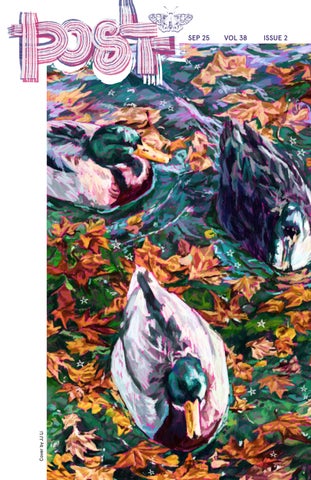
Cover by JJ Li
SEP 25
VOL 38
ISSUE 2
Table of
Contents feature
reddit whirlpools
1
where thoughts sit
3
train to paris
5
arts & culture
sad, mad, glad
9
an argument for making peace
11
lifestyle post-pourri crossword
i'll be back soon
13
the journey of my journals
15
goodbye mini fridge
16
narrative
1.
Great Lakes
2.
Make this house a ____
3.
That movie with Rihanna
4.
-ward bound
5.
Kansas for Dorothy
6.
Omaha for the Wizard of Oz
7.
____ Alone 2: Lost in New York
8.
The Baudelaire family home (pre-fire)
9.
“Work From ____”
10. Sherlock 4
post–
“You’ve been working out in the shower?” “I’ve been in his bathroom a lot.”
LETTER FROM THE EDITOR
letter from the editor Dear Readers,
In Narrative, Danielle and AnnaLise explore belonging and family. Sara wonders about what makes a book “happy” in A&C, and Anika argues for peace. In Lifestyle, Tarini confronts uncertainty and in post-pourri, Hallel rereads old journals. Finally, wish the Brown mini fridges goodbye with a mini crossword from Chelsea. I know this is all a ruse by Mother Nature
Just a week ago, I was wishing for fall, and
and summer will likely return next week (don’t
now that the first hint of chilly weather has swept
tell me the actual answer; I refuse to check the
in, I want it gone. I can’t get out of bed in the
weather), and I’m sure by then, I’ll have become
morning, because I fear my feet will freeze to the
so attached to fall that I’ll be upset all over again.
floor. I’m staring longingly at my new sundress
But, oh well. I hope you read this issue of post-
that I never found the right occasion to wear
with something pumpkin-spiced.
around campus. I’m not really in an apple cider mood yet. Isn’t this always how it is? We want something so bad until we have it. Time sneaks up on us suddenly and we realize how many things
Still curled in bed,
Elaina Bayard Editor-In-Chief
we have pushed to the fantasy world of “later.” But, I’m trying to be optimistic. I’m planning out my fall recipes and gathering blankets around myself. This week, our writers are also finding sources of comfort and optimism. For Feature, Serena reminisces on escaping the dread of college applications with r/applyingtocollege.
S eptember 25, 2026
FEATURE
reddit reddit whirlpools whirlpools on drowning and the college application process by Serena Lee Illustrated by selena zhu
14 post– post–
In Homer’s Odyssey, Odysseus and his crew face the classic mythological iteration of a “rock and a hard place”: Shall they sail past sixheaded Scylla and sacrifice six men or through the whirlpool Charybdis and risk the entire crew? He opts for the certain death of six before continuing on the harrowing journey home. I’m seventeen, and I’m aboard a ship that can somehow logistically carry 3.8 million U.S. high school seniors, and we are headed for certain doom. Our boat nears the fork where we must decide: How many of us will lose ourselves this semester? A portion? All? The college application process is a whirlpool that we’ve all had the misfortune of feeling the pull of. The late nights re-drafting essays that are meant to encapsulate everything that has ever made you who you are, the sore throat you ignore throughout November because you can’t be sick during application
season, the only melody in your ears being the click of your door as you shut everyone out to reach what you’re certain is nirvana: your dream college. But our woes didn’t start when the Common Application opened on August 1. We’ve been at this—and by “this,” I mean the endless cycle of fear—for years. – The summer after my sophomore year, I flew across the Pacific to move to the United States. As I slowly discovered what it meant to be an American high schooler—a Californian, no less!—I found myself quickly plunged into a world overwhelmingly focused on college applications. While I had spent my sophomore summer shoving suitcases into overhead bins, discovering every possible menu combo at InN-Out, and occasionally indulging in an idle game of cards with my family, my peers were shadowing professionals, attending intensive summer research camps, and molding themselves into what the world perceived as an “ideal” applicant. I
FEATURE was inexplicably behind. My sense of loneliness augmented as I came face-to-face with a sense of profound disadvantage in the face of my hardworking peers. Fearing the dearth of qualifications and preparedness compared to my classmates, I turned to online resources to try to ameliorate this perceived lack on my part—Why was I so behind the rest of my friends? And how could I fix it? Inevitably, I stumbled across Reddit’s r/ApplyingtoCollege subreddit, an online community of anxious teens, nail-biting parents, and the occasional condescending college student. With over 380k weekly visitors, the subreddit has become a home for the anxieties and insecurities of high school students all over the globe. It is an ocean of questions laden with fear, questions like Does it get easier? How do I stop being obsessed with prestige? Does anyone else feel like their acceptance is a mistake? Curled in the fetal position on my bed, my pupils were illuminated by the screen in front of me as I read thread after thread, seeking answers to questions I didn’t know I was supposed to be asking. The subreddit became my main source of information for all things higher education, and I sunk into a deluge of toxic conversations, each thread a whirlpool of information compressing my lungs until I became certain that the college application process would be my demise. College-related subreddits create an illusion where our metaphorical boat is approaching Scylla. While some people are destined to live, thriving below deck with their exemplary standardized test scores and published research with T-20 professors, others are hastily strapped to the mast, terrified sacrifices for the six-headed beast. I felt the rope burn as I stood barefoot on the deck, hopelessness a pit in my gut as days flew by and I had yet to nail down what part of myself I’d wrench out for my Common App Personal Statement. I was the sacrifice while others on Reddit seemed concerned yet poised with their oars, prepared to brave the currents I was drowning under. “Chance me for MIT, Caltech, and the Ivies” Demographics: Private college-prep school GPA: 4.00 UW Awards: USAMO qualifier, AIME 13, National Science Olympiad finalist, National chemistry competition finalist, 2nd place in a national research competition, Regional programming competition winner –Reddit user u/takppo in the subreddit
r/ChanceMe, a community where people list their high school stats and ask others for their chances to get into a given university Everywhere I looked, fellow students squinted at the invisible lines between a 4.4 and 4.5 GPA, laughed at the sheer mediocrity of a sub-1500 SAT score, and applauded users who had buzzwords like “champion” and “finalist” in their awards sections. The only solace I received was five scrolls in, stumbling across a user with a 2.1 GPA. Visualizing the user’s head being eviscerated by Scylla’s serrated teeth, I breathed a sigh of sadistic relief. At least it isn’t me this time. I had unwittingly succumbed to the belief that sacrificing others to the six-headed monster would save me. The human mind is so easily sucked in by the vortex of comparison. We cannot help swimming through college application subreddits as the statistics of other applicants tattoo themselves in our minds. We cannot help reading through college advice posts where successful former applicants underscore the best parts of their applications. We cannot help the tremor in our fingers during the latest hours of night as we fall into these spirals, these whirlpools of fearmongering and helplessness. We cannot help but drown. – The boat approaches Charybdis. We spent the solemn ride convincing ourselves that we were split into chosen ones, safely tucked below deck, and the unfortunate, lying prostrate on the deck. But the college application process is crueler than you think, and soon the whirlpool’s lashes tear at the bottom decks, seeping in through aged wooden planks. No one is safe anymore. We are all drowning, all too scared to admit it, and all choking on the toxins of our own creation. “I’m so scared to apply to colleges and seeing the decisions” I know my stats are competitive (4.0 UW and 1550)...[but] I feel completely inadequate… u/Free_Tailor954 “...stay FAR away from Chance Me. I haven’t looked there in nearly two years because it just makes me too anxious” u/Embarrassed-Shirt399 – But somewhere within the whirlpool, there is oxygen—an invitation to take a breath. While the myriad college-related subreddits often feel as if they are overflowing with negativity, they have also become a space where people are building scrappy communities. Scrolling through bleak headlines and comparing myself to “superior” applicants, I also stumbled across posts of encouragement. “As a mom, I’m so proud of all of you!! …And I'm so glad that you are all our future!” u/No_Macaroon_3309 “I know the "rejection is redirection" phrase can feel cliché and often painful, but know that things really do work out the way everyone tells you they will.” u/harrowhawks Like God’s hand outstretched, these small moments made an echo chamber of fear more bearable. In the two-month lurch between the day I submitted my Early Decision application to Brown and the day I got in, my whirlpool spirals of anxiety were quieted by
small moments tucked within Reddit threads. Hidden within one of the most toxic spaces for nervous teenagers were piles of encouragement from people who had lived through or were actively living through the same circumstances. We were unified not only by our collective fear, but also our desperate need to know it was going to work out. People on the subreddit intrinsically understood the pressure to make my parents proud, to achieve what people said you could, to grasp at the future you’ve always dreamed of. They knew the unbreakable habits of questioning your major every other night while confronting the lines between passion and profession. Of reading successful college essays off of social media because you can’t help yourself. Of obsessively watching Brown video essays at night begging for inspiration. — When I opened my Brown Early Decision letter, my family was swarmed around the countertop in our kitchen. I spun myself in spirals on my stool, cradling my dog as she absently licked at my wrists, too terrified to click the decision. My whirlpools of overthinking had transported themselves into the real world— instead of staying up at night in fits of fear, watching through reaction videos where people got into every single Ivy while comparing my stats to theirs, I was facing the very object of my dread. The acceptance letter caught me off guard. Around me, my family were in varying degrees of shock and celebration: My sister openly gaped at the disappointingly confetti-less “Congratulations” while my mom began to cry. My dad, the loyal videographer, documented each of our reactions while whispering to himself. At that moment, I wasn’t thinking of all the confusion I’d encountered on college application subreddits, nor the nights of solitude where I cried from fear. I was whole, jumping into my father’s arms while almost knocking the phone from his hand, grasping my sister’s hands as her face broke into jubilation, thanking my mother for all she did while she cried for me on Zoom from across the world. Now that I’ve matriculated at Brown University, I can’t help but look back on my younger self with fondness. Her confusions and anxieties pushed her into spaces that only augmented her own unproductive thoughts, yet she continued forward nonetheless. Reddit was a complex space to me in my latter years of high school, but my departure from engaging in the community has reminded me of a larger fundamental truth: the online world isn’t the entire world. I’m grateful for my experiences in learning about the college process and the unifying worries of others, but none of their words can perfectly encapsulate how the world runs, though it may seem that way at the moment. After opening my college decision, we circled up and ate jjajjangmyeon (Korean black noodles) to celebrate. My dad played his obnoxious yet endearing playlist of twenty renditions of Canon in D, and we toasted to Brown University with plastic cups filled with Sprite. I had made it out of Charybdis. I was back in Ithaca—I was home.
september 25, 2026
2
NARRATIVE
I’ve been thinking quite a lot about chairs recently—at least much more than the average person does day-to-day. I think about people too. People and chairs. People in chairs. Chairs that once held people and now sit empty. It does not seem to matter much, not even to me. And even if it did matter, it is only a chair. ... Fact: My mom never let us take off the plastic wrapping of our new dining table chairs. I suppose this comes with the scrimpand-scrounge mentality shared amongst those who leave their countries with nothing in their pockets. Those same people who are given the Sisyphean task of making something from nothing at all. I understand this better now—empathize with it even—but back then, watching it unfold filled me with a strange kind of resentment. My mom leans over the grease-and-Pepsisticky counter of the McDonald’s line, and I listen to foreign words tripping and stumbling over a foreign tongue as she points to the cheapest thing she can find on the menu. (She insists this is the only thing she likes.) I watch, silent, my perfectEnglish words locking on my perfect-English tongue. The teen at the cash register who looks just bored enough to be there and not bored enough to unravel the incoherency of my mother’s Mandarin-tinged order turns to me instead. – What can I get for you? – Two McChickens please The teen in front of us, the woman behind me, her two boys whose collars she keeps trying and failing to grab at as they run concentric circles around her thighs, and me—we all belong here. My mom stands at five-footnothing, and there is no space for her at all. I can’t claim to possess such superiority as I have just implied. I can’t claim that I am not also one of the disdainful, dismissive, just learn to speak English, it’s not that hard Americans, standing behind the counter looking down at my mother. I listen to my parents’ faltering sentences to the cashier, the gas attendant, and the customer service line, and the urge to apologize crawls up the back of my throat— nausea. My mind, the traitor that it is, screams at me: Say sorry they can’t speak (and not that you can’t understand), laugh like it’s some big joke, run run run away and act like you’re not related. I don’t do any of those things. Instead I just stand there, numb and dumb. I gorge myself on anger, and in secret, I starve anyway. The anger crashes over me in waves. Once, I took a pair of kitchen scissors and stabbed right through the plastic wrapping on one of those stupid, preserved dining table chairs. I overestimated, and now, if you look closely, you will see white stuffing peek out from the flowery brown cushion like a snowdrop blossom. My mom has never looked closely. But my luck is merely owed to the fact that we do not use those dining chairs much. Fact: For meals, we sit in the kitchen, on
3
post–
plain wooden seats. If you google the image of a “plain wooden chair,” you will have a pretty accurate idea of what they look like. These chairs are nothing special, perhaps even less so than most. No craftsmaker spent years honing their talents, learning to shape their legs or mold their seats for comfort. You can probably still buy a set of four at Ikea, or, like we did, pick them up off the street of a nice, rich neighborhood where they were tossed out for recycling. Here is a kind of craftsmanship and skill that goes unappreciated and unseen. One man’s trash is another’s treasure? These chairs are not special in the least, but I cried when my father tried to throw them away. It was as if he told me, that after all these years, he was going to toss a beloved old dog—not that I ever had a dog, but I did have blue parakeets once—to the streets. I blame myself for this incident however, because I am known for being the most sentimental one of us bunch. Fact: My own chair was passed down to me from a boy sent to the psychiatric ward. It is a gaming chair, though I have
where thoughts sit on plastic wrapping, fake leather, and home by Danielle Li Illustrated by Yoonseo lee
never gamed. This must raise some sort of Grecian dilemma, like Euthyphro who wrestled with: Is the pious loved by the gods because it is pious, or is it pious because it is loved by the gods? So tell me, can I still rightfully call it a gaming chair if I have never gamed? This line of thought almost certainly led to Socrates’s death by execution— for impiety and corruption of the youth—so perhaps it is better not to dwell on it. I also try not to dwell on the idea of sitting in a dead man’s chair. (Please, allow me some leeway for the dramatic flair.) He was a family friend and fresh out of a year in college, where Aunt Guo—his mom—is certain that those absurd and unnatural ideas were first planted. The last time I saw him, he had been ranting and raving about aliens and leaving for Arkansas. He pulled a knife out from the kitchen drawer, and that’s when I decided to go back to my room and lock the door. I’m not sure what’s become of him; he may be alive and quite well in Arkansas. All I know is that I got his old black and white AndaSeat gaming chair and it sits back at home, gathering dust. Fact: We no longer have a red leather
armchair. My dad is a fixer, a bit of a tools and mechanics whiz. He deconstructs our Toyota Sienna every half a year or so and performs all the oil changes, tire adjustments, fluid checks, and such. I can picture him, stubborn and sunburnt on the hot asphalt of our driveway (that he personally resurfaced, and then sealcoated with a SikaQuick and a blowtorch), fiddling with the suspension on the underside of the car. As he works, he likes to warn us: Don’t let the car dealership scam you into paying for more than you need. Call me and I’ll do it better. For free too. He adds as an afterthought. My mom is many things, but she is definitively not a fixer. In the master bedroom was a leather armchair. I call it leather because the seller had advertised it as such, and my mom bought into it immediately. Within months, the so-called leather fell off in little flakes. Chips of red would cling to the seams of your jeans and be almost impossible to wash off. It was like a scab that you couldn’t help but pick at, leaking blood and clear lymph fluid right when you thought it had closed. My mom’s brilliant idea was to paint over the bald white patches with a glittery red nail polish, an attempt at fixing the unfixable. Needless to say, the bottoms of our jeans were thereafter stained with more than just fake-leather flakes. ... I can’t help but think of these chairs. And among my thoughts I have picked out two: (1) Not all objects have beauty imbued into them from birth. I think that it often seeps its way in through the cracks and crevices and swirling wood grain by time and use. To be a forgotten thing or to sit cold on a museum shelf, I believe, must be to subject an object to a dismal fate. (2) Beauty does not end when an object is made. Perhaps it never ends as long as it is used and reused, either loved or hated. Perhaps it continues to live as long as we live: in the bodies that wear it down and in the hands that try—however clumsily—to repair it, in the ones that will keep a broken chair years after it should have been thrown away. But I am no crafter, at least not in the way I see it. So where exactly does the bulk of beauty in an object exist? In the slow, methodical creation of it, or in the way it is used and lived with? Which one of us can say for sure?
NARRATIVE
September 25, 2026
2
w
NARRATIVE
train to paris
performance, production, product by AnnaLise Sandrich Illustrated by Tarini Malhotra Saturday evening I got the 5:23 p.m. train from Gaspee Street going to New York Moynihan, where I would then take the subway to my cousin’s apartment in Park Slope. Dad said (multiple times) to get the Acela, but I didn’t think it was worth the price difference for the saved thirty-five minutes or so. I opted for the Northeast Regional. Dad said, also, let me know how much the train tickets cost and I’ll reimburse you. Dad said, also, if it ends up being too much of a hassle, just don’t go. Don’t worry about the sunk cost, the non-refundables. If you’d rather be studying, or at a party, or really anywhere else, don’t feel obligated. My father worries about obligation frequently and goes out of his way to avoid obligation for any of us at all times. To be fair, he’s not going to the show. Can’t get away, he said. (Too many obligations!) Though California is a lot farther from Broadway than Brown is. A few hours earlier, let’s say around three or four, I’d been putting up decorations in my room. For most of the summer, I lived in the same Providence apartment, but still hadn’t gotten around to finishing unpacking. Call it procrastination, call it severe executive dysfunction, call it a lack of discipline. I still hadn’t turned in an essay that was due in May, I’d all but ghosted the president of one of my clubs about summer work, and I had enough unpacked cardboard boxes in my room that it was difficult to find an unobstructed path from the bed to the door. I like to do a collage on the wall, a display of collected artwork and postcards to remind me of my travels, my love of the outdoors (or, possibly, to convince myself I am a little more outdoorsy than I actually am), the places I love, the memories I hold of them. But also, I add bookmarks from San Francisco and Providence bookstores (see, look, I like to read!), old race bibs (see look, I like to run!), fliers advertising past chamber orchestra performances (see, look, I like to play cello!). Little paper receipts of who I am, a way to add my personality to my room (or, possibly, to convince myself I am a little bit cooler than I actually am). See, look, I’m so creative, I have all these hobbies, I do all these interesting things. Here is a horrifically embarrassing, narcissistic secret: As I put up posters and cut-up museum brochures, I fantasize about wall tours for vague, unspecified audiences. They ask patiently—no, not patiently, excitedly— what’s this, what’s this, what’s this? And I explain the significance of each and every decoration, and they think that I am so cool, 5
post–
so well-traveled, so well-read, so smart, so interesting, so accomplished. Only, since this conversation has never, not once, actually happened in real life, it really just becomes me staring in silence at my wall for several minutes, telling myself these things. You are so cool, so well-traveled, so well-read, so smart, so interesting, so accomplished. Forget the sinking feeling in your stomach when you look in the mirror these days. You are beautiful! I do the same thing with Instagram and a book log I’ve never even shown anyone. (I read a lot of books this
summer—well, since you asked, eighteen. Nineteen if you count The Art of War, which I usually don’t because it’s so short, but you know, yeah, I did read an extended introduction and commentary and notes along with the original text, so yeah, maybe nineteen). You know those stereotypical interview questions, what’s your greatest weakness? Out loud, self-hatred. Inside, selfobsession.
NARRATIVE The collage gets bigger each year, with a few new additions from this summer. Most notably, a square sepia sticker with my last name in bold capital letters above an oldstyle film camera. By film I don’t mean artstudent photography, but film, like when the era of silent movies gave way to Fred Astaire and Ginger Rogers tap-dancing in black and white. I found the sticker inside Dad’s old copy of The Art of War (If it is possible to read something privately and performatively at the same time, that is exactly how I read Sun Tzu.), something he picked up in a bookstore in Taiwan in the eighties. The inclusion of the camera did not strike me as something my father would have done. Sure enough, he told me that he’d gotten them from his father, who had them made in the forties. An eightysomething-year-old sticker with my name on it, made by relatives who were dead long
before I was born. Obviously, I wanted one. He went up into the attic and got down a large plastic box of very old things and gave it to me, and at the top, there, a thick stack of stickers. SANDRICH SANDRICH SANDRICH SANDRICH SANDRICH. I took the stickers with me from California to Rhode Island and left the rest of the box behind. It was too large to feasibly take to Providence without carefully packing it up and checking it. Anyways, I’d hardly have time to read through it all when school started, and god forbid something should happen to any of its contents. College is not a safe place for family heirlooms. What was in the rest of the box? A request, expanded, as Dad doesn’t do things half-assed. Ask him to buy you green tea, and he comes back with that and two bottles of kombucha and an artisanal Earl Grey lavender blend, just because I thought you’d like to try it, as an experiment. Ask him to make you some eggs, and he will customize your breakfast burrito, feta or parmesan today, and how many tomatoes? Ask him to pick you up from the airport at two in
the morning, and he will arrive, without complaint, with a bag of your favorite snacks and maybe some of the leftover ratatouille he made the other night, so here are your options. And we are as good at asking him for things as he is at grocery shopping. I started my request with an innocent question over dinner downtown: (I said I missed him, so he came to visit. We split a bottle of rosé, which inspired me to later tell my brother that what wine you chose mattered less than the way you phrased your questions to the sommelier, which I don’t believe, obviously. Because that would be ridiculous. But then, I can’t actually remember if we went with the rosé or the white.) Was it true? I’d read in several places online that my grandmother had divorced her first husband, a Hollywood plastic surgeon, because he “wanted her to go under the knife.” Always that exact phrasing, and never a story that had been repeated by one of my own family members, prompting me to wonder about its validity. He said he’d never read anything about that in her diaries, and so I added one more task to his never-ending to-do list: Diaries? There are diaries? What diaries? Can I read them? I’d like to read them. Please find them for me. Both of my father’s parents died before I was born. My grandmother, 1999, age seventy-one, lung cancer. My grandfather,
September 25, 2026
6
NARRATIVE
1995, age sixty-seven, pancreatic cancer. So the only things I know about them are through the stories my living relatives tell me, the information that can be gleaned online, and the things they have both left behind. Diaries, yes, and a few stickers, but also the other stuff in the box. Here’s what I already knew about my respective grandparents: Mark Sandrich Jr.: Was named after his more famous father even though it’s considered bad luck in Judaism to do so. He assistant-directed a few movies and a handful of TV shows. In 1964, he wrote the score for an original Broadway musical called Ben Franklin in Paris, a semifictional depiction of Benjamin Franklin’s attempt to win over French support for the American Revolution by romancing one of the king’s confidants. It ran for less than a year and has been put on twice since: in San Francisco in 2008. And this weekend, by an off-Broadway theater company, in honor of the bi-quincentennial, in New York City. Hence the Northeast Regional, hence the train to Manhattan. Dad has a picture of him hanging on the wall of his office, and they look so similar that until recently, I honestly thought it was a photo of himself. Should’ve known Dad isn’t that narcissistic. Vanessa Brown: Was not actually her real name. She was born Smylla Brind in Vienna in 1928. If you’re good at math and know a little bit of history, you probably figured out that Vienna was not a great place to be born in 1928. Her family fled to Paris shortly before Nazi annexation. If you’re good at math and know a little bit of history, you probably figured out that Paris was not a great place to move to in 1937. And so the family made their way to New York until she was sixteen, when they moved to Los Angeles so she could pursue a film career. She changed her name to Tessa Brind and then Tessa Brown and then ultimately Vanessa Brown. She studied English at UCLA while she was still working, during which time she wrote film reviews for the Daily Bruin under her original name; Smylla wrote, about a movie she had been in, that Vanessa’s performance had been the only thing to make the movie bearable. She spent some time on Broadway. This was of great inspiration to me at fourteen, 7
post–
when I dreamed of making a profession of the stage, perhaps an aspiration half about recognition. In any case, I’ve moved on, and Dad blames himself—he always discouraged theater, vehemently. He apologizes all the time for destroying my fragile acting career, though I’ve stated numerous times that I didn’t even realize he wasn’t joking. She liked to paint and signed her artwork under Smylla. She was a delegate to the Democratic National Convention. She was severely bipolar. She earned two stars on the Hollywood Walk of Fame. According to Dad, she was blacklisted for alleged communism during the Red Scare. Ironic, given that my father uses the word “communism” the way the non-religious take the lord’s name in vain. Just like “oh my god” rarely refers to the literal almighty, “communist” does not refer to the political-economic ideology. “Communist(!)” is when someone cuts you off in traffic, or when the light turns red when you’re late to a meeting, or when your flight is delayed. My father, a linguistics major fluent in several languages (French, Italian, Chinese, Japanese, a tiny tiny bit of Spanish), never cursed in English around us growing up. It was always merde, or putain, or communist! My nicest relatives say I look like her, which I suppose is genetically plausible but perhaps also a little absurd given the degree to which it was agreed upon that she was stunning. Dad framed her 1953 Cosmopolitan cover and put it on the wall of his office. Here’s what I didn’t know, or didn’t fully appreciate: both my grandparents were aspiring novelists. In the box, bound informally in binders, were both of their unpublished manuscripts. I flipped through the first few pages of my grandfather’s and saw, alongside the typewriter script, edits scribbled in the margins with blue ink. Just as I used to edit my own manuscripts back in high school, type it up, print it out, put it in a binder, line-edit by hand in pen. There was a copy, also, of a play my grandmother had written, and her annotated Seven Year Itch script. I picked up none of these. Not the novels, not the plays, not even the diaries. Instead, I reached for the Cosmo magazine. I’d never seen it in full, only the cover.
She wears a velvety red dress and white gloves, one arm draped across her stomach, the other leaning against something behind her. She wears her dark brown hair cropped close to her head in a tight bob, a classic red lip, silver jewelry. Her smile just barely reaches her eyes. The title of the article reads: “Vanessa Brown: Her brains didn’t get in her way.” No, really. I can’t make this stuff up. The piece delves into her high IQ, her fluency in several languages, her reputation for erudition, starkly contrasted with a more traditional view of 1950s Hollywood glamour. Which is to say, the article explicitly states that, in women, “bust and IQ measurements work in reverse” and goes on to celebrate the fact that my grandmother’s career was not hindered by the fact that she could think. Sexist, yes—obscenely so. But also, ludicrously flattering. The kind of stuff you secretly hope people will say about you behind your back. What incredible PR. Her brains didn’t get in her way! Begging the question—how many women were, in fact, obstructed by gray matter? She talks about her husband (the first one, the plastic surgeon), and the article celebrates how he pushed her to ditch her typical unsexy sweaters for more shapely outfits. She talks about her career trajectory and life onstage. She talks about her awareness that her time in the spotlight is fleeting and that her time as an actress will decline as age robs her of conventional beauty. She discusses her post-Hollywood, post-Broadway dreams: She wants to write. Short stories, novels. She wants to be a writer. I want to be a writer. So we have something in common. Every writer wants the same thing, right? The same thing any type of artist wants? Something tangible that lasts. A product that can be passed on to posterity. A lasting impact, beyond death. But I set out to know my grandparents with a box full of resources to accomplish exactly that, with original novels and plays, creations, products, and in the end, I read the Cosmo magazine and not the book. This haunted me back on the train to Ben Franklin in Paris, as I attempted to use the travel time productively, to write, to parse
NARRATIVE
through my thoughts. Perhaps I just couldn’t face it, the horror of manuscripts that went unpublished. And had my grandparents been alive, I justified, maybe I wouldn’t have been so invested in the tabloids. Maybe I would have just asked them about their lives to their faces, clarified the gaps in all the articles, the discrepancies in the timelines, the disputes from source to source. Or maybe I would have remained anchored in my self-centrism. Maybe I would have misused the time to gripe about my own preoccupations. I certainly would have asked my grandmother for takes on my love life, given her own alleged troubles with superficial men. I briefly dated a boy who was infatuated with himself. I say briefly here to avoid the embarrassment, but truthfully, however short the time, I was obsessed. Truly. Headfirst, butterflies-in-the-stomach, shaky-handsaround-him, heartbeat-elevated-all-thetime, a million-cliches-can’t-contain-you obsessed. He spoke of greatness like it was an obligation. He spoke of himself with a constant air of resigned superiority, as though his ambition were a curse. I hated, even then, even in love, the way he preferred elegance over honesty when he spoke. You could practically hear him turning over his own phrases in his head after he said them aloud, admiring their beauty rather than shaping them into something real. A la: “Is this love? Eating oranges and doing bits?” A la: “You’re like the sun: warm and bright.” A la: “Is this love? It feels pretty close.” Lovely, lyrically curated words. Instead of the poetically harsher, infinitely kinder: “I don’t like you all that much.” It’s hypocrisy, though. The way he speaks is how I write. Never dishonest, per se, never untrue, but never written with honesty as the top priority. The letters I wrote him were designed with syntax as much as sentiment in mind. And if you asked me to articulate why, of all my past loves, Andrew is the only one I truly dislike, I would tell you it’s because he’s manipulative, because he’s performative, because he’s arrogant. I would say that he has the most unjustified superiority complex of anyone I’ve ever met, that he treated me like I didn’t matter, that he treats people like little collector’s items he can shove into a glass cupboard somewhere, always excited
to gain a new one, never interested in the old, always desperate for more than what he has, as though novelty were oxygen. That he expected—demanded—perfection from everyone around him and ruthlessly criticized when he didn’t get it, while barely meeting the minimum standards of what someone could call a reliable acquaintance. I would provide a million anecdotes, all the times he was a bad boyfriend, all the times he was a bad friend, all the subtle jabs at my sexual orientation, the boundaries he crossed, the moments that leave you thinking, what the hell was that supposed to mean, and all of it happened, all of it would be real. But none of it would be the truth. The truth is that I only dislike Andrew because I see the worst of myself in him. The truth would be that he and I find ourselves desperately ambitious, both convinced that we are exceptional with little evidence to back it up. In the face of this mounting and monumental lack of proof, we display incredible bravery and resilience. Feats of denial and self-centeredness worthy of an Olympic stage. He complains, actually— that his greatness is what is destroying his life. His greatness is a dark cloud hovering above him, not yet realized, but still everpresent. His greatness is a weighted vest, a tax, something that has robbed him of every opportunity for happiness. What do we really owe greatness anyway? What do we owe our grandparents? On the train, I shut my laptop. *** The venue was a cabaret-style dining room underground on 54th Street, hence the name of the theater company: 54 Below. My cousin and I took the Q over the Brooklyn Bridge (empty yellow benches, wide dirty window panes overlooking the water, uncrowded at that hour, view of the Statue of Liberty presiding over the New York skyline) and arrived around 6 p.m. on Sunday. Dinner and a show. Sweet brussel sprouts, baked blueberry brie, plum gazpacho, vodka rigatoni. Dad’s treat. The company called themselves “Broadway’s Living Room.” It was not a production in full, but rather a “musical in concert.” Most of the actors were in suits rather than costumes.
Many scenes were not off-book. The dialogue in between numbers was curtailed, and I couldn’t always tell what was a part of the original show and what had been adapted for the streamlined version I was watching. No matter. I was predominantly interested in what my grandfather had created: the music. Upbeat. Charming. Definitively old. This venue had only a piano, which perhaps undermined some of the more lively orchestration, the playfulness between the winds and the strings, but what was lost in fullness was made up for in its live character. A musical is notes on a page, something tangible, a book of songs you can hold in your hand. But it is also a performance. Things that cannot be repeated in perfect replication. Things that live and breathe and change. And end. And die. So as I listened to the two-part harmonies become three, become four, the baritones and the sopranos melding together, Ben Franklin attempting to win over France, I watched the pianist and tried to picture my grandfather sitting there. Mark Sandrich Jr. at the piano. Carefully composing. God, a whole musical— so much work. Tediously plotting each and every song, every melody, every note, for every instrument. But all I could really picture was my father. They look so alike. Here’s what I know about Dad: My mom calls him a saint because he makes her a fruit cup and coffee to go every morning. My aunt calls him an angel because of his sweet disposition throughout their childhood. My elderly neighbor called him a hero for taking him to every doctor’s appointment, helping him with every technical issue, for always being there at the drop of a doorbell. A hero of everyday moments. A hero of reliability, a hero of patience. Dad who does the taxes and the dishes and the laundry. Dad, steady on the phone when things are falling apart. There are beautiful, artistically profound ways of putting things, and then there are the tried and true, done-to-death cliches that are deeply, rigorously honest. I’d like to conclude on one of the latter: In the end, I will always be grateful to both of my grandparents for their greatest creation: my father, the best man I know.
September 25, 2026
8
sad, mad, glad A&C
in search of a good book
by Sara Harley Illustrated by Amalija Marich
9
post–
A&C
I carry between four to six books in my bag at all times. I bought a backpack during sophomore year because the weight of my shoulder bag gave me lopsided back pain. When my bookshelves began to overflow, I sacrificed my shoe racks to hold them. I study English and American Studies, and spend the majority of my spare time reading voraciously. Depending on the week, I usually read anywhere between sixty and three hundred pages each day. I prefer my schedule this way, but I’d be lying if I didn’t confess my disappointment that I haven’t become a faster reader. I’ve mastered the art of skimming, and I can race through books I find boring, but reading for comprehension beyond the analysis necessary for a 200-word Canvas discussion post is a far more ferocious beast. On several occasions, I’ve spent hours—armed with four different colored highlighters—attempting to decode two pages of esoteric literary theory. My sophomore and junior years in college were dedicated to studying classic American literature: The Scarlet Letter, The Yellow Wallpaper, The Great Gatsby, Uncle Tom’s Cabin, Love Medicine, Giovanni’s Room, among others. I loved discussing their artistic merits and how they reflected the broader American context. But by the end of last spring, my mind suddenly lost momentum. I couldn’t focus or connect to the words on the page. As I packed my library from the school year into boxes, I noticed that the majority of the books assigned by my professors contained a laundry list of content warnings: graphic violence, addiction, child abuse, and just about every phobia or -ism in the dictionary. I felt so burdened by the emotional weight of my library that I became a casualty of my syllabi. From stories written by the Lost Generation to Indigenous writers to
James Baldwin living in segregated Harlem, trauma feels key to writing about what it means to be an American. Even so, I was surprised by how frequently resolutions in the books I read felt fractional, like a trick without a treat. I decided to investigate my burnout as a symptom of a broader theme in classic American literature. Reading such a high amount of American literature left my mind feeling rubbed raw. With so much inequality, I found that a considerable proportion of American writing lacks proper catharsis. Resolution too often felt incomplete, never enough, or even simply impossible. Without a resolute conclusion, or just hope for a better future, the exposition of pain was more traumatizing than educational. A full spectrum of emotions, including sadness and fear, are necessary to create engaging plots or to build a political argument, such as emancipation (e.g., Narrative of the Life of Frederick Douglass, An American Slave by Fredrick Douglass; Incidents in the Life of a Slave Girl by Harriett Jacobs) or the futility of the American Dream (e.g., Death of A Salesman by Arthur Miller). In the traditional story arc—inciting incident, rising action, climax, falling action, and resolution—stories need moments that risk failure in order to capture our attention, moments where the heroine stumbles and the Joker almost destroys Gotham. In both a metaphorical and literal sense, moments of tension where triumph over evil feels unlikely are vital in storytelling. But, of course, against all odds, good triumphs over evil. I argue that many resolutions in American literature often feel incomplete because they intend to highlight realities that do not yet exist in order to illustrate society’s inequities. And as a student of American literature, I am exhausted. To me, the very best works of American
art create a balance of good writing with engagement in the broader sociopolitical moment, and in doing so, give it shape. Pulitzer Prize-winning journalist Jack Hart explains in his book Storycraft, “you can learn something from negative resolution, but eliminating the things you shouldn’t do—one by one—is a terribly inefficient way of learning about the world.” This understanding of conclusion extends far beyond the confines of literature, and into other mediums such as film, visual art, and music. Despite immense advancements in American equality, my experience reading American literature reminds me of Dr. T.J. Eckleburg’s eyes looking over Queens in The Great Gatsby. Fitzgerald writes: But above the grey land and the spasms of bleak dust which drift endlessly over it, you perceive, after a moment, the eyes of Doctor T. J. Eckleburg. The eyes of Doctor T. J. Eckleburg are blue and gigantic— their retinas are one yard high. They look out of no face but, instead, from a pair of enormous yellow spectacles which pass over a nonexistent nose … But his eyes, dimmed a little by many paintless days under sun and rain, brood on over the solemn dumping ground. As a metaphor for classic American literature gazing over the state of contemporary society, these glowing, glaring eyes haunt me. The political progress these books yearned for never quite happened. I wanted books to be a trap door to escape the present moment, like how reading used to feel during my childhood—under the sheets with a flashlight. I wanted to walk through the coat closet and into Narnia in order to leave my frustration about the state of the world, and my landlord, and my physical therapy exercises, and work, and work, and work behind. S eptember 25, 2026
10
A&C
an argument for making peace make peace! build peace! pull it out of thin air! by Anika Kotapally Illustrated by Yuna Ogiwara As soon as you learn to make peace, you’ll be happy. Just make peace and everything will make sense. Making peace is a surefire way to a better, brighter future. A future in which you want for nothing. It's your first step! It's your second step. It’s every step. Once you’ve made peace, a singular calm will steal over you and you will be saved. Yes, saved. Free, even! Free from fear. Free from sadness. Free from everything. Yes, you’ll be free! As soon as you make peace, you’ll dissolve into the world. You’ll be part of its great and beating heart. You’ll lose yourself in a crowd. You'll lose yourself in the woods. You'll lose yourself. You will be a dust mote in a shaft of light in an abandoned barn. You will be a crumpled tissue in the corner of a subway car. Yes, freedom! No one will look at you and no one will see you. Everyone wants to be free. Make peace and you’ll be a self-sustaining system. You will expand to contain the universe. You will be a tardigrade’s left toe. You will be a goose’s lonely call. You will be a warm current rising to the edge of the atmosphere. You will be hungry, yes. You will be so hungry. You will rumble and groan with the cough of a coal engine. You will be a fox’s starving mouth. You will search. You will search for a very long time. You will sit in a park in humid summer heat and crane your face to stare directly into the sun. You will not even wish to cry. You will own yourself. You will own nothing but yourself.
11
post–
A&C
S eptember 25, 2026
12
LIFESTYLE
i’ll be back soon
13
post–
LIFESTYLE
i’m still here by Tarini Malhotra Illustrated by Ina Ma
I How could Persephone have known that unassuming pomegranate seeds would assume her allegiance to a world she sought to escape? That something so small and natural could be the nexus of bewildering change? Whenever my nani came over, I would pretend our lunch, on a little table in the living room, was a sprawling picnic. She would play along, smiles in her voice—a voice I still remember twelve years later in the background of a video from when my dreams of a vast world were yet unrealized and adorned with Scrabble tiles. “Picnic,” P on a double word score, twenty-four points, and a childhood imagination stretching and bursting at the seams of a twenty-four-hour day. At my dadi’s house, I would play a game with a tree and little sticks for branches, and purple and yellow dangling monkeys that always fell off. Their curved tails, stackable and intertwined, tried desperately to hold onto the slight branches; sometimes they could, and sometimes I made a game of seeing how much the delicate sticks could hold on average in sticky strawberry summers. There were stars in my eyes and a toothy grin stretching across my face
and, as my dadi slathered pounds of butter on toast, I had my first lesson in getting back up again. II My obsession with aesthetics is rooted in my family’s long-lasting tradition of chasing the ideal, a quest for perfection that made me tear up a page if my handwriting looked bad in the title, and redraw the perfume bottle in the still life until it was perfectly symmetrical and the shadows were just right. Now, I need to capture the perfect shot, bottle up the pretty sky and latte art that’ll never be the same again, so they can’t escape my grasp and run away from me: run, run, as I did, 7000 miles away from home. Did I really run, if I search for my past everywhere I go? In trees that remind me of the mango-bent branches that spill into my balcony; in candles that shimmer with the blaze of childhood Lohri festivals, with beating drums, in my ancestral home, and firecrackers before a Diwali sleepover at my family friends’ house. When I first read Harry Potter, I remember marveling at the concept of a Time-Turner, and wouldn’t it be so cool if I could just alter the past and fast-forward into the future? Little did I know that adult me would try her very hardest to live in the present.
III Juliet told Romeo to strip himself of his name, and he agreed, voluntarily disentangling his identity from the label that threatened to sever their love. What’s in a name? A rose would smell as sweet, but would we revere her just the same? Would she be as supple or beautiful, or a fresco enshrined in the chapels of poetry, if we just untethered her and set her free? I’ve always been curious about the relationship between language and thought: how words can trap emotions that transcend meaning and how poetry promises adventures beyond our wildest imaginations with just a clever turn of phrase. The word naina, which simply means “eyes,” is transformed into an ethereal amalgamation of healing and beauty when a particularly talented composer compares them to dewdrops on flowers and gives them the power to erase wounds and illuminate new paths. Is it any wonder, then, that my identity is tenaciously attached to my name? Or is that connection an artifact of my attempt to hold onto a part of myself I left behind when I came here? If I start using the abbreviated version of my name that I give to baristas at my favorite cafes, will I be a new me? And maybe I’m a new me already, because displacement vectors and the velocity of college life set me on a trajectory and propel me toward new temporal grounding. IV I sit in the amphitheatre on Simmons Quad and the stars sparkle, winking at me as if we’re in on a secret. I am shrouded in ravendark night, and the warmth of the day’s whimsy and companionship suffuses my veins. I played Scrabble earlier today and achieved a perfect triple word score on Z, and that wasn’t even my greatest achievement. I look at the pretty nazar bracelet on my wrist and the book in my bag, recommended by a friend, and I fiddle with the curls I was genetically destined to have; then, I tune back into the conversation. It’s interesting to me that the Hindi word for yesterday and tomorrow is the same. Kal, I heard your laugh, part cackle, in an acquaintance’s voice. I’ll think of you again kal when I go for coffee with that same acquaintance, and maybe we’ll even become friends. Kal and kal, I flew and will fly dizzily through time to find a familiar face in the uncertainty of yesterday and tomorrow and forever.
september 25, 2026
14
POST-POURRI POST-POURRI
O P U T R S R O P I BEFORE YOU GO
the journey of my journals keeping track of time by Hallel Abrams Gerber Illustrated by Sheryl Chen
Once, I attempted to capture three months of my life in one afternoon. As an on-again, off-again user of my journal, I have moments and weeks of deep focus, and sometimes I forget to write notes all summer. Importantly, this journal spans five years, looks like a blue mini-Bible, and ranges in entries from notes so packed with events and reflections that they are illegible to the single “sick,” alongside various stickers and connecting arrows. It has traveled to ten states and two countries and is inarguably worse for wear. This fall, as I officially enter my junior year, I’ve returned to the habit of diary-keeping, and I get the joy of re-reading my freshman and sophomore entries as I write for junior year. 9/20/24: wicked Scrabble games Not sure what this refers to. I don’t—and didn’t—own a Scrabble board. I think this was Bananagrams. My friends remain obsessed. Three years later, I still have not won a game. My great-grandmother was a champion of online Scrabble. Past her 100th birthday, she played frequently and seldom lost. I’m not sure how she’d feel about my unwillingness to rearrange letters from the words I’ve created and since gotten attached to. 9/20/25: Beautiful Dave’s coffee lock-in Some things do remain consistent. I went there yesterday, and they recognized me before I ordered. My Keurig is not getting nearly enough use. 9/20/26: So much cheesecake This one speaks for itself. I spent my Providence summer exploring nearly every ice cream place in Providence, but this was the first cheesecake. Across these three years, my entries (and my priorities) clearly haven’t changed much. I have never been great at keeping all of my dates and habits aligned. When I was young, I would write four pages a night, leave a three-month gap, then a short story, and forty blank pages. I’ve never known quite what to do with space. My current journal gives me a limit—five lines per entry, five years per page. There is not enough room to be creative, to go into detail. The stakes are on the ground. As I write, I hold my memories in my hands. I am an unreliable narrator at best, not infrequently forgetting moments and days in their entirety. My journal holds inklings of the different iterations of myself: the continuities, the milestones, and the little moments. As I think about the next six months, the places that I will go with this journal, I cannot wait to see what fills its pages—what feels precious enough to keep, and which routines ground me in the moment.
15
post– 15 post– 13
CROSSWORD
mini fridge post- mini crossword by Chelsea Long illustrated by Hannah Gapp
1
2
3
4
5
6
7
8
9
Across
Down
1. South American civilization with renowned 25,000-mile road network 6. 1630 at Brown where students think analytically 7. Famous problematic snack 8. Deck containing the page of cups 9. Type of institution
1. Terribly angry 2. South Asian country located in the Himalayas 3. Cropped pant 4. In past years, Brown would _____ one mini fridge to each dorm. 5. Seven, in Madrid S eptember 25, 2026
16
Thank you for reading
magazine. New issues every week.
EDITOR-IN-CHIEF Elaina Bayard
“I hope you read this with your eyebrows raised in mild shock at another woman’s chaos, and I hope you feel the warmth of self-assurance tickle your fingertips.” — Nina Lidar, “operation: against my worse judgement” 09.25.24
“I’ll stop filling my schedule and emptying my cup. And I’ll start drop by drop, a call to my brother, a walk for myself, a movie just for joy.” — Ana Vissicchio, “fill my cup?” 09.26.25
FEATURE Managing Editor Chloe Costa Baker Section Editors Helen Hen Anika Kotapally ARTS & CULTURE Managing Editor Sasha Gordon Section Editors Gabriella Miranda Rebecca Sanchez NARRATIVE Managing Editor Gabi Yuan
Section Editors Lucie Huang Chelsea Long LIFESTYLE Managing Editor Hallel Abrams Gerber Section Editors Alayna Chen Tatiana von Bothmer POST-POURRI Managing Editor Tarini Malhotra Section Editor Christina Li HEAD ILLUSTRATORS Junyue Ma Lesa Jae
COPY CHIEF Jessica Lee Copy Editors Eve Kobell Kate Schuyler Michelle Wassef Su Yang LAYOUT CHIEFS James Farrington Alexa Gay Amber Zhao Layout Designers Hannah Gapp Lily Rantanen Joshua Rezneck Emma Vachal SOCIAL MEDIA Yana Giannoutsos Hung Lam Eva Mahajan Rebecca Sanchez