


with a hyphen
coming to a crossroads perspectives from a chronic overthinker old beginnings
the friendly eater’s guide to brownu dining
ear Readers,
Let me tell you a secret: I’m a time-traveler.
You’re reading these words on May 1 (or even later!), but I’m writing them all the way back on April 8. Oh, remember how young and naive were all those weeks by course registration and final presentations and the grade calculator website. Of course, I’m only guessing because, again, I’m writing this on April 8. But I suspect I’m right. Everything ends and everything begins again.
We go in circles and get knocked down by déjà vu.
We finish one set of exams and then, before we know it, there’s another test to take. But somehow time passes anyway. Slowly and subtly, these cycles spin us forward and, before we know it, another
year has ended. When this finals season is over, I’ll be a senior. I’ll have only one semester left at post-, and only one year left at Brown. It all feels so different. It all feels exactly the same. Our writers, too, find themselves caught in moments of endings, of change, of repetition. In Feature, Eleanor writes about a friendship continuing after graduation. Danielle traces the history of her violin and Christina traces her history with Latin for Narrative. In A&C, Indigo reflects on her time at post- as it comes to an end, while in Lifestyle, Yana and Maria reflect on their choices, through reading palms and overthinking respectively. Finally, Ina prepares you for your exams with a Brown-themed crossword and a guide to our dining halls.
Finals are overwhelming. We’re moving out for the summer, we’re saying goodbye to graduating friends, we’re spending absurd amounts of time studying in the Rock or the SciLi. Maybe, if we’re lucky, we’re finding a break to go bask on the Main Green, since hopefully spring has come by now. So sit in the sun, look at the flowers just now coming back to life, and read this issue of post-.
Elaina Bayard
BY ELEANOR DUSHIN
ILLUSTRATED BY ANGELINA FENG
Cantonese Jericho and I are almost never on the same page. When I’m doing well, he’s getting dumped, and when I’m bedridden, he’s globetrotting. We joke that we can’t both be happy at the same time: One of us has to be miserable for the other to prosper.
“Can you ask your girlfriend to break up with you?” I texted him before my chemistry final exam. In the days leading up to the exam, my phone had automatically bookmarked a grade calculator. I needed an 82 to land an A, and the more time I spent in the library, the more clearly I could see how low my chances were. “You can getbacktogetherSaturdayafternoon.”
“Okay,okay,” he replied. “I’llbereallysad.”
We had met in an elevator on the first day of the fall semester of my sophomore year and his junior year. After we had both spent the day standing in the back of every available course on pre-Columbian history, we ended up back at our dorm at the same time. “I saw you everywhere today,” I said as he pushed the button for his floor. “Do you seriously live right above me?” I lived in room 506, he was in 603. We had no choice but to know each other.
It wasn’t long before we had graduated from class friends to friends who met in class. He gave me pistachios from the giant bags his mother shipped to him, and I made him flat whites with oat milk and a half-pump of lavender syrup at my barista job. He visited my hometown the summer he returned from a semester abroad. On the Amtrak platform, he seemed to hold his tongue. “What’s wrong?” I asked.
“Nothing,” he said. “You’re just smaller than I remember.”
Whenever we were apart, we called as often as we could and texted fake names (Jacques Boneless, Gourd Fatherson, Justin Breadstick) back and forth. “Whichonedoyouwanttobe?” I texted.
“CanIpleasebeCantoneseJericho?” I chose Hugeness Bigness.
When I came back to Providence after finals for his commencement, I cried while helping him move out. He forced me to take everything I wanted (a Miles Davis poster, his cousin’s sweater that I’m hoping she forgets about, his obsolete fake ID to add to my collection) and everything
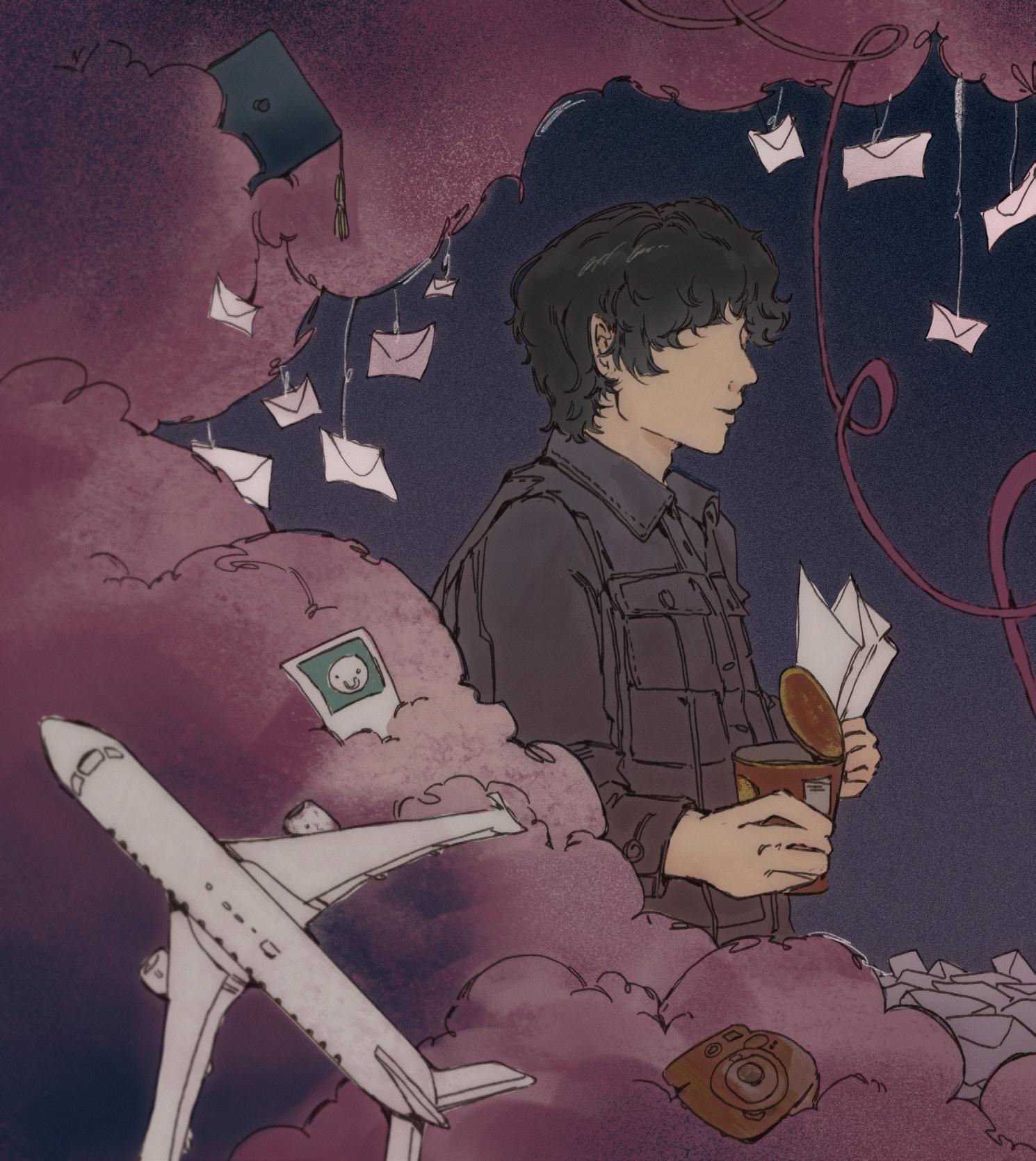
I didn’t (rolls of film that had already been developed, a Fujifilm instant camera, a bonsai tree starter kit that I knew I’d just kill).
The last time I’d cried in his apartment, it was because he had fed me noodles so spicy that I started wailing about my insecurities.
“I feel like no one cares if I’m around,” I sobbed.
He laughed and took photos of me. “You need to train your spice tolerance.”
My face grew red and puffy. “I can’t!”
“Hugeness Bigness,” he leveled with me, “Nat, Kiran, Lucas, they all like hanging out with you. We love you. We want you around.” I set the noodles aside, and we watched TwinPeaks until I fell asleep.
It was only natural that once I stopped crying and took the posters he couldn’t pack, Cantonese Jericho started. We had spent half our nights at his apartment on Ives Street. We cooked somewhat successful dinners, aside from one dish he called “Bolognese Bianca” that was some blend of cream and ground beef that turned purple on the stove. We watched movies I didn’t understand and did German homework that
neither of us could comprehend. He told me about his relationship problems and I told him about my social conflicts. We retreated to each other’s apartments when the people we liked didn’t like us back. He would say, “They kind of suck,” and I would say, “Who wouldn’t love you?” I fell asleep on the couch and sometimes came to consciousness just for a moment as he laid a blanket over me.
For months after he graduated and moved to Vienna, the only response I had to “How are you?” was “I’m good, just in an adjustment period,” but there was no sufficient amount of adjusting to be done. Our semi-weekly phone calls from his study abroad days became the norm once more. I knew that I needed him more than he needed me, but he was always the one to call. He sent me photos with no caption: a giant statue of Serge Gainsbourg’s credit card at a restaurant in Paris, his enormous and captivatingly fancy cat, a graffiti drawing of a kitten that he turned into Angelus Novus .
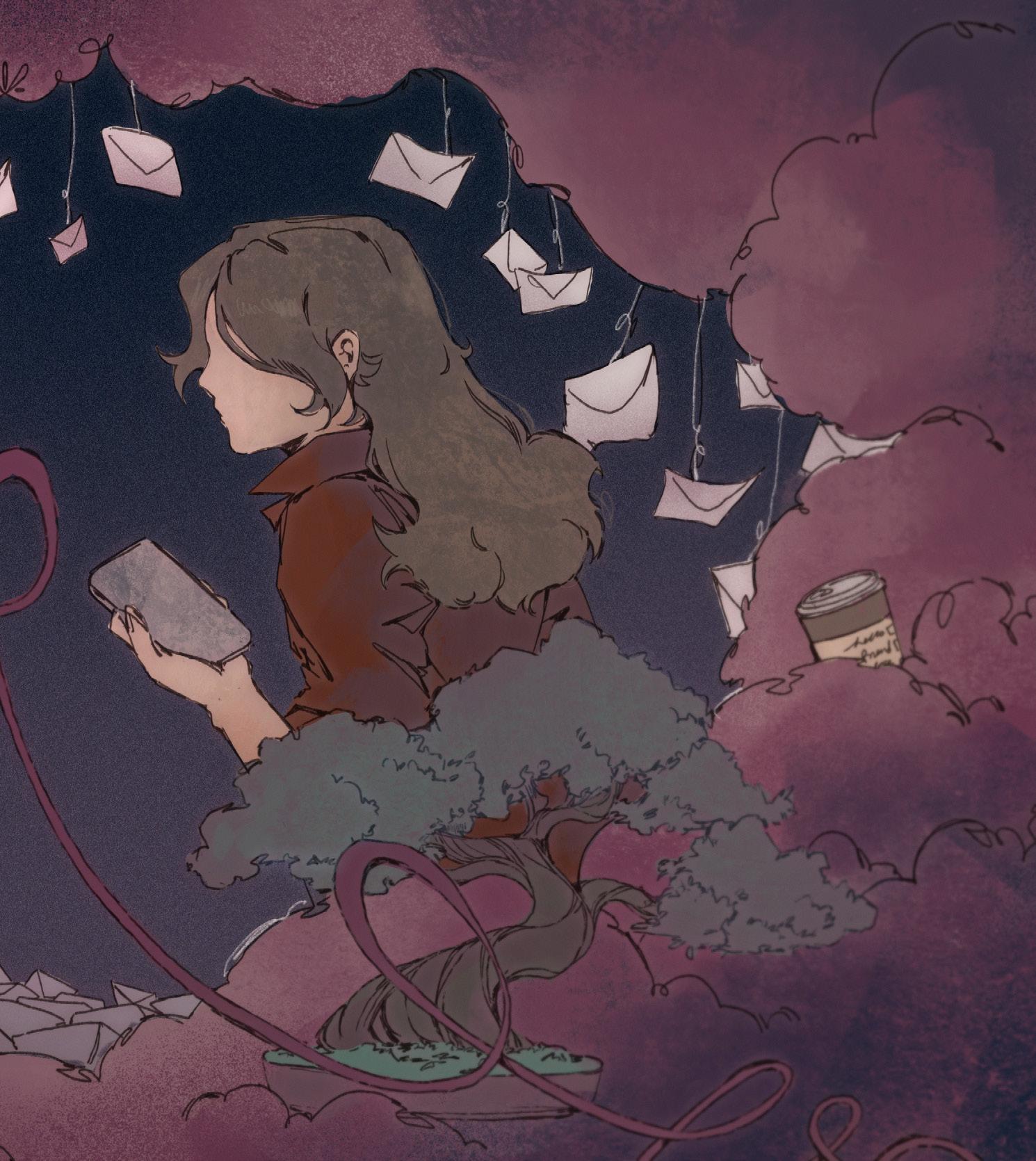
I never sent a compiled list of updates; I told him every unimportant thought the minute it appeared.
Still, what I would consider my “college experience” ended when he left. Cooking dinner became a chore, and I started avoiding as many social gatherings as I could. Without Cantonese Jericho, living in my own apartment felt like playing house, like going through the motions of real life when my days outside of class consisted almost entirely of knitting, working a restaurant job, and watching Survivor . It felt like there was no way to be happy here, just a way to be content.
I did so poorly in a presentation in my Toni Morrison class last semester that I immediately dropped the class and booked a flight to Vienna for spring break. It was a long time coming; contrary to what I had been told about Toni Morrison, there was a limit to how many rape, murder, and kitten-death scenes I could tolerate. Cantonese Jericho was the only one I wanted to see, let alone spend a week with. Aside from my mother, he’s the only person I never get sick of.
He has a sweet indifference to my arrival in Vienna. I asked him over the phone a few days before my flight how to get to his apartment, and he replied, “You’ll figure it out.” He still hates how long I take to eat and tie my shoes, and he still disagrees with all my takes on books and art. I still don’t hold his pretentious opinions against him because they’re probably right. He still tells me he worries about me. I still tell him not to.
His apartment is hardly big enough to make coffee in the morning. Aside from his bed, there are about four square feet of space to move around in his room. I snore so loudly the first night that I walk to the Apotheke the next morning and spend 23 euros on Breathe Right strips. We decide to sleep head-to-foot for the rest of the week. We try to tape my mouth closed, but my drool forms channels in the adhesive. “The things I do for you,” I complain.
“I really don’t think I’m being dramatic,” he insists. “It’s really loud.” I should have guessed that every night I couldn’t sleep, he
slept soundly.
We spend the week eating at cafes and going to museums. He shows me around the city and introduces me to his friends as I try to understand why every restaurant is called a cafe, even if it’s a semi-formal sit-down dinner service. At night, we read side-by-side and talk about the same nothings we always did.
On a Wednesday night, we play chess in a jazz bar and both suck at it. “Always think one step behind,” I say. A man with a middle part and a turtleneck makes a snarky comment on our game before reading Jack Kerouac into the microphone. I say I want to kill him. Cantonese Jericho just thinks he’s lame.
“I don’t think I’m going to be friends with many of these people when I leave,” he says to me as we ride the straßenbahn back to his apartment.
“I think that’s just how it goes,” I say. I probably won’t keep in touch with most of the people I consider friends now. I tend to place my bets hastily, saying I’m soul-tied to anyone I can spend more than two hours at a time with, but I’m not good at gambling. I often consider changing my number after I graduate. “Do you feel sad about that?”
He pauses for a moment. “Not really.” We watch a man lower his head behind his friend’s shoulder and sneeze directly onto his back. Our conversation stops abruptly as he turns to face me: “That was crazy.”
“If you ever do that to me,” I respond, “I’m never speaking to you again.”
Even with distance, I don’t see my friendship with Cantonese Jericho fading. He’s a part of being alive, like sleeping. Staying in each other’s lives is hardly a choice. It seems like the natural way of the world, as if to say, What else wouldIdowithoutyou?
I leave for Providence the same day he leaves for Paris. We go to the airport together, and I tell him to go through security and wait at his gate while I check in. He calls me as I stand in line to tell me he’s already boarding. “I’m sorry, Hugeness Bigness. I wish we had a proper goodbye,” he texts me a few minutes later. In our opposites-attract fashion, I take silent satisfaction in our not-goodbye. The time we spend apart seems more temporary than the time we spend together. A goodbye would be moot, insincere. I reply, “Nevertoolongbefore weseeeachotheragain.”
on this beautiful thing called post- magazine
BY INDIGO MUDBHARY
ILLUSTRATED BY ELLIE LIN
Whenever I am brainstorming what to write about for the Arts & Culture section of this fantastic publication, I tend to make a list of the films, TV series, books, songs, albums, and other media that I have consumed recently. But as I geared up to do this once again, I realized that there is an equal amount of art being produced on campus that is just as worthy of the attention of A&C writers like myself, yet seldom populates this section. From student bands to campus publications to visual art thesis exhibitions, art is alive and breathing among Brunonians.
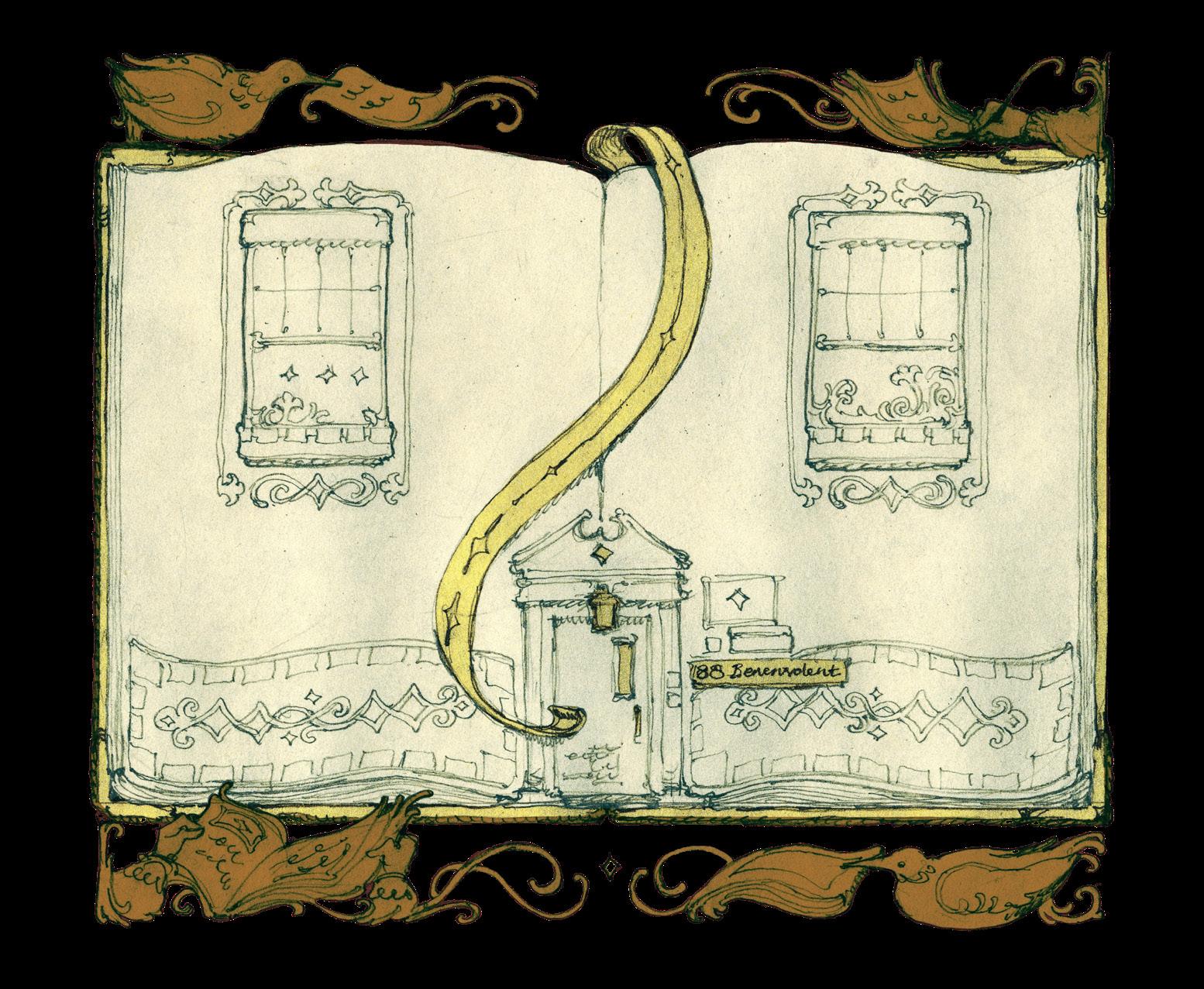
I often hear people boldly assert that art is generally on the decline—movies are getting worse because of TikTok, nobody wants to read anymore because of our shrinking attention spans, and AI has ruined everything. While these fatalistic statements contain kernels of truth, as a student who has been faithfully involved in the campus publication scene for almost four years, I have yet to see evidence of this rot that so many people around me say exists. Every week, as a copy editor, I enter 88 Benevolent and read beautiful creative nonfiction authored by my peers. While much has changed during my time at this institution, the earnestness, prose quality, and beauty of the pieces I am asked to check for grammar mistakes have remained constant.
This pessimistic assertion that art is in decay is deeply insulting to those who write, sing, paint, produce, and create in spite of how our society explicitly incentivizes us not to. People are making, and they’re making gorgeous things despite the tremendous obstacles to doing so. If more of these cynics picked up student publications or attended campus shows, I imagine I’d hear such declarations about the universal decline of art in the 21st century less often.
Getting to interact with great art is a big reason I have stayed at post- as long as I have, but it was certainly not why I joined. As a first-year, I knew I loved to write, but knew very little about
how to turn this into a career. Publishing seemed like a good idea at the time, so I signed up for as many campus magazines as possible. I remember going to the CareerLAB my first year here for resume help and the peer career advisor saying to me: “Wow! Your publications section is VERY long!”
I looked at her with wide, first-year eyes. “Is that a good thing?”
post- was the first magazine I applied to upon resolving to pursue a career in publishing—a dream which fell apart when I discovered my love of research, but that’s another story. I remember hesitating on the Google Forms application over the choice to apply to be a writer or a copy editor. While I love writing more than basically everything else that is available on this planet, I felt shy about the prospect of sharing my writing with these students I had never met.
Plus, I loved catching grammar mistakes. When I was in seventh grade, our English teacher would have us do an exercise each class called “Daily Grammar.” It was a half-page grammar worksheet that we would do in small groups, and then one person would share out the answers to the class. I loved Daily Grammar so much that I appointed myself the share-out person five classes in a row, after which my English teacher had to pull me aside to tell me that I had to let others take the lead on Daily Grammar once in a while. I was devastated. All this to say—forgive me if I sound melodramatic—sometimes I feel that I was born to be a copy ed. (In Sally Rooney’s sophomore novel NormalPeople , the protagonist says to the love of his life, “I’m not a religious person, but I do sometimes think God made you for me.” On the right day, I feel similarly about fixing comma splices.)
With years of Daily Grammar under my belt, I showed up to my first night as a copy editor at post- full of excitement. After stepping into the main conference room, I was informed that the “copy closet” was across the hallway. In a much smaller room, three other copy eds and I sat on a fuzzy pink rug as the copy chief, A, instructed us on the ins and outs of the post- style guide. I looked longingly at the main room where people were laughing and chatting. In the copy closet, we did not have chairs, much less any sort of joie de vivre.
The copy closet was a temporary institution, and eventually we lowly copy eds were upgraded to sitting at the main table with everyone else. Yet, things there were not much better. The copy chief was addicted to making “That’s what she said” jokes, which is not, on its own, an inherently bad thing. It’s just that every time she did so, she would look at me—the only first-year on the copy team—and say something like, “I shouldn’t say that! You’re just a baby!” or “You’re too innocent!” It was deeply odd, and I still don’t understand what compelled her to single me out like that. Besides, if she had ever cared to ask me anything about my life, she would have learned that I was no virgin— not that the behavior would have been any less problematic had I been.
Over the course of two semesters, this “That’s what she said” dynamic began to deeply irk me. Did she need me to fuck someone on the post- conference table to prove that I could handle a “That’s what she said” zinger? First-year me was so frustrated by this pattern that I might have done so if it would have meant A would stop being so weird to me in front of everyone.
Though I thought about quitting many times because of A, I stayed. I loved having a structured 45 minutes in my week where I was forced to read beautiful creative nonfiction. I was learning a lot about Brown and sometimes Providence through these pieces, and that was a good enough reason for me to stay. It’s funny how what seems like a small decision at the time, like staying at a campus publication despite an annoying copy chief, can change the course of your life.
My first year came and went in a haze of Keeney parties and “is football throwing tn” texts. It was a vapid year, but whose first year isn’t, at least a little bit? By the time I returned for sophomore year, I had much more clarity about what exactly I hoped to get out of my time here (see: more learning, both inside and outside the classroom). That fall, a new copy chief was appointed because A had graduated. Her name was E, and though I didn’t know it yet, she would go on to become one of my favorite people at Brown.
E was everything a copy chief should be: meticulous, dependable, and kind toward all copy eds, new arrivals and old timers alike. Once I figured out how to make her laugh, a friendship
quickly followed. When she graduated, I gifted her a copy of PlainStyle , a print edition style guide for academic writing. We’re still in touch, and I miss her every time I walk into 88 Benevolent.
E’s arrival meant that I started to feel a lot more comfortable at post-. Over time, I learned how to make the rest of the production team laugh, too, sending memes in the Slack and starting bits that I knew would crack even the most reserved section ed, such as inventing a fake beef between post- and the BDH and joking that we should start a separatist movement. (For the record, I believe no such thing and sincerely think the BDH represents the best of what undergraduate journalism can be.) Production nights slowly turned into a stand-up routine for me, of sorts, though I never let my new position as the post- jester impact the quality of my copy editing.
It was that year that I started writing in addition to copy editing. I received thoughtful edits from people who were becoming close friends. This motivated me to overcome any shyness I had about sharing my writing with other students who I respected. The kindness and care with which my writing was treated motivated me to eventually write about difficult topics, from personal crises like my rape to broader horrors such as the erosion of American democracy. Over the years, post- has become a place where I have worked out complicated feelings with the support of a team of people who care about me, ultimately culminating in short pieces for public consumption.
For example, take the aforementioned assault. While my casual reference to it earlier may make it seem like it’s something I know how to
talk about, it’s actually very hard for me to talk about it off the page. Yet, I simultaneously need to talk about it, because it impacts my daily life at this university. post-, then, has given me a middle ground in which I have begun to heal: In writing, I am able to broach a topic that I need to think about but struggle to bring up verbally. As a copy editor, I have read similar pieces about others’ traumas and seen other authors do the work of thinking through difficult things on the page. That’s the beauty of creative nonfiction, I think: to be able to say, “This happened, and I want you to know about it.”
But it’s not the medium of creative nonfiction alone that makes such reflection possible for authors like me—it’s the post- staff, and an institutional culture that encourages writing about difficult things, not for the sake of shock value or trauma dumping like the good Gen Zers we are, but rather out of the firm belief in writing’s transformative power.
post- is also full of pieces that foreground the joys of life. Such works are equally important in making the publication what it is. I wrote one just a few issues ago about how much I love my boyfriend. I think that’s the strength of postand what ultimately makes it stand apart from other campus publications: the sheer diversity of our pieces (though, of course, it’s no competition and we’re all friends here). In the same issue of post-, you’ll have an article about a popular film as a metaphor for the failures of international governance, an article about the joys of communal living as a college student, and an article about the passing of a loved one, to name a few hypothetical
examples.
As someone who has worked at a variety of campus mags (and rags), the beauty of post- is in its heterogeneity. At other publications I have worked for, there is a similar writing style across pieces. I don’t want to throw shade—our campus, much less the student writing scene, is far too small for that. However, I feel that for most publications, if I said to a student involved in this literary scene, “Write a piece in the style of [insert magazine here],” they would be able to do so, through certain prose and thematic choices. With post-, that would be genuinely impossible, and I think that is our greatest strength. It’s what’s kept me coming back for almost four years, despite an increasingly busy schedule and the decreasing relevance of this position to the rest of my resume. It’s what will keep me reading post- after I graduate in May.
And what a beautiful community of readers post- has. There have been multiple times where I have met someone new and introduced myself only for them to inform me that they’ve read a postpiece of mine. I recently learned that many people in my life have read these little musings—a fact that surprised me, as I never send them to anyone upon publication. I only just discovered that my roommate is religious about reading these articles, having consumed every single one. A long-ago friend with benefits (we got together back when there were dinosaurs) said his mom had read all my post- pieces, which is how I implicitly discovered that he had told his mom about me—something we had never discussed and which served as the final sign to end things.
A few times, I’ve even received emails from people with no Brown affiliation, including a message from a student in Boston who was also assaulted at her university. She said my writing gave her faith she’d reach her senior year. I share these examples not to glaze myself (as the saying goes), but rather to show that the readership of post- is as diverse as the pieces within its pages, from the mom of an ex-friend with benefits to a fellow rape survivor looking for solidarity. So, contrary to popular discourse, art is not dying. We’re making it every week here at post-. I will no longer be a part of these efforts when I graduate—I will become post-post-, if you will. Yet, post- will always be a part of me, living on via my fundamental belief in art and what it can do for others and myself. I don’t know who I would be if I did not believe in the value of making art and living it, which is to say I don’t know who I would be if I hadn’t joined post-. Luckily, I’ll never have to answer that question, but I will inevitably have to learn what it’s like not to be a copy ed here. It will probably be hard, and I will probably cry. It will be exactly the kind of thing that would make a good post- piece.
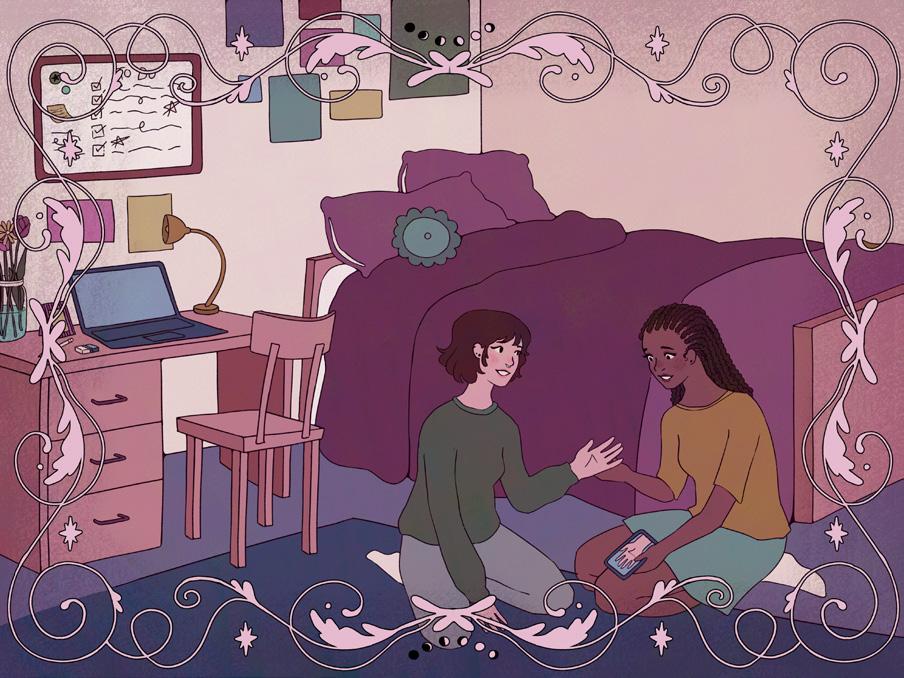
I“t says you’re at a crossroads.” My freshman year roommate, L, holds my palm in her right hand and her iPhone in her left, squinting at the indentation between my thumb and index finger. Her gaze shifts to the screen, reading wikiHow: “Intro to Palm Reading.”
I should be analyzing 16th century Spanish art, and L should be writing a bio lab report, but when it’s 2 a.m. during midterm season, there’s nothing better to do than devolve into an existential crisis—it’s just a bonus that we’re not alone.
“Yep… crosses through the head line… something about momentous decisions? Does that mean anything to you?”
We both laugh. Nightly shenanigans have destroyed both of our sleep schedules, and this isn’t the first time a “side quest” has completely replaced what were supposed to be strict lock-in hours.
It’s a slippery slope to an all-nighter, and we’re both teetering on the edge. But our astrology rabbit hole feels absolutely worth the dark under-eye circles. Plus, our fridge is fully stocked with Celsius for precisely this reason.
Maybe the stars, or the lines on my palm, or the creators of that webpage knew something even L didn’t. Because at that moment I was, in fact, at a crossroads. Earlier that day, I’d walked all the way to the registrar’s office to request my official transcript for transfer applications. The private tab on my computer screen displayed the Common Application, completely filled. Still, I couldn’t commit. In the days that followed, I found myself glancing repeatedly at the indiscriminate lines etched into my palm. Curse all these creases , I thought to myself. This “momentous decision” was eating me alive.
I finally hit the submit button 2 minutes before the Brown application was due—not unlike my class assignments that still somehow get submitted at 11:58 p.m. for a midnight deadline.
What’s funny is that I’d always wanted to end up at Brown. It was my dream school in every sense of the word. In fact, when I got rejected the first time, I promised myself it wasn’t over ‘til it was over. So, the
whenwikipedia(andpalms)predictedmy future
BY YANA GIANNOUTSOS ILLUSTRATED BY ANNA NICHAMOFF
difficulty of going through with the transfer was like the universe laughing in my face. I suppose I kept my promise, given that I am now writing this while under a pile of blankets in the middle of the night in Perkins, a building I’d heard legends about (not the good kind) when I was first applying. I can’t believe I’m sitting here complaining about a dorm room just a minute too far from the Ratty, or that I’ve grown accustomed to a college life I’d once equated to Hogwarts in my head. A lot happens in a year.
Saying goodbye was one of the hardest things I’ve had to do. Especially to L, one of the few people in this world who I believe truly knows me. It’s funny how endings work—how they drift away and bleed into beginnings.
L and I downloaded an app called Costar during our week of astrology. It’s basically the glorified version of a newspaper horoscope, but give it enough information about your birth, and it’ll basically map out the entire trajectory of your life (for better or worse). That sounded ideal to me and L at the time, and, to be honest, it still does. Since that day, we would (un)ironically rely on it to make the bad days good, the good days better, and justify our wallowing if need be. I can almost hear L debating whether to skip class because her horoscope that day said, “You deserve a nap.” Before I left, we linked our accounts so that we could keep track of the moods, life-altering romances, and even catastrophes on each other’s horizons.
L recently sent me a screenshot of the app. It read: “If it seems like you’ve known Yana all your life, there’s a good chance you were always meant to be friends.” Maybe it had something to do with the Sun’s alignment with Neptune in Aries?
Perhaps certain things are written in the stars. Or maybe we’re the ones who write them.
On the last day of freshman year, L and I engraved our initials into the edge of the door to our dorm—knowing that it would surely be renovated in the next 5 years, and that’s being generous. (Is there such a thing as a decent freshman year
residential building?) Nonetheless, evidence of us is etched there forever.
Our room has since been occupied by people who will also think they’re original for marking their initials in Sharpie. I am now far enough away that I can’t just decide to wake up and visit the building or L, or anyone from the life I was living last year. But I think about it all the time. I thought about our initial writing today when I trudged up the stairway of the List Art Building and saw hundreds of names I’ve now memorized after taking that route every day. I wonder where the owners of those names are now.
This year, a lot happened: I turned twenty, said “I love you” for the first time, declared my major (shoutout art history), dyed my hair dark to feel cool, transferred colleges, perfected my eggand-cheese recipe, and took up weight-lifting. I’m halfway through college, and it seems that since it started, everything has changed. Yet in more ways than one, I am exactly the same. Each day, I brace myself as I refer to my horoscope. When I accidentally shrink my favorite wool sweater in the Perkins dryer, I FaceTime my mother for emergency laundry assistance, knowing full well a YouTube tutorial video would suffice. I still feel a pang of jealousy at the fact that my little sister can solve a Rubik’s Cube faster than I can. I call L when I’m feeling down, up, and everywhere in between. My fridge is fully stocked with Celsius. I know I will leave my initials in this room, and in List, and anywhere else on this campus I can do so without getting punished for vandalism.
My horoscope today says: “Reach out to the person you used to be.” I guess this is me reaching out to her. Because in every way that counts, I am her. My palm will always be full of crosses through the headline. I will always be at the end of something and the beginning of another; always enduring some sort of existential crisis. We are all at a crossroads. And still, the stars align.
BY MARIA KIM ILLUSTRATED BY JUNYUE MA
Over time, interests ebb and flow, as do the questions that surround them. Being a philosophy major, it is in my nature to question anything and everything that comes my way. I wonder about occurrences as large as the blizzards that enveloped Brown’s campus this semester, a personal attack against this Midwesterner who grew up bombarded with negative temperatures. Other moments—as small as the glint in someone’s eye as I pass them on the street, or the dainty swaying of the trees while walking to class, almost as if they’re ushering all the students to congregate on the Main Green— raise similar questions for me. At parties, I am the one to stand to the side and ponder the true meaning of life and how this particular experience accounts for the overall status quo of the world while people yell, dance, and play beer pong. At least I think I am. This last statement seems to sum up the majority of the thought processes that regularly cycle through my head. Maybe that’s what life is supposed to amount to: discovering what it is by living it.
The relation between experience and analysis has always been tricky for me. Maybe there is no underlying meaning behind the rain that showers itself into oblivion, while I, too, trudge through resulting rivers on the street, feeling the weight of my responsibilities, actions, and place in the world. Maybe the line between theory and reality have blurred for me—how things theoretically should be put into place versus the way they scramble, almost comically disordered, into their positions in
the world. Are my expectations too high for my reality? Do I spend too much time in the universe I’ve crafted in my head and slowly, almost subconsciously, become out of touch with that which pans out around me?
Another common topic of chronic overthinking is other people’s perceptions/opinions of you, something of which I’ve had my fair mental share. Case in point: I have a distinct memory from third grade of being convinced that the group of boys trading Pokémon cards was secretly conspiring against me. Only by looking back with the wisdom of an almost 20-year-old, can I see that perhaps this pseudo Pokemon card club didn’t have any ulterior motives against me and my bright green Creek Valley Elementary School Carnival T-shirt. Perhaps they truthfully didn’t hear me when I choked out something akin to “dyew wantdkra trfe wifme” (in my head, it sounded like a clear “Want to trade cards with me?”), purposely not making eye contact with any of them. Similarly, maybe the cashier at the grocery store didn’t think it was enormously awkward when I fumbled in my bag for what felt like eons before realizing I had left my coupons at home. Finally, maybe it is fine that I chose not to say hi to that one acquaintance whom I feel obligated to acknowledge every time I pass them on the street, knowing full well of our mutual desire to not say anything at all. Spending as much time thinking about thinking as I do, it’s fascinating how one can almost start to see the way other people think as well.
The narrative I’ve crafted in my head requires every new experience, interaction, and encounter to fit neatly into the general framework of the world as I’ve experienced it. Yet, as I’m navigating the last year of my teenagehood, I’m starting to realize that this framework is less helpful than I thought it was. This realization started with the discovery that it is almost irritatingly clear when I encounter something that indeed does not fit into this framework (which, as I’m discovering, seems to happen a lot). The conclusion: Is it, then, truly acceptable to experience without analyzing? The slightly embarrassed, post-Pokémon-club-rejection third grader in me says no; the older, hopefully wiser version says signs point to yes.
Maybe there is some special meaning behind everything. Maybe Plato and Sartre are right that human beings are forever walking contradictions of themselves and thus can never embody the form of knowledge that is simply itself without having an opposite. Contradictions exist in the weather—the dusting of snow falling somberly on top of buildings, coloring them white and pale, after days of sunshine which brought out the sunshine in everyone. They exist in the thoughts in one’s head and the expression on one’s face, whether or not one complements the other. There seems to be as much to be said in the unspoken as in what is said outright; being a chronic overthinker puts one into a constant state of thinking between the lines.
I pass buildings with walls dotted with flowers
and wonder if those flowers exist in the crevices of my brain, inhibiting some neural pathway and resulting in my overthinking nature. I glance at the cathedral-like brick layouts in Sayles and wonder if some monk in a cathedral hundreds of years ago felt the same sense of awe as I do. I wonder if people act out of the same pursuit of some sort of drawnout goal, if they’re motivated by a single value in life, if some live carried away by emotions, if some don’t.
Another thing I’ve realized while at Brown is, as interesting and invigorating as living in one’s head can be, it is not the most practical method of going about one’s lived reality. Case in point: Perhaps I shouldn’t have gotten irrationally angry at my physics professor after receiving a pitifully low exam score when I had spent most of the lectures wondering what had caused our joints to evolve in the way that they did. Perhaps it is better to think that people mean what they say and that most don’t have malicious intentions. “Perhaps” seems to be the way that I go about living my life. Yet “perhaps” doesn’t write a paper for me, submit job applications for me, or talk to my philosophy professor during office hours about the nature of morality for me.
“Perhaps” has been both a blessing and a curse. But upon living experience after experience at Brown, something that I always seem to return to, even in the midst of chronic overthinking, is that one scene from Kung Fu Panda where Master Oogway advises a forlorn Po who is debating quitting his Dragon Warrior training: “Quit, don’t quit. Noodles, don’t noodles. You are too concerned with what was and what will be. There is a saying: Yesterday is history, tomorrow is a mystery, but today is a gift. That is why it is called the present.” Maybe the meaning of life will always be contingent upon a maybe. Maybe this truth is completely acceptable—maybe the lesson is that it will indeed all work out.
In Asiā est vir clārus.
Right around nine in the morning, when the sun shines ripe—having risen for a few hours now—the wheels touch down. At this moment, I feel my feet make contact with ground, too, but the invisible kind. At first glance through the plane window, it doesn’t look any different from America. You have to squint your eyes in order to better discern the thick brush of greenery beyond the runway, the pines similar in shape yet surely more ancient.
BY CHRISTINA LI ILLUSTRATED BY KYRA CHEN
The landscape blurs past the bus that takes us towards the coast. I continue observing it amidst the cacophony of excited yelps and squeals. The surroundings are still somewhat familiar, but increasingly hard to believe is that these very lands were where Western history and legend formed. Every so often, a car speeds by on the parallel highway, quaint in the European way. Who’s to say what is European, and what is distinctly Italian? Certainly not a seventeen-yearold Sichuan girl whose bloodline has never set foot on this old, old land. I lean my head against the glass and feel time wrap itself around me, coaxing further questions and musings out of me. Vir est Anchīsēs.
We skip Rome at first. I find myself before a cross beside Ms. Keener. The bus has dropped us off at a small village square right outside of our intended destination: Ostia Antica, the archeological ruins of the Romans’s port city. Below us lies that classic Italian
cobblestone, arranged in curves and grooves that eventually meet and overlap. Around us are villas, all connected and earthy, forming narrow passageways where perpendicular rows come to corners. A handful of the high schoolers, myself included, wander into the central church that stands separate. Above the altar, there’s a massive arch embedded into the wall. Over the centuries, instead of commissioning new frescoes or wall motifs, architects cut fragments out of ancient structures to create patchwork patterns. A large wooden cross with a sculpted Jesus attached to it rests against a column. When the first documented mention of Italian Christianity appeared in 1 CE, I wonder what the gods (Dei) thought of the ordeal as they watched their influence slowly fade away and the crowned man journey between life and death.
Ms. Keener points out the Latin phrase carved at the head of the arch, running in all uppercase letters without spaces between the words—the Roman way. I realize that this is the first time I’m seeing my language of study in actual usage, a dead language finally alive before my eyes (even if cemented in time). It exists, it exists, it exists, and so do I. Deciphering the line, I begin to recall my own gospel of sorts: First Declension Singular: -a, -ae, -ae, -am, -ā Dea Anchīsēn (accusative) amat.
Similar to English, Latin sentences are built around subjects, verbs, and direct objects. Unlike English, Latin words take on different “cases” that designate them into these specific functions; each case is correlated with a modified ending
to the root word. There are five: nominative, genitive, dative, accusative, and ablative. Puella is the nominative singular form, literally meaning “[the] girl,” while Puellarumis the genitive plural form, changing the function to possession and the translation to “of the girls.” All vocabulary typically follows these patterns, but, of course, there are exceptions. In a way, I love this puzzlepiecing, identifying the endings and organizing the words by meaning. In the way that I trace historical throughlines in translation, maybe I can similarly track my inner grammar nerd to these five years of declensions and conjugations. Maybe, though, I love it for what it isn’t. It isn’t something that is naturally, forever imprinted onto me. I roll the syllables of the old West off my tongue, the language of this once-thought empire of the world.
Aenēās est filius deae et Anchīsae.
The fifth word of Homer’s Odyssey reads “polytropos” (Πολύτροπος), an adjective used to describe the titular character Odysseus. Polytropos is also the subject of one of the most contested translation debates in history. With “poly” meaning “many; much” and “-tropos” meaning “turns; changes; styles,” it could be literally written as “much-turning.” By extension, it could be “much-traveled” or metaphorically “wily.” Some scholars argue that it’s untranslatable, its layered meaning only understood by the Greeks who heard the original bard hymns. Robert Fitzgerald offers “that man skilled in all ways of contending.” Robert Fagles writes, “the man of twists and turns.” Emily Wilson gives perhaps the most succinct translation: “complicated.”
Aenēas fēmina est Creūsa. Creūsa Aenēāsque fīlium vocant Ascanium.
After exploring the ancient streets of

Ostia Antica, we finally arrive in Rome. How clandestine it feels: me standing between Mr. Holmes, my middle school teacher, and Ms. Keener, my high school teacher, my two guides through the rings of time—my modern Virgils, now at the origin. We navigate through the streets of Trastevere, bustling with Saturday traffic. Sitting right on the Tiber River, this neighborhood is distinct for its narrow, winding streets—its maze-like structure is attributed to its medieval roots. The soles of my sneakers bend and mold to every cobblestone beneath, attempting to keep up with all the twists, trying to identify landmarks to no avail (they are never consistent anyway). How many people have crossed over this particular stone before, over this land? Aenēae patria est Troia.
I am in the classroom again, with the white brick walls (American, evidently) and declension posters taped from floor to ceiling. The collage of Times New Roman is interrupted by a square mural by Mr. Holmes’s door—a single mountain covered with different figures pinned at various heights. Each character corresponds to a specific student, representing their ascending path towards Olympus based on points accumulated from extra credit homework and quizzes throughout the year.
There were three languages offered at my middle school; by sixth grade, the decision between Spanish, French, and Latin was the latest hot topic among the Chinese moms. Registration form in hand, I checked off “Latin I” as my first-choice elective. As a girl whose body couldn’t tell the difference between a fight-or-flight situation and the act of public speaking, I swore off the speaking assignments of Spanish and French. Latin was a dead language—there would be no pronunciation practice or oral presentations involved. Perhaps beneath was another deeper layer. As writer Jhumpa Lahiri writes of her relationship with Italian, my Latin takes place in exile, a layer of separation between it and me. English is my true birth-tongue, my one fluency. Chinese is my obligation, connected to my heritage, heavy and hefty. Latin is different. My bloodline has never intertwined with Italy, no less Europe in general. It is separate, and, for that, it is all the freer.
I still remember my first sentences. I remember the first passage Mr. Holmes assigned us to translate, entitled “THE TROJAN WAR” from “Old Jenney” (affectionate nickname for the 1987 edition of Jenney’s First Year Latin)—the story of a famous man named Anchises who fell in love with a goddess. Together, they had a son, Aeneas, who then started a family of his own with a wife named Creusa and a son named Ascanius. I ran the next sentence’s words through the
dictionary. Aenēae: genitive form of “Aeneas.” Patria: nominative form of “country.” Est: thirdperson singular of “is.” Troia: accusative form of “Troy”… hold on. Who is Troy? My thirteenyear-old self thought. Aeneas’s country is Troy? This makes no sense.
Trōia nōn est in Eurōpā, sed in Asiā.
Five years later, I am in Rome (In Romā sum). Chronicled in the Aeneid, the Latin Odyssey, Aeneas journeys across the Mediterranean and ultimately lands on the Italian peninsula. His lineage later births Romulus and Remus, marking him as the founder of the Roman people. For some reason, there’s one sentence I remember best from that founding passage for myself: TroyisnotinEurope,butinAsia.Troy, not a name but a city. Latin, not separate but an avenue towards both continents.
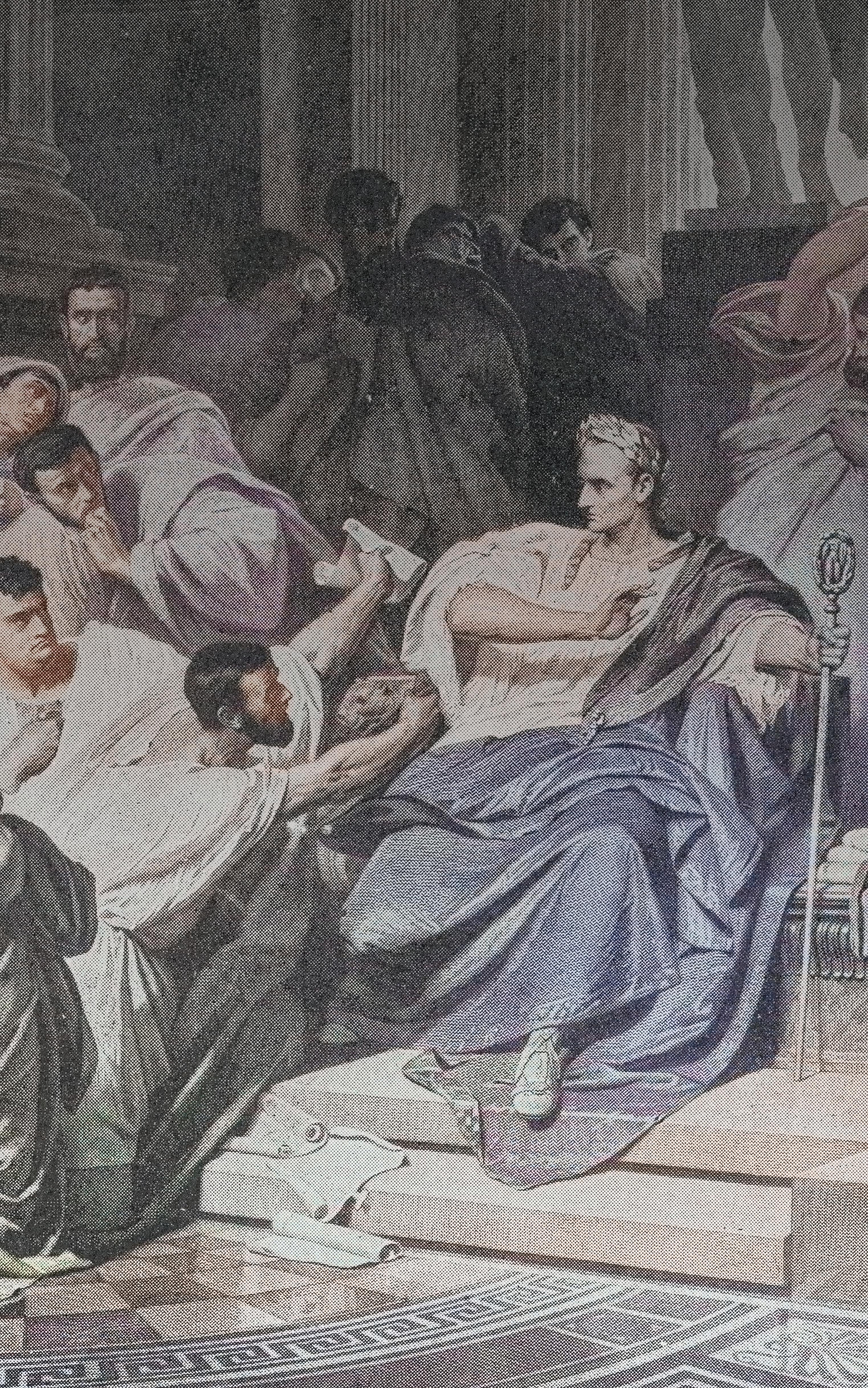
Five years later, I stand before Augustus himself—at least, a stone version of himself, the man who commissioned Virgil to compose an epic dedicated to his believed ancestor (two founders in one lineage, he boasted). From the hall of statues, the Vatican archives lie a few buildings away in this tiny country, another new one to check off. I have sought out the ancient scriptures. I have studied them and now see them for myself. I gaze upon time, and travel through it.
Nōn iam est Trōia… Hodiē ad Eurōpam nāvigāmus.
According to William Whitaker’s
Words, the Latin adjective clārus means “clear, bright, gleaming; loud, distinct; evident, plain; illustrious, famous.” Like much vocabulary, there are multiple interpretations that vary by its appearance across historical texts—creating a language of contradiction, of enigma. Here, I get to choose my translation. Perhaps I, too, can provide my most simple conveyance of what this dead language has grown to be for me. Something loud.
BY DANIELLE LI ILLUSTRATED BY MINGLU DU @DUMINGLU_ART
It is difficult for me to wax poetic about the beauty of a stringed instrument in a way that hasn’t been done before by countless violinists, violists, cellists, and bassists. In fact, my description would be much lesser in fluency and articulation, albeit meant with the same sincerity.
It has been many years since I last unzipped the worn fabric case of the old violin. I do not dare venture to call it my violin, as I appear to have belonged to it more than it ever belonged to me. It was handed down to me by my sister, a much more successful violinist who has gone on to perform (with a newer, better violin) across Europe and North America.
Often I imagine a sort of melancholy emanating from this old instrument, a despondency at having become a hereditary wood piece rather than the harbinger of musicality it was meant to be. Perhaps it will become, like a wild white-tailed deer, a taxidermy decoration void of life, mounted on the wall and seen only in passing. Or perhaps for you, dear Reader, I will uncover it one more time.
This instrument was purchased sometime in the year 2011, that murky time falling
somewhere between an earthquake-tsunami that devastated Japan (thereby causing the Fukushima Daiichi nuclear disaster) and the launch of the Atlantis shuttle mission, marking the end of three decades. But I do not think violins care much for geopolitics, natural disasters, or space exploration, so it must have been born the same way we all are: rather unapologetically.
I do not mean to say that this violin’s birth occurred when we obtained it. I wonder at all the hands it could have passed through before reaching mine or my sister’s. Were they crumpled and worn, with purple veins that bubbled beneath the skin? Were they strong and sprightly, sporting fingers that held an obnoxiously opulent diamond? I wonder what secrets this violin would have to share, if only we could unearth them.
Each violin comes with its own personality, or so they tell me. (I reference the words of a failed “first date” who was more intrigued by my pitch and horsehair bow than anything I had to say). This particular instrument came with an old wound—a distinct scar in the wood grain right by the fingerboard, the long black panel above which the four strings of the violin hover. My mother
balked at the thought of any such blemish and scrubbed at it any chance she could, perhaps hoping that her stubbornness could subdue it. It is like an acne-scarred reminder of youth or a peculiar birthmark under one’s left earlobe— beautiful in an eccentric sort of way.
It is often the way of science to draw comparisons between other organisms and ourselves, so why not do it with this particular species? We like to ascribe living terms to music: It grows, climaxes, pulses, dies away. We call it energetic, expressive, playful, lonely, and in almost all senses of the word, very much alive.
We will start from the scroll, a decorative spiral at the very top of the instrument’s neck (and here is where the humanoid comparison begins—but I am getting ahead of myself). The spiral, known as a volute, became the traditional design in the 1500s and has remained so ever since. The scroll is a way for violin makers to show their style or skill, with the work of more famous makers like Antonio Stradivari or Giuseppe Guarneri being distinguishable by look. There are tuning pegs that fit snugly into the pegbox, and these pieces together are considered the “head” of the violin.
The nut is a small piece of hard material at the top of the fingerboard with four grooves. The fingerboard widens downward, and is host to the four strings—G, D, A, E—if tuned correctly. The body of the violin is made up of the upper and lower bouts and has two “f-holes” that mirror each other on both sides of the fingerboard. These f-holes allow sound to project outward and were used in design during the Renaissance. Around the center of the violin body, there is a narrow inner curve called the waist. Makers like Andrea Amati came up with this human-like terminology to make these structures easier to understand. Perhaps we cannot ascribe this credit to Amati alone, as we are rather selfish and selfcongratulating creatures.
Now, on to the particulars of this specific violin. I still remember my visit to luthier Tsai Iaoshi’s home, though I was no more than six years old at the time. It is peculiar to have such a memory because there was nothing extraordinary about it: a nice suburban house
less than a two hours’ drive away, somewhere in the upper East Coast. An ordinary front door with an ordinary front porch, and an ordinary man with ordinary hands who could carve the living from wood. We exchanged $4,000 for that violin, $1,000 for the bow, and (in my opinion, a rather unwarranted) $500 for its blue fabric case. That is how music came into our possession.
Playing the violin seemed to me one of those difficult, impractical chores that adults task children with to swindle them out of playtime or other enjoyments of life. I hated every moment of it. My violin teacher was a middle-aged Asian man who threatened to wallop my legs with his metal and ivory bow every time I made a blunder. My lesson followed immediately after my sister’s. To have to fill the shoes of one who played Mozart’s Violin ConcertoNo.3 inG major at the age of ten was nothing short of excruciating—I spent
more time living in dread of the violin than playing it.
When I pick up this violin now, I am called back to my younger self. In music, it has become the norm for suffering to be indicative of effort. To be a good violinist is to have black callouses that form on your neck from the abrasion of the chinrest, termed “fiddler’s neck.” To be a good violinist is to bruise your fingertips and develop carpal tunnel in your wrists. I call upon a memory of
slicing open the pad of my left pointer finger on the uneven finish of a pool. I had bandaged it, unperturbed. I was a little more perturbed realizing that my violin teacher still expected me to play, cut finger and all. The vibration of the A string gave my finger a sour, unpleasant green hue that throbbed through the entirety of Chaconne in D minor and Partita No. 3.
It appears to me that violin is a glorified sport where hours equate to passion and rigidity is praised as persistence. But these are the sour complaints of an embittered former player, and the beauty found in the violin must far outweigh its temporary unpleasantries.
Regardless of my feelings on the subject, music appears to me one of those mysterious, indecipherable subjects that reveals its true form to only a gifted few. I have never had the luck to be one of those gifted. But perhaps you, Reader, if I have not yet put you off the subject entirely, might be able to grasp it in my place.


delicious bites, people to watch out for, and canon events
BY INA MA | ILLUSTRATED BY JJ LI
Sharpe Refectory (“the Ratty”)

DeliciousBites:
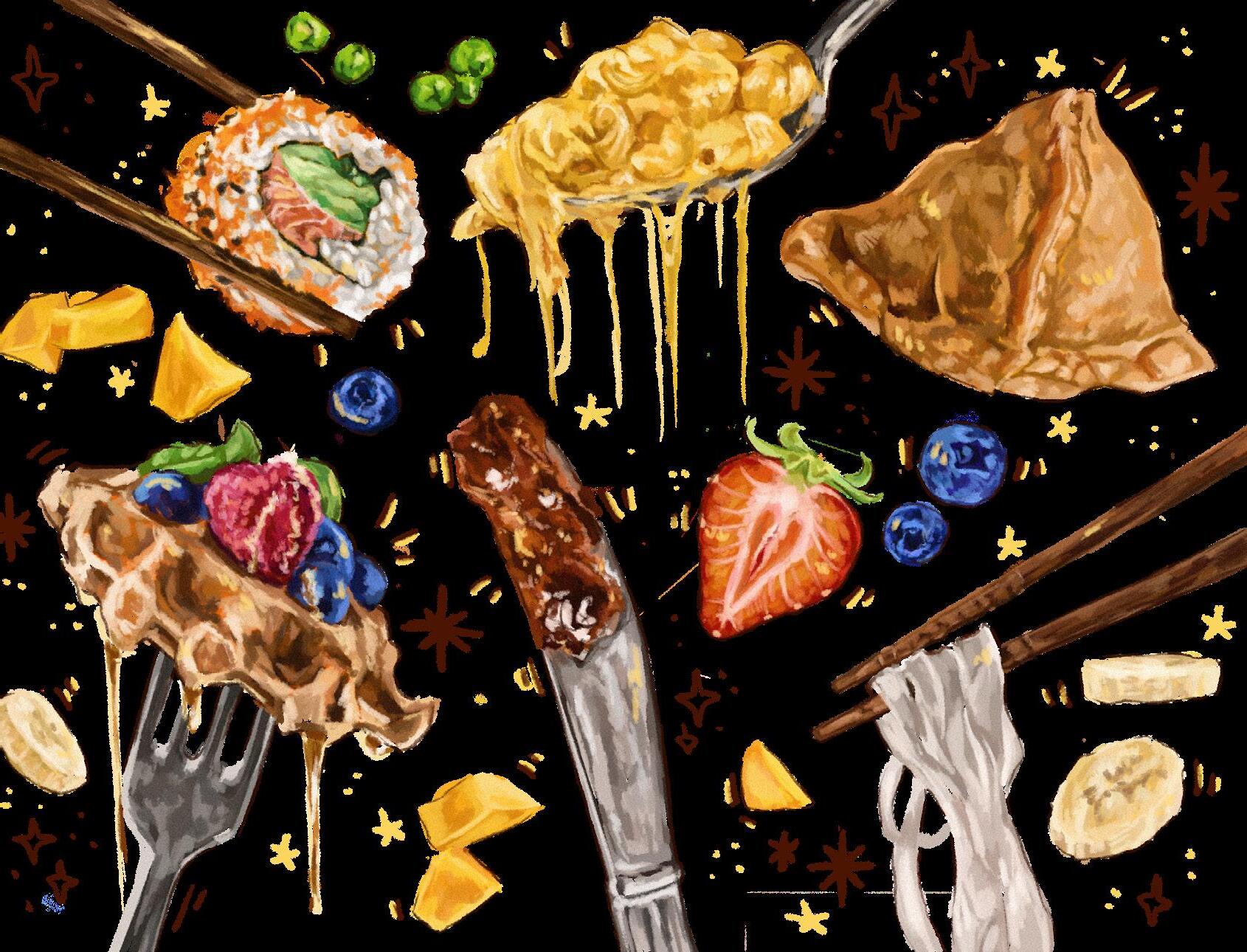
Breakfast: waffle bar with mangos and chocolate chips.
Lunch: kosher wings with pickles, carrot sticks, and celery.
Dinner: steak with broccoli and mashed potatoes.
PeopleToWatchOutFor: every one of your talking stages in the span of ten minutes, the guy you’ve talked to for a total of three times in class coming to eat with you, strangers begging for your table, strangers to beg for a table, the marching band, athletes taking up too many seats, CPax.
Canon Events: waiting in line across Wriston Quad in 9 degrees Fahrenheit, tossing a fork into the compost bin, tossing a spoon into the compost bin, tossing your phone into the compost bin, musty chancellor’s room carpet.

DeliciousBites:
Verney-Woolley (“V-Dub”)
Breakfast: omelet bar.
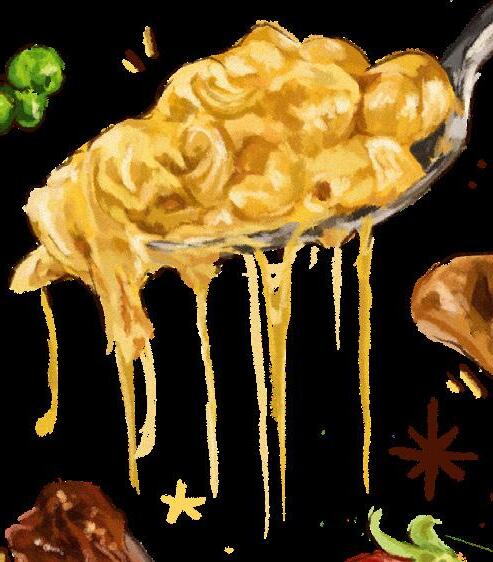
Lunch: mac and cheese bar with ham, broccoli, and peas.
Dinner: samosas and Indian night.
PeopleToWatchOutFor: yappers in the overflow room, athletes after morning practice, Nelson goers, neon yellow security guards.
Canon Events: eating V-Dub for 2 weeks straight during early move-in, leaky ceilings on rainy days.
She’s quaint, she’s yummy (sometimes). A North Campuser’s saving grace. Nothing is more blessed than walking downstairs for breakfast. Tough luck on weekends, though—the North Campus trudge to Ratty breakfast feels infinitely long. Everything about her vibe is a little off, from single-use plastic utensils and paper plates when the dish conveyor is broken to the overflow room being too quiet for comfort. But her menu is consistent (where else can you find bacon on a Wednesday morning?), and there’s something pleasant about sitting at the tables facing Meeting Street and basking in warm morning sunlight.
clamors for your attention and falls away like bubbles down a waterfall. But Andrews is good, it’s really, really good.
Josiah’s (“Jo’s”)
DeliciousBites:quesadilla, panini, fruit bowl.
PeopleToWatchOutFor:panini line cutters, drunk college students, high college students,

anyway. You can eat salmon here until you’re sick of it. Salmon, salmon every day.
Blue Room Cafe
DeliciousBites:sandwich with fig jam and goat cheese (thank me later), chocolate muffins.
PeopleToWatchOutFor:12 p.m. lunch rush, lineless mobs of people. CanonEvents: sometimes your pastry will be warm, sometimes your pastry will be cold, Sue!
You were sold the promise of the Blue Room on your campus tour before you committed to Brown. Delicious muffins and coffee every day. You burn through flex points like an open flame to sodium chloride in your chem lab. Better luck next semester. The best sandwich station on campus.
School of Engineering Cafe (“ERC”)
DeliciousBites:free Caesar wraps.
PeopleToWatchOutFor:engineers after class, professors, hangry graduate students. Canon Events: line too long before your Barus and Holley class, matcha disappointment.
The air is rich with dread of engineers and physicists alike. You’re not here for food, you’re here for fuel. A convenient pit stop on your way to class. I’d never come here of my own volition. My free will drives me to the Blue Room for a better cafe any day. When I’m in the ERC, I’m usually wallowing under the guise of studying. It’s easy because everyone around me is wallowing too.

Gourmet to Go
DeliciousBites:Tru Fru (raspberry, banana, and strawberry!), konjac jelly.
PeopleToWatchOutFor: caffeine addicts, hungry students off the meal plan using the microwave.
CanonEvents:burning through leftover flex points at the end of the semester. Your friendly campus convenience store. Highly underrated, highly overpriced. Great for an after-class pick-me-up. The silent soldier of the campus center, nobody talks about her enough.
Faculty Club
DeliciousBites:bussalicious bread pudding.
PeopleToWatchOutFor:professors and faculty.
Canon Events: okay networking event, okay speaker panel, okay business casual.
The Faculty Club carpet is stained with the essence of preprofessionalism. It’s supposed to be a classy establishment, but the chandeliers are gaudy, and the wallpaper print is out of date. For further reading: avocado toast panini, secret menu.
1. Take home…
2. Countdown
3. Girl
4. Four
5. Five
6. Tribal Council
7. Straw
8. FantasyXIV
9. -ly for this one night, I’m about to have a fun night
10. Destination

Cover Illustration by Tarini Malhotra Cover Design by James Farrington

“Do word games and not cocaine— that’s your lesson for today.”

“Everyone undergoes changes, new environments, and people coming and going within them. I feel as though I’ve navigated change well in the past; assuming an adaptive and receptive attitude didn’t feel like a trying task. Yet this upcoming bout of change feels different, lonelier.”
— Samira Lakhiani, “out of bloom”
“Maybe creativity isn’t about what’s made. Maybe it’s about why. That electric urge to reach across the gap and make someone feel something— confusion, discomfort, wonder, delight. We know it when it hits. Or when it doesn’t.”
— Rchin Bari, “the ghost behind the frame’” 04.11.24 04.09.25