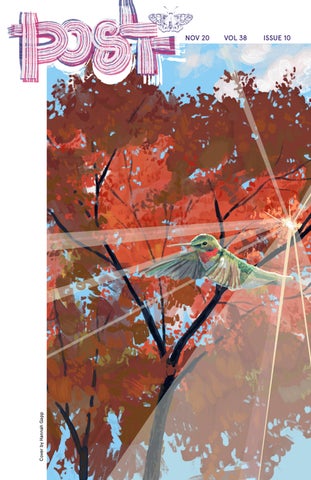
Cover by Hannah Gapp
NOV 20
VOL 38
ISSUE 10
Table of
Contents feature
narrative
arts & culture lifestyle
post-pourri crossword
Tofurkey
2.
The evil protein powder that calls to you in the night
3.
Saturn’s son
4.
The bowl of stew Esau sold his birthright for
5.
Dino Nuggies
6.
Hansel and Gretel
7.
Mrs. Lovett’s pies
8.
Green eggs and ham
9.
Census taker, with some fava beans and a nice chianti
4
Donner party
post–
1
who needs a best friend anyway?
3
seeking alpha
5
summer's end
7
not just a kids' show
9
working girls and pretty women
13
halfway to halfway
15
minutes before midnight
17
i could not ask and neither could you
19
cornucopia
21
Protein Sources
1.
10.
faint outlines
“I’m an undergraduate student…and a woman.” “Why would I come to your opps-giving?”
LETTER FROM THE EDITOR
letter from the editor Dear Readers,
Challenge is apparently on many of our minds: In Feature, Beatrice encounters life changes after graduation and Semi learns to go it alone. Vanessa takes us through a Narrative of choice, options, and optimization, and Sona is stymied by what may be an uncrossable distance. In A&C this week, Reece finds that childhood television had more complex moral dilemmas than he remembered, and Madi contrasts popular depictions of sex work in films, plumbing her
There’s been tension in “The War Room” of
own positioning on the topic. Emma spars with
88 Benevolent this week: Should the post- mini
the speed of college, seemingly unencumbered
crossword be difficult? Are fiendish clues a bug
by Zeno’s paradox in her Lifestyle, and Yana
or a feature of peculiar puzzles? This question is
undergoes a sort of time trial by course
almost existential to the nature of the crossword
registration. Ronan brings us straight to the
puzzle. Does it exist to truly challenge or merely
cornucopia of The Hunger Games in Crossword,
tease? Even the premise has a hint of cheek: The
and Ina confronts perhaps the largest challenge
name of the game is cross, after all.
of all: the historic AO3 outage.
As I’ve struggled with this question this
Troubles big and small, silly and serious
week, it’s begun to tint my whole worldview. I’m
seem to come for us all. Maybe it’s something
writing an essay in forty-five minutes tomorrow,
in the air. Maybe we could fight about it. I don’t
and I’m well aware that my unedited product can
think we can ever wholly get rid of challenge,
be…thorny. But isn’t the work of interpretation
it’s too essential for growth, but maybe we could
truly a blessing for the reader? I imagine
move…post-.
my professor will have far more fun reading something off-beat than boilerplate, challenges of my handwriting and Dickinson headcanons be damned. I completed an assignment for my mapping course that is by and large an exercise in copy-and-paste: I was not challenged. Have I learned? Should I meddle until I break it? These are, of course, trivial challenges.
Lovingly quarrelsome,
Sasha Gordon
A&C and Crossword Managing Editor
Much like my beloved-if-somewhat-overwrought mini crosswords (I’m looking at you, after you _____, you get LMNO). But there are other kinds.
November 20, 2026
FEATURE
seeing home from the rearview
t n s i e a n f t li u o
The old train tracks were paved over the night before my high school graduation, each rough bump of the wooden plates evened out with soft hot concrete. The tracks signaled that we were entering the town center, halfway home from our short venture away. As a child, I’d brace myself as my mother drove me home from the elementary school she worked at, on the way home from the dentist, coming back from a friend’s house. It became a habit: preparing before the car passed over the tracks—tensing my body and leaning back against the seat. Passing over wasn’t uncomfortable; it was more so jarring, as compared to the smooth trip that one wishes a car ride to be. One state of being, stillness, passed into the next, flight. However, I find the sudden absence of the bump on the eve of my graduation more jarring than actually passing over it. I brace myself, tensing my body so as not to be shaken by the jostle, and yet the jostle never 1
post–
comes. I look into the rearview mirror as m y mother drives me home from my high school for the last time, her hands holding t h e steering wheel as they once grasped my hand while crossing a busy street. Looking behind me as we cross the threshold into the center of town, I see smooth road where the tracks used to lay. A hawk circles overhead in easy flight; the hawk has learned to not tense up as it departs from the branch. As we near home, I think of how my habit of tensing for the tracks has already begun to fade. Two years earlier, when my friends and I got our licenses, we became an inseparable four, a carefree force. It tested my parents’ patience, put a strain on their limits, but they could tell I was happier. The crux of our friendship was a used Volkswagen GTI stickshift that fell into the hands of Bella, its leather seats cracked and worn, the material of the roof ripped and hanging down. We’d cram into its tight space, and hold our breaths every time she stalled it in the middle of traffic. A mushroom air freshener swung from the rearview mirror with each sharp turn, wishing us a “Happy Trip.” The car transformed from a necessary vehicle in delivering us to school to the seat of adventure for our friendships: Bella would pick me up before school and drop me off back at my house, a welcome alternative to taking the bus. As the school year grew
by Beatrice Hackett Illustrated by lesa jae Designed by emma vachal
colder, t h e days shorter, the daily dropoff became delayed. We’d stay out until the early morning, the car our key to a liberation beyond the brick and glass confines of school, beyond the entrapment of our parents’ walls. Other times, we found our temporary residence in a similarly cramped grey Prius, endearingly named by my friend Jonah after Schmidt from New Girl, a comedy show he loved. The Prius fittingly carried us to the movie theater every week, where the reality of our nights were replaced by fictitious figures and storylines. Once in a while, Annick would offer up her spacious car to harbor us, a white Honda Pilot that let us stretch out across the seats. At times she would blow past stop signs and red lights, lost in the music perfectly curated for the car ride. I was car-less, dependent on these three vehicles, and these three people to free me from the limits of a town without sidewalks. So together, we found a freedom in driving our looped path—school to home, to movie theater, to mall—rarely straying beyond the circumference of a circle five towns wide. Music played until playlists started to repeat. We’d drive for so long my back would ache against the rigid leather seat. When the car finally parked, in an empty lot somewhere, or beneath a streetlight, we gathered around the center console and pulled tarot cards. The car ride seemed to make the cards feel more real, impart an energy into them that cracked the secrets of the future wide open. With child-like awe, we would pull card after card, stitching together the meanings until
FEATURE there was no doubt that the magic was real. We’d move on to talk about ghosts, and the afterlife, higher states of being— concepts wholly bigger than us, bigger than the car we sat in. And sometimes in the darkness, when we grew still and were ready to leave, one of us would spy a subtle movement, likely an animal or a tree branch bending in the wind. We’d let the unease take over us and tether us back to the ground. A welcome fear, a faith in adventure that was more tangible than our previous imaginings. We’d turn on the headlights and peer into the night, speculating on what was just beyond the protection of the car. In those moments, its metal frame felt so thin. We spent the Fourth of July after graduation chasing fireworks from town to town. The colorful sky above us was a map we followed, like adventurers long past who navigated by the stars. As the celebrations died down deep into the night, we ended up parked at a playground. It was the destination the night sky had preordained for us. I stared out at the swings, the monkey bars, the winding slide, while my friends reminisced on their memories of elementary school. But there was a divide between myself and the playground, as real as the windshield in front of me. The past felt so remote, like my memories of childhood were slipping through the cracks in my brain and leaking out in front of me. I’d
suddenly grasp a small memory—intricate games of make-believe between the trees skirting the playground, slipping on the rainy blacktop and scraping my knees, lining up under a hot sun—but it would fade just as fast as the embers of light falling from the fireworks above our heads. Stories long past exploding for one single moment. A moment that left me deaf to all other sounds, blinded by the lights, feeling the heat on my skin. Then it was gone, dissolved into the night sky. I could remember a time, maybe only a year before, when I could conjure up my elementary and middle school years and see them like a movie playing in my brain. But suddenly, it was as if I reached out to touch these scenes and found that the colors had decomposed. Only the shapes and shadows of a black and white film were left, and even these I couldn’t see clearly.
And now I sat staring out at an emblem of my childhood, a natural vignette created by the headlights of the car. Fireworks popped and cracked in the distance, sounds I used to hide from behind my father’s legs. Now it felt as though the fireworks were hiding from me. I grew quiet as conversation rambled on from the front seat. We took a final group trip together in July, to my grandmother’s house on the coast of Maine. The house was run-down, creaking out whispers of family vacations gone by with each sea-salt breeze. That night we gathered in the living room— outdated furniture, sunken into from years of guests and relatives lounging after a day in the sun. The water gently lapping at the buoys, a metallic ding ringing out rhythmically every few beats. Empty cans littered the coffee table, an emblem of teenage mischief in the dead of night. The conversation turned, plunged into topics as deep as the harbor singing out to us from beyond the screened-in porch; it had become a habit when we drank. Twelve hours earlier, we passed the three-hour car ride here talking about love. Have you ever been in love? How do you define love? The drive home the next night was dark, resolute. We had emptied ourselves of deep talks. The headlights reflecting off the asphalt of the highway made me burn inside. Sleep was in the backseat, gentle conversation in the front. Keep the driver awake. We were going home together for the last time. Our last night as a group was supposed to be simple. Ice cream in the center of town, as the late August sun sets in a way that makes you realize autumn is coming. Sweetness for what is very bitter. It doesn’t stay simple, though. We are delayed, first by Annick’s car breaking down on the side
not see until the town has become a cold, white wasteland. A week before I leave, I am summoned to Bella’s basement. She picks me up and we pull into her driveway, as we’ve done hundreds of times. But this time the backseat is empty. We head down to the basement, I sink into her couch, and we both feel heavy. Quiet movie watching. Still there is a hum. Our convening point after a night out, the host of sleepovers and movie-watching, and that one fight that almost tore us apart—it is all present here. Even with just us two, our memories exist like a streamlined shimmer in the air between us. Maybe if I looked for it elsewhere, it would be lost in the shadow of a cloudy day, maybe it would stay lost for years on end, but it hummed in the basement. The residue of the stickers I stuck onto my mother’s car door when I was seven are gone. I panicked when they wouldn’t come off, scratching desperately at the decals with my fingernails. With tears in my eyes I recall telling my mother what I’d done, that her car door was ruined. She told me not to worry: They would break down eventually. We drive to college in the same silver Honda CRV. I’m in the backseat that has always been “mine.” My brother got the left side; I got the right. The journey between Boston and Providence is short, but as we leave the driveway, home feels as distant as my friends who have already left for school thousands of miles away. As distant as the five-yearold version of myself I can no longer reach, walking to the bus stop at the end of my street, donning a backpack bigger than my own body. Only the faint outlines of those stickers remain, patches of darkness from where the sun came in through the windows and faded the color around them. We pull onto the highway, leaving the town center and its newly smoothed pavement behind, and the roads I know so well melt away in the rearview.
o f the road, then by lastminute packing for Jonah, who is moving to California. Two hours later than what we aimed for, we are eating our ice cream. It begins to hit, the heaviness, the finality. Giggles about how “crazy” it is turn to tears. Tears turn to hugs goodbye. And suddenly I am back in my best friend’s car with the GTI stickshift, driving away from two people who I will November 20, 2026
2
FEATURE
who needs a best friend anyway? on my childhood neig by Semi Jung
h b o rh
Illus tr at
o od ,
ed b y
s e ou l-o d
Tar i
ni
Ma
a te
s, a
lh ot r
a
nd
m
yh
a st
de ed gn
De si
no
ow emm by
a
on s si l bse vacha
On t h e road to hell there was a railroad line… Fe b r u a r y 26, 2026. New York City was just crawling out of a particularly bad blizzard that had canceled every single flight except, miraculously, the one that had brought me to the snow-covered city. As I sat in the darkness of the Walter Kerr Theatre, listening as the excited murmurs and the shuffling of bodies stunted by thick winter coats were pierced by the sonorous, jazzy first notes of Kurt Elling, I was overcome by an ineffable wave of emotion—the powerful, warming sensation of hope. Hadestown is a retelling of Greek mythology that weaves together two distinct stories, that of Orpheus and Eurydice— 3
post–
wherein a poor poet-musician travels to the Underworld to rescue his lover—and that of Hades, the king of the Underworld, and his wife, Persephone, who is associated with the spring and summer seasons. I’m still amazed by how many themes the musical is able to pack into just a two-hour run— environmental destruction, resistance to authoritarianism, the power of art, and, of
course, hope despite the inescapability of tragedy. My solo trip to New York City last winter was, as most life-changing experiences tend to be according to Hadestown, the result of the fates aligning. I had just started my tutoring job around that time, which meant I was looking for a way to put my big girl money to use; there was quite literally nothing on which I’d be willing to spend it other than traveling or art, and the trip happened to involve both. Most importantly, though, I was fresh out
FEATURE of a hellish first semester of senior year, which meant that I was, in a sense, free. I was completely unconstrained by the next assignment or test, or even by my college prospects, as I’d just gotten into Brown via Early Decision that past December. It was in this volatile, expansive climate that I first came across a video of Jack Wolfe singing “Epic I” from the musical Hadestown. While I recognized the singer from his role in the Netflix show Shadow and Bone, I knew nothing about the musical itself, nor the song, nor the meaning behind its lyrics. Yet it became my new hyperfixation: I replayed Wolfe’s videos religiously, scavenged for clips of his live performances online, and relieved the mundanity of my commutes to orchestra rehearsals by listening to the musical’s cast album on repeat. I even sat through two hours of an illegal bootleg I found on YouTube, completely hooked the entire time, with the hopes that watching the musical in its entirety might cause my pipe dream of seeing it live to evaporate, or at least simmer down. But it only made the urge stronger. At some point, I think the pieces laid out in front of me must have simply clicked together into a full-fledged idea. The lyrics that lingered in my head all day, the pocket money sitting in my bank account, and my newfound sensation of liberation, in the wake of my ED result, from all the academic baggage that had once weighed me down—they finally culminated in a glorious, explosive epiphany of my free will. I shot a casual text over to my cousin living in Manhattan, got the approval of my surprisingly obliging mother, and booked the tickets. The rest is history. There will always be enough / She will always fill our cups / I will / And we will always raise them up / To the world we dream about / And the one we live in now Growing up, the backyard of my childhood house was encircled by a wooden fence with a gap-toothed smile. On the other side of this fence with a missing plank lived a family of five. Even today, they remain some of my favorite people in the whole world. When I was little, it was easy to hand out the distinction of “best friend.” The title, of course, went to my twin sister, with whom I spent every waking hour. May, who lived in the house behind ours, was my second “best friend.” Her twin brother Matthew, by extension, got the same title. The four of us, two pairs of twins making up a rather symmetrical, balanced cohort of friends, would brave our fears and venture out to the end of our street; when we grew older, we wandered a bit farther and marched along the rows of corn growing by our neighborhood. I’ve gone back to visit it in recent years, only to find the cornfield demolished, replaced by a bustling, modern apartment complex. And yet, despite the drastic changes it’s accumulated over the years, I still find it hard to forget this neighborhood where we did so much of our growing up together. For nearly a decade, that little circle, the
small stretch of road that wrapped around our two streets, was my entire world. My memories of this place, clouded over with the hazy film of nostalgia, linger in my memory every day. The hot summers when we splashed around in an inflatable pool in our backyard and climbed my slender cherry tree to pick the last of the red, ripe globes before the squirrels got to them. The pink plastic car in which we made our neighborhood rounds together. The way we’d slip back and forth through the gap in the fence where our dads had removed a plank of wood for easy access, no matter the hour of the day. What I wouldn’t give to feel the joy and innocence that I’d likely mistaken as mere normalcy back then. A world filled with my very best friends in the world, a world filled with only people I deemed my “best friends”—my sister, May and Matthew, Hoonie, even my lenient, loving, youthful parents—it was a paradise, a place of endless springtime where Persephone lingered all year round. What more could I ask for? And there ain’t a thing that you can do / When the weather takes a turn on you / ‘Cept for hurry up and hit the road / Any way the wind blows One of my favorite aspects of Hadestown is its depiction of kindred spirits—the young lovers, Orpheus and Eurydice, and even their older counterparts, Hades and Persephone, who, despite years of enduring a frigid marriage, are inspired by Orpheus’s song to restore the warmth of springtime to the similarly frigid world. It wasn’t until I got to Brown, just two months ago, that I realized how much I still obsess over this notion of a “best friend.” There’s no doubt that this stems from the tight-knit—maybe too tight-knit— circle of people I surrounded myself with growing up. To me, a best friend is a mutual commitment, a solemn—albeit unspoken— vow with someone that you’ll hold each other in the same special regard. I’ve never been the best with making new connections in a group setting; I’ve always preferred getting to know my friends one-on-one, uncovering their personal stories, particular interests, and emotional needs through deep conversations over coffee at my favorite cafe, or under the allure of 2:00 a.m. delirium in the comfort of my bedroom. But at college, where there are too many people to befriend and not enough time, this is just not feasible. Still, I’m slowly adjusting to my new lifestyle, learning, even, to enjoy it. I know how lucky I am: Two months in, and I have a strong gut feeling that I’ve met people who I would be happy to see every day for the next four years of my life. It’s only a matter of time until they go from being my “friend group” to my group of “best friends,” and I’m ever grateful to see every day as a step closer to this future. You, the one I left behind / If you ever walk this way / Come and find me lying in the bed I made But as much as I love my best friends, I have to admit that there’s a certain beauty in being watched by no one other
than yourself. While I’ve spent most of my vacations in Korea, this past summer I found myself seeing my birthplace in an entirely different light. Empowered by my newfound ability to navigate the public transportation system, and, frankly, getting nowhere with my twin sister’s endless love for her bed, I began to craft side quests for myself. I spontaneously made the decision to get new ear piercings. I took myself to picturesque, air-conditioned cafes where I downed matcha lattes and pointedly attempted to journal in my three different languages, as though I was exercising different muscles. Occasionally, I’d make plans with a friend in Korea whom I hadn’t seen in years, or offer to take one of my American friends who was visiting around one of Seoul’s trendy areas. But that summer, it felt like the city was mine. With my eyes opened to the concept of a solo date, the possibilities were endless. I could explore charming neighborhoods like Seochon and Haenggung-dong, losing myself in their quaint boutiques and charming alleyways. I could wander the streets of Seongsu-dong, enemy of my wallet and a bustling tourist hub dyed pink and teal, the colors of a Brandy Melville summer. When I close my eyes now, I can picture the way Seoul lights up after dark— how the neon lights of the convenience stores and food trucks by the Han River look against the dark backdrop of the sky as I make my way home to my grandmother’s apartment. In all of these moments, I’d embody Orpheus, marching through the darkness alone on his way to the Underworld and on his way out, with no way to know if his wife was following behind him. I wonder if, amidst his terror, he felt the same sense of purpose and hope that I did, wandering solo in this strange city I’d once called my home. Wait for me / I’m coming / Wait for me / I’m coming, too It’s been hard to keep up with solo dating here at Brown, what with the inevitable familiar faces at any nearby cafe, the happy friend groups picnicking on the Main Green that catch my eye each time I walk past, and, of course, my old companion FOMO. And yet, there’s quite nothing like getting a few hours to myself on the Quiet Green or in the Hay’s reading room with sunlight pouring in through the windows, my earphones blasting my personal (possibly illegal) recording of Jack Wolfe’s heavenly vocals in “Wait For Me,” the climax of the musical’s first act. Besides, with cities like Boston and New York City, the capitals of people-watching and solo traveling, within arm’s reach, I’m fortunate enough to be able to dream of the day I’ll vanish without a trace into the sea of people that wander their streets, knowing that even if I’m alone, I can be my own “best friend.”
November 20, 2026
4
NARRATIVE
seeking alpha what does it mean to win? by vanessa tao Illustrated by junyue ma designed by josh rezneck
In the world of finance, there’s something called an investment thesis. In abstract terms, it’s an argument that investors bet on to try to beat the market. It’s a set of principles and values, sometimes backed by research and more often crafted by experience, that is then tested and refined, over and over, until it begins to win. What does it mean to create? A few weeks ago, I went to a conference for gay students in business. Like, actually. Coming fresh off a cathartic Phoebe Bridgers concert in Boston and a red-eye back from Denver, I didn’t bother unpacking before boarding an Amtrak to New York for the weekend. I had applied to the conference under the pretense of free food and a free trip to New York, but what I didn’t expect was that three days later, the course of my year (and possibly the rest of my life) would be flipped on its head. The conference itself was fun. We heard from the Head of Marketing at Doordash (a Brown alum!), from the CEO of the Trevor Project, from the companies at the top of finance, consulting, and tech. I met and instantly clicked with dozens of students, meeting undergrads from upstate New York to Vietnam. Importantly, I met someone I couldn’t tear myself away from. We stumbled through the streets of New York together and then talked in the hotel lobby until sunrise, her head in my lap, before we slid back into business casual to network with BlackRock and JPMorgan. The next night, when it was time for her 4:00 a.m. flight, I hopped in the Uber with her to the Newark airport from Midtown just for an extra thirty minutes together. Objectively, that was a little crazy. If someone asked me why I had done that then, I wouldn’t have an answer. Maybe it was the sleep deprivation. Maybe it was curiosity. The buy-in was whatever the Uber back cost—I had a feeling about her, and the answer was obvious. It’s been a month now. If I hadn’t done that, however insane it might’ve seemed, we might not have kept talking, or started calling for hours every night, and I might not have booked flights to visit a week after meeting her, and I might not have experienced how she’s changed everything I believe about love in just a month. Maybe I was betting on chance. On 5 post–
vulnerability, on what might happen if you let it. Have you ever wanted something so badly you became religious for it? In fourth grade, I convinced my dad to let me test into the Gifted and Talented program because I had a vague sense it would open doors. To where, I wasn’t sure—I just knew I was bored, and I wanted movement. It’s a good thing I did, because the school I tested into was where I met Ms. Olis, my first believer, who would teach me the kindness and the confidence I needed to climb my first mountain, and then my next, and then the next one after that. Her faith in me delivered me to my middle school, where I met people who taught me that the first and last type of love is friendship, and then I went with them to the high school where I met more teachers and friends who would chart the direction of who I was and where I wanted to go. Still, I wasn’t satisfied. These places were all stepping stones, and I wanted to reach the end. After a fateful summer program where I learned to call hunger by a new name— ambition—I became adamant the college I went to would unlock the world I wanted to be in. The last world I wanted to be in. That was when I decided I wanted Brown. For Brown, yes, but also for the doors that the name would open. Through those doors, then, I’d be able to escape the life I’d been given and build from scratch the life I wanted, meet the kinds of people I’d want in it, do the kind of work I’d want to do. There, I’d finally be content. This time, I was betting on change. My theory was that by leaving what I knew, I’d grow far beyond what I could even imagine. What do you believe in? A few days ago, I went to watch You Can See Everything with some friends. I knew the movie would be good—this documentary coming out concurrent with my newfound obsession with entrepreneurship was not lost on me—but I didn’t expect to leave the theatre shell-shocked. Shortly after we left the movie theatre, we took my friend A to the ER for a breathing problem. There were three of us, an unnecessarily large entourage for a late night ER visit, but we all crammed into the car without a second thought. I’m writing this post-
article in the waiting room we’ve been sitting in for the past three hours, the four of us napping and reading and wheezing and thinking. All of us have early classes, work the next morning, problem sets due, essays to write. Still, we wait with her, bathed in relentless fluorescent lighting punctuated only by the tortured groans of a man in pain in the next room over. The hours slip by into the early a.m.s, and every time my friend tells me I can leave, I tell her to stop talking and save her breath. After we came back from the ER, A thanked me for staying. She has it all wrong. I never had a choice—there was no other room for me to be in then, because she was hurt, and so I was there. My first bet, maybe my last one too, is on loyalty. On devotion. On unconditionality, the only type of love my friends have ever taught me. What does it mean to be free? In that same elementary school I tested into, I would get a sticker every time I finished an assignment and did well on it, and once I had enough stickers I could trade them in for extra recess, or extra lunch, or an extra absence. Though I loved school, I relished and worked towards any opportunity I had to break free, even for a second. For the past two years, or maybe for my entire life, I’ve been optimizing for autonomy. For agency, for the ability to walk into any room I wish, for the freedom to create whatever life I want. It’s part of why I came to Brown, part of why I fought for a prestigious internship once here, part of why I wanted to go to law school after that, a part of the calculation in almost everything I spend my time on. Collect every badge, every gold star, fill out every sticker tracker, and then maybe at the end of it all cash it in for some extra time. For a longer leash to spend that time on—that is, until the recess bell rings and it’s time to do it all over again, except now in a new school or a new company or another institution that will open doors for the next institution after that. “It’s expensive to fly. You burn out. You fry the machine. You melt the engine. Every creature on earth has approximately two billion heartbeats to spend in a lifetime.” –Brian Doyle It’s easy, and reassuring, to stack options on top of options on top of options. To have a million doors, flight paths, to stay in constant
NARRATIVE
motion. Minimize risk. I played this game perfectly, won it in every way I knew how. I was betting on optionality. That only what I choose would ever be mine, so I needed as many choices as possible. What does it mean to win? After the conference flew by, I stayed an extra day in New York and met up with a couple of friends. While we were in line for Greek yogurt, I talked their ears off about San Francisco. Tapping through the menu, only half listening, my friend asked, “Why don’t you just go now?” It was so simple, but I had never even considered it. The second she said it, something clicked. The kindling was already assembled—I just needed a spark, and there it was. I froze in the middle of 7th Avenue and Charles. Pulled out my phone, made a call. “Crazy idea. If we raised money, would you take a gap semester and move to San Francisco with me?” “Like…sure, Vanessa.” “Actually? Like, seriously?” “Yeah. Why not?” My friend pulled me along the crosswalk, waving apologetically at the cars honking while I called another friend at UChicago. The conversation went similarly. I don’t think she was all that surprised. No reason to wait. That same night, I came back to Providence, pulled an all-nighter with my cofounders, and we started a company. A week later, we signed our names on a lease in San Francisco, and then again on Brown’s leave of absence form. Now, it’s as official as it can get. My two co-founders and I, one from Brown and the other from UChicago, decided in the course of ten days to start a company, take a leave from school, and move to the wild blue yonder (San Francisco) to try to create something from scratch—a startup, yes, but also a life. We’re going to spend the foreseeable future surrounded by the scariest things in the world: conviction, audacity, energy, to an extent we’ve never experienced. It’s terrifying, and I couldn’t be more electrified. Who are you here to be? When I met her during the first night of the conference, what drew me in first were cupcakes. Specifically, that she had gone to Magnolia Bakery to get some for her
roommate’s birthday. It was a small gesture, until it occurred to me that we had met our roommates less than a day ago, and that she somehow remembered her roommate’s birthday, that she liked cupcakes, and then even beyond that, stood in line to buy them for this near-stranger even after two allnighters, a red-eye flight from the West Coast, and a combined twenty hours of conference programming. When I opened a tab to find flights to SFO, I was betting on kindness. What do you want? Two years into Brown, or maybe much earlier than that, I became restless. As I spent my days crunching through fall leaves, watching movies with my friends, and carving out a life I loved, without even realizing it, the question I’d been trying to answer all my life was starting to rear its head again. You Can See Everything is a documentary about a hundred things. Elizabeth Holmes, still in prison for another four years, is simple on paper: she lied to investors, she got caught. That doesn’t explain why after the documentary, none of my friends could agree even on the most basic fact of her case— whether or not she was lying, because can it be a lie if you believe it? Except wait—did she believe it? Was she manipulated or is she the greatest manipulator alive? Whose game are we playing? To me, You Can See Everything was a question. Of reality and how it’s constructed. How what you intend to become is not what you are. How if you believe something, really know it, and sharpen your faith in it against the grindstone of fear, you might be able to create the world. What are you here to do? The week of Halloween, my cofounders and I stopped sleeping. We were applying to an accelerator that would undoubtedly change everything if we got in. Every waking moment, of which there were too many, was devoted either to working on the startup or surviving in classes and jobs so that we could go work on the startup. It was addicting. Absolutely exhilarating. A head rush, all the time, even if I was just sending out my fiftieth email or revising the pitch deck for the nth time. It was the week leading up to state finals during marching band, or tech
week for the musicals and plays I’ve worked on, or mock trial regionals, or taekwondo regionals, or, probably closest, the week before college applications were due. I was consumed by the momentum, sprinting at full speed, and it was thrilling. It was impossible. It was thrilling because it was impossible. Cheetahs sacrificed everything for speed; even their vocal cords were cut short to make room for their lungs. “Their hearts are stripped to the skin for the war against gravity and inertia, the mad search… the insane idea of flight.” –Brian Doyle For the first time since I came to Brown, I was dancing at a cliff’s edge again. I was having the time of my life. If anyone asked me why, or why now, or why so suddenly, I had no answer except that I was hungry. So hungry for something, for the first time in so long, that I would let it take me whole if it had to. Then, at the end of the week, we hit submit. We closed the eight-hour-long Zoom. And we went to bed. What now? What investors are trying to answer is how to find a return. Specifically, a return that’s better than the market, a return that’s uncorrelated to it: alpha. The reason why every investor creates a thesis is because the only way to beat the market, to escape the optionality trap, to win, is to pick a thesis and bet on it instead of hedging. To have conviction. To forge my beliefs and to stand on them, defend and tinker and hammer and build upon them until they might one day become real. Every resource I have, heartbeats and energy and flight paths and time, all in. I’m not certain it’ll work. Not even close. What I am certain of is that it’s the only answer. I’m certain that I’d like to live at the cliff’s edge, run on the tightrope between do or die, take a chance on the values and beliefs I’ve been honing for my entire life. I’ll either win or I’ll learn, preferably both. Call it instinct, call it a thesis. Whatever it is, it’s time to test it. It’s time to fling myself against a wall—preferably one that’s terrifying and vulnerable and tough and electric—and see what crumbles and what doesn’t. What will you spend your heartbeats on? To win: love, be loved, have enough conviction that the world has no choice but to change.
November 20, 2026
6
NARRATIVE
summer's end a letter
by Sona Kempner Illustrated by Amalija Marich designed by josh rezneck
Dear T, I don’t want to write that I miss you. I don’t want to write that sometimes, I can still feel the heat of Antiparos in June and you are right there, holding my slippery hand as we wade into the cool water. I see your island: blue rooftops and glittering expanses of sea beyond. By the time the water reaches our waists, you have already dove below the break, dark hair floating behind. You are a shadow by the rocks, the light refracting off the waves. I still remember seeing you for the first time, back when we were both on the cross country team freshman year. You were a hundred meters ahead of me during the warm-up, turning the bend around the track. I’m not sure when exactly, but we began eating lunch together, sitting on the astroturf side by side, and writing songs in the music room, weaving melodies from minor heartbreaks: the boy you
7
post–
liked,
t h e growing pains that sat below my knees. I could have stayed in the passenger seat of your car forever. Speeding up the twisting roads to Twin Peaks, I often imagined us flying over the edge, buoyed by the fog as we soared over Market Street until we reached the b a y. I had never
had a best friend before. For that one week in June, we were inseparable—even when you were sleeping, which occurred spontaneously throughout the day: for an hour after lunch, laying by the pool in Antiparos, or in the car, your head on my shoulder. I had adjusted to the time difference after the first two nights, but you never quite did; something—although I didn’t know what— kept you awake at night. Do you remember our last night on the island? I didn’t see you for the few hours after
NARRATIVE
dinner. You had gone to take a shower and never returned. When I went to look for you, I found a dark bedroom. I flipped on the light and there you were, eyes closed and wet hair wrapped in a white towel. For a brief moment, I thought that you were dead. There was something profoundly wrong—a silence and stillness that scared me—and then I saw the rise and fall of your chest, and everything was okay again. You were just sleeping. And yet, even then, you were gone somewhere I couldn’t reach. Three days before you left for college, I played “Summer’s End” while you packed. Phoebe’s voice sounded small and tinny from my phone speaker. It wasn’t like when I had first heard the song, from a video of two girls sitting on the edge of a dock, their voices only diverging o n
the occasional harmony. I was pressing on a bruise, hard. You paused the song before the second verse. Did you ever finish listening to it, like you said you would? I had promised that I would write you a letter. In my desk drawer, there is a stack of unused envelopes. I thought that maybe, just maybe, paper could hold us together and stretch the length of the country, from Claremont to Providence. I never tried. There was already an uncrossable distance. Last night, I listened to “Summer’s End” for the first time since August. I didn’t feel the hurt anymore. I just saw you, slipping below the current, summer long past. Love, S
November 20, 2026
8
A&C
not not just just aa kids’ kids’ show show how my favorite childhood show shaped my moral compass by Reece Goldman Illustrated by Junyue Ma Designed by Hannah Gapp After getting into college with not much lined up for the summer, I decided to rewatch my favorite childhood cartoon, Avatar: The Last Airbender. Outfitted in pajama pants and a sweatshirt, popcorn in one hand and remote in the other, I dove headfirst into nostalgia, ready to finish the series in a matter of days. The show features a young Air Nomad named Aang, who was trapped in an iceberg for a hundred years while his people were wiped out in a genocidal massacre. Even as a kid, I could tell this wasn’t your typical Nickelodeon show. In the first episode, we meet the main cast: Aang, Katara, and Sokka. As in many kids’ cartoons, the dialogue can be corny and predictable, and the characters seem to fit neat archetypes. For context, Katara and Sokka are siblings hailing from the Southern Water Tribe, which was severely weakened by a Fire Nation offensive. In the pilot episode, Sokka and Katara stumble upon Aang’s iceberg in the freezing waters of the South Pole. Katara is the caring and protective one; Sokka is the comic relief (who always ends up in the wrong place at the wrong time); Aang is the cheerful, idealistic hero. But, upon revisiting the show for the second time, I realized that the characters I had once understood as simple archetypes embodied deeply human struggles. Avatar is split into three seasons, or “books,” each centered on a different element. In theory, the four elements— Earth, Fire, Air, and Water—of the Avatar world live in harmony. But the military might of the Fire Nation powers a sadistic quest for world domination, upsetting the balance of elements and plunging the world into war. The first season starts slowly, though glimpses of the show’s complexity soon shine through. What makes the series so compelling is that its lessons extend far beyond its fictional world. Beneath the elemental battles, comedic banter, and seemingly straightforward conflict between good and evil lies a deeper exploration of morality, identity, and the choices that define us. The show asks questions that matter as much in our lives as in Avatar’s own universe. Which raises a larger question: How many of the values we 9
post–
A&C
November 20, 2026
10
A&C
carry into adulthood were first introduced to us through the stories we were exposed to as children? For this, we can look to the show’s real-world connections. Throughout the series, the Fire Nation is drawn in parallel to Imperial Japan. Like Japan in the late 1800s, the Fire Nation rapidly industrialized, giving it the capabilities to subjugate and eventually colonize other civilizations. Heavily militarizing, the Fire Nation justifies its conquest as sharing its greatness, wealth, and civilization with the rest of the world. As a young boy, I was introduced to the concepts of war and genocide without really understanding either. I grew up hearing stories of my great-grandparents’ escape from Nazi-occupied Hungary. But as a child, it was hard to grasp why one group would do something so horrific to another. Avatar gave me a way to begin to understand what had happened to and around my greatgrandparents. By no means do I equate the show with my family’s history, but it framed their suffering in a way my young mind could follow. Rewatching, I could see how the show examined the indoctrination that led ordinary Fire Nation citizens to excuse genocide against the Air Nomads, and to follow their authoritarian Fire Lord without question. As was crucial to countless authoritarian regimes in the real world, the Fire Nation manipulated their history to omit any wrongdoing, portraying the other nations as inferior or uncivilized. Perhaps most dramatically, the philosophy behind firebending was altered from one of life, breath, and passion into anger, hatred, and a drive for domination. As a child, I was unaware that I was consuming something so layered. For the first time, I began to develop a conscience about what drives the engine of human subjugation and degradation. It had been explained to me through a variety of mediums— grandparents, parents, teachers, books, etc—but what stuck with me were the themes probed by this “silly” show. Three moral “tests” explored by the show hit different themes that carry into my life today. Katara, Zuko, and Aang each face trials that, although different, push both them and the viewer to see situations in their true complexity rather than in black and white. During one of my binge sessions this past summer, I was about to call it a day when Book 3, Episode 16, “The Southern Raiders,” struck a chord. Until now, the audience has only known that Katara’s mother died when Katara was young. In this episode, we learn she was killed by a 11
post–
Fire Nation raider. Zuko, the exiled prince and son of Fire Lord Ozai, has, by this point, turned his back on his father’s sadistic quest for world domination and joined Aang and Katara. When he helps Katara find her mother’s killer, she is consumed by hatred. She wants to inflict the pain she has carried since childhood back onto the man responsible, and she abandons her moral compass in a blinding rage. Aang tries to talk her out of it. Like Katara, he knows the grief of losing everything, and he knows that revenge only feeds a cycle of anguish. Payback, he argues, doesn’t help you move on. It keeps your focus on the person who hurt you and forces you to relive the loss again and again. In a scene that has stuck with me for years, he offers a strange metaphor: “The monks used to say that revenge is like a twoheaded rat viper. While you watch your enemy go down, you’re being poisoned yourself.” The show poses one of its central dilemmas here: vengeance or forgiveness? It is also the question the whole war turns on, because a regime built on domination survives by keeping people locked in exactly this cycle. Anger and hate run deep in both our real world and a fictional world of mystical powers, where feeding the cycle of violence is dangerously easy. In times of immense loss, anger is almost always inevitable. The desire lies in trying to make others understand the pain they’ve caused. Katara dismisses forgiveness as a pass for the man who killed her mother, a cop-out. She can’t see how to forgive someone who took away the person she loved most. Aang, who lost his entire people to genocide, doesn’t try to stop her by force. Instead, he tells her: “This is a journey you need to take. You need to face this man. But when you do, please don’t choose revenge. Let your anger out, and then let it go. Forgive him.” In the end, face to face with her mother’s killer, Katara doesn’t forgive. She takes pity on an old and weak man and walks away. Her anger doesn’t dissipate, and she still loathes him. But she understands that revenge would only keep the engine of guilt and hatred churning. As a child, I didn’t understand this act of mercy. I wondered why Katara would hesitate to hurt the man who took her mother from her. In my narrow view, revenge was the satisfying ending a villain deserved. I couldn’t imagine an alternative, one where Katara ends the cycle of violence and rage. Rewatching the scene, I was surprised by how hard it hit me. Katara’s restraint wasn’t weakness, as I’d once believed, but an incredible feat
of strength. Revenge is hard, but what’s harder is accepting that it won’t bring the person back. Over time, I learned that strength isn’t defined by domination and control: it’s determined by the ability to live in accordance with your personal ethics, values, and beliefs about right and wrong. This nuance is explored in depth by one of my favorite characters in television history. Perhaps the show’s most morally complex character is Zuko, the prince of the Fire Nation and once-heir to the throne of the Fire Lord. After speaking out of turn at a Fire Nation council meeting in opposition to his father’s plans to sacrifice a division of new military recruits, his father faces him in a duel (Agni Kai). Upon realizing that he is going to be fighting his father, Zuko drops to his knees and begs for his mercy. However, his father takes no mercy and permanently scars and disowns his son. A few years later, present-day Zuko is introduced as a onedimensional embodiment of anger. Zuko’s desperation to earn his father’s conditional love leads him down a path of obsession with regaining his “honor.” With his self image shattered, Zuko is manipulated into believing the only “strength” is that which is derived by dominating others. The Avatar is the only thing in the way of the Fire Nation’s quest for world domination, so Zuko believes his path to winning his father’s love lies in capturing Aang. Upon my first watch, I hated Zuko. I despised his philosophy and felt little empathy for his pursuits. Conversely, when I rewatched the show I was struck by how much sadness and empathy I felt for Zuko. He is nothing but a scared child fighting for the love of a father who never made him feel like a son, but rather a weapon to mold into the next Fire Lord. Zuko’s pursuit is driven less by his own goals than by his need for his father’s acceptance. His uncle Iroh offers an alternative. He keeps telling Zuko that his destiny is his own to choose, not dictated by others. Iroh pushes Zuko to question his motives, his actions, and what he is truly fighting for, rather than chase a superficial version of “honor” instilled in him by a toxic family. He urges Zuko to look inward and ask himself, “Is this your own destiny, or is it a destiny someone else has tried to force on you?” Rather than letting Zuko believe that honor means winning the approval of a father who scarred him, Iroh guides him to see that real honor comes from within. After losing his son, Lu Ten, in military conquest, Iroh realizes that violence and conquest only bring pain and ruin. Through experiencing intense grief and spiritual
A&C
growth, Iroh learns that pride, status, and titles do not define someone. Instead, he determines that true “honor” is forged through personal integrity, compassion, and choosing to do what is right instead of what others demand. As a child, I was unprepared for what I felt toward Zuko. Most of the media I had consumed until then drew a blackand-white line between good and evil: The villain has a master plan to harm others, and the valiant hero swoops in to save the day. Avatar isn’t like that. Zuko is a nuanced, deeply traumatized “villain,” and as I learned more about him, unfamiliar feelings of empathy began to creep in. He is a lost kid seeking acceptance from a father who cast him aside. It’s easy to treat a villain as a blanket representation of sin, but Zuko offers something else: a character we can root for as he works through his trauma and moves beyond his past. By grounding Zuko’s anger in deep vulnerability, the show’s creators make his growth a slow burn rather than a sudden, “trope-y” change of heart. Glimmers of goodness surface even through his worst choices, and his arc is a constant struggle between his inherent good nature and the bitterness that drives him. It is hardly linear. Zuko earns his redemption; it is never handed to him. When I first watched the show, I wrongly assumed he would “turn good” right away. Instead, his change is gradual, filled with mistakes, regret, and hurting the people he loves most, and that is what makes him so human. He doesn’t receive forgiveness at once. He works to make amends with everyone he hurt. His journey is profoundly complex and impactful, and to this day I believe Zuko is the bestwritten character in television history. He taught me that anyone is capable of change if someone is there to help. We are quick to cast people out as morally corrupt, but Avatar shows a better way to treat them. As someone who harbored intense anger after being diagnosed with Type 1 diabetes in fifth grade, I understood Zuko at some fundamental level. While my selfesteem was already low, my diagnoses severely exacerbated my insecurity. At that point in my life, I wasn’t ready to accept it. So, I would lash out at anyone who lent out their hand to help me. I saw accepting help as accepting weakness. Much like how Zuko rejected the love of his uncle over and over, I rejected the people I cared about the most. My heart was full of resentment and embarrassment. I thought that if I rejected the illness it would somehow dissipate. Like Zuko, my journey to self-acceptance
and vulnerability was a long and hard road. He taught me that true growth comes with time and the love of others. I still think about Zuko frequently, and I thank Avatar for introducing me to his struggles that mirror mine. Aang’s own test comes in the finale. As the Avatar, he is told again and again by his friends and past lives (Avatars can talk to their past selves) that the only way to end the war and restore balance is to kill the Fire Lord. This mounting pressure causes Aang immense anxiety. As an Air Nomad and a pacifist, he is torn between the values he was raised on and the good of the whole world. Air Nomads believe all life is sacred, so can he still accept himself if he betrays the principle he holds closest to his heart? In the end, he refuses to choose between the two. Aang uses energybending to prevent Ozai from using his firebending altogether. To perform energybending safely, Aang had to stand completely firm in his own spiritual identity and moral convictions. If his own spirit had been corrupt or hesitant, Ozai’s corrupted energy would have destroyed him from within. He finds a way to stop the Fire Lord without taking his life, which is the same lesson he urged on Katara. Sooner or later, we all face a moment when our values cost us something. Aang’s choice was extreme, but the question underneath it is not. As a kid, I learned from Aang that keeping a sense of self sometimes means giving something up, and that holding to your principles is a decision you make even when it’s hard. They’re not just beliefs you carry around sometimes. In high school, I constantly felt pressure from my peers to drink. I was labeled a “party pooper” or someone who “thinks he’s better than everyone else.” Aang faced a similar push to abandon his values and kill Ozai, and like him, I was surrounded by people who didn’t understand my reasons. It took me a long time to stop apologizing for my sobriety, but once I did, I felt a weight lift off my shoulders. Like Aang, I’ve learned that my values supersede the expectations of those who don’t understand the choices I make. Rewatching Avatar as a young adult, I realized that many of its core themes had already taken root in me. I built my identity on the moral frameworks of Avatar: Aang’s pacifism in the face of overwhelming rage, Katara’s choice to forgive rather than seek revenge, and Zuko’s decision to abandon his blind pursuit of honor. When I was diagnosed with Type 1 Diabetes, I was profoundly bitter and resentful. I felt like the diagnosis had stripped any semblance
of independence I may have possessed, and this resentment turned into anger. However, Avatar acted as a space for me to grapple with some of these emotions. With each character facing a challenge, I saw a little bit of myself in each one. Their struggles are profoundly human, and each character had to make a difficult choice at one point throughout the show. They were some of the first ideas I could form around topics I could hardly articulate. Presented as an action-packed story with amazing fight scenes, Avatar was an avenue for me to access themes of morality, overcoming grief, and so much more that I wouldn’t have begun to consider otherwise. The show never told me what to think about violence, redemption, and revenge. It simply made me feel them. By watching each character overcome their inner demons, I was able to connect my own life experiences to theirs in a profound way. In a polarized world that pushes people into black-and-white categories, it matters now, more than ever, that the next generation internalizes these themes. Avatar is the sobering reality of a world where differences were prioritized over similarities. Currently, world superpowers are imposing their might on weaker nations for the same reasons that the Fire Nation was “civilizing” the other nations. We’ve descended into a sort of tribalism that paints other groups as morally corrupt. It’s easy to overlook how the stories we consume as children shape who we become, but I find myself thinking about it more than ever.
November 20, 2026
12
A&C
working girls and pret ty women
depictions of sex work in film by Madi Diaz Illustrated by Rai Pillai Designed bY Hannah Gapp When it comes to the ongoing discourse surrounding the ethics of sex work, I have generally never had anything new or revolutionary to say. That’s not to say that it’s not a fruitful or important discussion to have, but that its complexity runs so deep that it seems almost impossible to untangle, especially in 1,500 words. I’m certainly not qualified to answer grand questions about such a nuanced subject, but I think it is important to contend with my own preconceived notions of sex work. Recently, I have come across several online discussions about public perceptions of sex workers. Upon contemplating my own sentiments, I’ve realized that a majority of what I perceive about sex work derives from fiction—film, television, and literature alike. As an avid movie watcher, my mind runs rampant with different images of sex work in film and the various perspectives they offer about the sex work 13
post–
industry. Two films in particular come to mind: Garry Marshall’s Pretty Woman (1990) and Lizzie Borden’s Working Girls (1986). Both seminal films in their respective genres, they each portray the industry in jarringly disparate ways. Pretty Woman follows the romance between a sex worker named Vivian (Julia Roberts) and Edward (Richard Gere), a wealthy businessman. When Edward gets lost on Hollywood Boulevard and asks Vivian for directions, he ends up asking her to stay the night. Eventually, he hires Vivian to be his companion during his week in Los Angeles, for the (low?) price of $3,000. During this week—in archetypal romantic comedy fashion— Edward learns that life shouldn’t be all about work and money, Vivian realizes that she “could be so much more” than a sex worker, and the pair fall in love and live happily ever after. The first time I watched the film, I came away feeling completely torn. The romantic comedy lover in me was enamored by the palpable chemistry between the two leads, the wardrobe and set design, Julia Roberts’s stunning curly hair, and of course, a classically handsome Richard Gere. The other part of me, however, questioned the
implications of a romantic comedy centered around sex work: If a relationship stems from the transaction of sex and money, how romantic can it really be? Is it problematic to root for a couple in which the older, richer man attempts to “save” a woman from a life of prostitution in the name of love? After several rewatches, I’ve come no closer to answering any of these questions, but I have attempted to dig deeper into what makes this movie so conflicting. While Vivian’s identity largely hinges on her profession, halfway through the film I found myself almost forgetting that her relationship to Edward is entirely based in monetary exchange. The warmth of the romance between the characters distracts from the clear imbalance of power; it promotes a fantastical view of love within a dynamic rooted in objectification and transaction. Throughout the film, the more Vivian distances herself from her persona on Hollywood Boulevard, the more she becomes a respectable person in the eyes of the other characters, including Edward. When Vivian and Edward first meet, he does not seem to view her as a real person beyond her occupation—he is shocked when she knows a lot about cars, flosses her teeth, and enjoys I Love Lucy. As the film goes on, he encourages her to change herself, both physically and behaviorally. She is dismissed and judged by retail
A&C workers, hotel employees, and pedestrians until she straightens her hair, purchases formal clothing on Edward’s dime, and learns the difference between a shrimp and salad fork. In doing so, she begins to realize that she wants to leave her profession behind, furthering the idea that sex work is only a stepping stone to “real” life and shouldn’t be considered a legitimate job. Only once she has made this realization and “erased” her sex worker identity does she earn basic respect from others and become a person that Edward can love. It seems as though, in the eyes of both the filmmakers and the characters, sex work and humanity cannot exist simultaneously. Vivian is taught to abandon all of her traits that were so apparent when she first met Edward, in order to conform to the upperclass society he participates in. In one of the first sequences, we see the outskirts of a crime scene: A sex worker is dead, and the tourists of Los Angeles treat it like a movie set. The death is quickly dismissed, even by other sex workers, chalking it up to an overdose by her own accord. While I think there is value in the realism of this scene, it’s also curious to think about the purpose it serves in the film itself. Danger is ever-present for sex workers, yes, but the way it is framed makes it feel sensationalized, giving into the idea that these women need to be “saved.” There’s a tone of judgment embedded throughout, even on behalf of Edward. Towards the end of the film, an argument erupts between the two protagonists, during which Vivian says, “No one has ever made me feel as cheap as you did today.” Edward replies, with a pejorative inflection, “I find that hard to believe.” The film is ridden with these kinds of remarks, promoting the cliché that sex work is an illegitimate and unsuitable profession. Ironically, no one seems to abash Edward for being an equal participant in their exchange—the guilt is placed on Vivian, as if her profession is a moral failing. While Vivian does reject the idea of needing to be saved, it is clear that she should (and does) feel a sense of shame about being a sex worker. I chose to analyze Pretty Woman because it takes on such complex subject matter through the lens of a romantic comedy, which makes me wonder what we are supposed to take away from it. Is it that women can be saved from sex work with the power of love? That Vivian and Edward’s sex worker-client relationship is something to aspire to? To this day, I’m not entirely sure, but I do know that I don’t watch the film expecting to see a particularly progressive depiction of the sex work industry. After rewatching Pretty Woman, I began thinking about how many films include such melodramatic representations of sex work: Moulin Rouge! (2001), Taxi Driver (1976), and True Romance (1993) come to mind. This isn’t necessarily to say that these interpretations are entirely wrong, but they make films like Lizzie Borden’s Working Girls feel like a breath of fresh air. Working
Girls is an indie drama film that follows Molly (Louise Smith) during her day shift as an escort in a New York City brothel. The film deviates from many other films about sex work with its sheer simplicity and lack of drama—as a viewer, I felt like a fly on the wall during an ordinary workday. Molly and her coworkers deal with the pestilent mundanity of any workplace: a perpetuallyringing phone, an irritating boss, coworker tiffs, and difficult customers. Rather than dramatizing sex work, Working Girls presents it as a sterile career, devoid of any eroticism or passionate desire. The brothel environment lacks warmth and is unremarkable in its atmosphere, making it feel like a place where romance is virtually impossible. Even the graphic sex scenes are uncomfortable and dispassionate, nothing more than a routine performance for Molly. Aside from the obvious differences in genre, this is where Pretty Woman and Working Girls greatly diverge: Whereas Vivian eventually accepts Edward’s liberation (and love), Molly always keeps a strict boundary between herself and her clients. Although sex work is not her dream (she mostly works as a photographer), Molly outwardly resents the notion of being saved, asserting her agency as a grown woman. What I like about Working Girls is that it presents us with the realities of sex work through a non-judgmental lens. Amidst Hollywood’s constant patronization and stigmatization of sex workers, this film provides an honest look at the sex work industry by focusing on the labor itself. The work is dull and oftentimes cold, as shown through the nonchalance of the characters and their adherence to routine. Like any day at any
workplace, Molly’s shift drags on, marked by bookkeeping and small talk between clients. There is no sensationalism, empowerment, or shame, but rather, an understanding that Molly and her peers are working at the brothel for the same reason that anybody works at all: to pay the bills. It is also abundantly clear that being a sex worker has no infringement on Molly’s identity. The film’s opening sequence shows her waking up next to her girlfriend in bed, getting ready, and biking to work, highlighting the sheer normalcy of her life. Even the film’s technical aspects are minimal: Many of the shots are static and the editing is simple, thus framing everything as an observation. I came away from the film feeling like I watched a documentary, and this is where the film’s true value lies. The spectrum of sex work portrayal in film doesn’t begin or end with these two films, but I think it’s interesting to analyze their stark differences in order to examine my own (and perhaps others’) presumed assumptions about the industry. Pretty Woman delivers distinct elements of drama, romance, and passion while making it clear that Vivian must be saved from sex work in order to reach her full potential. By contrast, Working Girls is infused with realism, presenting sex work like any other 9 to 5—monotonous and conventional. Working Girls doesn’t seem to be pro or against sex work, but instead aims to observe it as a profession. All of this to say, I enjoy both of these films and the viewpoints they offer. Perhaps there are no easy answers to all of the great big questions surrounding the sex work industry, but there are ways expand our perspectives by engaging with these films—I recommend a double feature.
November 20, 2026
14
LIFESTYLE
In my first few days back at Brown for the fall semester of my sophomore year, I was walking my family across the Green after a classic East Side Pockets lunch when I noticed a solemn, freshman-seeming guy standing outside the Campus Center. I watched as he swiped his ID down the scanner in one confident motion, only to watch the light glow red. He tried again. Red. He tried more aggressively, as if he could intimidate the scanner into submission. Red. I walked over like an unpaid tour guide and explained that every building here has its own personality. Some you swipe down once. Some want a little down-thenup. Some make you flip the card entirely. It just takes practice. He attempted my down-then-up strategy, and the light finally responded, flashing green. He thanked me with a nervous laugh, and I returned to where I had left my family, who jumped at the chance to tease me about my public service the whole walk back to my dorm. “Good job, Emma. You’re a real Brown student now.” The moment kept circling back. A year ago, I was him, squinting at Google Maps and glaring at a door that wouldn’t open, blushing as a line of rushed students formed behind me. I remember some generous sophomore, junior, or senior (or who knows, maybe just a freshman who was smarter than I was) giving me the same “it just takes practice” talk, and I remember how much that small kindness mattered. When did I become that person? There’s no shiny badge for knowing how to get into buildings. Or for knowing your way to class without Google Maps, or remembering a jacket for your lecture in Salomon. Nobody announces the day you stop being the “new” one. You just catch yourself explaining something you don’t remember learning, and realize the place has quietly started to feel like yours. (Okay, I still open Google Maps sometimes. Rarely.) It was a strange thing to notice at the start of a year everyone has opinions about. Before this year, I had heard it all. Sophomore year is the best. Sophomore year is the worst. Sophomore year, I met my best friends. Sophomore year, I lost one. Every possible emotion, every memory, somehow fits into the same twelve months. I always filed it under someone else’s experience. My dad told me sophomore year is when 15
post–
college really begins: You know the ropes and no one’s holding your hand anymore. It’s time to go do college. I remember the day my family left after helping me move into my second-year dorm (because yes, I still needed handholding for that part). The hallway went quiet, the boxes sat half-open on the floor, and I looked out at Patriot’s Court, true sophomore territory, and braced myself. I’m gonna go do college. Here goes nothing. What I didn’t expect was how fast “nothing” would fill up. Sometime around September, the whole campus changes outfits. You’re in Blue Room catching up with friends when a classmate passes in a full suit, frantically muttering some IB lingo to themself (might as well be a foreign language to me), and you realize they didn’t just wake up feeling fancy. It must be Goldman Sachs day. Or maybe JPMorgan? Even the friends you were certain were pre-med file upstairs dressed to the nines, printed resumes in hand, and you silently hope they remember you when you need a place to stay in ten years. You turn back to your table, and in the minutes you spent watching peers clack by in heels and dress shoes like fashion week for APMA-Econ, your friends have moved on to a new topic of conversation: summer internships. “Wait, this coming summer?” I clarify. They must mean this past summer, right? Didn’t summer just end? Suddenly, everyone is talking about LinkedIn like it’s a person they’re in a relationship with, and I’m nodding along while quietly opening a new tab to figure out what PwC is. That’s the thing nobody warns you about. It isn’t the workload or the stress. It’s the speed. I spent my first year learning where everything was, and I’m spending my second realizing I’m already supposed to know where I’m going. Learning the map and choosing the destination turned out to be two very different skills, and I’m not sure I’m good at either yet. It feels like this summer barely had time to cool down before everyone started planning the next one. Nobody answers “I’m not sure” anymore when you ask what they’re studying. Soon, it’ll be time to declare— isn’t that a heavy word? A judge declares someone guilty. Toys “R” Us declares bankruptcy. (Still a low point in my life, by
e
n
om g sophomore yea
r fr
red
ni n t ur
halfway to halfway
re g o t
the way.) What business do I have declaring anything? So, that’s where I am: halfway to halfway, approaching the middle of sophomore year, which is itself the middle of college. It’s been an eventful first semester, and I’m still not sure what’s next. But even with all the whiplash, I’m not as scared as I expected to be. Part of that is the people, and how differently I hold onto them now. Last year, many of my friendships felt based on geography. You ate with whoever lived on your floor, s t u d i e d wherever a door was open, and ended up best friends with someone because they were three rooms down. It was easy, and I didn’t really know it. This year, everyone is scattered. Different dorms, different schedules, different club meetings that eat away at our evenings. Seeing a friend means texting “dinner?” or “Blue Room?” and then actually finding a time, which takes effort. But it also means
LIFESTYLE
BY EM
M A
R VA SA R ST LLU E|I ES ED
D ATE
N
S BY
PE ER NC ER SMELSN
SIG E |D
BY
LY LI
N RA
TA NEN
every Ratty catchup is something we chose. N o b o d y ends up at my table by accident anymore, and while I’d be thrilled if someone did, I appreciate the people who make time and show up on purpose. It’s a quieter kind of closeness, but a sturdier one. S o i t bums me out a little w h e n friends talk about the “sophomore slump.” I get it. You’re no longer the one who needs the map, but you’re not the one with the plan, either. It’s an in-between year, and in-between years can feel like waiting rooms. But waiting rooms are also where you notice things. The girl from your freshman seminar, who you now wave to from across the Green. Your favorite Campus Center booth, the one that has an outlet. The anticipation of Tuesday Andrews salmon. Small things, but they add up to a place that knows you back. We have a year under our belts, enough to act like we know what we’re doing, and still some time before things get too scary. Before breaks mean going somewhere far instead of going home. Before everything becomes a last. That’s a good enough reason to pay attention now, instead of spending this time anxious about what’s to come. Because if this is halfway to halfway, then the next half, and the half after that, are going to fly by. I can’t slow them down. I can only notice them, which, as it turns out, is something I’m getting better at. I notice who looks lost, and who is pretending not to be (freshmen, sure, but also plenty of sophomores, juniors, and seniors). It’s a little comforting to realize no one ever fully gets the manual. We just get a year of practice, and then it’s our turn to tell someone it just takes practice. For now, I’ll just stay here and be the sophomore holding the door. November 20, 2026
16
LIFESTYLE
minutes befo
losing the course registration war
by Yana Gianoutsos Illustrated by Stefanie Lee Designed by Lily Rantanen
Course registration happened last week, ten minutes after the bell rang for the end of my favorite course this semester. It’s one of those quintessential Brown writing classes with a name quirkier than you could imagine and essay prompts so open-ended I could submit my bio lab report and probably get an A for creativity. It’s the kind of class where every question we throw at the professor is met with the same answer: “What if?” My classmates and I have a bet to get him to actually admit when one of our ideas is garbage instead of taking the gentle approach and trying desperately to “see our vision,” but I don’t foresee that happening anytime soon. Somewhere between the free writes and workshops, we all became friends, or friendly acquaintances, or whatever we call the liminal space between awkwardly waving “hi” to someone in passing and sharing your secrets with them. Out of both solidarity and communal fear, we remained in the classroom after it ended, C@B glowing on our computer screens as we waited out the ten minutes before the clock would strike noon and our fates would be revealed. During that time span, we discussed the most effective clicking method to outsmart the C@B overlords and guarantee a secured spot in all our desired courses. We mourned the fact that we missed celebrating 11:11 on 11/11. We laughed about forming a club to improve reaction time, and debated the appropriate number of seconds prior to registration opening to begin frantic clicks. We settled on five, and wished each other the best of luck before the frenzy commenced. The final five seconds were a blur of clicks, profanities, and utterances that sounded like prayers. When our spring semester plans were finalized, we each began to pack up our things and head our own ways. It all happened so fast. I was left all alone to cope with the fact that I’d somehow ended up in the Intensive Russian course I’d only put in my back-up cart because I figured it’d be a good story to tell after my college days. I am already terrified. That said, I am a shopping period loyalist and, to date, have only ended up ever actually taking two courses in my pre-registration selection. --I’m writing this now, later in the day, after yet another run-in with the clock. It’s 12:30 a.m., and I’m coming off of the high of a midterm paper submission. The five minutes between 11:55 p.m. and midnight on the night an essay is due require a level of focus that cannot be 17
post–
summoned except under dire circumstances. Those integral minutes, for some (me), are reserved for intensive editing, reviewing citations, proofreading, and preparing for submission. Should one of those steps go wrong, or a device lag even for a second, the mission fails. Something about the manufactured urgency makes me feel alive— almost as alive as I do when the clock strikes
midnight and there is no more to be done, and I must sit there, either smug and satisfied with myself for an impressive job, or curled up in a ball on my bed, trying to suppress a shame spiral triggered by the mess I’ve just deemed submittable. Regardless, it’s
ore midnight
done, a n d there’s nothing left to do but rejoice. I’m now left to ponder what one does in the minutes after the quest is done. Where does the hero return to when they’ve defeated the villain? What are we to do without the purpose that can only be derived from a feeling of contrived pressure? As we near the semester’s end and I approach my final three semesters of
college, I can’t help but wonder what my life would look like if I were not a student. Complaining about assignments is ingrained in the fabric of my soul at this point. I wonder how I even got here, complaining about a midterm I’ve procrastinated at my dream school in a room that’s entirely my own. I am caught in a fit of nostalgia. Perhaps
LIFESTYLE
it's just the lingering effects of the dopamine hit from the confetti that appeared on my Canvas screen an hour ago. All I can do is look around at my little cluttered dorm room and smile. I peer at the miniature plush chair I purchased as a “cute reading space.” It has since become a platform for clothes I can no longer distinguish as dirty or clean. Instead of putting them in the laundry basket where they will inevitably end up, I neglect them, watching them accumulate. I see the recycled cardboard I duct-taped over the clock on my microwave, which was disrupting my REM sleep with its piercing blue glow. It now resembles a DIY robot. I notice the eyeliner pencil on my nightside table I used to use at the start of the semester when I still had time to care about my appearance at my 100-person morning lecture. I know my caring will reset come spring, and I will revitalize the eyeliner, jeans, and visible floorspace. But for now, I choose to relish in this moment, embrace the bags under my eyes left there from midterm season, and find comfort in a space that feels…lived-in. I go outside because I need some air to cool off from all the sappy nostalgia and emotional whiplash of the day’s victories and defeats. I am met unexpectedly by a four-person fiddle concert in the middle of Wriston Quad. They don’t notice my presence, but I linger there outside, listening as four unidentifiable silhouettes strum in unison under the moonlit November sky. It makes me want to howl and dance and sing at the top of my lungs. Except exhaustion is hitting and I am, once again, in a time crunch. I’ve got another essay due Friday. So, I return back inside and prepare myself for what will likely be a mediocre night’s sleep (the rumors about blue light are, in fact, true), conquer the obstacle course of books, clothes, and boxes lining my carpet, and repeat a recurring thought in my head: Only at Brown University…
November 20, 2026
18
POST-POURRI
O P U T R S R O P I BEFORE YOU GO
i could not ask and neither could you ao3 is back
by Ina Ma | ILLUSTRATED BY Jingyi Lin | Designed by James Farrington
Entire Work || Next Chapter || Chapter Index ↓ || Comments || Share || Download ↓ Rating: General Audiences Archive Warning: No Archive Warnings Apply Category: other Fandoms: Brown University Relationship: John D. Rockefeller, Jr. Library/Sciences Library Characters: John D. Rockefeller, Jr. Library (Rockefeller), Sciences Library (SciLi), John Hay Library (Hay), Champlin Memorial (Medical) Library, Orwig Music Library (mentioned), School of Public Health (SPH) (mentioned) Additional Tags: Alternate Universe - Humanized, First Meeting, Meet-Cute, Pre-Relationship, Fluff, New England Autumn, Oneshot, Developing Relationship, Strangers to Lovers, Getting Together, College/University, Opposites Attract, Height Difference Language: English Published: 2026-11-18 Words: 1,974 Chapters: 1/1 Comments: 0 Kudos: 0 Bookmarks: 0 Hits: 0
“Nobody in Rhode Island knows how to drive!” Rockefeller shouted into their windshield as they swerved around another pothole on
breath caught, interrupting their chain of expletives. Tall, lean, and angular as brutalist architecture. A long gray
Rockefeller, and they were dressed in an oversized knit sweater in the colors of New England autumn. They cupped their hands
North Main Street. At the sight of the Waterman Street intersection,
trenchcoat, which Rockefeller normally would’ve thought was
they pushed down on their turn signal and sent their little car
corny, but unfortunately it complemented their figure quite well. In
around their latte and gave Rockefeller an amused smile. “Sounds like SciLi to me. I’m surprised you haven’t met
crawling up College Hill. Rockefeller blew away a strand of hair that
one hand, a black briefcase; in the other, their car keys. They had an
them yet,” said the pair’s other friend, Champlin, from across the
had fallen across their face with frustration. They were halfway
eccentric but curious look to them, and Rockefeller would be lying
table. Champlin was a second-year med student. The medical
through their doctoral program in Comparative Literature, which
if they said this stranger didn’t pique their interest. They wore a pair
students didn’t usually mix with the graduate students, especially
meant they had to TA for undergraduate classes in the department.
of obnoxious dark shades and peered at Rockefeller over the rim.
considering Rockefeller and Hay’s humanities-oriented areas of
After spilling their morning black coffee down the front of their favorite woolen jacket and dropping an (almost new) pack of cigarettes into a puddle, they were down seventeen dollars and
“Well, clearly I got to the spot first,” the driver said dryly, sounding awfully smug.
study, but Champlin frequented Rockefeller’s preferred library, and the trio formed an unlikely friendship. Champlin wore their gray
“A trenchcoat and a briefcase. Who are you, Sherlock Holmes?”
zip-up Patagonia branded class jacket over whatever sweatpants
Rockefeller shot back. They opened their mouth to say more, but
and baggy athleisure they’d thrown on in the morning. They took
Once they reached the top of the hill, Rockefeller floored the
through the corner of their eye, they saw a haggard-looking engineer
a sip of their opened Celsius—their energy drink and caffeine
gas pedal down Waterman to Thayer, muttering an unintelligible
crawl into the car next to the contended spot and drive away. So,
consumption was enough to rival Rockefeller’s black coffee
apology to whichever students they almost ran over, and rushed
they shot the stranger a stink eye instead and backed into the newly
addiction.
to the reserved lot for doctoral students. They had a feeling the
opened spot. The driver’s lips quirked up, and they simply shrugged
Rockefeller frowned. “Who?”
university gave out more passes than parking spots. Usually, they
before walking away, swinging their keys and whistling. Rockefeller
“SciLi. Most of the medical students are familiar with them. I
were early enough to claim a leftover spot from the try-hard early
parked themself and checked their watch—“Oh shoot, my class!”—
think they’re getting their neuroscience PhD? They’re a character.
risers and engineers that never seemed to leave. They mentally
the altercation momentarily forgotten as they scrambled to collect
You either love them or you hate them,” said Champlin, looking up
crossed their fingers, really hoping they wouldn’t have to deal with
their papers and run to the Comparative Literature building.
from the pages of their STEP exam prep book. The trio sat in silence
tardy.
street parking (or shelling out twenty dollars for the parking garage day pass).
— “—and they were wearing sunglasses! In the middle of
for a few more minutes, Champlin studying, Hay and Rockefeller nibbling away at their pastries. Champlin appeared to lose interest
Rockefeller breathed a sigh of relief as they turned around the
November!! Who does that?” Rockefeller cried, throwing their
in the conversation and went back to a mixture of scribbling in their
last row in the lot to see one open spot among the rows of Toyota
hands up in the air. Despite their tardiness, class had gone well and
prep book and tapping on their iPad.
Priuses. Thank God. They slowed their car down to pull into the spot
the students were reasonably engaged—as much as they could ask
and—“Hey! What the hell?” Rockefeller stuck their head out the
for at 9 a.m. After class, Rockefeller had stepped into their office
window and shouted as a little gray car seemed to round the corner
to hold office hours, before their friend had lured them out with
out of nowhere and gunned into Rockefeller’s rightful spot, tires
promises of caffeine. They’d made their way down to Brown Bee
squealing. “Are you serious? Did you see who got here first?” They slammed their palm against the horn and slowly rolled forward,
“Well, they stole my parking spot,” huffed Rockefeller, breaking the quiet. Hay rolled their eyes. “The parking spots aren’t assigned to anyone. Sounds like they’re taking up a lot of your brain space,” Hay teased. Rockefeller choked on their coffee. “Excuse you!” Hay patted
Coffee along Benefit Street.
Rockefeller on the back.
Hay was enrolled in the history graduate program with a
“I’m just saying. Ever since you broke up with SPH—”
focus on American events and biographies. They were older than
“I hate public health students,” muttered Rockefeller.
into Park. The door popped open and the driver stepped out. As
Rockefeller and closer to finishing their PhD. The two had met at a
“Ahem. Ever since you broke up with SPH, you’ve been a little
Rockefeller squinted to get a look at who had stolen their spot, their
graduate student brunch and quickly hit it off. Hay was shorter than
blocking the car in its spot. The rude driver’s car engine cut off as they shifted their car
19
post–
sad and mopey. It’s just an idea,” they said.
POST-POURRI
POST-POURRI
“I hate STEM students too,” said Rockefeller, leaning forward
“Honestly, what are the chances we go to our cars at the same
generally seemed to be in a state of frazzled disorder. Illuminated
to grab a napkin and wipe up spilled coffee. “Always in labs doing
time? I could leave it on the hood of the car…no, what if it gets
only by the yellow glow of their car’s interior light, Rockefeller
who-knows-what.”
stolen? I really should’ve given it to Champlin and had them return
found it…slightly endearing?
“You’d know more than I do. You interact with them more,”
it. Who even said I wanted to get their number anyway? But—ugh.”
“Oh! It’s you. From this morning,” said SciLi, catching their
Hay chortled. “Anyways, I’ve got to get going. I have a meeting
The clock struck 6:30 p.m. and they decided they’d dawdled around
breath. They smoothed their hands over their shirt, attempting to
with Orwig after this,” they said, getting up and pushing their chair
their office for long enough. And they were hungry. Packing up their
gather themselves. Rockefeller stood to the side as a beat passed,
in. Rockefeller cocked a brow. “They’re in their first year of the
papers, Rockefeller slung their bag over their shoulder and made a
SciLi looking confused about why this stranger was approaching
Musicology and Ethnomusicology graduate program. They had
move to leave. Flicking the lights off and casting one last glance over
them. They lifted the arm holding the briefcase and thrust it
some questions about archival work and special collections, which
the office, they sighed. Rockefeller grabbed the briefcase and made
forward.
is my area of expertise,” Hay explained.
their way to the parking lot.
“I think this is yours,” they said, then mentally facepalmed
From across the table, Champlin started packing up their
The briefcase sat in their hand with a nice heft. It wasn’t too
backpack. “Gotta run too—I have my doctoring pre-clerkship,”
heavy, and its center of gravity was nicely placed. As they walked,
at not having anything else to say. Rockefeller watched as SciLi
they said. Rockefeller sighed and prepared to leave as well. As they
Rockefeller swung the briefcase back and forth, before realizing it
“Oh my goodness!! Thank you so much,” they said, setting the
picked up their coffee, one of the baristas called to them.
probably wasn’t the greatest thing to do with someone else’s bag and
briefcase down on the hood of the car and flicking it open. They
brightened, leaning forward and grasping the briefcase.
“Excuse me! Sorry—I overheard you’re a graduate student. Do
awkwardly stilling themselves. Making their way around the corner
were radiant with relief, illuminating the parking lot beyond the
you by any chance know who this belongs to?” asked the barista,
of the last row in the lot, they slowed when they saw the anonymous
light of their little car. Rockefeller watched as they tabbed through
thrusting forward a slim, black briefcase. Rockefeller opened their
driver (SciLi, they corrected themselves) digging through their gray
a mess of papers with some indecipherable mental system. “You’ve
mouth to deny, before groaning. Unfortunately, it did look familiar.
car with the interior lights on.
saved my life. My PI would’ve killed me. This is what I get for doing
Champlin peered around their shoulder to take a look at
Rockefeller slowed their pace, almost excessively, as they
all my work traditionally…I’m never stealing a parking spot again.”
the case. “That looks like SciLi’s bag.” The barista brightened and
approached the car. SciLi appeared to be out of sorts, frantically
SciLi then closed the briefcase and gingerly set it down in the
shoved the briefcase into Rockefeller’s arms before they could
digging through the back row of their car. It was one of those
passenger seat of their car.
protest.
small cars without a back door—a two-door coupe—so their legs
The two stood awkwardly as Rockefeller performed mental
“Thanks! Please return this to them. Have a good day,” chirped
were planted outside the car as their upper body leaned forward.
gymnastics to determine what to say next. “So you admit you stole
the barista, before turning away to serve the next waiting customer.
Rockefeller brought their hand up and knocked against the
the parking spot,” is what came out of their mouth.
Rockefeller quickly spun around in an attempt to pawn the case off
windshield of the car.
on one of their friends, but both were already one foot out of the cafe. “Ask for their number!” called Hay, as the door to Brown Bee closed with a jingle.
SciLi jolted, making a move to stand up but instead hitting their head on the roof of their car. “Ouch!” they exclaimed, before properly extricating themselves and standing up straight.
— The briefcase sat on the shelf of Rockefeller’s office like a black
They were tall. They were really tall. Rockefeller hadn’t been able to fully admire their height in their morning altercation, but
blot, drawing their attention even as they attempted to ignore it and
SciLi was probably the tallest person they’d met. Certainly the
grade papers. Hay had planted the idea, and it pestered them. As
tallest graduate student. They still wore their gray trenchcoat, but
they watched the sun set from their little office window, Rockefeller
it was fully unbuttoned, exposing a slightly rumpled button-up
twiddled their fingers and tried to decide what to do.
beneath. Their previously neatly done hair was tousled, and they
SciLi cracked a grin. “Karmic energy. But I don’t believe in it. Where’d you find my bag?” “I was at Brown Bee,” said Rockefeller. Another awkward silence ensued, but Rockefeller refused to let it fall. “So I was thinking—do you want—you should buy me a coffee. Or I can buy you a coffee. For the parking spot and the briefcase.” SciLi beamed. “I’d enjoy that a lot. Brown Bee then?” ↑ Top || Kudos ♥ || Bookmark
November 20, 2026
20
CROSSWORD
cornucopia post- mini crossword
by Ronan Carolan illustrated by Lila Vianna
1
2
3
4
5
6
7
8
9
Across
1. Hits with an open hand, like at the 2022 Oscars 6. For real, in slang 7. Where the odds are never in your favor 8. Leafy green that rhymes with one of Katniss's love interests 9. It might be final, or midterm
21
post–
Down 1. A traitor, or Lucy Gray's favorite reptile 2. He speaks for the trees 3. What many may be taking for a speedy ride home next weekend 4. Home to Haymitch, Primrose, and the like 5. Place for a massage
Thank you for reading
magazine. New issues every week.
“Yet, I eagerly eat apple pie, apple strudels, apple turnovers, apple crisp, apple cider donuts, many things apple. Whether naturally or artificially flavored, they are the only means for me to taste its sweetness without its consequences.” — Lynn Nguyen, “a love letter to apples” 11.22.24
“It’s midnight at the library, the very best time for people-watching.” — Sara Harley, “night at the museum” 11.24.25
EDITOR-IN-CHIEF Elaina Bayard FEATURE Managing Editor Chloe Costa Baker Section Editors Helen Hen Anika Kotapally ARTS & CULTURE Managing Editor Sasha Gordon Section Editors Gabriella Miranda Rebecca Sanchez
NARRATIVE Managing Editor Gabi Yuan Section Editors Lucie Huang Chelsea Long LIFESTYLE Managing Editor Hallel Abrams Gerber Section Editors Alayna Chen Tatiana von Bothmer POST-POURRI Managing Editor Tarini Malhotra
Section Editor Christina Li HEAD ILLUSTRATORS Junyue Ma Lesa Jae COPY CHIEF Jessica Lee Copy Editors Eve Kobell Kate Schuyler Michelle Wassef Su Yang LAYOUT CHIEFS James Farrington Alexa Gay Amber Zhao
Layout Designers Hannah Gapp Lily Rantanen Joshua Rezneck Emma Vachal SOCIAL MEDIA Yana Giannoutsos Hung Lam Eva Mahajan Rebecca Sanchez