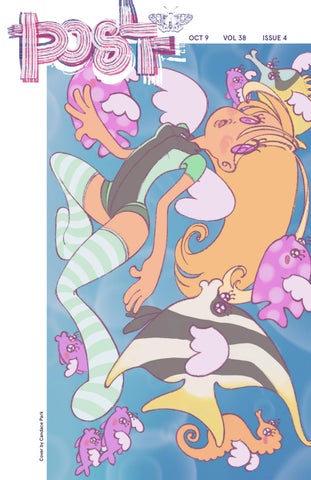
Cover by Candace Park
OCT 9 VOL 38 ISSUE 4
Table of
Contents feature
little
1
the game of love
3
rejection
7
arts & culture
radio to heaven
9
roblox's animal hospital
11
lifestyle post-pourri
reflection on a ldr twinship
13
the stranger at my door
15
crossword
the case-book of sherlock holmes
16
narrative
19
102
El E Me N Ts 7
1. Inspect 2. of Style
41
32
3. Rhodium 4. The ones you’re exposed to when you forget your umbrella 5. -ary, my dear Watson 6. “-ary, My Dear” (Schoolhouse Rock!) 7. LMNO 8. Wade Ripple 9. Of surprise 10. Earth, Wind & Fire 4
post–
“Any tips on flirting with my lesbian film professor?” “It is a 400page literature review; it is thrilling.”
LETTER FROM THE EDITOR
letter from the editor Dear Readers,
about the past and present, and meandering along “nontraditional” paths towards your hopes and dreams. This week’s writers take us through their nonlinear journeys. In Feature, Coco muses on her rock-climbing experiences and the shame of quitting. In Narrative, Christina spins us through a “court”-ly love for tennis, while Krisha reflects on rejection and redirection in conversation with a fortune teller. In A&C, the radio star twinkles through time in Alyssia’s piece, and Ann looks at Roblox journeys as both high-stakes and aimless analogies for healthcare and anthropology. In
The stars spill into the dappled horizon,
Lifestyle, twins navigate space, time, and shared
blending into the sea as the sailors search for
identity in Semi’s lovely ponderings. Finally,
their North. If they’re anything like me, they’ll
Alayna’s double feature in post-pourri and
get lost even if maps take them step-by-step from
Crossword traipses through Sherlock Holmes’
point A to point B. If they’re anything like me,
case-book
they’ll find wonder and sublimity in forsaking
surprises of residential life.
their nautical guides and wandering in time and space.
and
the
twisting
corridors
and
Come flit through post-’s issue this week and join us in our ambling, rambling, heartfelt
Lately, I’ve been grappling with questions
introspections. And maybe next time you go
of linearity and motion: the inexplicable societal
explore, you let go of Google Maps and sail, sans
push that urges us onward to goals, consequences,
North Star, to the distant lands of your daydreams.
futures. There’s a beauty in the disproportion of a train ride longer than the actual stay; in
Yours nomadically,
choosing the convoluted route through Fox Point
Tarini Malhotra
as you listen to long voice messages from your long-distance friend, disoriented in the dizzying
post-pourri Managing Editor
vortex of life and love. Surely, there’s just a little extra joy in tripping in heeled boots you definitely didn’t need to wear, and reminiscing
O ctober 9, 2026
FEATURE
lit tle on climbing and falling by Coco Kanders Illustrated by Lesa Jae designed by josh rezneck
1
post–
FEATURE
In 2015, my dad and my two brothers, Oliver a n d William, were in the ash-covered mountains of Grand Teton National Park, which I have never seen. They stayed at Jenny Lake Lodge, which, from my understanding of the establishment, embodied the frontier: logs piled high to make a home, rocking chairs on the porch, antlers, the focal point of any real mountain house. Jenny Lake Lodge was, fittingly, on Jenny Lake, at the base of the beastly Grand Tetons themselves. Every morning, they woke to Jenny's cookies in the kitchen and took the Jenny Lake shuttle across the water toward the mountains, where they began t h e i r climb. O n e day, halfway up their ascent of the Grandest of the Tetons, they stopped to rest. They found a cave— conveniently there, as caves are when you are tired and halfway up a mountain. Better than hanging off the side. Settling there, their bodies temporarily returned to something
more primitive. And while they idly rested, my dad’s friend and ostensibly their guide, Jack Tackle (an unusually complete name for a man in this line of work) went on. He was climbing with no one above him, “on lead,” clipping the rope into protection as he went. His route was a tricky one. A convex section of rock jutted out in the middle so that it had to be climbed around in order to reach the other side. From the bulge to the bottom was about 150 feet. The last piece of protection for the climber was about ten feet. Jack fixed the line. The others just had to follow. William, my eldest and therefore most formidable brother, went first. He began to climb toe after toe, his body pressed against the rock. Then at the bulge he froze. All four limbs starfished around the curve. I want to come down. My dad said William was scared. Looking down at the pit the Grand Teton had opened beneath him, he was shaking. Jack looked down. Hey, Will. The only way down is up. An absurdly classic remark from Tackle. His paralysis escalated. He trembled harder. Then, completely overtaken by fear, he let go of the mountain. He fell. For ten feet, before the anchored line caught him, fifteen-year-old William was simply falling. His body swung out in a semicircle over the Grand Teton until the rope caught and yanked him alive. He collected himself as Oliver, adjunct, silently stood as his shaking subsided. He tried again and reached the top. The quiet act of victory, undermined by its second attempt. Oliver went next and made it across quickly. He had seen his brother do it. If William could do it, he could do it too. He wasn't going to be scared like him. In the Lower East Side of New York there is climbing too: a modern, ultra-windowed climbing gym slapped into the middle of the Lower East Side. It is essentially one large pit. The windows are at street level, so the light from outside falls down into the chalky air. Expectantly, bright plastic holds cover the walls, colored routes crossing one another, people suspended across them like action figures with 9-to-5’s. My boyfriend, Harry, has recently taken up climbing, so this is how he tries to spend time with me now. I grew up occasionally climbing with my dad and brothers, though I wasn't invited all that much. I am my dad’s “little,” his doting nickname for me as the youngest of three. Too small. Too slow. Too scared. How would they know? The climbing gym is mostly bouldering, which means no rope. Shorter walls and falls suspended by thick mats. The first time I went with Harry, I got what I learned was called pumped. Your muscles become so activated that your arms begin to feel swollen with energy, as if your body has temporarily become stronger than it actually is. For a few minutes, I felt like Spider-Man. I liked it. I liked that I felt like I could jump onto a car in a full lot and traverse the sea of vehicles, hood to hood. I had never felt so physically capable. Harry showed me the easiest climbs, and I completed the first three I attempted. I am not afraid of heights, or of most things really, other than what's outside of my control. But there
was something strange about knowing that, at any moment, I could simply let go and fall into the mattress below me. As my body tired and the pump dissolved, the intrusive thoughts subsumed me once I climbed higher than my own height. The body gets tired, and the mind gets loud. What if I just let go? One climb in particular, a V3, was a feat for me and my noodle-like arms. I kept almost reaching the top. It had a bulge too. A curvature in the wall. Convex. And when I reached that point, my body seemed to lose its purpose. I would unravel down the wall, toe by toe, like a knot being undone. It cost me nothing to quit. I was only there to hang out with Harry. I went back with him a few days later. It was one of those New York summer monsoons—with the whole city submerged, we hid inside the cave of rainbow stalactites and dripping sweat. I got pumped, then tired again, but this time I had a little more endurance, and Harry wanted me to try the V3. Again. I tried it twice. No dice. I quit. I am a happy quitter here. Harry was not happy I quit. He did the climb himself, easily, showing me exactly how to get around the bulge, where to step, how to reach the top, and then gracefully descend. I watched him do it. I understood it wasn't difficult for him. I still didn't care. But he insisted, demanded, that I was going to get to the top of this climb. I was tired. I kept telling him I was tired. Jell-O body, Jell-O mind. But he kept instructing me. Where to go next. Where to put my left arm. Where to put my right leg. His voice came up from below me as I moved higher, a constant stream of directions. My body was already beginning to vibrate with the feeling that I had gone farther than I wanted to go. I don't want to do this anymore. He just wouldn't let up. So, to appease him, I fucking did it. I climbed higher and higher until there was only one thing left to do. One hand on the final hold, the other on the one beside it. I just had to bring them together. Easy. Vibration. Stasis. Beads of sweat. How long had I been up here? I hated this sweaty place. I hated this climb. Why was I pushing myself in a direction I didn't care to go? The wall had become enormous. The mat below me felt miles away. I let go. My back hit the cushion after a twenty-foot fall. Even now, I can still feel the air’s inability to catch me. I don’t know how William felt up there, I only know the version my dad tells me: Scared. Shaking. Let go. The mountain had presented him with a test, and he had briefly failed. He was scared, and climbed anyway. Oliver saw his feat and climbed quickly. Two responses to the same mountain. “Scaredy-cat” is the word my dad used. A childish, small remark, a remark that tells someone not only what their body can do but proof of what their mind is in return. But me, I am “little.” I am small. I was never invited. Not because I am scared. I am not scared. And even if I were, I wouldn't care. I care about being small. Or maybe I care about who gets to make you so. William said he wanted to come down, and so did I. OCTOBER 9, 2026
2
NARRATIVE
the game of love
because everything really is tennis by Christina Li Illustrated by Ina Ma Designed by Hannah Gapp
They say all is fair in love and war. Except when the war is between you, a yellow ball, and the grown man chasing said ball around a court approximately 200 miles away. There are perhaps, if you boil everything down to its bare sociological structure, two core types of college students the day before classes start. There is the student who carefully plugs in each part of their little ecosystem to their respective chargers. Laptop—check! Phone— check! Noise-cancelling, over-ear headphones plus the one and only iPad—check, and check! They set their alarm for 7:00 a.m. sharp, ready to conquer their 8:30 a.m. seminar and start the semester on the right foot, which entails a proper gym routine and actually eating breakfast everyday. Maybe they are a doeeyed freshman, or a senior hoping to stake a last-ditch effort to fix all their previous life choices. Either way, they are in bed by 11:00 p.m. at the latest, outfit already laid out in their dorm, equal parts eager to get the ball rolling and dreading the true end of summer. You know, the universal feeling. Then, there is the human-shaped creature you find crouched beneath their sheets, frantically typing up a storm on their phone, cheeks flushed and heart clenched. In this dark enclosure, only the blue light illuminates their face, and only the phone speakers fill the dead air with a cacophony of shoe squeaks and ball thwacks. The latter position is where you would have found me in the wee hours of one September 9, 2026 in Providence, Rhode Island—about five hours before the first day of classes at a certain Brown University. It is also the night of the US Open Quarterfinals, and the last match of the day is finally underway: Ben Shelton, the blockbuster American hero, versus Carlos Alcaraz, the Spanish superstar prodigy. Both are only twenty-three years old and currently in a complete, utter brawl. And I, hiding beneath my covers and biting at my nails, feel like my life is also on the line—alone on court, racket in hand, ball in play, and opponent across the net. Tues, Sept. 8 at 11:59 p.m. MY ADRENALINE RN WTFFFFFF SOMEBODY SEDATE ME
3
post–
LOVE-ALL It was not necessarily that tennis chose me, but more so that I chose tennis, latched on, and never quite let go. When I was thirteen, I decided that I needed to play a sport in high school. Having freshly quit competitive swimming, I must’ve had some sort of itch to be scratched. In elementary school, our gym teachers taught us hand-eye coordination by handing each of us a mini-racket and tennis ball. The goal? Hold your racket facing up, with the yellow fuzzy thing sitting precariously in the center, and begin bouncing the ball up and down, keeping it in the air for as long as you could. It was a test of balance, control, and strength. Amidst the echoes of laughter that ricocheted within the tall, hollow space, I placed my tongue between my lips in concentration. I liked the way it felt when the ball hit the strings. I liked the way my wrist dipped and absorbed the velocity each bounce. I liked the steady, hypnotic rhythm it created. My highest record was maybe an abysmal five or so bounces, and when we began practicing hitting the ball against the wall in later years, I was even worse—but something stuck. And so, after years of my parents’ futile attempts to get me into their own dream sports— like soccer (in which I blindly ran to wherever the ball was, no regard given to the concept of goals) and swimming (in which I thrashed around and fought for my life anytime I was forced to do butterfly)—I ditched everything. My gut, in all her might, kept on tugging me toward that silly sport with the fuzzy ball for some reason. I tagged along on one of my dad’s weekly grocery runs, made a Target stop, and bought the most affordable Wilson racket. I took some lessons with D, a junior guy from the high school team, on the nearest courts in a neighborhood neither of us lived in. Was I any good? By most standards, absolutely not—but I chose it, and I suppose that meant something. Wed, Sept. 9 at 12:32 a.m. this match about to go until 3am glorious lob Jesus Christ mamma mia santa italia LOVE-15 As freshman tryouts drew closer, I had an admittedly late epiphany: How the hell do tennis matches even work? Besides some brief rallies, most of my time was devoted to drilling the basics: forehands, backhands, volleys, and the most cursed of them all, serves. When the opponent fails to hit the ball back, you win a point. When you completely shank the ball and hit it humiliatingly outside of the lines, you lose a point. When I raised this question to D,
he began his explanation: A match is broken down into sets, which are broken down into games, and you win a game by either winning four points first or winning two in a row if at deuce… Then he paused, considering his words, and said, “Actually, I think it would be easiest to learn the scoring system if you watch a match.” I did not watch any matches; instead, most of my hours that spring were dedicated
NARRATIVE to playing The Sims 4 and reading through the Percy Jackson universe for the first time. I watched a couple YouTube explanations and advice videos, generally getting the hang of this through that alone. (15 means one point, and 30 means two points, therefore three points is… 40. Okay then.) I had never really been a big sports person anyway, something of an anomaly considering how massive basketball and football are back home. While in this shotgun mentality, I made it through tryouts—mainly because they took anyone who showed up that year—and found myself on the junior varsity team. I lost a lot, and I won very few times. I learned that one of my favorite things in the world is a clean, beautiful backhand, topped off with the most glorious pop! It really helped that it was by far my best stroke. Most of all, however, I realized that although I liked playing fine enough, it was the entire atmosphere that overtook my heart—the blazing sun hitting the blue-green courts, burning our arms, and setting over the
horizon at the end of a long match day. It was watching the ball fly between rackets, travelling impossible arcs over the net and slamming like bullets down onto the concrete. It was all of my teammates, crowded around the fence as our number two doubles team battled it out, our heads swivelling left and right in sync as we tracked the ball’s movement. It was electrifying. When I was fifteen, I decided that I needed to watch the US Open. My parents and siblings shot passing glances of confusion and judgment as I sat hunched over, hogging the family computer. A single Google tab laid open on the monitor: the live scoreboard of the 2021 US Open Men’s Singles Final. The day before, I scrolled through dozens of news articles as they reported on the Women’s Final—a nearly unprecedented match-up between two unseeded, teenage finalists. There was Leylah Fernandez, who knocked out multiple top five players on her historic run, and there was Emma Raducanu, who proceeded to complete
her flawless run to the title, never dropping a single set along the way. Earlier that week, I also caught sight of another teenage phenom on the rise: a certain eighteen-year-old Spaniard making his New York debut. In the third round, Carlos Alcaraz defeated third seed and top ten player Stefanos Tsitsipas in a five-set thriller, awkward teenage boy haircut and all. His playing was pure firepower and impossible magic, a generational talent that unfolded before your eyes—culminating in a run straight to the quarterfinals. Among the players, Alcaraz’s polar opposite also stood: a slightly older Jannik Sinner, a strikingly red-headed native German speaker from the mountains of Northern Italy. He had grown up a national champion skier and only committed to tennis at age thirteen; now, he was playing here as the reigning ATP Next Gen champion. That entire week, it felt like I was unlocking characters one after another, fascinated by all the storylines that converged with and diverged from each
OCTOBER 9, 2026
4
NARRATIVE other. Finally, it all ended here. On one side was Novak Djokovic, a member of the “Big Three” rivalry with Roger Federer and Rafael Nadal, the only players I had held a vague sense of prior to falling down the rabbit hole, alongside Naomi Osaka and the Williams sisters. Now, only one man stood in the way between him and a historic calendar-year Grand Slam: Russian player Daniil Medvedev, a relative mystery to me. As I watched the live score tick point by point on Google, Medvedev chipped away at the twenty-time slam champion and pressed his back against the wall, his blistering forehead and staggering agility on full display. By the third set, with Medvedev up two sets to nothing, Djokovic was in tears and the crowd in shock. I hung on every update and every tweet in disbelief. At championship point, the Russian served, and the Serbian swung to return the ball. Ball and racket made contact before it ricocheted off, flying through the air and then, inevitably, straight into the net. Game, Set, Match. Medvedev. The stands erupted, and yet, instead of raising his arms in victory or crying out of joy over his first Grand Slam title, Medvedev blinked, dropped his racket, and proceeded to completely flop onto the ground, sticking his tongue out and mimicking a dead fish. The live scoreboard froze: a straight set victory. I sat in front of the computer, jaw dropped, brain fried. I leaned back in my chair, kept my eyes on the screen as the reactions streamed in, and felt something inexplicable take root in me, burgeoning and blossoming. Wed, Sept. 9 at 12:42 a.m. my morale is dropping call me a 19th century sailor LMAO what are we going to make it home. the ship is beginning to take on some water i can’t let this set the tone for my semester OH I’M NOT HUNGRY #scurvy J laughed at “#scurvy” LOVE-30 According to Merriam-Webster, no one, not even etymologists, know how the modern tennis scoring system came to be. Of all the little, peculiar terminologies that float around this sport—deuce, ad, tweener, bagel—there is one that produces the most curiosity. I n tennis, “love”
5
post–
means nothing. More precisely, it represents a score of zero. There have been several theories as to why this is. The first theory finds its roots in the sport’s medieval French origins; it proposes that the use of “love” is derived from the French “l'œuf,” or “egg,” due to the written number “0” resembling “one.” When the game was adopted by English players, it is said they confused “l'œuf” with “love” over time, and eventually it stuck—becoming an integral part of the system. A second theory argues that the origins of love come from a different expression: “to play for love.” Essentially, even if a player has zero points, they still continue playing out of love for the game. Therefore, despite a losing position from 40 or 30 down, one still plays on, not for the win or wealth, but for love. No matter its true origins, you can always—with no doubt— find fragments of it woven into every game, every match, every tournament, every breath. Wed, Sept. 9 at 1:03 a.m. watch out i might have to resort to pinterest again praying that this turns into when we were watching jannik flop a little at wimbledon and he still came out on top haha. ha. You doing this before FDOC Carlos Alcaraz’s strongest soldier LOVE-40 Unlike Jannik Sinner, I ultimately did not commit to the “process” and find myself a five-time Grand Slam champion a mere nine or so years later. Following the end of my own short-lived playing career— which concluded after my junior year and a one-time stint as a varsity doubles player— my watching career lingered a little longer.
Throughout high school, among tabs of documents and assignments, there would be a perpetual Google tab open, rotating between different tournaments during the calendar year. October marked the Shanghai Masters, then November did the same for the Paris Masters and ATP Finals before January signalled the beginning of another season with the Australian Open. I would talk tennis with D and some friends from my team, then go home to watch compilation and “funny moments” videos by myself. My obsession
came in waves, flaring up during Grand Slam seasons and whenever my favorite players won. Sometimes I went months without following the tour; other times, I had one feverish week where I caught up on where everyone was in the rankings. Unlike most sports, tennis essentially operates with no offseason and on a year-round calendar—condemning players to a brutal schedule of constant competition, and fans to utter insanity. Perhaps naturally, life took over. My racket collected dust, and the world rolled on. When Sinner finally had his major breakthrough and won the 2024 Australian Open, I was in the thick of college applications. When Nadal officially retired from tennis at the Davis Cup, I was busy navigating my first semester of college. As Alcaraz and Sinner fought their now legendary 2025 Roland Garros Final, I was beginning work at my summer job. When they had their third final rematch in a row at the 2025 US Open, I was spiraling in academic crisis over the beginning of sophomore year. All this time, however, my Instagram still followed Tennis TV, and my Twitter account still followed some twenty-odd players. This past summer, at twenty, I never—and I mean, never—could have predicted that I would tumble straight into another all-consuming love affair. It was my first Providence summer, and my friends and I were horribly bored. Lucky for us, a sports summer was in the forecast with the World Cup creating a constant buzz in the air. As had become my routine, though, I was quietly keeping
up with Wimbledon through the o c c a s i o n a l I n s t a g r a m notifications. Whenever my friends asked how that archaic scoring system works in tennis, usually when we made nonexistent plans to play on campus, I gave the same answer I received years before: “It’s
NARRATIVE easier to explain if we watch a match in real time together.” This is how, on a sweltering Sunday in July, I found myself sitting on a couch with J, one of my best friends at Brown, watching the final in her sublet. It was the first full match I had watched since a Musetti-Fritz match, also at Wimbledon, in 2024. For the next close to four hours, it was like nothing had changed—I shouted when a ball looked like it was going out, only for it to land comfortably in (my horrible depth perception at its finest), and I shielded my eyes out of fear during tense break points. We laughed at Twitter commentary throughout the match, in typical screen-ager fashion, and began to comment on everything but the tennis being played. Sure enough, Jannik Sinner prevailed in four sets over the universal villain Alexander Zverev—to which, when Sinner finally took off his white cap and released his glorious, ginger curls from their confinement, I heard J exclaim, "Wait, why does he look kinda amazing?” What follows is something akin to floodgates bursting open; it is a whirlwind of all the videos and matches and players I watched years ago in high school, rediscovering them through watch parties with J and our friend T. I show them the stupid “Guess the Grunt” videos and challenge reels that treat these professional athletes like hostages. It gets so bad we make a group chat, where we trade Twitter posts for Tumblr fanart, and TikTok edits for personal
thinkpieces. When we are invited to Boston for a mutual friend’s joint birthday and World Cup Final watch party, we completely lose our m i n d s every time the camera pans over to Alcaraz, who was
then on injury hiatus from the tour, watching from the stands. It did, in fact, get so bad that for J’s birthday, I may or may not have created a TikTok account and may or may not have cooked up my own, home-cooked ship edit as a gift. (And no, I will not be disclosing any further information on this particular subject.) Sometimes, it feels like I can never love anything “normally.” When I fall in love, I dive head first into the deep end, letting total obsession consume my whole being. There is something about sharing this love with others that heightens this phenomenon, but also makes it all, truly, worth it. In tennis, to love is to lose. This summer, I hit a serve and found my losing game. Wed, Sept. 9 at 3:12 a.m. OMG SERVE HOLD I COULD CRY AGAIN FREE US i’m crying this is prob gonna go to a tiebreak the ship is teetering, the sailors are yelling HEAVE There’s something wrong with you I fear for you Please sleep now GAME, SET, MATCH Months later, the current state of the group chat has devolved into this: my 19th century ship metaphors (which is most definitely rooted in my futile attempt to read Moby Dick this summer), potential research studies on Carlos Alcaraz-induced psychosis, primal stress noises, talk of bakery products, threats of quitting the whole sport altogether, and hundreds of more incoherent shreds of consciousness written out in text form. The past two weeks have been filled with the most tennis I have ever watched in my life, a metric I would not have believed true if you told me
twenty at a time—T is our resident hostage in the group chat, though she appears once in a blue moon whenever a particularly gorgeous editorial shoot of Sinner pops up. Even if she’ll be across the pond now, I know who I can always rely on to complain about tournament withdrawals or trade Pinterest finds. It all comes to a head at the US Open, where—after 139 days—Jesus Christ (commonly referred to as Carlos Alcaraz) has been resurrected from the dead (wrist injury). Five matches later, after five sets and a super tiebreak, after vomiting into a towel on court, his first tournament run in nearly five months comes to an end. I am completely wrecked, in a sleepless state of delirium. I can barely stomach a single glance at my screen. I have been watching through J’s free ESPN trial since 11:00 p.m., after some horribly planned scheduling on the tournament directors’ part. As I prepare to pull up some previous match highlights to settle the adrenaline and reflect on my life decisions, the footage pans to Alcaraz waving New York goodbye, then cuts to the exit tunnel. It is there where, rackets and bag in hand, he walks off the court—a walk all players typically dread. It is there where, instead of hanging his head, he smiles. A full, toothy smile. Now returning to the tournament as a seventime Grand Slam champion, two of those being US Open titles, but most of all after months of uncertainty and recovery, he is not merely playing to win. It is a feeling both indescribable and inevitable. There is only one name for it. Wed, Sept. 9 at 10:52 a.m. carlos alcaraz may have died at 3:30 am last night as i watched on BUT I’M STILL HERE #FDOC2026
at the beginning of the year. I watch at least two matches a day, from Gauff v. Badosa to Medvedev v. Tiafoe—savoring the last boundless days of summer. Even as J is off campus, back home preparing for her study abroad, we still share tweets back and forth, nearly
OCTOBER 9, 2026
6
NARRATIVE
reject ion a conversation with a fortune teller by Krisha Pakala Illustrated by Lesa Jae Designed by Hannah Gapp Coming to a place like Brown, I anticipated that I’d face a fair amount of rejection—from clubs, classes, other people, or even myself. I was right to prepare for it, but what became apparent was that dealing with social rejection was like trying to swim through quicksand. I know continuing to try to escape is fruitless, but I do it anyway, because it’s innate. I wish so desperately for my reality to be different, but it will not bend to my will. Of course, there’s only so much I can control about external circumstances. People fundamentally do not owe me anything, so social rejection doesn’t have to be personal. A friend of mine told me this once: The extent that you think about others is the extent to which they are thinking about you. But after a recent experience, I’ve come to view social rejection as something analogous to a fortune teller at a state fair. Rejection sat down across from me at a rickety wooden table inside a dimly lit tent. The interior was nice, at least. A dark velvet purple surrounded me. Breezes from the frigid night crept in, but the atmosphere was familiar. A small fire crackled somewhere in the back of the tent, but it didn’t smell smoky. It smelled like incense— something I could recognize miles away. Feeling my shoulders relax, I thought to myself, sure, I’ll see what this is about. What’s the worst that can happen? So, I took Rejection’s outstretched, soft hand and let my curiosity actualize. Rejection smiled at me warmly, its kind eyes crinkling around the edges, and leaned in. Its voice was some melody of ones I knew intimately: my mom, my best friend, my own as a child. No one is looking for you, dear. I sat there with a smile plastered on my face, because when Rejection spoke, its voice was as smooth as honey. The meaning of the words did not land. Then, it let go of my hand, and retreated into the dark folds of the tent. The wind rustling outside became a whistle, then a scraping, and finally a cacophonous screech like an abrasive machine. Come back! Aren’t you going to tell me more than that? I shouted. I paid you good money! Sitting there in the tent, the only thing I was left clinging to was my own relentless, unreciprocated curiosity. 7
post–
I see curiosity as the easiest position to adopt when meeting new people, because it’s something we have used since infancy. So what warrants such friction to their curiosity about me? What is it about me that makes it easier for them to sidestep the innateness of curiosity than to follow that instinct? It is such a contrast inside my mind; I am endlessly curious about it. But not once have I inhabited their mind in
the same way. They have no desire to learn my quirks and complexities, my daily routines, the things that remind me of home, and certainly no desire to notice anything I do. For all I have done to make myself interesting, for everything I have wanted to change and did change, Rejection’s vague promise felt like an objective truth: I am still not good enough.
NARRATIVE
O ctober 9, 2026
8
A&C
radio to heaven
9
post–
the radio star twinkles, forever and always by Alyssia Ouhocine Illustrated by Selena zhu Designed by Emma vachal
A&C
My brain was sliced clean through in the middle of the work week and the soundtrack was everyone’s least favorite Taylor Swift album. This is, perhaps, the most poignant lesson that brain surgery taught me: the worst moment of your life will happen, and you won’t get to pick the song when it does. Your aggravation will worsen when the song blares through tinny dollar store headphones with exposed wiring. Mid-ugly cry, you will shimmy the cord to stop the feedback, but it won’t matter. The universe has a funny way of teaching lessons in patience. Radios were the deities of my youth, signposts that my small world was trudging along the cosmos at exactly the right pace. My parents’ first car was a 2005 Chrysler Sebring with a humble stereo setup. The vacuum fluorescent display was a small strip that informed you only of the channel as you turned the small grey knob. I relished the feeling of its glossy surface. The sides were etched with small, thin grooves that clicked gently as it turned. My sister and I had regular demands: “102.7!” “Z100!” “103.5!” We eventually discovered 95.5 FM amid the static, long before its devastating transformation into a Christian music station in 2019. But before worship music was all that played, 95.5 FM was added to our rotation to ensure a constant stream of Hot 100 Hits. Car rides were an endless circuit of Katy Perry, Taylor Swift, OneRepublic, Pitbull, and Justin Bieber. On his days off from work, my dad would bring the car to the empty lot outside the Wholesale Liquidators off Route 440. I’d tag along to watch him duck underneath the metal body, twiddling away at some issue that never quite resolved. The car often stalled at unlucky intervals, leaving my whole family stranded on the side of the road. On those days, I wished I were clairvoyant—a juvenile hope that still trails me on occasion. Back then though, seeing the future just meant being able to prepare myself for hours of waiting for a tow truck. My beloved distraction of choice? A pocket radio
my dad found, picked up, and brought home. The pocket radio’s coolest feature was the clip attached to its black, plastic shell. This made it possible to secure the rectangular device’s thick body to the waistband of my pants or—my preferred placement—the breast pocket of my T-shirt. Luxury had a loose definition during my childhood. In 2011, it meant having a pair of airplane headphones with a jack that wasn’t so loose, two AAA batteries, and a sister with an iPod Touch that outshined a pocket radio in both functionality and customization. Her new tech signified an end to our constant fights over ownership of the unwieldy device. I was filled with pride to call that little radio my own, even when the batteries came tumbling out every time it hit the floor. Before all this was the stereo in our onebedroom apartment. My family moved there when I was two and didn’t leave until I was six. Inside our tiny kitchen my mom would leave the music on, long after she finished cooking. While everyone watched television in the living room, I would tiptoe down the short hallway to practice my breakdancing to Taio Cruz songs, the linoleum absorbing the sound of my stomping. Someone would always catch me mid-spin. Red-faced and embarrassed, I scurried away. Long after the stereo broke and batteries would no longer stay put in my pocket radio, I found a new icon: a radio housed in the body of a flashlight. This was the radio of Hurricane Sandy, circa 2012. Before we hunkered down at our next-door neighbor’s apartment, my mom watched over my siblings and I by herself, at home; my dad spent most of the storm at the airport where he worked, unable to make it back safely. My sister and I huddled on the floor of the bedroom we shared—she sat atop the pink bedside rug shaped like a heart, while I crossed my legs over the blue rug shaped like a blocky house. I had tried to convince her to give me the heart one, but it was no use. Birth order always prevails. In front of our knobbly knees was the flashlight radio. Its body was thick, with many dark and complicated buttons and knobs. On the side was a long lever, and at the base was the opening for batteries. There were not many batteries to go around in the middle of Hurricane Sandy. My sister insisted we used the two powering my prized Password Journal. I so badly wanted to hear a Ke$ha song. Nobly, I obliged. The batteries, on their last leg, produced only a flicker of light and a faint hum of static. So began the hard labor. I was tasked with working the hand crank on the side of the flashlight radio. My sister braced the device on the ground while I spun the lever furiously, huffing and puffing as I tightened my grip. “Go Aly!” my sister whisper-yelled, careful not to wake our baby brother. I imagined the opening of “TiK ToK” and gritted my teeth, the hum of static growing louder. The sound reached a fever pitch that
eventually broke into the classic “...like a plastic bag, drifting through the wind, wanting to start again…” We got a few more seconds of music before the connection broke and descended back into static. I had wanted to hear Ke$ha, but Katy Perry’s brief appearance sufficed. Anything that crackled out of the flashlight radio felt like a gift from God. As a child, I believed in earnest that rain was God’s tears falling onto Earth. I understood radio to have the same mysterious origins, airwaves and FM magical contrivances that gave meaning to my life. Culture did not come from museums or catalogs in my house— it instead emerged sloppily, during on-air interviews with pop stars and celebrity gossip segments. I coveted the DJs’ jobs. But the world was already beginning to change. The iHeart Radio app was rolled out in 2011. This meant I could listen to my favorite stations whenever I wanted on my family’s iPad 2. Vevo also stole radio’s thunder. I was utterly enamored with music videos, new and old. It annoyed me when a video had seemingly nothing to do with the song’s content; “Little Talks” by Of Monsters and Men was particularly confusing. Music was always a three-minute reprieve from adolescence, but radio’s self-assured scheduled programming was constant salvation from the uncertainty of burgeoning adulthood. As I grew older, radio remained one of the few things that demanded nothing of me—especially as I recovered from a craniotomy. “Sunday Night Slow Jams” on 102.7 FM replaced the tension in my body with pure elation. I adored the love confessions people would call in with. Better yet were the apology call-ins. The insight into other people’s intimate lives was potent. I was astounded by human nature’s capacity for change; love could easily collapse into hatred just as fast as a chance encounter developed into marriage. What did I’m sorry even mean in the face of a years-long betrayal, or a forgotten anniversary? In between my commentary about the quality of these strangers’ remorse, I felt myself reaching an equilibrium. Yes, my brain pounds as though it’s been set on fire. I can’t talk about how scared I am of all that I have lost, including the futures I didn’t even know were mine to lose. My body is rebelling and I am called to the impossible task of forgiving it. But this hour of music is known. The album release date is secured. The trivia questions and scripts have been written. And when I did get better, I remembered cruising through a dark Stephen R. Gregg Park, quiet in the backseat of my parent’s car. Too tired and in pain to speak, I listened to my sweet mom and gentle dad engrossed in a murmured conversation, the September evening air drifting through the open windows. And the radio, always the radio, humming quietly and faithfully in the background. I thought of God and His tears and of wind-up flashlight radios and cheap headphones. I imagined airwaves as a long, wide bridge, full of listeners as small as ants. The sorrow and joy and heartbreak and hope upon it is constant and exciting, reliable in its intensity. My own fit perfectly on this path. Yet another signpost, the continuum winking in the distance with the promise that I would be okay.
O ctober 9, 2026
10
A&C
roblox’s anim
a meditation on slime monsters, “anomalies,” and anthropology by Ann Gray Golpira Illustrated by Julia Park Designed by Emma vachal
While some endure a grueling decade of school in their attempt to become a healthcare professional, others may opt for the slightly more accessible (yet just as intense) alternative route: Roblox. Ever since the platform’s founding and viral popularity during the peak of Covid isolation, bored adolescents and obnoxious preteens alike have flexed their medical acumen in games such as Maple Hospital, Charisma Hospital, Crossline Hospital, and more. In the majority of these games, players roleplay as doctors while engaging in various mini-games and addressing unexpected medical emergencies (the latter of which are often timed) from a rotating list of animated patients. Yet as with most things on the internet, what started off as a relatively simple and straightforward concept ultimately branched off into a multitude of even stranger subsections—including the recent virality of Animal Hospital. For those who have yet to get sucked into the children’s game like I (a twenty-year-old) have, here’s the setup: You wake up as a pink or tan bunny in a hospital waiting room, and after 11
post–
a few on-screen instructions, you begin your job as a hospital staff member by checking in an assortment of neon-colored animals into the clinic. After taking their pictures and printing their name tags, you’re instructed to follow the influx of feline, cervine, and canine patients to their hospital rooms, where you can then check their diagnoses and administer the appropriate meds with a few simple keystrokes. But what might seem like a simple narrative concept is soon complicated by a strange, deadly, and rapidly spreading disease throughout the online animal kingdom. Infected animals—referred to as “anomalies”— start trying to sneak past your check-in desk. Thankfully, you can catch them by noticing slightly “off” elements in their design or gait, but if or when they succeed, both you and your regular patients are in for quite the jumpscare: satanic rituals, impromptu cannibalism, stalkers, slime monsters, and more (so pretty much just the usual happenings of the SciLi basement on a Thursday night). Due to its endearing blend of snuggly graphics and deadly trespassers (don’t worry, there’s a taser if worst comes to worst), the game became a staple at summer sleepovers with my friends. It was both high-stress, yet mindless; high-stakes, yet meaningless. It was the perfect thing to occupy both our minds and computer screens as we challenged the bounds of sleep deprivation before fall. While the first few shifts are relatively mundane, the game’s intricate lore will certainly keep you from logging off. As time goes by—and as more “anomalies” make their way into your clinic—you start to gain classified
information regarding the hospital’s troubled past. While the doctor (a deer who pretty much just leaves you to your own devices) is locked away in his office, patients begin to whisper and confide in you about a string of mysterious disappearances, the origin of this strange new disease, and the corrupt corporation that controls the city. When you look past the grainy animation and absurd characters, the game actually raises an interesting and topical question about corruption within the healthcare industry (albeit in a highly satirized, potentially unintentional way given its Roblox medium). In addition to the immensely concerning new disease, the animal hospital also faces a variety of administrative and social issues that are eerily reminiscent of modern healthcare debates—
mal hospit al
A&C
including a lack of transparency (the deer doctor typically hides himself in his office and refuses to tell you why), undue influence from a larger corporation (you eventually find out about the internal politics of the clinic and how the aptlynamed “The Corporation” is controlling it), and emergency room overcrowding and congestion (sometimes there are so many animal patients at once that you can’t reach others in time or even admit them from the waiting room to begin with). After participating in more and more shifts and engaging in intermittent waiting r o o m
conversations, you slowly gain the trust of the hospital regulars—including recurring characters such as Ratthew (a small black rat that first appears between shifts 2–6), “Ron from Accounting” (a blue bunny that sports a briefcase and a dreadfully bright red toupee), and Liz (a caracal who used to work for “Animal News”). Maybe it’s just the extensive hours I’ve spent on course readings this week, but the gradual development and dissemination of the game’s lore almost mimics the typical structure of anthropological fieldwork. By accompanying the characters throughout their appointments, immersing yourself in their community, and slowly building enough trust throughout shifts to have meaningful conversations with them (sometimes you’ll talk about your lives while going about your routine practices), you’re conducting a sort of participant observation—a term used in the anthropological sphere when researchers engage and participate in activities with the people they are studying. Similar to a lot of well-done anthropological research, the fieldwork-reminiscent practices of Animal Hospital also reveal deeper, more complex accounts of individuals’ (in this case the animal characters) lives and interactions in the public sphere. In the context of the game, it reveals the corruption within the hospital through patients’ personal accounts of their family histories, their interactions with other healthcare professionals (i.e. the aforementioned deer doctor), and their feelings of being silenced by “The Corporation” and its harmful control. There’s obviously a lot wrong with my comparison between the lore of Animal Hospital and anthropological fieldwork— including my overly simplified definition
of the research practice, the complications associated with the player being in a position of power (you’re one of the hospital staff members, so it would be impossible to be a neutral observer), and, not to mention, the fact that this is a children’s computer game about infected bunnies and a furtive deer doctor. Still, I think there are some interesting similarities between the way the game gradually disseminates its lore and the often lengthy, personal nature of fieldwork. In any case, it’s certainly an intriguing way for a game to gradually reveal a story—especially one that follows deep-rooted corruption and inequities that are concerningly reminiscent of actual problems in the human healthcare sector. So whether you’re a budding anthropologist or simply a bored gamer with a few hours between classes, I urge you to download this strange, yet addictive game. At least you’ve got a new slumber party activity—one that might even convince you to mull over your class readings for a bit.
O ctober 9, 2026
12
LIFESTYLE
reflect ions on a
facetimes, finger hea
Midnight has rolled around once again, and I tap my iPad awake as it, too, attempts to doze off. The round, youthful faces of my parents in their thirties, cradling two small girls in floral-print dresses and the archetypal Dora-the-Explorer bowl cuts, fill the screen. Several glowing candles adorn the cake in front of them. It’s a moment suspended in time, practically surging from potential energy with the possibilities of what might happen next—the engulfing of the candles, the applause, the laughter. Maybe even a wail or two from my twin sister, who looks like she’s a pacifier and a fistful of rice crackers away from bursting into tears. Seated beside her, the two-year-old version of me stares straight at the camera, so that every time I open this iPad, we lock eyes. She is as foreign as the blurry faces of the countless strangers on this campus. I go to text a screenshot of my wallpaper to the single pinned contact on my phone, and I am stopped short by an unread message: Getting ready for bed. I’ll call in a second. I heave a sigh, surveying the pile of unfinished readings on my desk. The sun, it seems, always sets earlier in Oberlin, Ohio, than in Providence, Rhode Island, despite the fact that my sister and I live in the same time zone, three hours ahead of the one we grew up in together. This semester, our first ever as college students, isn’t the only time that my twin and I have done long distance. Just last summer, I left home for a two-week-long writing workshop in Gambier, Ohio, and she for a month-long music festival in the Berkshires. We’d planned to meet briefly at the San Francisco airport, making the most out of the brief sliver of time between me landing back home and her getting on her plane to Boston. Instead, a series of unexplained delays in my flight had me wringing my hands hundreds of feet up in the air, cursing several generations of Delta Airlines managers, and ultimately landing after she boarded her plane. For roommates that have occupied the same hundred-square-foot space for eighteen years, it may seem silly just how much we dwelled on the loss of those few hours. But in that moment, as I watched our duration of separation go from six-weeks-with-a-break-in-the-middle to six full, unbroken weeks of laggy FaceTimes and unanswered blue text bubbles, I was truly nothing short of devastated. That summer was the longest we’d ever gone without seeing each other. And now, we’re nearing our all-time high record of six weeks, knowing we’re on the path to outdoing it twofold. As obvious as it might sound, ever since I got to Brown, it’s been truly difficult to balance what I consider the newly formed two halves of my life: the past and present version of me, my childhood home and my current home, the old people and the new. It’s like a wall was put up the moment I arrived, keeping everything I've ever known from proceeding beyond that point. I can’t help but feel sometimes that I’ve left my sister on the other side of this massive, 13
post–
by Sem Illustrated by designed by j
unscalable, and yet oddly translucent wall. But five weeks in, I think we’ve gotten the hang of making the wall feel more manageable. She watches the broadcast of our convocation and takes rapid-fire screenshots of me, of all my friends, of the familiar faces from my high school; I play the livestream of her orchestra concert one night over an Andrews bento. During our slower mornings, we sit silently on call together and get ready for the day, soaking in each other’s presence. When we do talk, though—the figurative wall between us being by
no means soundproof—hours fly by. My sister gets to hear it all: the surreal experience of walking through the gates at Convocation; the Keeney parties during our first week; the way the Main Green looks on a sunny day, boasting Brown’s
LIFESTYLE
an ldr twinship
arts, and freshman flu
mi Jung Amalija Marich josh rezneck
lively picnic culture; my friendship drama; the transcendent experience of trying the Jo’s French fries for the first time; and of course each and every one of my watery coughs that encapsulate my struggle with freeing myself from the clutches of the
freshman flu. I talk until I’m out of breath. Then we switch. When I’m done giving her my enthusiastic affirmations and countless stink eyes for all her questionable opinions, we lapse again into a comfortable silence. She presses her face close to the phone screen and extends her thumb and index into a finger heart. I wave her away, embarrassed, just like I do every time. But even my own roommate has picked up this gesture, after my sister sent a heart her way when she appeared in the background of a call.
Every day, on our opposite sides of the wall, my twin and I go through opposite experiences. On some days, she’ll be complaining of the sweltering heat, and I, trekking through the knee-deep pool of water in front of EmWool using my rainboots like a lifeline. I agonize over my 300 page reading for my Korean Literature class; she complains about how she worries she’ll never be as good as the other clarinetists in her orchestra. I buy her a Phoebe Bridgers poster at the poster sale in front of the Brown Bookstore; she tells me about her first solo concert experience, how her pent-up emotions unraveled and came tumbling out, leaving her bawling like a baby as Phoebe climbed up onto the stage in Columbus. I laugh my head off as she relates the story to me; she’s always been the emotional one. I don’t tell her that sometimes, I feel the tangled ball of homesickness sitting like a rock in my stomach, too. I don’t tell her I’m proud of her for achieving this milestone, but I am. I so am. Do you miss her a lot? My cousin Joon asks me over the phone, when I call him to catch up. I say that it’s been hard to direct much of my attention toward her; I’ve just been so busy. It’s weird, I say. My “twinship” has always been the most upfront aspect of my identity. Semi and Sera, Sera and Semi—we’ve always been one unit. Many of our friends simply referred to us as “the twins.” But here, no one knows my sister exists until I bring her up. I suppose it does make it easy to come up with a fun fact when I need one, I tell Joon jokingly, whether it’s for club applications or for meeting new people. Damn, he says, she’s been reduced to a fun fact. He’s only teasing, of course, but it does get me reflecting. That night, I call her again and ask if she’ll ever visit me. I think about everything I’ll show her—my dorm room, my new friends, the SciLi where we spend half our time studying and half our time having a little too much fun, the Ivy Room where we order more smoothies than we have flex points for, the Steinert practice rooms that genuinely look like solitary confinement cells….But it’s an hour-long Uber ride to the Cleveland airport, plus a four-hour plane ride with a layover to get to Providence. It’s just not feasible. I never like to be the one to hang up first on any call, and she knows this. Sometimes, we’ll delay our goodbyes for fun, waving at the screen and taking turns repeating “bye” back and forth to each other endlessly. We’re like a pair of parrots playing a game, seeing who’ll break the chain first. She always does. She saves me the task of having to do it myself. So today, once again, we exchange our string of goodbyes and stare into a mirror of our own eyes for a prolonged moment. I wait. Her sweet, smiling face disappears into oblivion; I am reminded of how such warmth and hollowness can exist in a single human’s chest at once. october 9, 2026
14
POST-POURRI
O P U T R S R O P I BEFORE YOU GO
the stranger at my door welcome home, brunonians
by Alayna Chen | Illustrated by Lori Lai | designed by James farrington ArchBron:
with endless phone calls and an out-of-tune violin struggling through
have. It’s a simple enough design—just a little blue gem on a silver chain.
It’s lively over here. You get up to use the bathroom, wave at five people
Mendelssohn. At 3 a.m., you stare at the ceiling while an AI voice drones
You swear yours was aquamarine, and theirs feels too green. Did you
coming back from a party, skirt past two TikToks in the making, and
another chapter of Zumdahl and DeCoste’s Chemical Principles.
even bring that necklace to college? You probably left it at home.
from behind a door, punctuated by cheers and laughter. You can breathe in
EvPol:
MoChamp:
the privacy of your own room. Well, you could if you had any.
If you told me EvPol only appears on a full moon to those who invoke
Despite its residents staying cloistered within their rooms, MoChamp
Blueno’s name, I’d believe you. After a whole year at Brown, I’ve yet to hear
is welcoming and friendly—the ground floor lounge is always propped
a single person mention EvPol, much less meet a resident.
open with a trash can, inviting any passersby to join in on a game of pool.
exchange Instagrams with someone at the sink. A heavy bassline pulses
During move-in, you sat on your bed while you waited for your roommate to arrive. They had texted you their time slot, and you crossed your fingers and hoped for late-night whispers and big parties and secret hideaways. Throughout Orientation, you and your roommate
“You currently do not have any roommates or suitemates for this term,” StarRez proclaims.
As it is the back entrance to V-Dub, everyone already has swipe access, and residents are typically more than willing to let you upstairs if you
did everything together. You still do. Not
awkwardly stand in the entrance hall for long
because you try to, but because you are
enough. It’s so inviting, in fact, that deer also
the exact same person. Sure, you are green
enjoy the dorm’s hospitality.
and they are pink; you like bacon and they
You are in a triple. A forced triple, of
put mushrooms in their Ratty omelette;
sorts. But Madame Carolina Petunia Fillinora
you think one gorilla will win and they bet
Ettikins XII very respectfully stays within her
on the hundred men. But somehow, the
part of the room, so you don’t mind her that
two of you share the same concentration,
much. When you were first introduced to
the same hobbies, the same friends. All of
Madame Carolina Petunia Fillinora Ettikins
which would be exciting except you can’t
XII, you—apparently offensively (though you
stand the way they talk, the way they type,
thought politely)—asked, “Are we allowed to
the way they breathe. From the way they
have a fish in the room?” Your roommate took
scan a room to find you and then climb
great offense at the implication that Madame
over backpacks to sit in the opposite
Carolina Petunia Fillinora Ettikins XII was
corner, you’re pretty sure the feeling’s
merely “a fish” and explained in no uncertain
mutual.
terms that she was an emotional support animal. You find this highly suspect, as
Andrews/Metcalf/Miller:
Madame Carolina Petunia Fillinora Ettikins
At the top of the world, these dorms tower
XII gets stashed in the closet during CC
over all who draw near. The smell of fresh
checks. Madame Carolina Petunia Fillinora
laundry slips out of the vents as you walk
Ettikins XII has a great many rules, including
by, and you laugh from your lounges when
making your bed each morning, telling her
fools try to open the dining hall’s exterior doors
“hello” and “goodbye” when you enter and
to no avail. But as the months draw on and the seasons change, boredom
How lucky you are to get to avoid the disagreements, the drama, the
leave the room, turning out the lights at 11:38 p.m. sharp, only drinking
starts to seep in. The exit signs start to disappear, and even the dry noodle
disaster of a roommate. Supposedly, you could be assigned a roommate
purified water, avoiding gold jewelry, refraining from mint toothpaste,
bowl loses its taste.
at any time, but you are not concerned. It is nothing but an empty threat,
and keeping the temperature between 22.2 and 25.5 degrees Celsius.
Every Saturday night, your roommate drags you down to Jo’s,
like the liability waiver at Level 99. Weeks go by, and the other mattress
There were four more rules, but you don’t remember what those were.
pretending that they’ll actually use up their swipes. You have no idea
remains bare, a blank navy slab that waits. Yet in the deep stretches of
Oh, and never ever shorten her name in any way, shape, or form.
why they’re on the 20 Weekly, but the microfridge they made you split
night, you become aware. And you know. You know that they are there.
the cost of is stuffed with so many to-go boxes and Trader Joe’s freezer
They haunt you, an eerie presence that watches you from the edges of
meals that they would be left with at least a hundred swipes at the end
the room. A feeling you can’t shake, an invisible caress, a slight shift in
New Pems:
of the semester even if they were on Flex 460. Chipotle containers pile
the air too often and too unsettling to be the wind. Seances, incense,
They may not be the worst mazes on campus (I’m looking at you, Barbour),
up until you swear you can see the smell of beans and cheese. When you
iconography—you try them all, and nothing changes. They linger. And
but with disconnected buildings, exterior staircases that turn into slides
leave, you slather on perfume like it’s sunscreen. Pest control has been
the darkness watches.
during the winter, and awkward chain link fences, they leave more than a few lost souls wandering outside. At least their funky architecture breaks
called multiple times, and you flinch every time something seems to move in the corner of your eye.
Naturally.
JamesMead: Welcome to the place where all the fun is! North Campus is full of anti-
up the boring rectangles that make up the rest of North Campus? “Hey could you let me in”
EmWool:
social loners, but at Keeney, sharing is caring and also required. Communal
You get this text three times a week, and it always appears right
Semi-private bathrooms, direct access to the least-loved dining hall, and
bathrooms, spacious lounges perfect for a party, a kitchen complete with
when you’ve finally settled in at Hazel Origin Coffee. And it’s always
cinderblock prison walls—EmWool is delightful on paper and somewhat
an island to crowd around and be merry. Please put your name on your
urgent—they’re late for class, the bus for their ski trip leaves in ten
less delightful in actuality. You won’t meet anyone except your roommate
food before you leave it in the fridge. Not with a Post-It. In Sharpie. We can
minutes, they spilled their mac and cheese all over their white dress shirt
and—if you’re lucky—your bathmates, but the lack of a party scene doesn’t
pretend to be respectful of each other’s property.
and left their Tide pen in the room, the list goes on and on. The last straw
mean it’ll be quiet. The garbage truck comes around at 7 a.m. and doubles
You filled up your Brita again and patted yourself on the back. Look
was when they dropped their key down the sink and refused to pay the
at you, staying hydrated and taking care of your health! When you went
lock change fee. You don’t have to lock your door every time you leave,
Even the people on the other end of the hall have heard of your
through a tin of Altoids faster than usual, you chalked it up to stress.
they reasoned. Really, what’s the worst that could happen? You held
roommate. Or, more accurately, they’ve heard your roommate. Earbuds
Then, you folded your laundry and couldn’t find your favorite shirt. You
your tongue when they realized someone had walked in and stolen their
and headphones are a foreign concept to them, and their brand-new
assumed you left it in the dryer and someone accidentally took it. You
laptop. They cussed enough for the both of you.
JBL speaker is their best friend. It screams its existence into the world
ranted to all your friends about that one.
as a fantastic alarm clock.
with opera, heavy metal, and every genre in between. The days are filled
15
post– post–
Your roommate’s thrifted necklace looks a lot like the one you
CROSSWORD
the case-book of sherlock holmes post- mini crossword
by Alayna Chen illustrated by Yoonseo Lee designed by james farrington
1
2
3
4
5
6
7
8
9
Across
Down
1. Sir Arthur ___ Doyle 6. Sherlock's sister, in reverse 7. Metal fastener 8. The middle of the end, as a fairytale 9. What goes between two crèmes
1. Was concerned (for) 2. Yellowish green 3. “A Study in Scarlet,” for one 4. "The End of ___" (Taylor Swift docuseries) 5. Total
O ctober 9, 2026
16
Thank you for reading
magazine. New issues every week.
EDITOR-IN-CHIEF Elaina Bayard
“Then again, there are privileges to growing up, to standing on the cusp of real adulthood. I’m seeing my passions burgeoning before my eyes and taking classes in cool things, and when I talk to my friends, I get the sense that I am becoming someone real. Plus, what I didn’t mention was that next to my baguette, I had a bottle of wine in my tote bag too.” — Daniella Coyle, “get off my lawn!” 10.11.24
“An aspiring writer says the sky is dark as spilled ink, while a teenage artist says it’s the black of permanent marker.”
— Chelsea Long, “it’s like this” 10.03.25
FEATURE Managing Editor Chloe Costa Baker Section Editors Helen Hen Anika Kotapally ARTS & CULTURE Managing Editor Sasha Gordon Section Editors Gabriella Miranda Rebecca Sanchez NARRATIVE Managing Editor Gabi Yuan
Section Editors Lucie Huang Chelsea Long LIFESTYLE Managing Editor Hallel Abrams Gerber Section Editors Alayna Chen Tatiana von Bothmer POST-POURRI Managing Editor Tarini Malhotra Section Editor Christina Li HEAD ILLUSTRATORS Junyue Ma Lesa Jae
COPY CHIEF Jessica Lee Copy Editors Eve Kobell Kate Schuyler Michelle Wassef Su Yang LAYOUT CHIEFS James Farrington Alexa Gay Amber Zhao Layout Designers Hannah Gapp Lily Rantanen Joshua Rezneck Emma Vachal SOCIAL MEDIA Yana Giannoutsos Hung Lam Eva Mahajan Rebecca Sanchez