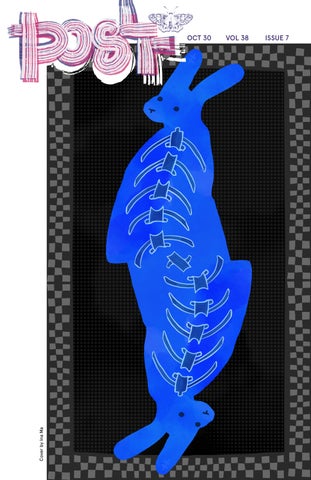
Cover by Ina Ma
OCT 30
VOL 38
ISSUE 7
Table of
Contents feature
narrative arts & culture lifestyle
post-pourri crossword
1.
The Property Brothers
2.
The Shining
3.
Jacob and Esau
4.
Liv and Maddie
5.
—k
6.
Lindsay Lohan and herself
7.
Tweedledee and Tweedledum
8.
Tweedledum and Tweedledumber
9.
Jekyll and Hyde
10. Romulus and Remus 4
post–
(never) growing up
1
ode to solanas
3
that’s so dark feminine black cherry mob wife core!
7
i want to be reminded
9
lost bag: a great find
11
introducing my mother & children tongues
13
between here & home
15
where'd you go, blueno?
17
slice of life
18
“Bro, there’s so much more material from being the Lorax over a random cute pirate.” “Did he waddle at all?”
LETTER FROM THE EDITOR
letter from the editor Dear Readers,
and finding consciousness in spaces beyond our immediate settings. In Feature, Serena reflects on being a youthful child through a story about her beloved pet chicken, while Su grapples with universal and personal dimensions of girlhood through family history. In Narrative, Kal plays with the balance between being productive and burnt out, while remaining true to herself through it all. In A&C, Madi writes about cataloging music through playlists, while Jack discusses
I couldn’t remember the last time I had done
local concerts and their spaces. In Lifestyle,
something for myself, in an intellectual sort of
Semi provides us with a story on language and
way, in a way where I wanted to keep learning.
connection across generations while Namrata
Admittedly, I’m intensely reading every day:
reflects on being an international student, and
Bernadette Mayer’s Memory for my poetry class,
what makes up a home. Alayna comes to us with
articles about appropriations for a National
a pie-themed crossword, while Maison’s post-
Security seminar, Jung Chang ’s Wild Swans for
pourri piece takes us abroad with Blueno.
my thesis. Yet I find myself restlessly flipping
These lovely writers challenge and explore
through the pages to see just how much more I
their own identities, interests, and loved ones in
have left, when I can put the books down, and
this week’s post- issue. Inspired to be inspired,
move onto a “better” task. Even when I put my
I’m writing for myself again through feverish
schoolwork away, none of my hobbies offer any
sessions with my English thesis and exploring
extended periods of inspiration. I had to do
language poetry, and I hope you all are too. If
something about this, because quite frankly, I
you too are feeling the need to rediscover what
felt like I was drowning trying to discover who
makes you feel complete, perhaps you can start
I was beyond the mosaic of everyone I’ve ever
by reading this issue.
loved and interacted with. In search of the root cause of joy, of something I could look forward to even after the longest day of studying and socializing, I chose to return to the greatest lessons that helped me through middle and high school, one that I think
In writing without obligation,
Gabi Yuan
Narrative Managing Editor
ultimately led me to find community at Brown: writing! This week’s writers similarly emulate a return to youthfulness, personal reflection,
O ctober 30, 2026
FEATURE
(never) growing up alternatively, childhood innocence by Serena Lee Illustrated by lori lai Designed By Emma Vachal
“Want to see something cool?” My cousin, mischief glimmering in his eyes, beckoned me over with a tilt of his head. His hands were cradling an amorphous object, something fuzzy and grey. Each knuckle bent inward to form a gentle cage around his treasure: a little chick. Its wide, beady eyes met mine as it began to chirp—a high-pitched sound not unlike the coos of my younger sister. According to my cousin, he had found the chick stumbling after its mother and siblings in the grassy lawn outside my backyard, trying to catch up with them to no avail. It was a weekly ritual for my cousin to stay with us on the weekends and, together, we often spread out on our lawn to watch Hawaii’s wild chickens peck at the empty space between grass blades our eyes couldn’t see. The mother hen was a regular in our neighborhood—preening with her iridescent orange feathers and sleek neck, we’d often watch her cavort with the male roosters who lounged in the area. Among her seven chicks, it was only the small chick my cousin had found that she rejected, seeing something fundamentally different about its lagging gait and inability to chirp. Determining there was no hope for her runt child, she and the other chicks disappeared in the crook of a wired fence—with no choice, my cousin scooped up the desperate bird and cradled it to his chest, imploring us to restore its hope. An act of salvation and mischief wrapped into a small, trembling chick. My family couldn’t leave the chick in good conscience, so it became our first real pet. While my father searched for vets in the area that offered care for chicks, my mother bought a dog cage from Petco and layered it with a warm towel for the chick to sleep in. My sister and I simply gaped at the chick as it stumbled around, legs bending inwards like its body was not created to be held up. It was clumsy and unsure, and its still-soft beak was addicted to punching holes in leaves that had browned from the humidity of rural Hawaiian air. There was softness in watching the chick, so improbable and fundamentally wrong for the world as it limped around, that made my heart feel as if it would burst. Though I did not know much, I knew I would try to take good care of it. 1
post–
Hope. We named the chick—who turned out to be male, according to the vet— after perhaps the only thing that had kept him alive (apart from, of course, raw granules of white rice). Hope soon became an integral part of my life. Coming back from school, I’d wait for him in my backyard, clapping my eager hands together to signal him. And he would come, clucking to himself as he navigated through tangled bushes to greet me. As I ran my fingers through his iridescent feathers, I’d whisper about my day: the coloring pages I got to do instead of social studies, the math problem I couldn’t figure out but Peyton helped me with, the time I played tag on the playground at recess and almost got expelled for breaking the no-tag rule. Over the next two years, Hope became a reflection of my childlike wonder. At seven years old, my heart fluttered with joy whenever I caught sight of the vibrant orange feather that stood out amongst the rest of his muted red and grey ones. I’d forsake homework and run around our curved backyard with him, hunting for leaves and digging my filthy fingernails through the dirt to feed him worms. I sat in awe when
he started to learn how to crow, jumping onto our dusty outdoor table and arching his back to generate enough power to let out a pathetic caw. My parents and cousin had known from the first day we found him that he was malformed, but my child’s eyes couldn’t see any of the signs. His broken crows and weak legs weren’t any different from my own social anxieties and skinned knees. I didn’t understand that the crookedness of his comb was a sign of a physical deformity. Neither of us were ever good at being balanced. One weekend, my sister and I spent the night over at our aunt’s house, and we returned home the next day to an eerie silence. Eagerly, I jumped into the backyard, clapping my hands to find Hope only to be met with the melancholy rustle of leaves from the trade winds. Maybe, I reasoned, he wandered a bit farther today and couldn't hear me. Because although I felt a sinking stone in my gut, there was still so much hope within me. My parents broke the news to my sister and me that night: Hope had gotten sick over the weekend, and his immune system hadn’t been
FEATURE
strong enough to ward off the pathogens. He had come back to his cage to say his farewells, bleary eyes looking up at my mother as his body began to violently convulse. They had buried him below his favorite bush and marked it with a crude white stone. Never again would I run my curious fingers through his feathers. I struggled to comprehend what a concept so large as death could possibly mean, reaching out to grab my mom’s finger with my entire fist while her eyes welled with tears. I didn’t realize the magnitude of sorrow I’d face now that I would never wake up to Hope’s awkwardly highpitched crows, nor that we’d soon have to throw out his cage before the other neighborhood chickens tried to take it for their own sleeping spaces. All I knew was a keening sadness rising up from the pit in my stomach, making my chest ache with confusion. – Childhood innocence is supposed to fade with time, yet I still feel as if I am living in the same manner. I’m led by emotions, feeling things with such extremity that they paralyze me, yet I rarely can articulate what it means to feel them.
I am so easily captured by wonder—sitting in my friend’s dorm, my eyes never fail to catch on her star garland that she made herself. I look in awe at clocks with second hands that move in increments of five seconds rather than one second. I am filled with glee at how my friends’ water bottle colors match how I perceive their personalities. When a smile takes over my face, I feel like a little child, experiencing everything on this planet for the first time. Yet I remain naive as well, stumbling like a weak-limbed chick over heavy concepts like death and cruelty. I didn’t understand why a mother would abandon her chick. I didn’t understand how Hope could disappear one day and yet also be eternally in my backyard, under our ugliest rock. Today, I still don’t understand anything. I live life in a cycle of perpetual optimism— hopeful, unaware of the maliciousness of impending doom. I am staring at the mini pumpkin on which I eagerly drew a lopsided Snoopy with my dying Sharpie, wedged in between my blind box figures and key rings in my dorm room, pleased with the confident
strokes, fully unaware of the mortality of the pumpkin. It will begin to rot in a matter of days. I am eternally sitting on the small ledge of my childhood backyard and clapping my hands together, confident that Hope is right around the corner. I do not turn my back on him and go into the house. In these ways, I am still a child. — I am sitting in the backseat of a car driving along the coast in Hawaii, cheeks pressed to the window as I soak in the glimmering view of triangular waves. I haven’t been here in years, but the blur where aquamarine deepens into blue is still the same gradient that raised me. My black skirt digs into my pelvis, and my matching black shirt sits awkwardly at my hips. At fifteen, I am too young to be in funeral colors. In the wake of a family tragedy, I find myself home again. The humid air sticks my bangs to my cheeks, and the soft rustle of trade winds whistles of the same eerie melancholy I felt when I returned home to an empty backyard, seven years prior. I am clawed by grief and it leaks out through the absentminded hand I drag down the window because how dare Hawaii be so beautiful in such a terrible time. I want to regress and become inconsolable, a young child sitting in the corner of a small church who is allowed to simply drown in their emotions rather than stand in the front, thanking the rows of grieving guests in broken Korean, trying to disguise a broken heart. I am a child—I do not understand how I could have been dancing gleefully at the promise of a cup of Somi Somi ice cream one second and crippled by sadness the next. I cannot comprehend the transition between laughing with my family about stupid jokes to watching them crumple over in unfathomable grief after a thirty-second phone call. I do not know if I am innocent anymore, yet I know I’m still so incomprehensibly naive. To an extent, we all live like children. To be a child is to be human. It means to feel emotions viscerally and allow yourself to be overtaken by them, for better or worse. It means there is an air of perpetual optimism, of unconditional positive regard toward a world that perhaps has yet to deserve the weight of our adoration. The car speeds up along the coast, and I cannot help but marvel at the picturesque beauty of the cliffs fading into the crashing shore, the impossible blue of the sky smiling down on its oceanic twin. I am torn by the darkness of my situation, yet the world screams its colors and I cannot help but feel the tiniest bit more alive. As we turn inland towards a blur of trees and the ocean disappears behind a line of houses and apartments, I am overwhelmed again, curling my knees into myself. I’m back on that backyard ledge, and I am waiting like an obstinate child who cannot admit to anyone that she is devastated. I know that Hope will come home, but I cannot support my feeble hypothesis that he is alive. That there is life beyond the hole in my old backyard or the scattering of ashes on a palm tree beside the ocean. There are so many things I have yet to know, but for now, I fall into the world with urgency and desperation, collecting emotions to display with pride and to be dismantled by. I sit here in this car, patiently waiting to grow up. O ctober 30, 2026
2
FEATURE
l o
s
ode to
“Everyone is female, and everyone hates it.” – Andrea Long Chu, Females I have the highest praise for authors who can write about being a woman without starting to hate themselves. Perhaps that’s why Valerie Solanas—in spite of her androcidal tendencies—could unapologetically seduce me into her world. As a child, Valerie projected her naïve anger onto the world. She wrote and sold insults to other kids. She beat up a girl for talking to a boy. She tried to attack a nun who crossed her. Valerie’s vigilante dreams persisted in her adult years. She found Andy Warhol at his studio and gave him a copy of her original play, Up Your Ass, which Andy promptly “lost” (it was too pornographic and repulsive, even for him). Furious, Valerie threatened him with blackmail. She got back twenty-five dollars and some exposure in a second-rate movie. Following that, Valerie wrote the SCUM Manifesto. In SCUM, men were the source of every pestilence in society: war, marriage, disease, famine, murder. They were inferior to women in every way. The only way to fix this abominable world, Valerie argued in all seriousness, was to eliminate the male sex altogether. It was the duty of women to undo the workings of incompetent men, overthrow capitalism, instate complete automation, collapse the government, and restore matriarchal order to society. Perhaps it was her schizophrenia, or maybe she finally had enough of the world’s bullshit, but Valerie became convinced that her good ol’ benefactor Andy was scheming to ruin SCUM! So, she bought a gun, walked to the Factory, and… SHOT ANDY WARHOL THROUGH HIS FUCKING SPLEEN. With the help of luck and a skilled surgeon, Andy survived, and Valerie went to jail, thus concluding her public career. Although, had Valerie never shot Andy, the movement SCUM created probably would’ve died then and there. 3
post–
s a n a
B u t because she did, S C U M survived as one of America’s most infamous pieces of radical feminist literature— isn’t it paradoxical that a woman’s success depends on her self-destruction? As extreme as SCUM was, Valerie seemed to peer directly into my soul and strip bare the part of my identity I thought I was ready to subdue forever: my femaleness. I cringe when I see my stunted, feminine bones reflected in the mirror. I hate the fact that I cannot muster up the courage to correct my friends when they say “she,” because I suffer far too many uncertainties and doubts about my hopelessly gendered existence to consider myself a girl. The rawness of girlhood! How can I even begin to explain this brutal, delicate force that I have tried to reject all these years, yet still can’t let go of? ((endurance))
I wonder if the rage that drove Valerie to shoot Andy was the same as my mother’s when she threatened to divorce my dad. Time distorts my memories: I remember cowering on the floor, unable to move. I remember crying at the notion of my family breaking. Mostly, I remember the mad look in her eyes as she told me to “never entrust your life to Chinese men.” China loves to cower in the folds of its history and pretend like its thousand-year war against women never existed. When Mao Zedong’s iron fist descended upon the People’s Republic, it buried China’s traditions— alongside the millions of concubines, harems, and raped daughters. Yet, as the rest of China
FEATURE
a reflection on girlhood by Su yang Illustrated by Anna Nichamoff designed by emma vachal
was industrializing, rebuilding itself from the aftermath of its civil war into a global tech superpower, young girls were still enduring the pain of having their feet turned into a jarring mass of flesh. Until the 1940s, the archaic Chinese practice of foot binding methodically afflicted girls in rural areas. By breaking bones and tightly wrapping them in gauze, their feet’s growth would be stunted. The motivations behind bound feet exceeded beauty standards: Like all things gendered, feet were political. Class determined labor. The richer a girl was, the less she needed to work, so the less she walked. In trying to imitate a status they did not have, fathers and mothers crushed their daughters’ feet, transferring down to her a generational superstition—a hope that the pain
she would endure at every waking moment of her life might somehow bring them fortune. My waipo had her feet bound when she was a child; the Cultural Revolution hit her when she was a teen. She fled with her family into the mountains of Chongqing, settling down in a humble, decrepit little town called Tongjing. Granted, amidst this upheaval, my grandmother no longer had to keep her feet bound. Still, the existing damage compounded over time. The aftermath of the war, the struggles of becoming a young mother, and my waigong’s abusive fist encumbered her already malnourished body until her crippled feet could no longer hold their weight. By the time I began to visit her in my mother’s childhood home, she could barely stand. I admit—I was insensitive. While my father and uncle filled the slummy apartment with boisterous laughter and my mother whispered secrets to her siblings, I confined myself to the couch, peeling grapes and attempting to entertain my half-senile grandmother. Her ineptitude infected my ten-year-old self. She dragged me into the depths of traditional Chinese society every time I visited, and every time I would find myself sitting beside her motionless body on the couch, my feet stuck to the ground as if they were broken too. Back then, I didn’t know that the next time I would visit, I would be going to her grave. The trek to her grave wasn’t easy. Thorns and weeds infested the vacant trail. After an
hour, I was breathless and woozy when we found ourselves in a small clearing graced only by a tangerine tree and a run-down cabin—my waipo’s home. Her grave lay a few steps below them, next to my waigong. Instead of just spelling out the name of the deceased, Chinese graves etch their entire heritage onto it. My waipo, 樊德珍, situated herself comfortably in the middle of the slab, following all the mothers and daughters who came before her. I traced the lines downwards until I reached the bottom line: granddaughters. As my mother knelt down before the burning offerings, I thought of the countless women buried beside their sadistic husbands. I thought about the cycle of trauma that had been passed down with the simple etching of a stone. I thought of my waipo’s mutilated feet. I wondered if death might make her more comfortable. My waipo never did consent to the way her life turned out. She did not subject herself to her biological femaleness nor its physical and political consequences. No one gets to consent to girlhood. ((escape)) ACT 2, SCENE 1. The DAUGHTER greets herself in the begrudging mirror. The white blouse imprinted with the crest of the Sacred Heart lies awkwardly on her shoulders, which are ever so slightly too wide. She sticks a bobby pin in her hair. On social media, haircutting has become a ritual amongst heartbroken women. Experiencing a bad breakup? Get a bob cut. Leave behind that toxic relationship with a few snips. She’s still scrutinizing her appearance when MA walks in with a comb. DAUGHTER: Ma, you pull on my hair again. MA: Endure it for a second. Your hair is as tangled as a sparrow’s nest. DAUGHTER: It hurts! Time flies. O ctober 30, 2026
4
FEATURE
ACT 2, SCENE 2. The daughter is in the bathroom again, but older. Her hair is now a shoulder-length bob. It appears more mature and vintage. Sleep has escaped her, so she paces around the enclosed space until she finds a pair of craft scissors. Almost impulsively, she raises it to a strand of hair and snips it in half. Then another, then another. It’s thrilling. She wonders how many of its smooth hairs she can destroy until it turns savage and unrecognizable. We let the montage go on for a minute, then the door is slammed open by MA, whose face is frozen in rage and fear. MA: Why are you up? Go to bed. God, what did you do to your beautiful hair? DAUGHTER attempts to speak, but all her spirit of rebellion had melted away the moment she saw MA’s conflicted face. Her heart has dropped into the pit of her stomach as she prepares for the onslaught to come. M A : You…you mutilated yourself! Now, you’re… MA chokes on her rage, then continues, voice shaking. You’ll start looking like a boy soon, like one of those f*gs selling their bodies on the streets. Think of the girl your waipo would have loved. You’re my daughter, so act like one. ACT 2, SCENE 3. DAUGHTER (if she could tell the truth): ((Ma. You gave me the gift of life. You taught me what it’s like to be a woman. Yet, all that I have learned from you is how to suffer. I’m sick of being the victim of our generational trauma and I’m sick of everything this misogynist household has forced me to become. And— don’t shake your head—you run away from your
5
post–
femaleness too. Think about the grown man who needs his aged mother to wash his feet, or the CEO who’s having an affair with his secretary while his wife and daughters observe helplessly from the background. We both want to eat the power and the privilege that society serves to men on a platter. We hate on pink and praise boyish behavior. We hate ourselves because femininity means vulnerability and weakness. Unhappiness is an inescapable consequence of our biological sex. Men, relatively speaking, are perfectly happy where they are.)) But she does not say this. She cries and apologizes until her knees become weak and her throat burns with a million sorry’s she doesn’t know why she says. She wishes to have been born a boy. She wishes to feel nothing at all. ACT 2, END. ((interlude: redness)) Womanhood is a cycle of self-hatred. I have learned to hate myself in the same way my mother was taught by her mother, her mother by her mother. Why is it that we can’t help but detest the self we are assigned? Sigmund Freud had an idea back in the twenties. He called it “penis envy.” Essentially, women wanted to be men. The daughter’s realization that she lacks a penis causes her to develop an intense anxiety about her femininity which she projects onto her mother for not giving birth to her as a man. The mother thus becomes the object of the daughter’s resentment, and her envy for the patriarchy intensifies— —Since when did red become a symbol for women? Was it when girls discovered menstruation for the first time, helplessly watching as a congealed, foreign force invaded their bodies? Was it when the Romans raped and stole the Sabine women from their motherland, staining Rome with their blood? Was it when the Church burned hundreds of innocent women in Salem, lighting up the sky with fire? Yet, despite all odds, they fought back. Women emerged from the depths of the hell that is society, covered in blood and rejuvenated by a kind of carnal, womanly solidarity that could only be forged in collective suffering. Out of the SCUM Manifesto’s blazing ashes came W.I.T.C.H, the Women’s International Terrorist Conspiracy from Hell. Dressed from head to
FEATURE
toe in black robes, they screamed and shouted the evils of war and capitalism, illuminating 1960s New York City with a violent blaze of passion. Women did not stop shouting when the Nazis told them that cosmetics were sinful, stifling their mouths with the red muffles of fascism. Instead, red lipstick became women’s war masks, their symbol of transgression. Hollywood stars flaunted its sensuality, making American men shudder at the sight of their faces. In rural China, young girls graffitied over the sex-trafficking advertisements plastered over their back alley walls with lipstick to protect other girls. Girls who were strangers to them but girls whom they understood nonetheless—by the very nature of girlhood. So, Valerie rebukes Freud. She writes that the woman does not envy the man. Rather, the man envies the woman…because his Y chromosome is really an incomplete X. So, the man—the incomplete woman— yearns to parallel her “emotional strength,” her “forcefulness,” her “resilience,” and her unstoppable “vitality.” He longs to be part of that unbreakable, undefeated sisterhood. Instead, spurred by his own insecurity, he turns to misogyny, war, and disease. It was never penis envy to begin with. It’s pussy envy. ((authority)) In line for the women’s bathroom at the New Hope pride parade, I tried to cover my bloody nose from the hordes of people waiting to pee. The smoldering heat that pervaded the air of New Hope brought out more than just sweat. Though I tried to act nonchalant, I realized it’s hard to ignore someone actively bleeding out in the bathroom. Still, I did not expect such overt kindness to come in the form of a tampon. “Um, do you want to stick my tampon up your nose? It’s bleeding a lot,” asked a stranger with a Pepto-Bismol-colored buzzcut. Not wanting to stick the cotton behemoth in my nose, I awkwardly rejected the offer while trying to stop my nose from staining the sink red. Yet, that small gesture remained in my head. After my little bloody episode finally subsided, I rejoined my friends at the lunch table, where my very cis-het friend greeted me with a concerned offering of pizza. I looked at my other friend, a rainbow tattoo situated in the center of her cheek. Drag queens blew kisses to the homophobic protesters. The children on the
sidewalk waved rainbow flags at us. An old gay couple held hands. A stranger with a buzzcut had offered to soak up my nosebleed. In spite of all the shit the world has to offer, here they were. Here we were, parading for life, against all odds. Male, female, nonbinary, transgender, genderqueer—in my giddy post-nosebleed clarity, I believed wholeheartedly for a minute that no other community has better exemplified the spirit of youth and of girlhood. *** To my girlhood, Hi there. I’m still a little apprehensive about writing this. Truthfully, I hate my nakedness. My hips are too round. My skin is too soft for my liking. I wish I could toggle my boobs off when I want to, but unlike cutting off your dead ends, you can’t escape the body you’re given. Likewise, I can’t escape your memories of my adolescence, but I can reinterpret history. Yes, you are a fatal condition of existence, but at the same time, a paradox. Girlhood is enduring generational trauma as though it were a mother’s brutal yet caring reprimand. Girlhood is swallowing your own rage while knowing that it is something to rise above. Girlhood is hating and loving, destruction and restoration, inner turmoil and peace. Girlhood transcends gender as a universal experience that everyone experiences at least once in their lifetime. So, be a little kinder towards your femininity. It came a long way.
O ctober 30, 2026
6
NARRATIVE
k r a d o s s ’ th at k c a l b e n i f e m in ! e r o c e f i w b o m y r r e ch e ideal st th f o s c ti e h st e a e th or, de
by K al Mehta jj li Illustr ated by zneck signed by josh re
I guess I would call myself the fun kind of narcissist. Class at Brown ends ten minutes before the hour, in case you’re a student with a stacked schedule who has to make her way across campus. Class at Harvard, I heard from a professor who used to teach there, starts seven minutes late. That is the time it takes the Harvard Man to walk across the Yard. Seven minutes for the wheels to turn; all this time to stride dignifiedly, easily, across one of the busiest factories in the world. It’s funny, she comments in seminar, we typically place man in contrast to woman, but here we are critiquing the juxtaposition of man and machine. I am the fun kind of narcissist because the third pairing in this love triangle is, I think, an easy combination. Woman and machine? Well. I am always fashionably late to class. I arrive with scarf trailing and face sweetly flushed, notebook in hand and apologies smooth on my tongue. My questions are poised and creatively provocative; my answers are eloquent but not presumptuous. And it never matters that I’ve missed ten minutes of class time, because I’m busy, busy, busy: scribbling away, poems and diagrams and equations, moving from building to building, interdisciplinary double concentrations, ever-growing resume, job applications, meetings and coffee chats, working through my vacations. Who would tell me off, in shoes too nice for sprinting, face paint too striking to sweat through? It does not matter that I am not the Harvard Man; I do not have a time limit. I am my own woman. This is why I am the fun kind of narcissist: there is a perverse joy in putting yourself together. It’s the same joy you get from editing a selfie or finishing a paper in a pretty cafe with a cup of something that smells good— the autoeroticism of being a good producer. I don’t think I was always like this, but it’s hard to remember being anything else. Sometimes I am briefly catapulted back to a time where I would run out the door to catch the school bus without having so much as caught a glimpse of myself in a mirror; it lasts barely a millisecond, the memory, and isn’t useful for anything other than knowing I was a child once. In the real world, which is the present world, which is this world, I grew up: I picked up my antidepressants 7
post–
udent body
and my sexuality and gathered myself into a woman. I looked back through my camera roll today, and I saw him and saw me with him, a skinny little tender delicate thing that could hunch over and tuck herself into his collar like she was the smaller one. The me with him would rub a little stick of her mother’s magenta Tom Ford over the bridge of her nose, flushing her face like a little sunburnt girl, and cup his face with large doe eyes. She would wake before him, always, and shake out her bedhead ‘til it strewed itself artistically across the pillow we shared, then pull him close so he would open his eyes to the warmth of their beautiful arrangement. Cute enough to kill, sweet enough to die for. I wear real blush now; it’s a deep terracotta red. I still put it on the same way. I wake up and stretch into the empty space of my bed, relaxed, but ever-so-slightly cold. What is woman in contrast to man? I wonder. How do I fix the irony that I became a woman alongside this man? There is no resolution, just the resignation of love. So that happened. So I am not the same. So I move on. In the true fashion of all women who are individuals these days, I have found myself my own lipstick. Drugstore brand, because I’m practical. Red, because I have too little iron in my body, because red nail theory, because feminine dignity, because when I stand up too quickly I fall over; and I want a man to catch me because I want a man to fight me because I want a man to find me. My skin carries the purple and yellow of a bruise, so I can’t be a scarlet lip, because that looks too orange (crass). I can’t be crimson, because that looks too pink (childish). I am Maybelline Vinyl Ink in Sweet N’ Sour from the limited edition Saucy line only available in India, eight dollars a tube and twenty-fourhour kissproof wear. Brown, desaturated, subtle, elegant. I am the perfect red. Back at seminar, I check my teeth in my dead laptop screen before I touch the professor’s arm. I loved your comment, I say. It’s fascinating; the man is mechanized in his pursuit of intelligence, but can we also say he is feminized? Class ends before she can reply, but I know my answer. A man—the average man, my
hypothetical man, my target—stumbles out of bed with ruffled hair and saunters through his day with voice rumbling and Adam’s apple throbbing. Useless, I think on my way out the building, crunching through a Red Delicious while I check my phone. No man learns this intelligence. In my next class, I type out a thesis, keeping half an ear on the lecturer. I’ll be able to figure out the content later, anyway. The Ivy League Man is trying to make himself the most intelligent machine, but the Ivy League non-man’s narcissistic transformation into a machine is curiously complicated by the additional demands made of her as an aesthetic object. I flip back to my Economics notes. Back in my dorm room in the late evening, when I take down my hair and slip into my night-dress, Maybelline Vinyl Ink is nearimpossible to remove. I peel off my skin every night under the covers, flaking red all over my sheets, burning my mouth on the red taste of sleep. I wake up, and my lips are still vaguely red. I coat them in sticky plastic every other morning, when the skin cells regenerate. Some days I wake up, and I have picked so much woman out of my mouth that I’m
NARRATIVE
completely exhausted. I have learnt to keep a basket on the top shelf of my closet for these useless days. I stumble out of bed. There’s deodorant so I don’t have to shower, and kohl for my eyes so I don’t have to put my face on. I find my basket, pull out torn jeans and a black tank. I decide I am too tired to breathe. My binder is the same color as my skin; it’s happily inconspicuous. I inhale, shallowly, before I open the door. I ruffle my hair and saunter out onto campus. Once this happened to me on a Friday, and I ended up at a party in this sloppy attempt at boyhood, which is perhaps so successful precisely because it is sloppy. I had no work that could be done; I was tired of work. I had no plans for the next day; I was tired, which is exactly why I could drink as much as I wanted, sway with scant effort across the dance floor, or slouch across the sofas, talking to women with easy confidence. When you’re drunk enough, when you’re man enough, nothing has a consequence. I dropped out of a class, I took an incomplete, I went on academic warning. I lost half my toiletries, or maybe I couldn’t be bothered enough to try and find them. I went weeks without a shower, and then I went home. God bless Maybelline Vinyl Lip in Sweet N’
Sour from t h e limited edition Saucy l i n e o n l y available in India. God bless the return to the womb and the blood of a woman. I wasted away half my summer in a familiar bed, waking up every so often to the sound of my mother leaving for work. The day before I left, I took myself to the mall with her money. I bought myself a fresh tube, neat and shiny. Now, when I wake up with a dry purple mouth, I reach over to my stocked vanity. I get into my closet, grab a hoodie, and put my hair in a bun. I walk my ass outside. A positive mindset, they call it in therapy, an achievement mindset. I can be a cute disheveled girl. Giant glasses that bring out the brown in my red lip; wham, here I am, delicately ruffled. I can wake up late. I can miss a class. I am my own beautiful woman, and I can get away with anything. I finish a reading for the first time in five months: Twenty-first century society is no longer a disciplinary society but rather an achievement society. Also, its inhabitants are no longer “obedience-subjects” but “achievementsubjects”. They are entrepreneurs of themselves [...] It is not the imperative only to belong to oneself, but the pressure to achieve that causes exhaustive depression. Seen in this light, burnout syndrome does not express the exhausted self so much as the exhausted, burnt-out soul. (ByungChul Han, The Burnout Society. Translated by Erik Butler. Stanford University Press, 2015.)
I can get away with anything. I can pull an allnighter and make it through the first day of a new job, an exam, another exam, an interview. I can spend a day in bed; beauty sleep. I can consume and expel whatever I want and joke like I’m not hunched over a metaphorical toilet—sarcasm, laughter, sex appeal, rage. I’ve been throwing up too much recently, I think. They switched me off my pills because my stomach got tender and round and refused to deflate (it’s hysterical that Lexapro gives you morning sickness), but that hasn’t seemed to rid me of whatever creature my body insists on birthing out the wrong end. I am my own woman. I flirt my way through another weekend and bring nobody home. I wonder if it’s because I can’t or because I don’t want to. I write all my midterm papers, finishing the last one on a quiet Sunday evening. Mill called the blind hedonist a pig; someone who pursues “lower” bodily pleasure in ignorance of higher intellectual goods like the experiences of success after labour, of the development of skill, or of the acquisition of knowledge. One wonders whether the man, in his relentless pursuit of machine-like productivity, is animal or intellectual. Is he simply chasing the monetary means of unlimited food, sleep, and sex? Or is he seeking to better himself ? The certain fact is that he is scarcely alive and conscious enough to be actively in pursuit of the good life. He is either blissfully unaware of his condition (a non-conscious being) or too worn-out to exist in whole form. The productivity of the non-man is easier to evaluate, given its distinct attention to the higher pleasures. She is not focused on wanting; she is focused on becoming the wanted object, with a commendable ethos of virtue (she is seeking to acquire the quality of virtuosity). The pleasures of intellect, of aesthetics, of self-improvement, serve as the natural rewards of her work. I don’t feel very rewarded. I don’t turn the paper in. I go to bed. I forfeit the midterm. I sleep through a meeting. I forget to wash my hair. I wake up. I read my paper. I edit, and then I go back to bed. The productivity of the non-man, meanwhile, is a conscious insanity. She works and works and becomes this, this thing, this thing that I read the last time I was home– “the depressive human being is an animal laborans that exploits itself ” [10]. She is the boss and she is the drudge; she is the ultimate biological machine, a working animal who is depressive who is a woman who is in drag is fluid is a failed man is nothing is somehow, inexplicably, perhaps unjustifiably, alive. O ctober 30, 2026
8
A&C
I
e r b o t n a w t
on music and memory by Madi Diaz Illustrated by julia park Designed by amber zhao
Each time I press play on my “Liked Songs” on Spotify, it feels like I’m playing Russian roulette. Anything could come up, whether it be my favorite song or one I have no recollection of ever hearing before. More often than not, a song will play that instantly sends me back to an extremely particular moment in my life, and just like that, I am transported to a time
9
post–
marked by emotions so intense and colorful that they become one with the music. The summer before junior year, I flew to LA to reunite with my friends and experience the sprawling city I’d heard so much about. As my flight landed, “Don’t Let Me Down” by The Beatles transferred out of my headphones and straight into my bloodstream. I hear the song now and I’m right back in that airplane cabin, buzzing with anticipation, watching the City of Angels come into view. In my mind, songs aren’t just lyrics with background vocals and blaring instrumentals— they’re time capsules, holding the weight of life’s memories. In my sophomore year of high school, I began curating monthly playlists as a way to record my musical discoveries and current earworms.
A&C
r e m de d in
W h a t started as a spontaneous venture became a personal tradition that remains intact to this day, fifty-five months later. These playlists can contain several elements: new music that I find or receive as a recommendation, songs that are stuck in my head, or songs that speak to me and what I’m experiencing at that time. Throughout the years, it’s become a ritual for me at the turn of each month. I spend time searching for new music, digging deep into the discographies of artists on my radar. Occasionally, the music comes to me, the algorithm proposing songs that scratch an itch and give me exactly what I’m looking for. There are some months when I only add a few songs, most of them repeats from months prior. “Paris” by The 1975 has nestled its way into my rotation almost every month since I was eighteen. The tracks from Ryan Beatty’s sophomore album, “Calico,” have defined my last three summers. My first and most recent monthly playlists both feature “Pictures of You” by The Cure, and it still sounds just as beautiful as when I first heard it. When I began this tradition at the ripe age of fifteen, I had no idea that I would still have such a strong attachment to it. But in a way, I’m not surprised. Almost six years
later, I’m still the girl I’ve always been, using music to soundtrack my life and connecting with it fervently. Sometimes I don’t even know how I’m feeling until I hear it in a song, and wonder how it’s possible that someone else can articulate it so perfectly. The silences of my days are always filled with one tune or another, and I replay songs until I should be tired of them (but never am). So it goes. I’ve recently begun to question myself and examine the root of my obsession with cataloging music in this way. To others, it may seem excessive and almost redundant to make the same type of playlist over and over again, with no end in sight. For me, however, it’s a way to keep track of not only time but also memories. I can play a song from September 2023 and remember what it felt like to be a college freshman, anxious and wide-eyed. I can play a song from April 2025 and be grateful that my brain feels a lot clearer now than it did then. Perhaps to a fault, I sometimes get the dreadful feeling that if I don’t write things down, I will forget all of the experiences, people, and places that have forged my life. I have a penchant for tracking everything from music to movies (yes, I also have an extensive Letterboxd account, how predictable); each song, film, or even book that I absorb can capture a specific moment in time. Maybe it’s neurotic to need to document everything so closely, but it’s just the way my brain works. For some time, however, I was hesitant to listen to some of the songs that hit too close to home or were reminiscent of a meaningful month or era. In a rather egocentric way, I felt like some songwriters reached into the deepest parts of my psyche, plucked out my most intimate thoughts, and turned them into poetry. The situations I found myself in were mirrored exactly in a three-minute melody, and sometimes, that was too agonizing to relive. I often think of the opening lines to The Strokes’ “What Ever Happened?”: I wanna be forgotten, and I don’t wanna be reminded. With memories come reminders of what used to be, what never happened, and what may never be the same again. Music brings these memories to the front of my mind: I click shuffle on a playlist, and all of a sudden, I am stopped in my tracks,
overwhelmed with flashbacks. It can be easy to let myself be tortured by these images from the past, whether they were good or bad. What I’ve realized though, is that these flashbacks can act as reminders of how far I’ve come or parts of myself that I’ve forgotten. And when it comes to songs that are a little too relatable, it’s rather comforting to know that my experiences aren’t unique, and that I’m not alone after all. In writing this now, the lyrics of “Paris” by The 1975 come to mind: Hey, kids, we’re all just the same, what a shame. We really are all just the same, and thank goodness for that. I’m walking through campus today against the soundtracks of October and November 2022, the months during which, drowning in school work and college applications, I applied Early Decision to Brown. I begin at my house on Bowen Street and walk through the Main Green, all the way down to Wickenden Street. “Where is My Mind” by Pixies starts to play (I had just watched David Fincher’s Fight Club for the first time) and, in my mind, I’m running late to AP Calculus, my first class of the day. I have no idea where I’m going to spend the next four years of my life—my dreams of Brown feel so out of reach that I hardly mention them to anyone at all. It’s too early in the morning to be thinking about derivatives, but at least there’s a party on Friday to look forward to. “Trade It” by Slow Pulp comes on next, and there I am in my adolescent bedroom, Harry Styles posters on the wall. I’m rereading my Common App supplements for the last time before turning them in, nervous, doubting myself, and thinking, there’s no way I’ll get in. As I listen to these songs, I’m overcome with a painful twinge of nostalgia. Next semester, I will graduate, and another four years will have gone by, and how long can I sustain those memories before I begin to forget? I ruminate in these thoughts over and over, but then, “Blew Away” by The Smashing Pumpkins plays over my headphones and suddenly I remember that this—walking through the Main Green on a crisp fall afternoon—is all I ever wanted at seventeen. It’s so easy to forget the things that once shaped you, that once occupied your brain so entirely. When I feel myself starting to forget, I open Spotify and visit the time capsules I’ve created. Sometimes, there is pain in remembering, but there is also beauty in facing the music of my life and allowing myself to appreciate how far I’ve come.
O ctober 30, 2026
10
A&C I arrived about fifteen minutes early at the corner where the attic venue sits, while some faces I recognized from Instagram were busy moving equipment up a set of metal stairs and tetris-ing it through a skinny doorway. I was nervous to meet these mustached men far cooler than me and decided not to go in yet. Instead, I walked about a block up from this not-so-famous DIY space, Lost Bag, and sat on the curb to listen to that night’s headliner, Older Brother, on Spotify. He’s got a folksy indie sound and is quintessential offspring of punk DIY. Think midwest emo, twee, and slowcore, among other buzzwords. It’s a cool sound, and I was getting excited to see the guy—whose real name is Mikey—in the flesh. Along with Mikey, there were three other acts set to perform that night: Clancy Conlin, Wallball, and Roolet. Clancy’s a mellow and extremely kind dude in his mid-twenties with a disheveled and vaguely confused look. He came to Providence from Western Massachusetts with his girlfriend after finishing school out there. Both Wallball and Roolet are based in Massachusetts and make often louder and more intense music than Clancy’s. The guys themselves also seemed a bit louder and more outgoing than Clancy. All of them, though, have distinct sounds, with Clancy’s quiet melancholy, Wallball’s angry sort of indie edge, and Roolet’s strange, distorted, and deafening sound. When 7:30 p.m. rolled around I made my way up the stairs, Venmoed fifteen bucks to the volunteer working the door, and entered what felt like another dimension. The lights were the first thing that struck me: There seemed to be one main overhead light, which was green, but the room had entirely different ambient lighting and I had no idea where it was coming from. Reds, pinks, blues—the whole rainbow was in the room and the only explanation was something mystical (or, at least, a really talented team of production volunteers). The decor of the place had me in a sort of trance: streamers, a disco ball, mannequins, records, ice cream lamps. I took a seat on a fairly worn-in couch next to a couple in their mid-tolate twenties. They had on lots of dark clothing, makeup, and a Geek Bar to complete their look. Everyone seemed to know each other and, while this was a perfect place for really good peoplewatching and there were lots of engaging ornaments to look at, I felt a bit awkward sitting on the couch and twiddling my thumbs. I soon realized that the majority of the people in the room were themselves musicians performing that night. They had a laid-back vibe, cool styles, and seemed very comfortable with each other. A group of them were playing Mario Kart in the back. I had many friend crushes developing. But the longer I sat on the couch, not talking to anyone, the further these friend crushes slipped out of my reach. Maybe because they were older than me, or maybe because they were in bands and cooler than me, I just couldn’t bring myself to get up off the couch and talk to anyone—I was paralyzed.
11
post–
Finally, an angel disguised as a dude with a buzzcut and a flannel came up to me and introduced himself as Noah. He was the roommate of Clancy Conlin, the opening act that night. According to Noah, Clancy’s a “crazy nut” and a “genius” who writes an absurd amount of music. I had to meet the guy and, luckily enough, my angel Noah seemed excited to introduce me. When we walked up to him, Clancy was sitting next to the Mario Kart squad, writing out a setlist to be performed in just a few minutes. He was quite soft-spoken and had a relaxing presence, which quickly made me feel comfortable. He told me that he’d originally moved to Providence for a combination of reasons: “My girlfriend moved here, and I lived in Western Mass. Before that, I was already kind of tired of it. I went to school out there, and then I lived out there a little bit. I'd heard Providence was an amazing place and it turned out… well, I won't spoil it.” Lost Bag occupies a very specific niche, one that’s been around for longer than you or I. The people who come here—maybe aside from myself— know what they’re walking into. They know that they’re going to get a certain type of intimate live music experience that they can’t get anywhere else. They know that they won’t be overcharged in support of a huge institution. They know that they’re going into a comfortable place where they will be welcomed. DIY venues like Lost Bag give these specific concertgoers and musicians a place to be at home—and that’s a darn necessary thing. On this point, Clancy told me, “I mean, where else would four bands like this play? Not everybody’s gonna like to listen to it, all of us have all that in common, but the right people are gonna love it. That’s why I think places like this are important, because the people that want to hear the music exist, but if the music doesn’t have a place to be played, they’re not, and no one’s gonna hear it at all.” Lost Bag isn’t the kind of place that’s super easy to stumble upon. They don’t host huge names or run any large advertisements (though they do make some pretty dope posters
lost a gre at
“don't be mean. don't p
by Jack Illustrated b designed by
on Instagram). I found myself wondering how people find this place, which is run entirely by volunteers, and how they’ve established such a deep-rooted niche without many big mainstream performers. When I asked Clancy how he found out about it, he said, “When I moved here, I heard about rishows.com, the website, and then I met Mikey over there. I’m in Mikey’s band now.” Sure enough, the headliner Mikey (Older Brother) was over near the front of the room, setting up some equipment. Clancy went on: “I met him because he was my girlfriend’s friend’s roommate and they introduced us. Mikey told me about this place; I
A&C
bag: at find
post too much online.”
Serpick by Sheryl Chen Amber Zhao
think I came here to see him play here, before I was in the band.” Mikey has been making music for upwards of twenty years, grew up in the Boston suburbs, and has been in Providence since 2014. Today, he works on sound at AS220, and his passion for music is palpable. During our relatively brief conversation, he hit me with more recommendations than I could count: Guerilla Toss, Switch, Snail Mail, Boyscott, and many more. DIY venues have given much to Mikey, and he has a deep respect, as many within the community do, for the purpose they serve. He
told me, “My mind was opened, I think, after college, a lot of local bands that never have a recording play in a bar or basement venue or something and are the best band you've ever heard. They’re so exciting. And I’m, like, listening to a phone recording I made in their apartment. It’s an exciting thing.” This kind of performance has that sort of effect and it’s hard to say exactly why—something to do with the atmosphere, something to do with the people attracted to it, something to do with the effort of finding the venue itself. As Mikey puts it, “For some people, it’s just everything.” I got the sense that Mikey was referencing himself here. He had a lot to say on DIY’s importance: “I guess it’s kind of anticapitalist. It doesn’t have to be necessarily, but I feel like it is a lot of the time. You can feel free to be weirder than the established infrastructure of music—it encourages you to be. That can be really special. Also, every community has its own series of aesthetics, which is fun. [DIY] has also been around forever.” Like in many DIY venues, the volunteers play a huge role in making Lost Bag possible. With ringing ears and two enthralling performances from Clancy and Wallball under my belt, I was able to chat with the volunteer who was working the door when I came in. Her name is Katie and, like everyone in the room, she’s got a deep passion for underground music and DIY. She told me that she’s been volunteering since 2023, right after they opened—or, shall I say, “opened”... In a lowered tone, Katie told me, “The lore that I’ve heard is that it used to be in another space, and then somebody got this space and said, ‘what you’re doing over there is so good. Bring it over here.’ I don’t know though. That’s just the lore.” The place is naturally mysterious because, to some extent, it has to be in order to keep running. Katie, who is herself a visual artist, told me how “in 2015, there was a scene like this and the city of Boston, all of a sudden, decided they need a crackdown on the DIY scene. So all the shows started to get busted—absolutely everything. It needs a little bit of protection… It’s not new, but it’s something that is under
threat because of whatever political stuff is going on. Like rising rents in Providence kill spaces like this.” Katie seemed to know and love almost everyone in the room that night. She’s a perfect example of the kind of person these DIY venues attract: “Everybody here is here for the love of the game. Nobody is making money. Just be nice to everybody, be supportive of everybody. Don’t be mean. Don’t post too much online.” Those lines just about sum up the project. But here are some more describing some of Katie’s personal experiences: “It’s a place where folks are just doing what they want to do, around the people that they want to do it with. And that’s what the underground is, it turns out…I love everything that everybody in this room does, and being a part of it means that they get to keep doing it.” The show was incredibly intimate and the artists, despite collaborating on many tracks, range in genre from soft indie folk jams to extremely distorted heavy metal. Clancy had one song called “Frankie” in which he plays “the trumpet” without a trumpet. A couple of my favorites from the night were Clancy Conlin’s “Old Vampire” and Wallball’s “I Need”—I’ve been listening to both of these via recordings I took of their performances on my phone, though they can both be found online. Not a bad idea, Mikey. Not bad at all. After the show, I chatted with Clancy for a bit and he gifted me a CD of his, Chords For Long Fingers. It was a deeply kind gesture, but it wasn’t only that. I don’t think he gave me the CD because he simply wanted to be kind or even because he wanted to spread his music. It was because that’s the kind of thing people do, the kind of thing people can do, at Lost Bag. Feeling the talent in the room, Mikey told me after the show, “Usually it’s not like individuals are geniuses, but like communities are geniuses. It’s been super special. It’s really exciting to get to be part of it. People are working hard to make this inclusive and make everyone feel at home. But obviously, there is an important part about it: It isn’t for everybody. Not everybody should go. It’s for the people who it’s for, and that’s great.” As for what’s next, the four bands are going on a small tour together: “We’re gonna play at Tin Can Alley in Southampton, Western Mass., tomorrow night, which is a bowling alley too, so I’m excited to play there. We played there this summer and it was really fun. Clancy knows a bunch of people from going to school in Western Mass., so that’s kind of like a hub. Then we’re going to New Hampshire and then Boston. Then, Wallball and Roolet are going on for another four dates.” I plan on coming back to the venue often, both before and after my new buddies’ tour. I can’t wait to see them again and hear about how things went. Maybe I’ll see you too—if you can make it to this dimension, of course.
O ctober 30, 2026
12
LIFESTYLE
r e h t o m y m g n i c u d o i nt r e u g n o t n e & childr s
a
t te r e l e v lo
Unfortunately, I am a person who scares easily. The triggers are everywhere—a bug in my semi-private bathroom, whose locked door is a comfort until it traps me alone with the evil creature; the face of a ghost on my screen after being forced by my friends to play Roblox horror games at 2 a.m.; the screams of motorcycle engines on Thayer as I rush home after a latenight study session. In all of these moments, I react in the same way. I flinch instinctively, like I’ve been burned by a hot stove, and yelp the age-old, inadvertent interjection of surprise. “엄마야!” Umma—the Korean word for mother. Eighteen years and three thousand miles from home, I still call out for my mother, my umma, in my mother tongue. It is a fitting label. *** Last week in my HISP0650 class, we discussed Yasnaya Aguilar’s essay “Hábitos al Hablar,” in which she explores language as a form of resistance and one of the many constructors of cultural identity. In the final paragraph, she raises the following questions: ¿Qué sucederá con las personas que aprenden en la infancia y al mismo tiempo hasta tres lenguas? ¿Qué papel juega cada una de sus lenguas en la construcción de su identidad? (What happens with those who learn up to three languages simultaneously during their childhood? What role does each language play in the construction of their identity?) As I turned my eyes forward, eagerly awaiting her response to this situation that pertained exactly to me, my hopes were crushed with the following, matter-of-fact line: “No lo 13
post–
to
lock b g n uildi my b
t it y n e d i s of
ng ell mi J u e S axw y M b a l en by Or d e ntan t a a r r t s ly Illu by Li d e n desig
sé.” She isn’t sure of the answer, either. Still, listening to my professor speak of the diverse associations that every individual makes with different languages got me thinking about my relationship with the three that I speak: Korean, the language of my first words; Spanish, my third and thus youngest language; and English, the not-so-neglected middle child. Each one evokes different memories, different emotions from various eras of my life, and wildly different versions of myself. And yet, in the end, they are equally mine. *** I. 한국어 I love my mother tongue. There’s something endlessly comforting and homey about it, as though it’ll take you into its arms, embracing all your flaws after the weeks of disuse have left you rusty. I love playing back decade-old videos from my childhood and listening to my babbling, twangy voice utter the Korean syllables with such ease; I love watching the wrinkles on my grandmother’s beautifully aged face rise and fall in time with the sentences that leave my mouth, a sure sign that she understands my every word. This is, of course, not to say that I enjoyed attending Korean language school growing up. In fact, I hated it with a passion—for twelve years of my life, it meant that I had to wake up at the crack of dawn (a crisp 7:30 a.m.), trek across entire mountains and valleys (cross the East Bay southward into Cupertino), and sit through four hours of hell (pure grammar, SAT-style Korean reading comprehension questions, and the occasional disruption by my rowdy male classmates who passed the time by chucking paper airplanes at the whiteboard). I attended only for the paper cups of tteokbokki they
served during field days and on Korean holidays, and because my parents would rouse me out of bed each Saturday and send me on my way, groaning, “I hate 한글학교!” Sometimes, when I speak in Korean, I’ll emerge like a figure hidden behind a veil. I can still picture the look of relief worn by the boy in my fifth-grade class as I translated his words to the teacher. I recall, clear as day, the surprise of an elderly woman on a subway in Seoul when she spotted me reading from a thick English novel. In that memory, I respond to her question, smiling, in unaccented Korean. My veil slips away. II. Español My Spanish journey began from sheer perfectionism—one missed accent mark on my first Spanish 1 vocabulary quiz. For the next five years, I memorized every grammar rule, pored over the picky conditions for the subjunctive and indicative moods, and engraved every possible scenario for the two Spanish verbs meaning “to be” into the surface of my brain. And yet, by the time I reached AP Spanish Language and Culture my senior year, I had come to a shocking realization: I couldn’t hold a single conversation in Spanish without my brain scrubbing itself clean, my heart flailing around in my chest, my palms perspiring tremendously. I panicked. I threw myself into one-on-one calls with virtual instructors from Colombia, Spain, and Argentina, just to nudge my tongue in the direction of comfort, if not fluency, in this language I wanted so badly to excel at. I still get asked why Spanish interests me so, why I’m pursuing it even now, constrained by neither obligation nor requirement. It’s true that I love Spanish for its adherence to its rigid, yet nonetheless logical, grammar rules. I love the warmth, the musicality of the native speaker’s rhythm. I love that it’s a language that consistently pronounces the two fickle syllables of my first name correctly.
LIFESTYLE
Still, part of me wonders if it’s all because Spanish is a language that’s not spoken by any of my closest friends or blood-related family members. It’s a language that I hear solely in my own voice; it is, therefore, perhaps the closest thing I have to an audible echo of my thoughts. III. English As counterintuitive as it might sound, English is, without a doubt, the strangest out of all of my languages. It’s the only language that I can draft an essay in, knowing I didn’t insult or disappoint an entire nation of people. It’s the only language I’ll use to write poetry. But there will come times when its syllables, smoothed over from years of use like the edges of sea glass, will glide over my tongue, and I’ll think of the ocean-sized distance between the Korean peninsula and the coast of California, of the even greater gap between “home” and a land unknown. They are the lengths my parents went to sixteen years ago to bestow upon me the gift of fluency, which is to say, the promise of comfort and convenience over shame. So when I say “girl,” “squirrel,” and “February,” I hear my parents struggling to form the curl of the “r” consonant. When I ask a stranger on the street for directions, I think about how my late grandfather once wandered the streets of a strange city for hours after getting lost on his walk around our neighborhood. English gives me confidence; it’s a language that makes me feel like the world is my oyster, like I can communicate with whoever I want, accomplish anything I put my mind to. And yet, speaking it with such perfection also fills
me with overwhelming guilt. I’m not sure it’s a feeling I can accurately put into words in any language. *** No entiendo de identidad sin contrastes, Yasnaya Aguilar writes in Hábitos al Hablar. A Korean-American, chattering away in the best Spanish she can muster—I am an individual made up of contrasts. A mama’s girl, jumping and startling at every passing shadow; a hopeful, newly independent college freshman; a still foreign, distant almost-stranger. I’m not sure what to make of her just yet. But I am excited to see where she takes me.
O ctober 30, 2026
14
LIFESTYLE
between here and home
so close yet so far by Namrata Nanduru Illustrated by Chloe Medina Designed by Lily Rantanen
15
post–
LIFESTYLE
Before coming to Brown, I hadn’t realised how a simple “Where are you from?” could be such a hard question to answer. People say Connecticut, Massachusetts, New Jersey, California. Others respond, “Oh, that’s not far,” or “Wow, that’s a bit of a journey.” Then I say India. And no matter how casually I try to say it or how other people respond when I do, there’s always a tiny, almost imperceptible, missed beat, a moment of disconnect between me and them. For most people, that orienting question is just a way of visualising someone on a map, of finding a shared connection or a familiar town. The conversation moves on, but I’m always left with the reminder that for so many people, home is a place they could visit on a long weekend—yet oceans away for me. I love it here at Brown. From meeting people I hope will be my lifelong friends, to
taking classes I couldn’t have anywhere else, to stepping into a life that feels entirely my own—I wouldn’t change a thing. Sometimes, I wonder whether that’s the reason why the distance is so difficult. The more I build here, the more there is to bridge between the two worlds I live in. My roommate gets to see her family weekly, friends make plans for Family Weekend, and nearly everyone I talk to is going home for Thanksgiving break. I’m learning to belong here, but the people who would make that easier are still so far away. There are times when I go back and forth with what exactly I’m longing for. I miss my family and friends, even though I talk to them every day. I miss having someone to take care of me, but at the same time, I love my freedom and independence. I miss the sunshine and warm humidity of South India, but I also love seeing the seasons change and bundling up in the
cold here. When you don’t know what exactly you’re missing, how can you find ways to feel better? And there’s something so strange about having family and friends visit. There’s anticipation for weeks beforehand, the excited reunion and catch-up and the feeling of two worlds colliding. When my dad visited Brown, I got to show him around campus. I got to take him to have my favourite smoothie at the Ivy Room. I got to rediscover my new world through someone else’s eyes, while having a piece of home with me. But no one prepared me for the dread that starts to form in your chest halfway through their visit, because you know they’re leaving again. When they do, the image of them walking away and the warmth of their last hug are so painful that they’re perhaps better locked away in memory. I don’t think about them. Having a reminder of home with you— and then watching it go away again—is perhaps the worst feeling of all. I remember when I first got to the United States, saw Providence, and walked around the campus I’dlive on for four years. It was, and still is, so exciting, but it came with a feeling of suspension. Like I’m floating and my anchor is now so far away that I’m not really tethered to anything solid. I don't know whether other international students feel quite the same way, but I imagine many understand what it means to start building a life somewhere so far from the home we’ve always known. It feels impossible to recreate it here, and so you try to start from scratch. Find belonging in entirely different ways than you’re used to. Maybe “Where are you from?” isn’t the hard question. Maybe it’s actually, “Where is home?” Before starting college, I may have said that they’re both asking the same thing. Now, two months into my freshman year, I can say that the answers are so impossibly different. I’m from India, but I haven’t figured out where exactly home is now. Because home still feels like my mom’s cooking and my grandmother’s hugs. It’s also my dorm room after a long day of classes. It’s debating whether to eat at Andrews or the Ratty with my friends, and stuffed animals from my bedroom, and latenight Jo’s runs with my roommate, and my high school best friends on FaceTime. There are bits of it everywhere. I know we’re all creating something wonderful at Brown. But that doesn’t replace the home we already have, and it doesn’t make you wish that it wasn’t so far away any less. No matter how much you love where you are, the distance still leaves a pang in your chest. Right now, home is a fragmented puzzle with the pieces scattered across borders. I’m still learning how all these parts fit together, and I haven’t figured out if home is somewhere you find or something you build. Maybe, for the next four years, I’ll keep trying to do both.
O ctober 30, 2026
16
POST-POURRI
O P U T R S R O P I BEFORE YOU GO
where'd you go, blueno? where has blueno been since he left college hill?
by Maison Teixeira | Designed by Hannah Gapp
17
post–
CROSSWORD
slice of life post- mini crossword
by alayna chen illustrated & Designed by Hannah Gapp
1
2
4
3
2
6
5
7
8
9
Across
Down
1. Ultra-processed meat that would be odd for a pie 5. _____ meringue pie 7. Type of angle for a slice of pie 8. Examines, as when planning a heist 9. Bent to propose
1. Workplace messaging app 2. Nut in a pie 3. Entertain 4. Overnight rest stop 6. Bird's home
O ctober 30, 2026
18
Thank you for reading
magazine. New issues every week.
“But there are still traces of home here: the nail dryer on my shelf gifted to me by my mom, the command strips my dad helped put up on the walls, and the empty suitcase that’s tucked under my bed, waiting to be packed for my next trip back home.” — Daphne Cao, “you are always your mother’s child” 11.01.24
“It’s a good way to keep the hands busy—it’s almost meditative, better than scrolling the phone or biting the nails or scratching the scalp.” — Elaine Rand, “untangling my loops” 10.31.25
EDITOR-IN-CHIEF Elaina Bayard FEATURE Managing Editor Chloe Costa Baker Section Editors Helen Hen Anika Kotapally ARTS & CULTURE Managing Editor Sasha Gordon Section Editors Gabriella Miranda Rebecca Sanchez
NARRATIVE Managing Editor Gabi Yuan Section Editors Lucie Huang Chelsea Long LIFESTYLE Managing Editor Hallel Abrams Gerber Section Editors Alayna Chen Tatiana von Bothmer POST-POURRI Managing Editor Tarini Malhotra
Section Editor Christina Li HEAD ILLUSTRATORS Junyue Ma Lesa Jae COPY CHIEF Jessica Lee Copy Editors Eve Kobell Kate Schuyler Michelle Wassef Su Yang LAYOUT CHIEFS James Farrington Alexa Gay Amber Zhao
Layout Designers Hannah Gapp Lily Rantanen Joshua Rezneck Emma Vachal SOCIAL MEDIA Yana Giannoutsos Hung Lam Eva Mahajan Rebecca Sanchez