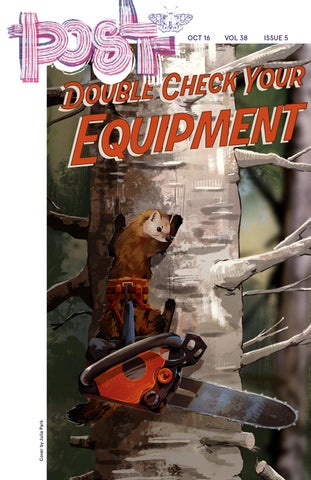
Cover by Julia Park
OCT 16
VOL 38
ISSUE 5
Table of
Contents feature
vagina mania
1 3
experiments in dreaming
5
hide and seek
7
not couture
9
i miss church.
11
unknown origins unveiled
13
post-pourri
digital junk drawer
15
crossword
show business
16
narrative arts & culture lifestyle
1. Dickinson 2. Brontë
community in the dark
Em il y s
3. Guan #emilie 4. Blunt 5. Indirect
6. Not the one in Paris 7. Elizabeth (of Clifford fame) 8. The corpse bride from Corpse Bride 9. That one Austen novel you misremember 10. Emily Post- (1872–1960), American author on etiquette 4
post–
“It’s organic.” “I can taste it.” “A vaginacologist”
LETTER FROM THE EDITOR
letter from the editor
This week’s writers similarly contemplate selfhood, connection, and permanence in this week’s issue. In Feature, Beatrice reflects on movie theaters as points of connection, while Ivy discusses womanhood and self. Vanessa compiles stories and dreams for Narrative, using the structure set by her English professor. In A&C, Margaret discusses pseudoscience and sisterhood, and Kal defines how to express functional fashion. In Lifestyle, Acadia reflects
Dear Readers,
on religion, and Crystal takes us on a tour of
I am falling back in love with our campus: its
Nostalgia Antiques. For a boost of inspiration,
many trees and stapled posters from last spring
Dolma has provided us with a beautiful show-
and crowded entryways on the Main Green. This
business-themed
appreciation, prompted by many a day stranded
explore intentions and follow-through, post-
in my room by the cold that would never end, has
pourri has Claire take us through our long
made me acutely aware of time passing and the
forgotten photos.
fact that I didn’t notice. We’re
officially
crossword.
Finally,
as
we
As we motivate ourselves through this where
middle bit of time, I hope you find some
resolutions fall away and leave life as it stands.
at
week
six,
connection—or distraction—amidst our pages
And, like the weather, we officially settle
this week. Take this issue to the park while you
into routines (hopefully soon, we will see,
still can, and enjoy!
as it is currently 80 degrees). Seeing friends, making connections, and making memories
Meandering through the quads,
now come alongside the slog of midterms and
Halleli Abrams Gerber
aforementioned ailments that love to accompany the fall. I am who I will be for the semester,
Lifestyle Managing Editor
theoretically.
O ctober 16, 2026
communit y FEATURE
movie theaters as a hub for shared humanity by Beatrice Hackett Illustrated by LORI LAI Designed by LILY RANTANEN
Friday nights in my hometown were often spent at the movie theaters—my friendships were strengthened amid the buttery smell of popcorn, slightly grimy leather seats, and the dingy carpet that is essential to all good theaters. Though I found myself frequenting the movie theater weekly, I never truly understood the appeal; my friends had AMC Stubs memberships, were serious about their Letterboxd accounts, and stayed on top of movie releases more than they did with the current news. It felt natural to tag along on their trips to the theater, for lack of a better night out. Our car rides home buzzed with an excitement that was almost as palpable as the vibrations of the tires along the asphalt. Though I was often a silent observer on the journey home, their eager analyses and breakdowns of the film we had just watched drew me out with them time and time again. After one of our late night rendezvous, I remarked offhandedly that I didn’t really get it. Going to the movies was fun and all, but I could never fathom going alone or going multiple times a week, as some of my friends did. Whether it was renting a movie on my laptop from the comfort of my bedroom or a night of watching Netflix from my couch, I found the way in which I viewed movies to be convenient and fulfilling enough. My best friend at the time, who is now fittingly studying to be a screenwriting major in LA, turned to me very suddenly. He asked me how I didn’t feel “unified” after each movie. I was thrown off by the statement. Feeling “unified” implied that I felt brought together by this experience, that I felt less separate from other people, less separate from the world. How could an old AMC, sitting on the side of the highway like an abandoned piece of furniture, make me feel this slice of belonging to a greater whole? I saw nothing glamorous, nothing of this so-called human “unification” in my trips to the theater. Nevertheless, his statement stuck with me. I started to reconsider this experience that always seemed so ordinary. When we returned to the theater the next weekend, I wasn’t paying attention to the screen but to the people next to me. Strangers of all ages and backgrounds were settling into the plush seats, and as the lights 1
post–
dimmed, a shared hush fell over the audience. The film began, and I noticed more than before how “in tune” the act of settling before a screen made us. When a comedic line was dropped, everybody laughed or shared a smile; when suspense was finally broken, it was like the audience flinched at once. Sentiments moved through the crowd like a wave, each person a particle moving in sync with the rest. When I asked how he first noticed this phenomenon, my friend described a similar process of understanding to my own. He noticed the auditory reactions first, which acted as a feeling of justification for the emotions he felt while watching the film. From this moment onwards he noticed the different demographics within each theater. “I’ve been in theaters with old women, families with little kids—all these people so different from myself but at the same time sharing the same experience as me. It was a comforting feeling. Out in the world, there are more reminders of how different I am from other people, but the theater becomes a much needed reminder that we’re all the same,” he described. Through his lens, I saw for the first time how the movie theater can become its own form of community when a film is shown, even if just for a fleeting ninety minutes. An understanding of my friends’ anticipation for the newest movie release
began to unfold. To them, it was bigger than watching a story on a screen. It was a moment of connection to two different worlds. From within the confines of a dark room, one could sit amongst strangers living very distinct lives, yet become momentarily lost together in one singular and fictional world. At the very same time, these individuals, each an independent world in itself, were colliding through shared emotion. The theater allowed a film to walk the line between escapism and correspondence, leaving the watcher to relate to characters both on the screen and characters sitting in the seat next to them. Theaters are one of the only instances in our modern world where we can experience something entirely new for the first time with a large group of total strangers. If you go into a movie theater for the premiere of a brand new movie, it’s guaranteed to be a unique experience for everybody in that room. And the emotions evoked by these films are not just trivial—our collective emotions as a society are imparted through the means of theaters. We are quick to dismiss the invocation of emotion as nothing but a hook for the audience, a way to keep eyes glued to the screen. In reality, each emotion evoked is
y in the dark FEATURE
selected specifically by the director of the film to communicate a larger message to the masses. For instance, the shared cultural anxieties of a society can be tracked across seemingly distinct films. All of the blockbuster films of this summer dealt with themes of memory loss— Peter Parker’s friends in Spider-man: Brand New Day have no recollection of him, Odysseus spends seven years in a state of amnesia on Calypso’s island in The Odyssey, Ryland Grace must piece together his intended mission upon waking from a coma in the middle of outer space in Project Hail Mary, and Nikki from Obsession is trapped in a form of blackout throughout the film. The reasoning for amnesia as a shared theme can be tracked back through the evolution of social media; the proliferation of algorithms and short form videos create a mass intake of diverse information in short periods of time, from which a person can hop from topic to topic. This type of scrolling creates a forgetfulness of selfhood. Our obsession with short form media that is dictated by trend, and thereafter circulates on a loop, has also reduced the public’s familiarity with unique and new experiences. Thus, social media traps us within recycled thoughts and feelings. A movie, however, helps combat the harm of social media by presenting an idea in an unprecedented way. A character experiencing amnesia reflects both these issues of thoughtlessness and repetition;
these characters thus become mirrors for the modern person, as the film as a whole attempts to wake the audience up from this state of mass unconsciousness. Shared themes through apparently distinct films are not new. The 2008 financial crisis and increasing government surveillance as a result of the War on Terror triggered a tidal wave in the 2010s of American films fraught with dystopian and apocalyptic themes, from The Hunger Games to Interstellar. Moving back even further, anxieties about technology’s increasing accessibility to the public and growing role as a commodity were commonplace in all types of films released in the 2000s, from children’s movies such as Wall-E to films for a mature audience like Eternal Sunshine of the Spotless Mind. This illusion of separation isn’t unique to the films we watch; it exists in our perceptions of our own independence, and is deconstructed when we walk into a theater to watch those very movies. The casual but heedless movie-watcher, like myself, thinks they are sitting down alone or maybe with a small group of friends and family members for a wholly individualized experience. In reality, the act of sitting down in that theater makes each audience member become just as connected as the themes throughout these films, whether conscious of it or not. I’ve asked my friends to try to think of another example where a group of complete strangers can experience something
completely new together for the first time, and walk out with mostly equivalent emotions provoked. Their examples were all activities housed within a theater: plays, musicals, dance performances. The only exception we found ourselves considering was a religious sermon. When compared with religion, an institution which has governed human society for its entire existence and been at the forefront of the creation of community, the power a theater has to relate people is more strongly emphasized. Places of worship often also appeal to specific demographics and have historically prompted alienation for the individual who strays from this likeness, whereas a theater allows vast diversity to coexist in literal darkness. The characteristic of darkness within theaters is imperative to feelings of unity, allowing the group to transcend surface level biases and the divisions that identity inherently draws. In this manner, theaters deconstruct the idea of barrier-based participation, thus stepping into the role as one of our only unconditional forms of spirituality. In our current society of intense polarization, I believe this makes theaters all the more imperative to maintaining a sense of humanity. Human beings cannot exist alone; mankind demands togetherness. It’s difficult to find unification going on anywhere else. Technology, news outlets, and global conflicts create divisions amongst the old and the young alike. With social media in the picture, listening to music and viewing art have become increasingly individualized experiences. But going to the movie theater, sitting down amongst a group of fifty or more strangers, and watching a film for the first time allows us to relate on a deeper emotional level, no spoken words needed. It is this unity that our society of isolation strongly lacks. So next time you want to see a new movie, don’t just wait for it to be released on your most accessible streaming platform—go out to the theater, sit in a room full of strangers, and experience it together. OCTOBER 16, 2026
2
vagina mania FEATURE
locating my future assimilation
by Ivy Rockmore Illustrated by Jingyi Lin (@bivian.lin) Designed by LILY RANTANEN
It’s March 2026: I’m rocking a blue bikini and I’m on my second cocktail and I’m feeling unashamed. I’m walking along a beach in the Dominican Republic at a resort where 300 other tipsy Brown students vacation. This resort has a shiny exterior with its four separate pools, but rot peeks out from the bark of the palm trees and the chlorine smells a bit like corruption or greed…yet that’s beside the point, because I’m kicking up sparkling rocks and seashells. They’re damaging my feet as I kick them, but I’m at the point where I don’t care enough to stop. I’m on the phone. On the line, my ear turns cold as my mom tells me that it is normal to feel out of place on a college spring break trip; it is normal to feel insecure. I recount the ample time I spent speaking with a young man on the sand whom I did not know had a girlfriend and who, after disclosing my transness, drunkenly slurred, “but you are so very pretty.” I recount trudging through the beach fearing my tuck had slipped, and as waves glowed and pulsed my mind’s eye stayed glued to the adolescent American children who, either in projection or in reality, would stare and stare and stare just below my belly button, even after their parents gave them glares and gave me a look of apology. There had been a week that felt like twenty years of white parties and posed hot tub photos and I had concluded my life would ripen and open with ease once I stopped fighting the current. I exhaled the last of it and announced to my mom: I wanted a vagina. I felt so much guilt after this realization in my gut because I recognized the tension. I was fundamentally giving up something I had held onto for so long: that even though “trans” is only an adjective, a modifier to my womanhood, it is one that I have held dear, one I am always shouting out. I am loud and have no shame. It’s my obligation; it lives as my brave arrogance. I sometimes joke with friends that I am the campus-celebrity transsexual. People whose names I don't know sometimes know mine. Word of mouth or admiration or simply audacious vivid bullshit. Though as an adult I have only lived as a cis-passing woman, and I have been a girl for so long now that any life 3
post–
before is foggy, I remain aware of just how much performance it requires, the daily maintenance it has instilled in me—the loud click of my boots in the library and the plum lip liner I reapply in the bathroom and the blowout I try to make last a week to savor the sporadic compliment from an aimless sophomore who whispers my hair looks better straight—but all I am doing is washing my hands, all I want is to keep myself clean. Being a doll is work and it is work that I take seriously, never for granted, because if I were born even thirty years earlier, there would be no career for me as a writer, no career at all really, if only because the history of trans womanhood in America is the history of spectacle, of being surveilled and dismissed. Candy Darling once said that her medium for being a celebrity was being a woman. I feel that I am constantly riding the line between the normative and ultimately privileged world that Brown has tossed me into and the emotional, psychological, and financial volatility of the trans scene in NYC. When I compare spring break white parties and campus dances with the lives my trans girl friends are living in New York—the raves and the ketamine and the lack of family support and the lack of degrees—a pit the size of a peach weighs me down. It sits in my stomach and it grows bigger but tastes sweet, because ultimately I will end up on the dance floor too, swaying my hips to a bad melody, choking on someone else’s strawberry vape smoke, opening my mouth and sticking my tongue out after exiting the subway for some cool summer rain relief. Most of my trans friends are living rapid cosmopolitan lives in New York City where they too are depressed and medicated, having to navigate systemic transphobia, state-inflicted poverty, emotional and sexual violence, and an increasingly fascist culture. At times I have felt guilty for allowing myself the privilege and pleasure of being cis-passing and mingling and growing up with friends at Brown who would ultimately be living stable and wealthy lives soon enough, if not already. And Brown is a beautiful place to live a beautiful life. Frankly it is easier to live a normative life. This past weekend, I flew home to Toronto to witness the beautiful wedding of my straight
male cousin, a union eleven years in the making. I sobbed heavy as rocks as they walked down the aisle. So stunning, such magic. I leaned into my mom’s ear and I bit down my lips to quiet myself; I admitted I wanted this, I wanted the love and the comfort that would come with living a life as a fully assimilated heteronormative woman, one who no longer had any ties to her birth as a boy. Conversely, the normative white-picketfence lifestyle I eye from afar and fear from up close. A goldendoodle nuzzles its nose against the soft skin of my calf. A husband crouches and bends down, his knees against the hardwood, as he places a leash on the dog. Together they walk to blow off steam from his tedious job in finance, and upon returning home, a pot of pasta steams up the living room. There is a baby chair, and in the chair is a child born by fancy glamorous dazzling IVF, made with eggs that are not mine because large places like oceans and the worlds they push away know I cannot break water. I will never be pregnant. I had only known cis people to achieve the white-picket-fence lifestyle. I see it as a representation of the what-could-be, the material structure most trans women will never access. And even then I know many of my straighter peers end up depressed, medicated, and putting their entire hope, heart, and semen into what the next generation of their children could do. The notion of a white picket fence is just as terrifying as it is glamorous. My mom taught me true glamour is entirely effortless. Then I had a wonderful FaceTime with one of my sisters (a trans girl friend newer to her transition) about how I had always seen her as one of my own. Even before she had taken the time to tell me, our relationship was bound by the fact that there was an incongruence between her birth gender and how she lived and navigated the world, and that even if she, at one point, presented more androgynous or even more boy, she still lived as a girl, always to me. “Real is what you feel, honey.” Beyond what gender is, the greater question I am orbiting is what it is to other people: my relationship with my body in isolation versus in relation to others. If there is anything I have learned from my education in poetry at Brown, it is that there is no intrinsic self. The self is always placed in relation to others: There is you, there is me, and I am only someone when I’m talking to you. When I’m talking to someone else, I am a different me.
FEATURE I would like to clarify the misconceptions with sexuality and my transness. People sometimes assume that men are gay for wanting dolls and this couldn’t be farther from the truth—in fact, my gay ex-boyfriend broke up with me because he’s gay. (All love!) But beyond that, I have had experiences with straight guys from Brown, RISD, New York, and all over; who have found me sexy, attractive, glamorous; who have approached me at parties, become my friends, given me attention—whatever you want to call it—yet still seem to be dealing with some internal pressures that I do not fully grasp and I would not like to. No, do not let me see inside your veins, because what is inside you is sacred and because you need to figure out your sense of selfhood and assuredness first. And my relationship to sex and sexuality is constantly in flux. I’m twenty-two, dammit—we all need to be having more sex! But here I am, essentially celibate at the moment, and happy as a clam—maybe more than ever—because it feels like I have stripped a part of myself. There was once a layer of outer skin and beneath that was a redder and fresher form, and now I am nude but not empty, onto the next level: to be a senior, to be writing daily, to be fully present in a way I perhaps wasn’t before I came to terms with myself fully. And yet this self is temporary. I remember the first time I heard about a straight guy getting dogged on by his friends for being into me. All because I committed the great sin of being my beautiful self. All I could think was stupid, stupid, stupid, this world is so fucked. Sometimes I wonder how these dudes will get degrees from the same school as me, dudes who despise trans women on a deep level because they despise a woman who has chosen herself over what society thinks to any degree. But all I can control is who I surround myself with, all it boils down to is care, because Brown has brought hot water to my bed when I’m sick, Brown is my shower cleansing me when I’m shivering, Brown brings me to the water where my girl friends and I dolphin-kick with salt beneath our teeth. This school is hot and cold and icy and sticky, but I can spit away the gunk of their minds, honestly, I can spit all day long, whenever and wherever I want. I have wants. They're beyond here. I remember, too, the first time I had sex with a woman. It was my freshman year, and I was still unashamed in the way only young women are. I lay flat against the pink sheets, sterile and barely moving. If you had to picture me, you might look into the eyes of a starfish. She was kind enough to do the work. I didn’t have the strength yet. In my memory I recall a push and pull between what felt pleasurable and what felt disgusting. What I was doing was not disgusting but it was the least womanly thing I could do. I had not fully conceptualized gender reassignment surgery beforehand. I’ve gotten with people of all different genders since and with time have gotten more comfortable in movement, in the body I was given—making do, no weakness, only fish. Women have only been kind to me in these experiences. It is the men who seem to complicate my relationship with sex. There are those who don’t know I’m trans and when they find out think, holy shit, no or those who think, holy shit, yes. You tell me which is worse. There have been those with fetishes and those who want to be me, whether inside my body or
to excavate the dysphoria in theirs. There are normal ones too, many of them typical boyish uneasy figures excited by tank top straps that slide off girls’ shoulders or those with brains rotted by porn, or the kind types who like to give you head in acts of selfless devotion and don’t want anything in return, or the opposite, who only want you to touch them, but fear is the spit beneath their tongue, all of it is so typical, so predictable, yet only some of it is pleasurable. It would be silly for me to think that a vagina would magically make this form of heterosexual sex more pleasurable. It would be silly for me to fail to mention the orgasm gap, the unequal amounts of pleasure cis women receive compared to men on average, or the fact that penetration alone does not suffice for many women, or that many of my women friends are having sex they do not always enjoy, or that men are often bad at listening to what women say they need. Sometimes my girl friends and I FaceTime and talk about what we think it will be like. We wonder if it will feel different to be penetrated in that way. We talk about where and when we’d want to do it, even though part of being new to being trans is being naive. Maybe being a girl is being naive, and being a woman is refusing passivity. All of us are young. Many of my girls are young to the journey. Fantasy keeps us alive. But surgery too is a fantasy and it’s one that I might not know for a good long while. I think here of Lauren Berlant’s theory of “cruel optimism,” which I wrote about in post- this time last year. The idea is that we have attachments to fantasies that stop us from actually being free. The Berlantian answer here is that obviously, a vagina will not solve my problems. Hell, it may not even make me “normative” insofar as I can never bear my own children. I will never have ovaries, I will never be able to carry a kid, which is sort of the epitome and peak of the nuclear family, of the structure which we try to squeeze into, if only for the sunlight that brings us warmth through the window of the home we one day will live in, we must think we will live. Nothing really mattered on the spring break trip, nothing ever happened there. I wrote a letter to my future self on the flight home. I’m writing to you from the airport. I’d like to know how it feels to have it done. I wonder if you’re glad. Do you wake up in the morning and bend down to look at it? When the steam rises above your hair in the shower, do you bend then too? Or is it only when you are walking down a narrow street and wind is closing in on you…Is it then that you open and close your legs and waddle as though a duck, knees bending in certainty to let the fabric be blown by the wind—without worry, without wear, without light. I’m writing to you because I want to know if you will ever go through with it. I’m writing to you because I want to know how it feels once you go through with it, once you begin to use it. Does it feel like power? How does it sound? Does it sound how you want it to sound, how you expect it to sound? How does it feel to urinate? Is urinating only using the feeling? When you bend down I can’t help but wonder which direction you are bending toward, the arc of the past or the arc of the future. When you are bending down I can’t help but listen, from a distance I see myself now pressing my ear up against the soft animal skin of your
thigh, listening, just listening for the blood that rushes through and then floods. I’m writing this in a text chain. I’m writing this in an airport. I’m writing this in transit because I want to type out how you will feel before I can chart out how I want to feel. I have had so many conversations that grow then dwindle, dwindle, dwindle and finally spill like wine on carpet, conversations about women's sexual pleasure. I become nauseous. Acid rises in my gut. I lack acid reflux but my reflexes are all galactic in the spine of my mind. How many of my girl friends actually enjoy the sex they’re having? What makes us cry out the sex we enjoy and what makes us quiet in the sex we don’t enjoy? I think I’d like to meet this version of you so much because I want to hear…I don’t yet know what I want to hear. Only you know where to think. I can’t wait to meet you but until then, yes, yes—I’ll take a drink. I never really understood devotion in relation to the body till I first had trouble sleeping. I would listen to light creep through my bedroom blinds. Even when I kept my eyes closed I would rustle in my sleep, some sleeping animal claimed me. Sometimes, when I was marginally younger, I would close my eyes and imagine all the bodies of the people I had ever kissed, and then I would take them like a mechanical crane and release them into a picture, and in the picture they would be stacked on top of one another, just this pile of limbs and geometric shapes, and I think there was something pleasurable to the image, warm and pleasurable, because shapes placed in eloquent patterns are often sacred. I never really believed I could devote my life to anything at all until I first listened to light creep through bedroom blinds. I never really wanted a vagina all that badly until I started to assimilate.
O ctober 16, 2026
4
NARRATIVE
experiments in dreaming
twenty-one mornings and a few late nights by vanessa tao Illustrated by Anna Nichamoff Designed by Hannah Gapp Although I am the furthest from a morning person you’ll ever meet, I registered for an English class called Morning Pages, which, on top of being a 9 a.m., mandates two pages of writing—you guessed it—every single morning. It’s made my dreams much more vivid, given me (or cursed me with) thirty minutes alone with my thoughts to start each day, and stirred up colors I’ve never seen before. Because it’s so early, I don’t remember anything I write. Rereading my morning pages has been an intriguing glimpse into myself, to see what I think of when I’m still asleep, still caught in the veil between worlds. Every morning, before I
7 5
post–
have a chance to think, I write. 1. morning pages, notes, dreams, roughly September 10 to October 1 - — - - — -- — - - — - — 2. I had a strange dream. It was nighttime, and I was in Berlin, standing on a cement tower in the middle of a river that knifed through the city. It was much like the Providence River, except that this one was on the verge of flooding as a thunderstorm raged overhead. The water rose to surround my ankles, the night punctuated by flashes of lightning. To my own surprise, I turned to the river, spread my arms, and leapt in headfirst. The dream ended before I found out whether I drowned, and I shot up gasping, disoriented and chilled despite the humid September morning. 7. We learned an idiom in Vietnamese: uống nước nhớ nguồn. When drinking water, remember the roots.
3. This time, I’m not writing my article in a Blank Street in New York next to my childhood friend. This time, I’m on a flight home to Denver, next to a man who all but admitted he makes missiles (“defense…working on things that only fly one way”). At the same time, an international friend is texting me about how her lease is endangered, which is making her miss home—a home she so desperately fled across the ocean from. This weekend, I am going home because I miss the scent of lavender shampoo in my mom’s room and because recently I haven’t been able to breathe without my chest tightening with the subtle suffocation of heartbreak. When anyone asks, though, I tell them it’s because otherwise it would be a long time before I saw my family again. 4. Recently someone brought up the idea that your original universe is your childhood home. I flinched when I heard this—what a terribly cold, static, and desolate original universe. And then I considered it would also be a universe of afternoon sunlight and the
NARRATIVE clacking of my dog’s nails on hardwood. Strange that when our built-home becomes shaky, we start to miss our original-home. It seems this phenomenon happens whether you flee 1,956 miles or 7,816 kilometers. 3. My favorite part of flying is the lapse between the moment and the fall, the tightrope between chance and death. 8. Recently, I had been struggling with the question of whether or not to go abroad. I would go to Shanghai, a city I’ve only spent three weeks in but already love. I would go to learn my father’s language, to say that I went abroad, to take a bite out of whatever is so life-changing about the experience. 11. Something I wondered about in Amsterdam: Do you think Banksy stopped being a street artist the second his art was hung in museums? 10. Mostly what was stopping me from committing to Shanghai was my friend S’s couch that she let me stay on for days, despite the fact that I lived ten minutes away, because she understood what I meant when I told her I couldn’t be alone, despite the fact that I have three suitemates, despite the fact that I live in the center of campus. Mostly what was stopping me was the new Snoopy blanket on my bed that my friend picked out. Mostly what was stopping me was the milk my friend A brought to me when I wasn’t even home, because when I asked why milk, she told me that when she was younger warm milk always made her feel better. Mostly what was stopping me was the summer squash that K roasted and the subsequent dinner we cooked, dancing around each other in
a rhythm we must have learned in some life that wasn’t this one because I had only really met her the week before. Mostly what was stopping me was the day my other friend S let me sleep until 2 p.m. on her floppy air mattress that took up all of her floor space so that she had to tiptoe around her own room. When she let me borrow all of her clothes because I didn’t want to leave. When she let me ramble and laughed at my bad jokes because she knew that every dream I had that night was about the same person, because she knew I felt sick to my stomach when I woke up. 9. Another dream. I was trapped at the bottom of a well, waiting for my brother to rescue me, except I was my brother and also the water. And the rope. And the shadow it cast. 12. A suspension between vulnerability and possibility, the losing of one to become another. That glance over the cliff to check how steep the drop is—not the jump or even the fall but the moment you resolve to do it, the threshold you cross, the little switch that clicks and doesn't flip back. 13. How much I love every blade of grass, every tree that falls in front of my dorm, every little rushed hello and sidewalk hug and “we’ll catch up.” How much I love his smile, and hers, and even hers too. How much I love the fat squirrels, how much I love that I am friends with someone in every suite in my building. How much I love my professors, my friends that will drop anything to do anything at a quick text. How much I love the river, where nothing ends, where whatever I bring to it is held, gentle and infinite. 7. I once asked gods I don’t believe in for more time with you. 14. Mostly what was stopping me was the very tangible truth that almost everyone I live for is here. That when I come back a lot of them will be gone. That this place, all 143 acres of it, is home in a way that makes my bones ache with longing, even when I’m here. Some strange, backwards nostalgia clinging to my lungs, missing something I haven’t even left. 15. In Vietnamese, you use the particle về when traveling home. Should I use it both ways, then? Flying from home to home. 16. A week into the semester, I woke up to the news that the author of my favorite essay, the essay that had become my creed over the years, had passed away. I emailed my high school English teacher about it—my first time talking to him in four years—and was delighted to hear that he now teaches woodworking and still remembers my love for “Living Like Weasels.” 6. If I declare some place is home, then I have to be able to leave it. Home waits. 27. My friend A has been holing himself up in his room, obsessed with creating his EP. It’s all he can talk about. I can’t blame him—I get it, the head rush of creating something wholly your own. It’s the closest antidote to time that I’ve found.
12. “To be the first vessel to hold this new thing.” (Alan Lightman) 18. Recently, during a law firm tour in Boston, I listened to a panel of lawyers speak about their careers, and I realized with cold certainty that I had to go to Shanghai. That I had to go to San Francisco the summer after that. Otherwise, I may become one of them one day, sitting ducks on the other side of the chasm they were too scared to jump over. 17. Is it possible to love a place so much it becomes a prison? What about a person? 19. Over the summer, I had the good fortune to travel to a few cities in Europe with my friends for ten days. As the six of us went from plane to car to train to train to train, bar after bar after museum after Tower after club after Wall after hostel, I remember the resonant tuning we started to find ourselves in. We spent so much time together I learned how to spring between every single person’s head, human synapse, hopping neurons, absolutely electric. In so little time, we created our own little original universe—created one where I knew everyone’s every thought, created one that we slept and ate and cried in for eternity. We walked everything, ate the Earth, became the trees, and drank until our throats burned. 20. Then eternity ended, and it was over. Another original universe gone, created and lived and inhaled once and then gone. 23. “Know you have a long way to travel / Miss you / I’m at the table in the back.” (Gabrielle Calvocoressi) 22. Ten days, four years, what makes an eternity an eternity? 21. “the two of us, or the all-of-us, not here long maybe it is.” (Ross Gay) 24. I’m going to Shanghai because I want to see if I can build from scratch. What I can build from scratch. I’m going because I want to see if home will wait for me. If I can really trust the unknown—however dark and however cold— enough to dive headfirst. If I really trust myself. I need to find out whether I drowned or not. Really, I’m going because I need to test out how deep I dare to dream. 25. It's the tension right before a first kiss, the catch of light in a pupil, the first breath of waking up, the space between beat and drop, not the lighting of the match but the failed one right before, the held breath before the next. 26. “…jump off cliffs all the time and build your wings on the way down.” (Annie Dillard) 28. Sometimes that’s just where the river marches, and you have no choice but to drown or to throw your arms out to a god you don’t believe in and jump, hit the water before it hits you, find the depths of the well before it finds you. Sometimes that’s all there is to do. Time helps but it leaves a scar anyway. If there’s anything I believe in more than I believe in love (there isn’t), it’s that whoever dares to dream wins.
OCTOBER OCTOBER O ctober16, 9, 2026
8 6
A&C
hide and seek
how pseudoscience helps me find my sister by Margaret Li Illustrated by Sheryl Chen @sheryicoco Designed by Amber Zhao
My sister is one of the biggest mysteries of my life. She came into the world in the first month of 2000, while I was born at the tail of 2004; so though the subtraction works out to four, she is basically five years older than me. Energetic and filled to the brim with creativity, my sister reigned as the natural ringleader of our childhood playmates. She was pretty and lively. She was good at everything. She was my idol. When she began high school, my sister entered a strange stage in her metamorphosis. She stopped pouring out an abundance of energy. She became moody and secretive. She often physically shut herself in her room, telling me off when I was being too loud. In any case, she did not want to build a snowman. This more distant and subdued version of my sister soon left for college, ending the thirteen years we lived under the same roof. About two years ago—six years after she had moved out—while staying home on a weekend
7
post–
off from work, my sister announced both that she had recently started to believe in the MBTI and that she possessed the ENFP-A personality type. It seemed to me that my sister had become ensnared by pseudoscience. I don’t remember when I first learned about the MBTI—possibly, I was made to take it in school, or possibly, a friend had recommended it. Either way, the test had always struck me as more of a party activity: a cute way to kill time, rather than bearing any real insight on my character. The Myer-Briggs Type Indicator (MBTI) is a set of questions developed by Katharine Cook Briggs and her daughter, Isabel Briggs Myers, based on psychologist Carl Jung’s theory of cognitive functions. The questions rely on a person’s perception of their own character and social habits to assign them to one of sixteen personality types. A personality type comprises five letters, each encapsulating a different trait. Here is my best attempt at demystifying the MBTI personality types based
on their descriptions on 16personalities.com, a popular platform that hosts MBTI tests and related theory. The first letter is either E or I, indicating extraversion—Jung had advocated for the use of “extraversion” rather than “extroversion” in his theories—or introversion. The second pair, S and N, determines whether a person leans more pragmatic or intuitive. The third pair, T and F, determines whether someone is more inclined to be thinking or feeling. The fourth pair, P and J, distinguishes spontaneous free spirits from detail-oriented planners. Finally, A and T represent self-assuredness and self-consciousness, respectively. The final letter acts as a filter on the previous four traits, reflecting how a person perceives themselves. All of this seems…arbitrary. There are days on which I feel more extraverted and sociable than others. I can be more “thinking” in some regards and more “feeling” in others. What does it even mean to be more “intuitive” than “pragmatic”? I had my doubts about the reliability of the questionnaire. However, my sister explained her results so animatedly and with such conviction, that I put away my skepticism for the time being and focused on the theory. Suppose that there is something to these letter combinations. What if they encode aspects of my sister that can help me
A&C
demystify, if only partially, the enigma that she is? But how could my sister possibly be an ENFP-A? Though E represents extraversion, I’ve long perceived my sister as being quite introverted. She loves nothing more than a quiet weekend with the cats. She rarely attends large social gatherings, like a night out with college friends or happy hour with work buddies. In fact, she has shared with the family multiple times that she greatly appreciates that her job allows her to work independently most of the time. In regards to being both intuitive (N) and deeply feeling (F), my sister has always struck me as being practical and rather stoic. For instance, after an argument, I tend to dwell on the uncomfortable aftermath for a while, hashing and rehashing the situation in my mind. I also feel an itch to approach the other party and discuss the matter, or apologize, or come to some sort of a resolution. My sister, on the other hand, appears to possess the happy gift of flipping over chapters expeditiously. Fights within the family rarely seem to bother her for more than a few hours. She usually goes on with her daily life and shows little signs of wanting to “talk about it” afterwards. My sister’s MBTI result confuses me, but maybe this just attests to the fact that the
theory is largely unsound. Human beings are so complex that it is impossible to distill the galaxy of possibilities within each of us into a personality type. Indeed, it is widely accepted that the MBTI theory has no rigorous empirical backings. The definitions for each personality type are rather hand-wavy. Test results could vary significantly based on the test-taker’s mood on a given day. Despite these defects, the test can still be quite alluring—it is an easy way to avoid reckoning with the intricacies of human connections. With personality types, our quirks and preferences and messy attempts at reaching others can be distilled into five orderly letters. You don’t get along with someone? No wonder! That person is an ISTP-A, your polar opposite MBTI type. Scared to go to the function alone? Don’t even try. You are an introvert, and therefore can’t be expected to enjoy raucous spaces. The MBTI trait descriptions draw lines in the sand, and we can be confined by their rigidity should we put too much trust into their ability to interpret selfhood. Unfortunately, there are many instances where the supposed science of personality types is used to justify the categorization of people. Corporations sometimes use personality tests in their hiring process to determine fit or competency. I’ve seen dating shows that open with the participants sharing their MBTI types as a part of their introductions. Social media can also propagate rather questionable guidance on navigating relationships based on the MBTI. The Chinese social media app Xiaohongshu has become one of my doomscrolling platforms of choice in recent years. Many Xiaohongshu accounts claim to be gurus in the way of navigating relationships using MBTI. There are all sorts of arguments regarding how different personality types would behave in given scenarios as well as instructional videos demanding that I avoid associating with people with certain personality types. If I had taken these posts seriously, I would sadly have to sever all ties with my parents, for they both tested to have my nemesis personality type—the evil ISTJ. And according to the videos, all that it would take to fill the void for me is an INTJ man. Someone who shares my discerning eye for people and social situations but intuitively interacts with the world through logic and reasoning, while I supposedly default to emotional connection. According to the videos, I will fall irredeemably for the INTJ man. The two of us will share a connection that is almost psychic and like no other, and we will perfectly complement one another. The videos leave the impression that relationships can be explained in binaries and extremes. It’s almost as if an MBTI mastermind were in charge of programming people’s brains: ISTJ people would act a certain way, and this
is what INTJ people would do under the same circumstances. It seems to me that if one uses the MBTI as a North Star in their relationships, they risk massively oversimplifying others and limiting themselves socially. Of course, it may still be wise to keep an eye out for that INTJ man. —------------------------------------------------------“The problem with playing hide-and-seek with your sister is that sometimes she gets bored and stops looking for you.”—Fangirl, Rainbow Rowell. I’ve learned a lot about my sister in recent years. Both of us began new chapters in our lives. Both of us encountered an inundation of different and new experiences. There have been celebrations, but also the pain, doubt, and nostalgia that are injected into all doses of growing up. It is both painfully obvious and deeply shocking to me that my sister processed many of our childhood memories differently than I did. I discovered this through conversations that occurred in the narrow strips of time when we overlapped in our parents’ home from school and work. Time and distance apart made it easier for us to air out the interiors of our minds, but we still approached these attempts gently, clumsily. We were a little rusty at connecting with each other. Our shared archive of childhood memories became the building blocks of conversations that surround those touchy, tingling things called “feelings.” Despite all my misgivings, the MBTI has emerged as a vocabulary with which we can communicate about ourselves. It is a limited vocabulary, and plenty gets lost in translation. But it is enough for now. After all, so much context needed to be explained; what was it like for her during all these years? For two people who are learning how to talk with one another in a new dimension, a plethora of language can be overwhelming. What we need is a language through the keyhole. When it doesn’t seem like she would want to come out and build a snowman, I can read my sister through the lens of ENFP-A. She is someone who gains energy from the vast world around her. Traveling and exploring new destinations inspire her. She loves the bustling city that she lives in. At the same time, she is often introspective and resides in an internal world populated by pet fancies. She is reluctant to divulge the geography of that world, but it is pulsing and alive nevertheless. Oh, and she is spontaneous and free, plans be damned. One day, we will adopt a more sophisticated language with which to communicate—one as intricate as the childhood riddles that we spoke in, I believe. Oftentimes, my sister is frustrating and still utterly confusing. But that is the way with all good mysteries, I guess.
O ctober 16, 2026
8
A&C
not couture how to do functional fashion as a brown student by Kal Mehta Illustrated by Candace Park designed by josh rezneck It’s Monday. I wake up covered in grime and glitter and the dull stickiness of dry sweat. My mouth is full of cotton. It’s time for class. For all the fanfare of studying at a famously creative school, the average Brown student’s morning closet-scavenging is relatively mundane. Is this shirt too dirty for me to rewear? What does the CPax weather machine have waiting to torment you outside the lukewarm comfort of your room? How many layers do you need, what classes do you have, where is that bra that you literally laundered yesterday? I can never find the answer to that last one; luckily, this campus seems to have a happily functional approach to underwear, where if (like me) you aren’t a fan, no one’s going to call you out on freeing the nipple. I’m running a few minutes late for my 10 a.m., as usual, and I don’t have the time to wash my hair. I don’t really have the privilege of throwing it up in a bun, either, since I’ve opted for the “hi-I-am-transgender” curly mullet, so I sacrifice doing my makeup in favor of assembling some vertical monstrosity from three claw clips and lots of curl cream. I definitely didn’t get enough sleep, so I slap on blush and pray that some color in my cheeks and the giant lenses of my glasses will lend me some illusion of wakefulness, grab my reliable leather jacket, and sprint out the door. Realistically, this is what college fashion is: a creature born of ideas and raised by cheap detergent, rushed mornings, and infinitely hostile weather. You’re faced with the concept of having to construct a new outfit every day (or most days; hey, the Tuesday-Thursday people don’t have to know what you wear on your Monday-Wednesday-Friday circuit), within infinite other constraints. This is the environment that breeds functional fashion: clothing that does its job without sacrificing style. As someone who likes to pretend they’re fashion-conscious, but is burdened with the inability to actually wake up on time, I had set three rules for getting ready by the end of my freshman year. This is how I, and most Brown students I see around campus, seem to approach our functional fashion: #1: Carry a default layer that works. I adopted a burgundy faux-leather fleecelined jacket from Macy’s Backstage in my first semester, and I take her pretty much everywhere, because New England really hates my Indian temperature preferences. #2: If you think it’s boring, add jewelry. If there’s one thing Brown students are good at, it’s the art of dressing up a T-shirt and regular pants, whether it’s a silver ear cuff, thrifted belt, or dangly earrings. I have a piercing-inspired necklace from Nostalgia that I love, and seldom 11 post– 9 post–
go out without some giant earrings. #3: If you have any semi-formal event that’s not class, a TA section, or a meeting with a professor, you invoke the Brown Smart Casual Guide. This is a nebulous, vague affair involving baggy jeans, collared shirts, bomber jackets, and chunky cardigans. Think boxy but slim; the actual pieces are simple because you want it to look like your clothes are just this nice every day. To get it right, you have to come across neat, yet appropriately slouchy. Don’t ask me how; I mostly just make sure my pants look inconvenient enough, and pray. Being a college student is often an exercise in the art of trying to look good enough to make a good impression without sacrificing your time, body, or sanity in the process. Coming
me a nice shape while keeping the comfort of a baggy outfit. If your legs are any shorter than a supermodel’s, wide-legged jeans can be an absolute pain. Hemming is always an option; buying culottes can be a nice trick, and if for some reason you want your legs to look longer, a tapered boot cut creates a good illusion. Some people consider these overly feminine: A bowlegged pant that stops right after your ankle can also lengthen your figure. It seems that the “correct slouch” lies on the fine line between too structured and too loose. Stiff T-shirts aren’t really the most comfortable, but overly wrinkly oversized tops are often considered underdressed. Baggy jeans aren’t just jeans three sizes too big, obviously:
from a big city and a background in both art and fashion design, I think Brown does functional fashion uniquely well. Beauty doesn’t have to be pain, minus many students’ stubborn refusal to wear a backpack (guilty as charged; I’ve been loving my burgundy weatherproof sling, though its wider strap and durable outer layer makes it a bit better than the totes I used to carry around). Or maybe I just visited Harvard a couple times and saw way too many guys in cargos and polos, and girls tripping over painful-looking brown leather boots (sorry Harvard, no shade). Either way, it got me thinking: What differentiates a fashionable casual ’fit from the rest? The “right kind of slouch” The shape of the era is the trapezoid. Most women who’ve scrolled through enough social media feeds will have heard of the loose-totight split: tight top goes with giant pants, giant top goes with short pants, or if appropriately pinned, a giant top can go with giant pants as long as you still have some shape. This is undoubtedly the time for the low-rise and the wide-cut. The thing that people often don’t tell you is that there’s a “right kind” of baggy. As we re-enter early 2000s skinny chic with Ozempic, gymfluencers, and the revival of the Victoria’s Secret fashion show, it seems pertinent to point out that baggy clothes aren’t necessarily a throw-on-and-go situation for everyone. Note that a fitted crew neck on an oversized t-shirt is a huge no-no: People tend to opt for loose collars, a boat neck, or a stretched crew, all with giant sleeves that make the arms and shoulders look delicate. On men, fitted shirts are still the rage, and looser cuts come with the caveat that they be cropped so that the legs look longer and the shoulders wider. The shorter or fuller your figure, the more difficult achieving these proportions becomes. If you have a large chest, a giant t-shirt doesn’t delicately hang off your shoulders like it’s supposed to. I’ve found that cutting up my shirts to an off-the-shoulder wide neck gives
They come in trapezoids or hourglass cuts that create a geometric lower body shape. I’ve recently ended up playing with this structured/ casual dichotomy by trying out a fitted collared half-sleeve shirt with my giant sweatpants. As someone who can never find a pair of jeans that fits both my hips and my waist, I live in sweats, and realised that they become less controversial when they’re ironed and paired with a structured top and the right shoes. It’s still interesting to note that I probably get away with my sweats because I’m on the skinnier end of midsize (though god knows what dress size that actually translates into these days) and have legs skinny enough to make sweatpants look rectangular (this happens when the band hangs off your hips and the rest of the pant is loose around your thighs). It’s no secret that if you’re fat (not Hollywood fat, realpeople fat) your casuals are considered a lot less “smart,” especially given that your body doesn’t fit into this angular ideal of the contemporary fashion world. Consider the low-waisted jean, slightly-cropped shirt combination that’s meant to show off one’s lower midriff. On someone larger you’d probably judge it to be an ill-fitting shirt, not a planned fashion moment. Just food for thought. Distorting the silhouette Another interesting thing about the modern college student is our turn away from the high-waisted and the skinny-fitted. The traditional silhouette for female-presenting bodies used to be a pant that cut off at the narrowest point of the waist and a top that was cropped appropriately to match. Malepresenting bodies were assigned a relatively fitted top and tapered pants. This hourglass/ rectangle dichotomy between the traditionally female and the traditionally male body is probably the most noticeable when you look at the cut of a typical cotton short. Notice that men’s shorts are cut rectangularly and end around the knee, where women’s shorts are cut
A&C A & C
trapezoidally, start at the narrow waist and end at mid-thigh. To no one’s surprise given the contemporary propensity of the oversized jort, we seem to have eschewed these silhouettes in favour of new cuts that focus on different parts of the body. In feminine fashion, it’s the collarbones and the lower belly; we’re done with crewcut shirts and are moving forward with loose sweaters, sharply dropped sleeves, and all kinds of alternative necklines that make the neck look longer and the shoulders less round. We’ve brought back the low-rise (huge, in my opinion, given the sensory nightmare that is high-waisted jeans), drawing attention to the little strip of skin at the lower abdomen instead of the actual waistline. Of course, we’re still obsessed with cinching our shirts; the internet abounds with tricks to give your oversized tops a taper at the waist, and Missguided recently came out with a “fitted oversized” shirt that pulls in under the ribs and flares out again over the hips. The hourglass will never fully die. But the advent of loose pants is huge for functional dressing. You might notice you feel a lot worse about your body when you’re squeezed into pants that are fitted around the lower waist or the upper thighs, as opposed to one that hangs off your hips without clinging to your legs. Of course, it’s highly possible that the social permissibility of these kinds of pants draws on the fashion world’s expectation that your body is thin enough to provide an artistic contrast to the giant clothing. I’m still optimistic enough to believe that this is changing, though, and that loose dressing can genuinely be a move towards enjoying a new and more diverse array of silhouettes. To hell with the fashionable body. Anyone looks good in baggy pants, if just for the fact that you’re not being expected to squash yourself into a pair of jeans that are essentially laminated to every part of your lower half. Of course, I can’t praise the functionality of baggy pants without taking a moment to mourn their fatal flaw. Most of us are no strangers to heel bites, or the nightmare of encountering an unexpected puddle when the hems of your pants are trailing on the ground. The price you often pay for flowy comfort is the ever-present risk of eating shit on the sidewalk. But for students spending their day traipsing around campus, the outfit doesn’t end at the pants, anyway: This is where finding the perfect shoe becomes important. Boots that are made for walking I mentioned earlier that I thought my sweatpants were passable as Brown Smart Casual partially because of my shoes. Here’s the thing about shoes. New England is cold, cobbled, and wet. Brown’s campus, despite our beloved (ha!) Facilities Management, isn’t exactly any
smoother. I have an incredible admiration for this girl in my TAPS class who walked in the other day with a pair of lovely, delicate gold sandals, but for those of us who aren’t as strong of will, the default shoe looks more like a worn pair of sneakers. I don’t need to comment on the rise of the chunky shoe or the thigh-high boot; we all know what the typical Brown student shoe looks like, if not just for the fact that we’re all looking down while we walk to class so that we don’t trip on the pavement. It’s still worth noting that a small twist on the classic sneaker can level up a casual outfit almost immediately, without sacrificing any of the shoe’s practicality. My brother got me to put some riveted spikes into my pair of New Balances (which, by the way, are a great shoe if you’re looking for something that’ll last: Their average lifespan is five to six years, even more if you’re not wearing them every day). The traditional Onitsuka Tigers or Adidas Sambas are popular precisely because they’re a good way to add a pop of color to your outfit without trying too hard; just buy a statement color. I’m a particular fan of the new Adidas ballet flats, which are basically the sneaker equivalent of those sweatpants that look like they’re made of denim: They’re easy to slip on but have all the comfort of a full-fledged sneaker, plus they provide some visual interest. Charms, colored laces, rivets, or just a standout pattern—these are all ways to dress up the college walking shoe. In the wintertime, we’ve got to stick to our boots, and not all of us can afford UGGs (they wear out quick, too). But I’ve found that wearing leg warmers or just opting for more interesting pants can make even the plainest water-resistant winter boot look smart. It’s impressive what a simple accessory can do. Bits and bobs Which brings us to the piece de resistance in a Brown student’s dresser: the trinket. Think about it this way: the more interesting detail there is to your overall silhouette, the more people assume you’re putting effort into what you’re wearing, and their eye falls forgivingly on the wrinkles or stains or unfortunately ugly outerwear that we all end up with at some point in our college workweek. Most of Brown’s student population seems to have mastered the art of the earring, so I will refrain from recommendations and only briefly note that the simple ear cuff, dainty helix, thin chain, or minimalist hoop (ranging from tiny to bangle-sized) are tried-and-tested defaults. But it doesn’t have to stop here. I’m a big fan of a “default necklace,” or an easy chain that you can wear every day. For me, it’s an easy outlet for sentimentality (my default is a pendant my parents gave me for my eighteenth). But it’s also a way to add to your outfit without having to spend extra time picking out jewelry in
the morning. Advocates of “easy fashion” and “simple style guides” have often espoused the 30/70 rule, where seventy percent of your wardrobe is comfortable and thirty percent is fun or interesting without necessarily being practical. Given our often-tight budgets, tiny closets, and the pain of doing laundry, I propose a conversion: Seventy percent of your outfit should be things you literally need to get through your day, and thirty percent should be jazzed up a little. If you’re feeling a comfy hoodie, consider grabbing a bright pair of earrings or adding some patches or embellishments to the lower half of your pants. A cute belt or a bandana tied through your belt loops/ to some part of your jeans/around your hair can do the same job. In the hell season between spring and fall, where the weather changes every hour, I’m a big advocate for a flashy light jacket or a patterned shawl, something with a rich color or tassels or a fun texture which you can drape over your shoulders, lay on the ground, or wrap around yourself as needed. For people who find lots of jewellery overtly feminine, a simple silver cuff, chunky dark beaded bracelet, leather cord necklace, or even a nice watch all fall into this same thirty percent category. Besides, all these things are great excuses to go thrifting or trinket shopping, and we’re always looking for permission to let ourselves buy fun things, aren’t we? Putting an end to the one size If you’ve made it this far, part of you is probably wondering why some student writer feels qualified to dispense fashion advice to college students, especially if you’re already someone who considers yourself pretty fashionable. The answer is that you really don’t have to listen to me. You’ll notice that a lot of this article is general observations that you can probably pick up by people-watching on the Main Green for, like, ten minutes. What I’m trying to get at is that Brown’s student fashion seems to be an interesting look into how we can convert the idea of dressing well to become something relevant to the average person’s life, with its bralessness and slouchiness and scrappiness and functionality. The ideal we’ve set doesn’t work for everyone; the rectangular, trapezoidal shapes of the era aren’t naturally performed by the majority of real human bodies, and putting effort into finding the perfect wardrobe isn’t really something we all have the time or money to do. But it’s a shift toward something more practical, more real, and I’m all for examining that critically. So, the next time you notice someone’s outfit on your way to class, or are sleepily picking out your own in the morning, I’m advocating that instead of trying to think about what’s in Vogue, you stick with the practicality you already live by. That’s the Brown way to do functional fashion: learning to style your own, unique body; experimenting a little without sacrificing your time; and, of course, remembering to check that damn weather app.
OOctober ctober16, 9, 2026 2026 12 10
LIFESTYLE
i miss church. by Acadia Phillips Illustrated by orla maxwell designed by emma vachal
13 post– 11
LIFESTYLE
I come from an extremely Christian household. Methodist, to be exact. My name is “Wesley.” My sister’s name is “Trinity.” My cousin’s name is “The Eucharist.” Haha no, I’m just kidding about that last one! But just as much as my name has served me, my Methodist upbringing is an undeniable part of my formation. I went to services every Sunday morning, youth group Sunday evenings, choir before that, mid-week oasis on Wednesdays, and volunteer days on Saturdays, with many of these activities being led by my mom, or my dad, or my sister. The intensity and consistency of my religious upbringing has made me a firm believer in the doctrine of generosity, in the majesty of liturgy, in the delectable taste of spit-tinged grape juice and a fat chunk of a King’s Hawaiian roll. I believe in God, too. I believe in a lot of things. Despite this long-standing love affair with whole-hearted belief, I still have quite the complicated relationship with organized religion. The spaces that have caused me the most pain in my life are arguably the religious ones, and I am not blind to the way Christianity has become a weapon. I have been at the receiving end of that unwieldy saber, my Church of Christ high school dealing me some nearly fatal blows. To them, I was much too lukewarm; to them, I was much too verbal. At the end of high school, as I prepared to come to Brown, I thought that I would enjoy the escape from religious pressure that I felt in my hometown. I thought that I would feel fresh and universally lovable. And for a while this was true—I felt much kindness, I saw much beauty, I relished in much freedom. I saw God in everything and everyone, in the mortar between bricks and wedged between teeth. But I was ultimately shocked to see how much I lost when I moved fourteen hours north of my church. Since coming to college, I have noticed that there are now some things missing from my life. Sundays I spend differently. A horde of my people suddenly miles away. A set of songs I don’t sing quite so often. It’s not the system of beliefs, or the archaic foundationals, or the cruel whip of vapid tongues that I miss. But it is church. I miss church. I miss the rhythm. It’s Sunday morning. I have somewhere to be. I have people to see. I have someone to speak with. I have a father. And then another. And then another. It’s Sunday morning and I have a lace dress on and my brown woven
flats and my Bible in hand. I have a smile that I know how to give away. I have peace to share. I have hands to hold. It’s Sunday morning. I have to go to church. I have a place that I can go. I have a pew with my name on it. I have something I must do. I miss the music. I don’t like Christian contemporary music; to be honest, I find it borderline offensive. It’s cheap. It’s capitalistic. It’s uninspired. It’s outside of my personal doctrine. But hymns. Hymns are another story. There is poetry there, and history. There is a simultaneity and reverberation. Something hollow is filled with our shared words and shared melodies. Somehow, through these mustered incantations, we become everyone who has come before, and everyone who comes after, and everyone today, singing, everywhere on this Earth. I miss the stained glass. The broken, beautiful things. The colorful things. The donated things. The emblematic. There is so much visual beauty in a church. There is so much to find reverence in and to revere. I like to look at speckled sun pouring through colored panes shaped by a hammer and chisel. My sister and I love this glass so dearly that she used the colors as her wedding theme. There is nothing quite so full of love as light streaming through. I miss the trees. The familial ones. The lineage I was born and raised in. That time after time gave me their hands and their words and their prayers. If asked, I could list their names off for days on end. Selina, Teresa, Kelsey, Anna, Kevin, Matt, Stephanie, so on and so forth. My prayer partner who gave me a collection of essays she wrote to her granddaughter and my preschool teacher who sent me to the principal’s office and my choir director who always offered me solos I left untaken and my sister’s friends who let me tag along and my VBS students and my next-door-neighbors and my pastor who goes out for beers with my parents every week. I love these people. And I miss them more than all the beautiful songs and the weekly routine and the cracks in the glass. I miss church. And so…I try to make family out of friends. I try to scrawl out religious iconography of my own. I try to write cheery poems and sing deep songs and listen closely to the birds in the trees. I try to find the weekly beats. I go through my prepared motions. I miss church, but if I try with all my might, I can find bits and pieces of it everywhere I go. I can make it for myself.
O ctober 16, 2026
12
LIFESTYLE
unknown orig
a day of strange and wonderful finds from nostalgia antiques by Crystal Zamora Illustrated by stefanie lee Designed by emma vachal
If you’ve ever wandered down Wickenden Street, whether it’s to pick up your daily coffee at Coffee Exchange or grab a bite at Amy’s, chances are you’ve stumbled across a quaint antique shop named Nostalgia Antiques and Collectibles that sits near the street corner. Throughout my time at Brown, I’ve frequented this shop many times with friends, eager to discover any treasures that have yet to be found in its various nooks and crannies. The shop, with all of its charm and curated selection of vintage items, ensures that you’ll find something worth writing home about. From miniature furniture to alien life forms, I thought I’d share some of my findings during this month’s expedition. 1. The “Karen” Coat Hanger Upon walking into the shop, I stumbled into one of the hidden corner rooms and came across an old wooden wall coat hanger with the name “KAREN” in colorful, bold lettering. As I inspected it closer, I realized how meticulously crafted this piece of woodwork was. There were white, dainty, dotted hearts painted onto each letter, and as precise as each dot was, a level of imperfection seeped through when I noticed each dot varied in size. There was something extremely human about this lack of perfectly even dots, and rather than framing it as a mistake, it revealed to me the careful work of an individual who must’ve spent countless hours meticulously crafting this piece with steady hands. Like most people who walk into an antique shop, I wondered who this wonderfully crafted coat hanger originally belonged to. With little to go off of to be able to track down its origins (and the fact that there are a bajillion people out there named Karen), I like to think that, given its whimsical nature, it wouldn’t be far-fetched to assume this piece once belonged to a child’s bedroom. This was a piece that exuded a parent’s love for their child, enough to craft a coat hanger by hand. I’m not sure who Karen is or where she is now, but it’s clear that she was loved. Attached to the coat hanger was also a tag that read “$28 KAREN Coat Hanger (of course, all karens are priceless).” It seems only fitting that another Karen would be the next person to own this beautiful piece, so if there are any Karens reading this, just so you know, there’s a coat hanger in that shop with your name on it! 2. Keys That Lead to Nowhere As I ventured further into the first floor, a couple of keys placed on a shelf in the center of the room captured my interest. They were enveloped in a thick and corrosive copper
13
post–
with teeth that had curved from turning locks many moons ago. I picked one up in my palm and noticed its jagged surface as it made contact with my skin, leaving behind traces of powdery orange dust and the scent of pennies on my fingertips. They were large, bulky, and engraved with numbers or words that alluded to their possible origins. I imagined how they must’ve opened the lock to someone’s home on numerous nights, been fumbled and dropped on the ground while attempting to be used, or simply sat in a coat pocket or a drawer for years on end with no real use. One of these keys in particular had an inscription on its handle that read “Marlborough Blenheim” with the number 101 inscribed very large in the center. Driven by curiosity, I did some digging online and found that it might’ve been an original room key belonging to the historic MarlboroughBlenheim Hotel that used to be located in Atlantic City, NJ. The hotel was built between 1902 and 1906 and existed until its demolition in 1978. I wondered, how in the world did a key from a demolished hotel in New Jersey end up in an antique shop in Rhode Island? While I’ll never know the answer, it was fascinating to be able to hold a remnant of the past and learn about a history that may be unknown to many. 3. Miniature Furniture I made my way past the keys and toward the right side of the first floor where shelves of trinkets covered the walls. Among these trinkets were a pair of vintage miniature dollhouse cabinets: a wooden Chippendale-style secretary bookcase in a dark red mahogany stain with brass hardware, and a molded plastic china hutch painted in coral with gold handles. These two had a tag that read “$9 Vintage Dollhouse.” The handles were functional and swung open and closed. Both pieces were in mint condition without a single chip in their paint. I imagined the young girl who must’ve placed these pieces within her doll’s home and cherished them deeply as she played with them for days on end. It made me think about being a young girl once myself, and the miniature furniture I once adored so immensely. A moment of girlhood that is so universal, especially the moment that arrives when you outgrow what you once loved. You then sell or donate your miniature furniture to another young girl who may love it just as much as you once did. I took the cabinets off of the shelf I found them in and placed them on the small wooden table in the center. I did this in hopes that a child would walk through the front door one day and their wandering eyes
would see these miniature treasures, breathing life into them once again. 4. Alf I proceeded toward the second floor and climbed up the creaky, carpeted steps surrounded by brightly colored paintings and pencil drawings, vintage photographs captured in black-and-white film, and framed movie posters from the sixties plastered on the walls. Once at the top, I started to scan the area, and amid the endless sea of clothing and knickknacks, a vibrant costume in the corner of the room caught my eye. The costume resembled a smock and was made of a thin, glossy plastic and split into two luminous colors. The top portion was an intense blue accompanied by a white trim outlining the neck and shoulders. The bottom half was a solid, vivid red. However, that wasn’t what made it so striking to me, it was the massive graphic printed on the very front depicting a furry creature with large ears and a pig’s nose. In big, bold letters the word “ALF” was spelled out. I was intrigued (and also a little unnerved) by this creature and quickly learned from the internet that ALF (Alien Life Form) is in fact a sitcom from the late eighties that follows an alien who starts living on Earth with a suburban family. This was a vintage 1980s ALF Halloween costume that was sold in boxed kits at drugstores and department stores during the show’s run from 1986-1990. I pictured this being a beloved costume worn by a kid in the eighties who wanted nothing more than to be their favorite character for Halloween. It was simple, easy to slip on, and if no one knew exactly who you were, then it would be spelled out for them in big, bold letters. Or perhaps this was worn by an adult who needed a last minute Halloween costume and decided to throw it on and call it a day. Regardless, the costume still lingered with the Halloween spirit left behind by its previous wearers, and as it hung in the corner, I could almost feel its many nights of trick-or-treating. Considering Halloween is right around the corner, it could be a fun idea to be a furry alien
LIFESTYLE
gins unveiled creature from the eighties as your Halloween costume this year. Every visit to Nostalgia, I am met with childlike wonder from the moment I step one foot through the door. I’m always awestruck by
the items I find inside of the shop and how they either remind me of certain moments in my life or teach me something new. Every item was once attached to a person and is now attached to a story or a piece of hidden history. Nostalgia
really does live up to its name, so next time you find yourself wandering down Wickenden, I urge you to take a look inside. You never know what might surprise you.
O ctober 16, 2026
14
POST-POURRI
O P U T R S R O P I BEFORE YOU GO
digital junk drawer our inability to press "delete"
by Claire Zhong | Illustrated by Rai Pillai | Designed by Hannah Gapp Why do we have hundreds of screenshots and photos haunting the depths of our phones? My storage is cluttered with hundreds of screenshots that I know, with almost complete certainty, I will never look at again. Some are testaments to moments of laughter, others are reminders that I swear I would remember, and several are random encapsulations of times I can barely recall. Over time, these button clicks accumulate into a distant digital archive of my life, a repository of fleeting interests, half-formed intentions and moments I am unwilling to let slip from my grasp. Something that doesn’t quite resemble a collection of memories, but not yet as inconsequential as clutter. It becomes an in-between that makes me ponder the fine line that separates documentation from accumulation. Somewhere in that accumulation, larger questions persist about whether or not preserving everything deepens one’s knowledge or buries memories under the sheer volume of stuff we refuse to forget. 1. the random screenshot you are definitely going to revisit A restaurant recommendation. You check the Google page for the hours of operation and take a screenshot for future reference. Maybe you want to send it to a friend later, or are convinced that within the next three weeks you will feel an unstoppable pull to this restaurant. Thank goodness for the screenshot! A screenshot that exists among hundreds already buried in your camera roll! A screenshot you will definitely remember you have! You will probably just use Google again. But what if you need it someday? And just like that, a completely mundane piece of information earns its permanent position in your phone. 2. the parking spot photo Row C, level four next to the second big blue pillar from the elevator. It is not even that big of a parking garage, but hey! You can never be too sure. This picture becomes extremely useful for the exact thirty-seven minutes it takes for you to get into the mall and return that sweater. Somehow the picture from this mundane activity is still taking up storage in your phone two years later. You just didn’t care to, or simply forgot to, delete it. 3. the sunset photo The pink and purple cascades in the sky last night were exceptionally beautiful, so naturally you took nine nearly identical photos. One is slightly brighter. One catches the clouds in the picture better. One has the sun in exactly the right spot. Maybe. You can’t really tell the difference. So you keep all nine. Somehow choosing only one photo admits that the other eight versions of the same memory somehow hold less value in your heart. So you don't choose! And, of course, you never look at them again. Maybe you post one on your Instagram story, leaving the other eight untouched. Nevertheless, they will all sit neglected among hundreds of other sunset photos that you’ve accumulated over the years. 4. the blurry concert photo Even if you don’t know what is happening in the photo. Is that a vague selfie or an unintentional flash photo of Olivia Dean zoomed into oblivion? Who knows? None of it really resembles what you saw, felt, and heard during the actual concert. Still, deleting the picture feels like the removal of a pivotal memory in your life. Or maybe you just wanted to prove you were there. Hey, you paid for the ticket! You can do whatever you want. 5. the group photo Posting prom photos is one of the most stressful tasks I can envision. The shared album keeps pinging, and the overstimulation causes you to just save every photo. One of them has to be good. Coordinating a group is always difficult as well; someone is looking away, blinking, or the camera angle is just not right. You go back and choose the best two for your Instagram post, and the rest stay for memories. Fifteen of the photos look identical. Your camera roll becomes less of a collection of memories and more of an archive for every possible draft you can have of the night. 6. the fit check The lighting is good, and the perfectly curated outfit encapsulates your vibe to a tee. One quick mirror selfie, and you will be out the door. Except it is never that simple. The camera dulls the lighting, or your expression is slightly off. Nevertheless, the photo is too casual to share online and not important enough to reference in the future. Still, it stays on your phone, preserved indefinitely, taking up storage as a moment that will never be alluded to again. All of this to say, the digital junk drawer is so strange. Mundane photos that aren’t important enough to revisit still feel too consequential to delete. They linger in the space between memory and clutter. But when everything is saved, the genuine moments get buried and blurred beneath restaurant screenshots and nine versions of the same photo. So next time, ask yourself if a photo is worth saving. Or don't. I know that the next time I see a particularly good sunset, I will probably take nine photos. And I will probably keep all nine.
15
post–
CROSSWORD
show business post- mini crossword
by Dolma Arow illustrated by Robin Goldfarb Designed by James Farrington
1
2
3
4
5
6
7
8
Across
Down
1. Stage performances 3. Game of chance 7. Broadcast studio sign 8. How you might feel after watching a drama
1. TV standalone test episode 2. Not a soundtrack, but a _____ 4. Single 5. What you might get before a premiere 6. "___ the season..."
O ctober 16, 2026
16
Thank you for reading
magazine. New issues every week.
EDITOR-IN-CHIEF Elaina Bayard
“Because the trees really are gorgeous, and chai really is delicious, and there’s nothing quite like the feel of cool October wind slipping through your fingertips, like something alive in and of itself.” — Michelle Bi, “in defense of pumpkin spice lattes” 10.18.24
“I am hesitant to take anything from this box without something to contribute back, but my mom reminds me that this art is meant to be shared. And besides, she’ll leave a drawing there tomorrow.” — Alyssa Sherry, “take art leave art share art" 10.17.25
FEATURE Managing Editor Chloe Costa Baker Section Editors Helen Hen Anika Kotapally ARTS & CULTURE Managing Editor Sasha Gordon Section Editors Gabriella Miranda Rebecca Sanchez NARRATIVE Managing Editor Gabi Yuan
Section Editors Lucie Huang Chelsea Long LIFESTYLE Managing Editor Hallel Abrams Gerber Section Editors Alayna Chen Tatiana von Bothmer POST-POURRI Managing Editor Tarini Malhotra Section Editor Christina Li HEAD ILLUSTRATORS Junyue Ma Lesa Jae
COPY CHIEF Jessica Lee Copy Editors Eve Kobell Kate Schuyler Michelle Wassef Su Yang LAYOUT CHIEFS James Farrington Alexa Gay Amber Zhao Layout Designers Hannah Gapp Lily Rantanen Joshua Rezneck Emma Vachal SOCIAL MEDIA Yana Giannoutsos Hung Lam Eva Mahajan Rebecca Sanchez