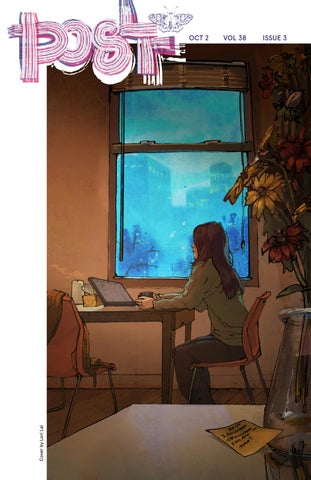
Cover by Lori Lai
OCT 2
VOL 38
ISSUE 3
Table of
Contents feature
te quiero
1
purple girl
3
i'm not homesick?
5
arts & culture
explore the world!
7
a dichotomy on wickenden
9
lifestyle post-pourri
a series of monologues in which you get to become someone else
13
ouroboros
15
how do we talk to each other?
16
narrative
crossword
Least Productive Debates 1.
Oxford comma (it’s correct)
2.
The one between me and my mom
3.
Presidential
4.
Is zero a natural number?
5.
Everyone Gets A Puppy (50.1%) vs. Diarrhea Forever (49.9%)
6.
Should I, the prince of Denmark, kill my loser uncle??
7.
Should I stay…or should I go?
8.
Brown vs. Harvard
9.
Is water wet?
10. Moses vs. Pharaoh 4
post–
“Cockroaches can survive anything but falling on their back.” “The sanctity of the horse has been destroyed.”
LETTER FROM THE EDITOR
letter from the editor
from her freshman fall. In A&C, Serena explores the world through Sporcle and details her love for geography, while Jack journeys to two Providence record stores to get to know the owners. In Lifestyle, Acadia provides some monologues to let you try out some different personas, and Krisha shares another piece in post-pourri about
Dear Readers,
change, unpredictability, and rationality. Finally,
After all of last week’s buildup and
make sure to complete Evan’s mini crossword
anticipation…we
survived
the
nor’easter.
before you go!
Sure, it was not the most delightful weekend—
As the winds calm down and the skies begin
starting with Harvard blowing us away on the
to clear, I look forward to brighter days ahead,
football field and then the storm sweeping us up
filled with less responsibilities. I hope that you
throughout the weekend—but all in all, we made
too, dear reader, can sit back and relax this week,
it through.
and feel cozy with this issue of post-.
This weekend felt like a perfect metaphor for the gust of commitments flying around as we leave Shopping Period behind and get settled into the semester. Sometimes it seems like an
Craving those Gilmore Girls-esque autumn days,
Jessica Lee Copy Chief
insurmountable storm, but somehow, we get through it. This week, our authors braved the storm to share some beautiful pieces for your reading pleasure. In Feature, Daniela discusses her evolving relationship with her first language. In Narrative, Coco explains what it means to be a “purple girl,” while Krisha muses on the feelings
O ctober 2, 2026
te quiero FEATURE
unearthing the abandoned and growing anew by Daniela Trejo-Rodriguez Illustrated by Sheryl Chen @sheryicoco Designed By James Farrington
“NO SE TE VAYA A OLVIDAR EL ESPAÑOL. CUANDO TENGAS TRABAJO, VAS A VER QUE TE VAN A PAGAR MÁS.” Those are the words that I typically hear whenever the topic of retaining my Spanish fluency comes up between me and my ma. I’ve had a front row seat to an infinite number of her knowing lectures, and this is a common one. She insists that bilingual people have better incomes, and that I should graduate university with some sort of certification proving my capability in the language. I don’t doubt her, of course. Knowing more than one language is useful in the workplace, and besides, who would pass up the chance to earn more money? When I decided this past summer that concentrating in Spanish didn’t sound too bad, I was admittedly searching blindly in the dark for direction. I didn’t know what I wanted, much like many other anxious teenagers being thrown into college life. And if I didn’t know what I wanted, then I would go with something safe, like Spanish. It fit nicely alongside International and Public Affairs (IAPA), and it made my ma happy, too, which was really the most important thing. As much as I was passionate about studying what I was interested in, I also wanted to satisfy her expectations. Now that I’ve started my first semester at Brown, I’ve told many people that, in addition to IAPA, I intend to concentrate in Spanish. I’d noticed for many years prior that my Spanishspeaking skills were lacking. Whenever I went on vacations to Mexico, I would hover behind my younger sister, listening as she took the reins of conversations, rambling to family members and friends in an accent and with vocabulary far better than mine. During family gatherings, I spent my time reciting possible responses to possible questions so as to not stumble over my words in case anyone caught me off guard. Even at home, my Spanglish became increasingly more English than Spanish, and I would fall into the habit of ending conversations with my ma prematurely because I didn’t know how else to further express myself, a habit that came to define our oftentimes unstable relationship. “VINE SOLITA HACE MÁS DE VEINTE AÑOS.” My ma came from Mexico to this country over twenty years ago with a handbag and little else in terms of personal belongings. Her grandpa had been a laborer in the Bracero Program of 1942, which allowed many Mexican people to work in the United States due to wartime labor shortages. As a young girl in 1
post–
the small town of San Miguel Caltepantla, she would find photos of him on an orange orchard in Florida stashed away in an old trunk. American influence would continue to seep into her everyday life—whether it be through music discs her uncles brought home featuring artists like Michael Jackson and Queen, TV programs showcasing a very recognizable gray cat and brown mouse, or news stories carried through the radio. She longed to see for herself the origins of these American products and to see the places in which her uncles worked to help maintain their family. And, more personally, she wished to work in America in order to be able to afford the basic necessities she never had. By the time she graduated high school, one of her uncles had offered to pay for her to go to a university, but ridden with self-doubt and fear of his money amounting to nothing, she told herself she would spend three, maybe five years working in the United States, and then come back, this time with money that belonged to her and no one else. So, on a Thursday she remembers very distinctly, she crossed the border on foot with false identification, arriving first at Laredo, Texas, then taking a bus to Dallas, and from there, arriving by flight to North Carolina, all by the next Monday. As any reader of this can likely guess, she did not, in fact, only stay in the United States for a couple of years. Rather, it is in Hickory, North Carolina that she would give birth to my older brother, me, and finally, my younger
sister. Spanish would become my siblings’and my first and only language, up until around when we turned four or five years old. And while my siblings and I worked hard at getting used to the uneven syllables of the English language, our ma worked tirelessly as a welder in order to provide us a childhood she never got to have herself. “NO SÉ CÓMO DECIRLO.” I don’t know how to say it. As the years have gone by, this sentence has become a staple in my conversations with my ma. I wonder what my ma feels when I say those words. Exasperation? Annoyance? Disappointment? I don’t recall learning English ever being a hard process for me. I’m sure I struggled in the early stages. Who wouldn’t? It sounded totally different from the quick and seamlessly-flowing words of my native language. But by the time I finally made it to kindergarten, I remember being assigned the role of translator, conveying the words of my Spanish-speaking peers who otherwise wouldn’t be understood. It honestly felt sort of like magic, being able to switch between languages so seamlessly. I felt so capable. Outside of class, I read English books fervently, spending my time at recess sitting on a bench, flipping pages gingerly every few minutes. I would even write fictitious stories of my own, mimicking the authors whose words I so greedily consumed. For the rest of elementary school and middle school, I became a stranger to the Spanish language, setting it aside in favor of
FEATURE
English. I never took any Spanish classes, and I only spoke Spanish at home. Speaking Spanish became synonymous with the confines of our small trailer, and only during exchanges with my ma, not my siblings. And so emerged the fault between me and my native language. I didn’t really like speaking Spanish in front of people other than my family. I felt like I was putting on a performance, like I was doing something unnatural. I would pay attention to the looks my family received when we walked into stores conversing in our native tongue. I remember being afraid we were “too loud,” even though another family could be reciting our conversations word for word and decibel for decibel in English and it’d be seen as totally normal. Despite not being fully aware of this prejudice, I internalized that prickly feeling of unwanted attention, building up an ugly, buried catalog of shame and embarrassment with regard to Spanish. As I became more aware of my deteriorating Spanish skills in high school, that catalog finally surfaced, exploding unapologetically before me. I vividly remember a day in freshman year where we had to practice student-led conferences showcasing all the work we’d done for the semester, which would be presented for our parents. Since I knew my mom wouldn’t like a presentation entirely spoken in English, I joined the Spanish-speaking group without thinking. And as soon as it became my turn to present, I froze, my heart racing like it had decided to run a marathon all of a sudden. I
realized then that I didn’t have nearly enough words in my vocabulary to present in Spanish, not without inserting multiple English words. But who joined the Spanish group just to end up speaking Spanglish? I thought that was dumb. I felt dumb. With every sentence that I butchered, I shrank further into myself, my posture worsening and my eyes becoming glued to the floor, so that by the end of my presentation I was nothing but a mumbling mess, my face glowing with uncomfortable heat. I was mortified. But I did nothing to change. Despite all of these warning signs before me, despite all of them pointing to a very deep-rooted problem, I turned a blind eye. If things had gotten to be this bad, then I couldn’t fathom attempting to change. I was afraid of what that would mean— admitting that I had become incapable? When Spanish was literally my first language? Such thoughts filled me with such shame that I refused to take any action. “¿QUÉ ME PASA?” On the second day of my HISP 0650 class at Brown, I didn’t say a single word during our class discussion. I mean, this isn’t really atypical of me, if I’m being honest. I’ve always been an anxious person, and sometimes I would just rather hear what other people have to say. But what made this incident so disturbing to me was why I didn’t speak up. The class was titled “Advanced Spanish Through Literature & Film”—I loved literature, and I loved film. I had a lot to say, in fact. But no
matter how much I wanted to, I just could not bring myself to raise my hand and speak up. As I sat there, taking note of my peers’ advanced vocabulary, missing out on cultural context— who even was Don Quijote?—and scrambling to comprehend every word that came out of my instructor’s mouth, a restless feeling gnawed at me from within. My vision became unfocused, and I felt sick to my stomach. Yet again, I felt like I was a stranger, putting on this performance of knowing Spanish when the truth was I had neglected the language for years. As I walked out of that classroom, trudging along the seven-minute walk back to my dorm, I dwelled on how I felt. Wetness prickled my eyes, causing my nose to run even in the hot and humid weather. It’s not that I was too intimidated to speak. It’s not even really that I was too scared to speak. I was ashamed. For the first time in years, I had been confronted with the consequences of my passivity. I couldn’t even share what I genuinely wanted to share— that’s how bad it had gotten. And as I immediately thought to tell my ma what had just happened, I became aware of a feeling even more important: I had failed her. My ma, who crossed the southern border by foot with only a handbag to her name, who worked relentlessly to fuel my dreams, who gave me the joy of my very first words. Spanish wasn’t just another language to me; it wasn’t just another bullet point to add to my resume for work. Spanish was a gift from my ma, a daily reminder of the life she had left behind and one of the strongest bonds connecting us. Without Spanish, I had no relationship with her. How could I have ever dismissed that? “TE QUIERO.” I’ve always been hypersensitive to the meaning of words in Spanish despite not having the biggest vocabulary—they’ve always carried a heavier weight of meaning. The worst arguments I’ve had with my ma have been mostly in Spanish, and I personally think that being on the receiving end of curse words in Spanish feels way worse than curse words in English. I’ve said “I love you” to many people in English, while in Spanish, I can barely even muster up the courage to simply say “te quiero.” And I think that sums up the essence of my point. Spanish—or any other language, for that matter—is not just a compilation of words, nor is it just the different shapes of syllables formed by the tongue. Rather, Spanish is a story to be shared, a culmination of lives and experiences and human connection. To me, Spanish is a representation of everything that my ma has done to raise me in a world full of opportunities and joys to be experienced. I said that one of my intended concentrations was Spanish. But I sort of lied. The real title of that concentration is “Hispanic Literatures and Cultures.” Yet again, that reinforces the notion that Spanish cannot be stripped from its rich history, especially that of its speakers. Needless to say, I am not going to be concentrating in Hispanic Literatures and Cultures just for the sake of finding employment or making more money. Rather, after years of studying and improving and becoming a better person than I was before, I will honor all my ma has sacrificed for me and my siblings.
september O ctober25, 2, 2026
2
NARRATIVE
purple girl taking purple personally
by Coco Kanders Illustrated by Rai Pillai @xraispex Designed by Hannah Gapp
There is a particular kind of girl on the internet who doesn't seem to like purple so much as to have been claimed by the color. I know this because I am, or at least my phone thinks I am, one of them. As I endeavored down the internet rabbit hole of the so-called “Purple Girl,” it became clear that she exists within a fully developed atmosphere. Edits of purple moons suspended over black water, black cats with violet eyes, long brown wavy hair cascading over a leather jacket, perhaps a flannel, coffee in a mug that you just know has gone cold, purple Converse, images of Euphoria glitter tears, or even better, Maddy, a central Euphoria character who internalizes spectatorship as a form of authorship, in her purple two-piece set from the Season One carnival scene. These reels are almost always soundtracked to a moody hit like Air’s “Playground Love,” or Grimes’ “Oblivion," or the Smashing Pumpkins’ “1979.” The images themselves have almost nothing to do with one another; purple is the principle that allows them to coexist. The color that turns a collection of otherwise unrelated objects into a single sensibility. The Purple Girl is a little goth, but not aggressively so; romantic, but too mysterious to be fully realized as such; feminine without the conspicuous labor of femininity; and somehow melancholic without appearing particularly unhappy. There is also a more maximalist version of her that draws no help from established aesthetics. AI images of a bedroom made entirely purple: purple walls, purple carpet, purple curtains, purple bedding, purple LEDs bleeding across the ceiling, an anime-looking girl with purple hair and purple clothes standing innocently in the middle of the room as though she has not decorated the bedroom but constructed a shrine. Hyperpop plays over the video, and the effect is both absurd and coherent. The color has swallowed the room, and the girl seems to have been swallowed with it. In either case, purple becomes a persona. What is interesting about these images is not that they accurately describe any particular kind of person, because they obviously do not, but that the color becomes diagnostic. Purple becomes a shorthand for an interior world, a way of suggesting personhood, from what she reads to what kind of sadness she might possess. A preference becomes a personality, and a personality begins to resemble a mythology. But there is also an underlying notion that the Purple Girl is “unwell.” This is clocked by Reddit users under the thread “People who 3
post–
Love Purple.” With 313 upvotes, u/Spiritualassist7873 can’t help but notice that people whose favorite color is purple do not merely like it but are “passionate about their purple.” u/Oneiros5321 concurs: “Why does every single person on earth who likes purple make it their entire personality?” The response from one purple partisan, u/PuzzleheadedRoyal559, is characteristically absolute: “ Purple is just a color to you. It’s a religion to us ️️ .” But why purple? Why is this particular color so available for the construction of oneself? The internet did not invent this particular
💜💜 ✝✝
use of purple; it only made it easier to see. Long before liking Instagram reels became a way to signal one's identity, purple was that signifier. Purple, unlike blue to the sky, green to trees and grass, and red to blood and fire, is scarcely found in the natural world. Purple exists, of course, in flowers and fruit and bruises, but it has never occurred as abundantly or as ordinarily as many other colors. For much of history, people worked very hard to produce purple. The first use of purple was found in prehistoric cave art at Pech Merle Cave in France (c. 35,000–16,000 BCE), where early humans
NARRATIVE
blended manganese and hematite powder to create purplish pigments, using them to paint geometric shapes and animals alike. Cut to 547 CE, purple was the most expensive dye in the world, or at least in ancient Greece. In the city of Tire, now in Lebanon, one of the earliest known forms of purple dye—Tyrian purple— was extracted from sea snails. Famously worth more than its weight in gold during antiquity, its production was incredibly resource- and laborintensive, requiring approximately 10,000 to 12,000 snails to harvest just one gram of dye. The result was beautiful enough to justify
the trouble. Thus, within Rome, Greece, and the Byzantine Empire, Tyrian purple became the ultimate status symbol. Roman emperors issued laws dictating who could wear it, and under some rulers, any unauthorized citizen caught wearing or trading the color faced asset seizure or even execution. Purple did not simply signify power, but also helped create the appearance of it. To see purple was to see scarcity, and therefore someone who had access to what almost everyone else did not. The color was evidence of a particular kind of life. For centuries, purple’s power depended on
its rarity. Then, in 1856, English chemist William Henry Perkin accidentally discovered mauveine, the first commercially successful synthetic purple dye, while attempting to synthesize quinine, a treatment for malaria. So now, purple could be sold in shops: dresses, nail polish, eyeshadow, iPhone cases! You name it. The color moved into the private lives of people who had never possessed a throne or expected to. One might have expected the democratization of the color to destroy its mystique; instead, the terms of the relationship changed. When purple could no longer distinguish the powerful from everyone else, it became available for common people to distinguish themselves from each other. Purple's meaning was no longer imposed upon the wearer by a court or a law, but could be chosen; once a color can be chosen, it can serve as a form of self-definition. This is perhaps the strange continuity of purple’s history: It has rarely had one fixed meaning, but has repeatedly been useful to people who wanted to make a particular identity visible. Only within the last century has purple been the visual language of, just to name a few, the women’s suffrage movement, the psychedelic anthem of Jimi Hendrix’s Purple Haze, and a lens to identify beauty (and, with it, a selfhood) in Alice Walker’s The Color Purple, before becoming, in Prince's Purple Rain, an entire world and spectacle that made the color inseparable from the man who created it. I can't help but hand it to Olivia Rodrigo’s latest ballad “purple,” in which she sings that red and blue (she and a boy, I presume) collide until neither can be picked out of the mix. It is a love song, but it is also almost by accident. People are what happens when two things stop being separate. Maybe that is why purple effortlessly lends itself to obsession: to become obsessed with something is to stop merely seeing it and begin building one’s world around it, letting it arrange everything else. The moon, the cat, the glitter tear didn't belong together until purple gave them a reason to. And the self works just the same, a pile of preferences that, given something to get together around, begins to resemble a person. It's worth remembering what purple costs, that in ancient times the color was an inheritance; it was chosen, it was proof they had been chosen. The Purple Girl reverses every term of that arrangement, purple arriving endlessly. Yet, she spends it the way emperors did: as evidence. What is scarce now is the feeling of being someone in particular, and purple, cheap as it has become, still promises to supply it. Last Halloween, I wore Maddy's purple twopiece set, and frankly, that was the hottest I've ever felt, and it wasn't just because I was hidden behind a costume. Nobody is born in purple anymore, but made into the way purple itself was made, with a great deal of effort, out of things that were never purple to begin with, until the result is so vivid it looks like who you were all along.
O ctober 2, 2026
4
NARRATIVE
i'm not homesick? i'm not homesick? i'm not homesick
neither here nor there
by Krisha Pakala Illustrated by Stefanie Lee Designed by Hannah Gapp
The first night after I moved in, I felt something odd. Or rather, felt a lack of something. I didn’t have the urge to ponder or contemplate—a rare occurrence—what my life would be like for the next nine months, nine hundred miles away from home. I didn’t have the urge to turn around and get back on the plane. This is a stark difference from those around me, who routinely call friends and family and express their longing for home, their pets, their food. It’s not that I have nothing to miss from the suburbs of Wisconsin. I miss the incense my father would burn every night ( jasmine and sandalwood) and the sound of our fireplace crackling in the bitter cold of the winter months. Perhaps this is because I craved independence even before I left for Providence. The idea of being in charge of my own life, maybe foolishly, seemed more like a great becoming than a burdensome responsibility. I was wishing time away during high school, hoping: I can’t wait until I’m somewhere other than here. As graduation approached, I kept hearing my friends talk about the inevitable bittersweetness of the summer, knowing that every day we spent together we’d be getting closer to being far apart. I nodded my head as if I agreed when I didn’t. It’s not that I don’t value my hometown friends or the memories—it was that I knew they’d always be in the periphery of my college life, only a phone call away. I trusted myself to reach out to them, so missing them seemed like pre-emptive and unnecessary sadness. At the same time, I accepted that once we all left, things would not be the same. There 5
post–
would be a defined period of “before college” and “after college.” It’s disorienting to think of the present relative to the future. I think about how I will tell my friends about all of the adventures and mundanities of my life at Brown as I am living them. I even think (not disingenuously) about how all the people I am bound to meet are seeing a polished vase, one carefully designed and curated and optimized, but not all the years of pieces it took to create it. So now I hold myself tightly together upon College Hill, worried that if I don’t, the vase will crack open and there will be nothing to
spill out. And what of the place I’m supposed to call home? I’m not sure home is even a tangible place to me. I’m sure many others have felt this before; we’ve surely believed at some point in these past three weeks that we will go home after this extended trip. I don’t feel a call to home, though. I’m not afflicted with homesickness in the slightest. Answers to everything related to my personhood, ambitions, and whatever else seemed so obvious before I came to Brown. I see now that the comfort of my hometown has blinded me to the fact that change can
NARRATIVE
k?k?
expose both stagnation and an overwhelming abandonment of everything I thought to be reality. I’m stagnating, in that home is still not here, or in Wisconsin. But at the same time, in the minor ways I’ve changed so far, they are not the changes I ever imagined for myself. In my current state of metamorphosis, where all my previous external structures of support have been eroded, I have to confront, at some point, that no amount of scrutiny or psychoanalysis—of who I am, was, or will be—will give me an answer to who or how I am supposed to be. No place will give me an
answer. Not home, and not Brown. They are in some other space that I cannot seem to grasp.
O ctober 2, 2026
6
explore the world! A&C
on geography games, friendships, and history by Serena Lee Illustrated by Robin Goldfarb Designed by emma vachal
South Africa, Lesotho, Eswatini. As my fingers fly across my keyboard, more and more of the interactive map on my screen fills in, transforming an initially blank world map into a detailed account of 197 nation-states. I hover over the keys as I contemplate the blank space between Nepal and Myanmar, and the seconds begin to tick down on the timer at the top left of my screen. It hits me like lightning—Bhutan! 197 countries in 5:40—not my best, but not my worst either. Sporcle’s online “Name the Countries of the World” quiz has been a favorite game of mine since the Covid pandemic, when my sheer boredom from the endlessness of Zoom classes compelled me to seek emergency alternatives to keep me entertained. In the game, you’re given fifteen minutes to type out as many countries as you can from memory, and you are rewarded with the satisfaction of essentially creating the world with your own hands. You are the closest to God here. You and your goldfish memory decide which countries exist on your screen. — I remember being five years old and frequenting the narrow hallway of my first 7
post–
house, where my mom had put up a five-byfour-foot world map poster to cover the cracked paint on the walls. Criss-cross on the floor, I’d trace my fingers down the borders like a roadtrip route, dazzled by the myriad colors that filled my vision. South Korea was bright pink, North Korea green, and the two were nestled between orange China and purple Japan. The world was bursting with color. When my parents told me that we’d be moving to Cambodia when I was seven years old, my sister and I scrambled to our giant world map in search of this elusive nation. It wasn’t in South America, nor Africa. Just as we began losing hope, we found it, bright red Cambodia tucked like a half-bloomed flower, locked in an embrace with Thailand, Laos, and Vietnam. That was my first time seeing my new home. In the living room, I’d spin our thrifted globe, landing my index finger on random countries, twirling the globe again and again until I finally landed on South Korea or the United States or Cambodia—the only three countries that were real to me. Three homes on a three-dimensional plane of hundreds of nation-states.
The world had yet to become real to me; it was just colors on my wall. — During the seven years I spent in Phnom Penh, Cambodia, the borders of the world began to materialize through my own lived experiences. The jagged line I saw on the map between Cambodia and Vietnam was covered by tall grass and dilapidated wooden fences in real life. I stood in line on Cambodia’s side with my family, braving the afternoon heat to renew our residential visas. To do so, we’d have to cross the border for a single heartbeat. A moment in Vietnam for three more years in Cambodia. This was the first time a border felt real. I quickly learned more about the discoverable nature of my world—a world scythed by borders yet whole nonetheless. Thailand was either a nine hour drive or a fifty-five minute flight away from Phnom Penh, though tracing its western peninsula to reach Phuket would take an additional hour by plane. Singapore was the smallest island-nation in the area, yet a bridge connected it to mainland Malaysia—much different from and more interconnected than the ugly black squiggle dividing the two nations
NARRATIVE
on a world map. As the borders of my world increased in clarity, so did my interest in understanding them. When Covid struck, I spent nearly two years, as we all did, under virtual house arrest in Cambodia. There would be no more physical exploration of the world around me. So I shifted to the next best option: learning about the world online. Watching sightseeing YouTube videos and Netflix nature documentaries eventually brought me down a rabbit hole that culminated with Sporcle’s neverending catalogue of geography quizzes. Sporcle is a website where you can play trivia games and quizzes on hundreds of different topics. One of their largest categories is geography games, of which “Name the Countries of the World” is my favorite. The game became a chance to test myself on what I knew and an opportunity to discover worlds I had yet to see for myself. For days, I would race the clock, typing with urgency to fill in the blank map as my brain stalled on areas I didn’t know by heart. What bordered Liberia? What country in the Caribbean was I missing? By studying the names of the countries
I missed, I soon became able to recite them by heart. I shaved minutes off my personal best, and my geography recitation abilities soared. The game had become the catalyst through which I memorized the names of the entire world around me, from countries I’d never seen before to ones I knew so intimately. In this way, “Name the Countries of the World” was my dearest companion, my small window into the world I was yearning for during Covid. When the pandemic ended and I eventually moved back to the United States, I confided my love for geography to Alex, a friend I met in American high school, only to discover he had never learned where the countries of the world were. Canada was north of the United States, Mexico was south…his knowledge tapered off from there. While my world had been so deeply written by the black and white borders of geography, the American curriculum’s lack of emphasis on foreign borders outside of the continent meant he had never formally learned the world map. Emboldened, I offered to teach him everything I knew about geography over the summer, and soon, our march to memorize the world commenced.
A&C
During that summer, Alex and I would meet everywhere across San Diego. Public libraries, high school classrooms, my living room (accompanied by my hyper toy poodle), the back corner of Panera armed with a potato cream soup and half a chicken sandwich. We talked about math (his interest), writing (my interest), and most importantly, geography. Together, we’d huddle over a shared laptop and take turns typing in the country names we could remember, filling in blanks when the other forgot. The game invites a journey toward ultimate perfection. We play again and again because we are bound to forget a country or two, and through it we can relearn a region of the world. By shaving seconds off of my records, I feel closer to understanding the vastness of our planet. As more and more of the map became clear to Alex, he began to ask questions as well. Why do the borders look the way they do? Is there a reason why Cambodia has so little coastal access compared to its neighbors? What is the history behind the dividing line between North and South Korea? Though I had spent the past year of my life dedicated to the rote memorization of Sporcle, his questions drove me to dig deeper. The borders made sense like puzzles clicking into place, but there were also stories written within every black line on the world map I had so much fun filling in. Together, we vowed to learn the history of why the map looked the way it did. In our journeys through TedED videos, online articles, and the occasional expository TikTok (corroborated by other sources, of course), we began to learn beyond the Sporcle screen. I realized I wasn’t only enamored by the speed and thrill of the game but rather the sense of discovery I experienced during it, and that discovery had brought me to understanding more of the world’s history. The map soon became more than just a twodimensional iteration of the world; instead, it was a genuine window through which we discovered the world in earnest. As we traveled across the world online, we uncovered the storylines wedged between borders, the lives encapsulated within a 900x600 pixel world map: the dreams of exploration in the Americas, the sins of colonialism in Africa, the foolishness of warfare in Europe. — Alex and I still keep up with our Sporcle habits, though we may both be rusty from the general harrows of college life that keep tearing us away from our beloved geography game. I opened the website while writing this article, seated on a plush couch in the awkwardly silent Hay Library, and attempted to rival my previous records. I was three minutes off, an egregious downfall. Yet the thrill was still there. Again, I was an explorer. I had revived my joy of filling in country names on Sporcle, discovering their histories through personal research, opening my eyes to a larger world. Yes, Cameroon is next to the Central African Republic. Yes, Grenada is a Caribbean island. Yes, the world is as large and as small as you can make it. Is the world infinite or is it 900x600 pixels on a dusty Macbook? Well, it is through this two-dimensional game that we’ve discovered the infinite bounds of our world. Alex and I agree that the two are the same.
O ctober 2, 2026
8
A&C
a di
ch
to
y o m o
Before coming to Providence, I figured there would be a market here for vintage shops of all sorts. We’re Gen Z college students, after all—we get a yen for that sort of thing. At least I know I do. Sure enough, I realized a few weeks into the fall semester that I would need some new records to get me through the chilly days ahead. I began looking for shops to scratch that distinct itch for a cozy, warm nook in which I could browse through records and forget that I had access to each of them in my pocket—consider me yenned. I was soon surprised to find two shops on Wickenden Street, only a few blocks apart. As I read through Yelp reviews and threads on Reddit, my surprise turned into shock. While one store, Olympic Records, seemed to be charming and widely appreciated, the other store, Round Again Records, had one consistent and overwhelming complaint: the owner. The vast majority of Yelp reviews mentioned something about his “breathtakingly rude” comments or his “irritated and cold” manner. I had to meet the guy for myself and see just how different these neighboring shops actually were. So, on an extremely windy Friday afternoon, I passed many a Brown-Harvard goer and made my way down to Wickenden Street, on a quest both for autumn records and a story or two to go along with them. A combination of fear and closing times led me to turn left on Wickenden and head towards Olympic Records, owned by Kevin Morosini, who Yelpers describe as the polar opposite of the Round Again Records owner: “He is very friendly, chatty, and knowledgeable, and one of the coolest shopkeepers I’ve met in Providence.” When I entered the store at 580 Wickenden St., only one other customer was 9
post–
inside. She was young, with oversized jeans and a khaki fanny pack that’s sort of hard to describe; I wondered if she was a Brown or RISD student. She was asking the man dusting records in the back—the famous Kevin Morosini—if he had any house or techno jams because she was having some friends over that night. The man apologized and said he didn’t have any in at the moment. The customer smiled and said, “Alright, Prince will have to do.” The man responded, “I think he’ll do just fine.” Olympic Records has an engaging and exciting vibe. The walls are full to the brim with records, posters, art, and vintage record store bags. I asked about the record store bags and the owner—the beloved Morosini—told me that “some of them are still around, but most of the places are gone. It's something that I've always liked, the printed bag. You know, I bust my ass like once a week, printing my own bag. It’s a little bit of work on my end of things, but I think that when somebody comes home, it’s nice to have something like this to look at.” Morosini’s darn right—an Olympic Records bag now hangs on my wall. He continues, pointing at a few 45s on the wall, “the decor of the store is kind of a mix of that
o l d record store stuff, like a beat-up single with ‘Shelley plus Butcher’ written on it. Mississippi Queen was their song—this was a thing couples did in the sixties.” Olympic Records’s selection, excluding house and techno, was pretty expansive. The right wall where I started browsing was dedicated pretty much exclusively to rock, with everything from newer indie/punk to The
A&C
ede
y on w ick
n
a record crawl from one ethos to another by Jack Serpick Illustrated by Yoonseo Lee Designed by emma vachal
Beatles. As I made my way to the left side of the store, I came across a section labeled, “Misc. Weird. Sounds. Everything else…” I quickly moved past that, flipped through the hip-hop section, and found a few bins with a four-for-ten deal. I was thrilled to find that there were some records I was quite excited about, though their condition wasn’t exactly pristine. Still, I snagged four keepers: two Donovan
records (Open Road and Fairy Tale), James Taylor’s Greatest Hits, and The Yardbirds’ Little Games. The CD section was pretty solid too, though a bit less organized (in a charming way). Looking through the selection, the next disc was a surprise every time. Inspired by the earlier customer to host a little upbeat gathering, I grabbed OutKast’s Stankonia. The whole place felt deeply genuine, like I was looking through someone’s personal collection and getting a peek at their true music taste, no larping involved. It was a fun experience that left me extremely curious about Morosini’s story and why he, a relatively young guy, chose to open the store in 2011. His answer was a solid precursor to our long chat about the modern passion for vinyl: “I’ve loved records since I was a kid. The story is not amazing; it’s not like I’ve had this lifelong aspiration to own a record store. It was one of those things where everything kind of just came together. I was working a lot and not really happy with my situation and I said, ‘You know what? I think I can open a record store.’ I found this space, knock on wood, and everything sort of lined up. I didn’t really realize that it was what I wanted to do, but record stores obviously always appealed to me.” Go figure.
Morosini told me that for the first four or five years, he sold a lot of new records because, at the time, “there wasn’t really a store on the east side of Providence that was selling new records, current music, and stuff like that.” I couldn’t help but wonder what Round About Records was up to during this time. Olympic Records moved away from this niche for a particular reason that led to the more expansive collection I saw: “The labels really started to focus on selling directly to the customer where, for a long time, the labels would sell to all the record stores and then the customers would come into the record stores to buy the records. Well, it seemed to me that at that time period, probably having a lot to do with social media and Facebook, they really realized, ‘Well, wait a second. Instead of wholesaling the records to this place, let’s just sell them to you and you can pretty easily preorder an album from whatever record label.’ They were actually really pretty good about getting this stuff into your hands the same day that you would be getting it if you just walked over here and bought it. So that certainly put a damper on what was already a very tough thing to make a profit off of. When I started to notice that was happening, I sort of phased out and just started to buy more used stuff. And my taste kind of changed right around that same time period too.” It was clear to me that Morosini has a passion for physical media. When kids come in, he doesn’t see them as posers, but as people who should be allowed to know what it feels like to hold your favorite record in your hands. When I asked about records that younger audiences gravitate towards, he said, “I feel it’s important, even if I’m not making much money on some of this stuff, to have it on the shelves. I’ll get a high school kid or a twelve-year-old kid that just got a record player and is like, ‘Oh, cool, I'm gonna O ctober 2, 2026
10
A&C
b u y a Nirvana record.’ It’s important to have that for them when they do come in, so they’ll feel included in the whole thing. I get Lana Del Rey records and stuff like that too.” After checking out, I wanted to keep chatting with the guy, but time wasn’t getting any slower and I had another shop with another owner to get to. So, I shoved the four records and CD in my backpack and headed down Wickenden to Round Again Records in search of some more records and the infamous man behind the desk. I grew nervous on the walk over, and
11
post–
even before I reached the jammed-shut door at 278 Wickenden St., I had already been overcome with an, albeit peripheral, feeling of dread. I didn’t want to be mocked or made fun of as so many Redditors and Yelp reviewers had. I imagined this feeling is common for customers who read the reviews. Whatever solace that provided, though, was soon obliterated by the mortifying thing that happened next. The front door was shut pretty tightly, in my defense. After a few tries, I figured I needed to change my approach. I turned perpendicular to the door, bent my knees into the sort of “ready position” tennis players use, and slammed my shoulder into the door with far more force than I’d intended. Of course, the door flew open and made a raucous noise as I stumbled in, Kramer-like. I looked up and a relatively old man with white-gray hair and glasses turned his head, mouth agape. We made horrified eye contact like two beings from different planets and I realized who this was: the man himself, the disreputable owner of Round Again Records, Steve Kolter. I quickly looked away and pretended to start browsing. Luckily, Kolter was in conversation with a friend who didn’t seem to notice my fiasco at the doorway, so it wasn’t too long before I felt the man’s eyes lift off of my back and I could relax. The two men, maybe in their late sixties or early seventies, were talking about New York and times long ago when Kolter says
he was living a “different life.” He used to manage a comedy club in the city and explained to his buddy that he “could have been a contender instead of what [he] is: a bum.” Overhearing this conversation was far more interesting than the records in front of me. I knew I had to talk to Kolter myself, but I needed to psych myself up before I could approach the desk. I also wanted to wait for his friend, who seemed comparatively quite boring, to give me an opportunity to hop in. I began flipping through the vinyls in front of me. The left wall, where I was, held mostly older soul music and R&B. This was probably the largest selection. Further down, towards the back, was the jazz and classical selection, which notably lacked contemporary projects. Also in the back was a bin of $1 records in shockingly good condition. The deeper I dug, the more I realized how much care Kolter put into the place. Everything seemed to be well taken care of and organized so as to flow smoothly from one section to the next. I was over the moon when I found Stephen Bishop’s Careless for just one dollar. I thought it had to be a mistake, but Kolter later told me he had too many copies—still seems wild to me. I’m no expert, but the pricing of several items seemed a little wonky to me. One angry Yelp reviewer noted something similar: “He had one record priced $30 that I'm guessing he put that price on twenty years ago and it’s been sitting there ever since. I looked it up online and it was $10 in mint condition, so I was going to see if I could offer him $15. I asked very politely if he was open to any kind of negotiation around prices and his response was, I’m paraphrasing, ‘I priced things what I think they're worth. Why would I accept less than what I think they're worth?’ So I didn't get that record. I did however buy a Madonna CD for $7.99 which is actually a 24k gold Japanese import release with a rough estimated value of $250, so karma's a bitch.” On the other side of the store was rock and pop. At one point, I was walking about with Prince’s Around The World In
A&C
A Day under my arm, but I decided to get Lindsay Buckingham and Stevie Nicks’s Buckingham Nicks instead. The record was just re-released about a year ago, and it’s an incredible relic from the years before the pair joined Fleetwood Mac. “Long Distance Winner” and “Stephanie” are my favorite tracks. The album cover—young, nude, and gorgeous—put me in a sort of trance which was broken only when I overheard Kolter and his pal saying their goodbyes. My time was near. I took a few nervous laps around the store, looking at nothing in particular, thinking about what my first question should be, and landing on the thing that I was most interested in: his story. So I went up to the front desk, introduced myself, and asked if he could tell me a bit about himself and what brought him to Providence. His response? “Let’s talk about the store.” Could’ve been worse—I’ll take it. I instead asked about the store’s location, assuming he’d say it had something to do with proximity to Brown and college students. I was wrong again: “The reason I opened on Wickenden Street was because, off 195, there were Wickenden Street exits. There were signs that said ‘Wickenden Street,’ so I knew that it would be easy to find the place. Secondly, this was a lowincome immigrant neighborhood where I could rent a storefront for very little money. This wasn't a college neighborhood then. It was a Portuguese-Azorian, Cape Verdean neighborhood. This neighborhood was always, until the last twenty years, an immigrant neighborhood.” Kolter told me that the changes in the neighborhood didn’t affect his business all that much though, because his customer base has never simply consisted of residents: “It's always been a store for record collectors, and record collectors find record stores.” True that. The man’s got a very passive attitude, both personally and when it comes to his business model. What’s more, he’s hyper-aware of this and seems to think it works well: “I don't advertise. I’ve never advertised ‘one-dollar records.’ You gotta find me. If you can’t find me, that’s okay—I
don't care.” At one point in our conversation, another customer came up to check out. He was middle-aged, with long hair and a leather jacket. After a smooth checkout, no insults or quips involved, an interesting exchange ensued. It was one which made me think the customer had seen a few reviews: Customer: “Well, keep doing what you’re doing. This is a cool thing.” Kolter: “Well, I’m gonna do it for a while longer. I’ve got nothing better to do.” Customer: “Hey, you’re bringing curiosity in here [gesturing to me]. You’ve got a good selection. I live on the West Coast and, everywhere I go, I look for record stores. That’s what record collectors do. You got a good shop, man. You’re right: You don’t need to fucking pay anybody, Yelp or Google or anybody, any money. People are gonna find it, people are gonna come in.” Kolter: “Yep. It’s worked for fortyseven years, so I'm not gonna change anything. If it ain't broke…” Customer: “Keep rambling.” Kolter: “Why not?” When I asked Kolter about his own music taste, he smirked, and I prepared for a lecture about how music today isn’t what it used to be. But then he said, “When I leave the store, I don't listen to any music at all, neither in my car nor at home at all, as in zero. I don’t want to listen to music when I leave the store. Just the idea of putting a record on a turntable is like work.” In fact, Kolter has never had a record collection. After I asked about how he started a record store with no records, he said, “Before I opened the store, I spent about six months going to yard sales and hustling, nickel and dime hustling.” By this point in our conversation, I felt like he was becoming more engaged, so I decided to try and prompt a little personal
life out of him again. It worked better than last time: “I did work in a motorcycle shop outside of Boston and I did run a nightclub in Manhattan and I did bang nails in southern Louisiana, but as far as having a retail store, this is the first one I’ve ever owned.” I still wasn’t sure, though, why he chose to open a record store in the first place, with no previous passion for records. I asked a few times during our conversation, and the best answer I got didn’t leave me all that satisfied. He said, “Because I lost my last job, and I had to find something to do when I didn’t want to go to work for anybody. So I opened my own store.” I don’t think I’ll ever really understand why he opened the shop. It was in a different time, under different circumstances than my own, with a more lived-in and probably less naive outlook than mine. Nonetheless, I’m glad he opened the shop, glad I got to learn a bit about him. Something tells me I’ll be back again. Stepping through the door into the gusty wind, I heard him singing the lyrics to Fred Neil’s "The Dolphin": “This old world may never change...”
O ctober 2, 2026
12
LIFESTYLE
by Acadia Phillips Illustrated by Lila Vianna @jademademoon_art DESIGNED BY Lily rantanen
A monologue in which you get to become a contented horse I am wandering through meadows. I am eating. I am enjoying what I eat. It is green, lush cud. I am not green, but I am lush, full of life, full of grass. I look to my left and see the sun is beginning to fall. I see a flock of wild horses scamper across the distant glen. They look supremely free. And comfortable in their skin. You might think I want that, the companionship the other horses have, the freedom to frolic. But the truth is I love my patch of grass, and I love my painted gate, and I love the sound of the wind, how I can listen to it from the same crack in the barn’s wall every single day. What is there in life, if not the sights you get the privilege to see grow, the friends you watch strain and shift? Why strive for newness when the old tune sounds so sweet? It is old, but it is not unchanging. It is old, but it isn’t dull.
es o
fs
ho
r
m t
a se ri mademoon_art
Do you ever get tired, and it’s not the sort of tired that you can crush? Some days, I get back to my bedroom, and all I want to do is pause my brain. If only I could just be someone somewhere else for a split second. I’ve suffered from this desire for dreamy paralysis forever. I’ve tried many solutions—going for a walk, quitting coffee, quality time with pettable pets—to very little avail. But I am delighted to inform you of the one thing that always snaps me out, distracts me, deters me: the theater. For years, theater has allowed me to shut off my brain momentarily. To embrace the lives of others, to become everyone but myself. Across the span of my community theater career, I have played many roles—mermaids, munchkins, a variety of animals—and in each role I have found the purest of distractions. Over the years, I have developed a system of working the practice of theater into my everyday life. When I become bogged down, or erratic, or questionably antsy, I open up my favorite plays, and I take on a brand new role. Through those pages, I am utterly transported. Theater doesn’t require an audience; it can be a purely solitary task. A reflection. An escape. This week, I want to provide you with an opportunity to intentionally become someone (or something) else. Please turn off your brain. Just for a moment. I promise it won’t hurt. It might even be a little fun. P.S. Please read these out loud. That’s a big part of the fun. They are monologues after all (and they’ll only take one minute).
on
h w n i s e u g o l o
by Acadia Phillips Illustrated by Lila Vianna @jade
13
post–
hich you get t o
LIFESTYLE
bec o
es
m
om eon
e e ls
A monologue in which you get to become a hyena at a girl-you-only-sort-of-know’s birthday party When I go to parties, I like to sit in the corner with my legs crossed. And to make myself look less ridiculously alone, I like to laugh boisterously at everything I see. When people look at me, or notice me, or ask me what’s so funny, I say something cute like “nothing!” or ask them why the chicken crossed the road. I don’t win many friends this way, but I feel like a brief moment of human interaction is worth my eternal embarrassment. I am always embarrassed. Hahahaha. No, really, I am. I am a diagnosed pool of embarrassment. I cannot change it. I cannot accept myself. Instead, I treat my embarrassment like a pesky gnat. Uncatchable. But if I try my very hardest, I can pretend, if even just for a moment, that he isn’t there. Hahahah. Hyenas don’t actually laugh, you know. It’s actually a rhythmic groan. A monologue in which you get to become a distinguished young lady who has a butler named Calvin Calvin! Oh, Calvin! Could you bring my tea to the parlor? I’m feeling exhausted. I’m feeling misty-eyed… Calvin, can you hear me? I said BRING ME MY TEA! Calvin exhausts me. Waiting exhausts me. I want things when I want them; I don’t like to be kept waiting. I like my tea how I like my men. Readily available! Ha ha. Calvin says I shouldn’t make jokes like that. Too crass. I always tell him that crass humor requires intellect. That unfunny people are also unintelligent people. He always frowns when I say this, a sheepish, ill-fitting frown. He’s never made a woman laugh before. Not more than polite giggles. Never a hardy laugh, especially not from me! Later today we are having a tea party, one with all the other girls from school. Calvin is serving scones. And cream. A mixed berry jam. A hardy porridge. Oh, I can’t wait. I love porridge. With three helpings of brown sugar and a bit of flaky chocolate on top. It is divine. Not because Calvin prepared it. No. It is divine because it is mine! Oh, Calvin? Do I hear him calling me? Ah yes. He says the girls are beginning to arrive. I must run. I must. My scones beckon. Do stop by for tea again next week! Thank you for playing pretend with me and indulging in my obnoxious tendency to monologue. If you had fun reading these, or felt yourself catching a fickle breath, I encourage you to perform for yourselves a little bit more, take a break from being you for just a moment each day. It can be a delightful escape.
O ctober 2, 2026
14
POST-POURRI POST-POURRI POST-POURRI
O P U T R S R O P I BEFORE YOU GO
ouroboros on cyclical rumination
by Krisha Pakala Illustrated by Spencer Smelser
In light of being at Brown for almost a month and the transitions that come with moving away from home, I’ve noticed that I’ve reflected more in these past couple of weeks than I did the entire summer. Why is that the case? Well, the night before I moved in, I Googled: I'm about to move into college why am I thinking so much, as one does. I squinted at my computer screen in the dark, tuning out the rustling of the itchy hotel comforter as I threw it off my legs. The answer I got was rational enough: During transitory periods of life, we are more prone not only to deep reflection, but also to selfconsciousness. Our external support structures and environments are taken away. We have to adjust to new routines. As I write retrospectively, the unpredictability I would face in the coming weeks, interestingly, began to breed predictable patterns in how I think. Walking through the Van Wickle Gates at Convocation—after standing in the blistering sun for an hour and being suffocated by the heat emanating from the 800-some people around me—might have been the greatest provocation. The paradox of waiting so long in discomfort for a mere moment that felt quite anticlimactic was a perfect summary of my worries. Everything I thought about Brown was no longer my imagination. It was coming alive, it was here, and it was going to be my new reality. To make sense of this reality, I did what I knew how to do: dissect every thought and will it to provide an answer. At times, I picture my mind as a Venus flytrap. Every thought that passes through is snapped at and digested slowly like a fly, until it can do nothing but wriggle and feebly attempt escape. This Venus flytrap does not rest. The flies squirm as I eat my breakfast and stare blankly out the V-Dub windows, as I put tomatoes in my salad, and as I put on my shower shoes. There is no running away, even in familiar, intuitive routines. Unpredictability became a problem to solve, and its constant, intense lingering is sure to bring discomfort. So now I have this thing: this intangible web of perceptions and judgments of others, the environment, and myself. This web has no beginning and no end, but somehow an infinite number of points of entry. The slightest engagement with a passive thought becomes active. It has become addictive in some sense; the potential for a thought to reach the nexus of its rationalization is too great to ignore. If thinking more could provide an answer, isn’t it worth it to continue, even if it’s paralyzing? In fact, I realize as I write this that I’ve managed to rationalize my ruminating. I have found a reason it exists and a reason it persists, yet I cannot manage to find a compelling reason not to do it. At what point can I say with certainty that my overanalyzing and dissecting every hour, minute, or second is unproductive or productive? Does such a binary even exist? And is it possible that it is neither? Alas, I’m left to default to the fact that this period is likely temporary, made so intense due to a significant life change. To put it rather formulaically, I’ve come to see the existence of impermanence as a negation of the significance of my rumination. This seems to be the conclusion I reach when I sit at Prospect Terrace, thinking and thinking and thinking as the sunlight filters through the trees.
15
post– 15 post– 13
1
2
post-mini crossword
by Evan Griffith-Ebrahimi
how do we ta lk to ea ch othe r?
CROSSWORD
illustrated by Orla Maxwell
each other?
3
4
5
7
6
8
9
9
Across
Down
1. _____ code 5. Alter written work 6. Newspapers, TV, Radio 8. Your dog when it's angry 9. An affirmation
1. Elmo on fire, Kermit sipping tea, Big Bird riding at dawn 2. Lyric Poem 3. John Denver's Blues? 4. What a gossip does to a pot 7. My reality plus a little more O ctober 2, 2026
16
Thank you for reading
magazine. New issues every week.
EDITOR-IN-CHIEF Elaina Bayard
“This rain is so cold and miserable. I feel like I have been sweetly gaslit by the glorious weather of Providence’s summer.” — Tarini Malhotra, “juxtaposition” 10.04.24
“Fall enters Providence with a quiet gravity. The city’s color palette shifts as the trees along Benefit Street turn.” — Liv Moon, “shades of today” 10.03.25
FEATURE Managing Editor Chloe Costa Baker Section Editors Helen Hen Anika Kotapally ARTS & CULTURE Managing Editor Sasha Gordon Section Editors Gabriella Miranda Rebecca Sanchez NARRATIVE Managing Editor Gabi Yuan
Section Editors Lucie Huang Chelsea Long LIFESTYLE Managing Editor Hallel Abrams Gerber Section Editors Alayna Chen Tatiana von Bothmer POST-POURRI Managing Editor Tarini Malhotra Section Editor Christina Li HEAD ILLUSTRATORS Junyue Ma Lesa Jae
COPY CHIEF Jessica Lee Copy Editors Eve Kobell Kate Schuyler Michelle Wassef Su Yang LAYOUT CHIEFS James Farrington Alexa Gay Amber Zhao Layout Designers Hannah Gapp Lily Rantanen Joshua Rezneck Emma Vachal SOCIAL MEDIA Yana Giannoutsos Hung Lam Eva Mahajan Rebecca Sanchez