PRESENTS
AUCTION: TUESDAY, JULY 21, 2020 AT 11 AM VIEWING: JULY 6 - 20 (DAILY 11 AM- 6 PM) TO BE HELD LIVE AND ONLINE AT
Rennert’s Gallery 26 W 17 TH ST. (BETWEEN 5 TH & 6 TH AVE.) NEW YORK, NY 10011 T: (212) 787-4000 F: (212) 604-9175 INFO@POSTERAUCTIONS.COM WWW.POSTERAUCTIONS.COM This sale is organized by Mr. Jack RENNERT and Ms. Terry SHARGEL. The catalogue is edited by Ms. Jessica ADAMS and designed by Mr. James M c COBB. For more information on this sale, as well as to place bids if unable to attend, please contact Ms. Terry Shargel.
A LETTER FROM JACK RENNERT
START BIDDING NOW
Dear Friends: We live in an uncommon time which requires special efforts to maintain our way of life—and our business. In spite of a pandemic which has taken so many lives and restricted us all, we intend to continue our Rare Posters auctions with the same high standards which have made them preeminent events in this field. It has been my enormous pride to publish a catalogue for each auction— totaling 80 in the past 35 years—which have become the worldwide exemplar for documentation and appreciation of vintage posters.
YOU CAN JOIN OUR JULY 21 AUCTION FROM ANYWHERE IN THE WORLD THROUGH THESE OPTIONS: ONLINE BIDDING Bid now and on auction day through our site: visit posterauctions.com and click Register to Bid. Or download our app—Poster Auctions International is available for Apple iOS and Android. To bid on either plat form, you must register a credit card; please be sure to do this before the live auction.
But while our next sale, our 81st auction, will uphold the quantity and quality
On auction day, follow the Live Auction link on our website to begin bidding—
of our prior auctions, it will regretfully not have a printed catalogue.
and remember to confirm your bid.
Instead, details for all 500 posters will be available in a downloadable
We recommend using our plat forms for a lower buyer’s premium (23%), but you may also bid through Invaluable and AuctionZip (25%).
document, and, as always, all lots will be posted on our website beginning July 1. Both will contain complete and informative background information on each poster. Bidding will be live and remain available on all our platforms, including our website, telephones, and order bids.
ABSENTEE & TELEPHONE BIDDING Complete the form on page 219 or download at posterauctions.com. For absentee bidding, indicate your ma ximum bid for each desired lot. You
It is our hope to exhibit all the posters in our gallery from July 6-20. We
may indicate an “either-or” bid if you want to purchase only a por tion of the
will take every precaution to make this the safest environment possible;
items on your wish list. You can also indicate an overall ma ximum dollar
should we require staggered entrances or reserved appointments, we will
amount. We’ll execute your bid on your behalf at the lowest price possible.
be sure to notify you. It will be a great show and we truly hope you can see
For telephone bidding, complete the absentee bidding form with the best
it in person.
phone number to reach you on July 21. When your lot comes up, one of our staf f members will call you and execute your bids on your behalf.
I hope you will participate in this sale. We are here to answer any questions. Stay well. Stay in touch.
SEND US YOUR FORM Email: info @ posterauctions.com Fax: 212-604-9175 Mail: 26 W. 17th St. NY, NY 10011. It should arrive by Friday, July 17. Or call Terr y Shargel to register at 212-787-4000.
BIDDING INCREMENTS Bidding at our auction will be strictly by the following increments. To $2,000 by $100
BID WITH CONFIDENCE — EVEN IF YOU CANNOT ATTEND We recommend all par ticipants familiarize themselves with the Conditions of Sale before auction day: visit posterauctions.com. Beginning at 11am on auction day, you’ll be able to access a live video feed at posterauctions.com.
$2,000 — $ 5,000 by $200 $ 5,000 — $10,000 by $ 500 $10,000 — $20,000 by $1,000
OUR NEXT SALE We are pleased to announce that the PAI-LXXXII sale will be held on Sunday,
$20,000 — $ 50,000 by $2,000
November 15, 2020. Consignments are accepted until September 1, 2020.
$ 50,000 — $100,000 by $ 5,000
Catalogue subscribers will receive their total number of catalogues
$100,000 — over by $10,000
beginning with the November auction.
©2020 Poster Auctions International, Inc. Jack Rennert - License 0797440
All rights reserved. Printed in the United States of America.
TABLE OF CONTENTS SPANISH POSTERS . . . . . . . . . . . . . . . . . . . . . . . . . . . . . . . . . . . . . . . . . 1-43
NORTH VIETNAM.. . . . . . . . . . . . . . . . . . . . . . . . . . . . . . . . . . . . . . . . . . 44-59
BICYCLES . . . . . . . . . . . . . . . . . . . . . . . . . . . . . . . . . . . . . . . . . . . . . . . . . . . 60-104 BELLERY-DESFONTAINES
LOT 115
CAPPIELLO
LOT 214
GESMAR
LOT 296
AUTOMOBILES . . . . . . . . . . . . . . . . . . . . . . . . . . . . . . . . . . . . . . . . . . 105-125
AVIATION . . . . . . . . . . . . . . . . . . . . . . . . . . . . . . . . . . . . . . . . . . . . . . . . . . 126-144
INTERNATIONAL POSTERS A-Z.. . . . . . . . . . . . . . . . 145-494
FIRMIN BOUISSET . . . . . . . . . . . . . . . . . . . . . . . . . . . . . . . . . . . . 193-197
LEONETTO CAPPIELLO.. . . . . . . . . . . . . . . . . . . . . . . . . . . . . 205-243
JULES CHÉRET . . . . . . . . . . . . . . . . . . . . . . . . . . . . . . . . . . . . . . . . 246-253
CHARLES GESMAR . . . . . . . . . . . . . . . . . . . . . . . . . . . . . . . . . . . 291-296
KEITH HARING . . . . . . . . . . . . . . . . . . . . . . . . . . . . . . . . . . . . . . . . . 311-317
TABLE OF CONTENTS CONTINUED
CHARLES LOUPOT.. . . . . . . . . . . . . . . . . . . . . . . . . . . . . . . . . . . 342-353
LEOPOLDO METLICOVITZ . . . . . . . . . . . . . . . . . . . . . . . . . . 365-370 .
MALERBRA
ALPHONSE MUCHA.. . . . . . . . . . . . . . . . . . . . . . . . . . . . . . . . . . 379-403
PAL . . . . . . . . . . . . . . . . . . . . . . . . . . . . . . . . . . . . . . . . . . . . . . . . . . . . . . . . 410-419
LOT 356 T.A. STEINLEN . . . . . . . . . . . . . . . . . . . . . . . . . . . . . . . . . . . . . . . . . 451-455
TOULOUSE-LAUTREC . . . . . . . . . . . . . . . . . . . . . . . . . . . . . . . . 466-479
SELECTED INDEX.. . . . . . . . . . . . . . . . . . . . . . . . . . . . . . . . . . . PAGE 212
BIBLIOGRAPHY . . . . . . . . . . . . . . . . . . . . . . . . . . . . . . . . . . . . . . . PAGE 213
ROUBILLE
LOT 438
CONDITIONS OF SALE . . . . . . . . . . . . . . . . . . . . . . . . . . . . PAGE 217
ABSENTEE BID FORM . . . . . . . . . . . . . . . . . . . . . . . . . . . . . PAGE 219
BIDDING TIPS . . . . . . . . . . . . . . . . . . . . . . . . . . . . . . . . . . . . . . . . . PAGE 220
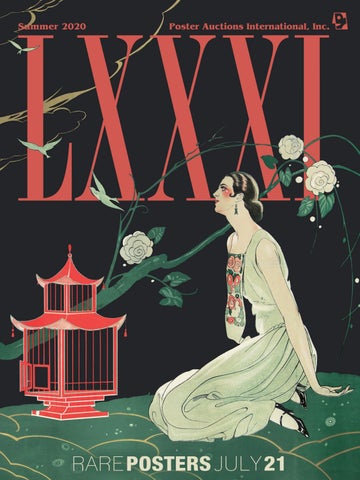
The front cover is a detail of lot 201, Palais de la Nouveauté by Umberto Brunelleschi. Page 1 is a detail of lot 32, Barcelona / Ciudad de Invierno by John Hassall.
VAN RYSSELBERGHE
LOT 485
Page 220 is a detail of lot 324, Fards Dorin by Louis-Theophile Hingre.
SPANISH POSTERS Modernisme was a distinctly Spanish art movement that heralded the revival of Catalan culture from roughly 18881911. Like similar movements of the time—Art Nouveau, Jugendstil, and the Vienna Succession—decorative ornamentation dominated the imagery. But the Modernistes shunned bourgeois exclusivity in favor of an integrated and democratic approach: they drew inspiration from Japanese woodblock prints, Pre-Raphaelite painting, and Belgian lithography; they also worked across multiple fields, including fine art, theatre, and architecture. A central point of influence was Els Quatre Gats (The Four Cats), a café and creative meeting place inspired by Paris’ Le Chat Noir. Founded by Ramon Casas, Santiago Rusiñol, and Miguel Utrillo, it attracted many prominent artists, including the young Pablo Picasso. Els Quatre Gats held performances, concerts, art exhibitions, and literary gatherings; the artists also published an influential literary review of the same name. Early Spanish posters are quite rare. The important 1897 book, “Les Affiches Etrangères,” details the latest and best offerings of several countries, from Austria to Japan. But not a single one is from Spain. In the landmark 1896 exhibition in Reims, 1,600 posters from 12 countries were featured, but only 6 from Spain. So while Spanish posters did not receive their deserved recognition early on, they certainly earned our attention today
SPANISH POSTERS
1 1. Femina. Artist: Anonymous 38 1⁄ 8 x 60 3⁄4 in./97 x 154.2 cm Lit. Mateu, Madrid Cond B-/Slight tears and stains at folds. The French have always been role models for high-end fashion with their undefinable aura of effortless class, and this bourgeois Spanish woman has fallen under the spell. Dressed to the nines on a stroll with her elegant greyhound, she’s picked up the latest issue of Femina, a Parisian women’s magazine that covered leisure activities, fashion, literature, and art. It was quite the feminist publication: in 1903, they dedicated an entire issue to female artists at the 1903 Salon, and the illustrations and cover were all drawn by women. In 1909, when the Académie Française proposed electing female members, Femina asked its readers to nominate 40 women writers to constitute an imaginary female academy, who were then featured in the magazine. Unfortunately, the Académie did not elect its first woman until 1980. Est: $4,000-$5,000.
SPANISH POSTERS
2
3 2. Gran Teatre del Liceu. 1900. Artist: Adrià Gual (1872-1943)
3. Orfeó Català. 1904. Artist: Adrià Gual (1872-1943)
33 1⁄4 x 24 1⁄4 in./84.6 x 61.5 cm Cond B/Slight tears, largely at bottom edge. Ref: Cataluña, 69
40 1⁄4 x 27 in./102 x 68.5 cm Henrich, Barcelona Cond A-/Slight stains at edges. Ref: Cataluña, 71; Cartells Catalans, p. 222-223
The ethos of Spanish Modernisme was an integration of and democratization of various art forms, and the artists themselves dabbled in various creative endeavors. Adrià Gual was no exception: he was a Catalan playwright, theatre businessman, founder of the Escola Catalana d’Art Dramàtic, pioneer of Spanish cinema, and poster designer who worked closely with other giants of the era, including Ramón Casas. This poster is a prime example of this era’s artistic crossover: an idyllic musical scene promotes the Gran Teatre del Liceu, a Barcelona opera house opened in 1847. While the specific context of this piece is unknown, it likely promoted the opera’s 1899⁄1900 season, which featured Wagner’s The Valkyrie and Tristan and Isolde; Wagner was a powerful source of inspiration for Gual, who incorporated the composer’s ideas and philosophies throughout his creative practice. Est: $1,400-$1,700.
Gual’s resplendent design harkens the opening of the Palau de la Música Catalana in Barcelona; the ornate Art Nouveau landmark was commissioned by the choral society Orfeó Català in 1904. The top of the choir’s banner fills the bottom portion of the design, with its coat of arms piercing upwards towards the Montserrat mountains. The murmuration of golden birds represents the group’s singing, and on a purely visual level, they add a lovely burst of color that contrasts with the purple mountainous landscape. Along with designing this first poster for the concert hall, Gual’s theatrical company, Companyia Adrià Gual, performed at the Palau. Est: $1,200-$1,500.
SPANISH POSTERS
4
6 4. Velodromo de Barcelona. 1898. Artist: Adrià Gual (1872-1943) 35 x 50 3⁄4 in./89 x 129 cm Lit. Hijo de Gual, Barcelona Cond B+/Slight tears and stains, largely at edges. Gual presents us with a veritable vision of Modernismo, saturated with Mucha-esque decorative elements and Catalan imagery. Just like Paris, Barcelona experienced a bicycle boom in the 1890s; several cycling clubs were born, including Peña Ciclista, the organizers of this charity event at the Bonanova Velodrome in Barcelona to benefit victims of flooded villages. The day’s events included international races to be awarded with art objects, cash prizes, and commemorative medals; a military band and municipal band promised to liven up the party. This velodrome was Barcelona’s first such venue; the initiative was launched by The Cyclist magazine—the official body of the Barcelona Society of Velocipedalists—and was opened in 1893. Along with regular bike races, the venue was also home to cricket, tennis, and soccer matches, and it was the first playing field of Fútbol Club Barcelona. This is a twosheet poster—and rare! Est: $2,000-$2,500.
5. Mercurio. 1903. Artist: Adrià Gual (1872-1943) 18 3⁄4 x 25 1⁄ 2 in./47.8 x 64.6 cm Lit. M. Pujadas, Barcelona Cond A-/Unobtrusive folds. Ref: Publicidad, 2043 Gual presents an idyllic coastal scene to promote the Spanish magazine Mercurio, which was founded by businessman José Puigdollers Macià in 1901, shortly after the loss of Spain’s last colonies: Cuba, Puerto Rico, and the Philippines. In coalition with the Casa de América in Barcelona, the magazine aimed to integrate Catalan business in America and reinvigorate Spain’s international affiliations. Gual’s design, paired with the text that reads “The travels of a drop of water,” illustrates the interconnectivity of the natural world—and perhaps supplies a conceptual vision of Mercurio’s ultimate goals. Est: $1,400-$1,700.
5
SPANISH POSTERS
7 6. Fabrica de Lustres / S. Ricart. 1898. Artist: Alejandro de Riquer (1856-1920)
7. Ayuniamiento de Barcelona. 1896. Artist: Alejandro de Riquer (1856-1920)
20 3⁄4 x 32 1⁄ 2 in./52.7 x 82.5 cm Utrillo & Rialp, Barcelona Cond B+/Slight tears at top paper edge; printer’s mark at lower right edge. Ref: Cataluña, 33; Riquer, p. 104; Cartells Catalans, p. 383; PAI-LXIV, 460
59 x 36 1⁄ 2 in./150 x 93 cm J. Thomas, Barcelona Cond A-/Slight tears, largely at edges. Ref: Maitres, 64; Reims, 1536; Phillips II, 577; Cataluña, 25; Cartells Catalans, 278; Riquer, p. 98; PAI-XII, 384
Spain’s foremost practitioner of Modernisme proves here that his work is an excellent rival to French Art Nouveau. While undoubtedly influenced by the style, the Spanish aesthetic of the late 19th century invited a broader integration of the arts. Notice here the influence of Japanese woodblock printing in the layers of floral details that traipse into the scene; the woman’s fiery red tendrils and loose dress reference Pre-Raphaelite portraits; the composition and symbolist imagery are a nod to Belgian posterists like Livemont. Ultimately, the design is meant to promote shoe polish: a testament to de Riquer’s unique vision, as well as his goal to democratize art by bringing visions such as these to the average people. Est: $2,500-$3,000.
For a searchable database of every poster we’ve ever sold at auction, view our Poster Price Guide at posterauctions.com
De Riquer was the earliest Spanish posterist of note, and, as can be seen from this design for an 1896 exhibition of arts and crafts, he was right up there with contemporary Art Nouveau pioneers, particularly Mucha and Livemont. He studied and traveled extensively in Europe, absorbed the influence of William Morris in England, and became quite versatile at various forms of design in many media. He produced illustrations, prints, ex-libris, and several murals. His posters continue to guide succeeding generations of Spanish graphic artists. This is a two-sheet design. Est: $3,000-$4,000.
SPANISH POSTERS
SPANISH POSTERS
8 8. The Four Seasons. 1900. Artist: Alejandro de Riquer (1856-1920) Each: 22 3⁄ 8 x 46 1⁄4 in./57 x 117.6 cm Cond A. Ref: Weill/Art Nouveau, p. 54; Cataluña, 26-29; Riquer, p. 130-133; PAI-LXVIII, 571 This is a rare complete set of the Four Seasons by de Riquer. More seldom seen than the equivalent series by Mucha, they are the artist’s masterpiece. A letter from the publisher Pierrefort to the artist indicates that the panels were printed on “paper exactly similar to the one used by Mucha for his animated Flowers,” and that, because of the intricate detail and shading within the designs, seven instead of six colors would be used in the printing process. The letter continues: “The artist responsible for the lithographic process is not only skilled in the use of colour but is also an excellent designer. He admires your panels very much and will do everything in his power to reproduce them properly. I have additionally agreed to keep an unflinching eye on the process myself. We shall experiment, something that is not easy, given the size of the lithographic stones” (Art Nouveau/Weill, p. 54). Est: $7,000-$9,000. (4)
SPANISH POSTERS
9
10
9. Quarta Exposició del Circol de Sant Lluch. 1899. Artist: Alejandro de Riquer (1856-1920)
10. Mosaicos Hidráulicos Òrsola Solá y Cia. 1898. Artist: Alejandro de Riquer (1856-1920)
13 5⁄ 8 x 28 1⁄ 2 in./34.6 x 72.3 cm Utrillo & Rialp, Barcelona Cond B+/Slight tears at horizontal fold. Ref: Eapagna, 852Riquer, p. 112; Cartellisme Catalunya, p. 21; Cartells Catalans, 272; Weill, 133
33 1⁄ 8 x 49 1⁄4 in./84 x 125.2 cm Utrillo & Rialp, Barcelona Cond B/Slight tears at folds. Ref: Cataluña, 36; Riquer, p. 116; Artes Gráficas, p. 173; PAI-XXIX, 597
The Saint Lluch Artists’ Circle was co-founded by de Riquer, Antoni Utrillo, and Joan Llimona, among others, in Barcelona in 1893. They took issue with the anticlerical sentiments in Modernisme, and aimed to bolster Catholic morals, family virtue, and the path of humility pursued by the medieval guilds. This initiative had a large impact on the development of the Catalan noucentisme movement. Here, de Riquer promotes the group’s fourth art exhibition with bold typography and sensitive floral details. “The sunflower is contemplated with attentive reverence by a maid— represented only by her head, covered with a veil trimmed with pearls, and by delicate hands. Everything has a delicious archaic taste and tender femininity... The inclination of the brow accentuates the curls of her hair with a typically modernist play of curves” (Cartellisme Catalunya, p. 24). Est: $1,400-$1,700.
De Riquer contributes his Art Nouveau aesthetic to a Barcelona firm specializing in hydraulic mosaics—a collaboration that was actually quite typical of the time. The decorative pigmented cement tiles were first invented in France in the mid-19th century, but it was a Barcelona company that developed it into an alternative product to natural stones like marble. The rise of this technique coincided with Modernisme, spurring complex and artistic designs created by artists including de Riquer and Gaudí. Est: $2,500-$3,000.
SPANISH POSTERS
11
12
11. Santa Eulalia. Artist: Porta
12. La Innovación. 1920. Artist: Porta
33 7⁄ 8 x 47 7⁄ 8 in./86 x 121.6 cm Seix & Barral, Barcelona Cond B/Slight tears at folds.
33 x 46 1⁄ 2 in./83.8 x 118 cm Seix & Barral, Barcelona Cond B/Slight tears and stains at folds. Ref: Publicidad, 486
As one can likely glean from this elegant design, the Santa Eulalia department store caters to Barcelona’s most bourgeois clients with luxury fashion from international designers. Founded in 1843, the store was first located on Calle de la Boquería at the old portal where Santa Eulalia became a martyr during the Roman era, which offered the store its name. In 1926, the store hosted one of Barcelona’s first fashion shows, which cemented Santa Eulalia’s sartorial prestige for generations to come; it is open to this day, and as elegant as ever. Est: $2,000-$2,500.
Register for online bidding at posterauctions.com
Whether on the hunt for a glamorous Hollywood gown or feathery flapper accessories, La Innovación assures shoppers that it’s “the most important house of silks and woolen goods.” Their three locations in Barcelona, Madrid, and Alicante surely attracted top fashionistas of the era. Est: $2,000-$3,000.
SPANISH POSTERS
13
14
15 13. Almidon “Bisbal.” Artist: Antoni Utrillo (1867-1944)
14. Cognac Barbier. 1898. Artist: Antoni Utrillo (1867-1944)
24 3⁄4 x 33 3⁄4 in./63 x 86 cm Utrillo & Rialp, Barcelona Cond B+/Slight tears at edges.
14 7⁄ 8 x 21 in./37.8 x 53.5 cm Utrillo & Rialp, Barcelona Cond A-/Unobtrusive folds. Ref: Cataluña, 95
A chic housewife demonstrates the benefits of Bisbal starch, which is here denoted as “the best for ironing.” Antoni Utrillo was a celebrated Spanish posterist; he also founded and directed the Utrillo & Rialp printing firm, which produced work for clients including Ramón Casas, Alejandro de Riquer, and Els Quatre Gats. Antoni is not to be confused with his cousin, Miguel Utrillo, a prominent engineer, painter, and artistic director. Est: $1,000-$1,200.
With soft pastels and mint green, Antoni Utrillo depicts a trio of bourgeoisie Spaniards enjoying a glass of Cognac Barbier. At the time of this poster’s creation, the liqueur was available “in all establishments,” though the company had little impact on the history of alcohol, as hardly anything is known about it. At any rate, the Art Nouveau design and Victorian fashions are historically fascinating. Est: $1,200-$1,500.
16
SPANISH POSTERS
17 15. Cañon Granífugo Bori. ca. 1900. Artist: Antoni Utrillo (1867-1944)
16. Publicacions de la Unió Catalanista. Artist: Antoni Utrillo (1867-1944)
17. Teatro Lírico. ca. 1897. Artist: Don Miguel Utrillo (1862-1934)
30 1⁄4 x 83 1⁄ 8 in./77 x 211.2 cm Utrillo & Rialp, Barcelona Cond A-/Slight stains at bottom edge.
37 3⁄ 8 x 52 in./95 x 132 cm Utrillo & Rialp, Barcelona Cond B+/Slight stains, largely in margins.
This cinematic design features impressive devices that resemble rockets or firework shoots—but they are, in fact, hail cannons. These shock wave generators are purported to disrupt the formation of hailstones in the atmosphere, though there is no evidence of any effectiveness. This particular Spanish invention debuted at Lyon’s International Competition. This is a two-sheet poster.
This delightful strawberry red design promotes publications from the Catalan Union. The group held its first assembly in Manresa in 1892 with the goal of uniting disparate Catalan entities, newspapers, and individuals. They proposed restoration of historic institutions and using Catalan as the official language of the region. As their initiative grew, political Catalanism became inextricably linked with the important cultural, artistic, and literary renaissance of Spain’s Modernisme. On offer here are various assembly reports and deliberations from the union’s diverse locations. Although unsigned, this image has all the markings of an Antoni Utrillo design. This is a two-sheet poster.
28 3⁄ 8 x 48 in./72 x 122 cm Cond B-/Restored tears at folds and edges. Ref: Timeless Images, 78; Cataluña, 65; Quatre Gats, 23; PAI-LXV, 511
Est: $1,400-$1,700.
Est: $2,000-$2,500.
“Utrillo was a true ‘renaissance man.’ In addition to being a painter, he was also an archeologist, engineer, and historian and traveled all over the world. While in Paris in 1891, he adopted the son of Suzanne Valodon, who thereafter became known as Maurice Utrillo and eventually earned an even greater measure of fame in his own right. Don Miguel founded several art magazines in Spain and championed the work of Zuloaga. He was influenced by the symbolists and by Alphonse Mucha and Art Nouveau, as can be seen in this poster for the Lyric Theatre” (Timeless Images, p. 177). Est: $4,000-$5,000.
SPANISH POSTERS
18. El Mellor Calsat y Mes Barato. 1905. Artist: Ricard Opisso (1880-1966) 34 5⁄ 8 x 50 in./88 x 127 cm Utrillo & Rialp, Barcelona Cond B+/Slight tears at seams. Ref: Cataluña, 808; Cartells Catalans, p. 121
18
This charmingly humble lady helps promote “the best and cheapest footwear” for an unknown shoe manufacturer located in front of the Sant Andreu tram station in Barcelona. Though Ricard Opisso was just 25 years old when he designed this, he was already well into his creative trajectory. He was born to a multigenerational family of artists, and at age 12, he began working with the architect Antoni Gaudí on the Sagrada Familia. Later, he joined Ramón Casas, Pablo Picasso, and other artists in the Els Quatre Gats group, and he contributed illustrations to prominent publications of the time, including Pèl & Ploma. This is a two-sheet poster—and rare! Est: $2,500-$3,000.
19. Antigua Casa Soteras Novedades. 1902. Artist: Francisco de Cidón Navarro (1871-1943) 29 1⁄4 x 41 3⁄ 8 in./74.3 x 105 cm Affiches Barral, Barcelona Cond B/Several tears, largely at folds. Ref: Cataluña, 100 De Cidón slyly composes the scene by calling direct attention to the two fashionable passersby—Señora Esteva y Portabella—with the text at right, which promotes new wares from Barcelona’s Old House of Sundries. It’s a fine example of de Cidón’s creative abilities: a split-second moment distilled down to its essence, allowing us to admire the women’s long dresses and oversized hats while the wash of negative space leaves plenty of breathing room for the text. Est: $2,000-$2,500.
20. Las Novedades. Artist: Anonymous 29 1⁄ 2 x 42 3⁄4 in./75 x 108.4 cm Talleres Barral Herms, Barcelona Cond B/Slight tears at folds. A smartly dressed woman shows off her neck scarf and lacy dress on her way to Las Novedades’ end of season sale, where everything is 15% off. The store was located in Barcelona’s famous La Rambla promenade within the building of the old University of General Study, now known as Rambla de Estudios. The 1.2 kilometer walk spans from the city’s nerve center, the Plaza de Cataluña, to the old port of Barcelona on the Mediterranean Sea.
19
Est: $1,400-$1,700.
SPANISH POSTERS
20
21
22
23
21. Callicida Escrivá. ca. 1910. Artist: Oleguer Junyent (1876-1956)
22. Destileria “El Norte.” Artist: C. Maring
23. Rapsodia. Artist: J. Jutglar
29 1⁄4 x 41 7⁄ 8 in./74.2 x 106.3 cm Utrillo & Rialp, Barcelona Cond B+/Slight stains, largely at edges. Ref: Cataluña, 111; Cartells Catalans, p. 81
27 1⁄4 x 41 1⁄4 in./69.2 x 105 cm J. M. Arnau, Barcelona Cond B/Slight tears at folds.
21 1⁄ 2 x 29 3⁄4 in./54.7 x 75.5 cm Plaza de la Catedral, Barcelona Cond B+/Slight tears at folds.
The Spanish have never believed in Santa Claus, but this slimmed-down version pouring generous amounts of liquor seems like an appropriate substitute. Oviedo’s “El Norte” distillery appears to have left no legacy behind, aside from this poster and a few salvaged promotional items, all of which promote their Marichu anise liqueur and Don L. cognac.
A posh outing in Victorian garb necessitates a great apéritif, and Rapsodia promises to be the best. Unfortunately, the Spanish liqueur seems to have been lost in the annals of time—no record exists, that we can find, of this particular apéritif or its parent company, which appears to be Victory & Ferrer.
A small crowd stands in awe as a woman in a Victorian red dress scrawls in cursive with chalk. The product being advertised may come as some surprise: it’s, of all things, a corn remover. Perhaps she is a school teacher who gets blisters on her hands from so much writing—or perhaps she is simply a model spokeswoman providing an elegant solution to a less than attractive problem. Oleguer Junyent was a jack of all creative trades: he was a painter, illustrator, set designer, interior designer, writer, and, of course, a posterist. Est: $1,700-$2,000.
Est: $1,400-$1,700.
Est: $1,400-$1,700.
SPANISH POSTERS
24
25
26
24. Ciencia Popular. ca. 1915. Artist: F. Sagristá
25. Hispania Simil Gamuza. ca. 1905. Artist: A. & J. Pey
25 1⁄4 x 34 1⁄ 2 in./64.3 x 87.8 cm Cond B/Tears at folds. Ref: Publicidad, 2152
30 3⁄ 8 x 43 1⁄ 2 in./77 x 110.3 cm Henrich, Barcelona Cond B+/Stains in margins. Ref: Cataluña, 869; Cartells Catalans, p. 87
In the vein of so many other great Art Nouveau designs for the latest in transit technology, Sagristá employs a goddess illuminating newly developed marvels: a zeppelin hovers above a passenger train; a motorcyclist zooms ahead of a race car; a speed boat careens ahead. They’re just some of the “latest inventions” highlighted in Ciencia Popular, a weekly magazine exploring science and industry. It’s difficult to pinpoint exactly which magazine this is; the Englishlanguage Popular Science was founded in 1872, but only added a Spanish version in 2008. Magazines of the same title were printed in Brazil and Argentina beginning in the mid-1920s. It would appear that Spain’s version has been nearly vanquished from history, but this striking design is certainly a testament to Spain’s scientific prowess. Est: $1,400-$1,700.
The turn of the century bolstered increasing prosperity in Spain, and consumers were eager to act the part of the new bourgeoisie. Traditional homemade products were swiftly replaced by name brand goods, and the average housewife now yearned for the well-kempt aura of the upper class. Here, an overdressed woman demonstrates her finesse for chic couture and household upkeep, while a wonderful bit of visual trickery proves to us just how potent this particular cleaning product is—though the cat seems more horrified than impressed. Est: $1,400-$1,700.
SPANISH POSTERS
26. Carnaval en Barcelona. 1898. Artist: Lluís Labarta (1852-1924) 32 7⁄ 8 x 72 in./83.5 x 182.8 cm Lit. Bobés, Barcelona Cond B/Slight tears at folds and seams. Ref: Cataluña, 539; Cartells Catalans, p. 135 “In turn-of-the-century Europe, the celebration of feasts—an ancient custom that is rooted in all cultures—follows the Roman tradition of changing seasons, and especially that imposed by the ecclesiastical calendar. Gradually, however, the festivities become more and more secular, and around the year 1900 they experience a burst of joy that accompanies the Belle Epoque. The most celebrated festival is Carnival, perhaps because it is the period of permissibility that precedes the age of austerity and penance of Lent. Masks, costume dances, comedy characters in art, streamers, and confetti are the most characteristic expressions in these posters” (Cartells Catalans, p. 133). Additionally, the 1888 Barcelona Universal Exposition—the country’s first international world’s fair—brought incredible renown to Spain. This poster perfectly encapsulates all of the aforementioned festive delight: streamers swirl; costumed ladies prance; an overjoyed Pierrot attempts to keep up; and numerous activities are promised, including a children’s pageant competition, an allegorical chariot art contest, horseback riding, a cycling party, and a great lantern march. This is a three-sheet poster. Est: $1,700-$2,000.
27. Exposición Internacional de Madrid. 1893. Artist: Eugène Grasset (1841-1917) 42 5⁄ 8 x 58 7⁄ 8 in./108.4 x 149.6 cm Imp. Lemercier, Paris Cond B/Slight tears and stains at folds and edges. Ref (all var but PAI): DFP-II, 407; Berthon & Grasset, p. 32; Hiatt, p. 51; Reims, 673; Chaumont/Exposons, p. 23; España, 722; PAI-LXXIII, 307 This exceptionally rare Grasset is an extravaganza of multiculturalism: a Russian-language poster, printed in France from the design of a French artist, to promote a Spanish event: the 1893 International Exposition in Madrid. It’s additionally remarkable for its medley of patterns and textures: crinkly sky, wavy hair, triangle cloak, square-patterned dress, laurel leaves, and wavy rivulets of water echoing the pattern in the stone. The structure in the background is likely the Palacio Real de Madrid.
27
Est: $2,500-$3,000.
28. Casa Codorníu. 1897. Artist: Julio Tubilla 47 7⁄ 8 x 36 3⁄4 in./121.7 x 93.5 cm J. Ortega, Valencia Cond B/Slight tears at folds. Ref: Cataluña, 770 Codorníu Winery is Spain’s oldest and second-largest producer of Cava—it was founded in 1551 near Barcelona. In 1897, the company held a competition for advertising posters, which prompted a long lineage of remarkable designs for the company. At this first competition, Tubilla’s ethereal design took first place; Ramón Casas took second, but his designs would later be used to promote the Spanish sparkling wine. Here, Tubilla employs undulating nymphs to create a lush setting behind the two Valencian imbibers; the metallic silver ink in the background creates a stunning visual effect. Est: $3,000-$4,000.
28
SPANISH POSTERS
29
30
31
29. Garba. 1905. Artist: Joan Llimona (1860-1926)
30. Litografía Blasi. Artist: Anonymous
36 x 55 1⁄4 in./91.5 x 140.4 cm Madriguera Cortes, Barcelona Cond B-/Restored tears at folds and seam. Ref: Artes Gráficas, p. 165
24 5⁄ 8 x 35 5⁄ 8 in./62.5 x 90.5 cm Cond B/Slight tears at edges.
Garba was a short-lived arts and cultural publication that was active from 1905-1906; it featured short stories, poems, art, and articles, all related to the taste and aesthetics of Modernisme and dedicated to promoting Catalan culture and society. The magazine’s illustrators included Adrià Gual, Ricard Opisso, and Joan Llimona, whose creative practice centered largely on religious paintings, and he produced few posters. Here, he employs this academic style to portray an allegorical woman peddling the newest issue of Garba to the disinterested men around her. Est: $1,400-$1,700.
A powerful man on horseback promotes the printing firm Litografía Blasi in Barcelona. The company printed books as well as posters, but little information exists on their work. Text on the left margin reads: “A los coleccionistas,” or “To collectors.” Est: $1,200-$1,500.
SPANISH POSTERS
31. Ayxelá y Rodón. 1899. Artist: F. Periquet 37 x 99 3⁄ 8 in./94 x 252.6 cm Utrillo & Rialp, Barcelona Cond B/Slight tears at folds. Using eye-popping reds and a chic traveler in monochrome fashions, this is a standout design for the little known Ayxelá y Rodón, a Spanish railway with service to Switzerland, France, and England. Little is known of the railway or the artist, but this three-sheet poster is stunning enough to stand on its own.
32
Est: $1,700-$2,000.
32. Barcelona / Ciudad de Invierno. 1911. Artist: John Hassall (1868-1948) 38 1⁄ 8 x 50 3⁄4 in./97 x 129 cm Affiches Barral, Barcelona Cond B+/Slight tears at folds. Ref: Cataluña, 233; PAI-IV, 183 Hassall—along with Dudley Hardy—was the most prolific and popular posterist in England at the turn of the century. Weill calls him “more original” than Hardy (p. 68). Judging his work in 1901, W.S. Rogers concluded that “Hassall’s work is more uniform in its excellence, and is clever in a high degree. He is extremely versatile, and displays a wide range of knowledge in his productions. His figures, his animals, and every accessory that he employs are well drawn, and impress one with the sense that they have been studied from life... His women, if savouring of a single model, are charming in their gaiety of manner, unconventionality of pose, and pert frankness of expression” (p. 34-35). Many of these qualities can be seen in this impressive poster for the Winter City of Barcelona: the beach and sky are drawn measuredly and geometrically, allowing the girl’s magnificent dress, hat, and umbrella to suffuse the scene. This is a two-sheet poster. Est: $3,500-$4,000.
33. Barcelona Palma. Artist: Merino 26 1⁄4 x 38 3⁄ 8 in./66.8 x 97.4 cm Seix & Barral, Barcelona Cond B+/Slight tears at folds. Although Merino’s design is from the 1920s, the aesthetic feels almost timeless: minimal graphic forms and saturated color depict the glowing sun over the ocean, providing us with just enough information to convey a flight from Barcelona to Palma de Mallorca across the Mediterranean Sea. Spain has over 3,000 kilometers of coastline, which practically begged for the development of seaplanes. Though they were initially created for military operations, seaplanes also transported casual travelers, as seen here. Est: $1,500-$2,000.
33
SPANISH POSTERS
35
34 34. Real Club de Barcelona. 1909. Artist: J. Montanya 29 3⁄4 x 42 1⁄4 in./75.4 x 107.4 cm Affiches Barral Herms, Barcelona Cond C+/Restored tears. The Royal Barcelona Yacht Club has drawn the fashionable crowds to the coast to watch regatta teams vie for the Spanish championship. The event was held as a benefit for those wounded and killed in the War of Melilla, a conflict between the Moroccan Rif tribes and Spanish and French colonialists. At this time, the Spanish army was ill equipped and unprepared for battle, leading to a months-long struggle against the retaliation. The Spanish army eventually increased its troops and artillery to win the battle, but this would prove to be only a small part of the ongoing struggle between the two countries. Est: $1,700-$2,000.
35. Fábrica de Bebidas. ca. 1899. Artist: Anonymous 17 1⁄4 x 22 in./44 x 56 cm Utrillo & Rialp, Barcelona Cond B/Horizontal fold; slight stains in margins. If cutting back on liquor is the goal, then carbonated water can provide a decent substitution, as evidenced by this stylish lady enjoying one of B. Claramunt’s latest fruit essence concoctions. An 1891 edition of The Brewer’s Guardian devoted a section of their issue to breweries in Barcelona, and noted that “B. Claramunt [is] one of the most important and progressive of the manufacturers, noted for his ideas of introducing the most modern mechanical improvements into his factory.” Salud! Est: $1,400-$1,700.
36
SPANISH POSTERS
37 36. La Correspondencia de España. 1901. Artist: E. Alvarez Dumont
37. Barcelona / Ciudad de Invierno. 1911. Artist: Carlos Verger Fioretti (1872-1929)
41 1⁄4 x 85 in./104.8 x 215.7 cm Henrich, Barcelona Cond B+/Slight tears and creases at seams. Ref: Guerra Civil, 210; PAI-XXVIII, 294
49 3⁄4 x 36 in./126.5 x 91.5 cm Henrich, Barcelona Cond B-/Restored tears at folds. Ref: Cataluña, 234; PAI-XXXIX, 507
A brigade of newsies takes to the street, bringing the citizens of Barcelona their copies of La Correspondencia de España, the politically independent daily newspaper. Packed with global news from all the world’s capitals, the daily lays claim to being a great source for the latest political news and wire service stories. The bustle of the poster is wonderful, showing a metropolitan urgency and an artistic proficiency. This is a three-sheet poster.
This two-sheet travel promotion gives us a shipboard couple drenched in the sultry hues of a Mediterranean sunset as they arrive in the port of Barcelona, their layers of clothing soon to be as unnecessary as any remaining workplace tensions. The poster was produced in several languages (for the French version, see PAI-XXVII, 607); this particular version was used to lure domestic (and other Spanish-speaking) vacationers to winter sojourns on the Catalan capital’s shores amidst the hills of Montjuïc, Vallvidrera, and Tibidabo. Though born in Paris, Verger received his artistic training in Madrid and is considered to be a Spanish artist. He painted landscapes and portraits, but was best known as an engraver and posterist.
Est: $2,000-$2,500.
Est: $4,000-$5,000.
Download our mobile bidding app at posterauctions.com
SPANISH POSTERS
38
39
40
38. Campionat de Catalunya. 1917. Artist: R. Rigol
39. Centre Autonomista. 1920. Artist: Montanya
40. Baile de Máscaras. 1926. Artist: Xavier Nogués (1873-1941)
23 1⁄4 x 25 in./59 x 63.3. cm Seix & Barral, Barcelona Cond B+/Unobtrusive folds; slight tears at edges.
18 1⁄ 2 x 25 3⁄4 in./47 x 65.4 cm Seix & Barral, Barcelona Cond B+/Stains in margins.
This charmingly simple design advertises Barcelona’s running championship of ten kilometers. The event was sponsored by the Autonomous Center of Dependents of Commerce and Industry—the Spanish organization for workers’ rights and wellbeing.
This tranquil impressionistic scene promotes the Catalan trade union and social association, the Autonomous Center of Dependents of Commerce and Industry. Founded in 1903, the organization aimed to improve workers’ rights and cultural well-being. Presumably, leisurely activities such as the regatta event seen here were part of the programming. Though the CADCI was gradually dissolved after Franco’s reign, the initiatives of the group continue through the General Union of Workers of Catalonia.
29 x 41 5⁄ 8 in./73.5 x 106 cm Seix & Barral, Barcelona Cond B/Slight tears at folds. Ref: Cartellisme Catalunya, p. 81
Est: $1,700-$2,000.
Est: $1,200-$1,500.
Beginning in 1889, the Cercle Artístic de Barcelona organized annual costume dances as part of the Carnival festivities; from 1915 on, posters became crucial advertising tools, and the group hosted poster competitions for each year’s event. For the dance of 1926, it appears that the theme was based around African culture. Nogués—who for some reason signed his works “Babel”—was a painter, draftsman, potter, printmaker, and illustrator for the magazine Papitu. Est: $1,400-$1,700.
SPANISH POSTERS
41
42
43
41. La Joselito. 1933. Artist: Anina
42. Gran Feria de Valencia. 1933. Artist: Pascual Capuz (1882-1959)
43. Fallas / Valencia. 1936. Artist: J. Canet Cabellon (1887-1951)
14 7⁄ 8 x 21 in./37.6 x 53.2 cm Cond A.
45 1⁄ 2 x 63 3⁄4 in./115.6 x 162 cm Ortega, Valencia Cond B/Slight tears at folds. Ref: España, 363
27 5⁄ 8 x 39 1⁄ 8 in./70 x 99.3 cm J. Avino, Valencia Cond B/Slight tears at folds. Ref: Espagna, 391
The Grand Fair of Valencia—also known as the July Fair—was established in 1871 as a secular celebration; it quickly blossomed into an internationally renowned event. Events included horseback riding, exhibitions, musical competitions, fireworks, dances, bullfights, and games. Naturally, posters were key advertising tools in promoting each year’s event. For the 1933 edition, Pascual Capuz— one of the foremost Spanish posterists of the century— created this riveting design, which blends historic imagery of bullfights and traditional Spanish dress with a modern Technicolor aesthetic.
The Falles is said to have begun in the Middle Ages as a celebration of the spring equinox; it evolved to be a commemoration of Saint Joseph, and today it is a massive annual affair in Valencia. The term falles refers to both the celebration and the monuments, which take the form of large-scale thematic paper-mâché sculptures. The event is a massive street party with historical, religious, and comedic processions; complex pyrotechnic displays; and revelers dressed in traditional dress. The culminating event is La Cremà, when all of the statues are burned in a massive bonfire—fire is said to be the symbol of the fiesta’s spirit. For the 1936 edition, a glowing bat cries out to let the games begin. This would be the last Falles for several years, as the Spanish Civil War began later that year.
Carmen Gomez—better known as La Joselito—is suspended in a graphic moment of flamenco dancing to announce her performance at the Salle Pleyel concert hall in Paris. Born in 1906, Gomez was practically destined to be a dancer; her grandmother, La Berenguera, was a legend of classical Spanish dance. Similarly, Gomez became an icon of the “golden age” of flamenco. The German record producer Claus Schreiner wrote, “La Joselito has the body of a woman born into the world of flamenco at the start of this century. Spurning seductiveness, she bewitches her audiences not with her body, but by focusing their total attention on the art itself” (Flamenco, p. 97). Est: $1,700-$2,000.
Est: $1,700-$2,000.
Est: $1,000-$1,200.
For a searchable database of every poster we’ve ever sold at auction, view our Poster Price Guide at posterauctions.com
NORTH VIETNAM From the mid-‘50s to ‘70s, the poster was a crucial form of communication in North Vietnam. In the midst of a brutal war, artists were responsible for disseminating messages to the vast rural population. They also depicted optimistic scenes to boost morale and raise popular support. To work urgently and economically, artists often hand-painted—rather than printing —their images. These unique hand-painted works from the collection of Deborah Salter offer a distinct perspective, and they are all seen here for the first time. Please note: quotes attributed to “Deborah Salter” are from her website.
44 44. Bravo Our Heroic Troops. ca. 1956. Artist: Anonymous 29 1⁄4 x 25 1⁄ 2 in./74.4 x 65 cm Ref: Vietnam, 2 “This naive poster contains a narrative which celebrates the liberation of Hanoi following the defeat of the French colonizers after the battle of Dien Bien Phu in 1954. The future of the newly independent Democratic Republic of Vietnam appeared optimistic and cause for celebration. The soldiers are depicted wearing the uniform of the Viet Minh army and portrayed as protectors and victors. They affectionately embrace the children and revere the older generation. The woman wears the traditional Ao Dai, a national costume and symbol of Vietnamese nationalist pride (introduced to Vietnam in the 1930s). The flag proudly displayed at the door of the women’s home is the flag of North Vietnam, an emotionally charged sign of the State (designed in 1940) and used by the Viet Minh during the uprising against the French. Ho Chi Minh adopted this flag in 1945 to represent the Democratic Republic of Vietnam, which subsequently became the government of North Vietnam in 1954. The red background of the flag symbolizes revolution and blood, while the points of the star represents the five classes in Vietnam society at the time: intellectuals, farmers, workers, businessmen, and militaries” (Deborah Salter). Est: $2,500-$3,000.
NORTH VIETNAM
45
46
45. Untitled. ca. 1960. Artist: Anonymous
46. Exercise at School. ca. 1960. Artist: Anonymous
29 3⁄4 x 41 1⁄ 8 in./75.5 x 104.5 cm Ref: Vietnam, 14
30 7⁄ 8 x 42 5⁄ 8 in./78.4 x 108.2 cm Ref: Vietnam, 16
“This cheerful, decorative poster aimed to promote food production and emphasize sound farming practice. The scene is positive and plentiful, showing an ethnic minority woman feeding her fat, healthy animals. The message for the peasant farmer is optimistic, promoting a productive and positive outlook through better care and animal husbandry. The pot-bellied pig is a specific breed found mainly in North Vietnam. The slogan may have been deliberately removed from the base of the poster and the image used for decoration after the political purpose had been fulfilled. However, while socialist realist art was the official sanctioned art form and art for art’s sake did not exist for public show, some artists painted decorative themes quietly for private consumption” (Deborah Salter).
“Ho Chi Minh was well known for his belief in physical exercise accompanying a child’s education. The Party recognized this discipline as integral to the productivity and future of the country. This naive work expresses the Party line well; the older child at the front of the poster is setting the example to the younger children to be active, exercise, and follow discipline. The children’s daily exercise routine takes place in front of their school. The older children wear the red communist scarf while the smallest child has yet to make the grade and earn his scarf. It is a well-balanced and pleasing poster designed to engage children in physical activity” (Deborah Salter).
Est: $3,000-$4,000.
Est: $1,700-$2,000.
NORTH VIETNAM
47 47. All Working Together to Improve the Collective Economy. ca. 1960. Artist: Thanh 41 3⁄4 x 28 in./106.2 x 71.3 cm Ref: Vietnam, 18 “This painterly work is technically accomplished and strongly reminiscent of Chinese propaganda art showing happy, benevolent peasants and soldiers boldly moving into the future and linked in solidarity to support the nation and the national cause. The positive, smiling figures are pushed to the front of the picture plane to support the message that the human contribution was North Vietnam’s most valuable asset in fighting for independence and unification” (Deborah Salter). The full text here reads: All working together to improve the collective economy and increase agricultural productivity. Est: $2,500-$3,000.
Register for online bidding at posterauctions.com
NORTH VIETNAM
48
49
48. Our Party has Brought Spring to the Country. 1961. Artist: H. Lam
49. Volunteer, We Are Ready. 1965. Artist: Truong Singh (1934-?)
29 1⁄4 x 42 7⁄ 8 in./74.2 x 109 cm Ref: Vietnam, 4
23 x 33 3⁄ 8 in./58.5 x 84.8 cm Ref: Vietnam, 24
“The first Five Year Plan [from] 1961-1965 set the government on an ambitious reconstruction agenda... after the French defeat in 1954. Gripped by a severe food shortage, the North Vietnamese government campaigned to increase food and industry by emphasizing the importance of peasants and workers. The posters... [promoted] efficient agricultural practices and increased industrial production. Images of abundance and productive agriculture were common... Through the depiction of fertility and abundance, it was hoped that peasant farmers would be inspired to work harder and increase production making the country happy and prosperous. The government set highly unrealistic goals for food production and introduced a ruthless land reform program commencing in 1955. The harsh reality for the peasants and workers during this period was quite different from the positive images reflected in propaganda posters” (Deborah Salter).
“This poster is influenced by elements of Soviet propaganda design. It shows a strong, dominant figure leading his followers into the patriotic act of volunteering for the war effort. The young soldier at the front of the picture plane has his sights fixed on glory as he strides out proudly holding his enlistment paper with a determined and resolute expression. The purpose of this poster was to engender patriotism and a community expectation that the younger generation would make sacrifices for an independent and unified nation and enlist into the armed forces. In reality, many young men and women did not enlist voluntarily into the People’s Army of Vietnam. The army comprised mainly of ‘conscripts’ who were often ‘recruited’ from their rural villages and rice fields with force. They received four months of basic training before they had their intensive training in specialist areas. North Vietnamese soldiers were known for being tightly knit and an intensely cohesive force. They were strongly indoctrinated with Party dogma and developed steely determination. At the time of unification in 1975, the Vietnam People’s Army numbered one million troops” (Deborah Salter).
Est: $2,500-$3,000.
Est: $3,000-$4,000.
NORTH VIETNAM
50. Building the Levy Banks Against the Enemy. 1967. Artist: Truong Singh (1934-?) 27 x 40 1⁄ 2 in./68.7 x 103 cm Missing paper at upper right edge. Ref: Vietnam, 38 “Air strikes failed to bring the North to a standstill. Thousands of laborers were constantly repairing roads, bridges, water reserves, and railways as fast as they were damaged to enable supplies and support the war effort. This bold work shows a strong and resilient figure, cartoon-like in proportion. His gun is fastened across his body and he holds a container of dirt to help rebuild the levy banks destroyed by the U.S. bombing. The underlying message is no matter how simple or small the contribution, everyone can help with the war effort” (Deborah Salter). Est: $1,700-$2,000.
51. Take a Firm Hold of the Wheel. 1969. Artist: T. Tam 27 1⁄4 x 36 3⁄ 8 in./69.4 x 92.5 cm Ref: Vietnam, 30 “Most propaganda images promoting the war effort were focused on land tasks and few were dedicated to work on the river networks. This poster illustrates a government worker navigating his patrol boat with steadfast concentration. His steely gaze is fixed on the job at hand. His blocky form and square jaw line is characteristic of Soviet style figurative propaganda. The vibrant blue and green color scheme is striking in its departure from the usual socialist red and yellow colors” (Deborah Salter). Est: $3,000-$4,000.
52. Under Ho Chi Minh We Become Winners. 1969. Artist: Nguyen Dung 38 1⁄ 8 x 28 in./96.8 x 71 cm Missing paper at upper and lower left corners. Ref: Vietnam, 19
50
During the conflict period, Vietnam was isolated from the rest of the world—their only contact was with nearby communist countries, including China and Russia, whose aesthetics were largely influential to Vietnamese artists. This design clearly takes heed to the Russian style with swaths of bold red, high contrast, and sharply delineated forms. In the foreground, a citizen enforces his strength and determination; to the left, the profile of Ho Chi Minh denotes his position of influence and protection over the people; to the right, male and female soldiers execute their duty to protect the country. Paper supplies were low at this time, so artists had to make the most of their materials—and powerful images like this one were exhibited frequently; the pin holes used at each location ultimately testify to the work’s visibility. Clearly, this work has been through a lot, but its damages make it all the more vital. Est: $1,700-$2,000.
53. Untitled. ca. 1970. Artist: Anonymous 25 x 31 3⁄4 in./63.5 x 80.5 cm Ref: Vietnam, 28 “The overall design of this work shows a strong forward thrust with the guns defending the nation featured alongside a sickle and tools of industry as the weapons needed to win the war. Ho Chi Minh proudly holds prime position in this poster as the ‘father of the people’ overseeing and guiding the nation’s fight for liberation. The work reflects a strong Russian stylistic influence showing the idealized three personas; the worker, soldier, and peasant representing the ‘everyman’ (and woman) all needed to win the war. The featured flag is the Communist South flag used between 1968 and 1975. After reunification the national flag of Vietnam became red with the yellow star” (Deborah Salter). Est: $1,700-$2,000.
54. The Vietnam People’s Army. ca. 1972. Artist: Toan Ngoc 29 1⁄ 8 x 38 1⁄ 2 in./74 x 98 cm Ref: Vietnam, 35 A united front was essential to Vietnamese success, and this design emphasizes solidarity with its men from the army, the air force, and the navy; behind them, two soldiers wave the North Vietnamese flag as encouragement. The style is typical of propaganda posters at the time, which were largely influenced by Chinese aesthetics: bright, primary colors that reverberate across a flattened scene.
51
Est: $4,000-$5,000.
NORTH VIETNAM
52
53 54
NORTH VIETNAM
55. Enemy Destroys, We Fix, and We Go. ca. 1965-1973. Artist: Anonymous 27 5⁄ 8 x 38 1⁄ 8 in./70.3 x 97 cm Ref: Vietnam, 37 “The iconic Thanh Hoa Bridge spanning the Song Ma river... was originally built by the French during the colonial era. In 1945 the Viet Minh sabotaged the bridge in their struggle to defeat the French and after victory was realized, the North Vietnamese commenced rebuilding it in 1957. The bridge... was a vital link between different regions of North Vietnam [and] a strategic passage for supplies and reinforcements being sent to the Viet Cong during the war. In 1965, the Americans commenced bombing the bridge nicknamed the Ham Rong Bridge (Dragon’s Jaw). Despite many attempts to destroy the bridge, success only came in 1972 when a laser-guided bomb finally struck and partially destroyed it [as seen here]. A young woman dominates the picture with authority, showing the determination of the people to overcome the trials and setbacks of war. In one hand she holds a kerosene lamp to guide the army trucks across the floating pontoon and in the other she holds her rifle. The pontoon across the Song Ma River was very narrow and required precise driving and very careful navigation. It was the job of young women to guide the vehicles at night with their lamps. The women were also encouraged to keep the skin on their arms as white as possible to assist with illuminating the margins of the pontoon and ensure safe passage. Vietnamese women were frequently depicted in propaganda posters with long hair to show their youth and deliver the image that young and old were needed to win the war” (Deborah Salter). Est: $3,000-$4,000.
56. North and South We Are One. 1975. Artist: Kho 29 1⁄ 2 x 34 1⁄ 8 in./75 x 84.4 cm Ref: Vietnam, 47
55
“This bold commemorative poster celebrates the fall of Saigon (now called Ho Chi Minh City) on 30 April 1975. Dominating the foreground, a victorious South Vietnamese female soldier proudly shows her FNL [National Liberation Front] armband and wears the checked scarf which identifies her as a southern guerrilla fighter. In the background stands the iconic market of Ben Thanh which gained notoriety during the launch of the Tet Offensive in 1968 and became the symbolic landmark of Saigon” (Vietnam, 47). Est: $3,000-$4,000.
57. Nothing is More Precious than Independence and Freedom. 1975. Artist: Trung 30 x 41 5⁄ 8 in./76.2 x 105.7 cm Ref: Vietnam, 46 In 1966, during the fiercest battles in Vietnam’s struggle for independence, Ho Chi Minh rallied citizens to resist U.S. invaders with a speech in which he famously said, “Nothing is more precious than independence and freedom.” This poster, created to commemorate Vietnam’s victory over Saigon, appropriates the text as a celebratory affirmation. The mother here wears the checkered scarf and camouflage pants of the Viet Cong fighters; her children represent hope for a new generation, and the youngest holds a lotus flower—an iconic Vietnamese symbol of purity, beauty, and nobleness. Est: $2,500-$3,000.
58. Our Troops Bravely Advance to Free the South. ca. 1975. Artist: Trung 35 x 28 3⁄4 in./89 x 73 cm Ref: Vietnam, 33 “An armed soldier and tank are depicted advancing to seize the Presidential Palace and capture Saigon. This ensuing victory ended the Vietnam War. The Viet Cong soldier wears his FNL armband and his recycled parachute camouflage cape flows behind him. The flag of Communist South Vietnam is proudly displayed on the roof of the palace. The flatness of the shapes with a clear black outline and the use of two or three colors suggests this work is from woodblock printing, a long tradition in Vietnam. Frequently, traditional woodblock technique was employed and hand painted over. There were few printing presses in Hanoi during the war and a limited production of around 5,000 prints was all that could be generated” (Deborah Salter).
56
Est: $2,500-$3,000.
NORTH VIETNAM
57
58
NORTH VIETNAM - BICYCLES
59 59. The Future Belongs to Our Children. Artist: Bui Khai 21 x 28 3⁄4 in./53.5 x 73 cm Ref: Vietnam, 53 “International Children’s Day is recognized and celebrated in many places around the world to honour children globally. It was first proclaimed by the World Conference for the Well-Being of Children in 1925 in Geneva, Switzerland and has been celebrated universally since that date. This poster celebrates Vietnam’s actions to promote the bond between parents and children and their connectedness. The celebration also highlights the importance of child welfare and protection. The colors and design reflect a strong Chinese influence with the use of vivid primary colors and happy faces. Ribbons, balloons, and flowers are suggestive of a big celebration with red being a constant color for communist celebratory posters” (Deborah Salter). The full text here reads: Celebrate the 1st of June; the future belongs to our children. Est: $1,700-$2,000.
BICYCLES These images cover nearly a century of bicycling history from the earliest models to motorcycles—and eight Tour de France posters span 80 years of the race; two images are hand-signed by Greg LeMond. For more bicycle posters not included in this section, see Gual’s Velodromo de Barcelona (no. 4), Lautrec’s La Chaîne Simpson (no. 473), and Lautrec’s Cycle Michael (no. 474)
BICYCLES
60 62 60. Zim Strock. ca. 1890. Artist: Wilhio 48 1⁄4 x 62 3⁄4 in./122.5 x 159.4 cm Imp. Paul Dupont, Paris Cond B+/Slight tears at folds. Ref: Petite Reine, 68; PAI-LXX, 2 Founded by its titular owner in 1884, Strock was a boutique bicycle manufacturer. This is arguably the best poster created for the brand, a two-sheet design equating its agility to that of a tiger. Rare! Est: $2,000-$2,500.
61. Acatène “Métropole.” ca. 1893. Artist: Lucien Baylac (1851-1913) 35 1⁄4 x 51 1⁄ 8 in./89.3 x 129.8 cm Imp. Kossuth, Paris Cond B-/Restored tears, largely at folds. Ref: Reims, 223 (var); Maindron 1896, p. 120 (var); PAI-LIX, 53 With the subtle addition of the French national tricolor as the background palette, this Chéret-like design promotes the new chainless model of Métropole bicycles—perfect for the lady rider wishing to not have her long skirts caught in the gears. Est: $1,400-$1,700.
62. Griffon. ca. 1894. Artist: Walter Thor (1870-1929) 30 3⁄4 x 46 3⁄ 8 in./78.2 x 118 cm Imp. G. Elleaume, Paris Cond B+/Unobtrusive folds. Ref: PAI-LXXIX, 58 A tender rite of passage: a mother encourages her son to take his first ride on a Griffon bike. The horseless carriage in the background suggests the next stage in the upward mobility of the younger generation.
61
Est: $1,200-$1,500.
BICYCLES
63
64 63. Rouxel & Dubois. ca. 1894. Artist: Ferdinand Lunel (1857-1933)
64. Hillman, Herbert & Cooper. ca. 1894. Artist: G. Moore
54 1⁄4 x 38 3⁄4 in./137.7 x 98.5 cm Imp. Charles Verneau, Paris Cond B+/Slight tears at folds. Ref: Bicycle Posters, 29 (var); Petite Reine, 48 (var); Reims, 829; Maindron 1896, p. 87; Sport à l’Affiche, 111; Ailes, p. 19; PAI-XLI, 19
39 1⁄4 x 30 in./99.8 x 76.2 cm Frederick Dangerfield, London Cond A-/Unobtrusive folds. Ref: PAI-LXXIX, 6
Known mostly for his humorous drawings, Lunel, a native of Paris, worked for numerous magazines, starting with Tout Paris. After La Vie Moderne (1879), La Vie Militaire (1883), Paris-Illustré (1884), and La Revue Illustré (1885) came ten years with Le Courrier Français. His designs show up even in exotic publications such as Le Moustique in Africa and Pick Me Up in London. This excellent poster, featuring an interplanetary tandem ride, is way ahead of its time, as Maindron saw straight off: “This poster is well done; peddling with verve, on a bicycle which must be perfection itself, two riders carried away by an uncommon intensity have left the earth and find themselves in the middle of the starry sky” (p. 87). A version of the poster, with the design slightly altered and without the address lower right, also exists. Est: $4,000-$5,000.
Why so serious? Perhaps the cyclists’ placid faces and dark clothing are meant to connote the seriousness of the Hillman, Herbert & Cooper bicycle manufacturer to German audiences. At any rate, their wide variety of options is clearly on display: penny-farthings, tricycles, tandems, and safety bikes are all available for cruising. This version is imprinted with the name of the Munich distributor Ch. N. Schad. Est: $2,500-$3,000.
BICYCLES
65
66
67
65. The Quadrant Tricycle Co. ca. 1887. Artist: Anonymous
66. Cycles Omnium. ca. 1896. Artist: F. Capelli
67. Cycles Sirius. Artist: H. Gray (Henri Boulanger, 1858-1924)
38 1⁄4 x 29 in./97 x 73.5 cm Cond B/Slight tears at folds and edges. Ref: Dodge, p. 109 (var); PAI-LXXIX, 3
27 1⁄ 8 x 40 in./69 x 101.5 cm Imp. N. Weill, Paris Cond B/Slight tears at fold. Ref: PAI-LXXIX, 24
43 x 59 3⁄ 8 in./109.3 x 151 cm Imp. Courmont Frères, Paris Cond B/Recreated borders. Ref: PAI-LXXIII, 24
An “omnium” was a bicycle endurance race, which was quite popular in the 1890s. Here, a little-known brand of cycle takes it name from the event, bringing forth images of strength and reliability.
This lesser-known ad for Cycles Sirius by H. Gray positions the bicycle manufacturer as a fine artist, much to the delight of the quartet of women who have come to inspect his newest masterpiece.
Est: $1,200-$1,500.
Est: $1,700-$2,000.
While the Quadrant Cycle Company produced both bicycles and motorcycles during its 38-year existence, its tricycles became the highlight of the brand. These three-wheelers were meticulously crafted and built for the open road, which made them exceptionally popular in the United States. Other versions of this poster flip around the display of products, occasionally making a bicycle the main focus or eliminating one of the tableaux. Est: $1,700-$2,000.
BICYCLES
68
71
69
68. Goodrich Tires / Miss Foote. ca. 1895. Artist: W. A. Clarke
70. Salles du National / Salon du Cycle. 1898. Artist: Georges Koister (1880-1956)
22 x 28 1⁄4 in./55.8 x 72 cm Henderson Lith., Cincinnati Cond A. Ref: PAI-LXXIX, 29
26 5⁄ 8 x 38 3⁄4 in./67.7 x 98.4 cm Gordinne, Liège Cond B/Slight tears and stains at folds. Ref: PAI-LXXIV, 108
Clarke created at least two designs for Goodrich Tires, both of which are quite rare—and both employ American archetypal personas to promote the brand. Here, Miss Foote of Chicago rides assuredly and handsfree through the streets of the Windy City.
This rare and subtly detailed Art Nouveau design announces the third annual Bicycle and Automobile Show of Liège.
Est: $1,400-$1,700.
71. Swift Cycles. 1898. Artist: Tom Browne (1872-1910)
69. Erste Höhenluft Radfahr-bahn. 1897. Artist: Johann Vincenz Cissarz (1873-1942) 21 x 30 in./53.5 x 76.2 cm Cond A-/Slight stains. Ref: DFP-III, 474; Takashimaya, 51; PAI-LXXIX, 27 The Germans, ever innovative and highly proper, opened the first high-altitude cycling track in Dresden—and to top it off, they offered female-taught cycling lessons “according to hygienic principles,” whatever that means. Here, Cissarz presents us with a taste of the standardsapproved action. Cissarz was a versatile German artist who painted landscapes and historic tableaux, but also designed glass, fabrics, furniture, ceramics, and metal works; he was active by turns in Dresden, Darmstadt, Stuttgart, and Frankfurt. Most of his poster output shows a fine sense of color and composition, and occurred in a ten-year period from 1897 to 1907. Rare and charming!
70
Est: $1,700-$2,000.
Est: $1,200-$1,500.
38 1⁄ 2 x 59 5⁄ 8 in./98 x 151.4 cm J. T. Grover, Nottingham Cond A-/Slight tears at folds. Ref: PAI-LXXIX, 23 Although repeatedly mentioned in texts on the subject, this three-sheet design by Browne for Swift Cycles is never reproduced, making it—until now—a bit of a mystery. As noted in the October, 1899 issue of The Poster: “Cycling designs have attracted Mr. Browne, and some of his finest work in this line has already appeared in this magazine, namely, The Swift Cycle poster.” Here, he plays up “his power in depicting rollicking fun, and he is master of a long series of humorous types of faces that serve him excellently in this direction” (Rogers, p. 42) within this very design: the prissy prior, lecherous codger, and wide-eyed young beauty. Est: $2,000-$2,500.
BICYCLES
72
73
74
72. Georges Richard. 1896. Artist: Fernand Fernel (1872-1934)
73. La Française. ca. 1899. Artist: Marodon
74. Clément-Cycles-Motocycles. ca. 1890. Artist: Pal (Jean De Paléologue, 1860-1942)
54 7⁄ 8 x 39 3⁄4 in./139.5 x 101 cm Imp. J. van Gindertaele, Paris Cond A-/Slight stains at edges. Ref: DFP-II, 341; Petite Reine, 29; Weill/Art Nouveau, p. 60; PAI-LXXIX, 32
42 1⁄4 x 58 1⁄ 8 in./107.2 x 147.7 cm P. Dupont, Paris Cond A. Ref: PAI-LII, 22
42 3⁄ 8 x 55 5⁄ 8 in./107.5 x 141.2 cm Imp. Paul Dupont, Paris Cond A-/Unobtrusive folds. Ref: Wine Spectator, 126; PAI-LXIX, 37
The Bordeaux-Paris bicycle race was an event of such interest that crowds of spectators lined the entire 360mile route between the two cities. While the rest of this poster for the winning La Française “Diamond” bicycle is handled in bright, flat colors, the face of the unidentified winner is done as an expressive portrait (but on the basis of the colors he’s wearing, chances are he’s Belgian). Guidon handlebars and Persian tires are also given some credit.
With a noble-looking Marianne figure standing proudly in front of them, we are presented with a glimpse of both the bicycle and early motorcycle models offered by Clément. By 1890, it was the most popular cycle brand in France, allowing it to boast the “largest factory in the world,” shown spreading out toward the horizon.
This charming design has us imagine that we’re trailing this stylish family of four on their bicycles and tandem bike. Though Fernel includes the word “automobiles,” the design is devoid of them; Georges Richard was just gearing up automotive production at this point. Est: $4,000-$5,000.
Est: $1,400-$1,700.
Est: $1,400-$1,700.
BICYCLES
75
76
77
75. La Marque Georges Richard. 1898. Artist: Pal (Jean De Paléologue, 1860-1942)
76. Cycles Clément. 1898. Artist: Pal (Jean De Paléologue, 1860-1942)
77. Fernand Clément & Cie. 1895. Artist: Pal (Jean De Paléologue, 1860-1942)
44 x 61 1⁄ 2 in./111.7 x 156.3 cm Caby & Chardin, Paris Cond A-/Slight tears and stains at edges. Ref: Ailes, p. 108; Affiches Automobiles, p. 12; PAI-LXIII, 478
42 3⁄4 x 60 1⁄4 in./108.7 x 153.2 cm Caby & Chardin, Paris Cond B/Slight tears at folds and edges. Ref: DFP-II, 701; Petite Reine, 36; PAI-LXXVIII, 19
42 1⁄4 x 58 1⁄ 2 in./107.3 x 148.6 cm Imp. Paul Dupont, Paris Cond B/Slight tears at folds. Ref: DFP-II, 685; Petite Reine, 49; Reims, 941; Gold, 68; Ailes, p. 60; Veloscopie, p. 87; PAI-LXIX, 36
Founded by the brothers Georges and Max Richard in 1893, Georges Richard only had three years of bicycle manufacturing before turning to automobile production. This poster is from that in-between period for the company, showing off both its cycle and car options. Est: $1,200-$1,500.
To proclaim the supreme superiority of Clément Cycles to the world, Pal has spared no symbol. Many French cycle posters have featured this type of larger-than-life goddess, barely wrapped in diaphanous linens, striding like a colossus upon Paris. Few, if any, have a Gallic Rooster as a headdress––she’s even had to take off the victorious laurels in order to crown herself avec le coq gaulois... while her Roman sandals bear the Wings of Hermes. By her feet, on the horizon is a Parisian panorama. You’ll notice that on the left, Montmartre hill is missing its Sacré-Coeur; the basilica was only completed in 1914. Est: $1,700-$2,000.
“The voluptuous beauty in ecstasy expresses the feeling of unrestrained freedom which the bicycle could bring into a 19th-century woman’s life. Now able to cover distances under their own power, women felt there was a whole new frontier opening to them, as indeed there was. Pal gives the euphoria palpable substance” (Gold, p. 48). While most printings of this poster feature a dark navy sky throughout the background, this one boasts a lovely color gradient that is rarely seen! Est: $5,000-$6,000.
BICYCLES
80 78. Patin-Bicyclette / Richard-Choubersky. ca. 1899. Artist: Pal (Jean De Paléologue, 1860-1942)
78
36 1⁄ 8 x 50 5⁄ 8 in./91.7 x 128.6 cm Imp. Paul Dupont, Paris Cond A-/Unobtrusive folds. Ref: Gold, 124; PAI-XXXI, 578 Ladies, take note: in the case of unwanted male attention, simply don a pair of newfangled getaway shoes. At least, Pal’s imaginative scene would suggest as much—a hapless passerby has been knocked right off his feet at the shocking sight of this early prototype for roller blades. Over eighty years later, roller blades would become choice accessories for exercise, but in the 19th century, Pal was not concerned with workout trends; the product was merely an excuse to create another graphic vixen, which he does here with sophisticated understatement. Est: $2,000-$2,500.
79. Déesse. ca. 1898. Artist: Pal (Jean De Paléologue, 1860-1942) 42 1⁄4 x 57 3⁄ 8 in./107.3 x 145.8 cm Imp. Paul Dupont, Paris Cond A-/Unobtrusive folds. Ref (all var but PAI): Bicycle Posters, 62; Petite Reine, 49; Wine Spectator, 127; Dodge, p. 123; Ailes, p. 63; Posters of Paris, 78; PAI-LXX, 30 “Déesse” (Goddess) was a name used in France by the British bicycle manufacturer Rudge. For it, Pal gives us a bold and startling image, with a virtually nude nymph holding a bike aloft for an admiring crowd. As befits a goddess, she not only rules over the Paris skyline, but over the entire world, as evidenced by the international make-up of the awestruck populace below. Est: $2,500-$3,000.
80. Liberator Cycles. ca. 1899. Artist: Pal (Jean De Paléologue, 1860-1942) 41 3⁄4 x 56 3⁄4 in./106 x 144.2 cm Affiches Kossuth, Paris Cond A. Ref (all var but PAI): DFP-II, 696; Bicycle Posters, 48; Petite Reine, 33; PAI-LXIII, 480 While the company’s symbol may be a male warrior, Pal was not one to give up a chance to design a curvaceous beauty. However, with a name like Liberator, his usual array of showgirls and upper-class ladies simply would not do. And so, we have a Valkyrie, ready to ride out in battle on her newly-acquired bicycle. One of the more interesting aspects of this poster is that, due to popularity, it was redone dozens of times by various artists who merely added some foliage or altered the text slightly, as Pal has done in this version.
79
Est: $1,700-$2,000.
BICYCLES
81
83
82 81. Cycles & Accessoires Griffiths. 1898. Artist: Henri Thiriet (1866-1897)
82. Châlet du Cycle. 1899. Artist: René Péan (1875-1940)
83. The Northampton Cycle Co. ca. 1900. Artist: Edward Penfield (1866-1925)
36 7⁄ 8 x 51 1⁄ 8 in./93.6 x 129.8 cm Imp. J. Barreau, Paris Cond B-/Restored tears at edges. Ref: Bicycle Posters, 27; Petite Reine, 42; Gold, 67; PAI-LXIX, 47
34 1⁄4 x 48 3⁄4 in./87 x 123.7 cm Imp. Chaix, Paris Cond A. Ref: Bicycle Posters, 58; PAI-XXII, 28
27 1⁄ 8 x 40 3⁄4 in./69 x 103.6 cm J. Ottmann, NY Cond B/Slight tears at folds. Ref: Bicycle Posters, 69; Weill, 116; Lauder, 225, pl. 53; Timeless Images, 96; PAI-XI, 348
In one of the loveliest bicycle posters ever designed, the Griffiths cycle is associated with youth, purity, speed, and beauty—all unattainable by the old crone sitting amongst the briers. Est: $1,200-$1,500.
The woods and forests that surrounded Paris at this time were filled with châlets such as this one in the Bois de Boulogne. These cafés were meeting places for Parisian cyclists. Although this flavorful poster depicts the social importance of the bicycle, it also demonstrates that the motorcycle and the automobile were beginning to threaten the quiet landscape. Rare! Est: $1,700-$2,000.
Download our mobile bidding app at posterauctions.com
“This beautiful poster for Northampton bicycles well illustrates the impact and power of this masterful artist. It is more the sure power of a revving engine than of actual movement; there is so much selfassurance in both content and style that one does not need proof of speed or even mobility. The composition, design, and color are so perfect here that it’s one of the few posters of which it may be said that to move one line or change one shade would be unimaginable” (Bicycle Posters, p. 11). Rare! Est: $12,000-$15,000.
BICYCLES
84. Cycles Hirondelle-St. Étienne. ca. 1900. Artist: Narcisse Vivien 41 3⁄4 x 54 3⁄ 8 in./106 x 138 cm Imp. Camis, Paris Cond A-/Unobtrusive folds. Ref: Bicycle Posters, 59; Petite Reine, p. 60; Ailes, p. 75; PAI-LXXVII, 14 There is not a single cycle in sight, but instead, a sky bursting with innumerable small birds—seen, exquisitely, through the stone aperture of an ancient loggia. “Hirondelle” is French for “swallow,” and since the bird is known for its “speed, grace and dependability,” (Bicycle Posters, p. 10) it became a natural symbol, quite literally, for manufacturer Française d’Armes’ new bike brand. The Hirondelle was France’s first modern cycle, and it became the preferred vehicle for the Paris gendarmes, gaining the reputation of more of a “working” bicycle than a leisure vehicle. Est: $2,000-$2,500.
84
85. Cycles le Globe. ca. 1900. Artist: Charles Tichon 36 3⁄4 x 51 1⁄ 2 in./93.4 x 131 cm Imp. J. Kossuth, Paris Cond B+/Slight tear at horizontal fold. Ref: Ailes, p. 69 While exhibiting her independence and physical strength, this liberated woman has yet to overcome one particular struggle: the darn dress, which women were practically required to wear, even while bicycling. Luckily, manufacturers found a savvy compromise in the drop-frame safety bicycle, which allowed the ladies to ride with ease while still fulfilling their expectations for modesty. Est: $1,700-$2,000.
86. L’Imperforable Belge. ca. 1900. Artist: Anonymous 24 1⁄4 x 33 3⁄ 8 in./61.5 x 84.7 cm Gouweloos, Bruxelles Cond B/Tears at folds. This mustachioed man seems to be readying for a performance with his L’Imperforable tires, perhaps to illustrate their strength and resilience. The tires, designed by a Mr. Gliambel, were supposedly resistant to the sharpest nails, flexible and elastic, and able to absorb the jolts of the bearings on pavement. We’d love to see what tricks this man has up his sleeve. Est: $1,000-$1,200.
87. Dunlop. ca. 1900. Artist: Anonymous 29 3⁄ 8 x 42 1⁄ 8 in./74.7 x 107 cm Lith. G. Bataille, Paris Cond A. Ref: Discount, 11 Majestic goddesses are no strangers to the world of tires, and this anonymous artist has fully embraced mythological beauty in this design for Dunlop. Drawing on Greek costume and Mucha’s spaghetti hair, our lady of the tires rises up powerfully above the Parisian commune of Argenteuil, where the Dunlop factories can be seen in the distance.
85
Est: $2,500-$3,000.
BICYCLES
86
88
87
88. Petit Cycles & Automobiles. ca. 1900. Artist: Philippe Chapellier 37 3⁄ 8 x 51 1⁄4 in./94.8 x 130.2 cm Imp. Chapellier, Paris Cond A-/Slight stains at edges. Ref: Collectionneur, p. 232; PAI-LVII, 29 Using the bustling Parisian backdrop of the ChampsElysées, Petit cycles and automobiles are shown as main players in this dynamic scene full of well-heeled drivers breezing down the boulevard in style. Est: $1,700-$2,000.
89. Cycles Cottereau. 1905. Artist: René Vincent (1879-1936) 63 1⁄ 2 x 46 3⁄4 in./161.4 x 118.6 cm Affiches Belleville, Paris Cond A-/Unobtrusive folds. Ref: PAI-LXXIX, 70 This early design by Vincent offers a glimpse at what will later become his signature whimsy. For Cottereau, he depicts two nearly identical women on a tandem bicycle flirting demurely with a middle-aged fellow who tries to keep up. Est: $2,000-$2,500.
89
BICYCLES
90
93 90. La Française / Dupré. ca. 1909. Artist: Pierre Gonzague-Privat (1880-1915) 44 1⁄ 8 x 62 in./112 x 157.6 cm Imp. Paul Dupont, Paris Cond A. Ref: PAI-LVII, 334
91
This remarkably detailed portrait of the cyclist Victor Dupré aboard his La Française “Diamond” bicycle promotes Hutchinson tires. A later version of this poster exists in which Dupré is seen wearing the French tricolor, the phrases “Champion du Monde” and “Champion de France” written across the sky. Records suggest that GonzaguePrivat was an avid cyclist himself and competed in a number of Tour de France races. Est: $1,700-$2,000.
91. Manufacture d’Herstal. Artist: Grim (Enrico Grimaldi, 1879-1966) 45 1⁄ 2 x 62 7⁄ 8 in./115.5 x 159.6 cm Imp. F. Millard, Paris Cond A. Ref: PAI-LXXIX, 73 “X” marks the spot. To promote a Belgian bicycle distributed by a French company, this little-known designer employs a traditional goddess to display the product. His choice of placement is certainly provocative, but passersby were likely to turn their heads and eventually appreciate the lithe bicycle being held aloft. Est: $1,400-$1,700.
92. La Française. ca. 1912. Artist: Mich (Michel Liebeaux, 1881-1923) 46 1⁄4 x 62 1⁄ 8 in./117.5 x 158 cm Affiches Marcial Goffin, Paris Cond A. Ref: PAI-LXXVIII, 34
92
Manic Art Nouveau athletic intensity bristles off this Mich design for the La Française Diamond bicycle. The allegorical
rider is captured somewhere betwixt Mucha-esque excess and phoenix-like extremes, with the tires of her ride paving their own way into the upper echelon of cycling supremacy. And if a decade-long dominance in an excruciating twowheeled endurance test isnt an occasion worth going to extremes over, then what exactly does one have to do to attain graphic bragging rights? Est: $1,700-$2,000.
93. Alcyon. 1911. Artist: Mich (Michel Liebeaux, 1881-1923) 47 3⁄ 8 x 62 5⁄ 8 in./120.4 x 159 cm Imp. G. Elleaume, Paris Cond B+/Unobtrusive folds. Ref: PAI-XLVIII, 106 Rending a France-shaped hole into the emerald backdrop, this multi-headed cyclist makes an immediate impression for Alcyon bicycles. And the left-hand text sums everything up rather nicely: “The face of the winner changes, but his bicycle is always an Alcyon”—short, sweet, and to the point. Mich’s evenhanded cockiness is, indeed, rather accurate as Alcyon remained the dominant bike in the Tour de France from 1909 until 1912, at which point Peugeot regained the upper hand until the outbreak of World War I. Though 1909’s champion François Faber (1887-1915; a Luxembourger cyclist, he was the first foreigner to win the Tour de France and his record of winning five consecutive stages still stands) and the victor from 1910, Octave Lapize (1887-1917; Lapize also won a bronze medal at the 1908 Summer Olympics in the men’s 100 kilometer race) get mentioned, it’s Cyprien Gustave Garrigou (1884-1963), the 1911 winner who gets the only face time in the poster. One of the best professional racing cyclists of his era, Garrigou rode in the Tour de France a total of eight times, pedaling through 117 stages—winning eight—and coming in the Top Ten ninety-six times and finishing sixty-five times in the First Five. Est: $1,700-$2,000.
BICYCLES
94
96
95
94. Cycles Le Globe / Pneu Dunlop. 1911. Artist: Anonymous
96. Alcyon / André Leducq. 1932. Artist: Jean Alexander Josse (1900-1976)
35 1⁄4 x 50 1⁄ 2 in./89.5 x 128 cm Robaudy, Cannes Cond B/Slight tears at folds and edges. Ref: PAI-LXXVIII, 30
29 3⁄4 x 45 3⁄4 in./75.6 x 116.2 cm Affiches Gaillard, Paris Cond B/Restored tears, largely near edges. Ref: Sportissimo, p. 187; PAI-XXVIII, 44
The 1911 Tour de France featured a dapper FrancoBelgian team—and this poster may be one of the earliest examples of incorporating photography into a lithographic design. The cyclists comprise of Cornet, Devroye, Menager, Nempon, Lambot, Pardon, Dupont, and Pothier. Though the team was nowhere close to taking the grand prize, their promotion is undeniably a winner.
This poster for Alcyon cycles features not only the likeness of André Leducq, member of the 1932 Tour de France championship team, but also his wholehearted endorsement for the Alcyon line as well: “When it comes to constructing a proper cycle, Alcyon has been indispensable for the past 30 years to race participation.” Add this to the fact that Alcyon served as the ride of choice for a total of seven Tour de France victories up to this point and you’ve created a recipe for surefire sales.
Est: $2,000-$2,500.
95. Cycles Ph. Thys / Tour de France. ca. 1925. Artist: Anonymous 22 7⁄ 8 x 31 1⁄ 8 in./58 x 79 cm O. de Rycker, Bruxelles Cond A. Using photomontage, this poster simultaneously promotes Belgian cyclist Philippe Thys, Peugeot bicycles, and Dunlop tires. Thys was the first cyclist to win the Tour de France 3 times: in 1913, 1914, and 1920; these last two wins were on the Peugeot team. Thys’ career was cut dramatically short with the outbreak of World War I. The French cyclist and sports journalist Henri Desgrange wrote, “France is not unaware that, without the war, the crack rider from Anderlecht would be celebrating not his third Tour, but his fifth or sixth.”
97
Est: $1,000-$1,200.
Est: $1,700-$2,000.
97. La Française Diamant. ca. 1920. Artist: Raoul Vion 45 5⁄ 8 x 60 1⁄ 2 in./116 x 153.7 cm Affiches Gaillard, Paris Cond B/Restored tears in map and edges. Ref: PAI-LV, 61 La Française Diamant was a cycling team backed primarily by Dunlop; however, as noted around various parts of the bicycle shown in this poster, other sponsors also contributed to these winning bikes, including Bowden for brakes, Brompton for the chain, and Brown for the seat. The list in the lower left remarks how it was the only brand to win every major bicycle race throughout France multiple times. Est: $1,200-$1,500.
BICYCLES
98
101
99
98. La Course en Tête. 1974. Artist: Anonymous
100. Campagnolo / Greg LeMond. 1990. Artist: Anonymous
44 1⁄ 8 x 62 in./112 x 157.4 cm Imp. St. Martin, Paris Cond A.
27 3⁄ 8 x 39 1⁄4 in./69.5 x 99.6 cm Cond A.
“La Course en Tête” (translated as “Head of the Field” or “In the Lead”) is considered by many cycling aficionados to be the greatest documentary on the sport. Directed by Joël Santoni, the film chronicles the triumphs of Belgian cyclist Eddy Merckx, the winner of eleven Grand Tours, three World Championships, and many other awards. His defense strategy was to constantly attack his opponents, and thus the film’s title became an apt descriptor of his tactics. And while the film reveals the personal and professional nuances of the champion’s life and career, the designer of this idyllic scene remains unknown.
Est: $1,000-$1,200.
Est: $1,200-$1,500.
101. Cycles Automoto. 1930. Artist: Lajos Marton (1891-1952)
99. Campagnolo / Greg LeMond. 1986. Artist: Anonymous
31 5⁄ 8 x 47 1⁄4 in./80.2 x 120 cm Dam Publicité, Paris Cond B/Slight tears at folds. Ref: PAI-LXVIII, 92
27 1⁄4 x 38 3⁄ 8 in./69.2 x 97.6 cm Offset Invicta, Italy Cond A. Though the duo of grinning cyclists may seem like the chummiest of pals, teammates Greg LeMond and Bernard Hinault harbored an intense rivalry which came to the fore in the 1986 Tour de France. Hinault, one of the greatest French cyclists, avowed his support to help LeMond win the race—but he then went back on his word in an attempt to demoralize and weaken his competition. At the peak of the Alpe d’Huez, the two riders rode hand-in-hand, and LeMond allowed Hinault to finish first. In the end, LeMond was the champion, becoming the first Tour de France winner from an English-speaking country. This photomontage design is hand-signed by LeMond.
100
While early Tour de France posters made great use of photomontage, this contemporary poster has brought us into the digital age. Greg LeMond—considered by many to be the greatest American cyclist of all time—is seen swerving into his third Tour de France win. This earned him a place among the ranks of just seven cyclists to win three or more Tours. This image promotes the Italian bicycle company, Campagnolo, and is hand-signed by LeMond.
Est: $1,000-$1,200.
Founded in 1902, Automoto was a bit late in entering the bicycle business. This bold design, however, brings the brand into the Deco age with a bold front axle offset against a crimson background. Est: $1,200-$1,500.
BICYCLES
104
102
102. FN (Fabrique Nationale). 1925. Artist: Marcello Nizzoli (1887-1960) 32 1⁄4 x 47 1⁄ 8 in./81.8 x 119.8 cm Publivox, Genève Cond A-/Slight tear at horizontal fold. Ref: Timeless Images, 117; PAI-LXXX, 152 Nizzoli’s arresting Art Deco design with a phantom-like motorcycle rider emphasizes both power and comfort, as the fashionable passenger can easily put on her lipstick during the ride. Nizzoli was a most versatile artist: painter, decorator, textile designer, and posterist. Many of his posters were for automobile companies. In 1938 he joined Olivetti and was responsible for some of their finest designs in the 1940s and 1950s. He produced a monograph on the firm in 1968. Est: $4,500-$5,000.
103. Dresch. 1928. Artist: Raymond Gid (1905-2000) 23 3⁄4 x 31 1⁄4 in./60.4 x 79.5 cm Imp. Bedos, Paris Cond B/Tears at folds. Ref: Gid, 9; PAI-LXXIV, 115 Founded in 1920 by the eccentric multimillionaire French-Algerian industrialist Henri Dresch, Dresch motorcycles needed an equally memorable visual presence. This shadow-golem, sheltering one of Dresch’s fine pieces of machinery, epitomizes the coolness of Art Deco. Est: $1,700-$2,000.
104. Motoconfort. ca. 1930. Artist: Geo Ham (Georges Hamel, 1900-1972) 46 3⁄4 x 30 3⁄4 in./118.7 x 78.2 cm Baratoud Courteau, Paris Cond B+/Slight tears at folds. Best known for his automotive posters, Geo Ham also dabbled in the occasional designs for motorcycles, which share his penchant for movement, speed, and the thrill of the ride. Here, against a tomato red background, he presents an excited rider zooming past on his Motoconfort. Created in 1926, Motoconfort was an offshoot of Motobécane motorcycles.
103
Est: $1,200-$1,500.
AUTOMOBILES For more automobile posters not included in this section, see Cappiello’s Automobiles Charron (no. 212) and Berliet (no. 229), and Loupot’s Huile Raoul Citroën (no. 344).
105 105. Voiturettes Automobiles Léon Bollée. 1896. Artist: André Robert
106. Circuit International. 1896. Artist: Georges Gaudy (1872-1940)
108. Cleveland Car. ca. 1900. Artist: Misti (Ferdinand Mifliez, 1865-1923)
55 1⁄4 x 38 5⁄ 8 in./140.5 x 98.2 cm Imp. Charles Verneau, Paris Cond A. Ref: Auto Show III, 5; PAI-XLV, 470
35 1⁄4 x 23 1⁄ 2 in./89.5 x 59.7 cm Lith. J. E. Goossens, Bruxelles Cond A. Ref: Wallonie, 56; PAI-LXXIX, 93
20 3⁄ 8 x 58 1⁄ 2 in./51.8 x 148.5 cm Imp. P. Vercasson, Paris Cond A-/Horizontal fold. Ref: PAI-LXXVII, 291
Bollée was one of the mechanics and machine shop owners who, in the days before mass production was introduced into the auto industry, offered to build custom bodies for the early enthusiasts. In this three-wheeler, the fastidiously dressed passenger is perched semicomfortably in front of her chauffeur. And though the dangling blanket and lack of a safety belt might make the modern motorist a bit uneasy, it’s an excellent portrayal of the devil-may-care naiveté of the early automotive age.
Organized by the Automobile Club of Belgium, this longformat race took drivers from the city of Spa, through the Dutch province of Nijmegen, into Germany’s Bonn, around Luxembourg, into Reims, and back into Belgium via Dinant, all to end where it started. Shown are women in various styles of traditional dress representing the stops against a metallic gold background.
Est: $3,500-$4,000.
107. Vaporine. 1898. Artist: Eugene Le Mouel (1859-1934)
Elmer E. Sperry of Cleveland was instrumental in establishing the electric street railway in that city. His early inventions in the 1890s included the electric arc lamp and electricity-operated mining equipment, with which he made a fortune. He built his first electric carriage in 1898 and in 1899 he contracted with the Cleveland Machine Screw Company to manufacture his automobile for him. The resulting Cleveland Car had lamps operated by push button and a single lever for controlling the movement of the automobile. The lever was moved sideways to indicate direction, pushed downward for speed, and pulled upward to remove the current and apply the brakes. The car was ultimately known as the “Sperry” in the United States and was exported under the name “Cleveland Car.” Misti, in this two-sheet poster, shows an evening ride in the electric car beneath a midnight blue sky filled with shooting stars.
Est: $1,000-$1,200.
34 1⁄ 2 x 48 7⁄ 8 in./87.5 x 124.2 cm Imp. Chaix, Paris Cond B+/Slight tears at folds. Ref: Auto Show III, 43; PAI-LXXV, 38 Oh, this is fun. Look closely at this parade down the Champs-Elysées: classic, photorealistic faces mingle with Art Nouveau caricatures, as the whole motley crew of dandies, society ladies, dirty old men, trumpeters, trilbywearers, and others are all motoring on Vaporine gasoline. Est: $1,400-$1,700.
Est: $2,000-$2,500.
AUTOMOBILES
106
107
Register for online bidding at posterauctions.com
108
AUTOMOBILES
109
110
111
109. Automobiles Gillet-Forest. 1900. Artist: Eugene Vavasseur (1863-1949)
110. Voitures Prosper Lambert. ca. 1902. Artist: Anonymous
111. Automobile Club de France / 5me Salon. 1902. Artist: Privat Livemont (1861-1936)
60 1⁄ 2 x 45 in./153.8 x 114.3 cm Atelier Vavasseur, Asnières Cond B/Slight tears and stains at folds and edges.
49 1⁄ 2 x 36 1⁄ 2 in./125.7 x 92.8 cm Imp. Bourgerie, Paris Cond B/Slight tears, largely at folds. Ref: Khachadourian, P. 20; PAI-XLIII, 6
39 3⁄ 8 x 51 in./100 x 129.5 cm Imp. J. Barreau, Paris Cond A. Ref: Automobile/Lopez, p. 144; Belle Epoque 1970, 90 (var); Belgische Affiche, 91; Auto Show I, 14; Auto Show II, 7; PAI-LXXV, 39
What do we have here? This new model from Gillet Forest seems to have astounded this group of onlookers, but the mystery that most perplexes us is their choice of couture: their driving accessories have taken on a futuristic aesthetic, and the admiring woman in white seems to be wearing a makeshift space suit. Gillet Forest was founded in 1899 in Saint-Cloud, France; their first automobiles were steam powered, and from 1902 on, they built cars with combustion engines. The company ended production around 1908. Est: $1,700-$2,000.
In the background, you’ll notice a woman being crowned with the laurel wreath for some sort of achievement—but the brass band and assemblage of dignitaries seem to have shifted their attention to the Prosper-Lambert fourseater that just so happens to be cruising by. Peculiarly, the words “viens, poupoule, viens” can be seen emanating from one of the horns, which is something of a bizarre incongruity. Does it indicate that the band is playing “Viens, Poupoule,” a song popularized in 1902 by Felix Mayol, one of the all-time music hall greats? And if that’s the case, how does it apply to either the car or the woman being honored once we translate the title and discover that it means “Come Here Little Whore”? It’s all quite mysterious. Prosper-Lambert was a French auto produced between 1901 and 1905. An artist’s mark that seems to be TH appears in the lower-right corner. Est: $1,200-$1,500.
Personifying the 5th Paris Auto Show is a regal-looking Art Nouveau goddess, proudly sitting at the helm of the latest open-air automobile. According to the side panel, bicycles, boats, and hot air balloons were also on view. Est: $6,000-$7,000.
AUTOMOBILES
112
113
114
112. Automobile Club de France. 1905. Artist: Jules-Alexandre Grün (1868-1938)
113. Phébus. Artist: Anonymous
114. Auto-Garage Bellecour. Artist: Francisco Tamagno (1851-1933)
62 x 46 3⁄ 8 in./157.4 x 117.8 cm Imp. Charles Verneau, Paris Cond A-/Slight tears and stains. Ref: Grün, p. 102; PAI-XLIV, 285
50 1⁄ 2 x 39 in./128.2 x 99 cm Imp. Maréchal, Paris Cond A. Ref: DFP-II, 947; Collectionneur, p. 232; PAI-XLII, 5
37 3⁄4 x 53 1⁄4 in./95.8 x 135.4 cm Lith. Gallice, Paris Cond B+/Slight stains at edges.
“The Automobile Club de France was created on the initiative of three automobile enthusiasts, the Comte de Dion, Paul Meyran, and the Baron de Zuylen who became its president upon its inception on November 2, 1895. It is under his leadership that the competitions and the main salons took place. As proven by this poster, the salon did not only cater to races and tourism but also to the industrial and military vehicles—important markets as well. Beginning with the army maneuvers in 1900, the generalissimo only traveled by automobile. The army is outfitted with Georges Richard and Mors vehicles and Renault enters fully into the military market. In 1905 Grün discovers the world of color. He doesn’t fall into the trap of trying to describe—which would have been impossible. He decides to evoke. In the foreground a gendarme, saluting at attention, on the left a joyous crowd and in the background, standing out against the setting sun, as in a shadowgraph, a stream of barely identifiable vehicles” (Grün, p. 102).
Despite rumors to the contrary, chivalry is alive and well, even in the mechanical age. Whether the gallant gentleman was moved to kiss the hand of the female motorist out of admiration for her charms or for her magnificent taste in automobiles is left for us to decide, with her male driving companion appearing to approve whichever scenario holds true. In fact nearly every passerby seems to have their approving gaze turned to the lady and her vehicle, a Phébus—a Parisian make which survived from 1899 to 1903.
Est: $2,500-$3,000.
Est: $2,500-$3,000.
Now that’s a look! It’s hard to say whether the shiny red automobile or its new owner—decked out in his best driving gear and flaunting a perfectly coifed beard— demands more attention from the crowd of cheering auto repairmen. His companion has also donned the latest, most extravagant fashions to celebrate the ride. Eldin & Lagier was a short-lived manufacturer of large cars and motors; their company lasted from 1898-1901 in Lyon. But Tamagno has immortalized the firm—and the fashions of the day. Rare! Est: $2,700-$3,000.
AUTOMOBILES
115 115. Automobiles Georges Richard. 1905. Artist: Henri Bellery-Desfontaines (1867-1909)
116. Ford. ca. 1910. Artist: Anonymous
57 1⁄ 8 x 33 3⁄ 8 in./145 x 85 cm Imp. Eugène Verneau, Paris Cond A-/Unobtrusive folds. Ref: Auto Show III, 26; PAI-XLVI, 191
45 1⁄ 2 x 61 in./115.5 x 154.8 cm Cond B+/Slight tears at folds.
A racing spirit forms a figurehead for the speeding automobile as it kicks dust into the starry midnight sky. Simultaneously poetic and dramatic, it’s one of the most spectacular automotive posters ever created. Several versions of the image are known; this particular version of the design comes complete with the announcement that the firm’s car had won the prestigious Gordon Bennett race in 1904 and “1905” replaces the typically seen checkerboard flag in the upper left. Bellery-Desfontaines had a short but successful career as a painter, decorator, and designer of furniture, books, and typefaces. Two of his color lithographs were included in the prestigious L’Estampe Moderne (1897 and 1898). Est: $12,000-$14,000.
For “the universal truck,” this anonymous artists presents us with detailed renderings of Ford’s latest models, including the Ford Model TT, Model AA, and Model BB, which began production in 1908. The text at bottom provides us with this impressive statistic: “13,000,000 Ford vehicles have already been delivered.” Est: $2,000-$2,500.
AUTOMOBILES
118
116
117
119
117. La Licorne. ca. 1918. Artist: Robert De Coninck
118. Claudel Carburateur. ca. 1912. Artist: Mich (Michel Liebeaux, 1881-1923)
119. L’Auto Regina. 1921. Artist: Pierre Larivière (1884-1932)
57 5⁄ 8 x 41 3⁄4 in./146.5 x 106 cm L’Edition Artistique, Paris Cond B/Tears at folds. Ref: PAI-LXXIX, 104
38 3⁄ 8 x 57 1⁄ 2 in./97.5 x 146.2 cm Publicité Wall, Paris Cond B/Slight tears at folds and edges. Ref: PAI-LXXI, 24
30 1⁄4 x 46 1⁄ 2 in./76.8 x 118 cm Affiches P. Larivière, Paris Cond B-/Tears at folds.
Coninck’s majestic unicorn struggles to keep up with the Corre automobile charging ahead. The company adopted the animal as their mascot after achieving racing successes with the driver Waldemar Lestienne, whose family crest bore a unicorn. The company began production of tricycles, quadricycles, and single-cylinder cabriolets in Levallois-Perret in 1901; the outbreak of war forced them to relocate to Neuilly-sur-Seine, and they remained in business until 1947. Coninck’s genre paintings were well-received at the Salon des Indépendants from 1920 to 1932.
Mich replaces masculinity with charm in this lighthearted design for a carburetor. We are promised that the Claudel brand will bring together the disparate parts of your car into one supremely functional unit with the efficiency of a camel, the power of a lion, the strength of an elephant, the flexibility of a panther, the precision of a stopwatch, and the speed of a swallow.
Est: $1,400-$1,700.
Est: $1,400-$1,700.
If you’ve ever dreamed of cruising in a flying automobile, this grinning devilish giant is happy to help you “climb the sky.” Auto Regina was a short-lived Parisian company that produced tri-wheeled automobiles from 1922-1925. Rare! Est: $1,400-$1,700.
AUTOMOBILES
120
121
120. Delahaye. ca. 1925. Artist: Fell
121. Donnet. 1926. Artist: Geo Ham (Georges Hamel, 1900-1972)
45 x 60 1⁄ 8 in./114.5 x 152.7 cm Riegel, Paris Cond A-/Slight creases. Ref: Auto Show I, 60; Automobile/Lopez, p. 58; PAI-LXXVIII, 60
46 1⁄ 8 x 62 in./117.2 x 157.5 cm Max Courteau, Paris Cond A.
This arresting Art Deco design presents the gleaming Delahaye vehicle emerging out of the dark into a Technicolor future; the silhouette rising from behind symbolizes the thoroughbred qualities of this fine automobile. There are several artists named Fell listed in various reference books who could have created this distinguished work, but the absence of initials or a first name prevents us from making a positive identification. Est: $2,500-$3,000.
Download our mobile bidding app at posterauctions.com
Full speed ahead! Geo Ham’s vivacious design for Donnet is a graphic Art Deco wonder. From the Bauhaus-style factory below, the newest make of Donnet springs forth, multiplying and zooming through the air. Founded in 1914, the Parisian auto manufacturer got its start with patrol flying boats for the French Navy before transitioning into passenger vehicles. The model seen here is likely the Zedel G2 Torpedo. Rare! Est: $4,000-$5,000.
AUTOMOBILES
122
123
122. Citroën C4. ca. 1928. Artist: Roger De Valerio (1896-1951)
123. Circuit de Dieppe. ca. 1930. Artist: Anonymous
47 1⁄ 8 x 62 3⁄ 8 in./120 x 158.4 cm Imp. Devambez, Paris Cond A. Ref: PAI-LXV, 513
31 x 46 1⁄ 2 in./78.5 x 118.2 cm Imp. Bedos, Paris Cond A.
Not to be confused with the car of the same name produced today, the Citroën C4 was only on the market from 1928 to 1930. Influenced by American automobile design at the time, both the C4 and the C6 were meant to replace the Type A and B models from prior years. Its most distinguishing feature was the third door on the rear. Est: $3,000-$3,500.
This riveting international event took place for 7 consecutive years in the commune of Saint-Aubin-sur-Scie. From 1929 to 1935, cars and motorcycles competed on the 76.5 kilometer track for the grand prize. Competitors included F1 drivers from around the world, though six of seven winners were French; most drove Bugattis. This undated design provides a graphic vista of the veritable speed obtained by the drivers; events included a speed contest as well as an elegance contest. Rare! Est: $7,000-$9,000.
AUTOMOBILES - AVIATION
124
125
124. Peugeot. 1930. Artist: André Girard (1901-1968)
125. Grand Prix de Caen / Ve Circuit de la Prairie. ca. 1951. Artist: P. Hervieu
46 3⁄4 x 62 1⁄ 2 in./118.7 x 158.7 cm Creation An. Girard, Neuilly Cond A. Ref: PAI-LXXVIII, 63
31 3⁄4 x 47 in./80.7 x 119.2 cm Imp. Malherbe, Caen Cond A. Ref: PAI-XXXII, 129
These Art Deco speedsters are likely to zoom right off the page, it seems. Girard presents three racing Peugeot models, which were tested at Monthéry, the famous autodrome just outside of Paris. The facility was opened in 1924 for car races and to test newer models before releasing them to the public.
To call the Caen course a “prairie” circuit is something of an exaggeration, but obviously the city fathers desired to present an image of open roads and spacious vistas. Hervieu depicts the multifaceted nature of the meet by drawing the two Ferrari racing cars against the silhouette of a motorcyclist.
Est: $2,500-$3,000.
Est: $1,400-$1,700.
For a searchable database of every poster we’ve ever sold at auction, view our Poster Price Guide at posterauctions.com
AVIATION
126
127
126. Grande Fête Acrobatique. 1898. Artist: Anonymous
127. G.N.R. / Doncaster. 1909. Artist: Anonymous
31 3⁄4 x 71 5⁄ 8 in./80.8 x 182 cm Typ. et Lith Benard-Mangeant. Tip-on printer: Emile Graff, Créteil Cond B-/Tears at folds. Ref: PAI-LXXIX, 110
24 5⁄ 8 x 39 5⁄ 8 in./62.6 x 100.7 cm Photochrom Co., London Cond B/Slight tears and stains, largely near edges. Ref: Looping the Loop, 31; PAI-XLI, 60
The Great Acrobatic Party is a grandiose event indeed, as one can glean from the exhaustive list of events presented: ascension of the first balloon, a regular balloon launch followed by a second group equipped with automatic release parachutes, an aerial cyclist performance (using a balloon without basket, valve, or stopping gear, etc. mounted by M. Gilbert, world champion, and the only one to go up 10,000 feet in space on a bicycle), raining flowers and parachutes, concerts, and an acrobatic party featuring the burlesque acrobats Fred and Jack (plus Juliani, the late-century juggler from Cirque d’Été; Smith, the reptile man from Nouveau Cirque; antipode exercises; Constanz-Ida of the Folies Bergère on a steel wire; and comic cyclists). But that’s just the beginning. On the right-hand side of the poster, the regulations for the Balloon Rally are detailed: opposing teams—mimicking enemy countries—must pursue a balloon cyclist carrying privy information and return the captive on the same machine he flew away on. Later events include a women’s race, followed by “Under the Butter Market,” which features oxyradical light projection by M. Ludovic Gully from Rouen, accompanied by illuminations of the great boulevards and monuments of the city. Later, more concerts, a great torch light retreat, and a finale performance by the great M. Gilbert on his Gladiator aerocycle. Are you still with us? This poster was printed by woodblock and is engraved with a color tip-on of a balloon. All in all, it’s a sensational and unique piece!
A Blériot monoplane and a Wright-style biplane jockey for position as they zing around the far pylon in an aerial competition billed as “England’s First Aviation Races” in the skies above the South Yorkshire hamlet with a rich tradition in both aviation and racing. Seeing as passenger flight hadn’t quite yet become a common practice, there was no better way to take in the sight of man claiming a little slice of the stratosphere than by rail—The Great Northern Railway, to be precise. If only Mother Nature would have cooperated: “Plagued by bad weather, the amount of flying done was far from impressive. Several of the trophies were withheld for lack of competition. There were arguments and recriminations, and the financial loss was considerable... [The poster] printed for the Great Northern Railway to publicize its special train service... is impressively simple. With its frontal view of a white-winged Blériot pursued by a biplane in a sky of limitless blue, the Doncaster poster stands today as a model of power and purity of line” (Looping the Loop, p. 51).
Est: $1,700-$2,000.
Est: $3,000-$4,000.
AVIATION
128
AVIATION
128. Verona Concorsi Aerei. 1910. Artist: Aldo Mazza (1880-1964) 38 3⁄4 x 76 3⁄ 8 in./98.3 x 194 cm E. Chappuis, Bologna Cond A-/Slight tears at edges. Ref: Oggi si Vola!, p. 82
129
Mazza’s official promotion for Verona’s first major air meet is truly a tour de force. Set against a perfectly cloudless sky, we see the statue that adorns the grave of Cangrande della Scala, Verona’s ruler from 1311 to 1329; he was also the leading patron of poet Dante Alighieri. Above him, we glimpse two of the competing aircraft: a Blériot and a Voisin; an Antoinette was also flown in the events. The meet boasted 200,000 lire in prize money for the daily races, though a lack of entrants in the international speed contest meant that 40,000 lire were never awarded. Competitors included Paulhan, Efimoff, Duray, Chavez, Molon, Küller, and Cataneo—the only Italian flier. Though the event was considered a financial failure, it was touted as a success for early aviation. This is a two-sheet poster—and rare! Est: $14,000-$17,000.
129. Fêtes d’Aviation. 1911. Artist: Goth 47 1⁄4 x 63 in./120 x 160 cm Imp. A. Pomeon, St. Chamond Cond A-/Slight tears at folds. Ref: PAI-LXXVII, 41 In what is practically the mirror image of Le Petit Parisien’s poster for the ParisMadrid race (see PAI-LXXIII, 70), we are here offered the skyline of the small town of Le Puy. The text below advertises a rivalry between Jules Vedrines (who would become the first pilot to break 100 mph the following year) and the Peruvian Juan Bielovucic Cavalié (the second aviator to make it across the Alps). Rare! Est: $2,500-$3,000.
130. 12em Meeting de Monaco : Maquette. ca. 1920. Artist: Anonymous 15 3⁄ 8 x 21 3⁄ 8 in./39 x 54.3 cm Gouache and ink maquette. Framed. Ref: PAI-LXXVII, 42 A biplane soars above; a speedboat zooms below—this is a maquette for a poster advertising the 12th Auto, Boat, and Plane Meeting in Monaco. It’s a relatively obscure show, but a documentary film was made of the 6th Meeting, in 1909; it’s likely the War intervened during the originally scheduled 12th annual Meet, and was picked up after the Armistice. Est: $2,500-$3,000.
130
AVIATION
131
132
133
131. Compagnie Franco-Roumaine. 1922. Artist: Torlotin
132. CAF / Voyages Aériens. ca. 1926. Artist: Jean Carlu (1900-1997)
133. 1ere Exposition Nationale d’Aviation. ca. 1927. Artist: J. C. B.
29 1⁄ 8 x 31 3⁄4 in./74 x 106 cm Imp. Charles Blitz, Paris Cond B+/Slight tears at folds and edges. Ref: PAI-LXIX, 662
25 3⁄ 8 x 39 1⁄4 in./64.4 x 99.7 cm Imp. Crete, Paris Cond A-/Unobtrusive folds. Ref (both var): Fly Now, p. 38; Crouse/Deco, p. 24
11 3⁄4 x 15 3⁄4 in./30 x 40 cm Imp. Marcel Picard, Paris Cond A.
Three years after the introduction of intra-European passenger service, a host of small companies popped up offering flights to various cities. This rare design in delicate twilight tones announces not-so-swift trips from Paris to Strasbourg, Prague, Warsaw, Vienna, and Budapest; flights to Belgrade, Bucharest, and Istanbul (referred to here as Constantinople) are promised to start in June of that year.
Carlu, a master of geometry and Art Deco design, flexes his Futurist muscle in this design for the Compagnie Aérienne Française. The dynamic typography and abstracted plane soaring above the globe was also used for the company’s logo, which was displayed on brochures, posters, and tail fins through the 1930s. “For the CAF poster, Carlu seems to have taken the aerial camera as his inspiration. The white airplane resembles an aerial camera. Take a step backward and the tail of the airplane becomes the shutter opening the lens. It focuses on a view of the French post-World War I sphere of influence, represented by the map below it. CAF’s great contribution to aviation history was producing aerial photographs for cartographers, industrialists, and city planners” (Fly Now, p. 39).
Est: $1,700-$2,000.
Est: $2,400-$2,700.
In 1901, Police Prefect Louis Lépine inaugurated the Lépine Competition to exhibit and award inventions created by its members. For its 27th edition, the organization mounted the first national exposition of tourist aviation as an homage to Fernand Forest, a founding member of the Concours Lépine and the creator of aviation engines. Apparently, despite Forest’s countless inventions, he was little recognized by peers, and Lépine decided to change that, first by making him a Knight of the Legion of Honor in 1910. Unfortunately, little other information exists on this particular event, which was organized with the aviation magazine L’air. The Lépine Competition, however, continues to thrive to this day. Est: $1,200-$1,500.
AVIATION
134
137
135
134. Fly BEA. 1955. Artist: John Castle
136. Pan American / Italy. ca. 1960. Artist: Aaron Fine
25 1⁄ 8 x 39 7⁄ 8 in./63.7 x 101.2 cm Cond A.
28 1⁄ 8 x 41 7⁄ 8 in./71.3 x 106.4 cm Cond A-/Slight tears at edges.
In 1955, Castle’s design was surely a charmer—but from today’s vantage point, we can see that he conceptualized touch-screen tourism long before the advent of iPads. But the notion of convenient world travel rings abundantly clear in any era. British European Airways was a state-owned airline established in 1946; it offered mostly domestic and short-haul flights. In 1974, the company merged with British Overseas Airways to form, simply, British Airways.
Buon giorno! This charming policeman demonstrates that the Tower of Pisa is not just a tourist attraction— it’s a teetering joy for locals alike. Fine created several joyous designs for Pan Am, but unfortunately, hardly any information exists on his life.
Est: $1,400-$1,700.
137. Pan Am / Africa. 1967. Artist: Anonymous
135. Air France / Südamerika. 1958. Artist: Bernard Villemot (1911-1989)
28 1⁄ 2 x 42 in./72.2 x 106.7 cm Cond A. Ref: PAI-LXV, 106
24 1⁄4 x 39 1⁄4 in./61.5 x 99.7 cm S. A. Courbet, Paris Cond A-/Slight tears at edges. Ref (all var): Air France/Dream, p. 129; Villemot, checklist; Villemot A-Z, p. 99; Bon Salle, 229; PAI-XLVIII, 67 Villemot promotes Air France flights to South America with bright, saturated hues and a celebration of contrasts: a centuries-old church beside cosmopolitan high-rises; locals in traditional dress meet a passerby in a tank top while two llamas look on. South America first appeared in Air France posters in 1936; eventually, designs like Villemot’s formed “a superimposition of visions and stereotypes that offer in the end a contrasting image of this continent, not all that far from reality...” (Air France/Dream, p. 129).
136
Est: $1,400-$1,700.
Est: $1,200-$1,500.
Despite the constant reproduction of this image on blogs and online shops, no record seems to exist of the artist’s name. But the reason for its popularity is clear: the image is bold, striking, and transfixing. The woman alone is a vision with her angular face and long eyelashes—and the Ankara fabric she wears simply adds to her allure. The repetition of pattern in the text below further references Pan Am’s groovier 1960s aesthetic. Est: $1,700-$2,000.
AVIATION
138
139
140
141
138. TWA / New York. 1955. Artist: David Klein (1918-2005)
139. TWA / Washington. 1955. Artist: David Klein (1918-2005)
140. TWA / Israel. 1955. Artist: David Klein (1918-2005)
141. TWA / Spain. ca. 1959. Artist: David Klein (1918-2005)
24 7⁄ 8 x 40 1⁄ 8 in./63.2 x 102 cm Cond A. Ref: Affiches Aviation, p. 162; PAI-LXXII, 43
25 x 40 1⁄ 8 in./63.4 x 102 cm Cond A. Ref: PAI-LX, 311
25 x 40 in./63.5 x 101.7 cm Cond A/P. Ref: PAI-LXXV, 104
25 x 40 in./63.5 x 101.5 cm Cond A-/Slight tears at left edge. P.
A patriotic explosion of fireworks lights up the night sky above the Capitol Building in this invitation to visit Washington, DC.
A modern interpretation of ancient religious symbolism dominates this poster promoting travel to Israel.
Klein is best remembered for the dozens of destination advertisements he created for TWA during the 1950s and ‘60s. For destination New York, Klein creates a stacked perspective of some of the city’s best known sights, piling landmark upon landmark—St. Patrick’s Cathedral, Rockefeller Plaza’s Prometheus, the Brooklyn Bridge, et al—then crowning them with a bust of Lady Liberty, and the typeface of the New York Times. Est: $800-$1,000.
Est: $1,000-$1,200.
Est: $700-$900.
For TWA’s service to Spain, Klein introduces us to the country’s most iconic representatives: matadors, seen here preparing for a bullfight as audiences line the stands. Klein devotes extra attention to the ornate details of their trajes de luces, or suits of lights, appropriately named for the sequins and reflective threads that cover the uniform—and they certainly shimmer in this design. Est: $700-$900.
AVIATION
142
143
144
142. Fly TWA / Rome. ca. 1961. Artist: David Klein (1918-2005)
143. American Airlines / Detroit. Artist: Bern Hill (1911-1977)
144. Air France / California. 1963. Artist: Guy Georget (1911-1992)
15 1⁄ 2 x 25 in./39.6 x 63.5 cm Cond A/P. Ref: PAI-LXXV, 108 (var)
30 x 39 3⁄4 in./76.2 x 101 cm Cond A. Ref: PAI-XLVII, 287 (var)
A Swiss Guard drums up your anticipation for Rome by rolling out the Coliseum, St. Peter’s, and all the myriadhued pageantry that Klein can conjure up in this epitome of early ‘60s aesthetics. This is the rare smaller format version.
Though the soaring price of gasoline and the continued popularity of foreign-made vehicles have somewhat diminished its status, Detroit is still known as the world’s traditional automotive center, as well as an important source of popular music. These legacies are celebrated by the city’s two familiar nicknames: Motor City and Motown. However, neither of these traditions are celebrated in Hill’s American Airlines poster for this destination. Rather, the sights of the passersby are focused on the bustling port activity of the Detroit River and the Art Deco majesty of the city’s skyline, namely the Penobscot, Dime, and Guardian Buildings.
24 1⁄ 8 x 39 in./61.2 x 99 cm Imp. Courbet, Paris Cond A. Ref: Air France, p. 91 (var)
Est: $600-$800.
Est: $1,200-$1,500.
Register for online bidding at posterauctions.com
Georget produced a number of playful Cezanne-inspired designs for Air France, often employing bold geometric shapes and bright punches of color. But while most of his images include national landmarks or cultural symbols, he takes a simple tongue-in-cheek bent for California: an overhead stage light is the only signifier we need to connote the star-studded glamour of Hollywood. Est: $1,200-$1,500.
INTERNATIONAL POSTERS A-Z
A-Z | ANONYMOUS
145
146
Anonymous 145. Young Buffalo / Sheriff of Angel Gulch. 1905.
146. The Life and Adventures of Buffalo Bill. 1912.
17 ⁄4 x 27 ⁄ 8 in./45 x 69 cm Strobridge Litho., Cincinnati Cond A. Framed.
28 1⁄4 x 48 in./71.7 x 122 cm The Riverside Printing Co., Milwaukee Cond A-/Slight tears in tip-on. Ref: Buffalo Bill, 76 (var); PAI-LXXIX, 181
3
1
Most successful stars inspire copycats, and Buffalo Bill was no exception. The great mythologizer of the Wild West provided fertile ground for a number of related personas, including one Vernon C. Seavers who dubbed himself “Young Buffalo.” Unfortunately, his acts didn’t achieve much of a lasting impact, as very little information exists on him or his shows. But he did have one brush with stardom thanks to Annie Oakley. At fifty years old, Oakley had all but retired from show business, though she received many offers to perform, including from Buffalo Bill. For whatever reason, she turned him down and went on tour with the Young Buffalo Wild West show. Many newspapers heralded her performances, such as this review from an unknown paper: “The elephants were great, and the clowns did their best to make Young Buffalo’s Wild West show, but it remained for the veteran Annie Oakley, best female shot in the world, to make the show a success.” This pre-Oakley design promotes a Young Buffalo (indeed looking young) in his new play, Sheriff of Angel Gulch. The top text area is a tip-on. Rare! Est: $2,500-$3,000.
“The design is a very interesting one, with the four Indians inside the backdrop of a stretched buckskin. At top and bottom are scenes of Indian life as featured in Wild West shows, including religious rituals and dances. To look at these Indians today is to see what became their accepted and expected image, as seen in hundreds of contemporary western motion pictures and television programs. But much of this comes from Buffalo Bill’s Wild West... The Indian-pattern border adds another fine design element...” (Buffalo Bill, p. 12). The same design was later used by the 101 Ranch Wild West (see Buffalo Bill, 76). This poster includes a tip-on for Barnsdale’s screening of “The Life of Buffalo Bill.” Est: $2,500-$3,000.
147. The Life and Adventures of Buffalo Bill. ca. 1912. 27 7⁄ 8 x 48 1⁄ 2 in./70.8 x 123.2 cm Riverside Printing, Milwaukee Cond A. Ref: PAI-LXXIX, 175 Though you may not immediately recognize it, our central character here is actually a cowgirl lassoing a longhorn steer. Cowgirls gained popularity through Wild West shows and dime novels, and Buffalo Bill featured numerous rough rider ladies as early as 1887. Eventually, cowgirls would appear in films as well, though mostly as stunt doubles and never as heroines. It is an interesting choice, then, to center on our bulldogging lass while disguising her as male—perhaps openly promoting a female rider was too ahead of its own time. This poster includes a Barnsdale tip-on. Est: $1,700-$2,000.
ANONYMOUS | A-Z
148 147
150
149
148. Miller Bros. / 101 Ranch / Wenona. 1914.
149. Barnum & Bailey Circus. 1916.
150. Henry Chanfrau.
27 1⁄ 2 x 18 1⁄ 8 in./70 x 46.2 cm Strobridge Litho., Cincinnati Cond A. Ref: PAI-LXIX, 116
27 3⁄4 x 18 1⁄ 8 in./70.5 x 46 cm Strobridge Litho., Cincinnati Cond A-/Unobtrusive folds.
21 1⁄ 8 x 25 3⁄4 in./53.7 x 65.4 cm A. Hoen, Baltimore Cond A.
“One of the most recognizable circus icons, the image of the clown playfully captures the viewer’s attention. In the American circus, the clown’s initial role was to provide comic relief to the serious and intense acts... and [fill] time while the performer caught his breath before the next stunt... The basic image of the clown and tents became an icon for the circus” (Strobridge, p. 96). This designer opted to add in an intimidating lion to create a sense of contrast between the goofy clown and the menacing creatures on view in the tents beyond.
For thirty years, Kit, the Arkansas Traveler was one of the most popular plays in America. It opened in 1869 in Buffalo, NY before sweeping the New York City theatre circuit in 1871. The production was initially owned by and starred Frank Chanfrau, who then passed on the responsibilities to his son, Henry, who performed in the star role until 1899. In the genre of American border drama, Kit Redding, his wife, and daughter are kidnapped by a frontier outlaw. Over a period of years, Kit gets into gun fights, gambling, drinking, and robbery: the standard stuff of Western drama. This play gave a massive boost to frontier dramas in general, paving the way for Buffalo Bill’s theatrical performances.
This delightful half-sheet design features some of the best performers from the 101 Ranch. Included are Wenona, the Sioux-pseudonym given to the Caucasian sharpshooter Lillian Smith, as well as the marksman couple Edith and D. T. Tantlinger. Est: $1,700-$2,000.
Est: $1,200-$1,500.
Est: $1,400-$1,700.
A-Z | ANONYMOUS
152
151
153
154
Anonymous (Continued) 151. The Virginian. ca. 1903.
152. Carmen la Bohémienne.
153. The Blue Bird. 1939.
28 3⁄ 8 x 42 1⁄4 in./72.2 x 107.5 cm Ackermann Quigley, Kansas City Cond B+/Slight tears at folds.
46 1⁄ 8 x 30 3⁄ 8 in./117 x 77 cm Affiches Louis Galice, Paris Cond B/Restored tears at left paper edge.
27 1⁄ 2 x 41 in./70 x 104.2 cm Joseph H. Tucker Litho. Cond A-/Unobtrusive folds.
Giddy up! This Wyoming cowboy story—based on the 1902 novel by Owen Wister—traces typical Wild West activities: tending cattle, killing a notorious bad guy, and wooing a school teacher. The play premiered at Boston’s Majestic Theatre in 1903 before moving to Broadway in 1904. Dustin Farnum starred in three runs of the play as well as the first of four film adaptations in 1914.
Carmen the bohemian has apparently taken charge of “his monkeys, his ponies, and his dog”—but we cannot say who “he” is, or even which Carmen this particular lady represents. Georges Bizet’s 1875 Carmen became so internationally famed that it spawned endless variations and reiterations in the theatre, but also in film, music performances, and pop culture. Our Carmen, with the particularly well-behaved animals, could perhaps be an animal tamer in the circus—or she could be starring in her own production. If anyone knows, please do enlighten us.
Shirley Temple was just 11 years old when she starred in the “The Blue Bird,” but she already had almost 30 previous film roles under her belt. Temple played Mytyl, a bratty and difficult little girl who comes across a unique bird in the Royal Forest. Though the plot takes place in Germany during the Napoleonic Wars, it shares many plot points with “The Wizard of Oz,” which was released the previous year: Mytyl is visited in a dream by a fairy who coaxes her to seek out the Blue Bird of Happiness. She is accompanied by her dog, cat, and a lantern, who have been transformed into humans; they time travel, encounter a frightening forest, experience luxury, and see the future. Mytyl awakens a transformed little girl who expresses kindness and compassion. The anonymous designer of this poster gives us a Technicolor vision of this dream world, replete with a version of the Emerald City basked in a golden glow.
Est: $1,000-$1,200.
Est: $1,200-$1,500.
Est: $1,000-$1,200.
ANONYMOUS | A-Z
155 154. Brotherhood of Railroad Trainmen. 21 1⁄ 2 x 27 3⁄4 in./54.8 x 70.5 cm Republic Bank Note, Pittsburgh Cond A-/Slight tears at left edge. Ref: PAI-LXXV, 193 The Brotherhood of Railroad Trainmen, “organized Sept 23rd 1883,” was one of America’s very first unions. Originally created to collectively bargain with management, it eventually grew to become the largest railroad union. Championing the watchwords of “sobriety” and “industry,” the BRT campaigned for increased life insurance coverage—and, upon succeeding, their goals grew to encompass the “mental, moral and physical improvement of its members, and consequently a better and more desirable class of men, who can be depended upon at all times, and into whose care and watchfulness thousands of lives and millions of dollars worth of property can be safely entrusted.” The eight inset scenes depict a widow mourning her loss, an office agreement, a train bridge collapse, funerals, vigilance, and family scenes. Est: $1,400-$1,700.
156
157
155. Aux Phares de la Bastille. ca. 1892.
156. Courses de Taureaux. 1893.
157. Katharine Roland / Danse Illuminée. ca. 1895.
51 1⁄ 8 x 36 1⁄ 2 in./129.7 x 92.8 cm Lith. Dupuy & Fils, Paris Cond B/Slight tears at folds. Ref: PAI-LXXIII, 164
51 1⁄ 2 x 70 3⁄4 in./131 x 179.7 cm A. Broise, Paris Cond B/Slight tears and stains at folds. Ref: PAI-LXXIII, 116
20 x 28 5⁄ 8 in./50.7 x 227 cm E. Weller, London Cond A. Ref: PAI-LXXIX, 223
An excellent depiction of street life in 1890s Paris, this illustration places Haussmann-esque architectural splendor front-and-center to advertise the “Lighthouses of the Bastille,” a departmentstore complex that inhabited the corner of Place de la Bastille and the Rue Saint-Antoine from 1875 to 1900. The twin cupolas were in fact lighthouses that illuminated the plaza. The Bank of France now occupies the location. We are so engrossed with the urban-life detail of 1890s Paris that we may forget that it’s men’s clothing being advertised here.
A dramatic moment between Picador and Toro announces the bullfights at the Nimes Arena, an intact Roman amphitheater restyled as a bullring in 1863. (Parts of southern France took a liking to bullfighting in the 19th century). This event, set for Sunday, June 25, 1893, featured the renowned 28-year-old toreador, The Espartero, whose story was told by Ibáñez in his novel “Blood and Sand.” Less than a year later, The Espartero would be gored to death in the Bullring of Madrid. This is a two-sheet poster.
Nothing is known about the career or life of Katharine Roland other than this poster, which hypes her up as “America’s Favorite” for her danse illuminée in the vein of the much more famous Loïe Fuller. The poster presumably promotes London performances of her illuminating work.
Est: $1,200-$1,500.
Est: $1,500-$2,000.
Download our mobile bidding app at posterauctions.com
Est: $1,200-$1,500.
A-Z | ANONYMOUS
158
159
160
Anonymous (Continued) 158. Saponite. ca. 1894.
159. Kontors-Utställning. ca. 1897.
160. Le Petit Journal / Les Deux Frangines. ca. 1899.
39 1⁄ 8 x 55 in./99.3 x 139.7 cm Imp. Bourgerie, Paris Cond A-/Slight tears and stains at edges. Ref: Célébrités, 96; PAI-LXXII, 99
28 5⁄ 8 x 43 in./72.7 x 109 cm A. Bortzells, Stockholm Cond A.
58 3⁄4 x 42 1⁄ 8 in./149.2 x 107 cm Imp. Moderne M. de Brunoff, Paris Cond B+/Slight tears at folds. Ref: Fit to Print, 29; PAI-XXIV, 87
Now here’s an exceptionally witty form of domestic politics. “Let’s wash our family’s dirty laundry,” Napoleon volunteers. Louis Phillipe, King of the French from 1830 to 1848, asks, “With what?” An opinionated Marianne, symbol of the République du France, interjects: “With Saponite.” It’s a bold statement from the detergent manufacturer: by claiming the Bourbon Louis Phillippe as part of Napoleon’s “family,” Saponite seems to be saying that, whether hereditarily or democratically derived, power corrupts—and for the good of the people, French leadership needs to clean up its act. Louis Phillippe fled France during the Revolution of 1848, which was sparked by massive economic inequality. When this poster was created, in 1894, the French president Carnot, highly popular for his integrity, was assassinated by an Italian anarchist as the Dreyfus Affair played out. Est: $1,200-$1,500.
Old habits die hard, but this stately man appears ready to ditch the old quill in favor of a shiny new typewriter. This image announces the exhibition of office goods at Stockholm’s Industrial Palace. Opened in 1888 as a circus, the venue was fashioned with Oriental details and held 2,700 spectator seats. From 1893 to 1897, the building served as an exhibition hall for trading companies and new inventions. In 1900, it changed course again to serve as a theatre, but in 1913, careless smokers led to its final demise. Est: $1,400-$1,700.
This finely drawn image promotes the serialization of “Le Deux Frangines” in Le Petit Journal with a scene plucked straight from the plot: a pretty flower-seller offers her wares to another lady on the Champs-Élysées. Spoiler alert: the carriage rider has no idea that the vendor is her long-lost sibling (frangine is French for “kid sister”). Will she learn the truth? Will the two reunite? You’ll have to read to find out. Est: $2,000-$2,500.
ANONYMOUS | A-Z
162
161 161. Parfumerie Vibert Frères. ca. 1900.
163. Dubois-Oudin.
24 3⁄ 8 x 19 in./62 x 48.2 cm L. Marx, Paris Cond B+/Slight tears in top text area.
46 1⁄ 8 x 62 1⁄ 8 in./117 x 157.8 cm Imp. Arts Industriels, Paris Cond A-/Unobtrusive folds. Ref: PAI-LXXIII, 170
It doesn’t get more idealistic than this: a luscious Edenic garden explodes with a medley of bright, oversized blooms while two cherubs look on in bemusement. Vibert Frères is said to have started operations around 1772 in Lyon; by 1889, they operated a store in Paris where patrons could select from cosmetics, fine pomades, perfume oils, perfumes, eau de colognes, soaps, and toiletries. They participated and won awards in the 1878, 1885, and 1889 Universal Exhibitions and were awarded the Grand Prix at the Exhibition in 1900. Est: $1,200-$1,500.
162. Au Grand Bon Marché. 1905. 45 7⁄ 8 x 61 3⁄4 in./116.5 x 157 cm Imp. Maurice Dupuy, Paris Cond B-/Slight tears and stains at folds and edges. Going one step further than Paris’ plain old “Au Bon Marché,” the Montpellier department store “Au Grand Bon Marché” announces its summer men’s offerings by trotting out this mustachioed fellow in a smashing outfit to get their point across. He’s the very picture of a turn-of-the-century sharply dressed man, and his young companion is likewise dressed to the nines. Est: $1,400-$1,700.
163
A frustrated thief, tools of trade in hand, turns away in disgust from a Dubois-Oudin safe, which doesn’t merely thwart lock pickers—it’s fireproof, too. “No luck!” he says, “Nothing to do with a Dubois-Oudin.” Camis produced the lithographic stones for this image, but the artist remains unknown. Est: $1,000-$1,200.
164. Duc de Brémont. 38 3⁄ 8 x 54 7⁄ 8 in./97.5 x 139.4 cm Imp. G. Bataille, Paris Cond A-/Unobtrusive folds. Ref: PAI-XLIII, 126 Simply because one’s responsibilities take one far afield doesn’t necessarily mean that all of the creature comforts of hearth-and-home need be denied an individual. For example, take Duc de Brémont sparkling wine—even if you find yourself in the capital of French Indochina, the product of the Veuve Amiot cellars is still happily within your reach. The uncredited poster is rather aglow with the portent of colonial optimism thanks to the golden lass that dominates the design, a woman who serves as both a deliciously pale embodiment of the beverage in question and of the opportunistic consumer to which the company hopes to entice. Est: $1,700-$2,000.
164
A-Z | ANONYMOUS
167
Anonymous (Continued) 165. The Ellington Piano.
165
27 1⁄ 8 x 40 3⁄ 8 in./69 x 102.6 cm U.S. Lithographic Co. Cond B+/Slight tears at folds. Ref: PAI-XXXII, 55 When the words “Ellington” and “piano” are combined, the image that most immediately pops to mind is one of a jazz genius working his magic on the keys—not a scaled-down version of the Von Trapp Family Singers. This, of course, doesn’t detract a bit from the charm of this lovely poster portrait that celebrates an all but forgotten element of the entertainment landscape: the family recital. It’s a comforting tribute to less technologically saturated times. Est: $1,700-$2,000.
166. Mignon. 39 1⁄ 8 x 53 3⁄4 in./99.4 x 136.5 cm Cond B/Slight tears at folds. Ref: PAI-LXXIII, 114 It is said that the flapping of a butterfly’s wings in Illinois can create a hurricane in the Gulf of Mexico. How then shall we think about this fractal iteration of showgirl-butterflies curled around a whirling dervish-girl in an icecream cone of flame? We can discover nothing about this outstanding work of art, leading us to believe it is exceptionally rare. Est: $2,000-$2,500.
167. Birra di Borgofranco. ca. 1911. 38 1⁄ 2 x 52 3⁄4 in./97.7 x 134.2 cm Lit. De-Tabacco, Biella Cond B+/Slight tears at folds and seam. Ref: PAI-XXVIII, 99 Even though this lager took the highest honors at a 1911 Turin competition, no trace remains of Borgofranco Beer in today’s hop-happy world. Undoubtedly a fine microbrew in its day, history has not seen fit to remember it as one of fermentation’s finest moments. What remains, however, is this delightfully intoxicating 2-sheet image of a well-heeled fellow, who—judging from the wild-eyed exclamation plastered on his face—is well beyond his first round, while the compliant barmaid keeps the supply of Borgofranco flowing.
166
Est: $1,700-$2,000.
ANONYMOUS | A-Z
a.
b.
168 168. Margot François. ca. 1912. 26 3⁄4 x 36 3⁄4 in./68 x 93.5 cm Friedlander, Hamburg Cond B/Slight tears at folds. Ref: PAI-LXXI, 189 Comic stunts on stilts are the name of the game for Margot François and her brother, who also happens to be her partner. Their antics were “hair-raising” and their act “bumpety-bump,” with “apparently bone-breaking falls,” according to the San Francisco Daily Times and other papers on the West Coast, where they performed from 1913 to 1920. Est: $800-$1,000.
169. Jérusalem Délivrée : Three Posters. 1918. A: 46 1⁄ 2 x 30 7⁄ 8 in./118 x 78.5 cm B: 47 x 31 in./119.2 x 78.7 cm C: 31 3⁄ 8 x 47 1⁄ 8 in./79.6 x 119.7 cm G. Delattre, Paris Cond B+/Unobtrusive folds. These three posters advertise the 1918 film adaptation of Torquato Tasso’s 1581 epic poem. The story centers around Christian knights battling Muslims to retake the holy city of Jerusalem during the First Crusade of 1096. Though based on historical events, Tasso includes references to the classical epics of Homer and Virgil and adds fantastical elements. In 1918, Enrico Guazzoni wrote and directed the Italian silent film version of the poem, which was distributed by Pathé. Of these three dramatic scenes, only one is signed: the vertical image with the more contemporarily dressed soldiers was designed by Maurice Mahut. Rare!! Est: $6,000-$8,000. (3)
c.
169
A-Z | ANONYMOUS
171
170
Anonymous (Continued) 170. Burroughs Additions Maschinen.
172. Farrell Lines. ca. 1950.
37 7⁄ 8 x 27 5⁄ 8 in./96.2 x 70 cm Rotochrom, Berlin Cond A. Ref: DFP-III, 4837; PAI-LXXI, 192
27 7⁄ 8 x 43 1⁄4 in./70.6 x 110 cm Cond A-/Slight tears at edges.
The Burroughs Class 2 high-keyboard adding machine was a marvel of technology when it was released, and the manufacturers keenly played up the wow-factor with glass sides that allowed the inner workings to be admired. As a bank clerk in Auburn, New York, William Seward Burroughs (1857-1898) became convinced that banks needed a machine that would add figures accurately and print entries and sums. In 1882, he moved to St. Louis, took a job in a machine shop, and began tinkering. By 1891, he had several patents and an adding machine sufficiently reliable for use in banks. It was sold by a firm called American Arithmometer Company, later renamed Burroughs. The Burroughs Corporation would remain an active manufacturer of calculating machines and then computers. In the 1980s it merged with Sperry Univac to form Unisys.
Sometimes, the journey is half the fun of travel; this anonymous artist makes that case for Farrell Lines by displaying various joyous activities upon the ship’s sun deck. It was a long trip, after all, from the American ports on the East Coast to South Africa with stops in Cape Town, Port Elizabeth, Durban, and Mozambique. Originally known as American South African Line, the privately held steamship corporation was founded in 1925 by the Farrell family; routes between the U.S. and South Africa continued through 1980. In 2000, trade routes were expanded to Australia and New Zealand before the company was acquired by P&O Nedlloyd, a Dutch enterprise that has become one of the world’s leading providers of point-to-point container shipping services. Est: $1,200-$1,500.
173. Harringay Arena. ca. 1938.
Est: $1,400-$1,700.
19 1⁄4 x 29 1⁄ 2 in./49 x 75 cm Cond A-/Slight tears at edges.
171. Bienaimé Lanouille. ca. 1933.
As it turns out, Canadians are not the only ones to love ice hockey—the Brits do, too. This Greyhound directs the puck with utmost ease during a match at North London’s Harringay Arena. The venue was in operation from 19361958 and was famous for ice hockey and boxing until the 1940s, when programming shifted to classical music and ballet. The artist’s initials are E.R.B. Match dates and times are part of a tip-on.
46 1⁄ 2 x 62 3⁄ 8 in./118 x 158.5 cm Imp. Bedos, Paris Cond B/Tears at folds. Ref: PAI-XVII, 72 The title character, Darling Lanouille, is shown larger than life and living up to his name, as a bevy of desperate, lilliputian female admirers cling to his enormous pink face. The artist is anonymous, but it’s a most self-assured and amusing design. The star, Louis Allibert (1897-1980), began his career in the silents, and went on to work under such leading French directors as René Clair and Sacha Guitry. Est: $1,700-$2,000.
172
Est: $1,700-$2,000.
173
ANONYMOUS | A-Z
175
174 174. Josephine Baker / RCA. ca. 1960.
176. Levy’s Rye. 1967.
30 1⁄4 x 46 7⁄ 8 in./76.8 x 119 cm Imp. R. Deligne, Paris Cond B+/Unobtrusive folds. Ref: PAI-LXXI, 76
29 3⁄ 8 x 45 7⁄ 8 in./74.6 x 116.5 cm MacNoughton Litho., Seacaucus, NJ (not shown) Cond A. Ref: PAI-LXIII, 75
This extremely rare publicity poster of Josephine Baker features a photo by Sam Levin, who was one of the most famous photographers of actresses and celebrities from the 1930s to the 1970s. He was credited with creating an aura of glamour and fame for Baker beginning in the 1930s, and he also created striking images for Romy Schneider and Brigitte Bardot. The poster is undated but is probably from 1960-’61, when Baker produced the last of three albums recorded for the RCA label.
Levy’s “real Jewish rye” receives another endorsement— this time, from a charming young boy.
Est: $1,200-$1,500.
Otl Aicher was one of the 20th century’s most influential designers and typographers—a master of the minimalist signifier. As the lead designer for the 1972 Summer Olympics in Munich, he created a series of detailed pictograms to guide athletes and visitors around the Olympic village. His work was so successful that in 1974, the U.S. Department of Transportation developed their own version of Aicher’s wayfinding system which continues to be used around the world. This poster advertises a Munich exhibition surrounding his 1984 book, “Critique of the Automobile.”
175. Levy’s Rye / Native American. 1967. 29 3⁄ 8 x 45 3⁄4 in./74.6 x 116.2 cm MacNoughton Litho., Seacaucus, NJ (not shown) Cond A. Ref: American Posters, 54; Images of an Era, 71; Saunders and Timmers, p. 167; PAI-LXVIII, 242 One of the most celebrated series of posters from the 1960s was a creation of the Doyle Dane Bernbach agency. Under its art director Howard Zieff, a dozen images of decidedly non-Jewish characters delighted in the “real Jewish rye” baked by Levy’s. These posters appeared on their delivery trucks and in the New York subways. This is the first and rarest image from this series. Est: $800-$1,000.
176
Est: $700-$900.
177. Kritik am Auto. 1985. 35 5⁄ 8 x 50 3⁄ 8 in./90.5 x 128 cm Cond A/P. Ref: PAI-LXXIII, 45
Est: $700-$900.
177
A-Z | ABBÉMA - BAC
Louise Abbéma
(1858-1927)
178. La Sorcière. 1903. 48 3⁄ 8 x 77 1⁄ 2 in./123 x 196.7 cm E. Bougard, Paris Cond B/Slight tears at folds. Ref: PAI-LXXIX, 236 In 1903, the New York Times printed a review of La Sorcière (The Witch) titled “Sardou Play Triumphs: ‘La Sorciere’ and Sarah Bernhardt Accorded a Great Ovation in Paris,” where it opened December 15, 1903. And Abbéma’s promotion is appropriately triumphant as well: Bernhardt takes the central focus of the design, with the azure lettering and slight shadows drawing out Bernhardt’s opalescent jewels, serene eyes, and the flowers in her luxurious gown. The play was written by Victorien Sardou, and Bernhardt played its star, Zoraya, at her namesake theatre in Paris. As the New York Times concludes, “The dramatic interest was splendidly kept up and Bernhardt’s personation of the Moorish girl was magnificent. The staging and the accessories were worthy of this [mastery] of Sardou. The audience was extremely enthusiastic and gave the actress repeated ovations.” Est: $3,000-$4,000.
Axel Andreasen
(1878-1953)
179. Pygmalion. 1914.
178
23 5⁄ 8 x 33 1⁄4 in./60 x 84.2 cm Andreasen & Lachmann, København Cond A/P. Ref: PAI-XXVII, 259 This poster for the Danish premiere of George Bernard Shaw’s Pygmalion simply sparkles with personality, due in large part to Andreasen’s refreshingly frank approach to the subject matter at hand. The play—based on the classical Greek legend of a king and sculptor who falls in love with a statue of Aphrodite he has created—concerns a professor of phonetics transforming a Cockney guttersnipe into an elegant woman. The beauty of the poster lies in the depiction of the flower girl, Eliza Doolittle, not drawn as an Audrey Hepburn diamond in the rough, but as a big-boned gal who’s seen more than her share of hard times yet still manages to keep her head held high. Andreasen was trained as a lithographer, as was his brother, Karl. However, the life of the theatre and cabaret engaged him as much as his activity in the graphic arts, and he reported on the theatre scene for the Danish newspaper, Politiken. Though known for a naturalistic sensibility with elements of Art Nouveau and a touch of humor, he abandoned poster design altogether when, after achieving success as a song writer, he primarily concentrated on a career as a lyricist. Est: $1,700-$2,000.
Jane Atché
(1880-1937)
180. Job. 1896. 22 3⁄ 8 x 29 1⁄ 2 in./57 x 79.5 cm Cond B/Restored tears in lower left area. Ref (all var but PAI): DFP-II, 24; Reims, 208; Abdy, p. 149; Wine Spectator, 101; Masters 1900, p. 26; PAI-XLIV, 80 This is a rare proof before letters in the smaller format! “We know just enough about Jane Atché to be intrigued. She was born in Toulouse, worked in lithographic prints—at first in black and white only, later in color—and earned an honorable mention at the Salon of the Société des Artistes Français in 1902. Her scarce posters all disclose that Mucha was obviously [a strong influence]” (Wine Spectator, 101). Abdy, in fact, considers Atché one of Mucha’s two best followers in France (p. 100). Of her half dozen known posters, this one for the cigarette paper firm is her most spectacular. We get the lyricism of Art Nouveau in the handling of the green dress and the smoke, combined with a compelling Lautrec-esque management of the solid black cape as it slashes through the design. On all levels, it succeeds completely.
179
Est: $2,500-$3,000.
ABBÉMA - BAC | A-Z
181
180
Marcellin Auzolle
(1862-1942)
Bac
(Ferdinand Bach, 1859-1952)
181. Banyuls-Trilles. ca. 1900.
182. Scala / Yvette Guilbert. 1893.
39 3⁄ 8 x 55 in./100 x 139.8 cm Imp. P. Vercasson, Paris Cond B-/Slight tears at folds. Ref: Apéritif, 35; Perpignan, p. 125; PAI-LXIX, 202
31 1⁄4 x 81 1⁄ 8 in./79.4 x 206 cm Imp. Chaix, Paris Cond B+/Slight stains at seam. Ref: DFP-II, 30; Reims, 213; Abdy, p. 103; Maitres, 19; PAI-LXXIII, 198
This Art Nouveau muse—a caricature of bounty and floral opulence—raises a glass of Banuyls-Trilles, an aromatized and fortified wine apéritif similar to Dubbonet. Est: $1,200-$1,500.
Yvette Gilbert debuts at the Scala “tout les soirs” in magnificent form: regal profile, flowing gown, laurel branches o’erhanging... But what’s this? She holds in her hands a decrepit marionette, in top hat and tails and a reaper’s sickle, labeled “Fin o’ Sìec,” or “End of Century.” In the background, the silhouette of Notre-Dame rests on the right horizon; on the left, the scaffolding of the in-construction Sacré-Coeur rises at the top of Montmartre hill. This is one of three posters for Yvette Guilbert by her lifelong friend, Bac; she opened at the Scala on September 29, 1893, having signed a record-setting, two-year contract with the large theater on the Boulevard de Strasbourg. This is a two-sheet poster. Est: $2,500-$3,000.
182
A-Z | BAC - BLOTT
183
186
Bac
184
(Continued)
183. Saint-Quentin-Plage. 1897.
185. Pêcheurs Réunis. ca. 1925.
31 3⁄4 x 47 1⁄ 2 in./80.7 x 120.8 cm Imp. Courmont Frères, Paris Cond A-/Slight tear at top paper edge. Ref: Train à l’Affiche, 30; PAI-LXIX, 204
46 1⁄ 2 x 62 5⁄ 8 in./118 x 159 cm Imp. Philippe de Girard, Paris Cond A. Ref: Gourmand, p. 25; Gold, 65; Image de Mer, p. 57; PAI-LXXVIII, 183
This leisurely Art Nouveau design announces the many ways to get to the beaches of Saint-Quentin, located on the French side of the English Channel. Based on the bathing beauty who waits for her maid to remove her oversized robe, this design clearly targets the more bourgeois crowds. Est: $1,700-$2,000.
Adrien Barrère
(1877-1931)
184. Le Secret de Polichinelle / Théâtre du Gymnase. 39 x 54 ⁄4 in./99 x 139 cm Imp. Ch. Wall, Paris Cond A. Ref: PAI-XXXIX, 132
“Mother Angot gives you word that the United Fishermen can get the catch from the port right to your table, including all fish, oysters, lobsters, scallops and the like.” A savvy Frenchman would know Mother Angot is an archetype of the fishwife. Once a term of denigration, the “lewd, harsh truth” of fishwives’ speech became a signifier of a democratic, revolutionary spirit: “the raw eloquence of the street,” and “the real voice of the market.” Mère Angot became a recurring character in Opéra Comique plays; fishwives helped bring down the Bastille. Est: $2,000-$2,500.
3
185
Marc Auguste Bastard
(1863-1926)
186. Bières de la Meuse. 1896.
Punchinello, the selfish, schizoid rascal of commedia dell’arte combined empty-headed folly with cruelty in order to concoct outrageous schemes to satisfy his animal-like lust and gluttony. Self-sufficient, witty, coarse, obscene, and debauched, the hunchback with the long crimson nose would eventually become the inspiration for Punch of Punch and Judy fame. Precisely what cockamamie plot he’s planting in this professorial character’s imagination isn’t made public, but with a title that translates as “Everybody’s Open Secret,” there must have been plenty of Parisians that made their way to the Théâtre du Gymnase to uncover just what this surreptitious comedy encompassed.
36 1⁄4 x 57 3⁄4 in./92 x 146.7 cm Imp. Lemercier, Paris Cond B+/Slight tears at folds and edges. Ref: DFP-II, 51; Reims, 218; Weill/Art Nouveau, p. 122; PAI-LXXVI, 152
Est: $1,400-$1,700.
Est: $2,000-$2,500.
Little is known about Marc Bastard, and this seems to be the principal representative of his artwork, but what a piece! Channeling both Botticelli and Grasset, this Venus of the Barley Fields was created a year before Mucha’s more famous poster on the subject. At the time, the brewers of the Meuse valley were facing slowing sales and consolidation, so they wished to advertise as a collective.
BAC - BLOTT | A-Z
188
187
Romare Bearden
189
C. H. Beauvais
Georges Blott
187. Toby Moffett for Senate. 1982.
188. Eau de Noix Cabanes.
189. Ville de Perpignan. 1896.
24 ⁄ 8 x 43 ⁄4 in./62 x 110 cm Cond A. Framed.
44 ⁄ 8 x 62 ⁄4 in./112.7 x 158 cm Moullot Fils, Paris Cond B+/Tear in bottom text area. Ref: PAI-X, 100
56 3⁄4 x 83 3⁄ 8 in./144 x 211.4 cm Imp. P. Vercasson, Paris Cond B+/Slight stains at edges; unobtrusive folds. Ref: Perpignon, p. 141; PAI-LXXIII, 207
All the patrons are lifting their glasses in a toast to the apéritif Eau de Noix Cabanés—or is it to the spirited young damsel who is making the rounds with a refill? The joyful splashes of color in the background seem to be an homage to Chéret, while the winsome caricature is all Beauvais’ own.
The city of Perpignan, on the Mediterranean coast just over the Pyrenées from Catalonia, was magical long before Salvador Dali had a vision of cosmogonic ecstasy in 1963 and proclaimed its train station to be the “Center of the Universe.” This poster confirms it with a charming fantasia of clowns, maidens, musicians, and mansions in celebration of its 1897 winter carnival, promising “flower battles,” “confetti battles,” and Catalan dances, among other delights.
3
(1911-1988)
1
Democrat Toby Moffett understood the persuasive power of art; in 1974, Alexander Calder’s campaign poster helped him to gain election to the House of Representatives. For his 1982 senatorial campaign, he turned to Romare Bearden. Bearden, who was born in the South and settled in New York City, dedicated his creative work to unity and cooperation within the African American community. His poster for Moffett is representative of his later work in graphic collage, and pays homage to his mentor Picasso. Most importantly, it demands respect for the Black community so effectively that the work could stand alone without the senate tie-in. Though Moffett did not win the seat, we’d consider this design to be a resounding victory. Est: $2,500-$3,000.
3
1
Est: $1,400-$1,700.
Est: $1,400-$1,700.
A-Z | BOCCHINO - BONNARD
V. Bocchino 190. Léfevre-Utile. 1911. 26 5⁄ 8 x 20 1⁄ 2 in./67.7 x 52 cm Imp. F. Champenois, Paris Cond A. Ref: Art & Biscuits, 26; Art du Biscuit, front & back inside covers; Alimentaires, 160; Gold, 58; PAI-LVI, 266
190
“Among the most enlightened companies of its day, Lefèvre-Utile sought many ways to popularize its products, among them posters prepared by top artists. Here, we see an assortment of decorative boxes and toys the company used to attract youthful clientele, some of whose adorable members are obviously responding to the bait—an equally sure lure for mothers interested in pleasing their offspring” (Gold, p. 42). Bocchino’s several designs for the company had a wholesome feel about them—he was the Norman Rockwell of the biscuit world, as is evident by this image. This poster is on the original display board. Est: $1,000-$1,200.
Jacques Bonneaud
(1898-1971)
191. Buster Keaton / Pan! dans la Lune. 1946. 46 3⁄4 x 62 1⁄ 2 in./118.7 x 158.8 cm J.E. Goossens, Lille/Paris Cond B/Slight tears at folds. Ref: Chocko, p. 273; PAI-XIX, 84 Buster Keaton was one of America’s top movie geniuses in the era of silent comedies, but later his fortunes fell so low that he was grateful for any job. This poster shows the Great Stone Face in one of the oddest projects he was ever involved in: “El Moderno Barba Azul,” made in Mexico in 1946 by fly-by-night producer Alexander Saltzman. It had Buster, mistaken for a Bluebeard, captured by the Mexican federales who decide to get rid of him by sending him to the Moon! The film was never released in the U.S.; in fact it scored its biggest success in France. Possibly the striking poster by Bonneaud accounts for that. Est: $2,000-$2,500.
Pierre Bonnard
(1867-1947)
192. Salon des Cent. 1896. 17 1⁄4 x 24 7⁄8 in./43.7 x 63.2 cm Imp. Chaix, Paris Cond A. Ref: DFP-II, 79; Salon des Cent, p. 53; Salon des Cent/Neumann, p. 35; Marx, 45; Bouvet, 39; Ives, illus. 19; Posters of Paris, 11; Word & Image, p. 27; PAI-LXXIX, 246
191
The drawing of a woman admonishing her dog appears only halffinished, with the right side remaining blank, but all the pertinent elements are there: the fashionable veiled hat, the gesture of the gloved hand, and the attentive pose of the pooch. Colta Ives, in the catalogue of the Bonnard exhibition at the Metropolitan Museum, speaks of “the softly delineated forms [in the Salon des Cent], enhanced with touches of modeling and color” and feels that although he was part of the Nabis group, “his adoption of a more relaxed and lyrically sensuous approach” set him apart from that fraternity (Ives, p. 6). This charming invitation is surely one of the finest and most sensitive lithographs of Bonnard and of the entire Salon des Cent series. Est: $7,000-$9,000.
BOCCHINO - BONNARD | A-Z
192
A-Z | BOUISSET
193
Firmin Bouisset
194
(1859-1925)
193. Chocolat Menier. 1893.
194. Chocolat Menier. ca. 1895.
33 3⁄4 x 59 5⁄ 8 in./85.8 x 126 cm Imp. Camis, Paris Cond B+/Slight tears at folds. Ref: DFP-II, 85; Reims, 237; Maindron 1896, p. 42; Musée d’Affiche, 49; Weill, 75; Masters 1900, 75; Chocolate Posters, Cover & p. 20; Karcher, p. 75 (var); PAI-LXXIX, 251
39 x 58 3⁄4 in./99 x 149 cm Imp. Pichot, Paris Cond B+/Slight tears at folds. Ref (all var but Karcher & PAI): DFP-II, 85; Reims, 237; Maindron 1896, p. 42; Musée d’Affiche, 49; Weill, 75; Masters 1900, 75; Chocolate Posters, Cover & p. 20; Karcher, p. 75; PAI-LXVI, 152
“Originally seen from the back in an 1892 design writing the words ‘Chocolat Menier’ on a wall, she returned many times over the years, sometimes scrawling different words in other languages, but always cutting an irresistible tomboyish figure” (Gold, p. 43). This variant shows the girl scrawling the brand’s name on the wall.
Most frequently, Bouisset’s design of this young female graffiti artist shows her scribbling “Chocolat Menier” on the blank slate of a wall she has happened upon (see previous lot). In this lesser-seen, later version, the young girl is writing “Eviter les Contrefaçons” (Avoid Substitutes). Regardless of version, the seductive charm of the composition remains, making it one of the most appealing posters by this artist who frequently used children as his theme.
Est: $3,000-$4,000.
Est: $3,000-$4,000.
BOUISSET | A-Z
195
197
196
195. L’Universelle. 1897.
196. Biscuit La Touraine. 1901.
197. Biscuits Lefèvre-Utile / LU-LU. 1897.
49 3⁄ 8 x 74 3⁄4 in./125.5 x 189.7 cm Affiches Camis, Paris Cond B-/Slight tears and stains at folds and edges. Ref: PAI-LXXIII, 217
39 1⁄ 2 x 55 1⁄ 8 in./100.4 x 140 cm Imp. P. Vercasson, Paris Cond A. Ref: PAI-LXV, 152
The children, the little doves, are playing with their newly hatched chicks in this grand late-Victorian advertisement for a gas-fired egg incubator. Far superior to a chickencoop, this wonderful invention allows you to incubate 36 eggs at a time using nothing but purified hot air.
Bouisset, of Chocolat Menier fame, levels the playing field to prove that all children—male or female—enjoy the occasional rascally behavior. Here, the little boy has been caught in the act of urinating on the wall in a scene that is both a bit uncomfortable and strangely delightful.
48 3⁄ 8 x 69 7⁄ 8 in./123 x 177.6 cm Daude Frères, Paris Cond A. Ref: Wine Spectator, 143; Art du Biscuit, p. 50 (var); Art et Biscuits, 11 (var); Wine Spectator, 143; PAI-LXVI, 153
Est: $1,200-$1,500.
Est: $2,000-$2,500.
For a searchable database of every poster we’ve ever sold at auction, view our Poster Price Guide at posterauctions.com
Lefèvre-Utile was a biscuit firm that worked hard on its image and always used first-class artists to create their advertising. “For them, Bouisset has a boy munching on a LU biscuit—and, since the company always tried to project an upper-class image, he put him in the uniform of a prestigious private school, with a smock and a medal for scholarship. The LU-LU boy became a trademark used on product boxes, and can be seen to this day painted on the entire gable wall of a six-story building on rue d’Auteil in Paris” (Wine Spectator, 143). Est: $1,200-$1,500.
A-Z | BRADLEY - BRUNELLESCHI
199
198
200
BRADLEY - BRUNELLESCHI | A-Z
201
William H. Bradley
(1868-1962)
Roger Broders
(1883-1953)
Umberto Brunelleschi
(1879-1949)
198. Whiting’s Ledger Papers. 1895.
199. Marseille / Porte de l’Afrique du Nord. 1929.
201. Palais de la Nouveauté. 1924.
9 1⁄4 x 20 in./23.5 x 50.7 cm Cond A/P. Grommet hole at top. Ref: DFP-I, 168; Lauder, 26; Reims, 1151; PAI-XVIII, 186
24 7⁄ 8 x 39 1⁄4 in./63.3 x 99.7 cm Imp. Lucien Serre, Paris Cond A-/Restored tears in bottom text. Ref: Broders, p. 81; Broders/Travel, p. 31; Mer s’Affiche, p. 189; Karcher, 408; PAI-LXXIX, 140
61 5⁄ 8 x 47 in./156.5 x 119.2 cm Imp. H. Chachoin, Paris Cond B+/Unobtrusive folds. Ref: PAI-XXXIX, 161
All the features—and considerable talent—that made Bradley America’s preeminent Art Nouveau master are on display here, including his detailed ornamentation and fascination with typography. He excelled in giving his images a certain graphic rhythm, with the sweeping curves and lines complementing and reinforcing each other until they create a composition that attracts and fascinates with an insistent pattern. Here we are offered a wide frame decorated with a floral pattern, a central design in languid lines and sharp colors, and the quaint typeface with red capitals. It’s quintessential Bradley. Est: $1,700-$2,000.
At the Porte de L’Afrique du Nord, hoards of international ships fill the peaceful sea as they anticipate new trade opportunities resulting from PLM’s railway expansion. From Broder’s idealized vantage point, we glimpse the Basilique Notre-Dame de la Garde, a church dedicated to the seafarer, rising on the hill; the dome to the left, of the Cathédrale La Major, would be difficult to see from the harbor at this angle. Nevertheless, the geometric composition, specked with coral red and dreamy sea blue, is a powerful depiction of the monumental change about to shake Marseille. Est: $4,000-$5,000.
Donald Brun
(1909-1999)
200. Nr. 163 Strassenzustand. 1958. 35 1⁄ 2 x 50 1⁄ 8 in./90 x 127.4 cm Hug, Zürich Cond A-/Slight tears at edges. P. Ref: PAI-LXXIII, 221 Deploying 3-D effects and geometric forms, Brun delivers an immediately riveting, eye-catching means of telling us to dial 163 for road conditions in Switzerland. Est: $700-$900.
East meets West in this magnificent Brunelleschi design for this department store’s summer sale. From its floral and avian elements to the flattened perspective that calls to mind the woodblock prints of Hiroshige, virtually everything in the poster appears to have been touched by an Asian influence. Everything, that is, except for one major ingredient: the lithe and lovely French beauty seated at right who presumably has all of her fashion desires fulfilled by the Palais de la Nouveauté. Attracted by the Exposition of 1900, the Tuscan-born Brunelleschi moved to Paris and quickly established himself in the circle of writers and artists of the Latin Quarter. His stylized drawings appeared regularly in Gazette du Bon Ton, Le Rire, Vie Parisiènne, Fémina, and other fashion journals of the day. But, as much as he was a Parisian figure, Brunelleschi’s Italian roots were usually evident. The influence of his academic studies in Florentine color and 18th-century Italian design showed up in his wildly imaginative costumes for the Folies-Bergère, operas, and operettas. Rare! Est: $5,000-$6,000.
A-Z | BURRET - CAPPIELLO
202
203
204
Jean-Léonce Burret
(1866-1915)
David Edward Byrd
(1941- )
Heinrich Campendonk
(1889-1957)
202. Imprimerie Nationale de Musique. 1896.
203. Woodstock Music & Art Fair. 1969.
204. Farbe Ausstellung. 1928.
24 7⁄ 8 x 34 1⁄ 2 in./63.3 x 87.5 cm Imp. Nationale de Musique, Bruxelles Cond B/Slight tears and stains at edges.
13 5⁄ 8 x 22 3⁄ 8 in./34.6 x 56.8 cm Cond A/P. Ref: Art of Rock, p. 257; PAI-LXXIX, 259
40 x 30 1⁄ 8 in./101.7 x 76.5 cm Cond A. Ref: PAI-LV, 180
Burret gives us a perfectly Art Nouveau design—featuring the requisite goddess-connoisseur—for the Belgian printers of music, drawings, engravings, and artistic posters. The shop appears to have fallen into obscurity, but Burret’s image preserves the Belle Epoque grandeur of the era.
This seldom seen design is the original poster for the Woodstock festival that would go on to become a cultural phenomenon. When the venue was changed from the town of Wallkill to Max Yasgur’s private farm at the last minute, a new poster had to be commissioned to redirect attendees (see PAI-LXVI, 472). Unfortunately, Byrd had just left for a month-long trip to a remote town in the Caribbean and was unreachable by phone, which left this design to wallow in obscurity despite its far greater artistic merits. But it’s a poignant time to revisit Byrd’s Ingres-inspired design; Woodstock celebrated its 50th anniversary in August of last year.
This exceptionally rare and important poster advertises an exhibition devoted to color. Printed in black-and-white, the rainbow and highlighted green area are all hand-tinted. The show itself featured some of the most important avant-garde artists of the era, including Kandinsky, Marc, Delaunay, Macke, Braque, Picasso, Klee, Gris, Naun, and Nolde. Interestingly, a list of the honorariums paid to the participants reveals that Campendonk received 560 marks for his contributions (which included this poster), while Kandinsky received a mere 200.
Est: $1,400-$1,700.
Est: $1,200-$1,500.
Est: $4,000-$5,000.
LEONETTO CAPPIELLO
A-Z | CAPPIELLO
205
207
Leonetto Cappiello
(1875-1942)
205. Pneumatiques Torrilhon. 1906. 46 1⁄4 x 62 3⁄4 in./117.5 x 159.3 cm Imp. P. Vercasson, Paris Cond B+/Slight tears at folds and edges. Ref: Cappiello/Rennert, 104; PAI-LXI, 152 Commissioned by the same company whose shoes inspired Cappiello to create one of his greatest designs (see PAI-LX, 129), this arresting image is for the brand’s tire division, and features the Devil himself attempting to take a bite out of the indestructible product. Est: $7,000-$9,000.
206. Le Passé a la Comédie-Française. ca. 1900. 17 1⁄ 2 x 11 3⁄ 8 in./44.5 x 29 cm Cond A.
206
This early design by Cappiello was a supplement in the satirical magazine Le Rire. As was typical in this stage of Cappiello’s career, he uses caricature and strong lines to depict three actors (M. Raphaël Duflos, Mlle Brandes, and M. Henry Mayer) from the play Le Passé, which was performed at the Comédie-Française—the oldest active theatre company in the world. This is a pochoir lithograph. Est: $800-$1,000.
CAPPIELLO | A-Z
209
208 207. La Marquisette. 1901.
210. Polaire / Le P’tit Jeune Homme. 1903.
39 x 81 1⁄4 in./99 x 206.5 cm Imp. P. Vercasson, Paris Cond A-/Slight tears and stains, largely at edges. Ref: Cappiello/Rennert 19; PAI-LXXVII, 150
38 5⁄ 8 x 55 1⁄ 8 in./98 x 140 cm Imp. P. Vercasson, Paris Cond B/Slight tears and stains, largely at folds. Ref: Cappiello/Rennert, 50; Cappiello, 220; Gold, 164; PAI-LXII, 294
This charming little slice-of-life moment reveals the more daring of the two girls introducing the other to the joys of Marquisette dessert liqueur. It’s a delightful scene played out on this larger, two-sheet version of the poster. Est: $2,500-$3,000.
208. Réjane / Théâtre du Vaudeville. 1902. 38 1⁄4 x 53 3⁄4 in./97.2 x 136.5 cm Imp. P. Vercasson, Paris Cond B+/Slight tears and stains in top and bottom text areas. Ref: Cappiello/Rennert, 30; PAI-LXXIX, 263 More commonly known for its English adaptation, The Marriage of Kitty, La Passerelle is a charming romantic comedy taking place, in part, aboard a ship. Here, the famed Gabrielle Réjane—rival of Sarah Bernhardt—is announced as the lead. It was her first performance in Paris after an eight-year world tour.
“Cappiello renders Polaire’s stage presence to striking perfection; her verve is all but contagious. Born Emilie Bouchaud... she was from all accounts quite a brash character, breaking into show business as a singer at 15. At first, she relied primarily on her physical assets—which included an impossibly small waist and an improbably large bust that she refused to conceal with layers of garments as was the fashion of the day. This, of course, earned her a great deal of censure, but also enough notice to get some theatrical offers; and there, she surprised everyone by turning out to be an accomplished comedienne. One of her vehicles, ‘Le P’tit Jeune Homme,’ revolved around the adventures of two young girls from the provinces visiting Paris for the first time who decide somewhere along the line that they might be safer if they disguised themselves as men” (Cappiello/Rennert, p. 68).
210
Est: $2,000-$2,500.
Est: $2,000-$2,500.
211. Mediana de Aragón / Aguas y Sales. 1906. 209. Charbon Chimique Rubaudo. 1903. 38 ⁄ 8 x 52 ⁄ 8 in./98.7 x 132.3 cm Imp. P. Vercasson, Paris Cond A-/Slight tears at edges. Ref: Cappiello/Rennert, 41; Wine Spectator, 209; PAI-LXXIX, 266 7
1
An experiment in color: from “rubaudo,” Cappiello sets the scene in nothing but tones of red and splashes of white, creating a vibrant, homey warmth that is radiant but not overpowering. The scene, though, is empowering: these charcoal briquettes are so easy to light, the lady of the house will do it herself—to the surprise of the attendant maid. Est: $2,000-$2,500.
38 x 53 3⁄4 in./96.5 x 136.5 cm Imp. P. Vercasson, Paris Cond B/Slight tears at folds and bottom text area. Ref: Cappiello/Rennert, 112 “In this poster for Mediana de Aragón mineral water, a well-armed flask is graced with life in order to strike fear into the oncoming envoy of mortality” (Cappiello/Rennert, p. 96). Rare! Est: $1,700-$2,000.
211
A-Z | CAPPIELLO
212
Cappiello
213
(Continued)
212. Automobiles Charron Ltd. / Puteaux. ca. 1906.
213. Monna Delza. ca. 1907.
214. Cognac Gautier Frères. ca. 1907.
49 3⁄ 8 x 77 1⁄4 in./125.5 x 196.2 cm Imp. P. Vercasson, Paris Cond B+/Slight tears at folds. Framed. Ref: Cappiello/Rennert, 99; Auto Show I, 30; PAI-LXXVIII, 47
31 x 89 5⁄ 8 in./79 x 227.6 cm Imp. P. Vercasson, Paris Cond A. Ref: Cappiello/Rennert, 47; PAI-LXXII, 154
46 x 62 3⁄ 8 in./117 x 158.5 cm Imp. P. Vercasson, Paris Cond A. Ref: Cappiello/Rennert, 124; PAI-LX, 137
Despite the omission of a date, the flat red background and lack of extraneous detail suggests this is from the earliest part of Cappiello’s career— and the same could be said for Monna Delza, whose vaudeville and theatre career ran from 1900-1920. It was most likely a stock poster to be filled in with theatre details at a later date. The Grecian dress reveals her patrician bearing; she later married into Italian nobility.
“Although Gautier is one of France’s oldest cognac distillers, there’s nothing old-fashioned about this ebullient eyeful bringing forth her vineyard-fresh bounty. You’d think that she’d appear at least slightly burdened beneath the heft of these hardy bunches as she trips the vine fantastic; the knowledge that she’s delivering a taste this enormous, however, keeps the spring in her step. This enterprise, which survives to this day, was established by Guy Gautier in 1697... Gautier’s success was partly due to the fact that he sided with the insurrectionists in one of the religious wars that took place in his time; when they won, he was named governor of the Cognac province, and he in turn passed its name to the brandy he had produced” (Cappiello/Rennert, p. 103).
“Fernand Charron, who won the first Gordon Bennett cup in a car of his own design in 1900, eventually took over the Automobiles Charron firm and manufactured large, comfortable—and expensive—sedans. The closed cab shown in the poster was the natural automotive evolution from a carriage design—it was very popular with the aristocracy as it exuded elegance and luxury. All of this is reinforced in Cappiello’s design, showing an elegant lady giving directions to her driver before entering the cab. The frame around the image, including the title plate, suggests that the Charron automobile is a masterpiece” (Cappiello/Rennert, p. 90). Est: $6,000-$7,000.
Est: $4,000-$5,000.
Est: $7,000-$9,000.
CAPPIELLO | A-Z
214 Register for online bidding at posterauctions.com
A-Z | CAPPIELLO
215
217
Cappiello
(Continued)
215. Maillane. 39 1⁄ 8 x 55 1⁄ 8 in./99.5 x 140 cm Imp. P. Vercasson, Paris Cond B/Slight tears at folds. Ref: Cappiello/Rennert, 251 “France Maillane was an actress and dancer who appeared at several theaters and musichalls, including the Odeon and the Cirque d’Hiver, where she was the featured player in ‘La Grande pastorale.’ Critics raved about her seductive charms and noted that she was also a very versatile dancer. This image of the artist, revealing her soulful side in an expressive pose, was no doubt used by her as a stock poster for performances at various venues” (Cappiello/Rennert, p. 169). Est: $2,500-$3,000.
216. “El Cafeto.” 38 3⁄4 x 54 5⁄ 8 in./98.5 x 138.7 cm Imp. P. Vercasson, Paris Cond B/Slight tears at folds. Ref: Cappiello/Rennert, 52 “In this Spanish poster for roasted coffee, the thin fellow promises henceforth to drink El Cafeto (‘the real roasted coffee with concentrated taste and aroma’) every day, apparently in the belief that it would give him the same jovial disposition now enjoyed by his rotund boon companion. The complimentary thin/drab fat/happy animals add to the message and our own interest in the product” (Cappiello/Rennert, p. 69). Est: $2,000-$2,500.
217. Elsen Kirsch Pur. 1909.
216
46 1⁄ 2 x 62 1⁄4 in./118 x 158 cm Imp. P. Vercasson, Paris Cond B+/Slight tears at folds. Ref: Cappiello/Rennert, 141 “To show that Elsen cherry-flavored liqueur is indeed pure, Cappiello gives us a jolly barrel filler and cherries that empty directly into the Elsen bottles. The same treatment can be seen in the posters for Produits Otto [see PAI-LXXVII, 152A]” (Cappiello/Rennert, p. 113). Est: $4,000-$5,000.
CAPPIELLO | A-Z
218 218. Lampe Osmine. 1910. 46 1⁄4 x 62 1⁄4 in./117.5 x 158 cm Imp. P. Vercasson, Paris Cond B+/Slight tears at folds. Ref: Cappiello/Rennert, 160A; PAI-XXIX, 178 This image was originally produced to promote Lampe Faust, and “We can only wonder what motivated the manufacturer to use a name associated with the forces of darkness for a light-emitting product. When the same image is used for another product of the same company with the neutral name Lampe Osmine, however, the visual impact of the image alone should suffice to engage your imagination” (Cappiello/Rennert, p. 121). Est: $6,000-$7,000.
A-Z | CAPPIELLO
220
219
Cappiello
(Continued)
219. Pneu Vélo Lefort. 1911. 47 1⁄4 x 62 1⁄ 2 in./120 x 158.8 cm Imp. P. Vercasson, Paris Cond B/Slight tears at folds. Ref: Cappiello/Rennert, 202; PAI-LXI, 156 “An original way to show how sturdy one’s tires are: the rats are doing their best to gnaw through the Pneu Vélo Lefort, but they’re simply too strong (Fort) for the rascally rodents. A wonderful visual pun and a true Cappiello inspiration!” (Cappiello/Rennert, p. 140). Est: $3,000-$4,000.
220. Poulain-Orange. 1911. 46 1⁄ 2 x 62 in./118 x 157.5 cm Imp. P. Vercasson, Paris Cond B/Slight tears at folds. Ref: Cappiello/Rennert, 176; Chocolate Posters, p. 31; PAI-LXXI, 248 A chocolate company with a horse for a mascot is the perfect client for Cappiello, as evidenced by the charming scene he created for one of the oldest French chocolatiers. While they specialized in a large range of chocolate products, the Poulain Orange was a powdered mix blended with vanilla which could be turned into hot cocoa or chocolate milk. The product is still produced today under the Cadbury company. Est: $2,000-$2,500.
221. Perla / Sel Raffiné. ca. 1911. 44 x 60 in./111.7 x 152.2 cm Imp. P. Vercasson, Paris Cond A-/Slight stains at edges. Ref: Cappiello/Rennert, 203
221
Playing on the old saying that if you can sprinkle salt on a bird’s tail, then you can catch it with your hand, Cappiello presents us with a wonderfully charming ad for Perla salt. He manages to capture the inquisitiveness of childhood as well as the beguiling power of nostalgia—we are both remembering being that little boy while also finding his actions adorably naïve. This image is printed on silk—and it’s rare! Est: $5,000-$6,000.
CAPPIELLO | A-Z
222
224 222. Végétaline. ca. 1912. 45 3⁄ 8 x 61 1⁄ 2 in./115.3 x 156.2 cm Imp. P. Vercasson, Paris Cond B+/Unobtrusive folds. Framed. Ref: Cappiello/Rennert, 233; PAI-LI, 157 Not-so-subtly pointing to the exotic origins of Végétalines main ingredient—coconut oil—Cappiello places a rosy-cheeked chef atop the happiest of elephants traipsing through the jungle. The product itself was created in 1896 by the Rocca, Tassy, & DeRoux companies of Marseilles, and is still being used today, particularly in the preparation of frites. Est: $4,000-$5,000.
223. Le Riz Bleu. 1913. 30 3⁄4 x 45 1⁄ 2 in./78.2 x 115.6 cm Imp. P. Vercasson, Paris Cond B/Slight tears at folds. Ref: Cappiello/Rennert, 259 “An outrageously flirtatious young maiden admires a cadet who apparently rolls his own smokes with Le Riz Bleu cigarette paper—a delectable scene by Cappiello executed in a caricature style approaching out-and-out illustration... The Riz Bleu cigarette paper firm was founded in 1901 in Angouleme by Charles Lecroix; the enterprise lasted a little over ten years” (Cappiello/Rennert, p. 174). Rare! Est: $2,000-$2,500.
224. Thé de la Cie Coloniale. 1914. 39 1⁄4 x 54 7⁄ 8 in./99.7 x 139.3 cm Imp. P. Vercasson, Paris Cond B/Slight tears at folds and edges. Ref: Cappiello/Rennert, 266; PAI-LXXI, 255 “The ubiquitous Compagnie Coloniale, which gave Cappiello two other commissions (in Spanish), advertises their product here in French, but with a decidedly Oriental aspect. Everybody’s idea of a sybaritic Chinese lord is the attention-grabber, his obvious satisfaction with this brand of tea the convincer. The company was founded in Paris in 1848 on the Avenue de l’Opera; this particular brand of tea is still being sold today” (Cappiello/Rennert, p. 178).
223
Est: $4,000-$5,000.
A-Z | CAPPIELLO
Cappiello
(Continued)
225. Gallus. 1919. 30 3⁄ 8 x 46 5⁄ 8 in./77.2 x 118.5 cm Imp. Devambez, Paris Cond B+/Slight tears at folds and upper text area. Ref: Cappiello/Rennert, 293; PAI-LVI, 217 Cappiello used a rooster to caw out the name of a variety of beverages; the earliest example is his 1906 design for Fonseca Costa, a Lisbon-based wine producer (see PAI-IX, 48). The cock of the walk would again appear in 1911 to promote J. H. Andresen port (see Cappiello/Rennert 208), and finally here—over a decade after its initial incarnation—in the artist’s most lifelike and proud rendering of the animal, announcing the latest vintage of Gallus wine. Est: $3,000-$4,000.
226. Wagram-Auto. 1919. 38 3⁄4 x 58 1⁄ 8 in./98.2 x 147.7 cm Imp. Devambez, Paris Cond A-/Slight tears in bottom text area. Ref: Cappiello/Rennert, 289; PAI-XXXIV, 163 “Wagram-Auto was a driving school cleverly located on Avenue Wagram. Show a learner at the wheel? Not on your life—how about, instead, showing in cartoon style that learning to drive acts as a safety umbrella. Another instructive way Cappiello shows how to translate the mundane into the visual. We don’t know if we can pass along complete credit to the artist’s inventiveness, but the school survived until the late 1980s at the same Paris address” (Cappiello/Rennert, p. 192). Est: $2,500-$3,000.
225
227. Le Printemps : Maquette. 1919. 21 x 15 in./53.3 x 38 cm Signed gouache and crayon drawing. Framed. Cappiello gives us a joyful and enchanted image of dancers emerging out of the clouds in a dreamlike scene. Clearly, the environment is festive; despite some of the men getting a little frisky, the action seems to be in goodhearted fun. The rendering is less caricaturistic for Cappiello and feels more so like a film still from the golden age of Hollywood. This image was reproduced as a two-spread in the 1919 edition of Fantasio magazine. Est: $14,000-$17,000.
228. Cachou Lajaunie. 1920. 39 x 59 1⁄4 in./99.2 x 50.5 cm Imp. Devambez, Paris Cond A. Ref: Cappiello/Rennert, 296; Cappiello, 291; Marques, p. 43; Health Posters, 222; PAI-LXXX, 269 “In Cappiello’s later years, caricature, now more polished and refined, makes an appearance every now and again. This second poster for Cachou Lajaunie, a breath freshener to counteract the effects of her cigarette, gets our attention with a woman in a startling dress decorated with large sequins in shades reminiscent of autumn foliage” (Cappiello/Rennert, p. 196). Est: $2,000-$2,500.
229. Berliet. 1922. 30 x 46 1⁄4 in./76.2 x 117.5 cm Imp. Devambez, Paris Cond A-/Unobtrusive folds. Ref: Cappiello/Rennert, 358; Auto Posters, p. 30; Karcher, 22; Auto Show III, 77; PAI-XXII, 44 In the 1920s, Berliet’s slogan was that they produced luxury cars “for the price of a small car,” as demonstrated by Cappiello’s high-class lady holding the prospectus of just such an auto with that precise motto below. After 1945, Berliet concentrated on trucks and buses and was absorbed into the Renault firm in 1960.
226
Est: $3,000-$4,000.
CAPPIELLO | A-Z
227
228
229
A-Z | CAPPIELLO
230
CAPPIELLO | A-Z
231
Cappiello
232
(Continued)
230. Vercingétorix. 1923.
231. Cabourg.
30 7⁄ 8 x 49 1⁄ 8 in./78.5 x 125 cm Imp. P. Vercasson, Paris Cond A/Bottom text line is a tip-on.
30 3⁄4 x 47 in./78 x 119.4 cm Imp. Devambez, Paris Cond A-/Slight stains. Ref: Cappiello/Rennert, 309; PAI-IX, 71
This Vichy spring water in Saint-Priest-Bramefant is recommended for stomach diseases and anemia; the text here reads,”If you care for your health, drink the mineral water Vercingétorix.” The curative properties are so alluring that even this gentle beast is willing to sit in repose while his tamer drips Vercingétorix into his open mouth. It’s a classic Cappiello move to conjure such an absurd scenario and transform it into brilliant advertising. This is the only known copy—rare!! Est: $6,000-$8,000.
Download our mobile bidding app at posterauctions.com
“This beautiful young visitor studies a list of activities available at the famous seaside resort of Cabourg, as the fresh ocean breezes blow her red cape about” (Cappiello/Rennert, p. 203). Rare! Est: $2,500-$3,000.
232. Contratto. 1922. 39 x 55 3⁄ 8 in./99 x 140.7 cm Les Nouvelles Affiches Cappiello, Paris Cond A. Ref: Cappiello/Rennert, 366; Cappiello/St. Vincent, 4.45; Menegazzi-I, 436; PAI-LXXIX, 272 In one of Cappiello’s most instantly recognizable designs, we are presented with a whimsically dressed lady offering up an oversized glass of Contratto champagne that overflows with effervescent foam. This is the larger and rarer two-sheet version of the poster. Est: $2,500-$3,000.
A-Z | CAPPIELLO
233
234
Cappiello
235
(Continued)
233. Biscotti Wamar. 1925.
234. Czekolada E. Wedel. 1926.
235. Cigarettes Laurens. 1927.
8 3⁄4 x 12 1⁄4 in./22.2 x 31 cm Cond A. Ref: Cappiello/Rennert, 419 (var)
29 x 38 7⁄ 8 in./73.5 x 98.8 cm Imp. Devambez, Paris Cond A-/Slight loss in upper left margin. Ref: Cappiello/Rennert, 442
46 1⁄ 2 x 63 1⁄ 8 in./118 x 160.2 cm Imp. Devambez, Paris Cond A-/Crease at upper left corner; stains at edges. Ref: Cappiello/Rennert, 456; PAI-IX, 96
“The zebra was one of Cappiello’s favorite exotic advertising animals and he used it several times to promote a client’s product. Here, it’s used to promote a Polish chocolate bar, Czekolada E. Wedel. However, this particular zebra has more of the characteristics of a rocking horse or carousel mount, especially in conjunction with the appealing youngster who’s come along for the ride” (Cappiello/Rennert, p. 442). Rare!
“Both horse and rider are obviously Arabic, and the stylized pyramids inform the viewer that they’re looking at an Egyptian scene. It is, in fact, an Egyptian tobacco that’s being advertised in this poster for Lauren’s Cigarettes. This is the Arabic text version. The brand name was, no doubt, inspired by Lawrence of Arabia. And ‘inspired’ is the correct adjective for this very powerful and modern design by Cappiello. The horse was a favorite subject of his, and it was seldom put to better use than in this most effective poster” (Cappiello/Rennert, p. 282).
“For Biscotti Wamar, Cappiello indulges in a delicious flight of fancy: a winged fairy on a rearing unicorn is not exactly an everyday image for a humble food product, but the posterist was never afraid to follow his muse in whatever direction it led him. What we don’t know, in this case, is how he alit on the idea of a unicorn—his only known use of the mythical beast” (Cappiello/Rennert, p. 262). This is an embossed in-store display. Est: $1,700-$2,000.
Est: $2,000-$2,500.
Est: $7,000-$9,000.
CAPPIELLO | A-Z
236 236. Porto Pitters. 1928. 43 3⁄4 x 61 1⁄4 in./116.3 x 155.6 cm Imp. Devambez, Paris Cond A. Ref: Cappiello/Rennert, 462; PAI-IX, 97 “This startling design of two tigers fighting for a bottle of Porto Pitters—which just happens to have a trademark with a tiger’s head—is one of the best examples of Cappiello’s ability to shock us into remembering a product” (Cappiello/Rennert, p. 286). Rare! Est: $8,000-$10,000.
A-Z | CAPPIELLO
237
Cappiello
238
(Continued)
237. Lane Borgosesia. 1927.
238. Superbagnères-Luchon. 1929.
36 1⁄4 x 52 in./92 x 132.2 cm Gros. Monti, Torino Cond A. Ref (all var): Cappiello/Rennert, 445; Cappiello/St. Vincent, 4.61; PAI-XLI, 150
24 1⁄ 2 x 39 1⁄4 in./62 x 99.6 cm Imp. Devambez, Paris Cond A-/Slight stains at edges. Ref: Cappiello/Rennert, 472; Chemin de Fer, 67; PAI-XLV, 212
“For Lane Borgosesia, we’re offered a bleach-white female figure sitting and knitting amidst skeins of colored wool. Cappiello obviously had a good time playing with the colorful yarn and his favored black background is especially helpful in bringing out the most of the colorful product. For another such treatment, see the Laines BZF poster [see PAI-XLI, 145]” (Cappiello/Rennert, p. 277).
“Bagnères-de-Luchon is a year-round resort in the Pyrenées, and the high-altitude Superbagnères is where serious skiers converge. To entice winter throngs, Cappiello gives the public a picture of young skiers having fun on the slopes. Their colorful attire adds to the wholesome interest that the area evokes” (Cappiello/Rennert, p. 292).
Est: $3,000-$4,000.
Est: $7,000-$9,000.
CAPPIELLO | A-Z
239
241
240
239. Florio et Cinzano. 1930.
240. Le Populaire. 1936.
241. MISR Line. 1937.
10 1⁄ 8 x 14 in./25.8 x 35.5 cm Imp. Devambez, Paris Cond A-/Slight creases near edges. Ref (all var but PAI): Cappiello/Rennert, 480; Cappiello/St. Vincent, 3.11; Boissons, 434; Art Deco, p. 87; PAI-LXXVII, 163
27 1⁄ 2 x 35 5⁄ 8 in./70 x 90.6 cm Editions Nouvelle Cappiello, Paris Cond A. Ref: Cappiello/Rennert, 520
11 1⁄ 2 x 17 1⁄4 in./29.3 x 43.8 cm Dameur Publicité, Paris Cond A-/Slight tears at top edge. Ref: Cappiello/Rennert, 523 (var); Cappiello/St. Vincent, 4.75 (var); PAI-IX, 110
When Cinzano merged with Florio in 1930, Cappiello was called upon to create a mate for the red Cinzano zebra he’d invented twenty years prior. And so, the white and blue Florio zebra was born, shown here leaping sideby-side with his new brand-brother. This is the in-store display version of the poster.
“Le Populaire was a socialist weekly launched during World War I in Limoges; it was transferred to Paris by Jean Longuet, the grandson of Karl Marx, who transformed it into a daily in July 1917. Cappiello advertises it with a simple domestic scene, implying that there is something for every family member within its pages” (Cappiello/Rennert, p. 320). Rare! Est: $2,500-$3,000.
Est: $1,700-$2,000.
The MISR Line was an Egyptian steamship company that ran from Alexandria to Marseille with a stopover in the Italian port of Genova. The goal of this poster was to emphasize the Egyptian style service on these ships to better prepare voyagers for their sojourn to Egypt. As one of the last posters created by Cappiello, it shows that the master has lost none of his touch. This is the smaller format in-store display—and rare! Est: $1,400-$1,700.
For a searchable database of every poster we’ve ever sold at auction, view our Poster Price Guide at posterauctions.com
A-Z | CAPPIELLO - CASSANDRE
242
Cappiello
(Continued)
242. Crème Éclipse. 1937. 46 1⁄4 x 63 3⁄ 8 in./117.6 x 161 cm Editions Nouvelle Cappiello, Paris Cond B/Slight tears at folds. Ref: Cappiello/Rennert, 522 “Eclipse shoe polish is represented by the person most likely to employ it in all the better households—a domestic from one of the French colonies. This product was made by the same firm that produced Jako household cleaner [see PAI-LI, 181]” (Cappiello/Rennert, p. 321). Rare! Est: $4,000-$5,000.
CAPPIELLO - CASSANDRE | A-Z
243
244 243. Grand Gala au “Lido.” 1938. 15 3⁄4 x 23 3⁄4 in./39.8 x 60 cm Damour, Paris Cond B/Slight tears and stains at folds and edges. Ref: Cappiello/Rennert, 531; PAI-LX, 176 “Twenty years after the conclusion of the First World War, a Grand Gala was held in Paris’ Lido music hall to benefit a veterans’ retirement home. Cappiello’s design of a heavily-decorated old soldier sharing tales of the trenches with a respectful lad lends a genuine human face to the societal affair” (Cappiello/Rennert, p. 326). Est: $1,700-$2,000.
245
A. M. Cassandre (Adolphe Mouron, 1901-1968) 244. Bonal. 1935. 47 x 63 in./119.3 x 160.2 cm Alliance Graphique, Paris Cond A. Ref: Cassandre/BN, 91; Cassandre/Weill, p. 127; Cassandre/Suntory, 43; Mouron, 63; Moderno Francés, p. 189; Apéritif, 75; PAI-LXXVIII, 234 “Opens the appetite,” Bonal claims, and Cassandre quite literally depicts this. Founded in 1865, Bonal is a sweet vermouth-like apéritif wine, infused with quinine, gentian, and many of the herbs featured in Chartreuse. This is the second version of the image, printed two years after the original with slightly different coloration. Est: $2,000-$2,500.
245. Italia. 1936. 24 3⁄ 8 x 39 1⁄ 2 in./61.8 x 100.4 cm Coen & Co., Milano Cond A-/Slight crease at bottom edge. Ref (all var but PAI): Mouron, 192; Cassandre/BN, 103; Brown & Reinhold, 58; Alpes, Pl. 10; Cassandre/Suntory, 63A; PAI-XLII, 194 Cassandre designed this and two other Italian tourism posters during a working summer holiday on the shore of Lake Maggiore in northern Italy. The Mussolini regime had passed a law banning Italian companies from commissioning French artists; to get around it, Cassandre’s future publisher in Italy, Augusto Coen, invited him to work in Italy. Savignac, then Cassandre’s assistant, loyally accompanied him and collaborated on the three posters. Though the style was a dead giveaway, Cassandre had to play along with the charade and use the monogram “A.M.C.” to conceal his French name. This particular creation centers on a montage of sports and recreational objects against a panorama of Italian topography. From the cobalt-blue Adriatic to the azure of the sky over the Alps, the entire scene is expressed with extreme graphic economy. This particular version of the poster excludes the bottom two text lines that mentions that Italy has the field for every sport in their beautiful country, allowing Cassandre’s masterful graphics to convey that message all by themselves. Est: $2,500-$3,000.
JULES CHÉRET
246
Jules Chéret
(1836-1932)
246. Eldorado. 1894. 33 x 46 in./83.7 x 117 cm Imp. Chaix, Paris Cond B-/Slight tears at folds and edges. Ref (all var but Chéret and PAI): Chéret, 271; Broido, 216; Maindron 1896, 189; DFP-II, 244; Reims, 340; PAI-LV, 241 One of the most famous music halls in Paris, the Eldorado hosted shows of some of the greatest performers of the day. Here, Chéret does not advertise a specific act, but rather the venue in general, claiming that every night is a wild, not-to-be-missed event at the Eldorado. This is the rare proof before letters. Est: $1,700-$2,000.
247. Palais de Glace. 1894. 34 1⁄4 x 96 3⁄ 8 in./87.7 x 244.7 cm Imp. Chaix, Paris Cond A. Ref: Chéret, 478, Broido, 366; Maindron 1896, 295; DFP-II, 246; PAI-LXXX, 308 In this larger-than-life two-sheet poster, Chéret displays all the charms of a confident blond skater whizzing by the viewer. Behind her, a male admirer hopes to catch up. Est: $5,000-$6,000.
247
CHÉRET | A-Z
248
249
248. Palais de Glace. 1896.
249. Théâtre de l’Opéra / 3me Bal Masqué. 1896.
34 3⁄ 8 x 49 in./87.4 x 124.6 cm Imp. Chaix, Paris Cond A-/Unobtrusive folds. Ref: Chéret, 484; Broido, 368; DFP-II, 256; Wine Spectator, 19; Gold, 131; Encylopédie/Weill, p. 39; PAI-LXVIII, 328
34 5⁄ 8 x 49 1⁄ 8 in./88 x 124.8 cm Imp. Chaix, Paris Cond A-/Unobtrusive folds. Ref (all var but Broido): Chéret, 379; Broido, 297; Maitres, 57; PAI-XLI, 194
Between 1893 and 1900, Chéret created a multitude of captivating designs for the Palais de Glace, a large skating rink located on the Champs-Elysées. Here, the brightly dressed beauty, complete with fur stole, balances daintily on one foot as her partner glides her around the ice. This is the larger format. Est: $3,500-$4,500.
Register for online bidding at posterauctions.com
The eye mask does nothing to conceal the charm of this lovely reveler whose dazzle throws all other participants into shadowy insignificance. Not only was this delectable design used to promote the first grand masked ball of the 1896 season, it was also utilized to call attention to various subsequent masked balls. Est: $3,500-$4,500.
A-Z | CHÉRET
250
251
CHÉRET | A-Z
252
Chéret
(Continued)
250. Moscou au Musée Grévin. 1896.
251. Musée Grévin / Fête d’Artistes. 1900.
68 ⁄ 8 x 48 ⁄ 8 in./173 x 123.5 cm Imp. Chaix, Paris Cond A.
34 ⁄ 8 x 48 in./88 x 123.3 cm Imp. Chaix, Paris Cond A. Ref: Chéret 609; Broido 471A; PAI-LI, 273
1
5
Chéret takes a brief break from his dreamy dancers to give us an impressionistic bird’s eye view of Moscow for an exhibition at the Musée Grévin, a frequent client of his. Supposedly, the exhibition featured a detailed diorama of the city; Chéret offers us a preview of the Moscow River winding around the Cathedral of Christ the Savior. This is a rare, unsigned two-sheet poster. Est: $2,000-$2,500.
5
The Grévin Museum was one of the many small establishments of the late 19th century which discovered that its permanent exhibits didn’t attract enough paying customers; hence, they created events to bring in bigger crowds. The Grévin specialized in recreations of recent news events, slide shows, pantomimes, magic shows, and concerts, many of which had promotional posters designed by Chéret. This particular design was used again for the puppet show of John Hewlett (see PAI-LI, 274), as well as the animated pseudo-film “Pantomimes Lumineuses” (see PAI-LI, 258), but here is the original, very rare version for an artists’ festival. Est: $3,000-$4,000.
252. Project pour Palais des Rois de Sardaigne : Painting. ca. 1905. 25 3⁄ 8 x 19 in./64.5 x 48.3 cm Signed pastel maquette. Framed. In 1908, Chéret graced the halls of the Palais des Rois de Sardaigne with six large-scale paintings dedicated to Nice’s Carnival and concurrent Batailles de fleurs. Here, we see his preparatory work for one of the panels which wraps around the entryway to the gallery; in the center, Chéret has included a design of the doorway. In vibrant colors, he depicts a joyous picnic scene with musicians and frolicking guests. In 1999, the panels were thoroughly cleaned to recover their original vibrant colors, and they remain on view to this day. Est: $17,000-$20,000.
A-Z | CHÉRET - CIESLEWICZ
253
Chéret
(Continued)
253. Elegante au Bouquet : Painting. 7 3⁄4 x 10 1⁄4 in./19.6 x 26 cm Signed oil painting. Framed. This model’s red hair and puffy yellow dress would be right at home in any of Chéret’s posters—but here, we’re offered a more intimate and tender portrait rendered in Impressionistic brush strokes. Chéret’s paintings add a dynamic aspect to his creative process and illustrate the breadth of his aesthetic capabilities. Est: $10,000-$12,000.
CHÉRET - CIESLEWICZ | A-Z
254
Alfred Choubrac
(1853-1902)
255
Roman Cieslewicz
(1930-1996)
254. Nectar Bourguignon. 1891.
255. Paris-Moscou 1900-1930 : Banner. 1979.
38 x 58 7⁄ 8 in./96.6 x 149.5 cm Lith. F. Appel, Paris Cond A-/Unobtrusive folds. Ref: Reims, 567; DFP-II, 273; Maindron 1896, p. 53; PAI-LXXIX, 302
60 1⁄ 2 x 70 3⁄4 in./153.7 x 179.7 cm Banner with metal bars at top and bottom. Ref (all var): Paris-Moscou, cover; Cieslewicz, p. 63; Cieslewicz/Pompidou, 198
Made from aged Burgundy wine, this award-winning apéritif is so delicious that Bacchus is all too eager to participate in the revelry. Est: $2,000-$2,500.
“While continuing his work based on symmetry, Cieslewicz also created posters which recalled Constructivism, such as the famous posters for the multidisciplinary exhibitions at the Centre Pompidou, Paris-Moscou, Paris-Berlin, and Paris-Paris. These were to influence many posters and also catalogues and invitation cards. The representational elements are eliminated in favour of the logic of typographic forms, enriched by colour which is also treated as a compositional element” (Cieslewicz/ Pompidou, p. 92). This banner was printed on canvas and hung outside the Centre Pompidou for the run of the exhibition; the design was also used for the cover of the exhibition catalogue. Est: $10,000-$12,000.
A-Z | COCTEAU - COLIN
257
256
Jean Cocteau
258
(1889-1963)
256. Ballets Russes de Diaghilew. 1939.
257. Poteries / Galerie Pont de Arts. 1958.
34 1⁄4 x 59 in./87 x 149.8 cm Cond A. Ref: Affiches Riviera, 195; Tourism/Suntory, 8º9; PAI-LXXVIII, 249
19 1⁄4 x 25 7⁄ 8 in./48.8 x 65.6 cm Imp. Mourlot, Paris Cond A. Ref: Cocteau, 30 (var)
258. Poteries / Tribunal de Pêche de Villefranche sur Mer. ca. 1958.
Originally used in 1911 to promote performances at either the Théâtre de Monte-Carlo or the Théâtre Chatelet (see PAI-LXX, 305), this design featuring the dancer Tamara Karsavina advertises an exhibition of the Ballets Russes in Paris.
Cocteau applies his characteristic playfulness to this announcement for an exhibition of pottery at the Galerie Pont de Arts. Cocteau dabbled in a variety of art forms, all of which evidenced his knack for playful line and minimalist forms.
In another lighthearted design for an exhibition of pottery, Cocteau creates a rhythmic interplay between humanized slivers of the moon. This time, he exhibited work at the Tribunal de Pêche de Villefranche sur Mer. The commune, which borders Nice, sprawls along the Mediterranean Sea.
Est: $2,000-$2,500.
Est: $1,000-$1,200.
Est: $1,000-$1,200.
18 7⁄ 8 x 24 3⁄4 in./48 x 63 cm Imp. Mourlot, Paris Cond A/P.
COCTEAU - COLIN | A-Z
259
260
Paul Colin 261
Colbe 259. Bowie : Drawing. 1983. 19 1⁄ 2 x 25 1⁄4 in./49.5 x 64 cm Signed gouache maquette. Framed.
(1892-1986)
260. La Nuit du Theatre / Luna Park. 1928.
261. French Line. ca. 1952.
46 1⁄4 x 62 1⁄ 2 in./117.5 x 158.8 cm Imp. H. Chachoin, Paris Cond B/Tears and stains at folds. Ref: Colin, 32; Colin Affichiste, p. 92; Colin/ Spectacles, p. 111; PAI-LXXIX, 310
24 x 30 in./61 x 76.2 cm Editions Transatlantique, Paris Cond A. Ref (all var): Colin Affichiste, 186; Suez, p. 125; Mer s’Affiche, p. 160; Image de Mer, p. 31; Compagnies Maritimes, p. 164; Affiches Évasion, p. 48; PAI-LXII, 14
David Bowie, ever the shape-shifting ingenue, is captured here between two of his distinct eras: the Major Tom/Pierrot character associated with his 1980 album, “Scary Monsters,” looks toward the next phase with the typography featured on his 1983 album, “Let’s Dance.” The portrait of Bowie bears an incredible resemblance to Edward Bell’s collaged artwork for the 1980 album, but the signature is not Bell’s; nor do we have evidence of a finalized poster made from this drawing, though it could have been a preliminary design for one of the “Serious Moonlight” promotions. It’s a drawing as attractive and mysterious as the legendary artist—and an incredibly unique work to remember him by.
“Luna Park was an amusement park at the Porte Maillot, near the Place de l’Etoile. Its director was Leon Volterra, who was the most important influence on the Parisian entertainment business for 30 years, as head of the Olympia, the Lido, the Théâtre de Paris, the Marigny, and other establishments. It was at Luna Park, on June 29, 1928, that a night of festivities was planned to raise money for a charity for needy, retired actors. Colin, as he was to do for so many groups and on so many occasions in the future, donated his talents to this worthy cause and in the process created a most delightful poster and—since it looks like it’s going to be a fun evening and we’d want to go there for sure—a most effective poster as well” (Colin, p. 8).
Est: $2,000-$2,500.
Est: $6,000-$8,000.
“Colin realized at least three posters for the General Transatlantic Company, known throughout the entire world by the name ‘French Line.’ Here, the somber ship cleaving the shimmering waters is seen sailing through a transparent drape consisting of the French colors, a delightful way to remind [the viewer] of the nationality of this transport company” (Colin Affichiste, p. 132). This is a never-before-seen version with the simplified “French Line” name at top and bottom text that reads: “Your gay entree to England and France.” It is d’après Paul Colin, indicating a second printing for the American market. Rare! Est: $2,500-$3,000.
A-Z | COMBAZ - DOMERGUE
262
264
Gisbert Combaz
(1869-1941)
(1872-1966)
262. La Libre Esthétique. 1895.
264. The Dome. 1898.
24 5⁄ 8 x 39 1⁄ 2 in./60.2 x 100.5 cm J.E. Goosens, Bruxelles Cond B/Slight tears at folds. Ref: Combaz, 56
19 3⁄4 x 29 3⁄ 8 in./50.2 x 74.5 cm Cond A-/Slight stains. Ref: Beggarstaff, fig. 47; DFP-I, 27; PAI-XX, 225
La Libre Esthétique, or “The Free Aesthetic,” was an artistic society in Brussels from 1893 to 1914. Combaz created an unrivaled assortment of posters for these exhibitions, and his own aesthetic is unmistakable—and highly sought after. Combining decorative elements with strong flat colors and a hint of Japanese woodblock printing, Combaz announces the 1895 exhibition at the Musée Moderne. We imagine that the flattened perspective ending in a blazing sun was likely inspiring to 1960s psychedelic artists. Est: $1,200-$1,500.
Eric De Coulon
(1888-1956)
263. Les États-Unis. 1930. 12 5⁄ 8 x 19 3⁄ 8 in./32 x 49 cm Imp. Montrouge, Larousse Cond A.
263
Gordon Craig
The Brooklyn Bridge bursts with activity in this boldly geometric two-tone design—an image that seems far ahead of its time, and is perhaps more akin to a pop art comic book scene. De Coulon promotes the United States compendium from the Larousse Collection, of which little information appears to exist—but it hardly matters. The New York harbor scene is brilliant on its own. Est: $1,200-$1,500.
An artist-actor and member of the Beggarstaff circle in London, Craig was bowled over by the talents of his friends. “Renting a room over a pork butcher’s shop while on tour in Chatham during the spring of 1896, he worked alone on some posters ‘a la Beggarstaff.’ Craig was honest enough to admit that the work he produced in the second half of the 1890s was ‘utter imitation’” (Beggarstaff, p. 65). Reviewing this image, The Poster magazine of November 1899 gives the artist much more credit, describing it as “the remarkable little poster by the clever son of a clever mother... The design is conceived in the Beggarstaff vein of extreme simplicity, though not altogether Beggarstaffian in treatment.” It goes on to help explain why this image is so rare today: “We understand that only a thousand of these posters were printed, so that it is likely to quickly become scarce” (p. 136). The figure depicted is famously brooding actor Henry Irving in a peaked hat, flowing cape, and olive scarf wrapped theatrically around his neck. Est: $2,000-$2,500.
COMBAZ - DOMERGUE | A-Z
266
Adolphe Crespin
(1859-1944)
265. Paul Hankar Architecte. 1894. 15 3⁄4 x 21 1⁄4 in./40 x 54 cm Ad. Mertens, Bruxelles Cond A. Ref: DFP-II, 1019; Weill, 88; Belgische Affiche, 44; Maitres, 91; Word & Image, p. 38; Reims, 1444; Affiches Etrangères, p. 90; Beaumont, p. 48; PAI-LXXIX, 312
265
We virtually never see posters for professional services—but this advertisement for Paul Hankar, one of Belgium’s best Art Nouveau architects, is really something special. To promote Hankar’s exteriors, Crespin takes an inward dive to illuminate the life within. In this perfectly proportioned work, symbolic forms—from compasses to honeycombs, rulers and protractors—surround the architect as an expression of his own mind. “The warm and vivid coloring further adds, if that’s possible, to the merit of this print which remains one of the best—if not the very best —of Crespin” (Beaumont, p. 48). Est: $5,000-$6,000.
Victor Creten
(1878-1966)
266. Exposition Universelle et Internationale de Bruxelles. 1906. 30 1⁄ 2 x 45 1⁄ 8 in./77.5 x 114.6 cm Imp. J. Goffin, Bruxelles Cond B/Slight tears at folds. Ref: Belle Epoque 1970, 46; Belgische Affiche, 51; Belgique/Paris, 53; PAI-III, 80 This striking design shows the influences of Creten’s brilliant career as an architect and his anticipation of the Art Deco style which was to gain prominence fifteen years later. “This poster was awarded first place in the preparatory competition of 1906 for the Universal Exposition of 1910. The Universal Exposition of Brussels in 1910, like that of 1935, stressed the function of the city, and it contributed to the development of Ixelles, near the University of Brussels, on the edge of the Bois de la Cambre. The Exposition was highly successful until the evening of August 14, 1910, when a fire devastated the pavilions. The year 1910 marks the beginning of King Albert’s reign and the selection of the famous Mayor of Brussels, Adolphe Max” (Belle Epoque 1970, p. 41). Est: $1,200-$1,500.
Jean-Gabriel Domergue
(1889-1962)
267. Bal du Grand Prix. 1923. 15 1⁄ 8 x 19 3⁄4 in./38.3 x 50.4 cm Imp. Lapina, Paris Cond A. Ref: PAI-I, 300 (var)
267
Originally entitled the Ball of a Thousand Beauties, this lavish event at the Paris Opéra was organized partially by Domergue himself. The theme was based on 18th century Venetian parties: the boxes were festooned with large golden swags and old tapestries, while the stage was entirely covered in black velvet. Outrageous costumes such as this would not have been uncommon among those in attendance, especially with the likes of the eccentric Marchesa Casati in town. This is the smaller format. Est: $1,700-$2,000.
A-Z | DOMERGUE - DRANSY
268
Domergue
(Continued)
269
A. Dondou
268. L’Été à Monte-Carlo. 1937.
270. Cosulich Line Trieste. 1930.
24 ⁄ 2 x 39 ⁄ 8 in./62.2 x 90.2 cm Imp. Lucien Serre, Paris Cond A-/Slight tears at edges. Ref: Affiches Riviera, 102; Sport à l’Affiche, 176; Art Deco, p. 78; PAI-LXXVIII, 265
27 1⁄4 x 38 3⁄4 in./69.3 x 98.5 cm Arti Grafiche, Trieste Cond A-/Slight creases at edges. Ref: Mer s’Affiche, p. 185; PAI-XXI, 160
“The most beautiful women in the world”—that’s “The Summer in Monte-Carlo.” With an image like this, we dare not disagree. Domergue made his home in Monte-Carlo and the Côte d’Azur, where he found much inspiration for subjects like these, who he illustrated with deft sensuality and infused with the styles of Modigliani and Ingres for good measure.
From a thickly foliaged spot on the shore, a native chief wearing full regalia looks on in stunned amazement as a golden ship approaches. In this rarely seen large format, Dondou’s depiction of the clash of cultures is particularly impressive. The vessel shown here is either the Saturnia or the Vulcania. These 23,000-ton sister ships held 279 passengers in first class, 257 in second, 309 in third, and 1,450 in steerage. The Saturnia was sold for demolition in 1966; the Vulcania followed suit in 1974.
1
1
Est: $2,500-$3,000.
Est: $1,200-$1,500.
269. L’Hiver á Monte-Carlo. 1937. 20 3⁄ 8 x 39 1⁄4 in./62 x 99.7 cm Imp. Lucien Serre, Paris Cond B+/Restored tears in bottom text panel. Ref (all var but PAI): Deco Affiches, p. 103; Affiches Azur, 211; PAI-LXXIX, 315 The Gatsby is strong in Domergue’s life and work. As a resident of Monte-Carlo, swanning about with the glitterati wa s both his artistic subject and his life’s object. It was a rather ideal business model: illustrate the world’s most beautiful women on the Riviera, design fashion accessories for them, and organize elegant balls in which to show them all off. He became a local celebrity in the process. This is one of Domergue’s finest designs—a perfect balance of colors and forms as the flashbulb-Hollywood couple is caught by the paparazzi. This is the smaller format. Est: $6,000-$8,000.
DOMERGUE - DRANSY | A-Z
270
271
273
272
Kees van Dongen
(1877-1968)
Georges Dorival
(1879-1968)
Dransy
(Jules Isnard, 1883-ca. 1945)
271. Livre des Mille Nuits et une Nuit. 1955.
272. Vers le Mont-Blanc: 3 Posters. 1928.
273. Nicolas / Nectar. 1949.
21 7⁄ 8 x 30 1⁄ 2 in./55.5 x 77.5 cm S.I.D.I., Levallois, Seine Cond A. Ref: Livre de l’Affiche, p. 157; Orientalist, p. 122; PAI-LXXIX, 316
Each: 29 1⁄4 x 40 3⁄4 in./74.2 x 103.7 cm Imp. Lucien Serre, Paris Cond A. Ref: Publicità Montagna, p. 23 (var); Alpes, p. 43 (var); Voyage, p. 35; PAI-LXXVII, 209
43 3⁄4 x 61 1⁄ 2 in./111 x 156.2 cm Editions H. Perrier, Paris Cond B+/Unobtrusive folds; slight stains at edges. Ref (all var but PAI): Nectar/Nicolas, 2; Gourmand, p. 38; Karcher, 96; PAI-LXXIX, 317
Van Dongen, one of the leading Fauves, was known for his wild nudes and radical use of color. Both stylistic tropes are clearly on display here in this promotional poster for his limited-edition illustrated version of the famous “One Thousand and One Nights.” In the foreground is a pink-bottomed Scheherazade gesticulating toward the disembodied head of Shahryar as she begins her famous series of tales.
“Far, far above, piercing the infinite sky, / Mont Blanc appears—still, snowy, and serene; / Its subject mountains their unearthly forms / Pile around it, ice and rock; broad vales between” – Percy Bysshe Shelley. These three posters for PLM Railway by Dorival are epic in their Modernist simplicity, almost anticipating Warhol in their colored iterations. “In the calm darkness of moonless nights, / In the lone glare of day, the snows descend / Upon that Mountain!” It’s very rare to have the full triptych—noon, sunset, and night—together as a unified set.
Nicolas was—and is—one of the major wine dealers/ distributors in France, and in 1922, the head of the family firm, Etienne Nicolas, asked Dransy to design a poster to show that the company delivers directly to your home. The delivery man, given the name Nectar, became one of the most popular and instantly recognizable images on the walls of France, and was used in dozens of variations. The image was the inspiration for later posters by Iribe, Loupot, and Cassandre, among others. This is the smaller format.
Est: $1,700-$2,000.
Est: $5,000-$6,000. (3)
Est: $2,000-$2,500.
A-Z | DRIEIM - DE FARIA
274
275
Drieim
Ludwig Lutz Ehrenberger
274. L’Huile de Foie de Morue.
276. Aufgalopp. ca. 1937.
40 x 58 5⁄ 8 in./101.6 x 149 cm Imp. Mulcey, Saint-Étienne Cond A-/Slight tears at folds.
46 1⁄ 8 x 67 in./118.2 x 170.3 cm Herm. Sonntag, München Cond B+/Slight tears along folds. Ref: PAI-LXXVIII, 277
No cod liver oil is fresher than this! The oil boasts high levels of omega-3 fatty acids, and it was often used as a nutritional supplement for growing children. The little ones here don’t seem deterred by the fishy taste—in fact, they’re all too game to drink it up, straight from the fish’s body. Though slightly off-putting, it’s a wholeheartedly clever design by an otherwise unknown artist, and this poster features especially vivid colors! Est: $2,500-$3,000.
Edward M. Eggleston
(1887-1941)
275. Pennsylvania Railroad / Atlantic City. ca. 1935. 24 3⁄4 x 39 3⁄4 in./63 x 101.2 cm O. Co., Clifton, New Jersey Cond A. Framed. Ref: PAI-LXXIX, 323 Now that’s a bathing suit! This fresh windswept beach-blonde is a knockout introduction to Atlantic City right around the city’s heyday as the Boardwalk Empire in the ‘30s. There’s nary a Pennsylvania Railroad in sight, but there’s no doubt this ad was a head-turner—and remains so today. Est: $6,000-$8,000.
Download our mobile bidding app at posterauctions.com
(1878-1950)
Undoubtedly, we’ve got a party—champagne corks pop, confetti explodes, and a horseriding performer flies high above it all—but this is actually a sanitized version of the annual Carnival horse racing party in Munich. Christian Weber, city council chairman and Nazi conspirator, created the Brown Ribbon (a popular horse race in Reim) and the MunichReim racing club, as well as this event at Munich’s largest vaudeville hall. Journalist Edward Pope attended and wrote, “Picture... the cellar of the Metropolitan [Opera House in New York] as a maze of beer halls, chambres-séparées and necking laboratories, where beer, champagne, kisses, hot dogs, re- and pro-creation mingle in gay abandon... Add a buxom contralto from the Munich State Opera, a nude ballet of clumsy former milkmaids and shopgirls (unshaven), a Turkish striptease artiste that Christian himself salvaged specially for the occasion from Paris... Reim stable fans, local Nazi brass hats, reckless Munich students, and all kinds of women from Christian’s mistresses to blond Hitler Girl Leaders...” Truly, there is more than meets the eye at this rambunctious affair. Est: $1,400-$1,700.
DRIEIM - DE FARIA | A-Z
276
277
278
279
Ener
Louis Fancher
277. Divan Japonais. 1896.
278. Scribner’s / September. 1907.
279. Christo.
37 x 50 in./94 x 127 cm Imp. Bourgerie, Paris Cond B/Slight tears at folds and edges. Ref: PAI-LXXIII, 276
14 3⁄4 x 22 7⁄ 8 in./37.6 x 58 cm Cond A. Framed. Ref: PAI-XIX, 327
48 3⁄4 x 36 in./124 x 91.4 cm Imp. E. Delanchy, Paris Cond A.
Scribner’s is ideal for a relaxing, late-summer read, as this 1907 poster suggests. Fancher employs a mostly monotone palette to let the accents of yellow pop like the sun arching above dissipating clouds. Rare!
If there is a heaven for dog lovers, it would probably look a whole lot like de Faria’s playful design for Christo—who we assume was a dog trainer and circus performer, but we have no sources to confirm it. But de Faria does a fantastic job of giving us a veritable survey of all sorts of dogs vying for best in show: sporting breeds, hounds, working dogs, terriers, and toys. The odd feline roams about as well, but canines triumph in this image.
Ooh, naughty. A barely dressed artist’s model flaunts nude drawings of herself, which are eagerly taken up by cherubs and cherubic-sized satyrs. This edition of the “Enraged Review,” in two acts, would be performed every evening after the café-concerts at the Divan Japonais, a venue made famous by Toulouse-Lautrec. Est: $1,200-$1,500.
Est: $1,700-$2,000.
(1884-1944)
Candido Aragonese de Faria (1849-1911)
Est: $1,200-$1,500.
A-Z | DE FARIA - FIX-MASSEAU
280
282 281
de Faria (Continued) 280. Wilhelmine. 24 1⁄ 2 x 34 1⁄ 2 in./62.2 x 87.5 cm Imp. E. Delanchy, Paris Cond A-/Unobtrusive folds. De Faria has certainly left us few clues to solve this poster mystery, so we’ll have to take a gamble. This “queen of virtuosos” is likely Friederike Sophie Wilhelmine, Princess of Prussia. Born in Berlin in 1709, she suffered an abusive childhood but found solace in music; she became an accomplished lutenist and composer, as evidenced here. But what, exactly, was de Faria advertising? Perhaps a theatre production or performance of her works? The case is still open, so let us know if you have any insight. Est: $1,700-$2,000.
281. Trianon Kook. 34 x 49 1⁄ 8 in./86.5 x 124.7 cm Imp. Formstecher, Paris Cond B+/Slight tears at folds.
283
The legendary Trianon concert hall brought a bit of the Wild West to Paris with Kook, the blindfolded shooter and Miss Mimosa, the living target. Despite his “high
precision shooting” in this “bold and sensational novelty,” it sounds like an incredibly dangerous act, which is perhaps why we haven’t found any information on Kook. De Faria gives us an explosive scene with two perspectives of the cowboy shooter and text in English and French. Est: $1,700-$2,000.
282. Alexandre. ca. 1900. 25 3⁄ 8 x 64 in./64.5 x 162.4 cm Imp. Formstecher, Paris Cond A-/Horizontal fold. Alexandre, the bird charmer, is awash in shimmering gold and Art Nouveau floral decadence. He specialized in mimicking the songs of birds, but aside from this luscious design, little else is known of him. This is a two-sheet poster—and rare! Est: $2,500-$3,000.
DE FARIA - FIX-MASSEAU | A-Z
285 284
Jacques Faria
(1898-1956)
Otto Fischer
(1870-1947)
283. L’Homme à l’Hispano. 1932.
286. Wilhelm Hoffmann / Dresden. 1896.
47 1⁄4 x 62 3⁄4 in./120 x 159.5 cm Atelier Faria, Paris Cond B/Slight tears at folds. Ref: Affiche Cinéma, 70; PAI-XV, 264
24 x 36 3⁄4 in./61.2 x 93.3 cm Wilhelm Hoffman, Dresden Cond B/Slight tears at folds and edges. Ref: Maitres, 127; DFP-III, 908; Wember, 309; Timeless Images, 70; PAI-XII, 213
This imaginative poster promotes a film by Jean Epstein (1897-1953), a visual poet of cinema. After arriving in Paris from his native Poland, Epstein directed a series of silent films of surpassing beauty and grace. He had less success with sound films, but they still have his imprint on them. Here, the infatuation of “The Man with the Hispano” (Jean Murat) with Marie Bell, shown as a blue face hovering over him, is captured most effectively. Est: $1,700-$2,000.
The printer advertises his shop as “an art institute for modern posters,” and the designer gives him the image to go with it—that of an artisan lithographer, pipe and all, submitting a proof to the critical eye of a female customer. It’s obviously a high-class printing establishment. Fischer was born in Leipzig and worked as a painter, decorator, and lithographer; he earned an honorary title of professor at the Dresden Academy. Est: $1,700-$2,000.
Georges Fay
(1871-1916)
284. Amieux-Frères. 1899. 52 3⁄4 x 37 in./134 x 94 cm Imp. P. Vercasson, Paris Cond B/Slight tears, largely at folds. Ref: Maitres, 183 Fay creates a vibrant setting for the employees of Amieux-Frères sardines and canned goods: the unusually bright red sky contrasts with the aquamarine ocean and the muted tones of the beach and workers. The text at right reads: “11 factories, employing 3,500 workers, producing 12 million cans yearly, our motto is like our name, make sure each can says Toujour à mieux [always the best].” Est: $2,000-$2,500.
Georges de Feure
Pierre Fix-Masseau
(1905-1994)
287. Folies-Bergére / Randall. 1929. 43 3⁄4 x 60 7⁄ 8 in./111 x 154.5 cm Jombart, Paris Cond B-/Tears at folds and edges; restored losses in top and bottom margin. Ref: PAI-LXXIII, 282
286
In this sunny dream of Deco, exquisitely stylized female faces, high-stepping chorus girls, and a nude wreathe themselves about the top-hatted head of André Randall, Master of Ceremonies at the Folies-Bergére. The Swiss star fronted this Parisian revue for many years, introducing the showgirls with gentlemanly savoir-faire. Est: $1,400-$1,700.
(1868-1943)
285. Le Diablotin. 1894. 24 x 31 1⁄4 in./61 x 79.3 cm J. Weiner, Paris Cond A. Ref: de Feure, p. 27; DFP-II, 345; PAI-LXXIX, 327 This was de Feure’s very first poster in a remarkable career that led to internationally famous designs for the Salon des Cent and more. To advertise the Brusselsbased, illustrated literary journal Le Diablotin (The Imp), a delightful woman in Belle Epoque finery dances away from a thoughtful little devil. Est: $1,700-$2,000.
287
A-Z | FIX-MASSEAU - GESMAR
288
289
Fix-Masseau
290
Arthur Foache
(Continued)
(1871-1967)
288. Gitanes. ca. 1955.
289. Foire de Paris. 1974.
290. La Garonne. 1898.
30 3⁄ 8 x 47 in./77 x 109.2 cm Imp. Courbet, Paris Cond A-/Slight tear at lower right corner. Ref: Fix-Masseau, p. 8; Fix-Masseau BN, p. 18; PAI-LXXIII, 283
46 x 62 1⁄ 8 in./116.8 x 157.8 cm Union Graphique Publicité, Paris Cond A. Ref: Fix-Masseau BN, p. 28; PAI-LXXVIII, 284
18 1⁄4 x 24 1⁄4 in./46.3 x 61.5 cm Cassan Fils, Toulouse Cond B+/Horizontal fold. Ref: DFP-II, 359; PAI-LXXIII, 286 (var)
This hand-signed work by Pierre Fix-Masseau, creator of the world-famous “Exactitude” poster, finds him toward the end of his career, bringing geometric essentialism to the still-life. The superb composition emphasizes the artistry of household wares at the annual Foire de Paris, a trade fair inaugurated in 1904.
Though more commonly seen without text, this is the complete version of Foache’s erotic reverie to advertise the Cassan Fils printing firm. With or without text, it’s a dreamy vision with irises and daffodils that shimmer amidst metallic inks—a composition inspired by Mucha’s Salon de Cent. This copy bears text reading “Gift from the Toulouse Society of Lithographers.” Rare!
Cigarettes tumble like musical notes from the Gitanes gypsy-lady’s guitar in this slinky and seductive bit of mid-century Modernism from Fix-Masseau. Est: $800-$1,000.
Est: $1,200-$1,500.
Est: $2,000-$2,500.
FIX-MASSEAU - GESMAR | A-Z
292
Charles Gesmar
(1900-1928)
291. Mistinguett. ca. 1924. 46 1⁄ 2 x 62 1⁄4 in./118.2 x 158 cm Imp. H. Chachoin, Paris Cond B+/Slight tears at folds. Ref: Gesmar, p. 105; PAI-LXXIII, 295
291
Ooh, what is that you’re smoking, Mistinguett? One of the rarest of Gesmar’s designs for the cabaret star, this image shows her flirtatiously smoking a pearl-encrusted pipe, glancing coyly—or is that wearily?—over her shoulder. She’s shown in the “Bonjour Paris” revue of 1924-25. Gesmar also designed her costumes, beginning at the age of 16. Est: $4,000-$5,000.
292. Mistinguett / Jewels. 1925. 46 1⁄ 8 x 63 in./117 x 160 cm Imp. H. Chachoin, Paris Cond B/Slight tears and stains at folds. Ref: Delhaye, p. 47; Gesmar, p. 117; PAI-LXXVIII, 293 This wry image of Mistinguett plays on her legendary performance style involving luxurious flirtation with the viewer. It’s also a testament to the seamless collaboration between the showgirl and her costume-designer artist, the young prodigy Charles Gesmar, who designed thousands of costumes and 55 posters for her. Note the identical hue of coral upon wrist-bauble, nails, and lips; the lapis lazuli upon her finger, and in her eye shadow; the emerald upon her ring finger, and in her eyes; the black pearls and Mistinguett’s mascara. Peek-a-boo, the colors say: I see you. Est: $1,400-$1,700.
293. Simone Dulac. 1925. 47 1⁄ 8 x 62 3⁄ 8 in./119.6 x 158.3 cm Imp H. Chachoin, Paris Cond B/Slight stains at folds and edges. Ref: Gesmar, p. 115; PAI-LXXIII, 299 Well there’s a looker! Gesmar seems to have (artistically) cheated on Mistinguett by stepping out with Simone Dulac for a moment, bringing his characteristic lines, baubles, and adornments to fashion an image projecting flirtatiousness, eroticism, and a knowing wit. She’s shown in the role of Micheline in the play Amours Délices, in a somewhat idealized form. Other posters by Adrien Barrère, as well as contemporary photos, portray her much as she was: a comic character actress, rather than a showgirl starlet, with parts in the comedies Je Suis un Homme Perdu (I Am a Lost Man) and Le Loup Garou (The Werewolf). As such, this marvelously evocative lithograph is also quite rare.
293
Est: $3,500-$4,500.
A-Z | GESMAR - GOULD
294
295
Gesmar
296
(Continued)
294. Theater des Westens. 1926.
295. Max Dearly.
296. Bal des Petits Lits Blancs à L’Opéra. 1928.
37 1⁄4 x 54 3⁄4 in./94.5 x 139 cm S. Malz, Berlin Cond B/Tears at folds. Ref: Gesmar, p. 146; PAI-LXXIX, 335
44 3⁄ 8 x 60 3⁄4 in./112.8 x 154.3 cm Imp. Casino de Paris Cond B/Slight tears at folds and bottom edge. Ref: PAI-LXXIII, 301
45 5⁄ 8 x 60 1⁄ 8 in./116 x 152.7 cm Imp. Françaises Réunies, Paris Cond B+/Restored tears at edges. Ref: PAI-XII, 228 (var)
Gesmar goes full-on funky in this design for a German theatre revue called The Train to the West. To the left of our two-faced burlesque dancer, we’re promised: The world’s greatest attraction! An excellent ensemble! Fairy outfits! Four hundred contributors! You had us at the fairy outfit, Gesmar.
With a name like Max Dearly, it’s hard to not become a heartthrob of the stage and screen. That’s why Lucien Roland renamed himself: he landed lead roles in 49 plays and films between 1903 and 1941, including Jean Renoir’s “Madame Bovary” and a 1934 version of “Les Miserábles.” Gesmar loved to draw his stars winking at you; in Max’s arch expression, he knows that you love him dearly. Rare!
In one of Gesmar’s most dazzling—and elusive—designs, this beauty dressed seemingly in nothing but beads invites us most tantalizingly to a charity ball at the Opera sponsored by the newspaper L’Intransigent. As is hinted at by the snoozing tikes below, this famous annual event benefitted a children’s hospital. This is the larger format—and rare!
Est: $1,500-$2,000.
Est: $1,400-$1,700.
Est: $4,000-$5,000.
GESMAR - GOULD | A-Z
298
297
Alice Russell Glenny
(1858-1924)
299
Joseph J. Gould, Jr. (1880-1935)
297. Buffalo Fine Arts Academy. 1897.
298. Lippincott’s / May. 1897.
299. Lippincott’s / September. 1896.
21 5⁄ 8 x 32 7⁄ 8 in./55 x 83.5 cm Courier Litho., Buffalo, NY Cond B+/Slight tears at horizontal fold. Ref: Lauder, p. 187
11 5⁄ 8 x 16 1⁄ 8 in./29.7 x 41 cm Cond B/Tear at horizontal fold; matted to image. Framed. Ref: Lauder, 91; DFP-I, 261; PAI-LVIII, 447
13 7⁄ 8 x 19 5⁄ 8 in./35.3 x 50 cm Cond A. Framed. Ref: DFP-I, 252; Lauder, 84; PAI-LXXVII, 229
After the estimable Will Carqueville left the Philadelphia magazine publisher Lippincott in 1895, Gould took over as poster artist until some time in 1897. His work for the magazine is often compared to Penfield’s for Harper’s–not to suggest imitation but, instead, comparable quality. For the May 1897 issue of Lippincott’s, he showcases a rather serious young lady who seems to be searching for a quiet spot to enjoy “Jason Hildreth’s Identity,” the featured selection of that month’s issue.
In 1901, W. S. Rogers noted: “It is sufficient to say that [Gould’s posters for Lippincott’s] conform to the best tradition of poster art.” And here we have arguably his best in the series, consisting of a quiet slice-of-life scene publicizing the September 1896 issue of this literary magazine.
This very early example of American posters—designed by this rarely seen female posterist—is a small but beautiful revolution. Boundaries are disrupted as the woman’s pendant drapes over the lettering; dragonflies flit to the corners of their frames as if they’re ready to fly off the page. The female figure, too, is almost precariously placed with a giant basket of flowers on her head—but she is serene and composed. “Only two posters are known by Glenny: one for the women’s edition of the Buffalo Courier, another for the 1897 exhibition of the Buffalo Fine Art Academy and Society of Artists. Both are among the most beautifully printed American posters of the 1890s. These designs have the cool, classic frontality that could be perfectly at home in one of McKim, Mead, and White’s classical-revival buildings or at the 1893 World’s Columbian Exposition in Chicago. Glenny’s drawing is firm and assured, and her feeling for color is unmatched. She trained as a painter in New York and Paris and specialized in murals” (Lauder, p. 187). Est: $1,700-$2,000.
Est: $1,000-$1,200.
Est: $1,200-$1,500.
A-Z | GRASSET - GROULIER
300
301
Eugene Grasset
302
H. Gray
(1841-1917)
(Henri Boulanger, 1858-1924)
300. L’Estampe et L’Affiche. 1895.
301. Grafton Gallery. 1893.
302. Théâtre de l’Opéra / 3e Bal Masqué. 1899.
16 7⁄ 8 x 23 1⁄ 8 in./43 x 59 cm Cond A-/Slight stains. Ref: PAI-LXX, 380 (var)
19 5⁄ 8 x 28 1⁄ 8 in./49.8 x 71.5 cm Verdoux, Ducourtioux & Huillard, Paris Cond A. Ref (all var): DFP-II, 406; Berthon & Grasset, p. 31; Reims, 671; PAI-LXX, 377
37 3⁄ 8 x 49 5⁄ 8 in./95 x 126 cm Affiches Camis, Paris Cond B/Slight tears at folds and edges. Ref: DFP-II 422; PAI-LXXVIII, 301
In this marvelously rare, tongue-in-cheek design, Grasset demonstrates how the poster is literally shooing aside the print as the preferred artistic medium—the triumph of the poster! This rare single color proof is a must for the poster collector. Est: $1,400-$1,700.
Grasset’s vibrant hand-colored proof serves as the basis for his later decorative panel and poster to promote the exhibition of Decorative Artists at the Grafton Gallery in London. The image of a contemplative lady amidst spring blooms was also used in his design “Exposition d’Art Décoratif / Galerie Georges Petit” (see PAI-LXX, 376). Rare!
Masked balls had been held at the old Paris Opera House since the 1850s. By the end of the 19th century, up to four “grands bals masqués” per season (January to March) were held at the (new) Théâtre de l’Opéra. Gray created several designs for the events; here he presents a different perspective of the grand foyer of the Opera Garnier; a delightful Joker waves the wand for the third Bal Masqué of 1899.
Est: $1,700-$2,000.
Est: $2,000-$2,500.
For a searchable database of every poster we’ve ever sold at auction, view our Poster Price Guide at posterauctions.com
GRASSET - GROULIER | A-Z
304
303
305
Groulier 303. Pétrole Stella. 1897.
304. Royal-Eclair. ca. 1900.
305. Concours de Chiens. 1907.
39 1⁄ 8 x 51 1⁄ 8 in./99.3 x 130 cm Imp. Courmont Frères, Paris Cond A. Ref: DFP-II, 421; Affichomanie, 116; Collectionneur, p. 53; PAI-LXXIX, 338
57 5⁄ 8 x 55 in./146.2 x 139.6 cm Imp. Courmont Frères, Paris Cond B+/Slight tears at horizontal fold. Ref: PAI-LXXVII, 230
42 1⁄ 2 x 30 1⁄ 8 in./108 x 76.5 cm Imp. A. Roux, Lyon Cond A-/Slight tears at edges.
Gray’s impressive design may at first belie the mundanity of the product being advertised. Winged nymphs swoop in to admire the light cast by Stella lamp oil—only to be blinded by its brilliance. Est: $4,000-$5,000.
While most poster artists of the Belle Époque tried to freeze a moment in a frame, H. Gray loved playing with narrative. Throughout the 1890s, his posters for RudgeWhitworth Cycles told a tale of female empowerment. Here, Gray is obviously inspired by silent film and the outsized theatrical gestures typical of the form. The result is fantastic: our great actress performs “gut health” stimulated by Royal-Eclair, “the sole electrified” apéritif available in all cafés. The warm painterly shades of the backdrops, in particular, will make your insides all warm and nice. This is a two-sheet poster. Est: $1,700-$2,000.
This robber doesn’t stand a chance against these finely trained dogs! In fact, the heist was most likely staged as one of the challenges included in this competition for police dogs. A writer by the name of Veranet reviewed one such event in 1908, writing, “So think! There were French, German, Swiss, Belgian, Dutch dogs there, and they did not seek a moment to devour each other! What a lesson for men!” The dogs did share a common shortcoming, however: none could resist a slice of “forbidden” cake, which was meant to test their obedience against temptation. Veranet continues, “But, was it not enough that dogs behave like men, what am I saying! Much better than men? Why demand that they also behave like heroes?” We agree that the dogs should have their cake and eat it too. Rare! Est: $1,700-$2,000.
A-Z | GRÜN - HAP
306
308
307
GRÜN - HAP | A-Z
309
Jules-Alexandre Grün
310
L. Guerrini
Henri Guydo
306. Cocorico! 1913.
307. Alianza. 1901.
309. Amara Blanqui. 1898.
30 x 47 1⁄4 in./76.2 x 120 cm Atellier Grün, Paris Cond A. Ref: Grün, p. 88; PAI-LXXIX, 345
43 1⁄4 x 31 3⁄4 in./110 x 80.5 cm C. Borrani, Firenze Cond A-/Slight tears and stains at edges.
47 3⁄4 x 79 1⁄ 8 in./121 x 201 cm Affiches Camis, Paris Cond B-/Restored tears at top text area and folds. Ref: DFP-II, 459; Schardt, p. 173; Affiches Rivièra, 351; Meisterplakate, 115; PAI-LXXIII, 317
(1868-1938)
This’ll wake you up: an invigorating design for a comic operetta that loosely translates as “When the cock crows.” It’s filled with saucy double-entendre (a change from Grün’s typical repertoire, which specializes in single-entendre): a scarlet cock in the deep night, overanticipating the sunrise, represents the action, while a pink-ribboned fan, sword, and cockaded military hat in the upper left represent the lovers. The operetta was written by Louis Ganne, conductor at the wonderfully named Cabaret des Incohérents. The poster is likely not intended for any one performance, but to advertise the publication of the libretto.
To advertise the Genoese insurance company Alleanza (advertised here in Spanish as ‘Alianza’), Guerrini provides a scene that feels nearly mythological: a metal worker is summoned by a goddess-like woman to observe a ship on fire in the far distance; plumes of smoke rise up in the red sky while a crane quietly looks on. We’re unsure what to make of the possible symbolism, but we do know that Alleanza was founded in 1898, and by 1910, they had agencies around Europe, including in Spain, where this poster would have been seen. Another interesting tidbit: Alleanza was purportedly the first company to offer jobs to women. Rare! Est: $2,000-$2,500.
Est: $1,200-$1,500.
Gustav Jahn
(1879-1919)
308. Hohe Tauern. ca. 1900. 26 1⁄ 8 x 38 1⁄ 8 in./66.4 x 97 cm Staatsdruckerei, Wien Cond A-/Slight creases. Gustav Jahn was an artist and a mountain climber—a combination that proved rich for his creative career and for tourism and travel campaigns in Austria’s Alpine region. Here, for the Imperial-Royal State Railways, he’s gifted us a scene of utter Art Nouveau decadence: a golden floral background embraces a serene vignette of the Grossglockner, the highest mountain in Austria and the tallest Alpine peak east of the Brenner Pass. It’s also a part of the Hohe Tauern range, which is described by the text below as “one of the most beautiful glacier areas in the Alps.” We are also provided with a list of the most visited of the picturesque valleys: Gasteinertal, Raurisertal, Ferleitental, and Kaprunertal. Est: $1,200-$1,500.
(1870-?)
A cordial or apéritif, Amara Blanqui was distilled with the rather odd flavor of herbs and ginger. If you have difficulty imagining such a thing, that’s not surprising: we lack words for it. Guydo’s art, here, accomplishes a synaesthetic conversion of taste to vision: herbal bitterness becomes the black licorice of the dress; ginger takes the hues of hair and fruit-branch above. Ivy frames the tableau, and herbal motifs decorate her blouse; we see our delightfully tart taste-tester on the cliffs high above the Mediterranean, near Nice, where the liqueur is distilled. The fresh wind of Le Mistral and the sun fall upon us. “Altogether charming,” wrote Estampe et Affiche in 1898. Est: $1,400-$1,700.
Carl Hap
(Karl Happel, 1819-1914)
310. Ambassadeurs / Qui Qui veut d’ l’Amour. ca. 1899. 31 1⁄ 8 x 47 3⁄4 in./79.2 x 121.2 cm Affiches Camis, Paris Cond A-/Unobtrusive folds. “Who wants love?” That’s the simple question posed by this one-act revue by Léon Xanrof and Léon Garnier. No plot exists that we’ve found, but we imagine a triumphant singsongy story about overcoming the triumphs of war and love. Xanrof—born Léon Alfred Forneau—was a French humorist, music-hall artist, playwright, and songwriter. Most notably, Yvette Guilbert took her first steps to stardom by singing his songs at the Chat Noir. Est: $1,400-$1,700.
A-Z | HARING
312
311
Keith Haring
(1958-1990)
311. Dolce Vita. ca. 1980.
313. Crack Down! 1986.
35 5⁄ 9 x 50 3⁄ 8 in./90.5 x 127.8 cm Duo d’Art Serigraphie Cond A/P.
17 x 21 7⁄ 8 in./43 x 55.6 cm Cond A/P. Ref: Haring Posters, 47; PAI-LXXIX, 348
Dolce Vita was Lausanne’s rock-and-roll version of Studio 54—so naturally, Keith Haring was a frequent visitor and creative contributor. To capture the vibe of the place, he conjured these two porous wrestlers whose limbs create an abstract geometric form. The owners of the venue so loved the design that they adopted his text as their official sign before closing in 1999. And because the Swiss have always been hip, you’ll find this text at bottom: “An original creation of Keith Haring published by the Swiss State Dept. to commemorate the 700th anniversary of the Swiss confederation.” Rare!
“In 1984, Haring had employed a young assistant who became addicted to crack. His struggle with the drug prompted Haring to come up with an idea for a largescale mural in East Harlem, directly on the FDR Drive” (Haring Posters, p. 114). This poster was created at the same time, and was used to help promote the 1986 “Crackdown on Crack” benefit concert in New York City. Bill Graham, the famed music promoter, organized the event to raise funds to combat the crack cocaine epidemic in New York.
313
Est: $800-$1,000.
Est: $1,700-$2,000.
312. Keith Haring at Tony Shafrazi Gallery. 1984. 23 3⁄ 8 x 35 3⁄ 8 in./59.3 x 90 cm Cond A/P. Ref: Kunstlerplakat, p. 199; PAI-LXXVIII, 319 To promote his exhibition “Into 84” at New York’s Tony Shafrazi Gallery, Haring depicts a wild, almost triballooking man, who is in fact the famous choreographer, Bill T. Jones. Haring and Jones met at a graffiti exhibition in London, and quickly became both friends and creative collaborators—naturally, the artist and dancer turned to body art. Haring used Jones’ body as a canvas, painting him from head to toe in his graphically stylistic manner, and Tseng Kwong Chi photographed Jones as he danced and performed spontaneously. The photographs were printed in black and white, and Haring reiterated the expressive forms by applying bold pops of color, resulting in this powerful and explosive design. Est: $1,200-$1,500.
314
HARING | A-Z
317 314. Pop Shop. 1985. 22 x 24 1⁄ 8 in./56 x 61 cm Cond A. To promote his Pop Shop in Manhattan, Haring enlists one of his charming dancing men among graphic black and white shapes—not dissimilar to his line paintings that covered the interior of the shop. Opened in 1986, the Pop Shop served as both an immersive art installation and a retail boutique that sold T-shirts and novelty items designed by Haring and his friends, including Kenny Scharf and Jean Michel Basquiat. As Haring explained, “Here’s the philosophy behind the Pop Shop: I wanted to continue this same sort of communication as with the subway drawings. I wanted to attract the same wide range of people, and I wanted it to be a place where, yes, not only collectors could come, but also kids from the Bronx. The main point was that we didn’t want to produce things that would cheapen the art. In other words, this was still an art statement.”
315
Est: $1,000-$1,200.
315. Roxy March 1985. 1985. 17 x 22 1⁄ 8 in./43 x 56.2 cm Cond A. The Roxy, located in Manhattan’s Chelsea neighborhood, got its start in 1978 as a roller disco, earning the name the “Studio 54 of roller rinks.” In 1982, the space was revamped into a dance floor, and the venue became a hub for dance music, hip hop, punk, and DJ experimentation. In his whimsical fuchsia poster for the venue, Haring offers us a taste of all the music options available over two weekends in March of 1985: a scratch DJ competition dubbed the Battle of the Century; a callout to “rappers, DJs, breakers, poppers, and all fresh people” to jam in the 11th Anniversary of Hip Hop; a “party to the break of dawn” with choice MCs; a Saturday hangover party; and Roxy’s first Big Butt Contest. Rare! Est: $800-$1,000.
316. Absolut Vodka. 1986. 32 7⁄ 8 x 45 1⁄ 8 in./83.5 x 114.6 cm Cond A/P. Ref: Encyclopédie/Weill, p. 188 (var); PAI-LXXVII, 244 As the legend goes, it was the mid-’80s in New York City, and Andy Warhol was at Studio 54. He gazed beyond the bar to the liquor on the wall, concentrated on the Absolut purity of the vodka bottle before him—and a game-changing ad campaign was born. Warhol selected Keith Haring as the second artist for the Absolut campaign, and he produced this shining, cheerful, One Nation Under a Vodka Groove design with the playfulness that only Haring can deliver. This is the version without the bottom text banner: “Absolut Haring.” Est: $1,700-$2,000.
317. American Music Festival / NYC Ballet. 1988. 35 7⁄ 8 x 23 7⁄ 8 in./91 x 60.6 cm Cond A/P. Ref: Haring Posters, 67; PAI-LXXIX, 349 Haring created this charmingly patriotic design for the 40th Anniversary of the New York City Ballet; it was one of a series of 11 artists’ posters commemorating the event. The poster was published by Philip Morris Companies.
316
Est: $1,000-$1,200.
A-Z | HASSALL - HERRMANN
318
320
John Hassall
319
(1868-1948)
318. The Shop Girl. ca. 1897.
319. Little Red Riding Hood. ca. 1900.
320. Newmarket. ca. 1896.
19 3⁄4 x 28 1⁄4 in./50 x 71.8 cm David Allen & Sons, London Cond B/Slight tears at folds and edges. Ref: DFP-I, 64; Femme s’Affiche, 52; Takashimaya, 34; PAI-LXI, 292
19 3⁄4 x 27 7⁄ 8 in./50.2 x 70.8 cm David Allen & Sons, London Cond A-/Slight tears at edges. Ref: DFP-I, 69
20 x 27 5⁄ 8 in./50.6 x 70.2 cm David Allen & Sons, London Cond B/Restored tears, largely at lower left corner.
Written by H.J.W. Dam, The Shop Girl was one of the new style Irish musical comedies which burst to popularity at the end of the 19th century. Each of these types of musicals focused on a single girl and her misadventures toward success, society, and love. They were a natural progression out of the era of burlesque and into one of a linear story line and coherent plot, ultimately allowing for the more complex theatrical musicals of the 20th century to be born. Est: $1,000-$1,200.
Hassall created two inspired designs for the pantomime performance of Little Red Riding Hood. As The Poster noted, “... each has the saving merit of simplicity. Both are decorative, without running into intricate and ineffective detail. Nothing could be more charming than the little red-cloaked figure treading her way amongst a crowd of flaunting scarlet poppies, while the wolf from the brow of the bleak hill engages himself in unholy contemplation of her. This bill performs its business of advertising to admiration, and is excellent alike in colour and composition” (December 1898, p. 242). Est: $1,400-$1,700.
Hassall employs a restrained approach that is nonetheless enticing to advertise Newmarket, a “racing comedy with music” performed by Alexander Loftus’ Musical Comedy Company at the Opéra Comique in London in 1896. This is one of three posters designed by Hassall for the play; he features Poppy and her horse-racing trainer, who helps save another jockey after he loses a large fortune. Est: $1,000-$1,200.
HASSALL - HERRMANN | A-Z
321
323
Frank Hazenplug
(1873-1908)
322
Hubert Herkomer
(1881-?)
I. Herrmann
321. The Chap-Book. 1896.
322. French Line / Paris to Europe. 1934.
323. Kunsthaus Zürich. 1913.
13 3⁄4 x 20 1⁄4 in./35 x 51.5 cm Cond B+/Slight tear at horizontal fold. Framed. Ref: Lauder, 100; Margolin, p. 100; Keay, p. 28; Reims, 1234; PAI-LXXVII, 252
24 3⁄ 8 x 39 1⁄ 2 in./62 x 100.3 cm Hill, Sifken & Co., London Cond A. Ref: PAI-LXXIX, 145 (var)
27 5⁄ 8 x 39 3⁄4 in./70.5 x 101.2 cm J.E. Wolfensberger, Zürich Cond A/P.
Hazenplug was a prolific contributor to the early literary magazine The Chap-Book: he designed their books, drew their advertisements, and provided illustrations to accompany the magazine’s written contents. And he experimented tirelessly, which amounted to his unique signature style. He drew influence from “the Pre-Raphaelites, arts and crafts masters such as Walter Crane, Art Nouveau, and Aubrey Beardsley” (MacLeod, p. 229) to develop his own American aesthetic using straight and structured lines and flat expanses of washed color. Here, we see his dreamlike fairy-tale aesthetic in application: a blissful reader enjoying the magazine with a generous amount of wine.
Herkomer presents a breathtakingly evocative and romantic dream of travel from the French Line C.G.T. You can certainly see, in this execution, Air France’s much later brand proposition of the vessel itself as a miniature Moveable Feast of Paris. All the city’s highlights rise out from the Paris’ prow as if they were freehand sketches by an artist on the banks of the Seine. Below the waterline, an entire miniature skyline of the City of Light stretches out to form the border between image and text.
Est: $800-$1,000.
Est: $3,000-$4,000.
Three years after its opening, Herrmann created this playful emerald and ochre design to announce an exhibition of Swiss painters, sculptors, and architects at the Kunsthaus Zürich. Today, the museum’s collection is renowned for its holdings of both Swiss and international artists, and it is the country’s largest museum. Rare! Est: $1,400-$1,700.
A-Z | HINGRE - HOHENSTEIN
324
Louis-Theophile Hingre
(1832-1911)
324. Fards Dorin. ca. 1898. 15 3⁄ 8 x 23 3⁄4 in./39 x 60.3 cm Breger & Javal Cond B+/Horizontal fold. Ref: PAI-XLVIII, 275 (var) Clearly an admirer of Mucha, Hingre—who worked in metal and stone sculptures in addition to being a graphic artist—creates a superior Art Nouveau promotional panel for the metal stamping firm of Breger & Javal. Wildly extravagant hair is just a jumping-off point with this opulently bejeweled, black-winged otherworldly creature, crowned with sensuous poppies and brandishing an hourglass to show the viewer that the figurative clock has already begun to tick. Not only does the image adhere to and elaborate upon Art Nouveau tenets, it creates a fantastical, riveting impression. Est: $2,000-$2,500.
HINGRE - HOHENSTEIN | A-Z
325 325. Quinquina Rouge Royal. 13 3⁄4 x 18 5⁄ 8 in./35 x 47.4 cm Imp. Joseph Charles, Paris Cond A. Hingre borrows a few of Mucha’s curvaceous decorative elements and adapts them to his usual outlandish Art Nouveau aesthetic to create an exquisite image for Quinquina. This in-store display is unsigned, but is clearly in line with Hingre’s style.
326
Est: $1,200-$1,500.
Hippo-Dup 326. Alcazar d’Eté / Miss Foy. ca. 1898. 36 5⁄ 8 x 51 5⁄ 8 in./93 x 131 cm Lith. G. Bataille, Paris Cond A. In an explosion of prismatic color, Miss Foy announces her upcoming performance at the Alcazar d’Eté. The resemblance to Loïe Fuller is apt—supposedly, Leonor Foy was a disciple of Fuller’s serpentine dance technique and took up the practice in her own performances. An 1898 review in Barcelona’s La Ilustración artística reads: “Foy... has surpassed her teacher creating new figures and effects of light and managing to take that beautiful spectacle to the highest degree achieved so far from a technical point of view. Foy performs her dance on a one-meter square glass plate through which three reflectors send light rays...” Unfortunately, Foy’s legacy is but a blip in the overall legacy of Loïe Fuller. Est: $2,500-$3,000.
Adolfo Hohenstein
(1854-1928)
327. Cloisonné Artistic Glass. 1899. 25 1⁄ 8 x 37 in./63.8 x 94 cm G. Ricordi, Milano Cond B+/Slight tears at folds and edges. Ref: Menegazzi I, 328; PAI-XXIV, 322 During a 25-year period beginning in 1889, Hohenstein created more than 100 poster masterpieces for the Milanese printing and publishing firm Ricordi. This image of a woman holding a bunch of irises in front of a religiously themed glass window displays the rich colors and flowing lines that mark all of Hohenstein’s work—the fine composition and graphic impact of this design make it one of his best. Est: $3,000-$4,000.
327
A-Z | JAPHET - KNOCK
330
Japhet
(Alexandre J. L. Jazet, 1814-1900)
328. Le Pôle Nord. ca. 1895.
328
37 3⁄ 8 x 61 3⁄4 in./95 x 157 cm Imp. Courmont Frères, Paris Cond B/Slight tears at folds and edges. Ref: PAI-LXIII, 328 Other posters for the fashionable Parisian “North Pole” ice skating rink mention that the establishment offers “Perpetual Skating on Real Ice” to the accompaniment of a forty-piece orchestra. This poster, however, focuses instead on two of the venue’s gorgeous patrons, decked out in the finest of Art Nouveau couture. Est: $2,500-$3,000.
Robert Kastor 329. Sarah Bernhardt / La Dame aux Camelias. 1912. 44 1⁄ 2 x 61 1⁄ 8 in./103 x 155.4 cm Affiches Monofilm, Paris Cond B+/Slight tears at folds. Ref: Bernhardt/Drama, p. 17; PAI-LV, 340 While Kastor is best known for his etchings and cartoons, it is his skill as a portraitist that makes this poster for the film version of La Dame aux Camelias special. Capturing one of the less melodramatic moments in the story, Bernhardt is shown at her wistful best, daydreaming away as a sea of flowers spreads out before her. The fact that this finely detailed image is done entirely in sepia, with the exception of the azure vase at the left, further pulls this poster into the realm of fine art. Est: $2,000-$2,500.
Charles Kiffer
(1902-1992)
330. Maurice Chevalier / Theatre des Champs-Elysées. 1963. 39 1⁄ 8 x 59 1⁄4 in./99.4 x 150.5 cm St. Martin, Paris Cond B+/Slight tears at folds. Ref: PAI-LXVI, 326 This is one of many posters created by Kiffer for Maurice Chevalier performing at the Theatre des Champs-Elysées. While not the height of his career, the early 1960s gave the singer eight major films, including “Can-Can” with Frank Sinatra. He was wellknown enough that only the iconic image of his yellow straw hat was necessary to let the average passerby know that Chevalier was performing.
329
Est: $1,400-$1,700.
JAPHET - KNOCK | A-Z
331 331. Ana Ricarda. 39 1⁄ 8 x 59 1⁄4 in./99.4 x 150.6 cm Imp. Bedos, Paris Cond B+/Stains at edges; unobtrusive folds. Ref: PAI-LXXIII, 333 In addition to his singular work for Chevalier, it should be noted that Kiffer recorded much of Paris’ music-hall history over a 40-year career. Here is a lovely portrait of the American dancer Ana Ricarda. Born into elegant aristocracy, she became a great choreographer and dancer during the mid-20th century, particularly within the tradition of classical Spanish ballet. The Spectator wrote of her ballet in 1954, “most beautifully conceived and performed, a simple tale told with great clarity and economy. One is left with the feeling that Ana Ricarda knew exactly what she wanted to do.” This poster is hand-signed.
332
Est: $1,700-$2,000.
Julius Klinger
(1876-1942)
332. La Joëla. 1910. 34 1⁄ 2 x 49 1⁄4 in./87.7 x 125.2 cm Hollerbaum & Schmidt, Berlin Cond B+/Slight tears at folds. Ref: Klinger, pl. 6.14; DFP-III, 1698; PAI-LXXVI, 318 Julius Klinger was one of the most gifted graphic artists of his generation. Born in Vienna, he relocated to Berlin and began a career as both a conceptual thinker and designer. He wrote extensively on the philosophy of advertising and created an altogether new design language during the 1920s. He was persecuted, deported, and killed by the Nazis in 1942. This catches him at the very beginning of his career, anticipating the flat colors, crisp lines, and geometric precision of Art Deco, on behalf of an unknown entertainer. Etingen notes that “the sense of graphic strength in La Joëla is further emphasized by Klinger’s limited use of text and the unadulterated exuberance of the dancer in the poster. She is the embodiment of a proud New Woman: unapologetic, proud, and strong” (Klinger, p. 79). Est: $4,000-$5,000.
Knock 333. XIX Congres de l’Union d’Etudiants de France. 1930. 28 3⁄4 x 41 1⁄ 8 in./73 x 104.5 cm Imp. Moullot, Marseille Cond B/Slight tears at folds. Ref: PAI-LXXIX, 354 This supremely Art Deco design promotes the 29th Congress of the National Union of French Students (UNEF) in 1930 in French Algeria. Up to this day, UNEF has a presence across all French universities, and aims to defend the interests and needs of students. While little more is known of the context behind this particular event, we are undeniably enraptured by the artist’s geometric use of line, pastel color palette, and desire for camaraderie for French and Algerian students. Rare! Est: $1,700-$2,000.
333
A-Z | KOSLOW - LEMOINE-MAUDET
334
336
Howard Koslow
(1924- 2016)
335
Carl Kunst
(1884-1912)
334. Stowe. ca. 1963.
336. Bilgeri-Ski Ausrüstung. ca. 1910.
29 3⁄ 8 x 40 1⁄4 in./75.8 x 102.3 cm Cond A-/Slight tears at edges.
30 1⁄4 x 20 1⁄ 8 in./77 x 51.2 cm Reichold & Lang, München Cond A. Ref: Voyage, p. 193; Takashimaya, 84; PAI-LIV, 408
Stowe, Vermont is a quaint town in the northern part of the state with one big claim: Mount Mansfield, the highest mountain in Vermont. It’s also one of three places in the state with surviving true alpine tundra from the Ice Ages. Koslow offers us a view of the peak under plenty of blue sky in this promotion for the “ski capital of the East.” Koslow studied art and graphic design at Pratt Institute, the Cranbrook Academy, and the School of Visual Arts; he also apprenticed under Jean Carlu at his New York studio.
Although not specifically a travel poster, this simple design for a ski equipment company is highly evocative of the genre, making the German mountains appear all the more enticing. Est: $1,200-$1,500.
Est: $1,400-$1,700.
Heinrich Lefler
Per Krohg
337. Jübilaüms Kunstausstellung. 1898.
(1889-1965)
335. Jean Börlin. 1920. 60 3⁄4 x 90 3⁄ 8 in./154 x 229.9 cm Imp. H. Chachoin, Paris Cond B/Tears, primarily at folds and edges. Ref: Weill, 470; Dance Posters, p. 53; Plakat Kunst, p. 94; PAI-LXXIX, 356 Founder of the Swedish Ballet in Paris, Jean Börlin was an extremely successful dancer and choreographer, determined “to enlarge the field of ballet, and re-invigorate it, by bending to its service the newest tendencies in art, music, and literature, yet never allowing any of these elements to dominate the dance... Experiment succeeded experiment, each bolder than the last” (Complete Book of Ballets, p. 669). This is the two-sheet version of the design. Est: $2,500-$3,000.
(1863-1919)
17 3⁄4 x 24 7⁄ 8 in./45 x 63 cm S. Czeiger, Wien Cond A/Matte stains at edges. This Secessionist-inspired design promotes an exhibition by members of Vienna’s Kunstlerhaus; it was one of many events staged to celebrate the 50th anniversary of Kaiser Franz Josef’s assumption to the throne. Lefler himself was a member of the Kunstlerhaus, as well as a founding member of the Hagenbund, which rebelled against the art establishment of the time. He was also a painter and stage designer for the Vienna Opera and contributed a set to New York’s Metropolitan Opera. Est: $2,000-$2,500.
KOSLOW - LEMOINE-MAUDET | A-Z
338
337
Noé Legrand
(1875-1915)
338. La Critique / Almanach Georges Bans. 1898. 21 x 29 7⁄ 8 in./53.3 x 76 cm Imp. Eug. Marx, Paris Cond A. Ref: PAI-LXIX, 347 This simple sketch of a curvy nude announces the Almanach edition of La Critique from 1898. Est: $1,400-$1,700.
Louis Lemoine-Maudet 339. Folies-Bergère / Dompteur Seeth. 1900. 35 1⁄ 2 x 48 in./90.4 x 122 cm Imp. Chaix, Paris Cond B+/Unobtrusive folds. German lion tamer Julius Seeth (1863-1939) was renowned for his control of the wild beasts—just look at how calmly they sit as if posing for a photograph. Acts like these were very popular at the Folies-Bergère, and we can only imagine the excitement rippling through the crowds as they looked on in awe. According to an 1898 segment in The Homiletic Review, “Herr Seeth was at the court of King Menelik, in Abysinnia; the king had heard, through his minister, of Seeth’s prowess, and wanted to see proof of it. He had twenty-eight Abyssinian lions caught especially, Seeth began his task of training them, and in a short time was able to produce them before the monarch perfectly trained. Menelik was so amazed and delighted at the performance that he immediately made a present of the twenty-eight lions to Seeth.” Est: $1,700-$2,000.
339
A-Z | LINDENBERG - LOUPOT
340
341
Lindenberg
Privat Livemont
340. Artis / Amsterdam.
341. J. C. Boldoot : Maquette. 1899.
21 7⁄ 8 x 32 1⁄4 in./55.5 x 81.8 cm Cond A-/Slight tears at edges.
3 x 5 in./7.7 x 12.8 cm Signed ink maquette. Framed. Ref (all var): DFP-II, 1067; Belle Epoque 1970, 86; Le Coultre, p. 119; Belle Epoque 1980, 95; Belgische Affiche, 95; PAI-LXXIV, 343
Squawk! This handsome Rhinoceros Horn bill beckons us to visit the romantic garden landscape of the Amsterdam Zoo. This tropical bird is native to Southeast Asia, and his distinctive horn-shaped casque aids in fighting, amplifying calls, attracting mates, and knocking down fruit from trees. Opened in 1838, Artis is not only the Netherlands’ oldest zoo, but one of Europe’s oldest as well. Est: $800-$1,000.
This is a very small preparatory work for Livemont’s romantic design promoting the Amsterdam perfumery J.C. Boldoot. With just a few strokes, Livemont manages to get down all the ornate details that would then be translated into color for the final poster. At bottom, it is signed “affiche de Privat Livemont.” Est: $1,400-$1,700.
Register for online bidding at posterauctions.com
(1861-1936)
CHARLES LOUPOT
A-Z | LOUPOT
342
Charles Loupot
343
(1892-1962)
342. L’Impartial : Maquette. ca. 1917.
344. Huile Raoul Citroën. 1925.
10 ⁄ 8 x 15 ⁄ 8 in./27.5 x 39 cm Pastel and ink maquette. Framed. Ref: PAI-LXXVI, 330
45 7⁄ 8 x 61 3⁄ 8 in./116.6 x 156 cm Les Belles Affiches, Paris Cond A. Ref: Loupot, 28; PAI-XXI, 280
7
3
This vividly colored, magnificently detailed maquette is for a poster on behalf of L’Impartial, a Swiss daily newspaper founded in Neuchâtel in 1881. It’s startlingly Deco-designed for such an early stage of Loupot’s career—and even evinces the theatrical fashion sense more often seen in Schnackenberg costume designs than in Swiss department stores at the time. It’s clear that even around 1917, when Loupot was rendering very traditional designs for his first clients, he was then reaching for the avant-garde. For a more literal-minded Loupot design for this newspaper, see PAI-XIV, 320. Est: $7,000-$9,000.
343. Tapis d’Orient. 1917. 35 5⁄ 8 x 51 5⁄ 8 in./91.2 x 131 cm Artis, Lausanne Cond A-/Slight tears in bottom margin. Ref: Loupot/Zagrodzki, 14; PAI-LXXIII, 349 As one of Loupot’s first posters, this image is exceptionally rare. Shown in relaxed simplicity, an Arabic woman sits before a tea table, exhibiting the high quality of the Oriental carpets available at the store. Est: $2,000-$2,500.
Using a cubist style with his trademark simplicity, Loupot creates a dynamic poster for a motor oil. Arms spin like a three-bladed propeller to suggest that this oil makes your engine go like the wind. The oil is available in three different mixtures and, to further the idea, Loupot sets up a three-step process: choose, use, and toss. It’s a good example of the artist’s work for the Damour agency, which from 1925 to 1930 set him up as director of his own graphic studio, “Les Belles Affiches,” in the Paris suburb of Aubrespin. Here Loupot created a large body of work, including some of his very finest posters for Dauphinet, Peugeot, Tracteur Austin, and Cointreau. In 1930, Loupot joined Cassandre to form the Alliance Graphique. This is one of only three known copies. Est: $14,000-$17,000.
LOUPOT | A-Z
344
A-Z | LOUPOT
Loupot
(Continued)
345. Sérodent. 1925. 35 3⁄ 8 x 50 1⁄4 in./90 x 127.6 cm Säuberlin & Pfeiffer, Vevey Cond A. Ref: Loupot/Lyon, 76; Loupot/Zagrodzki, 94C; Affiche Réclame, 34; PAI-LXXIII, 363 In this simple and effective design, a double stripe of toothpaste spells the product’s initial in pink and white. The dark background is characteristic of the stylistic change displayed by Loupot’s work of this period, immediately following his four-year collaboration with Cassandre in the Alliance Graphique. Possibly because this was a Swiss product, Loupot succumbed to the “object poster” style which was so popular there and in Germany at the time. Est: $4,000-$5,000.
346. Twining. 1930. 11 3⁄4 x 15 3⁄4 in./30 x 40 cm Les Belles Affiches, Paris Cond A. Framed. Ref: Loupot, 27 (var); Loupot/Zagrodzki, 85 (var); Loupot/Forney, 11; Affiches Réclame, 6; PAI-XIV, 323 This is the point-of-purchase placard version of Loupot’s poster for Twining Tea. A steaming cup placed next to the company’s initial suits us to a Tea indeed. Est: $5,000-$6,000.
347. Dauphinet. 1926. 46 3⁄4 x 63 in./119 x 160 cm Les Belles Affiches, Paris Cond A. Ref: Loupot/Zagrodzki, 65; Affiche Réclame, 44; Loupot/Lyon, 54; Loupot, 39; PAI-LXXIII, 359 Loupot offers us an interesting study in contrasting graphic styles. The princess —all geometric contours, smudged tones, and Modigliani neck—becomes a fantasy of taste above and beyond the photographically depicted chocolate bar wrapper. It’s an inspired choice that perfectly embodies the brand experience.
345
Est: $3,500-$4,500.
348. Nicolas : Display. ca. 1930. Height: 22 5⁄ 8 in./57.5 cm Wood in-store display. Even broken down into this simplified form, the Nicolas wine delivery man, Nectar, is clearly recognizable. Loupot often created three-dimensional counterparts to his two-dimensional lithographs, and made at least one other sculpture for Nicolas. This wood display in refreshing mint green is a charming example of his multifaceted work. Est: $3,000-$3,500.
349. Galeries Barbès. 1927. 23 1⁄ 2 x 31 3⁄4 in./59.7 x 80.7 cm Editions Armand Rousseau, Paris Cond A. Ref: Loupot/Zagrodzki, 71 (var); Loupot/Lyon 57 (var); Loupot/Forney, 25; PAI-LXXIII, 360 Bold geometric forms signify a fascinating shift in the history of Loupot’s creative development. For the furniture manufacturer Barbès, Loupot uses the faded-frame device he deployed for Voisin Autos (see PAI-LXXII, 275) and the 1925 Art Deco expo (see PAI-LXXI, 275), which delivered careerestablishing successes. However, by eschewing the naturalism of his earlier period, and abstracting the figure into geometric forms, he paves the way for his acclaimed series for St. Raphaël. Est: $2,500-$3,000.
350. Café Precia. 1929. 23 1⁄ 2 x 31 1⁄4 in./59.8 x 79.4 cm Les Belles Affiches, Paris Cond B/Slight tears at folds. Ref: Loupot/Zagrodzki, 83; Loupot, 37; Negripub, p. 78; PAI-LXXX, 25 In a bold but refined Art Deco graphic, Loupot transports us to the land where Precia’s beans are grown, and a local pours a fresh cup of coffee with finessed flair. This is the smaller format.
346
Est: $4,000-$5,000.
LOUPOT | A-Z
347
349
348
350
A-Z | LOUPOT
Loupot
(Continued)
351. Cointreau. 1930. 46 7⁄ 8 x 62 3⁄4 in./119 x 159.5 cm Les Belles Affiches, Paris Cond A. Ref: Loupot/Zagrodzki, 86B; Affiche Réclame, 19; PAI-XLV, 370
351
Loupot created two posters for Cointreau using the image of the commedia dell’arte clown Pierrot; one male (see PAI-XLV, 369) and one female, as seen here. Pierrot had been a staple of advertising for more than 30 years and Loupot was brought in to give a muchneeded update to the clown. Loupot abstracts and stylizes the character into Cubist forms defined by a textural orange peel which refers to the sour orange whose peel flavors this curaçao liqueur. The clowns nose clip is not just an eye-catching device—Loupot borrowed the accessory from photographs of the famed mime artist Najac as Pierrot. Est: $6,000-$7,000.
352. Fêtes de Paris. 1935. 47 1⁄ 2 x 62 1⁄ 8 in./120.6 x 159.8 cm Cond A. Ref: Loupot/Zagrodski, 93; PAI-LXXII, 280 Awash in gold ink and tiny spectators, this compound image of a caravel and a crown help promote a Paris trade fair. This is the larger format version of the design. Est: $3,000-$4,000.
353. St. Raphaël : Maquette. 1947. 46 1⁄ 2 x 62 in./118.2 x 157.5 cm Signed maquette on board. Framed. Ref (all var): Loupot/Zagrodzki, 109; Loupot/Forney, 55; PAI-LXXIII, 366 Loupot created a number of posters for this brand of bitters; here we see the streamlined incarnation of the two waiters who would become the company trademark. Throughout their evolution, two elements of their first rendering remained constant: their comic contrast in physique and their red and white colors. This also cements St. Raphaël’s new cursive logo; Loupot dismantled the old all-capital letter format and introduced this personalized product signature in 1938—which the company continues to use to this day. The printed version of this poster was used by St. Raphaël largely in Paris metro stations. This is a full-size, framed maquette from the artist’s studio.
352
Est: $40,000-$50,000.
LOUPOT | A-Z
353
A-Z | LUCAS - MAUZAN
354
355
E. Charle Lucas 354. Folies Bergère / La Loïe Fuller. ca. 1894.
355. Le Journal. 1897.
38 5⁄ 8 x 58 3⁄4 in./98 x 149 cm F. Appel, Paris Cond B/Restored tears at folds. Ref: PAI-LXXI, 402
31 x 46 7⁄ 8 in./78.6 x 119 cm Imp. Charles Verneau, Paris Cond B/Slight tears at folds. Ref: Fit to Print, 54; PAI-LXXVII, 272
In one of the rarest designs promoting Loïe Fuller, Lucas captures the dancer at the moment of anticipation, with her diaphanous fabrics curled against her like oversized robes. In the next instant, she would be leaping and twirling, the sheer gowns revealing her curves, dozens of colored lights creating a psychedelic vision of modernity long before psychedelic drugs became popular. She was considered the perfect blend of human and machine, so much so that many art historians mark the beginning of the Modern period with her first performance.
While Le Journal’s main focus was fictional literature, it also offered a wealth of other captivating content. As exemplified here, an illustration supplement was available every Wednesday for 5 centimes, and a fashion guide was available for 10 centimes every Monday—and all in full color.
Est: $2,500-$3,000.
Download our mobile bidding app at posterauctions.com
Est: $1,400-$1,700.
LUCAS - MAUZAN | A-Z
357
356
Gian Emilio Malerba
358
R. Di Massa
Luciano Achille Mauzan
356. Mele & Ci. / Mode Novità. 1910.
357. Carlo Candiani.
358. Impermeabili Moretti. 1921.
55 3⁄4 x 80 3⁄ 8 in./141.6 x 204.2 cm G. Ricordi, Milano Cond A-/Unobtrusive folds. Framed. Ref: Mele, 44; Manifesti Posters/Advertising, p. 126; PAI-L, 330
13 3⁄ 8 x 18 7⁄ 8 in./34 x 48 cm Carlo Sana, Milano Cond A.
54 x 78 1⁄ 8 in./137.3 x 198.4 cm MAGA, Paris Cond A-/Slight tear at upper left. Ref: Mauzan, A 182; Takashimaya, 204; PAI-LXXVIII, 357
(1880-1926)
Three elegant creatures take a two-sheet stroll—two of them showing off their latest finery from the Mele department store, the third equally well coifed and wearing fur. Malerba designed a number of posters for Ricordi, including at least three for Mele. “This poster of 1910 is the best bearing the painter Malerba’s signature and certainly among the most interesting of the Mele posters” (Mele, p. 206). Rare! Est: $10,000-$12,000.
A futuristic looking soldier defends the city of Milan from bursts of lightning with a shield made of terra cotta. It’s a clever design for Carlo Candiani & C., a company that specialized in the production of architectural terra cotta and statues for many clients, most notably the Natural History Museum of Milan. Founded in 1868, the company created many ornate details that still dot the city’s building facades to this day. Est: $1,200-$1,500.
(1883-1952)
Mauzan’s “Copertoni Impermeabili Moretti” poster, with elephant, is world-famous; here’s another angle, on a smaller, cuter scale: a delighted scarecrow, bundled in a Moretti raincoat, shelters two conversational frogs. It’s another sunny tale in the middle of a dark, downpouring night. Est: $1,700-$2,000.
A-Z | MAUZAN - MÉTIVET
359
360
Mauzan
(Continued)
359. Amaro Spech. 1922. 52 x 76 1⁄4 in./132 x 194 cm Maga, Milano Cond B/Slight tears at folds. Ref: Mauzan, A272; PAI-LXXVII, 279 This strangely wonderful design is classic Mauzan and Maga Advertising magic: the hypnotized man enchanted by his freshly poured glass of Amaro lets us know that no matter your birthplace, you, too, can be entranced by Amaro Spech. Est: $3,000-$4,000.
360. Stenotipo Grandjean. 1926. 53 3⁄ 8 x 77 1⁄4 in./135.6 x 196.2 cm Mauzan Morzenti, Milano Cond B-/Slight tears at seam and edges. Ref: Mauzan, A138 Mauzan invents a clever solution for the tired stenographer: don a mask that automatically does the work for you with no furious typing needed. His imagined telekinesis allows transcription “from brain to paper for the fastest way!” Stenographers, after all, had to meet strictly regulated words per minute at very high accuracy using shorthand. Grandjean was a French brand that advocated for workplace speed and efficiency, and Mauzan certainly takes that initiative to the next level. This is a two-sheet poster and rare! Est: $3,000-$4,000.
361. Pathé-Baby. 1928. 39 1⁄ 8 x 54 5⁄ 8 in./99.4 x 139 cm Mauzan Morzenti, Milano Cond A-/Slight tears at edges. Ref: Mauzan, A.219; PAI-LXXVI, 341 A trio of cherubic children and their grandfather are here to announce the Pathé-Baby, a remarkable home-cinema system that Pathé put on the market in 1923. It comprised both a small motion-picture camera and a miniature crank projector, capable of screening about 40 feet of footage. It’s the great-granddaddy of the Super-8.
361
Est: $3,000-$4,000.
MAUZAN - MÉTIVET | A-Z
362
Harry Mayerovitch
363
(1910-2004)
362. 1944 / Year of Decision. 1944. 23 5⁄ 8 x 36 1⁄4 in./60 x 92.2 cm Cond B/Slight tears at folds. In January of 1944, Eisenhower officially took command of the invasion forces in preparation for D-Day. Canadian Prime Minister William Lyon Mackenzie King mobilized Canadian money, supplies, and volunteers to support Britain. Mayerovitch created this (literally) pointed image to spur a sense of urgency to Canadians. Mayerovitch was a practicing architect when the war started; with building projects halted, he turned to painting and graphic design. His work got him noticed, and he was soon hired as the artistic director of the National Film Board of Canada’s Information Board’s Graphic Arts Division, where he created a plethora of wartime posters and patriotic films. Est: $800-$1,000.
F. Médaille 363. La Pêche / La Chasse. ca. 1900. Each: 21 3⁄4 x 29 in./55.3 x 73.7 cm Imp. F. Champenois (not shown) Cond A-/Slight stains at edges. Ref: PAI-XLVII, 363 This pair of decorative panels proves that there are elements of interior design to suit every taste. You say that allegorical representatives of flowers, seasons, artistic expression, celestial bodies and the times of the day are a little too girlie? Well, this nice set of Byzantine women embodies the bounty of the great outdoors—seen here before the addition of “Fishing” and “Hunting” designations in the panels directly above their heads—and are respectively bordered by appropriate flora and game, from crabs and prawns to pheasant and squirrel. Butch enough for you? Never have fishing and hunting looked so good. These compositions were offered by Champenois as “estampes décoratives” in his catalogue for ten francs a pair (in comparison, Mucha pairs, such as “Plume et Primevère” and the two Brittany women, sold for twelve francs). Est: $2,500-$3,000. (2)
Lucien Métivet
(1863-1932)
364. Eugénie Buffet / Ambassadeurs. 1893. 30 3⁄4 x 46 7⁄ 8 in./78.2 x 119 cm Imp. Charles Verneau, Paris Cond A-/Slight tears at edges. Ref: DFP-II, 574; Maitres, 22; Musée d’Affiche, 68; Gold, 170; PAI-LXXIII, 378 This image of Eugénie Buffet walking down a snowy street, her hands stuffed into her pockets and eyes burning intensely, is one of the classics of poster art. “This is the earliest of three posters Métivet did for this chanteuse; in all cases, he puts her on ordinary Paris streets in the clothes of a Paris working girl, the persona she projected in her performances” (Gold, p. 118). Est: $2,500-$3,000.
364
A-Z | METLICOVITZ
365
Leopoldo Metlicovitz
366
(1868-1944)
365. Fleurs de Mousse. 1898.
366. Iris. 1899.
31 x 42 ⁄ 8 in./78.8 x 107.7 cm G. Ricordi, Milano Cond B/Restored tears, largely at folds. Ref: Metlicovitz e Dudovich, 2; Ferrarotti, 71; Masters 1900, p. 120; Ricordi, 154; Gold, 8; PAI-LXX, 458
20 3⁄4 x 28 7⁄ 8 in./52.7 x 73.3 cm G. Ricordi, Milano Cond A. Ref: Ricordi, 56; Manifesti Italiani, p. 33; La Dolcissima, 48; PAI-IV, 42
3
In one of the finest works by the prolific Metlicovitz, a French perfume is advertised with a nude sylph in a reverent pose, enraptured with the fragrance from a small vial which “is so potent that the artist imagines it attracts even butterflies” (Gold, p. 7). Est: $2,500-$3,000.
The art of the Italian poster was born out of the opera; it was the only national cultural institution in Italy at the turn of the century. The music publisher Ricordi created an in-house printing operation in 1874 to promote its music, and Adolfo Hohenstein was hired to train the Italian staff, which included Metlicovitz. He went on to create brilliant designs for Puccini’s La Bohéme, Tosca, and Madame Butterfly. Here, he promotes Mascagni’s Iris, an opera in three acts about a young girl’s escapades in Japan. Metlicovitz masterfully combines notes of Italian Art Nouveau with a Japanese woodblock aesthetic to create a lush and resplendent scene. Est: $2,000-$2,500.
METLICOVITZ | A-Z
367
368
367. Tosca. 1899.
368. Amica. 1905.
20 3⁄4 x 27 3⁄4 in./52.7 x 69.8 cm G. Ricordi, Milano Cond A-/Slight tear in left margin. Ref: Weill, 139; Menegazzi, 80; La Docissima, 50; PAI-IV, 44
18 1⁄ 8 x 28 1⁄ 8 in./46 x 71.5 cm G. Ricordi, Milano Cond B/Slight tears and creases, largely near edges. Ref: PAI-LXVII, 427
Although La Tosca was originally a play written by Victorien Sardou with Sarah Bernhardt in the title role, Puccini’s operatic adaptation has an enduring acclaim. The plot takes place in Rome in the year 1800, and a century later, the opera premiered in Rome at the Teatro Costanzi. Ricordi was naturally in charge of promotional designs, and both Hohenstein and Metlicovitz created posters for the premier. But where Hohenstein’s image is a blood-red scene full of drama and tragedy, Metlicovitz positions the heroine as contemplative and subdued. Floria Tosca is seen with her eyes cast downward with a youthful glow of innocence—much like the idyllic flowers that surround her. Perhaps Metlicovitz’s image represents the age of innocence—and Hohenstein’s the eventual destruction.
Taking place in the Savoy mountains around the turn of the century, Amica recounts the story of two brothers in love with the same woman. A critical success at the time of its French premiere, it has since vanished into obscurity—unlike the composer’s most beloved opera, Cavalleria Rusticana.
Est: $2,500-$3,000.
For a searchable database of every poster we’ve ever sold at auction, view our Poster Price Guide at posterauctions.com
Est: $1,200-$1,500.
A-Z | METLICOVITZ - MINGOZZI
369
370
372
Metlicovitz
(Continued)
371
Georges Meunier (1869-1942)
Mich
(Michel Liebeaux, 1881-1923)
369. Pola / Venezia Giulia. ca. 1925.
370. Ettore Moretti. ca. 1933.
371. Crème Eclair. 1895.
372. Majic Soap. ca. 1912.
39 1⁄ 2 x 27 1⁄ 8 in./100 x 69 cm G. Ricordi, Milano Cond A. Ref: Travel Italia, p. 12
55 1⁄ 8 x 77 1⁄ 2 in./140 x 197 cm G. Ricordi, Milano Cond A-/Slight stains.
32 1⁄4 x 44 3⁄4 in./82 x 113.7 cm Imp. Chaix, Paris Cond B/Slight tears at folds and edges. Framed. Ref: Meunier, 15; Reims, 857; Gold, 52; PAI-LXIII, 397
47 3⁄4 x 63 in./121.2 x 160 cm Publicité Wall, Paris Cond B/Slight tears at folds.
Metlicovitz gives us a relaxing seaside view of the Pula Arena, constructed between 27 BC and 68 AD; today it’s one of the best preserved Roman amphitheaters. Though Pula (or, in Italian, Pola) is now the largest city in Istria County, Croatia, it’s had a tumultuous history of occupation by Italy, France, and Austria before being returned to Italy in 1918. Eight years later, the Italian State Railways commissioned this design as part of a larger transit and tourism initiative. Today, Pola retains some of its Italian heritage; the official languages are both Croatian and Italian. Est: $1,200-$1,500.
Metlicovitz gets straight to the point in this design for the Italian company that specialized in waterproof gear: here, the horse-drawn cart is protected by a massive rain-resistant tarpaulin. The solid black background gives no indication of a place or the motive of the journey, indicating that Ettore Moretti will protect you wherever you are. The horses, however, are out of luck for coverage. This is a two-sheet poster. Est: $1,700-$2,000.
“Thanks to this instant whipped-cream product, this woman escapes mess and bother. She can prepare elegant desserts in dinner dress: cinched waist, poufy sleeves, and flowers in her hair and décolletage—a veritable belle of the Belle Epoque” (Gold, p. 38). Est: $1,700-$2,000.
Before there was tie-dye, there was dye soap, a fairly ingenious sounding product that both dyed and cleaned garments at the same time. To promote Majic Soap, Mich gives us a Cappiello-esque devilish figure waving a colorful streamer of all the hues available for your home dying pleasure. Est: $2,500-$3,000.
METLICOVITZ - MINGOZZI | A-Z
375
Charles Michel
(1874-1967)
373. Maison F. Mommen. ca. 1896.
373
29 1⁄4 x 33 in./74.2 x 83.7 cm A. Bénard, Liège Cond B/Slight tears and stains at folds and edges. This is a classically Belgian Art Nouveau design advertising a Brussels art supply store. Maison Mommen was part of a larger artist complex known as Les Ateliers Mommen which included a factory, a wholesale store, artists’ workshops, and an exhibition space. The artists’ studios were first built in 1874, and hosted many great Belgian artists, including Theo van Rysselberghe. Though the Mommen family faced contemporary pressures from gentrification, they have managed to maintain the property as well as the creative ethos, and they host international artists as residents to this day. Rare! Est: $1,700-$2,000.
Victor Mignot
(1872-1944)
374. Aquafortistes. 14 x 20 1⁄4 in./35.6 x 51.5 cm J.B. van Campenhout, Bruxelles Cond A-/Slight stains at edges. Ref: PAI-XVII, 374 (var) Mignot was a quintessential Art Nouveau artist whose eye for lovely line and delight in curves and swirls applied even to mechanical objects, like the printing press that is the subject here. It and the figure’s hair and hat stand out in vibrant red and yellow against the muted sea foam background; this clear differentiation of planes is also typical of Mignot. This design was also issued as a signed and numbered lithograph (see PAI-XVII, 374). Est: $2,000-$2,500.
Giovanni Mingozzi
(1891-?)
375. Campari. 1950. 26 5⁄ 8 x 39 in./67.6 x 99 cm Studio Mingozzi, Bologna Cond A. Ref: PAI-LXXIX, 196 Mingozzi’s attractive and stimulating design for Campari seizes upon the iconic Modernist bottle designed in the 1930s by Fortunato Depero. Mingozzi, in a witty maneuver, doubles the bottle as if imagining it in motion, then inverts the shape into a cocktail glass. Bottoms up! Mingozzi spent his entire life in Bologna, where he founded two design studios dedicated to Modernist aesthetics in fashion and liquor advertising.
374
Est: $1,400-$1,700.
A-Z | MOLUSSON - MUCHA
377 376
A. Molusson 376. Trouville / La Piscine. ca. 1937. 24 1⁄ 2 x 39 in./62.3 x 99 cm Publicité C.H.M., France Cond A. Ref: Voyage, p. 50; Sport à l’Affiche, 190; PAI-XXVI, 419 The resort of Trouville advertises its newest attraction: a large public swimming pool, complete with diving boards of various heights. The symphony of blues which Molusson chooses to dominate the design works to a resoundingly cool and effective end. Est: $1,700-$2,000.
Henry Le Monnier
(1893-1978)
377. Château Robert : Maquette. 17 3⁄ 8 x 23 1⁄4 in./44 x 59 cm Signed gouache and watercolor maquette. Framed. A vineyard maiden bursts forth from a water fountain to prove “the gushing source of fresh fruit” found at the Château Robert vineyard. The Pomerol winery produces Merlot, Cabernet Franc, and Cabernet Sauvignon. Est: $1,700-$2,000.
Etienne Moreau-Nélaton
(1859-1927)
378. Les Arts de la Femme. 1895. 31 1⁄ 2 x 47 1⁄ 2 in./80 x 120.5 cm Imp. Charles Verneau, Paris Cond A-/Horizontal fold. Ref: DFP-II, 613; Maindron 1896, p. 159; Maitres, 58; Reims, 887; PAI-LXIX, 533 When reviewing the year’s best posters, the critic Maindron noted that this particular design for an exhibition of works by female artists was “la délicieuse affiche” and predicted that it would have “great value” in the future.
378
Est: $1,200-$1,500.
ALPHONSE MUCHA
A-Z | MUCHA
Alphonse Mucha
(1860-1939)
379. La Dame aux Camelias. 1896. 28 1⁄ 2 x 82 1⁄ 8 in./72.6 x 208.6 cm Imp. F. Champenois, Paris Cond B+/Slight tears at folds and text area. Framed. Ref: Rennert/Weill, 13, Var. 1; Lendl/Prague, p. 45; Mucha/Art Nouveau, 8; DFP-II, 267; Maitres, 144; Weill, p. 40; Reims, 898; PAI-LXXX, 416 “Alexander Dumas Jr.’s drama... had been very popular since its premier in 1852. Sarah Bernhardt considered it to be the key drama in her repertoire. This is perhaps Mucha’s most beautiful poster. The story of the tragic love of the great courtesan is portrayed in the poster with shocking impact. The figure of the heroine in a white robe leans against a balustrade with a background of silver stars. Her rich swept-back hair is adorned with her favorite flower, the camellia. This heraldic flower is repeated at the bottom of the poster, held by a mysterious hand... The tragedy is also symbolized by the hearts twined by thorny branches in the corners above the figure’s head... Mucha’s ability to characterize the substance of the play for which he created this poster, as well as his ability to express the most beautiful features of Sarah’s personality, was brought to perfection in this poster” (Mucha/Art Nouveau, p. 146). Est: $25,000-$30,000.
380. Sarah Bernhardt / American Tour. 1896. 28 7⁄ 8 x 77 1⁄4 in./73.5 x 196 cm Strobridge Litho., Cincinnati & New York Cond B+/Slight tears at folds. Ref: Rennert/Weill, 3, Var. 2; Lendl/Prague, 43; Masters 1900, p. 24 (var); PAI-LXXIX, 391 Sarah Bernhardt made one of her periodical tours of the United States from January through June of 1896. In the process, not only did she introduce American audiences to her luminescent acting style, but also to her personal posterist, Alphonse Mucha. She had the two-sheet “Gismonda” design (see PAI-LXXX, 415) recreated at Strobridge and used it throughout her American tour. Est: $10,000-$12,000.
381. Lorenzaccio. 1896. 29 1⁄4 x 81 5⁄ 8 in./74.3 x 207.3 cm Imp. F. Champenois, Paris Cond A. Ref: Rennert/Weill, 20; Lendl/Prague, p. 47; DFP-II, 626; Maitres, 144; Mucha/Art Nouveau, 7; Bernhardt/Drama, p. 62; Posters of Paris, 87; PAI-LXXIX, 390 Sarah Bernhardt adopts the pose of a pensive Lorenzo the Magnificent (14491492), the most powerful of the Medicis, in this play by Alfred de Musset. In the drama, Lorenzaccio struggles to save Florence, which had grown rich during his reign, from the grip of a power-hungry conqueror. Mucha represents this tyranny with a dragon menacing the city coat of arms (top left); Lorenzo has closed the book he was reading to ponder his course of action. Bernhardt adapted this 1863 play for herself, and the new version, represented by this poster, opened December 3, 1896. “Never afraid to tackle a male role, Bernhardt made Lorenzaccio one of the regular parts of her repertoire” (Lendl/Prague, p. 47). Anatole France’s review says it all: “In her latest transformation she is astonishing... She has created a living masterpiece by her sureness of gesture, the tragic beauty of her pose and glance, the increased power in the timbre of her voice, and the suppleness and breadth of her diction—through her gifts, in the end, for mystery and terror” (Bernhardt/Gottlieb, p. 140). This is the two-sheet larger format.
379
Est: $14,000-$17,000.
MUCHA | A-Z
380 381
A-Z | MUCHA
383
Mucha
(Continued)
382. Leslie Carter. 1908. 28 1⁄ 2 x 80 1⁄ 8 in./72.3 x 203.5 cm Strobridge Litho., Cincinnati Cond A-/Slight tear at horizontal fold. Framed. Ref: Rennert/Weill, 94; Lendl/Prague, p. 266; Mucha/Art Nouveau, 33; PAI-LXXX, 442
382
The great, ghostly Leslie Carter is here adorned with some of the most exquisitely detailed jewelry ever designed by Mucha for lithographic immortality. But who was this otherwise unknown goddess? Mrs. Leslie Carter was a “captivating woman who desired to become a great actress... She gained a fortune after a marriage to—and later divorce from—a billionaire, Leslie Carter, whose name she retained” (Lendl/Prague, p. 266). She conceived a vanity project, a play named Kassa, about “a Hungarian virgin ready to enter a convent, [but then] was seduced by Prince Béla, who a year later left her with a child. Kassa became insane and entered a convent, thinking that only a single day had passed” (Mucha/Art Nouveau, p. 174). Mucha contributed over 250 designs for the project, including stage, costume, and scenery design, but the play was a failure and Carter went bankrupt. Neither Mucha nor Long, the author, received an honorarium. Est: $10,000-$12,000.
MUCHA | A-Z
384 383. Bières de la Meuse. 1897.
384. Monaco-Monte-Carlo. 1897.
43 ⁄ 8 x 73 ⁄ 2 in./110.3 x 186.6 cm Imp. F. Champenois, Paris Cond B+/Slight creases at horizontal fold and edges. Framed. Ref: Rennert/Weill, 27; Lendl/Prague, p. 93; Mucha/Art Nouveau, 23; Timeless Images, 36; Maitres, p. 182; DFP-II, 633; PAI-LXXX, 429
29 3⁄4 x 42 7⁄ 8 in./75 x 109 cm Imp. F. Champenois, Paris Cond A-/Slight stains at paper edge. Framed. Ref: Rennert/Weill, 31; Lendl/Prague, p. 111; DFP-II, 639; Wine Spectator, 73; Affiches Azur, 194; Voyage, p. 15; Train à l’Affiche, 114; Mucha/Art Nouveau, 24; Affiches Riviera, 92; PAI-LXXX, 431
3
1
One of the world’s most famous posters, this piece was commissioned to promote the historic breweries of the Meuse River Valley, as competition and corporate consolidation led to closures by the end of the 19th century. Above, our beer-maiden leans in, hops and wheat and poppies in her wild tendrils of hair. Below, on the left, the town of Bar-le-Duc, capital of the Meuse département; on the right, Les Caves du Roi, Sèvres, where a major brewery is located—both in grayscale, as if to define the difference between beer-as-business, and beer as wild-lush-delight-of-the-gods. Est: $15,000-$20,000.
“Mucha went all out with a most opulent design. The shy maiden, kneeling, enraptured with the tranquility of the bay of Monte-Carlo, is completely encircled by the curving stalks of lilacs and hydrangeas, featuring some of the most intricate conflorescences ever painted by Mucha. Since the client was a railroad—Chemin de Fer P.L.M.—it is probable that the design is meant to suggest the tracks and wheels that convey the public to Monte-Carlo. The maiden is probably Spring herself, enraptured with the beauty of the seascape” (Rennert/Weill, p. 136). Est: $14,000-$17,000.
A-Z | MUCHA
Register for online bidding at posterauctions.com
MUCHA | A-Z
385
Mucha
(Continued)
385. The Seasons. 1896. Each: 22 1⁄ 8 x 41 in./56.2 x 104 cm Imp. F. Champenois, Paris Cond A. Ref: Rennert/Weill,18; Lendl/Prague, p. 182-183; Mucha/Art Nouveau, p. 186-187; PAI-LXXX, 422 “One of Mucha’s most endearing and enduring sets... Spring is a blonde sylph who seems to be fashioning a makeshift lyre out of a bent green branch and her own hair, with some birds as interested spectators. Summer, a brunette, sits dreamily on the bank of a pond, cooling her feet in the water and resting her head against a bush. Autumn is an auburn lady, making ready to partake of the ripe grape. Winter, her brown hair barely visible as she huddles in a long green cloak, snuggles by the snow-covered tree trying to warm a shivering bird with her breath” (Rennert/Weill, p. 90). It’s not only the passage of time that makes this series rare—they were difficult to find even at the time of their publication. The editor of The Poster couldn’t help a reader locate this set back in 1899, concluding: “they are getting scarce” (January 1899, p. 42). This is the variant with the names of the seasons at bottom and in the larger format. Est: $40,000-$50,000. (4)
A-Z | MUCHA
386
Mucha
(Continued)
386. The Flowers. 1900. 25 x 19 in./63.3 x 48.3 cm Imp. F. Champenois, Paris (not shown) Cond A/Slight stains at edges. P. Framed. Ref: Rennert/Weill, 49, Var. 2; Lendl/Prague, p. 202-203 (var); PAI-LXXIX, 385 “One of the fundamental premises of Art Nouveau was to look for inspiration in nature, and in ‘The Flowers’ set Mucha produced one of the best arguments for it. The four ethereal sprites represent [from left to right, respectively] the Rose, the Iris, the Carnation, and the Lily, and it is a clear case of Beauty celebrating beauty in each instance” (Lendl/Prague, p. 201). Originally, these images each occupied a separate panel, and were sold in a set; here, they’re placed side-by-side on a single sheet, which enabled Mucha to create a particularly Belle Époque border for it with ivy leaves, vines, and blossoms bursting out from the margins. Est: $10,000-$12,000.
387. The Seasons / Summer. 1900. 13 3⁄ 8 x 29 in./34 x 73.6 cm Imp. F. Champenois, Paris (not shown) Cond A-/Slight stains in margins. P. Ref: Rennert/Weill, 74, Var. 5; PAI-XXXIX, 404 A voluptuous midsummer stunner, parting the wheat with a soft undulance as she returns from an abundantly successful blossom-picking excursion, breathes sensual life into the 1900 “Seasons” decorative panel set. Composed of “four Mucha maidens representing the times of the year... Summer covers the ripening harvest with its salutary rays” (Rennert/Weill, p. 270). Est: $8,000-$10,000.
387
MUCHA | A-Z
388 388. The Seasons. 1897. Each: 6 x 16 3⁄4 in./15 x 42.5 cm Imp. F. Champenois, Paris (not shown) Cond A. Framed. Ref: Rennert/Weill, 37; Lendl/Prague, pp. 188-189; PAI-LXIX, 543 This is the second set of beguiling women Mucha created to represent the four seasons. Other than Winter, who is cozily hooded against the cold, they all sport Mucha’s trademark flowing cascades of hair and assume languid poses of sensual allure. A big marketing success for the printer Champenois, this set was used in a number of ways: with calendars for various years or without them, with the names of each season imprinted or not, sometimes with commercial clients’ names, and sometimes entirely blank. This is the smaller format. Est: $12,000-$15,000. (4)
A-Z | MUCHA
Download our mobile bidding app at posterauctions.com
MUCHA | A-Z
389
Mucha
(Continued)
389. The Seasons / L. Brancher. 1900. Each: 12 1⁄4 x 27 7⁄ 8 in./31 x 70.8 cm Imp. F. Champenois, Paris Cond A. Framed. Ref (all var): Rennert/Weill, 74, var. 1; Lendl/Prague, p. 192-193; PAI-LXXIII, 399 Of the various “Seasons” sets which Mucha created, this is a rare variant with the imprint of L. Brancher and the complete titles and descriptions; as always, it’s a tour de force, reaching beyond the decorative and into the subconscious. Winter is secluded, hidden, in tones of white and brown; Spring steps forward with erotic directness of intent; Summer is warm, languid, and indolent; while Autumn, regal Autumn, sets her bounty out with Byzantine splendor. Rare! Est: $45,000-$55,000. (4)
A-Z | MUCHA
390
391
392
MUCHA | A-Z
393
Mucha
(Continued)
390. Times of the Day / Dewez. 1904.
391. The Seasons / Winter. 1900.
392. Le Vent Qui Passe. 1899.
393. Job. 1896.
25 1⁄ 8 x 20 1⁄ 8 in./64 x 51 cm Cond A. Framed. Ref: Rennert/Weill, 62 (var); PAI-LXIII, 421
12 3⁄ 8 x 27 3⁄4 in./31.5 x 69.8 cm Imp. F. Champenois, Paris (not shown) Cond A-/Slight stains at edges. Framed. Ref: Rennert/Weill, 74, Var. 5 (var); PAI-LXXIX, 399
8 x 11 1⁄ 2 in./20.2 x 29.2 cm Imp. F. Champenois (not shown) Cond A. Framed. Ref: Rennert/Weill, 68, Var. 1; Lendl/Paris, 74 (var); Mucha/Art Nouveau, 75; PAI-XXVI, 427
15 3⁄4 x 20 3⁄4 in./40 x 52.7 cm Imp. F. Champenois, Paris Cond A. Framed. Ref: Rennert/Weill, 15; Lendl/Prague, p. 118; Mucha/Art Nouveau, 20; DFP-II, 635; Maitres, 202; Weill, p. 41; Timeless Images, 33; Driehaus, p. 79; PAI-LXXX, 421
In subdued pastels, this “quartet of barefoot young ladies represents the different times of the day. The borders are decorated in identical patterns... and the crisscross areas at the top have different floral panels. Each girl appears in an outdoor setting, with slender trees or tall flowers emphasizing her slim figure... The borders are worked out in such an exquisite pattern that each picture appears to be mounted in an elaborate frame of its own, or else seen through a decorated window. Quite possibly Mucha’s whole concept for the series was that of gothic stained-glass windows” (Rennert/Weill, p. 232). This is the only known variant of the decorative set, here used to advertise the Dewez printing firm as a promotional calendar with a 1905 calendarium. Est: $14,000-$17,000.
Shown with the usual accompanying poem, this haunting embodiment of the winter panel of the later Seasons series stares out at the viewer from behind snow-laden branches, surrounded by a border of metallic silver stars. This variant is printed on silk, lending it additional luster. Est: $6,000-$8,000.
The strange shape of this design is due to the fact that it was originally meant to decorate a crescent wall space in a proposed pavilion in the 1900 World’s Fair. When that project was not realized, the printer Champenois had Mucha add a few details which would enable them to market it as “a design for a fan,” although there was never any intention actually to produce one. The design shows a girl strewing leaves to denote the passage of time; behind her, an allegorical spirit hovers as a guardian of her (i.e. mankind’s) maturation. The text (“The wind that passes by takes youth away”) goes along with Mucha’s mythological concept. This is the smaller version with text; there was also a larger one without. Est: $3,000-$4,000.
This is Mucha’s single most famous work, though it seems impossible that such flamboyant effort would be devoted to selling cigarette papers. But the exotic tendrils of her hair conjure up the fractal whorls of smoke from an idle cigarette. The image is breathtaking; the beauty intoxicating. Photographs are seldom able to capture the metallic gold paint used for the hair, which gleams and radiates in the light, delivering an experience not unlike a religious icon. Est: $15,000-$20,000.
A-Z | MUCHA
394
Mucha
(Continued)
394. Dawn & Dusk. 1899. Each: 35 1⁄4 x 18 3⁄4 in./89.5 x 47.6 cm Imp. F. Champenois, Paris Cond A/P. Framed. Ref: Rennert/Weill, 70; Lendl/Prague, p. 217; PAI-LXXV, 388 “This pair of ladies represents the two transitory stages between night and day. Dawn throws off her cover as the morning sun chases away the night’s shadows; Dusk settles comfortably under the blanket as the sun sinks toward a crimson horizon. Only a barely perceptible difference in the delicate pastels distinguishes the two” (Lendl/Prague, p. 216). Est: $17,000-$20,000. (2)
MUCHA | A-Z
395
396
395. Biscuits Champagne / Lefèvre-Utile. 1896.
396. Flirt. 1900.
13 7⁄ 8 x 20 1⁄ 2 in./35.3 x 52 cm Imp. F. Champenois, Paris Cond A-/Slight tears at edges. Framed. Ref: Rennert/Weill, 17; Lendl/Prague, p. 69; Art & Biscuits, 15; PAI-LXV, 414
11 1⁄ 8 x 24 1⁄4 in./28.2 x 61.5 cm Imp. F. Champenois, Paris Cond A. Framed. Ref: Rennert/Weill, 72, Var. 1; Lendl/Prague, p. 73; Art du Biscuit, p. 9; Gold, 63; PAI-LXXIX, 389
Upon entering production in 1846, the Lefèvre-Utile biscuit company made a point of pushing a highly-refined, chic image. This poster for their biscuits champagne is one of the finest examples of that advertising goal, showcasing an elegant, stylish set of people enjoying the fine confection, thereby lending not only a stamp of quality, but one of taste. While never a poster, this design was meant to be hung as a display at the point of sale, and therefore came mounted on a board that had two grommet holes at the top. Est: $12,000-$15,000.
“To bring home the name of the product, Mucha created a discreet flirtation which embodies the 19th century ideal of a romantic encounter: the girl demure and coy, the gentleman persuasive, the setting a fragrant garden. But he didn’t forget the sponsor: The wrought-iron gate carries the name, and the girl’s dress features a print pattern of the letters L-U, a subtle decorative reminder” (Gold, p. 46). After the 1900 World’s Fair in Paris, the poster was reprinted with an added line of text referring to a prize won by the product on that occasion. Est: $7,000-$9,000.
A-Z | MUCHA
397
Mucha
398
(Continued)
397. Biscuits Lefèvre-Utile. 1896.
398. C. S. / Y.W.C.A. 1922.
399. Moët & Chandon. 1899.
17 ⁄ 2 x 24 in./44.5 x 61 cm Imp. F. Champenois, Paris Cond A. Framed. Ref: Rennert/Weill, 22; Lendl/Prague, p. 71; Weill, p. 42; Gold, 59 (var); Champenois, 90 (var); PAI-LXXX, 440
7 3⁄ 8 x 11 1⁄ 2 in./18.8 x 29.2 cm V. Neubert a Synové, Smíchov Cond A. Framed. Ref: Rennert/Weill 107, Var. 1; Lendl/Prague, p. 287; PAI-LXXVIII, 395
“One of Mucha’s most personable young ladies, her hair cascading irrepressibly in fine style, is offering a dish of wafers. The design of the girl’s dress incorporates sickle and wheat emblems... appropriate to the subject” (Rennert/Weill, p. 113). This is the original version of the poster with the 1897 calendarium.
“During his Czech period, Mucha did not involve himself in any commercial projects, but produced several posters for various good causes he believed in. This is a prime example of such work, a poster for the Czechoslovak YWCA... The main purpose of this new branch of the international YWCA was to build a home for unwed mothers and to promote the movement in the newlyfounded country” (Lendl/Prague, p. 287). This is the small format version of the design.
Each: 10 x 25 1⁄ 8 in./25.4 x 64 cm Imp. F. Champenois, Paris Cond A. Framed. Ref: Rennert/Weill, 65a & b; Lendl/Prague, p. 101; Wine Spectator, 68; Mucha/Art Nouveau, 28a & b; PAI-LXXX, 439
1
Est: $8,000-$10,000.
Est: $2,500-$3,000.
“For the firm of Moët & Chandon... Mucha executed a number of designs which were used on menus, postcards and other publicity. Two of his assignments were for posters; one of them was used to advertise their White Champagne... while the other served to publicize the... Dry Impérial. [White Star’s] seductive being tempts us with choice grapes in a lovely outdoor setting, with flowers at her feet and vine tendrils and leaves all about her head... [While Dry Impérial is a] grand design for a grand wine—the serene repose of the classically beautiful face, the gentle flowing garment, the delicate hues, the rich ornamental pattern, and the precise handling of spaces and shapes” (Rennert/Weill, p. 244). Est: $30,000-$35,000. (2)
MUCHA | A-Z
399
A-Z | MUCHA
400
Mucha
(Continued)
400. Ages of Man Calendar. 1899.
401. Société Chimique / Perfume “Rodo.”
35 1⁄ 2 x 12 1⁄ 8 in./90.2 x 30.7 cm Imp. F. Champenois, Paris Cond A. Framed. Ref: Rennert/Weill, 47, Var. 1; Lendl/Prague, pp. 174-175 (var); PAI-LXVII, 439
18 x 24 1⁄ 2 in./45.7 x 62 cm Cond A-/Slight tears at left edge.
“This series of four panels depicting the Ages of Man [was] used as the basis for a calendar for 1898” (Rennert/Weill, p. 47). The images show a young boy growing into an old man, always accompanied by a doting female muse. This is the rare proof before letters.
Mucha’s 1896 Lance Parfum “Rodo” gets a vibrant update in this unusually colorful design from the master of elegance. The maiden at center displays the new atomizer perfume from the Société Chimique of Rhône, which was quite a novelty at the time; a variety of fragrances and sizes were available for purchase. Apparently, the product was quite popular at Brazil’s Carnival, and this design caters to those Portuguese consumers. Rare!
Est: $4,500-$5,500.
Est: $2,000-$2,500.
MUCHA | A-Z
401 402. F. Champenois / Reverie. 1897. 20 1⁄4 x 26 1⁄ 2 in./51.5 x 67.5 cm Imp. F. Champenois, Paris Cond A. Framed. Ref: Rennert/Weill, 47, Var. 1; Lendl/Prague, pp. 174-175 (var); PAI-LXXX, 427
402
For many years, this design was simply known as “Reverie,” the name under which the decorative panel version of the design was widely sold by La Plume without lettering. However, further research appears to establish that its original use was as an in-house poster for a variety of establishments, from printing firms to chocolate manufacturers. Here, however, is the first incarnation of the design, used by F. Champenois to usher in the New Year of 1898. This is the version with text. Est: $12,000-$15,000.
403. Triners Bitter Wine. 1907. 12 1⁄ 2 x 14 1⁄ 8 in./32 x 35.8 cm American Lithographic Co., New York Cond B/Slight tears at top and bottom edges. Framed. Ref: Rennert/Weill, 92; PAI-XLVIII, 381 “During his whole American period... Mucha worked on only two projects to advertise commercial products: Warner’s Rust Proof Corsets and this poster. Since he was by this time an accepted portrait artist and something of a theatrical celebrity... and he is known to have refused many lucrative offers to do commercial work in this period, each of these two exceptions stands out as a mystery. Why did he accept these two orders? Joseph Triner was apparently a Chicago chemist who concocted a stomach remedy made from ‘pure California Red Grape-Vine and fresh herbs, classed among the Vegetable Bitters.’ Perhaps the most intriguing, and in its own way most revealing statement is the last sentence of [a] little handbill: ‘Extensively advertised, especially among the Bohemians, Germans, Poles, Slovenians, Hungarians, Croatians, and Lithuanians.’ Why Mr. Triner went to extra trouble to publicize his elixir among these diverse minorities is very likely the same reason why he chose a Bohemian artist to do his poster: he was himself a Czech immigrant and was probably well known among them” (Rennert/Weill, p. 320). This poster was exhibited in the 1907 exhibition, “Alphonse Mucha: The Spirit of Art Nouveau” at the San Diego Museum of Art. Est: $4,000-$5,000.
403
A-Z | MÜLLER - ORAZI
Alfred Müller
(1869-1940)
404. Swans. 1901. 57 7⁄ 8 x 20 1⁄ 2 in./147 x 52 cm Cond A. Framed. Ref: PAI-LXIX, 575
404
The is the companion piece to a decorative panel of peacocks; this tranquil design reflects Müller’s fascination with how light vibrates off certain objects—in this case, how the swans’ reflections ripple through the placid waters of a pond. Est: $2,500-$3,000.
Ch. Naitpod 405. Maurice Prévost. 1912. 45 1⁄ 2 x 61 1⁄ 2 in./115.7 x 156.2 cm Affiches Kossuth, Paris Cond A-/Unobtrusive folds. Furs, feathers, and fedoras—oh my! These bourgeois women are modeling the crème de la crème of Maurice Prévost Fourrures. The name would most likely refer to the French pioneer aviator who broke the world altitude record with a passenger at 10,000 feet in 1911. Why his name was chosen for a clothing store, however, remains unknown. Est: $1,400-$1,700.
P. Narey 405
406A
406A. Champagne Deutz & Geldermann. ca. 1900. 29 3⁄ 8 x 41 5⁄ 8 in./74.6 x 105.7 cm Imp. B. Sirven, Toulouse Cond A. Ref: PAI-LXXIX, 407 In case it slipped your mind, here’s a simple reminder —in the form of a poster within a poster—that picking up a bottle or two of Deutz & Geldermann champagne might not be a bad idea. In 1838, two businessmen from the German town of Aachen—Peter Geldermann and Wilhelm Deutz—came to the French city of Aÿ-Sur-Marne, which is well-known for its famous champagne to this day. They settled into the Champagne region and established their winery that very year. The foundation of this vineyard initiated a unique dynasty that greatly influenced the story of French Champagne; the company’s original grand marque house still produces bubbly to this day, though by another company. Est: $1,400-$1,700.
Francesco Nonni
(1885-1976)
406B. Fonte Meo. 1934. 39 x 55 in./99 x 139.6 cm E. Guazzoni, Roma Cond A. Ref: Manifesti Posters/Eat & Drink, p. 121; PAI-LXXVI, 388 The rapturous imperial red cloak, billowing about the noble face of this pre-Raphaelite redhead, is just the beginning of this masterpiece of artistic messaging by Francesco Nonni. Mineral water out of Rome ought to be regal, but Nonni pulls out all the stops: from the lettering to the antique streaks upon the stone and the medieval embroidery of the dress. Born in Faenza, Nonni trained in the Arts & Crafts school and later became part of Faenza’s famous ceramics industry, and was a master of woodcut, fine art painting, and of course, commercial posters.
406B
Est: $4,000-$5,000.
MÜLLER - ORAZI | A-Z
407
408
Eugene Ogé
409
Manuel Orazi
(1869-1936)
(1860-1934)
407. Absinthe de Pontarlier.
408. La Menthe-Pastille. 1904.
409. Thais. 1894.
59 3⁄ 8 x 85 3⁄ 8 in./150.7 x 216.8 cm Imp. P. Vercasson, Paris Cond B/Tears at folds. Ref: Ogé, 73; Absinthe Affiches, p. 227; PAI-LXXIII, 414
78 7⁄ 8 x 50 3⁄4 in./200.4 x 129 cm Imp. P. Vercasson, Paris Cond B/Slight tears at folds. Ref (all var but PAI): Ogé, 240; Boissons, 380; PAI-LXXIX, 419
15 x 41 1⁄ 2 in./38 x 105.5 cm Imp. Lemercier, Paris Cond A-/Slight tears at corners. Ref: Maindron, p. 97; French Opera, 34; Theaterplakat, 46; Reims, 920; Affiches 1000, 0013; PAI-LXXVIII, 404
Though digestifs are not usually associated with politics, Ogé takes up the task of distilling current events in the service of advertising. The Hague Tribunal serves as the gathering place for the politicos seen here: William II serves a drink to the Japanese Emperor, Matsuhito, behind the Emperor of France; the new Catholic Pope puts his arm around King Emmanuel III of Rome; Edward VII, King of the United Kingdom, gazes at a globe alongside Jacques Lebaudy; Leopold II of Belgium gazes at an image of his muse, Cleo de Merode; the new King of Spain, Alfonso XIII, boasts his new crown; and Uncle Sam serves a glass of liquor to a black baby—certainly, Ogé’s criticism of American racism. But we can rest assured that conversations should be peaceful thanks to the Menthe-Pastille that absolves the differences between these men.
Noted by Broido, this unique poster promoting Massenet’s opera has been created to resemble “a papyrus, torn, eaten away by the centuries. Orazi has created a poster that is the first to have such a curious form.” Such a different design is in perfect harmony with the opera’s plot, which takes place in Ancient Egypt during Byzantine rule. Drawn to the beautiful courtesan Thais, a Cenobite monk attempts to convert her from worshiping Venus to worshiping the Christian God. Ultimately, it is revealed that his interest in her is entirely rooted in lust, whereas her morals and sense of honor are far superior.
Ay, there’s wormwood! A particularly lush, louche, saucy, and soused lass winks at you with just the tipple for your table: Absinthe de Pontarlier, the “young cousin” brand, a lighter side of the “green fairy” than their regular libation. Vieux Pontarlier continues to be distilled today. This is a two-sheet poster. Est: $2,000-$2,500.
Est: $2,000-$2,500.
Est: $1,200-$1,500.
A-Z | PAL
410
412
Pal
(Jean De Paléologue, 1860-1942)
410. A la Place Clichy / Jouets-Etrennes. 1899. 39 1⁄ 2 x 55 in./100.3 x 139.6 cm Imp. Chardin, Paris Cond B-/Slight tears at folds and edges. Ref: PAI-LXXIX, 439 Pal is not usually one to dress his women up in layers, but a fox stole and oversized hat are appropriate enough when selecting Christmas presents for the children at the Place Clichy department store. Est: $1,200-$1,500.
411. La République. 1898. 44 x 61 3⁄4 in./111.6 x 156.7 cm Imp. Chardin, Paris Cond B/Slight stains at folds and edges. Ref: DFP-II, 694; Fit to Print, 79; PAI-LXXIX, 445 Edited by the former prime minister of France, Jules Méline, La République was a political and literary daily focusing on the point of view of the Progressive Republican party. Est: $1,400-$1,700.
412. Gustave Fabre / A Bas l’Intermèdiaire. ca. 1898. 58 7⁄ 8 x 85 1⁄ 2 in./149.6 x 217 cm Cond B-/Slight tears and stains at folds. Ref: PAI-LXXIII, 418 “Down with the middleman!” Gustave Fabre vintners of Nîmes want you to take the side of the lovely, hardworking, indignant grape stompers and kick the distributor (and his fees) to the curb, and go straight to the source for your wine. This two-sheet masterpiece comes without the additional text on the bottom (which delivers a more discursive argument) because it’s rather unnecessary. The image is everything. Est: $1,400-$1,700.
411
PAL | A-Z
414 413 413. La Liberté. 1898. 44 5⁄ 8 x 63 1⁄ 2 in./113.2 x 161.2 cm Imp. Chardin, Paris Cond B+/Unobtrusive folds. Ref: Fit to Print, 196; PAI-LXXIX, 437 Pal announces the inaugural issue of this liberal newspaper specializing in political and literary coverage with an image of an unfettered Marianne, holding an outsize writer’s quill—the weapon of choice of literati everywhere—that serves as the flag staff for the French tricolor. Est: $1,400-$1,700.
414. Nouveau Bazar / Jouets-Etrennes. 45 1⁄ 2 x 62 3⁄4 in./115.6 x 159.3 cm Affiches Kossuth, Paris Cond A-/Unobtrusive folds. Ref: PAI-LXXIX, 435 A toy and gift sale is announced by the Nouveau Bazar department store. Pal creates, as usual, a beautiful scene in the romantic realism style he favored. Est: $2,500-$3,000.
415. Rayon d’Or. 1895. 31 3⁄ 8 x 47 1⁄ 8 in./79.8 x 119.7 cm Imp. Paul Dupont, Paris Cond A. Framed. Ref: DFP-II, 688; Reims, 951; Timeless Images, 22; Weill, 71; Femme s’Affiche, 154; Wine Spectator, 129; Masters 1900, p. 32; Gold, 21; PAI-LXXVII, 323 “Rarely has a product so humdrum as a kerosene lamp been promoted with such uninhibited zest—but then Pal, given free rein to his imagination, could be relied on to come up with something featuring one of his incomparably alluring nymphs every time. The secret of his success is the fact that even though he makes it clear in some way... that these are purely imaginary spirits, the loving care with which he draws every curve and flesh tone gives them a sensuality much too solid for make believe” (Gold, p. 17). Est: $1,700-$2,000.
415
A-Z | PAL - PENFIELD
416
418
Pal
(Continued)
416. La Vache Enragée. 1896. 44 x 59 1⁄4 in./111.8 x 150.4 cm Imp. Paul Dupont, Paris Cond B+/Slight tears at folds and edges. Ref: Reims, 956; Affichomanie, 90; PAI-LXXIX, 447
417
Trying to write an article for La Vache Enragée (The Angry Cow), which he envisions graphically as a ghostly cow charging up Montmartre, a writer burning the midnight oil finally gets his inspiration—a heavenly vision of an exuberant Muse brought to him on the wings of imagination. The satirical periodical, founded by Willette, lasted only about a year. Est: $1,700-$2,000.
417. A la Place Clichy / Blanc. 1900. 38 ⁄ 8 x 54 ⁄4 in./98.2 x 139.2 cm Imp. Chardin, Paris Cond B+/Slight tears at folds. Ref: PAI-LXXIX, 438 5
3
For one of the white sales at La Place Clichy, Pal presents a lady in an impressively frilled housecoat as she inspects the newly purchased delicate linens as shown to her by her maid. It’s quite the image of luxury. Est: $1,700-$2,000.
418. Truth for September. 1901. 13 1⁄4 x 28 1⁄ 2 in./33.6 x 72.4 cm Cond A. Ref: PAI-LXXIX, 454 For the September issue of Truth, one of Pal’s indomitable beauties enjoys the view from the top of a windswept bluff despite the constrictions of her long dress. Truth was one of Pal’s first clients when he came to the United States. Est: $1,200-$1,500.
420
419 419. Truth for October. 1901. 13 5⁄ 8 x 27 7⁄ 8 in./34.6 x 70.8 cm Cond A-/Slight tears in margins. Ref: PAI-LXXIX, 455 This happy grape harvester has a dreamy look as if she was already anticipating the pleasant feelings of tasting the wine that will be made from the grapes. Est: $1,200-$1,500.
René Péan
(1875-1940)
420. Alcazar d’Été. 1902. 34 1⁄4 x 49 in./87 x 124.4 cm Imp. Chaix, Paris Cond A-/Slight tears and stains at edges. Like many other Parisian music halls of the time, the Alcazar d’Été presented tableaux vivants as a form of entertainment to audiences. Here, in a performance organized by Robert Paxton, scandalously clad nymphlike women loll about in the grass while adoring a statue of Pan: their spirit guide in this raucous affair. These performances were actually quite controversial, and not just because they were so provocative. What terrified audiences most was that the goddesses so long admired in art now embodied a physical human form. “Her transformation from an immobile figure of artistic beauty into a hypersexualized stock character of the Parisian music hall compounded the influence she wielded over the public as images of her... were reproduced within commercial art... Thanks to the music hall and the various other forms of mass culture associated with it, la femme nue emerged out of the artist’s relatively obscure studio and entered the public limelight, evolving from a statuesque figure posed on stage to an acting, speaking, dancing subject who complicated the socially coded categories and practices informing one’s understanding of art, morality, and gender” (Uncovering Paris by Lela F. Kerley, p. 71). Est: $1,700-$2,000.
PAL - PENFIELD | A-Z
423
421
422 421. Chamonix. 1905. 34 1⁄4 x 48 3⁄4 in./87 x 123.7 cm Imp. Chaix, Paris Cond A. Ref: Montagne, p. 197; PAI-LXXVIII, 413
Edward Penfield
424
(1866-1925)
423. Harper’s / May. 1896.
424. Poster Calendar 1897.
7 3⁄4 x 11 5⁄ 8 in./19.7 x 29.5 cm Cond A. Framed. Ref: DFP-I, 336; Lauder, 180; Maitres, 115; Penfield, 3; Margolin, p. 67; Gold, 101; PAI-LXXX, 460
10 1⁄4 x 14 in./26.2 x 35.7 cm Cond A. Framed. Ref: DFP-I, 373; Affichomanie, 140; Penfield, title page; Lauder, 191; PAI-LXXVIII, 417
W. Pencil
“Of this whole series, the May poster, of the girl with the two Angora cats has, perhaps, the greatest and most lasting charm. Its quaint originality and the absolute informality of its subject and the extraordinary simplicity of its treatment makes it a poster that one remembers for years after it has been put away” (Price, p. 235-36).
422. On the Avenue.
Est: $1,700-$2,000.
Both advertisement for Edward Penfield’s poster calendar and its cover, this is a self-portrait of the artist at work creating the calendar whose cover you are now gazing upon—a cheeky bit of meta-imagery for this gruffly introspective New Yorker. The family cat looks on, with both patient affection and malevolent trickery. Artists with cats all know how felines enjoy getting in the way of one’s work.
We’ve seen many grand solicitations for Chamonix in the wintertime; here, this lovely lady with her hiking cane would like to introduce you to summer in the Alps at the Grand Casino. Est: $2,500-$3,000.
45 x 14 ⁄ 2 in./114.5 x 36.8 cm Cond A. Ref: PAI-LII, 275 1
Pencil offers us a slice-of-life scene where old and new forms of transport converge. The particular Avenue he’s depicted is unknown—it could almost be anywhere in the world. Est: $800-$1,000.
Est: $1,700-$2,000.
A-Z | PETITJEAN - REHM
426
425
428
427
Edmond M. Petitjean
(1844-1925)
Phi
G. Poollide
425. Paris Vivant. ca. 1911.
426. Jazz Ensemble. ca. 1930.
427. Couleurs Peint-Neuf. 1928.
42 ⁄4 x 59 in./107.3 x 150 cm La Lithographie Nouvelle, Asnières Cond B+/Slight tears at folds. Ref: Fit to Print, 155; PAI-LXX, 582
23 ⁄ 2 x 31 ⁄ 8 in./59.8 x 80.5 cm Affiches P. Nerfi, Lille Cond A. Ref: PAI-LII, 418
51 x 35 3⁄ 8 in./129.5 x 98 cm Imp. Goosens, Bruxelles Cond A.
Paris Vivant was a short-lived humor magazine begun in 1883. Here, a Cappiello-esque redhead smirks and points to its amusing contents.
This ebullient design gives us a behind-the-scenes view of a conductor guiding his jazz band amid a wash of fiery color. The band and performance are unknown, but it’s a charming Jazz Age image.
This sunny design posits that Couleurs Peint-Neuf is so much fun to apply that the whole family wants to get in on the action—even the dog. The artist’s signature, at bottom right, is difficult to decipher; if anyone knows the correct artist name, do share.
Est: $1,000-$1,200.
Est: 1,200-$1,500.
1
Est: $1,700-$2,000.
1
5
PETITJEAN - REHM | A-Z
429
Vojtech Preissig
(1873-194)
430
Julius Mendes Price
(1857-1924)
431
Fritz Rehm
(1871-1928)
428. Arts and Crafts of the Homelands. 1919.
429. An Artist’s Model. 1895.
431. Cigaretten Laferme. 1896.
25 1⁄4 x 38 1⁄ 8 in./64.2 x 97 cm Wentworth Institute, Boston Cond A.
20 x 30 in./50.7 x 76.2 cm Waterlow & Sons, London Cond A. Ref: PAI-LXXIX, 458
22 1⁄ 8 x 32 3⁄4 in./56.2 x 83.4 cm Grimme & Hempel, Leipzig Cond B/Slight tears in background and bottom text area. Ref: DFP-III, 2637; Maitres, 124; Masters 1900, p. 172; Vleeshuis Museum, 167; PAI-XXIII, 448
In 1921, The Poster ran an article titled “Unique Development of Poster Art at Wentworth Institute, Boston: Under Direction of Vojtech Preissig Students Are Taught Poster Designing, Lettering and Printing—Each Artist His Own Craftsman.” Preissig, an American artist of Czech descent, had his big break designing and printing recruitment posters during World War I. Of this particular work for an exhibition at the Albright-Knox Art Gallery in Buffalo, NY, The Poster wrote, “It bespeaks not only a genuine artistry but a great love and loyalty for the homeland beyond the ocean. Beside a beautifully painted linen chest, filled with art needlework, embroideries, and other products of Bohemian folk-art, sits a quaintly garbed maiden. Wistfully, meditatively she gazes out of the poster, her thoughts far away in the homeland. In designs such as this Mr. Preissig’s work manifests unusual delicacy of sentiment and a remarkable sensitiveness to esthetic values.” Along with his creative output and faculty impact, there is another notable aspect of Preissig’s career: from 1897-1899, he lived in Paris and worked with Alphonse Mucha. Rare! Est: $1,700-$2,000.
An Artist’s Model was a two-act musical comedy written on the heels of the composer’s much-heralded A Gaiety Girl from two years prior. Its plot focuses on a former nude model who, now a widowed millionairess, returns to the studio to pursue her lost artist love. He in turn only takes interest in her once she is engaged to an English nobleman. This is the smaller format version of the design. Est: $1,400-$1,700.
Sidney Ransom
(1881-1958)
430. The Poster. 1898. 19 7⁄ 8 x 29 1⁄4 in./50.5 x 74.2 cm David Allen & Sons, London Cond B/Slight tears at edges. Ref: DFP-I, 145; PAI-XXX, 215 This poster is a jewel in any serious poster collection. For the lively English monthly journal which chronicled the contemporary poster scene in Europe and America, we are shown a character from one poster stepping out to admire one from another! Little is known of this artist, who signed his works, largely caricature-style illustrations, either M.Y. or M. Yendis, or as shown here, Mosnar Yendis. The design is an instructive example of how to deal effectively with the subject of posters, and remains the most admired legacy of the artist. Est: $1,200-$1,500.
An exceptionally dapper gentleman—boutonniere, stickpinned cravat, watch chain, waxed mustache, monocle, pink ring, and a sort of German version of Hercule Poirot—watches with great pleasure and satisfaction as the smoke rises from his excellent Turkish cigarette. His table and chair are the latest Wiener Werkstätte style—in fact, the whole poster design reflects that type of grid— but then, what else would you expect from a man who the poster labels “The Connoisseur”? Rehm was a prolific illustrator and poster artist working in his native Munich. Est: $2,000-$2,500.
A-Z | REISNER - ROUBILLE
Karel Reisner
(1868-1913)
432. Herecká Slavnost. 1900. 47 7⁄ 8 x 35 3⁄4 in./121.8 x 90.8 cm V. Neubert, Praha Cond B+/Slight stains, largely at edges. Ref: Poselstvi Ulice, p. 40 A wide range of curious emotions and fashions are on display to advertise the Summer Acting Festival at Klamovka, an 18th century Rococo homestead and garden located in Prague’s Smíchov district. Karel Reisner, a Prague native, studied at the Prague Academy of Painting and the Academy of Fine Arts in Munich. Upon returning to Prague, he continued painting, designed some lithographs, and taught art at local universities; in 1905, he opened his own school, Karel Reisner’s Private Art School. Est: $1,700-$2,000.
Hazel Roberts 432
(1883-1966)
433. Women Awake! 1016. 19 x 24 3⁄4 in./48.3 x 63 cm Andrew B. Graham, Washington D.C. Cond A. Ref: PAI-LXIX, 620 Founded by Theodore Roosevelt in 1902, the Navy League is a civilian-run group advocating for those acting in any of the sea services. During World War I, it began a training program for women to replace men in submarines should the nation need them. Est: $1,200-$1,500.
Edmond Andre Rocher
(1873-1948)
434. Salon des Cent. 1895. 17 5⁄ 8 x 24 1⁄ 8 in./44.7 x 61.3 cm Imp. Bourgerie, Paris Cond A-/Slight stains at edges. Ref: DFP-II, 756; Reims, 995; Salon des Cent, p. 26; Gold, 194; PAI-LIII, 425
433 434
“The woman is examining the print with intensely critical concentration—she might be an art student or even a painter herself” (Gold, p. 132). This was the only poster by Rocher in the historic 1896 Reims exhibition. The brownon-beige gives the piece a duotone effect that is achieved by printing pochoir over letterpress. In addition to his work as an illustrator, lithographer, and engraver, Rocher also dabbled in poetry. Est: $1,400-$1,700.
Auguste Roedel
(1859-1900)
435. Restaurant du Palmarium. 36 1⁄ 2 x 51 1⁄ 2 in./92.7 x 128.3 cm Eugène Mauler, Paris Cond B-/Tears at folds and edges.
435
436
The Jardin d’Acclimatation was opened in Paris in 1854 to “introduce into France and acclimatize foreign plants and animals suitable for domestic or ornamental purposes.” The property covers 50 acres and included gardens, exotic animals (including flamingoes, elephants, giraffes, and sea lions), green houses, and the Restaurant du Palmarium, a multi-use venue for dining, banquets, and weddings. In the 1950s, the iconic glass and steel Palm House was repurposed to house the Musée des Arts et Traditions Populaires. Here, Roedel offers us a preview of the many delights to be found at the Paris Zoo. Est: $1,400-$1,700.
REISNER - ROUBILLE | A-Z
437
438
de Rosa
Erwin Roth
436. Charlotte Dauvia. 1934.
437. Gebrüder Scholl / Zürich. 1916.
438. Spratt’s Patent Ltd. ca. 1909.
47 1⁄ 8 x 63 in./119.7 x 160 cm Imp. Bedos, Paris Cond B+/Slight tears at folds. Ref: PAI-LXXIII, 435
35 7⁄ 8 x 50 in./91 x 127 cm Wolfensberger, Zürich Cond A-/Slight tears at lower paper edge. Ref: Margadant, 220; Affiches Suisse, 9; PAI-LXXV, 438
A black dress, a two-tone blue, and the lines and typography of Peak Deco are pitch-perfect for the promotion of “Le Mot Que J’Aime” (The Word I Love), which was released as a 78 rpm on Polydor Records on January 15, 1934.
For the writer, a desk isn’t just a table or a tool. It’s home. Roth’s insight here transforms the pedestrian sale of Gebrüder Scholl’s office supplies into a melodious “Still Life at the Seat of Creativity.” Completing the picture is the oval frame, a favorite device of other Swiss designers of the era such as Mangold and Baumberger. A companion piece (not featured; see PAI-XIX, 475) does the same for Gebrüder Scholl’s art supplies.
45 1⁄4 x 61 5⁄ 8 in./115 x 156.6 cm Imp. Lemercier, Paris Cond A-/Slight tears and stains at edges. Ref: DFP-II, 765; Livre de l’Affiche, 24; Gold, 20; PAI-LXIX, 629
Est: $1,400-$1,700.
(1886-1963)
Est: $1,200-$1,500.
Auguste Roubille
(1872-1955)
Spratt’s was a major British pet food producer with branches in several countries (their U.S. factory was located in Newark, NJ). Here, the French branch advertises with a poster stressing dog food. “Roubille uses a restrained yet warm style to show a happy mistress dispensing Spratt’s treats to her clamoring canines” (Gold, p. 14). It’s surely one of the finest animal-centered images in the poster medium. Est: $10,000-$12,000.
A-Z | ROUBILLE - SELZ
439
441
Roubille
(Continued)
440
Paul Scheurich
(1883-1945)
Fritz Schoppe
439. Hydropeinture Rouillon. ca. 1890.
440. Plakate / Hollerbaum & Schmidt. 1911.
441. Hamburg-American Line / Far East. ca. 1962.
38 5⁄ 8 x 54 1⁄4 in./98 x 137.7 cm Imp. Charles Verneau, Paris Cond B/Slight tears at edges.
35 1⁄ 2 x 47 1⁄4 in./90.2 x 120 cm Hollerbaum & Schmidt, Berlin Cond B+/Slight tears at folds. Ref: Rademacher, 69
25 7⁄ 8 x 38 3⁄4 in./65.8 x 98.4 cm Carl Schunemann, Bremen Cond A-/Slight tears at top edge.
A sweet father and daughter team repaint their walls using Rouillon hydropaint, which promises “no more wet walls.” Information on the product is scant, but this mustachioed man with his pipe seems perfectly content with it. Est: $1,400-$1,700.
The printers Hollerbaum & Schmidt were at the center of Berlin poster design; under the direction of Lucian Bernhard, their stable of poster artists—including Julius Klinger, Hans Rudi Erdt, and Paul Scheurich—were considered the “Berlin School” of posterists. Here, Scheurich employs his deft hand to promote the printing firm itself. He uses only two colors and sparse lines to create a graphic impact not unlike the refined expression of the Beggarstaff Brothers. Est: $2,500-$3,000.
For a searchable database of every poster we’ve ever sold at auction, view our Poster Price Guide at posterauctions.com
Schoppe conjures images of exotic Orientalism for Hamburg-American Line’s trips to the Far East. HAPAG first launched trips to the Far East in 1885; by 1953, the company partnered with Norddeutscher Lloyd to provide monthly trips via the NDL’s turbine-powered ship, Weserstein. Est: $1,400-$1,700.
ROUBILLE - SELZ | A-Z
442
Julius A. Schweinfurth
(1858-1931)
442. Boston Festival Orchestra. 1895. 14 x 28 1⁄ 8 in./35.4 x 71.3 cm Winthrop B. Jones, Boston Cond B/Slight tears at edges; horizontal fold. Ref: Reims, 1322; PAI-LXXIX, 473 In sublime sunset-hued reds and oranges, Schweinfurth presents four charming medieval musicians to promote the 1895 Boston Festival Orchestra. Clearly inspired by Beardsley, he’s created a fully ornate border to frame the foursome—and these figures were based on an outline drawing by French painter Olivier Merson in the Luxembourg Museum. Schweinfurth was born in Auburn, NY and had a successful career as an architect in Boston; he also dabbled in creative projects including drawings and watercolor studies. Unfortunately, his poster production was not as abundant, and this is one of only two posters he ever designed. Rare! Est: $1,200-$1,500.
443
Paul Selten
(Seltenhammer, 1903-1987)
444
Guy Jean Selz & Cyrille Polissadim
443. Folies-Bergère / Folies en Folie / Mistinguett. 1933.
444. Theatre des Champs-Élysées / Misère Noire. 1927.
46 1⁄ 2 x 123 1⁄ 2 in./118 x 313.6 cm Imp. Pierre Havez, Paris Cond B-/Stains. Ref: Folies-Bergère, 71; PAI-LXXVI, 57
15 3⁄4 x 23 1⁄ 2 in./40 x 59.7 cm Imp. H. Chachoin, Paris Cond A-/Slight tear at top edge; slight creases at right edge. Ref: Spectacle, 192; PAI-LXXIX, 474
“It was in this revue, ‘Folies en Folie,’ that Mistinguett created her most famous song, ‘C’est vrai’ (It’s true). Colette, writing a review of this in Le Matin, ends a laudatory article as follows: ‘She is a national property. This year she still has this gait which reminds us of Réjane’s, her pupils the color of the chicory flower, her long legs, her unimpeachable set of teeth, her cheerful smile and her sentimental expression. [Selten,] a regular collaborator of the Folies-Bergère... was given the honor of producing the poster for the show. He did a fine job. Two rows of boys shaded from grey to black surround the Miss. Three hands (two black and one grey, a skillful color scheme) try to hold her. She—frail but delighted— smiles. Her arms are covered with the usual bracelets, her famous legs (at the time insured for the price of a private house on the Champs-Elysées) are barely hidden by a veil’” (Folies-Bergère, p. 12). This is a two-sheet poster with the “Folies-Bergère” tip-on missing. Est: $1,700-$2,000.
Get out your glad rags—and we do mean rags. The shabbiest chic and dirtiest patches are requested for the Dadaesque “Utter Poverty” costume ball. It’s going to be a don’t-miss night: fox-trotting (that’s what the lice-ridden do) to four jazz bands until 5 a.m., a dreadful theatrical presentation, a fashion show, and other things we’re too embarrassed to translate. Don’t shave, don’t shower, just slum. The place must have been mobbed: this cubist announcement by the unknown Selz and Polissadim couldn’t fail but bring them in motley droves. Est: $1,700-$2,000.
A-Z | SÉMANT - STEINBERG
445
446
447
Paul de Sémant
(1855-1915)
Ben Shahn
(1898-1969)
Dwight Clark Shepler
445. Premier Amour.
446. Lincoln Center / Philharmonic Hall. 1962.
447. New Hampshire. 1936.
53 5⁄ 8 x 75 1⁄4 in./136.2 x 191.2 cm Imp. H. Hérold, Paris Cond A. Ref: PAI-LXXVII, 359
30 x 46 in./76.2 x 117 cm Cond A-/Slight tears and stains at edges. P. Ref: Shahn, p. 177; Lincoln Center, 8; PAI-LXXI, 488
24 3⁄4 x 24 3⁄ 8 in./63 x 62 cm The Rumford Press, Concord Cond A. Ref: Art/Skiing, p. 104-5
To promote the serialization of “First Love,” an unpublished novel by Michel Morphy, Sémant delivered an idyllic scene with two young lovers who are under the spell of romance: they hold hands amidst a flower garden, their eyes glazed as they peer into the distance, perhaps imagining their futures together. This is a two-sheet poster. Est: $1,400-$1,700.
“Shahn’s love of music, musicians, and instruments, modern as well as ancient, is reflected in his many works dealing with musical themes. His image here of an angel... the graceful swirls of the feathery wings and the trance-like, ecstatic posture of the organist have that eyearresting quality so important to poster art. This poster announcing the opening of Philharmonic Hall in the new Lincoln Center for the Performing Arts in New York City was the first to be commissioned by the Center, under a gift from the Albert A. List Foundation” (Shahn, p. 145). Est: $1,000-$1,200.
(1905-1974)
“The best known of the posters promoting the state, Dwight Shepler’s ‘Land of glorious winter’ captures precisely the fresh outdoors freedom, the spectacular backdrop, along with the joys of social skiing to be found in New Hampshire in 1936” (New Hampshire on Skis, p. 15). Below this impressionistic scene, the text at the margin is of particular interest: “This poster reproduction of a painting made specially for the New Hampshire State Planning and Development Commission by Dwight Shepler, Boston, Massachusetts, may be purchased at a price of $1.00 from the Commission at Concord.” Est: $1,200-$1,500.
SÉMANT - STEINBERG | A-Z
449
Soler 448. Josephine Baker / Politeama. 1949.
448
29 x 42 5⁄ 8 in./74 x 108.4 cm Cond A-/Slight abrasions. Ref: PAI-LXXI, 74 Though most closely associated with the stages of Europe, and especially France, Josephine Baker was a superstar of global proportions (aside from the United States, where support was ironically lacking). This poster is for an Argentine appearance in 1949, when she was managed by her then-husband, Jo Bouillon. This was but one appearance on a sporadic Latin American tour that began in 1947 with engagements in Mexico and concluded with a stop in Cuba in 1950. The photograph here was used as a publicity image by Baker for over a decade, and its use continued even after the blush of youth dissipated. Est: $2,000-$2,500.
William Steig
(1907-2003)
449. Washington Square Art Exhibition. 1933. 10 1⁄ 8 x 13 in./25.7 x 33 cm Exploitation Printers, New York City Cond B+/Slight stains at edges. P. Ref: PAI-LXXVII, 364 From 1930-1935, the Washington Square Art Show commissioned four artists to create a poster for the event: James Thurber (see No. 463), Otto Soglow, George Grosz, and William Steig each took a turn. They are all playful and lighthearted, though Steig’s is arguably the most humorous: we imagine this artist’s son is sneakily attempting to beg off with this portrait of a nude woman. Est: $800-$1,000.
Saul Steinberg
(1914-1999)
450. The New Yorker / View of the World from 9th Avenue. 1976. 28 7⁄ 8 x 42 1⁄ 2 in./73.4 x 107 cm Cond A. Ref: PAI-LXXVII, 365 Steinberg’s 1976 cover for The New Yorker, also used as a poster, became legendary, iconic, endlessly copied and parodied throughout global culture, and a paragon of wit. Cover illustrations for The New Yorker have always set the bar for flashes of deep insight. But none surpass Saul Steinberg’s succinct encapsulation of a Manhattan mindset: globally self-important, yet improbably, paradoxically, deeply provincial at the same time.
450
Est: $1,500-$2,000.
A-Z | STEINLEN
452
Théophile-Alexandre Steinlen
(1859-1923)
451. Le Petit Sou. 1900. 39 1⁄4 x 80 1⁄ 2 in./99.7 x 204.5 cm Imp. Charles Verneau, Paris Cond B+/Slight tears and stains, largely at seams and edges. Ref (all var but PAI): Bargiel et Zagrodzki, 39; Crauzat, 507; Steinlen, 96; DFP-II, 795; Schardt, p. 148; Gold, 99; PAI-LXXIX, 484 Originally designed for a workers’ daily paper, this image shows a wild Marianne calling her fellow laborers to arms against the tyranny of the State. About to storm the new Bastille, she has ripped off her shackles in protest. This rare, three-sheet version includes top and bottom text. Est: $2,500-$3,000.
452. Le Journal / Les Mystères de la Tour Pointue. 1899. 23 1⁄ 2 x 31 3⁄4 in./59.8 x 80.5 cm Imp. Charles Verneau, Paris Cond B+/Unobtrusive folds; slight tear at left edge. Ref: Bargiel & Zagrodzki, 38B; Crauzat, 506; Fit to Print, 9; PAI-LXXIX, 482 Based on the memories of a retired police chief, “Les Mystères de la Tour Pointue” (Mysteries of the Pointed Tower) is one of many autobiographical installments in this series which ran for at least two years in Le Journal. Each involved some sort of gruesome murder, such as the one portrayed here in which a dastardly pair strangle an elderly gentleman, presumably over what is or is not written on the pages placed on the table. Est: $1,700-$2,000.
453. Mothu et Doria. 1893. 37 1⁄ 2 x 51 in./95 x 129.4 cm Impressions Artistiques, Paris Cond B+/Slight tears at folds and edges. Ref: Bargiel & Zagrodzki, 12A.2; Crauzat, 490; DFP-II, 780; Maitres, 46; PAI-LXXVI, 421
451
There is no consensus as to what Steinlen’s highly-regarded “Mothu et Doria” is actually trying to portray. A singing duo in Aristide Bruant’s social-realist mode? A stage drama? Is it a moment of socioeconomic conflict or comity? All we really know is this: a gentleman, likely returning from the Opera, proffers a cigar so that a raffish gentleman with sunken cheeks can light his own cigarette in the foggy gaslight of a Parisian night. Its ambiguity alone defines it as a superb work of art. Est: $4,000-$5,000.
STEINLEN | A-Z
453
454
454. Chocolats / Thés Cie Française. 1895. 31 1⁄ 8 x 45 3⁄4 in./79 x 116.3 cm Imp. H. Laas, Paris Cond B/Slight tears at folds. Ref: Bargiel et Zagrodzki, 19C; Crauzat, 494 (var); DFP-II, 784 (var); Wagner, 62 (var); Timeless Images, 49 (var); Maîtres, 170 (var); Chocolate Posters, p. 42; PAI-XLIX, 471 This is a very rare version with enlarged text border. A charming domestic scene advertises a tea importer. The cat was obviously expecting a dish of milk that would be used in the making of cocoa, the company’s other most popular product. The girl is Steinlen’s daughter, Colette, and the woman is his wife, Emilie. More than any other poster artist, Steinlen entices us with a heartfelt charm and sympathetic treatment of subjects. In fact, this design was so irresistible that the client used it with several text variations; this is one of the least known versions. Est: $7,000-$9,000.
455. Le Mirliton. 1891. 11 x 15 1⁄4 in./28 x 38.8 cm One bound volume; overall excellent condition, with some frayed edges. Ref: PAI-IX, 478 (var) More than 100 drawings—all by Steinlen—in this weekly journal published by Aristide Bruant. This volume contains all issues from March 17, 1893 to September 15, 1894. This journal featured Aristide Bruant’s “Répertoire,” which includes song sheets, librettos, monologues, poetry, and news of the world of art and entertainment. Est: $2,500-$3,000.
455
A-Z | STEVENS - THORN-PRIKKER
456
Gustave-Max Stevens
(1871-1946)
456. Le Sillon / 4me Exposition. 1896.
457
32 3⁄4 x 43 1⁄4 in./83.2 x 110 cm O. de Rycker, Bruxelles Cond B/Slight stains and creases, largely at edges. Ref: DFP-II, 1129; Belgische Affiche, 148; Galerie CGER, 13; Belgique/Paris, 6; Reims, 1503; Belle Epoque, 1970; Beaumont, p. 61; PAI-LIII, 467 “Stevens began with a poster of the highest style... for the Art Exhibition of Le Sillon. In itself the subject is common: a young woman hangs a painting on the wall. Only the artist implements his originality and his talent as a designer and colorist and right away has made of his poster a print of more than simple worth, elegant and distinguished” (Beaumont, p. 60). Le Sillon (The Furrow) “was an artistic society following realist tendencies; it was founded in Brussels in 1893 and lasted until 1925, as a continuation of Voorwaarts (18851893), a small Brussels society aiding budding artists” (Belle Epoque 1970, p. 72). Est: $1,700-$2,000.
Hisui Sugiura
(1876-1965)
457. Mitsukoshi Department Store. 1914. 30 1⁄ 8 x 41 1⁄4 in./76.5 x 105 cm Cond B/Restored tears at folds. Opened in 1895, Mitsukoshi was Japan’s first department store; blending Western influence with Japanese history, it became a modern creative center for locals and tourists alike. In 1908, Sugiura became the head of Mitsukoshi’s design department and created a series of inspired posters such as this one. He astutely combines Japanese print aesthetics with Art Nouveau opulence in a beautiful communion of East-meets-West. The woman perusing kimonos is holding a copy of the Mitsukoshi Times PR magazine to further promote the store. Est: $2,000-$2,500.
Fred Taylor
(1875-1963)
458. Clacton. 25 x 39 3⁄ 8 in./63.6 x 100 cm W.H. Smith, London Cond A. The Great Eastern Railway began making trips to Clacton-on-Sea in 1882. The seaside resort is the largest town in the Tendring peninsula in eastern England and serves mostly as a destination for leisure. Clacton gives us a survey of activities to choose from: ride in a sailboat, stroll along the boardwalk, play a round of golf, or just sit back and enjoy the “record sunshine all the year round.” Est: $2,500-$3,000.
458
STEVENS - THORN-PRIKKER | A-Z
459
460
461
Lance Thackeray
462
Theodoro
Henri Thiriet
459. Nestlé’s Swiss Milk.
(Théodore Pfeifer, 1896-1973)
461. L’Affiche Française. 1897.
(1868-1932)
29 3⁄4 x 20 1⁄ 8 in./75.7 x 51 cm Eyre & Spottiswoode, London Cond A-/Unobtrusive folds.
460. La Syphilis. ca. 1926.
19 1⁄4 x 25 1⁄4 in./49 x 64 cm Imp. Bourgerie & Cie, Paris Cond B+/Slight tears at horizontal fold. Ref: DFP-II, 814; Affichomanie, 44; PAI-LV, 503
462. Krefeld / Niederlandisch-Indische Kunstausstellung. 1906.
An allegorical figure representing “L’Affiche Française” sits on the banks of the Seine, thumbing through an album apparently containing a “Who’s Who” of French posterists, as the list on the right would seem to indicate. It is unclear, however, if this poster was for a publication or an exhibition. That said, with the silhouette of Notre Dame de Paris standing watch in the shimmering gold background, this is one of Thiriet’s more subtly dramatic designs.
Thorn-Prikker was a Dutch Art Nouveau painter and designer who also was an important figure in religious art, best known for his stained glass windows. His most famous painting is the mystical “The Bride,” created in 1893. Poster design, however, was not a sideline pursuit—it constituted an important part of his artistic practice. Here, he produces one of the more remarkable fusions of aesthetics one is likely to see: the interlacing of Vienna Secession and Asian patterns, for an exhibition of the arts of the Dutch East Indies at the Kaiser Wilhelm Museum in Germany.
(1869-1916)
Thackeray presents a strong case for the freshness of Nestlé’s Milk: a plump man on a walk through the farm asks, “Where are you going to my Pretty Maid?” The equally robust woman responds with a smile, “A Milking for Nestlé’s, Sir.” Equal parts charming and tongue-in-cheek, it’s a rare work by the little-known Thackeray, who specialized in comic sporting illustrations and postcard prints. Est: $1,000-$1,200.
30 ⁄ 8 x 46 ⁄ 8 in./78.5 x 119 cm Imp. Kaplan, Paris Cond A-/Slight stains at edges. Ref: Health Posters, 325 (var); A Votre Santé, p. 79; PAI-LXXIII, 456 7
7
A marvelous document: syphilis, says the poster, is a social plague and its victims are countless. It then goes on to list the myriad effects of the disease—that many have the disease without knowing it; that it’s one of the principal causes of sickness and death among the newborn; that a good number of chronic illnesses originate with syphilis. The silver lining: happily, syphilis is curable. The design urges all those contracting the disease to seek immediate treatment to prevent infecting others. The poster is sponsored by the French National League Against the Venereal Peril. The message is serious, and no doubt still timely, but it’s the image of the kissing couple against the “Death-Will-FindYou” grinning skull that makes it memorable. This is the larger format. Est: $1,200-$1,500.
(1866-1897)
Est: $1,700-$2,000.
Johan Thorn-Prikker
36 1⁄ 2 x 29 in./92.7 x 73.7 cm Cond A. Ref: Wember, 754; PAI-LXXV, 461
Est: $1,200-$1,500.
A-Z | THURBER - TOULOUSE-LAUTREC
463
465
James Thurber
(1894-1961)
463. Washington Square Out-Door Art Exhibition. ca. 1935. 11 x 14 1⁄ 8 in./28 x 35.8 cm Irons-Snell Printing, New York City Cond B/Slight tears at edges. P. Ref: PAI-LXXV, 492 James Thurber is one of America’s most beloved cartoonists as one of the great talents of The New Yorker and author of “The Secret Life of Walter Mitty.” Here, his typical cast of characters chats about their portraits— including the famous, adorable little dog in upper left. Est: $800-$1,000.
464
Charles Tichon
Jan Toorop
464. A la Place Blanche.
465. Arbeid voor de Vrouw. 1898.
46 1⁄ 8 x 60 3⁄ 8 in./117.2 x 153.3 cm Affiches Kossuth, Paris Cond A-/Unobtrusive folds.
25 3⁄4 x 34 3⁄4 in./65.5 x 88 cm Van S. Lankhout, Den Haag Cond B-/Restored tears, largely at edges. Ref: Wember, 760 (var); PAI-XI, 59
A white sale is not just a white sale when the venue is the Place Blanche, the home of the Moulin Rouge. In keeping with the extravagant nature of the music venue, the sale too must be spectacular. Tichon fashions Columbine as a scantily clad shopper whose extremely low cut dress seems to have shocked poor Pierrot. Est: $2,000-$2,500.
(1858-1928)
“Work for Women” was one of the suffragette issues of the turn of the century; the full text of the poster, which in another version can be seen at bottom, announces an exhibition of women’s achievements in the workplace. This poster is executed in sepia. Est: $2,000-$2,500.
TOULOUSE- LAUTREC
466
Henri de Toulouse-Lautrec
(1864-1901)
466. Eldorado / Aristide Bruant. 1894. 39 1⁄4 x 59 in./99.8 x 150 cm Imp. Bourgerie, Paris Cond A. Ref: Wittrock, P5; Adriani, 4; Wagner, 6; Lautrec/ Montmartre, 115; PAI-LXII, 570 Despite the fairly discouraging reactions to his first artistic attempt at publicizing Aristide Bruant, Lautrec also designed this poster, at Bruant’s request, for his appearances at the Eldorado on the Boulevard de
Strasbourg. He used new stones for the drawing, with the same dimensions and the same color arrangement as the design for his Ambassadeurs poster two years prior, but reversed. Strategically, this was a brilliant move, as the Ambassadeurs poster was already well known to the public. However, the management of the Eldorado was hardly more amenable, as we see from a letter by Lautrec which may refer to the Eldorado poster: “Bruant, my good friend. Enclosed the states as requested. As far as the poster ex condition is concerned, there are no good impressions left. The Eldorado management was very mean, haggling over the price and giving me less than the printing costs at Chaix. So I have worked at cost price. I
am sorry they misused our good relations to exploit me. It remains to be hoped we will be more careful next time” (Adriani, p. 23). That said, once the poster was printed and hung it became “one of the undisputed masterpieces which adorned the billboards of Paris. Such an impressive combination of form and color, of picture and lettering, has probably never been achieved since. Just as the red scarf and the wide-brimmed hat were Bruant’s trademark, so too this poster epitomize[d] Montmartre and its cabaret in the heyday” (Schardt, p. 176). This is a two-sheet poster. Est: $70,000-$90,000.
A-Z | TOULOUSE-LAUTREC
467
Toulouse-Lautrec
(Continued)
467. Babylone d’Allemagne. 1894. 35 1⁄ 8 x 50 in./89 x 127 cm Imp. Chaix, Paris Cond A. Ref (all var but PAI): Wittrock, P12B; Adriani, 58; DFP-II, 832; PAI-LXXI, 514 The subject is a book exposing the decadence of Berlin society, written by Lautrec’s friend Victor Joze. His poster “focuses the spectator’s attention on the hindquarters of four horses, the largest of which [is] also being closely observed by a caricature of the Kaiser standing in a guardbox. The implications of this, along with the book’s title, provoked a protest from the German ambassador to France and nearly caused an international incident. Joze, too, wrote Lautrec asking for him to withdraw the poster, as he felt the depiction of a German officer, together with the anti-German tone of the book, would not be tolerated by the police and could get him in trouble. Lautrec, however, refused to stop distribution of the poster, and as he had paid for it [himself], the publisher was not able to stop the distribution. [Thereafter], according to art dealer Edmond Sagot, the value of [Lautrec’s] work quadrupled” (Frey, p. 398). This is the rare proof before letters, with an inscription in the upper left corner: “A M. Duchanoy Commissaire de police du Contrôle Général. De la part de l’auteur.” (To Mr. Duchanoy, chief of police, from the artist). The note is a significant and in-your-face statement of Lautrec’s disdain of and challenge to the police. Est: $25,000-$30,000.
TOULOUSE-LAUTREC | A-Z
468 468. Caudieux. 1893. 36 3⁄ 8 x 50 1⁄8 in./92.4 x 127 cm Imp. Chaix, Paris Cond A-/Unobtrusive folds. Framed. Ref: Wittrock, P7; Adriani, 15; Wagner, 8; Reims, 776; PAI-LXXVII, 384A A well-loved cabaret personality in Montmartre, Caudieux was a large, floppy ball of a man, shown here with coattails billowing behind him as he exits, stage right. As the actor purses his lips in self-satisfaction after what we can imagine to be a fine performance, a hollow-cheeked audience member gawks curiously up from the orchestra pit. Feinblatt calls this “a study in dynamic motion and concentrated energy... and his bustling sweep across the boards is an unparalleled rendering of movement among Lautrec’s posters” (Wagner, p. 20). Est: $35,000-$40,000.
A-Z | TOULOUSE-LAUTREC
469
Toulouse-Lautrec
(Continued)
469. L’Artisan Moderne. 1896. 25 x 35 3⁄4 in./63.5 x 90.8 cm Imp. Bourgerie, Paris Cond A. Framed. Ref: Wittrock, P24A; Adriani, 59-II; Wagner, p. 13; PAI-LXXIX, 490 Lautrec’s friend André Marty was a publisher and dealer in graphic arts, and also the founder of a chain of interior decorating shops that he called “L’Artisan Moderne.” As a favor, the artist helped him to publicize that venture by designing this charming poster showing “a craftsman, the medalist Henri Nocq, taking instructions from his very charming lady client” (Adriani, p. 99). Est: $27,000-$30,000.
TOULOUSE-LAUTREC | A-Z
470 470. Jane Avril. 1893. 36 1⁄ 2 x 50 3⁄ 8 in./92.8 x 128 cm Imp. Chaix, Paris Cond A. Framed. Ref: Wittrock, P6B; Adriani, 11-I; Wagner, 7; DFP-II, 828; Maitres, 110 (var); Driehaus, p. 109; Wine Spectator, 41; Reims, 784; PAI-LXXVII, 386 “Universally considered his most brilliant and successful design” (Wagner, p. 22). “The Wine Spectator” introduces Toulouse-Lautrec’s world-famous lithograph this way: “Jane Avril on stage doing her specialty, which, according to contemporaries, was essentially a cancan that she made exotic by making a pretense of prudery—the ‘depraved virgin’ image aimed at arousing the prurience in the predominantly male audience. The sexual innuendo was captured by the artist by contrasting the dancer’s slender legs with the robust, phallic neck of the bass viol in the foreground—a masterly stroke that not only heightens our perception but also creates an unusual perspective: we see the performer as an orchestra member would, and this allows Toulouse-Lautrec to show, as if inadvertently, how tired and somewhat downcast she looks close-up, not at all in keeping with the gaiety of the dance that is perceived by the audience. It is clear, as Maindron has pointed out, that she is dancing entirely for the viewer’s pleasure, not hers, which makes it a highly poignant image. Seemingly without trying, Toulouse-Lautrec not only creates a great poster but makes a personal statement: Only a person who really cares about his subject as a human being would portray her with such startling candor” (Wine Spectator, 41). This is a hand-signed poster dedicated to A. Alexandre. Est: $70,000-$90,000.
A-Z | TOULOUSE-LAUTREC
471
Toulouse-Lautrec
472
(Continued)
471. Divan Japonais. 1893.
472. Elles. 1896.
23 1⁄ 2 x 31 3⁄ 8 in./59.7 x 79.8 cm Imp. Edw. Ancourt, Paris Cond A. Framed. Ref: Wittrock, P11; Adriani, 8; DFP-II, 824; Maitres, 2; Wagner, 3; Modern Poster, 5; Wine Spectator, 42; Posters of Paris, 92; Lautrec/Montmartre, 164; Reims, 780; PAI-LXXIX, 494
18 3⁄4 x 25 3⁄ 8 in./47.5 x 64.5 cm Cond A. Ref: Wittrock, 155-III; Adriani, 177-IV; DFP-II, 842; Reims, 782; PAI-LXX, 665
Pictured at the Divan Japonais café concert, Jane Avril “appears to be almost smiling, as if the whole thing were an inside joke. Jane is accompanied—or, more likely, being accosted—by noted critic Edouard Dujardin, no doubt with amorous intentions, but Avril’s faintly bemused expression indicates that she is used to this, and will be able to handle him without any trouble. Note that the performer—although it is a great celebrity, the famous Yvette Guilbert—is not the focus of the poster, and Toulouse-Lautrec makes sure of it not only by placing her somewhat indistinctly in the poorly-lit background, but even by going to the length of deliberately cutting her head off... Toulouse-Lautrec has made good use of spatter, a technique which adds another dimension to poster art: here, for example, it effectively separates the solid black of Jane’s dress from the less important dark mass of the bar and the orchestra” (Wine Spectator, 42). Est: $25,000-$30,000.
This poster announces Lautrec’s “Elles” collection, his famous brothel series, an edition of lithographs depicting prostitutes simply referred to as “Elles” (Them). This ambiguous title both recalls the common phrase ces dames (these ladies), and at the same time is the pronoun indicating all females. Although the women of the “Elles” series are prostitutes, they appear desexualized, shown in postures that emphasize the everyday and unglamorous nature of their occupation. In this instance, putting her hair back up after finishing with a client; the only indication that a man is even in the room is his top hat resting gingerly on her bed. It was the pictorial epilogue to what the artist had experienced in the maisons closes of the rue des Moulins, the rue d’Amboise, and the rue Joubert. “They” are “women to my liking,” as he used to say, and he often lived with them for weeks at a time during the years 1892 to 1895, a constant witness of their daily lives, of their suffering and intimacy. Est: $14,000-$17,000.
TOULOUSE-LAUTREC | A-Z
473 473. La Chaîne Simpson. 1896. 48 7⁄ 8 x 34 1⁄ 2 in./124.2 x 87.8 cm Imp. Chaix, Paris Cond A. Ref: Wittrock, P26; Adriani, 189; Wagner, 147; DFP-II, 839; Bicycle Posters, 28; Dodge, p. 172 (var); Ailes, p. 30; PAI-LIII, 482 “Henry, the frustrated athlete, was compulsively familiar with the vocabulary and technical aspects of a variety of sports in which he could participate as a spectator: horse and bicycle racing, wrestling, navigation and yachting, bullfighting. He watched them all with the same intensity that he watched a line of dancers or a circus bareback rider, attracted by the beauty of the movement, but also by the smells, sounds and excitement of the spectacle” (Frey, p. 353). His deep knowledge of the cycling field shows up abundantly in this poster for the French agent of the Simpson bicycle chain company. In the foreground is the champion cyclist Constant Huret; in the background are Tristan Bernard, the sports impresario who was a close friend of Lautrec’s, with Louis Bougle, the French agent who adopted the name “Spoke.” A touch of levity is added by what seems to be a “bicycle-built-for-ten” in the upper left corner; in fact, it’s two five-seaters, known at the time as “quints.” This is the finest specimen we’ve ever seen! Est: $70,000-$90,000.
Register for online bidding at posterauctions.com
A-Z | TOULOUSE-LAUTREC
474
475
TOULOUSE-LAUTREC | A-Z
476
Toulouse-Lautrec
(Continued)
474. Cycle Michael. 1896.
475. Salon des Cent. 1896.
476. The Chap Book. 1896.
49 ⁄ 8 x 35 in./126.6 x 89 cm Cond A. Ref: Wittrock, P25; Adriani, 188; DFP-II, 849; Wagner, 21; Sport à l’Affiche, 28; Handlebars/Joystick, 17; PAI-LXXIX, 61
15 ⁄ 8 x 23 ⁄4 in./40.3 x 60.3 cm Imp. Bourgerie, Paris Cond B+/Slight tears at edges. Framed. Ref: Wittrock, P20; Adriani, 137-III; Salon des Cent, p. 37; Wagner, p. 31; Gold, 195; Reims, 790; PAI-LXXX, 500
23 3⁄ 8 x 16 in./59.5 x 40.6 cm Imp. Chaix, Paris Cond A. Framed. Ref: Wittrock, P18B; Adriani, 139; Wagner, 24; DFP-II, 846; Wine Spectator, 51; PAI-LXXVIII, 464
“A friend of Paul Bernard (later known as Tristan), who was then director of the Buffalo (Neuilly) and Seine (Levallois) velodromes, [Toulouse-Lautrec] would install his squat frame in the infield, from where he would miss nothing of the cycling spectacle. Louis Bouglé, known as Spoke, commissioned a poster to launch the Simpson chain—the reverse of the almost omnipresent system with teeth meshing into holes in the chain set. This remarkable first draft—200 copies of which were apparently printed unlettered—represented the diminutive Welsh prodigy Jimmy Michael slipstreaming during a training session, a toothpick clenched between his teeth, as was common practice at the time to help with swallowing and breathing during exertion. But Spoke turned the design down, on the ground that Lautrec didn’t know how to draw a bicycle!” (Handlebars/Joystick, p. 50). Feinblatt points out that “a great number of these were destroyed by fire,” making it one of his rarest posters today (Wagner, p. 30).
Summer, 1895. Lautrec and fellow artist Maurice Guibert are on board the steamer Le Chili, en route along the Atlantic coast from Le Havre to Bordeaux. Lautrec cannot keep his eyes off the young woman berthed in cabin No. 54. She’s meeting her husband in Senegal. Lautrec, suddenly obsessed, ignoring pleas from Guibert, refuses to get off the boat at Bordeaux. Finally, he is persuaded off the boat at Lisbon. But not before he’s captured a photograph of the unknown woman, which he turned into a lithograph of the exact same pose, “exquisite both in its execution and in the remoteness of the subject’s personality” (Wagner, p. 31): ideal for the Salon des Cent, with its running themes of meditation, admiration, and preoccupation.
“The Irish American Bar at 33 rue Royale was furnished in gleaming mahogany, and had a Chinese-Indian barkeeper called Ralph, who with stoical calm served the British jockeys and trainers and local coachmen who frequented the bar. Here, too, the florid figure of Tom... the Rothschild’s coachman, a particular favorite with Lautrec for his supercilious manner... is visible among the customers being served by Ralph with a special concoction” (Adriani, p. 196). It was also a favorite haunt of Lautrec’s, as he “let people know he could be found every afternoon in a certain bar. For several years from 1894 onwards, it was the Irish and American Bar. There, it is said, [Lautrec] presided over the clients in the bar as he had over his house guests, insisting to Ralph... that people he didn’t like not be admitted” (Frey, p. 390). This is the finest specimen we have ever seen!
7
Est: $10,000-$12,000.
7
3
Est: $25,000-$30,000.
Est: $30,000-$35,000.
A-Z | TOULOUSE-LAUTREC
477
TOULOUSE-LAUTREC | A-Z
478
Toulouse-Lautrec
479
(Continued)
477. Aristide Bruant Dans Son Cabaret. 1893.
479. Le Théâtre Libre. 1893.
38 3⁄ 8 x 51 1⁄4 in./97.5 x 130.2 cm Imp. Edw. Ancourt, Paris Cond A. Ref: Wittrock, P9C; Adriani, p. 130; Maitres, p. 82; DFP-II, 827; PAI-LXXIX, 497
9 1⁄ 2 x 12 5⁄ 8 in./24 x 32 cm Imp. Eugène Verneau, Paris Cond B+/Slight tears at edges. Framed. Ref: Wittrock, 15; Adriani,40-III; PAI-LXXIX, 496
Bruant’s strong, forceful, and in many ways vulgar style was ideally suited to the intimate cabarets where fashionable society went “slumming” for thrills. Lautrec captures this brutal quality of the entertainer and the disdain with which he treated his audiences by having him show us the broad of his back, with his red scarf forming an exclamation point on it. The pose itself makes a complete, self-contained statement—Toulouse-Lautrec at his very best.
The Théâtre Libre, founded by André Antoine in 1887, was exempt from the censorship of the day—possibly due to its unique financing structure. Its 200 season-ticket holders were treated to some of the most avant-garde theatre of the era, witnessing productions such as Ibsen’s Ghosts, which had been banned elsewhere. By 1893, its financial situation was perilous, perhaps reflected in the two plays listed for the 1893-’94 winter season: A Bankruptcy and The Poet and The Financier. Toulouse-Lautrec’s print was originally published without lettering as “La Coiffure,” showing one of the women from the rue des Moulins brothel having her hair done.
Est: $40,000-$50,000.
478. Le Matin / Au Pied de l’Echafaud. 1893. 24 x 32 7⁄ 8 in./61 x 83.5 cm Imp. Chaix, Paris Cond A-/Unobtrusive folds. Ref: Wittrock, P8; Adriani, 14; DFP-II, 830; Reims, 787; PAI-LXV, 501 This design advertises the serialization of the 1891 book “At the Foot of the Scaffold” in the newspaper Le Matin. Written by a former prison chaplain, the book carried a “true crime” quality which would have been particularly appealing at the time. The poster perfectly echoes this feeling: the prisoner’s gritty face is contorted as the giant hand of the executioner weighs down upon his shoulder. Beyond him, faceless shadows on horseback will be the last thing he sees before death. All known copies of this image are trimmed at the bottom. Est: $7,000-$8,000.
Est: $1,700-$2,000.
A-Z | TOURNON - VASSILIEFF
481
480
Raymond Tournon
(1870-1919)
Jean-Dominique Van Caulaert
480. Enghien les Bains. 1901.
(1897-1979)
29 3⁄4 x 41 1⁄4 in./75.6 x 105 cm Imp. Dupont, Paris Cond B/Slight tears at folds and edges.
482. Reine Bellier. 1942.
Parisians of the early 20th century had a convenient way to escape the city: Chemin de Fer offered 120 daily trains running from Paris Saint Lazare to Enghien les Bains—at just 12 minutes per trip. Enghien is a spa town in the Ille de France region with purportedly curative waters. According to this poster—and several others advertising the destination—Enghien is also home to graceful swans. This well-dressed lady has fully embraced the getaway with piles of roses and a picturesque view. Est: $1,400-$1,700.
Johann G. Van Caspel
(1870-1928)
481. Flirting Couple. 1899. 32 1⁄4 x 24 1⁄ 8 in./82 x 61.3 cm Senefelder, Amsterdam Cond A-/Slight tears at edges. Ref: Van Caspel, p. 20 Van Caspel’s delightful advertisement for an unknown cigarette brand focuses on an official looking couple who are perhaps in the military or police force. Without a title or any other context, it’s difficult to communicate any specific details—but the charm is clear. Est: $1,400-$1,700.
47 x 62 7⁄ 8 in./119.3 x 159.8 cm Imp. Bedos, Paris Cond B/Slight tears and stains at edges. Ref: PAI-LXXIII, 477
482
This fine illustration for the imperious beauty “Reine Bellier” was presumably commissioned for an unknown actress who tried out the above as a stage name. Est: $1,200-$1,500.
483. Nelly Wick. 1951. 46 5⁄ 8 x 62 7⁄ 8 in./118.4 x 159.8 Les Editions Publicitas, Paris Cond B-/Slight tears and stains at folds and edges. Ref: PAI-LXXIII, 476 During the 1920s, van Caulaert produced posters for the likes of Josephine Baker and Mistinguett; from the 1930s to ‘50s he created publicity portraits for actresses. Here’s the elegant Nelly Wick, who appeared in “Three Boys, One Girl” (1948) and “Bonheur en location” (1949). Est: $1,700-$2,000.
483
TOURNON - VASSILIEFF | A-Z
484
Raoul Van Doren 484. Chemin de Fer Belges. 1928. 29 x 41 1⁄4 in./73.5 x 104.8 cm Studio Havas Cond A. Pairing an Art Deco traveler with historic architecture and costume, van Doren exhibits some of the discoveries one might encounter on a trip to Belgium’s art towns on the national railway. Established in 1834, the Chemin de Fer Belges created the first steam-powered public railway in Europe.
485
Est: $1,400-$1,700.
Theodore Van Rysselberghe
(1862-1926)
485. La Libre Esthétique / Le Quatrieme Salon. 1897. 27 1⁄ 2 x 37 in./69.7 x 94 cm Imp. Monnom, Bruxelles Cond B/Restored tears at folds. Framed. Ref: DFP-II, 1126; Reims, 1502; Belle Epoque, 1970, 132; Weill, 84; Masters 1900, p. 94; Saunders and Timmers, p. 90; PAI-LIX, 546 “Van Rysselberghe exerted a positive force for the revitalization of the decorative arts at the turn of the century, but his posters are not numerous; those he created for La Libre Esthétique are unquestionably the finest. The elegant feminine figures of his posters, very knowingly placed on the page, seem to be the pretext for Van Rysselberghe to balance large spots of red-orange against their greenish or bluish complementaries. The text is beautifully drawn and gracefully integrated into the design of the posters” (Belle Epoque 1970, p. 86). Est: $5,000-$6,000.
Marie Vassilieff
(1884-1957)
486. 2me AAAA Bal / Bullier. 1924. 30 1⁄ 2 x 45 1⁄ 2 in./77.3 x 115.6 cm Risacher, Paris Cond B-/Slight tears and stains, largely at folds. Ref: PAI-LXXV, 485 At the center of this poster, a conductor—yes, that’s him with the baton—raises his hands, signaling that the symphony is about to commence: the second ever AAAA Ball (Aide Amicale Aux Artistes, or “friendly help to artists”). Numerous benefits and balls for artists were held in Paris around this time; this one was an overture to Russian artist emigrées from the Bolshevik Revolution. The artist, Marie Vassilieff, preceded them, arriving in Montparnasse in 1907, opened her own atelier in 1912, and collected works by Chagall, Modigliani, Picasso, and Léger. She was a nurse for the French Red Cross during World War I, and painted the ornamental panels for the pillars in the dining room of La Coupole. She exhibited puppet portraits in London in 1920 and in Paris in 1923; these were obviously inspiration for this 1924 poster. Est: $5,000-$6,000.
486
A-Z | VILLA - ZON
Georges Villa
(1883-1965)
487. Raisin. ca. 1925. 31 5⁄ 8 x 47 in./80.5 x 119.5 cm Cond A-/Slight tears at edges. Ref: Karcher, 129; Boissons, frontis page; PAI-LXIX, 698 Bursting the plump grapes against her body in wild abandon, this pale blond likens concentrated grape jelly to the sensuous touch of a lover. Est: $1,200-$1,500.
René Vincent
(1879-1936)
488. Underwood. 21 1⁄ 2 x 29 7⁄ 8 in./54.5 x 75.8 cm Imp. Draeger, Paris Cond A. Ref: PAI-XXXI, 698
487
488
Vincent became a posterist for the smart set by virtue of his long connections with fashion—from the Belle Epoque of the turn of the century to the Art Deco styles of the late Twenties. An apostle of elegance, his posters are graced with sleek, stylish women who are like goddesses elevating their surroundings. He was also quite capable of utilizing this graphic command to transform the most mundane of products into something exceptional with his eye for charm and impeccable skill. Case in point: this wonderful design for Underwood typewriters, a work which encapsulates all the artist’s strengths as he renders the durability of the fast precision office machine with spectacular detail and combines it with the breezy flirtation and fine fashion sense of a frizzy-haired gal from the steno pool. Est: $1,400-$1,700.
489. Au Bon Marché / Toilettes d’Eté. 1924. 77 1⁄ 8 x 54 1⁄ 8 in./196 x 137.6 cm Imp. Duval et Bedos, Paris Cond B+/Slight tears and stains at edges. Ref: PAI-LXXIX, 510 “Squaawk! Polly wants her summer fashions!” Vincent’s many posters for the Paris department store Au Bon Marché constitute a magnificent pageant of “where fashion sits, puttin’ on the Ritz” during the Roaring ‘20s; this two-sheet poster is surely the most carnivalesque of them all. Est: $1,700-$2,000.
489
Andy Warhol
(1930-1987)
490. Bank / RCA Color Scanner. 1968. 45 3⁄4 x 29 7⁄ 8 in./116 x 75.8 cm Cond A. Ref: Images of an Era, 90; Warhol Posters, No. 7; Weill, 627; PAI-LXXIX, 511 “Pretty as a pigture, huh?” In 1968, RCA came up with a novel piece of technology: a device that could scan camera film for printing. Warhol immediately saw the implications: the traditional processes of the graphic artist and lithograph designer would become obsolete, since one could lift an image directly from film to poster. Since Warhol’s own art involved messing about with photos, he must have looked at RCA’s invention with a wry sense of humor. So the poster he created is a multi-layered joke: a live pig is painted as a piggy-bank, photographed, and scanned, with all the fine detail of fur reproduced perfectly. Warhol then went one step further. As Warhol painted the pig at RCA’s ad agency J. Walter Thompson, Irwin Horowitz photographed it. Andy’s entire team from the Factory was there. Warhol then negotiated the film rights to the work, seizing back the means of production in a move both artistically and professionally savvy. If any of our readers have a copy of it, please call us.
490
Est: $1,400-$1,700.
VILLA - ZON | A-Z
492
491
Jean d’Ylen (1866-1938)
Zig
491. “Ideal” Waterman. 1927.
493. Marguerite de Faust : Drawing.
78 3⁄4 x 123 7⁄ 8 in./200 x 314.7 cm Imp. P. Vercasson, Paris Cond B+/Slight tears at seams. Ref (both var): Crayons, 50; PAI-LXXVI, 462
12 x 18 1⁄ 2 in./30.5 x 47 cm Gouache and metallic ink. Framed.
Power and grace: our hair-on-fire writer pirouettes his pen around in this ode to the writerly craft writ large. Waterman, established in New York in 1884, is one of the few first-generation fountain pen manufacturers left standing today. This is a three-sheet billboard.
(Louis Gaudin, 1882-1936)
493
Zig takes the heroine out of Faust and transforms her into a cabaret showgirl in an outlandish feathery costume which is likely the artist’s own design. We imagine it could have been a conceptualization of a performance for Mistinguett, but Zig leaves us with only these words: “Marguerite de Faust. Un peu Fantaisie!!” Est: $2,000-$2,500.
Est: $6,000-$8,000
Lucian Zabel
(1893–1936)
492. Kaufhaus Löwenberg. ca. 1913. 18 x 27 1⁄ 2 in./45.7 x 70 cm Ernst Marx, Berlin Cond A-/Slight creases at folds and edges. Zabel presents us with a tableaux of offerings from Berlin’s Kaufhaus Löwenberg: sewing supplies, children’s booties, fine china, leather gloves, and lacy accessories. Zabel worked for the Ernst Marx printing house and studied under Julius Klinger, who clearly influenced the designer’s aesthetic. Provenance: Hans Sachs Collection. Est: $1,200-$1,500.
Jacques Zon
(1872-1932)
494. Spiritus Gloeilicht. 1898. 24 3⁄4 x 37 1⁄ 8 in./63 x 94.3 cm Emrik & Binger, Haarlem Cond B/Slight tears at folds. Ref: Modern Dutch Posters, 14; Dutch Poster, 101 “Like many designers of the nineties, Zon could suit his style to the requirements of his product and its potential buyers. His poster for lamp methanol, manufactured by the Nederlandsche Gist & Spiritus Fabriek, is drawn in a more decorative and allegorical manner, suitable to the elevated matters traditionally associated with the giving of light” (Modern Dutch Posters, p. 14). Zon practiced mostly as a painter but created a number of posters heavily influenced by Jugendstil. Est: $1,700-$2,000.
494
212
SELECTED INDEX
ALCOHOL
FOOD / DRINK
PROPAGANDA
APÉRITIFS / DIGESTIFS.... 2 3, 181, 188, 244, 254, 304, 309, 325, 375, 408
35, 175, 176, 185, 190, 193-197, 211, 216, 220-222, 224, 230, 233, 234, 274, 284, 346, 347, 350, 371, 395-397, 406B, 435, 454, 459, 487
44-59, 158, 187, 362, 433
BEER............................ 1 67, 186, 383 CHAMPAGNE / WINE........ 28, 164, 225, 232, 236, 239, 254, 273, 348, 353, 377, 395, 399, 403, 406A, 412, 419 COGNAC. . ...................... 1 4, 22, 214 LIQUEUR. . ...................... 2 3, 207, 217, 351, 359 LIQUOR......................... 3 16, 407
JEWISH INTEREST 140, 169, 175, 176, 276
LITERARY 1, 5, 264, 355, 437,
16, 24, 29, 30, 36, 160, 206, 240, 263, 271, 278, 285, 298, 299, 321, 338, 342, 411, 413, 416, 418, 419, 423-425, 430, 445, 450-452, 455, 467, 476, 478
ANIMALS BIRDS........................... 3 , 8, 45, 84, 195, 201, 221, 225, 282, 306, 340, 404, 480, 489 CATS............................ 25, 60, 149, 230, 236, 339, 423, 424, 454 DOGS . . .......................... 1 , 192, 216, 279, 305, 319, 356, 427, 438, 455, 469
SPORTS WINTER SPORTS............. 1 73, 238, 247, 248, 328, 334, 336, 447 OTHER.......................... 3 4, 38, 39, 156, 172, 245, 376
TECHNOLOGY / APPLIANCES 24, 159, 163, 170, 200, 218, 303, 360, 361, 415, 437, 488, 493
THEATRE MUSIC / DANCE BALS............................ 2 49, 267, 296, 302, 444, 486 CABARETS..................... 2 46, 294, 310, 420, 470, 471, 477
17, 145, 150, 151, 178, 179, 184, 206, 208, 210, 213, 215, 277, 293-295, 302, 318-320, 330, 379-382, 429, 432, 466, 468, 477, 479, 482, 492
TOBACCO
CARNIVAL / FESTIVALS.... 2 6, 40, 42, 43, 189, 252, 276
180, 223, 228, 235, 288, 393, 431, 453, 481
HORSES........................ 3 0, 117, 128, 148, 151, 152, 156, 160, 220, 233-235, 239, 276, 370, 422, 467
DANCE.......................... 4 1, 157, 166, 256, 312, 317, 326, 331, 332, 335
TRAVEL
FOLIES-BERGÈRE............ 2 87, 354, 443
BY RAIL. . ....................... 3 1, 183, 275, 369, 376, 384, 458, 480, 484
OTHER.......................... 4 3, 118, 147, 219, 222, 274, 323, 459, 490
JOSEPHINE BAKER.......... 1 74, 448
ART EXHIBITIONS
MISTINGUETT................. 2 91, 292, 443
7, 9, 177, 192, 204, 250, 251, 255, 257, 258, 262, 297, 301, 312, 314, 323, 337, 378, 428, 434, 449, 456, 462, 463, 475, 485
OPERA.......................... 2 , 3, 306, 366-368, 409
CHILDREN
LOÏE FULLER.................. 4 , 157, 166, 326, 354
ROCK............................ 2 03, 259, 311, 313, 315 SINGERS.. ...................... 1 82, 259, 282, 330, 364, 436
36, 44, 46, 57, 59, 62, 66, 72, 153, 162, 165, 190, 193-197, 220, 221, 234, 240, 274, 319, 361, 414, 427, 454
OTHER.......................... 1 65, 189, 202, 227, 243, 280, 288, 426, 442, 446, 492
FASHION
PERFUME / BEAUTY PRODUCTS
1, 6, 11, 12, 18-20, 155, 162, 201, 356, 358, 372, 405, 457, 489, 491
161, 341, 345, 365, 401
POSTERS ON POSTERS FILM 98, 146, 147, 153, 169, 171, 191, 283, 295, 329, 361, 483
30, 286, 300, 374, 430, 440, 461
BY SHIP . . ....................... 3 7, 172, 199, 231, 241, 261, 270, 322, 441 NEW YORK..................... 1 38, 175, 176, 263, 297, 312-317, 446, 449, 450, 463 THE ALPS / WINTRY LOCALES........... 2 38, 272, 308, 334, 336, 421, 447 WORLD’S FAIRS / EXPOS.......................... 2 7, 111, 133, 159, 266, 289, 352 OTHER.......................... 3 2, 33, 131, 132, 134-144, 245, 268, 269
213
BIBLIOGRAPHY
The following is a list of books used in the preparation of this catalogue. In the interest of brevity, these works have been abbreviated in the Reference (“Ref:”) section of the description of each lot. The abbreviations can be found below, accompanied by the work’s full title, author or editor, publisher’s name, city, and date of publication. It should be noted that we have made no reference to the many magazines and annuals which are essential tools in this area, such as The Poster, L'Estampe et l'Affiche, La Plume, Arts et Métiers Graphiques, Vendre, Das Plakat, Gebrauchsgraphik, and Graphis Posters. NOTE: References to prior PAI books are limited to the last auction in which the poster was offered. Results from all 80 prior auctions can be found on our website, www.posterauctions.com, by clicking on “Poster Price Guide.” All results are searchable by artist or title for a nominal subscription fee. Abdy The French poster, by Jane Abdy. New York : Clarkson N. Potter, 1969. Absinthe Affiches L’absinthe : les affiches, by Marie-Claude Delahaye. Auvers-sur-Oise : Musée de l’Absinthe, 2002. Adriani Toulouse-Lautrec : the complete graphic works, by Götz Adriani. London : Thames & Hudson, 1988. The catalogue raisonné, featuring the Gerstenberg collection. Affiche Cinéma L’affiche de cinema, by Jean-Louis Capitaine & Balthazar J. M. Charton. Paris : Editions Frédéric Birr, 1983. Affiche Réclame Quand l’affiche faisait de la réclame! : l’affiche Francaise de 1920 à 1940. Paris : Editions de la Réunion des Musées Nationaux, 1991. Catalogue of the exhibition at the Musée National des Arts et Traditions Populaires, Paris. November 12, 1991-February 3, 1992. Affiches 1000 1000 affiches de 1890 à nos jours, by Cees W. de Jong, Alston W. Purvis & Martijn F. Le Coultre. [Paris] : Hazan, 2010. Affiches Automobiles 100 ans d’affiches automobiles/100 years of auto posters, by Dominique Dubarry. Paris : Maeght, 1991. Affiches Azur Affiches d’Azur : 100 ans d’affiches de la Côte d’Azur et de Monaco, by Charles Martini de Chateauneuf. Nice : Editions Gilletta, 1992. Affiches d’Aviation Affiches de l’histoire d’aviation, by Gerard Hartmann & Francoise Leloup-Perier (with English-language insert: The history of aviation in posters). Paris : Citadelles & Mazenod, 2009. Affiches Etrangères Les affiches etrangères illustrées, by M. Bauwens, T. Hayashi, La Forge, Meier-Graefe & J. Pennel. Paris : Boudet, 1897. Affiches Évasion Affiches Évasion, by Florence Camard. Paris : Duncan, 1996. Affiches Riviera Affiches de la Riviera, by Annie de Montry, Françoise Lepeuve & Charles Martini de Chateauneuf. Nice-Matin : Editions Gilletta, 2001. Affiches Suisses Objets-realisme, affiches Suisses: 1905-1950, by Eric Kellenberger. Paris : Bibliothèque Forney, 1982. Catalogue of the exhibition held at the Bibliothèque Forney, Paris, January 22-March 20, 1982. Affichomanie L’affichomanie : collectionneurs d’affiches, affiches de collection, 1880-1900, by Alain Weill. Paris : Musée de l’Affiche, 1980. Catalogue of the exhibition on the subject of the Postermania of the 1880-1900, held at the Musée de l’Affiche, Paris, January 30-April 30, 1980.
Ailes Voici des ailes : affiches de cycles, by Nadine Besse & Paul Fournel. Saint-Etienne : Musée d’art et d’industrie, 2002. Catalogue of the exhibition at the Musée d’Art et d’Industrie, Saint-Étienne, May 3-September 22, 2002. Air France Air France : affiches/posters, 1933-1983, by Jérôme Peignot. Paris : Fernand Hazan, 1988. Air France/Dream Air France posters : making the world dream, by LouisJean Calvet and Philippe-Michel Thibault. Paris : Le Cherche-Midi, 2006. Alimentaires Un siecle de reclames alimentaires, by F. Ghozland. Toulouse : Editions Milan, 1984. Alpes Les Alpes à l’affiche, by Yves Ballu. Grenoble : Editions Glenat, 1987. American Posters Posters American style, by Therese Thau Heyman. New York : Harry N. Abrams, 1998. Apéritif Apéritif : affiches et réclames, by Thierry Devynck & Béatrice Cornet. Barbentane : Equinoxe, 1998. Catalogue of the exhibition at the Bibliothèque Forney, Paris, October 6-December 5, 1998. Art Deco Art deco graphics, by Patricia Frantz Kery. New York : Harry N. Abrams, 1986. Art du Biscuit L’art du biscuit, by Patrick Lefèvre-Utile. Verona : Éditions Hazan, 1995. Art et Biscuits L’art et les biscuits : la publicité de la firme LefèvreUtile de 1897 à 1914, ed. by Georges Herscher. Paris : Editions du Chêne, 1978.
Automobile/Lopez Affiches de l’automobile, by Emmanuel Lopez. Paris : Citadelles & Mazenod, 2011. A Votre Sante A Votre Sante, by Bruno Ulmer, Thomas Plaichinger, Charles Advenier. Paris : Editions Syros-Alternatives. Bargiel et Zagrodzki Steinlen affichiste : catalogue raisonné, by Réjane Bargiel and Christophe Zagrodzki. Lausanne : Editions du Grant-Pont, 1986. (Distributed in the United States by Posters Please, Inc., New York City). Beaumont L’affiche Belge, by A. Demeure de Beaumont. Clairac, France : Chateau de Daussinanges, 1897. Beauty and the Beast Beauty and the Beast / la Belle et la Bête Movie Posters, by Israel Perry and Jean-Louis Capitaine. New York : Queen Art Publishers, 2007. Beggarstaff The Beggarstaff posters, by Colin Campbell. London : Barrie & Jenkins, 1990. Belgique/Paris L’affiche en Belgique : 1880-1980, by Raymond Morini, et al. Paris : Musée de l’Affiche, 1980. Catalogue of the exhibition at the Musée de l’Affiche, Paris, 1980. Belgische Affiche De Belgische affiche : 1892-1914, by Yolande Oostens-Wittamer. Brussels : Koninklijke Bibliotheek Albert I, 1975. Belle Epoque 1970 La Belle Epoque : Belgian posters, watercolors and drawings from the collection of L. Wittamer-De Camps, by Yolanda Oostens-Wittamer. New York : Grossman, 1971. The catalogue of the touring exhibition of the Wittamer-De Camps collection.
Art of Rock The art of rock, by Paul D. Grushkin. New York : Abbeville Press, 1987.
Bernhardt/Drama Sarah Bernhardt : the art of high drama, by Carol Ockman and Kenneth Silver. New Haven, Conn. : Yale University Press, 2005. Catalogue of the exhibition at the Jewish Museum, New York, December 2, 2005-April 2, 2006.
Art/Skiing The art of skiing, by Jenny de Gex. New York : Universe Publishing, 2006.
Bernhardt/Gottlieb Sarah: The Life of Sarah Bernhardt by Robert Gottlieb. New Haven, Conn. : Yale University Press, 2010.
Artes Gráficas Las artes graficas de la epoca Modernista en Barcelona, by Eliseo Trenc Ballester. Barcelona : Gremio de Industrias Gráficas, 1977.
Berthon & Grasset Berthon & Grasset, by Victor Arwas. London : Academy Editions; New York : Rizzoli, 1978.
Auto Show I 1er salon de l’affiche automobile, by Jacques Perier. Paris : Automobile Club of France, 1978. Catalogue of the exhibition, compiled by Jacques Perier, and sponsored by the Automobile Club de France, Paris, October 1978. Auto Show II 2eme salon de l’affiche automobile, by Jacques Perier. Paris : Fédération Internationale de l’Automobile, 1979. Catalogue of the exhibition at the Musée de l’Affiche, Paris, September 29-October 14, 1979. Auto Show III L’automobile et la publicité. Catalogue of the exhibition at the Musée de la Publicité, Paris, 1984.
Bicycle Posters 100 years of bicycle posters, by Jack Rennert. New York : Harper & Row, 1973. Boissons Les boissons : un siècle de réclames, by F. Ghozland. Toulouse : Editions Milan, 1986. Broders Voyages : les affiches de Roger Broders, by Annie de Montry & Françoise Lepeuve. Paris : Syros-Alternatives, 1991. Broders/Travel Roger Broders : travel posters, by Alain Weill & Israel Perry. New York : Queen Art Publishers, 2002.
Broido The posters of Jules Chéret : 46 full color plates and an illustrated catalogue raisonné, 2nd ed., by Lucy Broido. New York : Dover, 1992. Brown & Reinhold The poster art of A. M. Cassandre, by Robert K. Brown & Susan Reinhold. New York : E. P. Dutton, 1979. Buffalo Bill 100 posters of Buffalo Bill’s Wild West, by Jack Rennert. New York : Darien House, 1976. Cappiello Cappiello, 1875-1942 : caricatures, affiches, peintures et projets decoratifs, by Claire Frèches-Thory & Réjane Bargiel. Paris : Réunion, 1981. Catalogue of the exhibition at the Galerie Nationale du Grand Palais, Paris, April 3-June 29, 1981. Cappiello/Rennert Cappiello : the posters of Leonetto Cappiello, by Jack Rennert. New York : Poster Art Library, Posters Please, Inc., 2004. Cappiello/St. Vincent Leonetto Cappiello : dalla pittura alla grafica, by Raffaele Monti & Elisabeth Matucci. Firenze : Artificio, 1985. Catalogue of the exhibition at the Hotel Billia in Saint-Vincent, Italy, March 30-May 30, 1985. Cartellisme Catalunya El cartellisme a catalunya, by Enric Jardi & Ramon Manent. Barcelona : Edicions Destino, 1983. Cartells Catalans Cartells Catalans, ed. by Jesús Giralt I Radigales. Barcelona : Enciclopèdia Catalana, 2007. Cassandre/BN A. M. Cassandre : oeuvres graphiques modernes, 1923-1939, by Anne-Marie Sauvage. Paris : Bibliothèque Nationale de France, 2005. Catalogue of the exhibition at Chaumont, May 21-July 23, 2005, and the Bibliothèque Nationale de France, Paris, September 20-Dcember 4, 2005. Cassandre/Suntory Every face of the great master Cassandre, by Masutani Yoko. Tokyo : Suntory Museum, 1995. Catalogue of the exhibition held at the Suntory Museum, Osaka, Japan, June-August, 1995. Cassandre/Weill Cassandre, by Alain Weill. Paris : Editions Hazan, 2018. Cataluña Cataluña en 1000 carteles : desde los origenes hasta la Guerra Civil, by Jordi Carulla, et al. Barcelona : Postermil, S.L., 1994. Célébrités Célebrités à l’affiche, by A. C. Lelieur & R. Bachollet. Lausanne : Edita, 1989. Champenois Champenois Imprimeur : publicité et vie bourgeoise 1875-1915, by Daniel Bordet. Paris : Editions Dabecom, 2004. Chaumont/Exposons Exposons affichons : 300 affiches d’expositions. Paris : Somogy, 1994. Catalogue for the 5th Poster Festival in Chaumont, France; includes a section on “L’Affiche pour l’Affiche” (Posters on Posters) from the Rennert collection.
214
BIBLIOGRAPHY (CONTINUED) Chemins de Fer 100 ans d’affiches des chemins de fer, by Pierre Belves. Paris : Edition NM–La Vie du Rail, 1980. Chéret La Belle Epoque de Jules Chéret : de l’affiche au décor, ed, by Réjane Bargiel and Segolène Le Men. Paris : Les Arts Décoratifs, 2010. (Distributed in the U.S.A. by Posters Please, Inc.) Catalogue of the exhibition at the Musée des Arts Décoratifs, Paris, June 23-November 7, 2010. Chocolate Posters Chocolate posters, by Israel Perry & Alain Weill. New York : Queen Art Publishers Inc., 2002. Choko 100 ans d’affiches de cinema : description et cote de 20,000 affiches, by Stanislas Choko. Paris : Editions de l’Amateur, 1995. Cieslewicz Roman Cieslewicz : plakate/affiches/posters/collages, by Jean-Christoph Bailey, Karl Dedecius, Dorit Marhenke & André Ruellan. Darmstadt : Braus, 1984. Cocteau Poesie Valante / Jean Cocteau, by Kazuichi Nomura. Tokyo : INCHIC Inc., 1999. Colin 100 posters of Paul Colin, by Jack Rennert. New York : Images Graphiques, 1977. Colin Affichiste Paul Colin : affichiste, by Alain Weill & Jack Rennert. Paris : Editions Denoel, 1989. Colin/Spectacles Paul Colin et les spectacles, by Claude Pérty-Parisot. Nancy : Musée des Beaux-Arts. Catalogue of the exhibition at the Musee des Beaux‑Arts, Nancy, May 2-July 31, 1994. Collectionneur Collectionneur d’affiches, edited by Laurence Prod’homme. Paris : Editions Apogé, Musée de Bretagne, 1996. Combaz Gisbert Combaz, Fin de Siecle Artist, by Jane Block. Antwerp : Pandora, 1999. Compagnies Maritimes Affiches des companies maritimes, by Gabriele Cadringher & Anne Weallans. Paris : Citadelles & Mazenod, 2008. Crauzat L’oeuvre gravé et lithographié de Steinlen, by E. de Crauzat. Paris : Société de Propogation des Livres d’Art, 1913. Reprinted, San Fransisco : Alan Wofsy Fine Arts, 1983. Crouse/Deco The art deco poster, by William Crouse & Alastair Duncan. New York : Vendome Press, 2013. Dance Posters 100 years of dance posters, by Walter Terry & Jack Rennert. New York : Avon Books, 1973. Delhaye Art deco posters and graphics, by Jean Delhaye. London : Academy Editions, 1977. DFP-I Das frühe plakat in Europa und den USA. Volume I, British and American Posters. Edited by Ruth Malhotra and Christina Thon. Berlin : Mann Verlag, 1973. DFP-II Das frühe plakat in Europa und den USA. Volume II, French and Belgian Posters. Edited by Ruth Malhotra, Marjan Rinkleff and Bernd Schalicke. Berlin : Mann Verlag, 1977.
DFP-III Das frühe plakat in Europa und den USA. Volume III, German Posters. Edited by Helga Hollman, Ruth Malhotra, Alexander Pilipczuk, Helga Prignitz and Christina Thon. Berlin : Mann Verlag, 1980.
Gesmar Charles Gesmar : 1900-1928, by Angelo Luerti, Milano : Luerti, 2009.
Discount Posters from the collection of Discount Tires, by Susan Driver. Scottsdale, Ariz. : Reinalt-Thomas Corp., 2007.
Gid Raymond Gid : affichiste et typographe, ed. by AnneClaude Lelieur. Paris : Agence Culturelle, 1992. Catalogue of the exhibition at the Bibliothèque Forney, Paris, June 17-July 11, 1992.
Dodge The bicycle, by Pryor Dodge. Paris, New York : Flammarion, 1996.
Gold First ladies of the poster : the Gold collection, by Laura Gold. New York : Poster Art Library, 1998.
La Dolcissima La dolcissima effigie : manifesti Italiani dell’opera lirica, by Robert Curci & Gianni Cori. Trieste : Ediozioni LINT, 1983.
Gourmand Un voyage gourmand : 60 affiches de gastronomie, by Alain Weill. Paris : Musée-galerie de la SEITA, 1992. Catalogue of the exhibition at the Musée-Galerie de la Seita, Paris, June 11-September 22, 1984.
Driehaus L’Affichomania : Catalogue of the exhibition at the Driehaus Museum, Chicago, by Jeannine Falino. Chicago: University of Chicago Press, 2017. Dutch Poster A history of the Dutch Poster 1890-1960, by Dick Dooijes & Pieter Brattinga. Amsterdam : Scheltema & Holkema, 1968.
Grün Jules-Alexandre Grün : the posters/les affiches, by Alain Weill & Israel Perry. New York : Queen Art Publishers, 2005. Guerra Civil La Guerra Civil en 2000 carteles, by Jordi Carulla & Arnau Carulla. Barcelona : Postermil, 1997.
Encyclopédie/Weill Encyclopédie de l’affiche, by Alain Weill. Paris : Hazan, 2011.
Haring Posters Keith Haring – Posters, by Jürgen Döring and Claus von der Osten. Munich/New York: Prestel, 2019.
España España en 1000 carteles, by Jordi Carulla & Arnau Carulla. Barcelona : Postermil, 1995.
Handlebars/Joystick Du guidon au manche a balai : affiches du Musée Mational du Sport de France/From handlebars to joystick : posters from the French Sport Museum, by Jean Durry. Lausanne : Musée Olympique, 2001. Catalogue of the exhibition at the Musée Olympique, Lausanne, March 8-June 17, 2001.
Femme s’Affiche La femme s’affiche : exposition d’affiches publicitaires, 1843-1990, by P.A. Luginbuuhl. Montreux : Office du Tourisme, 1990. Catalogue of the exhibition of the Kellenberger Collection held in Montreux, June 6-July 8, 1990. Ferrarotti I cartelli murali in Italia, 1891-1930 : arte minore o semplicemente arte?, by Virgilio Ferraroti, Dino Villani, Lucilla Ferraroti & Maria Giovanna Vianson. [Italy : s.n., 1981.] Catalogue of the 1981 exhibition. De Feure Georges de Feure : maitre du symbolisme et de l’art nouveau, by Ian Millman. Paris : ACR Editions, 1991. Fit to Print Fit to print : the newspaper and the poster, by Marc Davidson. Daytona Beach, Fla. : The News-Journal Corporation, 2004. Fix‑Masseau Pierre Fix‑Masseau : affiches 1928‑1983, by Paulette Perec. Paris : Bibliothèque Nationale, 1983. Catalogue of the exhbition at the Bibliothèque Nationale, Paris, Noveember 23, 1983-January 15, 1984. Fix-Masseau BN Fix-Masseau Affiches 1928-1983. Paris: Bibliotheque Nationale, 1983. Fly Now Fly Now: The Poster Collection of the Smithsonian National Air & Space Museum. Washington, D.C. : National Geographic, 2007 French Opera French opera posters : 1868-1930, by Lucy Broido. New York : Dover, 1976. Frey Toulouse-Lautrec : a life, by Julia Frey. New York : Viking Penguin, 1994. Galerie CGER L’art de l’affiche en Belgique : 1900-1980, by Pierre Baudson. Bruxelles : Caisee d’Épargne et de Retraite, 1980. Catalogue of the exhibition at Galerie CGER, Brussels, April 4-May 4, 1980.
Health Posters Posters of health, by Marine Robert-Sterkendries. Brussels : Therabel Pharma, 1996. Hiatt Picture posters, by Charles Hiatt. London : George Bell and Sons, 1895. Image de Mer L’image de la mer, by Alain Weill. Paris : U.C.A.D., 1984. Catalogue of the exhibition held at the Musée de la Publicité, February 15-April 30, 1984. Images of an Era Images of an era : the American poster, 1945-1975, by John Garrigan. Washington, D.C. : National Collection of Fine Arts, 1975. Catalogue of the exhibition at the Corcoran Gallery of Art, Washington, D.C., November 21, 1975-January 4, 1976. Karcher Memoire de la rue : souvenirs d’un imprimeur et d’un afficheur, by Alain Weill. Paris : WM Editions, 1986. (Distributed in the U.S.A. by Posters Please, Inc., New York, with a translation of text and the addition of an index). Keay American posters of the turn of the century, by Carolyn Keay. London : Academy Editions, 1975. Khachadourian Motoring : the golden years, a pictorial anthology : the Khachadourian Gallery, by Rupert Prior. London : Morgan Samuel Editions, 1991. Klinger Klinger / Beyond Poster Art in Vienna, by Karen Etingen. L’Affichiste, 2016. Kunstlerplakat Kunsterplakat, by Jurgen Doring. Hamburg : Museum fur Kunst und Gewerbe, Edition Braus, 1998.
Lauder American art posters of the 1890s in the Metropolitan Museum of Art : including the Leonard A. Lauder Collection, by David W. Kiehl, Phillip Dennis Cate & Nancy Finlay. New York : Metropolitan Museum of Art, 1987. Catalogue of the exhibition of the Metropolitan Museum of Art, New York, October 22, 1987–January 10, 1988. Lautrec/Montmartre Toulouse-Lautrec and Montmartre, by Richard Thomson, Phillip Dennis & Mary Weaver Chapin. Princeton, N.J. : Princeton Unversity Press, 2005. Catalogue of the exhibition at the National Gallery of Art, Washington, D.C., March 20-June 12, 3005, and the Art Institute of Chicago, July 16-October 10, 2005. Lendl/Prague Ivan Lendl : Alfons Mucha, by Jack Rennert & Karel Srp. Bratislava : Nakladatelství, 2013. Lincoln Center Lincoln Center Posters, by Vera List & Herbert Kupferberg. New York : Harry N. Abrams, 1980. Livre de l’Affiche Le livre de l’affiche/The book of the poster, by Réjane Bargiel-Harry & Christophe Zagrodzki. Paris : Editions Alternatives, 1985. Looping the Loop Looping the loop : posters of flight, by Henry Serrano Villard & Willis M. Allen, Jr. San Diego, Calif. : Kales Press, 2000. Loupot Charles Loupot, by Alain Weill. Paris : Musée de l’Affiche, 1978. Catalogue of the exhibition at the Musée de l’Affiche, Paris, November 1978-March 1979. Loupot/Forney Loupot: Peintre en Affiche. Catalogue of the 2018 exghibition at Bibliothèque Forney, Paris. Edited by Thierry Devynck. Loupot/Lyon Loupot: Peintre d’Affiches. Catalogue of the exhibition at the Musée de l’Imprimerie, Lyon, France, 2016. Text by Thierry De Vynck. Loupot/Zagrodzki Charles Loupot : l’art de l’affiche, by Christophe Zagrodzki. Paris : Le Cherche-Midi, 1998. (American distributor: Posters Please Inc., New York) Maindron, 1896 Les Affiches Illustrees (1886-1895), by Ernest Maindron. Paris : G. Boutdet, 1896. Maitres Les maitres de l’affiche : 1896-1900, by Roger Marx. Paris : Imprimerie Chaix, 1896-1900. Reprinted as Masters of the poster l896-1900, New York : Images Graphiques, 1977, and The complete ‘Masters of the poster,’ New York : Dover Publications, 1990. Manifesti Italiani Manifesti Italiani : dall’art nouveau al futurismo, 18951940, by Giampiero Mughini & Maurizio Scudiero. Milano : Ricordi, 1997. Posters of the Massimo & Sonia Cirulli Collection. Manifesti Posters/Advertising Manifesti Posters: Irony, Imagination and Eroticism in Advertising, 1895-1960, by Dario Cimorelli. Spa: Silvana Editoriale, 2010. Manifesti Posters/Eat & Drink Manifesti Posters/Eat & Drink in Italian Advertising 1890-1970by Mario Piazza & Alessandro Bellenda. Milano : Silvana Editoriale, 2014. Margadant Das Schweizer plakat/The Swiss poster : 1900-1983, by Bruno Margadant. Basel : Birkhaus Verlag, 1983.
215
BIBLIOGRAPHY (CONTINUED) Margolin American poster renaissance, by Victor Margolin. New York : Watson-Guptill Publications, 1975. Marques Images de marques/Marques d’images : 100 marques du patrimoine Français by Daniel Cauzard, Jean Perret & Yves Ronin. Paris : Editions Ramsay, 1989.
Negripub Negripub : l’image des noirs dans la publicité, by Raymond Bachollet, Jean-Barthelemi Debost, AnneClaude Lelieur & Marie-Christine Peyrière. Paris : Somogy, 1992. The catalogue of the exhibition at the Bibliothèque Forney, Paris.
Masters 1900 Masters of the poster 1900, by Alan Weill. Paris : Bibliothèque de l’Image, 2001.
Ogé Eugène Ogé, affichiste : 1861-1936, by AnneClaude Lelieur & Raymond Bachollet. Paris : Agency Culturelle, 1998. Catalogue of the exhibition at the Bibliothèque Forney, Paris, May 26-August 1, 1998.
Mauzan The posters of Mauzan : a catalogue raisonné, by Mirande Carnévalé-Mauzan. Gières : Mirande Carnévalé-Mauzan, 2001.
Oggi Oggi si Vola! Torino : Edizioni XX Secolo, 2004. Catalogue of the exhibition at the Museo Nazionale del Cinema, Torino, December 2003-February 2004.
Meisterplakate Franzosische Meisterplakate un 1900, by Hermann Schardt & Karl Heinz Feuerstein. Essen, Germany : Webels, 1968. Catalogue of the exhibition of the posters of the Sammlung der Folkwangschule für Gestaltung at the Villa Hugel, Essen, Germany, held November 12-December 15, 1968.
Orientalist The Orientalist poster, by Abderrahman Slaoui. Casablanca : Malika Editions, 1997.
Mele I manifesti Mele : immagini aristocratiche della “belle époque” per un pubblico di Grandi Magazzini, by Mariantonietta Picone Petrusa. Milano : A. Mondadori, 1988. Catalogue of the exhibition at the Museo Diego Aragona Pignatelli Cortes, Napoli, October 22-November 30, 1988. Menegazzi-I Il manifesto Italiano : 1882-1925, by Luigi Menegazzi. Milan : Electa Editrice, 1975. Mer s’Affiche La mer s’affiche, by Daniel Hillion. Rennes : Editions Ouest-France, 1990. Metlicovitz e Dudovich Metlicovitz e Dudovich : due cartellonisti del ‘900 dalla Raccolta Bertarellil di Milano, by Giovanna Ginex. Milano : Skira, 2002. Catalogue of the exhibition held at Paicenza, ex Centrale Elettrica Emilia, April 24-June 23, 2002. Meunier Georges Meunier : affichiste, 1869-1942. Paris : Société des Amis de la Bibliothèque Forney, 1978. Catalogue of the exhibition at Bibliothèque Fourney, Paris, May 25-July 1, 1978. Modern Dutch Poster The modern Dutch poster : the first fifty years, 18901940, by Marcel Franciscono. Cambridge, Mass. : MlT Press, 1987. Moderno Francés El cartel moderno Francés : el espectáculo está enel calle : Colin, Carlu, Loupot, Cassandre, by Carlos Pérez. Madrid : MNCARS, 2001. Catalogue for the Colin, Carlu, Loupot and Cassandre exhibition at the Museo Nacional Centro de Arte Reina Sofia, Madrid, November 15, 2001-January 21, 2002. Montagne La montagne s’affiche, by Daniel Hillion. Rennes : Editions Ouest-France, 1991. Mouron A. M. Cassandre, by Henri Mouron. New York : Rizzoli, 1985. Mucha/Art Nouveau Alphonse Mucha : the spirit of art nouveau, by Victor Arwas, Jana A. Brabcová-Orlíková & Anna Dvorák. Alexandria, Va. : Art Servicse International, 1998. Catalogue of the traveling exhibition. Musée d’Affiche Trois siècles d’affiches francauses : 1ère exposition du Musée de l’Affiche/Three centuries of French posters, by Alain Weill & Réjane Bargiel. Paris : Muséee d’Affiche, 1978. Catalogue for the inaugural exhibition at the Musée d’Affiche, Paris, 1978.
PAI – Books of the auctions organized by Poster Auctions International, Inc. PAI-I Premier Posters. Auction held in New York City, March 9, 1985. PAI-II Prize Posters. Auction held in Chicago, November 10, 1985. PAI-III Poster lmpressions. Auction held in New York City, June 1, 1986. PAI-IV Prestige Posters. Auction held in New York City, May 3, 1987. PAI-V Poster Pizzazz. Auction held in Universal City, California, November 22, 1987. PAI-VI Poster Splendor. Auction held in New York City, May 1, 1988. PAI-VII Poster Potpourri. Auction held in New York City, November 13, 1988. PAI-VIII Poster Treasures. Auction held in New York City, May 7, 1989. PAI-IX Poster Palette. Auction held in New York City, November 12, 1989. PAI-X Elegant Posters. Auction held in New York City, May 20, 1990. PAI-XI Poster Passion. Auction held in New York City, November 11, 1990. PAI-XII Poster Panache. Auction held in New York City, May 5, 1991. PAI XIII Poster Jubilee. Auction held in New York City, November 10, 1991. PAI-XIV Poster Extravaganza. Auction held in New York City, May 3, 1992. PAI XV Rarest Posters. Auction held in New York City, November 8, 1992. PAI-XVI Poster Parade. Auction held in New York City, May 2. 1993.
PAI-XVII Poster Classics. Auction held in New York City, November 14, 1993.
PAI-XXXIX Poster Intoxication. Auction held in New York City, November 14, 2004.
PAI-XVIII Winning Posters. Auction held in New York City, May 1, 1994.
PAI-XL Posters Excel. Auction held in New York City, May 1, 2005.
PAI-XIX Prima Posters. Auction held in New York City, November 13, 1994.
PAI-XLI Matchless Posters. Auction held in New York City, November 13, 2005.
PAI-XX Poster Panorama. Auction held in New York City, May 7, 1995.
PAI-XLII Posters Charm. Auction held in New York City, May 7, 2006.
PAI-XXI Timeless Posters. Auction held in New York City, November 12, 1995.
PAI-XLIII Posters Va-Va-Voom. Auction held in New York City, November 12, 2006.
PAI‑XXII Positively Posters. Auction held in New York City, May 5, 1996.
PAI-XLIV Winning Posters. Auction held in New York City, May 6, 2007.
PAI‑XXIII Poster Delights. Auction held in New York City, November 10, 1996.
PAI-XLV Top Posters. Auction held in New York City, November 11, 2007.
PAI-XXIV Poster Pleasures. Auction held in New York City, May 4, 1997.
PAI-XLVI Picture-Perfect Posters. Auction held in New York City, May 4, 2008.
PAI-XXV Sterling Posters. Auction held in New York City, November 9, 1997.
PAI-XLVII Posh Posters. Auction held in New York City, November 9, 2008.
PAI-XXVI Postermania. Auction held in New York City, May 3, 1998.
PAI-XLVIII Poster High. Auction held in New York City, May 3, 2009.
PAI-XXVII Poster Ecstasy. Auction held in New York City, November 8, 1998.
PAI-XLIX Soaring Posters. Auction held in New York City, November 8, 2009.
PAI-XXVIII Poster Vogue. Auction held in New York City, May 2, 1999.
PAI-L Poster Celebration. Auction held in New York City, May 3, 2010.
PAI-XXIX Posters for the Millennium. Auction held in New York City, November 4, 1999.
PAI-LI Rare Posters. Auction held in New York City, November 14, 2010.
PAI-XXX Poster Allure. Auction held in New York City, May 7, 2000.
PAI-LII The Winter Sale. Auction held in New York City, February 13, 2011.
PAI-XXXI Poster Power. Auction held in New York City, November 12, 2000.
PAI-LIII Rare Posters. Auction held in New York City, May 1, 2011.
PAI-XXXII Dream Posters. Auction held in New York City, May 6, 2001.
PAI-LIV Rare Posters. Auction held in New York City, September 8. 2011.
PAI-XXXIII Swank Posters. Auction held in New York City, November 11, 2001.
PAI-LV Rare Posters. Auction held in New York City, November 13, 2011.
PAI-XXXIV Poster Pride. Auction held in New York City, May 5, 2002.
PAI-LVI Food & Wine. Auction held in New York City, February 12, 2012.
PAI-XXXV Posters Perform. Auction held in New York City, November 10, 2002.
PAI-LVII Rare Posters. Auction held in New York City, May 6, 2012.
PAI-XXXVI Posters Persuasion. Auction held in New York City, May 4, 2003.
PAI-LVIII American Posters. Auction held in New York City, September 6, 2012.
PAI-XXXVII Poster Holiday/The Wright Stuff. Dual auction held in New York City, November 9, 2003.
PAI-LIX Rare Posters. Auction held in New York City, November 18, 2012.
PAI-XXXVIII Poster Style. Auction held in New York City, May 2, 2004.
PAI-LX Rare Posters. Auction held in New York City, March 10, 2013.
216
BIBLIOGRAPHY (CONTINUED) PAI-LXI Rare Posters. Auction held in New York City, September 12, 2013. PAI-LXII Rare Posters. Auction held in New York City, January 12, 2014. PAI-LXIII Rare Posters. Auction held in New York City, May 4, 2014. PAI-LXIV Rare Posters. Auction held in New York City, September 21, 2014. PAI-LXV Rare Posters. Auction held in New York City, January 25, 2015. PAI-LXVI Rare Posters. Auction held in New York City, May 3, 2015. PAI-LXVII Rare Posters. Auction held in New York City, October 11, 2015. PAI-LXVIII Rare Posters. Auction held in New York City, January 31, 2016. PAI-LXIX Rare Posters. Auction held in New York City, May 15, 2016. PAI-LXX Rare Posters. Auction held in New York City, October 30, 2016.
Penfield Designed to persuade : the graphic art of Edward Penfield, by David Gibson. Yonkers, N.Y. : Hudson River Museum, 1984. Catalogue of the exhibltion at The Hudson River Museum, Yonkers, New York, May 20July 15, 1984. Perier Ils s’envolèrent, by Jacques Perier & Françoise Leloup-Perier. Catalogue of the exhibition held at LeBourget from the collection of Jacques Perier on the 100th Anniversary of the Fédération Aéronautique Internationale, October 2005. Perpignan Perpignan: Capitale Touristique, by Eric Forcada. Office de tourisme de la Ville de Perpignan, 2009. Petite Reine La petite reine : le vélo en affiches à la fin du XIXeme, by Réjane Bergiel. Paris : Musée de l’Affiche, 1979. Catalogue exhibition held at Musée de l’Affiche, Paris, May 31-September 23, 1979. Phillips II Poster classics. The catalogue of the Phillips Auction held May 10, 1980, in New York. Text by Jack Rennert. Plakatkunst Plakatkunst von Toulouse-Lautrec bis Benetton, by Jürgen Döring. Hamburg : Edition Braus und Museum für Kunst und Gewerbe, 1994. Poselství Ulice Poselství ulice, by Josef Kroutvor. Prague : Comet, 1991.
PAI-LXXI Rare Posters. Auction held in New York City, March 12, 2017.
Posters of Paris Posters of Paris : Toulouse-Lautrec & his contemporaries, by Mary Weaver Chapin. New York : Delmonico, 2012. Catalogue of the exhibition at the Milwaukee Art Museum, June 1-September 9, 2012.
PAI-LXXII Rare Posters. Auction held in New York City, June 22, 2017.
Price Posters, by Charles Matlack Price. New York : George W. Bricka, 1913.
PAI-LXXIII Rare Posters. Auction held in New York City, October 22, 2017.
Publicidad La publicidad en 2000 carteles, by Jordi Carulla & Arnau Carulla. Barcelona : Postermil, 1998. In two volumes.
PAI-LXXIV Rare Posters. Auction held in New York City, February 25, 2018. PAI-LXXV Rare Posters. Auction held in New York City, June 26, 2018. PAI-LXXVI Rare Posters. Auction held in New York City, October 28, 2018.
Publicità Montagna La publicità va in montagna, ed. by Leonardo Acerbi. Aosta : Art Point Liberia Antiquaria, 2006. Rademacher Masters of German art, by Hellmut Rademacher. New York : October House, 1966 (Original German edition published in 1965 by Edition Leipzig).
Rogers A book of the poster, by W. S. Rogers. London : Greening & Co., 1901. Saunders & Timmers The Poster: A Visual History, by Gill Saunders and Margaret Timmers. New York : Thames & Hudson, 2020. Schardt Paris 1900, by Hermann Schardt. New York : Putnam’s Sons, 1970; reprinted New York : Portland House, 1987. (Originally published as Paris l900: Französiche plakatkunst, Stuttgart : Belser Verlag, 1968). Shahn The complete graphic works of Ben Shahn, by Kenneth W. Prescott. New York : Quadrangle/New York Times Book Co., 1973. Spectacle Les arts du spectacle en France : affiches iIllustrées, 1850-1950, by Nicole Wild. Paris : Bibliothéque Nationale, 1976. Catalogue of the Bibliothèque de l’Opera (part of the Bibliothèque Nationale). Sport à l’Affiche Sport à l’affche, by Jean Durry. Paris : Editions Hoebeke, 1988. Sportissimo Sportissimo : cent ans de grandes et petites histoires du sport, by Françoise Laget & Serge Laget. Paris : Editions du Chêne, 1996. Steinlen Théophile-Alexandre Steinlen, by Phillip Dennis Cate & Susan Gill. Salt Lake City : Gibbs M. Smith, 1982. Takashimaya The poster : 1865-1969. Tokyo : Nihon Terebi Hosomo Kabushiki Kaisha, 1985. Catalogue of the exhibition largely of posters from the Deutsches Plakat Museum of Essen, Germany, at the Takashimaya Art Gallery, Nihonbashi, Tokyo, April 18-May 7, 1985.
Villemot Les affiches de Villemot, by Jean François Bazin. Paris : Denoël, 1985. Villemot/A to Z Villemot : l’affiches de A à Z, by Guillaume Villemot. Paris : Éditions Hoëbeke, 2005. Vleeshuis Museum Affiches Belle Epoque. Catalogue of the exhibition at the Museum Vleeshuis, Antwerp, Belgium, 1979. [SAME AS AFFICHES BELLE EPOQUE?] Voyage L’invitation au voyage, by Alain Weill. Paris : Somogy, 1994. Wagner Toulouse-Lautrec and his contemporaries : posters of the Belle Epoque from the Wagner collection, by Ebria Feinblatt & Bruce Davis. Los Angeles : Los Angeles County Museum of Art, 1985. Catalogue of the exhibition at the Los Angeles County Museum of Art, April 9-June 16, 1985. Weill The poster : a worldwide survey and history, by Alain Weill. Boston : G.K. Hall, 1985. Weill/Art Nouveau The Art Nouveau Poster, by Alain Weill. Francis Lincoln Limited, 2015. Wember Die jugend der plakate : 1887-1917, by Paul Wember. Krefeld : Scherpe Verlag, 1961. Wine Spectator Posters of the Belle Epoque : the Wine Spectator collection, by Jack Rennert. New York : The Wine Spectator Press, 1990.
Timeless Images Timeless images, by Jack Rennert. Tokyo : Isetan Museum of Art, 1984. Catalogue of the exhibition at the Isetan Museum of Art, Tokyo, October 10-23, 1984.
Wittrock Toulouse-Lautrec : the complete prints, by Wolfgang Wittrock. London : Sotheby’s, 1985.
Toujours Plus Haut Toujours plus haut : affiches aviation, by FrançoisRégis Gastou & Laurence Berasategui-Couranjou. Paris : Chorus, 2004. Catalogue of the aviation poster exhibitions at the Centre de l’Affiche, Toulouse, France, Spetember 2004-August 2005.
PAI-LXXVIII Rare Posters. Auction held in New York City, June 23, 2019. PAI-LXXIX Rare Posters. Auction held in New York City, October 27, 2019.
Rennert/Weill Alphonse Mucha : the complete posters and panels, by Jack Rennert & Alain Weill. Boston : G. K. Hall, 1984.
Train à l’Affiche Le train à l’affiche : les plus belles affiches ferroviaires française, by Florence Camard & Christophe Zagrodzki. Paris : La Vie du Rail, 1989.
PAI-LXXX Rare Posters. Auction held in New York City, February 23, 2020.
Ricordi Grafica Ricordi : dal manifesto storico all produzione d’avanguardia, by Giovanni Sangiorgi, Giorgia Mascherpa & Giulia Veronesi. Roma : Ente Premi, 1967.
Travel Italia Travel Italia : the golden age of Italian travel posters : posters from the Collection Alessandro Bellenda, Alassio, Italy, by Lorenzo Ottaviani. New York : Abrams, 2007.
Riquer Alexandre de Riquer : obra gràfica, by Eliseo Trenc Ballester. Terrassa : Caixa Terrassa; Barcelona : Marc Marti, 2006.
Van Caspel Johann Georg Van Caspel : affichekunstenaar, 18701928, by Peter van Dam & Pim Reinders. Amsterdam : Stadsuitgeverij Amsterdam, 1990. Catalogue of the exhibition at the Amsterdams Historisch Museum, Amsterdam, June 12-September 30, 1990.
Paris-Moscou Paris-Moscou 1900-1930, ed. by Pontus Hulten. Paris : Imprimerie Moderne du Lion, 1979. Catalogue of the exhibition held at the Centre Georges Pompidou, Paris, 1979.
Vietnam Original Vietnam Propaganda Posters, by Deborah Salter. Melbourne : Deborah Salter Fine Art, 2019.
Theaterplakate Theaterplakate : ein internationaler historischer uberblick, by Hellmut Rademacher. Leipzig : Edition Leipzig, 1990.
Reims Exposition d’affiches artistiques Françaises et étrangères, modernes et retrospectives, by Alexandre Henriot. Reims : Impr. Coopérative de Reims, 1896. Catalogue of the exhibition at the Cirque De Reims, November 7-17, 1896. Reissued in a numbered edition of l,000 copies by the Musée de l’Affiche in 1980.
PAI-LXXVII Rare Posters. Auction held in New York City, February 24, 2019.
Veloscopie Veloscopie. Knotte-Heist [Belgium] : Casino Knokke, 1977. Catalogue of the exhibition help at Casino Knokke, June 26-September 4, 1977.
Tourism/Suntory Tourism in posters, by Keiko Ueki, Alain Weill & Yukie Takeuchi. Osaka : Suntor Museum, 1997. Catalogue of the exhibition at the Suntory Museum, Osaka, September 10-October 26, 1997.
CONDITIONS OF SALE
217
The Conditions of Sale in this catalogue, as it may be amended by any posted notice during the sale, constitutes the complete terms and conditions under which the items listed in this catalogue will be offered for sale. Please note that the items will be offered by us as agent for the consignor. Every potential buyer should read these Conditions of Sale and it will be agreed, acknowledged and understood by such buyer that said buyer has consented to each and every term and condition as set forth herein. 1. Authenticity and Terms of Guarantee.
3. Transfer of title and property.
For a period of five years from the date of this sale, Poster Auctions International, as agent, warrants the authenticity of authorship of all lots contained in this catalogue as described in the text accompanying each lot.
Upon the fall of the auctioneer’s hammer, title to the offered lot shall pass to the highest bidder, who may be required to sign a confirmation of purchase; and, shall be required to pay the full purchase price. The purchaser shall assume full risk and responsibility for the lot purchased upon the fall of the auctioneer’s hammer. Poster Auctions International, at its option, may withhold delivery of the lots until funds represented by check have been collected or the authenticity of bank or cashier checks has been determined. No purchase shall be claimed or removed until the conclusion of the sale. In the event Poster Auctions International shall, for any reason whatsoever, be unable to deliver the lots purchased by the buyer, its liability shall be solely limited to the rescission of the sale and refund of the purchase price and purchaser’s premium.
This warranty and guarantee is made only within the five year period and only to the original buyer of record who returns the purchased lot in the same condition as when sold to said buyer; and, it is established beyond doubt that the identification of authorship, as set forth in the description in this catalogue as may have been amended by any posted signs or oral declarations during the sale, is not correct based on a reasonable reading of the catalogue and the Conditions of Sale herein. Any dispute arising under the terms in this paragraph will be resolved pursuant to final and binding arbitration at the American Arbitration Association. Upon a finding by an Arbitrator in favor of buyer, the sale will be rescinded and the original purchase price, including the buyers premium, will be refunded. In such case, Poster Auctions International and the purchaser shall be deemed released of any and all claims that each may otherwise have had against the other arising out of the sale of such item. The benefits of any warranty granted herein are personal to the buyer and are not assignable or transferable to any other person, whether by operation of law or otherwise. Any assignment or transfer of any such warranty shall be void and unenforceable. The purchaser refers only to the original buyer of the lot from Poster Auctions International and not any subsequent owner, assignee, or other person who may have or acquire an interest therein. It is understood, in the event of disputed authenticity of authorship of any lot results in a rescission of the sale and restitution of the original price and premium paid by such purchaser, stated aforesaid, such restitution is buyer’s sole remedy and Poster Auctions International disclaims all liability for any damages, incidental, consequential or otherwise, arising out of or in connection with any sale to the buyer. Poster Auctions International has provided as much background information for each item listed in this catalogue as possible and has made reasonable efforts to insure the accuracy of the descriptions provided; but Poster Auctions International disclaims any warranty with regard to such descriptions and statements which accompany the listings in this catalogue, including but not limited to, the year of publication, the size, the condition, the printer, the references or any other background information or fact. Accordingly, buyer has due notice that any such information and/or descriptions cannot and will not be considered as material facts to this transaction and will not affect any sales herein.
On the fall of the gavel, THE SALE IS FINAL. All items are sold AS IS. The consignor warrants good title to the buyer. Poster Auctions International and the consignor make no representations or warranty that the buyer acquires any reproduction rights or copyright in items bought at this sale. Any statements made by Poster Auctions International, whether in this catalogue or by its officers, agents or employees, whether oral or written, are statements of opinion only and not warranties or representations of material facts as to each and every transaction herein. 2. Auctioneer’s Discretions. Poster Auctions International has absolute discretion to divide any lot, to combine any of them, to withdraw any lot, to refuse bids and to regulate the bidding. Poster Auctions International reserves the right to withdraw lots at any time prior to or during the sale. The highest bidder acknowledged by the auctioneer will be the purchaser of the lot. Any advance made on an opening bid may be rejected if the auctioneer deems it inadequate. In the event of any dispute between bidders, or in the event of doubt as to the validity of any bid, the auctioneer shall have the final decision either to determine the successful bidder or to re-offer and re-sell the lot in dispute. If any dispute arises after the sale, the auctioneer’s sale record shall be deemed the sole and conclusive evidence as to the purchaser of any lot or item.
Poster Auctions International disclaims all liability for damages, incidental, consequential or otherwise, arising out of its failure to deliver any lots purchased. Poster Auctions International does not charge extra or sell separately any frame if a poster is so offered; but it is clear that it is the poster and not the frame which is being offered for sale. Poster Auctions International shall not be responsible for any damage to the frame or to any poster within the frame. Generally, framed posters offered for sale were received framed, photographed that way, and Poster Auctions International can make no warranty or representations regarding the condition of the poster in unseen areas of any such frame. All items are sold strictly as is and the purchaser assumes full risk and responsibility for the purchased lot upon the fall of the hammer, as stated aforesaid. All lots shall be paid for and removed at the purchaser’s risk and expense by noon of the second business day following the sale. Lots not so removed will, at the sole option of Poster Auctions International and at purchaser’s risk and expense, be stored at Poster Auctions International’s office or warehouse or delivered to a licensed warehouse for storage. Purchaser agrees, in either event, to pay all shipping, handling and storage fees incurred. In the case of lots stored at Poster Auctions International’s own warehouse, the handling and storage fee will be an amount equal to 2% of the purchase price for each such lot, per month, until removed, with a minimum charge of 5% for any property not removed within thirty days from the date of the sale. In addition, Poster Auctions International shall impose a late charge, calculated at the rate of 2% of the total purchase price per month, if payment has not been made in accordance with these Conditions of Sale. Poster Auctions International may, on the day following the sale, remove all unclaimed items in their offices or warehouse. Unless purchaser notifies Poster Auctions International to the contrary, purchaser agrees that Poster Auctions International may, at its discretion, use purchaser’s name as buyer of the item sold. If the purchaser fails to comply with one or more of these Conditions of Sale, then, in addition to any and all other remedies which it may have at law or in equity, Poster Auctions International may, at its sole option, cancel the sale without notice to the buyer. In such event, Poster Auctions International shall retain as liquidated damages all payments made by the purchaser, or sell the item and/or lots and all other property of the purchaser held by Poster Auctions International, without notice. Such liquidation sale shall be at standard commission rates, without any reserve. The proceeds of such sale or sales shall be applied first to the satisfaction of any damages occasioned by the purchaser’s breach, and then to the payment of any other indebtedness owing to Poster Auctions International, including, without limitation, commissions, handling charges, the expenses of both sales, reasonable attorneys fees, collection agency fees, and any other costs or expenses incurred thereunder. The purchaser here by waives all the requirements of notice, advertisement and disposition of proceeds required by law, including those set forth in New York Lien Law, Article 9, Sections 200-204 inclusive, or any successor statue, with respect to any sale pursuant to this section. 4. Buyer’s Premium. A premium of 20% (23% for online bidding; 25% for online bidding through Invaluable/Auction Zip) will be added to the successful bid price of all items sold by Poster Auctions International. This premium shall be paid by all purchasers, without exception.
218 5. Order Bids. Poster Auctions International shall make reasonable efforts to execute bids for those not able to attend the auction; and act on the prospective purchaser’s behalf to attempt to purchase the item desired at the lowest price possible, up to the limit indicated by purchaser in writing as if the purchaser were in attendance. Poster Auctions International shall not be responsible for any errors or omissions in this matter. Poster Auctions International reserves the right not to bid for any such purchaser if the order is not clear; does not arrive in sufficient time; the credit of the purchaser is not established prior to the sale; or, for any other reason in its sole discretion. An Order Bid Form shall be provided on request. 6. Sales Tax. Unless exempt by law, prior to taking possession of the lot, the purchaser shall be required to pay the combined New York State and local sales tax, or any applicable compensating tax of another state, on the total purchase price. 7. Packing and shipping. Packing and/or handling of purchased lots by Posters Auctions International is performed solely as a courtesy for the convenience of purchasers. Unless otherwise directed by purchaser, packing and handling shall be undertaken at the sole discretion of Poster Auctions International. Poster Auctions International, at its sole discretion as agent of the purchaser, shall instruct an outside contractor to act on its behalf and arrange for or otherwise transport purchased lots. Charges for packing, handling, insurance and freight are payable by the purchaser. Poster Auctions International shall make reasonable efforts to handle purchases with care, but assumes no responsibility for damage of any kind. Poster Auctions International disclaims all liability for loss, or damages of any kind, arising out of or in connection with the packing, handling or transportation of any lots/ items purchased.
9. Notices and jurisdiction. (a) All communications and notices hereunder shall be in writing and shall be deemed to have been duly given if delivered personally to an officer of PAI or if sent by United States registered mail or certified, postage prepaid, addressed as follows: From: Poster Auctions International To: (Seller) From: (Seller) To: Poster Auctions International 26 W. 17th Street New York, New York 10011 or to such other address as either party hereto may have designated to the other by written notice. (b) These Conditions of Sale contain the entire understandings between the parties and may not be changed in any way except in writing duly executed by PAI and buyer. (c) These Conditions of Sale shall be construed and enforced in accordance with the laws of the State of New York. (d) No waiver shall be deemed to be made by any party hereto of any rights hereunder, unless the same shall be in writing and each waiver, if any, shall be a waiver only with respect to the specific instance involved and shall in no way impair the rights of the waiving party or the obligations of the other party in any other respect at any other time. (e) The provisions of these Conditions of Sale shall be binding upon and inure to the benefit of the respective heirs, legatees, personal representatives and successors and assigns of the parties hereto.
8. Reserves. All lots are subject to a reserve, which is the confidential minimum below which the lot will not be sold. Poster Auctions International may implement the reserve by bidding on behalf of the consignor. The consignor shall not bid on consignor’s property.
(f) The Conditions of Sale are not assignable by either party without written permission of the other party; any attempt to assign any rights, duties or obligations which arise under these Conditions without such permission will be void.
DESCRIPTION OF THE POSTERS
The following ratings have been used:
I. Artist’s name. Unless otherwise indicated, the artist’s name, mark or initials that appear on the poster. 2. Year of the Poster. The year given is that of the publication of the poster, not necessarily the date of the event publicized or the year that art for it was rendered. 3. Size. Size is given in inches first, then centimeters, width preceding height. Size is for entire sheet, not just the image area. 4. Printer.
Cond A Designates a poster in very fine condition. The colors are fresh; no paper loss. There may be some slight blemish or tear, but this is very marginal and not noticeable. A+ is a flawless example of a poster rarely seen in such fine condition. A– indicates there may be some slight dirt, fold, tear or bubble or other minor restoration, but most unobtrusive. Cond B Designates a poster in good condition. There may be some slight paper loss, but not in the image or in any crucial design area. If some restoration, it is not immediately evident. The lines and colors are good, although paper may have yellowed (light-stained). B+ designates a poster in very good condition. B– is one in fairly good condition. The latter determination may be caused by heavier than normal light-staining or one or two noticeable repairs. Cond C Designates a poster in fair condition. The light-staining may be more pronounced, restorations, folds or flaking are more readily visible, and possibly some minor paper loss occurs. But the poster is otherwise intact, the image clear, and the colors, though possibly faded, still faithful to the artist’s intent.
Unless otherwise indicated, the name of the printer is that which appears on the face of the poster. It should be kept in mind that frequently the establishment credited on the poster is, in fact, an agency, studio or publisher.
Cond D Designates a poster in bad condition. A good part of such poster may be missing, including some crucial image area; colors and lines so marred that a true appreciation of the artist’s intent is difficult, if not impossible. There are no D posters in this sale!
5. Condition of the Poster.
The above condition ratings are solely the opinion of Poster Auctions International, and are presented only as an aid to the public. Prospective purchasers are expected to have satisfied themselves as to the condition of the posters. Any discrepancy relating to the condition of a poster shall not be considered grounds for the cancellation of a sale.
We have attempted a simplified rating of all the posters in this sale. It should be kept in mind that we are dealing, in many cases, with 50 to 100-year-old advertising paper. The standards of the print collector cannot be used. Prints were, for the most part, done in small format, on fine paper, and meant to be immediately framed or stored in a print sleeve or cabinet. A poster, for the most part, was printed in a large format, on the cheapest possible paper, and was meant to last about eight weeks on the billboards. Most important to the condition of a poster — not eight weeks but often eighty years later—is the image of the poster: is that image (the lines, the colors, the overall design) still clearly expressed? If so, it is a poster worth collecting. While details of each poster’s condition are given as completely and accurately as possible, blemishes, tears or restorations which do not detract from the basic image and impact should not seriously impair value. All posters are lined, whether on linen or japan paper, unless otherwise indicated. But please note that posters received in frames are not inspected out of their frames and therefore no warranty can be made about them. All photos are of the actual poster being offered for sale. A close look at the photo and a reading of the text should enable the buyer who cannot personally examine the item to make an intelligent appraisal of it.
Some other notes and designations relating to the condition of a poster: Framed Where a poster is framed, this is indicated. In many cases, we have photographed the poster in the frame and the dimensions given are those which are visible within the matting or edges of the frame. Paper All posters in this sale are linen- or japan-backed unless the designation “P” appears. 6. Bibliography. An abbreviation for each reference (Ref) is given and can be found in the complete Bibliography. The reference is almost always to a reproduction of that poster. If a “p.” precedes it, it means the reproduction or reference is on that page; if number only, it refers to a poster or plate number. Every effort has been made to refer to books that are authoritative and/or easily accessible. 7. Pre-Sale Estimate. These estimates are guides for prospective bidders and should not be relied upon as representations or predictions of actual selling prices. They are simply our best judgment of the fair market value of that particular poster in that condition on the date it was written.
219
Poster Auctions International, Inc. at Re nnert’s Galler y
Absentee Bid Form
2 6 West 1 7 t h S t r eet , New York, N Y 10011 Tel : 2 1 2 . 7 8 7 . 4 0 0 0 | Fax: 212. 604. 9175 www. p ost er au c t i on s. c om | i n f o@ p os terau cti on s . com
PAI-LXXXI: Rare Posters
Please bid on my behalf on the following lots up to the price shown. I understand that all bids are subject to the Conditions of Sale which are printed in the Catalogue. Poster Auctions International will make every effort to execute bids for those not able to attend and act on the prospective purchaser’s behalf to try to purchase the item desired at the lowest price possible up to the limit indicated by purchaser below as if the purchaser were in attendance, but Poster Auctions International cannot be responsible for any errors or omissions in this matter. Poster Auctions International may reserve the right not to bid for any such party if the order is not clear, does not arrive in sufficient time, or the credit of the purchaser is not established, or for any other reason in its sole discretion. The purchase price will be the total of the final bid and a premium of 20% (23% for online bidding; 25% for online bidding through Invaluable/ Auction Zip) of the final bid together with any applicable sales tax. Unsuccessful bidders will not be informed but may telephone for sales results.
(Signed)
Date
Name Address City
State
Phone: Home:
ZIP
Office:
Fax:
Email Address Bank: Name Address
Account Number
Officer
Credit Card #
Exp
V-Code
n Order Bid n Telephone Bid - Telephone numbers where you can be reached on Tuesday, July 21
Lot #
Artist
Title
BID (excluding premium)
$
$
$
$
$
$
$
$
$
$
START BIDDING NOW YOU CAN JOIN OUR JULY 21 AUCTION FROM ANYWHERE IN THE WORLD THROUGH THESE OPTIONS: ONLINE BIDDING Bid now and on auction day through our site: visit posterauctions.com and click Register to Bid. Or download our app — Poster Auctions International is available for Apple iOS and Android. To bid on either platform, you must register a credit card ; please be sure to do this before the live auction. On auction day, follow the Live Auction link on our website to begin bidding—and remember to confirm your bid. We recommend using our platforms for a lower buyer’s premium ( 23%), but you may also bid through Invaluable and AuctionZip ( 25%).
ABSENTEE & TELEPHONE BIDDING Complete the form on page 219 or download at posterauctions.com. For absentee bidding, indicate your maximum bid for each desired lot. You may indicate an “either-or” bid if you want to purchase only a portion of the items on your wish list. You can also indicate an overall maximum dollar amount. We’ll execute your bid on your behalf at the lowest price possible. For telephone bidding, complete the absentee bidding form with the best phone number to reach you on July 21. When your lot comes up, one of our staff members will call you and execute your bids on your behalf.
SEND US YOUR FORM Email: info @ posterauctions.com Fax: 212-604-9175 Mail: 26 W. 17th St. N Y, N Y 10011. It should arrive by Friday, July 17. Or call Terry Shargel to register at 212-787-4000.
BID WITH CONFIDENCE — EVEN IF YOU CANNOT ATTEND We recommend all participants familiarize themselves with the Conditions of Sale before auction day: visit posterauctions.com. Beginning at 11am on auction day, you’ll be able to access a live video feed at posterauctions.com.
at Rennert’s Gallery 26 W 17th St ( between 5th & 6th Ave ) New York, N Y 10011 Phone: 212 787 4000 Fax: 212 604 9175 Email: info @ posterauctions.com www.posterauctions.com
Lot 83: The Northampton Cycle Co., by Edward Penfield, ca. 1900
Poster Auctions International, Inc. 26 West 17th Street, New York, NY 10011