January/February 2024 IAPHworldports.org
Vol 69 No 1
Providing thought leadership on the role of ports in a connected world
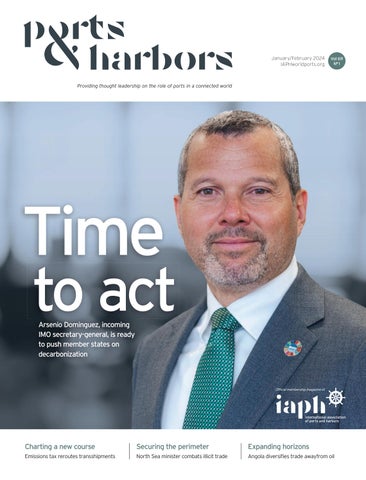
Time
to act Arsenio Dominguez, incoming IMO secretary-general, is ready to push member states on decarbonization
Official membership magazine of
international association of ports and harbors
Charting a new course
Securing the perimeter
Expanding horizons
Emissions tax reroutes transshipments
North Sea minister combats illicit trade
Angola diversifies trade awayfrom oil
OFC_PH_24_No1_Cover.indd 1
12/21/2023 4:31:56 PM
Leading Trade Ad_v1 .pdf
2
16/08/2023
5:37 PM
C
M
Y
CM
MY
CY
CMY
K
PortsAndHarbors_FullPageProcessor.indd 1
8/22/2023 9:39:54 AM
Vol 69 | No 1 | 2024
CONTENTS EDITOR’S COMMENT & CONTRIBUTORS | 02 On to pastures new
The new IMO secretary-general on his incoming term
PERSPECTIVE CYBER SECURITY | 08 A research center focused on maritime security
10 | FEATURE EU EMISSIONS TRADIND SYSTEM What the new emissions tax means for transshipments
WAKE-UP CALL EU ETS | 14 Comment on the new levy regulation
15 | CLOSING THE GAPS HDR What the E&P company focuses on in port projects
INTERVIEW PAUL VAN TIGCHELT | 16 The North Sea minister on combatting illicit trade
08
04 | IN CONVERSATION WITH ARSENIO DOMINGUEZ
18 | WORLD PORTS TRACKER PORT PERFORMANCE Latest port efficiency data analyzed
22 10
28
COLUMN PADDY RODGERS | 21 Tanker trade benefits from economic situation
LOOKOUT COP28 | 26 Climate debates in Dubai, UAE
IN COURT DIVERSITY | 30
CREATIVE SIDE THE BIG, ROUGH SEA | 34 Exploring world ports and trade in paintings
IAPH INFO Q&A PORT ENDEAVOR | 38 An update on the IAPH and UNCTAD cooperation
22 | PROJECT FOCUS ANGOLA Diversifying trade away from oil revenues
28 | PERSPECTIVE TOWAGE SECTOR Small but powerful boats can aid to decarbonization
32 | NINE TO FIVE DR JO NORTH Innovating the Port of Tyne, UK
36 | IAPH INFO News and information about your association
40 | THE REVIEW THE PIRATE’S WIFE The fascinating life of Sarah Kidd
Cover photo: Susanne Hakuba
Loans that stipulate diversity clauses
001_PH_24_No1_Contents.indd 1
34
12/21/2023 4:34:42 PM
EDITOR’S COMMENT
PORTS & HARBORS Published bi-monthly by the International Association of Ports and Harbors (IAPH). Produced, edited and printed by S&P Global Market Intelligence. ISSN: 0554-7555 PUBLISHER MASAHIKO FURUICHI IAPH secretary general E: info@iaphworldports.org PATRICK VERHOEVEN IAPH managing director E: patrick.verhoeven@ iaphworldports.org PRODUCTION S&P Global Market Intelligence 5th floor Ropemaker Place, 25 Ropemaker Place, London, EC2Y 9LY, UK T: +44 (0)203 253 2100 EDITORIAL INES NASTALI Content management principal E: Ines.Nastali@spglobal.com ADVERTISING AND EVENT SALES JOHN KNOWLES Sr sales executive – EMEA E: John.Knowles@spglobal.com CONTENT EDITING KERI DEEGAN Content management director CONTENT EDITORS YOGES PALANIAPPAN IRENE SOO NATALIA NGUI DESIGN HANNAH KIDD Associate director design MATT RAMSDALE Principal designer DESIGNERS PENNY TAGGART WYMAN CHOO PRODUCTION TRACY CELINE DAVID DENISE GRAZETTE NICOLA KOUTSOUMBI EDITORIAL AND PUBLISHING MANAGEMENT PETER TIRSCHWELL VP, Maritime, trade, and supply chain KEN FREDMAN Head of editorial, design and publishing
SUBSCRIPTIONS INTERNATIONAL ASSOCIATION OF PORTS AND HARBORS IAPH members enjoy a free subscription to P&H. If your organization is not a member and you would like a paying subscription to the magazine, please contact the IAPH for more information at: 7th Floor, South Tower, New Pier Takeshiba 1-16-1 Kaigan, Minato-ku Tokyo 105-0022, Japan T: +81 (0) 3-5403-2770 F: +81 (0) 3-5403-7651 E: ph@iaphworldports.org W: www.iaphworldports.org COPYRIGHT © 2024 BY S&P GLOBAL MARKET INTELLIGENCE LLC (AND ITS AFFILIATES AS APPLICABLE). ALL RIGHTS RESERVED.
INES NASTALI Editor
No part of this publication may be reproduced or transmitted, in any form or by any means, electronic, mechanical, photocopying, recording or otherwise, or be stored in any retrieval system of any nature, without prior written permission of S&P Global Market Intelligence. Any views or opinions expressed do not necessarily represent the views or opinions of IAPH, S&P Global Market Intelligence or their affiliates. DISCLAIMER OF LIABILITY While every effort has been made to ensure the quality and accuracy of the information contained in this publication at the time of going to press, IAPH, S&P Global Market Intelligence, their affiliates, officers, employees and agents assume no responsibility as to the accuracy or completeness of and, to the extent permitted by law, shall not be liable for any errors or omissions or any loss, damage or expense incurred by reliance on information or any statement contained in this publication. ADVERTISEMENTS Advertisers are solely responsible for the content of the advertising material that they submit to us and for ensuring that the material complies with applicable laws. IAPH, S&P Global Market Intelligence and their affiliates are not responsible for any error, omission or inaccuracy in any advertisement and will not be liable for any damages arising from any use of products or services or any actions or omissions taken in reliance on information or any statement contained in advertising material. Inclusion of any advertisement is not intended to endorse any views expressed, nor products or services offered, nor the organizations sponsoring the advertisement. THIRD-PARTY DETAILS AND WEBSITES Any third-party details and websites are given for information and reference purposes only and IAPH, S&P Global Market Intelligence and their affiliates do not control, approve or endorse these third parties or third-party websites. Further, IAPH, S&P Global Market Intelligence and their affiliates do not control or guarantee the accuracy, relevance, availability, timeliness or completeness of the information contained on any third-party website. Inclusion of any third-party details or websites.
002-003_PH_24_No1_Editors comment_3 contributors.indd 2
The lurking Leviathan
CONTRIBUTORS
SHEM OIRERE Freelance journalist Angola is still reeling from the effects of the civil war destruction that took place between 1975 and 2002. The government is racing to rebuild infrastructure with support from partners such as Japan. The ultimate plan is to recreate a seamless intermodal transportation network by connecting the country’s ports with the national rail network. A recently approved public-private partnership policy is winning the attention of some investors from Asia and Europe.
12/21/2023 1:33:54 PM
03
Around the same time, when Lloyds-Register-Fairplay, now S&P Global, took over production of this magazine in 2005, “emissions” did not garner a mention in the entire inaugural issue. The focus of articles more lied on expanding capacity at ports to allow larger vessels to call, granted with certain environmental concerns around disturbing ecosystems. Another headline article examined the influence of the then-new IMO’s International Shipping and Port Facility Security Code, which had come into force in 2004. This is still relevant as, in this edition, we have an interview with Belgium’s Minister of Justice and the North Sea Paul Van Tigchelt who works on countering illicit trade and drug trafficking, via IMO guidance, that the Port of Antwerp has been affected by. Regulation can be fluent and flexible and will, for years to come, be amended to better fit changing operations. It is better than no unified path. On that note, the operations of Ports & Harbors are also changing. This is the final edition that was produced by S&P Global. From the next edition on, the IAPH will work with UKbased publisher Mercator Media to produce the magazine, as well as the annual World Ports Conference. It has been a pleasure to be the guiding captain of this magazine for some of its journey and I wish you, dear readers, and the association all the best on its continued, sustainable path forward to provide thought leadership on the role of ports in a connected world. ines.nastali@spglobal.com
EDITOR’S COMMENT & CONTRIBUTORS
sea monster lurking in the depth of the world’s A oceans is slowly making its way to the surface: decarbonization is ready to strike the maritime industry, wielding tentacles of emission-trading schemes, global north-south divisions and competition over vital capital investment Ports can prepare for the imminent attack with a cleareyed understanding of the nature of the leviathon, as well as their own weaknesses. However, the diversity of port operatings systems – spanning varied private, public and hybrid models – presents a fundamental vulnerability. There is no single regulator where ports can come together and strategize, like there is with shipping. Instead, they will look to their governments for support and guidance — or support each other in the form of an association, such as the IAPH. At the same time, ports are the nodal point where the maritime industry comes together and where this sea monster might show its face from behind the breakwater, trying to break it down. Ports will need to engage with carriers and cargo owners who are working to reduce their Scope 3 emissions; this will provide the opportunity to align motivation among those hit equally, if not officially a unified strategy. For this, it is vital for ports to prepare baseline emissions data from their operations and their warehousing and hinterland footprint. While not yet requested by governments globally, the efforts of ports, such as Los Angeles and Long Beach, to comply with court- and state-ordered air pollution improvement plans for two decades can be watched as a bellwether.
@InesNastali
CHARLIE BARTLETT Freelance journalist
Speaking to Paul Van Tigchelt, Belgium’s Minister of Justice and the North Sea, about a crackdown on drug trafficking, human smuggling and wildlife trafficking, I was struck by his conviction that organized crime must be a shared responsibility between the public and private sectors. Belgium is leading the way, taking up the conversation with source and transit countries, and shipping companies, but warned that various initiatives must be coordinated.
Just in case there was not enough to worry about — here comes ETS! I’ll be looking ahead with interest to see whether the EU can get the rest of the world on board. Although given the outcome of MEPC80, that appears a distant possibility, in my opinion.
002-003_PH_24_No1_Editors comment_3 contributors.indd 3
Photos top left to right: Ines Nastali | Shirish Nadkarni | Felicity landon | Charlie Bartlett
FELICITY LANDON Freelance journalist
12/21/2023 1:37:37 PM
Photo: Susanne Hakuba
IN CONVERSATION WITH ARSENIO DOMINGUEZ
04
004-007_PH_24_No1_In Conversation With.indd 4
12/21/2023 4:05:58 PM
IN CONVERSATION WITH ARSENIO DOMINGUEZ
Windows of
opportunities IAPH managing director Patrick Verhoeven and Arsenio Dominguez, incoming IMO secretary-general, discuss the ship-shore interface and plans to make the maritime industry more efficient, secure and transparent during Arsenio’s initial term INES NASTALI
tion, such as chairing the Maritime Security - Piracy and Armed Robbery Working Group within the organization’s Maritime Safety Committee, culminating in 2014 with his appointment as Panama’s ambassador and permanent representative to the IMO, a role he continued until 2017. In those years, he also chaired IMO’s Marine Environment Protection Committee (MEPC), after which he joined the IMO Secretariat in 2017, first as chief of staff to the outgoing secretary-general Kitack Lim before being appointed as director of the organization’s administrative division in 2020 and then of the environmental division.
The maritime regulatory landscape Guiding principles will change significantly — or at least, His work within the MEPC is probably what Arsenio is take another shape that hopefully leads mostly known for within the maritime industry. to meaningful change in 2024. One of his goals for his tenure is therefore to see tangiOne, the International Maritime ble results in the decarbonization of shipping. Organization’s FAL maritime single In 2023, member states agreed to reach net zero around window (MSW) regulation will see increased digital 2050 through fuel standards as well as economic meastransmission of cargo data between ship and land side. ures that will enter into force in 2027. The inclusion of maritime emissions in But, “I am not only focusing on the the EU’s Emissions Trading System will environment, that’s the topic that put influence discussions around financing a “I am not IMO on the map but we’re more than that, sustainable low-carbon transition in mariafraid to including regulating safety and security. I time and therefore also at the IMO. want an organization that is flexible and Overseeing this change will be the shake things looking for tangible results and how we can IMO’s new first man, Arsenio Dominguez, up a bit” support the green transition, the increasing who has started his initial four-year term automation and use of technology as well as the regulator’s secretary-general with ARSENIO DOMINGUEZ as with a focus on the human element and the beginning of the new year. IMO diversity,” he said. “The younger generation Having been the director of the IMO’s is going to take over from us and so I want Marine Environment division since Januan organization that breaks down the barary 2022, he is not the first secretary-genriers like we have been working toward for the past several eral to come from inside the organization. years,” Arsenio laid out his vision for his term in a conversaEfthimios Mitropoulos, who served from 2004 to 2011, tion with IAPH managing director Patrick Verhoeven. and his successor Koji Sekimizu, who served as IMO “I am not afraid to shake things up a bit in order to get secretary-general until 2015, worked within several of the results,” he added. IMO’s divisions before being elected to head it up. But that would only be done with the goal to “mainArsenio himself first worked within the IMO when he tain the relationship between different stakeholders and represented Panama in a variety of roles at the organiza-
T
004-007_PH_24_No1_In Conversation With.indd 5
12/21/2023 4:07:12 PM
also the capabilities that they all have to based on the experience with LNG, which “We would implement regulations. It’s work we need you can extend to other fuels. And now happily share to do, taking into account the concerns, the World Climate Action Program, which which are very valid, to reduce the gap is a smaller group of leading ports, has the tool with between the global North and South, developed the Port Readiness Tool. On the IMO” address those concerns and of course that one hand, this is an assessment tool for goes through the different projects that we the ports themselves to see where we are PATRICK VERHOEVEN already have in place,” he said. One of his in the bunkering of low- and zero-carbon IAPH priorities is therefore to gather more data fuels in terms of safety, quality and the and ensure transparency of the effects concessions that they give to bunkering of decarbonization measures and “focus companies. But the idea, on the other more on measuring the success of the activities including hand, is to develop this as a public tool so the customer improving the planning so that we can be more specific in can see the status of ports.” The tool will be launched where our assistance is required. In a nutshell, that is the in 2024 and that again is, “something we would happily kind of organization I’m looking forward to lead”. share with the IMO, which will facilitate the decarbonization of shipping next to other measures,” said Patrick. Port support While he agrees that decarbonization rightly has the One group of stakeholders that might not being regattention at the moment, he can think of at least one ulated by the IMO but plays a vital connecting role in other agenda item that his members want to discuss the maritime supply chain is of course ports. Under the with the IMO. The IAPH, via its Risk and Resilience auspice of outgoing secretary-general Kitack Lim, the Technical committee, recently co-sponsored a submisrelationship between port authorities and the IMO has sion regarding the impact of illicit trade and organized become very close, with several joint efforts to push the crime to the 33rd session of the IMO Assembly, which incoming electronic MSW facilitation, for example. “We was discussed in early December 2023. The submission, can’t really work in isolation because the connectivity beaimed to garner support for an assembly resolution, urged tween ship and shore is required.” Then, there is the green parties to submit proposals to the IMO Maritime Safety agenda. “And of course, shipping is not going to be able to and Facilitation Committees to enhance and adapt the decarbonize without ports. We need terminals to supply existing framework for combating organized crime in the alternative fuels in a safe manner. So, we will be workmaritime sector. Additionally, the resolution invites IMO ing on the training and safety around alternative fuels member states to share successful strategies in mitigating required for the seafarers at the terminals but also around the impact of organized crime on international maritime the transport and handling of those,” Arsenio said. traffic and port facilities. “That is a valid point, the more For him, not only transparency but also standardizawe’re enhancing the use of technologies on both sides, the tion will be key in future. “The more logistically efficient a more risk we face around cybersecurity. We started work port is, the better the connectivity between the ship and with the IAPH on cyber guidelines a few years ago and port is. There are plenty of areas where we can actually that’s something we can continue to look at,” Arsenio said, continue to enhance and standardize some of the aspects agreeing with Patrick. between ship and shore. Looking to cold ironing, for Valuable exchanges example, as of the main aspects that will support this Indeed, with the incoming trade facilitation regulation on transition, but we do need to work on the standardization electronic MSWs, this will be pertinent. “Trade facilitation of this mechanism,” the new IMO secretary-general said. closely connects to security as well. At the World Ports He is referring to, for example, ensuring that grid elecConference in Abu Dhabi, we presented guidelines that tricity for this comes from renewable resources to avoid we developed together with the World Customs Organizashifting pollution and emissions from one part of the suption. Customs are a key player in trade facilitation. That’s ply chain to another. “I am looking forward to seeing what the spirit of those guidelines that you do both, make sure ideas the port industry has in this respect,” Arsenio said. that everything is checked as it should be, but at the same Patrick does have an idea. “I think the most important time, you facilitate trade,” Patrick said. The other element thing we can do is facilitate bunkering of low-carbon to getting the MSW off to a good start is to ensure ports fuels. We’ve already done work on safety in the past years
004-007_PH_24_No1_In Conversation With.indd 6
12/21/2023 4:08:39 PM
07
Working together
004-007_PH_24_No1_In Conversation With.indd 7
On the right path
So, what would the new IMO secretary-general like his legacy to be? For the IMO to be “a place that people aspire to work for.” For now, “We are in a good place, looking back to June 2023 and the manner in which the decision about reaching net zero was made, not just unanimously, but in a really good spirit,” he said. “Discussions were open and rich, which allowed member states to agree on a defined timetable to have technical and economic measures in place by 2027.” This will, hopefully, put the IMO on a good pathway to meet the 2030 and 2040 indicative checkpoints that ask for a 20% and 70% reduction of 2008 emissions, respectively. Arsenio is confident. “One of the things I enjoyed the most when I was chairing the Marine Environment Protection Committee was working with member states and to reach an understanding of the actions that have to be taken, how we continue to work together, where we can make progress, where we need to do further analysis and where valid concerns are,” he said. With this spirit, “We are in a right position to roll out measures and demonstrate that we really are compromising and we’re doing it in a fair manner with all the member states involved,” he said, looking forward to his term as IMO’s newest secretary-general.
Photos left to right: IAPH | Susanne Hakuba
The next step in the decarbonization journey of the IMO will be to hear back on the impact assessment for fuel standards and economic measures of which the interim report will be presented at MEPC81 in spring this year. The assessment will look at how proposed measures contribute to the reduction of greenhouse gases as well as the impact on states based on how connected they are to the shipping market, cargo types and also food security and socio-economic development. For Arsenio the support of ports will then be important. “Similar to the single window, we need to look at how we will roll this out because it will not be possible to choose and push every single port in one go, so we need to strategically look into the way we support ports in member states that are developing countries,” said Arsenio. This is also clear for the IAPH that supports one of the submissions for economic measures. “If there is revenue going to be generated, that should be used for infrastructure in small island states. The ones that are vulnerable
to the impact of climate change, and will need help with infrastructure,” Patrick said. Arsenio is again open to hear from the IAPH here. “What sort of infrastructure investments and budgets are we talking about? Any projections, scenarios and information that you may be able to provide can assist those conversations because you can look into specific terminals in small island developing states and what the needs are for investment. That would be helpful.”
IN CONVERSATION WITH ARSENIO DOMINGUEZ
in developing and developed states work together. “It is a challenge, in particular for developing states. The good thing is the support from developed countries for developing countries, such as between Norway and Antigua and Barbuda or Singapore and Angola. The idea is that from there is a learning for implementations of those projects and then franchising out to other countries,” said Arsenio. On the other hand, “the IAPH and IMO symposium on the topic, held in January 2023, showed that establishing a digital infrastructure, which will be the case for more developing states, might be more feasible than adapting existing digital processes that have been in use in ports in developed states,” Patrick said.
12/21/2023 4:09:33 PM
PERSPECTIVE CYBERSECURITY
Tackling digital corruption he University of Plymouth, located just a stone’s throw from the ocean in the southwest of England, began life in 1862 as a school of navigation. The sea has therefore always been woven into its heritage, and marine and maritime research, teaching and innovation remain firmly at its heart more than a century and a half later. The university has been awarded two Queen’s Anniversary Prizes for Marine Work and was rated the best in the world in relation to the UN Sustainable Development Goal 14: Life Below Water, in 2021. It is also leading the way in maritime cyberthreats research, via a cutting-edge international facility known as the Cyber-SHIP Lab, currently funded by Research England, in collaboration with industry partners.
T
The Cyber-SHIP Lab With about 90% of supplies moved via the oceans, the maritime industry is the lifeblood of global trade and commerce.
008-009_PH_24_No1_Perspective_1.indd 8
Cyberattacks are listed as a top-tier threat to international security, yet when it comes to cybersecurity, the sector is shockingly ill-prepared to deal with its own, extremely serious, vulnerabilities. The maritime industry is poorly placed to detect and mitigate cyberattacks for a number of reasons: briefly, there is a historic, false perception that a vessel out on the ocean is not part of a connected cyber network, there are problems caused by the unusual longevity of legacy maritime operational systems, and there is a lingering but persistent misconception that cybersecurity is purely an IT issue. All these are proving a considerable barrier to advances in maritime cyber resilience. A critical weakness has always been that cyber vulnerability testing is difficult on active vessels and platforms because of the limits on what can be achieved in short windows of refit time and in circumstances where the scope of testing is often artificially limited, since causing damage to
the systems is costly and would cause unacceptable impact on business operations. This is where the Cyber-SHIP Lab and the University of Plymouth Maritime Cyber Threats Research Group come in. A worldfirst, hardware-based maritime cybersecurity research-and-development platform, the Cyber-SHIP Lab brings together connected ships’ operational systems, configurable in vessel-specific layouts, as required. The lab can effectively become a physical twin of any ship’s operational systems in terms of IT and associated operational technology. Using this platform, the Cyber-SHIP Lab analyzes cyber-physical security vulnerabilities holistically – at the hardware, software and human levels – to identify, understand and mitigate threats. The team publishes research addressing real-world problems directly affecting the sector and works to develop practical tools and training. The scope of research is not limited to vessels alone: port operations, ship and port
12/21/2023 1:02:10 PM
09
ABOUT THE AUTHOR CHLOE ROWLAND is a former commercial litigation lawyer and the maritime cyber projects and key partner relationships manager at the University of Plymouth’s flagship Maritime Cyber Security research projects, the Cyber-SHIP and Cyber Resilience of Offshore Wind Networks Labs.
“Port operations are increasingly the focus of well-funded, state-level bad actors”
Riskocity and MaCRA The Maritime Cyber Risk Assessment framework (MaCRA) has been specially developed by the research team and is a commercial service delivered through spin-out company Riskocity Ltd. A unique solution for maritime cyber risk assessment, MaCRA dynamically responds to changes made within ships’ systems and to threats associated with voyage-specific route, port and cargo contexts to provide real-time, operation-specific cyber risk assessment. This framework represents a real step-change in maritime cyber vulnerability assessments.
Get involved If you would like to know more about the research of the The Cyber-SHIP and CROWN Labs and engage with the work the University of Plymouth Maritime Cyber Threats Research Group is doing, please get in touch with the author of this article, Chloe Rowland, maritime cyber projects and key partner relationships manager, at: chloe.rowland@plymouth.ac.uk
Photos left to right: Getty Images/Aleksandra Konoplia | University of Plymouth
008-009_PH_24_No1_Perspective_1.indd 9
practices, helping to secure international supply chains, economies and protect seafarers’ lives.
PERSPECTIVE CYBERSECURITY
interactions, autonomous and remote-consupply chains and are increasingly the focus trolled platforms are all considered, enaof well-funded, state-level bad actors wishbling the development of secure-by-design ing to cause widespread unrest and disrupmaritime systems across the whole supply tion. The Plymouth team has researched the chain. The research also has wider applicacyber-physical vulnerabilities of a number of tions into offshore operations and transport the world’s busiest ports and demonstrated, infrastructure via a second research lab, via detailed and realistic scenario visualizacurrently under development, the Cyber tions, how issues such as zero-day attacks, Resilience of Offshore ransomware, spoofing, Wind Networks, known as phishing, and lack of the CROWN Lab. cyber hygiene and social engineering may all be The Cyber-SHIP responsible for signifiand CROWN Labs are cant cyber vulnerabilities pioneering capabilities, affecting ports. providing insights that There are also often cannot be gained in the CHLOE ROWLAND unexpected vectors, virtual world through which can have serious simulation alone, and University of Plymouth cyber implications, rangare helping empower ing from geographic factors, through politics, the maritime sector to improve global down to silicon microprocessors, depending shipping security. on specific port location and operations. What this means for port authorities The team’s research can also help quantify the econometric impact that a Among the many services provided by the cyberattack could have on commercial acCyber-SHIP Lab team are model-based frameworks for dynamic cyberrisk assesstivity, not only in the event your own port ment, cybersecurity auditing and test-bedsuffered a direct cyberattack, but also ding, policy development, advice on how the knock-on effect that a cyber-based autonomous and augmented reality technolattack on a port on the other side of the ogies may impact cyber-physical risks, to world could have on your operations. name but a few. The team also provides The lab can provide a space for testing, holistic cyber-physical risk assessment for demonstrations and training, enabling the ports. Port operations are critical to global adoption of maritime cybersecurity best
12/21/2023 1:06:58 PM
FEATURE EU EMISSIONS TRADING SYSTEM
Competing efforts The EU Emissions Trading System now takes shipping emissions into account, a chance for neighboring transshipment ports to gain importance when journeys are diverted to reduce costs CHARLIE BARTLETT
s world leaders’ private jets descended on Dubai’s fully air-conditioned Expo City for COP28 in December 2023, the time had come to face up to something just about everyone has been dreading: Scope 3 emissions. Taking account of the carbon and carbon-equivalent emissions from a company’s own offices, even quantifying those from assets, such as bulk carriers and quay cranes, is relatively straightforward. This is in contrast to the likely multimonth slog of chasing emissions down the branches of the organizational chart, from company suppliers who may be uncooperative to open markets for raw materials, which can be completely opaque. Nevertheless, the importance of Scope 3 emissions cannot be understated. Tesla Inc. recently quantified its own Scope 3 emissions, and the results were harrowing: 30.1 million metric tons of CO2e, compared with just 610,000 metric tons emitted under Scopes 1 and 2. Ford Motors Co., which makes some electric vehicles but also a number of mega-pickups with V8 engines, has uncovered similar findings, with Scope 3 emissions representing about 97% of the total. The great hope – and threat – of Scope 3 is to put an end to the practice of offshoring emissions, and to force companies to face up to their true footprint. The carbon-intensive process of assembling computers, for example, occurs
A
010-013_PH_24_No1_Feature.indd 10
12/21/2023 2:51:08 PM
11
FEATURE EU EMISSIONS TRADING SYSTEM
Photo: Getty Images/Felix Cesare
12/21/2023 2:52:23 PM
010-013_PH_24_No1_Feature.indd 11
at factories in the Chinese cities of Kunshan and Chongqing, which use Chinese grid electricity and Chinese internal logistics, only to be transported to the US — where the only emissions their owners have had to worry about so far, is the electricity bill. This phenomenon is known as carbon leakage, and it has allowed politicians from some of the world’s biggest polluting nations to decry the world’s factory as an emissions menace — often, in the same breath, refusing to reduce their own emissions until mainland China does. In fact, taking into account these emissions-at-a-remove is enough to upend the list of the world’s biggest polluters. It doubles, for example, the UK’s carbon footprint according to the WWF’s 2020 Carbon Footprint report. This might be one reason why the inclusion of shipping in the EU Emissions Trading System (ETS), representing an early attempt to identify the true cost of carrying goods from one side of the world to the other, is so unpopular with the industry that exists to do it. All the tea in mainland China
In line with criticisms in the past, the International Chamber of Shipping (ICS) said at the opening of its Shanghai office in September 2023 that a lack of global regulation – such as its own suggestions for a carbo-bunkering levy, and a research and development fund – left it open for an undesirable regionalization of emissions regulation. “A legal framework in maritime transport” was desirable, versus the “challenges and risks from other unilateral regulations,” said Simon Bennett, ICS deputy secretary-general. Shipping giant CMA CGM SA has made an early attempt to quantify the effect of EU ETS on European shipping. Passing on the cost of ETS to its customers – assumed to be €90 per metric ton of CO2 emitted – would generate a €37 per TEU surcharge for vessels calling between European ports, and a €25 per TEU surcharge on Ports on the EU’s periphery, therefore, stand to make Asia-Europe trades. Intra-European reefer services were incredible gains in transshipment work at the expense of hit the hardest, at about €48. their European neighbors. As far as the EU is concerned, “Some aspects of EU ETS law are yet to be finalized, these ports include Tanger Med, Algeciras’ Moroccan such as the list of ports considered as transshipment ports counterpart, and Port Said in Egypt, both of which move that will have been published by the end of 2023, and may 65% of their container cargoes in the form of transshipbe reviewed every two years,” added CMA CGM. ments on an annual basis. Indeed, it is the thorny issue of transHowever, the European Sea Ports shipment ports that currently exercises Organization (ESPO) is unhappy with officials at the European Commission. this, saying, in September 2023, that the “In an ideal world IMO For example, if a shipment originating in EU is being too lenient. “While only a few would step up ... but Shanghai is unloaded in Rotterdam, the neighboring ports are reaching the very vessel operator pays 50% of the cost of the high transshipment volume thresholds they haven’t yet” CO2 generated throughout that voyage. put forward in the legislation (65%), many AOIFE O’LEARY However, if the container is transshipped ports and terminals around Europe have CEO, Opportunity Green outside the European Economic Zone, been or are building up transshipment caat Tanger Med for example, and carried pacity. The commission should therefore henceforth to Rotterdam, 50% of the cost not only look at current volumes, but also of this short voyage would be much more palatable. consider the transshipment capacity in the different ports This is exactly the sort of carbon leakage ETS is neighboring the EU.” designed to prevent. Indeed, it is a mechanism like this Incentivizing shipowners one, albeit in reverse, which benefits European shipownThere are a few eligible suitors, which could be well-served ers wanting to skirt EU scrapping regulations by selling in winning over European shipping. to an intermediary.
010-013_PH_24_No1_Feature.indd 12
12/21/2023 2:53:18 PM
13 Recent research by Drewry has average port capacity utilization sitting at 59% in the Middle East in 2022, having fallen lower during the disruptions of 2021. Drewry notes that capacity is set to increase by 3.5% by 2027, with demand likely to trail behind at 2.3%. DP World Ltd. has long positioned the Port of Jebel Ali, its flagship, as a gateway to Europe, and has for some years been locked in a battle with Khalifa Port in Abu Dhabi, which has seen both add more container capacity than there has, hitherto, been very much need for. As a transshipment hub, though, Jebel Ali is already a roaring success, with these volumes making up generally about two-thirds of its container traffic. However, this could turn out to stand both ports in good stead. At time of writing, Jebel Ali has almost an entirely new terminal to throw at the problem, Terminal 4, replete with remote-controlled quay cranes and a hightech BoxBay container stacking scaffold. It will likely be preferable to pay 50% of the cost of a voyage from one of these ports than from Shanghai. A new world order
Photo: Getty Images/Felix Cesare
010-013_PH_24_No1_Feature.indd 13
FEATURE EU EMISSIONS TRADING SYSTEM
For example, Türkiye’s Port of Mersin has 2.6 million TEU of capacity, about 10% of which is generally used for transshipment each year. But the port is growing, and Phase 2 of its East Mediterranean Hub project is set to be completed soon, adding another 800,000 TEU of capacity. Although Türkiye generally fosters a collaborative stance with the EU as a potential, and hopeful, prospective addition, there can be no doubt that with more than 600 nautical miles between it and the Greek port of Piraeus, and only a small fraction of transshipment cargo at time of writing, it could stand to benefit considerably. In 2023, Hutchison Ports Ltd. announced it would be making a major investment in Ain Sokhna port, Egypt, adding a new 1.7 million TEU terminal, as well as a new terminal at the Port of Alexandria, for a total of $700 million. ESPO insists that moves are being made already by EU neighboring ports to grow transshipment capacity. “We see a real ramping up of investments in additional TEU capacity in ports and new terminals in neighboring countries, including investments realized by major shipping lines in these ports, and we also hear about first rerouting movements outside Europe.” Further afield, should the economics stack up, the Middle East could be in for a windfall, as well.
ESPO maintains that this will levy costs on EU ports that they can ill-afford. “This reinforces the idea that shipping lines, where relevant, are preparing their way out of the EU ETS maritime,” said Zeno D’Agostino, chairman of ESPO. “We recognize the importance of the EU ETS directive and support its aim, but we continue to regret that this legislative framework disadvantages EU ports vis-à-vis non-EU ports, without the expected benefit in terms of emission reduction.” An added attraction of diversion is that vessels calling at non-EU ports will not be bound by FuelEU Maritime, meaning they will not have to worry about plugging into onshore power supply (OPS). The ESPO, too, calls for OPS to be made mandatory and tax-exempted, to ensure a return on infrastructure investment. This would help make it easier for shippers and shipowners to be hold accountable , also in the name of social responsibility, and, potentially, fines for not plugging into OPS to be given out. Putting moral arguments to one side, however, ETS’ various loopholes certainly seem to add credence to ICS’s argument that a scheme like EU ETS would only work if applied globally. However, in the aftermath of IMO MEPC 80, there seems little prospect of that. “Hopefully there is such a levy – but it will depend on what happens to the revenues, as to whether it renders the ETS unnecessary,” said Aoife O’Leary, CEO of activist group Opportunity Green. “In an ideal world, the IMO would step up and put in global regulations, but they haven’t yet – what we have is a revised initial strategy, with targets that are not quite 1.5 degrees C,” she added. “ICS may put forward its own versions of a shipping carbon levy, but quite often these have not covered important details such as the lifecycle of fuels. A lot of countries really need climate finance, and because shipping has barely paid any taxes, they are the perfect place to get it.” Either way, it seems unlikely that the revisions made to EU ETS will end after its entering into force in January.
12/21/2023 2:54:17 PM
14 n a significant move toward industry decarbonization, the EU in 2023 adopted legislative measures to the EU Emissions Trading System Directive for maritime transport emissions to be included in the EU Emissions Trading System (EU ETS) from Jan. 1, 2024. The move will have wide-ranging implications for the maritime industry, particularly on certain ports within and outside the EU.
I
The Directive defines a port of call as “the port where a ship stops to load or unload cargo or to embark or disembark passengers, or the port where an offshore ship stops to relieve the crew.” There are also various exclusions from On the horizon this definition, including stops for refueling, relieving crew The Directive itself includes a requirement on the EU – if not an offshore ship, ship-to-ship transfers, carrying Commission to review and report on the effectiveness out repairs, dry-docking, emergencies, sheltering from of the EU ETS provisions for maritime emissions and adverse weather and notably also “stops of containerships considering amending in a neighboring containthese in light of other er transshipment port” global commitments, (NCTP). The EU has now such as a potential IMO published an implementmarket-based measure on ing act (Implementing emissions reduction. Regulation 2023/2297) Under Article 3gg of the listing East Port Said in Directive, as part of this Egypt and Tanger Med in requirement to review and Morocco as NCTPs. A vesreport, the EU Commissel stopping at these ports JOHANNA OHLMAN VIOLET O’GORMAN ALESSIO SBRAGA Trainee solicitor Associate Partner sion must consider the shortly before or after risk of an increase in entering EU ports will not evasive practices. In parbe able to count their stop ticular, the Commission as either a beginning or must monitor the risk of a end to the vessel’s voyage. “shift of port hubs to ports This may have the effect outside the Union”, which of extending the length may occur for reasons of a voyage covered by With the EU Emissions Trading System entering explained above. The EU the EU ETS and, in turn, Commission will report the quantity of emission into force, Johanna Ohlman, Violet O’Gorman biennially from 2024 allowances that need to be and Alessio Sbraga at HFW, look at its onward and will propose surrendered for the ship’s measures “to ensure the emissions during the implications for ports effective implementation” voyage in question. of the Directive, taking The designation of into consideration in parNCTPs may have the ticular possible increases effect of decreasing vessel in transport costs, shifts of traffic at NCTP ports and transshipment hubs and changes in port traffic. potentially increase traffic in other non-EU ports in efforts Stakeholders should therefore remain cautious if by operators to minimize the length of voyages covered by planning strategically or long term to use alternative the EU ETS. However, as noted below, the EU will monitor ports to minimize EU ETS costs, as these practices will be and review such potential evasive activity. monitored and may be subject to more stringent Furthermore, Articles 12(3-d), (3-c) and (3-b) of the regulation in future. It is therefore clear that, going Directive allow member states (by making a request to forward, the impact of the EU ETS on the maritime the EU Commission) to take no action against shipping industry will be far-reaching. companies in respect of emissions incurred for certain
Wake-up call
Photos: HFW
WAKE-UP CALL EU EMISSIONS TRADING SYSTEM
The port of call
voyages to/from certain ports and/or by certain vessel types. These exclusions can apply until Dec. 31, 2030. These exclusions appear targeted to cover lifeline services operated in remote regions and it remains to be seen how – if at all – these provisions affect port traffic. Operating vessel services to other ports in remote regions not covered by the exclusions may prove more expensive due to the additional costs associated with EU ETS compliance – including but not limited to purchasing emission allowances – which may make calls at ports covered by the exclusions more attractive. Further, as the exclusions are subject to member state discretion, they may be utilized to different extents in different countries.
014_PH_24_No1_Wake Up Call.indd 14
12/21/2023 3:49:32 PM
15
Closing the gaps With upgrades to port infrastructure needed, HDR Inc. considers investments in resiliency, particularly to mitigate sea level rise, and a focus on digital design vital
015_PH_24_No1_Closing the gaps.indd 15
DOUG THIESSEN West region maritime lead, HDR are being studied to reduce carbon emissions and it is difficult at this stage to determine, which will emerge as the accepted solution. In recent work in Hawaii, for instance, we have helped explore different biodiesel bunkering options that may be used on the mainland. The best practice for each port will likely be highly dependent on geographic location, transportation modes and requirements. Q: What do ports need to do now to prepare for a changing infrastructure landscape? A: Ports understand their existing clients and customers very well, but it is also important for them to explore new industries and technologies, such as offshore wind and zero-emissions equipment. Planning studies and analyses of their operations can help ports make the most of their infrastructure and growth opportunities. Embracing new technology such as electrification will require added forethought during facility upgrades and new training for the ports and maritime workforce, but this will also lead to improved efficiencies and productivity. At the Port of Jacksonville, Florida, for instance, a needed wharf rehabilitation not only strengthened the
Q: What advice can you give ports to close the gaps in infrastructure? A: Ports are amazing, complex facilities, but no port can do it all. It is important that ports identify their niche — containers, liquid bulk, break bulk — and excel. Expand strategically, deepen industry connections, continually learn and improve and secure funding tailored to your operations. Moving forward, a collaborative effort among ports, consultants, industry and academia is crucial to address challenges such as technological disruption and climate changes. One way to facilitate this is through improved data sharing. In a competitive and cybercrime-ridden world, information exchange is key to port success and innovation. After all, a rising tide lifts all boats. Q: How would you like to further cooperate with ports in future? A: As a full-service firm with over 12,000 employees and hundreds of offices, HDR has worked with ports on almost anything they need. Our matrix organization allows us to tap into a broad range of global experience that crosses different markets like power and energy, industrial, water resources and more to provide integrated solutions. Similarly, our diversified service capabilities streamline our ability to deliver the expertise needed to move projects forward efficiently and effectively. From small to large, coastal to inland, container to cruise, our experts have experience with every type of port. Our driving philosophy is to be a trusted partner, to listen and understand current needs and work collaboratively to achieve port goals.
Photo: HDR
Q: How do you see the current state of the port infrastructure market in terms of market potential, including bunkering and digital infrastructure? A: A lot of port facilities are reaching the end of their life, which represents a large need for continued upgrades and rehabilitations. In the United States, the 2021 Report Card for America’s Infrastructure compiled by the American Society of Civil Engineers gave the nation’s ports a B-minus grade, noting significant needs for dredging and landside infrastructure improvements. The good news is that recent funding from federal and state sources plus private sector investment is supporting much-needed improvements, particularly in resiliency and with projects focused on mitigating sea level rise. We are also seeing innovations such as a bigger focus on digital design. New digital technology is evolving quickly, and digital asset management tools can help avoid or defer costly repairs and expensive downtime. Across the industry, many different options for bunkering and fuel alternatives
structure, but also added new electrical infrastructure to support the conversion to electrified cranes, as well as provide cold ironing services to ships in port.
CLOSING THE GAPS HDR
Q: Please give us a brief introduction of your role and how you interact with ports A: I serve as HDR’s west region maritime lead, working with ports and the wider maritime and freight industries across western North America. Before joining HDR, I served for a number of years as the chief harbor engineer and managing director for the Port of Long Beach, giving me a strong understanding of the operational as well as infrastructure needs of port facilities. HDR’s work with ports is built upon our core value of listening to our clients and understanding their needs at a deep level. We then match our expertise, which covers every aspect of maritime facility planning and design, both waterside and landside, to the requirements of each client.
Q&A
12/21/2023 3:07:10 PM
Paul Van Tigchelt 016-017_PH_24_No1_Interview.indd 16
12/21/2023 3:39:42 PM
17 With support of the IAPH, Belgium is leading proposals at the IMO to target drug trafficking. Belgium’s Minister of Justice and the North Sea, Paul Van Tigchelt, told P&H why this is a matter close to his heart FELICITY LANDON
He sees a “unique opportunity” that he is seizing with both hands, seeking to finish the job started by his predecessor. Belgium’s proposal is a flexible instrument
016-017_PH_24_No1_Interview.indd 17
Photo: Wouter Vervaeck
Fighting the good fight
to address various threats simultaneously, risks must then be included in the security he said. “You conduct a risk analysis and, plan. The fence that stops a terrorist can based on that, create a security plan to also stop a drug courier. The camera that prevent the risks from becoming reality. detects a human smuggler can also spot a Belgium is going further, expanding the drug smuggler. The best rules are simple; law to inland vessels and companies with we don’t need to reinvent the wheel.” an impact on maritime security, such as “A message to the underworld that the shipping agencies. The latter even requestupper world no longer tolerates being ed this, according to the minister. “They exploited for their financial gain. That too, are faced with infiltration from the the private and public sectors are going environment to obtain sensitive informato collaborate. From the contacts we tion. They also want to put a stop to this.” have, it is evident that more and more Van Tigchelt said to P&H that he always countries are looking at Belgium and wanted to fight injustice and make a internally evaluating what they can do difference. He studied law and ultimatebetter themselves. That gives me hope.” Belgium is ly became a drug actively engaging magistrate 20 years with key source ago, “constantly "‘The best rules are and transit counengaged in the fight simple: We don’t tries, having inked against internationagreements with ally organized crime need to reinvent Panama and Costa and drug trafficking the wheel” Rica to prevent drug in particular.” When shipments. The he was appointed a country is part of an drug magistrate, 5 European anti-narcotics coalition and metric tons of cocaine were being seized collaborates with the US. annually in Belgium. It has also reached an agreement with In 2022, that figure was 110 metric tons. the Netherlands and five major shipping Securing port operations companies — Mediterranean Shipping Shipping is crucial in contributing to Company S.A, Maersk A/S, Hapag-Lloyd economic prosperity and progress and AG, CMA CGM and Seatrade — focused allow cities such as Bruges and Antwerp on combating vessel misuse. “However, to evolve into what they are today, said the various initiatives must be coordiVan Tigchelt. “However, due to its unique nated. For example, smart seals are an characteristics, shipping is also very important weapon in the fight but there vulnerable to various threats. The import are many different types in the field.” and export of goods have been a source In together of various types of small- and large-scale Above all, the fight against organized crimes, such as smuggling, theft and crime must be a shared between public human trafficking.” He added, “Ships are and private sectors. “I am optimistic that in an unprotected environment during the private sector no longer sees this as their journey, subject not only to the laws solely a government problem but is genuof nature but also serving as a target for inely willing to collaborate, engage in diathose with malicious intent, directed at logue and take the necessary initiatives.” both the cargo and the ship itself.” The changes proposed are simple — to exAnd he is grateful for the support from pand the definition of unauthorized action. the IAPH. “By having the IAPH as a “In the risk analysis, in addition to esco-sponsor, our proposal to the IMO has pionage, sabotage and terrorism, we now the support of 177 ports and 174 port-relatalso consider the risk of drug trafficking, ed companies in 84 countries. The human smuggling or trafficking in wildoutreach is enormous, and I want to life. The necessary measures against these thank the IAPH for that support.”
INTERVIEW PAUL VAN TIGCHELT
elgium’s drug trafficking is “an even bigger problem than terrorism,” reported the Financial Times. The illicit drug trade at the Port of Antwerp is “fueling a crime wave,” reported France 24. Belgium has become “Europe’s port of call for cocaine,” reported the European Union Parliament magazine. It is not difficult to understand the motivation behind Belgium’s submission to IMO Maritime Safety Committee 108, scheduled for May 2024. The proposal is to make illegal actions part of the respective impact assessments and ensure a robust global framework and level playing field. Do the headlines accurately reflect the situation in Belgium? Paul Van Tigchelt, appointed Minister of Justice and the North Sea in October 2023 after the resignation of Vincent Van Quickenborne, said to P&H, “Unfortunately, the facts don’t lie. And it will get worse before it gets better. But that it will get better, I have no doubt. We are taking measures in securing our ports and shipping sector. We are seizing record amounts of cocaine. We are convicting hundreds of drug criminals because we managed to hack their SKY-ECC communication platform. And the rollout is gaining momentum. If we can undermine the profit model, we can make a difference.” He explained, “Antwerp is the second-largest port in Europe. There is a lot of drug-related violence. We want to reclaim our ports, and for this, we must use all possible means,” However, he emphasized that shipping is “a global phenomenon”. Therefore, “We must be cautious of the waterbed effect. Collaboration between ports within the EU but also, and especially, internationally, is important to maintain a level playing field. By combining the competencies of justice and the North Sea policy, I can work on all fronts on success rates, apprehension rates and conviction rates.”
B
21/12/2023 16:43:02
WORLD PORTS TRACKER PORT PERFORMANCE
Going steady Reduced demand makes for improved port efficiency in US ports, while Southeast Asia further emerges as important supply chain partner taking on more cargo TURLOCH MOONEY, MAX JANTHUR
he 2023 third-quarter update of the S&P Global Port Performance data focusses on the main US-Asia trade lanes and ports. During this time, container moves on ocean-going ships declined in all US regions. The average call size, and the quantity of containers loaded and discharged per individual ship call declined by more than 26% at main ports on the US West Coast compared with the third quarter of 2022 — a trend seen in all regions. At the same time, overall vessel calls have been on a steady climb since the beginning of 2022. In the US, this drop in demand and call sizes also drove further improvement in operational performance during the same time. At Gulf ports, for example, port-moves-perhour (PMPH), the quantity of containers moved per hour a ship spends in port, increased by nearly 66% year over year in the third quarter of 2023. At the main East Coast ports, PMPH increased by more than 90%. Countering this improved efficiency was a small increase in median export container dwell time at the main East Coast ports. This is the amount of time a container remains in the terminal yard before getting picked up by the importer or before being loaded onto a ship for export. Yard productivity, however, improved with West Coast ports, decreasing 30% and 45%, respectively, in median import and export container dwell time. Consequently, ship waiting time continued to fall on all US coasts, with the biggest year-over-year decline at East Coast ports at 78%.
T
On the other side of the world In Asia, performance at Chinese ports continued to improve. The main gateways showed a collective improvement of 30% in PMPH compared with the third quarter of 2022. Ports in Southeast Asia registered growth in container moves on ocean-going ships as the region expands its position as a sourcing destination in global supply chains. Especially, the ports of Chattogram in Bangladesh and Tanjung Perak in Indonesia noted significant growth in container moves. Overall, operational performance continued to improve at the main Southeast Asia gateways with PMPH up by 20% year over year, and yard productivity was ahead of Chinese counterparts during this quarter.
018-020_PH_24_No1_World Ports Tracker.indd 18
Improving productivity and emissions Port productivity is directly linked to the decarbonization agenda of maritime. Ships waiting to berth generate excess emissions that could be reduced by quicker berth access. In 2021, international shipping emissions increased almost 5% compared with 2020. The global port congestion that year was one of the main causes of that steep increase. If everything were to stay the same, the industry could be responsible for 15% or more of global emissions by 2050. The IMO targets are a 40% reduction in carbon intensity of international shipping by 2030 compared with 2008 and to reach net-zero greenhouse gas emissions by or around 2050. That reduction will come from a mix of design, economic and operational solutions, including optimizing vessel speeds, which depends on better network and port call efficiency to reduce waste in the time for vessels to call at ports. Absence of shared information is one of the primary causes of waste in port calls. Digitization is the antidote to this; it is the key to better efficiency and to the ultimate and highly challenging goal of system-wide just-in-time vessel arrivals. Port operations are very complex and produce large amounts of data. Digitization can ensure these data are recorded and utilized effectively, creating access to critical information at the right time, which in turn drives better collaboration and better synchronization of efforts between the different stakeholders in the port call ecosystem. There’s a direct relationship between port supply chain delays. Conversely, there’s a clear link between efficient gateway ports and terminals and efficient supply chains. The supply chain benefits and the reduced risks for the global trading economy are also very evident. Reducing maritime emissions is an important part of global emissions reduction, especially considering the delays and congestion in ports that we saw in recent years. Making global liner operations more efficient, particularly port calls, is one of the key levers to do that. To achieve these goals, greater focus is needed on performance, including measuring, tracking and benchmarking port call processes. Industry digitization can drive these improvements and enhance collaboration and coordination among the different stakeholders. The good news is that the building blocks are in place and these goals are achievable.
12/21/2023 4:00:34 PM
19 Vessel calls per region (index-based reporting with Q1 2017 = 100) 170 160 150 140 130 120 110 100 90 80 Q1
Q2 Q3 2018
Q4
Q1
Q2 Q3 2019
Q4
Q1
Q2 Q3 2020
Q4
Q1
Q2 Q3 2021
Q4
Q1
Q2 Q3 2022
Q4
Q1
Africa
Latin America
Mediterranean
Middle East & India
North America
Northeast Asia
Northern Europe
Oceania
Southeast Asia
Q2 Q3 2023
Port-moves-per-hour (total moves divided by port hours) per region (reporting quartile development, index-based with Q1 2017 = 100) 140 130
WORLD PORTS TRACKER PORT PERFORMANCE
70
120
100 90 80 70 60 50 Q1
Q2 Q3 2018
Q4
Q1
Q2 Q3 2019
Q4
Q1
Q2 Q3 2020
Q4
Q1
Q2 Q3 2021
Q4
Q1
Q2 Q3 2022
Q4
Q1
Africa
Latin America
Mediterranean
Middle East & India
North America
Northeast Asia
Northern Europe
Oceania
Southeast Asia
Q2 Q3 2023
The berth-moves-per-hour (BMPH) boundary was reduced from 15 to 5. Calls with BMPH below 5 are now eliminated, instead of 15.
018-020_PH_24_No1_World Ports Tracker.indd 19
Source: S&P Global Port Performance Program | © 2024 S&P Global Market Intelligence
110
12/21/2023 4:04:07 PM
20 Evolution of vessel size per region (reporting share of vessels 8,501+ TEU in total vessel calls, compared with Q1 2017) 45 40 35 30 25 20 15 10
WORLD PORTS TRACKER PORT PERFORMANCE
5 0 Q1
Q2 Q3 2018
Q4
Q1
Q2 Q3 2019
Q4
Q1
Q2 Q3 2020
Q4
Q1
Q2 Q3 2021
Q4
Q1
Q2 Q3 2022
Q4
Q1
Africa
Latin America
Mediterranean
Middle East & India
North America
Northeast Asia
Northern Europe
Oceania
Southeast Asia
Q2 Q3 2023
Evolution of call size per region (reporting quartile development without call size band reference, index-based with Q1 2017 = 100) 180 170
Source: S&P Global Port Performance Program | © 2024 S&P Global Market Intelligence
160 150 140 130 120 110 100 90 Q1
Q2 Q3 2018
Q4
Q1
Q2 Q3 2019
Q4
Q1
Q2 Q3 2020
Q4
Q1
Q2 Q3 2021
Q4
Q1
Q2 Q3 2022
Q4
Q1
Africa
Latin America
Mediterranean
Middle East & India
North America
Northeast Asia
Northern Europe
Oceania
Southeast Asia
Q2 Q3 2023
The index is created using the average regional values per quarter (total moves/total calls).
018-020_PH_24_No1_World Ports Tracker.indd 20
12/21/2023 4:07:03 PM
21
Offering the gift of kindness PADDY RODGERS Director, National Maritime Museum, Greenwich, UK
Photo: National Maritime Museum, United Kingdom
021_PH_24_No1_Column.indd 21
s the year closes and the next Therefore, a tripling of the oil price and looms into the calendar, one a three-day week or inflation at 20% in the A cannot imagine what that year west failed to materialize and are unlikely to might bring. come now. Another COP at which national promises Nevertheless, tension from these two accumulate nearly as fast as greenhouse gas conflicts will follow international relations emissions? A tanker market that looks set to and make resolution of key issues around go from strength to strength fueled by a low implementation of measures necessary to order book and increased ton-miles owing to halt global warming even more difficult to sanctions continuing to disrupt trade. Conachieve. tainer and bulk markets looking overbuilt The year 2024 will also see US elections, for a recessionary environment which will be driven once again and gas markets that really look “However, the by fear of immigration, just as it as if their time has come. None has been seen in the elections in of the shipping markets look the Netherlands. past is not like 2024 will see any meanIn none of these discussions necessarily a will immigration be discussed ingful shift in emissions from their operations or in the fuel in terms of global warming, waguide to the types of new buildings; the very ter shortages and crop failures. future” fact they are built has already Right now, the similarity is in contributed more carbon than crudely simplistic expressions their efficiencies will save during their of complex problems that manifests in pubworking lives. lic and private conversations, with effectiveWith treasury yield curves inverted, the ness of democracy called into question. market watchers are eagerly looking at Nowhere does this seem more apparent employment figures and bankruptcies to see than in the US as the hopeful candidates if the global economy is in an old-fashioned look hopelessly ill-equipped for the challengrecession. However, the past is not necessares they will face. ily a guide to the future. Take for example, With Thanksgiving and Black Friday any prediction based on the past would have behind us and the festive period around, it suggested the Russia-Ukraine conflict to be would be a very good time to make peace short and successful, rather than prolonged and offer the gift of kindness to each other. and deadlocked. The Hamas-Israel war sparked expectations in 1973 by the subsequent oil embargo. A consequent recession followed for shipping that lasted three decades. The world has, however, moved on. Russia is not the cold war sole superpower outside of the US, as it is now junior to China and ABOUT THE AUTHOR buys its military hardware from Iran. PADDY RODGERS is the director of the Oil supply no longer sits entirely with National Maritime Museum in Greenwich. OPEC nor does OPEC want to leave oil unBefore taking up this role, he led tanker sold with so many competing energy forms company Euronav for almost two decades. under development.
12/21/2023 2:16:58 PM
PROJECT FOCUS ANGOLA
22
022-025_PH_24__No1_Project Focus.indd 22
21/12/2023 17:07:08
PROJECT FOCUS ANGOLA
Intermodal movements A leading oil producer in Africa, Angola is expanding and modernizing its ports and railway networks as part of a wider economic plan to diversify foreign exchange trade and end dependence on oil revenues SHEM OIRERE
ngola, located in southern Africa along the Atlantic Ocean, is currently one of the largest recipients of massive foreign direct investment (FDI) within the African continent with US aid estimating investment in 2022 at $6.2 billion, more than the $4.4 billion for South Africa. According to the Department for Business and Trade, the United Kingdom’s FDI is estimated to have reached $2.35 billion in 2021. Overall, Angola anticipates a positive economic growth of 3.2% in 2023, a trend that started in 2022 when growth was estimated at 2.6% after nearly five years of recession, according to the US Department of State.
A
Pictured: Maritime Port Customs, Luanda, Angola, Africa. Photo: Getty Images/Frederico Santa Martha
022-025_PH_24__No1_Project Focus.indd 23
21/12/2023 17:07:30
such as Walvis Bay port in Namibia in the short term “due to While the International Monetary Fund said there was a obsolete infrastructure and inefficiencies”. decline in both oil prices and Angola’s production volumes The congestion at the Angolan ports leaves Walvis Bay in the first half of 2023 that led to lower export proceeds port in neighboring Namibia as the main gateway for Angoand oil revenues, the country is keen on leveraging the la’s exports and imports. According to Namport, Namibia’s 2018 private investment law to woo more investment in the national port operator, at least 2% of the Walvis Bay port expansion and upgrading of its transport sector to improve transshipment cargo is for Angola. business opportunities. Toyota said the expansion of the port, which was built in Currently, ports in the country struggle with obsolete 1958, and reviving of the container terminal, “will create a infrastructure, clearance of cargo taking, as well as loading strategic port in the southern region of Angola enhancing and unloading of exports and imports taking too long. agriculture, agro-industry, minerals, timber, oil and tourism Angola reported an increase in oil revenues as global pricin the area”. es spiked to more than $100/b, far above the government’s conservative price of $59/b for 2022, owing to Russia’s invasion of Ukraine earlier that year. Rebuilding effort The subsequent ban of Russia’s oil and gas exports Much of Angola’s critical transport infrastructure was resulted in some buyers halting procurement of additional destroyed during the civil war between 1975 and 2002, stock while others got caught up in panic-buying and pushincluding the destruction of a large part of the Sacomar iron ing up prices. ore export terminal as well as the closure of the MoçâmeThe country is the second-largest oil producer in Africa des steel plant that relied on the Cassinga iron ore mine as after Nigeria, with an output of approximately 1.16 million source for its product. b/d. The petroleum industry accounts for up to 75% of the Sacomar export terminal previously handled exports for country’s total revenues. Production of natural gas from granite, iron ore, marble and manganese until the 27-year associated oil is estimated at 17.9 Bcf. civil war devastated the mining sector, decDespite the high oil revenue earnings, the imating output volumes and pulling down government is moving ahead with its plan export levels forcing Angola to transform it of reviving other economic sectors such as into an oil and gas export gateway. iron ore trade under the national economic Angola now has moved forward with plans diversification agenda that aims at more to revive the iron-producing Cassinga mine private sector investment and efficiency in to the southwest, one of the largest iron ore public asset management. reserves in the country, which is connected For instance, Angola, through a public-prito Namibe port by the Benguela railway. DR. RICARDO DE ABREU vate partnership, is implementing an invest“There are proven reserves and producment program that entails the integration of tion will resume soon but the only way we can Minister of Transport, Angola its ports with the railway network to support export the commodity is through the Port of the anticipated increase in exports and Namibe,” Angola’s minister for transport Dr. import volumes in the medium-to-long term. Ricardo de Abreu told media previously. He said the entry of Toyota Tsusho into the Namibe and Sacomar expansion and modernization project is Reviving the iron ore trade Japan, which has been active in Angola since 1966 through good as, historically, “Japan was one of the main importers the Japan Bank for International Cooperation (JBIC), leads of our iron.” investments into those upgrades of maritime infrastructure. Cassinga iron ore mine is now part of the integrated ironIn early 2019, Japanese Toyota Group’s trading arm, Toysteel project by Turkish firm Tosyali Holding. The planned ota Tsusho Corporation, signed a two-component contract iron project also includes construction of a new factory to for the third phase of the expansion and modernization of process the iron ore into steel. Angola’s third-largest port, Namibe, and the rehabilitation of The Turkish steel company already commenced operathe Sacomar export container terminal close by. tions to convert iron ore into steel in January 2020 and was The $700 million project, part of an undertaking by granted the right to use the mining port Sacomar under Angola to establish logistics bases in the southern part of the construction in the Namibe region. country, involves construction of a new jetty and developIt said in 2021, the company was accelerating its investment of the back land at the Sacomar iron ore export terments in Angola “to operate iron ore mines in the Cassinga minal and the expansion of the Namibe container terminal, region, which has an important place in Angola’s history.” including dredging works as well as supply and installation of Tosyali also won the right to use the 500 km railway container cranes. between the iron ore mining site and the port. “The expansion of Port of Namibe and the rehabilitation of “With 2 billion tons of iron ore reserves, this project will Port of Sacomar in southern Angola will enable the country start with 4-5 million metric tons per year (MMt/y) and we to diversify its economy, reducing its dependency on oil,” aim to reach 10 MMt of iron ore processing capacity in a said Toyota in a statement. Angola has four other ports short time,” Tosyali said in its 2021 sustainability report. across its Atlantic coast including Luanda, Cabinda, Lobito Toyota therefore works on the Namibe port, which is exand Soyo, which a World Bank report says are not posing any pected to play a strategic role in exporting the anticipated competitive threat to other ports along the Atlantic coast surge in mineral and agricultural exports as well as serving
"The only way we can export the commodity is through the Port of Namibe"
022-025_PH_24__No1_Project Focus.indd 24
12/21/2023 4:39:18 PM
25 neighboring landlocked countries in Southern Africa such as Zambia, Zimbabwe and Malawi. Toyota Tsusho added that this is its biggest project in Angola and describes the Namibe port, which has an 875-meter berth and maximum permissible draft of 10 meters that gradually decreases toward the inner bay, as a facility with serious challenges constraining its performance such as lack of ancillary quay facilities for container transportation such as a shallow quay water depth that limits container ships to those with small-scale capacity. “This project, in which Japanese public and private sectors will work together to develop ports in Angola, has great significance and is expected to strengthen the bilateral relationship between Japan and Angola and be a milestone for Japanese companies to win business opportunities in Africa,” said Nippon Export and Investment Insurance, which is providing insurance for the private sector loans backing the project.
GABON
CONGO Cabinda
DRC
Soyo
Luanda
ANGOLA Lobito South Atlantic Ocean
Sacomar Namibe
Cassinga iron ore mine
ZAMBIA
Continued involvement
Getting on track Moreover, Angola has previously expressed interest in develop a 200 km railway line to Namibia to “be able to move cargo by rail from Cape Town to the Port of Namibe quickly and cheaply”. Financing for the comprehensive Namibe bay project has been provided by both Japanese and South Africa lenders with JBIC and Sumitomo Mitsui Banking Corporation providing 85% of the entire project funding. Part of the financing will be allocated to the procurement of construction-related works and equipment such as container cranes, work ships, jetty material and steel material equipment from Toyota Tsusho Corporation and Toa Corporation for the Namibe port expansion and Sacomar export terminal rehabilitation. “These projects will contribute to maintaining and enhancing the international competitiveness of Japanese industry by promoting the export of port-related equipment to the country by Japanese companies,” says JBIC.
022-025_PH_24__No1_Project Focus.indd 25
ZIMBABWE BOTSWANA
NAMIBIA
Walvis Bay
SOUTH AFRICA Main port
Capital city
Iron ore mine
Source: S&P Global © 2024 S&P Global. All rights reserved. Provided “as is”, without any warranty. This map is not to be reproduced or disseminated and is not to be used nor cited as evidence in connection with any territorial claim. S&P Global is impartial and not an authority on international boundaries which might be subject to unresolved claims by multiple jurisdictions.
The Development Bank of Southern Africa (DBSA), a development finance institution wholly owned by the South African government, is providing the remaining 15% of the project costs mainly as an “upfront risk capital” to unlock the 85% funding from the Japanese funding. Namibe port anchors the 905 km, 1905-built Moçâmedes Railway with 56 stations that run between the port and Menongue. The railway line used to transport up to 7 MMt/y of ore during the pre-civil war years. Additionally, Angola had indicated plants to connect the Namibe port transport system with that of Luanda and Benguela railway lines through the construction of three additional 10,000 km of railway lines. In 2017, the government announced a project to connect the Benguela and Moçâmedes railways lines with Russian companies, Rail Standard Service and Fortland Consulting Company, signing an agreement with the government to invest in the project. In the 2022 national budget, the government allocated $155 million to support the development of the rail sector and other associated economic sectors. The new phase of the Namibe port and Sacomar mineral export terminal project is expected to be a major boost to the drive by Angola to transform itself into a modern and vast logistics platform for ease of trade within the southern Africa region as well as to support the country’s own domestic economy and fast-track its ambitious national economic diversification program.
PROJECT FOCUS ANGOLA
Already between March 2018 and May 2019, Japan was involved in the first and second phases of the Namibe port expansion under a contract by TOA Corporation, a specialist manufacturer of sound equipment for commercial and professional use as well as video equipment such as security cameras. “The construction work improved the efficiency and safety of various types of work being carried out in the port, such as increasing the volume of cargo handled, shortening the container handling cycle of loading and unloading work and reducing the number of accidents when vessels are berthing, enabling this project to contribute to the development of the entire country,” Toa Corporation said after completing two phases of the Namibe port project. Phase three construction work was initially slated to commence in 2022, approximately three years after the effective date of the contract. “It will be able to compete with the other major ports in Southern Africa, like Walvis Bay in Namibia and Cape Town in South Africa,” a statement by the Angola Ministry of Transport said.
12/21/2023 4:40:29 PM
LOOKOUT COP28
26
026-027_PH_24__No1_Lookout.indd 26
12/21/2023 2:31:44 PM
LOOKOUT COP28
More than hot air he maritime industry zoomed in to discussions around emission reduction measures during the two-week long COP28 in Dubai in December 2023. Following the IMO’s decision in June 2023 to reduce shipping emissions to net zero around 2050, debates in Dubai focused on how to deliver on this goal. The difference between intention and reality was somewhat shown by mining magnate turned environmentalist Andrew Forrest, head of Fortescue Metals Group, who wanted to dock one of the world’s first ammonia-powered ships, the industrial supply vessel Green Pioneer, in Dubai Harbour Marina, but was stopped as the port did not allow this. The ship, with a retrofitted fourstroke engine can run on a blend of ammonia and diesel, but was run on vegetable oil for the trip from Singapore to Dubai, according to Forrest. During COP28, Forrest met with Sultan Ahmed bin Sulayem, chairman and CEO of DP World to discuss making changes to allow ships running on alternative fuels to call in Dubai as part of this mission to talk to global port authorities. A Fortescue spokesperson told P&H, “The Dubai Maritime Authority was welcoming of the Fortescue Green Pioneer coming into Dubai for COP28, however under international regulations there are restrictions on the use of ammonia as a marine fuel in port areas and the work to gain consent from a global network of ports is continuing. International regulations need to change so ammonia is welcomed as a viable and safe marine fuel. We intend to showcase the Green Pioneer in other ports to highlight this issue to accelerate the adoption of ammonia as a safe and carbon free fuel.” The IAPH has been working on a Port Readiness Level Tool for Alternative Fuels togeth¬er with the World Ports Climate Action Program to support ports in their transition and allow ships running on alternative fuels to call at berth. “It is a communications tool which aims to provide transparency about the capacity of ports to be alternative fuel ready”, said IAPH managing director Patrick Verhoeven. “This covers all relevant aspects, including safety procedures.” The tool is expected to be launched in 2024.
T
Pictured: An activist dressed in a robe imprinted with the picture of forest fire performs at the UNFCC COP28 Climate Conference on Dec. 11, 2023 in Dubai, UAE. Photo: Sean Gallup/Getty Images
026-027_PH_24__No1_Lookout.indd 27
12/21/2023 2:42:14 PM
PERSPECTIVE TOWAGE SECTOR
Cultivating global partnerships ort communities occupy an important and influential position in the global maritime industry. This position offers organizations within these communities many opportunities to influence change across the sector, through decisions they make to invest in and support developing low-carbon technology and fuel supply chains, for example. For example, operators of small vessels in ports face minimal regulatory obligations to reduce carbon emissions from their operations, thus making a modest contribution to global change. While support vessels frequently mobilized in ports are required to reduce their emissions of local pollutants, such as nitrogen and sulfur dioxides, there is currently no global regulation supporting their decarbonization. By taking steps to reduce emissions locally, the port community can positively impact the industry. Contrary to this, the pathway to decarbonization for vessels over 5,000 gross tonnage is well-defined.
P
028-029_PH_24_No1_Perspective2.indd 28
The IMO has set out clear targets and ambitions for how decarbonization will be realized for the global fleet. Its revised strategy aims to deliver net-zero emissions near to 2050, and for the carbon intensity of shipping to decline rapidly. By 2030, shipping’s regulator wants to see the industry obtaining a minimum of 5% — and ideally 10% — of its energy from near-zero greenhouse gas emissions technologies and fuels. One theme across the decarbonization strategy is that the IMO sets out minimum targets and asks the industry to surpass them. The minimum goal is a 20% reduction in total GHG emissions by 2030 compared with 2008, but the IMO challenges the industry to strive for a 30% cut. In the 2030s, when the industry will benefit from wider availability of decarbonization technologies, the IMO encourages the industry to go beyond the indicative outlined checkpoints. But again, the IMO’s GHG reduction strategy only applies to ships above 5,000 gt — leaving a gap in the market in terms of regulation.
Small but mighty The status quo means that operators of smaller vessels in the port environment — towage operators, service vessels and other workboats — operate without international constraints. There is no global mandate compelling these operators to address the carbon emissions from their activities. While the EU requires vessels over 400 gt entering its ports to provide monitoring, reporting and verification (MRV) data on their carbon emissions, there is no existing plan to integrate these vessels into the Emissions Trading System that relies on the vessel MRV data. Port communities should not allow this regulatory gap to hinder their progress in decarbonization and engagement with the energy transition. The towage sector is an important energy off-taker in ports and from this perspective, can play an important role in supporting efforts. The towage sector can, therefore, be a potential anchor client for many developers
12/21/2023 3:04:57 PM
29
ABOUT THE AUTHOR GARETH PROWSE serves as the head of decarbonization at Svitzer A/S, a global towage operator that is part of A.P. Moller–Maersk A/S. In this role, he leads the company’s global sustainability strategy. Prowse, who joined Svitzer in September 2021, holds a PhD from the University of Plymouth, UK.
“Port communities should not allow a regulatory gap to hinder their progress in decarbonization”
Photos left to right: Getty Images | Svitzer
028-029_PH_24_No1_Perspective2.indd 29
the United Kingdom, where it converted its fleet of tugs to run on low-carbon hydrotreated vegetable oil (HVO). This initiative created a demand signal, supporting the growth of the HVO value chain. As a result of these developments, Svitzer has reduced the carbon intensity of its operations by 18%. Svitzer worked with the Roundtable for Sustainable Biomaterials and the International Sustainability & Carbon Certification to quantify and document the carbon savings from each HVO-powered operation and provide well-to-wake emissions savings certification. Svitzer also collaborated with its global customer network to help them realize the Scope 3 emissions benefits that these savings bring. These agreements played a pivotal role in garnering commercial support for the evolving low-carbon HVO value chain. A partnership approach to adopting low-carbon fuels will enable port communities to test and demonstrate the feasibility of the fuel supply chain. A key goal of each port community should be to drive momentum for low-carbon fuel supply that can then be embraced by the wider shipping industry. Local knowledge, combined with global reach and strength, can initiate change that extends from the port sector to the broader shipping industry, surpassing the IMO’s established targets for decarbonization.
PERSPECTIVE TOWAGE SECTOR
of low-carbon fuels and technologies. This green methanol need a route to market. means that towage operators are wellSuppliers of methanol need to know that placed to support developing supply chains there will be demand for their product. But for these technologies, and in doing so, for most potential users, a switch to using support the wider decarbonization of the vessels powered by a low-carbon fuel will maritime industry. only happen when there is a steady supply At the end of many supply chains, at a reasonable price. Breaking free from consumers are demanding greater transthis supply and demand trap is essential for parency around our efforts to decarbonize the industry to adopt alternative fuels at the and deliver goods sustainably, which is scale needed to decarbonize. driving the demand for In collaboration with low-carbon technology naval architect Robert and fuels. Faced with this Allan, Svitzer A/S is pressure, conscientious designing the world’s first movers are prepared first tug powered by a to back the development methanol hybrid-fuel of commercial supplies cell. Scheduled for of low-carbon fuels and operation in 2025, this equipment to realize tug has the potential to carbon-saving benefits generate a level of fuel GARETH PROWSE, Svitzer for themselves as well as demand in its operating their customers. ports, thereby substantiating the need for However, bringing the benefits of local methanol supply growth. Such support decarbonization within reach of the whole for the supply side enables suppliers and port community will require a partnership terminals to develop their products and approach that involves operators from across services with confidence. By acting as an the supply chain. anchor client for local methanol supply, the towage sector, in partnership with the port community, could expedite the Ready to engage development of infrastructure for methanol Alternative fuels offer a clear example production, distribution and bunkering. of how the sector should work together Looking across the broader fuel landto deliver a low-carbon solution for the scape, Svitzer has realized a similar model in industry. For example, low-carbon fuels like
12/21/2023 3:05:54 PM
IN COURT DIVERSITY
Norton Rose Fulbright has seen several gender diversity-linked financing plans come into fruition in 2023
CASE
Linking ship finance to diversity
NORTON ROSE FULBRIGHT
lobal law firm Norton Rose Fulbright has advised Citibank NA and BNP Paribas as global coordinators, initial mandated lead arrangers and bookrunners on a $2.8 billion sustainability and gender diversity-linked facility to GasLog Ltd. The revolving facility is secured on GasLog’s fleet of LNG carriers and incorporates key performance indicators linked to both carbon emissions and female representation in the company’s cadetship program. The Norton Rose Fulbright team was led by co-head of EMEA Asset Finance and head of Greece, Yianni Cheilas. DNB Bank ASA functioned as agent for the deal, while ABN Amro Bank NV took on the role of sustainability coordinator. Cheilas said, “We are delighted to have been able to support our clients with this $2.8 billion facility, which appears to be the largest ever commercial debt financing recorded in the global shipping space. The deal highlights the growing importance of ESG [environmental, social, and corporate governance]-linked transactions within the industry, and features a novel gender diversity initiative. He added, “It is a transformative transaction for GasLog and reinforces the trend of a significant return of large-scale commercial bank debt in shipping, which we have been witnessing in the past couple of years, especially for prime global operators. It is also indicative of the favorable LNG market
G
030-031_PH_24_No1_In Court.indd 30
outlook, despite turbulent times and geopolitical crises, with new regions expected to add to the demand for LNG vessels as the global LNG supply continues to grow.” Earlier in 2023, Norton Rose Fulbright advised the creditors of GasLog and GasLog Partners Group — led by DNB Markets Inc. — on GasLog Partners’ take up of private transaction by GasLog. Gender diversity-linked loans are still a new development in the shipping sector. Also in 2023, Norton Rose Fulbright advised ABN AMRO as the documentation agent and sustainability coordinator for a syndicate of lenders, on one of the industry’s first gender diversity-linked loans to Navigator Gas LLC for the refinancing of 10 LNG carriers. The deal, which was completed on March 28, 2023, incorporated key performance indicators linked to both the environmental performance of Navigator’s fleet and — in what is a new development for the shipping industry — the number of women holding leadership roles at Navigator. The Norton Rose Fulbright team was led by partner and global co-head of shipping Simon Hartley, with support from associate Oliver Webber and trainee Maria-Christina Papoulia. Hartley commented, “This was a highly innovative form of financing; it is great to be able to see and play a part in the emergence of new forms of financing, knowing that they will help to support the development of future diversity in leadership within the sector.”
$2.8 billion For a sustainability and gender diversity-linked facility to GasLog Ltd
"New forms of financing will help support diversity in leadership within the sector" SIMON HARTLEY Partner and global co-head of shipping, Norton Rose Fulbright
21/12/2023 17:31:05
31
EXPERT
Incentivising diversity
ELEANOR MARTIN | Partner, Norton Rose Fulbright OLIVIA CULLEN | Counsel, Norton Rose Fulbright
030-031_PH_24_No1_In Court.indd 31
However, one concern is that simply measuring a percentage of the workforce does not recognize there are differing skill levels of the roles within organizations. Can it be considered progress if a high percentage of women are employed in lower skilled roles without any women in management? Equally, it is possible that requiring certain numbers of women to hold management positions could encourage quota-filling rather than meaningful development of female leadership. Perhaps the KPIs and associated sustainable performance targets need to reflect both issues, or maybe it comes down to the nature of the business of the company and the composition of the roles within the company to dictate the best measurement. For example, the demographics of the workforce of a cruise ship operator differs drastically from that of a floating production storage and offloading vessel owner. While the composition of a company’s employees can be measured, financial institutions will need to think about how ambitious to be in terms of setting targets and applicable benchmarks. The SLL principles’ guidance is for a target to apply during the life of the loan, to be meaningful and ambitious. For example, would it be realistic to set requirements for the percentage of female crew employed by a group by basing the calculation on the number of female
captains, which is likely to be few, within that group’s fleet? Benchmarking across the shipping industry can be difficult, because of the private nature of the syndicated loan market. However, it might be possible to benchmark statistics on gender diversity in the industry measured by an independent third party. Looking to the future, could financial institutions go further than just gender diversity and look at setting KPIs and sustainability performance targets relating to criteria related to LGBTIQ+, disability, race, ethnicity and culture? What is clear is that with a focus on gender diversity, the first steps are being made to ensure the shipping industry will become a more diverse and progressive industry. Until recently, little progress has been made in identifying and addressing social measures; however, in 2023, we have started to see, for the first time, financial incentives related to gender diversity being included in ship finance documentation. While some may question whether linking gender diversity to sustainability-linked loan provisions is the right approach to addressing the lack of diversity in the maritime industry, it is undoubtedly an important first step in the process.
IN COURT DIVERSITY
here has been increased pressure on the shipping industry to decarbonize, which has resulted in shipping loan agreements addressing sustainability aims. The Loan Market Association published the first iteration of the sustainability-linked loan (SLL) principles in 2019, which established the principles for classing a loan as an SLL. The essence of an SLL is that an economic outcome — generally a margin adjustment — is linked to the sustainability performance of the borrower. While the key performance indicators (KPIs) in shipping loans have generally focused on energy efficiency and carbon emissions, we have started to see KPIs relating to gender diversity. While gender diversity KPIs have been seen in corporate finance documentation in other industries for several years, they are novel for the shipping market. This is a significant change in an industry that has historically lacked female representation. The SLL principles advise that for KPIs to be credible they should be relevant to the borrower’s business, measurable and is able to be benchmarked. Where gender diversity KPIs have been used in corporate finance loan agreements in other industries, these have often used one of two methods of measuring diversity: the number of women as a percentage of the workforce or the number of women in senior positions.
T
This article was first published in Riviera Maritime Media.
12/21/2023 2:55:53 PM
8:30
10:00
It is just a short journey up to the Port of Tyne from where I live for a few online meetings with 2050 Maritime Innovation Hub collaborators. I took the lead in setting up the hub in 2019 at the request of Matt Beeton, the CEO. The maritime hub unites key industry players such as the Port of Tyne, Drax Group Plc, Offshore Renewable Energy Catapult, Nissan Motor Co. Ltd, Connected Places Catapult and Accenture plc, to address digital and decarbonization challenges on a national and global scale.
Next, I am facilitating an in-person innovation sprint in the hub. This focused event gathers all the right people in the physical or virtual room to collaborate on a significant challenge or opportunity. The theme for today’s sprint is loss of connectivity in autonomous shipping, and my team and I are working closely with the Department of Transport on this sprint series. Multidisciplinary experts have traveled far and wide to be here, and participation and engagement levels are superb.
12:30
5:00 After waking up to my alarm and getting ready for the day, I work on some writing while it is still quiet and my brain is fresh. I am currently working on a book called Leading Sustainable Innovation: A Roadmap for Technical Environments for global publisher Kogan Page. It is about the strategies, methodologies and tools essential for fostering sustainable innovation in technical programs and projects. I really enjoy writing and doing it first thing each day helps me to make the time for it.
ABOUT THE AUTHOR DR JO NORTH is the director of technology and transformation at the Port of Tyne, UK. She also leads the UK’s Maritime 2050 Innovation Hub.
Nine to five
Dr Jo North takes us through a day working as technology and transformation director at the Port of Tyne, UK. Here she focuses on driving innovation within the port’s supply chain including 5G rollout, green shipping corridors, and port automation.
032-033_PH_24_No1_Nine to Five.indd 32
A quick lunch and catching up on emails before I hop back into sprint facilitation mode again for the afternoon. We have a graphic illustrator capturing the conversations as we go. He is really creative and I am super impressed watching his work evolve in real time as our sprint progresses.
12/21/2023 2:44:39 PM
032-033_PH_24_No1_Nine to Five.indd 33
I finish a few emails and calls for a while. I am planning the Maritime Innovation Week 2024, which the Port of Tyne hosts, so I check in with the team for an update on speakers, attendees and other plans. This will be our second year running the event. It takes place at the port and at BT Tower in London, and will be livestreamed.
I head for a swim at my gym on the way home. I find it really relaxing at the end of a busy, productive day, especially now it is winter and always dark when I leave work. I have a 30-minute swim or so, not thinking about much at all! Then I head home for dinner and I do some work prep for tomorrow.
22:00
18:00
16:00 An informal catchup now with the three graduates in the Technology and Transformation team, Steven, Jack and Rhys. They have been with us for just a few weeks and are already doing really well, starting to lead projects of their own and making a difference already. We have graduates working in all areas across the port. Our 2023 cohort is our third graduate program. Of course, we have apprentices, too. They all bring really good ideas for improving what we do, especially using new technology.
17:00
15:00 Time for some one-on-ones with my team. We have some great catchups on the innovation projects they are working on. Dr. Eleni Bougaioukou has some exciting developments with green shipping corridor feasibility study. Ian Blake is launching our portwide 5G private network, working with BT and Ericsson. Tamsin Warren and her team are driving our data strategy and port automation projects. Fantastic progress!
The evening finishes with me reading some of A Year in Tokyo by Christy Anne Jones. A nice, light, entertaining and informative read before bed. As always, I read the hard copy book rather than an e-book to have a break from screen time.
Photo: Port of Tyne | Graphics: Getty Images
We have a team retrospective to review the sprint and agree next steps, before everyone heads off.
NINE TO FIVE DR JO NORTH
14:40
33
21/12/2023 17:17:23
CREATIVE SIDE THE BIG, ROUGH SEA
O
A different angle
ver the past 10 years, Aafke Steenhuis, a Dutch writer and painter, and Jan Joost Teunissen, founder and director of international policy research center FONDAD that focuses on the global financial system, went to explore the world as part of their project “The big, rough sea — World ports and globalization”. They cycled along the many harbor basins of the Port of Rotterdam, bumped around a rickety bus to Shanghai’s ultra-modern Yangshan port, sailed through the labyrinthine harbors of Hamburg on an old-fashioned ferry and drove past the closed terminals of the Port of Singapore in a special van. “We like the open, adventurous atmosphere of port cities,” the couple wrote on their project website. Together, they have traveled to 17 ports and penned their impressions in their book De grote wilde vaart — Wereldhavens en globalisering. Steenhuis also prepared numerous paintings of the ports and her impressions of the people living in the port cities, some of which are included in the book. “Some of them are ports of ancient civilizations, such as Shanghai, Piraeus, Marseille, Genoa and Alexandria; some of them are ports connected with medieval Northern European trade, such as Rotterdam and Hamburg; some of them are former European colonial ports, such as Singapore, Hong Kong, Mumbai, Los Angeles, Valparaíso, Santos, Cape Town and Sydney; and some of them are 20th-century ports that deal with the rise of fossil fuels, such as Murmansk with coal and Dubai with oil,” they said in a statement preceding their book release. For the book, Steenhuis and Teunissen talked to harbor experts, economists, sociologists, writers and businesspeople to answer questions, such as “What happens in world ports?”, “How did they originate?”, “How have they developed?”, “How did China’s ports expand so dramatically?”, “Can ports continue to grow indefinitely, or not?”, “What are they doing about the climate and the energy transition?” and “What will the maritime world look like in the future?”. Following their return home and the publication of their book in the Netherlands, “The next steps of our project are to get the book published in English and organize exhibitions to show Aafke’s paintings,” Teunissen said to P&H. You can relive Teunissen and Steenhuis’s big wild journey at www.degrotewildevaart.nl/eng.
Pictured: Rotterdam painted by Aafke Steenhuis. Photo: Aafke Steenhuis
034-035_PH_24__No1_Creative Side.indd 34
12/21/2023 3:14:15 PM
35
CREATIVE SIDE THE BIG, ROUGH SEA
034-035_PH_24__No1_Creative Side.indd 35
12/21/2023 3:15:11 PM
IAPH INFO
Membership notes We are pleased to welcome as new regular and associate members of the association: Regular member
Penang Port Sdn. Bhd.
Gerd Rahmdor to lead finance commitee We are delighted to announce the appointment of Gerd Ramdohr, who heads the financial services at the Hamburg Port Authority, as the chairperson of the IAPH Finance and Audit Committee.
Photo: Hamburg Port Authority
We value your opinion Would you like to share your views about any of the articles in Ports & Harbors? Are there other industry issues you feel strongly about? Email us and we will be happy to discuss if and how to include them. ph@iaphworldports.org
Malaysia +60 4375 2443 suhailawatie@penangport.com.my www.penangport.com.my Suhailawatie Ramli, head, corporate communications Associate members
ShipLog Mauritania Mauritania +22 243 434 111 info@shiplog.mr www.shiplog.mr/who-are-we Meissara M’Reizig, communications officer
Officers On Watch Belgium +32 478 978 603 rodrigue@oow.world www.oow.world Rodrigue Bijlsma, managing partner and president
Portchain APS
Klaus Faber AG Germany +49 171 265 8559 akeunecke@faberkabel.de www.faberkabel.de Alexander Keunecke, head, cranes, mining and tunneling
Federation of Freight Forwarders’ Associations in India India +91 022 671 074 95 info@fffai.org www.fffai.org Shankar Shinde, chairperson
Yeji Data Lab Inc. Canada +1 514 963 7616 david@yejidatalab.com www.yejidatalab.com David Lederhendler, CEO
Cable Factory BITNER
Denmark +97 152 699 4811 laia@portchain.com www.portchain.com Craig Halford, vice president, sales
Poland +48 509 299 309 zbigniew.eichler@bitner.com.pl www.bitner-cablefactory.com Zbigniew Eichler, product director, handling, mining and tunneling cables
EVENTS TIMELINE 2024 11
18
MARCH 11–15
MARCH 18–22
MARCH 25–27
IMO GHG Intersessional Working Group 16 Decarbonization discussions at the IMO in London www.imo.org
IMO MEPC 81 Decarbonization discussions with IMO member states in London www.imo.org
IAPH Technical Committee Days IAPH meeting in London
036-037_PH_24_No1_IAPH info.indd 36
25
www.Iaphworldorts.org
21/12/2023 16:54:32
37
Q: Can you introduce yourself and discuss the importance of IAPH? A: First and foremost, I am honored to serve as the vice president of the North American region with IAPH. I am also deeply grateful to my colleagues for electing me and trusting me with this responsibility. With more than 30 years in the maritime industry, my first two decades focused on shipping, global logistics and executive management in the private sector. This experience provided me the opportunity to live and work in more than 50 countries. In 2014, I took the helm at the Port of Los Angeles, the busiest container port in North America, focusing on major port capital projects, cargo volume growth and sustainable practices. Throughout my career, I have advocated for international cooperation, aligning with IAPH’s mission since its inception in 1955. IAPH has served as a crucial venue for the port industry to develop common interests and foster positive change. As the role of ports has evolved globally, this demands a new level of problem solving and cooperation, a challenge that IAPH is well-positioned to tackle.
8
Q: What are the current challenges faced by the port sector in North America? A: As the global trade rebounds from the pandemic-induced cargo surge, we have the opportunity to convert lessons learned into strategies and best practices. Infrastructure remains a key focus, requiring continuous improvement in terminals, rail systems and roadways, particularly in critical freight gateways and corridors that connect to consumer markets and production centers. By necessity, our thinking should encompass a broad definition of infrastructure, including digital, energy and workforce. We must continue to build our portfolio of supply chain data-sharing and cybersecurity initiatives that increase fluidity, resilience and competitiveness. We seek to advance our shared decarbonization goals through coordinated development of GSCs, ensuring the decarbonization of the world’s busiest shipping lanes. Ocean carrier and cargo owner leadership is critical to meet and even exceed the goals set in the IMO’s Revised GHG Strategy. Q: What cooperation with other IAPH regions and committee are you looking for? A: If we are to solve the enormous challenges facing our industry — many of which extend beyond borders and require international cooperation — collaboration across all IAPH regions will be essential. I believe IAPH is the ideal platform for collective problem solving and sharing best practices within the port industry. Under the visionary leadership of incoming IAPH president Jens Meier, CEO of the Hamburg Port Authority, I have no doubt that IAPH can be the driving force for industry change and cooperation on a worldwide scale.
22
8
APRIL 8–12
APRIL 22–26
OCTOBER 8–10
IMO Facilitation Committee 48 Meeting focused on trade relations at the IMO in London www.imo.org
IMO Legal Committee 111 Regulatory meeting in London
World Ports Conference Annual IAPH conference in Hamburg
www.imo.org
www.worldportsconference.com
036-037_PH_24_No1_IAPH info.indd 37
Photo: Port of Los Angeles
Q: What will be the strategic focus areas for your work as IAPH North America vice president? A: Through enhanced collaboration and communication facilitated by IAPH, I believe we can make significant progress in sustainability, workforce development and innovation. On sustainability, I believe IAPH must actively encourage the sharing of best practices and push toward a unified framework for creating green shipping corridors (GSCs). Leveraging the political and economic resources for these corridors can facilitate the transition to cleaner fuels and advanced technologies for maritime transport. Strengthening partnerships with stakeholders and governments is key to accelerating decarbonization, reducing air pollution and minimizing the industry’s overall environmental footprint.
Furthermore, recognizing that the success of any industry lies with its people, IAPH must prioritize the wellbeing and development of its workforce. By fostering greater inclusivity and engagement, IAPH can cultivate a skilled and diverse workforce capable of driving innovation. Finally, acknowledging ports as catalysts for technology development, I stress the importance of IAPH serving as a connector within the port industry, nurturing an environment that encourages the sharing of best practices and supports innovation in coordination with the private sector. By collaborating with technology providers, research institutions and policy makers, we can effectively address challenges in digitalization, decarbonization, cybersecurity and beyond.
IAPH INFO
GENE SEROKA Executive director, Port of Los Angeles
Gene Seroka, newly elected IAPH vice president for North America, outlines priorities to ensure ports are a reliable part of the supply chain
12/21/2023 3:56:14 PM
IAPH INFO Q&A PORT ENDEAVOR GAME
Playing to learn the trade The IAPH’s Antonis Michail and UNCTAD’s TrainForTrade Mark Assaf tour global ports to teach the intricacies of supply chain operations in a playful way through the Port Endeavor game Q: Question A: Antonis Michail M: Mark Assaf Q: What is the latest with the IAPH and UNCTAD Port Endeavor game? A: The World Ports Sustainability Program (WPSP) was established in 2018, having as its main aim to assist ports in integrating the 17 UN Sustainable Development Goals (SDGs) into world port governance and practice. Port Endeavor is a business game that serves this purpose by training port managers in making the link between UN SDGs and port practices. The game was launched back in 2021 as part of a wider partnership agreement between IAPH, UNCTAD TrainForTrade and the port training center of the Port of Antwerp-Bruges. Port Endeavor participants are assigned port management roles and are divided in teams of fictitious ports. In each round, teams are phased with a sustainability challenge and are asked to select their preferred
038-039_PH_24_Q&A Perspective.indd 38
response option between four different alternatives. Through team debate and exchange, participants must identify the more suitable and sustainable solution for their port, meaning the one that will reward them with the higher number or more suitable SGDs badges, while paying attention to their budget constraints. Disruptive events, such as oil spills, cargo handling accidents or even hurricanes, may occur during the game based on luck — roll of a dice — making things more interesting and unpredictable. At the end, the most sustainable port, the one that collected more in game points, wins the game. M: From the inception, we could sense the formidable potential of this very innovative and exciting board game. It comes as a perfect tool to enhance the learning experience of port managers and foster relevant exchanges on UN SDGs integration into port
strategies. This is why at TrainForTrade, we decided to fully integrate Port Endeavor into our renowned UNCTAD Port Management Program. It is part of our training and capacity building activities we organize in our three linguistic networks around the world, targeting senior port managers. Q: What has the feedback to the game been? A: Port Endeavor has been played by over 1,000 port professionals around the world with an outstanding satisfaction rate of more than 90%. Participants are praising the methodology and value of the exercise. This role-playing game enhances critical thinking, facilitates benchmarking, fosters soft skills and above all, teaches participants to see their job through the SDGs lenses. An important success factor highlighted by the participants is the realistic look and feel of the game. This is largely a result of
12/21/2023 4:23:08 PM
39 ABOUT THE AUTHORS
Port Endeavor testimonials Port Endeavor is currently available in English, French and Spanish. Dedicated training sessions have been so far delivered by the three partners in 16 countries around the globe. “The game is fun, and we found it very helpful in terms of decision making. The team had to discuss and choose the best options and also explain why we choose that strategy.” Russel Jay Paca, director, Paca Training and Management Systems in Cebu, Philippines “It is not just a game. It gives you the opportunity to think, to know what decision to take, and how effective it is. The process depends on critical thinking.” Adelaide Panford, learning and development manager, Port of Takoradi, Ghana “In our daily work, all decisions have consequences — good or bad. Problems arising in the game must be solved and they have a cost. Nothing could explain better how consequential our decisions are.” Esteban Pisani, Exolgan Container Terminal, Argentina
“A primary aim is to make Port Endeavor broadly available”
038-039_PH_24_Q&A Perspective.indd 39
MARK ASSAF is the chief of the Human Resources Development Section-TrainForTrade, at the UN Conference on Trade and Development in Geneva, Switzerland. He oversees international trade statistics, e-commerce, and port management programs. Photos left to right: IAPH | Antonis Michael | UNCTAD
the real-life examples of port practices that IAPH and UNCTAD will continue buildform the core content of Port Endeavor. ing on their well-established cooperation. Sustainability challenges and disruptive During the past five years, we have had events are all based on reality, while the numerous joint activities, such as participaresponse options that participants are tion in expert meetings, reporting, technical asked to choose from are real-life projects committees, peer reviews, projects, port that world ports are imstatistics data sharing, plementing and sharing WPSP and Port Enthrough the WPSP prodeavor. Challenges and jects database. Thanks opportunities from ports to this, Port Endeavor is and the maritime world constantly evolving. Casare numerous and with MARK ASSAF es are added periodically innovation and passion, to the database to create the two teams will be UNCTAD TrainForTrade new game content. able to do more to serve port members and member states. On SDGs, the clock is ticking as we have Q: What is planned next for the game and fewer than 2,200 days to reach the goals for future cooperation between the partners? the planet and prosperity of all. UNCTAD’s M: The three partners — IAPH, UNCTAD TrainForTrade program will continue to TrainForTrade and APEC — meet regularly to develop and use the Port Endeavor game in address all aspects of further development partnership with the IAPH and APEC, of Port Endeavor, including content, game enhancing the dedicated platform and dynamics and overall strategy. A primary digital features to expand its outreach and aim is currently to make Port Endeavor as speed up the implementation of SDGs. Port broadly available as possible globally. For Endeavor, the WPSP database of projects, that we look at options to scale up the delivand the annual IAPH Sustainability Awards ery of the game by developing a respective are leading the way in boosting sustainabilibusiness case and attracting additional ty in ports and serving the UN 2030 Agenda partners that will contribute to increasing for Sustainable Development. its current outreach. At the same time, we are also enhancing the dedicated platform and embedded digital features to further Get in touch with the Port Endeavor team: improve user experience. www.portendeavor.unctad.org
IAPH INFO Q&A PORT ENDEAVOR GAME
“The game allowed us to tackle many issues that port professionals experience every day. When facing disruptive events, we must apply teamwork and make decisions aligned with our corporate strategies and organizational objectives. Ports must develop sustainability plans and base their decisions on the SDGs.” Jacqueline Paredes Corrales, Terminal Internacional del Sur, Peru
ANTONIS MICHAIL is the technical director of the IAPH. He coordinates the work of the IAPH technical committees and supervises the initiatives of the association’s World Ports Sustainability Program.
12/21/2023 4:24:41 PM
40
BOOK AUTHOR DAPHNE PALMER GEANACOPOULOS is a historian, journalist, and author. Before The Pirate’s Wife, she published another account of wives of historic pirates.
THE
REVIEW
The Pirate’s Wife — The remarkable true story of Sarah Kidd INES NASTALI
n The Pirate’s Wife, historian, journalist and author Daphne Palmer Geanacopoulos charts the life of Sarah Kidd, an English expatriate who immigrated to New York at the age of 14. I was quite excited to review a book that features a female protagonist — hard to come by in maritime history. The book, written based on information from historical US and UK library and archive records, draws you into the life of 17th-18th century New York with the author adding her own thoughts as well as details to the narrative; from popular drinks to traditions around the birth of a child, or the quest by then-British colony New York to brighten up dark nights with lamps in the windows of the now mega city. One can only imagine what uproar it would have caused if Sarah Kidd had gone after unearthing Kidd’s lost treasure. Maybe an idea for a fictitious follow-up. Meanwhile, this book underscores the restrictions women faced.
Image: Harper Collins Publishers | Photo: Lydia Carlyle
I
040_PH_24_No1_Review.indd 40
After her arrival in New York, Sarah’s father marries her off to what would nowadays be a property mogul. They benefit from an early Johns Act on flour production, but the husband dies soon in an accident. The resilient Sarah takes decisive actions to secure her rightful inheritance and marries again soon after. By the time Sarah meets Captain Kidd in her late 20s, she is twice widowed. Again, the book is enriched by what Sarah might have thought in various situations, envisioning the response of her father and siblings upon learning of the tragic passing of her first husband, or commenting on what her room in the house looked like based on detailed archive descriptions. The book also weaves in the historical backdrop of the era, illustrating an economy under the Crown that “continued to flounder. The climate was ripe for piracy.” Not dissimilar to today, pirates still plunder owing to the lack of viable economic alternatives and helped by corrupt governments.
“And merchant sailors were given pittance for pay. Given the appalling conditions of merchant ships, piracy was an attractive alternative,” Geanacopoulos explained. While contemporary seafarers no longer battle conditions such as starvation and a disregard for personal safety, it is still not considered a desirable job. Kidd was executed for plundering vessels beyond his privateering contract targeting French enemy ships. Again, a reminder that captains today get prosecuted for much less than piracy. His confiscated assets were partly used to fund the National Maritime Museum in Greenwich, UK. Meanwhile Sarah remarried again and even learnt to write. “This extraordinary achievement, between the ages of 38 and 62, shows just how ambitious and determined she was to be more than an ordinary colonial woman. Her successful undertaking completed her transformation from “SK” to Sarah Rousby,” the author writes.
12/21/2023 2:08:09 PM
Providing thought leadership on the role of ports in a connected world
Breakbulk & Project Cargo Conference April 24 – 26, 2024 | New Orleans, Louisiana
IBC_PH_24_No1_Adverts.indd 41
12/21/2023 3:42:41 PM
PortsAndHarbors_FullPageProcessor.indd 1
11/13/2023 9:38:23 AM