July/August 2021 IAPHworldports.org
Vol 66 No 4
Providing thought leadership on the role of ports in a connected world
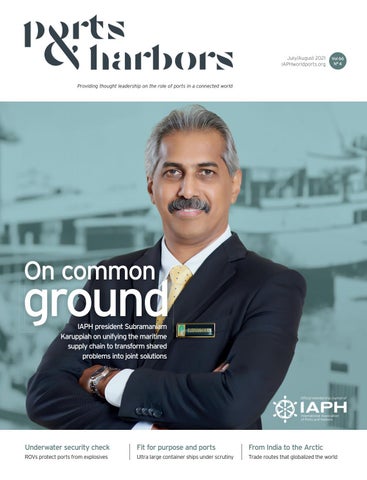
On common
ground IAPH president Subramaniam Karuppiah on unifying the maritime supply chain to transform shared problems into joint solutions
Underwater security check
Fit for purpose and ports
From India to the Arctic
ROVs protect ports from explosives
Ultra large container ships under scrutiny
Trade routes that globalized the world
OFC_PH_No4_Cover.indd 01
23-Jun-21 5:25:17 PM
Feature stories Social media posts
Sponsored or Native content
Need original content for your website? Short videos
Infographics + More...
WE ARE CONTENT CREATORS FOR THE LOGISTICS INDUSTRY
We’ve been writing and creating content based around airfreight and the logistics industry for over 20 years. We offer our expertise to help create the type of relationship building content that can help fuel your business, whether it be web news posts, social media exposure, short videos or full-length feature articles.
We are experienced in producing a multitude of media content on various channels with a specific emphasis on technical writing about the logistics industry, and can help create content that’s seen by decision makers in the industry.
WE PUBLISH TWO OF THE LEADING LOGISTICS PUBLICATIONS IN SOUTH-EAST ASIA.
www.logistics-manager.com
www.airfreight-logistics.com
VISIT OUR WEBSITES TO SEE THE TYPE OF CONTENT THAT WE CAN CREATE FOR YOU. For more information, please contact Dwight@logistics-manager.com
Untitled-1 1
5/25/2021 10:59:15 AM
Vol 66 | No 4 | 2021
CONTENTS EDITOR’S COMMENT & CONTRIBUTORS | 02 A rift is separating the maritime industry
Subramaniam Karuppiah shares his vision for the IAPH
PERSPECTIVE CYBERSECURITY | 08 A former hacker on digital liabilities in the supply chain
10 | FEATURE PORT SECURUTY ROVs help to deter explosive threats
THE DEBATE | THE POLL | 14 Discussing sustainable vessel growth
16 | INTERVIEW MARTIN CORNER Volvo’s supply chain vice president on decarbonization
IN NUMBERS ULTRA-LARGE CONTAINER SHIPS | 18 Data analysis into ULCSs damaging port equipment
10
04 | IN CONVERSATION WITH THE NEW PRESIDENT
20 | PROJECT FOCUS COMMUNITY OUTREACH Peru’s national port authority interacts with locals
20 16
24 LOOKOUT MEPC76 | 24
Outcome of IMO’s environmental measures discussion
HOW TO BECOME A RESILIENT PORT | 28 10 changes needed to make operations more resilient
The supporters of the IAPH 2021 conference
IAPH INFO WPSP AWARDS WINNERS 2021 | 40 Showcase of this year’s successful entries
26 | PERSPECTIVE COVID-19 VACCINE ROLL-OUT How shipping can play a role to distribute COVID-19 shots
30 | VIEW FROM ASTERN TRADE ROUTES From triangular trade to a globalized world
38 | IAPH INFO NEWS AND EVENTS The latest from your association
44 | THE REVIEW PORT OF LONDON MURDERS A crime classic newly published
Cover photo: Port Klang
ADVERTISING SECTION WPC 2021 SPONSORS | 34
001_PH_21_No4_Contents.indd 01
30
24-Jun-21 5:20:50 PM
EDITOR’S COMMENT
PORTS & HARBORS
SUBSCRIPTIONS
Published bi-monthly by the
INTERNATIONAL ASSOCIATION OF PORTS AND HARBORS
International Association of Ports and Harbors (IAPH), produced edited, and printed by IHS Markit. ISSN: 0554-7555 PUBLISHER MASAHIKO FURUICHI IAPH secretary general E: info@iaphworldports.org PATRICK VERHOEVEN IAPH managing director, Policy and Strategy E: patrick.verhoeven@ iaphworldports.org PRODUCTION IHS Markit Maritime and Trade 5th floor Ropemaker Place, 25 Ropemaker Place, London, EC2Y 9LY, UK T: +44 (0)203 253 2100 EDITORIAL INES NASTALI Senior custom publishing editor E: Ines.Nastali@ihsmarkit.com ADVERTISING AND EVENT SALES JOHN KNOWLES Sr sales executive – EMEA E: John.Knowles@ihsmarkit.com CONTENT EDITING TORI HILL Director, editorial and publishing CONTENT EDITORS IRENE SOO REBECCA LYDIA VEGA YOGES PALANIAPPAN DESIGN HANNAH KIDD Associate director design MATT RAMSDALE Principal designer WYMAN CHOO Designer PRODUCTION CLAIRE REED Production controller IHS MARKIT MARITIME & TRADE EDITORIAL AND PUBLISHING MANAGEMENT PETER TIRSCHWELL VP editorial and publishing MIDGE REGESTER Executive director editorial and publishing
002_003_P&H_21_No4_Comment&Contributors.indd 02
IAPH members enjoy a free subscription to P&H. If your organization is not a member and you would like a paying subscription to the magazine, please contact the IAPH for more information at: 7th Floor, South Tower, New Pier Takeshiba 1-16-1 Kaigan, Minato-ku Tokyo 105-0022, Japan T: +81 (0) 3-5403-2770 F: +81 (0) 3-5403-7651 E: ph@iaphworldports.org W: www.iaphworldports.org COPYRIGHT © 2021 IHS MARKIT. ALL RIGHTS RESERVED. No part of this publication may be reproduced or transmitted, in any form or by any means, electronic, mechanical, photocopying, recording or otherwise, or be stored in any retrieval system of any nature, without prior written permission of IHS Markit. Any views or opinions expressed do not necessarily represent the views or opinions of the International Association of Ports and Harbors (IAPH), IHS Markit or their affiliates. DISCLAIMER OF LIABILITY Whilst every effort has been made to ensure the quality and accuracy of the information contained in this publication at the time of going to press, IAPH, IHS Markit, their affiliates, officers, employees and agents assume no responsibility as to the accuracy or completeness of and, to the extent permitted by law, shall not be liable for any errors or omissions or any loss, damage or expense incurred by reliance on information or any statement contained in this publication. ADVERTISEMENTS Advertisers are solely responsible for the content of the advertising material which they submit to us and for ensuring that the material complies with applicable laws. IAPH, IHS Markit and their affiliates are not responsible for any error, omission or inaccuracy in any advertisement and will not be liable for any damages arising from any use of products or services or any actions or omissions taken in reliance on information or any statement contained in advertising material. Inclusion of any advertisement is not intended to endorse any views expressed, nor products or services offered, nor the organisations sponsoring the advertisement. THIRD-PARTY DETAILS AND WEBSITES Any third-party details and websites are given for information and reference purposes only and IAPH, IHS Markit and their affiliates do not control, approve or endorse these third parties or third-party websites. Further, IAPH, IHS Markit and their affiliates do not control or guarantee the accuracy, relevance, availability, timeliness or completeness of the information contained on any third-party website. Inclusion of any third-party details or websites.
INES NASTALI Editor
Industry imbalance
CONTRIBUTORS
LEE WILLETT Freelance journalist Safe and secure commercial shipping is essential to the effective flow of global trade. Recent events have drawn significant attention to the safe passage of maritime trade along sea lines of communication and through maritime choke points, with navies often present patrolling such areas. However, fixed points like ports present a vulnerability. Here, unmanned systems can provide presence and capability to help secure access to and from commercial ports.
24-Jun-21 5:51:30 PM
03
With the world watching how maritime plans to reduce emissions and the European Union wanting to include the industry into its emission trading scheme in July, there is not only a price tag on this mission but also a countdown that is running out, aggravating the urgency to act. This imbalance between developing and developed nations is a fundamental issue in climate change. We therefore need to look to the decisions that will be made at COP26, taking place just before MEPC77 in November, as they will be an indicator for the direction of our sector. Christiana Figueres, architect of the Paris Agreement, said at the World Ports Conference in June that developing countries will have an “anchor on our foot”, if not all countries move together. Look to the status of digitalization, port equipment, and technological innovation in different regions of the world — be it small island states, Africa, or South America. If ports there cannot afford to pay for green infrastructure upgrades, clean ships will not call. Instead, those ports become a haven for polluting ships, and the imbalance of emissions on those nations grows. To avoid this, associations that have a chance to speak at the IMO, such as the IAPH, also need to align their membership’s needs. The association’s new president captain Subramaniam Karuppiah has a clear vision to do so — he spoke about it on the following page in our cover interview. Consequently, with the eyes of the world watching us, the maritime industry faces the decision if its wants to be on the right or wrong side of history. ines.nastali@ihsmarkit.com
EDITOR’S COMMENT & CONTRIBUTORS
hen I joined the MEPC76 virtual meeting in mid-June, I was — just like anyone else — looking forward to seeing what measures the environmental committee of the IMO would decide on to tackle short-term emissions of shipping. What I saw instead, was the deep rift between the member states that has separated them, making a level-headed discourse impossible. The rift opened up when it came to deciding on a percentage figure to reduce the carbon intensity of maritime emissions. This was for two reasons: island states face the direct impact of climate change, so while they want hard lines to be drawn to curb emissions, only agreeing on reduction levels is not enough. At the same time, financing for decarbonization tools can be hard to come by. A dilemma. This alarmed me. If member states cannot agree on short-term measures but instead insert piecemeal deadlines in between, what hope is there to agree on long-term such as market-based measures? The next MEPC77, taking place in November, will see this discussion start but with the option to shift agenda items to future meetings, I am doubtful we will see a decision being made this year. Especially if those aforementioned divisions between the member states are not addressed. On paper, every member state is equal, however, with decarbonization largely being a financial burden, they are not. It is therefore pertinent that developed countries — which also created most of the emissions — shoulder this burden and market-based measures are agreed equitably. However, will developed countries listen to those calls and what blocking power do developing countries have?
W
@InesNastali
PENNY THOMAS: Freelance journalist
Coexistence between ports and their surrounding cities has not been without conflict, especially since the arrival of containers that heralded bigger and bigger ships, more and more lorries congesting often narrow roads, and ever-increasing pressures on space. What both surprised and delighted me with Peru’s multilevel and comprehensive port-city program was the clear goals, stress on leadership from local and regional authorities, and especially the involvement of young people.
As I researched the 200-year triangular trade, I was constantly distracted by records of the appalling slave trade from Africa to the Americas. We should not forget the human suffering upon which vast wealth and prosperity was amassed in the US and certain European countries. Humanity stands at a crossroads between what is easy and what is morally right to do; shipping can lead by example and carve a future that works for the planet and the lives it supports.
002_003_P&H_21_No4_Comment&Contributors.indd 03
Photos top left to right: Ines Nastali | Dr Lee Willett | Hugo Lamb | IHS Markit/Dean O’Brien
TONY SLINN Freelance journalist
24-Jun-21 5:51:41 PM
IN CONVERSATION WITH SUBRAMANIAM KARUPPIAH
04
004_007_PH_21_No4_InConversationWith.indd 04
24-Jun-21 4:35:39 PM
IN CONVERSATION WITH SUBRAMANIAM KARUPPIAH
Changing of the
guard IAPH president captain Subramaniam Karuppiah talked to IAPH managing director Patrick Verhoeven about his plans to not only bring the association but members of the supply chain together to turn shared problems into joint solutions INES NASTALI
new dawn for the IAPH: following his election as IAPH president and official introduction at the World Ports Conference in June, captain Subramaniam Karuppiah — the general manager of Port Klang in Malaysia — will serve the association as new president until 2023. He takes over from Santiago Garcia-Milà who will continue to support the IAPH as well as his role as deputy executive director at the Port of Barcelona, Spain. With 2020 having brought in organizational changes to the association’s committees, Subramaniam wants to “keep it simple,” he told P&H in a conversation with the IAPH’s managing director Patrick Verhoeven. The new president therefore described his vision in the following way: “I’m looking to serve every member on any issues that may arise. We have over 160 regular and 140 associate members and we have issues all around the world at ports, and only one is the pandemic.” He added that, in addition, there are operational, safety as well as cybersecurity issues. Building on the existing structures of the aforementioned committees and surveys, the new IAPH president hopes to connect in this way with the individual ports. “We have fantastic initiatives that are ongoing. Looking at the bigger picture, I would like to go down on the ground and see what more we can do for the individual members,” he said, acknowledging that while there are shared concerns, “everybody’s got their own issues”. Subramaniam would also like to see more engagement between the members as part of this collaborative vision.
A
Photo: Port Klang
004_007_PH_21_No4_InConversationWith.indd 05
24-Jun-21 4:36:38 PM
One way to facilitate this could be to share advice for another important subject within this realm. “I am really common challenges. “It could be just a simple question, passionate about moving the single-window concept further under digitalization. I think that’s one area that how do you deal with a shortage of tugboats in your port?” The goal of this would be to get some sort of guidance we need to ramp up,” he said. as well as reassurance. “At least we know that we’re not Especially considering the outcome of the IAPH survey the only ones. We’re facing the same problem somebody on electronic data exchange between ship and shore that else is having, and they probably have a solution that they has shown that only one-third of ports have working digcould share. So those are things that I want to go down on ital systems in place — something that should have been in place for all since 2019 under the IMO FAL Regulation. the ground and see the nitty-gritty part of our memberSubramaniam therefore wants to strengthen the relationship and what the needs are.” ship with not only the IMO but also the World Customs Practically, this sort of business agony aunt could find a Organization (WCO) to ensure standards set work for the home in P&H, but, “maybe we could also have an additional port community. platform for it, online or where people don’t feel shy to be pub“We don’t talk about tariff barriers anymore. We’re lished, so that they can answer the queries,” Patrick suggested. talking about non-tariff barriers. I mean those are the Through this collaboration, Subramaniam would also like to ones that are really hurting a lot of economies,” the IAPH see the IAPH become the voice of the industry. “We truly want president said. to be the voice that will make the difference in public forums Patrick agreed, adding, “Trade facilitation comes across when we’re talking to governments or when we’re speaking at several of the areas that we’re working on, and there, international meetings,” he said. He added that for this to work, the assodata collaboration is of course the most ciation needs to know that it is reflecting important one, but I think it also comes the views of all members and the only under the risk and resilience focus. We’re “We want to actually going to organize a workshop this way to do that is to convince members to strongly put their points across to the autumn on cooperation between customs be the voice leadership team. Subramaniam therefore authorities in port authorities, based on to make the urged readers to approach him with consome good practices. The WCO is quite cerns, thoughts, and ideas. keen on having a dialogue with us.” difference in Another big common issue to tackle public forums” is of course the decarbonization of the Working together From this input, the IAPH will be able to industry. Over the past nine months, SUBRAMANIAM boil down issues to common challenges. the Climate and Energy Committee has KARUPPIAH Foremost, “the pandemic is the most imalready done some outputs that, “we need portant one, which leaves very little time IAPH president to follow up on very vigorously to be able for other issues, but we still have to keep to implement those,” Subramaniam said. our focus on those,” said Subramaniam. “This is absolutely important for us. We For example, the IAPH is now looking at digitalization. must use the committees to our advantage,” he added. “I think we’re on the right track with the technical comThe committees have also enabled the IAPH to stay mittees that we have now, and here it’s the Data Collabconnected over the past year. “Otherwise, we don’t have oration Committee, but we need to push this through. I a networking session per se, unless we meet during the don’t think the utilization and also the absorption of digiannual conference, so it’s the technical committees that talization is evenly done across the world. I think we have are really critical to bring us all together and move our some members who are fantastic and really advanced. ambitions forward.” But we also have members who are still struggling to put Patrick has had the same experience. “I think the things together,” he said. technical committees are the backbone of the organizaThis is where the new IAPH president sees the involvetion. And of course, there’s a lot of voluntary work that we ment of the membership and stressed how vital it is that really need to support. It’s amazing the amount of time they are willing to share their experiences and knowledge the committee chairs and some of the members put in, to foster more collaborative initiatives. although they have their own jobs and their own compaIn addition, Subramaniam also hopes to move on nies to work for. I think that’s something we need to really
004_007_PH_21_No4_InConversationWith.indd 06
24-Jun-21 4:36:53 PM
07
Photo: IAPH
004_007_PH_21_No4_InConversationWith.indd 07
IN CONVERSATION WITH SUBRAMANIAM KARUPPIAH
be appreciative of. You always need some and Oceania, the regions for which he has “You always volunteers to drive things forward and been the association’s vice-president since produce things. For example, we are now 2017. “Look at the amount of trade that is need some producing guidelines on cybersecurity, coming from this region. Why aren’t we volunteers to and that’s a hell of a job.” having more members from here? So, we Those guidelines will be presented need to look at what are the actual issues drive things to the IMO in autumn (see page 43 for that these ports are facing and how we forward” a Q&A with the head of the IAPH Data can entice them in a mutually benefiting Collaboration Committee, Pascal Ollivier), way,” he explained. PATRICK VERHOEVEN “so we’re making really a difference by In this context, it is vital to look at the Managing director producing something that’s very useful for fact that the membership has been more the community, but we rely on volunteers IAPH demanding over the past years. from the ports,” Patrick said. In his view, “I would say we probably have become this is what makes an organization strong, more commercial in our approach tothat people are indeed willing to share their knowledge. wards membership recruitment than before because 10, Patrick considers this to be one of the main strengths for maybe 20, years ago this was automatic. You know people the IAPH going forward. felt they had to be part of something but now information is available everywhere online,” Patrick added. Mutual understanding His new president agreed. “I think that’s one we need to Another avenue of outreach that the new IAPH president actually put a clear stamp on and show the work we have wants to embark on is toward the shipping lines. “We are done. But we need to be a bit more innovative. We got to talking about climate change. They’re doing a lot on ships. constantly keep changing things, look at what else needs So maybe we can engage them to find out exactly how to be done to keep our members interested,” he said. they are looking at these issues and see whether we can This concept seems to work as the pandemic has — dework with them as well.” spite the physical distance — brought the association closer Patrick interjected, saying, “And improve, if I may just together. “I don’t know about you, Patrick. I personally add, the mutual understanding of how we operate. Subra, feel we did more during the pandemic than we did during as a captain, you’ve been on the other side, you know how normal times. We’ve been having very productive meetships and shipping company function, but I think you ings. We’ve been able to get things done more structured will get a lot of people on the port side who may not really and we’re able to actually share it with the membership. know the intricacies of shipping and vice versa. I think we That aside, I think the pandemic has brought us together. can bridge that gap,” replied Patrick. We are all having the same problem, right? For once, the “I agree with Patrick, the gap is widening right now. whole world is having one common problem caused by the And really, we were just trying to look at our own turf. pandemic. So, everybody can relate to the issues in each We’re trying to make sure that we do well in our own other’s countries and other ports,” Subramaniam, who at terms, but don’t understand that the other side experiencthe time of the interview, spoke from an again locked-down es the same. The most important thing is to understand Malaysia due to a spike in COVID-19 cases. each other’s problems,” said Subramaniam. However, the ports stay open. Just like in 2020, when not Having been a seafarer himself, he pointed to the crew only the pandemic started. “The COVID-19 19 task force change crisis. “You know, just look at the agony that that was initiated by our vice president Tessa Major was seafarers are going through. I mean, I’ve been on the other a catalyst for the way we restructured the association last side so I can relate to that, but you ask the man on the year,” Patrick summarized. street and he says, ‘they chose that employment. What While this was a breakthrough for the IAPH, the new are they complaining about?’ That’s not the answer that president also warned not to stop here. “Now, I hope we should be coming from policy makers.” don’t fall back. Let’s not move back towards normalcy until the next jack hammer hits. We need to continue A pandemic catalyst with what we have learned and make the changes right To coordinate such issues better, the new president wants now to always be alert that the next pandemic, the next to go on a membership drive, especially in Southeast Asia disruption, is not too far away,” he said.
24-Jun-21 4:36:54 PM
Know your criminal
PERSPECTIVE CYBERSECURITY
Know your supply chain inside out OVID-19 has ravished supply chains. The current uncertain environment is a combination of many issues such as closed ports, disputes between owners and charters, bankruptcies, unemployment, volatility in supply and demand for goods — the list goes on. Equally, the global pandemic has had a major impact on the criminal economy. A general consensus by industry experts is that an 80% rise in fraud, as a direct result of COVID-19, is a conservative estimate.
C
Taking advantage The pandemic has presented ample opportunities for criminals to exploit businesses ranging from supply shortages and reduced or immobile workforces, to poor oversight and weakened approval processes, low staff morale, and a general feeling of fear.
008_009_PH_21_No4_Perspective1.indd 08
Criminal behavior has adapted, innovated, and evolved during the current crisis, posing a risk to legitimate businesses and their supply chains. Vulnerabilities have appeared in what previously were assumed to be effective security procedures, giving criminals an advantage to commit crime — from targeting people working from home through impersonation fraud and phishing to cyberattacks. Furthermore, businesses are under increasing pressure to reduce costs. This is the last thing companies should do when it comes to supply chain security. What is needed in the current climate is agility, but with effective risk management. When it comes to supply chain fraud, a seemingly small event, perpetrated while controls are weakened, can snowball to significant losses over time.
Supply chains are particularly vulnerable to fraud owing to their global nature, complex operating environment, and their many touch points — every link presents an opportunity for crimes. Most businesses are familiar with the term know your customer. At We Fight Fraud, we talk about knowing your criminal. When it comes to supply chains, knowing who might be in the business of defrauding you is critical. So is knowing your supply chain. Businesses need to ask themselves: can you identify all the tiers of your supply chain? Do you really know your suppliers and vendors? Who produces your materials and products? Who are your suppliers’ suppliers? What is their background and reputation? Indeed, the security landscape in the maritime world is different, and different priorities present themselves to low-hanging fruit advice. This is down to separate threat actor scenario priorities within the maritime supply chain, which can range from outsider ransomware to inside threats and government-led activists. There are also issues around the mixed infrastructure; the transition between supervisory control and data acquisition (SCADA) systems, so those software and hardware systems that are connected to control industrial processes
24-Jun-21 2:16:05 PM
09
ABOUT THE AUTHOR SOLOMON GILBERT, head of Cyber at We Fight Fraud. Gilbert is in charge of We Fight Fraud’s cyber capability. His fascination with puzzles has led to his discovery of the cyberworld and, unfortunately, cybercrime until his arrest at the age 17. After that, he turned his focus on crime prevention.
008_009_PH_21_No4_Perspective1.indd 09
About We Fight Fraud We Fight Fraud was formed to solve a major problem: to keep up with the spiralling arms race between criminals and businesses, a deep understanding of how criminals think and their latest scams is needed. However, information and knowledge from the criminal world is extremely hard to access. The founders have brought a unique and diverse team together to solve this problem. They share a common passion to fight against fraud and financial crime, and they hold the belief that combining multiple perspectives is needed to stay safe.
Photos: Upper left to right: Getty Images/NASA/imaginima | Solomon Gilbert
“Current maritime security practices do not reflect modern capabilities”
Is there a vetting system that can be incorporated into your own access controls? What data needs to be controlled? What is the risk matrix for that data, and, for example, how is the supplier accommodating certain risk requirements? It is also important to check in to see if the supplier deviates from best practices. If so, is it appropriately justified? Are you planning for a supply chain break? Do you have a contingency plan in place? Can you effectively manage supplier control to your own infrastructure? Is the supplier frequently vetted and does it conform to ISO 2700x standards? Build these questions into due diligence, ask the supplier to routinely prove these points, and if it cannot, move on.
PERSPECTIVE CYBERSECURITY
but also non-SCADA systems; legal considPictured: A connected supply chain can also present a risk to all stakeholders. erations of international travel; and different physical threat actors. Standardization of security systems in maritime is mixed and inconsistent, with Help on hand differing priorities and requirements for The UK government’s National Cyber Security Center recommends four key elements differing shipping scenarios. to an overarching approach: understanding Inconsistent standards make maritime the inherent risks of a chain, establishing supply chain due diligence difficult. control, checking and testing the supply Supply chains need to be invulnerable chain itself, and making to high motivation, improvements as time high skill, and high time goes on. frame threat actors It is critical that suppliwho may be acting with ers follow this guidance, impunity or with foreign but that is on top of state approval. Finding checking the supplier’s a list of priorities, which access control structure cover this changing SOLOMON Gilbert, head of and its suitability to the landscape, while still Cyber at We Fight Fraud service it provides on a appeasing traditional case-by-case basis. recommended secuAdditionally, it is important to check rity coverage, is extremely difficult and whether a supplier has built its infrastructure scenario-based. Current maritime security practices do securely in its foundation, the adaptability of not reflect modern capabilities. the supplier to emerging threats, and what Moreover, adaptability is challenging knowledge of said threats it has. Furthermore, you should inquire how owing to any infrastructure overhaul, which may be required to protect against these data is stored, destroyed, and managed by new capabilities. the supplier. This should include backups SCADA management is also problematic. and what levels of redundancy exist and can be programmed into the services. The consideration of SCADA interaction and deployment alongside normal systems and Ask if the supplier vets their staff. If so, network infrastructure is an uphill battle. how do they do that?
24-Jun-21 2:16:49 PM
FEATURE PORT SECURITY
Port patrol Recent attacks on ships show the need to secure the maritime supply chain from explosive threats — remotely operated vehicles in ports help to do so DR LEE WILLETT
he numbers are well known. Officials and analysts alike note that 90% of global trade moves by sea. Such trade travels on commercial ships that transit the oceans along sea lines of communication (SLOC) and through maritime choke points. The significance of this trade is widely acknowledged at high levels within national governments and within the international community. This importance derives from the global reliance on just-intime delivery of goods and resources. However, while maintaining a 24/7, 365-day flow is recognized as crucial to daily life, the risks are increasingly recognized and evident. In recent years, events have demonstrated that disruption to the free flow of shipping can — and does — occur regularly, in different regions and contexts. In March 2021, the grounding of the container ship MV Ever Given closed the Suez Canal to all traffic for six days, at significant impact and cost to global shipping patterns. Back in November 2020, a Maltese-flagged oil tanker was damaged at Saudi Arabia’s Shuqaiq terminal in the Red Sea. Media reports noted an attack was conducted by an unknown source, with the vessel struck just above the waterline. Additionally in May/June 2019, waterborne improvised explosive devices (WBIEDs) were used to attack commercial ships, both anchored in and sailing through the Straits of Hormuz; other ships were seized. The incidents prompted the establishment of a multinational naval task group to ensure shipping security in the region. Ship seizures occurred routinely during the Somali piracy crisis between 2008 and 2014, despite naval forces deployed to escort shipping around the Horn of Africa. The piracy risk endures off Africa’s east coast, but since 2014 it has become a greater concern off Africa’s west coast.
T
Pictured: Japanese oil tanker Kokuka Courageous off the port of Fujairah in 2019, after it was attacked in the Gulf of Oman and damaged by a limpet mine.
010_013_PH_21_No4_Feature.indd 10
24-Jun-21 2:36:09 PM
11
FEATURE PORT SECURITY
Photo: MUMEN KHATIB/AFP via Getty Images
24-Jun-21 2:36:30 PM
010_013_PH_21_No4_Feature.indd 11
Shipping security
These examples demonstrate the emergence of what are known as asymmetric, hybrid, or grey zone maritime risks. Their significant threat to and impact on shipping underlines why high-level national and international efforts to tackle them are increasing. Despite the ships anchored offshore or at terminals, the aforementioned incidents are related to ships in transit. In deterring risks, navies are usually present around key waters such as SLOC and choke points. With limited ships available, even when operating in coalitions, navies cannot provide presence at every point of vulnerability. Instead, they tend to deploy to where generating maritime security presence can occur alongside deterring higherend, navy-on-navy risks to national interests. The question remains, though, of how to secure the world’s major commercial shipping ports — the SLOC’s start and end points — when naval ships may routinely be deployed elsewhere. Arguably, such ports are a potential point of vulnerability. As the Ever Given incident demonstrated, a single ship can block an access point for days or longer. As the Straits of Hormuz incidents demonstrated, WBIEDs can be deployed quickly and covertly. Reflecting on increasing trends in the defense world for using unmanned systems, the wider security community is looking at how such systems provide capacity to counter grey-zone threats such as WBIEDs.
Pictured: Saab’s Sea Wasp ROV at Hueneme Port, California, during Coastal Trident exercise in 2016. Sea Wasp can also operate upright to enable observation of a quay or the side of a ship. Photo: Saab Seaeye
Bespoke capability
In such scenarios, unmanned systems can provide a sustainable and adaptable capability. Government agencies are beginning to introduce them to secure critical national maritime infrastructure nodes such as ports and harbors, offshore resource facilities, and underwater communications cables. In April 2020, Swedish defense and security systems company, Saab, announced that the Netherlands had become the first European customer for the production variant of its Sea Wasp remotely operated vehicle (ROV), with the Netherlands’ Defense Materiel Organization (DMO) purchasing a then-undisclosed number of units on behalf of the Netherlands Ministry of Defense. Sea Wasp is an unmanned system designed to counter WBIEDs, using search, handling, and disposal functions. In its April 2020 statement, Saab said “Sea Wasp is a small and flexible ROV that can be used for a wide range of underwater operations, both within the commercial and military sectors. Sea Wasp can, for example, be used for sea mine detection and other reconnaissance operations.” The Netherlands has military and commercial ports that are of high national strategic value. The Royal Netherlands Navy’s (RNLN) main operating base is in Den Helder, on the northern part of the Dutch coast. The commercial Port of Rotterdam, further south at the Hook of Holland, is one of the top 10 largest international ports. Rotterdam has always been one of the primary European ports, along with Antwerp, Bremerhaven, and Hamburg. According to IHS Markit Maritime & Trade Ports Data, Rotterdam ranked ninth globally in the 2020 global list for throughput tonnage. The port handles
010_013_PH_21_No4_Feature.indd 12
container shipping, dry bulk, liquid bulk (including LNG), breakbulk, and food products. In April 2021, the Port of Rotterdam announced a 3% increase in freight handled in quarter one, compared with the same quarter in 2020. From commercial shipping and strategic security standpoints, Rotterdam is therefore a critical node for the Netherlands and the international community. In a statement to P&H, an RNLN officer involved in the project on behalf of the DMO confirmed delivery of three Sea Wasp vehicles on 31 March, at Den Helder naval base. “With the Saab Sea Wasp, we are able to remotely investigate and dismantle improvised explosives underwater,” the officer said. On where and how to operate the capability, the officer added, “The system can be deployed from ships and from [the] shore. The units using Sea Wasp can be deployed worldwide,” he added. “Sea Wasp transportation to the location is possible by vehicle, ship, or plane. During initial training, operators worked with the Sea Wasp system at Den Helder,” the officer confirmed. Presence and capability
Unmanned systems such as Sea Wasp offer sustained presence and flexible capability — outputs critical to countering IED-based threats to ports and other fixed maritime infrastructure nodes. Alongside the Netherlands contract, three prototype Sea Wasp units are being trailed by the US Navy and US law enforcement agencies under the US cross-government Combating Terrorism Technical Support Office (CTTSO) initiative. Such trials included deploying Sea Wasp for the
24-Jun-21 3:26:59 PM
13
010_013_PH_21_No4_Feature.indd 13
operator would prefer to do, which is to make a remote approach, such as, with a robot.” The vehicle also brings endurance and flexibility in searching for and addressing IED threats, including in confined areas and challenging waters. A relatively large ROV capable of carrying various sensors, Sea Wasp’s ability to operate in currents of 2.5 kt expands the operating time envelope compared with using a diver. Its endurance and sensor capability also bring significant search impact. “If you’ve got an area [of] 500 m by 500 m, you would do a decent search of that area in two to four hours, depending on the conditions,” said Lade. Such conditions include seabed debris, which is common in port and dock areas. “I would say, with a high level of confidence, you’ve got a very good percentage clearance,” he added. The ability to fly the vehicle in six degrees of freedom also brings flexibility in searching a port wall, or a ship’s hull. “If you’ve got a wall you want to search, normally a vehicle would do so by looking at the wall and going up and down the wall with the view in front, where the sonar doesn’t work very well. If you turn the vehicle so it’s flying with the wall as its seabed, then you can search the wall the same way you search the seabed,” Lade explained. “The same is true for a ship. In a lot of places on a ship’s hull, you’ll be searching at a 45° angle from the seabed. You can turn that 45° angle into the horizontal by flying at 45°.”There are other examples of how Sea Wasp’s flexibility enables different sensors or effectors to be used for different tasks. For example, in trials in the US, Lade noted that a knife was fitted to the manipulator arm to provide rope-cutting capability. Flexible deployability
This flexibility in what can be fitted to an unmanned system such as Sea Wasp, alongside transportation and deployment, shows that such systems provide a current capability that can be quickly and widely deployed to counter a range of risks to commercial shipping, including providing port security. As commercial shipping and the high demand for naval ship and other maritime security platform globally will continue to endure risks, so will the need for other options, such as unmanned vehicles as an alternative means to provide presence and capability to address such risks.
FEATURE PORT SECURITY
Coastal Trident exercise in 2016 and 2017. Coastal Trident is in part intended to assess technologies that address asymmetric underwater threats to port and critical infrastructure security. In the 2016 exercise, a Sea Wasp conducted security sweeps at Hueneme Port, California. In its 2016 Review Book, the CTTSO stated, “Sea Wasp participated in the Coastal Trident 2016 Regional Port and Maritime Security Program exercise designed to advance the state of the art in addressing potential threats to the US Marine Transportation System.” The CTTSO noted that Sea Wasp is “designed for surveillance, location, identification, and neutralization of underwater improvised explosive devices or ordnance specifically in the confined areas and challenging environmental conditions of ports and harbors.” Sea Wasp is a 1.3 m long, 75 kg vehicle, powered by six thrusters, and able to fly underwater like an airplane in six degrees of freedom to depths of 150 m. It can move forward and keep station in currents up to 2.5 kt. The station-keeping capability helps map search areas. Sea Wasp carries a dual-function, high-resolution and obstacle avoidance, search-and-classification sonar, and up to two cameras — one fitted forward along the center line — with the option to fit a second on a five-function manipulator arm. As an alternative to the manipulator arm, a grip stick can be fitted. Both grip stick and manipulator arm can carry various lethal or nonlethal effectors, enabled by a firing circuit. In sum, Sea Wasp is designed to carry a range of underwater sensors and effectors, allowing configuration for a range of missions. Using a two-person team, Sea Wasp can be operated from ashore using a vehicle or at quayside, or at sea using any vessel of opportunity, from rigid inflatable boats (RIBs) to large coastguard, naval, or commercial vessels. It is operated using a ruggedized control station or laptop, both incorporating a handheld controller, with connection through a 160 m long, clip-in tether that provides power and sends and receives data. Addressing the benefits an ROV such as Sea Wasp offers in countering IEDs, Chris Lade — Saab Seaeye’s UK defense sales, marketing, and business development manager — told P&H, “The fundamental thing is you don’t have to put a person in harm’s way. That’s what it was always designed to do; to emulate what every explosive ordnance device
24-Jun-21 3:27:14 PM
NILS KAHN | Managing director, MSC Germany Moving 90% of global trade, container ships are essential to the global economy as well as industries such as manufacturing, pharmaceutical, and retail. As the global trade volumes are expected to continue to grow, we need bigger, more efficient vessels to meet the demand. The size development of container vessels is mainly influenced by the market demand and pressure to cut unit costs. Fully loaded bigger ships do not only offer affordable trade and decreased shipping costs, but also increased efficiency. Ultra-large vessels generally emit less carbon dioxide per container carried, helping companies that move goods on our services to lower the carbon footprint of their supply chains. Our latest class of 24,000 TEU vessels also form a crucial part in improving efficiency as part of our efforts to help decarbonize the shipping industry. This pressure to evolve extends to ports and land usage, which means considerable investments in infrastructure and superstructure. Through handling charges and port fees, the shipping companies contribute their share of the cost, while infrastructure must remain a core public responsibility. Recent infrastructure projects have shown that development can be sustainable especially when putting a bigger
THE
focus on the environmental impact of the projects. It is not only about altering infrastructure to accommodate larger ships, but investment is also needed to accommodate the transition to a zero-carbon future. In addition to renewable energy usage and deployment of digital solutions to boost efficiency, significant infrastructure changes must be made in ports to ensure future fuels can be scaled up and made readily available for commercial ships to use. In addition to our significant efforts to explore new fuels and technologies, shipping lines are taking big steps toward more sustainable transportation of goods with each new generation of ships. Ports must be careful not to fall behind. A constructive collaboration between all relevant parties including regulators, port authorities, shipping lines, and governments should continue to ensure better coordination and optimum supply chain configurations. Decisions on where to deploy our larger container ships depend on factors such as market demand, wider network planning, and ports’ capacity to handle vessels this size. We will continue to evolve our global fleet and service our customers with large, efficient vessels, in line with market demand and of course following official guidance on the routes and ports where large container ships may operate.
DEBATE
Container vessel size multiplied in a decade. With the impact this has on ports, is further size expansion sustainable?
DANIEL HOSSEUS | Senior managing director, Zentralverband der deutschen Seehafenbetriebe Have ultra-large container ships outgrown ports and other maritime infrastructure? How sustainable is further vessel growth? The answers are “no” and “not very”. No, they have not outgrown ports and other maritime infrastructure yet — because the land side tries to keep up — and, no, further vessel growth is probably not very sustainable. However, the real question is what to do about it. The upside of ever larger container ships is told quickly. Yes, the more containers a ship can carry, the lower the unit costs. Cutting costs per container allows shipping companies to offer lower freight rates and to secure market share. Additionally, the environmental impact per container will also be lower as less ship fuel is required per container. Provided a port pair with enough water and enough cargo to continuously fill the ships over a sufficient number of years can be found, larger ships are a winning proposition for any shipping company that can afford them. However, the downside is told equally quickly. Larger vessels require larger port equipment and more infrastructure. They generate peaks that strain terminals and hinterland connections. Whole new ports get built, fairways dredged, and highways and railways upgraded just to
accommodate ever larger vessels. The large ships generate costs for much of which neither the lines nor their customers pay. Once all the external costs of ultra-large container vessels are added up, their overall benefit to the global community is less clear. What to do? A typical reflex is to try to regulate ship size. However, where do you draw the line? By TEU? By water draft? Beam? Air draft? All of the above? How do you justify a given benchmark that might favor one port over another? And are you not just fiddling with symptoms rather than seeking out causes? We believe the market should determine ship size, anticipating that container ships would eventually run the course of large tankers and double-decker passenger airplanes. However, this presupposes a properly functioning market. Does the liner shipping market function properly? Does it send adequate price signals? Are not, perhaps, international taxation, antitrust, and state aid rules distorting revenue and cost structures of global liner shipping companies, thereby unduly favoring ever larger vessels? To make sure the market can do its job on ship size, we need to discuss whether container shipping markets are governed by rules that truly benefit the global community.
15
JULY/AUGUST | ULCSS
POLL RESULTS
Container vessel size multiplied in a decade. With the impact this has on ports, is size expansion sustainable?
22%
EIGHT
78%
SEVENTY
The recent grounding of the ultra-large container ship Ever Given in the Suez Canal and the legal and trade issues that ensued might have impacted this poll. Regardless, people arguing that further vessel growth is sustainable are the minority, with 78% of poll respondents believing that it is not. However, Nils Kahn from MSC Shipping made a good point in the adjacent debate when he said constructive collaboration between all parties is needed. This discussion shows that more work is needed to understand each other’s roles and responsibilities within the maritime supply chain as for ports, the bigger vessels mean more considerations — in terms of tug usage and appropriate infrastructure — need to be taken when receiving them in port.
THE DEBATE | THE POLL
SEPTEMBER/OCTOBER | CYBERSECURITY
Either scan the above QR code or use the web link below to submit your answer to this month’s readers poll: bit.ly/IAPHSepOctPoll
014-015_No4_The debate_The poll.indd 15
Photos top to bottom: MSC Germany | Verband Deutscher Seehäfen
Are you confident your port is prepared to cope with the fallout of a potential cyberattack?
The IAPH Data Collaboration committee will present its latest guidelines on cybersecurity at the IMO MSC 104 meeting this October. These guidelines have been developed for the C-Suite level of port management and they are aimed to help CIOs to argue for advanced investments into cybersecurity. For the next edition of P&H, and in time for the IMO presentation, we would therefore like to discuss how prepared global ports think they are, should they suffer from a cyberattack on their operations.
24-Jun-21 5:45:21 PM
Martin Corner 016_017_PH_21_No4_Interview.indd 16
24-Jun-21 3:06:29 PM
17 While phasing out the combustion engine, carmakers such as Volvo also look to cut ties with inefficient supply chain partners CHARLIE BARTLETT
Part of lean principles is zero waste, which means we need to ensure we’re not shipping dead air anywhere.” “That might mean we use smart buffers, we create cross-docks — optimize the sharing of flows with other customers to apply lean, just-in-time principles in a smarter way,” he continued. “Let’s say we’re bringing a lot of product into Gothenburg, or Ghent, or Charleston — who else is bringing product into that area, and why are we not combining our demand, and letting the logistics network consolidate that demand in a smarter way? The logistic providers are doing this in a way that maximizes profits, but we need to all work together to reduce waste in the supply chain.”
Driving change
However, by far the biggest implications for the maritime industry are in Volvo’s increasing use of shortsea shipping, in preference to truck "Air freight is an transport — and by far the most egreTaking a shortcut unwelcome failure gious modality for the Shipping by sea will environment, air. be an efficient mode of the just-in-time “Air freight is an regardless of whether supply chain" unwelcome failure vessels come to be of the just-in-time powered by wind supply chain,” Corner once again. However, said. Volvo’s emissions consist of 30% air one of the advantages of involving more freight in 2020 for around 5% of our logisshortsea and feeder tonnage to enter the tics, in total. “It’s mainly intercontinental equation is that cars could be dropped parts — we have some sort of failure in the closer to their final destination. Asked if supply chain, and so we air freight parts, road transport could so be forgone because the recovery time if you’ve missed entirely for EVs, Corner responded that in a shipment is too long. From a road permany cases, it could — by using smaller spective, if you miss a shipment there’s a ro/ros to get close enough to the destinashorter recovery,” he said. tion showrooms to allow cars to drive off “But we have the right level of stock to the vessel, charge up, and go straight form natural buffers for lead times in the there. “There will of course be a tipping system. In winter, if a vessel is five days point dependent on distance, but I’m sure delayed, that’s not really an exceptional that’s something that will come into the circumstance, and we should be allowing equation,” he said. “If feeder vessels are in for that in our supply chain design.” optimum locations, maybe the cars could Although this development will take drive themselves to the final customer, some time, Volvo is making changes, Corand that’s more eco-efficient than putting ner confirmed. “We need to have a shipthem on a car transporter. It’s the second ping bridge, rather than doing a long-dishalf of the decade where that might start tance road transport across Europe.” to reach a tipping point.”
Shockingly, Martin Corner, vice president of Global Supply Chain Management at Volvo, told P&H, these moves have almost nothing to do with consumer pressure. “We never get asked that question,” he said, adding that it is really just part of a brand commitment now. The shift to EVs will change the structure of the car market dramatically, Corner said, and the way finished cars, parts, and raw materials are transported will require a major shake-up. “The supply chain is a huge part of our carbon emissions,” he explained. Volvo is therefore calculating all emissions from cargo flows. “Traditionally, if we were moving something from A to B, we would have put it on a truck, we would have considered leadtime, cost — whereas now, we are looking at slowing the flow down, putting it on a shortsea vessel and then a train.” The company is therefore looking at suppliers who are investing in more aerodynamic trucks, or biofuels. Just-in-time delivery is not going anywhere, Corner added, but there may have to be some compromises made to reduce overall emissions. “We want to strip out waste,” he said. “Just-in-time has been great for the automotive industry, but the issue is where we are sending half-empty trucks or boxes.
016_017_PH_21_No4_Interview.indd 17
Feeding in the new
Photo: Volvo | Getty Images
armakers are on a competitive schedule to shift production to battery-electric vehicles only. This is not, beginning to end, a story of regulatory and government pressure. The expansion of public transportation is one of the easiest ways to cut CO2. Shifting to battery-electric, therefore, is as much a public relations commitment for the automotive industry as it is a pragmatic one. Meanwhile, Volvo, whose cars are constructed in China, will phase out internal combustion engines by 2030. However, while they grapple with how to retool factories and secure materials needed to ramp up electric vehicle (EV) production, the logistics side is taking an unexpected turn; car companies are making moves to clean up supply chains.
C
INTERVIEW MARTIN CORNER
However, in the longer term, increasing the percentage of transport taking place by sea could produce green benefits beyond shipping’s general scale advantages. Volvo is in the process of working with Wallenius Wilhelmsen on the Oceanbird concept. The vessel design incorporates large, telescoping rigid sails, which reach to a height of 80 m when fully extended. Wilhelmsen’s outlandish claim is that by building the vessel — dubbed Orcelle Wind — as a sailing ship from the keel up, it will be capable of an incredible 90% reduction in fuel consumption over conventional car carrier designs. To put this into perspective, in the 1970s during the oil crisis, Japanese tanker Shin Aitoku Maru, was fitted with sails, noting fuel savings of as much as 30%, in favorable conditions. “Someone asked whether we will have an electric-powered intercontinental car carrier to transport our finished vehicles,” Corner noted, “and the answer is that the battery would have to be as big as the ship, so no. But in the long term, there are these new technologies, such as sail power.” “The question is: how fast can this be scaled up? To go from current ro/ro vessels to this solution is most likely going to take decades.”
24-Jun-21 3:07:34 PM
IN NUMBERS ULTRA-LARGE CONTAINER SHIPS
caution Calls to scrutinize the safety profile of ultra-large container vessels became louder following the Ever Given grounding in the Suez Canal in March. However, IHS Markit data does not point to a crisis in the segment INES NASTALI
verall, the number of incidents involving large and ultra-large container ships (ULCSs) with a capacity of more than 10,000 TEU has not increased over the past seven years. However, in the same time span, from 2014 to 2021, the number of incidents involving ULCSs were highest in 2017 and 2018 when the first 20,000 TEU ships entered into service. In context, the number of overall container ship incidents was higher during those years, too. Around half of the incidents that involved ULCSs took place in ports or canals. With most of those ships sailing the Europe-Asia routes, hot spot ports are in China, South Korea, Japan, along the East Indies, and in central European waters. At the same time, more incidents in relation with port equipment have been registered over the past year. While for smaller vessels, the main incident causes were engine failure and collisions, the plus 10,000 TEU ships proportionally struck more cranes, for example, with their mast. Overall, 26% of incidents within this group involved the ship coming in contact with gantry cranes — as recently seen in the port of Kaohsiung — compared with 9% for the below 10,000 TEU vessels. This could indicate a lack of appropriate infrastructure with ships having outgrown port equipment. In the grand scheme, 12% of incidents involved container ships, with cargo ships, bulk carriers, as well as passenger ro/ro and fishing vessels leading the table. According to the IHS Markit State of Maritime Safety 2020 report, vessels aged 10–15 years had the most casualties between 2015-2019, which points to those with less than 10,000 TEU capacity based on the evolution of container ship sizes. Hull or machinery damage remains the top casualty type; also for container ships. While another focus over the past years has been on onboard fires, often caused by misdeclared cargo, IHS Markit data shows that fire and explosion numbers have largely remained consistent between 2015 and 2019. However, with more of the ULCSs coming into service, the firefighting capabilities of ports — and salvage operators — should remain under scrutiny.
O
018_019_PH_21_No4_In numbers_v2.indd 18
2,833
Bulk carrier
1,475
Passenger/Ro-Ro ship (vehicles)
1,153
Fishing vessel
1,104
Container ship (fully cellular)
1,027
Container/Ro-Ro cargo ship
5
Container ship (fully cellular/ ro-ro facility)
2
Others
4,870
No Bis te: * Su cay; Br. Is ez Kie les Ca l C , No na an l al; rth S Pa na ea, E ma as Ca t Ch na an l; ne l,
Under
General cargo ship
24-Jun-21 11:47:27 AM
19 Vessels that struck port infrastructure Vessel size
Below
Over
10,000
Total incidents by ship type
10,000
Total incidents in port
316
12,469
46 Struck port infrastucture
between 2014–2021
31
14
10 30 %
362 At sea
309 Restricted waters
191
Canal*
85
Estuary/River
200
Assuming ULCC ships to be 10,000 TEU and above, 100 incidents out of the above occurred to ships of that size.
150
57 out of those 100 ULCS incidents took place in a port or canal. 447 out of the 1,034 total incidents took place in a port or canal.
100
Shipyard/Dry dock
20
141
138 126
122
63
50 12
15
2015
2016
4
All incidents ULCS incidents
25
Fjord
138
Regarding trends, the yearly totals –
79
7
158 148
19
15
11
14
2019
2020
0 2014
2017
2018
17
15 13
12
8
10
9
TEU
10
9
18,000 19,000
5
5
4
3
4
4
21,000
1
0
2014
20,000 23,000
2015
2016
2017
2018
2019
2020 2021
Data source & copyright: IHS Markit
10
018_019_PH_21_No4_In numbers_v2.indd 19
2021
ULCSs entering into service
23
1
Container incidents by location: 1,034
10
IN NUMBERS ULTRA-LARGE CONTAINER SHIPS
In port
Incident trend for ULCSs
%
24-Jun-21 11:47:30 AM
PROJECT FOCUS COMMUNITY OUTREACH
20
020_023_PH_21_No4_Project_Focus.indd 20
24-Jun-21 3:30:56 PM
PROJECT FOCUS COMMUNITY OUTREACH
Reaching out The Autoridad Portuaria Nacional de Perú’s initiatives to enhance the country’s ports’ relationships with local communities have developed into a comprehensive program, highlighting responsibility in terms of infrastructure and community aid TONY SLINN
ur initial beach-cleaning and tree-planting projects were successful, especially because terminal operators such as DP World Callao and Terminal Internacional del Sur began to do the same,” Mónica del Rosario, advisor to Autoridad Portuaria Nacional (APN) President Edgar Patiño Garrido, said about the beginning of the port authority’s community outreach program. That led APN to hold port-city workshops in 2017 that took into account its institutional objectives such as the National Port Development Plan (NPDP), and develop the theme to plan and promote port-city integration via a seven-point plan. This plan highlights technology, governance, culture, education, sustainability, and responsibility both in terms of infrastructure and community aid, with a specific objective from the National Port System (SPN) of sustainable development. “Since then, APN has set and overseen annual social responsibility and integration strategies, led by the Institutional Relations Unit — and here I’m indebted to my colleague and relations unit specialist, Roxana Jurado, for her help. Roxana also works with the Social Responsibility, Gender Equality, and
“O
Pictured: Aerial view of La Punta, Callao, Peru. Photo: Getty Images/antorti
020_023_PH_21_No4_Project_Focus.indd 21
24-Jun-21 3:32:01 PM
Quito
COLOMBIA
ECUADOR Iquitos Paita
BRAZIL Salaverry
Pucallpa
Callao Lima
PERU
Pacific Ocean
BOLIVIA La Paz Matarani Ilo
CHILE Main port
Port development
International boundary
Capital city
Subject to claim or dispute
Source: IHS Markit © 2021 IHS Markit. All rights reserved. Provided “as is”, without any warranty. This map is not to be reproduced or disseminated and is not to be used nor cited as evidence in connection with any territorial claim. IHS Markit is impartial and not an authority on international boundaries which might be subject to unresolved claims by multiple jurisdictions.
Empowerment of Women Committee of the Inter-American Committee on Ports,” del Rosario said. Among other initiatives were talks and workshops on the dynamics of environmental care aimed at primary level, secondand third-grade students that were run by educational specialists. These addressed issues such as recycling and using natural resources responsibly. Other workshops covered equality between men and women aimed at fourth- and fifth-year high school students and used group interaction to allow them to express ideas to improve these vital relationships. There were also talks covering SPN development to give them an understanding of the importance of port operations to the national economy and local communities, along with APN’s evolving role. Additionally, via the campaign Changing Together that began in 2018, APN reached out further to students nationally via workshops to promote environmental awareness, education, culture, and sustainable development, emphasizing that these went hand-in-hand with improving the quality of life.
Environmental gain In that regard, APN also has another responsibility: Peru includes a section of the Amazon rainforest and has ports, terminals, and wharves along its rivers. “The Amazon Environmental Awareness Campaign was designed to reduce pollution by promoting better port practices and raising awareness among river boat owners, ports, termi-
020_023_PH_21_No4_Project_Focus.indd 22
nals, wharves, marine agencies, passengers, and the general population. It began in the jungle city of Iquitos in 2019,” del Rosario said. This included strategies to avoid dumping solid waste from river vessels, a citizen forum, working meetings with marine agencies and at ports, terminals, and wharves, as well as a poster campaign. Picking up on sustainability, P&H asked what exact strategies ports were putting into place, to which del Rosario answered: “Currently, our terminals have yet to generate green electricity, through solar panels for example, and don’t have shore power for ships — the latter because calling vessels don’t have the ability to use it.” She continued, “but electric-powered terminal equipment is making an entrance. APM Terminals Callao, for example, has bought electric RTGs and ship-to-shores cranes, and DP World Callao invested nearly $7 million in four new eco-friendly electric RTGs that were delivered in April 2021. We are also increasingly seeing rail play a part in transporting goods,” she said. Del Rosario sets on competition to further increase this share. “APN believes ports will invest in clean energy as terminals compete with each other to show that they are sustainable. For example, TISUR, owned by Grupo Romero, is the first terminal in Latin America to be awarded the internationally recognized Port Environmental Review System certification, the flagship product of the EcoPorts network,” she said.
Local benefits “The local community is benefiting from these port infrastructure investments too, not just environmentally. Ports are helping to improve citizens’ housing and donating to improve and expand the health service.” She added, “During the pandemic, both APN and individual ports have donated equipment and aid to communities. For example, Salaverry Multipurpose Port Terminal Social Fund donated a medical oxygen generation plant producing 11 m3 of oxygen per hour; set up a field hospital with 30 beds; and delivered personal protective equipment (PPE) including 6,000 masks, 200 half-face respirators, 5,000 pairs of gloves, and 1,000 biosafety suits.” Nationally, port terminals have donated oxygen generators, food, PPE, and even an ambulance, while volunteers carried out the cleaning and disinfection of town and city streets. Gaining attention through these vital measures, APN also offers employment opportunities. “APN’s institutional relations unit, led by Javier Lossio, has worked with universities since 2015 and has managed to train over 2,000 students to date through forums covering careers in marine engineering, international business administration, and economic sciences among others,” she continued. Port and terminal visits have also played a major role, allowing university students to learn about infrastructure development and operations in different regions, including Paita, Matarani, General San Martín (Pisco), Ilo, Pucallpa, Iquitos, and Yurimaguas. Now, over 500 students have port and maritime industry careers. “During 2021, six online forums are programmed that will convene more than 10 universities in Paita, Matarani, Callao, Pisco, Salaverry, and Yurimaguas and examine prevention and safety measures to combat COVID-19,” del Rosario added. However, the effort to improve port-city relationships does not come without challenges.
24-Jun-21 3:33:08 PM
23
020_023_PH_21_No4_Project_Focus.indd 23
“It’s a challenge, but important that port and city are allies” MONICA DEL ROSARIO, APN
The $342-million Phase 2 expansion of the South Pier container terminal operated by DP World in Callao is scheduled to begin during the second half of 2021. The investment will see the current quay extended to at least 960 m from 650 m, storage area expansion of 8 ha to 30.3 ha, and installation of two new STS and six RTG cranes. It will increase the terminal’s annual capacity to 1.9 million TEU and give it the ability to simultaneously handle up to three 14,000-TEU Neo-Panamax vessels. This project, which will be carried out in stages over the next two years, brings DP World’s investment in Callao to over $800 million. “This is not only a key project for the continuous growth of the Peruvian economy, but also confirms Peru as a place for long-term investment by DP World,” South Pier container terminal CEO Gerard van den Heuvel commented. APN President Edgar Patiño Garrido added, “With this project, the South Pier and DP World Callao continue working for a much more competitive, world-standard terminal, to boost foreign trade and contribute to the dynamism of Peru’s economy.”
Photos top to bottom: APN | Monica del Rosario
“Yes, it is a challenge, but it’s important that port and city are strategic allies,” she continued, “and that efforts are made to reconcile interests and needs, especially when the local community has basic, unmet needs such as employment, health, and security. That in turn mandates that citizen participation in planning processes and city-port relations is vital as it will give that sense of coexistence. It will aid the harmonization of port development and logistics chain dynamics with the city, and should aim at collaboration, optimizing positive impacts, and mitigating negatives in a coordinated, concerted manner.” “And I stress, always seek leadership from local and regional authorities throughout this process.” Going forward, “The overall plan must have a perspective of what needs to be done to reduce the gaps between the vision of the future and the present,” del Rosario stated. “Yes, it is a long-winded process, but vital. That’s happening in Callao, where both the regional government and the municipality are taking important steps to consolidate sustainable social integration, and also in Ilo, where the city council held the ‘Challenges for Sustainable Integration’ international seminar in May.” “Thus, we are now promoting dialogue and training in the city of Paita, which has Peru’s second-largest port, with the same objective of achieving commitment from its local and regional authorities so that, in alliance with city stakeholders, they can formulate a strategic plan leading to a harmonious integration and co-existence with the port, based on competitiveness and productivity.” “APN welcomes — and is committed to promoting actions that allow the growth of our port cities, with citizens playing an important role in plans that value and integrate the urban fabric, making this a true sustainable development. And in this framework, APN ratifies its commitment to the modernization and sustainable growth of Peru’s national port system.”
PROJECT FOCUS COMMUNITY OUTREACH
DP World Callao expansion under way
Pictured: Kids learn about recycling at the port of Callao in Peru.
24-Jun-21 3:33:14 PM
LOOKOUT MEPC76
24
024_025_PH_21_No4_Lookout.indd 24
24-Jun-21 3:38:30 PM
LOOKOUT MEPC76
On another day n mid-June, the member states of the IMO came together once again to discuss environmental measures at the MEPC76 meeting. Knowing that the world now watches what efforts the maritime industry puts into reducing its carbon footprint, tensions ran high during the week-long meeting. With developed and developing countries having differing priorities and financial means, it was hard to agree on the immediate steps on how to tackle climate change. Pressure is on the industry, with the European Commission debating how to include shipping into the bloc’s emission trading scheme in July. Many IMO member states therefore urged for a strong message to reduce emissions and not be subjected to such local measures. However, the decision to reduce carbon intensity from ships by 2% between 2023 and 2026, which equals to an 11% reduction from 2019 levels by 2026, was classed as “weak” by the United States. Together with the United Kingdom and the EU countries, the US would have liked to see a 22% reduction, as there is concern that otherwise, the agreed goal of a 50% reduction by 2050, compared with 2008 levels, would not be reached. For the second time, the establishment of an International Maritime Research Board to develop low-carbon technologies was discussed. However, while support for this undertaking, to be financed via a $2/ton levy on fuel, was voiced, the committee shifted the discussion to the next meeting in November 2021. The outcome of this discussion for a potential $5 billion fund will be relevant for ports as 60% of investments to decarbonize the industry will have to be made on land. Another topic that divided the member states was the discussion on market-based measures, such as the introduction of a $100/ton carbon levy on ships’ fuel. Negotiations on this were also pushed to MEPC77 in November.
I
Pictured: The energy transition live: a wind turbine, container terminal, and coal-fired power plant at Rotterdam port, Netherlands. Photo: Getty Images/Mischa Keijser
024_025_PH_21_No4_Lookout.indd 25
24-Jun-21 3:39:14 PM
PERSPECTIVE COVID-19 VACCINE ROLL-OUT
Vaccine distribution strains and disrupts the supply chain here are more than 100 COVID-19 vaccine candidates in trials per the World Health Organization. However, there remains uncertainty as to how distributing those will impact the global supply chain, including requirements for air cargo capacity, vital trade lanes, quality control, and track and trace. With vaccinations having being administered for around half a year, significant delays have not been reported. Crucially, shipping as the global main trade transport method is mostly unsuitable to distribute the vital vials. Ships and ports are not in a position to adhere to the vaccine’s critical temperature requirements and as a mode of transport, ships just take too long to deliver the goods. This not only excludes a vital arm of transport, but it also means a wholly new supply chain has to be
T
026_027_PH_21_No4_Perspective2.indd 26
established. This could create a bottleneck once restrictions around the world will be lifted and planes will be reallocated for the currently dormant passenger air travel. “By the middle of 2021, we will see a surplus of vaccines and see a logistics network that is not able to handle it in terms of air freight, cold-chain infrastructure,” Hristo Petkov, head of pharmaceuticals at Maersk, said. At the end of 2020, Maersk inked a deal with trial candidate Vaxxinity to distribute vaccines via air but also ships where feasible. Frederic Gomer, partner at B2G Consulting, stated that one Airbus A340/A350 or Boeing 777 can transport a million vaccine doses. Considering the need for vaccine boosters, it would take around 12,000 of these aircraft to supply vaccines to 75% of the global population.
The worldwide freight industry has therefore been gearing up for an initial 2021 goal of transporting an average of 9 million cold doses per day. This will require approximately 856 temperature-controlled trucks outbound from Pfizer BioNTech and Moderna manufacturing facilities or distribution centers monthly. Distribution and delivery will continue to grow and get more complicated after the large urban and suburban areas are covered. Without a coordinated strategy, the volume will become very challenging, especially with the current cold chain constraints and delivery delays for new freezers growing to over one month and up to several months.
Transport conditions Aside from the challenges around the mode of transport to get vaccines to the country
24-Jun-21 2:25:09 PM
27
ABOUT THE AUTHOR
“There is potential for these limitations to spill over to cold chains for food and beverage”
026_027_PH_21_No4_Perspective2.indd 27
pacting other cold chain verticals including food and beverage. Other related elements of the vaccine rollout will need to be secured and potentially integrated, including detailed databases on the inoculations (manufacturer, dose number, date/time, location, and some data on the person’s age, gender, etc.) to ensure completion as well as maintain two-way communications regarding any side effects. There is early debate on vaccine passports that would need to link to this data for use cases from air travel to employers, schools, and hospitals. Security and privacy may be addressed through emerging technology such as blockchain. Resilience and adaptability are critical components of the supply chain. They can be strengthened by solutions offering integrated and end-to-end visibility, the optimization of related supplies (syringes, dry ice, etc.), inventory and routing optimization, automation and cold chain performance, and health monitoring. Developing countries will need solutions that do not require freezing, and newer delivery forms such as drones. This global effort is currently expected to continue into 2024, with later stages becoming increasingly challenging to complete. Those that can adapt, stand to make the greatest impact on their business and society.
Photos top left to right: Steve Russell/Toronto Star via Getty Images | ABI Research
of destination, another concern for the supPictured: COVID-19 vaccinations being loaded onto an aircraft at Pearson International Airport. ply chain is how rural areas in both developed and developing countries will struggle with ultra-low temperature requirements, distribution of smaller quantities, and Temperature-control challenges in the qualified transport and medical personnel. US and Germany alone have resulted in an Not one company can own the full end-toestimated 5,500 compromised doses from end supply chain for vaccines, even within a the Pfizer BioNTech and Moderna vaccines, given country. only some were then cleared for usage. With this being a developing situation, The vaccine value chain will therefore conditions can change. strain capacity and creTake, for example, the ate significant disruption early Pfizer BioNTech to all phases of global vaccine, which initially transport infrastructure was stored at ultra-low due to those unknowns. temperatures, as low as –70°C. However, after Adaptable and scalable initial use, in February Although some gov2021, Pfizer changed its ernments may place SUSAN Beardslee guidance to say it can be requirements upon stored at –25°C. principal analyst, ABI Research private companies, This shows the lack of companies such as DHL, sufficient experience with these new types UPS, and FedEx have been working with of Messenger RNA vaccines. The containgovernments and previously low-visibility ers used to store and transport them are pharma specialists to enable these massive not required for common vaccines and thus programs. It is expected that additional not widely available. Constant temperature strategic partners will be evaluated and control is needed from the manufacturing enabled for greater reach into rural areas. to the inoculation sites. According to known One area of potential concern will be the criteria, each person will require two doses number of commercial drivers and cold within 21 to 90 days, totaling at least 662 chain vehicles to address this volume. million doses in the US and approximately There is potential for these limitations 1.5 billion across the European Union. to spill over for some period of time, im-
PERSPECTIVE COVID-19 VACCINE ROLL-OUT
SUSAN BEARDSLEE, principal analyst, ABI Research, provides global intelligent transportation and e-freight research coverage, including vehicle telematics, heavyduty equipment technologies, and multi-modal service models. She leads research on emerging areas such as analytics, prognostics, and over-the-air updates.
24-Jun-21 2:26:11 PM
No 1
ABOUT THE AUTHOR MARK BUTTON is a project lead at The Resilience Shift and a senior maritime engineer at Arup. He has lead the Resilience4Ports initiative since June 2020, and is working to deliver low carbon, sustainable, and resilient port projects.
How to …become a resilient port
How do we define port resilience? Resilience is the ability of ports, and the systems that they are part of, to withstand and adapt to changing conditions and recover positively from shocks and stresses. Resilient ports will continue to provide essential services, regardless of what they may face now, and in the future. In our complex and uncertain world, resilience is essential to the business continuity of ports and the critical infrastructure systems that ports connect. Society needs resilient, low-carbon gateways to prosper. The Resilience4Ports initiative, led by The Resilience Shift and working with actors from across the ports industry — including the IAPH — has been exploring what this means in practice. Here we summarize 10 essential steps to realize port resilience.
Use a whole-system approach
Resilience needs the whole system to function, not just individual assets within the system. A port is a complex system of connected elements, embedded in an array of external systems. By mapping the elements, interdependencies, and functions, we can better understand the nature of ports and how their resilience can be enhanced. We recognize that very few organizations have the remit to take a whole-system view — boundaries are there for a reason — but by bringing together the value chain and demonstrating resilience value to everyone, we can realize change.
No 5
No 4 Work across the whole port value chain Engaging across the port value chain helps to clearly show what matters to whom, and that resilience is important to everyone, but for different reasons. It also helps us to clearly communicate the importance of resilience, by framing the resilience value for different audience groups whether public or private sector. Our work to date has heard from port authorities, investors, regulators, cities, solution providers, and communities. The common theme was that collaboration is essential. The huge challenges linked to the climate crisis, ecological emergency, and fourth industrial revolution require coordinated efforts, sharing of lessons, and building common platforms.
No 7
Manage deep uncertainty Resilience encompasses the need to mitigate the risks we know about, and to be able to respond to and recover from those that we cannot predict or avoid. With climate change increasing the potential for tipping points, alongside increasing systemic complexity and vulnerabilities, we are learning that the past is no longer a good predictor of the future. For ports, this is about developing leadership, culture, and strong links to community, as well as using digital tools to bring together all actors in the system. Previous crises — including COVID-19 — have shown us what characteristics helped ports manage unexpected or unpredictable impacts.
Embed resilient thinking at the funding stage
A step change is needed in the finance, investment, and insurance of ports, such that port projects that enhance system-level benefits are better recognized. By acknowledging and quantifying ports’ role as a nexus of multiple systems, we can capture wider benefits and work toward a shift in port funding.
028_029_PH_21_No4_How_To.indd 28
24-Jun-21 2:46:14 PM
29 No 2
Consider multiple drivers of change, holistically
Ports are subject to a wide range of shocks in the form of short-term events and stresses via long-term pressures that affect their ability to function. Our world is changing, faster than ever before. As well as mapping existing resilience challenges for ports — from hinterland connectivity to fragmented governance — we have identified 36 key trends and developments that will affect port resilience into the future. Our workshops with the ports industry explored decarbonization, technological change, port communities, and the environment to determine these key issues.
No 6
Integrate resilience and decarbonization
No 3 Explore resilience through change Driver of change, and the associated trends and developments, present opportunities to enhance resilience — for example by using digital technology to map and convene the port system. However, this will also present new resilience challenges — from cybersecurity threats to rising sea levels. By linking these drivers with resilience, ports can develop future-ready actions, integrating across disruptive themes.
No 8
Use technology that enhances, rather than compromises, resilience
Technological and smart solutions are visible in every aspect of critical infrastructure, from how organizations monitor and manage their assets, to how those responsible in an emergency event communicate with each other. It is critical to use the whole-system approach and consider interdependencies in planning technological interventions. Often the driver is not resilience, but efficiency, productivity, or safety. It is essential to ensure that solutions do not inadvertently create new vulnerabilities, through for example, increasing tight coupling, and that we do not create problems for future generations as we introduce ever more digital solutions into our infrastructure systems.
Find out more in our recent publications You can find out more by reading our recent report, our port primer, or by getting in touch. Join our Resilience4Ports initiative! We have shaped a series of actions to take forward the issues above. These include learning the lessons from COVID-19 and Brexit, developing guidance for integrated port transformation, promoting port investment that enhances whole system resilience, and convening a port’s value chain to understand and shape resilience. We are looking for ports who want to trial these innovative approaches, with our project partners.
Photo: Mark Button | Graphics: Getty Images
028_029_PH_21_No4_How_To.indd 29
HOW TO BECOME A RESILIENT PORT
The transition to a zero-carbon society, including the investment and increased collaboration it will bring, is a huge opportunity to build resilience. At the same time, if we do not prepare for an uncertain future, the journey to net-zero will not be complete. Our workshops highlighted the need for practical guidance on win-win actions for ports, tackling a more holistic approach to change. We are exploring this topic further with partners, over the coming year.
24-Jun-21 2:46:21 PM
Triangular trade A journey through significant trade routes that paved the road to globalization PENNY THOMAS
nyone familiar with the business of shipping will know that the laws of comparative advantage play a significant part in the flow of goods between nations. It is driven by a country’s ability to provide products and services that it can produce better than other countries, without losing out on the goods that it does not produce so well. It can then import these other goods from countries. In this way, all players benefit from cooperation and trade and stronger sales margins are realized. This rule has governed international trade since countries started buying and selling commodities — starting from Southeast Asia to the European spice trade in the 1500s, to the east to west finished clothing trade in the 20th century embedded by the event of containerization. Shipping follows the supply and demand of cargoes, and as countries’ comparative advantages shift, so do the transport routes that facilitate the commodities’ movement.
A
Legend has it
Trade between regions dates back into legend, but international shipping today emerged during the Age of Discovery: a period covering the 15th to 18th centuries, when European countries — notably Spain and Portugal — set out on sailing ships to explore the globe. With wind as the only way to power a vessel, ship captains made use of the trade winds — air currents above and below the equator that flow from east to west. This enabled Italian explorer Christopher Columbus to make the trans-Atlantic voyage in 1492–93 that resulted in the discovery of the New World of the Americas.
Pictured: A cargo ship loading or unloading barrels beside a quay. From “The Cottager and Artisan: The People’s Own Paper” illustrated by various artists and published by The Religious Tract Society, London, in 1896. llustration: Getty Images/whitemay
030_033_PH_21_No4_ViewFromAstern.indd 30
23-Jun-21 5:46:54 PM
31
VIEW FROM ASTERN TRADE ROUTES
030_033_PH_21_No4_ViewFromAstern.indd 31
23-Jun-21 5:47:20 PM
Pictured: Vintage engraving of The East River Wharves, near Burling Many trade routes were spawned from trade Slip, New York, USA. 1882. llustration: Getty Images/duncan1890 winds, with one notable but heinous example being the triangular trade that operated across the Atlantic. Between the mid-1700s and early 1900s, Europe was an exporting powerhouse, driven by industrial revolutions The history of the spice trade that introduced faster manufacturing process, making it Modern shipping does not have to depend on trade winds quicker and cheaper to produce goods. It had markets for and triangular trades to make the transport of goods these products at home and in the Americas economically viable, but the movement of raw products and Africa. from the Americas to the factories of Europe bears great Similarly, the New World had sugar, resemblance of the current east to west tobacco, and cotton to trade with Europe trade of finished goods that is driving Asian — three commodities propped up by slave and which is an example of "The movement of raw economies, labor. Hence, the triangular trade was early globalization. products from the formed: European-finished textiles, amOne of the most significant trades to munition, copper, and other manufactured affect ship transport was the spice trade. Americas to Europe goods were transported down the African Prior to the Age of Discovery, spices had bears resemblance of west coast. been mostly traded from Asia to Europe, When these cargoes were unloaded, Afvia the inland Silk Road. This inland route, the current east to rican slaves boarded and were transported which began in China and passed through west trade of finished across the Atlantic to the Americas to work Turkey and Asia before reaching Europe, in the sugar, tobacco, and cotton plantainvolved many middlemen and traders, goods that drives tions. These commodities were exported all of whom added a fee as the spices east across the Atlantic where Europeans traveled from east to west. When the goods Asian economies" benefited from the low prices owing to finally arrived in Europe, the prices had cheap labor. Goods such as raw cotton was significantly increased. In the 17th century, spun in European mills, some of which was transported nutmeg was worth more than its weight in gold. back to Africa, along with other finished goods. When Columbus discovered the Americas, he had in fact This continued until the end of the 19th century and set off in search of India, Japan, and the Spice Islands — the petered out as one major player after another of Portugal, latter now known as the Indonesian archipelago, MolucSpain, the United Kingdom, and others abolished the cas — as the desire to control the high-value trade was industry during the late 17th and 18th centuries. enormously high.
030_033_PH_21_No4_ViewFromAstern.indd 32
23-Jun-21 5:47:54 PM
33 with Europe 42 % market share and US 26 % market share being the primary export markets. In 2017, Grenada was the second largest exporter to Europe, with 8 % of total market share,” the Forbes article stated. However, unlike in the 1800s, spices nowadays make their way to their worldwide markets in containers through transshipment hubs. Today’s trade
030_033_PH_21_No4_ViewFromAstern.indd 33
The last frontier
The next destination for shipping is the Arctic, with new routes proposed to challenge the Suez Canal on certain journeys. One particular route is Northern Europe to Shanghai, China, which via the Arctic is 3,000 nautical miles less than the route that transits the Suez Canal. Global warming is thawing the Arctic region and this formerly inaccessible-by-ship region is now navigable at certain times of the year, with the window increasing annually. Russia is a major proponent of opening up the Arctic for ship transits. It has much to gain from activities in the region and has invested heavily in infrastructure to support this expansion. According to a Finnish manufacturing company, Wärtsilä, Russian President Vladimir Putin has said he wants traffic along the Northern Sea Route, one of the three viable routes, to reach 80 million tons annually by 2024. This is four times the amount in 2018. However, the environmental implications for opening up the region are also under scrutiny as ships emit pollutants that will melt the Artic at an accelerated rate, contributing to climate change overall. Nonetheless, it is a compelling option for an industry that has historically shown it has and will alter course to deliver goods between the source of supply and the source of demand, in the most economical, fastest, and efficient way.
VIEW FROM ASTERN TRADE ROUTES
It was Vasco da Gama, a Portuguese explorer who in 1498 navigated around South Africa’s Cape of Hope and found India. In 1521, the first westward voyage was completed by a Spanish expedition that saw ships from Spain cross the Atlantic, pass under the tip of South America via the Strait of Magellan, reaching the Philippines, and then the Spice Islands. It resulted in what was eventually called the Manila Galleon trade. Spain continued to control the Philippines, Seville (Spain), and Acapulco (Mexico) route for the next 250 years. This period also saw the emergence of the British and Dutch East India companies, and other European state trading bodies, to participate in the East Indian Spice Trade and eventually trade other goods such as cotton, silk, indigo, tea, and opium. When the United States entered the trade in the 1800s, the market became flooded and prices dropped. However, spices continued to be in demand and could contribute significantly to a country’s GDP. India for example still remains the biggest exporter, accounting for 70% of spice production. According to a 2020 Forbes article, the spice island of Grenada in the West Indies accounts for 20% of the world’s nutmeg production — with 70% being produced in Indonesia — and provides income to 30% of the small island state’s population. However, following the damaging effects of Hurricanes Ivan and Carmen in 2005 and 2015, respectively, the country lost 90% of its nutmeg trees. Since then, it has slowly tries to climb back to pre-Hurricane growth levels with an outlook of exceeded previous export volumes. “On a global level, demand for nutmeg is estimated at 9,000 tons,
The event of containerization for general cargo has led to a truly globalized world where economies of scale enable shipping to be competitive that manufacturing can take advantage of low-cost labor in developing countries. The east to west trade is characterized by finished products, made using inexpensive labor in Asia, and shipped to the west for consumption. As Rose George explained in her book: Ninety Percent of Everything, it is cheaper for the Scottish fish producers to send their fish to China for filleting, and then have it shipped back and frozen for distribution, rather than the fish being filleted at the source. Shipping will always seek the fastest, cheapest, and most efficient ways to move cargoes from source to destination. When the Suez Canal opened in 1869, it enabled an all-water route from Southeast Asia to the Mediterranean, bypassing the Cape of Good Hope. Today, 10% of world trade volumes move through the canal, and its importance was exemplified in the March 2021 blockage of the canal by containership Ever Given. The Panama Canal’s opening in 1914 offered another alternative for shipping by opening up the Pacific Ocean, making it easier to transit the Atlantic and Pacific Oceans, and giving more access to the Americas.
23-Jun-21 5:48:20 PM
ADVERTISING SECTION WPC 2021 SPONSORS
Thank you to our
WPC sponsors Host
Port of Antwerp About the Port of Antwerp
Sustainable port
As Europe’s second-largest port, the Port of Antwerp is a major gateway to the European continent: more than 300 line services to over 800 destinations ensure global connectivity.
True to its mission ‘a home port vital for a sustainable future’, Antwerp Port Authority aims to flexibly respond to a rapidly evolving maritime market, allowing the port to continue playing its role as a leading world port. The emphasis in this respect is on cooperation, adaptability, a strong focus on innovation and digitization, and on sustainable added value, as well as on responsibility towards society. Antwerp Port Authority is a limited liability company of public law, with the City of Antwerp as sole shareholder. It employs over 1,600 people. Port alderman Annick De Ridder is chairman of the Board of Directors and Jacques Vandermeiren is CEO and president of the Executive Committee, which is responsible for the dayto-day management.
Throughput The Port of Antwerp annually handles around 231 million tonnes of international maritime freight, and is home to Europe’s largest integrated chemical cluster. The port accounts, directly and indirectly, for a total of around 143,000 jobs and more than €20 billion added value.
Central location 60% of European consumption centers are located within a 500 km radius of Antwerp. Its central location in the heart of Europe makes Antwerp a cost-efficient choice for getting goods to the end customer. Practically any product you use in daily life passes through the port of Antwerp. There are five main types of cargo: container cargo, liquid bulk, dry bulk, breakbulk, and ro/ro.
034_037_PH_No4_WPC_Awards_sponsors.indd 34
www.portofantwerp.com
24-Jun-21 5:25:01 PM
35
Platinum
Maritime & Trade / EDM for Maritime (IHS Markit) Our workflow automation platform, EDM for Maritime, enables participants in the maritime, shipping and logistics sectors to replace manual data management processes with a solution that automatically synchronizes data across disparate sources, applications, and users. This increases efficiency; breaks down functional and technical silos; and supports decision-making by ensuring users have access to complete, accurate, and validated data.
www.ihsmarkit.com/products/edm-for-maritime.html
ADVERTISING SECTION WPC 2021 SPONSORS
IHS Markit is the leading source of critical maritime & trade insight, successfully enabling organizations, policy-makers and security experts to navigate today’s complex trading environment. With over 90% of international trade being transported by ship, an in-depth understanding of the shipping environment is vital to successfully manage inter-connecting global supply chains. Governments, traders, cargo owners, and the global shipping industry use IHS Markit maritime & trade intelligence every day to manage complex global supply chains, find sources of competitive advantage, identify new business opportunities, and secure our oceans and borders from potential security risks.
Gold
MPET MSC PSA European Terminal (MPET) is a joint venture between PSA and Terminal Investment Limited (TIL). With an annual throughput capacity of 9 million TEU, a quay length of 3.7 km, and a surface area of 242 ha, MPET is the largest container terminal in Europe and accounts for more than 50% of Antwerp’s total container volume. MPET is equipped with 41 container cranes and has 9 berths to handle the largest ships in the world. https://www.mpet.be
034_037_PH_No4_WPC_Awards_sponsors.indd 35
24-Jun-21 5:26:19 PM
ADVERTISING SECTION WPC 2021 SPONSORS
Gold
PSA Antwerp PSA Antwerp, PSA’s largest investment outside Singapore, is the container gateway to Europe, with excellent transhipment and hinterland connections for rail, road, barge, and short-sea vessels. PSA Antwerp operates two fully-owned container terminals in Antwerp – namely Noordzee and Europa Terminal; and MSC PSA European Terminal (MPET), a joint venture with Terminal Investment Limited located at the left bank of Schelde River. The Antwerp container terminals are connected to 800 destinations worldwide through 300 regular services. They handle over 80% of containers that arrive in Antwerp. In addition, the Europa and Noordzee Terminals have been upgraded to enable mega-vessel handling. www.psa-antwerp.be/en
Silver
E2open At E2open, we’re creating a more connected, intelligent supply chain. It starts with sensing and responding to real-time demand, supply and delivery constraints. Bringing together data from customers, distribution channels, suppliers, contract manufacturers and logistics partners, our collaborative and agile supply chain platform enables companies to use data in real time, with artificial intelligence and machine learning to drive smarter decisions. All this complex information is delivered in a single view that encompasses your demand, supply, logistics and global trade ecosystems. E2open is changing everything. Demand. Supply. Delivered.™ Visit
Silver
www.e2open.com
Saab Saab offers a complete suite of innovative products to make your maritime operations safer, more efficient, and more secure. We provide Port Management Information Systems, Terminal Operating Systems, Pilotage Management Systems, and Vessel Traffic Services Systems. Each of these solutions, separately or in combination, contribute to profitability of service organizations in a port. Much of the functionality we provide is made so people in the field can view and update information in real-time. With decades of experience and offices around the world, Saab is well equipped to bring the benefits of industry best practices to your port. www.saab.com/products/security/maritime-traffic-management
034_037_PH_No4_WPC_Awards_sponsors.indd 36
24-Jun-21 5:27:01 PM
37
Silver
Vancouver Fraser Port Authority The Vancouver Fraser Port Authority is the federal agency responsible for the stewardship of the Port of Vancouver. Like all Canada Port Authorities, we operate pursuant to the Canada Marine Act with a mandate to enable Canada’s trade through the Port of Vancouver, while protecting the environment and considering local communities. The Port of Vancouver is Canada’s largest port, and the third largest in North America by tonnes of cargo, enabling the trade of approximately $240 billion in goods with more than 170 countries. www.portvancouver.com
CMA CGM Led by Rodolphe Saadé, the CMA CGM Group is a world leader in shipping and logistics. Its 561 vessels serve more than 420 ports around the world, on all five continents. In 2020, they transported nearly 21 million TEU containers. With CEVA Logistics, a world leader in logistics services, CMA CGM handles 400,000 tons of airfreight and 2.8 million tons of inland freight every year. CMA CGM is constantly innovating to offer customers new maritime, inland and logistics solutions. Present on every continent and in 160 countries through its network of more than 400 offices and 750 warehouses, the Group employs more than 110,000 people worldwide, of which 2,400 are in Marseille where its head office is located.” www.cmacgm-group.com/en
ADVERTISING SECTION WPC 2021 SPONSORS
Bronze
Bronze
Port of Los Angeles The Port of Los Angeles is America’s premier gateway for international commerce. Located in San Pedro Bay, 25 miles south of downtown Los Angeles, this thriving seaport is recognized for record-setting cargo operations, environmental stewardship, community partnership, progressive security measures, historical landmarks, and the LA Waterfront. www.portoflosangeles.org
034_037_PH_No4_WPC_Awards_sponsors.indd 37
24-Jun-21 5:28:01 PM
IAPH INFO
Membership notes Welcome to new members: Associate members
MTS-ISAC USA 1-703-577-8755 scott.dickerson@mtsisac.org https://www.mtsisac.org Scott Dickerson, executive director
VISTACOM Mauritius 230-233-2101 sanjiv@vistacom.group https://vistacom.group/ Sanjiv Mulloo, CEO
Your opinion matters to us We invite you to share your views about any of the articles published in Ports & Harbors. In addition, if there are any other industry issues you would like to see featured in the magazine, please also get in touch. Email us your views and we will be happy to consider them for future coverage. ph@iaphworldports.org
IAPH Board for 2021–23 elected The IAPH held its 2021 annual general meeting by correspondence owing to the unusual circumstances of the COVID-19 pandemic. The following IAPH Board was elected by IAPH regular and honorary members.
President
Vice president, North region America
SUBRAMANIAM KARUPPIAH, general manager, Port Klang Authority, Malaysia
ROBIN SILVESTER, president & CEO, Vancouver Fraser Port Authority, Canada
Vice president, Africa region
Vice president, Asia, South/West, East, and Middle East region
HADIZA BALA USMAN, managing director, Nigerian Ports Authority, Nigeria
MASAHARU SHINOHARA, executive officer,
Vice president, Central and South America region
Kobe-Osaka International Port Corporation, Japan
TESSA MAJOR, director, International Business and Innovation, Port of Açu, Brazil
Vice president, Southeast Asia and Oceania region
Vice president, Europe region
JAY DANIEL R. SANTIAGO, general manager,
JENS MEIER, CEO, Hamburg Port Authority, Germany
Philippine Ports Authority, Philippines
IAPH elects new honorary members Four new honorary members were elected by IAPH regular and honorary members on 10 June. They received their honorary memberships from president Subramaniam Karuppiah. Name
Port
Position in the IAPH
SANTIAGO GARCIA MILÀ
Autoridad Portuària de Barcelona, Spain
• 2015–21: IAPH president • 2009–15: IAPH vice president • 2005–09: Trade Facilitation & Port Community System Committee, chair
YOSEPH BASSAN
Ashdod Port Company, Israel
• 2011–14: Cargo Operation and Logistics Committee, chair • 2000–05: Cargo Operation Committee, chair • 2012: Host of IAPH Mid-term Conference 2012
FRANS J.W.VAN ZOELEN
Rotterdam Authority, Netherlands
• 2014–21: Legal Counsellors, chair • 2005–21: Legal Committee, chair • 2003: Host of IAPH Mid-Term Conference 2003
DOV FROHLINGER
Israel Ports • 2012–20: Ports Finance & Economics Committee, chair Development and • 2012: Host of IAPH Mid-term Conference 2012 Assets Company, Israel
EVENTS TIMELINE 2021 5
6
6
JULY (5–8)
JULY (6–8)
JULY (6–15)
13th Annual UK Ports Conference Virtual conference
Black Sea Ports and Shipping The Marmara Taksim Hotel, Istanbul, Turkey
Strategic Port Logistics & Global Supply Chain Management
bit.ly/UKPortsConference
038_039_PH_21_No4_IAPH_Info.indd 38
bit.ly/BlackSeaPortsandShipping
bit.ly/PortLogisticsCourseTTPM
24-Jun-21 3:44:57 PM
39
7
Q: How does this teamwork look like? A: You have a team of two or three working on a chapter. And every week we meet online for 90 minutes and discuss. I mean it is amazing because the call is in the afternoon central European time but we have people in Singapore who come online at 10:30 pm, or Los Angeles when it is 6:30 am their time. Q: These guidelines will be different to not duplicate existing ones. Can you talk a bit more about this? A: First of all, the BIMCO guidelines exist for ships, then you have the UK port guidelines published by the national Department for Transport, then the European Union’s Agency for Cybersecurity published guidelines for ports in the European Union in December 2020. So, it was decided commonly to target the C-Suite level. Let us say, I am a CIO and I want to convince my executive committee or my CEO or CFO that we need to do something. Those guidelines will help me do that. In fact, they will be lessons learned from all CIOs around the table. So that is not technical. We are not telling people how to manage their cybersecurity or network systems. The second aim is to discuss how to collaborate between public and private sector within the port ecosystem. We are also going to address the digital divide between the ones who are super developed such as Los Angeles or Singapore, and the others who are not. Q: What is the remaining timeline for this project? A: When this magazine lands at the beginning of July, we will work on the submission to the IMO for discussion at MSC 104, which will take place in October. Q: Are there other projects the committee works on? A: We are hoping to work with the World Customs Organization on the first ever port and customs collaboration guidelines. In the emerging and developing countries, there are siloed organizations that do not work on securing and facilitating trade, which hurts the economy in those countries. If this goes ahead, we will work in the same collaborative working group style to also develop guidelines.
12
13
JULY
JULY
SEPTEMBER (13–17)
IAPH Risk and Resilience Committee Remote meeting via Microsoft Teams
IAPH Data Collaboration Committee Remote meeting via Microsoft Teams
London International Shipping Week Physical and virtual events week
www.iaphworldports.org
038_039_PH_21_No4_IAPH_Info.indd 39
www.iaphworldports.org
Photo: Pascal Ollivier
Q: The IAPH Data Collaboration Committee currently works on new cybersecurity guidelines. How did this come about? A: This work actually started two years ago in 2019. I said to Patrick Verhoeven, the IAPH managing director, port cybersecurity is becoming serious and we have a problem with port communities who do not want to share information and so we said, we conduct a survey and we will see. Following this, we started to develop a cybersecurity paper to engage port communities. Considering that the port facility is one of the most critical information infrastructure components supporting the global port community, the consequences of a cyberattack on such a facility can prove not only operationally disruptive to itself, its partners, and customers, but also undermine its position as a trusted partner within the broader port community locally, regionally, and globally. Successful attacks can damage or destroy critical information and operational technologies, render the very port services that are increasingly integrated within port management and port community systems, and single window systems that facilitate global trade inoperable. Then the pandemic arrived six months after. I joined the IAPH COVID-19 task force and we issued the call to action to accelerate digitalization. Shortly after, the finalized paper on cybersecurity for port communities, not for port authorities, was released, too. And with that, we said, we need to review the existing IMO guidance on maritime cyber risk management and the ISPS Code because cyber was not a concern back in 2004 when the code was developed. So the next step at IMO level has been welcomed to define how cyber risk management can be integrated in the context of the ISPS Code. Sometimes guidelines are more important than mandatory requirements. You know, we have the mandatory ship-to-shore electronic exchange of information and only one third of states do that at this stage.
So, we created a working group with about 20 of us IAPH members from around the world to develop non-technical guidance for port facilities. It is a new methodology that we have developed for our committees during COVID-19 to put teams together who work on projects like this.
IAPH INFO
PASCAL OLLIVIER President, Maritime Street
The chair of the IAPH Data Collaboration Committee, Pascal Ollivier, on the team effort behind new cyber guidelines that will be presented to the IMO
bit.ly/LISW2021
24-Jun-21 3:45:00 PM
WPSP Awards
winners 2021
IAPH INFO
At the World Ports Conference in June, the winners of this year’s World Ports Sustainability Program Awards were announced. P&H showcases the seven winning projects
040_043_PH_No4_WPSPAwards.indd 40
Resilient Digital Infrastructure:
MPA Singapore — Digital Port Ecosystem The Maritime and Port Authority of Singapore (MPA) has early on recognized that digitalization is a key driving force that will help transform the industry and secure Singapore’s position as a leading international maritime center. Hence, the MPA has implemented initiatives such as the Singapore Maritime Data Hub (SGMDH), a data-sharing and digital connectivity platform for industry/technology partners to collaborate and integrate their systems to catalyze the development of innovative solutions for the maritime industry to enhance operational efficiency and productivity. Second, Singapore’s maritime single window, the digitalPORT@SGTM, will enable seamless and integrated port services and pave the way for further digitalization of port and marine services. Lastly, digitalOCEANSTM network standardization, will foster interoperability between digitalPORT@SGTM and other digital platforms through the use of common data standards and application programming interfaces. Together, they form the core of Singapore’s digital port ecosystem, where SG-MDH is the backbone for data infrastructure supporting the services in digitalPORT@SGTM, while digitalPORT@SGTM is the key node for digital connectivity from the Port of Singapore, and digitalOCEANSTM provides data and API standards to foster interoperability with other digital platforms. The jury found this undertaking “impressive” as it “merges streams for a combined impact.” The public appreciated that the digital port ecosystem helped to reduce the administrative burden of shipmasters in port call and reporting formalities, allowing them to focus on their primary responsibility of navigating ships safely. It has also helped to save an estimated 100,000 manhours per year for the industry. New services such as crew change application and just-in-time services are also being rolled out as MPA continues its efforts to drive the transformation of the maritime industry during the COVID-19 pandemic.
24-Jun-21 11:52:36 AM
41
Resilient Physical Infrastructure:
Climate and Energy:
Port of Kaohsiung — Master Plan 2017–21
Port of Rotterdam — Zero Emission Services
Photos top left to right: Getty Images | Getty Images | Zero Emission Services | Graphics: Getty Images
040_043_PH_No4_WPSPAwards.indd 41
Zero Emission Services (ZES) has introduced a new energy system for making inland shipping more sustainable. This will be realized with emission-free navigation infrastructure accessible to everyone. The system will be clean, climate-neutral, and ready to compete with fossil fuels. ZES offers a complete range of products and services, based on interchangeable battery containers (ZESpacks) charged with renewable power, charging stations, technical support, and an innovative payment concept for ship owners. The 2050 ambition of ZES is to power 400 electric ships with 650 ZES packs, on 40 routes via an open-access network of 20 docking stations, thereby reducing emissions in the sector by 400–480 tons of carbon dioxide and about 2.8 tons of nitrogen per year. Additionally, ships sailing with ZES produce no particulate matter or noise. As ZES taps into the corridor and shuttle approaches and uses innovative software and data to make sailing more efficient, it contributes to reducing port congestion and supports the modal shift from road to water. Additionally, ZES docking stations can function as energy hubs for different modalities and can also be used to stabilize the electricity grid. As ZESpacks are mobile, they can meet temporary local demand for electricity, facilitating clean event or construction sites. This innovative concept also convinced the jury, highlighting the time-saving potential using charging stations. ZES was founded by ING Bank, energy and technical service provider ENGIE, maritime technology company Wärtsilä, and the Port of Rotterdam Authority. The Ministry of Infrastructure and Water Management supports this initiative together with the Province of South Holland.
IAPH INFO WPSP AWARDS WINNERS 2021
The Port of Kaohsiung is Taiwan’s largest international commercial port, with more than 10 million TEU throughput per year. It is also located in the most populous city in southern Taiwan. In addition to Taiwan’s 2013 Green Port policy, the Port of Kaohsiung is the first port in Asia to have achieved certification under the EcoPorts Port Environmental Review System. Since heavy industry and urban development increase conflicts between the port and city, the vision of the comprehensive Master Plan for Future Development and Construction 2017–21 is to install resilient infrastructure and implement environmentally friendly technologies on one hand, and increase the community outreach and port-city dialogue on the other — something that the jury declared a “great strategy of foresight.” The master plan demonstrates how to achieve economic development while encompassing climate and environmental considerations through two major projects: the second phase of the Intercontinental Container Terminal project and the Port Reinvention project. These projects’ synergy creates a new way of thinking about the port and city development as a whole and enhances the UN’s SDGs. In the past, port and city were developed to meet different goals. Consequently, their objectives have resulted in a huge gap in spatial planning. Because of the urgent need for development and the presence of heavy industry close to the city core, the two-phase Intercontinental Container Terminal project reclaimed new land and relocated high-risk industry, such as 300 petrochemical oil tanks from the old port to a new location. It is one of the largest reclamation projects in Taiwan. On the other hand, the access to the waterfront along the port has been restricted for the public for a long time. Jury and public applaud that the Port Reinvention project brings people back to the waterfront to enjoy the great port city landscape and learn about its history. Safety, health, and an accessible port-city are critical commitments of the port authority.
24-Jun-21 11:56:44 AM
IAPH INFO
Community Outreach and Port City Dialogue — Social Dimension:
Community Outreach and Port City Dialogue — Environmental Dimension:
Hamburg Port Authority — homePORT
Port of Açu — Protecting Sea Turtles
The Port of Hamburg faces various challenges ranging from competitiveness and environmental concerns to growing demands for innovative port management practices. To meet these challenges and to promote product innovation in Hamburg, a free space to try out innovative and hardware-heavy products under real conditions is needed. For this, transformative co-design with participation of citizens, ambitious port actors, science, and startups is key. homePORT comes to meet these requirements by designating and providing for test areas, a maker space, and an overarching community in the heart of the port to serve as a maritime real laboratory. The jury especially sees the potential regulatory testing aspect of this “fantastic project” as an advantage. With this incubator space, the port of the future can be discussed, designed, and developed together with port stakeholders, startups, and research institutions. This way, answers to questions about the end of the container age can be found; alternative utilization concepts considered; acceptance issues with regard to autonomous systems on land, water, and air evaluated; and approaches for a circular economy in the sense of a zero-emission approach simulated to develop sustainable concepts including ecological goals. The platform, including the community with networking opportunities for the exchange of knowledge and workshops as well as areas for testing under real conditions, has been up and running in the port since mid-December 2020. In addition, the plans for establishing a container innovation campus have been completed and will be implemented in the coming months. In cooperation with the Helmut Schmidt University, mechanical engineering expertise will be provided to ensure that the maker space will be operational later in 2021.
040_043_PH_No4_WPSPAwards.indd 42
For over 100 million years, turtles have covered vast distances across the world’s oceans, filling a vital role in the balance of marine habitats. Human activities have tipped the scales against the survival of these ancient mariners. Slaughtered for their eggs, meat, and shells, sea turtles suffer from poaching to over-exploitation, as well as habitat destruction and accidental capture in fishing gear. Climate change has also an impact on nesting sites; it alters sand temperatures, which then affect the sex of hatchlings. Nearly all species of sea turtle are now classified as endangered. Located in southeast Brazil, the Port of Açu is situated in a priority turtle nesting area and is hence committed to the protection of these species, working to ensure a safe and sustainable port environment. Since 2008, the port administration coordinates the Sea Turtle Conservation Program, which aims to protect, monitor, and research sea turtles that use the region for feeding and nesting. The program is divided into three lines of action: sustainable port operations, monitoring and protection of coastal environments, and community outreach and scientific research. The detailed information shared for this “wonderful project” impressed the jury. In 2021, the program reached the important milestone of 1 million sea turtle hatchlings released to the sea, a relevant contribution to species management and conservation. During this period, over 65 releasing and educational activities reached more than 7,500 people as part of local community engagement. Additionally in 2021, the program launched a protocol for dredging projects, consolidating best international practices and balancing operational needs and sea turtle protection, an important tool for new developments and benchmark with other ports. The program aims to leave a legacy for the world, showing that it is possible to develop port operations in a sustainable manner providing educational outreach and positive impacts on the environment — something that again impressed the jury and the public.
24-Jun-21 11:59:18 AM
43
Health, Safety, and Security:
Governance and Ethics:
Port of Açu — Together in the fight against COVID-19
DP World — Global Education Program
Photos top left to right: Getty Images | Port of Açu | Port of Açu | DP World | Graphics: Getty Images
040_043_PH_No4_WPSPAwards.indd 43
DP World aims to be essential to the future of global trade and believes that working in a sustainable and responsible way is essential to building a strong business for its customers, people, and society. Therefore, DP World has produced a stimulating Global Education Programme for its own employees to deliver in schools. The initiative boosts the confidence and aspirations of students, while building employees’ skills and enhancing job satisfaction and commitment to the business. The program, dubbed “impressive” by the jury, provides a rewarding way for employees to use their volunteering leave for educating students on the logistics and maritime sectors, safeguarding the future of a key industry, and ensuring that future leaders understand the importance of working sustainably. The aims are to address global education needs, ensure a sustainable pipeline of industry talent, and build soft skills. It targets students within the age range of 8–14 years and is being implemented in 25 countries around the world. The global reach of the project presented challenges, which were successfully overcome by translating the content of 10 different modules comprising lesson plans, presentations, work sheets, and feedback forms, into 14 different languages. The volunteering tutors receive all necessary educational material and guidance to deliver an engaging session. The feedback received by the 28,182 students and 786 teachers in the targeted schools, and the 865 volunteering employees from DP World business units in 25 countries globally, is summarized below and highlights the success of the Global Education Program. Within the targeted communities and schools globally, 96.6% of pupils said they learned something new, 85.4% said they learned about global trade, 97.3% of teachers said it provided pupils with something new their school could not, and 95.4% said they would recommend DP World as an employer to pupils. Within DP World employees globally, 96% had improved commitment to DP World, 97.5% agreed the experience improved their communication skills, and 94.4% agreed their job satisfaction was improved.
IAPH INFO WPSP AWARDS WINNERS 2021
The COVID-19 pandemic brought unprecedented challenges to the world and to the port and maritime industry. Essential to maintaining global trade, ports play an important role in keeping supply chains open and allowing maritime trade to flow, especially since the beginning of the pandemic. Aware of its role in the local community, the Port of Açu set up a crisis management team at the top management level to direct actions to raise awareness and fight COVID-19 and to maintain the safety and continuity of its operations and the whole port community. With the port community working in an integrated manner, different fronts of action were set up to ensure proper allocation of efforts and results: support to vulnerable population, social engagement, support to healthcare and essential service workers, investments on technology and testing, safety of their people, and operational continuity. On national and international levels, Port of Açu collaborated with port sector to promote knowledge and best practices exchange. Their efforts, in line with the port’s values and environmental, social, and governance strategy, showed the importance of port administration as an integration agent, promoting collaboration between different players in the region. The results will leave a legacy for the port and region. The structures and trust-based relationships created will support the continuity of the port’s operations together with community protection and local development during the next phases of the pandemic and beyond. The “new normal” will be even more integrated, collaborative, ethical, and responsible. The committees continue to work in 2021. The Port of Açu is monitoring and following the evolution of scientific knowledge and seeking innovative solutions to address the pandemic.
24-Jun-21 12:01:03 PM
44
BOOK AUTHOR JOSEPHINE BELL (real name Doris Bell Collier, [1897–1987]) was a prodigious writer of detective fiction and one of the founders of the prestigious UK Crime Writers’ Association, home to the Daggers Awards.
THE
REVIEW
The Port of London Murders VICTOR SHIEH
aving been assigned to review a fictional novel set in a maritime port, my own love of London meant that a search on recent releases involving ships, ports, and cargo was a short one. Republished by the British Library in late 2020, originally published by Longmans, Green and Co in 1938, I chose The Port of London Murders. Being a son of the Thames town of Isleworth, and a childhood in Richmond-upon-Thames obviously helped, this fascinating depiction of London, its port, and its people during the interwar period did not disappoint. The story is set in the 1930s by the arrival of a cargo ship in Tilbury battered by a Bay of Biscay storm, and the accidental release of river barges bearing its suspicious shipment leads to a string of murders and misdemeanours. Bell admitted herself that her practical approach toward fiction was not “to write about my inner soul, or not exclusively,”
Image: British Library | Photo: Josephine Bell
H
044_PH_21_No4_Review.indd 44
she once said, adding, “I knew I was not a literary character, merely a storyteller.” Choosing her pen pseudonym to avoid unethical self-promotion as a qualified medical doctor in her first novel Murder in the Hospital, Bell’s work was a precursor to a new realistic type of post-war detective fiction dominated up until then by the whodunit novels of the Golden Age of the Queens of Crime in the 1930s of the likes of Agatha Christie and Dorothy L Sayers. Anyone expecting a Cluedo-styled whodunit set in a mansion can look elsewhere. The Port of London Murders is a detective story told with the sort of penchant for precision and detail in her prose to satisfy the likings of any maritime engineer, logistician, merchant ship’s officer, or port captain. The author’s own experience as a practising doctor in Greenwich and her interactions with Londoners across all social divides mean that this book is a genuine reference of riverside life at the time.
Her depiction of the demise of riverside slums, and the “peasouper” fogs that clogged, darkened, and choked London with its coal-fired soot combines with her voyeuristic peeps at high society and the criminal underworld. Her interwoven storyline of characters varies from streetwise urchins paddling on the river shore to unscrupulous traders and partying dancehall snobs, all unpicked by unflinching detective work as the plot ebbs and flows. The Port of London Murders is an armchair delight with a gin and tonic, or perhaps on a deckchair with a Devonshire tea and scones on Richmond Hill.
For an enjoyable depiction of life and work on the Thames as it happens today, join me as a subscriber to the Port of London’s weekly Tidal Thames newsletter: bit.ly/PortofLondonTidalThamesNews
24-Jun-21 2:21:37 PM
Get strategic investment and competitive intelligence beyond the order book Fleet Capacity Forecast
4036-CU-0520
Whether you build, buy, sell, charter, insure, service or harbor ships, or trade in shipped commodities, the decisions you make can involve millions of dollars and should depend on the most reliable data and information. The Fleet Capacity Forecast is an online tool that lets you envision the 10-year supply and demand outlook for up to 110 combinations of ship types and sizes.
Learn more visit IHSMarkit.com/FleetCapacity
Untitled-1 1
7/22/2020 2:55:55 PM
GreenTech for Ports and Terminals
22-23 SEPTEMBER 2021
#GREENTECH21
DEDICATED TO SOURCING AND FINANCING GREEN TECHNOLOGIES FOR PORTS AND TERMINALS DISCOUNT CODE GTPTEARLY Offer running out on the 31st August 2021
THEMES ON THE AGENDA INCLUDE:
Emerging technologies driving sustainability
30+
World-Class Speakers
Regulations and initiatives from IMO and EU
9
Detailed Sessions
Port expansion and infrastructure investments
What does green financing mean for ports
Attendance From Across the Globe
Risk profiles and mitigation for securing port finance
3 Hours
of Dedicated Networking
Electrification of large-scale equipment
High-Level Representatives From Ports and Terminals
Organised By
REGISTER AT GTPT.EVENTS
Port Technology International Advert v.2.indd 1
6/21/2021 10:00:50 AM