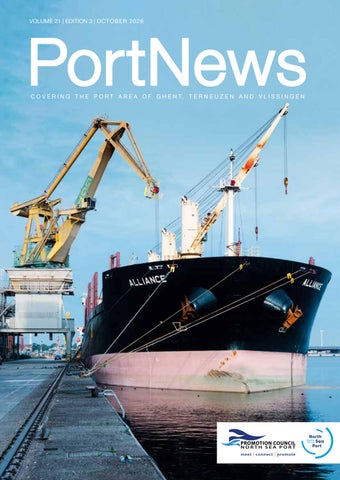
VOLUME 21 | EDITION 3 | OCTOBER 2026
C O V E R I N G T H E P O R T A R E A O F G H E N T, T E R N E U Z E N A N D V L I S S I N G E N
The Port. The Possibilities. Together. Smarter.
northseaport.com
meet | connect | promote
WHO WE ARE •
Safety first
•
People driven
•
Diverse family
•
Positive culture
•
Entrepreneurial
•
Resilient
T +31 (0) 115649841 info@tpt.nl www.tpt.nl
IN THIS ISSUE
34
12 20
28
16 04 North Sea Port – An undiminished ambition
08 Euro-Silo – Shaping the future of agribulk logistics
34 Return Industrial Solutions –
REGULARS
38 Zeeland Connect – Mapping
02 Events 03 Welcome Cas König 56 Port maps 59 New members 60 Members 64 Publishers page
Unlocking the future
the road to zero
12 Fertigent – Two decades of
42 Van Keulen Transport – Spirit and
16 Starck International – Building for
46 Van Gelder – Partner for ports and
20 Supermaritime – Growing with
50 Joris Clappaert – Book ‘CREW’,
24 Oleon – Natural chemistry for
53 North Sea Port – A successful
28 Alco Energy Ghent – A new name,
54 Onilio – A momumental hotel
logistics excellence
the future
the business
a sustainable future
a continued commitment
42
confidence
industry
A unique perspective
networking event for charity
ON THE COVER Image courtesy of Euro-Silo “Shaping the future of agribulk logistics”
PortNews I 1
In this issue.indd 1
21-09-2026 19:50
EVENTS
North Sea Port and Promotion Council North Sea Port will be in attendance at various events and trade shows. Below you’ll find a snapshot of the upcoming events that might be of interest to you.
14-15
OCTOBER
Top Transport Marseille
24-25
Offshore Energy
2026
NOVEMBER Amsterdam
2026
11
MARCH
2027
18-20 MAY
2027
20-22
OCTOBER
2026
3
DECEMBER
2026
Multimodaal Transport Expo Breda
20-22
World Hydrogen Summit & Exhibition Rotterdam
11-12
APRIL
2027
JUNE
2027
Argus Fertilizer Europe Conference Prague
Eindejaarsbijeenkomst Sas van Gent
WindEurope Copenhagen
BreakBulk Europe Rotterdam
5-6
European Commodi-
2026
Rotterdam
9-10
Stock Expo Rotterdam
NOVEMBER ties Exchange
MARCH
2027
26-29 APRIL
2027
17
JUNE
2027
Transport & Logistic München
Maritieme Haringparty Vlissingen
2 I PortNews
Events october 2026.indd 2
15-09-2026 18:11
A sense of responsibility Welcome “In Western Europe, it was the hottest summer ever recorded, and August 2026 was the warmest month ever measured worldwide. This is shown by figures from the European climate service Copernicus. It is due to global warming and the weather phenomenon El Niño. That is why it is predicted that 2027 will likely become even warmer than this year.” This was reported on 10 September by Flemish broadcaster VRT NWS. This exceptional drought is not an abstract climate story. We felt it in our own port as well. On the Ghent-Terneuzen Canal, it once again became clear how strongly our port is connected to water, and how vulnerable that system becomes when a long, hot summer puts the water level under pressure. Less water means less draught for seagoing vessels. And less draught means that ships can sometimes not depart or arrive fully loaded. The companies behind the North Sea locks in Terneuzen experienced daily what restrictions in draught, waiting times, or adjusted sailing windows meant for their supply, production, and security of delivery. This immediately affects planning, capacity, costs, and reliability throughout the logistics chain. The salinisation, too, was more topical than ever. Saltwater pushing further inland affects not only shipping. It also affects water management, nature, industry, and agriculture. It shows how closely everything in our port area is interconnected. As a port authority, we look at this with concern and a sense of responsibility. North Sea Port is the area manager, but we never do this alone. We manage water and shipping together with many partners from the Netherlands and Flanders: water managers, lock operators, governments, nautical services, and of course the companies in our port area. Precisely at moments like these, you see how important trust,
short lines of communication, and cross-border cooperation are. This summer teaches us that drought is no longer an exceptional peripheral phenomenon, but a structural challenge that we must take into account in how we develop and manage our port. We can, and must, learn from this together. By looking ahead better and earlier, sharing information faster, and having scenarios ready, we make our port more resilient. Because next summer is already announcing itself as another hot period, and that is exactly why cooperation between all parties involved is more important than ever. With kind regards, Cas König, CEO of North Sea Port PortNews I 3
Welcome Cas Konig.indd 3
14-09-2026 17:58
An undiminished ambition
In addition to CO2 capture and storage, the deployment of green hydrogen, produced with renewable electricity, will play an important role for Yara Sluiskil. Image courtesy of Yara Sluiskil.
With an annual production and consumption of 600,000 tonnes of hydrogen, North Sea Port is the largest hydrogen cluster in the Benelux. In its sustainability ambitions, the port authority aims to develop the port area over the coming years into one of Europe’s largest hydrogen hubs, with a strong focus on sustainable, green and low-carbon hydrogen. PortNews speaks with Charlotte Herman, hydrogen programme manager at North Sea Port, and Robert Mast, programme manager for industry decarbonisation at Smart Delta Resources (SDR).
Reality check Over the past few years, much has already been said and written about developments surrounding hydrogen. Various hydrogen projects have also been announced in the North Sea Port area, both in industry and logistics. Charlotte Herman is the first to admit that the sector has developed more slowly than expected in recent years due to a combination of high production costs, fragmented and uncertain regulation, slow permitting procedures, and insufficient infrastructure. However, she stresses: “Those growing pains must not make us forget how important hydrogen remains strategically in the long term. Every major net-zero scenario still foresees a substantial role for clean hydrogen in genuine decarbonisation. “Building a clean hydrogen economy was never something that would happen overnight. But if policymakers continue to focus on regulatory clarity, support infrastructure development and further stimulate demand, then hydrogen will grow into an essential instrument for achieving a competitive, autonomous and climate-neutral energy system. Fortunately,
governments are also expressing ambition in this regard, given the importance of these developments for the future of our industry. What is important, however, is that we look carefully at which application is most suitable. For some applications, direct electrification will be the more logical choice. For others, hydrogen, or a hydrogen carrier, may prove more efficient. “At the same time, we see that after a first wave, projects are being dropped, delayed or reconsidered. That is not necessarily a bad thing, quite the opposite. In this way, the market makes clear which projects are robust, scalable and economically viable. Within North Sea Port there are still various companies fully committed to hydrogen. These include existing companies that want to use hydrogen in their production, but also new and existing parties that want to produce hydrogen or import hydrogen carriers. In short, it is of great importance that we all emphasise that we must continue to invest in this. Precisely now that the growing pains are becoming visible and only the strongest projects are surviving, we must not throw the baby out with the bathwater. After all, the energy transition never follows a linear path. We saw the same pattern with offshore wind, LNG infrastructure and solar energy: there too, an initial phase of experimenting, learning, consolidating and scaling up was necessary. For hydrogen, we are at precisely that tipping point.”
4 I PortNews
PA artikel.indd 4
16-09-2026 19:39
Charlotte Herman, hydrogen programme manager at North Sea Port.
Leading the way requires daring
skil.
Robert Mast adds, “One important reason why sustainable hydrogen has not yet taken off broadly is that it currently cannot compete sufficiently with conventional alternatives. For many companies, it is therefore understandable that they are hesitant about making major investment decisions. At the same time, this creates a classic chicken-and-egg problem: without sufficient demand, production will not reach scale quickly and prices remain relatively high, while companies need competitive prices and sufficient certainty before they can make the switch. “We see the same interplay with infrastructure. Investments in, for example, transport pipelines, storage and bunkering facilities are only attractive when there is sufficient prospect of future use. Conversely, companies will only opt for sustainable hydrogen on a larger scale once that infrastructure is actually
Robert Mast, programme manager for industry decarbonisation at Smart Delta Resources.
available and security of supply has been adequately secured. The development of electric transport also took time before technology, infrastructure and market development were sufficiently aligned. Now that provisions are increasingly in order, we see companies making the switch more easily. Sustainable hydrogen needs a similar development. That requires parties willing to lead the way and make investments, even when not all uncertainties have been removed. At the same time, this calls for stable policy frameworks, sufficient investment certainty and good cooperation between the business community, governments and infrastructure parties. Only when these elements come together can the market truly scale up. The positive news is that such pioneers do exist, and that we also see various concrete initiatives emerging within the North Sea Port area. As SDR, we build on this to support our members in making these difficult choices and in creating the right ‘climate’ for decarbonisation.”
Developments in North Sea Port
The potential cross-border hydrogen network in and around North Sea Port.
Robert Mast continues, “Considerable use is already being made of hydrogen within the port area today. An important part of that concerns conventionally produced, so-called grey hydrogen. Yara Sluiskil is currently working on several routes to further decarbonise its production in Sluiskil. In addition to CO2 capture and storage, the deployment of green hydrogen, produced with renewable electricity, will also play an important role in the longer term [editor’s note: see also the March edition of this year’s PortNews from page 38]. “In addition, various parties within the port area are active in initiatives related to the production, import and storage of sustainable hydrogen and hydrogen carriers. These projects are at varying stages of development. For instance, VoltH2 recently announced that, following the award of SDE++ subsidy, the next step has been taken for the development of the intended 25 megawatt hydrogen plants in Vlissingen-Oost and PortNews I 5
PA artikel.indd 5
16-09-2026 19:39
North Sea Port is excellently located within the European hydrogen network.
Terneuzen. TotalEnergies applied for a permit this year for the construction of an electrolyser. LBC Terminals is working on the further development of storage facilities in Vlissingen-Oost. Among other things, this involves examining the import and storage of ammonia. As a hydrogen carrier, ammonia can play an important role in the future energy chain and can, once the necessary provisions have been realised, be converted back into hydrogen. These developments show that work is being done on several fronts within the port area to build a sustainable hydrogen chain. At the same time, its further development still requires investment, appropriate infrastructure, sufficient market demand and clear conditions.”
Backbone “The sustainable hydrogen that will be produced and stored within North Sea Port will ultimately not all be used within the port area itself,” explains Charlotte Herman. “In and around the port area, a considerable amount of infrastructure therefore still needs to be realised. Within the port area, a pipeline between Dow and Yara was already completed in 2018, and the port network will now need to be expanded to enable more connections. In addition, quite a bit still needs to be realised outside the port area for a full and reliable infrastructure. In both Belgium (grid operator Fluxys) and the Netherlands (grid operator Gasunie with Hynetwork), work is under way on a so-called hydrogen backbone: a main pipeline network for hydrogen that connects various industrial clusters and must also link up with similar networks in neighbouring countries. This network is being realised by converting existing natural gas pipelines and constructing new pipelines, an ambitious objective to which the sector is contributing actively.” Despite small successes in both the Netherlands and Belgium, the realisation of the backbone is not always going as quickly as hoped. At present, the first section of the hydrogen backbone in the Netherlands has been delivered in the port area of Rotterdam, and in Belgium part of the H2 Highway has already been realised between Desteldonk (near Ghent) and Opwijk (near Brussels). Charlotte Herman says, “At the moment, the construction of the hydrogen backbone is indeed progressing less quickly than hoped. Also, companies are hesitating to switch to sustainable hydrogen because of the high price, which means the infrastructure will become profitable more slowly. Infrastructure is leading. Without infrastructure, no market. What we need now is speed and action in building crossborder infrastructure as the key. Hydrogen will then be able to flow freely, without barriers created by national borders, thus creating economies of scale. Fortunately, our port area lies on the backbone routes of both Fluxys and Gasunie. Both parties
are building ahead of demand. If all goes according to plan, this route should be completed by 2030.”
Advocate Both Charlotte Herman and Robert Mast are convinced that hydrogen is necessary for the energy transition. “In addition to electrification and carbon capture and storage, hydrogen is also of great importance to enable the switch from fossil to sustainable,” says Charlotte Herman. “The energy transition is not about either-or, but about and-and. A combination of various methods of generating sustainable energy is needed so that both industry and consumers can ultimately use and consume energy entirely sustainably. There are serious projects, there is demand, and there is still much uncertainty. As advocates of a sustainable port, we as the port authority will therefore continue to commit fully to sustainable hydrogen. We do this by remaining in constant contact with the business community to help them where needed, by acting as a voice and sounding board towards the various governments, and by investing and facilitating ourselves where necessary. Most recently, we organised a major conference in which considerable attention was devoted to the opportunities and challenges surrounding hydrogen (see box: North Sea Port Conference 2026). There, we gave various parties a platform and, of course, offered the opportunity for all stakeholders to get in touch with one another.”
Flywheel Robert Mast adds, “It is positive that North Sea Port, the Province of Zeeland and SDR are working closely together on this dossier. In our view, the ambition remains undiminished. Precisely now, it is important that policymakers do not allow themselves to be held back by the challenges that arise along the way, but continue working on the conditions needed to scale up the hydrogen market further. Sufficient scale is an important factor in making sustainable hydrogen
6 I PortNews
PA artikel.indd 6
22-09-2026 20:28
Overview of investments in hydrogen, electrolysis, and import projects.
more competitive and economically viable in the long run. Government support will therefore remain important for some time to come, both financially and through clear regulation. That gives market parties and investors the confidence they need to be able to make investment decisions.” “Of course, demand from the market must also continue to develop,” concludes Charlotte Herman, “and that requires
an investment climate in which government, industry and knowledge and infrastructure partners jointly create the right conditions. Only then can the flywheel of the hydrogen market truly be set in motion.” I. NORTHSEAPORT.COM I. SMARTDELTARESOURCES.NL
North Sea Port Conference 2026 On Monday 21 September 2026, North Sea Port, together with Nieuwsblad Transport and Nederland Waterstofland, welcomed more than 400 participants from ports, industry, governments and civil society organisations at the Oude Vismijn in Ghent for the North Sea Port Conference 2026. With the Province of Zeeland and Smart Delta Resources as event partners, this edition was themed ‘Making a difference for industry and society’. Hydrogen, together with the related topics of renewable energy, circular raw materials, CCUS and cross-border infrastructure, was the main theme of this conference. In his reflections, Cas König, CEO of North Sea Port said: “The energy, knowledge and ambition surrounding themes such as hydrogen, circularity, CCUS and infrastructure once again demonstrated the enormous potential our cross-border port has to shape sustainable industry and ports: in our region, in the Netherlands, Flanders and Belgium, and across Europe. I often say: ‘Once the infrastructure is in place, the economy follows.’ During the conference, we once again saw numerous examples that confirm this.” Guest speakers included: – Liesje Schreinemacher, Deputy Secretary-General of the Benelux; – Ivan Delibasic, Director, Strategy & Public Affairs of Hydrogen Europe; – Torsten Klimke, Head of the Innovation and Research Unit at the Directorate-General for Mobility and Transport (DG MOVE);
– Isabelle Ryckbost, Secretary-General of the European Sea Ports Organisation (ESPO); – Pascal De Buck, CEO of Fluxys; – Willemien Terpstra, CEO of Gasunie; – Vincent Verbeke, CEO of Engie H2BE; – Jessica Hahn, General Manager of Zeeland Refinery; – Luc Cattoir, Plant Manager/General Director of Yara Sluiskil; – Alexander Fokker, General Director of LBC Vlissingen & Duisburg; – Alex Miles, Vice-President Commercial Development at Enerkem; – Dirk Snel, Vice-President Engineering LanzaTech and Senior Business Director, Growth & Strategic Projects – LanzaTech; – and Annick De Ridder, Flemish Minister of Mobility, Public Works, Ports and Sport. PortNews I 7
PA artikel.indd 7
22-09-2026 20:28
Shaping the future of agribulk logistics Euro-Silo is a storage, handling, and distribution company for dry bulk commodities, recognised for rapid vessel loading and unloading, flexible and dependable storage, and multimodal connections. Since its establishment in 1968, the company has consistently grown into a trusted specialist for agribulk, now operating three strategically located sites within North Sea Port.
All images courtesy of Euro-Silo.
8 I PortNews
Euro-Silo.indd 8
12-09-2026 10:06
“Eurosilo was established in 1968 at the Sifferdok in Ghent by Vanden Avenne Commodities and Cargill, with the Vanden Avenne family as the main shareholder,” says Thierry Cardon, commercial manager of Euro-Silo. “Since then, Euro-Silo has steadily expanded its activities and storage capacity. In 1992, the company acquired the Ghent Grain Terminal at the Rodenhuizedok, adding a second major site and strengthening its position as a leading agribulk terminal operator. More recently, Euro-Silo took over the operational activities and staff of SMEG International, adding a complementary long-term storage activity linked to the Sifferdok operations.”
A clear focus on agribulk Euro-Silo distinguishes itself through a deliberate and consistent emphasis on dry agricultural bulk. The company specialises in handling and storing grains, seeds, and derivatives such as soya meal, rapeseed, maize, linseed, and other agribulk commodities, serving three main markets: food, feed, and biofuels. “This focus on agribulk is one of our greatest strengths,” Thierry Cardon notes. “It sets us apart as a stevedoring
company and allows us to customise our facilities and operational processes specifically for these commodities. That’s why our slogan is: ‘Your grains are in good hands’. While we do not own these goods, we will handle, store, and monitor them with the utmost care. To support this, we have the right facilities in place to oversee everything effectively, giving our customers complete peace of mind when they store their goods with us.”
Flexible storage Over the years, Euro-Silo has invested significantly in a silo infrastructure that includes both vertical and horizontal storage. This provides the company with ample storage space and the flexibility to keep different batches, origins, and customer consignments separate when required. For customers, that means traceability, reliability and the ability to adapt storage solutions to changing flows and market needs. “Euro-Silo has a total storage capacity of 1,050,000t,” Thierry Cardon says. “Of course, our silos are rarely completely full. We manage our storage capacity carefully to keep product types, origins and customer consignments separate while maintaining sufficient space for incoming flows. This reliability
PortNews I 9
Euro-Silo.indd 9
12-09-2026 10:06
Euro-Silo’s SMEG site, a large warehouse used for long-term storage, is connected to Sifferdok quay via elevated conveyor systems.
is a core advantage for customers seeking efficient, resilient supply chains. “To illustrate, the crane at the Rodenhuizedok terminal can unload up to 1,500t per hour, while our two new pneumatic unloaders at the Sifferdok terminal are designed to unload 800t per hour. We unload an average of 4.5 million t from ships annually. While that figure may seem abstract, if this tonnage were loaded onto trucks, it would form a queue stretching from Ghent to Istanbul.” In addition to handling and storage, Euro-Silo also provides valueadded services such as weighing, temperature measurement, cooling for temperature-controlled storage, de-ironing, sieving and blending. These services further strengthen the company’s role as an integrated logistics partner for agribulk customers.
Three complementary sites Thierry Cardon, commercial manager of Euro-Silo.
is essential in agribulk markets, where continuity, traceability and product integrity are key.”
Fast handling and value-added services “Another defining feature of Euro-Silo is the speed of our operations, which directly results from our high level of automation,” Thierry Cardon adds. “Our advanced and purpose-built loading and unloading facilities can handle large volumes efficiently and manage several operations simultaneously. This combination of automation, capacity and operational know-how enables us to offer customers a high degree of flexibility and short turnaround times. Furthermore, our three sites are multimodal: we load and unload seagoing vessels up to the size of a Panamax, as well as coasters, barges, railway cars, trucks, and containers. This multimodality
Euro-Silo’s three sites are very similar in their operations, but each has a distinct role. Where the Sifferdok terminal serves as EuroSilo’s main grain trading hub, with many vertical and horizontal silos designed for rapid throughput and high turnover, the SMEG site adds complementary long-term storage capacity, Thierry Cardon explains. “The SMEG site is essentially a large warehouse where sizeable lots can be stored for extended periods, up to several months. It is situated in the Scheepzatestraat and is connected to Sifferdok quay via elevated conveyor systems. We had already been providing long-term storage there on a rental basis, but in April 2025, we officially took over all operations and staff. “The Rodenhuizedok terminal,” he continues, “is directly connected with two neighbouring biofuel plants: Alco Energy Ghent and Cargill. Alco Energy Ghent produces bioethanol, animal feed, and CO2 from maize. We unload and store nearly all the maize they use. Our storage silos are directly linked to their production silos, which we replenish daily, seven days a week.
10 I PortNews
Euro-Silo.indd 10
12-09-2026 10:06
The animal feed, Distillers Dried Grains with Solubles (DDGS), is then returned to us via a conveyor belt for storage and loading for the feed industry. For Cargill, we also handle the unloading of raw materials, which are primarily oilseeds, and we replenish their production silos directly from our storage facilities as well.”
Long-term asset plan In addition to the acquisition, Euro-Silo has also been working on a major investment programme for several years, Thierry Cardon says. “Our investment programme, which we call our long-term asset plan, mainly focuses on renewing and modernising critical assets, strengthening operational reliability and equipping the company for the next generation of agribulk logistics. For instance, at the Sifferdok site, we have installed a completely new roof on a flat silo and covered it with solar panels. The programme also involves concrete renovations to many of the silos at Sifferdok, extending their lifespan by 40–50 years. Examples of the technological innovations are our new Vigan pneumatic unloaders at Sifferdok, the largest of their kind in Europe, and a new loading installation to be installed in the near future. “Furthermore, the construction of our new offices is already well underway and will be completed in October this year. Immediately afterwards, the old office building will be demolished, and a new warehouse will be built on the site to provide additional storage capacity specifically for derivatives. It will contain smaller compartments dedicated solely to derivatives, have a storage capacity of nearly 30,000t, and feature its own unloading and loading installations. And that’s merely highlighting some investments for the Sifferdok terminal. At Rodenhuizedok, we are also carrying out extensive roof and concrete renovations, installing a new loading unit, and adding an identical Vigan unloading unit, like the one at the Sifferdok terminal, to increase unloading capacity. Moreover, the programme also covers the renewal of electrical installations and automation systems across the sites, strengthening the technological backbone of our operations. Together, all these projects amount to an investment of nearly 90 million euros, all while keeping our operations running at full capacity.”
Euro-Silo’s purpose-built loading and unloading facilities can manage several operations simultaneously.
Euro-Silo specialises in handling and storing dry agricultural bulk, serving three main markets: food, feed, and biofuels.
Sustainability, safety, and continuity Euro-Silo’s investment plan also emphasises sustainability as a key focus. Solar panels are installed whenever feasible, including on the new warehouse. Energy efficiency is prioritised when upgrading machinery. The new office building is designed to be energy-neutral, aligning with the overall commitment to energy conservation in all investments. Furthermore, EuroSilo’s International Sustainability & Carbon Certification (ISCC) supports biofuel-related activities and attention to carbon footprint. “Additionally,” Thierry Cardon adds, “Euro-Silo also supports more sustainable mobility through a bike lease plan for employees, including electric bikes and speed pedelecs, which is increasingly relevant as cycling infrastructure around North Sea Port continues to expand. Security measures, such as ISPS measures and the Port Pass rollout, ensure controlled access to the sites. Safety, security and quality are essential to our activities. Euro-Silo is ISO 9001 and FCA certified, enabling the company to store and handle animal feed products, including organic and bio-certified products, thanks to our Certisys bio certification.” “All in all,” Thierry Cardon concludes, “it’s a comprehensive asset renewal and expansion programme that will shape the future of Euro-Silo, built on the same foundations that made the
Safety, security and quality are paramount in all of Euro-Silo’s activities.
company successful: a clear agribulk focus, reliable and flexible storage, fast and automated handling, multimodal logistics and a willingness to invest ahead of market needs. Our goal is clear: to remain a trusted partner for agribulk flows in the decades to come.” I. EUROSILO.BE PortNews I 11
Euro-Silo.indd 11
12-09-2026 10:06
Broadening the horizon
All images courtesy of Ghent Transport & Storage.
DFDS meets growing demands
Two decades of logistics excellence Fertigent is a specialised terminal dedicated to the storage and distribution of liquid fertilisers in North Sea Port. Operated by GTS (Ghent Transport & Storage), Fertigent combines over 20 years of experience with a fully automated terminal, a storage capacity of 70,000t, in-line blending facilities for customised liquid fertilisers, and 24/7 service. In 2026, the company commemorates its 20th anniversary, a significant milestone that highlights Fertigent’s sustainable development and its strong position within the sector. 12 I PortNews
Fertigent.indd 12
21-09-2026 19:49
Fertigent is a specialised terminal dedicated to the storage and distribution of liquid fertilisers in North Sea Port.
Fertigent was founded as a joint venture between GTS, a leading and experienced logistics provider for various bulk cargoes based in North Sea Port, and the Lithuanian company Achema, the largest producer of nitrogen fertilisers in the Baltic states, as Yves Bienfet, managing director of GTS, explains. “The concept of this terminal was initially proposed by Achema,” Yves Bienfet says. “Achema was already a customer of GTS for dry bulk, mainly calcium ammonium nitrate and NPK, but it is also a major producer of liquid fertilisers. At the time, Achema was already supplying a number of traders operating in France and the Benelux, but it was also keen to operate directly in this market itself. Achema wanted to develop its own dedicated terminal, as there was no tank capacity for liquid fertilisers available to Achema in Ghent at the time. The company then approached various stevedores, but it was with GTS that it found the right chemistry, the right synergy. Shortly afterwards, in 2004, the company was founded, and we began designing the terminal together, drawing on Achema’s expertise in liquids and our expertise in logistics and distribution.
Yves Bienfet, managing director of GTS. PortNews I 13
Fertigent.indd 13
21-09-2026 19:49
Fertigent is a fully automated terminal with in-line blending facilities for customised liquid fertilisers.
“While Fertigent as a company was founded in September 2004,” he clarifies, “the first trucks at the new terminal were loaded in 2006, as it takes some time to conduct studies and design work, apply for planning permission, and carry out construction. We decided to celebrate our 20th anniversary as an operating terminal in 2026, just as we celebrated our tenth anniversary in 2016.”
In-line dilution “Designing the new terminal was quite a complex process,” Yves Bienfet notes, “because you’re dealing with a product, urea-ammonium nitrate (UAN), that is not straightforward to store, as it is corrosive to mild steel and requires quite complex handling. UAN is imported with a nitrogen content of around 32,3%. Depending on the end market, it has to be diluted prior to loading to a nitrogen content of either 32%, 30% or 28%. What makes our terminal unique is that we do this in line. In most terminals, this is done in tanks: diluting the product as it arrives and storing it in different tanks: one with 32% nitrogen, one with 30% nitrogen, and so on. Fertigent specifically chose not to operate this way but instead opted for a single tank in which the product is stored exactly as it arrives. Dilution then occurs during loading by adding water. This offers various advantages, the most obvious being cost. A separate tank for each batch is much more expensive, especially since UAN is a standardised product. Separate storage, for this product at least, makes no sense whatsoever. “What’s more,” he continues, “for the first few years, the terminal was dedicated to a single customer, Achema, and a single product, UAN. This changed about ten years ago, and we now have several users of our storage and distribution facilities. In addition, another product has been added: ammonium thiosulphate. This can be either handled as is or blended with the UAN. Depending on the customer’s requirements, we create a specific formulation – a blend
Fertigent installed solar panels on the roof and on the sun-facing sides of the tank walls.
containing a certain percentage of UAN and ammonium thiosulphate, often including a percentage of water as well. The advantage of adding ammonium thiosulphate to the UAN is its high sulphur content. In the past, acid rain provided plants with sufficient sulphur, which was its only positive effect. But now, because we desulphurise all our fuels and natural gas, we no longer have that continuous supply of sulphur via that route. So extra sulphur has to be added to the fertilisers.”
A fully automated terminal “Another strength of our terminal is that we are fully automated,” Yves Bienfet states. “It is fully driver self-operated. Truck drivers use their own unique loading code, linked to a specific order
14 I PortNews
Fertigent.indd 14
21-09-2026 19:49
and formulation. With this code, a truck driver can come and load his vehicle at our automatic loading installations, 24/7. Many terminals offer truck loading only on weekdays and during specific shifts. Our system enables loading at night, so fertilisers can be delivered to a farmer in France by six o’clock in the morning. Therefore, our way of working offers a great deal of flexibility, and I am pleased to say it functions very effectively. We have eight of these automatic-loading installations, which provide a failsafe and a degree of redundancy in our loading capacity. Suppose there were a problem with a particular loading installation, we could simply take it out of service temporarily for repairs while loading continues at the seven other installations. Furthermore, this large loading capacity helps manage demand during peak times. After all, liquid fertilisers are a seasonal product. During peak periods, we can handle as many as 150 trucks in a single day. “Because of this automation,” he adds, “Fertigent does not actually have any staff of its own. When loading or unloading seagoing vessels or barges, there will be people on site to connect and disconnect them, since the Fertigent terminal is managed entirely by GTS personnel. Across the entire GTS group, we have approximately 120 people on the payroll, which is sufficient staff for all operations. Additionally, in recent years, GTS has increased its staff by 40%, and we plan to grow by at least that much in the coming years as we continue to expand our terminals.”
A multimodal terminal “The Fertigent terminal is multimodal with connections to water, rail and road,” Yves Bienfet says. “The liquid fertilisers arrive mainly by sea, from various origins around the world. Reloading is mainly onto truck and barge, due to the nature of the end markets and the local distribution. The recipients of the goods are mainly end consumers, farmers, or larger agricultural cooperatives in the region. We mainly load for France, followed by Belgium and the Netherlands, and occasionally Luxembourg
and Germany. Farmers are mainly supplied by truck, whilst the cooperatives more often charter larger barges. Occasionally, we also load seagoing vessels, such as coasters bound for Germany, and we can load trains if required. We have also transported flexibags in containers, for example, to the French overseas territories.”
Fit for 55 “Fertigent’s plans for the future mainly focus on ensuring that our installations remain in excellent condition for the next twenty years,” Yves Bienfet notes. “This involves emptying and cleaning tanks, inspecting the coatings, and replacing pumps, valves, and pipework with stainless steel. After all, carbon steel was initially chosen for certain components because an anticorrosion agent is added to protect the metal. However, after twenty years, we have realised that this isn’t sufficient. Stainless steel is far more durable. “Sustainability is, of course, also a key focus, although Fertigent already excels in this area. We’re a ‘net-zero’ facility; we produce no wastewater and have no vapour nor CO2 emissions as we generate our own electricity. We recently invested in solar panels, ensuring that we generate more electricity than we consume. The terminal already has relatively low energy consumption. We mainly need electricity for our compressors and pumps, and there is no heating. The solar panels are installed on the roof and on the sun-facing sides of the tank walls. Since the products are non-flammable, this is an ideal opportunity to utilise that surface area, which would otherwise be unused. Moreover, we invested in batteries to compensate for the imbalance between electricity generation and consumption, resulting in a large surplus during the day and a shortfall in the evening. This difference can be mitigated by the batteries and help ensure the grid remains balanced. As a result, Fertigent has been Fit for 55 since 25.” I. FERTIGENT.BE
Fertigent celebrated its 20th anniversary as an operating terminal in 2026.
PortNews I 15
Fertigent.indd 15
21-09-2026 19:49
Vincent Allertz, founder of Starck International.
16 I PortNews
Starck.indd 16
21-09-2026 19:51
Building for the future Starck International moves into the next stage of its growth with the development of a new terminal in North Sea Port.
The Starck International story begins five years ago, when the company’s founder and director, Vincent Allertz, teamed up with Italy-based agri-food and feed leader the Borsari Group. The partnership laid the foundations for a business built around long-term investment, supply chain efficiency and close collaboration with customers and suppliers around the world. Before this, Vincent Allertz had spent ten years working with two large commodity trading houses. It was during this time that he had the idea to begin something himself, together with Elwin Abels, manager operations at Starck International, and the Borsari family. It was, he says, a good decision. “Things have gone well. We now have a team of 35 people working for the company, some of whom are based in our office and some in the port.” He explains that the company’s primary activities lie in the import of agri-feed commodities, for the compound feed, pet food and fermentation industries, which are then distributed to clients around (northern) Europe. “We’re a small player,” he continues. “But we are one of the few in the industry that is investing in our own logistics. Our philosophy is to own the warehouses that we use. We want to have a closed supply chain. With that, we are able to operate independent of the market. We believe this creates a win-win situation; for us it provides resilience, while our clients benefit from price stability.”
Fantastic location While Starck International runs its office in Utrecht, the company has been active in North Sea Port for the past few years, having acquired the premises and operations of Feijter-Granen in Sas van Gent in 2024. “This has proved to be a fantastic location for us,” states Vincent Allertz. “It’s right in the heart of the port with its own quayside where we can load coasters. Currently, we do have a draught restriction. We can load vessels up to 3,000 deadweight tonnes. However, we are working with North Sea Port to deepen the canal to a 6.5 metre draught. With this, we will be able to load vessels up to 4,000 deadweight tonnes. This will be ideal for short sea shipping, enabling us to export to the United Kingdom, Republic of Ireland and Northern Spain.” Still, he acknowledges, the Sas van Gent location still presents restrictions – it is not a deep sea port. Starck International, however, is in the process of developing a new grain terminal in the Vlissingen area of North Sea Port, which will allow the company to welcome larger vessels.
Further growth The opportunity arose when North Sea Port issued a tender for the redevelopment of the site formerly operated as Bulk Terminal Zeeland (BZT). The tender was awarded to BOW Terminal at the end of 2025. Realising, however,
The company’s primary activities lie in the agri-feed sector.
PortNews I 17
Starck.indd 17
21-09-2026 19:51
Starck International has enjoyed a positive collaboration with North Sea Port.
that BOW Terminal was not likely to need the location’s warehousing facilities, Vincent Allertz contacted BOW Terminal’s management. “BOW Terminal is developing the location as a marshalling port for breakbulk and for offshore energy projects in the North Sea. As such, the warehousing didn’t feature in the company’s plans for the site and the management agreed to sell them to us.” With this latest move, Starck International is able to further grow and optimise its logistics chain, consolidating the flow of goods for more efficient organisation. The development, he says, represents a great opportunity for Starck International. “Deep sea sites like this don’t become available all that often, so we were very interested when we heard about this location. It has a 12.5 metre draught. As a result, vessels of all sizes, right up to Panamax, will be able to bring commodities from all over
the world, which we can then distribute to our clients around Europe.” The area acquired by Starck International spans 8 hectares of the site’s total of 30 hectares. In addition, Starck International has entered into a long-term lease with North Sea Port for a further 6 hectares.
Positive collaboration The decision to develop the site was based, in part, on the experience Starck International has had working with North Sea Port in Sas van Gent. “The collaboration we have had with the port in Sas van Gent has worked very well for us. The mutual trust between our company and North Sea Port is very strong. It is a very entrepreneurial port, always working with you to find solutions,
The new terminal is able to host vessels of all sizes.
18 I PortNews
Starck.indd 18
21-09-2026 19:51
The company’s new terminal opened this year.
always trying to find the way to optimise the entire site. The port is also very approachable and very good at connecting people and businesses. What’s more, it offers excellent hinterland connections by road, rail and water.” Vincent Allertz says that this collaborative approach has been instrumental in helping Starck International realise its ambitions and encouraged it to continue investing in the region. Currently, he explains, the company is busy preparing the new terminal for operation later this year. “We are in the process of preparing everything so that we can achieve GMP (Good Manufacturing Practices) certification.” There is no shortage of things to do in advance of this, he continues. “The site has been empty for almost two years now so it needs a lot of attention. Just to clean one box takes a whole cleaning team two weeks.”
Local economic boost The development of the new terminal is good news not only for Starck International, Vincent Allertz says, but also for North Sea Port and the local economy. “This is all new activity for the region. We hope to be attracting more agri-feed business to the port. Hopefully, this will also enable the port to showcase its capabilities to support the sector. “Plus, everything will need to be managed and there will be vessels calling – all of which offer the potential to generate more revenue. It all represents business for the area.” He gives the example of the current activities taking place on site. “Everything we are doing right now – the construction, the electricity, the cleaning, and the use of infrastructure such as portacabins – is all being supplied by local companies.”
Above and beyond
Employment opportunities
The work taking place includes the entire electrical rewiring of the site’s electrical systems, laying of new road surfaces, installation of a new weighing bridge, erection of new fencing and the development of a new safety scheme. “It would be true to say that we are going above and beyond what is actually required of us, but we have made a significant investment and we want to make sure that everything is done right, for the long-term.”
Additionally, he says, the new terminal will provide employment opportunities for a new team of more than 30 empolyees, together with a terminal manager, as well as other non-direct employment; the expansion is expected to create opportunities across a range of operational and support roles as activity at the terminal continues to grow over the coming years. While accepting that it can sometimes be difficult to find personnel in the region, Vincent Allertz says that the effort to hire locally does pay off. “We have certainly found that we have nothing to complain about when it comes to the local workforce. What we find here is that people have a very hands-on mentality – it’s very much about ‘action, not words’. The people in the area are really willing to work. Plus,” he concludes, “they have a great sense of humour.”
Step by step Despite all of the tasks to be completed, Vincent Allertz expects the new terminal to be open by the time this editon of PortNews goes to press. “By that time, we should be able to start using the terminal. We will, however, do things gradually – step by step. It will be some time before we start to receive large vessels,” he says.
I. STARCKINTL.COM PortNews I 19
Starck.indd 19
21-09-2026 19:51
Growing with the business A new chapter for Supermaritime
Image courtesy of Supermaritime.
There have been some interesting developments at Supermaritime in the Vlissingen area of North Sea Port of late. At the beginning of this year, Milan Tevel moved into the role of general manager.
A familiar face He took up the function at a busy time when the stevedoring, cargo handling and logistics service company was developing a new warehouse facility, a project that reflects the company’s continued growth and its commitment to expanding the range of services it can offer existing and new customers alike. While still relatively new to the role of general manager, Milan
Tevel is certainly no stranger to Supermaritime. In fact, he explains, he has grown up around the company, following in the footsteps of his father, a stevedoring foreman. “When Supermaritime began 25 years ago, my father was one of the first to join the company. From 2008, he arranged for me to come and work here as a warehouse and terminal employee during my school holidays.” In 2010, Milan Tevel undertook an internship with the company before joining Supermaritime as a full-time employee straight from school in 2012. “Supermaritime has been a big part of my life for the past eighteen years – that’s more than half of my life,” he says.
20 I PortNews
Supermaritime.indd 20
12-09-2026 09:56
Milan Tevel, general manager of Supermaritime.
understanding of how the different parts of the operation fit together. “I started out as a stevedore, working as a forklift driver before becoming foreman. In 2016, I moved into planning and operations, before becoming operations manager in 2019. I held that role until taking up the position of general manager in January this year.”
Opportunities for growth There been some new developments at Supermaritime lately.
Supermaritime has been a big part of my life for the past eighteen years – that’s more than half of my life.
Through the ranks During his time as a full-time employee, Milan Tevel has experienced every aspect of the operation, working his way through the ranks. That broad experience has given him first-hand knowledge of the day-to-day challenges faced by employees across the business, as well as a detailed
In becoming general manager, Milan Tevel succeeds Martien Burger, who has been credited with driving the company’s growth over the past decades. He says that the opportunities for development were one of the factors that first attracted him to Supermaritime. “When I used to come during the school holidays, we were renting warehousing space of 8,000m2 from Kloosterboer. When I joined full-time in 2012, we were about to move into our own terminal – I could see that there were opportunities to grow along with the business.” Supermaritime moved into the newly constructed terminal in April 2013, shortly after Milan Tevel joined the company. Here, he explains, Supermaritime has its own, dedicated deepwater quayside, a yard of 90,000m2, together with 40,000m2 of warehousing – totalling 130,000m2 of bonded storage for its clients, including some of the largest players in the offshore oil and gas industry. PortNews I 21
Supermaritime.indd 21
12-09-2026 09:56
Image courtesy of Supermaritime.
The company’s new warehouse spans 12,787m2.
Broad range of services The facility enables the company to handle a broad variety of cargoes while providing customers with storage and logistics services from a strategically located site within North Sea Port. “From here, we serve our clients with a range of services such as storage of assorted cargo, and marshalling – mainly for the offshore industry. We also operate a number of liner services, two to Suriname and Guyana. The latter has been experiencing quite some growth lately, as offshore energy operations have been accelerating in the area. “And we operate a seasonal service, between August and January, shipping potatoes and onions to West Africa. This is quite a significant operation with close to 100,000t of onions handled each year.”
Next steps With the continued growth it has experienced over recent years, it was perhaps inevitable that Supermaritime would have to expand its facilities further. As customer requirements have evolved, the company has increasingly been called upon to provide additional storage capacity alongside its traditional stevedoring activities. This gradual evolution has shaped both the way the business operates and the investments it continues to make. “To begin with, Supermaritime was very focused on stevedoring activities. However, we like to accommodate our clients’
Supermaritime’s terminal features a dedicated deepwater quayside.
requests as far as possible so, when they asked us to start storing their goods, we were happy to support them. Over time, it’s got to the stage where we required not only more space, but also warehousing suited to different types of product. When this opportunity arose, we looked into it and decided it made sense to invest.” The new location spans a total of 12,787m2, 10,956m2 of which is warehousing space. Office space accounts for 521m2 of the new location’s footprint, with the remaining 1,310m2 comprised of mezzanine. The new warehouse has achieved BRCGS (Brand Reputation Compliance Global Standards) AA status – the highest rating that can be awarded, following a third-party audit, in the an internationally recognised programme for food safety, package, storage and distribution. Situated on Duitslandweg, on a recently redeveloped 100,000m2 area of North Sea Port, the location is well connected by road, water and rail. In addition to overseeing the latest expansion, Milan Tevel has been involved in a whole range of topics since taking up his role as general manager. “There’s certainly more focus on the financial aspect of the business in this role than there was previously when I worked in operations. And I am also working together with the owner of the company on strategy, making decisions for the future of the business. The transition from operations into general
22 I PortNews
Supermaritime.indd 22
12-09-2026 09:56
Image courtesy of Supermaritime.
Supermaritime continues to plan for increased efficiency in the future.
Image courtesy of Supermaritime.
now have 40 people and we continue to grow. That being the case, I am putting additional focus into human resources. “Additionally, AI and automation are high on our agenda right now – as they are for all businesses in the logistics sector. Our focus on these topics is essential if we don’t want to get left behind. Therefore, I am working closely with our IT personnel to move things forward.” While these technologies are still developing rapidly, Milan Tevel believes they already offer practical opportunities to improve efficiency by reducing repetitive administrative tasks and allowing employees to focus on higher-value activities. “To give an example, we have clients who send us a PDF. For years, we had to read that document, and then file it manually. Now, they send it via a specific email address and the whole process is done automatically with the support of AI agents – our colleagues here only have to check the document, which is considerably more efficient.
Added efficiency
Towards tomorrow
Milan Tevel is hopeful that advancing technology will help the company to overcome some of its HR challenges, he explains. “Today, we can do everything we need to do with the 40 people we have as full-time employees. But say there is a vessel coming in tomorrow. Then we’ll need 50, sometimes 70 more people. Just like that. And then, the day after, we only need 50 again. “While we have a good network locally that enables us to scale up and down quickly, as we continue to grow it can be very challenging to find the right people at short notice. I see a solution for this in increasing robotisation in our standard warehousing operation. “To be clear, this is not about displacing people – on the contrary, there are things we do here, especially in the terminal and with regard to breakbulk that it simply would not be possible to automate in the near future. “What we can hope to do, however, is apply innovative solutions that will help us to continue operating with our current workforce, in ways that make their work easier, safer and more efficient.”
Are there specific things that he is considering for the future? “Five years ago there were just fifteen people working here. We
I. SUPERMARITIME.COM
Image courtesy of Supermaritime.
The company’s clients include larget players in the oil & gas sector.
management has therefore brought a broader perspective, balancing day-to-day operational performance with longer-term planning and investment decisions.”
PortNews I 23
Supermaritime.indd 23
12-09-2026 09:56
Oleon’s Ertvelde plant in North Sea Port. Oleon is a company of natural chemistry: it converts renewable oils and fats into speciality ingredients for industries that touch everyday life. All images courtesy of Oleon.
Natural chemistry for a sustainable future Oleon Ertvelde in North Sea Port serves as both the headquarters and a key facility for Oleon, a leading global producer of oleochemicals. Oleon converts renewable natural fats and oils into high-value, sustainable solutions. Through innovation, expertise, and a commitment to renewable chemistry, the company creates products that serve a wide range of industries, including personal care, food, lubricants, and industrial applications, helping customers develop more sustainable solutions for the future. Oleon is a company of natural chemistry: it converts renewable oils and fats into speciality ingredients for industries that touch everyday life. Vegetable oils such as rapeseed, sunflower and palm oil, as well as animal fats such as tallow, are transformed into fatty acids, glycerine, esters and other oleochemical building blocks that are used in a variety of applications in different segments, explains Antoine Prevost, CEO of Oleon. “Our core business is transforming raw natural materials into speciality ingredients that serve a large variety of markets across
various industrial segments, including lubricants, cosmetics, nutrition, and home care. For instance, in lubricants, we provide additives that enhance performance. Our cosmetics segment focuses on ingredients for personal care products, such as creams and shampoos. For nutrition, we offer ingredients such as emulsifiers used in large-scale formulation for various applications, including specialised nutrition. In home care, our ingredients enhance product softness, such as in laundry detergents. And this is to name just a few. Other industries we
24 I PortNews
Oleon.indd 24
12-09-2026 09:59
serve include feed and fuels, coatings, inks, crop protection, and many more. Our chemistry is everywhere, as a building block, ingredient, or additive. As such, we supply both other chemical companies and manufacturers that sell end-products to customers.”
A global footprint and customer intimacy “Our industrial footprint is supported by multiple manufacturing plants worldwide,” Antoine Prevost says. “We currently have eight facilities: two in Belgium, one in France, one in Germany, one in the UK, one in Malaysia, one in Brazil and one in the US, which is our most recent one. This facility in Houston, Texas, was actually inaugurated this summer. The investment in this facility is part of our broader expansion into the Americas. Growing locally, close to our customers, is a core part of our strategy and DNA. Our global presence allows us to consistently deliver the same standards and quality worldwide. Our goal is to stay close to our customers and embody what we call ‘customer intimacy’ on a global scale. Customers value our combination of a global presence with a local approach. Success for us depends on forming long-term, meaningful relationships with all our partners. At Oleon, we focus on building long-term customer partnerships. We invest in understanding their needs, markets, and end-use applications, which helps us provide the most suitable and effective services tailored to each customer. “In terms of numbers, Oleon has eight manufacturing plants and twelve sales offices worldwide, employing approximately 1,600 people. We have an annual turnover of around 1 billion euros and deliver around 500,000t of products and speciality ingredients in more than 100 countries. To achieve optimal efficiency in our operations, we have specialities per location. The biggest difference is probably between our factories for base products and those for what we call ‘intermediate’ products.” He explains: “Our natural chemistry begins with oils and fats, which we initially convert into base ingredients. These can be sold to other chemical companies or processed further within Oleon. We operate two factories for base ingredients and products: one near Ghent, the Ertvelde factory in North Sea Port, which is one of the largest, if not the largest, oleochemical plants in Western Europe, with a capacity of 250,000t – making it a crucial asset for us – and another in Emmerich, Germany, close to the Dutch border. The Emmerich facility is smaller and focuses on specialitybased ingredients. Our other six factories are derivative factories that transform these base ingredients into more complex products through chemical reactions, such as esterification. These factories are located in Malaysia, France, Oelegem (near Antwerp), and across the Americas. They are equipped with multipurpose reactors suited for various applications; however, none can produce the full Antoine Prevost, CEO of Oleon. spectrum of products, so
Oleon has a long-standing tradition of pioneering new products and advancing technologies, developing solutions that improve product performance, lower carbon footprint, add value, and increase efficiency.
each factory is relatively specialised for certain products and applications.”
An ecosystem in North Sea Port “The importance of our facility in North Sea Port is apparent,” Antoine Prevost states, “as it serves as both a logistical and manufacturing hub for other Oleon plants. This factory is really a strategic one for Oleon. We have, of course, a major logistical advantage from our location in North Sea Port, not only in terms of geography but also in terms of logistics facilities. We value close cooperation with our neighbours and logistics partners here in the port. It creates an ecosystem where we can cooperate and improve. For instance, we recently signed an agreement with our long-term partner Mervielde. They have made a significant investment in their site at the Kuhlmannlaan, which is right next to ours, for the installation of six large shore tanks commissioned by Oleon. These tanks have a capacity of 2.5 million l each and are connected to our site via pipelines. We also have partnerships with Cargill and Total to discharge ships, because our raw materials are shipped to us primarily by sea. For example, we have coastal supplies from France, supplied by our group’s crushing operations near Bordeaux and Le Havre, which process rapeseed into oil. Tallow is also shipped by sea, and our export is handled multimodally as well. “Recent investments underline this strategic importance of Oleon’s North Sea Port site. The most significant recent investment is the expansion of the isostearic acid and dimer acid production facilities. As part of PortNews I 25
Oleon.indd 25
12-09-2026 09:59
Oleon is a member of the Avril Group, which in 2021 declared its goal to become the top provider of plant processing solutions for food, agriculture, and environmental sectors, with the mission to serve the Earth.
Oleon’s new facility in Conroe, Texas, was inaugurated this summer as part of its broader expansion across the Americas, emphasising local growth and proximity to customers worldwide. Personal care and cosmetics are just two of the large variety of industries Oleon serves.
a multi-year plan launched in 2018, we installed a new reactor at the Ertvelde plant, doubling capacity for these speciality products. The additional capacity became operational in 2024. The project builds upon an earlier investment of 20 million euros in 2018, when we launched a new production line for highquality dimers and isostearic acids in Ertvelde. The goal was to meet increasing demand for speciality oleochemicals used in applications such as lubricants, coatings, and cosmetics.”
Belgian roots “Oleon continues to use the Belgian site as a cornerstone of its global manufacturing and innovation network,” Antoine Prevost adds. “Incidentally, it’s also where our company’s origins are. Oleon can trace its origins all the way back to 1835, when Des Bougies de la Cour, Manufacture Royale, was established in Belgium. The company was one of the first to industrialise the chemistry of natural fats, supplying candles to the royal court. Then, in 1957, PetroFina and Ashland founded Oleochim NV in Ertvelde, enabling PetroFina to expand from petrochemicals into oleochemistry, producing fatty acids from vegetable and animal fats. In 1965, Oleochim bought Bougies de la Cour NV, and the two companies merged. Through several more mergers and acquisitions, the company became Oleochemicals, which was later sold by Fina in 2000. It was then that Oleon was born. Then, several acquisitions followed, and Oleon became part of the Avril Group in 2009. In 2021, the group announced its new ambition: to become the leader in plant processing solutions for
Oleon recently expanded its isostearic acid and dimer acid production facilities, doubling capacity for these speciality products.
food, agriculture, and environment, with the purpose: Serving the Earth.”
Innovation and sustainability “At Oleon, our strategy rests on four main pillars,” Antoine Prevost explains. “We have already spoken about two of them: customer intimacy and a global footprint. These go hand in
26 I PortNews
Oleon.indd 26
12-09-2026 09:59
Over 80 staff members work in R&D across various labs. The central lab is in Compiègne, France, with additional facilities in Belgium, Germany, Malaysia, and Houston, USA. hand with the remaining two pillars of Oleon’s business strategy: sustainability and innovation. Oleon has a strong tradition of pioneering new products and developing new technologies. Over 80 staff members work in R&D across various labs. The central lab is in Compiègne, France, with additional facilities in Belgium, Germany, Malaysia, and Houston, USA. We collaborate with partners and customers to co-develop solutions that improve product performance, lower carbon footprint, add value, reduce costs, and enhance efficiency. A robust innovation pipeline is crucial, serving as a key differentiator that we aim to emphasise in the market. “Then last but certainly not least, sustainability. Sustainability is a key element of our strategy, rooted in the origins of Oleon and the Avril Group. Avril is closely connected to the agricultural sector. As a result, sustainability is embedded in our company’s DNA. We work with natural ingredients such as oils, vegetable oils, and fats, and we therefore emphasise sustainable sourcing. For instance, when sourcing palm oil, we
ensure responsible procurement by choosing suppliers from areas that are not deforested. We hold various certifications and prioritise traceability of our sources. We ensure sourcing from non-deforested areas and uphold workers’ social rights through our suppliers. And we have established a robust supply chain to monitor these factors effectively. “Our second key area of sustainability is tackling climate change. We emphasise renewable energy sources. Recently, we signed a biogas power agreement to use biogas for our steam supply. Additionally, we utilise renewable electricity, having entered into a power purchase agreement with wind energy providers. We’re also investigating our own windmill project here in Ertvelde. Our focus remains on increasing renewable energy use and enhancing energy efficiency to lower overall consumption through process improvements. “Finally, we verify that both our suppliers and we are dedicated to lowering our carbon footprint, known as the Scope 3 focus. Overall, our climate strategy is broadly recognised and highly appreciated by our customers, especially in sectors like health, beauty, and nutrition, where large companies have also incorporated sustainability into their strategic objectives. As these industries accelerate their move toward sustainable solutions, Oleon demonstrates how renewable raw materials, innovation, and Natural Chemistry can contribute to a more circular and responsible future.” I. OLEON.COM PortNews I 27
Oleon.indd 27
12-09-2026 09:59
A new name, a continued commitment Alco Energy Ghent, located in North Sea Port, is Belgium’s largest biorefinery, converting maize into bio-ethanol, high-protein animal feed, liquid CO2, and various other by-products. With its integrated production methods and focus on sustainability, the company supports the production of renewable fuels and the advancement of the circular economy.
All images courtesy of Alco Energy Ghent.
Earlier this year, the company changed its name from the widely known Alco Bio Fuel to Alco Energy Ghent, a move that stems primarily from broader brand harmonisation within Alcogroup but also better reflects the company’s activities, says Renzo De Roose, plant manager of Alco Energy Ghent. “The name change is a natural result of the group’s growth in recent years,” he explains. “Alco Energy Ghent is a wholly owned subsidiary of Alco Energy, a joint venture between Alcogroup, a global group active in the production, distribution, and trading of ethanol, and Vanden Avenne Commodities, a family-run business involved in trading, distributing, and storing grain and related products. In addition to our site, Alco Energy has production facilities worldwide. In Durban, South Africa, and in Mauritius, for instance, we have plants that produce potable alcohol. In Rotterdam, we operate the largest ethanol plant in Europe, and in the Americas, Alco Energy Canada is
a recently acquired production site that performs the same activities as we do here in Ghent. To maintain consistency, the name change to Alco Energy has been implemented across all locations. Furthermore, our new name also shifts the focus: the previous name, Alco Bio Fuel, tended to suggest that we dealt solely in biofuel, but that is not the case. In terms of tonnage, we produce just as much animal feed as we do bio-ethanol. Roughly speaking, you could say that from 1t of maize, one third becomes bio-ethanol, one third becomes animal feed, and one third becomes liquid CO2.”
Alco Energy Ghent “Our site here in North Sea Port was established in 2008,” Renzo De Roose says. “Until then, Alcogroup had mainly been a trader in ethanol and was looking for a partner to set up its own bio-ethanol production unit. Subsequently, they
28 I PortNews
Alco Energy.indd 28
12-09-2026 09:51
All CO2captured is purified and liquefied at Alco Energy Ghent’s onsite GreenCO2 plant. GreenCO2 is operated by Alco Energy Ghent and is a joint venture between Alco Energy Ghent, Messer Benelux, and IJsfabriek Strombeek (Air Products).
formed a partnership with Vanden Avenne Commodities and with Aveve (now Arvesta), which remained a shareholder until 2024. The site in North Sea Port was a greenfield distinguished by its strategic location within the port and the pre-existing logistical facilities. Specifically, it is connected to the Euro-Silo Rodenhuize terminal. That is how we came into contact with Vanden Avenne, which is also the majority shareholder of EuroSilo. Euro-Silo manages all our logistics related to incoming goods and the dispatch of animal feed. Additionally, we are also linked to the tank terminal Evos for the storage and loading of our bio-ethanol.
Alco Energy Ghent in North Sea Port is Belgium’s largest biorefinery.
Renzo De Roose, plant manager of Alco Energy Ghent.
“In terms of capacity,” he continues, “Alco Energy Ghent currently produces 300,000m³ of bio-ethanol per year, and our plant operates seven days a week, 24 hours a day. The plant was originally designed to produce 160,000m³ of bioethanol per year, but thanks to improvement projects and increased efficiency, that figure has almost doubled and is likely to rise even further. This bio-ethanol is mainly used as a biofuel blended with petrol, thereby reducing greenhouse gas emissions. In addition, we are also one of the largest producers of biogenic CO2. We capture all the CO2 released during fermentation, which is then used in various industrial applications. And, as mentioned, we produce as much animal feed as we do bio-ethanol from our raw material.”
A corn brewery “Not all biofuels are the same,” Renzo De Roose clarifies, “there’s a big difference in the raw materials used. Biodiesel can be made from oil, for instance rapeseed oil. But that’s not what we do: our raw material is mainly maize – around 2,000t a day. People are sometimes surprised by our product range because we’re essentially upgrading a single raw material to produce both fuel and animal feed. But if you look at our production process, it makes perfect sense. You could feed the maize directly to the livestock, but that isn’t ideal. It’s better to refine it: that’s healthier for the livestock. Everything that’s useful for animal feed – the proteins – remains in the feed, but during the refining process, we convert the sugars into bio-ethanol and recover the CO2, which also has various useful applications. After refining, what remains is actually high-quality animal feed. PortNews I 29
Alco Energy.indd 29
12-09-2026 09:51
You could say that by refining the maize, we make for happier, healthier, and less methane-emitting cows. “The beginning of our production process is actually very similar to that of a brewery, but with the aim of working faster and achieving a very high alcohol content. First, we clean the maize, removing any stones or impurities. Then, we grind it using hammer mills to create a kind of flour. We mix this flour with water, boil it, and add enzymes. The mixture is then transferred into one of our four large fermentation tanks, where sugars are converted into bio-ethanol, CO2, and heat. Ultimately, the result is a product containing approximately 18% alcohol—effectively, a highly concentrated maize beer. The more concentrated it is, the less energy we require for the remaining process. Therefore, we always strive to work with the highest possible ethanol concentration. “The next step in the process is the transition from a brewing process to a more chemical process. We have to distil that beer down to pure alcohol. This is a highly complex distillation process, in which all impurities are removed from the bioethanol, leaving us with 99.8% pure bio-ethanol. The rest of the factory is then focused on animal feed production, with various stages of the process yielding by-products that can be sold separately as animal feed or animal feed additives. Examples include maize oil or wet animal feed, for which we recently built a new storage shed. However, the majority of the animal feed is dried and stored at Euro-Silo for sales to feed compounders.”
CO2 recovery
“All CO2 released during this manufacturing process is captured, purified and washed,” Renzo De Roose says. “On our site, we
Alco Energy Ghent was the first bio-ethanol production facility in Europe to receive ISCC certification. With over 90% CO2 savings, the company continuously aims to attain the highest CO2 reduction in the bio-ethanol sector.
have a plant dedicated to liquefying that CO2, which is a joint venture with Messer and Ijsfabriek Strombeek (Air Products). This plant consists of two units: one built in 2016 and the other in 2022. Both are operated by Alco Energy. During the COVID-19 pandemic, we were actually one of the few producers still producing CO2. Now, we’re one of the largest. On an annual basis, we produce around 160,000t of food-grade CO2, which is used for a wide range of applications: vaccines, dry ice storage, carbonated drinks… Breweries, for example, purchase a lot of CO2.”
30 I PortNews
Alco Energy.indd 30
12-09-2026 09:52
By refining the maize, Alco Energy Ghent makes for happier, healthier, and less methane-emitting cows.
Sustainability “These CO2 units at our site are actually part of a broader wave of recent investments focused on energy saving and sustainability,” Renzo De Roose states. “Alco Energy aims for the highest possible level of sustainability in its business model. Our animal feed directly replaces imported soya, and we also strive to achieve the sector’s best CO2 score for our bio-ethanol: over 90%. In fact, Alco Energy Ghent was the first biorefinery to be ISCC-certified. What does that figure mean? For each cubic metre of bio-ethanol produced, we need to determine the percentage of CO2 avoided compared to fossil fuels. Currently, that’s about 90% to 95%. This calculation involves a comprehensive CO2 assessment of raw materials, transportation, and plant energy use. After all, a biorefinery requires energy for boiling, cooling, and drying. That is why we have also installed a combined heat and power unit, allowing us to generate electricity and steam efficiently. It’s our goal to improve that even further — exploring measures such as alternative fuels, electrification, for example an e-boiler like the one in Alco Energy Rotterdam to enhance the sustainability of our process. For this important step of we will need all the necessary support from the port and the authorities. “But of course, it doesn’t stop there. For example, our Cold Cook project has been very successful – Cold Cook is an innovative approach to drastically improve the sustainability of the cooking process. By operating at lower temperatures and recovering waste heat, emissions are considerably reduced. Furthermore, we are connected to Induss for our water supply. They provide all the water we need, sourced from canal water. We also aim to minimise water discharge, operating in a circular manner whenever possible. The ultimate goal of Alco Energy’s climate plan is to be carbon-neutral by 2030 and to produce climate-positive ethanol.”
Firmly anchored within North Sea Port “Of course, this sustainable approach extends beyond our product and energy management to our logistics processes and local roots,” Renzo De Roose adds. “As already mentioned, we work closely with our neighbours in North Sea Port and also operate in a multimodal way. Approximately 700,000t of maize arrive here annually, of which 20% is sourced locally in
Alco Energy Ghent sources wet maize locally from Belgian farmers during the harvest season, fostering local partnerships.
Belgium by road, with the rest mainly arriving from France and the Black Sea region by water and sometimes by rail. This maize is unloaded at Euro-Silo: large ships of up to 50,000t are unloaded there quickly and efficiently. Euro-Silo stores our raw material and conveys around 2,000t a day to us via the conveyor belt. Our finished animal feed is also transported from our plant to the Euro-Silo storage facility via conveyor belt, where it is loaded, mainly for local markets. For the bio-ethanol, we have a direct link with Evos. After quality control, the bioethanol is pumped via underground pipelines to two large storage tanks at Evos’ terminal, which handles storage and loading. Around 80% of the bio-ethanol is then exported by ship to European customers, with the remaining 20% dispatched locally by road. Moreover, we source wet maize locally from Belgian farmers during the harvest season. The amount of wet maize we acquire has been rising each year, now reaching approximately 20% of our annual needs, a growth that reflects our emphasis on fostering local partnerships with Belgian farmers. After all, local production and local partnerships are embedded in the DNA of a sustainable business model.” I. ALCOENERGYGHENT PortNews I 31
Alco Energy.indd 31
12-09-2026 09:52
32 I PortNews
Alco Energy.indd 32
12-09-2026 09:52
PortNews I 33
Alco Energy.indd 33
12-09-2026 09:52
All images courtesy of Return Industrial Solutions.
Return Industrial Solutions is behind one of the Netherlands largest BESS projects.
Unlocking the future
Return Industrial Solutions approaches the energy transition with pride Grid congestion. Over the past few years, it has become a familiar term across many industries – and particularly in our ports. As companies seek to electrify their operations or expand existing facilities, limited access to the electricity grid has rapidly become one of the greatest obstacles to industrial growth and the energy transition. In industrial regions such as North Sea Port, grid congestion threatens to delay investment in new production facilities, logistics operations, electrification projects and charging infrastructure. Addressing that challenge requires more than additional grid capacity; it demands smarter ways of using the infrastructure that already exists.
Tackling the challenge head-on It is a challenge that Return Industrial Solutions is tackling head-on. The company is already behind one of the Netherlands’ largest Battery Energy Storage System (BESS) projects. Mufasa, currently under construction in the Vlissingen-Oost area of North Sea Port, recently reached an important milestone with the delivery of its 237 Tesla Megapack energy units. Experience gained through Mufasa has positioned Return Industrial Solutions perfectly to reduce project risk while
accelerating the engineering, procurement and construction of its next development.
Investment in North Sea Port Continuing the Lion King theme, that project is Pride Rock – two large-scale energy hubs named Simba and Nala, located in Vlissingen-Oost and Terneuzen respectively. Together they represent an investment of almost EUR 200 million in the North Sea Port region. Rather than simply providing battery storage, each hub will combine a large-scale BESS with a dedicated Closed Distribution System (CDS), creating shared energy infrastructure that enables multiple users to access electricity more efficiently. The CDS has its origins in VoltH2, which initiated the CDS to support the future electrification of its green hydrogen production. Return Industrial Solutions subsequently acquired a majority stake in the project and further developed the concept into the broader Pride Rock energy hubs. As part of the collaboration, the infrastructure has been designed to reserve at least 25MW of connection capacity for VoltH2, allowing the company to continue the development of its hydrogen projects. VoltH2 has been developing its hydrogen projects in Zeeland since 2021. The hydrogen market has long been difficult to
34 I PortNews
Return Energy.indd 34
12-09-2026 09:49
Our vision is not limited to today’s projects. Pride Rock has been designed so that future expansion and additional users can be accommodated. Arno Hendriks, founder of Return Industrial Solutions.
navigate, but is now increasingly taking shape, with growing clarity for industrial users, clear regulation from Europe, and future-proof subsidy instruments. The recent announcement of an SDE++ subsidy for VoltH2’s projects in Zeeland gives these projects a strong outlook. “The benefit of the Pride Rock setup is the flexibility it offers,” says Return Industrial Solutions founder Arno Hendriks. “VoltH2 is able to continue developing its hydrogen ambitions, while the shared grid infrastructure is made available to companies today.” Together, Simba and Nala are expected to make approximately 150MW of capacity available for third-party offtakers, while providing a further 100MW for third-parties that feed-in through their CDS. Because the CDS supports the development of a large-scale BESS, a potential hydrogen production facility, and other potential renewable third parties, which together can optimize electricity flows, the projects have received significant subsidy support from the Just Transition Fund (JTF). The JTF’s main aim is to enable regions that are strongly dependent on fossilfuel income and employment to make a just, equitable energy transition.
Enabling a smooth flow of energy Pride Rock also supports grid operator TenneT by providing large-scale flexibility exactly where the Dutch electricity system is under the greatest pressure. By charging during periods of surplus renewable generation and discharging during periods of high demand, the battery systems help smooth peak flows on the transmission network, reduce congestion and improve utilisation of existing grid infrastructure. This enables TenneT to accommodate more renewable energy while deferring or complementing costly grid reinforcements without compromising system reliability. In addition, both Pride Rock Energy Hubs have been granted 75MW of Transmission-Dependent Transport Rights (TDTR) by TenneT. This innovative transport product makes transmission capacity available under predefined conditions, giving the system operator greater operational flexibility while enabling the efficient integration of large-scale battery storage. During periods when transport capacity is available, the batteries can charge or discharge freely; during periods of network constraint, TenneT retains the ability to limit transport to safeguard grid stability.
The company is tackling the issue of grid congestion head on.
PortNews I 35
Return Energy.indd 35
12-09-2026 09:49
Pride Rock is about creating the infrastrcuture to enable the next generation of industry in the port.
Energy infrastructure for the next generation For Arno Hendriks, Pride Rock represents far more than another battery project. “Pride Rock is about creating the energy infrastructure that will enable the next generation of industry in North Sea Port. Access to electricity is rapidly becoming as important as access to land or deep-water quays. Without it, companies cannot grow, innovate or decarbonise. Our ambition is to unlock that future by making scarce grid capacity work smarter, creating room for both today’s industries and tomorrow’s.” The importance of projects such as Pride Rock reflects the rapid transformation of Europe’s electricity system. Increasingly, electricity is generated from variable renewable sources such as offshore wind and solar energy, while demand is becoming more dynamic as industry electrifies and transport shifts away from fossil fuels. Large-scale battery storage provides the flexibility needed to balance supply and demand, support the electricity grid and enable further electrification. Without that flexibility, integrating increasing volumes of renewable energy becomes significantly more difficult.
The project is expected to deliver significant economic benefits to the region.
Open door for investment For port-based companies, improved access to electricity opens the door to investment in technologies ranging from electric boilers and heat pumps to logistics equipment, charging infrastructure and heavy industrial plant – developments that can substantially reduce CO2 emissions. At the same time, shared energy hubs enable more efficient use of existing network infrastructure. “Traditional grid connections are designed around each user’s individual peak demand,” Arno Hendriks explains. “With an energy hub, multiple users share infrastructure much more efficiently. Battery storage helps shave peak loads, while smart energy management coordinates consumption between users. As a result, peak demand can be reduced, investment in additional infrastructure deferred and overall network costs optimised.” “In the same way that roads, railways and ports enable economic growth, energy infrastructure is taking on a similar role in enabling the energy transition.”
North Sea Port is ideally suited to such developments.
North Sea Port – ideally situated According to Arno Hendriks, North Sea Port is ideally suited to developments such as Pride Rock. “North Sea Port combines everything required for a successful energy hub. It is home to one of Europe’s largest concentrations of industry, logistics, energy production and heavy electricity users. The region also benefits from strategic high-voltage
36 I PortNews
Return Energy.indd 36
12-09-2026 09:49
Pride Rock is about creating the energy infrastructure that will enable the next generation of industry in North Sea Port.
Advanced development Development of both hubs has already reached an advanced stage. “The locations have been secured, permitting and technical engineering are well underway, and financing discussions are at an advanced stage. Financial close is expected by the end of September this year.” Before construction is complete, work will include installing high-voltage infrastructure, transformers, underground cable systems, medium-voltage installations, battery systems, power conversion equipment, protection and control systems, civil engineering works, testing and commissioning, together with integration into the national transmission network.
Regional economic boost The project is also expected to deliver significant regional economic benefits. “We strongly believe that projects like Pride Rock should generate value for the regional economy. A significant proportion of the engineering, civil works, electrical installation, logistics and maintenance will be delivered by companies active in Zeeland and the North Sea Port region.”
Just getting started
Pride Rock represents far more than just another battery project.
infrastructure, excellent transport links and significant opportunities for further growth. At the same time, electricity demand is increasing rapidly due to electrification and sustainability ambitions. “Together, Simba and Nala will strengthen the resilience of North Sea Port while creating opportunities on both the Dutch and Flemish sides of the port.”
Commercial operation is expected during the first half of 2028. However, Arno Hendriks views Pride Rock as only the beginning. “Electricity demand will continue growing as industries electrify their production processes, transport becomes electric, charging infrastructure expands and new technologies such as data centres, hydrogen production and electric boilers develop. Our vision is therefore not limited to today’s projects. Pride Rock has been designed so that future expansion and additional users can be accommodated where technically and commercially feasible.” As grid congestion increasingly becomes one of Europe’s defining industrial challenges, projects such as Pride Rock demonstrate how shared energy infrastructure can unlock growth while accelerating the energy transition. By combining large-scale battery storage with intelligent grid management, Return Industrial Solutions aims to create not only greater flexibility for today’s electricity network, but also the capacity needed to support the industries of tomorrow. I. RETURN.ENERGY
PortNews I 37
Return Energy.indd 37
12-09-2026 09:49
Mapping the road to zero Zeeland Connect’s latest research project paves the way to lower-emission operations in North Sea Port’s canal zone.
Zeeland Connect is the leading knowledge and innovation network for logistics in Zeeland, with North Sea Port, HZ University of Applied Sciences, Kotra Logistics, Impuls Zeeland, and the Province of Zeeland as strategic partners. It brings together entrepreneurs, government bodies, and knowledge institutions – the so-called triple helix – to combine theory and practice in order to develop logistical solutions that are smart, sustainable, future proof and relevant.
A strong logistics ecosystem Together, the partners in Zeeland Connect are building a strong logistics ecosystem in which collaboration, innovation, and entrepreneurship take centre stage, especially as today’s challenges demand joint, future-proof solutions. Zeeland
Connect achieves this together with a very broad and rich network of almost 100 partners, all of which are active in the region. The themes pursued by the partners are Logistics Flows and Connections, Zero Emission Logistics, Digitalisation and Robotisation, Autonomous Transport, and the think tank People-Centred Logistics and Innovation. The driving forces behind this knowledge & innovation network are chair Manon van Opdorp, theme leaders Remco de Rijke, Rutger van der Male and Rick Suurmond, and communications specialists Han Kerbert and Esmay Gunter, who, together with programme manager Mariko Rouw, are working hard to strengthen the regional logistics sector.
Import region for the country Remco de Rijke explains how the partnership functions, saying, “Here in the North Sea Port region, we are part of an important international freight corridor connecting the major logistics regions and ports in the Netherlands and Belgium. Within the Dutch Topcorridors programme, the national government works
38 I PortNews
together with regions along these major freight flows. As part of the Dutch Topcorridors policy, the national government works together with the region through the socalled Realisatiepact. The national government has made EUR 1 million available for this programme, matched by EUR 1 million from the Province of Zeeland and North Sea Port, to support regional development projects.”
aims. Within this project, our research focuses specifically on the Dutch part of the canal zone.” “Road transport needs to become more sustainable, but it quickly becomes complex. Will electric transport become dominant? In what timeframe? For which routes? What role will HVO, bio-LNG, or perhaps hydrogen play? And if electric trucks arrive: where will they charge?”
The way to go
Market-driven approach
One of these is a recently launched research project, Routekaart Zero Emissie Wegvervoer Kanaalzone+, or Roadmap for Zero Emissions Road Transport for the Canal Zone+. It aims to develop a roadmap to zero-emission road transport in North Sea Port and its surroundings. Frank Peeters of the HZ University of Applied Sciences Knowledge Centre of Entrepreneurship & Innovation, says, “North Sea Port is a large cross-border industrial cluster, with activities ranging from chemicals and container transport to agri-food. With its international connection from Vlissingen, Terneuzen and Ghent, the canal zone at its heart is key to our
The approach the roadmap takes is a market-driven one, explains Remco de Rijke. “We don’t approach stakeholders by asking where to install charging stations. Before building solutions, we need input from the market.” To achieve this, Remco de Rijke and Frank Peeters interviewed ten shippers in North Sea Port: Dow, Yara Sluiskil, Ovet, Cargill, Outokumpu, Vlaeynatie, Heros Sluiskil, Ravago, Trinseo, and SFP Group. The information they required from them covered such things as trade flows and patterns, and sustainability ambitions. “We asked how they see the transition unfolding, what limits
The Zeeland Connect partners are building an ecosystem in which collaboration, innovation and entrepreneurship are central.
PortNews I 39
Zeeland Connect partners Frank Peeters and Remco de Rijke.
they plan to impose on CO2 emissions, and what arrangements they are making with clients and transport companies,” states Remco de Rijke. “We also wanted to know whether they plan to invest in infrastructure themselves or would prefer centralised facilities.” Everyone wants to become more sustainable, he says, but someone ultimately has to foot the bill. Shippers indicate there is little room to pass on a premium for zero-emission transport, while carrier investments are substantial. “As a result, many parties are looking to legislation and regulations as a driver,” Remco de Rijke continues. “Not because companies are waiting for regulation, but because a level playing field is necessary. If sustainable transport remains more expensive and the market won’t pay for it, it will quickly lose out to diesel in a tender. “Interestingly, the literature adds nuance to this: electric driving can now become more competitive in terms of total operating costs,” rejoins Frank Peeters “However, that does not yet mean that a carrier can finance the initial investment. That difference between total cost of ownership and investment capacity is important. However, even if the business case works, the next question is ‘can you actually charge that truck at the desired location?”
Centralised location “We heard time and again that shippers would like to see a centralised truck parking location with facilities for charging, washing and dining, for example,” Remco de Rijke adds. “Some companies do intend to invest in their own infrastructure, but this is not always possible. Chemical companies, for instance, cannot charge electric 40 I PortNews
vehicles on site for safety reasons. Others lack space or grid capacity.” “One of the aims of this first phase, Frank Peeters states, was to build a clearer picture of the number and patterns of truck movements at the companies included in the research.” “For example, if a shipper says they have an average of 40 trucks per day on their premises, is this 40 each day, or is it sometimes 60 and on other days 20? Are there seasonal peaks and troughs? With that information, we can start to see how much infrastructure we might need.”
Willing participation Shippers have been very willing to participate, despite currently low demand for zero-emission and electric transport. “A lot of companies are primarily focused on Scope 1 emissions, as this is where most of their emissions come from. However, the companies we spoke to saw the value in understanding their logistics emissions and addressing them at the right moment,” continues Remco de Rijke.
The next step However, at this stage, he explains, it is not for the idea to say ‘this is the solution’. “The questions that follow are do the carriers feel the same way? We already know the regional transport companies and their zero-emission plans. We know less about carriers visiting the port from North Brabant, South Holland, Belgium and elsewhere in Europe. “In the next phase, we will speak to these businesses. We aim to find out how many vehicles they operate, how often they visit the canal zone, as well as whether they are working towards
zero emissions, and their preferred route and timeline. “Additionally, we need to know where they want to charge – at the client’s premises while loading or unloading, on the way, or at a central location. What investments are they planning to make themselves and what do they need from their clients, the government and the infrastructure providers? “Only when we know these things can we compare the perspectives of shippers and carriers. And that is when it becomes interesting – where do they align and where do they differ?”
Beyond reporting Once both sides of the chain are mapped, the team will build scenarios and produce a report by March 2027. “When we have a clear picture from both sides of the chain we can start building scenarios. We are deliberately choosing only two to three realistic development directions. So, no theoretical exercise with ten future visions,” explains Frank Peeters. Following this, he says, the project will test the sustainability, consider what the scenarios mean for energy demand and grid capacity. Is there sufficient space available, and are there safety restrictions in place? And what role can be played by local energy generation facilities? “We also involve parties like Stedin and Zeeuwind in this,” adds Frank Peeters. “Their role deliberately follows the market exploration: first, knowing what the need is, then looking at what is feasible in terms of energy and technology. “Ultimately, the scenarios must help us make choices: what is feasible in the short term, what requires more preparation? What form of collaboration do we need in order to reach the goals? This is important – if we see companies are willing to collaborate, for instance on shared infrastructure, we can gauge their commitment to the developments. For me, this is perhaps the most important difference compared to traditional research. The project will not be successful on the basis that we produce a nice report or a nice roadmap. It will be successful when the companies we spoke to recognise themselves in the picture
The project aims to be of benefit to multiple parties regionally.
and we have sufficient insight to be able to make choices. “Before we start building the infrastructure, however, we first need to understand how freight transport will evolve in the coming years. The transition to zero emissions is not only about technology; it’s about understanding the needs of the market and connecting the logistics, the energy and the infrastructure in a coordinated way. And, as I already mentioned, it’s about cooperation. Essentially, the technology is already in place. Now it’s about implementing it in a relevant way – and you can only achieve that when you have a tight collaboration within the framework of the triple helix.” “So far,” Remco de Rijke concludes, “this has been a very enjoyable project to be involved in, together with all our partners. We feel it offers significant value to many parties in our region and, as such, we are very proud to participate in it.” I. KCOI.NL I. ZEELAND-CONNECT.NL
The project will not be successful on the basis that we produce a nice report or a nice roadmap. It will be successful when the companies we spoke to recognise themselves in the picture and we have sufficient insight to be able to make choices. North Sea Port, with its strong logistic network, is an important region for the country.
PortNews I 41
Spirit and confidence Van Keulen Transport continues to develop as an all-round road haulier. The opening of a new office and workshop in 2021 gave the company and its employees an extra boost. It’s time for an update. Since we spoke with Erik Breure, managing director of Van Keulen Transport, in December 2022 (PortNews 17.4, page 18), much has happened in the world. The transport sector did not stand still and the company has grown along with it. “In 2021, we opened a new office with workshop,” begins Erik Breure with his story. “What was remarkable was seeing that these new facilities, with their modern appearance, gave the company extra spirit. They gave both our employees and our customers great confidence in the future of our company.”
Flexible transport Erik Breure continues: “Currently, we operate a large fleet of 65 of our own tractors and around a hundred trailers. Some of these trailers are container trailers, as more and more of our customers are requesting container transport, and some are so-called flats. These flats make us very flexible because, besides containers, we can also transport other things, such as breakbulk with them. This means that we can, for example, transport a container on the outward journey and project cargo such as crane parts on the return journey. With this, we can specifically and flexibly respond to various customer requests and save on transport costs. It’s also better for the environment because we avoid running empty or taking detours.”
Specialist work So, over the years, container transport has become increasingly important at Van Keulen Transport. Container transport initially seems like a simple operation: you pick it up somewhere and place it somewhere else, but appearances are deceptive according to Erik Breure. “Container transport has gradually become a more specialised activity. In the past, you did it alongside other work, but due to the advanced digitalisation of administrative processing, among other things, it has really become specialist work. Over the years we have really grown into this.
Currently, Van Keulen has four certified mechanics in employment and there is still room for expansion.
42 I PortNews
Van Keulen.indd 42
15-09-2026 18:07
PortNews I 43
Van Keulen.indd 43
15-09-2026 18:07
Over the years, container transport has become increasingly important at Van Keulen Transport.
For our clients in the North Sea Port area, for example, we can enter the necessary documents into Portbase. This requires extra knowledge. Within North Sea Port, fresh products are often handled in containers, which requires short transit times. This is often frustrated by controls that are regularly carried out by customs on these products, which brings additional pressure for us. Our employees must be able to anticipate this well to ensure that containers are still delivered quickly and neatly. It requires a lot of knowledge, for example of the entire administrative process, and over the years, we have ensured that our employees are always up to date,” Erik Breure states.
Electrification
Erik Breure, managing director of Van Keulen Transport.
A recent challenge is rising transport costs, partly due to high fuel prices and additional charges. The switch to electric transport may offer a solution. “Van Keulen Transport cannot ignore the fact that we will eventually have to convert our fleet to electric trucks,” explains Erik Breure. “We are certainly open to this, but at the same time we still face some challenges. Just think of the required charging capacity. This will take up more space on our premises than a filling station installation. Moreover, you need extra power capacity for these charging stations and that is not available in Zeeland, where grid congestion threatens. However, we were recently granted additional grid capacity, which means that in the near future we will be able to install five charging points for electrified trucks. Charging on the road is still a challenge too, especially when you want to travel abroad with your trucks. In the various countries many parties operate with their own systems and you want to prevent drivers from having to go around with
44 I PortNews
Van Keulen.indd 44
15-09-2026 18:07
In 2025 we were selected as Zeeland family business of the year. Something we are naturally proud of.
a whole package of charging passes. Fortunately various European truck manufacturers are collaborating under the banner of Milence on the MILE project. Within this project, by the end of 2027, 284 so-called MCS fast-charging points should be realised at 71 locations within the EU. Apart from these challenges, the price of electric driving is also a hot topic. At the moment it is not really economically attractive for us to switch. Anyway, diesel will probably remain the most profitable for longer distances for the foreseeable future. But, fair is fair, the announced extra distance-based levy for non-electric trucks makes freight transport just 20% more expensive. This certainly helps in decision-making in favour of electric driving. And, talking about electrification, we should not forget hydrogenpowered trucks. Although hydrogen power for vehicles is still in its infancy, it truly is a very interesting and promising technique that could be helpful in the transition from fossil fuels to sustainable solutions.”
Workshop What is special for the region is that Van Keulen Transport has its own workshop where they can maintain and repair their equipment and moreover are also allowed to carry out annual vehicle inspections. Erik Breure explains: “Thanks to the new construction in 2021 we have a modern and fully equipped workshop. Due to the growth of our company and our fleet, this new building was really necessary to create more space. Because we maintain our trucks and trailers ourselves, we save time and money. Nowadays we also regularly have equipment from our clients in the workshop. As long as we have time and space for it, we are happy to help our clients, since in our region the supply of truck repair and maintenance is not very plentiful. It’s also very convenient that we can collect trailers with our tractors so our clients don’t have to miss their own trucks.” Currently, Van Keulen has four certified mechanics in employment and there is still room for expansion. However, finding good, qualified mechanics is not easy, admits Erik Breure. “When someone reads this article and feels addressed by it, feel free to respond!” he says laughing. “Working at Van Keulen Transport means working at a real family company, which creates a good family atmosphere with attention for employees. In 2025 we were selected as Zeeland family business of the year. Something we are naturally proud of. We consciously want to be a socially involved company and our people feel comfortable with that, which is evident from the long-term employment contracts.”
What is special for the region is that Van Keulen Transport has its own workshop where they can maintain and repair their equipment.
Working at Van Keulen Transport means working at a real family company, which creates a good family atmosphere.
A close eye “Electric trucks will not be maintained by us in the foreseeable future since manufacturers require that electric trucks be maintained at the dealerships. But who knows what the future will bring and we will have to respond to this too. We will also slowly but surely have to switch to electric, certainly for shorter distances. It is the case, however, that because we maintain our equipment ourselves, the economic lifespan of the trucks, which normally lasts around seven years, is considerably extended. So before we have completely replaced our 65
trucks, we will be several years further along and I don’t think I’ll be experiencing that anymore,” says a smiling Erik Breure. “Either way, we always keep a close eye on things and follow developments in our market closely, so that if necessary we can respond thoughtfully and with a focus on the long term. That has brought us to where we are now, and it will bring us to where we want to be,” Erik Breure ends. I. VANKEULENTRANSPORT.NL PortNews I 45
Van Keulen.indd 45
15-09-2026 18:07
Partner for ports and industry
André Nelis, business leader and Jolanda Groeneveld, commercieel manager harbour and industry at Van Gelder.
From its location in Zierikzee, Van Gelder offers a comprehensive range of services for port projects, from straightforward assignments to complex developments. Van Gelder – the infrastructure partner of the Netherlands – celebrated its 110th anniversary this year. Founded in 1916, the company has developed into a complete, full-service infrastructure partner for above- and below-ground infrastructure solutions. Over the years, the company has grown considerably, acquiring other businesses along the way and expanding its portfolio. Today, a team of approximately 2,350 employees supports customers throughout the Netherlands with a diverse range of services, from engineering, sewerage works and road construction to railway infrastructure, telecommunications, and cable and pipeline installation. Van Gelder divides its activities into regions. Region West is
coordinated from Bergschenhoek in the province of ZuidHolland and is supported by four operational locations, one of which is located in Zierikzee.
Reliability and expertise in infrastructure Although much has changed within the company over the years, Van Gelder’s commitment to craftsmanship and its strong sense of independence have remained unchanged. “We remain a family-owned company,” says Jolanda Groeneveld, commercial manager for Region West. “We see a number of advantages in this, including our long-term vision. We are financially independent, not publicly listed, and able to make decisions autonomously. The owners of our company are
46 I PortNews
Van Gelder.indd 46
16-09-2026 18:41
not looking for quick profits; they are focused on securing the company’s long-term success. In other words, we are not dependent on banks. Instead, our owner reinvests 50% of the profit into the company, allowing us to invest and respond to market developments wherever necessary.”
The newest and cleanest asphalt plant “For example,” adds André Nelis, business leader responsible for Region Zeeland, “although the challenging market conditions of recent years have led many companies to close their asphalt plants, we have continued to invest in ours.” This includes the construction of the company’s newest asphalt plant in Nijkerk – the largest and cleanest in the Netherlands. The plant was officially opened in 2024 by King Willem-Alexander. It is a highly sustainable and energyefficient facility, equipped with approximately 3,000 solar panels that provide energy for heating the bitumen tanks and offices. The plant also incorporates innovative technology, including an advanced source extraction and filtration system designed to reduce emissions and odour. Up to 450,000 tonnes of recycled and bio-based asphalt are produced annually. This represents approximately 7% of total annual asphalt production in the Netherlands.
Supporting clients with sustainability This fits well with both Van Gelder’s sustainability vision and the sustainability objectives of our customers, explains André Nelis. “Our customers have sustainability ambitions, and we believe it is our responsibility to support them in achieving those ambitions.” “For example,” continues Jolanda Groeneveld, “we are working extensively on electrifying our company vehicle fleet. We have also invested in electric heavy equipment, such as an asphalt paving set, trucks and cranes, to ensure that our customers have the opportunity to execute their projects with zero emissions.”
Taking steps towards safety Another area of focus arising from the company’s core values is safety. “We are currently at level 4 of the Safety Culture Ladder, the Dutch safety ladder,” says André Nelis. “Safety is something we continuously focus on,” agrees Jolanda Groeneveld. “To ensure our continued progress in this area, we have developed our own internal safety programme.”
A multidisciplinary approach
Image courtesy of Van Gelder.
Van Gelder is a regional full-service infrastructure partner for ports and industry
The Van Gelder Group consists of two divisions: the Infrastructure Division and the Energy, Water & Telecom Division. This structure was introduced at the beginning of 2025 to enable the organisation to work in a clearer and more consistent way. The Infrastructure Division focuses on the delivery and maintenance of infrastructure projects, including road construction, rail infrastructure and traffic engineering, as well as asset management through Vermeulen. The Energy, Water & Telecom Division focuses on the installation, maintenance and expansion of underground and above-ground networks for energy, water and PortNews I 47
Van Gelder.indd 47
16-09-2026 18:41
Joan Sperling, project leader haven and industry and André Nelis, business leader.
Image courtesy of Van Gelder.
telecommunications, including fibre-optic networks. Van Gelder is also specialised in horizontal directional drilling. Horizontal directional drilling is the ideal solution in locations where it is not possible to excavate a trench, for example when installing cables and pipelines beneath railway lines, waterways and/or motorways. The company has divided its activities according to the main regions of the Netherlands: North, East, South and West, alongside a national Major Projects division. This includes major projects for the national government and provinces, as well as maintenance contracts and work in the private market. One example is GIGA Leopard, developed by GIGA Storage: a largescale energy storage facility in Delfzijl and one of the largest battery parks in the Netherlands.
Complementing each other Within the divisions, Van Gelder’s operating companies work together wherever possible so that it can offer its customers an integrated package. In other words, where necessary, it brings together different operating companies as a multidisciplinary team, fully focused on achieving the desired result. They have short lines of communication and can easily connect with one another. It is not only in the area of safety that Van Gelder’s unique identity and culture are evident. “We have a very flexible way of working. This is supported by our flat organisational structure and an open, accessible culture – both internally and externally,” says Jolanda Groeneveld. “One of the advantages of being part of a large, nationwide company such as Van Gelder is that we can always scale up quickly with colleagues from other regions when our customers need us.”
Image courtesy of Van Gelder.
The company’s operating companies work together to provide an integrated solution.
In the Zeeland ports From its Zierikzee location, Van Gelder operates with a team of approximately 45 skilled professionals, almost all of whom live locally. Throughout the region, Van Gelder is well known for its work with public authorities and in the leisure sector. The company also offers a broad range of services to customers in the port and industrial sectors, including those in the North Sea ports, Vlissingen and Rotterdam. Van Gelder has built up a long track record in port projects. To mention just a few examples from its broad portfolio, Van Gelder completed the expansion of a truck parking facility on
48 I PortNews
Van Gelder.indd 48
16-09-2026 18:41
the Maasvlakte in Rotterdam. For this project, Van Gelder was responsible for the integrated design and delivery of all aboveand below-ground infrastructure, including civil engineering works such as foundations, asphalt paving and cabling for systems including data communications and security. For the STAR Maasvlakte II project in the same part of the port, Van Gelder was responsible for delivering the aboveand below-ground infrastructure for the development of a 15-hectare site for a Maersk empty container depot.
A partner for the North Sea Port At North Sea Port, Van Gelder has also worked with numerous customers on infrastructure projects. André Nelis gives the example of the company’s work with Damen. “The work we have carried out and continue to carry out for Damen, at both locations in the port, is extremely diverse. It includes everything from repairing small areas of paving and carrying out emergency repairs to the complete renovation of parking areas, infrastructure works around temporary office facilities, cable routes and the installation of shore power connections for berthed vessels, and much more.” “Given the current geopolitical challenges worldwide, we also work closely with our port and industrial customers to develop solutions that are fast, comprehensive and sustainable. We often do this through a collaborative design-and-build approach, together with other construction teams.” Another project carried out by Van Gelder in the North Sea Port area for Vopak involved contributing to the engineering and approach, providing support and ultimately delivering a safety tunnel at one of Vopak’s facilities.
r.
Image courtesy of Van Gelder.
Van Gelder provides comprehensive support in the harbour.
Integrated support Van Gelder provides comprehensive, integrated support in the port and industrial sectors, says André Nelis. “In addition to delivering new developments and activities at existing locations, we also provide maintenance through our Asset Management division. For example, in the Port of Rotterdam, we are responsible for the entire ‘grey infrastructure’ – everything from road maintenance to grass cutting – providing the complete package.” “This is also an area in which we are growing. Last year, we acquired the Vermeulen Group, a company specialising in asset management, enabling us to further expand our offering in this field.”
Everything under one roof The work Van Gelder carries out in ports and industrial environments brings together specialists from all disciplines within the company, including civil infrastructure, rail works, asset management and more. “It is truly diverse,” says Jolanda Groeneveld. “Our work in ports is extensive and requires the expertise of colleagues from across the entire company. We support the entire process – from engineering, earthworks and sewerage systems to asphalt works, fire-fighting pipelines, the installation of site lighting up to 45 metres high, installation of vehicle charging stations, access-control systems and much more.” “That makes us the infrastructure partner for the Netherlands and, in our case, for the Zeeland region,” concludes André Nelis. “What makes us unique is that we have all disciplines in-house. We can offer a fully integrated package – from design through to construction and turnkey commissioning of every project.
r.
Image courtesy of Van Gelder.
The company’s work brings together specialists from multiple disciplines.
“This is our strength as a company, and we are proud of it!” I. VANGELDER.COM/EXPERTISES PortNews I 49
Van Gelder.indd 49
16-09-2026 18:41
The photography book “CREW” offers a glimpse of life at sea on long voyages, capturing crew members and their work environment in striking black-and-white images.
All images courtesy of Joris Clappaert.
A unique perspective 50 I PortNews
Crew Joris Clappaert 3 paginas.indd 50
21-09-2026 20:03
Ship agent and photographer Joris Clappaert captures the often-hidden life aboard ships in a new, unique photography book. With characterful black-and-white portraits, stories from sailors, and attention to the history of merchant shipping, he aims to make a closed world tangible, providing readers with a better understanding of what it means to live and work at sea for months on end.
Joris Clappaert has been working as a shipping agent at North Sea Port for 26 years. At the same time, he is a qualified photographer. He merged these two interests – maritime work and his passion for photography – into a personal project: a photography book featuring sailors on long voyages, spending months at sea. “When you see a seafaring vessel in the port, you see steel, cargo, and logistics,” Joris Clappaert says. “But on board, there are up to 30 crew members living, eating, and working. These are people of flesh and blood, often with families at home, and with a variety of responsibilities on board. This way of life remains unfamiliar to most people, and I have always found it intriguing. Through my work, I have spent a lot of time on board these ships, meeting the captain and crew. I have always been curious about their journey and their stories: how do they experience their long voyages, how do they stay in contact with home, and what does it mean to live on board for months in a world that largely remains closed off to outsiders? With my book, I wanted to portray this world, these seafarers, who deserve recognition and our respect, as they are a driving force behind our global economy.”
Portraits on board The result is a coffee table book that combines portraits, ship environments, and text: a story of and about life at sea. “For my book, I have spent months photographing sailors aboard ships,” Joris Clappaert states, “making portraits of them, largely headshots in black-and-white, since I favour characterful black-and-white portraits. I also placed the crew members in their working environments: on the ship, on deck, and sometimes in the engine room, interspersed with details of the ship and broader contextual images, as I aimed not only to focus on faces but also on the environment in which those faces belong.”
A life between ship and home “Central to this is life on board,” Joris Clappaert notes, “how sailors experience their relationship with home, how they cope with long absences. Former sailors also share their stories.
They tell how they started their careers 30 years ago, how they experienced it then, and how seafaring life has changed today. The difference is significant: over recent decades, much has changed in maritime life, with digitalisation among the main factors. Historically, sailors spent months away from home with limited contact. Today, digital communication and social media have reduced this gap. With Wi-Fi on board, and Starlink, sailors receive near real-time updates about their families. Good news travels quickly, and so does bad news. When hardships occur at home, they learn about it immediately, yet often cannot help since they are at sea, sometimes en route to distant locations. Digitalisation offers obvious benefits but also emotional challenges. The period of absence remains significant; sailors can be away for four to six months. However, when they return, they can fully enjoy their time at home. This cycle of prolonged separation and heartfelt reunion is a key aspect of the story.”
An art book with a story The book also explores the history of merchant shipping, focusing on how cargo transport by sea and seafaring life have evolved since the 17th century. Including sailors’ stories and history, this coffee table book offers far more text and depth than just a pretty picture book. “I wanted to prevent the reader from moving from image to image without context,” Joris Clappaert explains. “Think of photo exhibitions: they are often beautiful to look at, but when the photographer is not present, and there is no explanation accompanying the images, the visitor does not always know what they are looking at. Behind many photos lies a story, and it is precisely that story I want to bring to the fore in the book. It remains an art book, but with enough variety and longer passages of text to support the images. These texts are not merely short captions but longer passages spanning more than one page that momentarily take the reader beyond the viewing experience and offer depth, with the intention that the text serve as an introduction to the photographs that follow. “Furthermore, at the end of the book, there is a small photograph of each depicted person with their name, PortNews I 51
Crew Joris Clappaert 3 paginas.indd 51
21-09-2026 20:03
Careful consideration was given to the graphic layout, print quality, and choice of paper. Just selecting the right paper took half a day.
nationality, and rank. Since these ranks mean little to many readers, a brief explanation is provided each time of what the role involves and exactly what that person does on board. Various functions on board are covered: from crew members who keep the engine installation running in the engine room and monitor oil supply, to the captain at the top of the hierarchy.”
Attention to form and finish
Sailors’ stories, a historical framework, and meaningful background information take the reader beyond the viewing experience, deepening understanding of the images.
The book is compiled by Tina De Souter, a well-known book designer for art and photography books, who has also designed books about Panamarenko, among others. “A lot of attention also went into the design and details,” Joris Clappaert notes. “Careful consideration was given to the graphic layout, print quality, and choice of paper. Just selecting the right paper took half a day. That’s because I believe a coffee table book must have the exact right feel: how the paper unfolds, how it feels, the quality of the print, and the way each photograph is presented. This creativity, the ability to fine-tune every detail myself, is one of my motivations for publishing this book independently, without the support of a publishing house. To achieve this, I sought sponsorship from several major port companies interested in the project. Incidentally, the launch of the book coincided with the start of the academic year at the Antwerp Maritime Academy (Hogere Zeevaartschool), which is also participating in the project. During the festive opening ceremony on September 30th, I officially handed the book over to the school’s management. Several other companies also sponsored it, including North Sea Port. In fact, even before the official release, over 600 copies of my book had already been sold through pre-orders, showing that the topic does strike a chord in the port. By putting a face to the seafarers, I hope to give readers a warm glimpse and a clearer understanding of what it truly means to live and work at sea for months on end.” I. STANNBV.BE
The texts in the book “CREW” are published in both English and Dutch. “CREW” illustrates the various functions on board: from crew members who keep the engine installation running in the engine room and monitor the oil supply, to the captain at the top of the hierarchy.
52 I PortNews
Crew Joris Clappaert 3 paginas.indd 52
21-09-2026 20:03
Damen Vlissingen won this year’s auction of the first keg of herring. From left to right: Wilfried Nielen, provincial executive of Zeeland; Ronald Briene, managing director at Damen Naval; Michiel de Vliegher, managing director at Damen Shiprepair Vlissingen, and Hugo de Jonge, the king’s commissioner of Zeeland.
A successful networking event for charity Maritime Haringparty 2026 On Thursday, 18 June, the Maritime Haringparty took place at the Lasloods in Vlissingen, organised by Promotion Council North Sea Port and Lions Club Vlissingen. The event was a great success, with nearly 600 visitors and proceeds raised for good causes. The Maritime Haringparty is the B2B networking event for the port and logistics sector in Southwest Netherlands and Flanders, eagerly anticipated each year and once again, it provided an excellent opportunity to catch up with existing contacts and establish new ones. Of course, there was also ample opportunity to enjoy delicious herring and many other delicacies. As is tradition, the symbolic first keg of fresh herring was auctioned off, and this year Damen Vlissingen was declared the winner with a bid of EUR 9,500. Upon receiving the first keg, Michiel de Vliegher, managing director of Damen Shiprepair
Vlissingen, stated, “All Damen Vlissingen entities are delighted to have won the final bid this year on the first herring lot at the annual Maritime Haringparty in Vlissingen. Obviously, as one of the main local employers in the region, we are pleased to contribute to initiatives that support and foster growth of young people locally. When reflecting on the organisation of the Maritime Haringparty itself, we conclude that it has once again improved on its already successful formula. Even despite the hot temperatures, networking could take place in an informal setting with excellent food and refreshments. We are already looking forward to next year’s edition!” From the total proceeds of the event, Promotion Council North Sea Port awarded EUR 2,500 to Zeekadetkorps Veere and an equal amount to Patrasche, a Flemish youth care organisation. In addition, various amounts went to local charities selected by Lions Club Vlissingen. Promotion Council North Sea Port and Lions Club Vlissingen thank all attendees and the sponsors of the event for their contribution to the success of the Maritime Haringparty. If you are interested in becoming a sponsor of the event, please let us know via email at info@pc-nsp.com.
PortNews I 53
Haringparty.indd 53
12-09-2026 10:10
A monumental hotel Last June, a new hotel opened on the Boulevard in Vlissingen. In itself, this is not news, but what makes it special is that it happened in a well-known official national monument where the Higher Maritime School had been housed for many years. Through his company, Onilio, Joost van Damme manages various accommodation locations in Zeeland and Belgium, and the new hotel is a unique addition to his extensive portfolio. PortNews talks with him about his company and the beautiful new hotel.
Complete solution “With our company Onilio,” Joost van Damme explains, “we want to offer all industrial, logistics and maritime companies in and around North Sea Port a complete solution for all their business stays. There are many companies in North Sea Port looking for accommodation. Think of new employees waiting to relocate to Zeeland who need temporary housing, as well as important clients, or employees of maintenance companies and contractors who need to stay in the region for extended periods. For this, we offer a complete, diverse range of highquality hotel rooms, studios, apartments, holiday homes and even luxury villas. A long or short stay, in the city or just outside – we can offer it all, always providing a welcoming and flexible approach tailored to the guest (see also PortNews, issue 18.3, 2023, page 55). Now, with Hotel de Zeevaartschool, we have a unique and extraordinary hotel that fits seamlessly into Onilio’s philosophy.”
Iconic The Higher Maritime School, known as the Maritiem Instituut de Ruyter since 1978, had been located at Boulevard Bankert since 1903. The current building was constructed in the early 1950s to replace the original school, which had been destroyed by war damage. Since then, the building has been a prominent and iconic structure. In 2013, the educational institution
The hotel has an excellent restaurant.
relocated to another site in Vlissingen to merge with other Zeeland-based higher education programmes (now known as HZ University of Applied Sciences). After that, the building served as a medical centre and a care hotel.
Monument The opening of the four-star-plus Hotel de Zeevaartschool marked the culmination of years of work by founder Joost van Damme. He says he already had plans for the building in 2018 when he first contacted the municipality about his ideas. However, it took some time before work could actually begin. “It wasn’t until around 2020 that my plans to turn the maritime school into a hotel became more concrete,” he explains. “In 2024, we finally started renovating the building. Due to its monument status, both the exterior and interior had to be preserved as much as possible in their original state.” Because of this, little of the extensive renovation is visible from the outside, apart from a fresh coat of paint. It’s only when you step inside that you see what has been done. “We tried to preserve as many interior elements as possible, such as the staircase. We deliberately wanted to retain the original character of the school while creating beautiful, modern hotel facilities inside,” Joost van Damme continues. “The monument status was just one of the challenges we faced. We also had to deal with the looming electricity shortage in the province due to grid congestion, and we received a mandate from the local government to operate as sustainably as possible. With the solar panels we were allowed to install on the roof, combined with a large battery that allows us to store surplus energy, we are now almost fully electric. Only cooking and hot water supply still run on gas.”
Hotel de Zeevaartschool is a hotel with a real story.
54 I PortNews
Zeevaartschool 2 paginas.indd 54
12-09-2026 10:11
Joost van Damme, managing director of Onilio.
Since the Hotel De Zeevaartschool at Boulevard Bankert in Vlissingen opened, there has been no shortage of interest.
Something for everyone
Shipping traffic
The hotel now has a total of 70 rooms in various configurations. “In addition to standard rooms and family rooms with or without sea views, we also have a number of rooms that playfully reference the maritime past of the school. The sailor’s rooms are smaller, interior rooms without a view, while we also have captain’s rooms – large luxury suites with sea views. This way we offer something for everyone, including business travellers. Additionally, we have extensive facilities for meetings or training sessions at Hotel de Zeevaartschool. The characteristic tower has been preserved and, like some of our suites, can be used for business meetings in a more secluded atmosphere. Of course, the hotel has an excellent restaurant, and if desired, we can also create spaces for business gatherings there by using subtle partitions. These have already been proven popular in recent times.”
Joost van Damme concludes, “The municipality recently renovated the entire Boulevard, making it more pedestrianfriendly. It has become a beautiful place to spend time. Adjacent to the boulevard, we have created a brand-new terrace with a unique view of the shipping traffic on the Western Scheldt River, establishing a wonderful connection with the maritime history of our building. With Hotel de Zeevaartschool, we have opened a hotel with history and a real story. We are very proud of this at Onilio. Feel free to come and take a look. You are most welcome!” I. ONILIO.NL
Curious Since the hotel opened, there has been no shortage of interest. “Since the opening, business at our hotel has been fantastic,” says Joost van Damme enthusiastically. “We are very aware that our hotel holds historical value for many people – those who live near the hotel and, of course, the many people who received their maritime education here or worked here. Everyone is very curious about what has happened to ‘their’ school, and we have deliberately chosen to make our hotel freely accessible, giving people ample opportunity to admire the building from both the inside and out. We have also taken this into account with the interior design. When people enter, they first arrive in the welcoming restaurant and bar area. The reception desk is located further into the space, so it serves less as a potential barrier to exploring further. For us, every day is ‘Open Monument Day’,” says Joost van Damme with a smile. A unique view of the shipping traffic on the Western Scheldt River.
PortNews I 55
Zeevaartschool 2 paginas.indd 55
12-09-2026 10:11
North Sea Port: Ghent North Sea Port: Ghent
Zeekanaal Ghent - Terneuzen: The depth of water in the canal is 13.5 there are nodepth currents or tides. Zeekanaal Ghentm- and Terneuzen: The of water in the Inside portmthere are five docks or and three smaller canalthe is 13.5 and there arelarge no currents tides. docks, totalare quay of 31 and kilometres Insideoffering the port athere fivelength large docks three for vessels to 92,000 DWT. smallerupdocks, offering a total quay length of 2231kilometers a depthupoftowater ofDWT. at least kilometreswith for vessels 92,000 12.5 metres. Allwith the adocks direct 22 kilometers depth have of water of ataccess least to the canal. 12.5 metres. All the docks have direct access to the canal.
Zelzate •
• • Kluizendok: brand-new dock. a total Kluizendok: IsIsaabrand-new dock. HasHas a total quayquay length of 4,300 4,300metres metreswith witha depth a depth of water length of of water of of 13.5 metresand andaawidth widthofof 350 metres. 13.5 metres 350 metres. Zeekanaal Ghent - Terneuzen
• • Rodenhuizedok: Quay southern Rodenhuizedok: Quay on on thethe southern sideside is is 790 metres long longwith with13.5 13.5 metres depth. 790 metres metres of of depth. Width of 270 270metres. metres. Width of • • Mercatordok: Quay 1,800 metres Mercatordok: Quay is is 1,800 metres longlong withwith 13.5 metresof ofdepth. depth.Width Width metres. 13.5 metres of of 250250 metres.
Kluizendok
• • Alphonse Sifferdok:Quay Quay is 4,800 metres Alphonse Sifferdok: is 4,800 metres long,long, with 12.5 – 13.5 metres depth. Width ofof 300 with 12.5 – 13.5 metres depth. Width 300metres. metres. • • Grootdok, Noorddok, Middendok and Zuiddok: Grootdok, Noorddok, Middendok and Zuiddok: Total lengthofof6,855 6,855 metres. 6,575 metres Total quay quay length metres. 6,575 metres withwith 13 metres depth depthofofwater, water,and and 280 metres with 13 metres 280 metres with 8.5 metres depth depthofofwater. water. 8.5 metres Width: Grootdok: metres Width: Grootdok: 150150 metres Noorddok: 200 metres Noorddok: 200 metres Middendok: metres Middendok: 250250 metres Zuiddok: 220 metres Zuiddok: 220 metres
Rodenhuizedok
Mercatordok
Alphonse Sifferdok
Noorddok Grootdok Middendok Zuiddok
Ghent•
56 I PortNews 58
Plattegronden 2026.indd 56
12-09-2026 10:12
Western Scheldt Braakmanhaven
• Terneuzen Zijkanaal A
Noorderkanaalhaven Zuiderkanaalhaven Massagoedhaven
• Hoek
Zevenaarhaven
Philippine •
North Sea Port: North Sea Port: Terneuzen Terneuzen
Sluiskil •
Ghent-Terneuzen channel (Kanaalzone)
Zijkanaal B
channel •Ghent-Terneuzen Noorderkanaalhaven: North(Kanaalzone) quay: 170 metres; • Noorderkanaalhaven: North quay: 170 metres; South quay: 192 metres. South quay: 192 metres. • Zuiderkanaalhaven: North quay: 225 metres; • Zuiderkanaalhaven: North quay: 225 metres; South quay: 230 metres. South quay: 230 metres. • Massagoedhaven: 978 metres. metres. •• Massagoedhaven: Zevenaarhaven:978 North quay: 421 metres and • Zevenaarhaven: North quay:259 421metres. metres and 555 metres; South quay: 555 metres; South quay: 259 metres. • Axelse Vlaktehaven: 290 metres. Vlaktehaven: 290 metres. •• Axelse Autrichehaven: 850 metres. • Autrichehaven: 850 metres.
Zijkanaal D
Zijkanaal C
Autrichehaven
Sas van Gent •
Braakmanhaven
Braakmanhaven Braakmanhaven is part of North Sea Port, located Braakmanhaven is part of North Sea located directly on Western ScheIdt with noPort, locks. Four directly berths on Western ScheIdt with no locks. Four berths for seagoing vesseIs and three berths for inland for seagoing vesseIs and three berths for inland vessels. vessels. 0neJetty: berth for vessels 22,500 up dwtto •• Scheldt Dow’s Jetty: Scheldt One berth up fortovessels or 200 metres LOA. 22,500 dwt or 200 metres LOA. North and south •• Oceandock: Dow’s Oceandock: Northberths. and south berths. • Zeeland Container Terminal: 185 185 metres. • Zeeland Container Terminal: metres. • 0iltanking Jetties: Jetty 0tter 1 and Jetty 0tter 2. • EVOS Terneuzen. Docks A, BDocks and C.A, B and C. •• Braakman: Dow’s Braakman:
Zijkanaal E
• Westdorpe Zijkanaal H Zijkanaal F Zijkanaal G
Zelzate •
PortNews I 57
Plattegronden 2026.indd 57
12-09-2026 10:12
• Middelburg
Lewedorp • • Nieuw- en Sint Joosland
Bijleveldhaven Westhofhaven
• Oost-Souburg
Quarleshaven Sloehaven
• Vlissingen • Ritthem
Van Citterskanaal
Buitenhaven Kaloothaven
Westerschelde
• Nieuwdorp
Scaldiahaven ’s-Heerenhoek •
Van Cittershaven
• Borssele
North Sea Port: Vlissingen port area Vlissingen North Sea Port: Vlissingen
•• Sloehaven: Sloehaven: Suitable alI kinds of transshipment including LPGchemical and Suitable forfor alI kinds of transshipment including LPG and bulk chemical bulk 920 metres of quay. Cobelfret RoRo jetties: Four berths. • 920 Sloehaven: Suitable for alI kinds of transshipment including LPG and chemical bulkmetres 920 metres of quay. Cobelfret RoRo jetties: Four berths. of quay. •• Bijleveldhaven: Bijleveldhaven: metres ofRoRo quay. North bank ismetres 300 metres bulk 920 metres 1,980 of 1,980 quay. Cobelfret jetties: Four berths. metres of quay. North bank is 300 long. long. Can accommodate largest reefer vessels. •• Bijleveldhaven: Bijleveldhaven: 1,980 metres of quay. North bank is 300 metres long. vessels. Westhofhaven: 475 metres of of quay. Can accommodate 1,980 metres quay. North bank is 300largest metresreefer long. •• Westhofhaven: Westhofhaven: 475 metres of quay. Can accommodate large offshore 475 metres of quay. Can accommodate largest reefer vessels. East side jetty for discharging peat and general cargo quay. vessels. East side jetty for discharging peat and general cargo quay. Kaloothaven: 1,130 Two accommodate jetties on southlargest bank, one forvessels. • Westhofhaven: 475 metres of quay. Can reefer •• East Kaloothaven: metres of quay. Kaloothaven: metres of peat quay. Twogeneral jetties on south bank, one for inland barges. side jetty 1,130 for1,130 discharging and cargo quay. •• Scaldiahaven: Scaldiahaven: Over 1,700 metres of quay. sidebyused by Verbrugge for inland barges. Over 1,700 metres of quay. SouthSouth side used Verbrugge for handling and storage of cellulose and metals. Transverse quay is 250 metres •• Kaloothaven: Scaldiahaven: Over 1,700 metres of quay. South side used by Verbrugge for handling and storage of cellulose and metals. quayone is 250 long. 1,130 metres of quay. Two jettiesTransverse on south bank, formetres inland barges. long. handling and storage of cellulose andfor metals. is 250 0n metres • Van Citterskanaal/haven: Six jetties inlandTransverse vessels andquay coasters. southlong. ••• Scaldiahaven: VanCitterskanaal/haven: Citterskanaal/haven: Six 200 jetties for inland and Van Six jetties for inland vessels and coasters. 0n storage south bank, 275 metres. northmetres bank, metres. Heerema quay: 230coasters. metres and of Over0n1,700 of quay. South sidevessels used handling and 0n south bank, 275 metres. 0n north bank, 200 metres. Heerema quay: bank, 275 metres. 0n north bank, 200 metres. Heerema quay: 230 metres and 220 metres. cellulose and metals. Transverse quay is 250 metres long. 230 metres and 220 metres. 220 metres. • Quarleshaven: Extension of Sloehaven to NNE, 315 metres of quay. Set of two ••• Van Quarleshaven: Extension of Sloehaven to NNE, 315 metres ofEast quay. Setbank, of Qu arleshaven: Extension of 315 metres of quay: quay. Set two mooring buoys on east bank with a span ofNNE, 320 metres. Zalco bank, Citterskanaal/haven: SixSloehaven jetties fortoinland vessels and coasters. 0n of south two mooring buoys on east bank with a span of 320 metres. Zalco quay: mooring buoys on east bank with a span of 320 metres. Zalco quay: East bank, length of 1500n metres. Vopak200 Terminal VIissingen: LPGand jetties. 275 metres. north bank, metres. Quay: 230Four metres 220 metres. East bank, ofVopak 150 metres. Vopak Terminal VIissingen: LPG jetties. length ofRefinery 150length metres. Terminal VIissingen: Four LPG jetties.Four • Zeeland Pier: Located on Western Scheldt. Accommodates tankers up ••• Qu Zeeland Refinery Pier: Located on Western Scheldt. Accommodates Zeeland Refinery Pier: Located on Western Scheldt. Accommodates tankers up to 100,000 dwt with maximum LOA of 280 arleshaven: Extension of Sloehaven to metres. NNE, 315 metres of quay. Set of twotankers mooring up to 100,000 dwt with maximum LOA of 280 metres. to 100,000 dwt with maximum LOA of 280 metres. • buoys Buitenhaven: outside system with direct access to sea, 300 metres on east Located bank with a spanlock of 320 metres. •• Buitenhaven: Located outside lock system with direct access sea, Located lock system with direct access to sea, 300 metres ofBuitenhaven: quay. Northern basinoutside has area for coasters and Iighters. Vesta alsoto operates 300 metres of quay. Northern basin has area for coasters and Iighters. Vestaup of quay. Northern basin has area for coasters and Iighters. Vesta also operates an oil jetty for tankers. • Zeeland Refinery Pier: Located on Westernscheldt River. Accommodates tankers also operates an oil jetty for tankers. an oil jetty for tankers. to 100,000 dwt with maximum LOA of 280 metres.
Tern
• Noorder South qu
• Zuiderk South qu
• Massag
Zeeland Refinery Pier
• Zevenaa 555 met
• Axelse V
• Autriche
Braakm
Braakman directly on for seagoin
• Buitenhaven: Located outside lock system with direct access to sea, 300 metres of quay. Northern basin has area for coasters and Iighters. Vesta also operates an oil jetty for tankers.
58 I PortNews 56
Plattegronden 2026.indd 58
12-09-2026 10:12
NEW MEMBERS The Promotion Council North Sea Port is pleased to welcome new members. Founded in 1993, the Promotion Council North Sea Port represents members and promote the North Sea Port area. Together they offer a complete range of the best possible port facilities and all the logistics solutions you need. See pages 60-64 for a complete list of members.
➔ AUTOHOPPER
➔ GADOT BELGIUM
➔ INTERRIJN
I. JWDEVOOGD.NL
I. GADOT.BE
I. INTERRIJN.COM
➔ MS7
➔ NITRA+
➔ P. VAN EIJZEREN
DE VOOGD
MACHINEBOUW
I. MS7.NL
I. NITRA.BE
I. VANEIJZEREN.NL
➔ SYNGUARD
➔ UAB-ONLINE
➔ ZEEUWS ONLINE
I. SYNGUARD.BE
I. UAB-ONLINE.COM
I. ZEEUWSONLINE.NL
PortNews I 59
New Members.indd 59
12-09-2026 10:13
A
B
C
D
E
5G Multimodal A.C. Rijnberg transportservice B.V. aaff Aannemingsmaatschappij Van Gelder B.V. ABN AMRO AC Timber Trading Access World Terminals B.V. Actemium Adriaanse & van der Weel Advocaten Aerssens & Partners Aertssen Lifting N.V. Agro Minne AmSpec PMI B.V. Autohopper De Voogd AXXAZ
Best Hall Benelux
BMD Advies Boels Rental B.V. Bolckmans N.V. Boluda Towage Europe Bouwgroep Peters B.V. BOW Terminal Brandwacht Huren België Brandwacht Huren Nederland Cemminerals N.V. Clarksons Port Services BV CLdN COMCAM International Competence Development Center Control Union Belgium N.V. Cordeel Nederland B.V. C.T.O.B. Transport & Logistics Customs Support Terneuzen Damen Naval Damen Shiprepair Vlissingen Danser Group DB Cargo Belgium B.V. DB Cargo Nederland N.V. De Baerdemaecker N.V. De Jong Shipping De Ruyter Training & Consultancy De Zeeuwse Alliantie Notarissen Delta Safe Security Services B.V. DEME Environmental N.V. DFDS Belgium N.V. DHG Dixstone Shipyard dNM DOC Logistics B.V. DOW Benelux B.V. Draaicentrum B.V. Draftec B.V. Dutch Marine B.V. DXCO B.V. Elloro Elopak B.V.
www.5gmultimodal.com www.rijnberg.com www.aaff.nl www.vangelder.com www.abnamro.nl www.actimbertrading.com www.accessworld.com www.actemium.nl www.avdw.nl www.aenpmakelaars.nl www.aertssen.be www.agro-minne.be www.polarismarineinspections.nl www.jwdevoogd.nl www.axxaz.nl www.besthall.com www.bmdzuid.nl www.boels.com www.bolckmans.be www.boluda.eu www.bouwgroep-peters.nl www.bowterminal.nl www.brandwachthuren.be www.brandwachthuren.nl www.cemminerals.be www.clarksons.com www.cldn.com www.comcamenergy.com www.bbeu-cdc.org www.petersoncontrolunion.com www.cordeel.nl www.ctob-logistics.com www.customssupport.com www.damen.com www.damen.com www.danser.nl www.dbgargo.com www.nldb.cargo.com www.stukwerkers.com www.dejongshipping.com www.drtc.nl www.dezeeuwsealliantie.nl www.delta-safe.nl www.deme-group.com www.dfds.com www.dhg.nl www.dixstone.com www.dnm.nl www.dutchcontractors.com www.dow.com www.draaicentrum.nl www.draftec.nl www.dutchmarinebv.com www.dexcon.be www.elloro.nl www.elopak.com
EDUCATION AND GOVERNMENT
OTHER SERVICES
SUSTAINABLE INDUSTRY
LOGISTICS SERVICES
MARITIME
Members of Promotion Council North Sea Port
INDUSTRY
meet | connect | promote
OFFSHORE
MEMBERS
60 I PortNews
Participanten Port News 21-3.indd 60
21-09-2026 19:44
F
G H
I
J K
L
www.feyter.com www.fincofuel.com www.klouwers.nl www.fsagencies.com www.fmj.nl www.formatarchitecten.be www.gadot.be www.gtsghent.be www.globalporttraining.com www.greenblueot.nl www.h4a.nl www.haskoning.com www.havenwerk.nl www.henkkramer.nl www.heros.nl www.heylenwarehouses.com www.hollandshipyardsgroup.com www.homeflex.nl www.kampsstraalbedrijf.nl www.hsd.nl www.hrxpats.com www.hudigveder.nl www.hz.nl www.ibs-hallenbouw.nl www.iclip-terneuzen.nl www.igl.nl www.hendrikvedergroup.com www.impulszeeland.nl www.ing.nl/zakelijk www.walhoutcivil.com www.stukwerkers.com www.interlashing.com www.interrijn.com www.ipc-services.be www.istimewa-elektro.nl www.jandenul.com www.jonkmanopleidingen.nl www.justionadvocaten.nl www.kampsstraalbedrijf.nl www.katoennatie.com www.kochadviesgroep.nl www.shipstores.nl www.kva-energies.com www.lalemant.com www.lbctt.com
EDUCATION AND GOVERNMENT
OTHER SERVICES
SUSTAINABLE INDUSTRY
www.elten.com www.ecc-coach.nl www.epnl.nl www.equans.be www.euro-mit-staal.com www.eurorijngroup.com www.eurosilo.be www.evos.eu www.evos.eu www.faasse-fermont.nl
LOGISTICS SERVICES
ELTEN Benelux B.V. Embedded Coaching & Consultancy EP NL Sloe centrale B.V. Equans Euro-Mit Staal B.V. Euro-Rijn Global Logistics Euro-Silo N.V. Evos Ghent N.V. Evos Terneuzen B.V. Makelaardij Faasse & Fermont B.V. Fertilife Benelux B.V. Feyter Group FincoEnergies Marine Firma Klouwers Terneuzen Flushing Shipping Agencies FMJ E & I Zeeland B.V. Formatarchtecten B.V. Gadot Belgium Ghent Transport & Storage N.V. Global Port Training B.V. Green Blue Offshore Terminal H4A Haskoning B.V. Havenwerk B.V. Henk Kramer Communicatie Heros Sluiskil B.V. Heylen Warehouses Holland Shipyards Homeflex B.V. Hoondert ‘s-Heerenhoek Hoondert Services & Decommissioning HR Expat Services Hudig & Veder Chartering B.V. HZ University of Applied Sciences IBS Staalbouw B.V. ICL-IP Terneuzen B.V. IGL B.V. IKM Hendrik Veder B.V. Impuls Zeeland ING Business Banking Ingenieurbureau Walhout Civil B.V. Interface Terminal Gent (ITG) Interlashing B.V. Interrijn B.V. IPC Services België B.V. Istimewa Electrotechniek B.V. Jan De Nul Jonkman Opleidingen B.V. Justion Advocaten Kamps Straal- en Industriële Spuitwerken Katoen Natie Westerschelde B.V. Koch adviesgroep Ingenieurs & Architecten Koolwijk Shipstores B.V. KVA Energies B.V. Lalemant N.V., Lalemant Trucking N.V. LBC Vlissingen
MARITIME
Members of Promotion Council North Sea Port
INDUSTRY
meet | connect | promote
OFFSHORE
MEMBERS
PortNews I 61
Participanten Port News 21-3.indd 61
21-09-2026 19:44
M
N
Nexus Piping Mechanical B.V.
O
P
R
Nitra+ B.V. North Sea Port North Sea Port Talent Northfreeze N.V. NQi Cargo Surveyors N.V. Westerscheldetunnel Oceanwide Personnel Services B.V. Octant QHSSE Consultants Oliehandel Dekker B.V. OMC Services B.V. Onilio | Hotels – Appartementen – Vakantieparken Orbis Risk Partners N.V. Ørsted Nederland Outokumpu Stainless B.V. Ovet B.V. Ovet Shipping B.V. P. van Eijzeren Machinebouw Panattoni Pantank Peterson Nederland B.V. Petrodec Pfauth Logistics B.V. PreZero Provincie Oost-Vlaanderen PTC B.A. Rabobank Oosterschelde Rabobank Walcheren-Noord Beveland Rabobank Zeeuws-Vlaanderen
www.legrant.eu www.lgh.eu www.liftal.com www.onelineage.eu www.loodswezen.nl www.luctorbelting.com www.mvanzanten.nl www.maaskade.com www.maaskadegroup.com www.mammoet.com www.scalda.nl www.muzeeum.nl www.media58.nl www.mervielde.be www.meyland.be www.mmps.nl www.montismooring.com www.moore-drv.nl www.ms7.nl www.multraship.com www.borsele.nl www.middelburg.nl www.terneuzen.nl www.vlissingen.nl www.ngrp.com www.navi-gate.be www.navonus.be www.nexuspipingmechanical.com www.nitra.be www.northseaport.com www.northseaporttalent.eu www.northfreeze-group.com www.nqi.be www.westerscheldetunnel.nl www.oceanwidecrew.com www.octant-advies.nl www.oliehandeldekker.nl www.linkedin.com/in/chvdo www.onilio.nl orbis-partners.com www.orsted.nl www.outokumpu.com www.ovet.nl www.ovetshipping.com www.vaneijzeren.nl www.panattonieurope.com/nl-nl www.pantank.be www.onepeterson.com www.petrodec.eu www.pfauth.nl www.prezero.nl www.oost-vlaanderen.be www.ptcba.nl www.rabobank.nl/oosterschelde www.rabobank.nl/wnb www.rabobank.nl
EDUCATION AND GOVERNMENT
OTHER SERVICES
SUSTAINABLE INDUSTRY
OFFSHORE
Legrant Freight Management B.V. LGH BVBA Liftal Hijstechniek Lineage Logistics Vlissingen Loodswezen Regio Scheldemonden Luctor Belting Nederland B.V. M. Van Zanten Tranport & Overslag B.V. Maaskade Bevrachters Belgium Maaskade Group Mammoet Nederland B.V. Maritiem & Logistiek College de Ruyter Maritiem Muzeeum Zeeland Media58 B.V. Mervielde N.V. Meyland N.V. MMPS Montis Mooring- and Boatservice B.V. Moore DRV MS7 Uitzendbureau Multraship Towage & Salvage Municipality of Borsele Municipality of Middelburg Municipality of Terneuzen Municipality of Vlissingen Nature Group Navi-Gate B.V. Navonus N.V.
MARITIME
Members of Promotion Council North Sea Port
INDUSTRY
meet | connect | promote
LOGISTICS SERVICES
MEMBERS
62 I PortNews
Participanten Port News 21-3.indd 62
21-09-2026 19:44
S
T
U V
Return Industrial Solutions Rotterdam Shop Repair B.V. S.M.a.S.S. S.T.T. B.V. Sagro Aannemingsmij. Zeeland B.V. Sarens Nederland B.V. Saybolt Nederland B.V. Schelde Exotech Schipper Groep SEA-invest Secure Logistics B.V. SieTec Industrial Automation Seatrade Rotterdam B.V. SEC Catering Secil Cement SGS Nederland B.V. Shipyard Reimerswaal Smet Aannemingen Smulders Projects Netherlands B.V. Solinoor B.V. SPIE Nederland B.V. STT Forwarding Stukwerkers Havenbedrijf N.V. STV Logistics B.V. Supermaritime Nederland B.V. Swagemakers Intermodaal Transport B.V. Sweco Nederland B.V. Synguard T.I.M.E. Service Catalyst Handling B.V. Tanido B.V. Sworn Marine Surveyors Tank Terminal Sluiskil Tauris B.V. TAUW Belgium TAUW Netherlands Technics Group B.V. Terberg Tractors Belgium Terneuzen Port Service Terneuzen Processing Technologies The Safety Network Timmerman Industrial Repairs TOS Port & Logistics B.V. Transuniverse Group N.V. Tri-Modal Containerterminal Terneuzen TSA Safety Services B.V.
UAB-ONLINE
UWV EURES Goes Van Ameyde Marine Vlissingen Van Keulen Transport B.V. Van Moer Logistics Vandeputte Safety Experts Verbrugge Internationale Wegtransporten B.V. Verbrugge Marine B.V. Verbrugge Terminals B.V. Verenigde Bootlieden B.V. Veron B.V. Vertom Cleaning B.V.
www.return.energy www.rotterdamshiprepair.nl www.smass.be www.agency-stt.com www.sagro.nl www.sarens.nl www.corelab.com/rd/saybolt www.exotech.nl www.schippergroep.nl www.sea-invest.com www.secure-logistics.nl www.sietec.nl www.seatraderotterdam.nl www.seccatering.nl www.secil.pt www.sgs.com www.shipyardreimerswaal.com www.smet-aannemiongen.be www.smulders.com www.solinoor.com www.spie-nl.com www.bcseaports.com www.stukwerkers.com www.starckintl.com www.supermaritime.com www.swagemakers.nl www.sweco.nl www.synguard.be www.ts-cat.com www.tanido.com www.tankterminal-sluiskil.nl www.tauris.be www.tauw.be www.tauw.nl www.terbergspecialvehicles.com www.terneuzenportservice.nl www.tpt.nl www.thesafetynetwork.nl www.ltimmerman.nl www.tos.nl www.transuniverse.be www.vlaeynatie.eu www.tsa-bv.nl www.uab-online.com www.uwv.nl www.ameydemarine.com www.vankeulentransport.nl www.vanmoer.com www.vdp.com www.verbruggeinternational.com www.verbruggeinternational.com www.verbruggeinternational.com www.bootlieden.nl www.huur-kantoor-zeeland.nl www.vertomcleaning.com
EDUCATION AND GOVERNMENT
OTHER SERVICES
SUSTAINABLE INDUSTRY
LOGISTICS SERVICES
MARITIME
Members of Promotion Council North Sea Port
INDUSTRY
meet | connect | promote
OFFSHORE
MEMBERS
PortNews I 63
Participanten Port News 21-3.indd 63
22-09-2026 07:21
W
X Z
Vertraco Shipping B.V. Vlaeynatie B.V. Vlissingse Bootliedenwacht B.V. VoltH2 Operating B.V. Wagenborg Agencies B.V. Water-Link Strandhotel Westduin Westerschelde Ferry B.V. Wielemaker B.V. Wiertz Company Wilhelmsen Port Services B.V. Witte-Boussen Assurantiën B.V. XL Group Vlaanderen Zeeland Connect Zeeland Cruising B.V. Zeeland Refinery Zeeland Sugar Terminal ZeeuwsOnline B.V. Zéfranco Communicatieservice Frans ZR Company ZTZ Logistics B.V.
www.vertraco.nl www.vlaeynatie.eu www.vlb.vlissingen.nl www.volth2.com www.wagenborg.com www.water-link.be/industry www.westduin.nl www.westerscheldeferry.nl www.wielemaker.nl www.wiertz.com www.wilhelmsen.com/port-services/ www.witteboussen.nl www.xlgroupvlaanderen.be www.zeeland-connect.nl www.zeelandcruising.nl www.zeelandrefinery.nl www.vlaeynatie.eu www.zeeuwsonline.nl www.zefranco.com www.zrcompany.nl www.ztzlogistics.com
EDUCATION AND GOVERNMENT
OTHER SERVICES
SUSTAINABLE INDUSTRY
LOGISTICS SERVICES
MARITIME
Members of Promotion Council North Sea Port
INDUSTRY
meet | connect | promote
OFFSHORE
MEMBERS
COLOPHON
About PortNews Covering the port area of North Sea Port, PortNews is the official publication of the Promotion Council North Sea Port and port authority North Sea Port.
Circulation and subscriptions Distributed to a wide international audience, the high quality quarterly magazine promotes the activities of companies active in the ports to key customers, business partners, stakeholders, as well as at major international trade events. PortNews is available in hard copy as well as a digital version. Each issue has approximately 10,000 readers.
Editorial Committee The content of PortNews is the responsibility of the Editorial Committee. Contact: • John Dane, Chairman, Promotion Council North Sea Port • Michael Moreau, Communication Manager, North Sea Port • Charles van den Oosterkamp, Director, OMC Services BV Special thanks to everyone who kindly contributed their time and expertise to put together this issue of PortNews. Find out more about contributing to future issues of PortNews by contacting Charles van den Oosterkamp, info@omc-services.com, tel. +31 (0)6 10 979 655.
meet | connect | promote
P.O. Box 132 4530 AC Terneuzen, The Netherlands T +31 (0)115 647 400 John Kennedylaan 32, Harbour 3000A, 9042 Ghent, Belgium T +32 (0)9 251 0550 E contact@northseaport.com I www.northseaport.com Follow us on:
Would you like a free subscription to PortNews, or would you like to receive additional copies of PortNews free of charge for promoting the port and your organisation to your business relations? Please contact the publisher at info@pc-nsp.com or contacteer@northseaport.com.
Follow us on: PRODUCTION OMC SERVICES BV Management Charles van den Oosterkamp
IMPRINT Copyright 2026. All rights reserved. The contents of this magazine may not be reproduced in whole or in part without the express written consent of the publisher(s). PortNews is a production of OMC Services BV on behalf of the Promotion Council North Sea Port and North Sea Port. The
Free subscription or additional copies?
P.O. Box 5130 4380 KC Vlissingen, The Netherlands T +31 (0)118 491 320 E info@pc-nsp.com I www.pc-nsp.com
opinions expressed in PortNews are not necessarily those of the Editorial Committee or the publishers. While every effort has been made to ensure the accuracy of information in PortNews, no liability can be accepted for any
Contributing editors Arno Dirkzwager Ben Littler Tamara De Maesschalck Contributing photographers Foto-atelier De Rammelaere BV Limit Fotografie Mark Neelemans Fotografie Contact E info@omc-services.com T +31 (0)6 10 979 655
errors or omissions.
64 I PortNews
Participanten Port News 21-3.indd 64
21-09-2026 19:44
WHO WE ARE •
Safety first
•
People driven
•
Diverse family
•
Positive culture
•
Entrepreneurial
•
Resilient
T +31 (0) 115649841 info@tpt.nl www.tpt.nl
VOLUME 21 | EDITION 3 | OCTOBER 2026
C O V E R I N G T H E P O R T A R E A O F G H E N T, T E R N E U Z E N A N D V L I S S I N G E N
The Port. The Possibilities. Together. Smarter.
northseaport.com
meet | connect | promote