Upper School Course Descriptions Booklet 2026–2027
PORTLEDGE UPPER SCHOOL COURSE DESCRIPTIONS
The future belongs to those who possess the courage to explore it and the curiosity to shape it. Let your journey through these pages be the first step toward the innovator, leader, and visionaryyouaredestinedtobecome.
INTRODUCTION
DearPortledgeUpperSchoolStudents&Parents:
ThisCatalogcontainsaroadmapofcoursesandofferingsforstudents in9ththrough12thgrades.Coursecurriculaaredesignedbyteachers who are experts in their subject matter, department chairs, and administrators, meeting New York State, College Board, and InternationalBaccalaureatestandardswhereapplicable.Lessonsare composed to meet student needs while offering differentiated instruction,bothchallengingandsupportingstudentsintheirpursuit ofknowledge.
Student voice is valued in the classroom, and assessments are both formative and summative, with timely feedback provided by instructors to determine student understanding and encourage progress.Eachdepartmenthasestablishedascopeandsequenceas briefly outlined below, setting up students for success as they move forwardintheirPortledgejourneyandbeyond.
Once enrolled in a course, you will find each course’s syllabus, including grading criteria, rubrics, assignments, notes, lessons, and otherdetailsonmyPortledge.Forincoming/prospectivestudentsand families, please contact the Upper School office for additional informationandinsight.
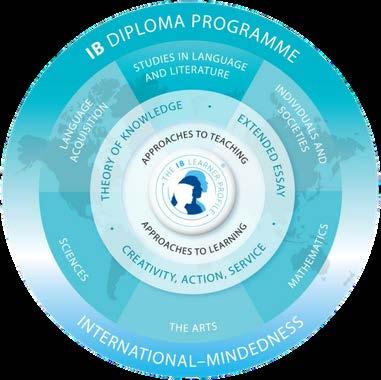
“Portledge is proud to be the only private school on Long Island to offer the prestigious International Baccalaureate Diploma Programme. The IB pedagogy inspires exemplary teaching and meaningful learning that aligns with Portledge School’s mission of instilling our students with an authentic lifelong love of learning.” (Trish Rigg, IB Programme Coordinator).Attheendofthisdocument,youwillfindmoreinformation about the requirements necessary to acquire an International Baccalaureate Diploma, as well as details about how to achieve special distinctions upon graduation, such as S.T.E.A.M. Scholars, Arts Scholars, Financial & Civic Scholars, and NY State Seal of Biliteracy. More information about the IB can also be found on our website: International BaccalaureateatPortledgeSchool.
The course descriptions below are intended to help students select courses for next year. Students are reminded that the school may withdraw any course described herein if the number of students signing up is insufficient, or if changes in personnel or scheduling difficulties precludeitsbeingoffered.Ifacourseisoversubscribed,priorityisgiven to the older students as much as is possible within the constraints of scheduling. Oversubscription in elective courses might also be resolved by a lottery if an additional section cannot be created. IB Diploma candidates are prioritized for IB courses. Every effort will be made to meetthestudents’needsandinterests.
Portledge School’s graduation requirements include the following during the Upper School years: 4 credits in English; 4 credits in Mathematics; 3 creditsinLabSciences;3creditsinHistory;2creditsduringUpperSchool yearsinFrench,Mandarin,orSpanish,culminatinginatleastlevel3;and a required non-credit course in Health. Additionally, students entering 9th or 10th grade in 2026-2027 must complete at least one course in the Performing Arts and one course from among the Visual Arts and Computer Science sometime before their graduation. Students entering 11th or 12th grade in 2026-2027 must complete at least two courses from among the Visual Arts, the Performing Arts, and Computer Science sometime before their graduation. A student needs to earn at least 18 credits to qualify for graduation. Most Portledge graduates earn far in excess of that number in order to enhance college-acceptance prospects.
The Portledge diploma indicates that a student has met the college preparatory standards of Portledge School and the requirements of the StateofNewYork.Thesestandardsaredividedintoafewareas:quantity and distribution of credits, physical education, community service, completionofaseniorproject,andacceptanceintoa4-yearcollege.
Students are expected to take a minimum of 5 credits each year. Lighter course loads must be approved in writing by the Director of UpperSchool.
Westronglyencourageallstudentstoenrollinaminimumof7credits per year, which is equivalent to 7 full-year classes (or 6 full-year classes and 2 single-semester classes). Requests to take more than 7 classes in either semester will be reviewed on a case-by-case basis andmustbeapprovedbytheDirectorofUpperSchool.
The 9th-grade curriculum includes 5 core required credits (English, Mathematics, History, Science, and World Languages). Students are also encouraged to take one Performing Arts course and at least one coursefromamongtheVisualArtsandComputerScienceareas.
The 10th-grade curriculum includes 5 core required credits (English, Mathematics, History, Science, and World Languages) plus a noncredit required Health course. Students are also encouraged to take one Performing Arts course and at least one course from among the VisualArtsandComputerScienceareas.
Any student enrolled in an Advanced Placement (AP) course is encouragedtotaketheAPexam.However,thosewhodonotwishtodo soarepermittedtooptoutearlyintheschoolyear.AllAPstudentswill sitforfinalexaminationsintheirclassesiftheychoosenottotakethe APtest.
IBCoursesareonlyforjuniorsandseniors.IBDiplomacandidatesmust take all core courses in IB. Non-Diploma candidates can elect IB courses depending upon instructor approval and available space. Students enrolled in the IB Diploma are required to take all IB assessments. Junior IB students will take a final in all of their classes duringtheUpperSchoolFinalExamweek.
Chris Disimile
Director of Upper School cdisimile@portledge.org
Francisco
Lameiro
Assistant Director of Upper School, Dean of Faculty flameiro@portledge.org
Susan Simon Associate Director of Upper School, Registrar ssimon@portledge.org
1.COMPUTER SCIENCE
Our comprehensive range of courses is designed to equip students with the skills and knowledge needed to thrive in today's technology-driven landscape. From foundational principlestoadvancedapplications,ourcurriculumoffersadiverseselectionofclasses that cater to both beginners and seasoned enthusiasts. Through hands-on projects, collaborative learning, and innovative problem-solving, our courses empower students to develop a deep understanding of computer science concepts essential for our innovativeworld.
Artificial Intelligence and the Global Economy
(10th, 11th, 12th - ½ cr/sem)
Prerequisite: Experience in computer programming is recommended. This one-semester course satisfies the engineering requirement for STEAM scholars and one of the requirements for Global Markets & Innovation scholars.
Artificial intelligence (AI) has a transformative impactonthemodernglobalmarketplace.Students will learn about the underlying economies and geopolitics of tokens, energy, and scaling. Within that context, students will leverage agentic AI systems, exploring how artificial and human intelligences can be ethically and effectively integratedtoenhanceentrepreneurialefforts.
Computer Science Principles
(9th, 10th, 11th, 12th - ½ cr/sem)
Prerequisites: Algebra or Department Permission Computer Science Principles (CSP) introduces students to the foundational concepts of computer science and challenges them to explore how computing and technology can impact the world. Rather than focusing the entire course on learning oneparticularsoftwaretoolorasingleprogramming language in depth, the course is designed to focus on the conceptual ideas of computing and help students understand why certain tools or languages might be utilized to solve particular problems. The goal of CSP is to develop in students the computational practices of algorithm development, problem solving, and programming. Do you want to learn about Comp Sci topics and coding languages to build fun apps? This class is for you! Offered in thefallandspring.
AP Computer Science A*
(9th, 10th, 11th, 12th - 1 cr/yr)
Prerequisite: Algebra or Department Permission. CSP or coding experience is recommended, but not required. This course satisfies the technology requirement for STEAM scholars. APComputerScienceA(CSA)introducesstudentstosoftwareengineeringandobject-orientedprogramming anddesignusingtheJavaprogramminglanguage.Thiscurriculumcoversabroadrangeoftopics,including thedesignofsolutionstoproblems,theuseofdatastructurestoorganizelargesetsofdata,thedevelopment andimplementationofalgorithmstoprocessdataanddiscovernewinformation,andtheanalysisofpotential solutions.Thiscoursewillpreparestudentstodevelopsoftwareskillsassociatedwithatext-basedcoding languageandtotaketheAPCSAexam(notrequired).Itwillalsobuilduponstudents’creativity,logic, problem-solving,projectplanning,andcollaborativeskills.Doyouwanttolearnmoreaboutobject-oriented, text-basedcoding?Comejointhisyear-longcourseexploringtheJavalanguage!
Prerequisites: Algebra or Department Permission. Agree and sign the “White Hat” policy. This course satisfies the technology requirement for STEAM scholars. APCybersecurityisayear-longhighschoolcourse that offers a broad introduction to the field and aligns closely with a college-level, introductory cybersecuritycourse.Studentslearnaboutcommon threatsandvulnerabilitiesandhowtheycombineto create risk. Students study how individuals and organizations manage risk and how risk can be mitigated through a defence-in-depth strategy. Students explore specific vulnerabilities, attacks, mitigations,anddetectionmeasuresacrossavariety of domains, including physical spaces, computer networks, devices, and data and applications. Throughoutthecourse,studentsconsidertheimpact of cybersecurity on individuals, organizations, societies, and governments. Content and skills taught in the course align with the professional skills outlined in the National Initiative for CybersecurityEducationWorkforceFramework.
IB Digital Society
(11th, 12th - 1 cr/yr)
This course can be taken as part of the IB Diploma programme or as a single course. This course satisfies the technology requirement for STEAM scholars. We are in a digital society. Digital systems are changingourworldandtransforminghowwethink, communicate,collaborate,andcreate.Thisone-year course invites students to better understand our changingworldandtoimaginewherewemightgo next.Aspartnersininquiry,studentsandteachers explore the impacts and implications of digital systemsforpeopleandcommunitiesindiverserealworld contexts. The passions, interests, and experiencesofstudentsarecentraltothecourse, which aims to empower them to become citizens whonotonlyparticipateindigitalsocietybutalso leadit.Areyouinterestedinethicsanddebating currenteventsrelatedtoourdigitalsociety?This courseisforyou!
Digital Design and Fabrication
(9th, 10th, 11th, 12th - ½ cr/sem)
This course satisfies the technology requirement for STEAM scholars.
Have an idea? Learn how to build it. This course introduces you to the world of digital fabrication, where you’ll learn to use industry-standard CAD and graphic design tools to power a suite of maker machinery. Through a series of creative challenges, you will explore 3D printing and laser cutting to developaportfolioofunique,physicalprojectsthat go from the computer screen to your hands. Students will use rapid prototyping to iterate and refinetheirdesigns,movingfrominitialconceptsto finished products. Want to design and create? Join DigitalDesignandFabrication.
Robotics 1
(9th, 10th, 11th, 12th - 1 cr/yr)
Prerequisite: Parent permission to attend the FIRST Tech Challenge competition. This course satisfies either the technology or engineering requirement for STEAM scholars, but cannot count for both. This course cannot be used to fulfill the 3-year lab science requirement.
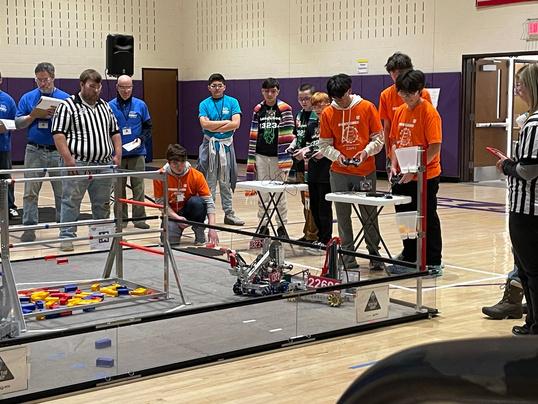
Students will design, build, and program robots, applying real-world math and science concepts, following the engineering design process. This course develops problem-solving, organizational, and project management skills as teams compete in the yearly FIRST Tech Challenge competition. Students will learn about basic mechanical elements, the logic of coding a robot, and how to useCADtodesigncustomparts.Inadditiontoclass time, this course has 5 to 8 after-school and weekend commitments, and two robotics competitions in mid January that students are expected to attend. Want to learn about the engineering design process and how to build and coderobots?SignupforRobotics!
1.COMPUTER SCIENCE
Robotics 2
(10th, 11th, 12th - 1 cr/yr)
Prerequisites: Robotics 1, parent permission to attend the FIRST Tech Challenge competition. This course cannot be used to fulfill any requirements for STEAM scholars. This course cannot be used to fulfill the 3-year lab science requirement.
This course will continue to develop the student’s understanding of the engineering process and further explore programming languages—coding syntax,testing,anddebugging.Studentswillexpand their understanding of robotics using TETRIX, goBILDA, REV, and raw materials to construct mechanical elements. More focus will be placed on CAD skills in this course. Students in Robotics 2 willalsobeaskedtotakeonaleadershiproleinan area of specialization to help peers in the Robotics coursewhoarenewtoroboticsdesign,construction, and programming. In addition to class time, this course has some after-school and weekend commitments, and a robotics competition in mid Januarythatstudentsareexpectedtoattend.
Robotics 4 Honors
(11th, 12th - 1 cr/yr)
Prerequisites: Robotics 3, parent permission to attend the FIRST Tech Challenge competition. This course cannot be used to fulfill any requirements for STEAM scholars. This course cannot be used to fulfill the 3-year lab science requirement.
At this level, students will be expected to not only complete the designing, building, and coding of a robot, but also lead engineering design discussions, building and coding projects, and teams. Students willhelpmanagetheclassKanban(orotherproject management tools) and serve as the main documentation editor. Robotics 4 students will also assist in teaching CAD skills to their peers to grow their communication skills. In addition to class time,thiscoursehassomeafter-schoolandweekend commitments, including two qualifier competitions inJanuary,thatweexpectstudentstoattend.
Robotics 3 Honors
(11th, 12th - 1 cr/yr)
Prerequisites: Robotics 2, parent permission to attend the FIRST Tech Challenge competition. This course cannot be used to fulfill any requirements for STEAM scholars. This course cannot be used to fulfill the 3-year lab science requirement.
This course will continue to develop the student’s understanding of the engineering process and further explore programming languages—coding syntax,testing,anddebugging.Studentswillexpand their understanding of robotics using TETRIX, goBILDA, REV, and raw materials to construct mechanical elements. More focus will be placed on advanced CAD skills, such as creating assemblies thatmove.StudentsinRobotics3willalsobeasked to take on small leadership roles in an area of specialization to help peers in the Robotics course who are new to robotics design, construction, and programming. In addition to class time, this course has some after-school and weekend commitments, including two qualifier competitions in January, thatweexpectstudentstoattend.
Website Design and Development
(9th, 10th, 11th, 12th - ½ cr/1 sem)
This course satisfies the technology requirement for STEAM scholars.
Website Design and Development introduces students to the foundational concepts of HTML5, CSS3, and JavaScript. Students will learn how to design websites with wireframing and then use VS Code to completely develop various website projects.Nopriorcodingexperienceneeded.Doyou wanttolearnhowtobuildrealwebsitescompletely from scratch? This class is for you! Offered in the springorfall.
2.ENGLISH
The English Department at Portledge is crafted to ignite a passion for literature, critical thinking, and effective communication. From analyzing timeless classics to exploring contemporary narratives, our curriculum encompasses a rich tapestry of literary works that will inspire and challenge you. Whether you're crafting eloquent essays, engaging in lively discussions, or honing your creative writing skills, our coursesofferaplatformforpersonalgrowthandintellectualexploration.
AppealProcess:
English Academic Pathways
English
Senior Seminars:
Each senior is required to take one credit of English, which will consist of IB English Year 2 or at least 2 Senior Seminars.
*Please see the section on Senior Seminars for course options.
Elective:
Crafting the Personal Narrative for College Applications and Beyond (11th) Thesecoursescannotbeusedtosatisfyany portionofthe4-yearEnglishrequirement.
If a student wishes to enroll in an English course for which they have not been recommended,theymustcompletethefollowingsteps:
1 . Submit a piece of graded analytical writing (e.g., an essay) from your current EnglishcoursetotheEnglishDepartmentChairforreview.Thispieceshouldbean accurateandrepresentativeexampleofastudent’swrittenandanalyticalskills.
2 . Complete a timed written assessment administered by the English Department. It willmeasurethestudent’sclosereadingandwritingskills.
Prerequisite for 9H: Department Permission. As students start their personal voyage into high school, this course will serve as an introduction to different literary genres and allow them to explore variousworksofliteraturesurroundingthethemeof self-discovery within the context of adventure and triumphs.Thecourseisstructuredtobuildonclose critical reading and effective writing skills while emphasizing literary analysis in a collaborative learning environment. Shared titles may include The Absolutely True Diary of a Part-Time Indian and Anya’s Ghost.Othertextsmayinclude The House on Mango Street, The Catcher in the Rye, Rebecca, The Odyssey, We Have Always Lived in the Castle, and selectnonfictionspeechesfromdiversespeakers.
English 11: American Literature
(11th - 1 cr/yr)
English 11 continues the broad survey of literature begun in the tenth grade. Students focus on developing effective language skills by reading and writing about such works as Fahrenheit 451, The Great Gatsby, and A Streetcar Named Desire,aswell asshortstoriesandpoemsfromavarietyofcultural, racial, and gender perspectives. Students also experiment with various approaches to writing, includingcompare/contrast,formalliteraryanalysis, and close reading. In addition, they study contextspecific vocabulary, grammar, and usage rules in conjunctionwiththeirwriting.
IB English Year 1
(11th - 1 cr/yr)
Prerequisite: Department Permission.
IB English Year 1 follows the first year International Baccalaureate Language A: Literature curriculum,whichoffersstudentstheopportunityto interactwithandcriticallyanalyzeawidevarietyof textsrepresentingdifferentgenres,themes,periods, styles, and cultural milieus. The reading may include Chronicle of a Death Foretold, 1984, A Doll’s House, Blankets, and The Bluest Eye, among others. StudentswhoarepursuingtheIBCertificateorthe IBDiplomashouldsignupforthisclass.
English 10 & 10 Honors:
Literature & Composition 2 (10th - 1 cr/yr) Required course.
Prerequisite for 10H: Department Permission. Thepurposeofthecourseistocontinuetobuildon close critical reading and annotation skills as well as effective writing skills. Particular emphasis is placed on literary analysis. Vocabulary will be examined within the context of the literary selections. Shared titles may include Night, Lord of the Flies, and Macbeth. Selections in short stories and poetry will include works written from a wide variety of cultural, racial, and gender perspectives. Students in 10H may also read The Adventures of Huckleberry Finn, Frankenstein, My Antonia, or A RaisinintheSun.
English 11 Honors: American Literature (11th
- 1 cr/yr)
Prerequisite: Department Permission. English 11H offers students the opportunity to interactwithandcriticallyanalyzeawidevarietyof textsrepresentingdifferentgenres,themes,periods, styles, and cultural milieus. The reading may include the intensive study of Fahrenheit 451, The Great Gatsby, A Streetcar Named Desire, Othello, Fences, and TheThingsTheyCarried,aswellasshort storiesandnon-fictionessayswrittenfromavariety of cultural, racial, and gender perspectives by such authorsasJonathanSwift,FrederickDouglass,Amy Tan, George Orwell, Chimamanda Ngozi Adichie, RichardRodriguez,andVirginiaWoolf.
Crafting the Personal Narrative for College Applications & Beyond
(10th (based on availability), 11th - ½ cr/sem)
This course cannot be used to satisfy any portion of the 4-year English requirement. Everyonehasastory—andoftenmorethanone—thatisworthtelling.It’sjustamatterofputtingtheright words in the right order. (Easier said than done!) This course will ask students to explore the pitfalls and possibilities when writing about oneself. The class is designed for students interested in completing their personalstatementsandotherwritingrelatedtothecollegeapplicationprocess.However,itwillalsobenefit studentswhowishtocraftnarrativesthatexploretheirdistinctivestories.
English 12
Each senior is required to take one credit of English, which will consist of IB English Year 2 or at least 2 Senior Seminars:
IB English Year 2
(12th - 1 cr/yr)
Prerequisites: Completion of IB English Year 1 and Department Permission. IB English Year 2 follows the second-year International Baccalaureate Language A: Literature curriculum.Buildingontheskillsandconceptsfrom IB English Year 1, students will interact with and critically analyze a wide variety of texts representing different genres, themes, periods, styles,andcultures.Majortextsmayinclude Fences, Twelfth Night, Narrative of the Life of Frederick Douglass, Things Fall Apart, The Things They Carried, and TheGreatGatsby ,aswellasthepoetry ofSeamusHeaney.StudentswhoarepursuingtheIB CertificateortheIBDiplomashouldsignupforthis class.
Senior Seminar: Creative Writing (Fiction/Nonfiction and Poetry) (12th
- ½ cr/sem)
This course will target each element of storytelling and the process of writing—generating ideas, writing,editing,andpublishing.Studentswillfocus onthecraftofstudying,crafting,andworkshopping fictionalpieces.Throughouttheclass,studentswill cover several genres, including fiction, nonfiction, and poetry. As the course progresses, students will also explore reading and writing poetry in various forms, including written, spoken word, and music lyrics.Additionally,therewillbepotentialspaceto coverothergenresduringtheclass.Studentsinthis course will help in the production of Portledge Blossoms ,theliterary/artmagazine.
Senior Seminar: A Deep Dive into Poetics (12th
- ½ cr/sem)
InthewordsofTa-NehisiCoates,"Poetryaimsforaneconomyoftruth."Aliteraryformthatpackssomuch profound meaning into tight, economical page space is often ideal when sharpening one's analytical skills. Beyond that, though, poetry is also a time-honored medium that has existed in many forms—brief to epic, structured to freeform, sometimes musical, sometimes dramatic, sometimes even sacred. This survey course willexploretherichhistoryofpoetryasanartform,aswellashowitiscraftedandanalyzed.Studentswill practicepoeticscansion,analyticalwriting,andcreativewritingastheytakethisdeepdiveintooneofthe world'smostbelovedmodesofexpression.
2.ENGLISH
English 12
Each senior is required to take one credit of English, which will consist of IB English Year 2 or at least 2 Senior Seminars:
Senior Seminar: The Evolution of the Modern Horror Story (12th
- ½ cr/sem)
What scares us, and why? How much of our fears come from a primal place, and how much depends upon the context of what is frightening in the world we see around us? This course aims to explorethosequestionsbytracingtheevolutionof horror media from the pivotal formation of the Gothic genre up to present-day horror hits. Studentswillreadliteraturefromvariouscenturies andregionsinordertoseehowhorrormediashifts across time, place, and surrounding mindsets/schools of thought. Reading material will be supplemented with films, television, and internetmediaasthesegenresbecomerelevantand revolutionary to the horror genre. We will discuss why tropes like the scary mansion and the family curse exist, what various creatures (vampires, werewolves,zombies,etc.)representacrossvarying mediaappearances,howhorrorcanbebasedonthe unfathomable or the mundane, and many more topics!Bytheendofthecourse,studentswillhave experimented with the horror genre by completing a series of assessments, analytical writing assignments,andcreativewritingprojects.
Senior Seminar: Love & Identity in Literature Honors (12th - ½ cr/sem)
Who are you, and how does that influence the relationships in your life? Authors from around the world and across the centuries have written about this topic, and this course will explore how their worksreflectvariousculturalunderstandingsofhow personalidentityimpactsloveandrelationships.By studying rich and diverse works of literature, we will investigate the complexities of identity, how relationship norms shift across cultures, and how creatorshavetriedtoemulateorrebelagainstsuch norms. This course will include nightly reading, ample class discussion, and both analytical and creative assignments that offer students a range of waystoengagewithclassmaterial.
Senior Seminar: The Evolution of the Modern Horror Story Honors (12th - ½ cr/sem)
What scares us, and why? How much of our fears come from a primal place, and how much depends upon the context of what is frightening in the world we see around us? This course aims to investigate those questions by tracing the evolution of horror media from the pivotal formation of the Gothic genre up to present-day horror hits. Students will read literature from various centuries and regions in order to see how horror media shifts across time, place, and surrounding mindsets/schools of thought. Reading material will be supplemented with films, television, and internet media as these genres become relevant and revolutionary to the horror genre. As the advanced version of this class, the course will challenge students to think critically abouthowartandliteraturereflecttheircontexts. What cultural roles does horror fulfill? How does horror play upon human psychology? How do storytellers across time and around the globe definemonstrosity,transgression,orevil—andto what end? How has horror been changed by new and varied storytelling methods and technologies? By the end of the course, students will have explored these topics through a series of assessments, creative writing projects, and analytical writing assignments, with a particular focusonresearchskillsandculturalliteracy.
2.ENGLISH
Senior Seminar: The History of Art and Literature (Ancient) (12th
- ½ cr/sem)
Thepurposeofthiscourseistostudythecrossover betweenartandliterature.Wewillcoverarthistory and literature from ancient history through the realistic period by analyzing, interpreting, and creatingartworkbasedonfamousartthroughoutthe world. In addition to the artwork, students will learn about the many fascinating stories that inspired/were inspired by art. The course will include an emphasis on visual literacy, developing both critical thinking skills and an appreciation of works of art and their stories. During the semester, we will also take a class trip to the Metropolitan MuseumofArttoviewtheartworkwehavestudied. Students are not required to take both art history courses, but they are welcome to do so. We will analyze, interpret, and create artwork based on famous art throughout ancient history. We will cover Art History and Literature from the PrehistoricErathroughthepre-ModernPeriodfrom aroundtheworld.
Senior Seminar: The History of Art and Literature (Modern) (12th
- ½ cr/sem)
Thepurposeofthiscourseistostudythecrossover betweenartandliterature.Wewillcoverarthistory and literature from the modern art period by analyzing, interpreting, and creating artwork based onfamousartthroughouttheera.Inadditiontothe artwork, students will also learn about the many fascinating stories that inspired/were inspired by art. The course will include an emphasis on visual literacy,developingbothcriticalthinkingskillsand an appreciation of works of art and their stories. Duringthesemester,wewillalsotakeaclasstripto the MOMA to view the artwork we have studied. Students are not required to take both art history courses,buttheyarewelcometodoso.
Senior Seminar: Memoir (12th - ½ cr/sem)
Thepurposeofthiscourseistoappreciatethegenre of memoir through close examination of multiple shorterandlongerexamplesoftheform.Eachmajor work—Brain on Fire, The Glass Castle, and Born a Crime—explores the vibrant personal stories of authors from all walks of life. The texts explore universal themes, such as the role of a parent, the stigma of mental illness, and the effects of poverty and discrimination on a person’s life. Students will be assessed in a variety of ways designed to test their close reading, speaking, teamwork, and creative writing skills. These will include creating grouppresentationsandmini-lessons,writingformal literary analyses, and crafting shorter and longer personalnarrativesandmini-memoirs.
Senior Seminar: The Moral of the Story
(12th - ½ cr/sem)
The purpose of this course is to explore how humanity can learn and grow from moral conflict. Each of the major works is thematically linked and presents complex ethical situations through the plights of the protagonists. Students will begin by studyingthehistoryofcautionarytalesinchildren’s literature, including analyzing several Brothers Grimm fairy tales as well as a deeper dive into the worldofspeculativefictionandsatire.Someofthe major texts include: Yellowface, “The Lottery,” The Perfect Match, The Handmaid’s Tale, “2Br02B,” “‘Repent, Harlequin!’ Said the Ticktockman,” Ponies, andselectepisodesof BlackMirror.Thesetextsvary in genre and include a group of diverse authors writing about a range of characters facing both uniqueanduniversalchallenges.Thetextsexamine moraldilemmas,suchastheroleofthegovernment initscitizens'lives,thehorrorsofblindlyfollowing tradition, and a friend's and peer's moral responsibilities.
3.HISTORY
The History Department at Portledge is dedicated to encouraging students to think independently, make global connections, become citizens of the world, and understand the interconnectedness of societies and cultures. There is an emphasis placed on reading and evaluating sources while considering the lens of the time period and perspective of the figure or events. Through the study of a multitude of sources, students are empowered to think critically and become the next generation of leaders and problem solvers. Writing and communication skills are developed so students become adept at using evidence to support their points of view. Portledge history students recognize they can become agents for change.
History Academic Pathways
History 9 History 10 Modern European
History 11
United States
Senior Seminars
History 9H
History 10 AP European
IB History Year 1 History of Americas
IB History Year 2 World
Non-IBDiplomacandidatesonly
Requirestestingand/orapproval
Electives:
APGovernment (9th–12th)
APPsychology (9th–12th)
APMacroeconomics(10th–12th)
HistoryofNewYork (9th–12th)
NativeAmericanHistory (10th–12th)
ProtestMovementsin20th-Century America (10th–12th)
If a student wishes to enroll in a history course for which they have not been recommended, then they must complete the following steps:
1 For the appeal to be considered, the student must first meet with their instructor to discuss their desire to join an advanced section.
2
. If the student's concerns are not resolved, the student is to meet with the Department Chair to discuss the appeal process and schedule a placement exam.
3 . The Department Chair will be responsible for developing and proctoring the exam.
4 The student must complete a timed assessment (make accommodations if needed), for which they will be provided content a week prior. This assessment will include multiple-choice questions, reading comprehension questions, and a written response. A grading rubric will be provided with the content regarding the students' written responses. Students must earn 85% or higher to be considered.
5 . All Appeals must be initiated by students to Department Chairs by April 17, 2026.
3.HISTORY
History 9: Patterns of Civilization and the Foundations of Modern Europe
(9th - 1 cr/yr)
Patterns of Civilization and the Foundations of Modern Europe is a ninth-grade history course that explores how civilizations throughout history have organized themselves to address shared human challenges. Students examine how societies from Ancient Greece, Rome, Persia, the Eastern Roman Empire, and the Islamic world created systems of law, government, infrastructure, economic exchange, culture, and religion, and how these systems shaped daily life and long-term stability. The course will follow a chronological structure, beginning in the ancient Mediterranean and the Levant and continuing through the early medieval Islamicworld.Ratherthanfocusingonmythologyor legendary figures, students analyze real institutions and structures that allowed civilizations to function, expand, and thrive. Special attention is given to the city centers of civilization, with focused studies on Constantinople and Baghdad in the8thand9thcenturies.Duringthe2ndsemester, students will turn to the rise of European nationstates, from the Renaissance to the Age of Exploration to the Protestant Reformation. Great importance will be put on analyzing texts, visual sources, and other historical evidence. In addition, students will learn to develop focused, wellstructuredessaysthatexpressandanalyzehistorical arguments. Emphasis is placed on developing criticalandevaluativethinkingskills.Participation is essential, as is the analysis of maps, art, and statisticalinformation.
History 10: Modern World (10th - 1 cr/yr)
This is a survey course of major developments that shaped the growth of civilization around the world from the 1500s to modern times. In order to understand varying perspectives of events within world history, the curriculum will cover colonization and subjugation throughout the world, thedevelopmentofdifferentsystemsofgovernment, worldwide revolutions, and the practice of imperialism. Major emphasis is then given to the origins and global impact of the First World War and the rise of totalitarian states. In the second semester, students are required to complete a research paper under the guidance of the teacher andthelibrarian.Theyfollowastructuredresearch processandworkalmostentirelyinschool.
History 9 Honors: Patterns of Civilization and the Foundations of Modern Europe (9th,
10th - 1 cr/yr)
Year 1 of a 2-year course.
Prerequisites: Average in current history course of A- or higher, and no lower than a 1 or 2 effort grade during the year.
Students who take this course are expected to complete the 2-year course sequence.
Patterns of Civilization and the Foundation of Modern Europe is a ninth-grade history course that explores how civilizations throughout history have organized themselves to address shared human challenges. Students examine how societies from Ancient Greece, Rome, Persia, the Eastern Roman Empire,andtheIslamicworldcreatedsystemsoflaw, government, infrastructure, economic exchange, culture, and religion, and how these systems shaped daily life and long-term stability. The course will follow a chronological structure, beginning in the ancient Mediterranean and the Levant and continuingthroughtheearlymedievalIslamicworld. Rather than focusing on mythology or legendary figures, students analyze real institutions and structures that allowed civilizations to function, expand,andthrive.Specialattentionisgiventothe city centers of civilization, with focused studies on Constantinople and Baghdad in the 8th and 9th centuries. During the 2nd semester, students will turn to the rise of European nation-states, from the Renaissance to the Age of Exploration to the Protestant Reformation. Great importance will be put on analyzing texts, visual sources, and other historical evidence. In addition, students will learn to develop focused, well-structured essays that expressandanalyzehistoricalarguments.Emphasisis placed on developing critical and evaluative thinking skills. Participation is essential, as is the analysis of maps, art, and statistical information. Students must have a strong interest in history, be able to independently read and analyze historical documents, and make meaningful connections. Studentsmustentertheclasswiththeabilitytoread and write fluid, well-developed essays using sources critically.Essaysandassessmentswillbetakenwith timeconstraints.Activeparticipationisanessential component of the class, as emphasis is placed on critical and evaluative thinking skills and class discussions. In addition, students will have to interpret primary sources, statistics, works of art, andmaps.
3.HISTORY
History 10: AP European History
(10th - 1 cr/yr)
Year 2 of a 2-year course
Prerequisites: 9H History course, B- or higher, and teacher recommendation. Studentsseekingtoenterthecoursewithouttaking theprescribedPre-APcoursemustfollowtheappeal process. In addition, summer work would be required.Studentswhotakethiscoursemusttake theAPExam.
AP European History is an introductory collegelevel European history course. Students will cultivatetheirunderstandingofEuropeanhistoryby analyzing historical sources and learning to make connectionsandcrafthistoricalargumentsasthey exploretheinteractionofEuropeandtheworld,as well as economic, commercial, cultural, and intellectualdevelopments.Inaddition,studentswill explore the evolution of nation-states and other institutionsofpower,socialorganization,national and European identity, and technological and scientificinnovation.Greatimportancewillbeput into analyzing texts, visual sources, and other historicalevidence.Inaddition,studentsmusthave theabilitytodevelopfocused,well-structuredessays expressingandanalyzinghistoricalarguments.
Studentsmusthaveastronginterestinhistory,be able to independently read and analyze historical documents, and make meaningful connections. Studentsmustentertheclasswiththeabilityto read and write fluid, well-developed essays using sources critically. Essays and assessments will be takenwithtimeconstraints.Activeparticipationis anessentialcomponentoftheclass,asemphasisis placedoncriticalandevaluativethinkingskillsand classdiscussions.Inaddition,studentswillhaveto interpret primary sources, statistics, works of art, andmaps.
Juniors are required to take United States
History; History 11 and IB History of the Americas courses fulfill this requirement. The department will finalize sections.
History 11: United States History (11th - 1 cr/yr)
This course covers both Domestic and Foreign Policy of the United States, including major political, economic, social, and cultural events from1865through2000. Emphasisisplacedupon honing skills such as analysis of primary and secondarysources,historicalinvestigation,research skills, written communication, as well as, public speaking. The advanced section of this course would combine extensive primary and secondary works with the assigned texts at an accelerated pace.
IB History of the Americas (11th - 1 cr/yr)
Prerequisite: Department Permission After completing IB History of the Americas, IB Diploma candidates will take IB World History in their senior year. Exams covering both years take place in May of senior year. The first of a two-year course, History of the Americas focuses on an in-depth investigation of interconnected topics. Throughout the year, studentswillstudyaspectsofhistory,withaheavy focusoncausationandcriticalanalysis.Threeindepthtopicswillbecoveredthroughouttheyear. The purpose of the course is to provide varying perspectivesregardingeventsthatshapedtheworld. By broadening the curriculum from the United States to one that encompasses both North and South America, students will gain a deeper appreciation for multiple perspectives and how interconnectedsocietytrulyis.
Inadditiontothecoursecontent,studentsshould be aware that this course focuses heavily on document analysis, compare-and-contrast style essays,andhistoricalinvestigation.Summerworkis expected.
3.HISTORY
IB Economics
(11th, 12th - 1 cr/yr)
Prerequisite: Algebra 2.
IB Economics can also be taken as a stand-alone course elective. Availability is dependent on staffing and enrollment.
TheaimsoftheIBEconomicscourseattheSLlevel are to enable students to develop a critical understanding of a range of economic theories, models, ideas, and tools in the areas of microeconomics, macroeconomics, and the global economy;toapplyeconomictheories,models,ideas andtools,andanalyzeeconomicdata;tounderstand and engage with real-world economic issues and problems facing individuals and societies; and to develop a conceptual understanding of individuals’ and societies’ economic choices, interactions, challenges,andconsequencesofeconomicdecisionmaking.
Prerequisite: rising 9th & 10th-graders must have the permission from the department. Thecoursewillworktointroducestudentstothe study of the behavior and mental processes of humanbeingsandotheranimals.Studentswilllearn abouttheethicsandmethodspsychologistsusein theirscienceandpractice.Topicsofstudywill includethehistoryofpsychology,researchmethods, biological understanding of behavior, sensation/perception, consciousness, learning, cognition,motivationandemotion,developmental psychology, personality, testing and individual differences,abnormalbehavioranditstreatment, andsocialpsychology(asdelineatedintheCollege BoardAPPsychologyCourseDescription).
AnystudentenrolledinanAdvancedPlacement(AP) courseisencouragedtotaketheAPexam.However, thosewhodonotwishtodosoarepermittedtooptout earlyintheschoolyear.AllAPstudentswillsitfor final examinations in their classes, regardless of whethertheychoosetotaketheAPtest.
IB World History
(12th - 1 cr/yr)
Prerequisite: IB History Year 1 (for IB Diploma candidates seeking HL designation). Department Permission for non-IB Diploma candidates for 11th & 12th grades.
IB Diploma candidates will have priority if space is limited. Non-IB Diploma candidates may also take IB World History in their senior year
Throughout this course, students will focus on specificcasestudiesregardingtheCauses,Practices, andEffectsofWar,leadingtoin-depthanalysis.In additiontothecasestudies,thecoursewillexamine twotopicsforgreaterunderstanding.Possibletopics include Authoritarian States (20th Century), and The Cold War: Superpower tension and rivalries (20th Century). The concentration of the two topicswillbedrivenbystudentinterestandteacher expertise. In addition to the course content, students should be aware that this course focuses heavilyondocumentanalysis,compareandcontrast style essays, and historical investigation. Summer workisexpected.
AP Government and Politics
(9th, 10th, 11th, 12th (schedule permitting) - ½ cr/sem)
APU.S.GovernmentandPoliticsisanintroductory college-level course in U.S. government and politics.Studentscultivatetheirunderstandingof U.S.governmentandpoliticsthroughanalysisof dataandtext-basedsourcesastheyexploretopics like constitutionalism, liberty and order, civic participation in a representative democracy, competingpolicy-makinginterests,andmethodsof politicalanalysis."
AnystudentenrolledinanAdvancedPlacement(AP) courseisencouragedtotaketheAPexam.However, thosewhodonotwishtodosoarepermittedtooptout earlyintheschoolyear.AllAPstudentswillsitfor final examinations in their classes, regardless of whethertheychoosetotaketheAPtest.
3.HISTORY
AP Macroeconomics
(10th, 11th, 12th - ½ cr/sem) Not offered in 2026–2027
Pre-requisite: Algebra 2, or concurrent enrollment in Algebra 2 required
AP Macroeconomics is an introductory college-level macroeconomics course. Students cultivate their understandingoftheprinciplesthatapplytoaneconomicsystemasawholebyusingprinciplesandmodelsto describeeconomicsituationsandpredictandexplainoutcomeswithgraphs,charts,anddataastheyexplore conceptslikeeconomicmeasurements,markets,macroeconomicmodels,andmacroeconomicpolicies.
Modern Russian Studies
(10th, 11th, 12th - ½ cr/sem)
Availability is dependent on enrollment.
This one-semester survey course examines the political,social,andculturalevolutionofRussian societyfromthe9thcenturythroughtheearly21st century.Theroleofkeyindividuals,events,and ideologies that shaped Russian history will be covered,aswillimportantdevelopmentsinRussian literature,art,andmusic.Specifichistoricaltopics will include the Kievan State, the Mongol Occupation, Imperial Russia, the Russian Revolution,theRussianCivilWar,RussiaUnder Communism,theSovietUnioninWorldWarII, the Cold War, post Communist Russia, and the Ukrainian War. Extensive attention will also be giventodevelopmentsinRussianliterature,music, andart.
Women in American History
(10th, 11th , 12th - ½ cr/sem)
Women in American History is a semester-long electivethatwillexplorewomen'slivedexperiences in the United States from 1848 through to the 1970s,coveringthepolitical,social,andeconomic eventsfromtheSenecaFallsConventionthroughto the fight for ratification of the Equal Rights Amendment. Class resources and readings will be selectedwithfemalewritersandhistorianscentered as creators and experts. Students should be enthusiasticallyinterestedinanopportunitytoread carefully, discuss thoughtfully, and write reflectively in a workshop-style class experience. Assessments will be varied, and a culminating biographicalresearchprojectwillbethefinal.
History of New York
(9th, 10th, 11th , 12th - ½ cr/sem)
Availability is dependent on enrollment. This elective is a survey of the history of New York, and more specifically New York City as it evolved from a deepwater natural port formed by the flow of the Hudson River to the modern metropolitan archipelago it is today. Although the history of New York is taught as a necessity to 35th-grade students in this state, as adolescent residents of the State of New York, our students have a responsibility to understand the complex development of our region at a higher level (11th12th grade). The history of New York is a history of the United States and the history of urban development in microcosm. While this is meant to beahistorycourse,itismorebroadlyahumanities and American studies course. This course aims to look at events in New York history through a number of unique lenses that will give students a more well-rounded understanding of the developmentoftheareawecallhome.
Protest Movements in 20th-Century America
(10th, 11th, 12th - ½ cr/sem)
Protestmovementsandactivismareentwinedinthe historyoftheUnitedStates.Attimes,thespiritsof protest and change coalesce around a specific event and manifest themselves in popular culture. This class will explore a key moment in U.S. History where this occurred, the decade of the 1960s. Civil Rights, Women's Rights, and anti-Vietnam War protests created a decade of upheaval, unrest, and change. Students will read and listen to music, interviews, and other media, such as visual art and movies, to explore a complete understanding of the timeperiod.
3.HISTORY
Senior Seminar: The History of Art and Literature (Ancient)
(12th - ½ cr/sem)
Availability is dependent on staffing and enrollment.
This course will be a combination of Art and Literature.Wewillanalyze,interpret,andcreate artwork based on famous art throughout ancient history.WewillcoverArtHistoryandLiterature fromthePrehistoricErathroughthepre-Modern Periodfromaroundtheworld.Inadditiontothe artwork,studentswillalsolearnaboutthemany fascinating stories that inspired/were inspired by art.Thecoursewillincludeanemphasisonvisual literacy, developing both critical thinking skills, and an appreciation of works of art and their stories.
Senior Seminar: The History of Art & Literature (Modern)
(12th - ½ cr/sem)
Availability is dependent on staffing and enrollment.
This course will be a combination of Art and Literature.Wewillanalyze,interpret,andcreate artworkbasedonfamousworksofartfrommodern history.WewillcoverArtHistoryandLiteraturein the Modern Period from around the world. In addition to the artwork, students will also learn about the many fascinating stories that inspired/were inspired by art. The course will emphasizevisualliteracy,criticalthinking,andan appreciationofworksofartandtheirstories.
4.MATHEMATICS
The Mathematics Department offers a variety of mathematics courses to meet the interests and needs of all students. The courses are designed to challenge, engage, and prepare students for success in the future by developing mathematical problem-solving skills, knowledge, critical thinking, and communication skills. Students are recommended to specific mathematics classes according to skill level, which are determined by the mathematics teacher and student performance. All students are requiredtotakeamathematicscourseduringeachoftheirhighschoolacademicyears. Summercoursesdonotsatisfythisrequirement.
Our goal is that each student is placed in the math course that is most appropriate for their learning needs as they move through the Upper School. For current Portledge students, subsequent class placement is determined by students’ performance and teacher recommendation in their current course. Students cannot retake a class that they have already passed. Departmental recommendations are based on student performance as well as student motivation, ability to keep up with content. completing work on time, attendance, skill level, retention, enthusiasm for the subject, approach tolearning,participation,qualityofwork,andstudentinitiative.
Students who wish to advance their math path during their time at Portledge may enrollinthePortledgeSummerProgrammathematicscourses.Thesecoursesshouldbe taken on campus. Requests for other summer courses can be made to the Department Chair. Approval for other courses will be made on a case-by-case basis, and advancement will be determined after evidence of completion of the online course is submitted to the Department Chair and a passing grade is earned on the course exam givenatPortledgeonthedesignatedtestingdate.Summercoursesaresubjecttochange based on enrollment, but the Summer 2026 Math offerings include: Algebra 1, Geometry,Algebra2,andPrecalculus.RegisterforSummerCourseshere.
Intro to Calculus & Statistics
Advanced Topics in Maths*
Calculus
Advanced Topics in Maths* *Advanced Topics in Mathematics may be offered following AP Calculus AB. Not offered in 2026-2027. Requires testing and/or approval
4.MATHEMATICS
Algebra 1
(1 cr/yr)
Offered during the summer of 2026, depending on enrollment and instructor availability. Algebra1isthestudyofthefundamentaloperations of algebra, introducing variables, algebraic expressions, equations, inequalities, functions, and multiplerepresentations.Inthisclass,studentswill develop the ability to explore and solve real-world application problems, demonstrate the appropriate use of graphing calculators, and communicate mathematical ideas clearly. This course lays the foundation for mathematical literacy that will help students succeed in every subsequent mathematics course.Majortopicsofstudyincludetheevaluation of algebraic equations, exponent rules and manipulation, polynomials, solving and graphing linear equations, solving and graphing two variable inequalities, solving systems of equations, radicals, word problems, solving and graphing quadratic equations,andfactoring.
Algebra 2 (1
cr/yr)
Prerequisite: Geometry.
Offered during the summer of 2026, depending on enrollment and instructor availability. Algebra 2 continues to develop the fundamental algebraicskillsneededforsuccessinhigher-level mathematics. Algebra 2 thoroughly studies functions, including parent functions, families of functions, and transformations. Students will developtheabilitytocreateandapplymodelsto situationsrepresentedbyfunctions.Thecontinued study of equations, systems of equations, inequalities, quadratics, factoring, and solving quadraticequationsbuildsonAlgebraIconceptsin greater depth as students work to define new functions.Majortopicsofstudyincludelinearand quadratic expressions, equations, and functions; polynomial, rational, and exponential functions; logarithmic functions, equations, and expressions; complex and imaginary numbers. Trigonometric conceptsinvolvingrighttrianglesarestudied,and laws involving non-right triangles are also introduced.
Geometry
(1 cr/yr)
Prerequisite: Algebra 1
Offered during the summer of 2026, depending on enrollment and instructor availability. Geometry continues students’ early study of geometricconceptsofshapesandsolidsandfocuses on the study of the properties of two and three dimensionalshapes;thesymmetry,congruence,and similarity of these shapes, and uses deductive reasoning and logical arguments in formulating directproofs.Studentswillacquireanddemonstrate knowledge of Euclidean geometry including basic definitions, postulates, theorems, and corollaries implementedthroughmathematicalmodeling.
Majortopicsofstudywillincludelogicalreasoning and formal proofs; properties of triangles, quadrilaterals, and circles; triangle similarity, triangle congruence, and right triangle relationships; analysis of area and volume; propertiesoftwoandthree-dimensionalgeometric figuresandsolids;andgeometricconstructionsand transformations.
Geometry Honors
(1 cr/yr)
Prerequisites: Algebra 1 and entrance exam/department permission
Offered during the summer of 2026, depending on enrollment and instructor availability. Summer Geometry H will not be labeled “Honors” on the transcript.
Geometry Honors is an in-depth formal study of Euclidean geometry that is supplemented by topics in analytic and transformation geometry, trigonometry, and algebra. Emphasis is placed upon developing both an appreciation of the axiomatic structure of mathematics and the ability to think logicallythroughtheconstructionofformalproofs. Major topics of study include lines and angles, deductive reasoning, parallel and perpendicular lines and planes, congruent and similar polygons, congruent triangles, quadrilaterals, inequalities in triangles, circles, area and volume, constructions andloci,coordinategeometry,andtransformations.
4.MATHEMATICS
Algebra 2 Honors (1
cr/yr)
Prerequisite: Geometry with placement exam & department permission or Geometry H. *Offered during the summer of 2026, depending on enrollment and instructor availability. Summer Algebra 2H will not be labeled “Honors” on the transcript.
Algebra2Honorsisanintensivestudyofadvanced algebraandtrigonometrydesignedtogivestudents the necessary background for mastery of more advanced mathematics. The emphasis is on the structure of mathematical systems as well as on algebraic, computational, and problem-solving skills. Major topics of study include linear and quadratic expressions, equations, and functions; polynomial, rational, and exponential functions; logarithmic functions, equations, and expressions; complex and imaginary numbers, sequences, and series; conic sections, basic trigonometry and identities;probabilityandstatistics.
Introduction to Calculus and Statistics (1
cr/yr)
Prerequisite: Precalculus
Calculusfocusesondevelopinganunderstandingof differential and integral calculus. Students will haveagoodfoundationforfurtherworkincalculus. Through the context of calculus, students will strengthen their skills in solving equations, graphing functions, and analyzing features of functionsandtheirgraphs.Thiscourseprovidesa review of polynomials, exponential, logarithmic, and trigonometric functions. Each family of functions will include an exploration of related limits, derivatives, and integrals. Major topics of study will include: limits and derivatives of functions, definite and indefinite integrals, simple differential equations, and applications of these techniques in solving related rates of change, optimization, volumes of revolution, and exponential growth. Statistics will introduce students to the major concepts and tools for collecting,analyzing,anddrawingconclusionsfrom data.MajortopicsofstudyincludeExploringData: Describing patterns and departures from patterns, Sampling and Experimentation: Planning and conducting a study, Anticipating Patterns: Exploringrandomphenomenausingprobabilityand simulation, Statistical Inference: Estimating populationparametersandtestinghypotheses.
Precalculus
(1 cr/yr)
Prerequisite: Algebra 2.
Precalculusbuildsuponthestudents'understanding of algebra, geometry, and mathematical functions. Studentswilldevelopadeeperunderstandingofthe fundamentalconceptsandrelationshipsoffunctions while strengthening mathematical skills in preparation for Calculus. In addition to content mastery, students will further develop their problem-solving skills. Major topics of study include: functions and their graphs with special attention to polynomial, rational, exponential, logarithmicfunctions,trigonometricfunctions,and analytictrigonometry,complexnumbers;systemsof equationsandinequalities;trigonometricidentities; andtrigonometricapplications.
Precalculus Honors (1 cr/yr)
Prerequisites: Algebra 2 and placement exam & department permission or Algebra 2A. Offered during the summer of 2026, depending on enrollment and instructor availability. Summer Precalculus H will not be labeled “Honors” on the transcript.
Precalculus Honors completes the formal study of functions and extends those ideas into advanced applicationsthatrequiremorecomplexcalculations. Studentswilldevelopadeeperunderstandingofthe fundamentalconceptsandrelationshipsoffunctions while strengthening mathematical skills in preparation for Calculus. In addition to content mastery, students will further develop their problem-solving and critical-thinking skills. Students are regularly challenged with tasks that require them to synthesize and apply concepts learnedthroughouteachunit.AdvancedPrecalculus is designed for the student who has a strong aptitudeoraninterestinmathematicsand/orwho will study calculus. Major topics of study will include fundamental concepts of algebra, polynomial equations of higher degrees, complex numbers, solving equations and inequalities, functionsandgraphs,polynomialfunctions,rational functions,functionsinvolvingradicals,exponential andlogarithmicfunctions,trigonometricfunctions, systems and matrices, sequences and series, conic sections,probabilityandstats,andanintroduction tolimits.
4.MATHEMATICS
Calculus Honors
(1 cr/yr) Prerequisite: Precalculus with department recommendation
CalculusHonorsoffersarigorousexplorationofthe fundamental concepts of differential and integral calculus.Whilethecoursecoversmanyofthesame topics as AP Calculus AB, it allows for a more flexible pace that emphasizes deep conceptual understanding and multi-step applications. This course is designed for students who desire a challenge beyond the standard calculus curriculum and seek a strong head start for university-level STEM coursework. Major topics of study will include advanced limits and continuity, the derivative and its applications, integration and its applications,anddifferentialequations.
IB Math Applications & Interpretation
Year 1
(11th - 1 cr/yr)
Prerequisite: Algebra 2.
Thisisyearoneofatwo-yearrigorouscoursethat coversfivemainareasofstudy:algebra,functions, geometry and trigonometry, statistics and probability, and calculus. This course heavily focusesonappliedmathematicsandtheuseofa calculator. Standard level and higher level are coseated,soallstudentswillbetaughtandassessed onhigherlevelmaterialduringYear1.ThisIBclass hasastrongeremphasisonstatisticsandthereforeis aimedatstudentswhowillgoontostudysubjects suchassocialsciences,naturalsciences,statistics, business,someeconomicscourses,psychology,and design.
AP Calculus AB
(1 cr/yr) Prerequisites: Precalculus with a placement exam & department permission or Precalculus A.
AP Calculus AB is an introduction to the fundamentalconceptsandmethodsofdifferential and integral calculus with an emphasis on their application, use of multiple representations incorporatinggraphic,numeric,analytic,algebraic, and verbal and written responses. This is an intensive,fast-pacedcoursethatpreparesstudents to take the Advanced Placement Calculus AB examination. Major topics of study include: functions; limits and their properties; analytic geometry; differentiation, applications of differentiation; integration, applications of integration; logarithmic, exponential, and other transcendentalfunctions.
AnystudentenrolledinanAdvancedPlacement(AP) course is encouraged to take the AP exam. However, thosewhodonotwishtodosoarepermittedtooptout early in the school year. All AP students will sit for final examinations in their classes, regardless of whethertheychoosetotaketheAPtest.
IB Math Applications & Interpretation Year 2
(12th - 1 cr/yr)
Prerequisite: IB Math Applications & Interpretations Year 1.
ThisrigorouscoursecontinuesthestudyfromYear1 inthefivemainareasofstudy:algebra,functions, geometry and trigonometry, statistics and probability, and calculus. This course heavily focusesonappliedmathematicsandtheuseofa calculator. Students will spend some class time workingontheinternalassessmentandpreparing fortheexam.ThisIBclasshasastrongeremphasis onstatisticsand,therefore,isaimedatstudents who will go on to study subjects such as social sciences,naturalsciences,statistics,business,some economicscourses,psychology,anddesign.
4.MATHEMATICS
IB Math Analysis and Approaches Year 1
(11th - 1 cr/yr)
Prerequisite: Algebra 2H.
Thisisyearoneofatwo-yearrigorouscoursethat coversfivemainareasofstudy:algebra,functions, geometry and trigonometry, statistics and probability, and calculus. This course focuses on pure mathematics and problem-solving. Standard levelandhigherlevelarecoseated,soallstudents willbetaughtandassessedonhigherlevelmaterial duringYear1.ThisIBclasshasastrongeremphasis oncalculusandisthereforeaimedatstudentswho will go on to study subjects with substantial mathematics content such as pure mathematics, engineering,physicalsciences,andsomeeconomics courses.
Advanced Topics in Mathematics
(1 cr/yr) Not offered in 2026–2027
Prerequisites: Calculus AB and department permission
Availability is dependent on staffing and enrollment.
This college-level course covers post-calculus AB materialatanintroductorylevel.Thecoursemay cover certain topics in Calculus C, Advanced Statistics, Multivariable Calculus, or Linear Algebra. Topics may include Paramentic, Polar, Vector functions, Infinite sequences and series, college-levelstatistics,PartialDerivatives,Multiple
IB Math Analysis and Approaches Year 2
(12th - 1 cr/yr)
Prerequisite: IB Math Analysis & Approaches Year 1.
ThisrigorouscoursecontinuesthestudyfromYear1 inthefivemainareasofstudy:algebra,functions, geometry and trigonometry, statistics and probability, and calculus. This course focuses on pure mathematics and problem-solving. Students willspendsomeclasstimeworkingontheinternal assessmentandpreparingfortheexam.ThisIBclass hasastrongeremphasisoncalculusandistherefore aimedatstudentswhowillgoontostudysubjects withsubstantialmathematicscontent,suchaspure mathematics, engineering, physical sciences, and someeconomicscourses.
Financial Literacy
(9th, 10th, 11th, 12th - ½ cr/sem)
Prerequisite: Algebra 1.
Please note that this course is a math elective. Portledge School requires that students also include a primary math course in their schedule in addition to this math elective, as some colleges may not view this course as one of the traditional math courses required for admission. Availability is dependent on staffing and enrollment. TheFinancialLiteracyclasswillteachthecritical money management skills that students need for everydayapplications.Fartoomanypeople,evena surprisingpercentageofthosewithsizableincomes, livepaychecktopaycheckduetomishandlingof theirmoney.Thisclassaimstofixthatbycovering a myriad of real-world topics that are extremely practical.Someoftheseskillsinclude:learninghow togetajob,payingtaxes,loans,credit,buyinga homevs.renting,buyingacar,retirementplanning, stocks,bonds,realestateandentrepreneurship.
5.MUSIC
The Music program at Portledge offers a diverse range of courses designed to immerse students in the transformative power of music, fostering creativity, expression, and a lifelongappreciationforthearts.Frommasteringinstrumentstoexploringmusictheory, our curriculum offers a harmonious blend of technical skill-building and artistic exploration.
Concert Chorus
(9th, 10th, 11th, 12th - Concert
Chorus
- 1 cr/yr)
All students with a strong desire to sing as part of anensembleareencouragedtoparticipateinUpper School Chorus. The Concert Chorus will both perform in two major concerts per year, as well as theThanksgivingAssembly.Inadditiontolearning arepertoireofchoralliterature,studentswillstudy proper singing technique, sight singing, and learn choral rehearsal and performance procedures. Special select groups may be formed within the choral ensembles as interest and ability warrant. Students are encouraged to re-enroll in chorus in subsequent years, as different literature will be studied.
Concert Band or String Orchestra
(9th, 10th, 11th, 12th - 1 cr/yr)
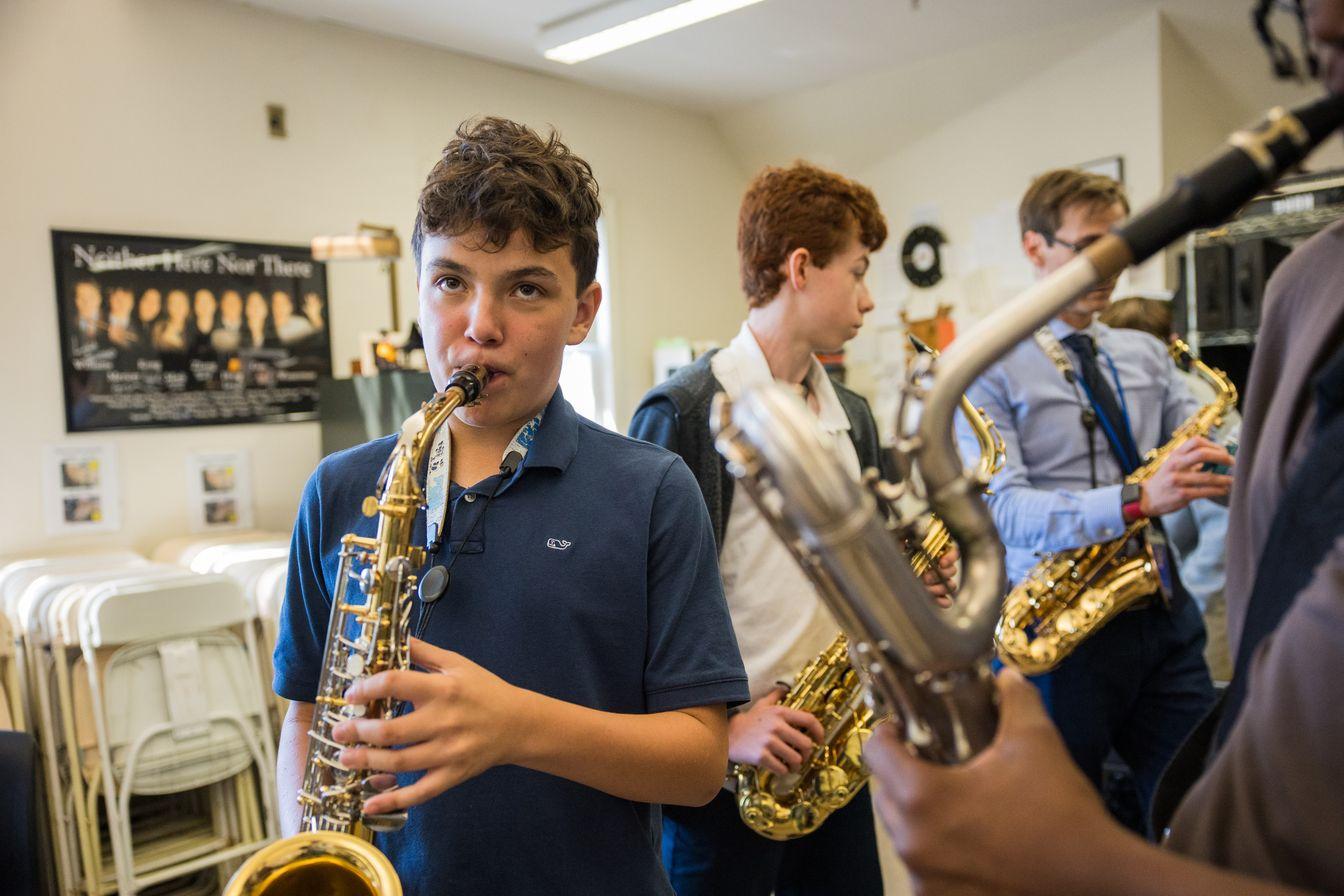
Wind, percussion, and string instrumentalists are offered the opportunity to advance their technical proficiency and to develop the skills necessary for ensemble playing. Rehearsals will be supplemented by in-school individual or group lessons. A variety of compositions, from classical arrangements to contemporaryworksandfilmscores,willbelearned and polished for performances during the school year, including winter and spring concerts. Small selectensemblesmaybeformedforinterested,able musicians. Students are encouraged to start in 9th gradeandcontinuethroughoutUpperSchool.
Chamber Orchestra Honors
(9th, 10th, 11th, 12th - ½ cr/yr)
High-level orchestral musicians are offered the opportunity to learn to play in a more intimate settingandatevenhigherlevels,meetingwiththe Orchestrateachereither1-on-1orinsmallgroups onceaweek.Thechamberrepertoireselectedwill offer students more responsibility and independence.
Select Chorus Honors
(10th, 11th, 12th - 1 cr/yr)
Prerequisite: By audition or with department approval in the spring semester.
The ensemble will study a broad range of musical choral literature, including, but not limited to: 20th-century music, jazz, and American folk. Students will work to build 4-part harmonies and complex chords. The chorus will have the opportunitytoperformunaccompanied.Membersof the group will strengthen their reading and listening skills with a heavy emphasis on sightsinging. The accompanying exercises will enhance each student’s ability by providing an opportunity to understand the sound and feel of each interval. The Select Chorus will perform at the winter and spring US concerts, with the possibility of also performing at other events throughout the year, such as the Thanksgiving Assembly, End-of-Year AwardsCeremonies,andvariousassemblies.
Solo and Chamber Music Performance Honors
(9th, 10th, 11th, 12th - ½ cr/yr)
Prerequisite: NYSSMA level 5 (or department approval through audition).
Co-requisite: enrollment in the Band, Orchestra, or Chorus
Availability is dependent on staffing and enrollment.
Musicians interested in solo and small chamber musicwillpracticetheirownrepertoirebothasa soloistaswellascollaboratewithothermusicians onarrangementscreatedspecificallyforthegroup based on individual instruments and skill level. Musicianswillalsohaveaccesstopracticerooms during free periods to work on solo or chamber music in a collaborative way guided by a music teacher. There will be culminating performances throughouttheyear,aswellasopportunitiesfor performancebothonandoffcampus.
Digital Audio, Music and Recording
(9th, 10th, 11th, 12th - ½ cr/sem)
Availability is dependent on staffing and enrollment. Studentswilllearnaboutvariousaspectsofaudio engineering, composition, and studio recording. Recordingstudiotechniquesandmusicproduction willbecoveredthroughprogramssuchasProTools andGarageband.Conceptsofmicrophoneselection, microphone placement, effects, recording, and mixing will be covered. Live audio set-up and productionwilloccurforvariouseventson-campus suchasconcerts,recitals,ormusicals,aswellasoffcampus occasions. Interested students must be available to set up and record at least two live performances in the spring semester (e.g. Coffeehouse,Blue&WhiteDay,Graduation,etc.)
IB Music Year 1
(11th, 12th - 1 cr/yr)
Prerequisite: Music Theory & Survey or department permission demonstrating a strong understanding of music theory fundamentals. Co-requisite: enrollment in the Band, Orchestra, Jazz Band, or a Chorus. Inthefirstyearofthistwo-yearcourse,students explore,experiment,andpresentmusic.Theywill alsolearnavarietyofvocabularyrelatedtomusic theorywhichtheyusetoanalyzeandwriteabout musicalcompositionsinfourAreasofInquiry(1)
Sociocultural/political, (2) listening and performance, (3) dramatic impact, movement, entertainment, and (4) music technology in the digital age. Students prepare performances, compositions,research,andjournalingwithpieces from the mentioned Areas of Inquiry across 3 contexts that range from Personal (familiar) to Global (unfamiliar). The course will involve listeningtocompositionsandthenanalyzingtheir musicalelements,suchasforms,instrumentation, and cadences. Students are expected to regularly practice their instruments as well as work with computerstohavearoundedunderstandingofmusic inallitscapacities.
Music Theory & Survey: Music In Our Lives
(9th, 10th, 11th, 12th - ½ cr/sem)
Availability is dependent on staffing and enrollment. Thiscourseisopentoallstudentswithaninterest in music, and especially those interested in IB Music. Students will examine the role and importanceofmusicinourliveswithafocusonthe musicalelementsusedtocreatetheworksstudied. Topicscoveredwillincludeclassical,jazz,popular, andtheatermusic,musicofothercultures,formin music,andmusictheory.Thecoursewillmakeuse of the Portledge Media lab and will include an introduction to music technology: students will learn the operation of the synthesizer, music sequencing, recording, and other skills involving musictechnology.Thisisanon-performingmusic course.Studentswillcompleteapaperonatopicin whichtheyhaveaspecialinterest.
IB Music Year 2
(12th - 1 cr/yr)
Prerequisite: IB Music Year 1, Music Theory & Survey, or department permission.
Co-requisite: enrollment in the Band, Orchestra, or a Chorus.
Availability is dependent on staffing and enrollment.
Inthesecondyearofthistwo-yearcourse,students continuetoanalyze,create,andperformmusicin all contexts across the Areas of Inquiry. All studentswillapplytheirpracticeandresearchinto several portfolio-style items, such as writing programnotestoaccompanyaperformance,playing theirinstrumentinthestyleofanotherinstrument, and producing their own electronic music. All students will be assessed for the Exploration, Experimentation, and Presentation requirements. Additionally,HLStudentswilldevoteasignificant amountoftimetotheirContemporaryMusicMaker project, which is to realize an actual musical collaboration and present a 15-minute video explanation of the process along with a performance.
Jazz Combo Honors
(9th, 10th, 11th, 12th - 1 cr/yr)
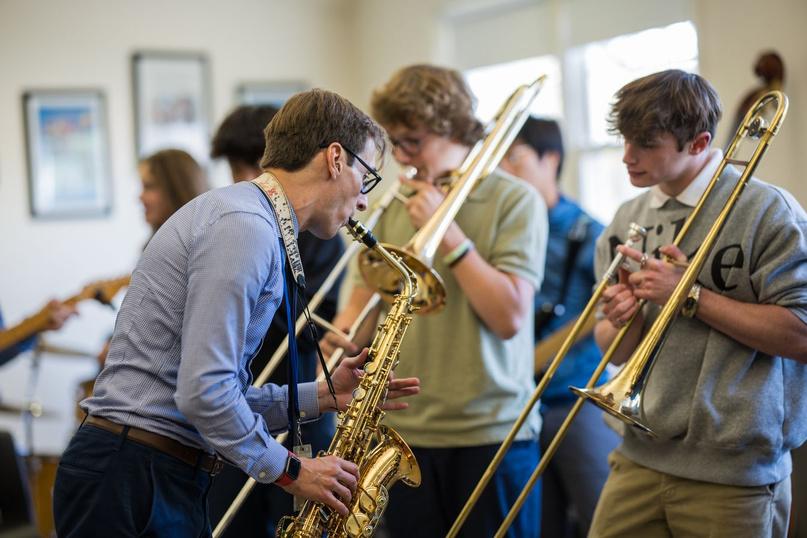
Prerequisite: By audition or with department approval in the spring semester. JazzComboisopenbyauditiontothosestudents who play saxophone, trumpet, trombone, piano, guitar,bass,anddrums(otherinstrumentsmaybe considered by petition). Students must be taking private lessons currently on their instrument and must play at an intermediate level or higher (NYSSMAlevel5).Theensembleperformsclassic and modern jazz literature. Students will learn techniquesofimprovisationandwillworktowards playing together as a unit. The ensemble will performatthewinterandspringconcertsoncampus andwillhaveoff-campusopportunitiestoperformas well. Auditions will be held during the spring precedingtheschoolyearinwhichthecoursewill betaken.
All students must complete three years of laboratory science at Portledge School. The department determines placement in honors and standard level sections based on past performances in science classes, the recommendations of a student’s previous teacher, standardized test scores, and, depending upon the course, the student’s aptitude in mathematics. The department tries to identify the most able students for honors classes, which proceed at a faster pace and explore the subject material in greater depth with more abstract thinking. The usual laboratory sequence includes, in this order, courses in biology, chemistry, and physics. Additional science electives, IB, and AP courses may be available to students and vary from year to year based on student enrollment and staffing availability. Students are encouraged to take a science course each of their four years in the Upper School.
English Science Academic Pathways
AppealProcess:
If a student wishes to enroll in a science course for which they have not been recommended,theymustcompletethefollowingstep(s):
The following courses can be used to fulfill the 3-year lab science requirement.
Biology
(9th - 1 cr/yr)
A survey/laboratory approach covering a wide variety of topics in the life sciences, this course emphasizes the relationship between structure and function and the interrelationships among organisms. Topics include scientific inquiry, cells and cell biology, ecology, genetics, organismal biology, evolution, and natural selection. An important goal of the course is the development of laboratory skills and scientific thinking. Labs are used to explore and reinforce concepts. The skills associated with the application of conceptual knowledge and analytical data are introduced and practiced,withtheintenttodevelopstrongcritical thinking skills and effective written communication.
Biology Honors
(9th - 1 cr/yr)
Prerequisites: Science 8H and department permission
A survey/laboratory approach covering a wide varietyoftopicsinthelifesciences,thiscourse emphasizestherelationshipbetweenstructureand function and the interrelationships among organisms.Topicsincludeallofthoselistedforthe standard Biology course. The course moves at a fasterpace,goesintogreaterdepth,andrequires more independent study skills. Students are expectedtohavestrongercriticalreadingskillsand are assessed on reading comprehension. An importantgoalofthecourseisthedevelopmentof laboratoryskillsandscientificthinking.Labsare used to explore and reinforce concepts. The applicationofconceptualknowledgeandanalytical data,alongwitheffectivewrittencommunication, are emphasized. Problem-solving and critical thinkingareusedinthiscourse,sostrongcritical readingandthinkingskillsareexpected.
Chemistry
(10th, 11th, 12th - 1 cr/yr)
Prerequisite: 1 year of Biology.
A laboratory course for students who want to understand the structure of matter, its properties, composition, and the changes that matter undergoes, with some reliance on mathematical relationships of chemical reactions. Topics will include the structure of the atom, chemical formulas, types of (and balancing) chemical reactions, phases of matter, gas laws, bonding, molecular geometry, intermolecular forces, stoichiometry, thermochemistry, and nuclear chemistry. The emphasis in this course will be on understanding concepts, although problem-solving will require some basic algebra. Labs will provide hands-on experience for in-depth exploration of chemical laws and principles. Occasionally, technology will be integrated into the lab experiments.
Chemistry Honors
(10th, 11th, 12th - 1 cr/yr)
Prerequisites: 1 year of Biology, Algebra 2 must be completed or taken concurrently, department permission
This laboratory course aims to develop an understandingofthebehaviorofsubstancesunder variousconditions.Topicsincludeallofthetopics listedforthestandardChemistrycourse.Thecourse movesatafasterpace,goesintogreaterdepth,and requires more independent study skills. Atomic structureandthebehaviorofelectronsareusedto investigate the properties of elements and to elucidate the nature of chemical bonds. Mathematical relationships during reactions, reaction rates, chemical equilibrium, acid-base reactions, and redox chemistry are explored. An importantgoalofthecourseisthedevelopmentof laboratory skills. Labs are used to explore and reinforceconcepts.Problem-solvingisusedinthis course,sostrongmathematicalskillsareexpected. StudentsshouldbeinAlgebra2oramoreadvanced math course. Occasionally, technology will be integratedintothelabexperiments.
6.SCIENCE
Physics: Mechanics
(11th, 12th - 1 cr/yr)
Prerequisites: 1 year each of Biology & Chemistry.
Thislaboratorycourseisgearedtostudentswho wanttoincreasetheirknowledgeofthephysical world without the use of advanced mathematics. Using a modeling approach, this course will investigate the broad topic of mechanics. The coursewilladdressmovingwithconstantvelocity, uniformacceleration,behaviorofaparticlewhen the sum of the force acting on it equals zero, behavior of a particle subject to a net force, projectilemotion,uniformcircularmotion,energy storageandtransfe,randmomentum.Experimental work helps demonstrate the interrelationship betweentheoryandfact.
Physics: Mechanics Honors
(11th, 12th - 1 cr/yr)
Prerequisites: 1 year each of Biology & Chemistry, Algebra 2 or higher, and department permission
Co-requisite: Precalculus. This laboratory course is geared to students who want to increase their knowledge of the physical world with the use of Algebra 2, trigonometry, and some Calculus. Topics include all of the topics listed for the standard Physics course. This course moves at a faster pace, goes into greater depth and requires independent study skills. The development of quantitative analytical skills through mathematical problem-solving is emphasized. Laboratory experiments to apply conceptual knowledge will be performed. Critical thinking aboutabstractconceptsisdeveloped.
IB Biology Year 1
(11th, 12th - 1 cr/yr)
2-year course
Prerequisites: 2 years of US Biology & US Chemistry.
IB Diploma and Course candidates who take this course are expected to complete the 2-year course sequence. Seniors can take this course with department approval.
Thiscollege-levelcourseprovidesin-depthcoverage of the discipline of Biology and develops essential laboratory and analytical skills required for advancedworkinthefield.Studentsareempowered to make sense of living systems through unifying themes. By providing opportunities for students to exploreconceptualframeworks,theyarebetterable to develop an understanding and awareness of the living world around them. The themes for the first yearincludeunityanddiversity,formandfunction, andinteractionandinterdependence.Topicsforthe first year include properties of water, macromolecules, cell origin and structure, gas exchangeandtransport,speciationandadaptations, conservation of biodiversity, enzymes, photosynthesis, cellular respiration, and chemical signaling. With an emphasis on experimental work, studentshaveopportunitiestoaskquestions,design experiments, collect and analyze data, collaborate with peers, and reflect on, evaluate, and communicate their findings. Field trips will be included to expand student learning opportunities. Assessments for this course include both formative
6.SCIENCE
IB Biology Year 2
(12th - 1 cr/yr) 2-year course
Prerequisite: IB Biology Year 1.
Thisisthesecondinatwo-yearcourseincollege-levelBiology.Studentsareempoweredtomakesenseof living systems through unifying themes. By providing opportunities for students to explore conceptual frameworks,theyarebetterabletodevelopanunderstandingandawarenessofthelivingworldaroundthem. Thethemesforthesecondyearincludethecontinuationofinteractionandinterdependence,andcontinuity andchange.Topicsforthesecondyearincludeintegrationofbodysystems,immunedefense,populationsand community,energyandmattertransfer,molecularbiology,reproductionandinheritance,naturalselection, andclimatechange.Withanemphasisonexperimentalwork,studentshaveopportunitiestoaskquestions, designexperiments,collectandanalyzedata,collaboratewithpeers,andreflect,evaluate,andcommunicate their findings. Field trips will expand student learning opportunities. The Internal Assessment will be completed during the second year, and all students are strongly encouraged to complete the external assessmentsgivenbyIB.
IB Environmental Systems Studies Year 1
(11th, 12th - 1 cr/yr)
2-year course
Prerequisite: 2 years of US Science (at least one year of chemistry is strongly recommended).
IB Diploma and Course candidates who take this course are expected to complete the 2-year course sequence. Seniors can take this course upon department approval. Thisisatwo-yearcourseinEnvironmentalScience designedtobetheequivalentofanIntroductionto EnvironmentalSciencecoursetakenduringthefirst yearofcollege.Thegoalofthiscourseistoprovide opportunities for students to study the scientific principles and concepts of environmental science and sustainability and to understand the interrelationships of the natural world, the processes that underlie the Earth, and the human dependence on ecosystem services. Students will identify and analyze natural and human-made problems, and examine and develop alternative solutions for resolving and/or preventing them. Topics for year one include Foundations of ESS, Ecology, Biodiversity and conservation, and Water. Work will include reading textbook material and current articles and conducting empirical studies, fieldwork,laboratoryexperiments,casestudies,and projects. Field trips and experiential learning will be emphasized. Students will begin the Internal Assessment(IA)duringthespringsemesterofYear 1.
IB Environmental Systems Studies Year 2
(12th - 1 cr/yr)
2-year course
Prerequisite: IB ESS Year 1.
This is the second year of a two-year course in college-level Environmental Science. The goal of thiscourseistoprovideopportunitiesforstudents tostudythescientificprinciplesandconceptsof environmental science and sustainability and to understand the interrelationships of the natural world,theprocessesthatunderlietheEarth,and the human dependence on ecosystem services. Students will identify and analyze natural and human-made problems and examine and develop alternativesolutionsforresolvingand/orpreventing them.TopicsforthesecondsemesterincludeLand, Atmosphere,andclimatechange;Naturalresources; and Human populations and urban systems. Work willincludereadingtextbookmaterialandcurrent articles and conducting empirical studies, field work, laboratory experiments, case studies and projects.Fieldtripsandexperientiallearningwill beemphasized.StudentswillcompletetheInternal Assessment(IA)duringthefallsemesterofYear2. All students are strongly encouraged to complete theExternalAssessmentsgivenbyIB.
IB Physics Year 1
(11th, 12th - 1 cr/yr)
2-year course
Prerequisites: Chemistry Honors, Algebra 2, or higher.
IB Diploma and Course candidates who take this course are expected to complete the 2-year course sequence. Seniors can take this course upon department approval.
As one of the three natural sciences in the IB Diploma Programme, physics is concerned with an attempt to understand the natural world. This algebra-based course explores space, time, and motion, the particulate nature of matter, wave behavior, fields, and nuclear and quantum physics, as well as mathematical, experimental, data analysis, and modeling tools. This course may also betakenbynon-IBstudents.
IB Physics Year 2
(12th - 1 cr/yr)
2-year course
Prerequisites: IB Physics Year 1 & Algebra 2
This course is the second year of a two-year sequencecoveringimportantprinciplesofphysicsin depth through problem solving and laboratory experiments. It is designed to meet the needs of those students wishing to further their study of physics.TheInternalAssessmentwillbecompleted duringthesecondyear,andallstudentsarestrongly encouraged to complete the external assessments givenbyIB.
IB Sports, Exercise & Health Science Year 1
(11th, 12th 1 cr/yr) 2-year course.
Prerequisite: 2 years of Upper School Science (Biology strongly recommended). IB Diploma and course candidates who take this course are expected to complete the 2-year course sequence. Seniors can take this course upon department approval; priority is given to IB Diploma students and juniors who wish to complete the IB Course certificate.
The Sports, Exercise, and Health Science (SEHS) Standard Level course offers an interdisciplinary exploration of how physiological, biomechanical, and psychological principles influence human health and athletic performance. This two-year program blends academic study with practical investigative skills, engaging students in laboratory and fieldwork activities. Key themes include exercise physiology, biomechanics, and sports psychology, with a focus on health and performance applications. The course emphasizes inquiry-based learning and the integration of scientific concepts, fostering critical thinking and analytical skills. Students will develop a strong foundation in experimental techniques and data analysis while exploring the ethical, environmental, and social implications of sports science. This course is particularly relevant for students interested in pursuing careers or further education in health, fitness, or sports-relatedfields.
IB Sports, Exercise & Health Science Year 2
(12th 1 cr/yr) 2-year course.
Prerequisite: IB Sports, Exercise & Health Science Year 1
Thisisthesecondinatwo-yearcourseofcollege-levelSports,Exercise,andHealthScienceStandardLevel courses. Students will continue to explore and develop a deeper understanding of the physiological, biomechanical, and psychological factors that influence physical activity, sports performance, and overall well-being. The themes for the second year include the interaction of body systems as it applies to sports performance,adaptationandresponsetotraining,andchangesinhealthandperformance.Withanemphasis onexperimentalandappliedwork,studentshaveopportunitiestoaskquestions,designinvestigations,collect andanalyzedata,collaboratewithpeers,andreflect,evaluate,andcommunicatetheirfindings.TheInternal Assessment will be completed during the second year, and all students are encouraged to complete the externalassessmentsgivenbyIB.
6.SCIENCE
AP Chemistry
(10th, 11th, 12th - 1 cr/yr)
Prerequisites: 2 years of Upper School Science: Biology & Chemistry & Algebra 2, and/or permission from the department. APChemistryisdesignedtobetheequivalentof the general chemistry laboratory course taken duringthefirstyearofcollegeforstudentsplanning to major in science. Topics will include atomic theory and atomic structure, chemical bonding, gases,liquidsandsolids,solutions,reactiontypes, stoichiometry, equilibrium, kinetics, thermodynamics, and electrochemistry. All topics will be covered with an emphasis on chemical calculations and mathematical formulations of chemical principles. Proficiency in the use of logarithmic and exponential relationships is expected and therefore it is necessary that the studenthavesuccessfullycompletedasecond-year algebra course. In addition, students will be required to maintain a thorough, well-organized laboratory notebook in such a fashion that chemistry professors at the students’ selected institutionscanreadilyreviewthisevidenceoftheir labexperiences.Technologywillbeintegratedinto the lab experiments. Students are strongly encouragedtotaketheChemistryAPexaminMay; however, those who do not wish to do so are permittedtooptoutearlyintheschoolyear.
Senior Seminar: Human Anatomy & Physiology
(12th - 1 cr/yr) Prerequisites: 1 year of Biology and 1 year of Chemistry. Availability is dependent on staffing and enrollment.
HumanAnatomyandPhysiologyisafull-yearcourse for students with an interest in science-related fields, particularly biology and health sciences. Through discussion and laboratory-based study, studentsexaminethestructureandfunctionofthe human body across multiple levels of organization, from molecules and cells to tissues and organ systems. This course will provide opportunities for students to design and interpret investigations, analyzedata,developstrongercriticalthinkingand communication skills, and deepen understanding through laboratory work and dissection. Topics include Basic Chemistry, Cells and Tissues, Skin and Body Membranes, and the Skeletal, Muscular, Nervous, Endocrine, Cardiovascular, Lymphatic, Respiratory, Digestive, Urinary, and Reproductive systems.
Senior Seminar: Human Anatomy & Physiology Honors
(12th - 1 cr/yr) Prerequisites: 1 year of Biology and 1 year of Chemistry. Availability is dependent on staffing and enrollment.
Human Anatomy and Physiology Honors is a fullyear course for students with a strong interest in science-related fields, particularly biology and healthsciences.Throughdiscussionandlaboratorybased study, students examine the structure and functionofthehumanbodyacrossmultiplelevelsof organization,frommoleculesandcellstotissuesand organsystems.Whilecoveringthesamecoretopics as the standard course, assessments emphasize independent learning, advanced critical thinking, scientific reading, and clear communication. Students design and interpret investigations, analyze data, and deepen understanding through laboratoryworkanddissection.TopicsincludeBasic Chemistry, Cells and Tissues, Skin and Body Membranes, and the Skeletal, Muscular, Nervous, Endocrine, Cardiovascular, Lymphatic, Respiratory, Digestive,Urinary,andReproductivesystems.
6.SCIENCE
Senior Seminar: Marine Science & Oceanography
(12th - 1 cr/yr) Prerequisites: 1 year of Biology & Chemistry. Availability is dependent on staffing and enrollment. Thiselectivecourseisdesignedtoprovideacomprehensiveexplorationofthemarineenvironment,bringing togetheroceanographyandmarinescience.Studentswilldevelopanunderstandingofecologicalprinciplesas theyexaminethephysicalstructureanddynamicsofmarineecosystems.Thecoursecoversarangeofmarine life,frommicrobestocomplexchordates.Throughengagingcourseworkandhands-onactivities,studentswill develop essential skills in observation, data analysis, problem solving, and scientific communication. Above all, this course aims to foster a deeper understanding and appreciation of marine ecosystems, promoting a genuinerespectforthediversityoflifeformsandprocessesinourocean.
(12th - 1 cr/yr) Prerequisites: 1 year of Biology & Chemistry and department permission Availability is dependent on staffing and enrollment.
This honors elective course provides a comprehensive exploration of the marine environment, integrating oceanography and marine science through a more rigorous and analytical lens. Students will deepen their understanding of ecological principles as they examine the physical structure, dynamics, and interconnectednessofmarineecosystems.Thecoursecoversarangeofmarinelife,frommicrobestocomplex chordates. While the core content parallels that of the standard course, assessments are differentiated to emphasize independent learning, advanced critical thinking, and higher-level reading and communication skills. Students will be expected to engage with scientific texts, analyze data sets, construct evidence-based explanations, and communicate their understanding through written, oral, and visual formats. Through inquiry-driven coursework and hands-on investigations, students will refine skills in observation, data analysis, problem-solving, and scientific communication. This course aims to foster a deeper understanding and appreciation of marine ecosystems, promoting a genuine respect for the diversity of life forms and processesinourocean.
Non-core Science Electives
The following courses cannot be used to fulfill the 3-year lab science requirement.
Robotics 1
(9th, 10th, 11th, 12th - 1 cr/yr)
Prerequisite: parent permission to attend the FIRST Tech Challenge competition. This course cannot be used to fulfill the 3-year lab science requirement. Students will design, build, and program robots, applying real-world math and science concepts, following the engineering design process. This course develops problem-solving, organizational, and project management skills as teams compete in the yearly FIRST Tech Challenge competition. Students will learn about basic mechanical elements, the logic of coding a robot, and how to useCADtodesigncustomparts.Inadditiontoclass time, this course has 5-8 after-school and weekend commitments,andtworoboticscompetitionsinmid January that students are expected to attend. Want to learn about the engineering design process and howtobuildandcoderobots?SignupforRobotics!
Robotics 2
(10th, 11th, 12th - 1 cr/yr)
Prerequisites: Robotics 1, parent permission to attend the FIRST Tech Challenge competition. This course cannot be used to fulfill the 3-year lab science requirement. This course will continue to develop the student’s understanding of the engineering process and further explore programming languages—coding syntax,testing,anddebugging.Studentswillexpand their understanding of robotics using TETRIX, goBILDA, REV, and raw materials to construct mechanical elements. More focus will be placed on CAD skills in this course. Students in Robotics 2 willalsobeaskedtotakeonaleadershiproleinan area of specialization to help peers in the Robotics coursewhoarenewtoroboticsdesign,construction, and programming. In addition to class time, this course has some after-school and weekend commitments, and a robotics competition in mid Januarythatstudentsareexpectedtoattend.
6.SCIENCE
Robotics 3 Honors
(11th, 12th - 1 cr/yr)
Prerequisites: Robotics 2, parent permission to attend FIRST Tech Challenge competition. This course cannot be used to fulfill the 3-year lab science requirement. Thiscoursewillcontinuetodevelopthestudent’s understanding of the engineering process and further explore programming languages—coding syntax,testing,anddebugging.Studentswillexpand their understanding of robotics using TETRIX, goBILDA, REV, and raw materials to construct mechanicalelements.Morefocuswillbeplacedon advanced CAD skills, such as creating assemblies thatmove.StudentsinRobotics3willalsobeasked to take on small leadership roles in an area of specializationtohelppeersintheRoboticscourse whoarenewtoroboticsdesign,construction,and programming.Inadditiontoclasstime,thiscourse has some after-school and weekend commitments, including two qualifier competitions in January, thatweexpectstudentstoattend.
Artificial Intelligence
(9th, 10th, 11th, 12th - ½ cr/sem)
Prerequisite: Experience in computer programming is recommended. This course satisfies the engineering requirement for STEAM scholars.
This course cannot be used to fulfill the 3-year lab science requirement. This one-semester elective course introduces students to the creation and use of artificial intelligence (AI). Students will learn about the history of AIs; their current implementations and applicationsinwriting,art,music,androbotics;and thesocial,ethical,andpedagogicalimplicationsof anticipateddevelopments.StudentswilluseAIsto produce written documents and two-dimensional images. Students will build, train, and evaluate simplenetworksembodiedinsoftware(e.g.,neural nets)orhardware(e.g.,swarmrobots).
Robotics 4 Honors
(11th, 12th - 1 cr/yr)
Prerequisites: Robotics 3, parent permission to attend FIRST Tech Challenge competition. This course cannot be used to fulfill the 3-year lab science requirement. Atthislevel,studentswillbeexpectedtonotonly completethedesigning,building,andcodingofa robot,butalsoleadengineeringdesigndiscussions, buildingandcodingprojects,andteams.Students willhelpmanagetheclassKanban(orotherproject management tools) and serve as the main documentationeditor.Robotics4studentswillalso assistinteachingCADskillstotheirpeerstogrow their communication skills. In addition to class time,thiscoursehassomeafter-schoolandweekend commitments,includingtwoqualifiercompetitions inJanuary,thatweexpectstudentstoattend.
Independent Science Research
(9th, 10th, 11th, 12th - ½ cr/sem) May be repeated in multiple years. This course cannot be used to fulfill the 3-year lab science requirement.
Studentswillidentifyatopicofinterest,learnhow to read and analyze primary source research papers, develop the business etiquette for approaching professionals in the field of interest to initiate discussions, prepare a detailed research proposal, plan research methods and analysis, carry out studies, analyze results, and prepare a professionalstylemanuscriptdescribingtheirfindings.
7.THEATRE ARTS
From the stage to behind-the-scenes, our curriculum provides a comprehensive explorationoftheatre,allowingstudentstodevelopessentialskills,gainconfidence,and discover their unique voice in the world of dramatic arts. Whether you're drawn to acting, directing, technical production, or the rich history of theatre, our courses provideaplatformforpersonalgrowth,collaboration,andadeeperunderstandingofthe powerfulimpactofliveperformance.
Intro to Theatre 1 & 2
(9th, 10th - ½ cr/sem)
Class limit - 20 students. Fulfills Performing Arts requirement.
Thisisanintroductorycoursedesignedforstudents to learn beginning acting technique, theory, and basic theatre appreciation and terminology. Fundamentals covered are basic theatre knowledge, history of acting practitioners and playwrights, improvisation,devisingtechniques,scenework,and other performing exercises designed to lay the groundwork for future theatre training in this program. This beginning course will focus on the PROCESSandhelpdeveloptheskillsandemotional freedom to explore and create characters. This is a performance class, and all students will perform a two-person scene final in this class. Theatre is collaborative in nature, and students interested in this course must be willing to be a positive and supportivememberofthisclassandprogram.
Creative Dramatics 1 & 2
(10th - ½ cr/sem)
Prerequisite: Intro to Theatre is strongly encouraged.
This one-semester course is offered in the fall semester. Class limit - 20 students. Fulfills Performing Arts requirement.
CreativeDramaticsisacoursedesignedforstudents to learn advanced acting techniques, theory, and theatre appreciation and terminology needed to grasp the concepts of acting and creative performance.Fundamentalscoveredaremonologues, improvisation, scene/character work and public performancesdesignedforfuturetheatretrainingin this program (IB Theatre). This is a performance class. Students will be asked to read, analyze, and perform plays in-class and possibly for the public. Studentswillalsobeaskedtocollaborateandcreate and perform theatre pieces based on Devised Theatre techniques such as: Theatre for Change, Theatre of the Oppressed and Process Drama. Theatre is collaborative in nature and students interested in this course must be willing to be a positive and supportive member of this class and program.
Theatre Production
(9th, 10th, 11th, 12th - ½ cr/sem)
This one-semester course is offered in the spring semester. Class limit - 20 students. Fulfills Performing Arts requirement.
Theatre Production is a class designed for students to learn about putting together a theatrical production and other performance events through a detailed look at backstage and technical elements of production. Thisclassisintendedforstudentswhoarecuriousaboutproduction,butarenotinterestedinaperformance basedclass.Theknowledgewillbeputtouseinpracticalways,supportingandhelpingcreatevariousschool performances, while learning how to be part of the performing arts community. Students must be willing to engage in elements covered, such as stage lighting, sound, stage management and running crew, and to participateinprovidingsupportoutsideofclassperformancesandevents.Studentswillleavethiscoursewith a basic understanding of the subjects, demonstrating the ability to use technical vocabulary, learn safety protocols, performance etiquette and give students skills and confidence to work and assist in various performanceandeventsettings.Theatreiscollaborativeinnatureandstudentsinterestedinthiscoursemust bewillingtobeapositiveandsupportivememberofthisclassandprogram.
7.THEATRE ARTS
IB Theatre Year 1
(11th - 1 cr/yr)
Prerequisite: Intro to Theatre, Creative Dramatics, or Theatre Production is strongly recommended. This class cannot be used to fulfill the Performing Arts requirement.
StudentsintheirfirstyearofIBTheatresignupfor thissection.Thisisatwo-yearadvancedcourseand part of the IB Diploma programme. Students are requiredtoexploreTheatrefromtheperspectiveof dramaturg, director, performer, group ensemble, production team, and spectator. Assessments are completedinthesecondyearofstudy,withthefirst year focused on gaining knowledge and understanding about the topics and preparing for assessments.
IB Theatre Year 2
(12th - 1 cr/yr)
Theatre 1 & 2 Honors (Non-IB Diploma)
(10th, 11th, 12th - 1 cr/yr)
Prerequisites: Intro to Theatre, Creative Dramatics, or Theatre Production, and department permission.
This class cannot be used to fulfill the Performing Arts requirement.
Theatre 1 & 2 is an advanced course and will be taught concurrently (i.e., in the same time and place) with IB Theatre. Students enrolled in this course will be involved with all aspects of the IB course and participate in IB Year 2 Diploma candidate projects. Students may take this course twice. If repeating the course, students are designatedTheatre2.
Musical Theatre 1 & 2 (11th,
12th - 1 cr/yr)
Prerequisite: IB Theatre Year 1. This class cannot be used to fulfill the Performing Arts requirement. StudentsintheirsecondyearofIBTheatresignup for this section. All IB Theatre assessments are completed, presented, and submitted to IB for grading.
Prerequisite: Intro to Theatre or Creative Dramatics and department permission
Musical Theatre is a class designed for students to learn about the history of Musical Theatre and developskillsneededtoperformthisartform.This is an advanced, performance-based class and students must be willing to engage in all elements covered: musical theatre history, singing, dancing andacting.Studentswillbeaskedtoperformvocal solos/duets/group numbers. Students will also be asked to perform in scenes and learn and perform dance combinations from shows. Students may also be asked to participate in outside public performances or school master classes. Theatre is collaborative in nature and any student interested in this course must be a positive and supportive member of this class and program. Students may take this course twice. If repeating the course, students are designated as Musical Theatre 2. This course is considered sufficient to fulfill the statemandated physical education requirement.
8.VISUAL ARTS
All students, regardless of experience, are encouraged to include an art elective into their schedule so that they have an opportunity to experience the benefits an art class can bring to their creative thinking skills. All elective courses will include an art historyorappreciationcomponentrelatedtoeachtopic.
Art Foundations
(9th, 10th, 11th, 12th - ½ cr/sem)
Availability is dependent on staffing and enrollment.
Students will examine the Elements and Principles of art and the role they play in designing a composition, while enhancing their understanding of the creative process. Students will be asked to engage in short small projects and exercises designed to improve their observation skill. Students will examine the painting style known as non-objective, established by the artist Wassily Kandinsky. This class is designed to help students gain a greater degree of satisfaction from other PortledgeStudioelectives.
Green Architecture
(9th, 10th, 11th, 12th - ½ cr/sem)
Availability is dependent on staffing and enrollment.
Students will be introduced to the fundamentals of architecturaldesign,solveconceptualproblems,and develop an awareness of architecture’s ecological and social relationships with an emphasis on the current movement in green architecture, that is, energy efficient, ecologically kind structures. Students will develop skills in working with form and spatial relationships though sketching, model construction,andcomputer-aideddesigns.
Graffiti Art
(9th, 10th, 11th, 12th - ½ cr/sem)
Availability is dependent on staffing and enrollment.
Students will examine the long history of graffiti, theevolutionoftheartformanditscurrentrolein modern culture. Students will choose an alias and createavarietyofletterdesigns.Studentswillalso learn about the current street art movement and createhandcutstencils.
Studio Art
(9th, 10th, 11th, 12th - ½ cr/sem)
Availability is dependent on staffing and enrollment.
Students will explore their individual creativity throughstudentdrivenandselfdeterminedprojects. Focus will be on finding the right outlet for the student’s personal expression. All skill levels are welcome and encouraged to either develop a new skillorfurtherdeveloptheirpassion.
Ceramics
(9th, 10th, 11th, 12th - ½ cr/sem)
Availability is dependent on staffing and enrollment.
This course is presented as an introduction to ceramics. Students will learn the basics of clay constructionastheyproduceworksusingpinch,coil and slab building techniques with clay. Knowledge oftheproperuseofclaytoolsandmaterialswillbe intertwined within the creative process and an examinationoftheartform.
Media Production
(9th, 10th, 11th, 12th - ½ cr/sem)
This one-semester course introduces 9th–12th graders to media production. In a collaborative studio, students master video and audio recording, editing, and scriptwriting while developing oncamera confidence. Through hands-on projects and afinalcapstone,studentsgaintechnicalproficiency in lighting, sound, and storytelling, fostering professionalisminadynamic,real-worldcontext.
Printmaking
(9th, 10th, 11th, 12th - ½ cr/sem)
Availability is dependent on staffing and enrollment.
This course is an introduction to printmaking. Studentswilllearnthebasicsofprintmakingasthey explore mono-prints, lino prints, and block printing. Knowledge of the proper use of tools and materials will be intertwined within the creative processandanexaminationoftheartform.
8.VISUAL ARTS
Photography/Media
(9th, 10th, 11th, 12th - ½ cr/sem)
Availability is dependent on staffing and enrollment.
This course introduces students to digital photography, focusing on camera operation and the "digital darkroom." Students master composition and technical skills using everything from smartphonestoDigitalSLRs.Thecurriculumcovers Photoshop editing—including retouching and color correction—alongside photography’s history and influential figures. While a Digital SLR is highly recommendedforseriousstudents,itisnotrequired.
Printmaking
(9th, 10th, 11th, 12th - ½ cr/sem)
Availability is dependent on staffing and enrollment.
This course is an introduction to printmaking. Studentswilllearnthebasicsofprintmakingasthey explore mono-prints, lino prints, and block printing. Knowledge of the proper use of tools and materials will be intertwined within the creative processandanexaminationoftheartform.
Fashion Illustration and Design
(9th, 10th, 11th, 12th - ½ cr/sem)
Availability is dependent on staffing and enrollment.
Studentsexploretheintersectionofartandapparel by mastering sketching the fashion figure and rendering textiles, accessories, and garments. The curriculumbridgespastandpresentthroughfashion historyandiconicdesigners,providingafoundation for students to develop their creative voices. Throughout the semester, students synthesize ideas by creating thematic mood boards, designing cohesive collections, and engaging in hands-on upcycling projects to transform existing garments intosustainablepieces.Bycourseend,studentswill have a versatile portfolio showcasing their illustrationskillsandabilitytoinnovatewithinthe modernfashionindustry.
IB Film
(11th, 12th - 1 cr/yr)
IB Diploma candidates must sit for this course in their junior year. If space allows, non-diploma seniors may request this course as an elective. Students learn how film creates meaning by developingideasfromconceptiontoproduction.By analyzingglobalfilmhistoryandtheory,thecourse fosters critical appreciation of diverse cultural perspectives. Students also gain the technical and organizationalskillsnecessarytoexpressthemselves creatively, ultimately achieving an international understanding of cinema through hands-on filmmakingandhistoricalstudy.
Sculpture
(9th, 10th, 11th, 12th - ½ cr/sem)
Availability is dependent on staffing and enrollment.
This course introduces students to a variety of techniques and materials used in the creation of three-dimensional sculpture. Students will use both additive and subtractive methods to produce works using materials including wood, clay, paper, wire, plaster, and mixed media. Written assignments will be required in conjunction with the study of sculptors, past and present. Trips to galleries and museumsonLongIslandandinNewYorkCitymay beincluded.
IB Visual Arts Year 1
(11th, 12th - 1 cr/yr)
2-year course.
IB Visual Arts Year 1 is a studio-based course exploring the students' creativity and culminating intheproductionoftwoandthree-dimensionalart. Drawing, painting, sculpture, and the digital realm will be explored. Students will develop their own artwork through research and thoughtful exploration of the art making process. Students are expected to be motivated and be able to connect and relate to a variety of styles, cultures, and time periodsandmakeconnectionstotheirownpersonal art-making practice. The creative process will be documentedinjournalsinwrittenandvisualforms.
IB Visual Arts Year 2
(12th - 1 cr/yr)
Prerequisite: IB Visual Arts Year 1
2-year course.
IBVisualArtsYear2isthesecondyearofastudiobased course exploring the students' creativity and culminating in the production of two and threedimensional art. Drawing, painting, sculpture, and the digital realm will be explored. Students will develop their own artwork through research and thoughtful exploration of the art making process. Students are expected to be motivated and be able toconnectandrelatetoavarietyofstyles,cultures, andtimeperiodsandmakeconnectionstotheirown personal art making practice. The creative process willbedocumentedinjournalsinwrittenandvisual forms.
9.WORLD LANGUAGES & CULTURES
The courses offered in the World Languages and Cultures Department help students learn to effectively communicate in the languages offered, while developing a strong cultural understanding and appreciation. All courses that are offered explore global issues,identities,experiences,andtheheritageofcountriesinwhichFrench,Mandarin, and Spanish are spoken. Students may orient their study towards the advanced track, which includes authentic literary texts, or towards developing their communication skillstobereadyforuseintheirfuturetravelsandstudy.
Completion of an IB Diploma requires enrollment in an IB Language B course. The Portledge graduation requirement is successful completion of a level-three course. Students are encouraged to study a language in all four years. Distinguished scholars who are devoted to the study of language and cultures may apply for admission to the PortledgeLanguageHonorSociety.
AppealProcess:
If a student wishes to enroll in a language course for which they have not been recommended,theymustcompletethefollowingsteps:
1 . Contact the teacher who made the recommendation and the Department Chair for approval
Additionally, to maintain placement in an advanced course, students must receive a teacherrecommendation,upholdstrongworkhabits,andmeetbehavioralexpectations.
In order to meet the graduation requirement, each Upper School student must successfully complete at least 2 credits during their high school years in French, Mandarin,orSpanish,culminatinginatleastlevel3.Weencouragestudentstoenrollin alanguagecourseduringallfouryears.Interestedstudentsmaystudyasecondforeign languageasanelective.
9.WORLD LANGUAGES & CULTURES
French Academic Pathways
Algebra 1
IB French Ab Initio Year 1 & Year 2 are electives available for students who have no, or very little, exposure to French. These coursesdonotmeetthelanguage requirementsforgraduation.
IB French Ab Initio Year 1
IB French Ab Initio Year 2
French 1
(9th, 10th, or department permission - 1 cr/yr) 3-year sequence required
Department permission is required if taken as a 2nd World Language
ThisisabeginningcourseforstudentswhoarenewtolearningFrenchandforthosewhoneedonemoreyear tosolidifytheirknowledgeandusageofthefundamentals.Inthecourse,studentslearnproperpronunciation and acquire basic vocabulary, grammar, and idioms. An introduction to the geography and civilization of francophonecountriesgivesdepthtotheprogram.
French 2
(9th, 10th, 11th - 1 cr/yr)
2–3 year sequence required
In this course, students work to increase their competency in all four language skills: listening, speaking, reading, and writing. They continue their study of grammar and vocabulary and practice their skills in a variety of ways, such as conversations in class, activities with audio-visual materials (including feature films), oral presentations, and shortessays.Theyalsoreachadeeperunderstanding ofthecultureandhistoryofthefrancophoneworld.
Successful completion of the course qualifies the student to enroll in French 3 in the following schoolyear.
French 2 Honors
(9th, 10th, 11th - 1 cr/yr)
2–3 year sequence required
Prerequisites: A- in the previous year’s course and/or teacher recommendation.
French2HstudentsfollowtheFrench2curriculum, with enrichment: the student must undertake the studyofmorecomplexgrammarstructures,complete additional reading and writing assignments, and do more independent work. Successful completion of the enrichment program in French 2H is a prerequisitetoFrench3H.
9.WORLD LANGUAGES & CULTURES
French 3
(10th, 11th - 1 cr/yr)
Required course
Prerequisite: Department permission
This course builds on the content of French 2 by providingreinforcementofbasicconceptsaswellas further grammar study, emphasizing the subjunctive and conditional moods. Students build upon their vocabulary,practicewithidiomaticexpressions,and generally have opportunities to gain fluency when expressing themselves in French. By studying various aspects of French-speaking societies indepth, students begin to make subtle comparisons with their own culture and experience. In this course,wecontinueourexplorationoffrancophone literature,cinema,andnewsreports.
French 4CC: Conversation & Culture
(11th, 12th - 1cr/yr)
Prerequisite: French 3 or 3H
This course is a continuation of French 3 (or of French 3H for those who wish to opt out of the Honors(formerlyAdvanced)track,offeringpractice atahighbeginner/intermediatelevel.Studentswill gainconfidenceusingthelanguagebydailypractice drillinggrammarconceptsthathavebeentaughtin previousFrenchcourses.Inaddition,studentslearn thevocabularyneededtoconverseaboutthetopics in the curriculum. While students do some reading (often as a class) and some writing (to reinforce theircommandofgrammar),theemphasisisplaced on oral communication. The class explores various cultural themes through short reading selections, internet websites, songs, poems, and movies. Each individual student is encouraged to investigate those aspects of the francophone world that correspondtohisorherpersonalinterests.Anopen exchangeofideasandinformationisakeyelement of the course; students will be responsible for at leastoneoralpresentationperterm.
French 3 Honors
(10th, 11th - 1 cr/yr)
Required course
Prerequisite: A- in French 2H, or department permission
In this course, students are expected to learn and use the most advanced structures possible to create authentic and sophisticated writing and speech. In addition to the exploration of the conditional and subjunctive moods (in all tenses), grammar lessons may include the aspect of adjectives, the infinitive mood,therelativepronouns,theliterarypasttense, the passive voice, and indirect discourse. In addition to the excerpts from our textbook(s), students will read classic French short stories as well as a novel or play, and continue their exploration of poetry and film. The work they do will develop the competencies they will need to demonstrateontheIBexams.
French 5CC: Conversation & Culture
(11th, 12th - 1cr/yr)
Prerequisite: French 4CC
This course is a continuation of French studies, offering practice at a high beginner/intermediate level. Students will gain confidence using the language through daily practice and drilling grammarconceptsthathavebeentaughtinprevious French courses. In addition, students learn the vocabulary needed to converse about the topics in the curriculum. While students do some reading (often as a class) and some writing (to reinforce theircommandofgrammar),theemphasisisplaced on oral communication. The class explores various cultural themes through short reading selections, internet websites, songs, poems, and movies. Each individual student is encouraged to investigate those aspects of the francophone world that correspondtohisorherpersonalinterests.Anopen exchangeofideasandinformationisakeyelement of the course; students will be responsible for at leastoneoralpresentationperterm.
9.WORLD LANGUAGES & CULTURES
IB French Year 1
(11th - 1 cr/yr)
2-year course
Prerequisite: French 3H, or department permission
This course, for students who have reached the intermediatelevel,ispartofthetwo-yearsequence in the IB program. Students enrolled in this course will prepare for exams taken in the second year of thetwo-yearsequence.Studentswillexplorethemes such as science & technology, world issues, and social relationships by reading articles, poetry, and prose,listeningtoandwatchingnewsprogramsand films, and doing research projects. The grammar concepts learned in previous courses are reviewed, and some advanced grammar topics are introduced. All students will engage in tasks used in IB assessments, and thereby improve their interpersonal, analytical, and presentational communicationskillsinFrench.
IB French Ab Initio Year 1
(11th - 1 cr/yr)
2-year course
Prerequisite: no more than 1 year of French
First year in a 2-year sequence of language study. TheAbInitiocourseisofferedatSLonly.Thisisa language acquisition course designed for students with no previous experience in—or very little exposure to—the target language (for example, a student may have never studied this language previously, or may have completed no more than a Level1courseinthelanguage).Languageabinitio students develop their receptive, productive, and interactive skills while learning to communicate in the target language in familiar and unfamiliar contexts. Students develop the ability to communicatethroughthestudyoflanguage,themes, and texts. There are five prescribed themes: identities, experiences, human ingenuity, social organization, and sharing the planet. While the themes are common to both language ab initio and language B, the language ab initio syllabus additionally prescribes four topics for each of the five themes, for a total of 20 topics that must be addressed over the two years of the course. The abilitytoworkindependentlyisimportantforthose whowishtosucceedinthiscourse.
IB French Year 2
(12th - 1 cr/yr)
2-year course
Prerequisite: IB French Year 1
Thisisthesecondyearofthetwo-yearsequencein the IB program. Students who select “SL” will take their exams at the Standard Level. In the second year, all students continue their exploration of themes such as science & technology, world issues, and social relationships by reading articles, poetry, andprose,listeningtoandwatchingnewsprograms andfilms,anddoingresearchprojects.HLstudents mustalsoreadapieceofauthenticFrenchlanguage literature (for HL, a minimum of 2 works must be studied during this two-year course). All students engage in the kinds of tasks used in IB assessments sothattheyarepreparedtositfortheexams,which are administered at various points throughout the schoolyear,culminatinginMay.
IB French Ab Initio Year 2
(12th - 1 cr/yr)
2-year course
Prerequisite: AB Initio Year 1
The second year in a 2-year sequence of language study. Language ab initio students develop their receptive, productive, and interactive skills while learning to communicate in the target language in familiar and unfamiliar contexts. Students develop the ability to communicate through the study of language, themes, and texts. There are five prescribed themes: identities, experiences, human ingenuity, social organization, and sharing the planet. While the themes are common to both language ab initio and language B, the language ab initiosyllabusadditionallyprescribesfourtopicsfor eachofthefivethemes,foratotalof20topicsthat mustbeaddressedoverthetwoyearsofthecourse. The ability to work independently is important for thosewhowishtosucceedinthiscourse.
9.WORLD LANGUAGES & CULTURES
Spanish Academic Pathways
Algebra 1
Spanish 1
(9th, 10th, or department permission - 1 cr/yr) 3-year sequence required Department permission is required if taken as a 2nd World Language.
Thisisabeginningcourseforstudentswhoarenew toSpanishandforthosewhoneedonemoreyearto solidify their knowledge and usage of the fundamentals. In the course, students learn proper pronunciation and acquire basic vocabulary, grammar, and idioms. An introduction to the geography and civilization of Spanish-speaking countriesgivesdepthtotheprogram.
Spanish 2
(9th, 10th, 11th - 1 cr/yr) 2–3 year sequence required
In this course, students work to increase their competency in all four language skills: listening, speaking, reading, and writing. They continue their study of grammar and vocabulary and practice their skills in a variety of ways, such as conversations in class, activities with audio-visual materials (including selections from feature films), oral presentations,andsimplewritingassignments.They alsoreachadeeperunderstandingofthecultureand history of the Hispanic world. Successful completionofthiscoursemeansthestudentisready to advance to Spanish 3 in the following school year.
Spanish 2 Honors
(9th, 10th, 11th - 1 cr/yr) 2–3 yr sequence required. Prerequisite: Department permission Spanish2HstudentsfollowtheSpanish2curriculum,withenrichment:thestudentmustundertakethestudy of more complex grammar structures, complete additional reading and writing assignments, and do more independentwork.SuccessfulcompletionoftheenrichmentprograminLevel2HisaprerequisitetoSpanish 3H.
9.WORLD LANGUAGES & CULTURES
Spanish 3
(10th, 11th- 1 cr/yr)
Required course
Prerequisite: Department permission
This course builds on the content of Spanish 2 by providingreinforcementofbasicconceptsaswellas further grammar study, emphasizing the different uses of past tenses and the subjunctive mood. Studentsbuildupontheirvocabulary,practicewith idiomatic expressions, and generally have opportunities to gain fluency when expressing themselves in Spanish. By studying various aspects of Spanish-speaking societies in-depth, students begin to make subtle comparisons with their own cultureandexperience.Inthiscourse,wecontinue ourexplorationofHispanicliteratureandcinema.
Spanish 4CC: Conversation & Culture
(11th, 12th - 1 cr/yr)
Prerequisite: Spanish 3 or 3H
This course is a continuation of Spanish 3 (or of Spanish 3H for those who wish to opt out of the Honors/Advanced track) designed to provide practice at a high beginner/intermediate level. The comprehensive grammar review book (Repaso, Glencoe) and on-line grammar exercises are among thecoursematerials.Inaddition,studentslearnthe vocabulary needed to converse about the topics in thecurriculum.Whilestudentscontinuetoworkon all four language skills, the emphasis is placed on oral communication. The class explores various cultural themes through short reading selections, songs, poems, and movies. Each individual student is encouraged to investigate those aspects of the Spanish-speaking world that correspond to his or her personal interests. An open exchange of ideas and information is a key element of the course; students will be responsible for at least one oral presentationperterm.
Spanish 3 Honors
(10th, 11th, or department permission - 1 cr/yr)
Required course
Prerequisite: Department permission
This course allows students who have reached the intermediate level to practice and develop all four language skills. Students are expected to learn and use the most advanced structures possible to create authentic and sophisticated writing and speech. In addition to the exploration of conditional phrases and the subjunctive mood (in all tenses), grammar lessons may include the infinitive, special uses of the future tense, and ways of marking time. In addition to the excerpts from our textbook(s), students will become used to reading Spanishlanguage newspapers, and they will be exposed to classic short stories, a novel or play, and more examplesofpoetryandfilm.Theworktheydowith these texts—which includes performing dialogues and debates, preparing topics for oral presentation, writing personal essays, and completing researchbased projects—will develop the competencies they willneedtodemonstrateontheIBexamattheend oftheirsenioryear.
Spanish 5CC: Conversation & Culture
(11th, 12th - 1 cr/yr)
Prerequisite: Spanish 4CC or department permission
This course is a continuation of Spanish, designed to provide practice at a high beginner/intermediate level. The comprehensive grammar review book (Repaso,Glencoe)andonlinegrammarexercisesare among the course materials. In addition, students learn the vocabulary needed to converse about the topics in the curriculum. While students continue to work on all four language skills, the emphasis is placed on oral communication. The class explores various cultural themes through short reading selections, songs, poems, and movies. Each individual student is encouraged to investigate those aspects of the Spanish-speaking world that correspondtohisorherpersonalinterests.Anopen exchangeofideasandinformationisakeyelement of the course; students will be responsible for at leastoneoralpresentationperterm.
9.WORLD LANGUAGES & CULTURES
IB Spanish Year 1
(11th - 1 cr/yr)
2-year course
Prerequisite: Spanish 3H, or department permission
This course, for students who have reached the intermediatelevel,ispartofthetwo-yearsequence in the IB program. Students who select “SL” will prepare for exams at the Standard Level, taken in the second year of the two-year sequence. All students explore themes such as science & technology,worldissues,andsocialrelationshipsby readingarticles,poetry,andprose,listeningtoand watching news programs and films, and doing researchprojects.Thegrammarconceptslearnedin previous courses are reviewed, and some advanced grammar topics are introduced. All students will engageintasksusedinIBassessments,andthereby improve their interpersonal, analytical, and presentationalcommunicationskillsinSpanish.
IB Spanish Year 2
(12th - 1 cr/yr)
2-year course
Prerequisite: IB Spanish Year 1.
Thisisthesecondyearofthetwo-yearsequencein the IB program. In the second year, students continuetheirexplorationofthemessuchasscience &technology,worldissues,andsocialrelationships by reading articles, poetry, and prose, listening to and watching news programs and films, and doing research projects. Students engage in the kinds of tasks used in IB assessments so that they are prepared to sit for the exams, which are administered at various points throughout the school year, culminating in May. HL students must also read a piece of authentic Spanish language literature(tobeinHL,aminimumof2worksmust bestudiedduringthistwo-yearcourse).
Pathways
IB Mandarin Ab Initio Year 1 & Year 2 are electives available for students who have no, or very little, exposure to Mandarin. Thesecoursesdonotmeetthe languagerequirementsfor graduation.
9.WORLD LANGUAGES & CULTURES
Mandarin 1
(9th, 10th, 11th - 1 cr/yr)
Thisisabeginningcourseforstudentswhoarenew toMandarinandforthosewhoneedonemoreyear of study to solidify their knowledge. Students will learnhowtowriteinpidginandrecognizeChinese characters.Theywilldevelopproperpronunciation, acquire basic vocabulary, grammar, and idioms. An introduction to the geography and to the customs and traditions of China throughout the calendar yeargivesdepthtotheprogram.
Mandarin 2
(9th, 10th, 11th - 1 cr/yr)
2–3 year sequence required
This course for students at the advanced beginner level is designed to increase their competence in Chinese language skills. They practice through conversations in class, activities with audio-visual materials, oral presentations, and short pieces of writing. Students will also reach a deeper understanding of the culture and history of China. Successful completion of the course qualifies the student to enroll in Mandarin 3 in the following schoolyear.
Mandarin 3
(10th, 11th, or department permission - 1 cr/yr)
ThisintermediatecoursebuildsonthecontentofMandarin2byprovidingreinforcementofbasicconcepts aswellasfurthergrammarstudy.Studentsbuildupontheirvocabulary,practicewithidiomaticexpressions, and generally have opportunities to gain fluency when expressing themselves in Mandarin. By studying variousaspectsofChinesesocietyin-depth,studentsbegintomakecomparisonswiththeirowncultureand experience.Inthiscourse,wecontinueourexplorationofauthenticmaterials,includingfilmclips,poetry, andnewsreports.
Mandarin 4CC: Conversation & Culture
(11th, 12th - 1 cr/yr)
Prerequisite: Mandarin 3 or 3H
Students in Mandarin 4CC have reached the intermediate high level. The course is a continuation of Mandarin3,offeringpracticeinparticularwithinterpersonalcommunication.Studentswillgainconfidence using the language through daily practice, drilling concepts that have been taught in previous Mandarin courses.Theclassexploresvariousculturalthemesthroughshortreadingselections,internetwebsites,songs, poems, and movies. Each individual student is encouraged to investigate those aspects of Chinese culture thatcorrespondtotheirpersonalinterests.Anopenexchangeofideasandinformationisakeyelementof thecourse;studentswillberesponsibleforatleastoneoralpresentationperterm.
Mandarin 5CC: Conversation & Culture
(11th, 12th - 1 cr/yr)
Prerequisite: Mandarin 4CC or department permission
Students in Mandarin 4CC have reached the intermediate high level. The course is a continuation of Mandarin3,offeringpracticeinparticularwithinterpersonalcommunication.Studentswillgainconfidence using the language through daily practice, drilling concepts that have been taught in previous Mandarin courses.Theclassexploresvariousculturalthemesthroughshortreadingselections,internetwebsites,songs, poems, and movies. Each individual student is encouraged to investigate those aspects of Chinese culture thatcorrespondtotheirpersonalinterests.Anopenexchangeofideasandinformationisakeyelementof thecourse;studentswillberesponsibleforatleastoneoralpresentationperterm.
9.WORLD LANGUAGES & CULTURES
Mandarin 4CC: Conversation & Culture
(11th, 12th - 1 cr/yr)
Students in Mandarin 4CC have reached the intermediate high level. The course is a continuation of Mandarin3,offeringpracticeinparticularwithinterpersonalcommunication.Studentswillgainconfidence using the language through daily practice, drilling concepts that have been taught in previous Mandarin courses.Theclassexploresvariousculturalthemesthroughshortreadingselections,internetwebsites,songs, poems, and movies. Each individual student is encouraged to investigate those aspects of Chinese culture thatcorrespondtotheirpersonalinterests.Anopenexchangeofideasandinformationisakeyelementof thecourse;studentswillberesponsibleforatleastoneoralpresentationperterm.
IB Mandarin Year 1
(11th - 1 cr/yr) 2-year course
Prerequisite: Department permission
This course, for students who have reached the intermediatelevel,ispartofthetwo-yearsequence in the IB program. Students enrolled in this course willprepareforexamsattheStandardLevel,taken in the second year of the two-year sequence. Students will explore themes such as science and technology,worldissues,andsocialrelationshipsby readingarticles,poetry,andprose,listeningtoand watching news programs and films, and doing researchprojects.Thegrammarconceptslearnedin previous courses are reviewed, and some advanced grammar topics are introduced. All students will engageintasksusedinIBassessments,andthereby improve their interpersonal, analytical, and presentationalcommunicationskillsinMandarin.
IB Mandarin Ab Initio Year 1
(11th - 1 cr/yr) 2-year course
Prerequisite: no more than 1 year of Mandarin
Thisfirstyearofatwo-yearsequenceisdesignedfor students with little to no prior exposure to the targetlanguage.OfferedattheStandardLevel(SL) only, the Ab Initio course focuses on developing receptive, productive, and interactive communication skills. Students learn to navigate both familiar and unfamiliar contexts through the study of five prescribed themes: identities, experiences, human ingenuity, social organization, and sharing the planet. To provide a structured foundation, the syllabus explores 20 specific topics across these themes over the two-year duration. By engaging with diverse texts and cultural themes, studentsbuildtheconfidencetoexpressthemselves effectively in a new language. Success in this fastpaced acquisition course requires a strong commitment to independent study and active participation.
IB Mandarin Year 2
(12th - 1 cr/yr) 2-year course
Prerequisite: IB Mandarin Year 1
Thisisthesecondyearofthetwo-yearsequencein theIBprogram(whichalsopreparesstudentsforthe Advanced Placement examination in Mandarin LanguageandCulture,shouldtheywishtositforit inMay).Inthesecondyear,studentscontinuetheir explorationofthemessuchasscience&technology, world issues, and social relationships by reading articles, poetry, and prose, listening to and watching news programs and films, and doing research projects. All students engage in the kinds of tasks used in IB assessments so that they are prepared to sit for the exams, which are administered at various points throughout the schoolyear,culminatinginMay.
IB Mandarin Ab Initio Year 2
(12th - 1 cr/yr) 2-year course
Prerequisite: Mandarin Ab Initio Year 2
The second year in a 2-year sequence of language study. Language ab initio students develop their receptive, productive, and interactive skills while learning to communicate in the target language in familiar and unfamiliar contexts. Students develop the ability to communicate through the study of language, themes, and texts. There are five prescribed themes: identities, experiences, human ingenuity, social organization, and sharing the planet. While the themes are common to both language ab initio and language B, the language ab initiosyllabusadditionallyprescribesfourtopicsfor eachofthefivethemes,foratotalof20topicsthat mustbeaddressedoverthetwoyearsofthecourse. The ability to work independently is important for thosewhowishtosucceedinthiscourse.
10.NON-CORE ELECTIVES
Non-Corecoursesareconsideredsupplementarytothenormalcourseload.Thecredits awarded for successful completion are not counted toward meeting the 18-credit minimumgraduationrequirement.Similarly,gradesearnedinnon-coreelectivesarenot factoredintothecomputationofplacementontheHighHonors/HonorsList.
Introduction to Chess
(9th, 10th, 11th, 12th - ½ cr/sem)
Pass/Fail.
Can be taken multiple semesters if applicable. Thisnon-coreelectiveprovidesanin-depthstudyof the game of chess from a scientific, artistic, and game perspective. Using chess as the primary conduit, the class provides an effective means for intellectual development and logical thinking. Studentslearntherules,notation,useofthechess clock,andbasicchessprinciples,aswellasstrategy, tactics, and endgame play. The class reinforces essential problem-solving techniques through lectures and discussion, followed by tournaments andmatchsituations,andadvancedgametheory.
Childhood Education
(9th, 10th, 11th, 12th - ½ cr/sem)
This course will serve as an introduction to the theory and practice of Childhood Education. Students will examine the intellectual, social, and physical development of children, and learn the skills needed to create and maintain an effective and safe learning environment. Upper School studentswillbematchedwithclassesintheMiddle School and/or Lower School for the purpose of observing,analyzing,reflecting,andsupportingthe lead teacher. They will also be required to create andteachalessonplanoftheirown.Additionally, students should be prepared to be active participants through collaboration with peers, active reflection and discussion about their experiencesintheclassroom,andresearchandthe presentation of various dimensions of Middle and Elementary School Education (philosophies, learningabilities,globaleducationalsystems,etc.).
Honors Chess: 1, 2 & 3
(9th, 10th, 11th, 12th - 1 cr/yr)
Prerequisites: Introduction to Chess or permission of instructor.
This full-year course is designed for students who intend to become rated or highly-skilled players. Therewillbe3levelsofHonorsChess:1,2,and3, all offered as separate classes that can be taken whenthepreviousleveliscompleted.Level3isthe highest level chess class and will cover advanced themes normally studied by serious tournament players.Allaspectsofchesswillbecoveredinthe3 classes, including detailed opening systems, middlegame themes, and endgame theory. Students will be assessed on a regular basis with daily homeworkassignments.Theuseofchessclocksand scorekeeping will be required. Players will be encouraged to compete in local rated chess tournaments. Students will each obtain online accounts at both Chesslang and Chess.com, where progress can be monitored. Students in this class willpotentiallybecomemembersoftheU.S.Chess Federationandobtainanationalranking.
American Sign Language (ASL)
(9th, 10th, 11th, 12th - ½ cr/sem) Pass/Fail.
This course will serve as an introduction to American Sign Language and Deaf Culture in general. Students will be instructed by a teacher employedbyMillNeckSchoolfortheDeaf.Class sessionswilloccuronPortledgeSchool’scampus.
11.NOT FOR CREDIT
Health (10th)
Pass/Fail
A required non-credit course. This10th-graderequiredclassisdesignedtoaddress common challenges high school students face as well as provide information about fundamental topicsinordertobeasuccessfulPortledgestudent. Portledge School believes that adolescents are able to make appropriate and healthy decisions when they are afforded the space for self-reflection when confronted with difficult situations and ethical dilemmas. Classes will be taught through a variety of formats around topics including, but not limited to: mental health, nutrition, substance use, human sexuality, and healthy relationships. This class enables students to critically think, converse, and reflect on these issues with their peers safely and engagingly through discussions, lectures, activities, and media content, which will set them up for a successfulandhealthyteenageandPortledgeUpper Schoolexperience.
Yearbook Production (9th, 10th, 11th, 12th)
This non-core offering involves students in every aspect of the production of Collage, the Portledge Yearbook. The book is produced through desktop publishing utilizing InDesign and Photoshop software.Studentsareinvolvedinplanning,layout, text, photography, advertising, meeting deadlines, and exhorting all members of the Class of 2027 to becomeactivecontributorstovariousaspectsofthe Yearbook. Yearbook staffers are required to be available to work on the book for a minimum of 3 periods per week. Weekend and after-school participationmayberequiredattimes.Enthusiasm, perseverance, organizational and time-management skills are all prerequisites for this endeavor. It’s fun!
12.PHYSICAL EDUCATION
Physical Education (9th, 10th, 11th, 12th)
A required non-credit course. Eachsemester,eachstudentmustfulfillastate-mandatedphysicaleducationrequirementbyparticipating inavarsitysport(orjuniorvarsityifavailable),anin-schoolPEclass,anin-schoolMusicalTheatreIorII class,orbygettinganexemptionapprovedbytheAthleticDirector.
The Arts Scholars program is a multi-year program of study focused on the Theatre Arts,VisualArts,orMusicatPortledgeSchool,andisopentostudentsingradesnine through twelve. Students interested in participating in the program must fill out an applicationandsubmitittotheappropriatedepartmentforapproval.Onceacceptedinto theprogram,astudentisconsideredanArtsScholarcandidate.
Music Arts Scholar Course Requirements
A Music Arts Scholar must demonstrate a commitment to choral or instrumental music by participating in a performing ensemble during eachschoolyearofhis/herUpperSchoolcareer.
A Music Arts Scholar must elect at least one academiccourseinmusic.CoursesincludeMusic Survey/Music Theory 1, IB Music SL and HL, Digital Music and Recording. All courses are basedonenrollment.
AMusicArtsScholarmustparticipateinatleast one spring NYSSMA Solo Evaluation Festival at Level IV or higher during their Upper School careerandearnaratingof“good”orbetter.
A Music Arts Scholar’s cumulative average for allmusiccoursestakenmustbeaboveaB+.
A Music Arts Scholar must be a positive, contributing musician with a good record of lessonattendance.
A Music Arts Scholar must attend, or perform in,theMusicalShowcase.
Arts Scholar designation will be conferred by voteofthemusicfacultyuponcompletionofthe requirementsinthesenioryear.
Theatre Arts Scholar Course Requirements
A Theatre Arts Scholar must demonstrate a commitment to participating or performing in at leastoneUpperSchoolplayormusicaleachyear oftheirPortledgecareer.
A Theatre Arts Scholar must take at least two (2) academic courses in Theatre. Courses offered are Intro to Theatre, Theatre Production, Creative Dramatics, Musical Theatre, and IB Theatre.
A Theatre Arts scholar must be an active member of the Drama Club for at least two (2) years and be willing to participate in workshops, field trips, fundraisers, and other theatrical activitiesonandoffcampus.
A Theatre Arts Scholar’s cumulative average for all Theatre courses taken must be no lower than B+.
Visual Arts Scholar Course Requirements
A Visual Arts Scholar must complete a minimum of two elective credits (four one-semester courses) in VisualArtsduringtheirfouryearsofUpperSchool.
A Visual Arts Scholar’s cumulative average for all visual art courses must be no lower than B+. The transcripts of students entering Portledge after 9th grade will be reviewed to determine whether previous courseworkmaybeappliedtowardsfulfillingtheArtsScholarrequirementsforvisualarts.
Beginning in 9th grade and continuing through 12th grade, a Visual Arts Scholar candidate must participate in both the winter and spring art exhibitions each year. A candidate may fulfill this requirement if currently enrolled in an art elective during the date of the exhibition or alternatively, by submitting one or more works, created independently, to an art department member for approval and inclusionineachexhibition.
AVisualArtsScholarmustsubmitaworkofartforconsiderationintheannualHeckscherMuseum“Long Island’s Best”, juried art competition at least once during their Upper School years. Priority is given to senior Arts Scholars. The guidelines for this high school juried art competition are shared on the HeckscherMuseum’swebsiteandmaybereviewedwithUpperSchoolartteachers.
14. STEAM SCHOLARS
The STEAM Scholar Program is a planned, multi-year program of study in Science, Technology,Engineering,Arts,andMath;itisopentoallUpperSchoolstudents.
Overview
SpellSTEAM:"STEAM".SstandsforScience,TforTechnology,EforEngineering,A forArt,andMforMathematics.Selectonecoursefromeachcategory,earningagrade of B or better; acceptable courses are listed below. Fulfill additional requirements as listed.Electivescanbehalf-yearcourses.
Science
APscience
IBscience
Science Research (only one Research course counts)
PhysicsMechanicsHonors
Astrophysics
SeniorSeminarinGeology
Otherscienceelectivessubjecttoapproval
Engineering
DigitalEngineering(notcurrentlyoffered)
ArtificialIntelligence
Second different Technology course (e.g., only oneRobotics,Chess,orResearchcoursecounts)
APCybersecurity
Mathematics
Calculus
APMath
IBMath
Technology
ComputerSciencePrinciples
IntroductiontoProgramming
IBDigitalSociety
Robotics(onlyoneRoboticscoursecounts)
GreenArchitecture
WebsiteDevelopment
Chess(onlyoneChesscoursecounts)
Science Research (only one Research course counts)
DigitalDesignandFabrication
Art
VisualArts
Theatre
Music
Additional requirements
Inform Dr. Muratore of your intention by the beginningofyourjunioryear.
STEAM-related presentation (e.g., musical performance, art display, participation in Science Symposium). Recommended by the end ofjunioryear.
STEAM-related community service, such as mentorshipofotherstudents.
15. GLOBAL MARKETS & INNOVATION SCHOLARS
The Global Markets and Innovation Scholars Pathway is a planned, multi-year program of study in Financial Literacy, Economics, and Entrepreneurship; it is open to all Upper Schoolstudentsandincludesthreecomponents:
1 . CourseRequirements:
Students must take at least 4 of the following 5 courses with a final grade of B or higherineachcourse:
Candidates are encouraged to participate in regional or national business competitions (e.g., DECA, FBLA, or investment challenges) to apply their classroomknowledgeincompetitiveenvironments.
3 . CapstoneRequirement:
To complete the pathway, students must fulfill one of the following during their Senioryear:
Entrepreneurship Project: A comprehensive business plan and pitch for a startup or social enterprise. (Subject to approval, this could overlap with the Senior Projectrequirement)
Professional Internship: A minimum of 40 hours in a finance, accounting, marketing,orgeneralbusinessenvironment.
Each IB World School operates within the boundariessetbytheIB,includingtheabilityto co-seat Standard Level (SL) and Higher Level (HL) exam students. SL and HL designation referstothelevelofcontenttestedattheendof the course. IB Diploma Candidates must sit for six exams and/or complete portfolio pieces for submission at the end of the course of study. A balance of at least 3 HL subjects and 3 SL subjectsisneededtoearnaminimumpointtotal of24(examsarescoredona1-7scale),withat least9pointsearnedinSLexamsandatleast12 points earned from HL exams. (Students can sit for four HL exams with permission from the IB Coordinator.) In addition to the six courses of study,IBDiplomastudentscompletetheIBCore (seebelowfordetails).
AtPortledgewevalueagrowthmindsetandencouragestudentstopushthemselvesto learn aspects of a discipline they may not otherwise have exposure to. IB courses at Portledgearepopulatedbyourstrongeststudents,andtheywillexperiencebothSLand HLtopicsinthefirstyearofalltwo-yearcourses.*Thisallowsstudentstogaininsight andtomakeaninformeddecisionregardingexam-levelchoice.
Incertaindisciplinessuchasmath,science,worldlanguages,andtheartsstudentswill “declare” their SL or HL exam choices at the end of the first semester in the junior year.ThesechoicesaredeclaredinEnglish,andhistoryatthestartofsenioryear.This practice is to best prepare students for the internal assessments associated with each class,astheymaydifferbetweenStandardandHigherLevels.TheIBCoordinatorwill conferencewithallteachersandstudentstoconfirmtheappropriateexamplacement.
ItisalsoimportanttoemphasizethattheIBProgrambuildsontherigorouscurriculum already established at Portledge. As a result, some HL topics will be covered and assessed,evenafterstudentsdeclaretheirexamtrack,asweaimtoprepareallofour studentsforcollege-levelwork.
16.IB DIPLOMA COURSE REQUIREMENTS
General sample based on 10 grade courses taken th
IB Pathways
Diploma Candidate
Ideal for:
Motivated students seeking academic challenge
6 Classes
a combination of 6 courses:
Language and Literature
Language Acquisition
Individuals and Societies
Sciences
Mathematics
The Arts
Must Complete IB Core? YES
Extended Essay (EE)
Theory of Knowledge (TOK)
Creativity, Activity, Service (CAS)
Eligible for an IB Diploma? YES
Non-Diploma Candidate
Ideal for: Passionate students exploring individual subjects
3–4 Classes
From our IB Course offerings:
Must Complete IB Core? NO
Eligible for an IB Diploma? NO
16.IB DIPLOMA COURSE REQUIREMENTS
The following is the most updated list of courses offered as SL/HL:
The extended essay introduces students to the demandsandrewardsofindependentwork.Emphasis is placed on doing personal research and communicating ideas effectively to write a 4,000word essay in an area of personal interest. The process of choosing a subject, topic, revising a research question and working with an advisor to guide the experience begins in IB Core Y1 and is completedbytheendofIBCoreY2.Thecompleted EEissubmittedtotheIBforexternalevaluation;a passingmarkisnecessarytoearnthediploma.
Creativity, Activity, Service (CAS)
CAS is an experiential learning component of the DP. Students complete a wide variety of extracurricular, community service, and athletic options to fulfill this requirement. These experiences, which begin in earnest during junior year culminate toward the CAS/Senior Project which all Portledge seniors participate in. The completion of the project is a Portledge graduation requirementaswellasarequirementtoearntheIB Diploma.
The following are offered only at the Standard Level:
IBDigitalSociety-1-YearCourse
IB Environmental Systems Studies - 2-Year Course
IBFrenchabinitio-2-YearCourse
IBMandarinabinitio-2-YearCourse
IB Core (11th, 12th) (Pass/Fail)
This class is scheduled during the fall semester. Automatically added to the schedule for Diploma students. Open to Diploma students only. IB Core is a mandatory course for all IB Diploma Candidates. Students are introduced to three components of the IB Core: Theory of Knowledge, the Extended Essay, and Creativity, Activity, and Service (CAS). Internal and external assessments are addressed over the two-year course (scheduled firstsemesterofjunior(IBCore1)andsenioryear (IBCore2)).
Theory of Knowledge (TOK)
TOKisaninterdisciplinarycoursedesignedtohelp students question and understand how they know what they know. Students study how individuals from various disciplines view the world in order to develop their own ways of thinking. By stimulating analysisofknowledgeacrossdisciplines,TOKseeks tohelpstudentsmakesenseofschoolandtheworld. During IB Core Y1 students complete a TOK exhibition which is internally assessed. In IB Core Y2, students will produce a TOK essay in response to one of six prompts. The paper, which is about 1500 words, is submitted for external evaluation, a passingmarkisnecessarytoearnthediploma.