Discussion Series
Join us for a Script Club with the Portland Public Library. Check out your copy of the script and join us two weeks before opening of each Mainstage Production. Scripts are available at the reference desk at the Main Branch of the Portland Public Library. This year discussions will be held in the Rines Room at 1:30pm two weeks before a show opens. Feel free to come and chat about the plays with Literary Manager, Todd Brian Backus; his Directing and Dramaturgy Apprentices, and special guests. Visit portlandlibrary.com/programs-events/ for more information.
The Artistic Perspective, hosted by Artistic Director Anita Stewart, is an opportunity for audience members to delve deeper into the themes of the show through conversation with special guests. A different scholar, visiting artist, playwright, or other expert will join the discussion each time. The Artistic Perspective discussions are held after the first Sunday matinee performance.
Curtain Call discussions offer a rare opportunity for audience members to talk about the production with the performers. Through this forum, the audience and cast explore topics that range from the process of rehearsing and producing the text to character development to issues raised by the work Curtain Call discussions are held after the second Sunday matinee performance.
All discussions are free and open to the public. Show attendance is not required. To subscribe to a discussion series performance, please call th e Box Office at 207.774.0465.
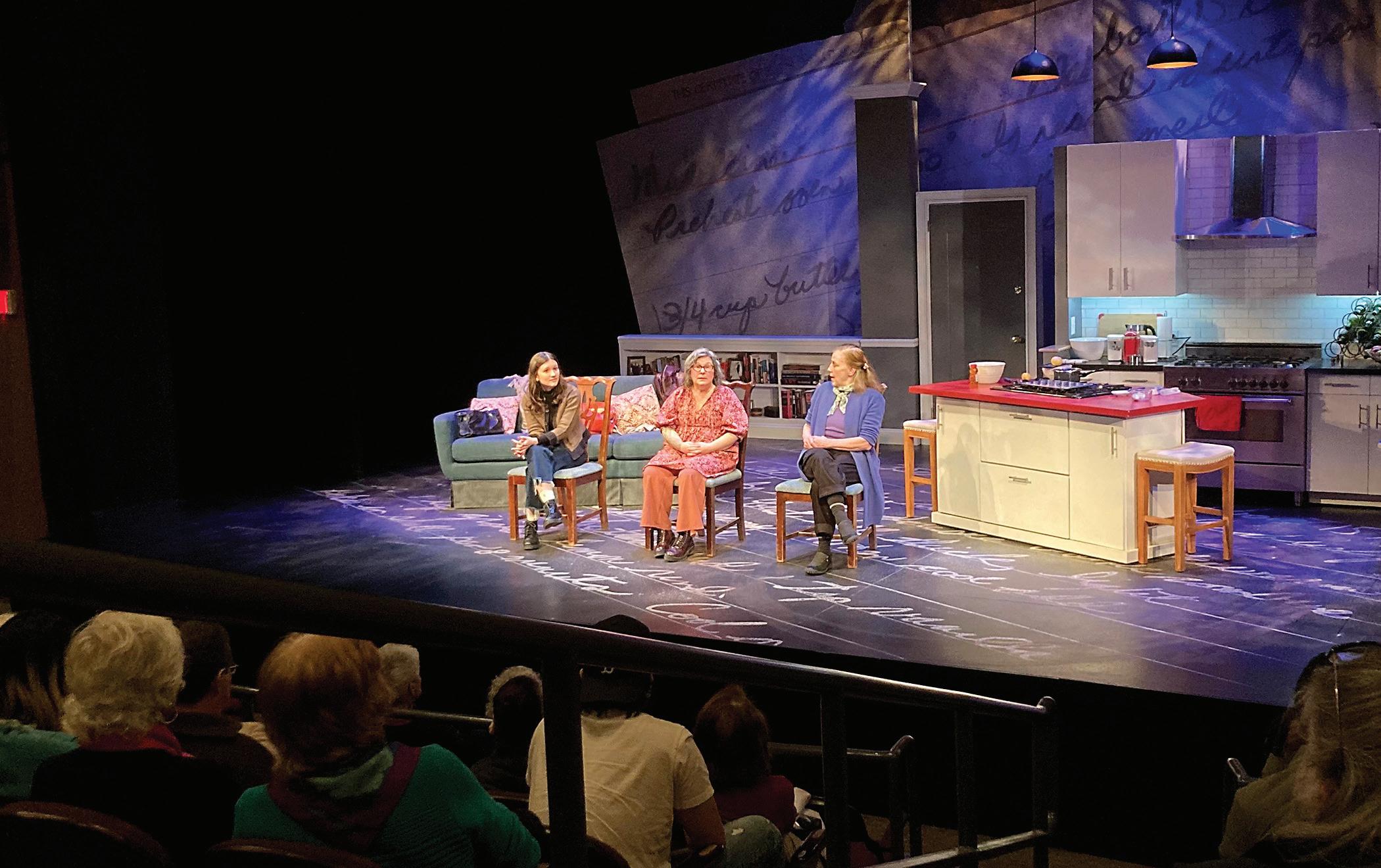
Dramaturg Kimmarie mccrann, Playwright Bess welDen, anD artistic Director anita stewart, in a talKBacK after Madeleines By Bess welDen at PortlanD stage comPany in 2025.
A Christmas Carol
by Charles Dickens
PlayNotes Season 52 Editorial Staff
Editor in Chief Todd Brian Backus
Contributors
Skyler Brianna, Max Lerin, Meredith G. Healy, Julia Jennings, Sophie B. Diaz, Jordan Wells, Dylan Gurrera, Zach Elton, Macey Downs
Jessi Stier, Jack Allen Murphy, sam lucas, and Kaushik Raghavan
Copy Editor Adam Thibodeau
Cover Illustration Aressa Goodrich

Portland Stage Company Educational Programs, like PlayNotes, are generously supported through the annual donations of hundreds of individuals and businesses, as well as special funding from:
The Simmons Foundation



Susie Konkel
Harold & Betty Cottle Family Fund
Letter from the Editors
Dear PlayNotes Readers,
Welcome to our third issue of PlayNotes for the 2025-2026 Season!
In this issue, we explore the world of Charles Dickens' A Christmas Carol. This beloved holiday classic reminds us to treat others with kindness and reflect on how we can be better members of our own communities. Even though Dickens wrote A Christmas Carol over 180 years ago, these themes still resonate with a modern audience. To give context to the time period in which the story exists we have included articles like “Dickens' England” (p. 23), “Spiritualism and Ghosts” (p. 25), and “Celebrations of Christmas Past” (p. 28).
This production is directed by Portland Stage's Education Director Michael Dix Thomas. To learn more about his experience bringing the piece to life, check out our interview with him (p. 10). We have also included Focus Questions (p. 15) and Post-Show Activities (p. 17) to further discussions in the classroom for our younger audience members. Readers can also learn about organizations in the Portland area who work to support our neighbors throughout the year (“Community Connections” on p. 38 and “Outreach & Advocacy” p. 40).
When compiling each issue of PlayNotes, we strive to provide articles and interviews that give you insight into what the process has been like behind the scenes (Portland Stage’s A Christmas Carol ), contain pertinent information about the play’s setting and major themes (The World of A Christmas Carol ), and provide deeper dives into specific subjects that compelled our literary department (Digging Deeper).
We hope you enjoy this issue and we look forward to seeing you at the theater!
Sincerely yours,
The Portland Stage Literary Department
Todd Brian Backus
Max Lerin
Skyler Brianna Kaushik Raghavan
About the Play
Edited for content by Skyler Brianna (2025—26)
While we do have ample history in our city and charming relics of it (like our cobblestone-lined waterfront), modern-day Portland is a couple of centuries and an ocean away from Charles Dickens’ London. The world he was immersed in and wrote about was quite different from 21st-century Maine, yet the spirit of the holidays that emanates from A Christmas Carol still resonates around the world.
A Christmas Carol was first published in December 1843 as a novella, and it was one of Dickens’ few works to be distributed in a stand-alone fashion, rather than through serialization. Christmas rituals, which have since become tradition, were just emerging in English public life during the Victorian period, which lasted from 1837–1901. Dickens took advantage of this societal change around the holidays, and the book became an instant hit. Having often held public readings of his previous works, Dickens took A Christmas Carol on tour. Initially, he performed it as a one-man show, with proceeds donated to charities. It was so popular that he continued to do readings of it for the rest of his life.
A Christmas Carol has maintained its popularity across the years because of how its story of redemption transcends 19th-century English industrialism. In every era since Dickens’
lifetime, issues like wealth disparity and greed have continued to harm societies around the world. Especially during the holiday season, benevolence and human connection can get lost in the frenzy of shopping and gift-giving. When families spend the holiday season driving from store to store, getting stuck in traffic, bickering, and spending large amounts of money, it is easy for consumerism to eclipse the true gift of the season: quality time with loved ones.
Contemporary versions of the story show that there is still much to be learned from this cautionary tale of greed and malevolence. The character of Scrooge lives on not only in English-speaking cultures, where his name has become a popular synonym for “miser,” but around the world as the story continues to be translated, adapted, and produced. In both the original text and in Portland Stage’s production, Scrooge reiterates exactly what A Christmas Carol teaches readers and audiences by stating, “I will live in the Past, Present and the Future. The Spirits of all three shall strive within me. I will not shut out the lessons that they teach.” The universal themes of showing kindness and generosity toward others is just as timely now as it was when readers and audiences alike first experienced A Christmas Carol.
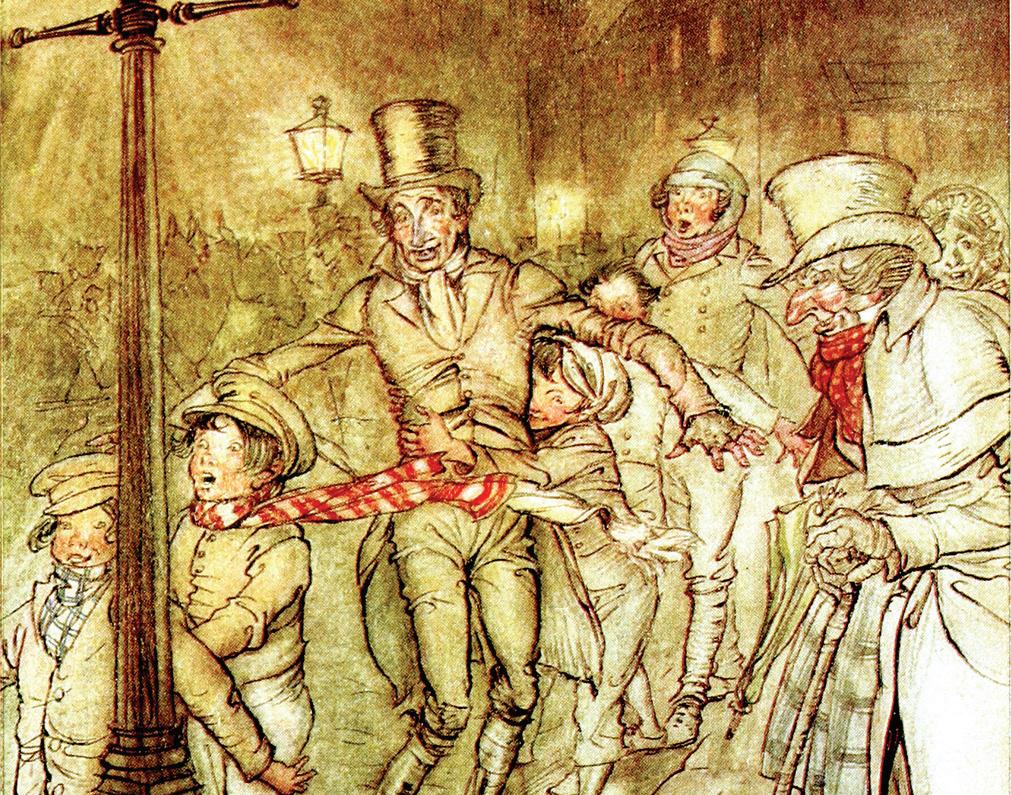
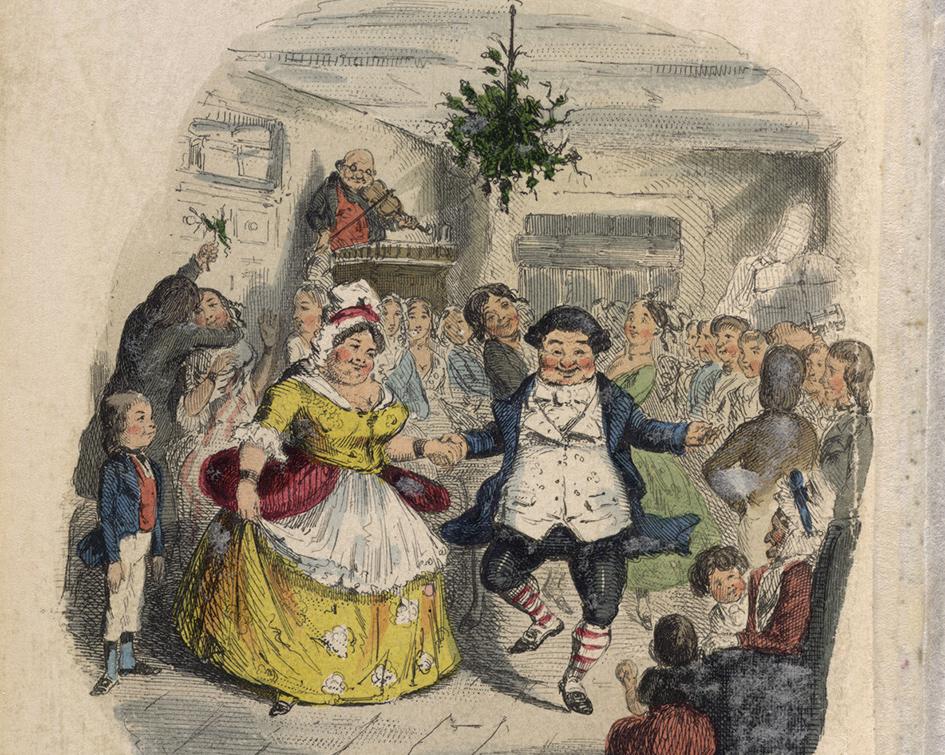
“mr fezziwig's Ball.colour illustration from 'a ChristMas Carol in Prose. illustrations By John leech” (1843)
image from DicKen's a ChristMas Carol By racKham (1915)
Production History
Edited for content by Skyler Brianna (2025—26)
Dickens’ novella A Christmas Carol was a hit from the start, with 6,000 copies sold by the first Christmas after its publication. The enduring popularity of A Christmas Carol is due in part to its immediate and continued adaptation for stage and screen. The first theatrical adaptation of Dickens’ novella opened in London at the Adelphi Theatre in February 1844. The story’s fantastical imagery and sparkling dialogue made it perfectly suited to the stage and by the end of that year, a total of eight theater companies had produced their own versions of A Christmas Carol.
While A Christmas Carol may have begun as a novella, its theatrical tradition has been firmly established, coming to life each year on countless stages with ghosts, memories, and a healthy dose of Christmas cheer. Today, A Christmas Carol is in the public domain, meaning that it can be adapted freely. Dozens of regional theaters across the United States make A Christmas Carol a part of their communities’ annual Christmas traditions. Many, like Portland Stage, create their own adaptations, but even theaters that share the same script focus on unique aspects of the story. Cast sizes range from one to thirty, and the style of each production varies depending on the vision of the company. Portland Stage’s version this winter will be the theater’s 24th production of A Christmas Carol.
A Christmas Carol is not only performed at community and regional theaters; it was seen on Broadway for four different limited engagements between 1991 and 2001, and it returned to Broadway for 57 performances in 2019, winning five Tony Awards. Since so many theater companies produce A Christmas Carol annually, there is a push to make it new and exciting each time. Some productions that heeded the call to reimagine the classic include A Christmas Carol: The Traditional Story with Modern Music published by Dramatic Publishing Company and the 2009 adaptation written and directed by Susie McKenna, which presented the story as a play-within-a-play, wherein a miserly uncle and his nephew tell the story whilst locked in a theater. Every adaptation is a little different, and adaptations
take many different theatrical forms, such as straight plays, musicals, radio plays, and one-person shows. The production of these adaptations can also vary vastly—some are elaborate spectacles that use countless props, magical maneuvers, and complicated scenery, whilst others are a simple staged reading on an almost empty stage.
Ever since the first productions occurred over 180 years ago, A Christmas Carol ’s popularity has only increased. With the advent of motion pictures, A Christmas Carol was one of the first novels to be adapted into a screenplay, with silent versions produced in both Britain and the US. As film technology developed, so did numerous adaptations of Dickens’ tale. Over the last hundred years, actors including Reginald Owen (1938), Alastair Sim (1951), Albert Finney (1970), George C. Scott (1984), Michael Caine (1992), Patrick Stewart (1999), and Jim Carrey (2009) have all portrayed Ebenezer Scrooge on film.
A number of animated versions (like Mickey’s Christmas Carol ) and musical television specials have paid homage to A Christmas Carol as well, featuring familiar casts of characters such as the Muppets, the Flintstones, and the Looney Tunes gang. Films have also adapted the traditional Scrooge story to feature a new iteration of Scrooge. For example, the 2000 film A Diva’s Christmas Carol starred Vanessa Williams and modernized the classic Scrooge story to feature a greedy pop singer. As recently as 2019, a three-episode miniseries of A Christmas Carol was aired by the BBC, focusing on Scrooge as a villain. Since Dickens first published the story in 1843, it has undergone many adaptations, but the spirit of the original novella remains. It is because of that spirit that A Christmas Carol remains a quintessential part of the holiday tradition.
About Charles Dickens
Edited for clarity by Meredith G. Healy (2019–22) and Julia Jennings (2023–24)
“Whether I shall turn out to be the hero of my own life, or whether that station will be held by anybody else, these pages must show.” So wrote Charles Dickens at the beginning of his most autobiographical novel, David Copperfield. Like David, Dickens’ early years were difficult: these early experiences with poverty and strife inspired many of his beloved characters as he grew to become one of the most cherished and revered writers of the English language. Charles John Huffman Dickens was born on February 7, 1812, at a small house in Portsmouth, Hampshire in England. His parents, John and Elizabeth, were members of the emerging middle class, and his father worked as a clerk in the Navy Pay Office. When John was transferred to Kent in 1817, the family went with him. They relocated to a larger home where Dickens spent five happy years attending school, putting on theatrical productions with his seven siblings, and reading avidly.
However, John Dickens, who was generally regarded as a generous, if lavish, man, was not frugal with the family’s funds. In 1824, the entire family, with the exception of Charles,
went to live in the Marshalsea debtors’ prison in London. Meanwhile, 12-year-old Dickens went to work at a boot-blacking factory in Southwark to help pay off the family’s debts. It was a difficult time in his life, and many of his characters, including the title characters of Oliver Twist and David Copperfield, as well as Pip from Great Expectations , were based on his experiences as one of the many lonely, laboring children who dotted London’s streets during Victorian times.
Respite seemed to come when the family was released from prison a few months later, but, to Dickens’ horror, his mother insisted that he continue working at the factory because she had grown accustomed to the extra income. Finally, at his father’s insistence, Dickens was allowed to return to school to complete his education. In 1827, at the age of 15, Dickens left school for good and took a position as a clerk in a law office. This proved to be a useful experience for him as it honed his writing skills and taught him shorthand, which he used to get a job as a court reporter. It was during this time that his first short story, “A Dinner at Poplar Walk,” appeared in The Monthly Magazine
In 1834, Dickens became a reporter for the newspaper The Morning Chronicle, where he wrote under the pseudonym “Boz,” his father’s childhood nickname for him. This led him to title his first book Sketches by Boz (1836), which was a collection of written sketches of Londoners. 1836 was a banner year for young Dickens, as the first installments of his serial novel, The Pickwick Papers, appeared a mere seven weeks later, solidifying him as a household name. In April of that year, Dickens married Catherine Hogarth, and left the Chronicle to become the editor of the magazine Bentley’s Miscellany
January of 1837 was the most commercially successful and prolific time of Dickens’ life. His next two novels, Oliver Twist and Nicholas Nickleby, were published as serials and had a new chapter released every week.
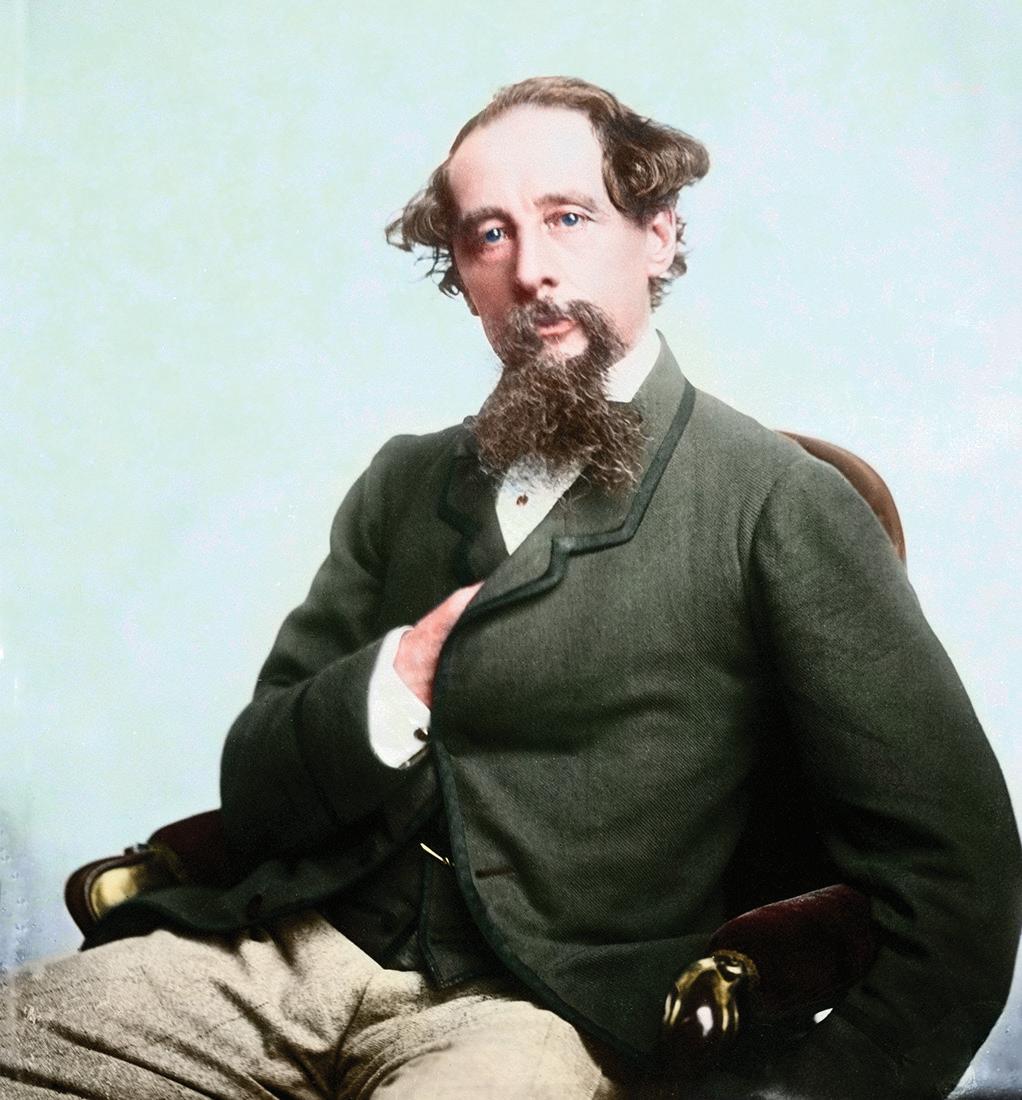
charles DicKens.
The Old Curiosity Shop, published between 1840 and 1841, marked the beginning of Dickens’ popularity in the United States. Each installment would arrive in New York by boat, and the distributors waiting on the docks would shout to the sailors, “Does Little Nell live?”, eager to discover the fate of the book’s young heroine.
The serial format meant that Dickens remained prolific, almost uninterrupted, for 35 years. However, following The Old Curiosity Shop, Dickens faced a rough patch in his career. Barnaby Rudge (1841) enjoyed little commercial success. His American Notes , published following his first journey to the United States and Canada, was very poorly received in those markets because it was highly critical of the US. These same sentiments inspired portions of Martin Chuzzlewit, which solidified distaste from American readers. Dickens went on to tour the US twice more, which led him to add a preface to all future copies of American Notes tempering some of the judgments the book contains. It states, “My readers have opportunities of judging for themselves whether the influences and tendencies which I distrusted in America, had, at that time, any existence but in my imagination.”
The one element of American society to survive Dickens’ sharp criticism was his experience with the Unitarian Universalists, a liberal spiritual movement unattached to any specific creed. In Boston, Dickens met with Ralph Waldo Emerson, William Ellery Channing, and other leading figures of the American Unitarian movement, a visit which Dickens praised in his Notes. Not long after returning to London, Dickens officially joined the Unitarian Church, writing “I have carried into effect an old idea of mine, and joined the Unitarians, who would do something for human improvement, if they could; and who practice Charity and Toleration.”
Dickens wrote A Christmas Carol soon after, believing he could use his fiction for social good. Indeed, the novella significantly reshaped our modern understanding of Christmas, aligning the holiday with supporting and giving to those in need
within our communities. While Scrooge’s own conversion seems to mirror Dickens’ experience with the Unitarians, Tiny Tim’s cry of “God bless us, every one” at the end of the story appears to reach beyond any denominational understanding of redemption, and embraces the universal message of community care and altruism.
Dickens managed to win back his audience in the US with A Christmas Carol, which appeared in December 1844. He wrote the entire novella in a scant six weeks, and went on to publish it as a single volume in an effort to keep the price down. However, Dickens was extremely specific about the cover and illustrations, which caused the publisher to have to reprint multiple times. Since Dickens had recently renegotiated his contract to receive a portion of the profits rather than a lump sum, Dickens made almost no money off the beloved book.
Following a long tour of Europe with his family, Dickens settled into an estate called Gads Hill, which he’d admired since childhood. There, he renewed his love of theater by collaborating on the script for The Frozen Deep with writer Wilkie Collins. A young actress named Ellen Ternan was in the cast, and she and Dickens began a passionate affair that would last the rest of his life. He ended up separating from his wife Catherine and going to live with Ellen, supporting Catherine and his ten children only financially.
Dickens’ health began to fail in 1866, but he continued to write and give public readings against his doctor’s wishes. Finally, on June 9, 1870, at the age of 58, he died of a stroke, leaving his 17th and final novel, The Mystery of Edwin Drood, unfinished. Dickens was buried in Poets’ Corner of Westminster Abbey. The processional lasted three days, and the day of his burial was one of national mourning for England. Dickens remains one of the most beloved writers in European literary history.
An Interview with the Director Michael Dix Thomas
Edited for Length and Clarity by Skyler Brianna (2025—26)
Directing and Dramaturgy Apprentice Skyler Brianna interviewed director Michael Dix Thomas about his process and experience directing A Christmas Carol .
Skyler Brianna (SB): What’s your background in theater?
Michael Dix Thomas (MDT): I’m an actor first. I started doing theater in middle school and high school, and there used to be a summer Shakespeare program run by The Children's Theatre of Maine, in Deering Oaks Park. When I was 16, I was in that, which was the first time I was in a play outside of school. Some of the classes and rehearsals for that actually happened in this building [Portland Stage]. Those experiences were really impactful and informative. I went on to study theater and acting in undergrad, and I worked as an actor and a little bit as a director after that in the area. I moved to DC in 2015 and got a Master’s Degree from the Shakespeare Theatre Company. I did more teaching and directing and acting. I moved back to Portland in 2022 and I’ve been the Education Director at Portland Stage ever since. So, my background is as an actor primarily, but I've also been a
director and a teacher and I'm currently a teacher most of the time.
SB: As you mentioned, you’re the Education Director here at Portland Stage. How does your experience as an educator inform your directing process for both young actors and adults?
MDT: I honestly don’t think that it's that different working with adults and working with young people. I think that a director needs two things: artistic vision and communication skills. Because this form is so collaborative—there's the actors in the room, but there's also all the designers and all the folks collectively working on a project—you can have the best ideas in the world, but if you can't figure out a way to communicate those to other artists and take everybody's views into account, and then use that to try to move the whole thing forward, then it doesn't matter what your vision is. So I discovered that early on in my career and decided that it was much easier for me to focus on my communication skills than it was for me to develop whatever “artistic vision”—which, by the way, is something we absolutely all do. By living in the world, and by reading plays, and
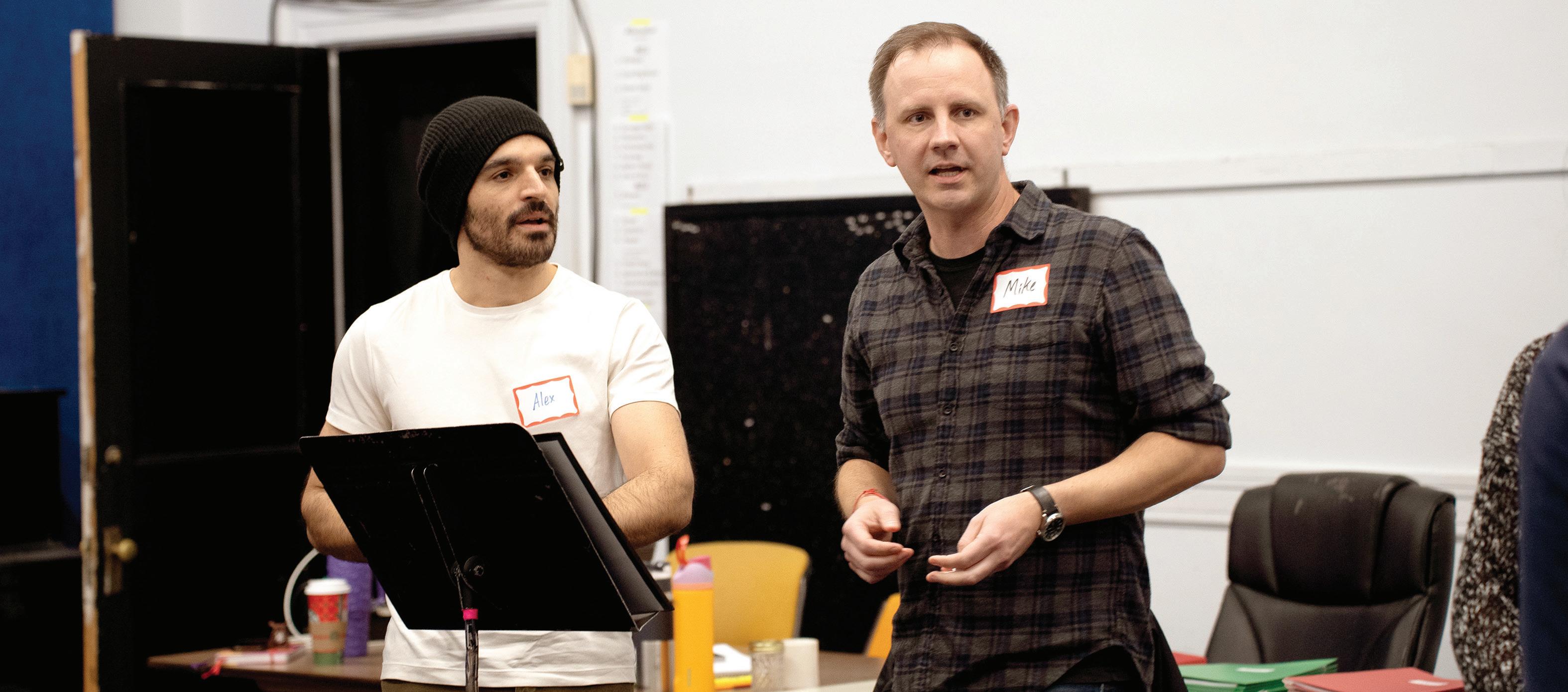
alex Purcell (aea) to the left of Director michael Dix thomas at the first reaD-through of a ChristMas Carol
Photo By aressa gooDrich
engaging with other art forms (like music and visual art and seeing plays)—taking in all this information and thinking about it critically is what shapes our perspective as artists. That’s how we build a point of view. So that's a thing I've spent a lot of time thinking about, which is a huge part of working as a teacher as well. I think you’ve got to find ways to talk to people that empowers them and makes them feel safe and willing to play, and I think that is just as true with adults—in fact, in many cases, they're further away from those instincts than young people are.
SB: What's the importance of having children in professional shows like this one, and how is it valuable for not only them, but everyone involved?
MDT: It's really valuable and special to give [the youth ensemble] this fun experience. A lot of them really adore it and come back here year after year. A lot of our young folks don't go on to pursue theater, but it's still really important for them to have an experience of working on an artistic project collaboratively with other people. It's a great way to learn about teamwork and collaborative creation. It’s also an opportunity to learn about the process of identifying and expressing your own emotional experience, and recognizing other peoples’ emotional experience, and how to communicate to people and make our needs heard and respecting other peoples’ needs. It’s also valuable to practice navigating the complexity of working in a (sometimes highstress) work environment, in order to create something that has an end goal. The show is going to open on December 6th one way or another—we all know we have to get here, we have to do things to get there, and learning how we do that collectively is a really satisfying and unique experience. That mix of some folks as young as seven, learning these skills by working with professionals who have been doing this for decades, is really special.
On the other side, I think for all of us, it's really valuable to be in the space with young people who are in many cases much more closely connected to that sense of play—who are really honest in their responses to things, who will tell you if something is working and
is effective (or if it's not!). I think that's really helpful for us who can get very caught up in the “why” or the theory behind something, when—if it’s not working in the room, then it’s not working—we gotta find another way in.
A full cast of both adult and young actors is valuable to the audience as well. In a given performance of this production, we have a cast of 19 actors, plus 12 people working on the crew (between the apprentice company and the stage management team), [and] then on top of that, we have all the designers working on the project. There are really so many people involved in something like this, and that's the case with so much that happens here, but frequently the cast on stage is small, so it can be easy for audiences to see this as a smaller collaborative operation than it actually is. And when we get to put people of various ages on stage, it adds a layer to the world that we’re creating, because then we’re not just showing you London in the 1840s, we’re showing you London in the 1840s with kids in it—which is accurate. So that’s great, because it really adds to the storytelling.
SB: What's your favorite moment in this production?
MDT: Watching Tom Ford navigate the moment in our script called the “New Day,” where Scrooge wakes up from his last visit with the Ghost of Christmas Yet to Come. Watching this actor figure out how to move through the text of Scrooge realizing “it’s all here, it all really happened” and making his promise to Jacob Marley to change his ways, and then recognizing that he has the chance to do that. This play keeps hammering home these lessons that a person can change, that you can rewrite your own future, and Scrooge gets the chance to live that, and I think watching Tom navigate that is really exciting and really fun. It always gets me. We played a lot with that scene two years ago when Tom last worked on it and I directed it, and it’s fun to see him going through it again, finding new things, finding new flavors and lenses and angles and colors to that scene, it’s really beautiful. His work as an actor is wonderful. He's able to take this character that's so big and cartoony and put
him into a real, grounded human person. He makes Scrooge, to me, feel like someone who you could run into in the world—though he’s extreme, he would make sense in this world and I really love that, I really appreciate that about Tom.
SB: A Christmas Carol has been performed on stage for over 180 years and this is Portland Stage’s 24th production of it. How do you approach the show to bring new perspectives and discoveries to the table to make this production unique?
MDT: Before I get into this script, I try to start with the novella. I reread the book and see if I can approach it with fresh eyes—is there an angle or a lens or a piece of the story that exists in Dickens’ writing that has not yet been highlighted by a production that I've been involved with? I’m always trying to make the show resonate for a contemporary audience, and particularly for audiences of young people because we have so many more student matinee performances (where school groups come to see the show) with this production than anything else in our season. So, I’m thinking about them a lot. Something new that you’ll see in this particular production is a reworking of the prologue. We changed it this year to try to find a way into the story that brings us closer to bridging that gap between the contemporary world and the world of the play—London, 1840s.
In this production, we also have a mix of actors who have done this specific production at Portland Stage before, and those who are new to it. The latter bring in their new takes and discoveries, having not experienced it before. For the actors who have worked on it previously and seem to know the process well, I encourage them to explore “why are we doing that, what else is there to mine out of this moment?” We continually ask, “What have we done in the past, versus what are we trying to focus on, what's the core idea of this scene, and how do we come back to that?” I think there are lots of little things I try to do throughout the process to bring people back to the sense of discovery in the room. I try to start us from a place of “what if we didn't already know what we were gonna do?”
Though, there are some times where we know,
really effective and worth the payoff.” It’s a real
speaking world. It introduced a modern idea of

world, connecting with your fellow humans, in addition to it being the celebration of the birth of Jesus Christ. So, not to say that Dickens by any means built a secular Christmas, but there are secular messages in this story that shaped the way we culturally recognize Christmas, and that helps this story to have a lasting impact. For that reason, this production (as many other productions and adaptations throughout time have) expresses a joy of Christmas and brings us a lot of fun, coziness, and familiarity. All of these components are part of why the show is so successful, year after year.
In some ways, I feel like if we’re trying to reinvent, and create, and do something different, we have to push against some of that in our work in the room to create a show that can resonate on a different level, which is also important. Part of why this show was so important, why Dickens’ work was so important during his lifetime, is how he's shone a light on some of the much darker sides of Victorian life—particularly what the English cities looked like in the midst of and at the tail end of the Industrial Revolution. The cities were incredibly polluted, the Industrial Revolution had allowed for many more people to make much more money off of the labor of individual workers, without raising the pay for those workers. Their jobs became more dangerous and the world around the factories became polluted by the industrial process.
Director, michael Dix thomas.
So you end up with a deeply dispossessed working class, a huge section of people who have been unemployed by overefficiency in work, and an increase in wealth concentrated by the highest earners. So we’re telling a story set in the pretty dystopian world that Dickens was in and that was the focus of his writing through most of his work. I think there are pieces of that story that resonate with people now, even though our situation is in many ways different from 1840s London. I have thought about this show through a quasi-political/ economic lens in the past, and as powerful as I think that is, the details are different enough that it struggles to resonate as immediately as I want it to with a modern audience, in terms of the economics of the storytelling. I think that what is most effective in our work as theater artists, when we’re telling a story in a room with an audience, is to focus on the human aspects of the story.
And I think that the economic and human aspects are connected. We are telling a story about a man who has shut himself off from the world, who discovers that he can move through that shut down-ness and open back
up again, and that his actions are specifically related to the way that he acquires, hoards, and distributes money, right? And if we look at our world as shut down and separated from one another as we walk through the streets of Portland, there is a real cost to that, as we learn through Scrooge’s story. It's impossible to walk into Portland Stage without walking past someone who is struggling on the street, and usually on my travels in, someone is asking me for money on my way into the theater. That is the nature of what it is to live in Portland, Maine, right now. It is just one way that our lives connect and really resonate to the world that Dickens is writing about, to me. So if there is anything that I want folks to take away from this, it's the reminder that we live in a world with all these other people, and that we need to recognize them.
One thing that the story does really well is tell us that one person's actions can have an impact. Collective action is actually the way to our shared liberation, [but] I think it is through those individual actions that we start to build towards collective action. I think that’s where this show can move us.
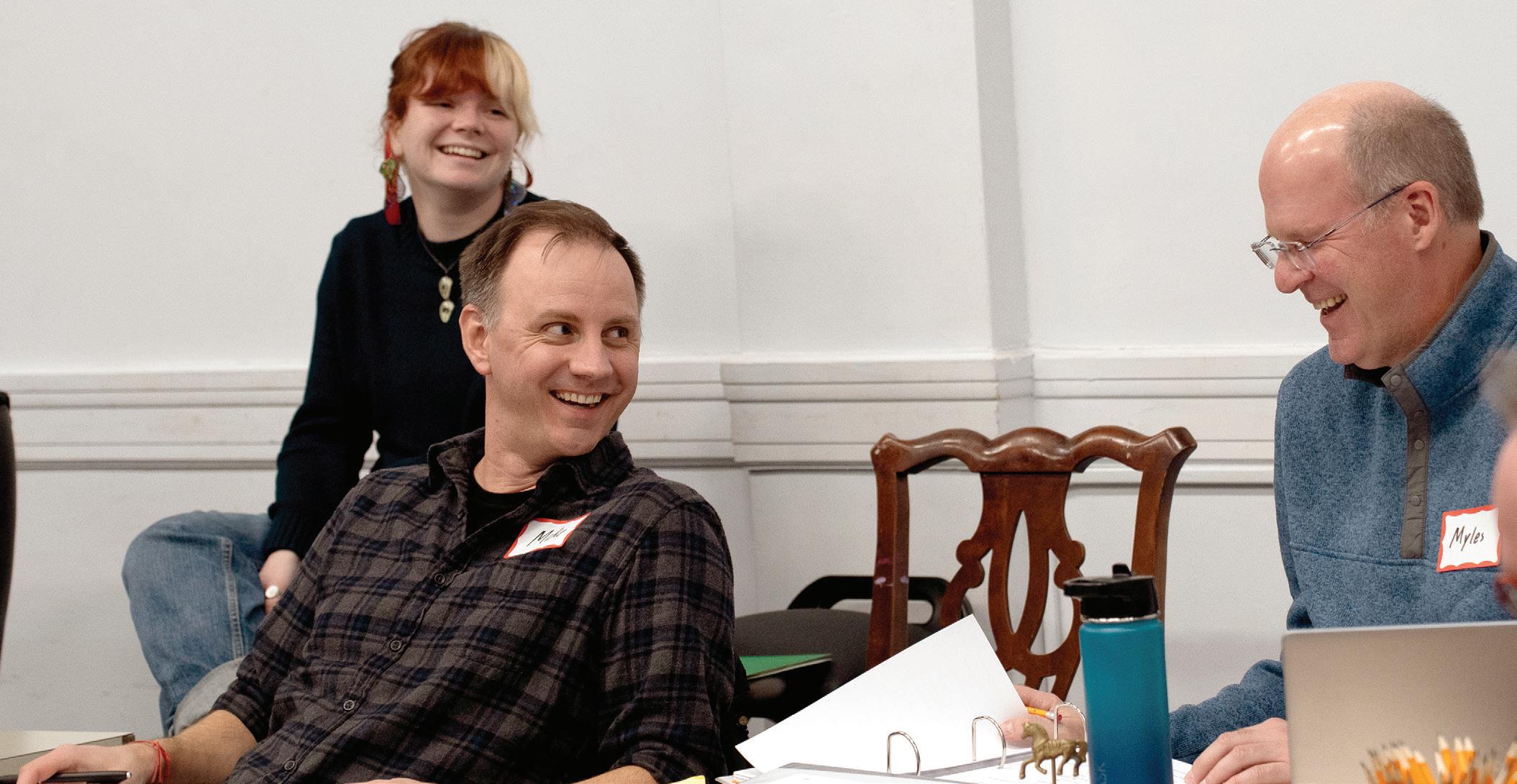
ProPs aPPrentice Briget Beecham (toP), Director michael Dix thomas (left), anD stage manager myles c. hatch all share a laugh at the first reaD of a ChristMas Carol. Photo By aressa gooDrich.
About the Cast and Characters
by Skyler Brianna (2025—26)

Name: Tom Ford (AEA)
Character : Scrooge
Scrooge: A miserly old man, known for his callous greed and coldheartedness.

Name: Dustin Tucker (AEA)
Characters: Bob Cratchit, Fezziwig, Undertaker
Bob Cratchit: Scrooge’s clerk. Father to 7, including Tiny Tim. A kindhearted man, who maintains his optimism despite his poverty.
Fezziwig: The boisterous and joyful employer of Young Scrooge.
Undertaker: Someone who prepares the deceased’s body for burial.
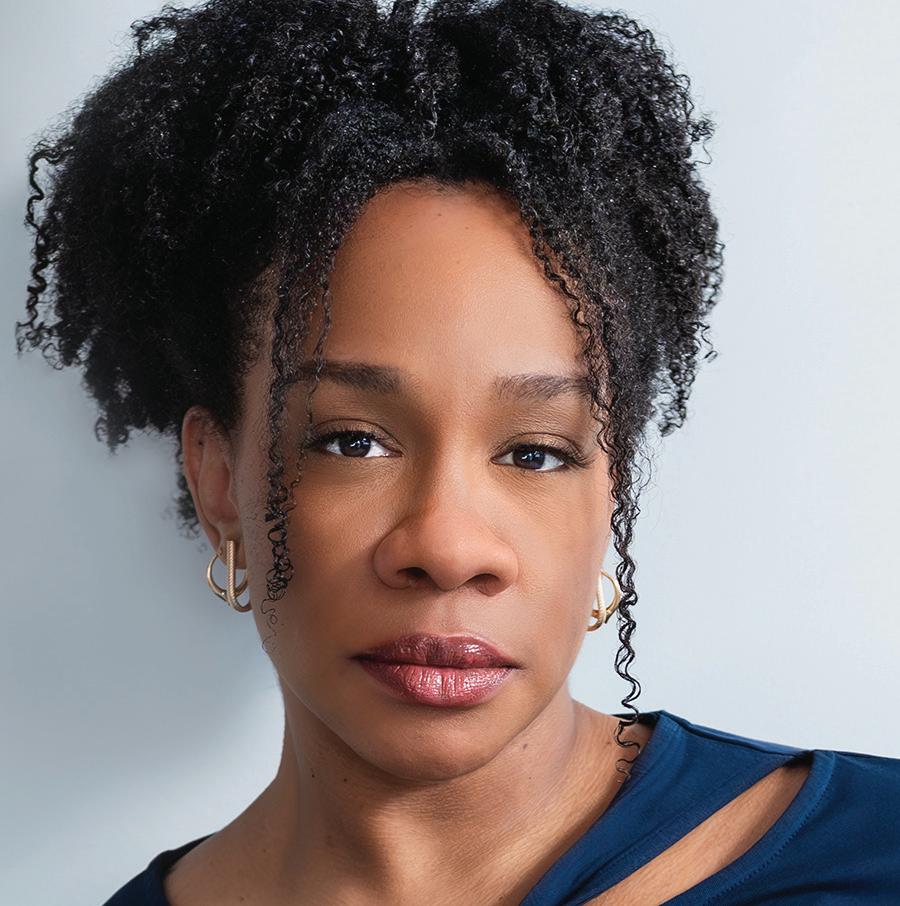
Name: Breezy Leigh (AEA)
Characters: The Ghosts, Charity Woman
The Ghosts: The Ghosts of Christmas Past, Present, and Future.
Charity Woman: Collecting donations for the poor.

Name: Alex Purcell (AEA)
Characters: Marley, Charity Man, Belle’s Husband, Topper
Marley : Scrooge’s late business partner.
Charity Man: Collecting donations for the poor.
Belle’s Husband: Married to Belle.
Topper: A guest at Fred’s party.

Name: Sarabell Wrigley
Characters: Belle, Fred’s Wife, Debtor, Charwoman
Belle: Scrooge’s young love. They broke up in their youth, once Scrooge’s greed began to take over.
Fred’s Wife: Married to Scrooge’s nephew.
Debtor: A member of the community who owes money to Scrooge.
Charwoman: A member of the community who cleans households.

Name: Thomas Ian Campbell
Characters: Fred, Young Scrooge
Fred: Scrooge’s nephew. Optimistic and boyish. Generous and full of the Christmas spirit.
Young Scrooge: Scrooge as a young man, when he works for Fezziwig and is in love with Belle.

Name: Brynn Lewallen
Characters: Mrs. Cratchit, Mrs. Fezziwig, Irmengard, Old Jo
Mrs. Crachit: The spitfire wife of Bob Cratchit. Mother to 7, including Tiny Tim.
Mrs. Fezziwig: The joyful wife of Fezziwig.
Irmengard: A guest at Fred’s Christmas party.
Old Jo: A member of the community who runs a beetling shop (similar to a pawn shop).
Focus Questions
by Sophia B. Diaz (2020—21) & Jordan Wells (2020—21)
1. What makes Charles Dickens' A Christmas Carol so popular? Why do you think many people continue to watch and read it every year?
2. Do you think this story is for children or adults? What aspects of the tale make it appeal to both audiences?
3. This story relies on supernatural elements. Why do you think Dickens chose ghosts to facilitate Scrooge’s transformation?
4. How does A Christmas Carol reflect the economy and class structure of Victorian England? As a writer, how did Dickens respond to these social and economic issues?
5. What do you believe our responsibility to our community is? In what ways do you fulfill that responsibility?
6. Charles Dickens' A Christmas Carol is set at Christmastime, but the show deals with themes of transformation, kindness, and community engagement. How does A Christmas Carol transcend the idea of Christmas to appeal to everyone, regardless of religion?
7. Dickens describes many Victorian holiday traditions in his story. What is a tradition? What are some traditions that you have?
8. In A Christmas Carol, Scrooge has to learn from the past, present, and future. Why is it important to listen to all three? How do the three complement each other in the lessons they teach?
9. What are some ways that people at all levels of financial stability give back to their community? Consider ways to give back beyond donating money.
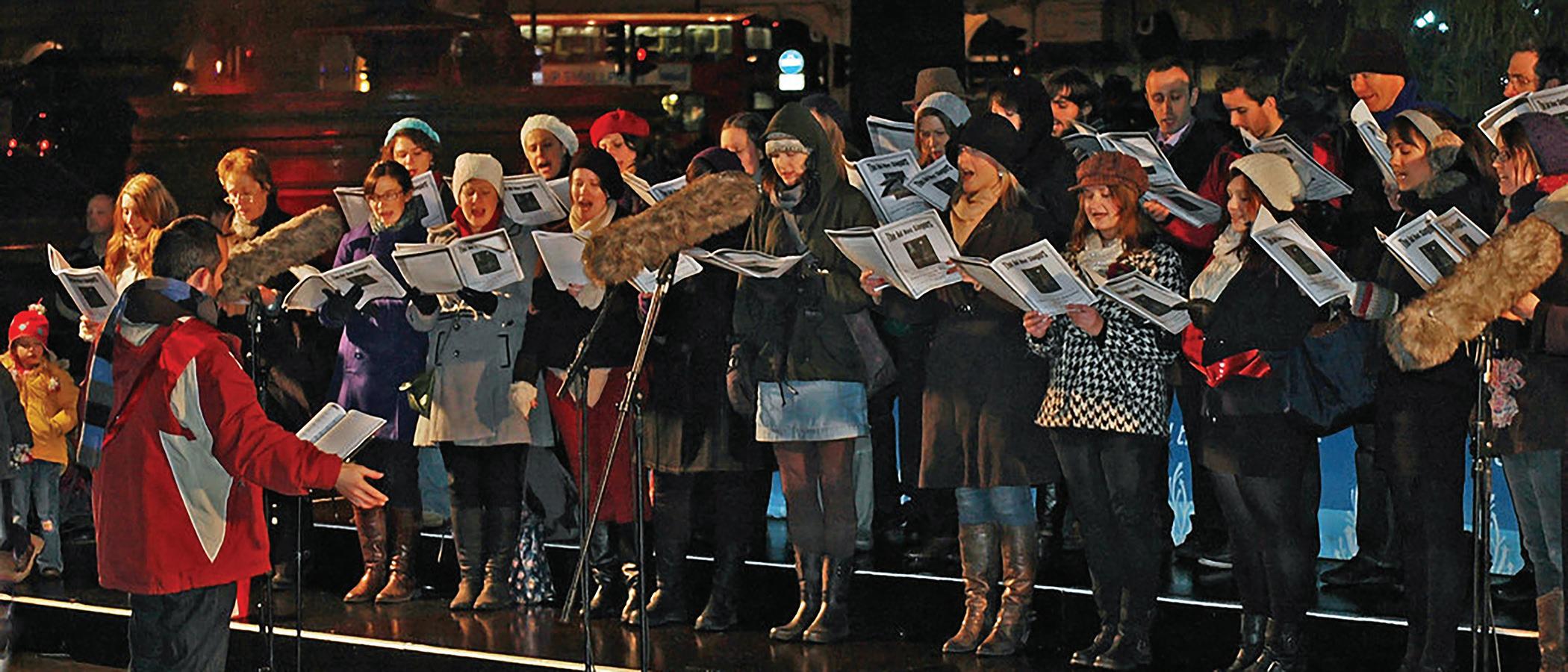
a grouP of carolers on the stePs of trafalgar square in lonDon.
Pre-Show Activities
by Sophia B. Diaz (2020—21) & Jordan Wells (2020—21)
In groups, explore and discuss the following themes:
• Do you believe you can change the future by changing your actions in the present?
• What is the value of remembering the past?
• If you could revisit an event or time in your past, would you change it? Why or why not?
As a class, share the traditions you have for various holidays. Discuss them in light of the following questions:
• What are the roots of your family’s holiday traditions?
• What do these traditions mean to you?
• How has the meaning of these traditions changed for you as you got older?
• How do your traditions compare to other traditions around the world?
Charles Dickens wrote A Christmas Carol in 1843. It is set in London, and explores the life of the working class as compared to the life of the wealthy. In groups, discuss the following questions:
• What was life like for working-class people in Victorian London?
• What kind of jobs did the working class have in Victorian London?
• What are some ways that the working class struggled in Victorian London? What were some of the good parts of their lives?
Imagine you are a member of the working class in Victorian London. Write a journal entry about a day in your life.
Read the beginning passages of the novella A Christmas Carol.
• How does Dickens set the tone for the story he is about to tell?
• How would you adapt the passage for the theater? Work together in a group and divide up the lines. How can you use your voices and bodies to engage an audience? Perform your piece for your fellow classmates.
• What do these descriptions tell us about Scrooge as a character?
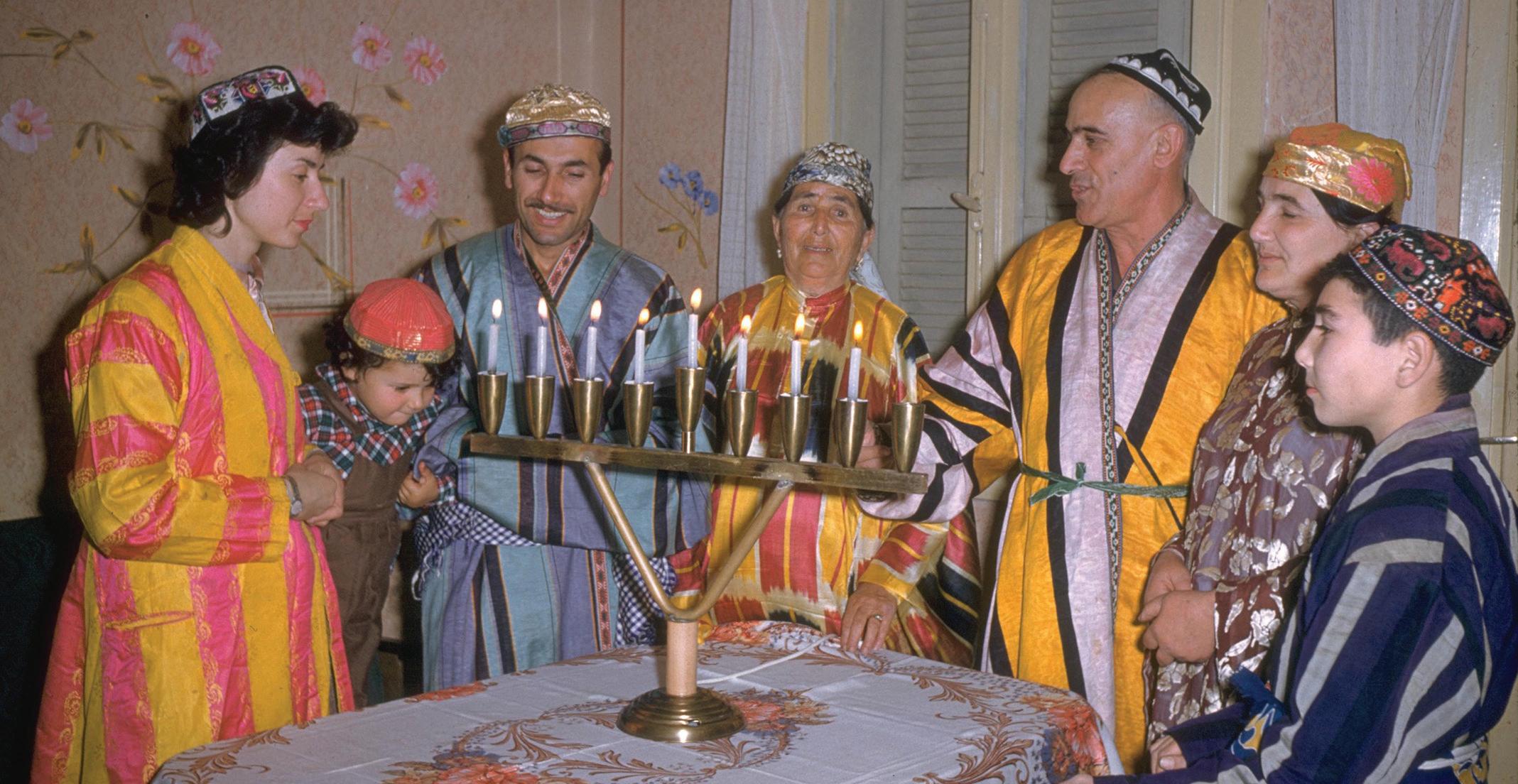
Costumes and History in A Christmas Carol
by Jessi Stier (2022—23)
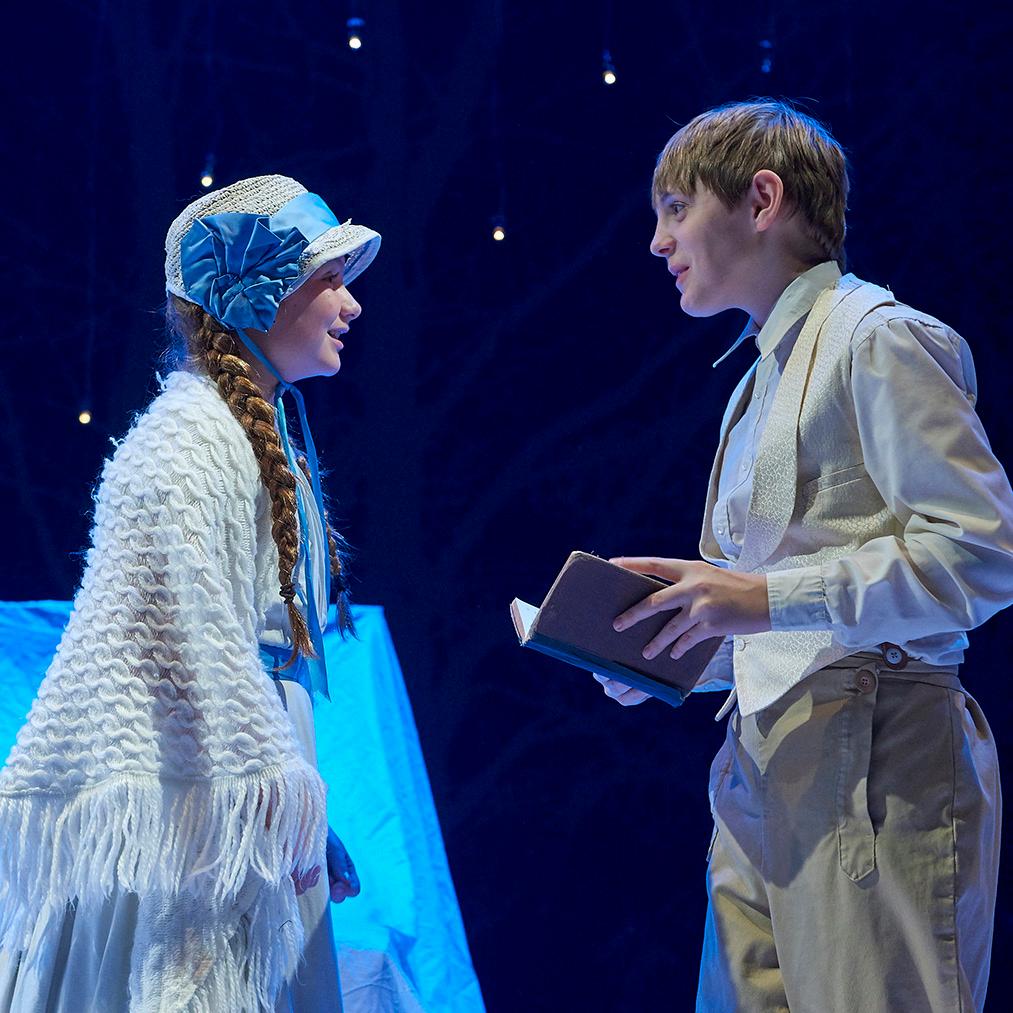
Portland Stage’s A Christmas Carol is filled with technical components that have entranced audiences time and time again. One of the most magical and critical elements to transporting viewers back to 1800s London is the costume design, led by Costume Coordinator Kathleen P. Brown and Costume Shop Manager Susan "Sue" Thomas. I sat down with Sue to discuss her history at Portland Stage, collaboration with Kathleen, and how it feels to return to this project over the years.
Sue grew up in Westbrook, ME, very close to Portland Stage. From a young age, she’s had a love for both architecture and fashion, so working in costumes felt like the perfect fit for her interests. Sue studied theater at Smith College, and upon graduation found her way to Portland Stage as a Costume Apprentice. She found the apprentice program to be very impactful, and in 2006, eagerly returned to work as Portland Stage’s Costume Shop Manager.
When asked about her history working on A Christmas Carol, Sue reflected on Jacqueline Firkins, a previous costume designer and
collaborator at Portland Stage who particularly inspired her. “Jacqueline was a fierce and intense woman,” she said. “I would come in in the morning and find that new dresses were made overnight!” Her passion left a long-lasting impact on Sue, as a few of her designs are still featured in A Christmas Carol today.
Sue and Jacqueline’s collaboration set a meaningful foundation for her partnership with current costume coordinator Kathleen P. Brown. “Kathleen is a fantastic, lovely human being who does things very efficiently, and has an incredible eye,” Sue said. She mentioned that she loves hearing Kathleen’s fresh ideas, as the pair find new answers to costume challenges. For example, rather than use makeup to simulate Marley’s jaw falling off as has been done in the past, Kathleen proposed using a mask to have a different stylistic effect. Comfort is also deeply important to Sue and Kathleen’s partnership, as they work to ensure that actors feel safe and seen in their identities during the costuming process.
Sue also appreciates that Kathleen utilizes Portland Stage’s costume stock to bring the design to life rather than constructing
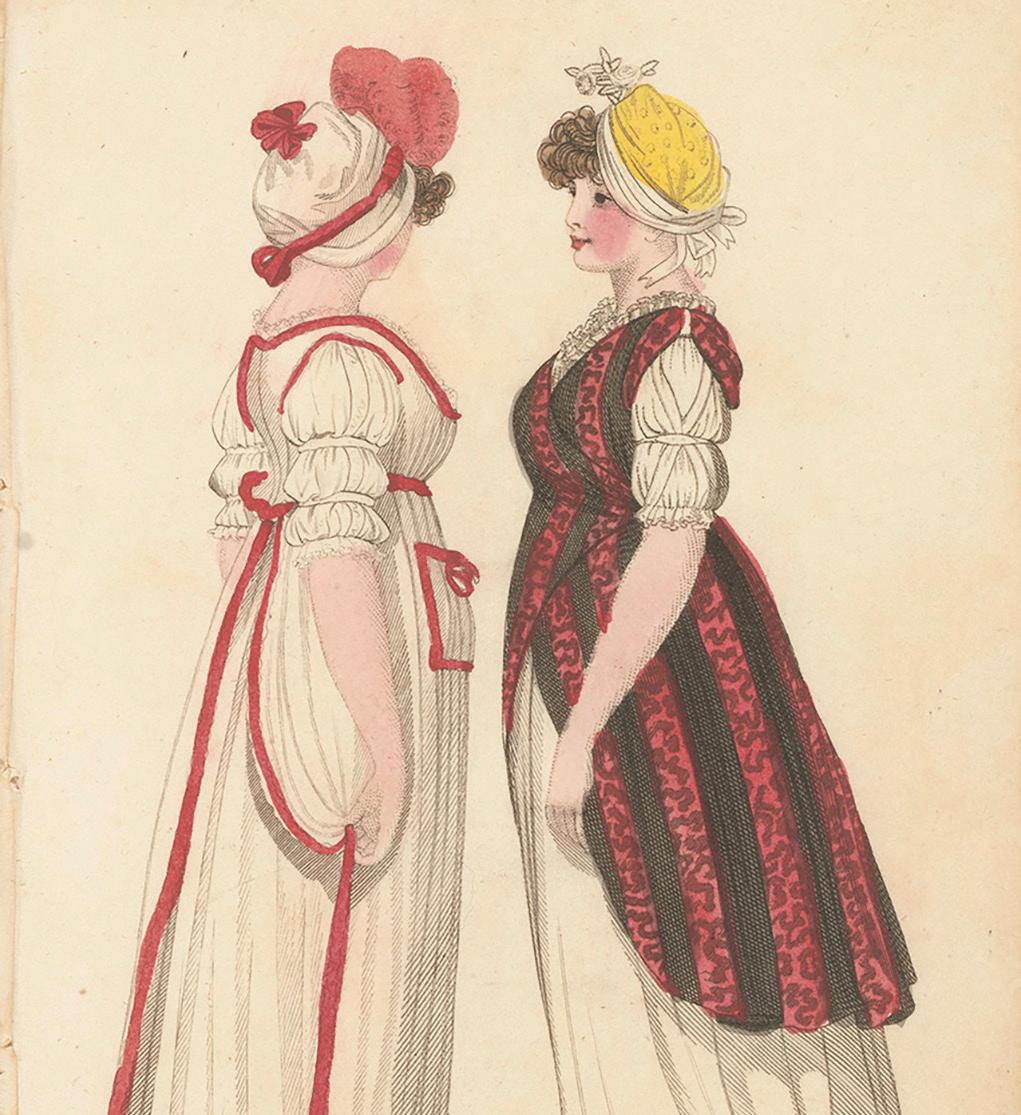
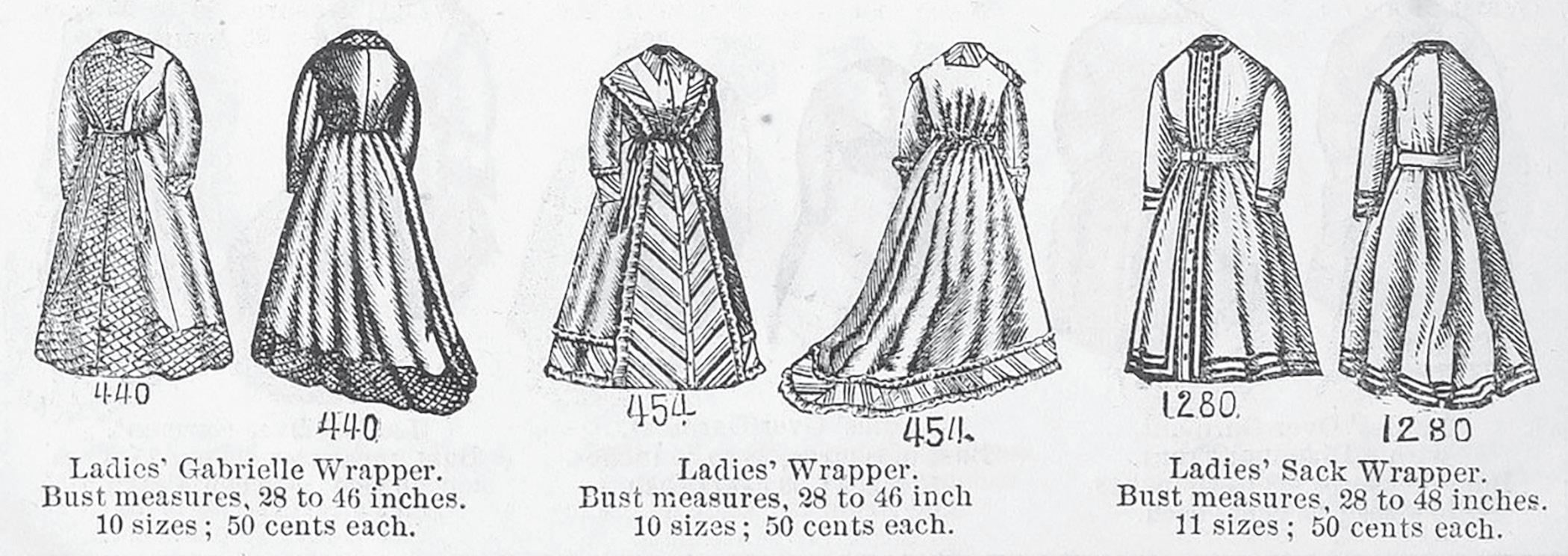
samPle of 1800s lonDon fashion.
PortlanD stage's youth comPany actors in costume.
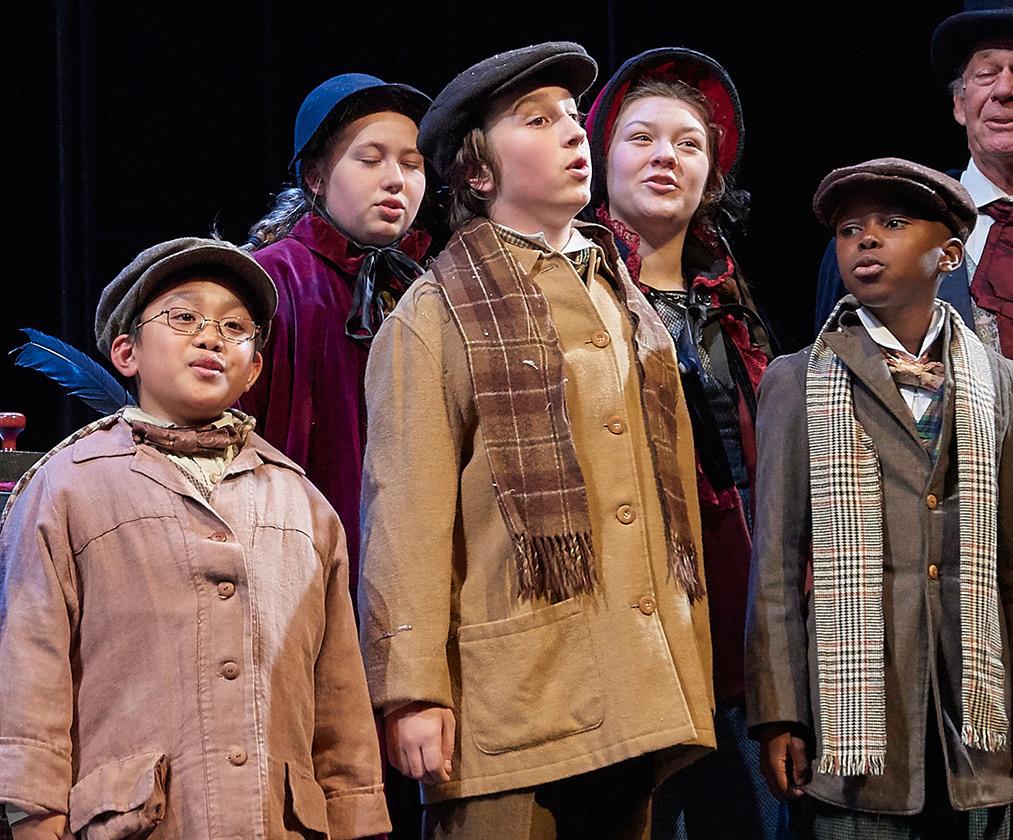
everything from scratch, so pieces that aren't always seen are used in performance. This provides a sense of authenticity for some characters. Rather than buying something new and distressing it to appear decades old, using an actual vintage garment brings an authenticity to its presentation, and be more accurate to the actor—enhancing character and story as well.
Many antique garments are used throughout the production including frock coats (a precursor to suit jackets), tailcoats, Bob Cratchit's tophat, and various capes and cloaks. Many of these garments are from the 1930s, and mirror the style of clothing from the late 1800s when A Christmas Carol takes place.
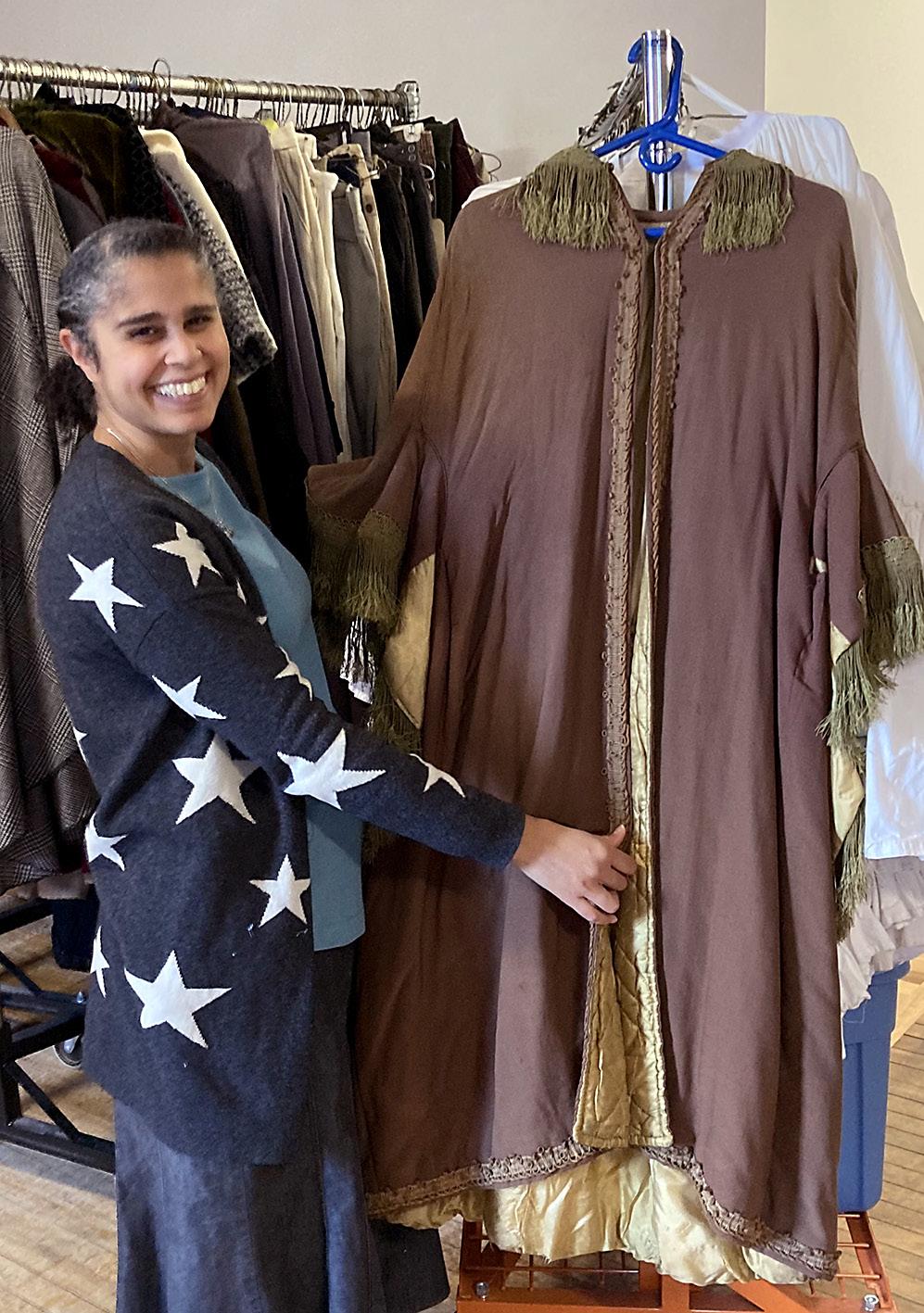
Sue’s personal favorite is a woman’s inverness, an outer coat with sleeves covered by a long cape originating from the 1850s. The garment was donated from New Orleans, and survived both the Civil War and Hurricane Katrina.
“That garment proves that if you construct something well, it will outlive you and your grandchildren,” Sue shared eagerly. She loves working with period garments, and looks forward to encountering them each year with A Christmas Carol
Sue’s favorite part of the tradition of A Christmas Carol however, is working with the Youth Company. “It’s fun seeing what they’re interested in and how they grow,” she said.
“Years ago, one of the kids who played Tiny Tim was really interested in Marley’s character,
and then ended up coming back as an adult to play Fred.” Getting to watch many of the actors grow up has been very powerful for Sue. She mentioned what an honor it is to train the next generation in theatrical practices, specifically inspiring an interest in costume history among young actors. She loves to educate the youth ensemble by explaining exactly why they’re dressed a certain way and strives to teach them that clothing is another language in itself. “Costumes are a code, and knowing that code can tell you a lot about a character,” she shared.
Overall, her collaboration with Kathleen, passion for antique garments, and love of theater education makes A Christmas Carol a very meaningful production for Sue and the Costume Department. They look forward to audiences seeing their hard work in action!
the youth ensemBle of a christmas carol in 2016.
susan thomas, costume shoP manager, with the inverness.
Glossary
by Zach Elton (2020—21) and Skyler Brianna (2025—26)
Actuarial accounting: The statistical calculation of life expectancies for the purpose of determining insurance rates.
Almshouse: Charitable housing provided to people who can no longer work. They were generally maintained by charities or the trustees of a bequest (money gifted to a person or organization, as dictated by a last will and testament).
Back-payments: An overdue payment from a debtor to a creditor on money owed.
Beetling shop: Similar to modern pawn shops. The poor sold any spare items they could find, like rags, bottles, bones, buttons, and metals.
Brazier: A portable heater consisting of a pan or stand for holding lighted coals.
Camden Town: An unfashionable part of London where the Cratchits live.
Capacious: Spacious.
Charwoman: Shortened from “chore woman.” A charwoman is a cleaning woman who did daytime chores but did not live with her employer, like a maid would.
Clergyman: A male priest, minister, or religious leader, especially a Christian one.
Clerk: A person employed, as in an office, to keep records, file, type, or perform other general office tasks.
Chief mourner: The person who organizes funerals.
Counting house: A counting house or counting room was traditionally an office where the financial books of a business were kept. It was also where the business received appointments and correspondence relating to demands for payment. As the use of counting houses spread in the 19th century, so did their
reputation as often uncomfortable and dreary places to work.
Comforter: A thick, woolen scarf, typically worn in the wintertime by those who could not afford an overcoat.
Covetous: Having or showing a great desire to possess something belonging to someone else. Synonymous with greediness.
Dowerless: Descriptor for a family who has no money to leave a daughter for her wedding or inheritance.
Gruel: Oatmeal or other hot cereal boiled in milk or water. It was a meager meal often offered to the poor at workhouses because it was cheap to make.
Half a crown: A Victorian measure of currency, once worth two and a half shillings (or two shillings and sixpence). Worth $26.65 in current USD.
Humbug: Deceptive or false talk or behavior.
Ironmongery: A British term for something made of metal; hardware.
Mince pies: A staple of British Christmas feasts, these rich pies included sugar, currants, raisins, apples, lemon, orange peel, spices, and ground meat, all in a pie crust.
Mirth: Gladness and merriment.
Undertaker: A person who dresses a body for burial and facilitates memorial services.
Workhouse (poorhouse): A publicly funded home for the poor and destitute that put people to work doing mindless and difficult labor in exchange for food and shelter. Very little money was spent on their maintenance to dissuade people from seeking aid there. In Dickens' time, it was a disgrace to be sent to the poorhouse.
Post Show Activities
by Sophia B. Diaz (2020-21) & Jordan Wells (2020-21)
1. Imagine yourself as the main character of Charles Dickens' A Christmas Carol.
• Who would the ghosts of your past, present, and future be?
• What would they look like and what would they say to you?
• Where would your spirits take you?
• How would your story end?
2. Fold a piece of paper into six equal-sized boxes. In the top three boxes, draw your ghosts of past, present, and future. Below each ghost, draw an image of somewhere that that ghost might take you. On the back of the paper, write a short paragra ph about each location, and then write about how your story would end—do you think you would go through a transformation, or do you think you would stay the same?
3. In this play, Scrooge tells us the story of his Christmas Ev e. Choose a different character in Scrooge’s story (Tiny Tim, Nephew Fred, one of the ghosts, etc. ) and write a paragraph about that night from their perspective.
4. Scrooge describes the night in great detail, including the p laces he goes and the characters he meets. Choose a location or a character from the play and draw/paint/collage a set or costume design for them.
5. How does each ghost contribute to Scrooge’s transformation? At the end of the play, do you think he has truly changed?
6. What characteristics make up Scrooge’s identity at the begin ning of the play? What about at the end? With a partner, discuss whether you believe Scrooge was truly able to change his identity at the end of the play.
An Interview Lighting Designer Bryon Winn
Edited for Length
and
Clarity by Kaushik Raghavan (2025—26)
Directing and Dramaturgy Apprentice Kaushik Raghavan interviewed Lighting Designer Bryon Winn about his long history with A Christmas Carol at Portland Stage and what keeps him coming back year after year.
Kaushik Raghavan (KR): How did you first come out to Portland Stage, and why do you keep coming back?
Bryon Winn (BW): I first came here in 1998. I came here to design A Christmas Carol. Anita [Stewart, Artistic Director] had called me in earlier in the fall. I can tell you exactly what I was doing. I had just designed a show in Minneapolis, and I was driving home in my car from Minneapolis to Iowa City and Anita called me on the way. I picked up my phone, and she said will you come out and design A Christmas Carol ? She and Chris Ackerland [Former CoArtistic Director with Anita Stewart] had run the theater for the first two years, and I had worked with both of them. I had met Chris and worked with Chris through Anita in San Francisco for Angels in America, I was one of his assistants for Angels when we did Part 1 and Part 2 at [American Conservatory Theatre.] Anita had gotten me that connection with Chris and I think forced Chris into hiring me. I knew Chris and Anita. Chris and I actually drove the same orange [Volkswagen Beetle,] but then they took over this job, and when Chris left, she needed a lighting designer, so she called me out to do this show.
I stay because it’s a great experience to come out here. I had worked with Anita, assisted for Anita, and built models for Anita; she had been my teacher in Grad school. I first met her on my first project in grad school. I was the assistant lighting designer, and she was the guest scenic designer, and I spent a lot of time working with her. I think over the years I knew her; I wanted to work with her. I loved working with her a lot too. When I was asked to come out and do this, it was a great opportunity. I just never wanted it to stop.
KR: How many times have you worked on A Christmas Carol and why do you keep coming back to it in specific?
BW: So, I came in to do the production in 1998. We were doing it every year for maybe 10 years. Then we started alternating with other productions. So, the other holiday show we started doing was The Snow Queen. So, I started lighting The Snow Queen and then when we started doing It’s a Wonderful Life, Greg [last name] designed that. So, I couldn’t tell you but it’s probably 15 or so productions of A Christmas Carol and all of the productions of The Snow Queen done in the interim. I have never done It’s a Wonderful Life [here]. I keep coming back to A Christmas Carol because I owe Anita a favor. But really, my students ask me this a lot. Why would you go back and do the show again and again? I think I do it for a couple of reasons. I did The Nutcracker for several years, but it’s not my favorite holiday show. The second act is a challenge for me. The end is a challenge. But I do like holiday shows.
I like that it’s a ritual for families. That they come to it. I think the message is really good. I never feel like it’s a bad message to feed the poor and spread joy and kindness. This arc of Scrooge, who has lost his humanity and lost his way and there’s this redemptive quality to it is interesting. Especially in such a cynical time. It’s really easy to be depressed and cynical but this show elevates you in a way. I watch audiences every year, how young people experience it every year. The cast of children is fantastic. They breathe life into the play. I’m never disappointed. When we get to “God Bless us everyone” and the final musical notes it is always heartwarming. Why would I not want to work on it? There are little adjustments we make every year. It’s not often that you get to tweak it. Where you get to edit it every year. Where you can go, well we know the base of what we’re doing. How do you we change it, how do we edit, adjust, how do we tell the story in a different way so
the idea that we look at an old play in a new direction is really interesting to me.
KR: Is there a specific moment in the show that you’re particularly proud of?
BW: I don’t know if there’s a moment in the play, but I think it’s because I’ve done it so many times. There are moments that I remember. Sometimes there was a moment when we’d do the transition to the final line, and I was able to focus down on Scrooge and Bob Cratchit, and you get this after image where we re-expose your eye. I was able to do that a couple of times. We’ve lit the opening so many different ways, and even this year, were taking a completely different tack on the opening. Sometimes at the top of [Ghost of Christmas] Yet To Come, we’ve had versions where we’ve had lots of bodies on stage, and there are a bunch of dark silhouettes which is interesting. I couldn’t have a favorite image; there is a collection of them over the years that have stuck with me.
KR: You’ve worked with Anita a lot, how has your relationship impacted your work here and elsewhere?
BW: It’s nice to have an artistic home. I’ve designed more shows here than anywhere else. I think over 70, close to 75 shows I’ve designed here. Because of that, and because I’ve worked with Anita so long, there’s a specific aesthetic that is built in here. The way of making work is very specific here. Something early on about this play is that we aren’t trying to burn people out, aren’t trying to ask too much of people, but we are using all the time we have. “We don’t stop working until we can perfect as many things as we can” has always been the mantra here. But at the same time, treating people with humanity. Not asking people to do more work and putting extra hours on them. If we have 10 hours to do something, we take 10 hours to do it, no one asks for 12 but we don’t use 6. The idea of continually refining and that work ethic is really important. I also love 32 foot prosceniums [Portland Stage’s theater width.] I think Anita has been a really good mentor for a lot of people, and I think the type of work she’s interested in doing is what I’m interested in doing. There’s a lot of alignment in those sorts of things. We don’t have to talk that much. I’ll call her and ask four questions and that’s usually enough. Theres a shorthand in the way we work. After 30+ years, we’ve worked it out.
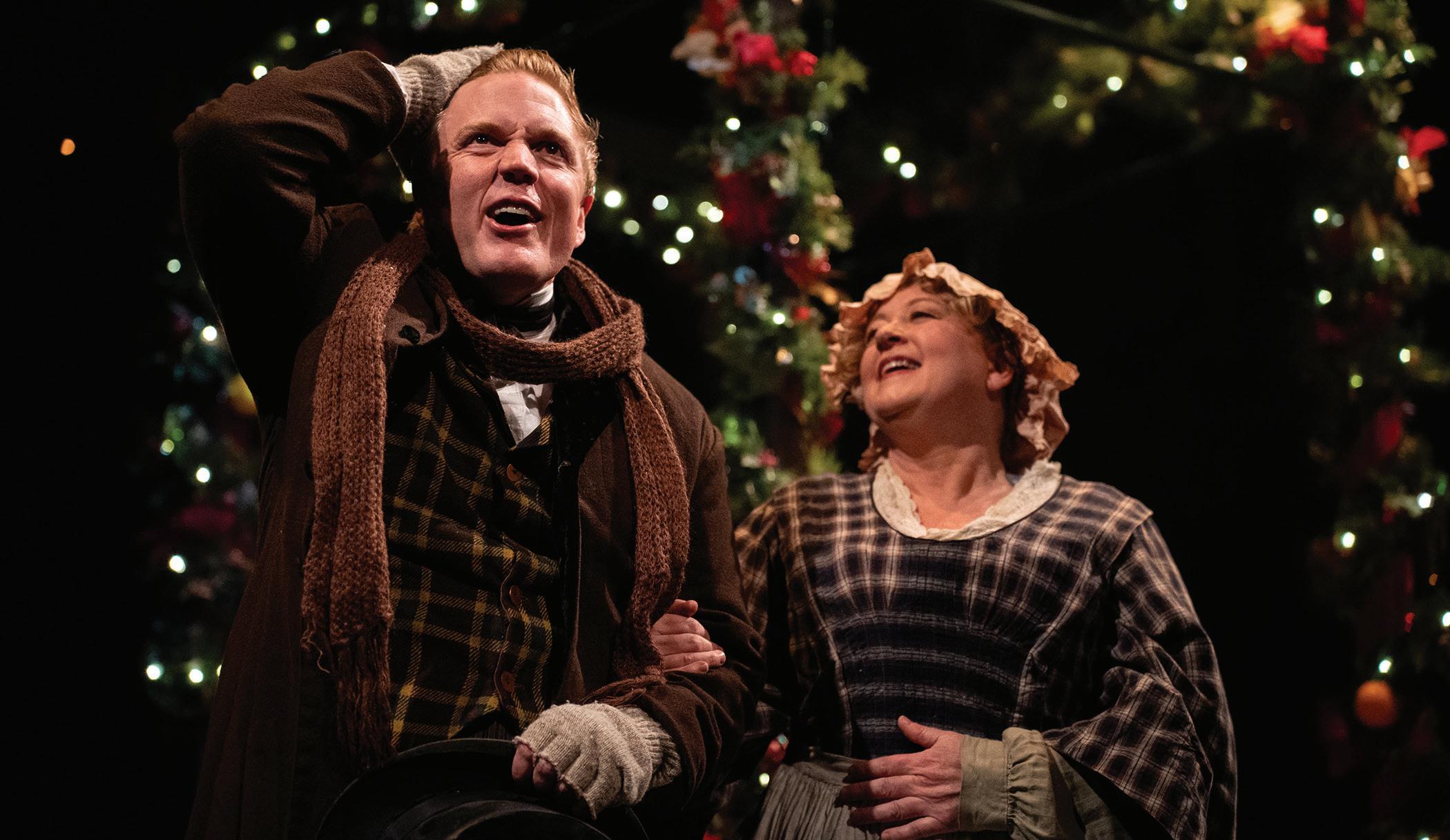
aea memBers Dustin tucKer anD grace Bauer in the 2023 ProDuction of a ChristMas Carol. lighting Design By Byron winn. Photo By James a. haDley.
Dickens' England
Edited for content by Dylan Gurrera (2018—19) and Skyler Brianna (2025—26)
With advancements like labor laws, worker’s rights, and an increasing national minimum wage, work life in today’s England vastly differs from the Victorian homeland that both Charles Dickens and the Cratchits experienced. Victorian England was a hotbed for cutthroat competition, grimy living conditions for the poor, and abysmal working atmospheres. These conditions, however, weren’t a coincidence; they were part of a more outrageous scheme. The unrestricted capitalism and colonial mindset of the European elite drove competition between all countries, with one common goal: to become the largest global superpower. This idea fueled British invention in the 18th and 19th centuries to harness efficient mass production. Big factories began to rise up across the country and cities became larger than ever, growing so fast that many were left without housing or work. Without proper labor laws, industrialists exploited their workers’ labor, knowingly putting them in dangerous working conditions for upwards of 15 hours a day. This age, called the Industrial Revolution, changed English society forever, and its backbone—competitive selfishness and the exploitation of labor—lives at the heart of Charles Dickens' social criticism in A Christmas Carol.
The Industrial Revolution started when inventors created new machines to help business owners use their employees more efficiently. With this mechanization of labor, duties that used to be time-consuming could be done more quickly; capitalists could cut costs and labor in order to compete in the growing market of consumer goods. While industrialization caused Britain’s industry to flourish—the textile industry grew from 40 million yards of fabric a year in 1785 to over two billion yards by 1850—the working class suffered. Entire families were put to work, including children. The Children’s Employment Commission of 1842 found children as young as four working in coal mines, pushing wagons of coal along seams too narrow for adults or ponies. Mothers would pull loads
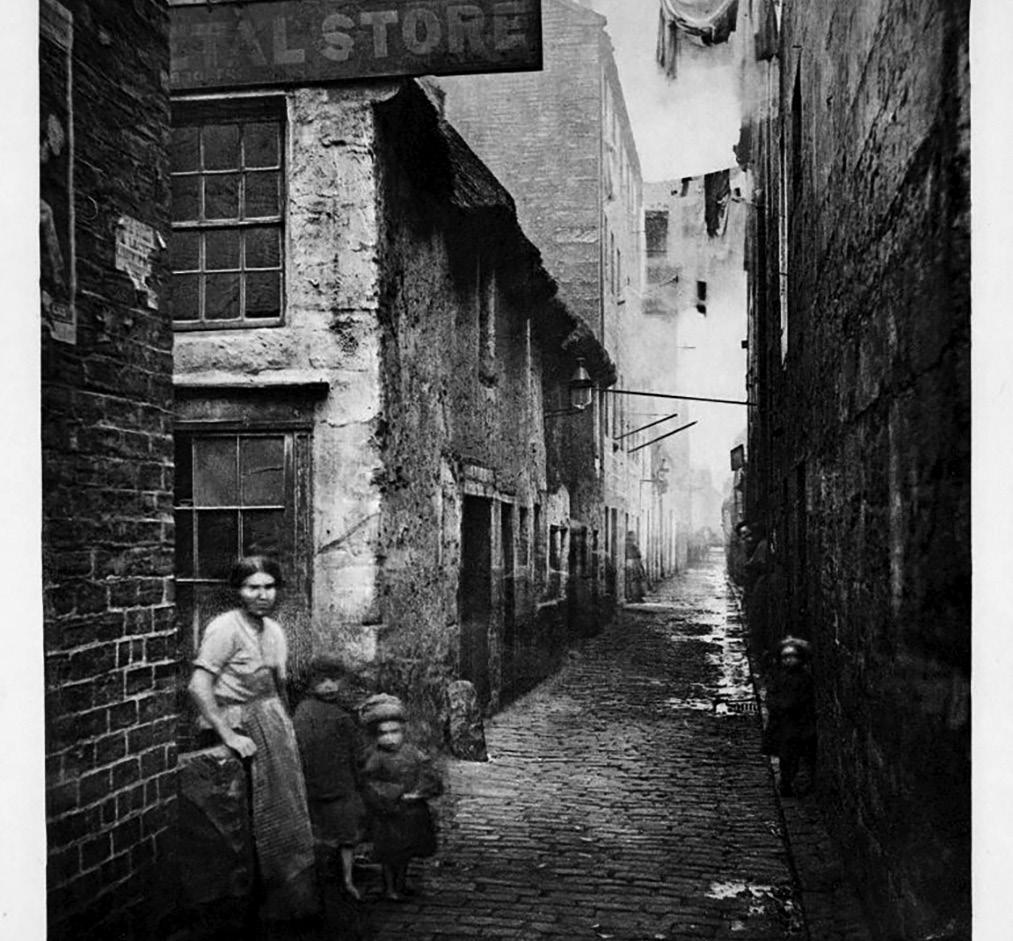
attached to chains between their legs, even when pregnant. Most of these women would suffer miscarriages from work strain. The life expectancy of an English laborer decreased over the course of the first half of the century to an appalling low in 1851; the average life expectancy of miners and laborers in Manchester at this time was 17 years. The country that revolutionized the industrial machine and saw unheard-of fortunes from the mass production of textiles and coal coexisted with a society that forced its impoverished populations to live a life of dread and severe mistreatment.
This was not new for the British Isles—the British elite had been waging a war on the poor for centuries, dating back to the first set of English Poor Laws in the 1600s. However, the Industrial Revolution reinvigorated the strict social relief policies in the country. The English had been known for seeing their poor—the “vagabonds,” the “paupers,” the “street urchins”—as “waste people,” or those who were unjustifiably perceived as lazy. Wealthy English people were tired of economically supporting these “waste people” whom they falsely believed drained the nation’s wealth in
a Poor woman with two Piteous chilDren in the Dirty street (1868).
welfare relief programs. The Victorians believed that they had found the solution. The unyielding Victorian mindset complained that the poor would remain so, as long as the government continued to aid them; the only solution, in their eyes, was to force the poor to work dangerous jobs to build the wealth of the state rather than deplete its resources. This callous perspective was unconcerned about the actual livelihood of the poor—it was always about the wealth and status of the country at large.
Tapping into this resentment amongst the working majority, two government representatives, Edwin Chadwick and Nassau William Senior, wrote a report claiming that some people were better off receiving benefits than finding honest work. In their unmerciful opinion, poverty was seen largely as a lifestyle choice born of “fraud, indolence, and improvidence,” and that “every penny bestowed that tends to render the condition of the pauper more eligible than that of the independent laborer, is a bounty of indolence and vice.” This inhumane approach to poverty can unfortunately still be found in several societies today in political platforms and legislation.
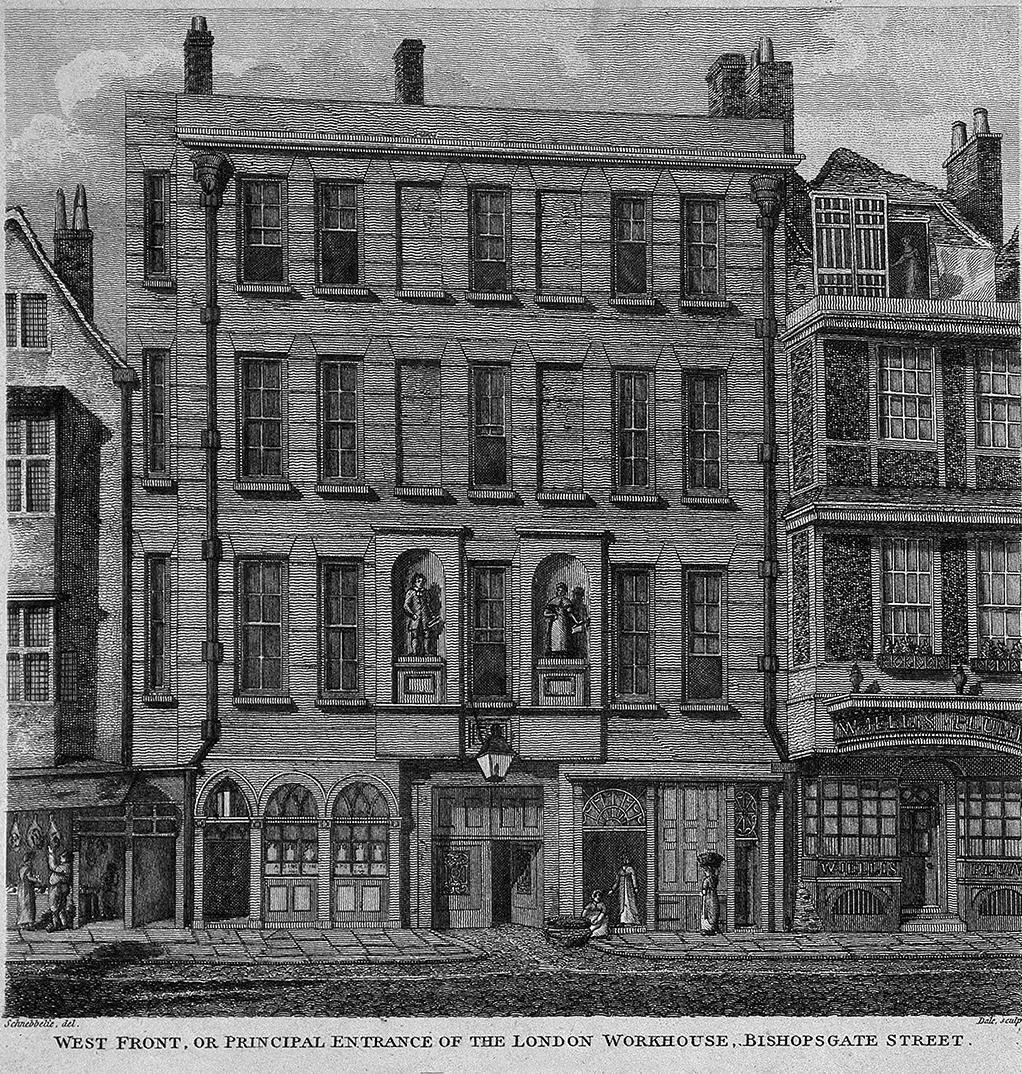
This nefarious duo proposed a new solution that would guarantee a life on benefits would always be a life of poverty. The English Poor Laws of 1834 set up workhouses and debtors’ prisons filled with the most destitute of England’s population—men, women, and children forced into inhumane conditions, and made to work off their debts from what little money they had been given to subsist. The conditions were so unlivable that the laborers in the Andover Workhouse, an institution that produced fertilizer from animal bone, fought over the putrid gristle left on the bones that were about to be processed for food scraps. Newborn babies died there with such frequency that the workhouse master reported them as stillborn to avoid penalties. The work often left laborers with stab wounds on their faces and hands from shards of bone. The English Poor Laws were not a system to relieve the poor—they were a method of social control that oppressed the most vulnerable group of people.
The acclaimed writer Charles Dickens did not always hold such a high status in English society; he, too, was familiar with the harsh, unfeeling hands of workhouse masters. As a boy, his family was sent to a debtors’ prison and Dickens was forced to work in a workhouse. With no choice but to work until his father was free, Dickens suffered through long hours with little pay in dangerous conditions—typical of a working-class boy his age. When his parents finally managed to pay off their debts and were freed, they continued to make Dickens keep working, as a means of extra income.
The English society that Dickens knew and hated was characterized as such: an icy, egotistical mindset that vilified the vulnerable; a dissolution of individuals’ worth into an exchange value; and the greedy, merciless hands of the upper classes that oppressed their laborers. His writing exposed the underbelly of this society in an attempt to change the hearts of many. A Christmas Carol in particular uses poignant themes like memory, belonging, regret, and morality paired with the familiar and comforting imagery of Christmas tradition to present this deeper message in a unique and resonant way.
a worKhouse in victorian lonDon
Spiritualism and Ghosts
Edited for content by Dylan Gurrera (2018—29) and Skyler Brianna (2025—26)
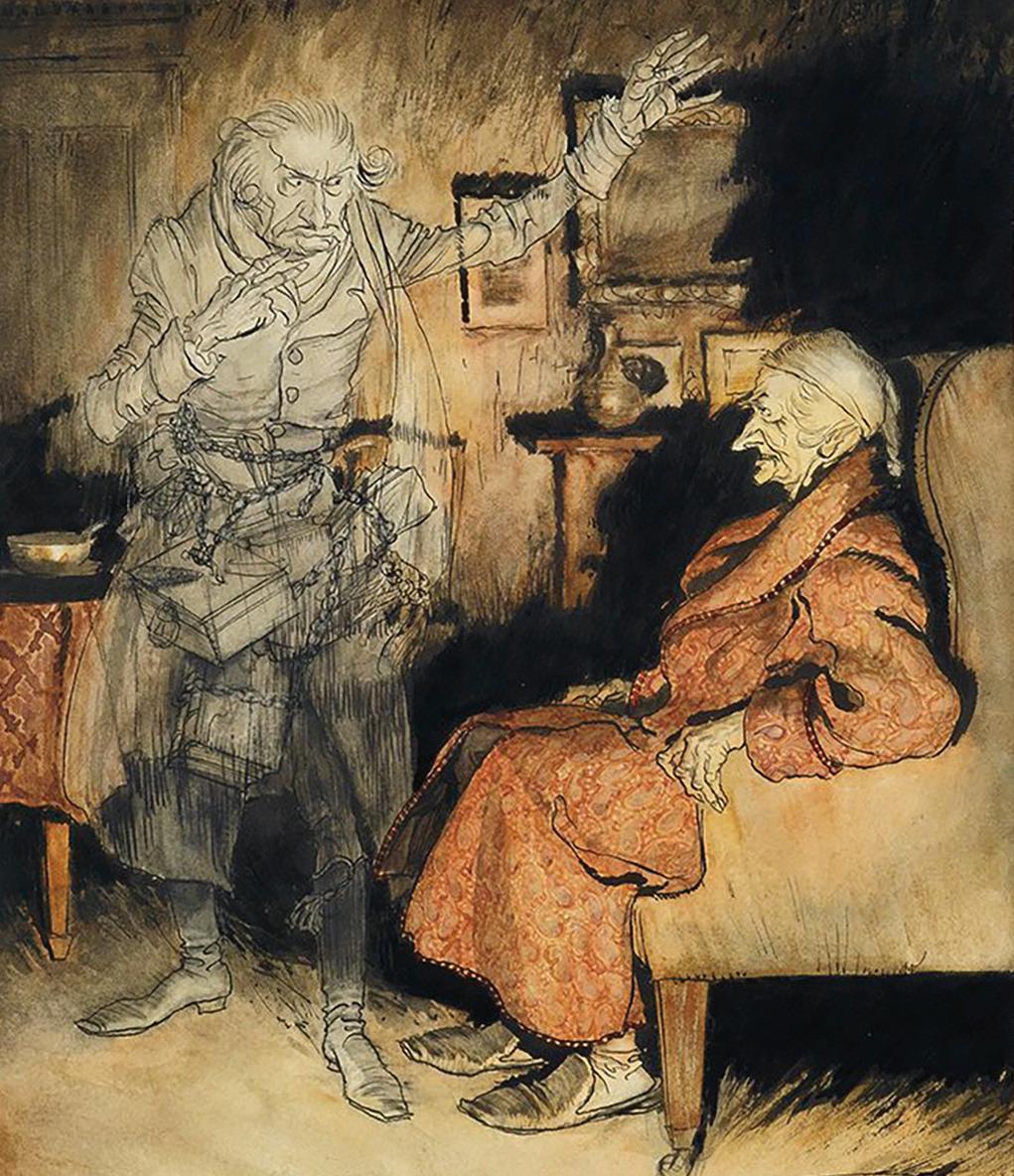
A thematic cornerstone of A Christmas Carol is Scrooge’s interactions with the Ghosts—both literal visions that visit him in the night, as well as the metaphors they represent: ghosts from his past, those around him deemed invisible by society, and the ghostly threat of that yet to come. In one of the most iconic Christmas Carol scenes, Scrooge attempts to unlock his door when suddenly, the keyhole transforms into the face of his dead partner, Marley. Shaking this off as a mere hallucination, Scrooge enters his home to sit down and rest after a long day. As he collapses into his chair, two arms emerge from either side and grab onto Scrooge; Marley’s ghost has been waiting for him. Marley foretells the arrival of three more spirits, who will haunt Scrooge before Christmas morning. While ghosts may evoke thoughts of Halloween before they do Christmas for the modern audience, it is no accident that the supernatural plays such a pivotal role in this Victorian tale.
Victorian England was host to a growing fascination with the paranormal via the
spiritualist movement—a phenomenon that was often reflected in the literature of the era. Authors like Wilkie Collins, H.G. Wells, and Charles Dickens utilized the supernatural in their stories to both educate and speak to deeper themes such as mortality, morality, and human connection. The popularity of this trend was deeply rooted in the new realities of life in Victorian England. Beginning in the late 18th century, the Industrial Revolution drastically changed what day-to-day life looked like for the average British citizen. Traditional English pastoral life, a life rooted in rural farming, gave way to cramped and unsafe urban centers as rural workers flooded the cities seeking new (and hopefully gainful) employment. The massive influx of workers also created a demand for supervisory positions, resulting in the formation of a new class of workers: those who oversaw the work of laborers and their families. With this came a new, literate middle class who preferred a more accessible art form than poetry. New literary forms like periodicals of short stories became popular, providing an extremely cheap platform for generic and repetitive ghost stories known as “penny dreadfuls.” However, the root of penny dreadfuls’ appeal rested in the growing fixation with death and The Beyond that was pervasive in society as a whole at this time— something we now consider to be a trademark characteristic of the Victorian era.
There were several factors that coincided to form this macabre trademark. Unsafe working conditions and a lack of labor laws during the Industrial Revolution were drastically reducing the life expectancy of working-class citizens, resulting in spiking death rates in England at the time. In America, where the spiritualist movement started, death rates were also booming from the Civil War. This made for a time where people were experiencing a lot of death whilst trying to navigate new ways to grieve, as religion was increasingly being replaced (or tempered) with scientific approaches. In the late 17th century, Scottish farmers began to study the science of the
illustration of scrooge anD the ghost of marley.
earth (now known as geology) and noticed things that did not align with what they had been taught about the Earth’s creation in the Christian Bible. Geology and other scientific advancements led many away from the traditional Christian Church—a movement commonly referred to as "the Victorian Crisis of Faith." Without religious answers for what happens to a soul after death, Victorians sought new ways to explain what happens to us after we die, as a means of processing and grieving the loss of their loved ones. Thus the spiritualist movement was born. People communed with the deceased via a medium (or psychic) and believe in the existence of a new kind of afterlife. Where the church had previously provided answers for the mysteries of life, people used the very new concepts of science to form a new belief system.
Spiritualism manifested in a variety of ways. Seances quickly became a common social event in parlors across England. A family would hire a “spiritualist” to come into their home and contact their loved ones who had passed on. The wealthy could afford large, fancy gatherings with famous mediums to host, but the average English family were still participating by whatever means they could, in an attempt to reach loved ones on the Other Side. Queen Victoria herself was even known to participate, in hopes of reaching out to her late husband, Prince Albert. Other common methods for communing with the dead included hypnosis and mesmerism.
While the desire to believe in something certainly informed the rapidly spreading belief in spirits, the methods by which this was achieved also had a role to play in people’s experience of the paranormal. One theory for the prevalence of paranormal sightings is that the increasingly common use of gas lighting, which emitted the toxic gas carbon monoxide, might have induced haunting hallucinations. Reports of spirits sending messages through knocking on walls were common, especially when playing with Ouija boards, though there are claims of these methods being tricks manufactured by the visiting spiritualist. Often these tricks would involve odd sounds, perhaps knocking or a bell ringing, “spirit writing” (or writing while under a trance), and movement of an item of furniture, seemingly of its own volition.
Whether these ghostly effects were manufactured or not, there is no denying that spiritualism had a formative impact on Victorian England. The power of this collective belief played a vital role in shaping how Victorians related to the world and their thoughts on what it means to be human and to live a life. This is reflected in Dickens’ use of ghosts as powerful messengers who contact Scrooge in an attempt to steer him on a more kind, and giving path, in the hope that he might live a happier and more fulfilling life for it.
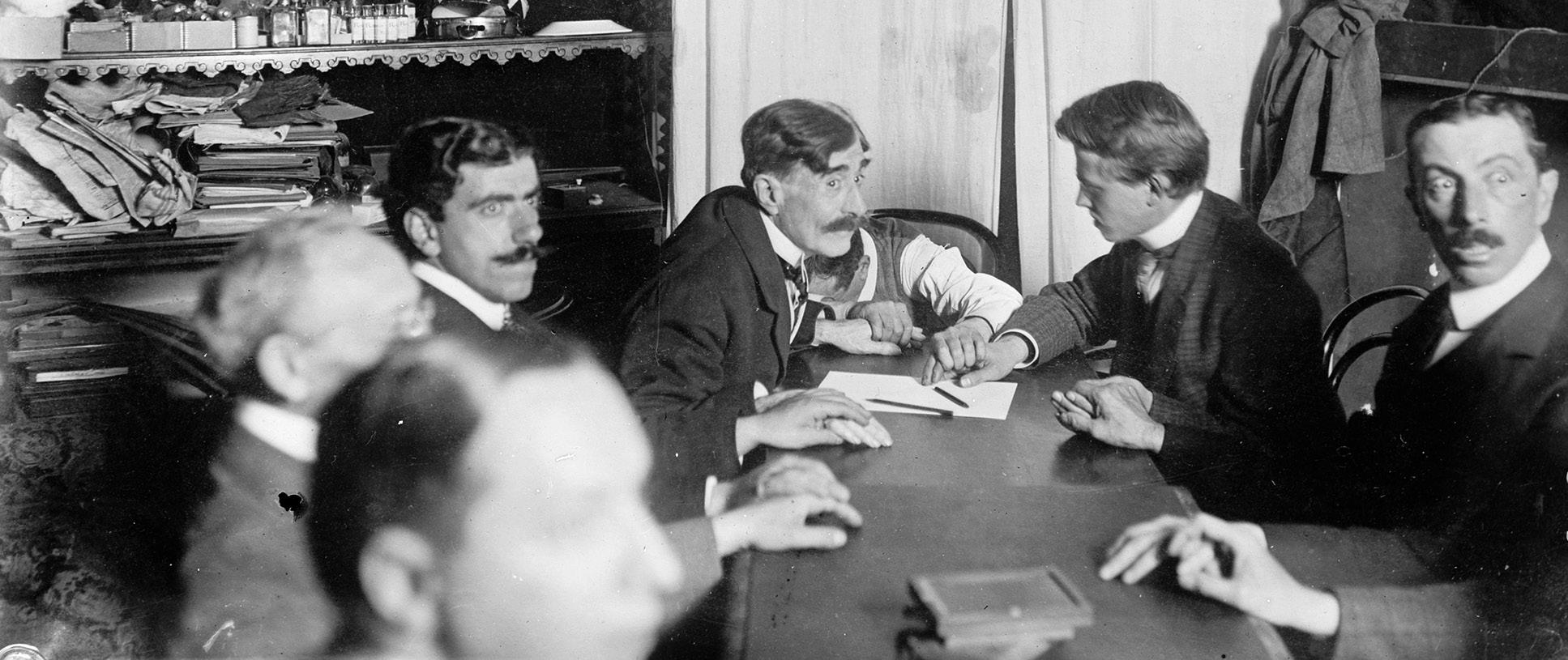
PhotograPh of a seance.
Celebrations of Christmas Past
Edited for clarity by Jack Allen Murphy (2025—26)
Christmas may seem like it has always been the biggest holiday in the Western world, but it was not always so. At the height of British leader Oliver Cromwell’s power (from 1653 until his death in 1658), Scrooge’s wish that “every idiot who goes about with ‘Merry Christmas’ on his lips should be boiled in his own pudding and buried with a stake of holly through his heart” was almost realized. Because of the holiday’s connection to the Catholic Church, the new Protestant government outlawed Christmas celebrations altogether until the restoration of the monarchy in 1660. It took 200 years before Victorian nostalgia would fully revive the holiday’s traditions. Aided by Queen Victoria and writers like Dickens, the mid-19th century saw historical practices such as caroling and gift giving come back into fashion, while new traditions, like decorating Christmas trees and sending Christmas cards, became common practice.
Like Scrooge, we must look to Christmases past, in order to better understand the modern Christmas. Almost every culture has some sort of celebration around the winter solstice, recognizing that the days will begin to get longer and spring will eventually come around. This solstice, sometimes referred to as Yule, is recorded as being celebrated long before the spread of Christianity. In Norse culture, there were Yule feasts, as there was not enough food to feed all of their livestock. For the Celts, Yule was an invitation to nature spirits to partake in merriment and mirth. This entailed drinking spiced cider and decorating with all sorts of greenery like holly, ivy, and yes, mistletoe.
One of the most unique pre-Christian celebrations came from the Romans, who celebrated Saturnalia—a week-long holiday of the solstice where gifts were exchanged. Named after the Roman god of agriculture and wealth, Saturnalia was a celebration of the utopia Rome wanted to be. This meant that government buildings were closed, gambling and other banned activities were legal, and anyone and everyone was encouraged to eat,
drink, and be merry: a time of lawful chaos. Saturnalia also had its own wintry hero: the King of Saturnalia. Usually someone of the lower class, the king would lead the festivities and generally encourage tomfoolery on this jolly holiday. Across the board, this was a time for the lower status; nobles would work for their servants would be allowed to dress up and join in the festivities. In the middle of Saturnalia’s disorderly utopia, there was a day known as the Birthday of the Unconquered Sun. This was to celebrate Sol Invictus, the sun god, promising another year of golden sun. It is suggested that this birthday could have inspired the placement of Christmas in late December. It wasn’t until the 4th century, when Emperor Constantine converted to Christianity, that the church wanted to make the birth of Christ an official holiday. The Bible never specifies the birthday of Jesus, so they gave him the Birthday of the Unconquered Sun,
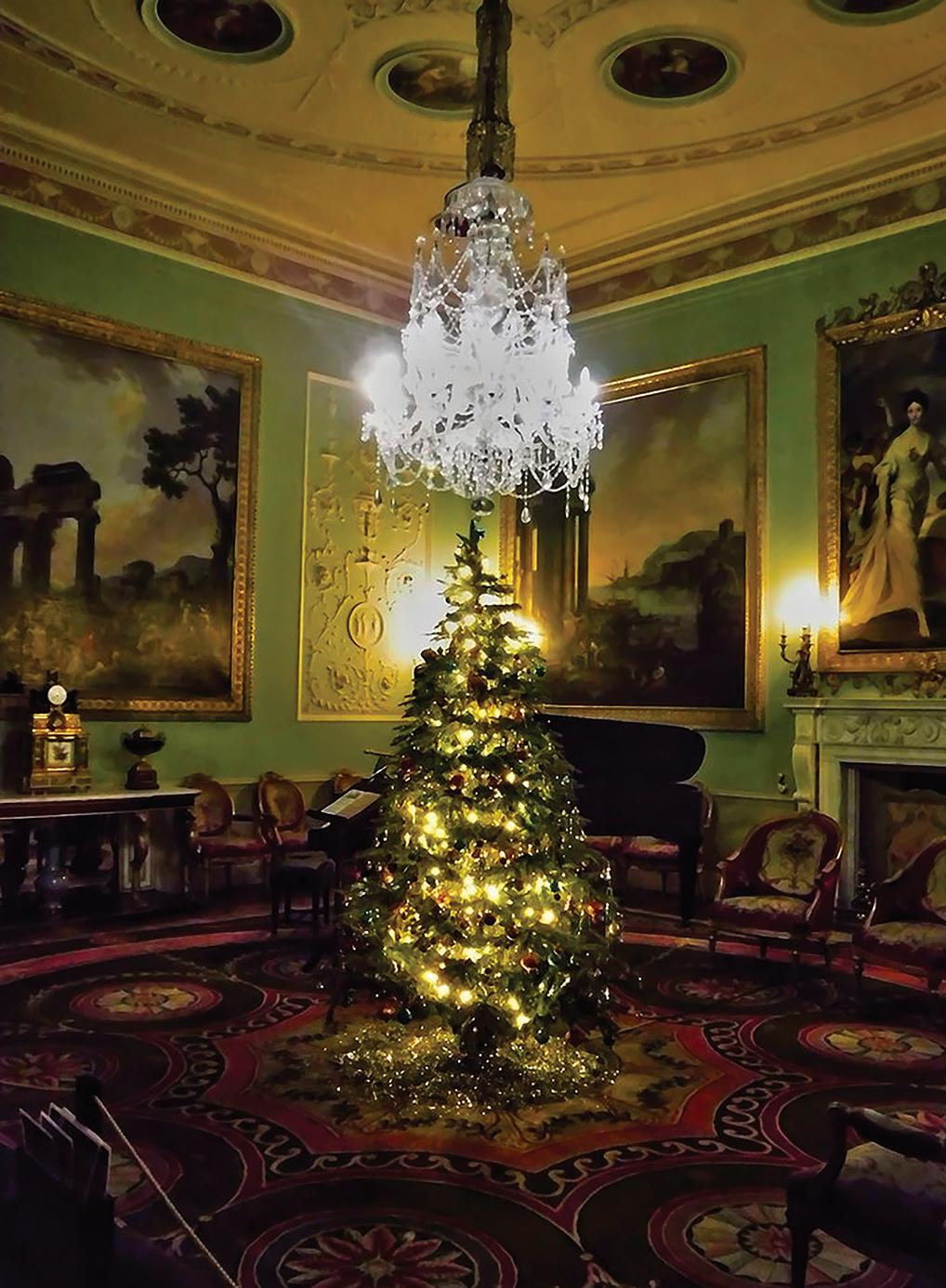
moDern christmas Decoration of a victorian home in lonDon.
December 25th, with the intention of making Roman converts more comfortable around the subject of Christianity. However, even with this rebranding, there was some dissonance. The sects of Christianity at this time were concerned with repentance, of aligning oneself to Christian morals to become a better person. Where is the joy and laughter? How can one person bring merriment to everyone?
Throughout history, music has always been the unifying art, making hearts beat as one. Once the world entered the Enlightenment which lasted from 1685-1815 CE, there was a newfound appreciation of finding the beauty in all things, even something as drab and droll as Christmas repentance. Caroling began during the Middle Ages and was featured at all major celebrations. The etymology of the word “carol” is contested. Some believe that it comes from the Greek word “choraules,” combining the two words “choros” and “aulein,” meaning “chorus” (singing) and “reed instrument,” respectively. The Catholic Church adopted this tradition in the 13th century, focusing it around the celebration of Christmas. The tradition of caroling continued to spread throughout Europe until England’s conservative Parliament outlawed it in 1647. When caroling finally regained its place in holiday celebrations during the Victorian era, it changed to fit the times. The popularity of parlor music encouraged the adaptation of old
songs to modern instruments and new songs, like “Good King Wenceslas,” abounded. In the 1820s, door-to-door caroling became popular. Groups caroled to raise money for charities and were often given mince pies and hot drinks by the families they sang for.
While the Celts were known to decorate trees in honor of nature spirits in days of yore, the Victorian era is responsible for the institution of the Christmas tree in England. Some say this practice dates to the ancient Germanic tribes, who brought evergreens into their homes to remind them of the coming spring during the difficult winter months. Christians slowly absorbed the tradition in Germany. Charlotte of Mecklenburg-Strelitz, wife of King George III, introduced Christmas trees to the British royal family when Princess Victoria was 13 years old in 1832. After her coronation in 1838, her husband, Prince Albert of Germany, brought the tradition to greater popularity by giving Christmas trees to English schools and army barracks. Woodcut prints of the royal family around their tree were published in magazines all over England and America, spreading the popularity and status of the Christmas tree in the Western world.
In the same vein as the Christmas tree, Christmas crackers began making their way to the holiday table, adding both aesthetic value and fun to the celebration. Originally,
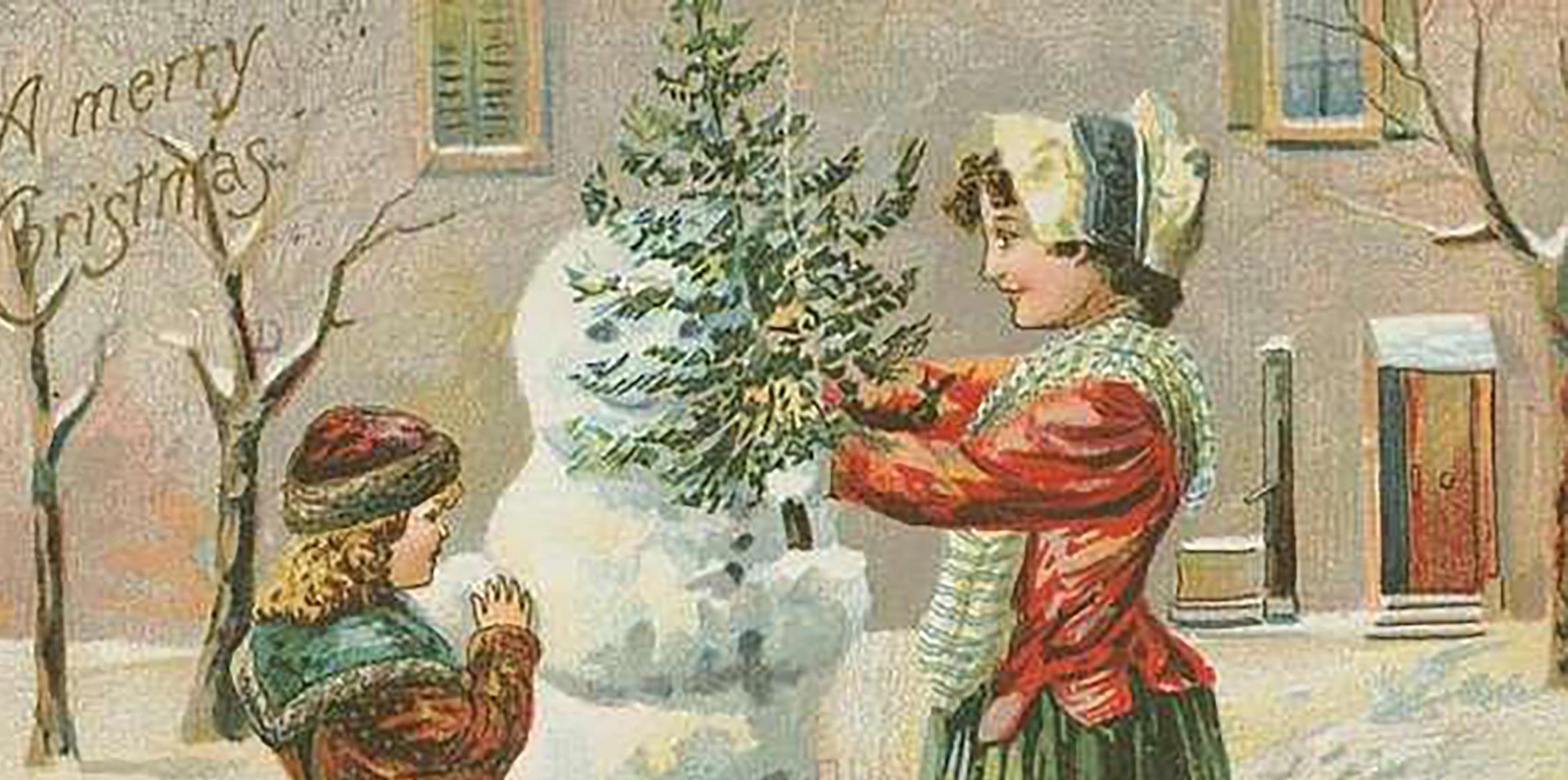
an early 20th century christmas carD
Christmas crackers were without their “crack,” or "bang"—they were popularized as candied almonds with love tokens wrapped in paper. But then one day, a fire in the factory combined with a chemical to produce a large crack. From that mistake, the cracker was born—a long twisted paper package with a prize inside that produced a loud bang when pulled apart. Christmas crackers began their popularity in the early to mid-19th century and had solidified their place at the Christmas dinner table by the end of the century. Like so many other Victorian Christmas traditions, Christmas crackers remain popular today.
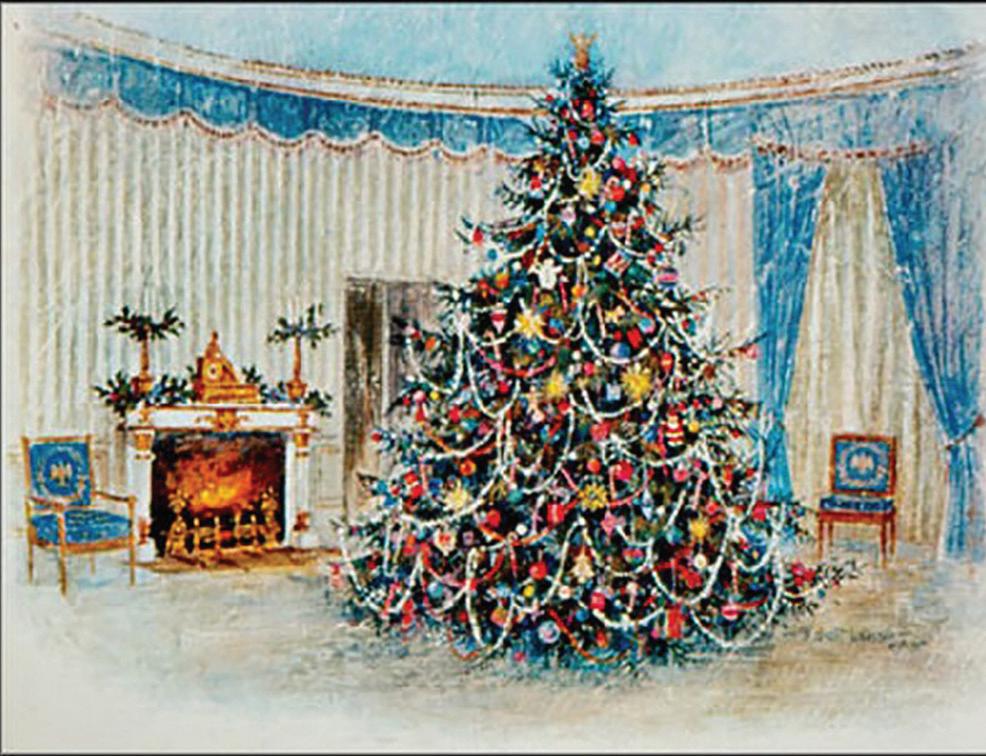
The Christmas card, like the Christmas tree, is another symbol that seems to have been around forever. However, Christmas cards only came into popular use in 1843, when inventor Sir Henry Cole commissioned painter John Calcott Horsley to design the first commercial Christmas card. Three years earlier, Cole had helped establish a uniform penny post throughout Great Britain. A batch of one thousand Christmas cards could be both printed and mailed for one shilling. Rather than religious or winter-themed imagery, early Christmas cards tended to depict children, animals, fairies, or floral designs to remind people of the coming spring. Queen Victoria sent out the first official Christmas card from the royal family in the 1840s, a tradition that still continues in many governments today. The United States followed suit in 1953, when President Eisenhower issued the first official White House card.

Still, as new traditions took place, some old ones were refashioned. For example, the exchange of presents was not nearly as popular a custom as caroling during the Victorian period and certainly nowhere near as prevalent as it is today. Before the Industrial Revolution, toys were all handmade, and therefore too expensive for all but the wealthy. However, with the advent of factories, toys began to be mass-produced and became more accessible for the middle class. Poor children, whose families could not afford toys, were likely to get an orange or apple in their stockings. Among all classes, handmade gifts remained the most common. Family members often spent months making presents for one another, which ranged from fans and other personal ornaments to jams and candies.
Along with these traditions, a Victorian Christmas also called for families to attend church, feast on hearty meals, and spend time with one another and close friends. Since their resurrection, these holiday practices have become pillars of Christmas celebrations, ensuring that, despite Scrooge and Oliver Cromwell’s wishes, the holiday will not retreat into obscurity anytime soon.
a moDern christmas cracKer
the 1967 white house christmas carD, sent out By PresiDent lynDon B. Johnson
Community Connections: Interview with Emma Berry
Edited for clarity and length by Max Lerin (2025—26)
Directing and Dramaturgy Apprentice
Max Lerin interviewed Emma Berry, the Community Programs Manager at Wayside about her work.
Max Lerin (ML): What is your role at Wayside?
Emma Berry (EB): I am the community programs manager, I oversee a lot of our community programming within the greater Portland area. The basis of Wayside is food rescue:, we take in food from grocery stores, farms–food that would typically otherwise go to the landfill. Most of the time it’s perfectly fine food, there’s just a myriad of reasons as to why stores don’t want it. For our meals program, we have nine weekly meals in the greater Portland area. We have a kitchen manager who is a trained chef—actually the Portland Press Herald just did a big piece on him—he will cook up meals—I think right now we’re at a little over 600 meals a week? Some of those are open to everyone, a few of them are just for senior folks. I oversee the meals program, so that’s kinda fun, I get to get out in the community and meet people and see the impact that Wayside is making. And then the other primary program that I oversee is our commodity supplemental food box program, which is for folks age 60 and up, and I oversee all of York, Cumberland, and Oxford county, so that keeps me pretty busy. I have about 65 sites. That’s a government funded program. We partner with the USDA, as well as Good Shepherd Food Bank, and it’s a monthly box— it’s about 30 pounds full of shelf stable food for seniors.
ML: That’s great.
EB: Yeah, so those are the primary things. We also have four picnics in the greater Portland area at community gardens every summer— that’s our pop-up picnic series—so we partner with Cultivating Community at their gardens. That keeps me busy in the summertime, and

then we also do meals, like one-off meals or monthly meals, with schools in the greater Portland area.
ML: That’s lovely.
EB: Yeah! Yeah, so it’s a little bit kinda all over the place. I think the nature of non-profits is that it’s a small staff, we’re primarily run by volunteers, so my position is always kinda changing, my tasks are always changing, as is everybody’s there.
ML: You’ve already started to answer this, but could you talk a bit about all of the services Wayside provides for the community?
EB: Our primary program is the food rescue. We have a big warehouse, and we pull from that for our community meals program. So the food comes in, our chef is able to get the first look at the salvaged food everyday for the meals, and then pantry coordinators will
emma Berry, community Programs manager at waysiDe.
Photo By chris wilKes.
come in and shop to supply their pantries. Individuals can’t necessarily come in and shop, but a lot of resident service coordinators for housing facilities will come in for their food pantries, or general pantries, primarily in Cumberland county—I think some in Oxford and York county as well. And then we have four monthly mobile food pantries in Portland. We have one at Kennedy Park, one in the West End, one at Washington Gardens, and then one at Harbor Terrace, so that allows people who don’t have transportation or the resources to get to pantries, it allows us to come to them, so we’re a little closer, and they can get fresh protein—usually vacuum packed chicken, fish, whatever we get in—and produce. So that’s a big one—our mobile food pantries—and then we have one-off things, too, that we do a lot, and we partner with different agencies, but I’d say those are our primary programs.
ML: What originally drew you to working at Wayside?
EB: I actually lived in the neighborhood—I don’t anymore—but I went to volunteer, and I saw that they were hiring for my position, so I applied and I just love the mission. Wayside is so much more than just a food program. We use food as a tool to bring people together in safe and welcoming spaces. As the Community Programs Manager, I get to meet new people every day. I was working in a corporate setting before that, and it can be kinda soul-
sucking–corporate America—I wanted to do something that felt more like I was actually doing something to help people. So that was what initially drew me to it, and then meeting the staff—we have a great team—and I get to get out and meet people in the community— whether it be pantry coordinators or meal guests—and I’m not stuck at my desk all day, which I really appreciate.
ML: Speaking of that, what are some ways you’ve noticed your work impact the community?
EB: Definitely our community meals program. We’re there to feed people but a huge part of it is the community aspect where it’s a nice meal and people get out of their house. I’d say our primary population is older people, so it’s a way for them to get out and build community; I see them building friendships where they do stuff outside of the meals. We also check in on people. If somebody’s not at a meal for a couple weeks, we’ll make sure we give them a call, see what’s going on- we have birthday parties at some of our meals sometimes.
ML: That’s sweet.
EB: Yeah, yeah I think that’s—cause you know obviously it’s important to feed people, but so is that community aspect.

a worKer at waysiDe unloaDing fooD from a waysiDe fooD rescue trucK. Photo By chris wilKes.
ML: And who is eligible to partake in those community meals?
EB: Anyone and everyone. Like I said, there are a couple that are just for residents—we have like two breakfasts a week, and that’s just for residents of the building—but other than that, most of our meals are open to the public.
ML: That’s lovely.
EB: Yeah. We do ask people for some of the demographics, you know—address, age—just for data funding purposes, but if they don’t feel comfortable doing that, we don’t require it necessarily.
ML: And what are some of the challenges you face in providing for the community?
EB: It can be tricky, we don’t know what we’re getting in from week to week, so learning how to deal with that, which, again, hasn’t been a huge issue. Our kitchen manager/head chef is pretty creative, but certain weeks the donations from salvage will be a bit less, so. It’s not usually a huge problem we face, but just using that creativity, and certain meals, we try to keep it–like we don’t do a lot of casseroles, for instance, cause people like to see what they’re eating. But honestly less issues than one might think, when you don’t really know what’s coming in and you’re not ordering stuff, or working with vulnerable populations, you don’t always know what you’re gonna get each day, but, yeah. We don’t have too many challenges.
ML: That’s good. What is something that you are proud of having accomplished at Wayside?
EB: Our meals program. I’ve been in this position almost four years now and I came into it right after everything had started to calm down with Covid, so some of the meals were established, but some of them I either had to kind of reignite or build from the ground up. Now I feel like things are running more on their own, cause we like our meals to kind of run themselves in a sense—get a good group of volunteers to take ownership for it—so that can take some time to get rolling. I feel like we’re at a good place where if I’m
not there one week, or our community meals assistant who goes to the meals a lot [isn't there and it can still happen smoothly]. A lot of the meals are self-sustaining, which did take a lot of work. That’s probably my biggest accomplishment, looking back over the past almost four years and seeing the growth that these sites have had and the people who look forward to coming to them.
ML: How can people get involved with Wayside?
EB: You can always email one of us, I always encourage people to check out our website, and we have so many volunteer opportunities. You can work in the kitchen preparing the food, or you can come to the meals and volunteer, the warehouse, sorting through stuff, or building bags of produce for our mobile food pantries. So we have a wide range of volunteer opportunities.
ML: That’s really great. Is there anything you’d like to add or anything else you’d like people to know about Wayside?
EB: Just check out our website. I definitely encourage people to come to our meals, it’s really good food. Even if I didn’t work there, I would come to the meals. You get to meet a wide range of people, and our new chef—he started in August and he worked in a lot of kitchens in New York City, so he’s excellent. I think last week, he made roasted lamb, and the week before that we had prime rib, so you never know what you’re gonna get, but he’s excellent. Wayside is all about inclusivity. Whether it be volunteers, staff, community members, or partners, everyone has a place and voice at Wayside. Since working here, I have gotten to know people from across our community. Everything we do is a reflection of our dedication to cultivating relationships.
Fiction for Social Justice
Edited for content by Max Lerin (2025—26)
As the Ghost of Christmas Present begins to wither away, two meager and miserable children emerge from the folds of her dress. “Spirit! Are they yours?” asks Scrooge. “They are Man’s,” replies the Ghost, “The boy is Ignorance. The girl is Want.” While we might think of the holiday season as a joyful time, Dickens didn’t want his readers to forget a deeper meaning to the holiday spirit. A Christmas Carol is as much a call for people (especially the rich) to strip themselves of ignorance and help the poor as it is a sentimental holiday story about togetherness. This story illustrates Dickens' concern for economic inequality, a subject that pervades not only A Christmas Carol but his entire body of work, and inspired future generations of social novelists to write about various systems of inequality such as racism, sexism, classism, and much more.
In 1858, Dickens wrote to his friend and fellow author Wilkie Collins describing much of what he hoped to accomplish through his writing: “Everything that happens...shows beyond mistake that you can’t shut out the world; that you are in it, to be of it; that you get yourself into a false position the moment you try to sever yourself from it; that you must mingle with it, and make the best of it, and make the best of yourself into the bargain.” Dickens committed his career as a writer to criticizing the hypocrisy and shortcomings of his society, especially regarding poverty. Dickens wrote his second novel, Oliver Twist (1838), in the wake of the English Poor Laws of 1834, which restricted poor relief to only those in the workhouses and “upon such terms that only the truly indigent would accept it.” The satirical components in the novel examine the lack of opportunity for most working-class children and orphans: a dismal choice between the workhouse, a life of crime, prison, or an early grave.
Much of Dickens' work functioned similarly to satirize English society, criticize the exploitative nature of capitalism and the Industrial Revolution, and expose society’s mistreatment
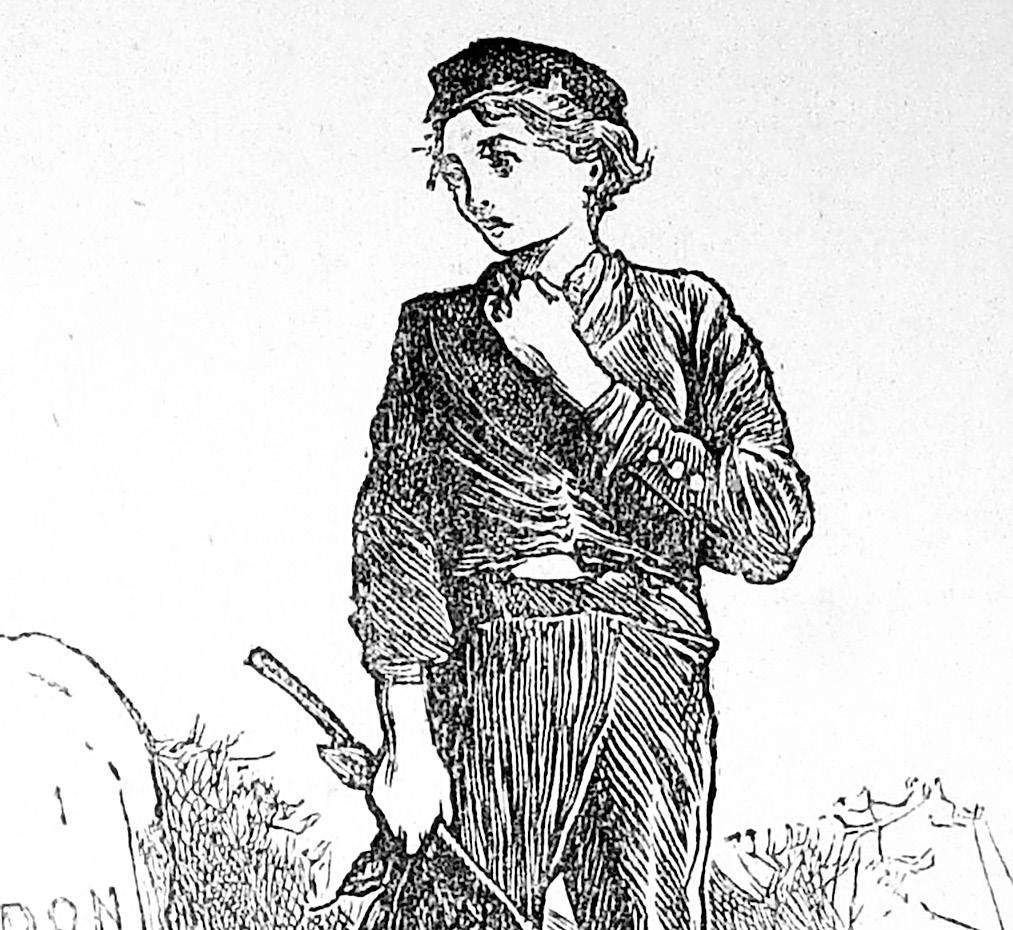
of the impoverished. For example, Dickens’ later novel Little Dorrit (published serially between 1855 and 1887) is set in the prison where Dickens’ father was imprisoned for debt. The novel comments on the shortcomings of debtors’ prisons, the lack of concern for laborers’ safety, and the Victorian government. This novel exemplifies Dickens’ commitment to challenging the issues he saw in the world, rather than shutting them out.
His engagement with the world paid off. Dickens’ work not only moved his readers; his sharp social criticisms changed English society. His novels exposed the dark underbelly of industrial progress and gave a voice to the exploited laborer’s lived experience. His work swayed public opinion so effectively that his descriptions of Marshalsea and the Fleet Prisons in Little Dorrit and The Pickwick Papers caused these debtors’ prisons to be shut down. Dickens even won the appeal of Karl Marx who stated that “[Dickens]...issued to the world more political and social truths than have been uttered by all the professional politicians, publicists, and moralists put together...”
Following in Dickens' footsteps, many authors devoted their literary work to exposing systematic societal problems, such as
illustration of a scene in oliver twist.
economic inequality, through social novels in their own countries. John Steinbeck’s The Grapes of Wrath tells the devastating story of an American working-class family. Focused on the Joad family’s move to California, Steinbeck’s novel details the overwhelming competition for very few jobs, degrading work conditions, and animosity from locals and police. Forced into a migrant lifestyle, the Joads become caught in a battle between union workers and landowners in search of strikebreakers to hire. The Grapes of Wrath won the Pulitzer Prize in 1940 and sold almost half a million copies in the first year after it was published. However, the book won more than just popular readership and literary accolades; the social criticism in The Grapes of Wrath led to congressional hearings on working conditions for migrants and changes to labor laws.
Unfortunately, these laws do little to protect today’s migrant workers, comprised largely of immigrants from Mexico and Latin America. Contemporary American author T.C. Boyle
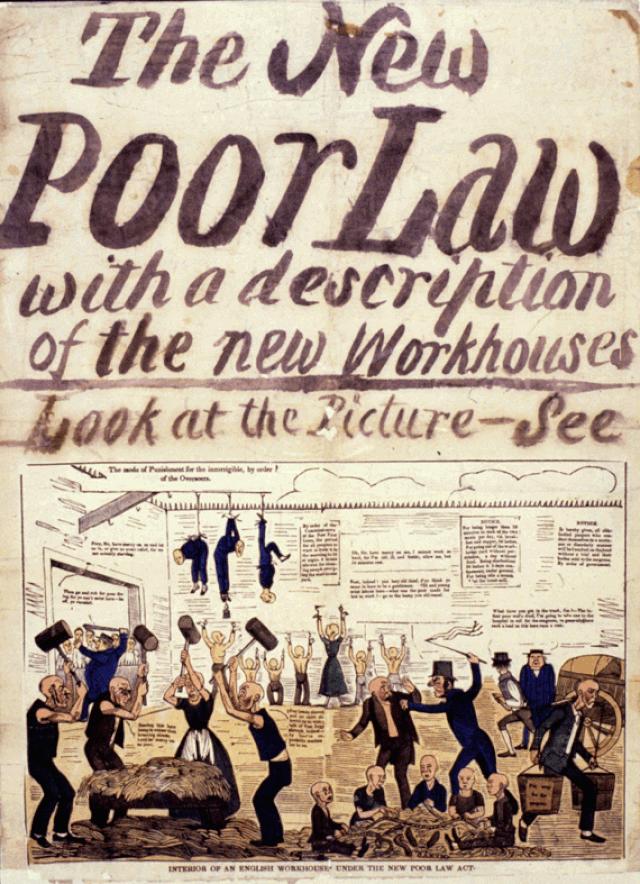
followed Steinbeck’s example with his 1995 novel The Tortilla Curtain. Boyle’s novel chronicles the lives of two families: the wealthy American Mossbachers and the impoverished and undocumented Mexican Rincóns. The two families become involved with each other when Delaney Mossbacher accidentally hits Candido Rincón with his car. The Tortilla Curtain begins with an epigraph from The Grapes of Wrath: “They ain’t human. A human being wouldn’t live like they do. A human being couldn’t stand it to be so dirty and miserable.” The farmer’s rationale for his mistreatment of migrant workers resonates uncomfortably with bigoted sentiments expressed today. Boyle said that Steinbeck’s effort inspired him to “imagine a new reality in a world that hasn’t changed as much as it would like to believe.”
As the successes of Dickens, Steinbeck, and Boyle illustrate, literary fiction has enormous potential to spark tremendous social change. Like the ghosts of A Christmas Carol, many social novels bring the miserable conditions endured by the oppressed into the homes of the privileged. They remind us of our shared responsibility to work with and for the disenfranchised.
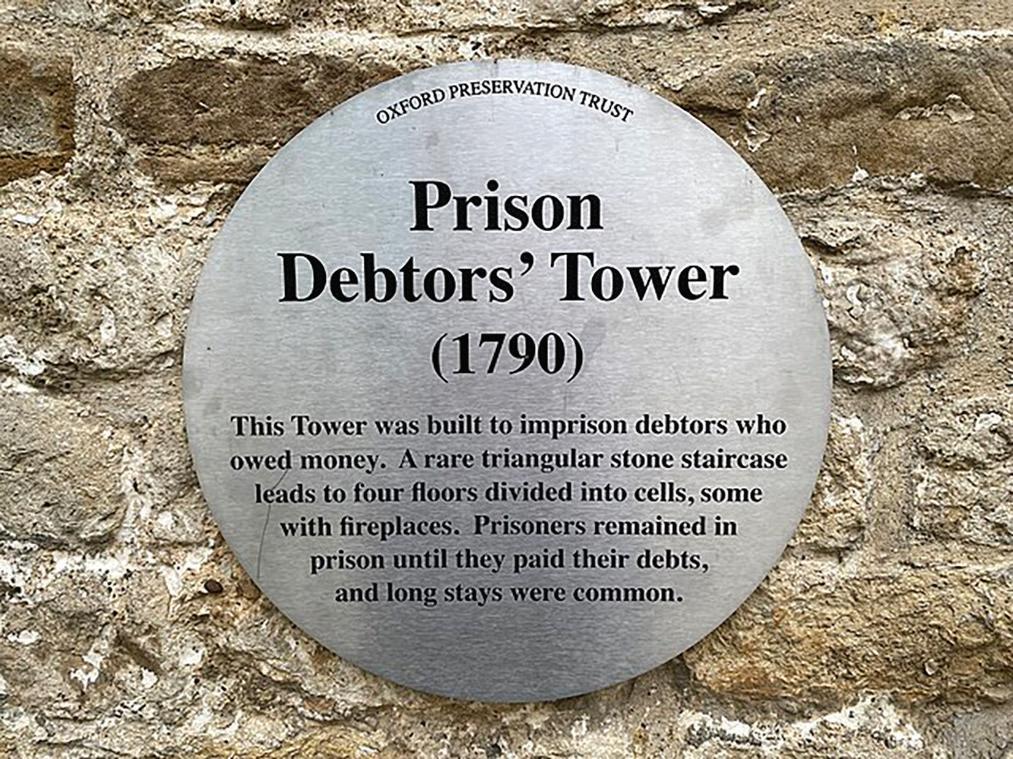
the new Poor law of 1834 Poster Prison DeBtor's tower Plaque at oxforD castle
Homelessness and Poverty in Maine
Edited for content by Kaushik Raghavan (2025—26)
Charles Dickens wrote his acclaimed novella
A Christmas Carol nearly two centuries ago, but the story of families, like the Cratchits, struggling through the holiday season in poverty has never been more pertinent. In Donald Trump’s America and with upcoming winter weather, many organizers and artists continue to see Dickens’ tale of charity as an important reminder to think of our community members who are facing poverty and homelessness, and to consider how we can support our neighbors in tough times.
On January 22, 2025, the Maine State Housing Authority counted roughly 2,413 individuals who were currently without housing in the state, including just over 600 residents housed in shelters and 1,400 in transitional housing. This is a continuation of a downward trend since the record high of 4,411 unhoused people in January 2022. But it is important to remember that this number only represents the unhoused population on a single day in the winter. The number of Mainers who have faced housing insecurity throughout the year is estimated to be higher. With an unhoused population that is consistently in flux, the dangers of winter are particularly detrimental, as even a single night outdoors can prove incredibly harmful.
Even when an individual or family has access to shelter, the economic restrictions of living in Maine can keep community members living from paycheck to paycheck. According to the Center on Budget and Policy Priorities, the rental housing market in Maine is among the least affordable in the nation, with nearly 30% of low-income households paying more than half of their monthly wages on rent. One in seven adult Mainers and one in five children face food insecurity. For the nearly one in seventeen Mainers living without health insurance, medical emergencies or changes in income can lead to a lack of heat or electricity, or can push them out of their homes during the holiday season.
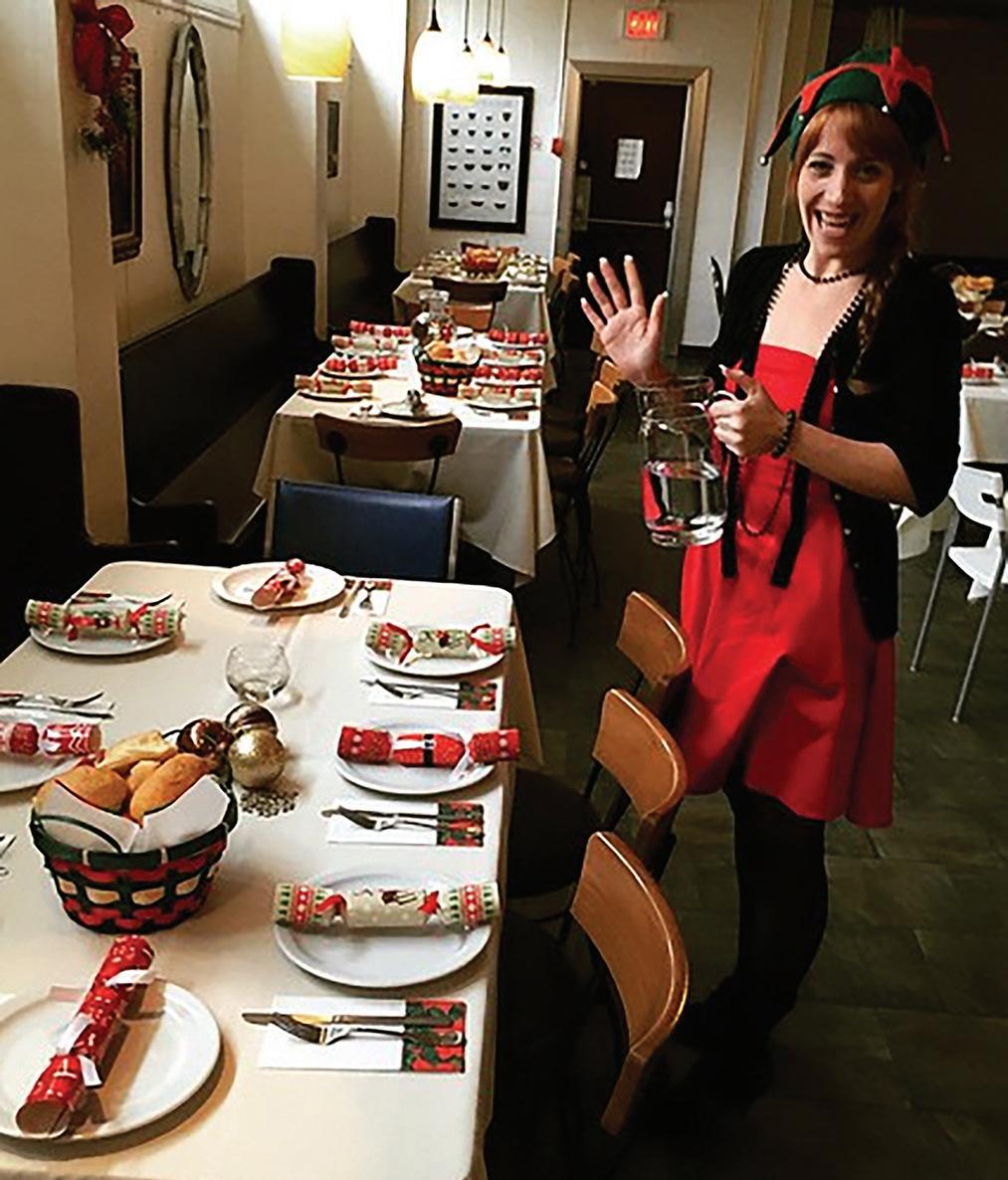
To address the increasing need for support, Portland has established various social safety nets for residents, including a Home Energy Assistance Program and several emergency shelters across the city, which house almost 1,200 individuals per night. They have also created an Encampment Crisis Response Team, whose goal is to maintain the health and safety of both those who are unhoused and the community at large. There are also city programs working to transition community members to long-term solutions. In the 2025 fiscal year, the Oxford Street Shelter placed 154 individuals into permanent housing.
Shay Dufour, who was homeless for a time herself, has some thoughts on why people are so apprehensive about entering homeless shelters. “A lot of these people that stayed at the shelter have had traumatic experiences." Dufour said in an interview with News Center Maine . “[People don’t go to shelters] because
a woman PrePares a holiDay Dinner for her community.
some people are suffering from substance abuse.” She added. Shelters usually don’t allow substance use among their residents. Some unhoused people feel as though the rehabilitation centers in shelters cause more harm than good. Dufour said that the amount of people not going to shelters makes it clear that the city’s approach is not working.
While advocates for the unhoused population continue to call for governmental action such as increased financial support for new housing developments and temporary shelter solutions, nonprofit organizations across Maine have stepped up to aid those in need when the state and city will not. Maine Needs, a social work program founded only months before the beginning of the COVID-19 pandemic, has grown by the thousands both online and in their brick-and-mortar location, connecting donors with social workers, organizers, and individuals in need across the state. Preble Street, another lauded community support organization, runs a Food Security Hub and makes over 2,000 hot meals every single day, including Christmas Day.
"It's a great way to spend Christmas morning,” Emily Yates, a professional chef with Preble Street, told News Center Maine in 2022. “I've had so much fun. Everyone is really excited. The staff is excited to eat. It's a really special time. I'm happy to be here."
As the curtain rises and falls on another merry production of A Christmas Carol at Portland Stage, we hope that Scrooge’s discordant praise of “prisons or workhouses” for the poor sparks a moment of reflection in our own community. While you may not be able to provide the biggest Christmas turkey for all your neighbors, there are many ways to support those in need this holiday season through donating food, your time, or your energy to advocate for those neighbors.
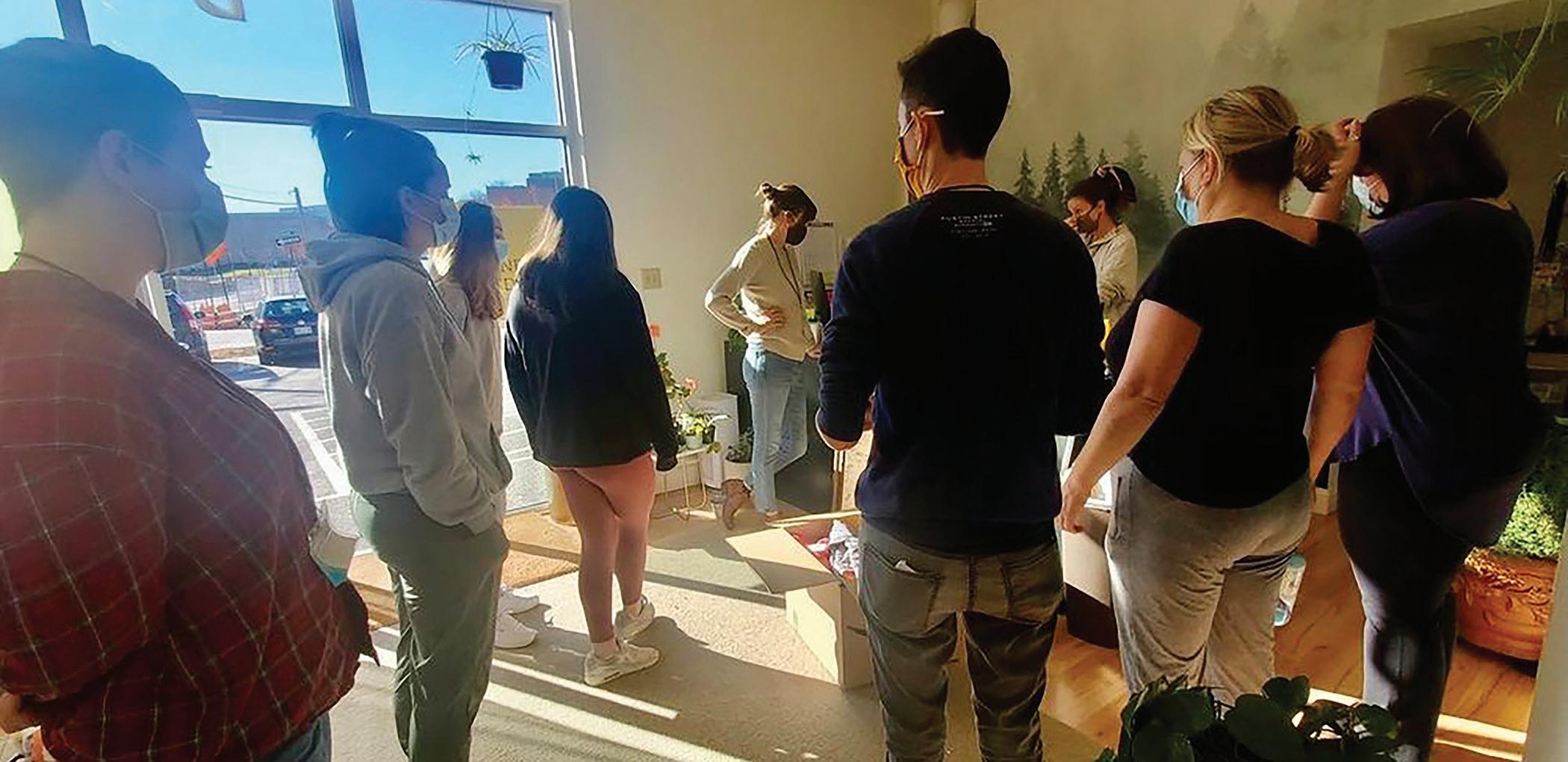
volunteers at a maine neeDs event.
Winter Holidays Worldwide
Edited for content by Macey Downs (2020—22) and Skyler Brianna (2025—26)
Since the beginning of recorded time, cultures around the world have held feasts and rituals to mark the coming and going of seasons. Winter celebrations are especially important, providing comfort and cheer through the coldest and darkest part of the year. Many modern wintertime holidays are rooted in the ancient practice of observing the winter solstice. In Europe, for example, the Roman Saturnalia, the medieval Feast of Fools, and the Germanic pagan Yuletide have all been adapted and absorbed into modern winter festivals. Like their predecessors, contemporary holiday feasts often celebrate light (because of its scarcity in the winter) with candles, bonfires, and electric Christmas lights. Feasting and traditional foods are also essential parts of winter holidays worldwide, celebrating the bounty of a good year and the generosity of family and friends.
North American Indigenous communities have been celebrating winter holidays for centuries. One common celebration across the world among Indigenous communities is the winter solstice. In the US, this is usually around December 21st, and is when the sun is at its lowest point in the sky, resulting in the shortest day and longest night of the year. Some Tribal Nations celebrate the winter solstice with ceremonies and festivals, while others use it as a time to turn inward and intentionally care for their spiritual selves, mind, body, or loved ones. Tribes in the Abenaki Nation—who were forcibly removed from much of Maine and still reside in western Maine, Canada, and Vermont—look to the winter solstice as a time when the next new moon will indicate the start of the new year.
Christmas is one of the most widely celebrated holidays in the world and its traditions grow more diverse as its geographic prevalence expands. In Venezuela, people celebrate Christmas by attending one of nine carol services leading up to the Nochebuena de Navidad on Christmas Eve, after which families share a festive meal. In Australia, where Christmas falls in the middle of summer and temperatures often reach 100 degrees, pool parties and trips to the beach have become tradition. “Carols by Candlelight,” an Australian tradition beginning in Melbourne in the
1930s, brings entire communities across the country to streets and parks, where live bands accompany their caroling. Right here in the US, Christmas customs vary by region; in New Orleans, a huge ox decorated with holly and ribbon is paraded around the streets, while in Alaska, a colorful star on a pole is taken from door to door.
The beloved figure of Santa Claus also varies widely across cultures. American Christmas imagery—heavily influenced by Clement Clarke Moore’s poem “’Twas the Night Before Christmas” and Coca-Cola’s advertisements by Haddon Sundblom—depicts a jolly, redsuited man with a reindeer-drawn sleigh. In Germany, however, children are visited by both the gift-giving Christ Child, called Christkind, who appears on Christmas Eve, and Weihnachtsmann, or Christmas Man, who arrives on Christmas Day to distribute gifts for good behavior. In Hungary, Mikulás—or Saint Nicholas—visits children on the evening of December 6. Mikulás is dressed in red bishop’s robes and accompanied by a devil, Krampus, who carries dry twigs to whip naughty children.
Many European countries observe other traditional winter festivities in addition to Christmas. In Sweden and several other Scandinavian countries, the Feast of Saint Lucy—sometimes also referred to as Santa Lucia—is held on December 13. On the morning of the feast, the eldest daughter in each household dons a white robe, red sash, and crown made of greenery and candles to honor the saint. Followed by her younger siblings, she serves a breakfast of coffee and traditional Lucia buns to her parents in bed. The name Lucy derives from the Latin “lux,” meaning light, so the Feast of Saint Lucy also celebrates the approaching return of the sun after many dark months.
Light is a recurring theme in winter holiday celebrations around the world. The Thai festival Loy Krathong is celebrated on the full moon of the twelfth lunar month, which usually falls in November on the Western calendar. Loy Krathong is roughly translated as “floating lotus cups” in English. Families and friends gather near rivers, pools, ponds, and canals to set afloat candles in lotus-shaped

paper boats known as krathongs. The lotus blossom symbolizes the flowering of the human spirit, and the act of releasing the raft shows respect for Phra Mae Khongkha, the water goddess, and represents the release of grudges and resentments. Fairs with performances and dances, family dinners, and singing are all a part of the celebration, which ends with a fireworks display after the little boats have been launched.
Chanukah, also called the Festival of Lights, is an eight-night festival celebrated by Jewish people around the world. The holiday is primarily observed by lighting the menorah, a candelabra with nine branches. Families place a menorah in a prominent spot in the home and light one candle each night—the number of lit candles therefore increases by one with each night of the celebration. This commemorates the eight nights of an ancient miracle that took place in the Holy Temple of Jerusalem, in which a small amount of oil that should have only lasted one day miraculously lasted for eight. Chanukah is also celebrated by eight nights of gift giving and the preparation and consumption of fried foods, the oil of which also harkens back to the miracle that inspired the holiday. Playing with a dreidel for chocolate coin-shaped treats called gelt is a popular Chanukah game and one of the many ways to spend quality time with loved ones on this holiday.
In the US, some African American families observe Kwanzaa, a Pan-African holiday that was created during the American civil rights movement of the 1960s. Kwanzaa is a secular holiday that is not associated with any one religion and celebrates African heritage and culture. The creator of Kwanzaa, Maulana Karenga, said that his goal for the holiday was to "give Black people an alternative to the existing holiday of Christmas and give Black people an opportunity to celebrate themselves and their history, rather than simply imitate the practice of the dominant society." Over the week-long celebration, families light seven black, red, and green candles on the kinara, a traditional candleholder. One candle is lit per day, each one representing one of the following principles: unity, collective work and responsibility, cooperative economics, faith, purpose, creativity, and self-determination. Families share meals, art, and gifts for the whole week of Kwanzaa.
Winter traditions and festivals come during the darkest and coldest part of the year, when love, generosity, and cheer are most appreciated. Despite their differences, the common themes and symbols of winter celebrations all over the world suggest a profound human need to band together and celebrate in difficult times. In doing so, we become part of a global community, connected to both our ancestors and people around the world today.
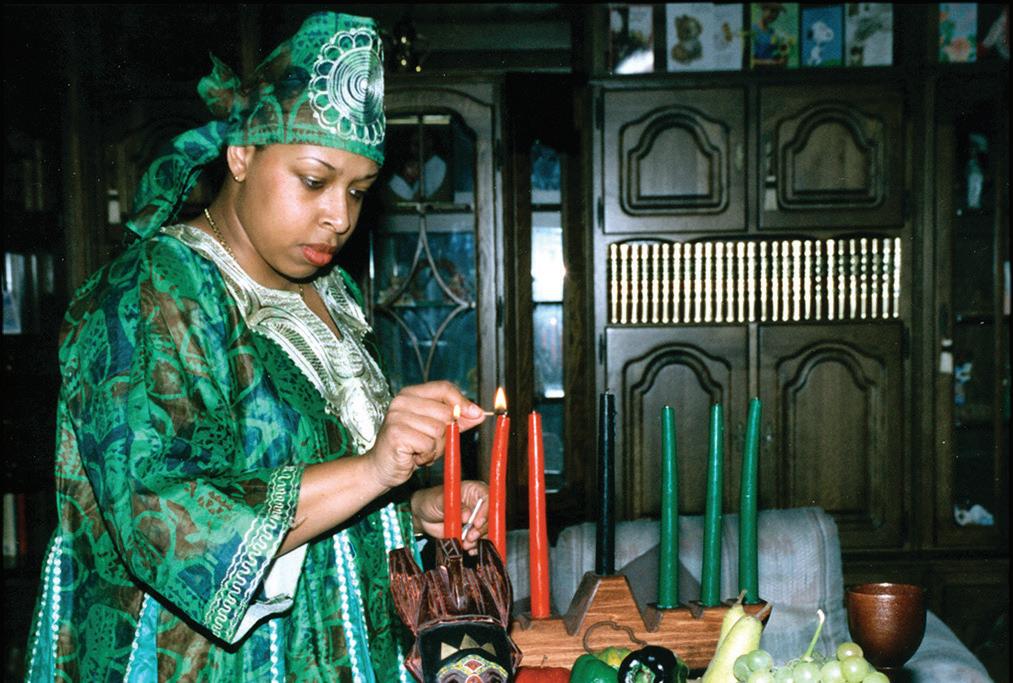
loy Krathong in uthai thani, thailanD (2004).
tech. sgt. Jennifer myers (aBove), 66th air Base wing noncommissioneD officer in charge of the military equal oPPortunity office, Demonstrates a Kwanzaa ritual where she lights a canDle in the Kinara” (2005).
Holiday Recipes
by sam lucas (2025—26)
Egg Nog
Yields 6 cups of egg nog
Prep Time: 15 minutes
Active Time: 10 minutes
Ingredients
6 large egg yolks
1 cup white sugar
2 cups whole milk
1 cup heavy whipping cream
1 tsp nutmeg
¼ tsp vanilla extract
Instructions
1) Whisk egg yolks and sugar together into a bowl until thoroughly combined.
2) In a saucepan over low to medium heat, mix together cream, milk, and nutmeg. Once all is combined and heated, slowly combine into sugar mixture, whisking constantly.
3) Pour mixture back into the saucepan on stove, add vanilla extract, stir until mixture is thickened.
4) Strain egg nog into a pitcher or bowl, and refrigerate until cold.
5) Pour and serve into smaller cups and top with whipped cream, nutmeg, or cinnamon.

Earl Grey White Hot Chocolate
Yields 4 cups of hot cocoa
Prep Time: 5 minutes
Active Time: 10 minutes
Ingredients
4 cups milk (of your choice)
1 cup white chocolate chips
1 tsp vanilla extract
3-4 tbs brown sugar (or to taste)
2 Earl Grey tea bags
Instructions
1) Pour milk into a pot and simmer over medium heat. Gradually add vanilla extract and brown sugar.

2) Once heated and mixed, add teabags to the pot and cover. Let teabags steep for 5 minutes.
3) Remove teabags, add white chocolate and simmer on low to medium heat and whisk until chocolate is thoroughly melted and mixed in.
4) Pour into mugs and top with whipped cream!

Cranberry Macadamia Nut Cookies
Yields 20-25 cookies
Prep Time: 20-25 minutes
Baking Time: 10-15 minutes
Ingredients
1 cup butter, softened
¾ cup packed brown sugar
¼ cup white sugar
1 (3.5-ounce) package instant vanilla pudding mix
2 large eggs
2 ¼ cups all-purpose flour
1 tsp baking soda
1 cup white chocolate chips
½ cup macadamia nuts (finely chopped)
½ cup dried cranberries
Instructions
1) Preheat oven to 375°.
2) In a large mixing bowl, mix together butter and sugars. Proceed to add pudding mix and eggs, followed by flour and baking soda.
3) Chop up macadamia nuts and cranberries into fine, small pieces, and add to the dough mixture.
4) Roll the dough into 1-2 tablespoon balls and then throw onto the baking sheet. Bake for 1015 minutes or until lightly browned.
5) Cool for 15 minutes.
Fruitcake
Yields 2, 8x4 inch sized cakes
Prep Time: 30 minutes
Baking Time: 30-45 minutes
Ingredients
3 cups all-purpose flour
1 tsp baking soda
2 tsp ground cinnamon
½ tsp ginger
1 tsp ground nutmeg
1 tsp ground allspice
½ ground cloves
½ cup brandy
2 cups brown sugar
1 ½ cups butter, softened
4 large eggs
2 tbs lemon zest
2 tbs vanilla extract
1 ½ cups dates
1 ½ cups mixed dried fruit (of your choice)
1 ½ chopped walnuts
Instructions
1) Preheat oven to 275°. Meanwhile, butter up your baking pans.
2) Whisk together dry ingredients and spices (excluding brown sugar) in a large mixing bowl.
3) In a separate bowl, mix brown sugar, eggs, lemon zest, brandy, and vanilla.
4) Mix wet and dry ingredients together and proceed to fold in fruit, dates, and nuts.
5) Transfer batter into pans, then bake in oven 35-40 mins, or until a toothpick inserted in the middle comes out clean.
6) Let cool for 30 minutes.

Outreach & Advocacy
by The Editors
This section is dedicated to offering an easy way for our readers to connect to the issues we discuss in PlayNotes.
Maine Needs
Maine Needs started in January of 2019 as a Facebook group to bridge the gap between Mainers in need and items people could donate. Their work helps build a strong foundation of community support with the goal of ensuring no one goes without the basics. Maine Needs reaches individuals and families statewide via partnership with the social services community in support of asylum seekers, students, the unhoused population, survivors of domestic violence, and those facing financial adversity.
Website: maineneeds.org
Maine People’s Housing Coalition
The Maine People's Housing Coaltion's mission is to destigmatize, decriminalize, and end homelessness. Creating change via mutual aid & political action. They use their general funds for water, food, medical supplies, phones, clothing, rental assistance for the newly housed and those facing evictions, and other emergent needs that may arise.
Instagram: @phc_me
Maine Prison Advocacy Coalition
Maine Prison Advocacy Coalition's mission is to support and advocate for Maine's incarcerated citizens, their families and friends. Their purpose is to reduce Maine's use of incarceration by advocating for a criminal justice system that is ethical, humane, and restorative. Their Vision is of a justice system that is restorative. It supports humanity in every person, and reflects and creates transformation and accountability.
Website: maineprisoneradvocacy.org
The Opportunity Alliance
Across Maine, individuals and families face growing challenges—from a severe housing shortage and homelessness crisis to mental health emergencies and limited access to community supports, especially in rural areas. These issues don’t exist in isolation—and neither do our solutions. The Opportunity Alliance takes a holistic approach to care. They support the whole individual, whole family, and whole neighborhood through tightly connected programs and strategic partnerships. Their wrap-around services are designed to meet urgent needs while building long-term stability.
Website: opportunityalliance.org
Preble Street
The mission of Preble Street is to provide accessible barrier-free services to empower people experiencing problems with homelessness, housing, hunger, and poverty, and to advocate for solutions to these problems.
Website: preblestreet.org
Maine Children's Home Christmas Program
Each year, the Christmas Program at the Maine Children’s Home distributes boxes of gifts and clothing to more than 1,700 financially disadvantaged children throughout the state.
Website: mainechildrenshome.org/programs/christmas-program
Portland Stage Company Education Programs
Student Matinee Series
The Portland Stage Student Matinee Program provides students with discounted tickets for student matinees. Following the performance, students participate in a conversation with the cast and crew, which helps them gain awareness of the creative process and encourages them to think critically about the themes and messages of the play.
Play Me a Story
Experience the fun and magic of theater on Saturday mornings with Play Me a Story! Ages 4 –10 enjoy a performance of children’s stories followed by an interactive acting workshop with Portland Stage’s Education Artists for $15. Sign up for the month and save or pick individual days that work for you. Build literacy, encourage creativity and spark dramatic dreams!
Shakespeare Teen Company
In April and May of 2026, students will come together as an ensemble to create a fully-staged Shakespeare production of Romeo and Juliet in Portland Stage’s studio theater. Participants in grades 7-12 take on a variety of roles including acting, costume design, marketing, and more!
Vacation and Summer Camps
Dive into theater for five exciting days while on your school breaks! Our theater camps immerse participants in all aspects of theater, culminating in an open studio performance for friends and family at the end of the week! Camps are taught by professional actors, directors, and artisans. Students are invited to think imaginatively, critically, and creatively in an environment of inclusivity and safe play.
PLAY Program
An interactive dramatic reading and acting workshop tour for elementary school students in grades pre-k through 5. Professional education artists perform children’s literature and poetry and then involve students directly in classroom workshops based on the stories. Artists actively engage students in in small group workshop using their bodies, voices, and imaginations to build understanding of the text while bringing the stories and characters to life. PLAY helps develop literacy and reading fluency, character recall, understanding of themes, social emotional skills, physical storytelling, and vocal characterization. The program also comes with a comprehensive Resource Guide filled with information and activities based on the books and poems.
Directors Lab
Professional actors perform a 50-minute adaptation of a Shakespeare play, followed by a talkback. In 2026 we will be touring A Midsummer Night's Dream to middle and high schools. After the performance, students engage directly with the text in an interactive workshop with the actors and creative team. In these workshops, students practice effective communication, creative collaboration, rhetoric, and critical analysis. The program also comes with a comprehensive Resource Guide filled with information and resources about the play we are focusing on. Directors Lab puts Shakespeare’s language into the hands and mouths of the students, empowering them to be the artists, directors, and ensemble with the power to interpret the text and produce meaning.

Portland Stage Company
Anita Stewart Artistic Director
Martin Lodish Managing Director
Artistic & Production Staff
Todd Brian Backus Literary Manager
Peter Funk Associate Technical Director
Ted Gallant Technical Director
Myles C. Hatch Stage Manager
Carrigan O'Brian Danish Company Manager & Co-Apprentice Coordinator
Elliot Nye Props Coordinator
Mary Lana Rice Production Manager, Lighting Supervisor, & Resident Lighting Designer
Seth Asa Sengel Asst. Production Manager, Sound Supervisor, & Resident Sound Designer
Susan Thomas Costume Shop Manager
Administrative Staff
Paul Ainsworth Business Manager
Rayne Barrett Development Associate
Mairi Chanel Audience Services Associate
Covey Crolius Development Director
Erin Elizabeth Marketing Strategist
Cassie Endicott Assistant Box Office Manager
Allison Fry Grants Coordinator
Aressa Goodrich Marketing & Graphic Design Associate
Katie Hodgdon House & Concessions Manager
Savannah Irish Marketing Project Manager
Jayson Murray Audience Services Associate
Stacey Salotto-Cristobol Education Assistant
Eva Tebbutt Audience Services Associate
Don Smith Audience Services Manager
Julianne Shea Education Administrator, Apprentice Coordinator
Adam Thibodeau House Manager
Michael Dix Thomas Education Director
Apprentice Company
Bridget Beecham Props Apprentice
Skyler Brianna Directing & Dramaturgy Apprentice
Zoë Cheever Electrics Apprentice
Hannah Cline Costumes Apprentice
Rori Haft Stage Management Apprentice
Lauren Kensley Costumes Apprentice
Max Lerin Directing & Dramaturgy Apprentice
sam lucas Company Management Apprentice
Eli Mowry Education Apprentice
Jack Allen Murphy Education Apprentice
Sidney Phillips Stage Management Apprentice
Kaushik Raghavan Directing & Dramaturgy Apprentice