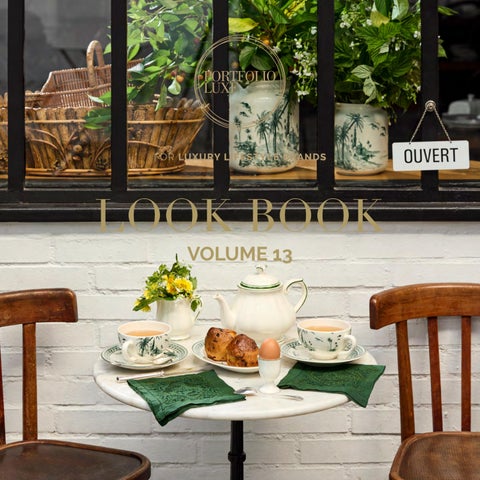
FOR LUXURY LIFESTYLE BRANDS
LOOK BOOK VOLUME 13
We are the exclusive UK agency appointed to represent a select number of prestige international brands. We pride ourselves on being the destination for clients looking to order furniture, lighting, decorative accessories and tableware.
OUR BRANDS
Elizabeth Grace Director
Portfolio Luxe is a full service sales agency unlike any other. We offer a comprehensive sales and marketing service, including fully personalised account management on behalf of some of the most prestigious, luxury international brands. Working closely with our clients according to each individual brief, we specialise in supplying interior designers from initial to final project stages, yacht fit outs, wholesale supply to retail partners, and hospitality - from full restaurant fit outs to finer touches in hotel suites. Our product categories include lighting, furniture, tableware and decorative accessories.
ZANETTO HANDMADE IN ITALY
Welcome to our AW26 Look Book Immerse yourself in all the latest luxury interior accessories, tableware, furniture and lighting from our international portfolio. AW26 celebrates the enduring appeal of objects with a story to tell, bringing together exceptional craftsmanship, material richness and a contemporary point of view. Across the collection, heritage and innovation sit side by side, revealing how time-honoured techniques continue to inspire new expressions of design. This season, we look beyond the finished object to explore the ideas, materials and makers behind it. From remarkable archives and generations of craftsmanship
to new collections and creative collaborations, AW26 reflects a world in which tradition is not simply preserved, but continually reinterpreted. Throughout this edition, we delve deeper into the stories that shape some of our most distinctive brands, uncovering the knowledge, experimentation and artistry behind their work. Together, they present a collection defined not by a single aesthetic, but by a shared belief in objects of character, beauty and lasting relevance.
We're also delighted and thankful to share conversations with Claire German of Design Centre, Chelsea Harbour, and James & Maria Close of ATLAS at Rockliffe Hall, offering their perspectives on design, creativity and the stories behind the spaces they help shape. As you browse, scan the QR codes for behind-the-scenes insights, trend blogs and video features. As always, our team is here to support your projects and selections with tailored solutions and expert guidance.
Meet our team We're a dedicated team covering a range of disciplines, each with at least 15 years of experience in the industry. Elizabeth Grace
Eman Charkaoui
Helena McConnell
Director
Senior Account Manager
Business Development Manager
Kirsten Simonsen
Victoria Lister
Paul Marshall
Amy-Leigh Wright
Account Manager
Hospitality & Tablescape Account Manager
Operations Manager
Client Support Administrator
CONTENTS CHRISTOFLE Club 30 collection Perles glassware
4 4 9
F EATUR E
F E AT U R E
INTO THE ARCHIVES... Alessandro Zannoni, Archivist, NasonMoretti
38
F E AT U R E
IN CONVERSATION... James & Maria Close, ATLAS restaurant
10
INTO THE ARCHIVES... Anna Favretto, Archivist, VENINI
46
GIEN Les Filets Fougère Les Vases à Oranger Les Dépareillées
14 14 16 18
HAVILAND & PARLON Symphonia collection
52 52
RAB IT T I 196 9 Toiles de Noyer mirrors
56 56
GIOBAGNARA Polo bathroom collection Positano bathroom collection Rolli trinket boxes Perla collection Positano fireplace set Lerici & Structura Four-in-a-Row game sets Mahjong game set Rolli Chess & Draughts game set Delos games collection
20 20 21 22 24 25 26 28 29 30
RUDI Nassa baskets
58 58
F EATUR E
IN CONVERSATION... Claire German, Design Centre, Chelsea Harbour
32
F E AT UR E
INTO THE ARCHIVES... Zanetto
60
SCAN FOR DETAILS
Christofle unveils Club 30, a distinctive new creation that is as functional as it is sculptural, dedicated to the art of the bar. Conceived as an invitation to celebrate with brilliance and elegance, Club 30 reinterprets the codes of Art Deco while reviving the festive spirit of Paris during the Roaring Twenties.
CLUB 30 4
CHRISTOFLE
Inspired by the exuberance of the Roaring Twenties, Club 30 pays tribute to the golden age of Parisian nightlife, when the French capital was the epicentre of celebration and refinement. This vibrant and glamorous era evokes a distinctly French art de vivre, where the bars of grand hotels, music halls and intimate lounges embodied a spirit of freedom and carefree joie de vivre.
With Club 30, the bar ritual becomes an immersive, sensory experience, designed to elevate every moment of conviviality. The aesthetic language of Art Deco lies at the heart of the Club 30 Collection. Fluted detailing and elegant curves reinterpret the iconic design vocabulary of the 1930s through a contemporary lens. This dialogue between past and present gives rise to a timeless visual signature - refined, bold and unmistakably modern.
The elegance of ritual The Club 30 Set comprises of five essential bar accessories crafted in stainless steel and marble, bringing together everything required for the perfect bar experience. A champagne bucket, an ice bucket, an aperitif tray and serving bowls combine seamlessly, adapting intuitively to every occasion and every style of entertaining. Compact yet sophisticated, the Club 30 Set is conceived as a centerpiece for gathering - a catalyst for conviviality,
created to accompany every shared moment, from aperitif to Champagne. Beyond its ingenious modularity, the Club 30 Set is a true collector's piece, designed to be displayed as much as it is used. Its sculptural presence, remarkable ability to capture light and striking interplay of materials make it equally at home in contemporary interiors and more classical settings.
Christofle's ambition to reinvent the rituals of the bar - an enduring universe that has always held a central place in the Maison's heritage and collections. With Club 30, Christofle brings together creativity, exceptional craftsmanship and intuitive functionality.
This innovative concept reflects CHRISTOFLE
5
The collection The centerpiece of the collection, the Club 30 Set, comprises five essential bar accessories and is complemented by a sculptural stainless steel champagne bucket. This striking new creation enriches Christofle's offering with a design that immediately captures the eye. Its elongated silhouette accentuates the rhythm of the vertical fluting and the purity of its smooth surfaces, creating a subtle interplay of symmetry and asymmetry. The contrast between textures and reflections enhances the generous proportions of the champagne bucket. Designed to take pride of place both on the table and within the home, it is an object that naturally invites celebration. The collection also includes an ice bucket, another indispensable element of the bar ritual. Its cylindrical silhouette combines an architecturally inspired fluted base with a mirror-polished surface that beautifully reflects the light. Carefully engineered for optimum ergonomics, it offers effortless functionality. Elegant and luminous, the ice bucket elevates every convivial occasion. Completing the collection, the ice tongs embody both the elegance of the ritual and the precision of the gesture. Refined yet highly functional, they are a timeless accessory - ideal both as a gift and as an object to treasure.
6
CHRISTOFLE
Innovative contemporary design The harmony of forms, the dialogue between materials, the expressive power of stainless steel and ingenious functionality all define the essence of Club 30's design.
richness of brown marble. This striking combination creates a refined dialogue between the metallic texture of steel and the warmth of stone, polished and matte finishes, cool and warm tones, revealing the full sensory beauty of each material.
A Play of Forms The collection explores a vocabulary of cylindrical and elongated silhouettes, favouring soft curves and rounded volumes, contrasted by the graphic rhythm of the vertical fluting.
The Power of Stainless Steel With Club 30, Christofle embraces stainless steel, expanding its barware offering with pieces that are both more accessible and easier to maintain, while retaining a distinctive and sophisticated aesthetic. The precision of the fluted steelwork and the Maison's signature mirror polish are the result of exceptional craftsmanship.
A Dialogue of Materials For the first time in Christofle's history, the five-piece Club 30 Set brings together the purity of stainless steel with the natural
Ingenuity & Functionality The ergonomics and design of every piece have been meticulously engineered to ensure intuitive, effortless use. Club 30 distinguishes itself through its sophisticated manufacturing process, technical innovation and a unique construction combining two different steel finishes with double-wall fabrication on the upper sections of each piece. The ice bucket, meanwhile, is entirely double-walled to guarantee optimal thermal insulation.
SCAN FOR DETAILS
CHRISTOFLE
7
A new icon of the bar Restaurants, hotel bars, private clubs and speakeasies are invited to embrace the Club 30 Set and the collection's individual pieces to offer their guests a distinctive and refined experience. The serving ritual is enhanced through the intuitive handling of each accessory, while the Art Deco-inspired design, combined with the brilliance of polished metal, promises an atmosphere that is both festive and elegantly sophisticated.
8
CHRISTOFLE
NEW PERLES GLASSWARE A new expression of the Christofle Maison, conceived for everyday living and revealing the full brilliance of lead-free crystal. Perles celebrates the purity of lines and the delicacy of artisanal craftsmanship. Each mouthblown piece reflects exceptional precision and attention to detail.
The signature of the collection lies in its fine crown of pearls, delicately cut into the crystal and encircling each glass like a refined jewel. Both graphic and timeless, this airy motif enhances the finesse of the material while bringing depth, texture, and brilliance to every piece. Designed to accompany every moment of life, these glasses naturally belong in everyday use while elevating the most elegant table settings with a spirit of contemporary classicism. CHRISTOFLE
9
In conversation...
JAMES & MARIA CLOSE AT L A S R E S TA U R A N T AT R O C K L I F F E
At ALTAS James & Maria Close, every detail has a story to tell. Inspired by journeys around the world, the restaurant Rockliffe Hall brings together global f lavours, considered design and an immersive chefguided approach to dining, creating an experience shaped as much by discovery and storytelling as by the dishes themselves. We talked to James & Maria Close about the vision behind ATLAS, the inf luence of travel and place, and how everything from wine and interiors to glassware, cutlery and tableware contributes to the experience.
10 IN DOLCE&GABBANA CONVERSATION... CASA
“ATLAS is inspired by your travels and culinary discoveries around the world. How do those experiences inf luence the way you approach the menu and the overall guest journey?
“Every great restaurant has a distinct point of view. What is the core philosophy that underpins the ATLAS experience, and how do you bring that philosophy to life on the plate?
For menu, the inspiration comes from the flavours and ingredients that we discover on our own journey, sometimes it is a long way from trying a simple but flavourful street food item in a different country to transporting it into something accessible but refined and elevated, still familiar and recognisable by our diners.
Philosophy behind ATLAS is really about creating a sense of discovery through food. We want each dish to offer something that goes beyond flavour alone, whether that's an unexpected combination of textures, a particular detail, or a story behind an ingredient or technique. It's about taking inspiration from places, cultures and experiences we've encountered and translating them into something that feels both familiar and new.
Service wise, we aim to have a relaxed atmosphere with high attention to guest's needs, and we simply pick the best elements from everywhere we have been and experienced the best service ourselves, and it is never stiff or overly formal.
it would actually be meaningful. It was very important to us for all these elements of serving to blend with each other seamlessly and to be intentional. The best glass for negroni, the most sophisticated champagne flute or the colour of the cutlery that quietly compliments the story and location of the dish.
“The concept promises an immersive, chef-guided dining experience. Beyond the food itself, what emotions or memories do you hope guests take away from an evening at ATLAS?
“Fine dining today is about much more than cuisine. How important are elements such as tableware, cutlery, glassware and presentation in shaping a guest's perception of luxury?
It is a combination of elements that we hope our guests would appreciate. We are not here to impose our autobiography on every diner, we share some details to give a context to the dish, but we hope it will spark their own memories or conversations and maybe even future plans about visiting countries or areas they always dreamed to visit.
Unintentional luxury can sometimes come across soulless or generic, and the last thing we would want our guest to think when they drink out of a Baccarat glass or use Christofle cutlery is 'what's the price tag on this?' We were very careful when choosing all items from plates to glassware, from cutlery to decanters, to service trays, always combining visual aspects with practicality, so
“You've carefully curated every aspect of the table setting, including pieces from Christof le and Giobagnara. What qualities do you look for in the objects and brands that become part of the guest experience? For instance, the colours of the Talisman complement two of our dishes from the main section, and it spreads to the wine glass stem colour as well as coloured elements on the crockery. Because one of them involves a coastline dish, we went with blue for La Rochelle, and another one for a dish with Marceille origins, had to be red. By this part of the menu, guests normally feel very relaxed about the service and great food that keeps coming their way, so these small details just give that extra stimulation and excitement that makes you wonder "Oh, what's
DOLCE&GABBANA IN CONVERSATION... CASA 11
coming next, what else are they going to surprise us with?"
“The restaurant's design blends North East heritage with international inf luences. How closely have the culinary and interior design visions evolved together? The vision was very much driven by us from a culinary perspective, because we had a clear sense of what ATLAS needed to be and how we wanted guests to feel and experience it. Interior designers did a great job pulling it out of us through details and references, and understood the thinking behind them to translate it into a physical space.
dimension to the ATLAS experience. When people choose a bottle, emotional connection can often outweigh the rational decision. It creates a real opportunity for storytelling and a sense of personal connection. Naturally, with our Head Sommelier we have added to our Around The World pairing another one called Postcards, that evolves around wines that hold memories for us, the vineyards that we visited, the producers or vintages we prefer. So depending on the guest, they can create their own wine journey to complement the meal or they can join us on ours.
“As Culinary Director across Rockliffe, how do you balance the creation of a destination dining experience at ATLAS When you decide that a restaurant with maintaining exceptional will have an open kitchen as an integral part of the guest experience, standards across the wider you realise those two cannot exist resort? separately.
“Wine is a central part of
the ATLAS journey. How do you work with the wine team to create pairings that complement a menu inspired by f lavours and ingredients from around the world? Wine adds unique emotional
12 IN DOLCE&GABBANA CONVERSATION... CASA
We joined the hotel over 2 and half years ago with a development team full of likeminded people, so we've had the time and resources to establish certain standards and direction for the rest of the outlets across the resort. It was essential to achieve this before opening ATLAS, so that for the moment, it can remain our priority. But of course, I still keep a close eye through meetings
with the hotel team, and regular diners in Rialto, to ensure they continue to achieve the standards we set.
“Looking ahead, what do you hope ATLAS will contribute to the North East's growing reputation as a world-class culinary destination? I think it is well recognised within the country as it has been building a reputation for many years now. So now I hope that it brings more international guests, because it's without doubt that we have things to offer at the highest level, and are definitely worth travelling for. www.rockliffe.co.uk @atlasjamesclose @rockliffe__
DOLCE&GABBANA IN CONVERSATION... CASA 13
LES FILETS Fougère
A new colour has been added to Gien's rainbow of handmade Filets: Fern Green. This shade echoes the green found in the Filet Noël collection and will therefore pair easily with those pieces. Inspired by the colour of plants - as suggested by its name, "fern" - it can be used throughout the seasons. Timeless, simple, and refined thanks to the elegance of the hand-crafted line and the traditional shell shape, this collection can be displayed on its own or paired with your favourite pattern. Bright and natural, this colour will complement many of Gien's other designs, such as Les Vases à Oranger, Millefleurs, Toscana, Chance Folle, and more.
14 GIEN
SCAN FOR DETAILS
GIEN 15
LES VASES À ORANGER The result of a collaboration between Gien and Palace of Versailles. The theme of this design is, more specifically, the Palace's gardens, the absolute masterpiece of the "King of Gardeners" and the King's gardener: André le Nôtre. Le Nôtre pioneered a new style, emerged in the 17th century: the "French formal garden," a true form of plant architecture. Among its hallmarks, the trellis is everpresent, shaping and defining the groves - those little "green oases" that punctuate a stroll through the Palace's gardens. At the heart of the gardens, Gien has chosen to highlight bronze orange tree vases. There are six of them; each is unique and constitutes a true treasure of the decorative arts. Drawing on historical engravings depicting this exceptional collection, Gien have reinterpreted these vases to make them the centerpiece of the collection.
16 GIEN
SCAN FOR DETAILS
Each piece features a border that reflects these themes: plant architecture and the art of trellising. Particular care was taken in the treatment of the motifs to highlight the "engraving effect" of the historical document from which the collection draws its inspiration. The colour palette - a monochromatic scheme of greens and khaki - bridges the tender freshness of gardens with the bronze patina of the vases, all punctuated by the vibrant pop of orange, giving the collection an effect that is both classic and light. Blending historical heritage with everyday elegance, "Les Vases à Oranger" collection offers a refined, fresh, and timeless vision of the French art of living.
GIEN 17
LES DÉPAREILLÉES Gien presents a new interpretation of the "Vues d'Orient: and "Monogramme" motifs in the green and blue Les Dépareillées collection drawn from its 19th-century archives. With these pieces, Gien is expanding its range of gifts and home decor items, offering three sizes of vases, three sizes of square candy trays, a round candy box, and a scented candle whose 'Rêve
18 GIEN
d'Orient' fragrance also invites you to travel and escape.
Pont aux Choux white and 'Rocaille' white collections.
This collection expansion also includes new tableware items designed to meet all your dining needs.
The green pieces will pair perfectly with the Pont aux Choux Emerald green and kaolin white cups, or the new Les Filets fern green pieces.
Mixing patterns and styles will help create a warm and inviting atmosphere at your table. You can pair the green and blue Les Dépareillées with the solid-colour
As for the blue, they pair perfectly with the Pont aux Choux sky, cobalt, and kaolin white cups, as well as the Les Filets blue and cobalt. SCAN FOR DETAILS
GIEN 19
POLO BATHROOM COLLECTION The Polo leather bathroom collection is defined by its signature rounded silhouette, where soft contours temper a rigorous geometry and lend each piece an elegant, contemporary presence. A leather-covered structure defines each piece, complemented by refined metal details available in brushed bronze, brushed brass or polished chrome. The dialogue between the warmth of leather and the lustre of metal gives the collection its distinctive character, at once sophisticated, tactile and timeless.
SCAN FOR DETAILS
20 GIOBAGNARA
POSITANO TOILET BRUSH & PAPER HOLDER Echoing the well known form of the Positano bathroom collection, with slim cylindrical designs, accented by flat metal edging. Presented in two models, either combining a toilet paper holder and toilet brush, or with additional wastepaper bin, the Positano set can be specified in all-metal, metal accented with genuine leather, or a combination of metal and marble. The unit is comprised of solid brass, making it sturdy and freestanding, with a non-slip waterproof rubber base underneath. The waste bin features a removable transparent plexiglass inner container for easy cleaning.
GIOBAGNARA 21
ROLLI TRINKET BOXES Inspired by the architectural rhythm of Genoa's historic Palazzi dei Rolli, the Rolli Collection translates classical proportions into a refined series of leather boxes. Layered profiles define each volume, creating subtle projections that recall cornices and articulated façades. Offered in monochrome or bicolour combinations, the collection unfolds across different scales and geometrics.
22 GIOBAGNARA
From square and rectangular forms to elongated and round silhouettes, each piece becomes part of a versatile architectural vocabulary, shaped by precise craftsmanship and the tactile richness of leather.
SCAN FOR DETAILS
GIOBAGNARA 23
PERLA COLLECTION
Perla brings together leathercovered, extruded round forms in a family of decor and table pieces defined by clarity and continuity. The volumes are reduced to their essence, compact and deliberate, almost monolithic. Encircling each piece, a metal ring made of linked spheres acts as a precious punctuation. More jewel than hardware, it recalls the cadence of a pearl collier, catching light and framing the form without excess. Perla speaks through balance, material presence and a discreet, ornamental gesture. The collection features coaster sets, valet trays and lidded trinket boxes.
24 GIOBAGNARA
SCAN FOR DETAILS
POSITANO FIREPLACE SET The Positano fireplace set is defined by an essential, highly graphic structure, where elongated volumes lend the composition a sense of lightness and vertical rhythm. This visual refinement is balanced by the substantiality of metal, enriched with leather inserts that introduce warmth and tactile contrast. A fireplace brush, a fire poker, fireplace tongs and a coal shovel complete the set, their slender silhouettes transforming functional tools into a refined sculptural ensemble. GIOBAGNARA 25
GAMES LERICI FOUR-INA-ROW The Lerici four in a row game set combines the warmth of leather and walnut wood with the smooth, opaque finish of plexiglass. The leather-covered wooden box supports a vertical playing field defined by a matte, substantial surface and framed on both sides by a black graphic line, whose perforated design reveals the colours of the chips as the game unfolds. When not in use, the playing field can be removed from the base and laid horizontally to serve as a lid, giving the set a compact and refined presence. Walnut wood chips with leather inserts complete the design, adding warmth, texture and a finely crafted detail to the composition.
26 GIOBAGNARA
STRUCTURA FOUR-INA-ROW The Structura four in a row game set pairs a solid architectural presence with a light, refined appearance. Its wooden structure supports a vertical playing field crafted from sole leather, whose perforated surface reveals the colours of the leather chips as the game unfolds.
SCAN FOR DETAILS
When not in use, the playing field can be removed from the base and laid horizontally to serve as a lid, transforming the set into a compact, elegant object. The warmth of wood and the distinctive character of sole leather lend the piece a subtly vintage quality, designed to age gracefully over time.
GIOBAGNARA 27
MAHJONG GAME SET Presented in a precious leather-covered wood case with removable top, this set is a stunning gift for any board game enthusiast. Includes one set of highly resistant opaque plexiglass tiles and sticks, four standard dice and a dice with north, south, east and west labelled sides to determine the seating arrangement and who will begin play.
Box complete with the following pieces: • 148 opaque plexiglass bicolour tiles (144 with symbols and characters + 4 plain) • 244 opaque plexiglass sticks • 4 opaque plexiglass standard dice • 1 opaque plexiglass dice with north, south, east and west labelled sides
SCAN FOR DETAILS
28 GIOBAGNARA
ROLLI CHESS & DRAUGHTS GAME SET
Inspired by the architectural rhythm of Genoa's historic Palazzi dei Rolli, the Rolli Chess / Draughts Set translates classical proportions into a refined composition of leather and wood. Layered profiles shape the leather-covered volume, while the lid becomes a decorative surface in its own right, with the playing field entirely articulated through intricate marquetry. Beneath it, maple
and walnut chess pieces are carefully arranged alongside draughts chips enriched with leather inlays, each resting within a dedicated slot shaped to its profile. Geometry, material and craftsmanship come together in a composition defined by rhythm, precision and quiet sophistication.
GIOBAGNARA 29
DELOS GAMES COLLECTION Giobagnara's Delos collection transforms the rituals of play through material, proportion and meticulous craftsmanship. Bringing together Chinese Checkers, Go, Othello and Sudoku, the series gives familiar games a distinctly contemporary character. Essential geometries and softly rounded forms provide a framework for a rich dialogue of materials. Walnut and wenge woods sit alongside travertine and Arabescato White marble, Corian and finely worked
SCAN FOR DETAILS
30 GIOBAGNARA
leather, with each variation bringing its own depth, texture and personality. Leather inserts, digitally printed playing surfaces and discreet storage drawers reveal and attention to detail that extends from the board to the individual playing pieces. Balancing functionality with a strong decorative presence, the Delos games are conceived not simply to be played, but to become part of the interior: tactile, beautifully crafted objects designed to remain on display.
GIOBAGNARA 31
In conversation...
CLAIRE GERMAN, CEO DESIGN CENTRE, CHELSEA HARBOUR
Design Centre, Chelsea Harbour is widely regarded as one of the world's leading destinations for interior design, bringing together more than 140 showrooms and over 700 international brands across furniture, fabrics, lighting, wallcoverings, kitchens, bathrooms, carpets, tiles and accessories. The Design Centre hosts major industry events including London Design Week, Focus on Design and WOW!house, attracting designers, architects, specifiers and discerning design enthusiasts from around the world. Under Claire German's leadership since 2010, it has strengthened its position as a leading international design hub and expanded both its showroom offering and event programme. Claire previously worked at Condé Nast, serving as Publishing Director of House & Garden and sitting on the Condé Nast board.
32 IN DOLCE&GABBANA CONVERSATION... CASA
“What do you believe has been the key to the Design Centre's success? Our mission is to help people discover great design and support those doing it best, from global brands to emerging makers that you will not find anywhere else. The key to our success has been our refusal to stand still - we're growing faster than ever, attracting more companies, building new audiences and investing in our infrastructure. A common misconception is that the Design Centre is 'just a building with showrooms', but the truth is that we're doing so much more to champion creativity, entrepreneurship and business. Beyond the standard support of traditional landlords, we go the extra mile. We understand the importance of a curated ecosystem, and we actively invest in the success of our showrooms through extensive branding, marketing and high-
profile events that generate media attention and fosters business growth. By maintaining an exceptional standard for the international brands we welcome and matching that with world-class events such as Focus on Design, London Design Week and WOW!house we have established ourselves as the definitive voice of authority for global interior design.
“How has the role of the
Design Centre changed since it first opened, and how do you see it evolving over the next decade? When the Design Centre first opened, it was a trade secret known only to professionals. It has evolved
hugely and strategies to reach new design lovers, create must-see experiences and increase footfall have presented all sorts of exciting possibilities. We've created a wonderful environment that people want to come to, and businesses want to be part of. We welcome not only designers, architects and specifiers from around the world who are working on top hotels, bars, boutiques, yachts, jets and private residences, but also visitors who are creating their own homes. Our digital channels reach out far and wide, sharing ideas and news about the people, products and projects you need to know about. We're bricks, mortar and beyond.
“You took the helm in 2010.
Looking back, what are the achievements you are most proud of ?
WOW!house. It's long been something I wanted to do since I arrived at the Design Centre. The idea was to give interior designers a blank canvas to create the most beautiful rooms possible. The showhouse has brought our worldwide design community together, sparking conversations, building relationships, sharing
knowledge, championing creativity and raising awareness for the charitable causes at its heart.
“Which decisions felt particularly bold or transformative at the time? Completing the Design Avenue was a milestone as it addressed a long-standing spatial challenge by converting an open-air gap into an impressive multi-storey atrium. Before its construction, the site was physically fragmented but the Design Avenue has seamlessly become a central artery. The space is used for major exhibitions, highprofile events and immersive design showcases, and is the home of WOW!house. Another bold move was launching the Design Emporium Collective this year. The curated marketplace is the first-of-its-kind resource for the industry.
“The Centre is often described
as a community as much as a destination. How important has fostering that sense of community been to your strategy? It's a cornerstone of everything we do. Design centres are
important to our industry as they provide a physical platform for inspiration, innovation, learning and collaboration - we call it 'connect, converse, create'.
“What have been the biggest challenges facing the interiors industry during your tenure, and how has the Design Centre adapted? You need to be bold, nimble and decisive in our industry always be on the lookout for new opportunities, pivot if necessary, and never be afraid of trying something new. When the world had a digital shift, we doubled down on the value of experiencing design in person. The popularity of WOW!house has proved that digital screens can never replace the joy of real-world design.
“What design trends are currently defining the luxury interiors market? We're seeing a more human-centric approach where spaces are not just beautiful and functional, but also make a deep personal connection to the people what inhabit them. There's a profound shift toward interiors that feel curated and collected over time rather than styled overnight with a focus
DOLCE&GABBANA IN CONVERSATION... CASA 33
something completely unique, and the rise of bespoke interiors goes hand-in-hand with this.
“Sustainability has become a major theme across design. How do you see this evolving from trend to long-term practice?
on heritage, emotional comfort and highly personal storytelling, prioritising craftsmanship and customisation over obvious displays of excess.
“Which emerging trends
do you think will have the greatest impact over the next few years? Our surroundings have a profound impact on how we think, feel and behave. Science is now providing evidence to support many of the decisions designers have long made based on experience and intuition. Wellness is no longer confined to the treatment room - it's breaking out of the spa and moving into our homes, actively supporting physical, mental
34 IN DOLCE&GABBANA CONVERSATION... CASA
and emotional health.
“Are clients becoming
more adventurous in their choices, or are they seeking timelessness and longevity? There's always been a strong emphasis on both craft and custom work in our showrooms. As we transition into a new digital age with the rise of AI, staying grounded - and keeping in touch with what it means to be human - will become more important than ever. Craftsmanship has a big part to play: designers are creating environments that are more led by emotion and how they make you feel, and brands recognise that handmade products tell a compelling story. Clients want
Sustainability is no longer an optional marketing buzzword. We're moving away from surfacelevel eco-trends toward more transparency in supply chains. There's more interest in circularity, understanding the lifecycle of a product, prioritising low-impact manufacturing and valuing the heirloom quality of pieces build to last multiple lifetimes.
“What materials, colours or
inf luences are exciting you personally right now?
Studios typically work behind closed doors, yet each season, common threads emerge that often mirror broader cultural shifts. Highlights for autumn/winter 26 include a rich palette of claret, gold and teal, alongside pinks and warm metallics. I'm personally captivated by verdigris with its blue-green patina. I love the texture of natural stone finishes and the new-old damasks, corduroy and wool that combine
traditional heritage with serious tactile heft.
“How have client expectations changed over the last decade? The modern client is vastly more informed and globally aware than a decade ago, largely driven by digital platforms like Instagram. Consequently, they don't just want to buy a product; they want to know who made it, how it was made, the materials and skills used and the story behind it.
“In an increasingly digital world, why does the physical showroom remain so important? While digital browsing has its place, nothing beats the real-life experience of seeing products in person or discussing custom options with knowledgeable showroom teams. Design is an inherently visceral, tactile industry. You cannot sit on a digital rendering to test the comfort of a sofa, nor can you accurately see how natural light bounces off a silk fabric through a smartphone screen.
“Are personal shopping and curated design services becoming increasingly
valuable in the luxury sector? Unquestionably. In an age of information overload, time has become the ultimate luxury. Our personal shopping team know the showroom inside out and can streamline the process for busy clients, translating a sea of options into a tailored edit, and even introducing them to products that they may not have considered before.
“How important is storytelling in helping consumers connect with brands and makers? Storytelling is the invisible thread that elevates a physical object into something to treasure. When a client learns about the multigenerational family in Italy that wove their fabric, or the hours of hand-casting that went into a bronze lamp, the value of that item changes.
“How did you come up with the concept of Source and later the Design Emporium Collective? With over 140 showrooms to explore, navigating the Design Centre can be a daunting task. We came up with the idea of a personal shopping service to provide friendly guidance
to help visitors narrow down the options. Once you have made your selection, the team handle every detail, from placing orders to arranging international shipping, providing a seamless, stress-free shopping experience. For those looking to elevate their dining experience, Source is a dedicated space in the Design Emporium Collective that showcases over 60 prestigious china and glass brands. From names like Meissen, Gien, Robert Haviland & C. Parlon, and NasonMoretti to contemporary designers like Alberto Pinto and 1882 Ltd, it offers everything from fine bone china and porcelain to crystal. You can also find touches for the table from flatware to linens and objets d'art. The Design Centre is ever-evolving and the Design Emporium Collective is a new initiative to meet a growing demand. Opening in March 2026, and with a fourth phase already in the pipeline, it's the place to find treasures that you would not find anywhere else.
“Are you finding interior
designers are using Source differently to the main Design Centre? Yes, the behaviour is distinctive as Source is the go-to for over 60
DOLCE&GABBANA IN CONVERSATION... CASA 35
prestigious china and glass brands. Personalisation and bespoke commissions are also available to ensure a tabletop is truly one-of-akind.
“Do interior designers enjoy
bringing their clients in and "playing" with tablescapes? They absolutely love it. It has democratised and animated the design process. The tactile, interactive nature of the Source space allows designers and clients to physically test out combinations, mix pattens and play with tablescapes in a highly creative 'sandbox' environment.
“What's next for Design Centre, Chelsea Harbour? We're focused on expanding our global reach while continuously refining our physical experience. Plans are already in place for WOW!house 2027 - it promises new surprises, more gasps of wonderment and the chance to immerse yourself in some truly mind-blowing interiors!
“Are there any exciting developments, partnerships or initiatives you can share with us? While I can't reveal everything just yet, we're forging incredibly exciting cross-industry partnerships. We're also expanding our mentoring initiatives and support rising stars I'm on the board of Next in Design, a scheme set up by Homes & Gardens to provide support for diverse new voices entering the interior design arena.
“What opportunities do you see for the next generation of designers? The next generation has an unprecedented opportunity to redefine the industry's relationship with craft and technology. They are digital natives who instinctively understand global connectivity, but they also possess a deep, refreshing respect for time-honoured skill and craftsmanship.
“What lessons from your
career in media and publishing do you still apply today? My background in magazine publishing has helped me in my
36 IN DOLCE&GABBANA CONVERSATION... CASA
role at the Design Centre as brand building and communication skills are important in both. Publishing taught me the absolute power of clear communication and audience engagement so that it tells a compelling story instantly.
events and talks at the Design Centre for a start!) The creative industries thrive on human connection; talent is vital but a willingness to learn will take you incredibly far.
As CEO of the Design Centre, it requires the exact same meticulous attention to detail; every event, showroom mix and campaign must engage, inform and inspire our audience. It's always fast-paced as we're constantly setting new benchmarks about what to see and do.
and inspire you after so many years in the industry?
It's incredibly inspiring to be at the vanguard of new launches and the latest collaborations, shining a spotlight on the wealth of talent here. My role is incredibly diverse, and no day is ever the same, whether it's looking at new collections to meeting new companies who want to work with us.
“What advice would you
give to someone hoping to build a career in the creative industries? Be relentlessly curious and build genuine relationships. Show up to events, ask questions and immerse yourself in the work of designers you admire (come to the myriad of
“What continues to motivate
The people. The design world is filled with an extraordinarily passionate, resilient and imaginative community of makers, designers and visionaries. It's easy to be motivated - working in the interior design industry is endlessly fascinating and no day at the Design Centre is ever the same. We're seen as the mothership, not just in the UK. If there's a product launch or an international event which brings everyone together - it happens here.
“When people walk though the doors of the Design Centre, what do you hope they leave with, besides inspiration? I want them to leave feeling fully equipped with the resources, knowledge and confidence they need to bring their creative visions to life, as well as appreciation of the extraordinary skill and craftsmanship behind every product they have found on their voyage of discovery. www.dcch.co.uk @designcentrech
“If you could identify one
thing that will define the future of great interior design, what would it be?
Soul. Great interior design in the future won't be defined by perfection or a specific trend; it will be defined by how deeply a space reflects the values of the people who inhabit it. A home with soul prioritises comfort, craftsmanship and emotional well-being over transient aesthetics.
DOLCE&GABBANA IN CONVERSATION... CASA 37
Into the archives... ALESSANDRO ZANNONI, ARCHIVIST NASONMORETTI
“What first drew you to
For over a century, NasonMoretti has shaped Murano glass through an expressive language of colour, form and craftsmanship. Preserved within its archive are not only finished objects, but drawings, photographs, catalogues and correspondence that reveal the experiments, ideas and human stories behind the company's evolution. We speak with Alessandro Zannoni, Archivist at NasonMoretti, about his work with this rich collection. He ref lects on the archive as a living space for discovery, where historic techniques and designs continue to inspire contemporary production and carry the story of NasonMoretti into the future.
38 INTO DOLCE&GABBANA THE ARCHIVES... CASA
working with archives, and what continues to inspire you about preserving NasonMoretti's heritage today? Before I began working with the NasonMoretti archive, after graduating in Product & Communication Design, I pursued a path of hands-on craft training in a Venetian workshop. For me, craftsmanship was - and still is - the opportunity to personally follow a project from its initial concept through to its realisation, and this has always been a fundamental aspect of my work. After a few years in Venice, in 2018 I had the opportunity to take part in the design of the NasonMoretti museum space. This allowed me to come into direct contact with objects from different periods, as well as photographs, documents, drawings, letters and many other materials.
This encounter sparked a deep interest in unexpected forms, colours and glassmaking techniques, nurturing a curiosity that, over time, has become an integral part of the way I work. Researching, studying and bringing new attention to these objects and the histories they embody gradually became central to my practice, even before my work as a designer. For me, the archive has become not simply a place of preservation, but a space for discovery and research - one that continually creates connections between the past and new possibilities for design.
“An archive is often seen as
a record of the past, yet it can also inf luence the future. How do you see your role in shaping the ongoing story of NasonMoretti? Making the archive accessible has led to some genuine rediscoveries. As happened earlier in the world of fashion, product-based corporate archives offer a comprehensive view of the intrinsic - and we might even say iconic - characteristics of a company's historical production. They form a kind of corporate DNA, one that continues to evolve and renew itself around stylistic elements, techniques and visual languages established over time. The creation of the museum and its exhibitions has made it possible to bring techniques, forms, and colours back into view, into our collective memory and attention - elements that, over the years and amid the fast pace of production in the furnace, can sometimes fade or be forgotten. Looking at pieces from the historical production today with a new awareness, exploring different colours and new technical possibilities, allows us to innovate while maintaining a sense of respect for and consistency with the company's identity.
A recent example is the tribute to the AS 15, AS 16 and AS 17 vases designed by Sergio Asti in the 1980s, selected for an exhibition during The Venice Glass Week 2025 and newly blown using a new palette of opaline glass. The colour selection partly reflects the designer's original choices while also expanding upon them, creating a dialogue between the historical design and contemporary production. It is therefore not simply a reissue, but rather a continuation of the original project one that introduces new possibilities without losing its identity. Having a comprehensive view of the company's production, from the earliest days of Cristalleria Nason & Moretti to the present, is both a privilege and a practical design tool. It allows us to give new value to our research, both through projects aimed at sharing and communicating the archive and through the development of new product lines, bringing what emerges from the archive back into the design process. In this sense, my work in the archive is not limited to preservation and historical reconstruction. The knowledge gained through objects, drawings, catalogues and documents becomes a design tool in itself - one that can suggest models
to recover or reinterpret, as well as modifications, forms, techniques and colours to explore. The archive thus becomes a living space, where research into the past can generate new possibilities and inspiration for contemporary production.
“Having spent so much time exploring the collection, is there a particular object, document or discovery that has surprised you or captured your imagination? It is really difficult to choose just one item in response to this question. If I had to, I would probably say the glasses decorated by Anzolo Fuga in the 1950s, particularly those featuring faces. I am fascinated by the idea of imagining these objects in their original context of use; sitting at the table at the end of a dinner, sipping a sherry an seeing the face painted in coloured enamel on the transparent bowl of the glass looking back at you, while, through the glass, it overlaps with the faces of friends and fellow guests. It is an image that continues to surprise me, because the decoration does not simply remain on the
DOLCE&GABBANA INTO THE ARCHIVES... CASA 39
surface of the object - it interacts with the person using it and with everything around it. The glass is constantly transformed by the point of view, the light, and the people on the other side of it. It is precisely this playful and unexpected quality, emerging from an everyday object, that continues to capture my imagination.
“What does the archive
reveal about the evolution of NasonMoretti and its place within the history of Murano glassmaking? First and foremost, the archive reveals changes in society, not only through the evolution of taste, but also through the transformation of rituals surrounding drinking and the table. The earliest tableware sets were particularly elaborate, comprising glasses of different shapes and heights - for rosolio, sherry, water, champagne, fine wine, white wine or red wine - and gradually gave way to more essential sets with a more limited range of forms.
Catalogue photograph of glasses with faces, designed by Anzolo Fuga, 1950s. NasonMoretti Historical Archive.
40 INTO DOLCE&GABBANA THE ARCHIVES... CASA
At the same time, certain pieces offer very tangible evidence of the technical and chemical evolution of Murano glassmaking. The first textures introduced to give crystal glass a distinctive character, for example, also helped to conceal imperfections. Over time, production techniques were refined to give individual model their own recognisable identity; from irregular cuts on the bases of the glasses to the use of textured moulds. These solutions brought manual knowledge and craftsmanship into dialogue with serial production, a
defining characteristic of Nason & Moretti table glassware. Through these objects, one can also sense the broader history of Italy. The restrictions imposed by the policy of Autarky during the Fascist period, for example, are reflected in the production of the Bologna glass: a simple, essential and functional glass designed for everyday use and traditional osterias. Then there is the ongoing exploration of colour, which runs throughout the company's history and also reveals how technical knowledge and possibilities have evolved over time. Historical opaline and uranium glasses are examples of this: they were produced using materials and processes belonging to an earlier phase of glassmaking and are no longer employed in contemporary production. Yet these historical colours remain important references for the development of new and compelling shades today.
“NasonMoretti is celebrated
for its sophisticated use of colour. Looking through the archive, how has the brand's relationship with colour evolved over the decades? From the earliest subtle shades, combined with clear crystal and
Colour thus became a meeting point between tradition, fashion, technical research and influences from different creative worlds. This continuous experimentation has enabled NasonMoretti to make a significant contribution to colour research in Murano glassmaking, developing over time one of the island's broadest and most distinctive palettes. Image from a historical catalogue featuring the Murano tableware set, 1920s. NasonMoretti Historical Archive.
used in table glassware - fumé, amethyst, turtle, light blue - the palette quickly evolved towards the bolder contrasts of Art Deco and colours evoking Oriental ceramics and lacquerware, such as coral red and black, later joined by milky white. Verde lauro also appeared very early on, recalling the distinctive green glass traditionally associated with Empoli.
A particularly significant example is the Lidia collection, which earned Nason & Moretti and Umberto Nason the Compasso d'Oro in 1955. Simple volumes, reflecting the sensibility of Northern European design, were created using reversed "incamiciato", or layered-glass techniques: an innovative way of reinterpreting Murano craftsmanship through an essential modern language.
From the 1950s onwards, travel, the company's participation in major international exhibitions, and its ongoing dialogue with the work of other manufacturers became fundamental drivers of innovation. Nason & Moretti demonstrated an ability to reinterpret techniques rooted in the Murano tradition, applying them to everyday glassware through light, contemporary forms.
In the following decades, the dialogue with the worlds of fashion and luxury - through collaborations with brands such as Dior, Valentino, Armani, Hermès, Bottega Veneta and Tiffany - also became an important stimulus for experimentation. The demands of the fashion industry, particularly in terms of colour, continually encouraged the company to explore new shades, combinations, and expressive possibilities in glass.
“Many of today's designers seek inspiration from historic craftsmanship. What lessons can be learned from the archive? We can learn so much. We can draw inspiration from forms and colour combinations that have already been explored, assessing their potential even before producing new samples. We can return to moments when intelligence was less artificial and more manual, rediscovering the value of gesture, experience and intuition. We can fall in love with a sketch and appreciate the quality, immediacy and warmth of a hand-drawn line. We can find inspiration in different photographic techniques, exhibition displays, catalogues, and ways of presenting and communicating glass that may seem unusual to us today,
DOLCE&GABBANA INTO THE ARCHIVES... CASA 41
42 IN DOLCE&GABBANA CONVERSATION... CASA
Examples of NasonMoretti's glass colour samples
but which, for that very reason, can open up new perspectives. Above all, we can draw on this extraordinary wealth of knowledge: thousands of experiments and intuitions, attempts, failures and successes accumulated over time by a company and, more broadly, by an entire region and its glassmaking culture. Not in order to repeat what has already been done, but to understand it, reinterpret it, and transform it into new possibilities and inspiration. In this sense, the archive is not simply a repository of the past; it is a tool for building a present and a future that are both beautiful and useful.
“Which designs do you
believe have had the greatest inf luence on modern table culture? I believe that the PL/4 and the 3/62 are among the most representative models-quintessential examples of NasonMoretti stemware. Their designs were established in the 1960s, yet their roots can be traced back to the company's earliest tableware sets with stems and open feet, reinterpreting this structure through fuller volumes and a particularly successful balance of
form, colour and texture.
“If you could choose a single piece from the archive that best represents the spirit of NasonMoretti, what would it be? This is another very difficult question. If I had to choose, I would say that the goblet from the AS4 series, designed by Sergio Asti in 1985; a generously sized bowl with a simple form, blown with a torsé texture, a coloured knop - particularly elegant in the pink version - and the classic open, trumpet-shaped stem. I believe that the exploration of form, the dialogue with the designer, and the carefully balanced relationship between texture, the transparency of the crystal glass, and colour, together with the harmony of its overall proportions, make it one of the pieces in the archive that best represents NasonMoretti. It is an object in which very different elements coexist without competing with one another; the texture brings the surface to life, the colour accentuates the knop, while the crystal glass gives the piece a sense of lightness.
Sketch for a carafe, tempera on paper, Cesare Lacca, 1957. NasonMoretti Historical Archive.
Overall, I find that it beautifully encapsulates NasonMoretti's ability to bring together formal exploration, craftsmanship, and the use of colour, a quality that runs throughout the company's history. www.nasonmoretti.com @nasonmoretti
DOLCE&GABBANA INTO THE ARCHIVES... CASA 43
“What do you hope future
generations will discover and understand about NasonMoretti through the archive?
Perhaps I should distinguish between future clients and future collaborators, but ultimately I believe the answer is the same. I hope they understand that, by purchasing and using a NasonMoretti glass, or by contributing to its creation, they are not simply drinking from a glass or blowing a vase; they are coming into contact with a piece of history and, in some way, helping to carry that history forward.
the material or the craftsmanship, but from a hundred years of experiments, successes, failures, stories and experiences. And I hope they can feel equally proud to make an object that carries all of this within it, or simply to use one. In the end, yes, it is a glass, but it is also much more than that.
I hope they can feel the passion of those who came before them and, at the same time, recognise the possibility of adding something of their own. For those who make these objects, it might be a gesture, a skill, or an intuition; for those who use them, it might be the way they become part of everyday life, memories and relationships. Even something as simple as telling friends over dinner the story behind a particular vase or glass allows that history to keep circulating, growing, and acquiring new meaning. Above all, I hope they understand the quality behind these objects; a quality that comes not only from Opaline glass tests, 2020.
44 INTO DOLCE&GABBANA THE ARCHIVES... CASA
(Top) Historical catalogue sheet, 3/62 tableware set, 1960s. (Left) First international Nason & Moretti logo, 1920s. (Right) Paper label, 1920s. NasonMoretti Historical Archive.
DOLCE&GABBANA INTO THE ARCHIVES... CASA 45
Into the archives... A N N A FAV R E T T O , A R C H I V I S T VENINI
“What first inspired you
to become an archivist, and what makes it such a rewarding experience?
A story, an artistic excellence, a typically Italian passion. Founded in 1921 by Paolo Venini, a Milanese lawyer, and Giacomo Cappellin, a Venetian antiques dealer, VENINI would become a model of excellence in the world of artistic glass, laying the foundations for a stylistic identity that still distinguishes it today. Over time, VENINI entered into important partnerships with artists such as Napoleone Martinuzzi, Carlo Scarpa, Vittoria Secchin, and, in the post-war period, Gio Ponti, Fulvia Bianconi and Mimmo Rotella. We talked to Anna Favretto about the role of the Archive in shaping VENINI's past and future.
46 INTO DOLCE&GABBANA THE ARCHIVES... CASA
My background in contemporary art led me to see the archive as a living organism and as a fundamental tool for research and, ultimately, for progress. I see the archive as a space for dialogue, exchange and for constantly questioning and reinterpreting memory. It is through this process of comparison - both with what lies outside the archive and, above all, between the different elements within it - that we can understand the past, continually rediscover it, and open up new perspectives for the future. VENINI has more than a century of history and a long tradition of collaborations with some of the most important and visionary figures of the twentieth century, resulting in an extraordinarily rich and high-quality heritage. For me, the most stimulating aspect is being able to create a continuous dialogue
between the ideas and projects that emerge from the archival documents and drawings, and VENINI's current production. Studying how pieces were conceived and made in the past, while observing how they are produced today, are experiences that complement one another: the present helps us to better understand the past, while the past offers new ways of looking at the present. I think it is precisely this exchange that demonstrates, in the most concrete way, how the archive is an integral part of the company's life, and how the archive and current production can continuously inform and enrich one another.
“How does the archive continue to shape the identity of VENINI today? The VENINI archive tells the story of an evolution that is not only stylistic and technical, but also cultural and social. VENINI's identity has been shaped over time, beginning
with the vision of its founder, Paolo Venini, and through encounters with different personalities, sensibilities and experiences that found here a common ground for experimentation. It is precisely through this dialogue between different individuals that objects and projects emerged and have become part of the collective imagination as expressions of the VENINI identity. I believe that the archive contributes to defining the company's identity not so much through the simple revival of past forms or models, but through an understanding of the principles that have guided its research. The historical heritage can certainly provide aesthetic and formal references, but above all, it preserves a way of designing: curiosity, experimentation, the dialogue between design and technique, and the continuous search for new possibilities within the material.
Baker, one of the international icons of modernity in the 1920s, and the work attracted significant attention from the art critics of the time. It is also one of the earliest sculptural works produced by VENINI in pulegoso glass, a highly innovative material at the time, which critics described as resembling "candied sugar." What I find particularly fascinating is the challenge of rendering the figure in such a material: through a complex, highly textured and distinctive medium, Martinuzzo manages to convey the softness and fluidity of a dancer's movement. It is precisely this contrast that make the work so powerful to me: a figure of great elegance and dynamism is expressed through a new and experimental material, transforming technical research into a true exploration of form.
“Is there a discovery or object that has left a particularly lasting impression on you? Among the objects that have left the strongest impression on me is certainly the Danzatrice by Napoleone Martinuzzi, from 1928. I find its story incredibly fascinating. The figure was inspired by Josephine
“What insights does the archive offer into the evolution of Murano glassmaking and VENINI's role within that story? The VENINI Archive allows us to understand the evolution of Murano glass through constant experimentation and through the growing number of collaborations with artists and designers from all over the world. The drawings, notes, correspondence and projects show how VENINI gradually became a place of exchange, learning and experimentation, where artists and designers could approach the practice of glassmaking and test their ideas through a direct dialogue with the material and with the master glassmakers. In this process, Paolo Venini played a fundamental role in bringing Murano glass into an international context. He promoted collaborations with artists and designers from very different backgrounds and took part in major international exhibitions, including in the United States. This openness helped introduce VENINI's language to a much wider audience and allowed it to become part of the international conversation around design.
Danzatrice, design by Napoleone Martinuzzi, 1929
DOLCE&GABBANA INTO THE ARCHIVES... CASA 47
What I find particularly interesting is that Paolo Venini transformed a traditional Murano glassmaking craft into something that could respond to the ideas and influences of contemporary art and design. So, what emerges from the archive is really a story of exchange: Murano tradition and international research constantly influencing one another. And this is what makes VENINI not just a place of production, but a true place of experimentation.
“How do you approach the challenge of preserving such a significant collection for future generations? Preserving a heritage as rich as VENINI's begins, above all, with understanding it. The Archive contains an extraordinary variety of materials - drawings, correspondence, photographs, brochures and project documentation - and to really study them, I think it is essential not to consider them as isolated elements, but to constantly put them into dialogue with one another. Every project tells a different story. There are very different circumstances behind them - commissions, changes, collaborations and different stages
of the design process - and each one creates its own unique path. By connecting different types of documents, and sometimes even different projects, we can begin to reconstruct these relationships and gain a much deeper understanding of how they developed. This is where digitisation becomes a very important tool, both for preservation and for research. It allows us to document the collection and make it more accessible, but, perhaps most importantly, it allows us to create new connections between materials and projects. It makes it easier to study individual documents while also placing them within a much broader context.
Model n.3695, Corroso, Carlo Scarpa, c.1938
At the same time, I don't think digital access can ever replace the direct experience of the physical archive. The materiality of a document, the traces of use and production, and the specific characteristics of each piece are all part of its history, and they can only really be understood through direct contact. So, for me, digitisation and physical preservation are not alternatives, but complementary tools: together, they allow us not only to preserve this heritage, but also to continue studying it and making it meaningful for future generations. Merletti serie, design by Ove Thorssen and Brigitta Karlsson, 1972
48 INTO DOLCE&GABBANA THE ARCHIVES... CASA
“Which collaboration do
you feel has had the greatest impact on the brand's identity, and why? Definitely Carlo Scarpa. If I think about the collaboration that, more than any other, helped shape VENINI's identity, for me the choice is almost unquestionable. Scarpa became deeply involved in the world of VENINI, first as a designer and draughtsman and later as artistic director, learning to understand glass through a direct and continuous relationship with the master glassmakers. This experience is reflected in an ordinarily broad and diverse body of work. Scarpa had an exceptional ability to reinvent himself; he experimented with new techniques, combinations of materials, surfaces, colours and forms, and presented works at the Biennale that reflected the constant evolution of his research. The fact that none of his projects were ever rejected also says something about the particular degree of freedom and trust that developed between Scarpa and the furnace. I think it is precisely this constant drive to experiment that played such an important role in shaping the visual identity of VENINI.
Scarpa expanded the expressive possibilities of glass and left behind a remarkable body of techniques, forms and solutions that have become an integral part of the company's history. What I find particularly remarkable is that his deep technical knowledge never limited his artistic development - quite the opposite. His understanding of the material and of the possibilities of the furnace gave him the freedom to push his ideas further and to explore new artistic directions. I think that is something that is not at all taken for granted.
“Looking through the archive, what can contemporary designers learn from the experimentation and creativity of previous generations? I think one of the most important things contemporary designers can learn from the Archive is the value of having a direct relationship with the furnace. Many of the projects show that innovation doesn't happen only on paper - it takes shape through a direct encounter with the material and with people who have a deep understanding of what it can do.
The dialogue between the designer and the master glassmaker is essential. Through tests, attempts, adjustments and even unexpected results, an initial idea can evolve into something that perhaps could never have been imagined through the drawing alone. It is really through making, experimenting and working directly with the glass that new possibilities emerge. Looking at the archival material, I find that many of the most interesting experiments came precisely from this exchange: the designer brings a vision, the master glassmaker brings a knowledge built through experience, and something new emerges from the two coming together.
“Are there particular colours, forms or glassmaking techniques that are enjoying a renewed application today? Definitely Fulvio Bianconi. I still find his work incredible contemporary, both in his approach to form and in his use of colour. Many of his pieces are attracting renewed interest today, and the Pezzati in particular seem to be experiencing a real revival. I think this has a lot to do with how relevant they still feel: the use of
DOLCE&GABBANA INTO THE ARCHIVES... CASA 49
colour, the freedom of the forms, and the way the surface becomes an integral part of the work all resonate very strongly with contemporary sensibilities. I find it fascinating that a body of work developed in the 1950s can be looked at again today and feel so fresh, without losing any of its strength.
“Many historic VENINI works are now considered highly collectible. What transforms a beautifully crafted object into a lasting work of art? I think the heart of VENINI's research is colour, and above all, the way colour has continuously evolved through different techniques and experiments. For me, for an object to become a work of art, it needs to have a strong identity and almost a magnetic quality that immediately draws your eye, without you necessarily knowing at first what has attracted you - whether it is the colour, the form, the material or the technique. That first attraction should make you want to look for longer and come back to the piece. A truly successful work has the ability to surprise you each time you see it,
50 INTO DOLCE&GABBANA THE ARCHIVES... CASA
gradually revealing new formal details, new shades of colour or new ways of working the glass. And each new discovery also makes you curious about its history; how it was conceived, what experiments came before it, what went into creating that particular colour, and what technical solutions made the final result possible. I think it is precisely this ability to reveal itself over time, without being exhausted by the first glance, that gives an object the potential to become a true work of art.
“Innovation has always been central to VENINI's story. What pieces within the archive best capture the spirit of experimentation? When I think about VENINI's spirit of experimentation, so many examples comes to mind, precisely because research has been a constant throughout the company's history. For example, I think to Buzzi's incamicianti glass, where layering different masses of glass created those extraordinary shades of Alba, Alga and Laguna. Or Carlo Scarpa's experiments with vetri corrosi, where the technique becomes a way of transforming the surface and changing our perception of
the material. And then there are Martinuzzi's piante grasse, which represent a fascinating example of a completely new approach to form. Another extraordinary example is Toni Zuccheri's Bestiario, especially works such as the Fenice and the Upupa. They are technically extremely complex, and the difficulty of making them becomes part of their expressive power. I also think of Alessandro Mendini and the Galassia serie, with its playful and intensely colourful language, showing how experimentation can come from imagination and complete freedom in design. And this spirit certainly didn't end with the twentieth century. We can see it in works such as Cavallo di Leonardo, presented at the Venice Biennale in 1993, and in more recent collaborations, such as those with Tadao Ando, which explore a more essential and contemporary language for glass. What I find most significant is precisely this continuity and variety. VENINI's experimentation has always followed the evolution of artistic taste and sensibility, constantly responding to new ideas, languages and ways of looking at glass. It is not about one particular technique
or one particular period, but also about continually questioning what glass can do through the dialogue between the designer, the material and the master glassmaker.
“What do you hope future
generations will learn about Italian design, artistic collaboration and Murano craftsmanship though the archive? I think one of the most important things future generations can learn from the VENINI Archive is precisely the way the company managed to transform a tradition deeply rooted in Murano culture into a new language. VENINI understood that the value of Murano's techniques and craftsmanship did not lie only in preserving them, but also in bringing them into dialogue with different worlds, sensibilities and areas of expertise. Artists, architects and designers from very different backgrounds brought new ideas, new questions and new ways of looking at glass into the furnace. At the same time, they had to engage with the material and with the knowledge of the master glassmakers, learning to understand both its possibilities and its limitations. I think it is precisely from this encounter that an important part of VENINI's modernity emerged; not from replacing tradition, but from allowing it to coexist with new
Galassia serie, Alitho lamp, design by Alessandro Mendini, 1993
perspectives, to absorb them and to transform through them. Murano was therefore not understood as a closed system, but as a place capable of welcoming different worlds and bringing them into dialogue. I would like the Archive to convey precisely this idea; that a tradition can remain alive only if it is able to engage with what lies beyond it. VENINI's history shows how the dialogue between Murano craftsmanship and these new perspectives could create a distinctive language, deeply rooted in its origins, but always open to experimentation.
Model n.2470, Pianta Grassa, pulegoso glass, Napoleone Martinuzzi, 1930
DOLCE&GABBANA INTO THE ARCHIVES... CASA 51
SYMPHONIA Symphonia sets the table for a quiet kind of splendour porcelain warmed by hand, gold catching the last of the afternoon light, garlands of roses composed like a melody around the rim. Every service is an invitation to linger, to pour again, to let the evening compose itself.
In the ateliers of Ch. Field Haviland, in Limoges, sometime in the closing decades of the 19th century, a decorative painter opens a book of Louis XV tapestries. In its pages he finds the motifs of a time that loves porcelain as much as music. From his hand a composition is born: fine arabesques entwine among garlands of miniature flowers, each motif orchestrated around a common centre. A pattern comes into being. It would take until the 1970s for it to be heard again. The manufacture of Robert Haviland
52 HAVILAND & PARLON
& C.Parlon - founded by Robert Haviland, grandson of Charles Field Haviland, who inherited his grandfather's marks in 1941 - brings the pattern back into production. It is placed within a newly imagined series: Mozart, in which each design bears the name of one of the master's works. Every motif, a measure. Every service, a variation. Symphonia - after the symphony that Mozart raised to its heights is one of the most delicate.
Then, like every score, Symphonia falls silent. The pattern goes to sleep in the maison's archives kept in memory by a few collectors who remained faithful. In 2026, Symphonia awakens. The maison - since 2021 in the hands of two sisters, MarieAmélie and Marie-Caroline Guillot - reopens the register where the pattern had been set down. Over a century after the first draughtsmen, it is MarieCaroline's hand that retraces every motif, every garland recomposed flower by flower, every thread laid down as they
were laid at the beginning. Nothing has been changed. The score is the same - time was simply allowed to let it rest. What you can now hold in your hands is not a new collection. It is a voice beginning again to sing in the porcelain of Limoges. A symphony begins again.
SCAN FOR DETAILS
HAVILAND & PARLON 53
A celebration of grace. Symphonia sets the table for a quiet kind of splendour - porcelain warmed by hand, gold catching the last of the afternoon light, garlands of roses composed like a melody around the rim. Every service is an invitation to linger, to pour again, to let the evening compose itself.
The language of detail. As the masters of old, each motif is drawn by hand and then reproduced through chromolithography. The precious print is laid upon the porcelain by our craftsmen called décorateursdécalqueurs. Finally, the gold bands are drawn freehand with a fine brush. Garlands of fine flowers, sweeping scrolls, matte gold laid down with the patience of a craftsman after several firings in our Limoges manufacture - every detail unfolds slowly, like a note held a moment longer than expected.
The art of entertaining. Symphonia is made for the table at its most generous - anniversaries, Sunday lunches that drift into evening, the toast no one wants to end. Pieces meant to be admired by candlelight, passed hand to hand, and one day handed down.
54 HAVILAND & PARLON
Everyday beauty.
Crafted in Limoges.
True elegance is not the rare occasion - it is the ritual that makes an ordinary hour beautiful.
Since 1924, Robert Haviland & C. Parlon has carried forward the finest traditions of Limoges porcelain. With Symphonia, the maison brings back to life one of the archive decors of Ch. Field Haviland - a heritage motif faithfully reissued for a new generation.
The first coffee, still warm. An afternoon tea, slowly poured. A conversation that lingers. Set the table, and let the day become an occasion.
SCAN FOR DETAILS
HAVILAND & PARLON 55
Toiles de Noyer Mirror No. 1 The Toiles de Noyer Mirror No. 1 explores reflection through a rich interplay of material, proportion and ornament.
More than a detail, the golden tacks become an integral part of the design language, accentuating the geometry of the frame and giving the mirror its recognisable character.
A walnut wood frame is enriched with refined saddle leather inserts, while golden tacks trace the composition with a distinctive, luminous rhythm.
Craftsmanship and decoration come together in a composition of strong material presence, where each element is precisely articulated and deliberately expressed.
The warmth and natural grain of walnut wood meet the depth and tactile character of leather, defined by the brilliance of metal.
Available in square and rectangular forms.
56 RABITTI 1969
TOILES DE NOYER The Toiles de Noyer collection showcases impeccable geometry and craftsmanship. Its solid walnut volumes highlight the richness of the material, exuding a sense
Toiles de Noyer Mirror No. 2 The Toiles de Noyer Mirror No. 2 explores reflection through material depth and disciplined geometry. A walnut wood frame is enriched with refined saddle leather inserts, marked by parallel engraved lines that emerge from the material's thickness and give the surface a precise, architectural rhythm.
of stability and refinement. Fine saddle leather inserts add a touch of sleek texture, enhancing the collection's piece with understated sophistication.
The warmth and natural grain of walnut meet the tactile depth of leather in a composition defined by restraint and proportion. The engraved detailing introduces structure without excess, reinforcing the geometry of the frame while allowing the richness of the materials to remain central.
graphic and material character. Essential, measured, and enduring. Available in square and rectangular forms. Design by Sonja Maraite.
Craftsmanship shapes every element with clarity, transforming the mirror into an object of strong RABITTI 1969 57
58 RUDI
The Nassa collection is the perfect synergy of style and utility, redefining living spaces with its sophisticated allure.. The framework of this series of storage baskets boasts a dark-stained aluminium structure and vibrant Technocuoio® weaving, combining durability with contemporary elegance. Ideal for both indoor and outdoor use. Available with small rubber feet or omnidirectional wheels underneath. The standard version features a darkstained aluminium structure, creating a refined contrast with the Technocuoio® weaving. New for 2026, the metal can also be varnished in any of the available Technocuoio® colours, allowing for a co-ordinated, monochromatic look or more distinctive colour combinations.
RUDI 59
Into the archives... WITH ZANETTO
of manufacture; it is part of “Zanetto's story began in 1963. athemeans object's history.
What has endured from those beginnings?
Founded in 1963, Zanetto is a luxury design brand that has been handcrafting tableware, accessories and home decor using the finest noble metals for 60 years. Known for its signature surface decorations and contemporary designs, we wanted to find out more about the history and inspiration that have kept Zanetto at the forefront of handcrafted metalworking over half a century.
At the heart of Zanetto is a lasting fascination with metal and with the possibilities of making by hand. More than sixty years after the company was founded, traditional metalworking techniques remain central to our identity. Yet preservation has never meant standing still. The story of Zanetto is also one of continual experimentation, bringing inherited skills into conversation with contemporary design.
“How important is the hand
of the maker to that story?
It is fundamental. For Zanetto, the character of an object emerges through the process of making it. Working by hand allows subtle variations to remain visible, lending each piece an individuality that would be lost through purely industrial production. Craftsmanship becomes more than
60 INTO DOLCE&GABBANA THE ARCHIVES... CASA
“What inf luence has Padua had on Zanetto's design language? Zanetto grew from a region with a longstanding tradition of metalworking, but its relationship with that heritage has always involved a degree of experimentation. From Padua, father and son Bernardo and Enrico Zanetto have explored how traditional skills can reproduce distinctly contemporary forms, treating metal not as a constraint but as a material with which to experiment.
“There is often a tension between tradition and modernity in craft. How does Zanetto navigate the two? Rather than seeing them as opposing ideas, Zanetto allows one to inform
the other. Historic metalworking knowledge provides the foundation, while experimentation brings that knowledge into the present. Familiar techniques are applied to unexpected forms, allowing craftsmanship to feel relevant rather than nostalgic.
“Surface and texture have become signatures of Zanetto. Why are they so important? The surface is where much of Zanetto's craftsmanship reveals itself. Metals are worked manually to create distinctive textures and finishes, turning the surface into an expressive part of the design. These specialist techniques give the objects their unmistakable character and ensure that the texture is never simply decorative; it becomes part of how each piece catches light, occupies a space and expresses the qualities of the material.
character is explored through form, finish and the marks left behind by the making process.
“There is also an idea of respect running through Zanetto's philosophy. What does that mean? Zanetto describes its approach as an "ethics of respect" - respect for people, for the metals themselves, for the work involved in transforming them and for the environment. It places craftsmanship within a wider idea of responsibility, making the process behind an object as significant as its finished appearance.
“And what is it about metal that continues to fascinate? Zanetto works with noble metals, including brass, copper, bronze, silver and gold. Each offers its own qualities, but together they provide a remarkably rich vocabulary for craftsmanship. The material is not disguised. Instead, its inherent
DOLCE&GABBANA INTO THE ARCHIVES... CASA 61
“After more than sixty years,
how would you describe the thread connecting Zanetto's past and present?
Perhaps it is a willingness to keep questioning what traditional craftsmanship can become. The techniques may have deep roots, but the intention remains contemporary: to explore metal through unexpected forms, distinctive surfaces and the individuality that comes from the handmade. It is this conversation between continuity and experimentation that continues to define Zanetto.
62 INTO DOLCE&GABBANA THE ARCHIVES... CASA
DOLCE&GABBANA INTO THE ARCHIVES... CASA 63
INTO THE ARCHIVES...
TALK TO US Reach out to us today to discuss our brands, the new collections and the solutions we provide. OFFI C E +44 (0) 20 7112 8426 EM A I L info@portfolioluxe.co.uk ON L INE www.portfolioluxe.co.uk IN STAG RA M @portfolioluxe
Photography and logos are copyright and registered trademarks of the respective brands.
www.p or t foliolu xe .co.u k