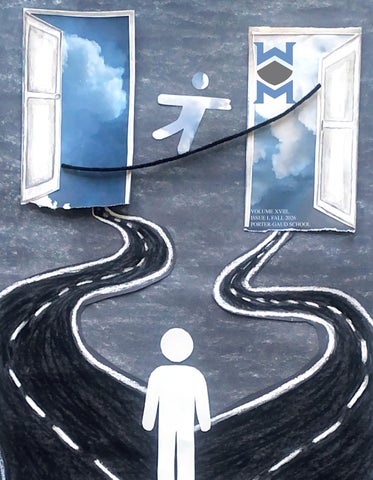
VOLUME XVIII, ISSUE I, FALL 2026 PORTER-GAUD SCHOOL
The watch staff would love to give a big thanks to those who helped out with this semester’s issue: Emma Blume, Blythe Brooker, Connor Doherty, Owen Donahue, Maya Naylor, Arielle Poole, Parker Thompson, Aki Yang, Mr. Brink Norton, Class of 2026 alumnus, Charlie Sidney, and last but never least, Mr. Patrick Hession. We could not publish our magazine without your involvement and we appreciate all that you have contributed! Sincerely, the watch Staff of 2026-27
watch PORTER-GAUD SCHOOL
The watch magazine is a student-run publication and is produced as part of the educational process. The views and opinions expressed here are strictly those of the authors and do not reflect the official policy or position of the school, its Board of Trustees, administration, faculty, staff, or the student body as a whole.
Cover art by Kat Burke 2
Table Of Contents 6 Are algorithms knocking us out of rhythm?
Wrong, but Never in Doubt 26 Often Don’t jump to conclusions over all the facts.
Your Own Adventure: 8 Choose A day in the life of a high schooler.
Are These Conspiracies? 30 Wright Ghegan
When Freedom Falls Flat Allison Kulka
Tessa Sidney
Are our Glasses Half Empty—Or Cracked?
10 Why humanity can’t often see a bright side. Samantha Star
Unexpected Rise to Reality 12 An How one fan’s fantasy became its own...sport? Robert Wey
Politics Clouding Our Environment? 14 Are Don’t let your vote pollute where we boat. Kat Burke
Griffin Lewis
Fall Wordsearch 31 Cate Altman It’s Complicated. 32 AForgiveness? deep dive into our transcendent situationship. Josh Blais
Highlights 36 Senior Come find a picture of yourself in the highlight!
38 Instagaud In this feature we feature new teachers.
Crossword and Clones in the Wild 16 Conservation Evie Shearer Books Themselves Turn a Page 18 When Haven’t you heard? Listening is the new reading. Clara Howell
21 Guess the Book? Penelope Snider
NCAA’s False Start, A Year in Advance? 22 The How a 24-team playoff changes America’s favorite game. Molly Hilpert
25 Name that Heisman! Graham Winterfield
3
Allison Kulka - Managing Editor Samantha Star - Managing Editor Tessa Sidney - Head Publisher Kat Burke - Art Director
4
Graham Winterfield - Publisher Wright Ghegan - Publisher Evie Shearer - Publisher Cate Altman - Publisher Penelope Snider - Publisher
Photograph by Patrick Hession
Robert Wey - Staff Writer Molly Hilpert - Staff Writer Josh Blais - Staff Writer Griffin Lewis - Staff Writer Clara Howell - Staff Writer
Ms. Sarah Romano - Faculty Advisor Mr. Childs Smith - Faculty Advisor Mrs. Jenny Albright - Facutly Advisor
5
When Freedom Falls Flat
Are algorithms knocking us out of rhythm? By Allison Kulka
Jolted awake by a blaring alarm, you panic—you’re late for school. Quickly, you brush your teeth and throw on your chosen school uniform of the day. Thundering to the kitchen, you grab from an array of breakfast bar options and bolt to your car…and it’s raining. Awesome! Sighing, you drag your feet back inside to grab a raincoat. Finally settled into your dry car, you open Spotify, click the first song that pops up, and rush out of the driveway. Even before your day has officially gotten started, you have already made six autonomous choices. Or have you? Autonomy is about being in control of your own life, being the one to make a conscious choice. Throughout any given day, CNBC determines that the average adult makes around 35,000 decisions. Left or right? Up or down? Yes or no? But not all choices are this simple. Behind almost every decision that you make, you are subconsciously going through something called a neural network of decision trees. This is what allows you to sort past the black and white and into the gray. Your brain goes through the suboptions, decides which one it likes best, picks it, and moves onto the next suboption. This process repeats until you find your answer. Let’s think back to your hypothetical response to the rain. You walked outside and noticed the weather. It was rainy. So what did you do about that? You turned around and went back inside. Subconsciously thinking to yourself, I should probably find something to protect me from this rain, you scrambled to find a raincoat. Maybe you had to guess which drawer or closet it was in. Maybe you knew exactly where it was and went straight to grab it. Either way, you took in your outside surroundings and made the choice to avoid the soaked socks and drenched clothes that would be inevitable if not for this rain jacket. That was your brain going through a neural network. And guess what? You just acted as an algorithm. Yes, the same kind of algorithm that your favorite social media feed uses to suggest just the right videos to you. Today, the word algorithm gets a really bad rep. Its connotation is unsettling—and maybe it should be sometimes, but other times less so. Algorithms, at their core, are just following steps. Steps to a recipe, steps in a morning routine, steps for washing your hands. The fundamentals are simple: if this happens, that happens. If step one is complete, then step two must be completed next. This is nothing unheard of. After all, it has been the way humans function since we stood upright. Yet, today's advanced algorithms have acquired a whole new dimension. It seems that human algorithms are barely hanging on in the fight to stay alive in our world of digital algorithms.
6
When it comes to social media, society throws the word algorithm around a lot—which of your friend’s latest post pops up on your feed or what miscellaneous user’s viral brainrot video becomes part of your nightly doomscroll. Either way, social media is all about algorithms, optimizing what will get the most clicks, likes, and shares. The machine learning algorithm built into these apps exists entirely to maximize their popularity. The app does better—and makes more money—the more engagement there is, so, naturally, to maximize revenue, the algorithm’s output is going to be what statistically favors engagement. It is the same with viral videos. Your social media profile’s algorithms are not only learning you, they are learning others like you. If someone in your demographic really likes a video, then chances are you're going to like it too. Multiply this exponentially and it starts to make sense why viral videos and leading influencers emerge. The problem is, though, not only is social media affirming your sense of humor or love of cute puppies, it is also affirming your beliefs. This sort of confirmation bias naturally pigeonholes you into only seeing things that agree with you. Australia sees this as dangerous. To be closedminded is to be ignorant, so their proposal is to give citizens a way to opt out of this forced algorithm. The BBC tells us that Australia’s current legislative plan is to require an option for social media users to pick to exclude their feed from algorithmic content recommendation. In their eyes, this proposal would be a next step in creating a healthy social media environment. But the issue is social media apps aren’t the only algorithmic echo chamber in our modern day lives. Between online shopping advertisements, top news stories, and even Netflix movie suggestions, it is hard to find an instance
where we are actually choosing the media we consume—the media that is molding what we think, how we act, and who we are. Pretty dystopian, right? The bottom line is that these algorithm-run platforms are businesses. They want to make the most money, and to do so, they must appeal to the consumer. Daniel Bauman, a computational and mathematical engineering PhD candidate, explains in an article published by Stanford University that this business model is “a tradeoff between exploration and exploitation.” As humans, our primary instinct is survival. And, through eons of trial and error, our species has determined that to survive is to be happy. So, yes, picking the wrong song to play on your morning car ride is not life or death, but it does have to do with happiness. Companies like Spotify or Apple Music know this, so they push you toward the song they think will make you the happiest, ensuring that you'll return time and again to feel happy once more. But the driving force is actually an 'it,' not a 'they' at all. And how is a machine supposed to give us what we humans want? Surprise! It can't. What it can do, though, see what makes the money. And, as Bauman points out, the most lucrative choice is oftentimes the option that avoids too much exploration of new ideas or exploitation of acting on the options that result from these ideas. The end goal is to make consumers happy, and humans tend to fear change. To maximize profit, then, the data that aligns best with your previous interests or “happiness” is pushed to you. If this is the case, are algorithms making us lose our ability to think outside of the box? Are they making us flat? Are they making us onedimensional? This is the question
that Sandra Matz explores in her 2025 TED Talk “Is AI turning us all into the same person?” In this, she considers decision making in everyday life, especially when it comes to algorithmic processes like AI. She claims to “worry that without the potential for discovery, for serendipity, we risk becoming more shallow and unidimensional versions of who we are and who we could be, not just as humans, as individuals, but as humanity.” Algorithms only ever make suggestions that have worked for other people before. That perfect song on a cold rainy day, yeah, someone else added it to their “Cold, Rainy Day” playlist. That route that gets you to school in just the right amount of time, thousands are driving on these exact streets, giving the algorithms all the data of accidents, traffic, and flooded roads it needs to optimize your drive’s efficiency. Are you starting to catch the trend? That groundbreaking essay idea you got from your favorite AI chatbot is actually someone else’s. As stated in Lauren Leibman’s August Post and Courier article, "you'll never stumble upon anything new, [we’re] only gonna know what we get fed by the algorithms.” Humans are a dynamic species, constantly adapting and evolving to our surroundings. But algorithms are giving us more of what we as humans already know—eliminating our need to adapt and evolve. Then what’s the answer? Cut yourself off from all forms of choice-based algorithms? Well, as you can tell by now, that’s nearly impossible in our modern age. A better approach is balance. We as humans are constantly taking in information from our surroundings, from other people…from algorithms. Sometimes we get so lost in what everything and everyone else is saying that we forget we have our own thoughts, ideas, and choices. This is the whole root of why algorithms can be problematic. But they don’t need to be. Podcaster Anna Corrin’s channel, Wild Geese, provides an interesting take on this in an episode on thinking for oneself. Rather than automatically turning to what other people or other algorithms are feeding you, curate your own beliefs and opinions. All in all, be introspective so you don’t simply become a product of what other people are telling you to think. Be autonomous. Whether it be choosing your school uniform’s polo color, not just conforming to what your friend told you to wear, or picking the breakfast bar that really appeals to you, not just the one you saw an advertisement for the previous day, keep thinking for yourself. On the other hand, maybe that song Spotify suggested to you actually does match the mood perfectly, so don’t be scared to rely on this algorithm if it fits. What matters most is awareness: awareness so that we don’t all become merely another dull rendition of what we consume.
Art by Maya Naylor
7
8
9
Are Our Glasses Half Empty—Or Cracked? Why humanity can’t often see a bright side. By Samantha Star
Everyone has had a crappy day. We’ve all overslept, making us rush and forget breakfast. At school, we’ve all gotten a bad grade we didn’t think we deserved. But what we probably didn’t notice on those days were all the parts we got right. All we see is the score, so we say to ourselves, Today is a bad day. But why did it go so badly? More than likely, your day was terrible because you expected it to be. And therefore, you tapped into an ancient evolutionary instinct we all have: negativity bias. It is easy to blame a horrible day on events outside of your control, but the way we react to the situations we are placed in determines how they affect us. The VeryWellMind publication explains, “It is the ‘bad things’ that grab our attention, stick to our memories, and, in many cases, influence the decisions that we make.” Unfortunately, our society is more keen to pounce on our failures than commend our accomplishments. This then compounds on our instincts to hyperfixate on what’s negative— blinding us to what’s positive. If you never told yourself that the day was going to be terrible, but said instead, I won’t let this one thing affect my day, you would likely have a better day than expected. If we constantly seek out the bad things in life, we will find them. If I put a mosaic in front of you and told you to look through a magnifying glass at one specific pattern, you would only see that part, not the mosaic as a whole. We need to zoom in and focus on specifics to view the nuances and complexities, but if we are too zoomed in we miss the larger picture and the actual message. Even though it sounds corny to proclaim the benefits of a positive mindset, in order to beat our negativity bias we have to look past the flaws to see the good. Every single person struggles to do this—it goes against the programming in our DNA—and the only way to beat the negativity bias is to accept the bad alongside the good. As Catherine J. Norris in an article for Social Neuroscience points out, “Past research has provided support for the existence of a negativity bias, the tendency for negativity to have a stronger impact than positivity. Theoretically, the negativity bias provides an evolutionary advantage, as it is more critical for survival to avoid a harmful stimulus than to pursue a potentially helpful one.” But in our modern age, we no longer need to hyperfixate on negative feelings in order to survive.
10
ur o , In 1943, American tely ore a psychologist n u s m on t r Abraham i e fo Maslow Un ciety ounc han so to p es t n ur ur kee r fail end o nts. ou mm shme co pli om c c a
presented his groundbreaking Hierarchy of Needs—a pyramid comprising the needs we have to reach in order to achieve our highest state of enlightenment. Looking at the Hierarchy, and, for the average American, we are all (as a whole) higher up on the pyramid than our primeval ancestors were. For example, we have modern medicine, giving us a longer lifespan than ever thought possible; advancements in technology have opened the world to globalization and full connectivity. And yet, all of us still react to negative stimuli as though it’s an immediate threat to our safety, instigating mental distress. Although, part of the reason why it is so hard to have a positive mindset is because our brains are literally programmed against it. In order to be a more positive thinker, we have to rewire our brains and go against our evolutionary instinct to survive. So next time someone gives you grief about not being positive enough, tell them that at least you know you would survive longer than them in a Darwinistic world. It seems simple enough: if we consistently tell ourselves that it is feasible to have a positive mental bias, we will accomplish more rather than resolving ourselves to a negative mindset. But in reality, it is hard to be more positive when there is a chemical imbalance in your brain that makes it feel impossible to change, even if you want to. That is the reason behind laziness; most people aren’t inherently lazy, some people may have more cognitive capacity to get things done. This all boils down to the lifelong game we play with ourselves. Your greatest adversary and destructor is always going to be yourself. Every single person has won and lost battles within their own mind. The key to changing your mindset is how you deal with the losses, not just the wins. For example, we don’t need to go into fight-or-flight every time we are exposed to something that we interpret as negative, and yet our body still does it. According to Harvard Health, the stress response starts in the amygdala, which is the site of our brain that contributes to processing our emotions. It processes our emotions as stressful, then sends a distress signal to the hypothalamus, which is the area of our brain that communicates with the rest of our body through our nervous system. The nervous system receives this signal and sends hormones associated with stress to our body. Our brain essentially processes the emotions we feel towards external stimuli in order to release hormones and neurotransmitters that cause depression, stress, excitement, pleasure, etc. Think of it like your brain is a smoke detector’s piercing warning before the “house” engulfs in flames. So, can we control these emotions that are translated to our brain? Self-regulation, either through meditation or specialized exercises, can help us guide our responses to the emotions we feel. This helps us realize that our emotions (fear, anxiety, happiness, disgust) can be fleeting, and don’t always have to be acted on. Medication, on the other hand, as cited by the American Psychiatric Association, stops the neurotransmitters
from being released in the first place. Neurotransmitters are chemical messengers like dopamine and serotonin. If they are blocked, the chemical reaction in your brain and nervous system is blocked, stopping us from feeling emotions that are unrelated to external stimuli. Medicine helps us regulate our emotions. Emotions are a mechanical process that reacts to our environment, but feelings are different. In an article in UHealth Collective, it explains the difference by stating, “Emotions are automatic and can be strong. They get experienced in the body, on a physiological level. Feelings are how we think about the emotion and interpret it.” So, here is where meditation and self-regulation comes in, not through controlling our emotions, but evaluating our feelings. Especially with mental health conditions, emotions can feel volatile, but by managing our feelings or our mindset, we can change the way we think. Working to be less negative, or shifting your entire perspective on the world may seem impossible, especially if you have been thinking one way your entire life. There are many ways to combat the negativity bias, and the most effective method appears incredibly simple, but it is actually incredibly difficult to do: Change your mindset. If we can interpret the signals from our environment and absorb all the information, and yet not allow ourselves to only see the negative, our entire outlook on life can change.
Even more, this optimism can save your life! Or, at least extend it. Harvard Health explains this by stating, “Science continues to find that people with an optimistic outlook enjoy healthier and longer lives. A study published Sept. 10, 2019, in the journal PNAS involving more than 70,000 people found that those who rated themselves as having high optimism were more likely to live to age 85 or older compared with less optimistic individuals.” Meaning, there is a direct correlation between longevity of life and optimism. It makes sense; everyone wants to have a long and healthy life, but unfortunately this kind of life isn’t just dropped from the sky into our eager hands—we have to work for it. Happiness is hard work but achievable; you just have to be willing to change your mindset.
Art by Parker Thompson
Just by reading this article you have already started the process of beating your bias. Because now you know. The most
important part of overcoming any type of bias is to be aware of it: acknowledge your negative thoughts, and catch your brain when you fall in these traps. According to Positive Psychology, an online resource for practitioners to write articles about psychology, “Albert Ellis’s (1957) ABC technique is one useful framework you can apply [for beating the negativity bias]. Once you become aware of your behavior or its consequences (B and C in the model, respectively), then you can work backward to think about what led to them (A for antecedents).” Essentially, this makes you aware of the thoughts that provoke feelings and reactions to those feelings. Similar to yoga, breathwork, or mental-health exercises, it is a skill to help gain more control over our life through controlling our responses to things out of our control. In order to solve a problem, you have to know that it exists in the first place.
11
An Unexpected Rise to Reality How one fan’s fantasy became its own… competitive sport? By Robert Wey
So…how are your playoff chances looking? If I had to guess, you’re either feeling like you’re on top of the world with a top three playoff seed, or you might be quietly regretting your decisions from four months prior. Whatever the scenario may be, one thing is certain: It hasn’t been what you expected. What I’m talking about is one of America’s favorite pastimes, boasting an industry value of anywhere from 40 to 70 billion dollars according to Forbes, and consuming the lives of over 60 million Americans. This pastime, of course, is fantasy football. In fact, fantasy football is more than just a way I—like many others—spend 4 plus hours strategizing, analyzing, and trading every week between the months of September to December. Fantasy football is, and is becoming more and more, a sport of its own. While there absolutely is an element of luck involved (or lack of: I had Christian McCaffrey on my team in 2024 when he played only four games due to injury), there are also just as many factors of skill, preparation, and intensity required to succeed, which make fantasy football exceed its status as mere entertainment. When fantasy football was first created, however, it was far from being considered a sport of its own. A part time owner of the Oakland Raiders, Wilfred Winkenbach, first had the idea in the 1960s, after testing his concept on golf and baseball in the decade prior. Eventually, his idea of drafting players (regardless of the sport) and adding up their points against an opponent caught the attention of other sports gurus, who took it and ran. Shortly after, the digital age revolutionized the game into a multi-billion dollar industry played by a wide range of age groups. By the early 2000s, ESPN, Yahoo, and CBS had all implemented real-time updates and instant roster changes, making it much easier for anyone of any skill level to manage their players, and thus capturing a larger audience than ever before. What was once a workplace game has been propelled into the pockets of millions of Americans.
12
Every sport has its consequences: injuries, bad calls, poor coaching, unfair circumstances (maybe you had to draft while
driving), and fantasy football is no exception. Recently, punishments for league losers have increased in popularity—and intensity. All it took was a ten second Google search to find a list of over 50 popular punishments from the past few years: 24 hours in Waffle House (an especially popular one), complete a large puzzle in the dark, a milk mile (four laps around a track with milk before each one), stand up comedy routines written by the other league mates, a spicy wings challenge, or other forms of public humiliation. Some leagues even have a weekly punishment for the loser that week, which can consist of one of the physical punishments listed above, or more recently, social media punishments have become popular—and increasingly embarrassing. Now, some people view these punishments as a form of hazing. Ipswich High school author Ethan Hanson writes, “The idea of
What was once a workplace game has been propelled into the pockets of millions of Americans.
fantasy football being referred to as a form of hazing isn’t exactly anything shocking. [...] The punishments fit the definition of the word as the imposition of embarrassing tasks as a form of acceptance or entertainment.” Yes, there is validity in this idea, but in my opinion, what these punishments really demonstrate is the cost of losing in fantasy football, which is, without a doubt, a defining component to any and every sport. These punishments don’t just cause chaos and fear throughout your league; they get people more involved, and give an incentive not to stop checking your lineup. All popular sports don’t just have repercussions for losing, they act as corporations and entertainment agencies, bringing in massive revenue. Fantasy football checks all of these marks, too, giving it unorthodox credit to be placed in a list with the major sports we play, watch, and enjoy. Today, major networks have popularized fantasy play. For example, NFL RedZone embraces the fantasy component in
professional football. As author Anthony Angelillo writes in the Quinnipiac Chronicle: “you can watch seven hours of football, flipping back and forth between each game. So when each team is in the red zone, it provides fantasy players an outlet to track every touchdown.” While fantasy football may not have been the main priority during the creation of RedZone, it was an influence, especially in its visual design. In other words, if networks and major platforms can find ways to publicize fantasy football, they do. Fantasy isn’t just a growing entertainment industry; it also captivates the time and attention of a broad audience. Based on evidence from Statista.com in 2022, 61% of people in the United States ages 18-29 participated in a fantasy league, and 26% of people 30 and older. That means that tens of millions of people are playing fantasy football and committing lots of time to it. And trust me, for the most intense fans, “lots of time” is an understatement. Surveys from ESPN, Yahoo, and research centers have found that people have reported they spend 60-90 minutes weekly on waiver wires picking up players, others claim they check their team over 20 times daily, some even have dual-computer monitor systems that consume the majority of their time. And despite this, those same people have 1-7, 2-8, 0-4, 3-11 records, simply because preparation can only take you so far.
Andy Stitzer is the author of “Technology’s Game-Changing Impact on Fantasy Sports” from Fantasy Six Pack and illustrates precisely how much fantasy has changed. Stitzer writes, “With instant updates on player injuries, game statistics, and scores, players can now make decisions that give them the edge over Art by Owen Don their competitors in real time.” He ahue even states that “As technology continues to evolve, the possibilities of the impact it can make in fantasy sports are endless.” I couldn’t agree more with both of these statements. Who knows how much more accurate, efficient, and accessible fantasy will become as technology improves. I do not pretend that fantasy football—or any fantasy sport—will ever be able to rival the real sport it is based off of, but based on the trajectory of the past few decades, it might get very close.
Some ages prepare more than others, though. Adults, for example, have a higher tendency to play for money, which raises the stakes tremendously, because while they could win big, they can also lose detrimentally. But more than this, fantasy football is a way to escape life’s monotonous duties, and it provides an opportunity to express competitiveness when they otherwise might not have one. Further, like any sport played in our modern age, fantasy football has been revolutionized by technology. What was once played on pen and paper in a notepad in the 60s and 70s can now be
accessed through two clicks on your phone. As part of the digital revolution came point projections, which are now more accurate than ever, and take a multiplicity of analytical factors into play in their creation and predictions of how a specific player will perform that week.
Fantasy has more elements of an actual sport than you would initially presume: consequence, influence, revenue, time-consumption, preparation, collaboration. While it doesn’t have a physical contact element, when you engage, you become the general manager of your own team. Further, its growth potential is immeasurable due to its undeniable grip on the free time of millions of people that generates tens of billions of dollars annually. How the 2026 fantasy season went is anyone’s guess. Was Parker Washington a wide receiver 1? Did Kenneth Walker finish as a top 3 running back? Was Trey McBride everything we hoped for and more? There are hundreds of different directions this NFL season and your fantasy season could go; you could win money, have to complete a gruesome punishment, or be destined for an early playoff exit. But I challenge you to take your league just a little more seriously and consider how real, high-stakes, dramatic, and close to being an actual sport fantasy football has become.
13
Are Politics Clouding Our Environment? Don’t let your vote pollute where we boat.
Hunting, surfing, fishing.
By Kat Burke
Living in the South, chances are you have done at least one of these activities. Perhaps you do these things so often that they have become mundane, habits that have lost the novelty that set them apart from other aspects of daily life. Even if you aren’t a prolific hunter, surfer, or fisher everyone enjoys the warm sun on their faces biking around the Old Village, basking on the sand on Folly, or floating in relaxing water on Sullivan’s. Although it may be difficult, try to imagine life without the beach, without marshes, without swamps. Without activities such as these, the Lowcountry simply wouldn’t be so unique and magical. This is exactly why we need to come together to protect the ecosystems we call home. In recent years, however, caring about the environment has become increasingly politicized. But if we truly care about the activities we say we do, something has to change. If you’ve been active on social media within the last decade (or simply been around high schoolers), chances are, you are familiar with the concept of “aesthetics” or the need to fit into a certain mold. It seems like every year a new trend takes the internet by storm. PreCOVID, we saw the advent of “VSCO girls,” the “Clean Girl,” and the “Lax Bro.” Perhaps a more long-lived trend—while some may contest my calling it a “trend”—is the rise in a “country” identity. Here at Porter-Gaud, the student lot teems with lifted trucks and elongated antennas. Outside of school, camo jackets and Huk hoodies have become everyday fashion. But while many embrace the aesthetic of the country-southern lifestyle and enjoy the activities our geography has to offer, some of those same people fail to acknowledge the ever-increasing stress on our ecosystems. Or worse, they simply feel like they “don’t (or shouldn’t) have to care.” Apathy towards climate change is largely due to how news outlets and political figures characterize climate concerns (and policy in general). Nowadays, it seems that to every problem there are only two answers, and any nuance or back-and-forth has fallen into a vacuum. And this is very much intentional. Party leaders and prominent politicians have been driving a wedge between both sides, adopting polarizing ideas to split constituencies down the middle. Any gobetween is forbidden in Congress, and voters are forced to take a stance on either side of the monstrous chasm of ideological limbo. In an interview with PBS, Tiernan Sittenfield, president and CEO of the National Parks Conservation Association, said that “[...] our national parks really are the core of what is best about this country. They really do bring us together across differences. [...] And they have absolutely never been partisan.” And he is right. Stewardship and conservation have been present throughout US history,
14
and attempts to protect our lands have been made by numerous presidents from both sides of the American political spectrum. The most notable, perhaps, is Theodore Roosevelt. Widely known as the first “conservationist” president, Roosevelt created the US Forest Service, 150 national forests, and 51 wild bird preserves during his presidency. From 1901-1909, 171 million acres of land were protected under his administration, so, rightfully, Roosevelt receives most of the recognition. But, in addition to Theodore Roosevelt, Franklin Roosevelt’s New Deal created opportunities for conservation; the Civilian Conservation Corps encouraged millions of men to plant trees and steward public places, and this Roosevelt administration also launched the creation of 140 wildlife conservancies. In 1970, Richard Nixon established the Environmental Protection Agency. Jimmy Carter signed the Alaska National Interest Lands Conservation Act of 1980. Donald Trump—in his first term—endorsed and signed the Great American Outdoors Act. So, obviously, presidents on both sides of the spectrum have cared about protecting the environment. However, in recent years, it seems that the Republican party has become decidedly against policy to protect the environment. There has even been a noticeable shift in the Trump administration’s agenda from 2020 to now. Strongly favoring the protection of industry over the environment, the second Trump administration proposed significant budget cuts to conservation agencies such as the National Park Service (25% cut), the Environmental Protection Agency (52% cut), and the Bureau of Land Management (34% cut). While industry is important, there is no replacing the genuine joy the outdoors bring us. To quote Jack Burwell, a senior here at Porter-Gaud, “I like being outside, enjoying sunsets and sunrises, and enjoying the art of working with animals. The outdoors can provide you with opportunities to bring people
together—family members, friends. They also connect me with my roots as a family of hunters and outdoorsmen. The ecosystems we have here provide my family with opportunities for us to bond and grow together and experience the things Charlestonians have done for centuries.”
AI companies have bled into the ideals of younger generations. People who typically align with Republican values have started characterizing climate policy as a threat, not as essential measures to preserve the activities that everyone—regardless of how you vote— partakes in.
Just as Jack said, being in nature can bring people together in the most authentic ways possible; don’t let politics prevent us from reaping the innumerable benefits that flow from the ecosystems that make up our home. Even small moves in the right direction can create a significant impact on the environment.
Caring about the environment isn’t “uncool” and it certainly doesn’t make you a “liberal snowflake.” The question that arises when someone is passionate about preserving the beauty of our planet shouldn’t be “are you a Democrat?” or “are you a Republican?” but, “How can I help?”.
For example, South Carolina has deterred companies from using plastic utensils like straws and grocery stores have adopted paper bag policies. While a mushy straw may be slightly annoying, this is an example of a change that can have a major impact with little to no disruptions of daily life. According to the National Library of Medicine: “biodegradable straws made from paper, hay, or plantbased materials such as PLA (polylactic acid) offer a compostable solution that breaks down naturally without leaving microplastics.” Such a small lifestyle change can prevent microplastics from infiltrating our waters and endangering our marine life.
Some of the easiest ways to make a difference are simply abiding by state and federal regulations. The South Carolina Department of Natural Resources has many guidelines and laws that protect wildlife and habitats across our state.
However, another aspect of our daily life may be becoming even more dangerous to the environment: AI. As our newest technological advancement, many politicians currently remain unsure about what stance to take on the issue. According to the Pew Research Center, more than half of Americans agree that AI data centers are bad for quality of life, home energy costs, and the environment. But because of the president’s stance, many Republican nominees and representatives have adopted pro-data center agendas and dismissed concerns about the impacts of AI in order to protect industry and the US’s place on the world stage. President Trump said that “We’re leading China in AI, and frankly, I want to keep it that way, because whoever wins AI wins.” Our local representatives have also taken this stance. For example, outgoing Republican senator Darline Graham has advertised her industrious ideals and expressed her support for the expansion of AI. This adoption of rigorous AI policy and the lenient (perhaps nonexistent?) checks on
Beach weekend on Sullivan’s? Don’t bring plastic. It only takes one faux jellyfish to kill a turtle, and one piece of plastic can take up to five hundred years to break down. The decision you make in one instance can have an impact on the Earth for five times your life time. Hunting weekend planned? Report harvests and don’t shoot more than the limit. Hunting is never just about the prize you bring home. At the heart of hunting lies conservation and preservation. Imagine if every person with a hunting license shot one more deer than the limit. That’s almost 16 million animals—nearly half of the whitetail deer population in the United States. Following the law and staying true to the fundamentals of hunting can create a significant difference. Non-governmental organizations are also great ways to help protect the planet. For example, the South Carolina Land Trust and the Lowcountry Land Trust protect South Carolina soil from development. Volunteerism and donations (no matter the amount) can make a world of difference in our ecosystems. Ducks Unlimited is another organization with members from all sides providing teenagers and young adults with opportunities to protect conservationist efforts, such as land cleanups or helping facilitate events to attract donors. Porter-Gaud also offers numerous ways to help out. Our service program frequently hosts beach sweeps and offers opportunities to pick up trash around Porter-Gaud. For example, Adopt-a-Highway is an easy way to get some fresh air and clean up our planet. These activities can also have a positive impact on our community and the ecosystems we inhabit. There are many aspects of protecting the environment that seem daunting, and at times it can feel like one person’s actions can’t possibly make a difference. But even the most mundane actions can have a significant impact on the people around us, and the future of our planet. From voting to something as simple as turning the faucet off while you brush your teeth, the Earth needs your help. While protecting the “Earth” may sound broad, remember that the best parts about living in Charleston are dependent on the effort we put in. The sun is setting on our ability to reverse the damage our species has done—the sooner we start, the safer our home.
Art by Kat Burke
15
‘Clones in the Wild How often do you hunt, fish, or surf? “I hunt once a month.” - Ellie Thompson’28 “All the time. These are my favorite activities.” - Wilson Yarborough’27 “I hunt and fish every week pretty much without exception mainly largemouth, bass broom deer, duck, quail dove, and turkey.” - Jack Burwell’27
What do you most enjoy about being outdoors? “Being with nature, getting away from people. Being in God’s beautiful earth.” - Owen Settle’27 “Getting fresh air and vitamin D.” - Ellie Egleston’27 “I enjoy the calmness of nature and usually spend that time with my dad.” Wilson Yarborough’27
What is your favorite aspect of Charleston? “I love the historic nature of the town. I love the deep connections many families have to it, including mine, and I love the small town feel with a big name attached to it—in terms of global recognition.” - Jack Burwell’27 “The water.” - Connell Grubb’27 “I like the sunsets and the crazy weather.” - Alex Sora’27
16
Conservation Crossword
DOWN
ACROSS
4. The_____American Outdoors Act that 1. The practice of killing wildlife. Trump endorsed in his first term. 2. The chief executive or head of state of a 6. The body of persons that constitutes republic. the governing authority of a political unit 3. The complex of a community of or organization. organisms and its environment functioning 7. The sport or business of catching a as an ecological unit. fish. 5. The surrounding conditions in which 8. Geographic and cultural region along living organisms exist. South Carolina’s coast. 17
When Books Themselves Turn a Page Haven’t you heard? Listening is the new reading. By Clara Howell
Would you believe it if someone said they read 50 books without turning a page? Audiobooks make this possible, of course, but does listening really count as reading? Some may wonder if an audiobook is more difficult to process than your typical print So the book—you are not question seeing the words at all, remains, for example—but it may should we not be that black and prioritize white. Picture this: in the morning rush you realize you forgot to finish the last chapter of Lord of the Flies, and left the book in your room. Already late for school, you quickly download the audio version during your commute. If you are skeptical that listening to the end can’t stack up to reading the hardback, don’t worry; you’re probably more prepared than you’d expect.
18
in the 1930s, they were on records, a project initiated by the American Foundation for the Blind. To this day, audiobooks remain a more accessible option for the visually impaired, giving those who are blind or have dyslexia the opportunity to experience books. This, however, is not what has driven the skyrocket in sales in recent years. The audiobook platform PublishDrive’s endof-year revenue reveals that, in a single year, earnings listening to have quadrupled. In a world books or where people are constantly reading plugged into their phones, the them? convenient choice is the one online.
No matter what you are reading, the goal, at least, remains the same: to understand the contents of an assignment or enjoy a story. It would be nice if your method for reading could be based solely on preference, but should it be?
You cannot read a physical book, unlike an audiobook, while walking your dog or driving to Starbucks. Audiobooks are convenient, considering they can be played from your phone, which is typically always with us. Imagine you’re driving on the highway with hours left before your next exit—all you’ve passed are trees and billboards. Turning on your current audiobook, which happens to also be narrated by your favorite actor, you are captivated by the story. Suddenly, your ETA doesn’t matter so much anymore. If your schedule is always full, or you find that an audiobook draws you in, this platform is likely best for your lifestyle.
Naturally, print books used to be the only option for reading. When audiobooks first came into the picture
When purchased on its own, an audiobook costs around the same amount as a paperback book.
However, through subscriptions such as Libro, which is solely for audio or ebooks, or Spotify premium, where you get audiobooks in addition to a wider selection of music, prices are lower and they are gaining popularity in more people’s lives. Who wouldn’t be more inclined to listen with these budgetfriendly options? Beyond the benefit to your bank account, listening to an audiobook positively stimulates your brain, engaging different areas that are not all activated when reading print. While printed books benefit learning in terms of seeing the spelling and grammar, audiobooks can help improve pronunciation. The Harvard Despite the advantages of audiobooks, there are several reasons why they don’t completely dominate the reading industry.
Gazette points out that more than 40% of Americans in 2026 still believe
When you listen to an audiobook, especially while completing a separate task, it is much more difficult to replay a section if you tune out. Having to pause and estimate where to rewind if you get distracted is more hassle than simply looking up from a book or flipping back a page. Another downside of audiobooks being digital is that when you pick up your phone to listen to another chapter of your book, texts or notifications are easy distractions that can keep you sidetracked. When you read, your brain sets its natural pace to best follow along with and understand the contents. This allows you more control over the speed of information intake. If someone else is reading it to you, it forces you to keep pace with the narrator rather than what you are used to. If you’re someone who loves curling up with a physical book in hand, you probably just find that it’s your go-to but never consider why. Maybe it’s something about the cozy spot you always choose to read in, the dog-eared pages, underlining your favorite sentences, or the feeling of closing the book when you finish that makes the experience irreplaceable. Despite the growing popularity of audiobooks, over 65% of respondents in a study by
the nonprofit Two Sides prefer print books. They are also the preference at Porter-Gaud. In a limited survey, 90% of high school students who responded to a survey felt the same. Seeing words on a page, as opposed to listening, has a number of benefits that people don’t typically consider. The fundamental skill of reading is where the biggest differences between audio and print books can be seen. Of course, literacy will always be necessary. Signs, posters, emails, and texts— printed words are all around you. As you grow older, you tend to run into more complicated words and sentence structures. Observing these in print and seeing the listening relationships between parts of requires less speech are important learning rigor and opportunities. Reading off therefore of paper leads your brain shouldn’t through a process, deriving count as meaning from the whole reading. text by matching letters to spelling, spelling to words, and so on. Bolded words, italics, paragraph breaks, and punctuation also help guide understanding while reading. When you only hear the words rather than see them, your brain doesn’t follow this sequence as closely, and therefore is unable to take advantage of these visual cues. Cognitive Train, a web-based platform that offers cognitive tests, advises that when you read a book, 10 to 15% of eye movements are regressions, meaning that you look back over a part of the text you have already read. This subconscious action allows you to better process spelling, grammar, punctuation, and acknowledge hidden meaning in the story. Even if it’s difficult to find time to sit down and read, when you do, you are choosing to stay focused on that specific task. Especially if you are reading for an assignment, this can be crucial, considering that concentrating directly on the text could improve comprehension and retention. Marina Koren, a writer for Smithsonian Magazine, informs us that reading a traditional book can also improve brain and mental health while slowing down cognitive decline at a greater rate than audiobooks. These numerous benefits make print books seem like
19
the easy choice over audiobooks, but while there are these advantages to consider, there are also many downsides to purchasing paperback books. The manufacturing process has a significant environmental impact, as BBC News points out. Behind every book you buy, there is approximately one kilogram of carbon dioxide released into the atmosphere from the process of manufacturing to shipping. Another British news outlet, The Guardian, explains that approximately 1,600 trees would be cut down every single day if not for recycling paper in order to print its works. Maybe you can’t find the time to check a book out from the library, or the shipping cost is enough to make you second guess your purchase. Whatever the case may be, finding yourself a hardcopy of a book may not be as easy as downloading the audio version on your phone. Now that you have the pros and cons of each medium, it’s probably obvious why one is more prominent or more preferred in your lifestyle. Is it, though, the more effective choice? Granted, although everyone wants to understand what they read, the average person may not mind if they forget some details of a book that is simply for entertainment. However, when the intention is to learn and retain the information, pertaining especially to students, you might be more conscious of your choice. However, there is not a straightforward answer if one form of reading is “easier” than the other. In fact, it depends more on the material you are consuming. The University of Delaware informs us that, for easier books and especially fictional stories, areas of your brain focused on social aspects and storytelling are activated. For these kinds of books, comprehension with listening and reading are similar. On the other hand, for complicated, data-heavy books, it is found that listening can be more of a struggle. To further the study, Stephanie Del Tufo, a professor of physiological and brain sciences at the University of Delaware, had half of her students read a podcast and the remaining students listen. The scores on an analysis quiz thereafter were
20
Art by Emma Blume
significantly higher for the reading group, with many of the students who had listened reporting that they had been multitasking. The results showed that engagement and retention are substantially higher for the reading group. Personally, I have always preferred print books over audiobooks. When I am reading a recommended book from a friend, I know the story will captivate me. And I can immerse myself more easily with a paperback, purposefully avoiding distractions from my phone. If you are anything like me, you may find yourself passively judging audiobook listeners. Returning after summer break to hear that everyone else listened to the assigned summer reading book online raises suspicion. Did they really listen or was it just playing in the background? Why weren’t they willing to take time to sit down and read it themselves I wonder? When there is independent reading time in school, audiobooks are not an option. If I listened to my independent book as an audiobook on a regular basis, I would also have to purchase and keep a hard copy with me for in-class reading. Putting in headphones and pulling up an audiobook on my phone isolates me more from those around me. With a physical book, I can still look up and easily join into surrounding conversation. So yes, what you read is your choice, although both listening and reading are important, they are not completely interchangeable. If someone doesn’t enjoy reading a print book, they won’t take the time to utilize any of the benefits, and vice versa for audiobooks. An ideal case is a balance of both, offering the chance to read what you prefer while also exercising different parts of your brain. In the end, simply finding a way to incorporate reading into your everyday routine is the best possible case. Be it through audio or print, the presence of books in your life is the most important factor.
Guess the Book
1. 2. 3. 4. 5. 6.
With answers at the bottom of the page
1. _________________ 2. _________________ 3. _________________ 4. _________________ 5. _________________ 6. _________________
21
1. Lord of the Flies 2. The Hunger Games 3. Harry Potter 4. Percy Jackson 5. The Summer I Turned Pretty 6. If You Give a Mouse a Cookie
NCAA’s False Start, a Year in Advance? How a 24-team playoff changes America’s favorite game. By Molly Hilpert
It’s the week before Christmas and you’re turning on the TV to watch the college football playoff: it’s Alabama vs. UMass or Georgia vs. Kent State. The consistently worst teams in college football are playing the giants in a new 64-team playoff. Hail Marys are the new buzzer beaters. Luckily this isn’t reality…yet.
championship out of reach. Kiffin’s antics, as many refer to them, are just the beginning of what is to come. These college football games have become an economic, social, and political enterprise—and everyone is clawing at a national championship.
The coaching carousel and chaotic transfer portal, however, are a reality. One man has become the symbol for it all: Lane Kiffin. Last December, he decided to fill Brian Kelley’s shoes at LSU, abandoning the team he had built at Ole Miss for the previous six years. When he abruptly left with Ole Miss players and coaches, he had one goal in mind—to win a national championship. Ironically, he might have had a better chance to fulfill this goal with the Ole Miss team he had built in the 2025 season, which then made it into the semifinals thanks to their new coach, Pete Golding.
A 64-team Every single snap puts playoff is teams closer (or farther) a distant from the playoffs. possibility from the newly adopted 24-team model, but it’s still a question. Expansion discussion began less than 15 years ago, and now there are 22 more teams than before. Rich boosters, athletic departments, media companies, the induction of NIL, and the colleges themselves changed the game.
In September, Ole Miss got their chance for revenge against LSU and public enemy number one, Lane Kiffin. Trinidad Chambliss, the quarterback scouted from Division III and shaped by Kiffin, led his team to a win against LSU 32-24. After the game, Chambliss downplayed it on ESPN, stating, “It’s just a football game.” But anyone paying attention would have known that it wasn’t just a game. It was about the future of college football, and how money is shaping it today more than ever. Out of desperation, Kiffin fought to roster NFL players. As a result, the SEC sued him. The suit is still ongoing, but LSU is on the verge of being kicked out. Kiffin tried everything to win, yet two losses might make a
College football media rights are extremely profitable, but the only way to make them more profitable is to have more games.
22
For the majority of the 21st century, there have been just two teams. The top teams were selected by using human polls–like the AP poll–and computer rankings which then picked the competitors for the game. It left zero room for error, and sometimes even being undefeated wasn’t enough to contend for a national title. Currently, there is a 12-team playoff. Teams can lose, but losing three is enough to put a team on life support. It’s an appropriately competitive regular season. Not every team gets in; yet enough good teams get a chance. Every game during the regular season means something because good teams are competing for spots. The stakes are high for everybody rather than mediocre teams hustling and great teams coasting. Every single snap puts teams closer (or farther) from the playoffs. For ESPN and college football conference leaders, the excitement of the regular season isn’t enough, however. The new 24-team playoff will (almost) guarantee a home playoff game if a team has three losses. The pressure to win each game will be erased because it doesn’t actually matter.
There are some pros to this new format, though. Teams left on the bubble would now have a chance to compete without suffering the anguish of what could have been. South Carolina in the 2024 season, which came off a strong streak and finished the season at 9-3, would have had a chance to keep the streak going. Furthermore, underdogs—a fan favorite—would have more of a chance to compete, as seen in the expanded World Cup this summer with teams like Cape Verde that made it to the knockout. The bracket isn’t terrible, which is one of few redeemable qualities. It actually grants one bye, which will help teams stay prepared for the next month to come. In addition, home playoff games have been successful, fun for fans and players alike. Yet, the positives stop there. Fans have always been the lifeline of college football. According to The Athletic, only 30% of fans nationwide actually want the playoff; according to a recent survey I conducted, only 13% of Porter Gaud Students do. In other words, the majority of us don’t want this change. For millions of fans, the life of college football has flatlined. Even the press is skeptical. On College Gameday, two days after this new format was announced, every single analyst criticized the new playoff on the very same network (ESPN) that was spearheading it. Bill Connelly, an ESPN journalist, summarized the expansion’s impact on fans, saying, “But even if this sport’s leadership
Photographs by Connor Doherty
has never been strong or helpful, this expansion is the biggest reminder yet that the leaders don’t give a single damn about what [fans] want or think. And that’s hard to swallow.” The selection process will still remain. There will be four automatic qualifiers for Power Four schools and one automatic qualifier for the Group of Six. The other 19 bids will all be at-large. The actual playoff, however, will last a whole extra week as the first round will move into the window typically reserved for Army vs. Navy. This, though, causes the biggest change in college football as a whole: Conference championship games are gone. The so-called 13th game of the regular season was beginning to conflict with the playoff as many feared that the extra loss would be held against them, even though the selection committee claimed the games played no role. Contrary to what the leaders of college football believed, these games had a purpose. Maybe it’s the competitive person I am, but what is the point of playing your games in a conference all year only for there not to be a winner? If winning is truly so important to coaches and executives, take the extra chance to win. While there will still be a requirement of 8-9 conference games, why not drop out of a harder
23
conference like the SEC or BIG10 and secure your chances in the ACC or BIGXII? At least this season, there is not an SEC team without a loss through week 7 and a lot of the “favorites” lost to unranked squads because the SEC is just hard. Any team can win any Saturday. Logically, there’s no reason to stay if there’s little reward. Conferences change every season and have begun to lose the location dependency of the past with Stanford and Cal being in the Atlantic Coast Conference. So why not leave? Conferences shape schedules, and the schedules create the quality of teams. Trying to win each week with massive stakes is what makes college football great. College football has the most important regular season of every US sport. That’s not worth sacrificing over a few extra playoff games, but for an extra $345 million (based on the findings of The Athletic), it is. While the leaders may try to deny it, this expansion is all about money. ESPN will pay the College Football Playoff $1.645 billion a year for their media rights. Citing Sports Business Journal, ESPN made $3.58 billion in revenue in 2025. College football media rights are extremely profitable, but the only way to make them more profitable is to have more games. These payments help schools as well; they are part of the revenue that a school brings in and are usually split across schools in the conference. That is, unless you’re Notre Dame, who keeps a $50 million contract with NBC, all for the school. Notre Dame, as an independent, follows no conference regulations but somehow always ends up ranked highly after playing teams like Rice and UNC. This money is precious to college football leaders, and they don’t want to give it up. Measures to regulate spending through the Protect College Sports Act have been unpopular as they would set a stricter cap for all schools and prevent schools like Ohio State and Texas from spending $50 million or more to secure the best roster. Less spending means a
24
less guaranteed chance at a championship. However, the bill has been more popular in Congress as it was passed by the Senate (the House still has not yet voted on it). This legislation prevents leaving conferences or having conferences of more than 16 teams; it hopes to regulate NIL as well. The hope is that having these regulations as federal law would end workarounds, but it is too soon to be sure. Money has become college football’s biggest driving force; expansion really only benefits the leaders and executives. Some coaches will now have more job security—but only 24 of them. Missing the playoffs with that many teams from a Power Conference puts most coaches on thin ice. The playoff gives conferences, media companies, and school athletic departments more money, but they don’t really need more—13 Power Conference athletic departments make more than a billion dollars. Expansion is corporate greed at its core, yet fans are supposed to see it as “growing the game” because it’s more “accessible”. College football is a staple of American life. In the 2004 travel story, Rammer Jammer Yellow Hammer, Warren St. James describes two diehard Alabama fans, the Reese’s, who skipped their own daughter’s wedding to go to an Alabama-Tennessee game. Many fans have held season tickets for 50, 60, or even 70 years as seen by organizations like the Gamecock Club. ESPN reported that fans at schools like Nebraska want to be buried near their team’s stadiums. Fans commonly claim, in social media videos produced by accounts like the Tailgate Tour, that they would give up their firstborn child for their team to win a national championship. Though this level of fanaticism may go a bit far, it reveals how much college sports means to people. A Tennessee vs. Wisconsin game isn’t the solution to “save” college football. It risks fans over a few more million dollars. It isn’t worth it.
Name that Heisman! Use the least amount of clues to earn the most points.
Player 1: +10 Points: This player threw for 5,671 yards and 60 touchdowns in his Heisman season. +5 Points: He won by the largest margin in the history of the award. +1 Point: He led LSU to a perfect 15-0 record and a National Championship.
Player 2: +10 Points: This player passed for 30 touchdowns while rushing for 21 touchdowns this season. +5 Points: He was just 19 years old when he received this award, becoming the youngest player to do so. +1 Point: He has gone on to win 2 NFL MVP’s for the Baltimore Ravens.
Player 3: +10 Points: This player generated 5,116 total yards of offense his Heisman season (a then SEC record). +5 Points: He became the first freshman to win the Heisman Trophy. +1 Point: This player was well known for his off the field antics and “Party Animal” persona. 1: Joe Burrow, 2: Lamar Jackson, 3: Johnny Manziel
By Arielle Poole
25
Ar
26
y Ak tb
i Yang
Often Wrong, but Never in Doubt Why p e o p l e a re j u m p i n g to c o n c l us i o ns o ve r a l l th e fa c t s . By Griffin Lewis
Last year, a man named Brian Cole Jr. was arrested for planting pipe bombs at both Democratic and Republican headquarters on January 5th, 2021. Now why in the world would he do this? He believed in a conspiracy theory. More specifically, he erroneously believed that the 2020 election was somehow “stolen,” He, unfortunately, is not alone in his belief, as 38% of people happen to agree with him, according to a 2023 YouGov poll titled “Which conspiracy theories do Americans believe are likely true?” There is little doubt that conspiracy theories are incredibly rampant today. Election, science, and reality denialism is now normal in American society. Not only is it frightening that more and more people seem to fall victim to such misinformation, but it is also scary what people do after they buy into these unfounded beliefs, like, for example, planting pipe bombs at major political conference buildings. Conspiracy theories, and their prevalence today, are due to plenty of factors, but perhaps the most powerful is social media. With algorithms designed to provide users with provocative content regardless of its validity and with waning journalistic ethics, current conditions lend themselves quite well to conspiracy. Knowing that these unfounded theories exist, it’s important to understand why they are incredibly dangerous to a democracy. To first address conspiracy theories, we must investigate how widespread they really are. According to that same YouGov poll, 31% of Americans believe that Barack Obama was not born in the United States. Another 29% think that voting machines were rigged to change votes in the 2020 election. Even more concerningly, 20% believe that the American government was behind the 9/11 terrorist attacks. With these statistics in mind, one might conclude that, recently, there has been a steep increase in conspiratorial belief. Interestingly, the evidence suggests otherwise.
After conducting four studies regarding the potential rise in belief in conspiracy theories, a 2022 investigation titled “Have beliefs in conspiracy theories increased over time?” failed “to observe compelling evidence that either specific conspiracy theory beliefs or general forms of conspiracism have increased.” So, then, why does it feel like conspiracy theories are especially widespread today? One potential answer to these questions, as I hinted at earlier, lies in the dominance of social media. Would you believe me if I told you that someone who said that dinosaurs were “fake and gay” has over six million followers and gets millions of views every upload? Though we modern folks might not bat an eye, twenty years ago—at the dawn of social media—people would have likely been shocked at this fact.
Election, science, and reality denialism is now normal in American society.
Not only does social media help to proliferate conspiracy theories, but the social media platforms are actually designed to feed people conspiratorial information and lead them down rabbit holes. Social media platforms have one goal: keep you on the platform as long as they can. (Mostly) they do not care if what they are showing you is true; they do not care if they feed you balanced information from a wide variety of viewpoints; they only care about holding your
27
attention for as long as possible. What these platforms and their algorithms have found is that provocative content garners far more engagement than balanced, nuanced content. To put it simply, a video calling dinosaurs “fake and gay” is far more entertaining than a video describing the science of fossils. As one continues to engage with this type of provocative and incendiary content, social media platforms flood the algorithms with more of it. And while one might consider that provocative content isn’t necessarily false, researchers at Brookings have found that “false news travels faster than truth online.” Over time, a feed can be chock-full of this untrue content. These platforms have no incentive whatsoever to show someone other sides of the story or more nuanced viewpoints, and this cycle leads to what is called an echo-chamber. An echo-chamber occurs when the only information someone is absorbing supports their previously held beliefs. People trapped in echochambers are never challenged by facts or other viewpoints, and therefore their own beliefs, whether true or not, are continuously reinforced. Once your social media feed constantly provides you with content that perfectly aligns with your own belief, it is extremely hard to break free. And while social media has undeniably enhanced everyone’s ability to express themselves, it has at the same time enhanced everyone’s ability to express things in the public square that simply are not true. It used to take four years of schooling and a major news publication next to your name to be called a journalist; now all it takes is the guts (or the gall) to post a controversial tweet. And the not-so-
s w ter e.” ne as lin se f on al els h “F av rut tr n t a th 28
great thing about controversial and provocative content is that it gets a lot of views, and a lot of views means a lot of money. In other words, being a conspiracy theorist is extremely lucrative. So, yes, this new age of social media has given way to a new era of journalism—on the one hand, one that is more collaborative and accessible, but on the other, we now have “journalists” who get rich calling dinosaurs “fake and gay.” Yes, the dinosaur conspiracy theory is silly and ostensibly harmless, but it is essential to not to lose sight of the catastrophic effects of widespread belief in things that are not true. Take January 6th, 2021 for example. Thousands of people who believed that the 2020 election was stolen violently stormed the Capitol and repeatedly chanted for the hanging of Vice President Mike Pence. Or consider the recent measles outbreaks; Science Direct researchers found that “Declining vaccination rates corresponded with circulating social media posts promoting misinformed beliefs towards the MMR vaccine.” Thousands of people are needlessly contracting measles because of the purely mythological correlation between vaccines and autism. Take note, too, that these examples are not exceptions to the rule. Researchers at the Harvard Misinformation Review have concluded that the “the stronger one’s beliefs in most conspiracy theories, the more likely they are to support political violence.” The “journalists” on social media, and, to an extent, our political leaders spreading baseless theories like that of the “stolen” 2020 election and vaccines that somehow give infants autism are doing immeasurable harm to our society. As they perpetuate their lies, they are slowly creating a society that is more polarized, more susceptible to commit violence, and unable to agree on basic facts. Conspiracy theories, which are spread like wildfire by social media algorithms and bad actors that abuse them, are prevalent in today’s society. Not only are they widespread, but they also make society worse off every day they are allowed to continue. It is essential that we, as a collective, work to combat conspiracy theories by spreading fact instead of fiction on social media, reinvigorate confidence in the systems around us, and begin to agree on the facts that, in an ideal word, should not be arguable.
29
Are These Conspiracies? Decide whether the events below were truly a part of history or simply a conspiracy...
Circle either “Real” or “Conspiracy” to make your choice. (Key at bottom of page)
In 1929, the initial wave of the 1929 crash was due to a small group of major banking interests who coordinated a synchronized sell-off to trigger the panic and profit from the resulting short positions.
In 1962, a bout of uncontrollable laughter spread among students at a school in Tanzania, lasting for months and forcing school closures, with cases spreading to nearby villages.
The 1985 New Coke launch was designed from the outset to fail. The event was engineered to drive public nostalgia and boost sales of the reintroduced ‘Classic’ formula.
In 1932, the Australian military deployed soldiers with machine guns to cull thousands of emus rampaging through Western Australian farmland. The emus won.
In 1918, the timing of expanded wireless radio transmission testing coincided with the onset of the pandemic which connected the electromagnetic exposure to the outbreak’s spread.
During the mid-20th century, the municipal water fluoridation programs originated as a disposal solution for aluminum manufacturing byproducts. Dental health benefits promoted afterward to secure public support.
During the Cold War, the U.S. military leaders drafted a plan to stage fake terrorist attacks on Americans and blame Cuba in order to justify the invasion.
Left to Right; Top to Bottom: Conspiracy; Real; Real; Conspiracy; Conspiracy; Conspiracy; Real; Real
30
From 1950-1970 CIA ran a long program testing mind control techniques on unwitting subjects.
Fall Wordsearch Pumpkin Halloween Vacation Pie Scarecrow Apple
Thanksgiving Fall Leaves Football Holidays No School 31
Forgiveness? It’s Complicated. A deep dive into our transcendent situationship. By Josh Blais
There is no doubt that Christianity is a religion of forgiveness. We all know that even the most pious Christians sin time and time again, cleansing themselves, in theory at least, through repentance that God so graciously accepts. Every horrible offense one can possibly conjure, no matter how ridiculously evil it may be, is forgivable in the eyes of God, that is, unless it involves blasphemy. Though it may not come as a surprise to you considering the implications of Christian forgiveness, it’s important to consider whether we can fully extend this same grace mentioned in the Bible to our daily lives on earth. That is where the moral dilemma comes in: could you forgive a serial killer, or rapist the same as you would a bad driver? Could you look into the eyes of a violent assailant and truly consider them forgiven just as you might someone else for pulling into the circle in front of you and making you brake, their only harm causing you temporary annoyance and minor inconvenience? Actions all carry different moral weights to the average person; while the intensity of the emotional impact varies, there are undoubtedly actions so horrific that a human mind might not possess the capacity to forgive them. So when Christianity seemingly offers forgiveness as a virtue without limits, a difficult question arises: Is forgiveness truly unconditional, or are there certain moral boundaries to what we can reasonably expect one to forgive? At least in its simplest form, forgiveness seems to be the negotiation between the weight of an offense and the burden of carrying the offense with you. Recognizing the most trivial offenses may make forgiveness seem almost insignificant, like a passing release of, or vow to not hold onto, a grudge against whoever this offender may be. Christianity, however, teaches that this act of release serves not only the offender, but also you. Consider the traffic circle example. Spending the rest of your drive home seething with anger for this inconsequential trespass would mean allowing a momentary offense to occupy far more of your life than it deserves. In this sense, wrath becomes a punishment imposed on not the offender, but onto oneself. The original offense may have lasted a few seconds, yet the resentment it inspires can persist long past the importance of the consequences. Holding onto such small things forces a nail of wrath into your precious time on earth, an unworthy intrusion. Therefore, it stands to reason that, as the intensity of offenses
32
increases, so does the difficulty to forgive. When an offense of the highest degree, like murder, is brought into question, there is no end to the inflictions that may be suffered by those left behind. Serious wrongdoing can alter a victim or their family’s perception of the perpetrator, the world, and even themselves. It’s important, then, not to forget that forgiveness can be a transactional element. When an offense is forgiven, the primary benefactor remains the one who committed it; however, the burden of dwelling is troublesome for the victim when the perpetrator is someone of value to them. Thus, at the aforementioned “highest degree,” is there truly an equivalent exchange? The difficulty of forgiveness becomes clear as we recognize that the resulting remorse, unlike the actions it follows, cannot travel back in time to erase the offense itself. Every last action, choice, and thought is staked in time and left within the universe like a permanent stamp. The degree of consequentiality, however, varies greatly based on that action; an apology cannot restore an ended life; remorse will not return an assault victim to their undamaged state of mind. Societies created punishment for this very reason, an attempt to remediate the unchangeable and prevent further atrocities from driving their barbed stakes into time. Within punishment lies the same problem: Remedies and deterrence do not reverse the action. Yet, the irreversibility of wrongdoing doesn’t render justice obsolete. Instead, it establishes a direct need for it. Justice demands the guilty be held accountable through consequences proportionate to the severity of their offenses. Christianity, despite its emphasis on mercy, does not reject this principle. Extending grace need not entail exemption from punishments. The biblical rejection of vengeance, which is encapsulated in the familiar principle of “turning the other cheek,” challenges the notion that wrongdoing shall always be answered with equivalent suffering. An “eye for an eye” satisfies the desire for retribution but does not restore what is lost. Forgiveness, then, is absolutely exclusive in its ability to reconcile the past. Justice and forgiveness must work in tandem to break the perpetual cycle of retaliation. The impossibility of a “re-do” in life is easily one of the most frightening facets of existence. In The Human Condition, Hannah Arendt proposes forgiveness as the absolute closest humans may get to reverting past actions. As stated, forgiveness is unique in both making peace with previous events and
expecting a tomorrow undefined by the action. Similar actions cannot produce such a salient outcome. An apology may acknowledge the harm done, remorse may attest to a genuine change of heart, and punishment may satisfy the need for justice. But none of these can revert the world to its state prior to the offense.
forgive may bear the eternal weight of the past, but, in some circumstances, may ask us to relinquish something we have every right to hold on to.
Because our actions produce outcomes we cannot control, it seems natural to forge a concept that allows us, to an extent, to free ourselves from the past. Without forgiveness, her thinking goes, the past is an inescapable prison constructed by consequences.
But where does this deeply human interpretation of forgiveness fit within the divine? Amidst what can seem an unbalanced transaction, the teachings of Christianity tip the scale back in favor of the victim. The Bible states that grace is a fundamental requirement for a virtuous existence on earth and a prerequisite to enter the kingdom of heaven.
Arendt, however, does not present forgiveness exclusively as an escape from this indefinite bind but also as an entrance to a new beginning. In her perspective, true forgiveness offers something far beyond simple compassion; it offers a future undictated by the past. This presents a troubling complication: What happens when the past is precisely what one cannot leave behind? The difficulty in this reintroduces the transactionality of forgiveness as possibly never rendering things equal between offender and victim. For the former, forgiveness may represent releasing the moral weight of a past transgression; for the latter, this transgression can very well remain an inescapable reality—regardless of if forgiveness is granted. Consider the victim of a violent crime. While the offender may feel genuine remorse and undergo rehabilitation, the victim can continue to experience the lifelong consequences–– such as post-traumatic stress disorder—-that are unable to be remedied with an apology. Would it not be peculiar that this victim must bear responsibility in the redemption of the offender? Or even more peculiar, that offering forgiveness is imperative to avoid Purgatory? Refusing to
The importance of forgiveness, then, may lie in its ability to dictate what is permitted to happen next.
Thus, when this grace is offered to another human regardless of severity, humanity mirrors the actions of God, who allegedly forgives humanity. As stated in Matthew 6:14-15: “For if you forgive others their offenses, your heavenly Father will forgive you as well. But if you don’t forgive others, your Father will not forgive your offenses.” Forgiveness is not merely an act of grace extended towards one another, but a fundamental component of one’s own relationship with God. As our own Father Kennedy describes it, extending grace to others brings one “into the cycle of God’s forgiveness,” allowing them to receive the same mercy they have offered. In entering the cycle, one participates in the very mercy upon which their own salvation depends. Consider the condemned criminal who turns to God in the final moments of life. With death approaching, the possibility of an afterlife ceases to be a distant theological abstraction and transforms into an immediate or looming personal consequence. 17th century French philosopher Blaise Pascal presents his well known Wager in his philosophical text Pensees, identifying a strange rationale for belief: If the potential reward of belief is eternal salvation, while the cost of belief is
33
comparatively finite, then belief becomes a rational gamble. So, in the proposed scenario, has this murderer truly recognized the weight of their actions? Has he undergone a transformation in character? Or has he merely identified his final opportunity to escape punishment? Regardless of his sincerity, I find it odd that he may be redeemed on the condition that he gives grace to what may be trivial offenses against him in life. Now consider the infamous serial killer Ted Bundy, who confessed to the murders of around 30 women. Bundy spent his final night before his electrocution praying with his pastor, quite a curious and telling action by someone who showed little care when it came to another’s death. As a psychopathic narcissist, his personality is characterized by a lack of empathy, superficial charisma, inflated self-perception, and a yearning for dominance. As soon as someone like Bundy is imprisoned, they completely lose the control they lust for, triggering a collapse of their narcissistic self image. So it stands to reason that Bundy’s conversion was either merely an attempt to regain some control over his fate, or a grasp by his narcissistic mind at any opportunity for a positive public perception. Now let’s say Bundy has been redeemed and is looking down on us from heaven while a victim’s family member who refused to offer him grace suffers eternal damnation. Unsettling thought, isn’t it? Is a nonbeliever barred from salvation or redemption for choosing to live a completely rational existence disregarding a transcendence that may be uncertain? If there is life after death, is the nonbeliever left to suffer if they choose not to partake in a lopsided transaction? Theoretically, yes. If we consider the widely accepted requirements for entrance, the nonbeliever is barred. Of course, we are ignorant to the true internal workings of the divine. If there is a God, such a higher power may recognize the flaws of its creation. It may recognize that we are often emotionally predisposed to “lose” when forgiving a great atrocity. It may not. In this world, at least, your own beliefs and moral compass are what ultimately matter the most. A fulfilled earthly existence may be just as important as what lies beyond (or what does not). If one derives fulfillment from a clearly defined equal interaction and utterly symbiotic relationships, the possibility of an exclusively earth-bound existence may make a more complicated forgiveness a detriment to fulfillment. With the confines of human interaction lifted, practically speaking, a spot reserved in heaven favors the victim. Yet, I find it difficult to reconcile the expectation of unconditional forgiveness with the very human limitations that make it so difficult to practice. A victim who cannot find it in themselves to forgive is not necessarily consumed with hatred, nor is their refusal an endorsement of the wrongdoing they suffered. Sometimes, refusing to forgive is simply an acknowledgement that the consequences of another’s actions have left scars unable to be healed by the redemption of an offender.
34
Artby by Arielle Arielle Poole Art Poole
35
36
37
Instagaud Mr. Torbett
@Turbo I have 28 years of teaching experience. I am originally from Wheeling, West Virginia (Country Roads Take Me Home), and I have been a baseball coach for 33 years. My step-daughter Mariana, is a 6th grader here at PG. In my family photo are Diana, Mariana, my daughter Gracen, my father Lionel, and my son Jake. In my spare time, I am usually coaching, exercising, watching sports, or spending time with family and friends. I also have been speaking Spanish for 5 years now, and I am not afraid to accept new challenges. I am super competitive, and enjoy being here at PG. 38
Instagaud Mrs. Shears
@inmyhistoryteacherera I’m Mrs. Shears! I’ve spent the past 13 years in education, including time in admissions at Appalachian State University, my alma mater, as well as at UT Knoxville. One of my favorite things to do is spend time with my daughter, who is 4 and a half years old. My family and I are also proud owners of a yellow Lab, Nora, and a Great Pyrenees, Bear. My hobbies include listening to music, reading on my Kindle, and trying new restaurants around town. I recently traveled to Paris just to see Taylor Swift in concert. My husband and I are huge football fans. Our fall is busy attending games in Boone, North Carolina, and Athens, Georgia. ROLL NEERS and Go dawgs!
@ I t l w S t t t T T t t c r t
Instagaud Mr. Pentaleri
@SeñorCinco I am from Greenville, South Carolina, where I went to Christ Church Episcopal School and played lacrosse. I went to Indiana University (before we were good at Football) and studied International Studies, Spanish, and Business. I enjoyed my time there in a fraternity, being involved in sports, and the cycling culture around the campus. Through the university I was able to study in Seville, Spain. This summer I was able to travel to Germany and Thailand and am open to recommendations for the future! I enjoy cycling around town in my free time and also spending time with my dog Pepe. I can be found on the US World Language Wing in room 324 but also on the lacrosse field starting this spring season.
Instagaud Mrs. Jones
@miniColleen My name is Colleen Jones, and I graduated with my husband and Mrs. Boeschen from PG in 1997. Chase and I were high school sweethearts, but we broke up for 10 years before getting back together and getting married. We had a big wedding party of 22 people, and out of that 22, 16 had gone to PG, including Mrs. Boeschen. Chase and I have 2 kids: Callan is 14, in 8th grade at Moultrie, and Willa is almost 11, in 5th grade at MPA. We also have a ridiculous 9yo Frenchie named Watson. Mrs. Boeschen and I have been friends since we were 8 years old. This is the 4th time I’ve been back to PG, so needless to say, this place is like home to me.
39
“If you don’t know where you’re going, any road’ll take you there.” - George Harrison
watch PORTER-GAUD SCHOOL
300 Albermarle Road Charleston, SC 29407