Lucas Lagoons Volcano Pool Project Is Erupting With Creativity
From a raging lazy river to a volcano hot tub that actually erupts, this backyard is the ultimate staycation.
• CONNECTED PRODUCTS YOU CAN COUNT ON.
• FIELD-READY SUPPORT YOU CAN RELY ON.
• PROMOTIONS ON SELECT PRODUCTS THAT CAN PUT CASH BACK IN YOUR POCKET.*
PARTNER WITH PENTAIR. PENTAIR.COM/BETHEPOOLHERO
Luxury, Quality, Confidence
Latham’s expanded fiberglass collection offers today’s most in-demand shapes, plus a range of sizes and features. Now, it’s easier than ever for your customers to find the perfect pool for their space and budget.
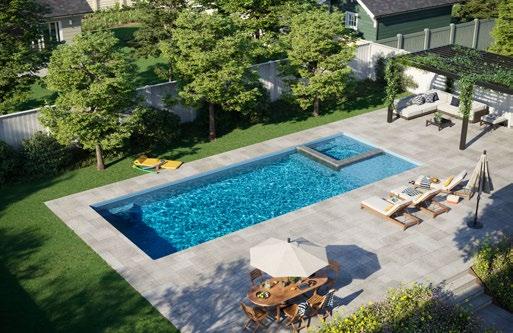
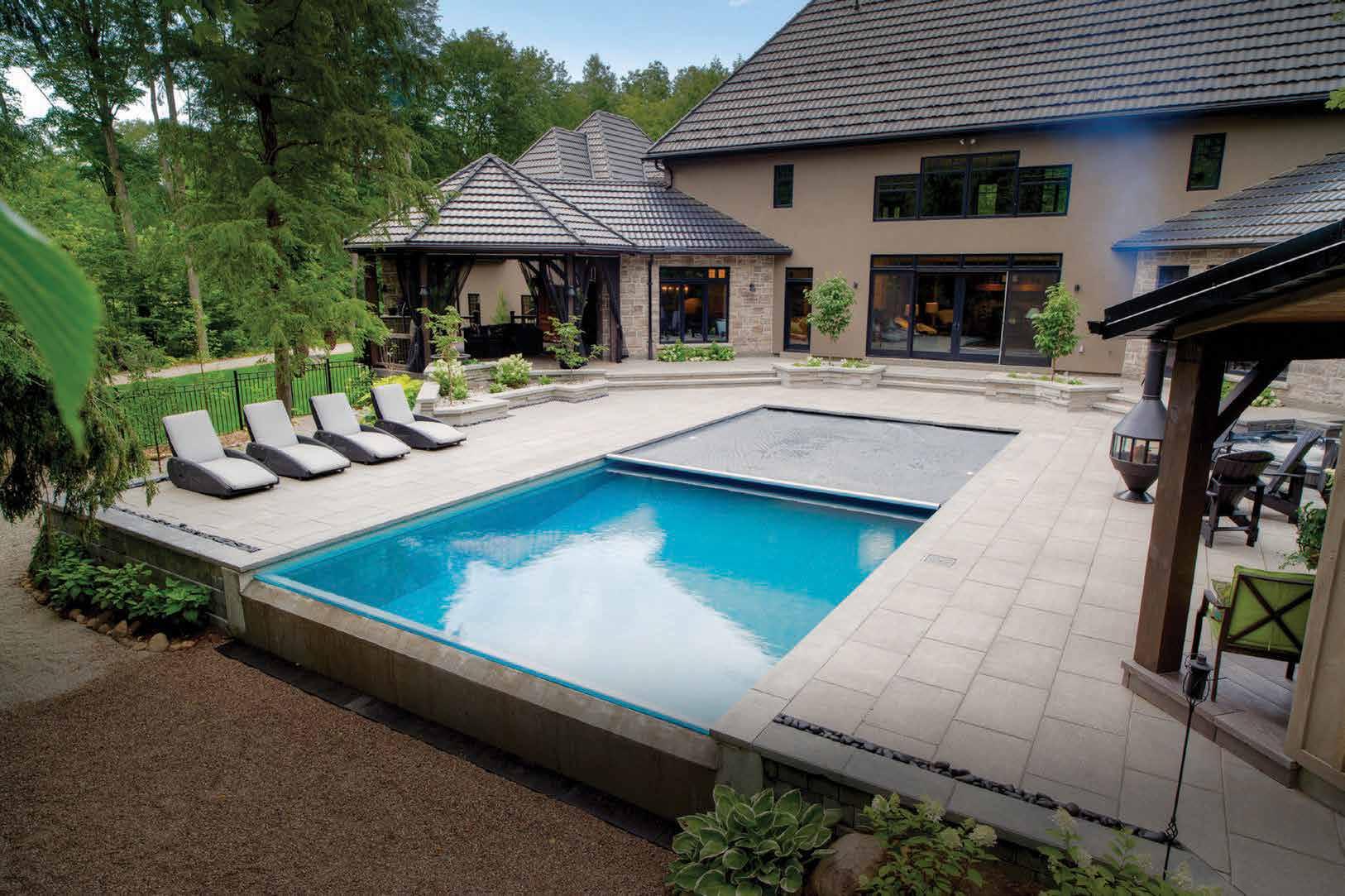
ASTORIA COLLECTION
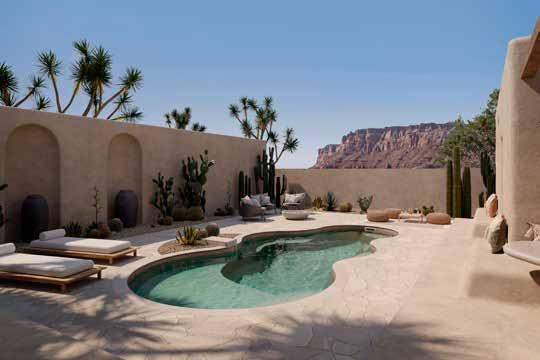
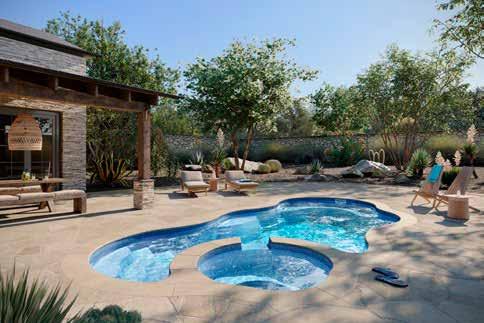
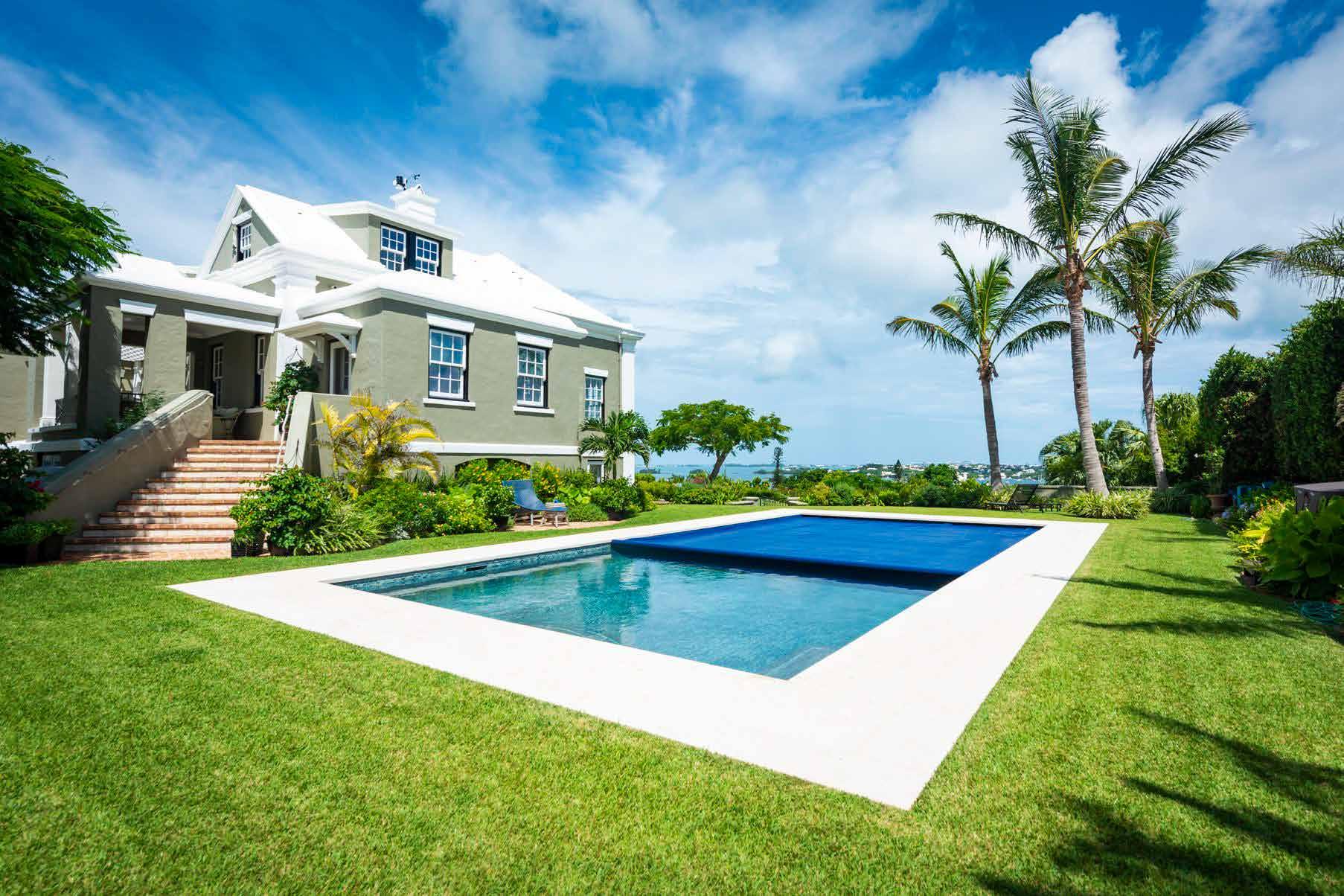
BERMUDA COLLECTION
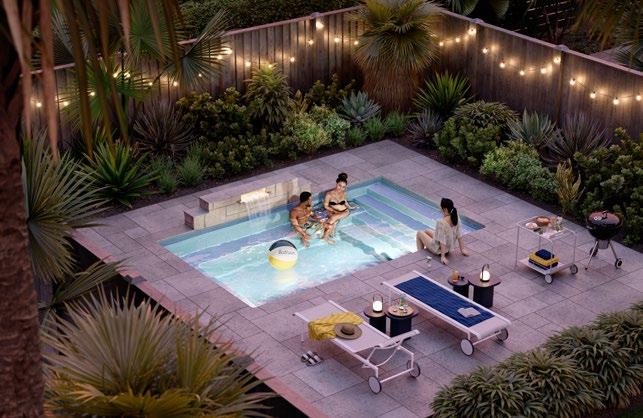
MILAN COLLECTION
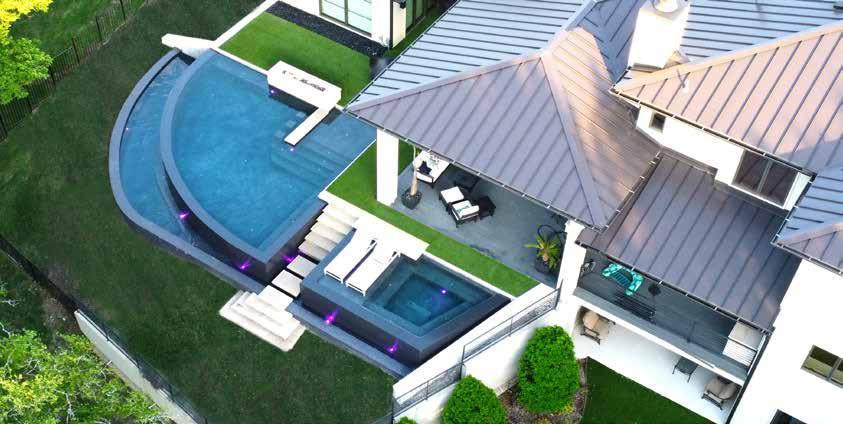
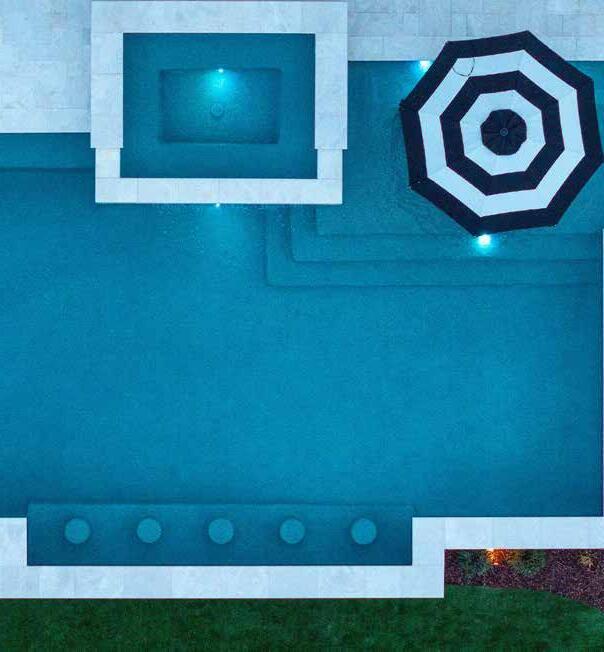
Crisp lines with integrated seating and built-in spas—Astoria balances form and function, with a touch of indulgence.
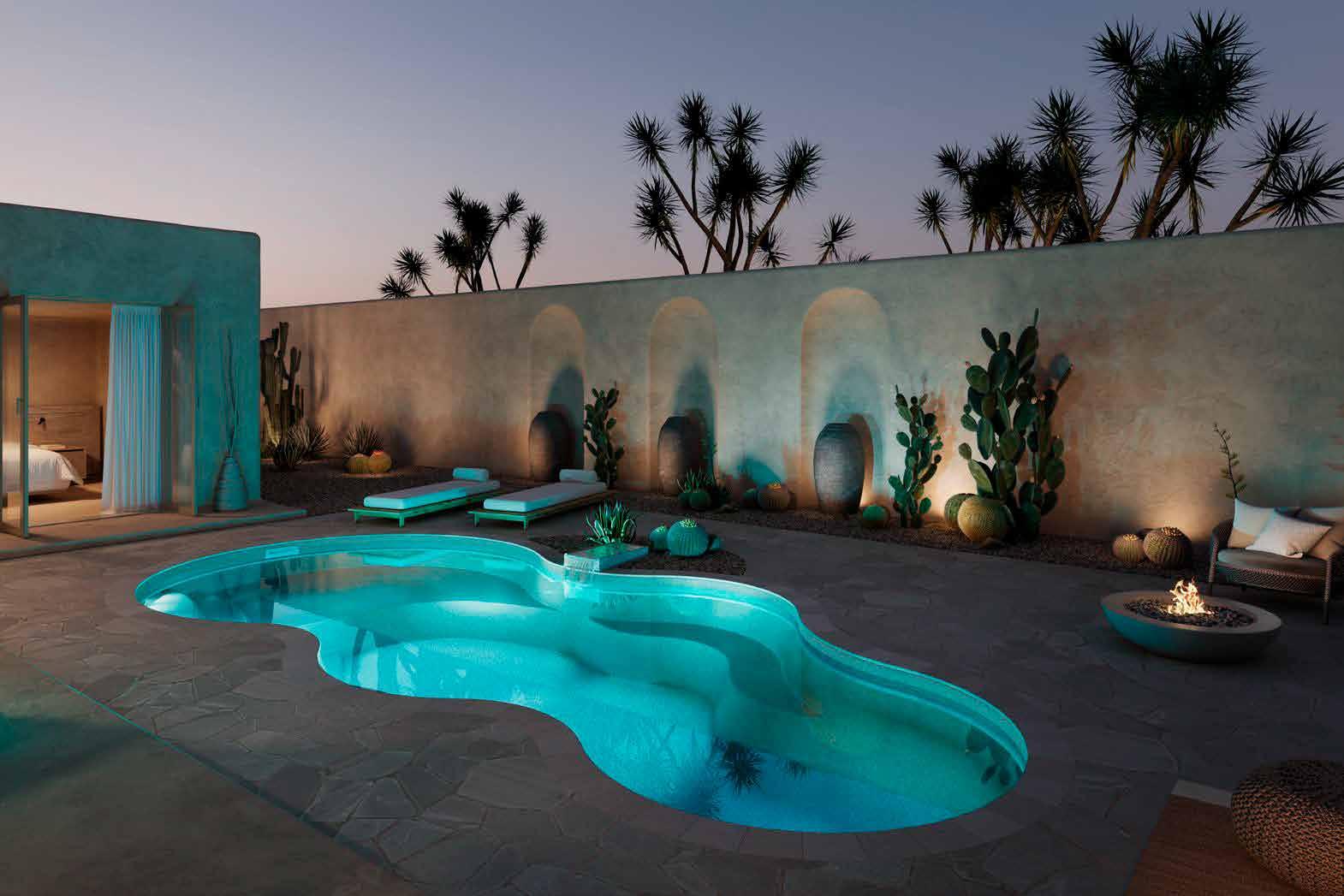
Bermuda invites relaxation with its flowing freeform designs featuring spacious underwater ledges and bench seating.
Small in size yet big on benefits, Milan transforms compact spaces into elevated retreats.
Editor’s LETTER
As summer arrives, pool professionals across the country are entering the busiest stretch of the year. Phones are ringing, schedules are filling up, and homeowners are once again investing in their backyards. While new construction remains an important part of the market, one trend continues to stand out in 2026: remodeling.
Throughout the first half of the year, we spoke with builders, service companies, manufacturers, and designers about the projects driving business today. Again and again, the conversation returned to renovations. Homeowners are upgrading aging pools, adding modern features, replacing outdated finishes, and transforming existing spaces rather than starting from scratch.
That shift has created new opportunities for companies willing to adapt. Many professionals are expanding their remodeling divisions, refining their processes, and embracing technologies that help them work more efficiently. Others are finding success by focusing on automation upgrades, water features, premium finishes, and backyard enhancements that help customers get more enjoyment from the pools they already own.
The theme of adaptation runs throughout this issue. From renovation trends and design inspiration to business insights and market analysis, you’ll find stories that highlight how pool professionals are responding to a changing environment while continuing to deliver exceptional results for their clients.
A s the market evolves, so does our industry. The professionals who continue to innovate, adapt, and deliver value will help shape what comes next. Here’s wishing all of you a tremendous summer!
POOL MAGAZINE - PO BOX 278 - Pilot Hill, CA 95664 www.poolmagazine.com | info@poolmagazine.com
10 HABITS OF HIGHLY SUCCESSFUL POOL COMPANIES
Sean Gadd, the new CEO of Latham Pools gives us an insider’s look into their playbook for 2026 and beyond.
Bad habits can sink a pool company quick, but good ones can help you stand head and shoulders above the competition.
MODERNIZING THE INSTALLED POOL BASE
Companies are scaling smarter and operating more efficiently with Pool360’s latest updates.
With an ever growing installed base of pools, automation is now a highly desired upgrade.
POOL BARRIER SAFETY: THE SMALL DETAILS THAT MATTER MOST
Pools are still a highly desireable amenity but premiums have cooled in a tighter market.
When it comes to pool fences and barriers, it’s the little details that can get you.
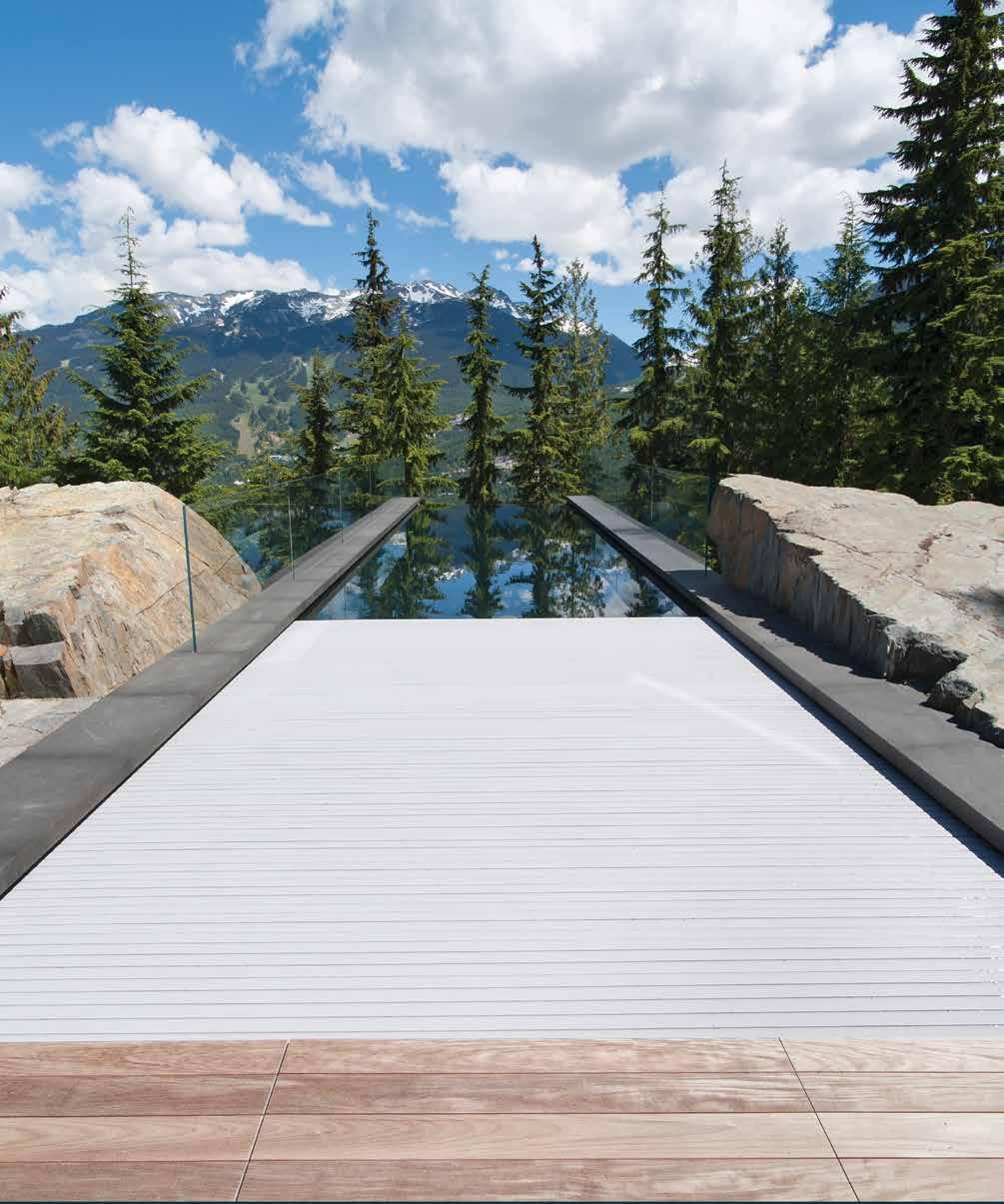
THE EDGE THAT CHANGED MY CAREER
Pool renovation projects have taken off in 2026, a look at what’s trending in remodels.
New construction may have dropped but represents just the tip of the iceberg when accounting for the whole industry.
Luxury pool designer Moses Campos offers an introspective look at the negative edge pool project that changed his career.
ERUPTING WITH CREATIVITY
Take a tour of Lucas Lagoons latest over the top pool project featuring a raging lazy river and a volcano hot tub that actually erupts.
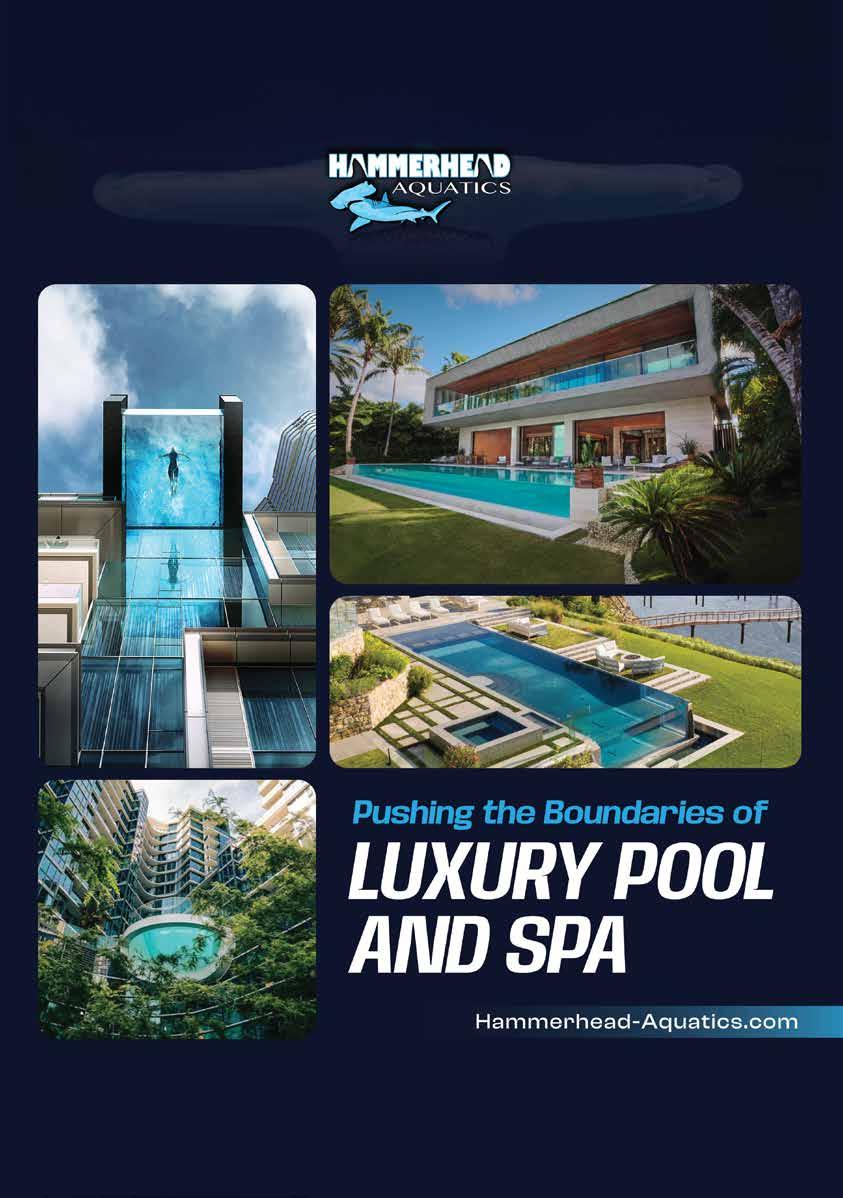
THE ACRYLIC POOL AUTHORITY: HAMMERHEAD AQUATICS
Critical insights and a by-the-numbers look at the U.S. swimming pool market in 2026.
SCHOOLS STOP GIVING SWIM TESTS, EVERYONE LOSES
Swimming proficiency used to be a requirement in many schools. What changed?
FIRSTHAND WHAT AN AQUATIC DESERT LOOKS LIKE
Buffalo closing its public pools speaks to the greater aquatics equity problem in America.
Hammerhead Aquatics has rapidly established a name for acrylic excellence.
INTO THE LATEST INNOVATIONS FROM SICIS
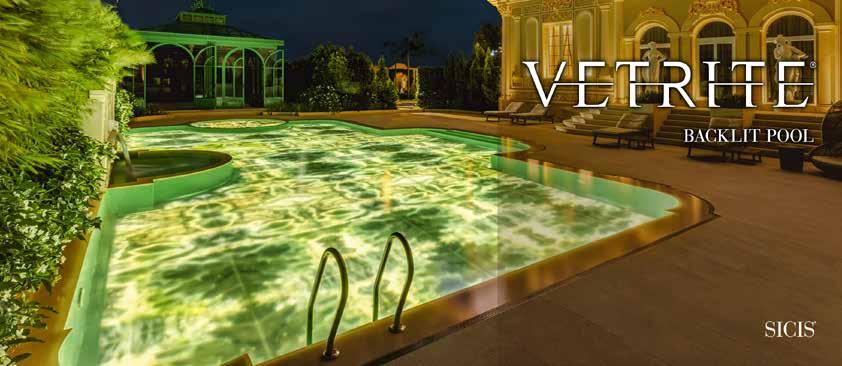
This season, everyone’s talking about Vetrite panels, and it’s clear to see why.
A LOOK AT THE TOP 10 TILE TRENDS OF 2026
Fresh off the expo floor at Coverings, we present the top 10 tile trends of 2026.
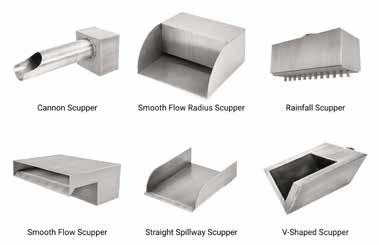
SCUPPERS ARE RESHAPING MODERN POOL DESIGN
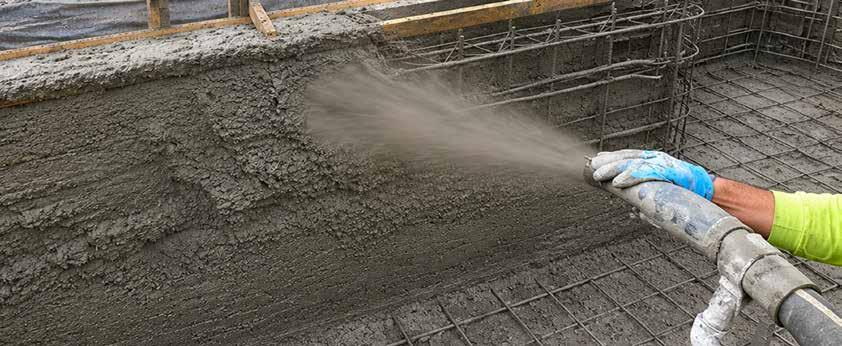
Construction expert Paolo Benedetti discusses improper shotcrete methods and which mistakes to avoid.
Designers are looking at scuppers in a whole new light and elevating their projects in the process.
Pool builder Lee Russell explains the importance of setting the type of standard the rest of the team will proudly follow.
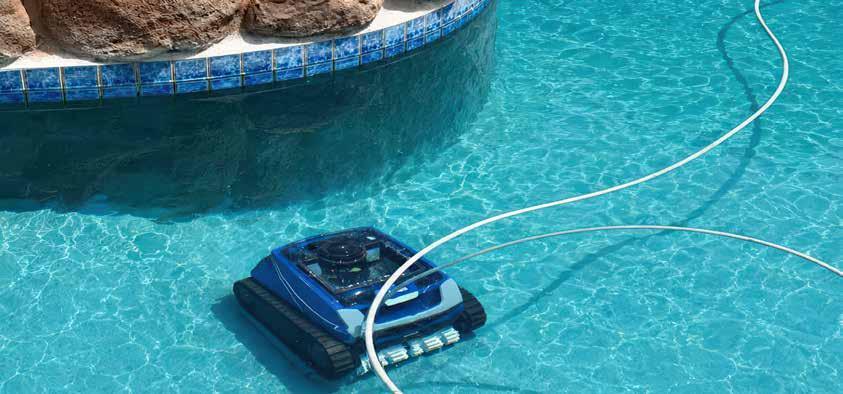
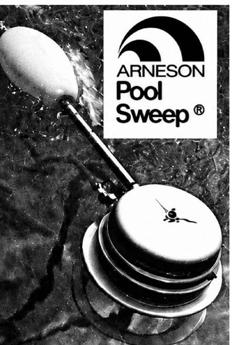
The old Arneson pool sweeps of yesteryear still provide an important lesson for pool pros today.
Inside Latham’s Playbook To Keep Winning
IN A TOUGH POOL MARKET
There’s no question the swimming pool industry has been navigating rough waters over the past couple of years.
Higher interest rates. Inflation. Softer discretionary spending. A cautious consumer environment. Builders across multiple regions have felt the slowdown as homeowners weigh large-ticket purchases more carefully than they did during the pandemic-era boom.
Yet somehow, amid all of that uncertainty, Latham Group continues gaining market share.
That was one of the central themes during a recent conversation with Sean Gadd, who recently stepped into the role of President and CEO at the industry giant as the company celebrates its 70th anniversary.
Gadd spoke candidly with us about the state of the industry, why fiberglass pools continue outperforming expectations, and
where he believes the biggest opportunities lie moving forward.
“The business is an exciting one. The industry is dynamic,” said Gadd. “Yes, it’s going through a bit of a hard time. But Latham’s got a great brand. We’ve got great people. I feel really strong about our value proposition.”
That confidence comes at a pivotal moment for the company. Latham has spent decades establishing itself as the dominant force in fiberglass pools while continuing to maintain strong positions in vinyl liner pools and automatic covers. But according to Gadd, the company’s next chapter is less about protecting what it already owns and more about aggressively expanding into underpenetrated markets.
One of the biggest drivers behind Latham’s continued growth is the ongoing shift toward fiberglass pools.
BY JOE TRUSTY
For years, fiberglass was viewed in many parts of the country as a niche product category. Today, that perception is rapidly changing.
“I see fiberglass growing,” said Gadd. “I think people are becoming more aware of the benefits of fiberglass. Really beautiful designs, high durability, low maintenance — those are all good things for a consumer who doesn’t really want to spend their time maintaining, cleaning and working on the pool.”
The speed of installation is another major factor.
“When a homeowner decides they want to do it, they don’t want to have to wait four months or five months to get into the pool,” said Gadd. “The shorter you can make that, the more attractive we feel it is.”
That speed-to-swim advantage has become one of fiberglass’ strongest selling points as consumers increasingly prioritize convenience
and predictability over lengthy construction timelines.
While fiberglass pools have long dominated many northern and midwestern markets, the southern United States has created one of the company’s biggest long-term growth opportunities.
“The number one challenge is awareness,” said Gadd. “In the southern states, the majority of pools go in with concrete or gunite. But I believe — and we’ve got evidence to show with our growth in Florida — that if you’re able to get the consumer to understand the benefits of fiberglass, and you get together with a good dealer network that can install it at a price that’s affordable and the product looks great, that you can go and win against the standard.”
As Gadd looks ahead over the next several years, he sees four major pillars driving Latham’s growth strategy.
The first is protecting and growing the company’s core business in the Northeast and Midwest, where Latham already maintains dominant market share positions.
The second is continuing to penetrate southern “sand
state” markets where fiberglass still has room to expand.
The third centers around automatic pool covers — a category Gadd sees as dramatically underutilized.
“We’ve got a goal of auto covers on every pool,” said Gadd. “Every new installed pool can essentially take an auto cover.”
In his view, automatic covers offer both practical and aesthetic advantages over traditional fencing while helping homeowners maintain cleaner, safer pools.
Finally, the company remains open to strategic acquisitions that either introduce adjacent product categories or expand Latham into new geographic territories.
“We want to look at businesses that give us something we haven’t sold before that’s adjacent to our current product line,” said Gadd.
BY: JOE TRUSTY
Pool360 PoolService Is Evolving TO HELP COMPANIES SCALE FASTER
AND OPERATE SMARTER
For years, many pool professionals viewed Pool360 primarily as an online ordering platform.
That perception is changing fast.
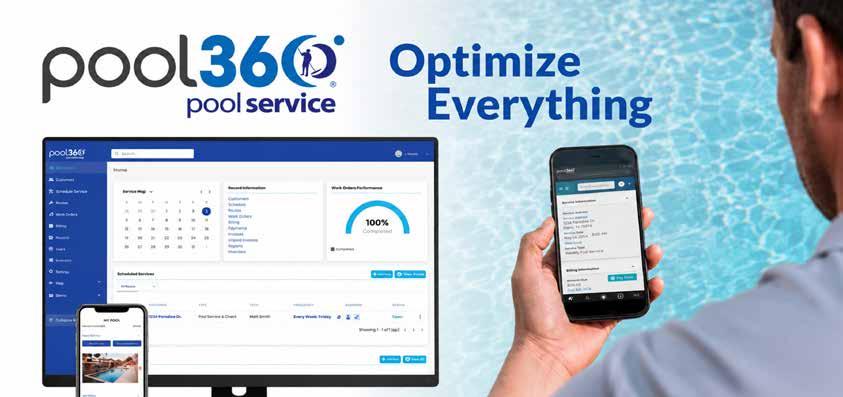
Today, the Pool360 ecosystem has evolved into something much larger — a connected digital platform designed to help pool service companies, retailers, and builders manage nearly every aspect of their business. From route optimization and customer communication to water testing, inventory visibility, quoting, and construction management integrations, PoolCorp is positioning Pool360 PoolService as a comprehensive operational backbone for modern pool companies.
According to Wally Glowicki, Senior Director of SaaS for PoolCorp, the mission goes far beyond software for software’s sake.
“The Pool360 ecosystem
is really designed to help create efficiency and value inside of our customers,” said Glowicki. “We feel that the pool industry especially has a great opportunity to become more digitally enabled, and ultimately provide growth to the entire industry by leveraging these digital products.”
That digital-first philosophy now sits at the center of PoolCorp’s broader strategy. Pool360 may have started as a way for customers to place orders online, but the platform has steadily expanded into a much broader business management ecosystem.
Glowicki explained that PoolCorp’s software development efforts are now focused on creating specialized digital tools that support nearly every stage of a customer’s business lifecycle.
“The Pool360 business solution team really focuses on developing specialized digital solutions that
empower our customers with that high-performing software for not just ordering products, but managing their business,” said Glowicki. “Whether that’s service, repair, construction, as well as water testing.”
That includes onboarding, demonstrations, training, ongoing support, and tools designed to improve both revenue and profitability for dealers.
Unlike many standalone software providers, PoolCorp’s advantage comes from its integration with an enormous national distribution network.
“PoolCorp is a distributor, and we strive to utilize our digital ecosystem to really elevate that dealer experience and create a tangible value for them,” Glowicki explained. “The differentiator that PoolCorp brings really comes from that connection that we have with our distribution network.”
That approach is helping Pool360 evolve into a one-stop operational platform that connects purchasing, inventory, service operations, marketing, customer management, and construction workflows into a single ecosystem.
One of the major differentiators behind Pool360 PoolService is that it goes well beyond simple scheduling and invoicing.
Glowicki described the platform as a full business management solution designed around the entire customer journey.
“As we expand our focus in development of Pool360, this really means offering solutions from a customer’s lead management upfront to contract management, servicing and routing, one-time service scheduling, quoting, ordering materials, and all the way to finalizing and invoicing a customer,” he said.
That level of operational integration is becoming increasingly important as pool companies look for ways to improve efficiency while scaling their businesses.
According to Glowicki, route optimization alone is creating substantial gains for service companies.
“We’ve seen an increase of 15% of capacities in users of our platform,” he said. “This reclaimed drive time, as well as time spent on the job, allows the technician to add another four to six stops a week.”
At an average service rate of roughly $150 per pool, those additional stops can translate into approximately $7,000 in annual revenue per technician.
“When we’ve done digging in on this, we see a 20% decrease in drive time from your typical manual routing or using of other tools,” Glowicki explained. “That savings can really add up, especially in today’s high cost fuel environment.”
Another major component of the Pool360 ecosystem is water testing.
While many retailers still view water testing as a simple in-store service, PoolCorp sees it as a critical customer engagement tool.
The software supports multiple testing systems, including Taylor Express Flex, LaMotte WaterLink SpinTouch, and liquid titration methods.
“We want to meet the customer where they are,” Glowicki explained. “Our platform provides exactly what they need regardless of how they decide to perform their water test.”
One of the biggest recent announcements this year has been Pool360’s integration with JobTread, a popular construction management platform.
According to Glowicki, the partnership aligned naturally with PoolCorp’s broader vision.
“JobTread was really perfect alignment to our strategy,” he said. “We both squarely put the customer at the center with our platforms.”
“Builders using live price syncing are 20% less likely to underquote a project by seeing the market costs in real time,” Glowicki explained.
He added that a typical pool build may involve between 50 and 100 line items, with manual entry often taking up to an hour per project.
“With this integration, it takes under three minutes,” he said. “95% reduction in data entry time.”
Finally, as Pool360 continues to expand, Glowicki says PoolCorp remains focused on building the ecosystem.
“We’re consistently looking at ways to create value in our platforms,” he said. “Whether that be new features, enhancements or integrations with other software technologies.” Read the whole article...
Pools And The Housing Market STILL
OIN DEMAND
BUT
ne of the most talkedabout metrics in recent housing data is the “pool premium,” or the price gap between homes with pools and those without. During the height of the pandemic housing surge, that gap expanded dramatically, topping out north of 60% in some markets.
Today, that premium has cooled slightly, settling closer to the mid-50% range. While that’s a noticeable shift, it doesn’t signal a drop in demand. Instead, analysts think it reflects a more balanced housing environment where today’s buyers have more time, more options, and greater negotiating power.
According to a recent report by Realtor.com, homes with pools are listed for about 54% more than homes without pools. It’s easy to misinterpret the “pool premium” as a direct value-add, but that’s not how the data works.
PREMIUMS COOL
Homes with pools tend to be larger, more upgraded, and located in higher-priced neighborhoods. On average, they offer more square footage and more complete outdoor living environments than homes without pools. That means the price gap isn’t being driven by the pool alone—it reflects the overall quality and positioning of the home.
What’s more telling is how both segments have performed over time in the housing market. Since 2019, home prices—whether they include a pool or not—have increased at nearly the same pace.
That’s an important distinction. It means that pools aren’t necessarily a force multiplier on appreciation. Instead, they’re helping homes stand out, attract attention, and command a premium from buyers who already value the lifestyle they represent.
BY: MARCUS PACKER
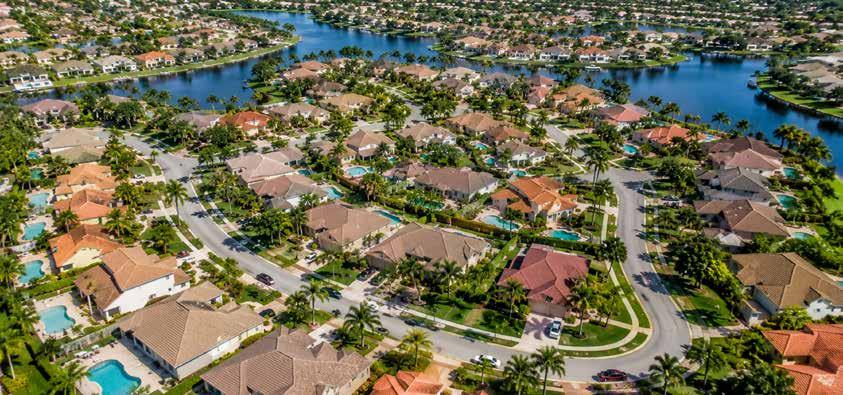
Location continues to play a major role in how pools are perceived and valued. In warmweather markets like Florida, Texas, Arizona, and California, pools are often viewed as a standard feature rather than a luxury. In many of these regions, pools appear in a significant percentage of listings, reinforcing the idea that they’re part of the expected lifestyle.
Pool-equipped homes are especially prevalent in Sun Belt markets, where warm weather and outdoor living go hand in hand.
Miami–Fort Lauderdale–West Palm Beach leads the way, with pools appearing in 61.8% of listings, followed closely by Phoenix–Mesa–Chandler at 58.4% and Orlando–Kissimmee–Sanford at 55.3%. Austin–Round Rock–San Marcos isn’t far behind at 51.9%, while Tampa–St. Petersburg–Clearwater comes in at 47.6%.
Further west, Las Vegas–Henderson–North Las Vegas shows pools in 43.1% of listings, with Riverside–San Bernardino–Ontario at 41.0% and Houston–Pasadena–The Woodlands at 38.8%.
California coastal markets like San Diego–Chula Vista–Carlsbad and Los Angeles–Long Beach–Anaheim round out the list at 37.7% and 36.0%, respectively, reinforcing just how common pools have become in many of the country’s most active housing markets.
Pool construction costs have increased dramatically since 2019, with industry estimates showing prices rising roughly 72% on average, depending on market and build type. What was once a $40,000–$45,000 project prior to the pandemic has, in many cases, become a $74,000+ investment today.
That cost escalation is one of the key reasons pool premiums haven’t fallen off a cliff. Buyers aren’t just comparing homes—they’re comparing the cost of buying versus building. Instead of purchasing a home and planning to add a pool later, many are prioritizing properties that already include one. The rising cost and uncertainty tied to new construction have made existing pools more attractive to many buyers in today’s market.
When viewed through that lens, the premium attached to homes with pools isn’t just about added value—it’s about avoided cost. Buyers recognize that installing that pool later can be significantly more expensive, which helped sustain demand and kept pool-equipped homes commanding higher prices even as the market has normalized.
Homes with pools are typically part of a broader category of properties that are larger, more feature-rich, and positioned at higher price points. On average, these homes offer more living space and more developed outdoor environments than homes without pools. That changes how buyers evaluate them.
Buyers are looking at:
• How the pool integrates with the backyard
• Whether the design aligns with the home
• Condition of the pool, equipment, and finishes
The pool still matters—but it’s one piece of a much larger equation.
For pros in the industry, the current market represents a shift back to fundamentals. The demand surge of the past few years has leveled off, and what’s replacing it is a more competitive environment where execution counts.
A few key takeaways stand out:
• Differentiation matters more than ever
• Design and integration are critical
• Educated buyers require better communication
• Service remains one of the strongest long-term opportunities
The rapid growth in pool construction over the last several years has also created a massive installed base. Those pools will require ongoing maintenance, repairs, and upgrades—providing stability for service professionals even as new construction activity fluctuates.
The biggest mistake right now would be confusing normalization with decline. The demand for pools isn’t falling off in the housing market, but it has settled. Buyers are taking a more thoughtful approach, and sellers are facing more competition. Pools still remain a high-demand amenity in Sunbelt states, but saw a small decline in premium last year amidst a more balanced housing environment.
Through all of this, one thing hasn’t changed. Pools still represent something buyers want. They enhance how people use their homes, how they entertain, and how they relax. That kind of appeal doesn’t disappear just because the market cools. The premium may not be what it was at the peak—but the demand behind it is still very real.
Read
the whole article...
A Second Life Beneath The Surface: POOL REMODELING TRENDS HOMEOWNERS ARE INVESTING IN
BY DYLAN WILTSHIRE
They say what’s old can be made new again—and in 2026, nowhere is that idea more evident than in America’s backyards. With an estimated 10.7 million residential swimming pools across the United States, the swimming pool industry is leaning into a powerful truth: while new pool construction has cooled, the appetite for pool remodeling has never been stronger.
Rather than breaking ground, today’s homeowners are reimagining what they already have. Aging pools are being transformed into modern retreats through thoughtful upgrades that blend functionality, design, and sustainability. From sleek new tile and coping to dramatic waterfalls and complete resurfacing, pool remodels are giving existing
installations a long-awaited refresh.
Roughly 8 percent of American households already own a swimming pool, making renovation a practical and cost- effective alternative to new construction. A remodel often requires less time, less disruption, and a smaller investment—while still delivering dramatic results. In an era where homeowners are prioritizing efficiency and value, remodeling has emerged as the smarter path forward.
The average American pool is now about twenty years old, placing many firmly in need of structural, cosmetic, or mechanical updates. For homeowners, this moment represents both necessity and opportunity: an essential renovation that also breathes
new life into an existing asset. A well- executed remodel doesn’t just enhance day-to - day enjoyment; it can also increase the value of the home itself.
With typical pool remodel costs ranging from $10,000 to $25,000, many homeowners view renovation as an investment—one that pays dividends in lifestyle, aesthetics, and long-term property appeal. It’s leisure and logic working hand in hand.
The business case for pool remodeling is just as compelling. According to the Pool & Hot Tub Alliance’s Q3 2025 Quarterly Pulse Survey, nearly 42 percent of pool companies reported increased renovation and remodel work, while only 21 percent experienced a decline. Remodel backlogs are averaging about two and a
half weeks, offering contractors consistent demand and quicker project turnover.
In contrast, new pool builds often require two to four months, from permitting to completion. Remodels provide homeowners with faster gratification and give industry professionals a reliable workflow—making renovations a win for both sides.
For many homeowners, remodeling has become the preferred alternative to building a new pool from the ground up. Renovations allow families to modernize aging pools, improve efficiency, add new features, and create a more current outdoor living experience without the cost, permitting delays, and extended construction timelines often associated with new pool projects.
In a more challenging economic environment, many homeowners are also choosing to stay in their current homes longer as the real estate market continues to cool.
Instead of taking on the uncertainty and expense of moving, more families are investing in improving the homes they already own. Pool remodeling has increasingly become part of that strategy, allowing homeowners to upgrade their backyard experience now while also improving the long-term resale appeal of the property later.
A Look at the Most Popular Pool Remodeling Projects in 2026
While some homeowners opt for a simple cosmetic refresh, others undertake major renovations that completely transform how their backyard looks and functions. In 2026, several remodeling trends continue to dominate the market as homeowners prioritize comfort, entertainment, wellness, and modern outdoor living.
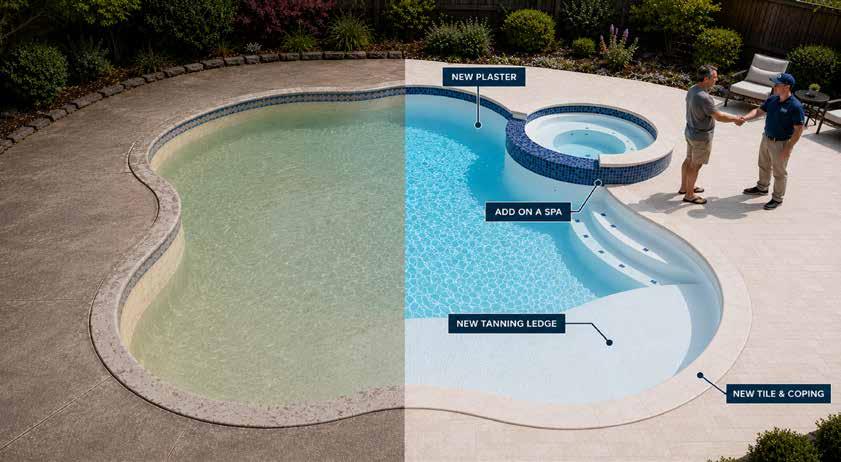
1. One of the most popular remodeling upgrades this year, integrated spas allow homeowners to enjoy their pool year-round while adding a more luxurious feel to the backyard.
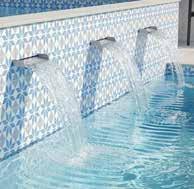
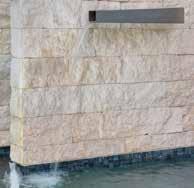
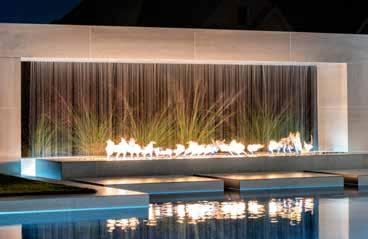
2. Water features remain a top remodeling choice. Sheer descents, scuppers, laminars, bubblers, and waterfalls add movement, sound, and resort-style appeal.
3. Pool resurfacing continues to rank among the most common renovation projects. Modern aggregate, quartz, and polished finishes improve both appearance and durability.
4. Waterline tile replacement remains a highly requested upgrade. New porcelain, glass mosaic, and linear tile designs can dramatically refresh an aging pool.
5. Coping upgrades continue to gain popularity. Materials such as travertine, porcelain, and limestone help modernize the pool while improving durability.
6. Deck renovations are among the fastest-growing remodeling projects. Homeowners are replacing aging concrete with pavers, travertine, stamped concrete, and porcelain surfaces.
7. Features like Baja shelves, tanning ledges, bench seating, and swim-up bars remain popular additions that enhance comfort and usability.
8. LED lighting upgrades continue to be a favorite remodeling choice. Modern systems improve efficiency while creating a more dramatic nighttime atmosphere.
9. Equipment modernization remains a priority for many homeowners. Variable-speed pumps, advanced filtration, and efficient heaters improve performance and reliability.
10. Smart automation is becoming increasingly common in pool remodels. Mobile controls allow homeowners to manage pool functions from virtually anywhere.
11. Heating upgrades remain a popular investment. High-efficiency heaters and heat pumps help extend the swimming season while reducing operating costs.
12. Safety enhancements continue to be an important part of many remodeling projects. Updated fencing, covers, alarms, and slip-resistant surfaces improve protection and peace of mind.
For many, projects like resurfacing, updated decking, integrated spas, lighting, automation, and new outdoor living features represent improvements they can enjoy immediately while potentially adding value when it eventually comes time to sell.
Read the whole article...
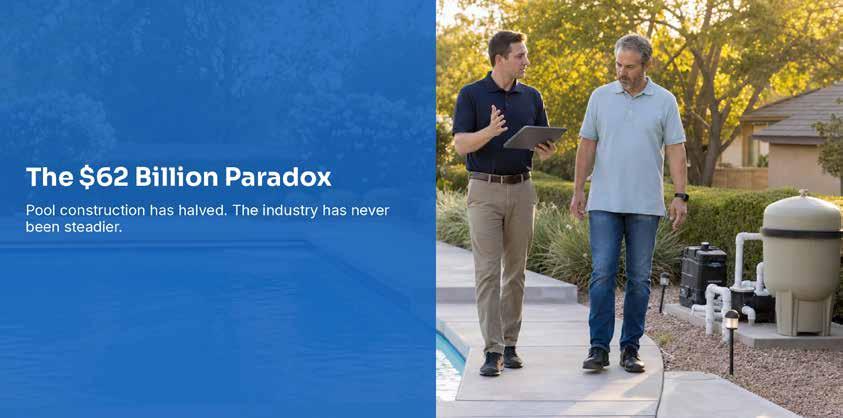
The $62 Billion Pardox HAPPENING IN THE POOL INDUSTRY
BY PARKER CONLEY
Builders will tell you the pool business is in a slump, and on one measure, they’re right: new in-ground construction has fallen by about half since 2021. But ask a route operator how business is going, and you’ll get a very different answer. That gap, between the headline most people see and the economics that actually run the industry, is the most important thing to understand about the pool market in 2026.
Here’s the short version. The U.S. pool, hot tub, and spa industry is worth roughly $62 billion, according to the Pool & Hot Tub Alliance. Building new pools is the part everyone watches, and it’s the part that swings hardest with interest rates and housing. But it’s a minority of the money. The majority comes from keeping the pools we already have running, and that spending doesn’t care
what mortgage rates are doing.
By The Numbers
• $62 billion: total U.S. pool, hot tub & spa industry
• ~$15 billion: annual pool and spa care aftermarket
• 14 million+: pools, spas, and hot tubs in the U.S.
• ~125,000: pool service and retail businesses
• ~ 60,000: new in-ground pools built in 2025, down ~50% from peak
• 1 to 2%: annual growth in the installed base of pools
Pool Corporation, the industry’s largest wholesale distributor, moves about $5.3 billion in product a year, and its own breakdown of where that money goes is the clearest window into the market’s structure. By Pool Corp’s accounting, maintenance accounts for roughly 64% of sales, renovation about 22%, and
new construction just 14%. Read that again. Nearly twothirds of what flows through the largest distributor in the business is the recurring, nondiscretionary stuff: chlorine, replacement pumps, filters, the parts and chemicals a pool consumes, whether or not its owner is feeling flush. Leslie’s calls this the “aftermarket,” and pegs it at about $15 billion a year on its own. It is the closest thing the industry has to a subscription business, except no one has to remember to renew, because a green pool renews the contract for you.
That single fact explains why the industry shrugs off downturns that would flatten a more discretionary market. A homeowner can postpone building a pool. They cannot postpone maintaining the one in their backyard without consequences that show up fast.
The other half of the resilience story is arithmetic. The U.S. has somewhere north of 14 million bodies of water that need ongoing care: Leslie’s counts roughly 8.8 million residential pools, about 5.5 million residential spas and hot tubs, and around 300,000 commercial pools. Pool Corp puts the inground share at about 5.4 million.
Crucially, that base grows 1% to 2% every year, even with construction down. Every pool that goes in is a permanent maintenance customer: it doesn’t churn, it doesn’t get returned, and it needs service for decades. As Pool Corporation CEO Peter Arvan has put it, each year new pools go into the ground and create growing demand for the products needed to maintain and improve them. New construction can fall by half, and the serviceable market still expands, because the denominator never shrinks.
Equipment cycles compound the effect. Pumps, heaters, and filters typically need replacing every 8 to 11 years, which means today’s installed base is also tomorrow’s replacement demand, a predictable wave of spending baked in years in advance.
Construction Cooled And It Mattered Less Than You’d Think
The decline itself is real and worth naming. Pool Corp’s data shows new in-ground starts running near 120,000 at the 2021 peak, falling to about 61,000 in 2024, and landing just under 60,000 in 2025, roughly a 50% drop. High rates and elevated build costs did exactly what you’d expect from a big-ticket, financed purchase.
Geography stayed concentrated throughout it. The Sunbelt “Sand States” (Florida, California, Texas, and Arizona) account for about 54% of total industry sales and roughly two-thirds of new pool starts, even as the national figure fell. Population continues to migrate toward exactly these poolheavy markets, which keeps regional demand sturdier than the national construction number alone suggests.
The point isn’t that the construction slump is fake. It’s that, given where the money actually lives, a 50% cut to the smallest slice of the pie does far less damage than the headline implies.
If the demand side is durable, the supply side is wide open. Pool Corp serves roughly 125,000 professional pool service and retail customers,
and the defining feature of that group is how small each one is. Most have fewer than 10 employees; a large share are the classic one-truck, owneroperator outfits. Leslie’s counts more than 8,000 independent retailers on top of that, and the PHTA lists around 4,000 member organizations.
Leslie’s is the largest national specialty retailer with more than 1,000 stores, and it still holds under 10% of the care aftermarket. There is no dominant national service brand. In an industry this large, that’s unusual, and it’s the structural reason the field remains so accessible to small independents and so interesting to anyone thinking about consolidation.
The 2026 Outlook
The forward read is steady-to-modestly-up. Distributors are guiding to low-single-digit sales growth, and equipment manufacturers like Pentair are projecting roughly 3 to 4%. PHTA’s own sentiment data found that about 69% of companies expect revenue growth over the next year.
The brightest spot is the service sector, specifically. In PHTA’s Q3 2025 pulse survey, service and maintenance companies were the only segment to report higher bottom-line profits, a direct echo of everything above. When the discretionary categories soften, the recurring one holds, and the operators closest to that recurring revenue feel it least.
The $62 billion figure makes the pool industry sound like a construction story. It isn’t. It’s a maintenance story wearing a construction story’s clothes. Strip away the part everyone watches, and you’re left with a $15 billion aftermarket, 14 million pools that need year-round care, and 125,000 mostly small businesses serving them: a market that’s large, fragmented, and remarkably indifferent to the economic cycle.
For the people who actually run routes, the implication is the one that’s been true all along: the base is growing, the field is wide open, and the work doesn’t stop when the economy does.
Read the entire article.
10 Habits of Highly Succesful POOL COMPANIES SHARE
BY JOE TRUSTY & LACI DAVIS
Highly effective pool companies focus heavily on discipline, consistency, and accountability. Many owners describe it as “training the muscle.” The more often strong habits are reinforced, the stronger the company becomes. Winning businesses understand that long-term success is built through repetition.
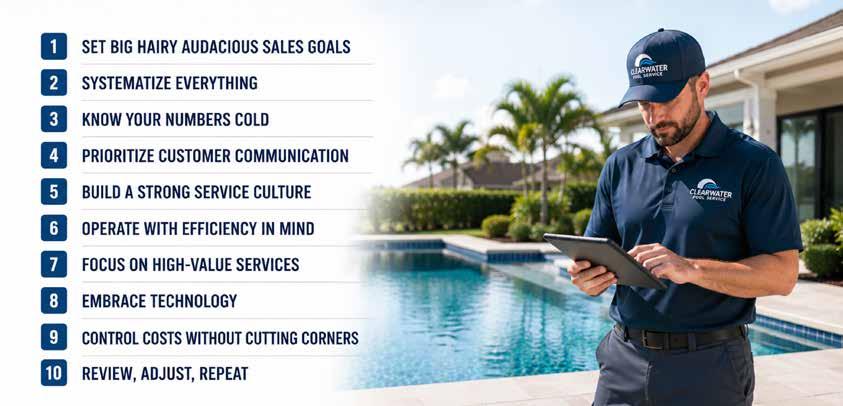
10 Habits Successful Pool Companies All Share
1) Set Big Hairy Audacious Goals
Successful pool companies don’t stumble into growth—they pursue it with intention.
Kelly Peel of Lakeside Custom Pools believes that goal setting and regular accountability meetings are critical components of building a high-performing team.
“We’ve never been interested in setting goals that we know we’ll hit. The goals that create real growth are the ones that challenge the organization to think bigger, operate differently, and raise its standards.”
2. Systematize Everything
Most pool companies aren’t disorganized. They’re unsystematized. There’s a difference. Disorganized people forget; un-systematized businesses repeat avoidable mistakes at scale.
Take Adam Beech, who wanted to scale his growing service company systematically.
“Managing technician training, service quality, and turnover was extremely chaotic and difficult. We solved this with Pool Brain. Tech training reduced by almost 70%, green pools reduced by over 80%,
customer churn due to complaints was virtually eliminated.”
3. Know Your Numbers Cold
Highly effective pool companies understand their financials at a granular level. They know their profit margins, labor costs, close rates, equipment costs, customer acquisition costs, and overhead.
Scott Reynolds, owner of Purpose Pools, says investing in systems that provide real-time visibility into business performance has been a game-changer.
“Once we instituted better technology and systems and started tracking our key metrics in one place, we could see revenue, receivables, upcoming work, technician productivity, and cash flow at a glance. That visibility helped us make better. decisions and run a much more efficient service operation.”
4. Prioritize Customer Communication
If Rudy Stankowitz had to create a one-sentence business plan for a pool company, it’d be: “Answer the phone, dummy.”
This isn’t just about quick communication to secure a lead. It’s being fast and clear throughout the entire life of the account. The way Bruno Brum at XBrum Piscinas in Rio sees it, “Most problems don’t stem from the water itself, but from misaligned expectations”.
It may be for this reason that the top pros consistently name the post-visit recap as one of their highestleverage communication habits.
As Scott Rhodes at Rhodes Custom Pools puts simply: “never leave them guessing or in the dark.”
5. Build a Strong Service Culture
For Gordie Robinson of Cox Pools, exceptional customer service isn’t just a philosophy—it’s a longterm growth strategy that has helped the company build lasting relationships and establish itself as a
leader in its market.
“When you consistently deliver a great customer experience, that creates a cycle where great service leads to stronger retention, stronger retention leads to more referrals, and those referrals bring in customers who already trust your company. That’s been a big part of how we’ve continued to grow and strengthen our position in the market.”
6. Operate With Efficiency In Mind
Efficiency isn’t never breaking, it’s what your team does when something does break. Adam Beech watched his own service company bleed from guesswork.
“Automatic chemical dosing reduced training, chemical spend (-40% reduction), algae growth, and customer complaints. That feature gave us a TON of time back.”
Brian Menzies at Pinch A Penny shared: “I’ve seen businesses [without route optimization] waste hours of payroll on road trips across cities to clean pools to lose money weekly.”
7. Focus on High Value Services
Not all revenue is created equal. The most effective pool companies understand which services generate the strongest margins and position themselves accordingly
Successful companies learn to sell value rather than price. They also recognize when market conditions are shifting and adapt their service offerings to meet changing consumer demand. Pool builder Emile Stinchcombe of Aqua Guard Pools, says that flexibility has been a key factor in helping his company navigate a softer market for new pool construction while continuing to grow through renovations and upgrades.
“Like many builders, we’ve seen demand for new pool construction cool compared to the peak years, but we’ve also seen a significant increase in remodeling projects. We’ve made a conscious effort to expand our renovation and upgrade services because that’s where we’re seeing strong demand. That shift has allowed us to maintain healthy revenue streams, keep our crews busy, and continue growing while some companies that relied too heavily on new construction have faced greater challenges.”
Companies that diversify their revenue streams are often better equipped to weather market fluctuations and changing consumer spending patterns.
8. Embrace New Technology
Hesitant to adopt new tech? Brian Menzies has three words for you: “Your competitors already are.”
The mistake most pros make isn’t refusing tech; it’s trying to overhaul everything at once and bouncing off the implementation. Adam Beech’s advice to operators is the same advice he followed building his platform one feature at a time: “Don’t try to eat the whole elephant in one bite.” Focus on routes first, then on chemistry, on billing, and then on the next thing. Pick what’s hurting most next.
Rudy Stankowitz put it plainly, “Technology is inevitable, and the tech-averse are putting themselves on a path to extinction.” The goal is not to become a tech company. The goal is to stop losing time to tasks, mistakes, and gaps that better systems can prevent.
9. Control Costs Without Cutting Corners
Highly effective pool companies pay close attention to expenses, but they also understand the difference between reducing waste and sacrificing quality. For Cole Daasnes of Poseidon Pool Service, improving margins has never been about finding cheaper products or lowering service standards. Instead, it’s about identifying efficiencies that strengthen the business without compromising the customer experience.
“One thing we’ve been focused on is finding ways to improve profitability that don’t impact the quality of service our customers expect. For instance, we’ve worked closely with vendors to negotiate better terms and discounts by paying invoices faster. In some cases, simply moving from net 30 to net 15 payment terms has created opportunities for savings that improve our margins without affecting the customer at all. That’s the kind of win-win every pool company should be looking for.”
10. Review, Adjust, Repeat
“One mistake is human,” Rudy Stankowitz says. “The same mistake twice is a process failure.” Or to paraphrase Brum, the best opportunities for business evolution lie in recurring problems.
However, if you’re not reviewing your business on a regular basis you may not even know how many times something really is a problem. But reviewing without adjustment is journaling. And adjustment without first reviewing is just guessing. The highly successful are doing both, on a predictable repeatable rhythm.
Or as Drew Coppolino at Pools Etc puts it, “Continuous improvement has to be built into the culture of the business, not treated as a one-time initiative.”
One of the biggest mistakes pool companies make is underestimating how quickly habits sprea. When poor communication, disorganization, lateness, lack of accountability, or cutting corners are tolerated, they become normalized. Over time, those habits affect multiple parts of the business—from customer satisfaction and employee morale to profitability and reputation.
Ultimately, culture is built through repetition. The habits leadership rewards, reinforces, and tolerates eventually become the habits the company is known for. Winning pool companies understand that building a successful business starts with building the right habits first.
Read the entire article.
Modernizing The Installed Pool Base: WHY AUTOMATION IS THE SMARTEST ADD-ON
BY MARTIN GRENIER
Renovation has emerged as the most dependable growth channel in the swimming pool sector. While new construction cycles fluctuate with economic conditions, the installed base of aging pools continues to represent a stable and scalable revenue stream.
Homeowners are choosing to reinvest in existing backyards, upgrading aesthetics, replacing aging equipment, and improving energy efficiency. But beyond visible improvements, many clients are asking a new set of questions: Can I control it from my phone? Can it alert me if something goes wrong? Can it run more efficiently? Those questions are opening the door to automation as a natural extension of renovation — not as a complex luxury system, but as a practical, revenue-generating upgrade.
For forward-thinking pool professionals, integrating automation into renovation projects is no longer a luxury add-on — it is a strategic modernization tool
that increases project value, improves operational efficiency, and strengthens long-term client retention. As smart-home technology becomes standard indoors, automation is rapidly becoming the next expectation outdoors.
Renovation projects present more than an opportunity to refresh a pool’s appearance — they provide a strategic moment to modernize how the entire system operates. With millions of existing pools built before smart controls became mainstream, there is significant untapped potential sitting on equipment pads across the country.
Homeowners already manage thermostats, lighting, and security systems from their smartphones; naturally, they are beginning to expect the same level of control over their pools and spas. For pool professionals, that shift in expectation creates a clear opening to introduce automation as part of a comprehensive renovation strategy.
John MacDonald, owner of Your Pool Guy Inc in Doylestown, Pennsylvania says his customers routinely ask him about automation for their pools. “Most customers start the automation discussion by asking if there is a way to control their pool water temperature remotely. Then they ask me if there is an app for that.” MacDonald says his clients are mostly interested in controlling their heaters, their pool lights and their water chemistry.
The smart phone has driven the consumer’s desire to control elements of their home from anywhere. Exterior landscape lights, pool lights, hot tub and pool temperatures, and control over pool and hot tub water chemistry, all manageable through their mobile devices. “Clients are happy because they have a trouble-free, easy to maintain pool,” explains MacDonald. “Automation simplifies the maintenance so pool owners can make sure the pool is put to bed right before they fall asleep, without having to go outdoors to check.”
Simpler automation systems like the Tild pool automation system, tend to be very effective for most customers. Intuitive, easy-to-operate systems are key to keeping customers happy. These systems offer enough features to satisfy the homeowner’s needs while remaining simple enough to avoid requiring technical support after installation. MacDonald says that the simpler automation systems are the most effective for the majority of his customers. “The simple automation systems that are intuitive to operate seem to really make customers happy,” explains MacDonald. “They just need to have enough of what the homeowner wants but also simple and intuitive enough that they don’t need any technical help after the installation.”
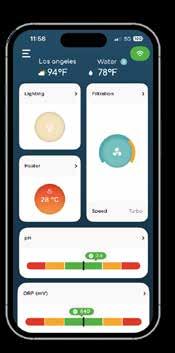
Control system interfaces have also become more user-friendly, even as their capabilities expand. For example, the Tild pool automation system comes equipped with the Vigipool app, that can be easily downloaded to the client’s smart phone. Consumers are comfortable with apps on their phone, whether it’s their home security system, lighting or streaming services. In fact, consumers are excited to use an app on their phone to control the temperature, lights and water chemistry of their pool.
Automation simplifies chores associated with pool and hot tub ownership and brings cost-saving benefits. Timers for outdoor and pool lights help reduce electricity costs, as does regulating pool and spa water temperatures. Automated pool and hot tub water chemistry dosing and control, like the Oxeo ORP and Phileo pH feeders, prevent overdosing or imbalance, minimizing the need for excessive chemical use and reducing overall expenses. Maintaining balanced pool water chemistry is especially critical for plaster pools, as unbalanced chemistry can lead to costly repairs. Additionally, having a compact, user-friendly pH controller with app-based notifications like the Phileo pH is an ideal solution for clients with pH imbalances caused by salt chlorine generators. Improper pH levels lead to scale build-up on the salt cell assembly, which can cause the chlorine generator to shut off.
“Many of my clients have salt chlorine generators and are regularly confronted with their salt-system shutting down as a result of pH problem in their pool water,” explains MacDonald. “One of the most frequent calls I receive is from clients reporting that their salt chlorine generator isn’t working. They don’t realize that they haven’t taken the time to maintain the proper pH levels in the pool water
and we all know this leads to scale accumulation on the salt cell assembly which shuts off the chlorine generator.”
MacDonald likes to recommend and install a pH automation controller that measures and doses the pool water to maintain the proper pH level. “I can’t be at the pool every day ensuring the pH is in the right range, so I like to recommend CCEI’s Phileo pH controller because it’s so compact and easy to use,” says MacDonald. “It’s just a little box about 3” x 4” in size so it fits on any equipment pad and it comes with the app so clients are notified if the water goes out of range so they can go add acid in to the container or similar. It offers the chemical automation that most customers need and want.”
Pool professionals agree that automation systems can help avoid the problems that can quickly increase the operating costs of a pool. Automation doesn’t take away work from service professionals as there are still always tasks to complete. But automation systems like the chemical controllers and feeders help between service calls to ensure all systems are operating correctly.
Offering and installing simple automation systems like the Tild pool automation system helps modernize pools for customers while differentiating their businesses from competitors. Adding simple automation to renovation projects is one of the easiest ways to increase project value, differentiate from competitors, and deliver the modern convenience clients already expect inside their homes. Automation is a game-changer that fosters customer loyalty by providing a more modern pool experience.
Offering pool automation boosts customer satisfaction and excitement about their backyard investment. These systems simplify pool maintenance and make operating other components easier, even remotely. Now is the perfect time for pool professionals to start offering simple backyard and pool automation as a way to renovate pools that need an update. Beyond liners, decking, and lighting upgrades, integrating simple automation systems gives pool professionals a powerful way to modernize and renovate older pools, increase profits, and deliver the smart-home functionality today’s homeowners expect.
Read the entire article.
Pool Barrier Safety: THE SMALL DETAILS THAT MATTER MOST
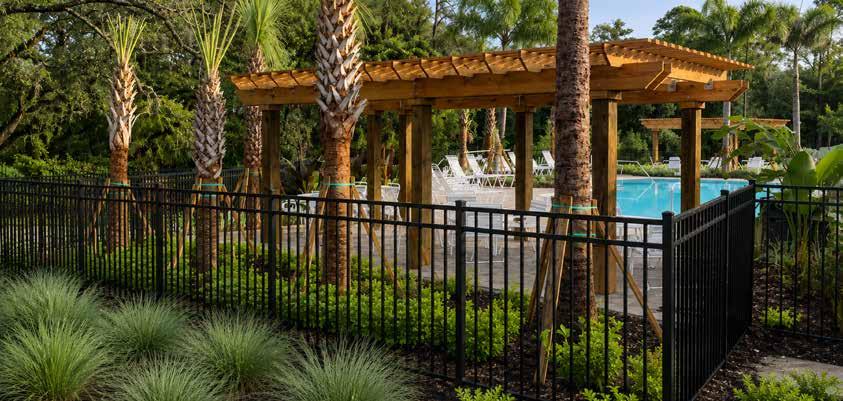
BY: JOE TRUSTY | PHOTO CREDIT: FLORIDA STATE FENCE
For many homeowners, a pool fence is treated as little more than a code requirement or decorative backyard feature. But according to Jeremy Brongo, owner of Florida State Fence, the details surrounding a properly designed and maintained pool barrier can make a tremendous difference when seconds matter most.
“One of the things that a fence can do is prolong the time that it takes for a child to get close to a pool,” said Brongo. “So it’s just an added layer of protection that doesn’t allow the children to accidentally fall into the pool.”
That idea — buying precious time — sits at the heart of modern pool safety philosophy.
Drowning remains one of the leading causes of accidental death for young children in the United States, and nowhere is
the issue more pronounced than in Florida. According to Florida Department of Health data, the state routinely leads the nation in child drowning fatalities among children ages 1-4. In many cases, the incidents occur in residential swimming pools.
Brongo says the speed at which these incidents occur is something many homeowners fail to fully appreciate until tragedy strikes close to home.
One of the biggest misconceptions homeowners have is that any backyard fence automatically satisfies pool safety laws.
In reality, Florida’s Residential Swimming Pool Safety Act contains very specific requirements governing residential barriers and controlled access around pools.
“That law requires residential
pools to have at least one approved safety feature designed to restrict or detect unsupervised access,” Brongo explained. “The most common solution is a compliant barrier system around the pool, such as a fence.”
The problem, according to Brongo, is that many homeowners never realize how technical those requirements actually become.
“I think people just assume that if they have a fence, then they’re compliant,” said Brongo. “But the fence actually has a lot of specifications that make it pool compliant.”
Pool barriers in Florida must generally be at least 48 inches tall and designed to discourage climbing. But even something as simple as the placement of a horizontal rail can create a code issue.
“If there’s a horizontal bar in the fence, that will allow a small child to put their foot in there and basically act as a ladder,” Brongo said. “So the spacing between any horizontal members on the fence has to be greater than 45 inches.”
While the fence itself matters, Brongo says the gate is often the single most critical component of the entire system.
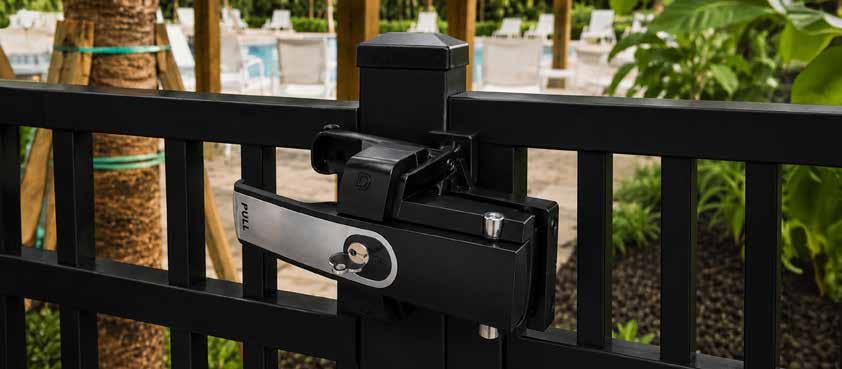
“I would say the gate’s probably the number one most important part of the fence,” said Brongo. “That’s naturally where people tend to walk and tend to go to access a pool.”
Florida law requires pool gates to be self-closing and self-latching, but Brongo says homeowners often underestimate how important proper operation truly is.
“If the gate for some reason closes but doesn’t fully latch, and the gate’s still accessible or has the ability to get in, that can become an issue,” he explained.
Another requirement many people never realize exists is the direction the gate swings.
“The gate’s required to swing out.
The gate cannot swing inward,” said Brongo. “A lot of people don’t know this.”
The Hidden Problems That Most Homeowners
Tend to Miss
Some of the biggest safety risks surrounding pool barriers aren’t actually part of the fence itself.
Brongo says his company frequently encounters situations where homeowners unknowingly create climbing hazards around otherwise compliant barriers.
“One of the main ones is if there’s something left near a fence or some type of pool equipment or AC equipment that’s too close to a fence and can be used as an object that someone can climb on,” he said. “That’s just not something that’s thought about very often.”
Furniture, planters, coolers, storage bins, and even landscaping can all unintentionally compromise a barrier system over time.
“I would say people tend to get complacent and they don’t maintain,” Brongo explained. “The fence may have been installed pool-compliant at one time, but over time, the gate might not be
functioning the same way that it was the day it was installed.”
When Homeowners Should Plan a Pool Safety Fence System
According to Brongo, barrier planning should never be treated as an afterthought.
In Florida, barrier systems are directly tied into the final stages of pool construction and inspection.
“It’s part of the pool safety inspection here in Florida,” said Brongo. “They actually will not allow a homeowner to fill the pool with water until they have the barrier system in place.”
That means pool owners should be discussing fencing, access points, alarms, and overall safety design alongside the original pool layout — not after construction is complete.
“Any doors leading directly to the pool area may have to have an alarm or some type of self-closing option,” Brongo explained.
For homeowners using the house itself as part of the barrier system, additional protections may also be required.
The Edge That CHANGED MY CAREER
BY MOSES CAMPOS
There’s a moment in many careers that doesn’t feel like a breakthrough at the time. It feels uncertain, uncomfortable, maybe even like you’ve been set up to fail. For me, that moment came early on, in what I now think of as my first experience with a “negative edge.”
I was just getting my start in the industry at Southernwind Pools, a place that gave me lots of opportunity and where I was learning quickly and eager to prove myself. Around that time, a project surfaced that the company had reservations about taking on. It lived just outside the organization’s comfort zone, with an unclear scope, unclear ownership, and no guaranteed outcome. Instead of fully committing resources or
leadership, the company took a cautious stance. Eventually, the responsibility landed on me, but without a clear roadmap, strong backing, or much direction.
In other words, I was on my own.
What made the situation even more defining was the addition of a newly assigned project manager, Eli Brannon. He was stepping into his role just as I was stepping into this challenge. We had a strong start. There was energy, momentum, and a shared sense that this could be something meaningful.
But early on, I realized that clarity mattered more than comfort.
I remember looking Eli straight in the eyes and asking him pointblank, “Are you up for doing this with me? Because if not, I’m okay
running this build on my own.”
It wasn’t confrontational. It was honest. The stakes were high, and I needed to know where we stood.
That moment set the tone for everything that followed.
With no predefined process to lean on, we had to create our own. Together, we navigated the unknowns, figuring things out in real time, solving problems as they came, and learning through action rather than instruction.
I started asking better questions, not just “What should I do?” but “What needs to happen for this to succeed?”
First, we broke the project down into manageable pieces. We sought input where we
could find it, even if it wasn’t formally assigned. Then we made decisions, sometimes imperfect ones, and learned quickly from the outcomes. Most importantly, we didn’t wait for permission to move forward.
That shift, from dependency to ownership, was the real turning point.
This project didn’t happen by chance. It came through a relationship that had been built over time. About a year earlier, I had worked alongside interior decorator Karyn Dismore, who had been brought in on a new home build where I was responsible for the backyard scope.
That experience created trust. We learned how each other thought, how we approached design, and how to communicate a shared vision to clients. So when this new opportunity came up, she thought of me.
She brought me in to help elevate the backyard to match the level of the home her client was building. From the start, it was clear this wasn’t going to be a typical project. It needed intention, creativity, and a willingness to push beyond standard solutions.
In our first review, Karyn and I agreed that the elevation of the yard was greater than most in the area. To me, that wasn’t a challenge. It was an opportunity. I explained how we could use that elevation to highlight the views the homeowner loved and create something that felt intentional and fitting for the client’s desire to have a “statement” backyard.
That conversation was a turning point. It gave her the confidence to go back to her client and stand behind me as the right fit for the project.
Looking back, the biggest lesson I was learning in those moments wasn’t just about design. It was about collaboration.
Early on, I thought collaboration meant working side by side on every idea. But what I’ve come to understand is that real collaboration is about listening first. It’s about understanding the vision others are bringing to the table and then contributing in a way that strengthens it.
That same lesson showed up again in my partnership with Eli Brannon. Just like with Karyn, it wasn’t about overlapping roles. It was about alignment. I had to clearly communicate vision and direction while giving Eli the space to take ownership, execute, and make decisions that supported not just me, but the homeowner and the overall design.
Collaboration, when done right, doesn’t dilute a project. It elevates it. It creates clarity, builds trust, and ultimately leads to a better result than any one person could achieve alone.
One of the most technical and ultimately rewarding lessons from that project came through hydraulics.
From the beginning, I was aiming to create a clear separation between the pool and spa, not just visually, but functionally. I wanted control over how the water moved, how each body performed, and how the overall experience would feel. It wasn’t the most conventional approach, and that became clear pretty quickly.
As we got deeper into the design, I remember being told that a more familiar and safer route would have been to let the spa spill into the pool, and then the pool spill into the basin. It was a tried and true method. Predictable. Easier to manage.
But that wasn’t the direction we had chosen.
Instead, we leaned into the challenge. We made a deliberate decision to design the suctions and returns in a way that would give us control over each spillway independently. It required more thought on the front end, anticipating flow rates, balancing elevations, and understanding how small adjustments would impact the system as a whole.
At the time, there was no guarantee it would work exactly how we envisioned. It was another moment at the edge, where theory meets reality and you don’t fully know the outcome until water is moving.
When we reached startup, everything came into focus.
With only minimal adjustments to pump speeds, we were able to dial in the exact effect we had been aiming for. The spillways behaved the way we intended. The separation held. And more importantly, we had control, real, functional control over the system.
It wasn’t just a design win. It was a confidence builder.
That experience taught me that hydraulics isn’t just about making
water move. It’s about shaping behavior. And when you’re willing to think beyond standard approaches and truly understand the system, you can create outcomes that are both precise and intentional.
It also reinforced something that’s stayed with me ever since. The best results don’t always come from doing what’s most familiar. They come from understanding why things work and having the confidence to apply that knowledge in new ways.
For a long time, I viewed that project as something I had to “get through.” It felt like an exception, an outlier in an otherwise structured career path. But over time, my perspective shifted.
That “negative edge” wasn’t a setback. It was a catalyst.
One that pushed me to become more resourceful, more decisive, and more comfortable with uncertainty. It also forged a professional relationship that has stood the test of time.
Today, Eli is a construction manager on the team I joined this year. That shared experience, one that could have easily gone the other way, is something we still talk about. We think fondly of that build, not because it was easy, but because of what it demanded from us and what it gave in return.
Read the entire article:
DesignYOUR TREND
Lucas Lagoons Volcano Pool Project
IS ERUPTING WITH CREATIVITY
There are luxury pools, and then there are Lucas Lagoons projects...
BY JOE TRUSTY
PHOTOS: SANDBAR MEDIA
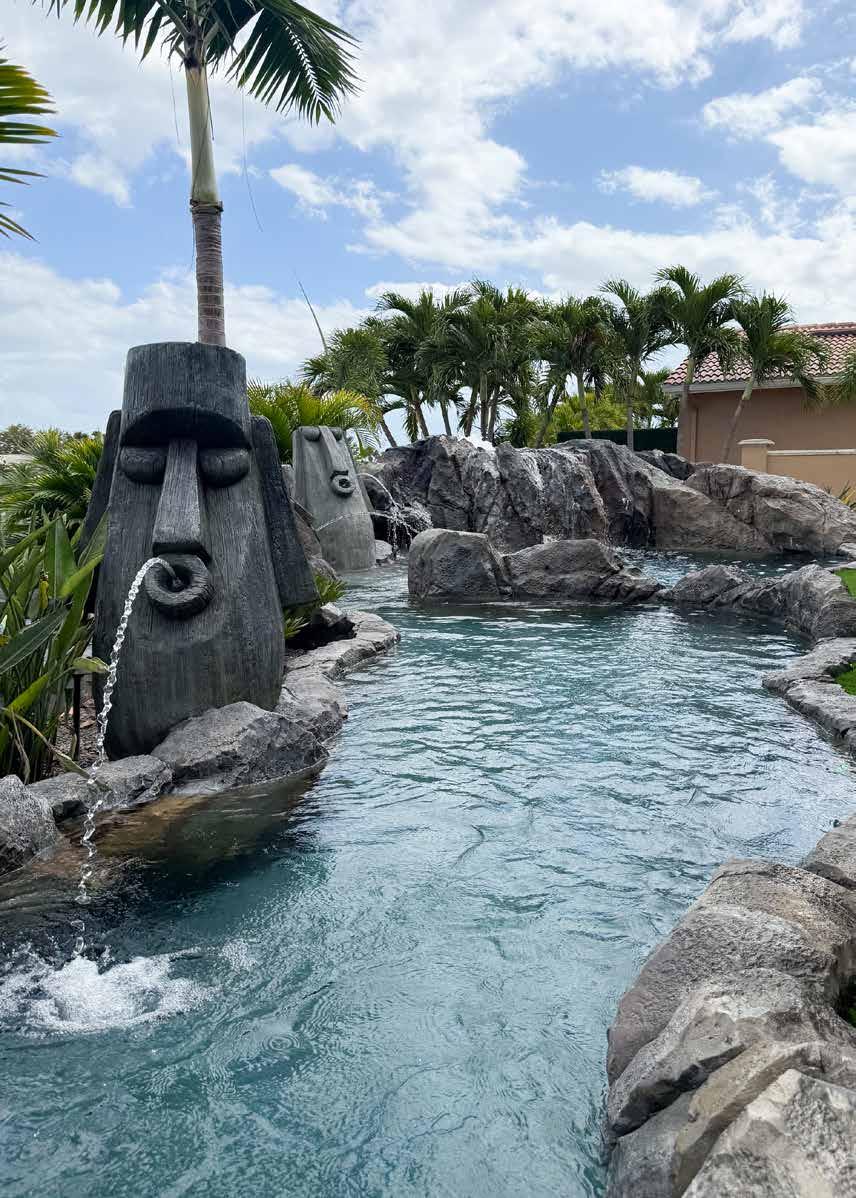
For more than a decade, Lucas Congdon has built a reputation as one of the most recognizable names in high-end custom pool design. Millions of viewers first discovered him through the hit television series Insane Pools, where elaborate grottos, towering waterfalls, hidden caves, massive rock formations, and resort-style backyards became his trademark.
What separated Congdon from many other celebrity pool builders wasn’t simply the scale of the projects. It was the way his pools felt interactive. The environments Lucas Lagoons created rarely looked like conventional backyard swimming pools. They looked more like private resorts hidden inside residential properties — spaces carefully designed to transport homeowners somewhere else entirely.
Over time, that philosophy evolved well beyond the kind of residential work that first made Congdon famous.
Today, Lucas Lagoons has become one of the industry’s go-to firms for overthe-top luxury aquatic environments, particularly when it comes to one specialty that very few builders in the country tackle at the same level: custom lazy rivers.
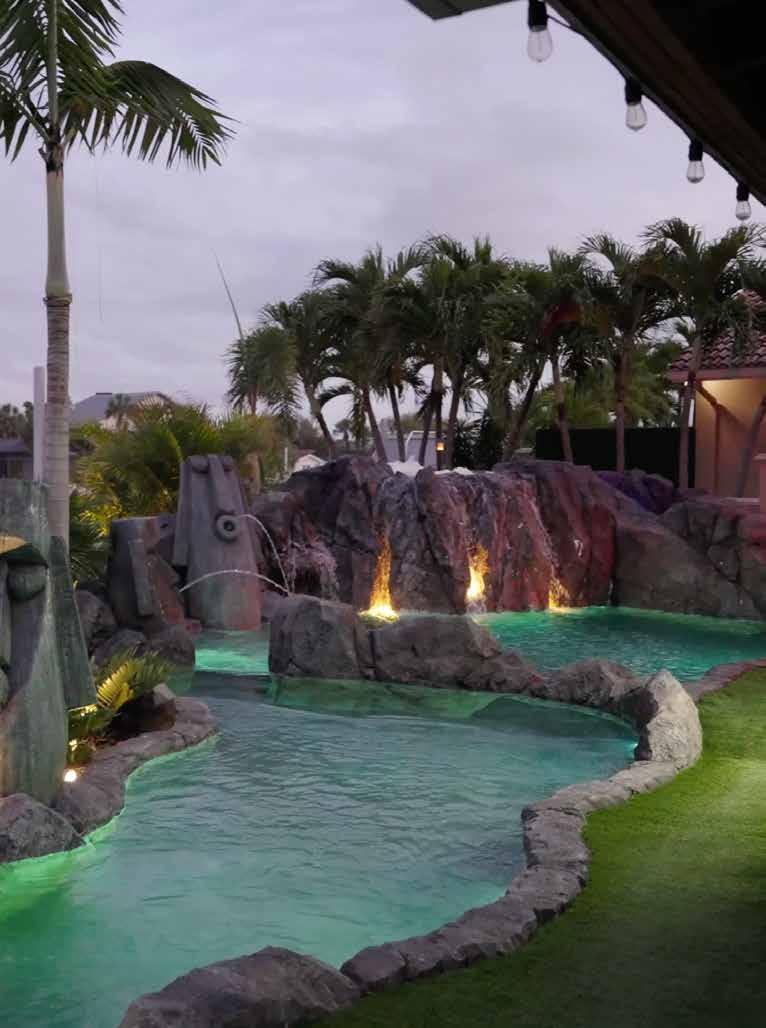
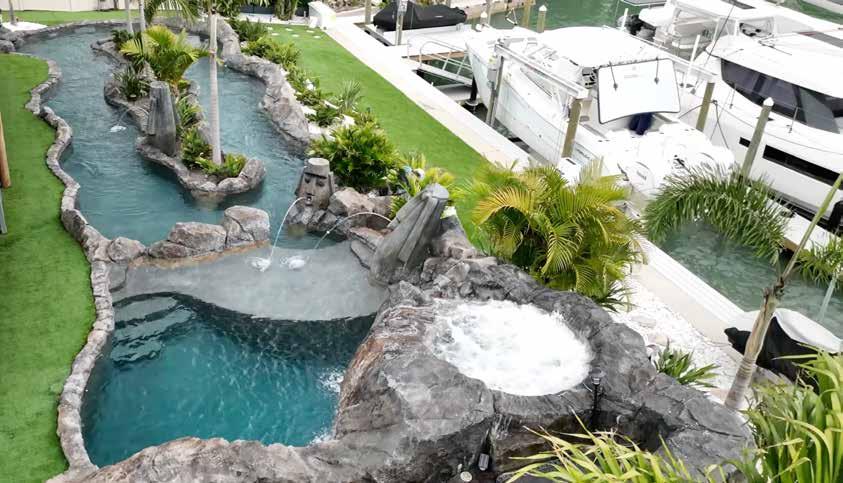
From a winding lazy river to a raised volcano hot tub that actually erupts, this themed backyard creates the ideal staycation at home.
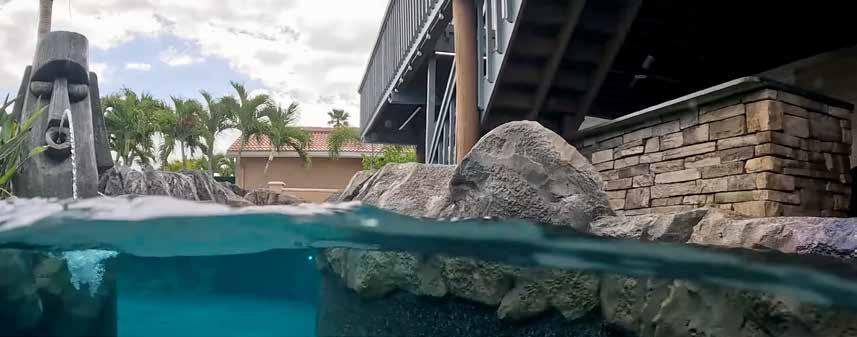
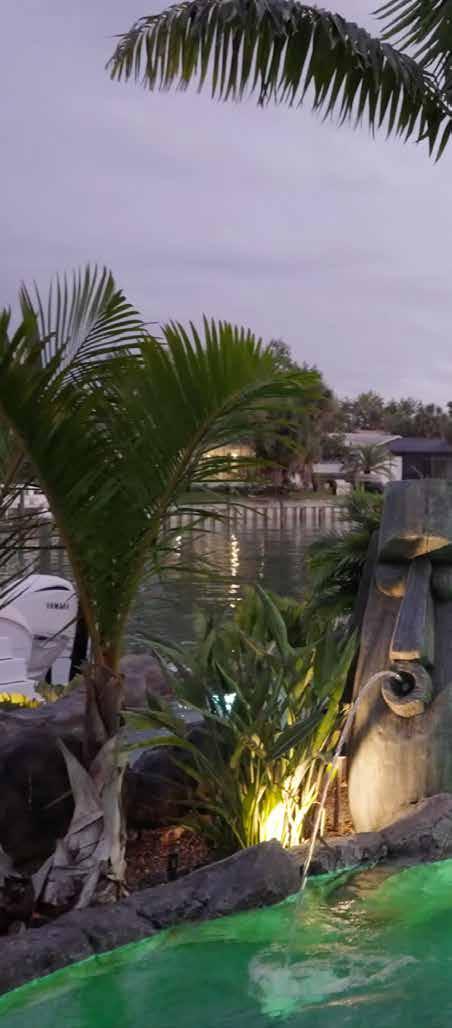
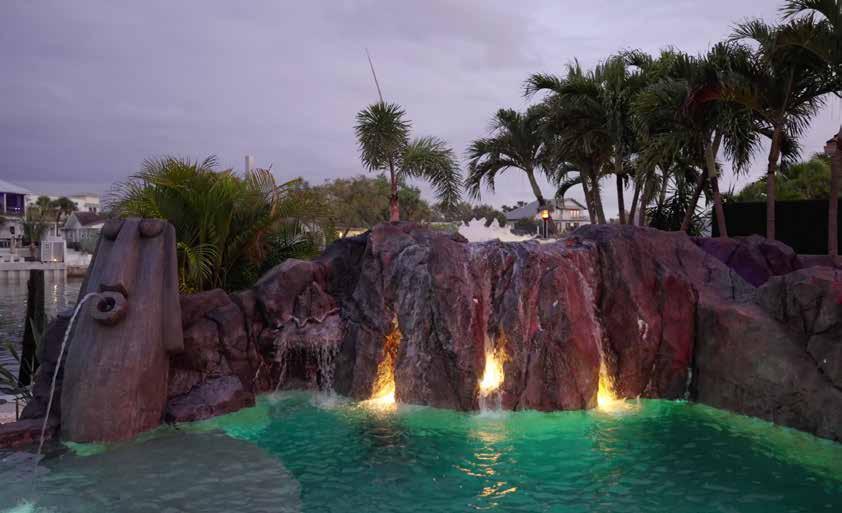
At first glance, the volcano project feels less like a residential backyard and more like a private tropical resort hidden somewhere along the Hawaiian coastline. Towering palms surround a winding lazy river while carved tiki features, dramatic rockwork, strategic lighting, and dense landscaping create an environment that feels cinematic without becoming overproduced.
At the center of it all sits the feature that immediately commands attention: a massive erupting volcano spa designed to look and behave like a natural volcanic formation.
Surprisingly, Congdon says the project did not originally begin with that concept.
“It was starting out kind of a typical Lucas Lagoons with a grotto and a lazy river,” he explained. “The clients had just gone to Hawaii and got all inspired by volcanoes and the tikis and all the faces and stuff.”
Around the same time, Congdon himself had recently traveled to Hawaii and found inspiration in the islands’ volcanic terrain and dramatic natural stone formations. That shared inspiration gradually evolved into one of the most technically ambitious features Lucas Lagoons has ever attempted.
The volcano spa sits elevated above the lazy river system like a natural landform emerging from the landscape. Creating something believable, however, required careful restraint.
“We’re very careful not to have things look too themey or fake or contrived,” Congdon said. “Disney’s cool and everything, but we’re not Disney. We like things to really feel authentic.”
The project began with the construction of a raised spa shell positioned roughly five feet above grade. From there, the team built a massive artificial rock structure around it designed to convincingly
replicate volcanic stone formations.
Interestingly, the project represented one of Lucas Lagoons’ first major departures from relying almost exclusively on natural stone.
“We’re best known for our natural stone,” Congdon explained. “But the same artist that helped us with the snow in Tennessee helped us carve that rock.”
The realism comes from an enormous amount of detail work. Water from the spa spills through carefully carved lava channels illuminated with embedded red lighting and crushed red glass to simulate glowing molten lava flowing down the surface of the volcano.
“We used this red glass and red lights,” he said. “As the water’s flowing down, it kind of looks like lava moving.”
The volcano even erupts.
A custom blower system periodically builds pressure before releasing bursts of water through the crater opening while integrated misters simulate rising volcanic smoke.
“Every so often, it kind of erupts and pushes extra water out of the spa,” Congdon said.
Even the pathway leading to the spa was designed with realism in mind. Rather than using conventional stairs, the team created a winding artificial turf ramp designed to resemble a volcanic trail cutting through the terrain.
“I didn’t want to do stairs coming up because you would never see stairs on a volcano,” he explained.
The result is experiential and dramatic without becoming
cartoonish, something Congdon clearly views as an important distinction.
“It looks so real, so authentic,” he said. “It’s not cheesy.”
While the volcano spa may be the visual centerpiece of the project, the lazy river itself remains equally impressive from an engineering standpoint.
Congdon says Lucas Lagoons continues taking on increasingly large and sophisticated lazy river projects, including one current build exceeding $10 million that features a 5,000-square-foot grotto, interconnected multi-level pools, acrylic viewing panels, cliff-jumping areas, plunge pools, and extensive resort-style hydraulic systems.
At that scale, the projects function more like private waterparks than
traditional residential pools. For the volcano project, Lucas Lagoons once again utilized Riverflow systems to achieve the aggressive current effect that gives the river its authentic resort feel.
“We’ve had a lot of luck with the product,” Congdon said. “It pushes a lot of water.”
According to Congdon, maintaining proper current flow throughout a lazy river requires far more planning than most people realize.
“If people really want the water moving, you really want a pump closer to every 50 to 75 feet,” he explained.
That attention to detail is one of the reasons Lucas Lagoons has increasingly become associated with luxury lazy river design at the highest level of the market.
As Lucas Lagoons projects have continued growing in both complexity and visibility, Congdon says he began noticing a recurring comment online from fans and prospective clients.
“‘If I ever hit the lottery, I’m calling you to build my pool.’”
That recurring sentiment helped inspire the company’s newest initiative: Designer Series Pools.
“These pools are pre-designed,” Congdon explained. “The idea is that all our custom jobs take a while to design and engineer.”
The Designer Series program offers pre-designed Lucas Lagoons pools ranging from roughly $250,000 to $750,000 while utilizing a growing network of authorized contractors around the country to build them locally under Lucas Lagoons guidance and standards.
The model significantly reduces travel, engineering, and logistical
expenses while allowing the company to expand nationally without sacrificing quality control.
“When I was dragging my team all around the country building these pools, by the time you pay all the guys and the per diem and the travel, it’s an average of over $100,000 per job,” Congdon said.
The company currently has several authorized contractors operating within the program, with additional builders preparing to join in the near future.
“We started it just over a year ago,” Congdon said. “We already have five authorized contractors, and we’ve got almost ten more ready to go.”
Congdon says the program has allowed Lucas Lagoons to create a system where clients can still experience the company’s signature style and design philosophy while working with trusted builders in their own markets.
“We do our best to vet them all,” he said. “We go through their financials, make sure they’re not gonna take a deposit and not be able to finish the job.”
For Congdon, the Designer Series represents more than simply scaling the Lucas Lagoons brand. It represents a way to bring the company’s visually dynamic design philosophy to more homeowners while still maintaining the creativity and authenticity that helped make the brand successful in the first place.
And judging by the volcano pool now gracing the cover of Pool Magazine, Lucas Congdon is still finding new ways to push the boundaries of what luxury pool design can become.
Read the entire article:
by over a century of proud American innovation.
Crafted by Builders.
Powered by Servicers.
Backed
Understanding The U.S. Pool Market A LOOK AT THE NUMBERS
The U.S. swimming pool industry in 2026 remains one of the largest and most resilient sectors within the outdoor living economy. While the explosive pandemicera construction boom has normalized, the broader market continues generating billions annually through remodeling, maintenance, chemicals, service, automation, equipment replacement, retail sales, and backyard lifestyle upgrades.
Today, the United States is home to an estimated 10.7 million swimming pools, including approximately 10.4 million residential pools spread across suburban and Sun Belt markets nationwide. That installed base continues creating recurring demand for service, repairs, remodeling, water care products, heaters, pumps, filters, lighting, automation systems, and outdoor living enhancements year after year.
The broader pool and spa industry
itself is estimated to generate more than $60 billion annually, making it one of the most significant categories within the home improvement and outdoor living sectors.
U.S. Pool Market at a Glance
• Total swimming pools in the United States: 10.7 million
• Residential swimming pools nationwide: 10.4 million
• Estimated annual industry value: More than $60 billion annually
• Residential in-ground pools: 5.4 million
• Residential above-ground pools: 3.4 million
• Residential spas and hot tubs: 5.5 million
• Commercial pools nationwide: 300,000+
• U.S. households with a swimming pool: Approximately 8%
• Annual new in-ground pool construction: Approximately 60,000–61,000 pools annually
• Largest regional markets: Florida, California, Texas, and Arizona
• Largest pool distribution
BY JOE TRUSTY
networks: POOLCORP and Heritage Pool Supply Group
• Fastest-growing segments: Pool remodeling, automation, outdoor living, and wellness products
• Strongest recurring revenue category: Pool service and maintenance
The biggest story in the pool industry today is not necessarily how many new pools are being built. It’s how many pools already exist.
With more than 10.7 million pools currently operating nationwide, the United States has built one of the largest recurring aftermarket economies in the outdoor living sector. Over 8% or 1 in 12 households have a swimming pool installed in the backyard.
Each pool creates continuing long-term demand. This recurring demand is one of the primary reasons the industry has remained relatively stable despite higher interest rates and slower housing activity entering 2026.
Unlike industries tied entirely to new construction, the pool business benefits from a massive installed customer base that continues spending money year after year simply to maintain and modernize existing pools.
The United States currently has an estimated 5.4 million residential in-ground swimming pools, making in-ground construction the dominant segment of the professional pool industry.
In-ground pools continue driving the highest-value backyard projects because they are permanent, highly customizable, and deeply integrated into modern outdoor living design.
Although above-ground pools receive less attention within luxury outdoor living discussions, they continue representing a substantial
portion of the total U.S. market.
Current estimates place the residential above-ground pool market at approximately 3.4 million units nationwide.
One of the most surprising realities within the broader aquatic industry is the sheer size of the residential spa and hot tub market.
The United States now has an estimated 5.5 million residential spas and hot tubs³ currently operating nationwide — slightly more than the number of residential in-ground swimming pools.
That creates a major opportunity for pool service professionals willing to expand beyond traditional swimming pool maintenance.
The U.S. commercial aquatics sector remains another critical segment of the broader market.
Current estimates place the number of commercial pools nationwide at more than 300,000 facilities.
Pool ownership continues clustering heavily throughout warm-weather states where outdoor living plays a larger role in residential culture. The largest pool markets in the United States remain:
• Florida
• California
• Texas
• Arizona
Together, these states account for a massive share of national pool construction, remodeling, distribution, and service activity.
The long-term strength of the installed pool market has fueled aggressive expansion among national distribution networks.
POOLCORP, the largest wholesale pool products distributor in the industry, currently operates 456 sales centers globally⁶.
At the same time, Heritage Pool Supply Group has expanded rapidly to more than 160 locations across 36 states⁷.
Combined, those two companies alone now represent more than 600 distribution and supply locations serving builders, retailers, remodelers, and service professionals throughout North America.
The pool industry experienced unprecedented growth between 2020 and 2022 as homeowners redirected spending into backyard improvements during the pandemic.
In many markets, contractors were booking projects 18 to 24 months in advance⁸ during the peak boom cycle.
That pace has moderated entering 2026.
Current estimates suggest the U.S. market is now building approximately 60,000 to 61,000 new in-ground pools annually.
While lower than pandemic highs, that still represents a healthy longterm construction environment supported by strong consumer interest in outdoor living.
The normalization of construction activity has also helped stabilize:
• Material availability
• Equipment lead times
• Labor scheduling
• Consumer expectations
• Builder backlogs
Rather than signaling industry weakness, many professionals now view the current market as healthier and more sustainable than the extreme boom conditions seen during the pandemic years.
One of the most important trends shaping the pool industry in 2026 is the explosive growth of remodeling and renovation work.
Millions of residential pools across the country are now decades old and entering major modernization cycles.
For many contractors, remodeling now represents a more predictable and stable revenue source than speculative new construction.
The aging installed pool base virtually guarantees long-term demand for renovation services well into the future.
Many homeowners are also choosing to remodel because upgrading an existing pool is often significantly less expensive and less disruptive than building a completely new one.
Despite broader economic uncertainty, several major longterm fundamentals continue supporting the industry.
• Massive Installed Base
• Recurring Service Demand
• Outdoor Living Remains Popular
• Aging Pool Infrastructure
• Wellness Trends Continue Growing
• Distribution Networks Expanding
With already operating nationwide, the recurring aftermarket opportunity remains enormous.
Looking ahead, the long-term outlook for the U.S. pool market remains strong.
The explosive pandemic construction surge may have normalized, but the industry now sits atop one of the largest installed residential pool bases in history.
That installed base will continue creating durable long-term demand for:
Extend Priceless Protection
Coverstar automatic safety pool covers give you a powerful advantage: offering year-round confidence to your valued customers. Protection, convenience, and energy savings—all at the push of a button. A Coverstar makes every pool safer the moment it's installed.
• All-season safety for kids, pets, and wildlife
• Stainless steel hardware, patented heat-sealed webbing, and waterproof motors offer strength and longevity
• Wide selection of colors, fabrics, and sizes for a range of aesthetics
• Nationwide support network for sales, installation, and service
| 800.833.3800
Everyone Loses When SCHOOLS STOP TEACHING KIDS TO SWIM
BY ALISE EVERTON
For more than a century, the ability to swim was once considered a basic life skill—something schools believed was essential for producing healthy, capable adults. Today, that expectation is quietly disappearing. Across the United States, both K–12 schools and universities have steadily removed physical education requirements, including swimming competency tests that were once common prerequisites for graduation.
The trend may seem minor on the surface, but it raises a serious question: Are we doing students a disservice by lowering the bar on physical education and life-saving skills?
At a time when obesity rates are climbing and drowning remains one of the leading causes of accidental death among children,
the erosion of swim education requirements deserves closer scrutiny.
Swimming competency tests were once a fixture on college campuses. As early as 1905, Cornell University introduced a graduation requirement that students demonstrate the ability to swim. Princeton followed in 1911 with one of the most demanding standards in the country, requiring students to swim 220 yards.
By 1913, the New York Times observed that “there is scarcely a college which does not prescribe a course in physical education and make swimming an essential part of the course.”
The logic was straightforward. Swimming is not just a sport—it’s a survival skill.
Frank Barton, an army officer and professor who helped push Cornell’s original requirement, famously argued that a soldier who could not swim was “dead weight to his unit.” The sentiment reflected a broader belief at the time that physical competence was a fundamental part of education.
Students were expected to leave school not only intellectually prepared, but physically capable.
Over the decades, however, that philosophy began to fade.
By the late twentieth century, many schools had already begun phasing out swimming requirements. A 1977 survey conducted by researchers at Temple University found that 42 percent of four-year universities still required students to pass a swim test before graduating.
By 1997, a follow-up study at North Carolina State University found that number had dropped to just five percent
Today, only a handful of universities still maintain such standards.
The latest example of the shift came from Dartmouth College. Since the early 1900s, Dartmouth required students to swim 50 yards before receiving their diploma. But in 2022, faculty voted to eliminate the test, meaning that for the first time in more than a century, graduates may leave the Ivy League institution without demonstrating basic swimming ability.
Dartmouth is not alone. Williams College removed its swim requirement in 2022. Hamilton College followed in 2023. Washington and Lee eliminated theirs in 2024.
These schools cited a variety of reasons— administrative challenges, cultural concerns, and disparities of swim experience among students. But regardless of the rationale, the outcome remains the same: a long-standing expectation of physical competency has quietly vanished.
One of the most prominent arguments behind the removal of swim tests centers on racial disparities in swimming ability.
According to the Centers for Disease Control and Prevention, Black children between the ages of five and fourteen are more than five times as likely to drown in a swimming pool as their white counterparts. Surveys have also found that Black adults are more than five times as likely to report that they cannot swim.
These statistics have made many universities uncomfortable maintaining swim requirements.
At Williams College, administrators noted that between 2013 and 2019, 81 percent of students who failed the school’s swim test were students of color. A university committee ultimately deemed the requirement “problematic” due to its disparate impact, leading faculty to eliminate the test.
Dartmouth offered similar reasoning when it scrapped its requirement, noting that students who failed the exam were “overwhelmingly students of colour.”
But some educators argue that eliminating swim requirements addresses the symptom rather than the problem.
Cornell University took a different approach. In 2024, a faculty committee voted to maintain the school’s swim competency requirement. In its resolution, the committee acknowledged the racial disparities but argued that the requirement should remain precisely because of them.
“By providing formal swimming instruction,” the committee concluded, “Cornell is doing its small part to help right the wrongs of US history and close the racial gap in accidental drowning in this country.”
It is a compelling argument. If the goal is to close the gap in swimming ability, removing the requirement may accomplish the opposite.
The disappearance of swim requirements may seem like a small change in the broader landscape of education. But it reflects a larger shift
in how schools define their role in preparing students for adulthood.
If education is meant to develop well-rounded individuals, physical competence should remain part of the equation.
Reading, writing, and scientific literacy are essential skills—but so are the abilities that allow individuals to care for their own health and safety.
Knowing how to swim is one of those skills.
When schools stop requiring it, they send a subtle message that physical capability no longer matters.
In a country already struggling with rising obesity, declining physical activity, and persistent drowning risks, that message may come at a cost.
Instead of abandoning swim education, schools should be asking a different question: How can we ensure that every student graduates not only educated, but capable of staying afloat?
Read the whole article.
Come to Buffalo And See First Hand WHAT AN AQUATIC DESERT LOOKS LIKE
BY RON USHER | PHOTOS: TRAVEL
Iread a story this week that made me angry. Not surprised. Angry.
A six-year-old girl named Ashlyn can swim across the pool and back. Her mother, Ashley, never learned. Ashley grew up in Buffalo with city pools that were only open in the summer. No year-round instruction. No real access. Now she watches her daughter swim and jokes that Ashlyn will have to save her if they’re ever in trouble in the water.
That’s not a heartwarming story. That’s a generational failure dressed up as progress.
Buffalo has one indoor public pool open year-round. One. In a city of nearly 280,000 people on the shores of Lake Erie and the Niagara River. The city has lost half its pools in the last decade.
‘N’ LIFESTYLE
Two are permanently closed. Two more shut for repairs. The outdoor pools that remain will only open this summer if they can find enough lifeguards, which gets harder every year because the pipeline that produces lifeguards starts at the pools they keep closing.
Mike Switalski of the City Swim Project has been teaching kids to swim for free or at subsidized cost since 2012, reaching up to 500 children a year. He said it as plainly as anyone could. Close pools. Fewer swimmers. Fewer people have the skills to become lifeguards. Fewer lifeguards means fewer pools can open. Repeat.
This is what an aquatic desert looks like.
An aquatic desert is not always a place with no pools. Sometimes
it is a place with pools that nobody uses. A city that built infrastructure and then walked away from it. A community where the pools exist on paper but the programming — the swim lessons, the lifeguard training, the learn-to-swim access — has been quietly eliminated through years of budget cuts and deferred decisions. Infrastructure without programming is not aquatic access. It is the appearance of access. And communities that mistake one for the other produce the same drowning statistics as communities with no pools at all.
Buffalo isn’t alone. Pittsburgh lost half its public pools over the past few decades. Cincinnati dropped from 44 facilities to 24. This pattern is playing out in city after city across the country — and underserved communities are paying the highest price.
This is where equity in aquatics becomes more than a phrase.
Equity in aquatics is not an abstract value. It is a measurable outcome — who has access to drowning prevention education, who receives swim instruction, who drowns, and who gets left behind. Buffalo has a large Black population.
Black children drown in swimming pools at rates 5.5 times higher than white children. Drowning is the leading cause of death for children ages one through four in the United States. More than 4,500 Americans drowned each year between 2020 and 2022 — 500 more annually than before the pandemic. These are not unrelated statistics. They are connected directly to decisions communities make about their aquatic facilities.
When a city closes a pool in an underserved neighborhood, it is making an equity decision whether it recognizes it as one or not. When a community fails to fund learn-to-swim programming for children who cannot afford private lessons, it is making an equity
decision. When a generation grows up without drowning prevention education because the facilities were never there or were quietly taken away, that is an equity failure with consequences measured in lives.
Ashley Kelley still cannot swim, her daughter Ashlyn can. That is progress. But it is fragile progress that depends entirely on one pool staying open, one program staying funded, one city finding enough political will to keep the doors unlocked.
This is why I am working with Mark Rauterkus on The Community Aquatics Directive — a framework for civic leaders and aquatic professionals that makes the case for treating pools as public health infrastructure rather than seasonal amenities. Not because the solutions are complicated. They are not. The funding exists.
New York State has committed more than $200 million through its NY SWIMS Initiative for exactly this kind of situation. Federal grants, philanthropic funding, and
community partnerships are all available to communities willing to make the case.
What is missing is urgency and political will. Decision makers who understand that closing a pool is not a budget decision — it is a public health decision with consequences that play out across generations.
Ashlyn wants to be a lifeguard when she grows up. I hope she gets that chance. I hope the pool is still open when she turns sixteen. I hope the city finds the lifeguards it needs to open the outdoor pools this summer. And I hope the people making those budget decisions read stories like this one and understand what they are actually deciding.
If this resonates with you, I’d love to connect. Find me on LinkedIn where I write about aquatics, community pools, and what it takes to make equity in aquatics a reality — not just a talking point.
www.linkedin.com/in/ronusher
A Refined Expression of Texture and Light
“We’ve Always Done It This Way”,
BAD SHOTCRETE PRACTICES
Understanding the process can make or break the success of a shotcrete pool. Too many pool contractors do not understand concrete science or shotcrete. Because of this lack of understanding, they cannot critically evaluate the practices of their shotcrete subcontractors.
Subcontractors will say “we’ve always done it this way,” or “we’ve never had a problem before.” Both may be true, however there are common bad practices that compromise the integrity of the process.
Most pool owners never see what happens during the shoot itself. They see steel, plumbing, excavation, and eventually a finished pool. What they don’t see is that the quality of the shotcrete application is one of the most critical structural phases of the entire project. Mistakes made during placement are often buried forever beneath plaster, tile, coping, and finishes. Problems may not show up immediately, but over time, they
can reveal themselves through cracking, hollow spots, bond failures, leaks, delamination, or recurring structural issues. This is why supervision matters. The difference between a properly placed shell and a compromised shell often comes down to jobsite discipline, proper sequencing, material handling, and whether the crew understands what the material is actually doing during placement.
Hands or fingers in the stream of the shotcrete or squeezing the nozzle, separates the aggregates from the cement paste and slows down the velocity, resulting in weaker concrete.
Shotcrete relies heavily on velocity to properly compact the material as it hits the receiving surface. Once someone interferes with the stream using their hand, fingers, or by pinching the nozzle, the consistency of the material changes. The aggregate can separate from the cement paste, which creates inconsistencies in density and strength throughout the shell. The nozzleman should
BY PAOLO BENEDETTI
be controlling placement through technique and distance — not by physically manipulating the stream.
Failing to place the floor or coves first allows the loose trimmings from the vertical walls and benches to fall into the floors & under the steel. Sometimes material can be vibrated into place. However, most of the time, the wall materials have stiffened & set up, so trimmings become waste materials. It is virtually impossible to shovel out this waste from under the floor steel.
The sequence matters. When crews rush through walls first because it is easier or faster, they often contaminate the horizontal surfaces with rebound and waste material. That waste becomes trapped beneath reinforcing steel where it cannot be properly consolidated. Over time, those areas can become weak points in the shell. Many chronic spa leaks and bench failures trace back to poor placement practices that occurred during the original shoot.
Once the concrete has stiffened, it cannot be used in benches, floors or walls. It is a waste product that needs to be hauled off-site.
If your recently shot project looks really clean, ask yourself, “Where are all of the trimmings?” There should be piles of waste around the entire pool. This is one of the most misunderstood parts of the process. Rebound and trimmings are not reusable structural material once they begin stiffening. Yet many crews still push, shovel, or pack this waste into steps, benches, coves, and floors to save time and cleanup
Most placed concrete is not selfconsolidating. Vibration is required to consolidate it & remove air pockets and voids. Walking on this material (aka: “stompcrete”) does not consolidate it.
Walking all over freshly placed materials – another version of stompcrete- alters the compressive value & water to cement ratios. Freshly placed shotcrete is still in a highly vulnerable state. Excessive foot traffic disturbs the material before it has properly set and consolidated.
If your crew is “flashing” the floor at the end of the job, they’re not doing you a favor – they’re cleaning out their pump & hoses in your pool floor.
The water used to rinse their hopper & hoses alters the cementto-water ratio, which results in a weak crusty layer on the floor. This is why these areas are very white in color & hollow-sounding.
If you don’t know the correct way to install shotcrete, you cannot hold your subcontractors
accountable. If you don’t supervise your subcontractors, they will take the path of least resistance.
Understanding concrete science is not optional if you are building shotcrete pools. It is the foundation of the entire structure. Builders who educate themselves, supervise properly, and demand better practices from their crews dramatically reduce the likelihood of future problems.
A properly installed shotcrete shell should not be based on luck, habit, or “the way it’s always been done.” It should be based on sound practices, proper supervision, and understanding exactly what is happening during every phase of placement.
Read the whole article.
Pool Construction Standards
BY LEE RUSSELL
THE BEST BUILDERS NEVER CUT CORNERS
Pool construction standards don’t fail all at once.
They fail the first time someone decides that the pressure of the moment is greater than the conviction behind the work. That decision is rarely dramatic. It doesn’t look like a failure. It looks like a reasonable response to a difficult situation.
In 35 years of building pools, I watched it happen more times than I can count. And it almost always started the same way.
There are two moments where the drift begins.
The first is the financial squeeze. The job is tight. The margin is thin. Something costs more than it should. And someone, maybe you, maybe someone you trusted, decides to substitute a material, compress a timeline, or skip a step
that felt optional in the moment.
In the pool industry, I saw this most often in the reinforcement steel. The wrong size. The wrong spacing. Decisions made before the concrete was ever poured were invisible once the job was done. Sometimes the only way to know was to get in and look, and even then, you had to know what you were looking for.
The nature of this industry is that the most critical decisions happen before anyone can see them. The steel, the plumbing, the drainage design, the engineering behind the shell. All of it is buried, covered, or filled before the homeowner ever sets foot in the backyard.
That invisibility is exactly where the temptation lives. If no one can see it, no one will know. If it holds through the warranty period, the problem becomes someone else’s.
The compromise gets made in the dark, and the person who made it is usually long gone by the time the failure shows up.
Sometimes, there was a small crack, a slight movement in the structure that only someone who knew what to look for would notice. The homeowner had no idea. The pool looked fine. Until it didn’t.
I’ve stood in front of homeowners and explained what was failing and why. The reaction was almost always the same: shock, anger, disappointment. And then the line that never got easier to hear: “We wanted to use you guys, but you were too expensive.” The repair was exponentially more expensive than building it right would have been. Every time. It gets justified quickly. We’ll make it up on the next job. The customer will never know. It’s close enough.
My dad had a saying about that. Close enough is only good for horseshoes and hand grenades.
But the decision has already been made. Not just about that job. About what kind of company you are willing to be when it costs something to hold the line. The people who work for you saw it too. They filed it away. They now know where the line actually is.
The second moment is customer capitulation. A client pushes back on price. A competitor comes in lower. And rather than holding the number that reflects the work, reflects the standard, you match it. You tell yourself it’s a relationship investment. A loss leader. A one-time exception.
I know that moment well. I had a competitor, also a friend, who took a job I walked away from. After it was done, he asked me how I knew that client would be a problem. The honest answer was that I didn’t know the client would be a problem. I knew the job couldn’t be built to the standard at that price. There was no way to do it right without compromise. The client didn’t realize the compromise would result in a poor project. My competitor couldn’t collect full payment.
Nobody won. Except the standard. It rarely stays a one-time exception. The second compromise is always easier than the first. The decision has already been made once. The precedent is set. What used to be the line is now just a starting point for negotiation. Both moments feel like flexibility. Both moments feel like good business. But they are not flexible. They are the first compromise. And the first is never the last.
A standard is not a rule on a wall. It is not a mission statement or a values document. A standard is only worth holding if you can explain why it exists. Not every process is a standard. Not every requirement is a conviction. The ones worth holding are the ones traceable directly to the quality of the work, the safety of the structure, and the integrity of what you promised.
Anyone can hold a standard when it’s easy. When the margin is healthy, when the customer is happy, when the job is going well, holding the standard costs nothing. It proves nothing. The standard is only proven when keeping it costs something. When the squeeze is real. When the customer is unhappy. When the competitor is cheaper. That is the moment the standard either holds or it doesn’t.
The people around you are watching. Every time. They are not judging. They are calibrating. They are figuring out where the real line is, not the one you talk about, but the one you actually defend. And they will build their own behavior around what they find.
I have seen it go both ways. A crew member at a job I wasn’t on makes the call the right way. Holds the line, pushes back on a shortcut, does it the way it should be done, even when no one is watching. You find out later. You didn’t tell them to do it. They did it because they knew why it mattered.
And I have seen the other version. A trench was not properly compacted because it was the end of the day, and everyone was ready to go home. Not dramatic. Not malicious. Just the path of least resistance when the pressure showed up, and the standard wasn’t in the room. Years later, the deck moves. The homeowner calls. You find out that way.
Both versions tell you exactly where your standard actually lives. The standard lives not in your policy manual, not in what you say at the morning meeting, but in what your people do when you are not there. You cannot hold a standard alone. You can set it. You can model it. But you cannot be in
every room, on every job, in every conversation where the pressure shows up and the easy path is right there.
My team had a saying. “That’s not how Lee does it.” And my business partner hated it. Not because my way was the only way. There are many ways to do a job correctly. But because I had set a standard, they had internalized it. They weren’t quoting a rule. They were carrying a conviction. That is what it looks like when a standard has taken hold. It doesn’t need you in the room anymore.
The reality of holding a standard is this: You’ll lose jobs because of it. You’ll lose customers because of it. This industry gives you plenty of opportunities to compromise. Margins are tight, the competition is real, and the homeowner has three other bids. The invisible nature of the work means you could cut corners, and nobody would know. The pressure to match a lower price, to substitute a material, to compress a timeline. It shows up on every job. It never stops showing up.
But the builders who last, the ones who build reputations that outlive any single project, are the ones who decided early what kind of company they were going to be when it cost something to hold the line. That decision doesn’t get made once. It gets made every time the pressure shows up. And every time it is made correctly, it gets easier for the people around you to make it the same way. The jobs and customers you lose by holding the line are not the ones you were built to serve. And the ones who stay know what they are getting. That is the foundation worth building on.
Read the whole article.
The Acrylic Pool Authority: HOW HAMMERHEAD AQUATICS BECAME A GO-TO NAME
BY JOE TRUSTY | PHOTO CREDITS: HAMMERHEAD AQUATICS
There are luxury pools. And then there are the kinds of projects where the pool itself becomes architecture.
The kind that cantilevers off the side of a high-rise. The kind where swimmers float above a dining room through a massive transparent floor panel. The kind where acrylic walls, windows, vessels, and water features aren’t simply decorative accents — they become the centerpiece of the entire design.
That’s the world Jason Jovaag operates in every day.
A s President and CEO of HammerHead Aquatics, Jovaag has quietly become one of the most sought-after specialists in the global luxury aquatic design space. When elite builders, architects, and
designers need complex acrylic engineering for some of the world’s most ambitious pool projects, his name comes up repeatedly.
A sk enough people in the upper echelon of the pool industry who they trust with acrylic windows and structural aquatic features, and eventually the same answer keeps surfacing:
“Jason’s the guy.”
That reputation didn’t happen overnight. Over the years, HammerHead Aquatics has built a portfolio spanning luxury residential pools, high-rise rooftop installations, zoos, aquariums, wellness facilities, and some of the most recognizable aquatic environments in the world. What separates the company from many others operating in the acrylic space is its vertically integrated approach.
“We actually do design, engineering, fabrication, and installation,” explained Jovaag. “So it’s a one-stop shop where we can actually follow the process all the way from concept through construction.”
That turnkey approach has positioned HammerHead as a critical partner on projects where there is very little margin for error. These aren’t standard backyard pools. These are engineering exercises wrapped inside luxury architecture.
One of the biggest trends driving HammerHead’s growth has been the explosion of vertically integrated luxury living — particularly in markets like Miami, the Bahamas, Dubai, and Beverly Hills.
Developers and ultra-high-net-worth homeowners increasingly want private aquatic experiences incorporated directly into elevated living spaces. That means plunge pools hanging off balconies. Cantilevered rooftop pools. Acrylic edge details suspended dozens of stories above the ground.
Jovaag was one of the early specialists helping bring those ideas into reality. Today, those projects are becoming increasingly extreme. “We like to push the envelope as far as what we can design and build,” Jovaag explained. “And you can see that represented in many of the projects we’re involved in today.”
That mentality has made HammerHead a frequent collaborator with some of the most recognizable names in luxury pool and architectural design. Jovaag has worked alongside elite builders and designers including Ryan Hughes, Paolo Benedetti, Danny Wang, and acclaimed modern architect Paul McClean of McClean Architecture, amongst many others.
Having established a reputation as a go-to authority for all things acrylic pool related,, today, HammerHead is also seeing increased demand for acrylic fire features, acrylic spheres incorporated into landscape design, and largeformat acrylic water walls that would be difficult or impossible to achieve with traditional glass.
“Glass does have its limitations when it comes to manufacturing size,” said Jovaag. “But the possibilities with acrylic are endless with the chemical bonding technology to be able to get to some of these larger format sheets.”
Another trend gaining traction in the ultra-luxury market is acrylic floor panels.
These installations allow homeowners to look upward through the bottom of a pool into living spaces below — transforming the swimming pool itself into a functional skylight.
HammerHead currently has one especially ambitious project underway involving what Jovaag described as one of the largest residential floor windows attempted to date.
“That window is massive,” he said. “It’ll be one of the largest floor windows done for a residential application at about 32,000 pounds.”
Despite the prestige attached to many of HammerHead’s projects, Jovaag continues to remain heavily involved in industry education.
Because acrylic installations remain relatively specialized within the pool industry, many builders encounter a steep learning curve during their first project.
That’s where HammerHead often steps in long before installation begins.
“We want to give them the tools to make them successful,” Jovaag explained. “Giving them dos and don’ts of what not to do, what to expect from us, what we expect from them.”
That consulting mindset has made HammerHead a valuable collaborator for designers and contractors attempting increasingly sophisticated builds.
In 2026, HammerHead Aquatics is now entering another major chapter. The company recently opened a new Las Vegas facility that will allow it to bring approximately 90 percent of manufacturing and fabrication operations in-house.
For Jovaag, the move is about greater control, better scheduling, and ensuring consistency from start to finish.
“The term I use — care, custody, and control,” he said. “Now, we own every process from A to Z.”
That expanded capability positions HammerHead to continue growing alongside a growing luxury pool segment that seems increasingly willing to chase bigger ideas and more ambitious aquatic experiences.
Read the entire article.
The Art of Engineering The Art of Engineering
Since 1980, Aquamatic pool covers have focused on safety, energy savings and ease of use. With our technology, we are setting a higher standard through innovation and design. Supported by a 20 year mechanical warranty, and the most standard features of any automatic cover in the industry.
Hydramatic
•all-fluid hydraulic drive
•one-fourth the moving parts
•zero lubrication & self-adjusting
HydraLux
•unique trackless design can cover virtually any pool
•the only energy saving insulated automatic cover
•manufactured exclusively in the USA
Dive Into The Latest Pool Design INNOVATIONS FROM SICIS
BY JOE TRUSTY | PHOTOS: SICIS
For decades, SICIS has been recognized globally for its luxury glass mosaics, supplying some of the world’s most ambitious hospitality, spa, and residential projects. Today, the Italian design company is pushing far beyond traditional mosaic applications and into a new category of glass innovation that could reshape luxury pool and outdoor living design in the years ahead.
During a recent conversation with Pool Magazine, Julio Velez, Director of Sales for SICIS North America, discussed how the company is introducing illuminated glass surfaces, reflective submerged finishes, and immersive design concepts that are beginning to influence high-end aquatic environments around the world.
“We’ve evolved over the years,” explained Velez. “We’re most well known for our glass mosaic, but today we’re a full architectural glass company.”
One of the innovations generating significant interest is Vetrite, SICIS’ large-format decorative glass panel system. While Vetrite has already gained popularity in luxury residential
and hospitality applications for walls, countertops, flooring, and features, the company is now exploring how the material can be used beneath the water’s surface.
“If you’re familiar with gauged porcelain or porcelain panels, we have a similar product to that made out of glass,” said Velez. “They come approximately four feet by ten feet.”
Unlike conventional pool finishes, Vetrite transforms glass into a beautiful architectural surface. Through a proprietary lamination process, SICIS incorporates interlayers between sheets of glass to create a wide variety of textures, patterns, colors, and visual effects.
“What we do that is special is how we decorate the glass, and how we turn ordinary glass panels into art,” said Velez. “We have stone look, antique mirror, panels that look like leather, textiles.”
The applications extend far beyond the pool itself. SICIS utilizes the material throughout luxury residential and commercial environments, allowing designers to create continuity between indoor and outdoor spaces using the same design language.
Showcasing The Capabilities of Vetrite
One project that demonstrates the potential of the technology particularly well is Olympic Villa in Phnom Penh, Cambodia. The luxury residence became the site of SICIS’ first large-scale underwater Vetrite installation, utilizing illuminated glass panels beneath the surface of the pool.
The project challenged traditional assumptions about how pools are illuminated and finished. Rather than relying exclusively on conventional underwater fixtures positioned around the perimeter of the vessel, designers transformed the pool floor itself into an artistic lighting feature.
The 98-square-meter swimming pool features Vetrite Gem Glass panels installed across the pool floor and illuminated using SICIS’ proprietary Neptune underwater lighting system. The panels were selected from the company’s Opalescent collection and arranged in a bookmatched pattern that creates the appearance of natural stone beneath the water.
“The pool itself became an architectural light feature capable of glowing from beneath the water’s surface,” explained Velez.
During the day, the glass interacts with sunlight and water movement to create constantly changing reflections and visual textures. At night, the effect becomes even more dramatic as the illuminated floor radiates light upward through the water, transforming the vessel into the visual centerpiece of the property.
The installation represents more than a decorative finish. It reflects a growing shift in luxury pool design.
“Pools no longer function as standalone amenities,” said Velez. “Today’s integrated design experiences connect architecture, lighting, wellness, and outdoor living.”
That trend is increasingly evident across luxury residential, hospitality, and wellness projects, where designers are seeking materials that blur the boundaries between architecture, art, lighting, and landscape design.
According to Velez, SICIS sees significant opportunity for Vetrite as designers continue searching for ways to differentiate high-end aquatic environments. The material allows architects and designers to introduce ornate surfaces, large-format visual patterns, and integrated lighting effects that would be difficult to achieve using traditional pool finishes alone.
While illuminated glass pool interiors remain relatively rare, Olympic Villa offers a glimpse into what may become a growing category within luxury aquatic design. As technology advances and homeowners seek increasingly customized outdoor environments, materials such as Vetrite may play a larger role in shaping the future appearance of premium swimming pools.
For SICIS, the project represents more than a single installation. It serves as a demonstration of how decorative glass, lighting, and aquatic design can work together to create engaging environments that extend well beyond the traditional concept of a swimming pool. As luxury outdoor living continues to evolve, innovations like Vetrite are helping redefine what is possible beneath the surface.
Read the entire article.
A Look at the Top 10 TILE TRENDS OF 2026
Every year, the pool and outdoor living industry looks to Coverings for insight into the materials shaping the future of design.
More than a trade show, Coverings serves as a preview of the colors, textures, technologies, and surface materials that will influence residential and commercial projects in the years ahead. For pool builders, designers, and outdoor living professionals, it offers an early look at the products and concepts clients will soon be requesting.
At Coverings 2026, one thing became clear: tile is no longer simply a finish material. It’s becoming a primary design element that helps define entire outdoor environments. From tactile textures and wellnessinspired palettes to integrated technology and artistic installations, the latest trends are creating new opportunities for pools, spas, and outdoor living spaces.
BY JOE TRUSTY | PHOTO: GBIV DESIGNS
Here are the ten tile trends making the biggest impact on pool and outdoor living design.
Articulated Accents
Texture continues to take center stage as manufacturers introduce sculpted surfaces, carved details, and dimensional patterns. These products create depth and movement that change throughout the day as natural light interacts with the surface. In pool environments, articulated accents are particularly effective on feature walls, raised bond beams, spillways, and outdoor living structures.
Brutalish Sanctuary
Raw materials, concrete looks, terrazzo finishes, and understated palettes define this trend. The focus is on authenticity rather than ornamentation, creating spaces that feel grounded, architectural, and connected to their surroundings. Large-format porcelain pavers and matte
finishes help establish a calm, modern aesthetic.
Gilded Age
Metallic finishes remain popular, but with a more refined approach. Gold, bronze, and metallic accents are appearing in decorative waterlines, spillways, and feature walls where they introduce warmth and contrast without dominating the design. The trend reflects a broader move toward layered luxury, where small details create lasting visual impact.
Haptic Experience
Advancements in manufacturing are producing surfaces designed to be touched as much as seen. Textured finishes, dimensional relief patterns, and highly detailed glazing techniques are creating tile that engages multiple senses. The result is a more sensory and interactive outdoor environment that enhances the overall user experience.
Jade Terrain
Green continues its rise as a foundational color palette. Inspired by biophilic design and the growing connection between wellness and outdoor living, shades ranging from sage to emerald are influencing pool interiors, spa finishes, and landscape-adjacent surfaces. The result is a more natural connection between water, architecture, and the surrounding environment.
Micro-Illusions
Small-format tile is making a comeback through detailed mosaics, dimensional textures, and intricate patterns. While large-format surfaces continue to dominate many projects, designers are increasingly using smaller tiles to introduce detail and craftsmanship. The combination creates visual interest without sacrificing a clean, contemporary look.
Organic Minimalism
Soft neutrals, warm tones, and subtle textures define this wellness-driven aesthetic. Rather than drawing attention to individual materials, Organic Minimalism focuses on creating environments that feel cohesive, balanced, and relaxing. The trend aligns closely with the growing demand for outdoor spaces designed around everyday enjoyment and wellness.
Surface Technologies
Innovation continues to expand what tile can do. Enhanced slip resistance, advanced digital printing, integrated lighting effects, and high-performance finishes are helping merge aesthetics with functionality. For outdoor living spaces, these technologies improve safety and durability while expanding design possibilities.
Tailored Craft
Inspired by textiles, leather, and handcrafted materials, this trend introduces woven textures, stitched details, and fashion-inspired patterns into durable porcelain and ceramic surfaces. It offers designers new ways to create personalized spaces while maintaining the performance required for outdoor applications in demanding exterior environments. The look feels both tailored and timeless.
Tile as Art
Large-format panels and advanced printing technologies are transforming tile into architectural focal points. From statement walls to decorative installations, tile is increasingly being used as a durable and expressive design medium. These applications allow designers to introduce bold visual elements in spaces where traditional artwork may not be practical.
The Big Picture
Across all ten trends, a common theme emerges: tile is becoming more tactile, more expressive, and more integrated into the overall design of a space. Materials are drawing inspiration from nature while incorporating new technologies that improve performance, safety, and durability.
For pool builders and outdoor living designers, these trends offer a glimpse into where consumer preferences are heading. Today’s clients aren’t simply looking for a swimming pool—they’re looking for environments that reflect how they live, entertain, and relax. The innovations showcased at Coverings 2026 demonstrate that tile is no longer just part of the conversation—it’s helping lead it.
Read the whole article...
Scuppers Are The Big Feature RESHAPING MODERN POOL DESIGN
Scuppers have evolved far beyond their original purpose. Once viewed as simple water outlets or decorative spillways, they’ve become one of the most versatile design elements in modern pool construction. Today’s scuppers influence not only how a backyard looks, but how it sounds, flows, and feels. Designers are using them to create rhythm, introduce movement, soften noise, and shape the overall atmosphere of outdoor living spaces.
That shift was the focus of a recent Pool Magazine Podcast discussion with AquaBlu Mosaics’ Frank Vitori and The Outdoor Plus National Director of Sales Chuck Nitschke, who explored how scuppers are being used in today’s high-end projects—and what designers often get wrong.
Rise of Artistic Water Features
According to Vitori, modern pool design continues moving toward cleaner lines and stronger design expression.
“We’re seeing designers moving toward clean architectural lines and looking for accent pieces that really support that,” said Vitori.
That trend has fueled demand for sheer descents and flush-mounted spillways designed to create uninterrupted sheets of flowing water. Rather than showcasing the hardware itself, designers often want the water to appear as though it’s emerging seamlessly from a wall.
“It creates a dramatic look of a long linear sheet of water flowing out of the wall into the pool,” Vitori explained.
The result is sleek, design driven, and highly contemporary—but also unforgiving when executed poorly.
What Designers Get Wrong
Both experts agreed that many scupper problems stem from installation rather than product selection.
“If the water flow isn’t perfectly even or the unit isn’t designed right internally, you’re going to see breaks in that sheet, turbulence, or inconsistent flow,” said Nitschke. “That completely takes away from the aesthetic.”
Poor plumbing layouts, restrictive fittings, and inadequate flow rates
BY JOE TRUSTY
can all disrupt performance before water even reaches the feature. Leveling issues are equally problematic.
“These features are not very forgiving,” Nitschke said. “If the scupper is even slightly out of level, the water is going to favor one side.”
Vitori noted that even experienced builders sometimes underestimate how sensitive sheer descents are to installation details.
“The whole appeal to these sheer descents is that clean, undisturbed sheet of flowing water,” he said.
Designers can also run into trouble by overusing water features. The most successful projects tend to integrate scuppers into the overall architecture rather than scattering them throughout the yard. Material selection matters as well. A stainless steel spillway may look perfect in a contemporary design but feel out of place on a Mediterranean-inspired project. The key is selecting features that support the story the space is trying to tell.
Rainfall Scuppers and Experiential Design
While sheer descents remain popular, designers are becoming more creative with overhead rainfall scuppers.
“We’re seeing an increase in overhead installations,” said Vitori.
Unlike linear spillways, rainfall scuppers create texture, movement, and a more layered experience. Designers are increasingly using them to define outdoor spaces without relying on physical walls or barriers.
“One of the great things we’re seeing with rainfall scuppers is the ability to create division of a space, but in a way that is aesthetically pleasing,” Vitori said. The falling water remains semi-transparent, allowing outdoor kitchens, lounge areas, and pool spaces to feel connected while still creating visual separation.
Rainfall features also add another important design element: sound.
“That rainfall effect gives you more sound as it’s hitting the water, which is great for masking noise,” Nitschke explained.
Customization & Style
Builders are using these installations to help reduce traffic noise in urban settings while creating a more relaxing, spa-like environment. Many projects now combine multiple water effects to create contrast and depth.
Customization has become increasingly important as designers seek solutions tailored to each project. That flexibility allows designers to maintain scale, symmetry, and proportion across feature walls and outdoor living environments.
“A lot of builders are getting really creative,” said Nitschke. “They’ll combine that sheer descent for the architectural look and then use that rainfall scupper to soften it and add a little contrast.”
More Than a Finishing Touch
Today’s scuppers are increasingly design-forward, experiential, and artistic all at once. Builders are no longer simply selecting spillways. They’re choosing sound profiles, water textures, finishes, placement strategies, and visual rhythms that shape how an entire backyard functions.
When done well, scuppers stop feeling like accessories and become part of the architecture itself—adding movement, sound, depth, and personality to outdoor living spaces the moment homeowners step outside.
Read the whole article.
Where’s The Jellyfish Cleaner?! UNDERSTANDING MODERN POOL CLEANER SELECTION
The evolution of automatic pool cleaners over the last forty years has been remarkable. Many professionals who have been in the industry long enough remember the Arneson Pool Sweep — the “jellyfish cleaner,” as I called it when I was a child — pulsing its way across the pool floor. Others recall the Ray-Vac, which, to my young imagination, looked exactly like a stingray gliding along the bottom. These early hydraulic cleaners were simple, mechanical, and surprisingly effective for their time, even if most of us didn’t fully understand how they worked.
Today, modern pools may rely on in-floor cleaning systems, robotic cleaners, suction-side units, or pressure-side cleaners. Each of these technologies has a legitimate place in the industry, but none of them is universally appropriate. Cleaner selection must be based on hydraulics, debris load, regional environment, and overall system design. It cannot be reduced to brand familiarity or homeowner
preference alone.
When a client contacts me about replacing a pool sweep, the evaluation begins long before I recommend a product. I start by examining the filtration system, pump type, plumbing layout, and overall equipment condition. I walk the property and assess the surrounding landscape — not just the client’s trees, but the neighbors’ as well. My mother, who serviced pools long before I did, taught me that anything within a five-mile radius can eventually end up in a pool. She wasn’t exaggerating. That principle still guides my assessments today. Cleaner selection is not a one-sizefits-all decision. It is a hydraulic engineering decision.
Pressure Side Cleaners Have Their Place
Pressure-side cleaners rely on return-side pressure to move throughout the pool and collect debris. They excel in high-foliage environments because they
BY KELLI CLANCY
capture medium-to-large debris in an onboard bag, keeping it out of the pool’s suction plumbing. Booster pump models provide consistent performance and maintain cleaning efficiency regardless of filter condition, though they require dedicated plumbing and increase energy consumption. Non-booster models depend heavily on system hydraulics and can quickly lose effectiveness when filters are dirty, cartridges are failing, or plumbing is undersized. Tires, belts, bearings, and debris bags are the most common wear items. Pressure-side cleaners are particularly effective in heavily landscaped yards, where their wide intake and debris bag help prevent clogging and maintain reliable performance.
Suction-Side Cleaners and System Load
Suction-side cleaners operate using the pool’s existing filtration system and are well-suited for fine debris, dust, and small leaves.
They perform especially well in desert environments or pools with minimal foliage, provided the filter is properly sized and well-maintained. Because suction cleaners increase filter load, they require more frequent filter cleanings to maintain performance. Their effectiveness is directly tied to filter condition and pump speed, and they benefit significantly from the addition of an inline leaf canister to help prevent plumbing blockages.
In-Floor Cleaning Systems
In-floor cleaning systems are engineered directly into the pool structure and rely on popup heads to push debris toward
pump performance and regular head maintenance, and they can be expensive to repair or retrofit. When the hydraulics are correct, they are highly effective. When they are not, they can become a longterm liability.
Robotic Pool Cleaners
Robotic cleaners operate independently from the pool’s circulation system and offer some of the highest filtration capabilities available today. Many models filter down to 2–5 microns, significantly reducing the workload placed on the pool’s primary filtration system. They excel at wall climbing, tile-line scrubbing, and energy efficiency. Because they operate on
operated while swimmers are in the pool.
Variable-Speed Pumps Changed
Everything
Cleaner performance is inseparable from hydraulic conditions. A mismatch between cleaner type and system capability can lead to cavitation, low-flow alarms, heater shutdowns, poor debris removal, excessive filter pressure, and premature equipment wear.
Variable-speed pumps add another layer of complexity. If a pump is programmed too low, suction cleaners stall, pressure cleaners lose drive pressure, infloor systems fail to pop properly, and heaters or flow switches may shut down. The best practice is to program a dedicated cleaner speed directly into the automation or pump schedule.
Why Geography Matters
Cleaner selection must also account for regional differences. Fine dust in desert climates requires different filtration capabilities than large leaves in wooded environments. Coastal regions introduce sand and silt. High-pollen areas demand stronger micron filtration.
Surface type, pool geometry, and local energy regulations — especially Title 20 and Title 24 requirements in California — all influence cleaner performance and overall system compatibility. A cleaner that performs flawlessly in Northern California may struggle in North Carolina or Southern California simply because of environmental differences.
The Real Lesson Behind the “Jellyfish Cleaner”
The Arneson “jellyfish cleaner” may now be a nostalgic memory, but it still represents an enduring truth: a cleaner only works when it matches the pool’s hydraulics, environment, and system design. Modern cleaners are more advanced, more specialized, and more capable than
ever before, but they are also more dependent on proper selection and configuration.
As professionals, our responsibility is to evaluate every pool as a unique hydraulic system and recommend the cleaner that will perform reliably within that environment. Cleaner selection is not a sales decision. It is a technical decision. When done correctly, it leads to cleaner pools, happier clients, and fewer callbacks — a win for both the homeowner and the professional.
Observations From The Field
“We service more than 500 pools each week using a wide variety of cleaners, including pressure-side, return-side, suction-side, and robotic units.
In my experience, the Polaris 280 pressure-side cleaner stands out as one of the sleekest and most durable cleaners on the market, with one of the largest debris bags available.
While replacement parts are affordable, it does require a booster pump, so it may not be the most energy-efficient option. That said, it remains incredibly reliable.”
JR Ramos, Popas’ Pools — Placerville, CA
“Before robotics, I was a pressureside guy. I think it stemmed from the days of the Arneson Pool Sweep and later expanded into Polaris pressure-side cleaners. I was never a fan of suction-side cleaners. In the Midwest, they would clog skimmer or pump baskets too quickly with debris and put major strain on the pump. Cavitation and shaft seal failures were common.
My own pool, which I built in 2006
in the shape of a famous rodent, proved to be a challenge for pressure-side cleaners because, at the time, most had a maximum hose length of only 30 feet. The pool was 48 feet wide and 36 feet tall, and the head alone was a 30-foot-diameter circle. The pressure-side cleaner could barely cover it.
To compensate, I installed in-floor cleaning in the ears. What I didn’t anticipate was that every time the pressure-side cleaner headed toward an ear, the hose would pull tight, causing the cleaner to do a wheelie and fall onto its side, wasting valuable cycle time before righting itself. The ears were always spotless thanks to the in-floor system, and I eventually wished I had installed it throughout the entire pool.
Years later, my pressure cleaner finally died. While waiting for parts, I brought home a demo robotic cleaner from Maytronics. The thing had a 60-foot cord. It rolled over my in-floor heads like roadkill, scooping up debris before the heads even had a chance to rotate. For the first time, I was no longer limited by hose length.
In the twenty years since building that pool, it has basically become a crash-test dummy for everything in the swimming pool industry — pumps, salt systems, ORP and pH metering systems, automation systems from just about every manufacturer you can think of. I’ve probably tested nearly every pool cleaner on the market, and none of them compare to robotics.”